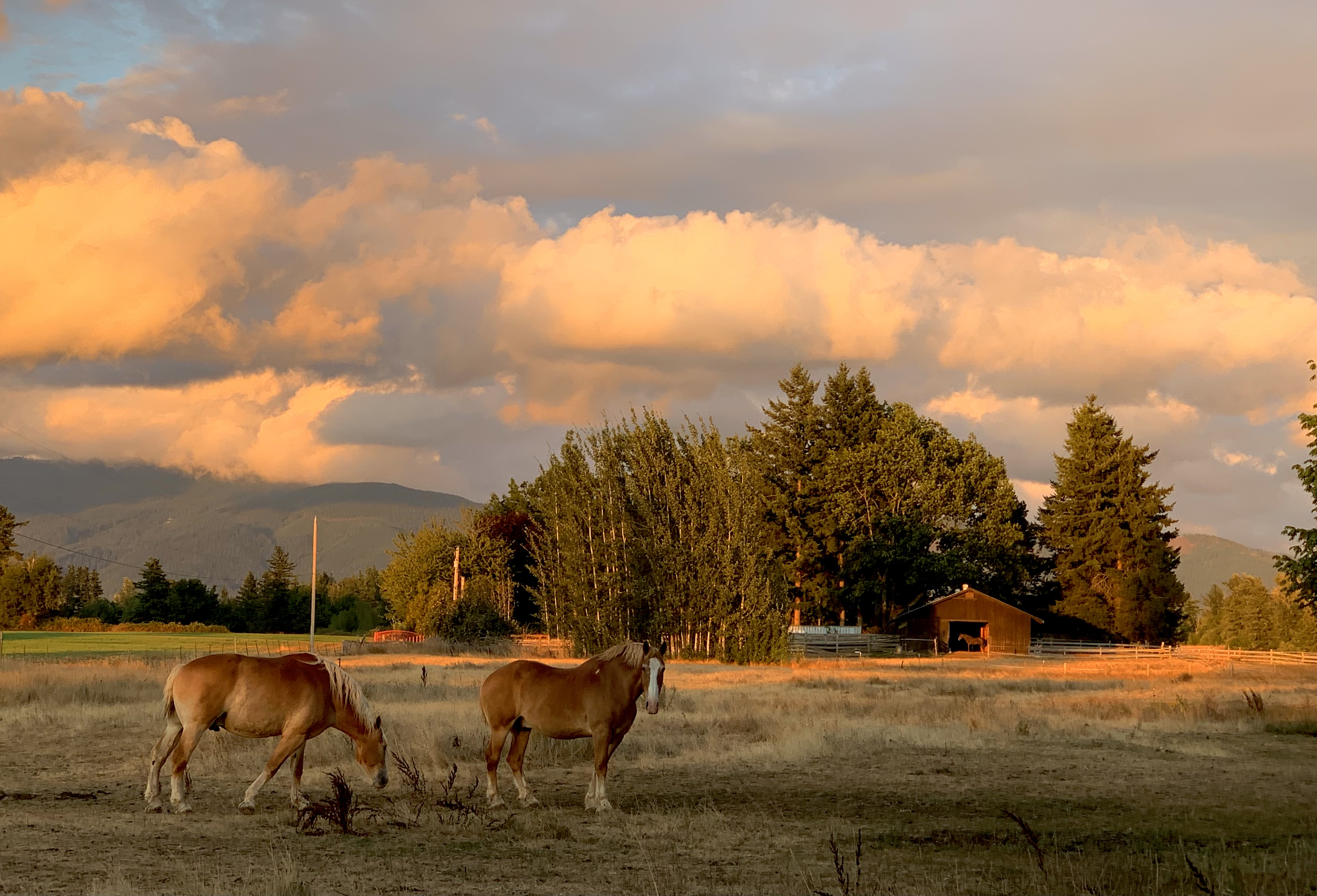
Browsing and Chewing Sweet Hay

To Bring the Horse Home…

after Philip Larkin

Is all I’ve wanted past wanting
since I was six and delirious with fever,
an infinitive forged from a night
when giant ladybugs with toothpick
antennae patrolled my wicker nightstand.
Yes, I’ve been with horses since, 
travelled illegally with them in trailers,
known certain landscapes only framed
by alert ears, and with one in particular,
spent whole afternoons with her big jaw
heavy on my shoulder. Still, I hatched
plots to bring a horse to the house, to ride 
to school, to pasture one or even three
in the garden, shaded by that decorative
willow, which could have used a purpose.
But there were city bylaws in two languages,
and over the years, a dog, stray cats,
turtles, and many fish. They lived, they died.
It wasn’t the same. Fast-forward, I brought
the baby home in a molded bucket seat, but she
lacked difference, attuned as I was, checking
her twenty-four-seven. Now that she’s 
grown, I’m reduced to walking city parks
with this corrosive envy of mounted police,
though I’m too old for the ropes test,
wouldn’t know what to do with a gun.
If there’s a second act, let me live
like the racetrack rat in a small room
up the narrow stairs from the stalls,
the horse shifting comfortably below,
browsing and chewing sweet hay.
A single bed with blanket the color
of factory-sweepings will suffice,
each day shaped to the same arc, 
because days can only end when
the lock slides free on the stall’s
Dutch door, and I lead the horse in,
then muscle the corroded bolt shut.
That’s what days are for: I cannot rest
until the horse comes home.

~Julie Bruck “To Bring the Horse Home”

photo by Breanna Randall

The best moment in the barn is in the evening just following the hay feeding, as the animals are settling down to some serious chewing. I linger in the center aisle, listening to the rhythmic sounds coming from six stalls. It is a most soothing contented cadence, first their lips picking up the grass, then the chew chew chew chew and a pause and it starts again. It’s even better in the dark, with the lights off.

I’ve enjoyed listening to the eating sounds at night from the remote vantage point of my bedroom TV monitor system set up to watch my very pregnant mares before foaling. A peculiar lullaby of sorts, strange as that seems, but when all my farm animals are chewing and happy, I am at peace and sleep better.

It reminds me of those dark deep nights of feeding my own newborns, rocking back and forth with the rhythm of their sucking. It is a moment of being completely present and peaceful, and knowing at that moment, nothing else matters–nothing else at all.

If I am very fortunate, each day I live has a rhythm that is reassuring and steady, like the sounds of hay chewing, or rocking a baby. I awake thinking about where my next step will bring me,  and then the next, like each chew of sweet hay. I try to live in each moment fully, without distraction by the worry of the unknown.

But the reality is:
life’s rhythms are often out of sync,
the cadence is jarring,
the sounds are discordant,
sometimes I’m the one being chewed on, so pain replaces peacefulness.

Maybe that is why this lullaby in the barn~~this sanctuary~~is so treasured. It brings me home to that doubting center of myself that needs reminding that pain is fleeting, and peace, however elusive now, is forever. I always know where to find it for a few minutes at the end of every day, in a pastoral symphony of sorts.

Someday my hope for heaven will be angel choruses of glorious praise, augmenting a hay-chewing lullaby.

So simple yet so grand.

One-Time
Monthly
Yearly

Make a one-time or recurring donation to support daily Barnstorming posts

Make a monthly donation

Make a yearly donation

Choose an amount

$10.00
$25.00
$50.00
$5.00
$15.00
$100.00
$5.00
$15.00
$100.00

Or enter a custom amount

$

Your contribution is deeply appreciated.

Your contribution is appreciated.

Your contribution is appreciated.

DonateDonate monthlyDonate yearly

The Humble Can Do Great Things

The essence of America, that which really unites us, is not ethnicity, or nationality or religion. It is an idea, and what an idea it is—that you can come from humble circumstances and do great things. That it doesn’t matter where you came from but where you are going.
~Condoleezza Rice

We have been preserved, these many years, in peace and prosperity. We have grown in numbers, wealth and power, as no other nation has ever grown. But we have forgotten God. We have forgotten the gracious hand which preserved us in peace, and multiplied and enriched and strengthened us; and we have vainly imagined, in the deceitfulness of our hearts, that all these blessings were produced by some superior wisdom and virtue of our own. Intoxicated with unbroken success, we have become too self sufficient to feel the necessity of redeeming and preserving Grace, too proud to pray to the God that made us!
~Abraham Lincoln from Proclamation 97 – Appointing a Day of National Humiliation, Fasting and Prayer (March 1863)

Perhaps Independence Day should actually become a day of National Humiliation, Fasting and Prayer, as Lincoln proclaimed in March 1863. Goodness knows, after all we’ve been through as a nation, the U.S.A. still struggles with understanding who we are and how to live out the brilliant idea that began our government nearly 250 years ago.

Even for those coming from the most humble of backgrounds, it is possible for any person to do great things here. The key is to never forget the blessings bestowed upon us by the courage and perseverance of our forebears. So much blood has been shed to bring us the freedoms we take for granted.

Today is a day to be grateful and prayerful, not proud. Let us not forget amid the cacophony of fireworks, the overabundant picnic food and unending parades – we the people must vow together that our unity be strengthened by single-minded commitment to peace and harmony rather than be destroyed by division and conflict.

Our God does not abandon the humble in spirit.
Let us not forget such a God.

photo by Joel DeWaard
One-Time
Monthly
Yearly

Make a one-time or recurring donation to support daily Barnstorming posts

Make a monthly donation

Make a yearly donation

Choose an amount

¤10.00
¤25.00
¤50.00
¤5.00
¤15.00
¤100.00
¤5.00
¤15.00
¤100.00

Or enter a custom amount

¤

Your contribution is deeply appreciated.

Your contribution is appreciated.

Your contribution is appreciated.

DonateDonate monthlyDonate yearly

When One’s Ramble is Over

The smell of that buttered toast simply spoke to Toad,
and with no uncertain voice;
talked of warm kitchens,
of breakfasts on bright frosty mornings,
of cozy parlour firesides on winter evenings,
when one’s ramble was over
and slippered feet were propped on the fender;
of the purring of contented cats,
and the twitter of sleepy canaries.
~Kenneth Grahame, The Wind in the Willows

I’m not a practitioner of the ancient art of aromatherapy for medicinal purposes but I do know certain smells transport me more effectively than any other mode of travel. One whiff of a familiar scent can take me back years to another decade and place, in time traveling mode. I am so in the moment, both present and past, my brain sees, hears, tastes, feels everything just as it was before.

The most vivid are kitchen smells. Cinnamon becomes my Grandma’s farm kitchen full of rising breakfast rolls, roasting turkey is my mother’s chaotic kitchen on Thanksgiving Day, fresh baked bread is my own kitchen during those years I needed to knead as therapy during medical training.

The newly born wet fur of my foals in the barn carries the sweet and sour amnion that was part of every birth I’ve been part of: delivering others and delivering my own. My heart races at the memory of the drama of those first breaths.

The garden yields its own treasure: tea roses, sweet peas, heliotrope, mint, lemon verbena take me back to lazy breezes wafting through open bedroom windows in my childhood home. And of course the richness of petrichor: the fragrance of the earth after a long awaited rain will remind me of how things smell after a dry spell.

I doubt any aromatherapy kit available would include my most favorite farm smells: newly mown hay, fresh fir shavings for stall bedding,  the mustiness of the manure pile, the green sweetness of a horses’ breath.

Someday I’ll figure out how to bottle all these up to keep forever.   Years from now my rambles will be over, when I’m too feeble to walk to the barn,  I can sit by my fireplace, close my eyes, open it up and take a whiff now and then to remind me of all I’m grateful for. 

I’ll breathe deeply of those memories that speak to me through scents — with no uncertain voice.

One-Time
Monthly
Yearly

Make a one-time or recurring donation to support daily Barnstorming posts

Make a monthly donation

Make a yearly donation

Choose an amount

¤10.00
¤20.00
¤50.00
¤5.00
¤15.00
¤100.00
¤5.00
¤15.00
¤100.00

Or enter a custom amount

¤

Your contribution is deeply appreciated.

Your contribution is appreciated.

Your contribution is appreciated.

DonateDonate monthlyDonate yearly

Collecting Slants of Light

I like the slants of light; I’m a collector.
That’s a good one, I say…
~Annie Dillard from Pilgrim at Tinker Creek

How valuable it is in these short days,
threading through empty maple branches,
the lacy-needled sugar pines.

 
Its glint off sheets of ice tells the story
of Death’s brightness, her bitter cold.

 
We can make do with so little, just the hint
of warmth, the slanted light.
..
~Molly Fisk, “Winter Sun” from 
The More Difficult Beauty

There’s a certain Slant of light
On winter afternoons —
That oppresses, like the Heft
of cathedral tunes.
When it comes, the Landscape listens —
Shadows hold their breath —
When it goes, ’tis like the Distance
On the look of Death.
~Emily Dickinson

During our northwest winters, there is usually so little sunlight on gray cloudy days that I routinely turn on the two light bulbs in the big hay barn any time I need to fetch hay bales for the horses. This is so I avoid falling into the holes that inevitably develop in the hay stack between bales. Winter murky lighting tends to hide the dark shadows of the leg-swallowing pits among the bales, something that is particularly hazardous when attempting to move a 60 pound hay bale.

Yesterday when I went to grab hay bales for the horses at sunset, before I flipped the light switch, I could see light already blazing in the big barn. The last of the day’s sun rays were at a precise winter slant, streaming through the barn slat openings, ricocheting off the roof timbers onto the bales, casting an almost fiery glow onto the hay. The barn was ignited and ablaze without fire and smoke — the last things one would ever want in a hay barn.

Thanks to late afternoon winter light, I could scramble among the bales without worry.

It seems as I age I have been running into more dark holes. Even when I know where they lie and how deep they are, some days I will manage to step right in anyway. Each time it knocks the breath out of me, makes me cry out, makes me want to quit trying to lift the loads which need carrying. It leaves me fearful to venture where the footing is uncertain.

Then, on the darkest of days, light comes from the most unexpected of places, blazing a trail to help me see where to step, what to avoid, how to navigate the hazards to avoid collapsing on my face. I’m redirected, inspired anew, granted grace, gratefully calmed and comforted amid my fears. Even though the light fades, and the darkness descends again, it is only until tomorrow. Then it reignites again.

Yet another slant of light for my collection…

The Light always returns so I can climb out of any dark holes that want to swallow me whole.

Tell all the truth but tell it slant —
Success in Circuit lies
Too bright for our infirm Delight
The Truth’s superb surprise
As Lightning to the Children eased
With explanation kind
The Truth must dazzle gradually
Or every man be blind —
~Emily Dickinson

One-Time
Monthly
Yearly

Make a one-time or recurring donation to support daily Barnstorming posts

Make a monthly donation

Make a yearly donation

Choose an amount

¤10.00
¤20.00
¤50.00
¤5.00
¤15.00
¤100.00
¤5.00
¤15.00
¤100.00

Or enter a custom amount

¤

Your contribution is deeply appreciated.

Your contribution is appreciated.

Your contribution is appreciated.

DonateDonate monthlyDonate yearly

Tenderness for Ordinary Things

Last evening,
As I drove into this small valley,
I saw a low-hanging cloud
Wandering through the trees.
It circled like a school of fish
Around the dun-colored hay bales.
Reaching out its foggy hands
To stroke the legs of a perfect doe
Quietly grazing in a neighbor’s mule pasture
I stopped the car
And stepping out into the blue twilight,
A wet mist brushed my face,
And then it was gone.
It was not unfriendly,
But it was not inclined to tell its secrets.
I am in love with the untamed things,
The cloud, the doe,
Water, air and light.
I am filled with such tenderness
For ordinary things:
The practical mule, the pasture,
A perfect spiral of gathered hay.
And although I should not be,
Consistent as it is,
I am always surprised
By the way my heart will open
So completely and unexpectedly,
With a rush and an ache,
Like a sip of cold water
On a tender tooth.
~Carrie Newcomer “In the Hayfield”

I realize that nothing in this life is actually ordinary – at times I could weep over the unordinariness that is around me.

The light falls a certain way, the colors astound, the animals grace the fields with their contentment, the birds become overture, the air is perfumed with rain or blossom.

How can I not ache with this knowledge? How can I not feel the tenderness of my heart feeling so full, it could burst at any moment?

Truly extraordinary to be able to give myself over to this.

Light pools like spilled water on the floor
Cold air slips like silk beneath the door
The sky feels like a grey wool cap
Pulled down round my ears that near

All the ridge is lined with stands of beech
At the tops they’re swaying quietly
So elegant and raw without their leaves
All of these I see

I catch a memory a scent another short glimpse
Like someone leaned over and gave my forehead a kiss
I give myself to this

There’s a hidden spring back where it’s hard to find
Someone used it years ago to make moonshine
This forest has a different sense of time
Than yours or mine

I catch a memory a scent another short glimpse
Like someone leaned over and gave my forehead a kiss
I give myself to this

There’s a soil horizon
Layers beneath the trees
A sign of outward grace
Unraveling

One bird sits and sings an aching song
One turning leaf, ten circles on the pond
Two careful does wait silently beyond
Then they’re gone they’re gone

I catch a memory a scent another short glimpse
Like someone leaned over and gave my forehead a kiss
I give myself to this
~Carrie Newcomer

One-Time
Monthly
Yearly

Make a one-time or recurring donation to support daily Barnstorming posts

Make a monthly donation

Make a yearly donation

Choose an amount

¤10.00
¤20.00
¤50.00
¤5.00
¤15.00
¤100.00
¤5.00
¤15.00
¤100.00

Or enter a custom amount

¤

Your contribution is deeply appreciated.

Your contribution is appreciated.

Your contribution is appreciated.

DonateDonate monthlyDonate yearly

So Much to Remember

The partly open hay barn door, white frame around the darkness,
the broken board, small enough for a child
to slip through.

Walking in the cornfields in late July, green tassels overhead,
the slap of flat leaves as we pass, silent
and invisible from any road.

Hollyhocks leaning against the stucco house, peonies heavy
as fruit, drooping their deep heads
on the dog house roof.

Lilac bushes between the lawn and the woods,
a tractor shifting from one gear into
the next, the throttle opened,

the smell of cut hay, rain coming across the river,
the drone of the hammer mill,
milk machines at dawn.

~Joyce Sutphen, “The Last Things I’ll Remember” from First Words

There are so many memories we keep stored in our neurons; some we revisit regularly through reminiscing, day dreams, night dreams or story telling. Other memories remain buried and untouched. I like to think the last things we remember are those we return to again and again, unlocked by a smell, a taste, or a music passage. Even those with the worst memory loss can sometimes sing a hymn or recite a poem or verse of scripture without hesitation.

Thanks to our Creator, we each have a reservoir of vivid memories we can draw from during the driest and darkest moments of our lives. When we are lost and discouraged, they will take us home again.

One-Time
Monthly
Yearly

Make a one-time or recurring donation
to support daily Barnstorming posts

Make a monthly donation

Make a yearly donation

Choose an amount

¤5.00
¤10.00
¤20.00
¤5.00
¤15.00
¤100.00
¤5.00
¤15.00
¤100.00

Or enter a custom amount

¤

Your contribution is deeply appreciated.

Your contribution is appreciated.

Your contribution is appreciated.

DonateDonate monthlyDonate yearly

Radical Gratitude

There is always an enormous temptation in all of life to diddle around making itsy-bitsy friends and meals and journeys for itsy-bitsy years on end. It is so self-conscious, so apparently moral, simply to step aside from the gaps where the creeks and winds pour down, saying, I never merited this grace, quite rightly, and then to sulk along the rest of your days on the edge of rage.

I won’t have it. The world is wilder than that in all directions, more dangerous and bitter, more extravagant and bright.

We are making hay when we should be making whoopee;
we are raising tomatoes when we should be raising Cain,
or Lazarus.
~Annie Dillard from Pilgrim at Tinker Creek

Other than a few exceptional circumstances in my life, I have always played it safe: a down-home, don’t rock the boat, work hard and live-a-quiet-life kind of person. My grandparents lived that way, my parents lived that way so I feel like it is bound in the twists and turns of my DNA.

Even so, I do know a thing or two about sulking on the edge of rage, lost in a morass of seething bitterness about the state of the world.  Yet if I were honest about it, my discontent is all about me, always about me. I want to have accomplished more to deserve taking up space in my days on earth.

But that’s a problem we all have, isn’t it? We’re never worthy of such unmerited grace as has been shown to us.  It is such a pure Gift I wait for, borne out of God’s radical sacrifice that warrants from me a life of radical gratitude, even when I choose to live it out a little quietly, making hay and raising tomatoes.

One-Time
Monthly
Yearly

Make a one-time or recurring donation to support daily Barnstorming posts

Make a monthly donation

Make a yearly donation

Choose an amount

¤5.00
¤10.00
¤20.00
¤5.00
¤15.00
¤100.00
¤5.00
¤15.00
¤100.00

Or enter a custom amount

¤

Your contribution is deeply appreciated.

Your contribution is appreciated.

Your contribution is appreciated.

DonateDonate monthlyDonate yearly

The Heart’s Need

About living in the country?
…peace can deafen one, beauty surprise
No longer.  There is only the thud
Of the slow foot up the long lane
At morning and back at night.
~R.S. Thomas from “The Country”

…once when he was walking
Along a lane in spring he was deceived
By a shrill whistle coming through the leaves;
Wait a minute, wait a minute-four swift notes;
He turned, and it was nothing, only a Thrush
In the thorn bushes easing its throat.
He swore at himself for paying heed,
The poor hill farmer, so often again
Stopping, staring, listening, in vain,
His ear betrayed by the heart’s need.
~R.S.Thomas from “The Lonely Farmer”

I must not forget my heart’s need:
my utter astonishment
at the beauty around me
even on the hottest and sweatiest of days,
even on the grayest and wettest of days,
while trudging the darkened barnyard path
to attend, although weary, to chores.

If ever I fail to see
what is right in front of me,
this grace-given gift
to my eyes and ears and heart,
I do not deserve to put on boots
or hold a pitchfork.

Farmer with a pitchfork by Winslow Homer

He knows every stone that’s been struck by the plow
There’s a pile by the barn by the sweat of his brow
The land has his heart and he rarely complains
And it holds his knees when he prays for rain

He’s a dusty old carhartt and the light in the barn
He’ll work the late hours and he’s up before dawn
Every man has a story and the story goes on
From grandad’s eyes to a new born son

Why I farm is in my blood, like the sunlight is on my skin
Is who I meant to be, is who I’ve always been
Is more than just a living, it’s my way of life
And it grows like seed inside my heart
That’s why I farm

We always pull through when we thought we would break
In the flood ’93, in the draught ’88
The Lord has his timing ’cause only he knows
That when next year comes the crops will grow
Find more lyrics at 

Tough the world may shake around me, still I am stable
For as long as I am able, I’ll work this way
‘Cause when heaven comes this close to what you’re holding
This life is but a moment in a bigger plan
~The Henningsens

One-Time
Monthly
Yearly

Make a one-time or recurring donation to support daily Barnstorming posts

Make a monthly donation

Make a yearly donation

Choose an amount

¤5.00
¤10.00
¤20.00
¤5.00
¤15.00
¤100.00
¤5.00
¤15.00
¤100.00

Or enter a custom amount

¤

Your contribution is deeply appreciated.

Your contribution is appreciated.

Your contribution is appreciated.

DonateDonate monthlyDonate yearly

Summer Nap

In the afternoon of summer, sounds
come through the window: a tractor
muttering to itself as it

Pivots at the corner of the
hay field, stalled for a moment
as the green row feeds into the baler.

The wind slips a whisper behind
an ear; the noise of the highway
is like the dark green stem of a rose.

From the kitchen the blunt banging
of cupboard doors and wooden chairs
makes a lonely echo in the floor.

Somewhere, between the breeze
and the faraway sound of a train,
comes a line of birdsong, lightly
threading the heavy cloth of dream.

~Joyce Sutphen, “Soundings” from Naming the Stars

As a young child, I remember waking from my summer afternoon naps to the sights and sounds of our rural community. I could hear tractors working fields in the distance, farm trucks rumbling by on the road, the cows and horses in the fields, a train whistle in the distance and the ever-present birdsong from dawn to dusk.

These were the sounds of contentment and productivity, both together. Surely this is how heaven must be: always a sense of something wonderful happening, always a reason to celebrate, always a profound sense of respite and sanctuary.

Even now, there is that moment of awakening of my heart and soul from a summer nap when I try to listen for the chorus of angels outside my open window.

photo by Harry Rodenberger

One-Time
Monthly
Yearly

Make a one-time or recurring donation to support daily Barnstorming posts

Make a monthly donation

Make a yearly donation

Choose an amount

¤5.00
¤10.00
¤20.00
¤5.00
¤15.00
¤100.00
¤5.00
¤15.00
¤100.00

Or enter a custom amount

¤

Your contribution is deeply appreciated.

Your contribution is appreciated.

Your contribution is appreciated.

DonateDonate monthlyDonate yearly

In a Cloud of Gold

Photo of Aaron Janicki haying with his Oberlander team in Skagit County courtesy of Tayler Rae
Benjamin Janicki of Sedro Woolley raking hay with his team of Oberlanders

Travel as a backward step.
You journey until you find
a meadow where wildflowers
grow with pre-factory-farming
copiousness, a horse-drawn
landscape where hay is saved
in older ways, to revive
the life you lived once,
catch up with your past.
~Dennis O’Driscoll from Time Pieces (2002)

… The Amish have maintained what I like to think is a proper scale, largely by staying with the horse. The horse has restricted unlimited expansion. Not only does working with horses limit farm size, but horses are ideally suited to family life. With horses you unhitch at noon to water and feed the teams and then the family eats what we still call dinner. While the teams rest there is usually time for a short nap. And because God didn’t create the horse with headlights, we don’t work nights.
Amish farmer David Kline in Great Possessions

photo by Tayler Rae

One evening I stopped by the field to watch the hay rake
drawn toward me by two black, tall, ponderous horses
who stepped like conquerors over the fallen oat stalks,
light-shot dust at their heels, long shadows before them.
At the ditch the driver turned back in a wide arc,
the off-horse scrambling, the near-horse pivoting neatly.
The big side-delivery rake came about with a shriek—
its tines were crashing, the iron-bound tongue groaned aloud—
then, Hup, Diamond! Hup, Duke! and they set off west,
trace-deep in dust, going straight into the low sun.

The clangor grew faint, distance and light consumed them;
a fiery chariot rolled away in a cloud of gold
and faded slowly, brightness dying into brightness.
The groaning iron, the prophesying wheels,
the mighty horses with their necks like storms—
all disappeared; nothing was left but a track
of dust that climbed like smoke up the evening wind.

~Kate Barnes “The Hay Rake” from Where the Deer Are

My grandparents owned the land,
worked the land, bound
to the earth by seasons of planting
and harvest.

They watched the sky, the habits
of birds, hues of sunset,
the moods of moon and clouds,
the disposition of air.
They inhaled the coming season,
let it brighten their blood
for the work ahead.

Soil sifted through their fingers
imbedded beneath their nails
and this is what they knew;
this rhythm circling the years.
They never left their land;
each in their own time
settled deeper.
~Lois Parker Edstrom “Almanac” from Night Beyond Black.

Nearing 68, I am old enough to have parents who both grew up on farms worked by horses, one raising wheat and lentils in the Palouse country of eastern Washington and the other logging in the woodlands of Fidalgo Island of western Washington.  The horses were crucial to my grandfathers’ success in caring for and tilling the land, seeding and harvesting the crops and bringing supplies from town miles away.  Theirs was a hardscrabble life in the early 20th century with few conveniences.  Work was year round from dawn to dusk; caring for the animals came before any human comforts.  Once night fell, work ceased and sleep was welcome respite for man and beast.

In the rural countryside where we live now, we’ve been fortunate enough to know people who still dabble in horse farming, whose draft teams are hitched to plows and mowers and manure spreaders as they head out to the fields to recapture the past.  Watching a good team work with no diesel motor running means hearing bird calls from the field, the steady footfall of the horses, the harness chains jingling, the leather straps creaking, the machinery shushing quietly as gears turn and grass lays over in submission.  No ear protection is needed.  There is no clock needed to pace the day.   There is a rhythm of nurture when animals instead of engines are part of the work day.   The gauge for taking a break is the amount of foamy sweat on the horses and how fast they are breathing. It is time to stop and take a breather, it is time to start back up do a few more rows, it is time to water, it is time for a meal, it is time for a nap, it is time for a rest in a shady spot.  This is gentle use of the land with four footed stewards who deposit right back to the soil the digested forage they have eaten only hours before.

Our modern agribusiness megafarm fossil-fuel-powered approach to food production has bypassed the small family farm which was so dependent on the muscle power of humans and animals.  In our move away from horses worked by skilled teamsters,  what has been gained in high production values has meant loss of self-sufficiency and dedicated stewardship of a particular plot of ground.  Draft breeds, including the Haflinger horses we raise, now are bred for higher energy with lighter refined bone structure meant more for eye appeal and floating movement,  rather than the sturdy conformation and unflappable low maintenance mindset needed for pulling work.   Modern children are bred for different purpose as well, no longer raised to work together with other family members for a common purpose of daily survival.   Their focus at school is waning as they have no morning farm chores when they get up, too little physical work to do before they arrive at their desks in the morning.   Their physical energy, if directed at all,  is directed to competitive sports, engaged in fantasy combat rather than winning a very real victory over hunger.

I am encouraged when young people still reach for horse collars and bridles, hitch up their horses and do the work as it used to be done.   All is not lost if we can still make incremental daily progress,  harnessed together as a team with our horses, tilling for truth and harvesting hope.

photo by Joel DeWaard


I like farming. I like the work. I like the livestock and the pastures and the woods.  It’s not necessarily a good living, but it’s a good life.  I now suspect that if we work with machines the world will seem to us to be a machine, but if we work with living creatures the world will appear to us as a living creature.  That’s what I’ve spent my life doing, trying to create an authentic grounds for hope. ~Wendell Berry, horse farmer, essayist, poet, professor

One-Time
Monthly
Yearly

Make a one-time or recurring donation to support daily Barnstorming posts

Make a monthly donation

Make a yearly donation

Choose an amount

¤5.00
¤10.00
¤20.00
¤5.00
¤15.00
¤100.00
¤5.00
¤15.00
¤100.00

Or enter a custom amount

¤

Your contribution is deeply appreciated.

Your contribution is appreciated.

Your contribution is appreciated.

DonateDonate monthlyDonate yearly