Lord of the Pots and Pans and Things

Lord of the pots and pans and things,
since I’ve no time to be
a saint by doing lovely things,
or watching late with thee,
or dreaming in the dawnlight,
or storming heaven’s gates…
make me a saint by getting meals
and washing up the plates.
Thou who didst love to give men food
in room or by the sea,
accept this service that I do—
I do it unto thee.
~ Brother Lawrence from Practicing the Presence of God

Wash the plate not because it is dirty nor because you are told to wash it, but because you love the person who will use it next. 
~St. Teresa of Calcutta

Even the mundane task of washing dishes by hand is an example of the small tasks and personal activities that once filled people’s daily lives with a sense of achievement.
~B.F. Skinner, behavioral psychologist

She rarely made us do it—
we’d clear the table instead—so my sister and I teased
that some day we’d train our children right
and not end up like her, after every meal stuck
with red knuckles, a bleached rag to wipe and wring.

The one chore she spared us: gummy plates
in water greasy and swirling with sloughed peas,
globs of egg and gravy.
Or did she guard her place
at the window? Not wanting to give up the gloss
of the magnolia, the school traffic humming.
Sunset, finches at the feeder. First sightings
of the mail truck at the curb, just after noon,
delivering a note, a card, the least bit of news.
~Susan Meyers “Mother, Washing Dishes”

My thoughts went round and round and it occurred to me that if I ever wrote a novel it would be of the ‘stream of consciousness’ type and deal with an hour in the life of a woman at the sink.

….I had to admit that nobody had compelled me to wash these dishes or to tidy this kitchen. It was the fussy spinster in me, the Martha who could not comfortably sit and make conversation when she knew that yesterday’s unwashed dishes were still in the sink.
~Barbara Pym from Excellent Women

I trace the struggling relationships and estrangements in the American family to the invention of the automatic dishwasher.

I have proof…

What happened to the necessary cooperation of a human dishwasher with two hands full of wash cloth and scrubber, having to get along with a dish dryer armed with a towel?

Where is the list on the refrigerator of whose turn is next, and the accountability if a family member somehow shirks their washing/drying responsibility and leaves the dishes to the next day?

No longer do family members have to cooperate in real time to scrub clean glasses, dishes and utensils, put them in the dish rack, dry them one by one and place them in the cupboard where they belong.

If the human dishwasher isn’t doing a proper job, the human dryer immediately takes note and recycles the dirty dish right back to the sink.

Instant accountability.

I always preferred to be the dryer. If I washed, and my sister dried, we’d never get done. She would keep recycling the dishes back for another going-over.

And so my messy nature was exposed.

Family conversations started over a meal often continue over the clean-up process while concentrating on whether a smudge is permanent or not. I learned some important facts of life while washing and drying dishes that I might not have learned otherwise. Sensitive topics tend to be easier to discuss when elbow deep in soap suds. Spelling and vocabulary and math fact drills are more effective when the penalty for a missed word or equation is a snap on the butt with a dish towel.

Our church hosts weekly Sunday evening potluck meals for 50-60 people after our evening worship service; we are committed to using real dishes, glasses and utensils rather than add to landfills with throwaways. There is no automatic dishwasher in our fellowship hall other than whoever stands up and heads to the sink first. There is no assigned duty list. Sometimes it takes a teetering stack of dishes to motivate the initiation of the wash/dry process. Sometimes there is an eager-beaver volunteer ready to wash as soon as the dirty dishes start to appear. Once the washing starts, there is always someone ready to dry, another someone ready to put things away and another someone to wipe down the tables, all having the best of conversations in the process.

It is cooperation in action, yet another example of how we all “pitch in” for the benefit and love of others.

So modern society is missing this best opportunity for daily family-together cooperation time. Forget family “game” night, or parental “date” night, or even vacations. Dish washing and drying at the sink takes care of all those times when families need to be communicating, all while coordinating efforts to clean, sort and organize.

It is time to treat the automatic dishwasher as simply another storage cupboard; instead pull out the brillo pads, the white cotton dishtowels and the plastic drainage dish rack.

Let’s start tonight.

And I think it is your turn first…

Holy as a day is spent
Holy is the dish and drain
The soap and sink, and the cup and plate
And the warm wool socks, and the cold white tile
Shower heads and good dry towels
And frying eggs sound like psalms
With bits of salt measured in my palm
It’s all a part of a sacrament
As holy as a day is spent


Holy is the familiar room
And quiet moments in the afternoon
And folding sheets like folding hands
To pray as only laundry can
I’m letting go of all my fear
Like autumn leaves made of earth and air
For the summer came and the summer went
As holy as a day is spent


Holy is the place I stand
To give whatever small good I can
And the empty page, and the open book
Redemption everywhere I look
Unknowingly we slow our pace
In the shade of unexpected grace
And with grateful smiles and sad lament
As holy as a day is spent
And morning light sings ‘providence’
As holy as a day is spent
~Carrie Newcomer “Holy as a Day Is Spent “

Bring to Light the Mystery: That Patch of Sunlight

It appears now that there is only one
age and it knows
nothing of age as the flying birds know
nothing of the air they are flying through
or of the day that bears them up
through themselves
and I am a child before there are words
arms are holding me up in a shadow
voices murmur in a shadow
as I watch one patch of sunlight moving
across the green carpet
in a building
gone long ago and all the voices
silent and each word they said in that time
silent now
while I go on seeing that patch of sunlight

~W.S. Merwin, “Still Morning” from The Shadow of Sirius

photo by Barbara Hoelle

Our memories can play tricks.

Just a whiff of a fragrance can trigger an experience of another time and place, a song can transport us to a decade long ago, a momentary sensation will remind us of a past experience long forgotten.

We dwell inside a different age as the years go by, in a body that no longer looks or feels exactly the same, yet our memories take us powerfully back to a special moment that happened before.

For those who struggle with post-trauma recollections, this is a curse to be overcome. For those whose memories bring joy and comfort, they seek to nurture and cherish what has been as if it is still here and now.

Let us remember the Light, just as the poet W.S. Merwin in this poem “Still Morning” remembers the moment of his baptism in a church long gone and whose voices are long since stilled. The Light of that day remains, as fresh today as it was when it moved toward him.

Our memories aren’t tricks, and neither is the Light that shone on us. They sustain us in the here and now.

Our Savior: an ever-moving patch of Light in our lives –
forever radiant.

This year’s Barnstorming Lenten theme is Ephesians 3:9:

…to bring to light for everyone what is the plan of the mystery hidden for ages in God, who created all things…

TEXT
O nata lux de lumine,
Jesu redemptor saeculi,
Dignare clemens supplicum
Laudes precesque sumere.

Qui carne quondam contegi
Dignatus es pro perditis,
Nos membra confer effici
Tui beati corporis.

TRANSLATION
O Light born of Light,
Jesus, redeemer of the world,
Mercifully deign to accept
The praises and prayers of your suppliants.

O you who once deigned to be hidden in flesh
For the sake of the lost,
Grant us to be made members
Of your blessed body.

Where Spirit Meets the Bone

The mail truck goes down the coast
Carrying a single letter.
At the end of a long pier
The bored seagull lifts a leg now and then
And forgets to put it down.

There is a menace in the air
Of tragedies in the making.
Last night you thought you heard television
In the house next door.
You were sure it was some new
Horror they were reporting,
So you went out to find out.
Barefoot, wearing just shorts.
It was only the sea sounding weary
After so many lifetimes
Of pretending to be rushing off somewhere
And never getting anywhere
.

This morning, it felt like Sunday.
The heavens did their part
By casting no shadow along the boardwalk
Or the row of vacant cottages,
Among them a small church
With a dozen gray tombstones huddled close
As if they, too, had the shivers.
~Charles Simic “Late September” from The Voice at 3:00 a.m.: Selected Late and New Poems 

Have compassion for everyone you meet,
even if they don’t want it. What seems conceit, 

bad manners, or cynicism is always a sign 
of things no ears have heard, no eyes have seen.
You do not know what wars are going on
down there where the spirit meets the bone.

~Miller Williams “Compassion” from The Ways We Touch: Poems

Christians are called by God to be living
so sacrificially and beautifully that the people around us, 
who don’t believe what we believe,
will soon be unable to imagine the world without us.
~Pastor Tim Keller

As we walk this life of trouble and suffering,
this Jericho Road together,
we cannot pass by the brother, the sister, the child
who lies dying in the ditch.

We must stop and help.
We cannot turn away from others’ suffering.

By mere circumstances of our place of birth,
it could be you or me there
bleeding, beaten, abandoned
until Someone, journeying along that road,
comes looking for us.

He was sent to take our place,
as Substitution
so we can get up,
cared for, loved,
made whole again,
and walk Home.

Maranatha.

Yet Another Ode to Potlucks

I wonder more and more if the first thing shouldn’t be to know people by name, to eat and drink with them, to listen to their stories and tell your own, and to let them know with words, handshakes, and hugs that you do not simply like them, but truly love them.

It is a privilege to have the time to practice this simple ministry of presence.
~Henri Nouwen from The Practice of the Presence of God

The church, I think, is God’s way of saying,
“What I have in the pot is yours,
and what I have is a group of misfits
whom you need more than you know
and who need you more than they know.” 

“Take, and eat,” he says,
“and take, and eat,
until the day, and it is coming,
that you knock on my door.
I will open it, and you will see me face to face.”

He is preparing a table.
He will welcome us in.
Jesus will be there, smiling and holy,
holding out a green bean casserole.
And at that moment, what we say, what we think, and what we believe will be the same:
“I didn’t know how badly I needed this.”
~Jeremy Clive Huggins from “The Church Potluck”

We celebrate end of winter’s overlong stay,
And find a respite from embittered mood,
Ignore our sagging incomes for a day,
With shared potluck communion of comfort food.

Beef stew stocked with veggies and potatoes,
Drizzled bread cubes over macaroni and cheese,
Salted nachos dotted with ripened tomatoes,
Meat loaf topped with ketchup please.

Home made bread from the oven, steaming and soft
Fresh hot chocolate and coffee provide reason to stay,
Remember the smell of shared food will lazily waft
So welcome and hardy with no debt to pay.

When the job is lost or the family is sour,
Too many nights lonely and aching in pain,
Fellowship together for only an hour,
Nurtured and nourished, is never in vain.

Once gratefully finishing up the last crumb,
When life’s feast is done, the journey’s end near
Hang on to your fork awaiting dessert that’s to come
Instead of clinging to worry and unknown fear.

Keep your fork when uncertain about what comes tomorrow
It will remind you of what you can not yet see;
The meal’s not quite over, there’ll be sweetness, not sorrow:
We’ll celebrate together, the best is yet to be.

AI image created for this post

Stained Glass

People are like stained-glass windows.
They sparkle and shine when the sun is out,
but when the darkness sets in,
their true beauty is revealed only if there is a light from within.
~ Elisabeth Kübler
Ross

Photo from http://www.fumcoly.org

The Methodist church of my childhood had a sanctuary lined by colorful rectangles of stained glass windows. Each church member had an opportunity to choose and place a colored pane matching his or her stage of life, to become a permanent part of the portrait of a diverse church family. Mosaics of colored sections represented the transition through life, moving from childhood in the windows at the entrance, on to adolescence,  then to young adulthood, moving to middle age, and then finally to the elder years nearest the altar.

Rainbows of color crisscrossed the pews and aisles, starting with pale and barely defined green and yellow at the outset, blending into a blossom of blue, then becoming a startling fervor of red,  fading into a tranquil purple past the center, and lastly immersed in the warmth of orange as one approached the brown of the wood paneled altar. 

Depending on where one chose to sit, the light bearing a particular color combination was cast on open pages of scripture, or favorite hymns, or on the skin and clothing of the people,  reflecting the essence of that life phase. 

Included in the design was the seemingly random but intentional scattering of all of the colors in each panel. Gold and orange panes were sprinkled in the “youth” window predicting the wisdom to come, and a smattering of some greens, blues and reds were found throughout the “orange” window of old age,  just like the “spark”  of younger years so often seen in the eyes of the our eldest citizens.

The colored windows reflected the truth of God’s plan for our lives. There was certainty in the unrelenting passage of time; there was no turning back or turning away from what was to come. 

Although each stage shone with its own unique beauty,  none was as warm and welcoming as the fiery glow of the autumn of life. Those final windows focused their brilliance on the plain wood of the cross above the altar.

Beyond the stained glass,
as life fades from the richest of colors
to the earthy tones of dusty frames,
the kaleidoscope of God’s illumination
continues to shine, glorious.

Photo from http://www.fumcoly.org
AI image created for this post

We are like windows
Stained with colors of the rainbow
Set in a darkened room
Till the bridegroom comes to shining through

Then the colors fall around our feet
Over those we meet
Covering all the gray that we see
Rainbow colors of assorted hues
Come exchange your blues
For His love that you see shining through me

We are His daughters and sons
We are the colorful ones
We are the kids of the King
Rejoice in everything

My colors grow so dim
When I start to fall away from Him
But up comes the strongest wind
That he sends to blow me back into his arms again

And then the colors fall around my feet
Over those I meet
Changing all the gray that I see
Rainbow colors of the Risen Son
Reflect the One
The One who came to set us all free

We are His daughters and sons
We are the colorful ones
We are the kids of the King
Rejoice in everything

We are like windows
Stained with colors of the rainbow
No longer set in a darkened room
Cause the bridegroom wants to shine from you

No longer set in a darkened room
Cause the bridegroom wants to shine from you

Lyrics by Keith Green

Where You Go, I Will Go: Comfort Food and Clean Up

The church, I think, is God’s way of saying,
“What I have in the pot is yours,
and what I have is a group of misfits
whom you need more than you know
and who need you more than they know.” 

“Take, and eat,” he says,
“and take, and eat,
until the day, and it is coming,
that you knock on my door.
I will open it, and you will see me face to face.”

He is preparing a table.
He will welcome us in.
Jesus will be there, smiling and holy,
holding out a green bean casserole.
And at that moment, what we say, what we think, and what we believe will be the same:
“I didn’t know how badly I needed this.”
~Jeremy Clive Huggins from “The Church Potluck”

“When someone invites you to a wedding feast, do not take the place of honor, for a person more distinguished than you may have been invited. If so, the host who invited both of you will come and say to you, ‘Give this person your seat.’ Then, humiliated, you will have to take the least important place. 10 But when you are invited, take the lowest place, so that when your host comes, he will say to you, ‘Friend, move up to a better place.’ Then you will be honored in the presence of all the other guests. 11 For all those who exalt themselves will be humbled, and those who humble themselves will be exalted.”

“When you give a luncheon or dinner, do not invite your friends, your brothers or sisters, your relatives, or your rich neighbors; if you do, they may invite you back and so you will be repaid. 13 But when you give a banquet, invite the poor, the crippled, the lame, the blind, 14 and you will be blessed. Although they cannot repay you, you will be repaid at the resurrection of the righteous.”
Luke 14: 7-14

In the unspoken hierarchy of what makes a church function, I’m a kitchen lady and always will be.  I remember those very women from my childhood church of the fifties and sixties– their tight-knit ability to function as if one organism, swarming in aprons among tables set up in the fellowship hall and bustling around in the back by the stoves with steaming pots and pans and the occasionally dropped plate.

They kept the rest of us alive, those church ladies, by feeding us efficiently and plentifully and never ever sitting down.  I would occasionally see them eating standing up in the back of the hall, chatting amiably among themselves after the rest of us were served, but I knew they carefully wrapped up the leftovers during the clean up to deliver to shut-ins who couldn’t make it to the church supper.

I knew I was destined to become a kitchen lady, shy and introverted as I am, hiding myself behind huge plates of food and piles of dish cloths. Our church potlucks together every Sunday after our evening worship. For me, it is a welcoming place of comfort and clean up filled with plenty of leftovers for anyone who needs them.

That perfectly describes the kingdom of God in my book and His Book.

AI image created for this post

This year’s Lenten theme:

…where you go I will go…
Ruth 1:16

Wrestling and Torn Open

Schizomeno—meaning in Greek “ripped open.” It occurs twice in the Gospels: once when the temple veil is torn the day of Christ’s crucifixion. The other is when “the heavens opened” upon Christ’s baptism.

But they didn’t just “open.” They were ripped open. God broke into history with a voice and an act of salvation unlike any other. 

To study the Bible with people of faith is to see it not only as an object of academic or antiquarian interest but also as a living word, a source of intellectual challenge, inspiration, comfort, uncomfortable ambiguities, and endless insights for people who gather in willingness to accept what seems to be God’s invitation: Wrestle with this.

Healthy churches wrestle, working out their salvation over coffee and concordances, knowing there is nothing pat or simple about the living Word, but that it invites us into subtle, supple, resilient relationship with the Word made flesh who dwells, still, among us.
~Marilyn McEntyre from “Choosing Church”

Passing down this story of Christ’s life, death, resurrection and ascension is not merely, or mainly, an exercise in cognition. Nor is it a divinely inspired game of telephone, where we simply whisper a message to the next generation through the ages. 

Inevitably the story comes to us through ordinary people over dinner tables, at work, in songs, through worship, conflict, failure, repentance, ritual, liturgy, art, work and family.

Christianity is something we believe, but it is also a practice. Central to our practice is what Christians call sacraments, where the mysteries of faith are manifest through the ordinary stuff of earth—water and skin, bread and teeth.
~Tish Harrison Warren from “True Story”

photo by Barb Hoelle

Mom,
You raised your hands while we sang this morning
like I’ve never known you to,
but I guess until recently I’ve never really known you in a church that let you feel alive.

I’m sure the last one did before it faded,
but I was too young to distinguish church from habitual gathering
and they wouldn’t have taught me grace if they’d wanted to,

and that was before I cracked our lives apart.

But it was then, wasn’t it, in the aftermath,
that I saw more of your layers
and saw that they were tapestries,
punctured a thousand times and intricate,
majestic, though they’ve been torn.

Were you tired of hiding,
or just tired?

Thank you for letting yourself be seen.

Thank you, Lord, for her.
~Griffin Messer  “An Analysis of Worship Today”

Ripped open to allow access – that is what God has done to enter into this ordinary stuff of earth, and giving us access to Him.

I enter the church sanctuary twice every Sunday to be reminded of this struggle:
a wrestling match
with ourselves,
with each other,
with everyday ordinary and ornery stuff,
with the living Word of God.

None of this is easy and it isn’t meant to be.
We must work for understanding and struggle for contentment and commitment.

I keep going back – gladly,
knowing my guilt,
eager to be transformed,
not only because I choose to be in church,
but because He chose to invite me there.

photo by Joel DeWaard
AI image created for this post

We Are No Longer Alone: Accepting the Gift of Grace

I finally have faith that no matter what happens to me, I will never be beyond help, because I have seen parents, friends and acquaintances live with catastrophe and illness. They were beautifully cared for by those who most loved them.

Twenty-nine years in a tiny church has proved to me that when two or more are gathered who believe in Goodness, they will take care of those in their community who are suffering, scared, lonely. So what are my closest people going to do when my time comes? They will help me come through to whatever awaits. I’ve learned that we can bank on this. Graciousness almost always bats last.
~Anne Lamott from “Have a Little Faith” from Small Victories: Spotting Improbable Moments of Grace.

photo by Barb Hoelle

…when I experienced the warm, unpretentious reception of those who have nothing to boast about, and experienced a loving embrace from people who didn’t ask any questions, I began to discover that a true spiritual homecoming means a return to the poor in spirit to whom the kingdom of heaven belongs.
~Henri Nouwen from The Return of the Prodigal Son

I urge you to live a life worthy of the calling you have received. Be completely humble and gentle; be patient, bearing with one another in love. Make every effort to keep the unity of the Spirit through the bond of peace. There is one body and one Spirit, just as you were called to one hope when you were called; one Lord, one faith, one baptism; one God and Father of all, who is over all and through all and in all. But to each one of us grace has been given as Christ apportioned it.
Ephesians 4:1-7

The Wiser Lake Chapel sanctuary was a warm and open space with a high lofted ceiling, dark wood trim accents matching the ancient pews, and a plain wooden cross above the pulpit in front. There was a pungent smell from fir bough garlands strung along high wainscoting, and a circle of candles standing lit on a small altar table. Apple pie was baking in the kitchen oven, blending with the aroma of good coffee and hot cocoa.

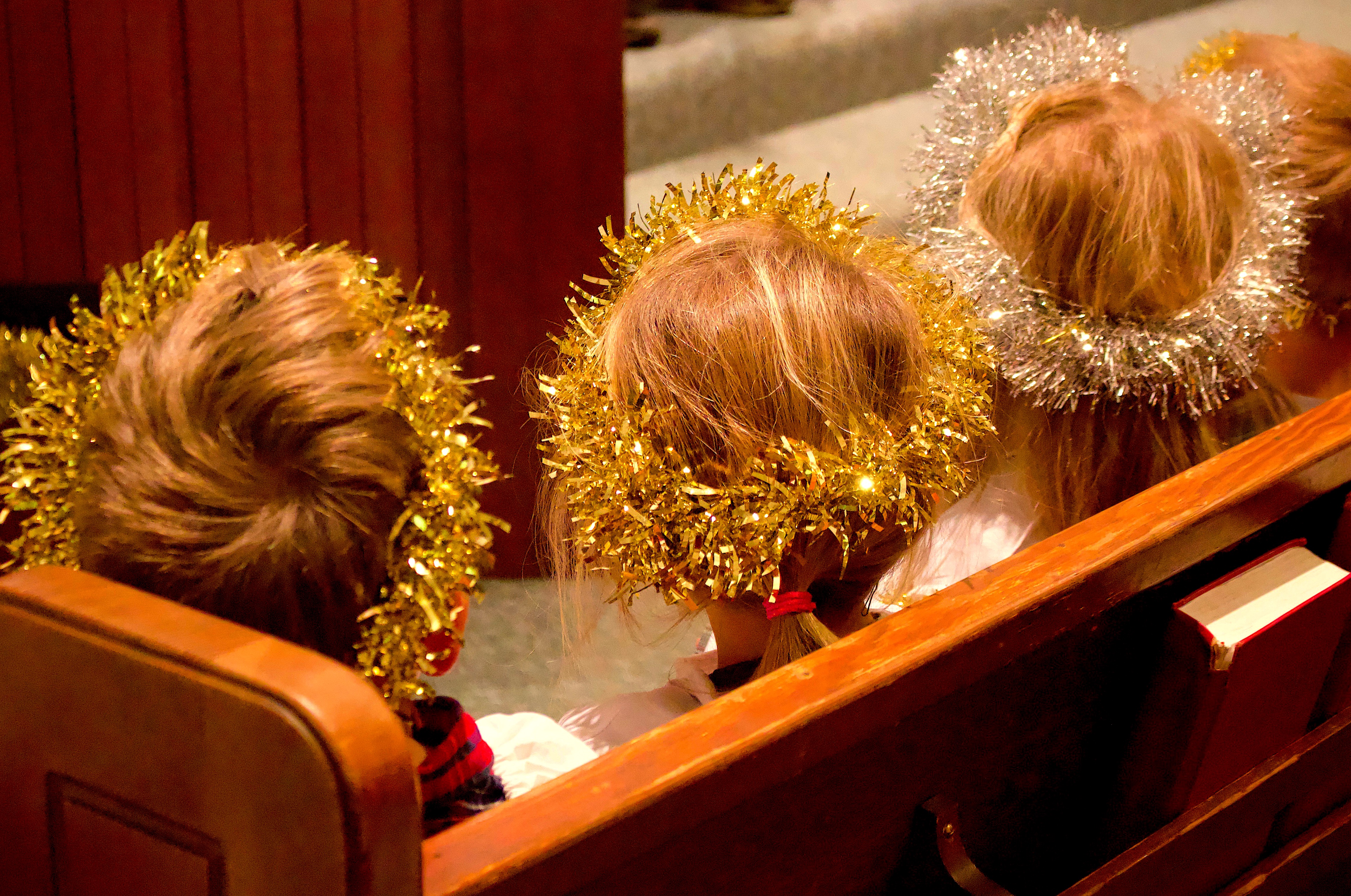
The service was a Sunday School Christmas program, with thirty some children of all ages and skin colors standing up front in bathrobes and white sheet angel gowns, wearing gold foil halos, tinfoil crowns and dish towels wrapped with string around their heads. They were prompted by their teachers through carols and readings of the Christmas story. The final song was Silent Night, sung by candle light, with each child and member of the congregation holding a lit candle. The evening ended in darkness, with the soft glow of candlelight illuminating faces of the young and old, some in tears streaming over their smiles.

It felt like home. We had found our church. We’ve never left. Over three decades it has had peeling paint and missing shingles, a basement that sometimes floods when the rain comes down hard, toilets that don’t always flush well, and though it smells heavenly on potluck days, there are times when it can be just a bit out of sorts and musty.

It also has a warmth and character and uniqueness that is unforgettable.

Like our pastors over the decades – Bruce Hemple, Stephen Tamminga, Albert Hitchcock and now Nathan Chambers – our chapel is humble and unpretentious yet envelops its people in a loving embrace of God’s Word, with warmth, character, grace and a uniqueness that is unforgettable.

That describes all the flawed folks
who have gathered there over the years,
once lost but now found.

We know we belong,
such as we are,
just as we are,
gifted with grace by a God
we worship together in this place.

Perhaps you belong at this old church too…

AI image created for this post

This year’s Advent theme is from Dietrich Bonhoeffer’s sermon on the First Sunday in Advent, December 2, 1928:

The celebration of Advent is possible only to those who are troubled in soul, who know themselves to be poor and imperfect, and who look forward to something greater to come. For these, it is enough to wait in humble fear until the Holy One himself comes down to us, God in the child in the manager.

God comes.

He is, and always will be now, with us in our sin, in our suffering, and at our death. We are no longer alone. God is with us and we are no longer homeless.
~Dietrich Bonhoeffer – from Christmas Sermons

Emptying Like a Cloud

God empties himself
into the earth like a cloud.
God takes the substance, contours
of a man, and keeps them,
dying, rising, walking,
and still walking
wherever there is motion.
Annie Dillard from “Feast Days” in Tickets for a Prayer Wheel

Soon we will enter the season of Advent, an opportunity to reflect on a God who “takes the substance, contours of a man”, as He “empties himself into the earth like a cloud.” 

Like drought-stricken parched ground, we prepare to respond to the drenching of the Spirit through the Son, and be ready to spring up with renewed growth.

He walked among us before His dying and subsequent rising up.
He walked among us again, appearing where least expected,
sharing a meal, causing our hearts to burn within us,
inviting us to touch and know Him.

His invitation remains open-ended,
His heart preparing us for our eternal home.

I think of that every time the clouds gather, open up, and empty.  
He freely falls to earth, soaking us completely,
through and through and through.

AI image created for this post

Now in Age I Bud Again

How fresh, oh Lord, how sweet and clean 

Are thy returns! even as the flowers in spring; 

         To which, besides their own demean, 

The late-past frosts tributes of pleasure bring. 

                      Grief melts away 

                      Like snow in May, 

         As if there were no such cold thing. 

         Who would have thought my shriveled heart 

Could have recovered greenness? It was gone 

         Quite underground; as flowers depart 

To see their mother-root, when they have blown, 

                      Where they together 

                      All the hard weather, 

         Dead to the world, keep house unknown. 

         These are thy wonders, Lord of power, 

Killing and quickening, bringing down to hell 

         And up to heaven in an hour; 

Making a chiming of a passing-bell. 

                      We say amiss 

                      This or that is: 

         Thy word is all, if we could spell. 

         Oh that I once past changing were, 

Fast in thy Paradise, where no flower can wither! 

         Many a spring I shoot up fair, 

Offering at heaven, growing and groaning thither; 

                      Nor doth my flower 

                      Want a spring shower, 

         My sins and I joining together. 

         But while I grow in a straight line, 

Still upwards bent, as if heaven were mine own, 

         Thy anger comes, and I decline: 

What frost to that? what pole is not the zone 

                      Where all things burn, 

                      When thou dost turn, 

         And the least frown of thine is shown? 

         And now in age I bud again, 

After so many deaths I live and write; 

         I once more smell the dew and rain, 

And relish versing. Oh, my only light, 

                      It cannot be 

                      That I am he 

         On whom thy tempests fell all night. 

         These are thy wonders, Lord of love, 

To make us see we are but flowers that glide; 

         Which when we once can find and prove, 

Thou hast a garden for us where to bide; 

                      Who would be more, 

                      Swelling through store, 

         Forfeit their Paradise by their pride.
~George Herbert “The Flower”

Our small church has several gracious and kind gardeners who share the produce from their yards each week to provide a fresh bouquet to sit on the table in front of our humble wooden pulpit.

It is a treat to walk into church and see what has been brought to the altar on Sunday morning. I have started to keep a photo album of these very special Sunday “pulpit posies.”

Why are these special? After all, almost every church displays a floral arrangement every Sunday.

These are special as most of these flowers are seeded, watered, fertilized and nurtured by one of our own, grown with love and caring, just as God cares for each of His children.

These are special as some are considered simple weeds, and are picked from ditches and hedges. They are still part of God’s creation and have a wild beauty that can be as breathtaking as a hothouse orchid.

These are special because they often go home with a congregant or visitor who will enjoy their loveliness for many more days, as if they represent the manifestation of God’s Word itself.

Some of us are dahlias, zinnias and roses. Some of us are rare gardenias and orchids. Most of us are dandelions, sagebrush, fireweed, burdock, and daisies populating the ditches.

No matter which roots we sprout from, or where, we are the wonders of this gardening God of love.

As we age, we bud afresh for Him.