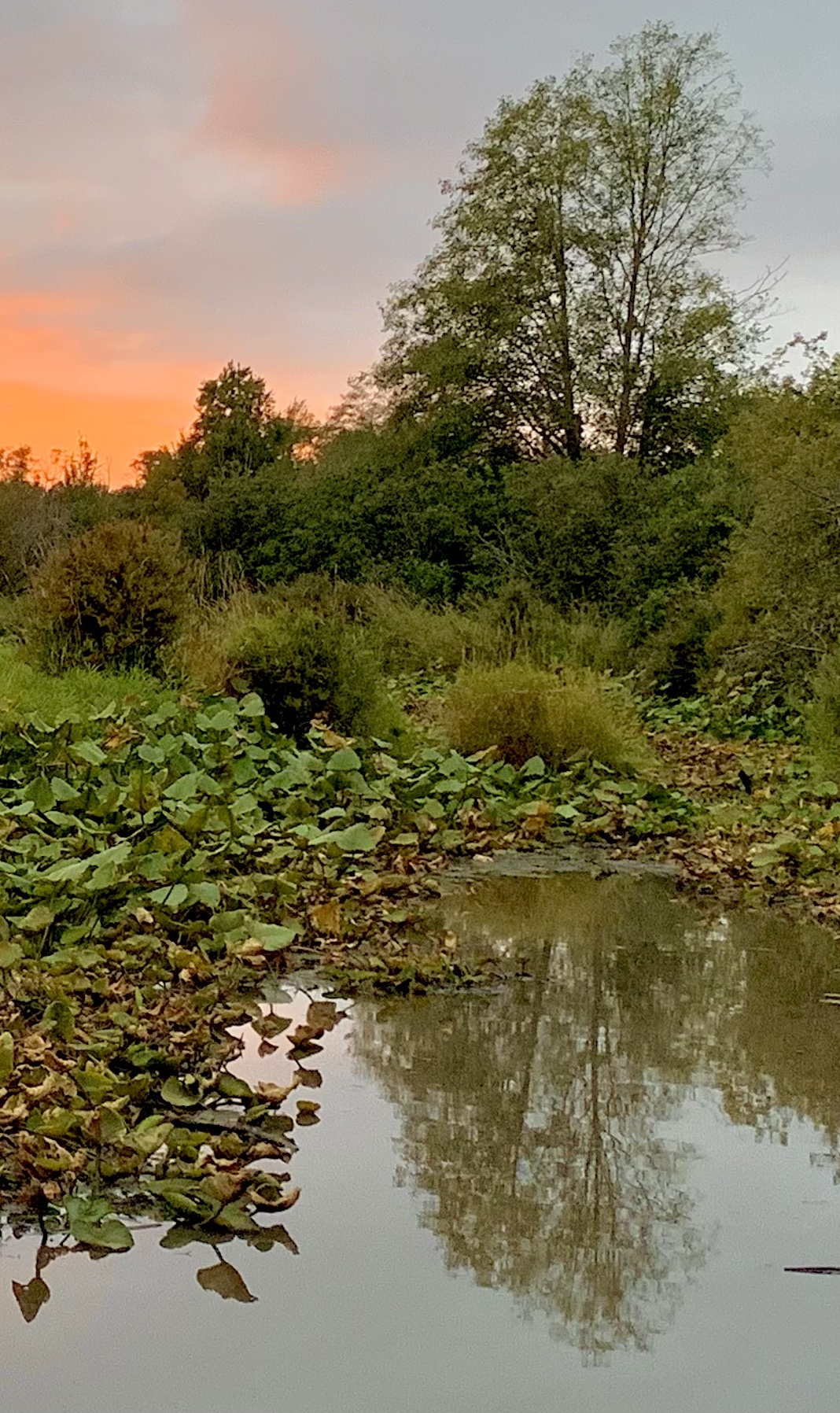
This world, after all our science and sciences, is still a miracle; wonderful, inscrutable, magical, and more, to whosoever will think of it.
To awaken each morning with a smile brightening my face; to greet the day with reverence for the opportunities it contains; to approach my work with a clean mind; to hold ever before me, even in the doing of little things, the ultimate purpose toward which I am working; to meet men and women with laughter on my lips and love in my heart; to be gentle, kind, and courteous through all the hours; to approach the night with weariness that ever woos sleep and the joy that comes from work well done – this is how I desire to waste wisely my days. ~Thomas Dekker, 16th century British playwright
I work hard at wasting my days wisely.
Summers are a classic opportunity to waste time and I do – happily – yet there is always a hint of regret: I could have made more of a dewy bright morning, an afternoon of cooling shadows, or a full-moon twilight.
Or perhaps I could have made this day better for someone else to waste.
How better to waste my days: to find ways for my interactions to be more joyous, if only through a smile, a shared chuckle, a kind word, a generous gesture.
Waste away, dear days. What a wonderful world this could be.
The world, after all, is a miracle and needs us to notice.
One-Time
Monthly
Yearly
Make a one-time or recurring donation to support daily Barnstorming posts
Now Naaman was commander of the army of the king of Aram. He was a great man in the sight of his master and highly regarded, because through him the Lord had given victory to Aram. He was a valiant soldier, but he had leprosy.
Naaman went with his horses and chariots and stopped at the door of Elisha’s house. Elisha sent a messenger to say to him, “Go, wash yourself seven times in the Jordan, and your flesh will be restored and you will be cleansed.”
But Naaman went away angry and said, “I thought that he would surely come out to me and stand and call on the name of the Lord his God, wave his hand over the spot and cure me of my leprosy.Are not Abana and Pharpar, the rivers of Damascus, better than all the waters of Israel? Couldn’t I wash in them and be cleansed?” So he turned and went off in a rage.
Naaman’s servants went to him and said, “My father, if the prophet had told you to do some great thing, would you not have done it? How much more, then, when he tells you, ‘Wash and be cleansed’!” So he went down and dipped himself in the Jordan seven times, as the man of God had told him, and his flesh was restored and became clean like that of a young boy. 2Kings 5: 1, 9-14
He that is down needs fear no fall, He that is low, no pride; He that is humble ever shall Have God to be his guide. ~John Bunyan from The Pilgrim’s Progress
Source: Pilgrim’s Progress,
Perhaps it was his plain talk about the Word of God. Perhaps it was his folksy stories tying that Word to our lives. Perhaps it was because he was, like the rest of us, so fully a flawed and forgiven human being.
Pastor Bruce Hemple ministered to thousands over his lifetime of service, yet the simple act of climbing the steps up to the pulpit at Wiser Lake Chapel was nearly impossible for him.
Bruce had one leg. The other was lost to an above the knee amputation due to severe diabetes. He wore an ill-fitting prosthetic leg that never allowed a normal stride and certainly proved a challenge when ascending stairs. He would come early to the sanctuary to climb the several steps to the chair behind the pulpit so he would not have to struggle in front of the congregation at the start of the service. As we would enter to find our pew seats, he would be deep in thought and prayer, already seated by the pulpit.
He often said he knew he was a difficult person to live with because of his constant pain and health problems. His family confirmed that was indeed true, but what crankiness he exhibited through much of the week evaporated once he was at the pulpit. Standing there balanced on his good leg with his prosthesis acting as a brace, he was transformed and blessed with clarity of thought and expression.
His pain was left behind.
He came to our church after many years of military chaplaincy, having served in Korea and Vietnam and a number of stateside assignments. He liked to say he “learned to meet people where they were” rather than where he thought they needed to be. His work brought him face to face with thousands of soldiers from diverse faiths and backgrounds, or in many cases, no faith at all, yet he ministered to each one in the way that was needed at that moment. He helped some as they lay dying and others who suffered so profoundly they wished they would die. He was there for them all and he was there for us.
One of his memorable sermons came from 2Kings 5:1-19 about the healing of the great and proud warrior Naaman who was afflicted with leprosy. Pastor Bruce clearly identified with Naaman and emphasized the message humility with obedience to God as the key to Naaman’s healing. Like Naaman, no one would desire “Seven Ducks in a Muddy Pond” but once Naaman was obedient despite his pride and doubts, he was cured of the incurable by bathing in the muddy Jordan River.
Even upon his retirement, Bruce continued to preach when churches needed a fill in pastor, and he took a part time job managing a community food and clothing bank, connecting with people who needed his words of encouragement. He was called regularly to officiate at weddings and funerals, especially for those without a church. He would oblige as his time and health allowed.
His last sermon was delivered on a freezing windy December day at a graveside service for a young suicide victim he had never known personally. Pastor Bruce was standing at the head of the casket and having concluded his message, he bowed his head to pray, continued to bend forward, appeared to embrace the casket and breathed his last.
He was gone, just like that.
He was not standing up high at the pulpit the day he died. He was obediently getting muddy in the muck and mess of life, and waiting, hoping, as we all are, for the moment he’d be washed clean.
One-Time
Monthly
Yearly
Make a one-time or recurring donation to support daily Barnstorming posts
When a great moment knocks on the door of your life, it is often no louder than the beating of your heart, and it is very easy to miss it. ~Boris Pasternak
‘Is there anybody there?’ said the Traveller, Knocking on the moonlit door; And his horse in the silence champed the grasses Of the forest’s ferny floor: And a bird flew up out of the turret, Above the Traveller’s head: And he smote upon the door again a second time; ‘Is there anybody there?’ he said. But no one descended to the Traveller; No head from the leaf-fringed sill Leaned over and looked into his grey eyes, Where he stood perplexed and still. But only a host of phantom listeners That dwelt in the lone house then Stood listening in the quiet of the moonlight To that voice from the world of men: Stood thronging the faint moonbeams on the dark stair, That goes down to the empty hall, Hearkening in an air stirred and shaken By the lonely Traveller’s call. And he felt in his heart their strangeness, Their stillness answering his cry, While his horse moved, cropping the dark turf, ’Neath the starred and leafy sky; For he suddenly smote on the door, even Louder, and lifted his head:— ‘Tell them I came, and no one answered, That I kept my word,’ he said. Never the least stir made the listeners, Though every word he spake Fell echoing through the shadowiness of the still house From the one man left awake: Ay, they heard his foot upon the stirrup, And the sound of iron on stone, And how the silence surged softly backward, When the plunging hoofs were gone. ~Walter De La Mare “The Listeners”
Years ago, a young woman I’d been treating for depression for several weeks in my clinic called unexpectedly on a Friday afternoon and canceled an upcoming appointment for the following Monday and did not reschedule.
The receptionist sent me a message as was our policy for patients who “cancel and do not reschedule.” It gave me a bad feeling that she was turning her back on her treatment plan and I was uneasy about the upcoming weekend without knowing what was going on with her.
I could have just put on my coat and headed home at the end of that long Friday after a very stressful work week and even more stressful year. I was discouraged about many aspects of my clinic work load and my after-hours responsibilities only seemed to get heavier. I was frustrated at how ineffectively I was communicating to administrative supervisors about the need for change.
I was ready to quit and walk away.
Even so, in a moment of clarity about my role and commitment to those I was responsible for, I called my patient to find out how she was doing. She didn’t answer her phone.
I mulled over my options. Protocol was to call the police to go to her address for a “well-being” check. I looked up her apartment address and decided instead to drive the few blocks to get there.
As I approached her door, I could hear someone moving around in her apartment, but she ignored my knocks and my voice and when I tried to open the door, it was locked.
So I stayed right there, talking to her through the door for about 15 minutes, letting her know I wasn’t leaving until she opened up the door. I finally told her she could decide to open the door or I would call 911 and ask the police to come to make sure she was okay. She then unlocked the door, tears streaming down her face. She had been drinking heavily, with liquor bottles strewn around on the floor. She admitted an intent to overdose on aspirin and vodka. The vodka was already consumed but the unopened aspirin bottle was in her hand.
I was the last person she expected to see at her door.
Miraculously, the inpatient mental health unit at the local hospital had an open bed. I told my patient that we could save time and hassle by heading over there together right then and there, and avoid the emergency room chaos and delay, and the possibility of an involuntary detainment.
She agreed to come with me and be admitted voluntarily for stabilization. When I went to the hospital to see ger the next day, she greeted me with a hug and thanked me for not giving up on her when she had given up on herself.
In sobriety, her eyes were brighter and she was more hopeful. She never expected anyone to care enough to come knock on her door when she was at her lowest point. It was the start of her climb out of her pain and depression.
Four years later, a small card arrived in my clinic mailbox on another most challenging work day from an unfamiliar address two thousand miles away. The name looked vaguely familiar to me but when I opened and read the contents, this time it became the knock on the door to get my attention, to focus the beating of my heart on what was most important – not the stresses of my work place — and it was my turn to let tears flow:
“Dear Doctor,
I am not sure if you will remember me considering you see a number of patients daily; however, I am a patient whose life you changed in the most positive way. I never truly THANKED YOU for listening to me and hearing my silent words of grief and hearing my cries for help. If it had not been for you, had you not knocked on my door, I would not be writing this letter to you today. I don’t know exactly what to say to the person who saved me from hurting myself fatally. You were a stranger in my life, but a dear friend in my time of need. THANK YOU, for everything that you did for me. You have a permanent place in my heart, you have given my spirit hope, you have reminded me that a life is worth living. Thank you, thank you, thank you! Sincerely, L_____”
Somehow I had the sense that I needed to go knock on her door because I was keeping my word to take care of her at her lowest point. I had the stubbornness to stay put until she responded, and most of all, I’m appreciative for her gracious note letting me know it made a difference.
When I needed it the most, she made a difference for me that kept me on the job for another twenty years.
With her letter, she knocked, oh so gently, on my own locked door. I opened it, amazed that someone cared enough to let me know I kept my word.
One-Time
Monthly
Yearly
Make a one-time or recurring donation to support daily Barnstorming posts
We have not yet encountered any god who is as merciful as a man who flicks a beetle over on its feet. ~Annie Dillard from The Force That Drives the Flower
What inference might one draw about the nature of God from a study of his works? An inordinate fondness for beetles. The Creator would appear as endowed with a passion for stars, on the one hand, and for beetles on the other. ~ J.B.S. Haldane, British biologist
Indeed, we stranded folk do encounter a God who saves us by flipping us back onto our feet as we lie helplessly waving our arms and legs in the air, so stuck and pitiful.
God knows all about the helplessness of suffering and hears our cry for mercy.
Once we are righted back to our feet, we walk forth forever changed – restored to the world, ready to help anyone we encounter who finds themselves stuck upside down in their misery.
When beetles fight these battles in a bottle with their paddles and the bottle’s on a poodle and the poodle’s eating noodles… …they call this a muddle puddle tweetle poodle beetle noodle bottle paddle battle. ~ Dr. Seuss from Fox in Socks
One-Time
Monthly
Yearly
Make a one-time or recurring donation to support daily Barnstorming posts
The wise old apple tree in spring, Though split and hollow, makes a crown Of such fantastic blossoming We cannot let them cut it down. It bears no fruit, but honey bees Prefer it to other trees.
The orchard man chalks his mark And says, “This empty shell must go.” We nod and rub it off the bark As soon as he goes down the row. Each spring he looks bewildered. “Queer, I thought I marked this thing las year.”
Ten orchard men have come and gone Since first I saw my grandfather Slyly erase it. I’m the one To do it now. As I defer The showy veteran’s removal My grandson nods his approval.
Like mine, my fellow ancient’s roots Are deep in the last century From which our memories send shoots For all our grandchildren to see How spring, inviting bloom and rhyme, Defeats the orchard men of time. ~Robert Hillyer “The Pastoral”
When great trees fall, rocks on distant hills shudder, lions hunker down in tall grasses, and even elephants lumber after safety.
When great trees fall in forests, small things recoil into silence, their senses eroded beyond fear.
When great souls die, the air around us becomes light, rare, sterile. We breathe, briefly. Our eyes, briefly, see with a hurtful clarity. Our memory, suddenly sharpened, examines, gnaws on kind words unsaid, promised walks never taken.
Great souls die and our reality, bound to them, takes leave of us. Our souls, dependent upon their nurture, now shrink, wizened. Our minds, formed and informed by their radiance, fall away. We are not so much maddened as reduced to the unutterable ignorance of dark, cold caves.
And when great souls die, after a period peace blooms, slowly and always irregularly. Spaces fill with a kind of soothing electric vibration. Our senses, restored, never to be the same, whisper to us. They existed. They existed. We can be. Be and be better. For they existed. ~ Maya Angelou “When Great Trees Fall”
When our ancient Spitzenberg apple tree came down in a November windstorm years ago, there was no time to provide any sort of memorial service, or otherwise dispose of the remains.
My husband started in on the job Thanksgiving morning and I watched through the kitchen window as I cooked for the family members soon to arrive. As he made several chain saw cuts through the trunk to make pieces easily moveable, the extent of the astonishing hole in this old tree became visible. It was suffering from an extreme equivalent of human osteoporosis with a brittle skeleton that somehow had lasted through innumerable windstorms over the years, even while still bearing apples, still trying its best to be fruitful.
The brittleness extended right down into the roots, and they too gave way so easily in the wind that the tree literally broke off at ground level and leaned over, propped up by much healthier and resilient upper branches that had so recently held apples.
When it fell, the trunk oriented itself so it provided a view right through to the barnyard down the hill, telescoping what the tree had surveyed for so many years of its life. Clearly this had been a holey trunk for some years; within the cavity at the base were piles of different size rocks stashed there by the Lawrence children three generations ago, followed by our Gibson children thirty years ago.
There was also a large tarnished spoon, lost decades ago into the dark center of the apple tree and now retrieved at its death. At some point, a Gibson child playing a farm version of frisbee golf must have flung a plastic bucket lid at the hole in the tree, and it disappeared into the gap and settled at the bottom.
All this, like a treasure trove of history, was just waiting for the time when the tree would give up its secrets at its death. There were no gold or silver coins, no notes to the future like a glass bottle put out to sea. This well hidden time capsule held simply rocks and spoon and lid.
I realized as I stared into the gulf of empty trunk that I’m hollowing too, more hollow than I care to admit. Like so many of us, stuff is hidden deep inside that we’d just as soon not have discovered. Our outside scaffolding braces against the buffeting by the winds and storms of life, as we cling with mighty roots to this mortal soil.
It is clear we’d be much stronger if we were wholly solid throughout, filled with something stronger even than our outsides. Yet we tend to get filled up with a lot of nothing, or even worse than nothing, a lot of garbage. This is stuff that weakens us, furthers the rot, shortens our fruitful life, doing nothing to make us more whole and holy.
I’m looking more critically now at what fills my empty spots since staring down the barrel of that old apple tree trunk.
Even so, I realize my hollow shell has been saved and salvaged, year after year, by the grace and wisdom of our Divine Orchardist who loves us as we are, up to and after we finally topple over.
May our hollow be hallowed. Wholly hole-y holy…
One-Time
Monthly
Yearly
Make a one-time or recurring donation to support daily Barnstorming posts
What shall I say, because talk I must? That I have found a cure for the sick? I have found no cure for the sick but this crooked flower which only to look upon all men are cured. This is that flower for which all men sing secretly their hymns of praise! This is that sacred flower! ~William Carlos Williams from “The Yellow Flower”
The nail of each big toe was the horn of a goat. Thick as a thumb and curved, it projected down over the tip of the toe to the underside. With each step, the nail would scrape painfully against the ground and be pressed into his flesh. There was dried blood on each big toe.
It took an hour to do each big toe. The nails were too thick even for my nail cutters. They had to be chewed away little by little, then flattened out with the rasp, washed each toe, dried him off, and put his shoes and socks back on. He stood up and took a few steps, like someone who is testing the fit of a new pair of shoes.
“How is it?” “It don’t hurt,” he said, and gave me a smile that I shall keep in my safety deposit box at the bank until the day I die.
I never go to the library on Wednesday afternoon without my nail clippers in my briefcase. You just never know. ~Richard Selzer from “Toenails” from Letters to a Young Doctor
I know for a while again the health of self-forgetfulness, looking out at the sky through a notch in the valleyside, the black woods wintry on the hills, small clouds at sunset passing across. And I know that this is one of the thresholds between Earth and Heaven, from which even I may step forth and be free. – Wendell Berry from “Sabbath Poems”
Whenever I lose perspective about what I was trained to do and who I am meant to serve, when I wallow in the mud of self-importance rather than in the health of self-forgetfulness~
On those clinic days when I would wash out a plug of wax from a deaf ear and miraculously restore hearing or remove a painful thorn in a festering thumb or clip someone’s crippling toenails so they can step forth in freedom or I simply sit still as someone cries out their heart’s pain
I would cling to that crooked flower of healing and forgiveness I was handed over fifty years ago, sharing its sacred sweetness with another.
I was given these tools for a reason, and try to still use them.
You just never know.
One-Time
Monthly
Yearly
Make a one-time or recurring donation to support daily Barnstorming posts
I’ve learned that no matter what happens, or how bad it seems today, life does go on, and it will be better tomorrow. I’ve learned that you can tell a lot about a person by the way he/she handles these three things: a rainy day, lost luggage, and tangled Christmas tree lights. I’ve learned that regardless of your relationship with your parents, you’ll miss them when they’re gone from your life. I’ve learned that making a ‘living’ is not the same thing as making a ‘life.’ I’ve learned that life sometimes gives you a second chance. I’ve learned that you shouldn’t go through life with a catcher’s mitt on both hands; you need to be able to throw something back. I’ve learned that whenever I decide something with an open heart, I usually make the right decision. I’ve learned that even when I have pains, I don’t have to be one. I’ve learned that every day you should reach out and touch someone. People love a warm hug, or just a friendly pat on the back. I’ve learned that I still have a lot to learn. I’ve learned that people will forget what you said, people will forget what you did, but people will never forget how you made them feel. ~Maya Angelou
…think of all the things you’ve learned over the years— the hard and the holy, the mysteries that will always remain mysterious, the clean edges of truth, the soft edges of every kindness given or received, the way trouble and wonder will continue to show up, sometimes leaving us beached and breathless with uncontainable joy or unutterable sorrow. I think of all the times I was knocked to my knees by a beautiful and brilliant flash of the completely obvious. ~Carrie Newcomer from A Gathering of Spirits
I learned from my mother how to love the living, to have plenty of vases on hand in case you have to rush to the hospital with peonies cut from the lawn, black ants still stuck to the buds. I learned to save jars large enough to hold fruit salad for a whole grieving household, to cube home-canned pears and peaches, to slice through maroon grape skins and flick out the sexual seeds with a knife point. I learned to attend viewings even if I didn’t know the deceased, to press the moist hands of the living, to look in their eyes and offer sympathy, as though I understood loss even then. I learned that whatever we say means nothing, what anyone will remember is that we came. I learned to believe I had the power to ease awful pains materially like an angel. Like a doctor, I learned to create from another’s suffering my own usefulness, and once you know how to do this, you can never refuse. To every house you enter, you must offer healing: a chocolate cake you baked yourself, the blessing of your voice, your chaste touch. ~Julie Kasdorf– “What I Learned from my Mother”
Five years ago today, I wrapped up 45 years of uninterrupted medical training and doctoring.
Even while bearing three children and going through a few surgeries myself, I was not away from patient care for more than twenty consecutive days at any one time. This was primarily out of my concern that, even after a few weeks, I would forget all that I’d ever known.
Indeed, half of what I learned in medical school and residency nearly fifty years ago has evolved, thanks to new discoveries and clarifying research. I worried if I actually stepped away from doctoring for an extended time, then return to see patients again, I would be masquerading as a physician rather than be the real thing.
I couldn’t fathom a day when I could actually investigate a medical dilemma by typing a few words in a search engine on a computer screen. Instead, I researched through opening my encyclopedic collection of reference textbooks along with huge notebooks of “Scientific American Updates,” a monthly process of throwing out old articles to be replaced by newly discovered data. That is how I kept learning before the computer replaced books and pen and paper…
If being truly honest, even now, those who spend their professional lives providing medical care to others always share this concern: if a patient only knew how much we don’t know and will never know, despite everything we DO know, there would really be no trust left for us at all.
With so much rapidly changing medical information at everyone’s fingertips and computer screens, who needs a trained physician when there are so many other resources – many sketchy and opportunistic – for seeking health care advice?
Yet, I am convinced most patients really do want doctors to share the best information they have available at any point in time rather than rely on the latest internet algorithm and so-called “experts.”
I know over forty years of clinical experience gave me an eye and an ear for the subtle signs and symptoms that no googled website or AI app or virtual doc-in-the-box can discern: the avoidance of eye contact, the tremble of the lip as they spoke, the barely palpable rash, the hardly discernible extra heart sound, the fullness over an ovary, the slight squeak in a lung base. These are things I was privileged to see and hear, about which I made decisions together with my patients.
The work I did over four decades was a reflection of a continual learning process; out of my natural caution, I was honest when I didn’t know what the diagnosis was, nor the best treatment, but committed to doing my best to find out.
Continual learning – what I was trained to do for thousands of days and many more thousands of patients during my professional life, while passing a comprehensive certification examination every few years to prove my study and changing fund of knowledge.
Since retiring, the help I offer no longer means writing a prescription for a medication, or performing a minor surgery. I have to simply offer up me for what it’s worth, without a stethoscope.
Now I aim to be the best mom and grandma and friend I can be. I can press my hand into another’s, hug when needed, smile and listen and nod and sometimes weep when someone has something they need to say. No advanced degree or certification required.
Someday, hopefully not too soon, I will die happy knowing I chose this with my life: still learning and still caring.
One-Time
Monthly
Yearly
Make a one-time or recurring donation to support daily Barnstorming posts
There we shall rest and we shall see; we shall see and we shall love; we shall love and we shall praise. Behold what shall be in the end and shall not end. ~St. Augustine: ‘The City of God,’ Bk. XXII, Chap. 30.
The cows know. Standing still in the pasture, chewing cud and steadily swishing flies. With those enormous eyes, they look for all the world as if they know.
The wind knows. It whispers to the grass. The grass tells the trees who pass it on to the birds. The crickets discover it all on their own.
But you and I, we don’t. Though on a day like today when the sun is bright and the cattails let loose a flurry of tiny parachutes, we sense there’s something the world knows.
A man crosses the street in rain, stepping gently, looking two times north and south, because his son is asleep on his shoulder.
No car must splash him. No car drive too near to his shadow.
This man carries the world’s most sensitive cargo but he’s not marked. Nowhere does his jacket say FRAGILE, HANDLE WITH CARE.
His ear fills up with breathing. He hears the hum of a boy’s dream deep inside him.
We’re not going to be able to live in this world if we’re not willing to do what he’s doing with one another.
The road will only be wide. The rain will never stop falling. ~Naomi Shihab Nye “Shoulder” from Red Suitcase
And just what is it that we should know? What are we missing that the cows, the wind, the trees, the grass, the birds, the crickets, the cattails, and certainly dogs know that we struggle to understand?
Simply this: be content, live aware of each moment as it comes, be grateful for it and say so, then have hope for the next moment, no matter how hard it may be.
Cherish whatever and whoever depends on us, love them with all we’ve got. Provide the shoulder that someone else needs. Give ourselves away without expecting something in return. Write it down so it is not lost.
We can see it deep in our dogs’ eyes. They know.
photo by Nate Gibson
One-Time
Monthly
Yearly
Make a one-time or recurring donation to support daily Barnstorming
For grace to be grace, it must give us things we didn’t know we needed and take us places where we didn’t know we didn’t want to go. ~Kathleen Norris from Cloister Walk
Sap withdraws from the upper reaches of maples; the squirrel digs deeper and deeper in the moss to bury the acorns that fall all around, distracting him.
I’m out here in the dusk… where the wild asters, last blossoms of the season, straggle uphill. Frost flowers, I’ve heard them called. The white ones have yellow centers at first: later they darken to a rosy copper. They’re mostly done. Then the blue ones come on. It’s blue all around me now, though the color has gone with the sun.
There is no one home but me— and I’m not at home; I’m up here on the hill, looking at the dark windows below. Let them be dark…
…The air is damp and cold and by now I am a little hungry… The squirrel is high in the oak, gone to his nest , and night has silenced the last loud rupture of the calm. ~Jane Kenyon from “Frost Flowers”
Even when the load grows too heavy, when misery rolls in like a fog that covers all that was once vibrant,
even then even then
there awaits a nest of nurture, a place of calm where the tired and hungry are fed.
We who are empty will be filled; we who are weary will be restored.
One-Time
Monthly
Yearly
Make a one-time or recurrent donation to support daily Barnstorming posts
So I can’t save the world— can’t save even myself, can’t wrap my arms around every frightened child, can’t foster peace among nations, can’t bring love to all who feel unlovable.
So I practice opening my heart right here in this room and being gentle with my insufficiency. I practice walking down the street heart first. And if it is insufficient to share love, I will practice loving anyway. I want to converse about truth, about trust. I want to invite compassion into every interaction. One willing heart can’t stop a war. One willing heart can’t feed all the hungry. And sometimes, daunted by a task too big, I ask myself, What’s the use of trying? But today, the invitation is clear: to be ridiculously courageous in love. To open the heart like a lilac in May, knowing freeze is possible and opening anyway. To take love seriously. To give love wildly. To race up to the world as if I were a puppy, adoring and unjaded, stumbling on my own exuberance. To feel the shock of indifference, of anger, of cruelty, of fear, and stay open. To love as if it matters, as if the world depends on it. ~Rosemerry Wahtola Trommer “Because” From The Unfolding
I can’t stop all the pain and suffering in the world or bring peace between angry nations.
But I can make a difference to those around me. It won’t stop a war or cure all diseases, but I can be ridiculously courageous in my compassion for others.
As we’ve been traveling for the past week, I’ve had many opportunities to treat others like I hope to be treated. I’ve tried to listen carefully, to express gratitude for the efforts others make. I try to smile more when I’m among strangers and meet their gaze, which takes the greatest courage of all for an introvert like me.
So I’ll take lessons from puppies I’ve known: to wag and wiggle and treat everyone as a best friend – with great joy and exuberance. It matters. Peace in the world depends on it.
photo by Brandon DielemanAI image created for this post