Dawn comes later and later now, and I, who only a month ago could sit with coffee every morning watching the light walk down the hill to the edge of the pond and place a doe there, shyly drinking,
then see the light step out upon the water, sowing reflections to either side — a garden of trees that grew as if by magic — now see no more than my face, mirrored by darkness, pale and odd,
startled by time. While I slept, night in its thick winter jacket bridled the doe with a twist of wet leaves and led her away, then brought its black horse with harness that creaked like a cricket, and turned
the water garden under. I woke, and at the waiting window found the curtains open to my open face; beyond me, darkness. And I, who only wished to keep looking out, must now keep looking in. ~Ted Kooser “A Letter in October”
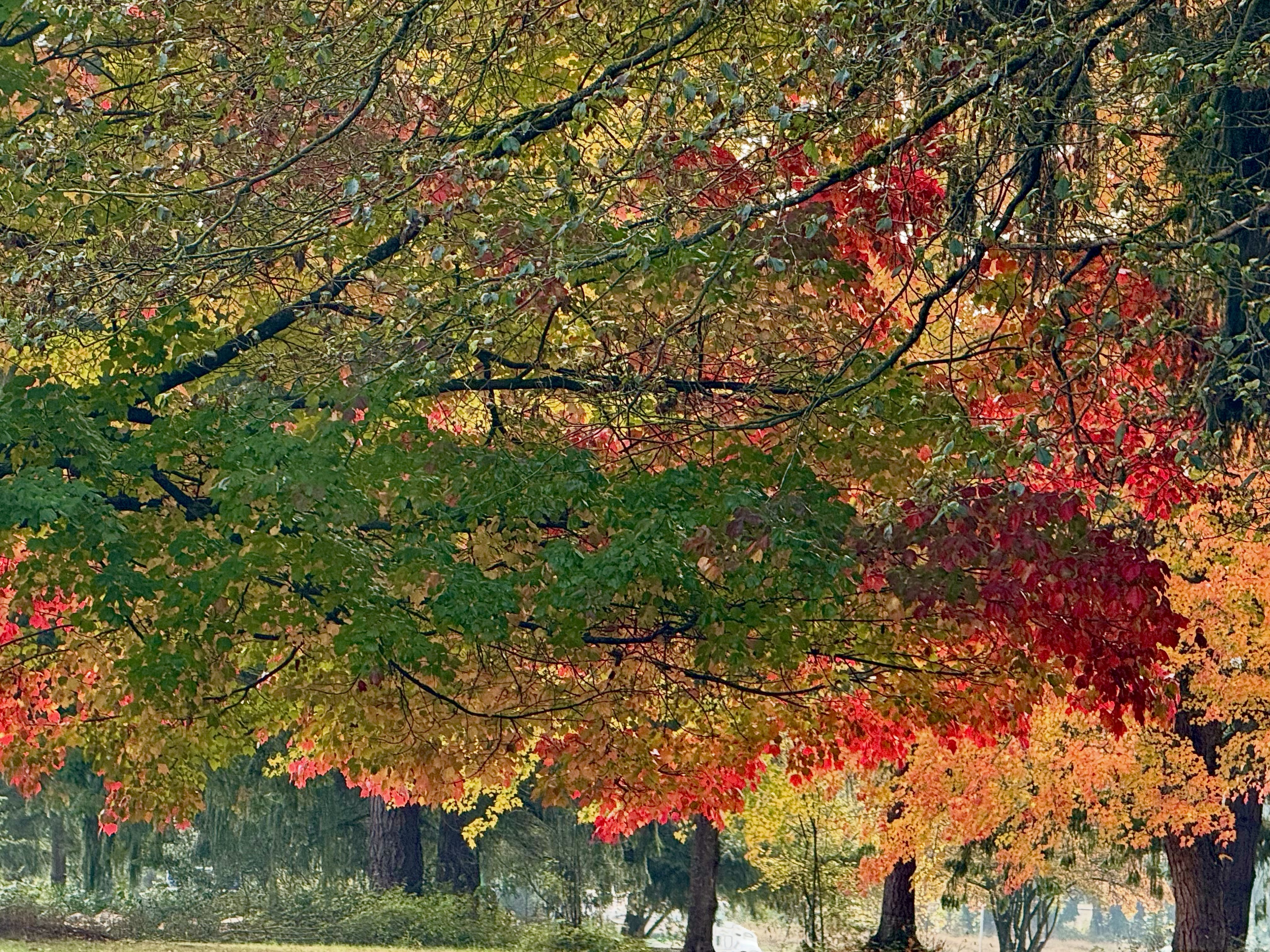
God knows we seek out light these autumn mornings
praying to see multicolors filling the lines outside; my face a shadow in a blackened window pane
Some mornings we can only see our own reflection mirrored by darkness, startled by time, as we wonder what comes next.
God knows, as each year passes, we need His Light illuminating us as we look beyond ourselves, but even more as we look within.
One-Time
Monthly
Yearly
Make a one-time or recurring donation to support daily Barnstorming posts
to the heartbeat. Would our child live? Air tinted
gray, I moved closer, searched the screen
for the halo of bone,
touched glass
and stroked our bad luck,
my finger leaving its smudge
on the oval glow,
delicate as a grape. The head would
never form. Grace stared at the brightness
then closed her eyes, the light flickered
on our hands. This second child. Never.
The dark
washed in, heavy as water.
Did our baby know pain? Inside tiny feet
kicking, small hands
open, fingers reached out. Drift
of white static, this broken globe
we had made. ~Brian Komei Dempster “Glow” from Seize
The call came in the middle of a busy night as we worked on a floppy baby with high fever, a croupy toddler whose breathing squeezed and squeaked, a pale adolescent transfusing due to leukemia bleeding.
It was an anencephalic baby just born, unexpected, unwanted in a hospital across town, and she needed a place to die.
Our team of three puzzled how to manage a baby without a brain– simply put her in a room, swaddled, kept warm but alone? Hydrate her with a dropper of water to moisten her mouth? Offer her a taste of milk?
She arrived by ambulance, the somber attendants leaving quickly, unnerved by her mewing cries.
I took the wrapped bundle and peeled away the layers to find a plump full term baby, her hands gripping, arms waving once freed; just another newborn until I pulled off her stocking cap and looked into an empty crater — only a brainstem lumped at the base.
No textbook pictures had prepared me for the wholeness, the holiness of this living, breathing child.
Her forehead quit above the eyebrows with the entire skull missing, tufts of soft brown hair fringed her perfect ears, around the back of her neck. Her eyelids puffy, squinting tight, seemingly too big above a button nose and rosebud pink lips.
She squirmed under my fingers, her muscles strong, breaths coming steady despite no awareness of light or touch or noise.
Yet she cried in little whimpers, mouth working, seeking, lips tentatively gripping my fingertip. A bottle warmed, nipple offered, a tentative suck allowing tiny flow, then, amazing, a gurgling swallow.
Returning every two hours, more for me than for her, I picked her up to smell the salty sweet scent of amnion still on her skin as she grew dusky.
Her breathing weakened, her muscles loosened, giving up her grip on a world she would never see or hear or feel — to behold something far more glorious.
I gazed into her emptiness, waiting my turn to be filled.
One-Time
Monthly
Yearly
Make a one-time donation to support daily Barnstorming posts
When he had washed their feet and put on his outer garments and resumed his place, he said to them, “Do you understand what I have done to you? You call me Teacher and Lord, and you are right, for so I am. If I then, your Lord and Teacher, have washed your feet, you also ought to wash one another’s feet.
For I have given you an example, that you also should do just as I have done to you. Truly, truly, I say to you, a servant is not greater than his master, nor is a messenger greater than the one who sent him. If you know these things, blessed are you if you do them.
I am not speaking of all of you; I know whom I have chosen. But the Scripture will be fulfilled, ‘He who ate my bread has lifted his heel against me.’ (Psalm 41:9)
I am telling you this now, before it takes place, that when it does take place you may believe that I am he.
Truly, truly, I say to you, whoever receives the one I send receives me, and whoever receives me receives the one who sent me.” John 13: 12-20
Rembrandt Head of Christ
I, too, stood on the sacred image … on the face of the man who has been ever in my thoughts, … on the best and most beautiful face that any man can ever know, on the face of him whom I have always longed to love.
I understand your pain and your suffering. It is for that reason that I am here.
Lord, I resented your silence.
I was not silent. I suffered beside you. ~Shisaku Endo from Silence – an interchange at the end of the book between Father Sebastian Rodrigues and the voice of the Lord Jesus
Then Judas in his hot desire Said, “Give me what you will.” Christ spoke to him with words of fire, “Then, Judas, you must kill, One whom you love, One who loves you As only God’s son can: This is the work for you to do To save the creature man.“
“And men to come will curse your name, And hold you up to scorn; In all the world will be no shame Like yours; this is love’s thorn. It takes strong will of heart and soul, But man is under ban. Think, Judas, can you play this role In heaven’s mystic plan?”
So Judas took the sorry part, Went out and spoke the word, And gave the kiss that broke his heart, But no one knew or heard. And no one knew what poison ate Into his palm that day, Where, bright and damned, the monstrous weight Of thirty white coins lay.
It was not death that Judas found Upon a kindly tree; The man was dead long ere he bound His throat as final fee. And who can say if on that day When gates of pearl swung wide, Christ did not go His honored way With Judas by His side?
And then there is the love for the enemy– love for the one who does not love you but mocks, threatens, and inflicts pain. The tortured’s love for the torturer. This is God’s love. It conquers the world. ~Frederick Buechnerfrom The Magnificent Defeat
Even my close friend in whom I trusted, who ate my bread, has lifted his heel against me. Psalm 41:9
…he shall bruise your head, and you shall bruise his heel. Genesis 3:15
Jesus knew Judas would “lift his heel against him” – Jesus chose him for that very reason, a close friend who had been a cherished part of the twelve.
The kick is hard, but not unexpected.
A heel crushes the image of Jesus and all that is good and beautiful.
Yet, this Lord is able to understand the pain of the betrayer and know suffering so much, He brings it onto Himself.
It was for this reason He came. It was for this reason He invites us to eat the bread of life alongside Him. We are filled and forgiven because He loves us enough to take our kicks and crushes.
What a gift to be known so well by God Himself.
I am reading slowly through the words in the Book of John over the next year alongside my church family. Once a week, I will invite you to “come and see” what those words might mean as we explore His promises together.
One-Time
Monthly
Yearly
Make a one-time or recurring donation to support daily Barnstorming posts
He is a hard one to write a poem about. Like Napoleon. Hannibal. Genghis Khan. Already so large in history. To do it right, I have to sit down with him. At a place of his own choosing. Probably a steakhouse. We take a table in a corner. But people still recognize him, come up and slap him on the back, say how much they enjoyed studying about him in school and ask for his autograph. After he eats, he leans back and lights up a cigar and asks me what I want to know.
Notebook in hand, I suggest that we start with the Little Big Horn and work our way back. But I realize I have offended him. That he would rather take it the other way around. So he rants on about the Civil War, the way west, the loyalty of good soldiers and now and then twists his long yellow hair with his fingers. But when he gets to the part about Sitting Bull, about Crazy Horse, he develops a twitch above his right eye, raises his finger for the waiter, excuses himself and goes to the restroom while I sit there along the bluffs with the entire Sioux nation, awaiting his return. ~David Shumate “Custer” from High Water Mark
Bighorn Battlefield – National Park Service photo
When my family took two cross-country trips by car, once in 1963 and another in 1965, my father, a former officer and battalion leader in the Marines during WWII, was the primary driver and keeper of maps and deadlines. He could be convinced to stop at any number of state and national parks, points of interest and historical markers, but all four times we passed the sign indicating the Battle of the Little Bighorn, he would not stop despite our pleading.
“You’ve seen as much as there is up there,” he would say as we sped past, pointing at the marble monolith at the top of the hill where the battle took place. I would look around at the desolate countryside of brown grass with no trees, in the middle of nowhere, and wonder how this place could ever have warranted a battle to the death.
I was frustrated at my dad’s refusal to stop to learn more, but it was only a monument and stone gave markers. No interpretive center yet.
I had certainly learned about General George Custer’s Last Stand in my elementary school history lessons. But my interest was primarily driven by a 1958 Disney movie “Tonka Wakan” that I had seen in the theater and then later on Sunday nights on “Walt Disney’s Wonderful World of Color.” I thought I understood the tragedy of that day from the standpoint of the U.S. Calvary and the only surviving horse Comanche, who in the Disney-imagined version of the battle, was raised and trained by a young Indian boy who turned the horse over to the calvary and then later was part of the Little Bighorn Battle in defense of Indian territory.
So I had a very skewed and Disney-fied version of history and my father was not helping me understand more deeply. It wasn’t until much later that I realized the likely reason he was so reluctant to stop and examine the history of the Battle of the Little Bighorn.
My father was ashamed of it. He was a humble man who knew there could be no pride or sense of honor in that place.
He had likely been trained in his Marine Officer’s Training in 1942 to understand that the poor decision-making of a cocky, overly self-assured General led to the slaughter of five companies of the 7th Calvary Regiment as well as their Indian scouts in addition to dozens of Lakota and Dakota Sioux, Cheyenne and Arapahoe warriors.
My father had lived through three South Pacific island battles where poor decision-making was a death sentence. He didn’t feel the need to rehash a sorry history in this desolate part of Montana.
As an adult, I’ve visited the Battlefield with my husband and children several times, have learned more about what led to the battle, what took place that day and how the indigenous people of the region have memorialized the spot from their own perspective. When we approach this spot on our cross-country drives, I’m filled with regret and remorse at the loss of life and the eventual loss of a Native American culture that could never again be as it was, despite the defeat they handed to the cavalry that day. I learned more when our son lived and taught high school math on the Pine Ridge Reservation of the Lakota Sioux people and we visited the site of Wounded Knee, another tear-drenched place in U.S. Cavalry and Native American history.
We the people, most of us descendants of immigrant Americans, comprise the U.S. government and military — which has proven recently it doesn’t always make the best or wisest decisions.
War, suffering, loss and death cannot and should not be Disney-fied. History is more complex than a paragraph in a textbook, or a tweet or AI meme on social media from the White House.
We have so much to learn about our shame and our need for greater humility. We need to understand who we have offended, not just how offended we feel. We can’t hide from reality in the bathroom or drive on past the sites of these bloody conflicts, hoping it will all be forgotten.
We must never forget.
One-Time
Monthly
Yearly
Make a one-time or recurring donation to support daily Barnstorming posts
If we could, like the trees, practice dying, do it every year just as something we do— like going on vacation or celebrating birthdays— it would become as easy a part of us as our hair or clothing.
Someone would show us how to lie down and fade away as if in deepest meditation, and we would learn about the fine dark emptiness, both knowing it and not knowing it, and coming back would be irrelevant.
Whatever it is the trees know when they stand undone, surprisingly intricate, we need to know also so we can allow that last thing to happen to us as if it were only any ordinary thing,
leaves and lives falling away, the spirit, complex, waiting in the fine darkness to learn which way it will go. ~Grace Butcher, “Learning from Trees” from Poetry of Presence
And is it not enough that every year A richly laden autumn should unfold And shimmer into being leaf by leaf, It’s scattered ochres mirrored everywhere In hints and glints of hidden red and gold Threaded like memory through loss and grief, When dusk descends,when branches are unveiled, When roots reach deeper than our minds can feel And ready us for winter with strange calm, That I should see the inner tree revealed And know its beauty as the bright leaves fall And feel its truth within me as I am?
It is not yet enough. So I must try, In my poor turn, to help you see it too, As though these leaves could be as rich as those, That red and gold might glimmer in your eye, That autumn might unfold again in you, Feeling with me what falling leaves disclose. ~Malcolm Guite from “And is it Not Enough?”
If I were to die as a leaf does, I would want to change my clothes just bit by bit, overnight oozing gradually to scarlet, bleeding into the green a little bit more, until I’m so unrecognizable, I’ll seem brand new.
That would be ideal.
The reality is a fading to grey and brown, my edges withered and torn, bug-bitten with holes and weather-beaten bruised, dangling and fearful of letting go and so forgotten.
So I remember: no one, not one, falls without its Maker knowing. No one, not one, dies without being made brand new.
One-Time
Monthly
Yearly
Make a one-time or recurring donation to support daily Barnstorming posts
What is this unfolding, this slow- going unraveling of gift held in hands open to the wonder and enchantment of it all?
What is this growing, this rare showing, like blossoming of purple spotted forests by roadsides grown weary with winter months?
Seasons affected, routinely disordered by playful disturbance of divine glee weaving through limbs with sharpened shards of mirrored light, cutting dark spaces, interlacing creation, commanding life with whimsical delight.
Everything is made to perish; the wonder of anything at all is that it has not already done so. No, he thought. The wonder of anything is that it was made in the first place. What persists beyond this cataclysm of making and unmaking? ~Paul Hardingfrom Tinkers
God does not leave us to perish in the valley of dry bones.
We may think we are invincible, yet the truth is: we are mere dust, ready to blow away. The immense power of the breath of God fills newborn lungs and will someday restore the empty lungs of the resurrected dead.
He rebuilds our muscle and sinews, reconnects us bone to bone, person to person, living to rattle and sing as the body of Christ, mirrored reflections in His image.
This unfolding, this growing, this blossoming, this breaking: Lord, keep dizzying us with your blessings, now and always.
One-Time
Monthly
Yearly
Make a one-time or recurring donation to support daily Barnstorming posts
The room darkened, darkened until our nakedness became a form of gray; then the rain came bursting, and we were sheltered, blessed, upheld in a world of elements that held us justified. In all the love I had felt for you before, in all that love, there was no love like that I felt when the rain began… ~John Updike from “The Blessing” from Collected Poems.
As the rains return, as we shelter together, blessed by the passing years and miles, our unknowns have become known, our understanding breathed in silence.
Though we be gray as the clouds above, our hearts still beat in synchrony each pulsing moment more sacred than the last.
Lyrics: A soft voice, a kind word A tender touch in a hard world Your voice like rain after the seeds are sown Your kindness and grace is all I’ve ever known
We’re not the same, you and me You’re an evergreen and I’m a maple tree Sometimes I’m bare, sometimes I’m sweet You can carry on consistently And in a million little ways, you show How to take two souls and make one home
You love the dirt, I find life in words I sit and think, you relish your work You could teach, teach a master class Without a word you show us how to make a feast from scratch And in a million little ways, you show How to take two souls and make one home And in a million little ways, you show How to take two souls and make one home
A sanctuary for our children A sanctuary for our fears and hopes Here in the wilderness, our world longs for this To be known and loved To be known and loved
Lyrics: In the quiet misty morning When the moon has gone to bed, When the sparrows stop their singing And the sky is clear and red, When the summer’s ceased its gleaming When the corn is past its prime, When adventure’s lost its meaning – I’ll be homeward bound in time
Bind me not to the pasture Chain me not to the plow Set me free to find my calling And I’ll return to you somehow
If you find it’s me you’re missing If you’re hoping I’ll return, To your thoughts I’ll soon be listening, And in the road I’ll stop and turn Then the wind will set me racing As my journey nears its end And the path I’ll be retracing When I’m homeward bound again
Bind me not to the pasture Chain me not to the plow Set me free to find my calling And I’ll return to you somehow
In the quiet misty morning When the moon has gone to bed, When the sparrows stop their singing I’ll be homeward bound again. ~Marta Keen “Homeward Bound”
One-Time
Monthly
Yearly
Make a one-time or recurring donation to support daily Barnstorming posts
All winter your brute shoulders strained against collars, padding and steerhide over the ash hames, to haul sledges of cordwood for drying through spring and summer, for the Glenwood stove next winter, and for the simmering range.
In April you pulled cartloads of manure to spread on the fields, dark manure of Holsteins, and knobs of your own clustered with oats. All summer you mowed the grass in meadow and hayfield, the mowing machine clacketing beside you, while the sun walked high in the morning;
and after noon’s heat, you pulled a clawed rake through the same acres, gathering stacks, and dragged the wagon from stack to stack, and the built hayrack back, uphill to the chaffy barn, three loads of hay a day from standing grass in the morning.
Sundays you trotted the two miles to church with the light load a leather quartertop buggy, and grazed in the sound of hymns. Generation on generation, your neck rubbed the windowsill of the stall, smoothing the wood as the sea smooths glass.
When you were old and lame, when your shoulders hurt bending to graze, one October the man, who fed you and kept you, and harnessed you every morning, led you through corn stubble to sandy ground above Eagle Pond, and dug a hole beside you where you stood shuddering in your skin,
and lay the shotgun’s muzzle in the boneless hollow behind your ear, and fired the slug into your brain, and felled you into your grave, shoveling sand to cover you, setting goldenrod upright above you, where by next summer a dent in the ground made your monument.
For a hundred and fifty years, in the Pasture of dead horses, roots of pine trees pushed through the pale curves of your ribs, yellow blossoms flourished above you in autumn, and in winter frost heaved your bones in the ground – old toilers, soil makers: O Roger, Mackerel, Riley, Ned, Nellie, Chester, Lady Ghost. ~Donald Hall “Name of Horses”
Today, we said goodbye to our last Haflinger mare after four decades of being a breeding farm. We have two geldings left on the farm, in their early 20’s.
I was dreading this day but knew it would eventually come.
Belinda, who I have written about here, flew from the Netherlands as a baby with her mother in 1998, bringing new bloodlines to North America from an East German Haflinger breeding program, at the time only recently accessible to breeders with the opening of the Berlin Wall.
She proved to be a great broodmare here on our farm and her foals all sold quickly to other breeders. However, her last twelve years of retirement were complicated by metabolic imbalance and a tendency toward laminitis. We finally had to make the hard choice to bring out the vet to gently help her pass with intravenous medication into eternal lush pastures she could tolerate. Then the local hauler picked her up for cremation. No bullets to the brain, no hole to be dug.
We have done our final parting with our horses in this way over our forty years of Haflinger ownership. It is certainly different from how it was done when I was a kid on a small cow and horse farm. Our family mare, Dolly, in 1965, was put down by a vet’s bullet to the head after an agonizing bout with colic. My dad sent me back to the house beforehand, not wanting me to watch. Still, I could not help but hear the gunshot as if it had gone right through me as well. It took Dad the rest of the day to dig a hole deep enough so she could be buried on our farm.
At first her grave was my place to cry where no one but the trees and wild flowers could see.
When my tears finally dried up, it was a place to sing loudly where no one but chipmunks and my dog could hear.
And before I left for college, it became the sanctuary where I retreated to talk to God when my church no longer was.
I suspect her bones lie there still, with tall trees now growing through her ribs. That dent in the ground will always betray the spot.
We’ll remember you fondly, Belinda. You traveled far to come here and gave us your best. We promised you would live here on this farm, in peace, until your last breath.
Belinda’s last evening out on pasture
One-Time
Monthly
Yearly
Make a one-time or recurring donation to support daily Barnstorming posts
The way the trees empty themselves of leaves, let drop their ponderous fruit, the way the turtle abandons the sun-warmed log, the way even the late-blooming aster succumbs to the power of frost—
this is not a new story. Still, on this morning, the hollowness of the season startles, filling the rooms of your house, filling the world with impossible light, improbable hope.
And so, what else can you do but let yourself be broken and emptied? What else is there but waiting in the autumn sun? ~Carolyn Locke “What Else?” from The Place We Become
So this is how life goes:
we are sowed, set down roots, bud and grow and flower and bloom and fruit and flourish,
then dry and change and wither and empty and break away to be carried off beyond this air and water and soil.
We thrive where we are planted, do what we could with a little nurture, then transcend the here and now.
So shall we plant the next generation in healthy soil. May we weed and water and feed as needed. May we never seek to overshadow the sun but step aside so its light fully shines on whoever comes next.
One-Time
Monthly
Yearly
Make a one-time or recurring donation to support daily Barnstorming posts
St. Cyril of Jerusalem, in instructing catechumens, wrote: “The dragon sits by the side of the road, watching those who pass. Beware lest he devour you. We go to the Father of Souls, but it is necessary to pass by the dragon.”
No matter what form the dragon may take, it is of this mysterious passage past him, or into his jaws, that stories of any depth will always be concerned to tell, and this being the case, it requires considerable courage at any time, in any country, not to turn away from the storyteller. ~Flannery O’Connor from “Mystery and Manners: Occasional Prose”
How close the clouds press this October first and the rain—a gray scarf across the sky. In separate hospitals my father and a dear friend lie waiting for their respective operations, hours on a table as surgeons crack their chests. They were so brave when I talked to them last as they spoke of the good times we would share in the future. To neither did I say how much I loved them, nor express the extent of my fear. Their bodies are delicate glass boxes at which the world begins to fling its stones. Is this the day their long cry will be released? How can I live in this place without them? But today is also my son’s birthday. He is eight and beginning his difficult march. To him the sky is welcoming, the road straight. Far from my house he will open his presents— a book, a Swiss army knife, some music. Where is his manual of instructions? Where is his map showing the dark places and how to escape them? ~Stephen Dobyns “No Map” from Velocities:New and Selected Poems
Fairy tales do not tell children the dragons exist. Children already know that dragons exist. Fairy tales tell children the dragons can be killed. ~G.K. Chesterton from Tremendous Trifles
No, this is not the end— hardly an end, but a hard beginning. There will always be a morning— a rebirth.
So, here in the dark— in a night bleaker than bleak— in a time outside of time— there is a mark on the Holy map of your soul where you found your Maker in the hard, dark night— and then lived to see the light of dawn. ~Kimberly Phinney from“An Ode to Hard, Dark Nights
May it be a light to you in dark places, when all other lights go out. ~J.R.R. Tolkien, The Fellowship of the Ring
<Here there be dragons> was any place on the ancient maps that was unknown and unexplored, a place to avoid at all costs~ or for the daring and carefree, pointing to exactly the place to explore.
<Here there be dragons> marks the remainder of our days that dwell at the edge of life’s roadmap ~ scary, unpredictable, impenetrable ~ and often full of peril.
So many are lost without a map, unable to find their way in the dark, wrecked and wandering, weeping and wretched, believing they have come to the end.
Yet this is not the end, only the beginning. A hard start – all rebirths are hard.
As I have been shown mercy, so I must become mercy, be loving where others show hate, be giving when others take away, build up while others tear down.
We walk together into the emerging light – it’s right there where darkness used to dwell… following God’s holy map of our soul.
On a rusty iron throne Past the furthest star of space I saw Satan sit alone, Old and haggard was his face; For his work was done and he Rested in eternity.
And to him from out the sun Came his father and his friend Saying, now the work is done Enmity is at an end: And he guided Satan to Paradises that he knew.
Gabriel without a frown, Uriel without a spear, Raphael came singing down Welcoming their ancient peer, And they seated him beside One who had been crucified. ~James Stephens “The Fullness of Time”
One-Time
Monthly
Yearly
Make a one-time or recurring donation to support daily Barnstorming posts