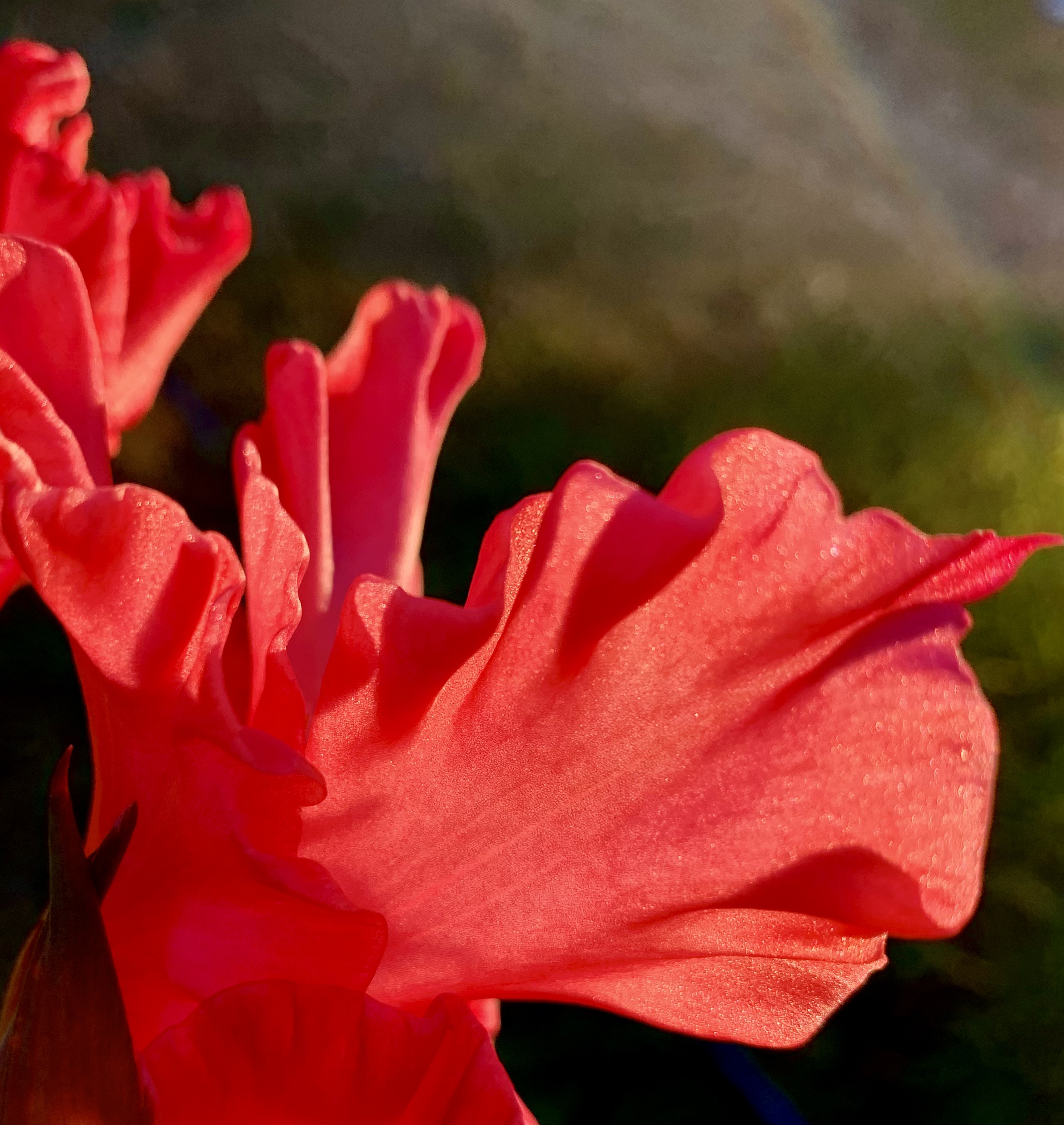
You Just Never Know

What shall I say, because talk I must?
That I have found a cure
for the sick?
I have found no cure
for the sick

but this crooked flower
which only to look upon
all men
are cured. This
is that flower
for which all men
sing secretly their hymns
of praise! This
is that sacred
flower!
~William Carlos Williams from “The Yellow Flower”

The nail of each big toe was the horn of a goat.  Thick as a thumb and curved, it projected down over the tip of the toe to the underside.  With each step, the nail would scrape painfully against the ground and be pressed into his flesh.  There was dried blood on each big toe. 

It took an hour to do each big toe.  The nails were too thick even for my nail cutters.  They had to be chewed away little by little, then flattened out with the rasp, washed each toe, dried him off, and put his shoes and socks back on.  He stood up and took a few steps, like someone who is testing the fit of a new pair of shoes. 

“How is it?”

“It don’t hurt,” he said, and gave me a smile that I shall keep in my safety deposit box at the bank until the day I die.

I never go to the library on Wednesday afternoon without my nail clippers in my briefcase.
You just never know.

~Richard Selzer from “Toenails” from Letters to a Young Doctor

I know for a while again
the health of self-forgetfulness,
looking out at the sky through
a notch in the valleyside,
the black woods wintry on
the hills, small clouds at sunset
passing across. And I know
that this is one of the thresholds
between Earth and Heaven,
from which even I may step
forth and be free.
– Wendell Berry from “Sabbath Poems”

Whenever I lose perspective
about what I was trained to do
and who I am meant to serve,
when I wallow in the mud of self-importance
rather than in the health of self-forgetfulness~

On those clinic days when I would wash out
a plug of wax from a deaf ear and miraculously restore hearing
or remove a painful thorn in a festering thumb
or clip someone’s crippling toenails
so they can step forth in freedom
or I simply sit still as someone
cries out their heart’s pain

I would cling to that crooked flower
of healing and forgiveness I was handed
over fifty years ago, sharing
its sacred sweetness with another.

I was given these tools for a reason,
and try to still use them.

You just never know.

All the Pretty Little Horses

The mare roamed soft about the slope,
Her rump was like a dancing girl’s.
Gentle beneath the apple trees
She pulled the grass and shook the flies,
Her forelocks hung in tawny curls,
She had a woman’s limpid eyes,
A woman’s patient stare that grieves.
And when she moved among the trees,
The dappled trees, her look was shy,
She hid her nakedness in leaves.
A delicate though weighted dance
She stepped while flocks of finches flew
From tree to tree and shot the leaves
With songs of golden twittering;
How admirable her tender stance.
And then the apple trees were new,
And she was new, and we were new,
And in the barns the stallions stamped
And shook the hills with trumpeting.
~Ruth Stone, 
“The Orchard” from What Love Comes To

Only one retired Haflinger mare remains on our farm now, her small herd diminishing one at a time as they passed from old age. She now is thirty herself, living her remaining days with two geldings in their twenties.

Over four decades, we have kept over a dozen mares born on this land, where they served us well, birthing us their foals and working when asked. In their retirement, they deserved this easy life on pasture for as long as their legs and feet could carry them up and down the slopes of our hilly farm – they more and more resembled our ancient crooked crippled orchard trees, some of which have toppled in the winter winds..

We are close to the end of our horse-keeping days; hard decisions must be made at some point and I don’t feel quite prepared to determine when they are no longer enjoying their time under the sun and I am too frail to care for them as they deserve.

I don’t want them or me to topple over like an old hollow tree in the wind.

I listen for their nickers as I come into the barn each morning and gauge their eagerness to be set free to the fields. The other day, as the sky was gray with a passing rain shower, the geldings went outside happily. As I let our mare out to pasture, she stopped on her way through the gate and turned around, poised to head back to the barn rather than get wet.

I looked her in the eyes and understood exactly how she was feeling.

Perhaps I have identified a bit too much with the stiffness as my aging mares move, their need for frequent napping times in the field, swishing at flies while they dream of younger days of flirting with stallions, nursing babies, having suppler joints and the occasional wild gallop at twilight.

I sing a sad lullaby to myself as I work about the barn with slow deliberation, knowing there is a somber sorrow to life change.
The years pass, never to return, leaving those limpid eyes, flowing manes and tails in their wake.

Ah, yes,
I have had
all the pretty little horses…

The Fade to Twilight

some words need to be

repeated
the way a sunset plays
every night
in the fade to twilight
the same scene
over and over
but never once
lost in its sameness
~Juniper Klatt “some words need to be” from I was raised in a house of water

Out of the deep and the dark,
A sparkling mystery, a shape,
Something perfect,
Comes like the stir of day:
One whose breath is a fragrance,
One whose eyes reveal the road to stars,
The wind in his countenance,
The glory of heaven upon his back.
He steps like a vision hung in air,
Diffusing the passion of eternity;
His abode is the sunlight of morn,
The music of eve his speech:
In his sight,
One shall turn from the dust of the grave,
And move upward to the woodland.

~Yone Noguchi The Poet”

Once in your life you pass
Through a place so pure
It becomes tainted even
By your regard, a space
Of trees and air where
Dusk comes as perfect ripeness.
Here the only sounds are
Sighs of rain and snow,
Small rustlings of plants
As they unwrap in twilight.
This is where you will go
At last when coldness comes.
It is something you realize
When you first see it,
But instantly forget.
At the end of your life
You remember and dwell in
Its faultless light forever.

~Paul Zimmer “The Place” from Crossing to Sunlight Revisited.

I like the slants of light; I’m a collector.
That’s a good one, I say…
~Annie Dillard from Pilgrim at Tinker Creek

I won’t forget the glow on the hill as the sun drops,
centering behind our sentinel tree.
I won’t forget the rays coming through the branches,
glistening on a tattered web
and an evening primrose unwrapping.
I won’t forget the way the air itself changes as the color spreads,
like a fragrant scent carried on the wind.

The light is faultless but I am not.
My collection of slants of light
and words to describe them
may fade with time.

Even so, it was – maybe just once –
so perfect, so pure, so ripe.
And I’ll remember I was there to witness it.

What I’m Still Learning…

I’ve learned that no matter what happens, or how bad it seems today, life does go on, and it will be better tomorrow.

I’ve learned that you can tell a lot about a person by the way he/she handles these three things: a rainy day, lost luggage, and tangled Christmas tree lights.


I’ve learned that regardless of your relationship with your parents, you’ll miss them when they’re gone from your life.


I’ve learned that making a ‘living’ is not the same thing as making a ‘life.’


I’ve learned that life sometimes gives you a second chance.


I’ve learned that you shouldn’t go through life with a catcher’s mitt on both hands; you need to be able to throw something back.


I’ve learned that whenever I decide something with an open heart, I usually make the right decision.


I’ve learned that even when I have pains, I don’t have to be one.


I’ve learned that every day you should reach out and touch someone. People love a warm hug, or just a friendly pat on the back.


I’ve learned that I still have a lot to learn.


I’ve learned that people will forget what you said, people will forget what you did, but people will never forget how you made them feel.
~Maya Angelou

…think of all the things you’ve learned over the years—
the hard and the holy,
the mysteries that will always remain mysterious,
the clean edges of truth,
the soft edges of every kindness given or received,
the way trouble and wonder will continue to show up, sometimes leaving us beached and breathless with uncontainable joy or unutterable sorrow.
I think of all the times I was knocked to my knees by a beautiful and brilliant flash of the completely obvious.

~Carrie Newcomer from A Gathering of Spirits

I learned from my mother how to love
the living, to have plenty of vases on hand
in case you have to rush to the hospital
with peonies cut from the lawn, black ants
still stuck to the buds. I learned to save jars
large enough to hold fruit salad for a whole
grieving household, to cube home-canned pears
and peaches, to slice through maroon grape skins
and flick out the sexual seeds with a knife point.
I learned to attend viewings even if I didn’t know

the deceased, to press the moist hands

of the living, to look in their eyes and offer
sympathy, as though I understood loss even then.
I learned that whatever we say means nothing,

what anyone will remember is that we came.
I learned to believe I had the power to ease
awful pains materially like an angel.
Like a doctor, I learned to create

from another’s suffering my own usefulness, and once
you know how to do this, you can never refuse.
To every house you enter, you must offer

healing: a chocolate cake you baked yourself,
the blessing of your voice, your chaste touch.
~Julie Kasdorf– “What I Learned from my Mother”

Five years ago today, I wrapped up 45 years of uninterrupted medical training and doctoring.

Even while bearing three children and going through a few surgeries myself, I was not away from patient care for more than twenty consecutive days at any one time. This was primarily out of my concern that, even after a few weeks, I would forget all that I’d ever known.

Indeed, half of what I learned in medical school and residency nearly fifty years ago has evolved, thanks to new discoveries and clarifying research. I worried if I actually stepped away from doctoring for an extended time, then return to see patients again, I would be masquerading as a physician rather than be the real thing.

I couldn’t fathom a day when I could actually investigate a medical dilemma by typing a few words in a search engine on a computer screen. Instead, I researched through opening my encyclopedic collection of reference textbooks along with huge notebooks of “Scientific American Updates,” a monthly process of throwing out old articles to be replaced by newly discovered data. That is how I kept learning before the computer replaced books and pen and paper…

If being truly honest, even now, those who spend their professional lives providing medical care to others always share this concern: if a patient only knew how much we don’t know and will never know, despite everything we DO know, there would really be no trust left for us at all.

With so much rapidly changing medical information at everyone’s fingertips and computer screens, who needs a trained physician when there are so many other resources – many sketchy and opportunistic – for seeking health care advice?

Yet, I am convinced most patients really do want doctors to share the best information they have available at any point in time rather than rely on the latest internet algorithm and so-called “experts.”

I know over forty years of clinical experience gave me an eye and an ear for the subtle signs and symptoms that no googled website or AI app or virtual doc-in-the-box can discern: the avoidance of eye contact, the tremble of the lip as they spoke, the barely palpable rash, the hardly discernible extra heart sound, the fullness over an ovary, the slight squeak in a lung base. These are things I was privileged to see and hear, about which I made decisions together with my patients. 

The work I did over four decades was a reflection of a continual learning process; out of my natural caution, I was honest when I didn’t know what the diagnosis was, nor the best treatment, but committed to doing my best to find out.

Continual learning – what I was trained to do for thousands of days and many more thousands of patients during my professional life, while passing a comprehensive certification examination every few years to prove my study and changing fund of knowledge.

Since retiring, the help I offer no longer means writing a prescription for a medication, or performing a minor surgery. I have to simply offer up me for what it’s worth, without a stethoscope.

Now I aim to be the best mom and grandma and friend I can be.
I can press my hand into another’s, hug when needed, smile and listen and nod and sometimes weep when someone has something they need to say. No advanced degree or certification required.

Someday, hopefully not too soon, I will die happy knowing I chose this with my life: still learning and still caring.

The Sweet Ache of Memories

All day the stars watch from long ago
my mother said I am going now
when you are alone you will be all right
whether or not you know you will know
look at the old house in the dawn rain
all the flowers are forms of water
the sun reminds them through a white cloud
touches the patchwork spread on the hill
the washed colors of the afterlife
that lived there long before you were born
see how they wake without a question
even though the whole world is burning

~W.S. Merwin “Rain Light”

Well-away and be it so,
To the stranger let them go.
Even cheerfully I yield
Pasture, orchard, mowing-field,
Yea and wish him all the gain
I required of them in vain.
Yea and I can yield him house,
Barn, and shed, with rat and mouse
To dispute possession of.
These I can unlearn to love.
Since I cannot help it? Good!
Only be it understood,

It shall be no trespassing
If I come again some spring
In the grey disguise of years,
Seeking ache of memory here.
~Robert Frost from “On the Sale of My Farm”

the farm where I grew up in east Stanwood
the Stanwood farm from the road

From the road, each of the two small farms where I grew up in western Washington state (Stanwood and Olympia) look nothing like they did in my childhood.  When I drive past now, whether on Google Earth virtually or for real, the outbuildings have changed and are unfamiliar, fences pulled down, the trees exponentially taller or gone altogether, the fields no longer well-tended. Instead the familiarity is in the road to get there, the lean into the curves, the acceleration in and out of dips, the landscape which triggers a simultaneous comfort and disquiet deep in my DNA.

Though my brother once stopped and got permission to look around our long-ago childhood home, and sent me pictures that looked barely recognizable, I myself have never stopped to knock; instead I have driven slowly past to sense if I feel what I used to feel in these places.  My memories are indeed triggered but feel a bit as if they must have happened to someone else.

I have the same feeling when driving past my parents’ childhood farms on Similk Bay on Fidalgo Island and in the Palouse wheat fields. Part of me belongs to these places even though they have never been truly “mine” – only part of sweet memories from my own childhood.

barn on Olympia farm
Olympia house
the driveway to my mother’s Palouse farm where she grew up
my mother’s childhood home in Spring Valley, the Palouse

One clinic day years ago, I glanced at the home address of a young man I was about to see for a medical issue and I realized he now lived in my childhood home located over 100 miles away.  When I greeted him I told him we had something in common: we had grown up under the same roof, inside the same walls, though children of two different generations. 

He was curious but seemed skeptical — how could this gray-haired middle aged woman know anything about his home?  He told me a bit about the house, the barn, the fields, the garden and how he experienced it felt altogether strange to me.  He and I had shared nothing but a patch of real estate — our recollections were so completely disparate.

The two daughters of the family who sold our current farm to us over thirty years ago have been back to visit a time or two, and have driven by whenever they are in the area. Many things remain familiar to them but also too much has changed – it is not quite the same farm they remember from their childhood. I know it aches to visit here but they do let me know when a photo I post has a particular sweet memory for them.

I worry for the fearsome ache if someday, due to age or finances, we must sell this farm we cherish ~ this beloved place our children were raised, animals bred and cared for, fruit picked from an ancient orchard, plants tended and soil turned over. It will remain on the map surely as the other two farms of my past, visible as we pass by slowly on the road, but primarily preserved in the words and photos I harvest here.

Only be it understood,
It shall be no trespassing
If I come again some spring
In the grey disguise of years,
Seeking ache of memory here.


There will always be hoping something will still remain familiar on the map of my memory. After all, there is no such beauty as the place where I belonged – now and forever ago.

eveningporch51218

Tell me, where is the road
I can call my own
That I left, that I lost
So long ago?
All these years I have wandered
Oh, when will I know
There’s a way, there’s a road
That will lead me home

After wind, after rain
When the dark is done
As I wake from a dream
In the gold of day
Through the air there’s a calling
From far away
There’s a voice I can hear
That will lead me home

Rise up, follow me
Come away, is the call
With the love in your heart
As the only song
There is no such beauty
As where you belong
Rise up, follow me
I will lead you home
~Michael Dennis Browne

Something Aimed At You

And I was alive in the blizzard of the blossoming pear,
Myself I stood in the storm of the bird–cherry tree.
It was all leaflife and starshower, unerring, self–shattering
power,
And it was all aimed at me.

What is this dire delight flowering fleeing always earth?
What is being? What is truth?

Blossoms rupture and rapture the air,
All hover and hammer,
Time intensified and time intolerable, sweetness raveling rot.
It is now. It is not.

~Osip Mandelstam “And I Was Alive” (translated by Christian Wiman) from Stolen Air 

Ordinary things have always seemed numinous to me. 
One Calvinist notion deeply implanted in me is that
there are two sides to your encounter with the world.
You don’t simply perceive something that is statically present,
but in fact there is a visionary quality to all experience.
It means something because it is addressed to YOU. 
~Marilynne Robinson from The Paris Review 2008

We mostly live through routine and ordinary days, unconscious of many treasures and abundance laid before us.

In fact, these are addressed to us as pure gift –
postmarked to our address, fully paid, no postage due.

Daily I search the soil of my life, this farm, this faith
to find what in me still yearns to grow, to blossom, to fruit,
in order to be harvested to share with others.

Such sweetness undoes our inevitable decay.

I am so grateful for the tie that binds me to those who visit this page, hoping what I share makes a difference in your ordinary,
but still so precious, day. 

The gift of ordinary time is now.
Its numinosity is aimed at each one of us.

Poem by Dana Gioia

Echo of the clocktower, footstep
in the alleyway, sweep
of the wind sifting the leaves.
Jeweller of the spiderweb, connoisseur
of autumn’s opulence, blade of lightning
harvesting the sky.

Keeper of the small gate, choreographer
of entrances and exits, midnight
whisper traveling the wires.
Seducer, healer, deity or thief,
I will see you soon enough—
in the shadow of the rainfall,
in the brief violet darkening a sunset—

but until then I pray watch over him
as a mountain guards its covert ore
and the harsh falcon its flightless young.

Come and See: Who Would Be First to Throw Stones?

They went each to their own house but Jesus went to the Mount of Olives. Early in the morning he came again to the temple. All the people came to him, and he sat down and taught them.  

The scribes and the Pharisees brought a woman who had been caught in adultery, and placing her in the midst they said to him, “Teacher, this woman has been caught in the act of adultery. Now in the Law, Moses commanded us to stone such women. So what do you say?”  This they said to test him, that they might have some charge to bring against him.

Jesus bent down and wrote with his finger on the ground. And as they continued to ask him, he stood up and said to them, “Let him who is without sin among you be the first to throw a stone at her.” And once more he bent down and wrote on the ground.  

But when they heard it, they went away one by one, beginning with the older ones, and Jesus was left alone with the woman standing before him. Jesus stood up and said to her, “Woman, where are they? Has no one condemned you?”  She said, “No one, Lord.”

And Jesus said, “Neither do I condemn you; go, and from now on sin no more.”
John 7:53 – John 8:11

[The earliest manuscripts and many other ancient witnesses do not have John 7:53—8:11. A few manuscripts include these verses, wholly or in part, after John 7:36, John 21:25, Luke 21:38 or Luke 24:53.]

The adulterous woman is brought alone by the Jewish authorities for judgement, to be humiliated by serving as a test case for Jesus. This incident was not so much about justice as it was about seeing how Jesus would react to her situation.

His response is not what they expected.

He stoops to the ground, taking his time, avoiding their gaze, writing something (inscrutable to the reader) in the dirt. He then stands to look them in the eye to state what is necessary before acting out the law’s justice: only those who have not sinned will be first to cast the stone at a sinner.

Then he kneels again to trace His finger through the dirt —
outlining each person’s sin? naming names?
buying time for things to calm down?
keeping them guessing? just doodling?

The authorities, knowing their own burden of sin,
the oldest of them initially,
turn to leave one by one.
Soon only the accused woman and Jesus remain.

As St. Augustine writes about this powerful gospel story:
relicti sunt duo, misera et misericordia” which translates to
two were left: misery and mercy.
She, standing in the misery of her sin;
He, standing in the glory of His mercy.

No longer condemned while He takes it all on Himself.
No stones to throw; free to go; sin no more.

I am reading slowly through the words in the Book of John over the next year alongside my church family. Once a week, I will invite you to “come and see” what those words might mean as we explore His promises together.

Light Becomes What It Touches

…The world
is flux, and light becomes what it touches,
becomes water, lilies on water,
above and below water,
becomes lilac and mauve and yellow
and white and cerulean lamps,
small fists passing sunlight
so quickly to one another
that it would take long, streaming hair
inside my brush to catch it.
To paint the speed of light!
Our weighted shapes, these verticals,
burn to mix with air
and change our bones, skin, clothes
to gases.  Doctor,
if only you could see
how heaven pulls earth into its arms
and how infinitely the heart expands
to claim this world, blue vapor without end.
~Lisel Mueller from “Monet Refuses the Operation” from Second Language

Monet’s corner of a lily pond (1918-1919)

Heaven pulls earth into its arms…”

We all see things differently, don’t we?
What seems ordinary to one is extraordinarily memorable to another.

How might I help others to see the world as I do?
How might I learn to adjust my focus to see things as you do?

The world is in flux;
my delight and dismay flows
from moment to moment,
from object to absence,
from light to darkness,
from color to muted.

Perhaps the blur from Monet’s cataracts
also impedes my vision, creating a deeper understanding,
as I use my imagination to fill in what I can’t quite discern.

My heart and mind expands exponentially
to claim this world and all that beauty has to offer,
while heaven – all this while – pulls me into its arms.

In heaven, my focus will be clear.
All will be extraordinarily ordinary.

Gift of a Day

A hundred thousand birds salute the day:–
        One solitary bird salutes the night:
Its mellow grieving wiles our grief away,
        And tunes our weary watches to delight;
It seems to sing the thoughts we cannot say,
        To know and sing them, and to set them right;
Until we feel once more that May is May,
        And hope some buds may bloom without a blight.
This solitary bird outweighs, outvies,
        The hundred thousand merry-making birds
Whose innocent warblings yet might make us wise
Would we but follow when they bid us rise,
        Would we but set their notes of praise to words
And launch our hearts up with them to the skies.
~Christina Rossetti “A Hundred Thousand Birds”

Every day is perfect, if
when you wake, you hear birds
in the garden, in the yard. Birds


up and down, ushering in one more day
in all the houses on Shaker Way. Birds
on telephone lines, light posts. Birds


twit, twittering on trees
hailing fellow birds
with a nod of  beak—gray kingbird;


top-hatted, streamertail
tuxedoed, doctor bird—
busy-bodied hummingbird


tucking in, out, of pink, red ixoras
punch-drunk in love. Birds
preening for, chatting up other birds—


the oriole, the grass quit, in mid-song
on the lawn, in a dance of  birds
an all-day-long conference of bird;


red-headed woodpecker
—drummer boy, or girl bird
in this daily symphony of  birds


—an orchestra on Shaker Way
in serenade of each perfect day with birds—
from the very first mockingbird


heralding, in solo warble
one more day, filled with birds—
brightened, lightened, trilled by birds:


precious, diamond-throated
sweet song, miracle-toting birds
the-gift-of-day-is-here birds.


Bird, bird, bird. Hello bird.
You lift me up bird.
You sing the day beautiful, bird.

~Ann-Margaret Lim “Birdsong of Shaker Way”

Birds afloat in air’s current,
sacred breath? No, not breath of God,
it seems, but God
the air enveloping the whole
globe of being.
It’s we who breathe, in, out, in, the sacred,
leaves astir, our wings
rising, ruffled—but only saints
take flight…
But storm or still,
numb or poised in attention,
we inhale, exhale, inhale,
encompassed, encompassed.

~Denise Levertov from “In Whom We Live and Move and Have Our Being” from The Stream and the Sapphire

As if reluctant to let go the setting sun last night,
one lone bird still sang a twilight song,
long after the others fell asleep,
their heads tucked neatly under their wings.

This lone bird had not yet finished the day,
breathing in and out its plaintive melody,
articulating what my own thoughts could not say.

And before a hint of light this June morning,
I am swept from my dreams at 4:30 AM
by a full chorus singing from the same tree,
no longer a lone voice, but hundreds.

Although my day is launched early by warbling songs,
I cannot forget twilight’s one reluctant bird
who fought back the impending darkness using only its voice.

I too resist the darkness with what I write here,
if only I can keep it at bay:
inhaling, exhaling, encompassed in holy Breath.

I want to sing out light and love to Light:
encompassed by no darkness here.

I hear a bird chirping, up in the sky
I’d like to be free like that spread my wings so high I
see the river flowing water running by
I’d like to be that river, see what I might find

I feel the wind a blowin’, slowly changing time
I’d like to be that wind, I’d swirl and the shape sky
I smell the flowers blooming, opening for spring
I’d like to be those flowers, open to everything

I feel the seasons change, the leaves, the snow and sun
I’d like to be those seasons, made up and undone
I taste the living earth, the seeds that grow within
I’d like to be that earth, a home where life begins

I see the moon a risin’, reaching into night
I’d like to be that moon, a knowing glowing light
I know the silence as the world begins to wake
I’d like to be that silence as the morning breaks

He doesn’t know the world at all
Who stays in his nest and doesn’t go out.
He doesn’t know what birds know best
Nor what I sing about, Nor what I sing about, Nor what sing about:
That the world is full of loveliness.

When dew-drops sparkle in the grass
And earth is aflood with morning light. light
A blackbird sings upon a bush
To greet the dawning after night,
the dawning after night,
the dawning after night.
Then I know how fine it is to live.

Hey, try to open your heart to beauty;
Go to the woods someday
And weave a wreath of memory there.
Then if tears obscure your way
You’ll know how wonderful it is
To be alive.

~Paul Read

Time Travel for No Good Reason

As if you needed one,
as if you could help it,
for no good reason
a tune out of nowhere
pops into your head
when you least expect,
riffs effortlessly in the
folds of your cerebrum—

your own private jukebox,
your personal music device
on random minus the earbuds—
drumming itself up to keep
you company: here, a little
Janis Joplin while you vacuum
cat hair; there, a John Denver line
as you peel potatoes at the sink.

How can others not hear it,
this frequent odd gift?
Sometimes you forget
and blurt the words to the chorus,
which, after all, is all you can remember,
those take me home, country roads,
that feelin’ good was good enough
for me
, even conjuring

the gas station in Colorado
back where you, wearing
those bell bottoms and that
paisley, were about to fill a tank
of freedom into the blue VW Bug
when Carole King belted out
and it’s too late baby, now it’s too late
though we really did try to make it

and you couldn’t move, couldn’t
quit sobbing to the steering wheel
that would not console those blues
or say what you had left to lose,
wouldn’t question why in hell
you were going down that road
where for no good reason
you seemed to be heading.

~Twyla M. Hansen “For No Good Reason” from Rock. Tree. Bird.

He (the professor) asked what I made of the other students (at Oxford) so I told him.
They were okay, but they were all very similar…
they’d never failed at anything or been nobodies,
and they thought they would always win.
But this isn’t most people’s experience of life.

He asked me what could be done about it.
I told him the answer was to send them all out for a year
to do some dead-end job
like working in a chicken processing plant
or spreading muck with a tractor.
It would do more good than a gap year in Peru. 

He laughed and thought this was tremendously witty.
It wasn’t meant to be funny.

~James Rebanks from The Shepherd’s Life
(how a sheep farmer succeeds at Oxford and then goes back to the farm)

In our barn we have a very beat up old AM/FM radio that sits on a shelf next to the horse stalls and serves as company to the horses during the rainy stormy days they stay inside, and serves as distraction to me as I clean stalls of manure and wet spots morning and evening. 

We live about 10 miles south of the Canadian border, so most stations that come in well on this radio’s broken antenna are from the lower mainland of British Columbia. This includes a panoply of stations spoken in every imaginable language– a Babel of sorts that I can tune into: Spanish, Japanese, Chinese, Hindi, Russian, French and of course, proper British accent English. 

But standard issue American melting-pot genetic mix that I am, I prefer to tune into the “Oldies” Station and reminisce.

There is a strange comfort in listening to songs that I enjoyed 50+ years ago, and I’m somewhat miffed and perplexed that they should be called “oldies”.  Oldies used to refer to music from the 20’s, 30’s and 40’s, not the 50’s, 60’s, and 70’s and (heavens to Betsy) the 80’s and 90’s!  

I listen and sing along with a mixture of feeling ancient and yet transported back to my teens. I can remember faces and names I haven’t thought of in decades, recall special summer days picking berries and hear the long lost voices from school days. I can smell and taste and feel things all because of the trigger of a familiar song. 

There is something primordial –deep in my synapses– that is stirred by this music. It’s almost like instant time travel without magic needed. In fact, I shoveled manure to these same songs 65 years ago, and somehow, it seems not much as changed. 

Or has it? One  (very quick) glance in the mirror tells me it has, and I have.

Yesterday – I Got You, Babe and you were a Bridge Over Troubled Waters for this Natural Woman who just wants to be Close to You so You’ve Got a Friend.  There’s Something in the way I Cherish The Way We Were and of course Love Will Keep Us Together. If You Leave Me Now,  You’re So VainI’ve always wanted it My Way but How Sweet It Is when I Want To Hold Your Hand.  Come Saturday MorningHere Comes the Sun as we’re Born to Be Wild

Help! Do You Know Where You’re Going To?  Me and You and A Dog Named Boo will travel Country Roads and Rock Around the Clock even though God Didn’t Make the Little Green Apples to grow in a Moonshadow.  Fire and Rain will make things All Right Now once Morning is BrokenI’ll Say a Little Prayer For You so just Let It Be.

I Can’t Get No Satisfaction from the Sounds of Silence — If— Those Raindrops Keep Fallin’ on My Head.  Stand By Me as It’s Just My Imagination that I am a Rock, when really I only want Time in a Bottle and to just Sing, Sing a Song.

They just don’t write songs like they used to. I seem to remember my parents saying that about the songs I loved so well in the 60’s and 70’s. Somehow in the midst of decades of change, there are some constants. Music still touches our souls, no matter how young or old we are.

And every day there will always be manure that needs shoveling.