Such a Glorious Infestation…

She lingered in that charming little garden
to say hello to the gnomes,
such a glorious infestation!
How few wizards realize just how much we can learn
from the wise little gnomes-
or, to give them their correct names, the Gernumbli gardensi.
‘Ours do know a lot of excellent swear words,’ said Ron…
J.K. Rowling in Harry Potter and the Deathly Hallows

It is hard to say exactly when the first one moved in. This farm was distinctly gnome-less when we bought it nearly forty years ago, largely due to twenty-seven hungry barn cats residing here at the time in various stages of pregnancy, growth, development and aging. It took awhile for the feline numbers to whittle down to an equilibrium that matched the rodent population.

In the mean time, our horse numbers increased from three to seven to over fifteen with a resultant exponential increase in barn chores. One spring thirty years ago, I was surprised to walk in the barn one morning to find numerous complex knots tied in the Haflingers’ manes. Puzzling as I took precious time to undo them, literally adding hours to my chores, I knew I needed to find the cause or culprit.

It took some research to determine the probable origin of these tight tangles.  Based on everything I researched, they appeared to be the work of Gernumbli faenilesi, a usually transient species of gnome preferring to live in barns and haylofts in close proximity to heavy maned ponies. In this case, as the tangles persisted for months, they clearly had moved in, lock, stock and barrel. The complicated knots were their signature pride and joy, their artistic way of showing their devotion to a happy farm.

All well and good, but the extra work was killing my fingers and thinning my horses’ hair. I plotted ways to get them to cease and desist.

I set live traps of cheese and peanut butter cracker sandwiches, hoping to lure them into cages for a “catch and release”. Hoping to drive them away, I played polka music on the radio in the barn at night. Hoping to be preemptive, I braided the manes up to be less tempting but even those got twisted and jumbled. Just as I was becoming ever more desperate and about to round up more feral cats, the tangling stopped.

It appeared the gnomes had moved on to a more hospitable habitat. Apparently I had succeeded in my gnome eradication plan. 

Or so I thought.

Not long after, I had the distinct feeling of being watched as I walked past some rose bushes in the yard. I stopped to take a look, expecting to spy the shining eyes of one of the pesky raccoons that frequents our yard to steal from the cats’ food dish. Instead, beneath the thorny foliage, I saw two round blue eyes peering at me serenely. This little gal was not at all intimidated by me, and made no move to escape. She was an ideal example of Gernumbli gardensi, a garden gnome known for their ability to keep varmints and vermin away from plants and flowers. They also happen to actively feud with Gernumbli Faenilesi so that explained the sudden disappearance of my little knot-tying pests in the barn.

It wasn’t long before more Gardensi moved in, a gnomey infestation. They tend to arrive in pairs and bunches, bringing their turtles and dogs with them, like to play music, smoke pipes, play on a teeter totter, work with garden tools, take naps on sun-warmed rocks and one even prefers a swing, day and night through all four seasons. They are a bit of a rowdy bunch and always up for a party, but I enjoy their happy presence and jovial demeanor. I haven’t yet heard any bad language as we have a “keep it clean” policy about bad words around here. They seem quite hardy, stoically withstand extremes in weather, wear masks when asked and only seem fearful when hornets build a nest right in their lap.

As long as they continue to coexist peaceably with us and each other, keep the varmints and their knot-tying cousins away, and avoid bad habits and swear words, I’m quite happy they are here. Actually, I’ve given them the run of the place. I’ve been told to be cautious as there are now news reports of an even more invasive species of gnome, Gernumbli kitschsi, that could move in and take over if I’m not careful. In fact, several new little fellows moved into my hanging baskets and back into the barn this week – someone obviously had put the word out this is a great place to winter over. Now I need to watch for more mane tangles again.

A gnome explosion.

I shudder to think.  There goes the neighborhood.

photo by Tomomi Gibson

There’s Something About the Outside of a Horse

There is something about the outside of a horse that is good for the inside of a man…
~Long time equestrian wisdom attributed to many famous riders

Twenty-five years ago today, two days before the world changed forever, I helped organize a gathering of Haflinger horse owners from western Canada and the United States in our nearby town of Lynden, Washington. We enjoyed an annual meet-up at the local fairgrounds to enjoy our horses together for a few days doing breed demonstrations for the public, riding, jumping, dressage, driving in teams, vaulting –
a little of everything with our versatile horses.

We received permission from Lynden City Hall to have a Haflinger parade on a quiet Sunday morning while local folks were worshipping in the many churches in town. We wanted to be sure to begin from the fairgrounds after services had started, do a two mile route through town and back to the fairgrounds before the traffic increased later.

It was a remarkable sunny morning of over ninety Haflingers and their people – some riding, driving, or leading their horses — all enjoying the quiet peace of a Sabbath morning in a friendly little town. Some of the owners and their horses had been in local parades in their home towns, but none had the experience of being an “all Haflingers” troop through a downtown.

It all went smoothly without a hitch.
Well, actually there were several “hitches” in the parade: carts and wagons being pulled by our golden friends.

Everyone returned safely home before September 11, 2001. Life hasn’t felt as peaceful or calm in the same way ever since. This 2001 Haflinger parade was the one and only time it happened in our part of the world.

This is to remember those few days we spent together — the insides of us enjoying the outsides of our Haflingers.

Each is Nothing Without the Others

Theirs is a perfection of pure form.
Nobody but has his proper place and knows it.
Everything they do is functional.
Each foray in a zigzag line
Each prodigious lifting
Of thirty-two times their own weight
Each excavation into the earth’s core
Each erection
Of a crumbly parapetted tower —

None of these feats is a private pleasure,
None of them done
For the sake of the skill alone —

They’ve got a going concern down there,
A full egg-hatchery
A wet-nursery of aphids
A trained troop of maintenance engineers
Sanitation experts
A corps of hunters
And butchers
An army

A queen
Each
Is nothing without the others, each being a part
Of something greater than all of them put together
A purpose which none of them knows
Since each is only
The one thing that he does. There is
A true consistency
Toward which their actions tend.
The ants have bred and inbred to perfection.
The strains of their genes that survive survive.
Every possible contingency
Has been foreseen and written into the plan.

Nothing they do will be wrong.
~Daniel Hoffman “Ants” from Beyond Silence

The ant in the shadow of this blade of grass
Is indifferent to my presence, to the action
Of the day, to the creaking of the limbs
Of the sycamore, to the sun lowering itself
Slowly from the scaffolding of the sky…

The ant has not moved.  It is deep in meditation.

…Ants understand
The principle of undefiled silence.  My ant glows
Like charcoal now in the lengthening rays of the sun.
I kneel and whisper, “Look up at me.  I’m here.”

~John Gilgun from “The Ant in the Shadow of This Blade of Grass”

Today, when I could do nothing,
I saved an ant.
..


Small black ant, alone,
crossing a navy cushion,
moving steadily because that is what it could do.

Set outside in the sun,
it could not have found again its nest.
What then did I save?


It did not move as if it was frightened,
even while walking my hand,
which moved it through swiftness and air.


Ant, alone, without companions,
whose ant-heart I could not fathom—
how is your life, I wanted to ask.


I lifted it, took it outside.

This first day when I could do nothing,
contribute nothing…

…I did this.

~Jane Hirshfield from “Today When I Could Do Nothing”

The other day, as I sat down in the grass to take pictures, I felt a tickle at the nape of my neck. I reached up, felt something, and when I looked to see what it was, I found a tiny ant crushed in my fingers.

Suddenly it felt like things were crawling everywhere on me, especially my scalp. I shook out my hair and clothes and found there weren’t any more ants. It was only one unfortunate, defenseless victim who chose the wrong place and time to inhabit me.

As a child, I was fascinated by the ant hills in the woods and fields of our small farm. I would track yards and yards of ant trails from the busy mounded colonies to tree trunks and other sources of food, watching the single-file, single-minded insects heading through all sorts of terrain to sustain their community. Having ants crawling on me wasn’t a problem then – they were part of my exploration of creation … sometimes they explored me. So I’m sympathetic to a solitary ant’s curiosity.

When we share the same few square inches of landscape, we want to ask one another: How is your life? hoping to fathom each other’s heart. We are each of us a part of something greater than all of us put together.

In this small corner of the internet, I share words or pictures I hope might bring a smile, a nod of recognition, or a moistened eye, wanting to find common ground with people I likely will never meet in the chaos of existence.

So I ask you every now and again
because I want to know:
how is your life?

Though I may do nothing else of import
in this scatter-mess of life’s anthill, I can do this:
I’m here, exploring and caring,
listening for your comments, feedback and messages.
Nothing you say will be wrong…

Tabby Cat Group Therapy

A happy arrangement:
many people prefer cats to other people,
and many cats prefer people to other cats.
~Mason Cooley

The real objection to the great majority of cats is their insufferable air of superiority. Cats, as a class, have never completely got over the snootiness caused by the fact that in Ancient Egypt they were worshipped as gods. This makes them too prone to set themselves up as critics and censors of the frail and erring human beings whose lot they share. They stare rebukingly. They view with concern. And on a sensitive man this often has the worst effects, inducing an inferiority complex of the gravest kind.
~P.G.Wodehouse from The Story of Webster

Cat! who hast pass’d thy grand climacteric,
  How many mice and rats hast in thy days
  Destroy’d? How many tit bits stolen? Gaze
With those bright languid segments green, and prick
Those velvet ears — but pr’ythee do not stick
  Thy latent talons in me — and upraise
  Thy gentle mew — and tell me all thy frays,
Of fish and mice, and rats and tender chick.
Nay, look not down, nor lick thy dainty wrists–
  For all thy wheezy asthma — and for all
Thy tail’s tip is nick’d off — and though the fists
  Of many a maid have given thee many a maul,
Still is that fur as soft, as when the lists
  In youth thou enter’dest on glass bottled wall.

~John Keats “Sonnet to Mrs. Reynold’s Cat”

Our farm cats tolerate one another. Barely.

Yet they agree on one thing: no additional cats are welcome here.
They are inhospitable to any wandering feral kitty who happens to pussy-foot through to check out the food dishes by the front porch and the back porch.

Those are run off with hisses and spits.

The cats have their own agreed-upon hierarchy about who approaches the food dish first and it is not negotiable.

And when it is time for an occasional necessary group therapy session to work out their differences, they practice social distancing with extreme care, so as not to offend one another.

These cats prefer a solitary life, unless forced into couples counseling by the farm owner because of a spat over shared territory. They are determined not to be dependent on anyone or anything and prefer to blend camouflaged into the background, ready to capture any rodent or bird who happens by.

Clearly, they know they are the superior species.
We exist to serve them.
And they tolerate us living here with them. Barely.

Bring to Light the Mystery: A Ministry of Presence

More and more, the desire grows in me simply to
walk around,
greet people,
enter their homes,
sit on their doorsteps,
play ball,
throw water,
and be known as someone who wants to live with them.

It is a privilege to have the time
to practice this simple ministry of presence.
Still, it is not as simple as it seems.

My own desire to be useful,
to do something significant,
or to be part of some impressive project is so strong
that soon my time is taken up
by meetings, conferences, study groups, and workshops
that prevent me from walking the streets.
It is difficult not to have plans,
not to organize people around an urgent cause,
and not to feel that you are working directly for social progress.

But I wonder more and more if the first thing shouldn’t be
to know people by name,
to eat and drink with them,
to listen to their stories and tell your own, and
to let them know with words, handshakes, and hugs
that you do not simply like them, but truly love them.
~Henri Nouwen from The Practice of the Presence of God

For too many years,
I was wrapped up in the trappings of the “useful” life –
tight schedules, meetings, committees, strategic priorities –
I forgot there is so much living usefully that I neglected to do.

There needs to be more potlucks,
more “oh, by the way” conversations,
more connections “just because,”
more showing up whenever extra hands are needed.

If only I could invite you all over for breakfast.
We’d have a wonderful time…

Actually, now that I think of it —
you ARE invited for breakfast – Sunday, April 5, 2026 at 7 AM.
Dress warmly.
Wear boots.
Come hungry and thirsty for the Word and ready for hugs.

Easter Sunrise on our hill.

photo by Joel De Waard

This year’s Barnstorming Lenten theme is Ephesians 3:9:

…to bring to light for everyone what is the plan of the mystery hidden for ages in God, who created all things…

Lyrics by John Donne
Bring us, O Lord God, at our last awakening into the house and gate of heav’n:
to enter into that gate and dwell in that house,
where there shall be no darkness nor dazzling, but one equal light;
no noise nor silence, but one equal music;
no fears nor hopes, but one equal possession;
no ends nor beginnings, but one equal eternity;
in the habitation of thy glory and dominion, world without end.
Amen.

A Difficult Game Indeed

The chief difficulty Alice found at first
was in managing her flamingo:
she succeeded in getting its body tucked away,
comfortably enough, under her arm,
with its legs hanging down, but generally,
just as she had got its neck nicely straightened out,
and was going to give the hedgehog
a blow with its head,
it would twist itself round and look up in her face,
with such a puzzled expression
that she could not help bursting out laughing:
and when she had got its head down,
and was going to begin again,
it was very provoking to find that
the hedgehog had unrolled itself,
and was in the act of crawling away….
Alice soon came to the conclusion
that it was a very difficult game indeed. 

~Lewis Carroll from Alice in Wonderland

Lewis Carroll Illustration
photo by Chris Duppenthaler

What a difficult game we find ourselves playing.

Does anyone understand the rules anymore?

Handed an uncooperative gangly mallet,
our aim is hopelessly thwarted.

The furry round target takes one look, sees no point, so wanders off, seeking a friendlier game to play somewhere else.

These are absurd times for humans and hedgehogs.

photo by Chris Duppenthaler

Rummaging Among Clouds

The fields are snowbound no longer;
There are little blue lakes and flags of tenderest green.
The snow has been caught up into the sky—
So many white clouds—and the blue of the sky is cold.
Now the sun walks in the forest,
He touches the boughs and stems with his golden fingers;
They shiver, and wake from slumber.
Over the barren branches he shakes his yellow curls. …
Yet is the forest full of the sound of tears….
A wind dances over the fields.
Shrill and clear the sound of her waking laughter,
Yet the little blue lakes tremble
And the flags of tenderest green bend and quiver.

~Katherine Mansfield “Very Early Spring”

You might say that clouds have no nationality
Being flags of no country, flaunting their innocent neutrality
Across frontiers, ignorant of boundaries;
But these clouds are clearly foreign, such an exotic clutter
Against the blue cloth of the sky
I want to rummage among them, I want to turn them over
With eager fingers, I want to bargain
For this one or that one, I want to haggle and dicker
Over the prices, and I want to see my clouds wrapped up
In sheets of old newspapers, and give them away
To young girls to pin in their hair
Or tuck them, glossy as gardenias, behind an ear,
Or stretch one out to the length of a lacy shawl
And toss it over a shoulder, or around a waist.
~Constance Urdang “Clouds”

Our farm sits about 9 miles from an international border. The sky and clouds are oblivious to the line drawn by two governments, and don’t bother to stop at the border stations controlling access of humans across that line.

The clouds are free to go where they please, so they do, while we watch. They are both a foreign and domestic cloud of witnesses to our earthbound follies and foolishness.

No passports or IDs, no being pulled into “secondary” for more intensive searches and questioning, no being “turned back” not allowed across, no deportations.

They simply float and glide where the breezes take them, assuming whatever shape, identity or characteristics they wish.

What a beautiful day in the neighborhood if one happens to be a cloud or a cloud of witnesses…

AI image created for this post

Wrestling and Torn Open

Schizomeno—meaning in Greek “ripped open.” It occurs twice in the Gospels: once when the temple veil is torn the day of Christ’s crucifixion. The other is when “the heavens opened” upon Christ’s baptism.

But they didn’t just “open.” They were ripped open. God broke into history with a voice and an act of salvation unlike any other. 

To study the Bible with people of faith is to see it not only as an object of academic or antiquarian interest but also as a living word, a source of intellectual challenge, inspiration, comfort, uncomfortable ambiguities, and endless insights for people who gather in willingness to accept what seems to be God’s invitation: Wrestle with this.

Healthy churches wrestle, working out their salvation over coffee and concordances, knowing there is nothing pat or simple about the living Word, but that it invites us into subtle, supple, resilient relationship with the Word made flesh who dwells, still, among us.
~Marilyn McEntyre from “Choosing Church”

Passing down this story of Christ’s life, death, resurrection and ascension is not merely, or mainly, an exercise in cognition. Nor is it a divinely inspired game of telephone, where we simply whisper a message to the next generation through the ages. 

Inevitably the story comes to us through ordinary people over dinner tables, at work, in songs, through worship, conflict, failure, repentance, ritual, liturgy, art, work and family.

Christianity is something we believe, but it is also a practice. Central to our practice is what Christians call sacraments, where the mysteries of faith are manifest through the ordinary stuff of earth—water and skin, bread and teeth.
~Tish Harrison Warren from “True Story”

photo by Barb Hoelle

Mom,
You raised your hands while we sang this morning
like I’ve never known you to,
but I guess until recently I’ve never really known you in a church that let you feel alive.

I’m sure the last one did before it faded,
but I was too young to distinguish church from habitual gathering
and they wouldn’t have taught me grace if they’d wanted to,

and that was before I cracked our lives apart.

But it was then, wasn’t it, in the aftermath,
that I saw more of your layers
and saw that they were tapestries,
punctured a thousand times and intricate,
majestic, though they’ve been torn.

Were you tired of hiding,
or just tired?

Thank you for letting yourself be seen.

Thank you, Lord, for her.
~Griffin Messer  “An Analysis of Worship Today”

Ripped open to allow access – that is what God has done to enter into this ordinary stuff of earth, and giving us access to Him.

I enter the church sanctuary twice every Sunday to be reminded of this struggle:
a wrestling match
with ourselves,
with each other,
with everyday ordinary and ornery stuff,
with the living Word of God.

None of this is easy and it isn’t meant to be.
We must work for understanding and struggle for contentment and commitment.

I keep going back – gladly,
knowing my guilt,
eager to be transformed,
not only because I choose to be in church,
but because He chose to invite me there.

photo by Joel DeWaard
AI image created for this post

God’s Keyboard

The whole concept of the Imago Dei (or)…the ‘Image of God’ is the idea that all men have something within them that God injected…

This gives him a uniqueness, it gives him worth, it gives him dignity.

And we must never forget this…there are no gradations in the Image of God.

Every man from a treble white to a bass black
is significant on God’s keyboard,
precisely because every man is made in the Image of God.

One day we will learn that.

We will know one day that God made us to live together as brothers
and to respect the dignity and worth of every man.
– Martin Luther King, Jr. from his “The American Dream” sermon, July 4, 1965
from A Knock at Midnight: Inspiration from the Great Sermons of Reverend Martin Luther King, Jr.

Next to the Blessed Sacrament itself, your neighbor is the holiest object presented to your senses.
~C. S. Lewis from The Weight of Glory

photo of San Juan Islands by Joel DeWaard

We are united by our joint creation as the Image of God.  Not one of us reflects God more than another but together form His body and His kingdom on earth.

Dr. King’s words and wisdom continue to inform us of our shortcomings sixty years later. We flounder in our flaws and brokenness; so many question not only the validity of equality of all people of all shades, but even doubt the existence of a God who would create a world that includes the crippled body, the troubled mind, the questioned gender, the genetically challenged, those never allowed to draw a breath.

Yet we are all one, a composition made up of white and black keys too often discordant, sometimes dancing to different tempos, on rare occasions a symphony. 

The potential is there for harmony, and Dr. King would see and hear that in his time on earth.

Perhaps today we unite only in our shared tears, shed for continued strife and disagreements, shed for injustice that results in senseless killings, shed for our inability to hold up one another as holy in God’s eyes as His intended creation, no matter our color, our origin, our defects, our differences and similarities.

There are no gradations in God nor in His intended harmonious creation. We can weep together, anticipating the day when the Lord God wipes all tears away. 

AI image created for this post

We Are No Longer Alone: Accepting the Gift of Grace

I finally have faith that no matter what happens to me, I will never be beyond help, because I have seen parents, friends and acquaintances live with catastrophe and illness. They were beautifully cared for by those who most loved them.

Twenty-nine years in a tiny church has proved to me that when two or more are gathered who believe in Goodness, they will take care of those in their community who are suffering, scared, lonely. So what are my closest people going to do when my time comes? They will help me come through to whatever awaits. I’ve learned that we can bank on this. Graciousness almost always bats last.
~Anne Lamott from “Have a Little Faith” from Small Victories: Spotting Improbable Moments of Grace.

photo by Barb Hoelle

…when I experienced the warm, unpretentious reception of those who have nothing to boast about, and experienced a loving embrace from people who didn’t ask any questions, I began to discover that a true spiritual homecoming means a return to the poor in spirit to whom the kingdom of heaven belongs.
~Henri Nouwen from The Return of the Prodigal Son

I urge you to live a life worthy of the calling you have received. Be completely humble and gentle; be patient, bearing with one another in love. Make every effort to keep the unity of the Spirit through the bond of peace. There is one body and one Spirit, just as you were called to one hope when you were called; one Lord, one faith, one baptism; one God and Father of all, who is over all and through all and in all. But to each one of us grace has been given as Christ apportioned it.
Ephesians 4:1-7

The Wiser Lake Chapel sanctuary was a warm and open space with a high lofted ceiling, dark wood trim accents matching the ancient pews, and a plain wooden cross above the pulpit in front. There was a pungent smell from fir bough garlands strung along high wainscoting, and a circle of candles standing lit on a small altar table. Apple pie was baking in the kitchen oven, blending with the aroma of good coffee and hot cocoa.

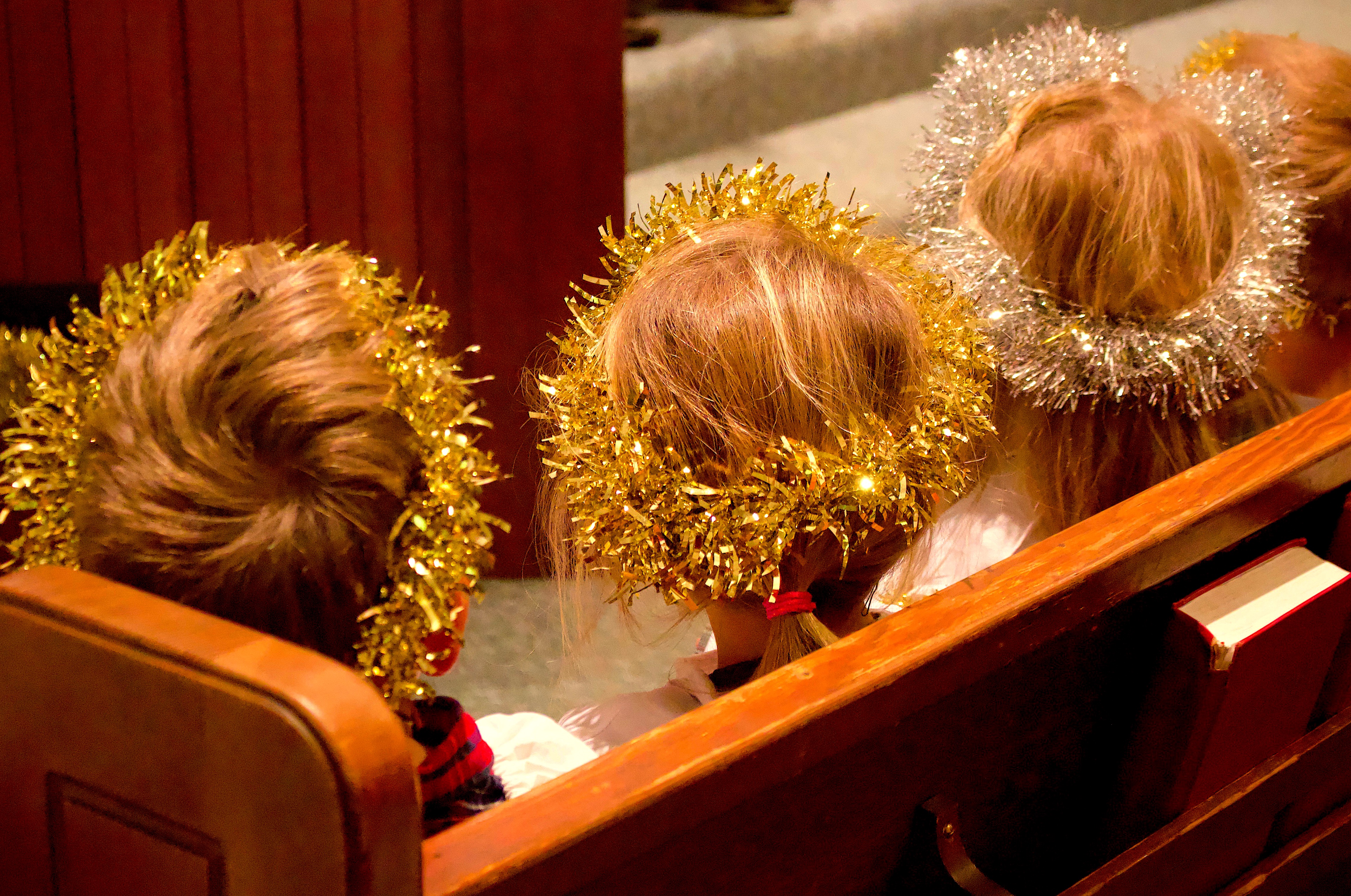
The service was a Sunday School Christmas program, with thirty some children of all ages and skin colors standing up front in bathrobes and white sheet angel gowns, wearing gold foil halos, tinfoil crowns and dish towels wrapped with string around their heads. They were prompted by their teachers through carols and readings of the Christmas story. The final song was Silent Night, sung by candle light, with each child and member of the congregation holding a lit candle. The evening ended in darkness, with the soft glow of candlelight illuminating faces of the young and old, some in tears streaming over their smiles.

It felt like home. We had found our church. We’ve never left. Over three decades it has had peeling paint and missing shingles, a basement that sometimes floods when the rain comes down hard, toilets that don’t always flush well, and though it smells heavenly on potluck days, there are times when it can be just a bit out of sorts and musty.

It also has a warmth and character and uniqueness that is unforgettable.

Like our pastors over the decades – Bruce Hemple, Stephen Tamminga, Albert Hitchcock and now Nathan Chambers – our chapel is humble and unpretentious yet envelops its people in a loving embrace of God’s Word, with warmth, character, grace and a uniqueness that is unforgettable.

That describes all the flawed folks
who have gathered there over the years,
once lost but now found.

We know we belong,
such as we are,
just as we are,
gifted with grace by a God
we worship together in this place.

Perhaps you belong at this old church too…

AI image created for this post

This year’s Advent theme is from Dietrich Bonhoeffer’s sermon on the First Sunday in Advent, December 2, 1928:

The celebration of Advent is possible only to those who are troubled in soul, who know themselves to be poor and imperfect, and who look forward to something greater to come. For these, it is enough to wait in humble fear until the Holy One himself comes down to us, God in the child in the manager.

God comes.

He is, and always will be now, with us in our sin, in our suffering, and at our death. We are no longer alone. God is with us and we are no longer homeless.
~Dietrich Bonhoeffer – from Christmas Sermons