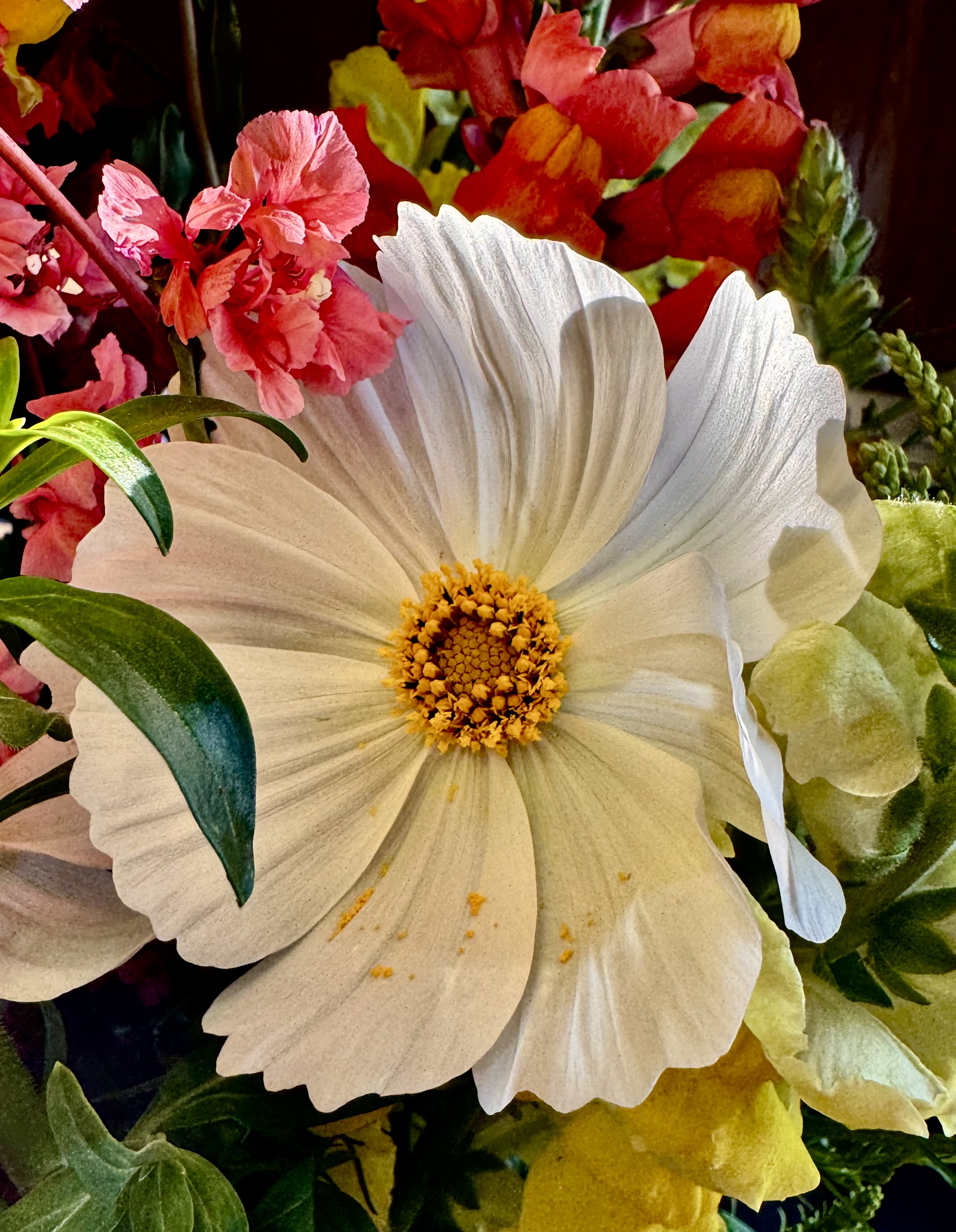
What if you slept And what if In your sleep You dreamed And what if In your dream You went to heaven And there plucked a strange and beautiful flower And what if When you awoke You had that flower in your hand Ah, what then? ~Samuel Taylor Coleridge “What if you slept…”
What might our dreams tell us of heaven?
The last few nights I dreamed of those with whom I once had a warm friendship but no longer do.
My dreams were of grace and reconciliation, of walking and talking together and rediscovering our common goals and beliefs rather than dwelling on estrangement and sadness as we’ve gone our separate ways.
Upon waking, I wondered what vision of heaven this suggests: finding the lost treasure of connection that I allowed to let go.
Restoring a friendship is like waking, holding a strange and beautiful flower plucked in a dream. I cradle it gently in my hand as the precious gem it is.
What then is still possible? And what might I do with this flower now?
One-Time
Monthly
Yearly
Make a one-time or recurring donation to support daily Barnstorming posts
Dawn comes later and later now, and I, who only a month ago could sit with coffee every morning watching the light walk down the hill to the edge of the pond and place a doe there, shyly drinking,
then see the light step out upon the water, sowing reflections to either side — a garden of trees that grew as if by magic — now see no more than my face, mirrored by darkness, pale and odd,
startled by time. While I slept, night in its thick winter jacket bridled the doe with a twist of wet leaves and led her away, then brought its black horse with harness that creaked like a cricket, and turned
the water garden under. I woke, and at the waiting window found the curtains open to my open face; beyond me, darkness. And I, who only wished to keep looking out, must now keep looking in. ~Ted Kooser “A Letter in October”
God knows we seek out light these autumn mornings
praying to see multicolors filling the lines outside; my face a shadow in a blackened window pane
Some mornings we can only see our own reflection mirrored by darkness, startled by time, as we wonder what comes next.
God knows, as each year passes, we need His Light illuminating us as we look beyond ourselves, but even more as we look within.
One-Time
Monthly
Yearly
Make a one-time or recurring donation to support daily Barnstorming posts
When he had washed their feet and put on his outer garments and resumed his place, he said to them, “Do you understand what I have done to you? You call me Teacher and Lord, and you are right, for so I am. If I then, your Lord and Teacher, have washed your feet, you also ought to wash one another’s feet.
For I have given you an example, that you also should do just as I have done to you. Truly, truly, I say to you, a servant is not greater than his master, nor is a messenger greater than the one who sent him. If you know these things, blessed are you if you do them.
I am not speaking of all of you; I know whom I have chosen. But the Scripture will be fulfilled, ‘He who ate my bread has lifted his heel against me.’ (Psalm 41:9)
I am telling you this now, before it takes place, that when it does take place you may believe that I am he.
Truly, truly, I say to you, whoever receives the one I send receives me, and whoever receives me receives the one who sent me.” John 13: 12-20
Rembrandt Head of Christ
I, too, stood on the sacred image … on the face of the man who has been ever in my thoughts, … on the best and most beautiful face that any man can ever know, on the face of him whom I have always longed to love.
I understand your pain and your suffering. It is for that reason that I am here.
Lord, I resented your silence.
I was not silent. I suffered beside you. ~Shisaku Endo from Silence – an interchange at the end of the book between Father Sebastian Rodrigues and the voice of the Lord Jesus
Then Judas in his hot desire Said, “Give me what you will.” Christ spoke to him with words of fire, “Then, Judas, you must kill, One whom you love, One who loves you As only God’s son can: This is the work for you to do To save the creature man.“
“And men to come will curse your name, And hold you up to scorn; In all the world will be no shame Like yours; this is love’s thorn. It takes strong will of heart and soul, But man is under ban. Think, Judas, can you play this role In heaven’s mystic plan?”
So Judas took the sorry part, Went out and spoke the word, And gave the kiss that broke his heart, But no one knew or heard. And no one knew what poison ate Into his palm that day, Where, bright and damned, the monstrous weight Of thirty white coins lay.
It was not death that Judas found Upon a kindly tree; The man was dead long ere he bound His throat as final fee. And who can say if on that day When gates of pearl swung wide, Christ did not go His honored way With Judas by His side?
And then there is the love for the enemy– love for the one who does not love you but mocks, threatens, and inflicts pain. The tortured’s love for the torturer. This is God’s love. It conquers the world. ~Frederick Buechnerfrom The Magnificent Defeat
Even my close friend in whom I trusted, who ate my bread, has lifted his heel against me. Psalm 41:9
…he shall bruise your head, and you shall bruise his heel. Genesis 3:15
Jesus knew Judas would “lift his heel against him” – Jesus chose him for that very reason, a close friend who had been a cherished part of the twelve.
The kick is hard, but not unexpected.
A heel crushes the image of Jesus and all that is good and beautiful.
Yet, this Lord is able to understand the pain of the betrayer and know suffering so much, He brings it onto Himself.
It was for this reason He came. It was for this reason He invites us to eat the bread of life alongside Him. We are filled and forgiven because He loves us enough to take our kicks and crushes.
What a gift to be known so well by God Himself.
I am reading slowly through the words in the Book of John over the next year alongside my church family. Once a week, I will invite you to “come and see” what those words might mean as we explore His promises together.
One-Time
Monthly
Yearly
Make a one-time or recurring donation to support daily Barnstorming posts
Now before the Feast of the Passover, when Jesus knew that his hour had come to depart out of this world to the Father, having loved his own who were in the world, he loved them to the end.
During supper, when the devil had already put it into the heart of Judas Iscariot, Simon’s son, to betray him, Jesus, knowing that the Father had given all things into his hands, and that he had come from God and was going back to God, rose from supper. He laid aside his outer garments, and taking a towel, tied it around his waist. Then he poured water into a basin and began to wash the disciples’ feet and to wipe them with the towel that was wrapped around him.
He came to Simon Peter, who said to him, “Lord, do you wash my feet?”
Jesus answered him, “What I am doing you do not understand now, but afterward you will understand.”
Peter said to him, “You shall never wash my feet.”
Jesus answered him, “If I do not wash you, you have no share with me.”
Simon Peter said to him, “Lord, not my feet only but also my hands and my head!”
Jesus said to him, “The one who has bathed does not need to wash, except for his feet, but is completely clean. And you are clean, but not every one of you.”
For he knew who was to betray him; that was why he said, “Not all of you are clean.” John 13: 1-11
sculpture by Mark Greine
What e’er the soul has felt or suffered long, Oh, heart! this one thing should not be forgot: Christ washed the feet of Judas. ~George Marion McClellan from “The Feet of Judas” in The Book of American Negro Poetry 1922
artist Otto Stemler
Being thorough, I remove a holey sock to view a diabetic man’s filthy feet. I use the time to complete our talk of what drove him to live on the street as I wonder how any of this can help.
While he tells me more of his medical past, I run warm water into a stainless bowl. I immerse both his feet and begin to ask myself what good it does for this poor soul to allow himself to undergo this ablution.
Silently I sluice the water between his toes and soap the crusty callous at his heel. I marvel at his arch and notice how closely it fits my palm. I know he can feel this proximity too. He shuts his eyes.
Months of useless layers peel away, revealing layers useless weeks ago. Removing the tough brown hide of yesterday yields clean pink skin, but we both know this ritual will be useless days from now.
Still, this moment may withstand time’s test, teaching us each lessons unknown before. I learn the medicine of selflessness. He learns what medicine is really for– the hope that basin, soap and touch can bear. ~Robert Fawcett “Washing Feet”
Jesus washing the feet of his disciples by Finnish artist Albert Gustaf Edelfelt
I’ve washed feet as part of my job, learning the medicine of selflessness:
…as an aide in a rest home caring for the crippled feet of the elderly, as a medical student in an inner city hospital seeing the homeless whose socks had to be peeled off carefully to avoid pulling off gangrenous toes, as a doctor working with the down and out detox patients from the streets who had no access to soap and water for weeks.
People always protest, knowing the futility of washing when feet will only become grimy again. Like Peter, we never believe our feet, those homely gnarled bunioned claw-toed calloused parts of us, deserve that attention, and certainly not love.
We are ashamed to have someone care about them, care for them, when we don’t care enough on our own.
I have never washed the feet of someone about to betray me, leading me to my death.
I have never had my feet washed by someone who understood my heart needed cleansing even more than my feet, who loved me that much.
So, I must not forget:
He kneels before us, the humility and towels of a servant as His only raiments.
He gently cups our heels in His palms, washes and dries our soles and arches and toes,
but what is truly cleansed is our beating heart, held with such care in His loving hands.
I am reading slowly through the words in the Book of John over the next year alongside my church family. Once a week, I will invite you to “come and see” what those words might mean as we explore His promises together.
One-Time
Monthly
Yearly
Make a one-time or recurring donation to support daily Barnstorming posts
Poetry is a life-cherishing force. For poems are not words, after all, but fires for the cold, ropes let down to the lost, something as necessary as bread in the pockets of the hungry. ~Mary Oliver from A Poetry Handbook
…I want to write with quiet hands. I want to write while crossing the fields that are fresh with daisies and everlasting and the ordinary grass. I want to make poems while thinking of the bread of heaven and the cup of astonishment; let them be songs in which nothing is neglected, not a hope, not a promise. I want to make poems that look into the earth and the heavens and see the unseeable. I want them to honor both the heart of faith, and the light of the world; the gladness that says, without any words, everything. ~Mary Oliver from “Everything” from New and Selected Poems: Volume Two
Poetry may make us from time to time a little more aware of the deeper, unnamed feelings which form the substratum of our being, to which we rarely penetrate; for our lives are mostly a constant evasion of ourselves. —T.S. Eliotfrom The Use of Poetry and the Use of Criticism
Much of the time, on the surface, we appear a tangled mess – a jumble of unarticulated feelings and desires, needs and wants.
Deeper down, there is a hungry soul in a place that can’t be seen.
We rarely dip in there; it can be a sore spot we are tempted to touch but avoid doing so because of its tenderness.
The bright light of a few well chosen words can ring us like a bell; we are struck dumb finding such clarion clarity comes to a place so well hidden.
A rope of words drops to lift up the lost and sad and empty – a reminder mere words can rescue and revive.
One-Time
Monthly
Yearly
Make a one-time or recurring donation to support daily Barnstorming posts
Even after Jesus had performed so many signs in their presence, they still would not believe in him. This was to fulfill the word of Isaiah the prophet:
“Lord, who has believed our message and to whom has the arm of the Lord been revealed?”
For this reason they could not believe, because, as Isaiah says elsewhere:
“He has blinded their eyes and hardened their hearts, so they can neither see with their eyes, nor understand with their hearts, nor turn—and I would heal them.”
Isaiah said this because he saw Jesus’ glory and spoke about him.
Yet at the same time many even among the leaders believed in him. But because of the Pharisees they would not openly acknowledge their faith for fear they would be put out of the synagogue; for they loved human praise more than praise from God.
Then Jesus cried out, “Whoever believes in me does not believe in me only, but in the one who sent me. The one who looks at me is seeing the one who sent me. I have come into the world as a light, so that no one who believes in me should stay in darkness.
“If anyone hears my words but does not keep them, I do not judge that person. For I did not come to judge the world, but to save the world. There is a judge for the one who rejects me and does not accept my words; the very words I have spoken will condemn them at the last day. For I did not speak on my own, but the Father who sent me commanded me to say all that I have spoken. I know that his command leads to eternal life. So whatever I say is just what the Father has told me to say.” John 12: 37-50
…glory means good report with God, acceptance by God, response, acknowledgment, and welcome into the heart of things. The door on which we have been knocking all our lives will open at last.
The promise of glory is the promise, almost incredible and only possible by the work of Christ, that some of us, that any of us who really chooses, shall actually survive that examination, shall find approval, shall please God.
To please God…to be a real ingredient in the divine happiness… to be loved by God, not merely pitied, but delighted in as an artist delights in his work or a son— it seems impossible, a weight or burden of glory which our thoughts can hardly sustain. But so it is. ~C.S. Lewis from The Weight of Glory
Riches I heed not, nor vain, empty praise; Thou mine inheritance, now and always. Thou and thou only, first in my heart, High King of Heaven, my treasure thou art. ~Eleanor Hull – 4th stanza of Be Thou My Vision
We all love praise, even vain empty praise which rings hollow in our ears. Even so, it feels as glorious as the transient golden light of October – gilded and alluring.
After all, the next step is withering and dying unto winter.
In our desire to be loved, too often we demand proof we have value, either by an impressive salary, or the number of “followers” we have on social media, our name placed on a building, or surrounding ourselves with people who tell us only what we want to hear.
Jesus is well aware that publicly acknowledging a belief in Him alone can come at great cost: it means turning away from the passing praise and admiration from others.
Instead, Christ came into the world to save us with His promise of glory — not for a temporary “feel-good” moment — but so we would forever truly understand the Father’s delight in us, His children.
Nothing can be more glorious than that.
I am reading slowly through the words in the Book of John over the next year alongside my church family. Once a week, I will invite you to “come and see” what those words might mean as we explore His promises together.
One-Time
Monthly
Yearly
Make a one-time or recurring donation to support daily Barnstorming posts
“Now my soul is troubled, and what shall I say? ‘Father, save me from this hour’? No, it was for this very reason I came to this hour. Father, glorify your name!”
Then a voice came from heaven, “I have glorified it, and will glorify it again.” The crowd that was there and heard it said it had thundered; others said an angel had spoken to him.
Jesus said, “This voice was for your benefit, not mine. Now is the time for judgment on this world; now the prince of this world will be driven out. And I, when I am lifted up from the earth, will draw all people to myself.” He said this to show the kind of death he was going to die.
The crowd spoke up, “We have heard from the Law that the Messiah will remain forever, so how can you say, ‘The Son of Man must be lifted up’? Who is this ‘Son of Man’?”
Then Jesus told them, “You are going to have the light just a little while longer. Walk while you have the light, before darkness overtakes you. Whoever walks in the dark does not know where they are going. Believe in the light while you have the light, so that you may become children of light.” When he had finished speaking, Jesus left and hid himself from them. John 12: 27- 36
And God held in his hand A small globe. Look he said. The son looked. Far off, As through water, he saw A scorched land of fierce Colour. The light burned There; crusted buildings Cast their shadows: a bright Serpent, A river Uncoiled itself, radiant With slime. On a bare Hill a bare tree saddened The sky. many People Held out their thin arms To it, as though waiting For a vanished April To return to its crossed Boughs. The son watched Them. Let me go there, he said. ~R.S. Thomas “The Coming”
You have answered us with the image of yourself on a hewn tree, suffering injustice, pardoning it; pointing as though in either direction; horrifying us with the possibility of dislocation. Ah, love, with your arms out wide, tell us how much more they must still be stretched to embrace a universe drawing away from us at the speed of light. ~R.S.Thomas “Tell Us”
Some ask for the world and are diminished in the receiving of it. You gave me only this small pool that the more I drink from, the more overflows me with sourceless light. ~R.S. Thomas “Gift”
“Let me go there” And You did.
Knowing what awaited You.
Your arms out wide to embrace us~ we who try to grasp a heaven which eludes us.
This heaven, Your Light You brought down to us, knowing our darkness and our terrible need.
You wanted to come here, knowing all this.
Holding us firmly within your wounded grip, You, the Son, handed us back to heaven.
I am reading slowly through the words in the Book of John over the next year alongside my church family. Once a week, I will invite you to “come and see” what those words might mean as we explore His promises together.
Lyrics: Light after darkness, gain after loss Strength after weakness, crown after cross; Sweet after bitter, hope after fears Home after wandering, praise after tears
Alpha and Omega Beginning and the end He is making all things new Springs of living water Shall wash away each tear He is making all things new Sight after mystery, sun after rain Joy after sorrow, peace after pain; Near after distant, gleam after gloom Love aftеr wandering, life after tomb
Lyrics Lead, kindly light, amidst the grey and gloom The night is long and I am far from home Here in the dark, I do not ask to see The path ahead–one step enough for me Lead on, lead on, kindly light.
I was not ever willing to be led I could have stayed, but I ran instead In spite of fear, I followed my pride My eyes could see, but my heart was blind Lead on, lead on, kindly light.
And in the night, when I was afraid Your feet beside my own on the way Each stumbling step where other men have trod shortens the road leading home to my God Lead on, lead on, my God, my God, lead on, lead on, kindly light.
One-Time
Monthly
Yearly
Make a one-time or recurring donation to support daily Barnstorming posts
Now among those who went up to worship at the feast were some Greeks. So these came to Philip, who was from Bethsaida in Galilee, and asked him, “Sir, we would like to see Jesus.” Philip went and told Andrew; Andrew and Philip went and told Jesus.
And Jesus answered them, “The hour has come for the Son of Man to be glorified. Truly, truly, I say to you, unless a grain of wheat falls into the earth and dies, it remains alone; but if it dies, it bears much fruit. Whoever loves his life loses it, and whoever hates his life in this world will keep it for eternal life. If anyone serves me, he must follow me; and where I am, there will my servant be also. If anyone serves me,the Father will honor him. John 12: 20-26
There was once in man a true happiness of which there now remain to him only the mark and empty trace, which he in vain tries to fill from all his surroundings, seeking from things absent the help he does not obtain in things present.
But these are all inadequate, because the infinite abyss can only be filled by an infinite and immutable object, that is to say, only by God Himself. ~Blaise Pascal from Pensees
You have made us for yourself, O Lord, and our heart is restless until it rests in you. ~Augustine of Hippo from Confessions
The sacred moments, the moments of miracle, are often the everyday moments, the moments which, if we do not look with more than our eyes or listen with more than our ears reveal only… a gardener, a stranger coming down the road behind us, a meal like any other meal. But if we look with our hearts, if we listen with all our being and imagination… what we may see is Jesus himself. ~Frederick Buechner from The Magnificent Defeat
“Sir, we would like to see Jesus.”
I thought our old church pulpit was the only one to have a plaque with John 12:21 attached to it — a clear reminder to anyone standing there, preparing to speak. I learned this verse has traditionally graced pulpits through the generations, encouraging preachers and listeners to work together to clear the obscuring fog to find the Messiah.
Jesus is not hidden from us; indeed, we are heart-blind most of the time, so wrapped in our own worries and troubles that we do not know where to look or who to ask to help us see Him.
It is through the preaching and sharing of God’s Word that the heart veil is lifted. To those Gentiles who wanted to see the man they had heard about, Jesus tells them what must come next: He must die, like a seed in the ground, in order to be glorified. We see Him in ways and places we could never have imagined, especially hanging on the cross in our place.
As we restlessly seek to clear the fog and fill what is empty within us, we must keep our eyes open wide, listening with all our being, our hearts at the ready, every moment.
He is already here, right where we are, always beside us.
We would see Jesus, for the shadows lengthen Across this wanting visage of our life; We would see Jesus, our weak faith to strengthen For the last weariness, the final strife.
We would see Jesus, the great rock foundation Whereon our feet were set by sov’reign grace; Nor life nor death, with all their agitation, Can thence remove us, if we see His face.
We would see Jesus: this is all we’re needing; Strength, joy, and willingness come with the sight; We would see Jesus, dying, risen, pleading; Then welcome day, and farewell mortal night. ~Anna Bartlett Warner “We Would See Jesus”
I am reading slowly through the words in the Book of John over the next year alongside my church family. Once a week, I will invite you to “come and see” what those words might mean as we explore His promises together.
One-Time
Monthly
Yearly
Make a one-time or recurring donation to support daily Barnstorming posts
The next day the large crowd that had come to the feast heard that Jesus was coming to Jerusalem.So they took branches of palm trees and went out to meet him, crying out, “Hosanna! Blessed is he who comes in the name of the Lord, even the King of Israel!”
And Jesus found a young donkey and sat on it, just as it is written,
“Fear not, daughter of Zion; behold, your king is coming, sitting on a donkey’s colt!”
His disciples did not understand these things at first, but when Jesus was glorified, then they remembered that these things had been written about him and had been done to him. The crowd that had been with him when he called Lazarus out of the tomb and raised him from the dead continued to bear witness. The reason why the crowd went to meet him was that they heard he had done this sign.
So the Pharisees said to one another, “You see that you are gaining nothing. Look, the world has gone after him.” John 12: 12-19
On the outskirts of Jerusalem the donkey waited. Not especially brave, or filled with understanding, he stood and waited.
How horses, turned out into the meadow, leap with delight! How doves, released from their cages, clatter away, splashed with sunlight.
But the donkey, tied to a tree as usual, waited. Then he let himself be led away. Then he let the stranger mount.
Never had he seen such crowds! And I wonder if he at all imagined what was to happen. Still, he was what he had always been: small, dark, obedient.
I hope, finally, he felt brave. I hope, finally, he loved the man who rode so lightly upon him, as he lifted one dusty hoof and stepped, as he had to, forward. ~Mary Oliver “The Poet thinks about the donkey” from her book Thirst.
As the Book of John now enters the week of Jesus’ passion, we learn of palms and a donkey.
Palm Sunday is a day of dissonance and dichotomy in the church year, very much like the donkey who figured as a central character that day.
Sadly, a donkey gets no respect, then or now – for his plain and awkward hairy looks, for his loud and inharmonious voice, for his apparent lack of strength — yet he was the chosen mode of transportation for an unlikely King riding to His death.
There was a motley parade to Jerusalem: cloaks and palms at the feet of the donkey bearing the Son of God, disorderly shouts of adoration and blessings, the rebuke of the Pharisees to quiet the people.
Jesus’ response was “even the stones will cry out” about what is to come.
But the welcoming crowd waving palm branches, shouting sweet hosannas and laying down their cloaks did not understand the fierce transformation to come, did not know within days they would be a mob shouting words of derision and rejection and condemnation.
The donkey knew because he had been derided, rejected and condemned himself, yet still kept serving. Just as he was given voice and understanding centuries before to protect Balaam from going the wrong way, he could have opened his mouth to tell them, suffering beatings for his effort.
Instead, just as he bore the unborn Jesus to Bethlehem, stood over Him sleeping in the manger, bore a mother and child all the way to Egypt to hide from Herod, the donkey keeps his secret well.
Who, after all, would ever listen to a mere donkey?
Even so, we would do well to pay attention to this braying wisdom.
The donkey knows – he’s a believer.
He bears the burden we have shirked. He treads with heavy heart over the palms and cloaks we lay down as meaningless symbols of honor. He is the ultimate servant to the Servant who laid aside His crown.
A day of dichotomy — of honor and glory laid underfoot only to be stepped on, of blessings and praise turning to curses, of the beginning of the end becoming a new beginning for us all.
And so Jesus wept, knowing all this. I suspect the donkey bearing Him wept as well, in his own simple, plain, and honest way, and I’m quite sure he kept it as his special secret.
I am reading slowly through the words in the Book of John over the next year alongside my church family. Once a week, I will invite you to “come and see” what those words might mean as we explore His promises together.
One-Time
Monthly
Yearly
Make a one-time or recurring donation to support daily Barnstorming posts
The grace of God means something like: Here is your life. You might never have been, but you are… Here is the world. Beautiful and terrible things will happen. Don’t be afraid. I am with you. ~Frederick Buechner in “Wishful Thinking and later” in Beyond Words
We are hard pressed on every side, but not crushed; perplexed, but not in despair; persecuted, but not abandoned; struck down, but not destroyed…
Therefore we do not lose heart. Though outwardly we are wasting away, yet inwardly we are being renewed day by day. For our light and momentary troubles are achieving for us an eternal glory that far outweighs them all.
So we fix our eyes not on what is seen, but on what is unseen. For what is seen is temporary, but what is unseen is eternal. -2 Cor 4:8-9, 16-18
I believe like a child that suffering will be healed and made up for, that all the humiliating absurdity of human contradictions will vanish like a pitiful mirage …that in the world’s finale, at the moment of eternal harmony, something so precious will come to pass that it will suffice for all hearts, for the comforting of all resentments, for the atonement of all the crimes of humanity, for all the blood that they’ve shed; that it will make it not only possible to forgive but to justify all that has happened. ~Fyodor Dostoevsky from The Brothers Karamazov
Twenty-five years ago, a day started with bright sun above and ended in tears and bloodshed below.
This is a day for recollection; we live out a remembrance of the torrential red that flowed that day;
A quarter century later, our streets both near and far-away still course with the blood of innocents, so what have we learned from all this?
That terrible day’s edges were so sharp we all bled; still bearing the scars, we need comforting.
So do not be afraid: you are not alone.
We breathe and weep and love as we remember that day, emerging inevitably transformed.
One-Time
Monthly
Yearly
Make a one-time or recurring donation to support daily Barnstorming posts