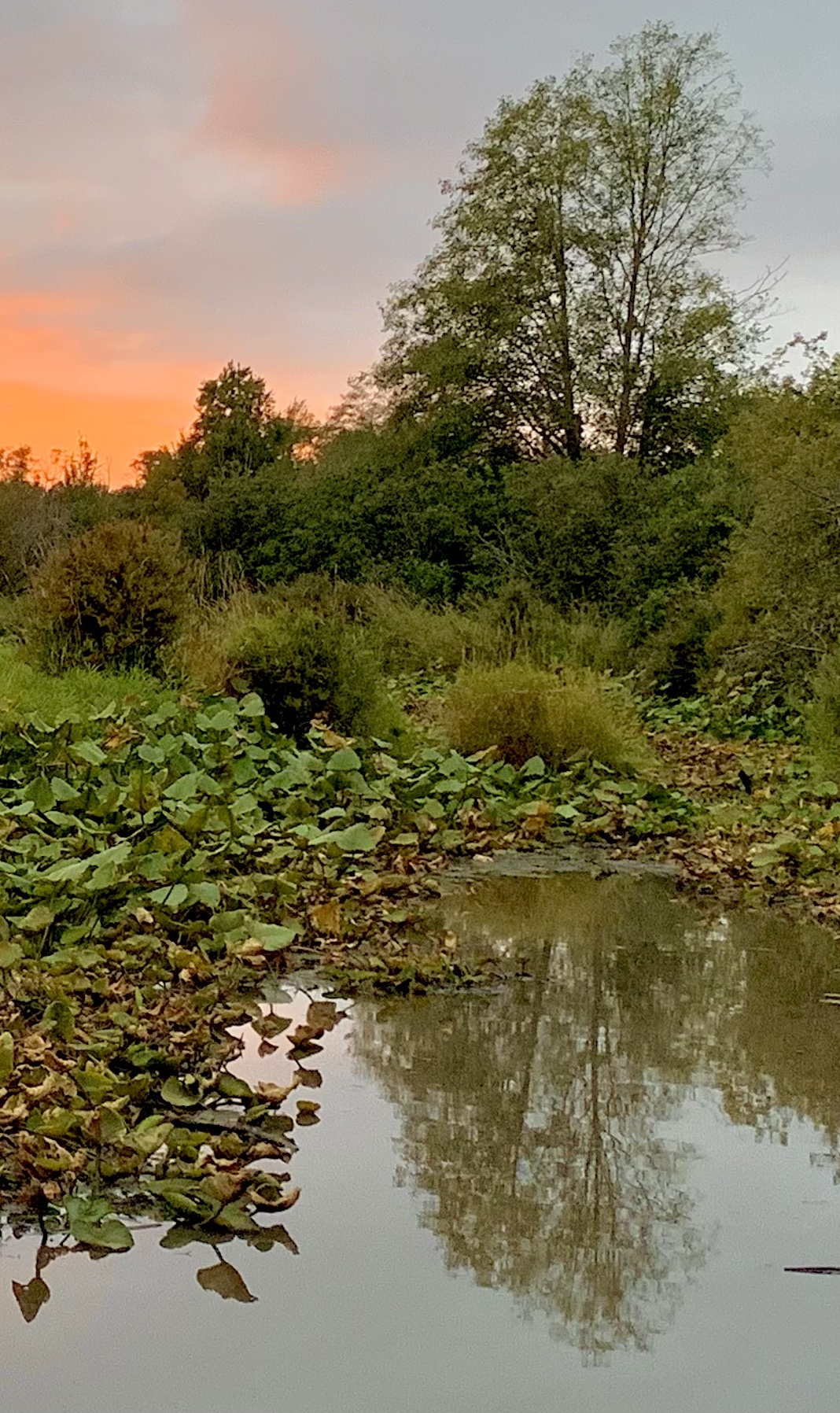
Hours and hours of taffy pulled and stretched to the furthest reaches of neighborhood lawns, universe of grasses cool and tickling, cushions for our bodies somersaulting and cartwheeling, tagging you’re it, while somewhere above us
the dimmer switch of Heaven would be turning down to lavender rose and deeper rose, and then the voices of the mothers streaming in through the darkening air to come home, come home. ~Andrea Potos “Summer, Childhood” from Her Joy Becomes
Once when we were playing hide-and-seek and it was time to go home, the rest gave up on the game before it was done and forgot I was still hiding. I remained hidden as a matter of honor until the moon rose. ~Galway Kinnell “Hide-and-Seek 1933” from Strong Is Your Hold.
We all long for home.
As the day wanes, the sky dims to pastels, the breezes pick up, I want to be called home: to warmth, to a good evening meal, to hugs and cozy bed.
No matter what excitement exists outside the four walls of home, I am eager for the comfort of finding my way home.
In the villages and towns all across Japan, there is a traditional folk song played daily in the early evening over loudspeakers in the streets – a reminder to the children of the neighborhood that it is time to give up their games and head home. They stream out of the parks and streets, each to their own house or apartment.
The song that thousands of U.S. soccer fans belted out after the World Cup soccer games was “Take me home, country roads.”
Last night, as I left an evening meeting at our local homeless mission shelter, I passed through the huge room housing over a hundred sleeping people on cots and floor mattresses. The overhead lights had been dimmed, each person safe, warm, fed, and welcome – no longer invisible and hidden away in the woods or alleys.
May we all know how it is to be welcomed home, when overwhelming darkness comes, knowing the Light always returns.
Whence comes Solace?—Not from seeing What is doing, suffering, being, Not from noting Life’s conditions, Nor from heeding Time’s monitions; But in cleaving to the Dream, And in gazing at the gleam Whereby gray things golden seem.
II
Thus do I this heyday, holding Shadows but as lights unfolding, As no specious show this moment With its irised embowment; But as nothing other than Part of a benignant plan; Proof that earth was made for man. ~Thomas Hardy “On a Fine Morning”
Whence comes Solace? Cleaving to the dream, gazing at the gleam…
nothing other than Part of a benignant plan; Proof that earth was made for man.
I had to look up “benignant” – it is like being told a concerning tumor is “benign” – granting gracious kindness and beneficence in the midst of deep-seated worry.
A new lease on life.
We forget our original task of caring for the Garden. Having soiled our own nest, we can’t abandon earth for another greener, brighter, happier planet. Of all the planetary options in this infinite universe, we were placed right here for good reason, and here we remain.
Our solace: all that ordinarily seems gray gleams golden illuminated by the Light shining down on our shadowy selves.
Even when the news headlines are dismal, when our individual struggles are great, when human history seems to keep repeating itself, our Creation is purposeful, eternally preserved through divine sacrifice.
The solace of gray shadows melts to gold: as part of the overall “benignant plan” we have been given our life back.
One-Time
Monthly
Yearly
Make a one-time or recurring donation to support daily Barnstorming posts
And on those hot afternoons in July, when my father was out on the tractor cultivating rows of corn, my mother would send us out with a Mason jar filled with ice and water, a dish towel wrapped around it for insulation.
Like a rocket launched to an orbiting planet, we would cut across the fields in a trajectory calculated to intercept— or, perhaps, even—surprise him in his absorption with the row and the turning always over earth beneath the blade.
He would look up and see us, throttle down, stop, and step from the tractor with the grace of a cowboy dismounting his horse, and receive gratefully the jar of water, ice cubes now melted into tiny shards, drinking it down in a single gulp, while we watched, mission accomplished. ~Joyce Sutphen“Carrying Water to the Field”
It was my special responsibility to carry cold water out to my dad when he was on the tractor doing field work.
Yes, he could have carried a thermos along but then he would not have seen his kid walking carefully from the house over the fresh-turned dirt, he would not have an excuse for a short break to wipe the sweat from his face with his bright red kerchief, nor sit and survey the straightness of his furrows.
He would not have lifted her up to sit beside him on the tractor, allowing her to “drive,” steering down the rows, curving around the killdeer nests so their young are spared.
Indeed – it is a a special responsibility to nurture someone at work who doesn’t stop to refill themselves. It happens rarely any more – whether in the field or factory or home or even – creating a daily blog like this.
What wondrous love to carry water to those who thirst. What wondrous grace then fills our furrowed lives.
Thank you, faithful readers and supporters, for you who carry water to me when I am dry and thirsty convince me my work here is not in vain: mission accomplished.
Once a year I ask my readers to fill out the feedback form at the bottom left of my blog home page, or this link to a feedback form
Questions I hope you will answer to assist me in making Barnstorming worth your time: *how long have you been following Barnstorming? *how often do you share Barnstorming with others? *what does Barnstorming content mean to you personally? *what Barnstorming content do you most appreciate? *do you have a favorite post, photo, or moment from the blog? *what Barnstorming content would you rather see less often? *do you listen to the music links at the end of posts? *do you ever click on the links to sources for poems and quotes? *how can I make your time on Barnstorming more worthwhile?
One-Time
Monthly
Yearly
Make a one-time or recurring donation to support daily Barnstorming posts
I spent seven hours yesterday at my daughter’s house helping her expand their garden by at least ten times. We dug up sod by the shovelful, shook off the dirt as best we could; sod into the wheelbarrow and off to the pile at the edge of the yard. Then all that over and over again. Five hours total work-time, with time out for lunch and supper. By the time I got home I knew all too well that seventy-two is not thirty-five; I could barely move.
I got to quit earlier than Nadine. She told me I’d done enough and that I should go get a beer and lie down on the chaise lounge and cheer her on, which is what I did.
All this made me remember my father forty years ago helping me with my garden. My father’s dead now, and has been dead for many years, which is how I’ll be one of these days too. And then Nadine will help her child, who is not yet here, with her garden. Old Nadine, aching and sore, will be in my empty shoes, cheering on her own.
So it goes. The wheel turns, generation after generation, around and around. We ride for a little while, get off and somebody else gets on. Over and over, again and again. ~David Budbill “Seventy-Two Is Not Thirty-Five” from Tumbling toward the End
The wheel turns, we cycle around again, get on and eventually get off. This is a week of July birthdays in our family, for both old and young.
This hit me when we celebrated our grandson’s third birthday a few days ago in a suburban backyard where my daughter has continued the Gibson/Polis gardening tradition, using the compost we hauled in our truck from our farm several hours away.
Her peas were full and ripe and juicy, her greens lush and tasty – simple perfection thanks to her careful tending.
Meanwhile, our son gardens with his three boys in a very small urban backyard in Denver, teaching them what is weed and what will become a future meal.
I couldn’t help but get weepy, enjoying that special birthday feast.
…and knowing someday, our grandsons will plant and weed and harvest from the soil just as we and their parents did, over and over, again and again.
And this is why my eyes are closed It’s just as well for all I’ve seen And so it goes, and so it goes And you’re the only one who knows ~Billy Joel
One-Time
Monthly
Yearly
Make a one-time or recurring donation to support daily Barnstorming posts
They brought to the Pharisees the man who had been blind. Now the day on which Jesus had made the mud and opened the man’s eyes was a Sabbath. Therefore the Pharisees also asked him how he had received his sight. “He put mud on my eyes,” the man replied, “and I washed, and now I see.” Some of the Pharisees said, “This man is not from God, for he does not keep the Sabbath.” But others asked, “How can a sinner perform such signs?” So they were divided.
Then they turned again to the blind man, “What have you to say about him? It was your eyes he opened.” The man replied, “He is a prophet.” They still did not believe that he had been blind and had received his sight until they sent for the man’s parents. “Is this your son?” they asked. “Is this the one you say was born blind? How is it that now he can see?”
“We know he is our son,” the parents answered, “and we know he was born blind. But how he can see now, or who opened his eyes, we don’t know. Ask him. He is of age; he will speak for himself.” His parents said this because they were afraid of the Jewish leaders, who already had decided that anyone who acknowledged that Jesus was the Messiah would be put out of the synagogue.That was why his parents said, “He is of age; ask him.”
A second time they summoned the man who had been blind. “Give glory to God by telling the truth,” they said. “We know this man is a sinner.”He replied, “Whether he is a sinner or not, I don’t know. One thing I do know. I was blind but now I see!”
Then they asked him, “What did he do to you? How did he open your eyes?” He answered, “I have told you already and you did not listen. Why do you want to hear it again? Do you want to become his disciples too?” Then they hurled insults at him and said, “You are this fellow’s disciple! We are disciples of Moses!We know that God spoke to Moses, but as for this fellow, we don’t even know where he comes from.”
The man answered, “Now that is remarkable! You don’t know where he comes from, yet he opened my eyes.We know that God does not listen to sinners. He listens to the godly person who does his will.Nobody has ever heard of opening the eyes of a man born blind. If this man were not from God, he could do nothing.” To this they replied, “You were steeped in sin at birth; how dare you lecture us!” And they threw him out.
Jesus heard that they had thrown him out, and when he found him, he said, “Do you believe in the Son of Man?” “Who is he, sir?” the man asked. “Tell me so that I may believe in him.” Jesus said, “You have now seen him; in fact, he is the one speaking with you.” Then the man said, “Lord, I believe,” and he worshiped him.
Jesus said, “For judgment I have come into this world, so that the blind will see and those who see will become blind.” Some Pharisees who were with him heard him say this and asked, “What? Are we blind too?” Jesus said, “If you were blind, you would not be guilty of sin; but now that you claim you can see, your guilt remains. John 9: 13-41
When we look long at one another, we soften, we relent, listen,
might forgive. We allow for silence —and when we see each other,
are known, and in that moment might change
though nothing has moved or been spoken.
There are some who say the walls cannot be broken,
but suddenly we are in a free place, and the fields
that extend from its center stretch for miles
as if out of the pupil and the iris of that momentary kingdom. ~Annie Lighthart “When We Look” from Pax
Why no! I never thought other than That God is that great absence In our lives, the empty silence Within, the place where we go Seeking, not in hope to Arrive or find. He keeps the interstices In our knowledge, the darkness Between stars. His are the echoes We follow, the footprints he has just Left. We put our hands in His side hoping to find It warm. We look at people And places as though he had looked At them, too; but miss the reflection. ~R.S. Thomas “Via Negativa”
It is this great absence that is like a presence, that compels me to address it without hope of a reply. It is a room I enter
from which someone has just gone, the vestibule for the arrival of one who has not yet come. I modernise the anachronism
of my language, but he is no more here than before. Genes and molecules have no more power to call him up than the incense of the Hebrews
at their altars. My equations fail as my words do. What resources have I other than the emptiness without him of my whole being, a vacuum he may not abhor? ~R.S. Thomas “The Absence”
We cannot recognize our blindness, unaware of what we can’t see and don’t know, until our eyes are opened.
Before that happens, all we know is the emptiness behind our closed eyes.
How can we know what vision we are capable of until suddenly, miraculously, it is given to us in a gift of grace.
Lord, banish the blindness of my guilt, fill the vacuum of my emptiness with your love, allow me to see — not only the world around me, but to look deeply into other open eyes and see You reflected.
Open up my eyes, so I might see That You have made these ways for me Open up my eyes so I may see That You my God, will walk with me ~Chorus lyrics from All My Ways are Known to You
I am reading slowly through the words in the Book of John over the next year alongside my church family. Once a week, I will invite you to “come and see” what those words might mean as we explore His promises together.
One-Time
Monthly
Yearly
Make a one-time or recurring donation to support daily Barnstorming posts
We may ignore, but we can nowhere evade, the presence of God. The world is crowded with Him. He walks everywhere incognito. And the incognito is not always easy to penetrate. The real labor is to remember to attend. In fact to come awake. Still more to remain awake. ~C.S. Lewis from “Letters to Malcolm: Chiefly on Prayer”
I worked hard in my professional life to be interruptible: my patients, colleagues and staff needed to be able to stop my momentum at any time to ask a question, get an opinion or redirect my attention to something more important. As a physician, it was crucial that I remained prioritized from outside my field of vision as I was not always aware at any given time where I’m needed most.
Yet in my personal life, I struggle with interruptions happening outside my control. I feel imposed upon when things don’t flow as I hoped or planned– after all, this is MY life.
Yet…
God interrupts. God interferes. God intervenes. God intrudes. God intercedes.
As He must, because He is God. And I must be ready, accepting, answering His grace with grace.
It is HIS life living within me, His plan, His timing, His priorities.
Not mine.
Never mine.
One-Time
Monthly
Yearly
Make a one-time or recurring donation to support daily Barnstorming posts
As he went along, he saw a man blind from birth.His disciples asked him, “Rabbi, who sinned, this man or his parents, that he was born blind?”
“Neither this man nor his parents sinned,” said Jesus, “but this happened so that the works of God might be displayed in him. As long as it is day, we must do the works of him who sent me. Night is coming, when no one can work. While I am in the world, I am the light of the world.”
After saying this, he spit on the ground, made some mud with the saliva, and put it on the man’s eyes. “Go,” he told him, “wash in the Pool of Siloam” (this word means “Sent”). So the man went and washed, and came home seeing.
His neighbors and those who had formerly seen him begging asked, “Isn’t this the same man who used to sit and beg?” Some claimed that he was.
Others said, “No, he only looks like him.”
But he himself insisted, “I am the man.”
“How then were your eyes opened?” they asked.
He replied, “The man they call Jesus made some mud and put it on my eyes. He told me to go to Siloam and wash. So I went and washed, and then I could see.”
Where is this man?” they asked him.
“I don’t know,” he said. John 9:1-12
The Lord came: what did He do? He set forth a great mystery. He spat on the ground, He made clay of His spittle; for the Word was made flesh. And He anointed the eyes of the blind man. The anointing had taken place, and yet he saw not. He sent him to the pool which is called Siloam. But it was John’s concern to call our attention to the name of this pool; and he adds, Which is interpreted, Sent. You understand now who it is that was sent; for had He not been sent, none of us would have been set free from iniquity. Accordingly he washed his eyes in that pool which is interpreted, Sent — he was baptized in Christ. ~Augustine from Tractate 44 on John
Generations have trod, have trod, have trod, And all is seared with trade; bleared, smeared with toil; And wears man’s smudge and shares man’s smell: the soil Is bare now, nor can foot feel, being shod. ~Gerard Manley Hopkins from “God’s Grandeur”
A man that looks on glass On it may stay his eye; Or if he pleaseth, through it pass, And then the heav’n espy.
All may of Thee partake: Nothing can be so mean, Which with his tincture—”for Thy sake”— Will not grow bright and clean. ~George Herbert from “The Elixir”
We came from dust in the beginning, choosing to wallow in mud of our own making.
And Christ lives among us and our muddy messes.
Yet He is even more: when Christ heals the blind man, He mixes the dusty earth and His own spit — using holy mud to anoint unseeing eyes which heal glass-clear with washing.
Christ – sent to cleanse and restore us with God’s deep and abiding grace.
We once were blind, but now we see…
I am reading slowly through the words in the Book of John over the next year alongside my church family. Once a week, I will invite you to “come and see” what those words might mean as we explore His promises together.
One-Time
Monthly
Yearly
Make a one-time or recurring donation to support daily Barnstorming posts
At the edge of the city, at the edge of the world, at the edge between the earth and endless sky, the moonshining place, the place where we hung our long summer legs over the edge and fought the urge to drop a shoe or sneak a real first kiss, the place where we played hide-and-go-seek and Tag, you’re it! until we couldn’t breathe or the sun went down, the place where we came on the quietest nights to feel the moon kiss the edge between our skin and endless sky. ~Sarah Kobrinsky, from Nighttime on the Otherside of Everything
photo of supermoon by Harry Rodenberger
there will be sun, scalloped by clouds, ushered in by a waterfall of birdsong. It will be a temperate seventy-five, low humidity. For twenty-four hours, all politicians will be silent. Reality programs will vanish from TV, replaced by the “snow” that used to decorate our screens when reception wasn’t working. Soldiers will toss their weapons in the grass. The oceans will stop their inexorable rise. No one will have to sit on a committee. When twilight falls, the aurora borealis will cut off cell phones, scramble the internet. We’ll play flashlight tag, hide and seek, decorate our hair with fireflies, spin until we’re dizzy, collapse on the dew-decked lawn and look up, perhaps for the first time, to read the long lines of cold code written in the stars…. ~Barbara Crooker “Tomorrow” from Some Glad Morning.
The truth of it is: we’re always on the edge of something. Often we’re not aware of it but that’s where some of the best things happen.
Summer itself can lead us right to edge of ourselves, a bright and bold tease to imagine something even more beautiful beyond our reach. It is an invitation to follow the lingering light of the horizon to wherever it may take us.
I can’t help but cling just a while longer before I tumble off the edge of the world.
Lyrics: In love, we find our way With trust, hope remains
I’ll be here Stay right here Don’t you fear
In love, we find our way through the night In love, we find our way
In love, we find a way Your love leads the way
One-Time
Monthly
Yearly
Make a one-time or recurring donation to support daily Barnstorming posts
The artichoke With a tender heart Dressed up like a warrior, Standing at attention, it built A small helmet Under its scales It remained Unshakeable,
She enters the kitchen And submerges it in a pot.
Thus ends In peace This career Of the armed vegetable Which is called an artichoke, Then Scale by scale, We strip off The delicacy And eat The peaceful mush Of its green heart. ~Pablo Neruda from “Ode to an Artichoke”
She bore only the heart, Worked at the stem with her Fingers, pulling it to her, And into her, like a cord. She would sustain him, Would cover his heart. The hairy needles And the bigger leaves, These she licked into shape, Tipping each with its point. He is the mud-flower, The thorny hugger. ~James McMichael “The Artichoke”
I peeled off a leaf like my father did, dipped it in melted butter, and with my teeth scraped and sucked the nut-flavored slimy stuff. We piled up the inedible parts, skeletons of leaves and purple prickles.
Piece by piece, the artichoke came apart, the way we would in 1959, the year the flowerbuds of the artichokes in my father’s garden bloomed without him, their blossoms seven inches wide and violet-blue as bruises.
But first we had that miracle on our table. We peeled and peeled, a vegetable striptease, and worked our way deeper and deeper, down to the small filet of delectable heart. ~Diane Lockwood from “The First Artichoke”
I first encountered a globe artichoke in my first week at college in California. I’d never seen one before, much less dismantled and actually eaten one. The California natives around me in the dining hall were astonished my worldview had never before included artichoke leaves and heart. After all, the University was only an hour away from the artichoke capital of the world, Watsonville, where the motto for the annual artichoke festival was “Thistle Be Fun!”
My frame of reference growing up on a farm was that thistle-looking plants were noxious weeds and needed to be chopped down before going to seed and reproducing even more noxious weeds. This spiny looking bud that was about to bloom a purple thistle flower looked highly suspicious to me and not to be trusted.
But then someone showed me how to peel off a leaf, dip the base in mayonnaise or lemon garlic butter and scrape off the soft part with my teeth.
Noxious? Not even close. Absolutely delicious! Prickly protects the tasty.
The circumferential peeling of leaves one by one leads deeper to softer petals and fewer prickles, with the flavor becoming less subtle and more distinct. Once the leaves are all off, there lies uncovered at the base a heart to be scooped out. The round meaty heart is the point of all this effort.
It is the gold in the buried treasure chest, the pot at the end of the rainbow. It takes work to reach it, but it never disappoints.
How to mentally get past the plainness and prickles? How to recognize what appears so undesirable as something to preserve and nurture?
There are so many times in my day I walk right past such people or opportunities as not worth the trouble. Sometimes I myself am the one with the prickles, protective as they seem to me yet announcing caution to others, not to be trusted.
How could anyone know the tender heart that dwells within unless we gently, graciously, gratefully peel the prickles away?
One-Time
Monthly
Yearly
Make a one-time or recurring donation to support daily Barnstorming posts
Master, how serene Are all the hours We waste If, as we waste them, We place them in a vase Like flowers.
There are no sorrows In our lives Nor joys either. Let us learn then, Innocent sages, Not to live life,
But to pass through it, Tranquil, serene, Taking children As our teachers, Eyes full Of Nature . . .
Beside a river, Beside a road, Wherever we are, Living life With the same Light ease.
Let us gather flowers. Let us bathe our hands In the calm rivers, And from them Learn their calm.
[12 June, 1914] ~Fernando Pessoa from “Ode 1” translated from Portuguese by Margaret Jull Costa & Patricio Ferrari
How fresh, oh Lord, how sweet and clean Are thy returns! even as the flowers in spring; To which, besides their own demean, The late-past frosts tributes of pleasure bring. Grief melts away Like snow in May, As if there were no such cold thing.
Who would have thought my shriveled heart Could have recovered greenness? It was gone Quite underground; as flowers depart To see their mother-root, when they have blown, Where they together All the hard weather Dead to the world, keep house unknown.
These are thy wonders, Lord of power, Killing and quickening, bringing down to hell And up to heaven in an hour; Making a chiming of a passing-bell. We say amiss This or that is: Thy word is all, if we could spell.
Oh that I once past changing were, Fast in thy Paradise, where no flower can wither! Many a spring I shoot up fair, Offering at heaven, growing and groaning thither; Nor doth my flower Want a spring shower, My sins and I joining together.
But while I grow in a straight line, Still upwards bent, as if heaven were mine own, Thy anger comes, and I decline: What frost to that? what pole is not the zone Where all things burn, When thou dost turn, And the least frown of thine is shown?
And now in age I bud again, After so many deaths I live and write; I once more smell the dew and rain, And relish versing. Oh, my only light, It cannot be That I am he On whom thy tempests fell all night.
These are thy wonders, Lord of love, To make us see we are but flowers that glide; Which when we once can find and prove, Thou hast a garden for us where to bide; Who would be more, Swelling through store, Forfeit their Paradise by their pride. ~George Herbert “The Flower”
There are days we live as if death were nowhere in the background; from joy to joy to joy, from wing to wing, from blossom to blossom to impossible blossom, to sweet impossible blossom. ~Li-Young Lee from “From Blossoms”
Our small church has a couple of gracious and kind gardeners who share the produce from their yards and fields each week to provide a fresh bouquet to sit on the table in front of our humble wooden pulpit.
It is a special treat to walk into church and see what they brought to the altar to share with us all on Sunday morning. I keep a photo album of these very unique Sunday “pulpit posies” our keepers of gardens share.
Why are these arrangements special? After all, almost every church displays a floral arrangement every Sunday.
These are special as many of these flowers are seeded, watered, fertilized and nurtured by one of our own, grown with love and caring, just as God cares for each of His children.
These are special as some are considered simple weeds, and are gleaned from ditches and hedges. They are part of God’s creation and have a wild beauty that can be as breathtaking as a hothouse orchid.
These are special because they often go home with a congregant or visitor who will enjoy their loveliness for many more days, as if they represent the manifestation of God’s Word itself.
Some of us are dahlias, zinnias and roses. Some of us are rare gardenias and orchids. Most of us are dandelions, sagebrush, Queen Anne’s lace, fireweed, burdock, and daisies thriving in the crevasses, ditches and hedgerows of life.
No matter which roots we sprout from, or where, we are the wonders of our loving gardening God. He created us to take care of His creation.
Each week, we bud afresh for Him.
One-Time
Monthly
Yearly
Make a one-time or recurring donation to support daily Barnstorming posts