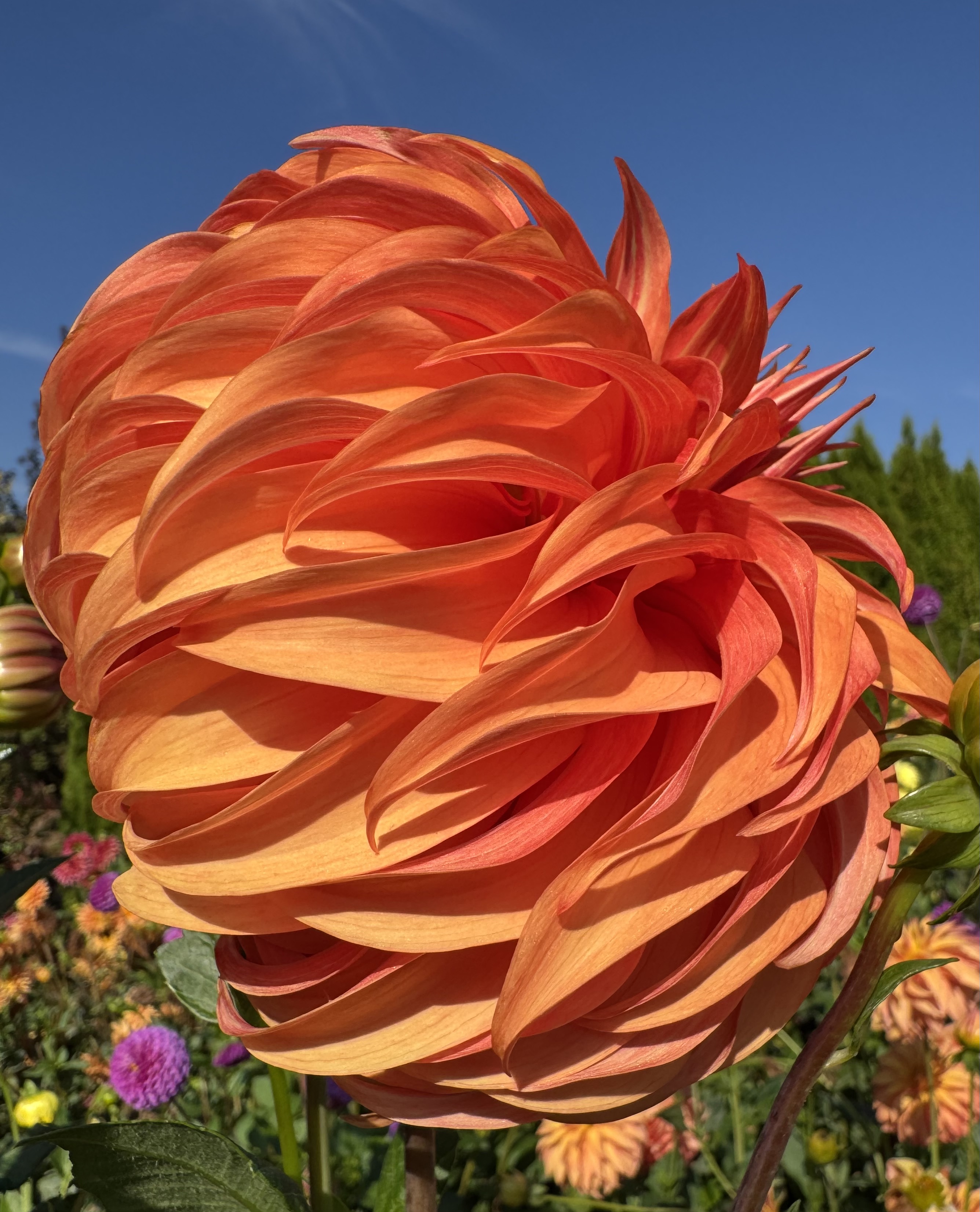
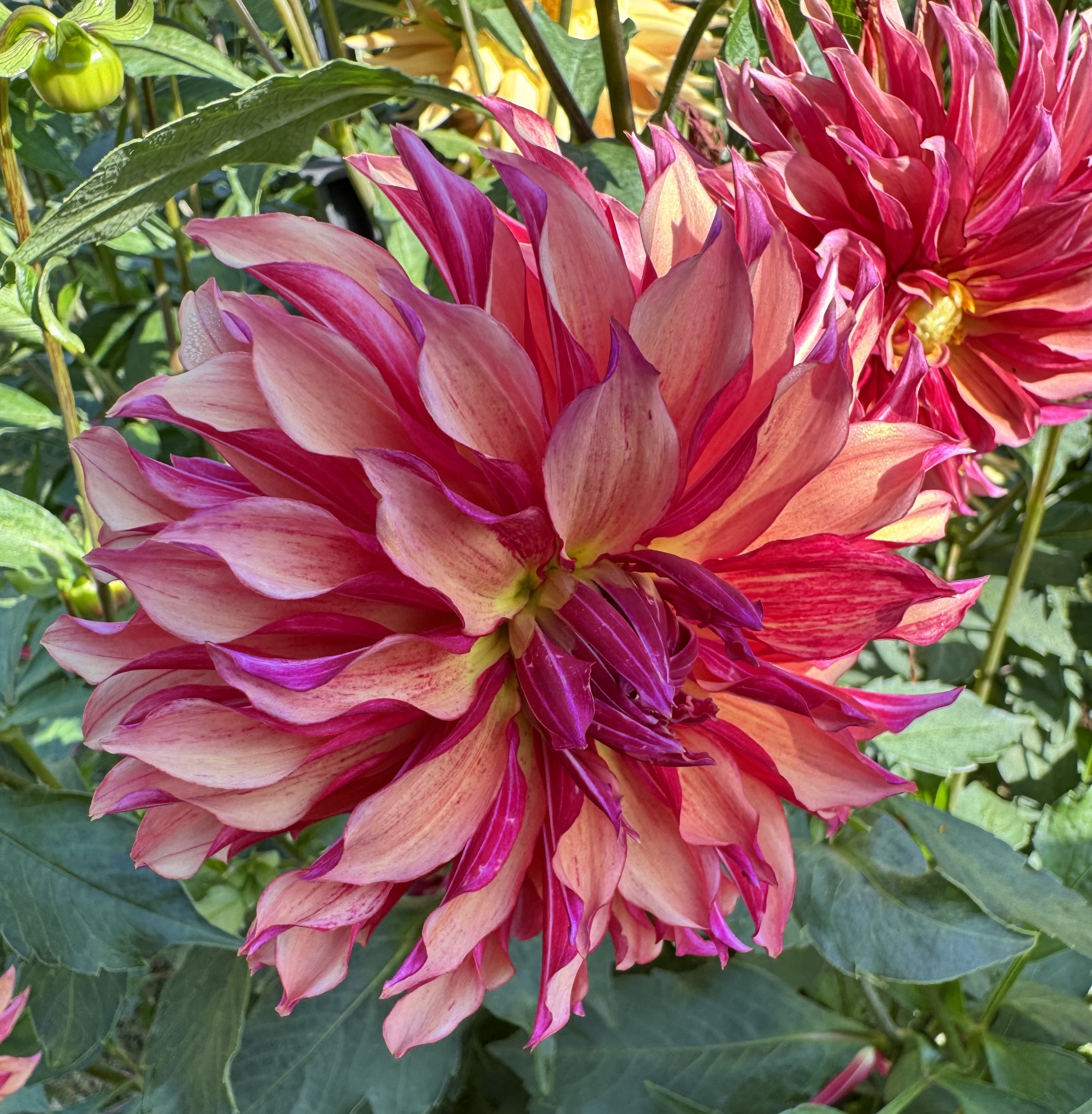
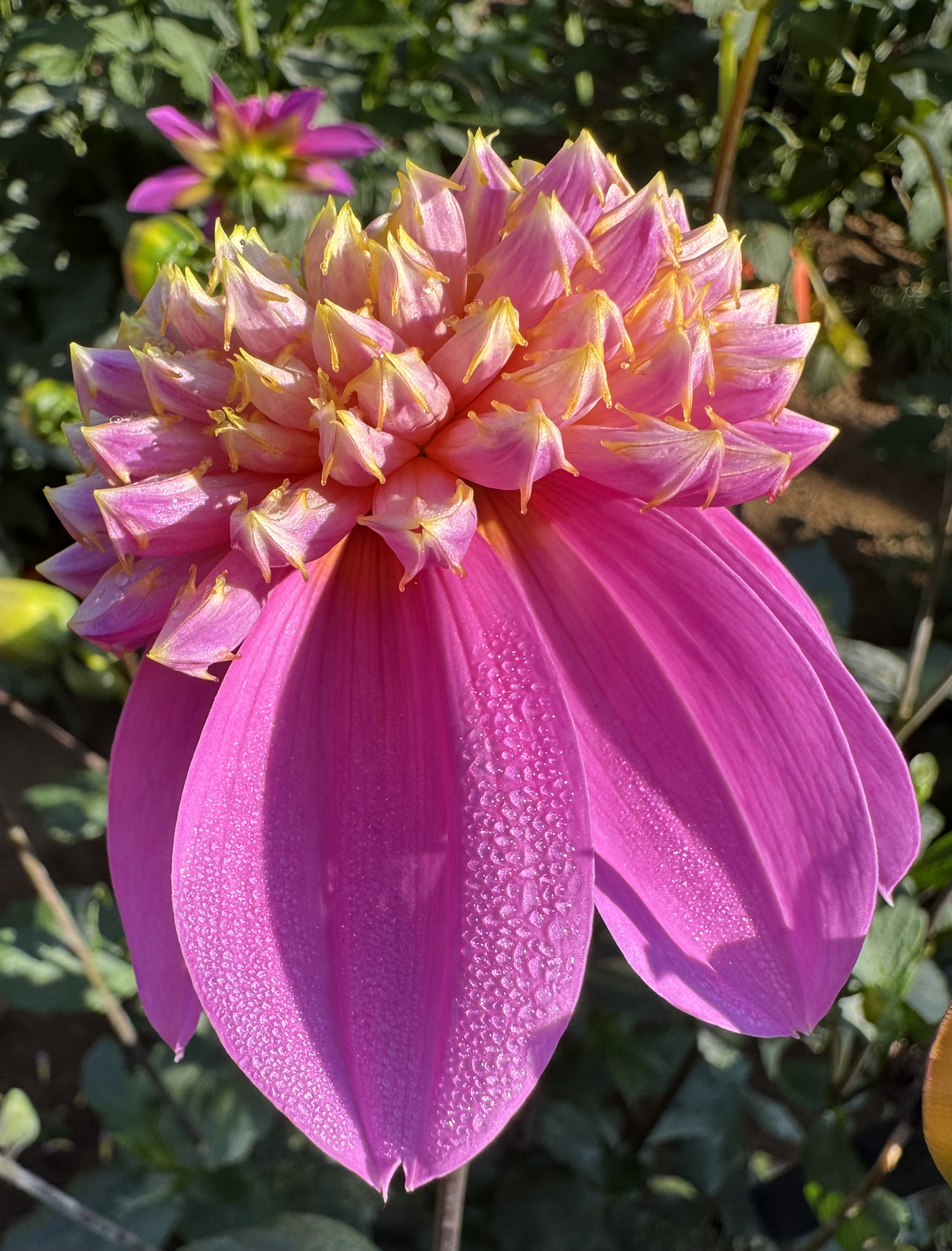
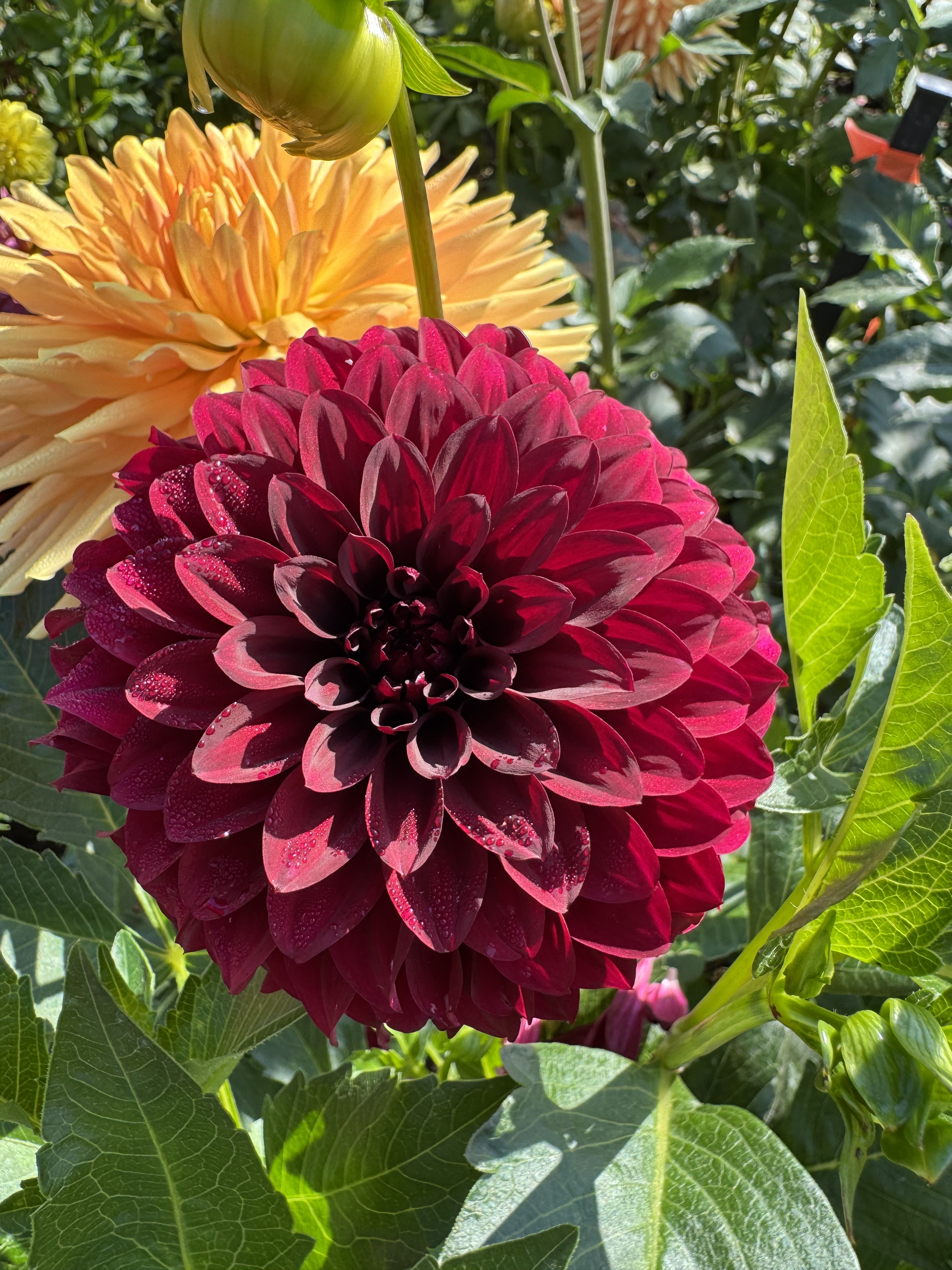
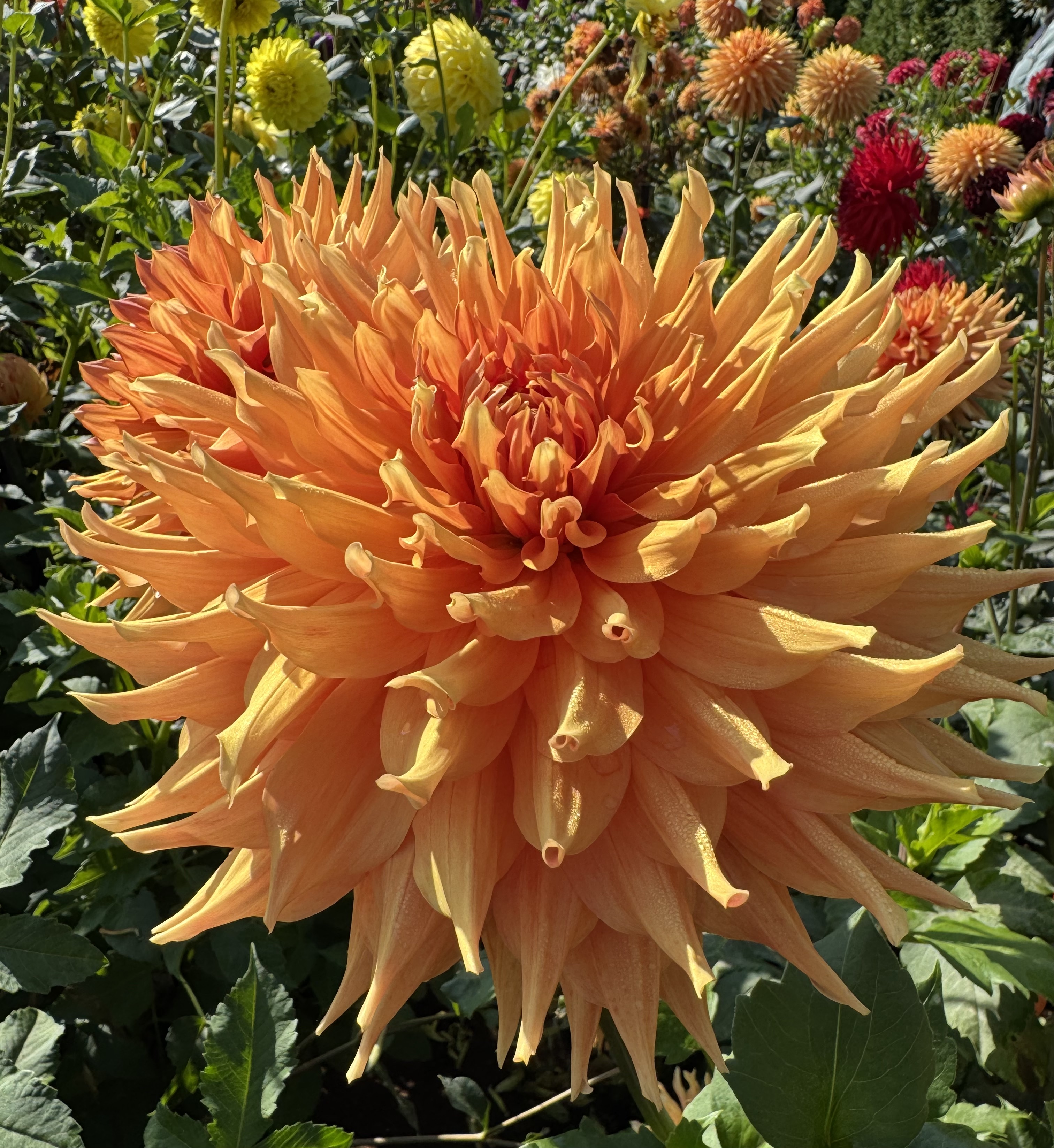
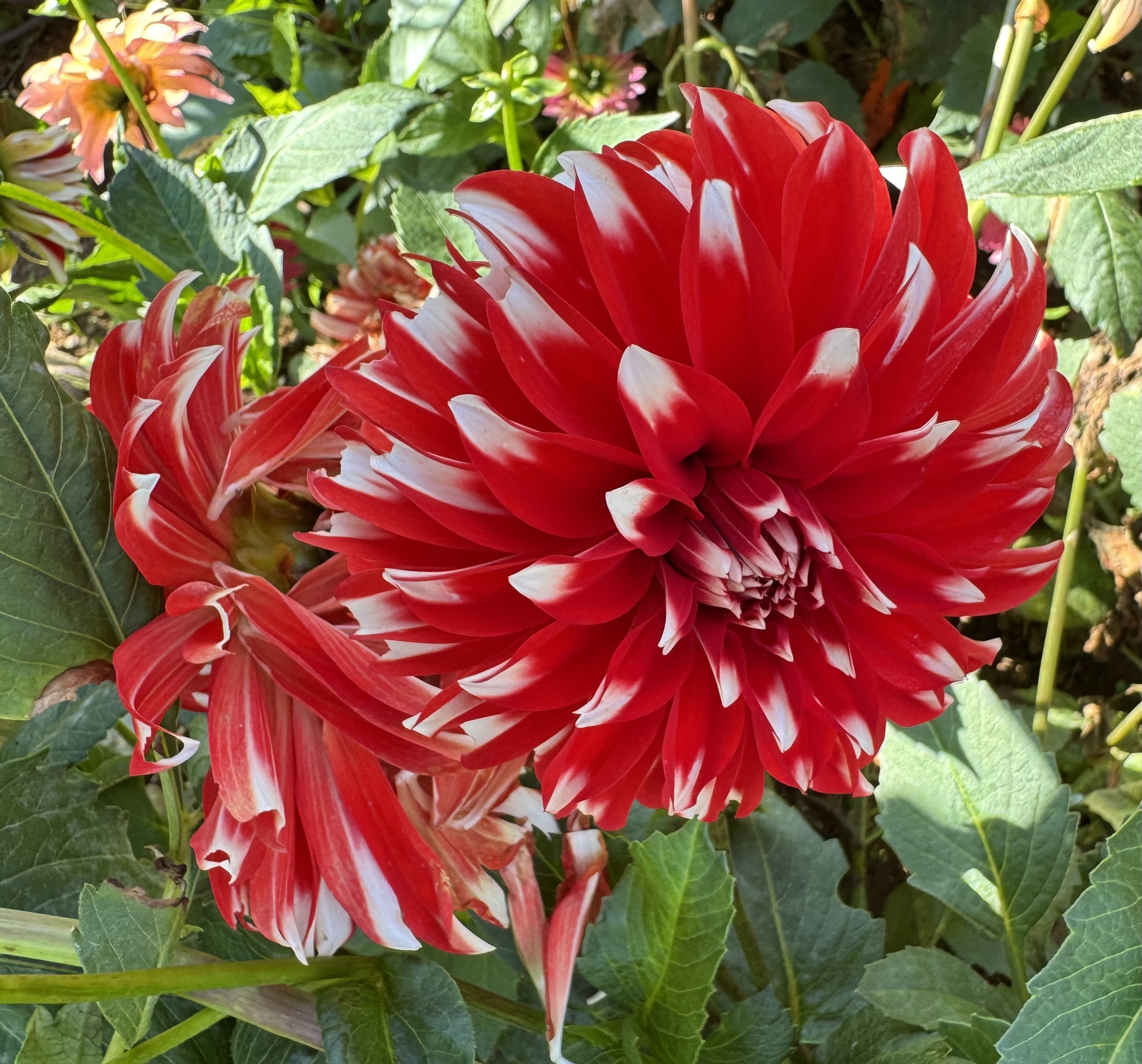
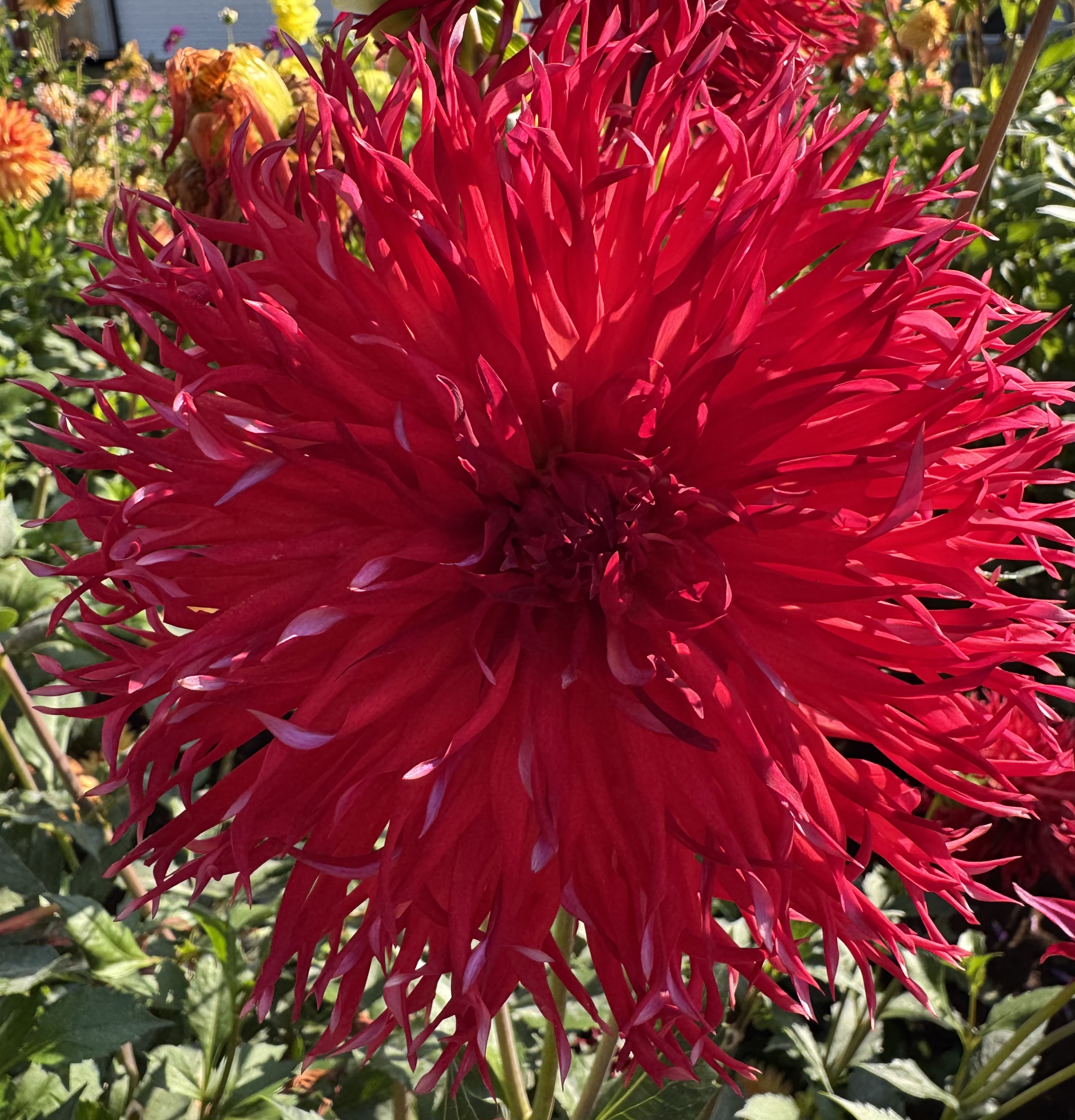
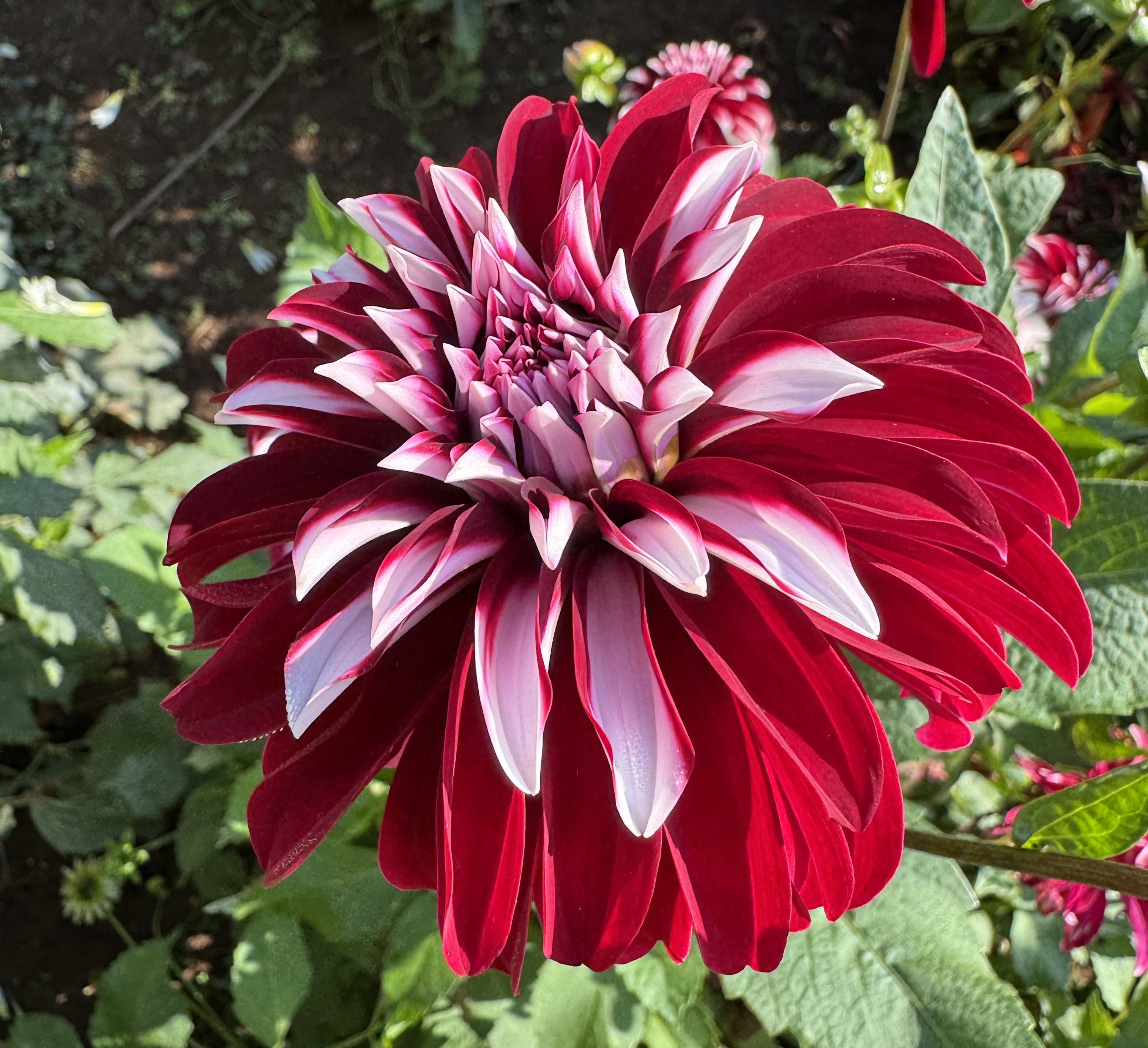
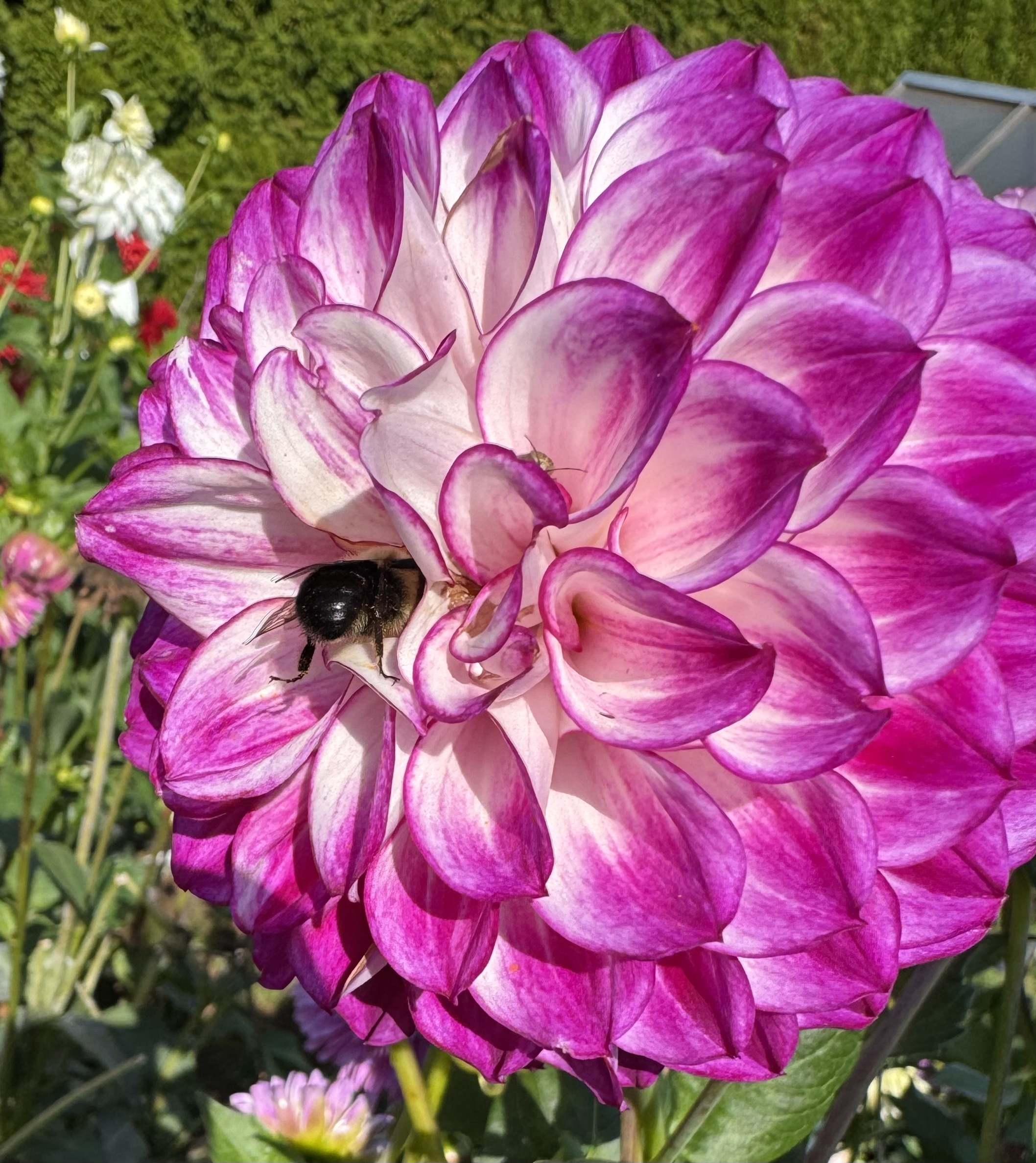
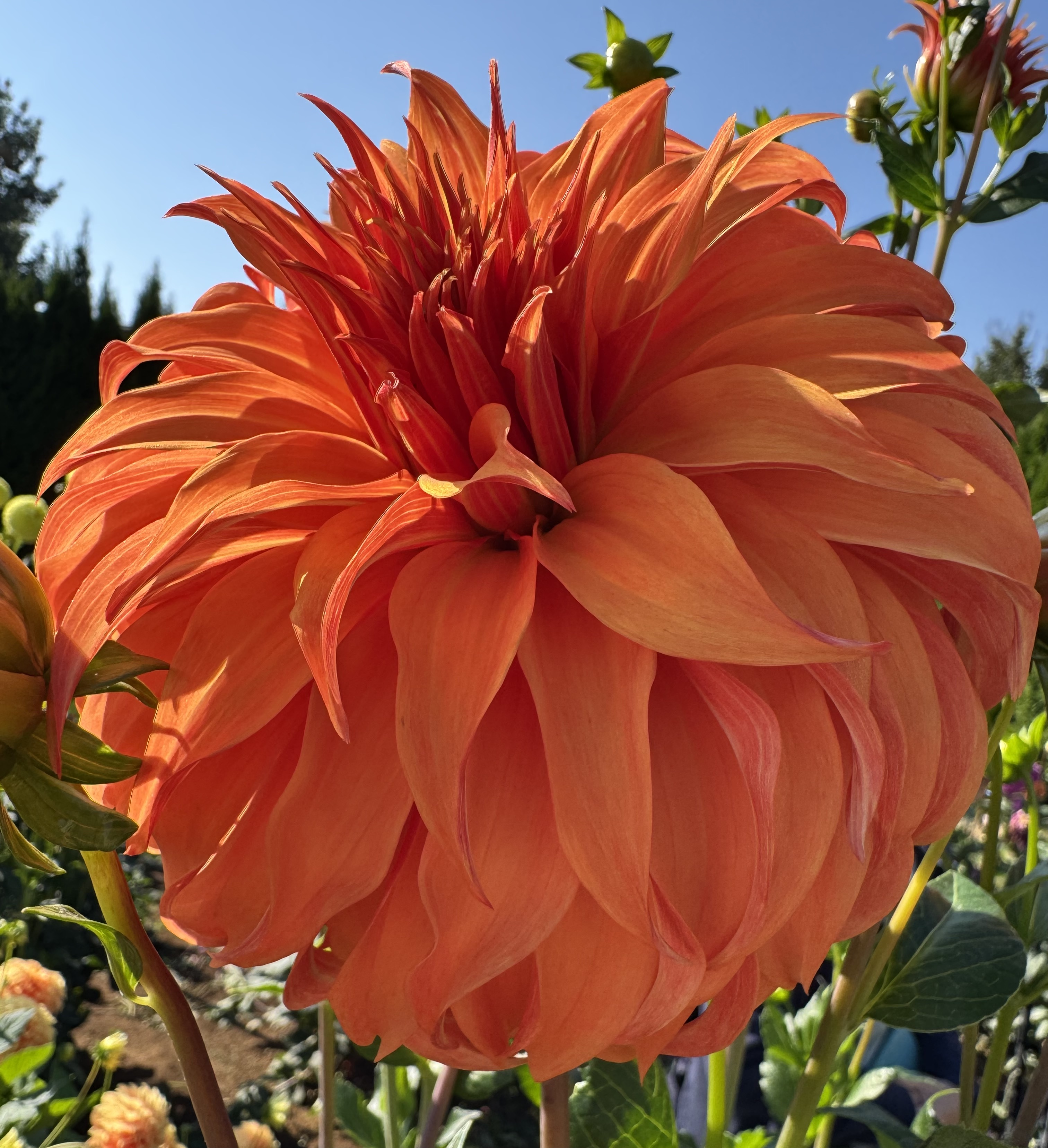
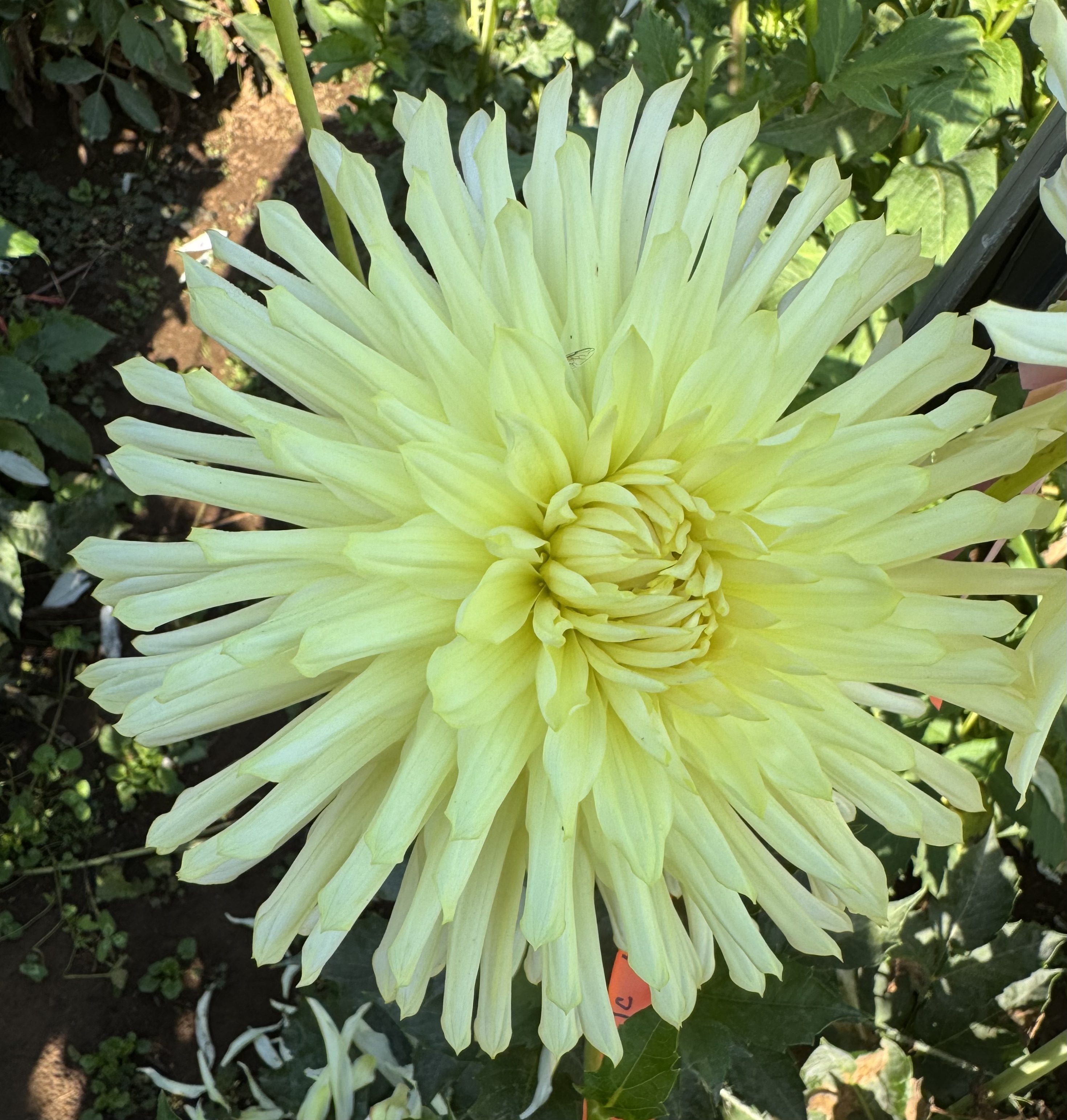
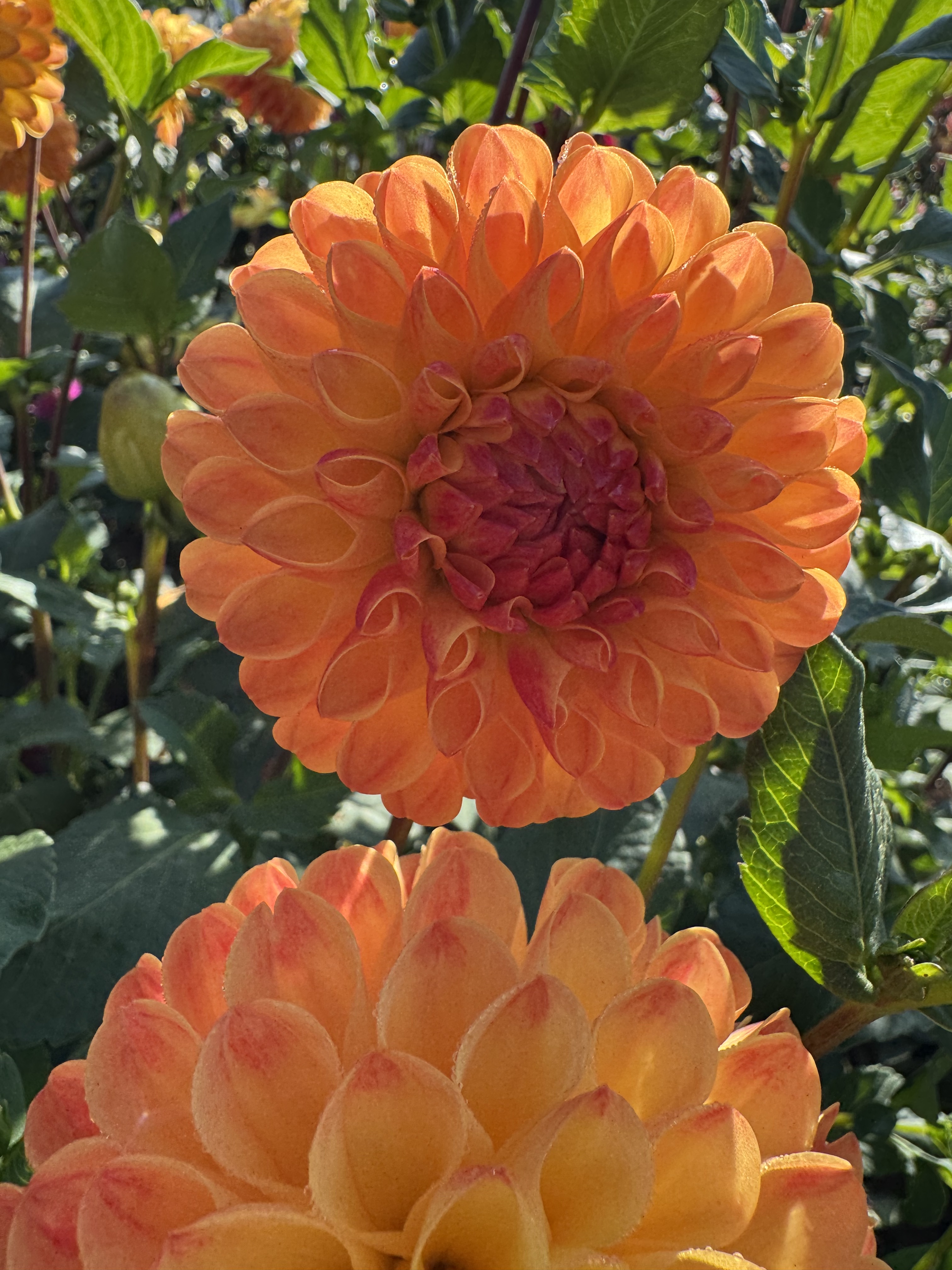
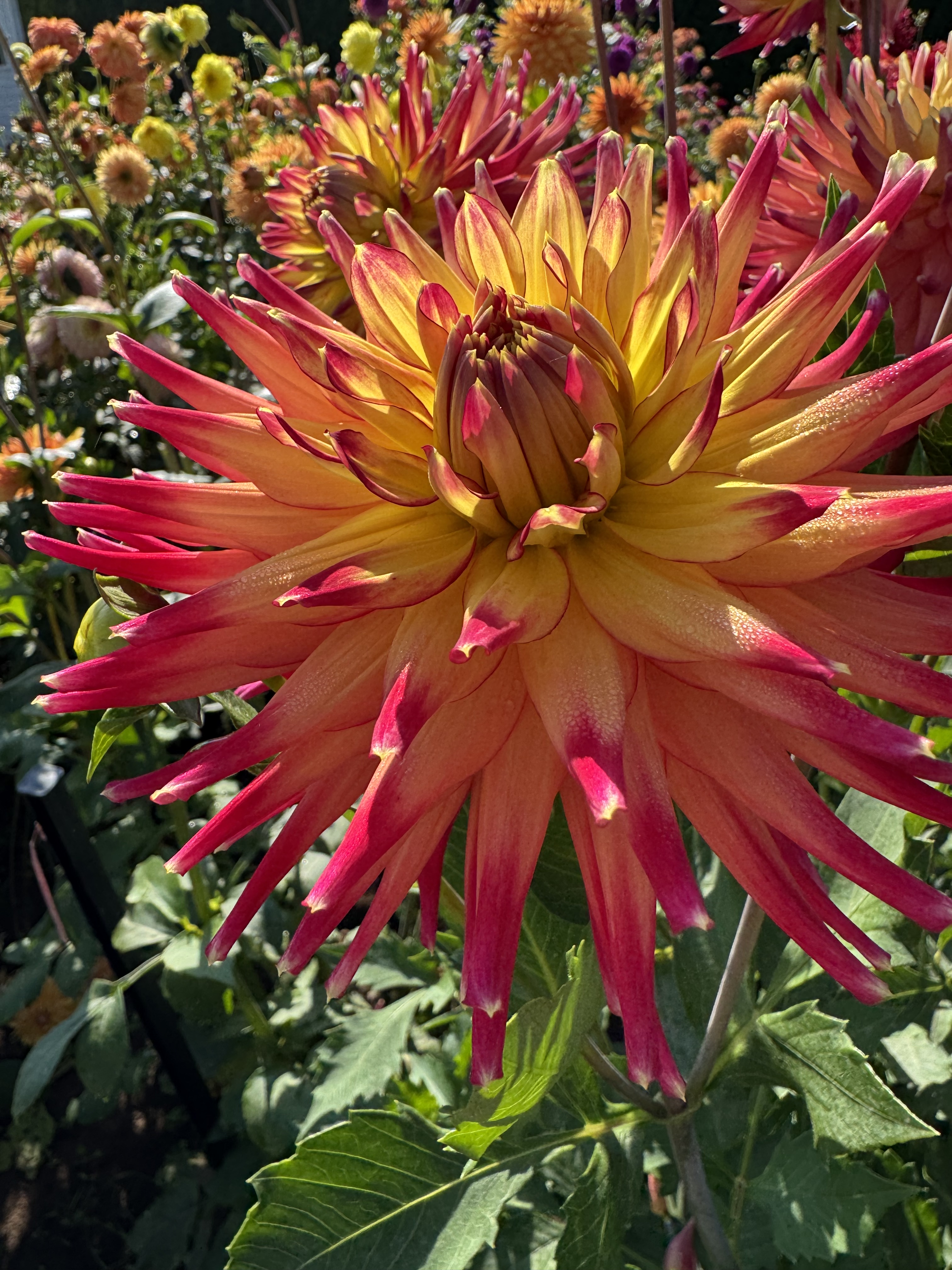
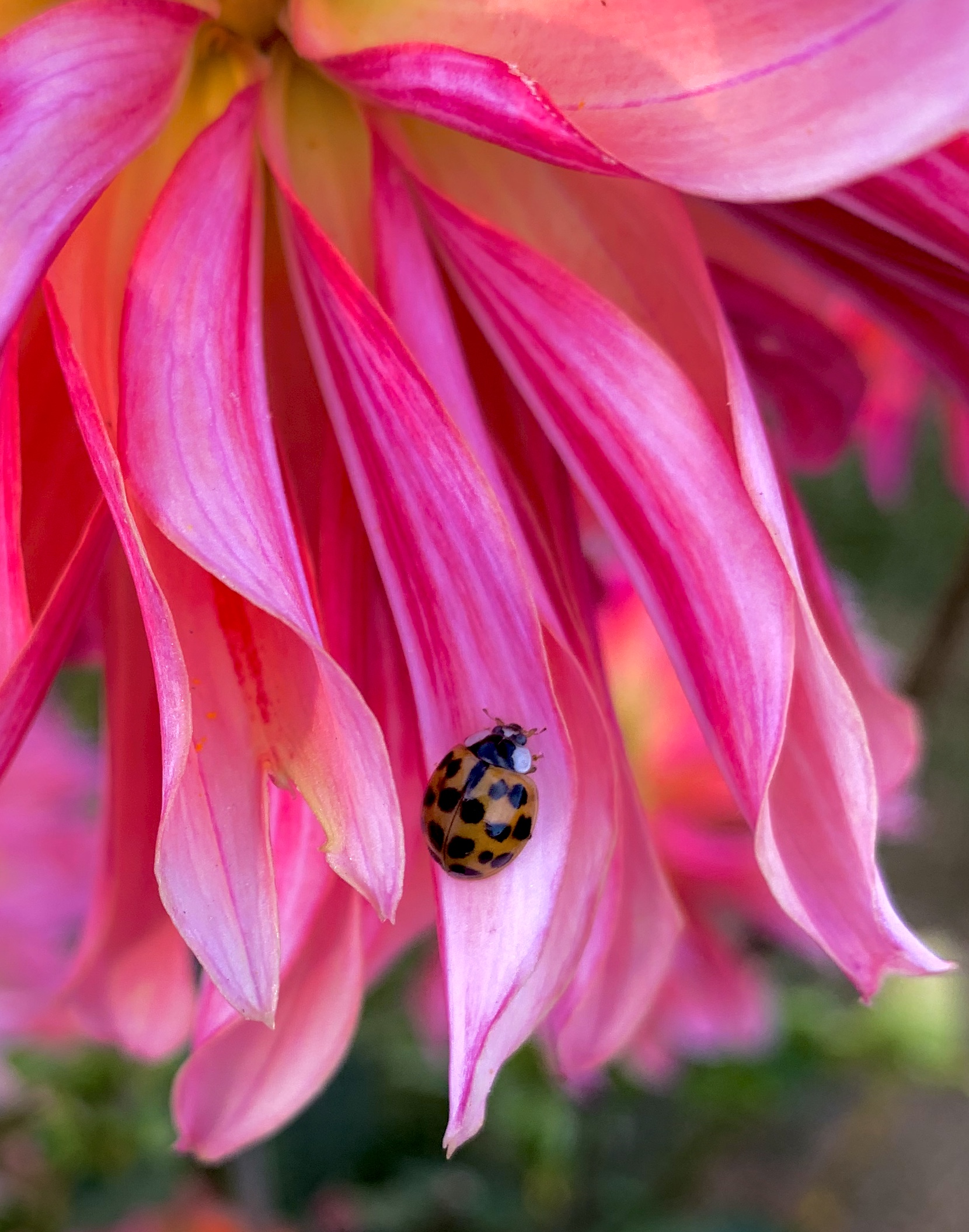
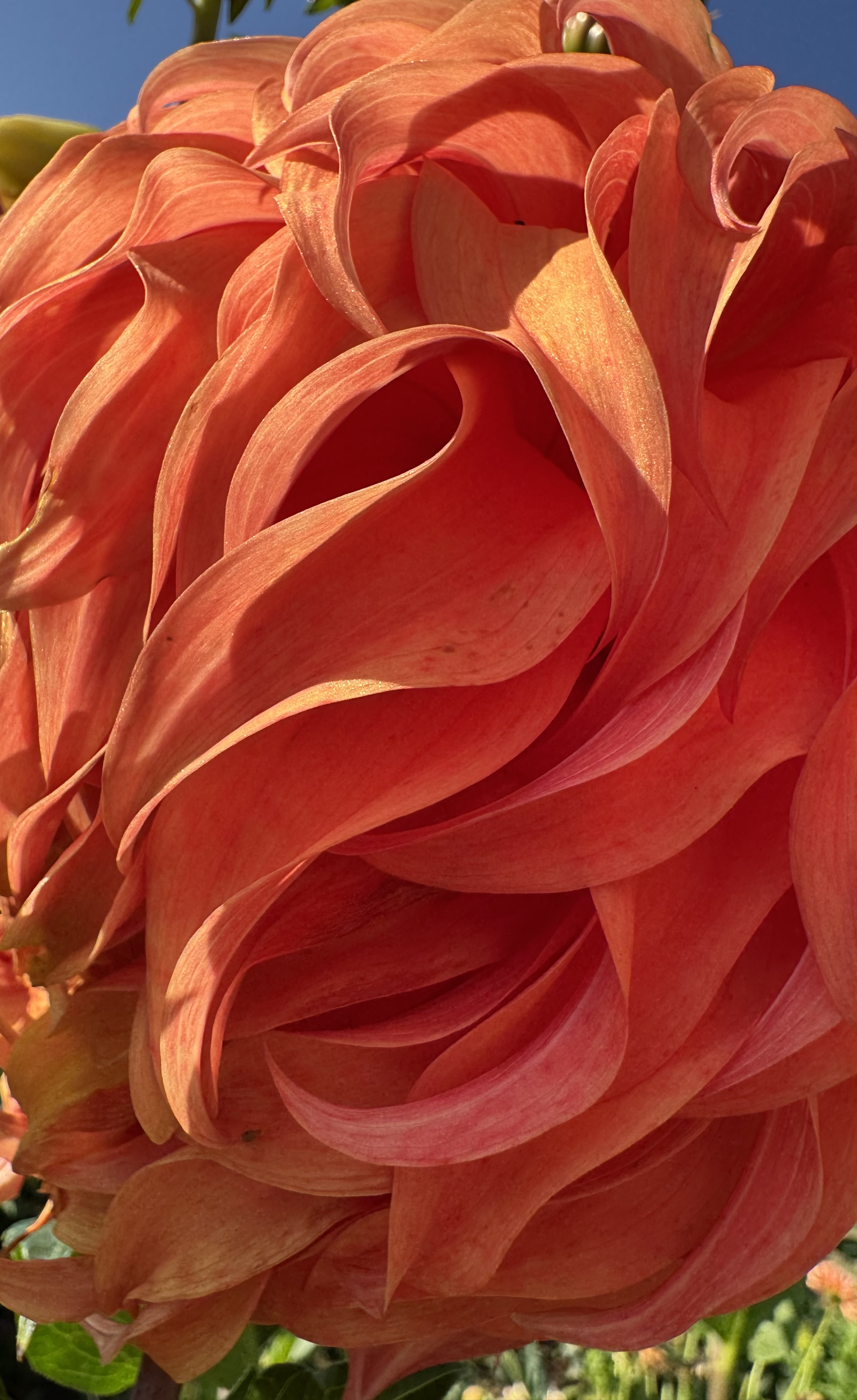
Something about the relentless beauty of the dahlias this year makes me forget lists and calls and news and aches as I stand beside them in a splendor stupor, watching them bloom in real time, not wanting to miss a moment of the long stems rising, the red color deepening then fading from the petals as they age. I imagine a time lapse begins, and the world’s winter white, then greening again, and now a hundred years pass, now five hundred, a thousand, and the garden bed is gone and the fence is gone and the trees and the ditch and the home are gone, and there’s no way to know this was once a place where dahlias grew. Is it any wonder, then, I call to you, ask you to come stand here with me to watch the dahlias open themselves to the sun, each petal a hymn to the present, a history soon to be forgotten, a shimmer in time we might put in a vase and marvel as all around it the whole world spins. ~Rosemerry Wahtola Trommer “A Scrap in Time”
In my beginning is my end. Now the light falls Across the open field, leaving the deep lane Shuttered with branches, dark in the afternoon…
The dahlias sleep in the empty silence. Wait for the early owl.
Dawn points, and another day Prepares for heat and silence. Out at sea the dawn wind Wrinkles and slides. I am here Or there, or elsewhere. In my beginning.
Home is where one starts from.
Love is most nearly itself When here and now cease to matter. ~T. S. Eliot, verses from “East Coker” in Four Quartets
What a pity flowers can utter no sound! —A singing rose, a whispering violet, a murmuring honeysuckle… oh, what a rare and exquisite miracle would these be! ~Henry Ward Beecher
A flower garden is a place for prayer and hymns of praise.
When I meet a truly great gardener, like my friend Jean who has grown and hybridized dahlias, what I see growing in the soil is a choral composition of petals, leaves and roots.
Jean has passionately cared for these plants for many of her nine decades of life. They reflect that love in every spiral and swirl, hue and gradient of color, showing stark symmetry and delightful variegation.
Arising from the plainest of homely and knobby look-alike tubers grow these luxurious beauties of infinite variety. I am stunned by each one, captivated, realizing that same Creator ensures we too bloom from mere dust, becoming a hymn of praise arising from every fiber of our being.
One-Time
Monthly
Yearly
Make a one-time or recurring donation to support daily Barnstorming posts
The meaning of marriage begins in the giving of words. We cannot join ourselves to one another without giving our word. And this must be an unconditional giving, for in joining ourselves to one another we join ourselves to the unknown. ~Wendell Berry from “Poetry and Marriage” in Standing By Words
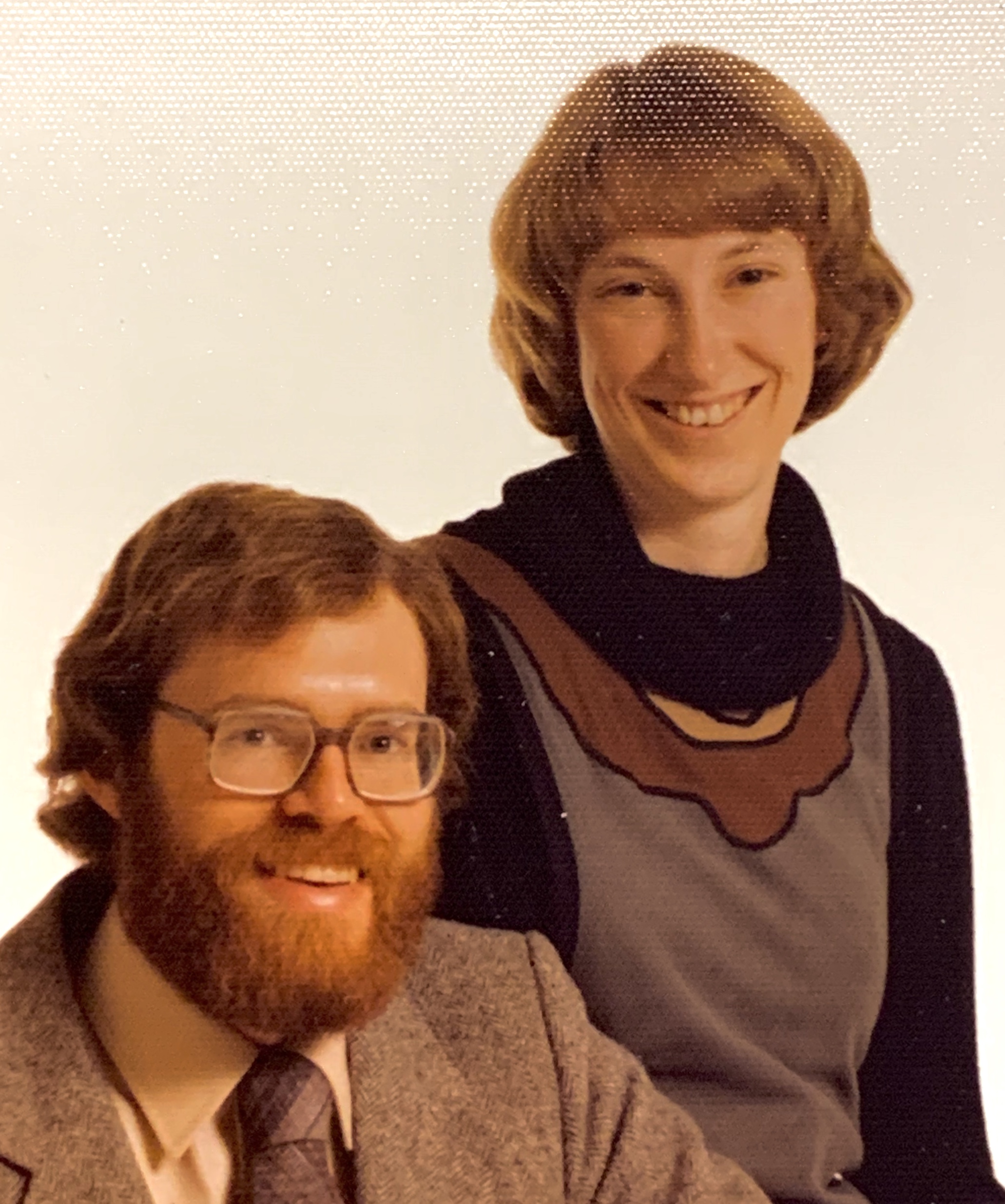
Our vows to one another forty-four years ago today:
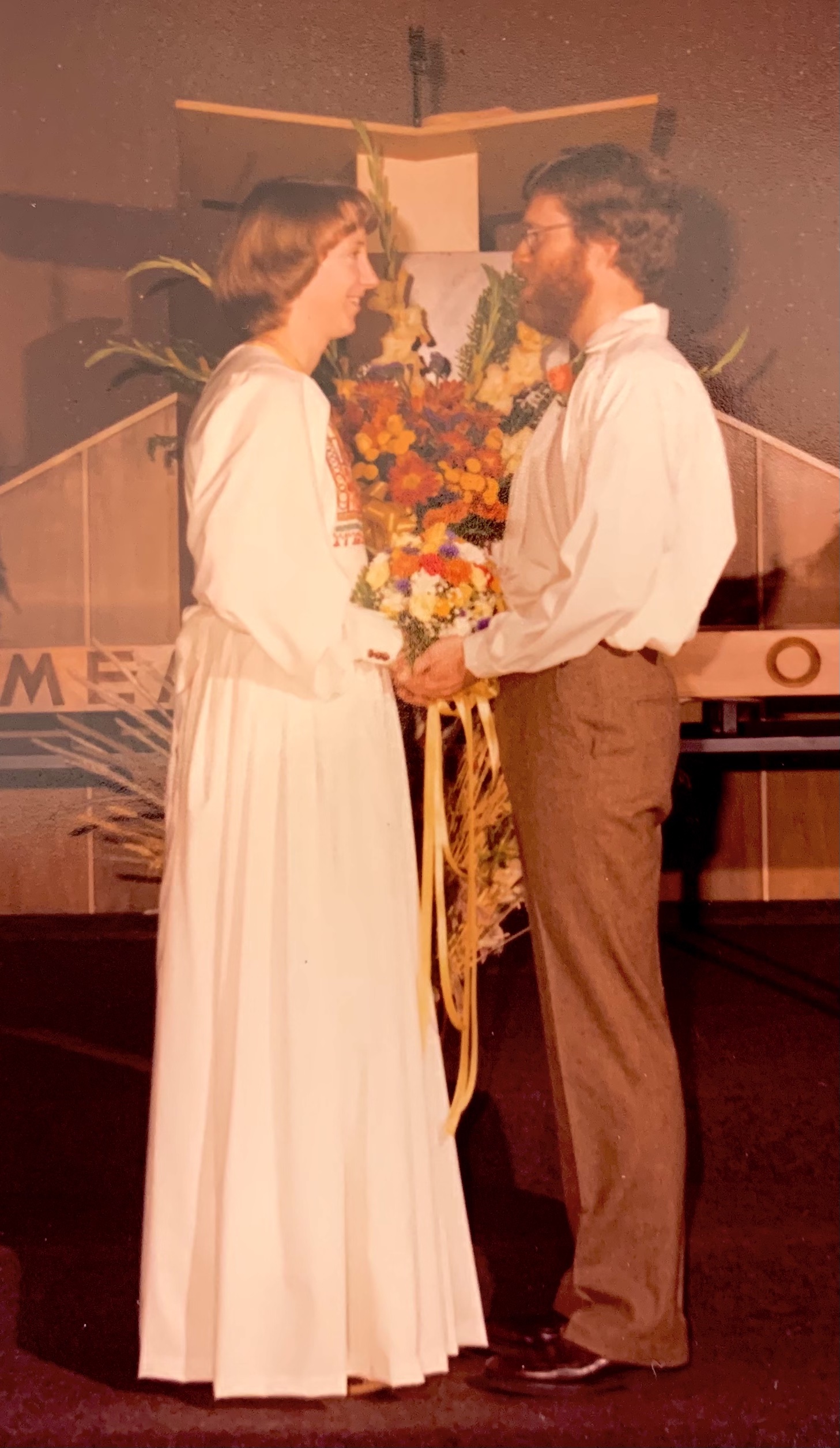
Before God and this gathering, I vow from my heart and spirit that I will be your wife/husband for as long as we both shall live.
I will love you with faithfulness, knowing its importance in sustaining us through good times and bad.
I will love you with respect, serving your greatest good and supporting your continued growth.
I will love you with compassion, knowing the strength and power of forgiveness.
I will love you with hope, remembering our shared belief in the grace of God and His guidance of our marriage.
“And at home, by the fire, whenever you look up, there I shall be–and whenever I look up, there will be you.”
(our wedding vows for our September 19, 1981 wedding at First Seattle Christian Reformed Church — the last line adapted from Thomas Hardy’s “Far From the Madding Crowd”)
Sometimes our life reminds me of a forest in which there is a graceful clearing and in that opening a house, an orchard and garden, comfortable shades, and flowers red and yellow in the sun, a pattern made in the light for the light to return to. The forest is mostly dark, its ways to be made anew day after day, the dark richer than the light and more blessed, provided we stay brave enough to keep on going in.
We enter, willing to die, into the commonwealth of its joy. ~Wendell Berry from “A Country of Marriage”
…Marriage… joins two living souls as closely as, in this world, they can be joined. This joining of two who know, love, and trust one another brings them in the same breath into the freedom of sexual consent and into the fullest earthly realization of the image of God. From their joining, other living souls come into being, and with them great responsibilities that are unending, fearful, and joyful. The marriage of two lovers joins them to one another, to forebears, to descendants, to the community, to heaven and earth. It is the fundamental connection without which nothing holds, and trust is its necessity. ~Wendell Berry from Sex, Economy, Freedom and Community
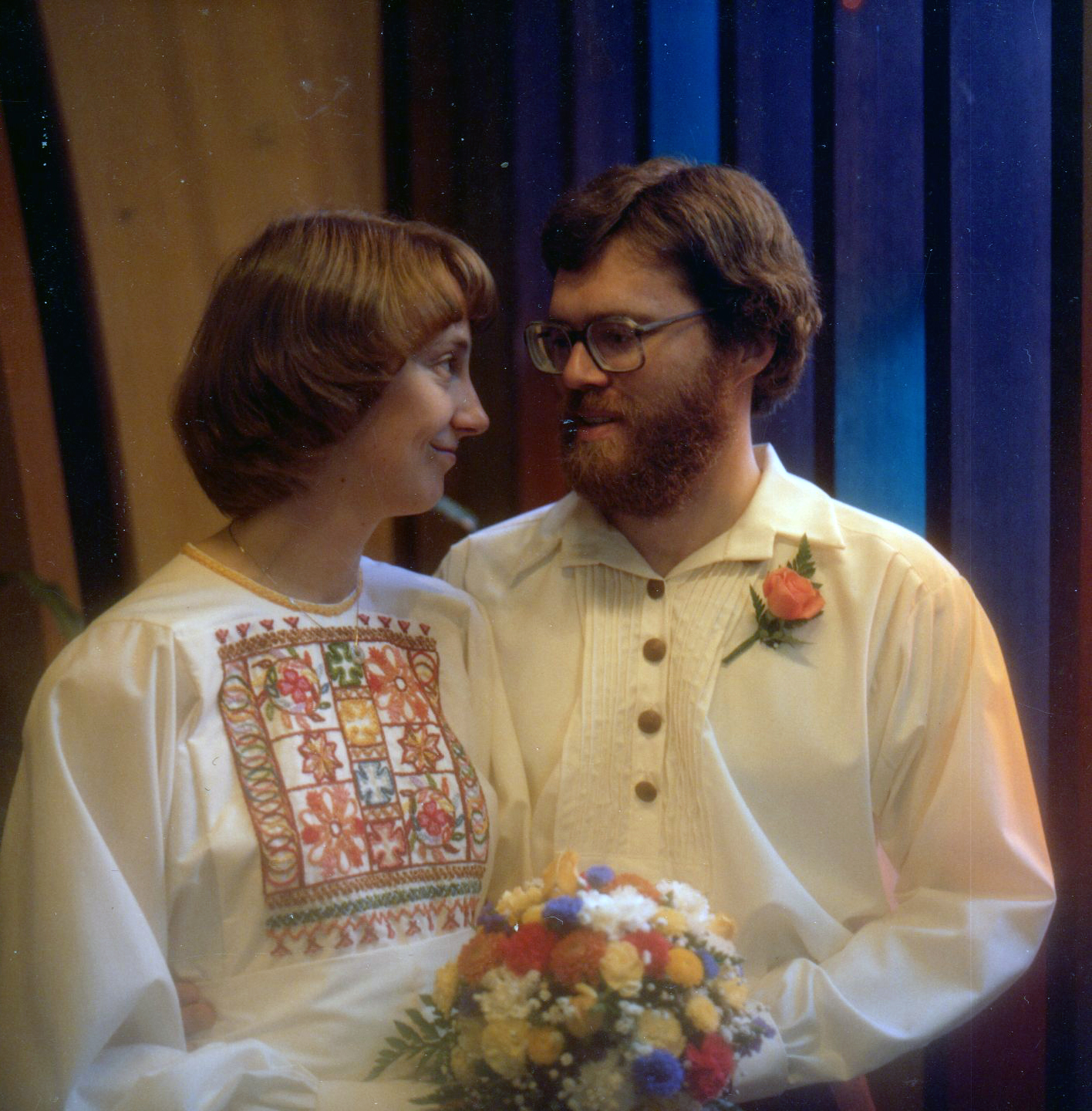
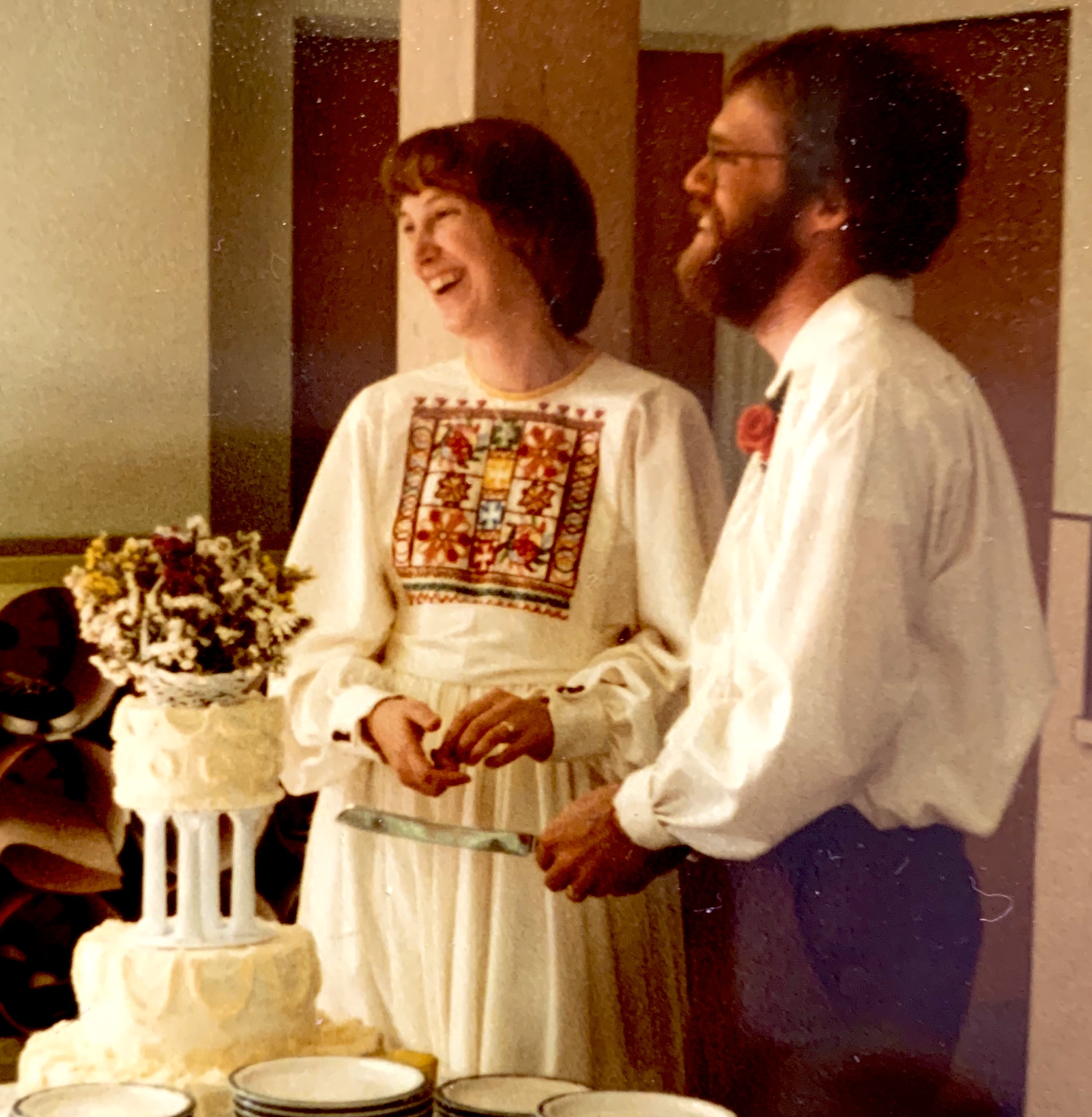
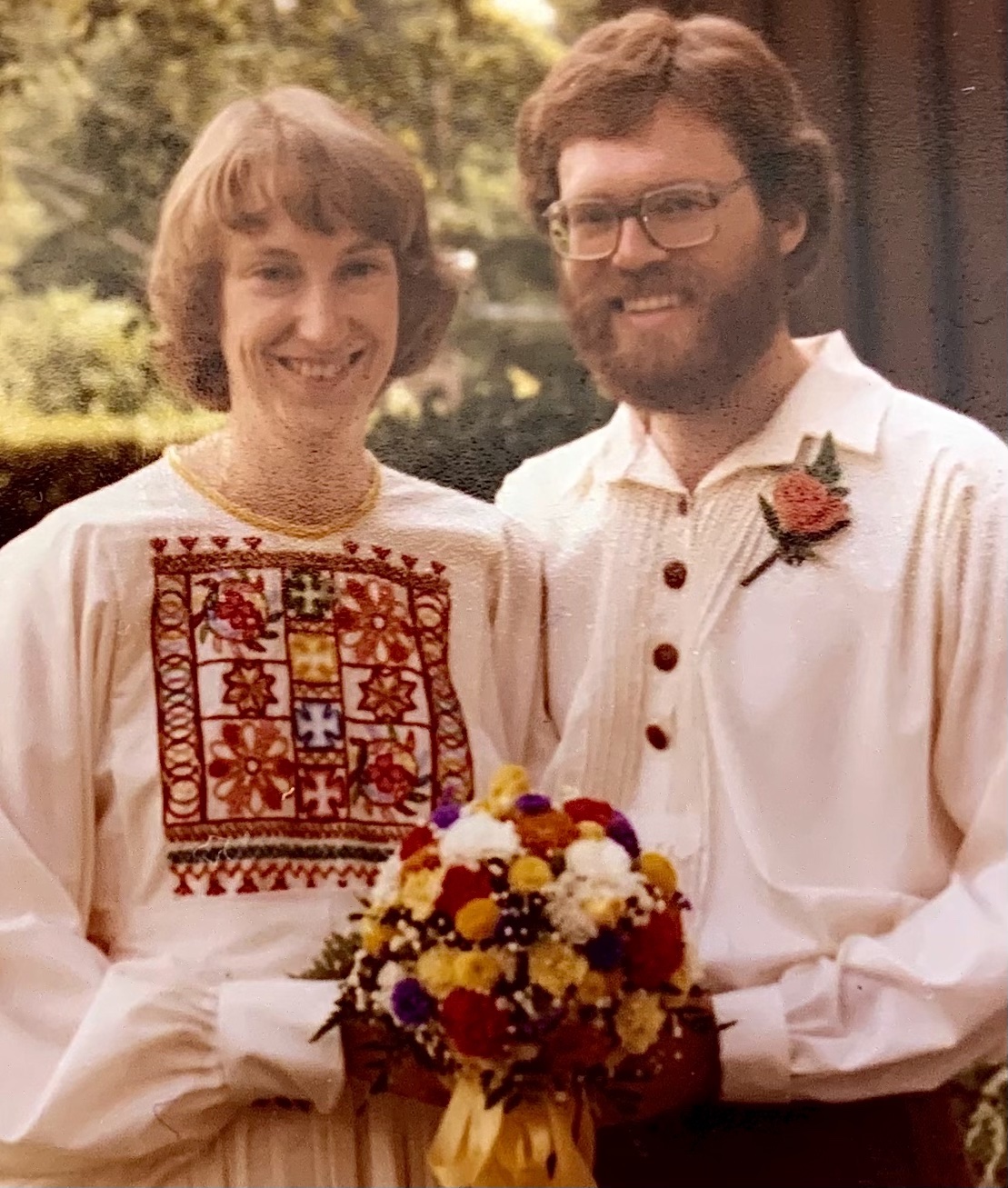
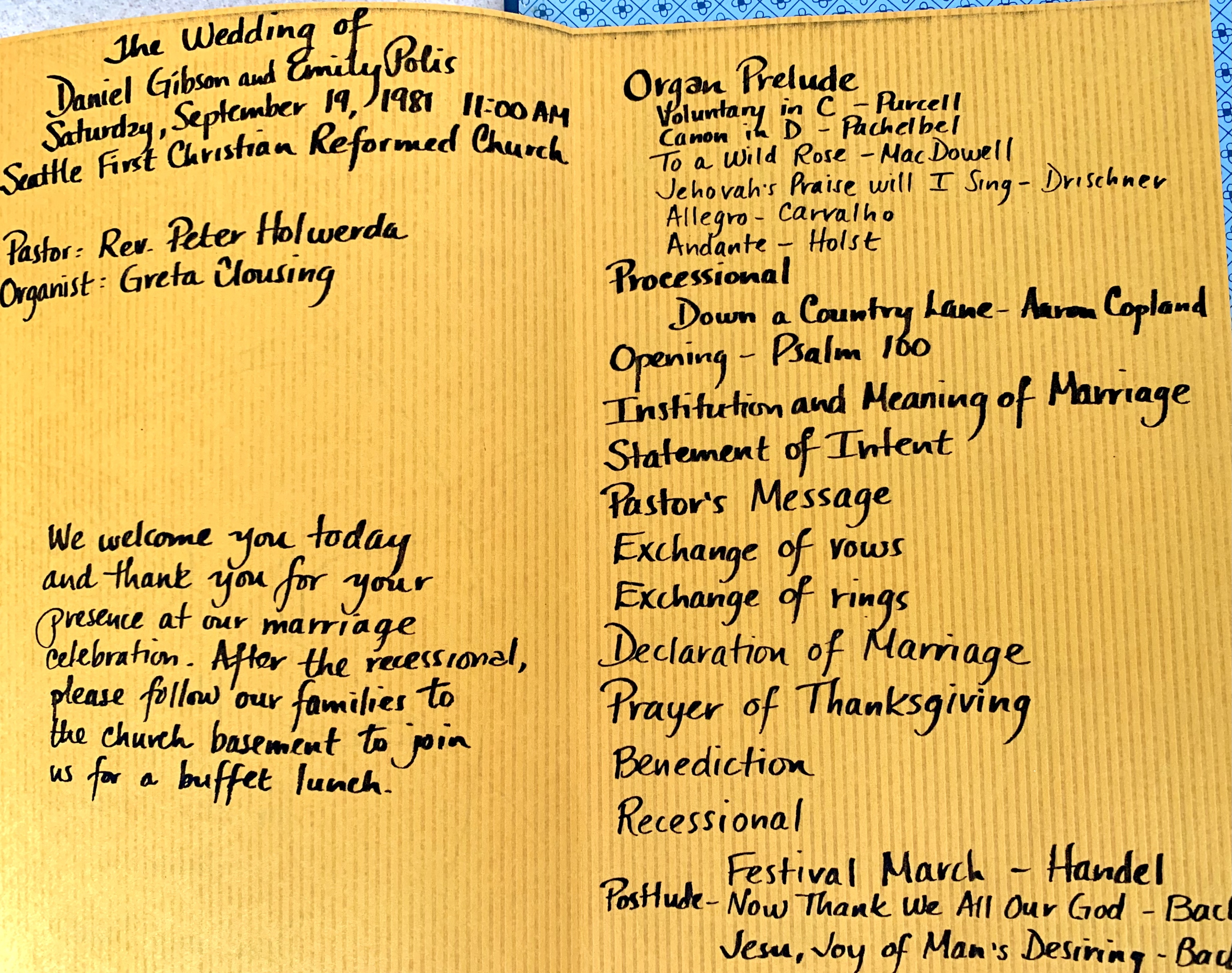
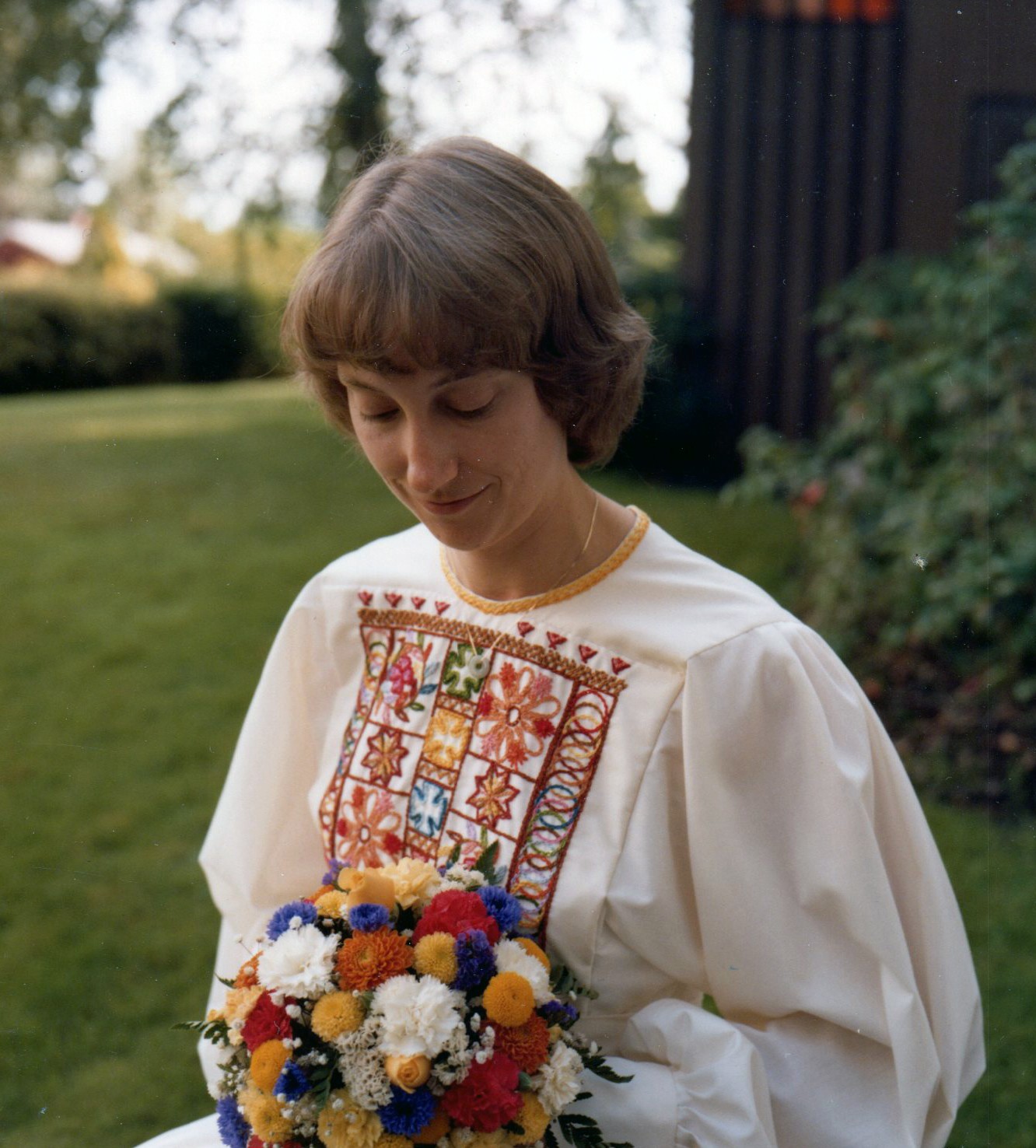
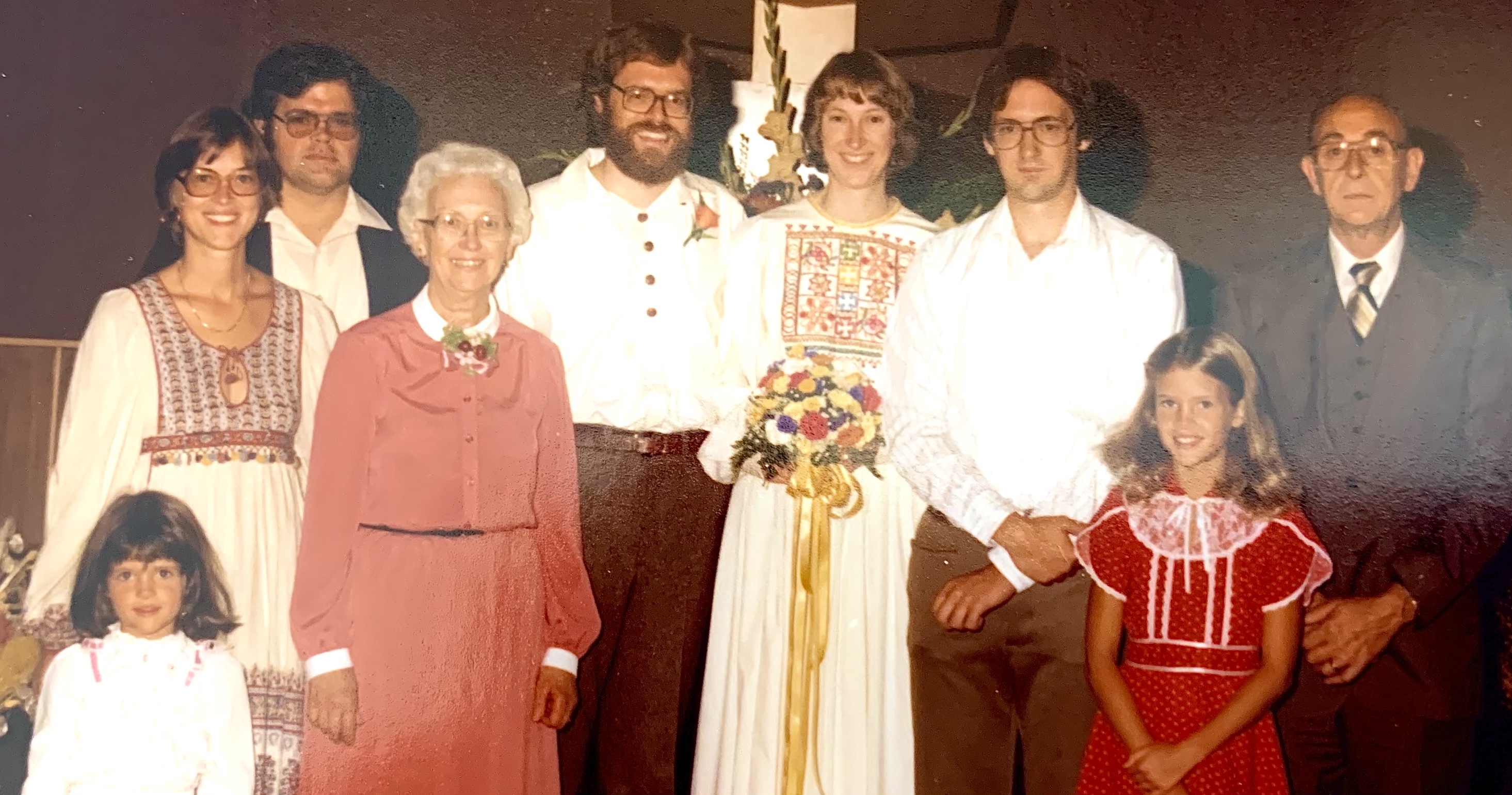
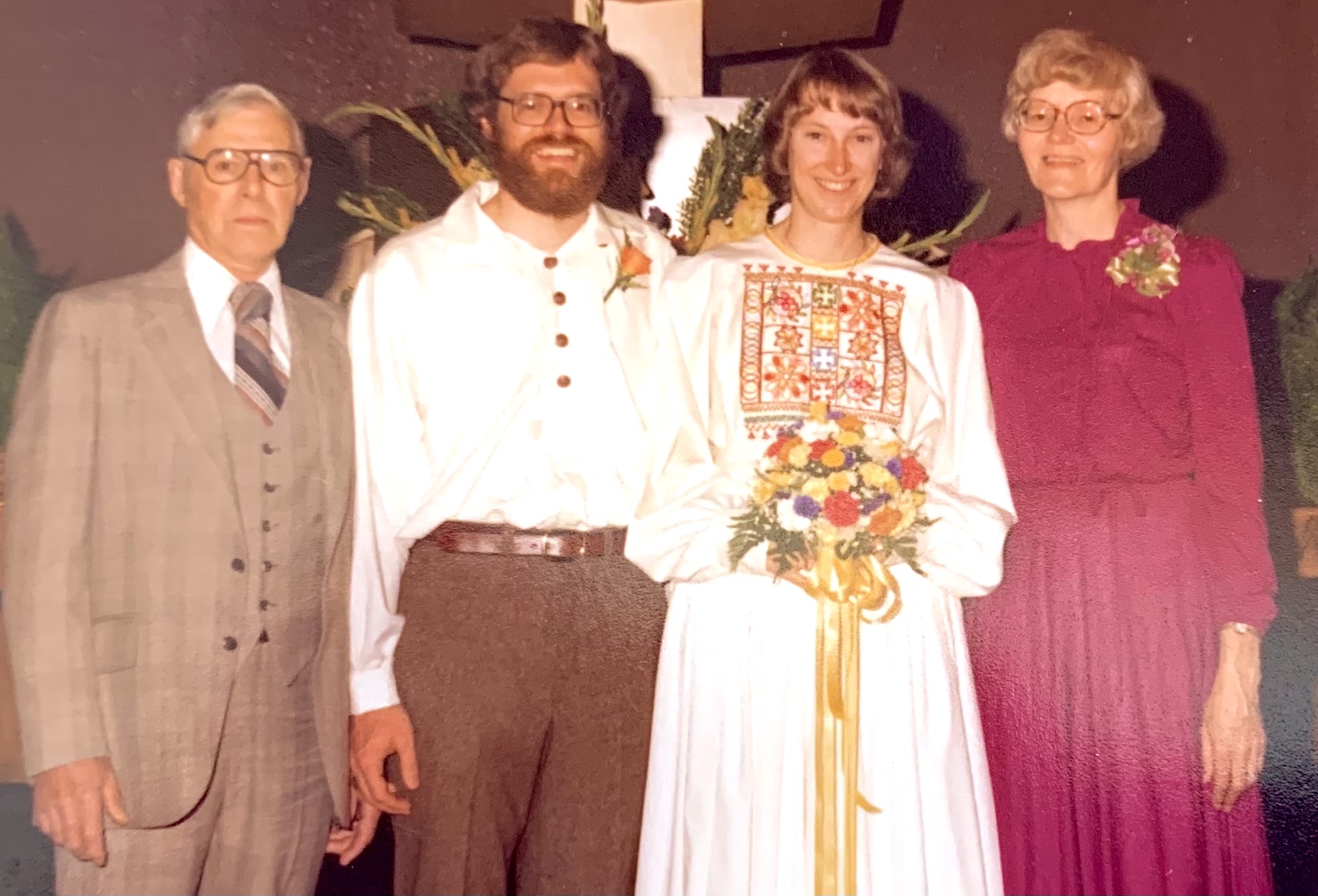
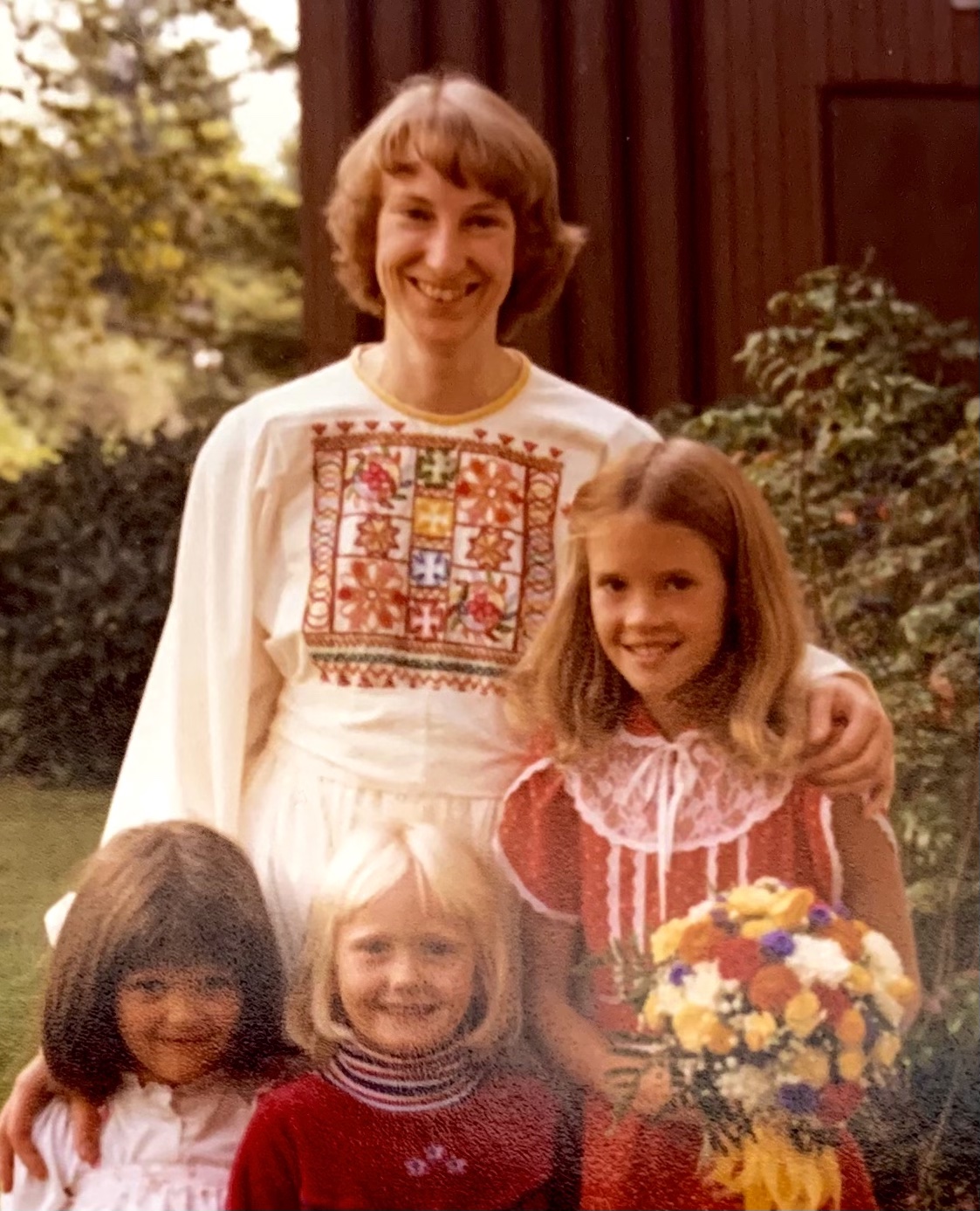
We married forty-four years ago today in our Seattle church with Pastor Peter Holwerda officiating, with a small group of family and friends as witnesses.
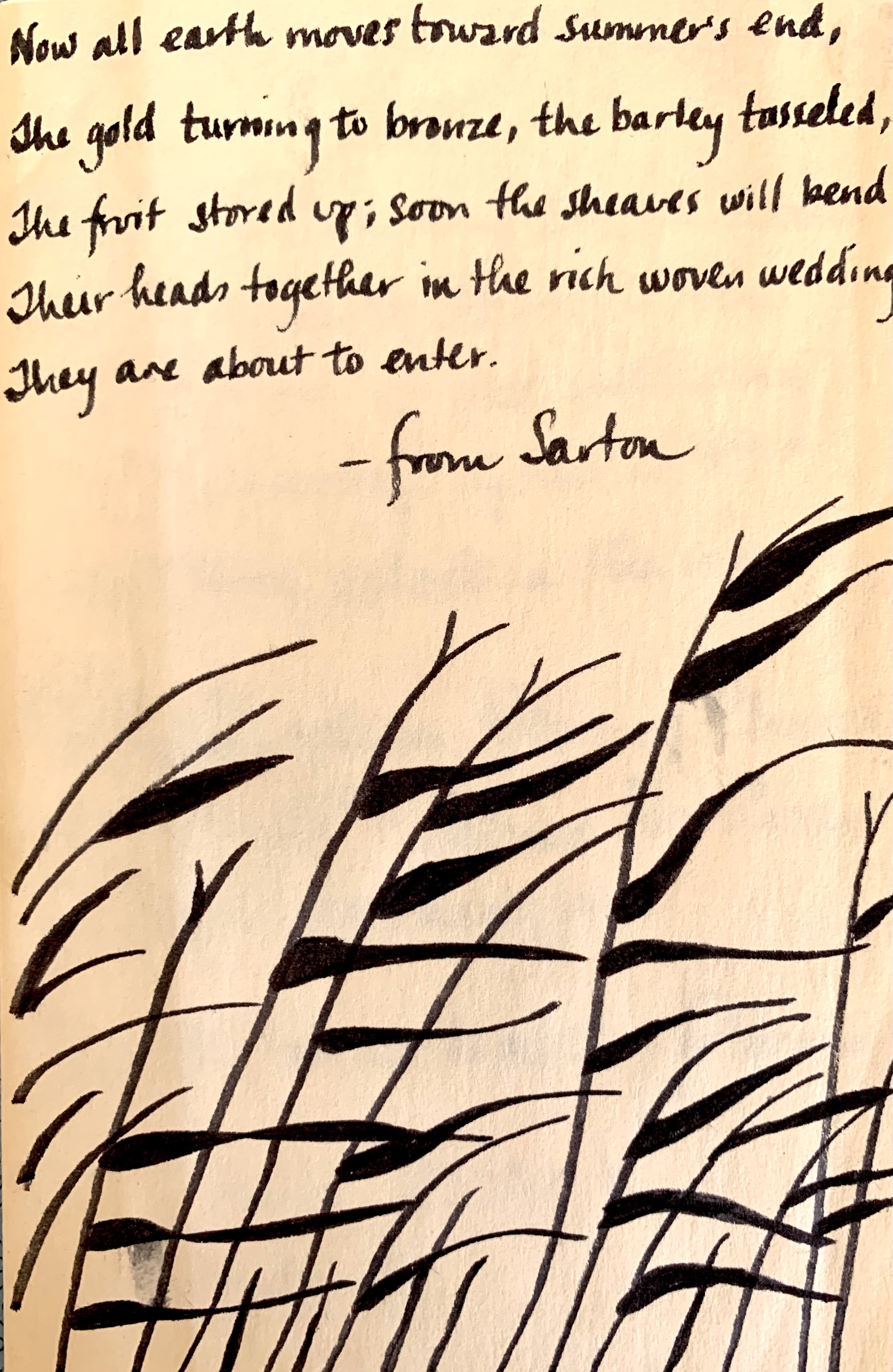
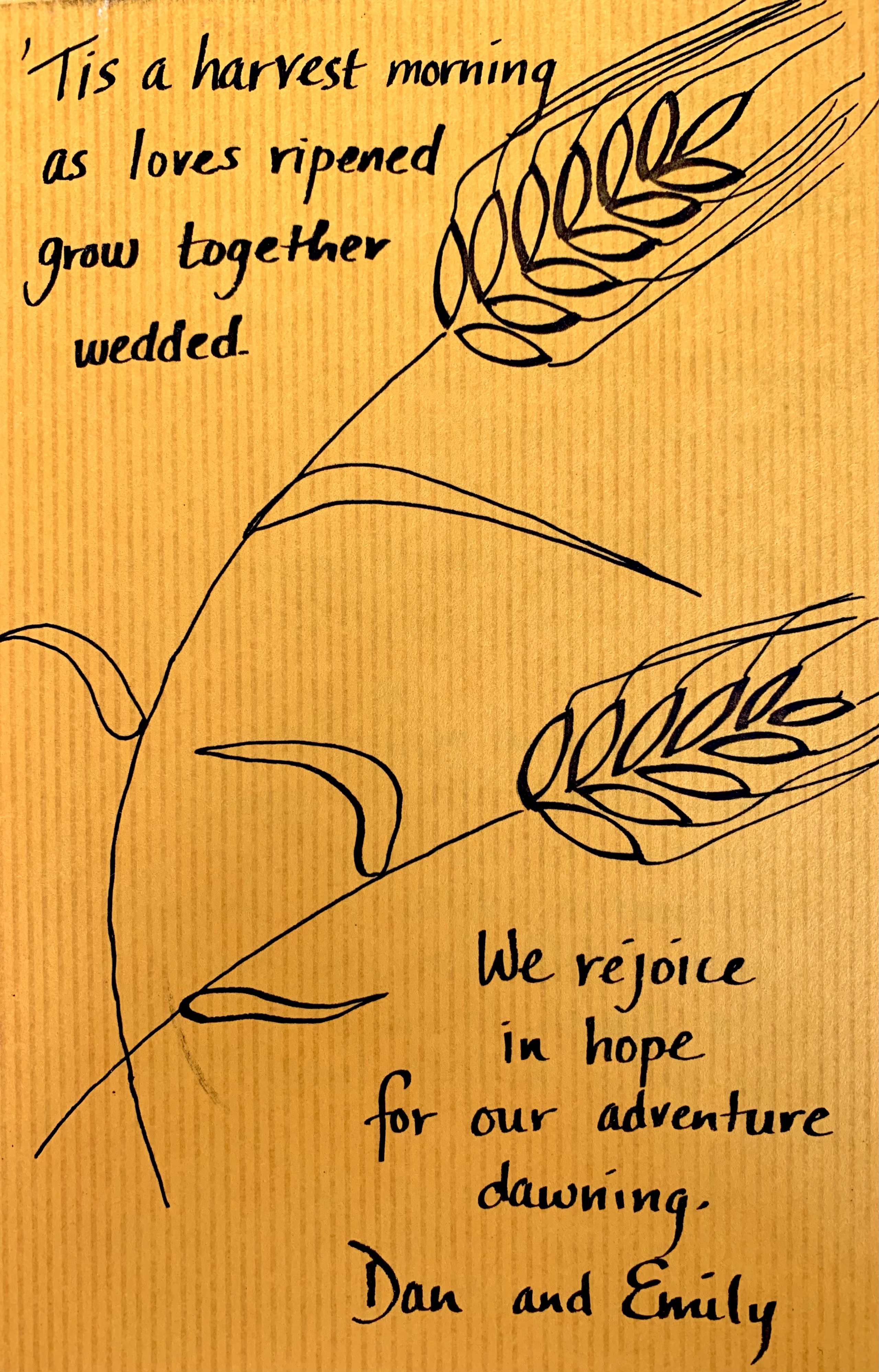
It was a wedding of two frugal people with little to spend – I sewed my dress and Dan’s shirt from muslin, we grew our own flowers, our families helped potluck the lunch afterward and our tiered carrot cake was made by a friend.
Yet our vows to one another were not frugal and held nothing back. They were extravagant and comprehensive, coming from our hearts and spirits. The music we asked our amazing organist to play (versions below) inspired us by its simplicity and complexity – very much like the families that raised us and the God we worship.
Our vows have taken us from the city to the countryside, to the raising and rejoicing in three amazing children and now six grandchildren. We both served more than forty years as a public-employed attorney and physician. We have laid down those responsibilities, and picked up the tools of farm and garden along with church and community service for as long as we are able.
We treasure each day of living together in faithfulness, respect, compassion and hope – knowing that how we love and find joy in one another mirrors how God loves and revels in His people.
We pray for many more days to fill us with what endures.
A pot of red lentils simmers on the kitchen stove. All afternoon dense kernels surrender to the fertile juices, their tender bellies swelling with delight.
In the yard we plant rhubarb, cauliflower, and artichokes, cupping wet earth over tubers, our labor the germ of later sustenance and renewal.
Across the field the sound of a baby crying as we carry in the last carrots, whorls of butter lettuce, a basket of red potatoes.
I want to remember us this way— late September sun streaming through the window, bread loaves and golden bunches of grapes on the table, spoonfuls of hot soup rising to our lips, filling us with what endures. ~Peter Pereira from “A Pot of Red Lentils”
Here are versions of the organ music we selected for prelude, processional, recessional and postlude
One-Time
Monthly
Yearly
Make a one-time or recurring donation to support daily Barnstorming posts
Summer is over, the old cow said, And they’ll shut me up in a draughty shed To milk me by lamplight in the cold, But I won’t give much for I am old. It’s long ago that I came here Gay and slim as a woodland deer; It’s long ago that I heard the roar Of Smith’s white bull by the sycamore. And now there are bones where my flesh should be; My backbone sags like an old roof tree, And an apple snatched in a moment’s frolic Is just so many days of colic.
I’m neither a Jersey nor Holstein now But only a faded sort of cow. My calves are veal and I had as lief That I could lay me down as beef; Somehow, they always kill by halves, — Why not take me when they take my calves? Birch turns yellow and sumac red, I’ve seen this all before, she said, I’m tired of the field and tired of the shed. There’s no more grass, there’s no more clover; Summer is over, summer is over. ~Robert Hillyer “Moo!”
Something inspires the only cow of late To make no more of a wall than an open gate, And think no more of wall-builders than fools. Her face is flecked with pomace and she drools A cider syrup. Having tasted fruit, She scorns a pasture withering to the root. She runs from tree to tree where lie and sweeten The windfalls spiked with stubble and worm-eaten. She leaves them bitten when she has to fly. She bellows on a knoll against the sky. Her udder shrivels and the milk goes dry. ~Robert Frost “The Cow in Apple Time”
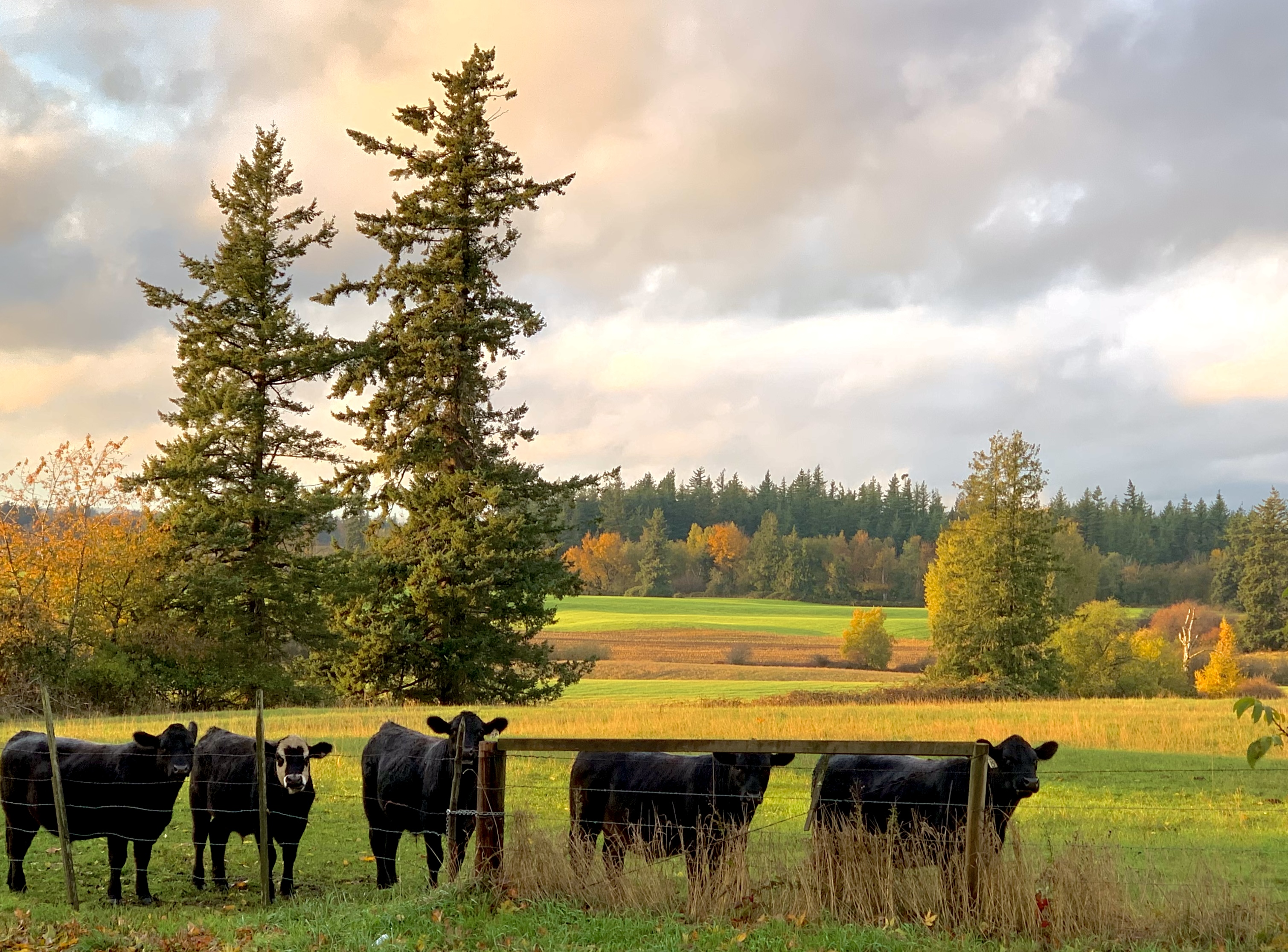
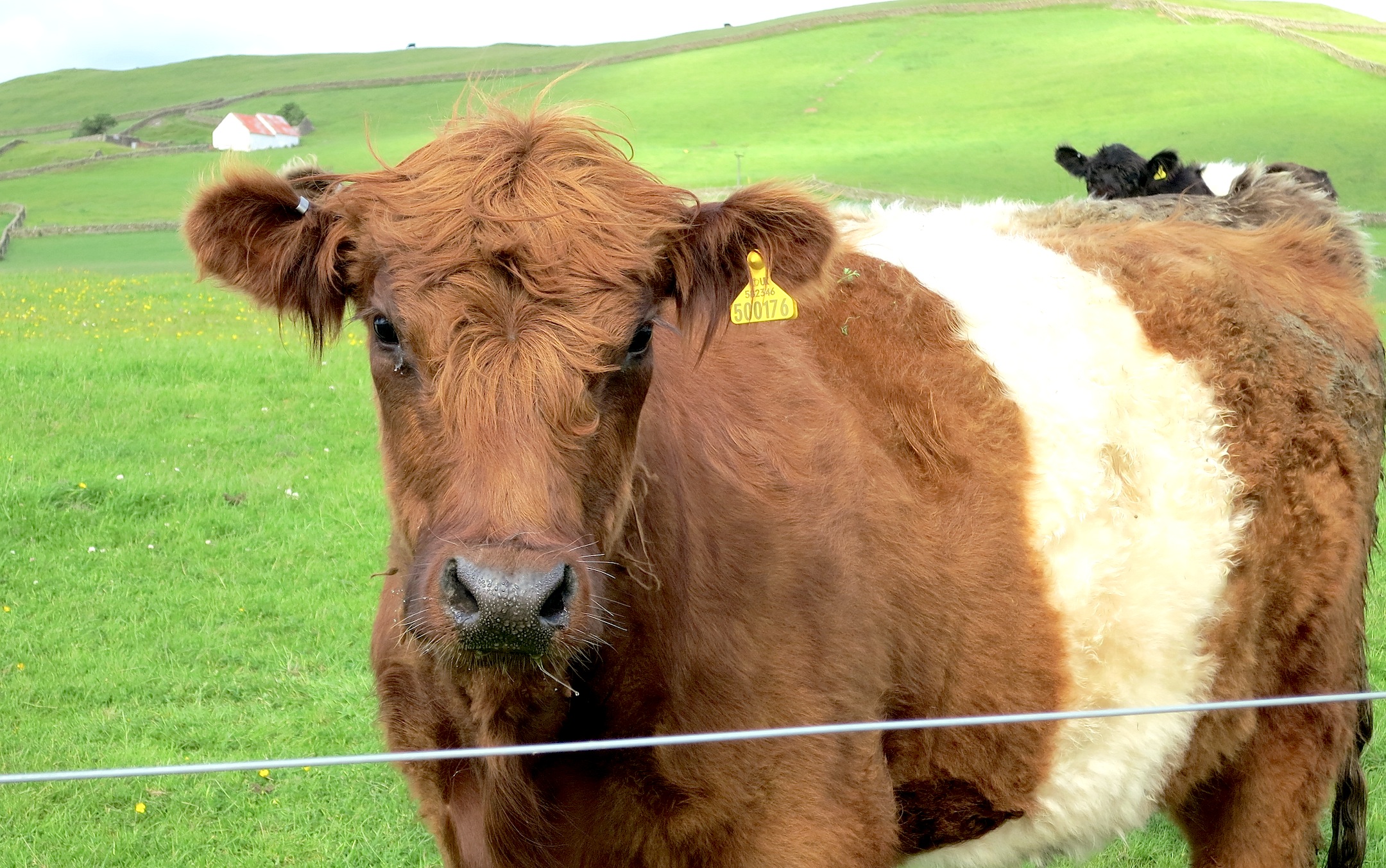
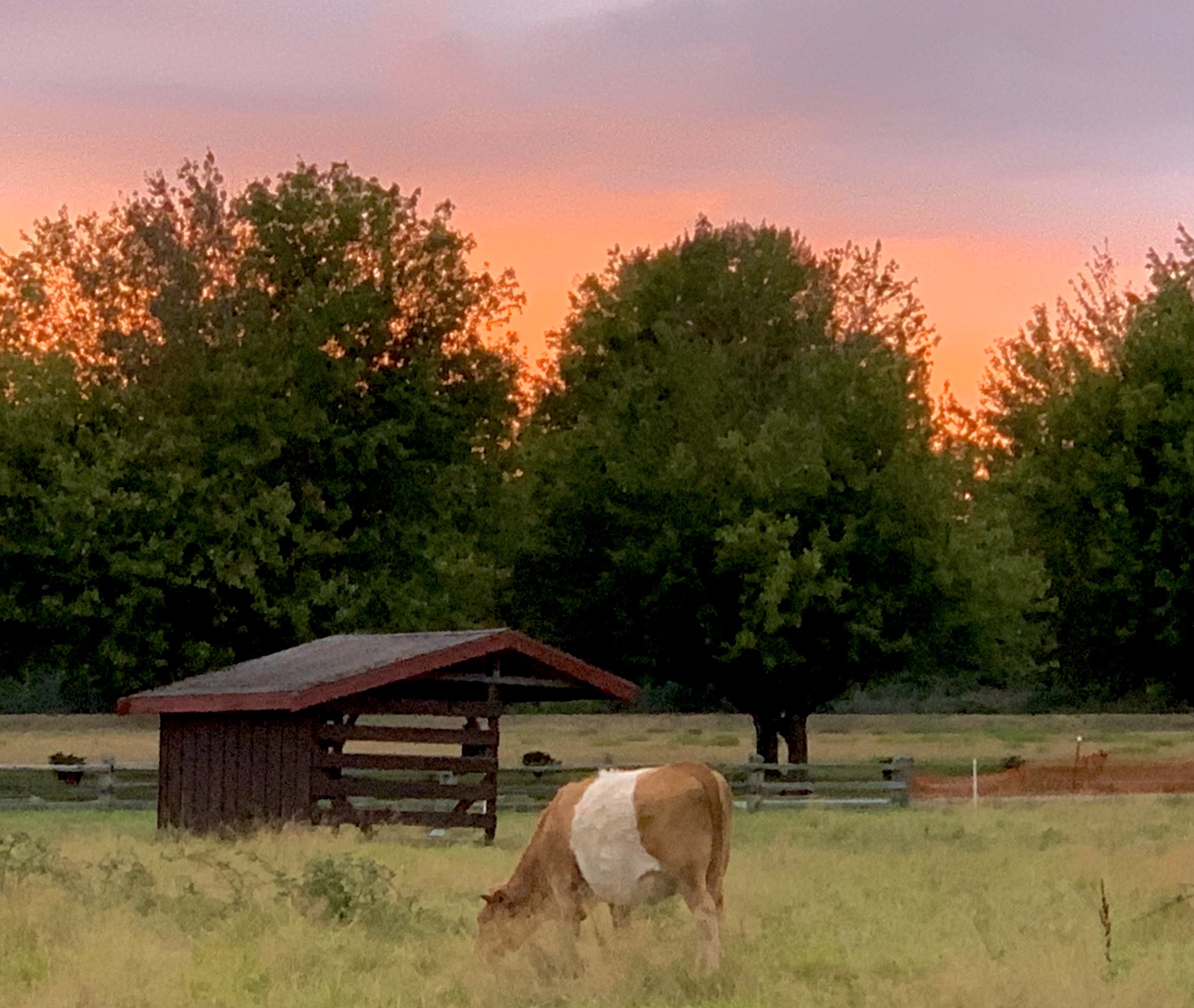
I have lived among cows, our own and our neighbors’, dairy and beef, most of my life. Given their status as a food source, cows aren’t always granted a long life, but I do envy those who spend much of the year chewing cud outside in pastoral settings.
We’ve owned some aged cows. They can be set in their ways and don’t particularly like a change in routine. They prefer a communal life, bearing calves, surrendering their milk, and ensuring the herd hierarchy is maintained with a minimum of fuss.
I remember my dad curing a cow’s habit of eating apples directly from a tree branch. She had the apple lodged in her esophagus as it had slipped down her throat unchewed, but too large to pass through to her rumen. She was foaming at the mouth, breathing fine, but the apple was a visible lump palpable mid-way down her neck. My dad grabbed a short two by four board and a hammer, placed the board on one side of her neck lump, and with the hammer, hit her neck precisely over the apple, crushing it. She was immediately cured and sauntered over to grab more apples, off the ground rather than the branch.
Cows can experience various health issues, sometimes relating to infections in their udders, but not infrequently, trouble with their hooves. They can get abscesses which are quite painful until emptied, as well as sharp rocks or gravel wedged into their foot. This sometimes necessitates hoof work done by a specialist who visits dairy farms on a regular basis.
I confess I (along with a million or so other folks) spend an inordinate amount of time watching YouTube channels of cow hoof trimming. I have no desire to do the job myself, but restoring a limping cow to a comfortably walking cow is a skill that must be very gratifying.
As an aging female myself, I know all about aches and pains. I too feel the sadness of summer coming to an end, when the grass and clover grows sparse in the field, and when chilly nights are best spent in the shelter of the barn.
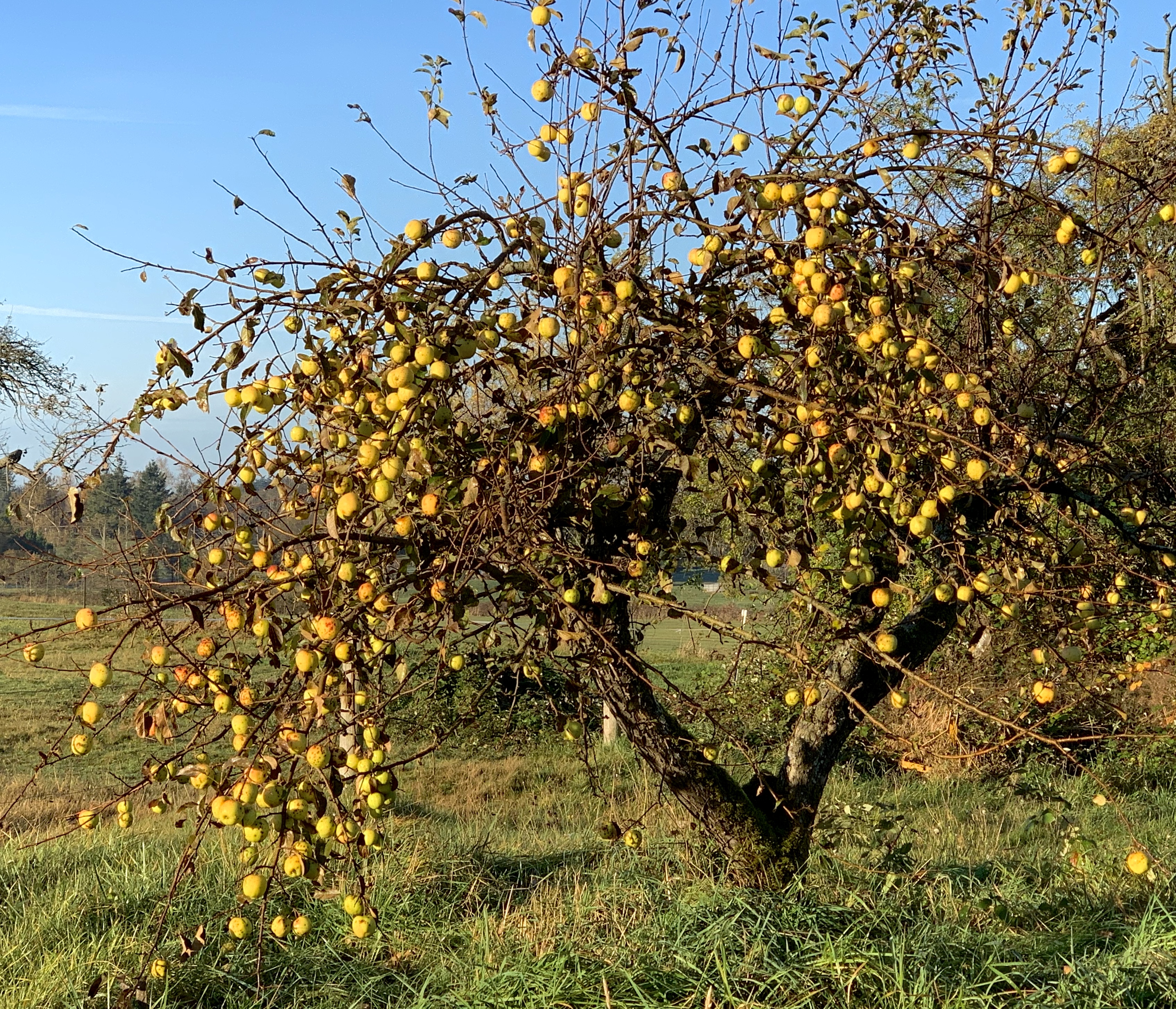
But I’m not yet ready to give up on this sweet pastoral life. There are still some days left, and apples to pick up off the ground, for this fading old cow…
One-Time
Monthly
Yearly
Make a one-time or recurring donation to support daily Barnstorming posts
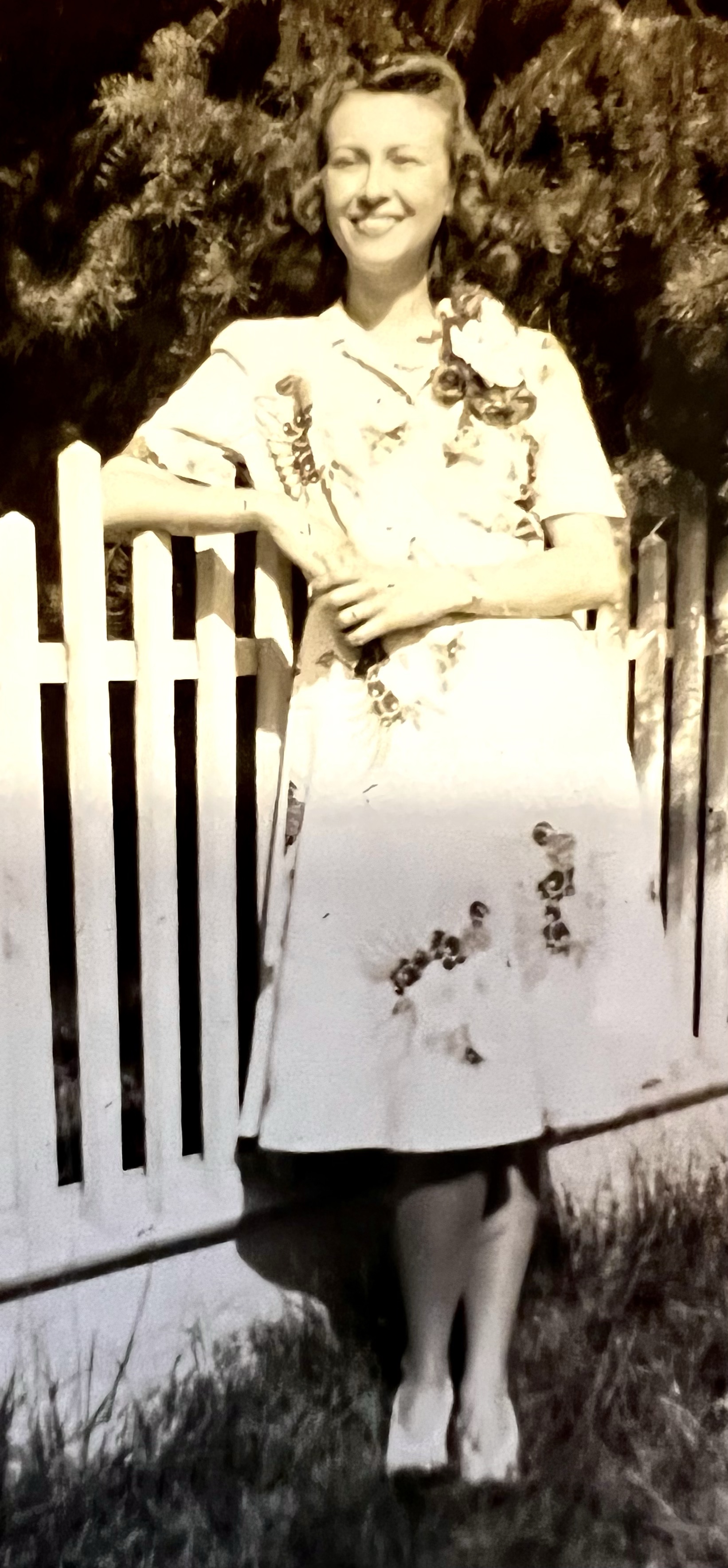
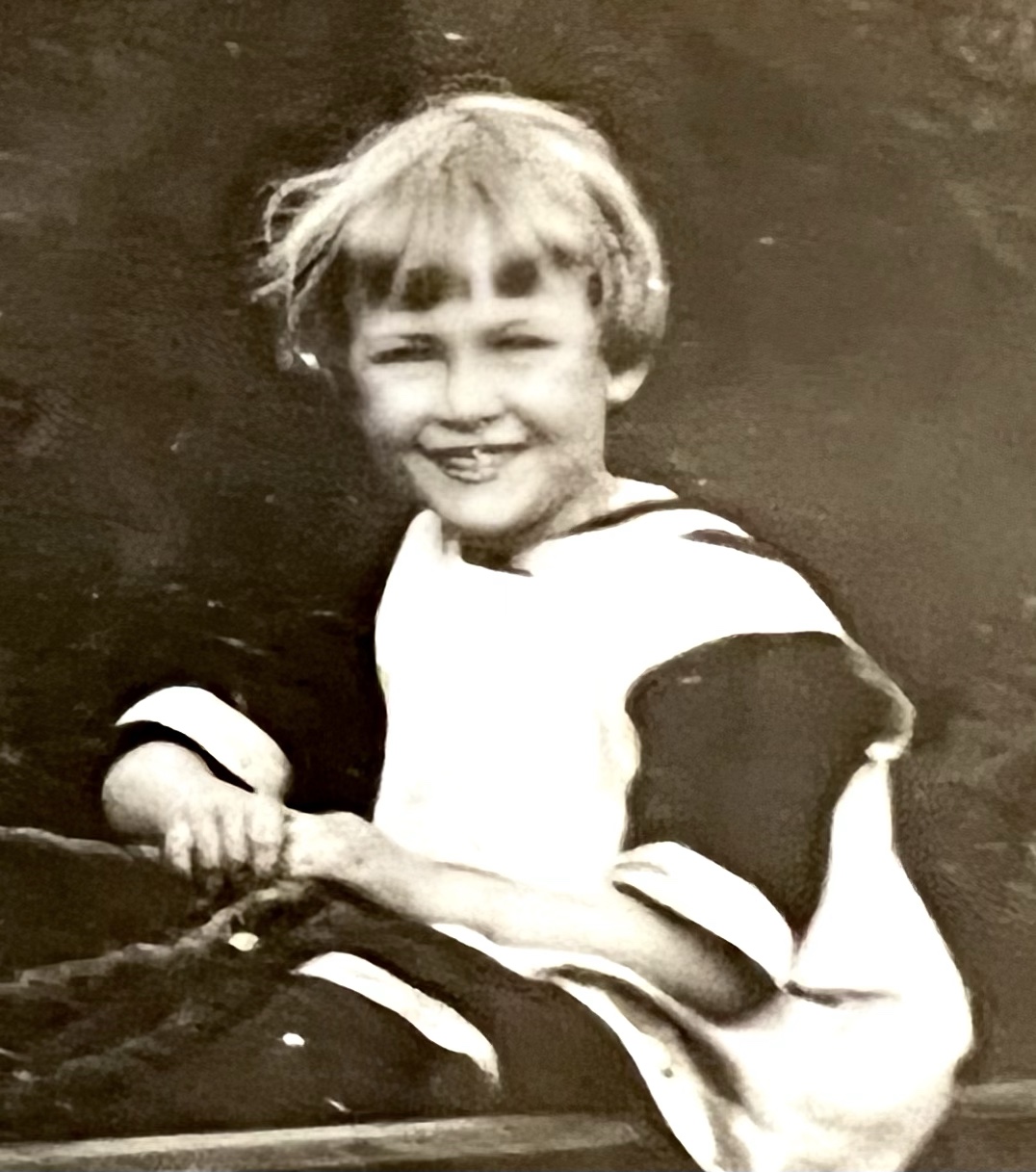
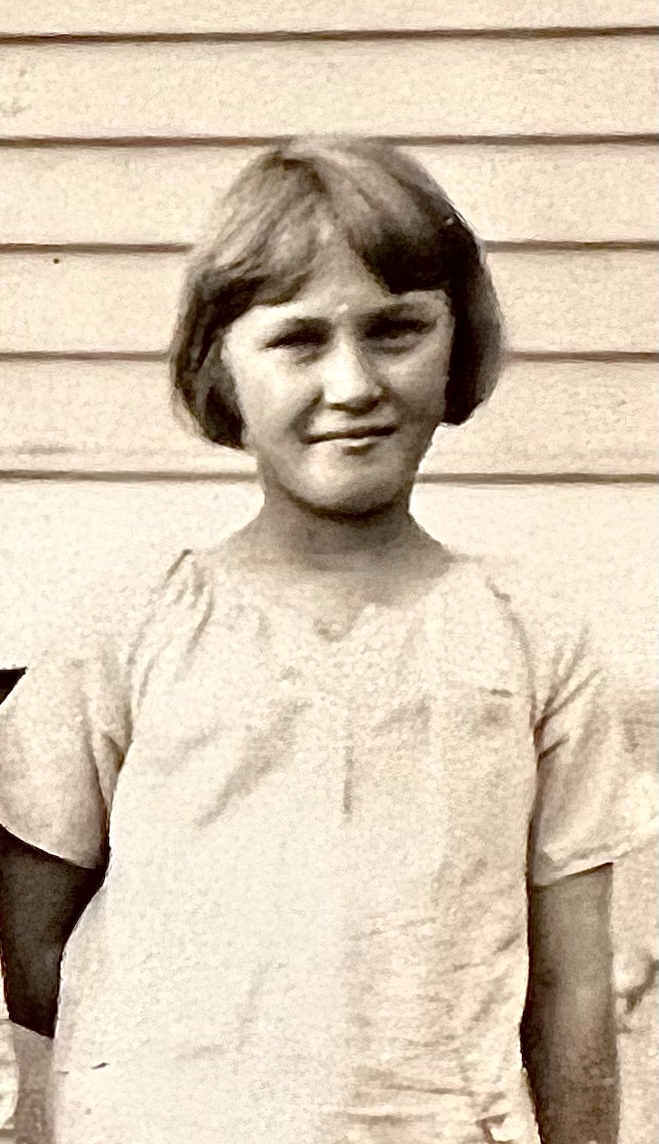
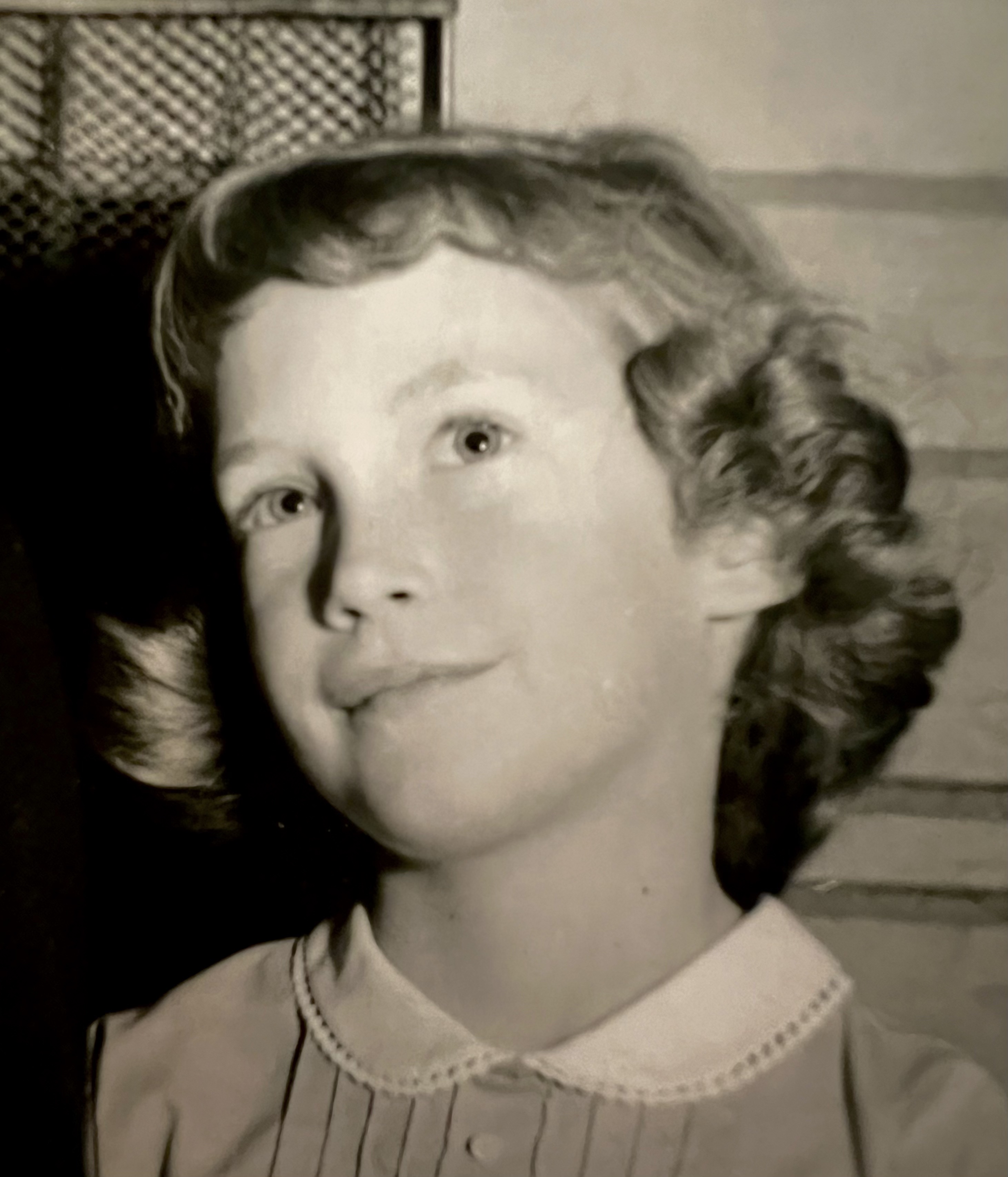
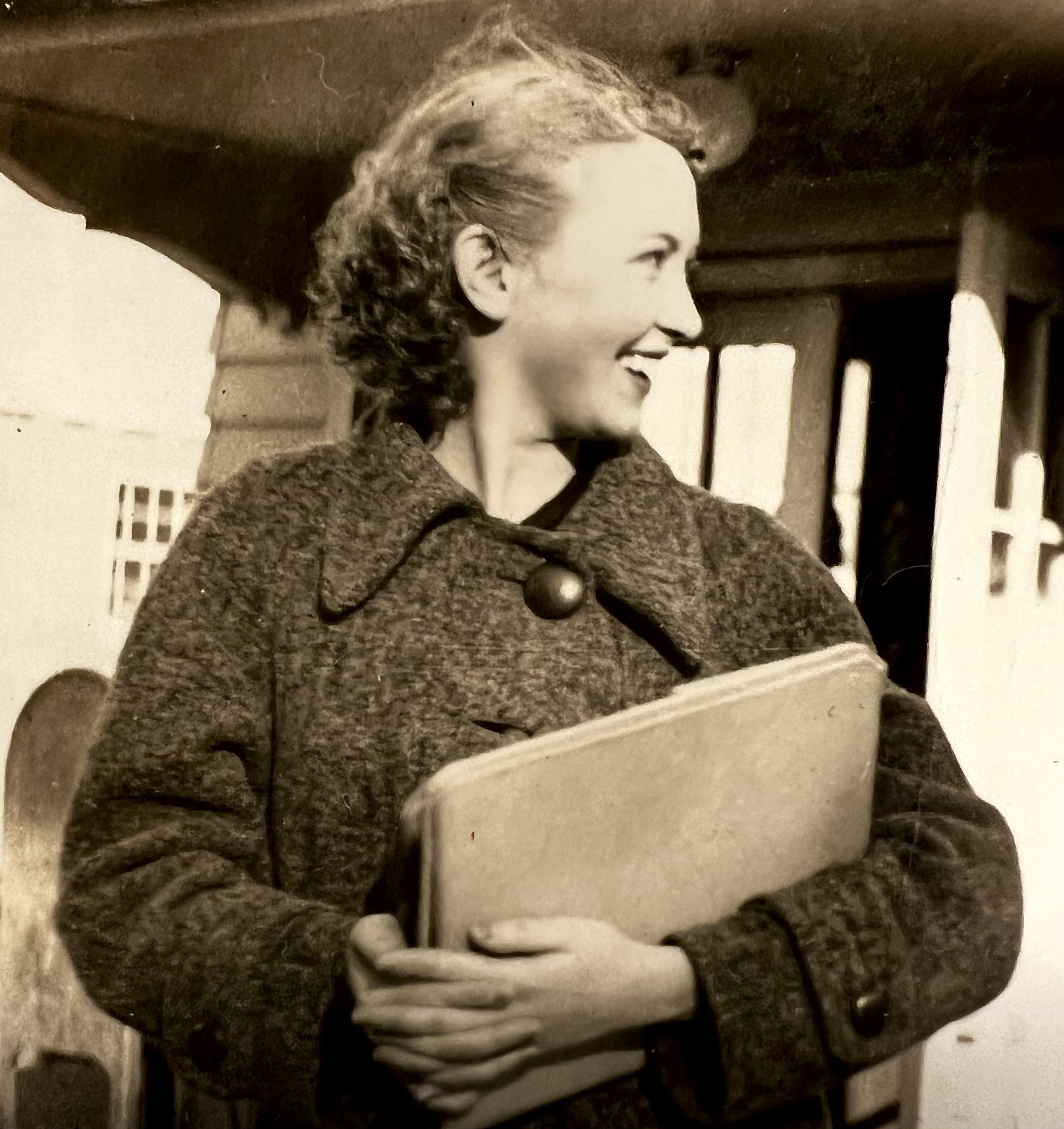
She wasn’t looking when they took this picture: sitting on the grass in her bare feet wearing a cotton dress, she stares off to the side watching something on the lawn the camera didn’t catch. What was it? A ladybug? A flower? Judging from her expression, possibly nothing at all, or else the lawn was like a mirror, and she sat watching herself, wondering who she was and how she came to be there sitting in this backyard, wearing a cheap, white dress, imagining that tomorrow would be like all her yesterdays, while her parents chatted and watched, as I do years later, too distantly to interfere. ~Dana Gioia, “Photograph of My Mother as a Young Girl” from Daily Horoscope
Seeing photos of ancestors a century past
is like looking at your own fingerprints—
circles and lines you can’t recognize
until someone else with a stranger’s eye looks close and says that’s you. ~Joseph Bruchac, “Prints” from Sing: Poetry from the Indigenous Americas.
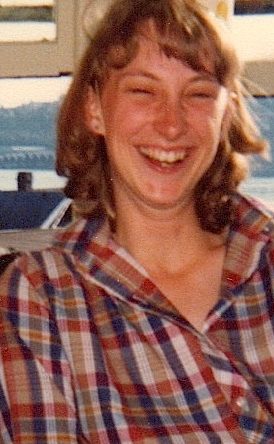
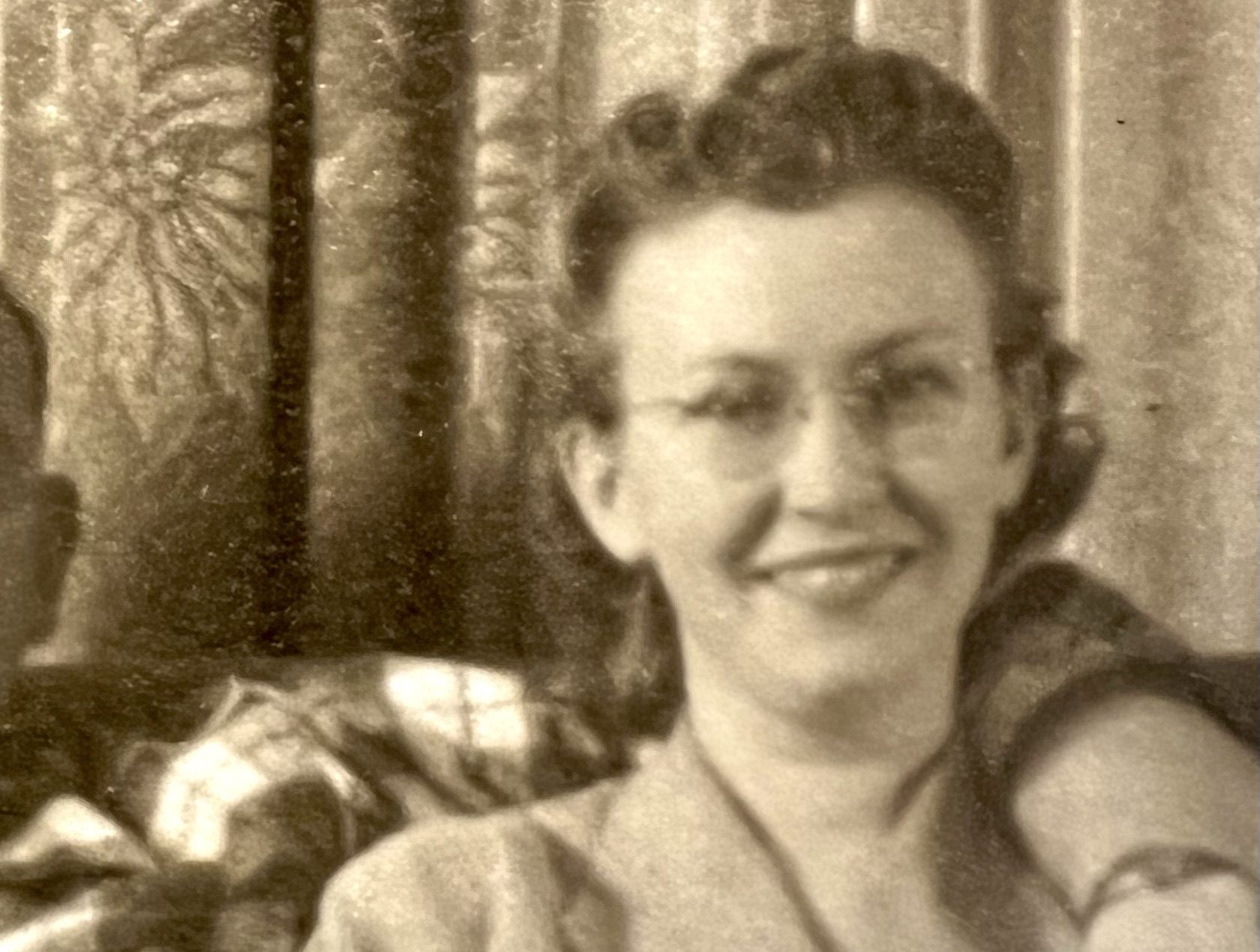
Growing up, it was never obvious to me that I looked like either one of my parents. Once, as a naughty kid, I told them I thought I was adopted as there wasn’t a single photo to be found of my mother looking pregnant (never mind that few women in the 50’s allowed themselves to be photographed pregnant).
Searching the faces of extended family in old photographs, others would comment on the facial similarities between my young mother and me.
And indeed, the older I have become, the more I see my mother looking back at me in the mirror.
The characteristics I inherited from my father aren’t as obvious in the mirror: his persistence and problem-solving, his inability to ever fully relax, his drive to get things done and not give up.
So, yes, that is me in the photos of my mother taken nearly a century ago, as well as those taken not so long ago.
I now recognize me in those photos, grateful to resemble such a loving and lovely mom.
One-Time
Monthly
Yearly
Make a one-time or recurring donation to support daily Barnstorming posts
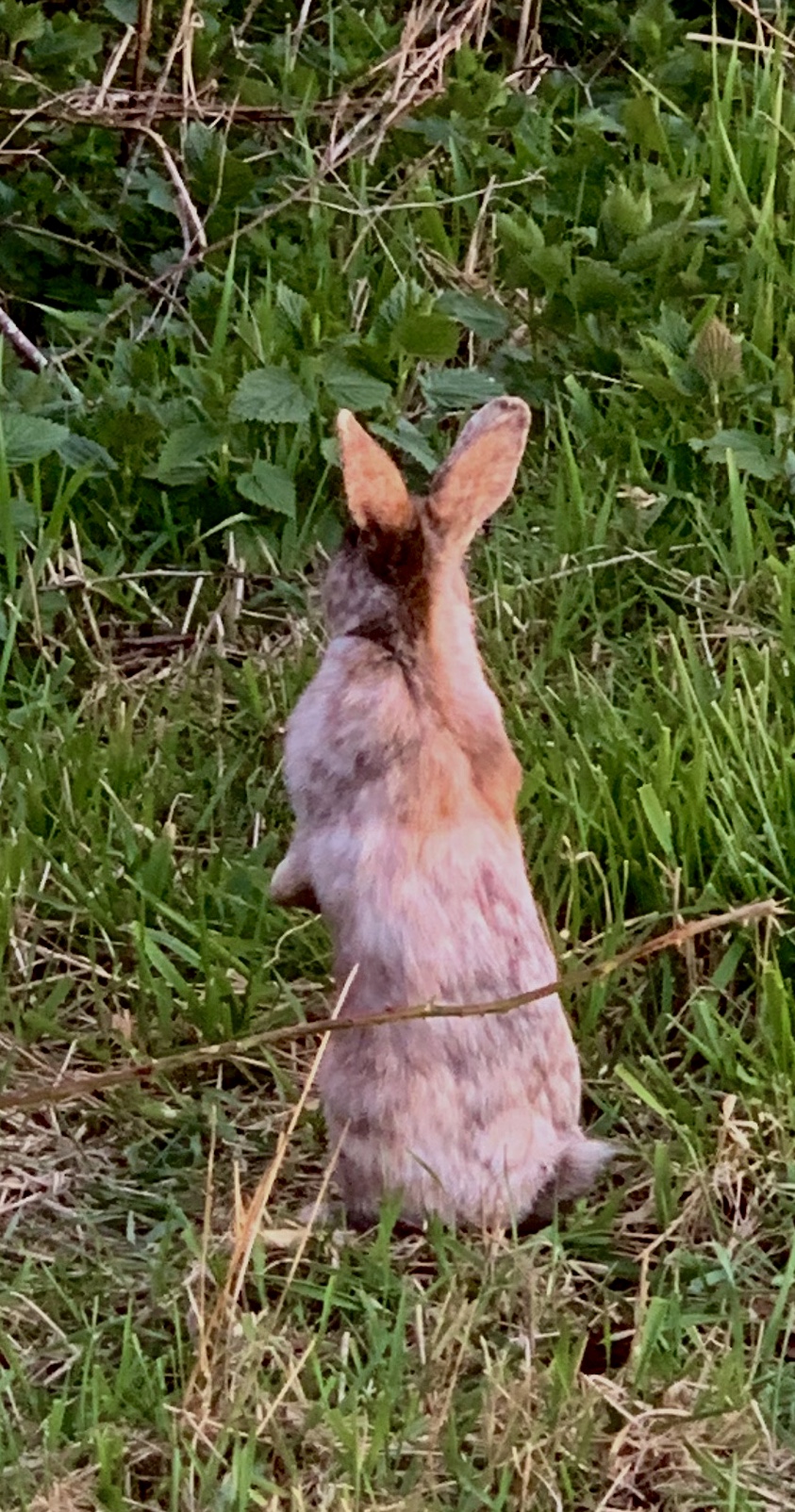
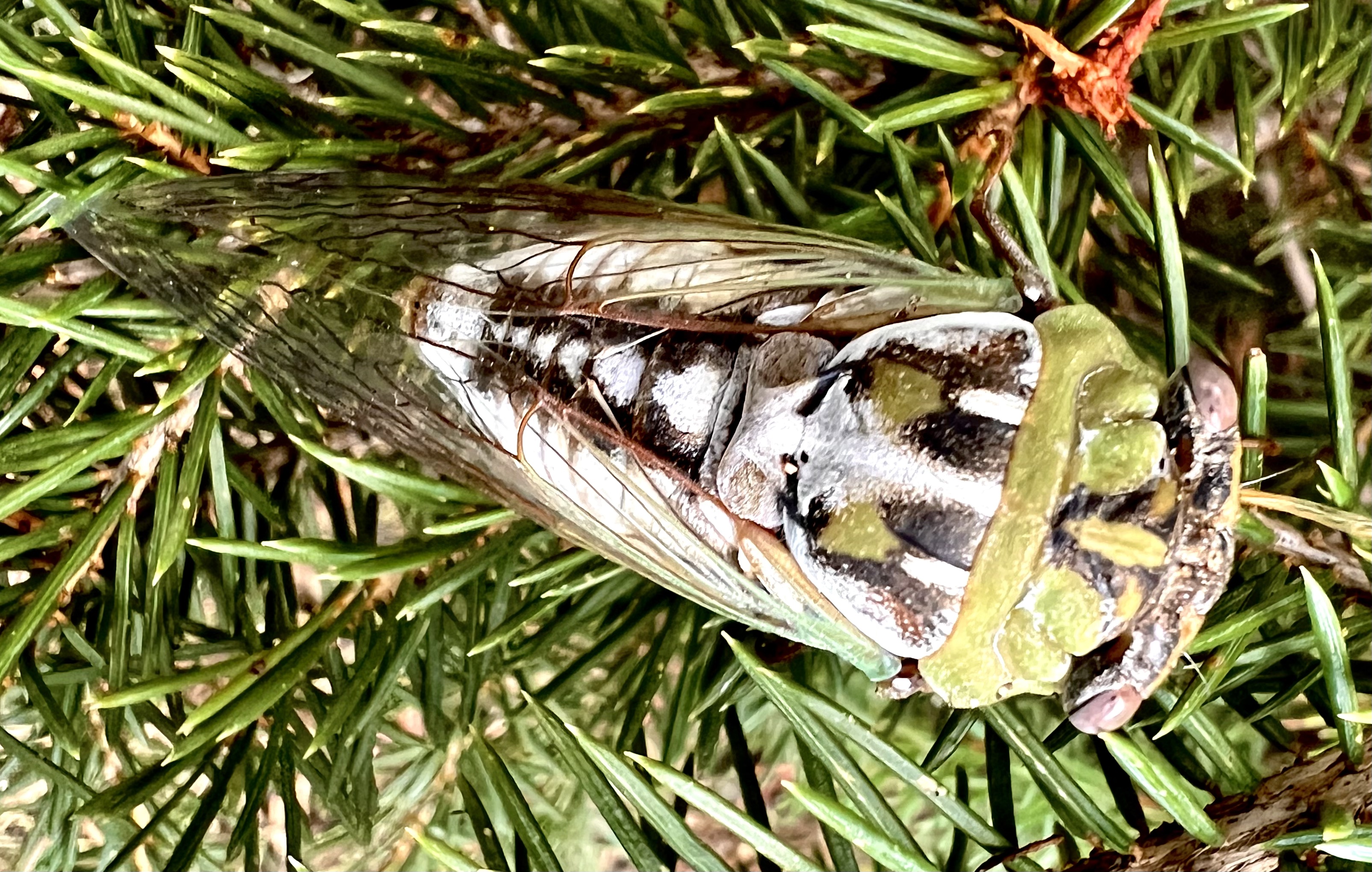
For seasons the walled meadow south of the house built of its stone grows up in shepherd’s purse and thistles the weeds share April as a secret finches disguised as summer earth click the drying seeds mice run over rags of parchment in August the hare keeps looking up remembering a hidden joy fills the songs of the cicadas
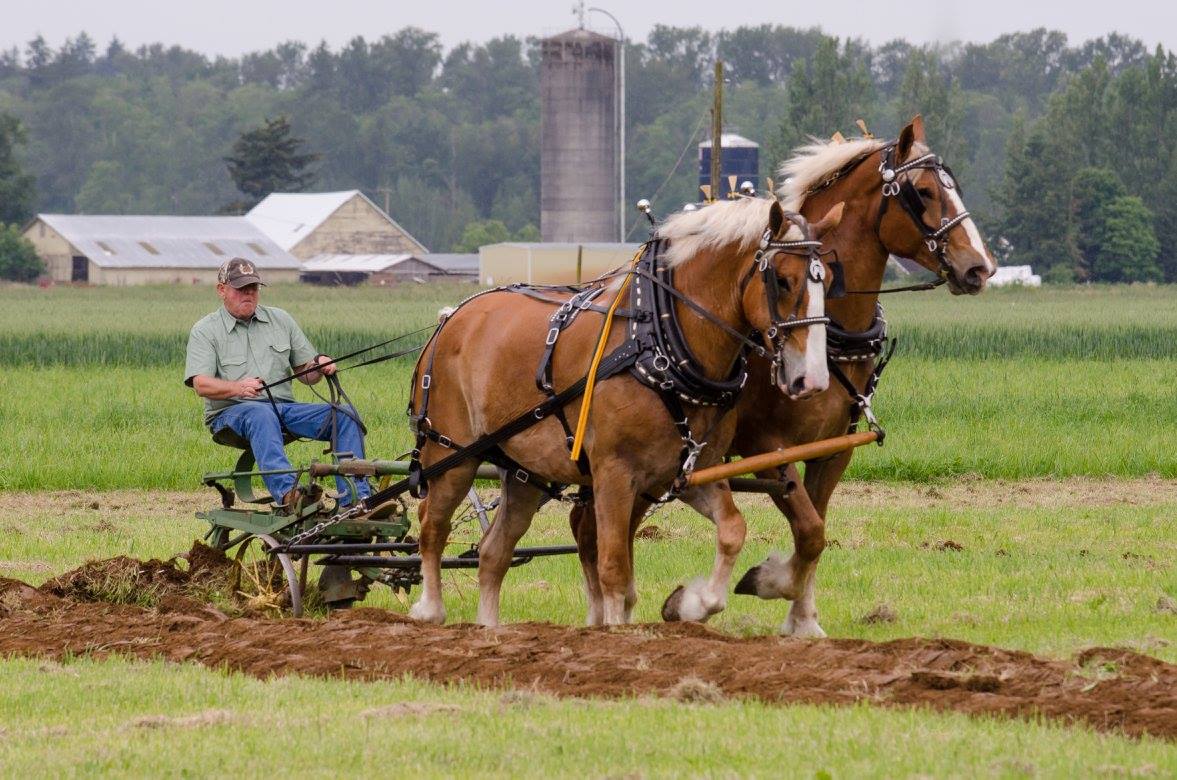
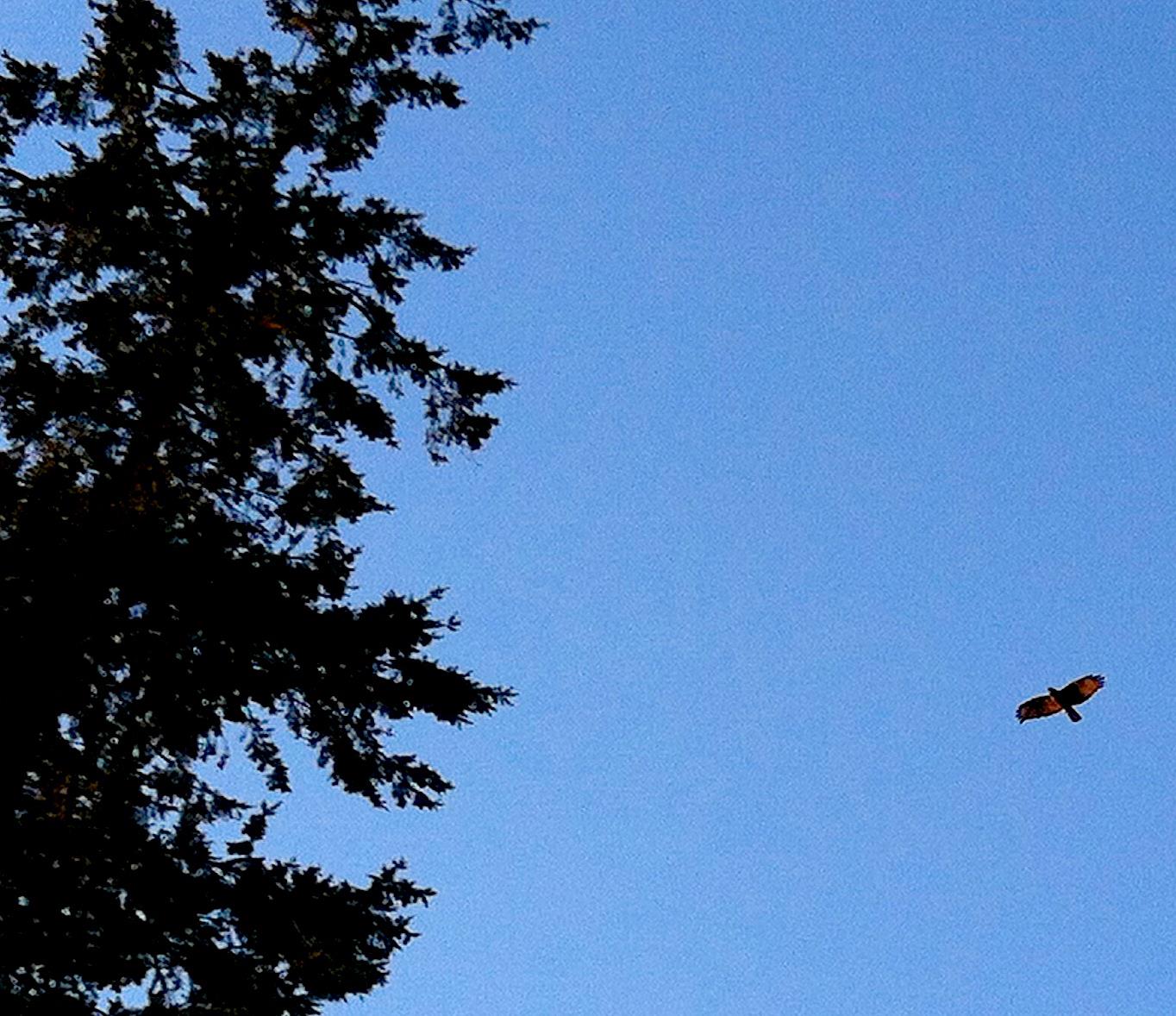
two days’ rain wakes the green in the pastures crows agree and hawks shriek with naked voices on all sides the dark oak woods leap up and shine the long stony meadow is plowed at last and lies all day bare I consider life after life as treasures oh it is the autumn light
that brings everything back in one hand the light again of beginnings the amber appearing as amber ~ W. S. Merwin, “September Plowing” from Flower & Hand
photo by Joel De Waard
When you are already here you appear to be only a name that tells of you whether you are present or not
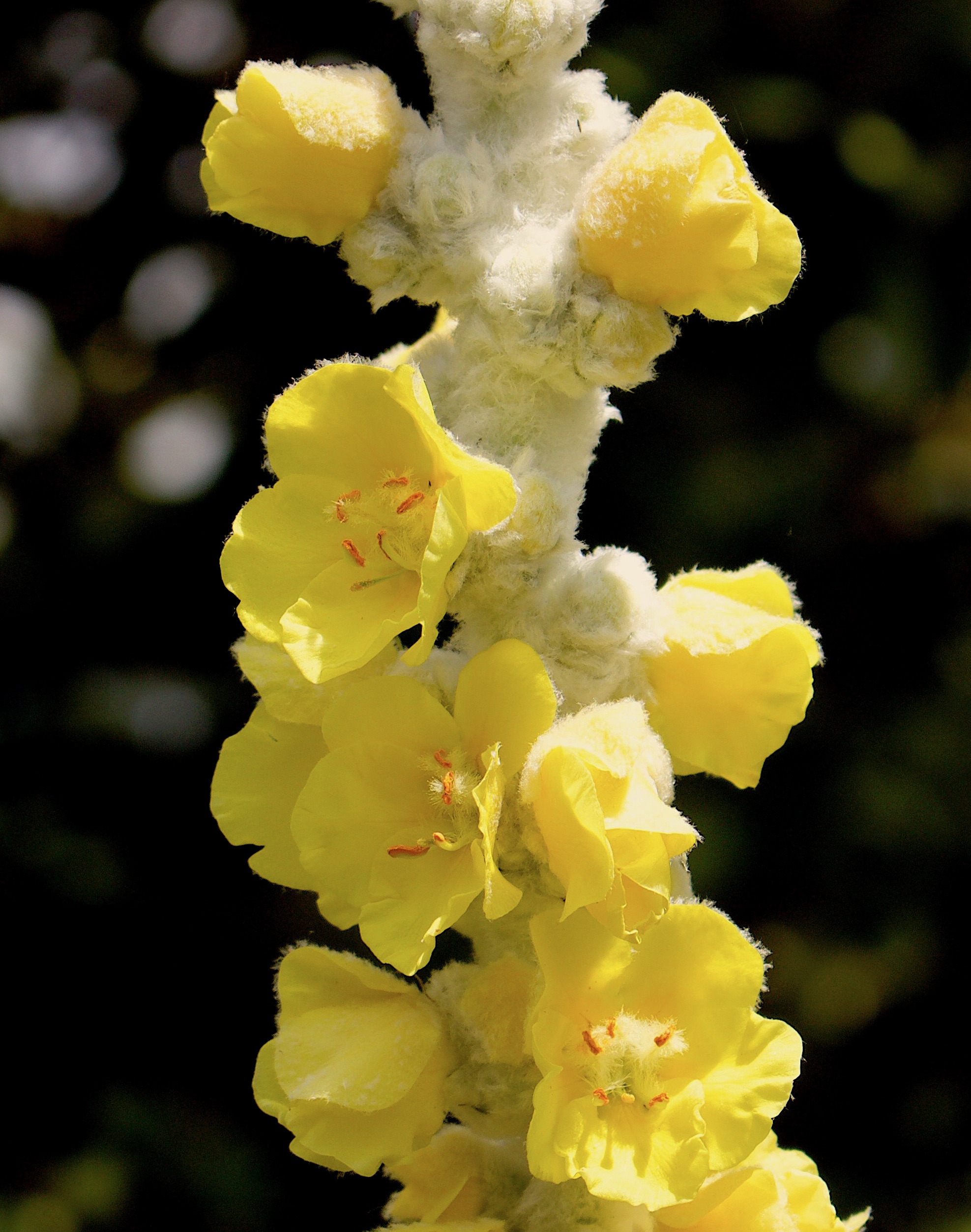
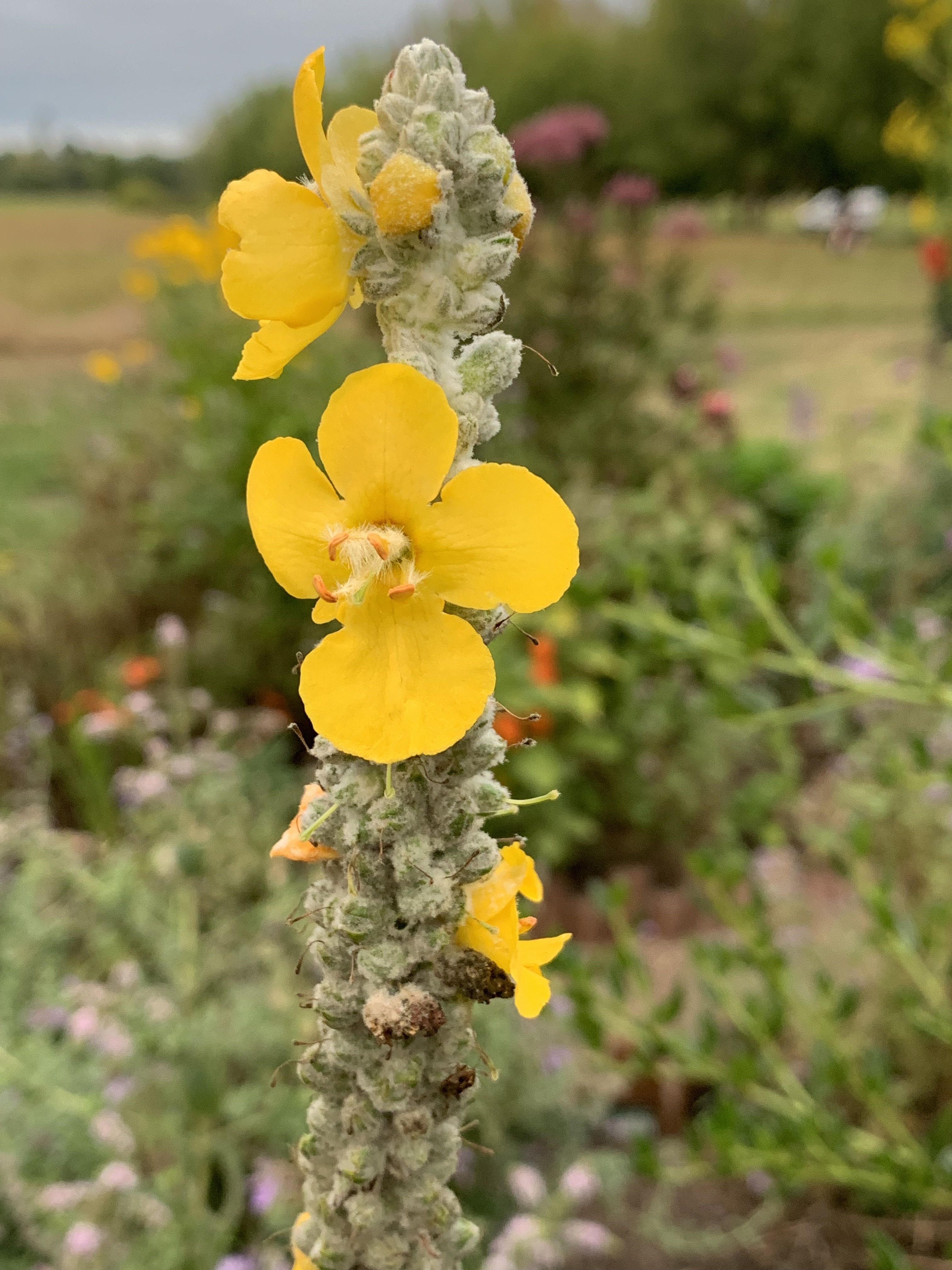
and for now it seems as though you are still summer still the high familiar endless summer yet with a glint of bronze in the chill mornings and the late yellow petals of the mullein fluttering on the stalks that lean over their broken shadows across the cracked ground
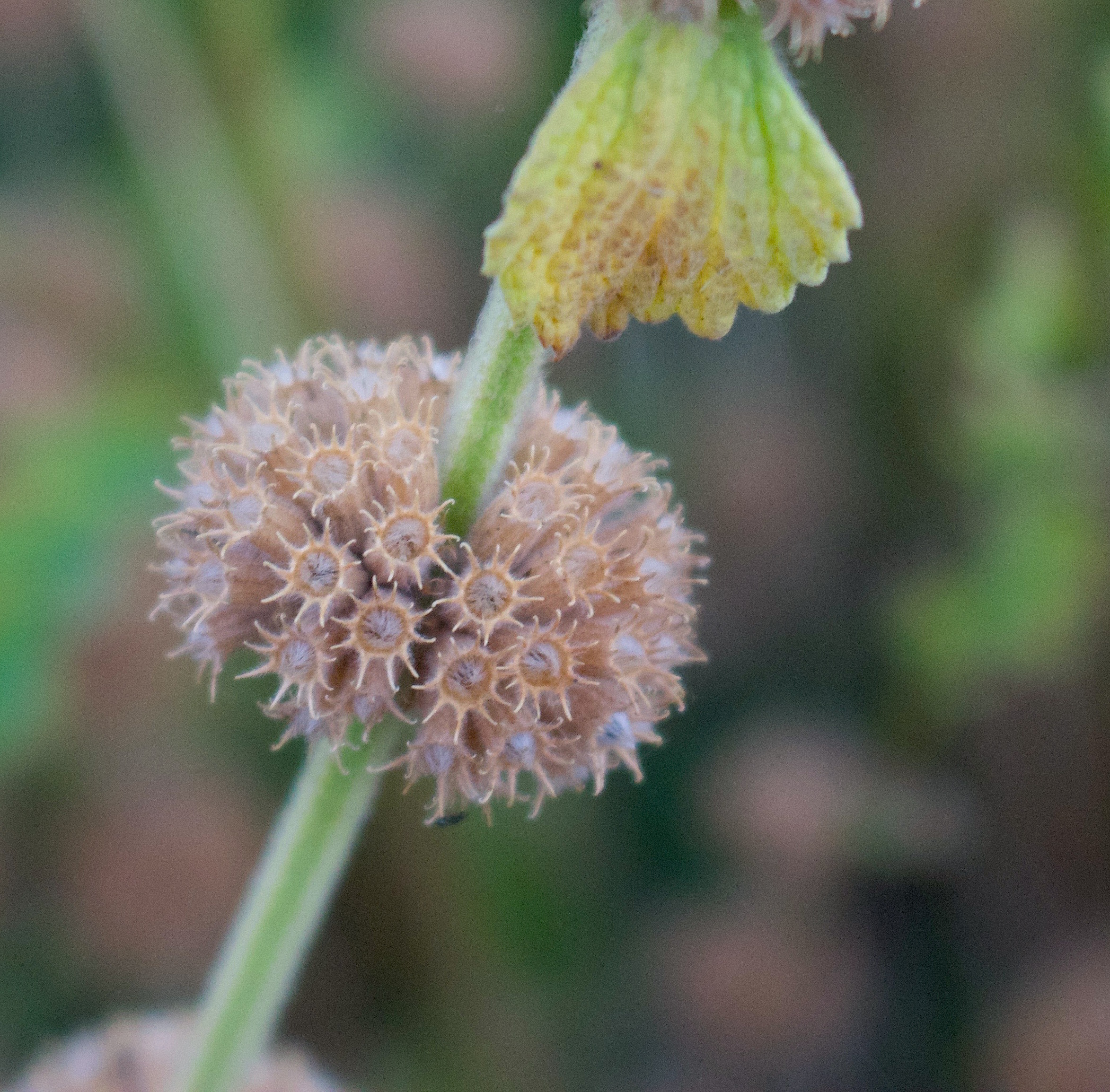
but they all know that you have come the seed heads of the sage the whispering birds with nowhere to hide you to keep you for later
you who fly with them
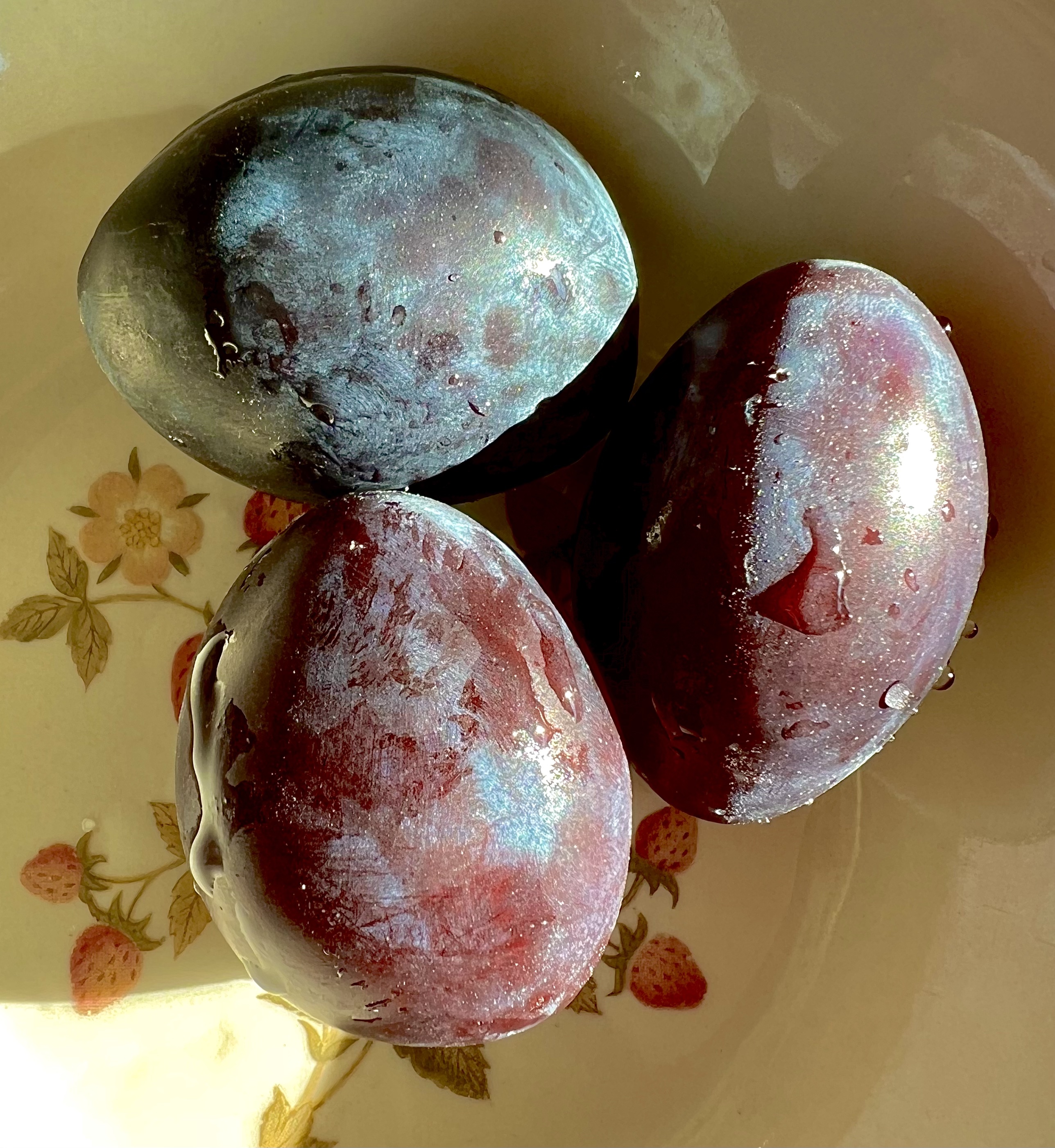
you who are neither before nor after you who arrive with blue plums that have fallen through the night
Now that it has rained a bit, the light of September is a filtered, more gentle illumination than we have experienced for the past several months of dry summer glare.
It is more lambent: a soft radiance that simply glows at certain times of the day when the angle of the sun is just right, and the clouds are in position to soften and cushion the luminence.
It is also liminal: it is neither before or after, on the threshold between seasons when there is both promise and caution in the air.
Sometimes I think I can breathe in light like this, if not through my lungs, then through my eyes.
It is a temptation to bottle it up with a stopper somehow, stow it away hidden in a back cupboard. Then I can bring it out on the darkest days, pour a bit into a glass, and imbibe.
But for now, I fill myself full to the brim. And my only means of preservation is with a camera and a few words.
So I share it now with all of you to tuck away for a future day. Perhaps you too will be thirsty for a lambent light.
One-Time
Monthly
Yearly
Make a one-time or recurring donation to support daily Barnstorming posts
Yet you, Lord, are our Father. We are the clay, you are the potter; we are all the work of your hand. Isaiah 64:8
From dust to purpose, beauty spins as planned. Love is crafted by surrender when clay trusts the Potter’s hands. ~Jamie Trunnel from “The Potter’s Hands”
For we are God’s handiwork, created in Christ Jesus to do good works, which God prepared in advance for us to do. Ephesians 2:10
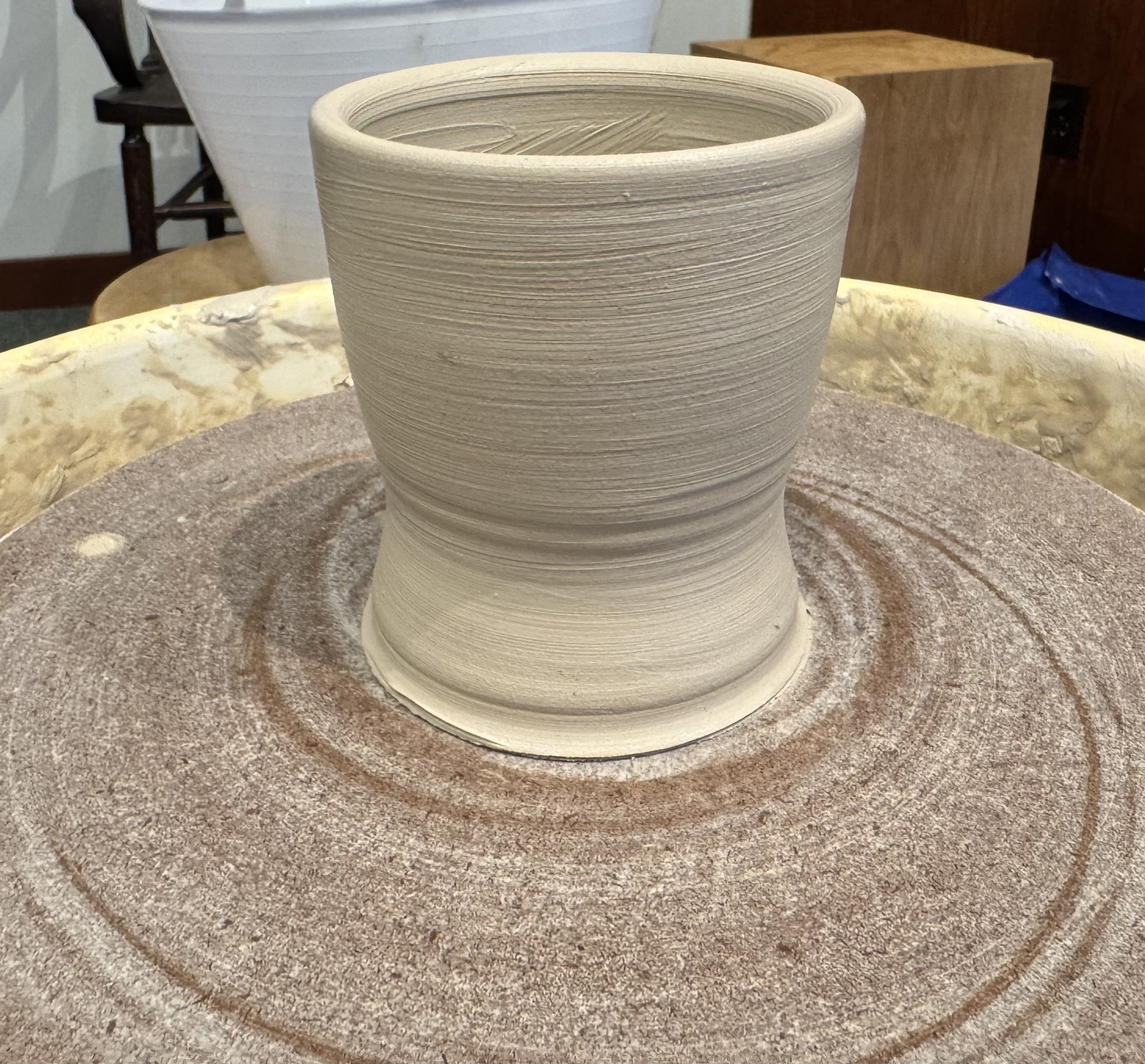
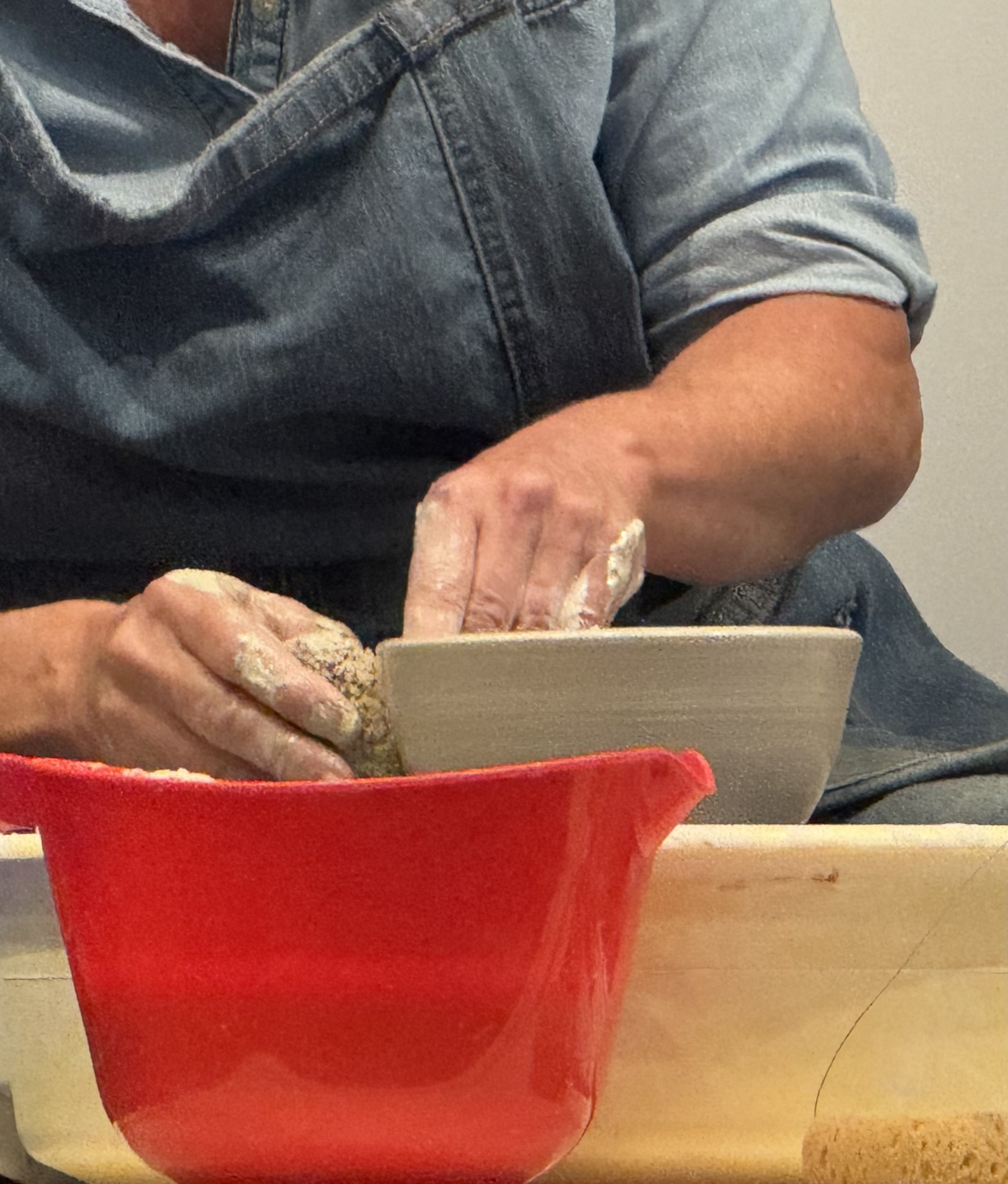
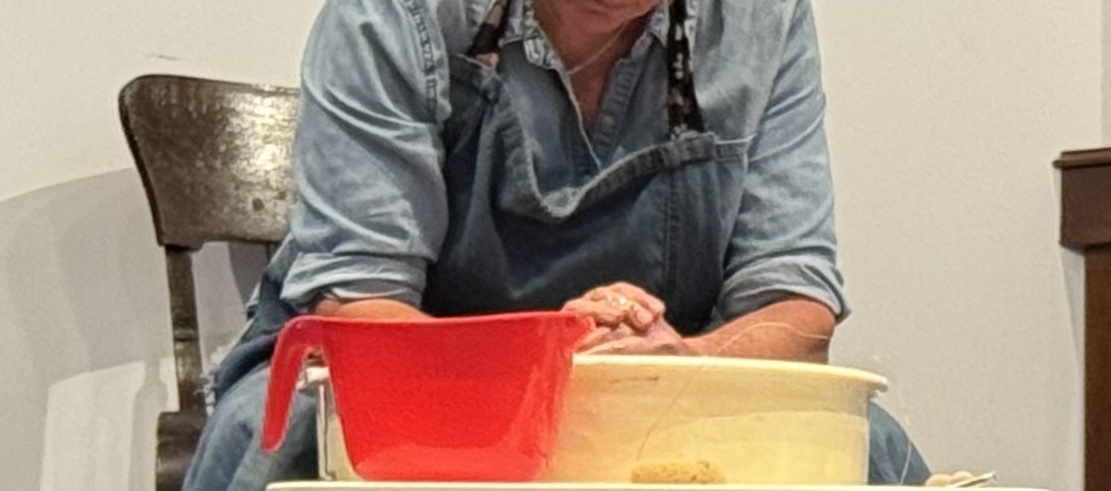
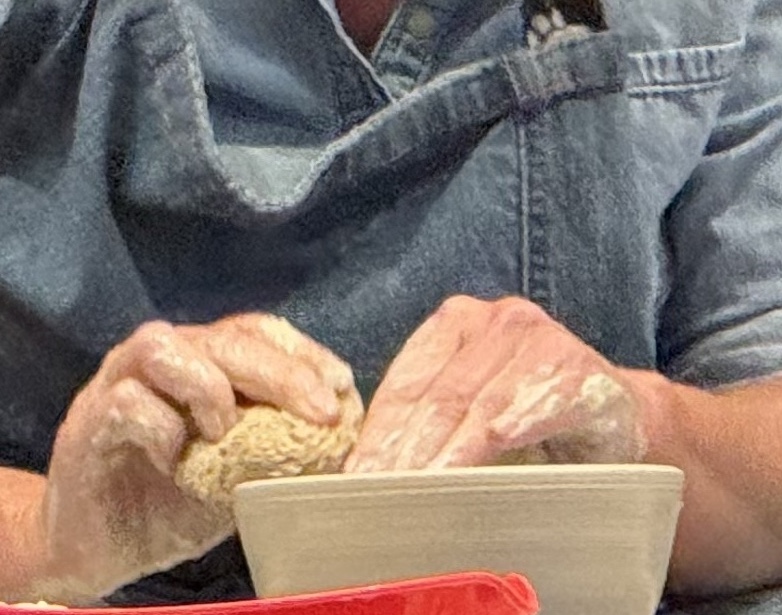
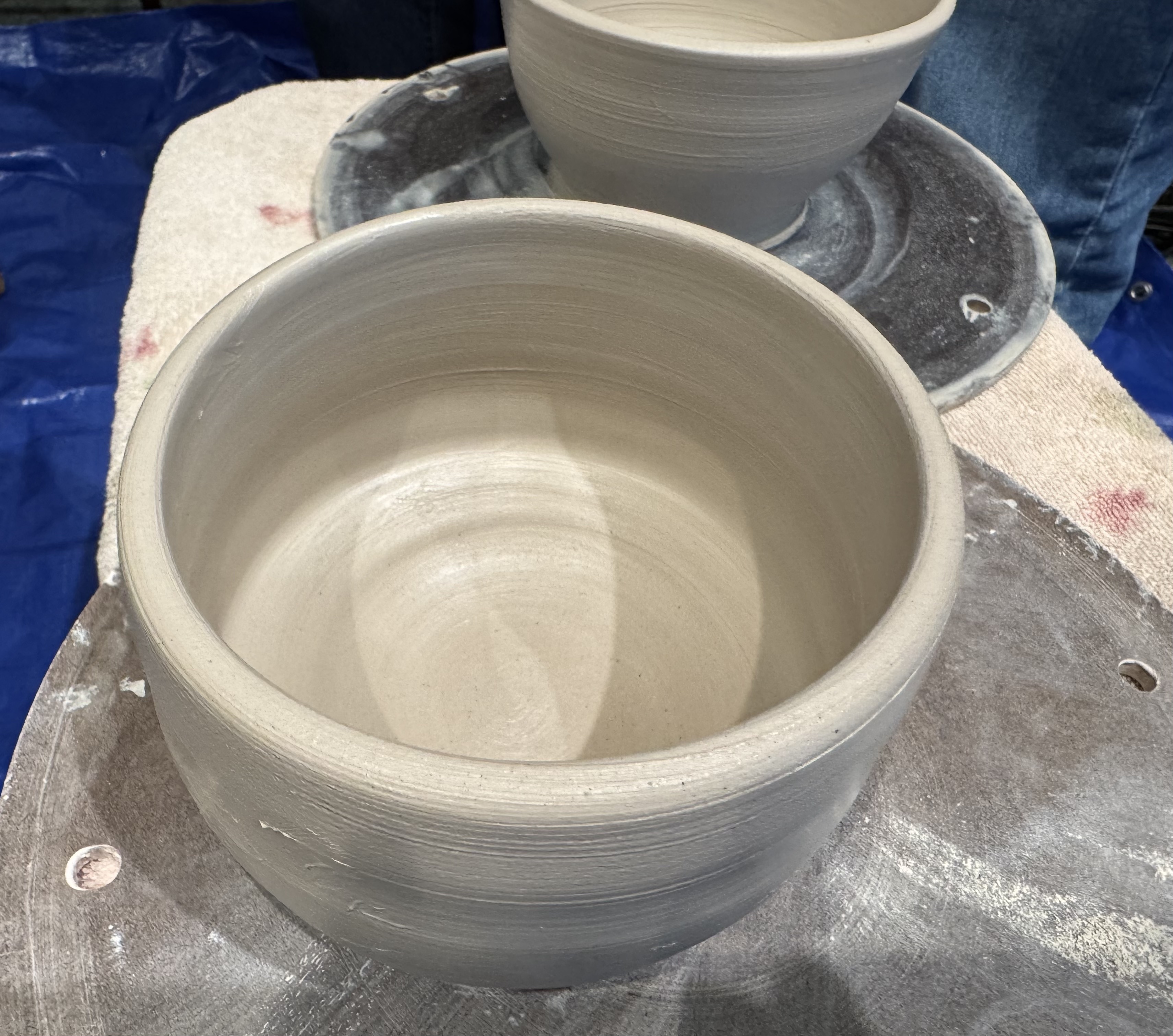
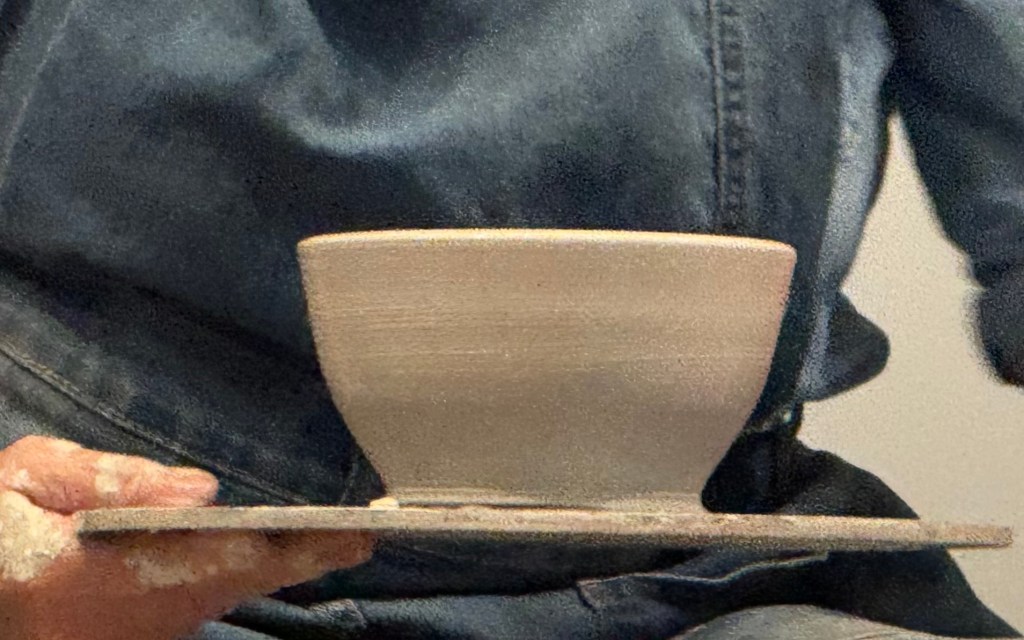
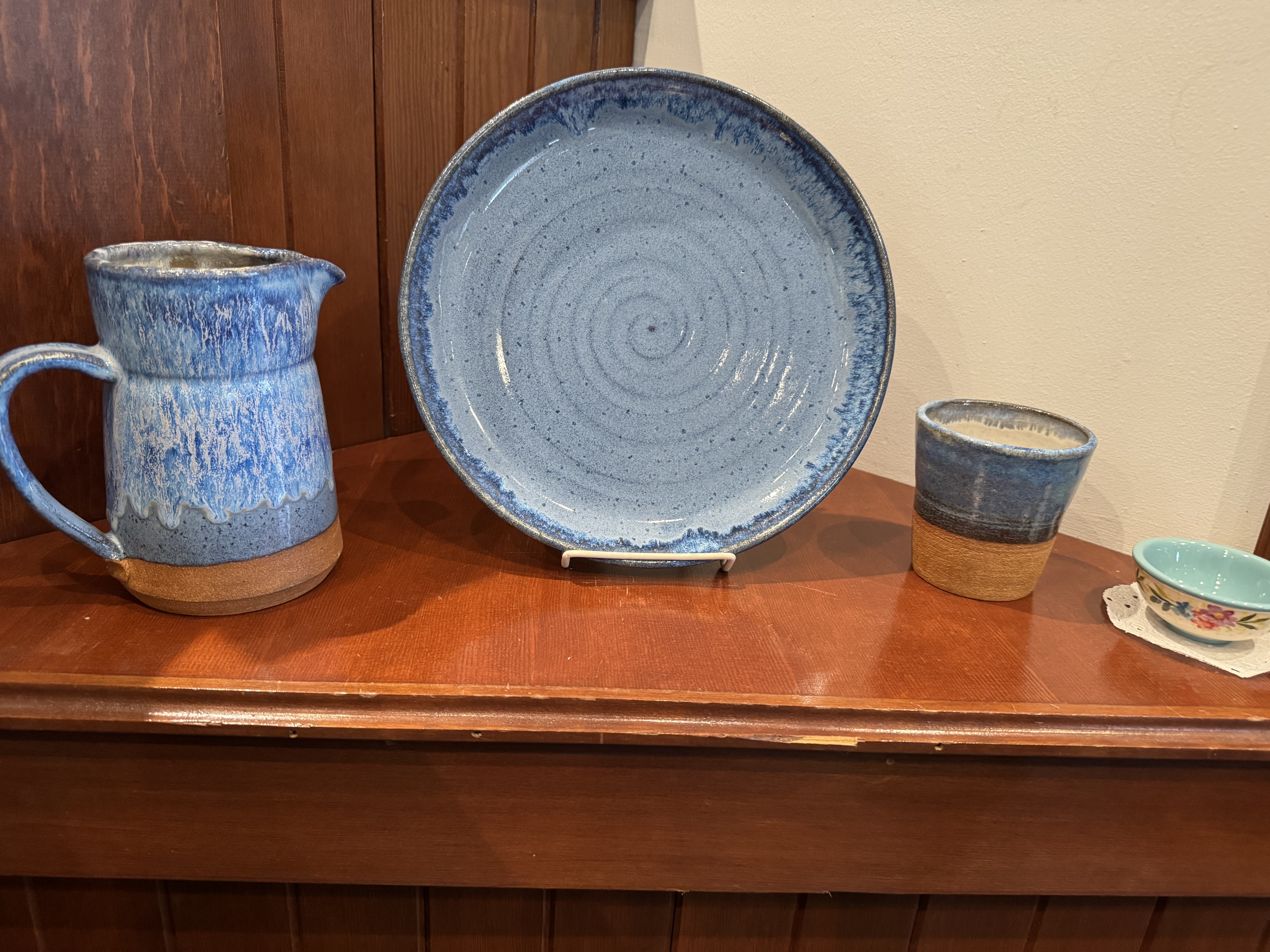
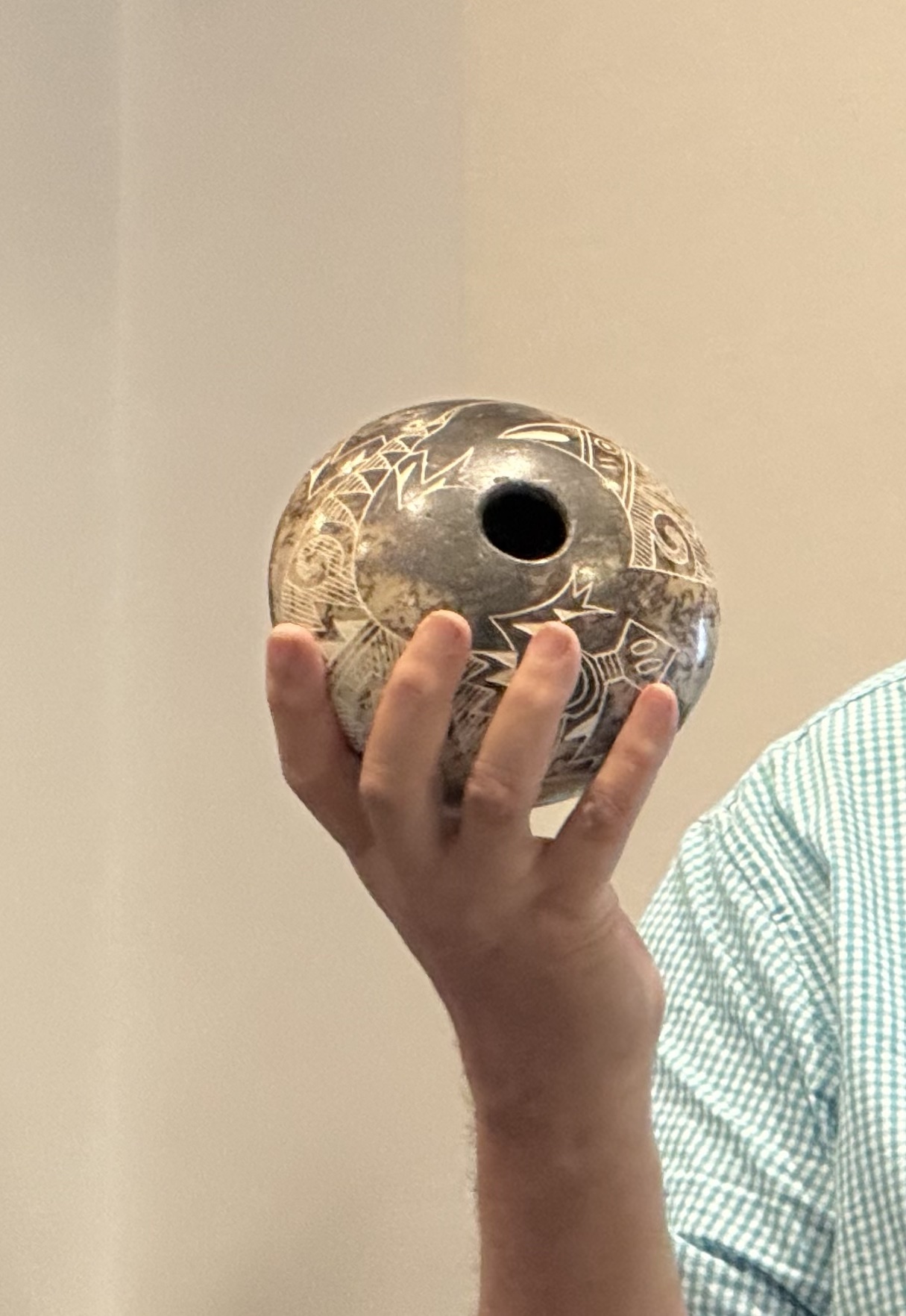
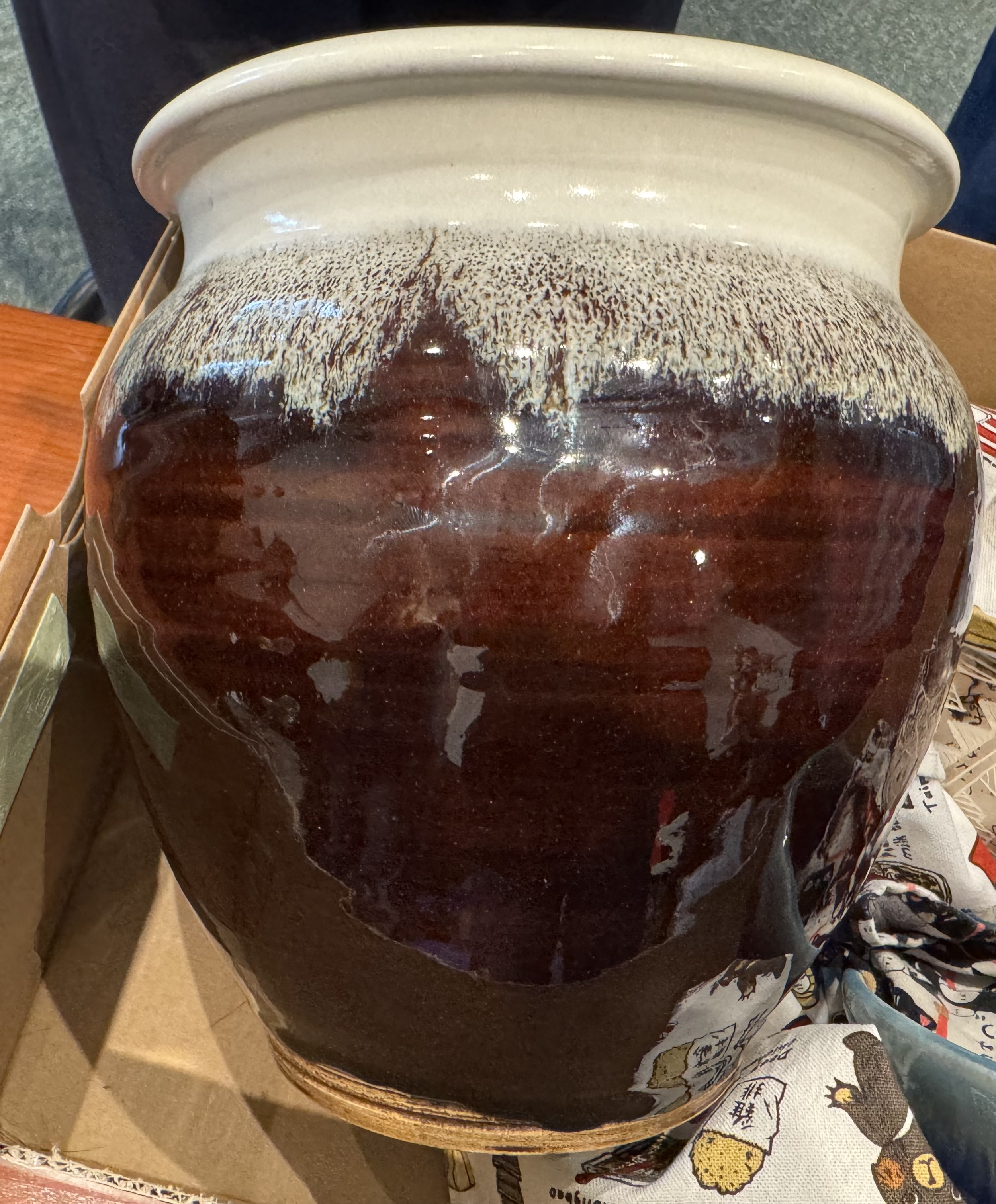
The best pottery is never completely perfect, becoming an original, unique piece. It is infused with the potter’s eye and energy, the expert pressure of fingers and palm, with a design and vision coming from the heart and imagination of the potter.
Last night, during our evening church worship, two artists in our congregation, one using words of scripture and the other at a pottery wheel, demonstrated how creating and sculpting a work of pottery is key to understanding how God shapes each one of us, from our beginnings, preparing us in advance for the work we are to do.
Each one is a unique and original individual, formed by the hands of the Artist to become something with a purpose and plan. Even with imperfections, we are created as both beautiful and functional.
His Hands remain around us, holding and molding us to His plan.
One-Time
Monthly
Yearly
Make a one-time or recurring donation to support daily Barnstorming posts
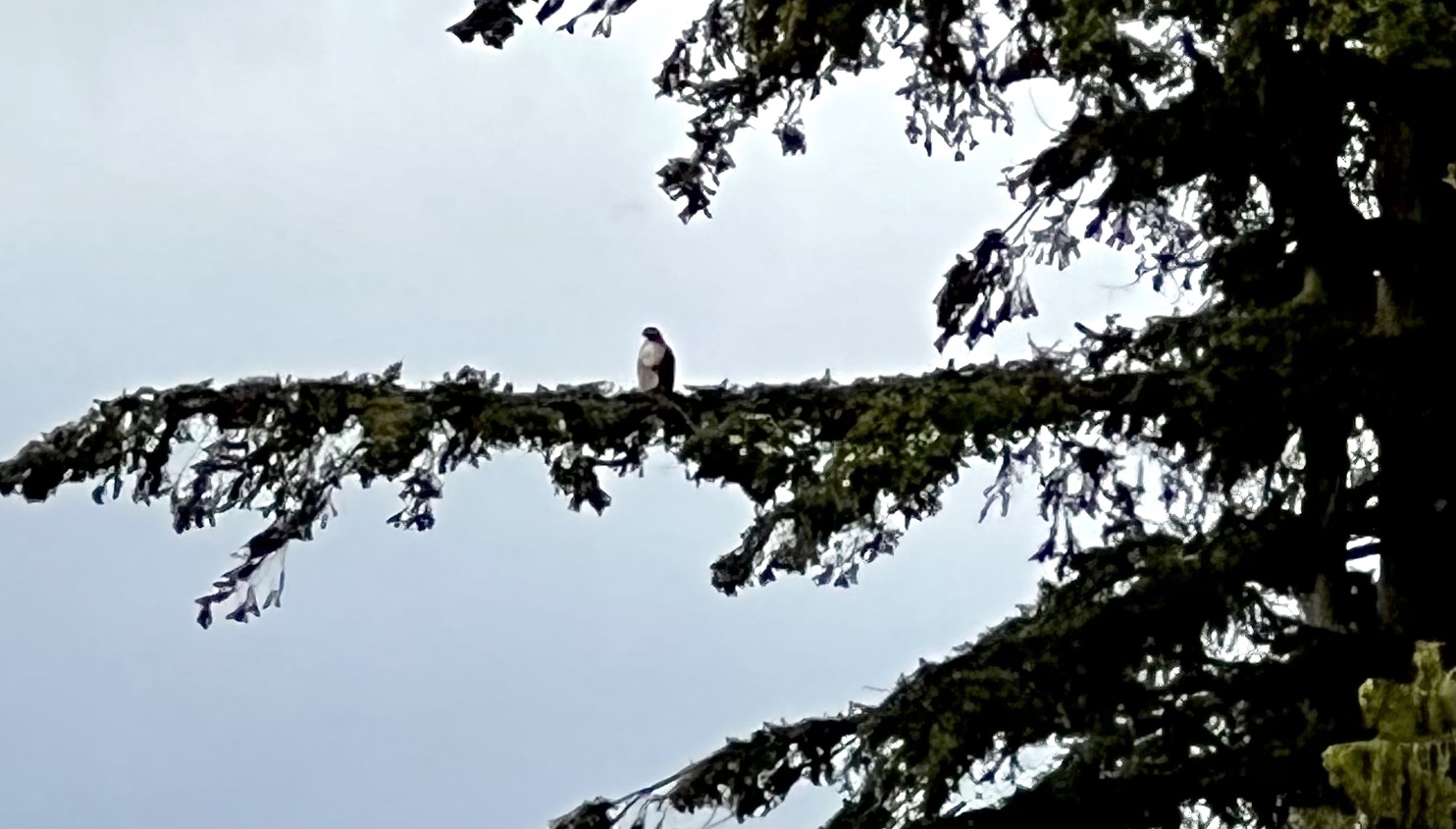
When I saw the figure on the crown of the hill, high above the city, standing perfectly still
against a sky so saturated with the late- afternoon, late-summer Pacific light
that granules of it seemed to have come out of solution, like a fine precipitate
of crystals hanging in the brightened air, I thought whoever it was standing up there
must be experiencing some heightened state of being, or thinking—or its opposite,
thoughtlessly enraptured by the view. Or maybe, looking again, it was a statue
of Jesus or a saint, placed there to bestow a ceaseless blessing on the city below.
Only after a good five minutes did I see that the figure was actually a tree—
some kind of cypress, probably, or cedar. I was both amused and let down by my error. Not only had I made the tree a person, but I’d also given it a vision,
which seemed to linger in the light-charged air around the tree’s green flame, then disappear. ~Jeffrey Harrison “The Figure on the Hill” from Into Daylight
Who was it who suggested that the opposite of war Is not so much peace as civilisation? He knew Our assassinated Catholic greengrocer who died At Christmas in the arms of our Methodist minister, And our ice-cream man whose continuing requiem Is the twenty-one flavours children have by heart. Our cobbler mends shoes for everybody; our butcher Blends into his best sausages leeks, garlic, honey; Our cornershop sells everything from bread to kindling. Who can bring peace to people who are not civilised? All of these people, alive or dead, are civilised. ~Michael Longley “All of These People” from Collected Poems
Who among us appear in the light-charged air, visible on the crown of the hill of life – who might be mistaken for a martyr or a saint or a visionary, when each one of us is merely a person responsible to a family, committed to help friends, dedicated to serve a community, placed in this world to steady a broken civilization.
There is the simple truth that we need a person with roots deep in the ground, branches that reach up and out, bearing fruit to share with those around us.
But surely not this misery, not this blight, not this trouble, certainly not these murders, which only bears and shares a heart-rending, horrible grief.
One-Time
Monthly
Yearly
Make a one-time or recurring donation to support daily Barnstorming posts
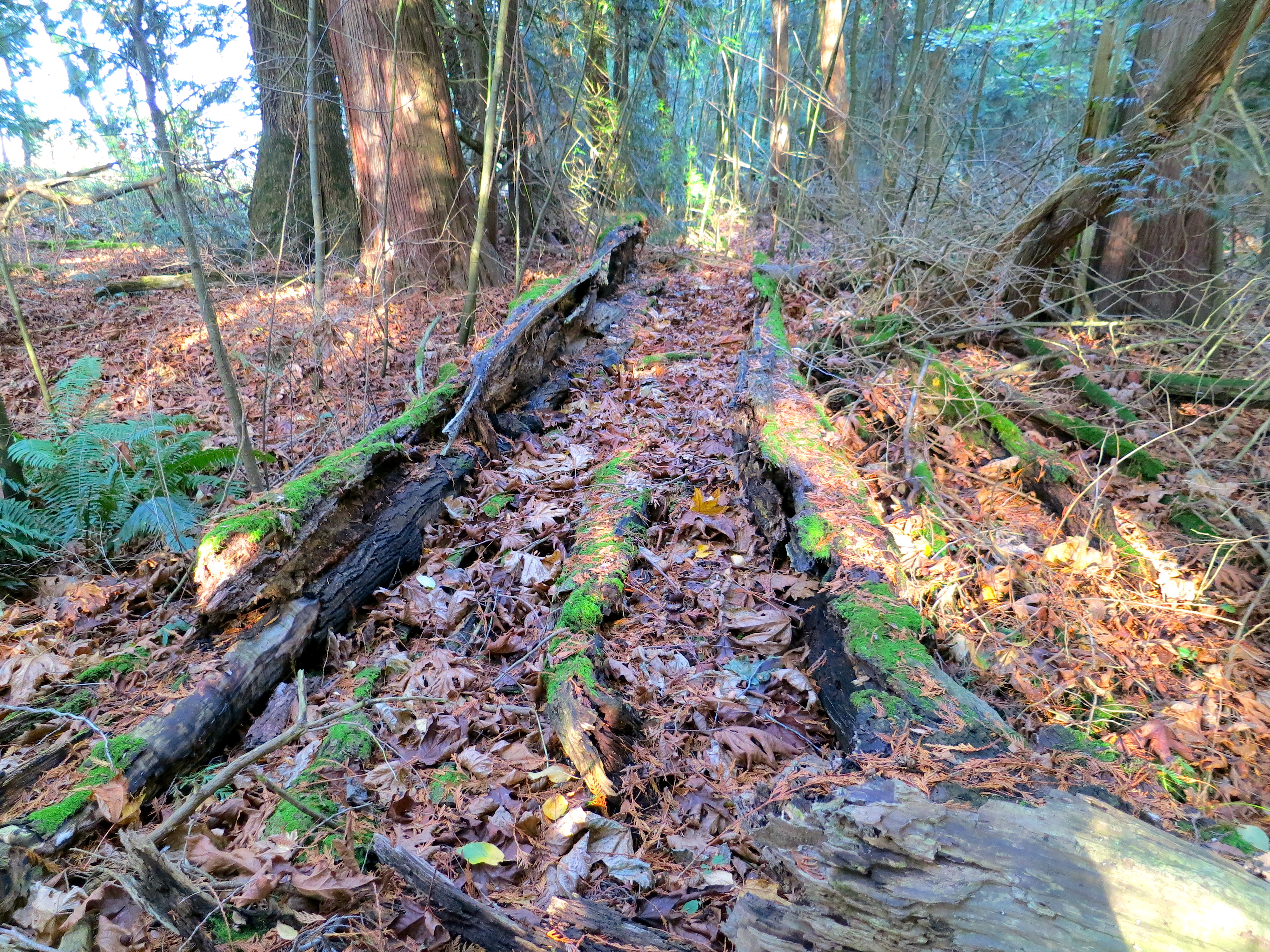
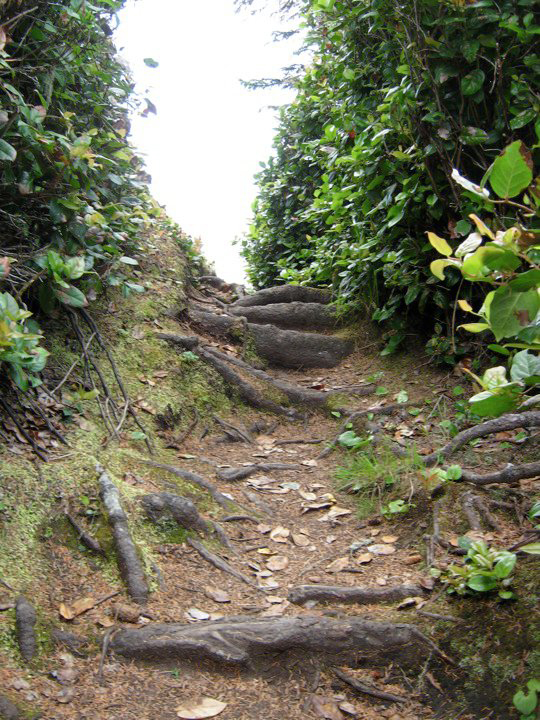
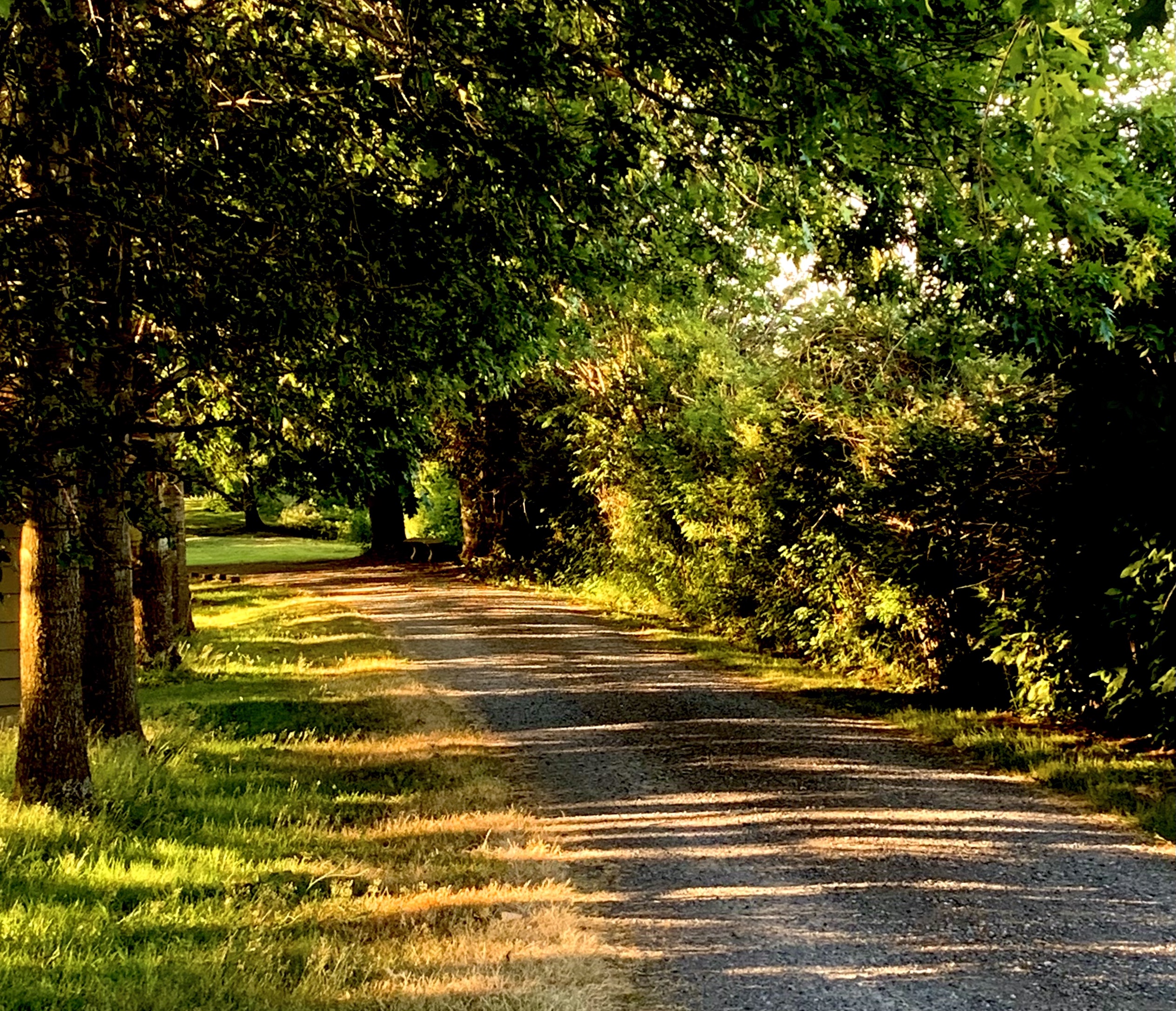
They shut the road through the woods Seventy years ago. Weather and rain have undone it again, And now you would never know There was once a road through the woods Before they planted the trees. It is underneath the coppice and heath, And the thin anemones. Only the keeper sees That, where the ring-dove broods, And the badgers roll at ease, There was once a road through the woods.
Yet, if you enter the woods Of a summer evening late, When the night-air cools on the trout-ringed pools Where the otter whistles his mate, (They fear not men in the woods, Because they see so few.) You will hear the beat of a horse’s feet, And the swish of a skirt in the dew, Steadily cantering through The misty solitudes, As though they perfectly knew The old lost road through the woods. But there is no road through the woods. ~Rudyard Kipling “The Way Through the Woods”
Nature has a way of covering our offending tracks, given time and left alone.
We think we’ve built a lasting impression, clearing the path for easy passage, forging ahead into the future.
Yet no invitation is needed for the overgrowth to reclaim the road some folks traveled, once upon a time.
Now the old lost road is overwhelmed by the mists and mosses of time; may it stay buried in the past as we pass through, unnoticed and oblivious.
photo by Emily VanderHaak
One-Time
Monthly
Yearly
Make a one-time or recurring donation to support daily Barnstorming posts
The thing is to love life, to love it even when you have no stomach for it and everything you’ve held dear crumbles like burnt paper in your hands, your throat filled with the silt of it. When grief sits with you, its tropical heat thickening the air, heavy as water more fit for gills than lungs; when grief weights you like your own flesh only more of it, an obesity of grief, you think, How can a body withstand this? Then you hold life like a face between your palms, a plain face, no charming smile, no violet eyes, and you say, yes, I will take you I will love you, again. ~Ellen Bass, “The Thing Is” from Mules of Love
...everything here seems to need us —Rainer Maria Rilke
It’s a hard time to be human. We know too much and too little. Does the breeze need us? If you’ve managed to do one good thing, the ocean doesn’t care. But when Newton’s apple fell toward the earth, the earth, ever so slightly, fell toward the apple. ~Ellen Bass from “The World Has Need of You” from Like a Beggar
Fallen leaves will climb back into trees. Shards of the shattered vase will rise and reassemble on the table. Plastic raincoats will refold into their flat envelopes. The egg, bald yolk and its transparent halo, slide back in the thin, calcium shell. Curses will pour back into mouths, letters un-write themselves, words siphoned up into the pen. My gray hair will darken and become the feathers of a black swan. Bullets will snap back into their chambers, the powder tamped tight in brass casings. Borders will disappear from maps. Rust revert to oxygen and time. The fire return to the log, the log to the tree, the white root curled up in the un-split seed. Birdsong will fly into the lark’s lungs, answers become questions again. When you return, sweaters will unravel and wool grow on the sheep. Rock will go home to mountain, gold to vein. Wine crushed into the grape, oil pressed into the olive. Silk reeled in to the spider’s belly. Night moths tucked close into cocoons, ink drained from the indigo tattoo. Diamonds will be returned to coal, coal to rotting ferns, rain to clouds, light to stars sucked back and back into one timeless point, the way it was before the world was born, that fresh, that whole, nothing broken, nothing torn apart. ~Ellen Bass “When You Return” from Like a Beggar
There is so much grief these days so much anger, so much loss of life, so much weeping.
How can we withstand this? How can we know, now, when we are barely able to breathe that we might know – at some point – we might have the stomach to love life again?
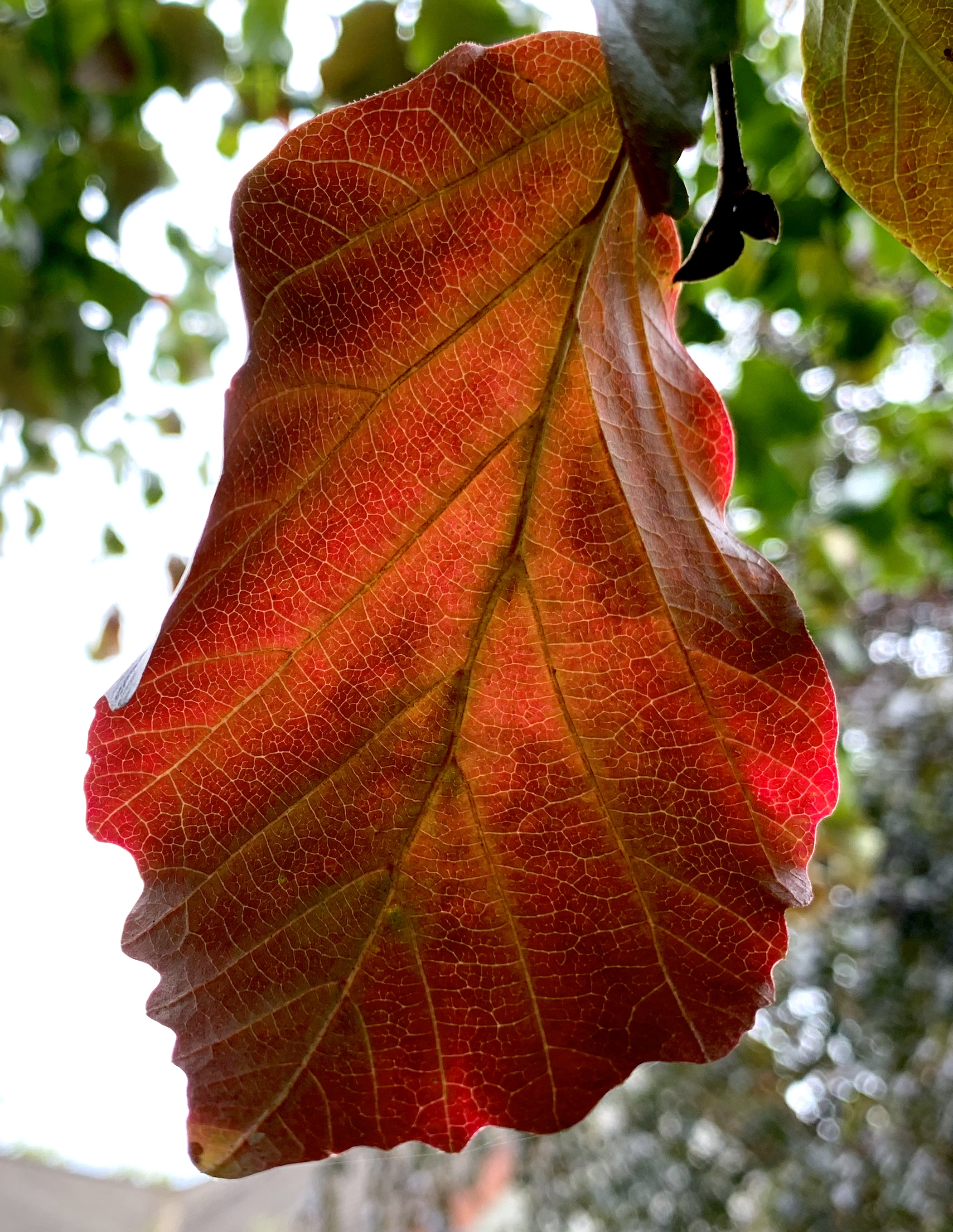
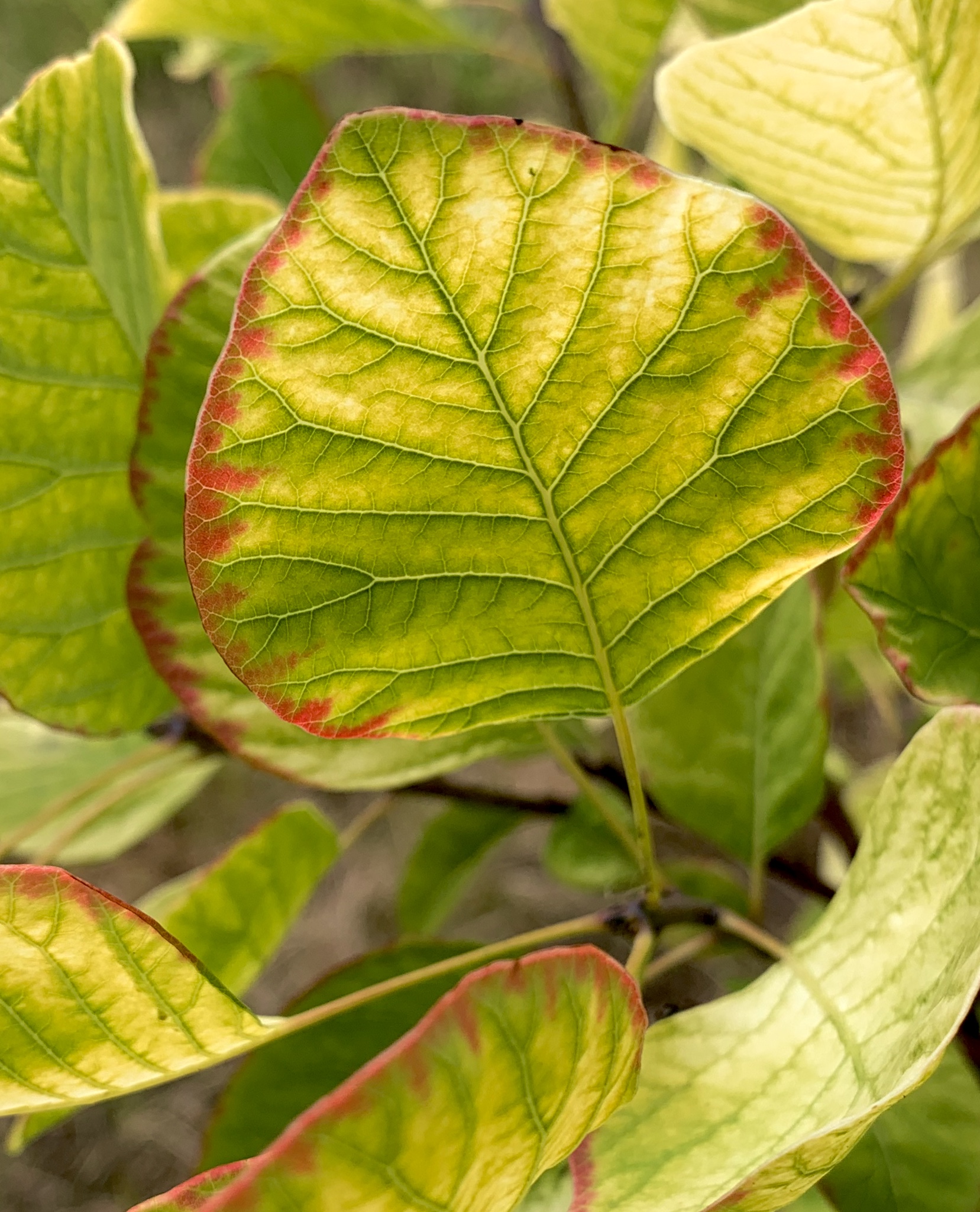
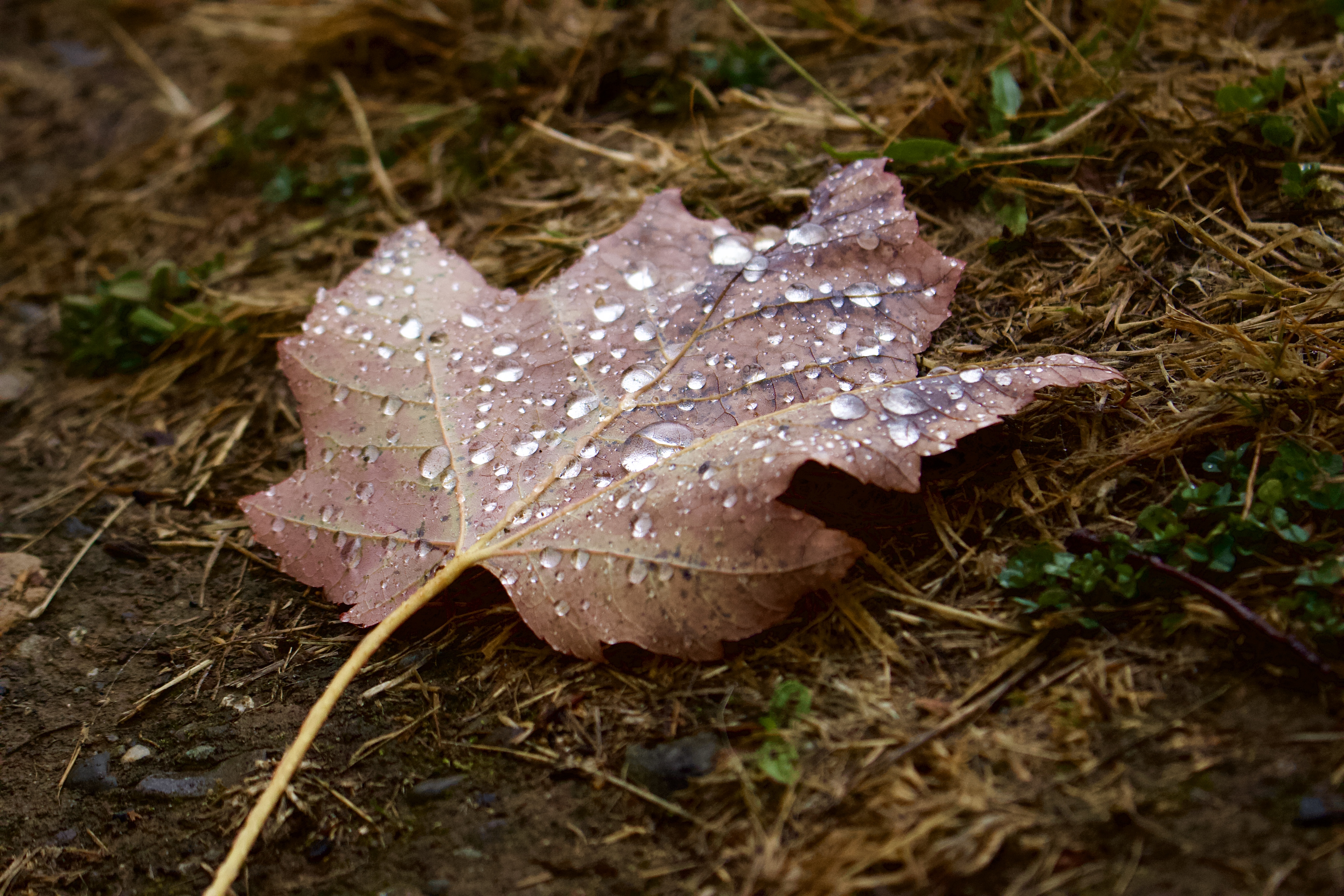
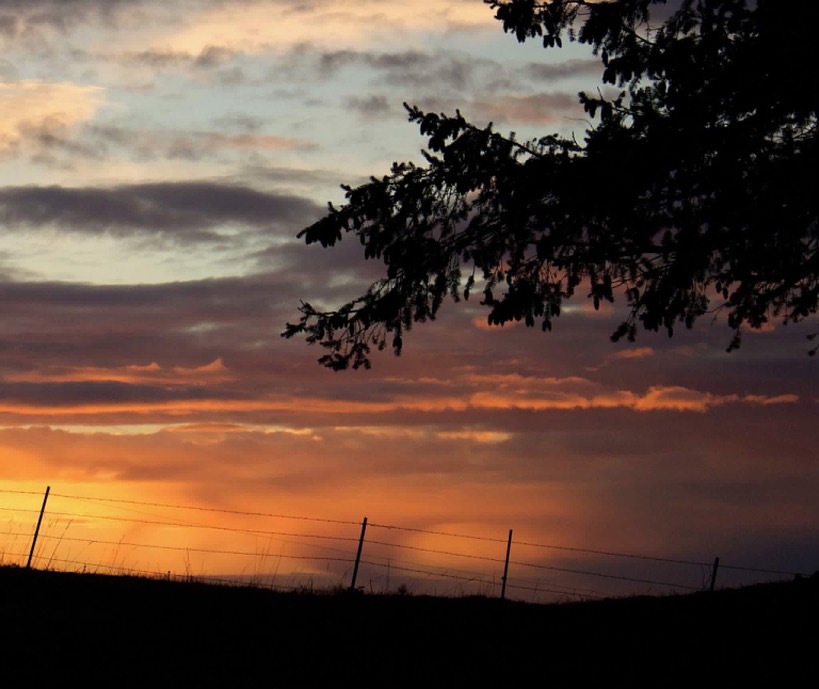
This time of year, no matter which way I turn, autumn’s kaleidoscope displays new patterns, new colors, new empty spaces as I watch the world die into itself once again.
Some dying is flashy, brilliant, blazing – a calling out for attention. Then there is the hidden dying that happens without anyone taking notice: just a plain, tired, rusting away letting go.
I spent this morning adjusting to the change in season by occupying myself with the familiar task of moving manure. Cleaning barn is a comforting chore, allowing me to transform tangible benefit from something objectionable and just plain stinky to the nurturing fertilizer of the future.
It feels like I’ve actually accomplished something.
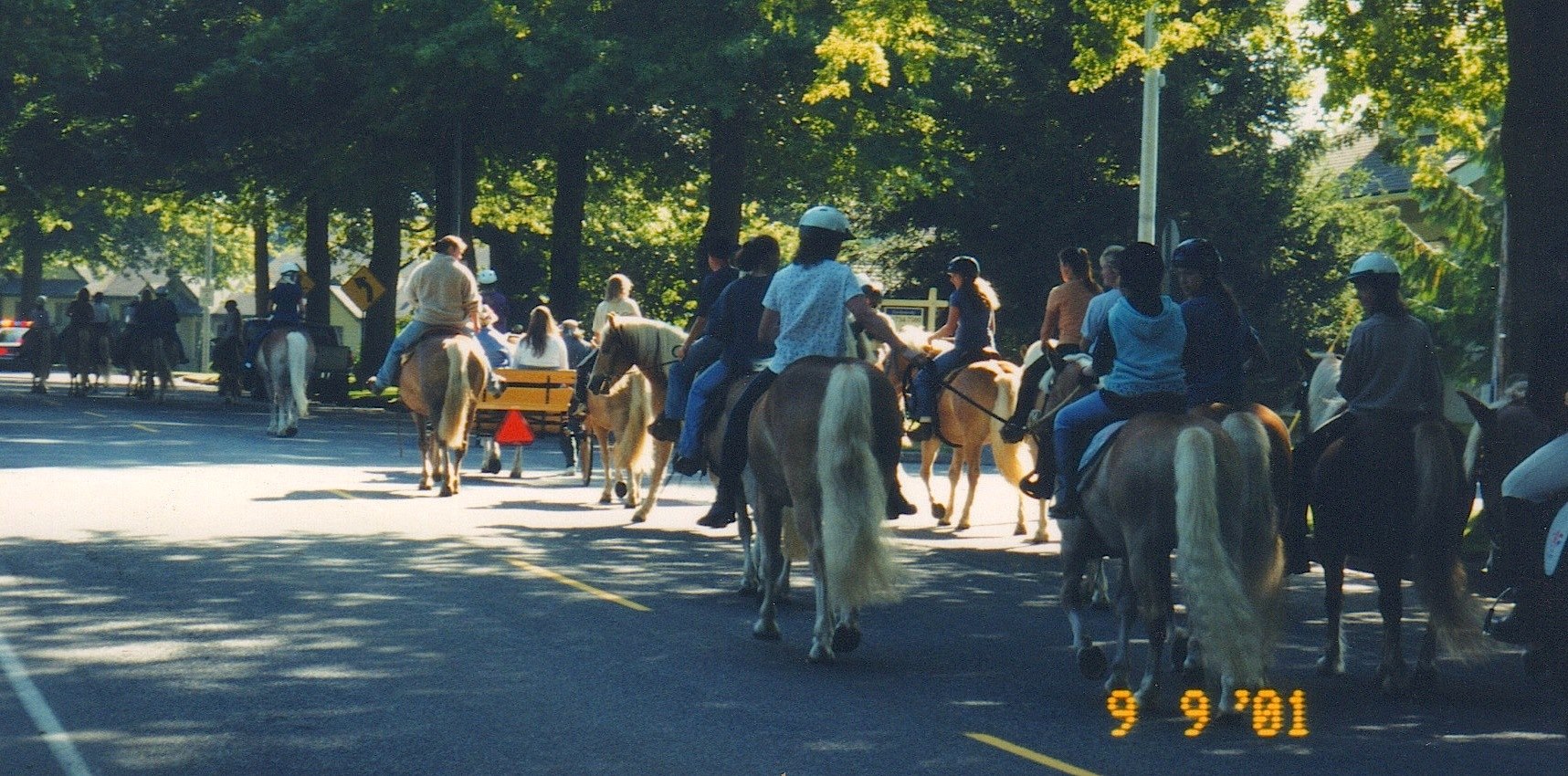
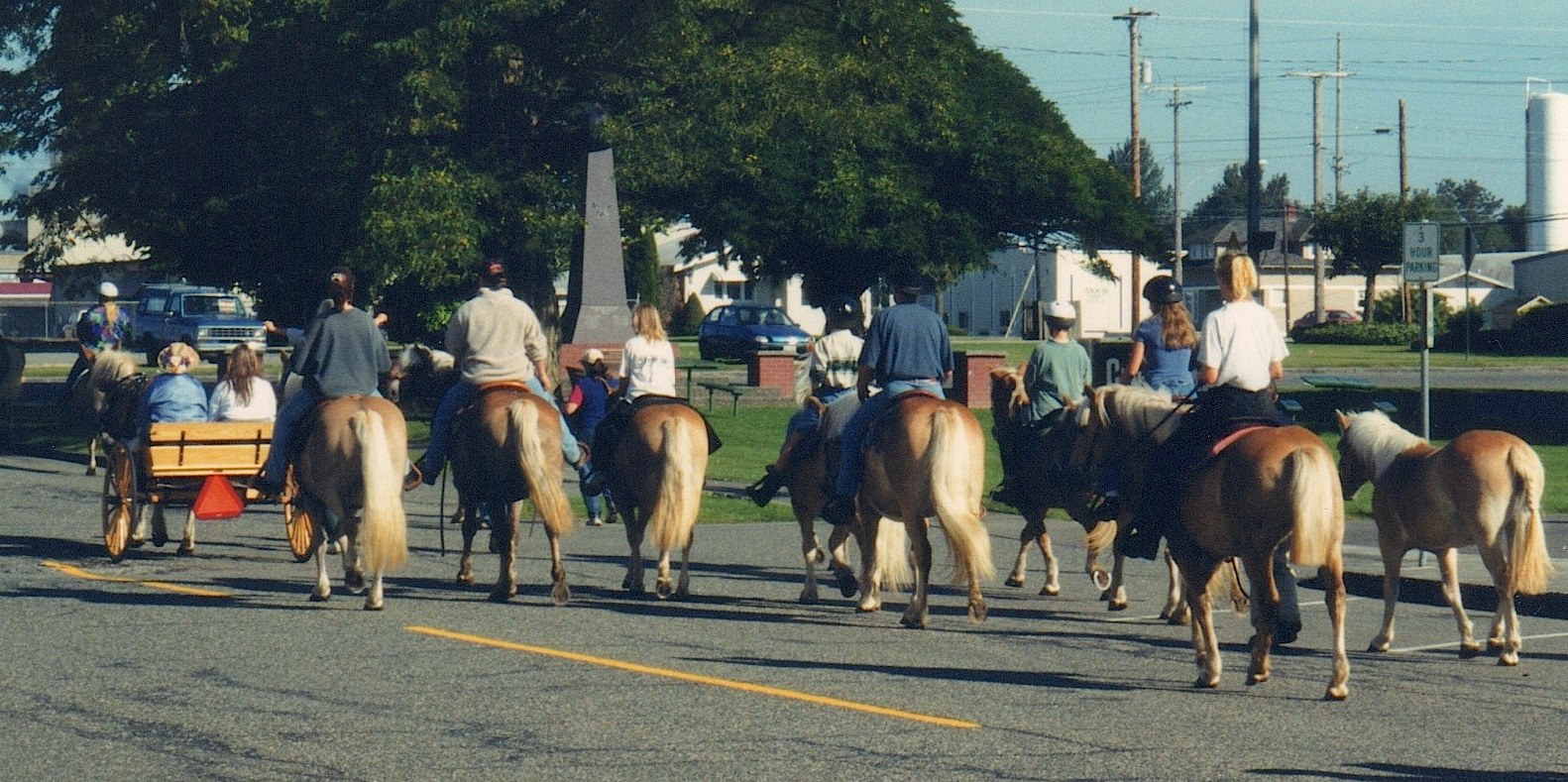
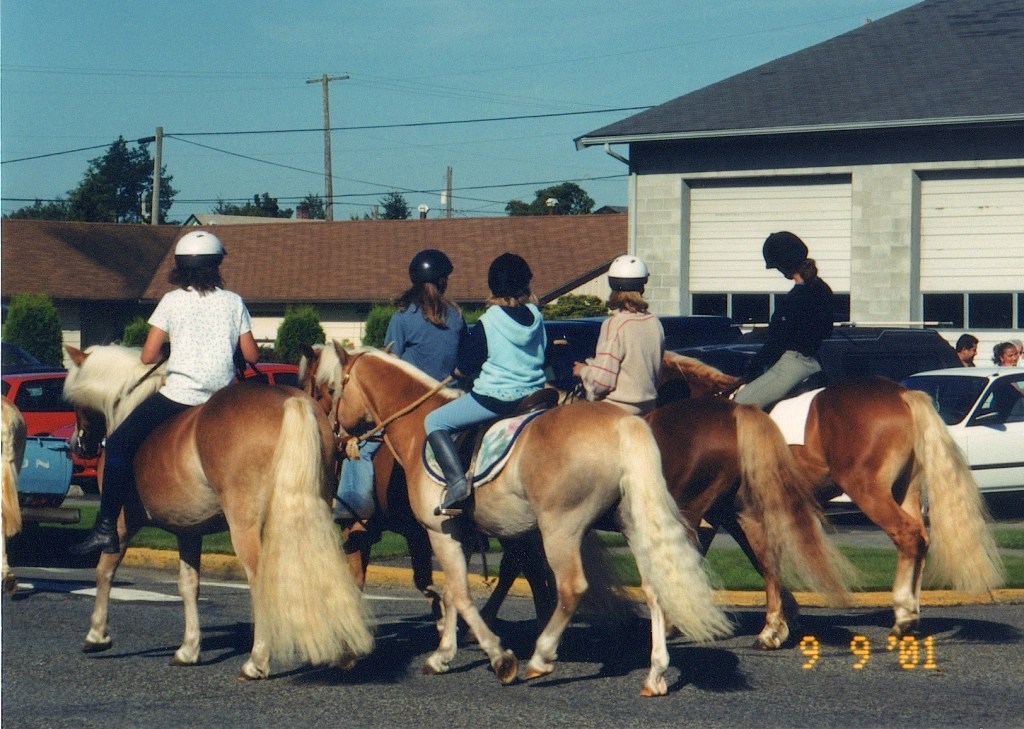
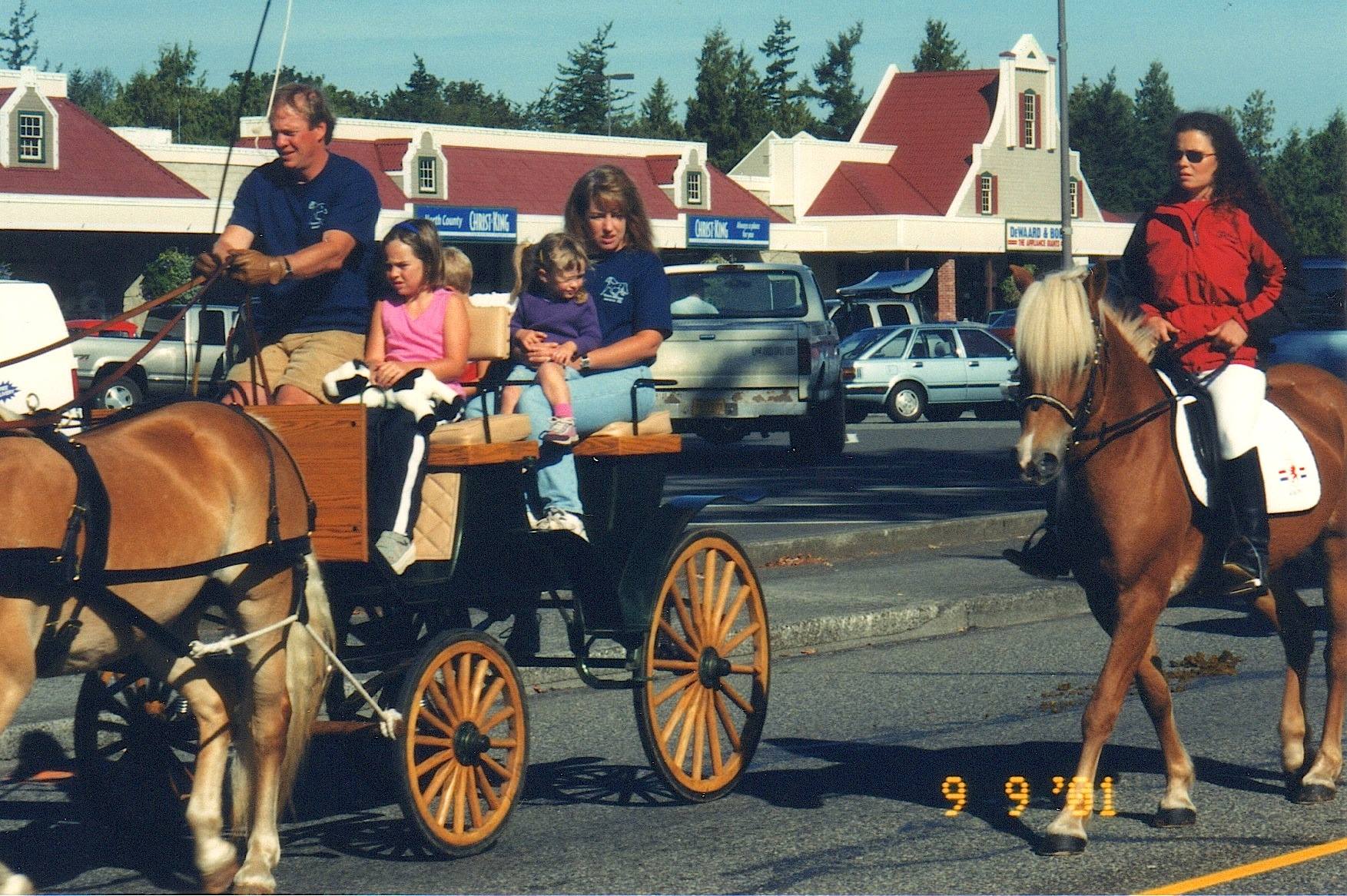
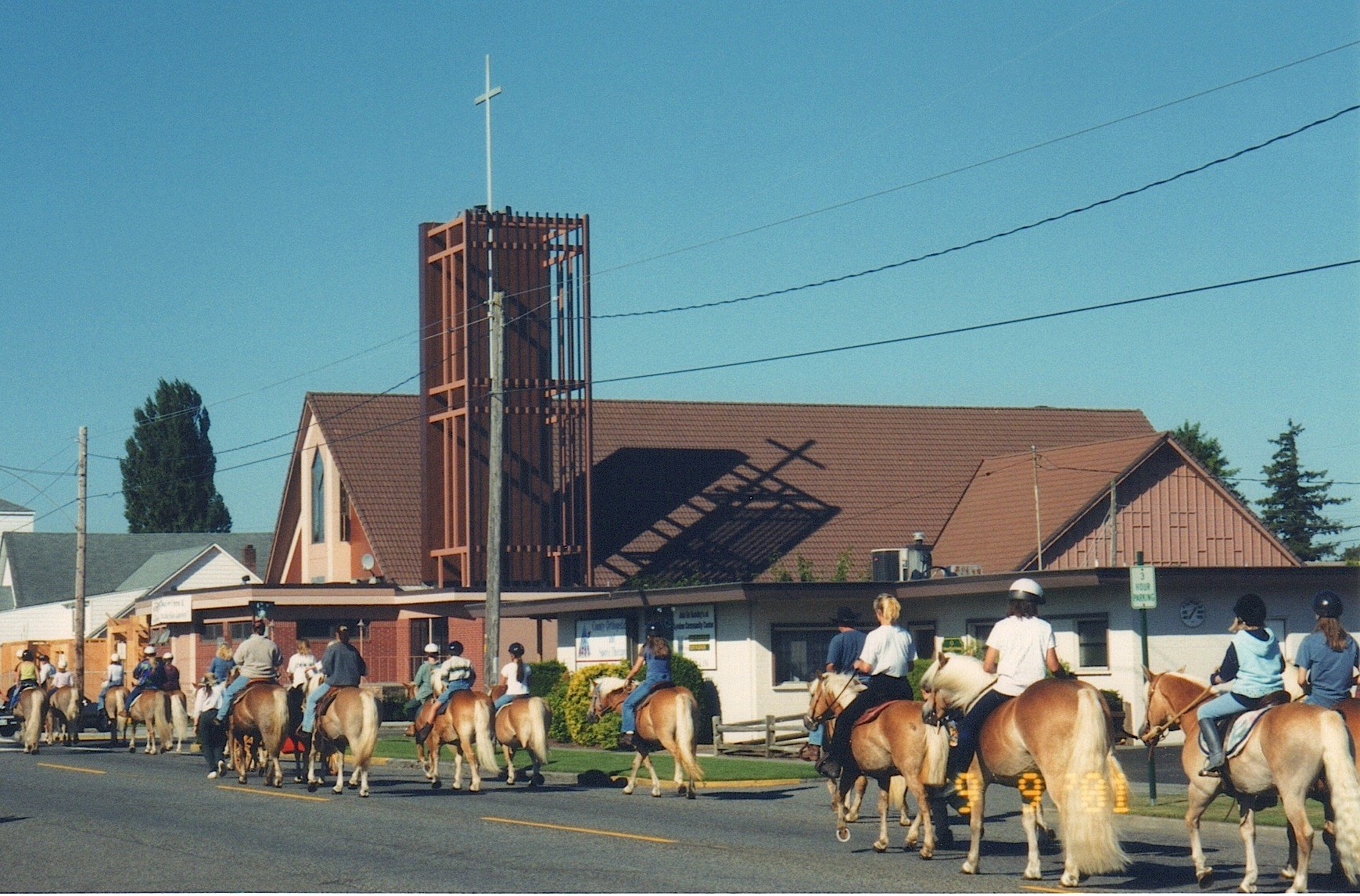
As I scoop and push the wheelbarrow, I recalled another barn cleaning 24 years ago, just days before the world changed on 9/11/01.
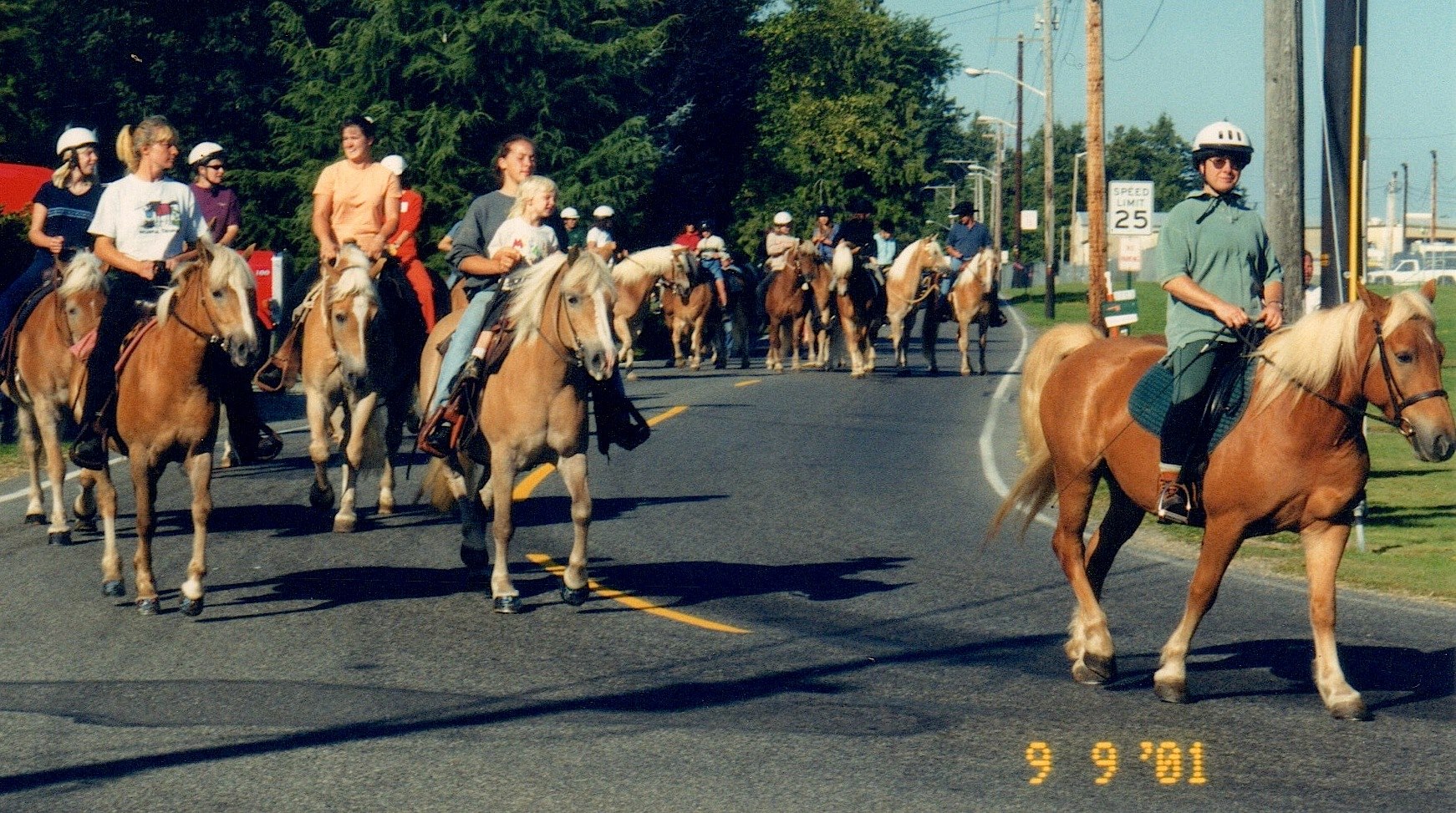
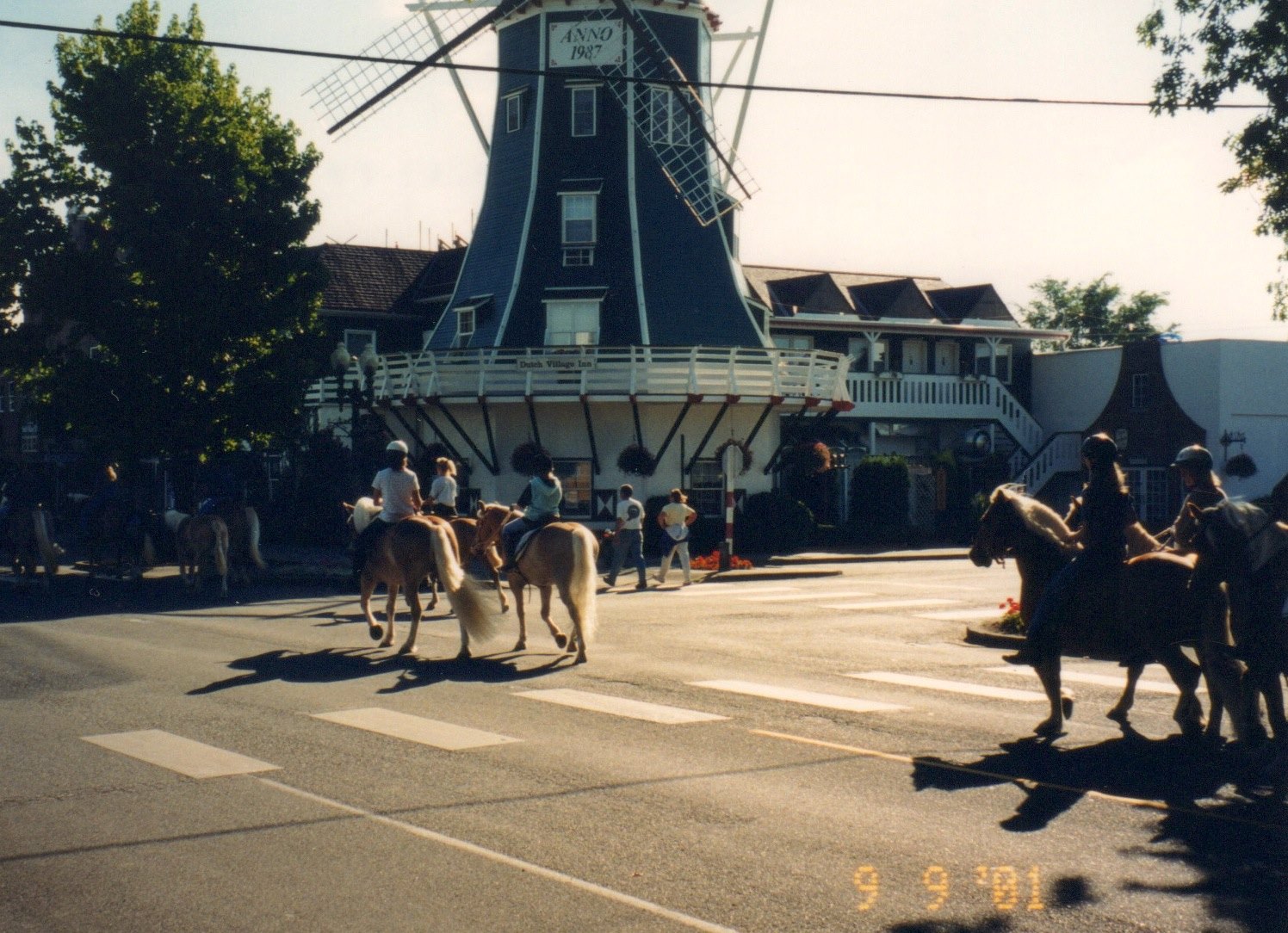
I was one of three or four friends left cleaning over ninety stalls after a Haflinger horse event that I had organized at our local fairgrounds. Some people had brought their horses from over 1000 miles away to participate for several days, including a Haflinger parade through our town on a quiet Sunday morning.
There had been personality clashes and harsh words among some participants along with criticism directed at me as the organizer that I had taken very personally. As I struggled with the umpteenth wheelbarrow load of manure, tears stung my eyes and my heart.
I was miserable with regret, feeling my work had been futile and unappreciated.
One friend had stayed behind with her young family to help clean up the large facility and she could see I was struggling to keep my composure. Jenny put herself right in front of my wheelbarrow and looked me in the eye, insisting I stop for a moment and listen:
“You know, none of these troubles and conflicts will amount to a hill of beans years from now. People will remember a fun event in a beautiful part of the country, a wonderful time with their Haflingers, their friends and family, and they’ll be all nostalgic about it, not giving a thought to the infighting or the sour attitudes or who said what to whom. So don’t make this about you and whether you did or didn’t make everyone happy. You loved us all enough to make it possible to meet here and the rest was up to us. So quit being upset about what you can’t change. There’s too much you can still do for us.”
Jenny had no idea how wise her words were, even two days later, on 9/11.
During tough times since (and there have been plenty), Jenny’s advice replays, reminding me to cease seeking appreciation from others or feeling hurt when harsh words come my way.
She was right about the balm found in the tincture of time. She was right about giving up the upset in order to die to self and self absorption, and instead to focus outward.
I have remembered.
Jenny herself did not know that day she would subsequently spend six years dying while still loving life every day, fighting a relentless cancer that was only slowed in the face of her faith and intense drive to live.
She became a rusting leaf gone holy, fading imperceptibly over time, crumbling at the edges until she finally had to let go. Her dying did not flash brilliance, nor draw attention at the end. Her intense focus during the years of her illness had always been outward to others, to her family and friends, to the healers she spent so much time with in medical offices, to her firm belief in the plan God had written for her and those who loved her.
So Jenny let go her hold on life here. And we reluctantly let her go. Brilliance cloaks her as her focus is now on things eternal.
You were so right, Jenny. The hard feelings from a quarter century ago don’t amount to a hill of beans now. The words you spoke to me that day taught me to love life even when I have no stomach for it.
All of us did have a great time together a few days before the world changed. And manure transforms over time to rich, nurturing compost.
I promise I am no longer upset that I can’t change what is past nor the fact that you and so many others have now left us.
But we’ll catch up later.
One-Time
Monthly
Yearly
Make a one-time or recurring donation to support daily Barnstorming posts
After nourishment, shelter and companionship, stories are the thing we need most in the world. Philip Pullman
You’re going to feel like hell if you wake up someday and you never wrote the stuff that is tugging on the sleeves of your heart: your stories, memories, visions, and songs–your truth, your version of things–in your own voice. That’s really all you have to offer us, and that’s also why you were born. ~Anne Lamott in a TED Talk
Write as if you were dying. At the same time, assume you write for an audience consisting solely of terminal patients. That is, after all, the case. ~Annie Dillard from “Write Till You Drop”
I began to write after September 11, 2001 because that day it became obvious to me I too was dying, albeit more slowly than the thousands who vanished that day in fire and ash, their voices obliterated with their bodies.
So, nearly each day since, while I still have voice and a new dawn to greet, I speak through my fingers and my camera lens to others dying around me.
We are, after all, terminal patients, some more imminent than others, some of us more prepared to move on, as if our readiness had anything to do with the timing.
Each day I too get a little closer, so I write in my own voice and share photos of my world as a way to hang on a while longer, yet with a loosening grasp. Each day I must detach just a little bit, leaving a small trace of my voice and myself behind.
Eventually, through unmerited grace, so much of me will be left on the page there won’t be anything or anyone left to do the typing.
There is no moment or picture or word to waste.
One-Time
Monthly
Yearly
Make a one-time or recurring donation to support daily Barnstorming posts














 Barnstorming