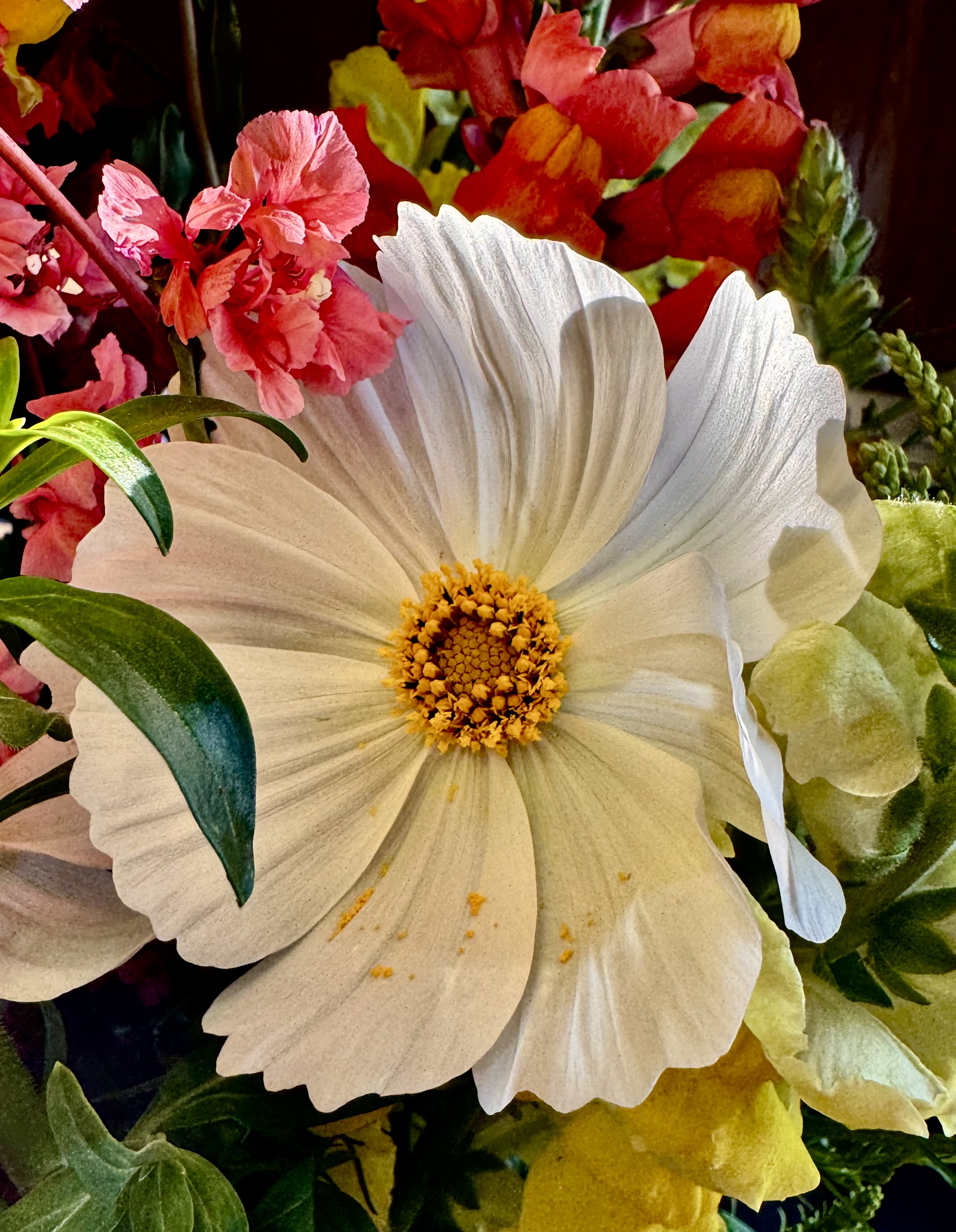
What if you slept And what if In your sleep You dreamed And what if In your dream You went to heaven And there plucked a strange and beautiful flower And what if When you awoke You had that flower in your hand Ah, what then? ~Samuel Taylor Coleridge “What if you slept…”
What might our dreams tell us of heaven?
The last few nights I dreamed of those with whom I once had a warm friendship but no longer do.
My dreams were of grace and reconciliation, of walking and talking together and rediscovering our common goals and beliefs rather than dwelling on estrangement and sadness as we’ve gone our separate ways.
Upon waking, I wondered what vision of heaven this suggests: finding the lost treasure of connection that I allowed to let go.
Restoring a friendship is like waking, holding a strange and beautiful flower plucked in a dream. I cradle it gently in my hand as the precious gem it is.
What then is still possible? And what might I do with this flower now?
One-Time
Monthly
Yearly
Make a one-time or recurring donation to support daily Barnstorming posts
Dawn comes later and later now, and I, who only a month ago could sit with coffee every morning watching the light walk down the hill to the edge of the pond and place a doe there, shyly drinking,
then see the light step out upon the water, sowing reflections to either side — a garden of trees that grew as if by magic — now see no more than my face, mirrored by darkness, pale and odd,
startled by time. While I slept, night in its thick winter jacket bridled the doe with a twist of wet leaves and led her away, then brought its black horse with harness that creaked like a cricket, and turned
the water garden under. I woke, and at the waiting window found the curtains open to my open face; beyond me, darkness. And I, who only wished to keep looking out, must now keep looking in. ~Ted Kooser “A Letter in October”
God knows we seek out light these autumn mornings
praying to see multicolors filling the lines outside; my face a shadow in a blackened window pane
Some mornings we can only see our own reflection mirrored by darkness, startled by time, as we wonder what comes next.
God knows, as each year passes, we need His Light illuminating us as we look beyond ourselves, but even more as we look within.
One-Time
Monthly
Yearly
Make a one-time or recurring donation to support daily Barnstorming posts
When he had washed their feet and put on his outer garments and resumed his place, he said to them, “Do you understand what I have done to you? You call me Teacher and Lord, and you are right, for so I am. If I then, your Lord and Teacher, have washed your feet, you also ought to wash one another’s feet.
For I have given you an example, that you also should do just as I have done to you. Truly, truly, I say to you, a servant is not greater than his master, nor is a messenger greater than the one who sent him. If you know these things, blessed are you if you do them.
I am not speaking of all of you; I know whom I have chosen. But the Scripture will be fulfilled, ‘He who ate my bread has lifted his heel against me.’ (Psalm 41:9)
I am telling you this now, before it takes place, that when it does take place you may believe that I am he.
Truly, truly, I say to you, whoever receives the one I send receives me, and whoever receives me receives the one who sent me.” John 13: 12-20
Rembrandt Head of Christ
I, too, stood on the sacred image … on the face of the man who has been ever in my thoughts, … on the best and most beautiful face that any man can ever know, on the face of him whom I have always longed to love.
I understand your pain and your suffering. It is for that reason that I am here.
Lord, I resented your silence.
I was not silent. I suffered beside you. ~Shisaku Endo from Silence – an interchange at the end of the book between Father Sebastian Rodrigues and the voice of the Lord Jesus
Then Judas in his hot desire Said, “Give me what you will.” Christ spoke to him with words of fire, “Then, Judas, you must kill, One whom you love, One who loves you As only God’s son can: This is the work for you to do To save the creature man.“
“And men to come will curse your name, And hold you up to scorn; In all the world will be no shame Like yours; this is love’s thorn. It takes strong will of heart and soul, But man is under ban. Think, Judas, can you play this role In heaven’s mystic plan?”
So Judas took the sorry part, Went out and spoke the word, And gave the kiss that broke his heart, But no one knew or heard. And no one knew what poison ate Into his palm that day, Where, bright and damned, the monstrous weight Of thirty white coins lay.
It was not death that Judas found Upon a kindly tree; The man was dead long ere he bound His throat as final fee. And who can say if on that day When gates of pearl swung wide, Christ did not go His honored way With Judas by His side?
And then there is the love for the enemy– love for the one who does not love you but mocks, threatens, and inflicts pain. The tortured’s love for the torturer. This is God’s love. It conquers the world. ~Frederick Buechnerfrom The Magnificent Defeat
Even my close friend in whom I trusted, who ate my bread, has lifted his heel against me. Psalm 41:9
…he shall bruise your head, and you shall bruise his heel. Genesis 3:15
Jesus knew Judas would “lift his heel against him” – Jesus chose him for that very reason, a close friend who had been a cherished part of the twelve.
The kick is hard, but not unexpected.
A heel crushes the image of Jesus and all that is good and beautiful.
Yet, this Lord is able to understand the pain of the betrayer and know suffering so much, He brings it onto Himself.
It was for this reason He came. It was for this reason He invites us to eat the bread of life alongside Him. We are filled and forgiven because He loves us enough to take our kicks and crushes.
What a gift to be known so well by God Himself.
I am reading slowly through the words in the Book of John over the next year alongside my church family. Once a week, I will invite you to “come and see” what those words might mean as we explore His promises together.
One-Time
Monthly
Yearly
Make a one-time or recurring donation to support daily Barnstorming posts
If we could, like the trees, practice dying, do it every year just as something we do— like going on vacation or celebrating birthdays— it would become as easy a part of us as our hair or clothing.
Someone would show us how to lie down and fade away as if in deepest meditation, and we would learn about the fine dark emptiness, both knowing it and not knowing it, and coming back would be irrelevant.
Whatever it is the trees know when they stand undone, surprisingly intricate, we need to know also so we can allow that last thing to happen to us as if it were only any ordinary thing,
leaves and lives falling away, the spirit, complex, waiting in the fine darkness to learn which way it will go. ~Grace Butcher, “Learning from Trees” from Poetry of Presence
And is it not enough that every year A richly laden autumn should unfold And shimmer into being leaf by leaf, It’s scattered ochres mirrored everywhere In hints and glints of hidden red and gold Threaded like memory through loss and grief, When dusk descends,when branches are unveiled, When roots reach deeper than our minds can feel And ready us for winter with strange calm, That I should see the inner tree revealed And know its beauty as the bright leaves fall And feel its truth within me as I am?
It is not yet enough. So I must try, In my poor turn, to help you see it too, As though these leaves could be as rich as those, That red and gold might glimmer in your eye, That autumn might unfold again in you, Feeling with me what falling leaves disclose. ~Malcolm Guite from “And is it Not Enough?”
If I were to die as a leaf does, I would want to change my clothes just bit by bit, overnight oozing gradually to scarlet, bleeding into the green a little bit more, until I’m so unrecognizable, I’ll seem brand new.
That would be ideal.
The reality is a fading to grey and brown, my edges withered and torn, bug-bitten with holes and weather-beaten bruised, dangling and fearful of letting go and so forgotten.
So I remember: no one, not one, falls without its Maker knowing. No one, not one, dies without being made brand new.
One-Time
Monthly
Yearly
Make a one-time or recurring donation to support daily Barnstorming posts
What is this unfolding, this slow- going unraveling of gift held in hands open to the wonder and enchantment of it all?
What is this growing, this rare showing, like blossoming of purple spotted forests by roadsides grown weary with winter months?
Seasons affected, routinely disordered by playful disturbance of divine glee weaving through limbs with sharpened shards of mirrored light, cutting dark spaces, interlacing creation, commanding life with whimsical delight.
Everything is made to perish; the wonder of anything at all is that it has not already done so. No, he thought. The wonder of anything is that it was made in the first place. What persists beyond this cataclysm of making and unmaking? ~Paul Hardingfrom Tinkers
God does not leave us to perish in the valley of dry bones.
We may think we are invincible, yet the truth is: we are mere dust, ready to blow away. The immense power of the breath of God fills newborn lungs and will someday restore the empty lungs of the resurrected dead.
He rebuilds our muscle and sinews, reconnects us bone to bone, person to person, living to rattle and sing as the body of Christ, mirrored reflections in His image.
This unfolding, this growing, this blossoming, this breaking: Lord, keep dizzying us with your blessings, now and always.
One-Time
Monthly
Yearly
Make a one-time or recurring donation to support daily Barnstorming posts
The room darkened, darkened until our nakedness became a form of gray; then the rain came bursting, and we were sheltered, blessed, upheld in a world of elements that held us justified. In all the love I had felt for you before, in all that love, there was no love like that I felt when the rain began… ~John Updike from “The Blessing” from Collected Poems.
As the rains return, as we shelter together, blessed by the passing years and miles, our unknowns have become known, our understanding breathed in silence.
Though we be gray as the clouds above, our hearts still beat in synchrony each pulsing moment more sacred than the last.
Lyrics: A soft voice, a kind word A tender touch in a hard world Your voice like rain after the seeds are sown Your kindness and grace is all I’ve ever known
We’re not the same, you and me You’re an evergreen and I’m a maple tree Sometimes I’m bare, sometimes I’m sweet You can carry on consistently And in a million little ways, you show How to take two souls and make one home
You love the dirt, I find life in words I sit and think, you relish your work You could teach, teach a master class Without a word you show us how to make a feast from scratch And in a million little ways, you show How to take two souls and make one home And in a million little ways, you show How to take two souls and make one home
A sanctuary for our children A sanctuary for our fears and hopes Here in the wilderness, our world longs for this To be known and loved To be known and loved
Lyrics: In the quiet misty morning When the moon has gone to bed, When the sparrows stop their singing And the sky is clear and red, When the summer’s ceased its gleaming When the corn is past its prime, When adventure’s lost its meaning – I’ll be homeward bound in time
Bind me not to the pasture Chain me not to the plow Set me free to find my calling And I’ll return to you somehow
If you find it’s me you’re missing If you’re hoping I’ll return, To your thoughts I’ll soon be listening, And in the road I’ll stop and turn Then the wind will set me racing As my journey nears its end And the path I’ll be retracing When I’m homeward bound again
Bind me not to the pasture Chain me not to the plow Set me free to find my calling And I’ll return to you somehow
In the quiet misty morning When the moon has gone to bed, When the sparrows stop their singing I’ll be homeward bound again. ~Marta Keen “Homeward Bound”
One-Time
Monthly
Yearly
Make a one-time or recurring donation to support daily Barnstorming posts
What can l say, now that summer’s gone, with the weight of its heat, its thick blanket of humidity, the cacophony of zinnias, marigolds, salvia? Now the sky is clear blue and cloudless, that sure one-note that can only mean October. You’re gone. The leaves turn gold in the calendar’s rotisserie, giving up their green, and the burning bushes have ignited, struck their book of matches. It’s enough to make the heart break, isn’t it? We keep going down the one road, there’s no turning back. ~Barbara Crooker “Now” from Small Rain
…the golden hour of the clock of the year. Flowers that were once bright as a box of crayons are now seed heads and thistle down. All the feathery grasses shine in the slanted light. …time to draw the drapes against the wind, time to hunker down. Summer’s fruits are preserved in syrup, but nothing can stopper time. No way to seal it in wax or amber; it slides though our hands like a rope of silk. ~Barbara Crooker from “And Now it’s October” from Small Rain.
It’s half-past October, the woods are on fire, blue skies stretch all the way to heaven. Of course, we know that winter is coming, its thin winding sheets and its hard narrow bed. But right now, the season’s fermented to fullness… ~Barbara Crooker from “Reel” in The Book of Kells
Another October. The maples have done their slick trick of turning yellow almost overnight; summer’s hazy skies are cobalt blue.I want to praise things that cannot last. The scarlet and orange leaves are already gone, blown down by a cold rain, crushed and trampled. They rise again in leaf meal and wood smoke. I want to praise everything brief and finite. night falls swiftly, tucking us in her black velvet robe, the stitches showing through, all those little lights, our little lives, rising and falling. ~Barbara Crooker from “Equinox”
This slow fading away of October renders us transient ourselves-
only visitors here, no laying down claims, simply passing through enjoying the scenery, knowing this too won’t last…
Yet it is sweet ~let me say it again~ oh so sweet while we’re here.
One-Time
Monthly
Yearly
Make a one-time or recurring donation to support daily Barnstorming posts
Poetry is a life-cherishing force. For poems are not words, after all, but fires for the cold, ropes let down to the lost, something as necessary as bread in the pockets of the hungry. ~Mary Oliver from A Poetry Handbook
…I want to write with quiet hands. I want to write while crossing the fields that are fresh with daisies and everlasting and the ordinary grass. I want to make poems while thinking of the bread of heaven and the cup of astonishment; let them be songs in which nothing is neglected, not a hope, not a promise. I want to make poems that look into the earth and the heavens and see the unseeable. I want them to honor both the heart of faith, and the light of the world; the gladness that says, without any words, everything. ~Mary Oliver from “Everything” from New and Selected Poems: Volume Two
Poetry may make us from time to time a little more aware of the deeper, unnamed feelings which form the substratum of our being, to which we rarely penetrate; for our lives are mostly a constant evasion of ourselves. —T.S. Eliotfrom The Use of Poetry and the Use of Criticism
Much of the time, on the surface, we appear a tangled mess – a jumble of unarticulated feelings and desires, needs and wants.
Deeper down, there is a hungry soul in a place that can’t be seen.
We rarely dip in there; it can be a sore spot we are tempted to touch but avoid doing so because of its tenderness.
The bright light of a few well chosen words can ring us like a bell; we are struck dumb finding such clarion clarity comes to a place so well hidden.
A rope of words drops to lift up the lost and sad and empty – a reminder mere words can rescue and revive.
One-Time
Monthly
Yearly
Make a one-time or recurring donation to support daily Barnstorming posts
Winter is an etching, spring a watercolor, summer an oil painting and autumn a mosaic of them all. ~Stanley Horowitz, a poem in Readers’ Digest Nov. 1983
WinterWinter
L’Inverno (Winter) Opus 8, No. 4, in F minor
I. Allegro non molto– Frozen and trembling in the icy snow, In the severe blast of the horrible wind, As we run, we constantly stamp our feet, And our teeth chatter in the cold. II. Largo– To spend happy and quiet days near the fire, While, outside, the rain soaks hundreds. III. Allegro– We walk on the ice with slow steps, And tread carefully, for fear of falling. Symphony, If we go quickly, we slip and fall to the ground. Again we run on the ice, Until it cracks and opens. We hear, from closed doors, Sirocco, Boreas, and all the winds in battle. This is winter, but it brings joy. ~Vivaldi (Winter poem)
SpringSpringSpringSpring
La Primavera (Spring) Opus 8, No. 1, in E Major
I. Allegro– Festive Spring has arrived, The birds salute it with their happy song. And the brooks, caressed by little Zephyrs, Flow with a sweet murmur. The sky is covered with a black mantle, And thunder, and lightning, announce a storm. When they are silent, the birds Return to sing their lovely song. II. Largo e pianissimo sempre– And in the meadow, rich with flowers, To the sweet murmur of leaves and plants, The goatherd sleeps, with his faithful dog at his side. III. Danza pastorale. Allegro– To the festive sound of pastoral bagpipes, Dance nymphs and shepherds, At Spring’s brilliant appearance. ~Vivaldi (Spring poem)
SummerSummerSummerSummer
L’Estate (Summer) Opus 8, No. 2, in G minor
I. Allegro non molto– Under the heat of the burning summer sun, Languish man and flock; the pine is parched. The cuckoo finds its voice, and suddenly, The turtledove and goldfinch sing. A gentle breeze blows, But suddenly, the north wind appears. The shepherd weeps because, overhead, Lies the fierce storm, and his destiny. II. Adagio; Presto– His tired limbs are deprived of rest By his fear of lightning and fierce thunder, And by furious swarms of flies and hornets. III. Presto– Alas, how just are his fears, Thunder and lightening fill the Heavens, and the hail Slices the tops of the corn and other grain. ~Vivaldi (Summer poem)
AutumnAutumnAutumnAutumnAutumnAutumn
L’Autunno (Autumn) Opus 8, No. 3, in F Major
I. Allegro– The peasants celebrate with dance and song, The joy of a rich harvest. And, full of Bacchus’s liquor, They finish their celebration with sleep. II. Adagio molto– Each peasant ceases his dance and song. The mild air gives pleasure, And the season invites many To enjoy a sweet slumber. III. Allegro– The hunters, at the break of dawn, go to the hunt. With horns, guns, and dogs they are off, The beast flees, and they follow its trail. Already fearful and exhausted by the great noise, Of guns and dogs, and wounded, The exhausted beast tries to flee, but dies. ~Vivaldi (Autumn poem)
I walk this farm lane to stand at the same spot countless times through the year, as witness to the changing palette around me.
The Artist lovingly chooses His color and technique with a gentle touch for each season.
So too, He paints my life with richness and variety: from the austere lines in winter, to a green emergence in spring, a summer of sweet fruitfulness and a mosaic crescendo in autumn.
The Artist’s signature can be spotted on each masterpiece, gracing the transforming canvas of each of our lives.
One-Time
Monthly
Yearly
Make a one-time or recurring donation to support daily Barnstorming posts
The way the trees empty themselves of leaves, let drop their ponderous fruit, the way the turtle abandons the sun-warmed log, the way even the late-blooming aster succumbs to the power of frost—
this is not a new story. Still, on this morning, the hollowness of the season startles, filling the rooms of your house, filling the world with impossible light, improbable hope.
And so, what else can you do but let yourself be broken and emptied? What else is there but waiting in the autumn sun? ~Carolyn Locke “What Else?” from The Place We Become
So this is how life goes:
we are sowed, set down roots, bud and grow and flower and bloom and fruit and flourish,
then dry and change and wither and empty and break away to be carried off beyond this air and water and soil.
We thrive where we are planted, do what we could with a little nurture, then transcend the here and now.
So shall we plant the next generation in healthy soil. May we weed and water and feed as needed. May we never seek to overshadow the sun but step aside so its light fully shines on whoever comes next.
One-Time
Monthly
Yearly
Make a one-time or recurring donation to support daily Barnstorming posts