They work with herbs and penicillin. They work with gentleness and the scalpel. They dig out the cancer, close an incision and say a prayer to the poverty of the skin. They are not Gods though they would like to be; they are only human trying to fix up a human. Many humans die. They die like the tender, palpitating berries in November. But all along the doctors remember: First do no harm. They would kiss if it would heal. It would not heal.
If the doctors cure then the sun sees it. If the doctors kill then the earth hides it. The doctors should fear arrogance more than cardiac arrest. If they are too proud, and some are, then they leave home on horseback but God returns them on foot. ~Anne Sexton “Doctors” from The Awful Rowing Toward God.
The only wisdom we can hope to acquire is the wisdom of humility; humility is endless. ~T.S. Eliot from East Coker
Let me never forget how humbling it was to provide care for hurting people and not be 100% certain what I do would actually work, though I was trusted to recommend the best option…
which could include a tincture of time, just wait and see, try this or that.
Or witnessing a vaccine-preventable illness gallop through a university population, taking weeks to safely harness and control.
Not unlike other physicians who tumbled off while racing a pathogen, losing their balance between overconfidence and humility, I sometimes found myself unseated and stranded, having to return on foot to retrace my steps, reframe my words and hopes and do no harm – to try once again to make a difference.
One-Time
Monthly
Yearly
Make a one-time or recurring donation to support daily Barnstorming posts
She lingered in that charming little garden to say hello to the gnomes, such a glorious infestation! How few wizards realize just how much we can learn from the wise little gnomes- or, to give them their correct names, the Gernumbli gardensi. ‘Ours do know a lot of excellent swear words,’ said Ron… J.K. Rowling in Harry Potter and the Deathly Hallows
It is hard to say exactly when the first one moved in. This farm was distinctly gnome-less when we bought it nearly forty years ago, largely due to twenty-seven hungry barn cats residing here at the time in various stages of pregnancy, growth, development and aging. It took awhile for the feline numbers to whittle down to an equilibrium that matched the rodent population.
In the mean time, our horse numbers increased from three to seven to over fifteen with a resultant exponential increase in barn chores. One spring thirty years ago, I was surprised to walk in the barn one morning to find numerous complex knots tied in the Haflingers’ manes. Puzzling as I took precious time to undo them, literally adding hours to my chores, I knew I needed to find the cause or culprit.
It took some research to determine the probable origin of these tight tangles. Based on everything I researched, they appeared to be the work of Gernumbli faenilesi, a usually transient species of gnome preferring to live in barns and haylofts in close proximity to heavy maned ponies. In this case, as the tangles persisted for months, they clearly had moved in, lock, stock and barrel. The complicated knots were their signature pride and joy, their artistic way of showing their devotion to a happy farm.
All well and good, but the extra work was killing my fingers and thinning my horses’ hair. I plotted ways to get them to cease and desist.
I set live traps of cheese and peanut butter cracker sandwiches, hoping to lure them into cages for a “catch and release”. Hoping to drive them away, I played polka music on the radio in the barn at night. Hoping to be preemptive, I braided the manes up to be less tempting but even those got twisted and jumbled. Just as I was becoming ever more desperate and about to round up more feral cats, the tangling stopped.
It appeared the gnomes had moved on to a more hospitable habitat. Apparently I had succeeded in my gnome eradication plan.
Or so I thought.
Not long after, I had the distinct feeling of being watched as I walked past some rose bushes in the yard. I stopped to take a look, expecting to spy the shining eyes of one of the pesky raccoons that frequents our yard to steal from the cats’ food dish. Instead, beneath the thorny foliage, I saw two round blue eyes peering at me serenely. This little gal was not at all intimidated by me, and made no move to escape. She was an ideal example of Gernumbli gardensi, a garden gnome known for their ability to keep varmints and vermin away from plants and flowers. They also happen to actively feud with Gernumbli Faenilesi so that explained the sudden disappearance of my little knot-tying pests in the barn.
It wasn’t long before more Gardensi moved in, a gnomey infestation. They tend to arrive in pairs and bunches, bringing their turtles and dogs with them, like to play music, smoke pipes, play on a teeter totter, work with garden tools, take naps on sun-warmed rocks and one even prefers a swing, day and night through all four seasons. They are a bit of a rowdy bunch and always up for a party, but I enjoy their happy presence and jovial demeanor. I haven’t yet heard any bad language as we have a “keep it clean” policy about bad words around here. They seem quite hardy, stoically withstand extremes in weather, wear masks when asked and only seem fearful when hornets build a nest right in their lap.
As long as they continue to coexist peaceably with us and each other, keep the varmints and their knot-tying cousins away, and avoid bad habits and swear words, I’m quite happy they are here. Actually, I’ve given them the run of the place. I’ve been told to be cautious as there are now news reports of an even more invasive species of gnome, Gernumbli kitschsi, that could move in and take over if I’m not careful. In fact, several new little fellows moved into my hanging baskets and back into the barn this week – someone obviously had put the word out this is a great place to winter over. Now I need to watch for more mane tangles again.
A gnome explosion.
I shudder to think. There goes the neighborhood.
photo by Tomomi Gibson
One-Time
Monthly
Yearly
Make a one-time or recurring donation to support daily Barnstorming posts
Now among those who went up to worship at the feast were some Greeks. So these came to Philip, who was from Bethsaida in Galilee, and asked him, “Sir, we would like to see Jesus.” Philip went and told Andrew; Andrew and Philip went and told Jesus.
And Jesus answered them, “The hour has come for the Son of Man to be glorified. Truly, truly, I say to you, unless a grain of wheat falls into the earth and dies, it remains alone; but if it dies, it bears much fruit. Whoever loves his life loses it, and whoever hates his life in this world will keep it for eternal life. If anyone serves me, he must follow me; and where I am, there will my servant be also. If anyone serves me,the Father will honor him. John 12: 20-26
There was once in man a true happiness of which there now remain to him only the mark and empty trace, which he in vain tries to fill from all his surroundings, seeking from things absent the help he does not obtain in things present.
But these are all inadequate, because the infinite abyss can only be filled by an infinite and immutable object, that is to say, only by God Himself. ~Blaise Pascal from Pensees
You have made us for yourself, O Lord, and our heart is restless until it rests in you. ~Augustine of Hippo from Confessions
The sacred moments, the moments of miracle, are often the everyday moments, the moments which, if we do not look with more than our eyes or listen with more than our ears reveal only… a gardener, a stranger coming down the road behind us, a meal like any other meal. But if we look with our hearts, if we listen with all our being and imagination… what we may see is Jesus himself. ~Frederick Buechner from The Magnificent Defeat
“Sir, we would like to see Jesus.”
I thought our old church pulpit was the only one to have a plaque with John 12:21 attached to it — a clear reminder to anyone standing there, preparing to speak. I learned this verse has traditionally graced pulpits through the generations, encouraging preachers and listeners to work together to clear the obscuring fog to find the Messiah.
Jesus is not hidden from us; indeed, we are heart-blind most of the time, so wrapped in our own worries and troubles that we do not know where to look or who to ask to help us see Him.
It is through the preaching and sharing of God’s Word that the heart veil is lifted. To those Gentiles who wanted to see the man they had heard about, Jesus tells them what must come next: He must die, like a seed in the ground, in order to be glorified. We see Him in ways and places we could never have imagined, especially hanging on the cross in our place.
As we restlessly seek to clear the fog and fill what is empty within us, we must keep our eyes open wide, listening with all our being, our hearts at the ready, every moment.
He is already here, right where we are, always beside us.
We would see Jesus, for the shadows lengthen Across this wanting visage of our life; We would see Jesus, our weak faith to strengthen For the last weariness, the final strife.
We would see Jesus, the great rock foundation Whereon our feet were set by sov’reign grace; Nor life nor death, with all their agitation, Can thence remove us, if we see His face.
We would see Jesus: this is all we’re needing; Strength, joy, and willingness come with the sight; We would see Jesus, dying, risen, pleading; Then welcome day, and farewell mortal night. ~Anna Bartlett Warner “We Would See Jesus”
I am reading slowly through the words in the Book of John over the next year alongside my church family. Once a week, I will invite you to “come and see” what those words might mean as we explore His promises together.
One-Time
Monthly
Yearly
Make a one-time or recurring donation to support daily Barnstorming posts
Stand still. The trees ahead and bushes beside you Are not lost. Wherever you are is called Here, And you must treat it as a powerful stranger, Must ask permission to know it and be known. The forest breathes. Listen. It answers, I have made this place around you. If you leave it, you may come back again, saying Here. No two trees are the same to Raven. No two branches are the same to Wren. If what a tree or a bush does is lost on you, You are surely lost. Stand still. The forest knows Where you are. You must let it find you. ~David Wagoner “Lost”
Our grandchildren — born in Tokyo, adapting to a rural life here — bring within them the serenity of the gardens they visited there, finding respite from worldly worries and sorrows.
We remind them to love such stillness: there is rest after busyness, there is light beyond darkness, there is peace amid chaos, there are smiles after tears, there is quiet within noisiness, there is grace and mercy forever…
…as we who are older give way to the new.
One-Time
Monthly
Yearly
Make a one-time or recurring donation to support daily Barnstorming posts
I will wait here in the fields to see how well the rain brings on the grass. In the labor of the fields longer than a man’s life I am at home. Don’t come with me. You stay home too.
I will be standing in the woods where the old trees move only with the wind then with the gravity. In the stillness of the trees I am at home. Don’t come with me. You stay home too. ~Wendell Berry “Stay Home” from Collected Poems
A steady silver rain pours out over the gray world on an ordinary morning. Drenching for hours the field, wild flowers, soil and all the birds off somewhere dry in hidden nests, keeping quiet.
And you, too: keep quiet for a few hours, let your thoughts fizz like that silver sheen, shushshushshushshush, ceaseless sheet of velvet, of plenty. Enough to hear, to drink, to soak in, though you hadn’t known how dry you were. ~Joanne Esser “What You Need: (It Doesn’t Have to Be Lightning)” from Nothing is Stationary
Yesterday morning, our county was awakened shortly after 6AM with several thunder crashes after lightning bolts flashed and illuminated our dark bedroom.
Thunder storms are unusual in the Pacific Northwest; even more unusual is an early morning storm with so much drama and subsequent dumping rain.
I was fortunate to be sheltering inside a comfortable home with a good roof — not sitting in a tree.
I was happy,watching it happen without it happening to me.
Then I looked out my kitchen window, where a drenched pine siskin sat trembling on our bird feeder, her breakfast interrupted by the downpour. No doubt she would much rather have been at home quietly sitting in her favorite tree, but as she was unable to fly so soaked by the heavy torrent, she huddled under the little cover of the feeder, trying to ride it out.
Watching her cope with her wet plumage from an unplanned bird bath, I realized I hadn’t known how dry I was.
After twenty minutes, the storm was all over as the sun began peeking out from behind roiling clouds. She shook off the excess drops from her feathers, picked out a few more seeds before launching on her way to parts unknown.
I sat and finished my toast, musing at our brief breakfast alongside one another, each safe under temporary shelter. In her own way, she let me know: In the stillness of the trees I am at home. Don’t come with me. You stay home too.
And so I shall…
Lyrics: We all need love and shelter A place where we let go and rest To live secure with one another To be ourselves, not somebody else
Everybody needs respect and dignity Everybody needs love, real love
We all need to know we’re worthy That we are treasure to our core We can tell the truth about our trauma To be believed so we can be restored
Everybody needs love; everybody knows love Is what it takes to make a life So everybody breathe love; everyone receive love It’s how we heal and make things right
We all need confirmation To know that we are seen and heard To live our lives out in freedom Then all our flags of hope can be unfurled
We all need a place to shelter
Lyrics: Whisper truth over me I’m loved eternally Never am I alone, you’re here with me I don’t have to be afraid Faithfulness doesn’t change Unshakable terra firm underneath my need
I wanna know this love A love that never dies For when I trust I find Your love sustains my life
Whisper grace over me I don’t need to earn your peace Help me surrender now as you carry me When shadows are lengthening I’m sheltered beneath your wings Compassionate arms of love are still underneath
I wanna know this love A love that never dies For when I trust I find Your love sustains my life
I wanna know this love A love that never dies For when I trust I’ll find Your love sustains my life
One-Time
Monthly
Yearly
Make a one-time or recurring donation to support daily Barnstorming posts
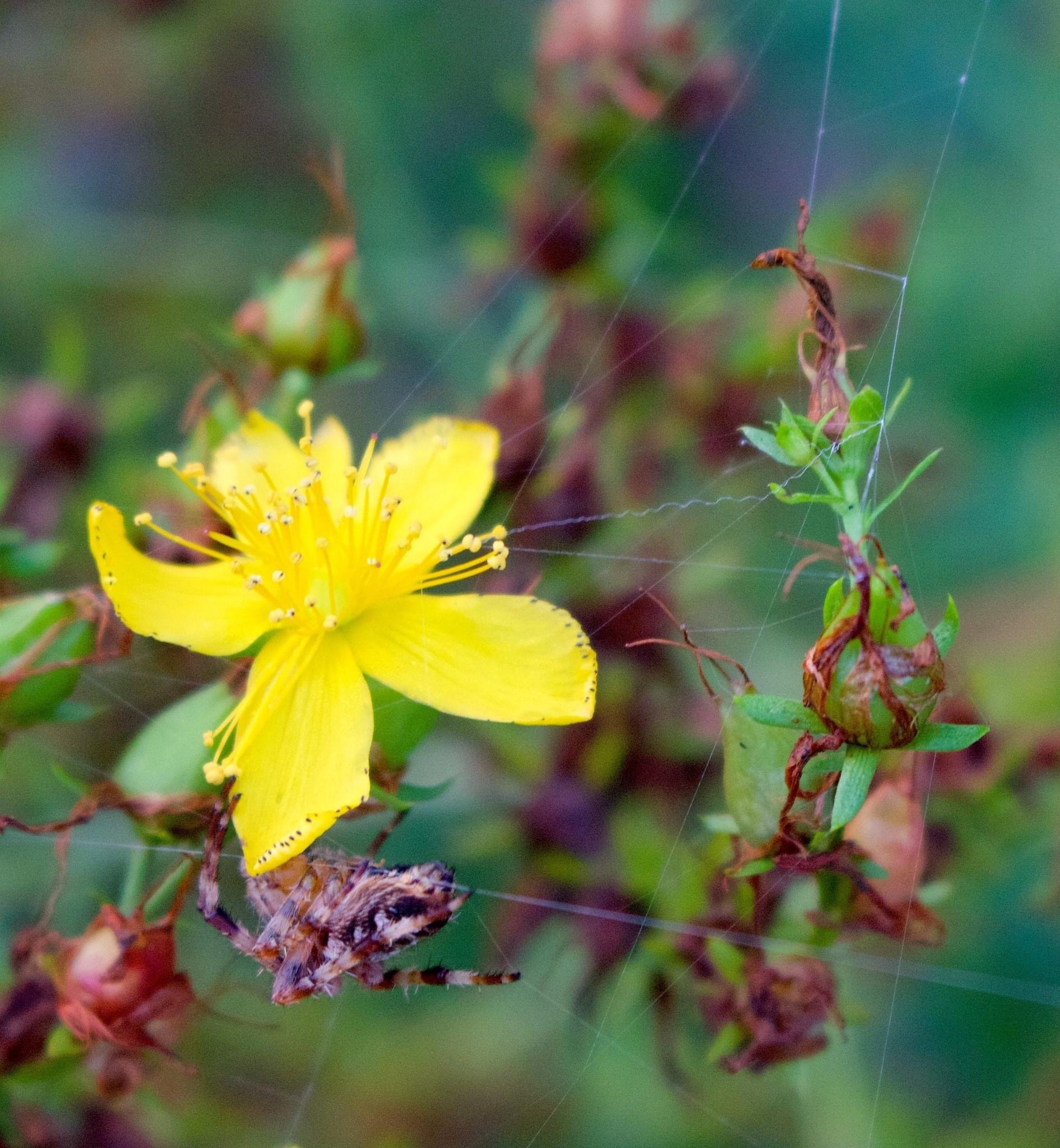
Silk-thin silver strings woven cleverly into a lair, An intricate entwining of divinest thread… Like strands of magic worked upon the air, The spider spins his enchanted web – His home so eerily, spiraling spreads.
His gossamer so rigid, yet lighter than mist, And like an eight-legged sorcerer – a wizard blest, His lace, like a spell, he conjures and knits; I witnessed such wild ingenuity wrought and finessed, Watching the spider weave a dream from his web. ~Jonathan Platt“A Spider’s Web”
I believed only air stretched between the dogwood
and the barberry: another thoughtless human assumption
sidetracking the best story this furrow spider knew to spin.
And, trying to get the sticky filament off my face, I must look,
to the neighbors, like someone being attacked by his own nervous
system, a man conducting an orchestra of bees. Or maybe it’s only the dance
of human history I’m reenacting: caught in his own careless wreckage,
Not everyone is taking a holiday today on Labor Day. Some are busier than ever, creating a masterpiece nightly, then waiting in hope for that labor to be rewarded.
I too spin elaborate dreams at night: some remembered, some bare fragments, some shattered, some potentially yield a meal.
We work because we are hungry. We work because someone we love is hungry and needs feeding.
Yet the best work is the work of weaving dreams ~out of thin air and gossamer strands~ where nothing existed before, not as a trap or lure or lair but as a work of beauty- a gift as welcome as a breath of fresh air.
Lyrics from E.B.White poem “Natural History” The spider, dropping down from twig Unfolds a plan of her devising A thin premeditated rig To use in rising
And all that journey down through space In cool descent and loyal hearted She spins a ladder to the place From where she started
Thus I, gone forth as spiders do In spider’s web a truth discerning Attach one silken thread to you For my returning
Lyrics
Take the silver thread of a spider’s web And spin, spin, spin Silver wings to fly and sing Upon the wind High above the trees, across the seas And through the sky To the rainbow’s bend, where stories never end And dreams never die
One-Time
Monthly
Yearly
Make a one-time or recurring donation to support daily Barnstorming posts
Would you believe I’ve been looking for rain, here, with few days remaining in this fleeting season of summer? Our days are numbered that we might share with the sun in a clear blue sky and the hours growing warmer, and I have kept an eye out for the clouds. Only I wish for the conditions and doubt that might send us all deep inside our dark homes to sleep and read and pray in preparation for the coming colder days. Would you believe that the sight of slate gray spanning horizon to zenith and down is one I am quite taken with? ~David K. Wheeler “The Cold Season” from Contingency Plans
My mother, who hates thunder storms, Holds up each summer day and shakes It out suspiciously, lest swarms Of grape-dark clouds are lurking there; But when the August weather breaks And rains begin, and brittle frost Sharpens the bird-abandoned air, Her worried summer look is lost,
And I her son, though summer-born And summer-loving, none the less Am easier when the leaves are gone Too often summer days appear Emblems of perfect happiness I can’t confront: I must await A time less bold, less rich, less clear: An autumn more appropriate. ~Philip Larkin “Mother, Summer, I”
Summer grass aches and whispers.
It wants something; it calls and sings; it pours out wishes to the overhead stars.
The rain hears; the rain answers; the rain is slow coming; the rain wets the face of the grass. ~Carl Sandberg “Summer Grass”
August rushes by like desert rainfall, A flood of frenzied upheaval, Expected, But still catching me unprepared. Like a match flame Bursting on the scene, Heat and haze of crimson sunsets. Like a dream Of moon and dark barely recalled, A moment, Shadows caught in a blink. Like a quick kiss; One wishes for more But it suddenly turns to leave, Dragging summer away. – Elizabeth Maua Taylor“August”
The endless clear skies of August now broken with exuberant clouds, rain falling in warm gusts, leaves landing on browned ground.
This summer ended up being simply too much – an excess of everything bright and beautiful, meant to make us joyful, yet bold and exhausting in its riches.
From endless hours of daylight, to high rising temperatures and wildfires, to palettes of smoke-filled landscapes to fruitfulness and abundant blooms.
While summer always fills a void after enduring cold spare dark days the rest of the year, I still depend on autumn returning.
I welcome darkening times back, knowing how much I miss those drear twilight months of longing for the overwhelming fullness of summer.
One-Time
Monthly
Yearly
Make a one-time or recurring donation to support daily Barnstorming posts
We have not yet encountered any god who is as merciful as a man who flicks a beetle over on its feet. ~Annie Dillard from The Force That Drives the Flower
What inference might one draw about the nature of God from a study of his works? An inordinate fondness for beetles. The Creator would appear as endowed with a passion for stars, on the one hand, and for beetles on the other. ~ J.B.S. Haldane, British biologist
Indeed, we stranded folk do encounter a God who saves us by flipping us back onto our feet as we lie helplessly waving our arms and legs in the air, so stuck and pitiful.
God knows all about the helplessness of suffering and hears our cry for mercy.
Once we are righted back to our feet, we walk forth forever changed – restored to the world, ready to help anyone we encounter who finds themselves stuck upside down in their misery.
When beetles fight these battles in a bottle with their paddles and the bottle’s on a poodle and the poodle’s eating noodles… …they call this a muddle puddle tweetle poodle beetle noodle bottle paddle battle. ~ Dr. Seuss from Fox in Socks
One-Time
Monthly
Yearly
Make a one-time or recurring donation to support daily Barnstorming posts
It’s the immemorial feelings I like the best: hunger, thirst, their satisfaction; work-weariness, earned rest; the falling again from loneliness to love; the green growth the mind takes from the pastures in March; the gayety in the stride of a good team of Belgian mares that seems to shudder from me through all my ancestry. ~Wendell Berry “Goods”
photo by Joel De Waardphoto by Joel De Waard
The plow has savaged this sweet field Misshapen clods of earth kicked up Rocks and twisted roots exposed to view Last year’s growth demolished by the blade.
I have plowed my life this way Turned over a whole history Looking for the roots of what went wrong Until my face is ravaged, furrowed, scarred.
Enough. The job is done. Whatever’s been uprooted, let it be Seedbed for the growing that’s to come. I plowed to unearth last year’s reasons—
The farmer plows to plant a greening season. ~Parker Palmer “Harrowing”
photo by Joel De Waardphoto by Joel De Waard
It’s not likely anyone would say I didn’t work hard enough.
After all, I come from a long line of human work-horses who knew it takes sweat and tears, and sometimes bleeding.
Even so, all those years I know I could have plowed more deeply than I did.
I could have thrown myself more fully into the pull on the tugs, shared the load more effectively, shouldered the yoke with greater enthusiasm, bent my neck down low with unbroken determination.
You could say somewhere I lost the gayety in my stride, and you would be right — toward the end, I was trudging through the furrow, bruised from turning up too many submerged rocks, bumping into immoveable tree stumps, tripping on hidden roots, stuck in the deep mud of long and lonely post-midnight hours.
You might even say the knowledge of a job well-done lay at a depth my plow could ever reach.
I had seen others die in the harness, never able to rest easy.
A few years ago I knew the time had come to shrug off the yoke, shake off the bridle and bit, shudder free of the harness.
On this side of the ground, I find myself wondering and wandering, the blinkers no longer impeding my vision, feeling the morning sun on my unyoked withers.
Yet when I see an untilled field, something in me even now still tries to hold on to the plow —
photo by Joel De Waardphoto by Joel De Waardphoto by Joel De Waard
One-Time
Monthly
Yearly
Make a one-time or recurring donation to support daily Barnstorming posts
Tonight at dusk we linger by the fence around the garden, watching the wound husks of moonflowers unclench themselves slowly, almost too slow for us to see their moving— you notice only when you look away and back, until the bloom decides, or seems to decide, the tease is over, and throws its petals backward like a sail in wind, a suddenness about this as though it screams, almost the way a newborn screams at pain and want and cold, and I still hear that cry in the shout across the garden to say another flower is about to break. I go to where my daughter stands, flowers strung along the vine like Christmas lights, one not yet lit. We praise the world by making others see what we see. So now she points and feels what must be pride when the bloom unlocks itself from itself. And then she turns to look at me. ~James Davis May “Moonflowers” from32 Poems Magazine
When once the sun sinks in the west, And dewdrops pearl the evening’s breast; Almost as pale as moonbeams are, Or its companionable star, The evening primrose opes anew Its delicate blossoms to the dew; And, hermit-like, shunning the light, Wastes its fair bloom upon the night, Who, blindfold to its fond caresses, Knows not the beauty it possesses; Thus it blooms on while night is by; When day looks out with open eye, Bashed at the gaze it cannot shun, It faints and withers and is gone. ~John Clare “Evening Primrose”
Ever since I was a kid, I have needed to share with others something special I’ve seen — a “hey, take a look at this!” moment so I can witness it again through their eyes.
Sharing can make it even sweeter.
Sometimes others see what I see; sometimes not. Sometimes others wonder what has gotten into me.
I was an odd farm kid, no question: a summer twilight’s entertainment might be watching evening primrose blossoms open at night.
Evening primrose and moonflower are night blooming plants meant to attract pollinating moths.
At dusk, (one could set one’s watch by the primrose’s punctuality) one green wrapped bud per stem would open, revealing a bright yellow blossom with four delicate veined petals, a rosette of stamens and a cross-shaped stigma in the center, rising far above the blossom. The yellow was so vivid and lively, it seemed almost like a drop of sun was left on earth to light the night. By morning, the bloom would begin to wither and wilt under the real sunlight, somehow overcome with the brightness, and would blush a pinkish orange as it folded upon itself, ready to die and drop from the plant in only a day or two, leaving a bulging seed pod behind.
As a kid, I would settle cross-legged on our damp lawn at twilight to watch the choreography of the opening of evening primrose blossoms. With diminishing light and cooler temperatures, there would be a sudden loosening of the protective green husk, an almost audible release. Then over the course of about a minute, the overlapping yellow petals would unfurl, slowly, gently and purposefully in an unlocking action that revealed their pollen treasure trove inside.
It was like watching time lapse cinematography, only this was an accelerated, real time flourish of sudden beauty, happening right before my eyes.
It was magic. I always felt privileged to witness each unveiling as so few flowers ever allow us to behold their unfolding.
On those lazy summer evenings, my younger brother wasn’t nearly as impressed when I tried to lure him into becoming flower-audience along with me. That’s okay; I was always underwhelmed by the significance of his favorite football team’s touchdowns that he insisted on sharing with me.
He was sure my priorities were screwy.
Possibly he was right. Even so, I wanted you all to know about something so special as a flower knowing exactly the best time to open to attract nocturnal pollinators, and manages it in under a minute, all because the waning light and cooler temperatures causes a sudden rush of cellular fluid into the bottom hinges of the petals, forcing them to pop open.
What a smart plant. What an even smarter God, worthy of praise.
One-Time
Monthly
Yearly
Make a one-time or recurring donation to support daily Barnstorming posts