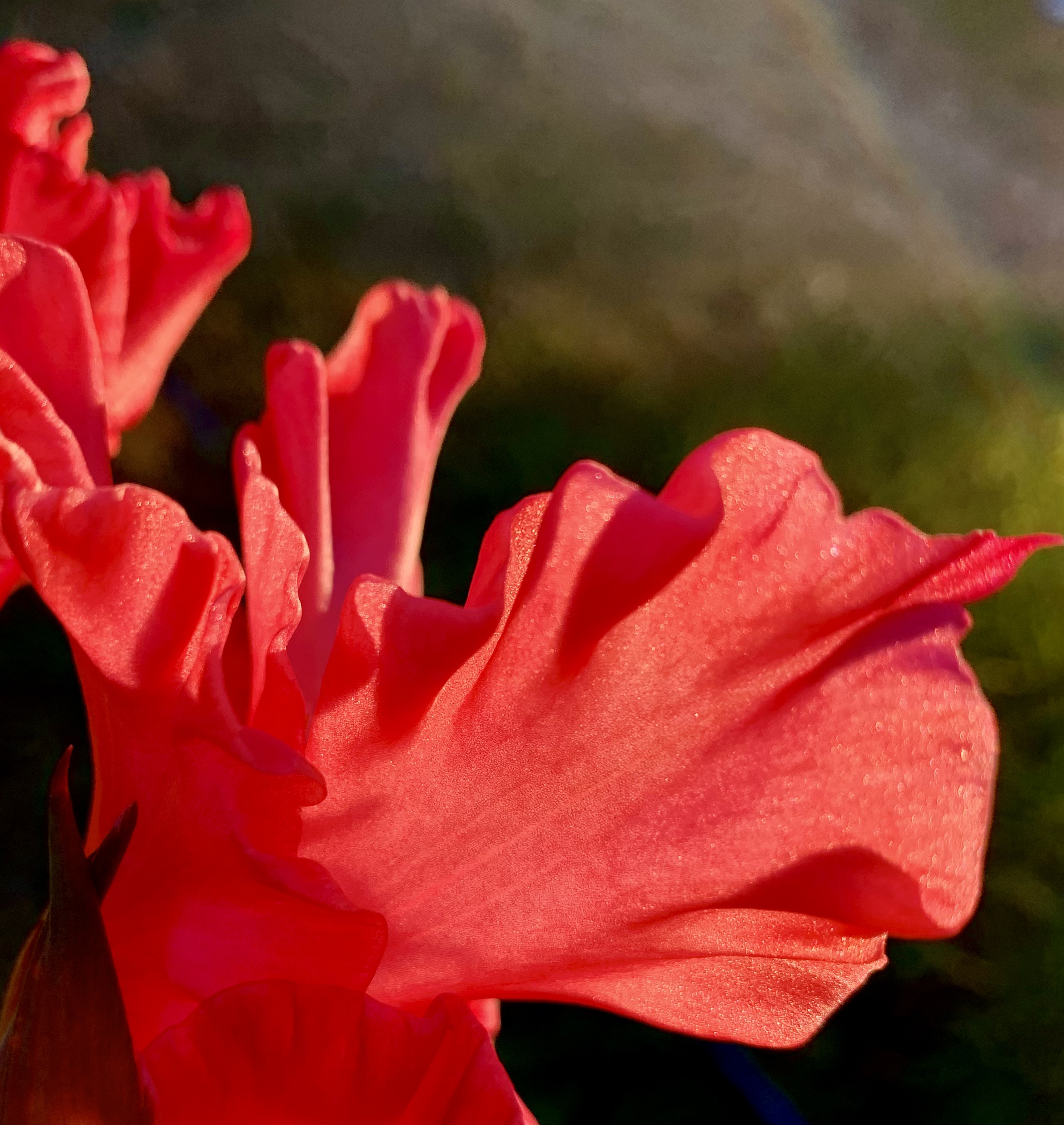
The way the trees empty themselves of leaves, let drop their ponderous fruit, the way the turtle abandons the sun-warmed log, the way even the late-blooming aster succumbs to the power of frost—
this is not a new story. Still, on this morning, the hollowness of the season startles, filling the rooms of your house, filling the world with impossible light, improbable hope.
And so, what else can you do but let yourself be broken and emptied? What else is there but waiting in the autumn sun? ~Carolyn Locke “What Else?” from The Place We Become
So this is how life goes:
we are sowed, set down roots, bud and grow and flower and bloom and fruit and flourish,
then dry and change and wither and empty and break away to be carried off beyond this air and water and soil.
We thrive where we are planted, do what we could with a little nurture, then transcend the here and now.
So shall we plant the next generation in healthy soil. May we weed and water and feed as needed. May we never seek to overshadow the sun but step aside so its light fully shines on whoever comes next.
One-Time
Monthly
Yearly
Make a one-time or recurring donation to support daily Barnstorming posts
And that is just the point… how the world, moist and beautiful, calls to each of us to make a new and serious response.
That’s the big question, the one the world throws at you every morning. “Here you are, alive. Would you like to make a comment?” ~Mary Oliver“The Morning Poem”
It is impossible to stay a silent observer of the world when you awake still alive.
An autumn morning demands a response.
I would like to make a comment.
It isn’t only nature pulling what was once lush and young into the ground: we witness flying leaves and dropping temperatures giving way to brisk winds and chill rains.
Humankind, like the change in seasons, is skilled at dying: we face violence across borders, nurture hatred which blusters, rips, drenches, encompasses, buries.
Nothing can remain as it was.
Yet I awake, lit and alive, struck and wrung by vanishing darkness, a witness to the sun rising up to catch the moon.
Called to comment. Dying to respond.
One-Time
Monthly
Yearly
Make a one-time or recurring donation to support daily Barnstorming posts
St. Cyril of Jerusalem, in instructing catechumens, wrote: “The dragon sits by the side of the road, watching those who pass. Beware lest he devour you. We go to the Father of Souls, but it is necessary to pass by the dragon.”
No matter what form the dragon may take, it is of this mysterious passage past him, or into his jaws, that stories of any depth will always be concerned to tell, and this being the case, it requires considerable courage at any time, in any country, not to turn away from the storyteller. ~Flannery O’Connor from “Mystery and Manners: Occasional Prose”
How close the clouds press this October first and the rain—a gray scarf across the sky. In separate hospitals my father and a dear friend lie waiting for their respective operations, hours on a table as surgeons crack their chests. They were so brave when I talked to them last as they spoke of the good times we would share in the future. To neither did I say how much I loved them, nor express the extent of my fear. Their bodies are delicate glass boxes at which the world begins to fling its stones. Is this the day their long cry will be released? How can I live in this place without them? But today is also my son’s birthday. He is eight and beginning his difficult march. To him the sky is welcoming, the road straight. Far from my house he will open his presents— a book, a Swiss army knife, some music. Where is his manual of instructions? Where is his map showing the dark places and how to escape them? ~Stephen Dobyns “No Map” from Velocities:New and Selected Poems
Fairy tales do not tell children the dragons exist. Children already know that dragons exist. Fairy tales tell children the dragons can be killed. ~G.K. Chesterton from Tremendous Trifles
No, this is not the end— hardly an end, but a hard beginning. There will always be a morning— a rebirth.
So, here in the dark— in a night bleaker than bleak— in a time outside of time— there is a mark on the Holy map of your soul where you found your Maker in the hard, dark night— and then lived to see the light of dawn. ~Kimberly Phinney from“An Ode to Hard, Dark Nights
May it be a light to you in dark places, when all other lights go out. ~J.R.R. Tolkien, The Fellowship of the Ring
<Here there be dragons> was any place on the ancient maps that was unknown and unexplored, a place to avoid at all costs~ or for the daring and carefree, pointing to exactly the place to explore.
<Here there be dragons> marks the remainder of our days that dwell at the edge of life’s roadmap ~ scary, unpredictable, impenetrable ~ and often full of peril.
So many are lost without a map, unable to find their way in the dark, wrecked and wandering, weeping and wretched, believing they have come to the end.
Yet this is not the end, only the beginning. A hard start – all rebirths are hard.
As I have been shown mercy, so I must become mercy, be loving where others show hate, be giving when others take away, build up while others tear down.
We walk together into the emerging light – it’s right there where darkness used to dwell… following God’s holy map of our soul.
On a rusty iron throne Past the furthest star of space I saw Satan sit alone, Old and haggard was his face; For his work was done and he Rested in eternity.
And to him from out the sun Came his father and his friend Saying, now the work is done Enmity is at an end: And he guided Satan to Paradises that he knew.
Gabriel without a frown, Uriel without a spear, Raphael came singing down Welcoming their ancient peer, And they seated him beside One who had been crucified. ~James Stephens “The Fullness of Time”
One-Time
Monthly
Yearly
Make a one-time or recurring donation to support daily Barnstorming posts
“Now my soul is troubled, and what shall I say? ‘Father, save me from this hour’? No, it was for this very reason I came to this hour. Father, glorify your name!”
Then a voice came from heaven, “I have glorified it, and will glorify it again.” The crowd that was there and heard it said it had thundered; others said an angel had spoken to him.
Jesus said, “This voice was for your benefit, not mine. Now is the time for judgment on this world; now the prince of this world will be driven out. And I, when I am lifted up from the earth, will draw all people to myself.” He said this to show the kind of death he was going to die.
The crowd spoke up, “We have heard from the Law that the Messiah will remain forever, so how can you say, ‘The Son of Man must be lifted up’? Who is this ‘Son of Man’?”
Then Jesus told them, “You are going to have the light just a little while longer. Walk while you have the light, before darkness overtakes you. Whoever walks in the dark does not know where they are going. Believe in the light while you have the light, so that you may become children of light.” When he had finished speaking, Jesus left and hid himself from them. John 12: 27- 36
And God held in his hand A small globe. Look he said. The son looked. Far off, As through water, he saw A scorched land of fierce Colour. The light burned There; crusted buildings Cast their shadows: a bright Serpent, A river Uncoiled itself, radiant With slime. On a bare Hill a bare tree saddened The sky. many People Held out their thin arms To it, as though waiting For a vanished April To return to its crossed Boughs. The son watched Them. Let me go there, he said. ~R.S. Thomas “The Coming”
You have answered us with the image of yourself on a hewn tree, suffering injustice, pardoning it; pointing as though in either direction; horrifying us with the possibility of dislocation. Ah, love, with your arms out wide, tell us how much more they must still be stretched to embrace a universe drawing away from us at the speed of light. ~R.S.Thomas “Tell Us”
Some ask for the world and are diminished in the receiving of it. You gave me only this small pool that the more I drink from, the more overflows me with sourceless light. ~R.S. Thomas “Gift”
“Let me go there” And You did.
Knowing what awaited You.
Your arms out wide to embrace us~ we who try to grasp a heaven which eludes us.
This heaven, Your Light You brought down to us, knowing our darkness and our terrible need.
You wanted to come here, knowing all this.
Holding us firmly within your wounded grip, You, the Son, handed us back to heaven.
I am reading slowly through the words in the Book of John over the next year alongside my church family. Once a week, I will invite you to “come and see” what those words might mean as we explore His promises together.
Lyrics: Light after darkness, gain after loss Strength after weakness, crown after cross; Sweet after bitter, hope after fears Home after wandering, praise after tears
Alpha and Omega Beginning and the end He is making all things new Springs of living water Shall wash away each tear He is making all things new Sight after mystery, sun after rain Joy after sorrow, peace after pain; Near after distant, gleam after gloom Love aftеr wandering, life after tomb
Lyrics Lead, kindly light, amidst the grey and gloom The night is long and I am far from home Here in the dark, I do not ask to see The path ahead–one step enough for me Lead on, lead on, kindly light.
I was not ever willing to be led I could have stayed, but I ran instead In spite of fear, I followed my pride My eyes could see, but my heart was blind Lead on, lead on, kindly light.
And in the night, when I was afraid Your feet beside my own on the way Each stumbling step where other men have trod shortens the road leading home to my God Lead on, lead on, my God, my God, lead on, lead on, kindly light.
One-Time
Monthly
Yearly
Make a one-time or recurring donation to support daily Barnstorming posts
You can die for it- an idea, or the world. People have done so, brilliantly, letting their small bodies be bound to the stake, creating an unforgettable fury of light. But this morning, climbing the familiar hills in the familiar fabric of dawn, I thought of China, and India and Europe, and I thought how the sun blazes for everyone just so joyfully as it rises under the lashes of my own eyes, and I thought I am so many! What is my name? What is the name of the deep breath I would take over and over for all of us? Call it whatever you want, it is happiness, it is another one of the ways to enter fire. ~Mary Oliver “Sunrise”
Over the years, I have not missed many early autumn sunrises – most I have not recorded as they are often gray and rainy.
This particular day of September – the 24th – has been a treasure trove of color and cloud patterns and light for the last 12 years. Today I share these with you in their variety and beauty.
Every day, let us watch the sun rise with its light under our eyelashes – the fire of happiness illuminating us all as morning breaks open, like the First Day.
9/24/17 9/24/169/24/159/24/149/24/26 6:53 AM
One-Time
Monthly
Yearly
Make a one-time or recurring donation to support daily Barnstorming posts
Autumn begins to be inferred By millinery of the cloud, Or deeper color in the shawl That wraps the everlasting hill. ~Emily Dickinson from “Summer Begins to Have the Look”
The passing of the summer fills again my heart with strange sweet sorrow, and I find the very moments precious in my palm. Each dawn I did not see, each night the stars in spangled pattern shone, unknown to me, are counted out against me by my God, who charges me to see all lovely things… ~Jane Tyson Clement from “The Passing of Summer”
September’s Baccalaureate A combination is Of Crickets — Crows — and Retrospects And a dissembling Breeze That hints without assuming — An Innuendo sear That makes the Heart put up its Fun And turn Philosopher. ~Emily Dickinson“September’s Baccalaureate”
There’s something in my very blood that owns Bare hills, cold silver on a sky of slate A thread of water, churned to milky spate Streaming through slanted pastures fenced with stones. ~Elinor Wylie from “Wild Peaches”
Summer now is waning and wistful; it has the look of packing up, and moving on without bidding adieu or looking back over its shoulder.
Cooling winds have carried in darkening clouds with a hint of spit from the sky as I gaze upward to see (and smell) the change.
A decent rain is long overdue yet there is temptation to bargain for a little more time. Though we are in need of a good drenching there are still onions and potatoes to pull from the ground, berries to pick before they mold on the vine, tomatoes not yet ripened, corn cobs just too skinny to pick.
I’m not quite ready to wave goodbye to sun-soaked clear skies.
The overhead overcast is heavily burdened with clues of what is coming: earlier dusk, the feel of moisture, the deepening graying hues, the briskness of breezes.
There is no negotiation possible. I need to steel myself and get ready, wrapping myself in the soft shawl of inevitability.
So autumn advances with the clouds, taking up residence where summer has left off. Though there is still clean up of the overabundance left behind, autumn will bring its own unique plans for display of a delicious palette of hues.
The truth is we’ve seen nothing yet.
One-Time
Monthly
Yearly
Make a one-time or recurring donation to support daily Barnstorming posts
I am a dry man whose thirst is praise of clouds, and whose mind is something of a cup. My sweetness is to wake in the night after days of dry heat, hearing the rain. ~Wendell Berry from “Water”
I have had my dream—like others— and it has come to nothing, so that I remain now carelessly with feet planted on the ground and look up at the sky— feeling my clothes about me, the weight of my body in my shoes, the rim of my hat, air passing in and out at my nose—and decide to dream no more. ~William Carlos Williams “Thursday” from Sour Grapes
Open the window, and let the air Freshly blow upon face and hair, And fill the room, as it fills the night, With the breath of the rain’s sweet might.
Not a blink shall burn to-night In my chamber, of sordid light; Nought will I have, not a window-pane, ‘Twixt me and the air and the great good rain, Which ever shall sing me sharp lullabies; And God’s own darkness shall close mine eyes; And I will sleep, with all things blest, In the pure earth-shadow of natural rest. ~James Henry Leigh Hunt from “A Night-Rain in Summer”
We are still waiting for a few late-summer rainy days; each year they are a blissful reminder of God’s intent to refresh and replenish us when we are at our driest, when we are short on sleep and hope and dreams.
How sweet to fall asleep listening in the dark to the patter of raindrops after weeks of drought, waking to damp air, raindrop jewelry, and petrichor.
Perhaps I’ll remember this longing of mine while I grumble and slosh around in the fortieth day of rain this winter.
When will I be satisfied there is just enough but not too much? When will all my dreams seem as real as pulse and breath?
In the meantime, God — let it rain – preferably as I sleep.
Lyrics:
I know your life On earth was troubled And only you could know the pain You weren’t afraid to face the devil You were no stranger to the rain
Go rest high on that mountain Now your work on earth is done Go to heaven a-shoutin’ Love for the Father and the Son
Oh, how we cried the day you left us We gathered ’round your grave to grieve Wish I could see the angels faces When they hear your sweet voice sing
Go to heaven a-shoutin’ Love for the Father and the Son
One-Time
Monthly
Yearly
Make a one-time or recurring donation to support daily Barnstorming posts
Whatever is foreseen in joy Must be lived out from day to day. Vision held open in the dark By our ten thousand days of work. Harvest will fill the barn; for that The hand must ache, the face must sweat.
And yet no leaf or grain is filled By work of ours; the field is tilled And left to grace. That we may reap, Great work is done while we’re asleep.
When we work well, a Sabbath mood Rests on our day, and finds it good. ~Wendell Berry “Sabbath Poem X, 1979″
Why do we bother with the rest of the day, the swale of the afternoon, the sudden dip into evening, then night with his notorious perfumes, his many-pointed stars?
This is the best— throwing off the light covers, feet on the cold floor, and buzzing around the house on espresso— and, if necessary, the windows— trees fifty, a hundred years old out there, heavy clouds on the way and the lawn steaming like a horse in the early morning. ~Billy Collins from “Morning”
photo by Krisula Steiger
He had driven half the night From far down San Joaquin Through Mariposa, up the Dangerous Mountain roads, And pulled in at eight a.m. With his big truckload of hay behind the barn. With winch and ropes and hooks We stacked the bales up clean To splintery redwood rafters High in the dark, flecks of alfalfa Whirling through shingle-cracks of light, Itch of haydust in the sweaty shirt and shoes. At lunchtime under Black oak Out in the hot corral, —The old mare nosing lunchpails, Grasshoppers crackling in the weeds— “I’m sixty-eight” he said, “I first bucked hay when I was seventeen. I thought, that day I started, I sure would hate to do this all my life. And dammit, that’s just what I’ve gone and done.” ~Gary Snyder – “Hay for the Horses” from Riprap and Cold Mountain Poems
Sure enough, I’ve gone and done it — spent over 50 years of my life taking care of horses. I hope for at least a few more years of horsekeeping as long as I am able while our three retired, aging Haflingers stick around.
No one said I had to do this and plenty of people saw it as expensive folly, including a few cherished folks who continue to aid and abet my horse ownership.
When I was young and agile and full of energy, I didn’t really project ahead fifty years to see that picking up hay bales, moving manure piles and being bumped or stepped on by a 1000 pound animal is a bigger deal now than it once was.
Fourteen years ago, I wrote the following on this website:
From September through April, I scramble to the top of the hay pile in the barn to push down two bales to feed to our horses, now that the pastures are resting and “left to grace” for the winter. My husband has been busy spreading our composted manure out on the fields to give them an extra fertilizer boost for next spring’s growth.
As farmers, we have to always be thinking one or two seasons ahead: the hay brought into the barn in June or July does not leave the barn until late-autumn. The manure piled up in winter gets spread on pastures the following fall. The tilled cornfields surrounding us are seeded in May and not harvested until October after several months of rain and sun and rain again.
More than practicing forethought, as farmers we know our meager efforts, as tangible as they are, are dependent solely on grace: that there will be enough rain, that there will not be too much rain, that there will be enough days of sunlight, that the seed will sprout, that the machinery will work when needed, that there will be no blight or pests, and that the hay crew will materialize when needed for harvest. So much of this is not due to the labor of our hands, no matter how much we sweat and ache, but due to the great work of the Creator in His Creation.
Every hay bale I open spills forth His mercy, a reminder of how grateful I am for seed and sun and rain and a barn full of promises.
Despite the hard physical work, fifty years hasn’t changed how I love the smell of a soft muzzle, or seeing my reflection in their eyes.
When I lived in a city apartment so many years ago, I knew I would love to wake up every morning to take care of horses the rest of my life.
A writer should concern himself with whatever absorbs his fancy, stirs his heart, and unlimbers his typewriter. I feel no obligation to deal with politics. I do feel a responsibility to society. A writer has the duty to be good, not lousy; true, not false; lively, not dull; accurate, not full of error. He should tend to lift people up, not lower them down.
A writer must reflect and interpret his society, his world; he must also provide inspiration and guidance and challenge. Much writing today strikes me as deprecating, destructive, and angry. There are good reasons for anger, and I have nothing against anger. But I think some writers have lost their sense of proportion, their sense of humor, and their sense of appreciation.
I am often mad, but I would hate to be nothing but mad: one role of the writer today is to sound the alarm. The environment is disintegrating, the hour is late, and not much is being done. Instead of carting rocks from the moon, we should be carting the feces out of Lake Erie. …I think I would lose what little value I may have as a writer if I were to refuse, as a matter of principle, to accept the warming rays of the sun, and to report them, whenever, and if ever, they happen to strike me. ~E.B. White 1969 (on writing)
It is tiresome always feeling angry about what it is happening in the world, feeling that everything has become political.
I’m tired of reading (and writing) words of frustration, but want to rail against the meanness that surrounds us, and push back the bully to seek out a balance of kindness, perspective and insight.
When I need to feel something other than mad, I walk as far as I can go, look up, revel in the gift of rays of light and bask in their warmth and promise.
I will accept what the Sun has to offer and tell about it so that my anger drains away like so much waste flushed down a pipe, never to be seen again.
Lyrics: Even before we call on Your name To ask You, O God, When we seek for the words to glorify You, You hear our prayer; Unceasing love, O unceasing love, Surpassing all we know.
Glory to the Father, and to the Son, and to the Holy Spirit.
Even with darkness sealing us in, We breathe Your name, And through all the days that follow so fast, We trust in You; Endless Your grace, O endless Your grace, Beyond all mortal dream.
Both now and forever, And unto ages and ages, Amen.
One-Time
Monthly
Yearly
Make a one-time or recurring donation to support daily Barnstorming posts
I go to nature not because its flowers and sunsets speak to me (though they do) or listen to me inquire but because I have filled it with unintentionality, so that I can miss anything personal in the roar of sunset, so that I can in beds of flowers hold my head up too. ~A.R. Ammons from The Ridge Farm from Complete Poems
Take the tangle instead of the trouble it causes. Take the world inside as seriously as any other. Take your elderly mother and father at face value as they have to. Take the mirror of the sky mirrored in the bay. Take the swell of new-mown hay and the river conversing where the valley opens its mouth and the land begins to creak less as the evening steals light away— Take the wick in the far hills and take the sun and the wind and the look of nothing for granted. Take a little less, all right and try not to take fright. Take the end in mind instead of the end in sight. ~Brian Turner “Take This” from Taking Off
God speaks to each of us as he makes us, then walks with us silently out of the night.
These are the words we dimly hear:
You, sent out beyond your recall, go to the limits of your longing. Embody me.
Flare up like a flame and make big shadows I can move in.
Let everything happen to you: beauty and terror. Just keep going. No feeling is final. Don’t let yourself lose me.
Nearby is the country they call life. You will know it by its seriousness.
Each of us, intentionally made by our Creator in His image, yet we discover the beauty and terror of living in His shadow.
So much happens which we don’t intend but there is nothing unintentional with God.
Books and lectures tell us to live intentionally while each day contains something that brings us to our knees.
I tell myself: even though I don’t know what tomorrow will be, I will not take fright Like a flower, I’ll hold my head up I’ll just keep going while taking His Hand and following wherever He intends to take me.
One-Time
Monthly
Yearly
Make a one-time or recurring donation to support daily Barnstorming posts