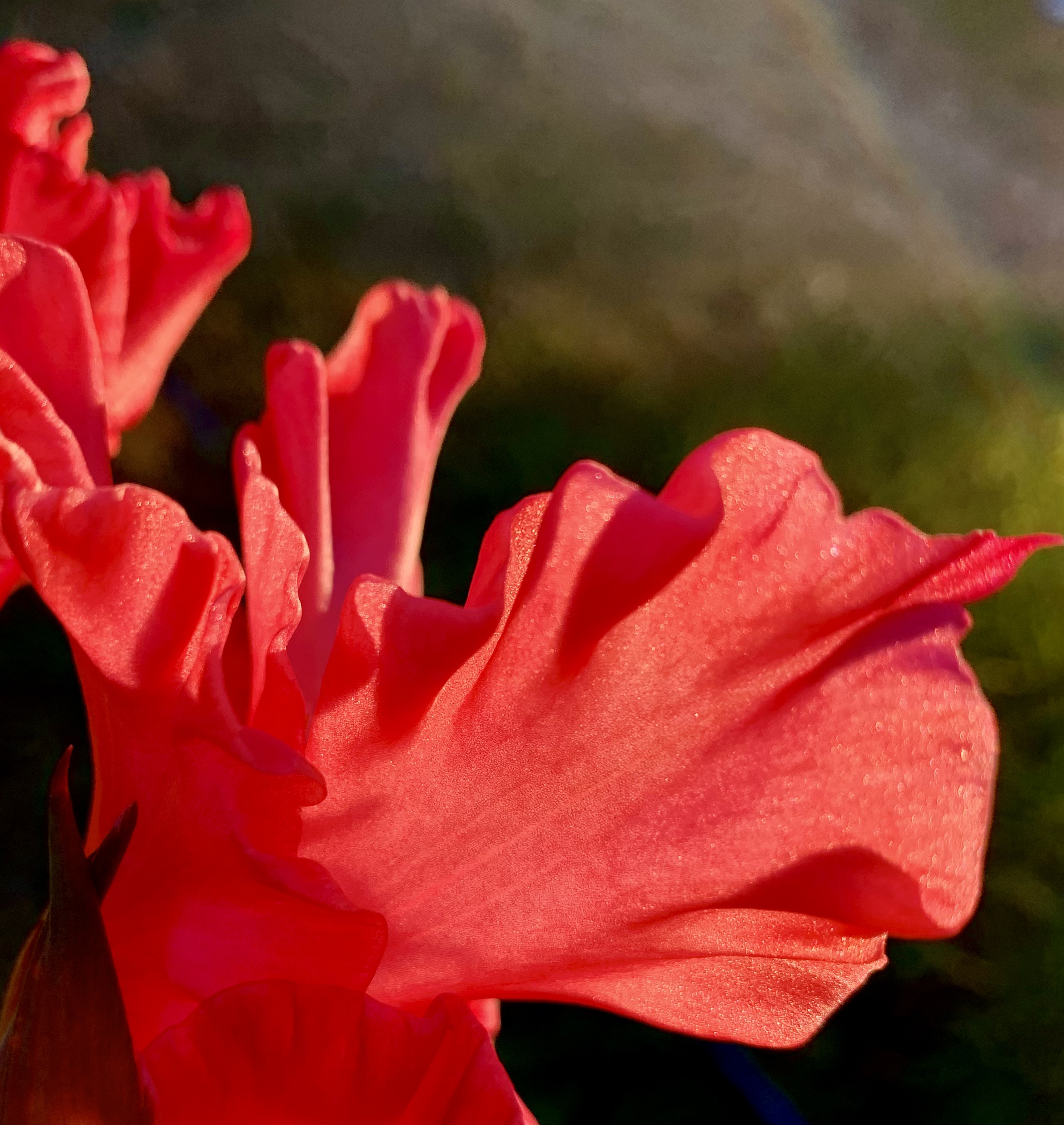
I go to nature not because its flowers and sunsets speak to me (though they do) or listen to me inquire but because I have filled it with unintentionality, so that I can miss anything personal in the roar of sunset, so that I can in beds of flowers hold my head up too. ~A.R. Ammons from The Ridge Farm from Complete Poems
Take the tangle instead of the trouble it causes. Take the world inside as seriously as any other. Take your elderly mother and father at face value as they have to. Take the mirror of the sky mirrored in the bay. Take the swell of new-mown hay and the river conversing where the valley opens its mouth and the land begins to creak less as the evening steals light away— Take the wick in the far hills and take the sun and the wind and the look of nothing for granted. Take a little less, all right and try not to take fright. Take the end in mind instead of the end in sight. ~Brian Turner “Take This” from Taking Off
God speaks to each of us as he makes us, then walks with us silently out of the night.
These are the words we dimly hear:
You, sent out beyond your recall, go to the limits of your longing. Embody me.
Flare up like a flame and make big shadows I can move in.
Let everything happen to you: beauty and terror. Just keep going. No feeling is final. Don’t let yourself lose me.
Nearby is the country they call life. You will know it by its seriousness.
Each of us, intentionally made by our Creator in His image, yet we discover the beauty and terror of living in His shadow.
So much happens which we don’t intend but there is nothing unintentional with God.
Books and lectures tell us to live intentionally while each day contains something that brings us to our knees.
I tell myself: even though I don’t know what tomorrow will be, I will not take fright Like a flower, I’ll hold my head up I’ll just keep going while taking His Hand and following wherever He intends to take me.
One-Time
Monthly
Yearly
Make a one-time or recurring donation to support daily Barnstorming posts
How did I come to be this particular version of me, and not some other, this morning of purple delphiniums blooming like royalty, destined to meet these three dogs asleep at my feet, and not others— this soft summer morning, sitting on her screened porch become ours, our wind chime singing of wind and time, yellow-white digitalis feeding bees and filling me— and more abundance to come: basil, tomatoes, zucchini. What luck or fate, instinct, or grace brought me here— in shade, beneath hidden stars, a soft, summer morning, seeing with my whole being, love made visible. ~Laura Foley “The Once Invisible Garden” from Sledding in the Valley of the Shadow
Suddenly it is August again, so hot, breathless heat. I sit on the ground in the garden of Carmel, picking ripe cherry tomatoes and eating them. They are so ripe that the skin is split, so warm and sweet from the attentions of the sun, the juice bursts in my mouth, an ecstatic taste, and I feel that I am in the mouth of summer, sloshing in the saliva of August. Hummingbirds halo me there, in the great green silence, and my own bursting heart splits me with life. ~Anne Higgins “Cherry Tomatoes” from At the Year’s Elbow
Such still air. Soon the mid-morning breeze will float in like tepid water, then hot.
How do I start this day, I who am unsure of how my life has happened or how to proceed amid this warm and steady sweetness? ~Albert Garcia from “August Morning” from Skunk Talk
Write it in your heart that every day is the best day of the year. Live in the sunshine, swim in the sea, breathe the wild air. Finish each day and be done with it. You have done what you could. Some blunders and absurdities no doubt crept in; forget them as soon as you can. Tomorrow is a new day. You shall begin it serenely and with too high a spirit to be encumbered with your old nonsense. ~Ralph Waldo Emerson from Collected Poems and Translations
She has done what she could… ~Mark 14:8
How do I start this gift of a new August summer day?
When sleep is elusive, the air too still and warm at midnight When even a cloud-strewn sky looks dry When wildfire smoke drifts in on waves from north and east, obscuring, rounding out the sharp edges
Yet I taste the sweetness offered this tepid summer morning, unencumbered by my old over-thinking nonsense.
I’m here, present and accounted for, blessed by all I see. I am doing what I can. Let the day begin.
Even After All this time The sun never says to the earth,
“You owe Me.”
Look What happens With a love like that, It lights the Whole Sky. ~Daniel Ladinsky, from “The Gift”
One-Time
Monthly
Yearly
Make a one-time or recurring donation to support daily Barnstorming posts
How easily happiness begins by dicing onions. A lump of sweet butter slithers and swirls across the floor of the sauté pan, especially if its errant path crosses a tiny slick of olive oil. Then a tumble of onions.
This could mean soup or risotto or chutney (from the Sanskrit chatni, to lick). Slowly the onions go limp and then nacreous and then what cookbooks call clear, though if they were eyes you could see
clearly the cataracts in them. It’s true it can make you weep to peel them, to unfurl and to tease from the taut ball first the brittle, caramel-colored and decrepit papery outside layer, the least
recent the reticent onion wrapped around its growing body, for there’s nothing to an onion but skin, and it’s true you can go on weeping as you go on in, through the moist middle skins, the sweetest
and thickest, and you can go on in to the core, to the bud-like, acrid, fibrous skins densely clustered there, stalky and in- complete, and these are the most pungent, like the nuggets of nightmare
and rage and murmury animal comfort that infant humans secrete. This is the best domestic perfume. You sit down to eat with a rumor of onions still on your twice-washed hands and lift to your mouth a hint
of a story about loam and usual endurance. It’s there when you clean up and rinse the wine glasses and make a joke, and you leave the minutest whiff of it on the light switch, later, when you climb the stairs. ~William Matthews “Onions”
I don’t mean to make you cry. I mean nothing, but this has not kept you From peeling away my body, layer by layer,
The tears clouding your eyes as the table fills With husks, cut flesh, all the debris of pursuit. Poor deluded human: you seek my heart.
Hunt all you want. Beneath each skin of mine Lies another skin: I am pure onion–pure union Of outside and in, surface and secret core.
…It’s true it can make you weep to peel them, to unfurl and to tease from the taut ball first the brittle, caramel-colored and decrepit papery outside layer, the least
recent the reticent onion wrapped around its growing body, for there’s nothing to an onion but skin, and it’s true you can go on weeping as you go on in, through the moist middle skins, the sweetest
and thickest, and you can go on in to the core, to the bud-like, acrid, fibrous skins densely clustered there, stalky and in- complete, and these are the most pungent… ~William Matthews from “Onions”
…I would never scold the onion for causing tears. It is right that tears fall for something small and forgotten. How at meal, we sit to eat, commenting on texture of meat or herbal aroma but never on the translucence of onion, now limp, now divided, or its traditionally honorable career: For the sake of others, disappear. ~Naomi Shihab Nye from “The Traveling Onion” from Words Under the Words: Selected Poems.
Onion, luminous flask, your beauty formed petal by petal, crystal scales expanded you and in the secrecy of the dark earth your belly grew round with dew. Under the earth the miracle happened and when your clumsy green stem appeared, and your leaves were born like swords in the garden, the earth heaped up her power showing your naked transparency…
…You make us cry without hurting us. I have praised everything that exists, but to me, onion, you are more beautiful than a bird of dazzling feathers, heavenly globe, platinum goblet, unmoving dance of the snowy anemone
and the fragrance of the earth lives in your crystalline nature. ~Pablo Neruda from “Ode to the Onion”
Everything smells of “eau de onion” here in the kitchen when the onions are brought in from our garden to be stored or dehydrated and frozen for winter soups and stews.
This is weepy business, but these are good tears like I spill over the whistled Greensleeves theme from the old “Lassie” TV show, or during any childrens’ choir song, or by simply watching videos of our grandchildren who live too far away to visit every day.
It takes almost nothing these days to make me weep, so onions are a handy excuse, allowing my tears to flow without explanation:
I weep over the headlines.
I weep over how messy things can get between people who don’t listen to one another or who misinterpret what they think they hear.
I weep knowing we all have layers and layers of skin that appear tough on the outside, but as you peel gently or even ruthlessly cut them away, the layers get more and more tender until you reach the throbbing heart of us.
We tend to hide our hearts out of fear of being hurt, crying out in pain.
Like an onion, each one of us exists to make the day a bit better, the meal more savory, to enhance the flavors of all who are mixed into this melting pot together, trying to make sad things new.
We aren’t meant to stand alone, but to disappear into the stew, and be sorely missed if we are absent.
So very dish needs an onion, and for the sake of the dish, every onion vanishes in the process.
No, I don’t mean to make you cry as you peel my layers away, gently, one by one, each more tender until you reach my heart. Chop away at me if you must but weep the good tears, the ones that mean we weep for the sake of our meal together: you eating and drinking, and me – consumed.
Lyrics: When the dark wood fell before me And all the paths were overgrown When the priests of pride say there is no other way I tilled the sorrows of stone
I did not believe because I could not see Though you came to me in the night When the dawn seemed forever lost You showed me your love in the light of the stars
Chorus: Cast your eyes on the ocean Cast your soul to the sea When the dark night seems endless Please remember me
Then the mountain rose before me By the deep well of desire From the fountain of forgiveness Beyond the ice and fire
Though we share this humble path, alone How fragile is the heart Oh, give these clay feet wings to fly To touch the face of the stars
Breathe life into this feeble heart Lift this mortal veil of fear Take these crumbled hopes, etched with tears We’ll rise above these earthly cares
Lyrics: Light after darkness, gain after loss Strength after weakness, crown after cross; Sweet after bitter, hope after fears Home after wandering, praise after tears
Alpha and Omega Beginning and the end He is making all things new Springs of living water Shall wash away each tear He is making all things new Sight after mystery, sun after rain Joy after sorrow, peace after pain; Near after distant, gleam after gloom Love aftеr wandering, life after tomb
One-Time
Monthly
Yearly
Make a one-time or recurring donation to support daily Barnstorming posts
Light wakes us – there’s the sun climbing the mountains’ rim, spilling across the valley, finding our faces. It is July, between the hay and harvest, a time at arm’s length from all other time, the roads ragged with meadowsweet and mallow, with splays of seedheads, slubbed and coarse, rough linen. The fields above the house, clotted with sheep all spring, are empty now and froth with flowering grasses, still in the morning light. Birds move around the leafy fields, the leafy garden.
It is the time to set aside all vigil, good or ill, to loosen the fixed gaze of our attention as dandelions let seedlings to the wind. Wake with the light. Get up and go about the day and watch its surfaces that brighten with the sun.
And later, when the light is drowsed and heavy go find the burdened fruit trees where the shade lies splashed and opened-out across the ground. Spread over it a quilt worn soft by other bodies, then curl and fall down into sleep at light.
Awaken to a world of long, loose grass-stems, and leaves above, and birds, breaking out of the leaves. ~Kerry Hardie from “Sleep in Summer”
Saying good-bye to July last week meant admitting summer is already half-baked and so are we–
we who are still doughy, not nearly done enough.
The rush to autumn is breathless. We want to hold on tight to our longish days, fall asleep in the grasses, endure sweaty nights for just a little while longer…
Please, oh please grant us unending light and steady us for the task of getting ready for letting go.
A new series of summer photo notecards from our farm is now available as a thank you gift to you for your financial support of Barnstorming — details here
One-Time
Monthly
Yearly
Make a one-time or recurring donation to support daily Barnstorming posts
I spent seven hours yesterday at my daughter’s house helping her expand their garden by at least ten times. We dug up sod by the shovelful, shook off the dirt as best we could; sod into the wheelbarrow and off to the pile at the edge of the yard. Then all that over and over again. Five hours total work-time, with time out for lunch and supper. By the time I got home I knew all too well that seventy-two is not thirty-five; I could barely move.
I got to quit earlier than Nadine. She told me I’d done enough and that I should go get a beer and lie down on the chaise lounge and cheer her on, which is what I did.
All this made me remember my father forty years ago helping me with my garden. My father’s dead now, and has been dead for many years, which is how I’ll be one of these days too. And then Nadine will help her child, who is not yet here, with her garden. Old Nadine, aching and sore, will be in my empty shoes, cheering on her own.
So it goes. The wheel turns, generation after generation, around and around. We ride for a little while, get off and somebody else gets on. Over and over, again and again. ~David Budbill “Seventy-Two Is Not Thirty-Five” from Tumbling toward the End
The wheel turns, we cycle around again, get on and eventually get off. This is a week of July birthdays in our family, for both old and young.
This hit me when we celebrated our grandson’s third birthday a few days ago in a suburban backyard where my daughter has continued the Gibson/Polis gardening tradition, using the compost we hauled in our truck from our farm several hours away.
Her peas were full and ripe and juicy, her greens lush and tasty – simple perfection thanks to her careful tending.
Meanwhile, our son gardens with his three boys in a very small urban backyard in Denver, teaching them what is weed and what will become a future meal.
I couldn’t help but get weepy, enjoying that special birthday feast.
…and knowing someday, our grandsons will plant and weed and harvest from the soil just as we and their parents did, over and over, again and again.
And this is why my eyes are closed It’s just as well for all I’ve seen And so it goes, and so it goes And you’re the only one who knows ~Billy Joel
One-Time
Monthly
Yearly
Make a one-time or recurring donation to support daily Barnstorming posts
Light and wind are running over the headed grass as though the hill had melted and now flowed. ~Wendell Berry “June Wind” from New Collected Poems
Cut grass lies frail: Brief is the breath Mown stalks exhale. Long, long the death
It dies in the white hours Of young-leafed June With chestnut flowers, With hedges snowlike strewn,
White lilac bowed, Lost lanes of Queen Anne’s lace, And that high-builded cloud Moving at summer’s pace. ~Philip Larkin “Cut Grass” from The Complete Poems
June is the month when grass grows exponentially, taking over all open spaces and every nook and cranny
Light and wind work magic on a field of flowing tall grass. The blades of the mower lay it to the ground in green streams that course up and down the slopes. It lies orderly in stoneless cemetery rows.
Farmer’s fields are lined with rows of mown grass, a precious commodity to be harvested for the livestock to eat the rest of the year. Some of the green is bagged up like big marshmallows for easy storage and some put in silos for later in the winter.
The shorn grass is critical to the life of the animals we raise.
What was once waving and bowing to the wind is cut and crushed: no longer bending but bent, no longer flowing but flown, no longer growing but mown.
At summer’s pace, while the clouds saunter overhead, grasses are stored as fodder for the beasts of the farm on those cold nights when the wind beats at the doors.
It will melt in their mouths. As we watch them chew, we’ll remember overflowing abundance of those summer days in June.
One-Time
Monthly
Yearly
Make a one-time or recurring donation to support daily Barnstorming posts
…I saw a mom take her raincoat off and give it to her young daughter when a storm took over the afternoon. My god, I thought, my whole life I’ve been under her raincoat thinking it was somehow a marvel that I never got wet. ~Ada Limón from “The Raincoat”
My mother, Elna Schmitz Polis, was born 106 years ago today in the lonely isolation of a Palouse wheat and lentil farm in eastern Washington. She drew her first breath in a two story white house located down a long poplar-lined lane and nestled in a draw between the undulating hills.
She attended a one room school house until 8th grade, located a mile away in the rural countryside, then moved in with her grandmother “in town” in Rosalia to attend high school, seeing her parents only a couple times a month.
It was a childhood which accustomed her to solitude and creative play inside her mind and heart – her only sibling, an older brother, was busy helping their father on the farm. All her life and especially in her later years, she would prefer the quiet of her own thoughts over the bustle of a room full of activities and conversation.
Her childhood was filled with exploration of the rolling hills, the barns and buildings where her father built and repaired farm equipment, and the chilly cellar where the fresh eggs were stored after she reached under cranky hens to gather them. She sat in the cool breeze of the picketed yard, watching the huge windmill turn and creak next to the house. She helped her weary mother feed farm crews who came for harvest time and then settled in the screened porch listening to the adults talk about lentil prices and bushel production. She woke to the mourning dove call in the mornings and heard the coyote yips and howls at night.
She nearly died at the age of 13 from a ruptured appendix, before antibiotics were an option. That near-miss haunted her life-long, filling her with worry that it was a mistake that she survived that episode at all. Yet she thrived despite the anxiety, and ended up, much to her surprise, living a long life full of family and faith, letting go at age 88 after fracturing a femur, which also broke her will to live.
As a young woman, she was ready to leave the wheat farm behind for college, devoting herself to the skills of speech, and the creativity of acting and directing in drama, later teaching rural high school students, including a future Pulitzer Prize winning poet, Carolyn Kizer. She loved words and the power and beauty they wielded.
Marrying my father was a brave and impulsive act, traveling by train to the east coast only a week before he shipped out for almost 3 years to the South Pacific to fight as a Marine in WWII. She must have wondered about the man who returned from war changed and undoubtedly scarred in ways she could not see or touch. They worked it out mostly in silence, as rocky as it must have been at times.
Her episode of Graves’ disease, before I was born, must have been agonizing for both of them and my older sister, as her storm of thyroid overactivity resulted in months of sleepless full time panic. Only thyroid removal saved her, but radical surgeries take their toll. Their marriage never fully recovered.
In their reconciliation after a painful divorce decades later, I finally could see the devotion and mutual respect between life companions who had finally found shared purpose and love.
As a wife and mother, she rediscovered her calling as a steward of the land and a tireless steward of her family, gardening and harvesting fruits, vegetables and us children. When I think of my mother, I most often think of her tending us children in the middle of the night whenever we were ill; her over-vigilance was undoubtedly due to her worry we might die in childhood, as she almost did.
She never did stop worrying until the last few months. As she became more dependent on others in her physical decline, she gave up the control she thought she had to maintain through her “worry energy” and became much more accepting about the control the Lord maintains over all we are and will become.
I know from where my shyness comes, my preference for birdsongs rather than radio music, my love of naps, and my tendency to be serious and straight-laced with a twinkle in my eye. This is my German-Palouse side–immersing in the quietness of solitude, thrilling to the sight of the spring wheat flowing like a green ocean wave in the breeze and appreciating the warmth of rich soil held in my hands.
My mother came from that heritage and it is the legacy she left with me. I am forever grateful for her unconditional love to the end of her life; her willingness to share the sunshine and warmth of her nest whenever we felt the need to fly back home and shelter, overprotected but safe nonetheless, under her wings.
One-Time
Monthly
Yearly
Make a one-time or recurring donation to support daily Barnstorming posts
Imagine you wake up with a second chance: How good to rise in sunlight, in the prodigal smell of biscuits – eggs and sausage on the grill. The whole sky is yours
to write on, blown open to a blank page. Come on, shake a leg! You’ll never know who’s down there, frying those eggs, if you don’t get up and see. ~Rita Dover “Dawn Revisited” from On the Bus with Rosa Parks
Jesus said to them, “Come and have breakfast…” John 21:12a
The world begins at a kitchen table. No matter what, we must eat to live.
The gifts of earth are brought and prepared, set on the table. So it has been since creation, and it will go on.
We chase chickens or dogs away from it. Babies teethe at the corners. They scrape their knees under it.
It is here that children are given instructions on what it means to be human. We make men at it, we make women.
At this table we gossip, recall enemies and the ghosts of lovers.
Our dreams drink coffee with us as they put their arms around our children. They laugh with us at our poor falling-down selves and as we put ourselves back together once again at the table.
This table has been a house in the rain, an umbrella in the sun.
Wars have begun and ended at this table. It is a place to hide in the shadow of terror. A place to celebrate the terrible victory.
We have given birth on this table, and have prepared our parents for burial here.
At this table we sing with joy, with sorrow. We pray of suffering and remorse. We give thanks.
Here we sit as evening falls Like old horses in their stalls. Thank you, Father, that you bless Us with food and an address And the comfort of your hand In this great and blessed land. Look around at each dear face, Keep each one in your good grace. We think of those who went before, And wish we could have loved them more. Grant to us a cheerful heart, Knowing we must soon depart To that far land to be with them. And now let’s eat. Praise God. Amen. ~Gary Johnson “Table Grace”
Our life revolves around the table, whether at home or at church.
This is where we hang out late into the evening, and begin the day before dawn.
This is where prayer happens, our meals eaten, stories told, arguments ensue and ease.
This is where we listen to, understand and love each other through smiles and tears.
This is where we share what we have and eat and are fed and this is where God provides for us daily.
We think of those who went before and wish that we could have loved them more.
So let us love one another now, while we can, when we can, and we shall feast together.
Perhaps the world will end at the kitchen table, while we are laughing and crying, eating of the last sweet bite.
Amen and Amen.
One-Time
Monthly
Yearly
Make a one-time or recurring donation to support daily Barnstorming posts
Meanwhile his disciples urged him, “Rabbi, eat something.”But he said to them, “I have food to eat that you know nothing about.”Then his disciples said to each other, “Could someone have brought him food?”
“My food,” said Jesus, “is to do the will of him who sent me and to finish his work. Don’t you have a saying, ‘It’s still four months until harvest’? I tell you, open your eyes and look at the fields! They are ripe for harvest. Even now the one who reaps draws a wage and harvests a crop for eternal life, so that the sower and the reaper may be glad together.Thus the saying ‘One sows and another reaps’ is true. I sent you to reap what you have not worked for. Others have done the hard work, and you have reaped the benefits of their labor.”
Many of the Samaritans from that town believed in him because of the woman’s testimony, “He told me everything I ever did.” So when the Samaritans came to him, they urged him to stay with them, and he stayed two days.And because of his words many more became believers.
They said to the woman, “We no longer believe just because of what you said; now we have heard for ourselves, and we know that this man really is the Savior of the world.” John 4: 31-42
The grower of trees, the gardener, the man born to farming, whose hands reach into the ground and sprout, to him the soil is a divine drug. He enters into death yearly, and comes back rejoicing. He has seen the light lie down in the dung heap, and rise again in the corn. His thought passes along the row ends like a mole. What miraculous seed has he swallowed that the unending sentence of his love flows out of his mouth like a vine clinging in the sunlight, and like water descending in the dark? ~Wendell Berry “The Man Born to Farming” from Farming: A Handbook
My dad had a standard sign-off whenever I called my parents long-distance once a week from college.
He always said, “you know what you’re there for…”
At first I puzzled over that phrase. I knew I was in school to study and get a degree, but what was going to happen after that was still an unknown. Yet the weekly reminder was a good one. He was telling me that I was a seed sown in rich soil, and what I learned would help me grow and thrive as long as I remembered to put my roots down and drink deeply from that well of knowledge.
So it was with the Samaritan woman at the well – Jesus waited for her in the heat of the day for a reason. She was a seed sown, meant to bring others to share in the harvest of the good news she had heard.
So we too are here for a purpose. We truly need one another, to become interwoven and linked, both visibly and invisibly.
I am woven around you and you around me; together we grow and thrive when tended and — just as intended.
But more than anything, we need our Gardener. We are sown, nurtured, grown under His care. He knows what we are here for, and now, so do we.
I am reading slowly through the words in the Book of John over the next year. Once a week, I invite you to “come and see” what those words might mean as we explore His promises together.Past posts can be found by searching “Come and See” on this blog.
One-Time
Monthly
Yearly
Make a one-time or recurring donation to support daily Barnstorming posts
On the third day a wedding took place at Cana in Galilee. Jesus’ mother was there,and Jesus and his disciples had also been invited to the wedding. When the wine was gone, Jesus’ mother said to him, “They have no more wine.”
“Woman, why do you involve me?” Jesus replied. “My hour has not yet come.”
His mother said to the servants, “Do whatever he tells you.”
Nearby stood six stone water jars, the kind used by the Jews for ceremonial washing, each holding from twenty to thirty gallons.
Jesus said to the servants, “Fill the jars with water”; so they filled them to the brim.
Then he told them, “Now draw some out and take it to the master of the banquet.”
They did so, and the master of the banquet tasted the water that had been turned into wine. He did not realize where it had come from, though the servants who had drawn the water knew. Then he called the bridegroom asideand said, “Everyone brings out the choice wine first and then the cheaper wine after the guests have had too much to drink; but you have saved the best till now.”
What Jesus did here in Cana of Galilee was the first of the signs through which he revealed his glory; and his disciples believed in him.
After this he went down to Capernaum with his mother and brothers and his disciples. There they stayed for a few days. John 2: 1-12
St. John tells how, at Cana’s wedding feast, The water-pots poured wine in such amount That by his sober count There were a hundred gallons at the least.
It made no earthly sense, unless to show How whatsoever love elects to bless Brims to a sweet excess That can without depletion overflow.
Which is to say that what love sees is true; That this world’s fullness is not made but found. Life hungers to abound And pour its plenty out for such as you. ~Richard Wilbur from “A Wedding Toast”
In sleep his infant mouth works in and out. He is so new, his silk skin has not yet been roughed by plane and wooden beam nor, so far, has he had to deal with human doubt.
He is in a dream of nipple found, of blue-white milk, of curving skin and, pulsing in his ear, the inner throb of a warm heart’s repeated sound.
His only memories float from fluid space. So new he has not pounded nails, hung a door broken bread, felt rebuff, bent to the lash, wept for the sad heart of the human race. ~Luci Shaw “Kenosis”from Waiting on the Word
Experiencing the present purely is being emptied and hollow; you catch grace as a man fills his cup under a waterfall. ~Annie Dillard from Pilgrim at Tinker Creek
The world is filled, and filled with the Absolute.To see this is to be made free. ~Pierre Teilhard de Chardin from Hymn of the Universe
My mouth will utter praise of the Lord, of the Lord through whom all things have been made and who has been made amidst all things; who is the Revealer of His Father, Creator of His Mother; who is the Son of God from His Father without a mother, the Son of Man through His mother without a father.
He is as great as the Day of Angels, and as small as a day in the life of men; He is the Word of God before all ages, and the Word made flesh at the destined time. Maker of the sun, He is made beneath the sun.
In His Father He abides; from His mother He goes forth. Creator of heaven and earth, under the heavens He was born upon earth.
Wise beyond all speech, as a speechless child, He is wise. Filling the whole world, He lies in a manger. Ruling the stars, He nurses at His mother’s breast. He is great in the form of God and small in the form of a servant, so much so that His greatness is not diminished by His smallness, nor His smallness concealed by His greatness. ~St. Augustine from Exposition on Psalm 148
How empty was the world before Christ!
From Mary’s untouched womb to Joseph’s futile search for a place to sleep in Bethlehem, to the shepherds’ dismal existence on the hillsides, to Simeon’s arms aching to hold the Messiah, to Anna’s long wait in the temple, to the dregs left in the wedding casks of wine.
In a million ways, seen and unseen, the empty spaces are filled, the hunger sated, the thirst quenched, the rest assured. He joined with us in celebration so we shall never lack again.
He is wedded to us–all is fulfilled, someday to be filled fully.
I am reading slowly through the words in the Book of John over the next year or so. Each week, I will invite you to “come and see” what those words might mean as we explore His promises together.
My 2025 Advent theme: On the threshold between day and night
On that day there will be neither sunlight nor cold, frosty darkness. It will be a unique day—a day known only to the Lord— with no distinction between day and night. When evening comes, there will be light. Zechariah 14:6-7
So once in Israel love came to us incarnate, stood in the doorway between two worlds, and we were all afraid. ~Annie Dillard in Teaching a Stone to Talk
One-Time
Monthly
Yearly
Make a one-time or recurring donation to support daily Barnstorming posts