A Change in Altitude


‘Regret has to be useless or it’s not really regret.’
 ~Simone de Beauvoir

Rescuers did not find my uncle’s body.
But they found his axe at an icy altitude
impossible to navigate without one.


A little higher up, they found my uncle
’s sleeping bag at an altitude
unsurvivable without one.


You likely have a pen in purse or pocket.
Take it out and write a list of all
you need at your present altitude.


Next, change altitudes. Now, make another list:
the two biggest regrets of your life.
Take your time. Get it right. Because

here is all you need to know about need:
That list of regrets—cross one off.
You are going to need that space later.
~Jessica Goodfellow, “Unreachable” from Whiteout

I’ve known people who lost their lives while hiking/climbing in the mountains or due to some other tragedy – the cascade of decisions leading to their death are sources of regret for all who mourn them, even decades later. Somehow regret is a difficult feeling to let go;
we cling to it as if it is somehow an essential part of us.

It is easy for me to come up with a long list of regrets in my life. They seem to grow like weeds – useless, unplanned, unwanted and prolific, threatening to take over any good fruit being produced.

Few of us volunteer to share openly about our current guilt or shame unless we are sitting in a therapy group, a confessional booth, or AA. Instead it gives us permission to beat ourselves up, going over and over in our minds how we could have done things differently.

As a physician, I heard about such heart-ache in my clinical encounters – a patient will regret an impulsive sexual encounter that turned out badly, or drinking and drugging too much, or regret an ongoing conflict with a family member, or wish they had decided to get that vaccine before becoming ill with a potentially preventable infection.

Our list of regrets can be endless and life-destroying.

I understand the pain of regret as I too am a flawed and fractured person with an eight-decade history of things done and left undone, words said and unsaid. Even if I think I can somehow manage to cross a regret off my own list – perhaps I apologized and was granted forgiveness, or I tried to make right what I’d messed up — I still know a new regret will occupy its place before long.

I can’t simply fix my own regret list.

No matter what altitude we’re at — down in the pits in the lowest of the low, or up in the highest imaginable, I have come to realize that forgiveness is only possible through a knowledge of God Himself.
He came to walk beside us in our low spots and our high spots, no matter where we find ourselves. His work on earth has crossed off our regrets and mistakes and wiped us clean of them.

He did this because He understood our desperate need;
thanks to His sacrifice and love, our heart-aches are left at the Cross.

Consumed by Harrowing Fire

(War Time)

There will come soft rains and the smell of the ground,
And swallows circling with their shimmering sound;

And frogs in the pools singing at night,
And wild plum trees in tremulous white,

Robins will wear their feathery fire
Whistling their whims on a low fence-wire;

And not one will know of the war, not one
Will care at last when it is done.

Not one would mind, neither bird nor tree
If mankind perished utterly;

And Spring herself, when she woke at dawn,
Would scarcely know that we were gone.

~Sara Teasdale “There Will Come Soft Rains”

…one of man’s purposes is to assist God
in the work of “hallowing” the things of Creation.
By a tremendous heave of the spirit,
the devout man frees the divine sparks

trapped in the mute things of time;
he uplifts the forms and moments of creation,
bearing them aloft

into the rare air and hallowing fire
in which all clays must shatter and burst.
~Annie Dillard from Pilgrim at Tinker Creek

The fire burst the house and let it slam flat down, puffing out skirts of spark and smoke.

The crash. The attic smashing into kitchen and parlour. The parlour into cellar, cellar into sub-cellar.


Smoke and silence. A great quantity of smoke.


Dawn showed faintly in the east. Among the ruins, one wall stood alone. Within the wall, a last voice said, over and over again and again, even as the sun rose to shine upon the heaped rubble
and steam:


“Today is August 5, 2026, today is August 5, 2026, today is…”


~Ray Bradbury from the end of his 1950 short story “There Will Come Soft Rains”

So much of the world is beset by smoke and ashes this summer.

Not only are the fires roaring uncontrolled across landscapes, consuming everything in their path,
but harrowing fires burn within us as well.

We too are consumed,
left in a haze of gray and dust.

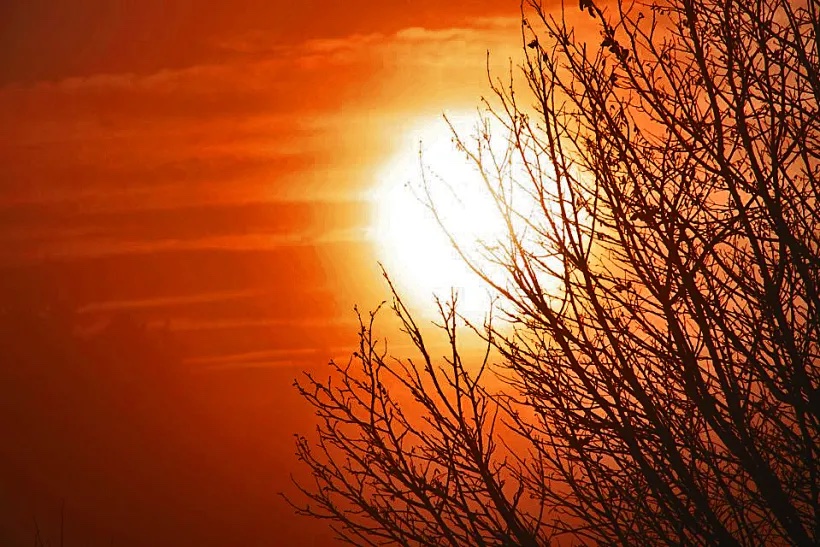
Even the smoke-painted sun traverses the sky
and then settles and sets,
swallowed by a seed puff ball,
absorbed and hallowed.

Like us, may it be released aloft this morning
transformed like a seed freed to the wind,
to rise unfettered and holy.

Waking with the Light

Light wakes us – there’s the sun
climbing the mountains’ rim, spilling across the valley,
finding our faces.
It is July,

between the hay and harvest,
a time at arm’s length from all other time,

the roads ragged with meadowsweet and mallow,
with splays of seedheads, slubbed and coarse, rough linen.
The fields above the house, clotted with sheep all spring,
are empty now and froth with flowering grasses,
still in the morning light. Birds move around
the leafy fields, the leafy garden.

It is the time
to set aside all vigil, good or ill,
to loosen the fixed gaze of our attention
as dandelions let seedlings to the wind.
Wake with the light.
Get up and go about the day and watch
its surfaces that brighten with the sun.

And later, when the light is drowsed and heavy
go find the burdened fruit trees where the shade
lies splashed and opened-out across the ground.
Spread over it a quilt worn soft by other bodies,
then curl and fall down into sleep at light.

Awaken to a world of long, loose grass-stems,
and leaves above,
and birds, breaking out of the leaves.

~Kerry Hardie from “Sleep in Summer”

Saying good-bye to July last week
meant admitting summer is already half-baked
and so are we–

we who are still doughy,
not nearly done enough.

The rush to autumn is breathless.
We want to hold on tight
to our longish days,
fall asleep in the grasses,
endure sweaty nights
for just a little while longer…

Please, oh please
grant us unending light
and steady us for the task
of getting ready for letting go.

A new series of summer photo notecards from our farm is now available as a thank you gift to you for your financial support of Barnstorming — details here

Unanswerable Questions

Under the harvest moon,
When the soft silver
Drips shimmering
Over the garden nights,
Death, the gray mocker,
Comes and whispers to you
As a beautiful friend
Who remembers.

   Under the summer roses
When the flagrant crimson
Lurks in the dusk
Of the wild red leaves,
Love, with little hands,
Comes and touches you
With a thousand memories,
And asks you
Beautiful, unanswerable questions.
~Carl Sandburg “Under the Harvest Moon”

I mistake the sound of a recycling cart
hitting the curb

for the latch of our gate
and picture him instantly:

my father stumbling
into the light of the backyard


to shoot himself.

I’d been looking at the fruit trees
and the fire pit,


the loose board of the old fence
in the wind.

I’d been thinking of how lost
you’d have to be


to believe you knew
everything there was to know


about yourself.
And now this sound


I mistake for my father
going through with it: one


awful letter in his coat pocket
to me, another


to my unborn son.
~Bobby Elliot “Mondegreen” from The Same Man

I’ve been there, and so have you.

I might hear or see or smell something
completely benign and insignificant,
but my brain processes it differently,
its similarity to past memory or experience
bringing it front and center and real again.

Often it is a song, or a smell, or a date on the calendar.
It can be an unexpected, sudden sound,
like a slammed door
or a recorded voice or photo from long ago.

This can lead to time travel
back to that previous moment in time,
with the feeling of being right there again.

It can be a lovely memory, warm and comforting,
or it can be a total nightmare
I never want to remember or reexperience.

When it happens to me,
to distract from the distress it can cause,
I instead admire the stickiness of my stored memories,
how powerful chemical connections are
between my body and my feelings.

There is poignancy in how I
relive those moments of past joy and struggles,
trying to capture in words what just happened,
all the while knowing, for the rest of my days,
some questions will forever remain unanswered.

On a Fine Golden Morning

Whence comes Solace?—Not from seeing
What is doing, suffering, being,
Not from noting Life’s conditions,
Nor from heeding Time’s monitions;
But in cleaving to the Dream,
And in gazing at the gleam
Whereby gray things golden seem.

II

Thus do I this heyday, holding
Shadows but as lights unfolding,
As no specious show this moment
With its irised embowment;
But as nothing other than
Part of a benignant plan;
Proof that earth was made for man.

~Thomas Hardy “On a Fine Morning”

Whence comes Solace?
Cleaving to the dream, gazing at the gleam

nothing other than
Part of a benignant plan;
Proof that earth was made for man.

I had to look up “benignant” – it is like being told a concerning tumor is “benign” – granting gracious kindness and beneficence in the midst of deep-seated worry.

A new lease on life.

We forget our original task of caring for the Garden.
Having soiled our own nest, we can’t abandon earth for another greener, brighter, happier planet. Of all the planetary options in this infinite universe, we were placed right here for good reason, and here we remain.

Our solace: all that ordinarily seems gray gleams golden
illuminated by the Light shining down on our shadowy selves.

Even when the news headlines are dismal,
when our individual struggles are great,
when human history seems to keep repeating itself,
our Creation is purposeful,
eternally preserved through divine sacrifice.

The solace of gray shadows melts to gold:
as part of the overall “benignant plan”
we have been given our life back.

What the Sky Might Bring

When it snows, he stands
at the back door or wanders
around the house to each
window in turn and
watches the weather
like a lover. O farm boy,
I waited years
for you to look at me
that way. Now we’re old
enough to stop waiting
for random looks or touches
or words, so I find myself
watching you watching
the weather, and we wait
together to discover
whatever the sky might bring.
~Patricia Traxler “Weather Man”

My father was a skywatcher,
cloud-noter, wind-gauger,

trained since birth
to check the weather first thing
and last. In those last

dim years when all else had left
mind and memory, he’d still stare
keenly out the car window

as I drove him to neurologist
or podiatrist, and exclaim with joy and

satisfaction: Look at those clouds!
And I knew right then
that watching the sky

was a good way to conduct a life–
that reading the outlines of clouds,

lifting a finger to the pulse of
breeze coming your way,

is what can hold you close,
clasp you tight to the thrum.

~Wendy Ingersoll “Weatherman”

My farm boy still looks at me that way,
wondering if today will bring
a storm,
or a scorcher,
or a deluge,
and I reassure him as best I can,
because he knows me so well
in our many years together:

today, like nearly every other day,
will be mostly cloudy
with occasional sun breaks.

Unfolding Before My Eyes

Tonight at dusk we linger by the fence
around the garden, watching the wound husks
of moonflowers unclench themselves slowly,
almost too slow for us to see their moving—
you notice only when you look away
and back, until the bloom decides,
or seems to decide, the tease is over,
and throws its petals backward like a sail
in wind, a suddenness about this as though
it screams, almost the way a newborn screams
at pain and want and cold, and I still hear
that cry in the shout across the garden
to say another flower is about to break.
I go to where my daughter stands, flowers
strung along the vine like Christmas lights,
one not yet lit. We praise the world by making
others see what we see. So now she points and feels
what must be pride when the bloom unlocks itself
from itself. And then she turns to look at me.
~James Davis May “Moonflowers” from
 32 Poems Magazine

When once the sun sinks in the west,
And dewdrops pearl the evening’s breast;
Almost as pale as moonbeams are,
Or its companionable star,
The evening primrose opes anew
Its delicate blossoms to the dew;
And, hermit-like, shunning the light,
Wastes its fair bloom upon the night,
Who, blindfold to its fond caresses,
Knows not the beauty it possesses;
Thus it blooms on while night is by;
When day looks out with open eye,
Bashed at the gaze it cannot shun,
It faints and withers and is gone.

~John Clare “Evening Primrose”

Ever since I was a kid, I have needed to share with others something special I’ve seen — a “hey, take a look at this!” moment so I can witness it again through their eyes.

Sharing can make it even sweeter.

Sometimes others see what I see; sometimes not.
Sometimes others wonder what has gotten into me.

I was an odd farm kid, no question: a summer twilight’s entertainment might be watching evening primrose blossoms open at night.

Evening primrose and moonflower are night blooming plants meant to attract pollinating moths. 

At dusk, (one could set one’s watch by the primrose’s punctuality) one green wrapped bud per stem would open, revealing a bright yellow blossom with four delicate veined petals, a rosette of stamens and a cross-shaped stigma in the center, rising far above the blossom. The yellow was so vivid and lively, it seemed almost like a drop of sun was left on earth to light the night. By morning, the bloom would begin to wither and wilt under the real sunlight, somehow overcome with the brightness, and would blush a pinkish orange as it folded upon itself, ready to die and drop from the plant in only a day or two, leaving a bulging seed pod behind.

As a kid, I would settle cross-legged on our damp lawn at twilight to watch the choreography of the opening of evening primrose blossoms. With diminishing light and cooler temperatures, there would be a sudden loosening of the protective green husk, an almost audible release. Then over the course of about a minute, the overlapping yellow petals would unfurl, slowly, gently and purposefully in an unlocking action that revealed their pollen treasure trove inside.  

It was like watching time lapse cinematography, only this was an accelerated, real time flourish of sudden beauty, happening right before my eyes. 

It was magic. I always felt privileged to witness each unveiling as so few flowers ever allow us to behold their unfolding.

On those lazy summer evenings, my younger brother wasn’t nearly as impressed when I tried to lure him into becoming flower-audience along with me. That’s okay; I was always underwhelmed by the significance of his favorite football team’s touchdowns that he insisted on sharing with me.

He was sure my priorities were screwy.

Possibly he was right. Even so, I wanted you all to know about something so special as a flower knowing exactly the best time to open to attract nocturnal pollinators, and manages it in under a minute, all because the waning light and cooler temperatures causes a sudden rush of cellular fluid into the bottom hinges of the petals, forcing them to pop open.

What a smart plant. What an even smarter God, worthy of praise.

A Road to Lead Me Home

It’s a dangerous business, Frodo, going out of your door.
You step into the Road, and if you don’t keep your feet,
there is no knowing where you might be swept off too.
~J.R.R. Tolkien – Bilbo to Frodo in Fellowship of the Rings

What if this road, that has held no surprises
these many years, decided not to go
home after all; what if it could turn
left or right with no more ado
than a kite-tail? What if its tarry skin
were like a long, supple bolt of cloth,
that is shaken and rolled out, and takes
a new shape from the contours beneath?
And if it chose to lay itself down
in a new way, around a blind corner,
across hills you must climb without knowing
what’s on the other side, who would not hanker
to be going, at all risks? Who wants to know
a story’s end, or where a road will go?

~Sheenagh Pugh “What if This Road?”

I do not think that all who choose wrong roads perish;
but their rescue consists in being put back on the right road.
~C.S. Lewis from The Great Divorce

We grow accustomed to the Dark —
When Light is put away —
As when the Neighbor holds the Lamp
To witness her Good bye —

A Moment — We Uncertain step
For newness of the night —
Then — fit our Vision to the Dark —
And meet the Road — erect —

And so of larger — Darknesses —
Those Evenings of the Brain —
When not a Moon disclose a sign —
Or Star — come out — within —

The Bravest — grope a little —
And sometimes hit a Tree
Directly in the Forehead —
But as they learn to see —

Either the Darkness alters —
Or something in the sight
Adjusts itself to Midnight —
And Life steps almost straight.

~Emily Dickinson

So few grains of happiness
measured against all the dark
and still the scales balance.

The world asks of us
only the strength we have and we give it.
Then it asks more, and we give it.

~Jane Hirschfield from “The Weighing”

I admit I stumble if not careful,
bearing some bruises and scrapes from
hazards hidden in darkness.

My eyes slowly adjust to such bare illumination,
when the Lamp is dim and the road unfamiliar.

I’m feeling my way through uncertainty in this time of life.

I suspect there are fellow darkness travelers
who also have lost their way and their Light,
giving away what they can
and sometimes more than they have.

And so, blinded as we each are,
we run forehead-first into the Tree
which has always been there and always will be,
the symbol of our salvation.

Because of who we are and Who loves us,
we, now free and forgiven,
safely follow a darkened road made nearly straight,
all the way Home.

Lyrics: Tell me where is the road I can call my own,
That I left, that I lost, so long ago.
All these years I have wondered, oh when will I know,
There’s a way, there’s a road that will lead me home.

After wind, After rain, when the dark is done,
As I wake from a dream, in the gold of day,
Through the air there’s a calling from far away,
There’s a voice I can hear that will lead me home.

Rise up, follow me, come away is the call
With (the) love in your heart as the only song
There is no such beauty as where you belong
Rise up, follow me, I will lead you home.

At Summer’s Edge

At the edge of the city,
at the edge of the world,
at the edge between
the earth and endless sky,
the moonshining place,
the place where we hung
our long summer legs
over the edge and fought
the urge to drop a shoe
or sneak a real first kiss,
the place where we played
hide-and-go-seek
and Tag, you’re it!
until we couldn’t breathe
or the sun went down,
the place where we came
on the quietest nights
to feel the moon kiss
the edge between
our skin and endless sky.

~Sarah Kobrinsky, from Nighttime on the Otherside of Everything

photo of supermoon by Harry Rodenberger

there will be sun, scalloped by clouds,
ushered in by a waterfall of birdsong.
It will be a temperate seventy-five, low
humidity. For twenty-four hours,
all politicians will be silent. Reality
programs will vanish from TV, replaced
by the “snow” that used to decorate
our screens when reception wasn’t
working. Soldiers will toss their weapons
in the grass. The oceans will stop
their inexorable rise. No one
will have to sit on a committee.
When twilight falls, the aurora borealis
will cut off cell phones, scramble the internet.
We’ll play flashlight tag, hide and seek,
decorate our hair with fireflies, spin
until we’re dizzy, collapse
on the dew-decked lawn and look up,
perhaps for the first time, to read the long lines
of cold code written in the stars….
~Barbara Crooker “Tomorrow” from Some Glad Morning.

The truth of it is: we’re always on the edge of something.
Often we’re not aware of it
but that’s where some of the best things happen.

Summer itself can lead us right to edge of ourselves,
a bright and bold tease to imagine something
even more beautiful beyond our reach.
It is an invitation to follow the lingering light of the horizon
to wherever it may take us.

I can’t help but cling just a while longer
before I tumble off the edge of the world.

Lyrics:
In love, we find our way
With trust, hope remains

I’ll be here
Stay right here
Don’t you fear

In love, we find our way through the night
In love, we find our way

In love, we find a way
Your love leads the way

Daylight Stakes Its Claim

I think I grow tensions
like flowers
in a wood where
nobody goes.
Each wound is perfect,
encloses itself in a tiny
imperceptible blossom,
making pain.
Pain is a flower like that one,
like this one,
like that one,
like this one.
~Robert Creeley “The Flower”

…forests giving way
to open meadow where deep snow
lingers and finally relents, uncovering
acres of lily — glacier yellow, avalanche
white — daylight restaking its earthly claim.
Every season swallows someone — 
~Kevin Craft from “For the Climbers”

To see a World in a Grain of Sand
And a Heaven in a Wild Flower,
Hold Infinity in the palm of your hand
And Eternity in an hour.

~William Blake from Auguries of Innocence

In early July, up in the alpine meadows of the Cascade mountains grow delicate avalanche lilies pushing through icy crust as the snow melt completes. Though brief in their blooming, they are harbingers of long summer daylight, a reminder the painful darkness of winter is behind us, as well as bound to come again too soon.

I am swallowed by each season.

The lilies, bursting through waning snow, become a bit of heaven on earth. Despite the bleak chill of winter, they fight to rise triumphant each year, an eternal promise of a some-day never-ending summer.