The Dangerous Business of Going Out Your Door

Roads go ever ever on,
Over rock and under tree,
By caves where never sun has shone,
By streams that never find the sea;
Over snow by winter sown,
And through the merry flowers of June,
Over grass and over stone,
And under mountains in the moon.

Roads go ever ever on,
Under cloud and under star.
Yet feet that wandering have gone
Turn at last to home afar.
Eyes that fire and sword have seen,
And horror in the halls of stone
Look at last on meadows green,
And trees and hills they long have known.

The Road goes ever on and on
Down from the door where it began.
Now far ahead the Road has gone,
And I must follow, if I can,
Pursuing it with weary feet,
Until it joins some larger way,
Where many paths and errands meet.
And whither then? I cannot say.

The Road goes ever on and on
Out from the door where it began.
Now far ahead the Road has gone.
Let others follow, if they can!
Let them a journey new begin.
But I at last with weary feet
Will turn towards the lighted inn,
My evening-rest and sleep to meet.

Still ’round the corner there may wait
A new road or secret gate;
And though I oft have passed them by,
A day will come at last when I
Shall take the hidden paths that run
West of the Moon, East of the Sun.
~J.R.R. Tolkien “Bilbo’s Walking Song”

It’s a dangerous business, Frodo, going out of your door. You step into the Road, and if you don’t keep your feet, there is no knowing where you might be swept off too.
~J.R.R. Tolkien – Bilbo to Frodo in Fellowship of the Rings

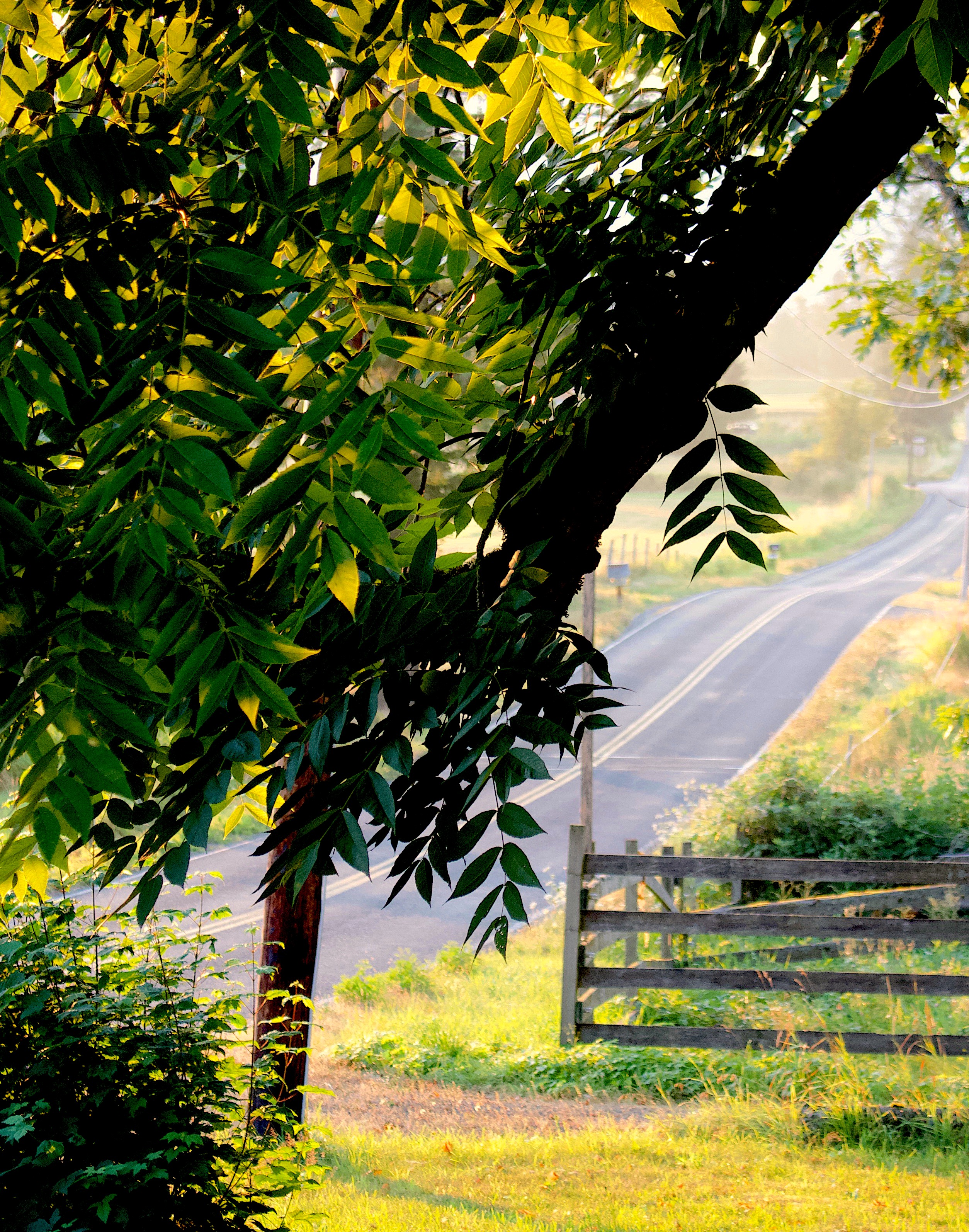
I love these country roads in June, at dawn or dusk,
the light and shadow playing over the path,
promising summer breezes and simple joys.

When we walk these roads,
we pass by deep ditches,
hop the potholes and avoid the bumps.

Still it’s a dangerous business,
walking out the front door into life,
not knowing just where we may be swept off to.

Passing by secret gates and overgrown paths,
I take the familiar route that leads me home,
following the Master Guide so I don’t lose my way.

One-Time
Monthly
Yearly

Make a one-time or recurring donation to support daily Barnstorming posts

Make a monthly donation

Make a yearly donation

Choose an amount

$10.00
$25.00
$50.00
$5.00
$15.00
$100.00
$5.00
$15.00
$100.00

Or enter a custom amount

$

Your contribution is deeply appreciated.

Your contribution is appreciated.

Your contribution is appreciated.

DonateDonate monthlyDonate yearly

Revery Alone Will Do…

To make a prairie it takes a clover and one bee, a
One clover, and a bee,
And revery.
The revery alone will do,
If bees are few.
~Emily Dickinson

Bees do have a smell, you know, and if they don’t they should, for their feet are dusted with spices from a million flowers.
~Ray Bradbury
from Dandelion Wine

Pollinators are having a rough time of it these days, combating man-made insecticides or failing to find flowering weeds to visit given the wide-spread use of herbicides. Plus, there is the American penchant for mowing grassy landscapes to look perfectly uniform and weed-free.

When I see a honey or bumble bee happily doing its job, it is a cause for celebration.

I was thrilled to see the latest research reported today demonstrating the ability of a flowering plant, like a snapdragon in the study, to “hear” (through vibro-acoustic signals) the buzz of an approaching pollinator, responding instantly by increasing its nectar volume and sweetness.
The postulated feedback mechanism is that pollinators will be more attracted to a plant that “rewards” their visit, thereby increasing the likelihood of ongoing pollination visits and survival of further generations of both creatures.

This world depends on a revery of communication we can only begin to understand – between plant to plant, plant to insect — a daydream of connections bringing the spicy smell of pollen from a million flowers to the lowly feet of the bee, which generates more of both as well as honey for you and me.
May it be, may it be, may it bee…

May we know such reverie.

AI image created for this post
One-Time
Monthly
Yearly

Make a one-time or recurring donation to support daily Barnstorming posts

Make a monthly donation

Make a yearly donation

Choose an amount

$10.00
$25.00
$50.00
$5.00
$15.00
$100.00
$5.00
$15.00
$100.00

Or enter a custom amount

$

Your contribution is deeply appreciated.

Your contribution is appreciated.

Your contribution is appreciated.

DonateDonate monthlyDonate yearly

Where You Go, I Will Go: Be Still and Know

Be still, and know that I am God…
Psalm 46:10

Be still and know that I am God.
Be still and know that I am.
Be still and know.
Be still.
Be.

patrickscathedral
Down Cathedral, Downpatrick, Ireland
stpatrickgrave
St. Patrick’s grave marker

I rise today
in the power’s strength, invoking the Trinity
believing in threeness,
confessing the oneness,
of creation’s Creator.

I rise today
in heaven’s might,
in sun’s brightness,
in moon’s radiance,
in fire’s glory,
in lightning’s quickness,
in wind’s swiftness,
in sea’s depth,
in earth’s stability,
in rock’s fixity.

I rise today
with the power of God to pilot me,
God’s strength to sustain me,
God’s wisdom to guide me,
God’s eye to look ahead for me,
God’s ear to hear me,
God’s word to speak for me,
God’s hand to protect me,
God’s way before me,
God’s shield to defend me,
God’s host to deliver me,
from snares of devils,
from evil temptations,
from nature’s failings,
from all who wish to harm me,
far or near,
alone and in a crowd.

Around me I gather today all these powers
against every cruel and merciless force
to attack my body and soul.

May Christ protect me today
against poison and burning,
against drowning and wounding,
so that I may have abundant reward;
Christ with me, Christ before me, Christ behind me;
Christ within me, Christ beneath me, Christ above me;
Christ to the right of me, Christ to the left of me;
Christ in my lying, Christ in my sitting, Christ in my rising;
Christ in the heart of all who think of me,
Christ on the tongue of all who speak to me,
Christ in the eye of all who see me,
Christ in the ear of all who hear me.

For to the Lord belongs salvation,
and to the Lord belongs salvation
and to Christ belongs salvation.
May your salvation, Lord, be with us always.

—”Saint Patrick’s Breastplate,”
Old Irish, eighth-century prayer.

Six years a slave, and then you slipped the yoke,
Till Christ recalled you, through your captors cries!
Patrick, you had the courage to turn back,
With open love to your old enemies,
Serving them now in Christ, not in their chains,
Bringing the freedom He gave you to share.
You heard the voice of Ireland, in your veins
Her passion and compassion burned like fire.

Now you rejoice amidst the three-in-one,
Refreshed in love and blessing all you knew,
Look back on us and bless us, Ireland’s son,
And plant the staff of prayer in all we do:
A gospel seed that flowers in belief,
A greening glory, coming into leaf.
~Malcolm Guite  — A St. Patrick Sonnet

Every year on March 17, St. Patrick is little remembered for his selfless missionary work in Ireland in the fifth century. We visited his grave in Downpatrick, Ireland some years ago. It is a humble stone fixed upon on a hilltop next to Down Cathedral overlooking the sea.

I wondered what he would make of how this day, dubbed with his name, is celebrated now in the United States.

Perhaps Patrick would observe we have lost sight of our commitment to faith and purpose in our rush to be the first, greatest, wealthiest, and most dominant.

Patrick, in his prayer, urges us instead to know only God as the power of protection in our lives, knowing our human weakness and need for salvation.

He would advise us to be still and know.
Be still.
Be

morningclover
patrickcathedral2
AI image created for this post

This year’s Lenten theme:

…where you go I will go…
Ruth 1:16

One-Time
Monthly
Yearly

Make a one-time or recurring donation to support daily Barnstorming posts

Make a monthly donation

Make a yearly donation

Choose an amount

$10.00
$25.00
$50.00
$5.00
$15.00
$100.00
$5.00
$15.00
$100.00

Or enter a custom amount

$

Your contribution is deeply appreciated.

Your contribution is appreciated.

Your contribution is appreciated.

DonateDonate monthlyDonate yearly

Warmness of Clover Breath

To enrich the earth I have sowed clover and grass
to grow and die. I have plowed in the seeds
of winter grains and of various legumes,
their growth to be plowed in to enrich the earth.
I have stirred into the ground the offal
and the decay of the growth of past seasons
and so mended the earth and made its yield increase.
All this serves the dark. I am slowly falling
into the fund of things. And yet to serve the earth,
not knowing what I serve, gives a wideness
and a delight to the air, and my days
do not wholly pass. It is the mind’s service,
for when the will fails so do the hands
and one lives at the expense of life.
After death, willing or not, the body serves,
entering the earth. And so what was heaviest
and most mute is at last raised up into song.

~Wendell Berry “Enriching the Earth” from Collected Poems

It was the face of spring, it was the face of summer,
it was the warmness of clover breath.
Pomegranate glowed in her lips, and the noon sky in her eyes.
And all of this, this breath-warmness and plum-tenderness

was held forever
~Ray Bradbury from Dandelion Wine

To make a prairie it takes a clover and one bee,
One clover, and a bee,
And revery.
The revery alone will do,
If bees are few.
Emily Dickinson

Every autumn my father, an agriculture teacher by training, brought home gunny sacks of grass seed from the feed and seed store.  He would start up his 1954 Farmall Cub tractor, proceed to disc and harrow an acre of bare ground in our field, and then fill the seeder, distributing seed on the soil for his annual agronomy cover crop over winter growing experiment.  The little sprouts would wait to appear in the warming spring weather, an initial green haziness spread over the brown dirt, almost like damp green mold.  Within days they would form a plush and inviting velveteen green cushion, substantial enough for a little wiggle of blades in the breezes.  A few weeks later the cover would be a full fledged head of waving green hair, the wind blowing it wantonly, bending the stems to its will.  It was botanical pasture magic, renewable and marvelous,  only to be mowed and stubble turned over with the plow back into the soil as nutrition for the summer planting to come.  It was the sacrificial nature of cover crops to be briefly beautiful on top of the ground, but the foundational nurture once underground.

One spring the expected grassy carpet growth didn’t look quite the same after germination–the sprouts were little round leaves, not sharp edged blades.  Instead of identical uniform upright stems, the field was producing curly chaotic ovoid and spherical shapes and sizes. Clover didn’t abide by the same rules as grasses.  It had a mind of its own with a burgeoning and bumpy napped surface that didn’t bend with breezes, all its effort invested instead in producing blossoms.

A hint of pink one morning was so subtle it was almost hallucinatory.  Within a day it was unmistakeably reddening and real.  Within a week the green sea flowed with bobbing crimson heads. We had never seen such vibrancy spring from our soil before.  It exuded scented clover breath, the fragrance calling honey bees far and near.  True reverie.

The field of crimson dreams and sated honey bees lasted several weeks before my father headed back out on the Farmall to turn it under with the plow, burying the fading blossoms into the ground.  Their sacrifice bled red into the soil, their fragrant breath halted, their memory barely recognizable in the next summer crop germination.   Yet the crimson heads were there, feeding the growth of the next generation, deepening the green as it reached to the sun.

Such a sweet thing, alive a thousand summers hence in the soil.

What a beautiful feeling.

Crimson and clover, over and over.

AI image created for this post
One-Time
Monthly
Yearly

Make a one-time or recurring donation to support daily Barnstorming posts

Make a monthly donation

Make a yearly donation

Choose an amount

$10.00
$25.00
$50.00
$5.00
$15.00
$100.00
$5.00
$15.00
$100.00

Or enter a custom amount

$

Your contribution is deeply appreciated.

Your contribution is appreciated.

Your contribution is appreciated.

DonateDonate monthlyDonate yearly

The Honesty of Horses

It was dragging my hands along its belly,
loosing the bit and wiping the spit
from its mouth that made me
a snatch of grass in the thing’s maw,
a fly tasting its ear. It was
touching my nose to his that made me know
the clover’s bloom, my wet eye to his that
made me know the long field’s secrets.
But it was putting my heart to the horse’s that made me know
the sorrow of horses. Made me
forsake my thumbs for the sheen of unshod hooves.
And in this way drop my torches.
And in this way drop my knives.
Feel the small song in my chest
swell and my coat glisten and twitch.
And my face grow long.
And these words cast off, at last,
for the slow honest tongue of horses.

~Ross Gay “Becoming A Horse”

photo by Emily Vander Haak

Living the dream of nearly every young girl, I grew up with a horse in our back field. The first was a raw-boned old paint who allowed my older sister and toddler me to sit atop him, walk around the barnyard and on the driveway at no more than a walk. He was arthritic and sore, but patient and tolerant to the attention of little girls. When we moved away to another part of the state, he didn’t come with us and I was too young to fully understand where he had been sent.

The horse on our new farm was my sister’s 4H project who was a spiffy chestnut mare with a penchant for a choppy trot and speedy canter. My sister would go miles with friends on horseback down back-country roads. Sadly, my sister soon became allergic (hives and swelling) to any contact with horses. I was barely old enough to start riding by myself in our fields.The little mare missed her adventures with my sister but seemed to adapt to my inexperience and took care of me as best she could – I never fell off. One night, she broke through a fence and ate her fill in a field of growing oat grass. The next day she was euthanized due to terrible colic. I was inconsolable, crying for days when visiting her burial spot on our property.

These first two horses tolerated the inexperience of their handlers and tried to compensate for it. I’ve since owned a few horses who knew exactly how to take advantage of such inexperience. Horses size up people quickly as our feelings and fear can be so transparent; it takes much longer for us to understand the complexity of their equine mind. Many diverse training techniques are marketed as testimony to that mystery.

I have learned that horses appreciate a patient and quiet approach, reflecting their consistency and honesty. They like to be looked in the eye and appreciate a soft breath blown over their whiskers. They want us to find their itchy spots rather than act the part of a pseudo-predator with intent to harm.

That’s not asking too much of us.

In return, we learn how best to communicate what we need from them. They are remarkably willing to work when they understand the job and feel appreciated. In return, we are given a chance to experience the world through their eyes and ears, to comprehend the remarkable sensitivity of a skin able to shiver a fly away.

I’ve spent much of my life learning with horses and hope there are a few years still left to learn more. Whatever sorrow they feel in their hearts is when I’ve failed to be who they need me to be. Their gift to me is an honest willingness to forgive, again and yet again.

One-Time
Monthly
Yearly

Make a one-time or recurring donation to support daily Barnstorming posts

Make a monthly donation

Make a yearly donation

Choose an amount

¤10.00
¤25.00
¤50.00
¤5.00
¤15.00
¤100.00
¤5.00
¤15.00
¤100.00

Or enter a custom amount

¤

Your contribution is deeply appreciated.

Your contribution is appreciated.

Your contribution is appreciated.

DonateDonate monthlyDonate yearly

A Galaxy of Grasses

О Greater Light, we praise Thee for the less;
The eastern light our spires touch at morning,
The light that slants upon our western doors at evening.
The twilight over stagnant pools at batflight,
Moon light and star light, owl and moth light,
Glow-worm glowlight on a grassblade.
О Light Invisible, we worship Thee!

~T.S. Eliot from “O Light Invisible”

Look, in the early light, 
   Down to the infinite 
   Depths at the deep grass-roots; 
      Where the sun shoots 
In golden veins, as looking through 
   A dear pool one sees it do; 
   Where campion drifts 
Its bladders, iris-brinded, through the rifts 
      Of rising, falling seed
   That the winds lightly scour—
Down to the matted earth where over 
   And over again crow’s-foot and clover
      And pink bindweed
      Dimly, steadily flower.

~Michael Field “The Depths of the Grass”

We wove hip-high field grass 
into tunnels 

knotting the tops 
of bunched handfuls the drooping 
heads tied together. 

My seven siblings and I 
sheltered ourselves

inside these labyrinths 
in a galaxy of grasses.
~Heather Cahoon “Shelter”

As a child I liked to go out far into our hay field and find the tallest patch of grass. There, like a dog turning circles before a nap,  I’d trample down the tall waving stems that stretched up almost to my eyes, and create a grass nest, just cozy enough for me. I’d sit or lie down in this tall green fortress, gazing up at the blue sky, and watch the clouds lazily drift over top of me.  I’d suck on a hollow stem or two, to savor the bitter grass juice. Time felt suspended.

Scattered around my grassy cage, looking out of place attached to the broad grass stems, would be innumerable clumps of white foam. I’d tease out the hidden green spit bugs with their little black eyes from their white frothy bubble encasement. I too felt “bubble-wrapped” in my green hide-a-way.

My grassy nest was a time of retreat from the world.  I felt protected, surrounded, encompassed and free –at least until I heard my mother calling for me from the house, or a rain shower started, driving me to run for cover, or my dog found me by following my green path.

It has been decades since I hid away in a grass fort trying to defoam spit bugs. Surely, I’m overdue: instead of being determined to mow down and level the grass around me, I long for a galaxy of grassy bubble-wrap.

One-Time
Monthly
Yearly

Make a one-time or recurring donation to support daily Barnstorming posts

Make a monthly donation

Make a yearly donation

Choose an amount

¤5.00
¤10.00
¤20.00
¤5.00
¤15.00
¤100.00
¤5.00
¤15.00
¤100.00

Or enter a custom amount

¤

Your contribution is deeply appreciated.

Your contribution is appreciated.

Your contribution is appreciated.

DonateDonate monthlyDonate yearly

In a Cloud of Gold

Photo of Aaron Janicki haying with his Oberlander team in Skagit County courtesy of Tayler Rae
Benjamin Janicki of Sedro Woolley raking hay with his team of Oberlanders

Travel as a backward step.
You journey until you find
a meadow where wildflowers
grow with pre-factory-farming
copiousness, a horse-drawn
landscape where hay is saved
in older ways, to revive
the life you lived once,
catch up with your past.
~Dennis O’Driscoll from Time Pieces (2002)

… The Amish have maintained what I like to think is a proper scale, largely by staying with the horse. The horse has restricted unlimited expansion. Not only does working with horses limit farm size, but horses are ideally suited to family life. With horses you unhitch at noon to water and feed the teams and then the family eats what we still call dinner. While the teams rest there is usually time for a short nap. And because God didn’t create the horse with headlights, we don’t work nights.
Amish farmer David Kline in Great Possessions

photo by Tayler Rae

One evening I stopped by the field to watch the hay rake
drawn toward me by two black, tall, ponderous horses
who stepped like conquerors over the fallen oat stalks,
light-shot dust at their heels, long shadows before them.
At the ditch the driver turned back in a wide arc,
the off-horse scrambling, the near-horse pivoting neatly.
The big side-delivery rake came about with a shriek—
its tines were crashing, the iron-bound tongue groaned aloud—
then, Hup, Diamond! Hup, Duke! and they set off west,
trace-deep in dust, going straight into the low sun.

The clangor grew faint, distance and light consumed them;
a fiery chariot rolled away in a cloud of gold
and faded slowly, brightness dying into brightness.
The groaning iron, the prophesying wheels,
the mighty horses with their necks like storms—
all disappeared; nothing was left but a track
of dust that climbed like smoke up the evening wind.

~Kate Barnes “The Hay Rake” from Where the Deer Are

My grandparents owned the land,
worked the land, bound
to the earth by seasons of planting
and harvest.

They watched the sky, the habits
of birds, hues of sunset,
the moods of moon and clouds,
the disposition of air.
They inhaled the coming season,
let it brighten their blood
for the work ahead.

Soil sifted through their fingers
imbedded beneath their nails
and this is what they knew;
this rhythm circling the years.
They never left their land;
each in their own time
settled deeper.
~Lois Parker Edstrom “Almanac” from Night Beyond Black.

Nearing 68, I am old enough to have parents who both grew up on farms worked by horses, one raising wheat and lentils in the Palouse country of eastern Washington and the other logging in the woodlands of Fidalgo Island of western Washington.  The horses were crucial to my grandfathers’ success in caring for and tilling the land, seeding and harvesting the crops and bringing supplies from town miles away.  Theirs was a hardscrabble life in the early 20th century with few conveniences.  Work was year round from dawn to dusk; caring for the animals came before any human comforts.  Once night fell, work ceased and sleep was welcome respite for man and beast.

In the rural countryside where we live now, we’ve been fortunate enough to know people who still dabble in horse farming, whose draft teams are hitched to plows and mowers and manure spreaders as they head out to the fields to recapture the past.  Watching a good team work with no diesel motor running means hearing bird calls from the field, the steady footfall of the horses, the harness chains jingling, the leather straps creaking, the machinery shushing quietly as gears turn and grass lays over in submission.  No ear protection is needed.  There is no clock needed to pace the day.   There is a rhythm of nurture when animals instead of engines are part of the work day.   The gauge for taking a break is the amount of foamy sweat on the horses and how fast they are breathing. It is time to stop and take a breather, it is time to start back up do a few more rows, it is time to water, it is time for a meal, it is time for a nap, it is time for a rest in a shady spot.  This is gentle use of the land with four footed stewards who deposit right back to the soil the digested forage they have eaten only hours before.

Our modern agribusiness megafarm fossil-fuel-powered approach to food production has bypassed the small family farm which was so dependent on the muscle power of humans and animals.  In our move away from horses worked by skilled teamsters,  what has been gained in high production values has meant loss of self-sufficiency and dedicated stewardship of a particular plot of ground.  Draft breeds, including the Haflinger horses we raise, now are bred for higher energy with lighter refined bone structure meant more for eye appeal and floating movement,  rather than the sturdy conformation and unflappable low maintenance mindset needed for pulling work.   Modern children are bred for different purpose as well, no longer raised to work together with other family members for a common purpose of daily survival.   Their focus at school is waning as they have no morning farm chores when they get up, too little physical work to do before they arrive at their desks in the morning.   Their physical energy, if directed at all,  is directed to competitive sports, engaged in fantasy combat rather than winning a very real victory over hunger.

I am encouraged when young people still reach for horse collars and bridles, hitch up their horses and do the work as it used to be done.   All is not lost if we can still make incremental daily progress,  harnessed together as a team with our horses, tilling for truth and harvesting hope.

photo by Joel DeWaard


I like farming. I like the work. I like the livestock and the pastures and the woods.  It’s not necessarily a good living, but it’s a good life.  I now suspect that if we work with machines the world will seem to us to be a machine, but if we work with living creatures the world will appear to us as a living creature.  That’s what I’ve spent my life doing, trying to create an authentic grounds for hope. ~Wendell Berry, horse farmer, essayist, poet, professor

One-Time
Monthly
Yearly

Make a one-time or recurring donation to support daily Barnstorming posts

Make a monthly donation

Make a yearly donation

Choose an amount

¤5.00
¤10.00
¤20.00
¤5.00
¤15.00
¤100.00
¤5.00
¤15.00
¤100.00

Or enter a custom amount

¤

Your contribution is deeply appreciated.

Your contribution is appreciated.

Your contribution is appreciated.

DonateDonate monthlyDonate yearly

Time to Stand and Stare

What is this life is, full of care
We have no time to stand and stare.
No time to stand beneath the boughs
And stare as long as sheep or cows.
No time to see, when woods we pass,
Where squirrels hide their nuts in grass.
No time to see, in broad daylight,
Streams full of stars, like skies at night.
No time to turn at Beauty’s glance,
And watch her feet, how they can dance.
No time to wait till her mouth can
Enrich that smile her eyes began.
A poor life this if, full of care,
We have no time to stand and stare.

~William Henry Davies “Leisure”

Fingers of twilight shadow
begin to reach over the hill
crawling down through the field
up unto the bank of blackberries
covering fences along the alder grove.

Our horses chew their last
clover leafs before
coming to the barn for night, eyelids heavy,
relaxed and full, drowsy with spring evening
peace at hand and hoof.

A sudden change in the air forces
their heads up and ears forward;
they form a line, standing and staring at the hilltop
above them, riveted to the spot, alert
to an coming intruder, unfamiliar and foreign.

The roar is intermittent, like a warm wind
rattling a barn roof, but inconstant;
then peaking over the crest of the hill
a rounded top of technicolor glory:
The hot air balloon rises.

The horses riveted, baffled, fascinated;
no wild instinct prepares their response
to this wizard’s act from Oz in their own backyard.
The basket riders wave and laugh at the equine audience below
standing in formation with golden noses in the air
and white manes blowing in the breeze.

The balloon summits the hill, dipping low, almost touchable
before moving back up to race the sunset,
and search out other pastures, other valleys and hills.
The horses released from the spell of “stand and stare”
leap in response, snowy tails high, noses flared-

To race up the hill to catch impending darkness,
our night mares cavort, float suspended
until their air is let out, gently, in softening snorts,
to settle down in a shavings bed in the barn
where night, blissful, becomes ordinary again.

One-Time
Monthly
Yearly

Make a one-time or recurring donation to support daily Barnstorming posts

Make a monthly donation

Make a yearly donation

Choose an amount

¤5.00
¤10.00
¤20.00
¤5.00
¤15.00
¤100.00
¤5.00
¤15.00
¤100.00

Or enter a custom amount

¤

Your contribution is deeply appreciated.

Your contribution is appreciated.

Your contribution is appreciated.

DonateDonate monthlyDonate yearly

Kneeling for Courage

You want to know how I spend my time?
I walk the front lawn, pretending
to be weeding. You ought to know
I’m never weeding, on my knees, pulling
clumps of clover from the flower beds: in fact
I’m looking for courage, for some evidence
my life will change, though
it takes forever, checking
each clump for the symbolic
leaf, and soon the summer is ending, already
the leaves turning, always the sick trees
going first, the dying turning
brilliant yellow, while a few dark birds perform
their curfew of music. You want to see my hands?
As empty now as at the first note.
Or was the point always
to continue without a sign?
~Louise Glück  “Matins V”

I have never been a brave person. In fact, I can be as fearful of the headlines of world events as the next person – a downright lily-livered chicken-heart. People like me may engage in lots of magical thinking, hoping I just might change through hard work and a large measure of good luck.

But what has luck got to do with it? Nothing whatsoever.

The reality is, many people work hard and still face insurmountable struggles that regularly force them to their knees. Courage is asking God for the grit to keep going no matter what confronts you because that is exactly what He did for us: even when his knees hurt from kneeling, his voice was hoarse with prayer, his eyes full of tears, his efforts unacknowledged and unappreciated, his heart broken.

Even when I come up empty-handed, I take courage and take heart. His heart.

Take heart, my friend, we’ll go together
This uncertain road that lies ahead
Our faithful God has always gone before us
And He will lead the way once again

Take heart, my friend, we can walk together
And if our burdens become too great
We can hold up and help one other
In God’s love and God’s grace

Take heart my friend, the Lord is with us
As He has been all the days of our lives
Our assurance every morning
Our defender in the night

If we should falter when trouble surrounds us
When the wind and the waves are wild and high
We will look away to Him who ruled the waters
Who spoke His peace into the angry tide

He is our comfort, our sustainer
He is our help in time of need
When we wander, He is our Shepherd
He who watches over us never sleeps

Take heart my friend the Lord is with us
As He has been all the days of our lives
Our assurance every morning
Our defender in the night

One-Time
Monthly
Yearly

Make a one-time or recurring donation to support Barnstorming

Make a monthly donation

Make a yearly donation

Choose an amount

¤5.00
¤10.00
¤20.00
¤5.00
¤15.00
¤100.00
¤5.00
¤15.00
¤100.00

Or enter a custom amount

¤

Your contribution is deeply appreciated.

Your contribution is appreciated.

Your contribution is appreciated.

DonateDonate monthlyDonate yearly
Sweating Under the High Arc of Midsummer

What is the hayfield in late afternoon
that it can fly in the face of time,

and light can be centuries old, and even
the rusted black truck I am driving

can seem to be an implement born
of some ancient harvest,

and the rhythmic baler, which spits out
massive bricks tied up in twine,

can seem part of a time before now
because light glitters on the hay dust,

because the sun is sinking and we sweat
under the high arc of mid-summer,

because our bodies cast such long shadows–
Rebecca, with the baby strapped to her back,

the men who throw impossible weight
to the top of the truck, the black and white

dog that races after mice or moles
whose lives have been suddenly exposed.

How does the taste of my sweat take me
down through the gate of childhood,

spinning backwards to land in a field
painted by Bruigel, where the taste of salt

is the same, and the same heat
rises in waves off a newly flattened field.

In the duskiness of slanted light, we laugh
just as we laughed then, because there is

joy in what the earth gives, allowing
our bodies to mingle with it, our voices

small on the field, our work assuring the goats
can give milk, the sheep can grow wool,

and we will have in our bones the taste
of something so old it travels in light.
~Susie Patlove “First Cutting” from Quickening

photo by Nate Gibson
1994
2005
2011

There is a timelessness to mid-summer hay harvest that goes back generations on both sides of our family. The cutting, raking and gathering of hay has evolved from horse-drawn implements and gathering loose shocks of hay to 100+ horse power air-conditioned tractors and huge round bales wrapped and stored in plastic sheathing rather than in barns.

Our farm is happily stuck somewhere in-between: we still prefer filling the haybarn with bales that I can still lift and move myself to feed our animals. True hay harvest involves sweat and dust and a neighborhood coming together to preserve summer in tangible form.

I grew up on a farm with a hayfield – I still have the scar over my eyebrow where I collided with the handle of my father’s scythe when, as a toddler, I came too close behind him as he was taking a swing at cutting a field of grass one swath at a time. I remember the huge claws of the hay hook reaching down onto loose hay piled up on our wagon. The hook would gather up a huge load, lift it high in the air to be moved by pulley on a track into our spacious hay loft. It was the perfect place to play and jump freely into the fragrant memories of a summer day, even in the dark of winter.

But these days it is the slanted light of summer I remember most:
-the weightlessness of dust motes swirling down sun rays coming through the slats of the barn walls as the hay bales are stacked
-the long shadows and distant alpenglow in the mountains
-the dusk that goes on and on as owls and bats come out to hunt above us

Most of all, I will remember the sweaty days of mid-summer as I open the bales of hay in mid-winter – the light and fragrance of those grassy fields spilling forth into the chill and darkness, in communion of blessing for our animals.

photo by Tayler Rae
Pieter Bruegel “Hay Harvest”
My grandparents Leslie Polis and Kittie Lovelace standing in a hayfield with loose hay shocks — 1915

Enjoy this blog post? A new book from Barnstorming is available to order here: