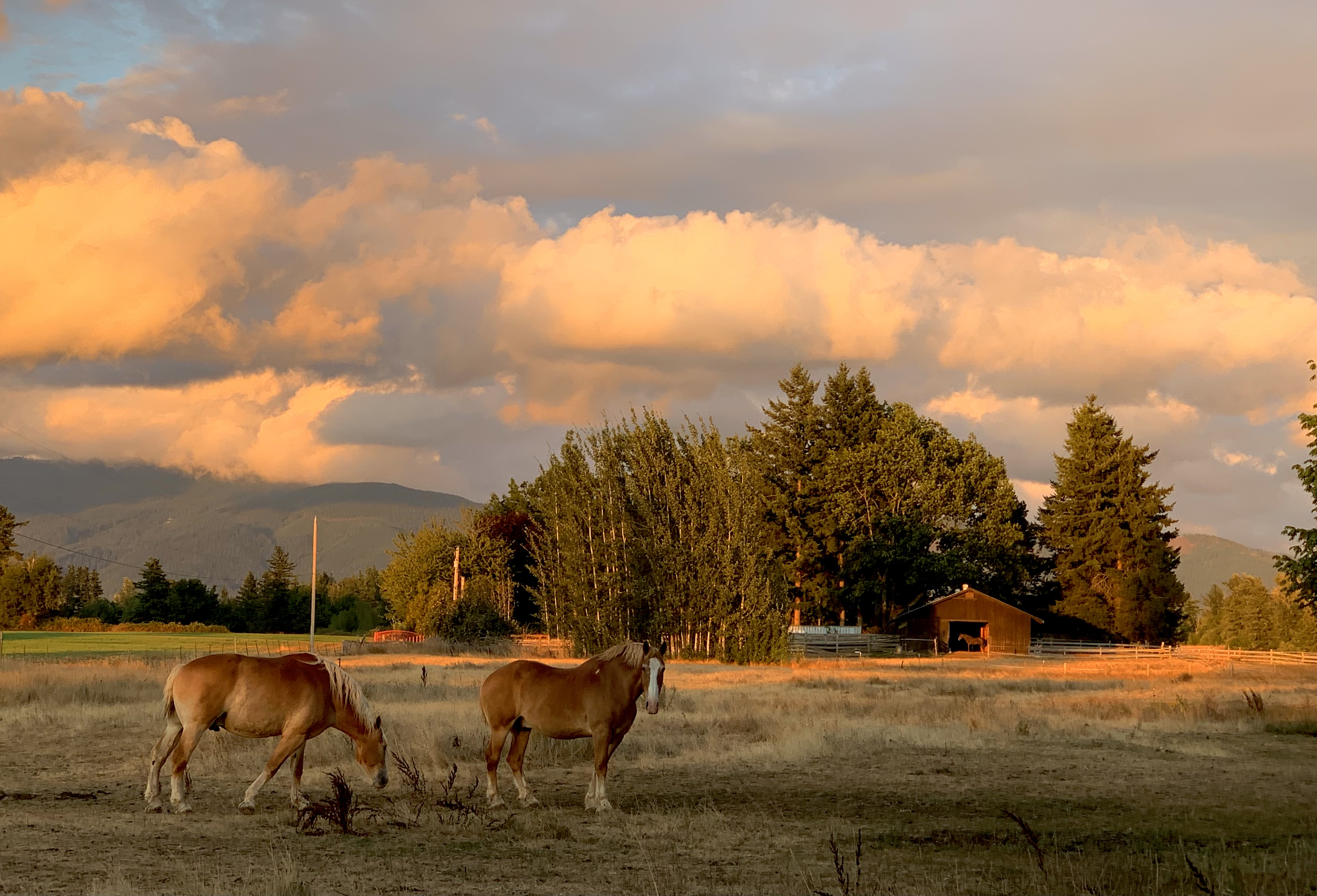
There is always an enormous temptation in all of life to diddle around making itsy-bitsy friends and meals and journeys for itsy-bitsy years on end.
It is so self-conscious, so apparently moral, simply to step aside from the gaps where the creeks and winds pour down, saying, I never merited this grace, quite rightly, and then to sulk along the rest of your days on the edge of rage.
I won’t have it.
The world is wilder than that in all directions, more dangerous and bitter, more extravagant and bright.
We are making hay when we should be making whoopee; we are raising tomatoes when we should be raising Cain,or Lazarus. ~Annie Dillard from Pilgrim at Tinker Creek
Other than a few exceptional circumstances in my life, I have always played it safe: living an itsy-bitsy life being a down-home, don’t rock the boat, work hard and live-a-quiet-life kind of person, growing hay and tomatoes and a few other things…
My grandparents lived that way, my parents lived that way. I feel like it is bound in the twists and turns of my DNA.
I do know a thing or two about sulking on the edge of rage, lost in a morass of seething bitterness about the state of the world. Yet if I were honest about it, the discontent I feel is all about me, always about me.
I want to have accomplished more to deserve taking up space in my days on earth. But that’s a problem we all have, isn’t it?
We’re unworthy of such unmerited grace as has been shown to us, raising us from the holes we dig for ourselves. It is such a pure Gift I wait for, borne out of God’s radical sacrifice deserving from me a life of radical gratitude, even when I choose to live it out a little quietly, making hay and raising tomatoes.
One-Time
Monthly
Yearly
Make a one-time or recurring donation to support daily Barnstorming posts
Winslow Homer’s The Veteran in a New FieldMan Scything Hay by Todd Reifers
There was never a sound beside the wood but one, And that was my long scythe whispering to the ground. What was it it whispered? I knew not well myself; Perhaps it was something about the heat of the sun, Something, perhaps, about the lack of sound— And that was why it whispered and did not speak. To the earnest love that laid the swale in rows, The fact is the sweetest dream that labor knows. My long scythe whispered and left the hay to make. ~Robert Frost in “Mowing”
Mowers, weary and brown, and blithe, What is the word methinks ye know, Endless over-word that the Scythe Sings to the blades of the grass below? Scythes that swing in the grass and clover, Something still, they say as they pass; What is the word that, over and over, Sings the Scythe to the flowers and grass?
Hush, ah hush, the Scythes are saying, Hush, and heed not, and fall asleep; Hush, they say to the grasses swaying, Hush, they sing to the clover deep! Hush – ’tis the lullaby Time is singing – Hush, and heed not, for all things pass, Hush, ah hush! and the Scythes are swinging Over the clover and over the grass! ~Andrew Lang (1844-1912) “The ScytheSong”
It is blue May. There is work to be done. The spring’s eye blind with algae, the stopped water silent. The garden fills with nettle and briar. Dylan drags branches away. I wade forward with my scythe.
There is stickiness on the blade. Yolk on my hands. Albumen and blood. Fragments of shell are baby-bones, the scythe a scalpel, bloodied and guilty with crushed feathers, mosses, the cut cords of the grass. We shout at each other each hurting with a separate pain.
From the crown of the hawthorn tree to the ground the willow warbler drops. All day in silence she repeats her question. I too return to the place holding the pieces, at first still hot from the knife, recall how warm birth fluids are. ~Gillian Clarke“Scything” from Letter from a Far Country (1982)
The grass around our orchard and yet-to-be-planted garden is now thigh-high. It practically squeaks while it grows. Anything that used to be in plain sight on the ground is rapidly being swallowed up in a sea of green: a ball, a pet dish, a garden gnome, a hose, a tractor implement, a bucket. In an effort to stem this tidal flood of grass, I grab the scythe out of the garden shed and plan my attack.
When the pastures are too wet yet for heavy hooves, I have hungry horses to provide for and there is more than plenty fodder to cut down for them.
I’m not a weed whacker kind of gal. First there is the necessary fuel, the noise necessitating ear plugs, the risk of flying particles requiring goggles–it all seems too much like an act of war to be remotely enjoyable. Instead, I have tried to take scything lessons from my husband.
Emphasis on “tried.”
I grew up watching my father scythe our hay in our field because he couldn’t afford a mower for his tractor. He enjoyed physical labor in the fields and woods–his other favorite hand tool was a brush cutter that he’d take to blackberry bushes. He would head out to the field with the scythe over this shoulder, grim reaper style. Once he was standing on the edge of the grass needing to be mowed, he would then lower the scythe, curved blade to the ground, turn slightly, positioning his hands on the two handles just so, raise the scythe up past his shoulders, and then in a full body twist almost like a golf swing, he’d bring the blade down. It would follow a smooth arc through the base of the standing grass, laying clumps flat in a tidy pile alongside the 2 inch stubble left behind. It was a swift, silky muscle movement — a thing of beauty.
Once, when I was three years old, I quietly approached my dad in the field while he was busily scything grass for our cows, but I didn’t announce my presence. The handle of his scythe connected with me as he swung it, laying me flat with a bleeding eyebrow. I still bear the scar, somewhat proudly, as he abruptly stopped his fieldwork to lift me up as I bawled and bled on his sweaty shirt. He must have felt so badly to have injured his little girl and drove my mom and I to the local doctor who patched my brow with sticky tape rather than stitches.
So I identify a bit with the grass laid low by the scythe. I forgave my father, of course, and learned never again to surprise him when he was working in the field.
Instead of copying my father’s graceful mowing technique, I tended to chop and mangle rather than effect an efficient slicing blow to the stems. I unintentionally trampled the grass I meant to cut. I got blisters from holding the handles too tightly. It felt hopeless that I’d ever perfect that whispery rise and fall of the scythe, with the rhythmic shush sound of the slice that is almost hypnotic.
Not only did I become an ineffective scything human, I also learned what it is like to be the grass laid flat, on the receiving end of a glancing blow. Over a long career, I bore plenty of footprints from the trampling. It can take awhile to stand back up after being cut down.
Sometimes it makes more sense to simply start over as the oozing stubble bleeds green, with deep roots that no one can reach. As I have grown back over the years, singing rather than squeaking or bawling, I realize, I forgave the scythe every time it came down on my head.
photo by Nate Gibson
One-Time
Monthly
Yearly
Make a one-time or recurring donation to support daily Barnstorming posts
Last evening, As I drove into this small valley, I saw a low-hanging cloud Wandering through the trees. It circled like a school of fish Around the dun-colored hay bales. Reaching out its foggy hands To stroke the legs of a perfect doe Quietly grazing in a neighbor’s mule pasture.
I stopped the car And stepping out into the blue twilight, A wet mist brushed my face, And then it was gone. It was not unfriendly, But it was not inclined to tell its secrets.
I am in love with the untamed things, The cloud, the doe, Water, air and light. I am filled with such tenderness For ordinary things: The practical mule, the pasture, A perfect spiral of gathered hay. And although I should not be, Consistent as it is, I am always surprised By the way my heart will open So completely and unexpectedly, With a rush and an ache, Like a sip of cold water On a tender tooth. ~Carrie Newcomer “In the Hayfield” from A Permeable Life: Poems & Essays
deer running in the foreground
Cool water on a tender tooth describes it exactly:
a moment of absolute wonder brings exquisite tears to my eyes. I’m so opened and exposed as to be painful, feeling a clarity of being both sharp and focused.
it’s gone as quickly as it came, but knowing it was there – unforgettable – and knowing it is forever only a memory, both hurts, and comforts…
One-Time
Monthly
Yearly
Make a one-time or recurring donation to support daily Barnstorming posts
(I wrote this 15 years ago on July 6 and have updated it with an addendum)
I remember childhood summers as 3 months of full-out celebration– long lazy days stretching into nights that didn’t seem to really darken until 11 PM and bright birdsong mornings starting out at 4:30 AM. Not only were there the brief family vacations at the beach or to visit cousins, but there was the Fourth of July, Daily Vacation Bible School, the county fair, family reunions, and of course and most importantly, my July birthday. Yes, there were mundane chores to be done, a garden to tend, a barn to clean, berries to pick, a lawn to mow and all that stuff, but my memories of summer are mostly about fluff and frolic.
So where are the summer parties now? Who is out there celebrating without me? Nothing seems to be spontaneous as it was when I was a child. Instead, most grown-ups have to go to work most days in the summer.
I’m finding myself in the midst of my 55th summer and I have to create celebrations if they are going to happen in my life. Without that perspective, the bird song at 4:30 AM can feel more irritant than blessing and the long days often mean I fall asleep nodding over a book at 9 PM. I want to treasure every, every minute of this precious time yet they flow through my fingers like so much water, faster and faster.
I realize there will be very few “family” summers left as I watch my children grow into adults and spread their wings. They will be on to new adventures in future summers. So each family ritual and experience together takes on special meaning and needs to be appreciated and remembered.
So….for this summer my family has crammed as much in as we can in celebration of the season:
We just spent some time in the hayfields bringing in the bales with friends–our little crew of seven–sweating and itchy and exhausted, but the sight and smell of several hundred hay bales, grown on our own land, harvested without being rained on and piled in the barn is sweet indeed. Weekly we are out on the softball field in church league, yelling encouragement and high-fiving each other, hooting at the good hits and the bad, the great catches and the near misses, and getting dirty and sprained, and as happy to lose as to win. We had a wonderful July 4 barbeque with good friends culminating in the fireworks show on our farm’s hill overlooking miles of valley around us, appreciating everyone else’s backyard displays as well as our own.
We are now able to sing hymns in church in four part harmony, and last night our children helped lead the singing last night in an evening “campfire church” for over fifty fellow worshipers on our hill. In a couple weeks, we’ll take to the beach for three days of playing in the sand, roasting hot dogs. reading good books, and playing board games. We’ll try to make the trek down to Seattle by train to spend the day watching the Mariners play (and likely lose).
One change after seventeen years of hosting a display of our horses at the Lynden Fair: due to “off the farm” work and school schedules, we can’t muster the necessary round-the-clock crew of being there for our little part of small town agricultural pursuits.
Yet the real party happens right here every day in small ways without any special planning. It doesn’t require money or special food or traveling beyond our own soil. It is the smiles and good laughs we share together, and the hugs for kids taller than I am. It’s adult conversations with the new adults in our family–no longer adolescents.
It’s finding delight in fresh cherries from our own trees, currants and berries from our own bushes, greens from the garden, flowers for the table from the yard.
It is the Haflingers in the field that come right up to us to enjoy rubs and scratches and follow us like puppies. It is babysitting for neighborhood toddlers who remind us of the old days of having small children, and who give us a glimpse of future grandparenthood. It is good friends coming from far away to ride our horses and learn farm skills.
It is an early morning walk in the woods or a late evening stroll over the hills. It is daily contact with aging parents who no longer hear well or feel well but nevertheless share of themselves in the ways they are able. It is the awesome power of an evening sunset filled with hope and the calming promise of a new day somewhere else in this world of ours.
Some days may not look or feel like there’s a summer party happening, but that is only because I haven’t searched hard enough. The party is here, sparklers and all, even if only in my own mind.
Addendum: Fifteen years have passed since this was written and I’m glad I can look back and be reminded how full of life those family summers were. We seldom have the full-meal-deal of everyone together at one time, and since our parents have passed on to eternal summers in heaven, we have now the blessings of six grandchildren. Freckles abound!
We still can make a party happen, if only in our own minds.
AI image created for this post
One-Time
Monthly
Yearly
Make a one-time or recurring donation to support daily Barnstorming posts
Light and wind are running over the headed grass as though the hill had melted and now flowed. ~Wendell Berry “June Wind” from New Collected Poems
Cut grass lies frail: Brief is the breath Mown stalks exhale. Long, long the death
It dies in the white hours Of young-leafed June With chestnut flowers, With hedges snowlike strewn,
White lilac bowed, Lost lanes of Queen Anne’s lace, And that high-builded cloud Moving at summer’s pace. ~Philip Larkin “Cut Grass” from The Complete Poems
June is the month when grass grows abundantly.
Light and wind work magic on a field of flowing tall grass. The blades of the mower lay it to the ground in green streams that course up and down the slopes. It lies orderly in stoneless cemetery rows.
Farmer’s fields are lined with rows of mown grass, a precious commodity to be harvested for the livestock to eat the rest of the year. Some of the green is bagged up like big marshmallows for easy storage and some put in silos for later in the winter.
The grass’ death is critical to the life of the animals we raise.
What was once waving and bowing to the wind is cut and crushed: no longer bending but bent, no longer flowing but flown, no longer growing but mown.
At summer’s pace, while the clouds saunter overhead, the grasses are stored as fodder for the beasts of the farm on those cold nights when the wind beats at the doors.
It will melt in their mouths. As we watch them chew, we’ll remember the overflowing abundance of summer in June.
AI image created by this post
One-Time
Monthly
Yearly
Make a one-time or recurring donation to support daily Barnstorming posts
To rest before the sheaves are bound, toss the scythes aside, bare the feet and sink into the nearest haystack, release the undone task and consent to sleep while the brightest hour burns an arc across its stretch of sky: this is the body’s prayer, mid-day angelus whispered in mingled breath while the limbs stretch in thanksgiving and the body turns toward the beloved.
This is the prayer of trust: what’s left undone will wait. The unattended child, the uncut acre, cracked wheel, broken fence that are occupations of the waking mind soften into shadow in the semi-darkness of dream. All shall be well. Little depends on us. The turning world is held and borne in love. We give good measure in our toil and, meet and right, obey the body when it calls us to rest. ~Marilyn Chandler McEntyre “Noon Rest (after Millet: 1890)” from “The Color of Light: Poems on Van Gogh’s Late Paintings”
Van Gogh: Noon Rest at Musée d’Orsay, Paris
Thanks to retirement, I have learned to love mid-day naps.
After forty-plus years of 10 hour work days, then awakened with calls at night, I managed to semi-thrive on minimal sleep.
Not any more.
I’ve discovered that it is possible to leave things undone, something that was never possible during doctoring and patient care. It is okay to set a task aside and think about it later. All this doesn’t come naturally to me but I’m learning.
So it is time to kick off my shoes, pull a quilt up to my chin and close my eyes, just for a little while.
All will be well. The world keeps turning, even when I’m not the one pedaling to keep it going.
AI image created for this post
One-Time
Monthly
Yearly
Make a one-time or recurring donation to support daily Barnstorming posts
The whole of Christ’s life was a continual passion; others die martyrs, but Christ was born a martyr. He found a Golgotha, where he was crucified, even in Bethlehem, where he was born; for to his tenderness then the straws were almost as sharp as the thorns after, and the manger as uneasy at first as the cross at last. His birth and his death were but one continual act, and his Christmas Day and his Good Friday are but the evening and the morning of one and the same day. From the creche to the cross is an inseparable line. Christmas only points forward to Good Friday and Easter. It can have no meaning apart from that, where the Son of God displayed his glory by his death. ~John Donne, opening words in his sermon on Christmas Day 1626
O dying souls! behold your living spring! O dazzled eyes! behold your sun of grace! Dull ears attend what word this word doth bring! Up, heavy hearts, with joy your joy embrace! From death, from dark, from deafness, from despairs, This life, this light, this word, this joy repairs.
Man altered by sin from man to beast; Beast’s food is hay, hay is all mortal flesh. Now God is flesh and lies in manger pressed As hay, the brutish sinner to refresh. O happy field wherein this fodder grew, Whose taste doth us from beasts to men renew. ~Robert Southwell from The Nativity of the Christ,Jesuit poet (1561-1595)
Our neighborhood hay crew
remembered on
frosty mornings before dawn
when bales are broken for feed
and fragrant summer spills forth.
In the dead of winter
during the darkest blowing icy nights
the bales open like a picture book
illustrating how life once was,
and will be again~
Rainy spring nights’ hay
becomes bedding
for new foals’ sleep
to guarantee sunshine
in the uneasy manger
on the darkest of days:
Communion.
Advent 2023 theme …because of the tender mercy of our God, whereby the sunrise shall visit us from on high to give light to those who sit in darkness and in the shadow of death, to guide our feet into the way of peace. Luke 1: 78-79 from Zechariah’s Song
One-Time
Monthly
Yearly
Make a one-time or recurring donation to support daily Barnstorming posts
Is all I’ve wanted past wanting since I was six and delirious with fever, an infinitive forged from a night when giant ladybugs with toothpick antennae patrolled my wicker nightstand. Yes, I’ve been with horses since, travelled illegally with them in trailers, known certain landscapes only framed by alert ears, and with one in particular, spent whole afternoons with her big jaw heavy on my shoulder. Still, I hatched plots to bring a horse to the house, to ride to school, to pasture one or even three in the garden, shaded by that decorative willow, which could have used a purpose. But there were city bylaws in two languages, and over the years, a dog, stray cats, turtles, and many fish. They lived, they died. It wasn’t the same. Fast-forward, I brought the baby home in a molded bucket seat, but she lacked difference, attuned as I was, checking her twenty-four-seven. Now that she’s grown, I’m reduced to walking city parks with this corrosive envy of mounted police, though I’m too old for the ropes test, wouldn’t know what to do with a gun. If there’s a second act, let me live like the racetrack rat in a small room up the narrow stairs from the stalls, the horse shifting comfortably below, browsing and chewing sweet hay. A single bed with blanket the color of factory-sweepings will suffice, each day shaped to the same arc, because days can only end when the lock slides free on the stall’s Dutch door, and I lead the horse in, then muscle the corroded bolt shut. That’s what days are for: I cannot rest until the horse comes home. ~Julie Bruck “To Bring the Horse Home”
The best moment in the barn is in the evening just following the hay feeding, as the animals are settling down to some serious chewing. I linger in the center aisle, listening to the rhythmic sounds coming from six stalls. It is a most soothing contented cadence, first their lips picking up the grass, then the chew chew chew chew and a pause and it starts again. It’s even better in the dark, with the lights off.
I’ve enjoyed listening to the eating sounds at night from the remote vantage point of my bedroom TV monitor system set up to watch my very pregnant mares before foaling. A peculiar lullaby of sorts, strange as that seems, but when all my farm animals are chewing and happy, I am at peace and sleep better.
It reminds me of those dark deep nights of feeding my own newborns, rocking back and forth with the rhythm of their sucking. It is a moment of being completely present and peaceful, and knowing at that moment, nothing else matters–nothing else at all.
If I am very fortunate, each day I live has a rhythm that is reassuring and steady, like the sounds of hay chewing, or rocking a baby. I awake thinking about where my next step will bring me, and then the next, like each chew of sweet hay. I try to live in each moment fully, without distraction by the worry of the unknown.
But the reality is: life’s rhythms are often out of sync, the cadence is jarring, the sounds are discordant, sometimes I’m the one being chewed on, so pain replaces peacefulness.
Maybe that is why this lullaby in the barn~~this sanctuary~~is so treasured. It brings me home to that doubting center of myself that needs reminding that pain is fleeting, and peace, however elusive now, is forever. I always know where to find it for a few minutes at the end of every day, in a pastoral symphony of sorts.
Someday my hope for heaven will be angel choruses of glorious praise, augmenting a hay-chewing lullaby.
So simple yet so grand.
One-Time
Monthly
Yearly
Make a one-time or recurring donation to support daily Barnstorming posts
Last evening, As I drove into this small valley, I saw a low-hanging cloud Wandering through the trees. It circled like a school of fish Around the dun-colored hay bales. Reaching out its foggy hands To stroke the legs of a perfect doe Quietly grazing in a neighbor’s mule pasture I stopped the car And stepping out into the blue twilight, A wet mist brushed my face, And then it was gone. It was not unfriendly, But it was not inclined to tell its secrets. I am in love with the untamed things, The cloud, the doe, Water, air and light. I am filled with such tenderness For ordinary things: The practical mule, the pasture, A perfect spiral of gathered hay. And although I should not be, Consistent as it is, I am always surprised By the way my heart will open So completely and unexpectedly, With a rush and an ache, Like a sip of cold water On a tender tooth. ~Carrie Newcomer “In the Hayfield”
I realize that nothing in this life is actually ordinary – at times I could weep over the unordinariness that is around me.
The light falls a certain way, the colors astound, the animals grace the fields with their contentment, the birds become overture, the air is perfumed with rain or blossom.
How can I not ache with this knowledge? How can I not feel the tenderness of my heart feeling so full, it could burst at any moment?
Truly extraordinary to be able to give myself over to this.
Light pools like spilled water on the floor Cold air slips like silk beneath the door The sky feels like a grey wool cap Pulled down round my ears that near
All the ridge is lined with stands of beech At the tops they’re swaying quietly So elegant and raw without their leaves All of these I see
I catch a memory a scent another short glimpse Like someone leaned over and gave my forehead a kiss I give myself to this
There’s a hidden spring back where it’s hard to find Someone used it years ago to make moonshine This forest has a different sense of time Than yours or mine
I catch a memory a scent another short glimpse Like someone leaned over and gave my forehead a kiss I give myself to this
There’s a soil horizon Layers beneath the trees A sign of outward grace Unraveling
One bird sits and sings an aching song One turning leaf, ten circles on the pond Two careful does wait silently beyond Then they’re gone they’re gone
I catch a memory a scent another short glimpse Like someone leaned over and gave my forehead a kiss I give myself to this ~Carrie Newcomer
One-Time
Monthly
Yearly
Make a one-time or recurring donation to support daily Barnstorming posts
Heart, I implore you, it’s time to come back from the dark, it’s morning, the hills are pink and the roses whatever they felt
in the valley of night are opening now their soft dresses, their leaves
are shining. Why are you laggard? Sure you have seen this a thousand times,
which isn’t half enough. Let the world have its way with you, luminous as it is
with mystery and pain– graced as it is with the ordinary. ~Mary Oliver “Summer Morning”
I love to stay in bed All morning, Covers thrown off, naked, Eyes closed, listening.
There’s a smell of damp hay, Of horses, laziness, Summer sky and eternal life.
I know all the dark places Where the sun hasn’t reached yet, Where the last cricket Has just hushed; anthills Where it sounds like it’s raining, Slumbering spiders spinning wedding dresses.
The good tree with its voice Of a mountain stream Knows my steps. It, too, hushes.
I stop and listen: Somewhere close by A stone cracks a knuckle, Another turns over in its sleep.
I hear a butterfly stirring Inside a caterpillar. I hear the dust talking Of last night’s storm.
Farther ahead, someone Even more silent Passes over the grass Without bending it.
And all of a sudden In the midst of that quiet, It seems possible To live simply on this earth. ~Charles Simic from “Summer Morning”
Reading headlines about yet more unimaginable losses and grieving people is extraordinarily painful on a summer morning when all should be luminous and lighthearted. My heart isn’t feeling the light at all; I struggle to leave behind those dark places where the sun hasn’t reached yet.
Yet if I’m still and quiet, I can hear life going on all around me. My sadness doesn’t change the mystery of a world God created in beauty and peace, now overshadowed by our fall into darkness, yet redeemed by a sacrificial Love we cannot possibly comprehend.
What a summer morning revelation. It’s as extraordinarily ordinary and simple as that.
One-Time
Monthly
Yearly
Make a one-time or recurring donation to support daily Barnstorming posts