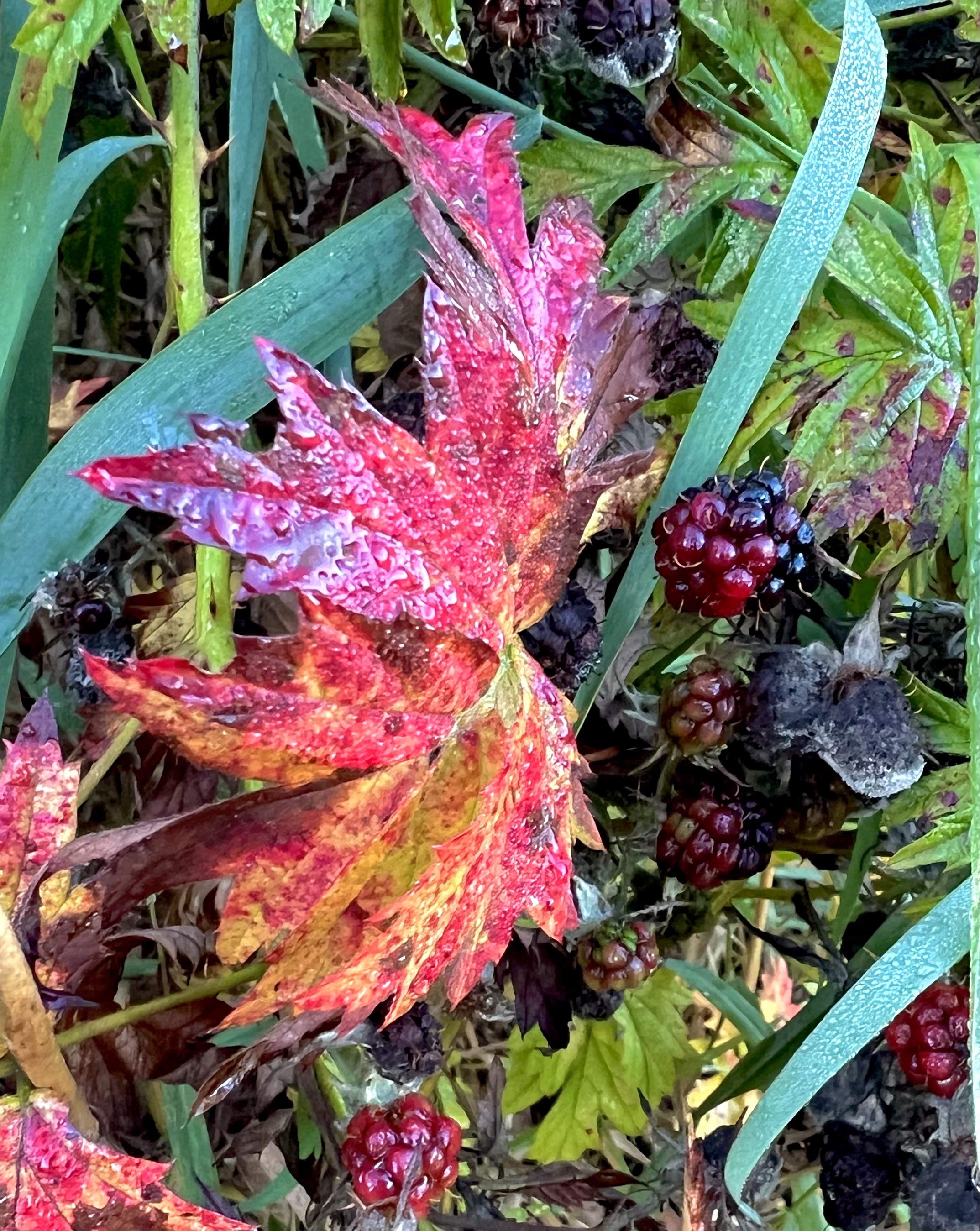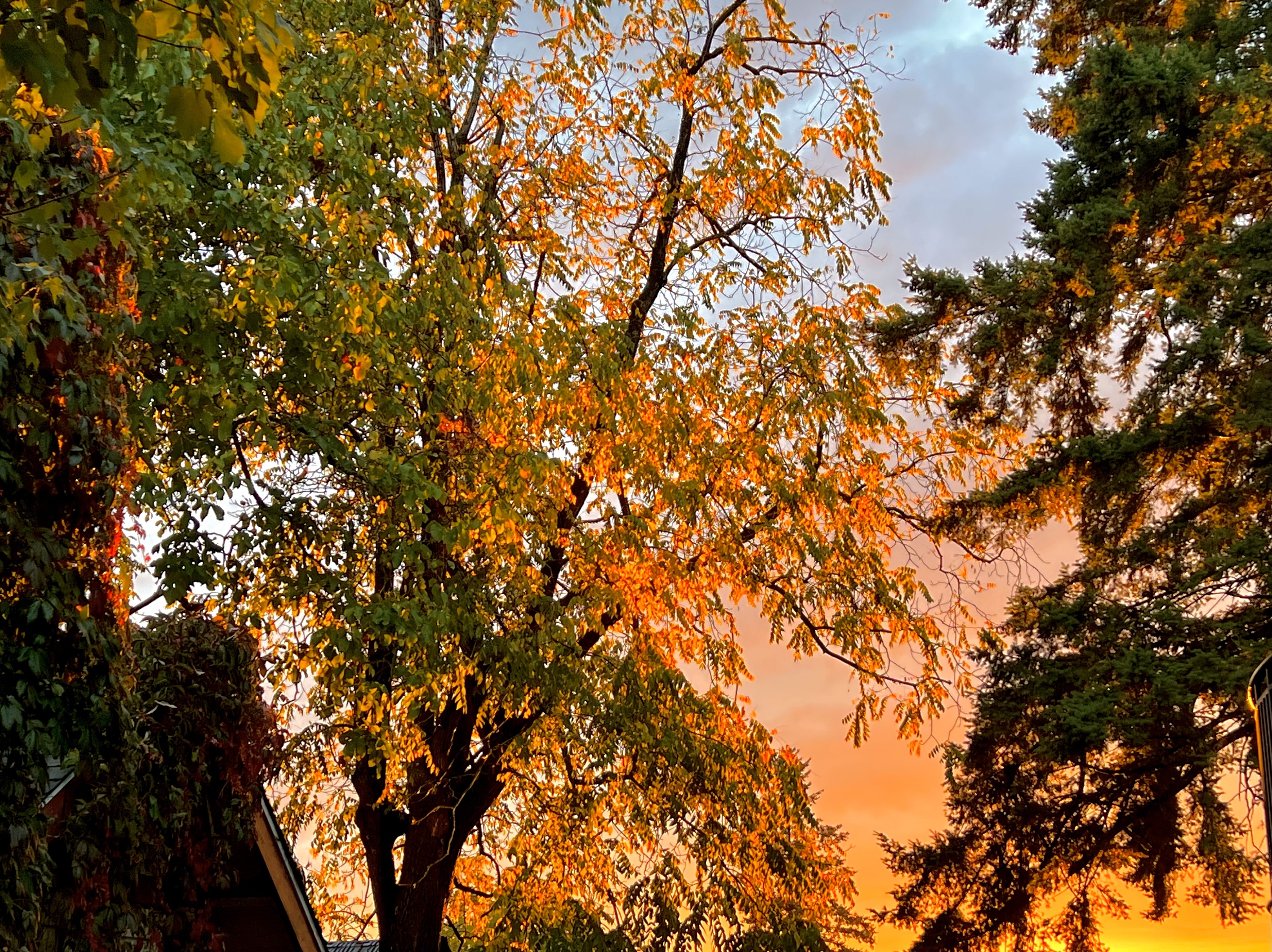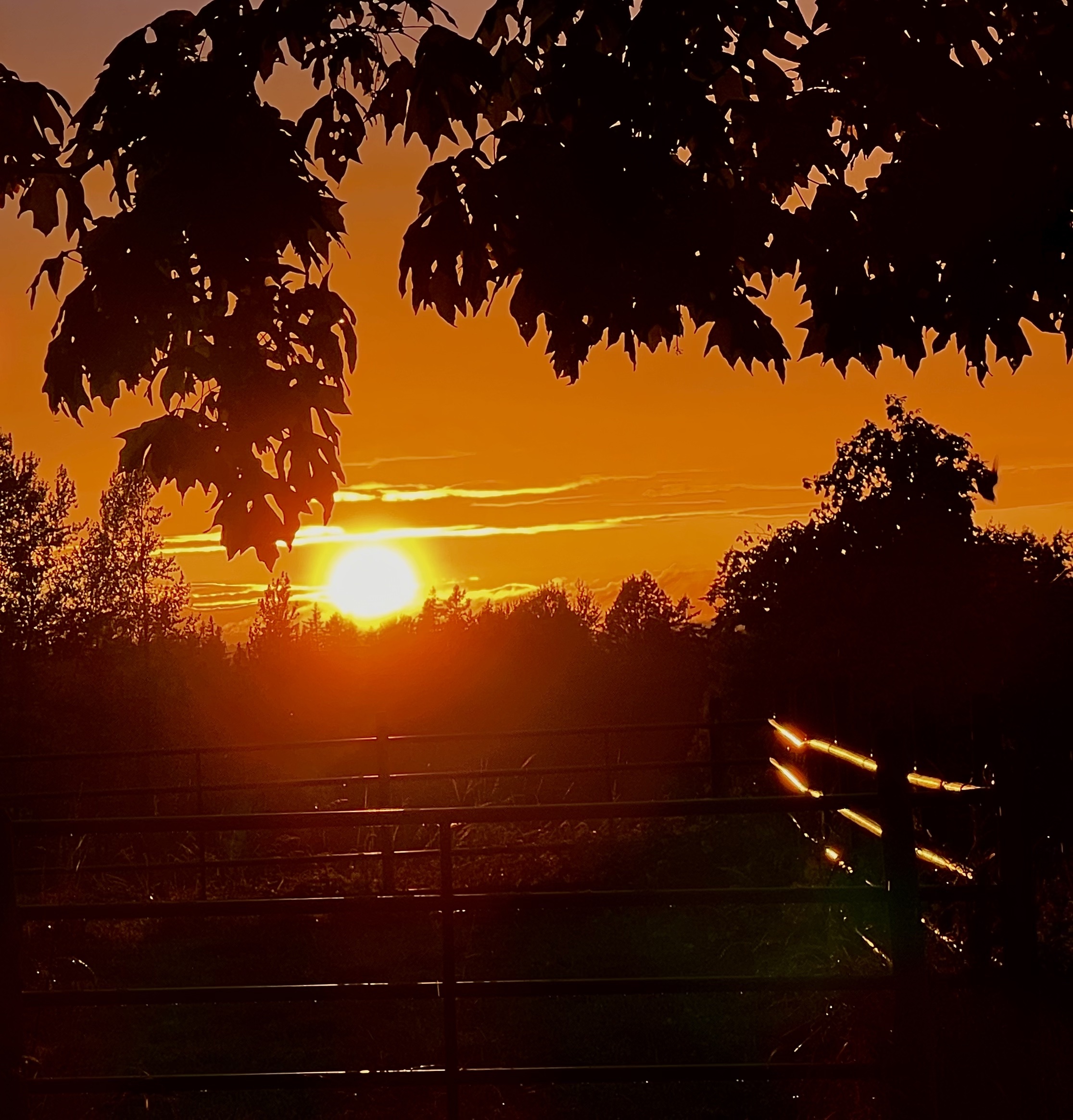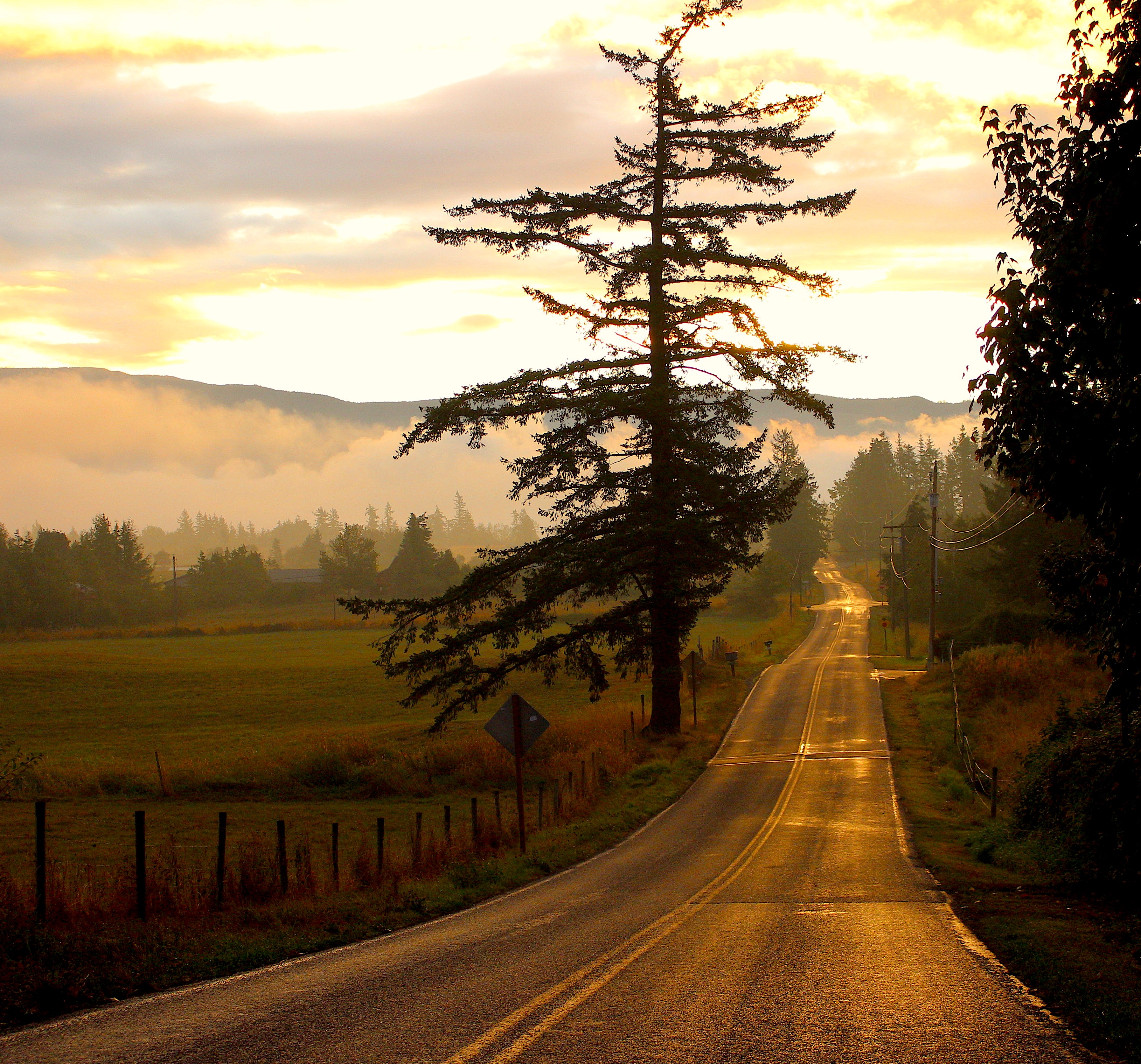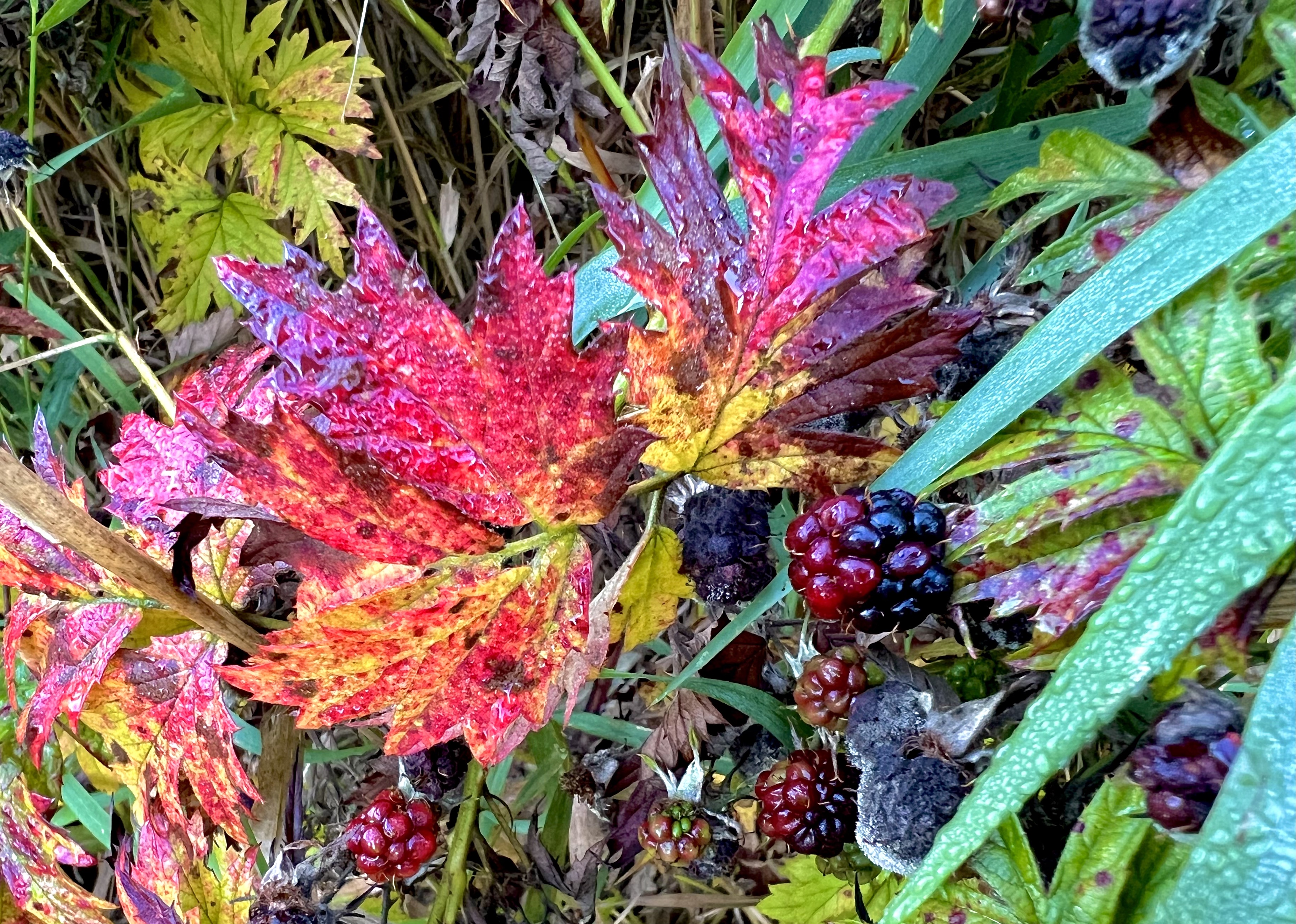
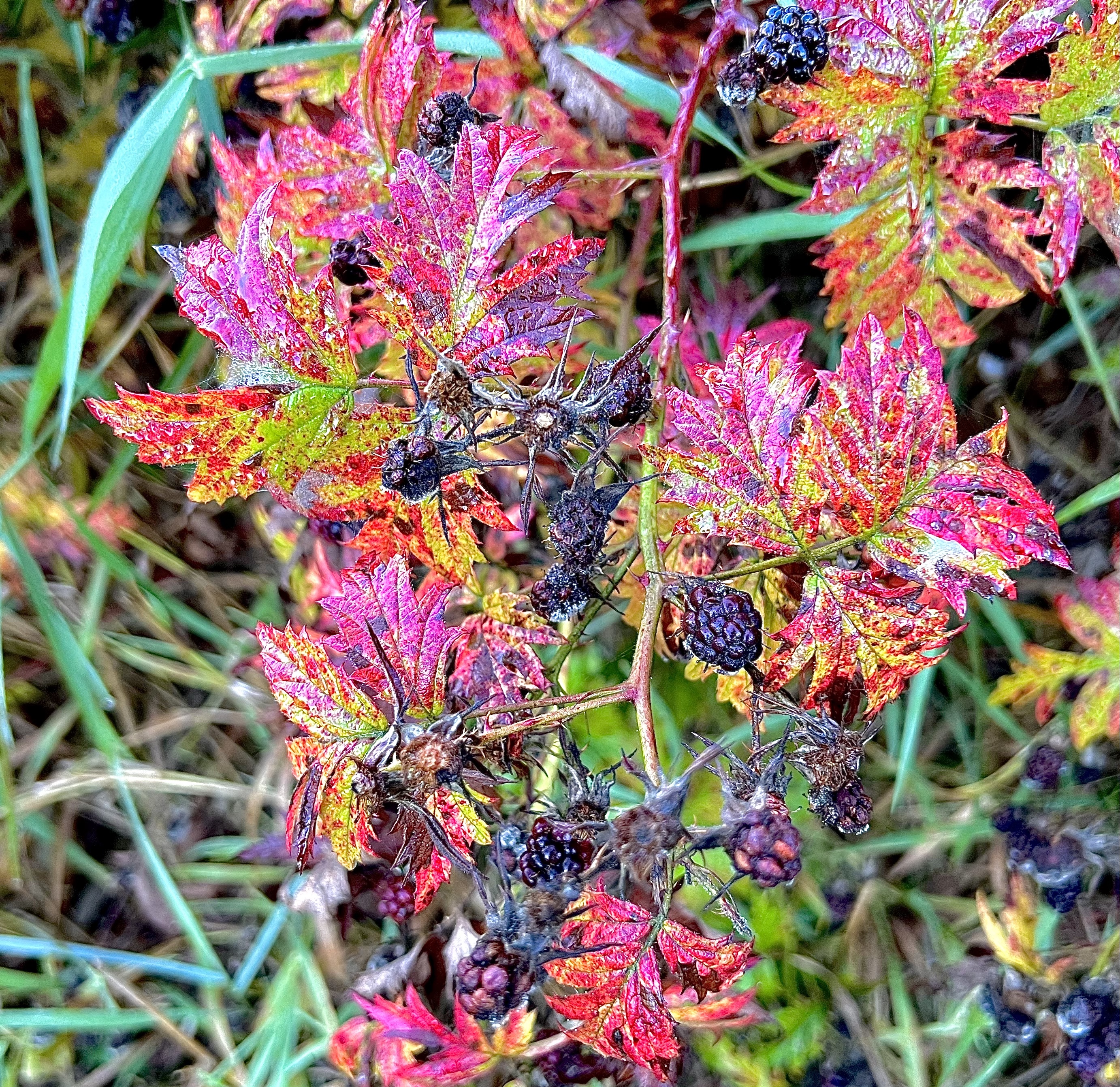
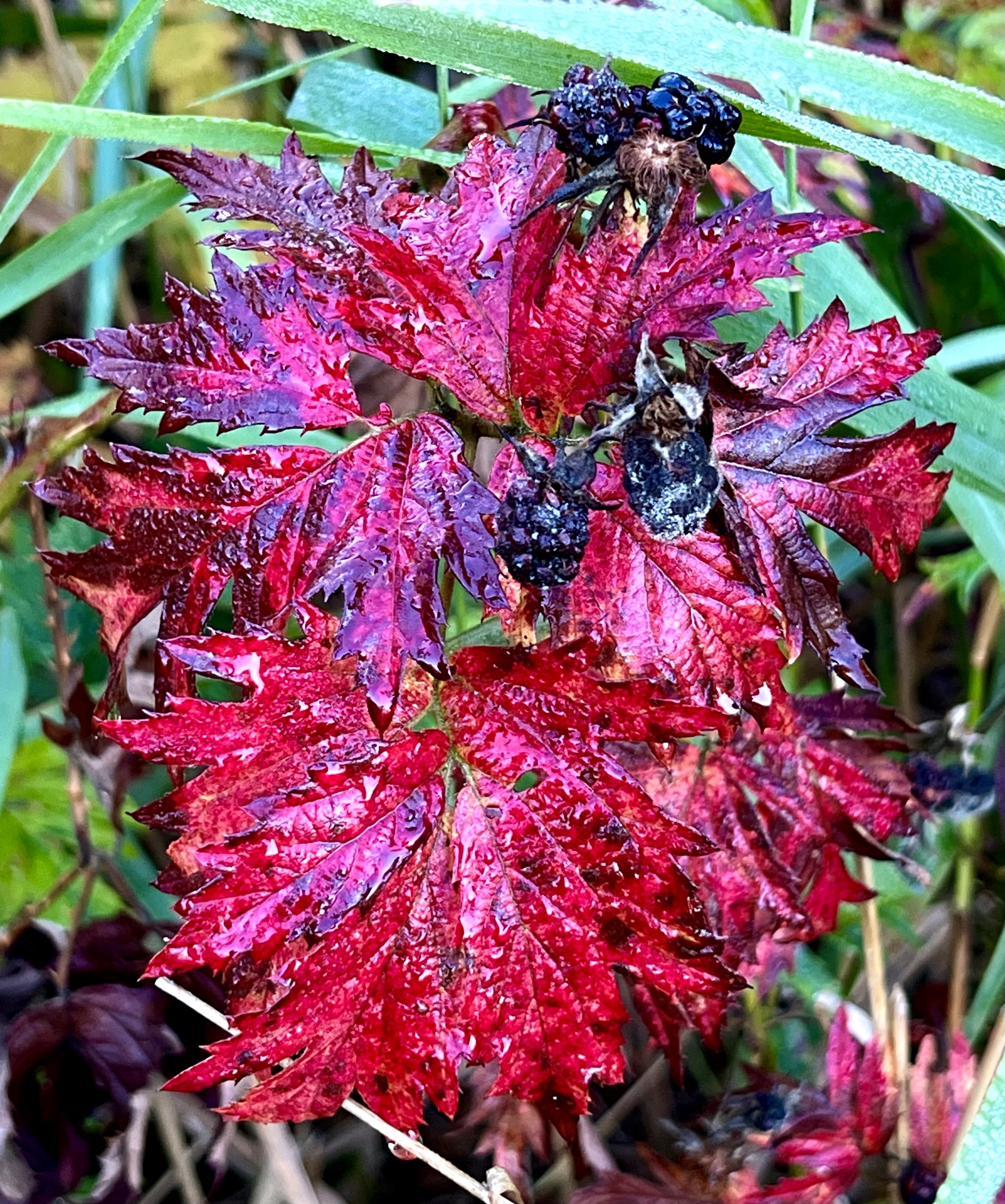
Late September Blackberry Picking

They lie
on the ground
after the deer
have left after the
bear has had her fill they

lie under the stars
and under the sun
in a cloud of brambles
the ripest ones
fall first
become black jam
in the thatch.


as a boy I hated
picking blackberries the
pail never full like
one half of a
slow
conversation.

Now
their taste
is sweeter
in memory
the insect buzz the
branches too high the blue
summer never quite
over before
the fall
begins.

~Richard Terrell from “Blackberries” from What Falls Away is Always
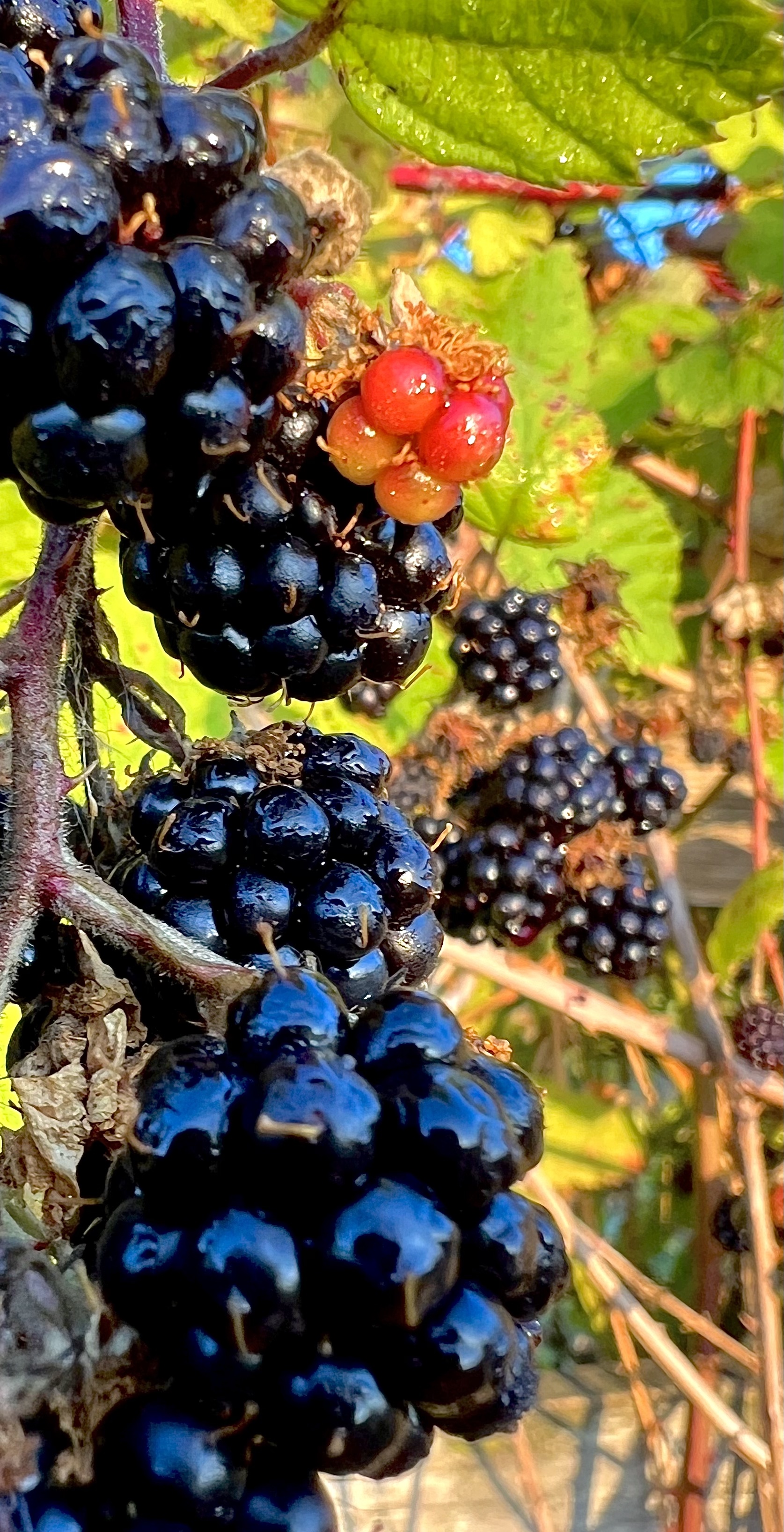
You ate that first one and its flesh was sweet
Like thickened wine: summer’s blood was in it
Leaving stains upon the tongue and lust for
Picking. Then red ones inked up and that hunger
Sent us out with milk cans, pea tins, jam-pots
Where briars scratched and wet grass bleached our boots.
Round hayfields, cornfields and potato-drills
We trekked and picked until the cans were full,
Until the tinkling bottom had been covered
With green ones, and on top big dark blobs burned
Like a plate of eyes. Our hands were peppered
With thorn pricks, our palms sticky as Bluebeard’s.

We hoarded the fresh berries in the byre.
But when the bath was filled we found a fur,
A rat-grey fungus, glutting on our cache.
The juice was stinking too. Once off the bush
The fruit fermented, the sweet flesh would turn sour.
I always felt like crying. It wasn’t fair
That all the lovely canfuls smelt of rot.
Each year I hoped they’d ke
ep, knew they would not.
~Seamus Heaney from “Blackberry Picking”
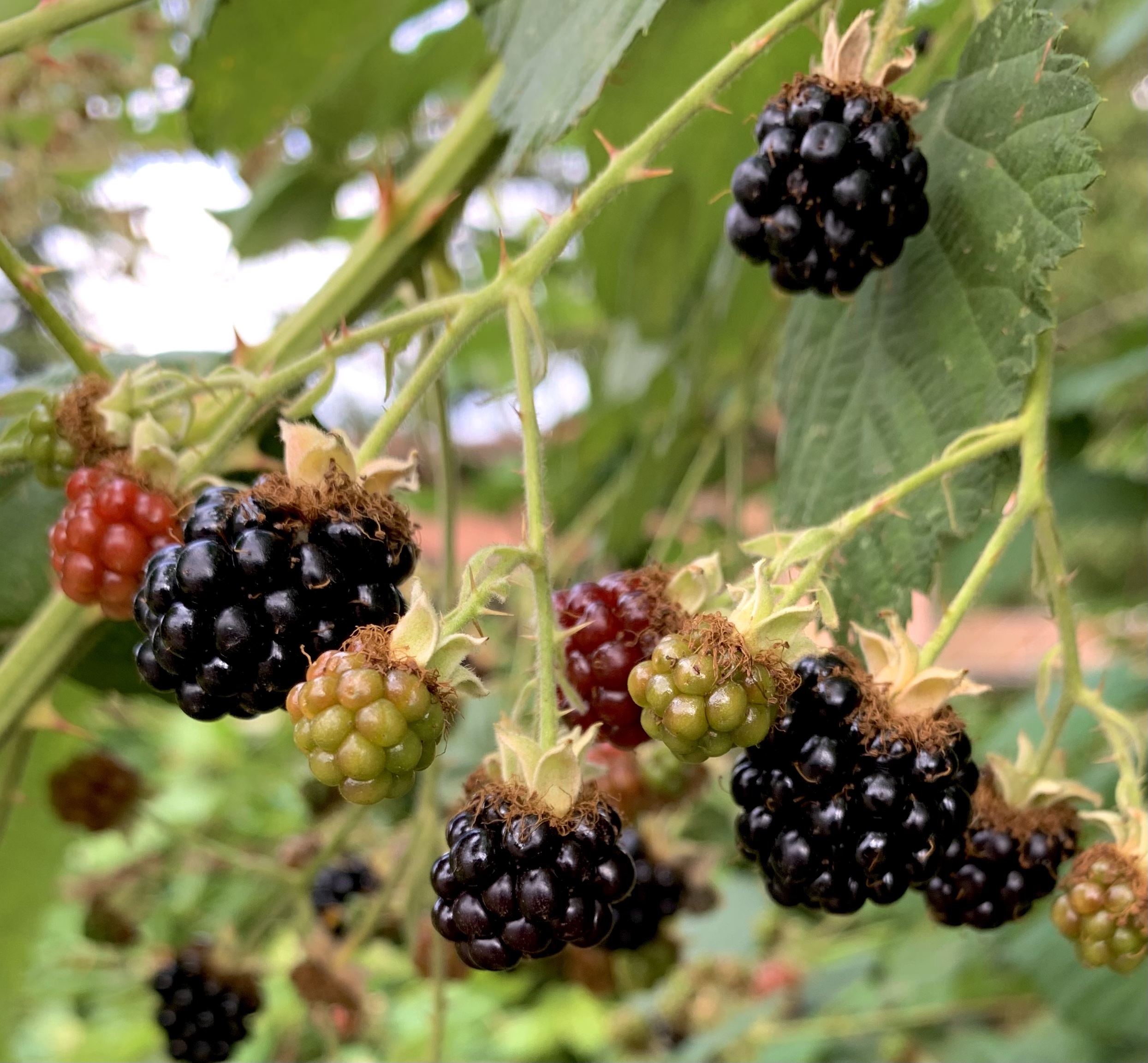
In the early morning an old woman
is picking blackberries in the shade.
It will be too hot later
but right now there’s dew.

Some berries fall: those are for squirrels.
Some are unripe, reserved for bears.
Some go into the metal bowl.
Those are for you, so you may taste them
just for a moment.
That’s good times: one little sweetness
after another, then quickly gone.

Once, this old woman
I’m conjuring up for you
would have been my grandmother.
Today it’s me.
Years from now it might be you,
if you’re quite lucky.

The hands reaching in
among the leaves and spines
were once my mother’s.
I’ve passed them on.
Decades ahead, you’ll study your own
temporary hands, and you’ll remember.
Don’t cry, this is what happens.

Look! The steel bowl
is almost full. Enough for all of us.
The blackberries gleam like glass,
like the glass ornaments
we hang on trees in December
to remind ourselves to be grateful for snow.

Some berries occur in sun,
but they are smaller.
It’s as I always told you:
the best ones grow in shadow.

~Margaret Atwood “Blackberries” from Dearly 
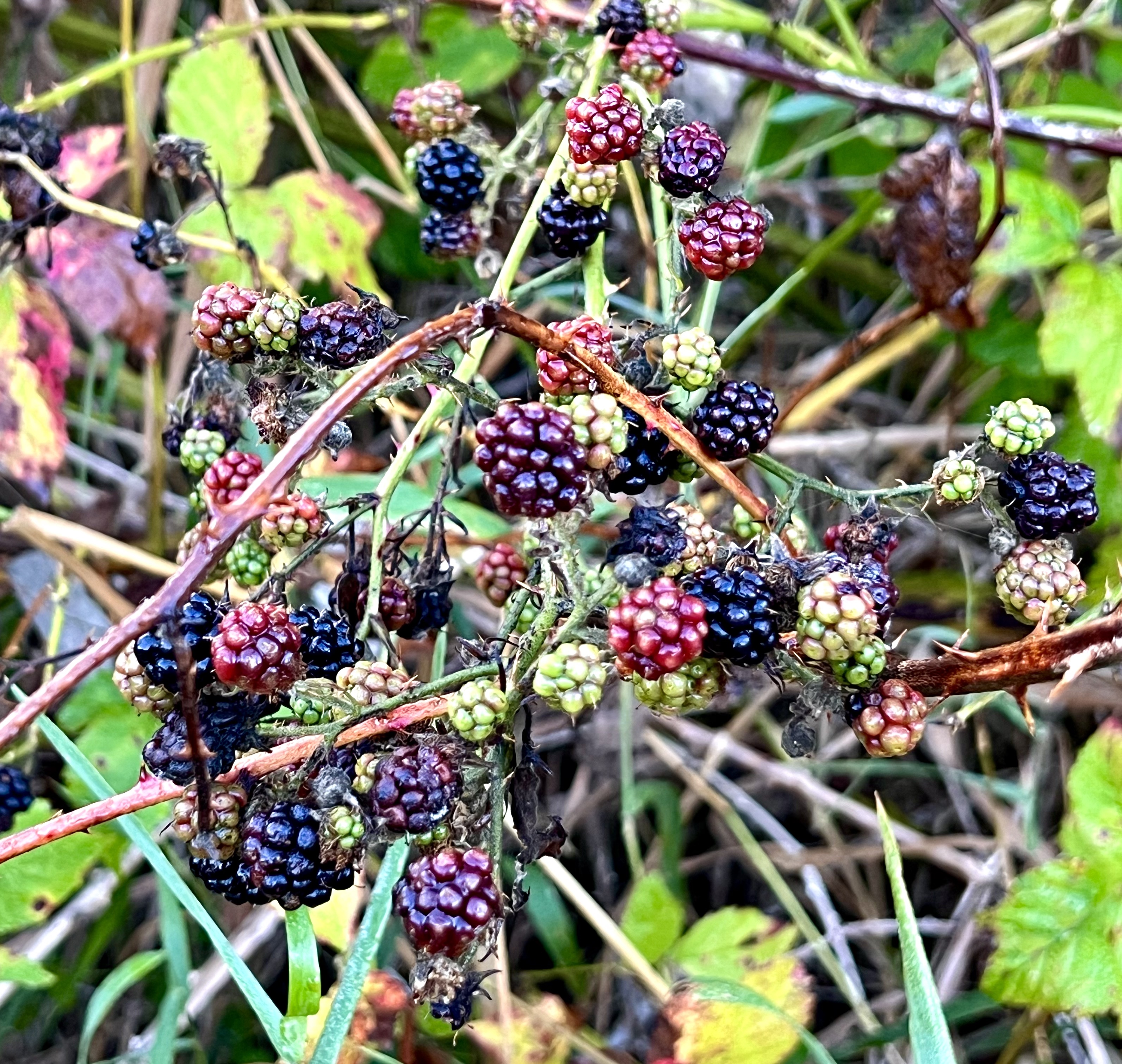
I love to go out in late September
among the fat, overripe, icy, black blackberries
to eat blackberries for breakfast,
the stalks very prickly, a penalty
they earn for knowing the black art
of blackberry-making; and as I stand among them
lifting the stalks to my mouth, the ripest berries
fall almost unbidden to my tongue,
as words sometimes do, certain peculiar words
like strengths or squinched,
many-lettered, one-syllabled lumps,
which I squeeze, squinch open, and splurge well
in the silent, startled, icy, black language
of blackberry-eating in late September.

~Galway Kinnell “Blackberry Eating”
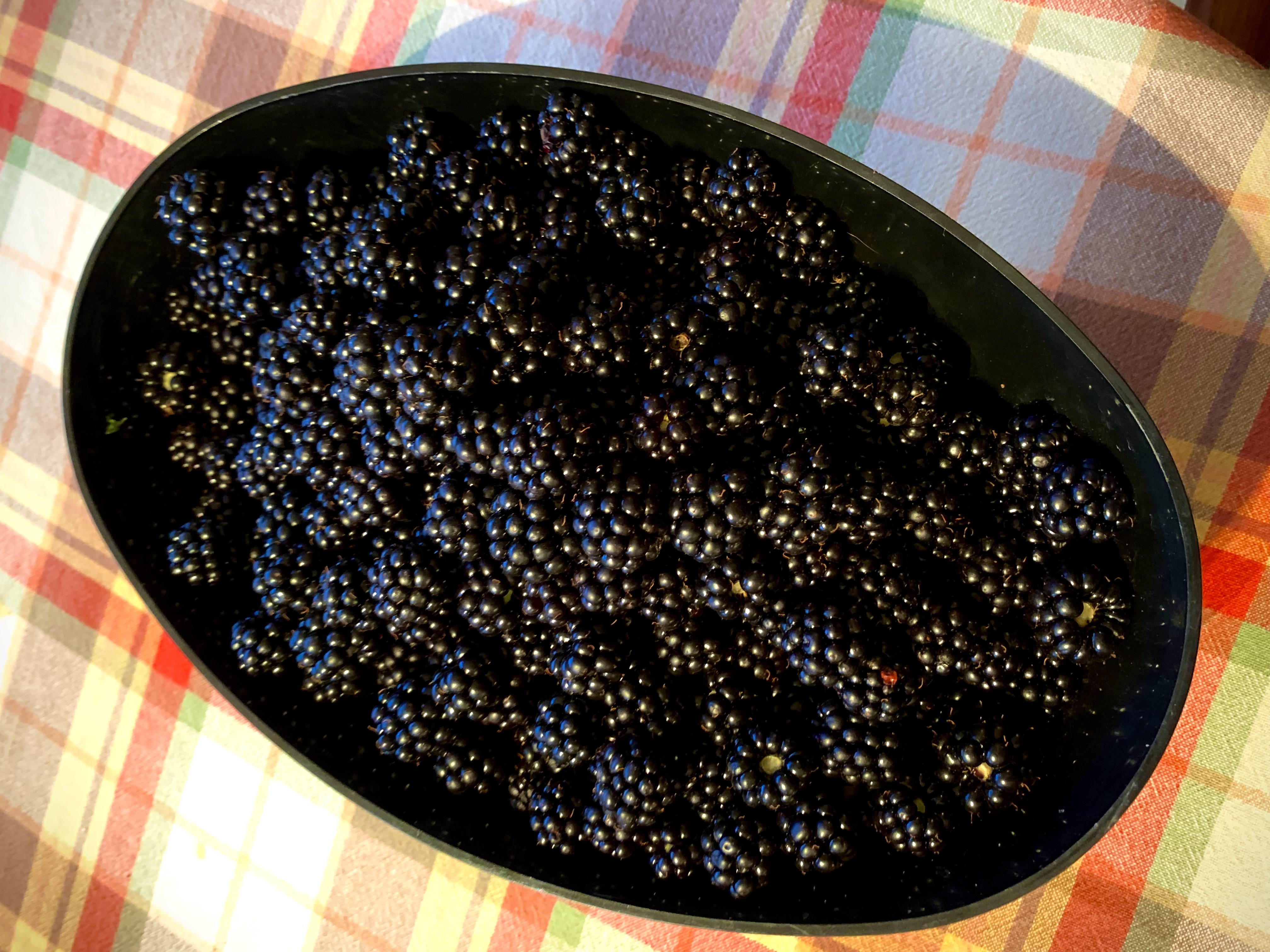
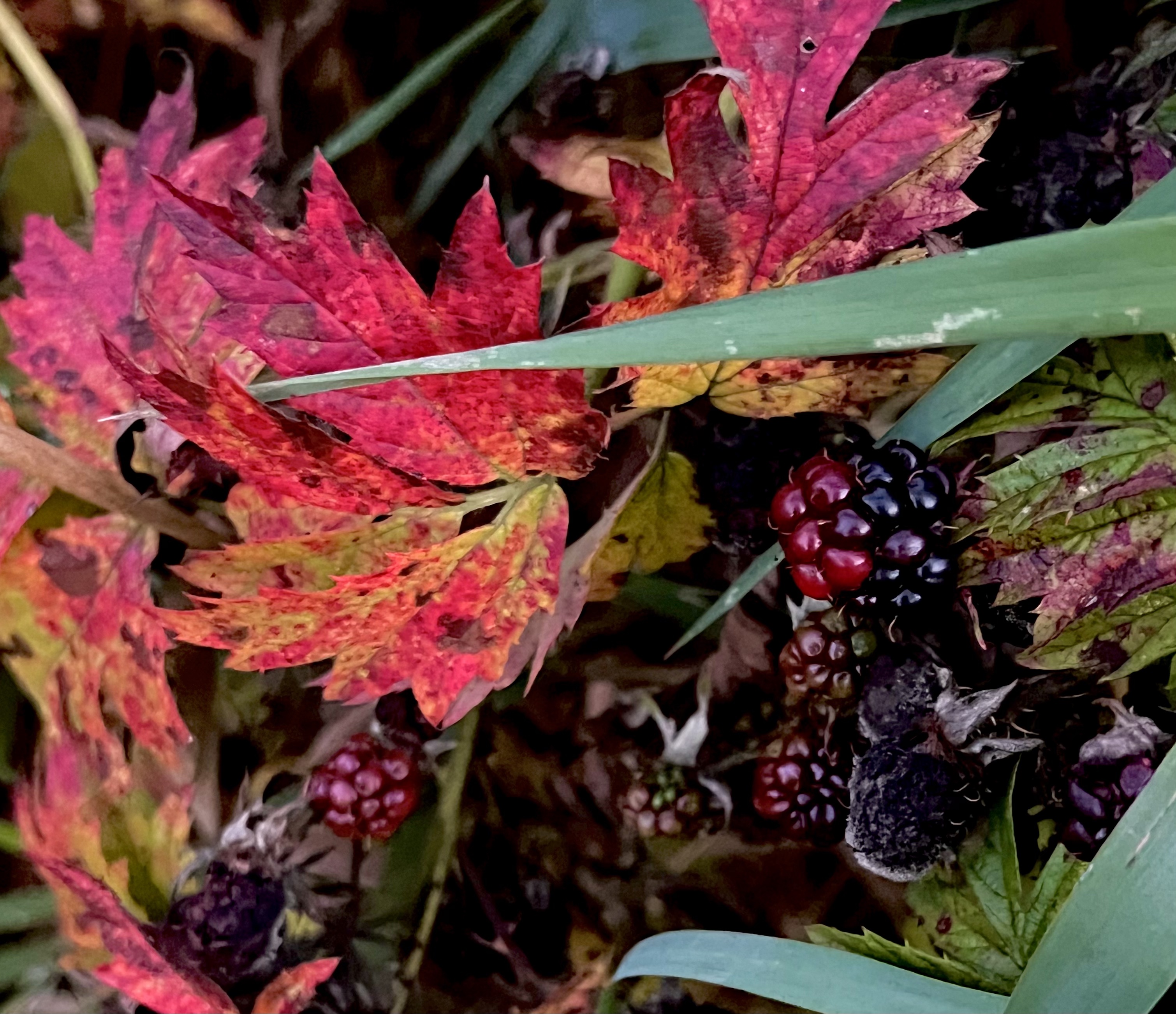
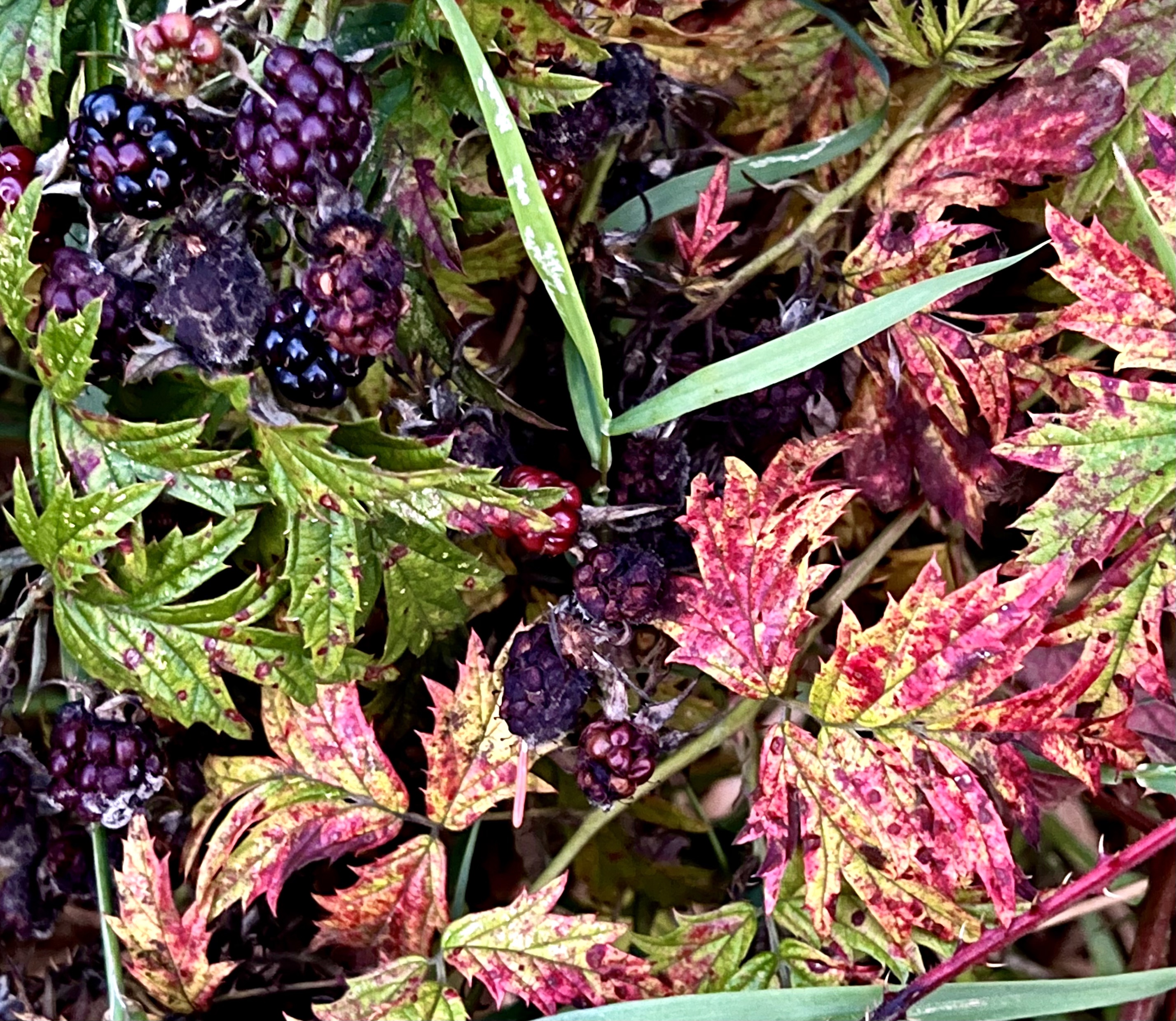
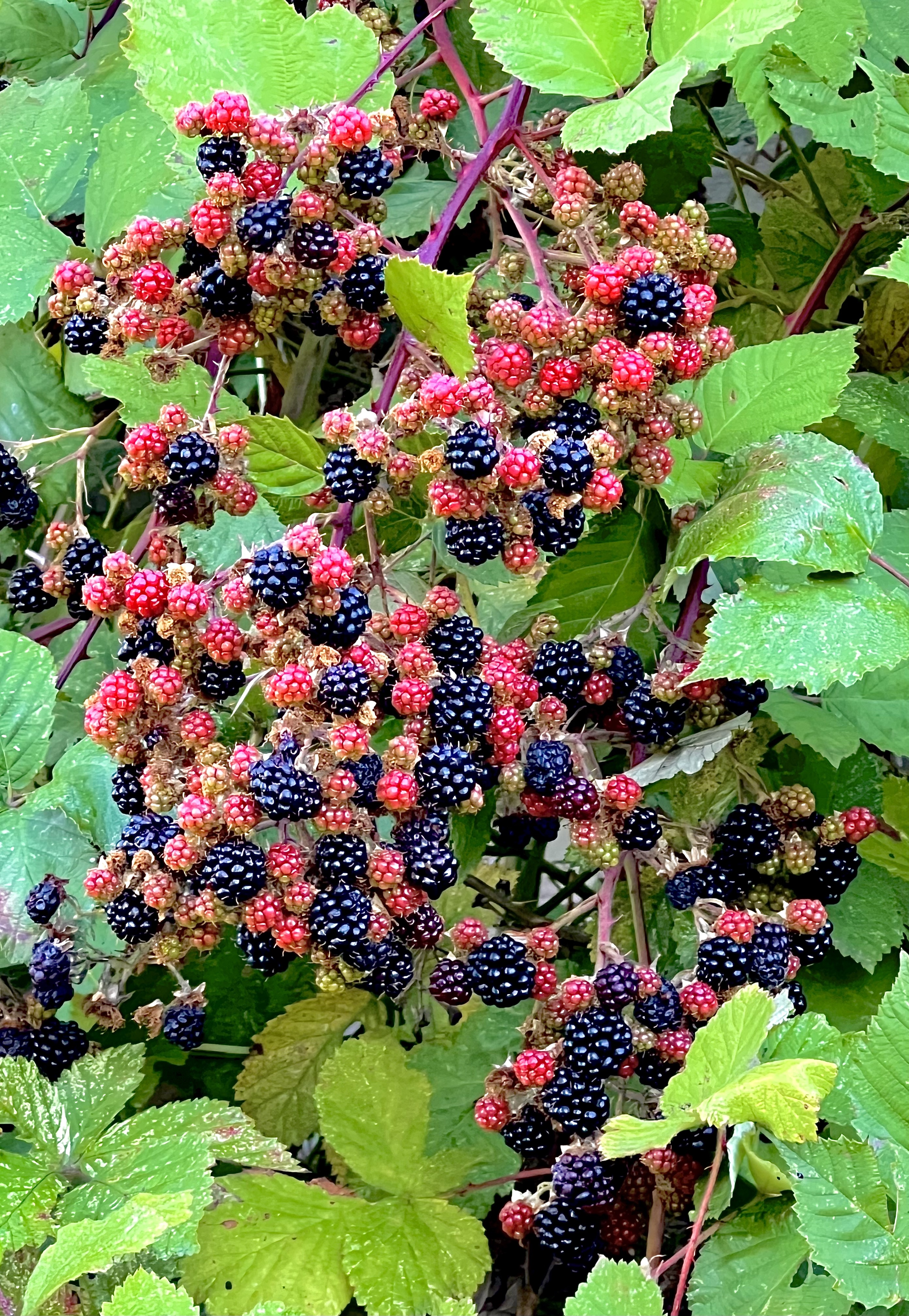
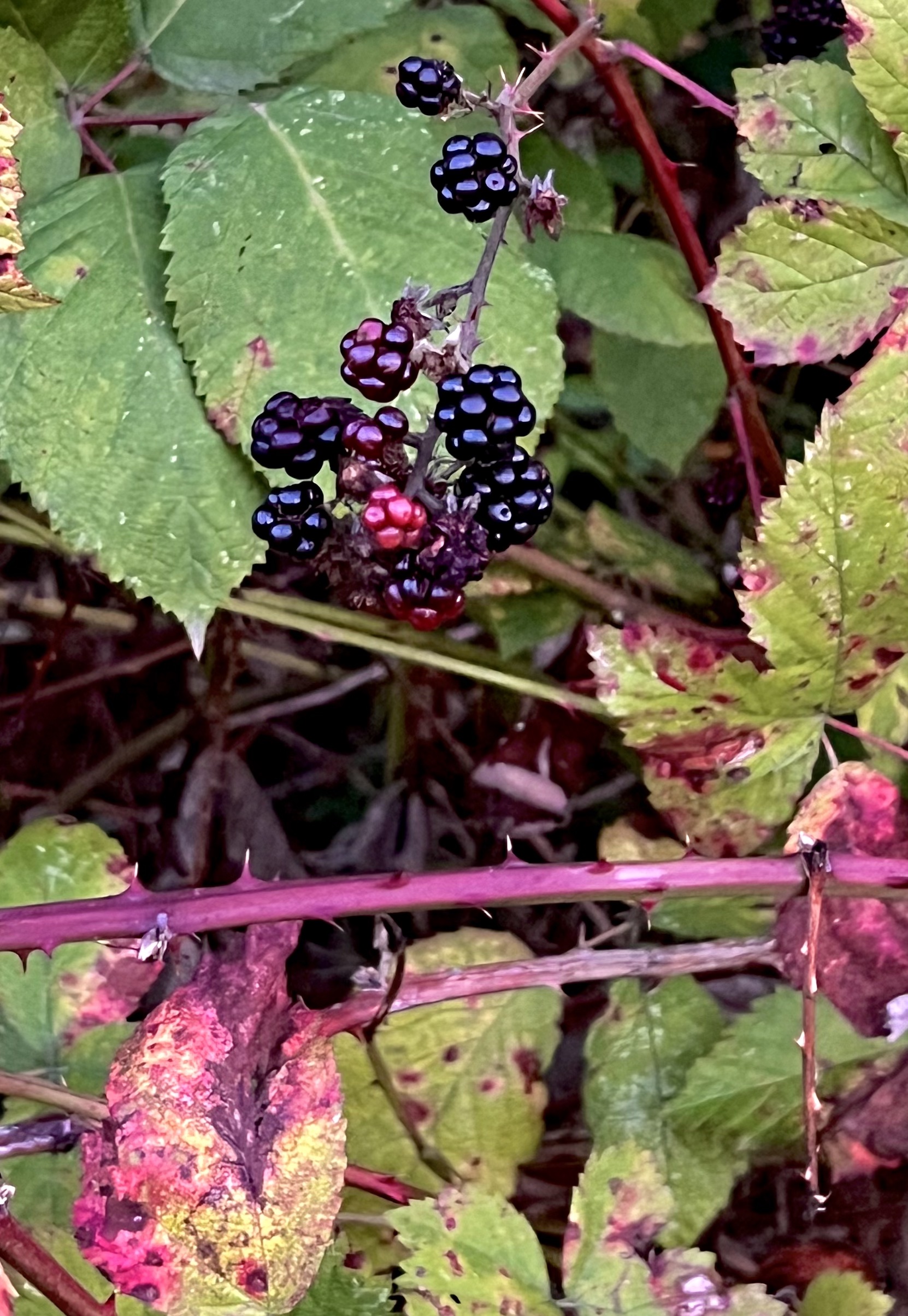
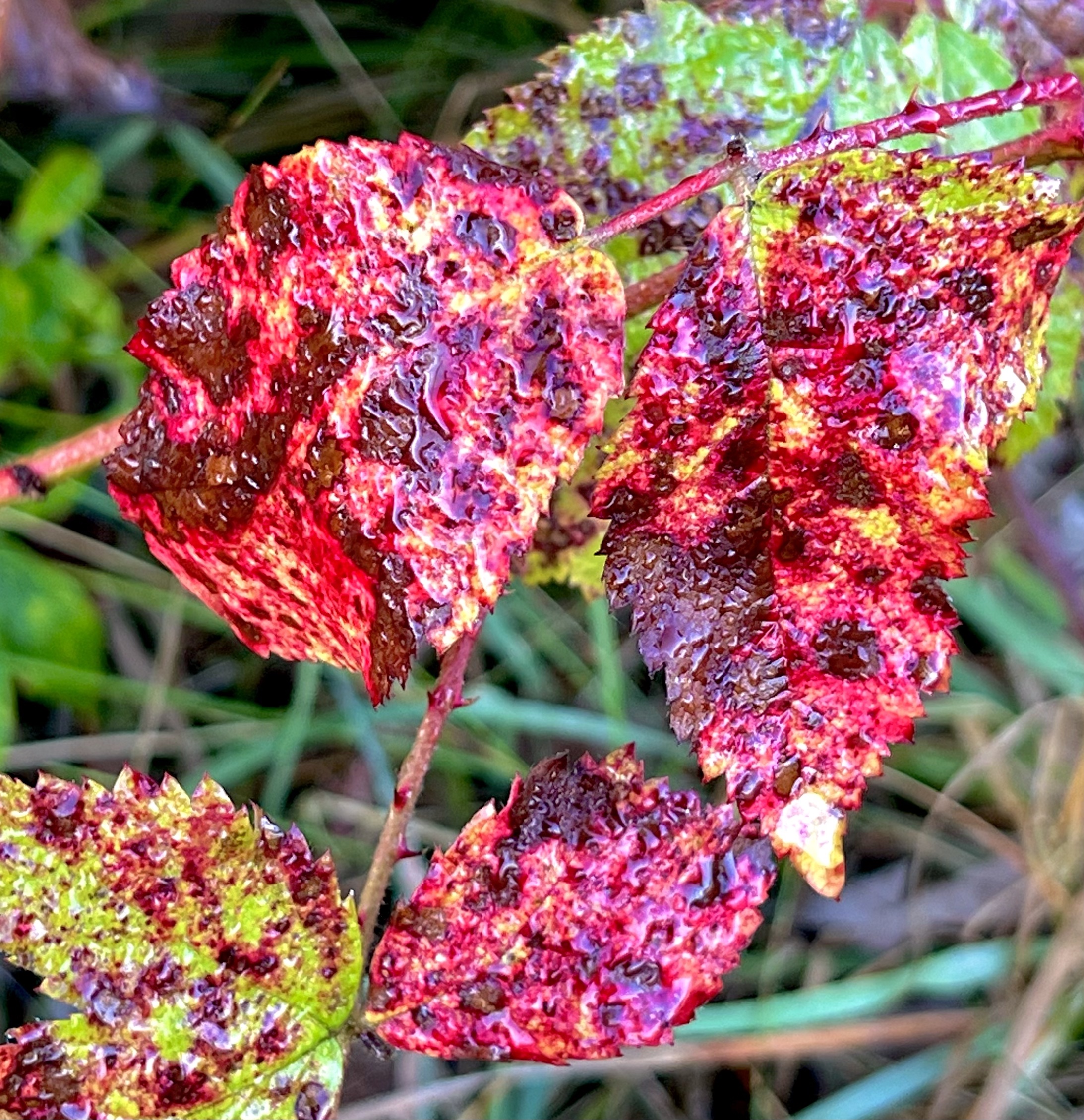
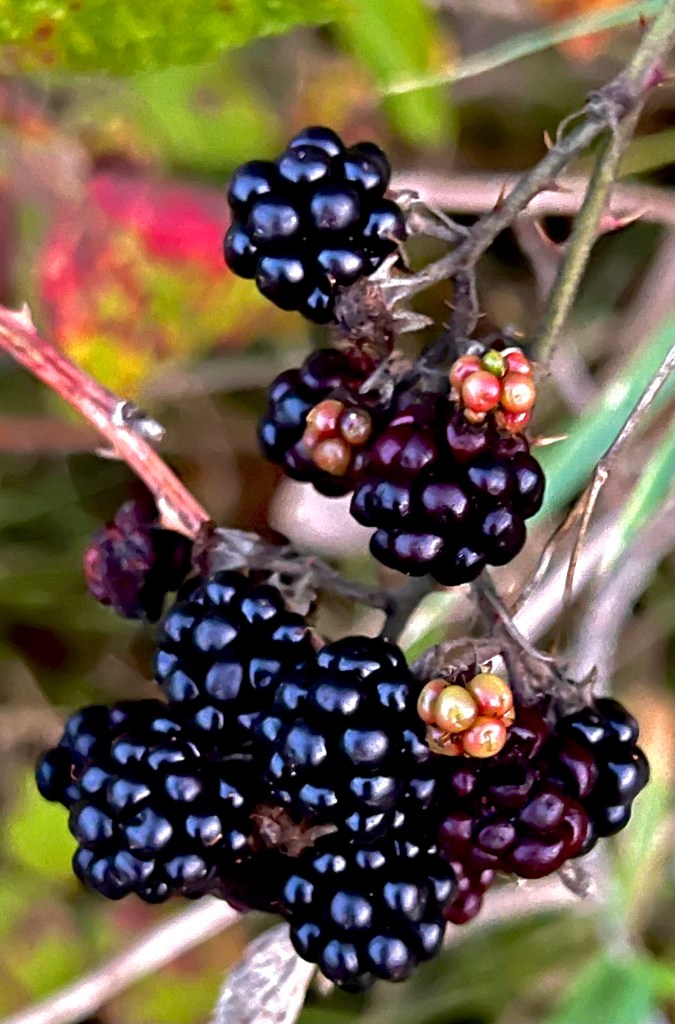
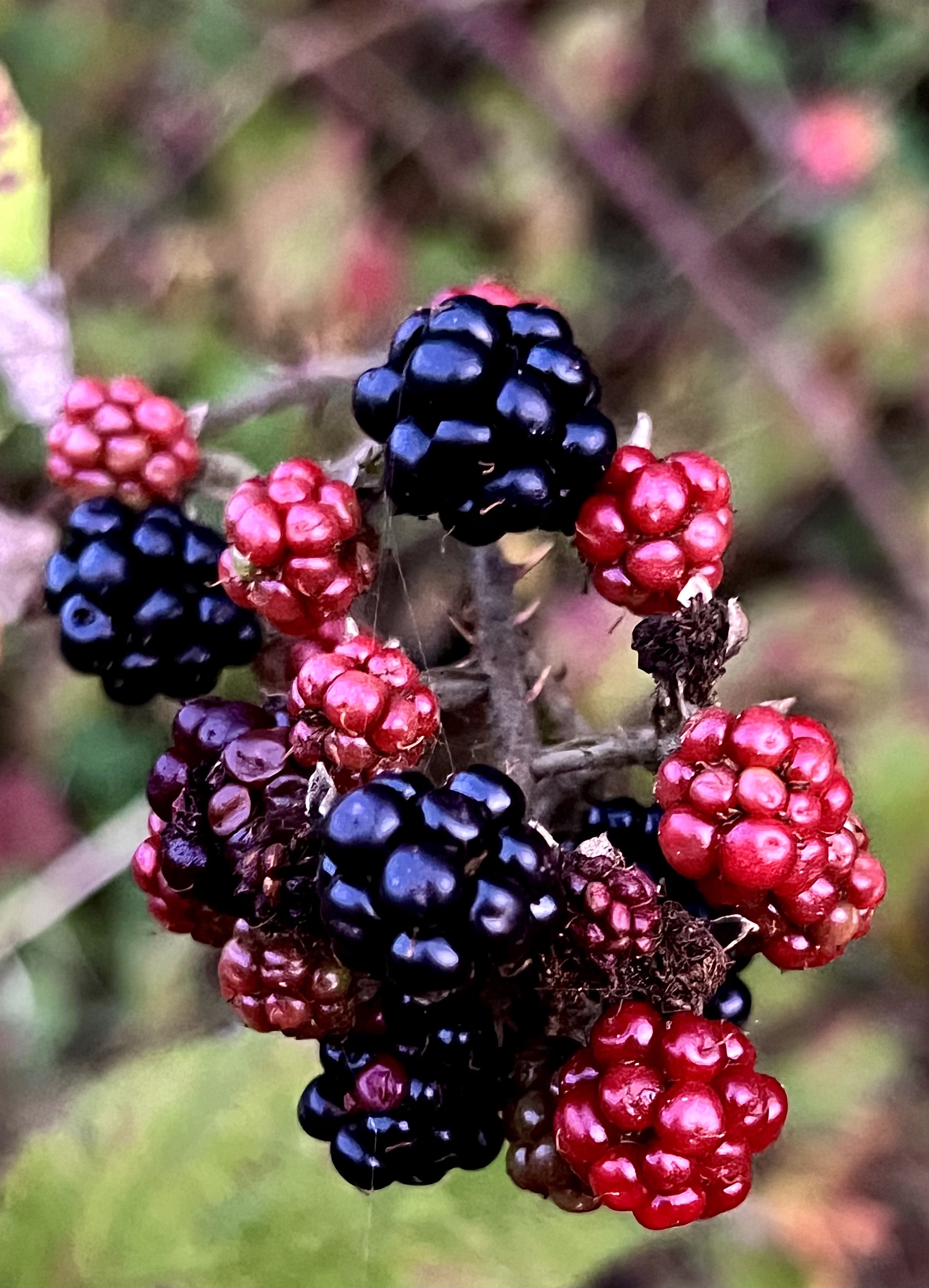
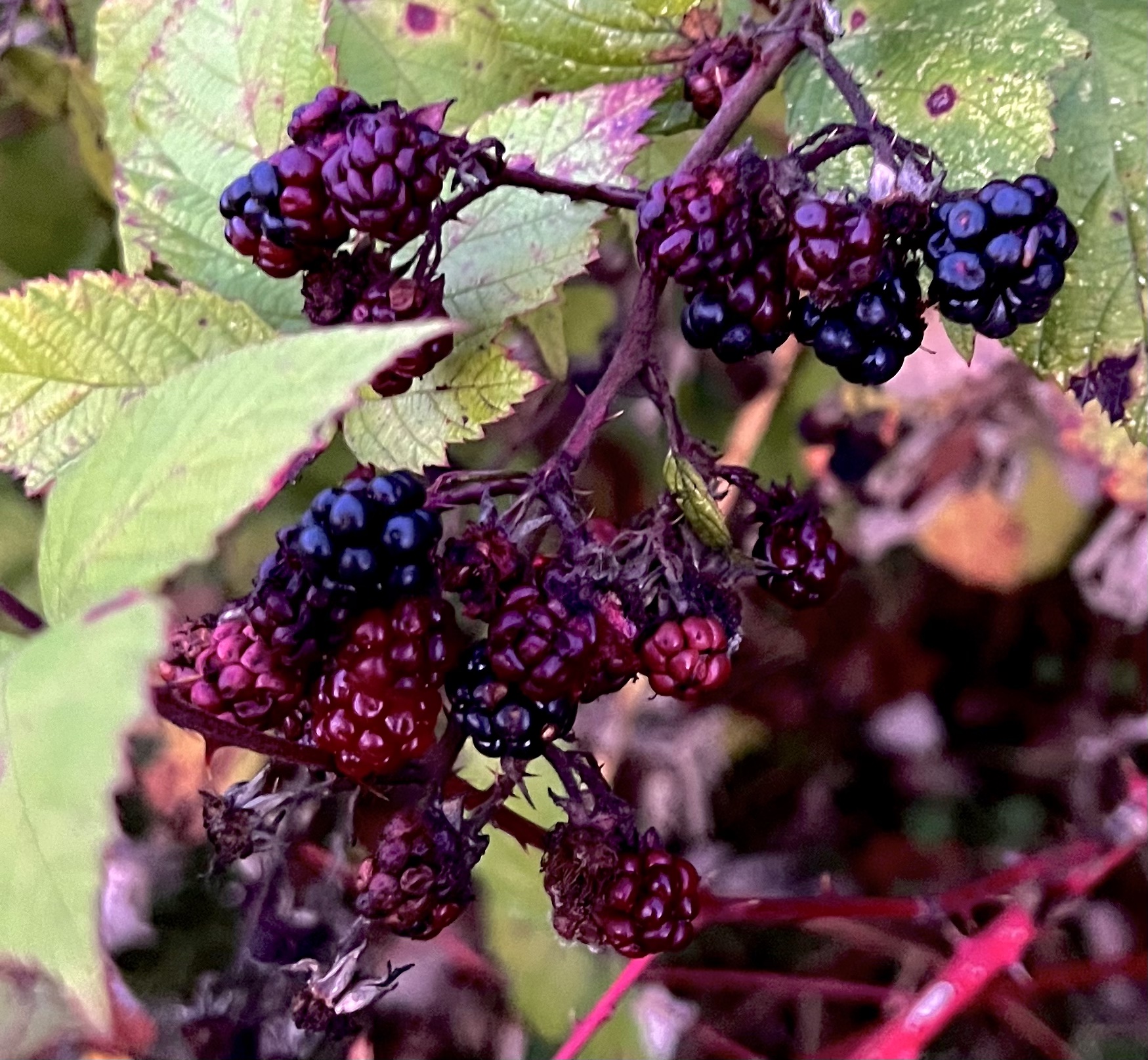
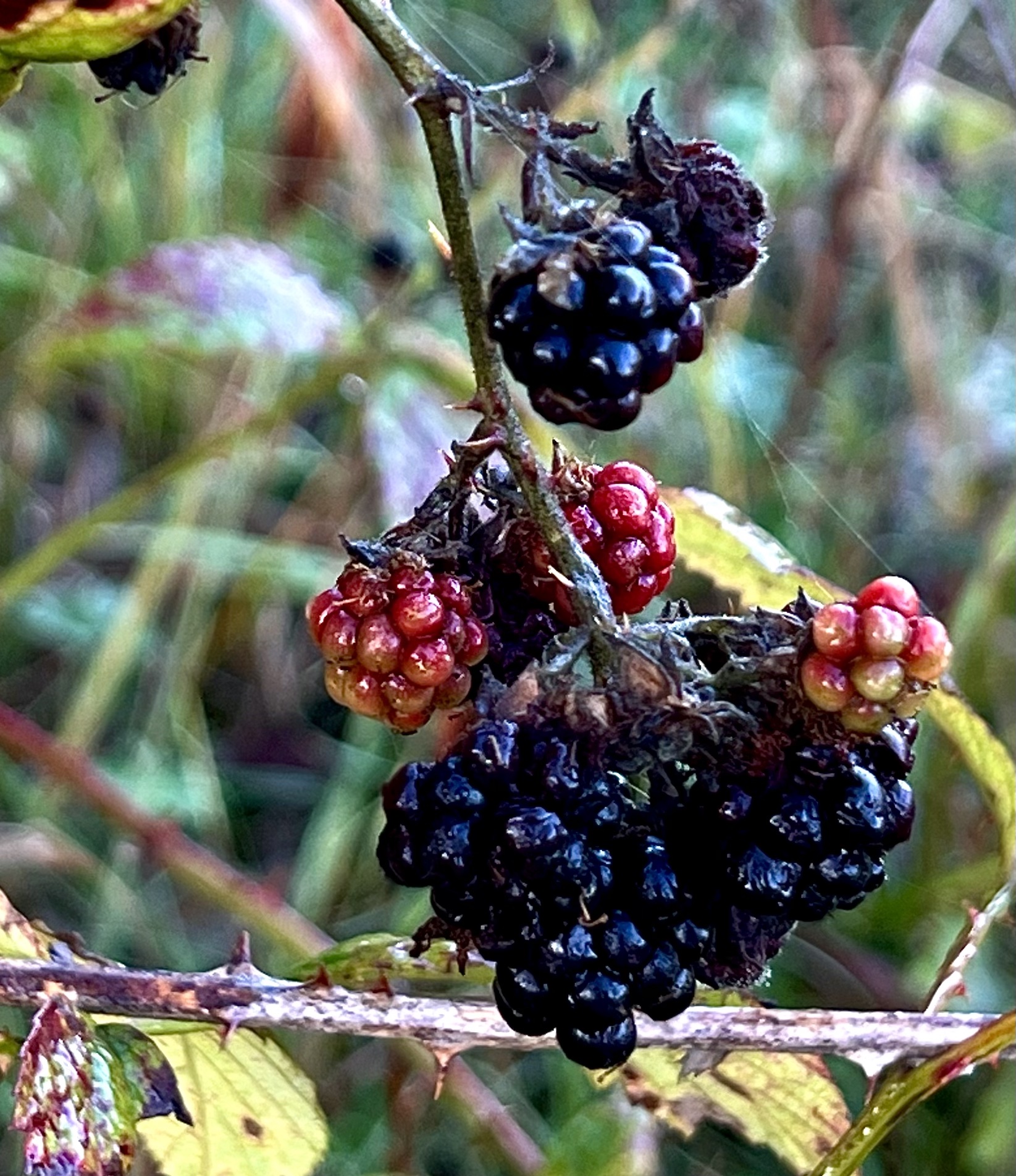
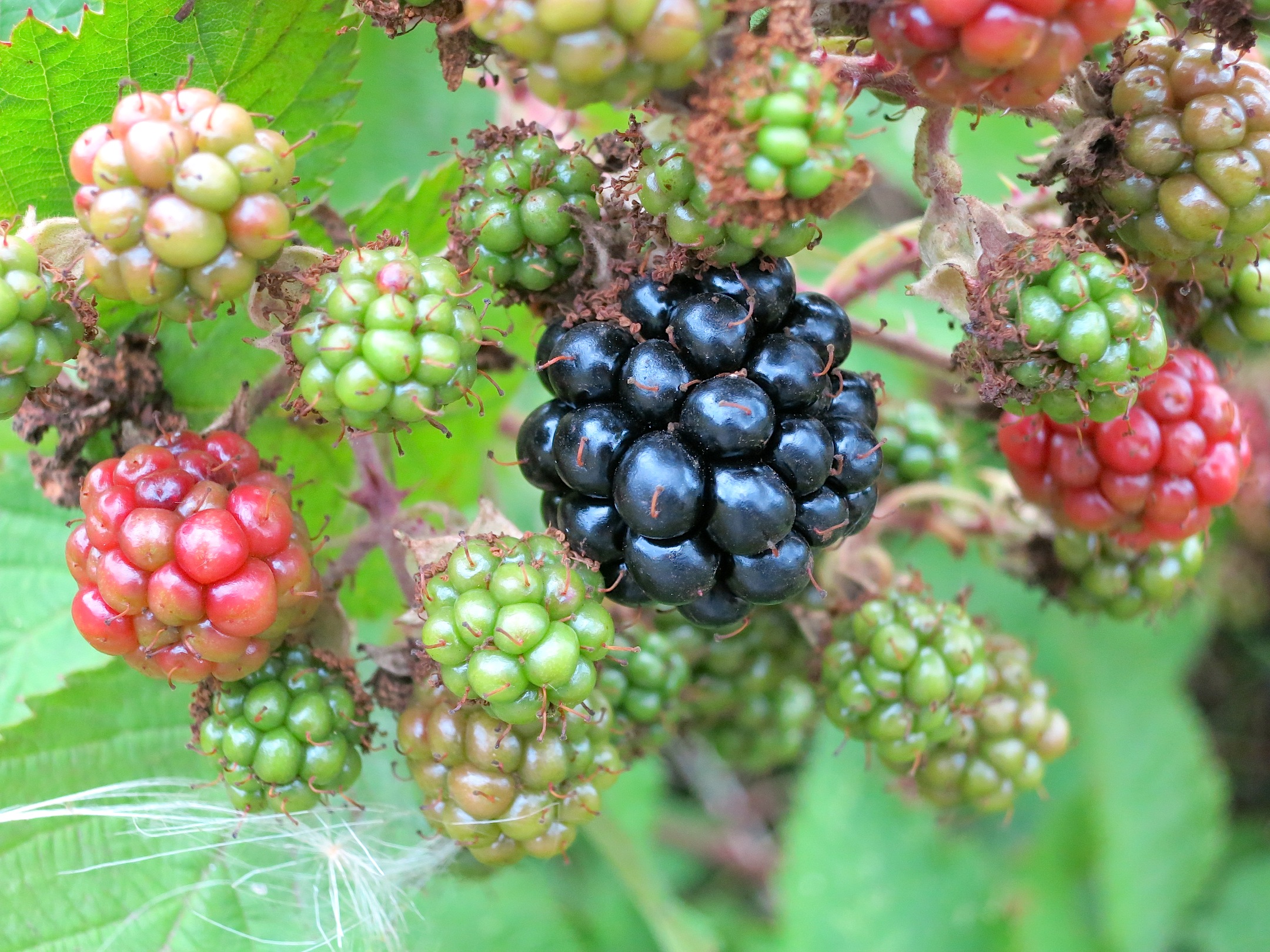
Blackberry vines are trouble 90% of the year – always growing where they are not welcome – reaching out to grab passersby without discriminating between human, dog or horse. But for a month in late summer and early fall, they yield black gold – bursting, swelling, unimaginably sweet fruit that is worth the hassle tolerated the rest of the weeks of the year.

It has been an unusually dry summer here in the Pacific Northwest with little rain until recently, so the fields are brown and even the usually lush blackberry vines have started to dry and color up. The berries themselves are rich from the sun but starting now to shrivel and mold.

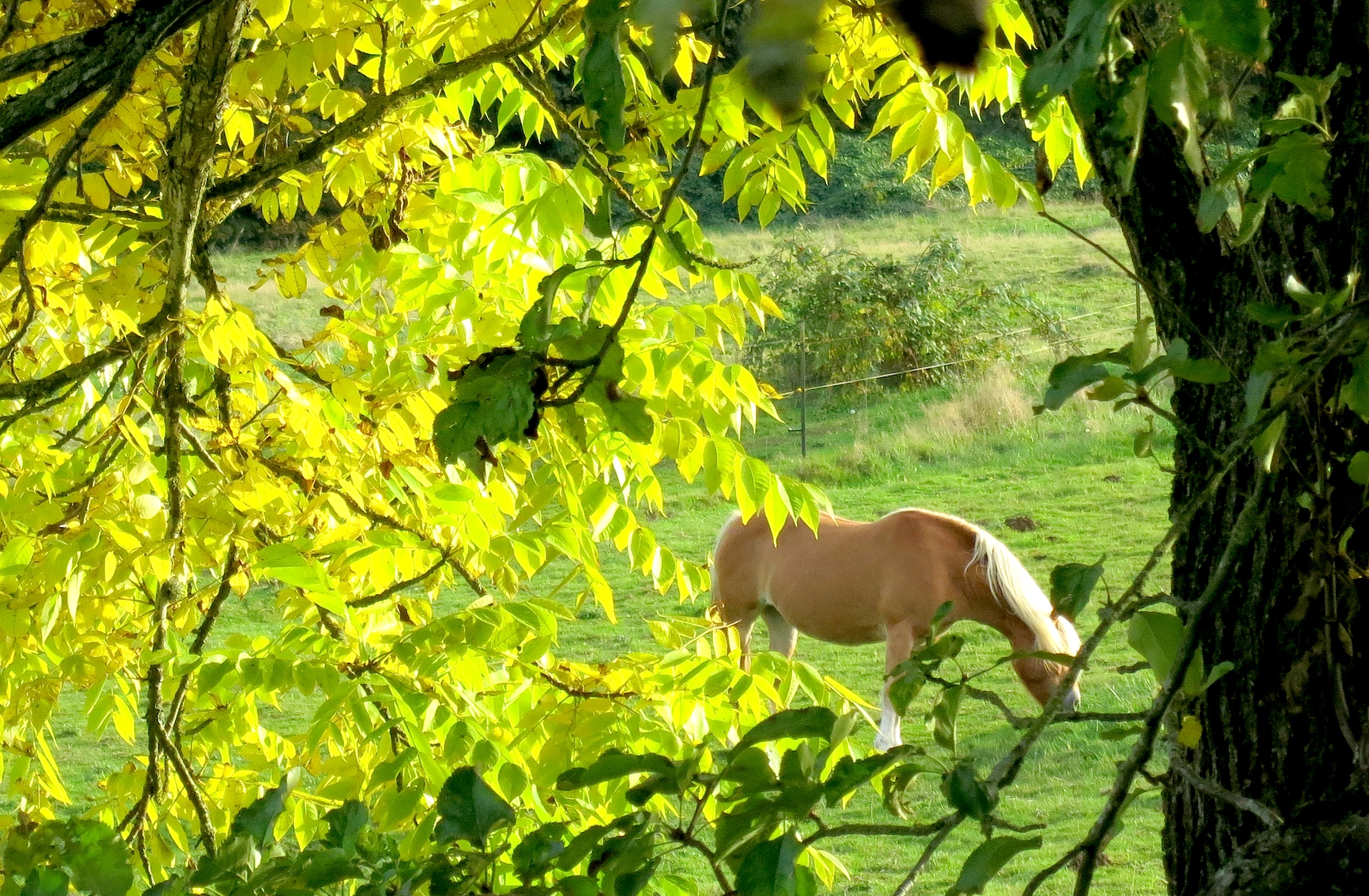
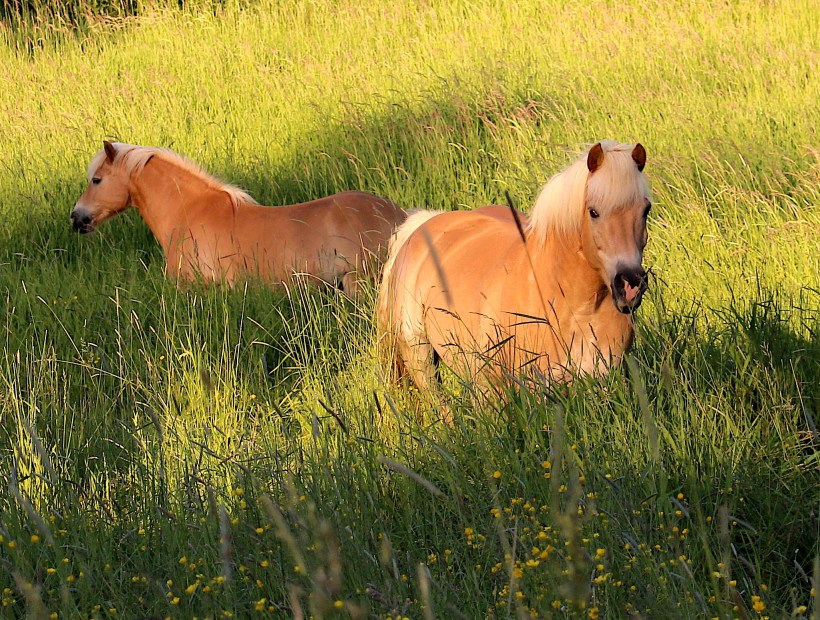
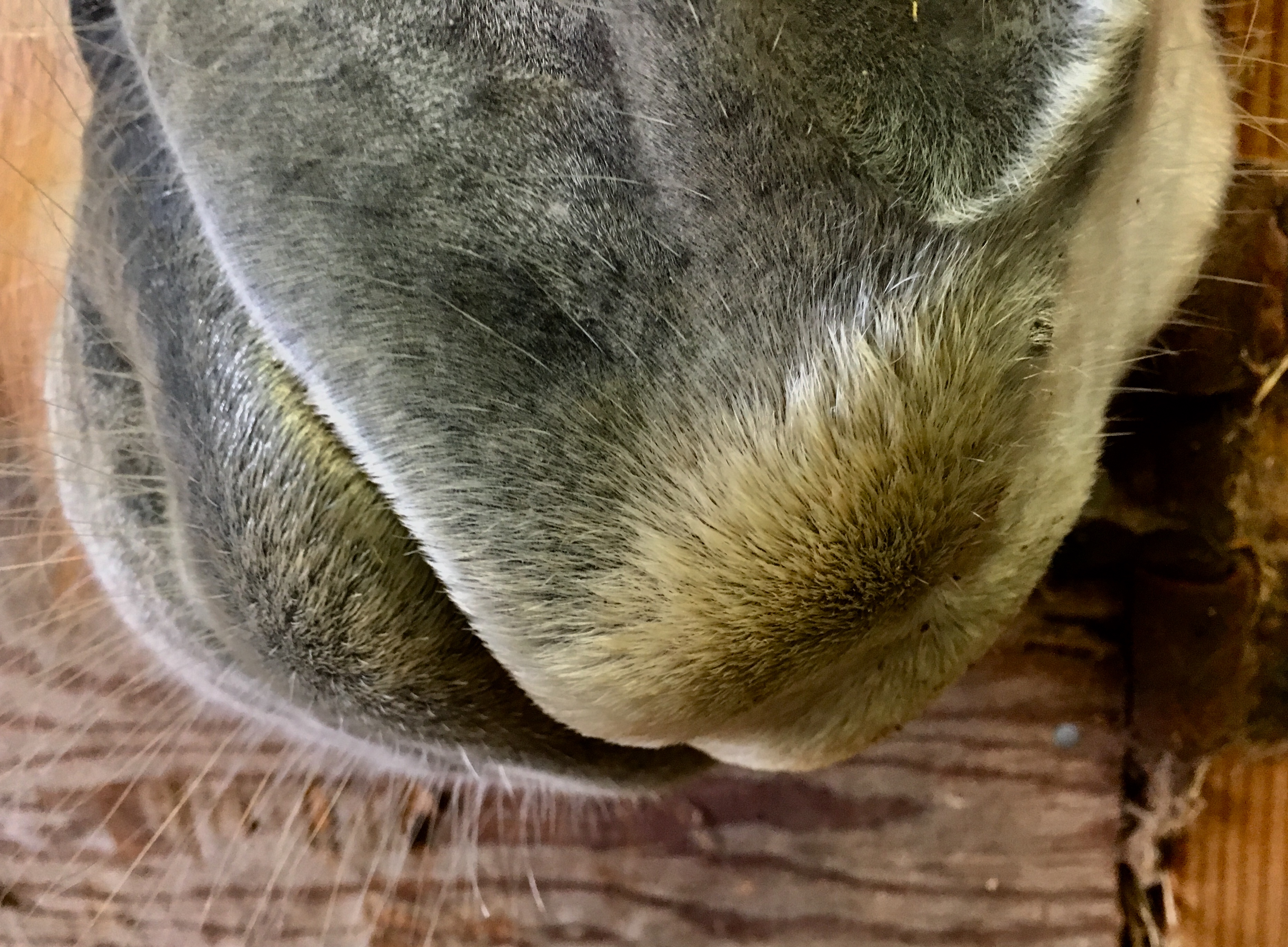
Our Haflinger horses have been fed hay for the past several weeks as there is not enough pasture for them without the supplement–we are about 6 weeks ahead of schedule in feeding hay. I had grown a little suspicious the last couple nights as I brought the Haflingers into the barn for the night. Two of the mares turned out in the back field had purplish stains on their chests and front legs. Hmmmm. Raiding the berries. Desperate drought forage behavior in an extremely efficient eating machine.

So this evening I headed toward the berries. When the mares saw the bowl in my hand, that was it. They mobbed me. I was irresistible.

So with mares in tow, I approached a berry bank. It was ravaged. Trampled. Haflinger poop piles everywhere. All that were left were some clusters of gleaming black berries up high overhead, barely reachable on my tip toes, and only reachable if I walked directly into the thicket. The mares stood in a little line behind me, pondering me as I pondered my dilemma.

I set to work picking what I could reach, snagging, ripping and bloodying my hands and arms, despite my sleeves. Pretty soon I had mares on either side of me, diving into the brambles and reaching up to pick what they could reach as well, unconcerned about the thorns that tore at their sides and muzzles. They were like sharks in bloody water–completely focused on their prey and amazingly skilled at
grabbing just the black berries, and not the pale green or red ones.

Plump Haflingers and one *plumpish* woman were willingly accumulating scars in the name of sweetness.

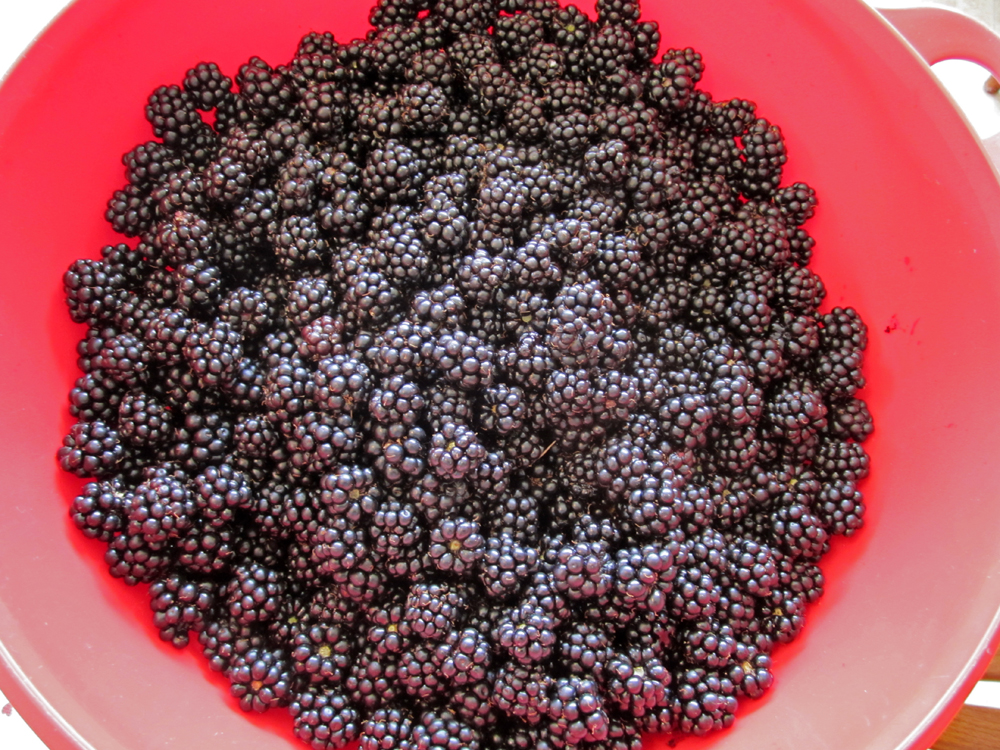
When my bowl was full, I extracted myself from the brambles and contemplated how I was going to safely make it back to the barn without being mare-mugged. Instead, they obediently trailed behind me, happy to be put in their stalls for their evening hay, accepting a gift from me with no thorns or vines attached.

Clearly, thorns are part of our everyday life. Thorns stand in front of much that is sweet and good and precious to us. They tear us up, bloody us, make us cry, make us beg for mercy.

Yet thorns have been overcome. They did not stop our salvation, did not stop goodness raining down on us, did not stop the taste of sweetness given as a gracious gift.

If we hesitate, thorns only proliferate unchecked.

So, desperate and hungry, we dive right in, to taste and eat.
One-Time
Monthly
Yearly

Make a one-time or recurring donation to support daily Barnstorming posts

Make a monthly donation

Make a yearly donation

Choose an amount

$10.00
$25.00
$50.00
$5.00
$15.00
$100.00
$5.00
$15.00
$100.00

Or enter a custom amount

$

Your contribution is deeply appreciated.

Your contribution is appreciated.

Your contribution is appreciated.

DonateDonate monthlyDonate yearly
This Estranging Season

Lord, the time has come. The summer has been so long.
Lay your shadows over the sundials
and let loose the wind over the fields.

Order the last fruits to fully ripen;
give them two more days of southern sun,
urge them to perfection and speed
the last sweetness into the laden vine.

Those who have no house, will not build one now.
Those who are alone will long remain so,
they will rise, and read, and write long letters
and through the avenues go here and there
restlessly wandering, with the leaves drifting down.

~Rainer Maria Rilke “Herbsttag” English translation by Paul Archer from 1902 in the collection Das Buch der Bilder.

First hints of our condition manifest:
Spite in the wind, mist-gauze across the moon,
Light chill, the spider’s filaments, blanched grass,
And two days as warm as the south change nothing at all.
A morning comes when you know this cannot end well.
Soon it will be no time for gathering in gardens
All too soon, my dears, it will be the weather
For Brahms quintets, for leaves drifting triste past the windows
Of those in their rooms alone for the duration,
For whom this is no time to build. Those now alone
Are going to remain so through this estranging season
Of reading, of writing emails as detailed as letters,
Of watching dry leaves grow sodden on empty pavements.
Rilke said this in lines that I last read in Edinburgh
With my most beautiful aunt in her later age
When, many things gone, she remembered those verse in German.

~Peter Davidson “September Castles”

Enter autumn as you would 
a closing door. Quickly, 
cautiously. Look for something inside 
that promises color, but be wary 
of its cast — a desolate reflection, 
an indelible tint.
~Pamela Steed Hill  “September Pitch”

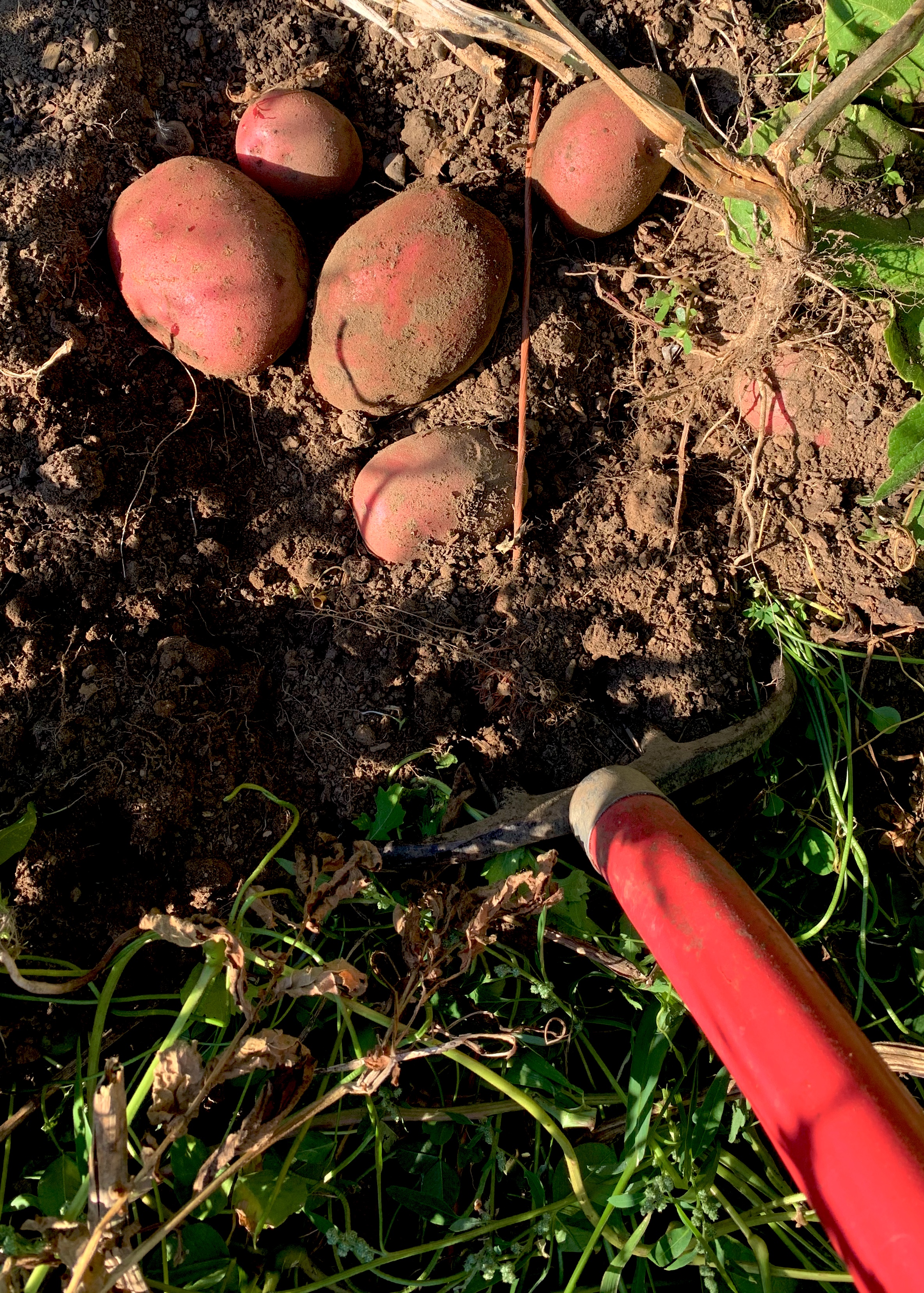
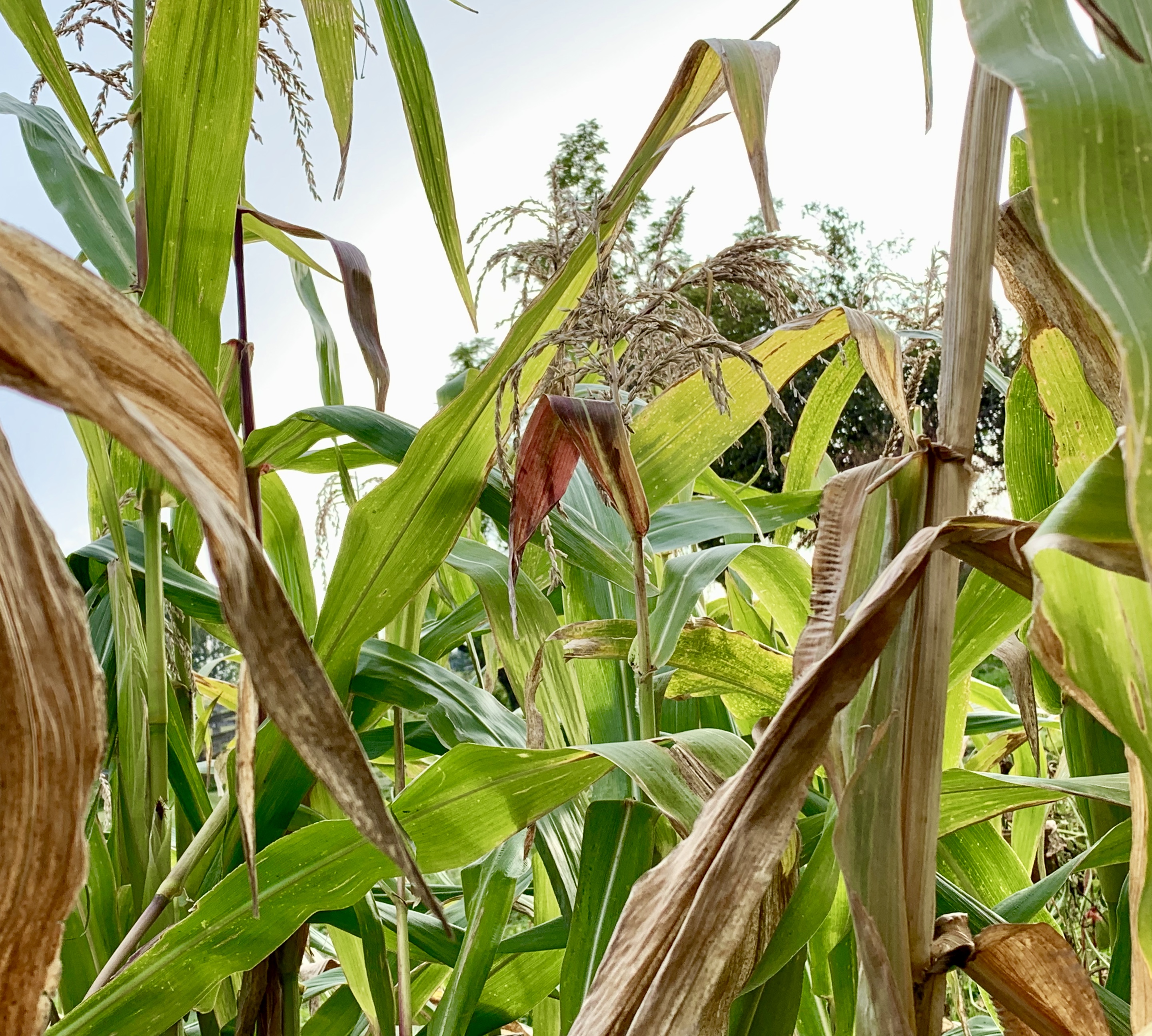
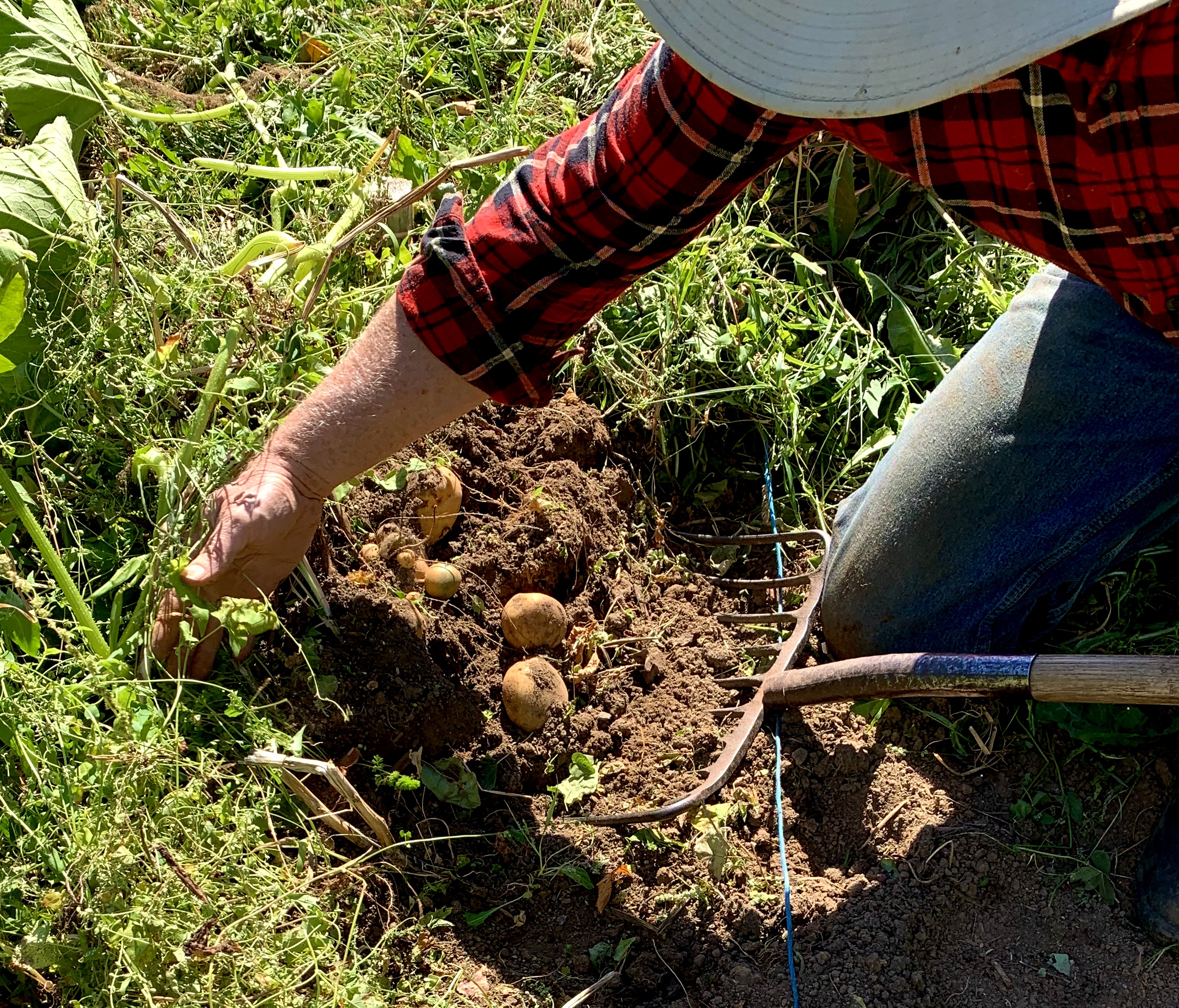
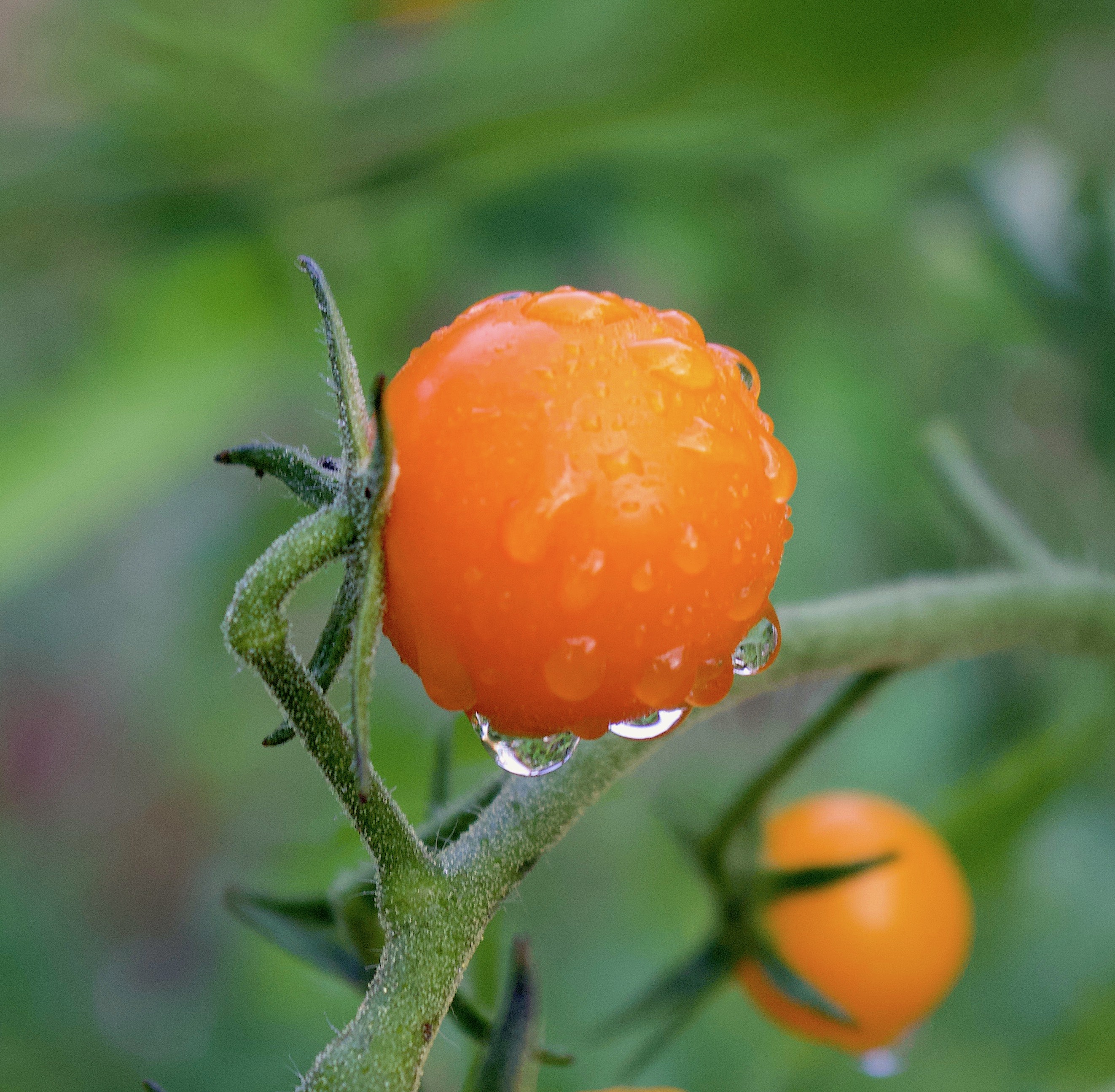
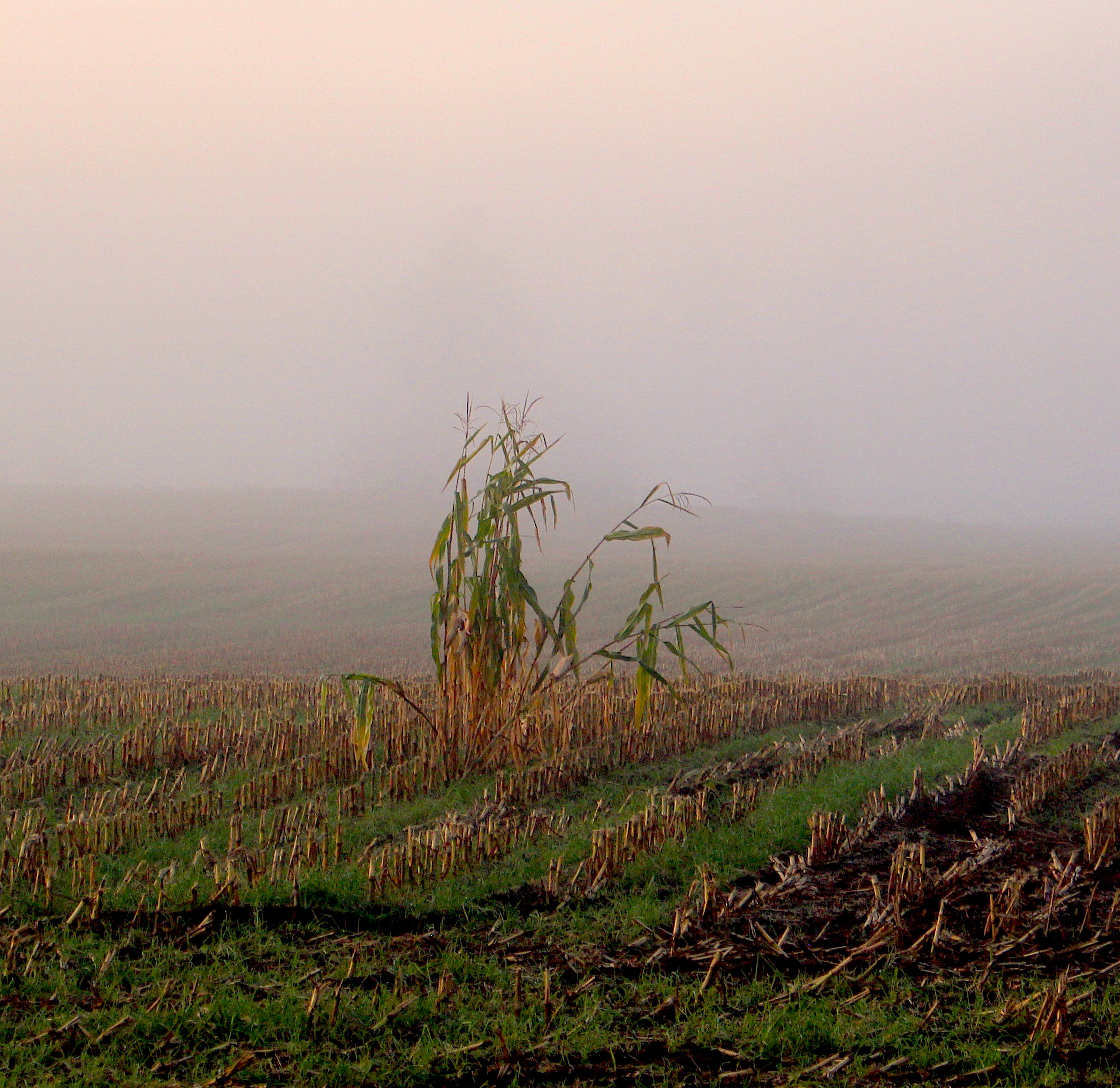
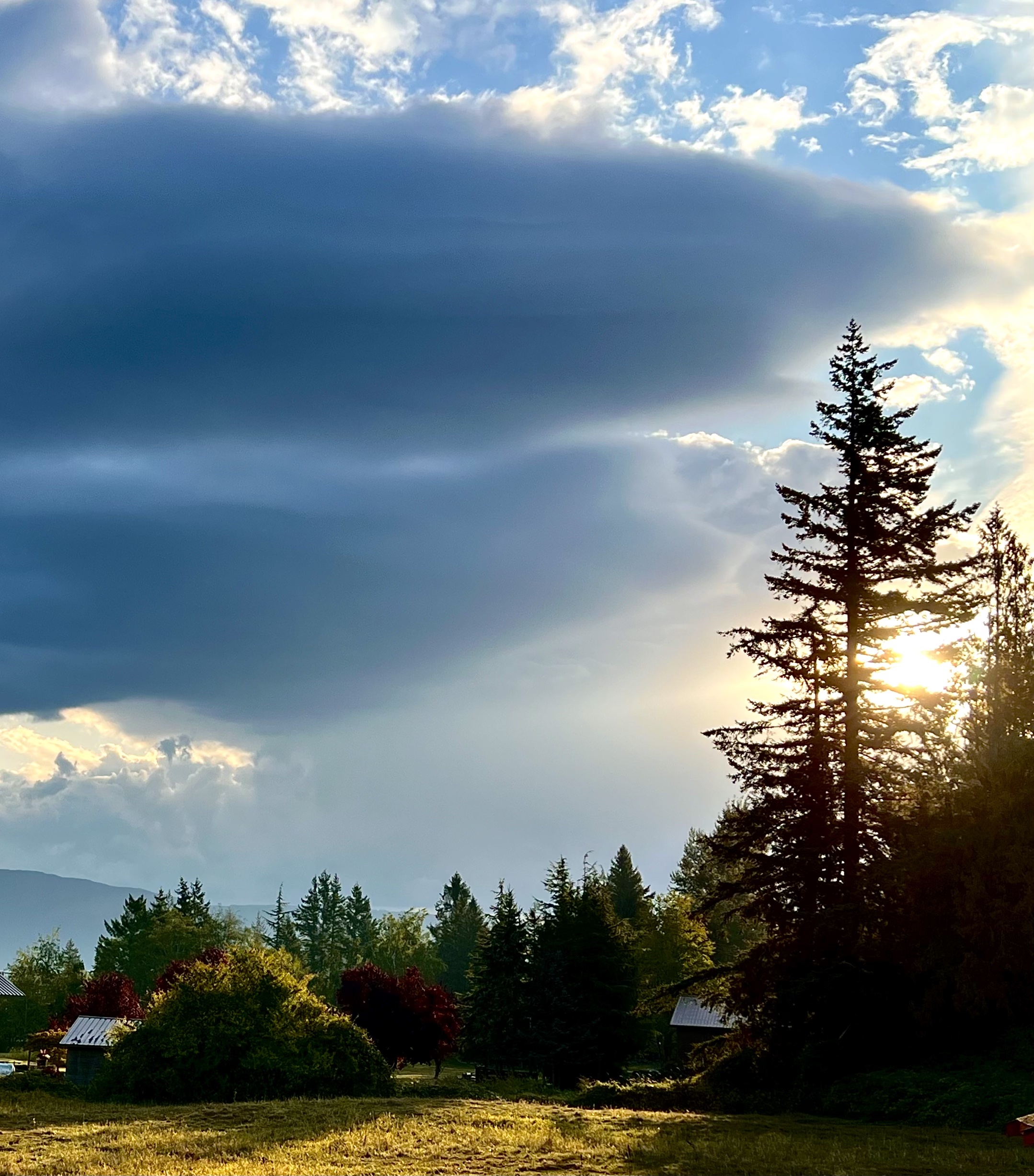
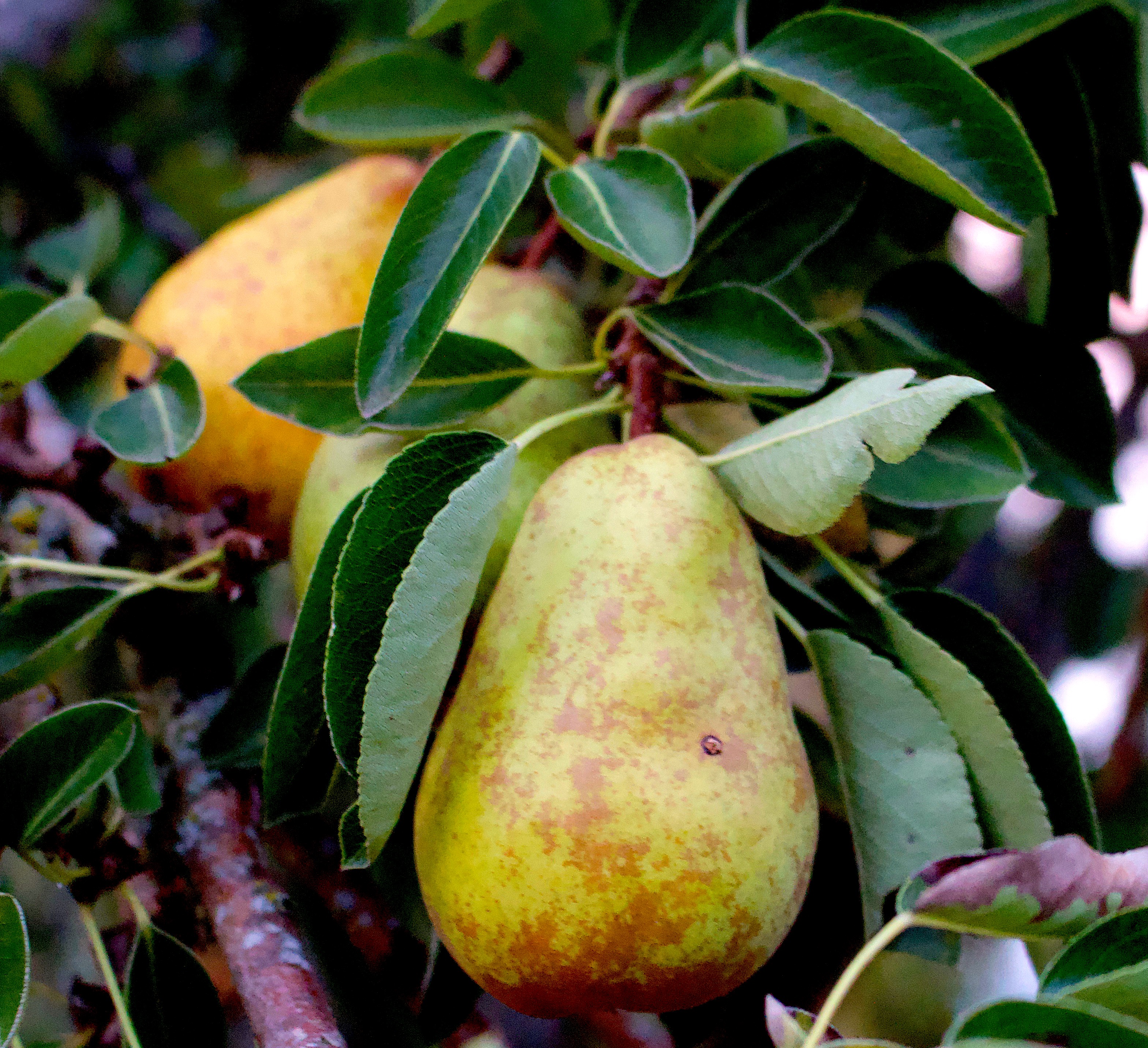
Summer has packed up, and moved on without bidding adieu or looking back over its shoulder. Cooling winds have carried in darkening clouds. I gaze upward to see and smell the change.  Rain has fallen, long overdue, yet there is temptation to bargain for a little more time.  Though we needed this good drenching, there are still potatoes to pull from the ground, apples and pears to pick, tomatoes not yet ripened, corn cobs too skinny to pick. 

I’m just not ready to wave goodbye to sun-soaked clear skies.

The overhead overcast is heavily burdened with clues of what is coming: earlier dusk, the feel of moisture, the deepening graying hues, the briskness of breezes, the inevitable mud and mold.  There is no negotiation possible. I need to steel myself and get ready, wrapping myself in the soft shawl of inevitability.

So autumn advances with the clouds, taking up residence where summer left off. Though there is still clean up of the overabundance left behind, autumn will bring its own unique plans for an exhilarating display of a delicious palette of hues.

Lord, the time has come. The truth is we’ve seen nothing yet.

One-Time
Monthly
Yearly

Make a one-time or recurring donation to support daily Barnstorming posts

Make a monthly donation

Make a yearly donation

Choose an amount

$10.00
$25.00
$50.00
$5.00
$15.00
$100.00
$5.00
$15.00
$100.00

Or enter a custom amount

$

Your contribution is deeply appreciated.

Your contribution is appreciated.

Your contribution is appreciated.

DonateDonate monthlyDonate yearly

Sweet and Sour

In Summer, in a burst of summertime
Following falls and falls of rain,
When the air was sweet-and-sour of the flown fineflower of
Those goldnails and their gaylinks that hang along a lime
~Gerard Manley Hopkins from “Cheery Beggar”

What I wanted
wasn’t to let in the wetness.
That can be mopped.

Nor the cold.
There are blankets.

What I wanted was
the siren, the thunder, the neighbor,
the fireworks, the dog’s bark.

Which of them didn’t matter?

Yes, this world is perfect,
all things as they are.

But I wanted
not to be
the one sleeping soundly, on a soft pillow,
clean sheets untroubled,
dreaming there still might be time,

while this everywhere crying
~Jane Hirshfield “I Open the Window” from The Asking

Sweet and sour extends far beyond a Chinese menu; it is the air we breathe.  Dichotomy is in our life and times – the bittersweet of simple pleasures laced with twinges and tears.

I am but a cheery beggar in this world, desiring to hang tight to the overwhelming sweetness of each glorious moment:

the startling late summer sunrise,
the renewed green coming through the dead of spent fields,
the warm hug of a compassionate word,
a house filled with love and laughter.

But as beggars aren’t choosers, I can’t only have sweet alone;
I must endure the sour that comes as part of the package —

the deepening dark of a sleepless and restless night,
the muddy muck that comes after endless rain,
the sting of a biting critique,
the emptiness when younger ones head home.

So I slog through sour to revel some day in sweet. 

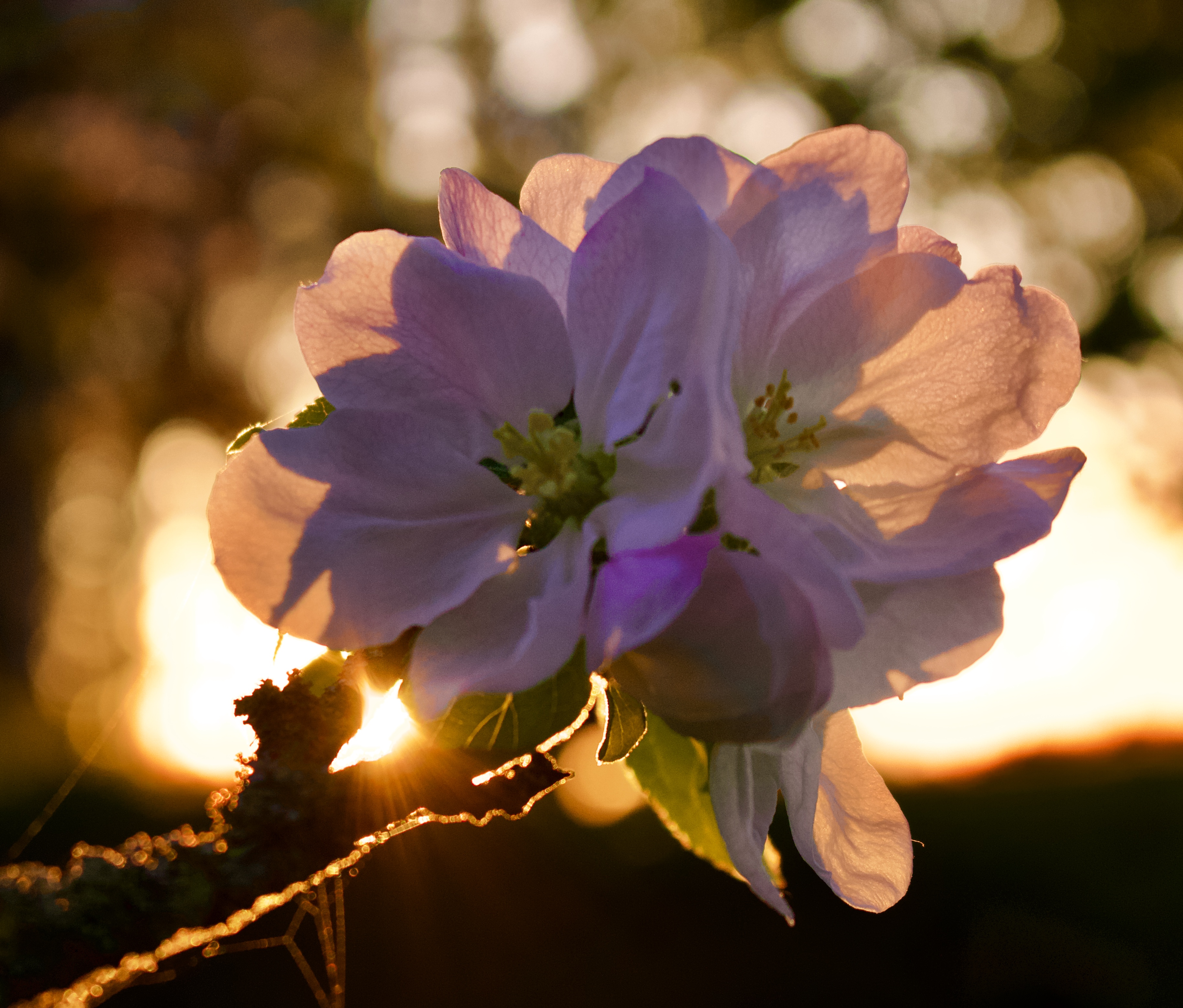
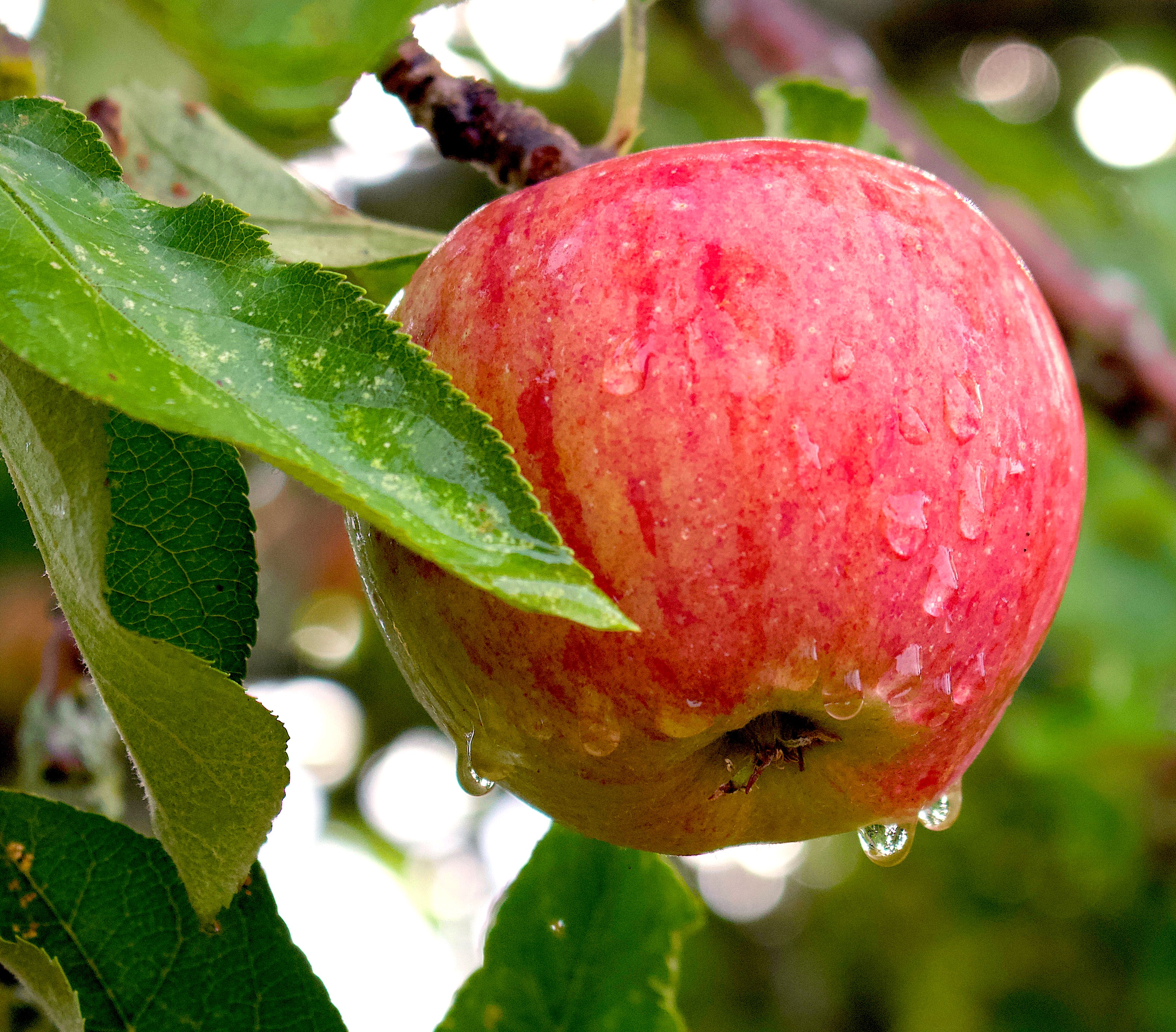
Months of manure-permeated air is overcome one miraculous morning by the unexpected and undeserved fragrance of apple blossoms, so sweet, so pure, so full of promise of the wholesome fruit to come.

The manure makes the sweet sweeter months later, long after the stench is gone.

And I breathe in deeply now, content and grateful for this moment of grace and bliss, wanting to hold it in the depths of my lungs forever, its mercy overwhelming the power of sour.

One-Time
Monthly
Yearly

Make a one-time or recurring donation to support daily Barnstorming posts

Make a monthly donation

Make a yearly donation

Choose an amount

$10.00
$25.00
$50.00
$5.00
$15.00
$100.00
$5.00
$15.00
$100.00

Or enter a custom amount

$

Your contribution is deeply appreciated.

Your contribution is appreciated.

Your contribution is appreciated.

DonateDonate monthlyDonate yearly
No Longer Young and Still Half-Perfect

Ah Sun-flower! weary of time,
Who countest the steps of the Sun:
Seeking after that sweet golden clime
Where the travellers journey is done.

~William Blake from “Ah Sun-flower”

My work is loving the world.
Here the sunflowers, there the hummingbird—
equal seekers of sweetness.
Here the quickening yeast; there the blue plums.
Here the clam deep in the speckled sand.

Are my boots old? Is my coat torn?
Am I no longer young, and still half-perfect? Let me
keep my mind on what matters,
which is my work,

which is mostly standing still and learning to be astonished.
The phoebe, the delphinium.
The sheep in the pasture, and the pasture.
Which is mostly rejoicing, since all the ingredients are here,

which is gratitude, to be given a mind and a heart
and these body-clothes,
a mouth with which to give shouts of joy
to the moth and the wren, to the sleepy dug-up clam,
telling them all, over and over, how it is
that we live forever

~Mary Oliver “Messenger” from Thirst

My boots are old and leaky and my coat is torn. I’m no longer young but I still go out into the world every day to find something to smile about.

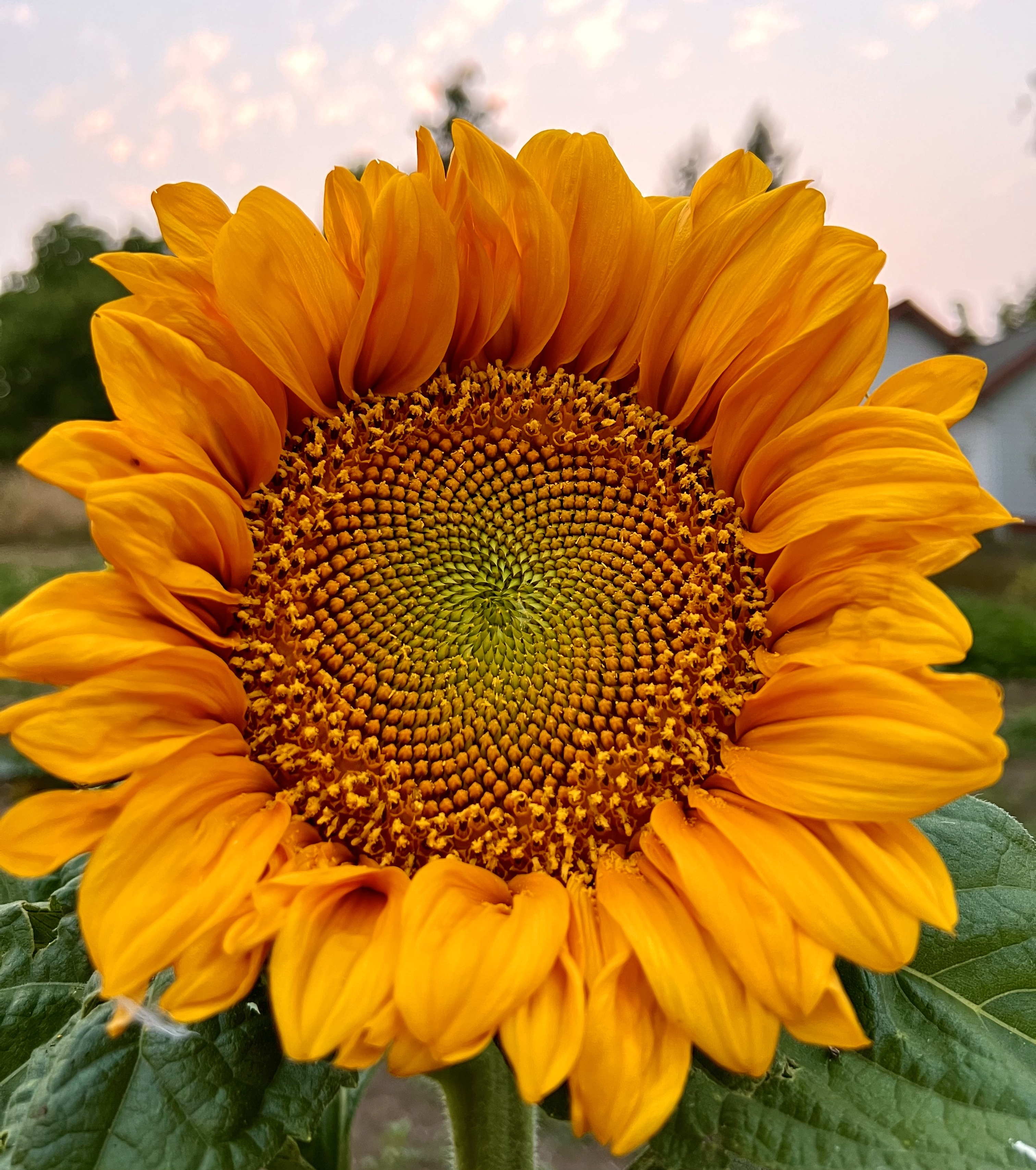
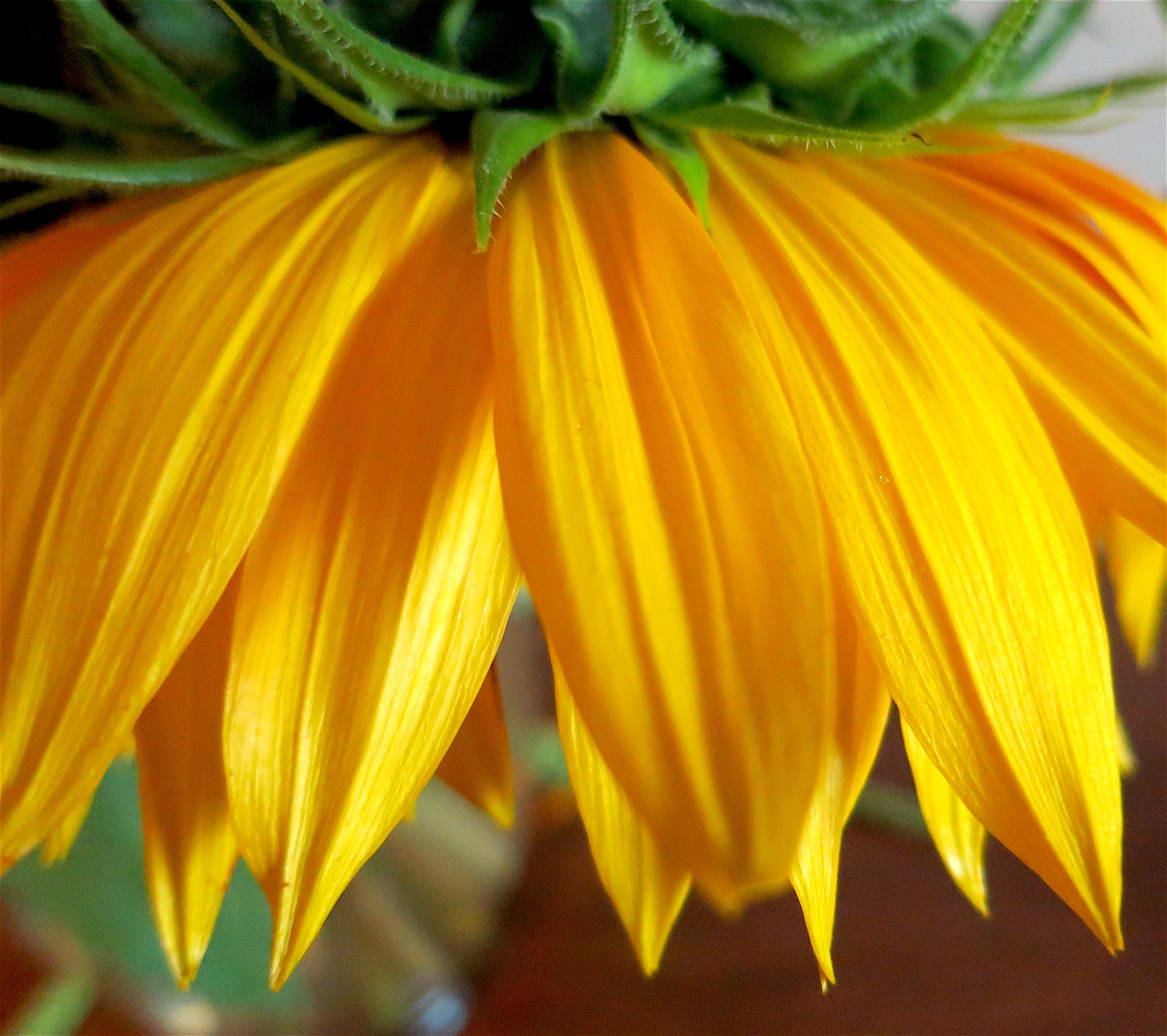
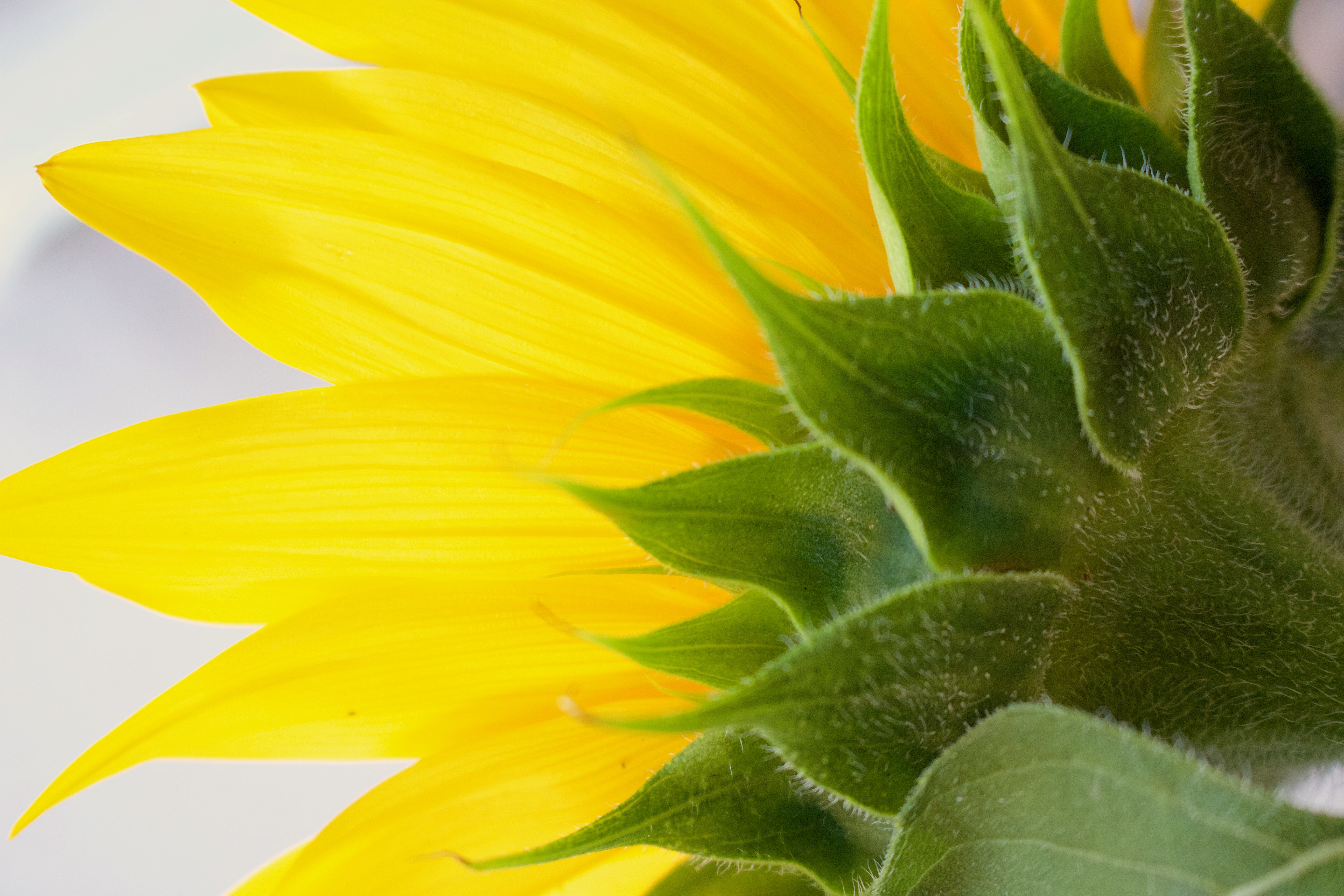
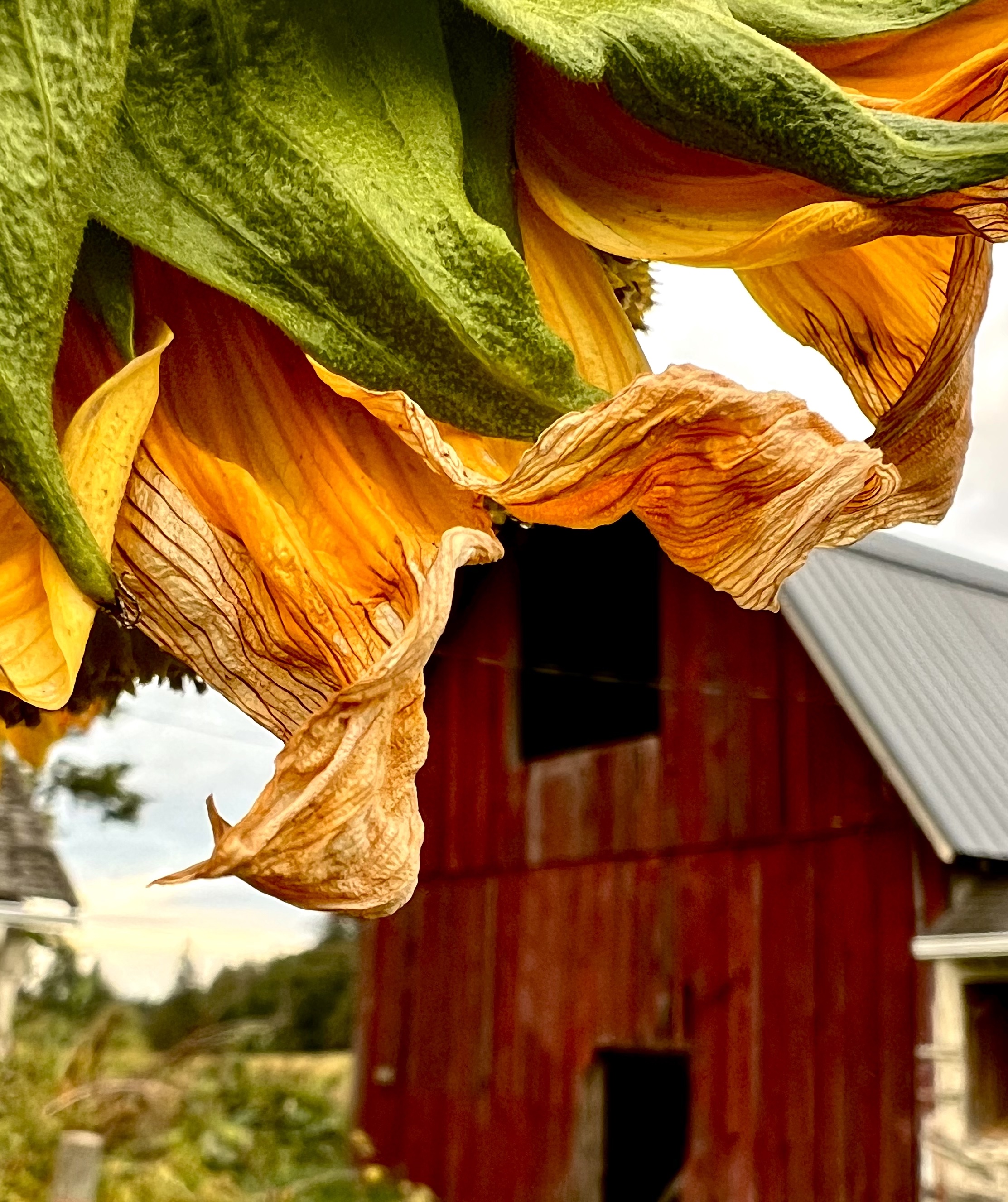
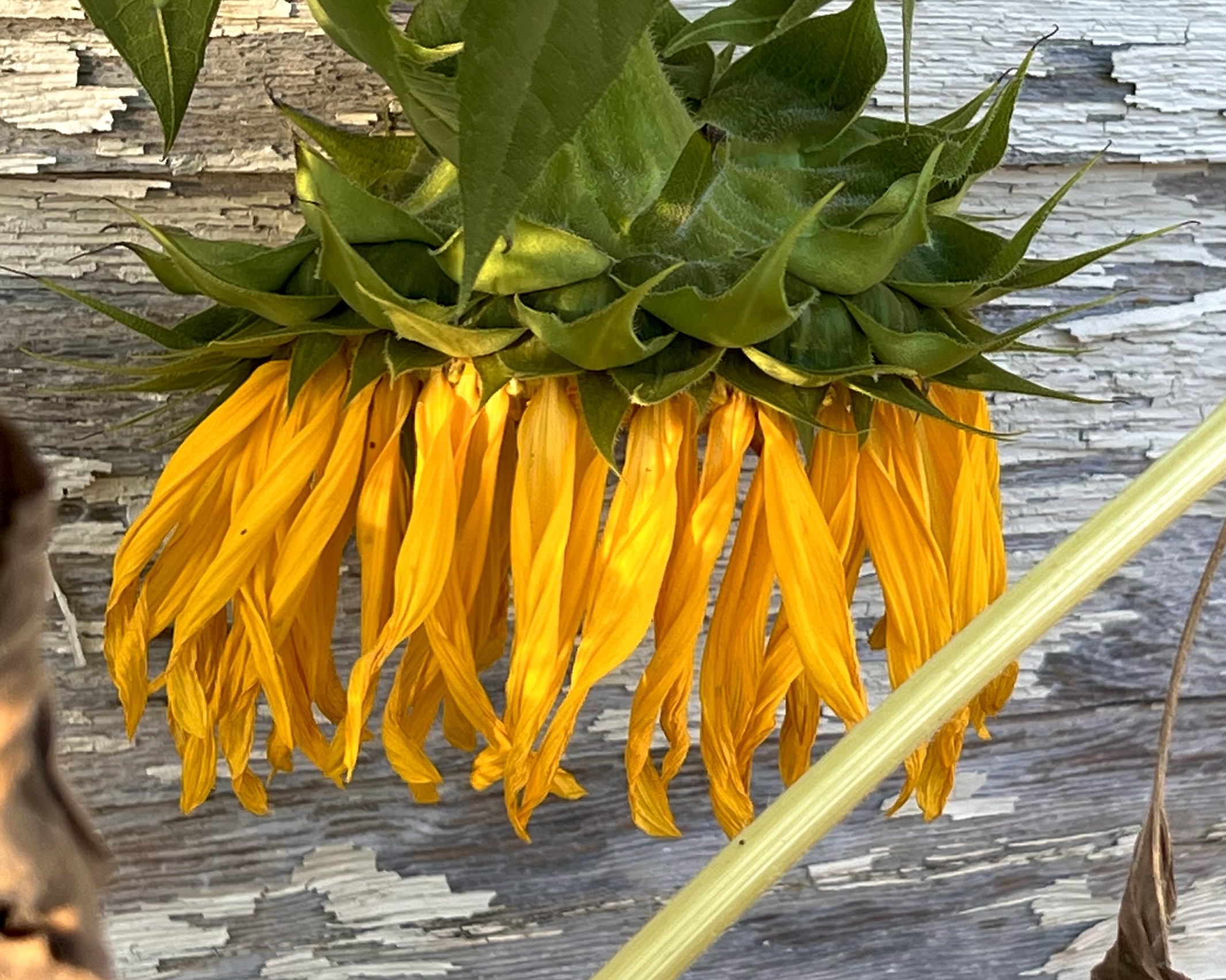
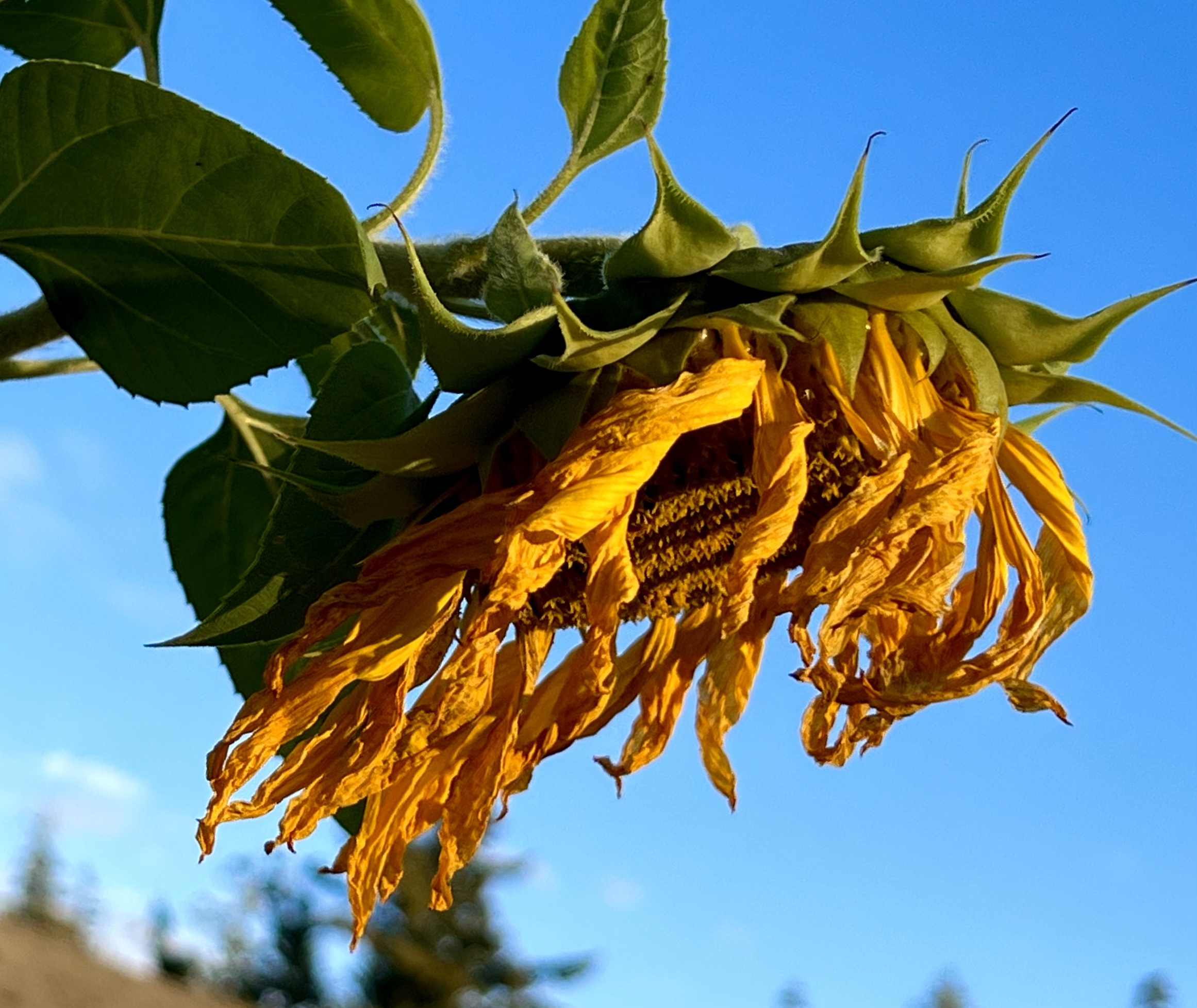
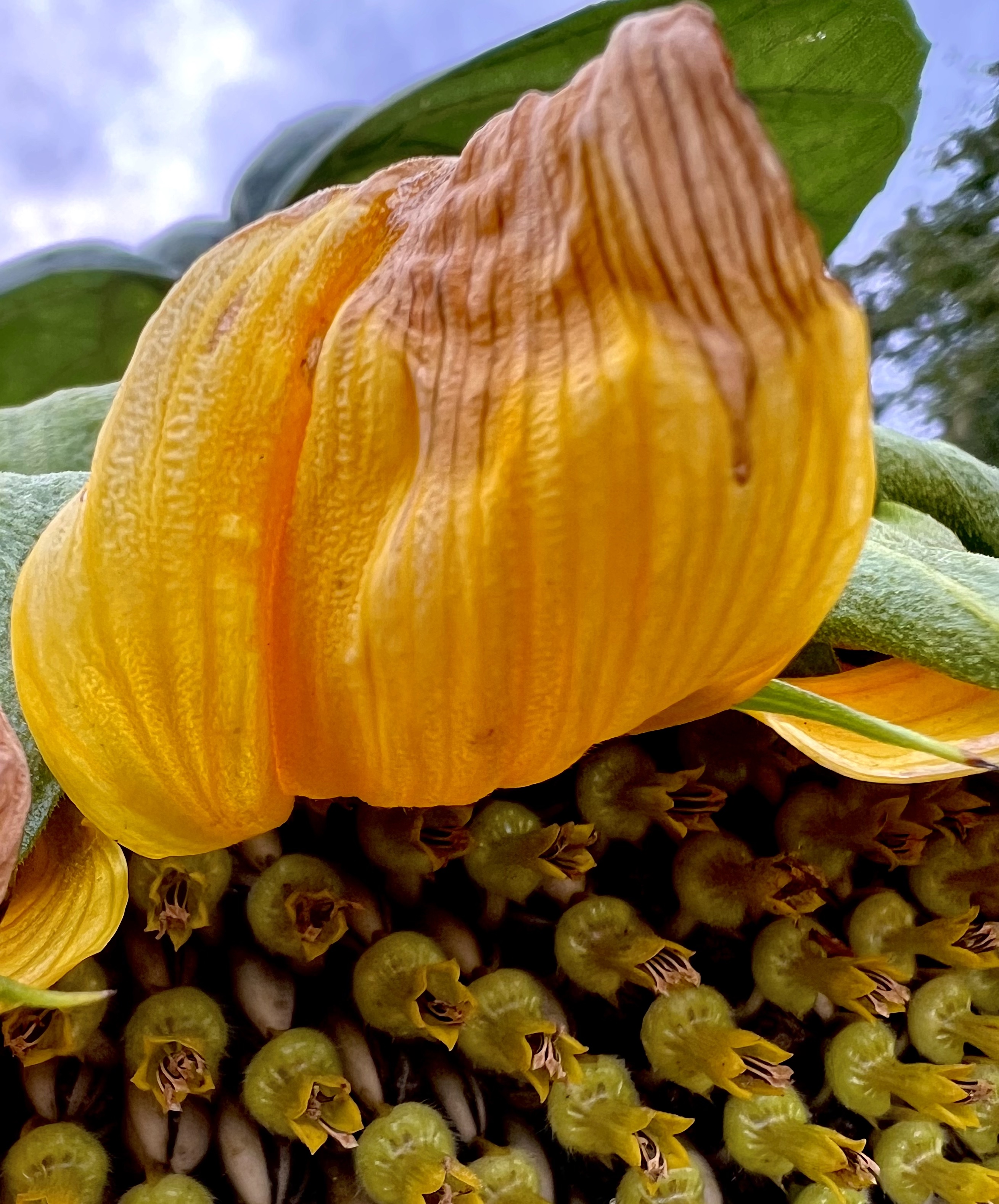
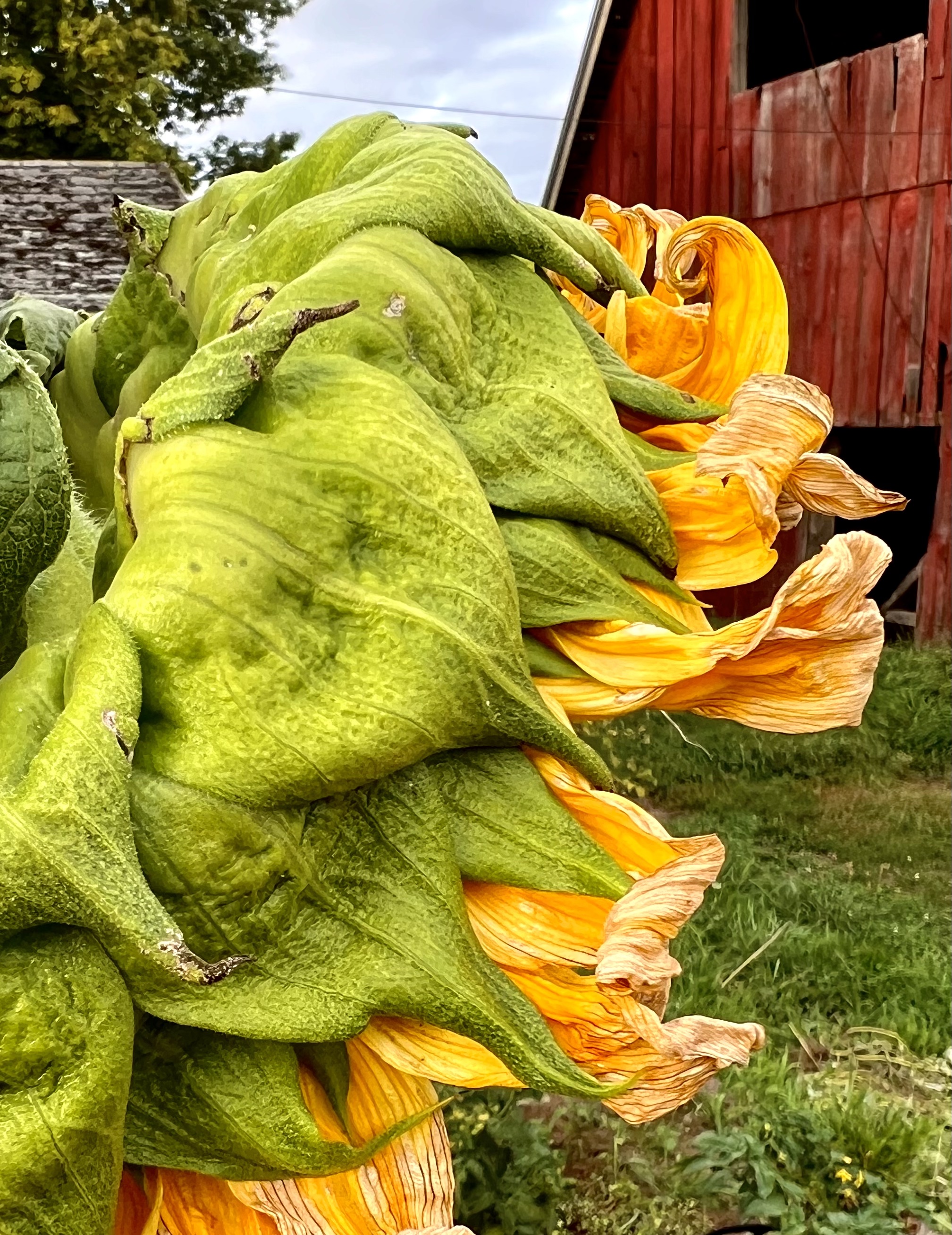
A time-weary sunflower hangs its head to stare down at its roots, no longer able to lift its face to greet the sun as it rises or bid it farewell as it sinks into the horizon. Still very much alive, it focuses instead on where it came from, putting its energy into the seeds, to make sure there is a next generation, and a next and a next.

That is more than half-perfect.
That is its work in this world and that is my work these days.

Weary at times but rejoicing.
Withered and torn and weather-beaten
but still capable of joy and wonder that
we are so deeply loved as we are.

One-Time
Monthly
Yearly

Make a one-time or recurring donation to support daily Barnstorming posts

Make a monthly donation

Make a yearly donation

Choose an amount

$10.00
$25.00
$50.00
$5.00
$15.00
$100.00
$5.00
$15.00
$100.00

Or enter a custom amount

$

Your contribution is deeply appreciated.

Your contribution is appreciated.

Your contribution is appreciated.

DonateDonate monthlyDonate yearly
What Hard Work Yields


I look for the spade
I used when I was young,
when my grandfather said dig
and I dug holes
the depth I’d been taught
so the posts would stand,
hold the miles of barbed and hog wire
dividing our ground… Dig, he would say,

and all morning, afternoon,
until it rained, until dark,
until I couldn’t lift the spade and grub
and he said enough,
I dug through dry brown
until it turned yellow clay
or black earth caked
to the tip of the steel. He taught me to measure
strength by depth,
narrow the hole around the oiled post,
and sturdy the line he’d laid
before I was old enough
to blister from work,
acquire the knowledge of straight,
of strength, cool soil,
rusted staples and splintered wood,
the knowledge of bending spikes
new, splicing wire,
swinging a hammer down hard,
the ache from hours of digging,
calloused hands and sunburn.
He trained me to rake,
tamp, stomp, pack dirt and clay,
the weight of the earth around the post,
its strength into the line.

Now the hammers, pliers and cutters are gone.
No rolls of wire hang from the beams.
No boxes of staples and spikes jam the shelves.
The tamping stick is broken.
Someone has wrapped duct tape around the spade handle;
the steel has rusted brown and rough;
a crack climbs from the tip to the mud-caked neck.
He would say it is useless,
that things are not like they were
~Curtis Bauer from “A Fence Line Running Through It”

The old farmers in our county are dying off,
the ones who remember
when horse and human muscle provided the power
instead of diesel engines.
They have climbed down off their tractors
and into their beds
for a good night’s sleep.

Their machine sheds are cleared
in an auction,
their animals trucked away
for butcher,
their fence lines leaning
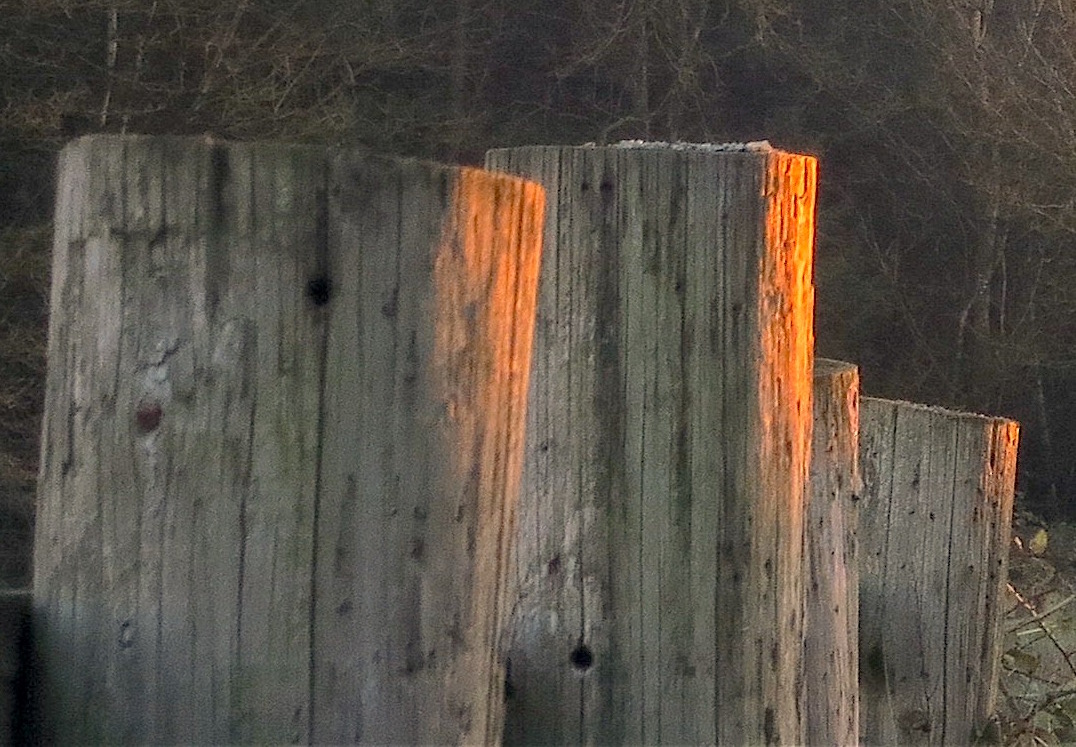
yet the corner posts,
set solid and sure in the hard ground,
keep standing
when the old farmer no longer does.

These old farmers knew hard work.
knew there were no days off,
no shirking duty,
knew if anyone was going to do
what needed doing
it was them,
no one else.
Things are not like they were
yet the strong posts remain,
ready to hold up another fence line,
showing us few remaining farmers
what hard work yields.

One-Time
Monthly
Yearly

Make a one-time or recurring donation to support daily Barnstorming posts

Make a monthly donation

Make a yearly donation

Choose an amount

$10.00
$25.00
$50.00
$5.00
$15.00
$100.00
$5.00
$15.00
$100.00

Or enter a custom amount

$

Your contribution is deeply appreciated.

Your contribution is appreciated.

Your contribution is appreciated.

DonateDonate monthlyDonate yearly

Becoming a Skeleton of Its Summer Self

Toward the end of August I begin to dream about fall, how
this place will empty of people, the air will get cold and
leaves begin to turn. Everything will quiet down, everything
will become a skeleton of its summer self. Toward

the end of August I get nostalgic for what’s to come, for
that quiet time, time alone, peace and stillness, calm, all
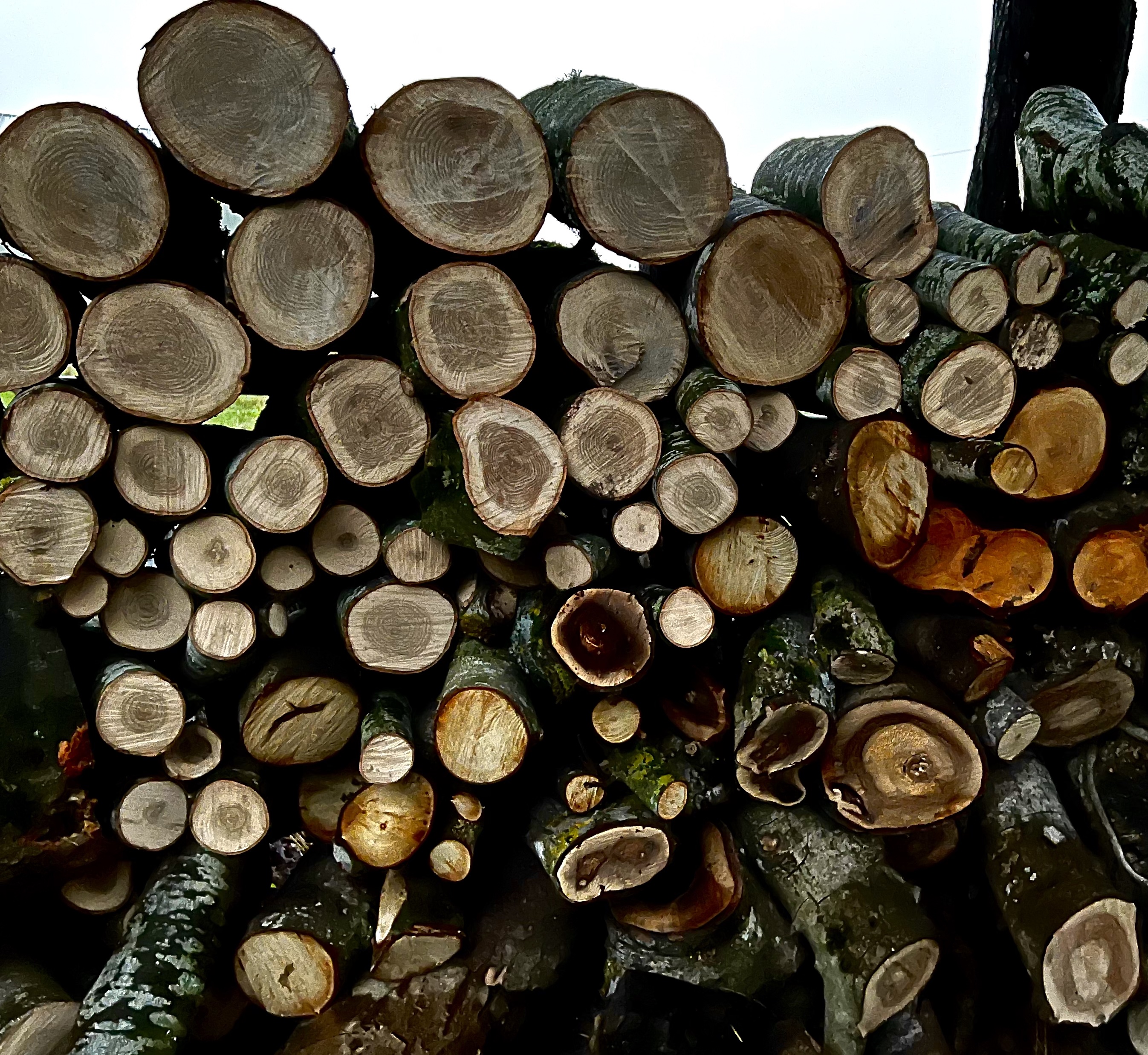
those things the summer doesn’t have. The woodshed is
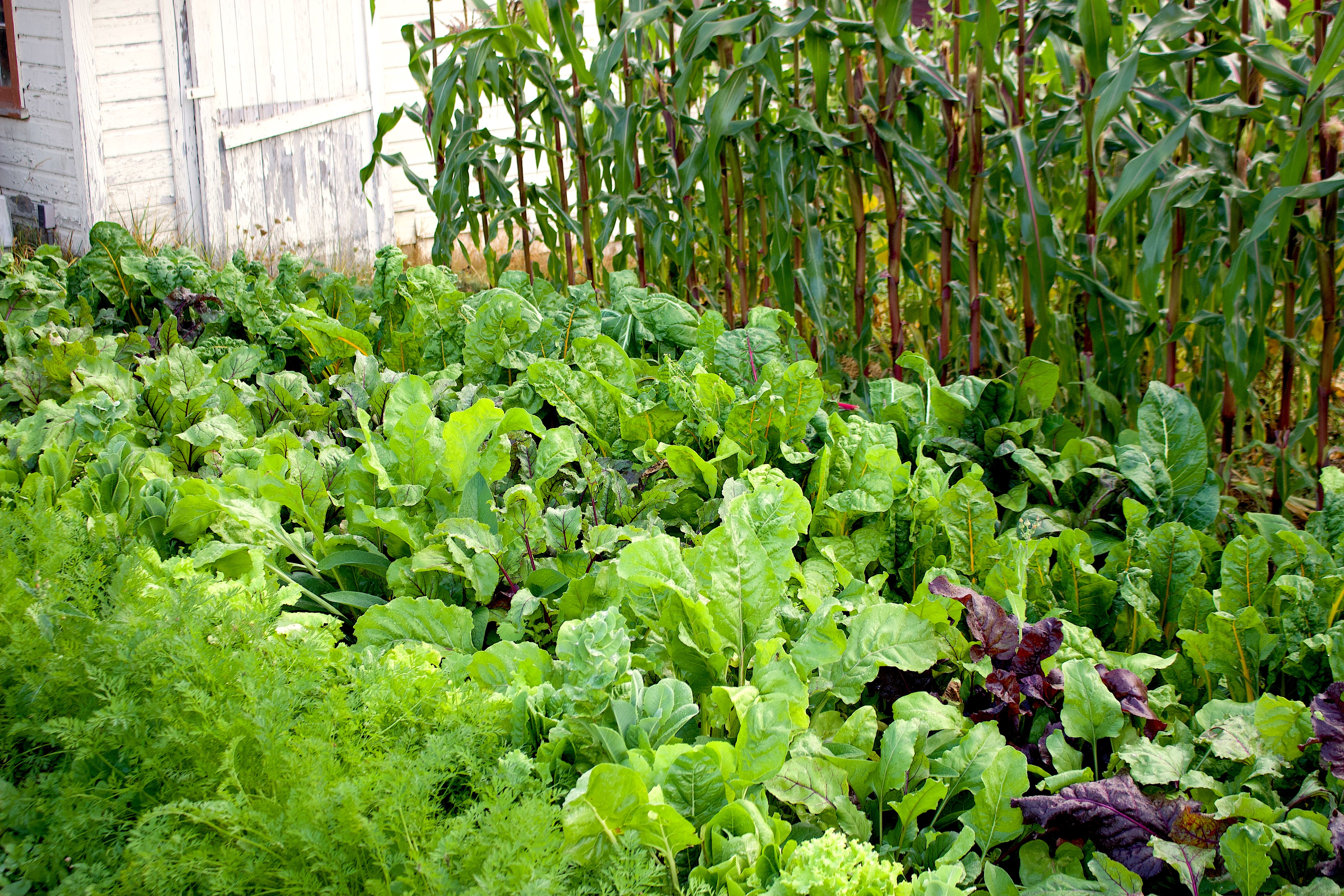
already full, the kindling’s in, the last of the garden soon

will be harvested, and then there will be nothing left to do
but watch fall play itself out, the earth freeze, winter come.

~David Budbill, “Toward the End of August” from Tumbling Toward the End.

As the calendar page flipped to September this past week, I felt nostalgic for what is coming, especially for our grandchildren who are starting new classes tomorrow.

Summer is filled with so much overwhelming activity due to ~18 hours of daylight accompanying weeks of unending sunny weather resulting in never-enough-sleep.  Waking on a summer morning feels so brim full with possibilities: there are places to go, people to see, new things to explore and of course, a garden and orchard always bearing and fruiting out of control.

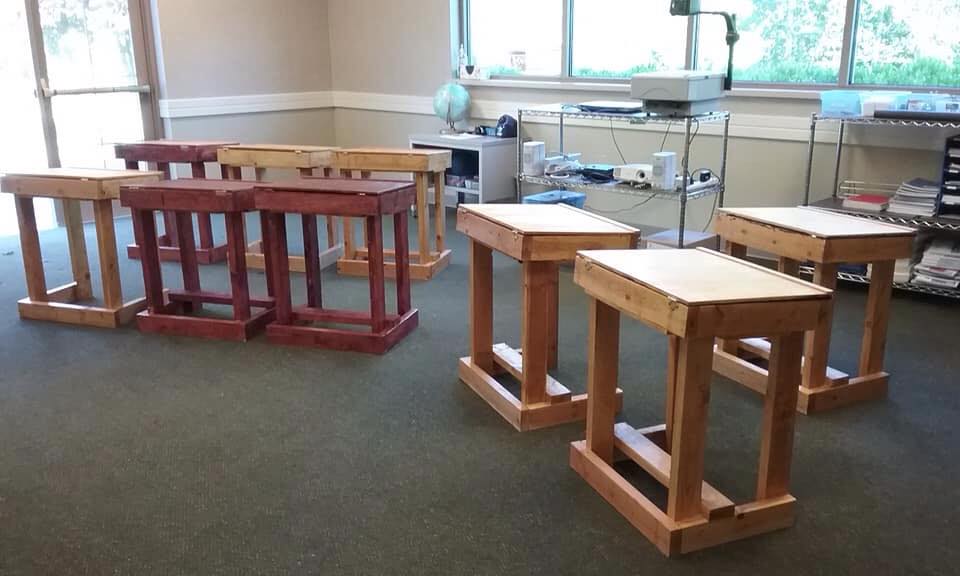
As early September days usher us toward autumn, we long for the more predictable routine of school days, so ripe with new learning opportunities. One early September a few years ago, my teacher friend Bonnie orchestrated an innovative introduction to fifth grade by asking her students, with some parental assistance, to make (from scratch) their own personalized school desks that went home with them at the end of the year. These students created their own learning center with their brains and hands, with wood-burned and painted designs, pictures and quotes for daily encouragement.

For those students, their desks will always represent a solid reminder of what has been and what is to come.

So too, I welcome September’s quieting times ushering in a new cool freshness in the air as breezes pluck and toss a few drying leaves from the trees.  I will watch the days play themselves out rather than feeling I must direct each moment.  I can be a sponge, ready to take in what the world is trying to teach me.

And so I am whispering hush … to myself.

Goodnight August, goodnight summer, goodnight leaves,
goodnight garden, goodnight moon, goodnight air,
goodnight noises everywhere.

Bonnie’s student-made desks

One-Time
Monthly
Yearly

Make a one-time or recurring donation to support daily Barnstorming posts

Make a monthly donation

Make a yearly donation

Choose an amount

$10.00
$25.00
$50.00
$5.00
$15.00
$100.00
$5.00
$15.00
$100.00

Or enter a custom amount

$

Your contribution is deeply appreciated.

Your contribution is appreciated.

Your contribution is appreciated.

DonateDonate monthlyDonate yearly
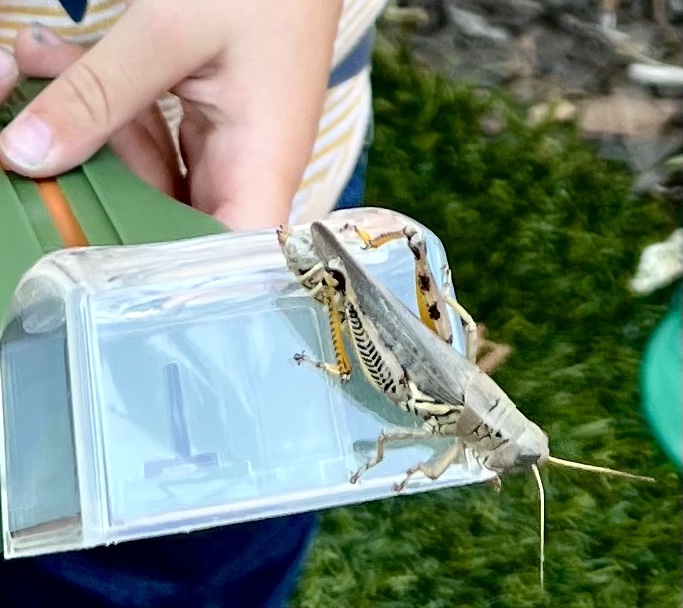
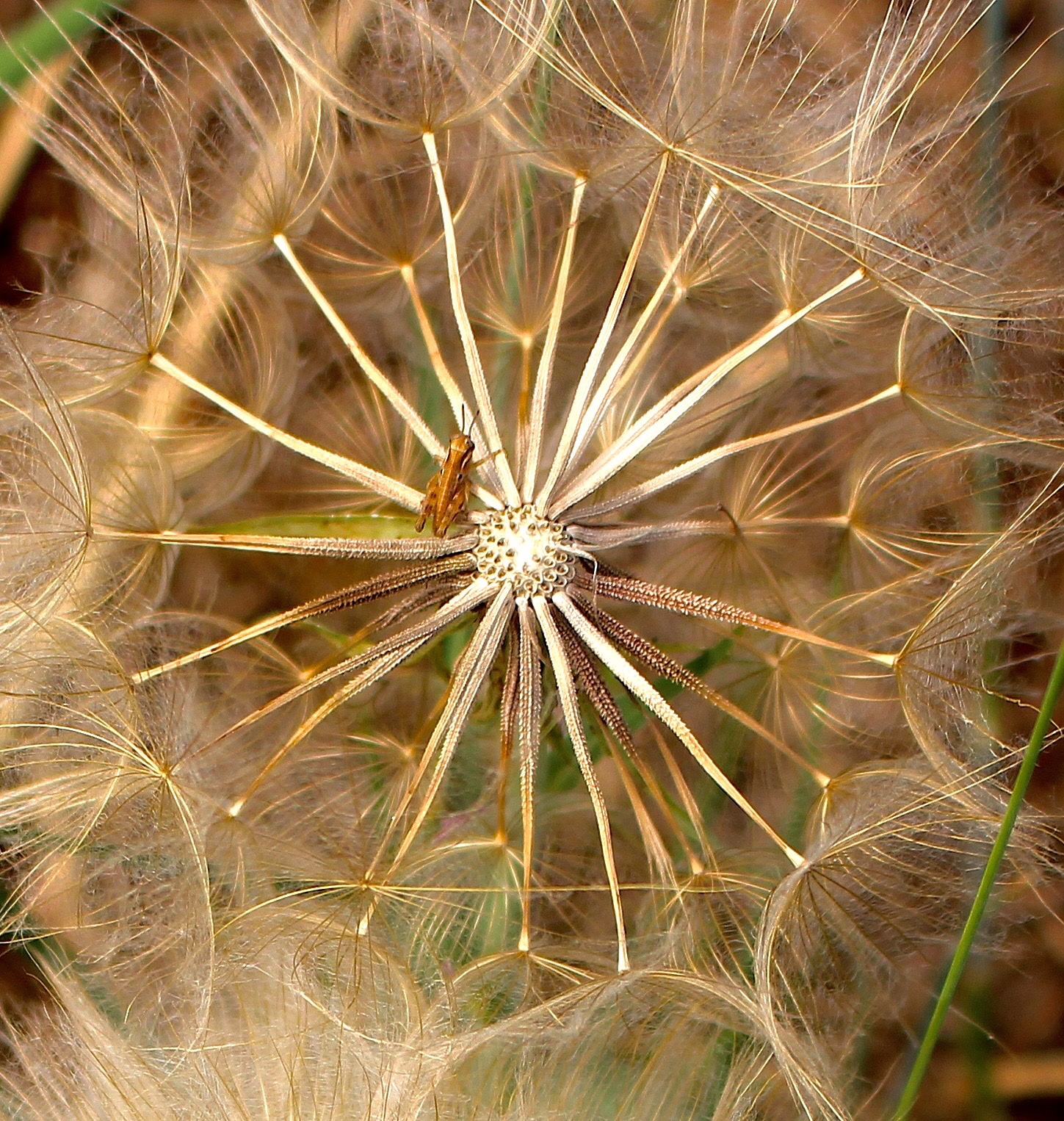
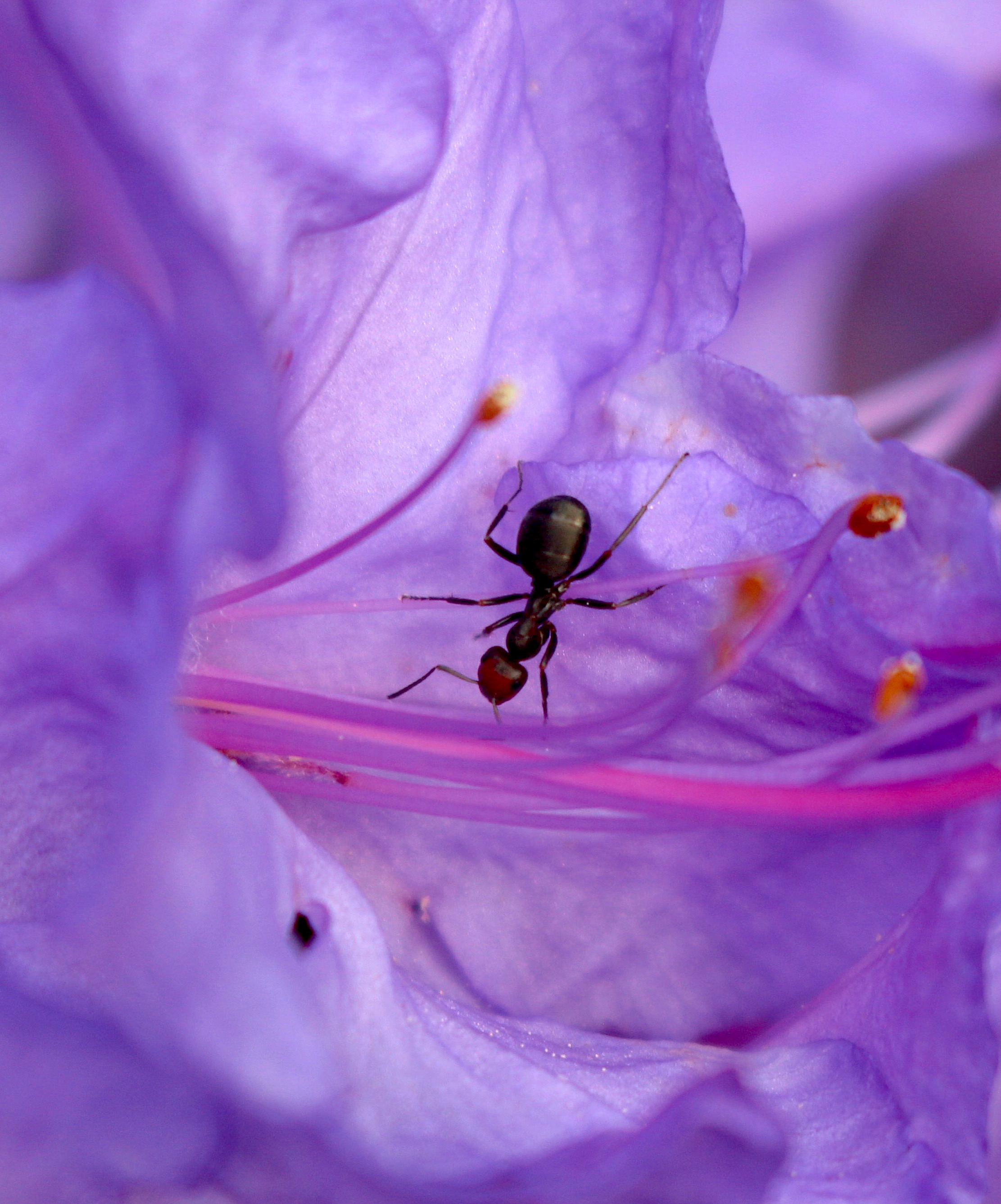
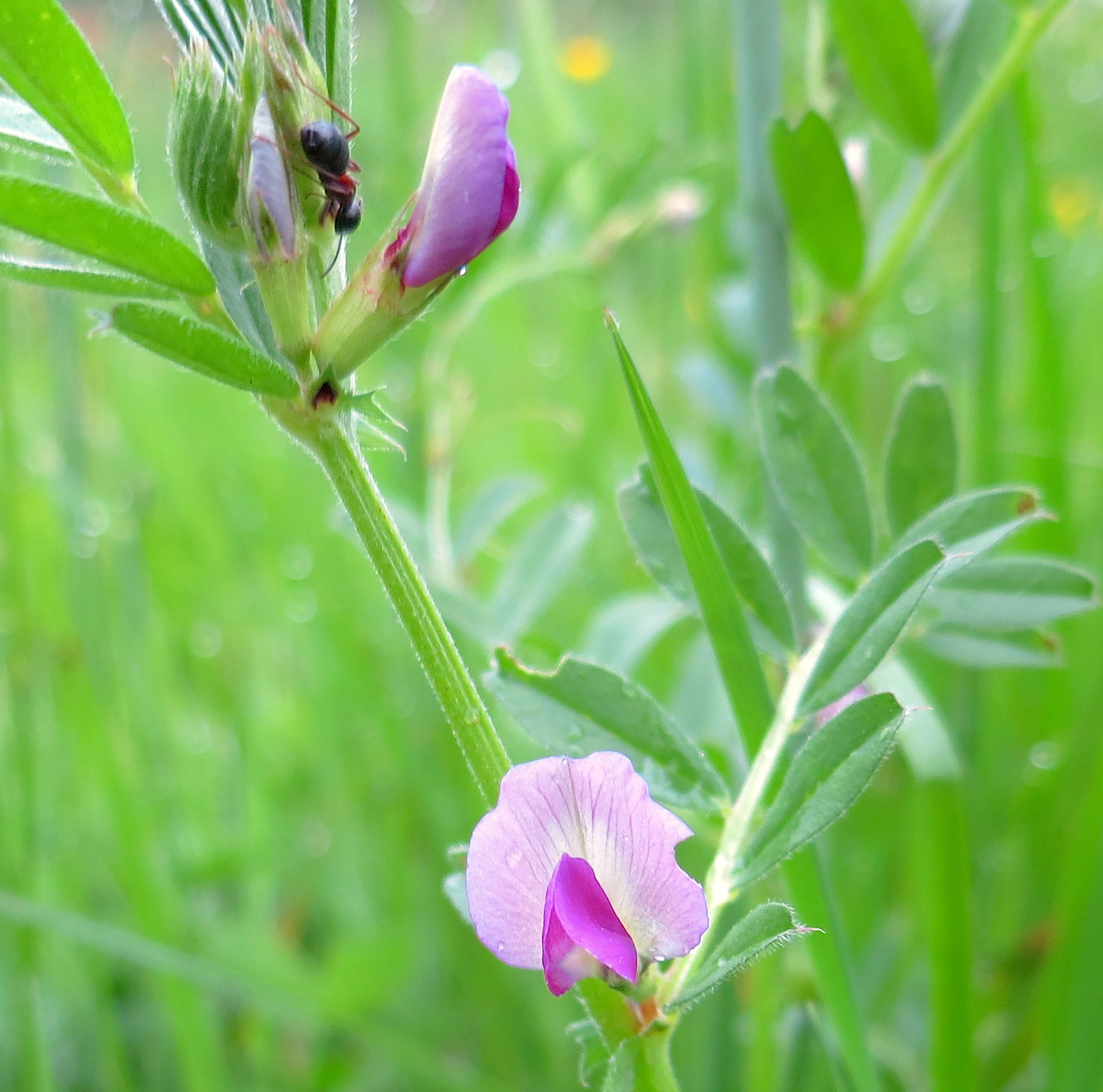
Ant Trudges While Grasshopper Sings

‘Ant, look at me!’ a young Grasshopper said,
As nimbly he sprang from his green, summer bed,
‘See how I’m going to skip over your head,
And could o’er a thousand like you!
Ant, by your motion alone, I should judge
That Nature ordained you a slave and a drudge,
For ever and ever to keep on the trudge,
And always find something to do.

‘Oh! there is nothing like having our day,
Taking our pleasure and ease while we may,
Bathing ourselves in the bright, mellow ray
That comes from the warm, golden sun!
While I am up in the light and the air,
You, a sad picture of labor and care!
Still have some hard, heavy burden to bear,
And work that you never get done.

‘I have an exercise healthful, and good,
For timing the nerves and digesting the food—
Graceful gymnastics for stirring the blood
Without the gross purpose of use.
Ant, let me tell you ‘t is not a la mode,
To plod like a pilgrim and carry a load,
Perverting the limbs that for grace were bestowed,
By such a plebeian abuse.

‘While the whole world with provisions is filled,
Who would keep toiling and toiling to build
And lay in a store for himself, till he ‘s killed
With work that another might do?
Come! drop your budget and just give a spring.
Jump on a grass-blade and balance and swing.
Soon you’ll be light as a gnat on the wing,
Gay as a grasshopper, too!’

Ant trudged along while the grasshopper sung,
Minding her business and holding her tongue,
Until she got home her own people among;
But these were her thoughts on the road.
‘What will become of that poor, idle one
When the light sports of the summer are done?
And, where is the covert to which he may run
To find a safe winter abode?

‘Oh! if I only could tell him how sweet
Toil makes my rest and the morsel I eat,
While hope gives a spur to my little black feet,
He’d never pity my lot!
He’d never ask me my burden to drop
To join in his folly—to spring, and to hop;
And thus make the ant and her labor to stop,
When time, I am certain, would not.

‘When the cold frost all the herbage has nipped,
When the bare branches with ice-drops are tipped,
Where will the grasshopper then be, that skipped,
So careless and lightly to-day?
Frozen to-death! ‘a sad picture’ indeed,
Of reckless indulgence and what must succeed,
That all his gymnastics ca ‘nt shelter or feed,
Or quicken his pulse into play.

‘I must prepare for a winter to come.
I shall be glad of a home and a crumb,
When my frail form out of doors would be numb,
And I in the snow-storm should die.
Summer is lovely, but soon will be past.
Summer has plenty not always to last.
Summer’s the time for the ant to make fast
Her stores for a future supply!’

~Hannah Flagg Gould “The Grasshopper and the Ant”

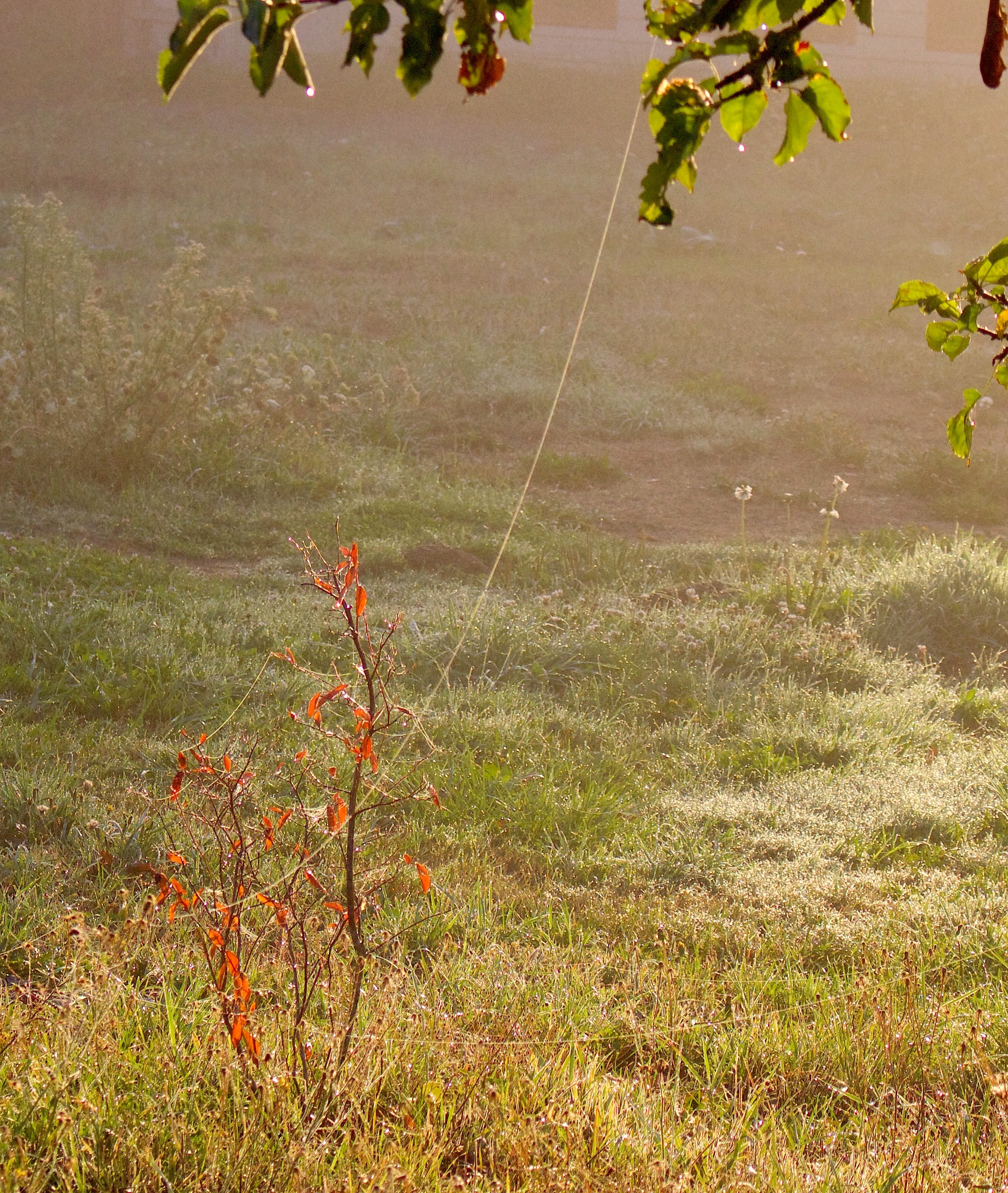
I did not grow up in a household that took time off. We were trudgers.

When my dad came home from his desk job in town, he would immediately change into his farm clothes and put in several hours of work outside, summer or winter, rain or shine, light or dark.

My mother did not work in town while we were children, but worked throughout her day inside and outside the house doing what farm wives and mothers need to do: growing, hoeing, harvesting, preserving, washing, cleaning, sewing, and most of all, being there for us.

As kids, we had our share of chores that were simply part of our day as our work was never done on a farm. When we turned twelve, we began working for others: babysitting, weeding, barn and house cleaning, berry picking.  I have now done over 56 years of gainful employment – at times holding part-time jobs at once because that was what I could put together to keep things together.

An absolutely dedicated trudger.

Now in retirement, my work is about showing up to do what is needed where I am needed. There is a sweetness to trudging that I’ve not known before.

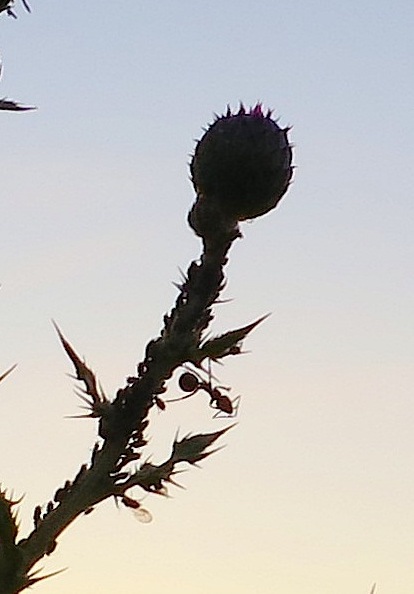
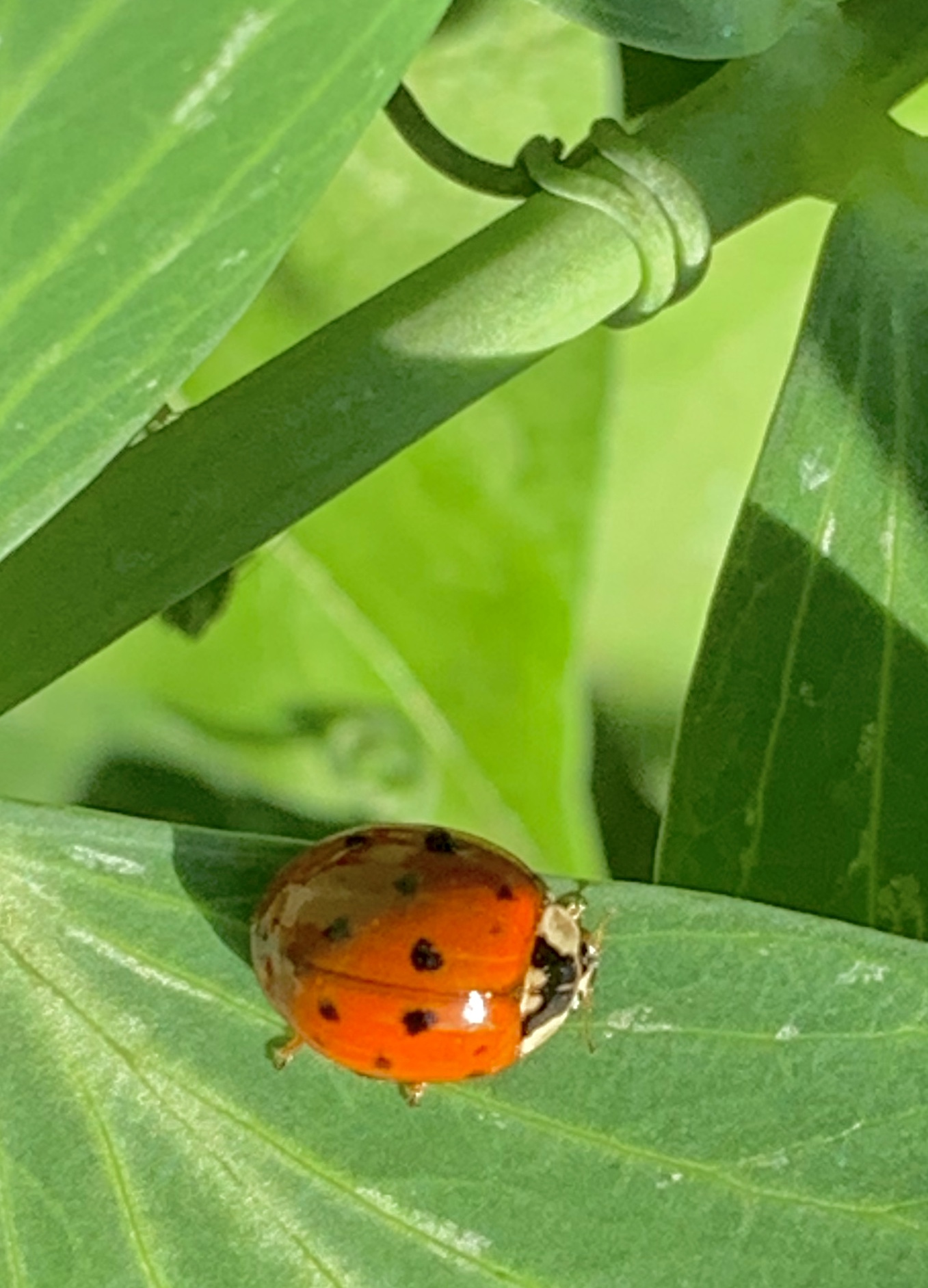
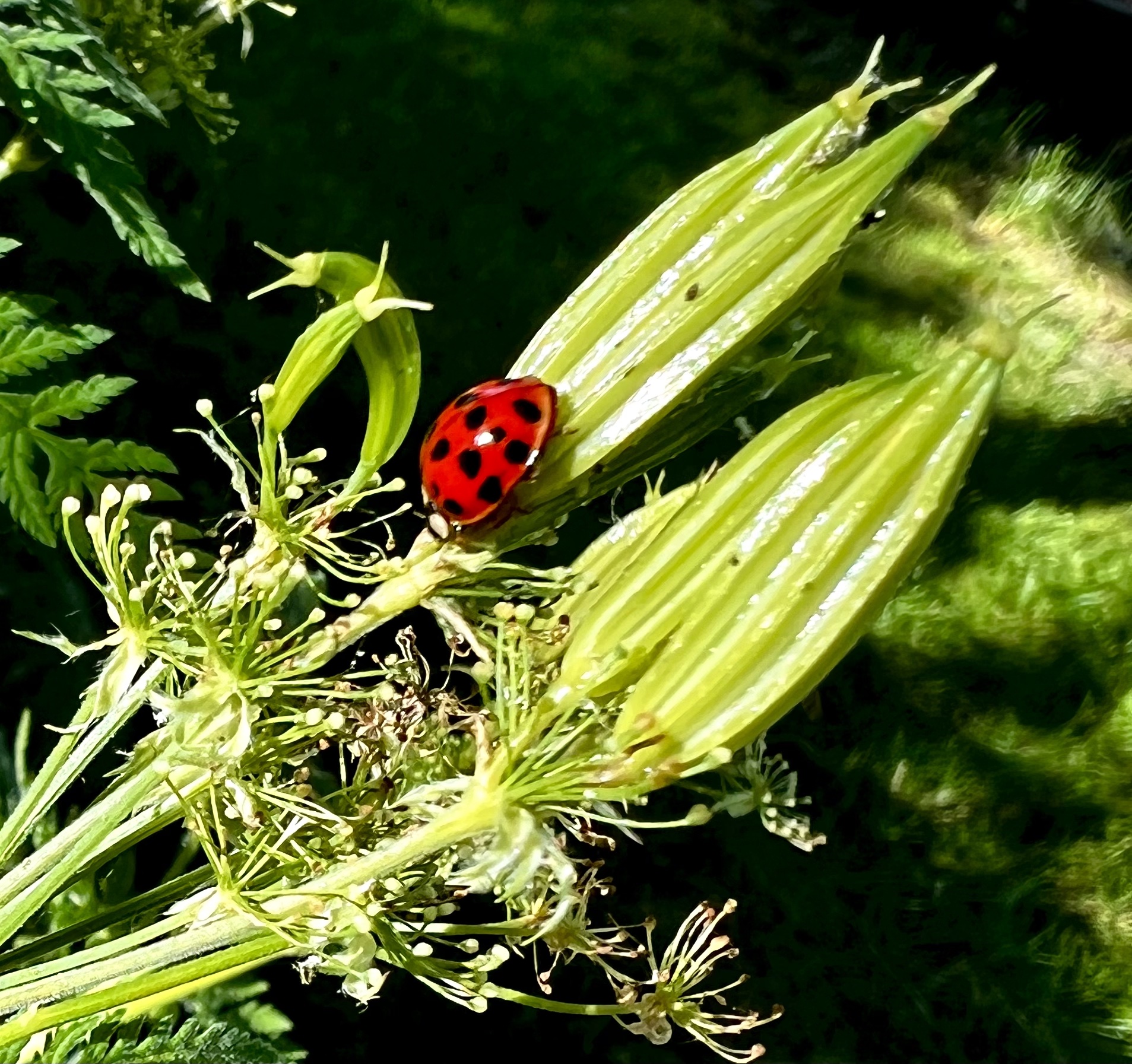
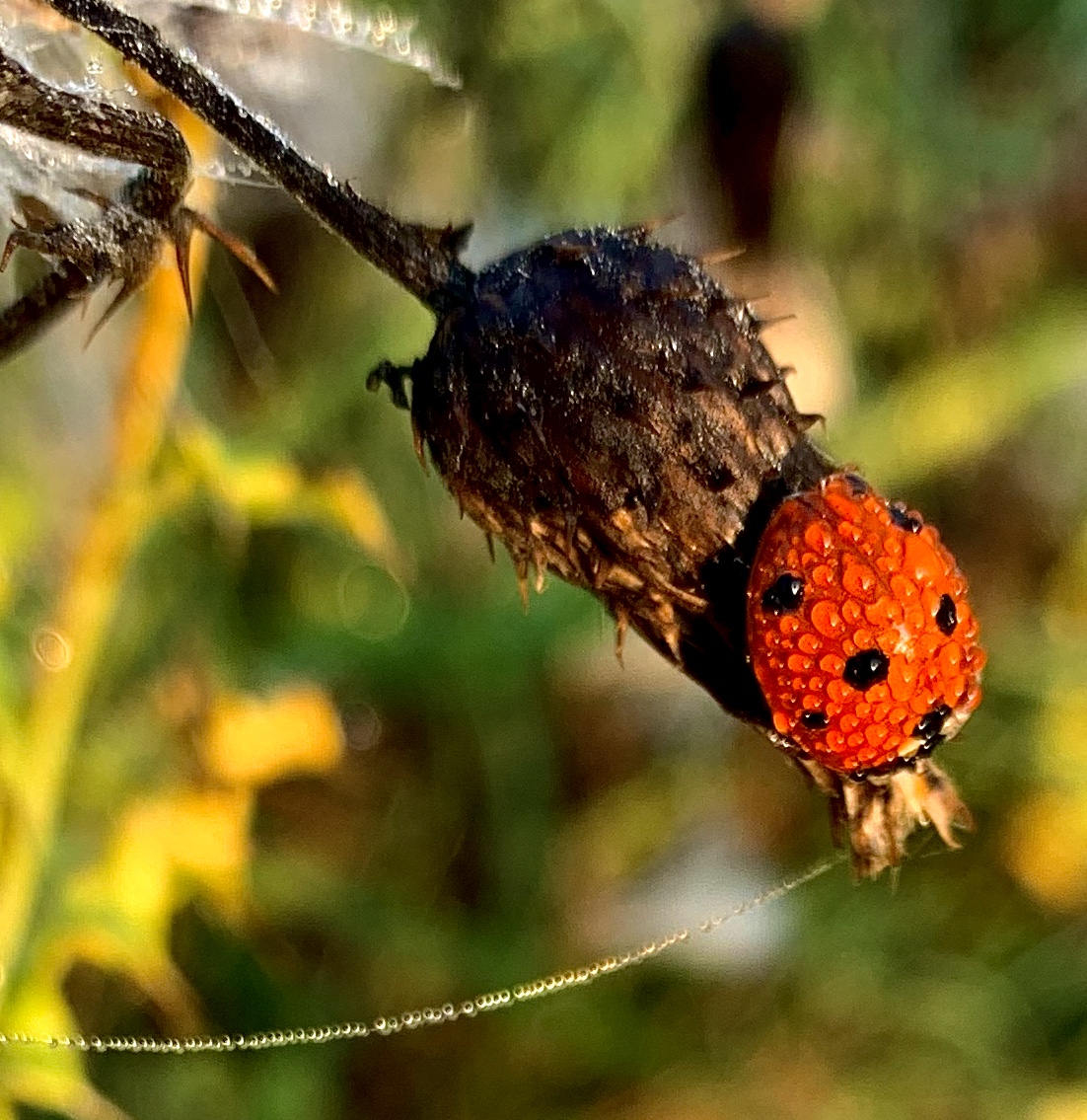
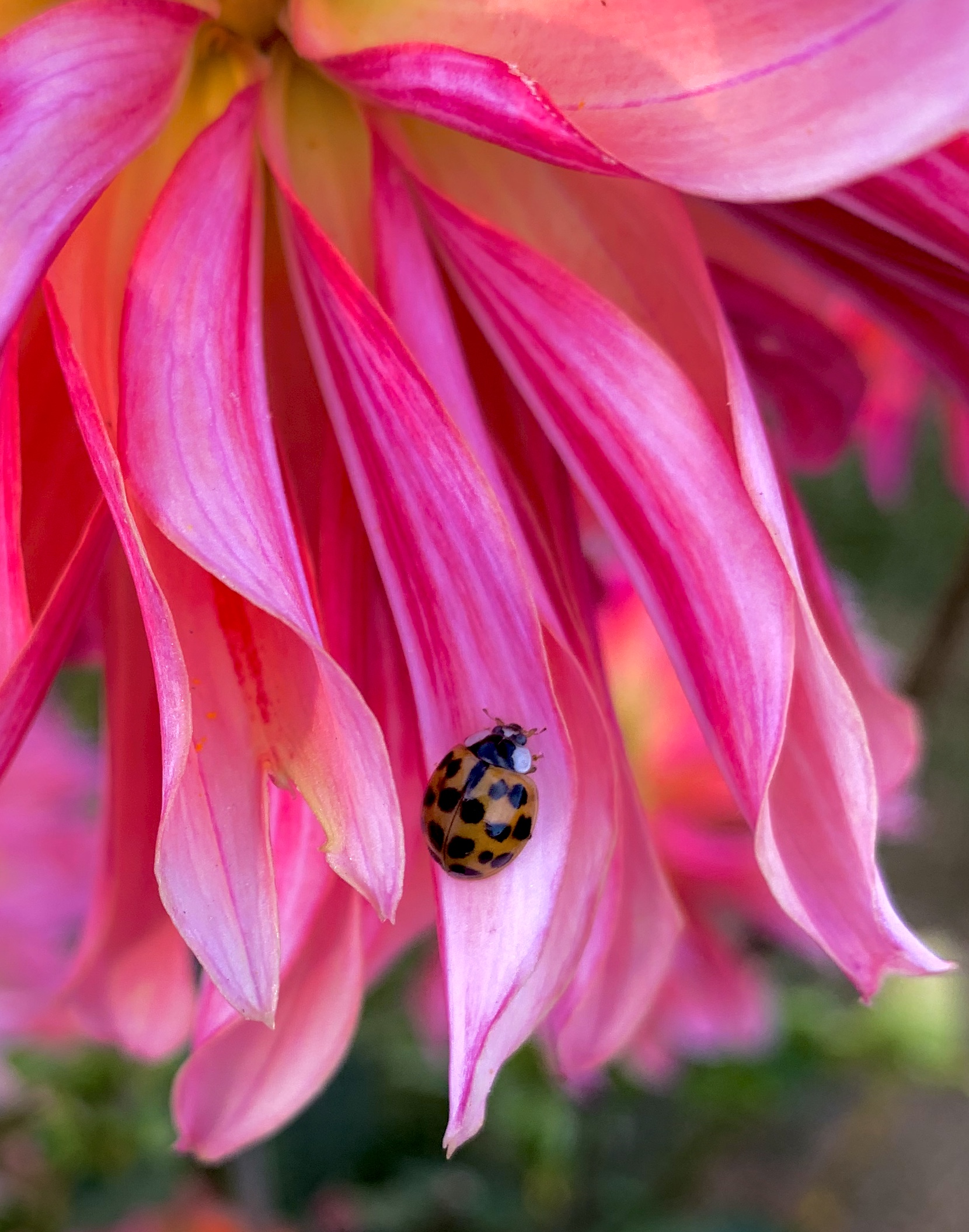
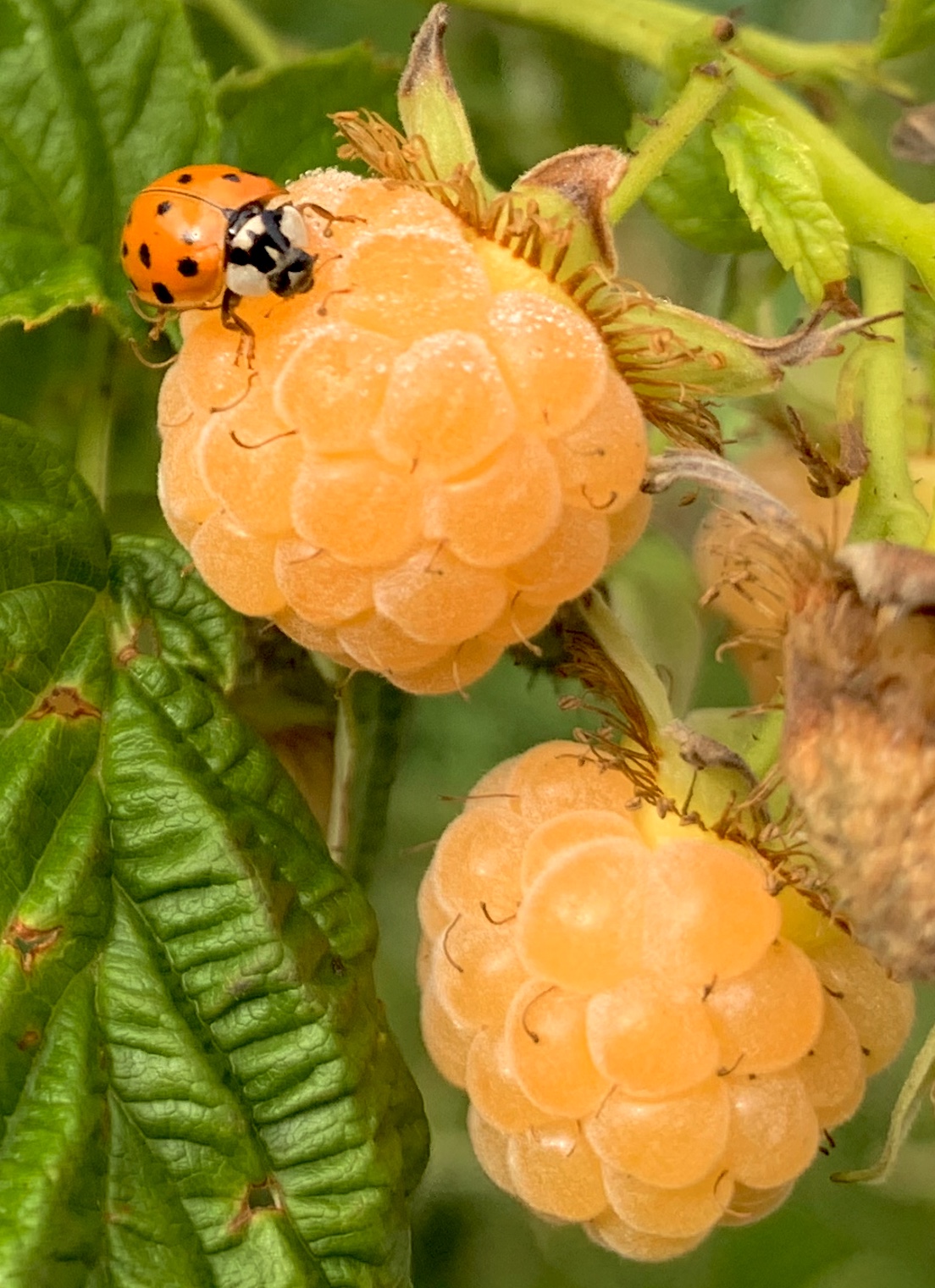
Perhaps it is finding the blend of trudger ant and celebrant grasshopper in the form of the peaceful, gentle and colorful ladybug – doing its job of protecting the garden from harmful intruders.

Truly we should strive to emulate a creature who is welcome wherever it may be found.

Ladybugs are possibly the only non-controversial subject left in the world. You can start a ladybug conversation with a total stranger without getting hit in the mouth.
~Charles Harper

One-Time
Monthly
Yearly

Make a one-time or recurring donation to support daily Barnstorming posts

Make a monthly donation

Make a yearly donation

Choose an amount

$10.00
$25.00
$50.00
$5.00
$15.00
$100.00
$5.00
$15.00
$100.00

Or enter a custom amount

$

Your contribution is deeply appreciated.

Your contribution is appreciated.

Your contribution is appreciated.

DonateDonate monthlyDonate yearly
Each Thing Noticed

The Old Testament book of Micah answers the question
of why we are here with another:
“What doth the Lord require of thee but to do justly,
and to love mercy, and to walk humbly with thy God?”
We are here to abet creation and to witness it,
to notice each thing so each thing gets noticed.
Together we notice not only each mountain shadow
and each stone on the beach
but we notice each other’s beautiful face
and complex nature so that creation need not play

to an empty house.
~Annie Dillard from Life Magazine’s “The Meaning of Life”

I started out a noticer,
a child who crawled on the ground
to follow winding ant trails from their hills,
then watched nests bloom with birds,
sitting still as a lizard sunning himself on a rock.

Next I was a student researcher of great apes,
following wild chimpanzees deep into an exotic forest
to observe their life in a community so much like our own.

Then came a profession and parenting and daughtering,
with mounting responsibilities and worries and cares,
and I stopped noticing any more,
too much inside the drama
to witness it from outside.

Creation played to an empty house
and the empty house was me.

Slowly now,
I’ve returned to noticing again~
buying my ticket, finding my seat,
smiling and nodding
applauding
hooting and hollering
begging for an encore.

It’s a non-stop show of the miraculous
where I’m an appreciative audience
preparing to write a great review.

One-Time
Monthly
Yearly

Make a one-time or recurring donation to support daily Barnstorming posts

Make a monthly donation

Make a yearly donation

Choose an amount

$10.00
$25.00
$50.00
$5.00
$15.00
$100.00
$5.00
$15.00
$100.00

Or enter a custom amount

$

Your contribution is deeply appreciated.

Your contribution is appreciated.

Your contribution is appreciated.

DonateDonate monthlyDonate yearly
Help Along the Road

I dreamed that heaven
was a long road

populated by people
we didn’t necessarily
know, or like, or
agree with

and who
we didn’t expect
any help from.

… But we did.

We all helped
each other
along that road.

~Sara Barkat “Heaven” from The Sadbook Collections

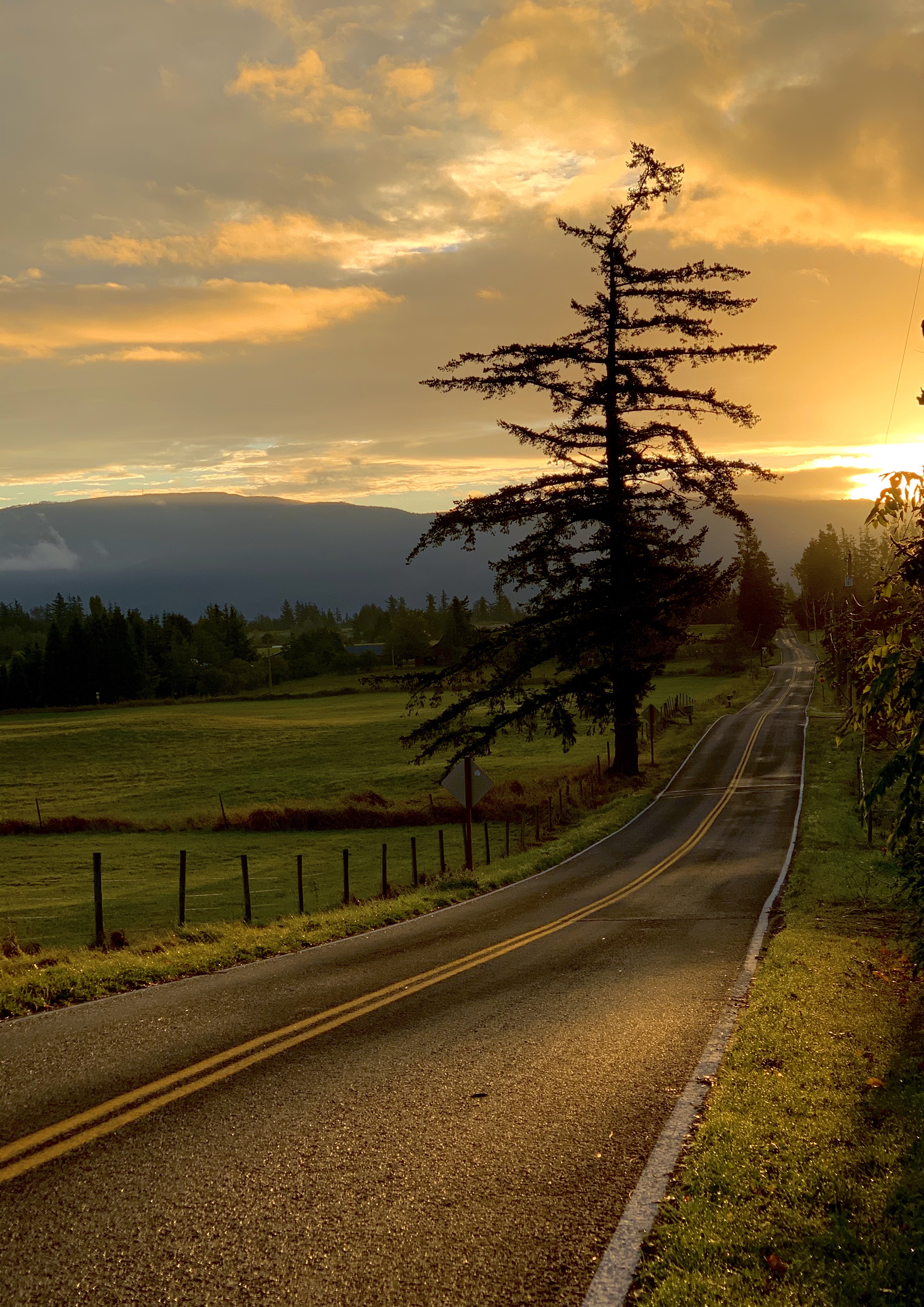
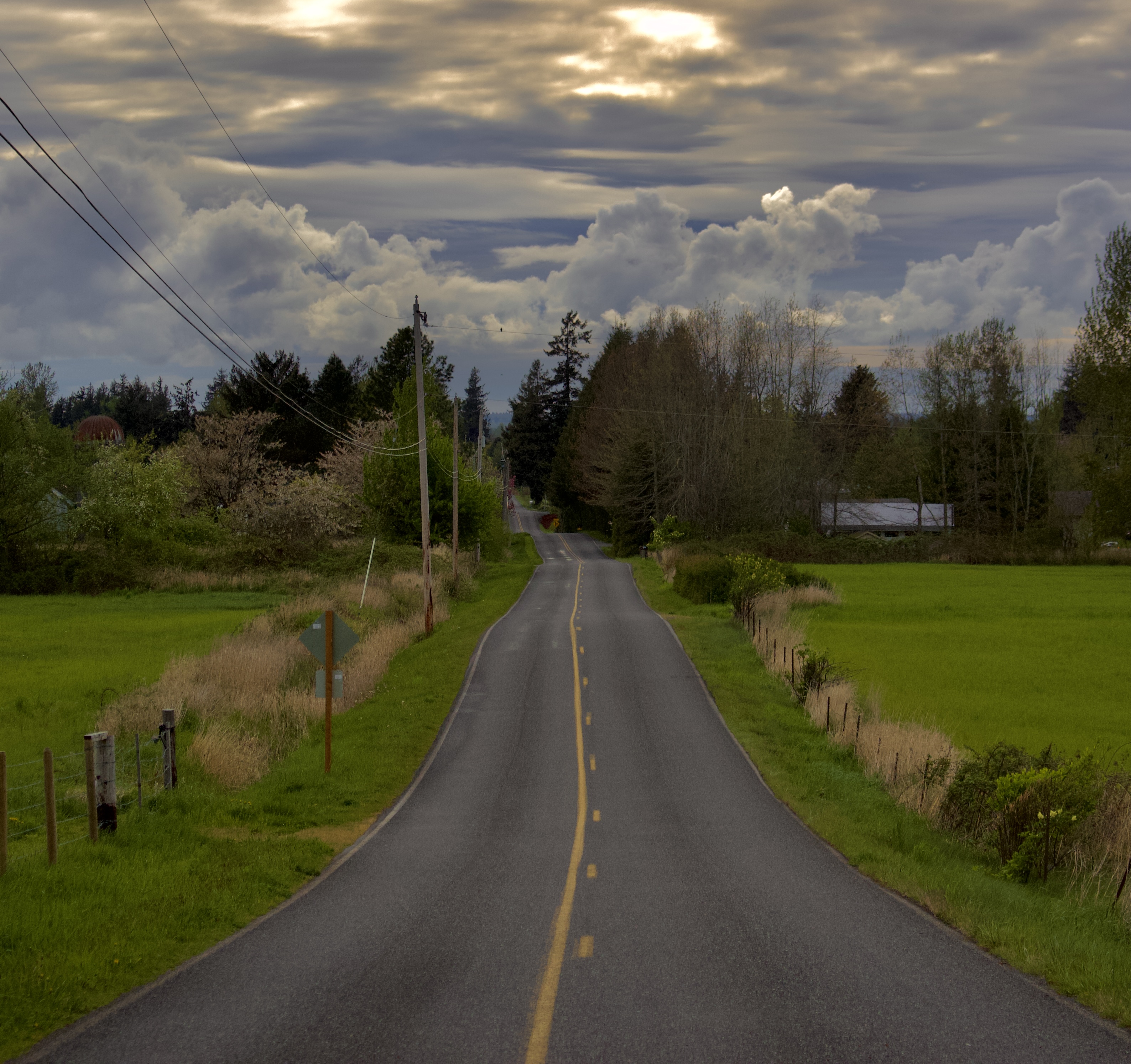
This is the country road we live on. I know where it ends to the east: at the very edge of the Cascade foothills, right in the middle of a small tribal nation trying to survive challenging economic times on their reservation land.

Heading west from here, there is another tribal nation trying to survive.

In between are farmers who are having to sell their dairy herds because milk prices aren’t keeping up with the cost of maintaining their business. There are families now without sustainable wage employment because large industries have pulled up stakes and closed their doors. There is land that is overpriced as people flee the chaos and lawlessness of the cities, hoping to find peace and quiet.

There is much sadness along the road we travel that leads to heaven, but as a diverse people who struggle together on this journey, we take turns carrying one another when one has what another does not. We still have the sun and the rain and the soil, the turning of the seasons and the rhythm of a sun that rises up and comes down.

On our way to there, why not share?

One-Time
Monthly
Yearly

Make a one-time or recurring donation to support daily Barnstorming posts

Make a monthly donation

Make a yearly donation

Choose an amount

$10.00
$25.00
$50.00
$5.00
$15.00
$100.00
$5.00
$15.00
$100.00

Or enter a custom amount

$

Your contribution is deeply appreciated.

Your contribution is appreciated.

Your contribution is appreciated.

DonateDonate monthlyDonate yearly
Browsing and Chewing Sweet Hay

To Bring the Horse Home…

after Philip Larkin

Is all I’ve wanted past wanting
since I was six and delirious with fever,
an infinitive forged from a night
when giant ladybugs with toothpick
antennae patrolled my wicker nightstand.
Yes, I’ve been with horses since, 
travelled illegally with them in trailers,
known certain landscapes only framed
by alert ears, and with one in particular,
spent whole afternoons with her big jaw
heavy on my shoulder. Still, I hatched
plots to bring a horse to the house, to ride 
to school, to pasture one or even three
in the garden, shaded by that decorative
willow, which could have used a purpose.
But there were city bylaws in two languages,
and over the years, a dog, stray cats,
turtles, and many fish. They lived, they died.
It wasn’t the same. Fast-forward, I brought
the baby home in a molded bucket seat, but she
lacked difference, attuned as I was, checking
her twenty-four-seven. Now that she’s 
grown, I’m reduced to walking city parks
with this corrosive envy of mounted police,
though I’m too old for the ropes test,
wouldn’t know what to do with a gun.
If there’s a second act, let me live
like the racetrack rat in a small room
up the narrow stairs from the stalls,
the horse shifting comfortably below,
browsing and chewing sweet hay.
A single bed with blanket the color
of factory-sweepings will suffice,
each day shaped to the same arc, 
because days can only end when
the lock slides free on the stall’s
Dutch door, and I lead the horse in,
then muscle the corroded bolt shut.
That’s what days are for: I cannot rest
until the horse comes home.

~Julie Bruck “To Bring the Horse Home”

photo by Breanna Randall

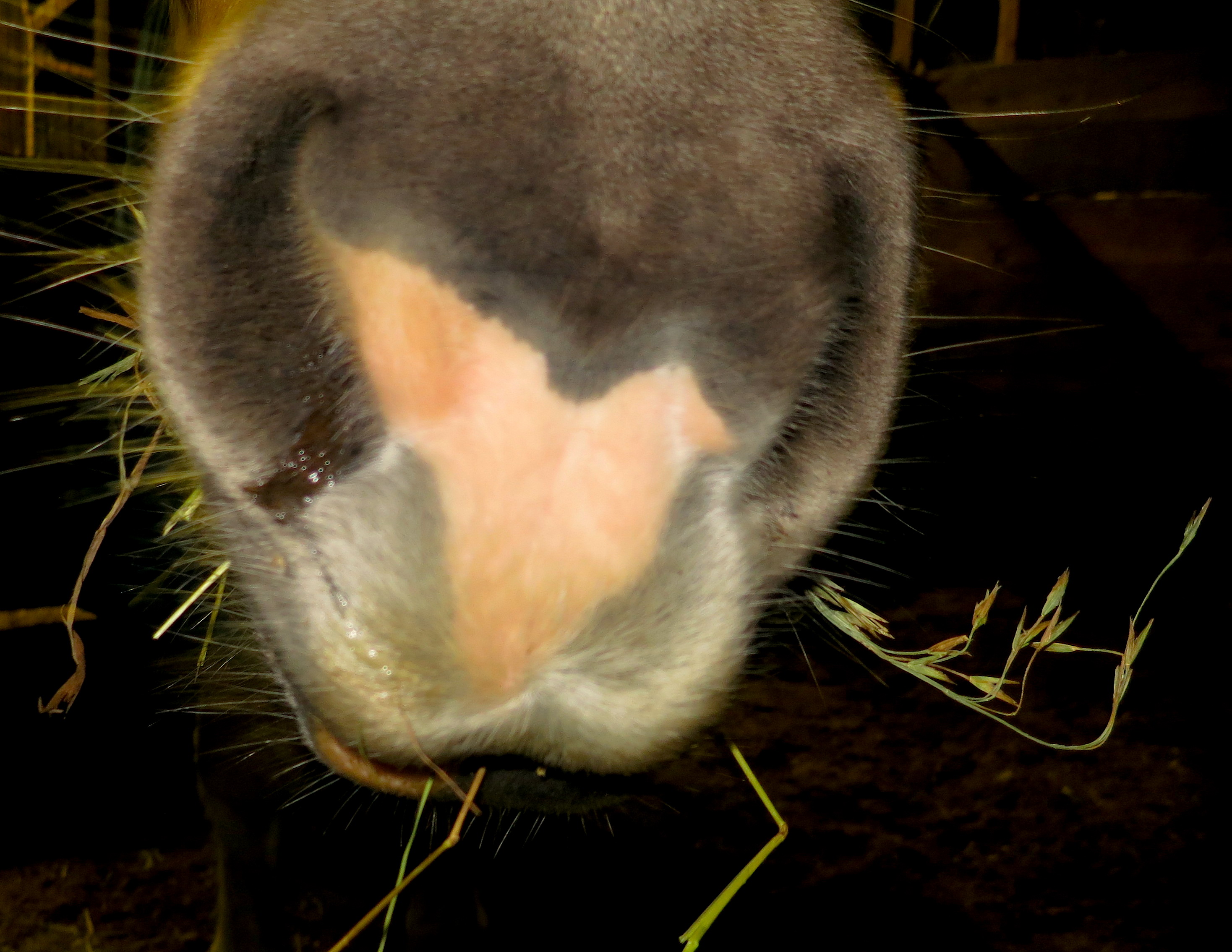
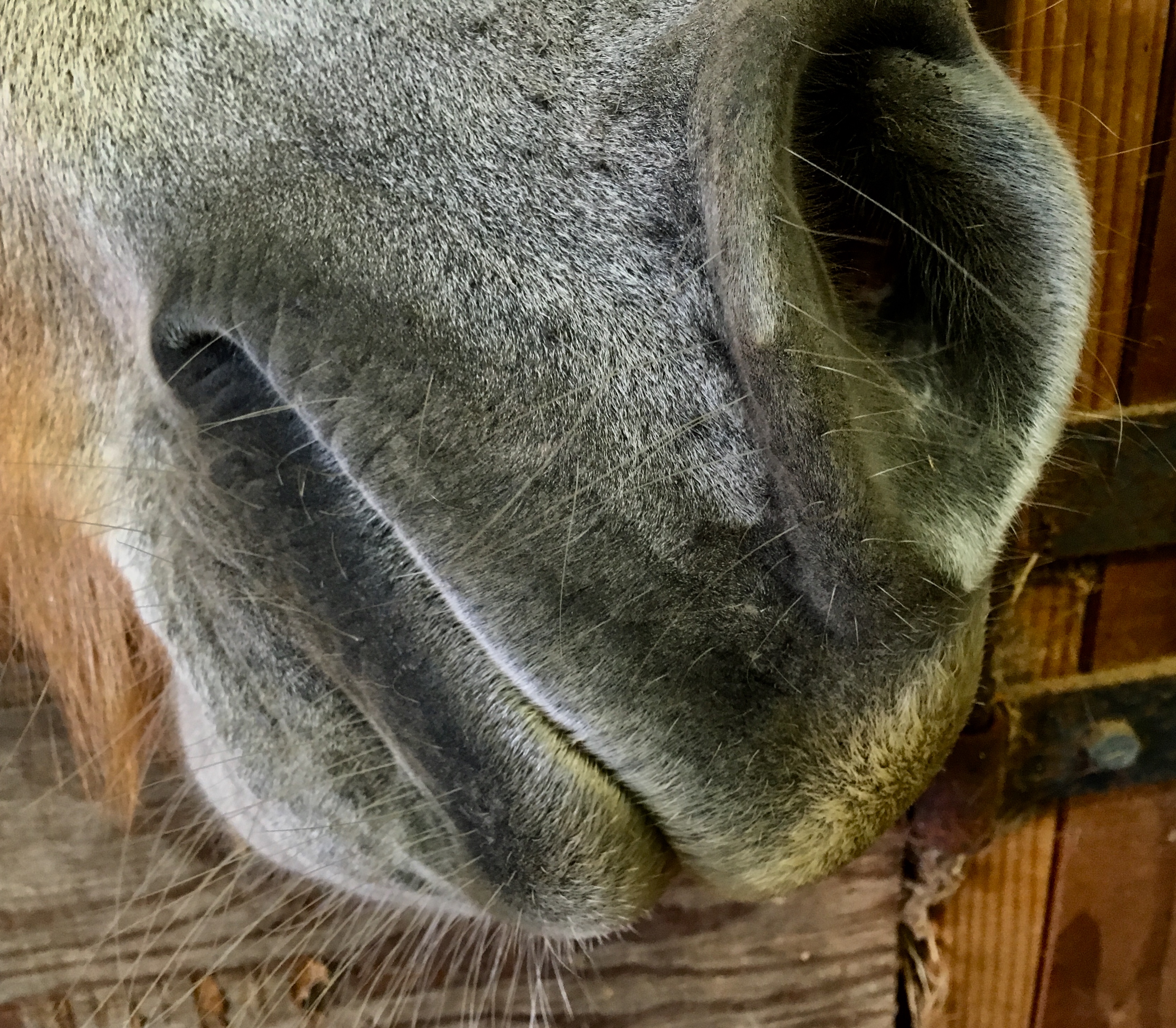
The best moment in the barn is in the evening just following the hay feeding, as the animals are settling down to some serious chewing. I linger in the center aisle, listening to the rhythmic sounds coming from six stalls. It is a most soothing contented cadence, first their lips picking up the grass, then the chew chew chew chew and a pause and it starts again. It’s even better in the dark, with the lights off.

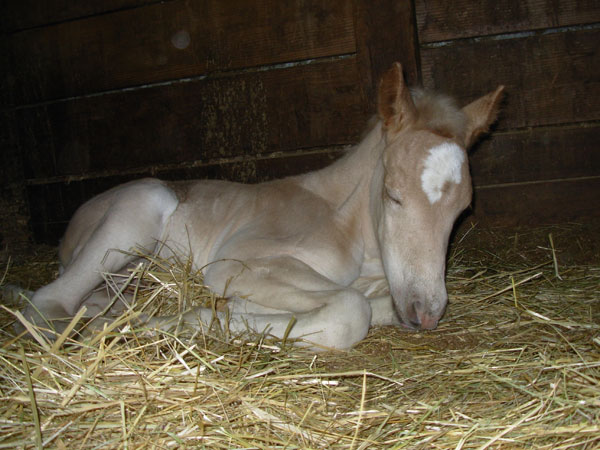
I’ve enjoyed listening to the eating sounds at night from the remote vantage point of my bedroom TV monitor system set up to watch my very pregnant mares before foaling. A peculiar lullaby of sorts, strange as that seems, but when all my farm animals are chewing and happy, I am at peace and sleep better.

It reminds me of those dark deep nights of feeding my own newborns, rocking back and forth with the rhythm of their sucking. It is a moment of being completely present and peaceful, and knowing at that moment, nothing else matters–nothing else at all.

If I am very fortunate, each day I live has a rhythm that is reassuring and steady, like the sounds of hay chewing, or rocking a baby. I awake thinking about where my next step will bring me,  and then the next, like each chew of sweet hay. I try to live in each moment fully, without distraction by the worry of the unknown.

But the reality is:
life’s rhythms are often out of sync,
the cadence is jarring,
the sounds are discordant,
sometimes I’m the one being chewed on, so pain replaces peacefulness.

Maybe that is why this lullaby in the barn~~this sanctuary~~is so treasured. It brings me home to that doubting center of myself that needs reminding that pain is fleeting, and peace, however elusive now, is forever. I always know where to find it for a few minutes at the end of every day, in a pastoral symphony of sorts.

Someday my hope for heaven will be angel choruses of glorious praise, augmenting a hay-chewing lullaby.

So simple yet so grand.

One-Time
Monthly
Yearly

Make a one-time or recurring donation to support daily Barnstorming posts

Make a monthly donation

Make a yearly donation
Choose an amount

$10.00
$25.00
$50.00
$5.00
$15.00
$100.00
$5.00
$15.00
$100.00

Or enter a custom amount

$

Your contribution is deeply appreciated.
Your contribution is appreciated.

Your contribution is appreciated.

DonateDonate monthlyDonate yearly