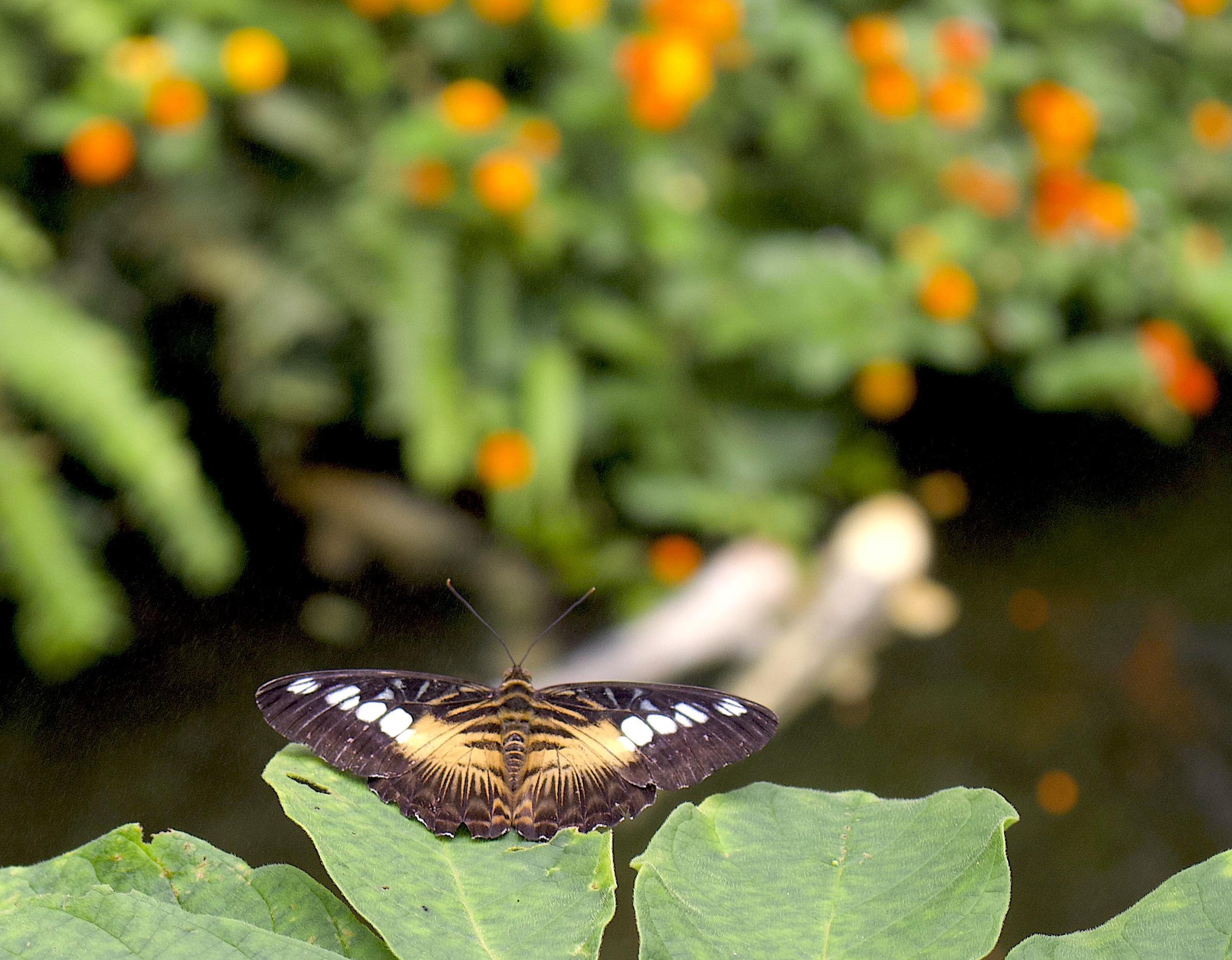
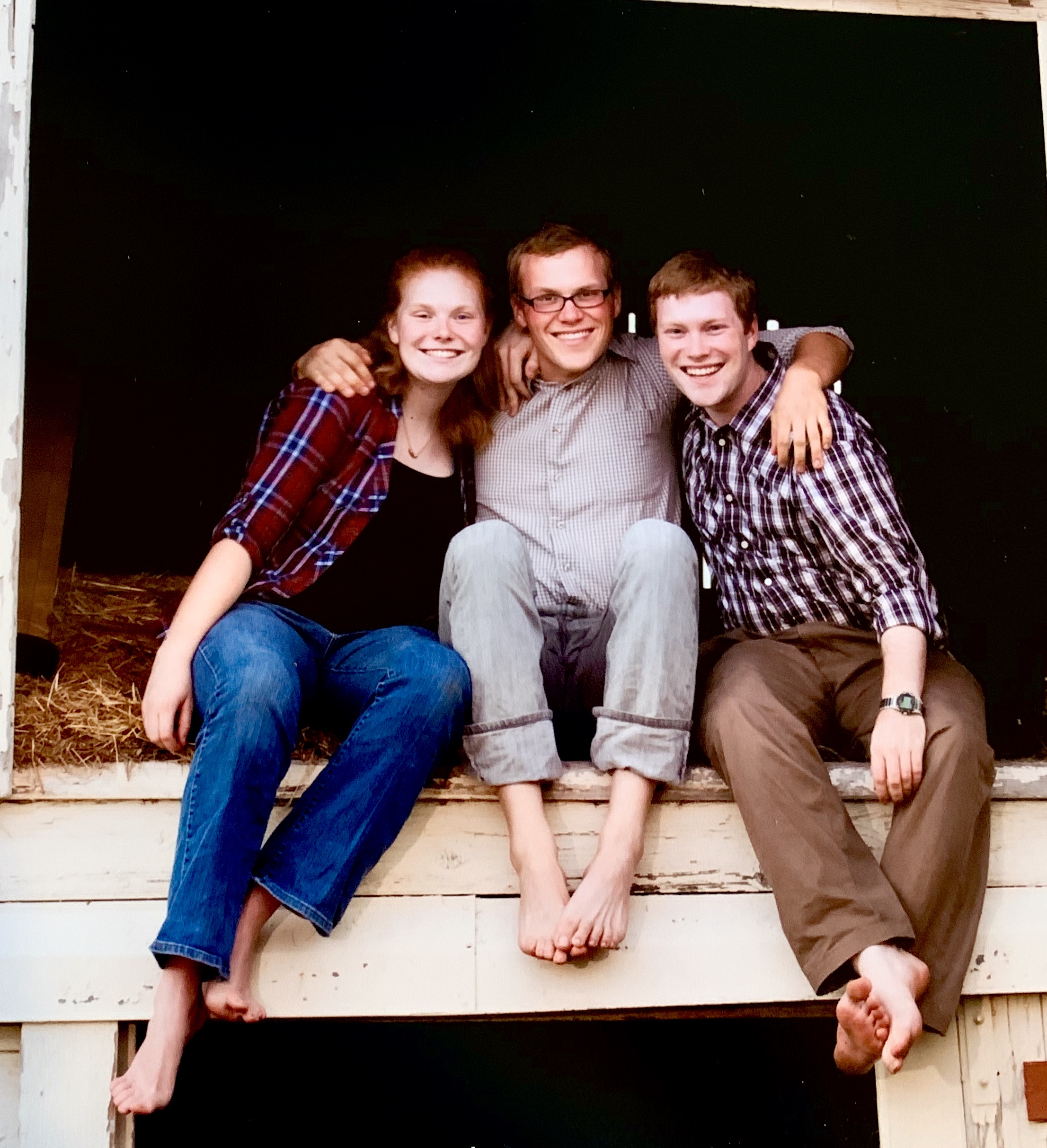
The crust of sleep is broken Abruptly— I look drowsily Through the wide crack. I do not know whether I see Three minds, bird-shaped, Flashing upon the bough of morning; Or three delicately tinted souls Butterflying in the sun; Or three brown-fleshed, husky children Sprawling hilarious Over my bed And me. ~Jeanne D’Orge “Matins”(published in 1917)
This morning I broke through the misty tides of my dreams, surfacing to cool morning air and prelude of a dawn bird chorus.
Today I wake imagining who I might be from a myriad of dreams…
Sometimes I wake as if once again a young girl, sun coming through frilly curtains to shower my face with a warming light.
Sometimes I wake as if once again a sleep-thirsty student, hoping to snooze another 15 minutes before class.
Sometimes I wake once again as if a new mother, dripping and leaking at the sound of my baby’s cries.
Sometimes I wake as if once again a weary farmer, up much of the night with a laboring mare and slow-to-suck foal.
Sometimes I wake as if once again a preoccupied physician, mentally reviewing the night’s phone calls and concerns.
Today I wake as a grandma, wishing my bed would bounce with a pile of birds and butterflies and jubilant children, wishing me good morning and eager to see me up and at ’em.
So who am I?
I was, I am, I will be all those things, as I hang tight to the bough of morning.
One-Time
Monthly
Yearly
Make a one-time or recurring donation to support daily Barnstorming posts
You can hide nothing from God. The mask you wear before men will do you no good before Him. He wants to see you as you are, He wants to be gracious to you. You do not have to go on lying to yourself and your brothers, as if you were without sin; you can dare to be a sinner. ~Dietrich Bonhoeffer from Life Together
In your hands
The dog, the donkey, surely they know They are alive. Who would argue otherwise?
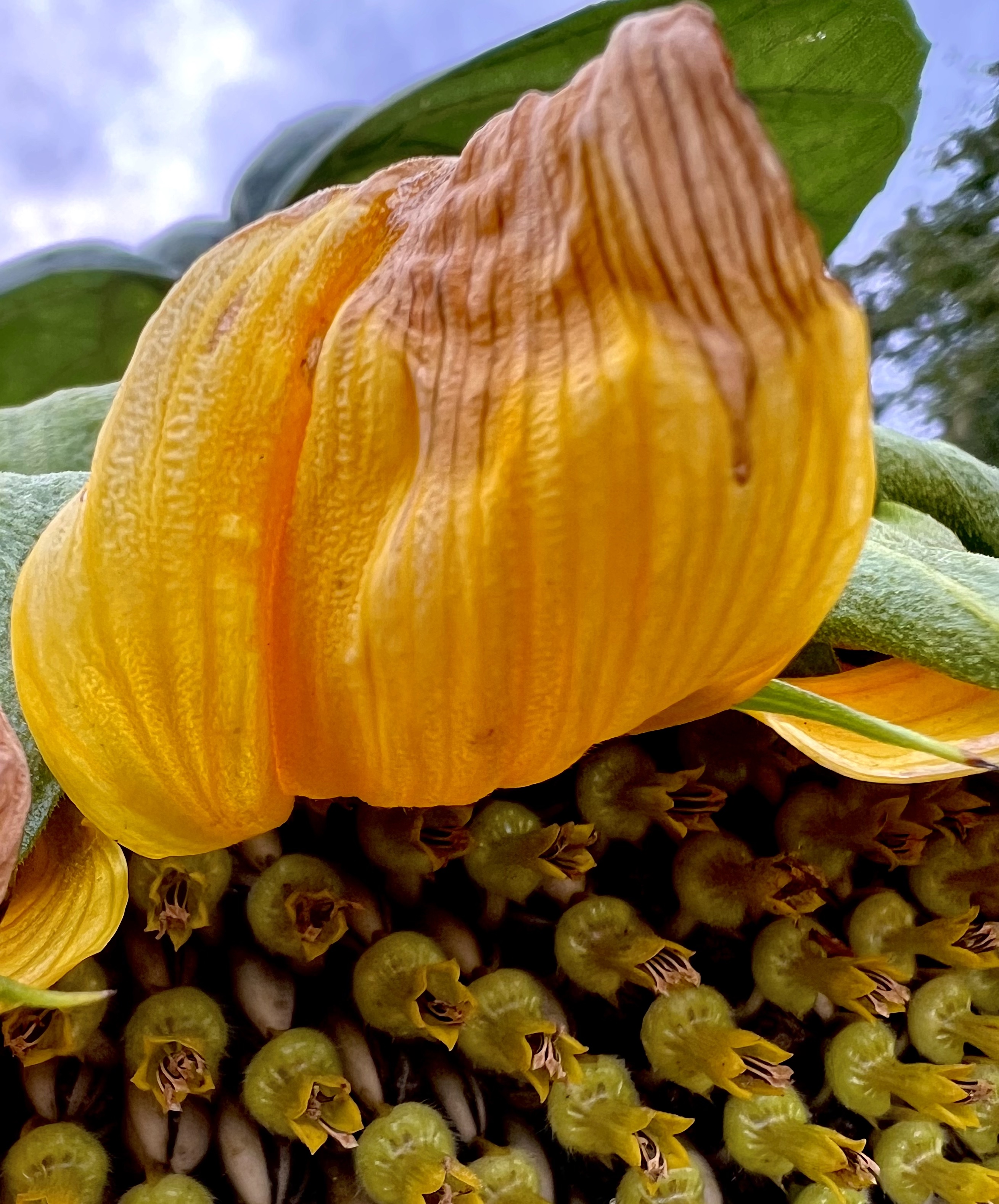
But now, after years of consideration, I am getting beyond that. What about the sunflowers? What about The tulips, and the pines?
Listen, all you have to do is start and There’ll be no stopping. What about mountains? What about water Slipping over rocks?
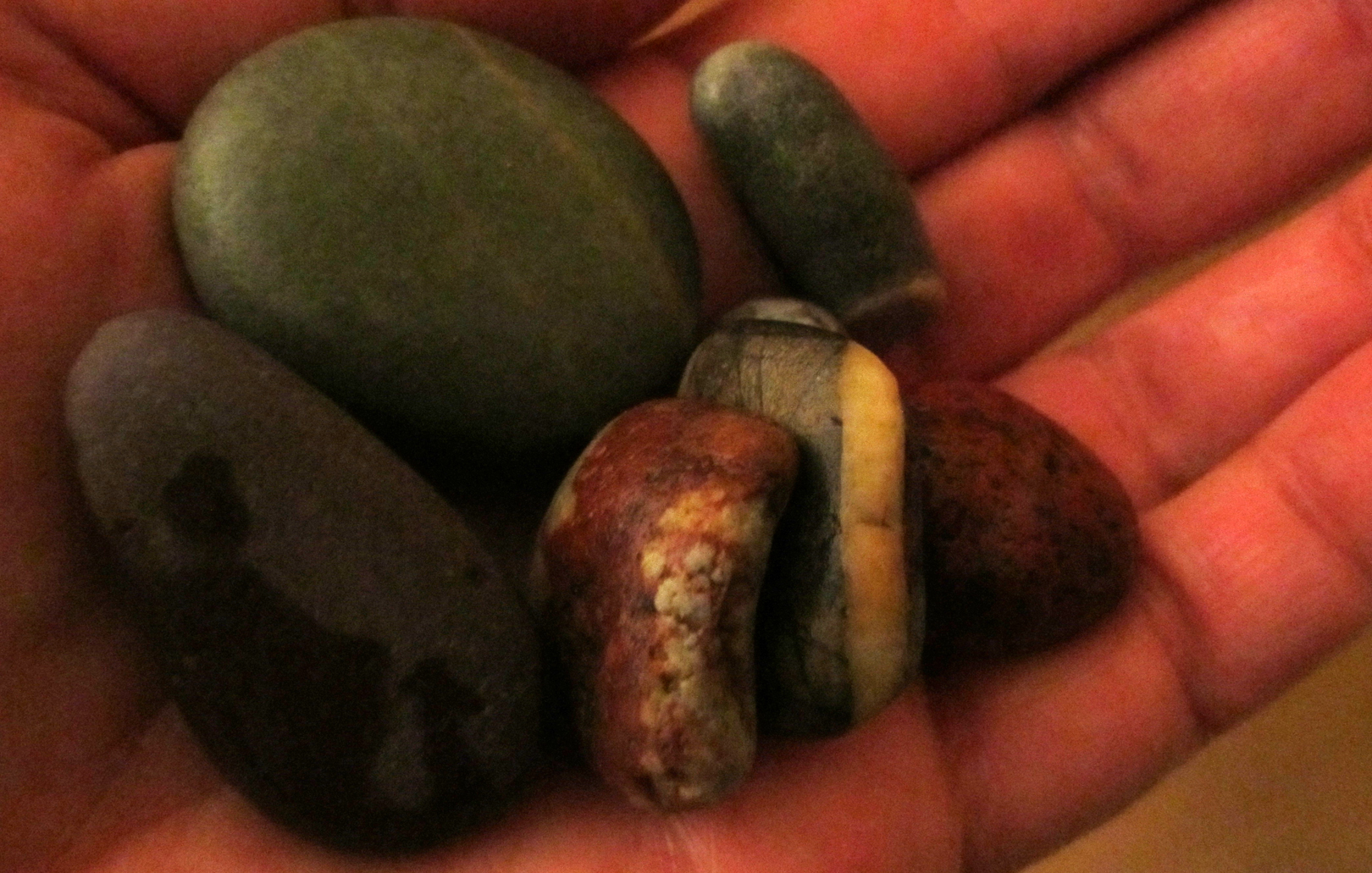
And speaking of stones, what about The little ones you can Hold in your hands, their heartbeats So secret, so hidden it may take years
Before, finally, you hear them? ~Mary Oliver “in your hands” from Swan: Prose and Poems
When I take myself to the doctor, I trust I’m seeing someone who tries to know me thoroughly enough that he or she can help me move out of illness into better health.
This is how acceptance feels: trusting someone enough to come out of hiding, allowing them to see the parts of me I prefer to keep hidden.
As a physician myself, I am reminded by the amount of “noticing” I did in the course of my work. Each patient, and there were so many, deserved my full attention for the few minutes we were together. I started my clinical evaluation the minute I entered the room and I began taking in all the complex verbal and non-verbal clues offered up, sometimes unwittingly, by another human being.
During the COVID pandemic, my interactions with patients became all “virtual” so I didn’t have the ability to observe as thoroughly as I usually did. Instead, I needed them to tell me outright what was going on in their lives, their minds and their hearts in both spoken or written words. I couldn’t ‘see’ them, even on a screen, in the same way as face to face in the same room.
How can someone call out their worries to me when they are hidden behind a camera lens?
I can’t witness first hand the trembling hands, their sweatiness, their scars of self injury. Still, I am their audience and a witness to their struggle; even more, I must understand their fears to best help them. My brain must rise to the occasion of taking in another person, accepting them for who they are, with every wart and blemish, offering them the gift of compassion and simply be there for them at that moment.
God isn’t blinded in His Holy work as I am in my clinical duties. He knows us thoroughly because He made us; He knows our thoughts before we put them into words. There is no point in trying to stay hidden from Him.
He holds us, little pebbles that we are, in His Hand, and He listens to our secret heartbeats.
Those of us who believe we can remain effectively hidden will never be invisible to God.
AI image created for this post
One-Time
Monthly
Yearly
Make a one-time or recurring donation to support daily Barnstorming posts
Be obscure clearly. Muddiness is not merely a disturber of prose, it is also a destroyer of life, of hope: death on the highway caused by a badly worded road sign … think of the tragedies that are rooted in ambiguity, and be clear! ~E.B. White from his classic book on writing well –The Elements of Style
As a family doctor with over forty years of clinical practice under my belt, I have found the E.B. White’s advice for writing can be applied to the field of medicine. I tried my best to clarify the obscurity of the human condition in my job, hoping my patients could provide me the information I needed to make a sound diagnosis and treatment recommendation.
Communication is hard work for many patients, especially when they are depressed and anxious on top of whatever they are experiencing physically. There is still plenty of unknowns in the psychology and physiology of humans. Then, throw in a disease process or two or three to complicate what appears to be “normal” and further consider the side effects and complications of various treatments.
Evidence-based decision making isn’t always perfectly equipped to produce the best and only solution to one individual’s problem.
Sometimes the solution to a patient’s symptom is foggy, muddy, and obscure, not at all pristine and clear. It is the physician’s job to try to bring everything into the best focus possible. Then it is our job to communicate our thinking and decision process in a way that respects the patient’s right to be skeptical.
A physician’s clinical work is challenging on the best of days when everything goes well. We see things we have never seen before, expect the unexpected, learn skills we never thought we’d need to know, and attempt to make the best choice between competing treatment alternatives. Physicians constantly unlearn things we thought were gospel truth, but have just been disproven by the latest, double-blind controlled study, which may soon be reversed by a newer study.
We find ourselves standing on evidence-based quicksand even though our patients trust that we are giving them rock-solid advice based on a foundation of truth learned over years of education and training. Add in medical decision-making that is driven by cultural, political, or financial outcomes, rather than what works best for the individual, and our hoped-for clinical clarity becomes even more obscured.
Forty-two years of doctoring in the midst of the mystery of medicine means learning, unlearning, listening, discerning, explaining, guessing, hoping, and remaining very humble in the face of a disease process or a public health threat like COVID. What works well for one patient may not be appropriate for another despite what the best evidence says or what insurance companies and the government are willing to cover. Each individual we see deserves the clarity of a fresh look and perspective, instead of being treated by cook-book algorithm.
So, as a physician and healer, be obscure clearly. A life may depend on it.
One-Time
Monthly
Yearly
Make a one-time or recurring donation to support daily Barnstorming posts
There comes the strangest moment in your life, when everything you thought before breaks free— what you relied upon, as ground-rule and as rite looks upside down from how it used to be.
Your heart’s in retrograde. You simply have no choice. Things people told you turn out to be true. You have to hold that body, hear that voice. You’d have sworn no one knew you more than you.
This disease of being “busy” (and let’s call it what it is, the dis-ease of being busy, when we are never at ease) is spiritually destructive to our health and wellbeing.
It saps our ability to be fully present with those we love the most in our families, and keeps us from forming the kind of community that we all so desperately crave.
Tell me you remember you are still a human being, not just a human doing. Tell me you’re more than just a machine, checking off items from your to-do list. Have that conversation, that glance, that touch. Be a healing conversation, one filled with grace and presence.
Put your hand on my arm, look me in the eye, and connect with me for one second. Tell me something about your heart, and awaken my heart. Help me remember that I too am a full and complete human being… ~Omid Safi from The Disease of Being Busy
It has been nearly three years since I hung up my stethoscope. I’m no longer paid to be very busy. It isn’t feeling strange to wake up with no “job” to go to.
I still am vigorously treading water but with no destination in mind other than to stay afloat. It’s enough to just move and breathe in this new and strangely unfamiliar territory.
It was scary at first, backing off from all-consuming clinic responsibilities, yet knowing I was becoming less effective due to my diminishing passion and energy for the work. I’d been working in some capacity for over fifty years, starting in high school.
I could barely remember who I was before I became a physician.
So here I am — changed and changing — volunteering here and there, budding and blooming in new colors and shapes, exercising a different part of my brain, and simply praying I make good use of the time left to me, being something as worthwhile as what I had been doing.
So, once again, my days have become… strangely beautiful… in ways I could never have imagined.
AI image created for this post
One-Time
Monthly
Yearly
Make a one-time or recurring donation to support daily Barnstorming posts
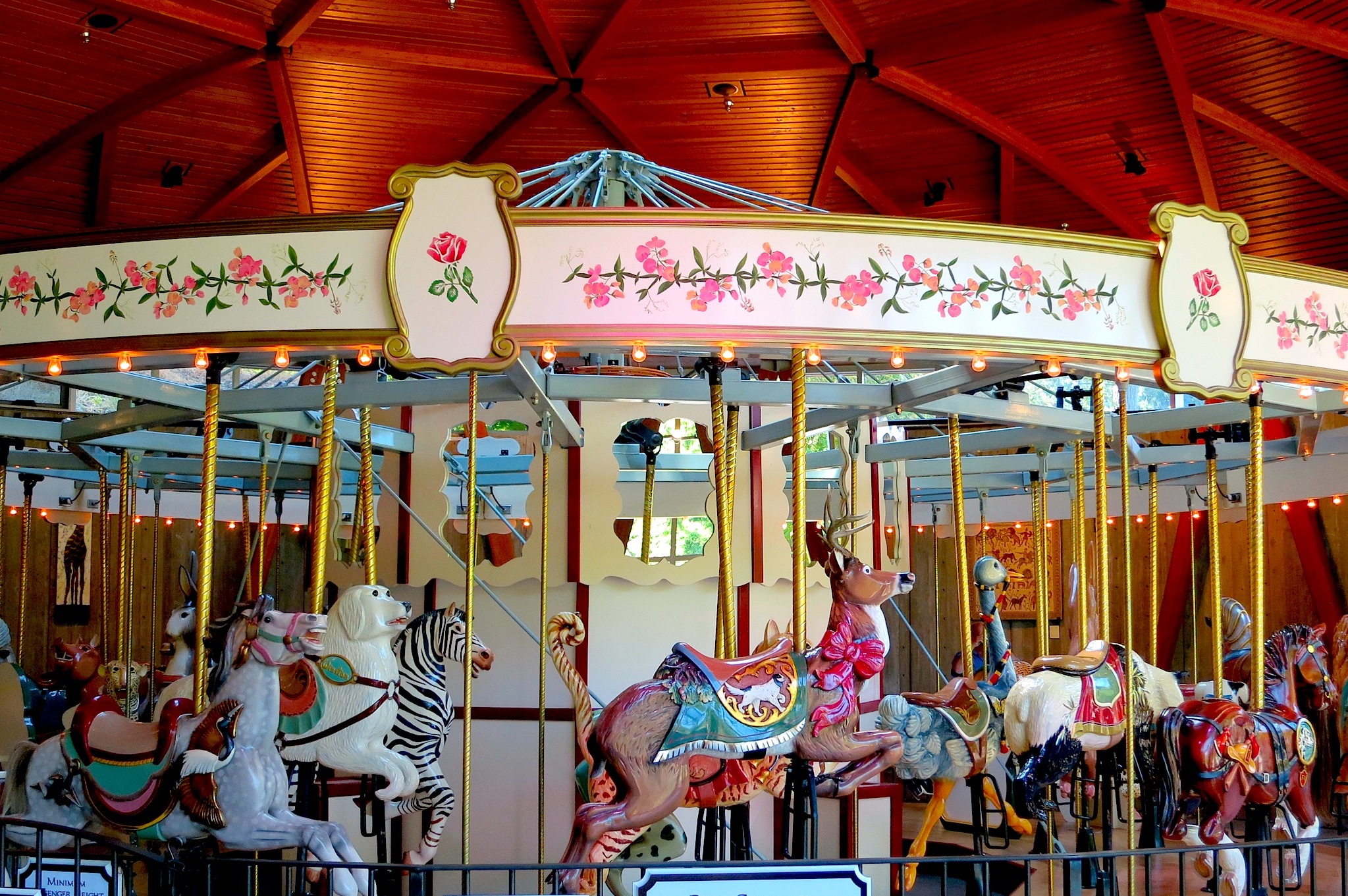
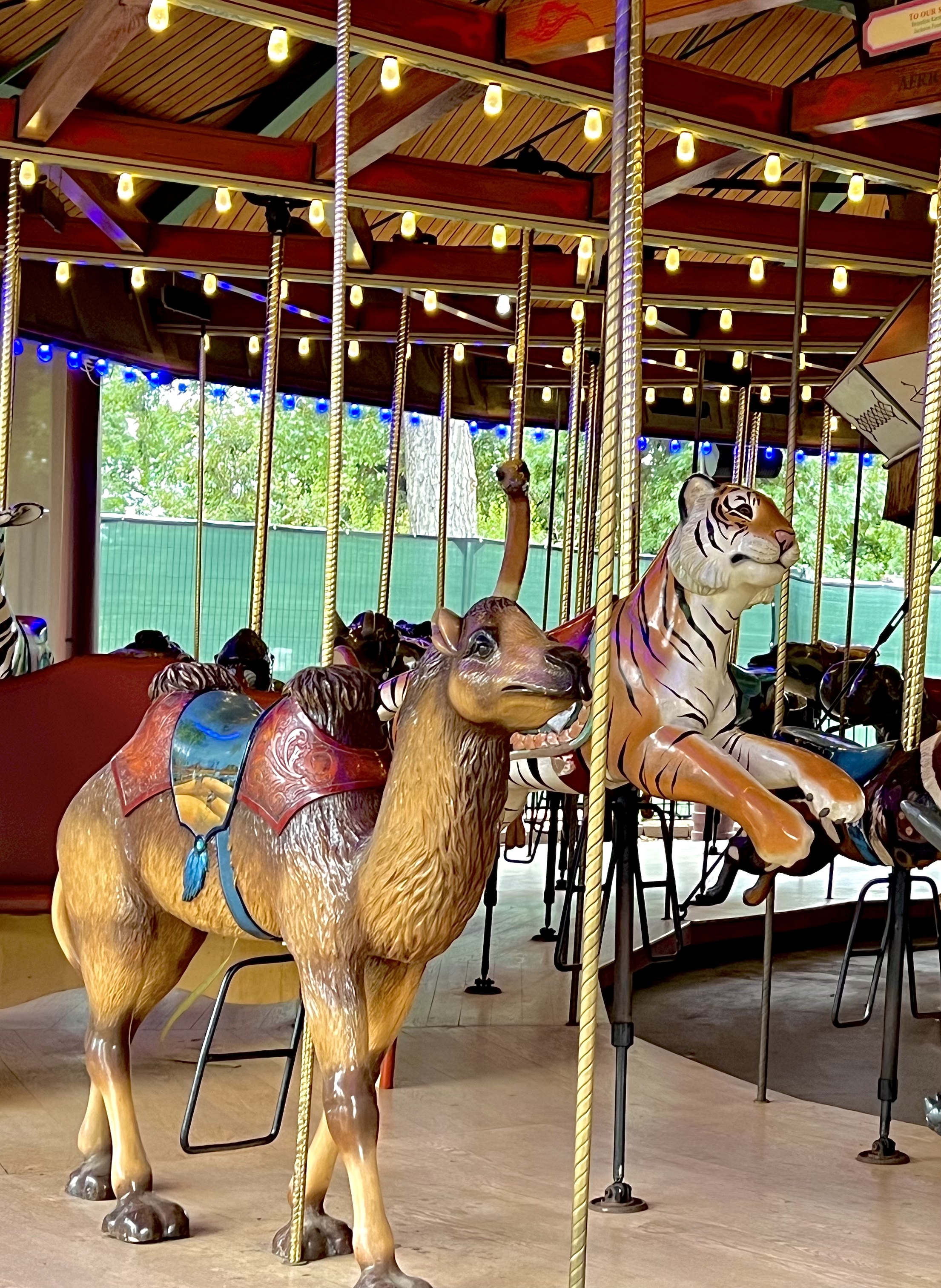
And the seasons they go round and round And the painted ponies go up and down We’re captive on the carousel of time We can’t return, we can only look behind From where we came And go round and round and round In the circle game… ~Joni Mitchell “The Circle Game”
those lovely horses, that galloped me, moving the world, piston push and pull, into the past—dream to where? there, when the clouds swayed by then trees, as a tire swing swung me under—rope groan. now, the brass beam, holds my bent face, calliope cadence—O where have I been? ~Rick Maxson “Carousel at Seventy”
On thin golden poles gliding up, sliding down, a kingdom of horses goes spinning around.
Jumper, Brown Beauty, Dark Thunder, Sir Snow, a medley of ponies parade in a row.
Settled in saddles, their riders hold on to reins of soft leather while circling along
on chestnut or charcoal, on sleek Arctic white, on silver they gallop in place day and night.
Such spinning is magic, (to dream as you sail) with lavender saddle and ebony tail,
whirling to music in moonlight, spellbound, galloping, galloping, merrily go round. ~Rebecca Kai Dotlich “Carousel”
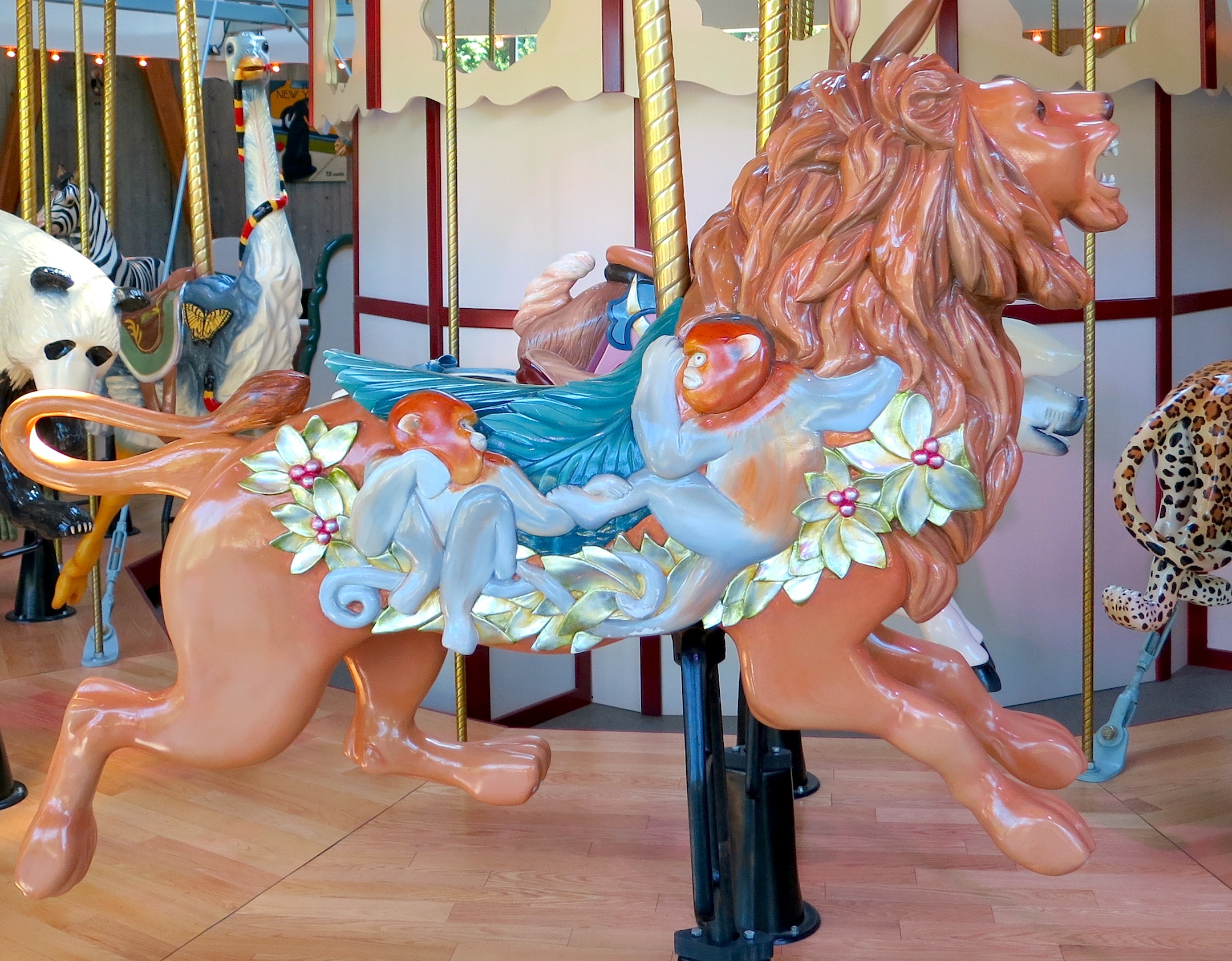
Under its canopy, in the shade it casts, turns a world with painted horses, all from a land that lingers a while before it disappears. Some, it’s true, are harnessed to a wagon, but all have valor in their eyes. A fierce red lion leaps among them, and here comes ’round a snow-white elephant.
Even a stag appears, straight from the forest, except for the saddle he wears, and, buckled on it, a small boy in blue.
And a boy in white rides the lion, gripping it with small clenched hands, while the lion flashes teeth and tongue.
And here comes ’round a snow-white elephant.
And riding past on charging horses come girls, bright-eyed, almost too old now for this children’s play. With the horses rising under them, they are looking up and off to what awaits. ~Rainer Maria Rilke from “Jardin de Luxembourg”
A fewJuly memories:
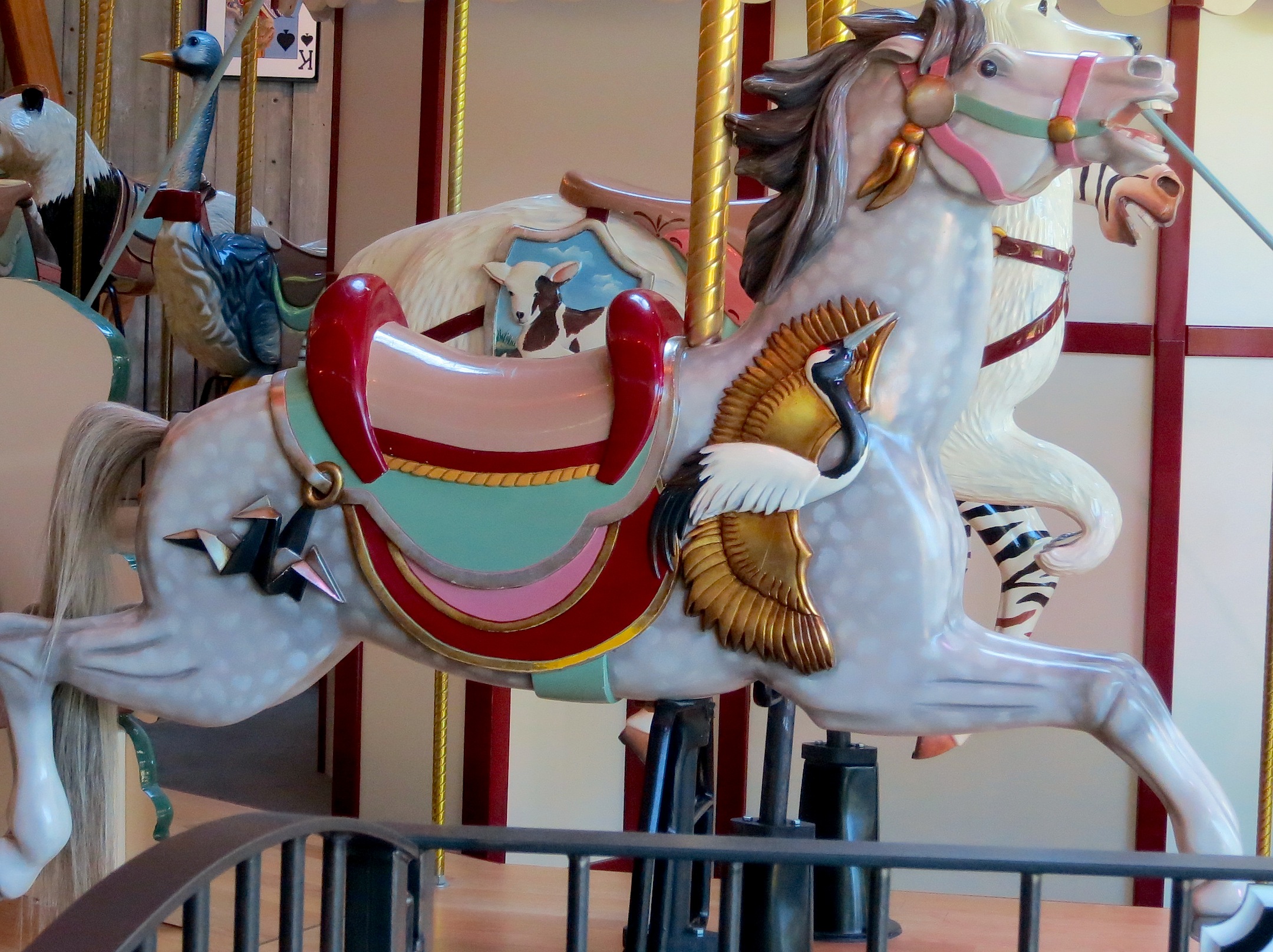
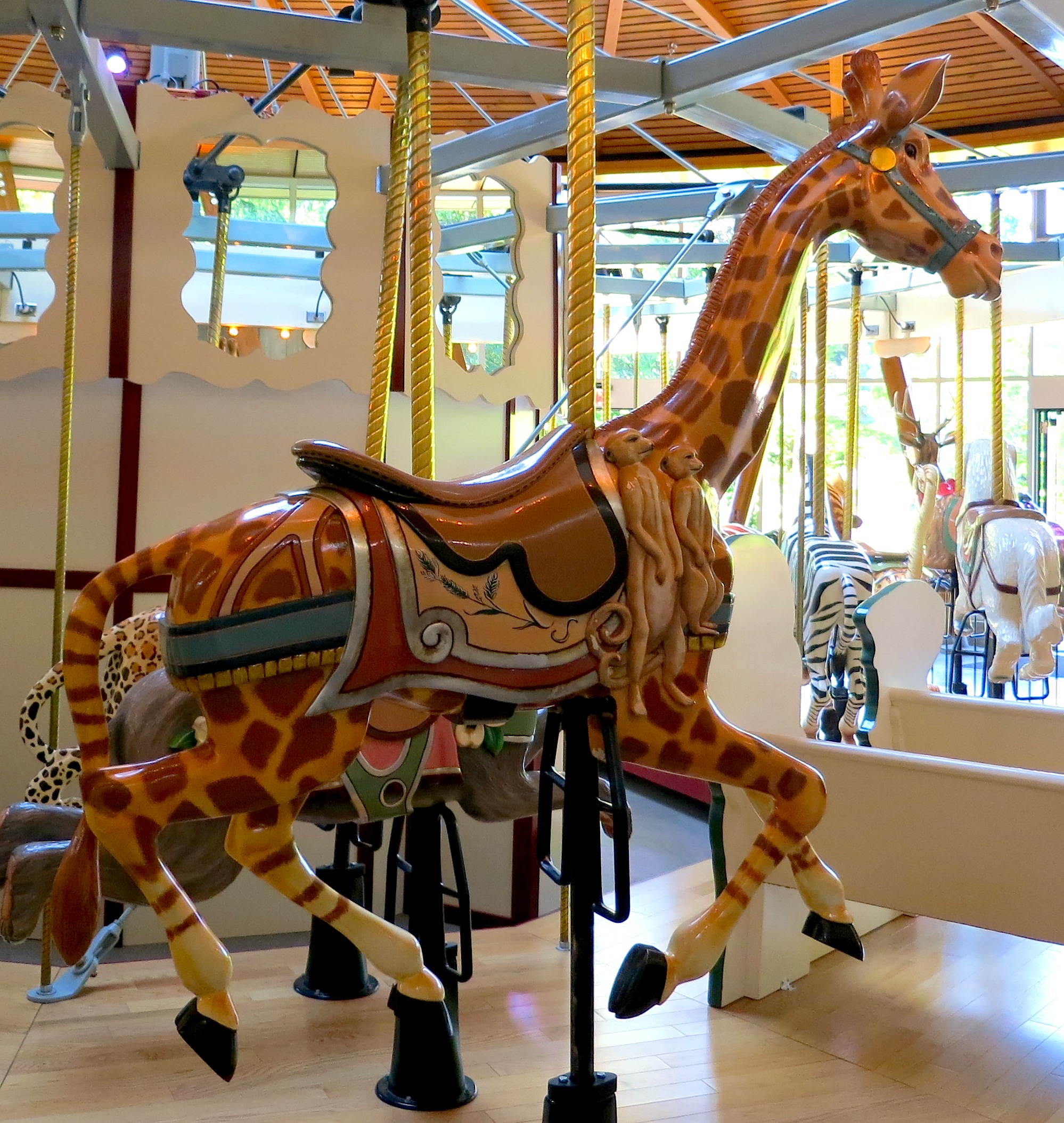
Sixty-five years ago, I was a five year old having her first ride on the historic carousel at Woodland Park Zoo before we moved from Stanwood to Olympia. Fifty-four years ago — a teenager working in a nursing home as a nurses’ aide after three days of training. Forty-nine years ago – returned home early from my studies in Tanzania after four chimpanzee researcher friends were held hostage for ransom and eventually released Forty-three years ago — deep in the guts of a hospital working forty hour long shifts, thinking about the man I was soon to marry Thirty-four years ago — my husband and I picking up bales of hay in our own farm field, two young children in tow after accepting a new position doctoring at the local university Twenty-seven years ago — raising three children and completed farm house remodel, supporting three parents with health issues, raising Haflinger horses, helping design a new clinic building at work, playing piano and teaching Sunday School at church Twenty-whatever years ago – life spinning faster, blurring with work at home, on the farm, at clinic, at church. I begin writing to grab and hang on to what I can. Sixteen years ago — one son about to move to Japan to teach and the other son to teach at Pine Ridge in South Dakota, daughter at home with a new driver’s license working with migrant children, a mother slowly bidding goodbye to life at a local care center, farming less about horse raising and more about gardening, maintaining and preserving. Ten years ago — two sons married, daughter working as a camp counselor so our first summer without children at home. Perfect time to raise a new puppy! Five years ago – A two year old granddaughter and two new grandsons! Daughter teaching, engaged to be married. Two years ago – completed forty-two years of non-stop doctoring so I bid it goodbye. Now – Three more grandsons! Two retired grandparents! Big garden on the farm but we’re slowing down.
The puppy’s face and our hair are turning white…
O where have I been? We can only look behind from where we came and await what is ahead.
The decades pass, round and round – there is comfort knowing that through the ups and downs of daily life, we still hang on. If we slip and fall, there is Someone ready to catch us.
Looking behind you, where have you been? What awaits you where you are heading?
AI image created for this post
One-Time
Monthly
Yearly
Make a one-time or recurring donation to support daily Barnstorming posts
Some things are very dear to me— Such things as flowers bathed by rain Or patterns traced upon the sea Or crocuses where snow has lain … the iridescence of a gem, The moon’s cool opalescent light, Azaleas and the scent of them, And honeysuckles in the night. And many sounds are also dear— Like winds that sing among the trees Or crickets calling from the weir Or Negroes humming melodies. But dearer far than all surmise Are sudden tear-drops in your eyes. ~Gwendolyn Brooks “Sonnet 2”
We human beings do real harm. History could make a stone weep. ~Marilynne Robinson from Gilead
I am an easy cryer. It takes very little to tip me over the edge: a hymn, a poem, simply witnessing a child’s joy. Suddenly my eyes fill up. I blame this on my paternal grandmother who was in tears much of her time when visiting our family, crying happy, crying sad, crying frustrated and angry tears.
Somehow after her visit, she was always smiling, so I think her weeping was cathartic emptying of her stress.
My greatest trigger to weep myself is watching someone else tear up. I think my grandmother left behind some powerful empathy genes.
I had to desensitize my response to tears to be effective as a physician/healer. Witnessing tears in the exam room is a normal part of the job: patients are anxious, ill, in pain or simply need to decompress in safety. I learned early on to be unobtrusive and not interrupt, letting the flow of tears be part of how the patient was trying to communicate. It was a struggle when my inclination was to cry right along with them. But I needed to be the rock in the room, solid and steady. I could understand their tears as yet another symptom of a clinical presentation, allowing me to observe without being clouded by my own emotional response.
Sometimes that worked. Sometimes not. At times overwhelmed, I wept at births, I wept at deaths, I wept at the sharing of bad news.
Now, liberated from the exam room, I freely weep at the state of the world, or when I read of disaster and tragedy, and especially when I witness intentional harm and meanness in others. I’m no longer a barely responsive stone, but more like an over-filled sponge being squeezed – everything builds up until I can hold it no more. Reading headlines in the news is sometimes more than I can bear.
I cry myself dry.
And that is okay. Once emptied out, I can be filled again by so much that is good and precious in this life.
That is worth weeping over.
AI image created for this post
Detail from “Descent from the Cross” by Rogier van der Weyden
One-Time
Monthly
Yearly
Make a one-time or recurring donation to support daily Barnstorming posts
We should always endeavour to wonder at the permanent thing, not at the mere exception. We should be startled by the sun, and not by the eclipse. We should wonder less at the earthquake, and wonder more about the earth. ~ G.K. Chestertonfrom ILLUSTRATED LONDON NEWS, October 21, 1905
As a physician, I was trained to perform physical examinations by learning first what was normal about the human body. As young, theoretically healthy, medical students, we practiced physical examinations on each other, and then had to demonstrate our skills in front of a professor for our class grade in physical assessments.
Since I went to medical school at a time when fewer than 1 in 5 students was a woman, each female student was placed in a physical exam group of three men, taught by a male physician, and then evaluated by a male professor. These were full examinations, including internal assessments, conducted in a typical open-backed hospital gown, in a classroom with long black lab tables to substitute for exam tables.
It was the ultimate feeling of vulnerability to be exposed to one’s classmates, supervisors and evaluators in such a way. Yet, it helped me understand the naked vulnerability of a patient undressing for a physician’s evaluation in the exam room.
After learning to assess and document what was normal in the physical exam, I was then trained to take note of the exceptions – the human body equivalent of an eclipse or an earthquake, a wildfire or drought, a hurricane or flood, or merely an annoying pothole or molehill.
A physician’s attention is rarely focused on everything that is going well with the human body, but instead concentrating on what is aberrant, failing, or could be made better.
This is unfortunate; there is much beauty and amazing design to behold in every person I meet, especially those with chronic illness who feel nothing is as it should be — they feel despair and frustration at how their mind or body is aging, failing or faltering.
To counter this tendency to just find what’s wrong and needed fixing, I learned over the years to talk out loud as I was trained to do during those medical school physical assessments: you have no concerning skin lesions, your eardrums look clear, your eyes react normally, your tonsils are fine, your thyroid feels smooth, your lymph nodes are tiny, your lungs auscultate clear, your heart sounds are perfect, your breasts reveal no palpable lumps, your belly exam is reassuring, your reflexes are symmetrical, your prostate is smooth and normal, your cervix, uterus and ovaries are healthy, your emotional response to your stress level and your tears are completely understandable.
I also wrote messages to patients meant to reassure: your labs are in a typical range or are getting better or at least maintaining, your xray shows no concerns, or isn’t getting worse, those medication side effects are to be expected and could go away.
I chose to acknowledge what was working well before attempting to intervene in what is not.
I’m not sure how much difference it made to my patient. But it made a difference to me to wonder first at who this whole patient was before I focused in on what was broken and causing dis-ease.
I remain startled nearly 50 years later, and always astonished, by the sheer wonder that is our bodies – the Artist’s masterpiece.
One-Time
Monthly
Yearly
Make a one-time or recurring donation to support daily Barnstorming posts
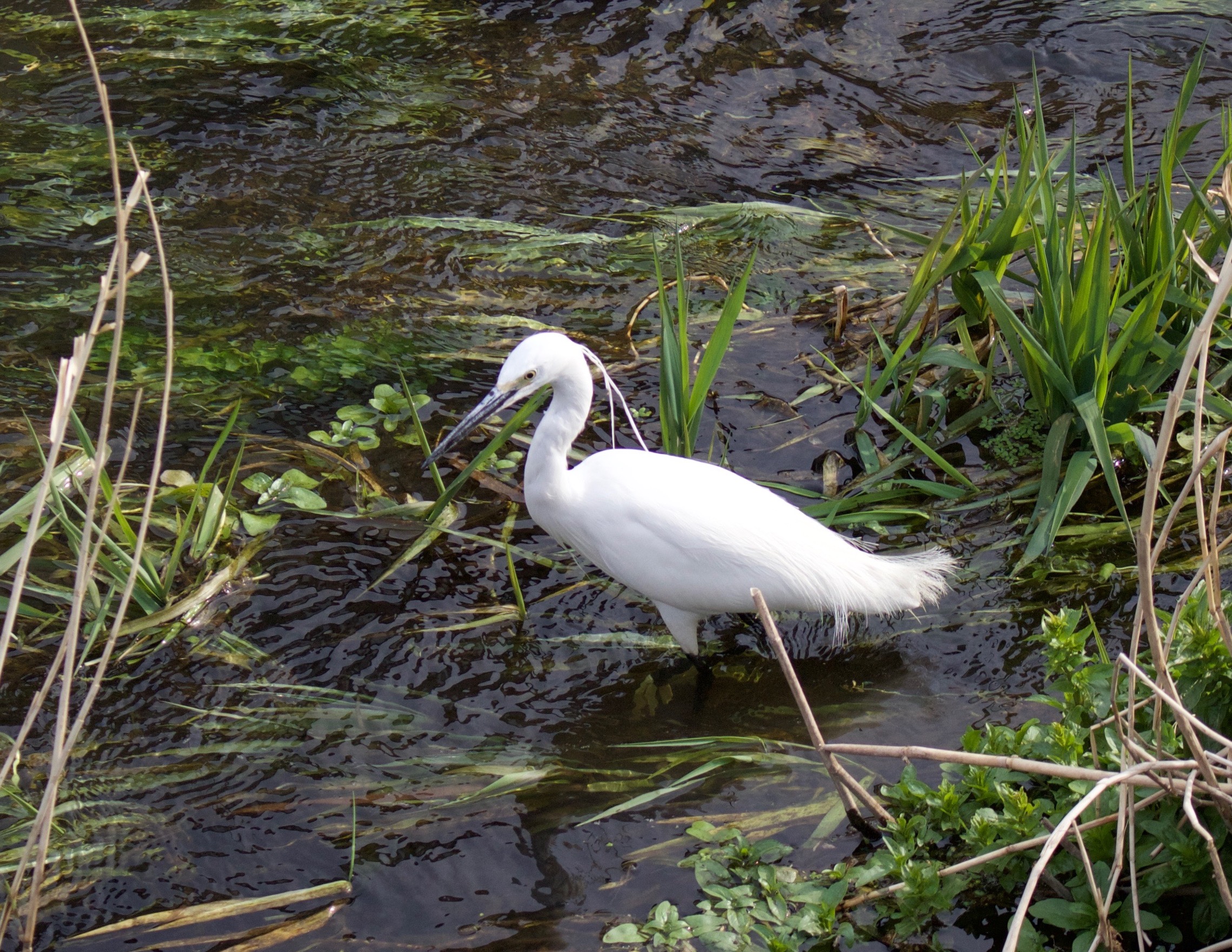
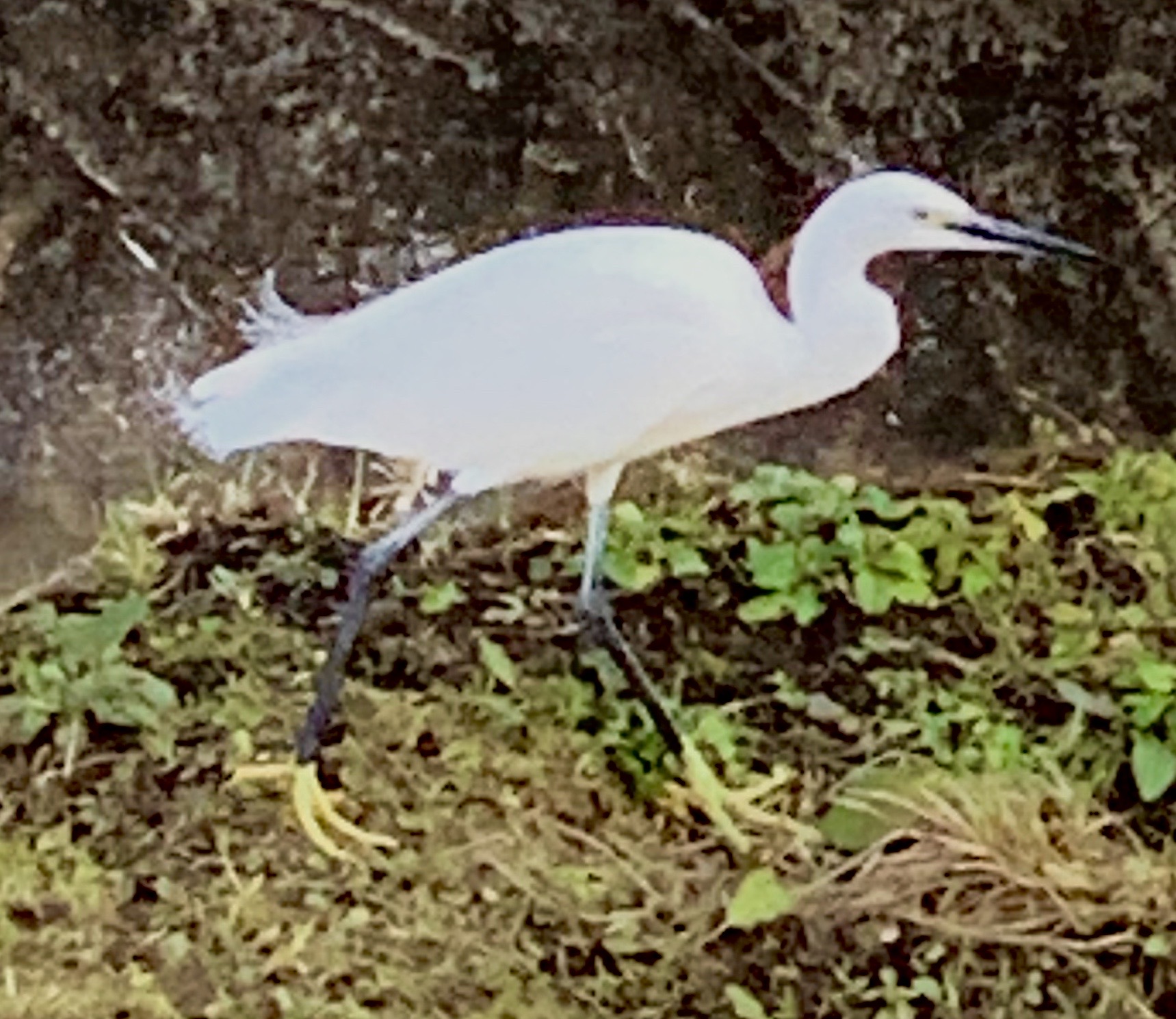
There is a hush now while the hills rise up and God is going to sleep. He trusts the ship of Heaven to take over and proceed beautifully as he lies dreaming in the lap of the world. He knows the owls will guard the sweetness of the soul in their massive keep of silence, looking out with eyes open or closed over the length of Tomales Bay that the egrets conform to, whitely broad in flight, white and slim in standing. God, who thinks about poetry all the time, breathes happily as He repeats to Himself: there are fish in the net, lots of fish this time in the net of the heart. ~Linda Gregg “Fishing in the Keep of Silence” from All of It Singing.
The second before the sun went out we saw a wall of dark shadow come speeding at us. We no sooner saw it than it was upon us, like thunder. It roared up the valley. It slammed our hill and knocked us out. It was the monstrous swift shadow cone of the moon. I have since read that this wave of shadow moves 1,800 miles an hour. Language can give no sense of this sort of speed—1,800 miles an hour. It was 195 miles wide. No end was in sight—you saw only the edge. It rolled at you across the land at 1,800 miles an hour, hauling darkness like plague behind it. Seeing it, and knowing it was coming straight for you, was like feeling a slug of anesthetic shoot up your arm. If you think very fast, you may have time to think, “Soon it will hit my brain.” You can feel the deadness race up your arm; you can feel the appalling, inhuman speed of your own blood. We saw the wall of shadow coming, and screamed before it hit.
This was the universe about which we have read so much and never before felt: the universe as a clockwork of loose spheres flung at stupefying, unauthorized speeds. How could anything moving so fast not crash, not veer from its orbit amok like a car out of control on a turn?
Less than two minutes later, when the sun emerged, the trailing edge of the shadow cone sped away. It coursed down our hill and raced eastward over the plain, faster than the eye could believe; it swept over the plain and dropped over the planet’s rim in a twinkling. It had clobbered us, and now it roared away. We blinked in the light. It was as though an enormous, loping god in the sky had reached down and slapped the Earth’s face.
When the sun appeared as a blinding bead on the ring’s side, the eclipse was over. The black lens cover appeared again, back-lighted, and slid away. At once the yellow light made the sky blue again; the black lid dissolved and vanished. The real world began there. I remember now: We all hurried away.
We never looked back. It was a general vamoose … but enough is enough. One turns at last even from glory itself with a sigh of relief. From the depths of mystery, and even from the heights of splendor, we bounce back and hurry for the latitudes of home. ~Annie Dillard from her essay “Total Eclipse” in The Atlantic about the February 1979 eclipse in Washington State
In February 1979, I was working as a medical student on an inpatient psychiatric unit in a large hospital in Seattle, less than a hundred miles from the band of total eclipse Annie Dillard describes above happening just to the south.
Our clinical team had tried to prepare our mostly psychotic and paranoid schizophrenic patients for what was about to happen outside that morning.
Our patients were much more anxious than usual, pacing and wringing their hands as the light outside slowly faded, with high noon transformed gradually to an oddly shadowy dusk. The street lights turned on automatically and cars moved about with headlights shining.
We all stood at the windows in the hospital perched high on a hill, watching the city become dark as night in the middle of the day. Our unstable patients were sure the world was ending and certain they had caused it to happen. Extra doses of medication were dispensed as needed while the light faded away and then slowly returned to the streets outside. Within an hour the sunlight was fully back, and many of our patients were napping soundly, safe in the heart of the net we had thrown over them to protect them.
A hush had fallen over us all as we watched the light go out and then return. We were safe.
We all breathed a sigh of relief, having witnessed such transient glory from the heavens. We did not cause it but a Power far greater did. The eclipse swept – a racing shadow followed by restoration of light – the edge of our sanity to accept that our light can indeed be taken away.
For some, they live their whole lives consumed by shadow.
Miraculously, the Light has been returned to us in this shining night. We may not be able to look it in the Face — simply too blinding — but we need never dwell in darkness again.
One-Time
Monthly
Yearly
Make a one-time or recurring donation to support daily Barnstorming posts
Now I become myself. It’s taken Time, many years and places; I have been dissolved and shaken, Worn other people’s faces, Now to stand still, to be here, Feel my own weight and density!
All fuses now, falls into place From wish to action, word to silence, My work, my love, my time, my face Gathered into one intense Gesture of growing like a plant. Now there is time and Time is young. Stand still, stand still, and stop the sun! ~May Sarton from “Now I Become Myself”
My grade school took part in an educational experiment in the early 1960’s. It was one of the first schools to mainstream special needs children into “regular” classrooms. At that time, the usual approach was to put kids with disabilities in separate rooms, if not entirely separate schools.
During those years, the average class size for a grade school teacher was 32-35 kids, with no teacher’s aides, rare parent volunteers, (except for field trips and room mothers who threw the holiday parties) and no medications or special accommodations for ADHD or dyslexia. I’m not sure how teachers coped with nearly three dozen noisy disruptive kids, but somehow they managed to teach in spite of the obstacles. Adding in children with mental and physical challenges without additional adult help must have been very difficult.
So some kids got recruited to help out the kids with disabilities. It helped the teacher by creating a buddy system for the special needs kids who might need help with class work or who might have difficulty getting around.
I was assigned to Michael so our desks were side by side for the year. He was a thin little boy with cerebral palsy and hearing aids, thick glasses hooked with a wide band around the back of his head, and spastic muscles never going where he wanted them to go. He could not remain still, try as he might. He walked independently with some difficulty, mostly on his tiptoes because of his shortened leg tendons, frequently falling when he got going too quickly. His thick orthopedic shoes with leg braces would trip him up. His hands were intermittently in a grip of contracted muscles, and his face was always contorting and grimacing. He drooled a lot, so perpetually carried a Kleenex in his hand to catch the drips of spit that ran out of his mouth and dropped on his desk, threatening to spoil his coloring and writing papers.
His speech consisted of all vowels, as his tongue couldn’t quite connect with his teeth or palate to sound out the consonants, so it took some time and patience to understand what he said. He could write with great effort, gripping the pencil awkwardly in his tight palm and found he could communicate better at times on paper than by talking.
I made sure he had help to finish assignments if his muscles were too tight to write, and I learned his speech so I could interpret for the teacher. He was brave and bright, with a finer mind than most of the kids in our class. He loved a good joke and his little body would shudder as he roared his appreciation. I was always impressed at how he expressed himself and how little bitterness he had about his limitations. He was the most articulate inarticulate person I had ever met.
As Michael appeared around the corner of the grade school building every morning, he would walk quickly in his careful tip-toe cadence, arms flailing, shoes scuffing, raising up dust with each step. He would wave at me and call out my name in his indecipherable voice.
Once, as he approached, a group of kids playing tag swooped past him, purposely a little too close, spinning him off his feet like a top and onto the ground. Glasses askew, he lay momentarily still, and realizing I was needed, I ran to help him up. Despite all he endured, I never saw Michael cry, not even once, not even when he fell down hard. When he got angry or frustrated, he’d get very quiet. His muscles would tense up so much he would go into even greater spasms.
I had no tolerance for anyone who bullied him. I could see the pain in his grimacing face. Although he would give me a huge toothy smile of thanks, his eyes, as usual, said what his mouth could not. Michael knew I needed him as much as he needed me. I relished my new role as the life preserver thrown to him as he struggled to stay afloat in a sea of classroom hostility.
There were many times when I resented being teased by other students about Michael being my boyfriend. Although he would blush bright red when he heard that, Michael really had become a good friend, who just happened to be a boy.
The following academic year, he moved to another school district, so I never saw Michael again. However, I heard him on local radio six years later, reading an essay he’d written for the county Voice of Democracy contest on what it meant to be a free citizen. His essay was one of the top three award winners that year. I was amazed at how understandable his speaking voice had become.
Years later, I went on to medical school, learning from patients who lived with even far greater limitations than Michael. I realized that my initial training in compassionate care had been as I sat by his side helping him navigate 5th grade. He showed me how important it was to take the time to understand his voice and his heart when others would or could not.
I didn’t appreciate it then as I do now, but he taught me far more than I ever taught him: patience, perseverance and respect for the journey through obstacles rather than focusing just on the destination.
He helped me surpass my own less visible limitations. I was his special friend – one who just happened to be a girl.
So let’s not get tired of doing what is good. At just the right time we will reap a harvest of blessing if we don’t give up. Galatians 6:9
This Lenten season I reflect on the words of the 19th century southern spiritual hymn “What Wondrous Love is This”
One-Time
Monthly
Yearly
Make a one-time or recurring donation to support daily Barnstorming blog posts
For the bark, dulled argent, roundly wrapped And pigeon-collared.
For the splitter-splatter, guttering Rain-flirt leaves.
For the snub and clot of the first green cones, Smelted emerald, chlorophyll.
For the scut and scat of cones in winter, So rattle-skinned, so fossil-brittle.
For the alder-wood, flame-red when torn Branch from branch.
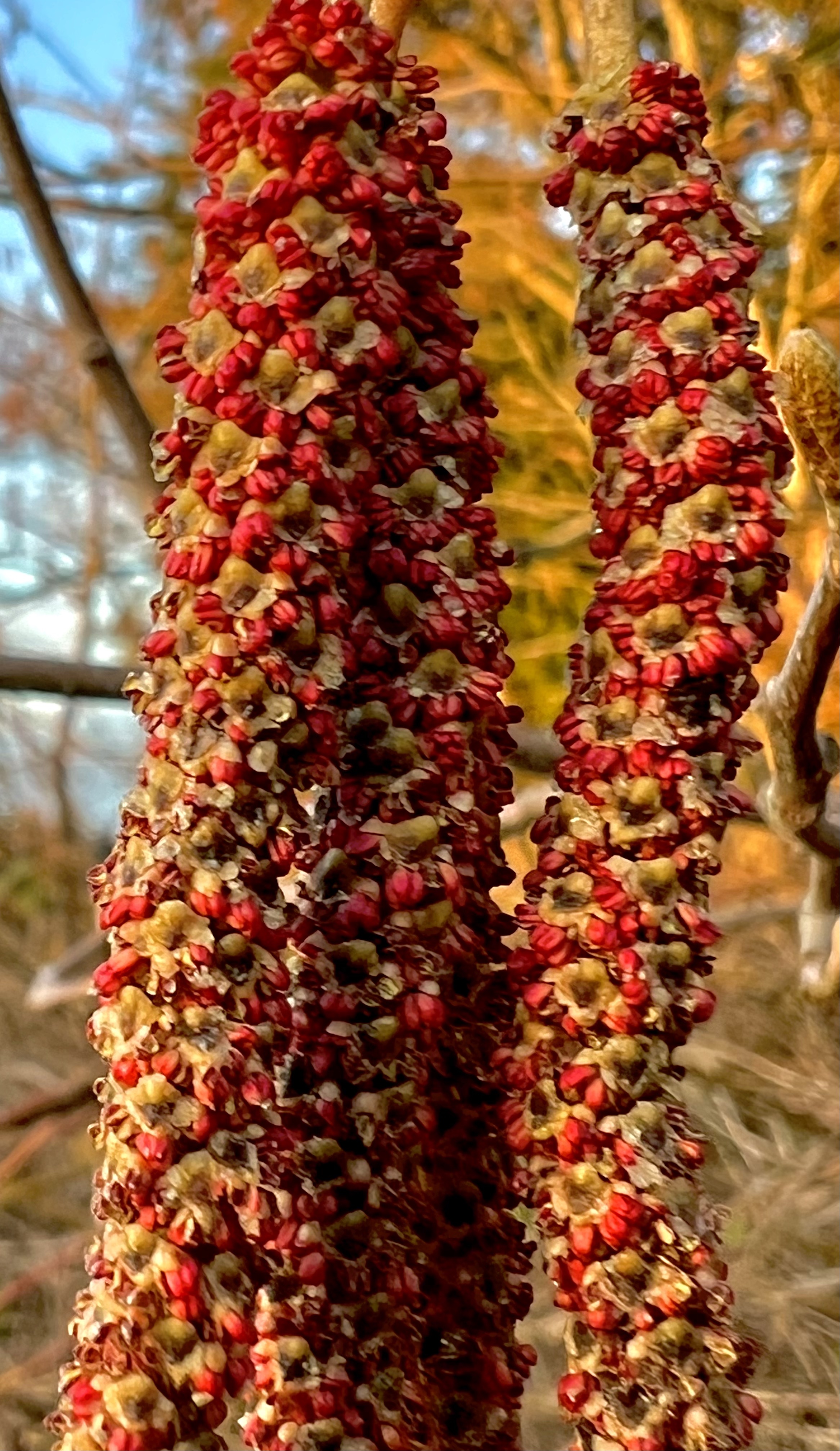
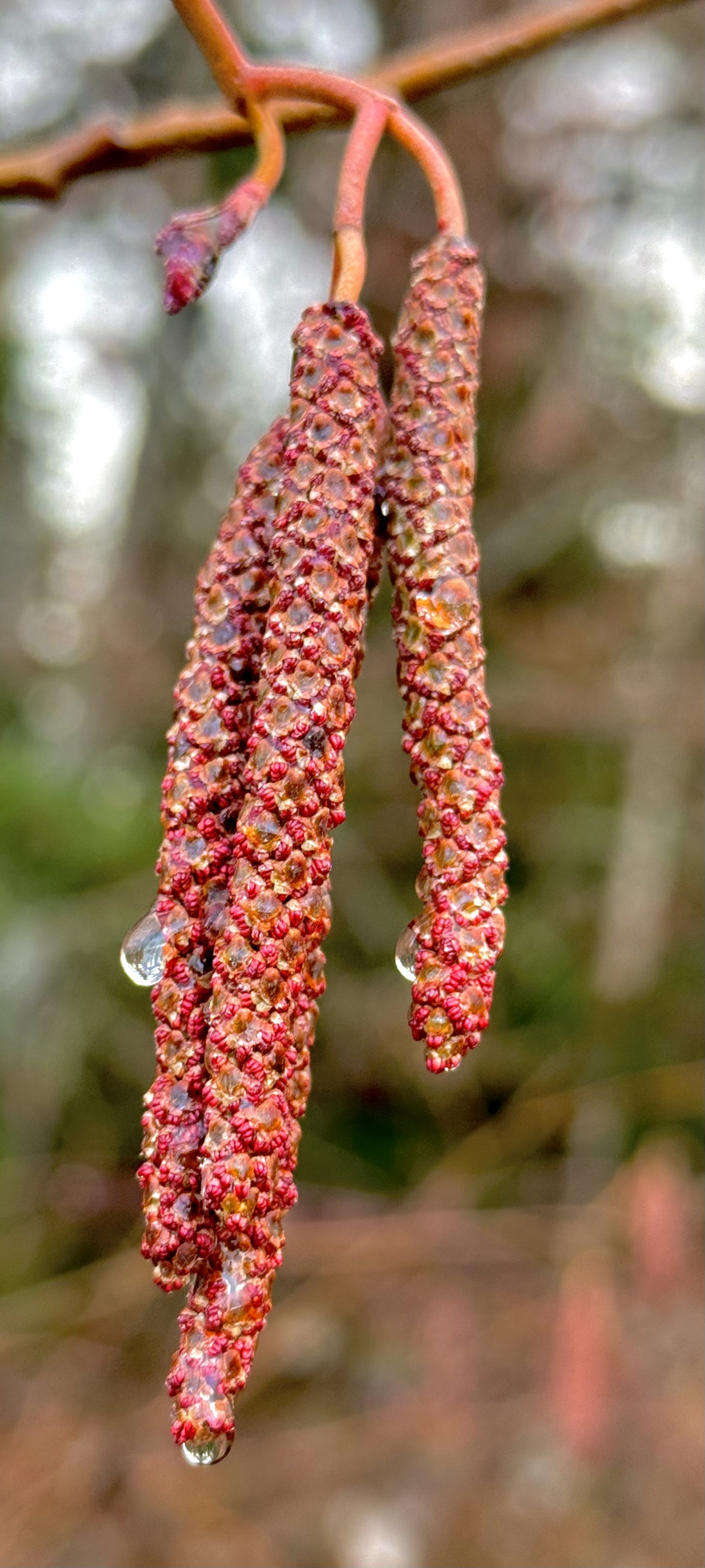
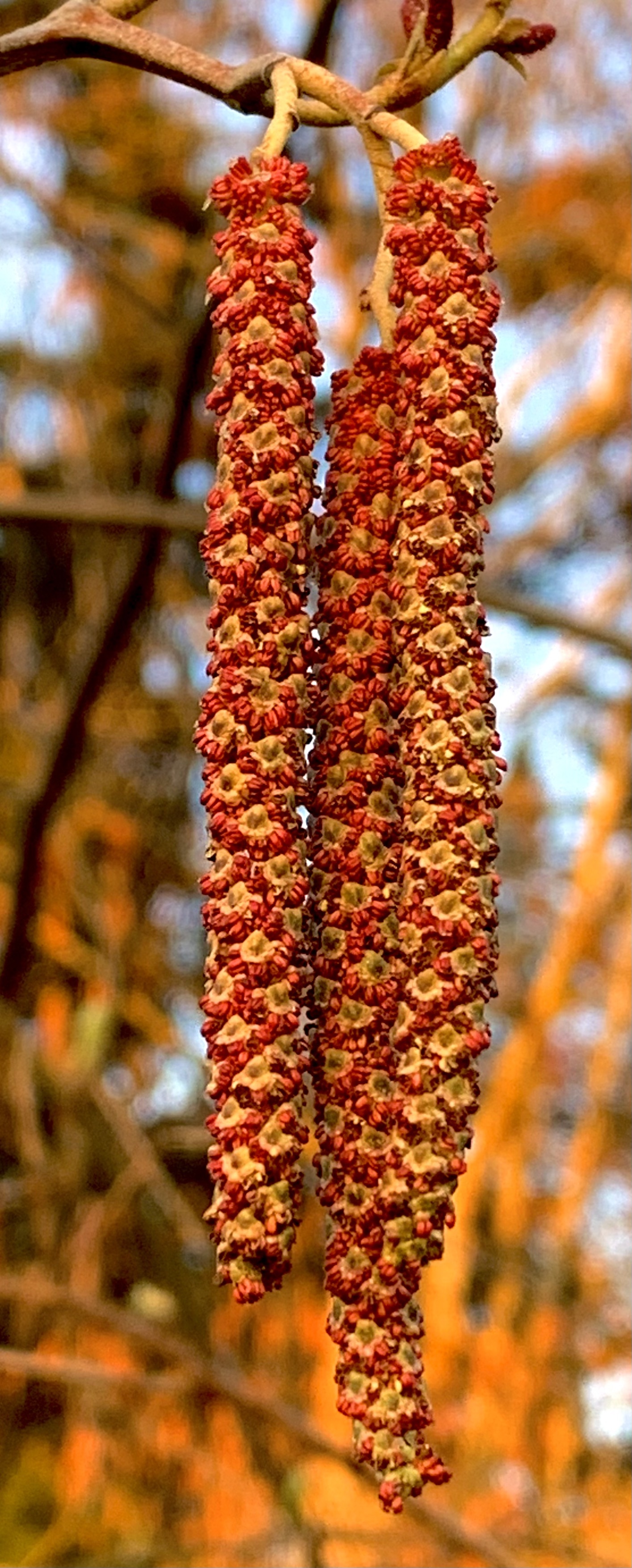
But mostly for the swinging locks Of yellow catkins.
Plant it, plant it, Streel-head in the rain. ~Seamus Heaney “Planting the Alder”with an explanation of some of the poet’s poetic words here
I’ve worked in many medical settings, and have seen lots of illnesses and injuries over 40+ years of doctoring. Despite all that experience, I really don’t do well with badly broken bones. Basic wrists and fingers and ankles are no problem but open compound and comminuted fractures (i.e. “crushed bones”) are downright terrifying. It appears to me they can never be pieced back together. Even looking at the xrays makes me cringe. I avoided doing a surgical orthopedic rotation during my training because I knew I’d have issues with the saws and the smells involved in fixing bad fractures. And witnessing the pain is unforgettable – there are few things that hurt more.
In early spring 2008, my 87 year old mother shattered her lower femur trying to stand up after getting down on her hands and knees to retrieve a pill that had dropped to the floor and rolled under her desk. The pain was overwhelming until the paramedics managed to immobilize her leg in an air cast for transport to the ER. As long as her leg wasn’t moved, she was quite comfortable– in fact overjoyed to see me in the middle of a workday when I arrived at the hospital. She was so chatty that when she was asked by the ER doctor “how did this happen?” she launched into a long description of just how she had dropped the pill, where it had rolled, and what pill it was, what color it was, why she was taking it, etc etc. I started to get antsy, knowing how busy the Doc was and said, with just a *wee bit* of irritation, “Mom, he doesn’t need to know all that. Just tell him what happened when you tried to stand up.”
That did it.
Now it wasn’t just her leg that hurt, it was her feelings too, including her own sense of responsibility for what had happened, and her tears started to flow. The ER doc shot me a sideways glance that clearly said “now look what you’ve done” and then took my Mom’s hand tenderly, looking her straight in the eye and said, “That’s all right, these things happen despite our best intentions—you go right ahead and tell me the whole story, right from the beginning…”
So she did, completely reaffirmed and feeling absolved of her guilt that she had somehow done this to herself. Having been shown a caring and healing grace from a total stranger after her cherished physician daughter had totally blown Bedside Manners 101, she never really complained about the pain in her leg again.
Then it was my turn to feel guilty. Instead of planting the compassion she so badly needed in that moment, I guttered all her fear and pain together. It crushed her.
Her leg was quickly fixed with a rod and with physical therapy, she took a few steps with assistance. Sadly, she never again lived independently, and as happens so often with immobilized older people despite healed fractures, she died only eight months later. Bones heal but the spirit doesn’t. That spring day really was the beginning of the end for her, and in my heart, I knew that was likely to be the case. My irritation was about what I suspected was coming, and for what I knew it meant for her, but mostly for me.
What I had forgotten out of selfish self-concern and what I will not forget again: even the most horrendous pain can be relieved by compassionate grace. The crushed will stand, and walk, and thrive again with a gentle touch and a lot of love.
Let me hear joy and gladness; let the bones you have crushed rejoice. Psalm 51:8
This Lenten season I reflect on the words of the 19th century southern spiritual hymn “What Wondrous Love is This”
One-Time
Monthly
Yearly
Make a one-time or recurring donation to support daily Barnstorming posts










































 Barnstorming