We walked downhill to the beach, her hand in mine, small step after small step. She said Hi to the doggie on the leash, Hi Mommy to a woman passing on the street, Hi Daddy to a bearded man. On the sand, she stared transfixed at the water, the slight waves, the tide not yet pulling out. She looked up toward a flap of wings. Bird, I said, pointing at the seagull, and she mimicked, Bird, then turned her gaze back to the waves’ slow slapping. Later I sat, looking at trees below me, a hint of haze burning off the far bay, the world busy working and sailing, waking, while I sat waiting as Evie napped that quiet Maine morning, the full tide of grandmotherhood lapping my shore. ~Laura Foley, “Full Tide” from It’s This
They each carried a balloon from a special event for kids and their families.
It had been a morning of our family being together, just because. Being a grandparent needs no other reason other than “just because.”
Big sister was saying how she planned to take her balloon to school on Monday to show her friends. She was enjoying the balloon’s bobbing and weaving in the air … until suddenly it popped, causing her to jump and then she had nothing left but tatters in her hand.
Her face crumpled and the tears began to flow.
Little brother gripped his balloon more tightly, looking at his sister’s tears and worrying the same thing might happen to his balloon. His face contorted, ready to cry right along with her. And then there was a moment of clarity and insight in his eyes.
He handed his balloon to her. He said, “here, you can have mine.”
Though he was clearly sad at the thought of having no balloon himself, his eyes were shining with proud tears.
He had discovered what it meant to sacrifice, to comfort and care for someone he loved.
She was speechless. She held his balloon gently, struggling to know how to respond. If it was even possible, she loved him so much more in that moment.
So their parents said to her brother, “we think that gift deserves stopping for a hot chocolate on the way home.”
Big sister looked at her parents, looked again at her little brother, and handed the balloon back to him, saying “why don’t we share?”
Hot chocolate makes all things wonderful and cozy and better, when shared.
Especially for weeping, laughing, full-to-the-brim-with-love grandparents.
One-Time
Monthly
Yearly
Make a one-time or recurring donation to support daily Barnstorming posts
The meaning of marriage begins in the giving of words. We cannot join ourselves to one another without giving our word. And this must be an unconditional giving, for in joining ourselves to one another we join ourselves to the unknown. ~Wendell Berry from “Poetry and Marriage” in Standing By Words
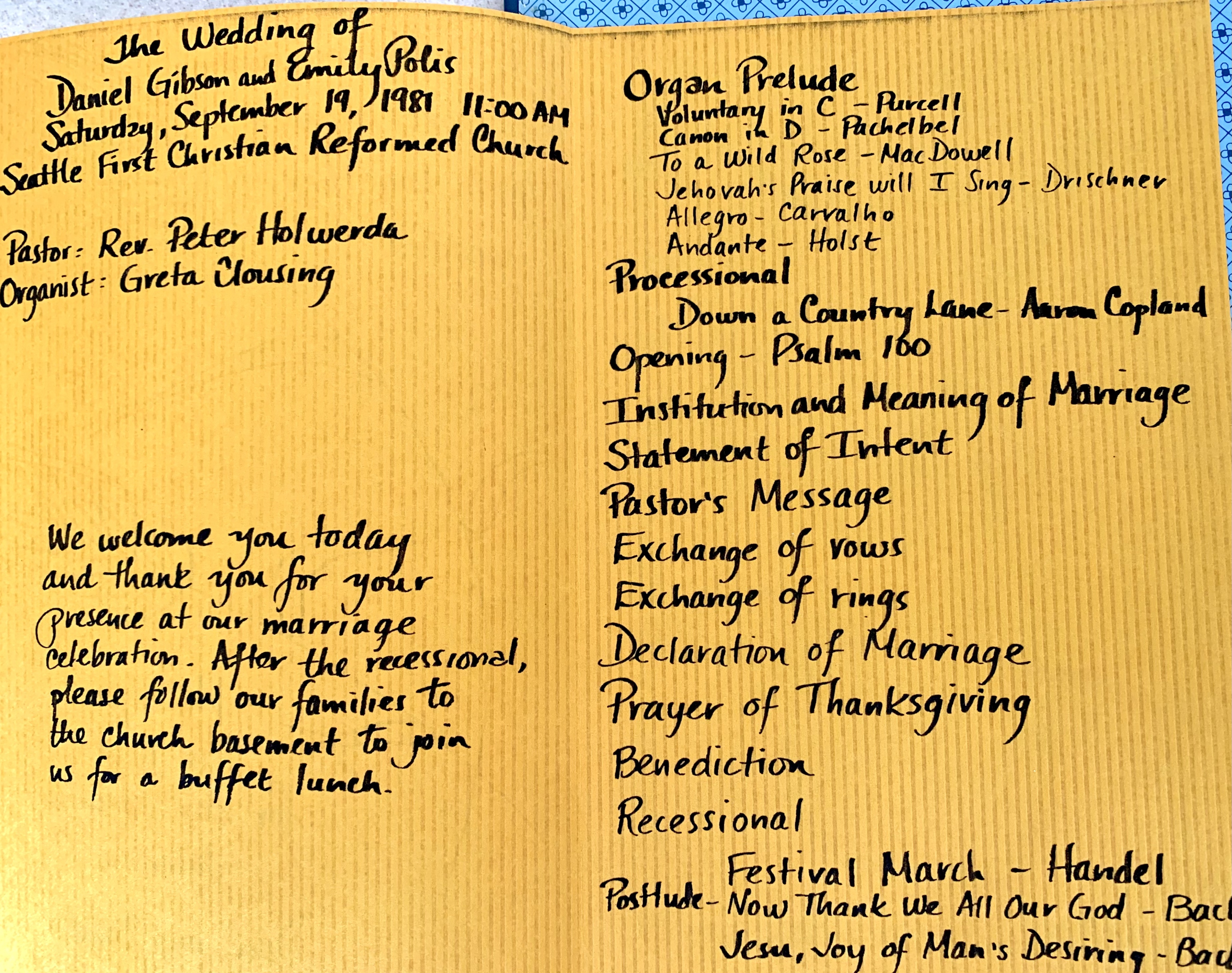
Our vows to one another forty-five years ago today:
Before God and this gathering, I vow from my heart and spirit that I will be your wife/husband for as long as we both shall live.
I will love you with faithfulness, knowing its importance in sustaining us through good times and bad.
I will love you with respect, serving your greatest good and supporting your continued growth.
I will love you with compassion, knowing the strength and power of forgiveness.
I will love you with hope, remembering our shared belief in the grace of God and His guidance of our marriage.
“And at home, by the fire, whenever you look up, there I shall be–and whenever I look up, there will be you.”
(our wedding vows for our September 19, 1981 wedding at First Seattle Christian Reformed Church — the last line adapted from Thomas Hardy’s “Far From the Madding Crowd”)
Sometimes our life reminds me of a forest in which there is a graceful clearing and in that opening a house, an orchard and garden, comfortable shades, and flowers red and yellow in the sun, a pattern made in the light for the light to return to. The forest is mostly dark, its ways to be made anew day after day, the dark richer than the light and more blessed, provided we stay brave enough to keep on going in.
We enter, willing to die, into the commonwealth of its joy. ~Wendell Berry from “A Country of Marriage”
…Marriage… joins two living souls as closely as, in this world, they can be joined. This joining of two who know, love, and trust one another brings them in the same breath into the freedom of sexual consent and into the fullest earthly realization of the image of God. From their joining, other living souls come into being, and with them great responsibilities that are unending, fearful, and joyful. The marriage of two lovers joins them to one another, to forebears, to descendants, to the community, to heaven and earth. It is the fundamental connection without which nothing holds, and trust is its necessity. ~Wendell Berry from Sex, Economy, Freedom and Community
We married forty-five years ago today in our Seattle church with Pastor Peter Holwerda officiating, with a small group of family and friends as witnesses.
It was a wedding of two frugal people with little to spend – I sewed my dress and Dan’s shirt from muslin, we grew our own flowers, our families helped potluck the lunch afterward and our tiered carrot cake was made by a friend.
Yet our vows to one another were not frugal and held nothing back. They were extravagant and comprehensive, coming from our hearts and spirits. The music we asked our amazing organist to play (versions below) inspired us by its simplicity and complexity – very much like the families that raised us and the God we worship.
Our vows have taken us from the city to the countryside, to the raising and rejoicing in three amazing children and now soon to be seven grandchildren. We served more than forty years as a public-employed attorney and physician. We have laid down those responsibilities, and picked up the tools of farm and garden along with church and community service for as long as we are able.
We treasure each day of living together in faithfulness, respect, compassion and hope – knowing that how we love and find joy in one another mirrors how God loves and revels in His people.
We pray for many more days to fill us with what endures.
I want to remember us this way— late September sun streaming through the window, bread loaves and golden bunches of grapes on the table, spoonfuls of hot soup rising to our lips, filling us with what endures. ~Peter Pereira from “A Pot of Red Lentils”
Here are versions of the organ music we selected for prelude, processional, recessional and postlude
I spent seven hours yesterday at my daughter’s house helping her expand their garden by at least ten times. We dug up sod by the shovelful, shook off the dirt as best we could; sod into the wheelbarrow and off to the pile at the edge of the yard. Then all that over and over again. Five hours total work-time, with time out for lunch and supper. By the time I got home I knew all too well that seventy-two is not thirty-five; I could barely move.
I got to quit earlier than Nadine. She told me I’d done enough and that I should go get a beer and lie down on the chaise lounge and cheer her on, which is what I did.
All this made me remember my father forty years ago helping me with my garden. My father’s dead now, and has been dead for many years, which is how I’ll be one of these days too. And then Nadine will help her child, who is not yet here, with her garden. Old Nadine, aching and sore, will be in my empty shoes, cheering on her own.
So it goes. The wheel turns, generation after generation, around and around. We ride for a little while, get off and somebody else gets on. Over and over, again and again. ~David Budbill “Seventy-Two Is Not Thirty-Five” from Tumbling toward the End
The wheel turns, we cycle around again, get on and eventually get off. This is a week of July birthdays in our family, for both old and young.
This hit me when we celebrated our grandson’s third birthday a few days ago in a suburban backyard where my daughter has continued the Gibson/Polis gardening tradition, using the compost we hauled in our truck from our farm several hours away.
Her peas were full and ripe and juicy, her greens lush and tasty – simple perfection thanks to her careful tending.
Meanwhile, our son gardens with his three boys in a very small urban backyard in Denver, teaching them what is weed and what will become a future meal.
I couldn’t help but get weepy, enjoying that special birthday feast.
…and knowing someday, our grandsons will plant and weed and harvest from the soil just as we and their parents did, over and over, again and again.
And this is why my eyes are closed It’s just as well for all I’ve seen And so it goes, and so it goes And you’re the only one who knows ~Billy Joel
One-Time
Monthly
Yearly
Make a one-time or recurring donation to support daily Barnstorming posts
Who loves the rain And loves his home, And looks on life with quiet eyes, Him will I follow through the storm; And at his hearth-fire keep me warm; Nor hell nor heaven shall that soul surprise, Who loves the rain, And loves his home, And looks on life with quiet eyes. ~Frances Shaw, “Who loves the rain” from Look To the Rainbow of Grace
Now more than ever you can be generous toward each day that comes, young, to disappear forever, and yet remain unaging in the mind. Every day you have less reason not to give yourself away. ~Wendell Berry from “There is no going back”
What a wonder I was when I was young, as I learn by the stern privilege of being old: how regardlessly I stepped the rough pathways of the hillside woods, treaded hardly thinking the tumbled stairways of the steep streams, and worked unaching hard days thoughtful only of the work, the passing light, the heat, the cool water I gladly drank. ~Wendell Berry “VII” 2015 from Another Day
I would like to be the air that inhabits you for a moment only. I would like to be that unnoticed and that necessary… ~Margaret Atwood
I stop writing the poem to fold the clothes. No matter who lives or who dies, I’m still a woman. I’ll always have plenty to do. I bring the arms of his shirt together. Nothing can stop our tenderness. I’ll get back to the poem. I’ll get back to being a woman. But for now there’s a shirt, a giant shirt in my hands, and somewhere a small girl standing next to her mother watching to see how it’s done. ~Tess Gallagher “I Stop Writing the Poem”
For Dan’s 73rd birthday…
In this journey together, we inhabit each other, however long may be the road we travel; you have become the air I breathe, refreshing, renewing, restoring~~ you are that necessary to me, and that beloved.
Each year, as we grow older together: grayer, softer, gentler with ourselves, each other, and the world.
I pause to say, on this day you were born, thank you, God, yet again for bringing you to earth so we could meet, raise our three amazing children, and now six grandchildren, with another on the way, walking life together with faith and hope and dreams.
It was your quiet brown eyes I trusted first and just knew I’d follow you anywhere, and I have…
One-Time
Monthly
Yearly
Make a one-time or recurring donation to support daily Barnstorming posts
I closed my mother’s eyes when she died and again, my father’s
I made no fortune no headlines nothing went viral
I sang and danced for no one
I remembered I noticed I breathed
Just an ordinary life filled with extraordinary love.
How disappointing. ~Mary Poindexter McLaughlin “Alma Mater”
Parents can hold unreasonable expectations of success for their children; they tend to reflect their own deficiencies or failures. After all, we want our kids to make the world a better place than it was for us.
Yet no academic degree, no bank account, no notoriety or award can match living an ordinary life filled with extraordinary love.
And yes, I am disappointed in myself – not because of the unmet expectations of my parents – I checked off all the boxes they hoped I would achieve in my younger years, but I couldn’t match the extraordinary love they showed me.
The older me tended to withhold myself emotionally from them as they grew frailer, fearing their weaknesses would someday become my own.
I could have been more compassionate in their final years, rather than taking on the more professional role of the doctor-daughter – physically present but too distracted and stretched with competing responsibilities.
That is something I cannot undo now except to pray for forgiveness for how my own inner struggles made those years harder than they needed to be.
My husband and I birthed three tall kind people who we love and have sent into the world. I pray for them what I wish I had understood when I was sent into the world by my parents: living their ordinary life of extraordinary love is more important than anything else they set out to do.
I rejoice as I see them foster such love for their spouses and their children and their communities: remembering, noticing and breathing life into each new day.
Seeing that as the years go by, I keep planting my sunflowers, slowly letting go of my own disappointment in myself.
One-Time
Monthly
Yearly
Make a one-time or recurring donation to support daily Barnstorming posts
Today I’m sharing some poems I’ve collected recently about parenting, as I realize, looking back at my life, being a parent (and now a grandparent) has been my greatest joy.
In the early afternoon my mother was doing the dishes. I climbed onto the kitchen table, I suppose to play, and fell asleep there. I was drowsy and awake, though, as she lifted me up, carried me on her arms into the living room, and placed me on the davenport, but I pretended to be asleep the whole time, enjoying the luxury— I was too big for such a privilege and just old enough to form my only memory of her carrying me. She’s still moving me to a softer place. ~Leo Dangel “In Memoriam” from Saving Singletrees.
We stop at the dry cleaners and the grocery store and the gas station and the green market and Hurry up honey, I say, hurry, as she runs along two or three steps behind me her blue jacket unzipped and her socks rolled down.
Where do I want her to hurry to? To her grave? To mine? Where one day she might stand all grown? Today, when all the errands are finally done, I say to her, Honey I’m sorry I keep saying Hurry – you walk ahead of me. You be the mother.
And, Hurry up, she says, over her shoulder, looking back at me, laughing. Hurry up now darling, she says, hurry, hurry, taking the house keys from my hands. ~Marie Howe “Hurry”
It wouldn’t even matter if I could sleep as in was capable since soon as I tuck in my son calls from his bad dream and I’m upstairs wiping his brow and saying how it’s okay so I trudge back down and arrange the pillow just right and my breath steadies till my daughter coughs and needs water downstairs to get it creak back up and I tell her it’s okay and I flop downstairs again and find my bed after and in it the baby upset by all this walking and creaking and I hear her and I pat her on the back and make wave sounds with my mouth telling her she’s okay and I don’t know if I am really I’m tired but I also feel guilty like I’ve won something huge, opulent and undeserved. ~Mischa Willett “Price”
All day the stars watch from long ago my mother said I am going now when you are alone you will be all right whether or not you know you will know look at the old house in the dawn rain all the flowers are forms of water the sun reminds them through a white cloud touches the patchwork spread on the hill the washed colors of the afterlife that lived there long before you were born see how they wake without a question even though the whole world is burning ~ W.S. Merwin, “Rain Light” from The Shadow of Sirius
The best thing I did for my mother was to outlive her
for which I deserve no credit
though it makes me glad that she didn’t have to see me die
Like most people (I suppose) I feel I should have done more for her
Like what? I wasn’t such a bad son
I would have wanted to have loved her as much as she loved me but I couldn’t I had a life a son of my own
a wife and my youth that kept going on maybe too long
And now I love her more and more
so that perhaps when I die our love will be the same
When the doctor suggested surgery and a brace for all my youngest years, my parents scrambled to take me to massage therapy, deep tissue work, osteopathy, and soon my crooked spine unspooled a bit, I could breathe again, and move more in a body unclouded by pain. My mom would tell me to sing songs to her the whole forty-five minute drive to Middle Two Rock Road and forty- five minutes back from physical therapy. She’d say, even my voice sounded unfettered by my spine afterward. So I sang and sang, because I thought she liked it. I never asked her what she gave up to drive me, or how her day was before this chore. Today, at her age, I was driving myself home from yet another spine appointment, singing along to some maudlin but solid song on the radio, and I saw a mom take her raincoat off and give it to her young daughter when a storm took over the afternoon. My god, I thought, my whole life I’ve been under her raincoat thinking it was somehow a marvel that I never got wet. ~Ada Limón “The Raincoat”
In the spelling bee my daughter wore a good brown dress and kept her hands folded. There were twelve children speaking
into a microphone that was taller than they were. Each time it was her turn I could barely look. It wasn’t that I wanted
her to win but I hoped she would be happy with herself. The words were too hard for me; I would have missed chemical,
thermos, and dessert. Each time she spelled one correctly my heart became a bird. She once fluttered so restlessly beneath
my skin and, on the morning of her arrival, her little red hands held nothing. Her life since has been a surprise: she can
sew; she can draw; she can read. She hates raisins but loves science. All the parents must feel this, watching from the cheap
folding chairs. Somewhere inside them love took shape and now it stands at the microphone, spelling. ~Faith Shearin “Spelling Bee” from Moving the Piano.
Each carried a balloon from a special event for kids and their families.
It had been a morning of our family being together, just because. Being a grandparent needs no other reason other than “just because.”
Big sister was saying how she planned to take her balloon to school on Monday to show her friends. She was enjoying the balloon’s bobbing and weaving in the air … until suddenly it popped, causing her to jump and then she had nothing left but tatters in her hand.
Her face crumpled and the tears began to flow.
Little brother gripped his balloon more tightly, looking at his sister’s tears and worrying the same thing might happen to his balloon. His face contorted, ready to cry right along with her.
Then there was a moment of clarity and insight in his eyes.
He handed his balloon to her. He said, “here, you can have mine.” And though he was clearly sad at the thought of having no balloon himself, his eyes were shining with proud tears.
He had discovered what it meant to sacrifice, to comfort and care for someone he loved.
She was speechless. She held his balloon gently, struggling to know how to respond. If it was even possible, she loved him so much more in that moment.
So their parents said to her brother, “we think that gift deserves stopping for a hot chocolate on the way home.”
Big sister looked at her parents, looked again at her little brother, and handed the balloon back to him, saying “why don’t we share?”
Hot chocolate makes all things wonderful and cozy and better, when shared with children we would give up anything so they can flourish.
One-Time
Monthly
Yearly
Make a one-time and recurring donation to support daily Barnstorming posts
Lord of the pots and pans and things, since I’ve no time to be a saint by doing lovely things, or watching late with thee, or dreaming in the dawnlight, or storming heaven’s gates… make me a saint by getting meals and washing up the plates. Thou who didst love to give men food in room or by the sea, accept this service that I do— I do it unto thee. ~ Brother Lawrence from Practicing the Presence of God
Wash the plate not because it is dirty nor because you are told to wash it, but because you love the person who will use it next. ~St. Teresa of Calcutta
Even the mundane task of washing dishes by hand is an example of the small tasks and personal activities that once filled people’s daily lives with a sense of achievement. ~B.F. Skinner, behavioral psychologist
She rarely made us do it— we’d clear the table instead—so my sister and I teased that some day we’d train our children right and not end up like her, after every meal stuck with red knuckles, a bleached rag to wipe and wring.
The one chore she spared us: gummy plates in water greasy and swirling with sloughed peas, globs of egg and gravy. Or did she guard her place at the window? Not wanting to give up the gloss of the magnolia, the school traffic humming. Sunset, finches at the feeder. First sightings of the mail truck at the curb, just after noon, delivering a note, a card, the least bit of news. ~Susan Meyers “Mother, Washing Dishes”
My thoughts went round and round and it occurred to me that if I ever wrote a novel it would be of the ‘stream of consciousness’ type and deal with an hour in the life of a woman at the sink.
….I had to admit that nobody had compelled me to wash these dishes or to tidy this kitchen. It was the fussy spinster in me, the Martha who could not comfortably sit and make conversation when she knew that yesterday’s unwashed dishes were still in the sink. ~Barbara Pym from Excellent Women
I trace the struggling relationships and estrangements in the American family to the invention of the automatic dishwasher.
I have proof…
What happened to the necessary cooperation of a human dishwasher with two hands full of wash cloth and scrubber, having to get along with a dish dryer armed with a towel?
Where is the list on the refrigerator of whose turn is next, and the accountability if a family member somehow shirks their washing/drying responsibility and leaves the dishes to the next day?
No longer do family members have to cooperate in real time to scrub clean glasses, dishes and utensils, put them in the dish rack, dry them one by one and place them in the cupboard where they belong.
If the human dishwasher isn’t doing a proper job, the human dryer immediately takes note and recycles the dirty dish right back to the sink.
Instant accountability.
I always preferred to be the dryer. If I washed, and my sister dried, we’d never get done. She would keep recycling the dishes back for another going-over.
And so my messy nature was exposed.
Family conversations started over a meal often continue over the clean-up process while concentrating on whether a smudge is permanent or not. I learned some important facts of life while washing and drying dishes that I might not have learned otherwise. Sensitive topics tend to be easier to discuss when elbow deep in soap suds. Spelling and vocabulary and math fact drills are more effective when the penalty for a missed word or equation is a snap on the butt with a dish towel.
Our church hosts weekly Sunday evening potluck meals for 50-60 people after our evening worship service; we are committed to using real dishes, glasses and utensils rather than add to landfills with throwaways. There is no automatic dishwasher in our fellowship hall other than whoever stands up and heads to the sink first. There is no assigned duty list. Sometimes it takes a teetering stack of dishes to motivate the initiation of the wash/dry process. Sometimes there is an eager-beaver volunteer ready to wash as soon as the dirty dishes start to appear. Once the washing starts, there is always someone ready to dry, another someone ready to put things away and another someone to wipe down the tables, all having the best of conversations in the process.
It is cooperation in action, yet another example of how we all “pitch in” for the benefit and love of others.
So modern society is missing this best opportunity for daily family-together cooperation time. Forget family “game” night, or parental “date” night, or even vacations. Dish washing and drying at the sink takes care of all those times when families need to be communicating, all while coordinating efforts to clean, sort and organize.
It is time to treat the automatic dishwasher as simply another storage cupboard; instead pull out the brillo pads, the white cotton dishtowels and the plastic drainage dish rack.
Let’s start tonight.
And I think it is your turn first…
Holy as a day is spent Holy is the dish and drain The soap and sink, and the cup and plate And the warm wool socks, and the cold white tile Shower heads and good dry towels And frying eggs sound like psalms With bits of salt measured in my palm It’s all a part of a sacrament As holy as a day is spent Holy is the familiar room And quiet moments in the afternoon And folding sheets like folding hands To pray as only laundry can I’m letting go of all my fear Like autumn leaves made of earth and air For the summer came and the summer went As holy as a day is spent Holy is the place I stand To give whatever small good I can And the empty page, and the open book Redemption everywhere I look Unknowingly we slow our pace In the shade of unexpected grace And with grateful smiles and sad lament As holy as a day is spent And morning light sings ‘providence’ As holy as a day is spent ~Carrie Newcomer “Holy as a Day Is Spent “
One-Time
Monthly
Yearly
Make a one-time or recurring donation to support daily Barnstorming posts
God keep my jewel this day from danger; From tinker and pooka and bad-hearted stranger. From harm of the water, from hurt of the fire. From the horns of the cows going home to the byre. From the sight of the fairies that maybe might change her. From teasing the ass when he’s tied to the manger. From stones that would bruise her, from thorns of the briar. From evil red berries that wake her desire. From hunting the gander and vexing the goat. From the depths o’ sea water by Danny’s old boat. From cut and from tumble, from sickness and weeping; May God have my jewel this day in his keeping. ~Winifred Lett (1882-1973) “Prayer for a Child“
photo by Nate Gibson
I pray because I can’t help myself. I pray because I’m helpless. I pray because the need flows out of me all the time, waking and sleeping. It doesn’t change God. It changes me. ~C.S. Lewis
I want to make a case for the Lighthouse Parent, a term that the pediatrician Kenneth Ginsburg and others have used. A Lighthouse Parent stands as a steady, reliable guide, providing safety and clarity without controlling every aspect of their child’s journey.
Like a lighthouse that helps sailors avoid crashing into rocks, Lighthouse Parents provide firm boundaries and emotional support while allowing their children the freedom to navigate their own challenges. They demonstrate that they trust their kids to handle difficult situations independently. The key is learning when to step back and let them find their own way. ~Russell Shaw from “Lighthouse Parents Have More Confident Kids”
celebrating a long-awaited pregnancy – 1985
This “prayer for a child” has hung on the wall in our home for four decades, purchased when I was pregnant with our first of three children.
The drawing of the praying mother watching her toddler leave the safety of the home to explore the wide world addressed my worries as a new mama. I would glance at it daily, knowing the world is full of peril; it would remind me of God’s care for our family through every scary thing, real or imagined.
It helped me smile at a few of my irrational fears. Tinkers and pookas and fairies were unlikely to find our children in our rural landscape but at times the world seems full of “black-hearted strangers” and other threats, known and unknown.
Decades later, I continue to pray for our grown children and their God-given spouses, and for six adventuresome grandchildren.
I pray because I can’t not pray, and because I’m helpless without the care and compassion of our sovereign God for each of us, especially when we are brand new, completely dependent and helpless. He is a true “lighthouse” in our lives,
May I be changed by my prayers, molded into a “grand” mother and a light for our half dozen cherished grandchildren, each a jewel in His keeping.
One-Time
Monthly
Yearly
Make a one-time or recurring donation to support daily Barnstorming posts
The children have gone to bed. We are so tired we could fold ourselves neatly behind our eyes and sleep mid-word, sleep standing warm among the creatures in the barn, lean together and sleep, forgetting each other completely in the velvet, the forgiveness of sleep.
Then the one small cry: one strike of the match-head of sound: one child’s voice: and the hundred names of love are lit as we rise and walk down the hall.
One hundred nights we wake like this, wake out of our nowhere to kneel by small beds in darkness. One hundred flowers open in our hands, a name for love written in each one. ~Annie Lighthart,“The Hundred Names of Love” from Iron String
I thought I had forgotten how to wake to the sound of a baby’s cry or a child’s voice calling out in the night.
I thought I wouldn’t remember how to gently open their bedroom door, entering their darkness from my own darkness, sorting out what was distressing them, sensing how to soothe them back to slumber, wondering if I might sing or pray the words they needed to hear, bringing a blossoming peace and stillness to their night.
When our son’s family arrived three years ago from thousands of miles away, staying with us until they could settle in their own place, I was reminded my nights were never meant to be mine alone.
As a child myself, I had such frequent night-wakenings that I’m sure my mother despaired that I would ever sleep through the night. She would come when I called, sitting beside my bed, rubbing my back until I forgot what woke me in the first place. She was patient and caring despite her own weariness, sleep problems and worriedness. She loved me and forgave me for needing her presence in the night; her nights were never her own.
So I too responded with compassion when my own children called out in the night. As part of my doctoring life, I woke regularly to phone calls from the ER or hospital and from patients during forty-two years of medical practice; I listened and tried my best to answer anxious questions with gentle understanding.
And when a grandchild sleeps here overnight, I’m on call again, remembering the sweetness of someone responding in the dark; the fears of the night need the promise of the Lord staying with us until the new day comes, usually only a few hours away.
Little child, be not afraid Though rain pounds harshly against the glass Like an unwanted stranger, there is no danger I am here tonight
Little child, be not afraid Though thunder explodes and lightning flash Illuminates your tear-stained face I am here tonight
And someday you’ll know That nature is so The same rain that draws you near me Falls on rivers and land On forests and sand Makes the beautiful world that you’ll see In the morning
Little child, be not afraid Though storm clouds mask your beloved moon And its candlelight beams, still keep pleasant dreams I am here tonight
Little child, be not afraid Though wind makes creatures of our trees And their branches to hands, they’re not real, understand And I am here tonight
And someday you’ll know That nature is so The same rain that draws you near me Falls on rivers and land On forests and sand Makes the beautiful world that you’ll see In the morning
For you know, once even I was a Little child, and I was afraid But a gentle someone always came To dry all my tears, trade sweet sleep for fears And to give a kiss goodnight
Well now I am grown And these years have shown That rain’s a part of how life goes But it’s dark and it’s late So I’ll hold you and wait ‘Til your frightened eyes do close
And I hope that you’ll know That nature is so The same rain that draws you near me Falls on rivers and land On forests and sand Makes the beautiful world that you’ll see In the morning
Everything’s fine in the morning The rain’ll be gone in the morning But I’ll still be here in the morning
One-Time
Monthly
Yearly
Make a one-time or recurring donation to support daily Barnstorming posts
May the wind always be in her hair May the sky always be wide with hope above her And may all the hills be an exhilaration the trials but a trail, all the stones but stairs to God. May she be bread and feed many with her life and her laughter May she be thread and mend brokenness and knit hearts… ~Ann Voskamp from “A Prayer for a Daughter”
Nate and Ben and brand new baby LeaDaddy and Lea
Mommy and Lea
“I have noticed,” she said slowly, “that time does not really exist for mothers, with regard to their children. It does not matter greatly how old the child is – in the blink of an eye, the mother can see the child again as she was when she was born, when she learned to walk, as she was at any age — at any time, even when the child is fully grown….” ~Diana Gabaldon from Voyager
Just checking to see if she is real…
Your rolling and stretching had grown quieter that stormy winter night thirty-three years ago, but still no labor came as it should.
Already a week overdue post-Christmas, you clung to amnion and womb, not yet ready. Then as the wind blew more wicked and snow flew sideways, landing in piling drifts, the roads became more impassable, nearly impossible to traverse.
So your dad and I tried to drive to the hospital, concerned about your stillness and my advanced age, worried about being stranded on the farm far from town. When a neighbor came by tractor to stay with your brothers overnight, we headed down the road and our car got stuck in a snowpile in the deep darkness, our tires spinning, whining against the snow.
Another neighbor’s earth mover dug us out to freedom.
You floated silent and still, knowing your time was not yet.
Creeping slowly through the dark night blizzard, we arrived to the warm glow of the hospital, your heartbeat checked out steady, all seemed fine.
I slept not at all.
The morning’s sun glistened off sculptured snow as your heart ominously slowed. You and I were jostled, turned, oxygenated, but nothing changed. Your heart beat even more slowly, threatening to let go your tenuous grip on life.
The nurses’ eyes told me we had trouble. The doctor, grim faced, announced delivery must happen quickly, taking you now, hoping we were not too late. I was rolled, numbed, stunned, clasping your father’s hand, closing my eyes, not wanting to see the bustle around me, trying not to hear the shouted orders, the tension in the voices, the quiet at the moment of opening when it was unknown what would be found.
And then you cried. A hearty healthy husky cry, a welcomed song of life uninterrupted. Perturbed and disturbed from the warmth of womb, to the cold shock of a bright lit operating room, your first vocal solo brought applause from the surrounding audience who admired your purplish pink skin, your shock of damp red hair, your blue eyes squeezed tight, then blinking open, wondering and wondrous, emerging and saved from a storm within and without.
You were brought wrapped for me to see and touch before you were whisked away to be checked over thoroughly, your father trailing behind the parade to the nursery. I closed my eyes, swirling in a brain blizzard of what-ifs.
If no snow storm had come, you would have fallen asleep forever within my womb, no longer nurtured by my failing placenta, cut off from what you needed to stay alive. There would have been only our soft weeping, knowing what could have been if we had only known, if only God had provided a sign to go for help.
So you were saved by a providential storm sent from God and we were dug out from a drift: I celebrate whenever I hear your voice – your students love you as their teacher and mentor, you are a thread born to knit and mend hearts, all because of the night God sent drifting snow.
My annual retelling of a most remarkable day:: Thirty-three years ago today, our daughter Lea Gibson was born in an emergency C-section, hale and hearty because the good Lord sent a wind and snow storm to blow us into the hospital in time to save her.
Thanks to that blizzard, Lea is a school teacher, serves the youth ministry in her church, and will soon receive her Masters in School Counseling.
She is married to her true love Brian– he also is a blessing sent from the Lord. Together they have their own miracle child, happily born in the middle of the summer rather than snow-drift season.
The Lord wanted her in this world: May she be bread and feed many with her life and her laughter May she be thread and mend brokenness and knit hearts…
One-Time
Monthly
Yearly
Make a one-time or recurring donation to support daily Barnstorming posts