We were promised sufferings. They were part of the program. We were even told, ‘Blessed are they that mourn.’ The real problem is not why some pious, humble, believing people suffer, but why some do not. C.S. Lewis ~~writing on suffering in The Problem of Pain
The Christian has never been promised a pain-free existence. No one escapes suffering, no matter how strongly they believe in God. It is what we signed up for.
How could an all-powerful all-knowing God allow suffering, especially in innocent children? This is a standard argument used against the existence of a beneficent God. The reasoning is — if abundant suffering and evil is allowed in the world, no merciful God is in control.
Yet that reasoning sets aside gospel reality: God identifies so strongly with His Creation, He allows His own suffering and death.
He mourns. He weeps. He hurts. He bleeds. He dies. Just like us.
What all-powerful all-knowing God would do that? Our God would, because He is first and foremost a loving God who makes imperfection perfect again. Then He defeats death to ensure our eternal union with Him.
No, there isn’t a “no pain” guarantee –neither God nor even the natural world ever promised that. But only our God promises “no stain” –that we are washed clean for eternity by His shed blood.
In the midst of our sadness and mourning, that is our greatest comfort of all.
For just as we share abundantly in the sufferings of Christ, so also our comfort abounds through Christ. 2 Corinthians 1:5
I have told you these things, so that in me you may have peace. In this world you will have trouble. But take heart! I have overcome the world. John 16:33
This Lenten season I reflect on the words of the 19th century southern spiritual hymn “What Wondrous Love is This”
One-Time
Monthly
Yearly
Make a one-time or recurring donation to support daily Barnstorming posts
For the bark, dulled argent, roundly wrapped And pigeon-collared.
For the splitter-splatter, guttering Rain-flirt leaves.
For the snub and clot of the first green cones, Smelted emerald, chlorophyll.
For the scut and scat of cones in winter, So rattle-skinned, so fossil-brittle.
For the alder-wood, flame-red when torn Branch from branch.
But mostly for the swinging locks Of yellow catkins.
Plant it, plant it, Streel-head in the rain. ~Seamus Heaney “Planting the Alder”with an explanation of some of the poet’s poetic words here
I’ve worked in many medical settings, and have seen lots of illnesses and injuries over 40+ years of doctoring. Despite all that experience, I really don’t do well with badly broken bones. Basic wrists and fingers and ankles are no problem but open compound and comminuted fractures (i.e. “crushed bones”) are downright terrifying. It appears to me they can never be pieced back together. Even looking at the xrays makes me cringe. I avoided doing a surgical orthopedic rotation during my training because I knew I’d have issues with the saws and the smells involved in fixing bad fractures. And witnessing the pain is unforgettable – there are few things that hurt more.
In early spring 2008, my 87 year old mother shattered her lower femur trying to stand up after getting down on her hands and knees to retrieve a pill that had dropped to the floor and rolled under her desk. The pain was overwhelming until the paramedics managed to immobilize her leg in an air cast for transport to the ER. As long as her leg wasn’t moved, she was quite comfortable– in fact overjoyed to see me in the middle of a workday when I arrived at the hospital. She was so chatty that when she was asked by the ER doctor “how did this happen?” she launched into a long description of just how she had dropped the pill, where it had rolled, and what pill it was, what color it was, why she was taking it, etc etc. I started to get antsy, knowing how busy the Doc was and said, with just a *wee bit* of irritation, “Mom, he doesn’t need to know all that. Just tell him what happened when you tried to stand up.”
That did it.
Now it wasn’t just her leg that hurt, it was her feelings too, including her own sense of responsibility for what had happened, and her tears started to flow. The ER doc shot me a sideways glance that clearly said “now look what you’ve done” and then took my Mom’s hand tenderly, looking her straight in the eye and said, “That’s all right, these things happen despite our best intentions—you go right ahead and tell me the whole story, right from the beginning…”
So she did, completely reaffirmed and feeling absolved of her guilt that she had somehow done this to herself. Having been shown a caring and healing grace from a total stranger after her cherished physician daughter had totally blown Bedside Manners 101, she never really complained about the pain in her leg again.
Then it was my turn to feel guilty. Instead of planting the compassion she so badly needed in that moment, I guttered all her fear and pain together. It crushed her.
Her leg was quickly fixed with a rod and with physical therapy, she took a few steps with assistance. Sadly, she never again lived independently, and as happens so often with immobilized older people despite healed fractures, she died only eight months later. Bones heal but the spirit doesn’t. That spring day really was the beginning of the end for her, and in my heart, I knew that was likely to be the case. My irritation was about what I suspected was coming, and for what I knew it meant for her, but mostly for me.
What I had forgotten out of selfish self-concern and what I will not forget again: even the most horrendous pain can be relieved by compassionate grace. The crushed will stand, and walk, and thrive again with a gentle touch and a lot of love.
Let me hear joy and gladness; let the bones you have crushed rejoice. Psalm 51:8
This Lenten season I reflect on the words of the 19th century southern spiritual hymn “What Wondrous Love is This”
One-Time
Monthly
Yearly
Make a one-time or recurring donation to support daily Barnstorming posts
September. Second-year medical student. An early patient interview at the Massachusetts General Hospital Routine hernia repair planned, not done. Abdomen opened and closed. Filled with disease, cancer.
The patient is fifty-six, a workingman, Irish I sit with him, notice the St. Christopher medal around his neck. Can’t hurt, can it? he laughs. I have become his friend.
I bring him a coloring book picture that shows this thing, this unfamiliar organ that melted beneath our hands at dissection: Pancreas.
Leaving his room, crying, avoiding classmates, I take the back stairs. I find myself locked, coatless in the courtyard outside. ~Kelley Jean White “Pandora”
At seventeen years old, I thought I had things figured out. I had graduated near the top of my senior class, was heading off to college, and felt confident about who I was becoming. I had attended church all my life but my commitment to my faith was actually waning rather than strengthening.
In anticipation of college tuition bills, I took a summer job at a local nursing home for $1.25 an hour as a nurses’ aide. My total training was two days following a more experienced aide on her rounds of feeding, pottying, dressing and undressing, and bathing her elderly patients. Then I was assigned patients of my own and during a typical shift I carried a load of 13 patients. It didn’t take long for me to learn the rhythm of caretaking, and I enjoyed the work and my patients.
One woman in particular remains vivid in my memory 52 years later. Irene was in her 80’s with no nearby family, bedridden with a painful bone disease that had crippled her for a decade or more. She was unable to do any of her own self care but her mind remained sharp and her eyes bright. Her hearty greeting cheered me when I’d come in her room several times a shift to turn her on her egg-crate mattress bed to prevent pressure sores on her hips and shoulders.
The simple act of turning her in her bed was an ordeal beyond imagining – it always hurt her. I felt as though I was impaling her on hundreds of sharp needles.
I would prepare her for the turn by cushioning her little body with pads and pillows, but no matter how careful I was, her brittle bones would crackle and crunch like Rice Crispies cereal with every movement. Tears would flow from her eyes and she’d always call out “Oh Oh Oh Oh” during the process but then once settled in her new position, she’d look up at me and say “thank you, dear, for making that so much easier for me.”
I would nearly weep in gratitude at her graciousness when I could do so little to alleviate her suffering.
Before I’d leave the room, Irene would grab my hand and ask when I would be returning. Then she’d say “I know the Lord prepared you to take care of me” and she would murmur a prayer to herself.
As difficult as each “turning” was for both of us, I started to look forward to it. I knew she prayed not only for herself, but I knew she prayed for me as well. I felt her blessing each time I walked into her room knowing she was waiting for me. She trusted me to do my best.
One evening I came to work and was told Irene was running a high fever, and struggling to breathe. She was being given oxygen and was having difficulty taking fluids. The nurse I worked under asked that I check Irene more frequently than my usual routine.
As I approached her bed, Irene reached out and held my hand. She was still alert but very weak. She looked me in the eye and said “You know the Lord is coming for me today?” All I could say was “I know you have waited for Him a long time.” She murmured “Come back soon” and closed her eyes.
I returned to her room as often as I could and found her becoming less responsive, yet still breathing, sometimes short shallow breaths and sometimes long and deep. Near the end of my shift, as morning was dawning, when I entered the room, I knew He had come for her.
She lay silent and relaxed for the first time since I had met her. Her little body, so tight with pain only hours before, seemed at ease. It was my job to prepare her for the mortuary workers who would soon come for her. Her body still warm to touch, I washed and dried her skin and brushed her hair and wrapped her in a fresh sheet, wondering at how I could now turn her easily with no pain and no tears. I could see a trace of a smile at the corners of her mouth. I knew then the Lord had lifted her soul from her imprisonment. He had rewarded her faithful perseverance.
I rejoice in the hope of the glory of the Lord, thanks to Irene. She showed me what it means to watch for the morning when He will come. Though immobile in bed, crippled and wracked with pain, her perseverance led to loving a young teenager uncertain in her faith, and helped point me to my future profession in medicine.
Irene brought the Lord home to me when she went home to Him.
And werejoice in the hope of the glory of God. Not only so, but we also rejoice in our sufferings, because we know that suffering produces perseverance Romans 5:2b-3
This Lenten season I reflect on the words of the 19th century southern spiritual hymn “What Wondrous Love is This”
One-Time
Monthly
Yearly
Make a one-time or recurring donation to support daily Barnstorming posts
A front of thunderstorms had sought you out. It vowed to run a diabolical black line through all that you were sure about— the ordinary, sane, the sensible. You raced to get the loose stuff off the lawn, with purpose rearranged and stacked the chairs, relieved, almost, when the phenomenon of gray-green storm clouds simplified your cares. And though it couldn’t miss, it kind of did. Darkness at noon gave way to sun at one. Catastrophe and doom had been short-lived. Embarrassed that your fears were overblown, you faced your mundane day-to-day concerns, vaguely upset that normalcy returns. ~Robert Crawford “Squall”
Beneath our clothes, our reputations, our pretensions, beneath our religion or lack of it, we are all vulnerable both to the storm without and to the storm within. ~Frederick Buechner – from Telling the Truth
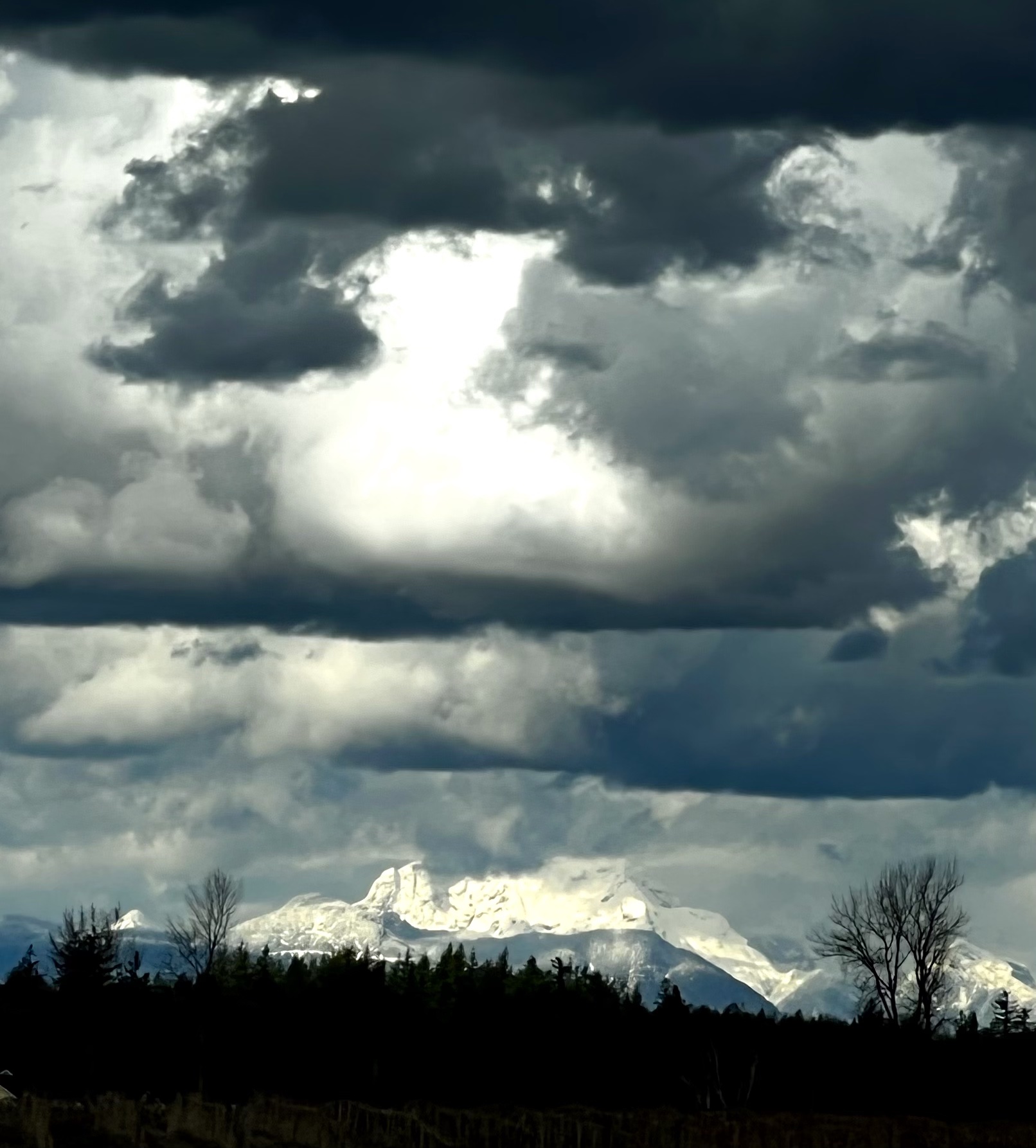
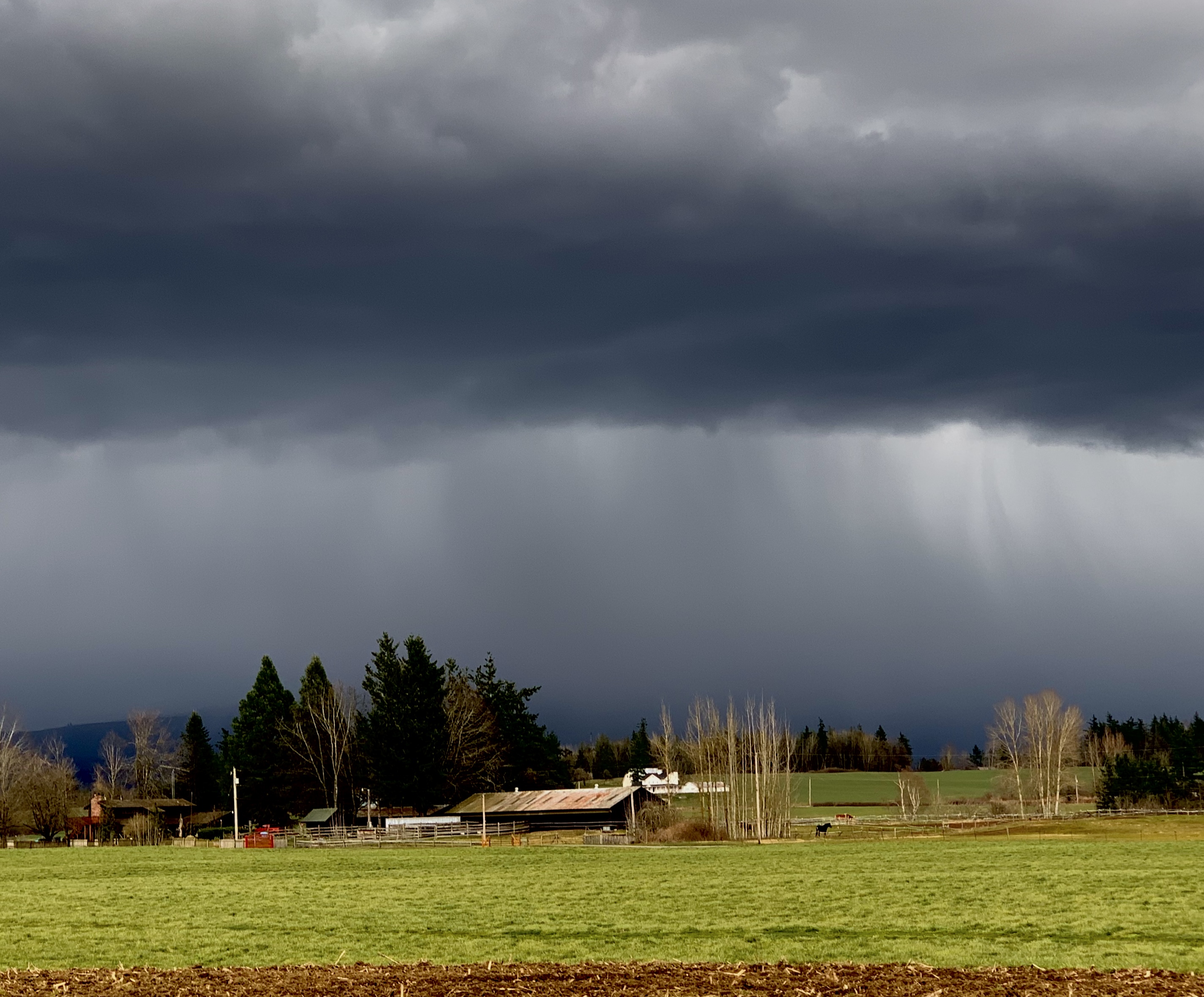
I watch the storm fronts roll in, threatening my outside and inside: heavy damaging winds, thunder and lightning, torrential unpredictable rains, mudslides, horrible forest fires destroying what is familiar and routine.
Inside my own head, the storm clouds of news headlines overpower day-to-day mundane concerns: devastating wars and violence, crime and protests, homelessness, rampant starvation and disease, man’s ongoing inhumanity to man.
I want to hide under a rock until the storms inside and outside blow over.
In the midst of the tempest — while wars rage on the planet, while a bitter election season is underway — a miracle may be wrought. Brilliant light exposes how heaven weeps from heavy clouds. A rainbow touches the earth in holy promise.
God assures His people: this storm too will pass, even the storms of our own making. Darkness is overcome by Light.
Painting of snowy Cascades by John Hoyte
He stilled the storm to a whisper; the waves of the sea were hushed. They were glad when it grew calm, and he guided them to their desired haven. Psalm 107:29-30
This Lenten season I reflect on the words of the 19th century southern spiritual hymn “What Wondrous Love is This”
One-Time
Monthly
Yearly
Make a one-time or recurring donation to support daily Barnstorming posts
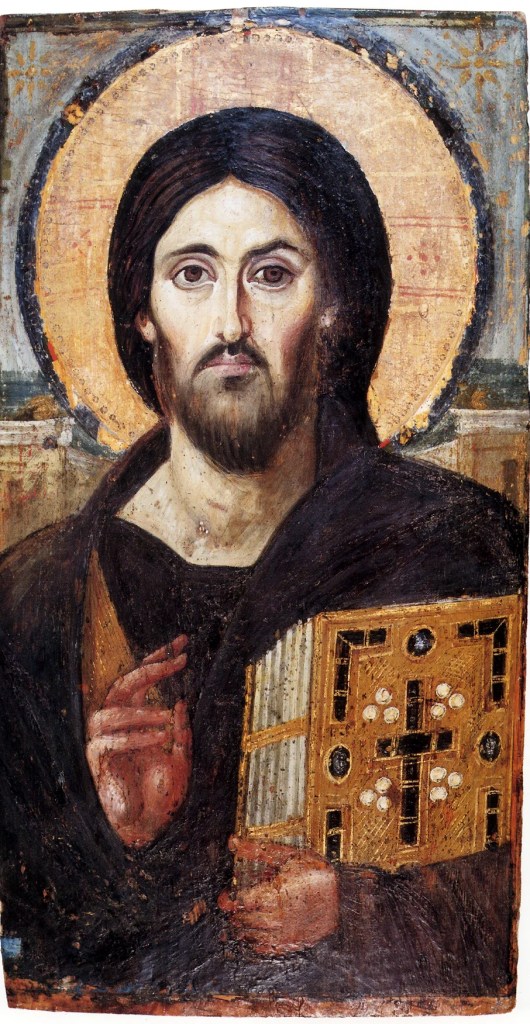
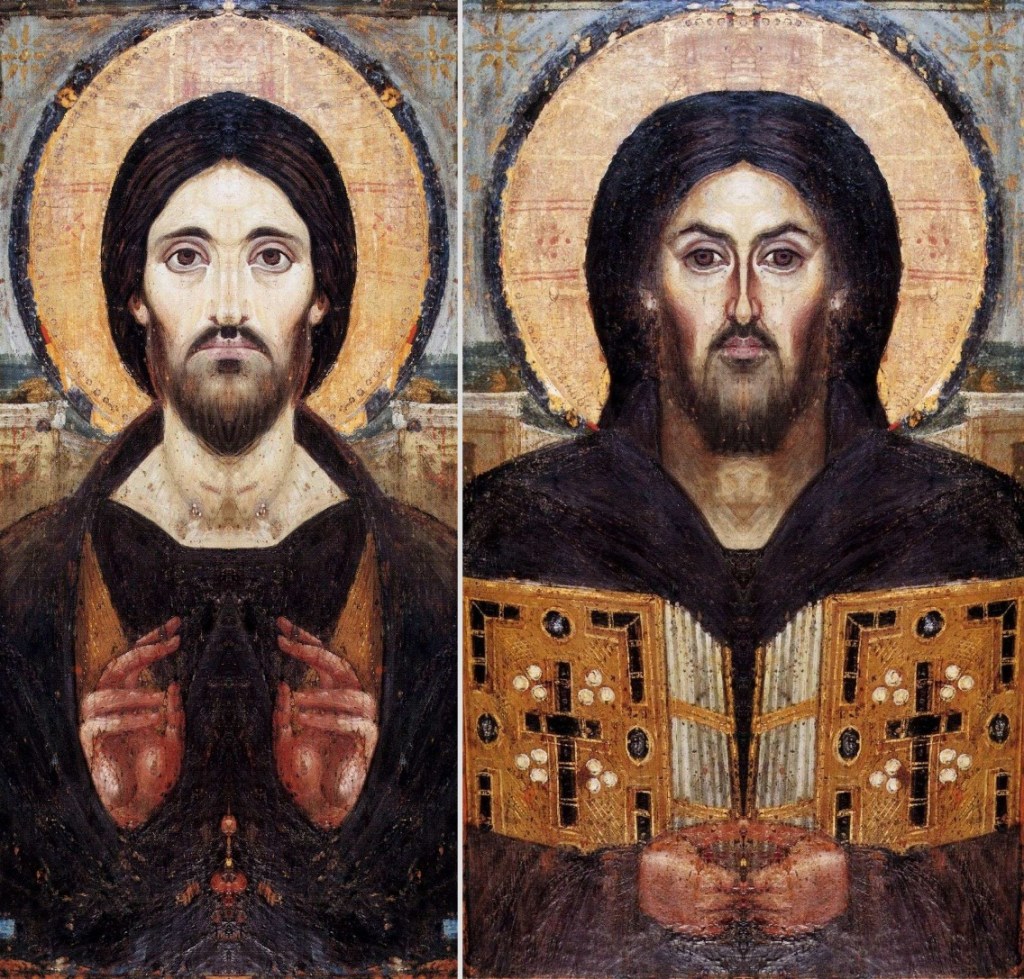
Directly in front of me he is here, him on this quiet morning in a room of the Byzantine Museum, Athens, in the hundred-degree heat and dust of a city not yet fully awake. Here, and I am suddenly confronted— the oldest icon in existence—with his image.
The rest of the room evaporates, and all I see is him: Pure mystery, great and wondrous, dizzying and terrible.
How can wood and pigment egg yolk and animal skin convey such ethereal truth, intensify the power, captivate Christian eye and heart?
Christ of Sinai looks at me with steady gaze. His eyes—the famed twins Justice and Mercy— see straight through me piercing the whitewashed tomb of my exterior till it hurts. One eye is dark, foreboding shadows between the brow and lid deepening and on the verge of righteous anger— the other eye embraces all even my unworthy soul. I stand and cannot pray. My eyes swell with tears. I cannot look anymore. ~Ed Higgins from “Icon: Christ of Sinai” from Near Truth Only
I was not raised with religious icons. I have little understanding about how they may comfort and encourage those who value and even worship them. Yet I do understand inspiring art and words may deepen our faith in God. This has been true for millennia.
This particular Byzantine icon, the oldest known of Christ, is preserved from the 6th century, an early representation with an intense gaze from eyes that are both from man and God.
I look for tears in those eyes. My own fill up knowing Christ is able to see the depths beyond my white-washed exterior.
I look away, ashamed.
Because He sees what we try to keep from Him, Jesus weeps, knowing the truth about us, yet loving us anyway.
the right and left sides of the icon shown in mirror image, illustrating the dual nature of divine and human
You are like whitewashed tombs, which look beautiful on the outside but on the inside are full of the bones of the dead and everything unclean. Matthew 23:27
Detail from “Descent from the Cross” by Rogier van der Weyden
This Lenten season I reflect on the words of the 19th century southern spiritual hymn “What Wondrous Love is This”
One-Time
Monthly
Yearly
Make a one-time or recurring donation to support daily Barnstorming posts
When it snows, he stands atthe back door or wanders around the house to each window in turn and watches the weather like a lover. O farm boy, I waited years for you to look at me that way. Now we’re old enough to stop waiting for random looks or touches or words, so I find myself watching you watching the weather, and we wait together to discover whatever the sky might bring. ~Patricia Traxler “Weather Man”
My farm boy does still look at me that way, wondering if today will bring frost, a wind storm, maybe fog or mist, a scorcher, or a deluge.
I reassure him as best I can, because he knows me so well in our many years together:
today, like most other days, I predict I will be partly cloudy with a chance of showers, and as always, occasional sun breaks.
One-Time
Monthly
Yearly
Make a one-time or recurring donation to support daily Barnstorming posts
Do you know why this world is as bad as it is? It is because people think only about their own business, andwon’t trouble themselves to stand up for the oppressed, nor bring the wrong-doers to light. My doctrine is this: that if we see cruelty or wrong that we have the power to stop, and do nothing, we make ourselves sharers in the guilt. ~Anna Sewell from Black Beauty
A true revolution of values will soon cause us to question the fairness and justice of many of our past and present policies. On the one hand, we are called to play the good Samaritan on life’s roadside; but that will be only an initial act. One day the whole Jericho road must be transformed so thatmen and women will not be beaten and robbed as they make their journey through life. True compassion is more than flinging a coin to a beggar; it understands that an edifice that produces beggars needs restructuring. America, the richest and most powerful nation in the world, can well lead the way in this revolution of values. There is nothing, except a tragic death wish, to prevent us from reordering our priorities… ~Martin Luther King, Jr. from a speech April 4, 1967
We live in a time where the groaning need and dividedness of humankind is especially to be felt and recognized. Countless people are subjected to hatred, violence and oppression which go unchecked. The injustice and corruption which exist today are causing many voices to be raised to protest and cryout that something be done. Many men and women are being moved to sacrifice much in the struggle for justice, freedom, and peace. There is a movement afoot in our time, a movement which is growing, awakening.
We must recognize that we as individuals are to blame forevery social injustice, every oppression, the downgrading of others and the injury that man does to man, whetherpersonal or on a broader plane.… God mustintervene with his spirit and his justice and his truth. The presentmisery, need, and decay must pass away and the new day of the Son of Man must dawn. This is the advent of God’s coming. ~Dwight Blough from the introduction to When the Time was Fulfilled (1965)
I weep to see ongoing bitter divisions among our citizens as we fail to learn from history’s past errors. Here we are again, groaning against one another once more, ignited by front-running candidates for president whose ethics and values do not represent freedom and justice for all.
As we once again walk this hazardous Jericho Road together, we cannot pass by those who lie dying in the ditch, our brother, our sister, our neighbor, a stranger.
We must stop and help lest we share the guilt of their suffering.
It could be you or me there bleeding, beaten, abandoned until Someone took our place so we can get up and walk Home.
Maranatha.
At the edge of Jericho Road Beneath the street light’s yellow orange glow The feared and the fallen go In the way of predator and prey No one’s spared Because hate is too great a weight to bear
In a cage of shadows we meet Naked and bloodied in the street At the mercy, at the feet Of the way of predator and prey No one’s spared Because hate is too great a weight to bear
In the darkness on shattered pavement The better angels fade Blurred in slumber, murder by numbers Do you know my name? Do you know my name? I believe in you
Because everyone holds some part of the truth And now, I’m in your way Do we stay on Jericho Road, forever going nowhere Till hate is too great a weight to bear
One-Time
Monthly
Yearly
Make a one-time or recurring donation to support daily Barnstorming posts
You never know what may cause them. The sight of the ocean can do it, or a piece of music, or a face you’ve never seen before. A pair of somebody’s old shoes can do it. Almost any movie made before the great sadness that came over the world after the Second World War, a horse cantering across a meadow…
You can never be sure. But of this you can be sure.Whenever you find tears in your eyes, especially unexpected tears, it is well to pay the closest attention. They are not only telling you something about the secret of who you are, but more often than not God is speaking to you through them of the mystery of where you have come from and is summoning you to where, if your soul is to be saved, you should go next. ~Frederick Buechner fromWhistling in the Dark
photo by Emily Vander Haak
I’m not paying close enough attention to the meaning of my leaking eyes if I’m constantly looking for kleenex to stem the flow. During the holidays, it seems I have more than ample opportunity to find out the secret of who I am, where I have come from, and where I am to be next.
So I keep my pockets loaded with kleenex, and there is a box ready in every room of the house.
It mostly has to do with welcoming our three children, their spouses, and six grandchildren back home for a few days to become a full-out, noisy, messy, chaotic household again. There will be puzzles and games and music and laughter and unending laundry and constant meal preparation and consumption. It is about singing grace together in five-part harmony before we eat, praying precious words of gratitude.
It is about remembering the drama of our youngest’s birthday thirty-one years ago today, as if it were only yesterday, when her life was saved by a snowstorm. Now she and her husband bring their own son for visits back to the farm.
It certainly has to do with bidding farewell again, gathering them all in for that final hug and then letting go.
We have urged and encouraged them to go where their hearts are telling them they are needed and called to be, even if that means miles away from their one-time home on the farm. For our oldest son’s family, that means returning and settling in just down the road.
I too was let go once and though I would try to look back, too often in tears, I set my face toward the future. It led me here, to this marriage, this family, this farm, this work, our church, to more tears, to more letting go if I’m granted more years to weep again and again with gusto and grace and gravitas.
This is what I’m sure is the secret of me: to love so much and so deeply that letting go is so hard that tears are no longer unexpected or a mystery to me or my children and grandchildren. It is a given that Grandma will weep at a drop of a hat, at a hug, or a hymn. My tears are the spill-over of fullness that can no longer be contained: God’s still small voice spills down my cheeks drop by drop like wax from a burning candle.
No kleenex are needed with these tears.
Let them flow as I let them go. It is as it should be.
One-Time
Monthly
Yearly
Make a one-time or recurring donation to support daily Barnstorming posts
one small crystal that gleams clear colours out of transparency.
I need more.
I break off a fragment to send to you.
Please take this grain of a grain of hope so that mine won’t shrink.
Please share your fragment so that yours will grow.
Only so, by division, will hope increase,
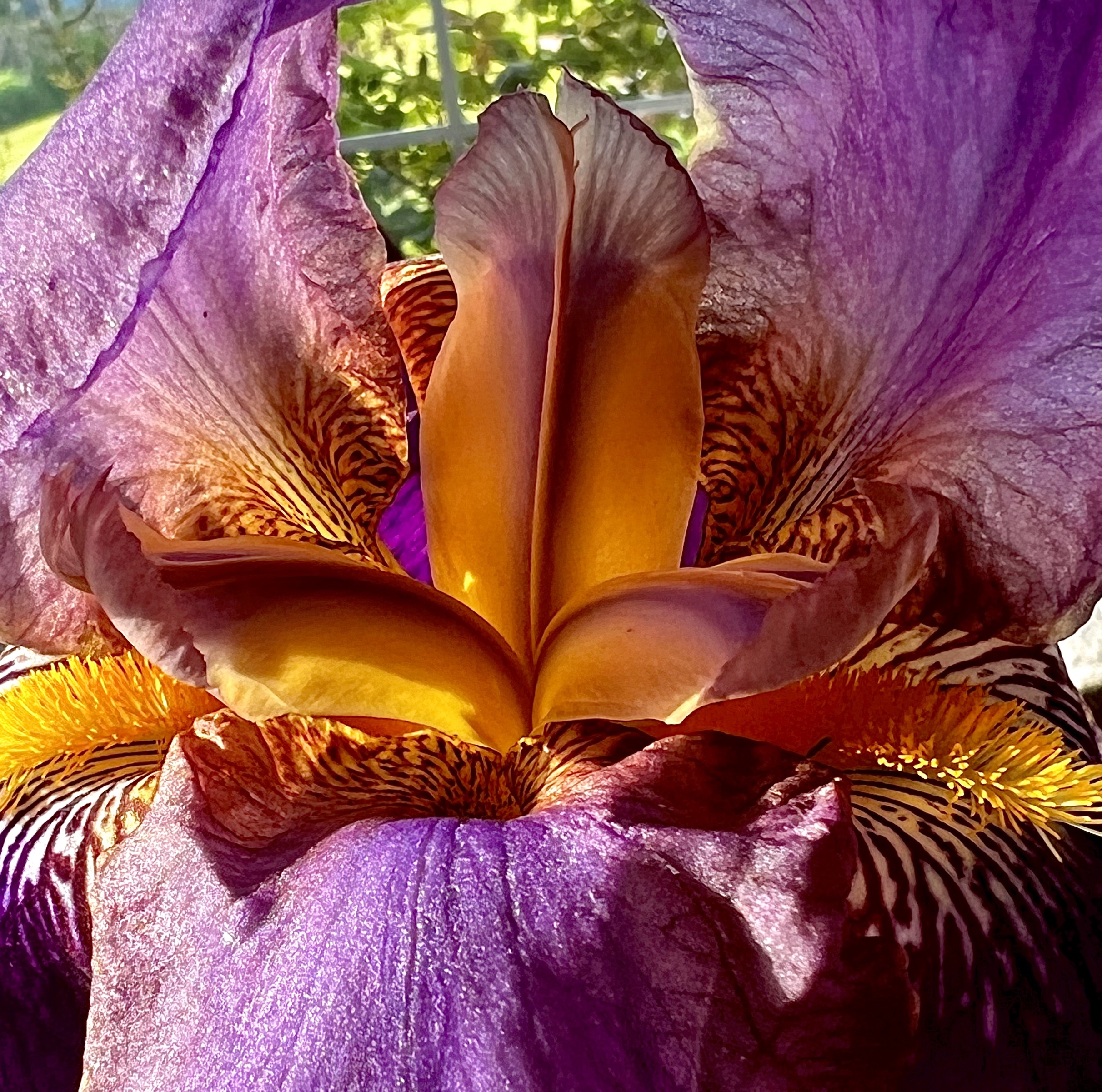
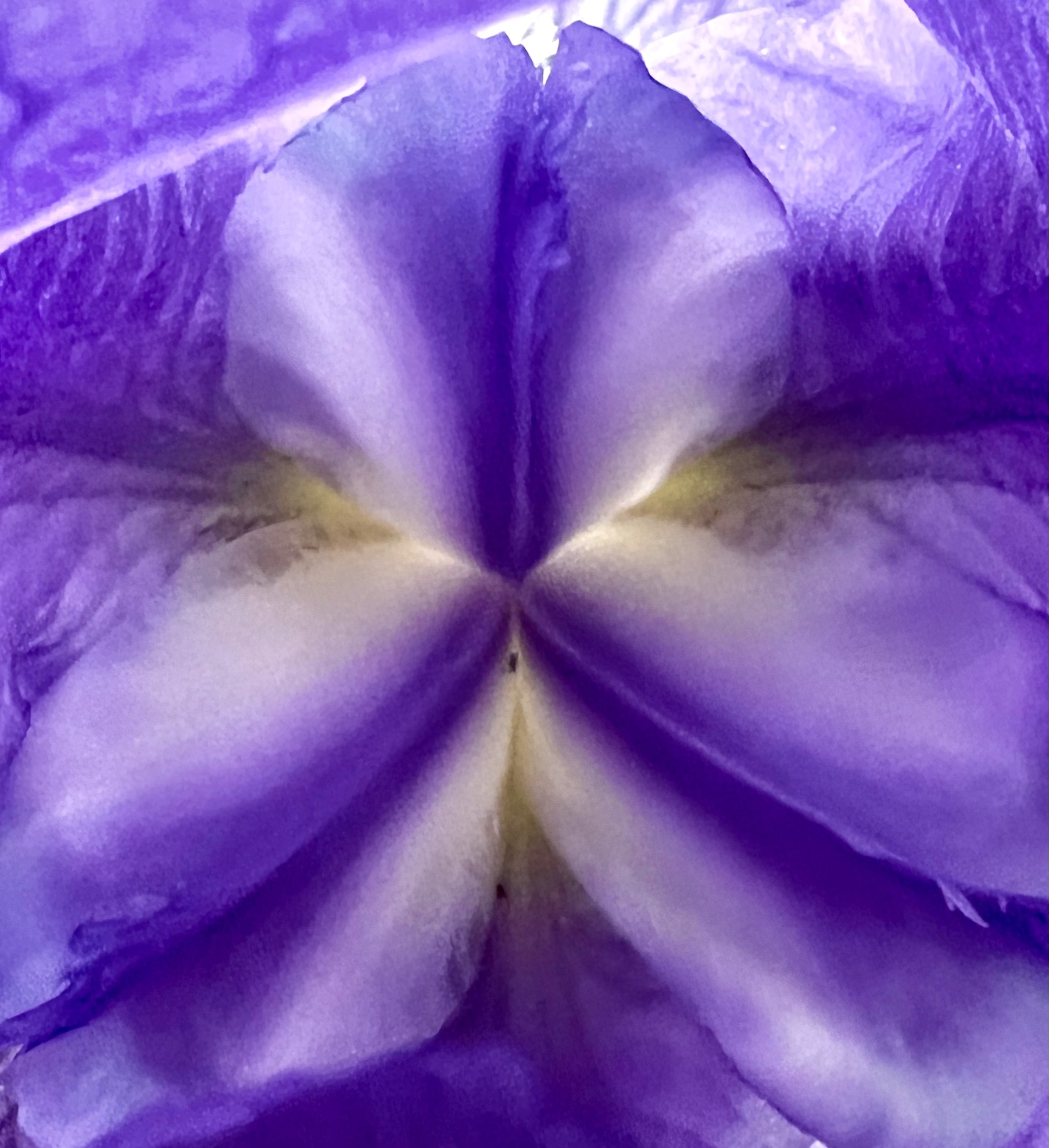
like a clump of irises, which will cease to flower unless you distribute the clustered roots, unlikely source– clumsy and earth-covered– of grace. ~Denise Levertov “For the New Year, 1981”
As this year draws to its end, We give thanks for the gifts it brought And how they became inlaid within Where neither time nor tide can touch them.
The days when the veil lifted And the soul could see delight; When a quiver caressed the heart In the sheer exuberance of being here.
Surprises that came awake In forgotten corners of old fields Where expectation seemed to have quenched.
The slow, brooding times When all was awkward And the wave in the mind Pierced every sore with salt.
The darkened days that stopped The confidence of the dawn.
Days when beloved faces shone brighter With light from beyond themselves; And from the granite of some secret sorrow A stream of buried tears loosened.
We bless this year for all we learned, For all we loved and lost And for the quiet way it brought us Nearer to our invisible destination. ~John O’Donohue “At the End of the Year” from To Bless The Space Between
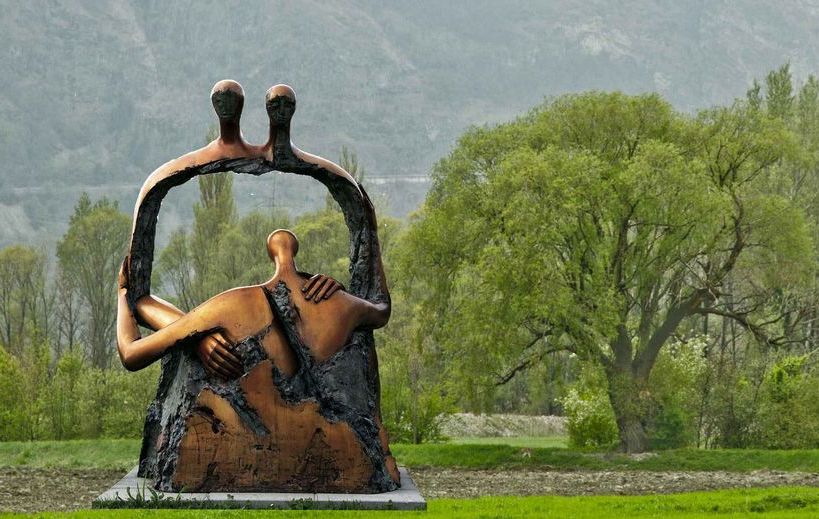
Sculpture by Artist Albert Gyorgy
Truly, we live with mysteries too marvelous to be understood.
How grass can be nourishing in the mouths of the lambs.
How rivers and stones are forever in allegiance with gravity, while we ourselves dream of rising.
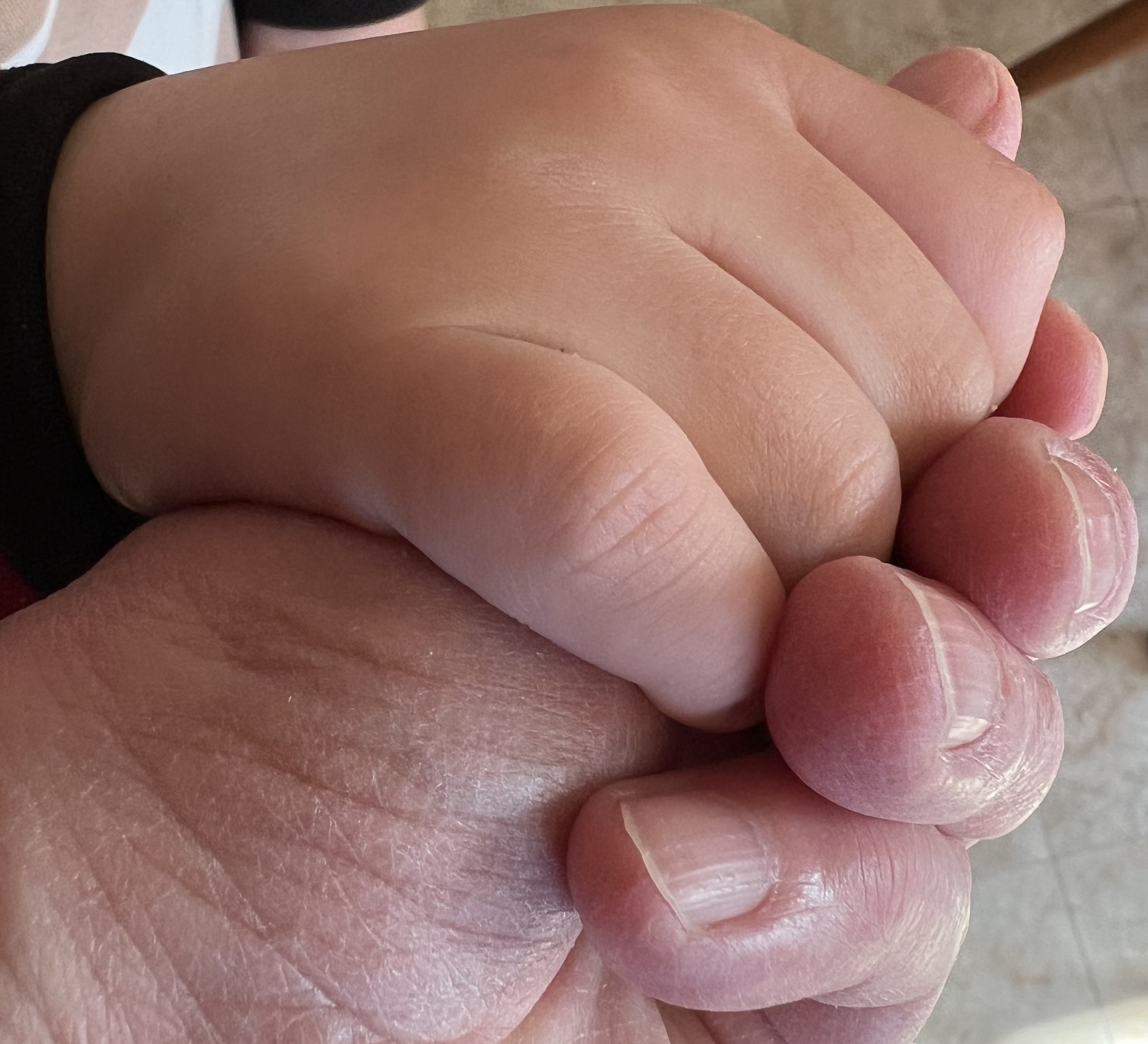
How two hands touch and the bonds will never be broken.
How people come, from delight or the scars of damage, to the comfort of a poem.
Let me keep my distance, always, from those who think they have the answers.
Let me keep company always with those who say “Look!” And laugh in astonishment and bow their heads. ~Mary Oliver “Mysteries, Yes”from Evidence: Poems
photo by Nate Gibson
Each day, for nearly twenty years, I break off a grain of hope from these dirt-covered, humble roots I have dug up to share.
I hand off a grain of hope to you here, as it will grow through your nurture, a tiny marvel you break off someday to hand on to someone else.
A voice is heard in Ramah, mourning and great weeping, Rachel weeping for her children and refusing to be comforted, because they are no more. Matthew 2:18 and Jeremiah 31:15
We think of him as safe beneath the steeple, Or cosy in a crib beside the font, But he is with a million displaced people On the long road of weariness and want.
For even as we sing our final carol His family is up and on that road, Fleeing the wrath of someone else’s quarrel, Glancing behind and shouldering their load.
Whilst Herod rages still from his dark tower Christ clings to Mary, fingers tightly curled, The lambs are slaughtered by the men of power, And death squads spread their curse across the world.
But every Herod dies, and comes alone To stand before the Lamb upon the throne. ~Malcolm Guite “Refugee”
When Christ was born in Bethlehem, Fair peace on earth to bring, In lowly state of love He came To be the children’s King.
And round Him, then, a holy band Of children blest was born, Fair guardians of His throne to stand Attendant night and morn.
And unto them this grace was giv’n A Saviour’s name to own, And die for Him Who out of Heav’n Had found on earth a throne.
O blessèd babes of Bethlehem, Who died to save our King, Ye share the martyrs’ diadem, And in their anthem sing!
Your lips, on earth that never spake, Now sound th’eternal word; And in the courts of love ye make Your children’s voices heard.
Lord Jesus Christ, eternal Child, Make Thou our childhood Thine; That we with Thee the meek and mild May share the love divine. ~Laurence Houseman “The Holy Innocents”
There is no consolation for families of those children lost to death too soon: a rogue king’s slaughter of innocents.
And still today – so much needless death of the young, on the same ground, flooded with blood, across disputed borders and faith.
Arms ache with the emptiness of grief, beds and pillows lie cold and unused, hugs never to come again.
There is no consolation for loss then or now; only mourning and great weeping, sobbing that wrings dry every human cell,
leaving only dust behind: our beginning and our end.
One-Time
Monthly
Yearly
Make a one-time or recurring donation to support daily Barnstorming posts






















































 Barnstorming