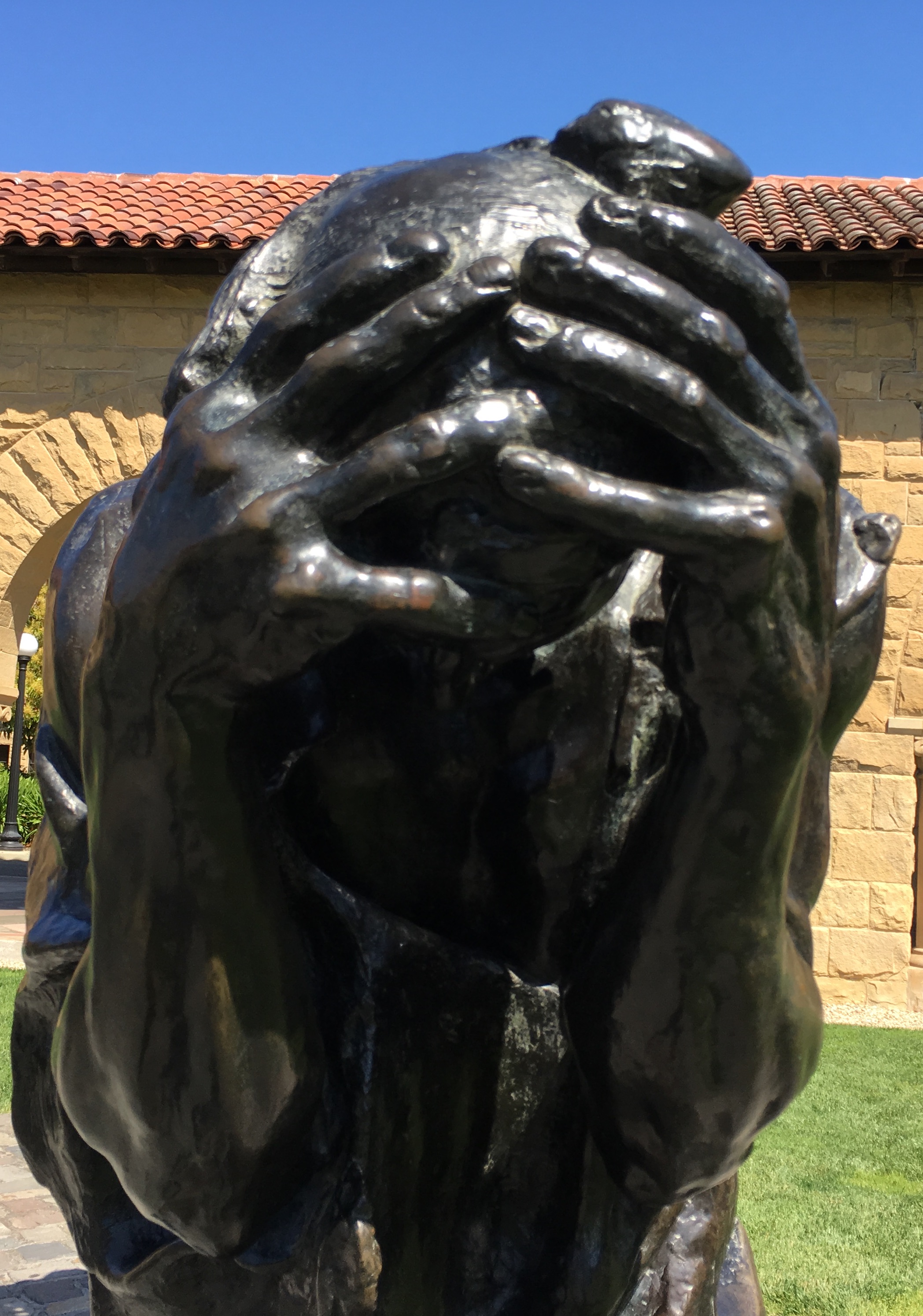
Spiking the Summer Air

Against the rubber tongues of cows and the hoeing hands of men
Thistles spike the summer air
Or crackle open under a blue-black pressure.

Every one a revengeful burst
Of resurrection, a grasped fistful
Of splintered weapons and Icelandic frost thrust up

From the underground stain of a decayed Viking.
They are like pale hair and the gutturals of dialects.
Every one manages a plume of blood.

Then they grow grey, like men
Mown down, it is a feud. Their sons appear,
Stiff with weapons, fighting back over the same ground.
~Ted Hughes “Thistles”

Sheep will not eat it
nor horses nor cattle
unless they are starving.
Unchecked, it will sprawl over
pasture and meadow
choking the sweet grass
defeating the clover
until you are driven
to take arms against it
but if unthinking
you grasp it barehanded
you will need tweezers
to pick out the stickers.

Outlawed in most Northern
states of the Union
still it jumps borders.
Its taproot runs deeper
than underground rivers
and once it’s been severed
by breadknife or shovel
—two popular methods
employed by the desperate—
the bits that remain will
spring up like dragons’ teeth
a field full of soldiers
their spines at the ready.

Bright little bursts of
chrome yellow explode from
the thistle in autumn
when goldfinches gorge on
the seeds of its flower.
The ones left uneaten
dry up and pop open
and parachutes carry
their procreant power
to disparate venues
in each hemisphere
which is why there will always
be thistle next year.

~Maxine Kumin “Why There Will Always Be Thistle Next Year” from The Long Marriage

Summer will grow old
As will the thistle, letting
A clenched bloom unfold

To which the small hum
Of bee wings and the flash of
Goldfinch wings will come,

Till its purple crown
Blanches, and the breezes strew
The whole field with down.
~Richard Wilbur “A Pasture Poem” from Anterooms

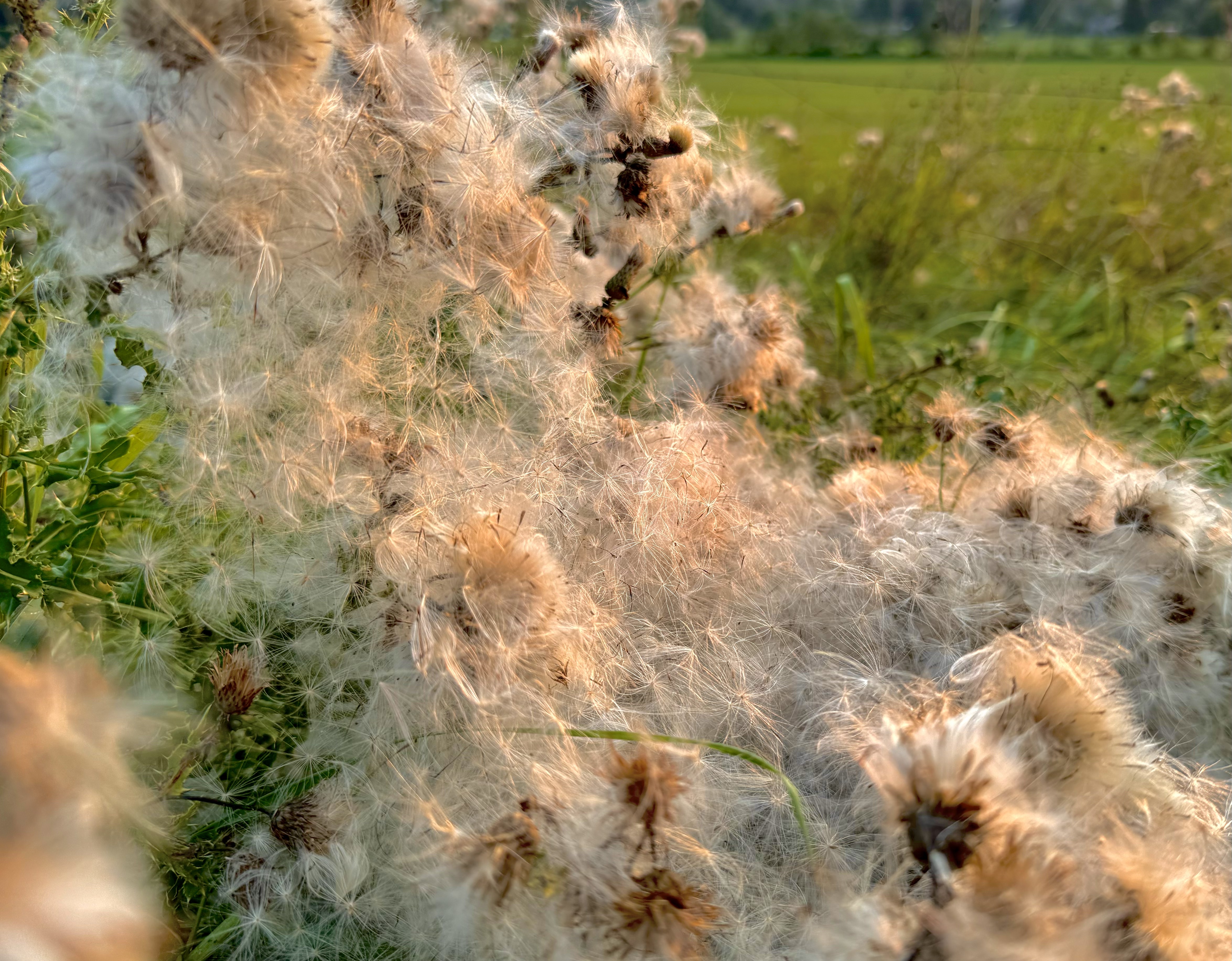
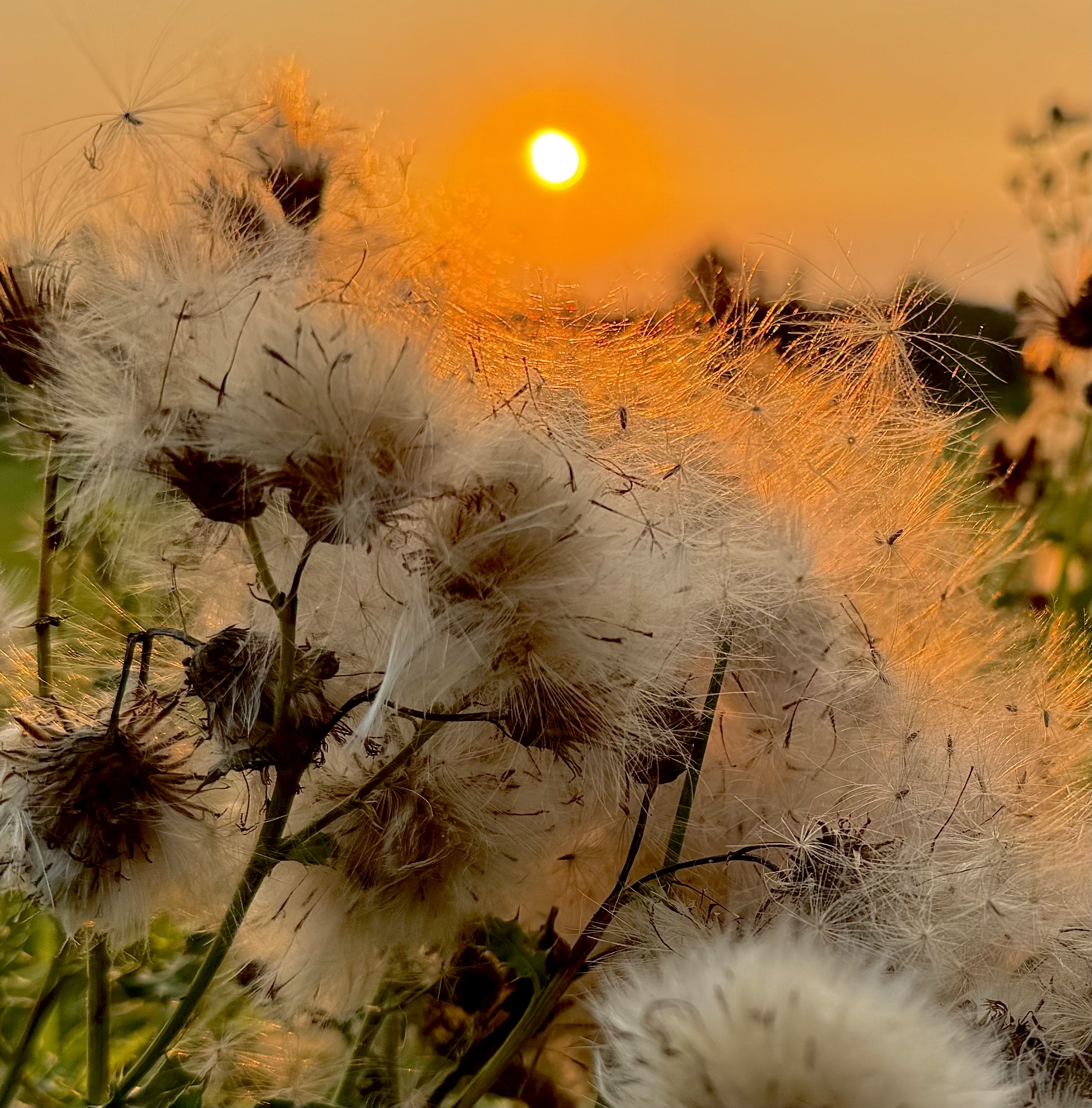
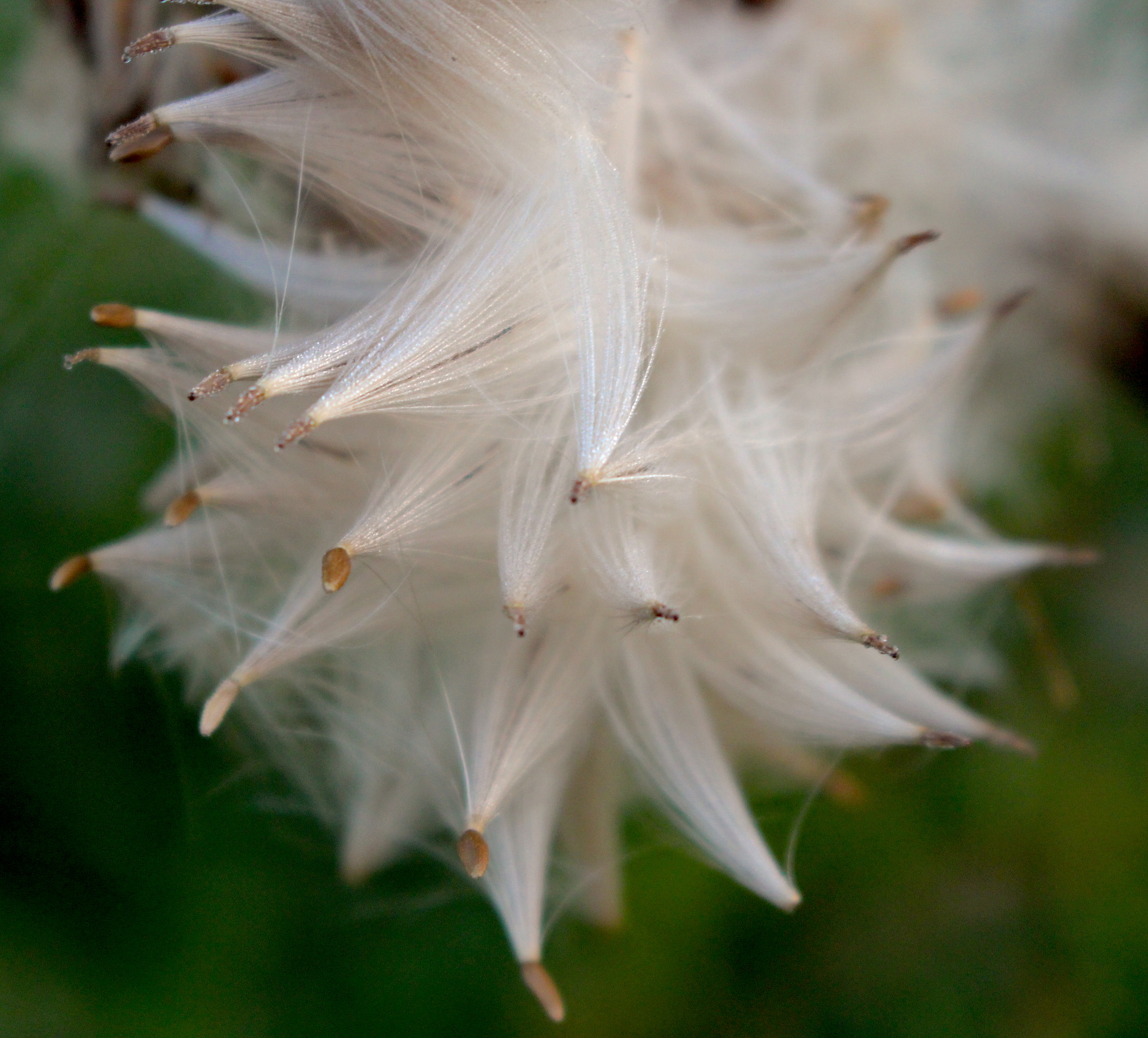
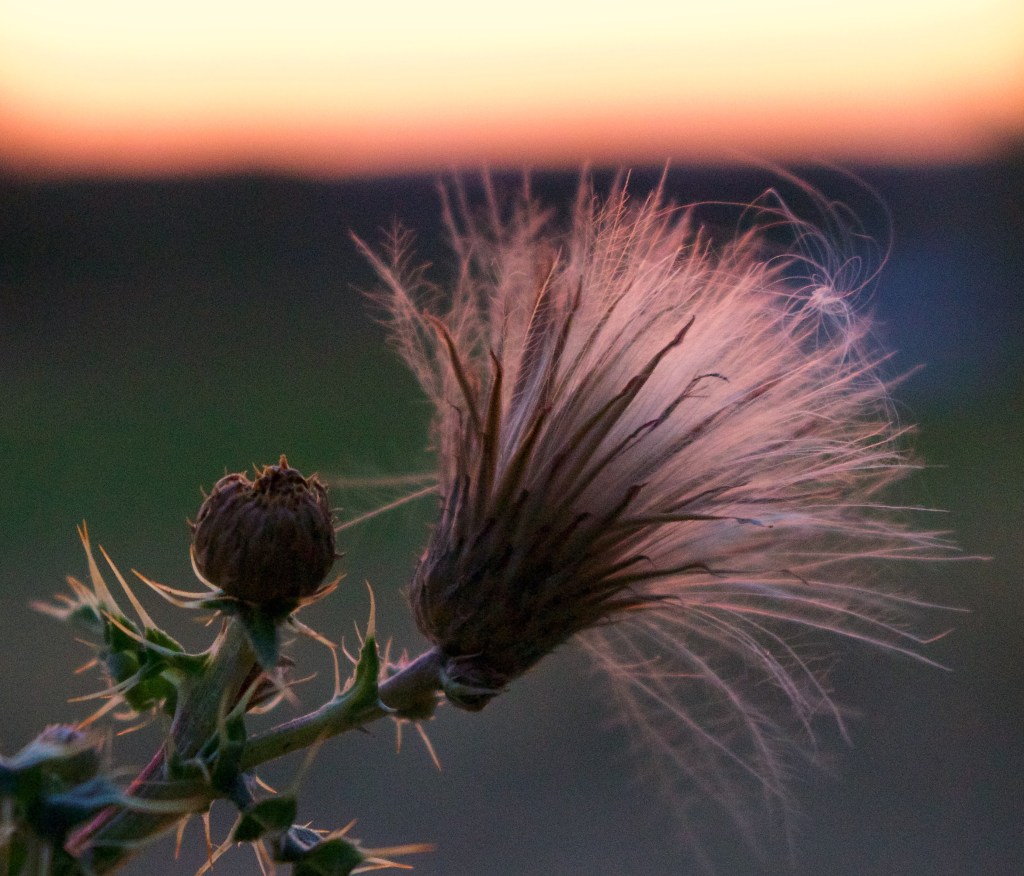
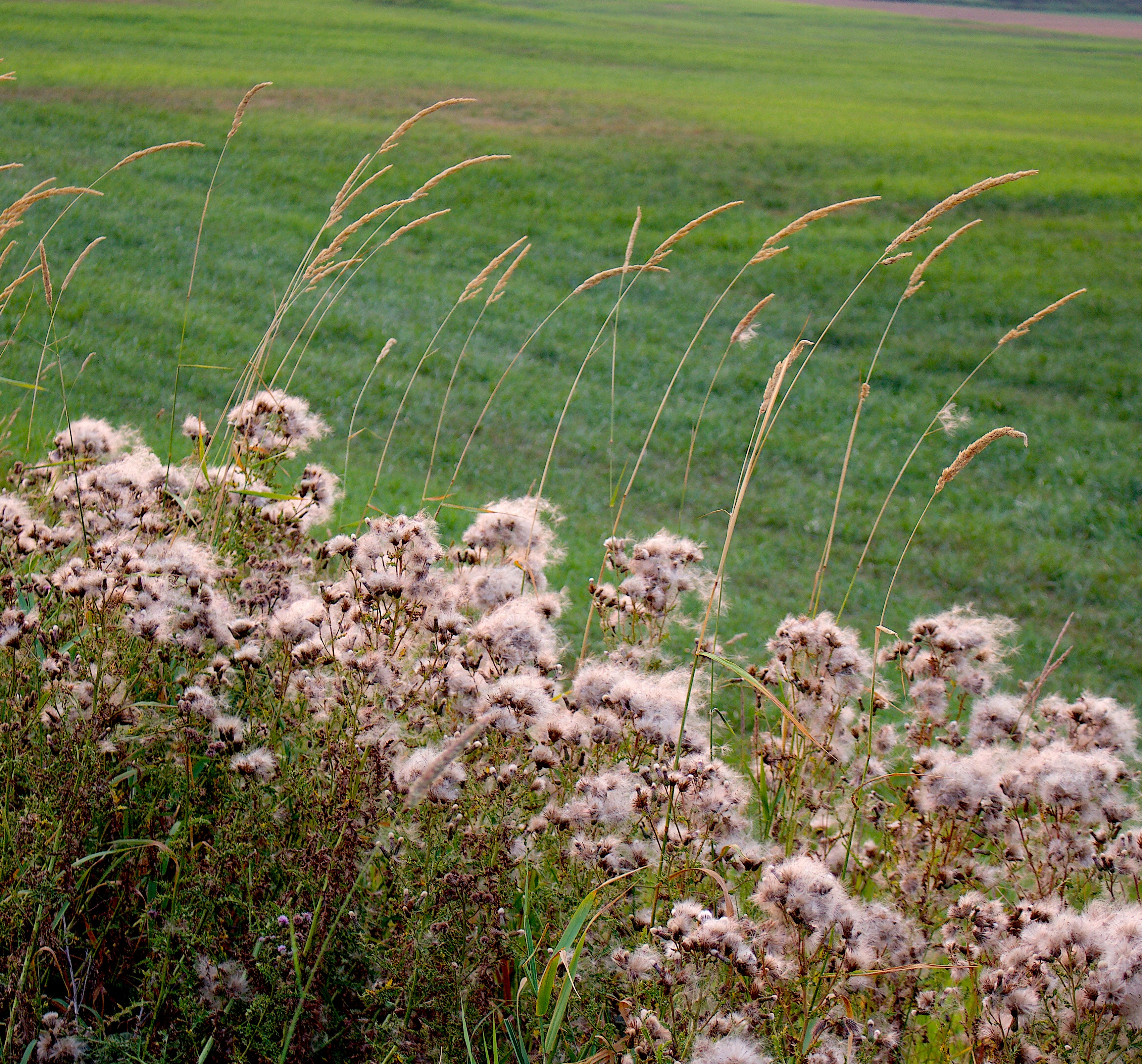
Thistle is armored, deeply rooted, and relentless in its self-defense, very much like enemies facing off in the human wars of our current and past history.

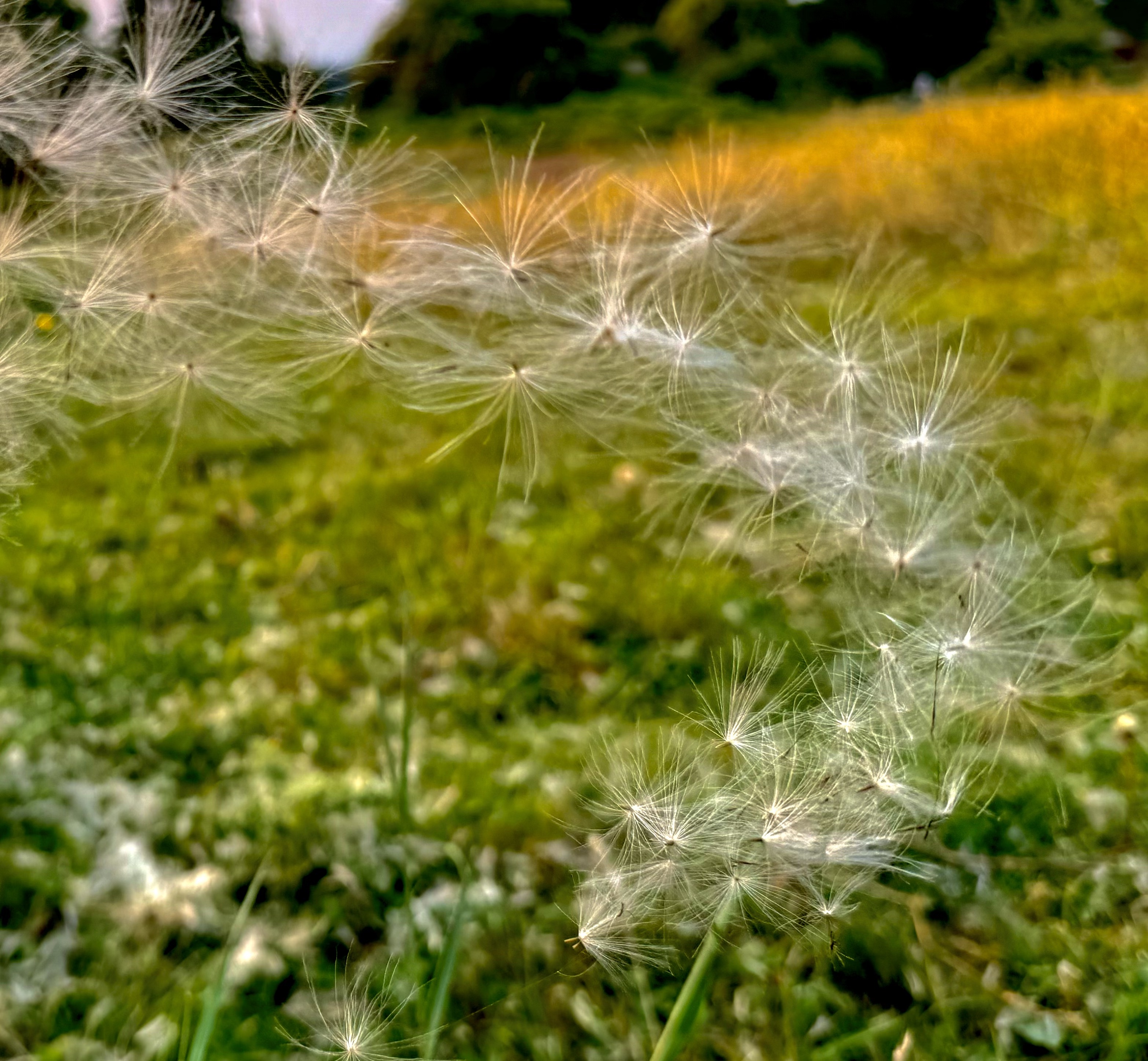
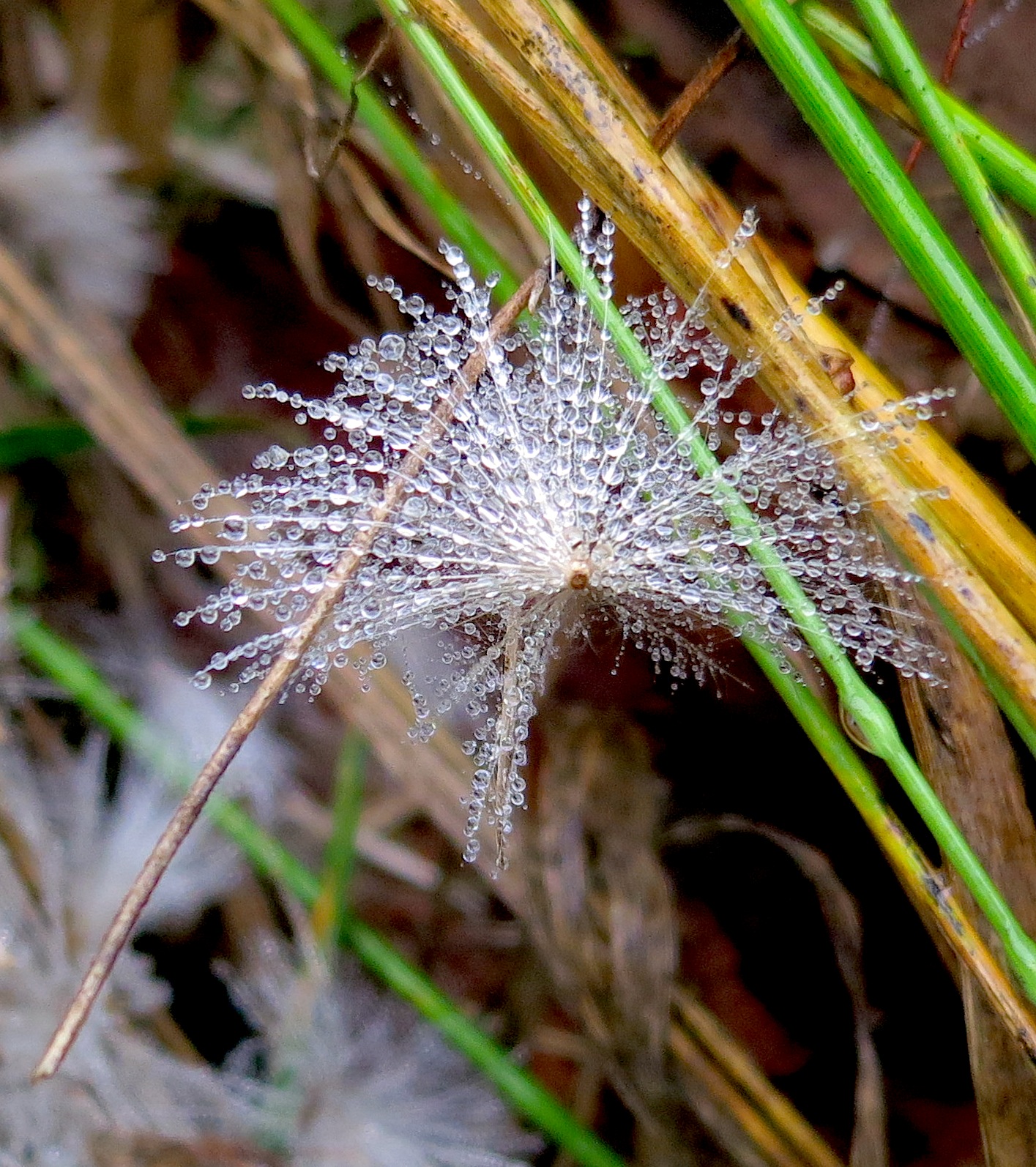
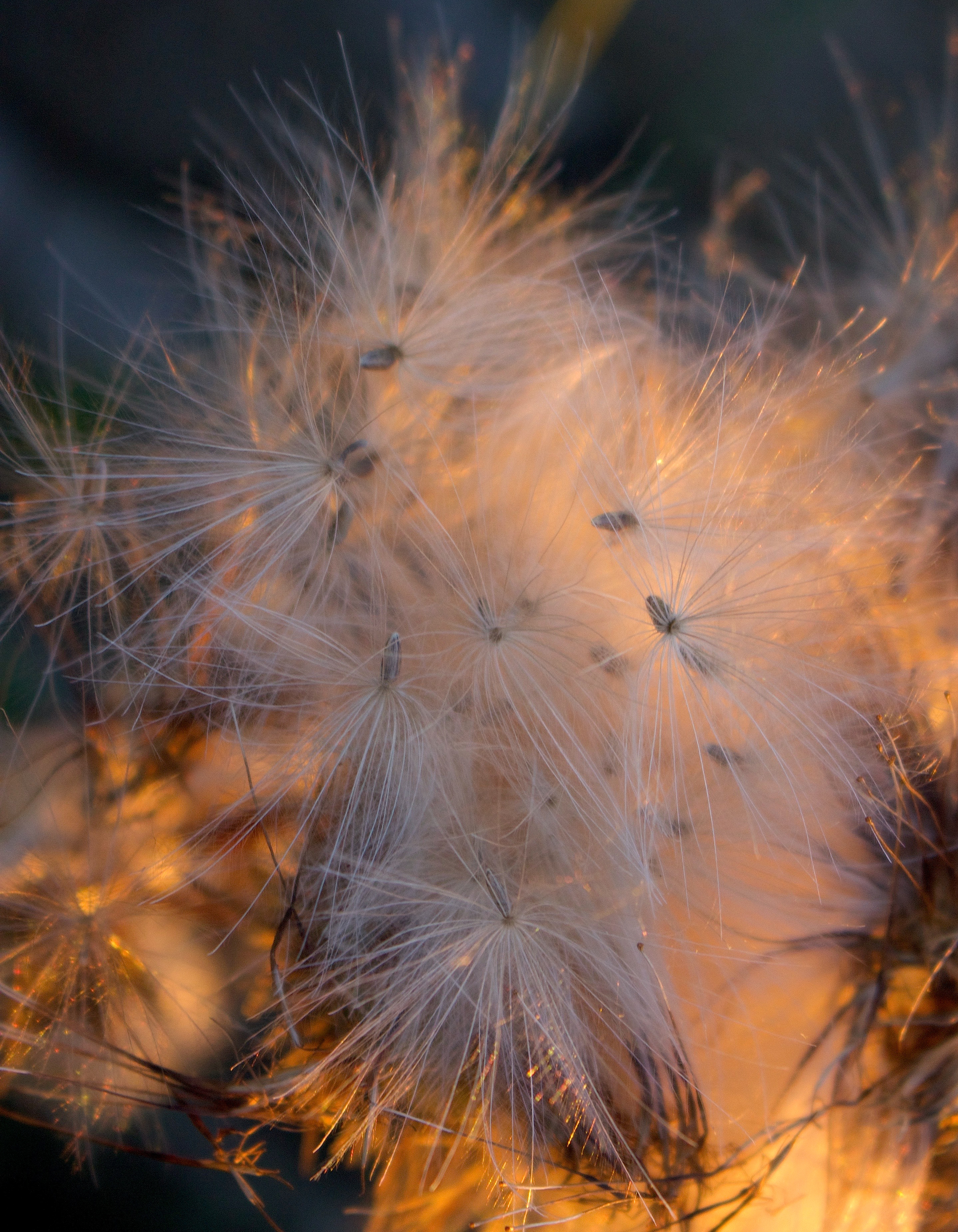
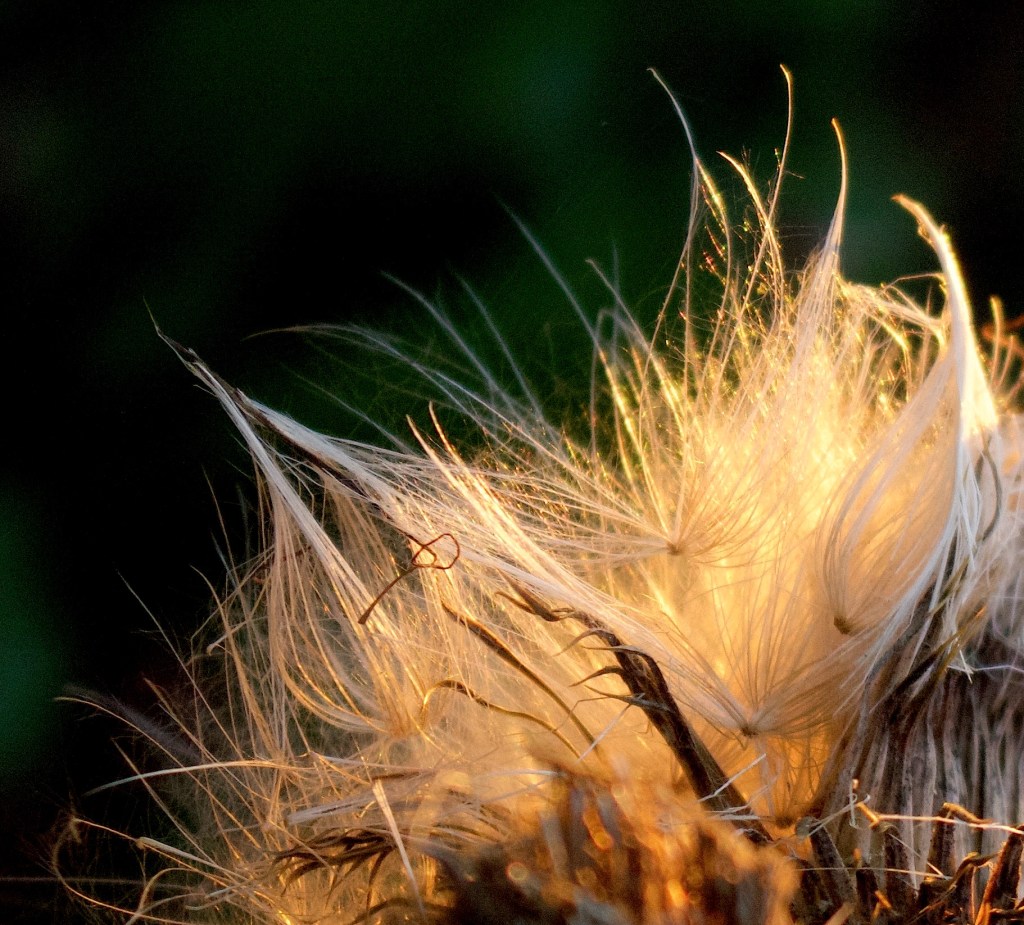
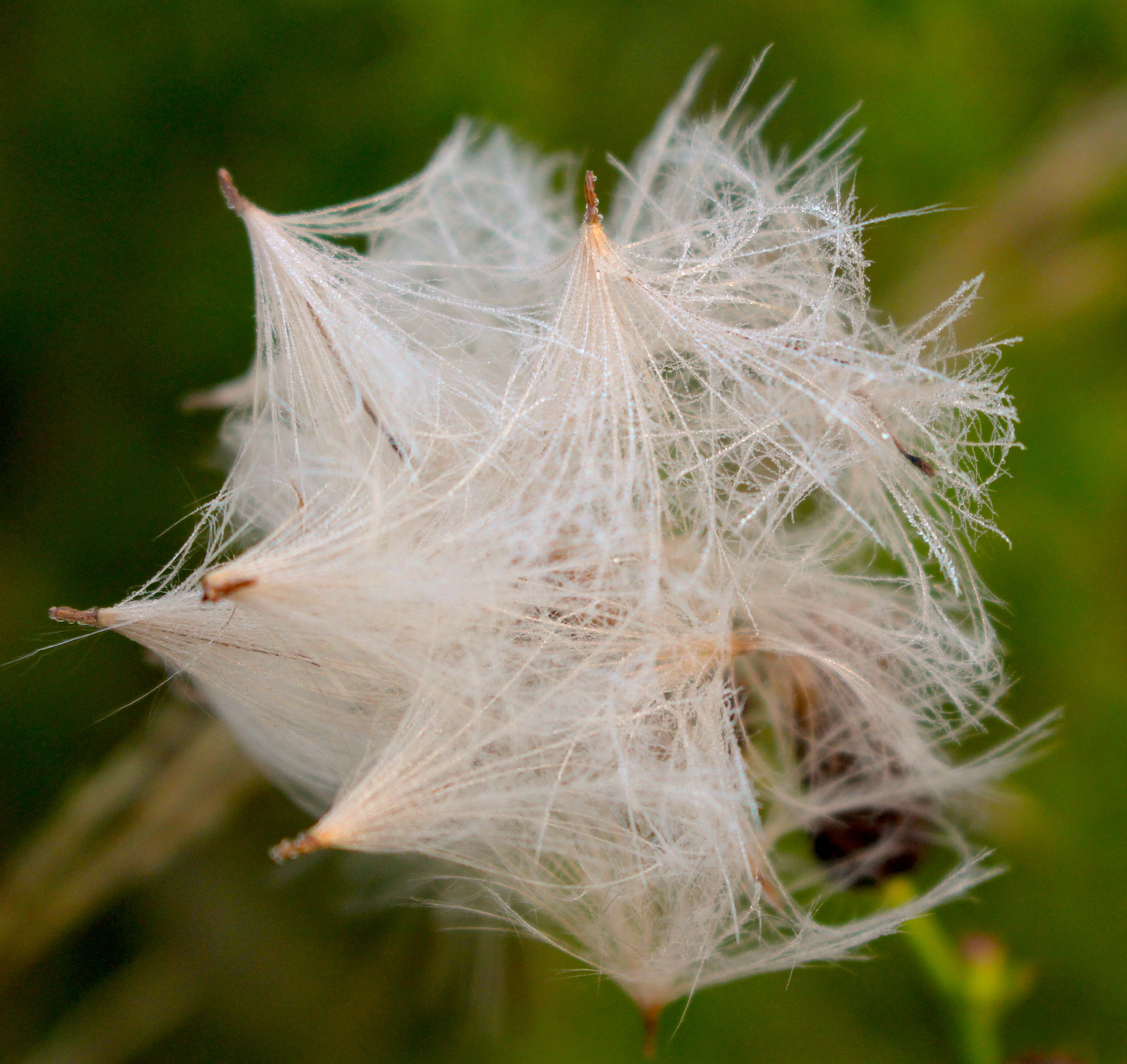
Highly invasive, thistle produces downy tasty dancing seeds ready to soar far in their effort at world domination. Generation after generation of thistles persist due to these vulnerable ballerinas’ flight to the next available patch of soil.

Unlike thistle, may we thrive with determined persistence, without need for spikes and thorny spines that attack and draw blood. May we instead exude a vulnerable softness and grace — fluffy and tender as a baby blanket meant to cradle and nurture rather than maim and cripple.

One-Time
Monthly
Yearly

Make a one-time or recurring donation to support daily Barnstorming posts

Make a monthly donation

Make a yearly donation

Choose an amount

$10.00
$25.00
$50.00
$5.00
$15.00
$100.00
$5.00
$15.00
$100.00

Or enter a custom amount

$

Your contribution is deeply appreciated.

Your contribution is appreciated.

Your contribution is appreciated.

DonateDonate monthlyDonate yearly

A Symbol of Who We Are

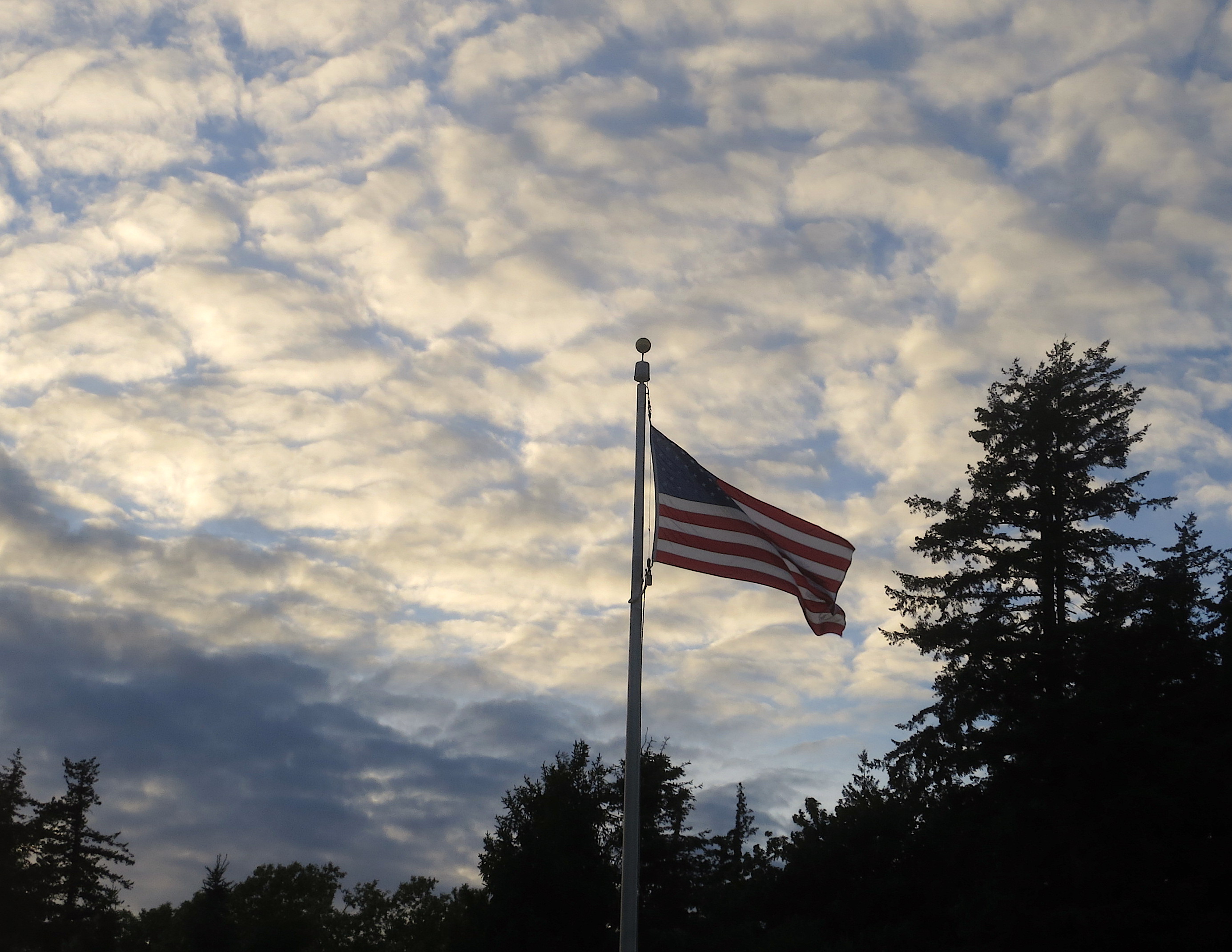
I am what you make me; nothing more. I swing before your eyes as a bright gleam of color, a symbol of yourself.
~Franklin K. Lane, Secretary of the Interior, 1914 Flag Day address

Sometimes, as a child,  when I was bored, I’d grab a step ladder, pull it into our hallway, climb half way up and carefully lift the plywood hatch that was the portal to our dark attic.  It took some effort to climb up into the attic from the ladder, juggling a flashlight at the same time, but once seated safely on the beams above our ceiling, being careful not to put my foot through the carpet of insulation, I could explore what was stowed and normally inaccessible to me.

All the usual attic-type things were put up there:  Christmas ornaments and lights,  baby cribs and high chairs,  lamps and toys no longer used.  Secrets to my parents’ past were stored away there too.  It was difficult imagining them as young children growing up on opposite sides of the state of Washington, in very different circumstances, or as attractive college students who met at a dance, or as young marrieds unencumbered by the daily responsibilities of a family.  The attic held those images and memories like a three dimensional photo album.

My father’s dark green Marine Corps cargo trunk was up there, the one that followed him from Officer Training in Quantico, Virginia, to beach and mountain battles on Tarawa, Tinian and Saipan in the South Pacific, and three years later back home again.  It had his name and rank stenciled on the side in dark black lettering.  The buckles were stiff but could be opened with effort, and in the dark attic, there was always the thrill of unlatching the lid, and shining the flashlight across the contents.  His Marine Corps dress uniform lay inside underneath his stiff brimmed cap.  There were books about protocol, and a photo album which contained pictures of “his men” that he led in his battalion, and the collection of photos my mother sent of herself as she worked as a teacher of high school students back home.

Most fascinating was a folded Japanese flag inside a small drawstring bag, made of thin white see-through cloth with the bold red sun in the middle.  Surrounding the red sun were the delicate inked characters of many Japanese hands as if painted by artists, each wishing a soldier well in his fight for the empire.  Yet there it was, a symbol of that soldier’s demise, itself buried in an American attic, being gently and curiously held by an American daughter of a Marine Corps captain.  It would occur to me in the 1960s that some of the people who wrote on this flag might still be living, and certainly members of the soldier’s family would still be living.  I asked my father once about how he obtained the flag, and he, protecting both me and himself, waved me away, saying he couldn’t remember.  I know better now.  He knew but could not possibly tell me the truth.

These flags, charms of good luck for the departing Japanese soldier as he left his neighborhood or village for war, are called Hinomaru Yosegaki (日の丸寄せ書き).  Tens of thousands of these flags came home with American soldiers; it is clear they were not the talisman hoped for.  A few of these flags are now finding their way back to their home country, to the original villages, to descendants of the lost soldiers.  So now has this flag.

Eighty years ago doesn’t seem that long, a mere drop in the river of time.  There are more than mere mementos that have flowed from the broken dam of WWII, flooding subsequent generations of Americans, Japanese, Europeans with memories that are now lost as the oldest surviving soldiers pass, scores of them daily, taking their stories of pain and loss and heroism with them. My father could never talk with a person of Asian descent, Japanese or not, without being visibly uneasy. As a child, I saw and felt this from him, but heard little from his mouth.

When he was twenty two years old, pressed flat against the rocks of Tarawa, trying to melt into the ground to become invisible to the bullets whizzing overhead, he could not have conceived that sixty-five years later his twenty two year old grandson would disembark from a jumbo jet at Narita in Tokyo, making his way to an international school to teach Japanese children. My father would have been shocked that his grandson would settle happily into a culture so foreign, so seemingly threatening, so apparently abhorrent. Yet this irony is the direct result of the horrors of that too-long horrible bloody war of devastation: Americans and Japanese, despite so many differences, have become the strongest of allies, happily exchanging the grandchildren of those bitterly warring soldiers back and forth across the Pacific.  It too was my privilege to care for Japanese exchange students daily in my University health clinic, peering intently into their open faces and never once seeing the enemy that my father feared.

Now all these decades later, our son taught for 13 years in Tokyo, with deep admiration and appreciation for each of his students, some of whom were great-grandchildren of WWII Japanese soldiers. He married a granddaughter of those my father fought. Their two children are the perfect amalgam of once warring, yet now peaceful, cultures; a symbol of blended and blending peoples overcoming the hatred of past generations, creating a new world.

Our son and daughter-in-law, having now settled their family in the States, are adapting to a different language, culture and flag. I pray our son – having devoted part of his life as teacher and missionary to the land of the rising sun – has redeemed his grandfather, the soldier-warrior of the past century.

(U.S. Air Force photo by Staff Sgt. Peter Reft)

One-Time
Monthly
Yearly

Make a one-time or recurring donation to support daily Barnstorming posts

Make a monthly donation

Make a yearly donation

Choose an amount

$10.00
$25.00
$50.00
$5.00
$15.00
$100.00
$5.00
$15.00
$100.00

Or enter a custom amount

$

Your contribution is deeply appreciated.

Your contribution is appreciated.

Your contribution is appreciated.

DonateDonate monthlyDonate yearly

A Gathered Radiance

I am not resigned to the shutting away
Of loving hearts in the hard ground.
So it is, and so it will be, for so it has been, time out of mind:
Into the darkness they go, the wise and the lovely.  Crowned
With lilies and with laurel they go; but I am not resigned.
Lovers and thinkers, into the earth with you.
Be one with the dull, the indiscriminate dust.
A fragment of what you felt, of what you knew,
A formula, a phrase remains,—but the best is lost.
The answers quick and keen, the honest look, the laughter, the love,— They are gone.  They are gone to feed the roses. 

Elegant and curled
Is the blossom.  Fragrant is the blossom.  I know. 

But I do not approve.
More precious was the light in your eyes

Than all the roses in the world.
Down, down, down into the darkness of the grave
Gently they go, the beautiful, the tender, the kind;
Quietly they go, the intelligent, the witty, the brave.
I know.  But I do not approve.  And I am not resigned.
~Edna St. Vincent Millay “Dirge Without Music”

These hearts were woven of human joys and cares,
Washed marvelously with sorrow, swift to mirth.
The years had given them kindness. Dawn was theirs,
And sunset, and the colors of the earth.


These had seen movement, and heard music; known
Slumber and waking; loved; gone proudly friended;
Felt the quick stir of wonder; sat alone;
Touched flowers and furs and cheeks. All this is ended.

There are waters blown by changing winds to laughter
And lit by the rich skies, all day. And after,
Frost with a gesture, stays the waves that dance
And wandering loveliness. He leaves a white
Unbroken glory, a gathered radiance,
A width, a shining peace, under the night.

~Rupert Brooke “All This is Ended”

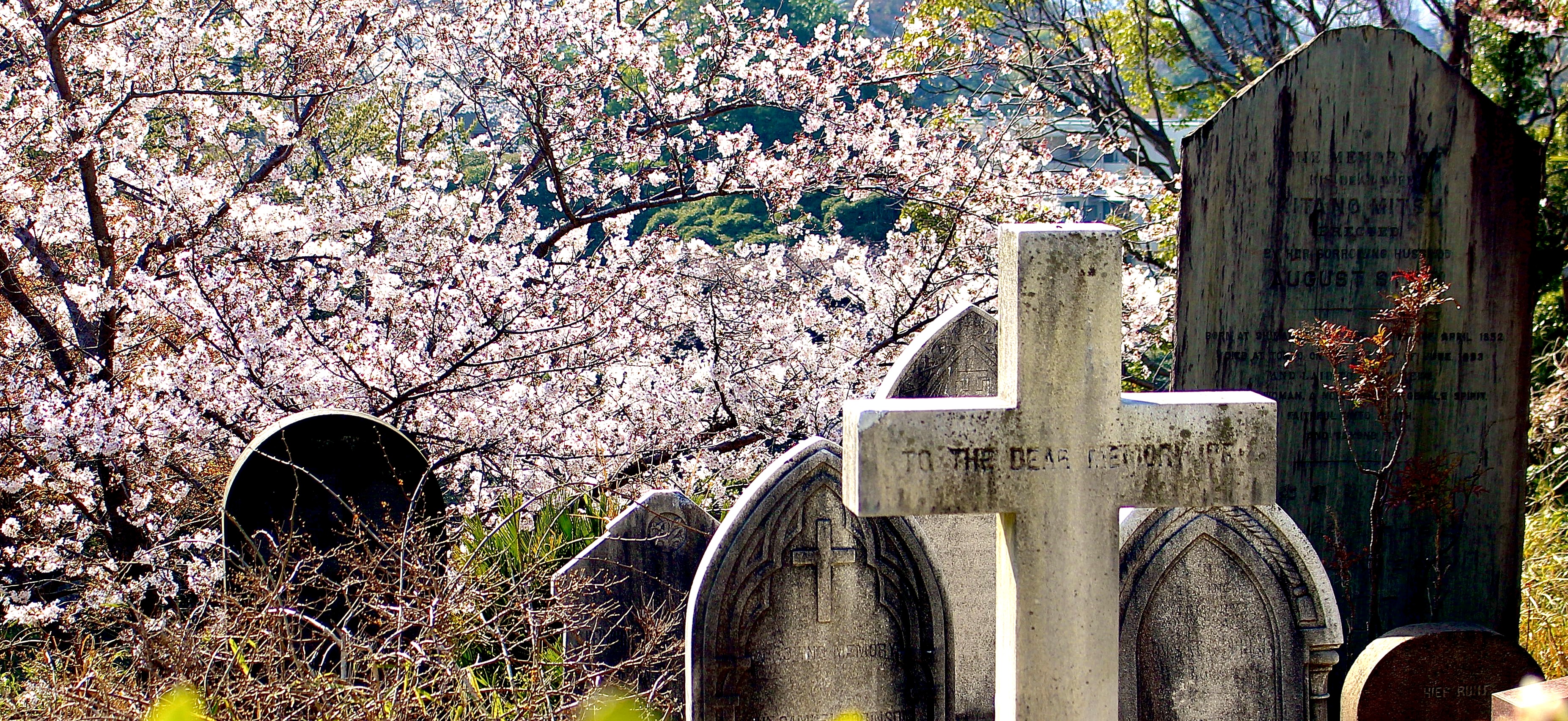
Each Memorial Day weekend without fail,
we gather with family, have lunch, reminisce,
and trek to a cemetery high above Puget Sound
to catch up with our relatives who lie there still.
Some for well over 100 years, some too recent,
some we knew and loved and miss every day,
others not so much, unknown to us
except on genealogy charts,
their names and dates and these stones
all that is left of them:

the red-haired great-grandmother who died too young,
the aunt who was eight with lymphoma,
the Yukon river boat captain,
the logger and stump farmer,
the unmarried teacher who bequeathed an oil well to her church,
the two in-laws who lie next to each other
but could not co-exist in the same room while they lived and breathed.

Yet we know each of these
(as we know ourselves and others)
was tender and kind, though flawed and broken,
was beautiful and strong, though wrinkled and frail,
was hopeful and faithful, though too soon in the ground.

We know this about them
as we know it about ourselves:
someday we too will feed roses,
the light in our eyes transformed into elegant swirls
emitting the fragrant scent of heaven.

No one asks if we approve.
Nor am I resigned to this but only know:
So it is, so it has been, so it will be.

AI image created for this post

“They were so young” – poem written by Garrison Keillor

One-Time
Monthly
Yearly

Make a one-time or recurring donation to support daily Barnstorming posts

Make a monthly donation

Make a yearly donation

Choose an amount

$10.00
$25.00
$50.00
$5.00
$15.00
$100.00
$5.00
$15.00
$100.00

Or enter a custom amount

$

Your contribution is deeply appreciated.

Your contribution is appreciated.

Your contribution is appreciated.

DonateDonate monthlyDonate yearly
Dreaming of Home

In great deeds, something abides. 
On great fields, something stays. 
Forms change and pass; bodies disappear; 
but spirits linger, to consecrate ground for the vision-place of souls. 
And reverent men and women from afar, 
and generations that know us not and that we know not of, 
heart-drawn to see where and by whom great things were suffered and done for them, shall come to this deathless field, 
to ponder and dream; and lo!

the shadow of a mighty presence shall wrap them in its bosom, 
and the power of the vision pass into their souls. 
This is the great reward of service. 
To live, far out and on, in the life of others;
this is the mystery of the Christ,

–to give life’s best for such high sake
that it shall be found again unto life eternal.

~Major-General Joshua Chamberlain, Gettysburg, Pennsylvania 1889

The sunlight now lay over the valley perfectly still.
I went over to the graveyard beside the church
and found them under the old cedars…
I am finding it a little hard to say that I felt them resting there, but I did…

I saw that, for me, this country would always be populated
with presences and absences,
presences of absences,
the living and the dead.
The world as it is

would always be a reminder
of the world that was,
and of the world that is to come.
~Wendell Berry in Jayber Crow

A box of over 700 letters, exchanged between my parents from late 1941 to mid-1945, sat unopened for decades until last year. I started reading.

My parents barely knew each other before marrying quickly on Christmas Eve 1942 – the haste due to the uncertain future for a newly trained Second Lieutenant in the Marine Corps. They only had a few weeks together before she returned home to her rural teaching position and he readied himself to be shipped out for the island battles to come.

They had no idea they would not see each other for another 30+ months or even see each other again at all. They had no idea their marriage would fall apart 35 years later and they would reunite a decade after the divorce for five more years together.

The letters do contain the long-gone but still-familiar voices of my parents, but they are the words and worries of youngsters of 20 and 21, barely prepared for the horrors to come from war and interminable waiting. When he was fighting battles on Tarawa, Saipan, and Tinian, no letters or news would be received for a month or more, otherwise they tried to write each other daily, though with minimal news to share due to military censorship. They speak mostly of their desire for a normal life together rather than a routine centered on mailbox, pen and paper and waiting, lots and lots of waiting.

I’m not sure what I hoped to find in these letters. Perhaps I hoped for flowery romantic whisperings and the poetry of longing and loneliness. Instead I am reading plain spoken words from two people who desperately wanted to have a home together. They somehow made it through those awful years to make my sister and brother and myself possible.

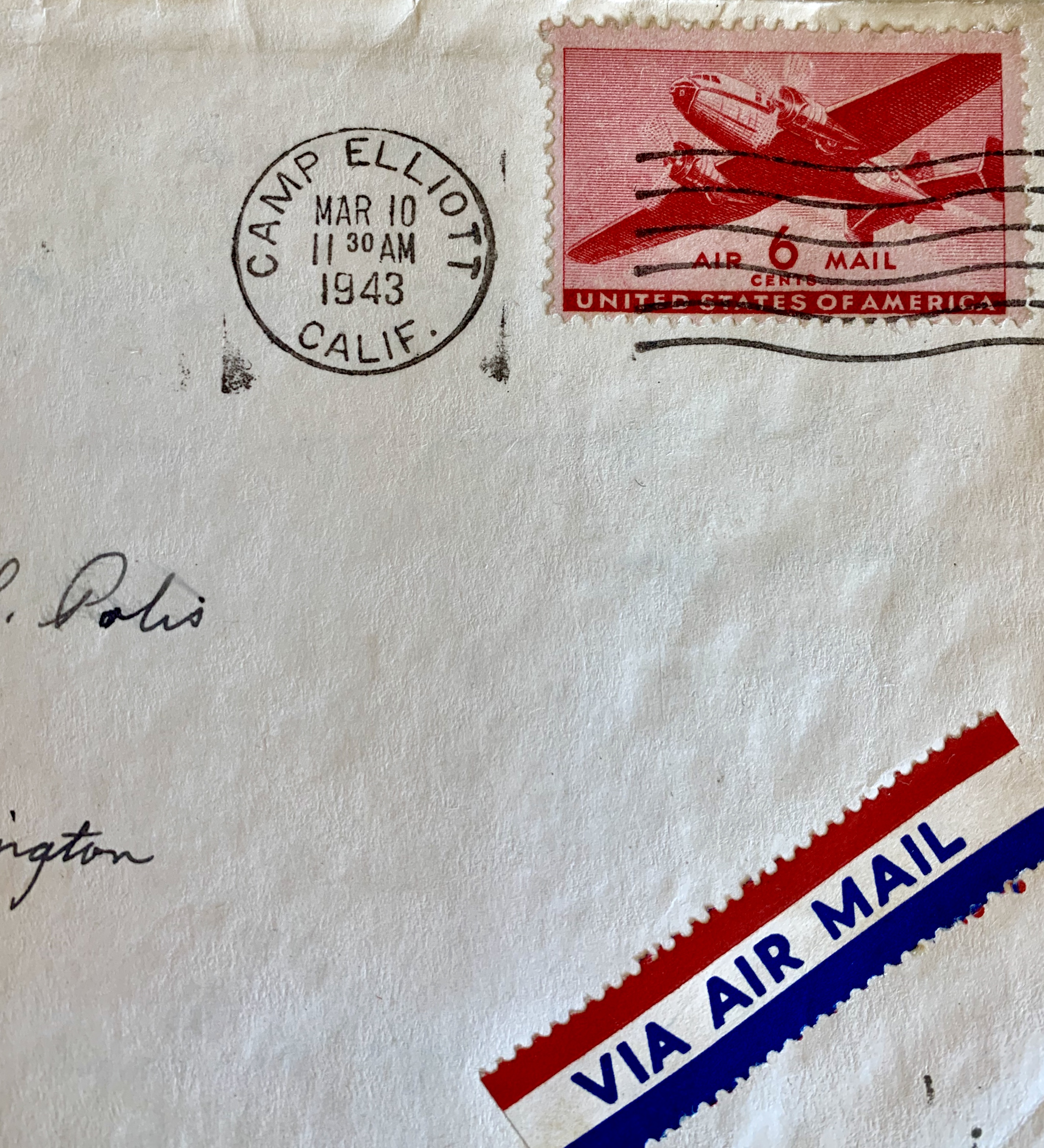
Our inheritance is contained in this musty box of words bereft of poetry. But decades later my heart is moved by these letters – I carefully refold them back into their envelopes and replace them gently back in order. A six cent airmail stamp – in fact hundreds and hundreds of them – was a worthwhile investment in the future, not only for themselves and their family to come, but for generations of U.S. citizens who tend to take their freedom for granted.

Thank you, Dad and Mom, for what you gave up to make today possible.

AI image created by this post

I hear the mountain birds
The sound of rivers singing
A song I’ve often heard
It flows through me now
So clear and so loud
I stand where I am
And forever I’m dreaming of home
I feel so alone, I’m dreaming of home

It’s carried in the air
The breeze of early morning
I see the land so fair
My heart opens wide
There’s sadness inside
I stand where I am
And forever I’m dreaming of home
I feel so alone, I’m dreaming of home

This is no foreign sky
I see no foreign light
But far away am I
From some peaceful land
I’m longing to stand
A hand in my hand
…forever I’m dreaming of home
I feel so alone, I’m dreaming of home
~Lori Barth and Philippe Rombi “I’m Dreaming of Home”

One-Time
Monthly
Yearly

Make a one-time or recurring donation to support daily Barnstorming posts

Make a monthly donation

Make a yearly donation

Choose an amount

$10.00
$25.00
$50.00
$5.00
$15.00
$100.00
$5.00
$15.00
$100.00

Or enter a custom amount

$

Your contribution is deeply appreciated.

Your contribution is appreciated.

Your contribution is appreciated.

DonateDonate monthlyDonate yearly
Fearsome Things to See

Not much to me is yonder lane  
 Where I go every day;  
But when there’s been a shower of rain  
 And hedge-birds whistle gay,  
I know my lad that’s out in France
 With fearsome things to see  
Would give his eyes for just one glance  
 At our white hawthorn tree.

   .    .    .    .  

Not much to me is yonder lane  
 Where he so longs to tread:
But when there’s been a shower of rain  
I think I’ll never weep again  
 Until I’ve heard he’s dead.

~Siegfried Sassoon “The Hawthorn Tree”

I drove West
in the season between seasons.
I left behind suburban gardens.
Lawnmowers.  Small talk.

Under low skies, past splashes of coltsfoot,
I assumed
the hard shyness of Atlantic light
and the superstitious aura of hawthorn.

All I wanted then was to fill my arms with
sharp flowers,
to seem from a distance, to be part of
that ivory, downhill rush.  But I knew,

I had always known,
the custom was
not to touch hawthorn.
 Not to bring it indoors for the sake of

the luck
such constraint would forfeit–
a child might die, perhaps, or an unexplained
fever speckle heifers.  So I left it

stirring on those hills
with a fluency
only water has.  And, like water, able
to redefine land.  And free to seem to be–

for anglers,
and for travellers astray in
the unmarked lights of a May dusk–
the only language spoken in those parts.

~Eavan Boland “White Hawthorn in the West of Ireland”

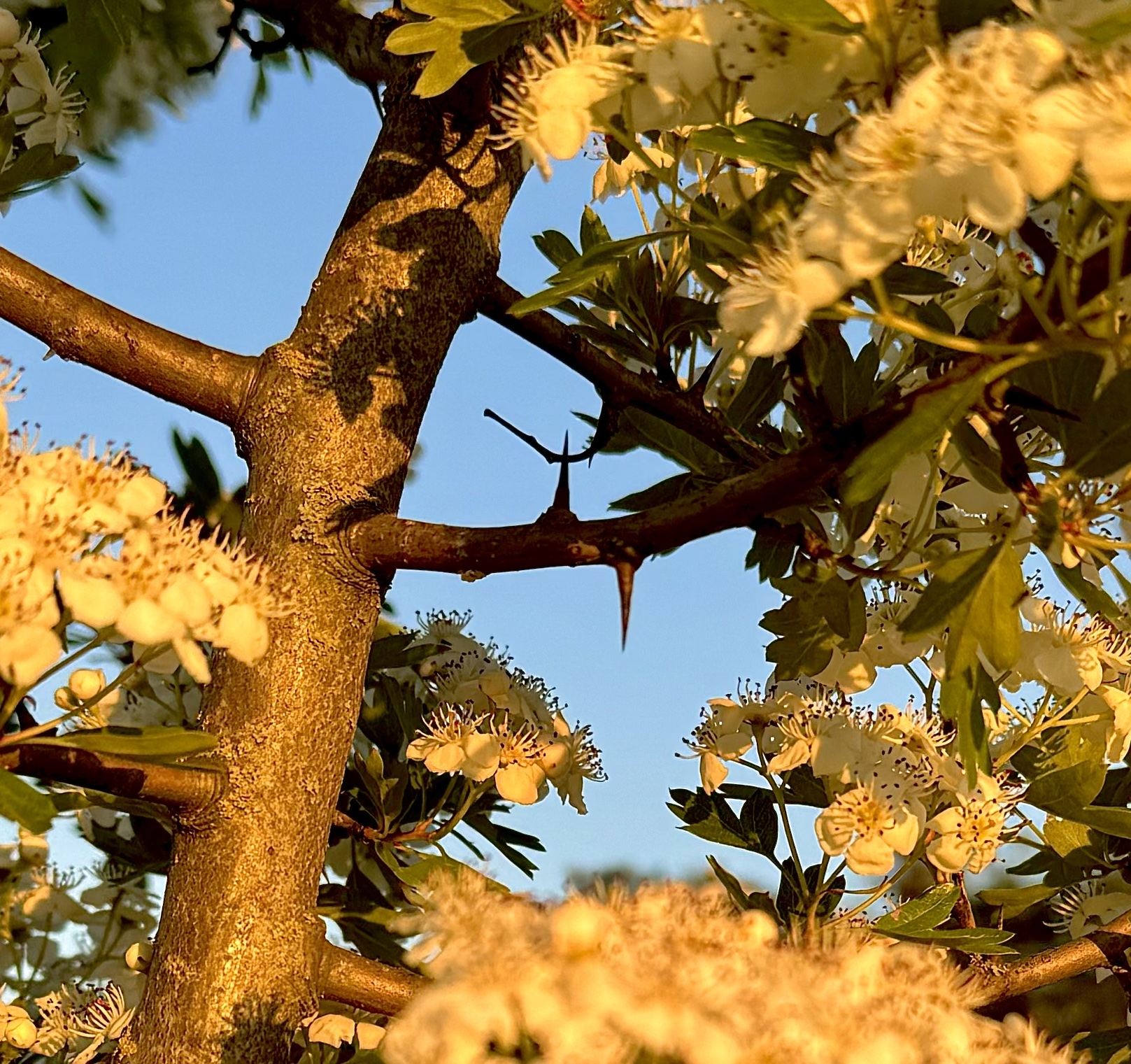
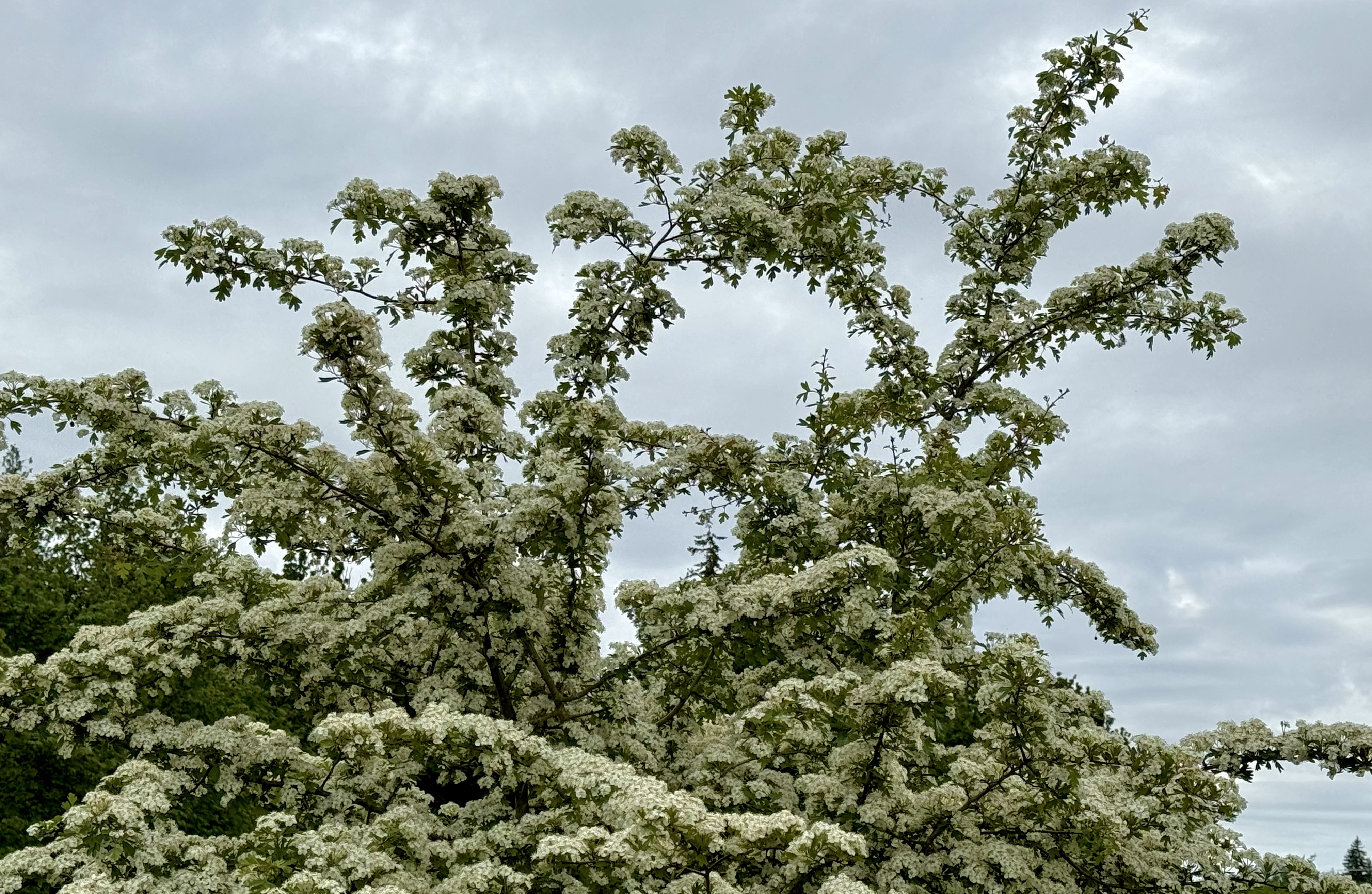
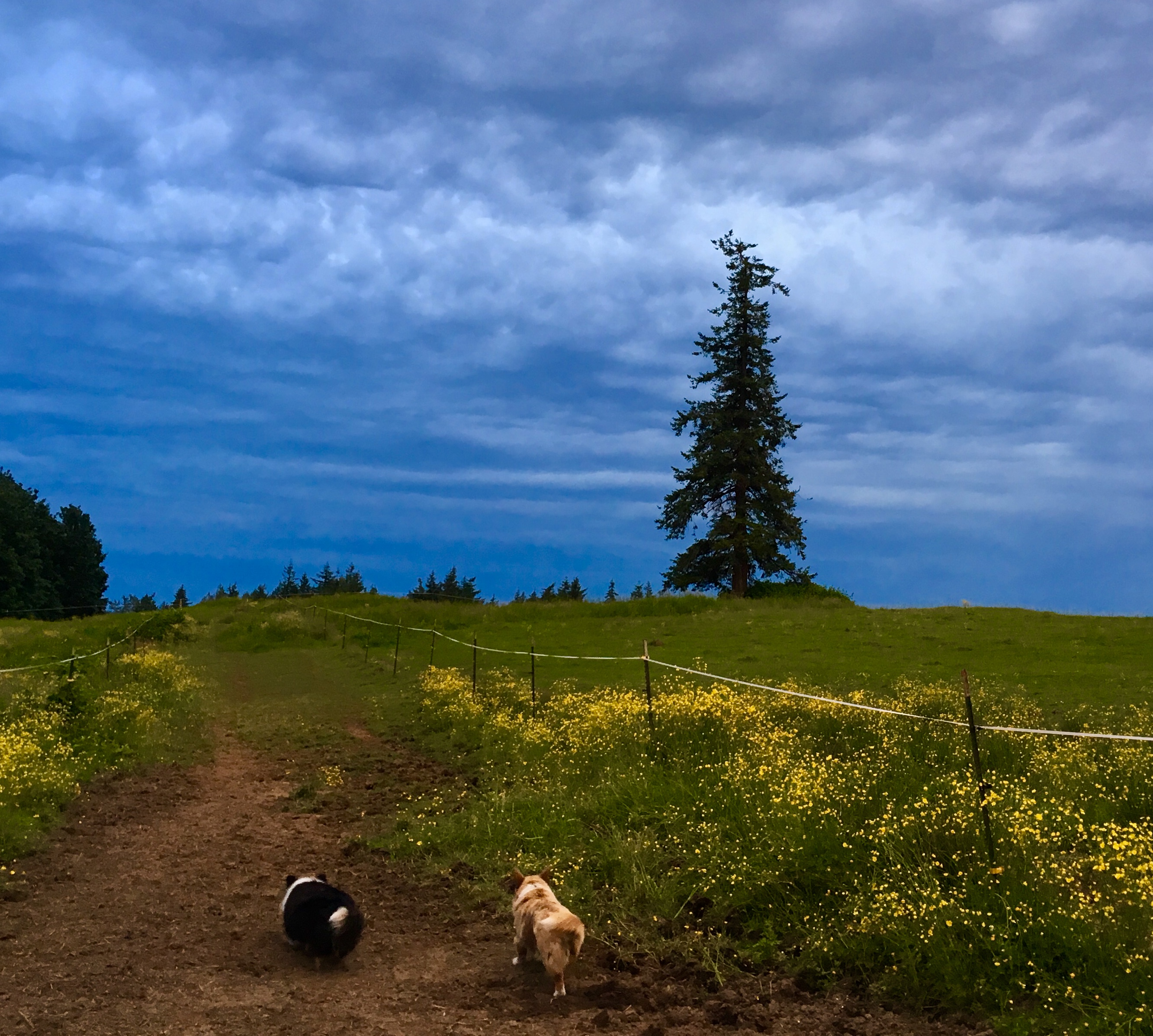
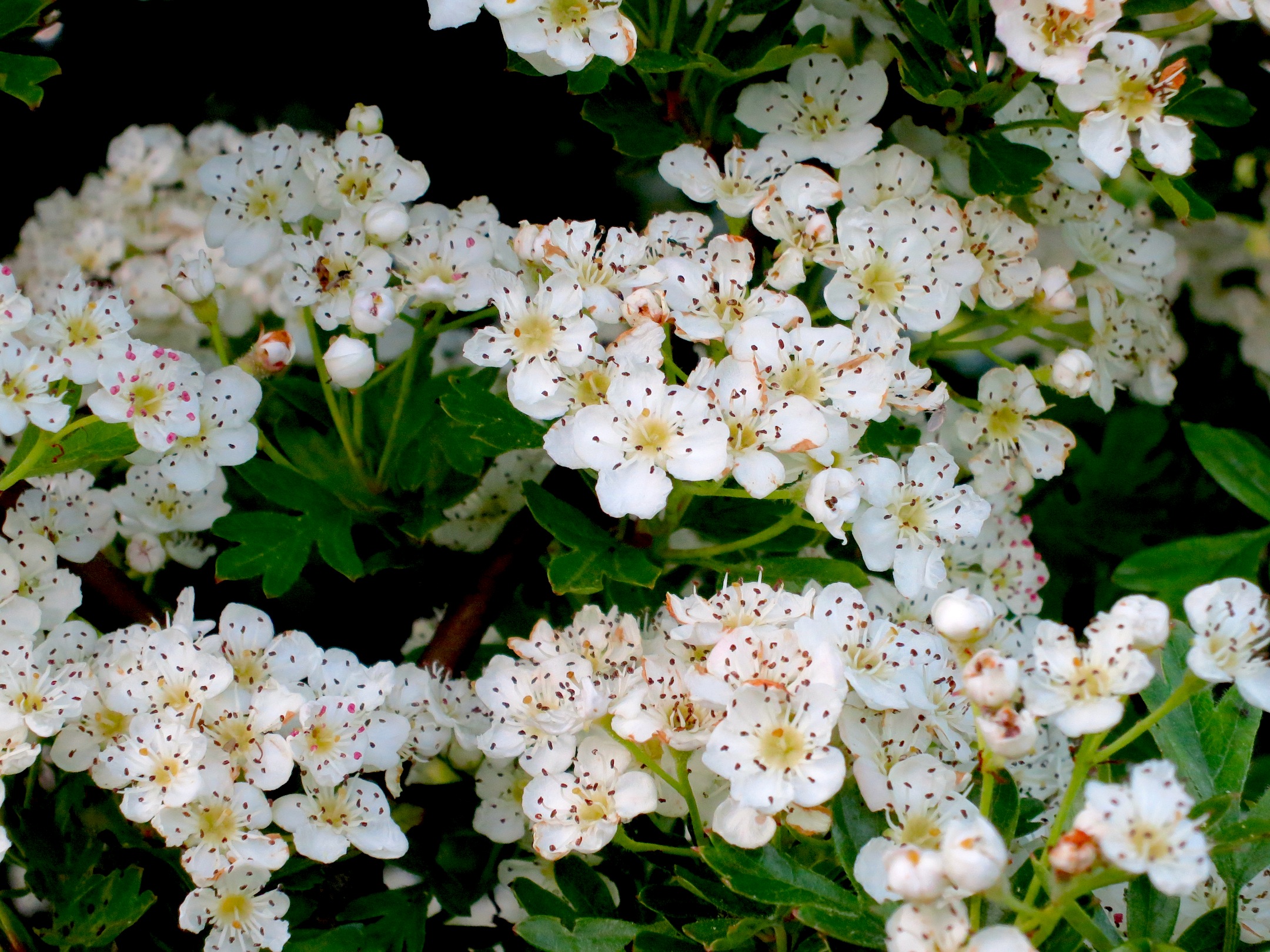
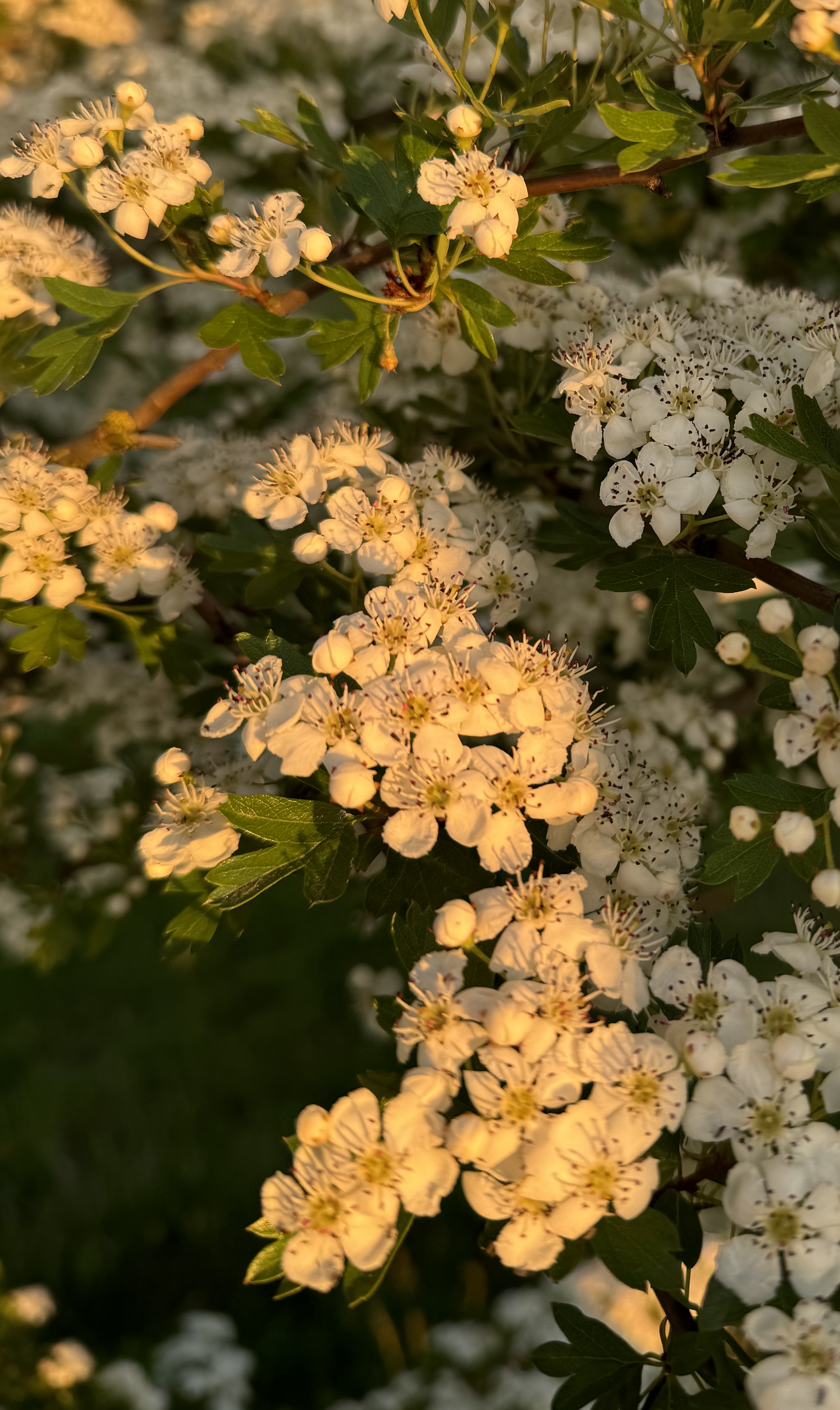
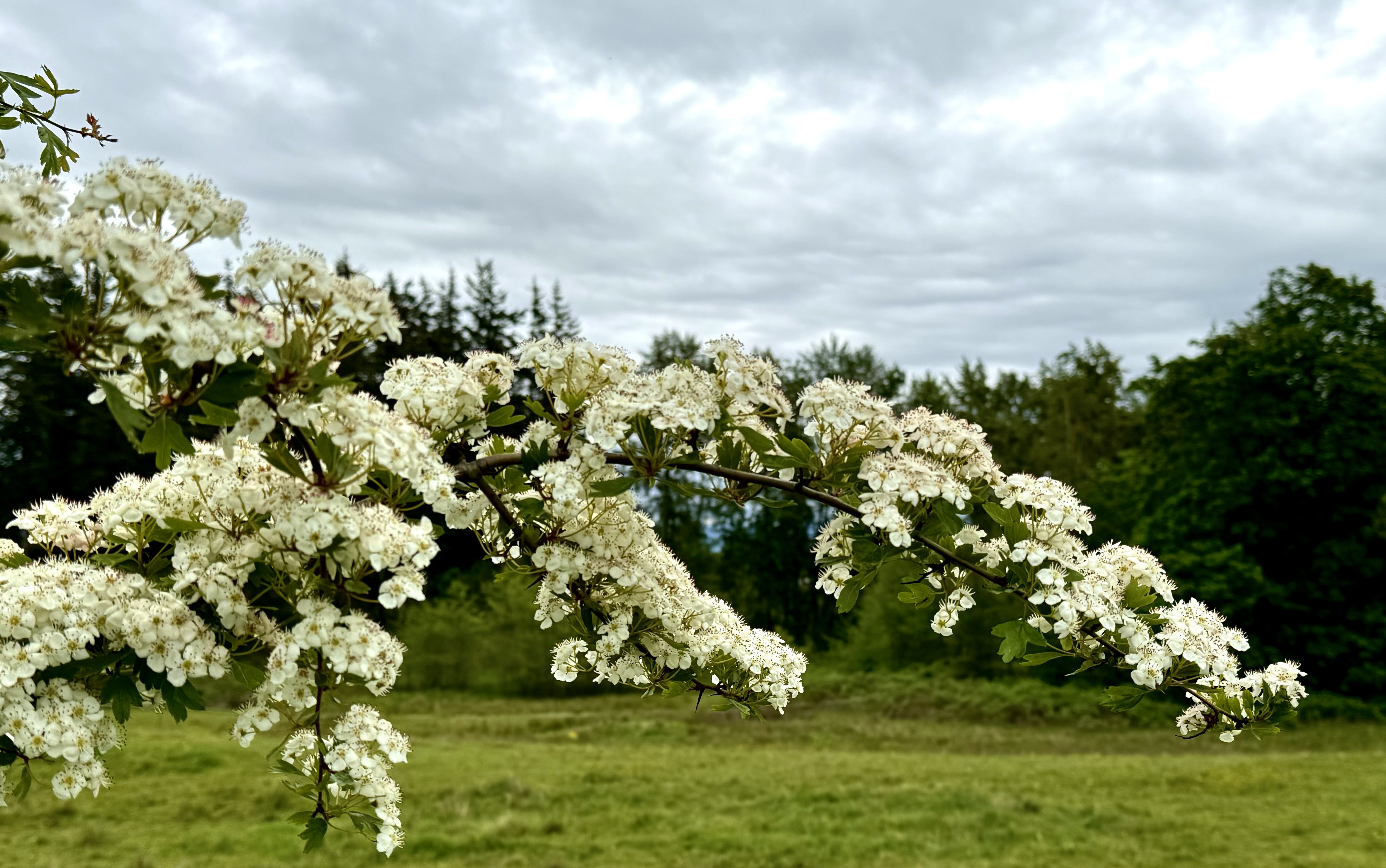
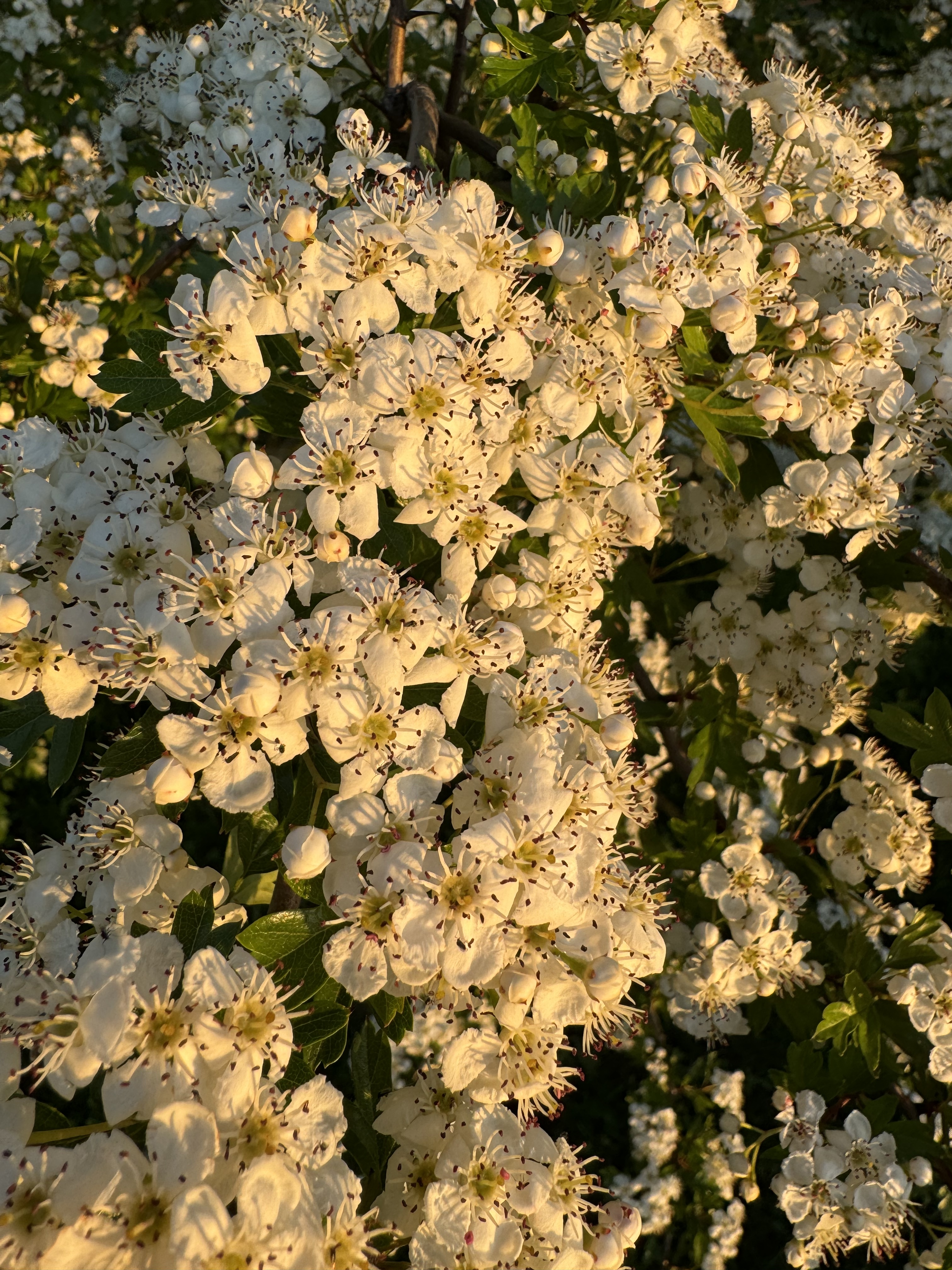
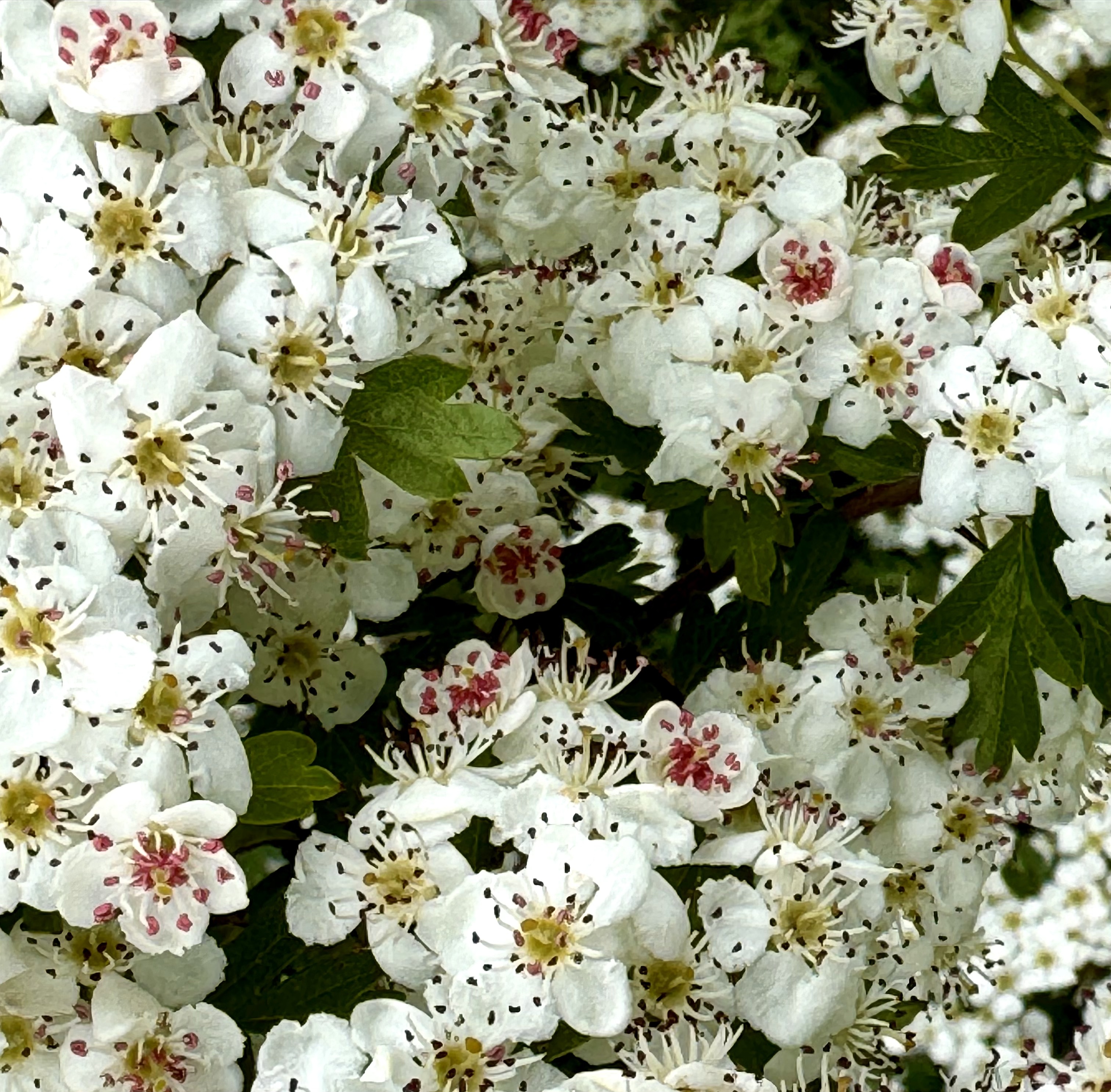
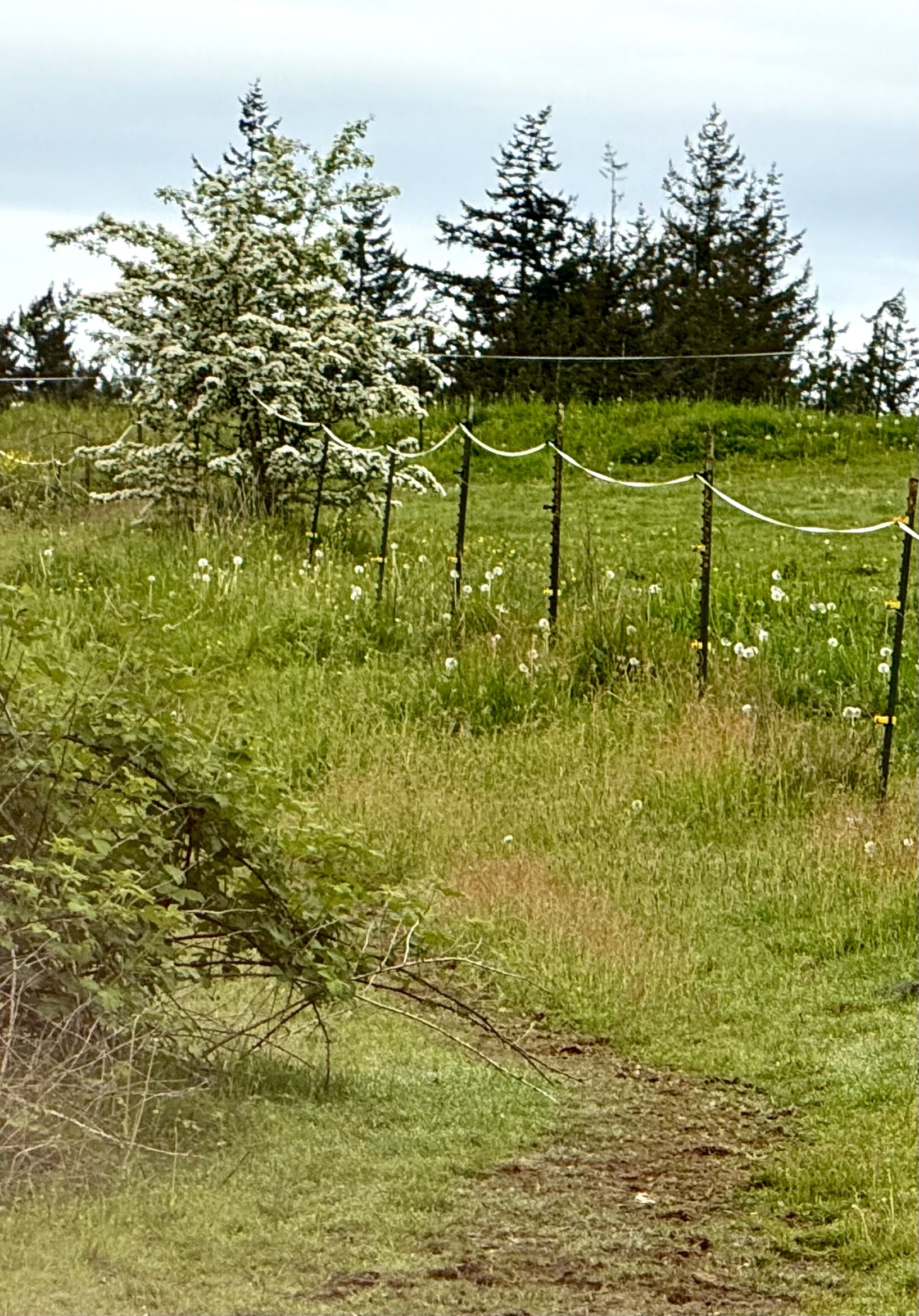
The bird-sowed hawthorn bush along the lane to our back field has suddenly become a blooming tree, staking out its place alongside the trail the horses follow to their pasture. This May, it is a white flame against the dark woods.

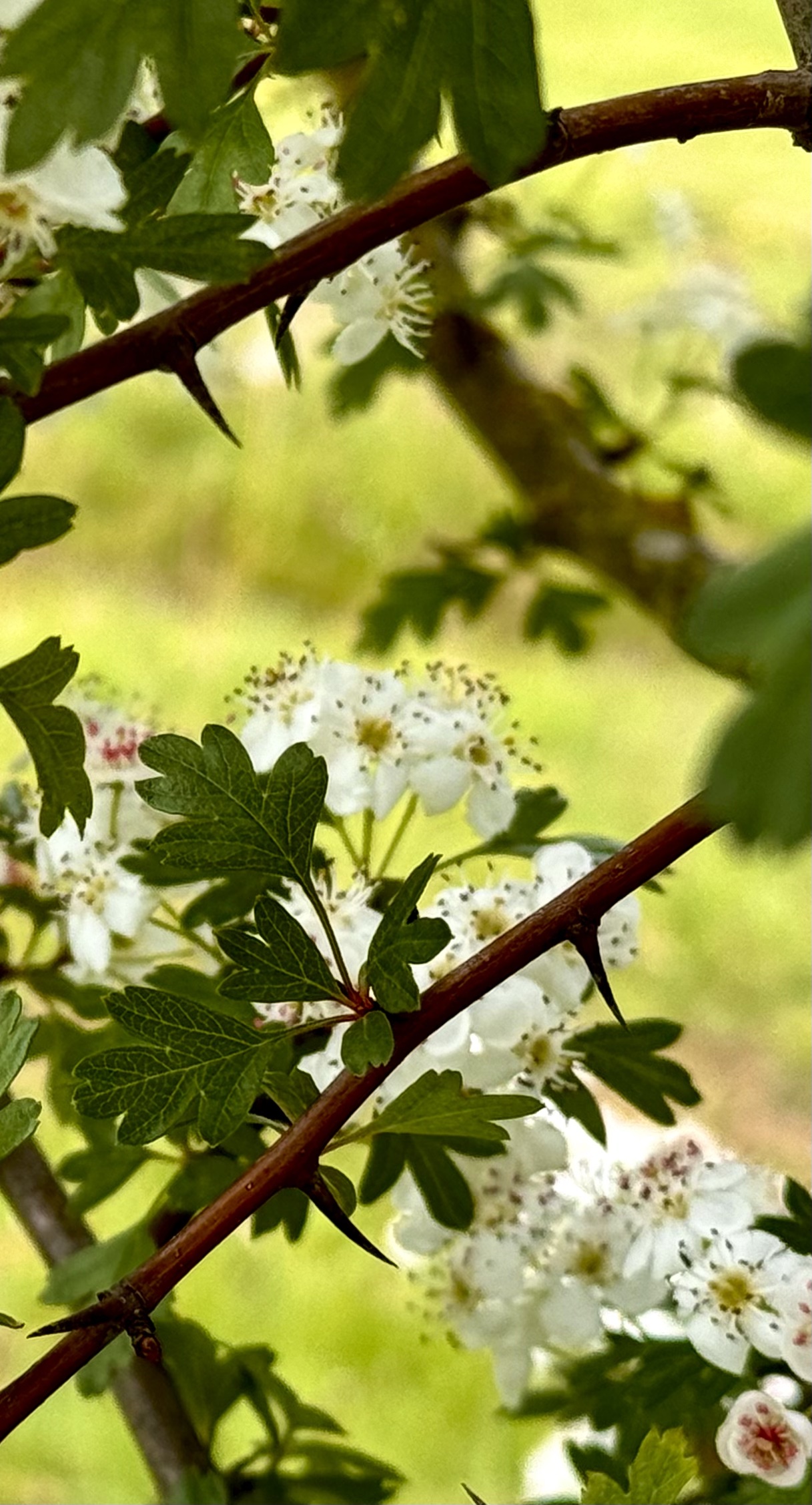
Though we didn’t intend for it to be there, we’ll leave it be. Hawthorns are great bird habitat and a haven for honeybees. They are found in most hedge rows in the United Kingdom, impenetrable due to their fierce thorns and criss-cross network of branches, a historic symbol of the toughness and persistence of the Celtic people. Though we don’t need a hedge row here, I appreciate the tree’s reminder it has a place in myth and lore.

It will never be a hospitable tree like the lone fir tree that graces our hill, or the big leaf maple where children climb, or the black walnut whose branches support the treehouse. But it will be a white beacon every May, portending the summer to come, and if it bears fruit, it will feed the birds that nest in its interior.

And like the poem written by WWI soldier/poet Sassoon, it will be a bittersweet reminder of the familiar comfort of home, even though sharp thorns abound among the blossoms. Those thorns are nothing compared to the despair found in the fearsome trenches of warfare.

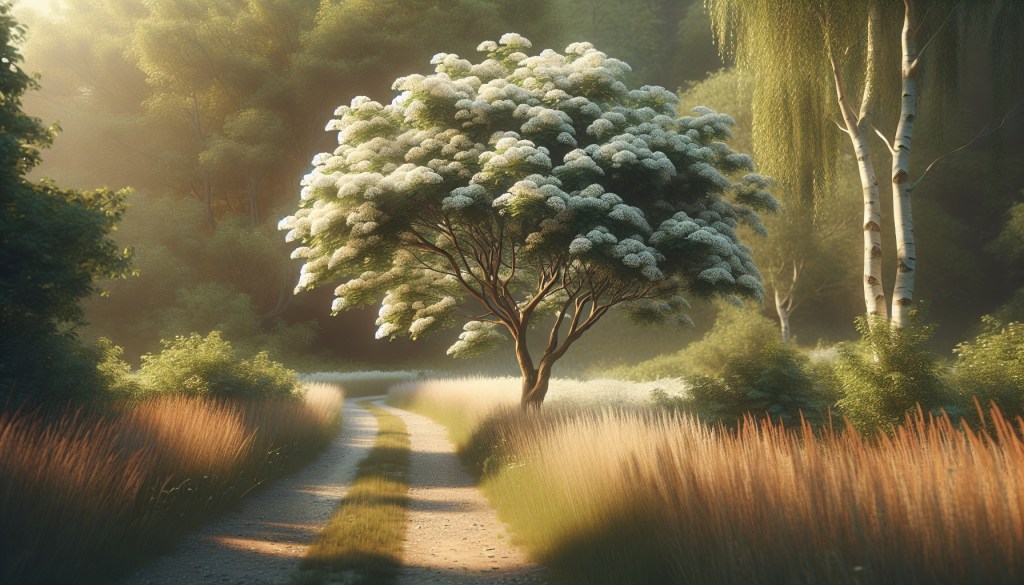
AI image created for this post
Siegfried Sassoon’s handwritten poem

along fair Arran’s shores
the swans sing soft of tale of yore,
of a young love taken to sea

the two were hand in glove
like sparrows bound in sacred love
a tune that only they can sing

a tree of unity
they planted by the green eyed sea
the branch would hold their love through time

a sailor lad was he
he said,”dont cry my lovely, mhari
before the moon is full i’ll return”

I’ll wait for thee and she sang to him

the moon shone full and bright
and home he sailed mid-summers night
the tree so young and blossoming

they slept among the green
the world was light and dreams serene
the fires in their hearts burned bright

Where moss-grown boulders stand,
he took her by the lily hand
and there they wed at break of day

the seas know not of hearts
and once again the two must part.
“it wont be long, i swear to thee.

please wait for me.”
and she sang to him

The hawthorn tree has grown,
10 years she walked shores alone,
she hears his whisper in the leaves

Home is the sailor lad,
home in the sea, forever plaid,
Under the wide and starry sky

Yes, I will wait for thee,
By mountain, sea and tree;
And on the wind you’ll hear my love,

for at the fall of day
Beneath the leaves where once we lay
I’ll sit and sing i’ll wait for thee

come back to me….
music and lyrics by Fae Wiedenhoeft

One-Time
Monthly
Yearly

Make a one-time or recurring donation to support daily Barnstorming posts

Make a monthly donation

Make a yearly donation

Choose an amount

$10.00
$25.00
$50.00
$5.00
$15.00
$100.00
$5.00
$15.00
$100.00

Or enter a custom amount

$

Your contribution is deeply appreciated.

Your contribution is appreciated.

Your contribution is appreciated.

DonateDonate monthlyDonate yearly
And Through Eternity: Facing the Storm

A front of thunderstorms had sought you out.
It vowed to run a diabolical
black line through all that you were sure about—
the ordinary, sane, the sensible.
You raced to get the loose stuff off the lawn,
with purpose rearranged and stacked the chairs,
relieved, almost, when the phenomenon
of gray-green storm clouds simplified your cares.
And though it couldn’t miss, it kind of did.
Darkness at noon gave way to sun at one.
Catastrophe and doom had been short-lived.
Embarrassed that your fears were overblown,
you faced your mundane day-to-day concerns,
vaguely upset that normalcy returns.

~Robert Crawford “Squall”

Beneath our clothes, our reputations, our pretensions,
beneath our religion or lack of it,
we are all vulnerable both to the storm without
and to the storm within.
~Frederick Buechner – from Telling the Truth

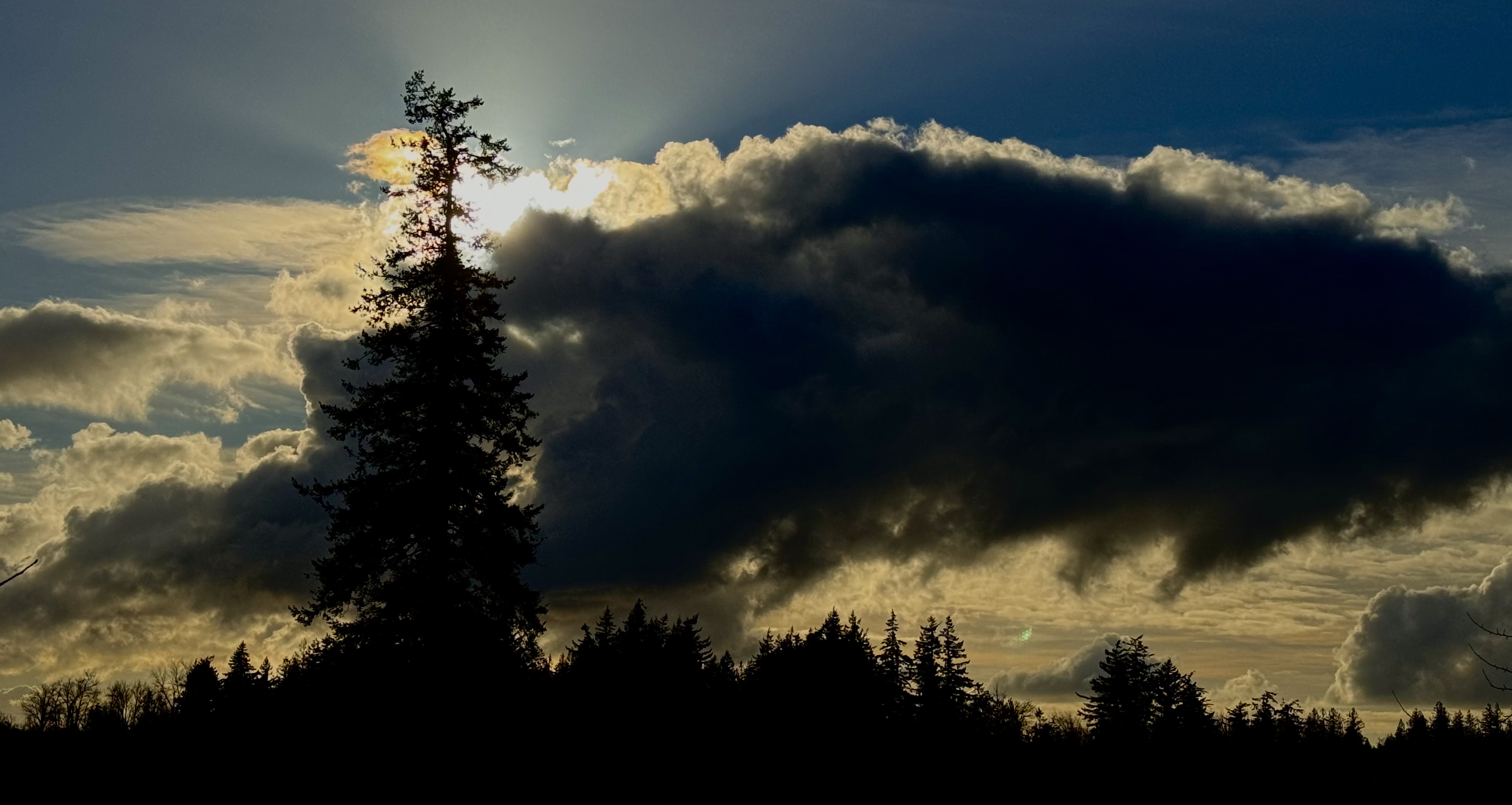
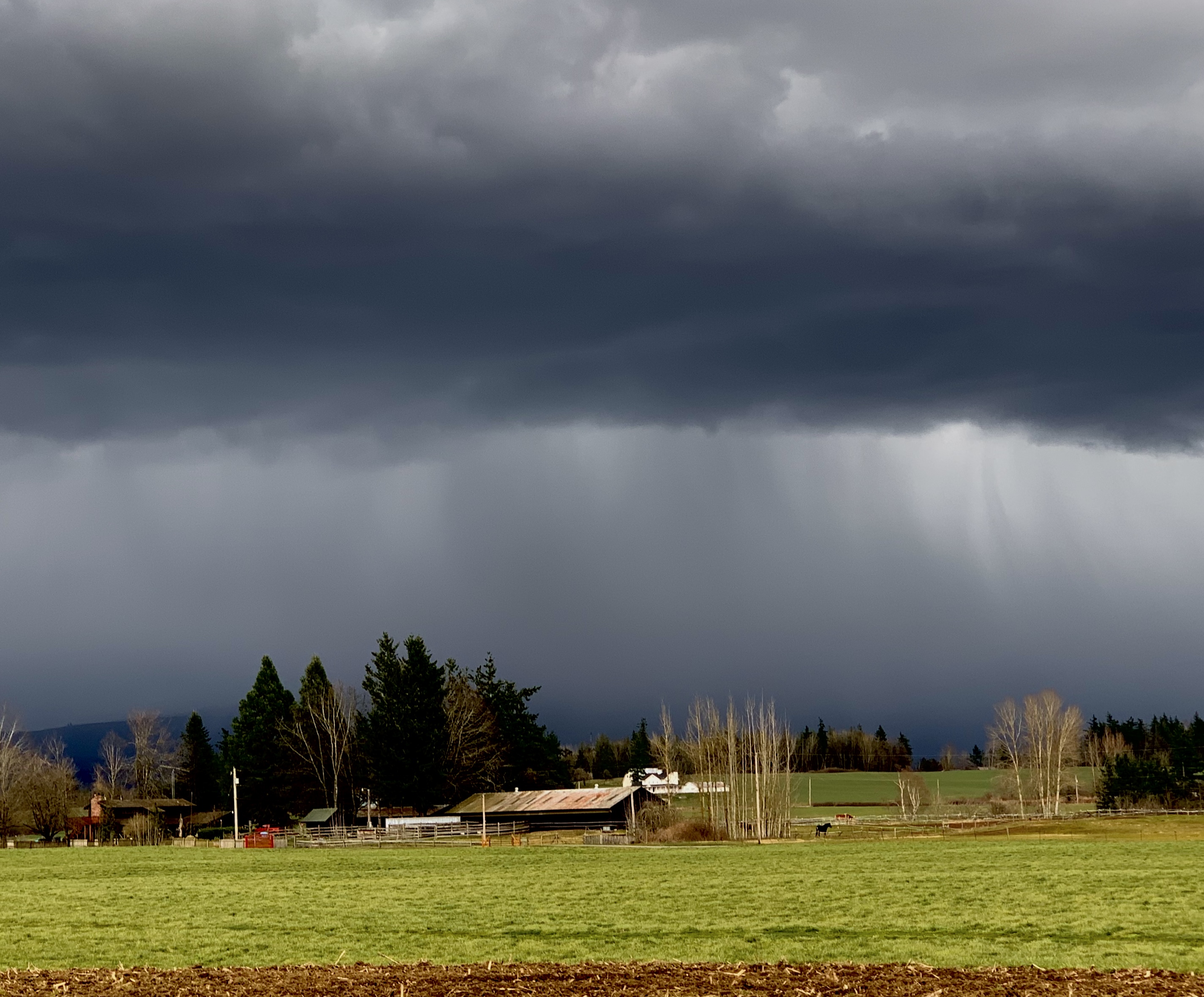
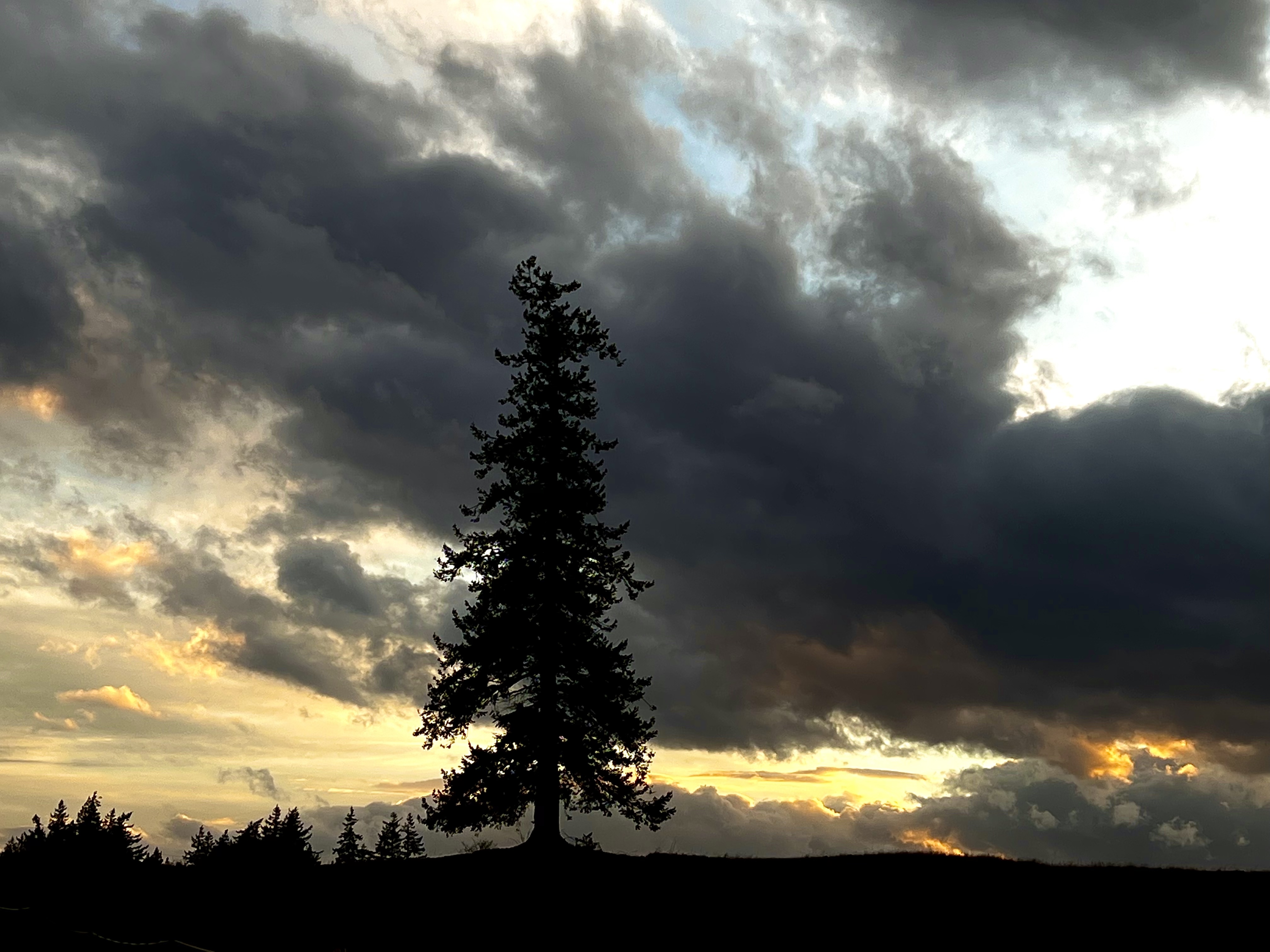
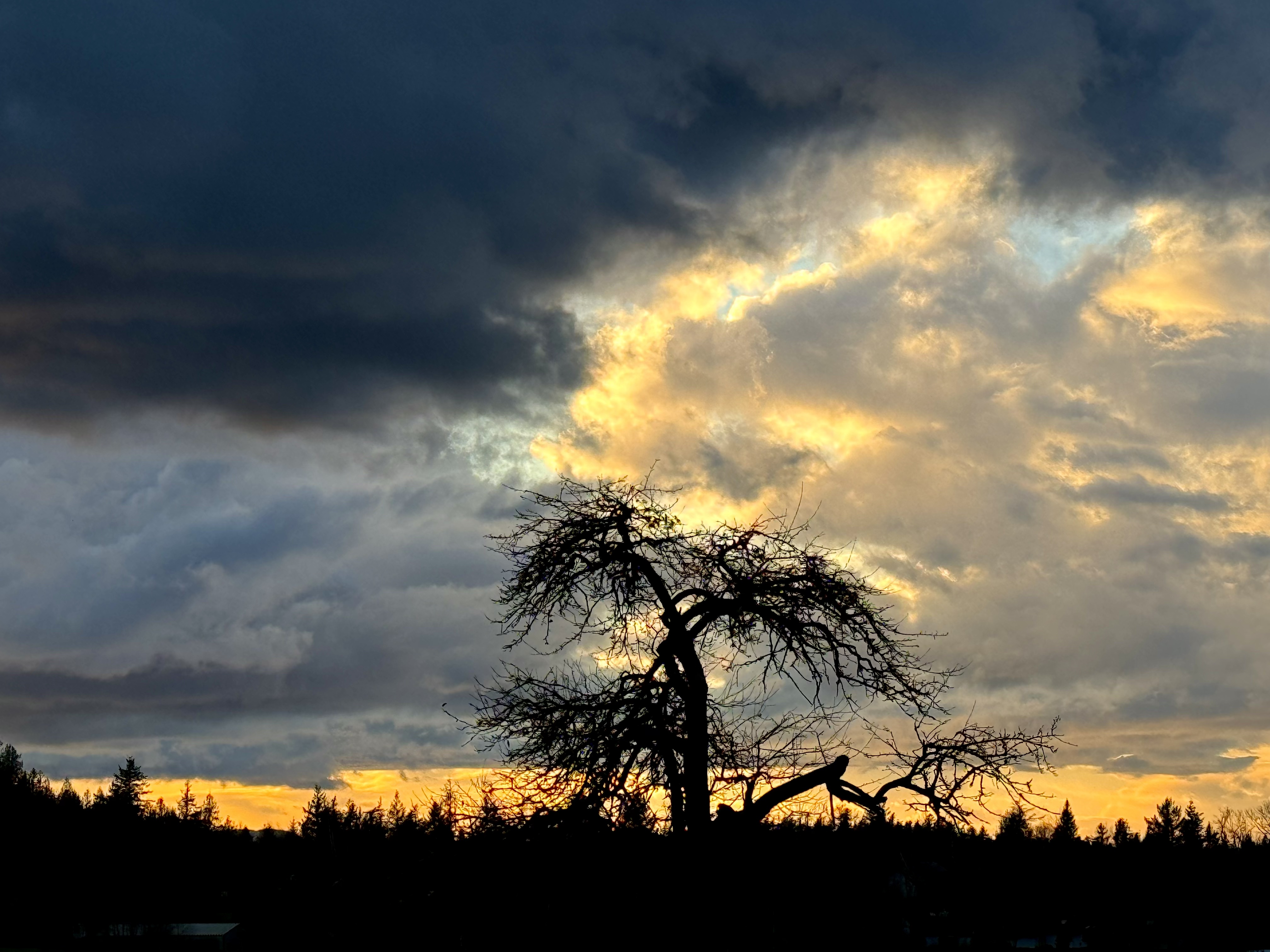
I watch the storm fronts roll in, threatening my outside and inside: heavy damaging winds, thunder and lightning, torrential unpredictable rains, mudslides, horrible forest fires destroying what is familiar and routine.

Inside my own head, the storm clouds of news headlines overpower day-to-day mundane concerns: devastating wars and violence, crime and protests, homelessness, rampant starvation and disease, man’s ongoing inhumanity to man.

I want to hide under a rock until the storms inside and outside blow over.

In the midst of the tempest — while wars rage on the planet, while a bitter election season is underway — a miracle may be wrought.
Brilliant light exposes how heaven weeps from heavy clouds. A rainbow touches the earth in holy promise.

God assures His people: this storm too will pass, even the storms of our own making. Darkness is overcome by Light.

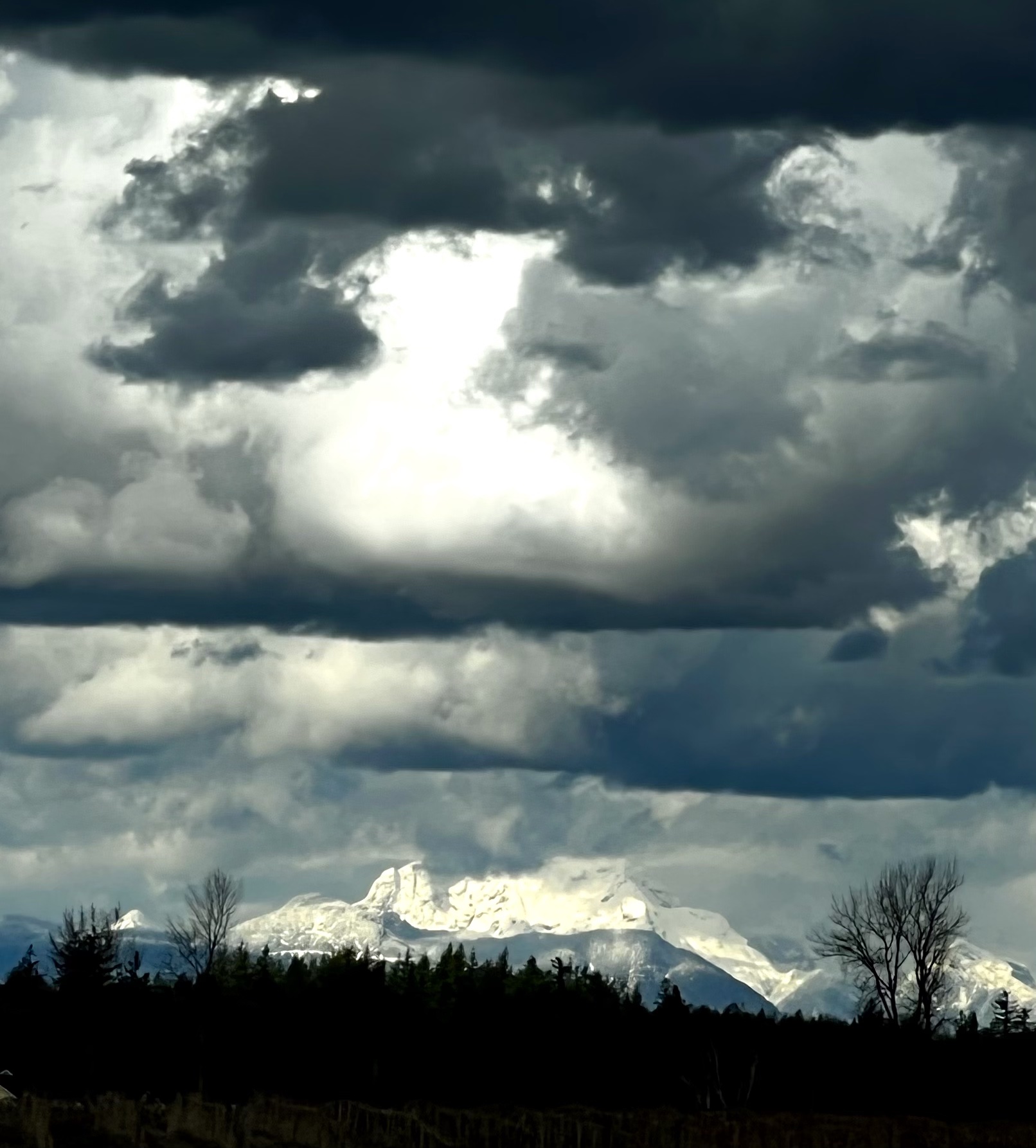
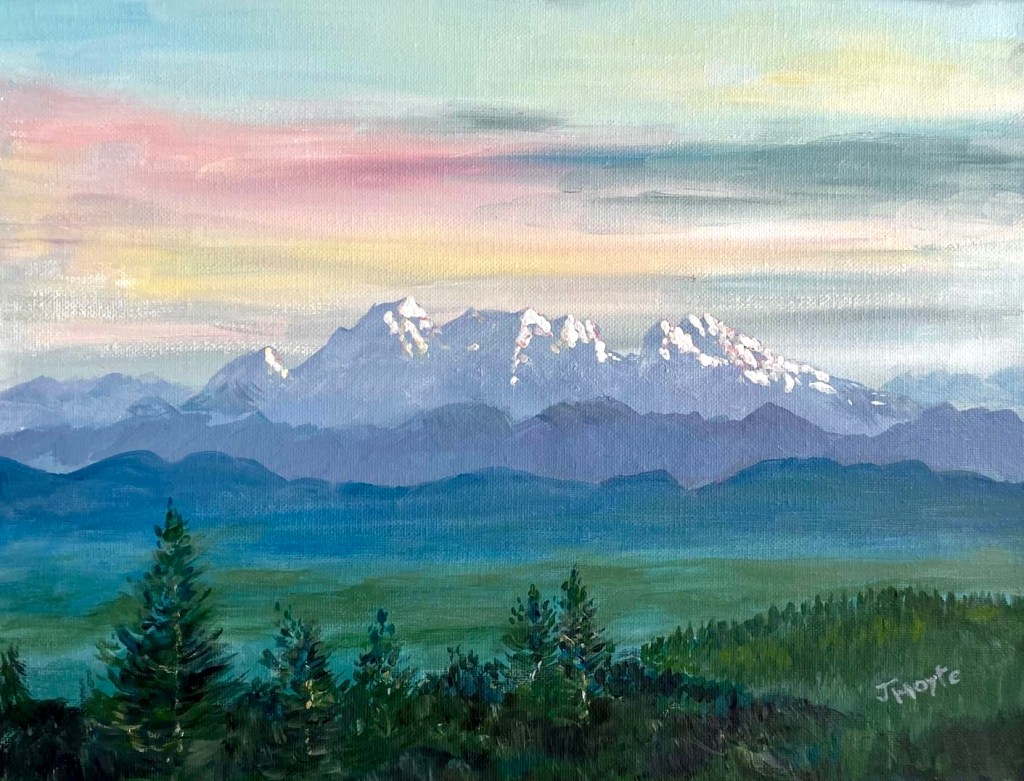
Painting of snowy Cascades by John Hoyte

He stilled the storm to a whisper;
    the waves of the sea were hushed.
They were glad when it grew calm,
    and he guided them to their desired haven.
Psalm 107:29-30

This Lenten season I reflect on the words of the 19th century southern spiritual hymn “What Wondrous Love is This”

One-Time
Monthly
Yearly

Make a one-time or recurring donation to support daily Barnstorming posts

Make a monthly donation

Make a yearly donation

Choose an amount

$10.00
$25.00
$50.00
$5.00
$15.00
$100.00
$5.00
$15.00
$100.00

Or enter a custom amount

$

Your contribution is deeply appreciated.

Your contribution is appreciated.

Your contribution is appreciated.

DonateDonate monthlyDonate yearly
The Bitterness and Waste of War

When you go home tell them of us and say –
“For your tomorrow we gave our today”
~John Maxwell Edmonds from “The Kohima Epitaph” 

They shall grow not old, as we that are left grow old:
Age shall not weary them, nor the years condemn.
At the going down of the sun and in the morning
We will remember them.
~Lawrence Binyon from “For the Fallen” (1914)

We are the Dead. Short days ago
We lived, felt dawn, saw sunset glow,
Loved and were loved, and now we lie
In Flanders fields.
~LtCol (Dr.) John McCrae from “In Flanders Fields”

November pierces with its bleak remembrance
Of all the bitterness and waste of war.
Our silence tries but fails to make a semblance
Of that lost peace they thought worth fighting for.
Our silence seethes instead with wraiths and whispers,
And all the restless rumour of new wars,
The shells are falling all around our vespers,
No moment is unscarred, there is no pause,
In every instant bloodied innocence
Falls to the weary earth ,and whilst we stand
Quiescence ends again in acquiescence,
And Abel’s blood still cries in every land
One silence only might redeem that blood
Only the silence of a dying God.
~Malcolm Guite “Silence: a Sonnet for Remembrance Day”

To our military veterans here and abroad –
in deep appreciation and gratitude–
for the freedoms you have defended on behalf of us all:

No one is left untouched and unscarred in the bitterness of war.

My father was one of the fortunate ones who came home, returning to a quiet farm life after three years serving in the Pacific with the Marines Corp from 1942 to 1945.  Hundreds of thousands of his colleagues didn’t come home, dying on beaches and battlefields.  Tens of thousands more came home forever marked, through physical or psychological injury, by the experience of war and witness of death and mayhem all around them.

No matter how one views wars our nation has fought and may be obligated to fight in the future, we must support and care for the men and women who have made, on our behalf, the commitment and sacrifice to be on the front line for freedom’s sake.

Even our God died so we could stop fighting each other (and Him). What a waste we have not stopped to listen and understand His sacrifice enough to finally lay down our weapons against one another forever.

Support for wounded veterans:

Disabled American Veterans

Disabled Veterans National Foundation

Wounded Warrior Project

There Will Always Be Thistle

Against the rubber tongues of cows and the hoeing hands of men
Thistles spike the summer air
And crackle open under a blue-black pressure.

Every one a revengeful burst
Of resurrection, a grasped fistful
Of splintered weapons and Icelandic frost thrust up

From the underground stain of a decayed Viking.
They are like pale hair and the gutturals of dialects.
Every one manages a plume of blood.

Then they grow grey, like men.
Mown down, it is a feud. Their sons appear,
Stiff with weapons, fighting back over the same ground.

~Ted Hughes “Thistles”

Sheep will not eat it
nor horses nor cattle
unless they are starving.
Unchecked, it will sprawl over
pasture and meadow
choking the sweet grass
defeating the clover
until you are driven
to take arms against it
but if unthinking
you grasp it barehanded
you will need tweezers
to pick out the stickers.

Outlawed in most Northern
states of the Union
still it jumps borders.
Its taproot runs deeper
than underground rivers
and once it’s been severed
by breadknife or shovel
—two popular methods
employed by the desperate—
the bits that remain will
spring up like dragons’ teeth
a field full of soldiers
their spines at the ready.

Bright little bursts of
chrome yellow explode from
the thistle in autumn
when goldfinches gorge on
the seeds of its flower.
The ones left uneaten
dry up and pop open
and parachutes carry
their procreant power
to disparate venues
in each hemisphere
which is why there will always
be thistle next year.

~Maxine Kumin “Why There Will Always Be Thistle Next Year” from The Long Marriage

This upstart thistle
Is young and touchy; it is
All barb and bristle,

Threatening to wield
Its green, jagged armament
Against the whole field.

Butterflies will dare
Nonetheless to lay their eggs
In that angle where

The leaf meets the stem,
So that ants or browsing cows
Cannot trouble them.

Summer will grow old
As will the thistle, letting
A clenched bloom unfold

To which the small hum
Of bee wings and the flash of
Goldfinch wings will come,

Till its purple crown
Blanches, and the breezes strew
The whole field with down.
~Richard Wilbur “A Pasture Poem” from Anterooms

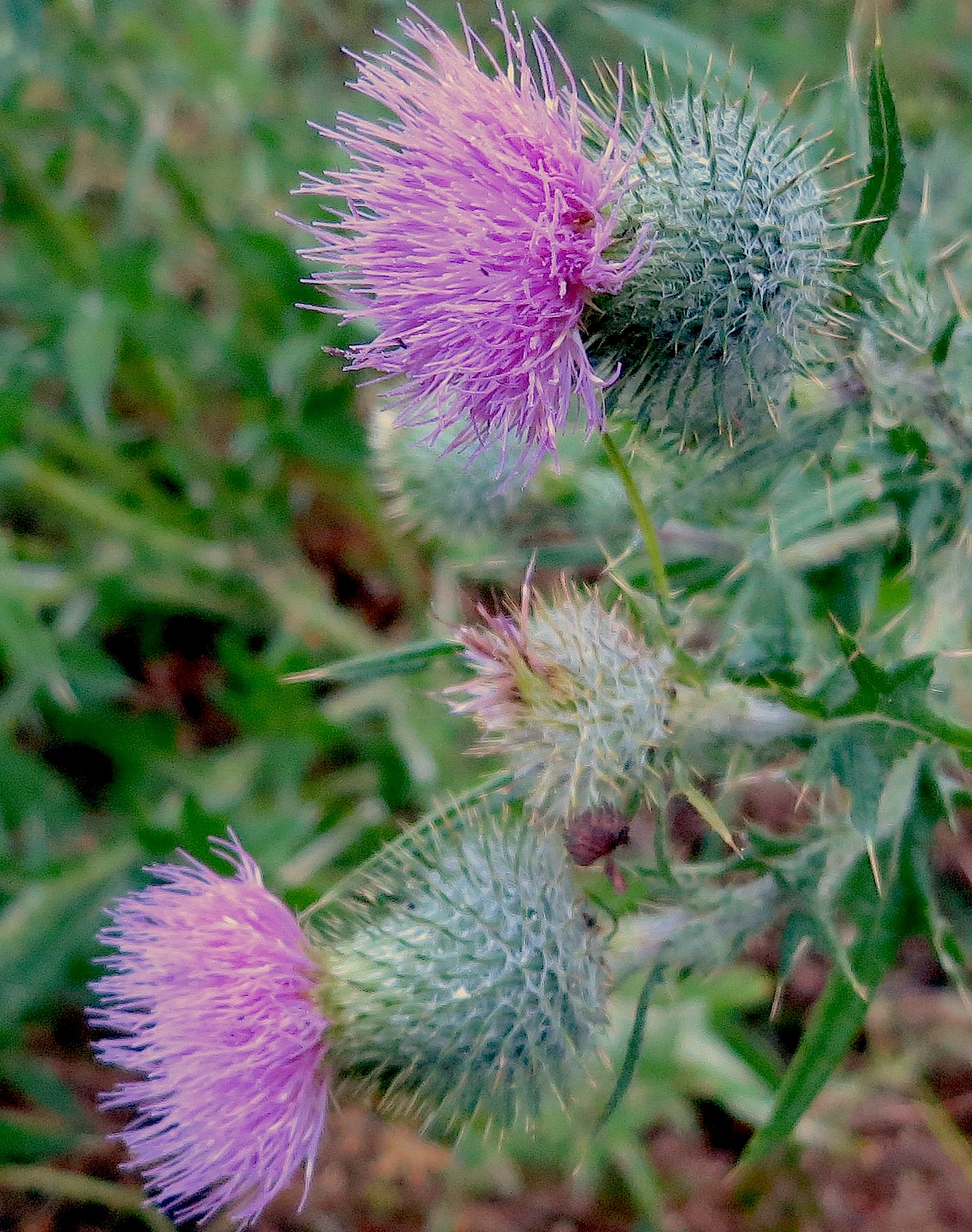
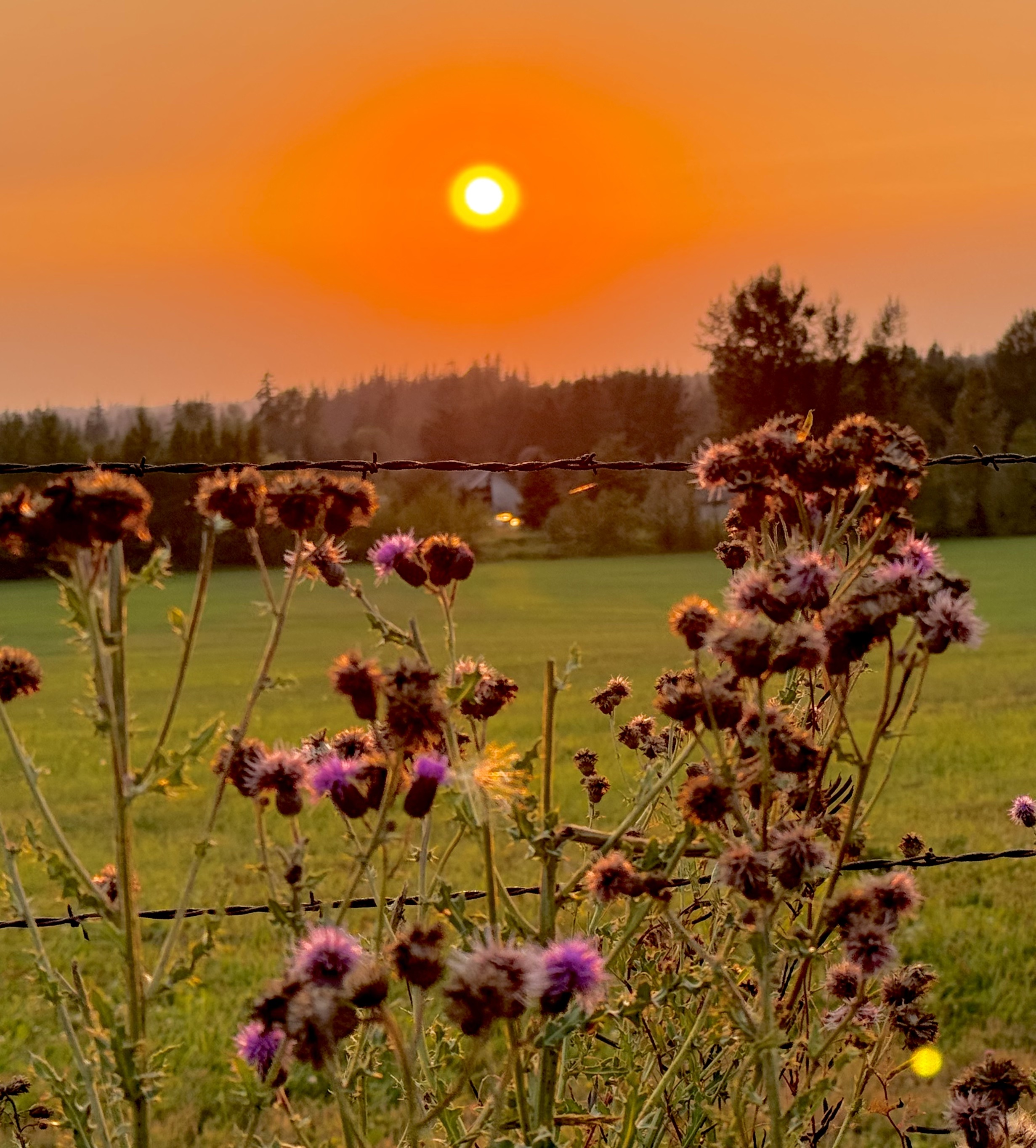
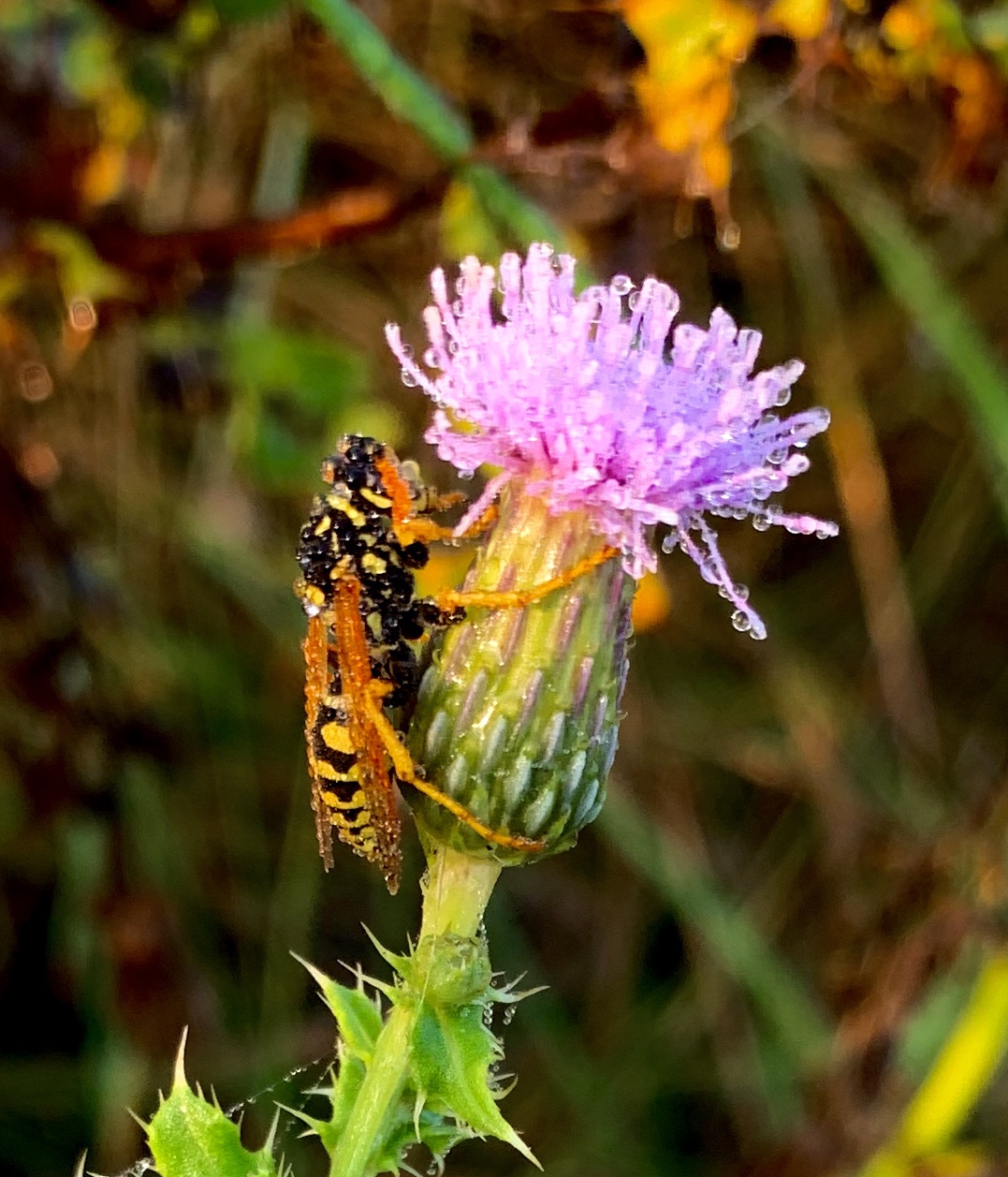
Like the thistle that dots our pastures, I have a tendency at times to be bristly, barbed and sharp. Perhaps it is only my desire for self-protection in a threatening world. Having spiky thorns may keep me from being “eaten”, but they won’t deter the approach of the hungry goldfinch, butterfly or bee. 

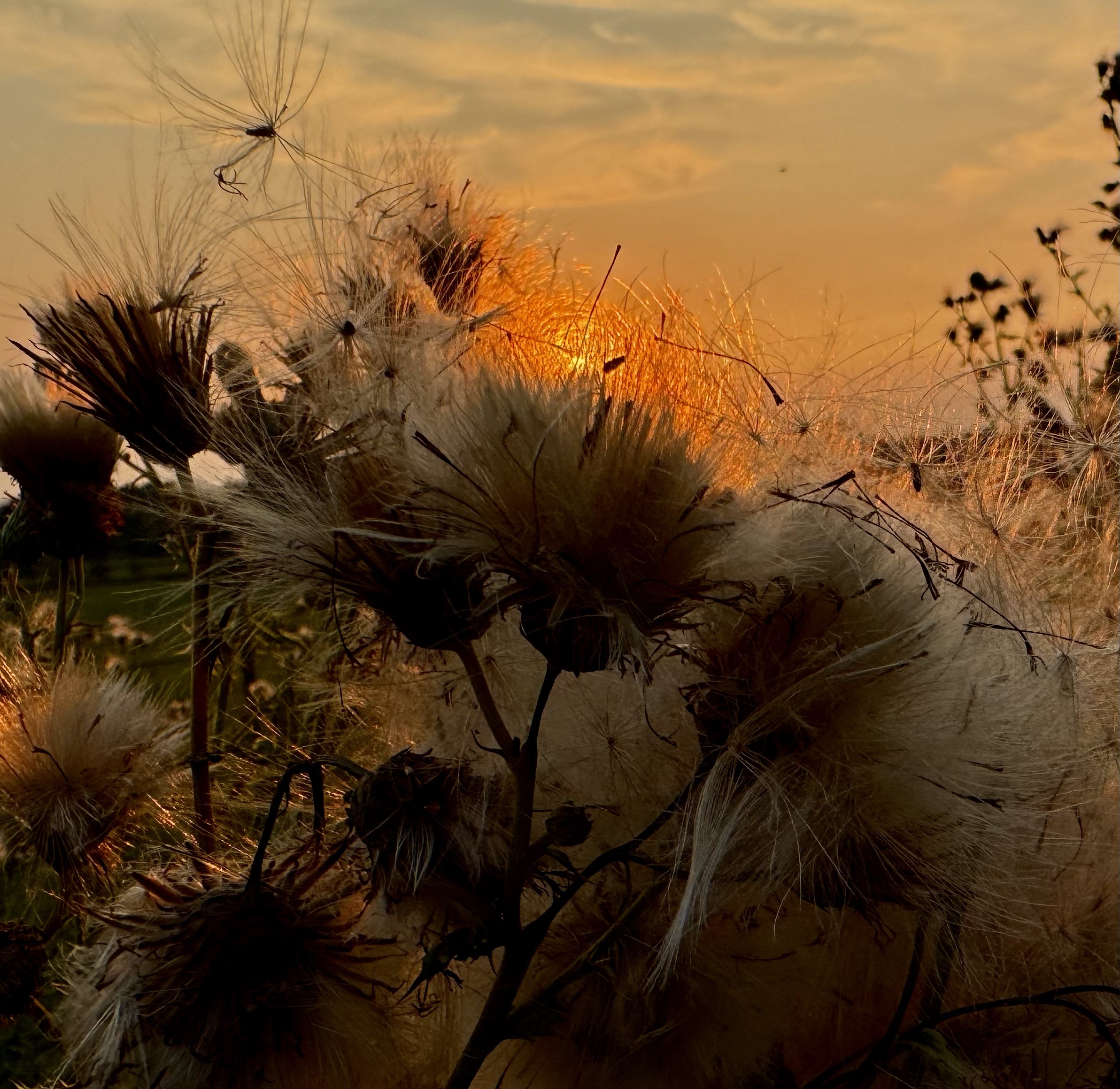
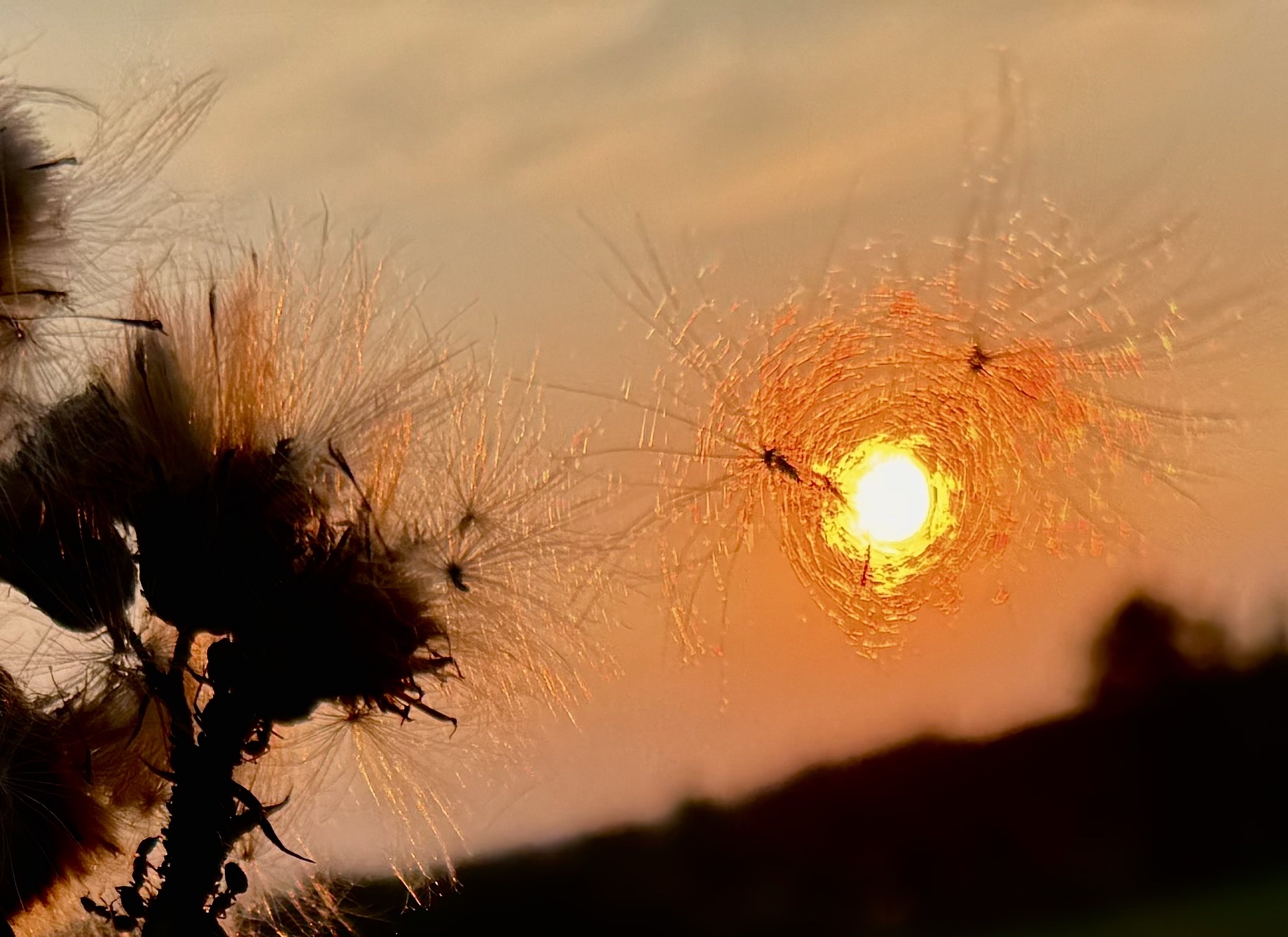
I’ve softened over time (in more ways than one!) by forces outside of myself. The autumn thistle may bristle but its thistledown envelops the pasture as surely as God’s grace envelops me.

With the breezes, the softest thistle seed spreads afar rather than remaining stock-still in self-defense. I find as I wrap up my seventh decade, I too am adrift, seeking out previously unexplored nooks and crannies in which to land.

“For a time I rest in the grace of the world, and am free.”
~Wendell Berry from The Peace of Wild Things

That is how grace and redemption works, both on thistles and bristly people: our self-protective sharp edges shine with a delicate downiness, spreading beauty instead of bristles. 

Everyone is in need of such a transformation. The worldly dilemma with thistle and people is that downy seeds grow up to wield yet more barbs and thorny weapons. The entire pasture becomes a battlefield.

Lord, please make me an instrument of your peace…

One-Time
Monthly
Yearly

Make a one-time or recurring donation to support daily Barnstorming posts

Make a monthly donation

Make a yearly donation

Choose an amount

$10.00
$25.00
$50.00
$5.00
$15.00
$100.00
$5.00
$15.00
$100.00

Or enter a custom amount

$

Your contribution is deeply appreciated.

Your contribution is appreciated.

Your contribution is appreciated.

DonateDonate monthlyDonate yearly
A Common Hand

Because what’s the alternative?
Because of courage.
Because of loved ones lost.
Because no more.
Because it’s a small thing; shaking hands; it happens every day.
Because I heard of one man whose hands

haven’t stopped shaking since a market day in Omagh.
Because it takes a second to say hate, but it takes longer,

much longer, to be a great leader.
Much, much longer.

Because shared space without human touching
doesn’t amount to much.
Because it’s easier to speak to your own

than to hold the hand of someone whose side
has been previously described, proscribed, denied.
Because it is tough.
Because it is meant to be tough, and this is the stuff of memory,

the stuff of hope, the stuff of gesture, and meaning and leading.
Because it has taken so, so long.
Because it has taken land and money and languages

and barrels and barrels of blood.

Because lives have been lost.
Because lives have been taken.

Because to be bereaved is to be troubled by grief.
Because more than two troubled peoples live here.
Because I know a woman whose hand hasn’t been shaken

since she was a man.
Because shaking a hand is only a part of the start.
Because I know a woman whose touch calmed a man

whose heart was breaking.
Because privilege is not to be taken lightly.

Because this just might be good.
Because who said that this would be easy?
Because some people love what you stand for,

and for some, if you can, they can.
Because solidarity means a common hand.
Because a hand is only a hand; so hang onto it.

So join your much discussed hands.
We need this; for one small second.
So touch.
So lead.

~Pádraig Ó Tuama “Shaking Hands”

Nothing is new about conflicts over borders and religion and politics. What is new is the ability of an individual to share the terror and hatred to the rest of the world in mere seconds. We all become unwitting witnesses to human pain and suffering, eager to take sides if we can bear to watch.

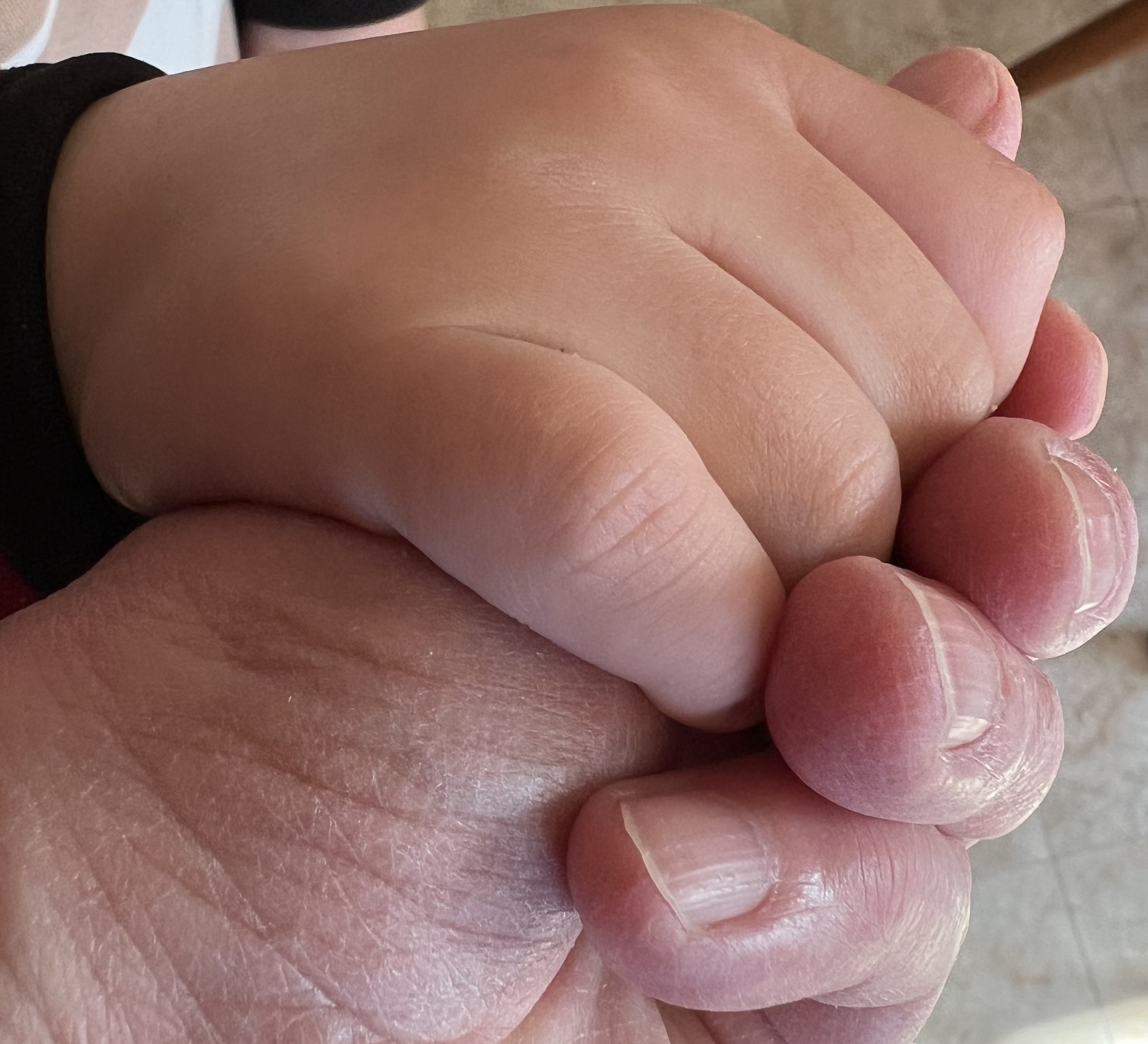
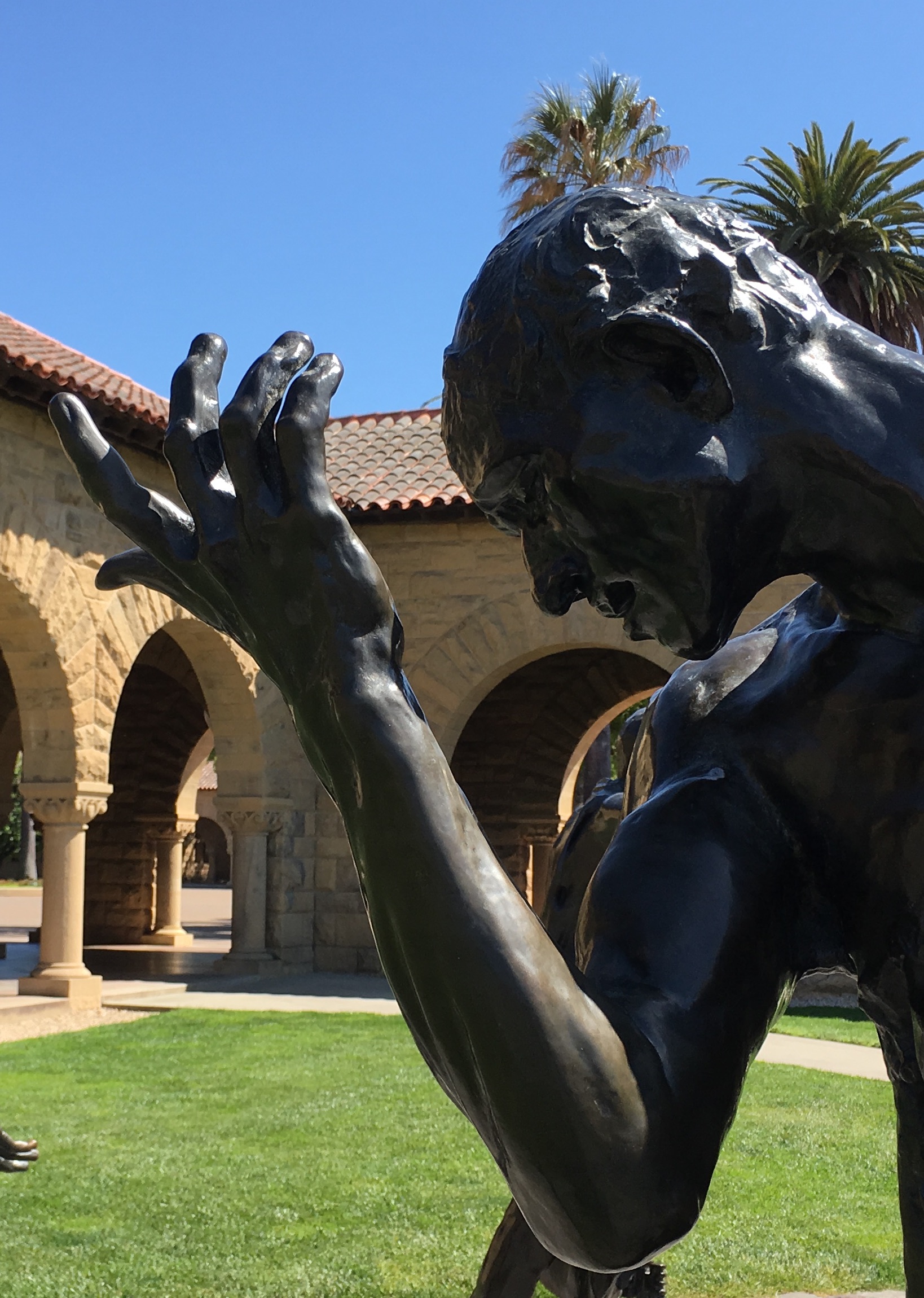
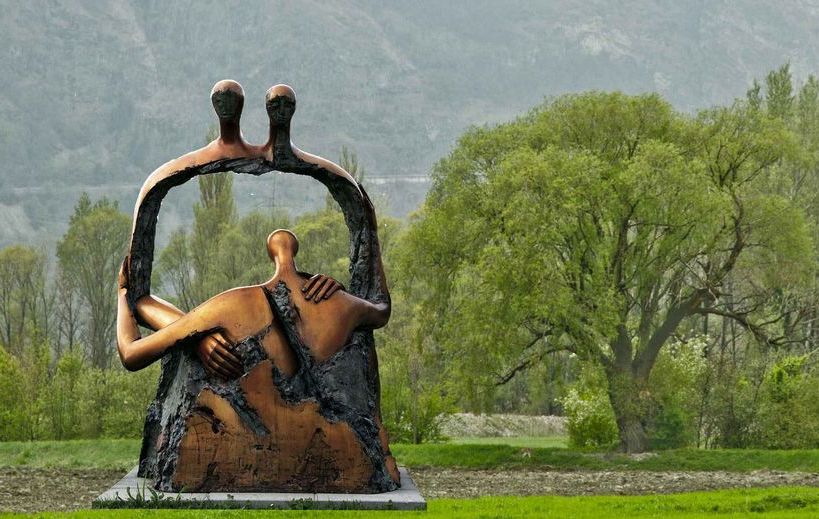
We each share a common hand. We need leaders who reach out to touch one another with more than words. They represent the human beings who lost limbs and lives in the battle for supremacy.

Historic handshakes are never meaningless, but even more vital is a connection between humans steeped in historical hatreds. We need to reach out and help lift each other’s burdens.

Take my hand. Look in my eyes. Even for one small second.

Sculpture by Artist Albert Gyorgy

One-Time
Monthly
Yearly

Make a one-time or recurring donation to support daily Barnstorming posts

Make a monthly donation

Make a yearly donation

Choose an amount

$10.00
$25.00
$50.00
$5.00
$15.00
$100.00
$5.00
$15.00
$100.00

Or enter a custom amount

$

Your contribution is deeply appreciated.

Your contribution is appreciated.

Your contribution is appreciated.

DonateDonate monthlyDonate yearly
Making a Comment

And that is just the point…
how the world, moist and beautiful,
calls to each of us to make a new and serious response.

That’s the big question,
the one the world throws at you every morning.
“Here you are, alive.
Would you like to make a comment?”
~Mary Oliver

The last few days, it has been impossible to stay
a silent observer of the world when one awakes,
still alive on a morning moist and beautiful,
while on the other side of the earth,
innocents have been brutally butchered in their beds,
whole families murdered,
bodies desecrated and dragged into the street.

It demands a response.

I cannot remain speechless in the face of evil.
Such violence, fed by generations of hatred,
begets more hatred and violence, on and on.
It festers, blusters, rips apart, tortures, buries.
And so it goes, an ongoing human history
of wars and more wars.

And here I am,
alive on a brilliant autumn morning,
while others immeasurably suffer.

Called to make a new and serious response.
Called to comment, as I do every day.
Knowing my voice is only one
in a vast wilderness of voices,
crying out in lament over the dead and dying.

Lord, have mercy, have mercy, have mercy on us.

Consider donations to assist humanitarian aid
to Save the Children or Doctors without Borders