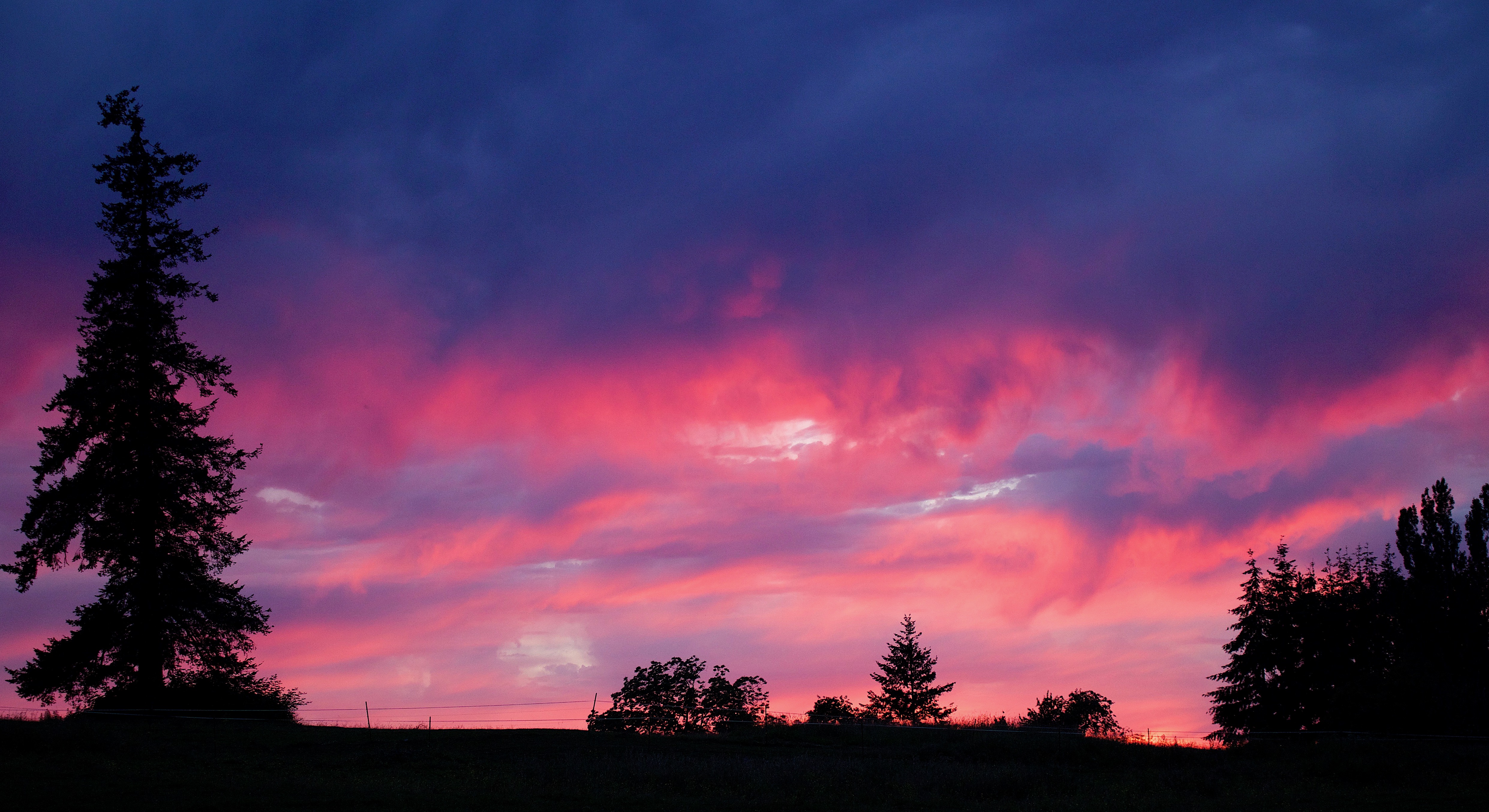
I love color. I love flaming reds, And vivid greens, And royal flaunting purples. I love the startled rose of the sun at dawning, And the blazing orange of it at twilight.
I love color. I love the drowsy blue of the fringed gentian, And the yellow of the goldenrod, And the rich russet of the leaves That turn at autumn-time…. I love rainbows, And prisms, And the tinsel glitter Of every shop-window.
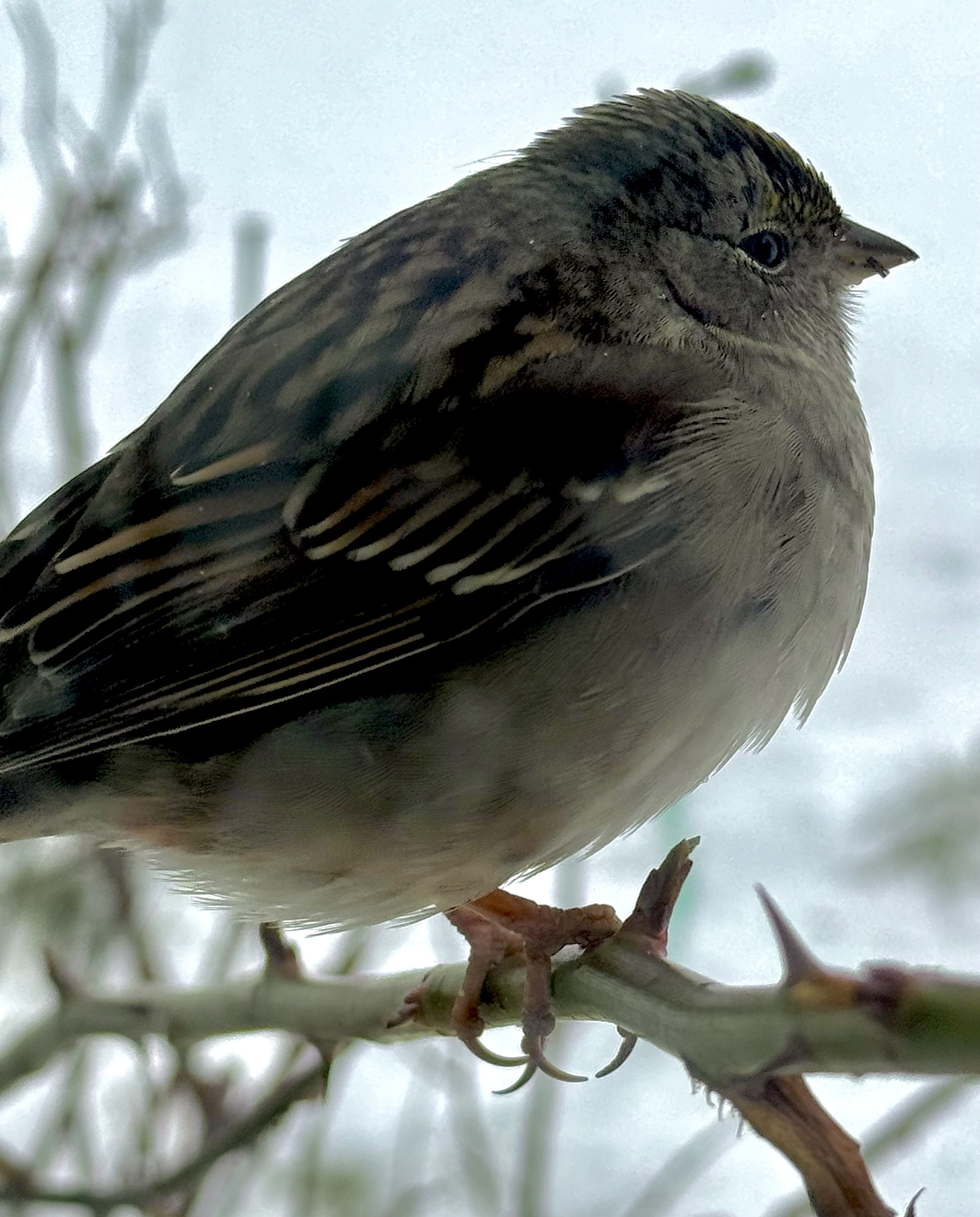
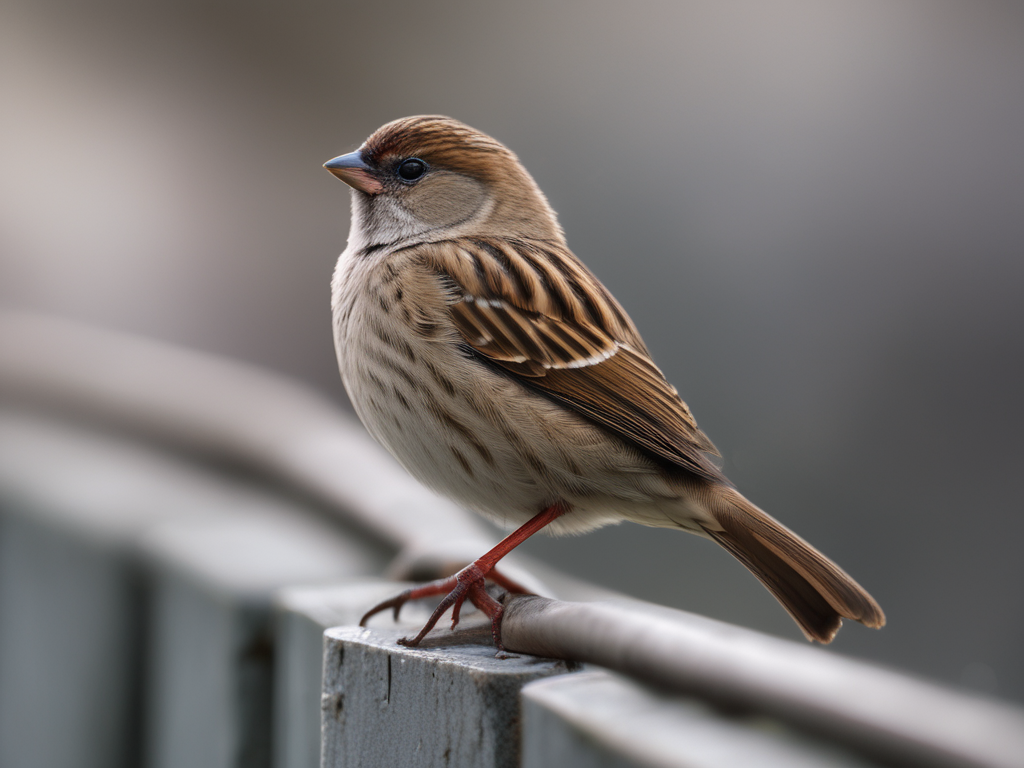
I love color. And yet today, I saw a brown little bird Perched on the dull-gray fence Of a weed-filled city yard. And as I watched him The little bird Threw back his head Defiantly, almost, And sang a song That was full of gay ripples, And poignant sweetness, And half-hidden melody.
I love color…. I love crimson, and azure, And the glowing purity of white. And yet today, I saw a living bit of brown, A vague oasis on a streak of gray, That brought heaven Very near to me. ~Margaret E. Sangster “Colors”
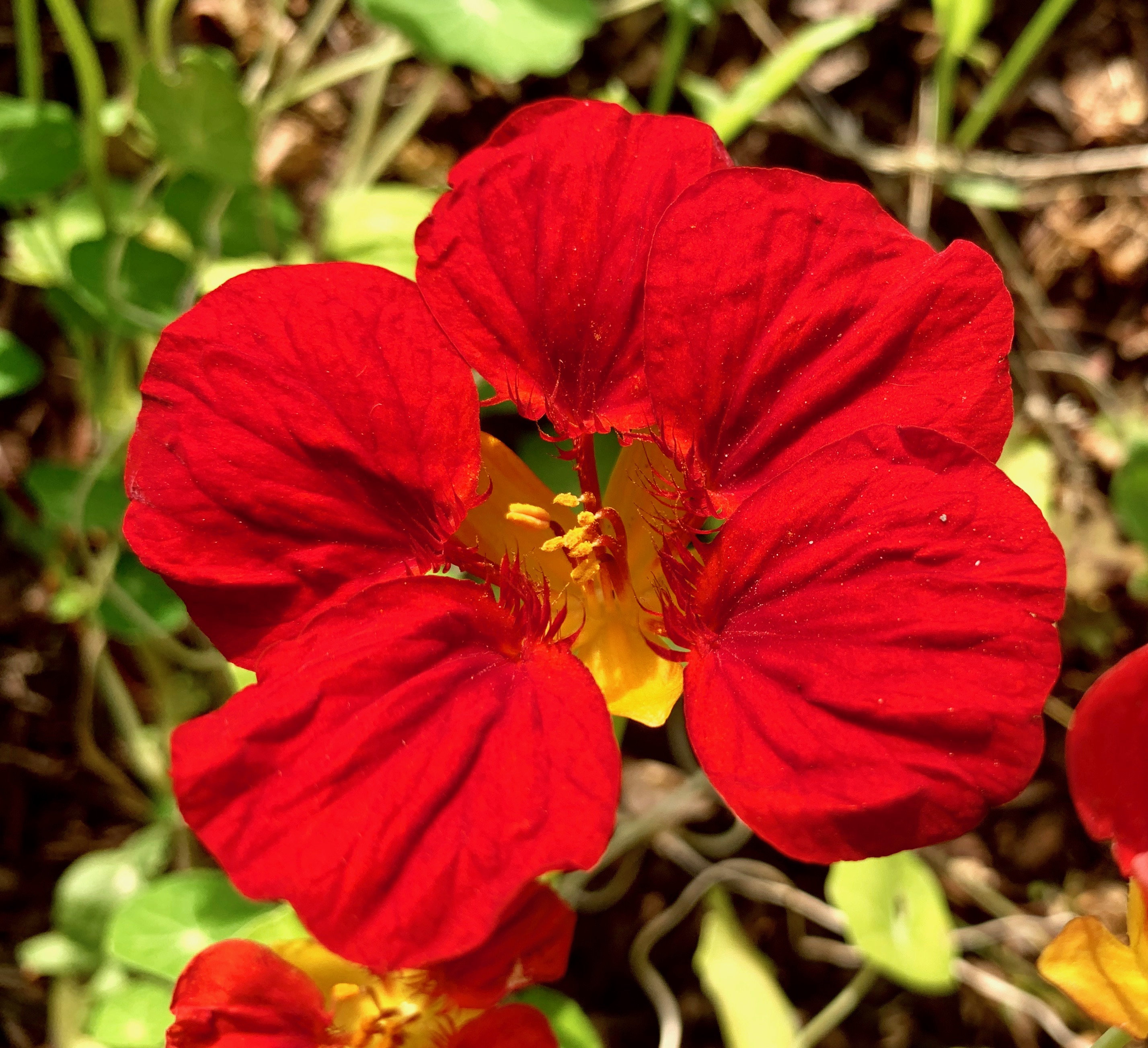
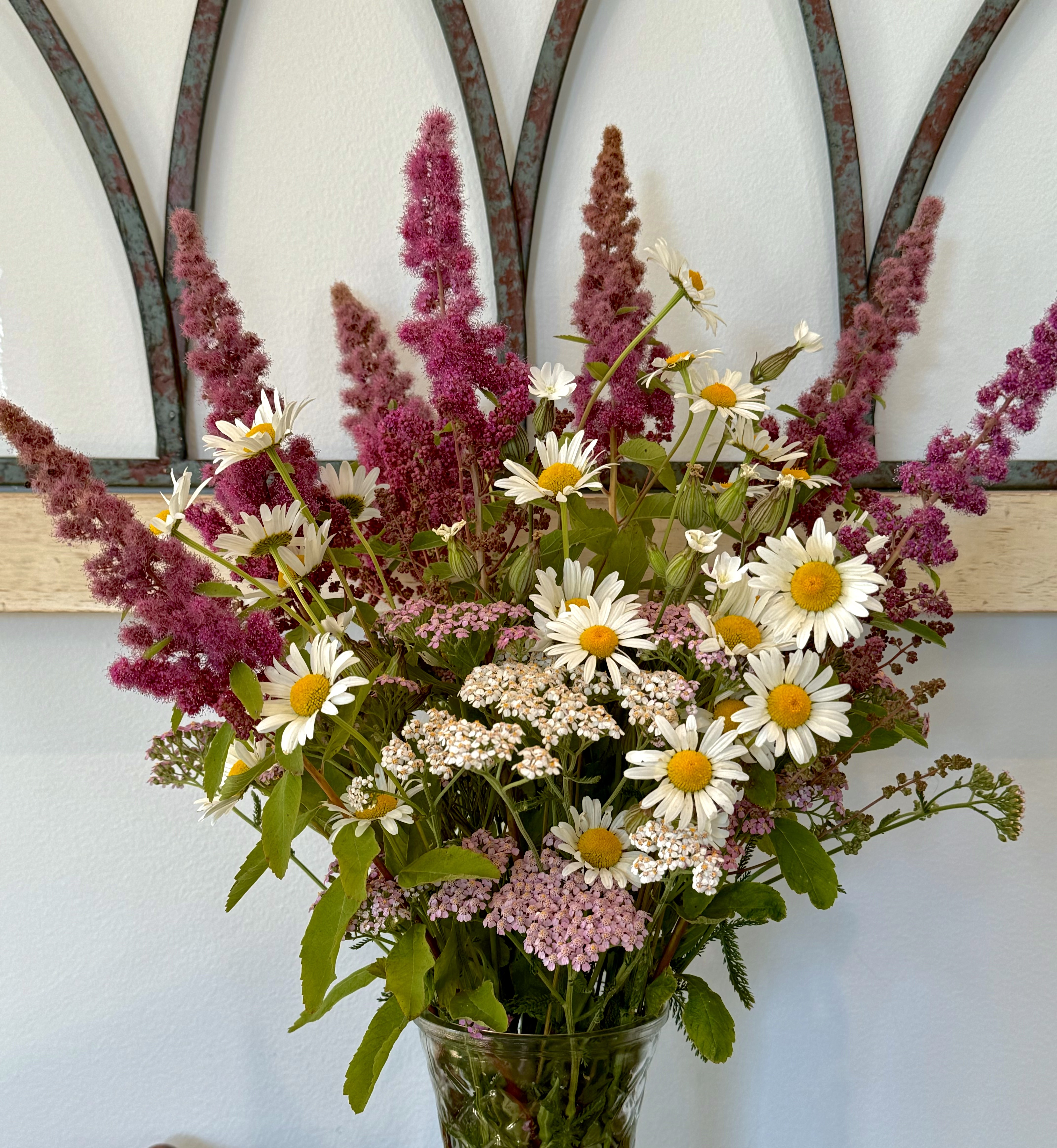
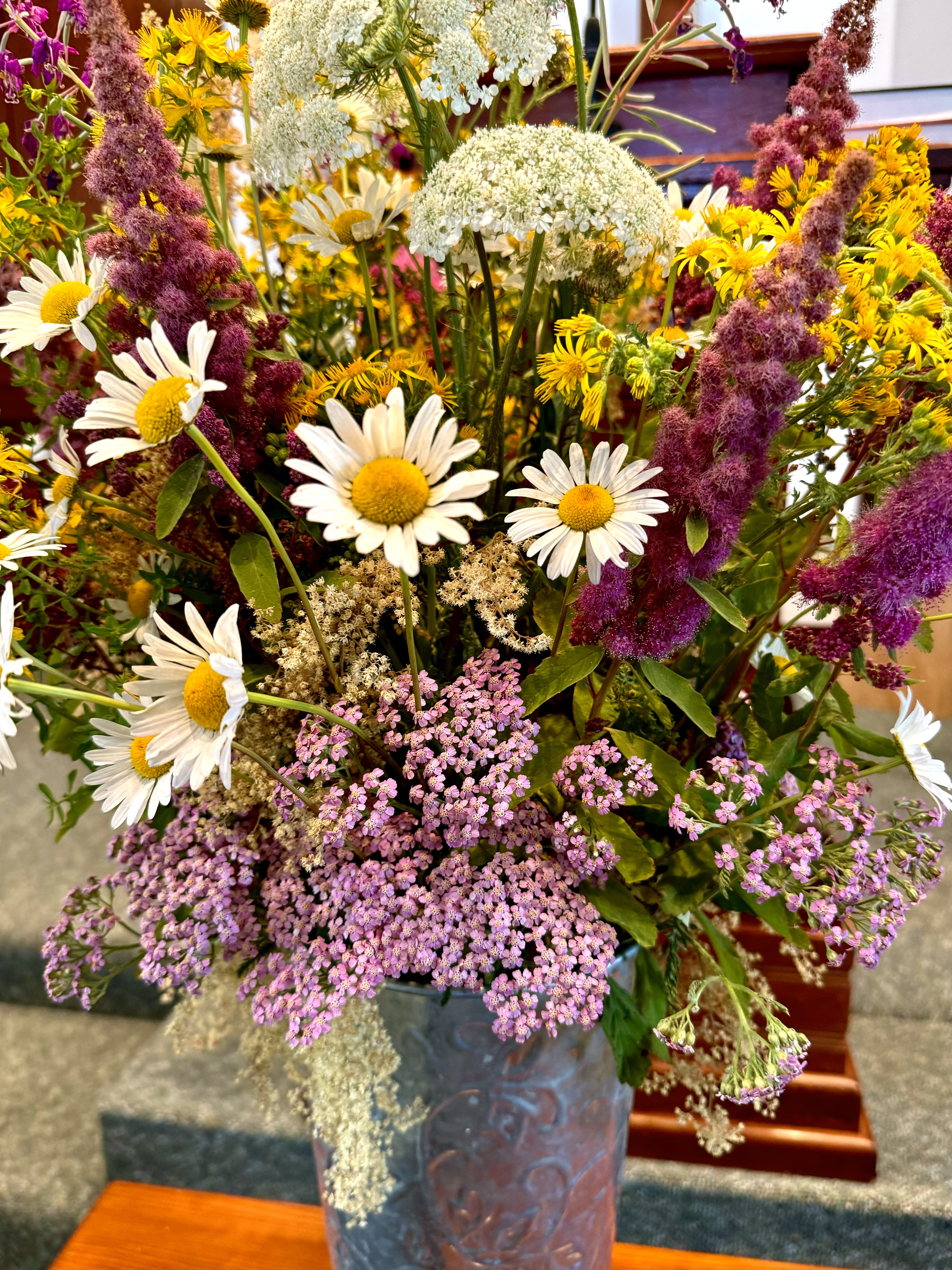
photo by Harry Rodenberger
My eye always seeks out color because there is so much gray as background and foreground.
My ear listens for the singing of sweet melodies in the midst of mourning and sorrow.
My heart longs for hints of heaven in the daily ordinary because this sad world wants to believe in the promises.
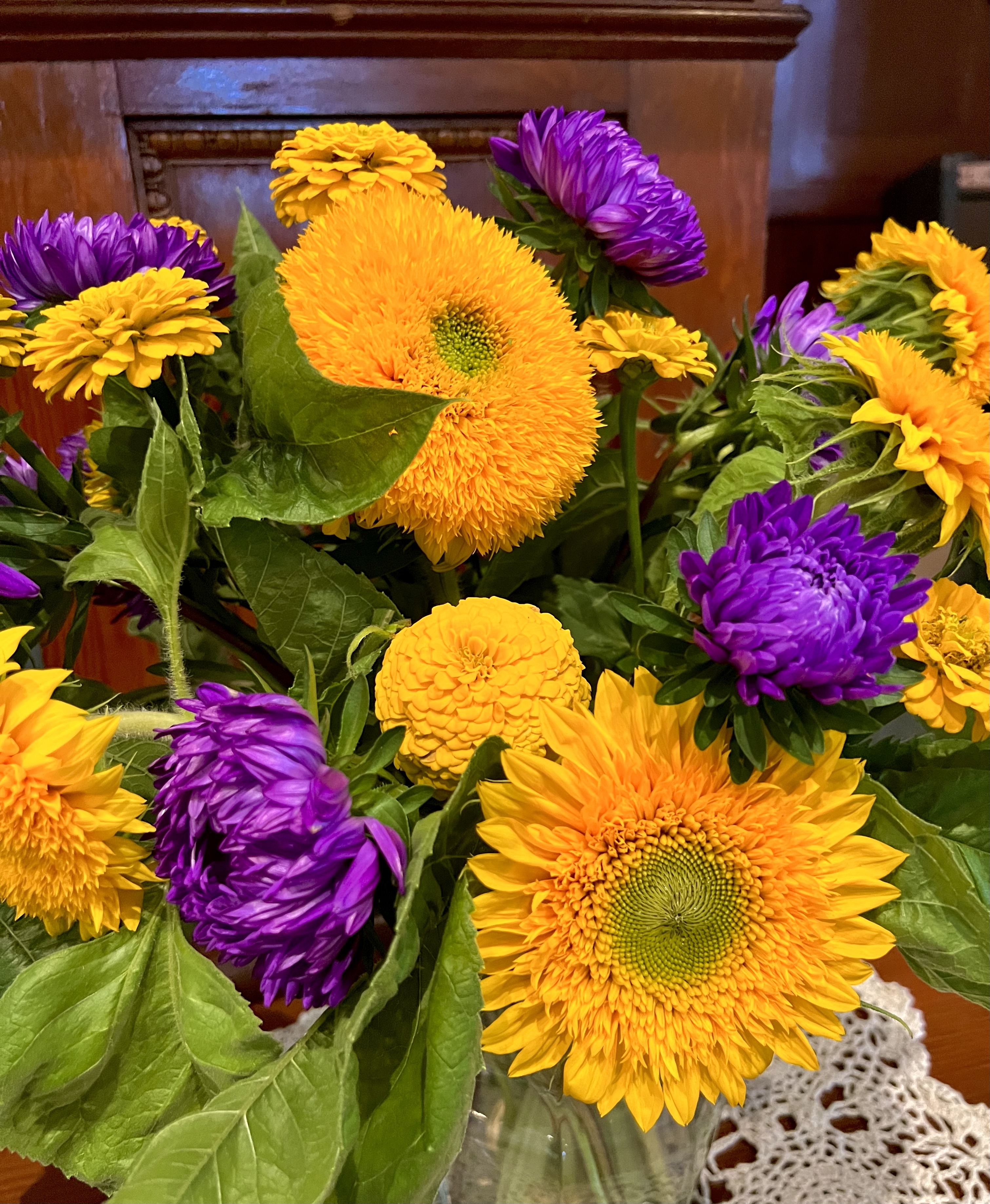
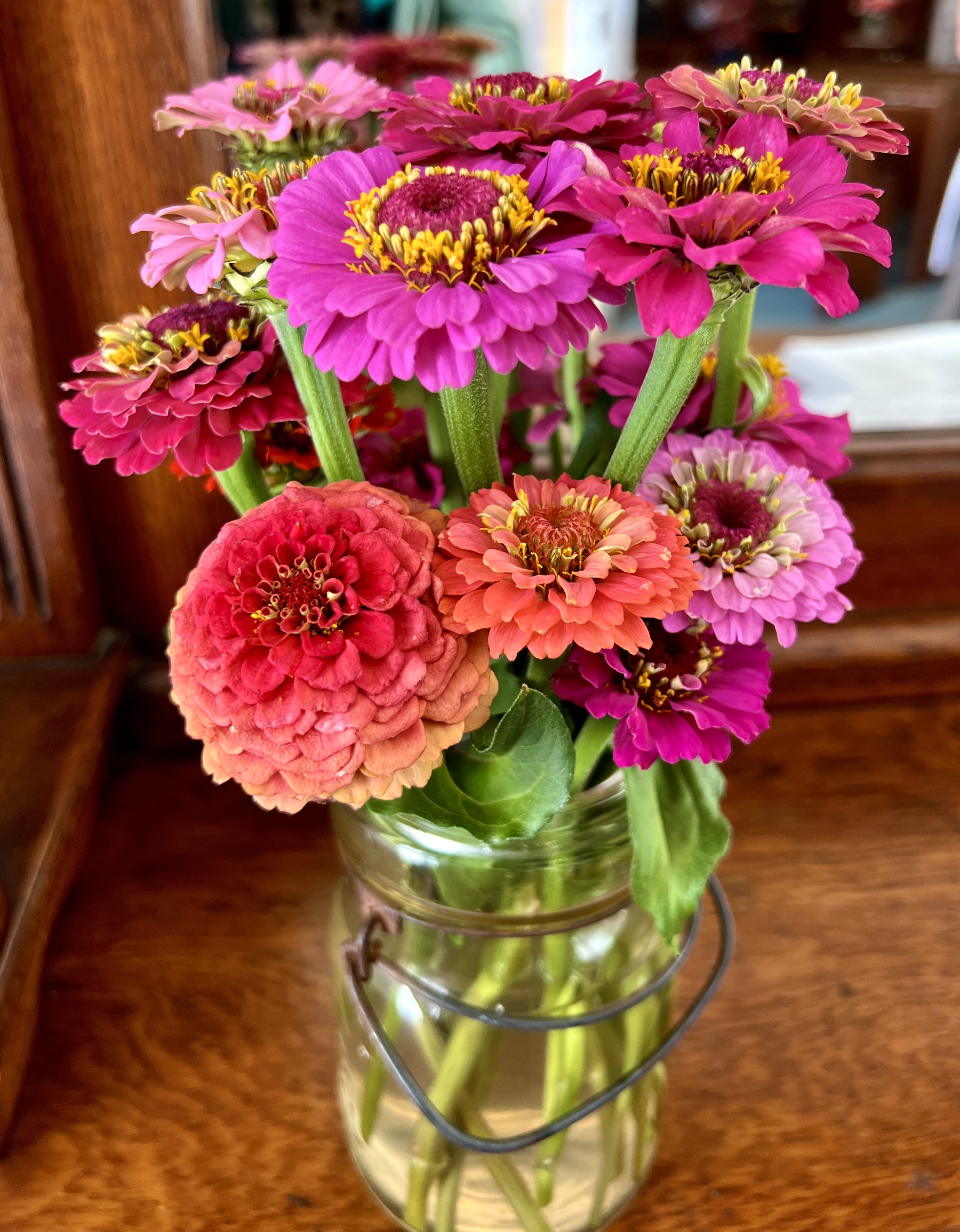
photo by Harry Rodenberger
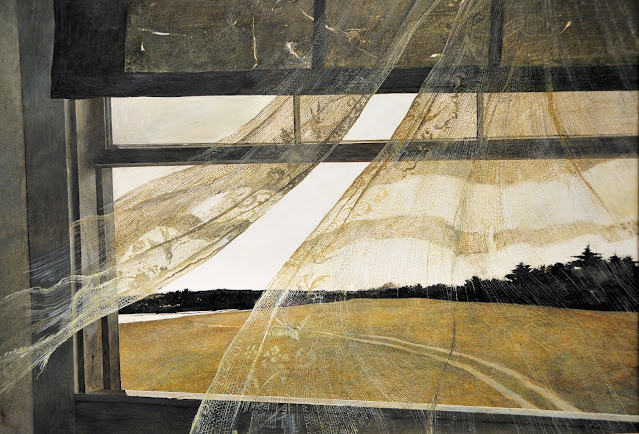
Andrew Wyeth – Wind from the Sea, 1947AI image created for this post
One-Time
Monthly
Yearly
Make a one-time or recurring donation to support daily Barnstorming posts
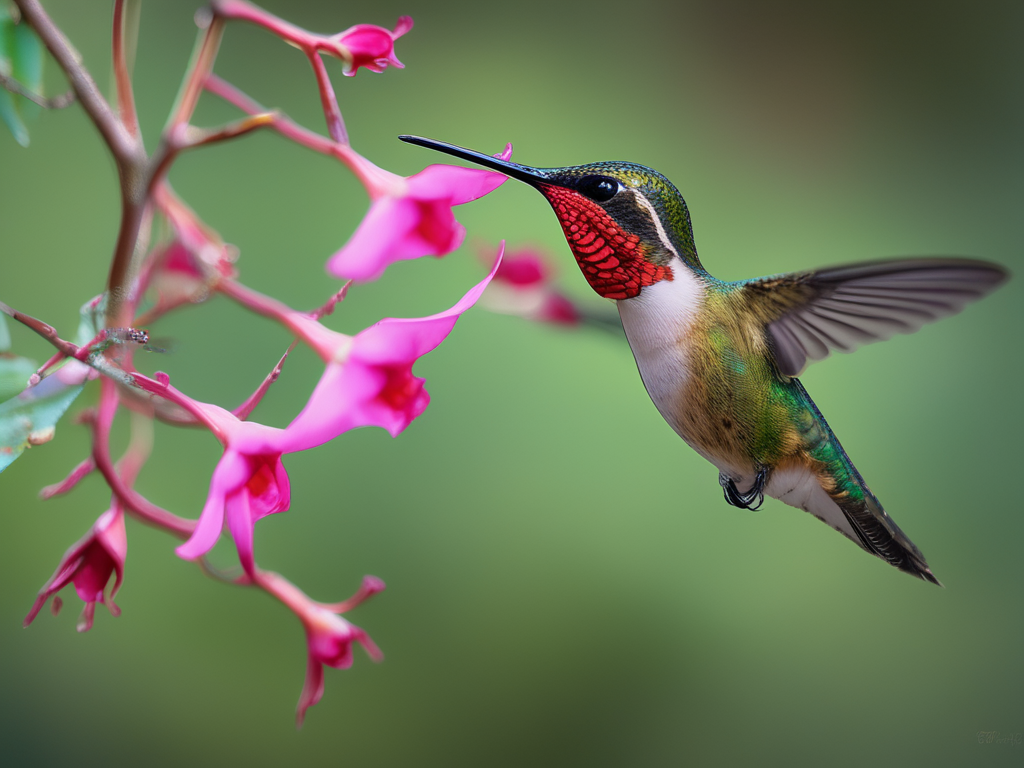
When I was with the green hummingbird, it became the company I didn’t know I needed. We spent our mornings together, and after it went its way, I read and wrote.
…a hummingbird, essential company in the endless journey through dead-ends, restarts, and new beginnings – as well as a reminder of the beauty of the world, the power of the sun, the rain, love, and life, all packed inside the body of a creature that weighs less than an ounce. A sign that within the smallest detail, the whole world is present, and just as the gravity and magnificence of life is present in the mountains, oceans, stars, and everything larger than life, it is also brilliantly present in its smallest bird. ~Zito Madu from “Hummingbirds are Wondrous” in Plough
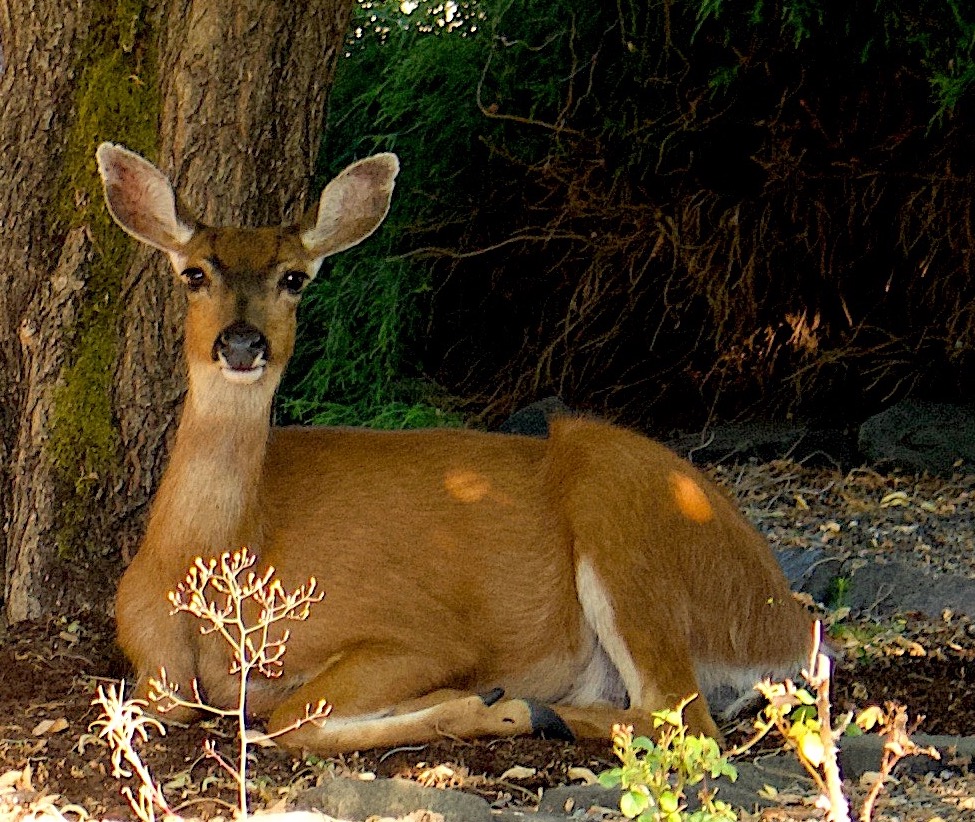
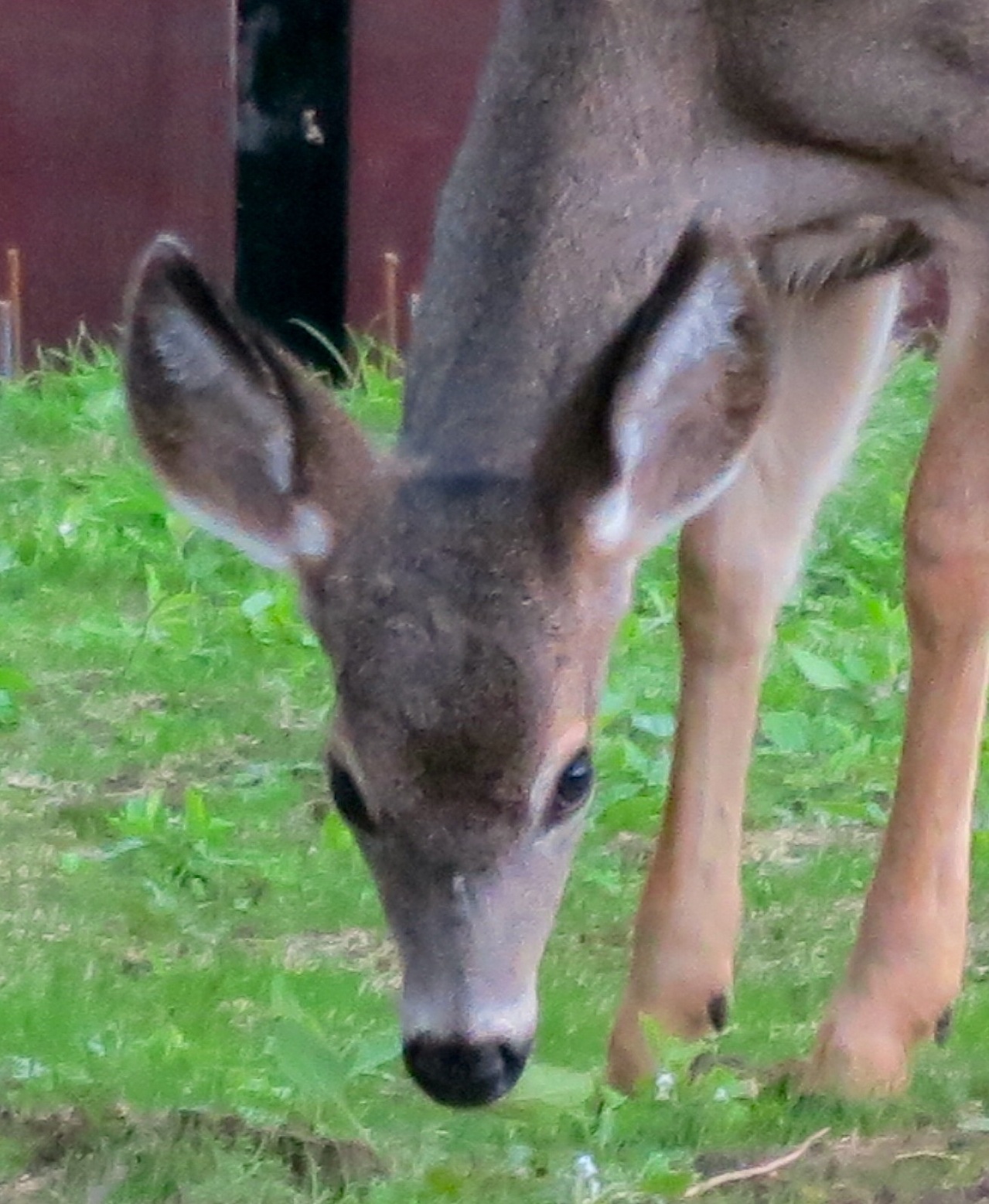
Near dusk, near a path, near a brook, we stopped, I in disquiet and dismay for the suffering of someone I loved, the doe in her always incipient alarm.
All that moved was her pivoting ear the reddening sun was shining through transformed to a color I’d only seen in a photo of a new child in a womb.
Nothing else stirred, not a leaf, not the air, but she startled and bolted away from me into the crackling brush.
The part of my pain which sometimes releases me from it fled with her, the rest, in the rake of the late light, stayed. ~C. K. Williams “The Doe” from The Singing
Oh little one who was to be born this week in June forty one years ago~ so wanted so anticipated but lost too soon gone as swiftly in a clot of red as a doe disappearing in a thicket: a memory, when I think of you that makes me question if you were real — but you were and you are and someday I’ll know you when I see you and curious about who I am, you won’t flee, but remain close to find out.
AI image created for this postAI image created for this post
One-Time
Monthly
Yearly
Make a one-time or recurring donation to support daily Barnstorming posts
Some things are very dear to me— Such things as flowers bathed by rain Or patterns traced upon the sea Or crocuses where snow has lain … the iridescence of a gem, The moon’s cool opalescent light, Azaleas and the scent of them, And honeysuckles in the night. And many sounds are also dear— Like winds that sing among the trees Or crickets calling from the weir Or Negroes humming melodies. But dearer far than all surmise Are sudden tear-drops in your eyes. ~Gwendolyn Brooks “Sonnet 2”
We human beings do real harm. History could make a stone weep. ~Marilynne Robinson from Gilead
I am an easy cryer. It takes very little to tip me over the edge: a hymn, a poem, simply witnessing a child’s joy. Suddenly my eyes fill up. I blame this on my paternal grandmother who was in tears much of her time when visiting our family, crying happy, crying sad, crying frustrated and angry tears.
Somehow after her visit, she was always smiling, so I think her weeping was cathartic emptying of her stress.
My greatest trigger to weep myself is watching someone else tear up. I think my grandmother left behind some powerful empathy genes.
I had to desensitize my response to tears to be effective as a physician/healer. Witnessing tears in the exam room is a normal part of the job: patients are anxious, ill, in pain or simply need to decompress in safety. I learned early on to be unobtrusive and not interrupt, letting the flow of tears be part of how the patient was trying to communicate. It was a struggle when my inclination was to cry right along with them. But I needed to be the rock in the room, solid and steady. I could understand their tears as yet another symptom of a clinical presentation, allowing me to observe without being clouded by my own emotional response.
Sometimes that worked. Sometimes not. At times overwhelmed, I wept at births, I wept at deaths, I wept at the sharing of bad news.
Now, liberated from the exam room, I freely weep at the state of the world, or when I read of disaster and tragedy, and especially when I witness intentional harm and meanness in others. I’m no longer a barely responsive stone, but more like an over-filled sponge being squeezed – everything builds up until I can hold it no more. Reading headlines in the news is sometimes more than I can bear.
I cry myself dry.
And that is okay. Once emptied out, I can be filled again by so much that is good and precious in this life.
That is worth weeping over.
AI image created for this post
Detail from “Descent from the Cross” by Rogier van der Weyden
One-Time
Monthly
Yearly
Make a one-time or recurring donation to support daily Barnstorming posts
I am not resigned to the shutting away Of loving hearts in the hard ground. So it is, and so it will be, for so it has been, time out of mind: Into the darkness they go, the wise and the lovely. Crowned With lilies and with laurel they go; but I am not resigned. Lovers and thinkers, into the earth with you. Be one with the dull, the indiscriminate dust. A fragment of what you felt, of what you knew, A formula, a phrase remains,—but the best is lost. The answers quick and keen, the honest look, the laughter, the love,— They are gone. They are gone to feed the roses. Elegant and curled Is the blossom. Fragrant is the blossom. I know. But I do not approve. More precious was the light in your eyes Than all the roses in the world. Down, down, down into the darkness of the grave Gently they go, the beautiful, the tender, the kind; Quietly they go, the intelligent, the witty, the brave. I know. But I do not approve. And I am not resigned. ~Edna St. Vincent Millay “Dirge Without Music”
These hearts were woven of human joys and cares, Washed marvelously with sorrow, swift to mirth. The years had given them kindness. Dawn was theirs, And sunset, and the colors of the earth.
These had seen movement, and heard music; known Slumber and waking; loved; gone proudly friended; Felt the quick stir of wonder; sat alone; Touched flowers and furs and cheeks. All this is ended.
There are waters blown by changing winds to laughter And lit by the rich skies, all day. And after, Frost with a gesture, stays the waves that dance And wandering loveliness. He leaves a white Unbroken glory, a gathered radiance, A width, a shining peace, under the night. ~Rupert Brooke “All This is Ended”
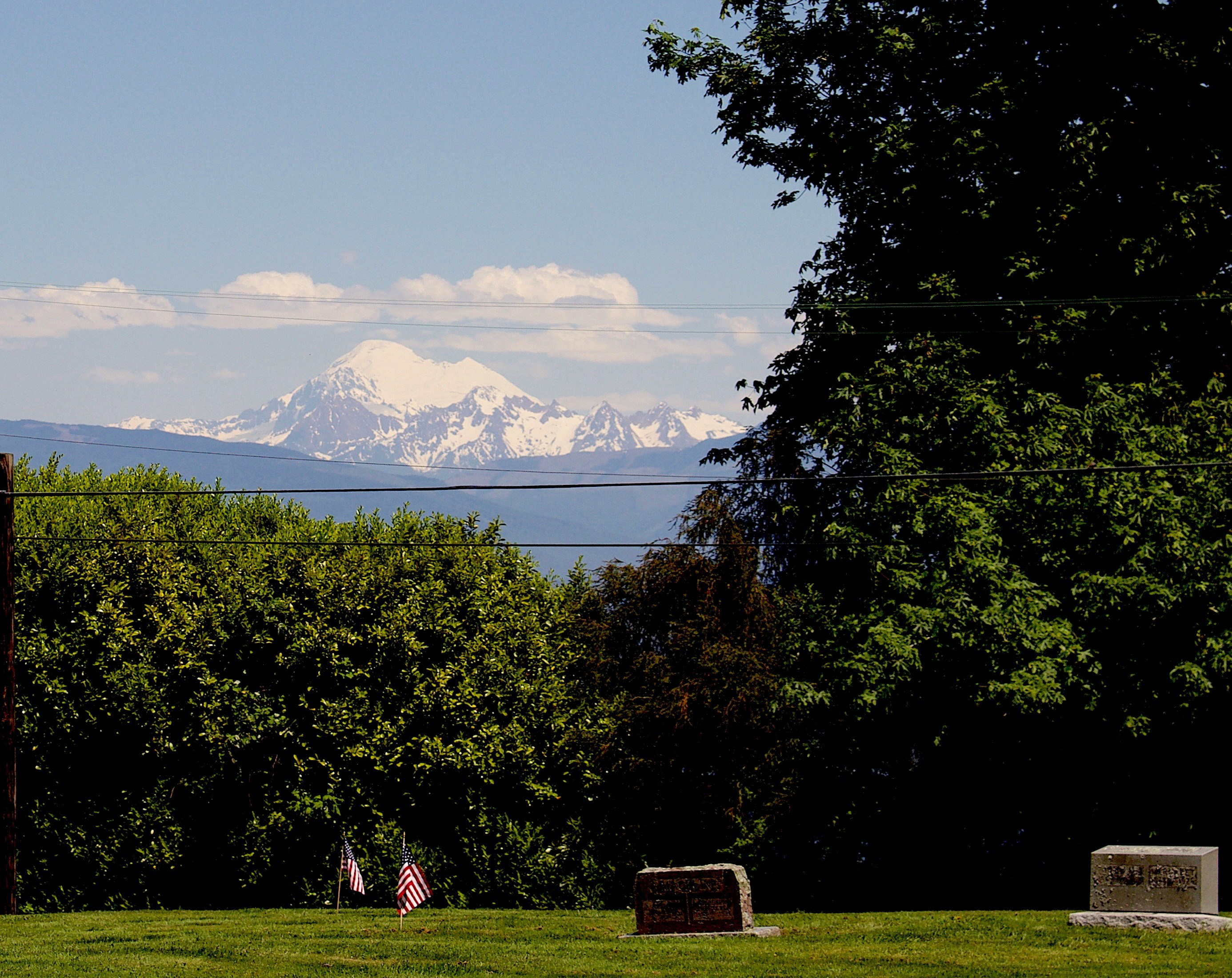
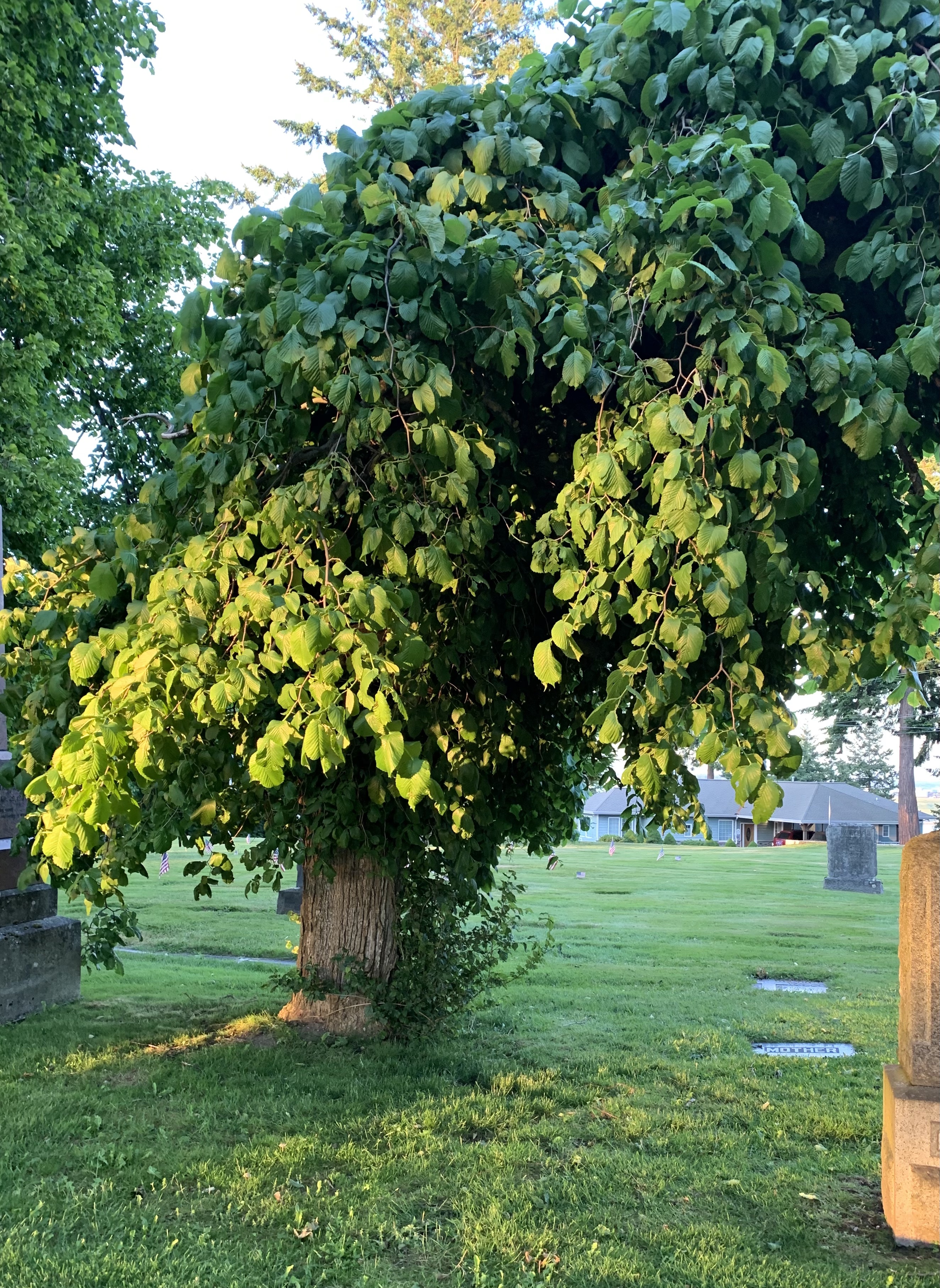
Each Memorial Day weekend without fail, we gather with family, have lunch, reminisce, and trek to a cemetery high above Puget Sound to catch up with our relatives who lie there still. Some for well over 100 years, some too recent, some we knew and loved and miss every day, others not so much, unknown to us except on genealogy charts, their names and dates and these stones all that is left of them:
the red-haired great-grandmother who died too young, the aunt who was eight with lymphoma, the Yukon river boat captain, the logger and stump farmer, the unmarried teacher who bequeathed an oil well to her church, the two in-laws who lie next to each other but could not co-exist in the same room while they lived and breathed.
Yet we know each of these (as we know ourselves and others) was tender and kind, though flawed and broken, was beautiful and strong, though wrinkled and frail, was hopeful and faithful, though too soon in the ground.
We know this about them as we know it about ourselves: someday we too will feed roses, the light in our eyes transformed into elegant swirls emitting the fragrant scent of heaven.
No one asks if we approve. Nor am I resigned to this but only know: So it is, so it has been, so it will be.
In great deeds, something abides. On great fields, something stays. Forms change and pass; bodies disappear; but spirits linger, to consecrate ground for the vision-place of souls. And reverent men and women from afar, and generations that know us not and that we know not of, heart-drawn to see where and by whom great things were suffered and done for them, shall come to this deathless field, to ponder and dream; and lo! the shadow of a mighty presence shall wrap them in its bosom, and the power of the vision pass into their souls. This is the great reward of service. To live, far out and on, in the life of others; this is the mystery of the Christ, –to give life’s best for such high sake that it shall be found again unto life eternal. ~Major-General Joshua Chamberlain, Gettysburg, Pennsylvania 1889
The sunlight now lay over the valley perfectly still. I went over to the graveyard beside the church and found them under the old cedars… I am finding it a little hard to say that I felt them resting there, but I did…
I saw that, for me, this country would always be populated with presences and absences, presences of absences, the living and the dead. The world as it is would always be a reminder of the world that was, and of the world that is to come. ~Wendell Berry in Jayber Crow
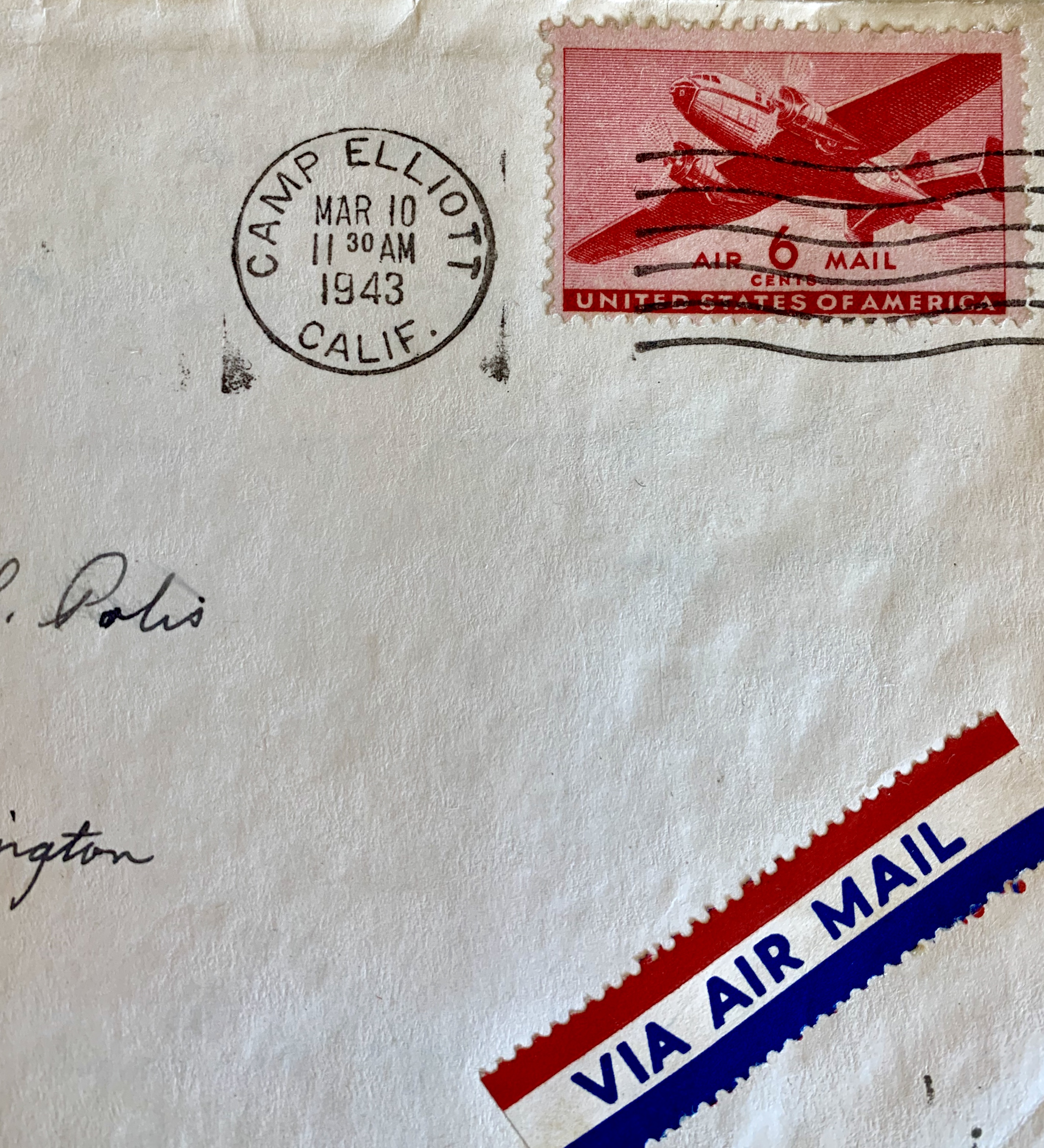
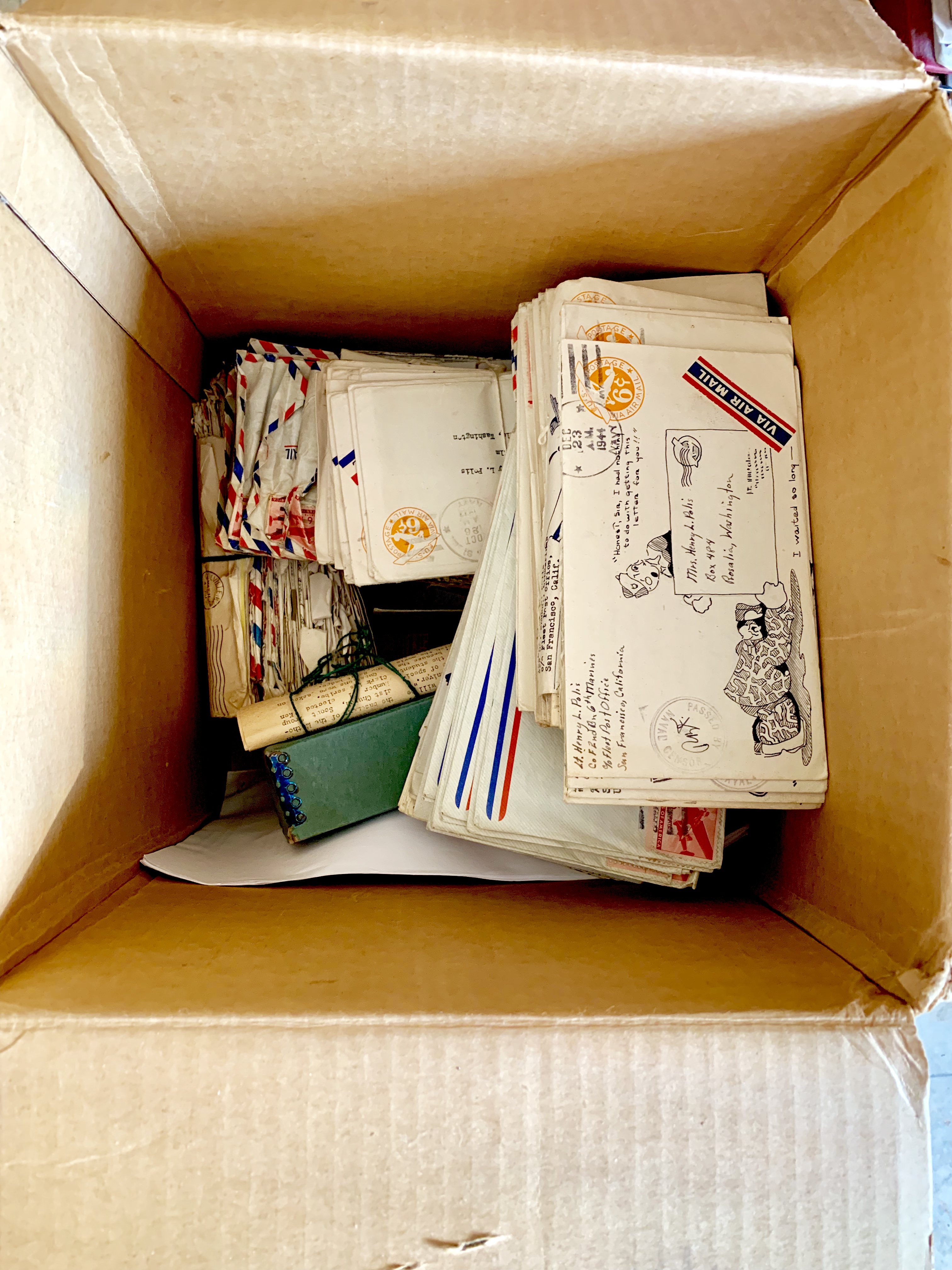
A box of over 700 letters, exchanged between my parents from late 1941 to mid-1945, sat unopened for decades until last year. I started reading.
My parents barely knew each other before marrying quickly on Christmas Eve 1942 – the haste due to the uncertain future for a newly trained Second Lieutenant in the Marine Corps. They only had a few weeks together before she returned home to her rural teaching position and he readied himself to be shipped out for the island battles to come.
They had no idea they would not see each other for another 30+ months or even see each other again at all. They had no idea their marriage would fall apart 35 years later and they would reunite a decade after the divorce for five more years together.
The letters do contain the long-gone but still-familiar voices of my parents, but they are the words and worries of youngsters of 20 and 21, barely prepared for the horrors to come from war and interminable waiting. When he was fighting battles on Tarawa, Saipan, and Tinian, no letters or news would be received for a month or more, otherwise they tried to write each other daily, though with minimal news to share due to military censorship. They speak mostly of their desire for a normal life together rather than a routine centered on mailbox, pen and paper and waiting, lots and lots of waiting.
I’m not sure what I hoped to find in these letters. Perhaps I hoped for flowery romantic whisperings and the poetry of longing and loneliness. Instead I am reading plain spoken words from two people who desperately wanted to have a home together. They somehow made it through those awful years to make my sister and brother and myself possible.
Our inheritance is contained in this musty box of words bereft of poetry. But decades later my heart is moved by these letters – I carefully refold them back into their envelopes and replace them gently back in order. A six cent airmail stamp – in fact hundreds and hundreds of them – was a worthwhile investment in the future, not only for themselves and their family to come, but for generations of U.S. citizens who tend to take their freedom for granted.
Thank you, Dad and Mom, for what you gave up to make today possible.
AI image created by this post
I hear the mountain birds The sound of rivers singing A song I’ve often heard It flows through me now So clear and so loud I stand where I am And forever I’m dreaming of home I feel so alone, I’m dreaming of home
It’s carried in the air The breeze of early morning I see the land so fair My heart opens wide There’s sadness inside I stand where I am And forever I’m dreaming of home I feel so alone, I’m dreaming of home
This is no foreign sky I see no foreign light But far away am I From some peaceful land I’m longing to stand A hand in my hand …forever I’m dreaming of home I feel so alone, I’m dreaming of home ~Lori Barth and Philippe Rombi “I’m Dreaming of Home”
One-Time
Monthly
Yearly
Make a one-time or recurring donation to support daily Barnstorming posts
“Your attention, please,” the mate’s voice says, “we are slowing a moment for a memorial,” and sure enough we all do, all of us, even those entangled in a bustle to get to the other side, restless chunks of festering business waiting, little urgencies pricking us into a stressed huff. Below on the car deck a small group slowly forms, and a mate lowers a rope, beckons them forward, the ferry engines slowing whatever our hurry, and we are all coasting together on a rainy sea.
A heavy-set woman unwraps a nondescript urn from a carefully held towel, handing it in turn to an ungainly boy, a shy girl, an older man, and she watches as each tips the urn to scatter dust into a windy vortex off the ferry’s stern, a fine grey mist streaming over the roiled wake in a high breeze before settling, disappearing into grey oblivion of sea, sky, and late afternoon.
As the ferry’s horn sounds three long blasts, the four bow heads. The woman hesitates, hides her face a moment in the towel, kisses each of her party, and shakes the mate’s hand. He speaks, his words lost to us in sea sounds and engines, then looks up to the bridge, waves, and the small group, holding hands, rejoins some two hundred of us who have in silence watched this mini-delay in our grey crossing. The ferry’s engines begin their normal thrum to push us forward again against a grey sea and under a low, grey sky, where a fine dust disappeared, and white seagulls rise and cry. ~Rob Jacques, “Memorial, Washington State Ferry” from Adagio for Su Tung-p’o
There is a sense of timelessness while riding on the ferry runs between the islands and peninsulas in Washington state. While driving my car on the busy freeways in the region, I am at the mercy of the weather, other drivers and all manner of delays. When I’m on a ferry, I become mere witness, only a rider seeking peaceful passage. Someone else worries about safely getting from Point A to Point B.
I’m able to breathe: watching the waves and the wake, the antics of gulls and cormorants, and rarely, an orca pod.
Next week is a time of memorial and remembrance of those who have passed into eternity. The ashes of my parents rest in the ground under a plaque that I visit annually with my family. Dad would have preferred his ashes to be cast out upon on the open water that he loved, but Mom chose a cemetery plot for them both, a more familiar resting place for a girl who grew up in the Palouse farmlands, no where near large bodies of water.
Last year, a good friend chose to be composted; he rests now in his beloved orchard, feeding the trees that continue to bear fruit.
No matter where our mortal bodies eventually find our rest, we hope to be remembered.
Our souls have risen, free.
video taken on the Samish Sea (Puget Sound) from my friend Andrew
One-Time
Monthly
Yearly
Make a one-time or recurring donation to support daily Barnstorming posts
Not much to me is yonder lane Where I go every day; But when there’s been a shower of rain And hedge-birds whistle gay, I know my lad that’s out in France With fearsome things to see Would give his eyes for just one glance At our white hawthorn tree.
. . . .
Not much to me is yonder lane Where he so longs to tread: But when there’s been a shower of rain I think I’ll never weep again Until I’ve heard he’s dead. ~Siegfried Sassoon“The Hawthorn Tree”
I drove West in the season between seasons. I left behind suburban gardens. Lawnmowers. Small talk.
Under low skies, past splashes of coltsfoot, I assumed the hard shyness of Atlantic light and the superstitious aura of hawthorn.
All I wanted then was to fill my arms with sharp flowers, to seem from a distance, to be part of that ivory, downhill rush. But I knew,
I had always known, the custom was not to touch hawthorn. Not to bring it indoors for the sake of
the luck such constraint would forfeit– a child might die, perhaps, or an unexplained fever speckle heifers. So I left it
stirring on those hills with a fluency only water has. And, like water, able to redefine land. And free to seem to be–
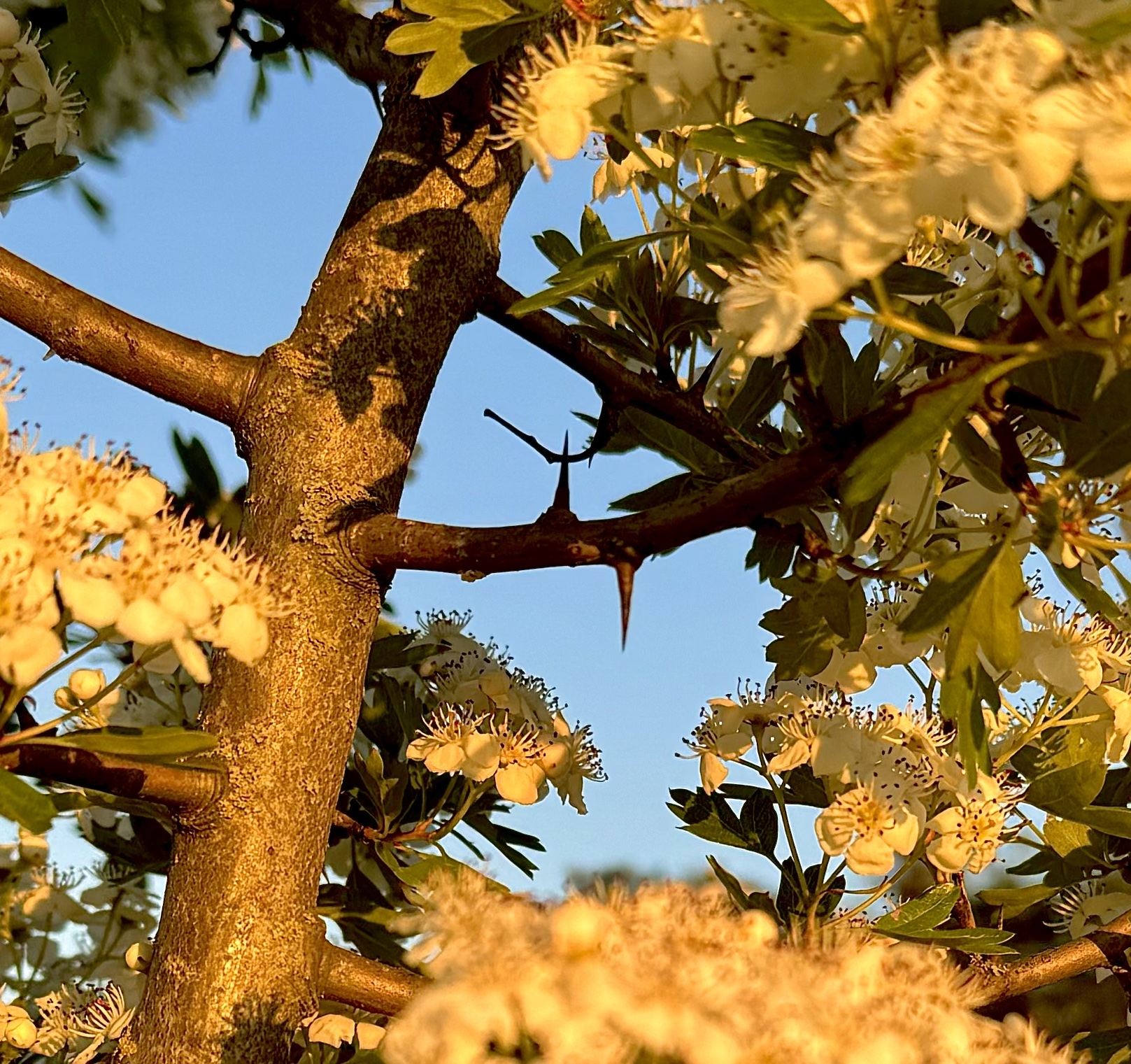
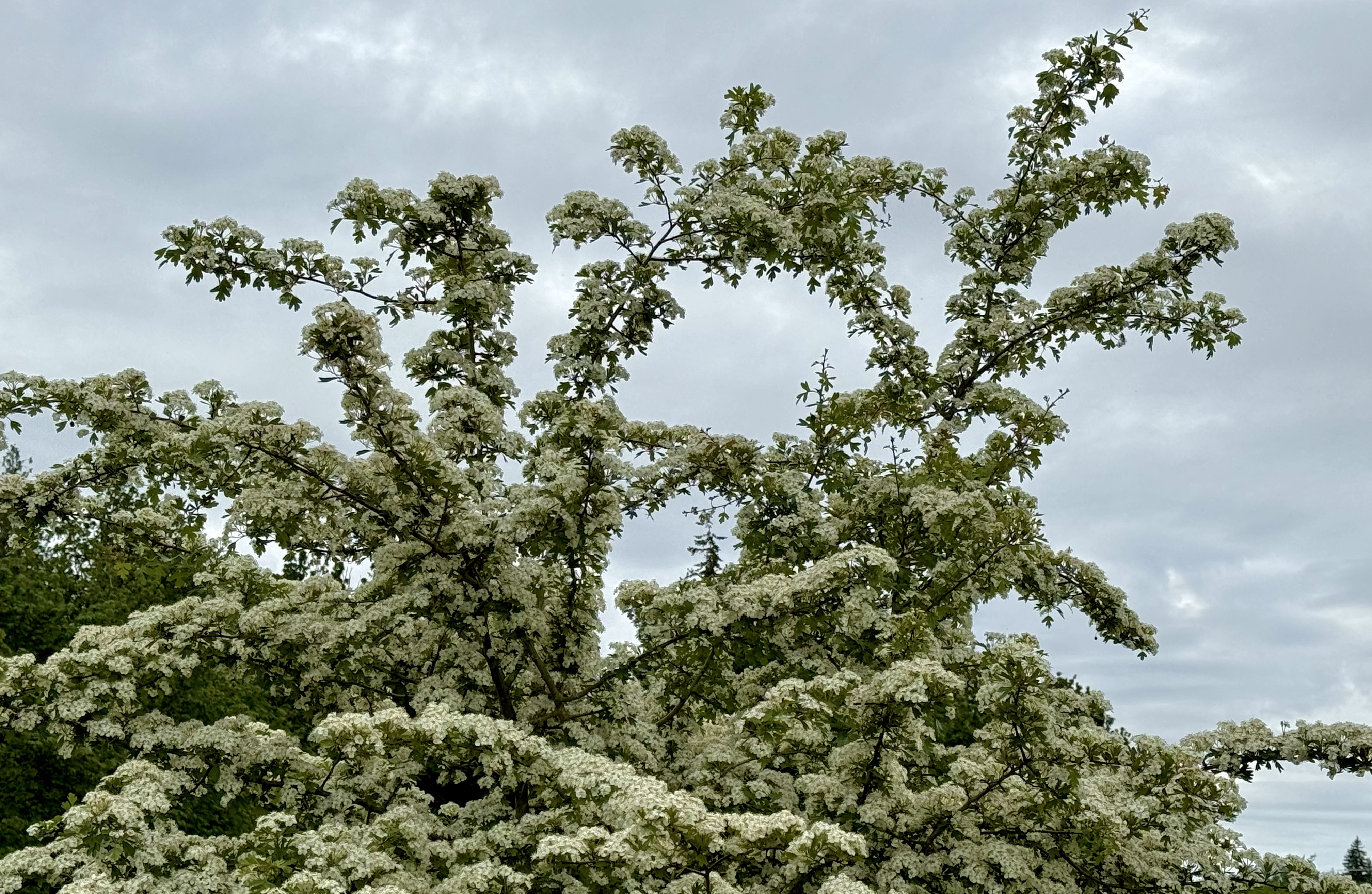
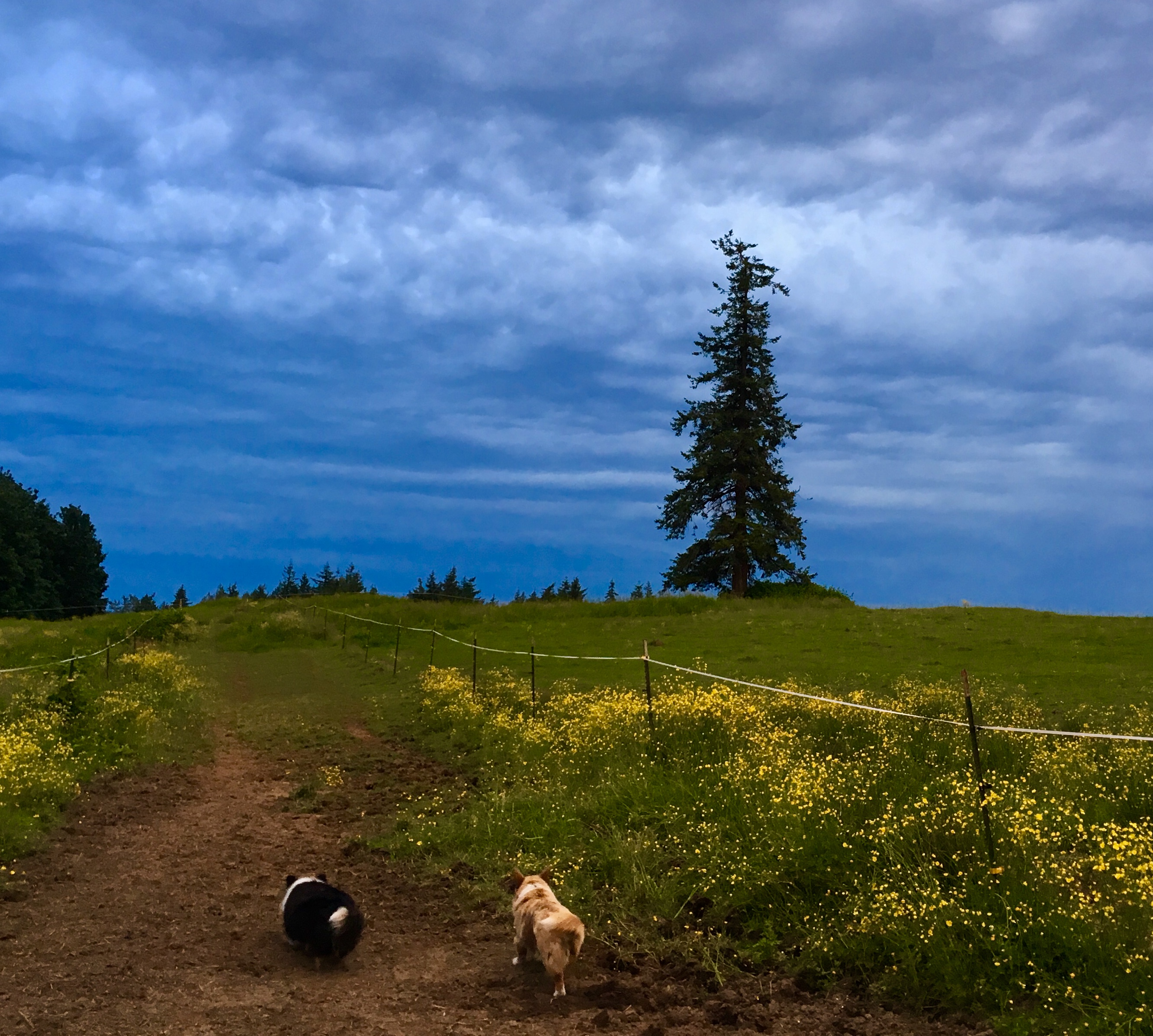
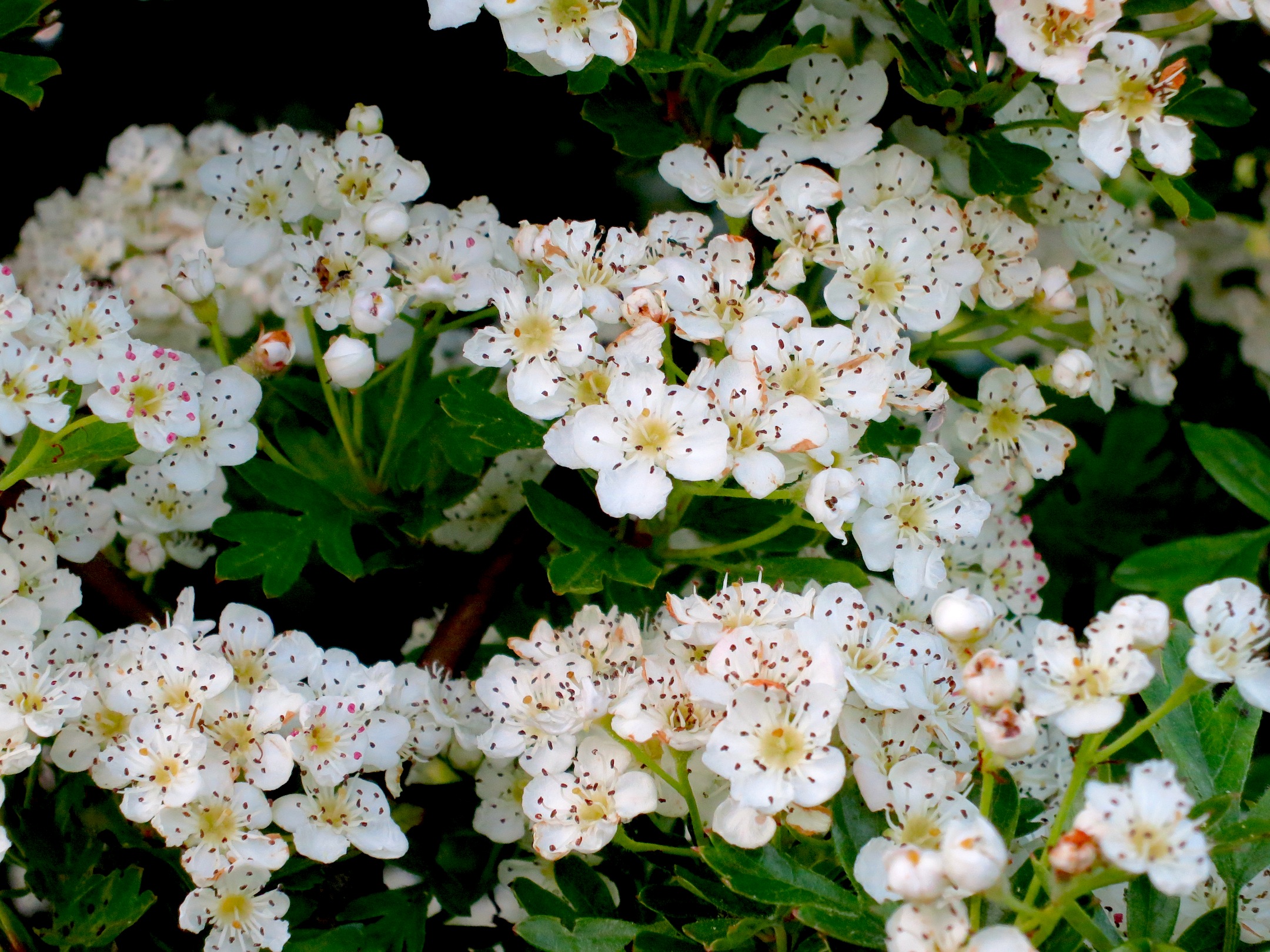
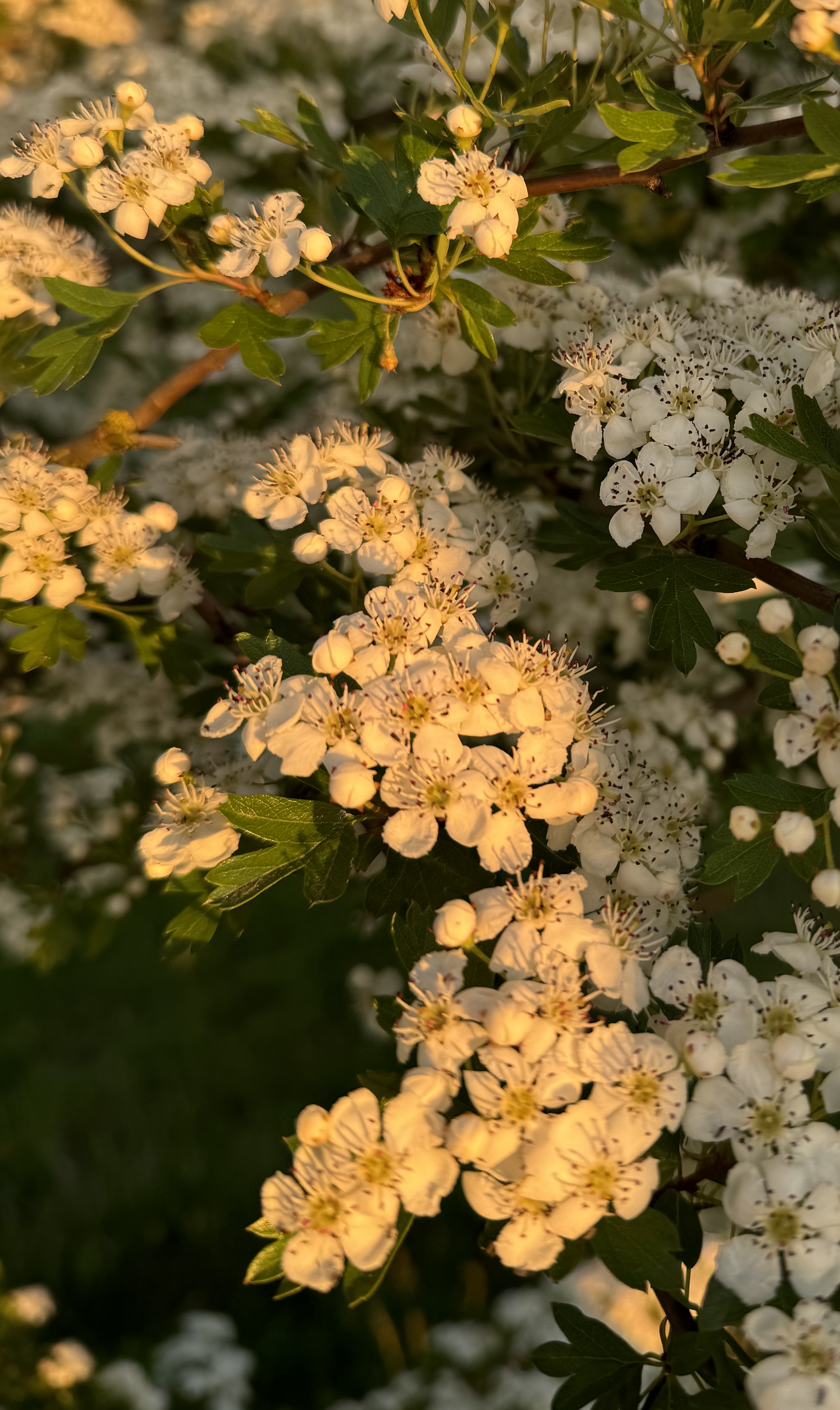
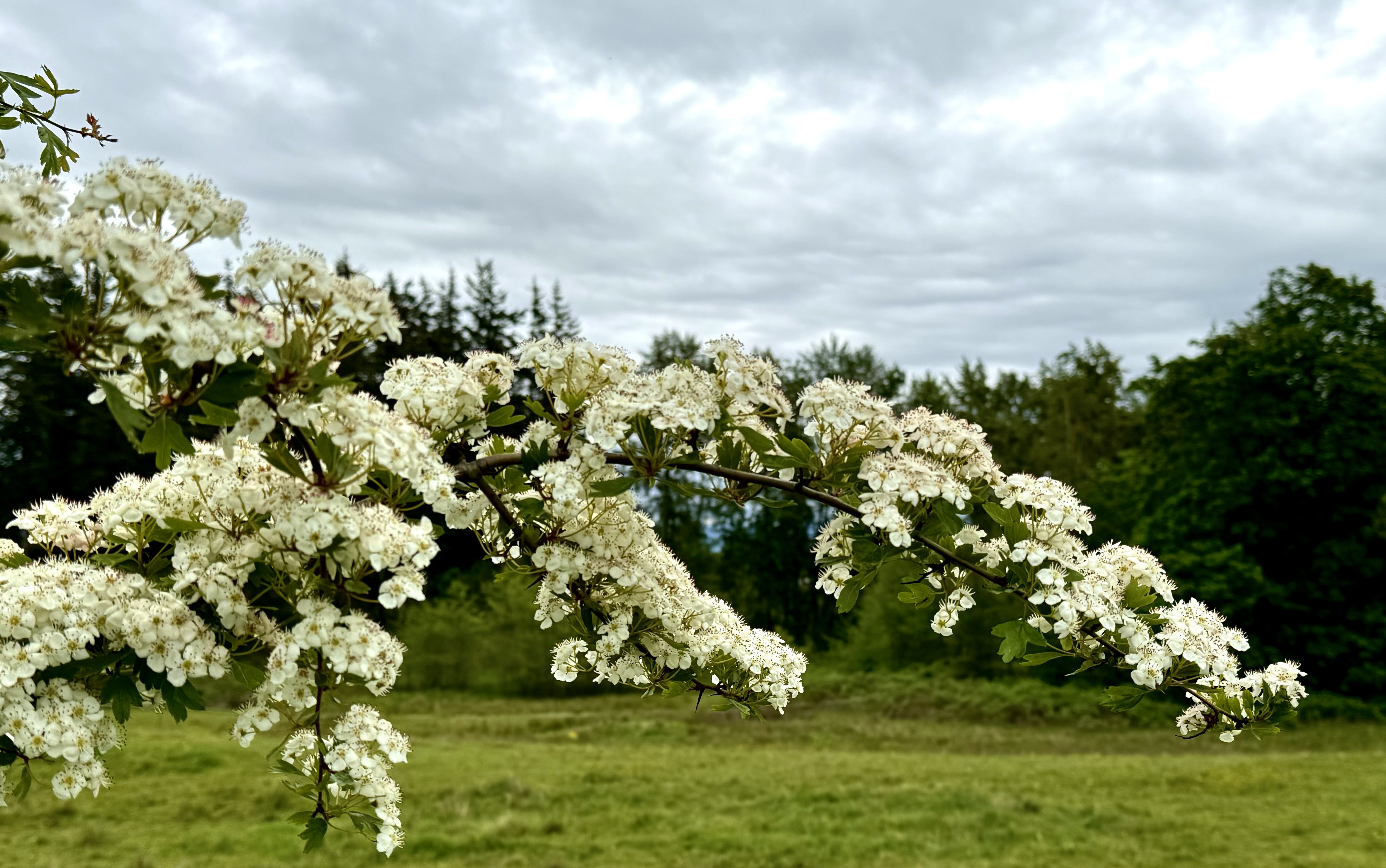
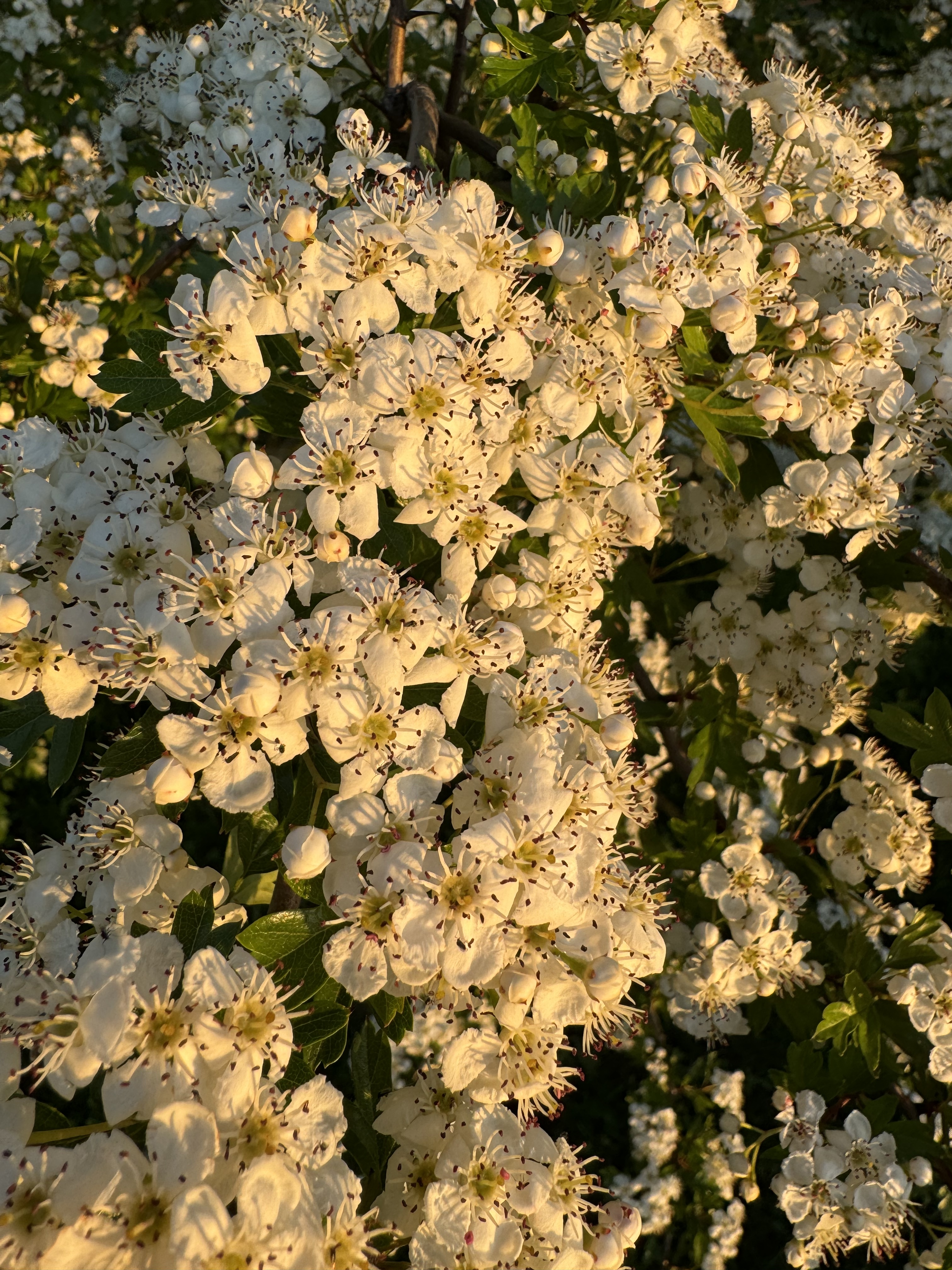
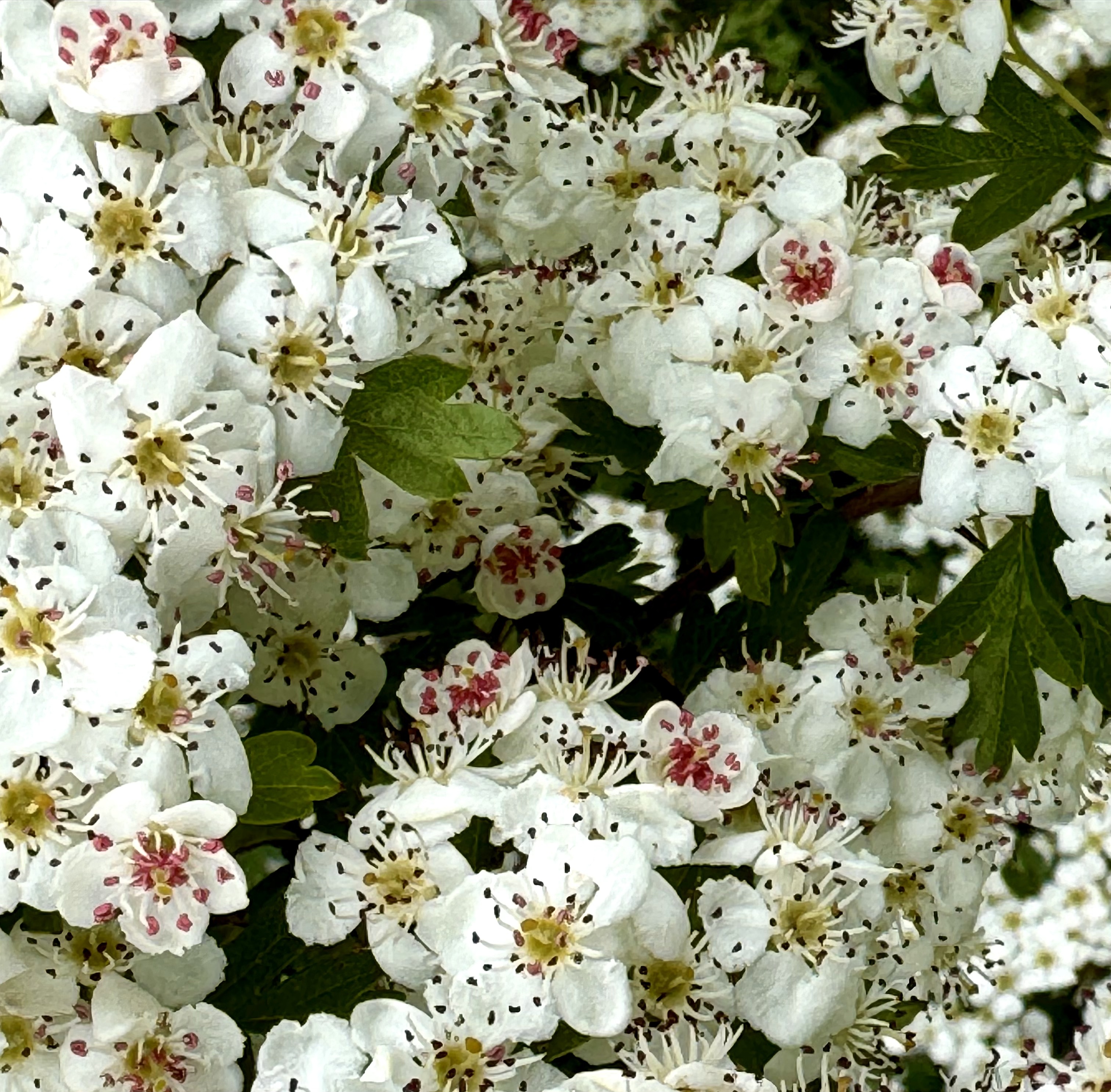
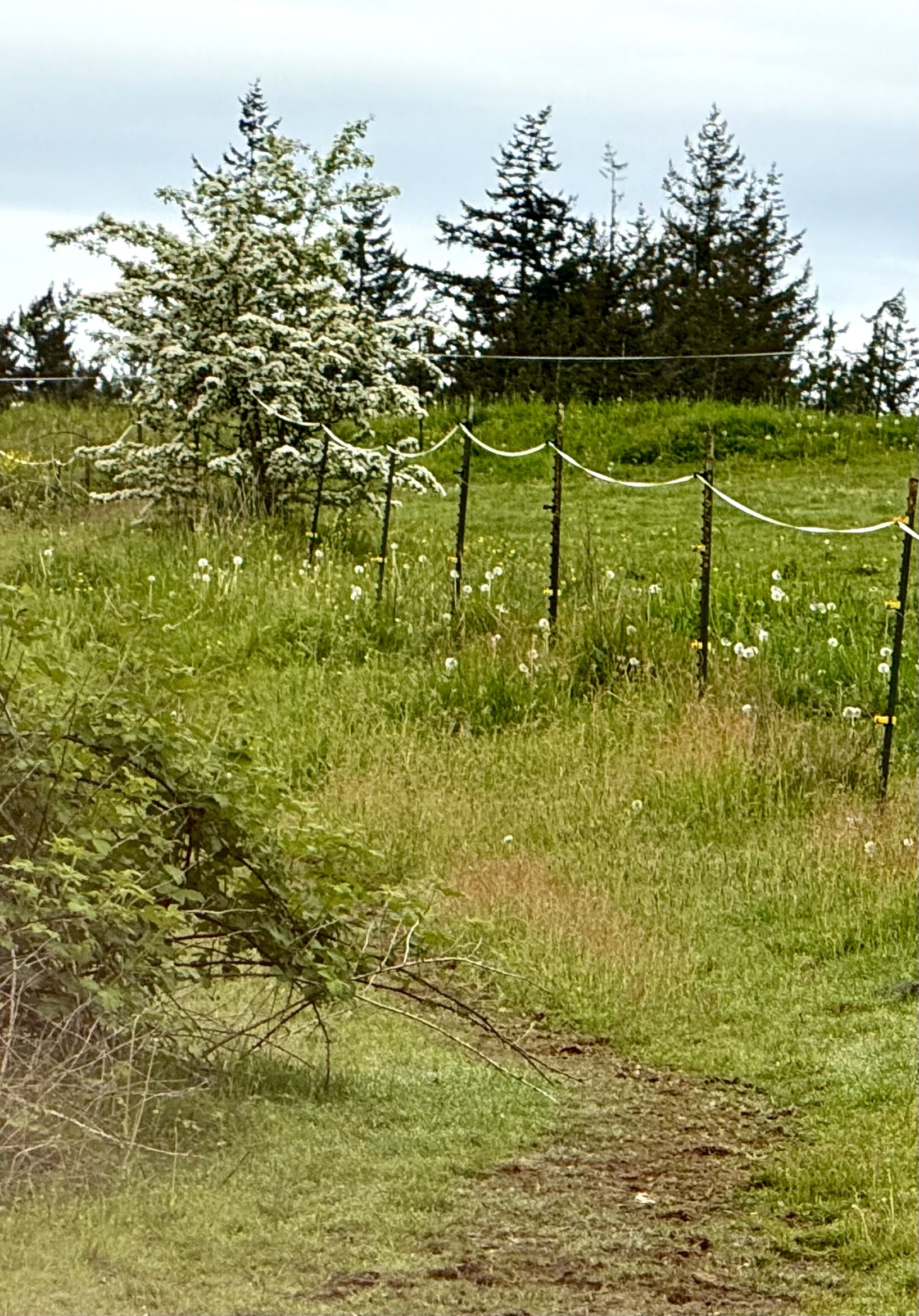
The bird-sowed hawthorn bush along the lane to our back field has suddenly become a blooming tree, staking out its place alongside the trail the horses follow to their pasture. This May, it is a white flame against the dark woods.
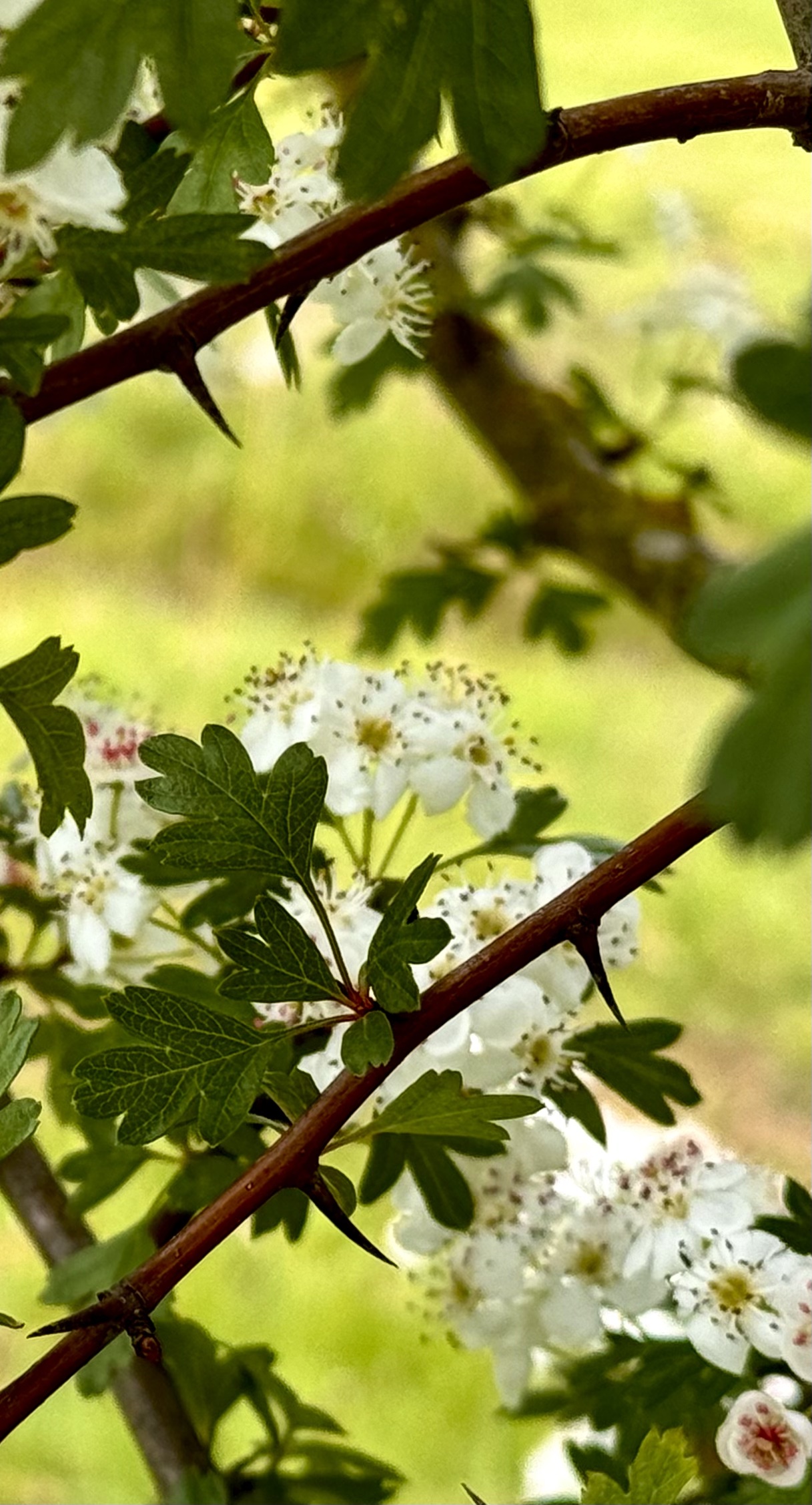
Though we didn’t intend for it to be there, we’ll leave it be. Hawthorns are great bird habitat and a haven for honeybees. They are found in most hedge rows in the United Kingdom, impenetrable due to their fierce thorns and criss-cross network of branches, a historic symbol of the toughness and persistence of the Celtic people. Though we don’t need a hedge row here, I appreciate the tree’s reminder it has a place in myth and lore.
It will never be a hospitable tree like the lone fir tree that graces our hill, or the big leaf maple where children climb, or the black walnut whose branches support the treehouse. But it will be a white beacon every May, portending the summer to come, and if it bears fruit, it will feed the birds that nest in its interior.
And like the poem written by WWI soldier/poet Sassoon, it will be a bittersweet reminder of the familiar comfort of home, even though sharp thorns abound among the blossoms. Those thorns are nothing compared to the despair found in the fearsome trenches of warfare.
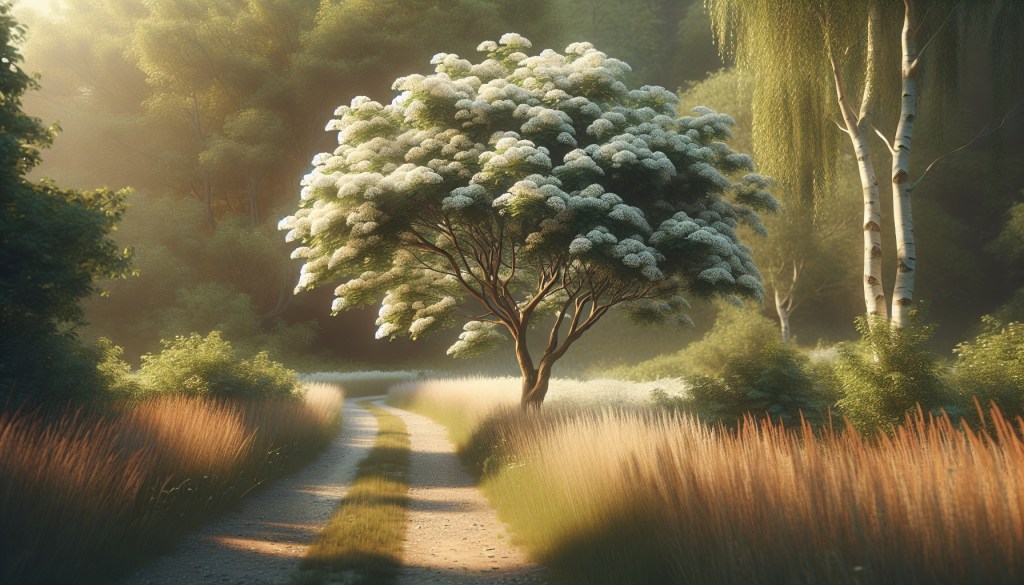
AI image created for this postSiegfried Sassoon’s handwritten poem
along fair Arran’s shores the swans sing soft of tale of yore, of a young love taken to sea
the two were hand in glove like sparrows bound in sacred love a tune that only they can sing
a tree of unity they planted by the green eyed sea the branch would hold their love through time
a sailor lad was he he said,”dont cry my lovely, mhari before the moon is full i’ll return”
I’ll wait for thee and she sang to him
the moon shone full and bright and home he sailed mid-summers night the tree so young and blossoming
they slept among the green the world was light and dreams serene the fires in their hearts burned bright
Where moss-grown boulders stand, he took her by the lily hand and there they wed at break of day
the seas know not of hearts and once again the two must part. “it wont be long, i swear to thee.
please wait for me.” and she sang to him
The hawthorn tree has grown, 10 years she walked shores alone, she hears his whisper in the leaves
Home is the sailor lad, home in the sea, forever plaid, Under the wide and starry sky
Yes, I will wait for thee, By mountain, sea and tree; And on the wind you’ll hear my love,
for at the fall of day Beneath the leaves where once we lay I’ll sit and sing i’ll wait for thee
come back to me…. music and lyrics by Fae Wiedenhoeft
One-Time
Monthly
Yearly
Make a one-time or recurring donation to support daily Barnstorming posts
What words or harder gift does the light require of me carving from the dark this difficult tree?
What place or farther peace do I almost see emerging from the night and heart of me?
The sky whitens, goes on and on. Fields wrinkle into rows of cotton, go on and on. Night like a fling of crows disperses and is gone.
What song, what home, what calm or one clarity can I not quite come to, never quite see: this field, this sky, this tree. ~Christian Wiman, “Hard Night”
Some days, although we cannot pray, a prayer utters itself. So, a woman will lift her head from the sieve of her hands and stare at the minims sung by a tree, a sudden gift.
Some nights, although we are faithless, the truth enters our hearts, that small familiar pain; then a man will stand stock-still, hearing his youth in the distant Latin chanting of a train.
Pray for us now. Grade 1 piano scales console the lodger looking out across a Midlands town. Then dusk, and someone calls a child’s name as though they named their loss.
Darkness outside. Inside, the radio’s prayer — Rockall. Malin. Dogger. Finisterre. ~Carol Ann Duffy “Prayer”
photo by Bob Tjoelker
As a child falling asleep, I prayed to God with moans and groans echoing in my ears.
Growing up on a small farm located about two miles from a bay in Puget Sound, I found myself praying for safety on foggy nights as fog horns moaned in the distance. Scattered throughout the inlet, the horns called out mournful groans of warning to passing freighter ships. The resonant lowing of the horns carried miles over the surrounding landscape due to countless water particles in the fog transmitting sound waves so effectively. The louder the foghorn moan heard on our farm, the thicker and more hazardous the mist in the air. Those horns would make me unspeakably sad for reasons I could only articulate to God. Thus I prayed for the ships, and I prayed for my own shaky navigation through life.
Navigating blind in a fog necessitates taking unpredictable risks. The future can seem a murky mess. I cannot see what lies ahead: I navigate by my wits, by my best guess, but particularly by listening for the low-throated warnings coming from the rocky shores and shallows of those who have gone ahead of me.
I am easily lost in the fog of my fears – disconnected, afloat and circling aimlessly, searching for a touch point of purpose and direction. The isolation I sometimes feel may simply be my own self-absorbed state of mind, sucking me in deep until I’m soaked, dripping and shivering from the smothering gray. If only I trust the fog horn warnings and reassurances from the Word of God, I could charge into the future undaunted.
He is in the pea soup alongside me, awaiting the Sun’s dissipation of the fog. Now I know, nearly seventy years into this voyage, the fog eventually clears. The journey continues on beyond these shores.
Even so, I will keep praying with the resonant voices of wisdom and caution from shore, like the nightly tradition of the BBC radio shipping forecasts that calm so many to sleep to this day. Even a Finisterre (the end of the land) prayer holds us in safety as we find our way home.
Instead of echoing the anxious moans and groans of my childhood prayers, may my voice be heard singing an anthem of hope and promise.
One-Time
Monthly
Yearly
Make a one-time or recurring donation to support daily Barnstorming posts



































 Barnstorming