A Lesson Learned Young

I have a brief confession
that I would like to make.
If I don’t get it off my chest
I’m sure my heart will break.

I didn’t do my reading.
I watched TV instead—
while munching cookies, cakes, and chips
and cinnamon raisin bread.

I didn’t wash the dishes.
I didn’t clean the mess.
Now there are roaches eating crumbs—
a million, more or less.

I didn’t turn the TV off.
I didn’t shut the light.
Just think of all the energy
I wasted through the night.

I feel so very guilty.
I did a lousy job.
I hope my students don’t find out
that I am such a slob.
~Bruce Lansky “Confession”
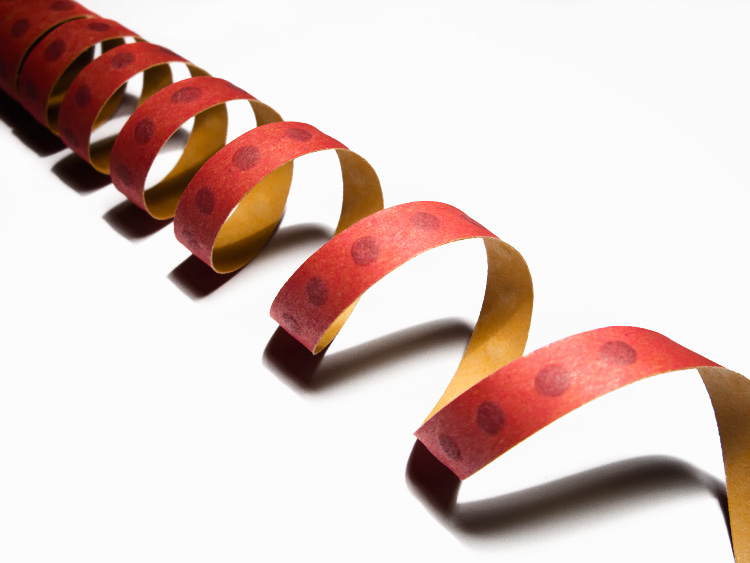
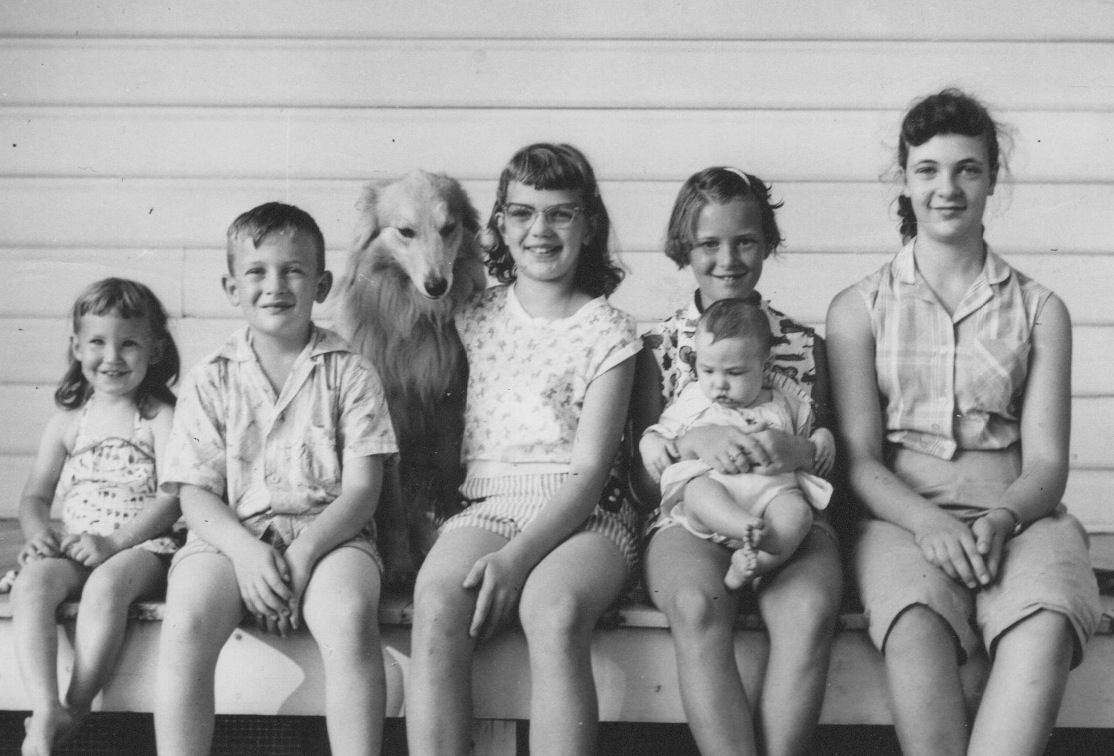
Summertime visits to our cousin Joe’s farm were always greatly anticipated.  We would be allowed several days of freedom exploring the fields and barns, playing hide and seek, reading comic books and Mad Magazines that we never had at our own house.

In addition, we got to play with Joe’s cap guns. These noisy little pistols had the ability to make a pop from the roll of “caps” inserted inside. They seemed far more authentic than any of the squirt guns we played with at home.

But I was a girl. I got tired of the cowboy or war shooting games quickly. There is only so much popping you can do and it just isn’t that fun any more. I was bored with my brother playing with the guns endlessly so one day I simply put an end to it by pocketing the last roll of caps in my jacket, thinking I’d slip them back into Joe’s bedroom the next day before we left for home.

It wasn’t until we were home several days later that I was reminded in the middle of breakfast about the roll of caps when my mother came out of the laundry room dangling the coil of dots up for me to see.

“What are these doing in your jacket pocket?”  she asked. 
I swallowed my cheerios down hard, nearly choking.

“Guess they belong to Joe.”   I said, not meeting her gaze.

“He gave them to you?”

“Um, not exactly.”

“You took them?”

“Guess so.”

“Does he know you have them?”

“Not exactly.”  I started to cry.  I didn’t even want the stupid things, had no way to use them and didn’t even like them. But I took them. In fact, I stole them.

She put the roll on the kitchen table in front of me, set a big envelope and a piece of paper and a pencil down in front of me and told me to write an apology to my cousin Joe, as well as my aunt and uncle.  The note would be wrapped around the roll of caps and mailed to them that day.

I was mortified at being caught with ill-gotten gains. How could I confess this thing I did? How would I ever make it right with my cousin? How would he ever trust me again, and how would my aunt and uncle ever allow me to come visit again?

I wrote each word slowly and painfully, the note paper oozing the guilt I felt.

“Joe, I’m sorry that I took your roll of caps without asking you. I put them in my pocket where they didn’t belong and forgot about them. But that was wrong. I have never taken anything that wasn’t mine before and I never will again. I’m very very sorry.”

My mother read it, nodded, sealed up the envelope with the roll of caps inside, put on stamps and we walked out to the mailbox together to mail it.  My stomach hurt and I didn’t think I’d feel okay ever again.

Three days later, my aunt wrote me back:

“Thank you for returning Joe’s caps. Sometimes we must learn hard lessons about doing the right thing. Joe accepts your apology and has learned from your example. He’s relieved he didn’t lose them as he has to earn the money to pay for them with his allowance. We’re looking forward to your next visit! Much love to you.”

Instantly I felt much better. I now understood the relief of apology and the healing of confession.

But most of all, I’ve never forgotten the sweetness of forgiveness.
One-Time
Monthly
Yearly

Make a one-time or recurring donation to support daily Barnstorming posts

Make a monthly donation

Make a yearly donation

Choose an amount

$10.00
$25.00
$50.00
$5.00
$15.00
$100.00
$5.00
$15.00
$100.00

Or enter a custom amount

$

Your contribution is deeply appreciated.

Your contribution is appreciated.

Your contribution is appreciated.

DonateDonate monthlyDonate yearly
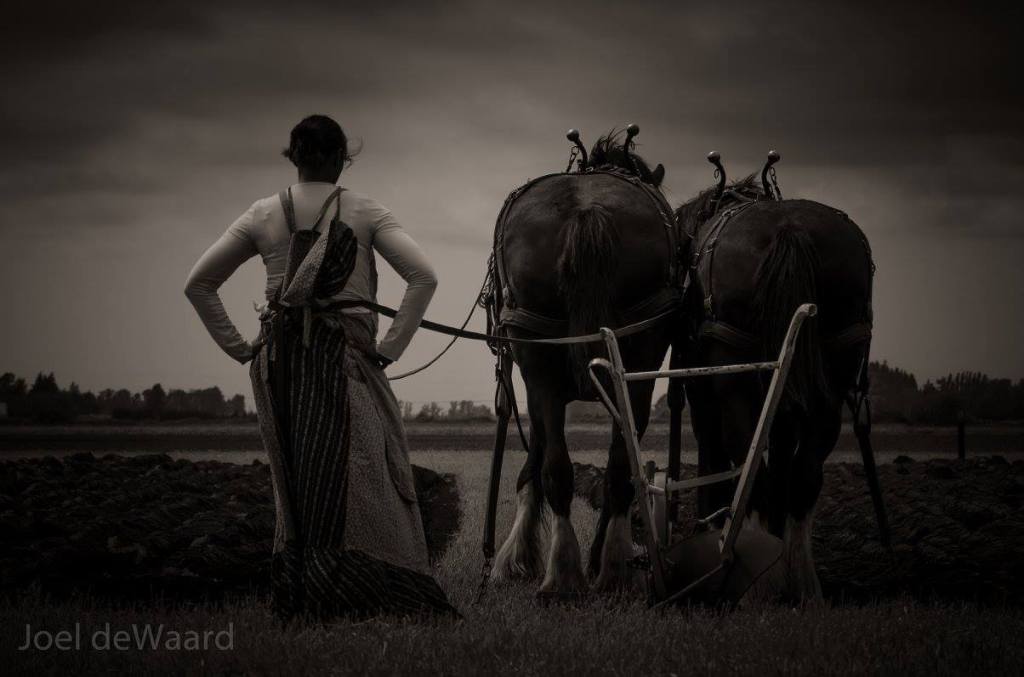
Hold On…

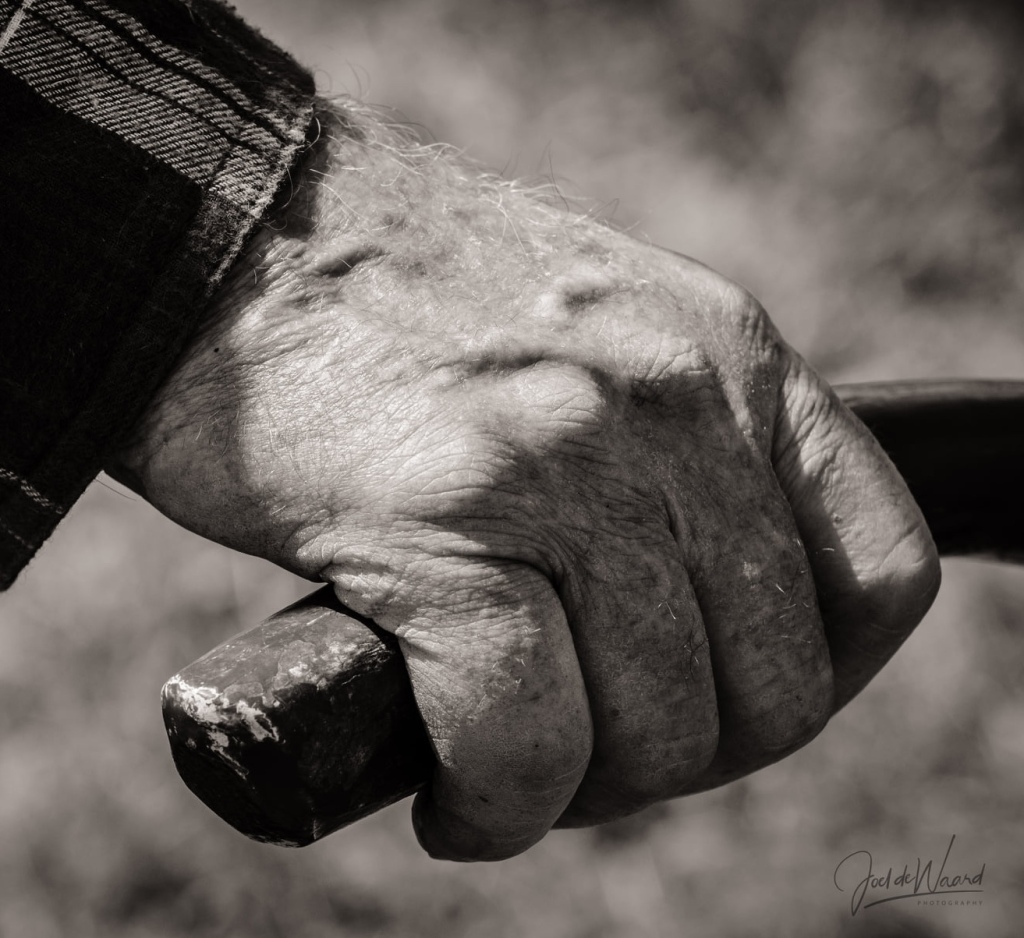
photo by Joel DeWaard

Little soul,
you and I will become
the memory
of a memory of a memory.
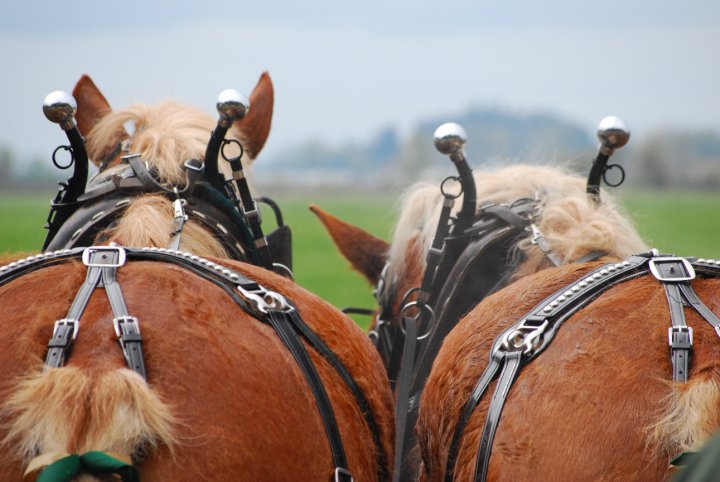
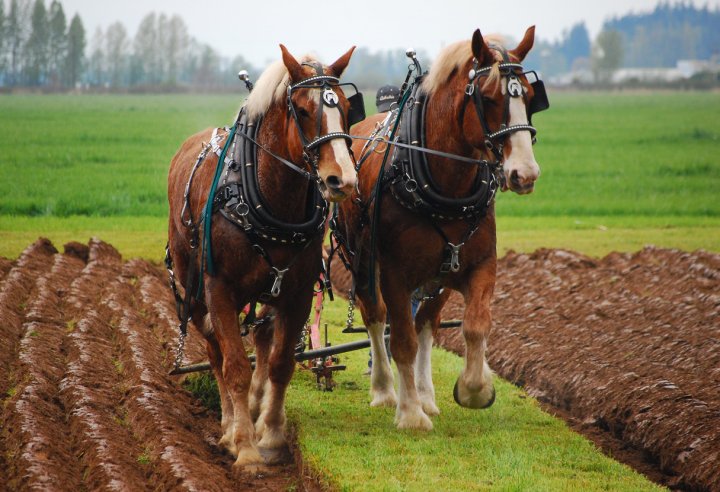
A horse
released of the traces
forgets the weight of the wagon.
~Jane Hirshfield “Harness”

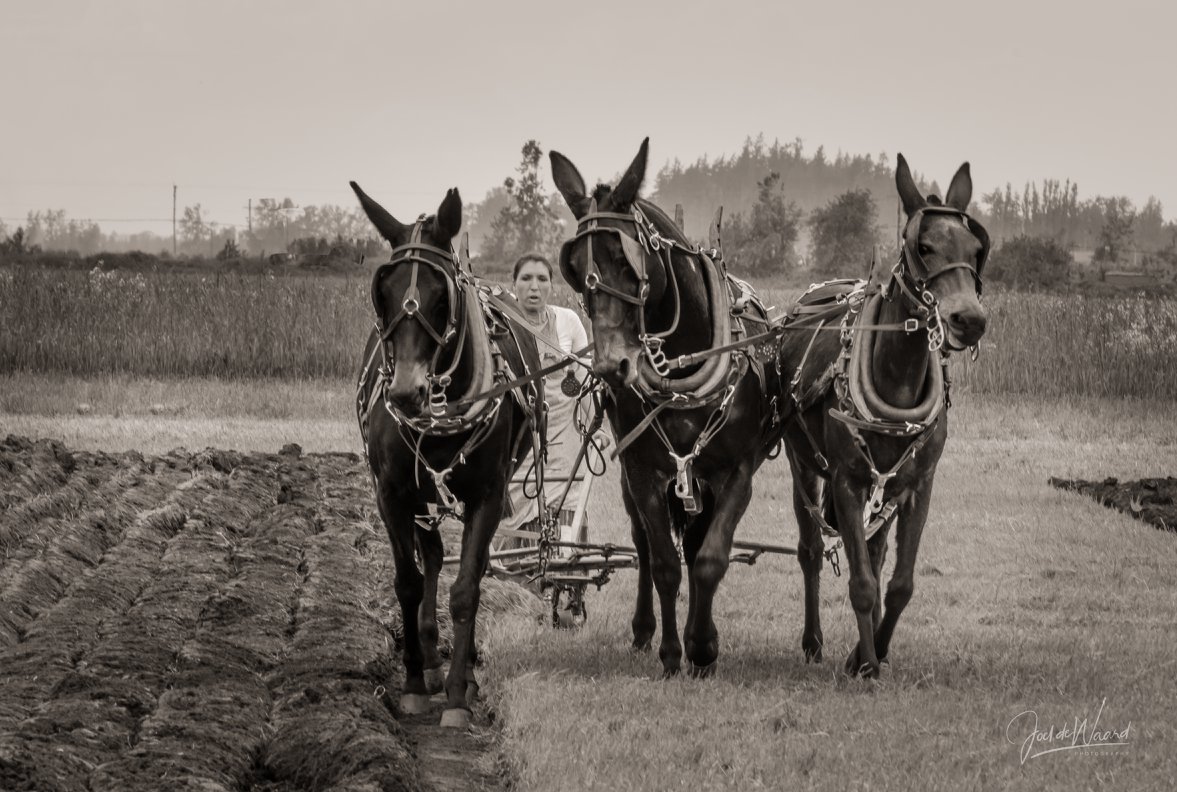
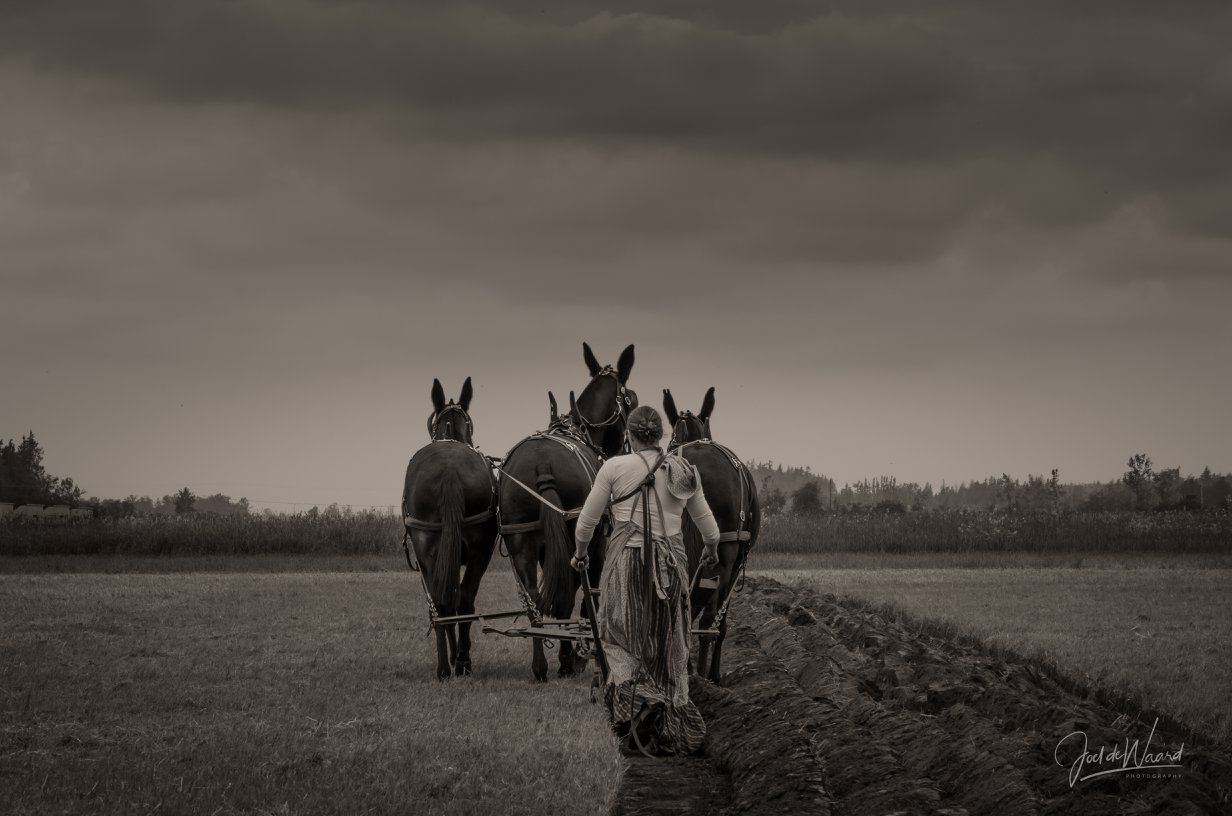
photo by Joel DeWaard
Field with Plowing Farmers by Vincent Van Gogh

My grandmothers were strong.
They followed plows and bent to toil.
They moved through fields sowing seed.
They touched earth and grain grew.
They were full of sturdiness and singing.
My grandmothers were strong.

My grandmothers are full of memories
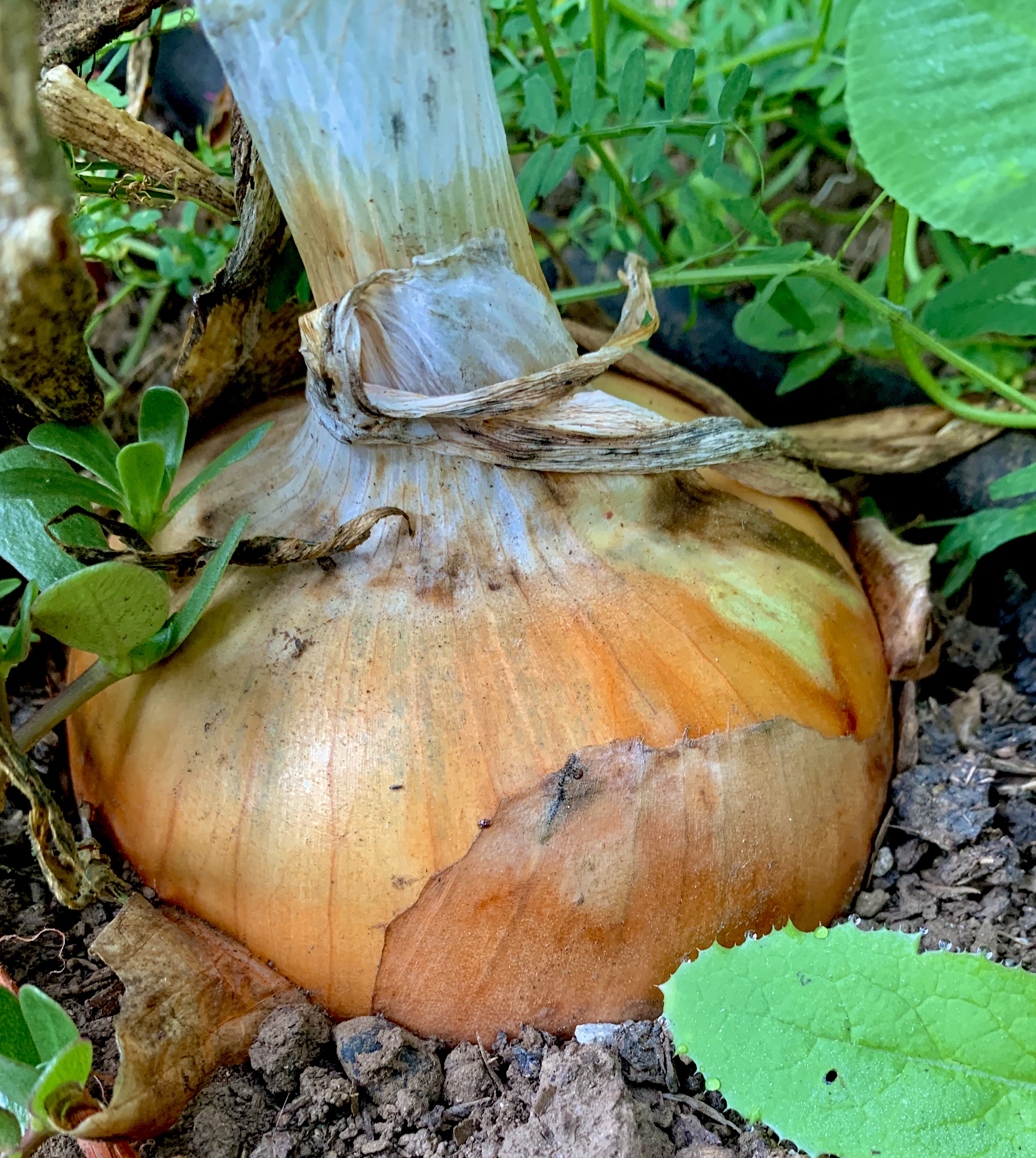
Smelling of soap and onions and wet clay
With veins rolling roughly over quick hands
They have many clean words to say.
My grandmothers were strong.
Why am I not as they?

~Margaret Walker “Lineage”

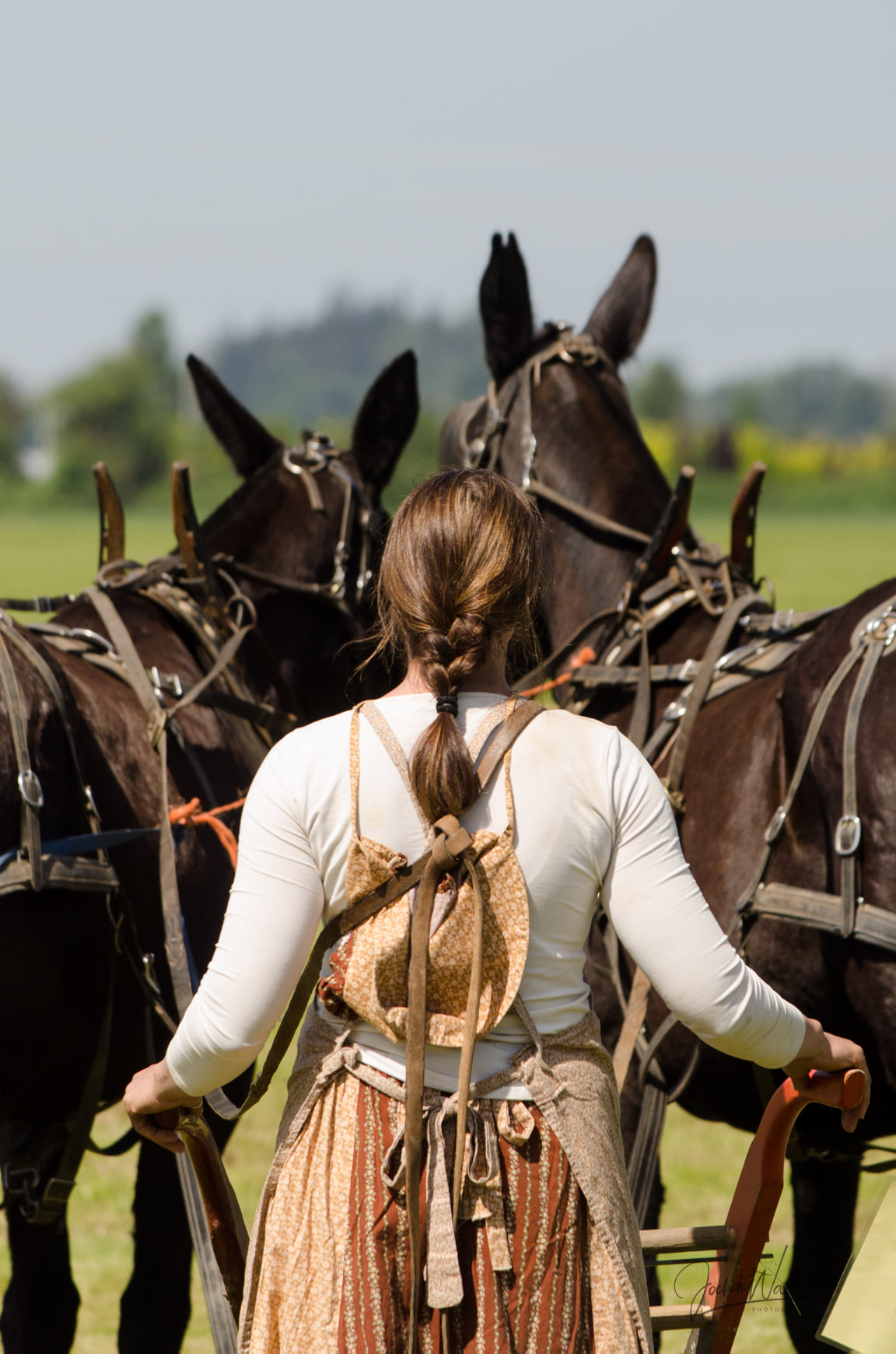
photo by Joel DeWaard

In recognition of the history of Juneteenth...

So many years of shouldering huge burdens
while waiting for freedom from the harness:
grandmothers, grandfathers, parents, children
struggling through every ounce of sweat,
every sore muscle,
every drop of blood,
every tear.

How can one forget the weight of the plow
as it turns over the earth
where someday all will rest as dust?

The soil of strong hearts is well-tilled,
yielding to the plowshare,
furrowed deep and straight
by the hard pull of the traces.

Although black hearts and minds are still tread upon
yet do they bloom;
even when turned inside out
yet do they flourish.

Plow deep our hearts this day, oh Lord,
to celebrate freedom declared for all God’s children.

May we never forget the strength it took to hold on…
to plow, sow, grow, gather and harvest that freedom,
the steady pull on the traces
in order to raise up strong children and grandchildren
evermore and everywhere.

photo by Joel DeWaard
photo by Joel De Waard

Thank you once again to Joel DeWaard, local farmer, craftsman and photographer, who graciously shares his remarkable photos.

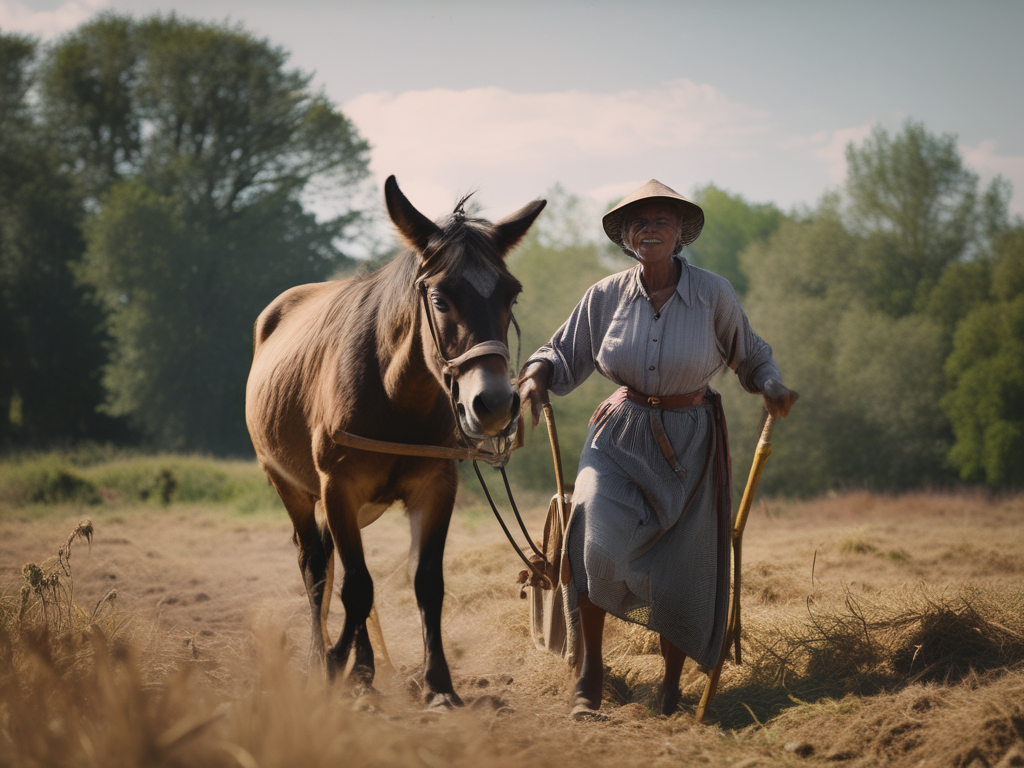
AI image created for this post

One-Time
Monthly
Yearly

Make a one-time or recurring donation to support daily Barnstorming posts

Make a monthly donation

Make a yearly donation

Choose an amount

$10.00
$25.00
$50.00
$5.00
$15.00
$100.00
$5.00
$15.00
$100.00

Or enter a custom amount

$

Your contribution is deeply appreciated.

Your contribution is appreciated.

Your contribution is appreciated.

DonateDonate monthlyDonate yearly

These Things You Do

There you are
this cold day
boiling the water on the stove,
pouring the herbs into the pot,
hawthorn, rose;
buying the tulips
& looking at them, holding
your heart in your hands at the table
saying please, please, to nobody else
there in the kitchen with you.
How hard, how heavy this all is.
How beautiful, these things you do,
in case they help, these things you do
that, although you haven’t said it yet,
say that you want to live.

~Victoria Adukwei Bulley “There You Are”

Our daily rituals are so routine and mundane, unless they are disrupted by unexpected and unwanted events. Then we desire nothing more than to get back to what is routine, familiar and comforting.

Right now, I’m aware of at least four friends in our small church congregation who are undergoing treatment for cancer, and a couple others who are waiting on testing results. They would love nothing more than a boringly routine day like they had known pre-diagnosis. Instead, nothing seems as if it will ever be the same again, except an awareness of how precious and valued each day of life is.

Thankfully, very few people are forced to share their life-threatening illnesses with the world via headlines, videos and photos like the King of England and Princess of Wales. Surely, that adds another layer of hard heaviness on top of dealing with such difficult, exhausting treatments and interventions.

For those coping with challenging medical illness, I pray for comforting rituals and routines that remind you how much you are loved. These beautiful moments of everyday life are reasons you want to live, even as you do these hard things.

May your heart and soul be held in loving hands as you see this through.

AI image created for this post
One-Time
Monthly
Yearly

Make a one-time or recurring donation to support daily Barnstorming posts

Make a monthly donation

Make a yearly donation

Choose an amount

$10.00
$25.00
$50.00
$5.00
$15.00
$100.00
$5.00
$15.00
$100.00

Or enter a custom amount

$

Your contribution is deeply appreciated.

Your contribution is appreciated.

Your contribution is appreciated.

DonateDonate monthlyDonate yearly
Sudden Tears

Some things are very dear to me—
Such things as flowers bathed by rain
Or patterns traced upon the sea
Or crocuses where snow has lain …
the iridescence of a gem,
The moon’s cool opalescent light,
Azaleas and the scent of them,
And honeysuckles in the night.
And many sounds are also dear—
Like winds that sing among the trees
Or crickets calling from the weir
Or Negroes humming melodies.
But dearer far than all surmise
Are sudden tear-drops in your eyes.
~Gwendolyn Brooks “Sonnet 2”

We human beings do real harm.
History could make a stone weep.
~Marilynne Robinson from Gilead

I am an easy cryer. It takes very little to tip me over the edge: a hymn, a poem, simply witnessing a child’s joy. Suddenly my eyes fill up. I blame this on my paternal grandmother who was in tears much of her time when visiting our family, crying happy, crying sad, crying frustrated and angry tears.

Somehow after her visit, she was always smiling, so I think her weeping was cathartic emptying of her stress.

My greatest trigger to weep myself is watching someone else tear up. I think my grandmother left behind some powerful empathy genes.

I had to desensitize my response to tears to be effective as a physician/healer. Witnessing tears in the exam room is a normal part of the job: patients are anxious, ill, in pain or simply need to decompress in safety. I learned early on to be unobtrusive and not interrupt, letting the flow of tears be part of how the patient was trying to communicate. It was a struggle when my inclination was to cry right along with them. But I needed to be the rock in the room, solid and steady. I could understand their tears as yet another symptom of a clinical presentation, allowing me to observe without being clouded by my own emotional response.

Sometimes that worked. Sometimes not. At times overwhelmed, I wept at births, I wept at deaths, I wept at the sharing of bad news.

Now, liberated from the exam room, I freely weep at the state of the world, or when I read of disaster and tragedy, and especially when I witness intentional harm and meanness in others. I’m no longer a barely responsive stone, but more like an over-filled sponge being squeezed – everything builds up until I can hold it no more. Reading headlines in the news is sometimes more than I can bear.

I cry myself dry.

And that is okay. Once emptied out, I can be filled again by so much that is good and precious in this life.

That is worth weeping over.

AI image created for this post
Detail from “Descent from the Cross” by Rogier van der Weyden
One-Time
Monthly
Yearly

Make a one-time or recurring donation to support daily Barnstorming posts

Make a monthly donation

Make a yearly donation

Choose an amount

$10.00
$25.00
$50.00
$5.00
$15.00
$100.00
$5.00
$15.00
$100.00

Or enter a custom amount

$

Your contribution is deeply appreciated.

Your contribution is appreciated.

Your contribution is appreciated.

DonateDonate monthlyDonate yearly
Fearsome Things to See

Not much to me is yonder lane  
 Where I go every day;  
But when there’s been a shower of rain  
 And hedge-birds whistle gay,  
I know my lad that’s out in France
 With fearsome things to see  
Would give his eyes for just one glance  
 At our white hawthorn tree.

   .    .    .    .  

Not much to me is yonder lane  
 Where he so longs to tread:
But when there’s been a shower of rain  
I think I’ll never weep again  
 Until I’ve heard he’s dead.

~Siegfried Sassoon “The Hawthorn Tree”

I drove West
in the season between seasons.
I left behind suburban gardens.
Lawnmowers.  Small talk.

Under low skies, past splashes of coltsfoot,
I assumed
the hard shyness of Atlantic light
and the superstitious aura of hawthorn.

All I wanted then was to fill my arms with
sharp flowers,
to seem from a distance, to be part of
that ivory, downhill rush.  But I knew,

I had always known,
the custom was
not to touch hawthorn.
 Not to bring it indoors for the sake of

the luck
such constraint would forfeit–
a child might die, perhaps, or an unexplained
fever speckle heifers.  So I left it

stirring on those hills
with a fluency
only water has.  And, like water, able
to redefine land.  And free to seem to be–

for anglers,
and for travellers astray in
the unmarked lights of a May dusk–
the only language spoken in those parts.

~Eavan Boland “White Hawthorn in the West of Ireland”

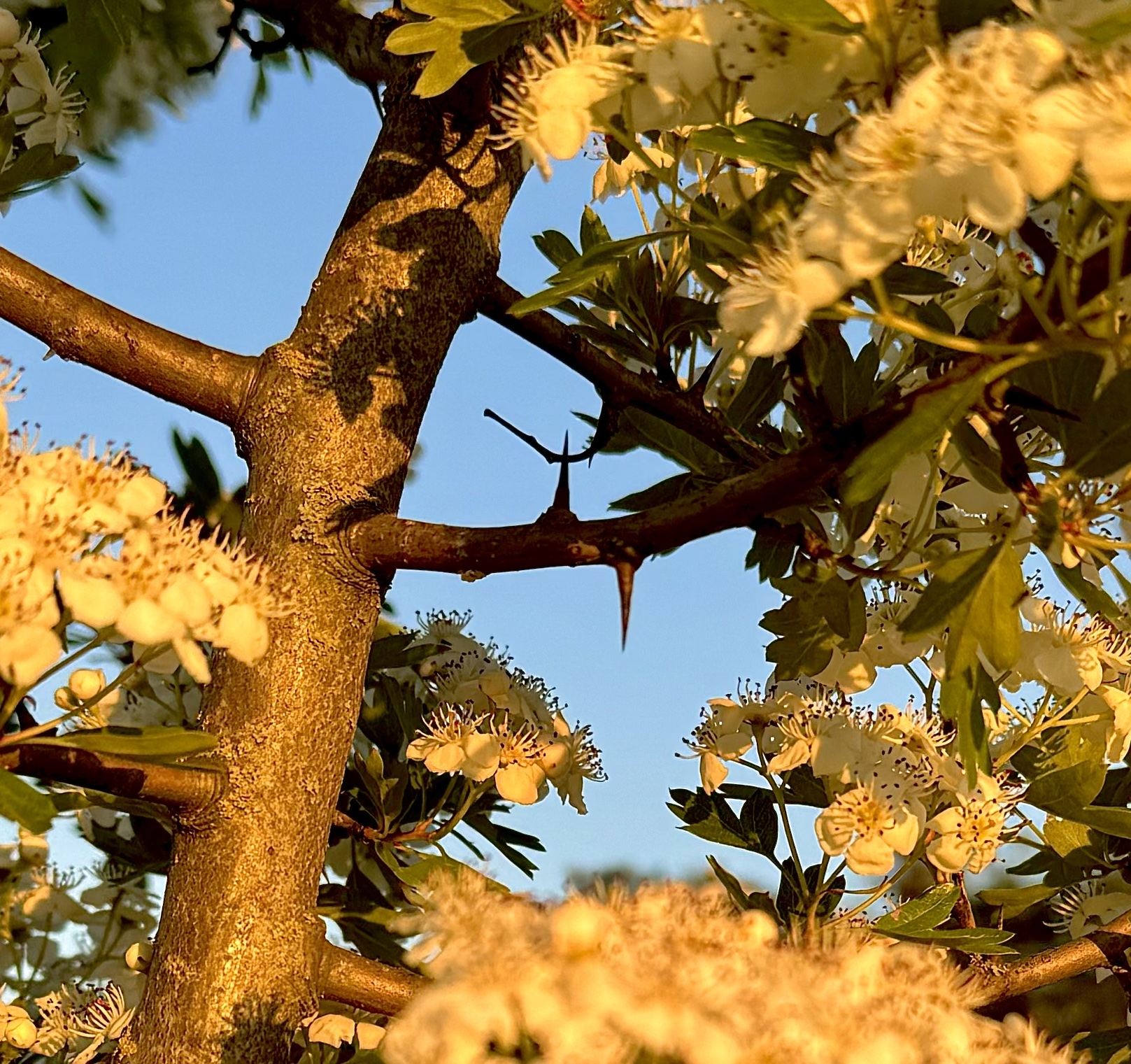
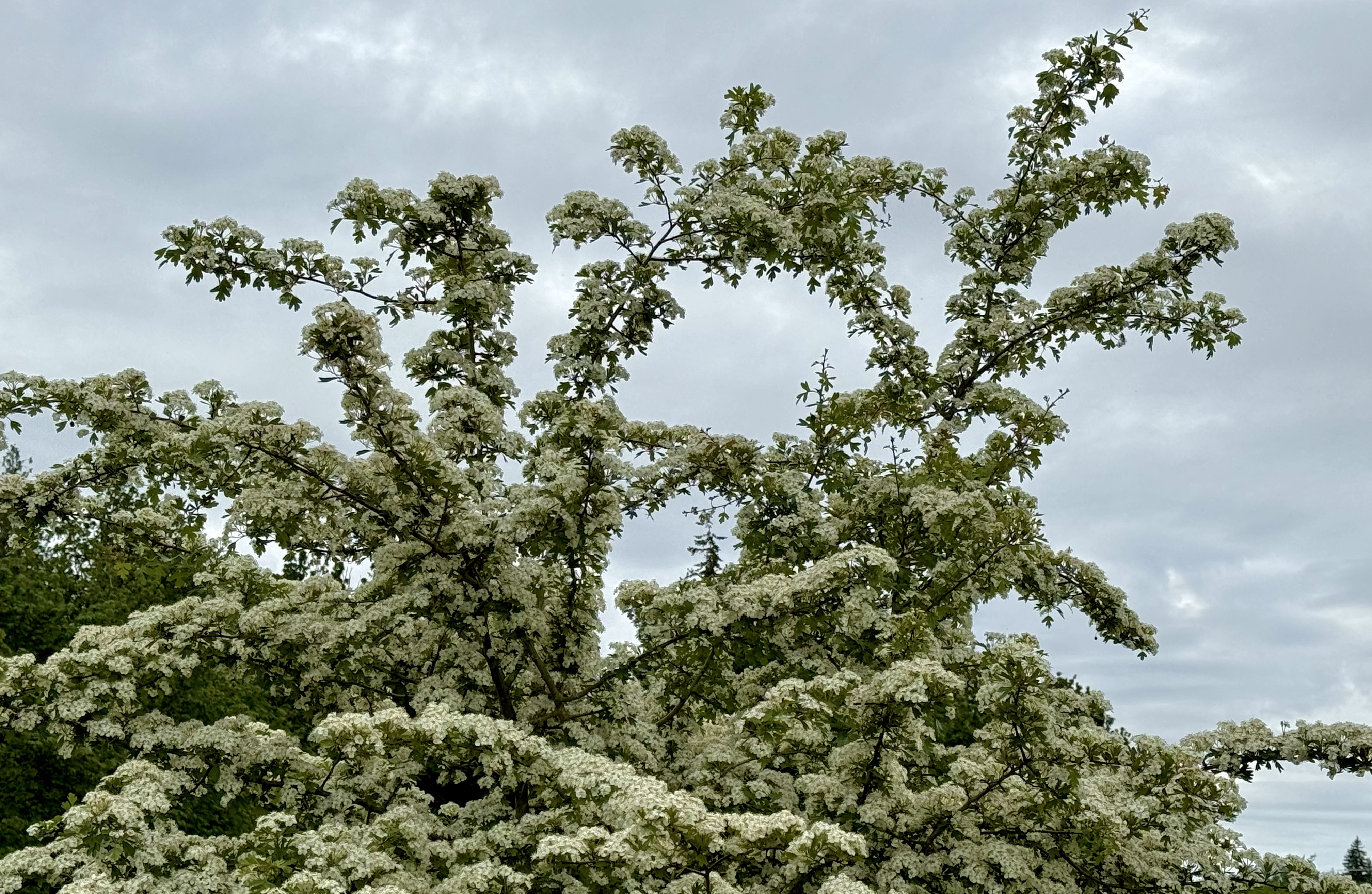
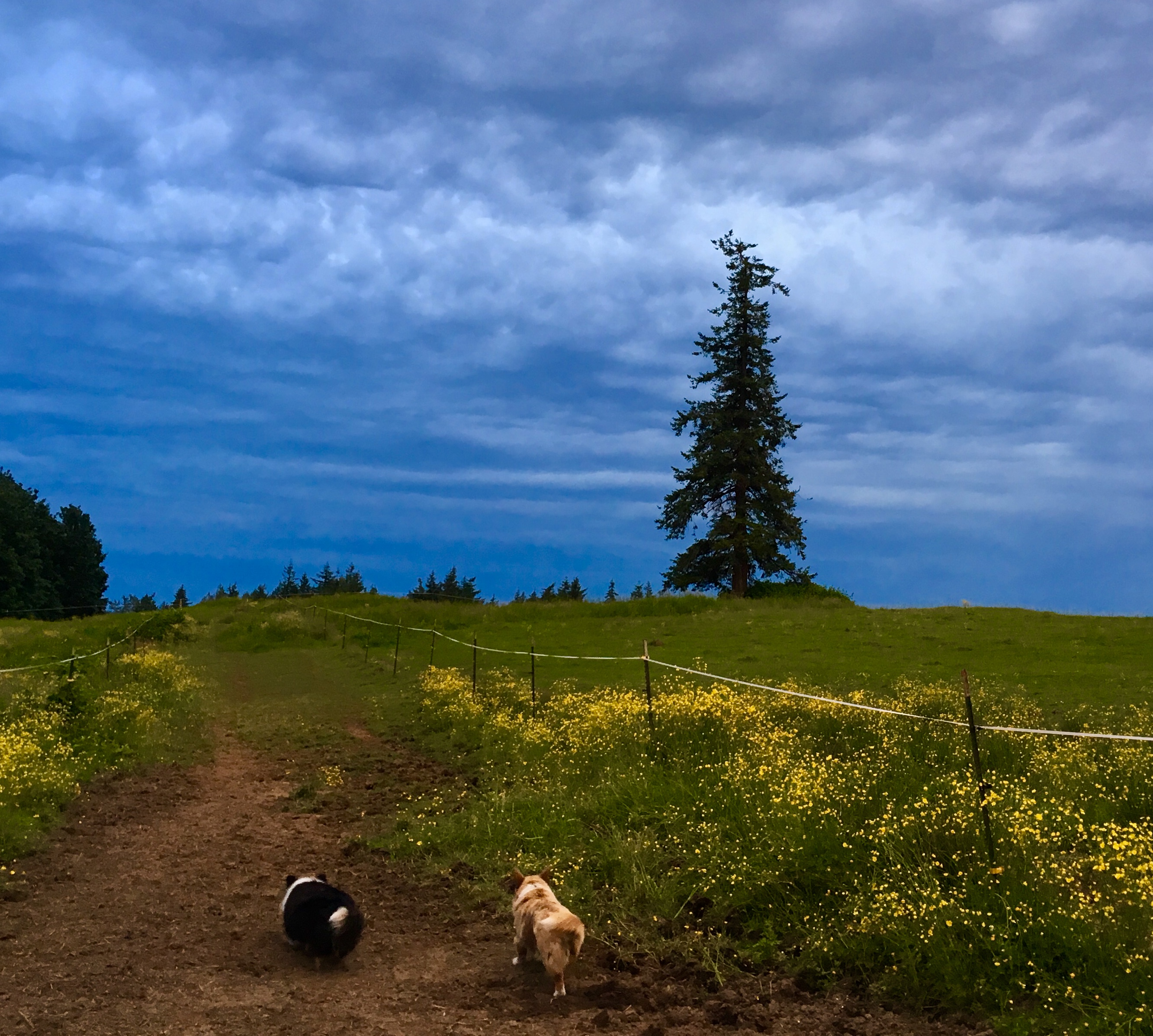
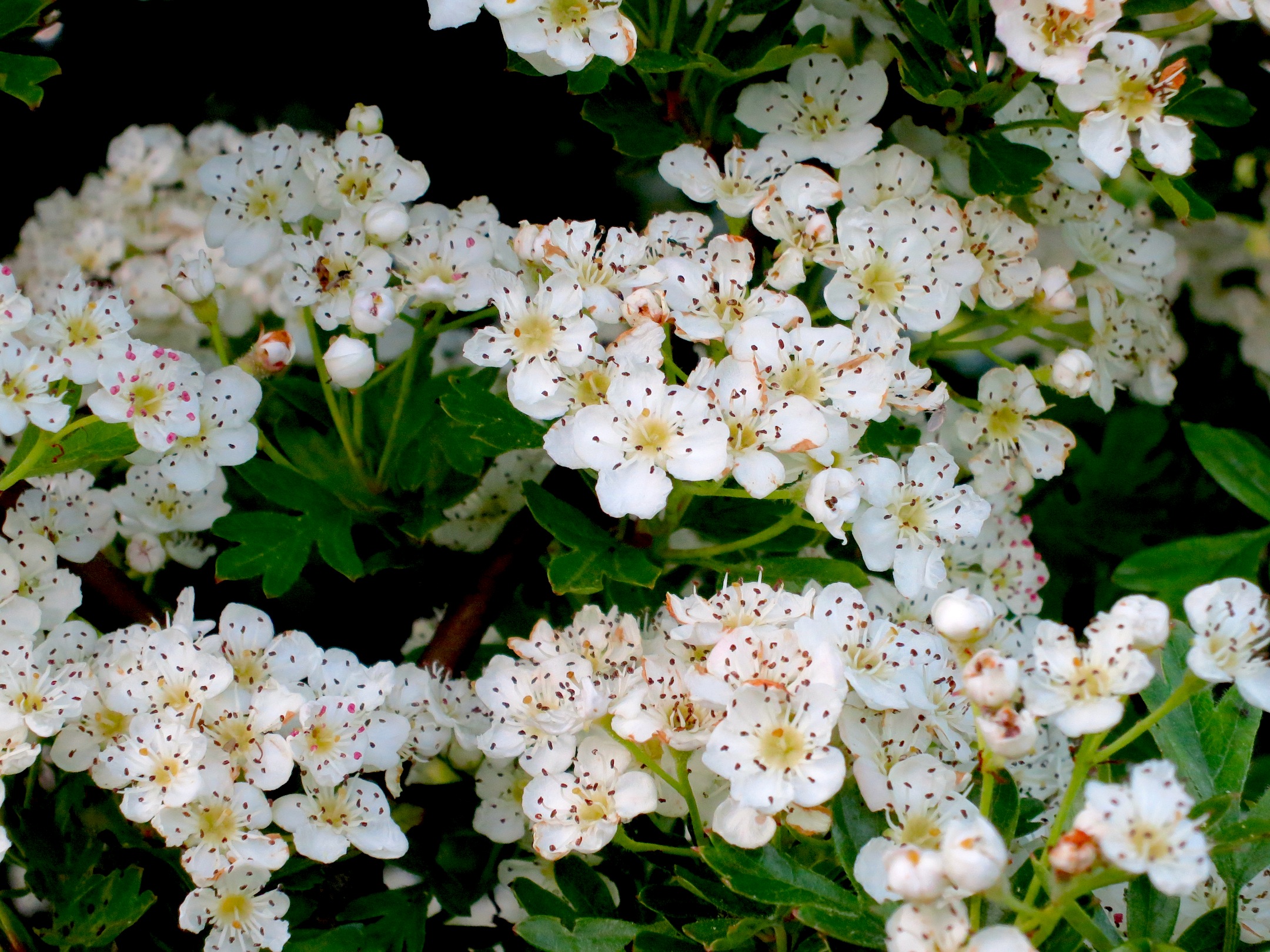
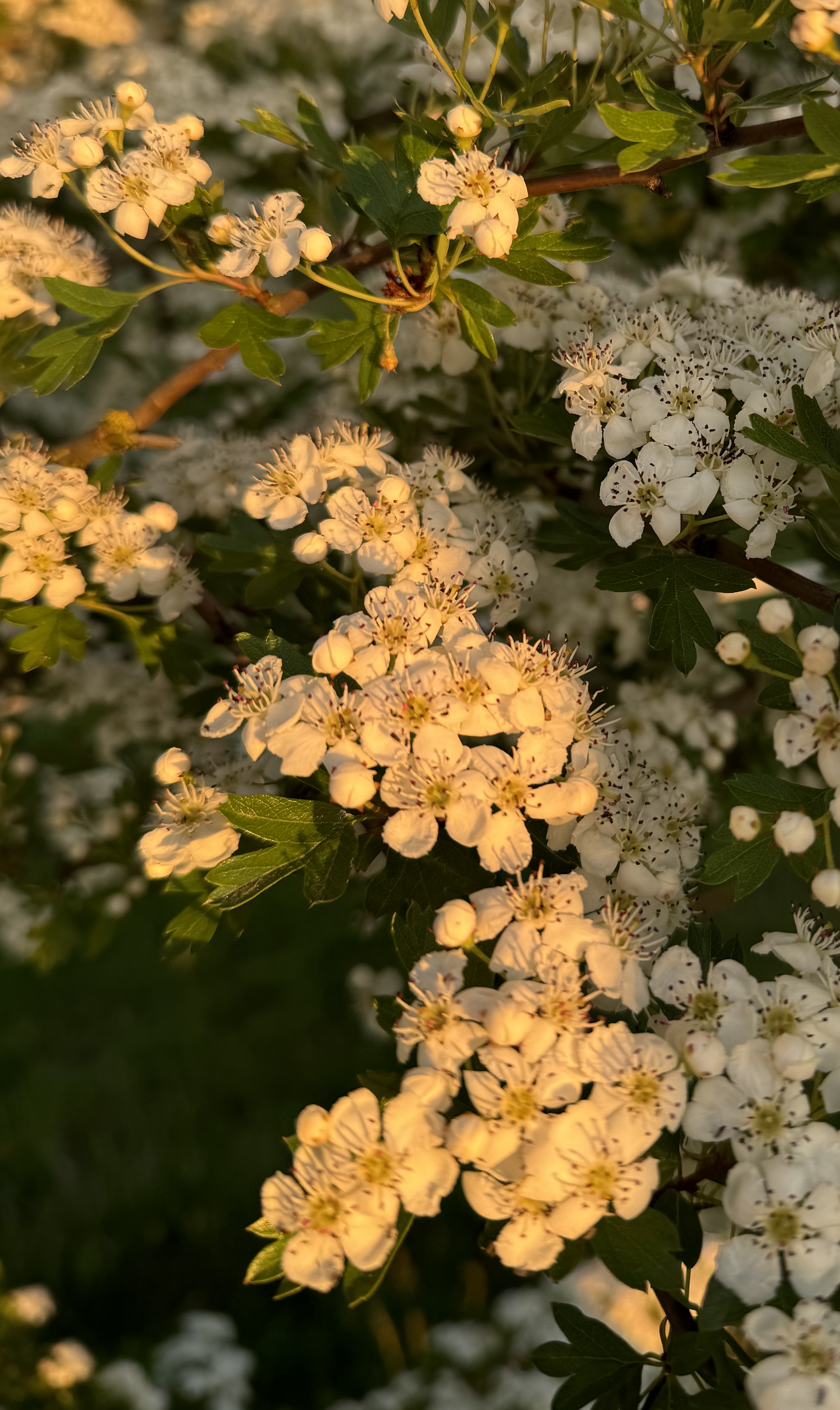
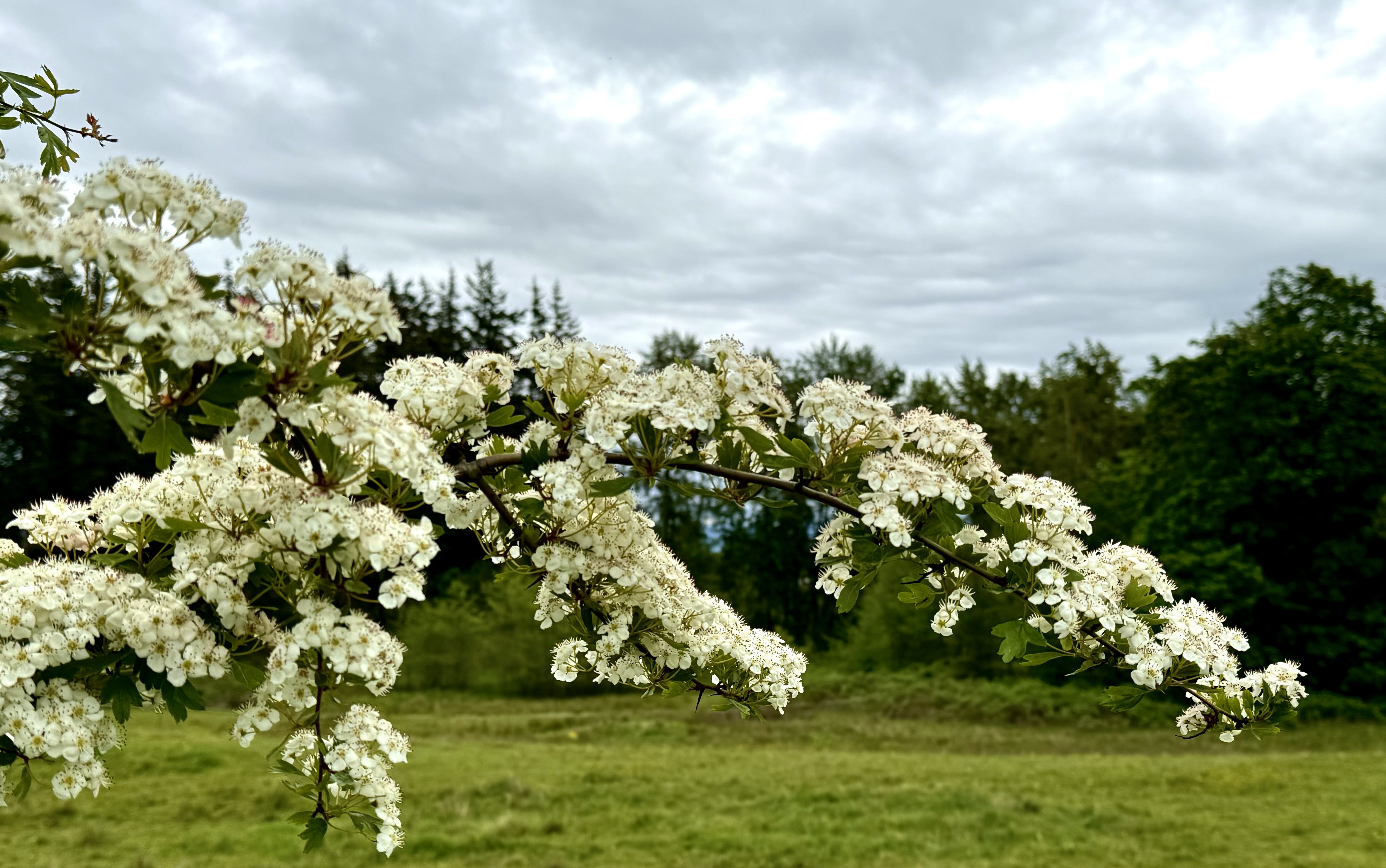
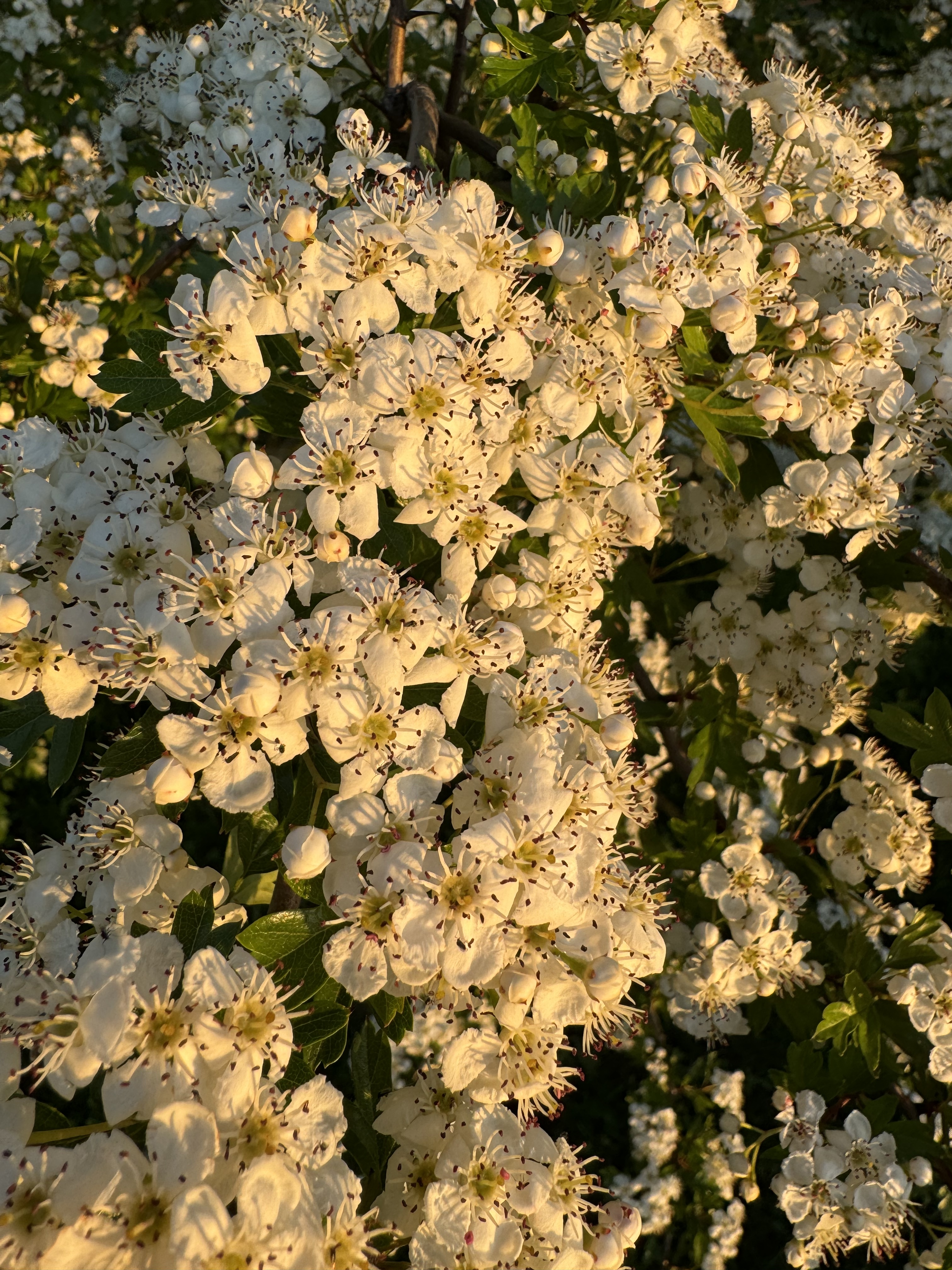
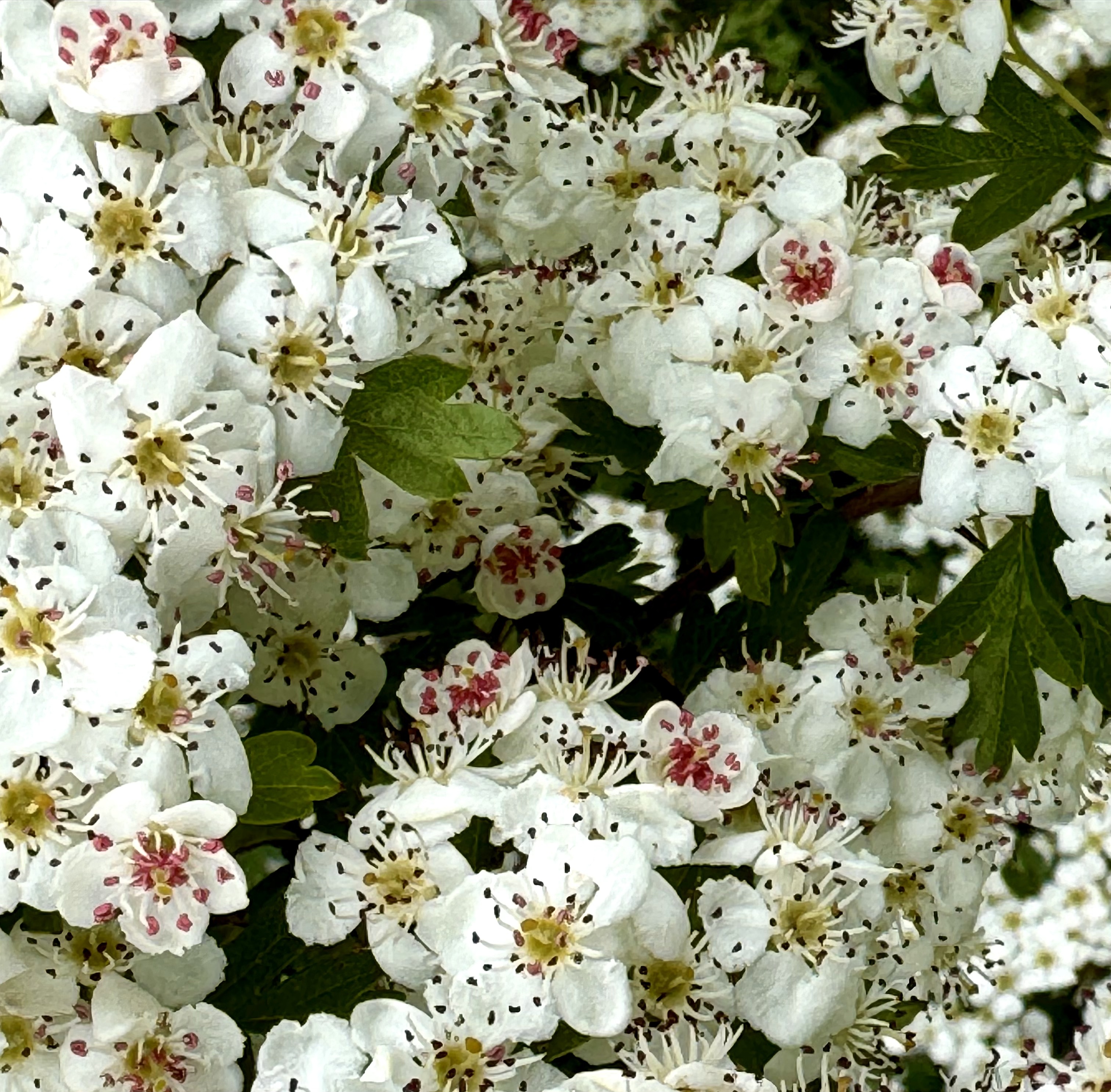
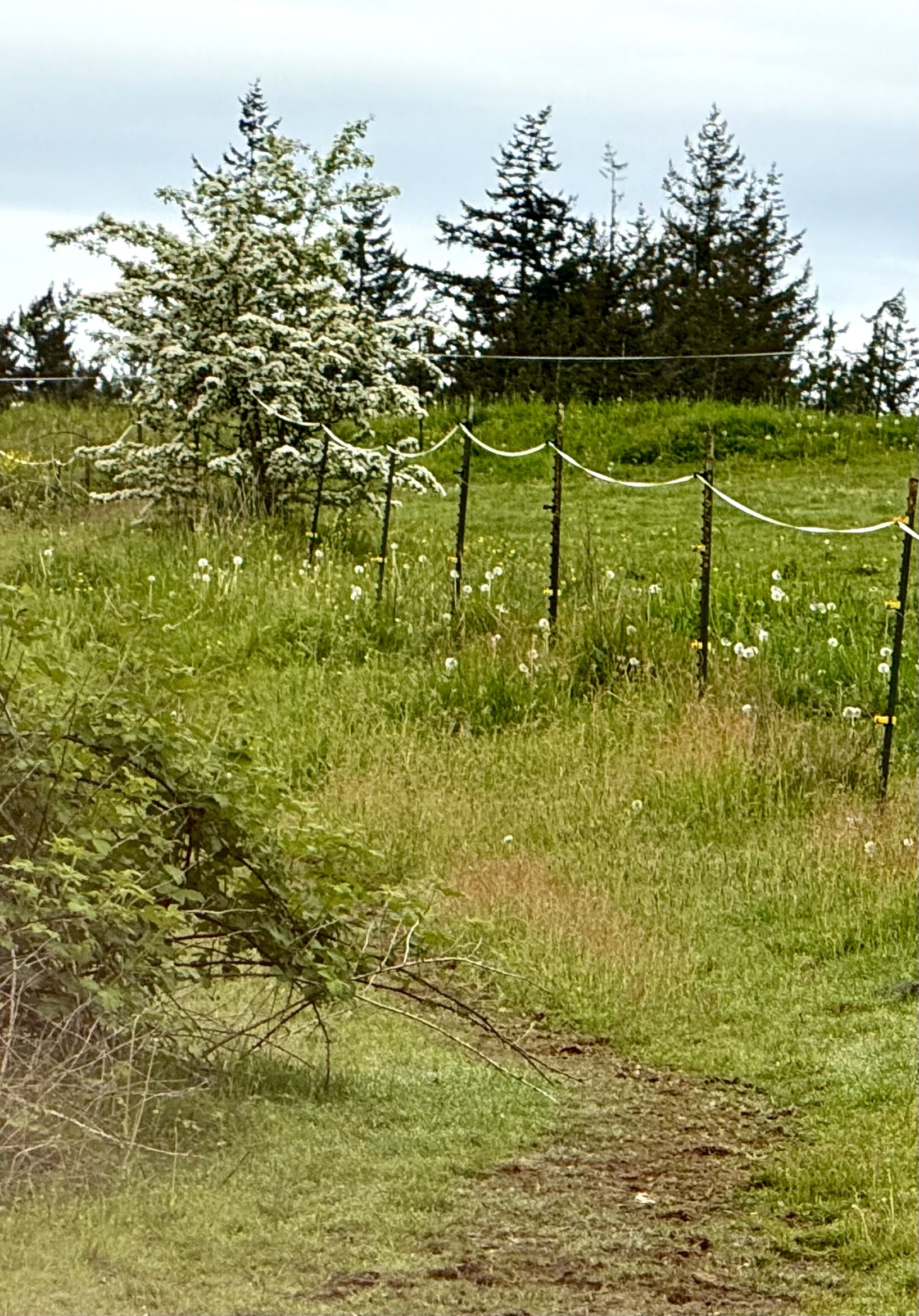
The bird-sowed hawthorn bush along the lane to our back field has suddenly become a blooming tree, staking out its place alongside the trail the horses follow to their pasture. This May, it is a white flame against the dark woods.

Though we didn’t intend for it to be there, we’ll leave it be. Hawthorns are great bird habitat and a haven for honeybees. They are found in most hedge rows in the United Kingdom, impenetrable due to their fierce thorns and criss-cross network of branches, a historic symbol of the toughness and persistence of the Celtic people. Though we don’t need a hedge row here, I appreciate the tree’s reminder it has a place in myth and lore.

It will never be a hospitable tree like the lone fir tree that graces our hill, or the big leaf maple where children climb, or the black walnut whose branches support the treehouse. But it will be a white beacon every May, portending the summer to come, and if it bears fruit, it will feed the birds that nest in its interior.

And like the poem written by WWI soldier/poet Sassoon, it will be a bittersweet reminder of the familiar comfort of home, even though sharp thorns abound among the blossoms. Those thorns are nothing compared to the despair found in the fearsome trenches of warfare.

AI image created for this post
Siegfried Sassoon’s handwritten poem

along fair Arran’s shores
the swans sing soft of tale of yore,
of a young love taken to sea

the two were hand in glove
like sparrows bound in sacred love
a tune that only they can sing

a tree of unity
they planted by the green eyed sea
the branch would hold their love through time

a sailor lad was he
he said,”dont cry my lovely, mhari
before the moon is full i’ll return”

I’ll wait for thee and she sang to him

the moon shone full and bright
and home he sailed mid-summers night
the tree so young and blossoming

they slept among the green
the world was light and dreams serene
the fires in their hearts burned bright

Where moss-grown boulders stand,
he took her by the lily hand
and there they wed at break of day

the seas know not of hearts
and once again the two must part.
“it wont be long, i swear to thee.

please wait for me.”
and she sang to him

The hawthorn tree has grown,
10 years she walked shores alone,
she hears his whisper in the leaves

Home is the sailor lad,
home in the sea, forever plaid,
Under the wide and starry sky

Yes, I will wait for thee,
By mountain, sea and tree;
And on the wind you’ll hear my love,

for at the fall of day
Beneath the leaves where once we lay
I’ll sit and sing i’ll wait for thee

come back to me….
music and lyrics by Fae Wiedenhoeft

One-Time
Monthly
Yearly

Make a one-time or recurring donation to support daily Barnstorming posts

Make a monthly donation

Make a yearly donation

Choose an amount

$10.00
$25.00
$50.00
$5.00
$15.00
$100.00
$5.00
$15.00
$100.00

Or enter a custom amount

$

Your contribution is deeply appreciated.

Your contribution is appreciated.

Your contribution is appreciated.

DonateDonate monthlyDonate yearly

Helpless Prayer

I pray because I can’t help myself.
I pray because I’m helpless.
I pray because the need flows out of me all the time —

waking and sleeping.
It doesn’t change God — it changes me.

~attributed to C.S. Lewis in “Shadowlands”

A recovering Faye with her sister Merry

Last week, on May 1, I found a surprise hanging on our front door – a little May Day basket full of little perennial blooms, along with a cheery message and a rainbow sticker. It hung from the door handle as a symbol of spring renewal, as well as a bit of a mystery – the flowers came with no hint of who had left them.

So I did a little sleuthing (actually A LOT of sleuthing) and found out they were delivered by our nearby neighbor Faye, who turned 11 just last week. She has a very special history some of you may remember:

Nine years ago, on this Barnstorming blog, I wrote about our little neighbor, two year old Faye, sickened by E.Coli 0157 infection/toxin to the point of becoming critically ill with Hemolytic Uremic Syndrome (plummeting cell counts and renal failure requiring dialysis to keep her alive).  My original post about her illness is found here. I asked for your prayers on her (and others’) behalf.

At the worst point of her hospitalization at Seattle Children’s, when the doctors were sounding very worried on her behalf, Faye’s mother Danyale, in the midst of her helplessness, wrote to our Wiser Lake Chapel Pastor Bert Hitchcock with a plea for prayers from our church.

Here is how Pastor Bert responded to Danyale and her husband Jesse who remained at home, caring for their four other children:

“I understand that Faye (and everyone dealing with her) is fighting for her life. And that’s the way I am praying: that God in his merciful power, would deliver her, even if her condition looks hopeless.

If you were able to be in church this morning, you might hear my sense of urgency, for I have chosen this benediction, with which to close the service — and I give it to you right now, from the mouth of our Lord:

Jesus said: “Do not be afraid, Danyale!
I am the First and the Last.
I am the Living One.
I died, but look – I am alive forever and ever!
And I hold the keys of death and the grave.

Neither you nor I know how this will turn out — the possibilities are terrifying. But we do know who holds the keys of life and health and death; He is the Life-giver, who heals all our diseases — nothing can rip our lives (or little Faye’s life) out of His hands. And, when He does allow these bodies to give out, He promises to give us glorious new life, safe forever in His presence. These are not pious platitudes; these are the rock-hard promises of the one who loves us more than life, and who is absolutely in control of what is happening today.

Safe in the arms of Jesus,
Safe on His gentle breast;
There by His love o’ershaded,
Sweetly my soul shall rest.

I’m praying for you all; and your Chapel Family will be praying this morning, as we gather in the Lord’s presence.

Love you, and yours, Danyale,
Pastor Bert Hitchcock

That week, Faye’s renal failure reversed itself. She was able to return home with normal kidney function and improved cell counts, having also survived a bout with pneumonia.

Here is what her mother wrote to share with you all once she came home:

“Dear Friends and readers of Barnstorming,

Some of you we know, but so many of you we do not. Whichever the case, Emily tells me you have prayed for our little girl, Faye, throughout her sickness and into her recovery. What can parents say when people–many of whom we may never be privileged to meet in this life–have come alongside us to beseech the Lord for our daughter’s life and pray for her healing? Thank you. Thank you!

Faye is doing so well; stronger every day, more and more herself! It is wonderful to see.

This week we head back down to Seattle Children’s for a check up–we’ll get to say hello to the good folks who saw her through her sickness. A special stop will be made on the dialysis unit to see Nurse Kathy, a favorite of Faye’s. We anticipate a good report!

Thanks again for your love and support, far and wide. Truly astounding.
Danyale and Jesse, for Faye, too

—————————————

Now Faye is a delightful, healthy eleven year old girl who secretly blessed me with a basket of May Day flowers. She doesn’t remember the crisis that nearly took her from us nine years ago, but she does know about God’s rainbow promises. And she certainly knows about the power of prayer in the face of helplessness.

As Pastor Bert said: our faith in an unchanging and steadfast God who loves and holds us, can change us – forever.

Amen and Amen

Faye, age 2, after her recovery

Let Live

Let us not with one stone kill one bird, 
much less two. Let us never put a cat 
in a bag nor skin them, regardless 
of how many ways there are to do so. 
And let us never take the bull, especially 
by his gorgeous horns. What I mean is 

we could watch our tongues or keep 
silent. What I mean is we could scrub 
the violence from our speech. And if we find
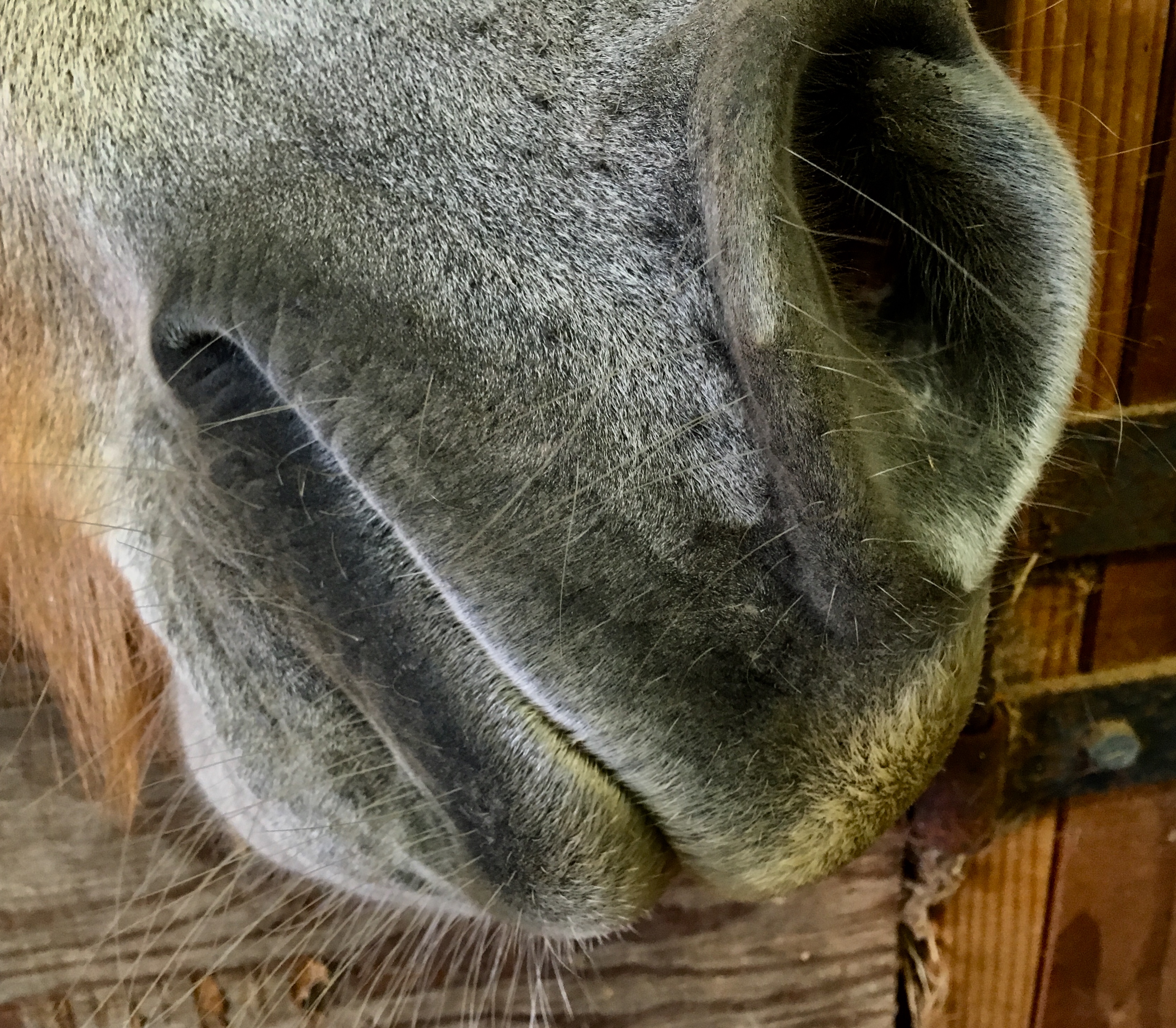
truth in a horse’s mouth, let us bless her

ground-down molars, no matter how 
old she is, especially if she was given 
as a gift. Again, let’s open her mouth——that of the horse, 
I mean——let us touch that interdental space where 
no teeth grow, where the cold bit was made to grip. 
Touch her there, gently now, touch that gentle 

empty between her incisors and molars, rub her 
aching, vulnerable gums. Don’t worry: doing so calms her. 
Besides, she’s old now; she’s what we call 
broken; she won’t bite. She’s lived through 
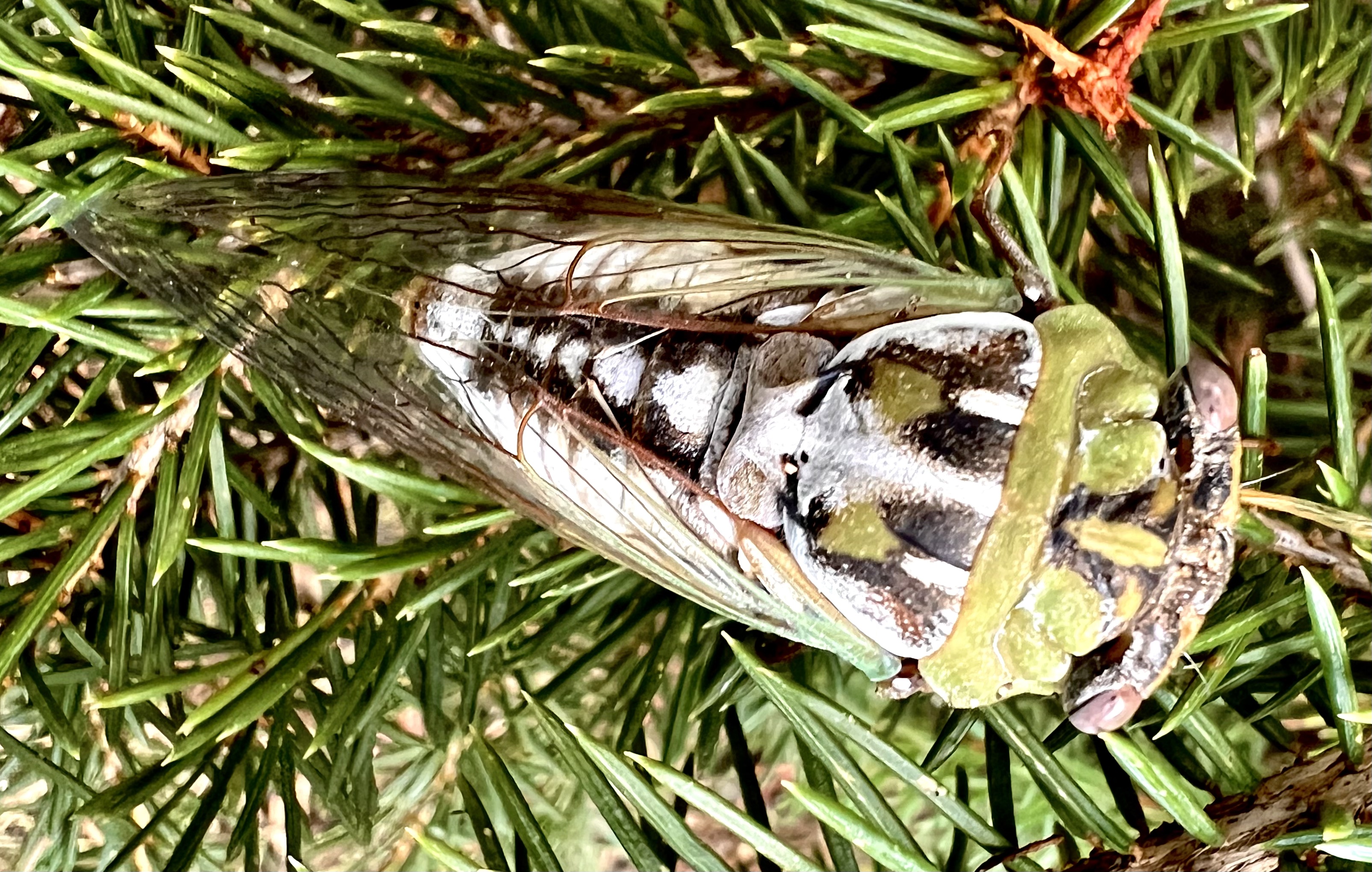
two thirteen-year emergences of cicadas

and thought their rising a god infestation, 
thought each insect roiling up an iteration 
of the many names of god, because god to her is 
the grasses so what comes up from grass is
god. She would not say it that way. Nor would she

say the word cicada——words are hindrances 
to what can be spoken through the body, are 
what she tolerates when straddled, 
giddy-up on one side then whoa on the other. After, 
it’s all good girl, Mable, good girl
before the saddle sweat is rinsed cool 
with water from the hose and a carrot is offered 
flat from the palm. Yes, words being 

generally useless she listens instead 
to the confused rooster stuttering when the sun
burns overhead, when it’s warm enough
for those time-keepers to tunnel up from the 
dark and fill their wings to make them 
stiff and capable of flight. To her, it is the sound 

of winter-coming in her mane 
or the sound of winter-leaving in her mane——
yes, that sound——a liquid shushing 
like the blood-fill of stallion desire she knew once 
but crisper, a dry crinkle of fall 
leaves. Yes, that sound, as they fill their new wings 
then lumber to the canopy to demand
come here, come here, come 
here, now come

If this is a parable you don’t understand, 
then, dear human, stop listening for words. 
Listen instead for mane, wind, wings
wind, mane, wings, wings, wings. 
The lesson here is of the mare 
and of the insects, even of the rooster 
puffed and strutting past. Because now, 
now there is only one thing worth hearing, 
and it is the plea of every living being in that field 
we call ours, is the two-word commandment 
trilling from the trees: let live, let live, let live. 
Can you hear it? Please, they say. Please.
Let us live.  

~Nickole Brown “Parable”

When a governor writes about her decision to shoot her wayward dog and stinky goat, our reaction is about the injustice perpetrated on the dog more than her decision to play god with any animal she has responsibility for. I feel a twinge of guilt at the accusation. Who among us can throw stones?

God is clear we are meant to be caretakers of His Creation. Yet I still swat flies and trap mice – there is no pleasure in doing so, so I still ask for forgiveness for my lack of charity and decision to make my own existence more comfortable at the expense of another living thing.

I admit I fail Creation in myriad ways.

I have owned animals whose behavior brought me to my knees, sometimes literally with my face in the muck. I have wept over the loss of a deformed stillbirth foal and a pond of koi frozen in a bitter winter storm. The stories abound of my helplessness in the face of sadness and loss and frustration but I never wanted to become executioner.

I don’t live with cycles of cicada population booms but have experienced their overwhelming din and understood we are mere witnesses and not in control. We are not “little g” gods on this earth. We are its stewards.

Let us live and thrive together.

Please let us live.

photo by Emily Vander Haak

What To Live For

Still and calm,
In purple robes of kings,
The low-lying mountains
sleep at the edge of the world.
The forests cover them like mantles;
Day and night
Rise and fall over them
like the wash of waves. 
Asleep, they reign.
Silent, they say all.
Hush me, O slumbering mountains –
Send me dreams.

~Harriet Monroe “The Blue Ridge”

If you find yourself half naked
and barefoot in the frosty grass, hearing,
again, the earth’s great, sonorous moan that says
you are the air of the now and gone, that says
all you love will turn to dust,
and will meet you there, do not
raise your fist. Do not raise
your small voice against it. And do not
take cover. Instead, curl your toes
into the grass, watch the cloud
ascending from your lips. Walk
through the garden’s dormant splendor.
Say only, thank you.
Thank you.
~Ross Gay “Thank You”

I live for those who love me,
Whose hearts are kind and true;
For the heaven that smiles above me,
And awaits my spirit, too;
For all human ties that bind me,
For the task my God assigned me,
For the bright hopes left behind me,
And the good that I can do.


For the cause that needs assistance,
For the wrongs that need resistance,
For the future in the distance,
And the good that I can do

~George Linnaeus Banks from “What I Live For”

Our surrounding hills circle like wagons,
their strong shoulders promising steadfast protection.
Above them, the palette of sky changes with the weather,
as turmoil and turbulence continually stirs up our world.

There is so much good to be done:
our world needs hands-on, hearts-on work
for causes needing assistance –
for wrongs needing resistance.

Feeding, housing, healing, caring,
for those in our own neighborhoods
won’t make headlines like blocking freeways and college buildings.

Rather than raising tents and fists, idle hands can serve.
Rather than raising voices and drums, heads can bow in grateful prayer.

The mountains remind us:
Though we are here and now, we will soon turn to dust.
They ask us:
How to live a life that truly makes a difference for those in need?

One-Time
Monthly
Yearly

Make a one-time or recurring donation

Make a monthly donation

Make a yearly donation

Choose an amount

$10.00
$25.00
$50.00
$5.00
$15.00
$100.00
$5.00
$15.00
$100.00

Or enter a custom amount

$

Your contribution is deeply appreciated.

Your contribution is appreciated.

Your contribution is appreciated.

DonateDonate monthlyDonate yearly
Let Me Go There…

And God held in his hand
A small globe. Look, he said.
The son looked. Far off,
As through water, he saw
A scorched land of fierce
Colour. The light burned
There; crusted buildings
Cast their shadows; a bright
Serpent, a river
Uncoiled itself, radiant
With slime.

                        On a bare
Hill a bare tree saddened
The sky. Many people
Held out their thin arms
To it, as though waiting
For a vanished April
To return to its crossed
Boughs. The son watched
Them. Let me go there, he said.
~R.S. Thomas “The Coming”

You have answered
us with the image of yourself
on a hewn tree, suffering
injustice, pardoning it;
pointing as though in either
direction; horrifying us
with the possibility of dislocation.
Ah, love, with your arms out
wide, tell us how much more
they must still be stretched
to embrace a universe drawing
away from us at the speed of light.
~R.S.Thomas “Tell Us”

“Let me go there”
And You did. Knowing what awaited You.

Your arms out wide
to embrace us
who try to grasp
a heaven which eludes us.

This heaven, Your heaven
You brought down to us,
knowing our terrible need.

You wanted to come here,
knowing all this.

Holding us firmly
within your wounded grip,
You the Son
handed us back to heaven.

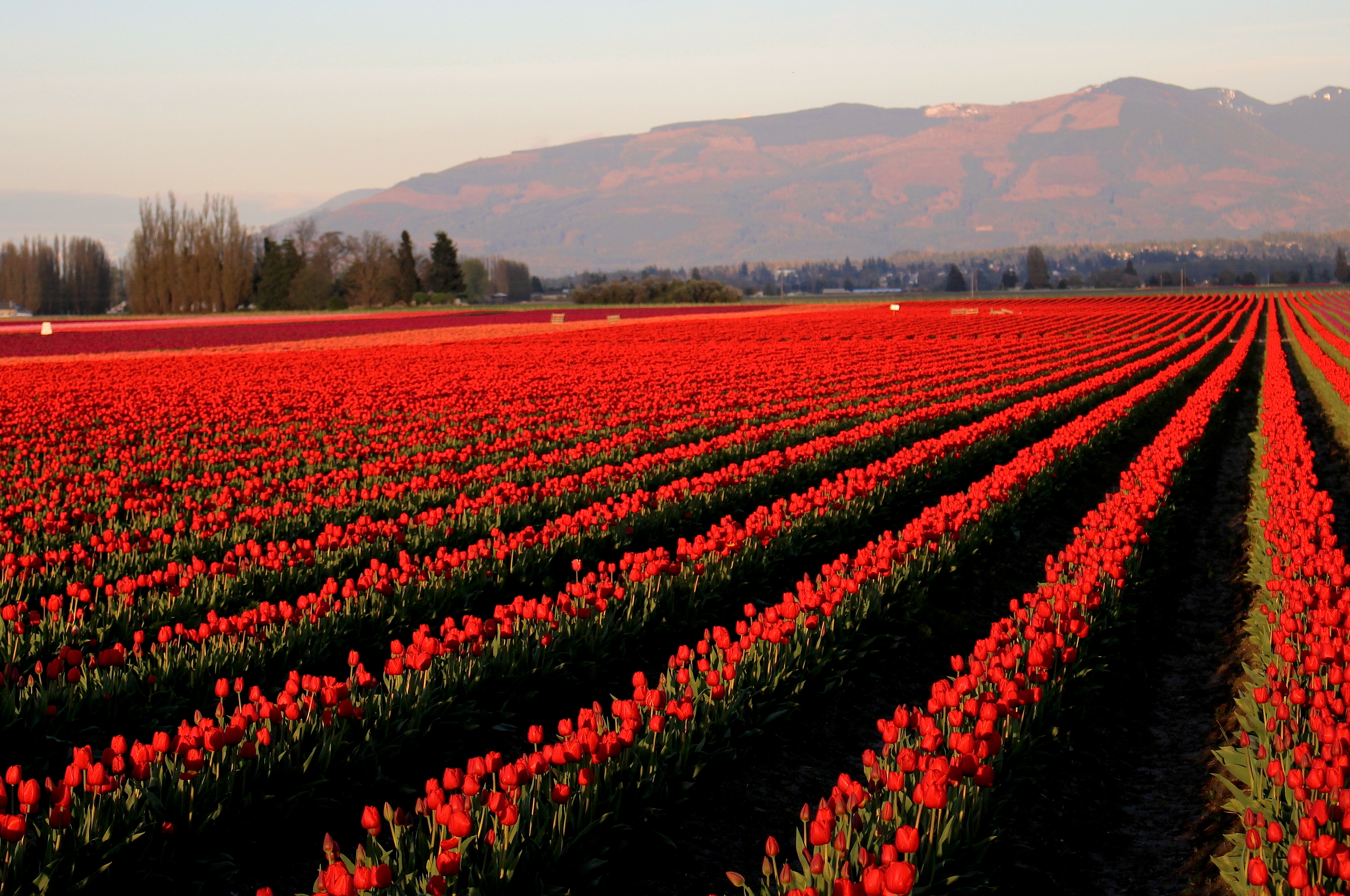
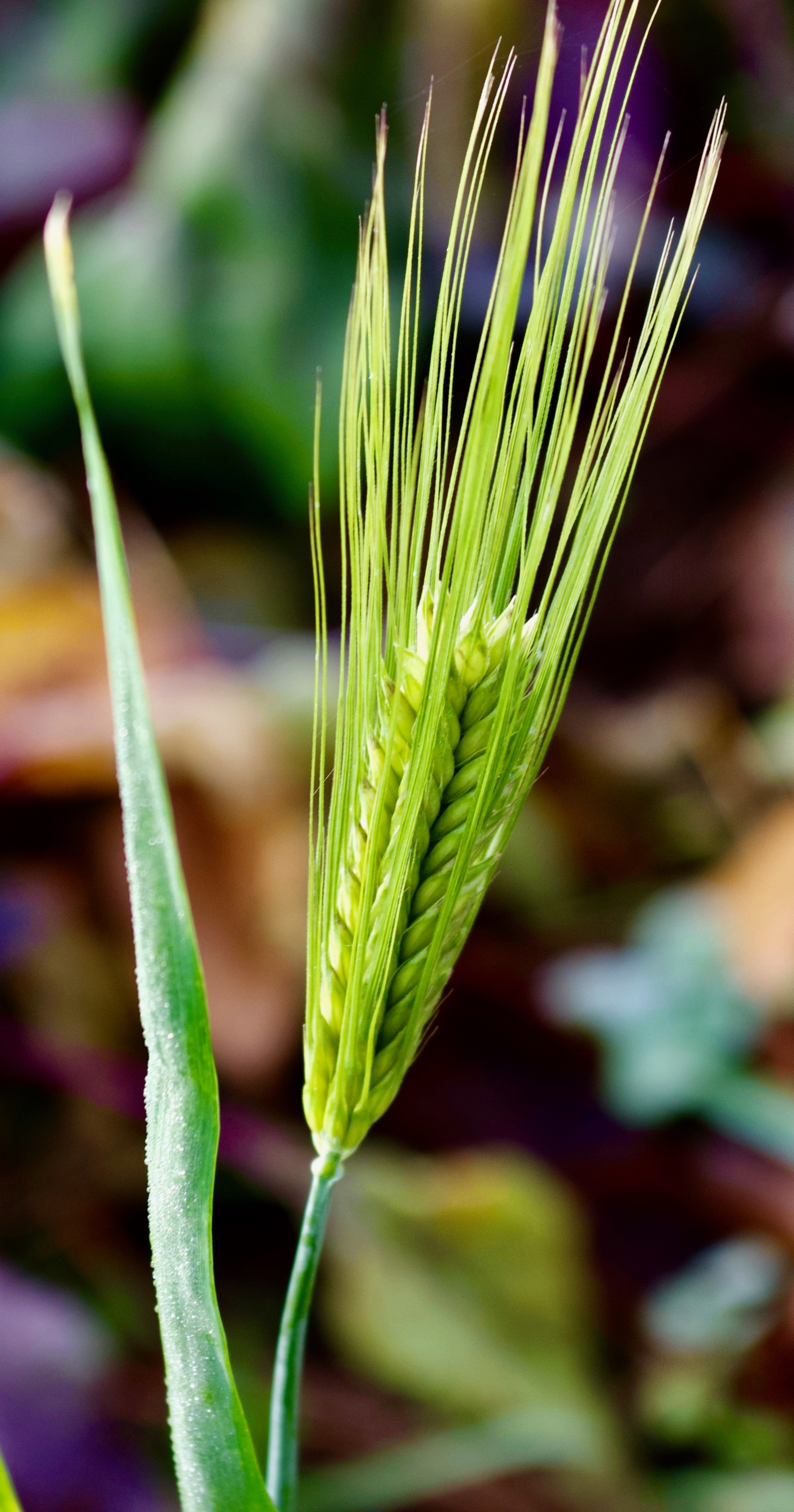
Mostly months of dirt rows
Plain and unnoticed.
Could be corn, could be beans
Could be anything;
Drive-by fly-over dull.

Yet April ignites an explosion:
Dazzling retinal hues
Singed and scorched, crying
Grateful tears for such as this
Grounded rainbow on Earth

Transient, incandescent
Brilliance hoped for.
Remembered in dreams,
Promises realized,
Housed in crystal before shattering.

One-Time
Monthly
Yearly

Make a one-time or recurring donation to support daily Barnstorming posts

Make a monthly donation

Make a yearly donation

Choose an amount

$10.00
$25.00
$50.00
$5.00
$15.00
$100.00
$5.00
$15.00
$100.00

Or enter a custom amount

$

Your contribution is deeply appreciated.

Your contribution is appreciated.

Your contribution is appreciated.

DonateDonate monthlyDonate yearly
Startled By the Sun, Not By the Eclipse

We should always endeavour to wonder at the permanent thing, not at the mere exception. We should be startled by the sun, and not by the eclipse. We should wonder less at the earthquake, and wonder more about the earth.
~ G.K. Chesterton
from ILLUSTRATED LONDON NEWS, October 21, 1905

As a physician, I was trained to perform physical examinations by learning first what was normal about the human body. As young, theoretically healthy, medical students, we practiced physical examinations on each other, and then had to demonstrate our skills in front of a professor for our class grade in physical assessments.

Since I went to medical school at a time when fewer than 1 in 5 students was a woman, each female student was placed in a physical exam group of three men, taught by a male physician, and then evaluated by a male professor. These were full examinations, including internal assessments, conducted in a typical open-backed hospital gown, in a classroom with long black lab tables to substitute for exam tables.

It was the ultimate feeling of vulnerability to be exposed to one’s classmates, supervisors and evaluators in such a way. Yet, it helped me understand the naked vulnerability of a patient undressing for a physician’s evaluation in the exam room.

After learning to assess and document what was normal in the physical exam, I was then trained to take note of the exceptions –
the human body equivalent of
an eclipse or an earthquake,
a wildfire or drought,
a hurricane or flood,
or merely an annoying pothole or molehill.

A physician’s attention is rarely focused on everything that is going well with the human body, but instead concentrating on what is aberrant, failing, or could be made better.

This is unfortunate; there is much beauty and amazing design to behold in every person I meet, especially those with chronic illness who feel nothing is as it should be — they feel despair and frustration at how their mind or body is aging, failing or faltering.

To counter this tendency to just find what’s wrong and needed fixing, I learned over the years to talk out loud as I was trained to do during those medical school physical assessments:
you have no concerning skin lesions,
your eardrums look clear,
your eyes react normally,
your tonsils are fine,
your thyroid feels smooth,
your lymph nodes are tiny,
your lungs auscultate clear,
your heart sounds are perfect,
your breasts reveal no palpable lumps,
your belly exam is reassuring,
your reflexes are symmetrical,
your prostate is smooth and normal,
your cervix, uterus and ovaries are healthy,
your emotional response to your stress level and
your tears are completely understandable.

I also wrote messages to patients meant to reassure:
your labs are in a typical range
or are getting better
or at least maintaining,
your xray shows no concerns,
or isn’t getting worse,
those medication side effects are to be expected and could go away.

I chose to acknowledge what was working well before attempting to intervene in what is not.

I’m not sure how much difference it made to my patient.
But it made a difference to me to wonder first at who this whole patient was before I focused in on what was broken and causing dis-ease.

I remain startled nearly 50 years later, and always astonished, by the sheer wonder that is our bodies – the Artist’s masterpiece.

One-Time
Monthly
Yearly

Make a one-time or recurring donation to support daily Barnstorming posts

Make a monthly donation

Make a yearly donation
Choose an amount

$10.00
$25.00
$50.00
$5.00
$15.00
$100.00
$5.00
$15.00
$100.00

Or enter a custom amount

$

Your contribution is deeply appreciated.
Your contribution is appreciated.

Your contribution is appreciated.

DonateDonate monthlyDonate yearly