And when he drew near and saw the city, he wept over it, saying, “Would that you, even you, had known on this day the things that make for peace! But now they are hidden from your eyes. ~Luke 19:41-42
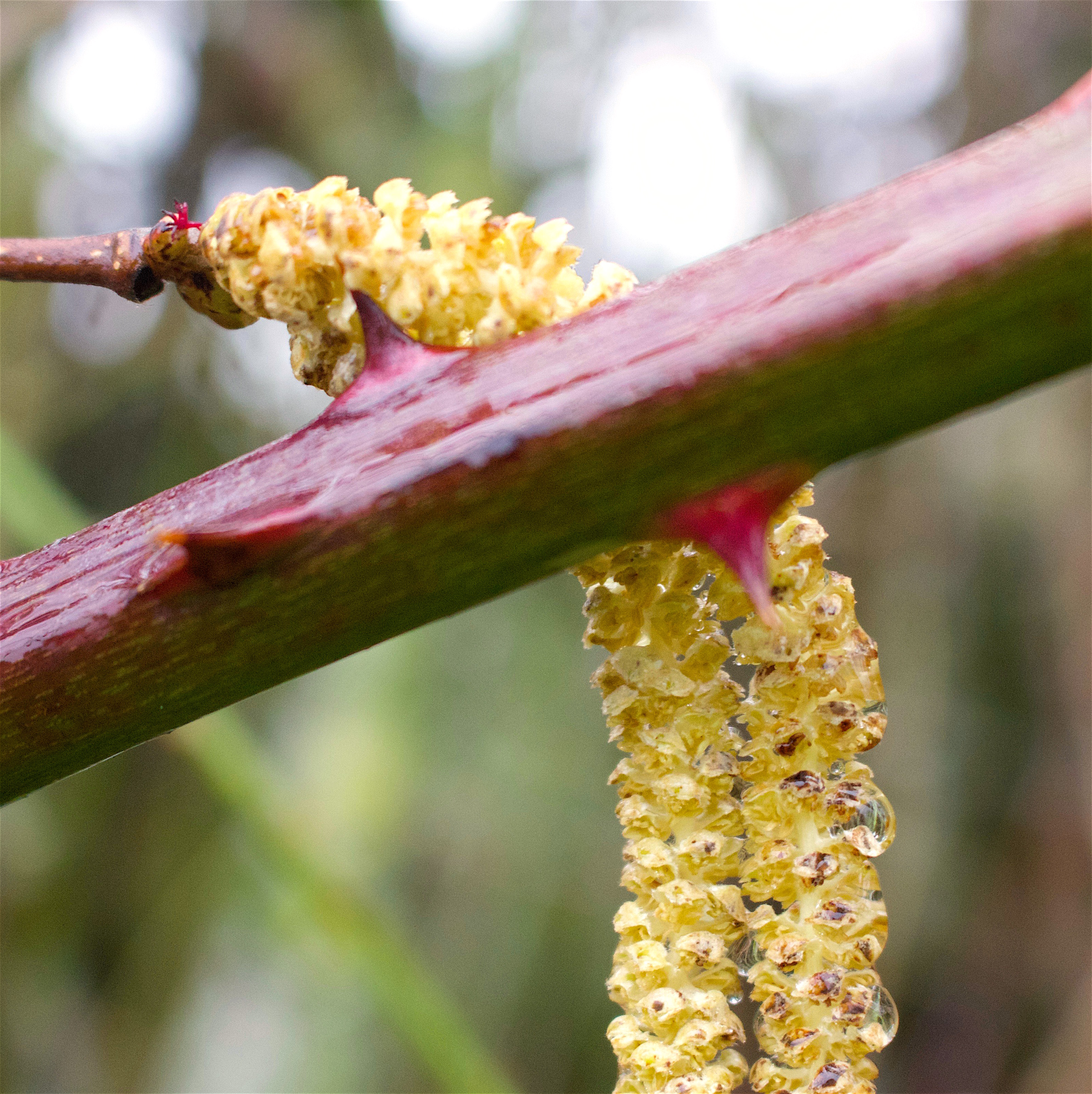
Facing ahead to a week of knowing thousands are ill, grieving, dying, a week facing my own fears of vulnerability and mortality, a week where thorns overwhelm the blossoms~~
To remember what He did this week long ago, to conquer the shroud and the stone, to defy death, makes all the difference for us right now, here.
Indeed Jesus wept and groaned for us.
To be known for who we are by a God who weeps for us and groans with pain we caused: we can know no greater love.
This week ends our living for self, only to die, and begins our dying to self, in order to live.
This year’s Barnstorming theme for the season of Lent:
God sees us as we are, loves us as we are, and accepts us as we are. But by His grace, He does not leave us where we are. ~Tim Keller
Seems the sorrow untold, as you look down the road At the clamoring crowd drawing near Feel the heat of the day, as you look down the way Hear the shouts of Hosanna the King
Chorus Oh, daughter of Zion your time’s drawing near Don’t forsake Him, oh don’t pass it by On the foal of a donkey as the prophets had said Passing by you, He rides on to die
Come now little foal, though you’re not very old Come and bear your first burden bravely Walk so softly upon all the coats and the palms Bare the One on your back oh so gently
Midst the shouting so loud and the joy of the crowd There is One who is riding in silence For He knows the ones here will be fleeing in fear When their shepherd is taken away
Soon the thorn cursed ground will bring forth a crown And this Jesus will seem to be beaten But He’ll conquer alone both the shroud and the stone And the prophesies will be completed On the foal of a donkey as the prophets had said Passing by you He rides on to die ~Michael Card
How often we look upon God as our last and feeblest resource! We go to Him because we have nowhere else to go. And then we learn that the storms of life have driven us, not upon the rocks, but into the desired haven. ~George MacDonald
photo by Nate Gibson
Everlasting God, in whom we live and move and have our being: You have made us for yourself, so that our hearts are restless until they rest in you. There is a different kind of prayer without ceasing; it is longing. Whatever you may be doing, if you long for the day of everlasting rest do not cease praying. If you do not wish to cease praying, then do not cease your longing. Your persistent longing is your persistent voice. But when love grows cold, the heart grows silent. If you are filled with longing all the time, you will keep crying out, and if your love perseveres, your cry will be heard without fail. ~Augustine of Hippo from Augustine’s Expositions of the Psalms
C.S. Lewis writes of his “inconsolable longing, almost like a heartbreak” experiencing grief after losing his wife to cancer. He describes “the stab, the pang” of such longing, a visceral sense of being emptied completely and hungering to be refilled.
God accepts our yearning restless emptiness as a prayer for restoration. He hears our ceaseless cry and He too weeps with us.
May we continue to long for the refuge, the safe haven, that only can be found in Him.
This year’s Lenten theme for Barnstorming:
God sees us as we are, loves us as we are, and accepts us as we are. But by His grace, He does not leave us where we are. ~Tim Keller
I’m running in circles It’s a steep hill to climb My own understanding won’t cut it this time I’m feeling the pressure Believing the lies But I want to believe this life is not mine
I’m left undone By the seas You have split My fear-waging a battle, I’m left more equipped It’s like we’re face to face This heaven on land Even when I fight, it’s from the palm of Your hand
Here’s my mountain Now break down my walls I am confident Your hand’s in every rise And every fall
You shattered my scares And drowned me in peace I’m not tethered to fear, in Your presence they cease My heart, it is won You alone are enough I am done with my searching, it’s You that I want
Here’s my mountain Now break down my walls I am confident Your hand’s in every rise And every fall
I hear You in the whispers And in the sonnets of the waves How I love the One who carries How I love the One who saves I see You in my trial When my pain turns into song How I love the One who tells me Not to stray but I belong
And just like the tides It’s highs and it’s lows I know You’re my constant, You won’t waver or go ~Olivia Kieffer
We think of him as safe beneath the steeple, Or cosy in a crib beside the font, But he is with a million displaced people On the long road of weariness and want. For even as we sing our final carol His family is up and on that road, Fleeing the wrath of someone else’s quarrel, Glancing behind and shouldering their load. Whilst Herod rages still from his dark tower Christ clings to Mary, fingers tightly curled, The lambs are slaughtered by the men of power, And death squads spread their curse across the world. But every Herod dies, and comes alone To stand before the Lamb upon the throne. ~Malcolm Guite “Refugee”
…as you sit beneath your beautifully decorated tree, eat the rich food of celebration, and laugh with your loved ones, you must not let yourself forget the horror and violence at the beginning and end of the Christmas story. The story begins with the horrible slaughter of children and ends with the violent murder of the Son of God. The slaughter depicts how much the earth needs grace. The murder is the moment when that grace is given.
Look into that manger representing a new life and see the One who came to die. Hear the angels’ celebratory song and remember that sad death would be the only way that peace would be given. Look at your tree and remember another tree – one not decorated with shining ornaments, but stained with the blood of God.
As you celebrate, remember that the pathway to your celebration was the death of the One you celebrate, and be thankful. ~Paul Tripp
There can be no consolation; only mourning and great weeping, sobbing that wrings dry every human cell, leaving dust behind, dust, only dust which is beginning and end.
He came to us for times such as this, born of the dust of woman and the breath of Spirit, God who bent down to lie in barn dust, walk on roads of dust, die and be laid to rest as dust in order to conquer such evil as this that could terrify masses and massacre innocents.
He became dust to be like us He began a mere speck in a womb like us, so easily washed away as unexpected, unneeded, unwanted.
Lord, You are long expected. You are needed You are wanted.
Your heart beat like ours breathing each breath like ours until a fearful fallen world took Your and our breath away.
You shine through the shadows of death to guide our stumbling uncertain feet. Your tender mercies flow freely when there is no consolation when there is no comfort.
You hear our cries as You cry too. You know our tears as You weep too. You know our mourning as You mourned too. You know our dying as You died too.
Only God can glue together what evil has shattered.
We will know His peace when He comes to bring us home, our tears finally dried, our cells no longer just dust, as we are glued together by the breath of God forevermore.
the tender mercy of our God, by which the rising sun will come to us from heaven to shine on those living in darkness and in the shadow of death, to guide our feet into the path of peace. Luke 1: 78-79
I let her garden go. let it go, let it go How can I watch the hummingbird Hover to sip With its beak’s tip The purple bee balm — whirring as we heard It years ago?
The weeds rise rank and thick let it go, let it go Where annuals grew and burdock grows, Where standing she At once could see The peony, the lily, and the rose Rise over brick
She’d laid in patterns. Moss let it go, let it go Turns the bricks green, softening them By the gray rocks Where hollyhocks That lofted while she lived, stem by tall stem, Blossom with loss. ~ Donald Hall from “Her Garden” about Jane Kenyon
Some gray mornings heavy with clouds and tear-streaked windows I pause melancholy at the passage of time.
Whether to grieve over another hour passed another breath exhaled another broken heart beat
Or to climb my way out of deepless dolor and start the work of planting the next garden
It takes sweat and dirty hands and yes, tears from heaven to make it flourish but even so just maybe my memories so carefully planted might blossom fully in the soil of loss.
Courage is almost a contradiction in terms. It means a strong desire to live taking the form of a readiness to die. ~ G.K. Chesterton
They shall grow not old, as we that are left grow old: Age shall not weary them, nor the years condemn. At the going down of the sun and in the morning We will remember them. ~Lawrence Binyon from “For the Fallen” (1914)
We are the Dead. Short days ago We lived, felt dawn, saw sunset glow, Loved and were loved, and now we lie In Flanders fields. ~LtCol (Dr.) John McCrae from “In Flanders Fields”
When you go home tell them of us and say – “For your tomorrow we gave our today” ~John Maxwell Edmonds from “The Kohima Epitaph”
To all our U.S. veterans over the centuries – with deep appreciation and gratitude–for the freedoms you have defended on behalf of us all:
My father was one of the fortunate ones who came home, returning to a quiet farm life after three years serving in the Pacific with the Marines Corp from 1942 to 1945. For the first time I have been reading his letters home to my mother over the last few months, realizing how uncertain was their future together. Hundreds of thousands of his colleagues didn’t come home, dying on beaches and battlefields. Tens of thousands more came home forever marked, through physical or psychological injury, by the experience of war.
We citizens must support and care for the men and women who have made the commitment to be on the front line for our freedom’s sake.
I’m unsure why the United States does not call November 11 Remembrance Day as the Commonwealth nations did at the WW1 Armistice. This is a day that demands much more than the more passive name Veterans’ Day represents.
This day calls all citizens who appreciate their freedoms to stop what they are doing and interrupt the routine rhythm of their lives. We are to remember in humble thankfulness the generations of military veterans who answered the call to defend their countries by sacrificing their time, resources, sometimes health and well being, and too often their lives.
Remembrance means never forgetting what it costs to defend freedom. It means acknowledging the millions who have given of themselves and continue to do so on our behalf. It means never ceasing to care. It means a commitment to provide resources needed for the military to remain strong and supported. It means unending prayers for safe return to family. It means we hold these men and women close in our hearts, always teaching the next generation about the sacrifices they made.
Most of all, it means being willing ourselves to become the sacrifice when called.
To you from failing hands we throw The torch; be yours to hold it high. If ye break faith with us who die We shall not sleep, though poppies grow…
She skimmed the yellow water like a moth, Trailing her feet across the shallow stream; She saw the berries, paused and sampled them Where a slight spider cleaned his narrow tooth. Light in the air, she fluttered up the path, So delicate to shun the leaves and damp, Like some young wife, holding a slender lamp To find her stray child, or the moon, or both. Even before she reached the empty house, She beat her wings ever so lightly, rose, Followed a bee where apples blew like snow; And then, forgetting what she wanted there, Too full of blossom and green light to care, She hurried to the ground, and slipped below. ~James Wright “My Grandmother’s Ghost from Above the River: The Complete Poems
I saw my grandma’s ghost once.
She was my only grandparent I actually knew and who actually knew me — the others were lost before I was born or too young to realize what I had lost.
She had lived a hard life: losing her mother when she was 12, taking over the household duties for her father and younger brother while leaving school forever, too young marrying an abusive alcoholic, losing her first child to lymphoma at age 8, taking her three remaining children to safety away from their father for a year to live above a seedy restaurant where she cooked seven days a week to make ends meet.
But there was grace too. A marriage that somehow got patched together after Grandpa found God and sobriety, her faith that never wavered, their soil that yielded beautiful flowers she planted and nurtured and picked to sell, children and grandchildren who welcomed her many open armed visits and hugs.
She was busy planning her first trip of a lifetime at age 72 when we noticed her eyes looked yellow. Only two weeks later she was bed-bound in unrelenting pain due to pancreatic cancer, gazing heaven-ward instead of Europe-bound. Her dreams had been dashed so quickly, she barely realized her itinerary and destination had changed.
I was 16 at the time, too absorbed in my own teenage cares and concerns to really notice how quickly she was fading and failing like a wilted flower. Instead I was picking fights with my stressed parents, worrying over taking my driver’s license driving test, distracted by all the typical social pressures of high school life.
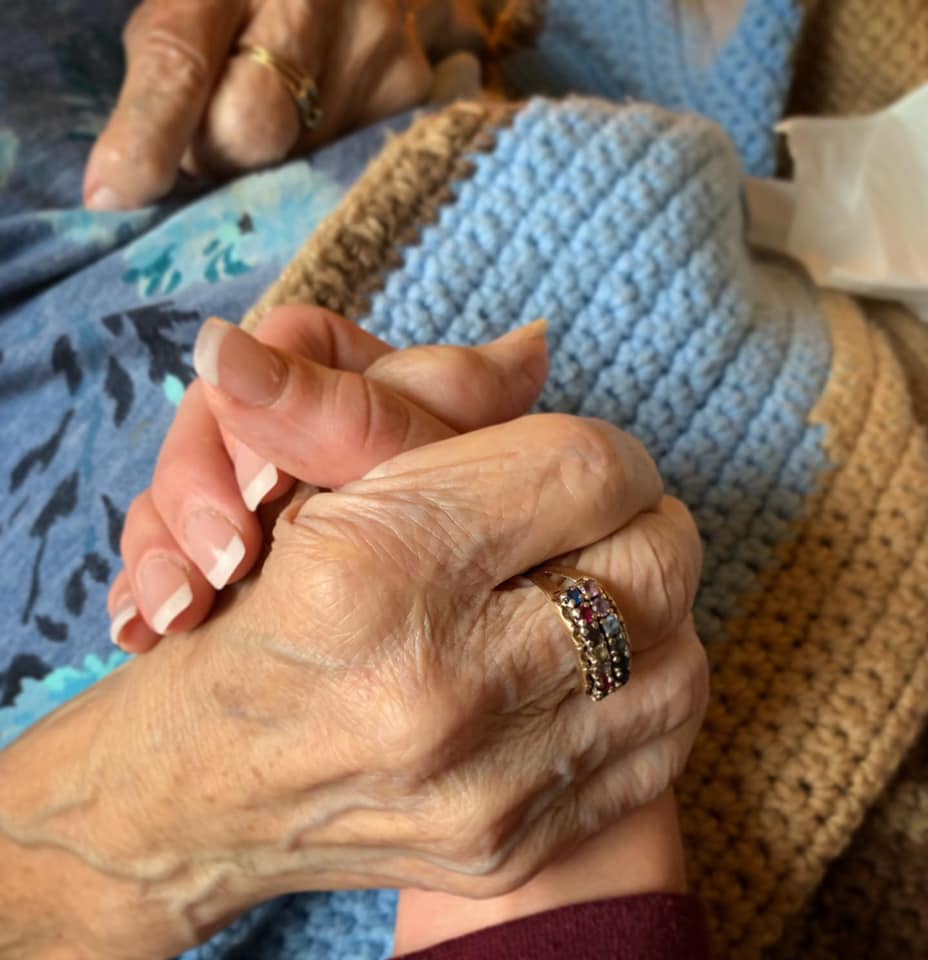
Her funeral was unbearable as I never really said goodbye – only one brief hospital visit when she was hardly recognizable in her anguish and jaundice. I didn’t even get to hold her hand.
Soon after she had been lowered into the ground next to her husband and young daughter, she came back to me in a dream.
I was asleep when my bedroom door opened into the dark, wakening me as the bright hallway light pushed its way via a shimmering beam to my bed. Grandma Kittie stood in my bedroom doorway, backlit by the light surrounding her silhouette. She silently stood there, just looking at me.
Startled, I sat up in my bed and said to her, “Grandma, why are you here? You died and we buried you!”
She nodded and smiled. And then she said to me:
“I wanted you to know I’m okay and always will be. You will be too.”
She gave a little wave, turned and left, closing the door behind her. I woke suddenly with a gasp in my darkened bedroom and knew I had just been visited.
She hadn’t come to say goodbye or to tell me she loved me — that I knew already.
She had come to shine with her light blossoming around her, mending my broken heart by planting it with peace.
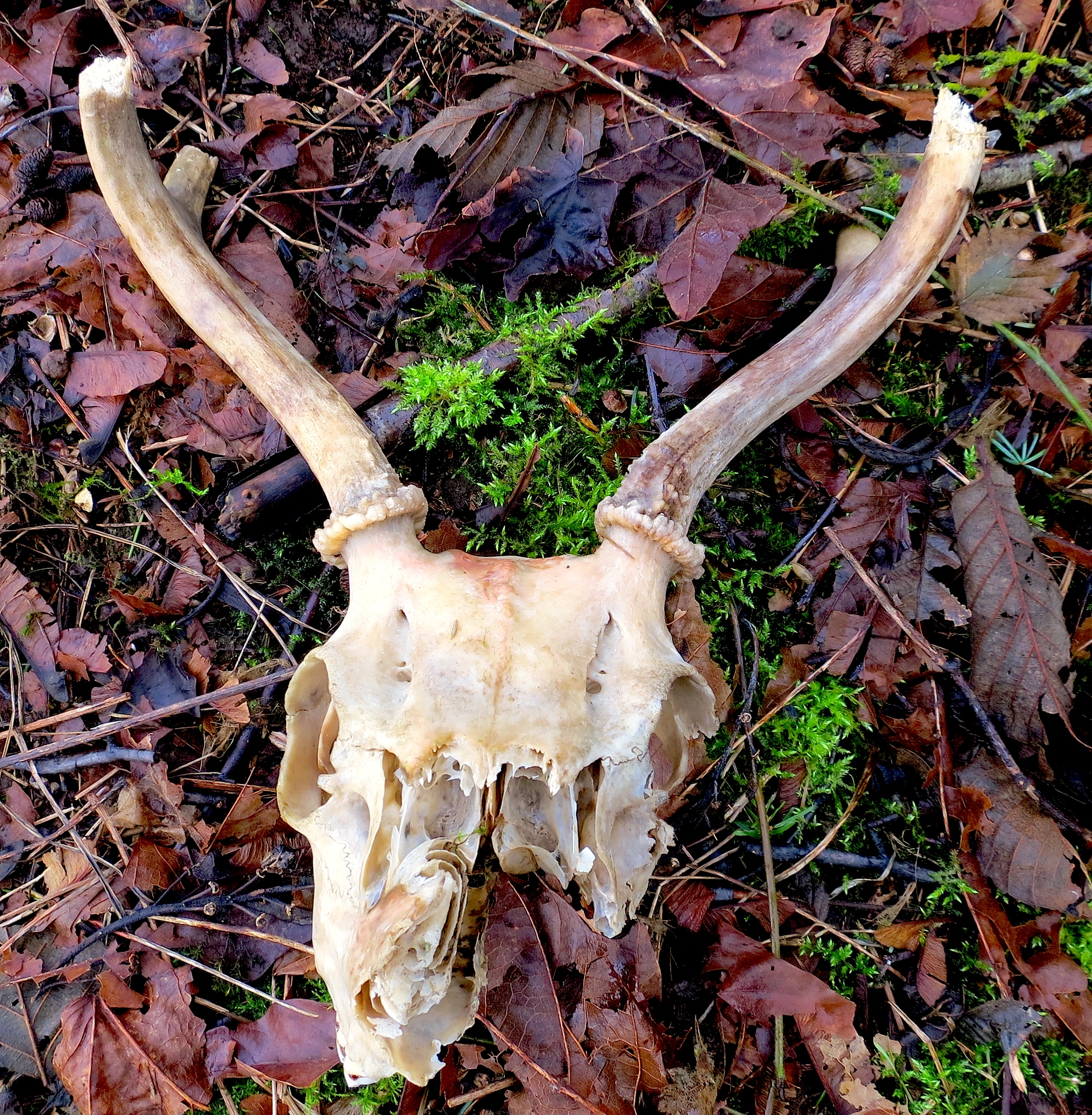
A Wounded Deer—leaps highest— I’ve heard the Hunter tell— ‘Tis but the Ecstasy of death— And then the Brake is still! ~Emily Dickinson from “165″
The deer in that beautiful place lay down their bones: I must wear mine. ~Robinson Jeffers from “The Deer Lay Down Their Bones”
As the house of a person in age sometimes grows cluttered with what is too loved or too heavy to part with, the heart may grow cluttered. And still the house will be emptied, and still the heart.
Empty and filled, like the curling half-light of morning, in which everything is still possible and so why not.
Filled and empty, like the curling half-light of evening, in which everything now is finished and so why not.
Beloved, what can be, what was, will be taken from us. I have disappointed. I am sorry. I knew no better.
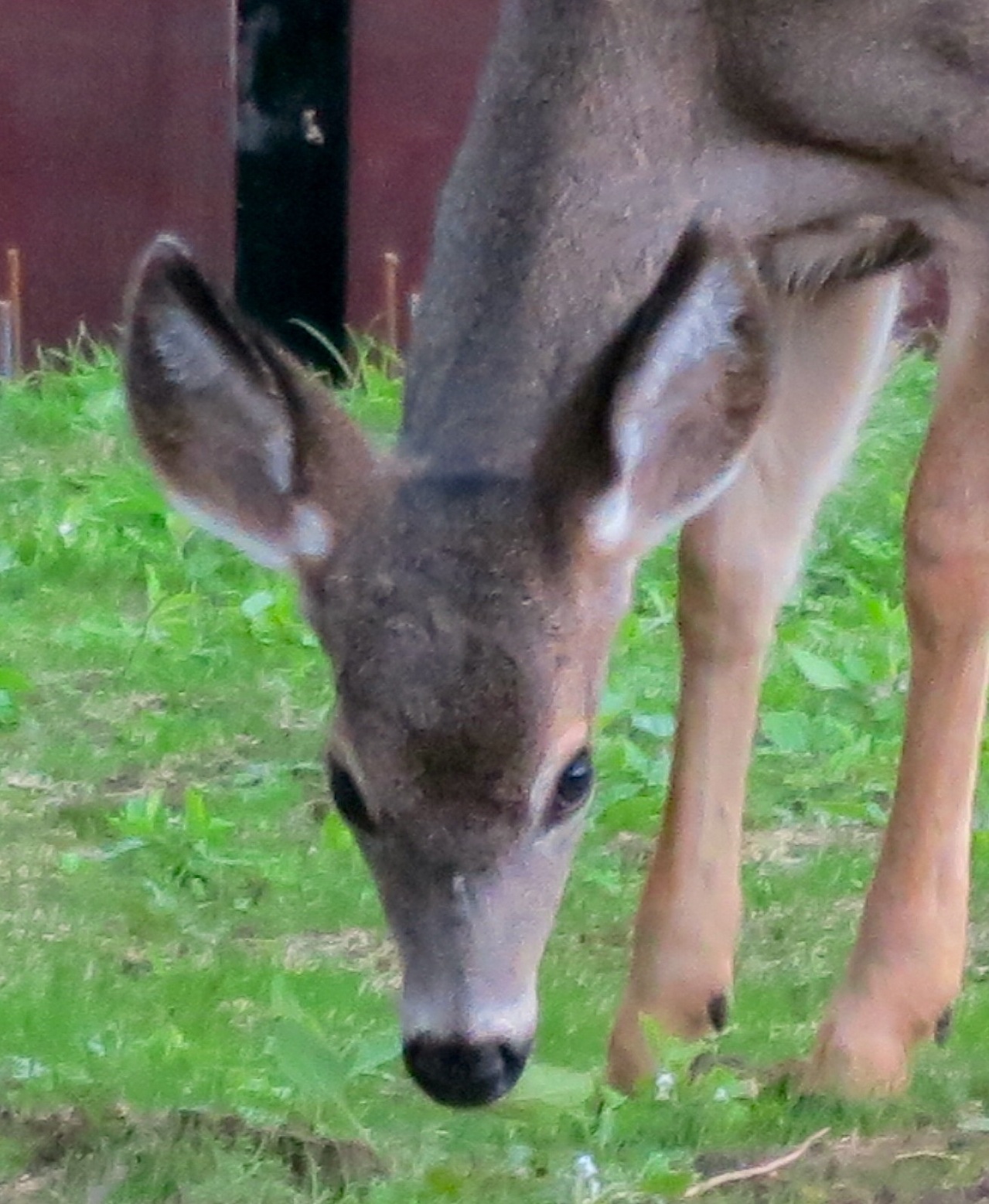
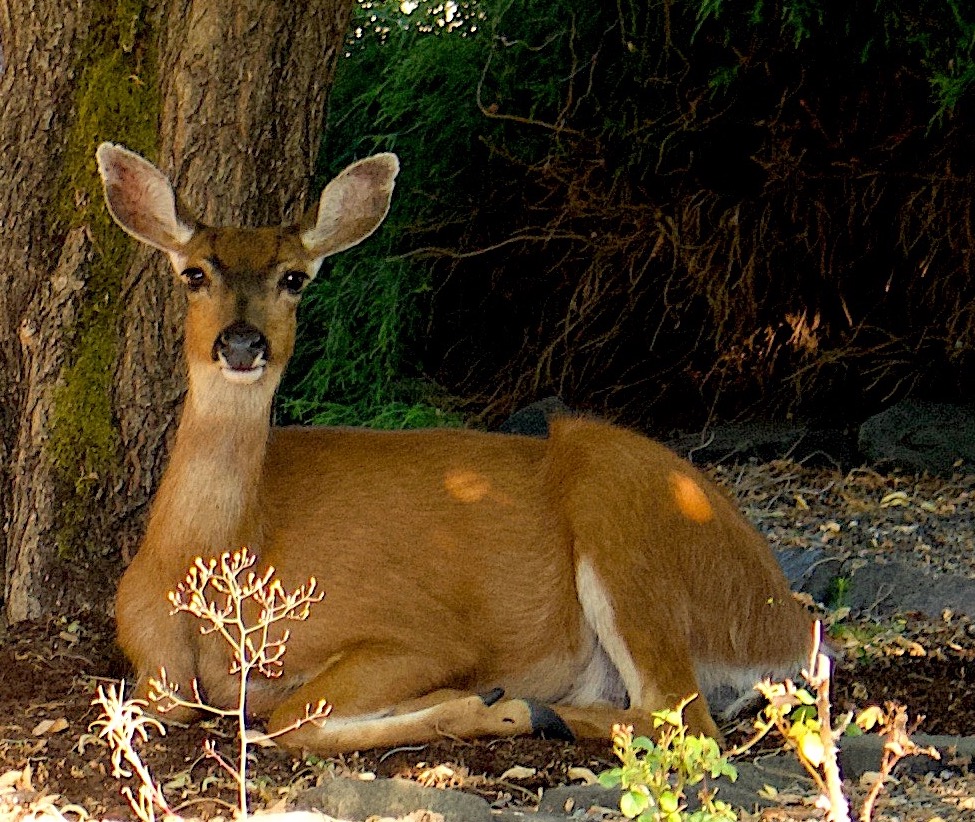
A root seeks water. Tenderness only breaks open the earth. This morning, out the window, the deer stood like a blessing, then vanished. ~Jane Hirschfield from “The Standing Deer”
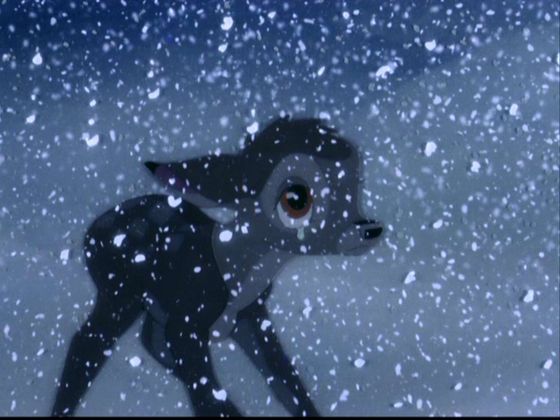
My first time ever seated next to my mother in a movie theater, just a skinny four year old girl practically folded up in half by a large padded chair whose seat won’t stay down, bursting with anticipation to see Disney’s Bambi.
Enthralled with so much color, motion, music, songs and fun characters, I am wholly lost in a new world of animated reality when suddenly Bambi’s mother looks up, alarmed, from eating a clump of grass growing in the snow.
My heart leaps with worry. She tells him to run for the thicket, to seek safety where she has always kept him warm next to her.
She follows behind, tells him to run faster, not to look back, don’t ever look back.
The gun shot hits my belly too.
My stomach twists as he cries out for his mother, pleading for her. I know in my heart she is lost forever, sacrificed for him.
I sob as my mother reaches out to me, telling me not to look. I bury my face inside her hug, knowing Bambi is cold and alone with no mother at all.
She took me home before the end. I could not bear to watch the rest of the movie for years. His cries still echo in my ears.
Now, my children are grown and have children of their own to protect. My mother is gone from this earth, my thicket emptying, my heart full, my stomach stronger, I even keep the seat from folding me up in a movie theater.
I now can look back and weep inconsolably once more.
I spent this morning adjusting to this change in season by occupying myself with the familiar task of moving manure. Cleaning barn is a comforting chore, allowing me to transform tangible benefit from something objectionable and just plain stinky to the nurturing fertilizer of the future. It feels like I’ve actually accomplished something.
As I scooped and pushed the wheelbarrow, I remembered another barn cleaning twenty years ago, when I was one of three or four friends left cleaning over ninety stalls after a Haflinger horse event that I had organized at our local fairgrounds. Some people had brought their horses from over 1000 miles away to participate for several days. Whenever horse people gather, there were personality clashes and harsh words among some participants along with criticism directed at me that I had taken very personally. As I struggled with the umpteenth wheelbarrow load of manure, tears stung my eyes and my heart. I was miserable with regrets. After going without sleep and making personal sacrifices over many months planning and preparing for the benefit of our group, my work felt like it had not been acknowledged or appreciated.
My friend Jenny had stayed behind with her family to help clean up the large facility and she could see I was struggling to keep my composure. Jenny put herself right in front of my wheelbarrow and looked me in the eye, insisting I stop for a moment and listen.
“You know, none of these troubles and conflicts will amount to a hill of beans years from now. People will remember a fun event in a beautiful part of the country, a wonderful time with their horses, their friends and family, and they’ll be all nostalgic about it, not giving a thought to the infighting or the sour attitudes or who said what to whom. So don’t make this about you and whether you did or didn’t make everyone happy. You loved us all enough to make it possible to meet here and the rest was up to us. So quit being upset about what you can’t change. There’s too much you can still do for us.”
During tough times which still come often in my professional life, Jenny’s advice replays, reminding me to stop seeking appreciation from others, or feeling hurt when harsh words come my way. She was right about the balm found in the tincture of time and she was right about giving up the upset in order to die to self and self absorption, and keep focusing outward.
Jenny, I have remembered what you said even though sometimes I emotionally relapse and forget.
Jenny herself spent the next six years literally dying, while vigorously living her life every day, fighting a relentless cancer that was initially helpless in the face of her faith and intense drive to live. She became a rusting leaf, fading imperceptibly over time, crumbling at the edges until she finally let go. Her dying did not flash brilliance, nor draw attention at the end. Her intense focus during the years of her illness had always been outward to others, to her family and friends, to the healers she spent so much time with in medical offices, to her belief in the plan God had written for her and others.
Despite her intense love for her husband and young children, she had to let go her hold on life here. And we all had to let her go.
Brilliance cloaks her as her focus is now on things eternal.
You were so right, Jenny. No conflicts from twenty years ago amounted to a hill of beans; all is remembered fondly by those who were part of the gathering. I especially treasure the words you wisely spoke to me.
And I’m no longer upset that I can’t change the fact that you have left us. There is still so much you do for us, alive in our memories.
Everyone must leave something behind when he dies, my grandfather said. A child or a book or a painting or a house or a wall built or a pair of shoes made. Or a garden planted. Something your hand touched some way so your soul has somewhere to go when you die, and when people look at that tree or that flower you planted, you’re there.
It doesn’t matter what you do, he said, so long as you change something from the way it was before you touched it into something that’s like you after you take your hands away. The difference between the man who just cuts lawns and a real gardener is in the touching, he said. The lawn-cutter might just as well not have been there at all; the gardener will be there a lifetime. ~Ray Bradbury from Fahrenheit 451
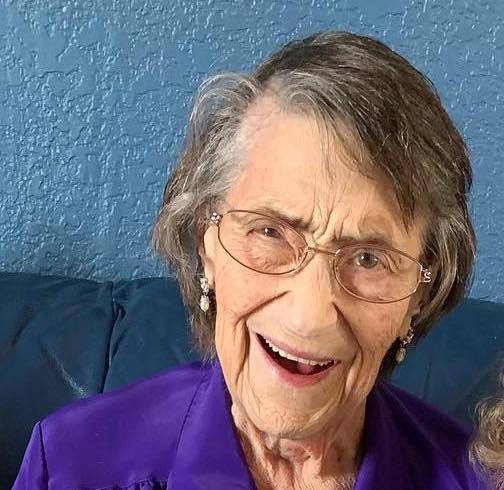
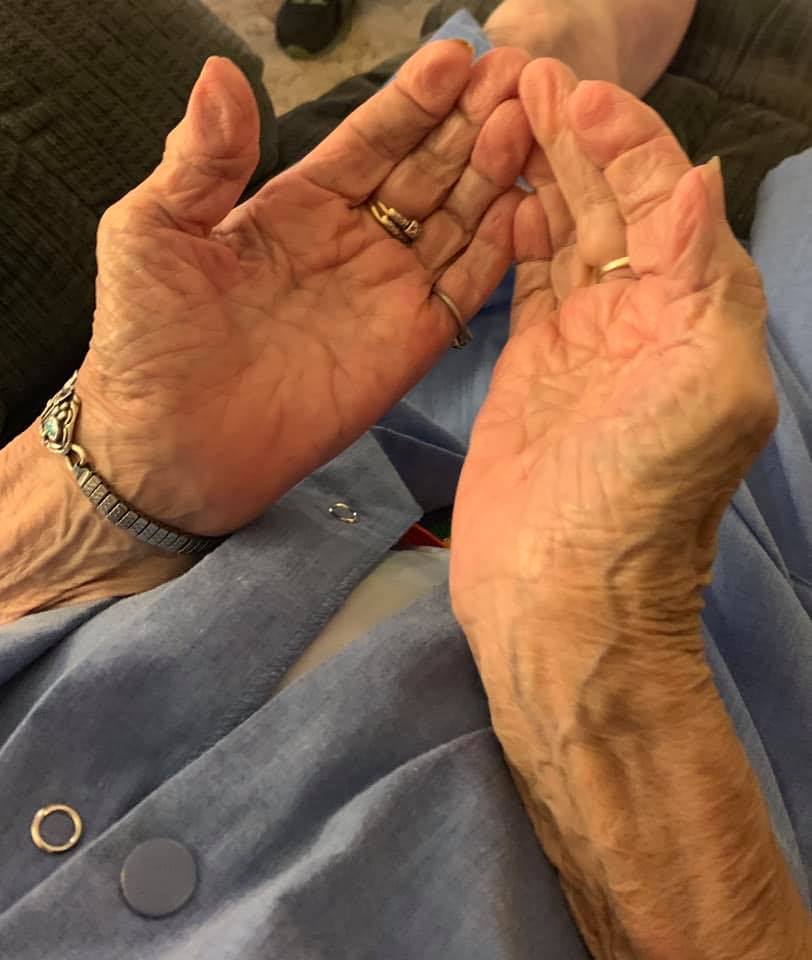
Esther Meyer, nearly 92, photo taken by a granddaughterEsther’s hands – photo by Donna Meyer photo by Danielle Meyer Miljevic
At last the entire family stood, like people seeing someone off at the rail station, waiting in the room.
“Well,” said Great-grandma, “there I am, I’m not humble, so it’s nice seeing you standing around my bed. Now next week there’s late gardening and closet-cleaning and clothes-buying for the children to do. And since that part of me is called, for convenience, Great-grandma, won’t be here to step it along, those other parts of me called Uncle Bert and Leo and Tom and Douglas, and all the other names, will have to take over, each to his own.”
“Yes, Grandma.”
Somewhere a door closed quietly.
… she saw it shaping in her mind quietly, and with serenity like a sea moving along and endless and self-refreshing shore.
Downstairs, she thought, they are polishing the silver, and rummaging the cellar, and dusting in the halls. She could hear them living all through the house.
“It’s all right,” whispered Great-grandma, as the dream floated her. “Like everything else in this life, it’s fitting.”
And the sea moved her back down the shore. ~Ray Bradbury “Great-Grandmother” from Dandelion Wine
Esther learned young how to work and she never forgot, still working up until the last few days of her long life.
Today she is sweeping up, wiping down counters and washing the dishes in a corner of heaven, after baking cookies and putting a soup on to simmer, to be sure everyone up there is well-fed and feels welcome.
She grew up on a remote farm in South Dakota where survival meant the whole family pitched in to help. When she married Pete and headed west to Washington, the work never let up: six sons, a small farm, a construction business to help manage, working as a caretaker privately and in a nursing home, taking on the mission of coordinating a large Sunday School ministry in our small church back over fifty years ago and never leaving.
Esther touched everything and everyone in this life, leaving a bit of herself behind in all of us. She’ll stay plenty busy in the next life.
She wasWiser Lake Chapel for over half her life, along with her husband Pete who passed from chronic leukemia over a decade ago. Their son Wes took on many of Pete’s carpentry and building maintenance duties at church, but then he too lost a fight with acute leukemia.
Esther persevered despite these heartbreaking losses, a tenacious testament to the power of the Spirit in one woman’s life. She had more artificial joints in her body than her own joints, some replaced twice. Her heart tried to fail any number of times, most recently after a trip to Europe she made earlier this year, by herself, to visit her missionary son. She never stopped driving. She never stopped walking even though every step took immense effort paid in pain. She came to every church service, morning and night and mid-week, usually with something fresh-baked in her hand. If soup was needed for a meal on short notice, she could make it happen in an hour from what she stored away in her freezer. She was a self-appointed clean-up crew, wheeling her walker from table to sink to counter to trash can and back again.
Every new great-grandbaby and every new Chapel baby had a hand-made Esther quilt, complete with her hand-painted pictures and the details of the birthday and birthweight printed on it. She made hundreds over her lifetime.
Esther’s family is a large exuberant and glory-filled group of sons and daughter-in-laws and grands and great-grands who reflect who she and Pete were to them, to our church and the greater community. They are a legacy left on earth, to keep up the good work and gratitude-filled worship, to never ever give up, no matter how tough life can be.
Thank you, Esther, for changing us all so profoundly we won’t ever be the same as we were before you touched us; you left us all so much better than before. Now I believe we all are just a little bit like you.
And most of all, thanks for 90-plus years of your loving labor on the Lord’s behalf. The soup is on the stove in memory of you.
there are no words there is no song is there a balm that can heal these wounds that will last a lifetime long and when the stars have burned to dust hand in hand we still will stand because we must
in one single hour in one single day we were changed forever something taken away and there is no fire that can melt this heavy stone that can bring back the voices and the spirits of our own
all the brothers, sisters and lovers all the friends that are gone all the chairs that will be empty in the lives that will go on can we ever forgive though we never will forget can we believe in the milk of human goodness yet
we were forged in freedom we were born in liberty we came here to stop the twisted arrows cast by tyranny and we won’t bow down we are strong of heart we are a chain together that won’t be pulled apart ~Kitty Donohoe “There are no words”written on 9/1/11
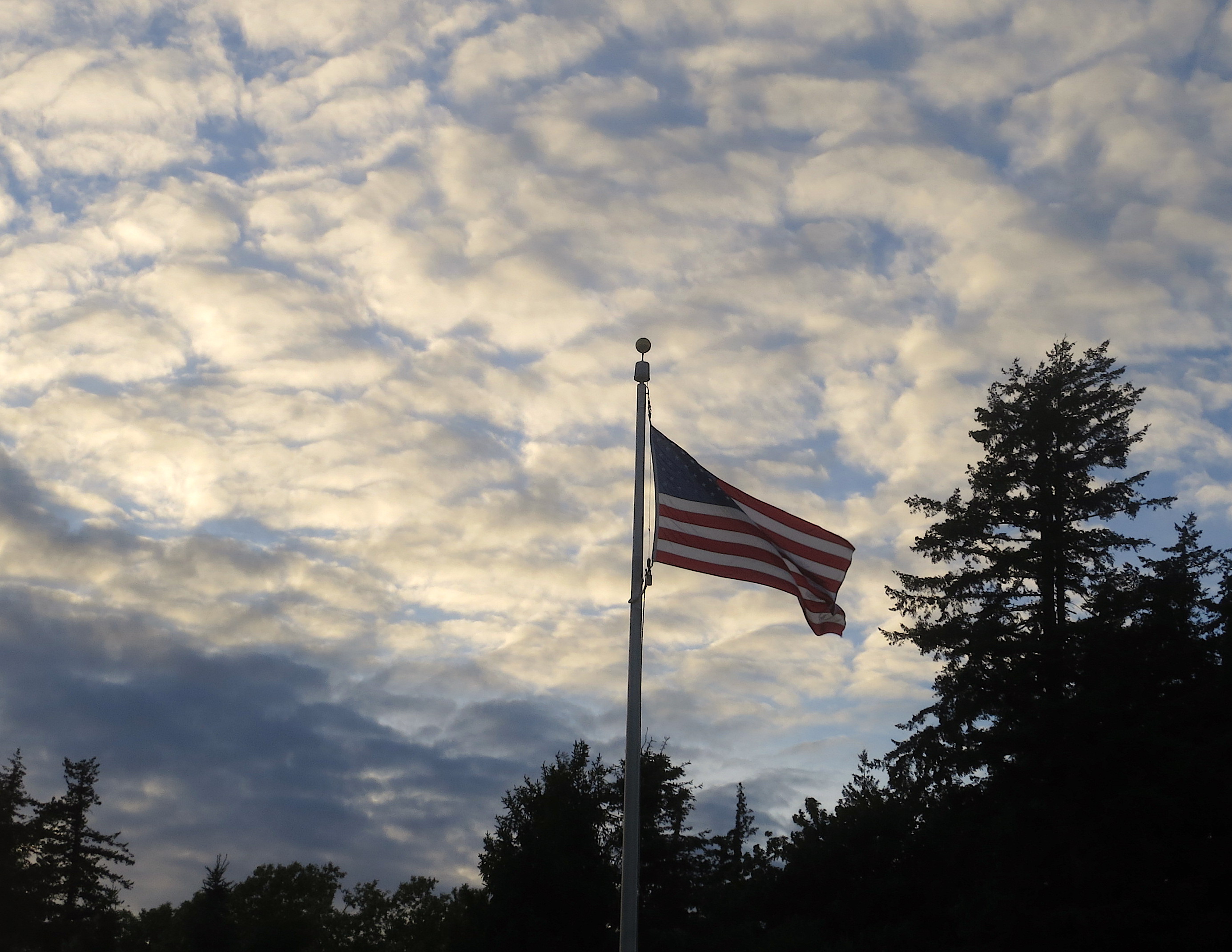
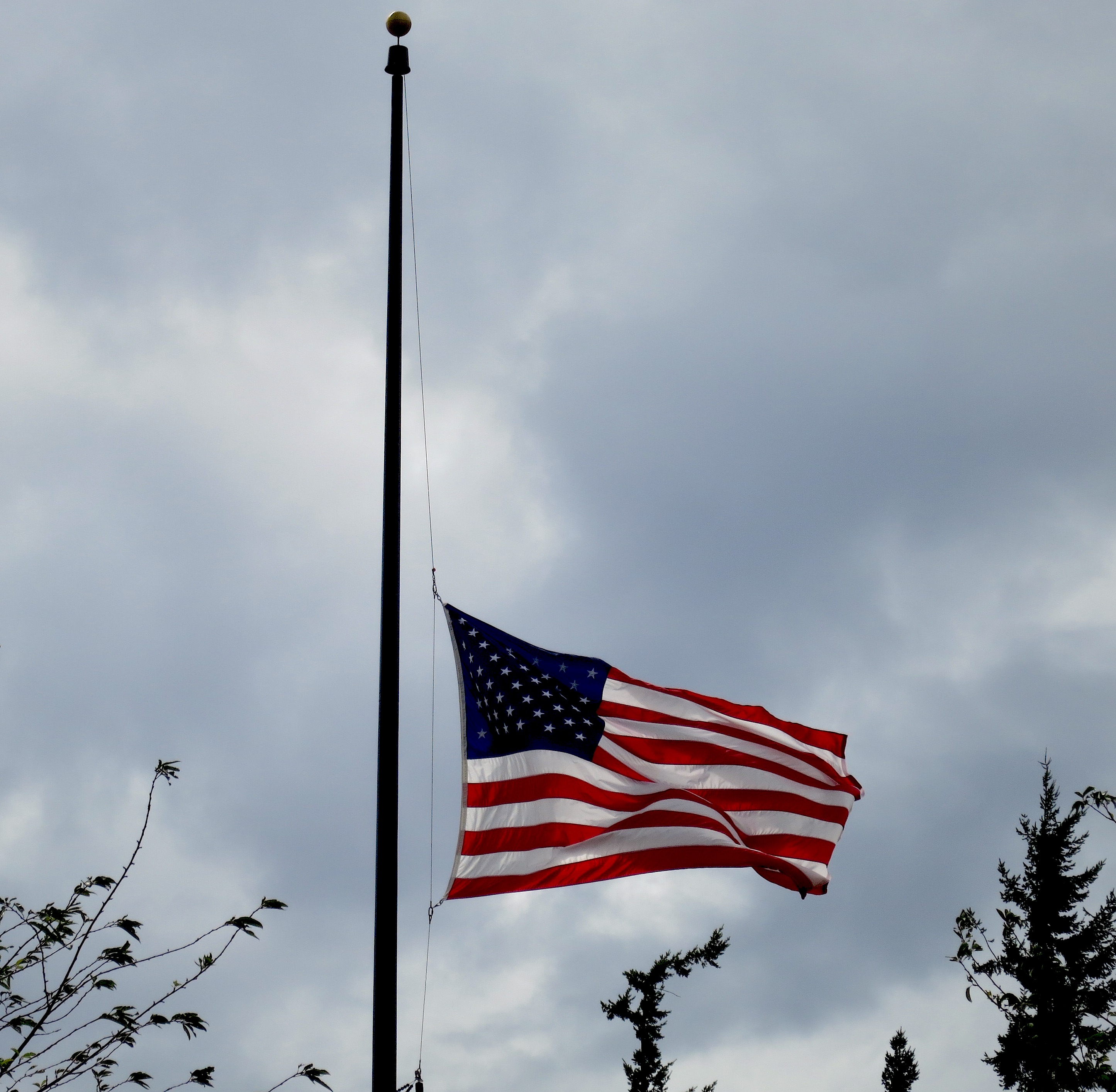
As a grade school child in November 1963, I learned the import of the U.S. flag being lowered to half mast in response to the shocking and violent death of our President. The lowering of the flag was so rare when I was growing up, it had dramatic effect on all who passed by — something very sad had happened to our country, warranting our unified silence and our stillness.
Since 9/11/01, our flag has spent significant time at half mast, so much so that I’m befuddled instead of contemplative, puzzling over what the latest loss might be as there are so many, sometimes all happening in the same time frame. We no longer are silenced by this gesture of honor and respect and we certainly are not stilled, personally and corporately instigating and suffering the same mistakes against humanity over and over again.
There remains so much more sadness to be borne after that tragic day 18 years ago – such abundance of grief that our world has become overwhelmed and stricken and it seems we’ve lost all imagination for the “milk of human goodness.” Instead it seems we have become more divisive, pulling ourselves apart.
We must return, as people of faith, to that stillness to which we are called on a day such as today. We must be still; we must be silent. We must let the bells toll and the names be read out. We must grieve the losses of this turning world and pray for release from the suffering we cause and we endure. Only in the asking, only in the kneeling down and pleading, are we surrounded by grace. A flag half lowered may have lost its power to punch our gut, but we are illuminated by the Light, forged in freedom, born in liberty.
We must stop allowing our chain links from being pulled apart.















 Barnstorming