Our memories are, at best, so limited, so finite, that it is impossible for us to envisage an unlimited, infinite memory, the memory of God.
It is something I want to believe in: that no atom of creation is ever forgotten by him; always is; cared for; developing; loved. ~Madeleine L’Engle from The Summer of the Great-Grandmother
…a friend told me a story about a little girl who wanted time alone with her infant brother. Her parents were suspicious of her motives. What if she did something to harm the baby? The big sister was so persistent that her mom and dad finally decided to allow her ten minutes alone with him in his room. After they closed the door, they listened quietly.
They felt chills when they heard their daughter say, “Baby tell me what heaven is like. I’m starting to forget.” ~Sue Shanahan from “Fresh from Heaven”
He of strength and hope, of infinite memory and everlasting love:
He knows us down to our very atoms ~~ even we who are weak, broken, and undeserving.
He causes us to burst into bloom in remembrance of having been in His presence.
AI image created for this post
One-Time
Monthly
Yearly
Make a one-time or recurring donation to support daily Barnstorming posts
Some claim the origin of song was a war cry some say it was a rhyme telling the farmers when to plant and reap don’t they know the first song was a lullaby pulled from a mother’s sleep said the old woman
A significant factor generating my delight in being alive this springtime is the birdsong that like a sweeping mesh has captured me like diamond rain I can’t hear it enough said the tulip
Lifetime after lifetime we surged up the hill I and my dear brothers thirsty for blood uttering our beautiful songs said the dog ~Alicia Suskin Ostriker “Song” from The Old Woman, the Tulip, and the Dog
To be blessed is to know God is inside all created things, even those seemingly hopeless.
To be blessed is to sing a lullaby of loving kindness that settles a restless heart.
To be blessed is to become a blessing so contagious, there is no hope of cure.
AI image created for this post
Lyrics: Oh! Hush thee, my baby, the night is behind us, And black are the waters that sparkled so green. The moon, o’er the combers, looks downward to find us, At rest in the hollows that rustle between.
Where billow meets billow, then soft be thy pillow, Oh weary wee flipperling, curl at thy ease! The storm shall not wake thee, nor shark overtake thee, Asleep in the arms of the slow swinging seas! ~Rudyard Kipling “The White Seal”
translated lyrics from the Lakota: Ah I say, I say to you I am speaking to you… Ah I say, I say to you To you I am saying it My kind-hearted boy go to sleep Tomorrow will be nice I am speaking to you
One-Time
Monthly
Yearly
Make a one-time or recurring donation to support daily Barnstorming posts
A day is nothing if not a disappearing act held fast by ropes of sunlight and breeze until rain comes or a tree coughs to shake night along;
then there are the shadows that feel like yesterday’s distance but become only apparitions when we haul them into light or move beyond their pull—
I wish for mornings, still, days full of violets— and the beautiful clouds, where in their always- disappearing, their solemn ache, I find poems. ~Sarah Etlinger “Evanescence (with Clouds)” from The Weather Gods
I look for poems everywhere, even in colorless misty mornings, chill and stormy winds, humid breathless afternoons.
It is as if a Poet is saying to me: I feel this ache today. You too?
One-Time
Monthly
Yearly
Make a one-time or recurring donation to support daily Barnstorming posts
I wonder more and more if the first thing shouldn’t be to know people by name, to eat and drink with them, to listen to their stories and tell your own, and to let them know with words, handshakes, and hugs that you do not simply like them, but truly love them.
The church, I think, is God’s way of saying, “What I have in the pot is yours, and what I have is a group of misfits whom you need more than you know and who need you more than they know.”
“Take, and eat,” he says, “and take, and eat, until the day, and it is coming, that you knock on my door. I will open it, and you will see me face to face.”
He is preparing a table. He will welcome us in. Jesus will be there, smiling and holy, holding out a green bean casserole. And at that moment, what we say, what we think, and what we believe will be the same: “I didn’t know how badly I needed this.” ~Jeremy Clive Huggins from “The Church Potluck”
We celebrate end of winter’s overlong stay, And find a respite from embittered mood, Ignore our sagging incomes for a day, With shared potluck communion of comfort food.
Beef stew stocked with veggies and potatoes, Drizzled bread cubes over macaroni and cheese, Salted nachos dotted with ripened tomatoes, Meat loaf topped with ketchup please.
Home made bread from the oven, steaming and soft Fresh hot chocolate and coffee provide reason to stay, Remember the smell of shared food will lazily waft So welcome and hardy with no debt to pay.
When the job is lost or the family is sour, Too many nights lonely and aching in pain, Fellowship together for only an hour, Nurtured and nourished, is never in vain.
Once gratefully finishing up the last crumb, When life’s feast is done, the journey’s end near Hang on to your fork awaiting dessert that’s to come Instead of clinging to worry and unknown fear.
Keep your fork when uncertain about what comes tomorrow It will remind you of what you can not yet see; The meal’s not quite over, there’ll be sweetness, not sorrow: We’ll celebrate together, the best is yet to be.
AI image created for this post
One-Time
Monthly
Yearly
Make a one-time or recurring donation to support daily Barnstorming posts
Before the second summit party began the ascent of the princess of mountains, an ominous black cloud settled slowly around the summit block, persuading us to take a rest day, but morale was good. The next day at seven in the evening, my daughter Devi was on her last pitch, and it took her until midnight to haul up over the final lip. A long day.
Two days later, a blizzard kept us in our tents, but the next morning, Devi was stricken, saying calmly, “She is calling me. I am going to die,” before she fell into unconsciousness. I tried to revive her, mouth-to-mouth, but felt her lips grow cold against mine. We had lost her. My daughter was gone. I and the other climbers wept.
Her fiancé Andy and I bundled her in her sleeping bag and slipped her off the precipice of the North- East face. I said we had committed her to the deep. She had been the driving force behind this expedition, as she was inexorably drawn to her namesake. The Bliss-Giving Goddess had claimed her own. An excerpt from her last diary is inscribed on a stone placed in a high-altitude meadow of Patai:
“I stand on a windswept ridge at night with the stars bright above and I am no longer alone but I waver and merge with all the shadows that surround me. I am part of the whole and I am content.” ~Eleanor Swanson, Last Light on the West Face of Nanda Devifrom Non Finito
Nanda Devi peak, courtesy of Stanford Alpine Club
The ripple effect from Nanda Devi Unsoeld’s arrival as a new junior in Olympia High School in 1970 reached me within minutes, as I felt the impact of her presence on campus immediately. One of my friends elbowed me, pointing out a new girl being escorted down the hall by the assistant principal. Students stared at the wake she left behind: Devi had wildly flowing wavy long blonde hair, a friendly smile and bold curious eyes greeting everyone she met.
From the neck up, she fit right in with the standard appearance at the time: as the younger sisters of the 60’s generation of free thinking flower children, we tried to emulate them in our dress and style, going braless and choosing bright colors and usually skirts that were too short and tight. There was the pretense we didn’t really care how we looked, but of course we did care very much, with hours spent daily preparing the “casual carefree” look that would perfectly express our freedom from fashion trends amid our feminist longings.
Practicing careful nonconformity perfectly fit our peers’ expectations and aggravated our parents.
But Devi never looked like she cared what anyone else thought of her. The high school girls honestly weren’t sure what to make of her, speculating together whether she was “for real” and viewed her somewhat suspiciously, as if she was putting on an act.
The high school boys were mesmerized.
She preferred baggy torn khaki shorts or peasant skirts with uneven hems, loose fitting faded T shirts and ripped tennis shoes without shoelaces. Her bare legs were covered with long blonde hair, as were her armpits which she showed off while wearing tank tops. She pulled whole cucumbers from her backpack in class and ate them like cobs of corn, rind and all. She smelled like she had been camping without a shower for three days, but then riding her bike to school from her home 11 miles away in all kinds of weather accounted for that. One memorable day she arrived a bit late to school, pushing her bike through 6 inches of snow in soaking tennis shoes, wearing her usual broad smile of satisfaction.
As a daughter of two Peace Corps workers who had just moved back to the U.S. after years of service in Nepal, Devi had lived very little of her life in the United States. Her father Willi Unsoeld, one of the first American climbers to reach the summit of Mt. Everest up the difficult west face, had recently accepted a professorship in comparative religion at new local Evergreen College. He moved his wife and family back to the northwest to be near his beloved snowy peaks, suddenly immersing four children in an affluent culture that seemed foreign and wasteful.
Devi recycled before there was a word for it simply by never buying anything new and never throwing anything useful away, involved herself in social justice issues before anyone had coined the phrase, and was an activist behind the scenes more often than a leader, facilitating and encouraging others to speak out at anti-war rallies, organizing sit-ins for world hunger and volunteering in the local soup kitchen. She mentored adolescent peers to get beyond their self-consciousness and self-absorption to explore the world beyond the security of high school walls.
Regretfully, few of us followed her lead. We preferred the relative security and camaraderie of hanging out at the local drive-in to taking a shift at the local 24-hour crisis line. We showed up for our graduation ceremony in caps and gowns while the rumor was that Devi stood at the top of Mt. Rainier with her father that day.
I never saw Devi after high school but heard of her plans in 1976 to climb with an expedition to the summit of Nanda Devi, the peak in India for which she was named. She never returned, dying in her father’s arms as she suffered severe abdominal pain and irreversible high altitude sickness just below the summit. She lies forever buried in the ice on that faraway peak in India.
Her father died in an avalanche only a few years later, as he led an expedition of Evergreen students on a climb on Mt. Rainier, only 60 miles from home. Her mother, Jolene, later served in Congress from our district in Washington state.
Had Devi lived these last 50 years, I have no doubt she would have led our generation with her combination of charismatic boldness and excitement about each day’s new adventure. She lived without pretense, without hiding behind a mask of fad and fashion and conformity and without any desire for wealth or comfort.
I wish I had learned what she had to teach me when she sat beside me in class, encouraging me by her example to become someone more than the dictates of societal expectations. I secretly admired the freedom she embodied in not being concerned in the least about fitting in. Instead, I still mourn her loss all these years later, having to be content with the legacy she has now left behind on a snowy mountain peak that called her by name.
Mt. Shuksan, Washington state
One-Time
Monthly
Yearly
Make a one-time or recurring donation to support daily Barnstorming posts
The fields are snowbound no longer; There are little blue lakes and flags of tenderest green. The snow has been caught up into the sky— So many white clouds—and the blue of the sky is cold. Now the sun walks in the forest, He touches the boughs and stems with his golden fingers; They shiver, and wake from slumber. Over the barren branches he shakes his yellow curls. … Yet is the forest full of the sound of tears…. A wind dances over the fields. Shrill and clear the sound of her waking laughter, Yet the little blue lakes tremble And the flags of tenderest green bend and quiver. ~Katherine Mansfield “Very Early Spring”
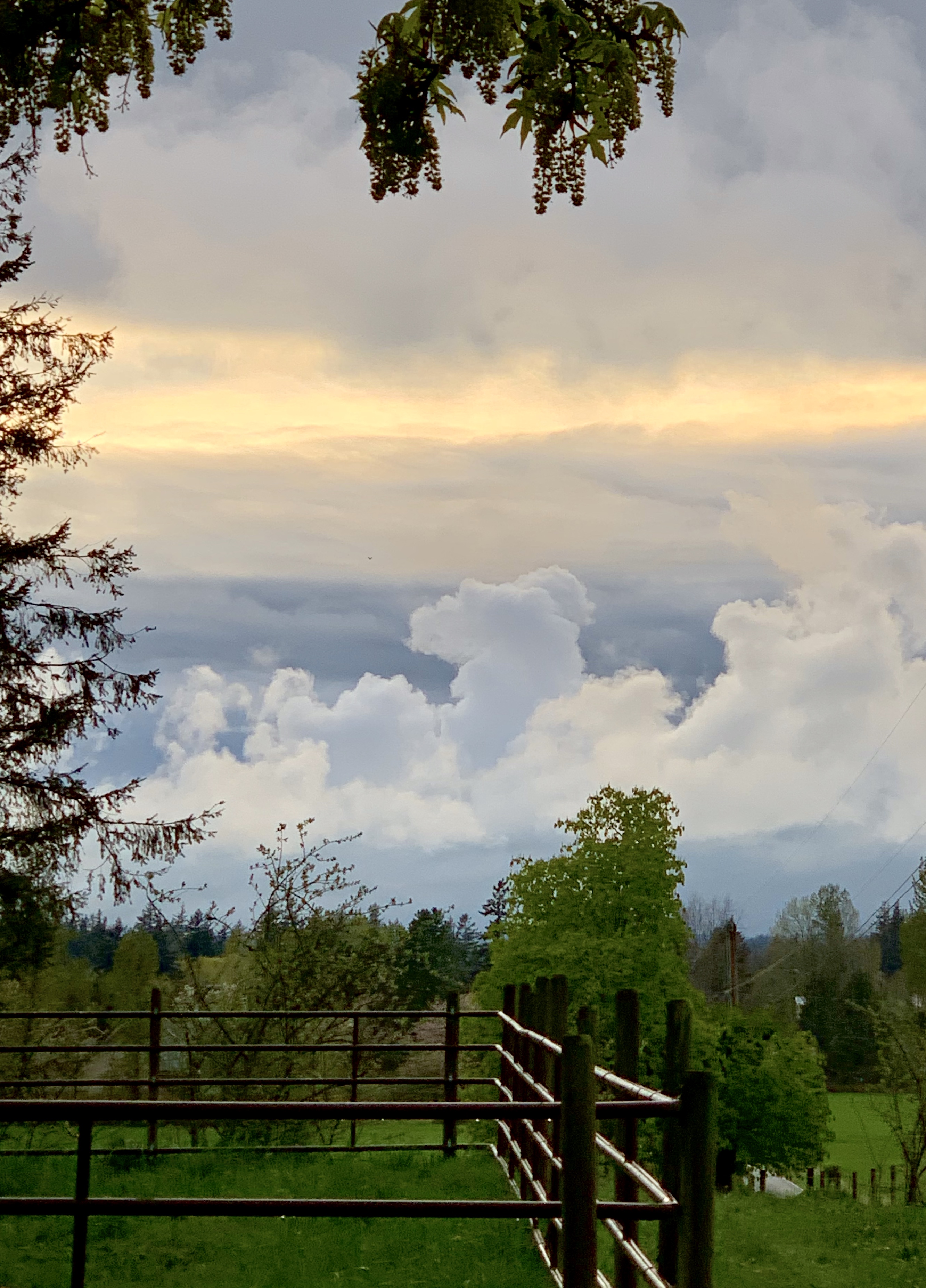
You might say that clouds have no nationality Being flags of no country, flaunting their innocent neutrality Across frontiers, ignorant of boundaries; But these clouds are clearly foreign, such an exotic clutter Against the blue cloth of the sky I want to rummage among them, I want to turn them over With eager fingers, I want to bargain For this one or that one, I want to haggle and dicker Over the prices, and I want to see my clouds wrapped up In sheets of old newspapers, and give them away To young girls to pin in their hair Or tuck them, glossy as gardenias, behind an ear, Or stretch one out to the length of a lacy shawl And toss it over a shoulder, or around a waist. ~Constance Urdang “Clouds”
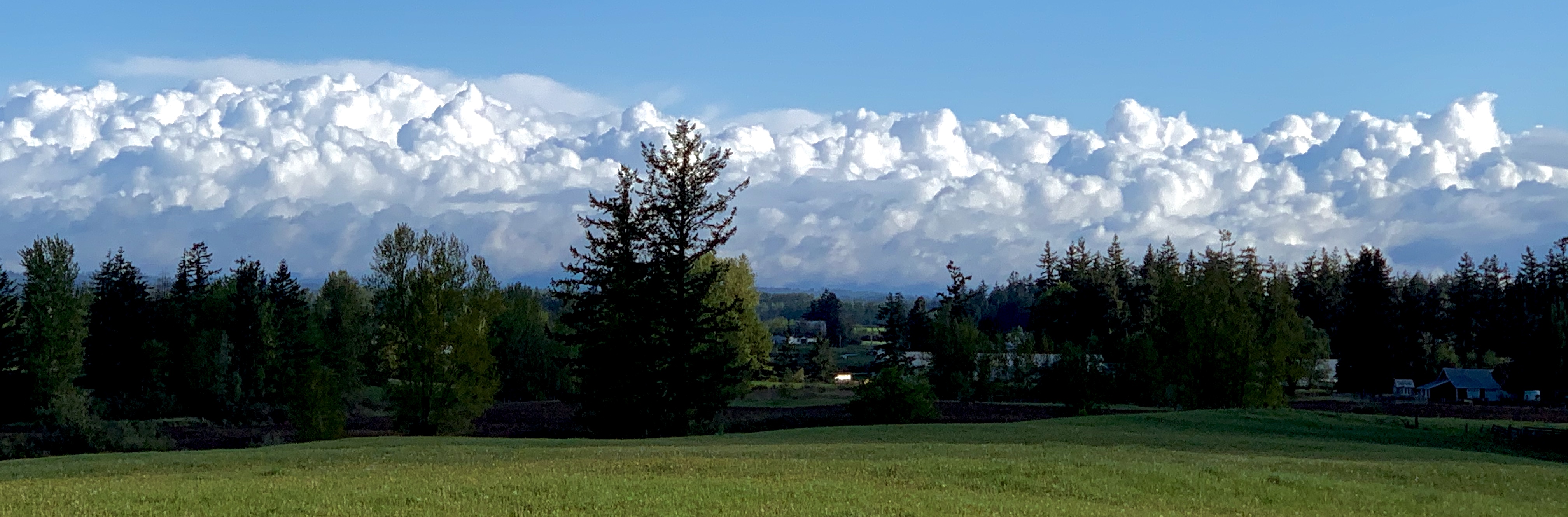
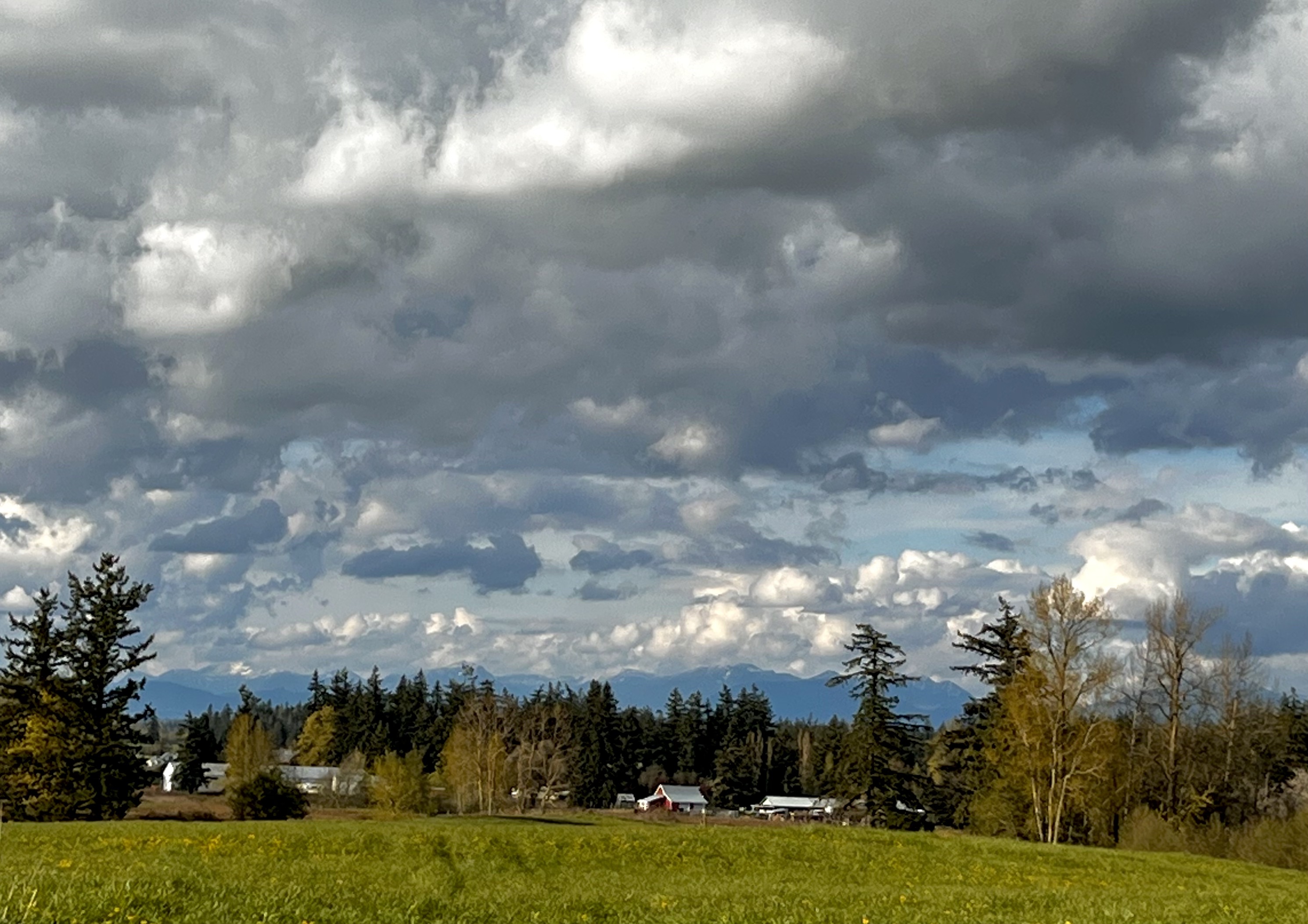
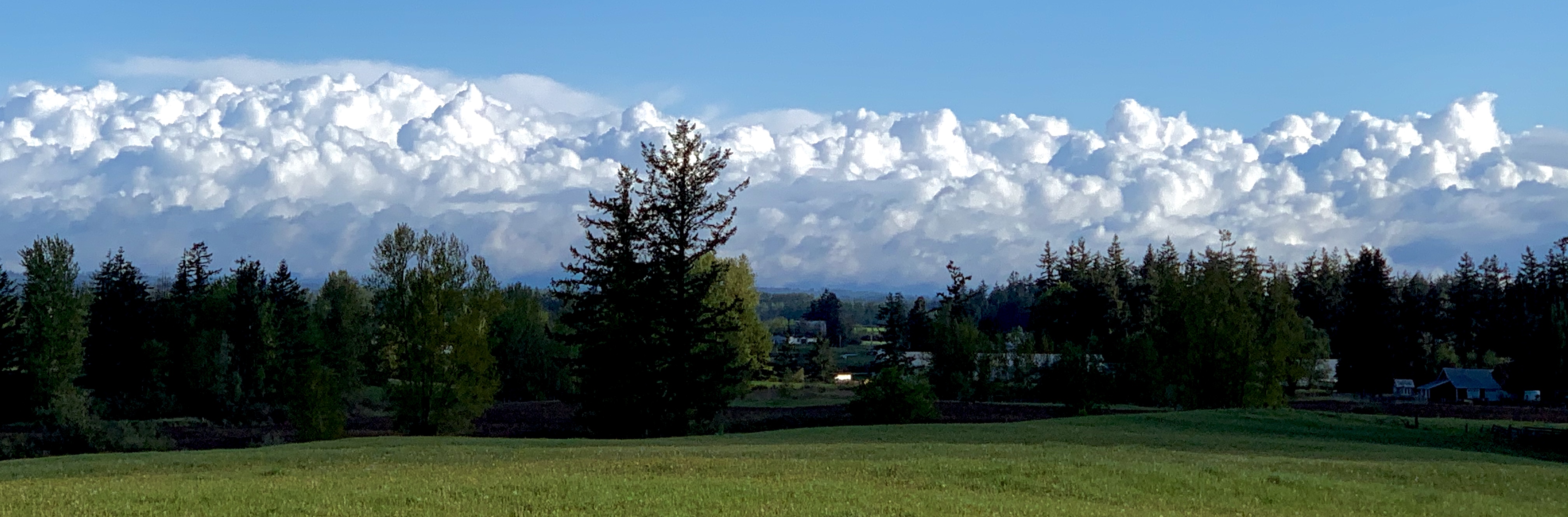
Our farm sits about 9 miles from an international border. The sky and clouds are oblivious to the line drawn by two governments, and don’t bother to stop at the border stations controlling access of humans across that line.
The clouds are free to go where they please, so they do, while we watch. They are both a foreign and domestic cloud of witnesses to our earthbound follies and foolishness.
No passports or IDs, no being pulled into “secondary” for more intensive searches and questioning, no being “turned back” not allowed across, no deportations.
They simply float and glide where the breezes take them, assuming whatever shape, identity or characteristics they wish.
What a beautiful day in the neighborhood if one happens to be a cloud or a cloud of witnesses…
AI image created for this post
One-Time
Monthly
Yearly
Make a one-time or recurring donation to support daily Barnstorming posts
It’s so easy to look and see what we pass through in this world, but we don’t. If you’re like me, you see so little. You see what you expect to see rather than what’s there. ~Frederick Buechner from The Remarkable Ordinary
Jesus said to them, “Come and have breakfast.” None of the disciples dared ask him, “Who are you?” They knew it was the Lord. John 21:12
It is too easy, by the next day, to let go of Easter — to slide back into the Monday routine, managing our best to get through each day, our jaws set, our teeth gritted, as we have before.
We are blinded by our grief, shivering in misery, thinking Him only the Gardener as He passed by. We don’t pay attention to Who is right before us, Who is always tending us: the new Adam, caring for a world desperate for rescue.
God knows this about us. So He invites us to breakfast on Monday and every day thereafter.
He feeds us, a tangible and meaningful act of nourishing us in our most basic human needs though we’ve done nothing to deserve the gift. He cooks up fish on a beach at dawn and welcomes us to join Him, as if nothing extraordinary has just happened.
Just yesterday evening he reviewed His Word and broke bread in Emmaus, opening the eyes and hearts of those like us who failed to see Who this is walking beside them.
This is no ordinary Gardener.
When He offers up a meal of His Word, the gift is nothing less than Himself.
AI image created for this post
One-Time
Monthly
Yearly
Make a one-time or recurring donation to support daily Barnstorming posts
The church, I think, is God’s way of saying, “What I have in the pot is yours, and what I have is a group of misfits whom you need more than you know and who need you more than they know.”
“Take, and eat,” he says, “and take, and eat, until the day, and it is coming, that you knock on my door. I will open it, and you will see me face to face.”
He is preparing a table. He will welcome us in. Jesus will be there, smiling and holy, holding out a green bean casserole. And at that moment, what we say, what we think, and what we believe will be the same: “I didn’t know how badly I needed this.” ~Jeremy Clive Huggins from “The Church Potluck”
“When someone invites you to a wedding feast, do not take the place of honor, for a person more distinguished than you may have been invited. 9 If so, the host who invited both of you will come and say to you, ‘Give this person your seat.’ Then, humiliated, you will have to take the least important place. 10 But when you are invited, take the lowest place, so that when your host comes, he will say to you, ‘Friend, move up to a better place.’ Then you will be honored in the presence of all the other guests. 11 For all those who exalt themselves will be humbled, and those who humble themselves will be exalted.”
“When you give a luncheon or dinner, do not invite your friends, your brothers or sisters, your relatives, or your rich neighbors; if you do, they may invite you back and so you will be repaid. 13 But when you give a banquet, invite the poor, the crippled, the lame, the blind, 14 and you will be blessed. Although they cannot repay you, you will be repaid at the resurrection of the righteous.” Luke 14: 7-14
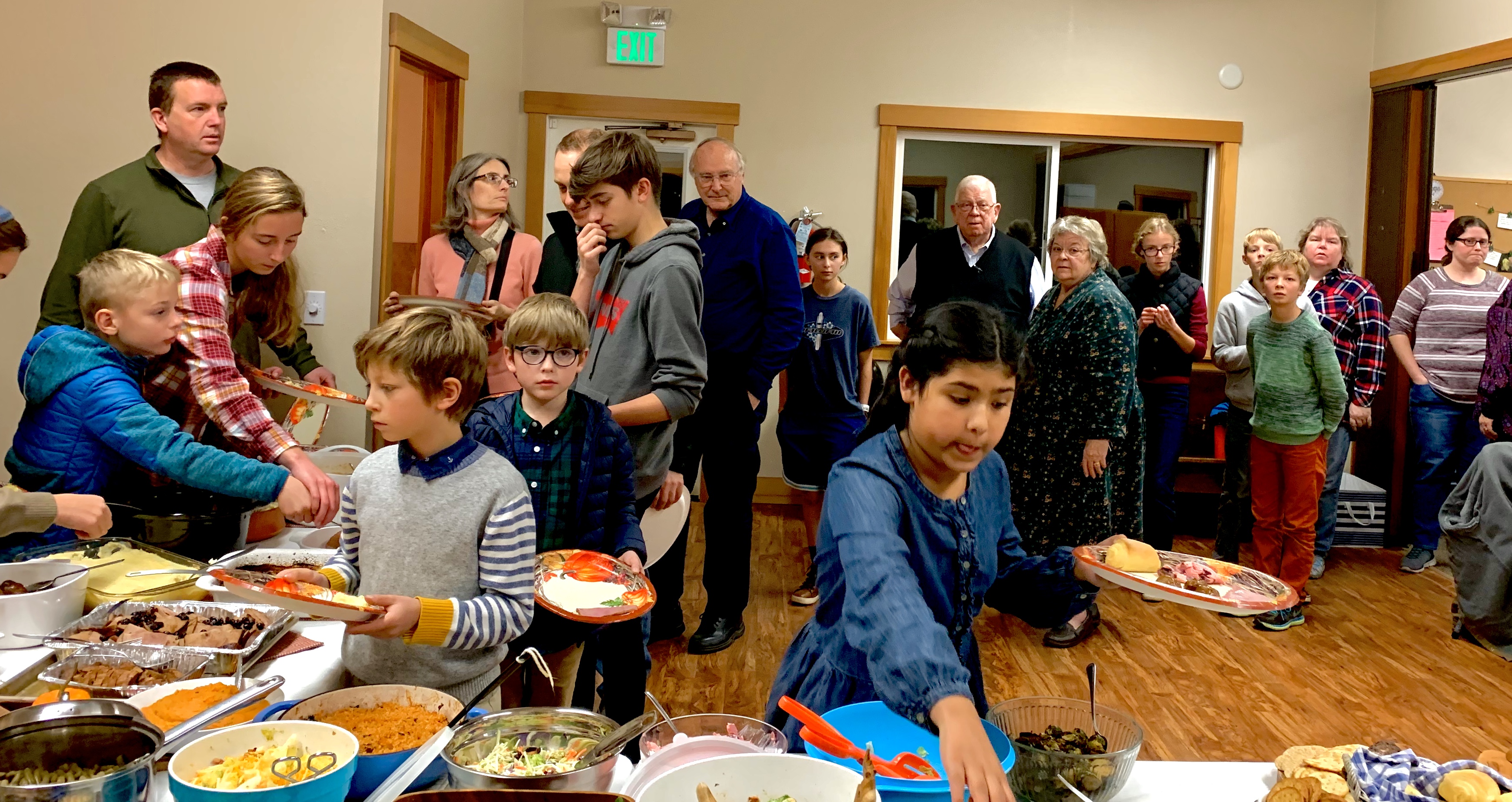
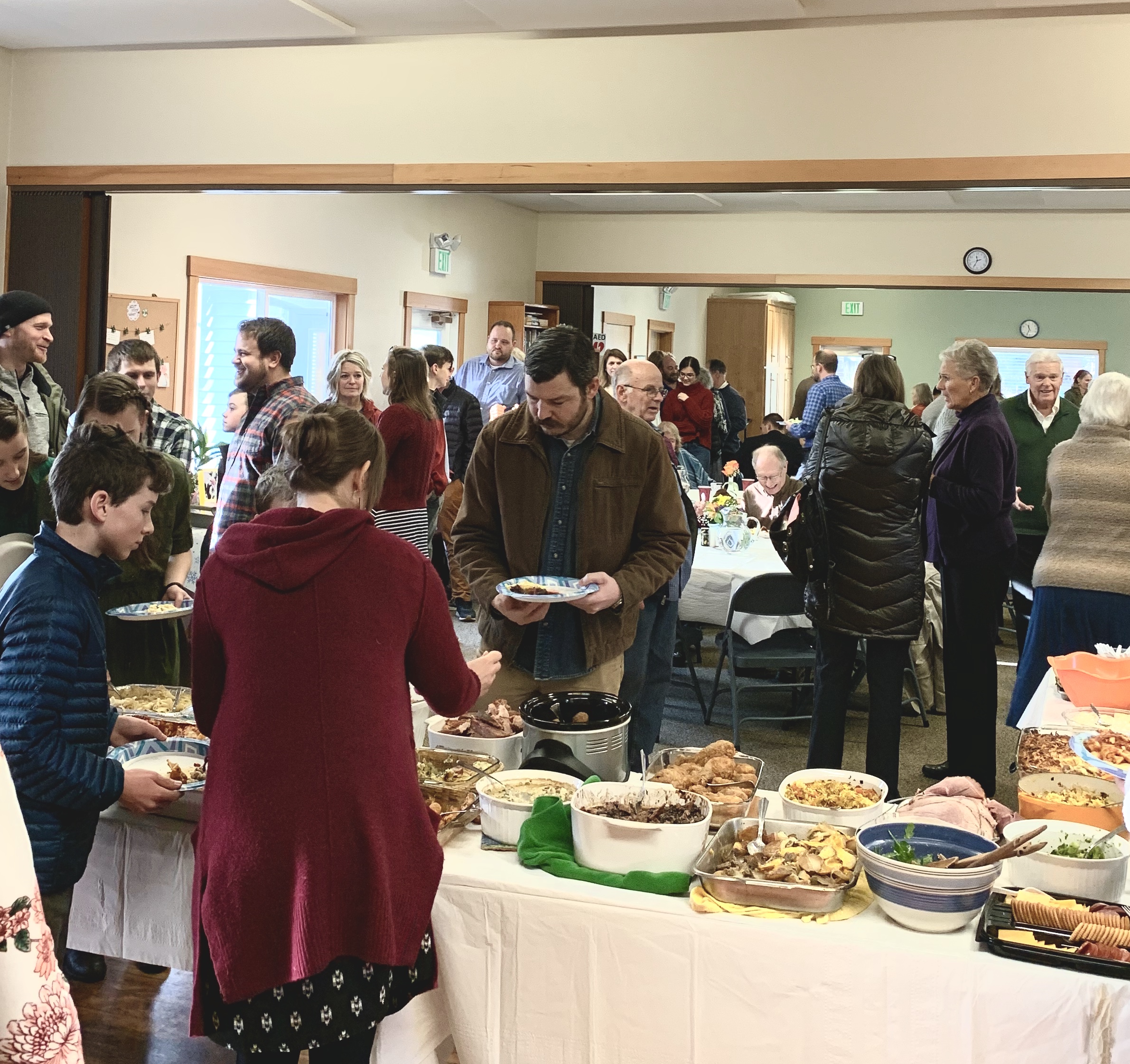
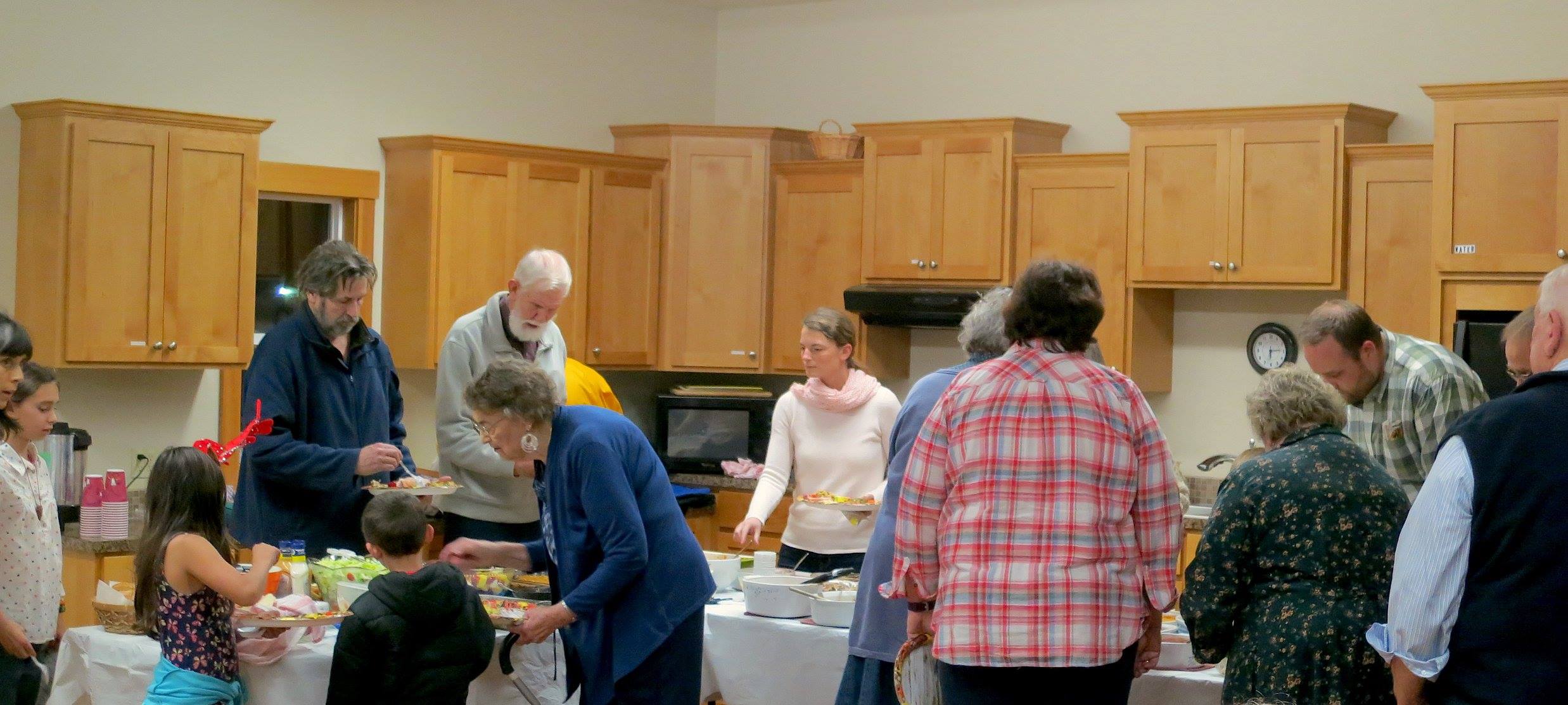
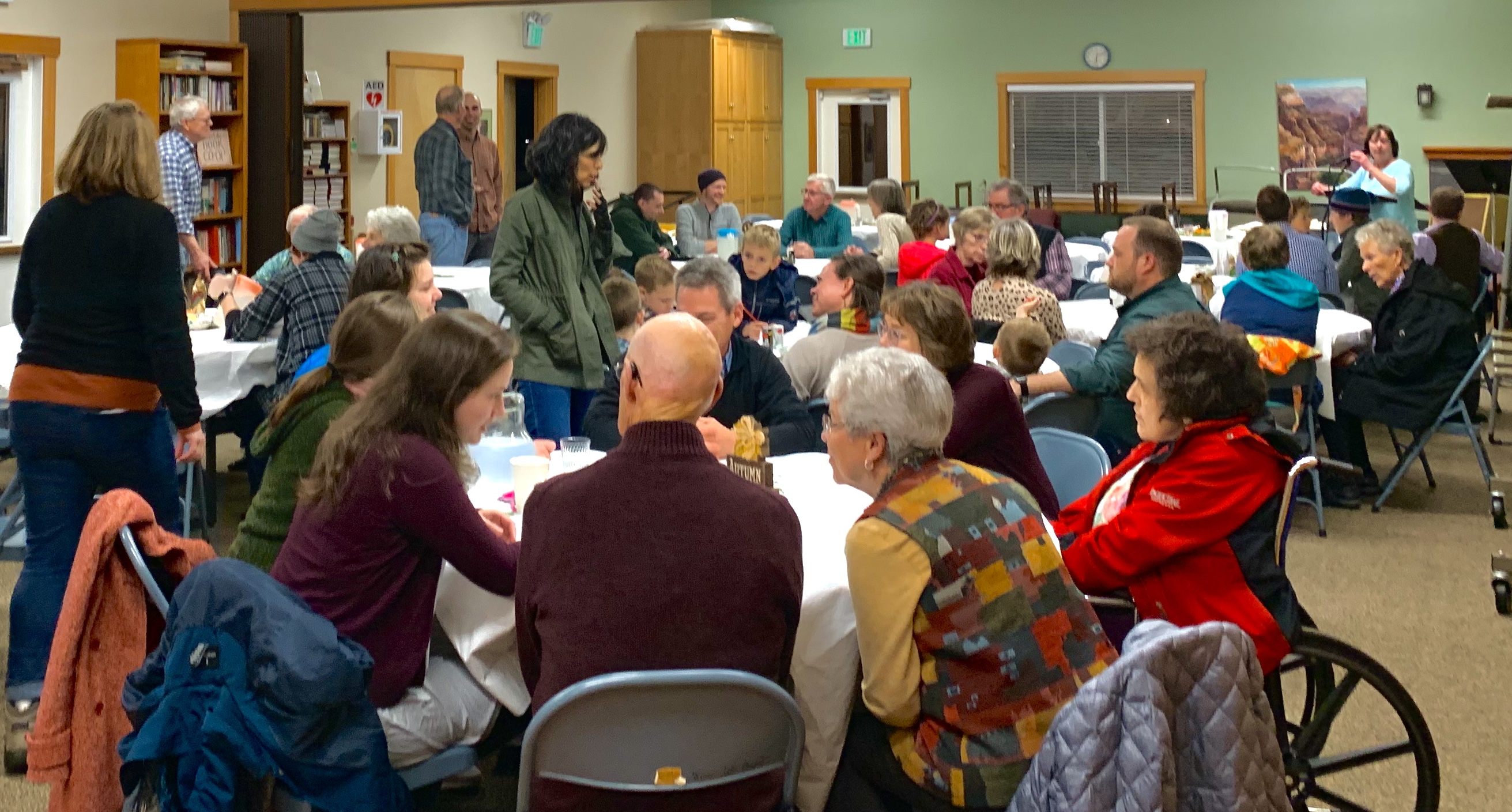
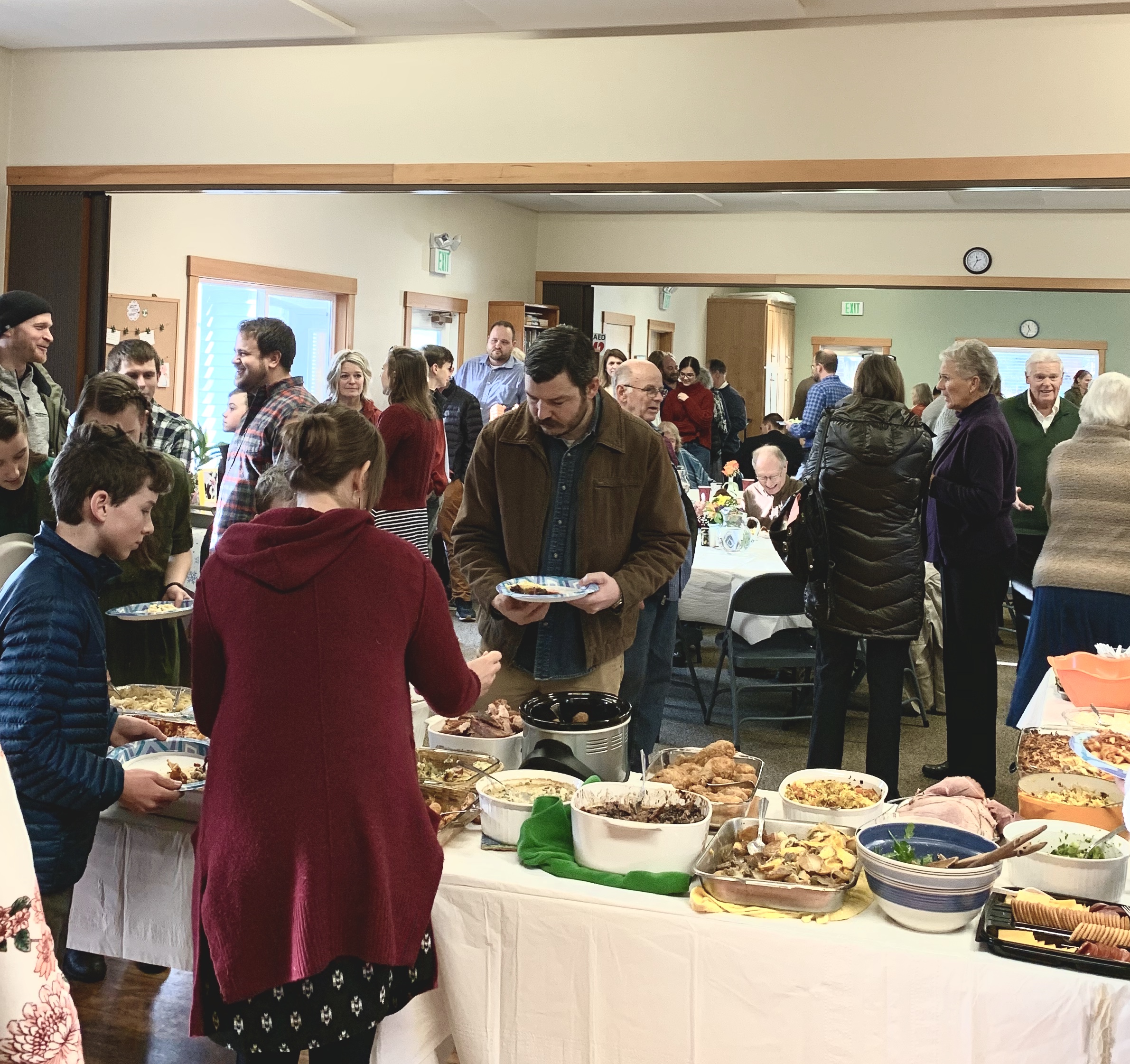
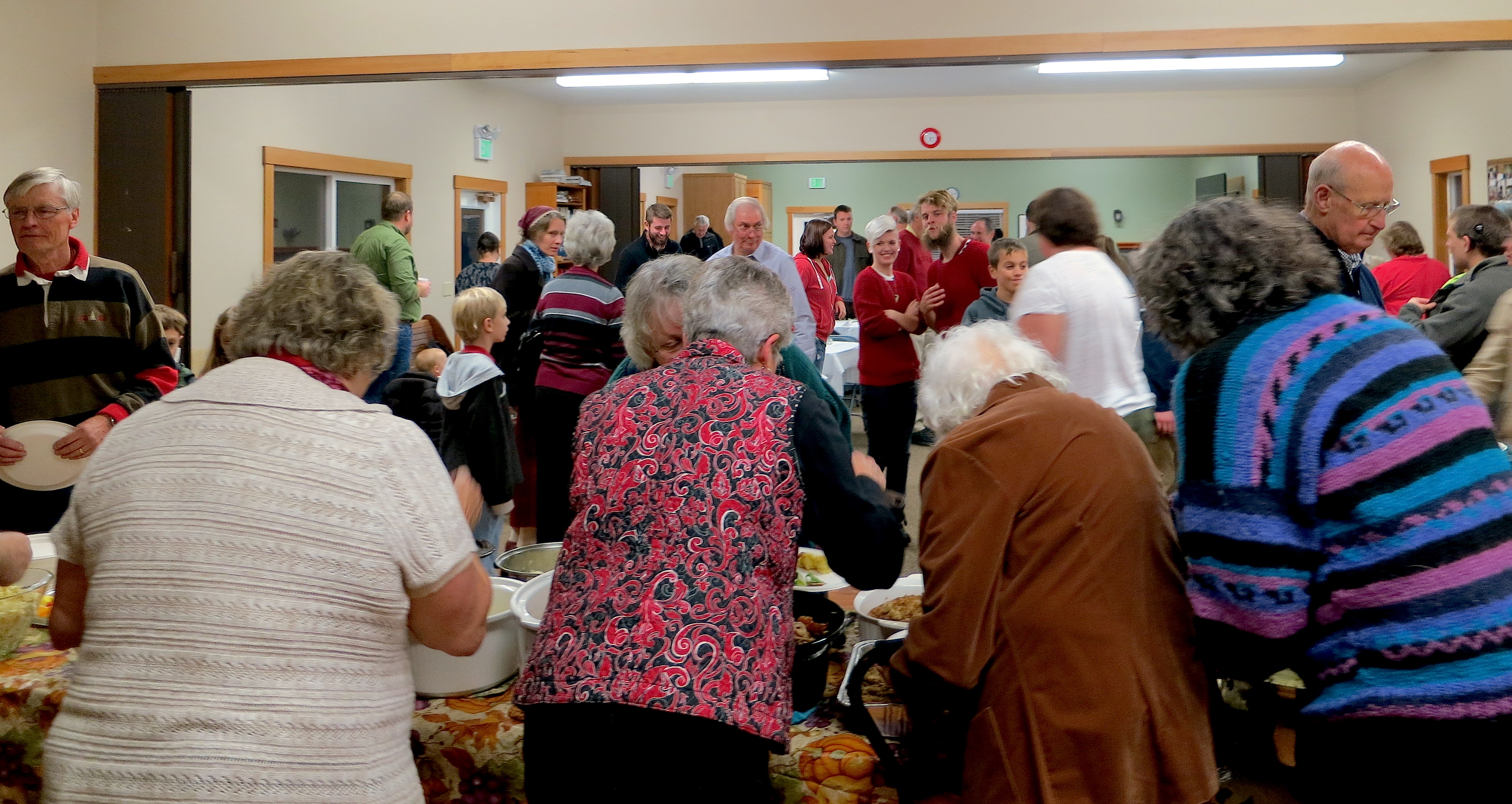
In the unspoken hierarchy of what makes a church function, I’m a kitchen lady and always will be. I remember those very women from my childhood church of the fifties and sixties– their tight-knit ability to function as if one organism, swarming in aprons among tables set up in the fellowship hall and bustling around in the back by the stoves with steaming pots and pans and the occasionally dropped plate.
They kept the rest of us alive, those church ladies, by feeding us efficiently and plentifully and never ever sitting down. I would occasionally see them eating standing up in the back of the hall, chatting amiably among themselves after the rest of us were served, but I knew they carefully wrapped up the leftovers during the clean up to deliver to shut-ins who couldn’t make it to the church supper.
I knew I was destined to become a kitchen lady, shy and introverted as I am, hiding myself behind huge plates of food and piles of dish cloths. Our church potlucks together every Sunday after our evening worship. For me, it is a welcoming place of comfort and clean up filled with plenty of leftovers for anyone who needs them.
That perfectly describes the kingdom of God in my book and His Book.
AI image created for this post
This year’s Lenten theme:
…where you go I will go… Ruth 1:16
One-Time
Monthly
Yearly
Make a one-time or recurring donation to support daily Barnstorming posts
…we all suffer. For we all prize and love; and in this present existence of ours, prizing and loving yield suffering. Love in our world is suffering love. Some do not suffer much, though, for they do not love much. Suffering is for the loving. This, said Jesus, is the command of the Holy One: “You shall love your neighbor as yourself.” In commanding us to love, God invites us to suffer.
Over there, you are of no help. What I need to hear from you is that you recognize how painful it is. I need to hear from you that you are with me in my desperation. To comfort me, you have to come close. Come sit beside me on my mourning bench. ~Nicholas Wolterstorff from Lament for a Son
I wondered if 7:30 AM was too early to call her. As a sleep-deprived fourth year medical student finishing a long night admitting patients in the hospital, I selfishly needed to hear her voice.
I wanted to know how Margy was doing with the latest round of chemotherapy for breast cancer; I knew she was not sleeping well these days. She was wearing a new halo brace—a metal contraption that wrapped around her head like a scaffolding to secure her degenerating cervical spine from collapsing from metastatic tumor growths in her bones.
She knew, we all knew, she was trying to buy more time from a life of rapidly diminishing days.
Each patient I had seen the previous 24 hours while working in the Emergency Room benefited from the interviewing skills Margy had taught each medical student in our class. She reminded us that each patient had an important story to tell, and no matter how pressured our time, we needed to ask questions that gave permission for that story to be told. As a former nun now married with two teenage children, Margy had become our de facto therapist at a time no medical school hired supportive counselors.
She insisted physicians-in-training remember the suffering soul thriving inside the broken body.
“Just let the patient know with certainty, through your eyes, your body language, your words, that you want to hear what they have to say. You can heal so much hurt simply by sitting beside them and caring enough to listen…”
After her diagnosis with stage 4 cancer, Margy herself became the broken vessel who needed the glue of a good listener. She continued to teach, often from her bed at home. I planned to visit her that day, maybe help out by cleaning her house, or take her for a drive as a diversion.
Her phone rang only once after I dialed her number. There was a long pause; I could hear a clearing of her throat. A deep dam of tears welled behind a muffled “Hello?”
“Margy?”
“Yes? Emily? ”
“Margy? What is it? What’s wrong?”
Her voice shattered like glass into fragments, strangling on words that struggled to form.
“A policeman just left. He told us our boy is dead.”
I sat in stunned silence, listening to her sobs, completely unequipped to know how to respond.
None of this made sense. I knew her son was on college spring break, heading to Mexico for a missions trip.
“I’m here, what’s happened?”
“The doorbell rang about an hour ago. Larry got up to answer it. I heard him talking to someone downstairs, so I decided to try to get up and go see what was going on. There was a policeman sitting with Larry on the couch. I knew it had to be about Gordy.”
She paused and took in a shuddering breath.
“The group was driving through the night in California. He was asleep in the back of the camper. They think he was sleepwalking and walked right out of the back of the moving camper and was hit by another car.”
Silence. A strangling choking silence.
“They’ll bring him home to me, won’t they? I need to know I can see my boy again. I need to tell him how much I love him.”
“They’ll bring him home to you, Margy. I’m on my way to help you get ready…“
God is not only the God of the sufferers but the God who suffers. … It is said of God that no one can behold his face and live. I always thought this meant that no one could see his splendor and live. A friend said perhaps it meant that no one could see his sorrow and live. Or perhaps his sorrow is splendor. … Instead of explaining our suffering, God shares it. ~Nicholas Wolterstorff from Lament for a Son
This year’s Lenten theme:
…where you go I will go… Ruth 1:16
One-Time
Monthly
Yearly
Make a one-time or recurring donation to support daily Barnstorming posts
Let your speech be alway with grace, seasoned with salt, that ye may know how ye ought to answer every man. Colossians 4: 6
Let all bitterness and wrath and anger and clamor and slander be put away from you, with all malice,and be kind to one another, tenderhearted, forgiving one another, as God in Christ forgave you. Ephesians 4: 31-32
You have heard that it was said, ‘Love your neighbor and hate your enemy.’But I tell you, love your enemies and pray for those who persecute you, that you may be children of your Father in heaven. He causes his sun to rise on the evil and the good, and sends rain on the righteous and the unrighteous. Matthew 5:43-45
And whom do I call my enemy? An enemy must be worthy of engagement. I turn in the direction of the sun and keep walking. It’s the heart that asks the question, not my furious mind. The heart is the smaller cousin of the sun. It sees and knows everything. It hears the gnashing even as it hears the blessing. The door to the mind should only open from the heart. An enemy who gets in, risks the danger of becoming a friend. ~Joy Harjo “This Morning I Pray For My Enemies”
I have a heart full of questions Quieting all my suggestions What is the meaning of Christian In this American life?
Is there a way to love always? Living in enemy hallways Don’t know my foes from my friends and Don’t know my friends anymore Power has several prizes Handcuffs can come in all sizes Love has a million disguises But winning is simply not one ~Jon Guerra from “Citizens”
…{His is} the love for the enemy– love for the one who does not love you but mocks, threatens, and inflicts pain. The tortured’s love for the torturer. This is God’s love. It conquers the world. ~Frederich Buechner from The Magnificent Defeat
After watching the appalling ambush of disrespect and rudeness by our country’s two leaders in the Oval Office yesterday toward visiting Ukrainian President Zelenskyy, I find myself gnashing my teeth in anger.
Now – who indeed is the friend, and who is the enemy?
This was not the time or forum for a public, rather than private high stakes discussion: the presence of cameras encourages bullies to have their say in front of a vast audience, determined to intimidate in order to “make good television.”
Simply agreeing to disagree on some issues in a difficult negotiation no longer seems an option. Why can’t a debate honor the other side enough to facilitate a civil discussion? Instead, if someone doesn’t see it your way, they’re perceived as ungrateful, morally deficient, hostile or worst of all, they have become the enemy.
But Ukraine is not the enemy and never wants to be. They want to remain whole and free to govern themselves and need help to withstand the attacks of their neighborhood bully.
Those of us who have been around awhile know: bellowing hateful words puts a match to angry feelings that burn hot inside and outside. Usually a fruitful political debate over polarizing opinions can inspire a profound sense of purpose and compromise, yet if there is no respect or honor shown, it burns to ashes.
I disagree vehemently with what our leaders are doing and in particular, the boorish and foolish way they are doing it. Their school yard behavior is a far cry from the biblical command to exhibit grace and compassion instead of hostility and retribution.
Fickle things are those angry words – someone lights a match to them, keeps stoking the fire with new fuel, over and over again until nothing remains standing.
Let us refuse to be the kindling as our leaders seek our attention daily by inflicting more trauma and angst, not just to the citizens of Ukraine and Europe, but to the U.S. citizens to whom they are ultimately accountable.
Let us resist our own angry gnashing of teeth by praying that only God’s transforming love for enemies can soften the hearts and minds of the bullies of the world.
One-Time
Monthly
Yearly
Make a one-time or recurring donation to support daily Barnstorming posts















































 Barnstorming