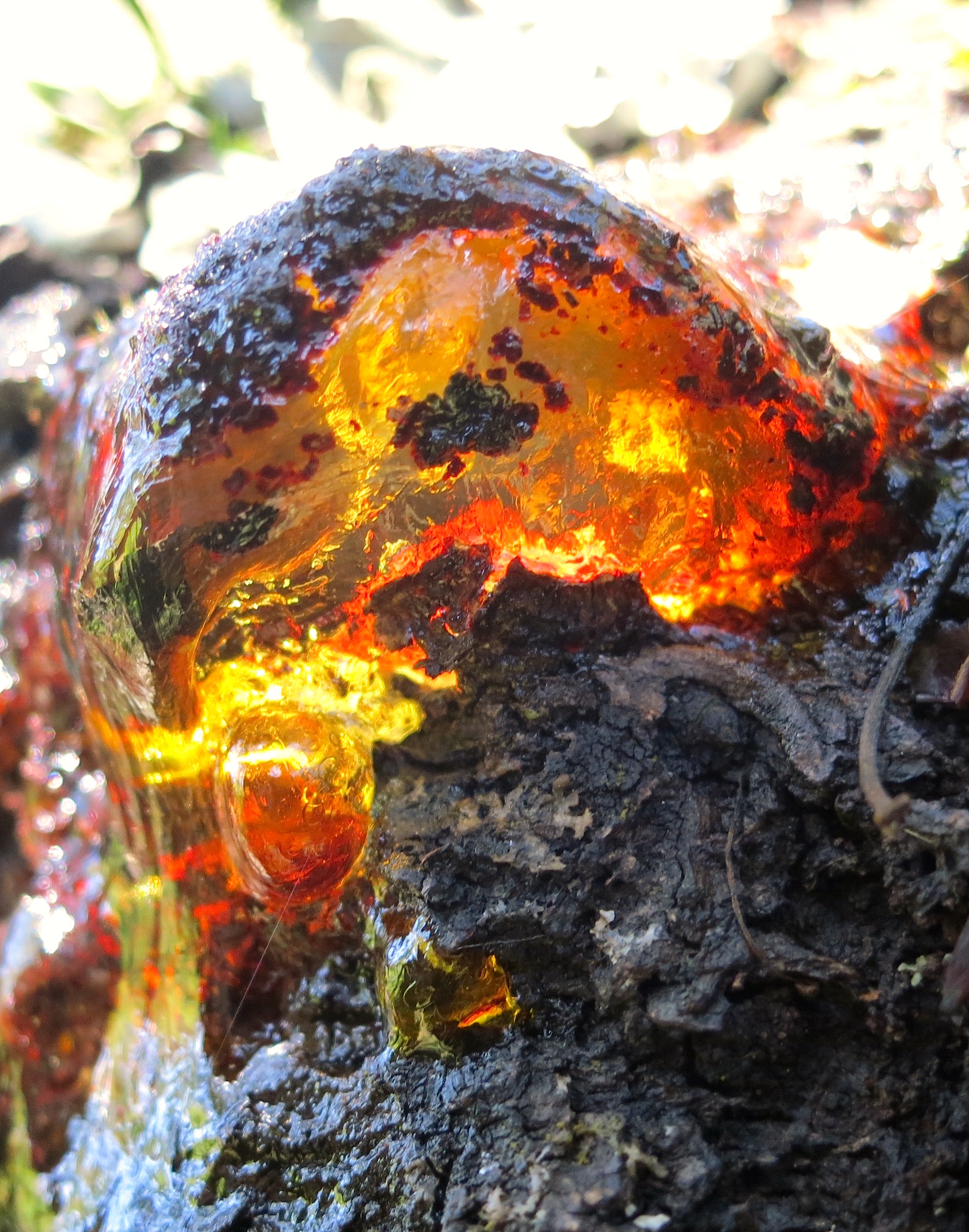
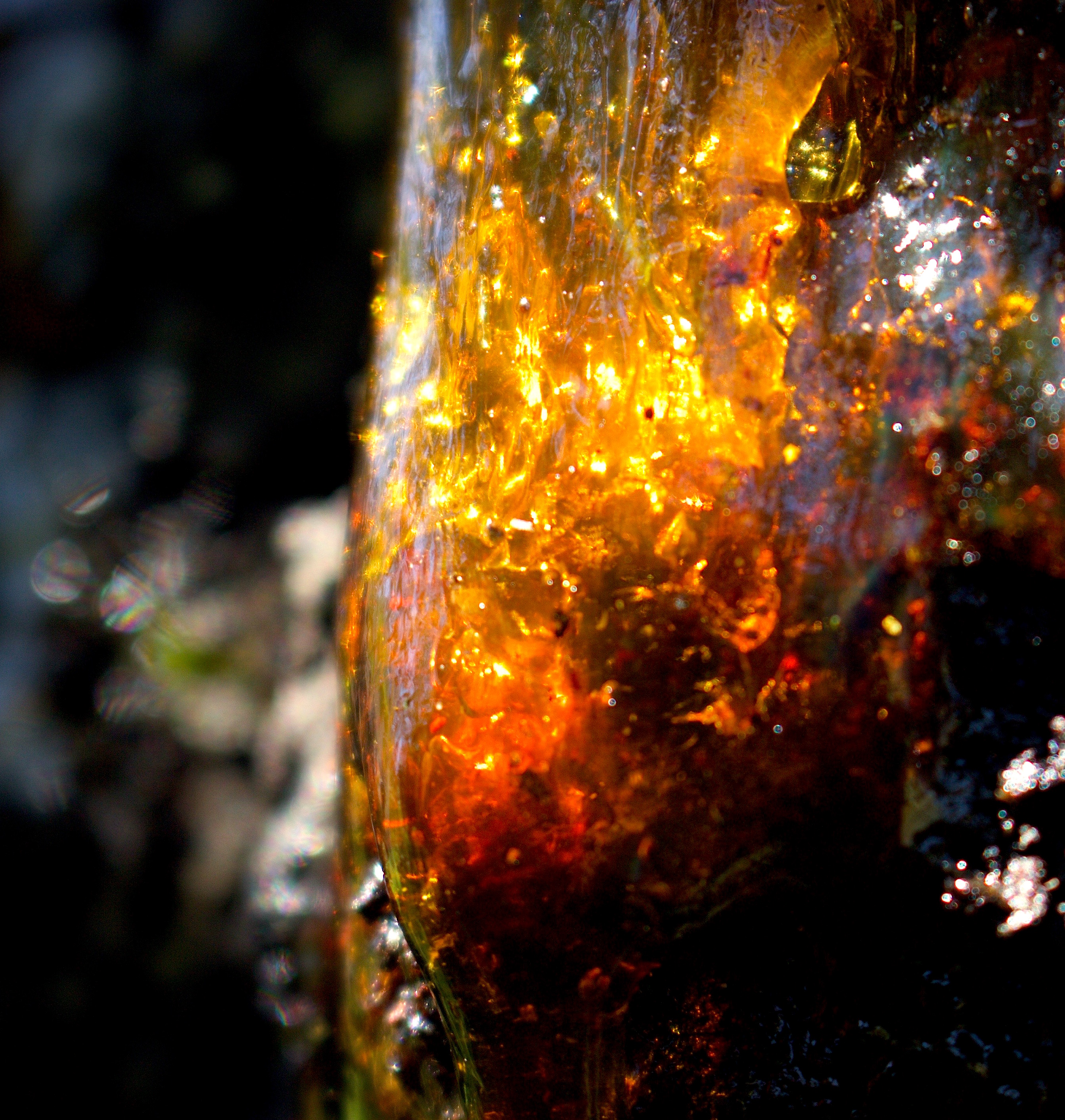
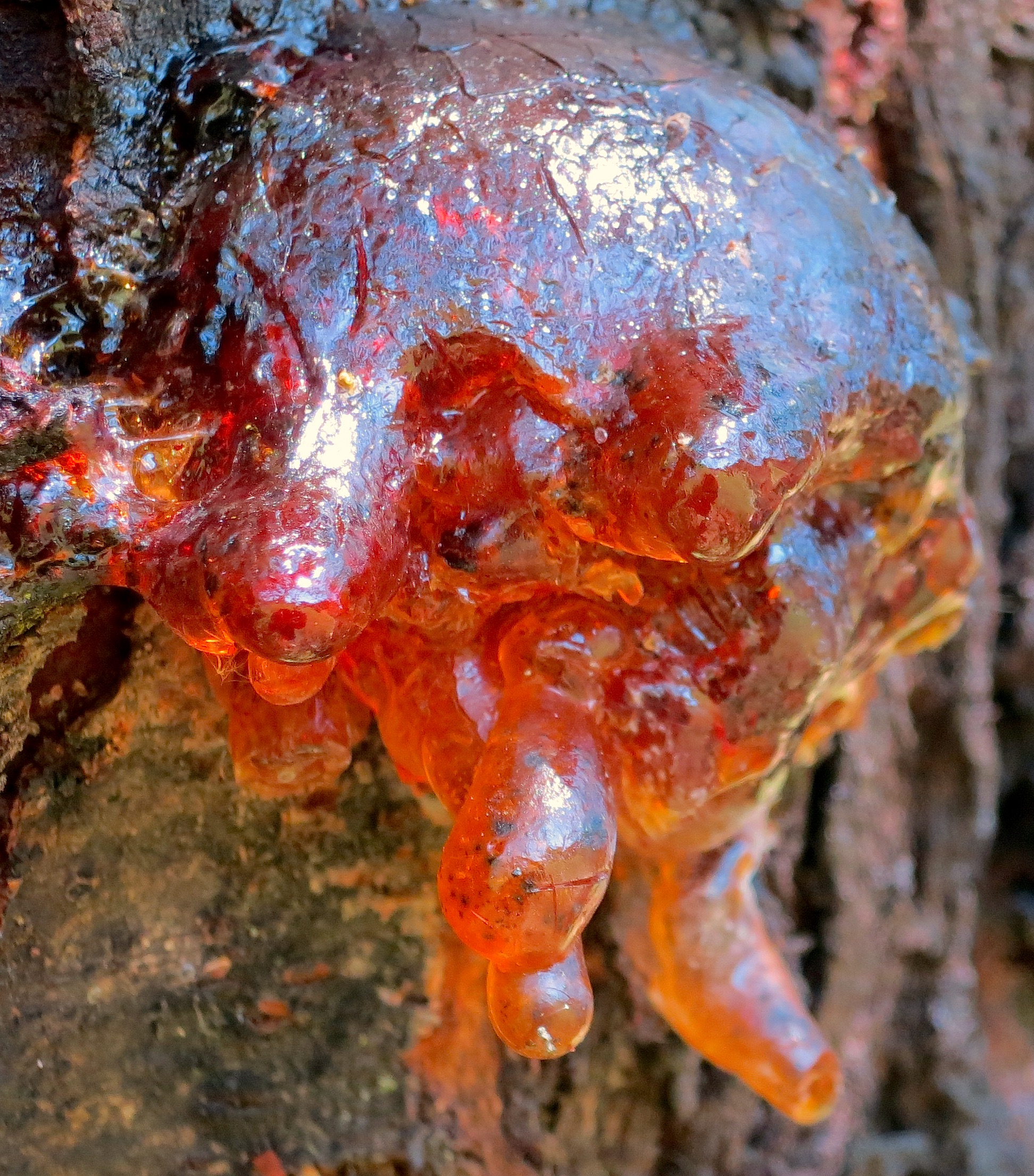
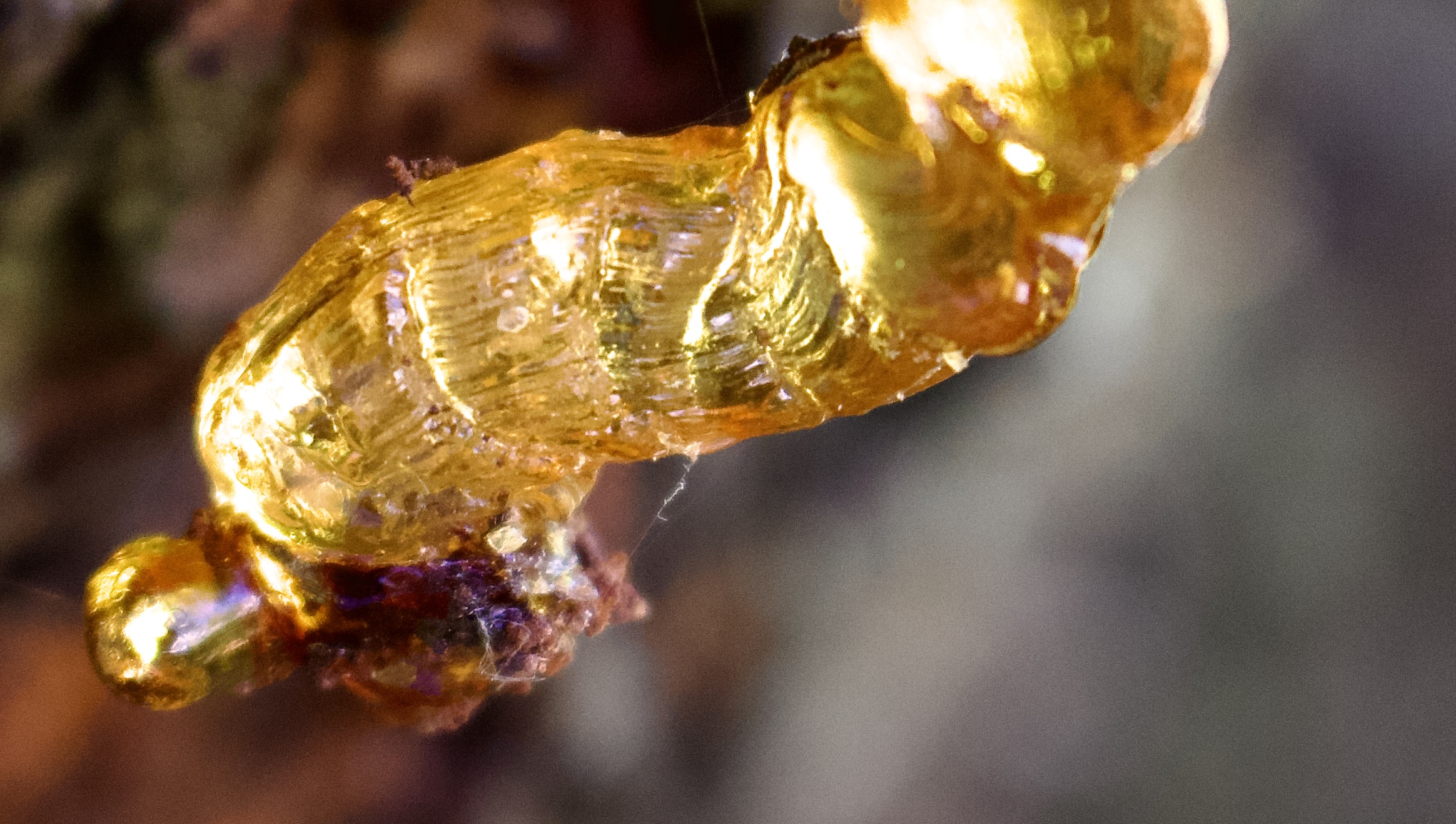
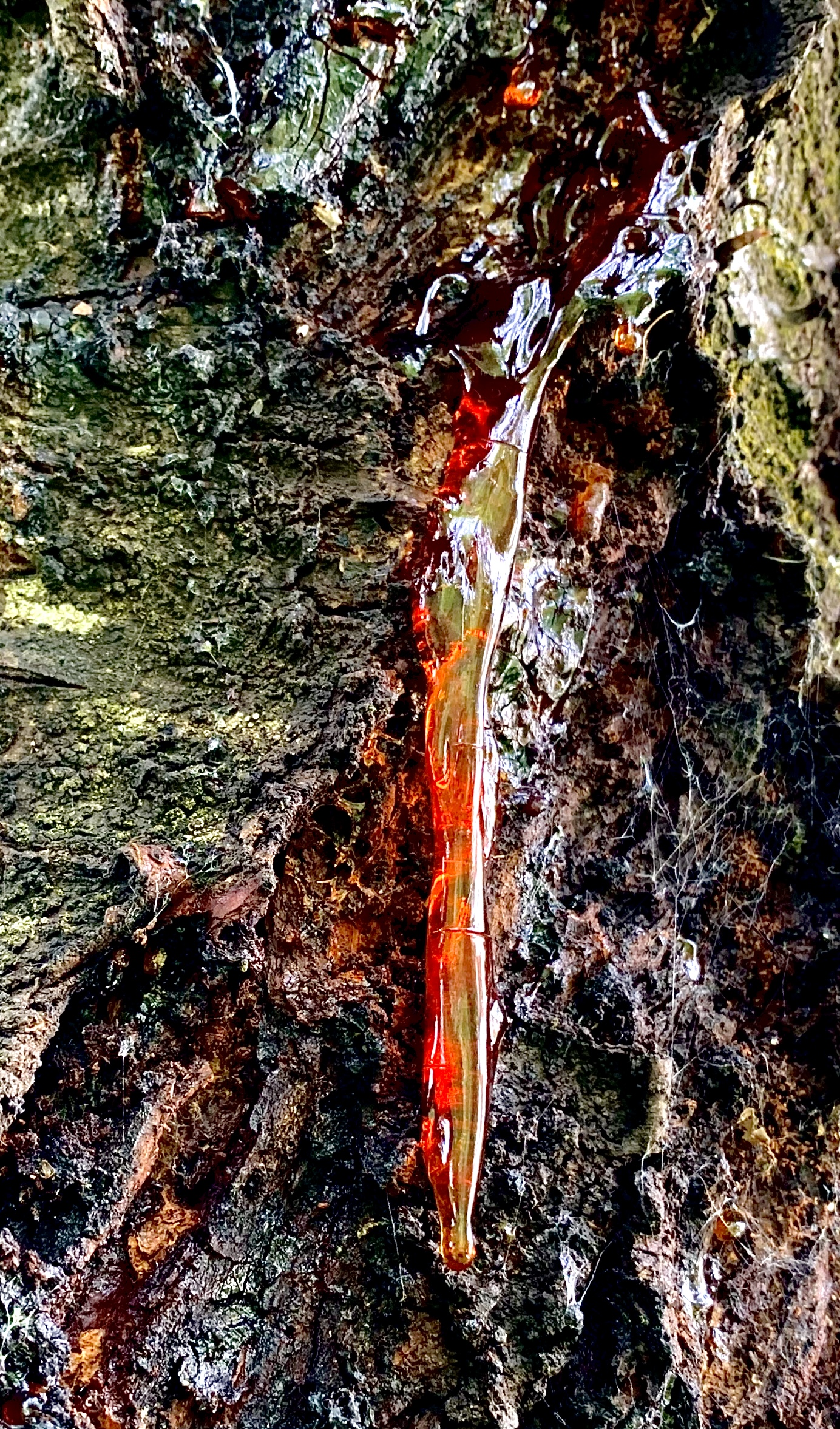
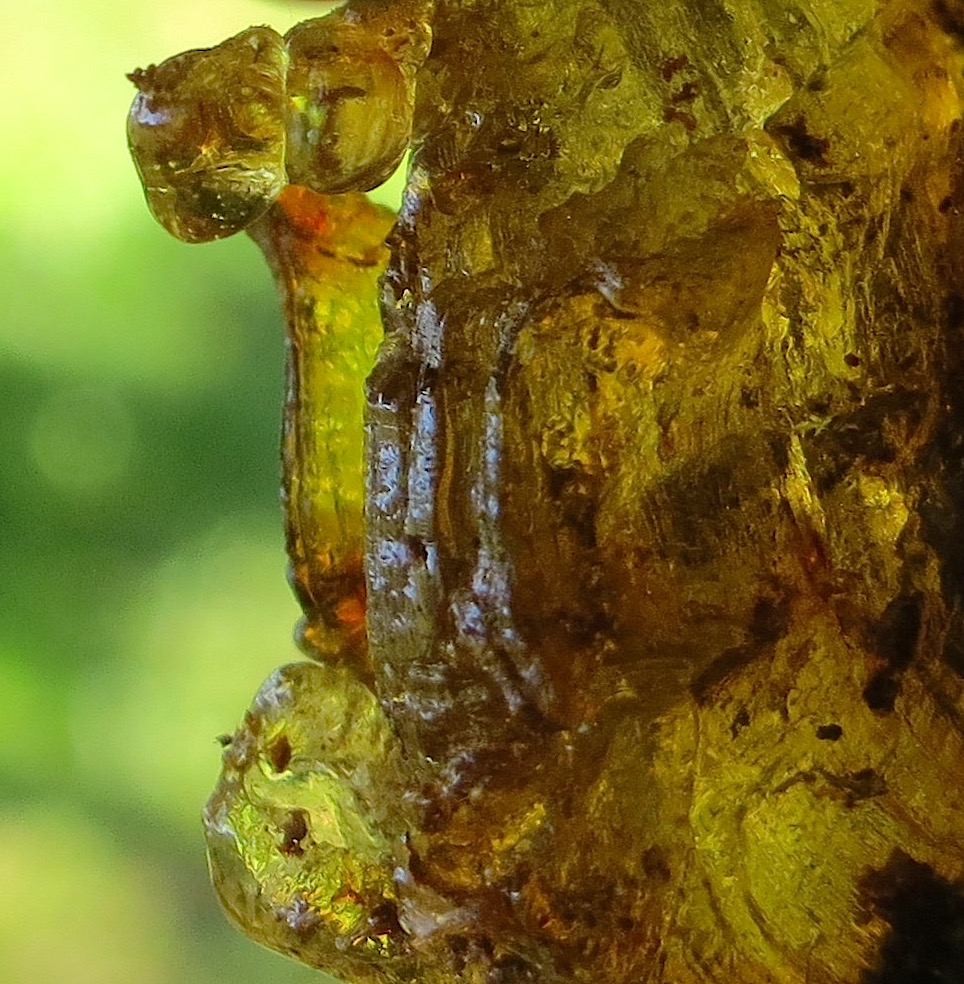
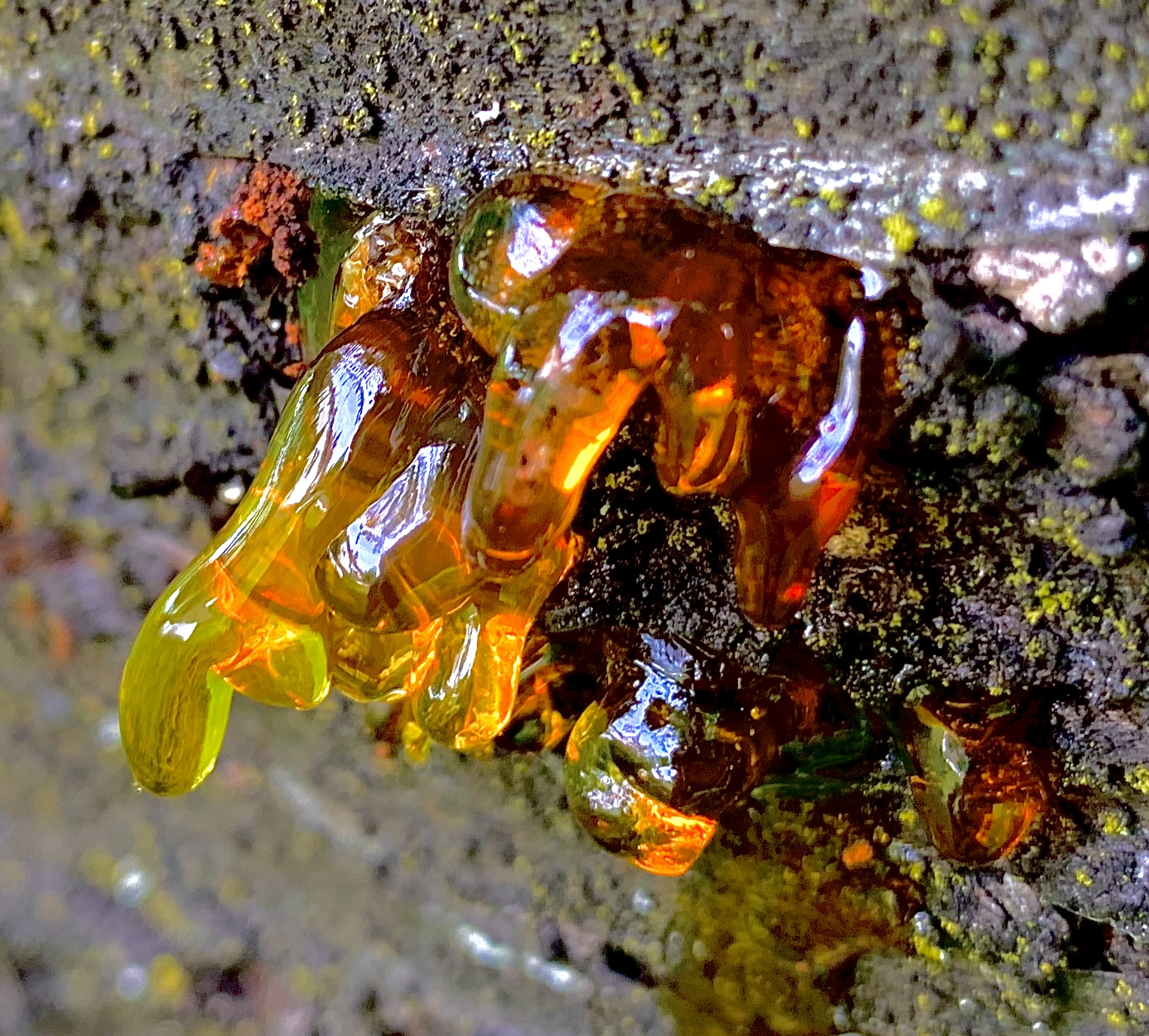
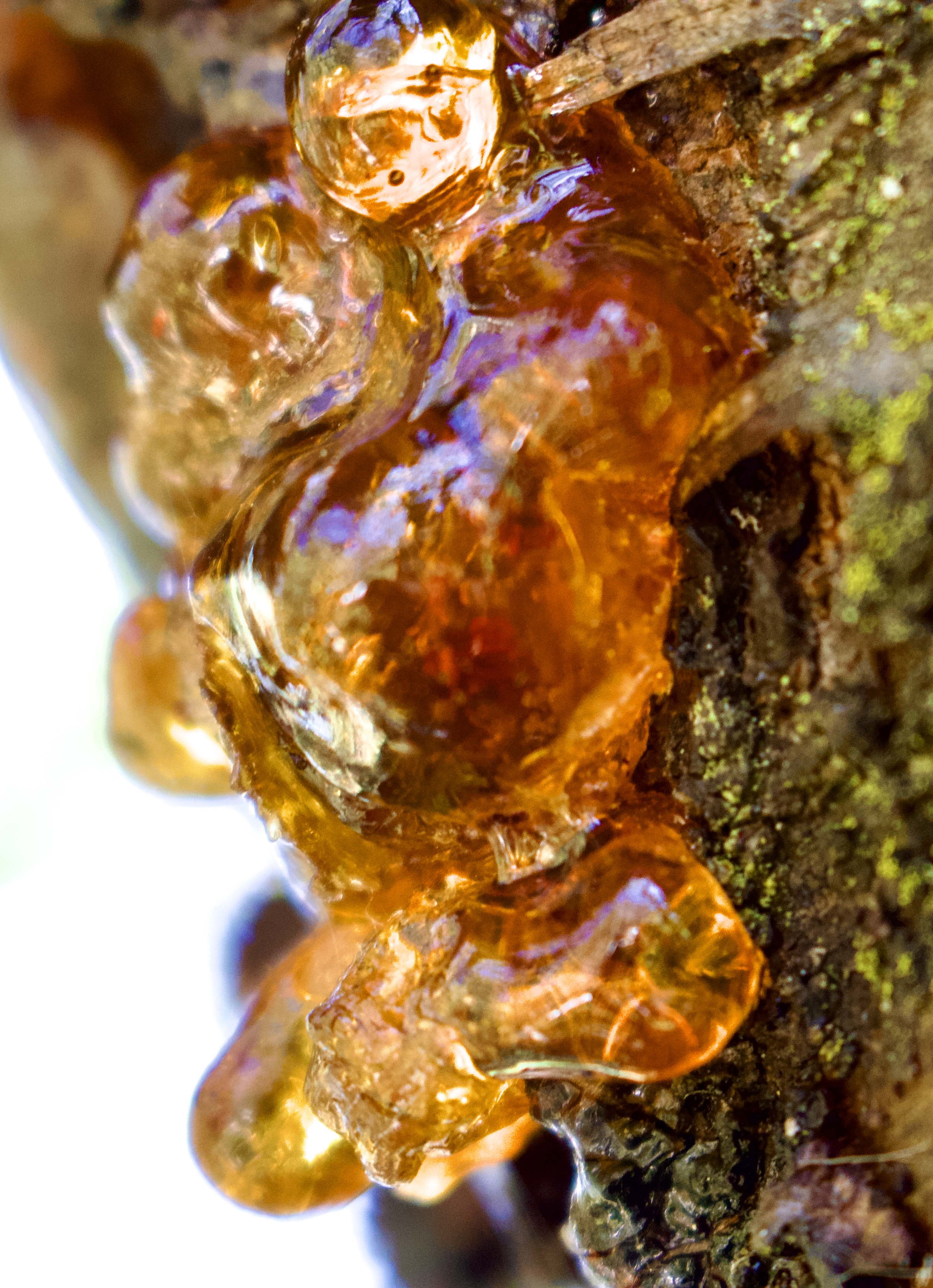
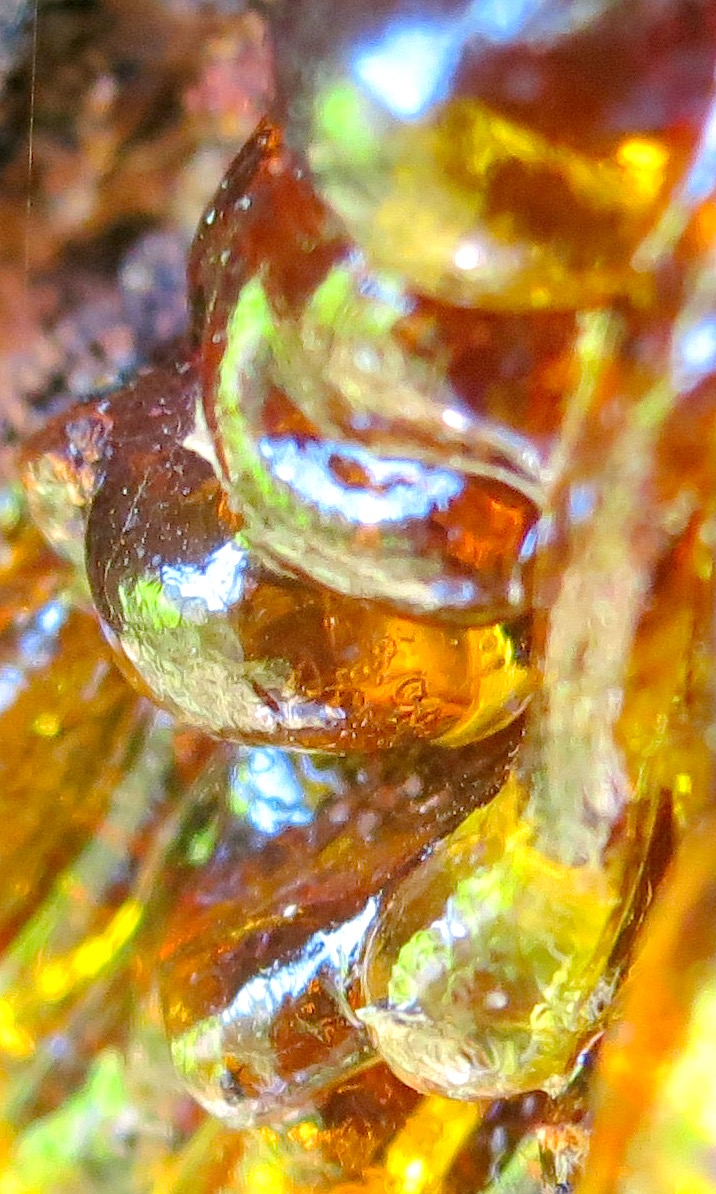
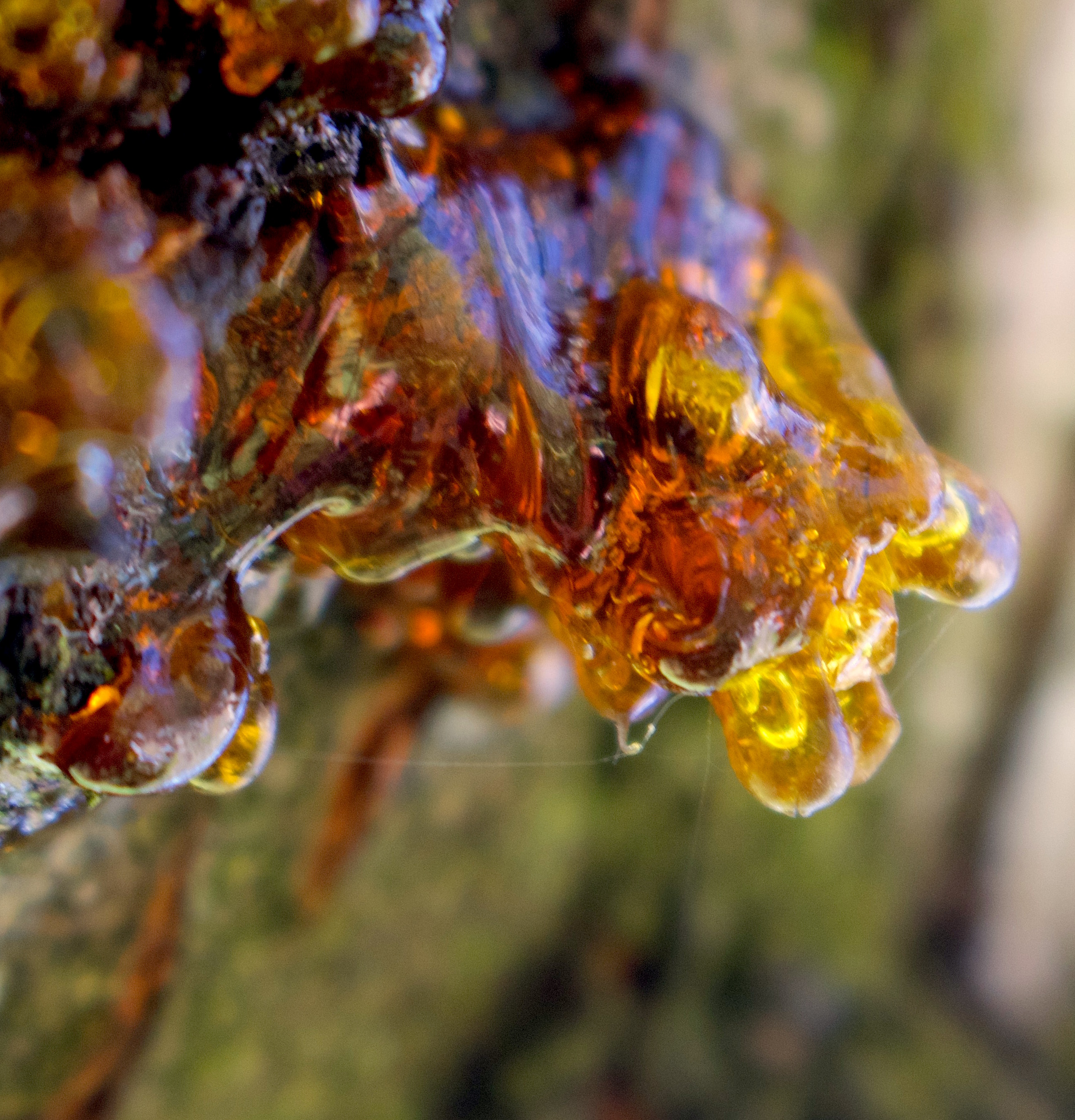
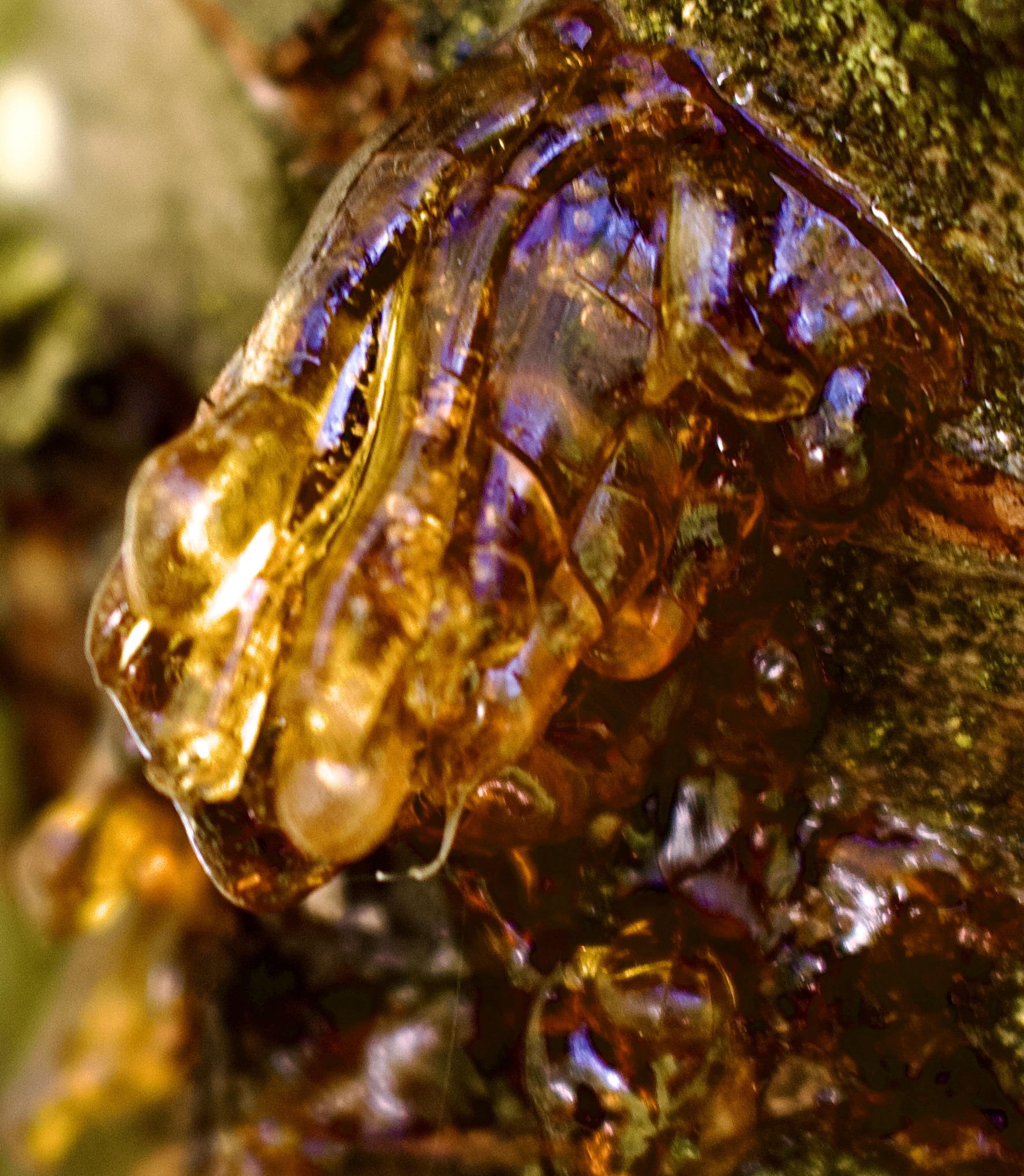
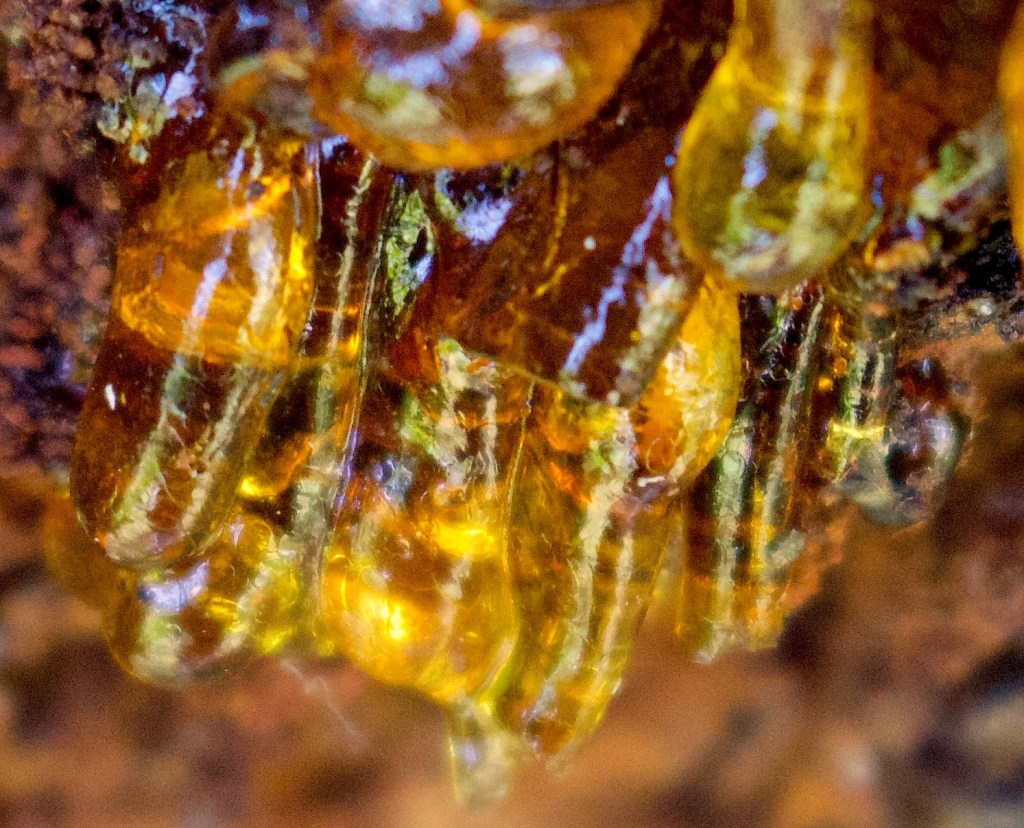
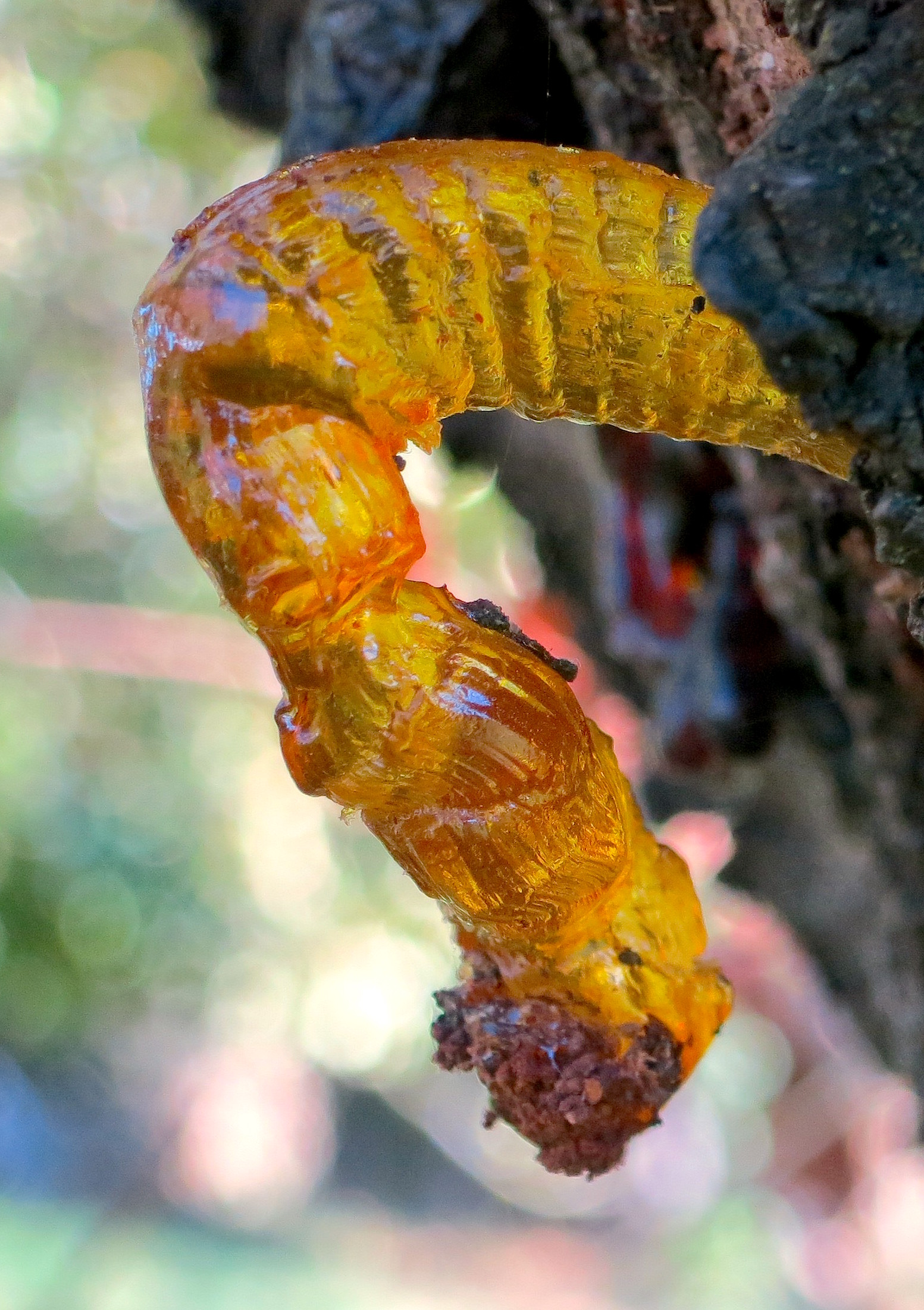
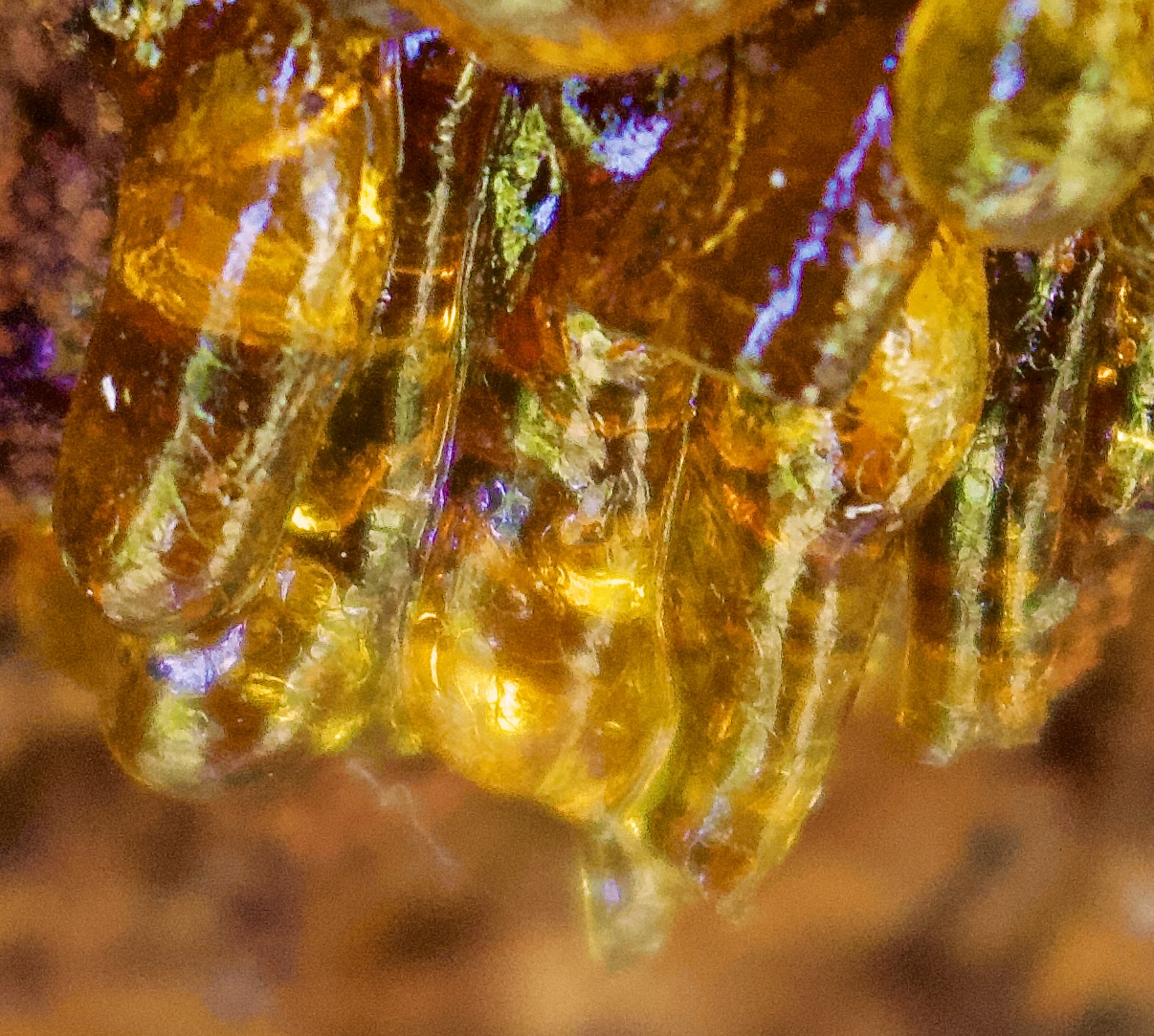
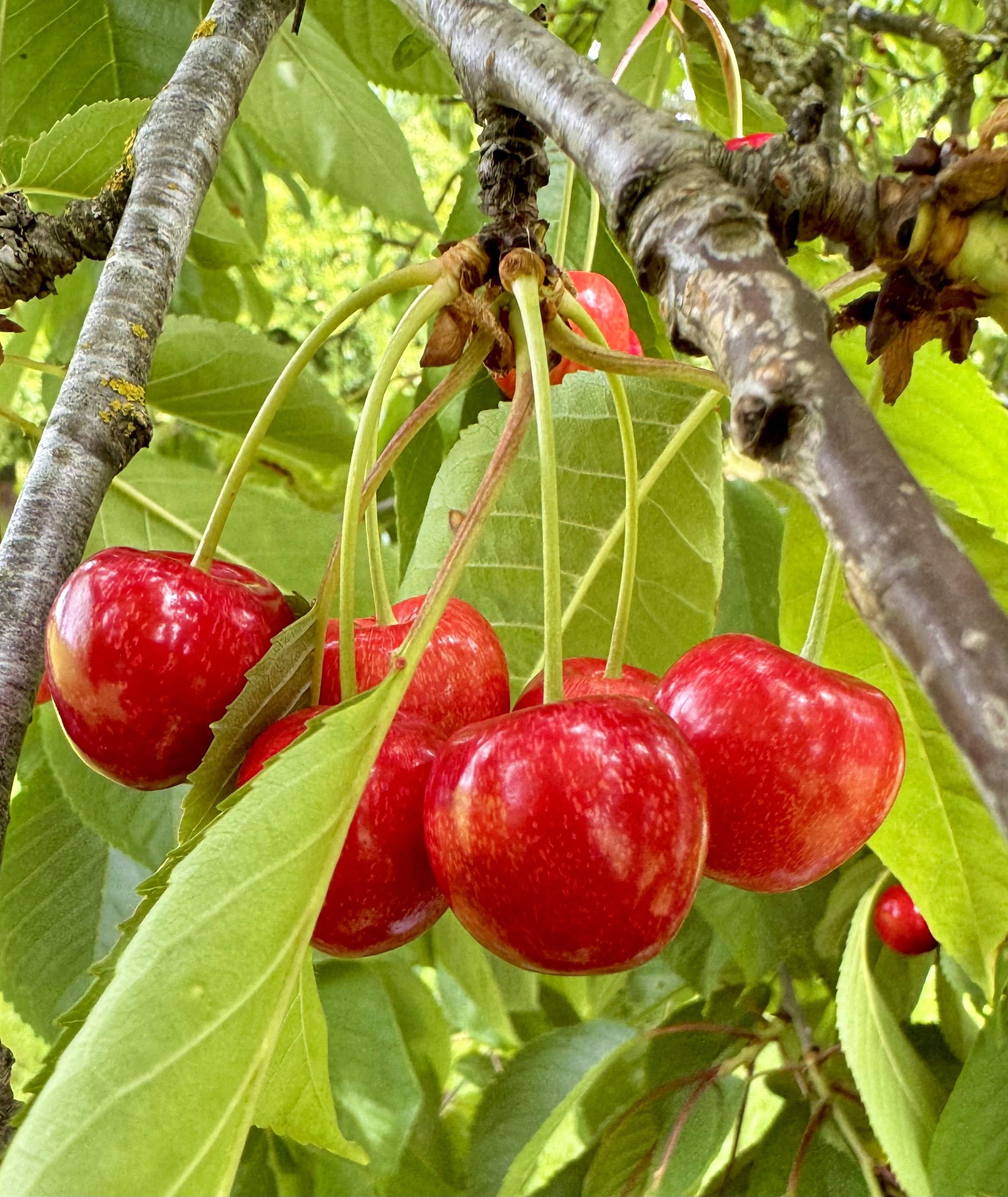
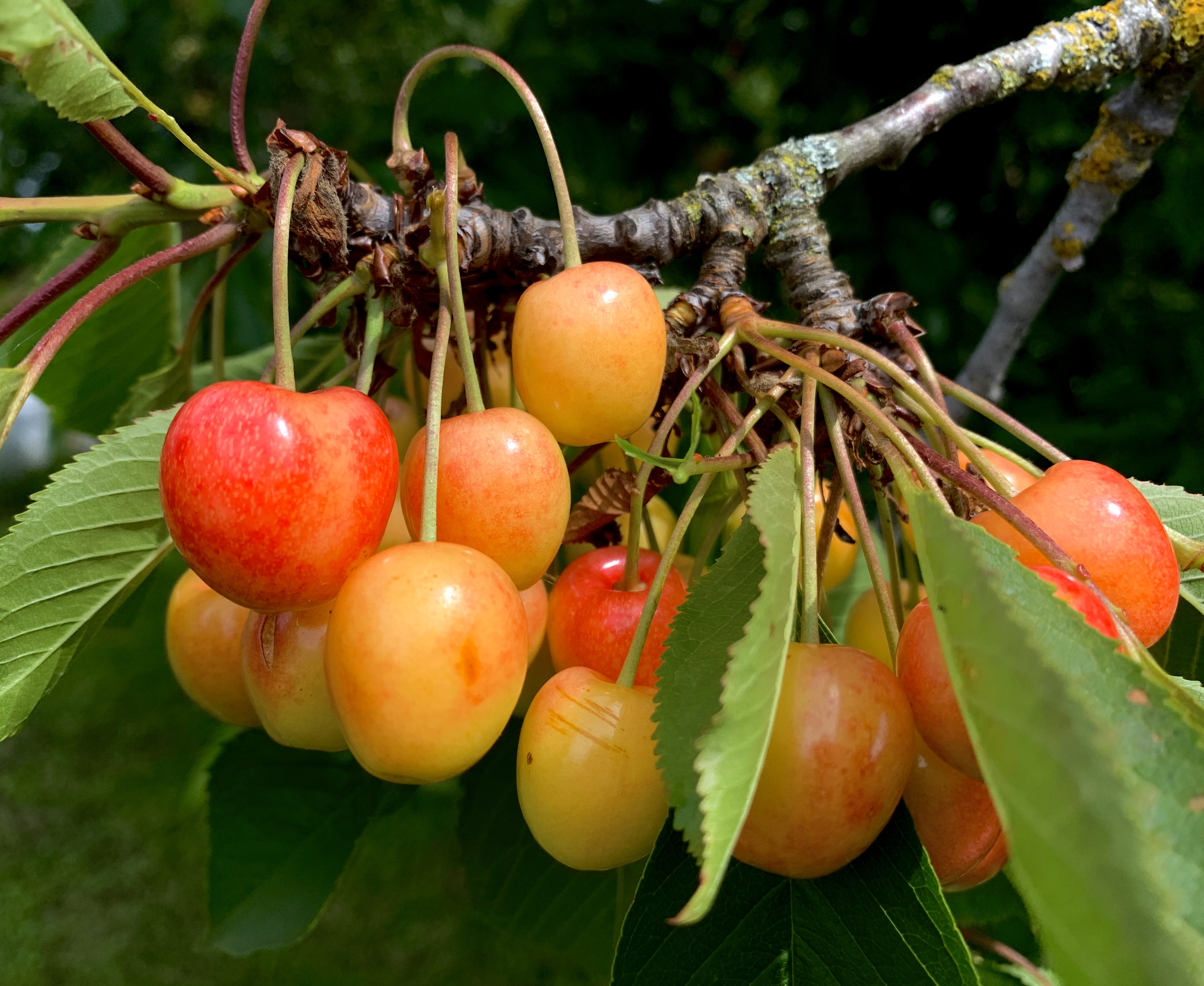
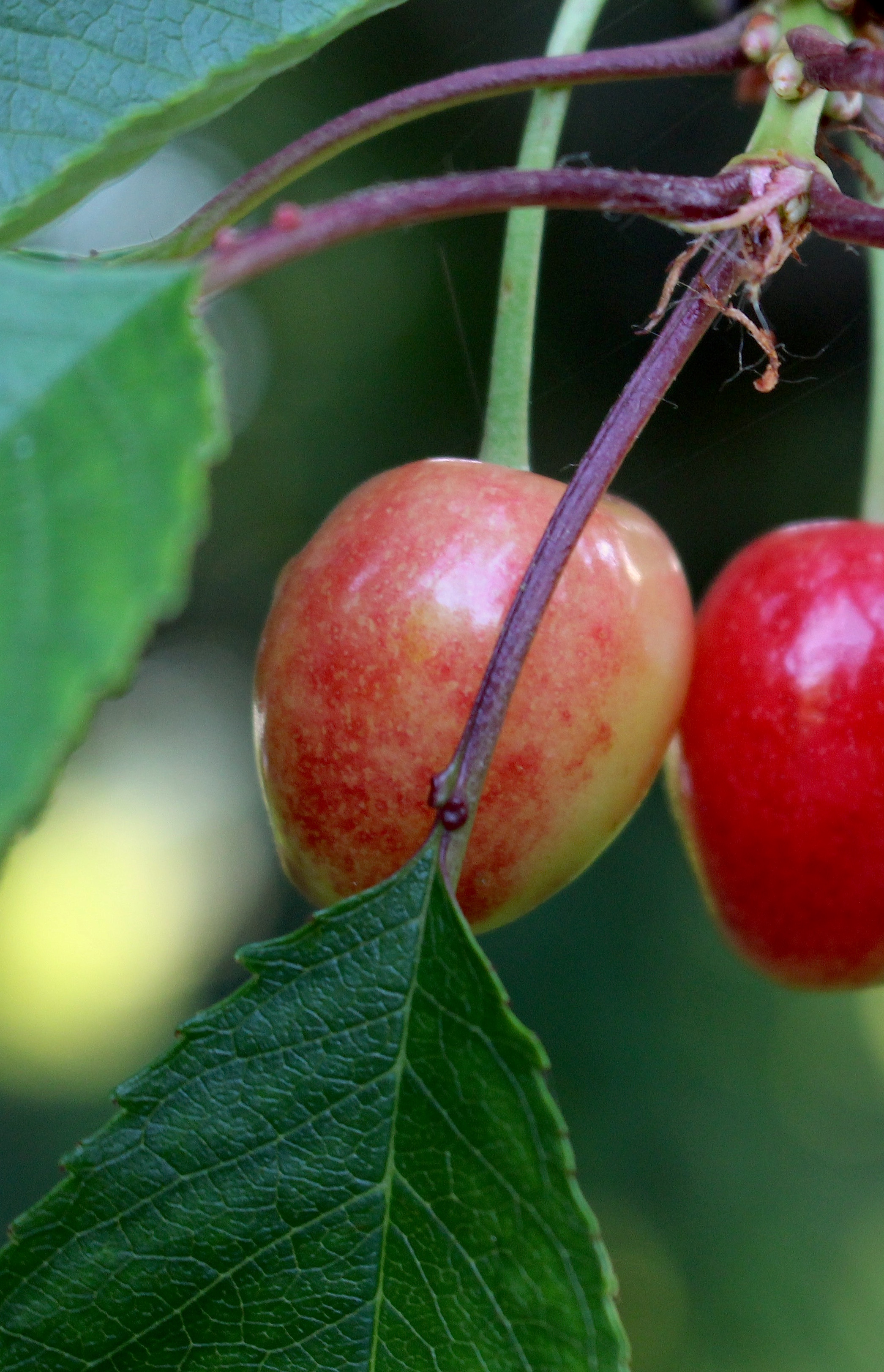
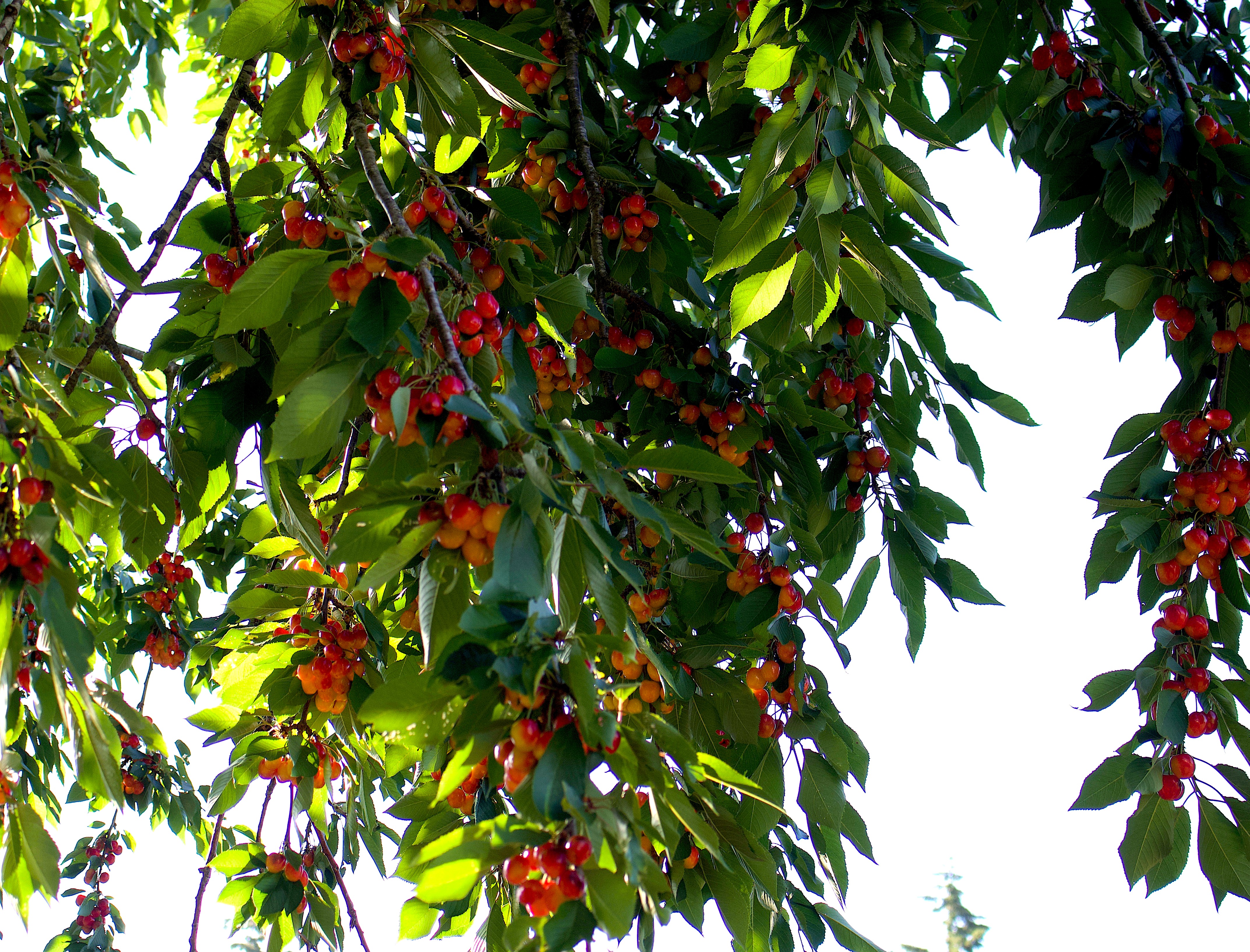
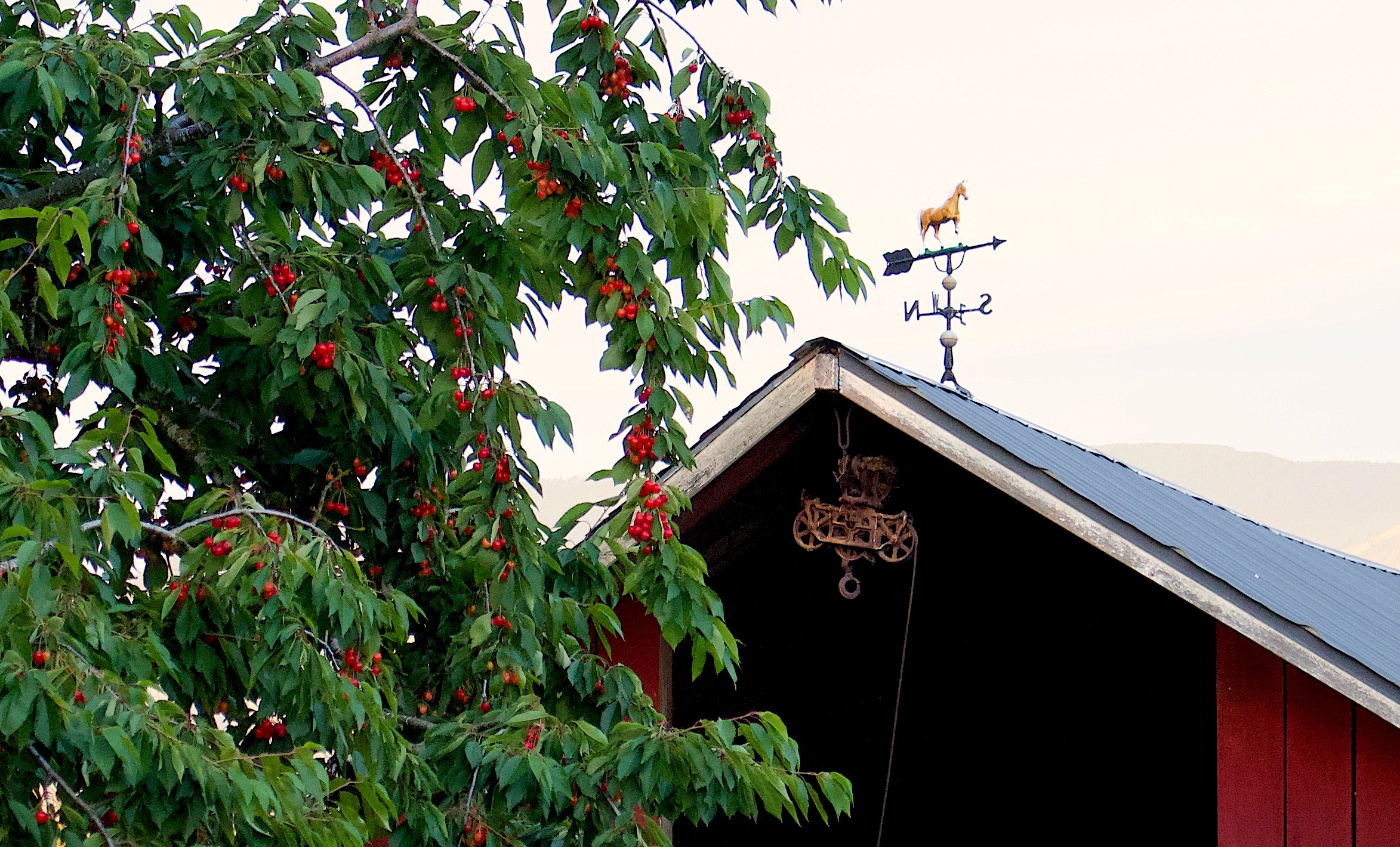
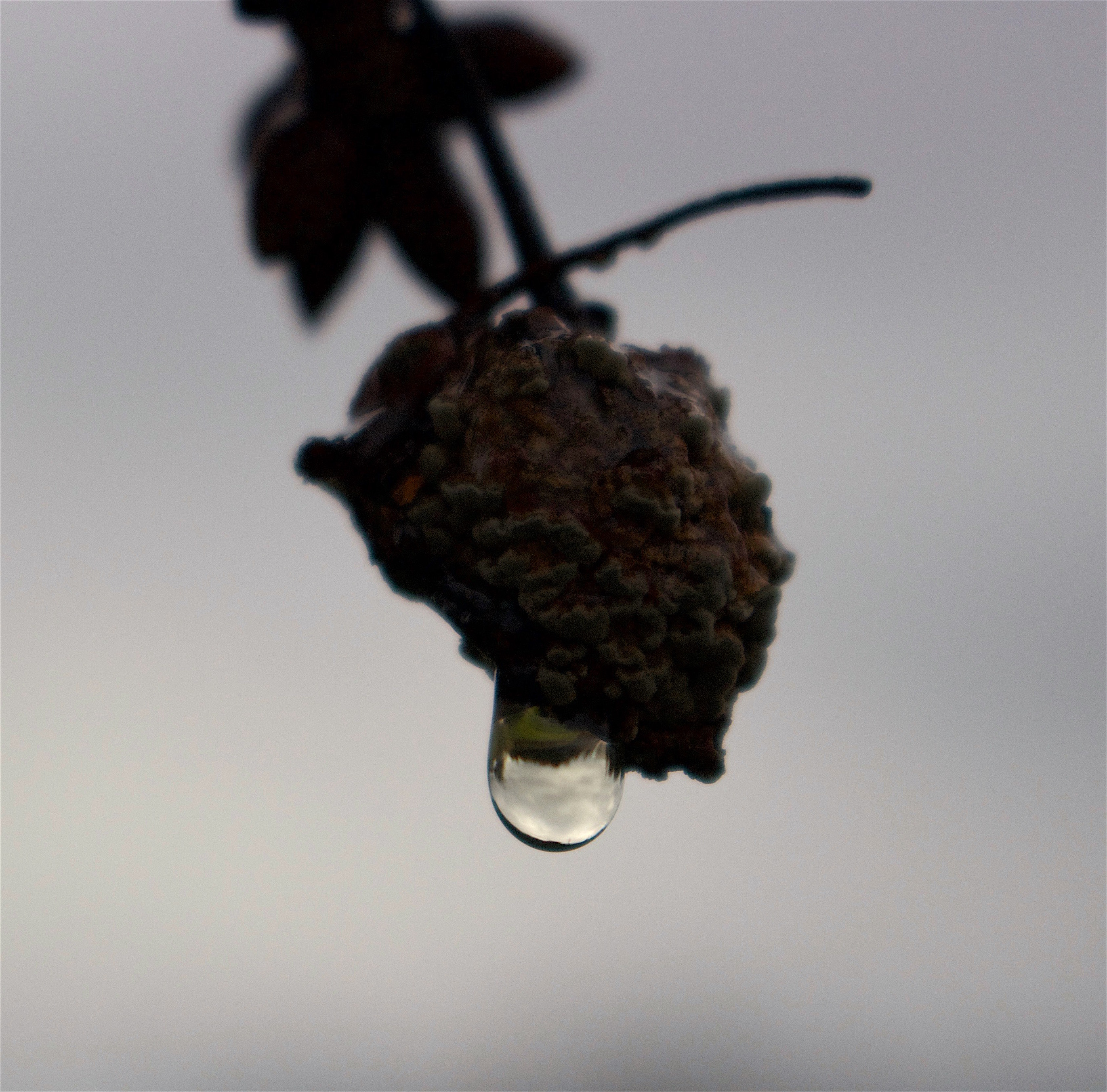
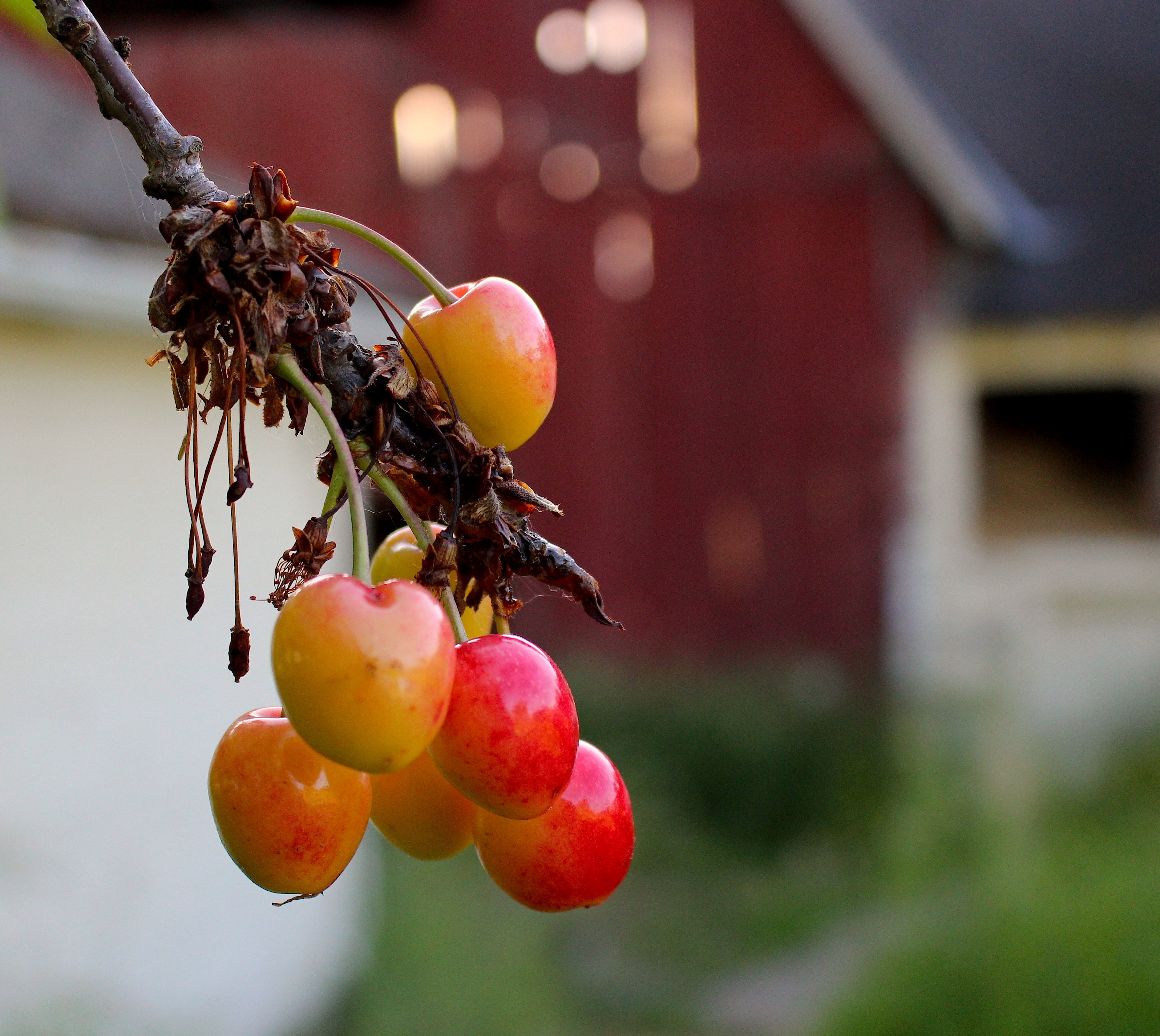
The last remaining cherry tree on our farm, a Royal Anne, has stood between house and barn for over 100 years. This year, its branch joints and bark defects are bleeding – oozing sculptures of amber sap.
The resin is hard and glass-like, reflecting the tree’s slow internal circulation, changing subtly day by day.
Though its cherries burst months ago with juicy flavor, now it bleeds crystalline flames from its wounds.
What a gift is this love bleeding out as it moves deep inside an old trunk. In its thirsty anguish, our dear cherry tree is weeping, creating glass fruit reflecting Light.
One-Time
Monthly
Yearly
Make a one-time or recurring donation to support daily Barnstorming posts
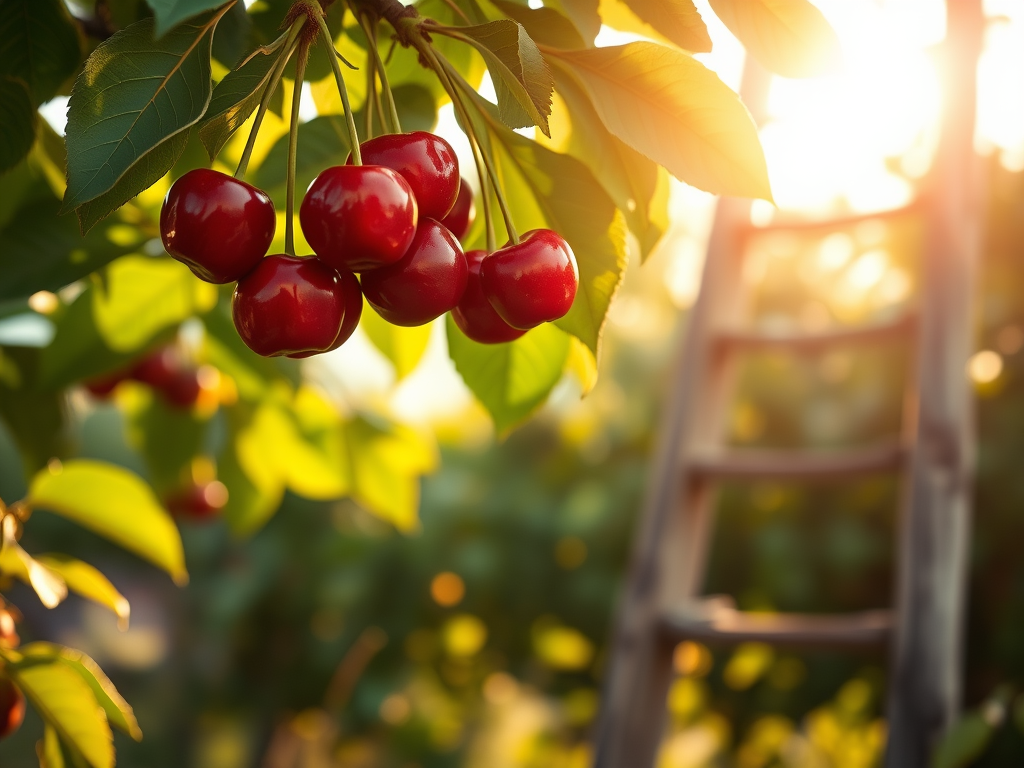
We used to pick cherries over the hill where we paid to climb wooden ladders into the bright haven above our heads, the fruit dangling earthward. Dark, twinned bells ringing in some good fortune just beyond our sight. I have lived on earth long enough to know good luck arrives only on its way to someone else, for it must leave you to the miracle of your own misfortune, lest you grow weary of harvest, of cherries falling from the crown of sky in mid-summer, of hours of idle. Let there be a stone of suffering. Let the fruit taste of sweetness and dust. Let grief split your heart so precisely you must hold, somehow, a memory of cherries— tart talismans of pleasure—in the rucksack of your soul. Taut skin, sharp blessing.
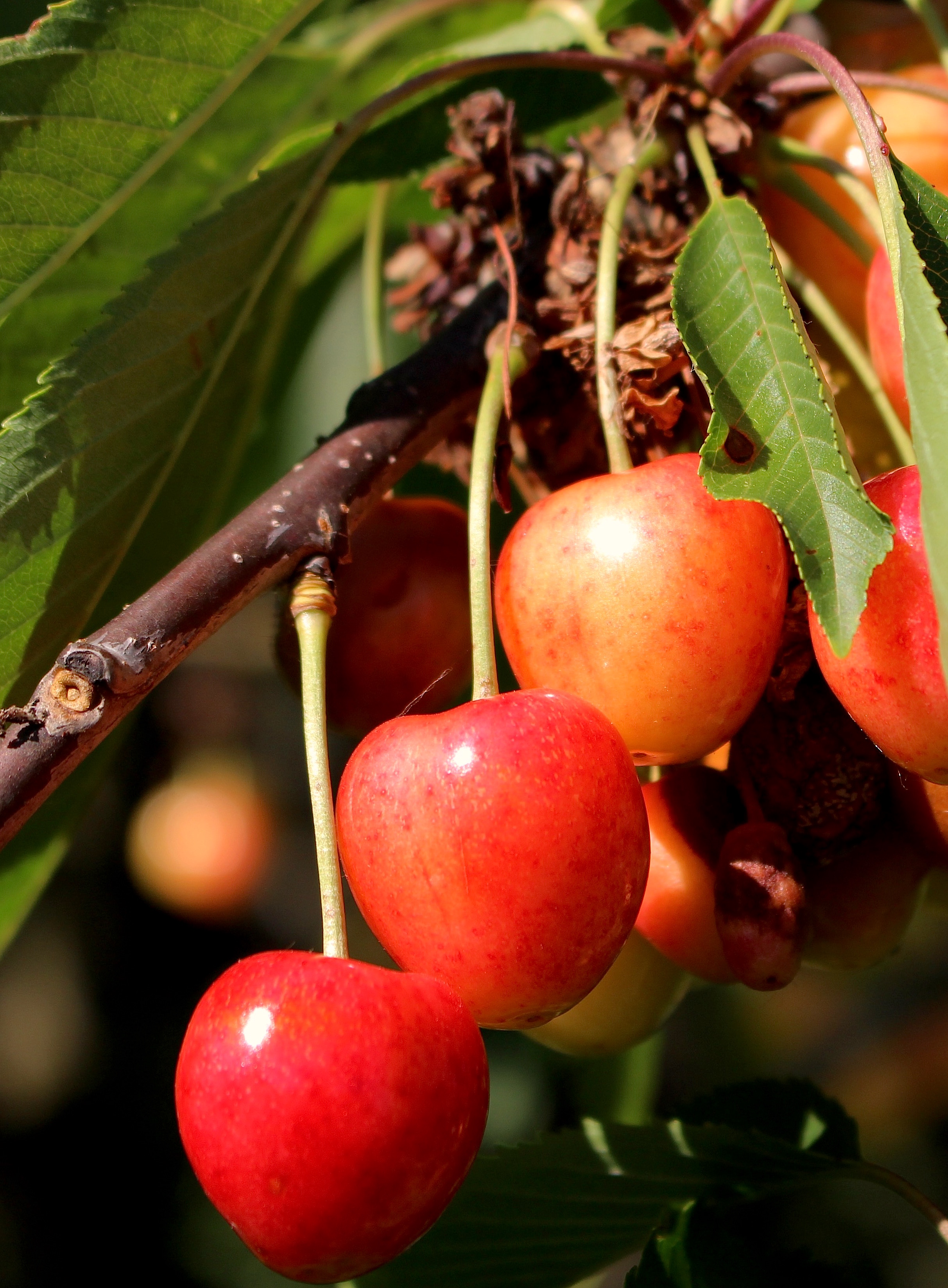
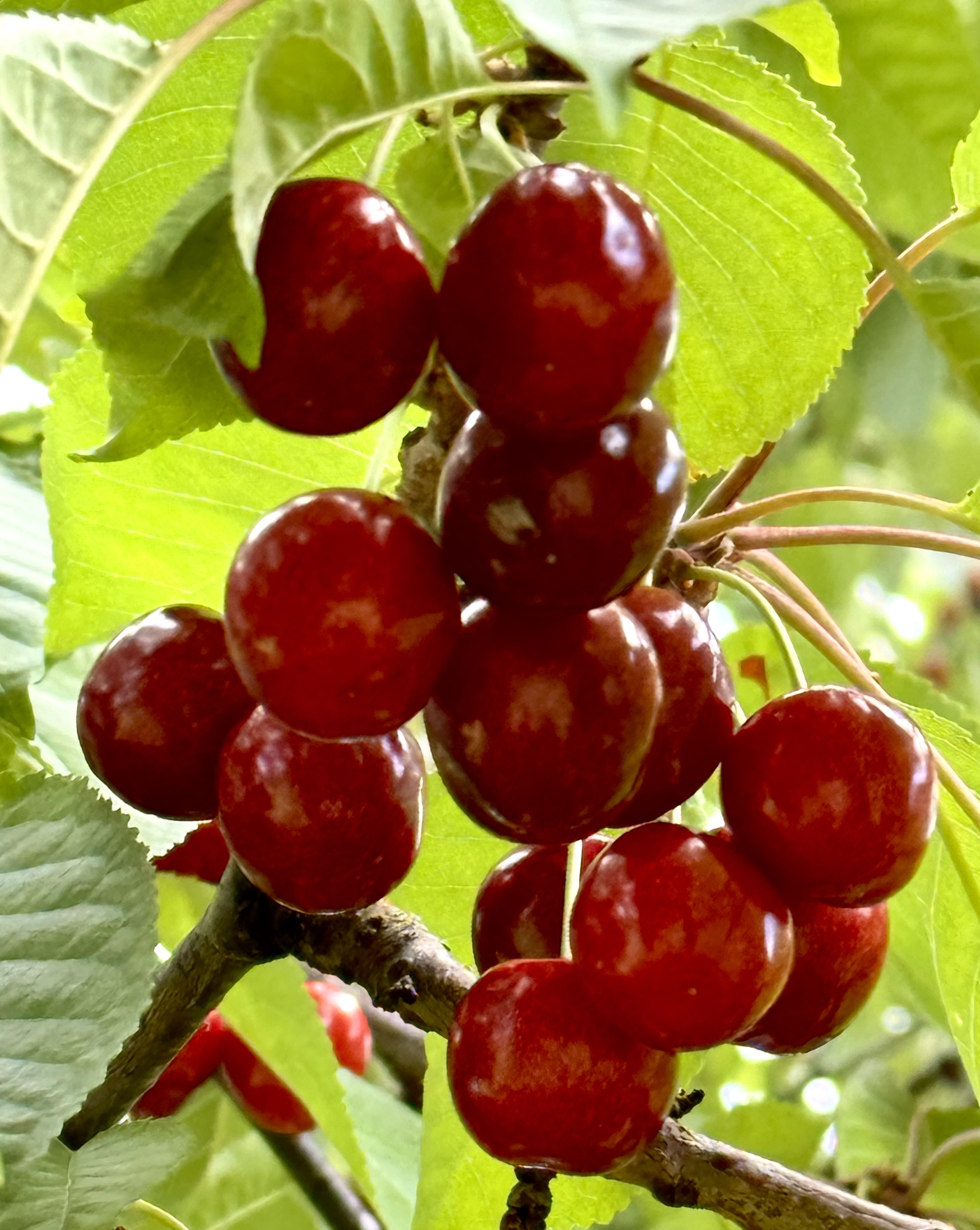
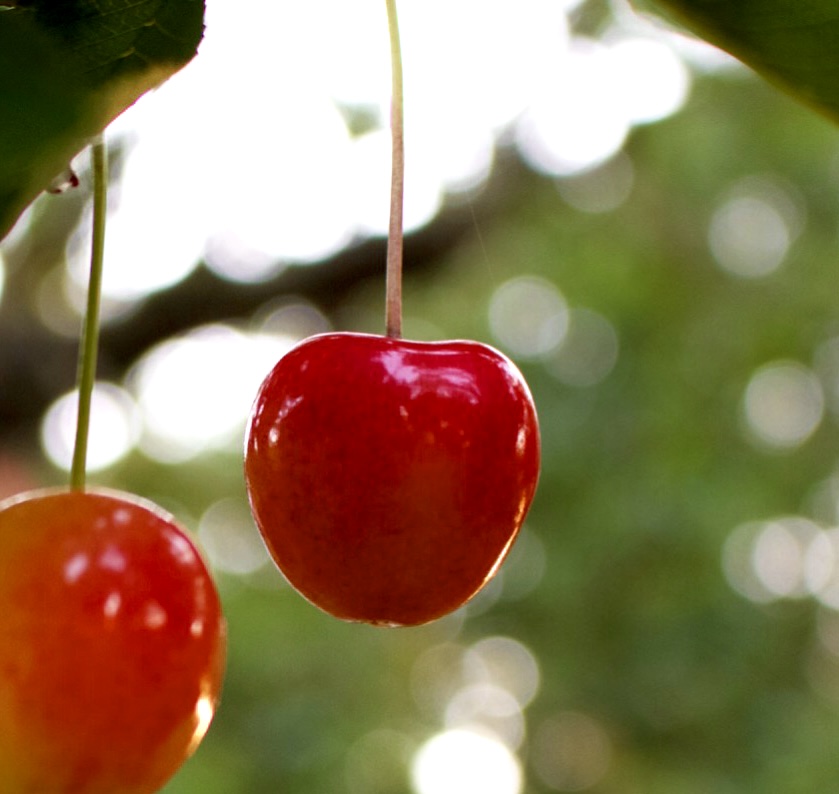
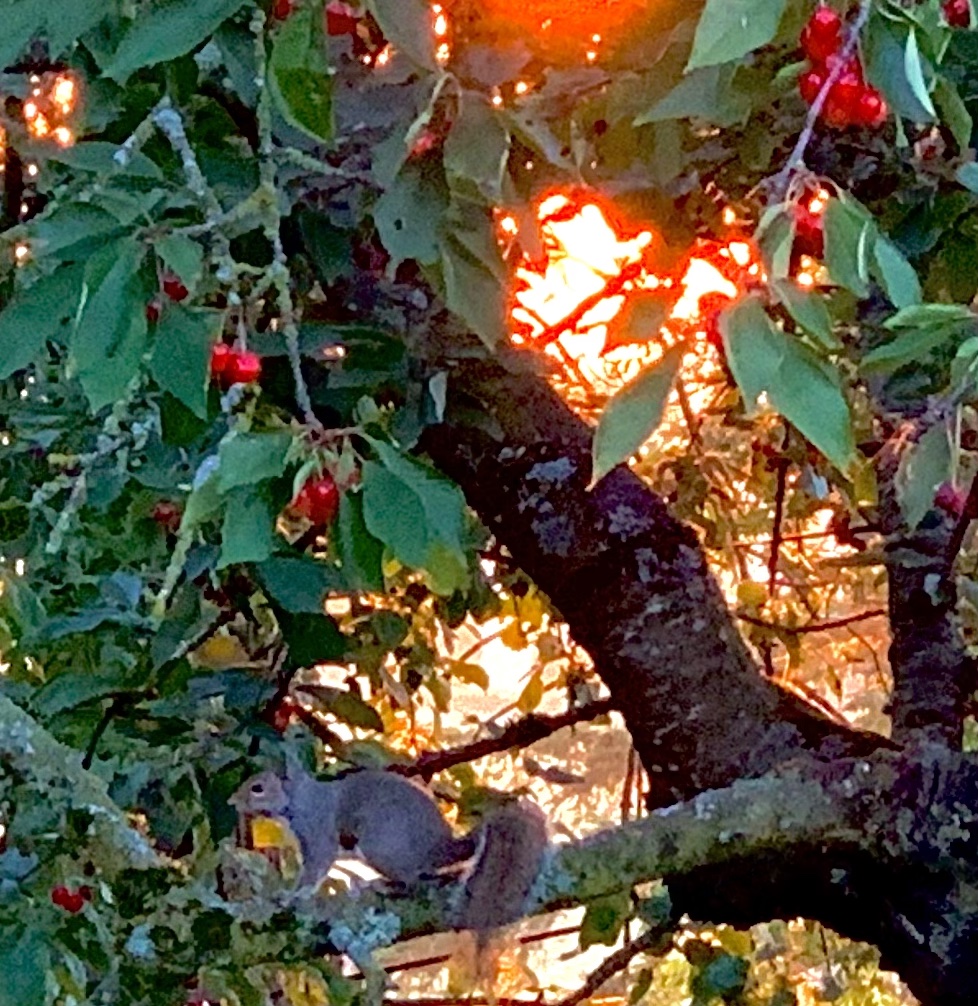
Life is not a bowl of cherries, unless you count the ones that aren’t yet ripe, or are over-ripe, or have a squirrel- or bird-bite taken, or have shriveled to raisins on the tree.
Yes, there are perfect cherries that shine in the dark, glistening with promise, tempting us to climb high to pick them.
Those we really want usually are out of reach.
How can we know what perfection is unless we experience where life falls short?
The lingering taste of grief, the agony of waiting for word in a tragedy, the gnawing emptiness of indescribable loss.
Only the memory of what was nearly perfect, remembering what could have been knowing what will someday be our reality can ease the bitter pit of suffering now.
May the families of those swept away in flooding, those who live in the path of war and violence, those who hunger for justice, or starving for food, those who struggle with life-threatening and chronic illness somehow know the comfort of God’s perfection awaits them. The Light and Goodness is there for us to taste, yet just beyond our reach.
AI image created for this post
One-Time
Monthly
Yearly
Make a one-time or recurring donation to support daily Barnstorming posts
Let Him easter in us, be a dayspring to the dimness of us, be a crimson-cresseted east. ~ Gerard Manley Hopkins from “The Wreck of the Deutschland”
There is a fragrance in the air, a certain passage of a song, an old photograph falling out from the pages of a book, the sound of somebody’s voice in the hall that makes your heart leap and fills your eyes with tears. Who can say when or how it will be that something easters up out of the dimness to remind us of a time before we were born and after we will die?
All changed, changed utterly: A terrible beauty is born. ~William Butler Yeats from “Easter, 1916”
So, friends, every day do something that won’t compute. Love the Lord. Love the world. Work for nothing. Take all that you have and be poor. Love someone who does not deserve it. Denounce the government and embrace the flag. Hope to live in that free republic for which it stands. Give your approval to all you cannot understand. Praise ignorance, for what man has not encountered he has not destroyed.
Go with your love to the fields. Lie down in the shade. Rest your head in her lap. Swear allegiance to what is nighest your thoughts. As soon as the generals and the politicos can predict the motions of your mind, lose it. Leave it as a sign to mark the false trail, the way you didn’t go. Be like the fox who makes more tracks than necessary, some in the wrong direction. Practice resurrection. ~Wendell Berry from Manifesto: The Mad Farmer Liberation Front
It had been a slow coming of spring this year, seeming in no hurry whatsoever. Snow has remained in the foothills and the greening of the fields only begun.
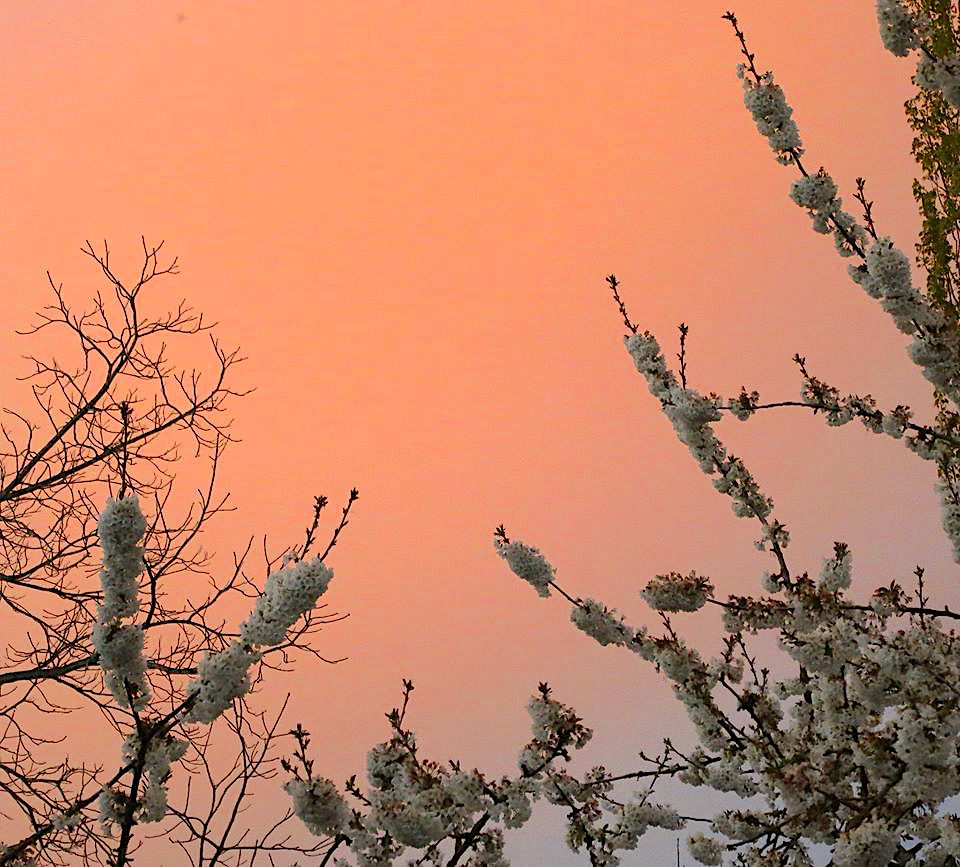
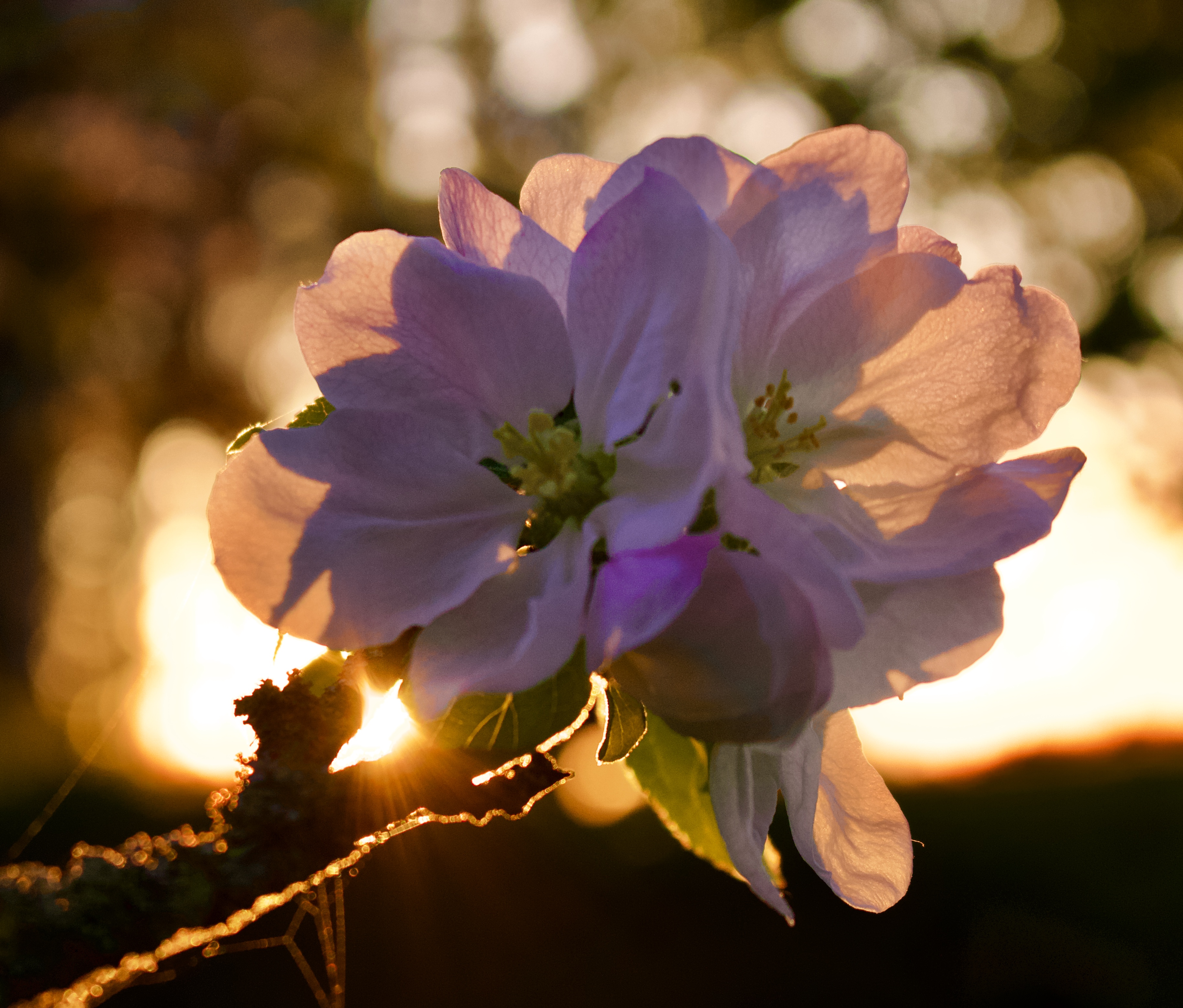
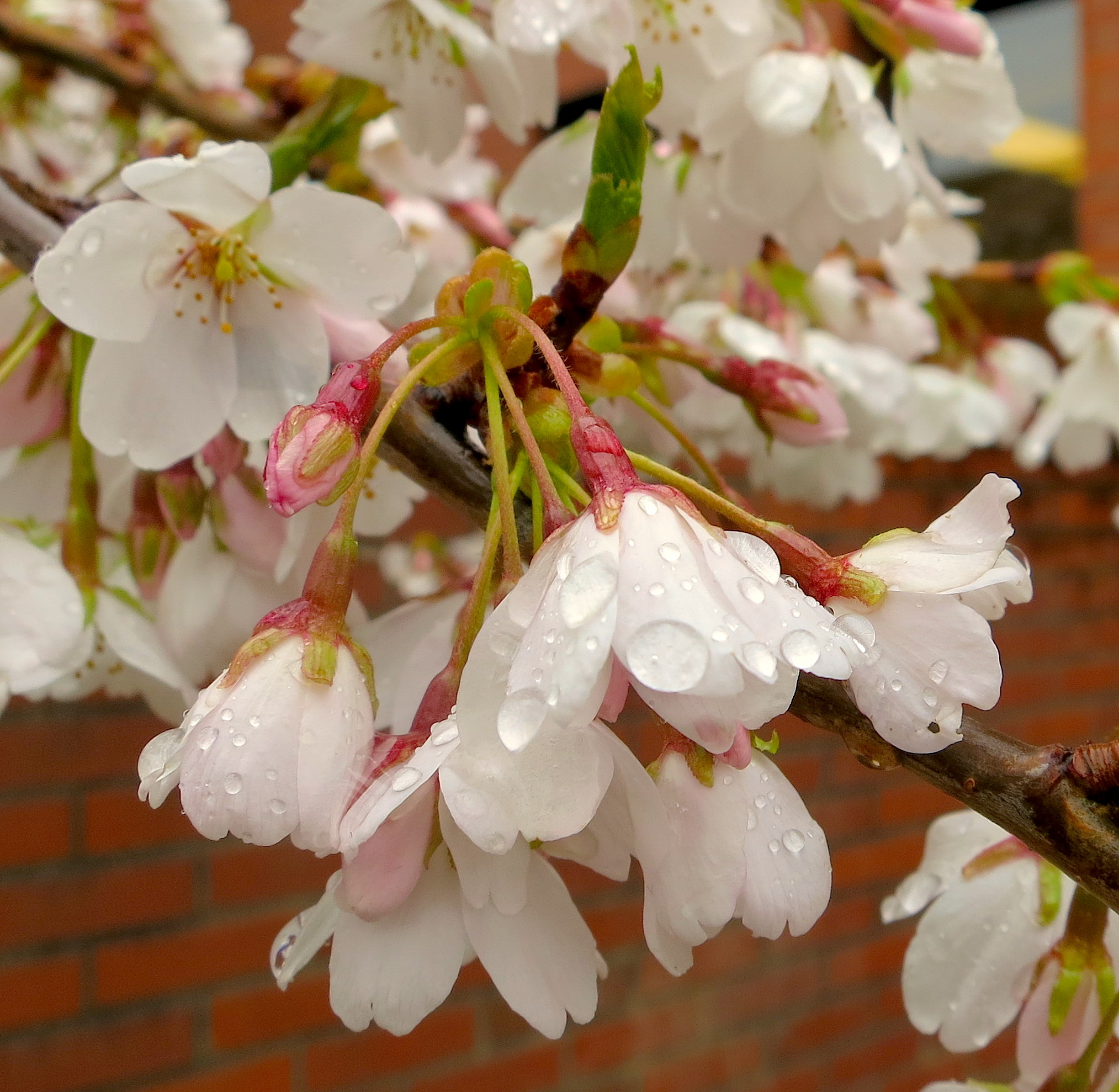
Bravely, flowering plum and cherry trees burst into bloom despite a continued chill, and the pink dogwood and apple blossoms are now emerging. The perfumed air of spring permeates the dawn.
Such variability is disorienting, much like standing blinded in a sudden spotlight in a darkened room, practicing resurrection.
Yet this is exactly what eastering is like. It is awakening out of a restless sleep, opening a door to let in fresh fragrant air, and the heavy stone locking us in the dark is rolled back.
Overnight all changed, and changed utterly.
He is not only risen. He is given indeed.
AI image created for this post
One-Time
Monthly
Yearly
Make a one-time or recurring donation to support daily Barnstorming posts
When Joseph woke from sleep, he did as the angel of the Lord commanded him… ~Matthew 1:24
Who has not considered Mary And who her praise would dim, But what of humble Joseph Is there no song for him?
If Joseph had not driven Straight nails through honest wood If Joseph had not cherished His Mary as he should;
If Joseph had not proved him A sire both kind and wise Would he have drawn with favor The Child’s all-probing eyes?
Would Christ have prayed, ‘Our Father’ Or cried that name in death Unless he first had honored Joseph of Nazareth ? ~Luci Shaw “Joseph The Carpenter”
It was from Joseph first I learned of love. Like me he was dismayed. How easily he could have turned me from his house; but, unafraid, he put me not away from him (O God-sent angel, pray for him). Thus through his love was Love obeyed.
The Child’s first cry came like a bell: God’s Word aloud, God’s Word in deed. The angel spoke: so it befell, and Joseph with me in my need. O Child whose father came from heaven, to you another gift was given, your earthly father chosen well.
With Joseph I was always warmed and cherished. Even in the stable I knew that I would not be harmed. And, though above the angels swarmed, man’s love it was that made me able to bear God’s love, wild, formidable, to bear God’s will, through me performed. ~Madeleine L’Engle “O Sapientia” in A Widening Light: Poems of the Incarnation edited by Luci Shaw
The hero of the story this season is the man in the background.
He is the adoptive father who does the right thing rather than what he has legal right to do, who listens to his dreams and believes, who leads the way over dusty roads to be counted, who searches valiantly for a suitable place to stay, who does whatever he can to assist her labor, who stands tall over a vulnerable mother and infant while the poor and curious pour out of the hills, the wise and foreign appear bringing gifts, who takes his family to safety when the innocents are slaughtered.
He is only a carpenter, not born for heroics, but steps up when called. He is a humble man teaching his son a living, until his son leaves to save the dying. He is strong and obedient, a tree bowing low to give up his fruit.
This man Joseph is the Chosen father, the best Abba a God could hope for.
AI image created for this post
This year’s Advent theme is from Dietrich Bonhoeffer’s sermon on the First Sunday in Advent, December 2, 1928:
The celebration of Advent is possible only to those who are troubled in soul, who know themselves to be poor and imperfect, and who look forward to something greater to come. For these, it is enough to wait in humble fear until the Holy One himself comes down to us, God in the child in the manager.
God comes.
He is, and always will be now, with us in our sin, in our suffering, and at our death. We are no longer alone. God is with us and we are no longer homeless. ~Dietrich Bonhoeffer – from Christmas Sermons
One-Time
Monthly
Yearly
Make a one-time or recurring donation to support daily Barnstorming posts
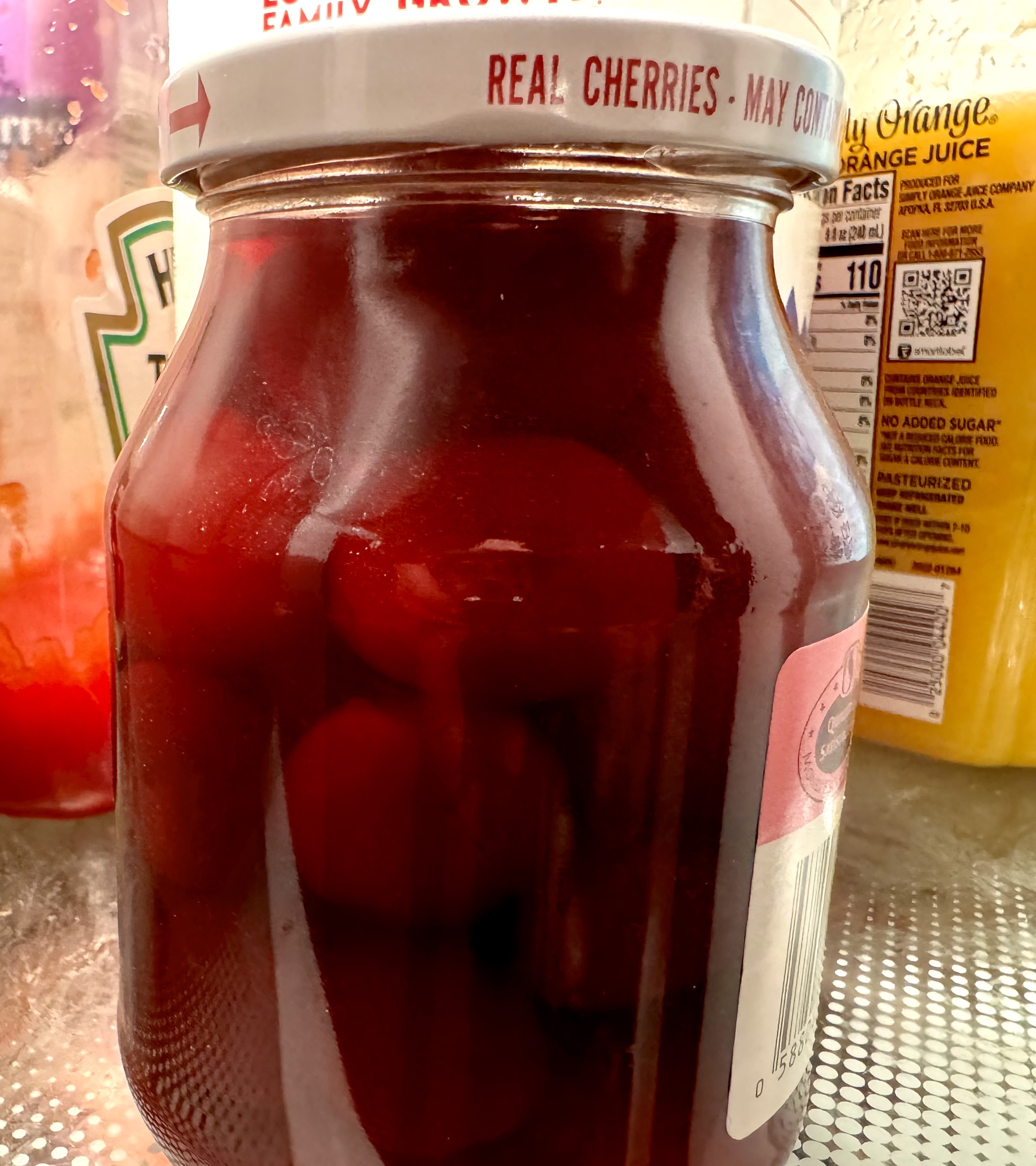
More like a vault — you pull the handle out and on the shelves: not a lot, And what there is (a boiled potato in a bag, a chicken carcass under foil) looking dispirited, drained, mugged. This is not a place to go in hope or hunger. But, just to the right of the middle of the middle door shelf, on fire, a lit-from-within red, heart red, sexual red, wet neon red, shining red in their liquid, exotic, aloof, slumming in such company: a jar of maraschino cherries. Three-quarters full, fiery globes, like strippers at a church social. Maraschino cherries, maraschino, the only foreign word I knew. Not once did I see these cherries employed: not in a drink, nor on top of a glob of ice cream, or just pop one in your mouth. Not once. The same jar there through an entire childhood of dull dinners — bald meat, pocked peas and, see above, boiled potatoes. Maybe they came over from the old country, family heirlooms, or were status symbols bought with a piece of the first paycheck from a sweatshop, which beat the pig farm in Bohemia, handed down from my grandparents to my parents to be someday mine, then my child’s? They were beautiful and, if I never ate one, it was because I knew it might be missed or because I knew it would not be replaced and because you do not eat that which rips your heart with joy. ~Thomas Lux “Refrigerator, 1957”
My childhood refrigerator also contained a jar of maraschino cherries. They were used only once a year, at Thanksgiving, when my mother would pull the jar out from the depths of the fridge, twist open the top and pull out four bright red cherries.
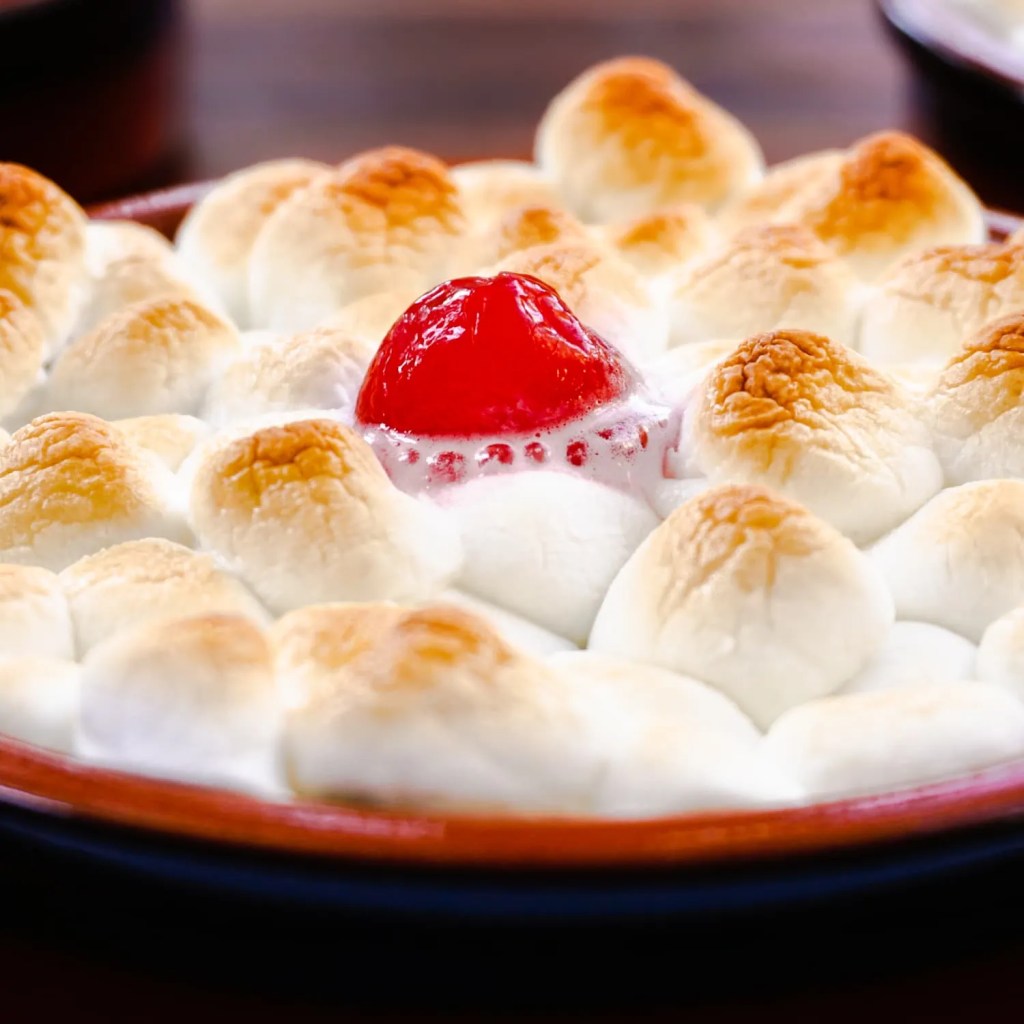
A sweet potato dish would be warming in the oven, covered by large melting marshmallows placed in the center of a ring of canned pineapple. Mom arranged the cherries, cut in half, on top of each marshmallow and replaced the dish in the oven, until the meal was ready to serve.
That was it. We never saw the cherries again for another year.
Sweet potatoes taste wonderful, all on their own, without a dressing of marshmallows and pineapples. But the special holiday tradition was set. In some magical way, the cherries dressed the dish up to help make a tense family gathering a bit jollier.
I do still have my own jar of maraschino cherries in my refrigerator. I forget why. It doesn’t have anything to do with sweet potatoes which I like to serve up plain for Sunday dinners. I possibly bought the jar out of nostalgia, or perhaps because I think every refrigerator needs a jar of maraschino cherries — kind of like the open box of baking soda that sits in most fridges to keep the odors under control.
Regardless, when I spy the jar every once in a while when rummaging in the fridge for something else, it stops time for a moment of remembrance and sadness. After all, I don’t replicate my mom’s mid-century cooking efforts of many-colored jello salads, bread-crumb-topped casseroles and… maraschino marshmallow sweet potatoes.
Even so, a daughter’s love for her mama remains irreplaceable.
One-Time
Monthly
Yearly
Make a one-time or recurring donation to support daily Barnstorming posts
Between the March and April line — That magical frontier Beyond which summer hesitates, Almost too heavenly near. The saddest noise, the sweetest noise, The maddest noise that grows, — The birds, they make it in the spring, At night’s delicious close. It makes us think of all the dead That sauntered with us here, By separation’s sorcery Made cruelly more dear. It makes us think of what we had, And what we now deplore. We almost wish those siren throats Would go and sing no more. An ear can break a human heart As quickly as a spear, We wish the ear had not a heart So dangerously near. ~Emily Dickinson“The Saddest Noise”
Every spring I hear the thrush singing in the glowing woods he is only passing through. His voice is deep, then he lifts it until it seems to fall from the sky. I am thrilled. I am grateful. Then, by the end of morning, he’s gone, nothing but silence out of the tree where he rested for a night. And this I find acceptable. Not enough is a poor life. But too much is, well, too much. Imagine Verdi or Mahler every day, all day. It would exhaust anyone. ~Mary Oliver “In Our Woods, Sometimes a Rare Music ” from “A Thousand Mornings”
What does it say about me that a only a few months ago, in the inky darkness of December mornings, I was yearning for the earlier sunrises of spring. Once we’re well into April, the birdsong symphony alarm clock each morning is no longer so compelling.
This confirms my suspicion that I’m incapable of reveling in the moment at hand, something that would likely take years of therapy to undo. I’m sure there is some deep seated issue here, but I’m too sleep deprived to pursue it.
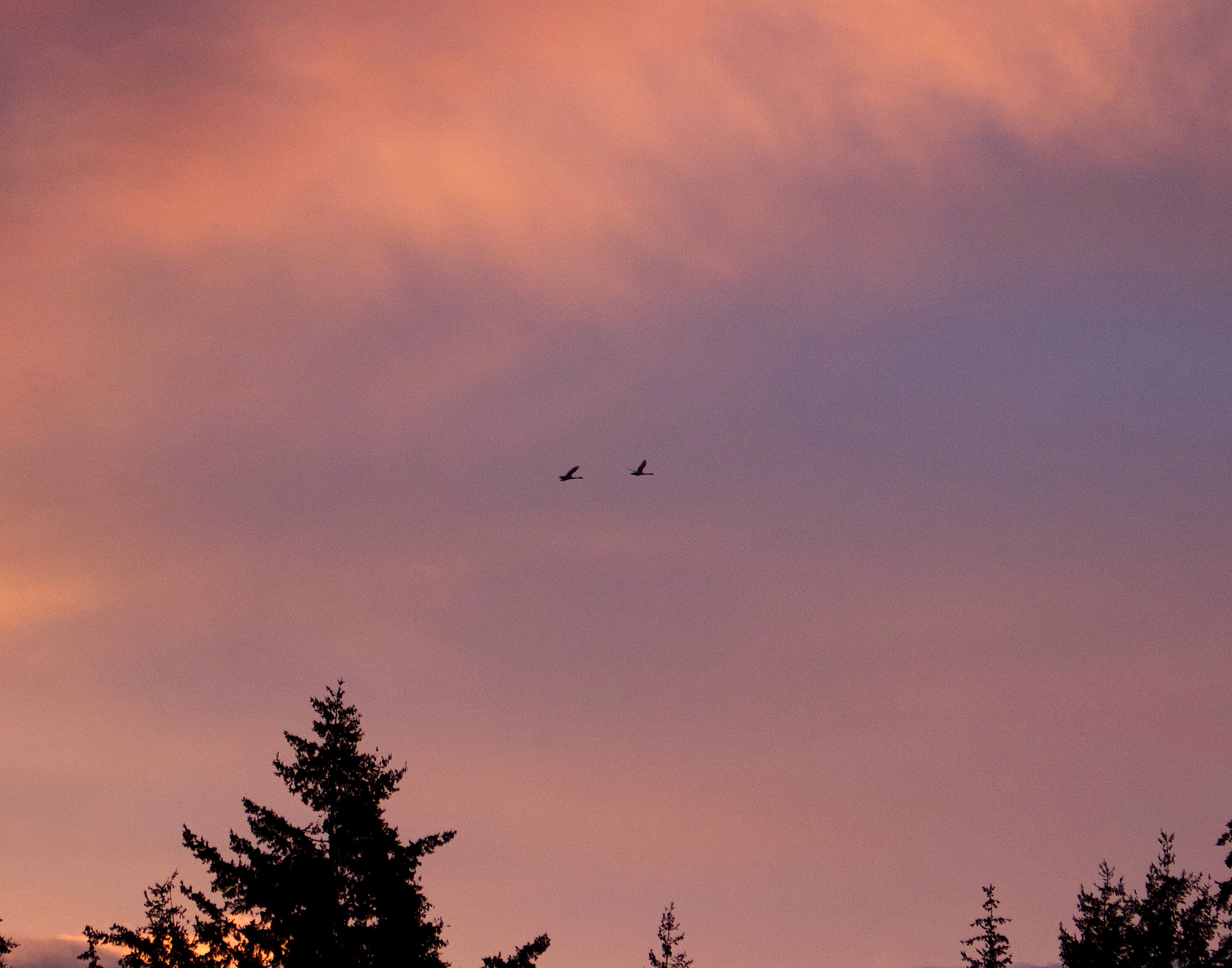
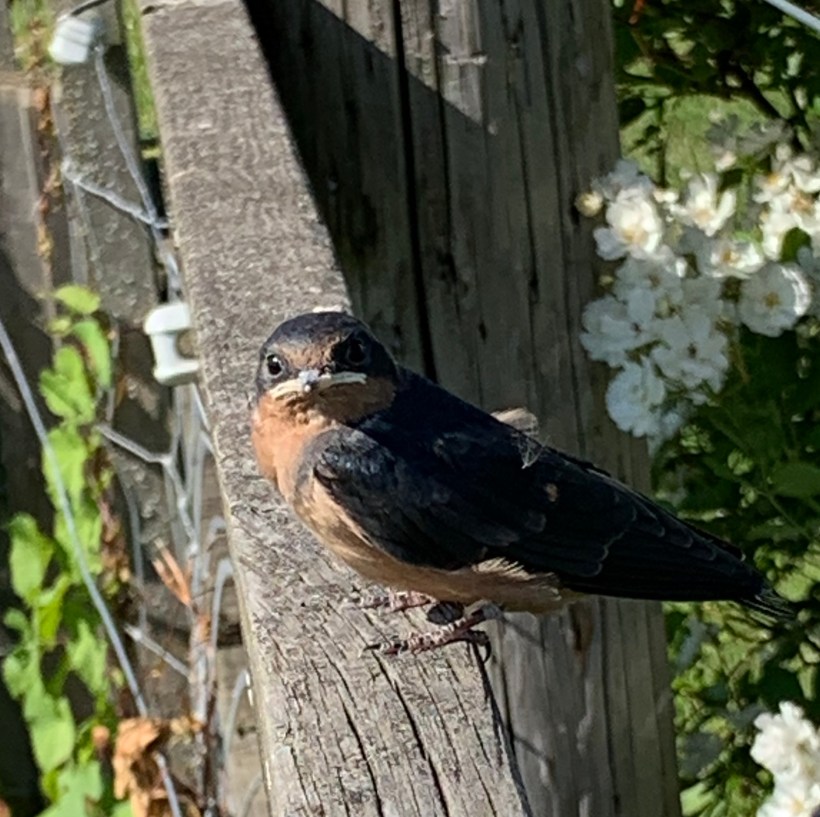
My eyes pop open earlier than I wish, aided and abetted by vigorous birdsong in the trees surrounding our farm house. Daylight sneaks through the venetian blinds. Once the bird chorus starts, with one lone chirpy voice in the apple tree by our bedroom window, it rapidly becomes a full frontal onslaught orchestra from all manner of avian life-forms, singing from the plum, cherry, walnut, fir and chestnut. Sleep is irretrievable.
Yet it would be such a poor life without the birdsong. Even so, too much is … a bit too much.
I already need a nap.
photo by Harry Rodenberger
One-Time
Monthly
Yearly
Make a one-time or recurring donation to support daily Barnstorming posts
We were riding through frozen fields in a wagon at dawn. A red wing rose in the darkness.
And suddenly a hare ran across the road. One of us pointed to it with his hand.
That was long ago. Today neither of them is alive, Not the hare, nor the man who made the gesture.
O my love, where are they, where are they going The flash of a hand, streak of movement, rustle of pebbles. I ask not out of sorrow, but in wonder. ~ Czeslaw Milosz “Encounter”
She philosophically noted dates as they came past in the revolution of the year;… her own birthday and every other day, individualized by incidents in which she had taken some share. She suddenly thought one afternoon that there was yet another date of greater importance, her own death… A day which lay sly and unseen among all other days of the year… but not the less surely there. When was it? ~Thomas Hardy from Tess of the d’Urbervilles
We do not know the day or the hour of our death day. We must not be lulled into complacency by the routines of daily life; it could be tomorrow or the next day or maybe it was yesterday.
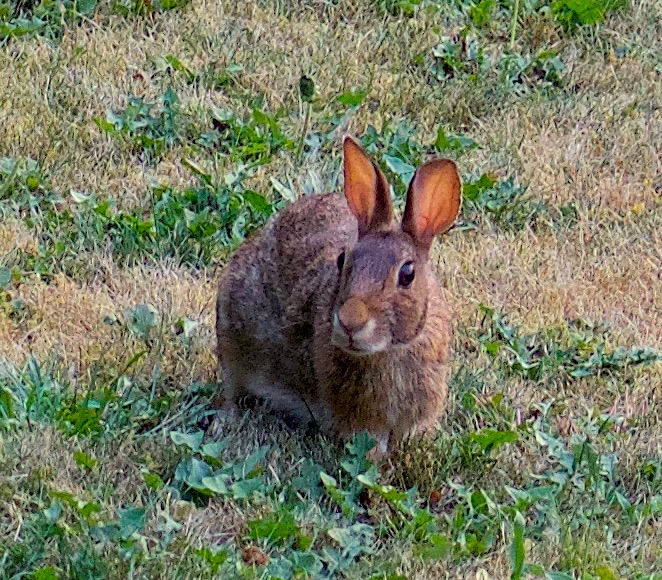
Each moment is a gift, like the flash of a blossom or the transparency of a rabbit’s ear, pulsing with each heart beat as our blood flows and sustains.
And we know – blood was shed, just as blossoms shed, covering us all.
Keeping watch, keeping watch – there is a day when we go home.
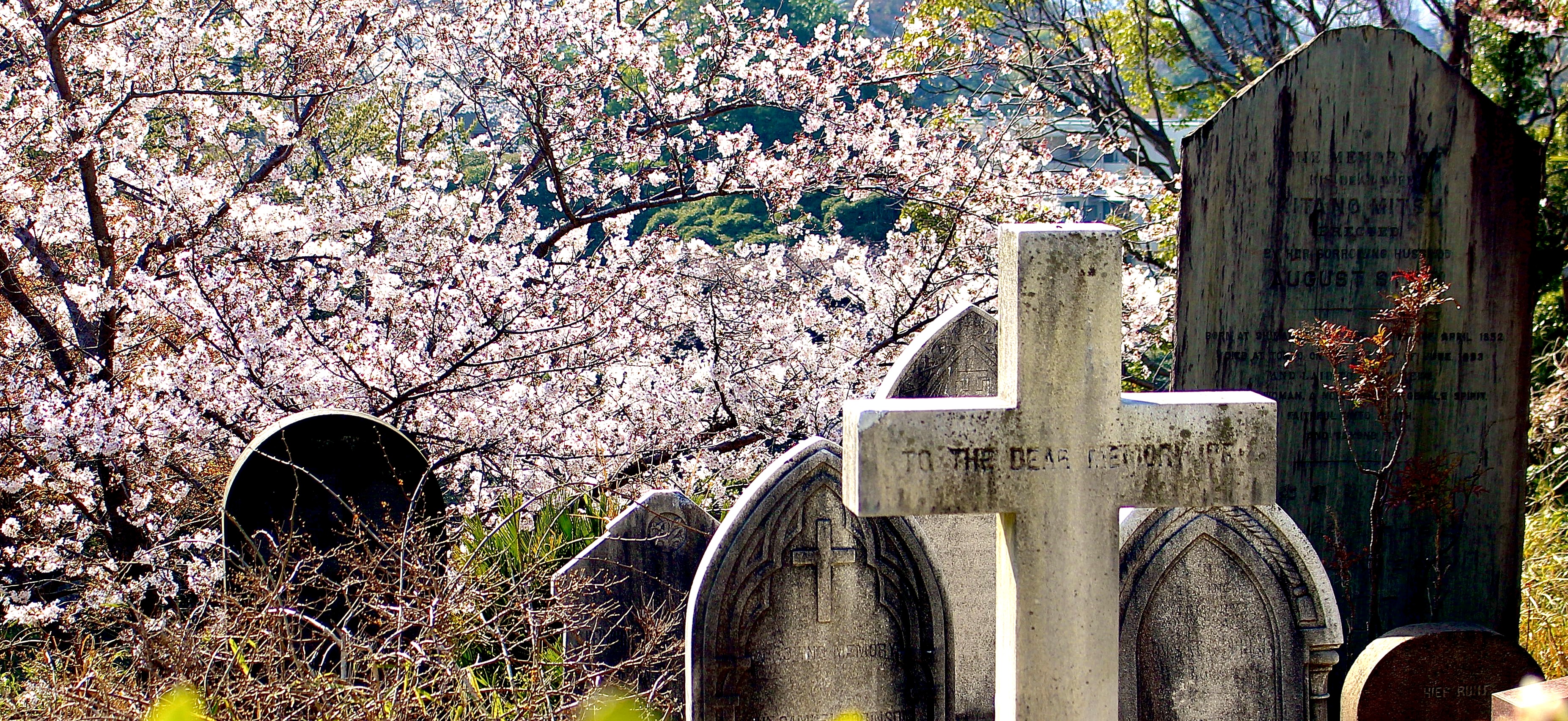
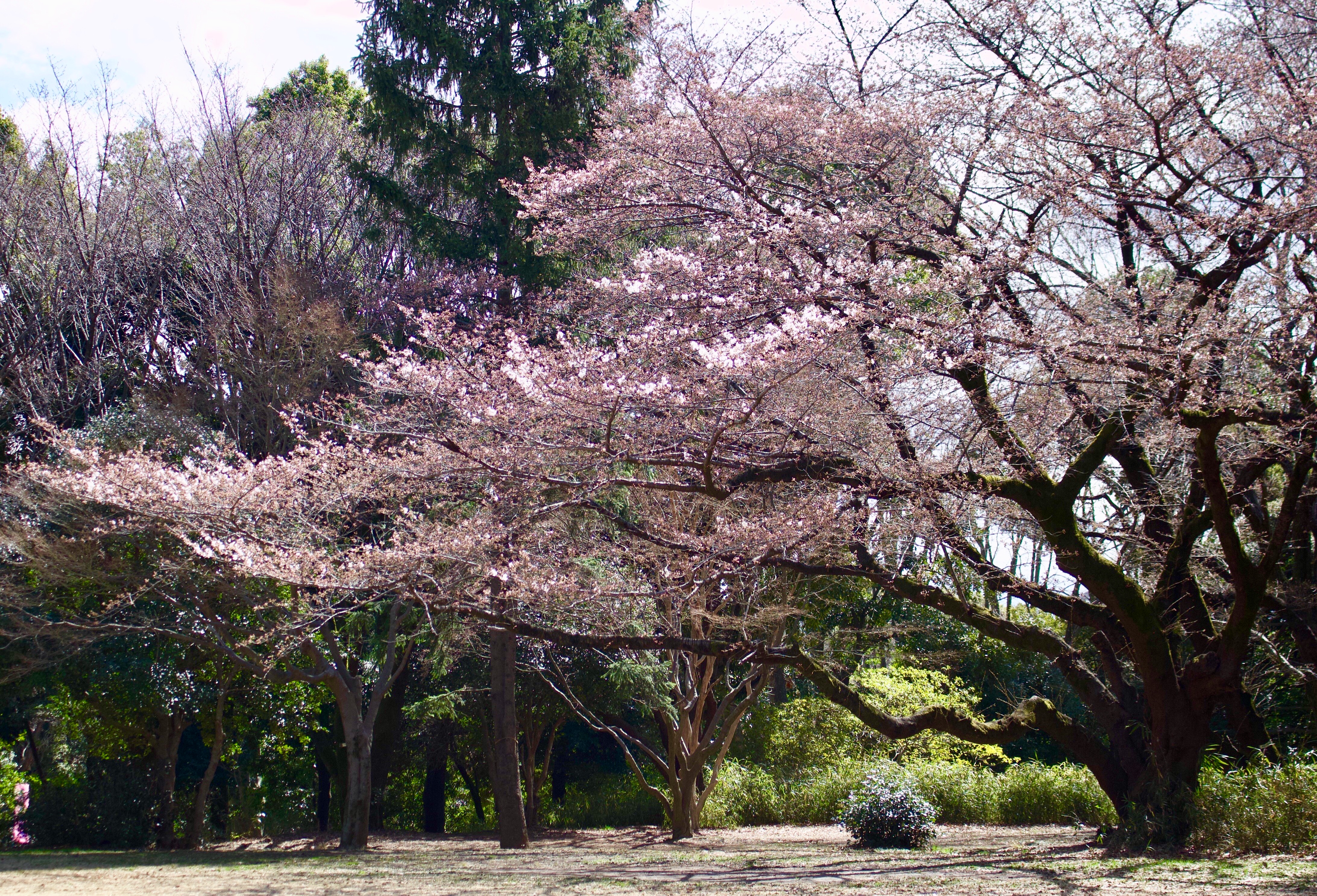
fallen sakura petals in Tokyo (photo by Nate Gibson)
Therefore keep watch, because you do not know the day or the hour. Matthew 25: 1-13
This Lenten season I reflect on the words of the 19th century southern spiritual hymn “What Wondrous Love is This”
One-Time
Monthly
Yearly
Make a one-time or recurring donation to support daily Barnstorming posts
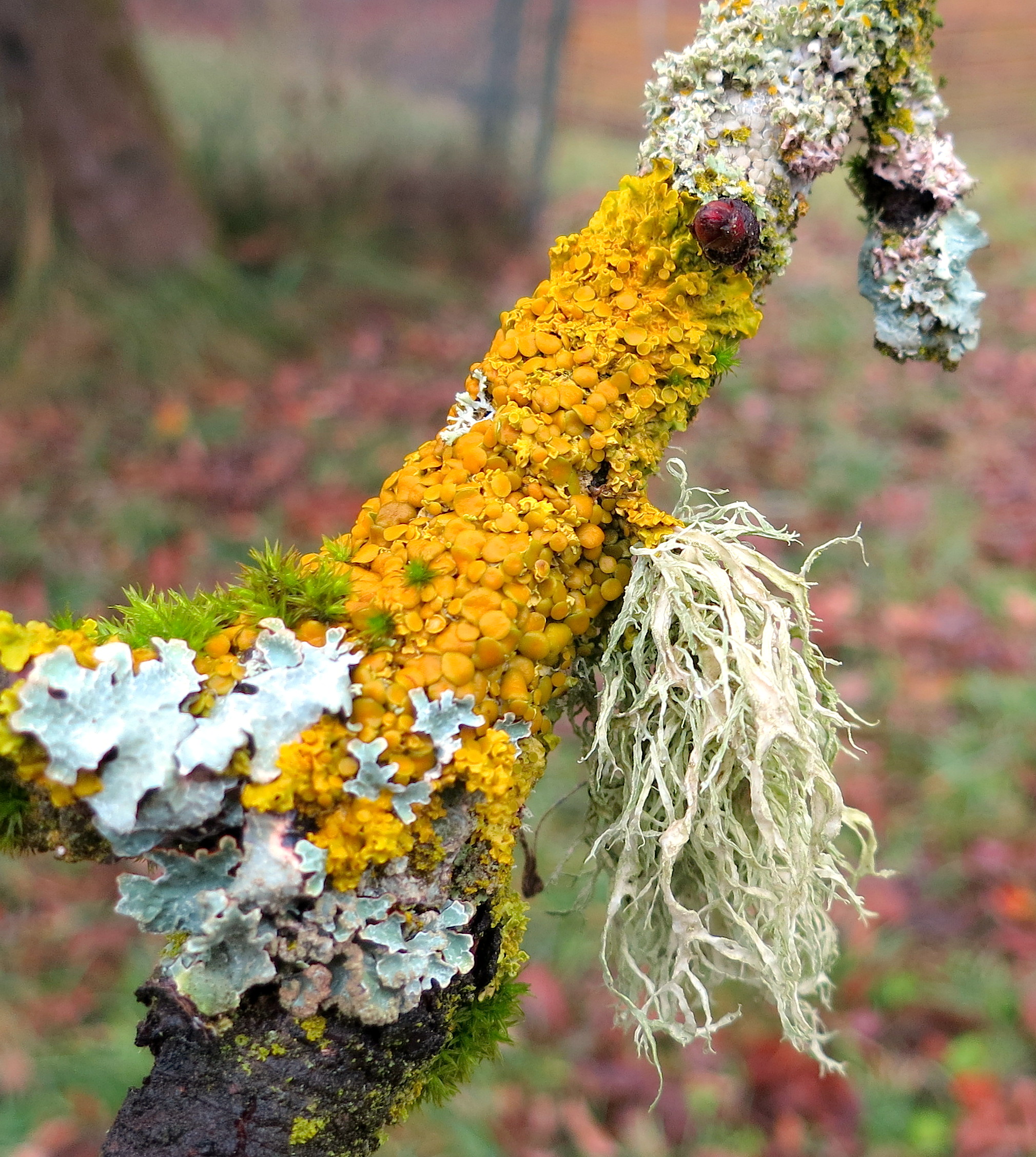
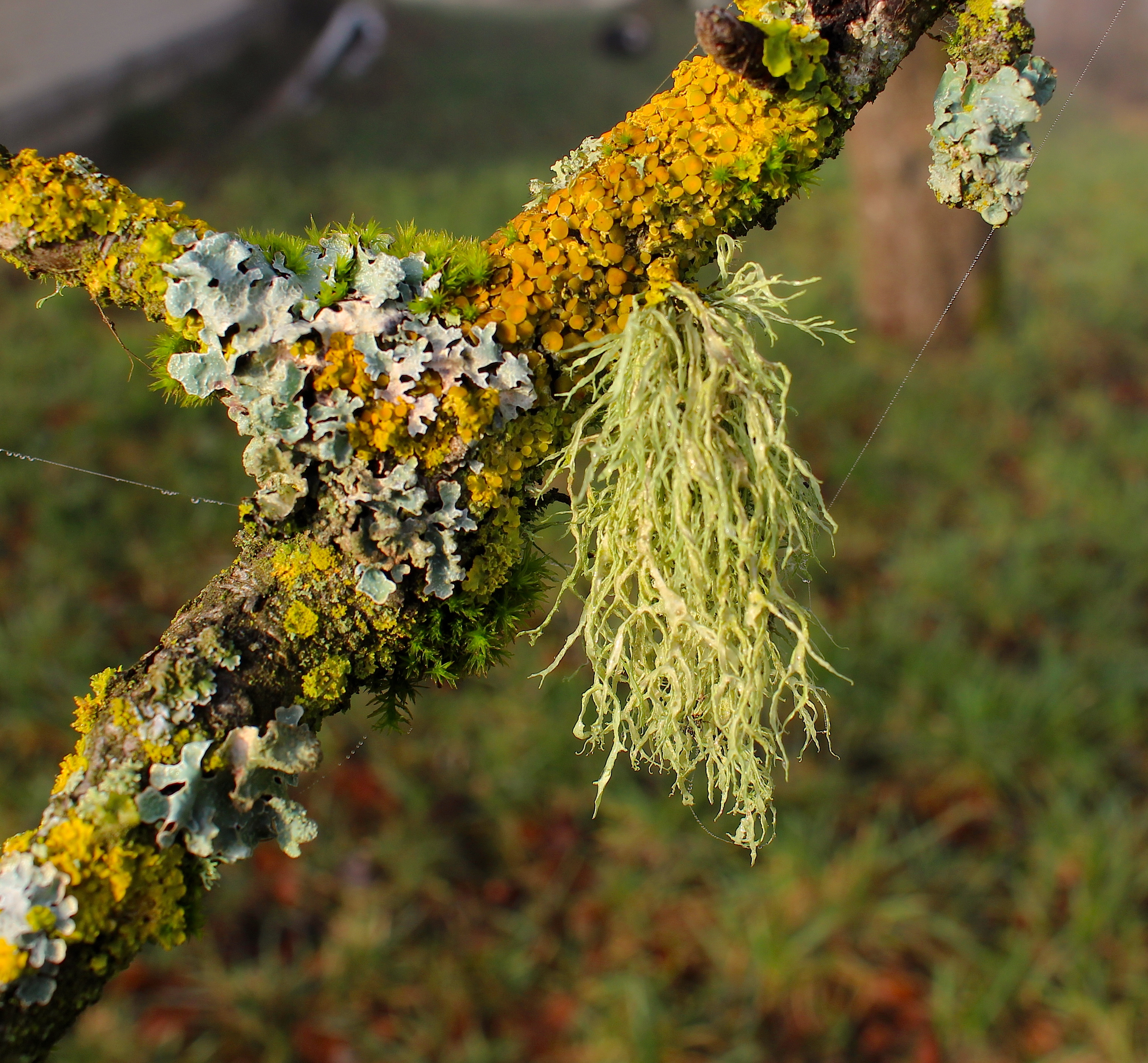
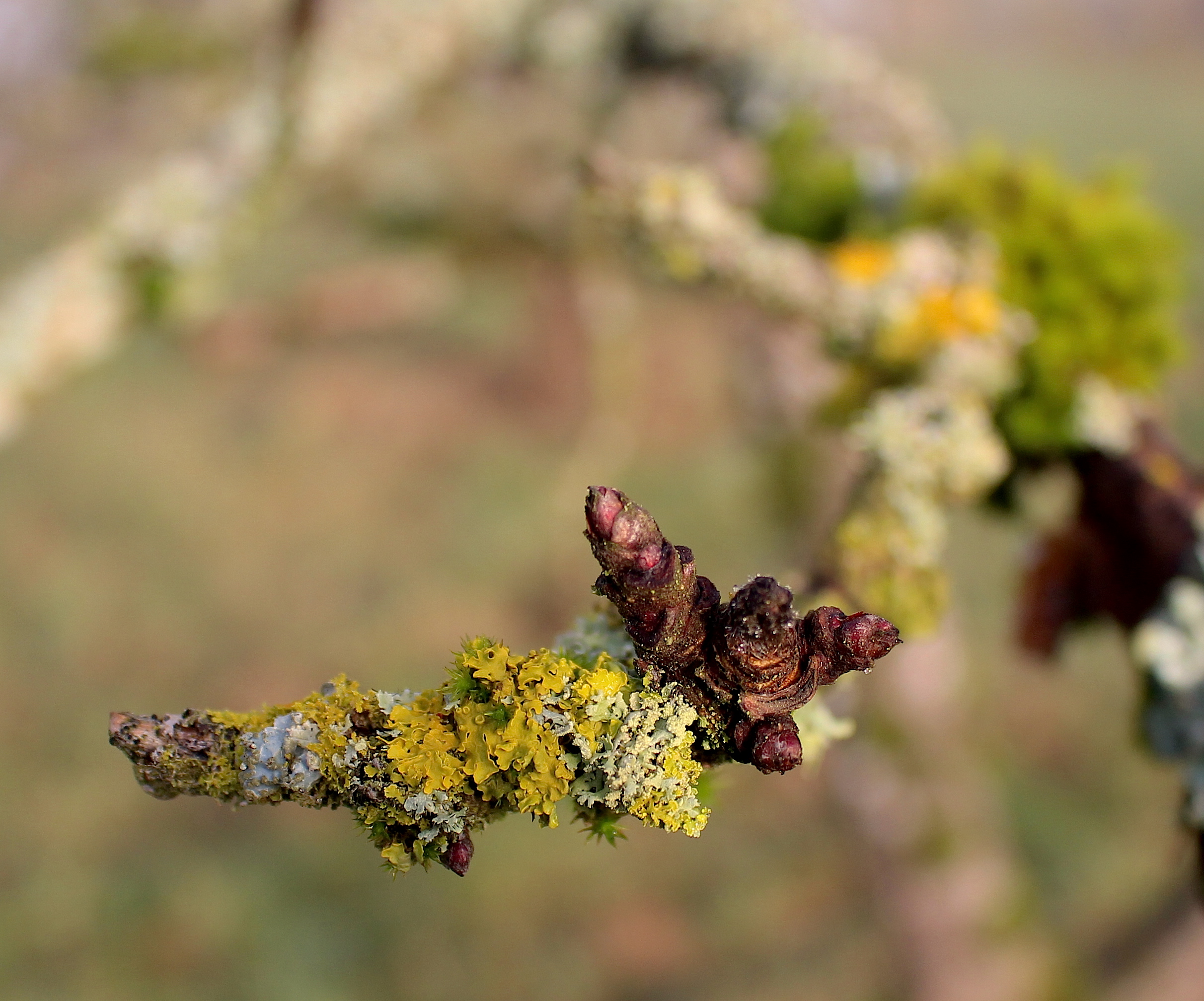
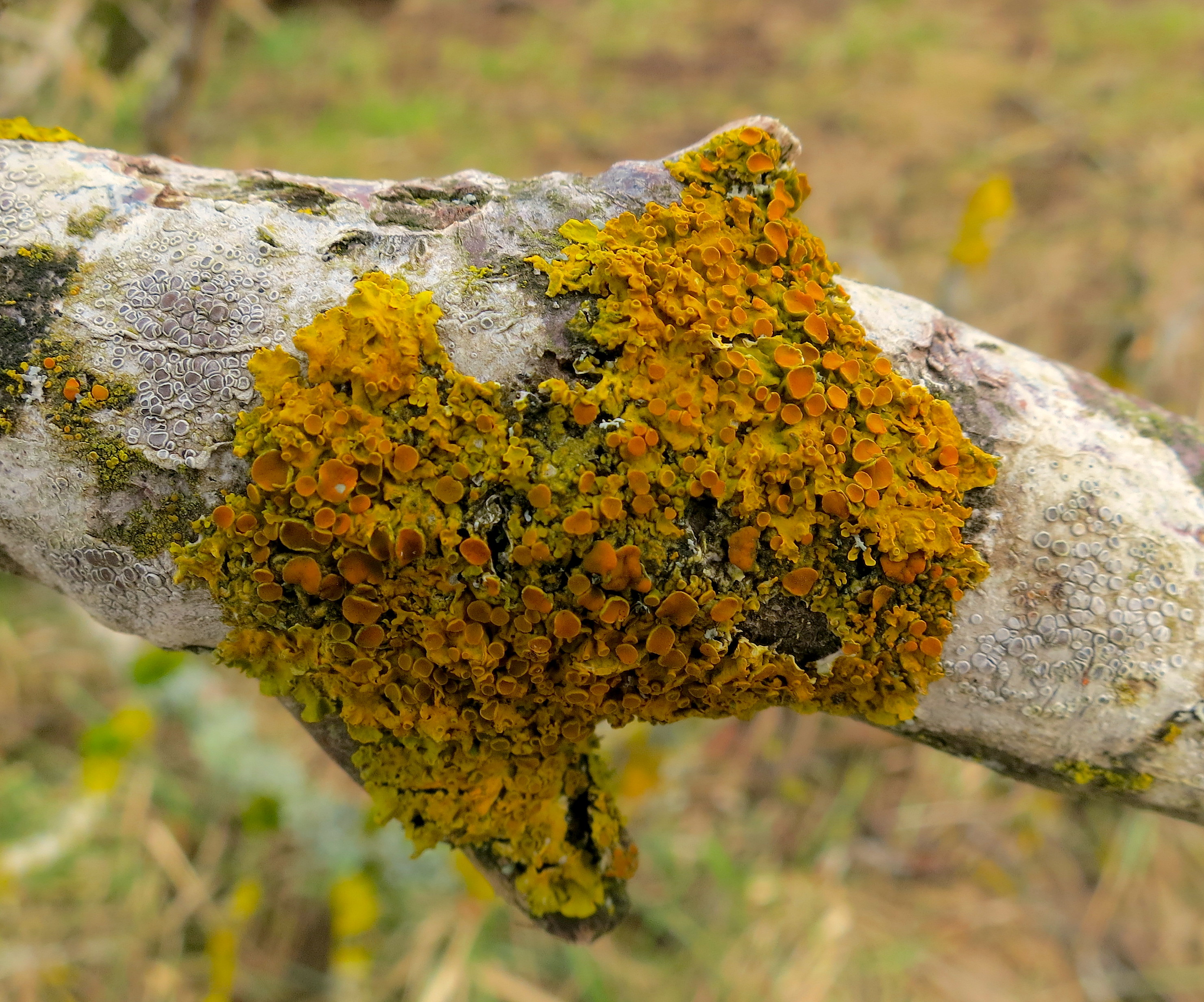
The juncture of twig and branch, scarred with lichen, is a gate we might enter, singing. ~Jane Kenyon from “Things” from Collected Poems
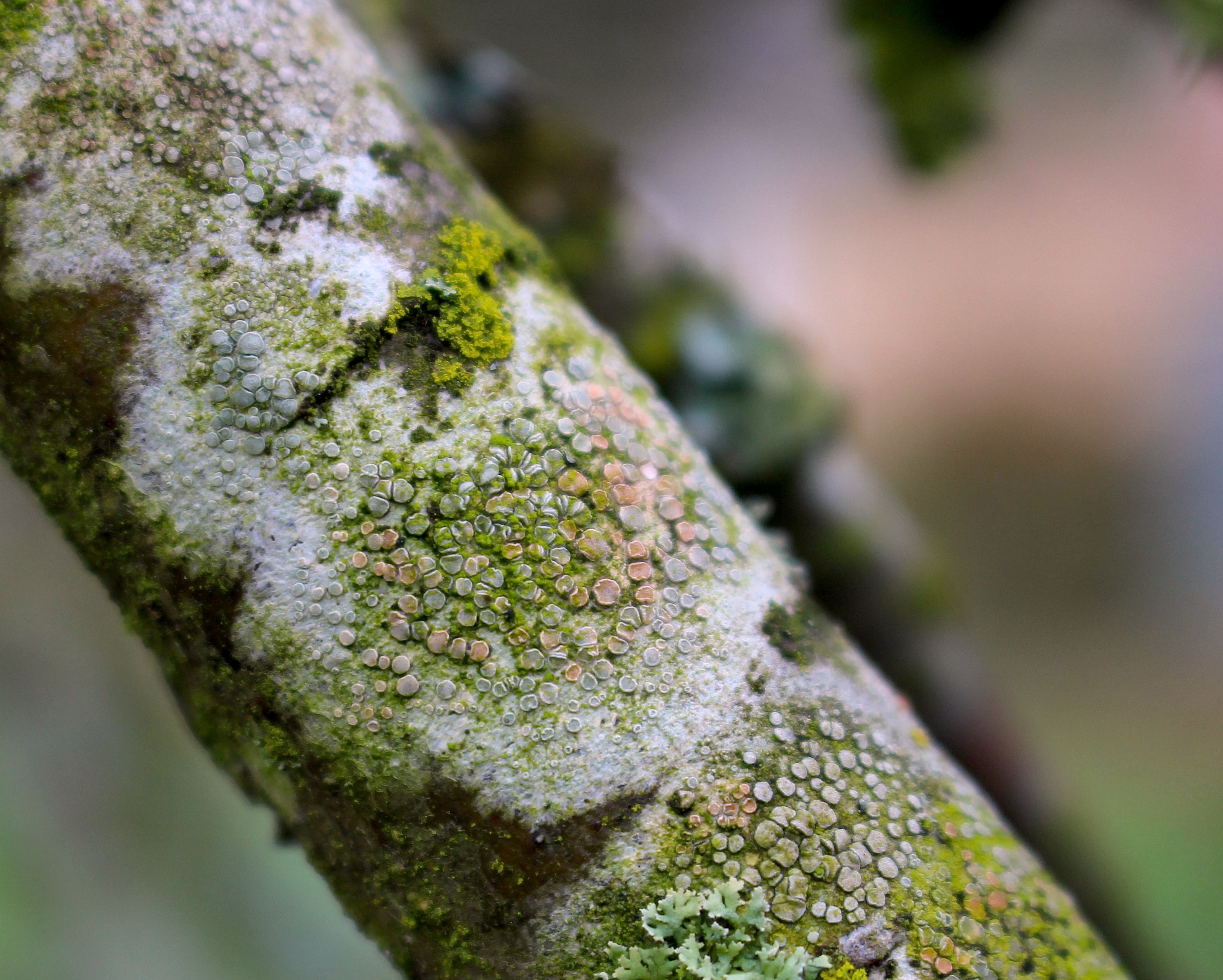
Who’s this –alone with stone and sea? It’s just the lowly Lichen We: the alga I, the fungus me; together, blooming quietly. What do we share–we two together? A brave indifference to the weather. A slow but steady growing pace. Resemblance to both mud and lace. As we now, so we shall be (if air clear and water free): the proud but lowly Lichen We, cemented for eternity. ~Joyce Sidman “The Lichen We” from Ubiquitous
All these years I overlooked them in the racket of the rest, this symbiotic splash of plant and fungus feeding on rock, on sun, a little moisture, air — tiny acid-factories dissolving salt from living rocks and eating them.
Here they are, blooming! Trail rock, talus and scree, all dusted with it: rust, ivory, brilliant yellow-green, and cliffs like murals!
Huge panels streaked and patched, quietly with shooting-stars and lupine at the base. Closer, with the glass, a city of cups!
Clumps of mushrooms and where do the plants begin? Why are they doing this? In this big sky and all around me peaks & the melting glaciers, why am I made to kneel and peer at Tiny? ~Lew Welch, “Springtime in the Rockies,Lichen” from Ring of Bone: Collected Poems
Back then, what did I know?
Uptown and downtown. Not north, not south, not you.
When I saw you, later, seaweed reefed in the air, you were grey-green, incomprehensible, old. What you clung to, hung from: old. Trees looking half-dead, stones.
Marriage of fungi and algae, chemists of air, changers of nitrogen-unusable into nitrogen-usable.
Like those nameless ones who kept painting, shaping, engraving, unseen, unread, unremembered. Not caring if they were no good, if they were past it.
Rock wools, water fans, earth scale, mouse ears, dust, ash-of-the-woods. Transformers unvalued, uncounted. Cell by cell, word by word, making a world they could live in. ~Jane Hirshfield from “For the Lichens” from Come, Thief
But what is life to a lichen? Yet its impulse to exist, to be, is every bit as strong as ours — arguably even stronger. If I were told that I had to spend decades being a furry growth on a rock in the woods, I believe I would lose the will to go on. Lichens don’t. Like virtually all living things, they will suffer any hardship, endure any insult, for a moment’s additional existence. Life, in short, just wants to be. ~Bill Bryson from A Short History of Nearly Everything
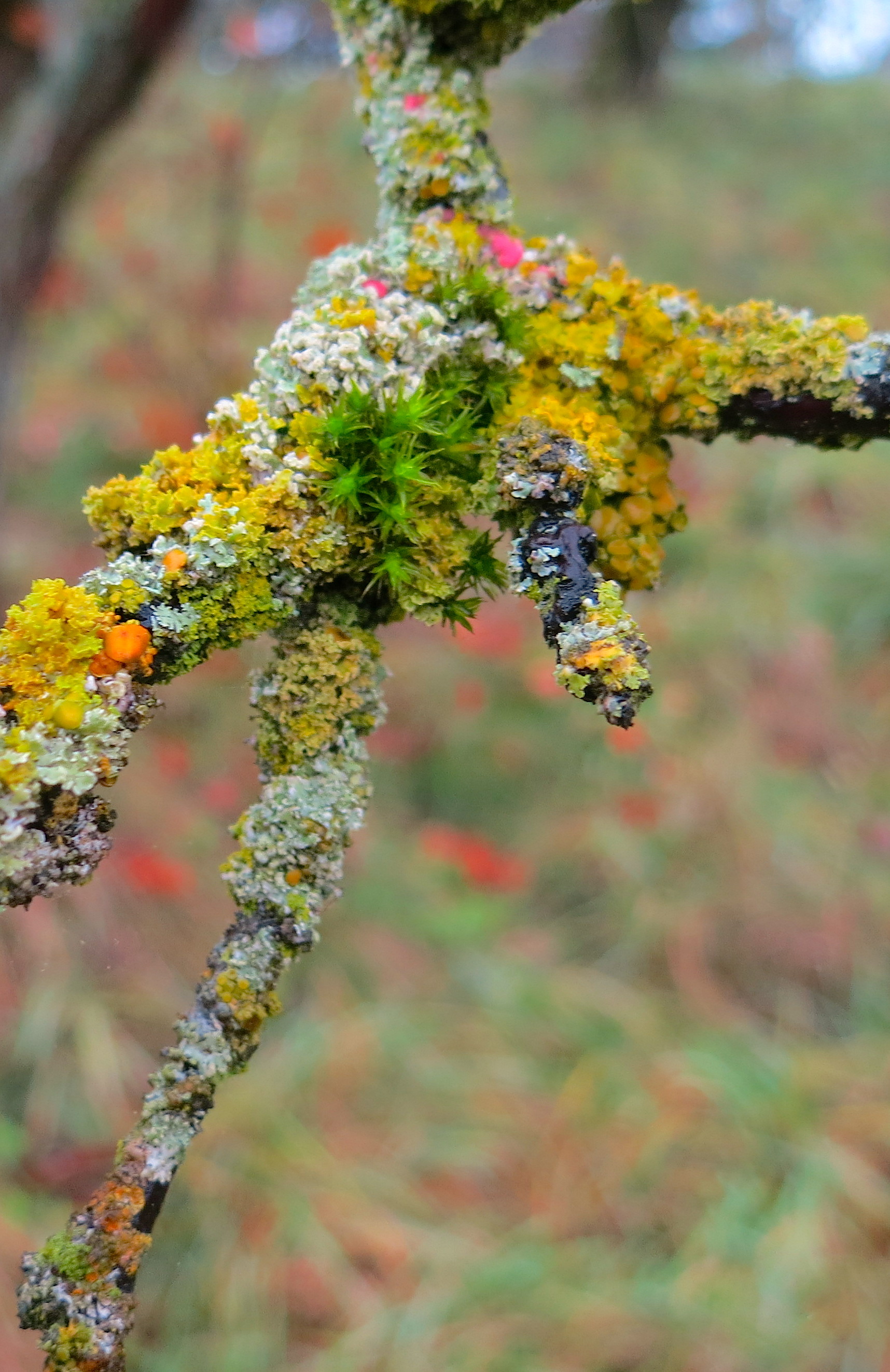
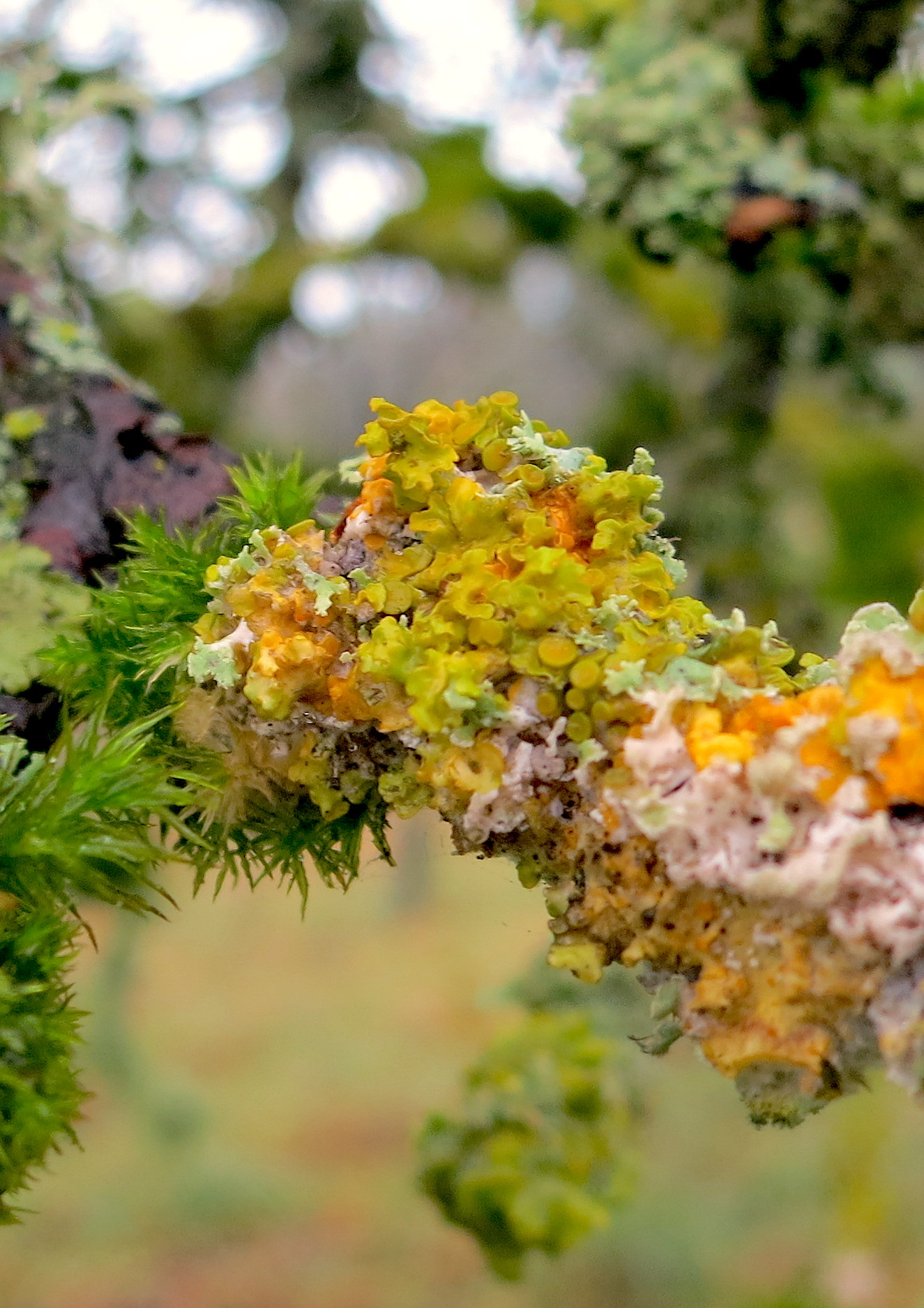
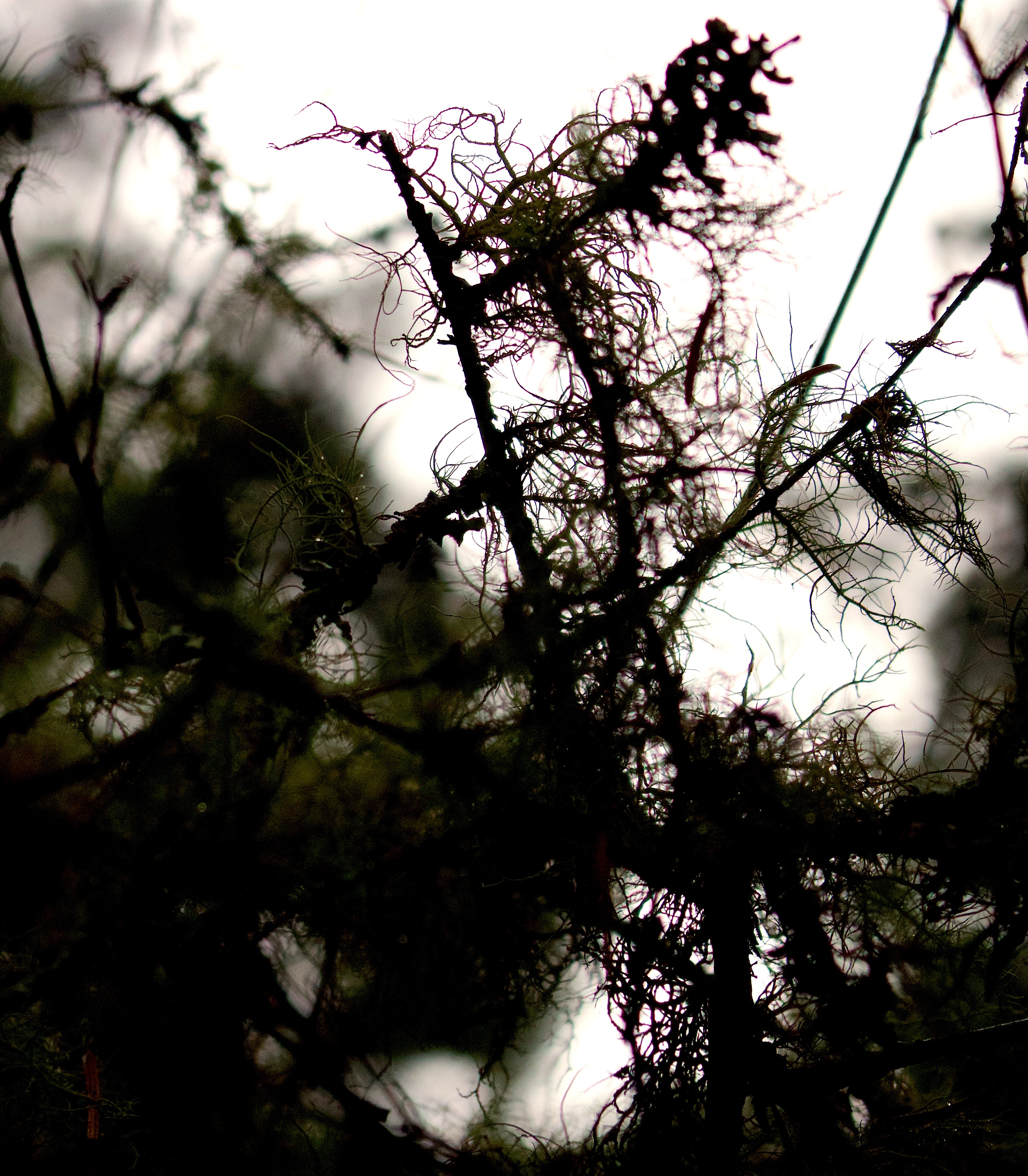
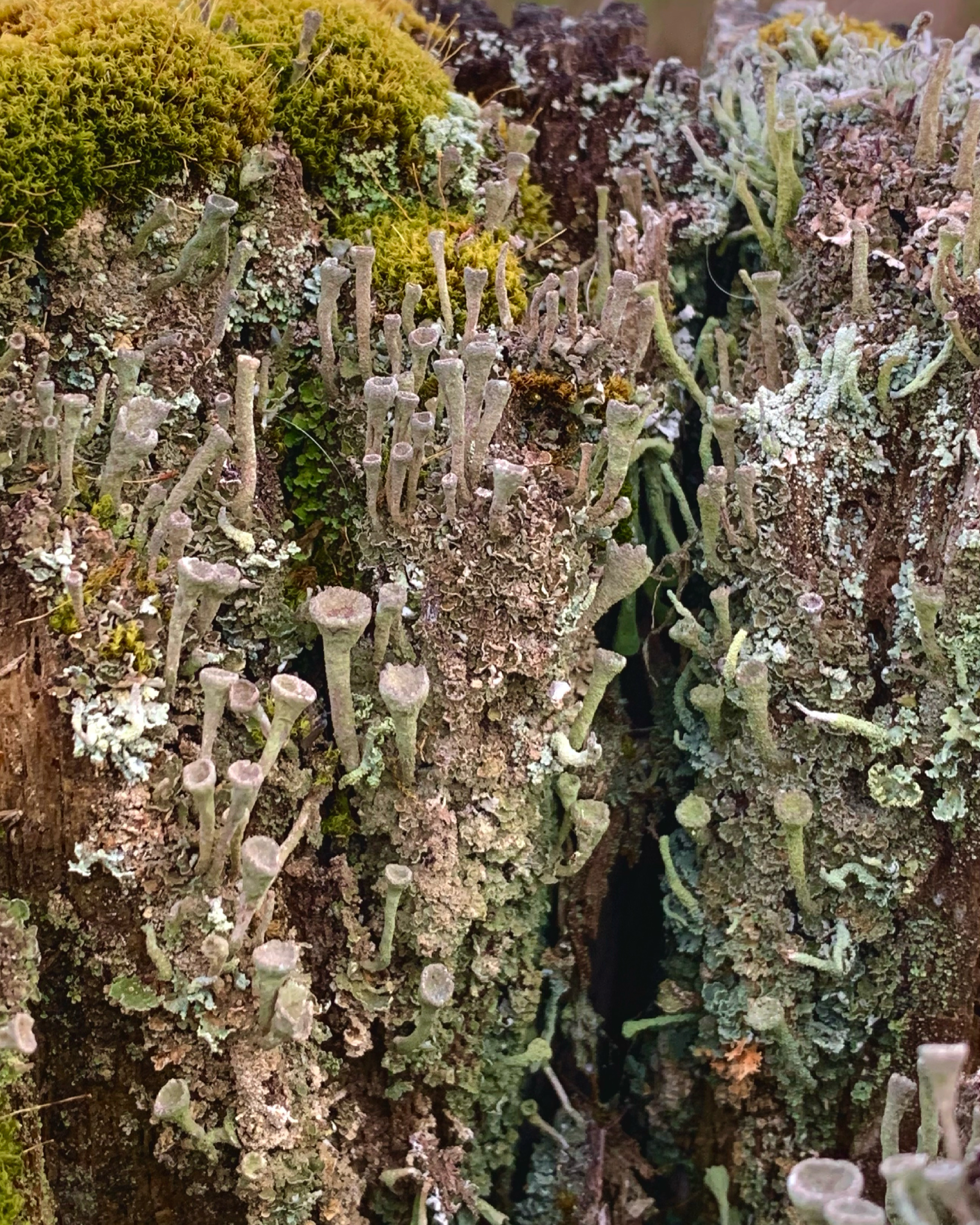
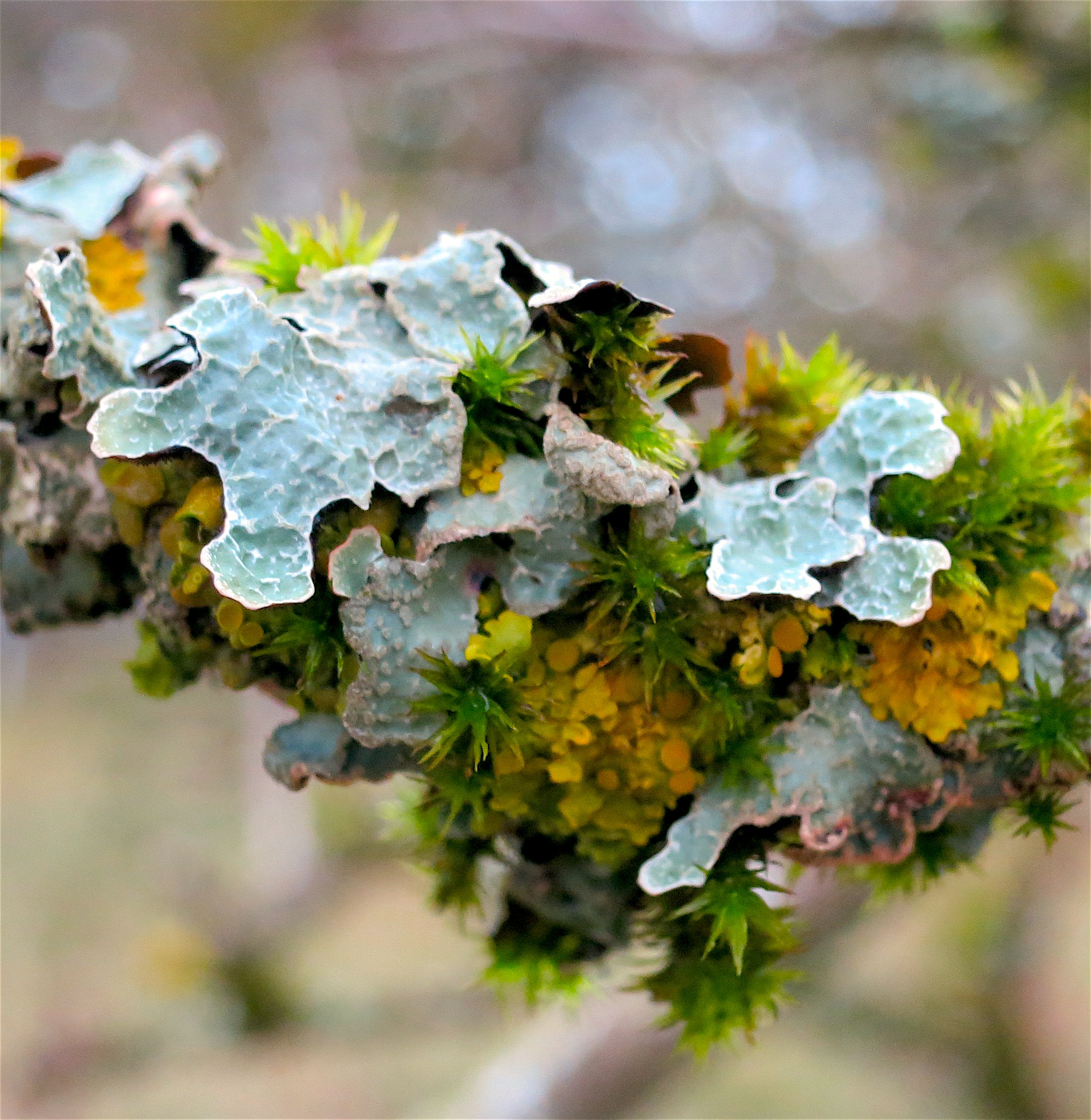
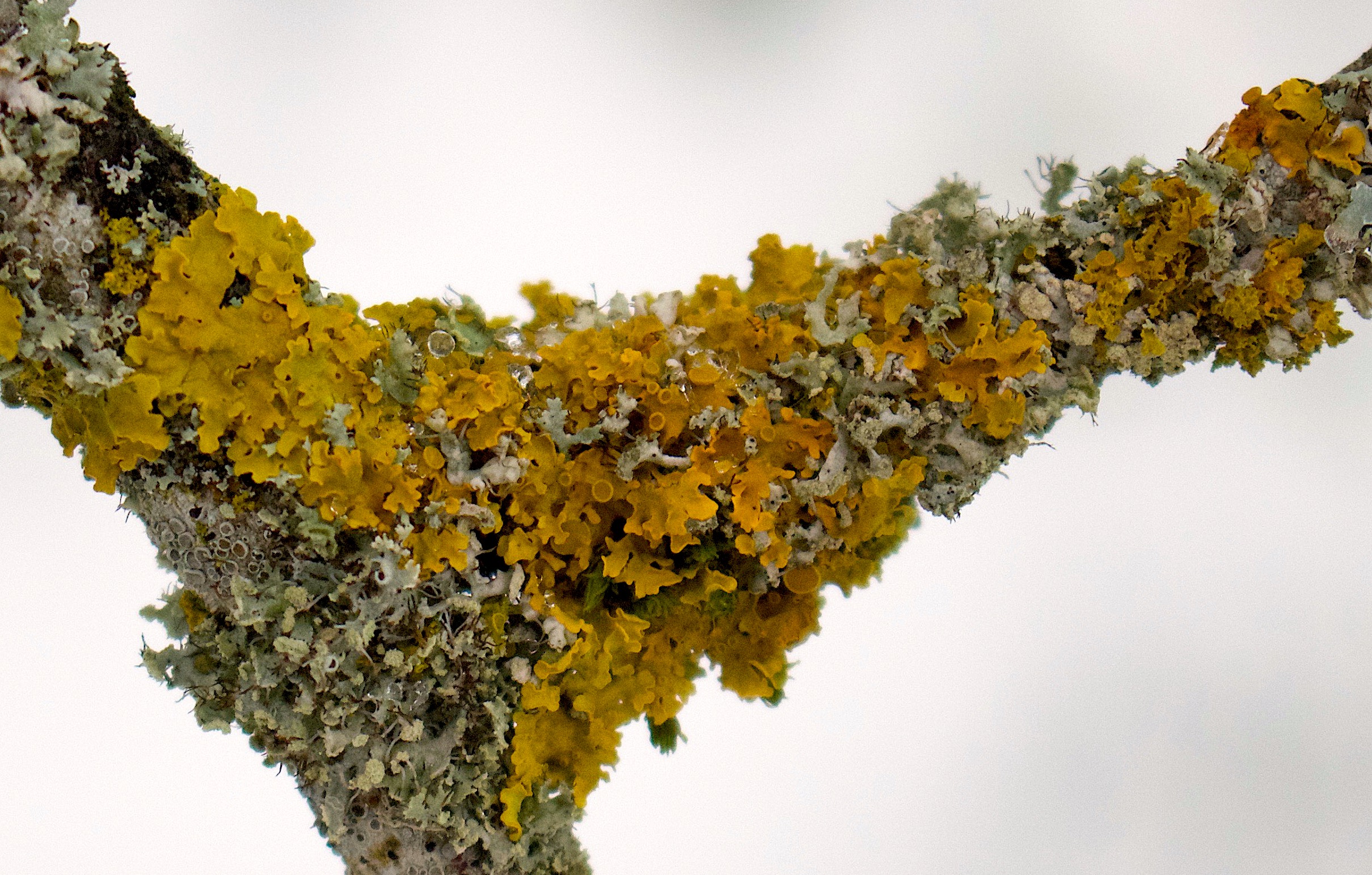
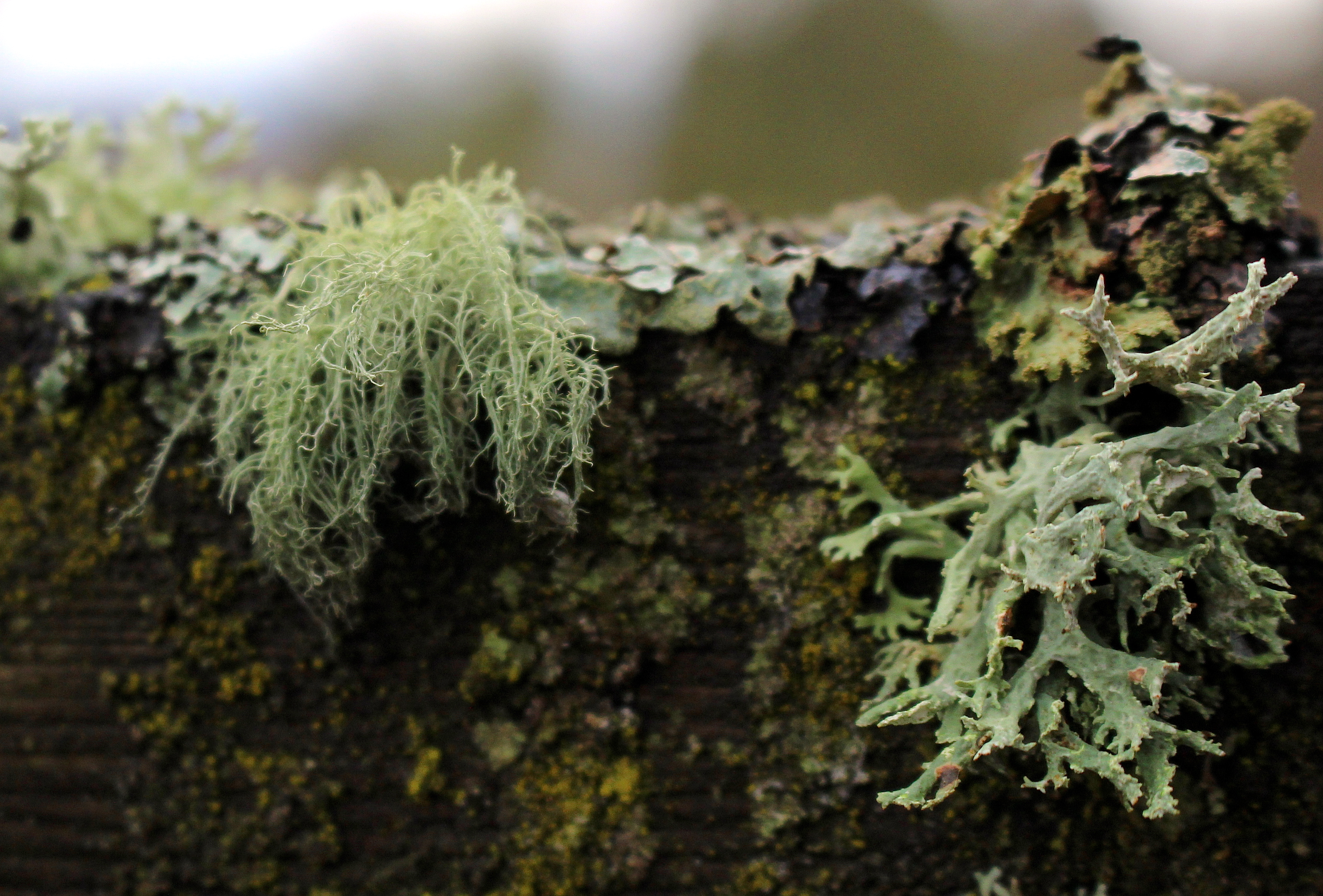
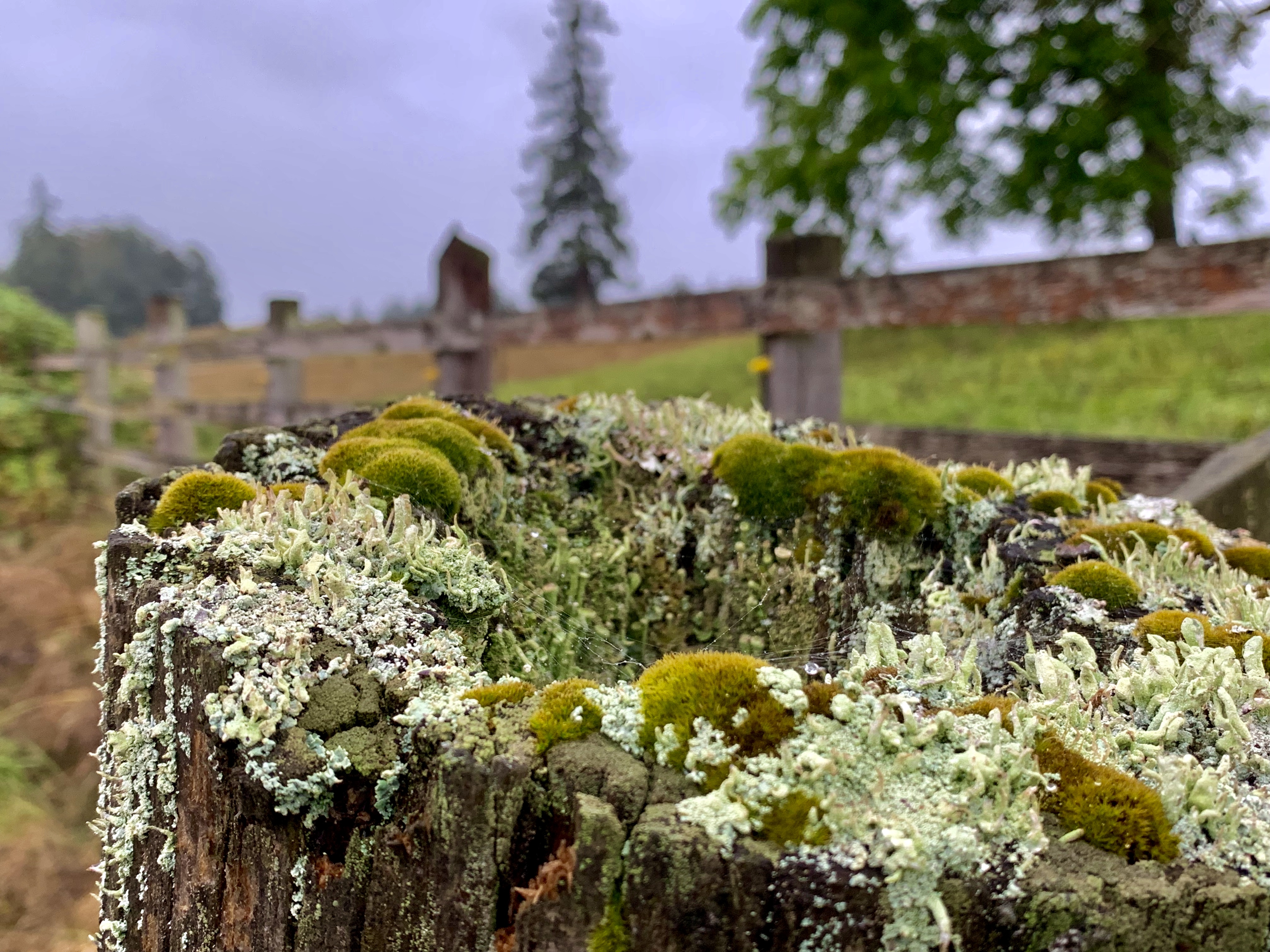
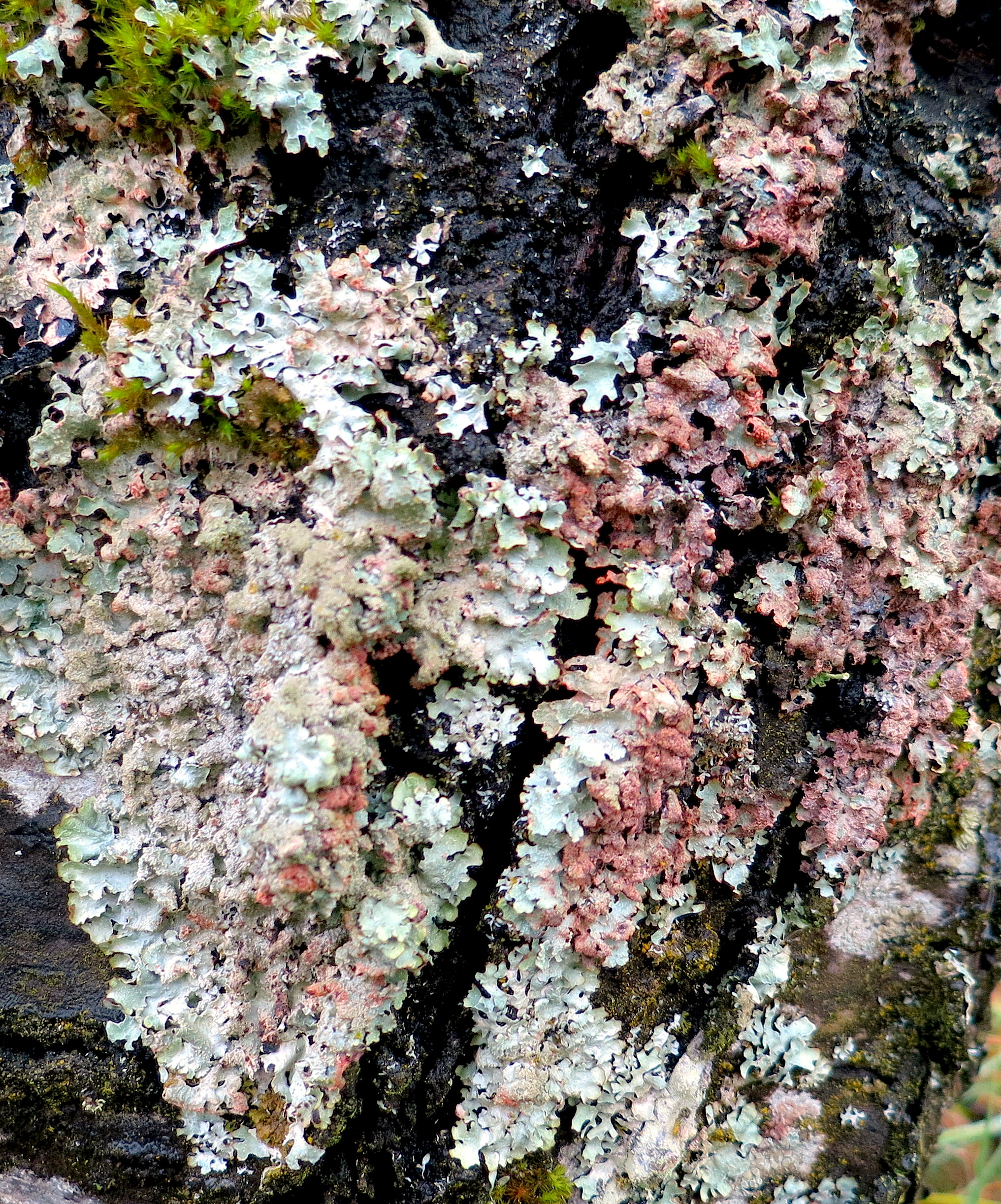
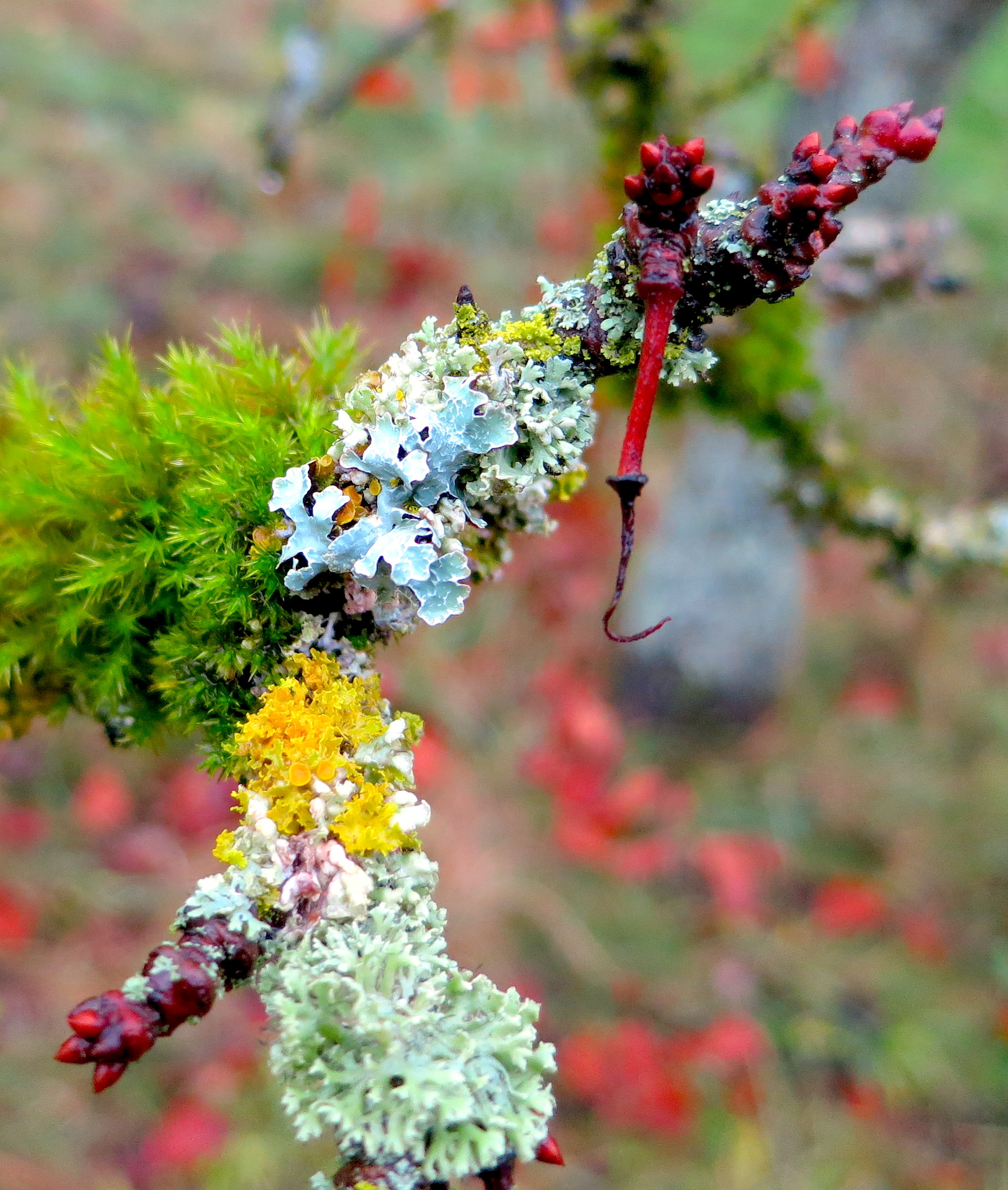
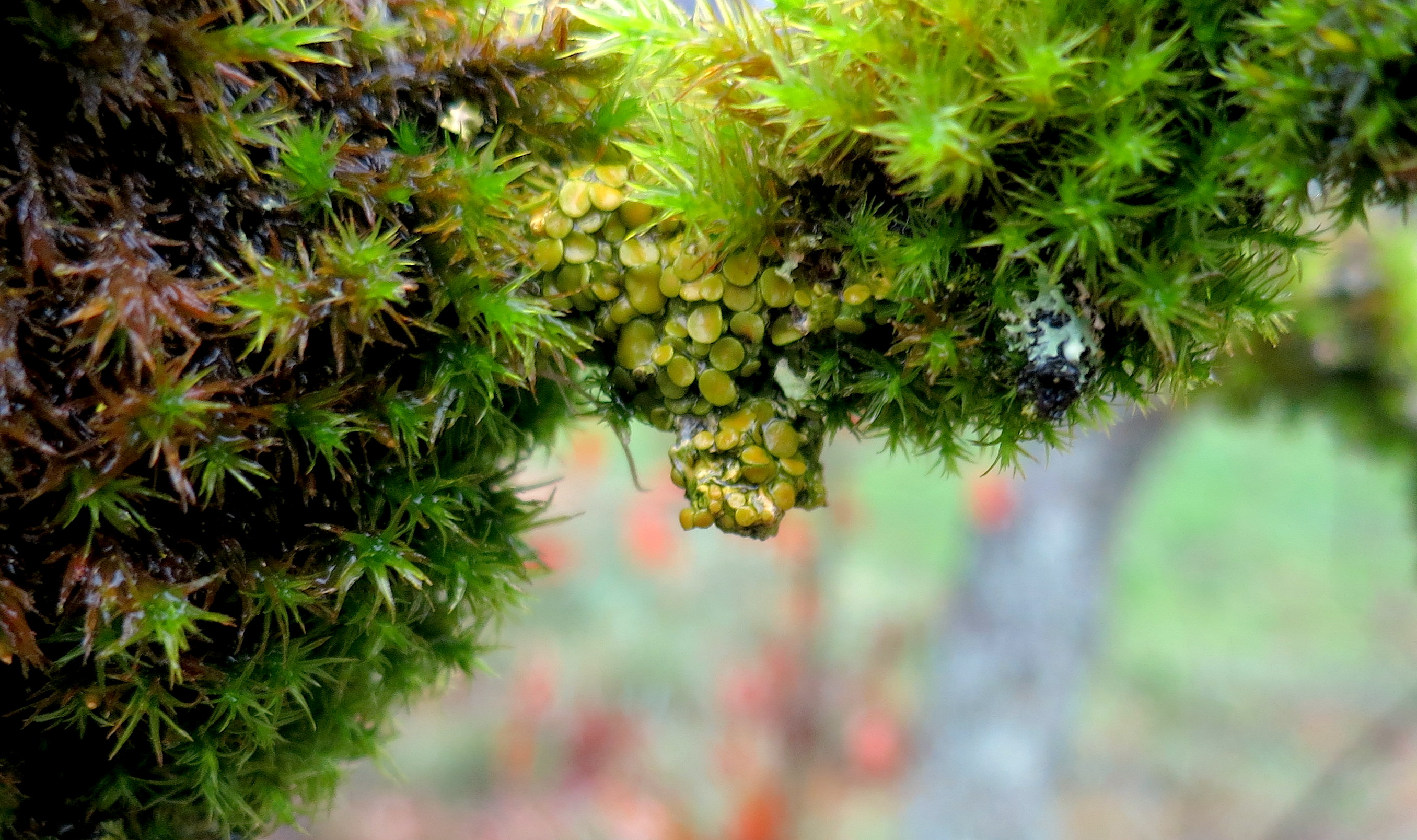
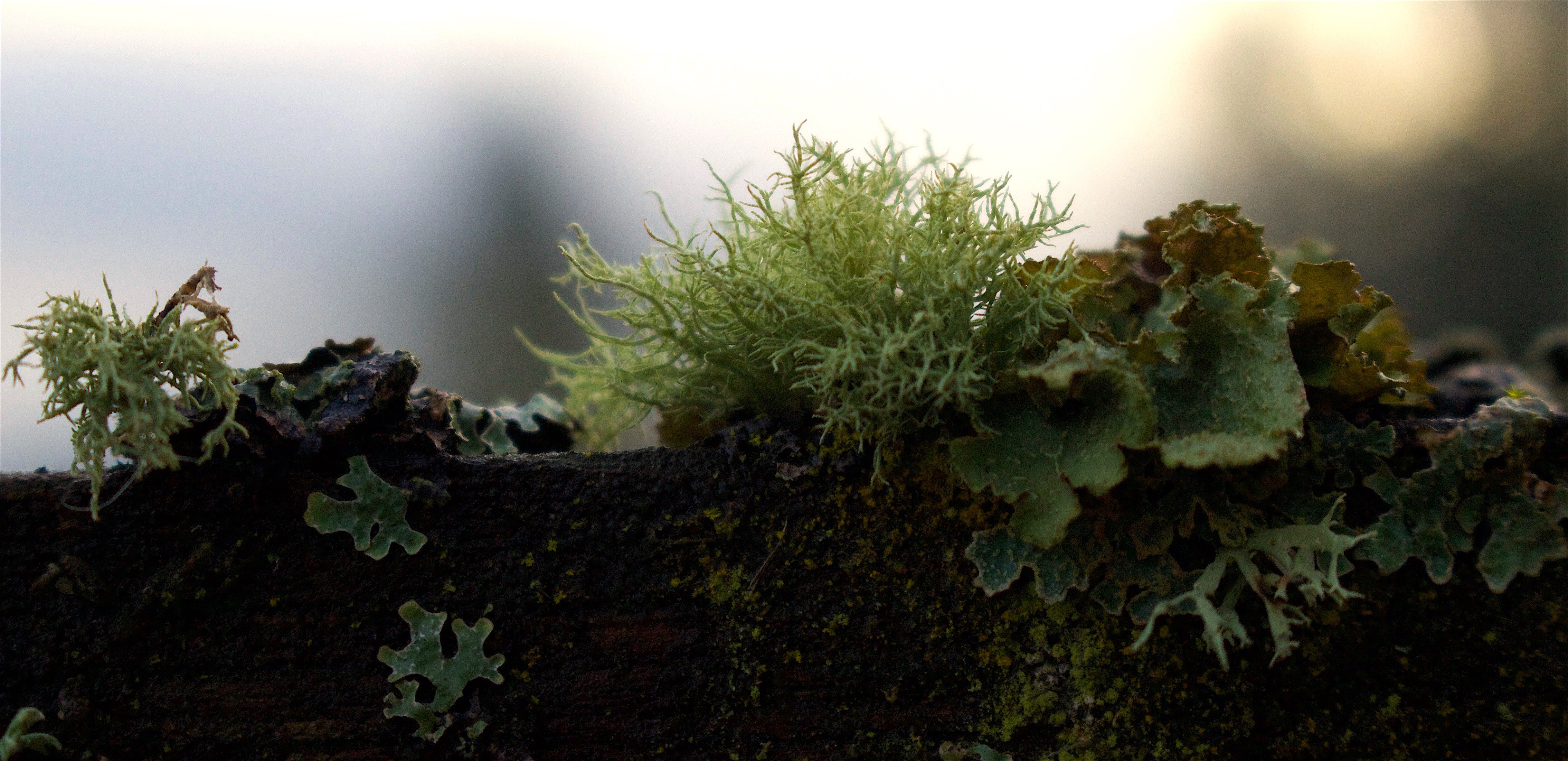
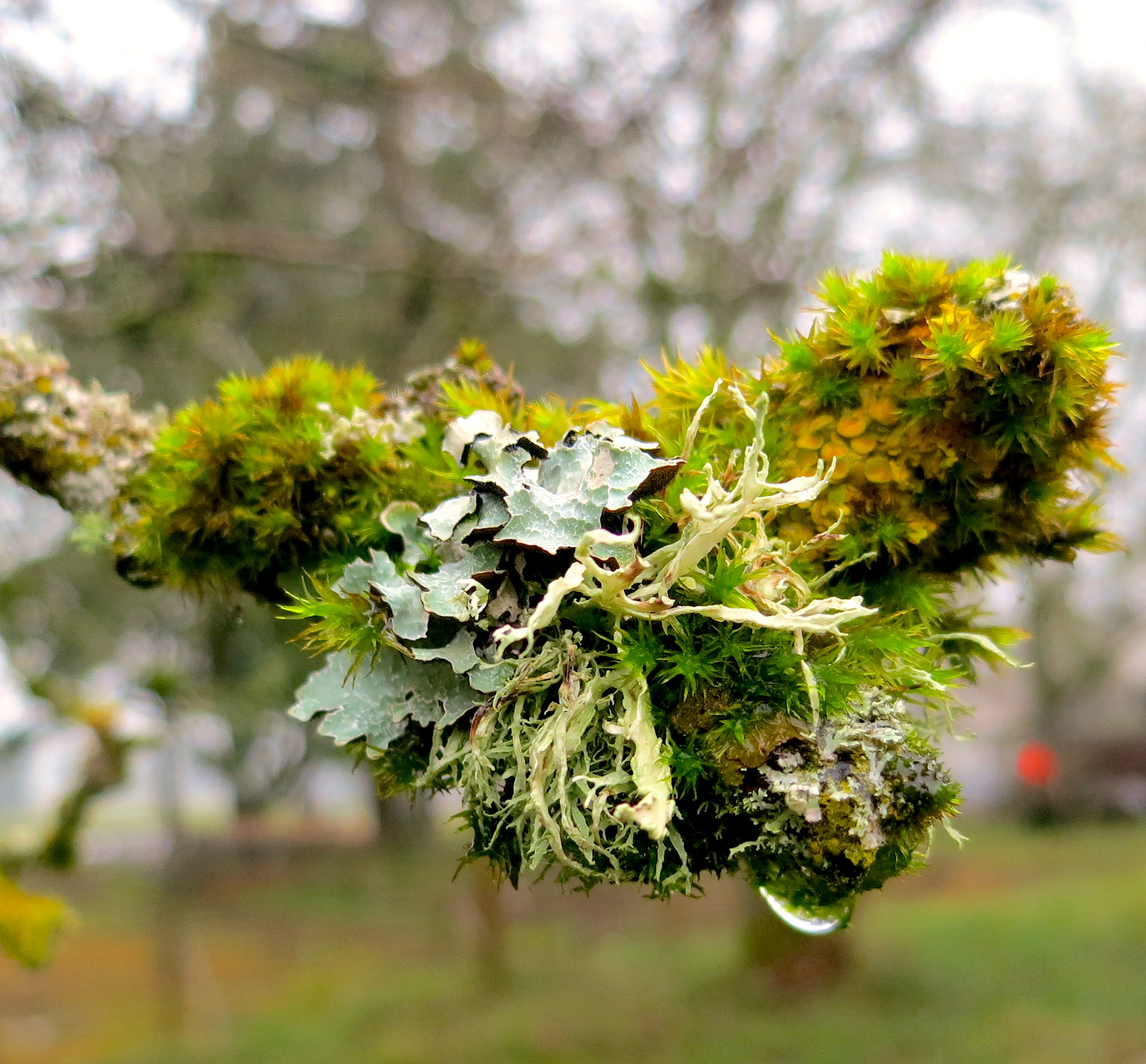
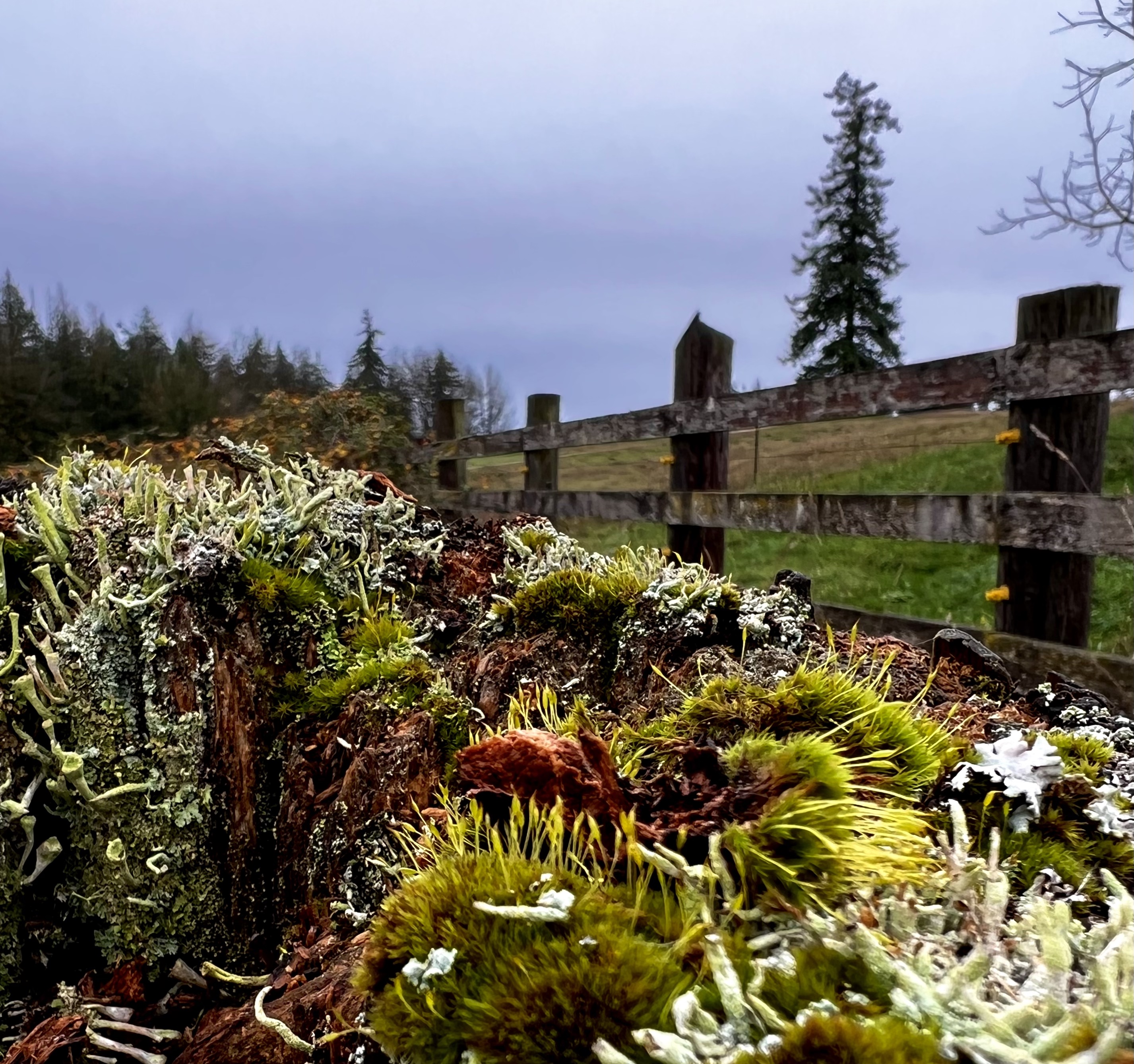
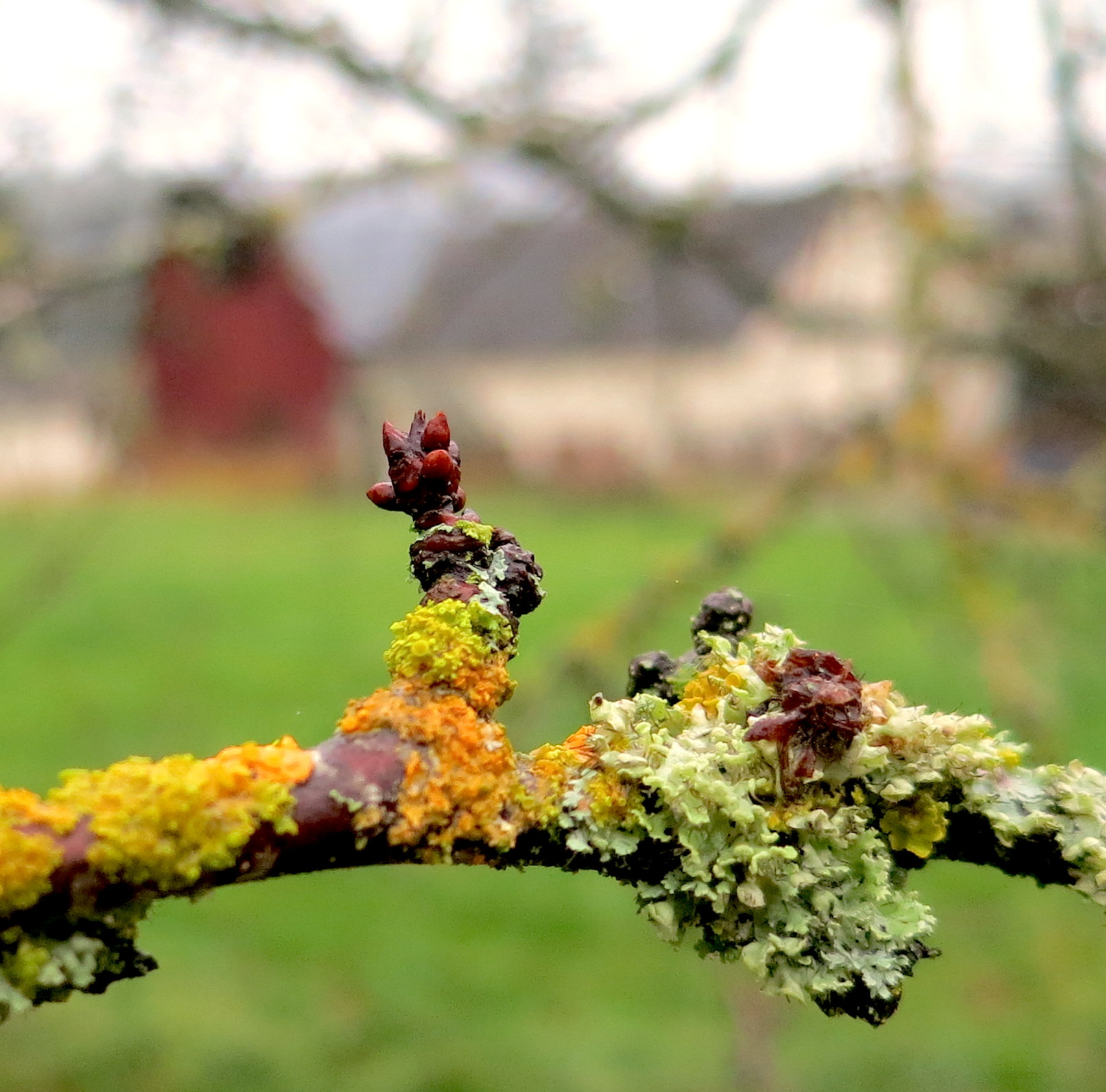
I’ve lived in the Pacific Northwest for nearly 70 years – this farm for 30 years. The grandeur of the snow-capped mountains to the north and east and the peaceful shore to the west overwhelms everything in between. Autumn after autumn, I’ve walked past these antique apple trees, but had never stopped to really look at the landscape growing on their bare shoulders and arms. There is a whole other ecosystem on each tree, a fairy land of earth bound dryland seaweed, luxuriant in the fall rains, colorful in the winter, hidden behind leaves and fruit in the hot summer. I had never really noticed the varied color and texture all around me.
This is the world of lichen, a mixed up symbiotic cross between algae and fungus, opportunistic enough to thrive on rock faces, but simply ecstatic on absorbent bark.
It hasn’t bothered them not to be noticed as they are busy minding their own business. As poet John McCullough writes in his poem “Lichen”:
It is merely a question of continuous adjustment, of improvising a life.
When I’m far from friends or the easing of a wind against my back, I think of lichen— never and always true to its essence, never and always at home.
Instead of lifting my eyes to the hills and the bay for a visual feast, I need only open the back gate to gaze on this landscape found on the ancient branches in my own back yard.
It’s a rich life of improvisation indeed.
One-Time
Monthly
Yearly
Make a one-time or recurring donation to support daily ad-free Barnstorming posts
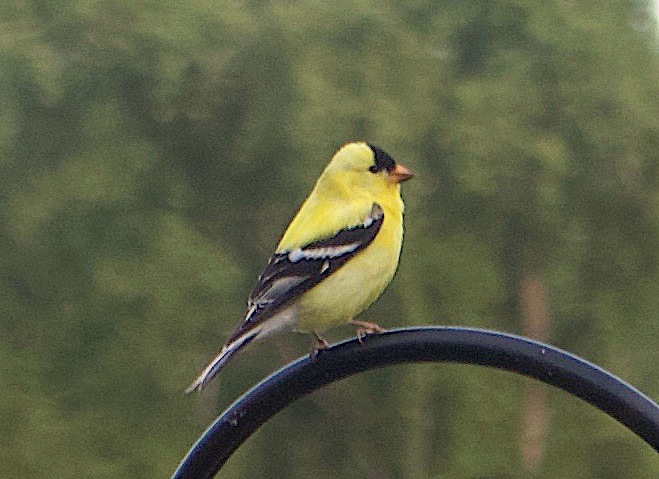
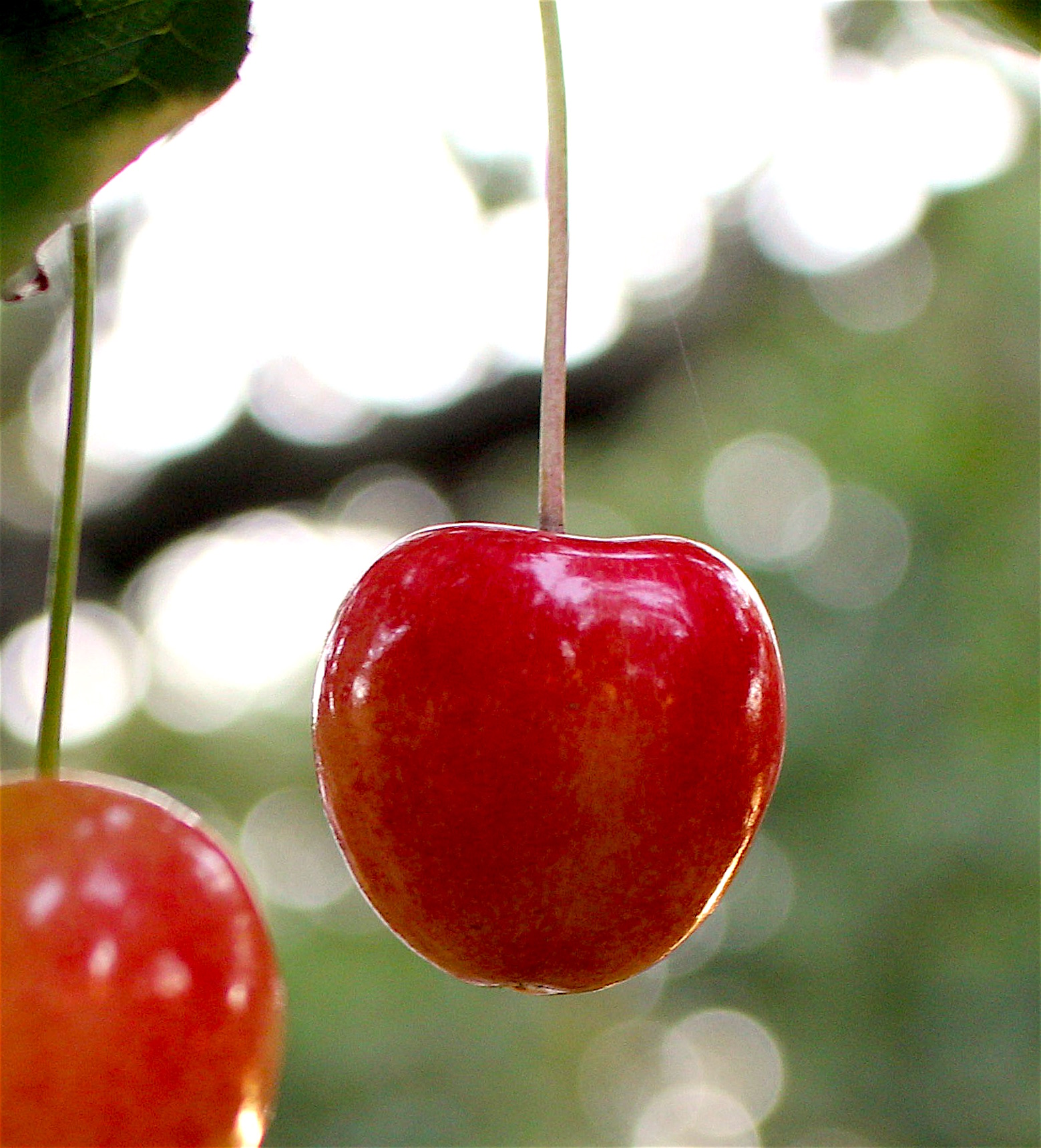
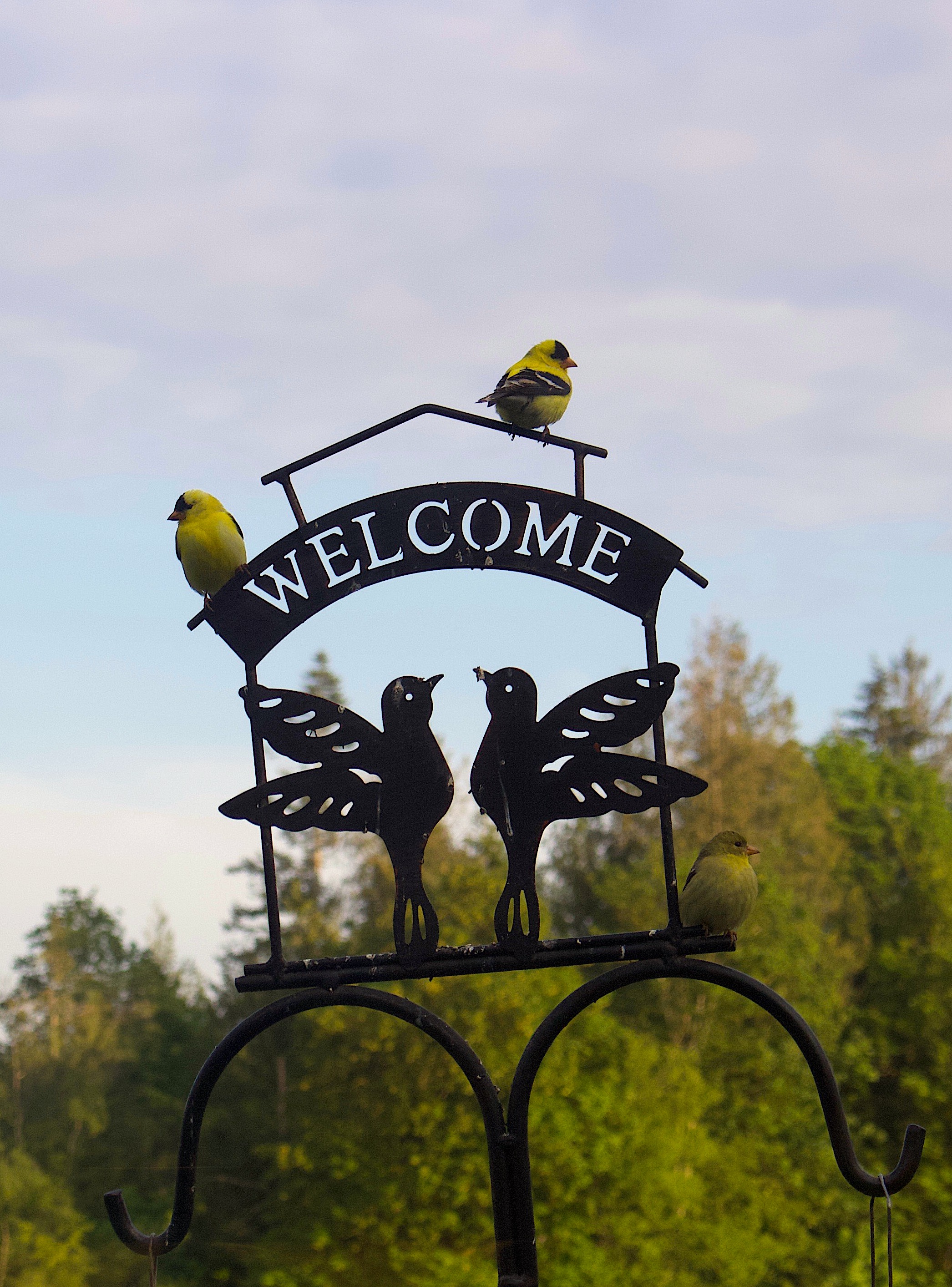
Late in May as the light lengthens toward summer the young goldfinches flutter down through the day for the first time to find themselves among fallen petals cradling their day’s colors in the day’s shadows of the garden beside the old house after a cold spring with no rain not a sound comes from the empty village as I stand eating the black cherries from the loaded branches above me saying to myself Remember this ~W.S. Merwin “Black Cherries”
Let me imagine that we will come again when we want to and it will be spring we will be no older than we ever were the worn griefs will have eased like the early cloud through which the morning slowly comes to itself and the ancient defenses against the dead will be done with and left to the dead at last the light will be as it is now in the garden that we have made here these years together of our long evenings and astonishment ~W.S. Merwin “To Paula in Late Spring”
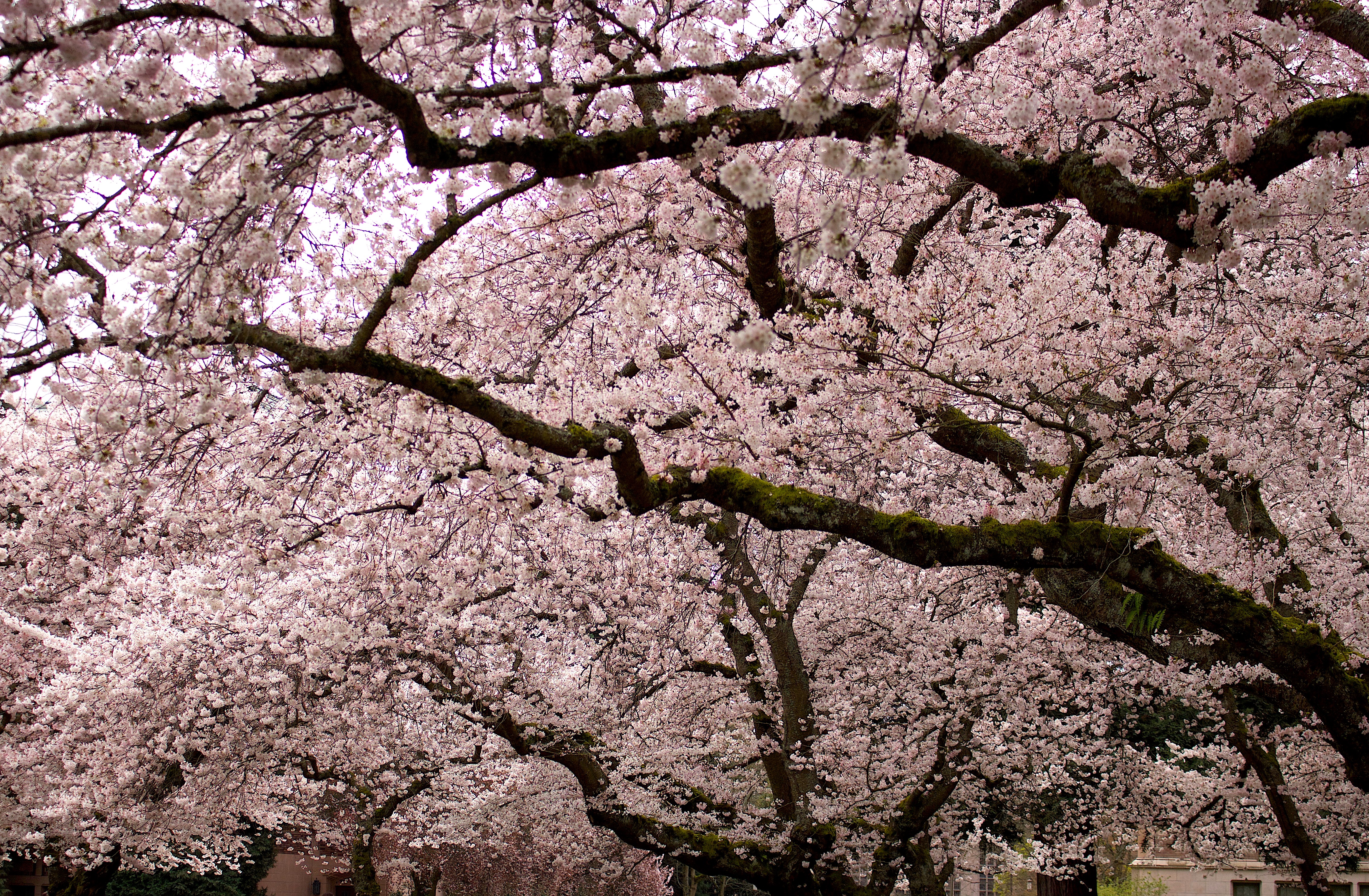
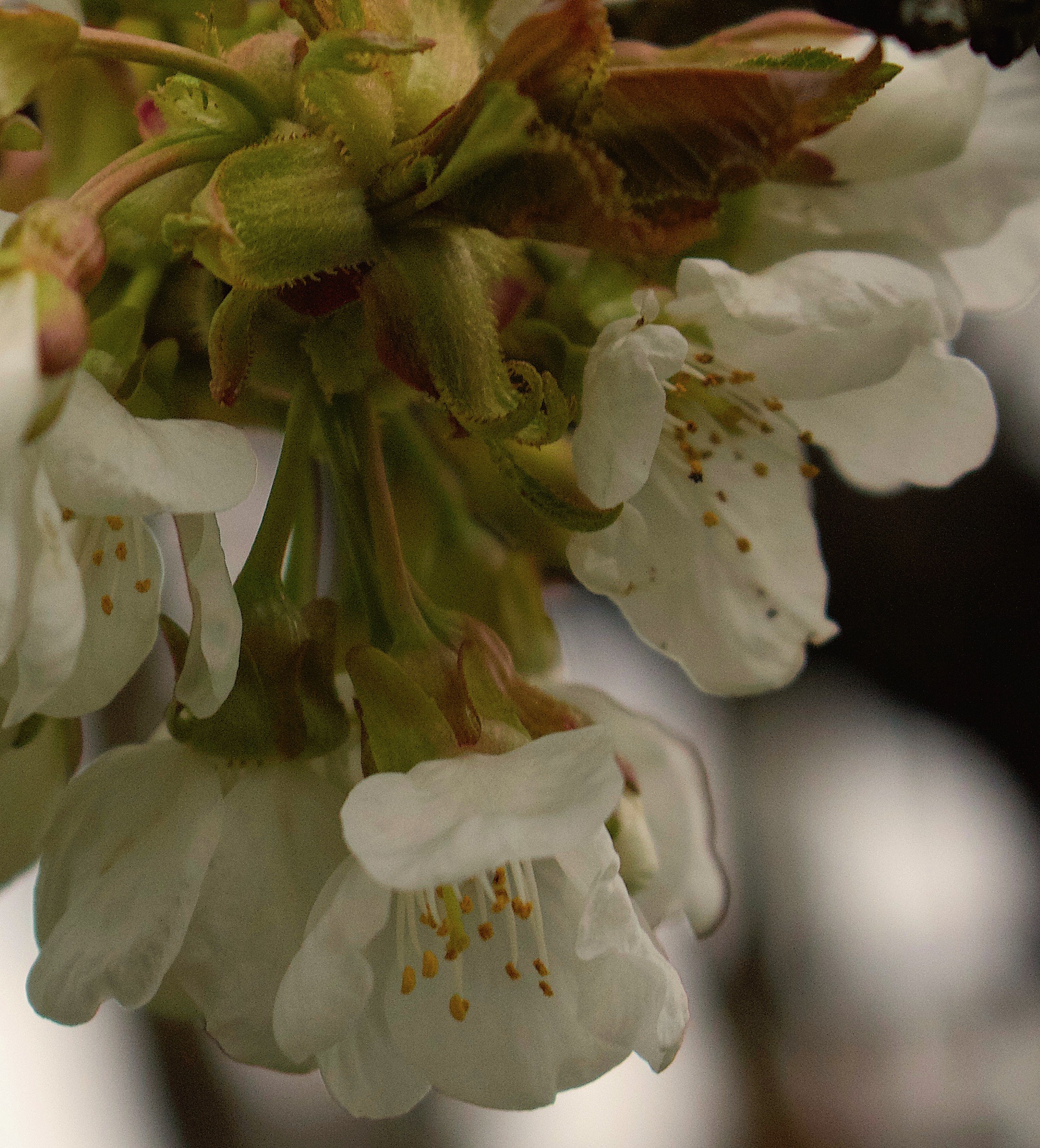
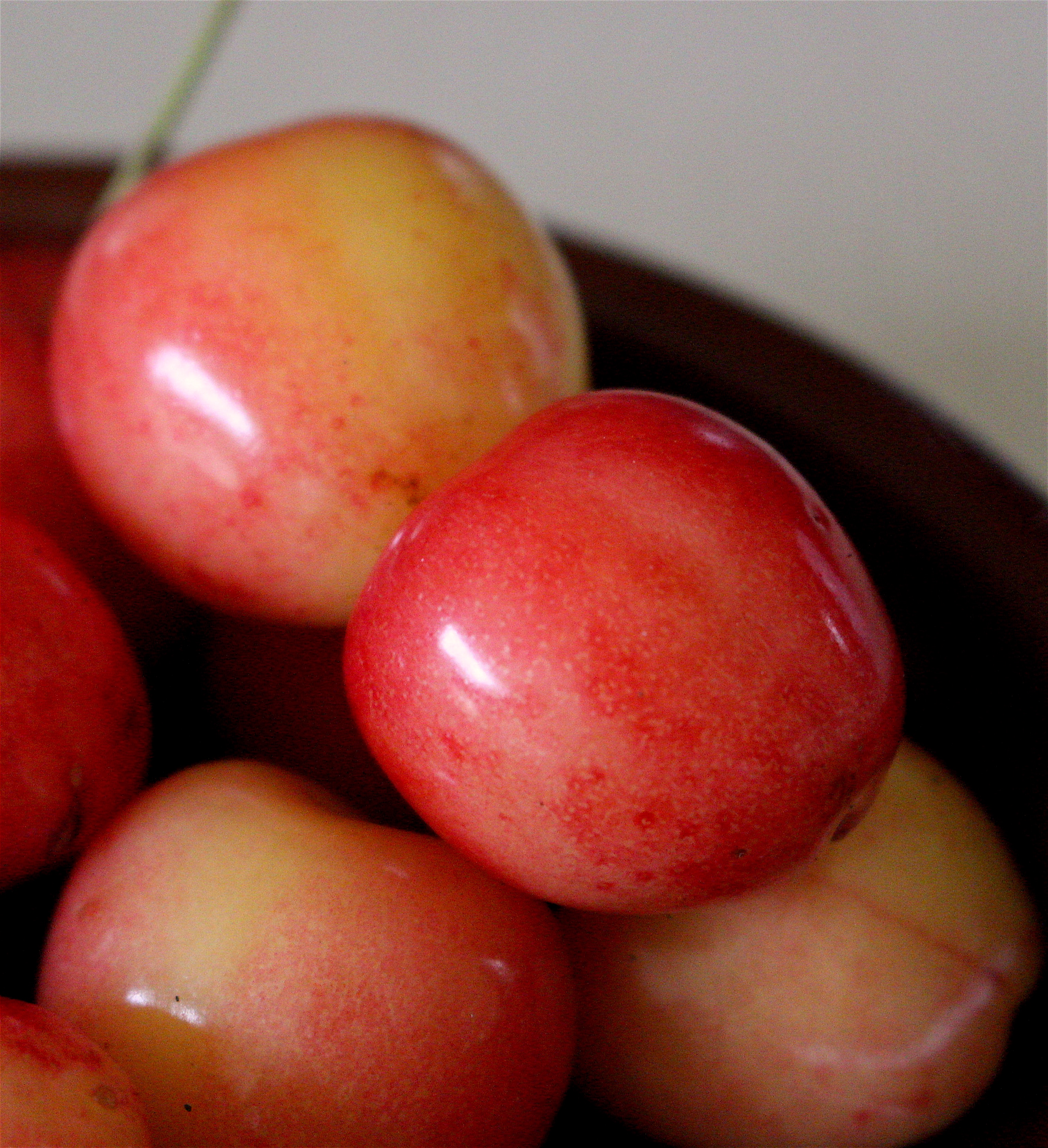
Yes, let us be astonished that any spring happens. That the dull gray of winter yields to petals and fruitful blossoms, then to fruit that is both sweet and sour on our tongues. That the air resonates with birdsong and flower perfume and the sun warms enough to dissipate the mist and tears.
Let us remember this, oh let us remember so it is never forgotten: all is made right and good as eternity itself will taste like this.
One-Time
Monthly
Yearly
Make a one-time or recurring donation to support daily Barnstorming posts
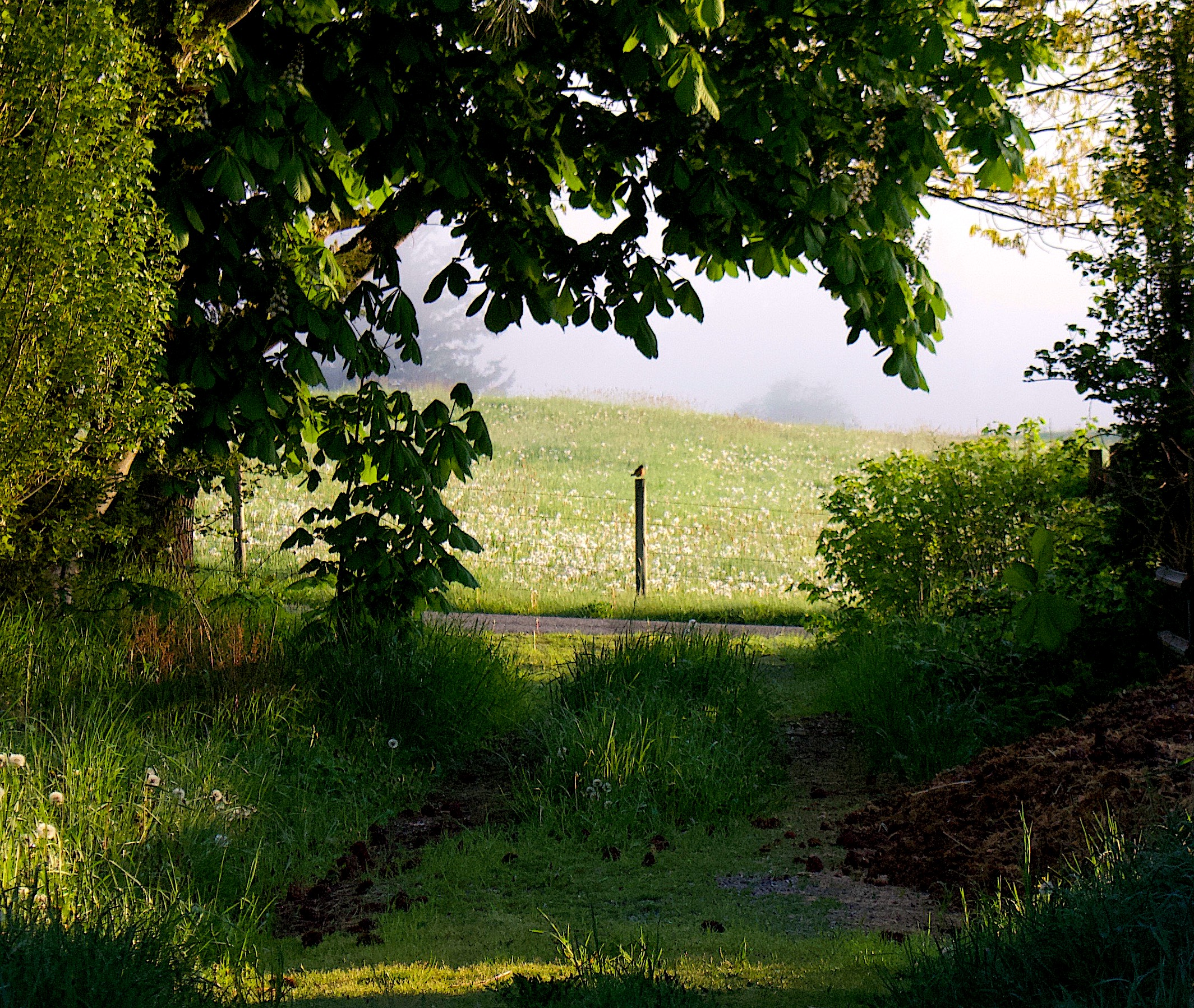
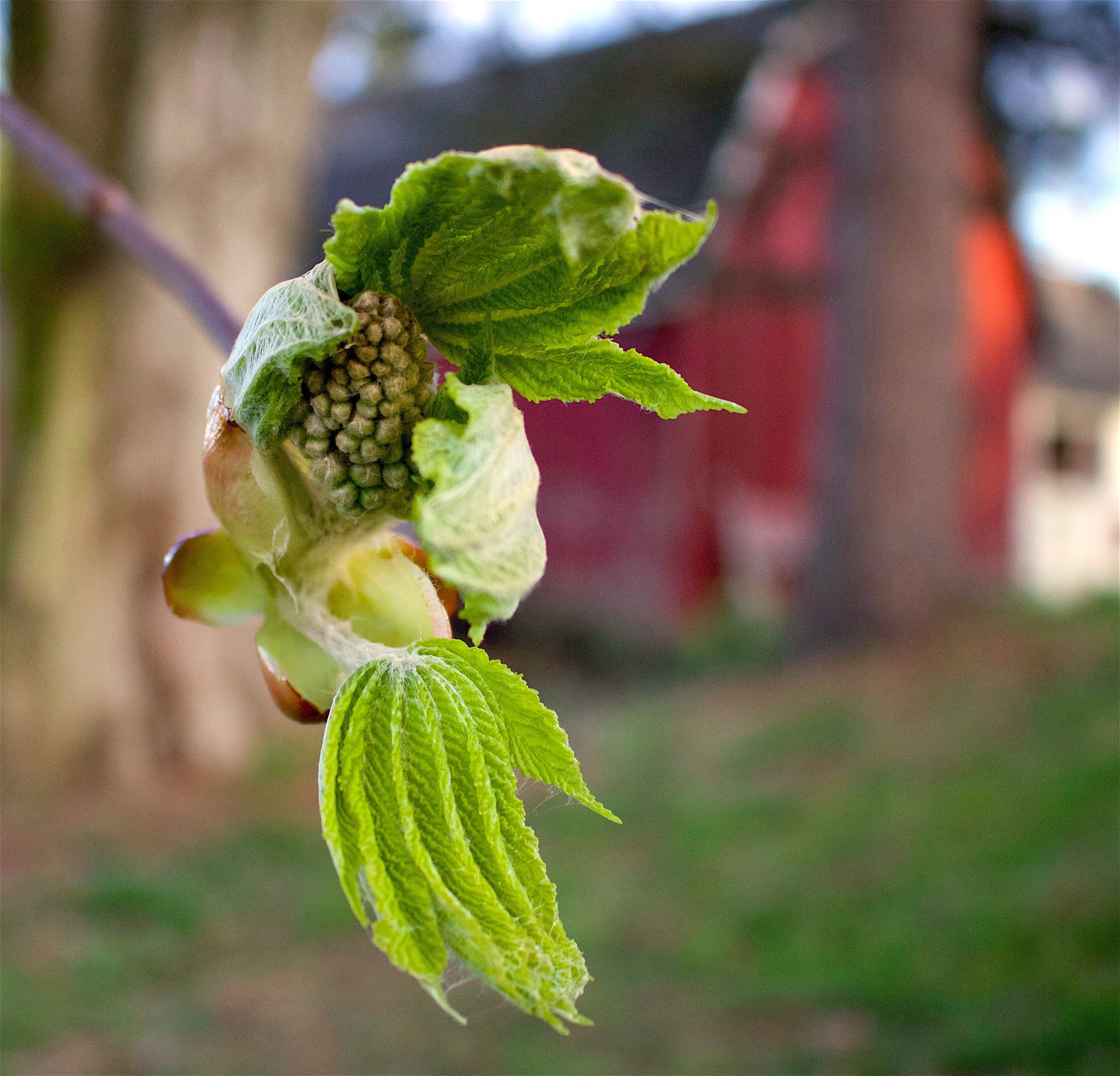
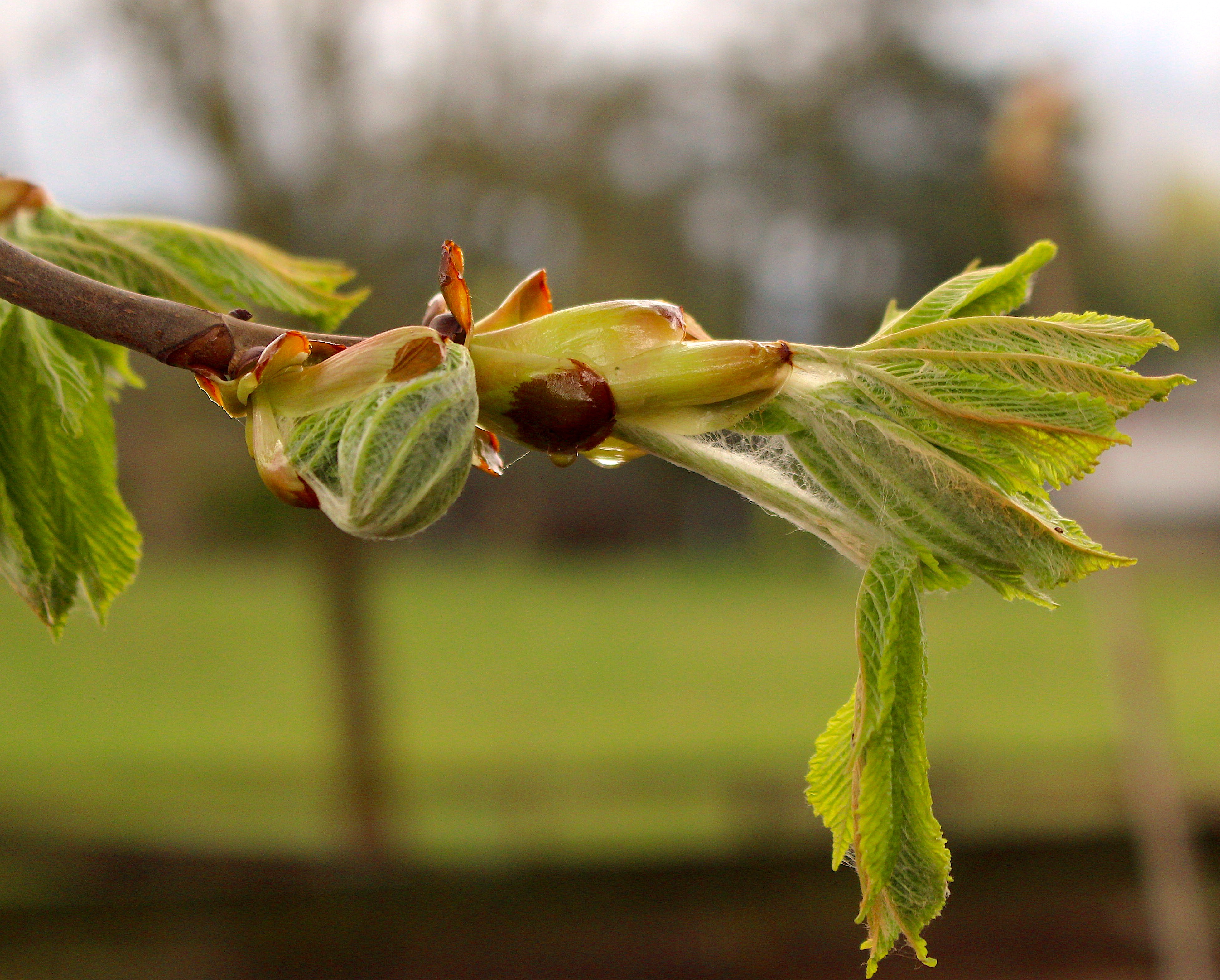
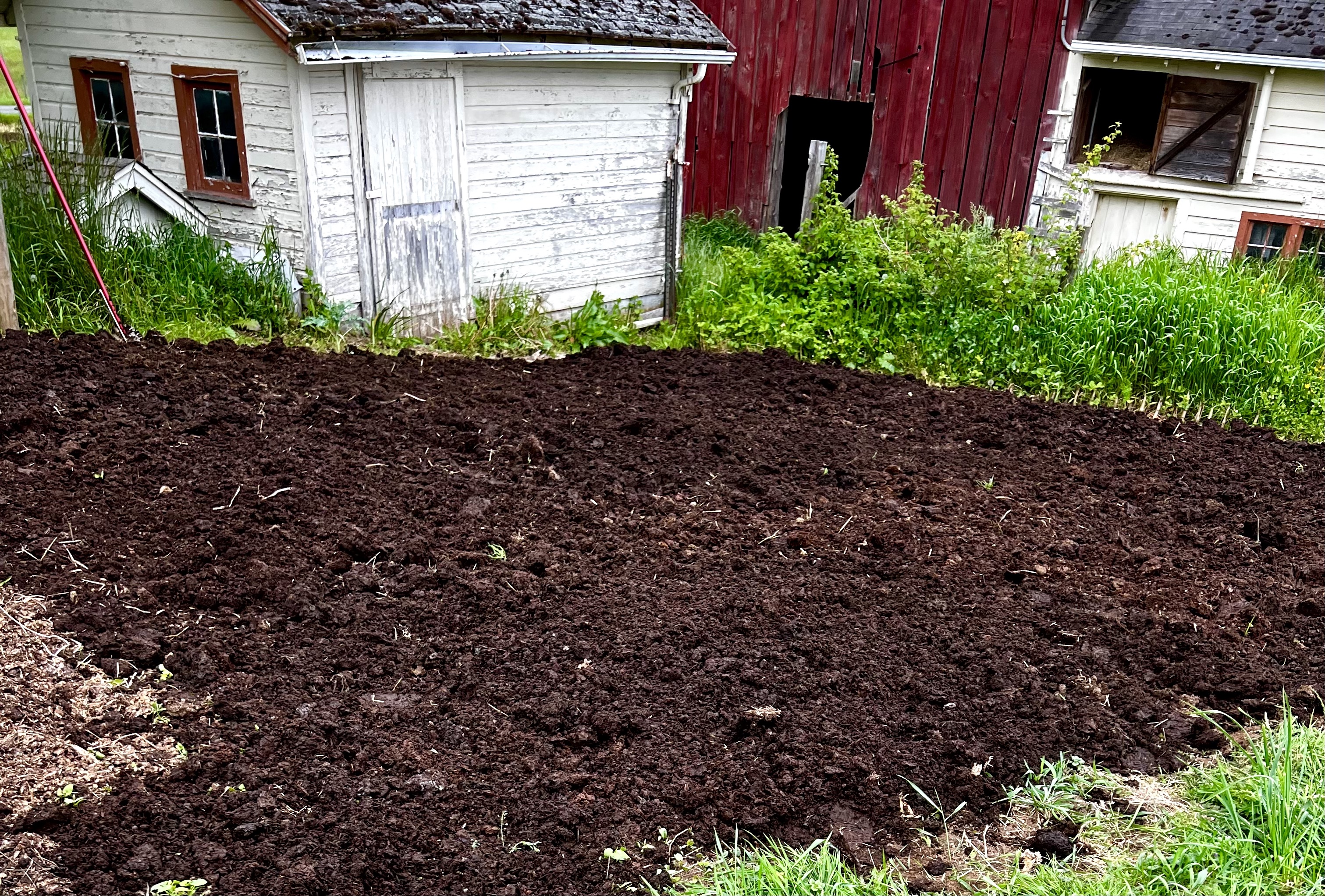
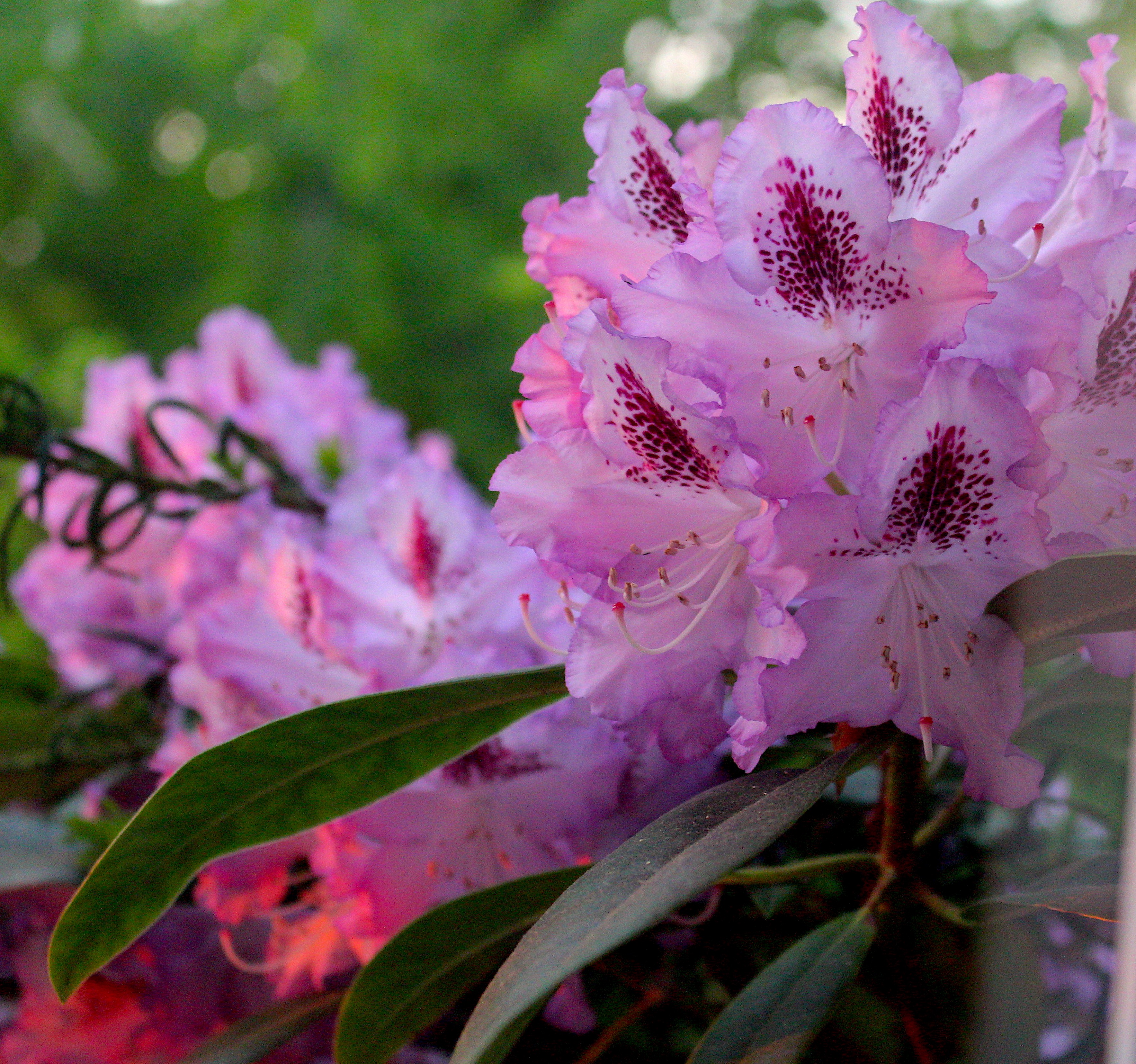
One day, something very old happened again. The green came back to the branches, settling like leafy birds on the highest twigs; the ground broke open as dark as coffee beans.
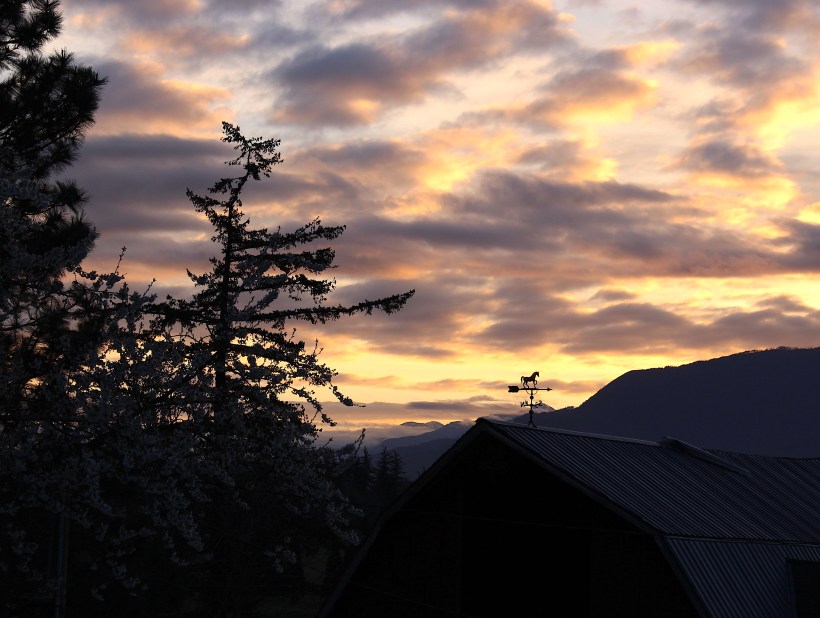
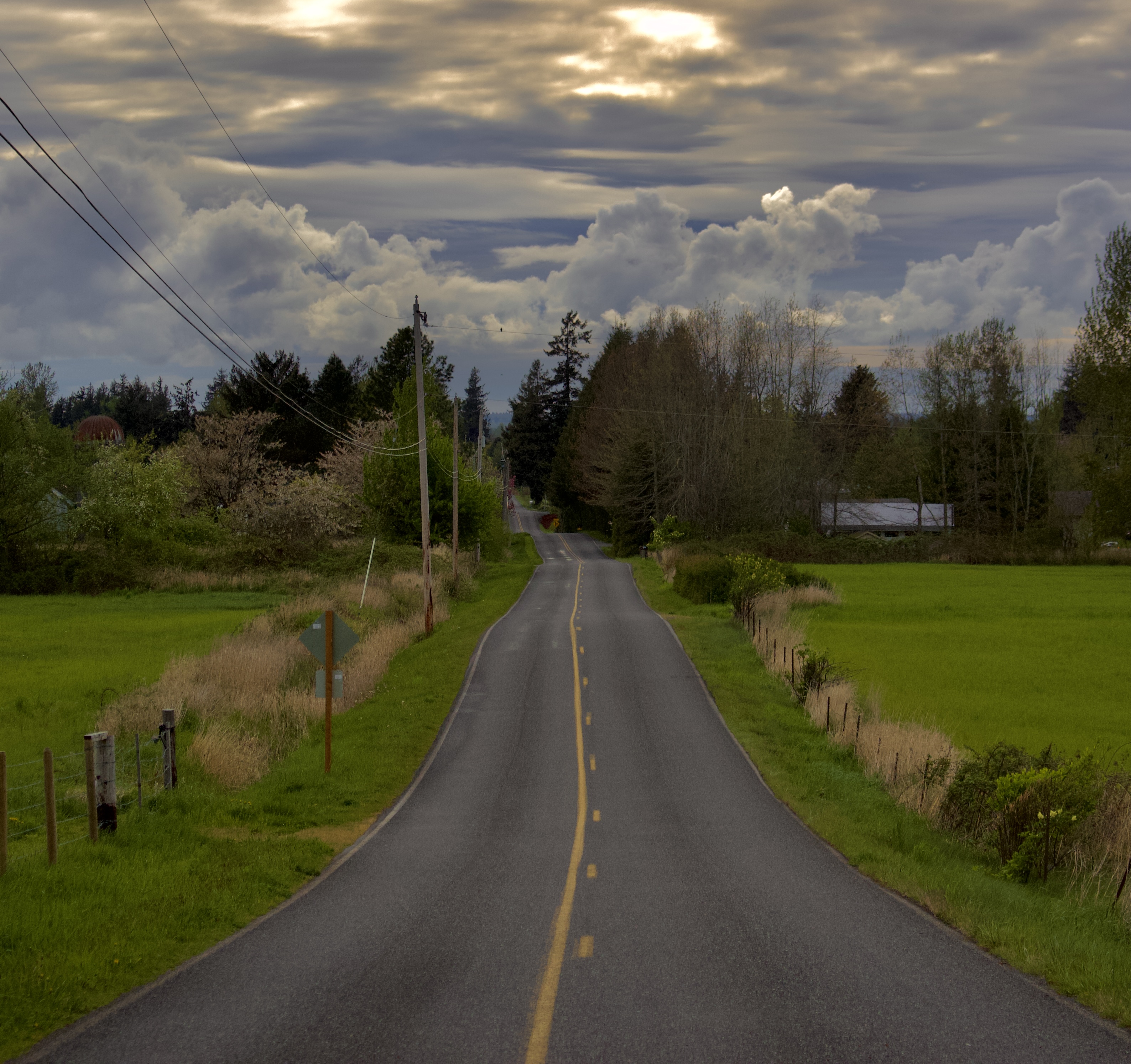
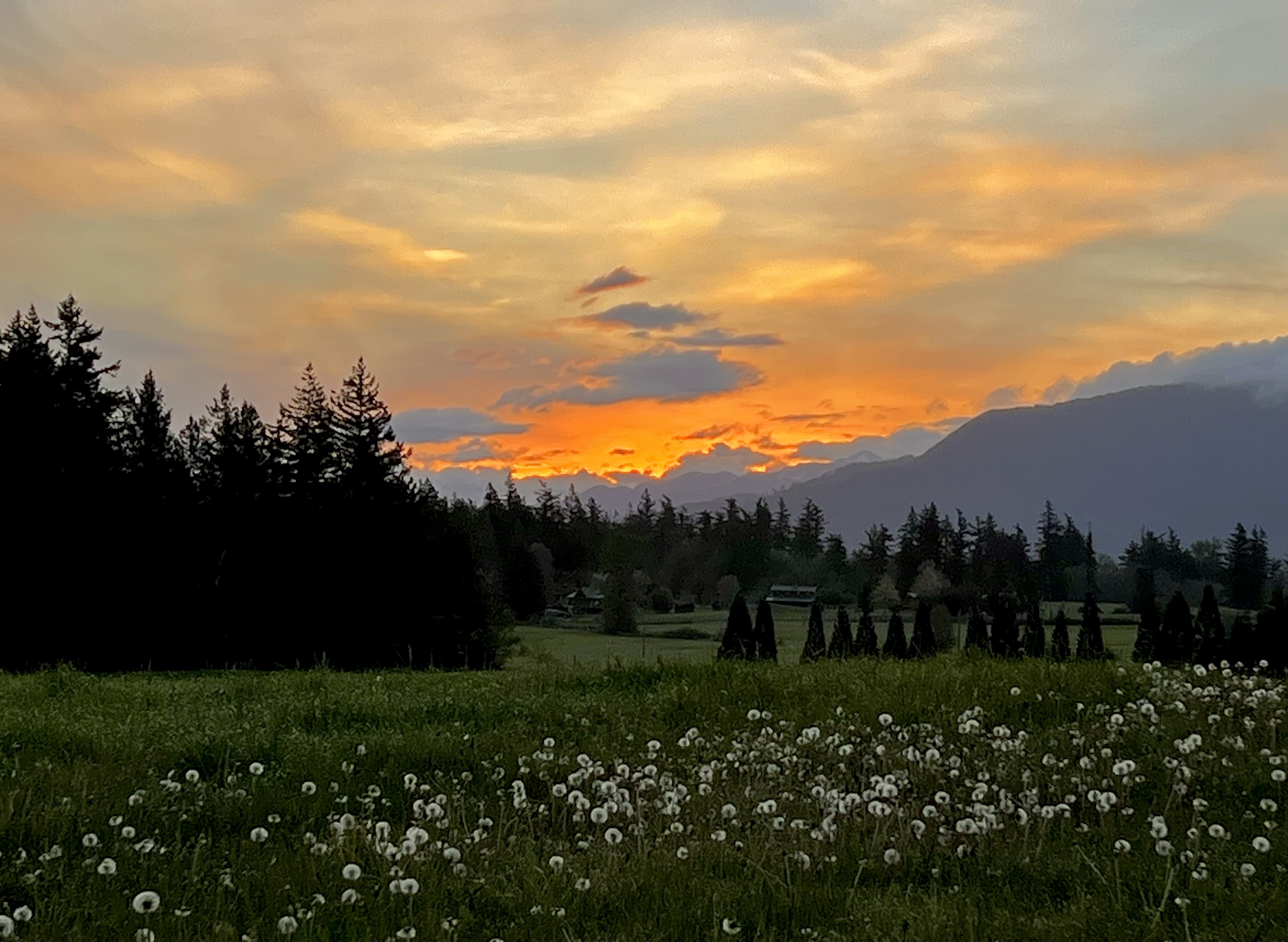
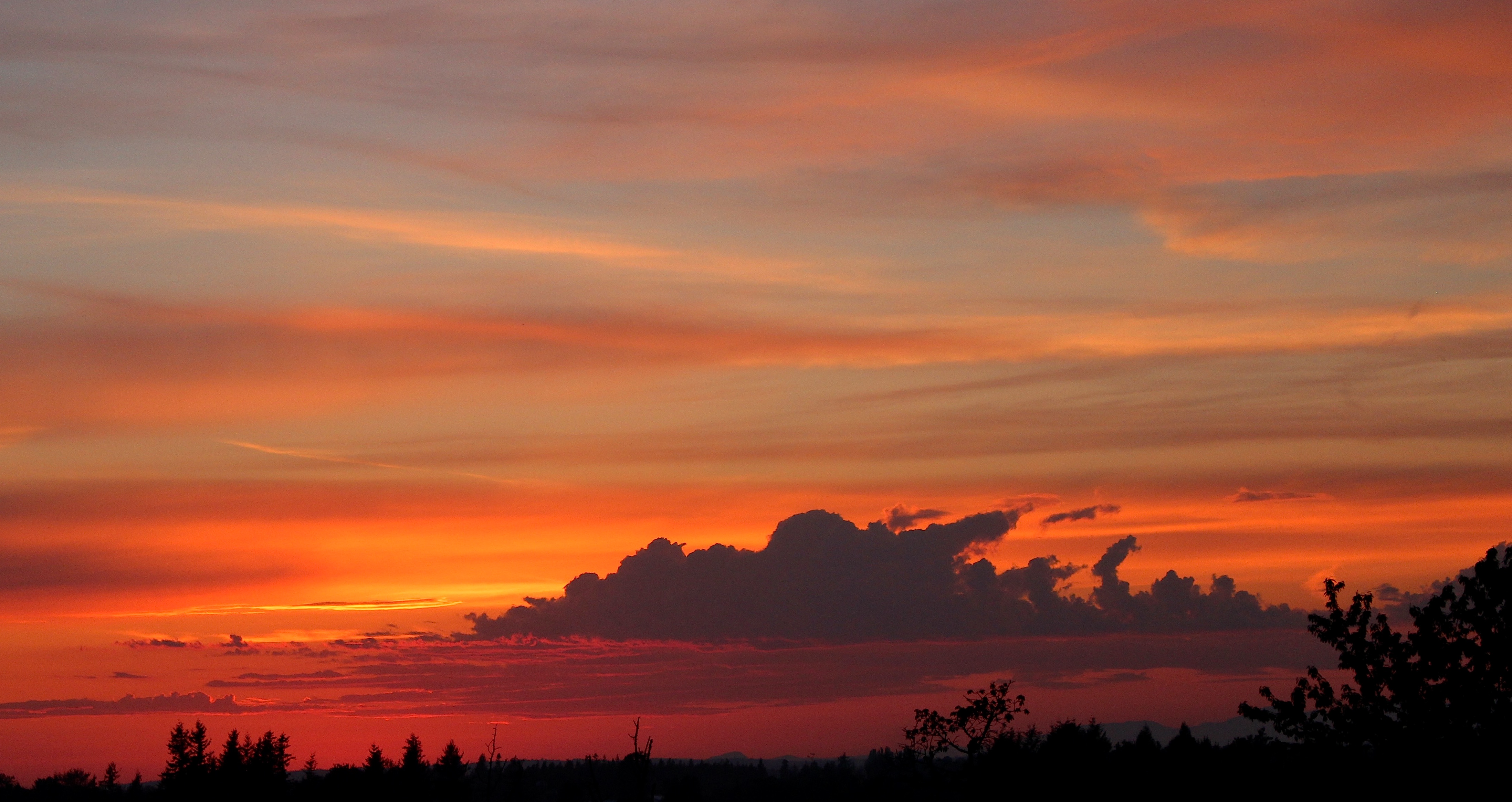
The clouds took up their positions in the deep stadium of the sky, gloving the bright orb of the sun before they pitched it over the horizon.
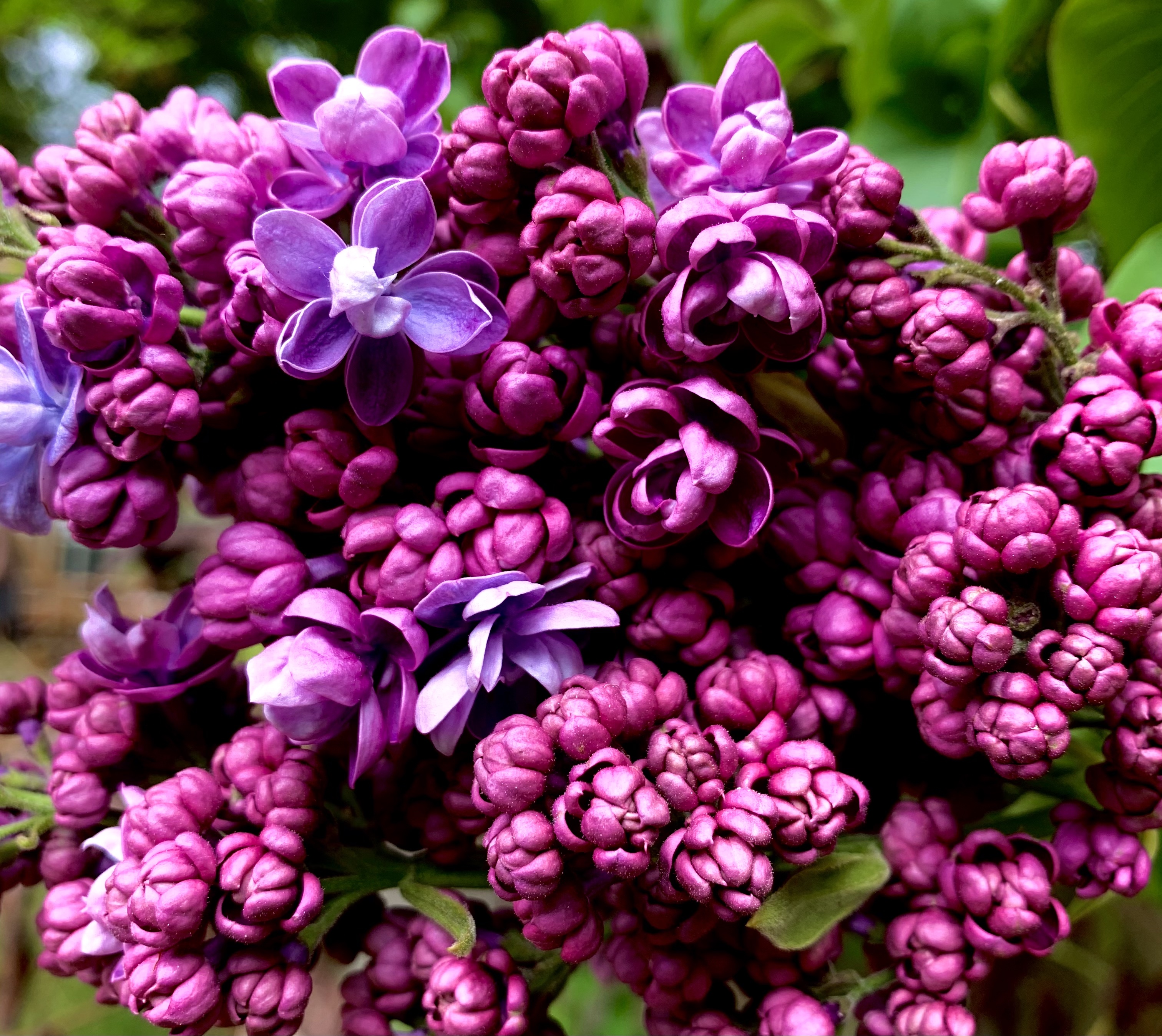
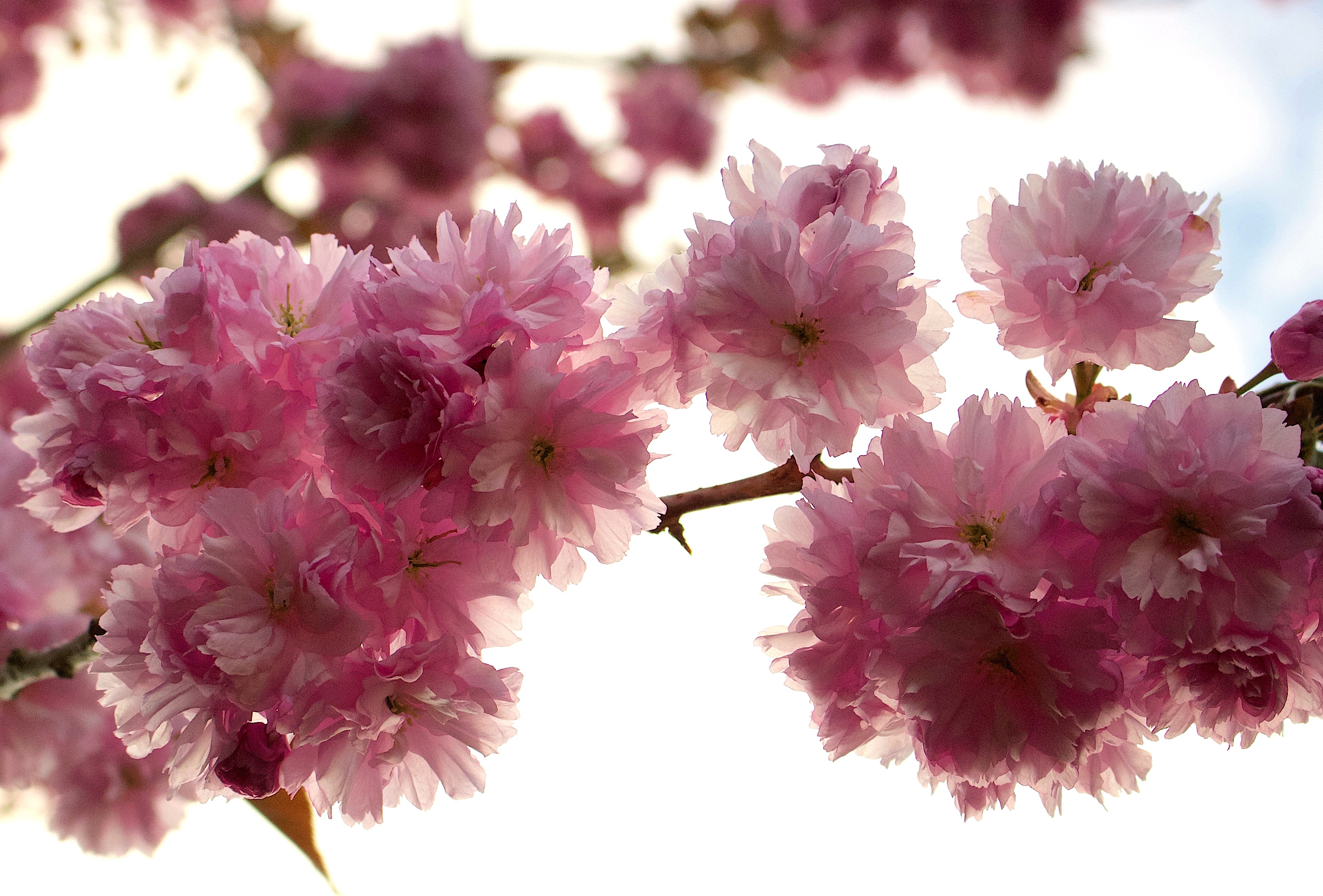
It was as good as ever: the air was filled with the scent of lilacs and cherry blossoms sounded their long whistle down the track


















 Barnstorming