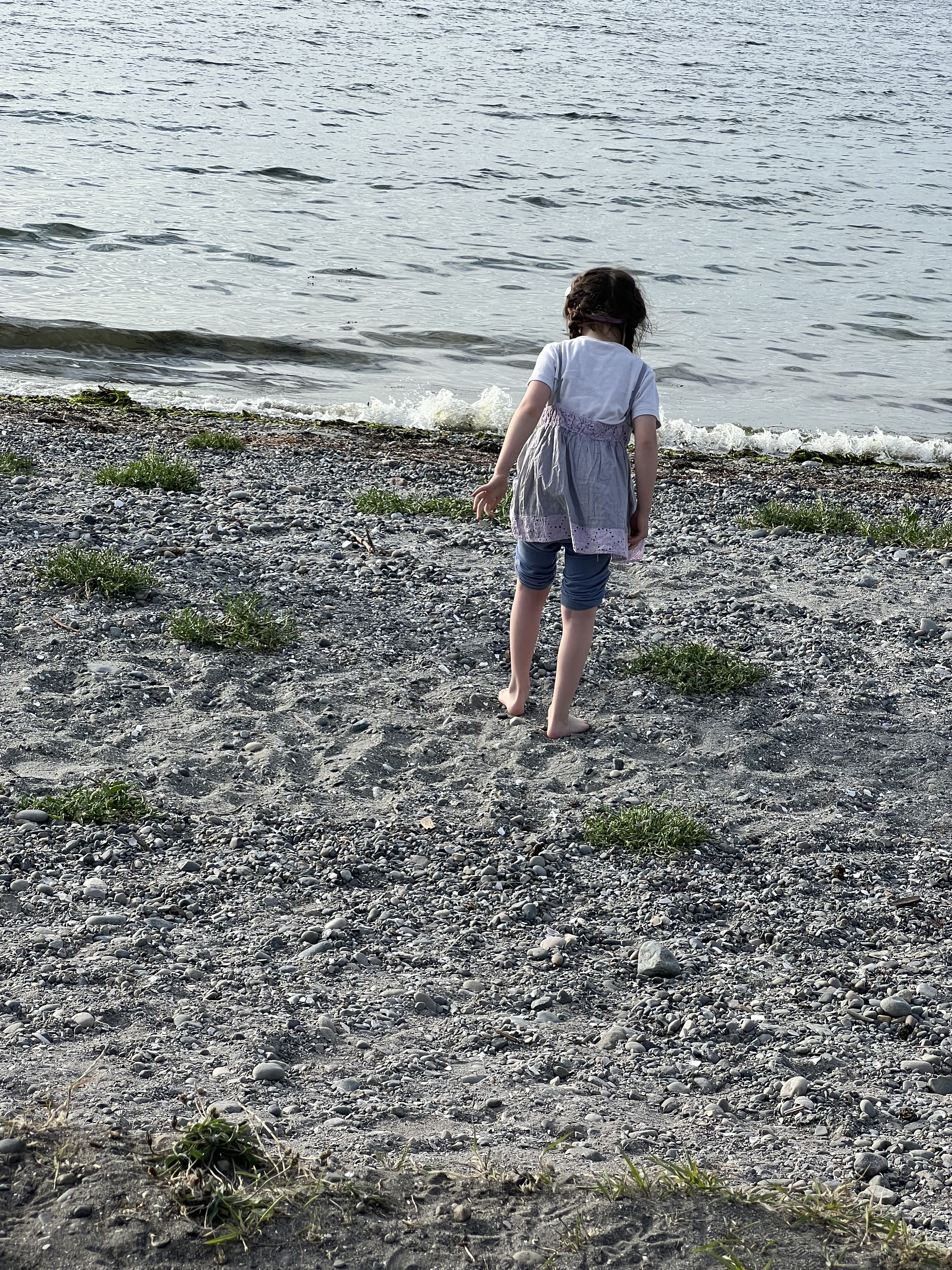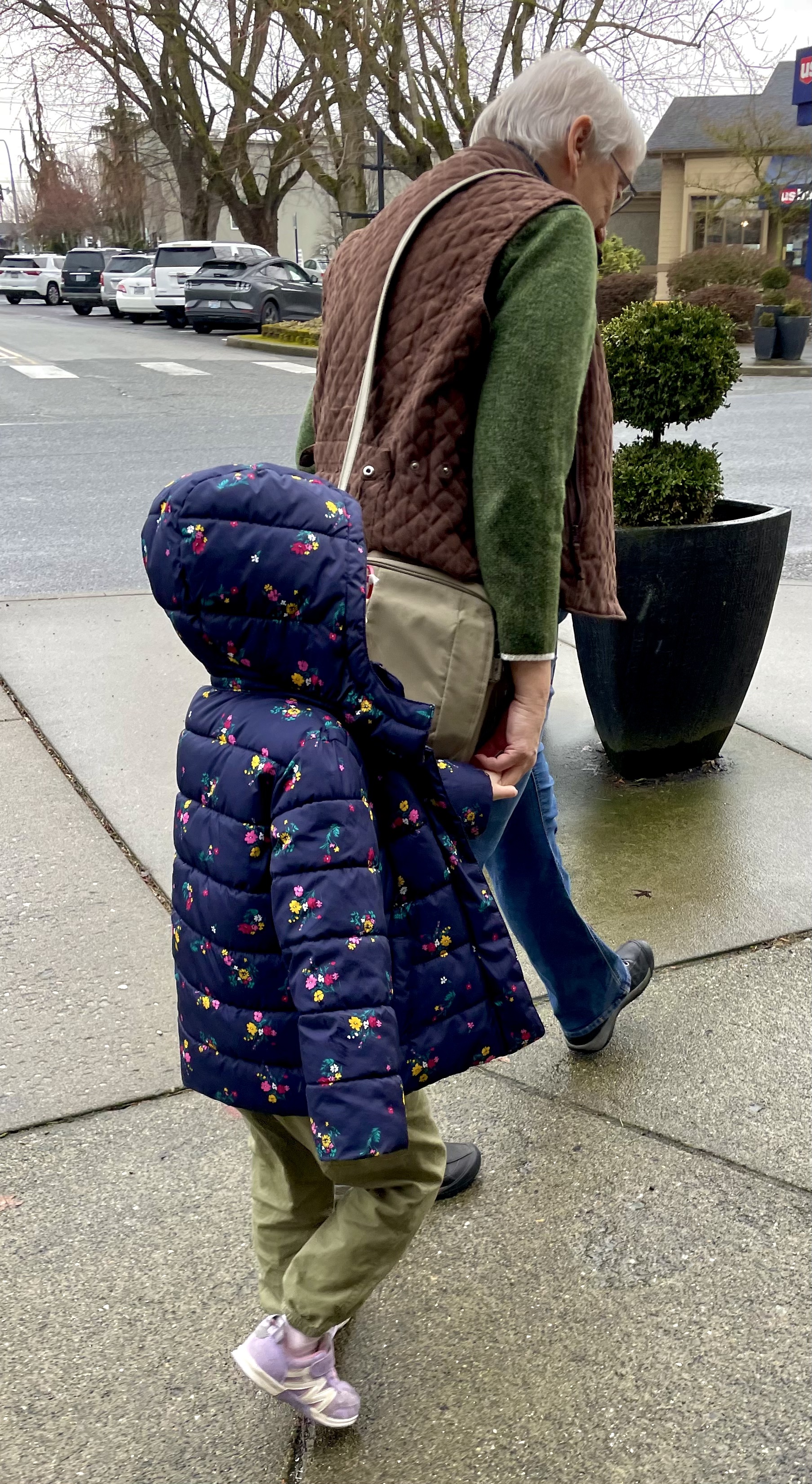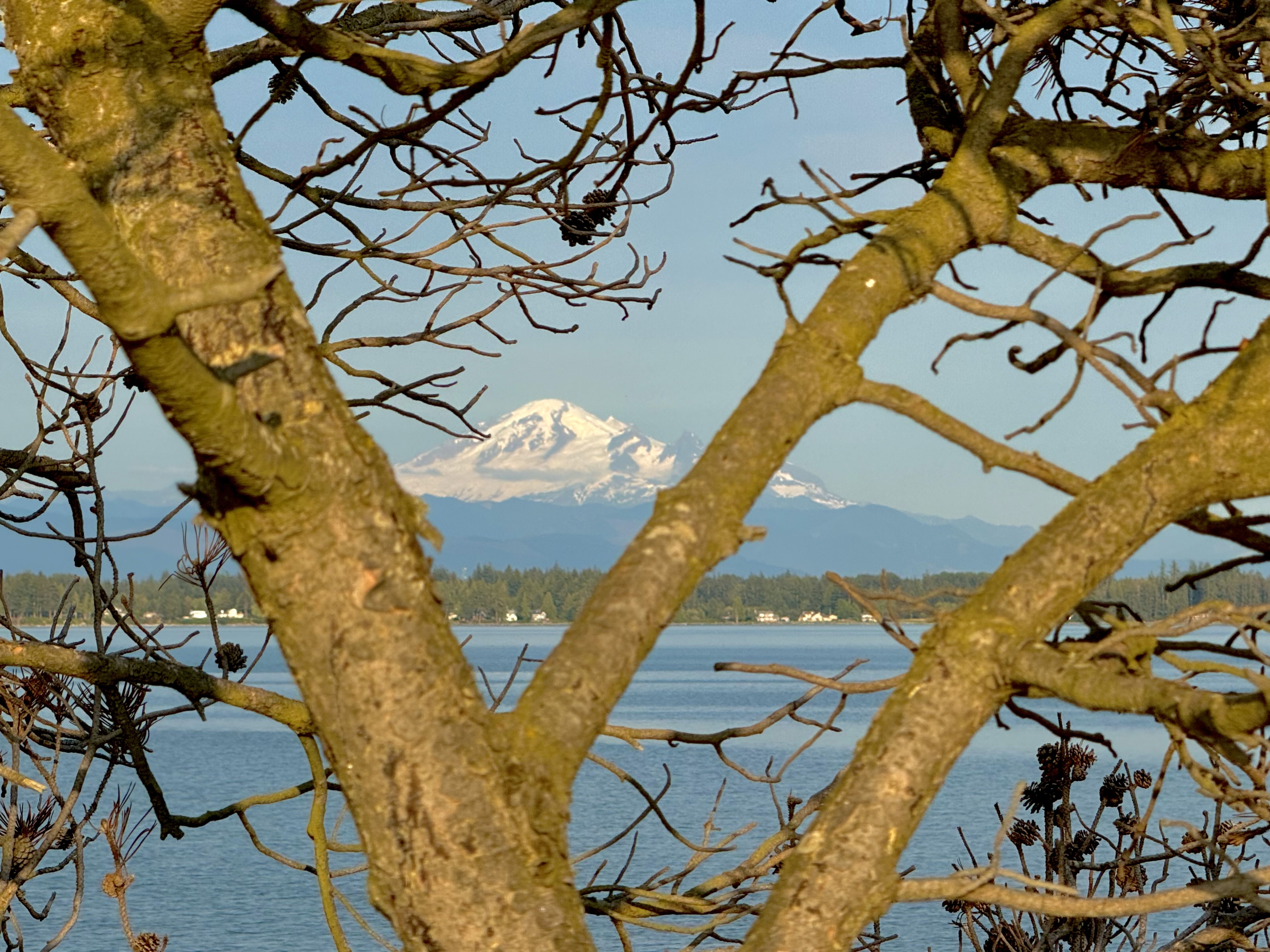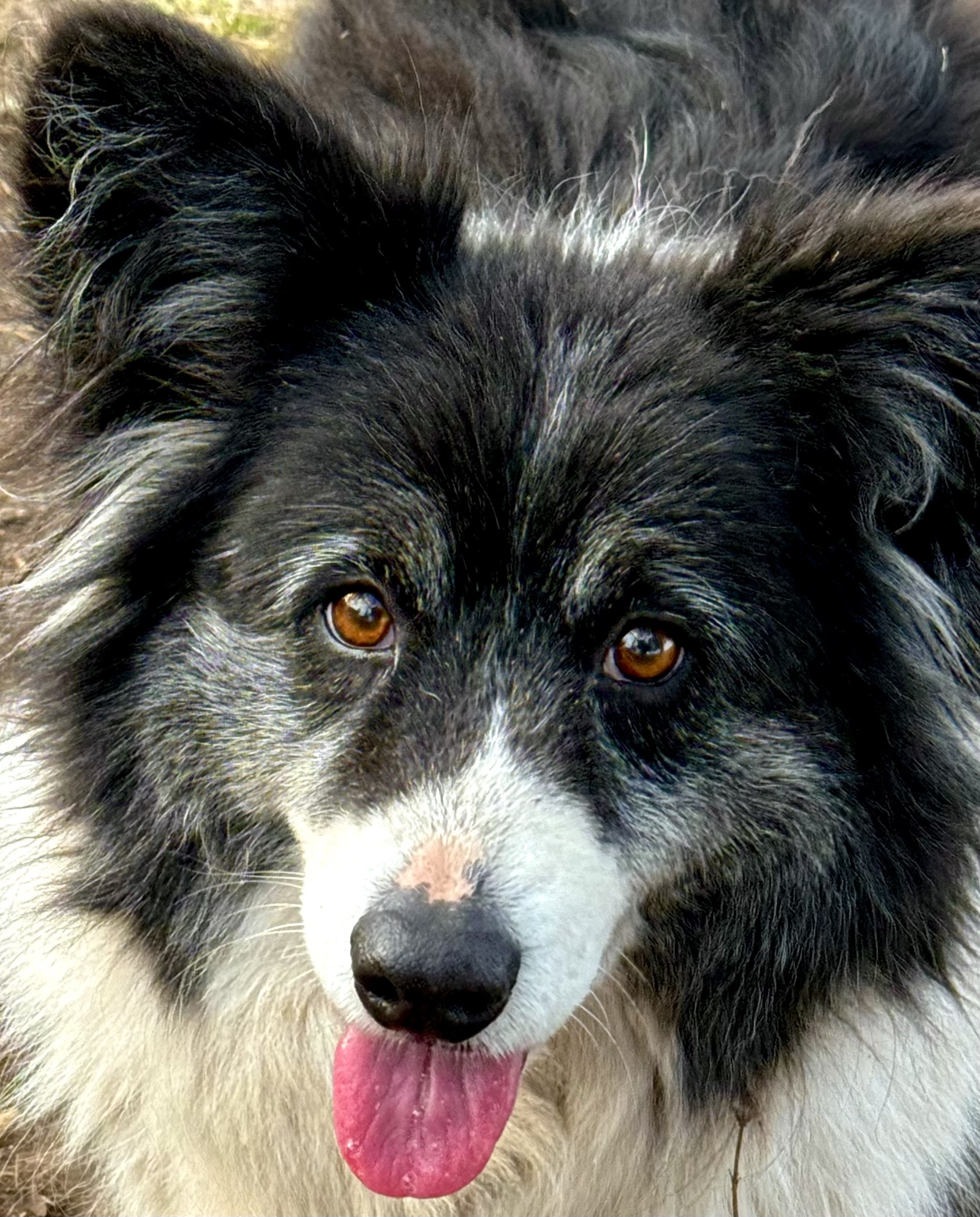
We walked downhill to the beach, her hand in mine, small step after small step. She said Hi to the doggie on the leash, Hi Mommy to a woman passing on the street, Hi Daddy to a bearded man. On the sand, she stared transfixed at the water, the slight waves, the tide not yet pulling out. She looked up toward a flap of wings. Bird, I said, pointing at the seagull, and she mimicked, Bird, then turned her gaze back to the waves’ slow slapping. Later I sat, looking at trees below me, a hint of haze burning off the far bay, the world busy working and sailing, waking, while I sat waiting as Evie napped that quiet Maine morning, the full tide of grandmotherhood lapping my shore. ~Laura Foley, “Full Tide” from It’s This
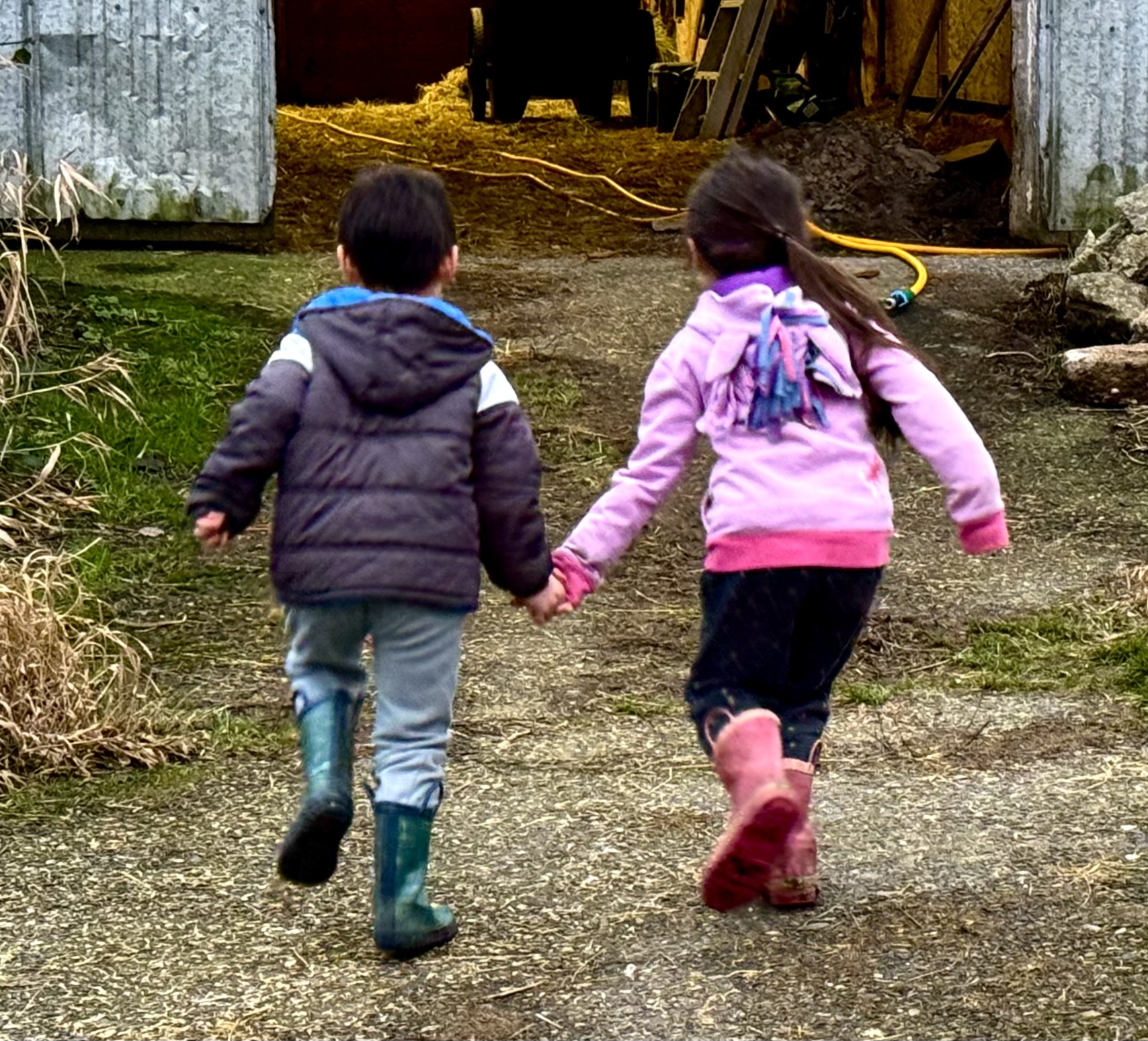
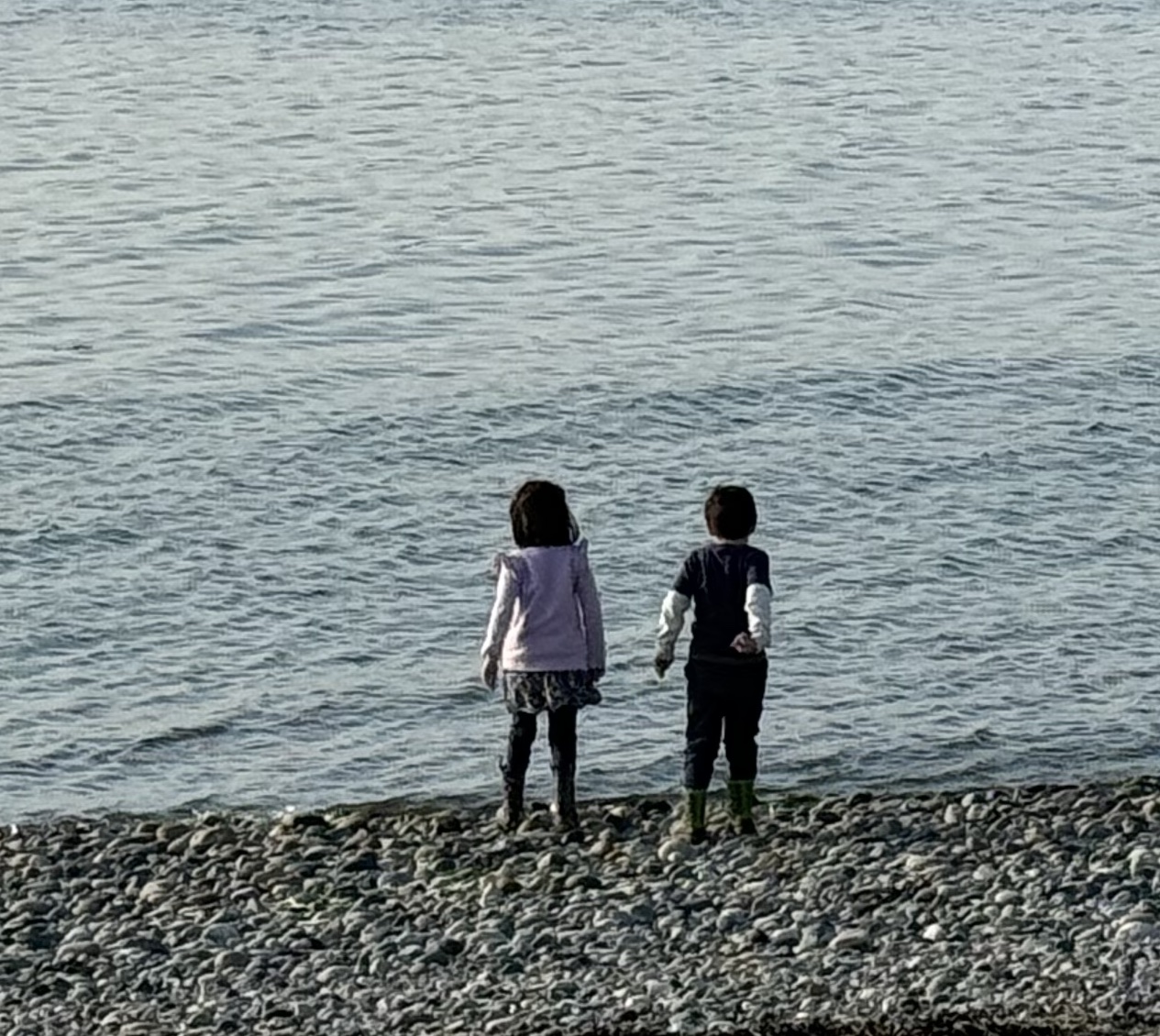
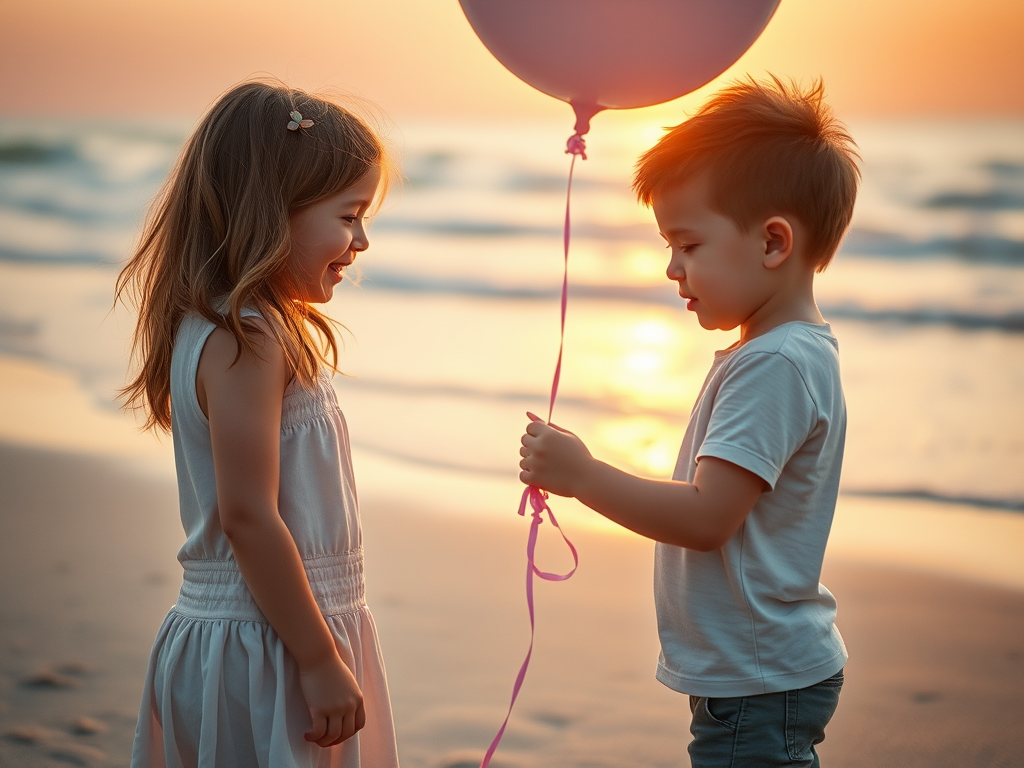
They each carried a balloon from a special event for kids and their families.
It had been a morning of our family being together, just because. Being a grandparent needs no other reason other than “just because.”
Big sister was saying how she planned to take her balloon to school on Monday to show her friends. She was enjoying the balloon’s bobbing and weaving in the air … until suddenly it popped, causing her to jump and then she had nothing left but tatters in her hand.
Her face crumpled and the tears began to flow.
Little brother gripped his balloon more tightly, looking at his sister’s tears and worrying the same thing might happen to his balloon. His face contorted, ready to cry right along with her. And then there was a moment of clarity and insight in his eyes.
He handed his balloon to her. He said, “here, you can have mine.” And though he was clearly sad at the thought of having no balloon himself, his eyes were shining with proud tears.
He had discovered what it meant to sacrifice, to comfort and care for someone he loved.
She was speechless. She held his balloon gently, struggling to know how to respond. If it was even possible, she loved him so much more in that moment.
So their parents said to her brother, “we think that gift deserves stopping for a hot chocolate on the way home.”
Big sister looked at her parents, looked again at her little brother, and handed the balloon back to him, saying “why don’t we share?”
Hot chocolate makes all things wonderful and cozy and better, when shared.
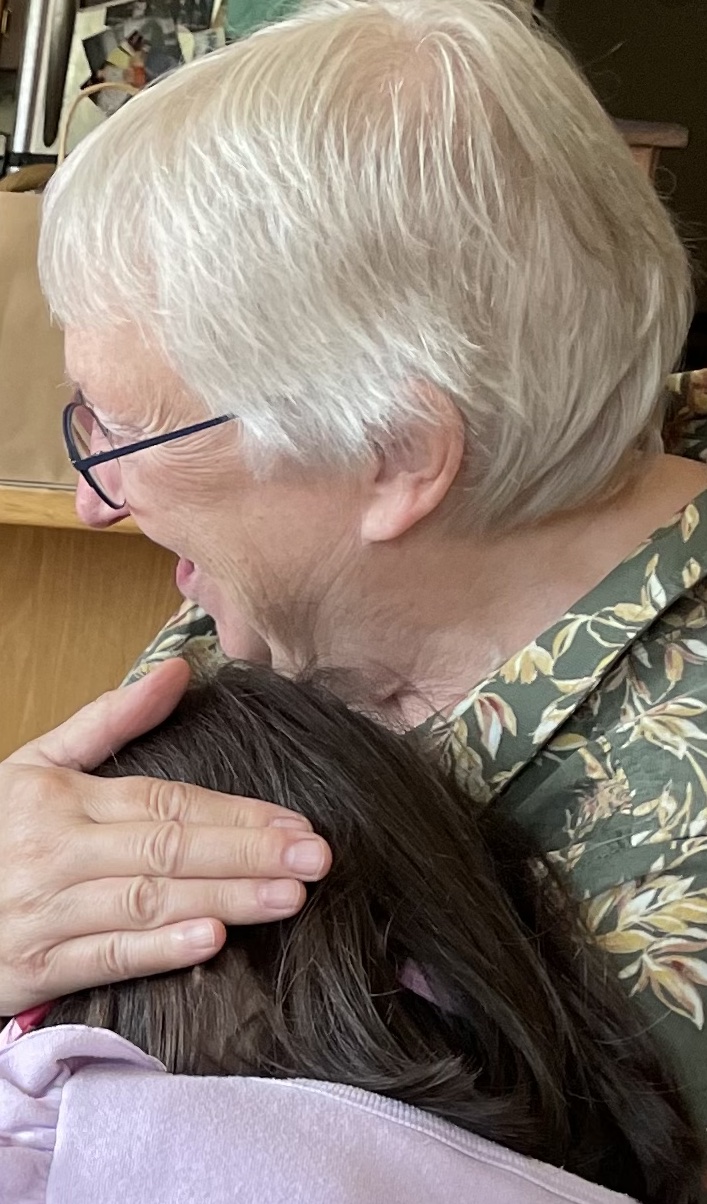
Especially for weeping, laughing, full-to-the-brim-with-love grandparents.
AI image created for this post
One-Time
Monthly
Yearly
Make a one-time or recurring donation to support daily Barnstorming posts
(I wrote this 15 years ago on July 6 and have updated it with an addendum)
I remember childhood summers as 3 months of full-out celebration– long lazy days stretching into nights that didn’t seem to really darken until 11 PM and bright birdsong mornings starting out at 4:30 AM. Not only were there the brief family vacations at the beach or to visit cousins, but there was the Fourth of July, Daily Vacation Bible School, the county fair, family reunions, and of course and most importantly, my July birthday. Yes, there were mundane chores to be done, a garden to tend, a barn to clean, berries to pick, a lawn to mow and all that stuff, but my memories of summer are mostly about fluff and frolic.
So where are the summer parties now? Who is out there celebrating without me? Nothing seems to be spontaneous as it was when I was a child. Instead, most grown-ups have to go to work most days in the summer.
I’m finding myself in the midst of my 55th summer and I have to create celebrations if they are going to happen in my life. Without that perspective, the bird song at 4:30 AM can feel more irritant than blessing and the long days often mean I fall asleep nodding over a book at 9 PM. I want to treasure every, every minute of this precious time yet they flow through my fingers like so much water, faster and faster.
I realize there will be very few “family” summers left as I watch my children grow into adults and spread their wings. They will be on to new adventures in future summers. So each family ritual and experience together takes on special meaning and needs to be appreciated and remembered.
So….for this summer my family has crammed as much in as we can in celebration of the season:
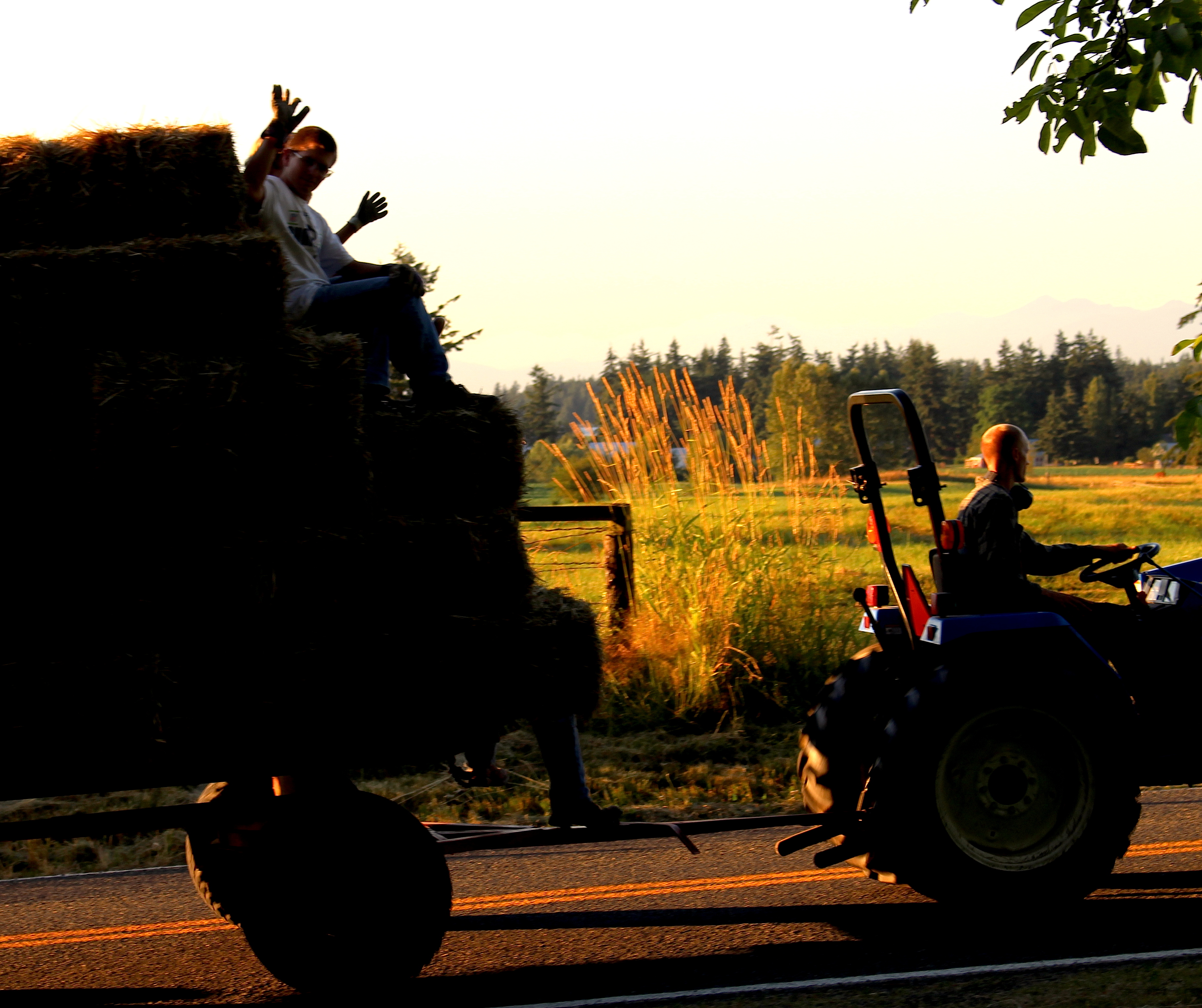
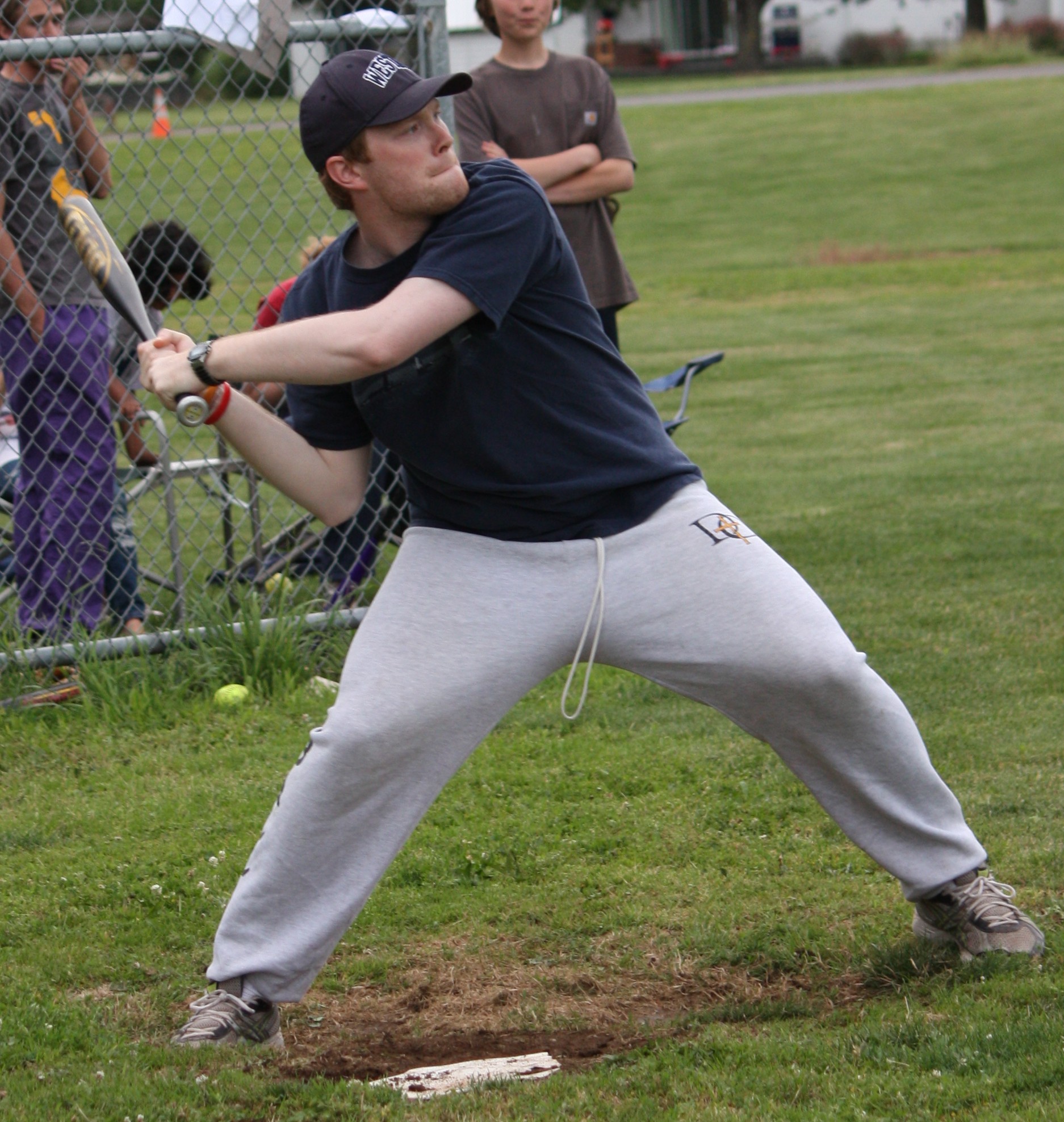
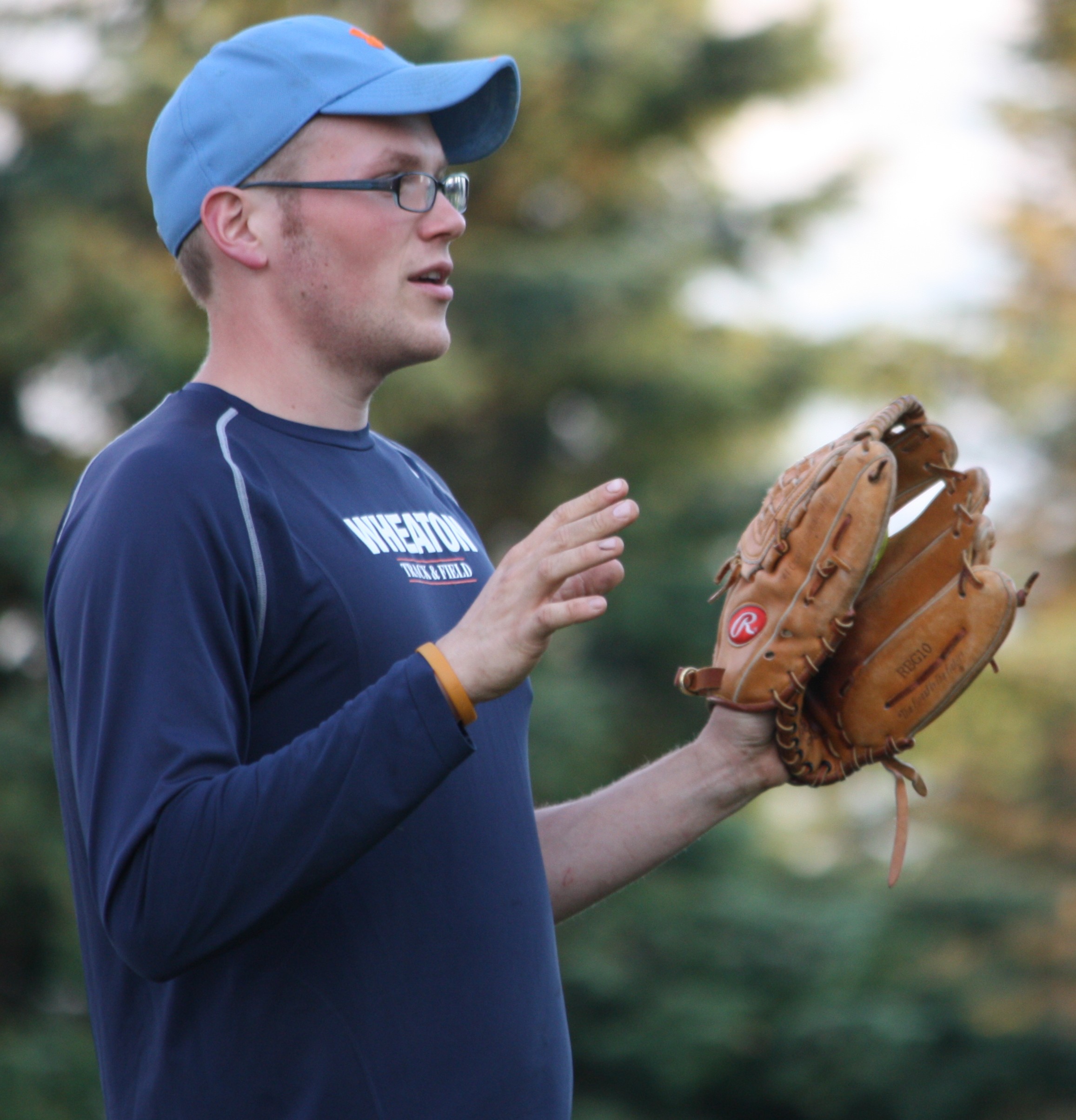
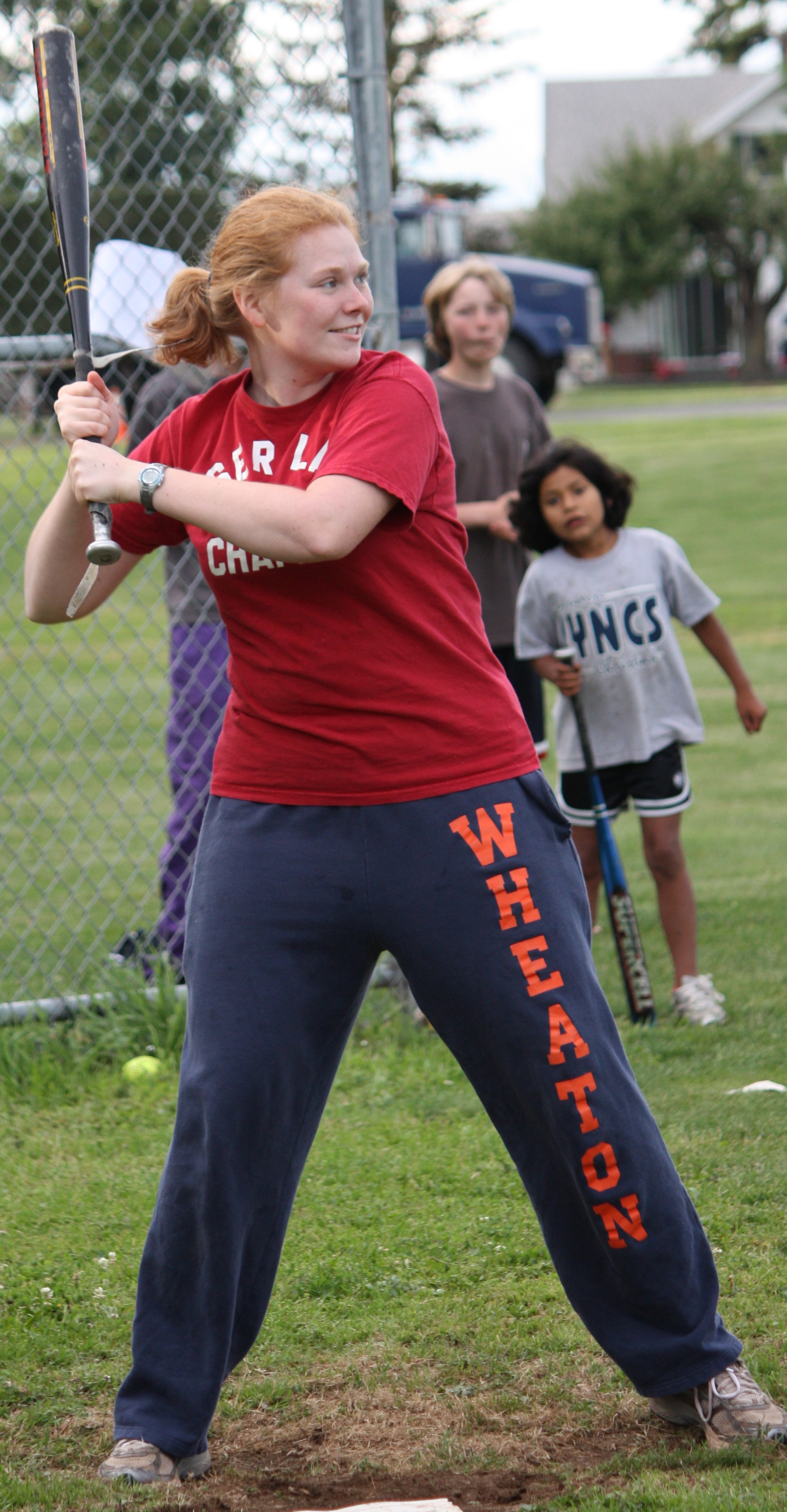
We just spent some time in the hayfields bringing in the bales with friends–our little crew of seven–sweating and itchy and exhausted, but the sight and smell of several hundred hay bales, grown on our own land, harvested without being rained on and piled in the barn is sweet indeed. Weekly we are out on the softball field in church league, yelling encouragement and high-fiving each other, hooting at the good hits and the bad, the great catches and the near misses, and getting dirty and sprained, and as happy to lose as to win. We had a wonderful July 4 barbeque with good friends culminating in the fireworks show on our farm’s hill overlooking miles of valley around us, appreciating everyone else’s backyard displays as well as our own.
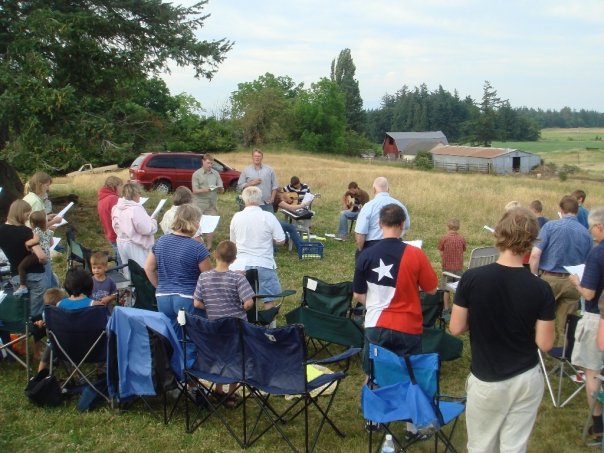
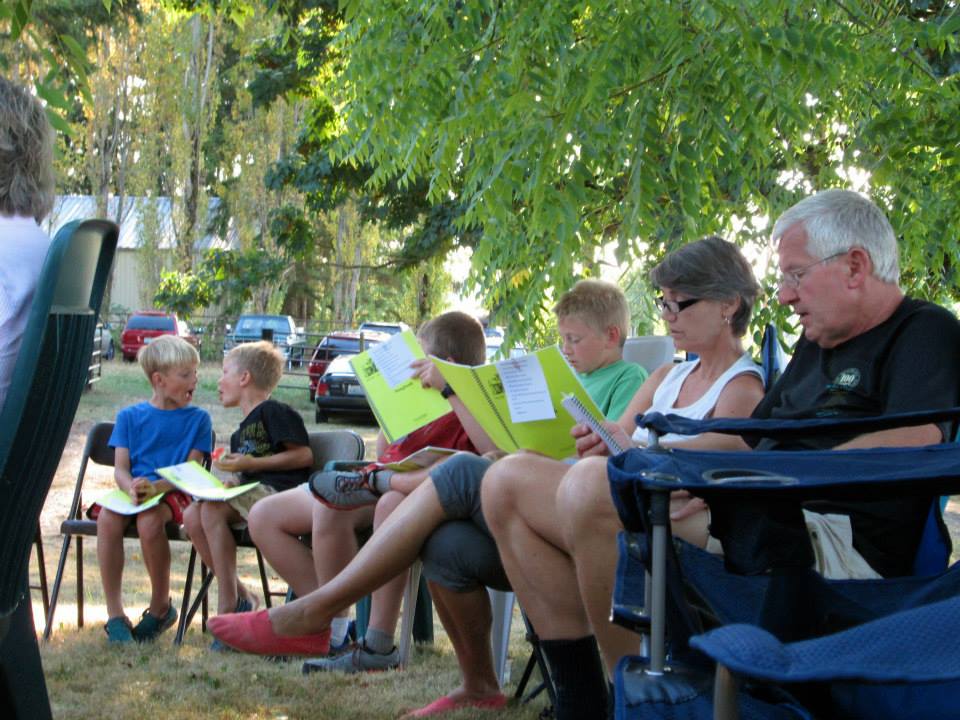
We are now able to sing hymns in church in four part harmony, and last night our children helped lead the singing last night in an evening “campfire church” for over fifty fellow worshipers on our hill. In a couple weeks, we’ll take to the beach for three days of playing in the sand, roasting hot dogs. reading good books, and playing board games. We’ll try to make the trek down to Seattle by train to spend the day watching the Mariners play (and likely lose).
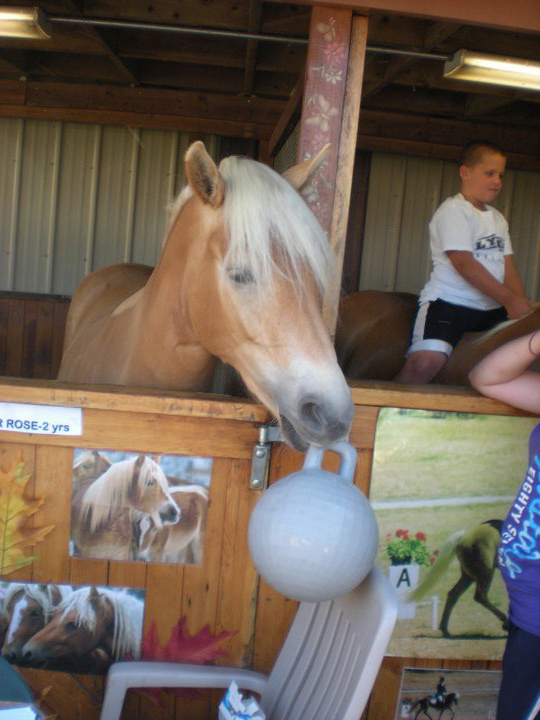
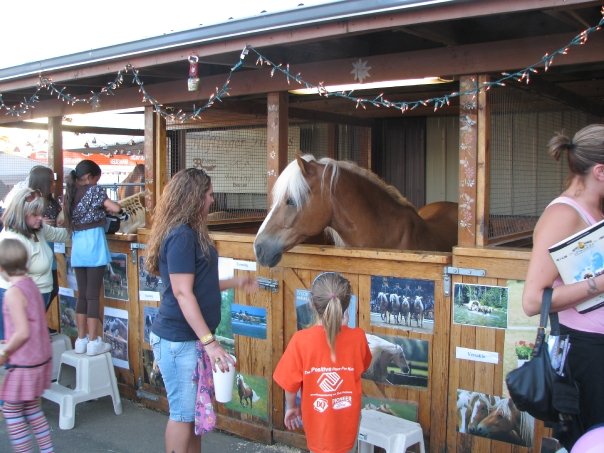
One change after seventeen years of hosting a display of our horses at the Lynden Fair: due to “off the farm” work and school schedules, we can’t muster the necessary round-the-clock crew of being there for our little part of small town agricultural pursuits.
Yet the real party happens right here every day in small ways without any special planning. It doesn’t require money or special food or traveling beyond our own soil. It is the smiles and good laughs we share together, and the hugs for kids taller than I am. It’s adult conversations with the new adults in our family–no longer adolescents.
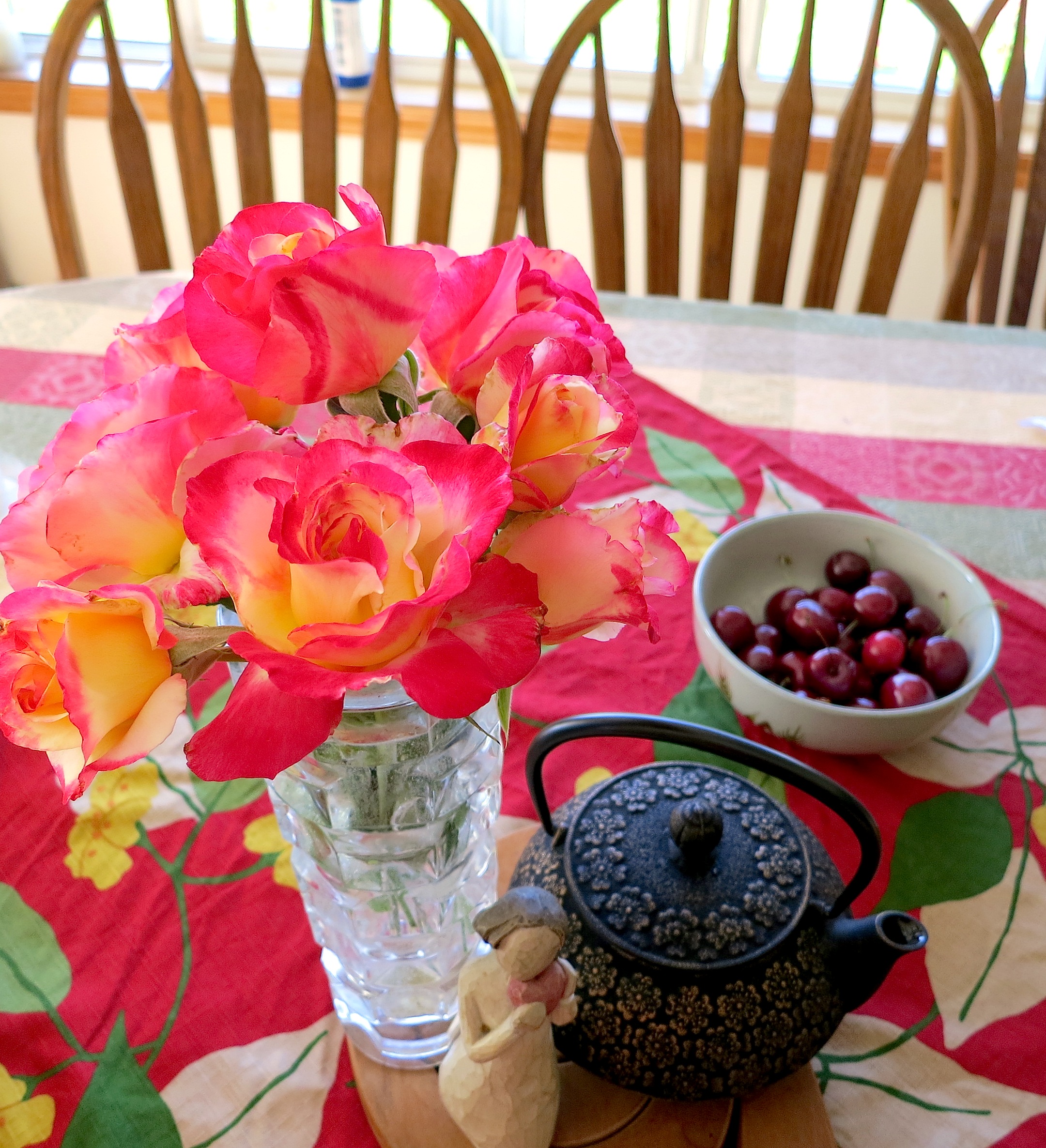
It’s finding delight in fresh cherries from our own trees, currants and berries from our own bushes, greens from the garden, flowers for the table from the yard.
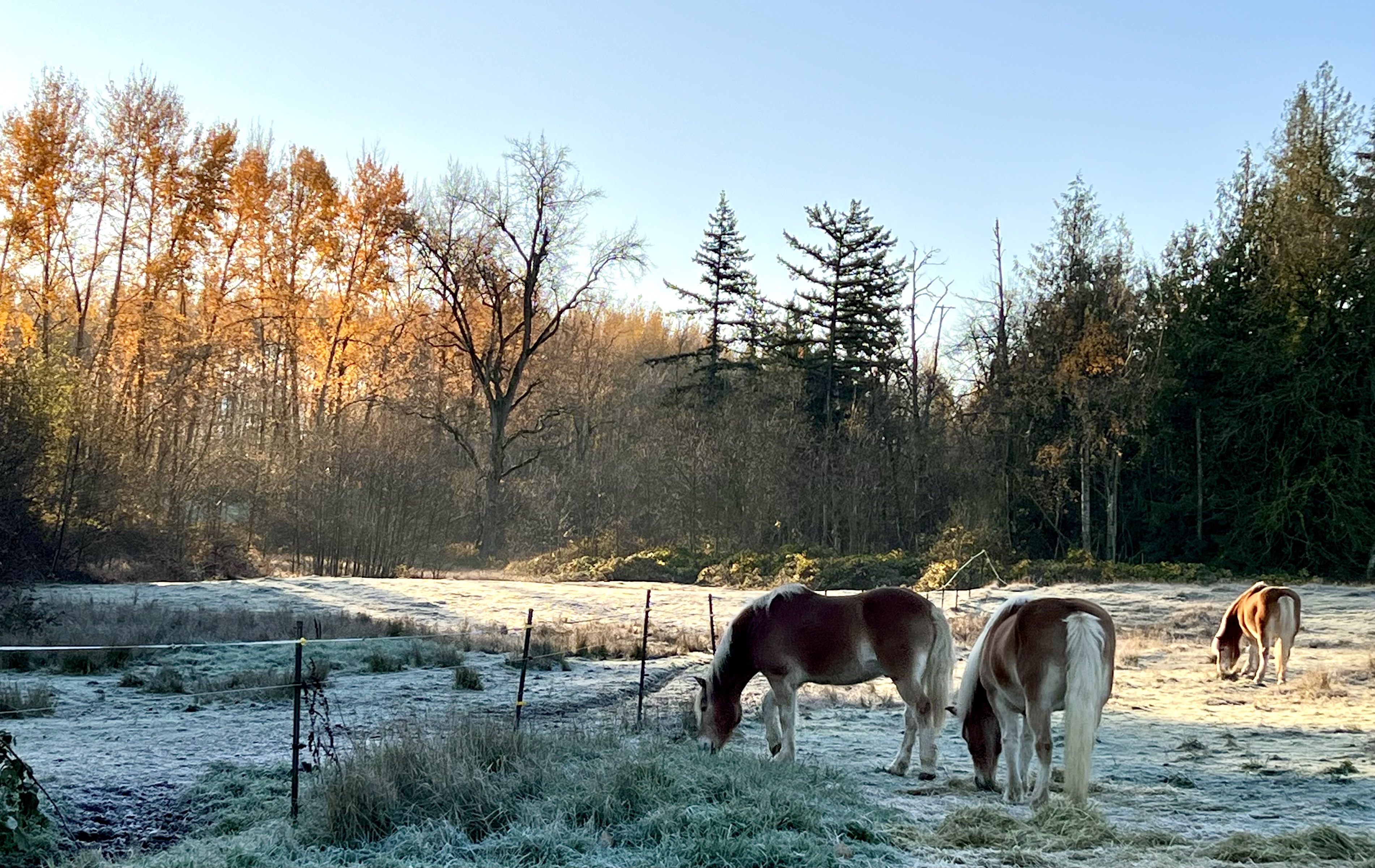
It is the Haflingers in the field that come right up to us to enjoy rubs and scratches and follow us like puppies. It is babysitting for neighborhood toddlers who remind us of the old days of having small children, and who give us a glimpse of future grandparenthood. It is good friends coming from far away to ride our horses and learn farm skills.
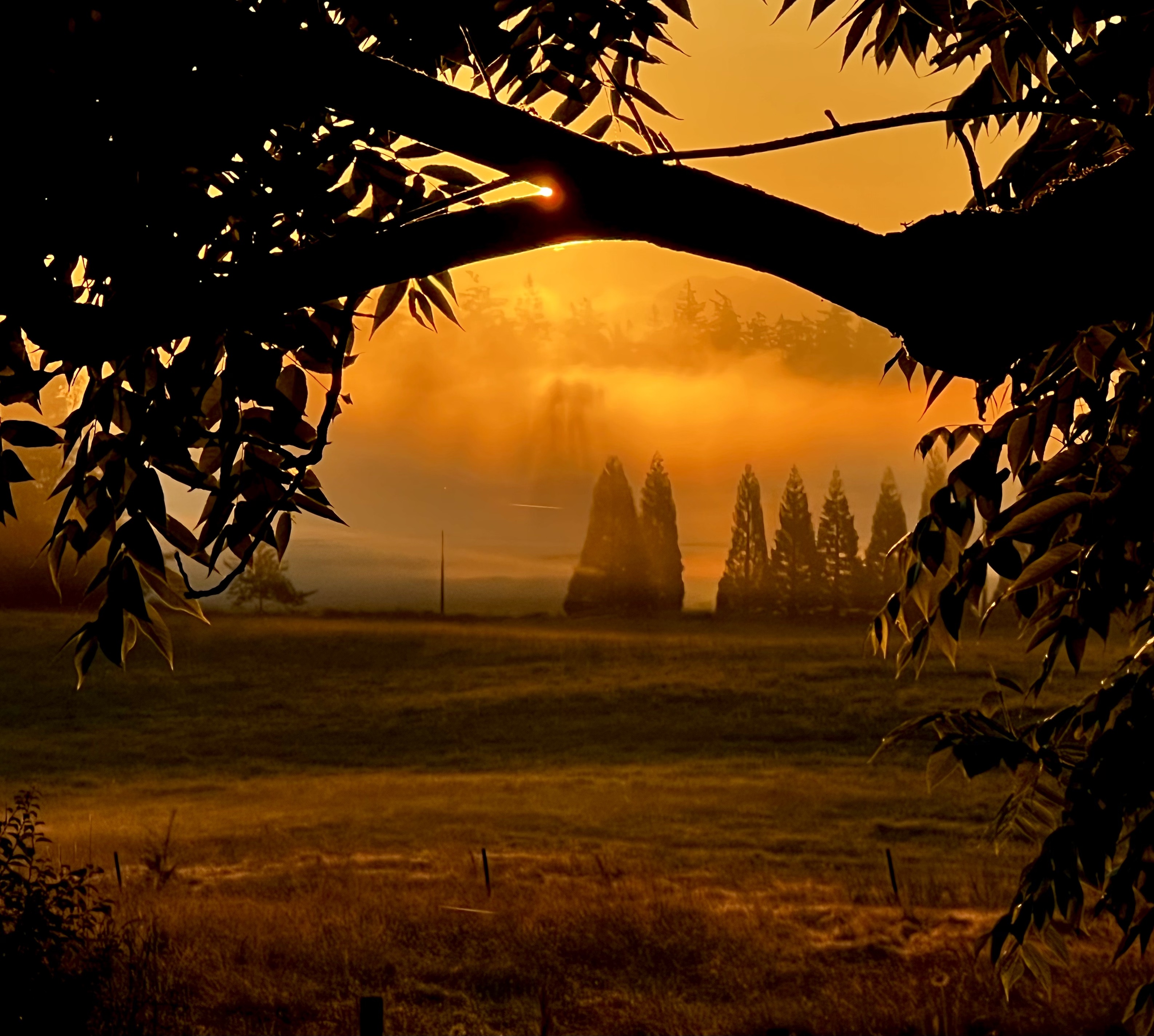
It is an early morning walk in the woods or a late evening stroll over the hills. It is daily contact with aging parents who no longer hear well or feel well but nevertheless share of themselves in the ways they are able. It is the awesome power of an evening sunset filled with hope and the calming promise of a new day somewhere else in this world of ours.

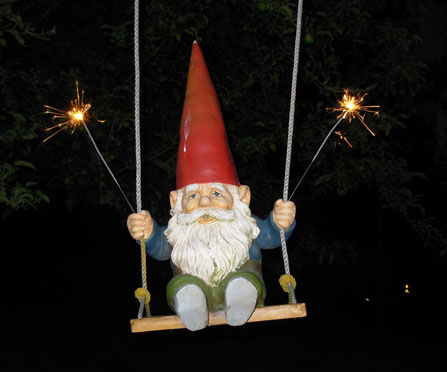
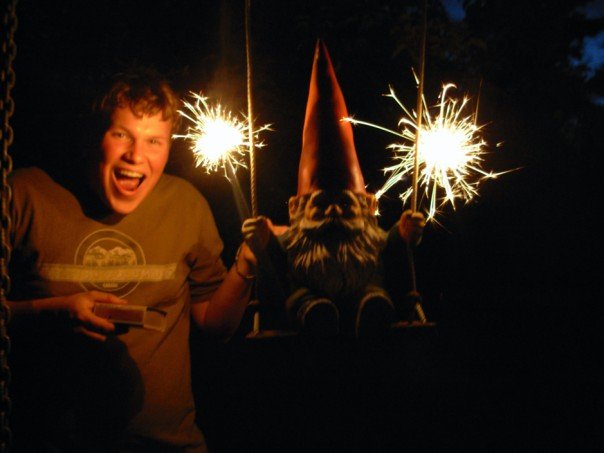
Some days may not look or feel like there’s a summer party happening, but that is only because I haven’t searched hard enough. The party is here, sparklers and all, even if only in my own mind.
Addendum: Fifteen years have passed since this was written and I’m glad I can look back and be reminded how full of life those family summers were. We seldom have the full-meal-deal of everyone together at one time, and since our parents have passed on to eternal summers in heaven, we have now the blessings of six grandchildren. Freckles abound!
We still can make a party happen, if only in our own minds.
AI image created for this post
One-Time
Monthly
Yearly
Make a one-time or recurring donation to support daily Barnstorming posts
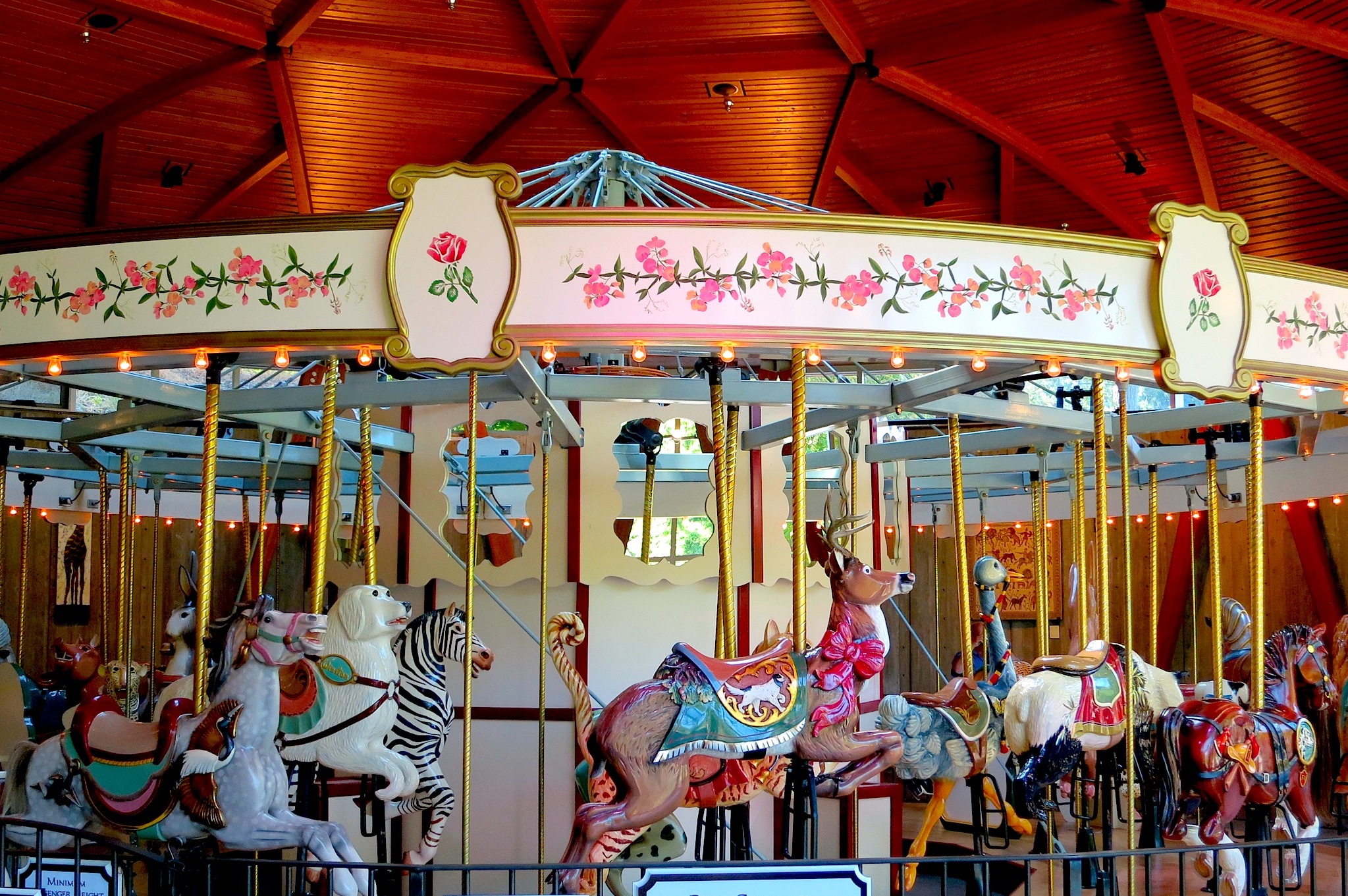
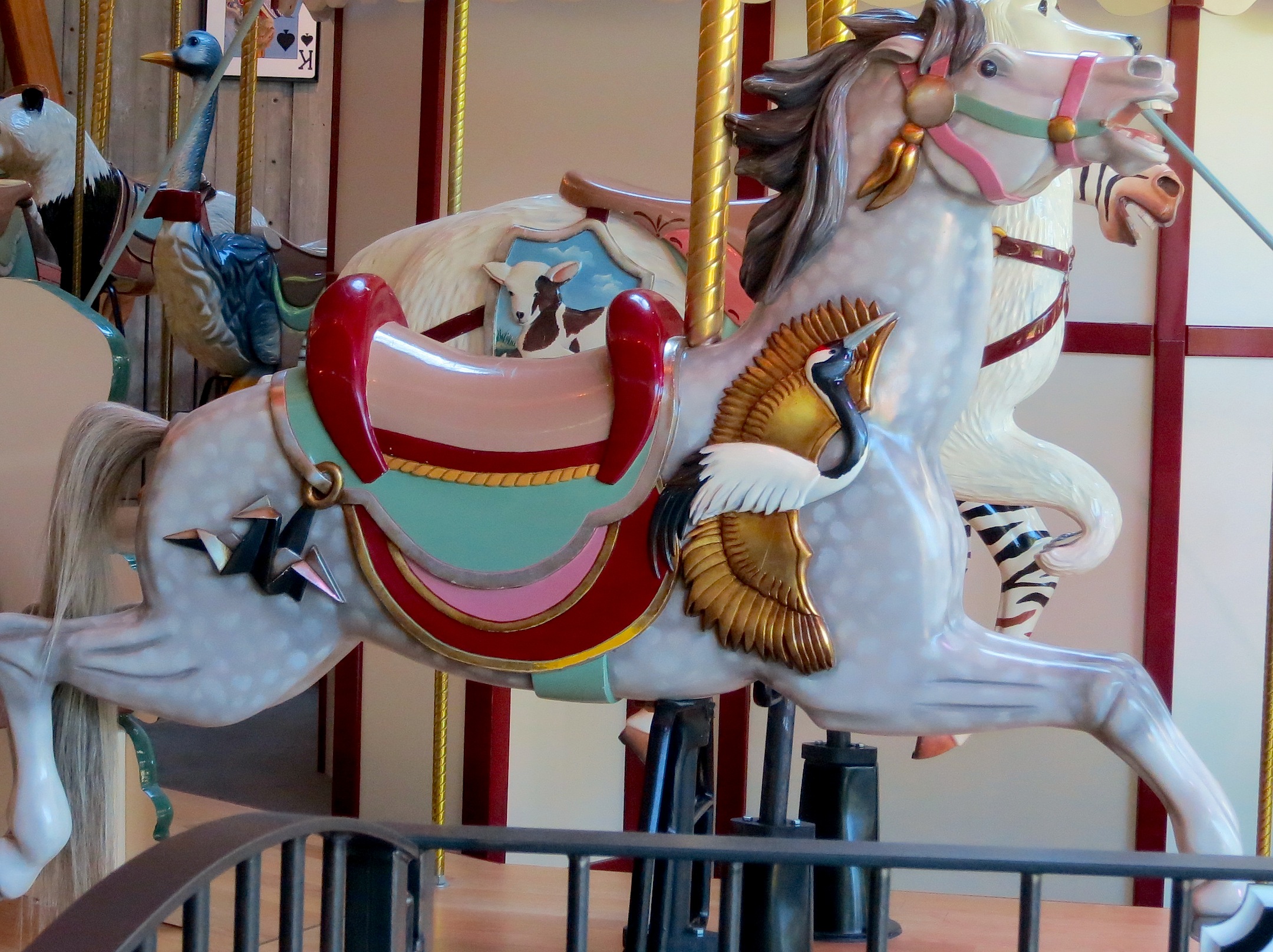
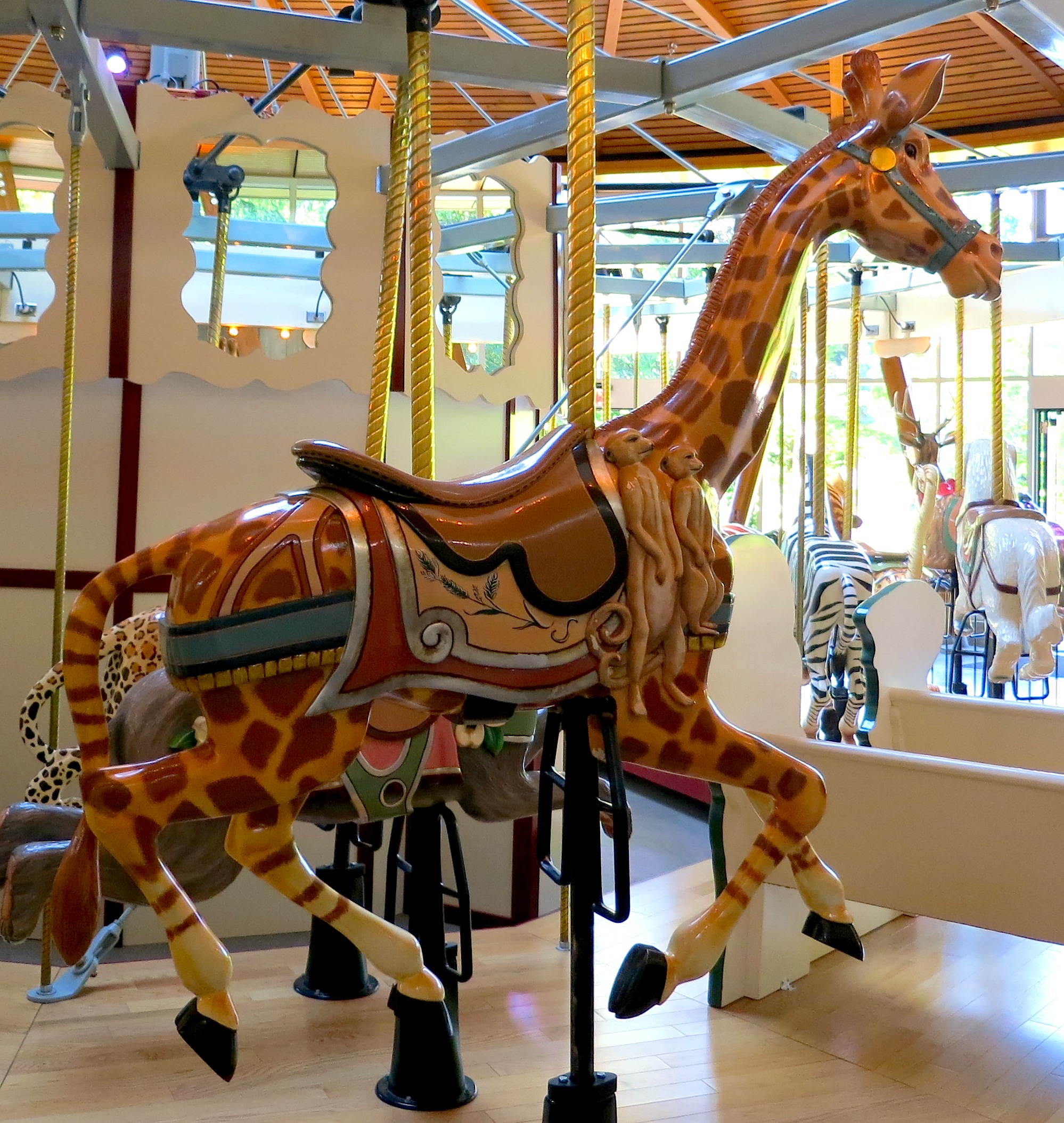
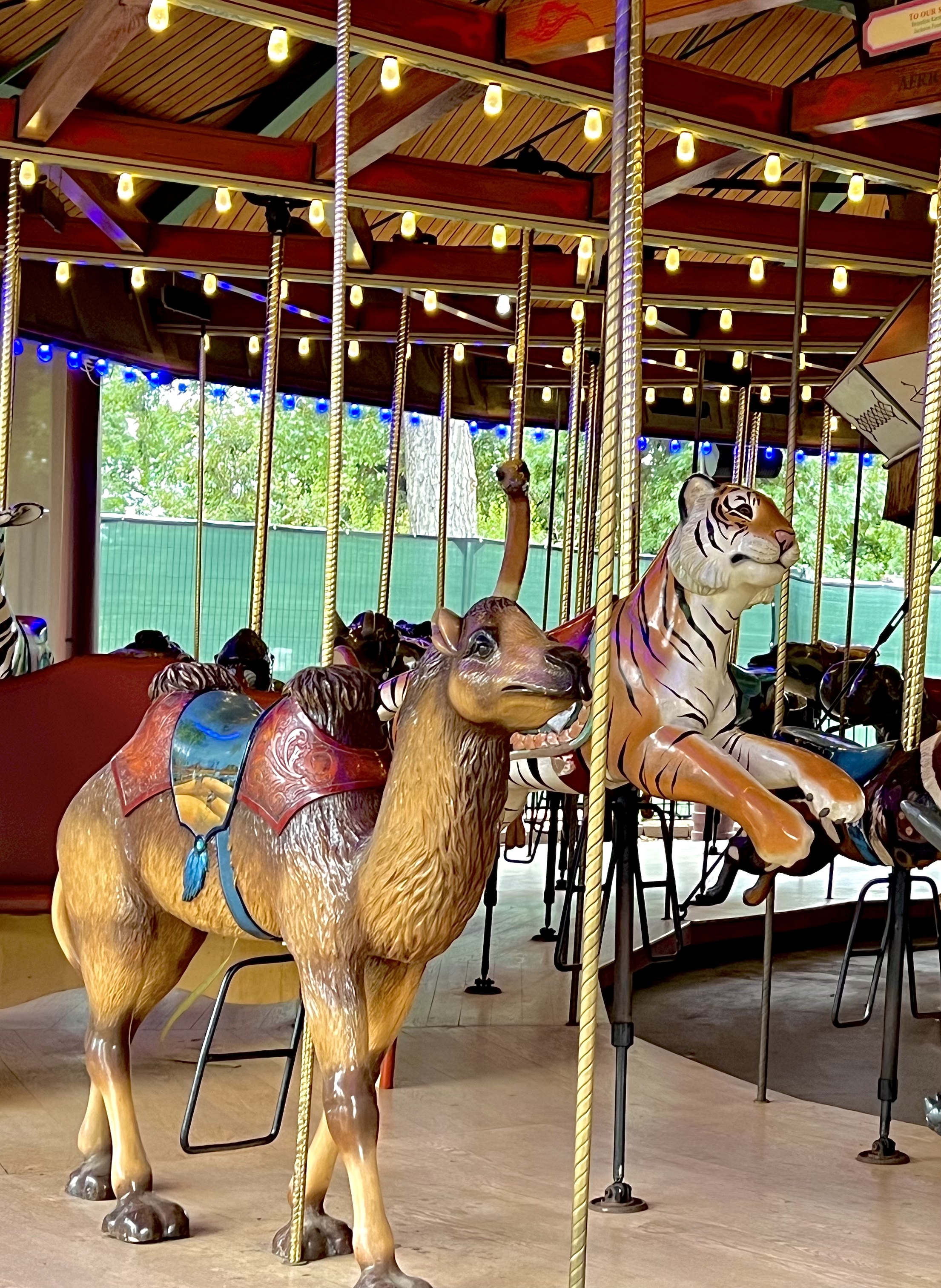
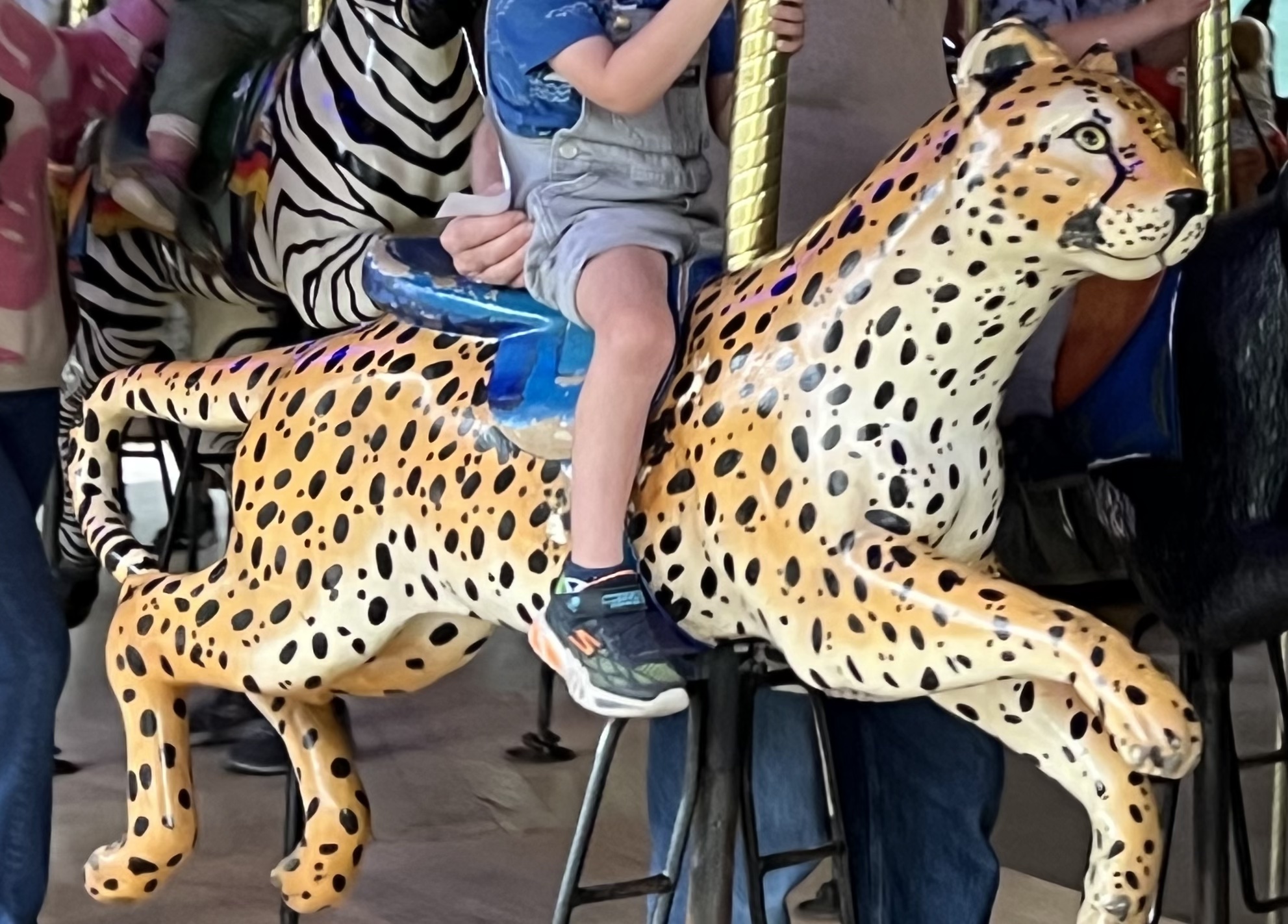
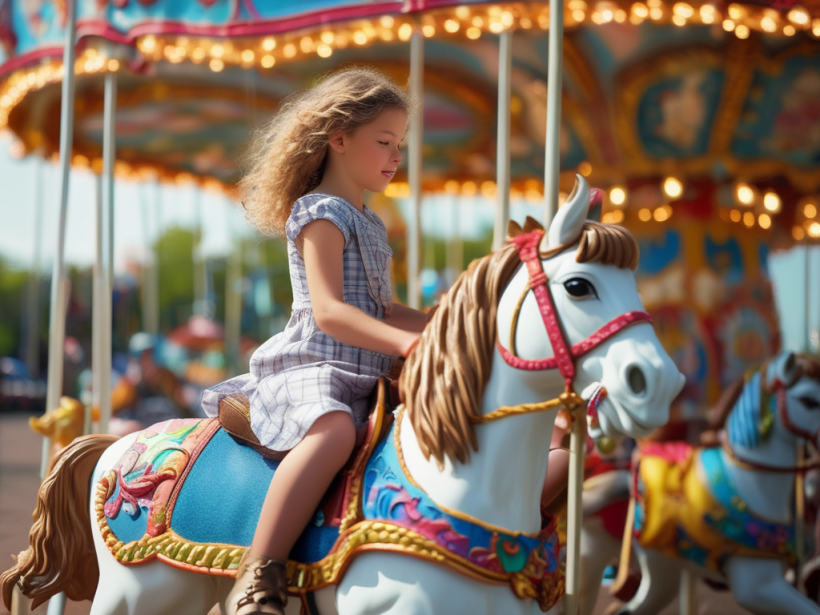
And the seasons they go round and round And the painted ponies go up and down We’re captive on the carousel of time We can’t return, we can only look behind From where we came And go round and round and round In the circle game… ~Joni Mitchell “The Circle Game”
those lovely horses, that galloped me, moving the world, piston push and pull, into the past—dream to where? there, when the clouds swayed by then trees, as a tire swing swung me under—rope groan. now, the brass beam, holds my bent face, calliope cadence—O where have I been? ~Rick Maxson “Carousel at Seventy”
On thin golden poles gliding up, sliding down, a kingdom of horses goes spinning around.
Jumper, Brown Beauty, Dark Thunder, Sir Snow, a medley of ponies parade in a row.
Settled in saddles, their riders hold on to reins of soft leather while circling along
on chestnut or charcoal, on sleek Arctic white, on silver they gallop in place day and night.
Such spinning is magic, (to dream as you sail) with lavender saddle and ebony tail,
whirling to music in moonlight, spellbound, galloping, galloping, merrily go round. ~Rebecca Kai Dotlich “Carousel”
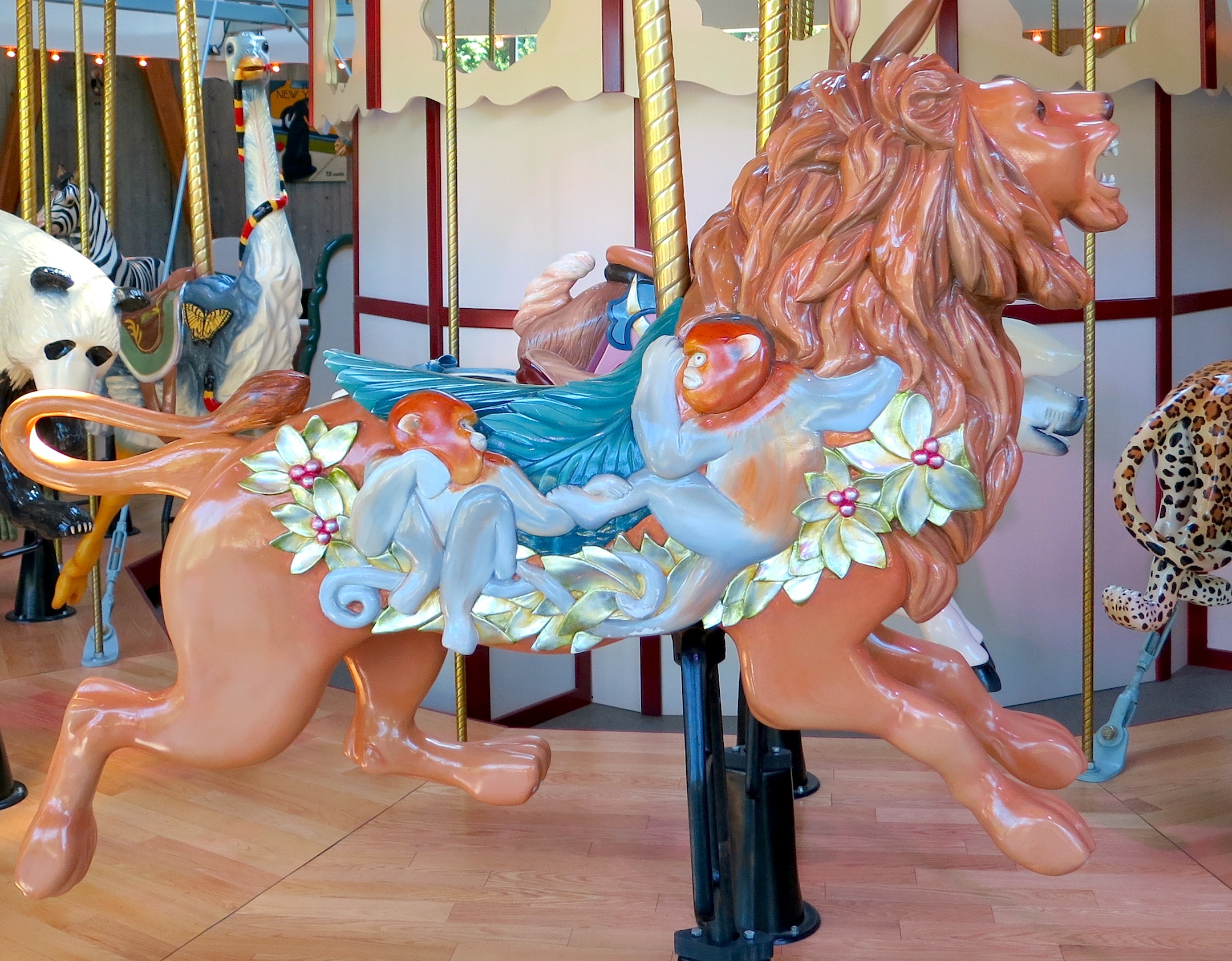
Under its canopy, in the shade it casts, turns a world with painted horses, all from a land that lingers a while before it disappears. Some, it’s true, are harnessed to a wagon, but all have valor in their eyes. A fierce red lion leaps among them, and here comes ’round a snow-white elephant.
Even a stag appears, straight from the forest, except for the saddle he wears, and, buckled on it, a small boy in blue.
And a boy in white rides the lion, gripping it with small clenched hands, while the lion flashes teeth and tongue.
And here comes ’round a snow-white elephant.
And riding past on charging horses come girls, bright-eyed, almost too old now for this children’s play. With the horses rising under them, they are looking up and off to what awaits. ~Rainer Maria Rilke from “Jardin de Luxembourg”
A fewJuly memories:
Sixty-five years ago, I was a five year old having her first ride on the historic carousel at Woodland Park Zoo before we moved from Stanwood to Olympia. Fifty-four years ago — a teenager working in a nursing home as a nurses’ aide after three days of training. Forty-nine years ago – returned home early from my studies in Tanzania after four chimpanzee researcher friends were held hostage for ransom and eventually released Forty-three years ago — deep in the guts of a hospital working forty hour long shifts, thinking about the man I was soon to marry Thirty-four years ago — my husband and I picking up bales of hay in our own farm field, two young children in tow after accepting a new position doctoring at the local university Twenty-seven years ago — raising three children and completed farm house remodel, supporting three parents with health issues, raising Haflinger horses, helping design a new clinic building at work, playing piano and teaching Sunday School at church Twenty-whatever years ago – life spinning faster, blurring with work at home, on the farm, at clinic, at church. I begin writing to grab and hang on to what I can. Sixteen years ago — one son about to move to Japan to teach and the other son to teach at Pine Ridge in South Dakota, daughter at home with a new driver’s license working with migrant children, a mother slowly bidding goodbye to life at a local care center, farming less about horse raising and more about gardening, maintaining and preserving. Ten years ago — two sons married, daughter working as a camp counselor so our first summer without children at home. Perfect time to raise a new puppy! Five years ago – A two year old granddaughter and two new grandsons! Daughter teaching, engaged to be married. Two years ago – completed forty-two years of non-stop doctoring so I bid it goodbye. Now – Three more grandsons! Two retired grandparents! Big garden on the farm but we’re slowing down.
The puppy’s face and our hair are turning white…
O where have I been? We can only look behind from where we came and await what is ahead.
The decades pass, round and round – there is comfort knowing that through the ups and downs of daily life, we still hang on. If we slip and fall, there is Someone ready to catch us.
Looking behind you, where have you been? What awaits you where you are heading?
AI image created for this post
One-Time
Monthly
Yearly
Make a one-time or recurring donation to support daily Barnstorming posts
On the green hill with the river beyond it long ago and my father there and my grandmother standing in her faded clothes wrinkled high-laced black shoes in the spring grass among the few gravestones inside their low fence by the small white wooden church the clear panes of its windows letting the scene through from the windows on the other side of the empty room and a view of the trees over there my grandmother hardly turned her head staring like a cloud at the empty air not looking at the green glass gravestone with the name on it of the man to whom she had been married and who had been my father’s father she went on saying nothing her eyes wandering above the trees that hid the river from where we were a place where she had stood with him one time when they were young and the bell kept ringing ~W. S. Merwin “Widnoon” from The Moon Before Morning
I remember my grandfather as a somber quiet man who used to slowly rock in a wooden chair that now happens to sit empty here in our home.
For most of his life, my Grandpa drank heavily but he wasn’t just any drunk. He was a mean drunk. Surly, cursing, prone to throwing things and people, especially at home.
Grandma used to say he learned to drink in the logging camps and I suspect that is true. He started working as a logger before he was fully grown, dropping out of school, leaving home around age sixteen and heading up to the hills where real money could be made. He learned more than how to cut down huge old growth Douglas Fir trees, skid them down the hills using a team of horses, and then roll them onto waiting wagons to be hauled to the mills. He learned how to live with a group of men who surfaced once or twice a month from the hills to take a bath, bootleg booze during prohibition and maybe go to church with their womenfolk.
Mostly the loggers taught him how to curse and drink.
He headed home to the farm with muscles and attitude a few years later, and started the process of felling trees, creating a “stump farm” that was a challenge to work because huge stumps dotted the fields and hills. He slowly worked at blasting them out of the ground so the land could be tilled. It proved more than he had strength and motivation to do, so his fields were never very fruitful, mostly growing hay for his own animals. He went to work in the local saw mill to make ends meet.
He cleaned up some when he met my grandmother, who at eighteen was seven years younger, and eager to escape her role as chief cook and bottle washer for her widowed father and younger brother. She was devout, lively and full of energy and talked constantly while he, especially when sober, preferred to let others do the talking. It was an unusual match but he liked her cooking and she was ready to escape the drudgery of her father’s household and be wooed.
They settled on the stump farm and began raising a family, trying to eke out what living they could from the land, from the sporadic work he found at the saw mill, and every Sunday, took the wagon a mile down the road to the Bible Church where they both sang with gusto.
He still drank when he had the money, blowing his pay in the local tavern, and stumbling in the back door roaring and burping, falling into bed with his shoes on. Grandma was a teetotaler and yelled into his ruddy face about the wrath of God anytime he drank, their four children hiding when the dishes started to fly, and when he would whip off his belt to hit anyone who looked sideways at him.
When their eldest daughter took sick and died of lymphoma at age eight despite the little doctoring that was available, Grandpa got sober for awhile. He saw it as punishment from God, or at least that is what Grandma told him through her sobs as she struggled to cope with her loss.
Over the years, he relapsed many times, losing fingers in his work at the mill, and losing the respect of his wife, his children and the people in the community. Grandma took the kids for several months to cook in a boarding house in a neighboring town, simply to be able to feed her family while Grandpa squandered what he had on drink. Reconciled over and over again, Grandma would come back to him, sending their only son to fetch him from the tavern for the night. My Dad would bicycle to that dark and smoky place, stand Grandpa up and guide him staggering out to their truck for the weaving drive home on country roads. On more than one occasion, Grandpa, belligerent as ever, would resist leaving and throw a punch at his boy, usually missing by a mile.
But once the boy grew taller and strong enough to fight back, managing to knock Grandpa to the ground in self-defense, the punching and resistance stopped. The boozing didn’t.
Grandpa sobered up for good while his boy fought in the war overseas in the forties, striking a bargain with God that his boy would come home safe to work the farm as long as Grandpa left alcohol alone. It stuck and he stayed sober. His boy came home. Grandpa saw it as a promise kept and became an elder in his Bible Church, taught Sunday School and gave his extra cash to the church rather than the tavern. He and Grandma donated a house on their property to the church for a parsonage.
Some twelve years later, sitting in a Christmas Sunday School program one Christmas Eve, Grandpa leaned toward Grandma and she saw his face broken out in sweat, his face ashen.
“It’s hot in here, I need air, “ he said and collapsed in her lap. He was gone, just like that. He left the rest of his family behind while he sat in church, sober as can be, on the day before Christmas.
There is no question in my mind he knew he was forgiven. He headed home one more time, not weaving or swerving but traveling straight and narrow.
AI image created for this postAI image created for this post
One-Time
Monthly
Yearly
Make a one-time or recurring donation to support daily Barnstorming posts
I am not resigned to the shutting away Of loving hearts in the hard ground. So it is, and so it will be, for so it has been, time out of mind: Into the darkness they go, the wise and the lovely. Crowned With lilies and with laurel they go; but I am not resigned. Lovers and thinkers, into the earth with you. Be one with the dull, the indiscriminate dust. A fragment of what you felt, of what you knew, A formula, a phrase remains,—but the best is lost. The answers quick and keen, the honest look, the laughter, the love,— They are gone. They are gone to feed the roses. Elegant and curled Is the blossom. Fragrant is the blossom. I know. But I do not approve. More precious was the light in your eyes Than all the roses in the world. Down, down, down into the darkness of the grave Gently they go, the beautiful, the tender, the kind; Quietly they go, the intelligent, the witty, the brave. I know. But I do not approve. And I am not resigned. ~Edna St. Vincent Millay “Dirge Without Music”
These hearts were woven of human joys and cares, Washed marvelously with sorrow, swift to mirth. The years had given them kindness. Dawn was theirs, And sunset, and the colors of the earth.
These had seen movement, and heard music; known Slumber and waking; loved; gone proudly friended; Felt the quick stir of wonder; sat alone; Touched flowers and furs and cheeks. All this is ended.
There are waters blown by changing winds to laughter And lit by the rich skies, all day. And after, Frost with a gesture, stays the waves that dance And wandering loveliness. He leaves a white Unbroken glory, a gathered radiance, A width, a shining peace, under the night. ~Rupert Brooke “All This is Ended”
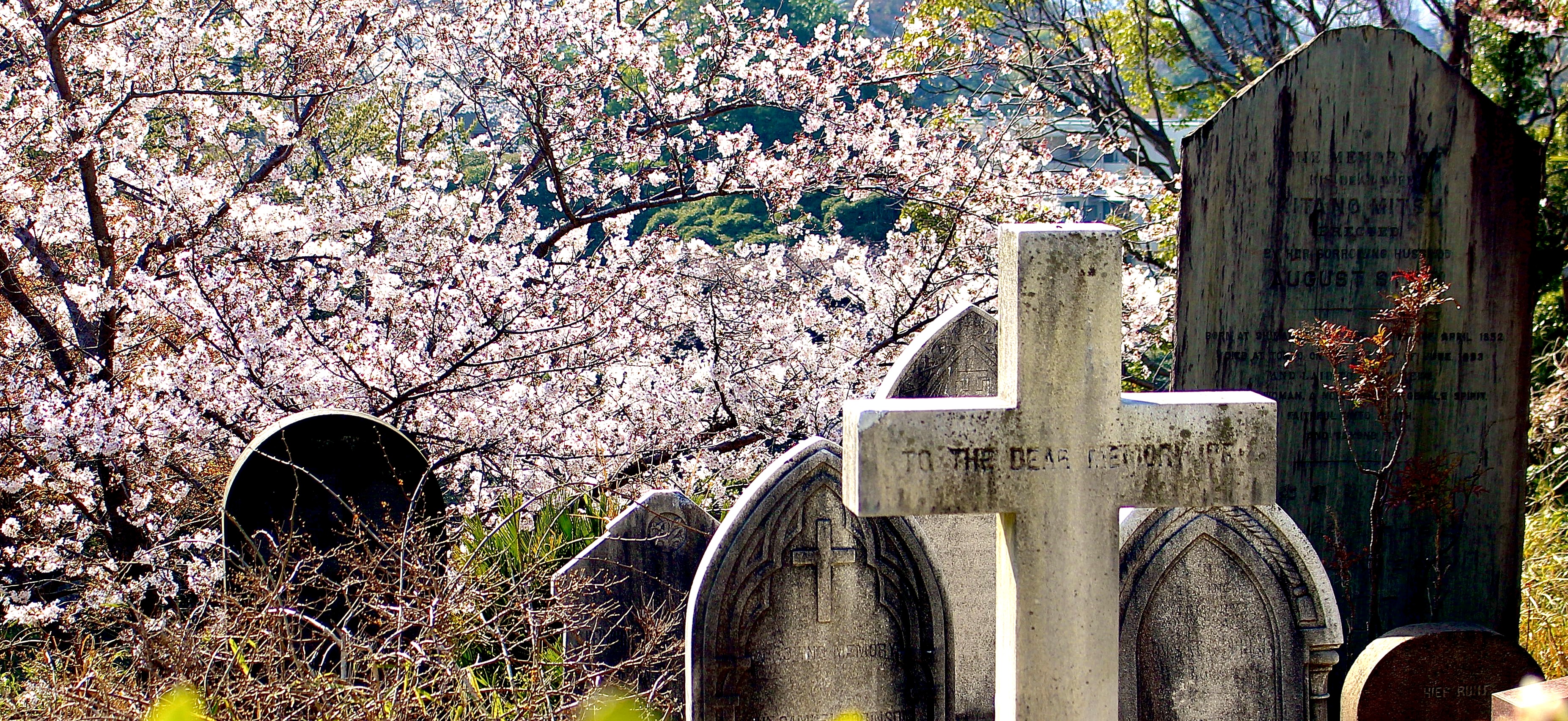
Each Memorial Day weekend without fail, we gather with family, have lunch, reminisce, and trek to a cemetery high above Puget Sound to catch up with our relatives who lie there still. Some for well over 100 years, some too recent, some we knew and loved and miss every day, others not so much, unknown to us except on genealogy charts, their names and dates and these stones all that is left of them:
the red-haired great-grandmother who died too young, the aunt who was eight with lymphoma, the Yukon river boat captain, the logger and stump farmer, the unmarried teacher who bequeathed an oil well to her church, the two in-laws who lie next to each other but could not co-exist in the same room while they lived and breathed.
Yet we know each of these (as we know ourselves and others) was tender and kind, though flawed and broken, was beautiful and strong, though wrinkled and frail, was hopeful and faithful, though too soon in the ground.
We know this about them as we know it about ourselves: someday we too will feed roses, the light in our eyes transformed into elegant swirls emitting the fragrant scent of heaven.
No one asks if we approve. Nor am I resigned to this but only know: So it is, so it has been, so it will be.
It started before Christmas. Now our son officially walks to school alone. Semi-alone, it’s accurate to say: I or his father track him on his way. He walks up on the east side of West End, we on the west side. Glances can extend (and do) across the street; not eye contact. Already ties are feeling and not fact. Straus Park is where these parallel paths part; he goes alone from there. The watcher’s heart stretches, elastic in its love and fear, toward him as we see him disappear, striding briskly. Where two weeks ago, holding a hand, he’d dawdle, dreamy, slow, he now is hustled forward by the pull of something far more powerful than school.
The mornings we turn back to are no more than forty minutes longer than before, but they feel vastly different–flimsy, strange, wavering in the eddies of this change, empty, unanchored, perilously light since the red hat vanished from our sight. ~Rachel Hadas “The Red Hat”
You can kiss your family and friends good-bye and put miles between you, but at the same time you carry them with you in your heart, your mind, your stomach, because you do not just live in a world but a world lives in you. ~ Frederick Buechner
As a child, I lived just outside of city limits in a semi-rural area, only a half mile from my elementary school on a country road. By first grade, I was allowed to walk to school and home again, then when I was older, with my younger brother in tow. I don’t remember my parents watching me as I made the journey, but I do remember some practice walks on a weekend, to reinforce how to safely cross the roads and where to walk alongside the drainage ditch.
I don’t remember ever being worried about what might happen to me outside of my parents’ presence, and nothing scary ever did happen. I’m sure my parents were worried, but both as children had walked to their rural schools on their own – it simply was how things happened in the 20’s and 30’s.
For children growing up now, it feels different.
Our three children grew up on a farm seven miles from town, so rode a school bus or were taken to school by a parent or grandparent. They didn’t have that early independence that I did. Our grandchildren, especially those living in large cities, are even more protected. It didn’t hamper their desire to explore the world – they have traveled all over.
The difference is the anxiety of the parent, watching that child disappear around a corner on foot, or bike or eventually in a car. It is that empty feeling of letting go before one is ready, but when you know you must.
The heart stretches to encompass one’s child out in the world, out of sight, no longer anchored at home. After all, we are that elastic and that resilient.
One-Time
Monthly
Yearly
Make a one-time or recurring donation to support daily Barnstorming posts
In a daring and beautiful creative reversal, God takes the worse we can do to Him and turns it into the very best He can do for us. ~Malcolm Guite from The Word in the Wilderness
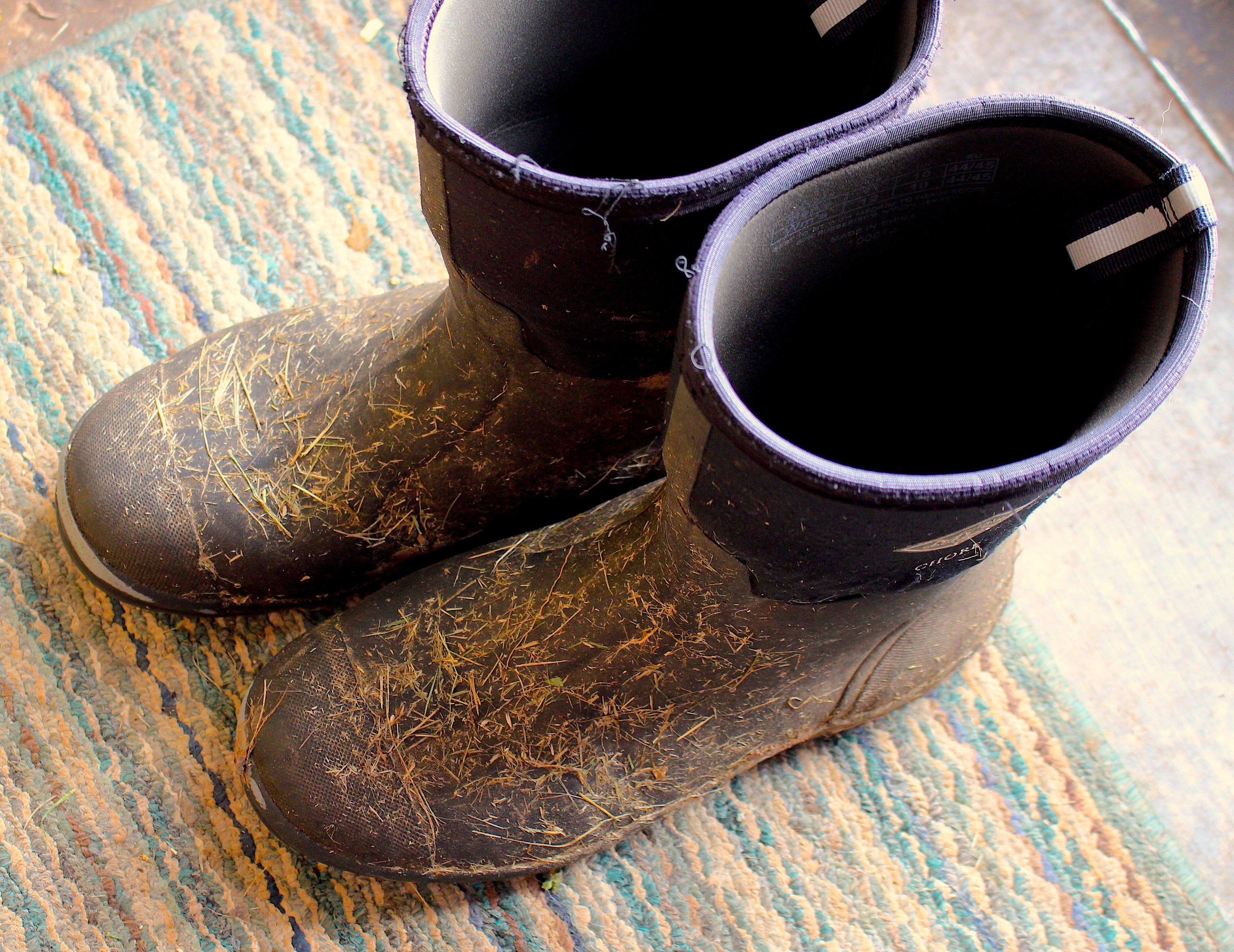
Samwise Gamgee and Homer, our two Cardigan Corgis, do barn chores with me twice daily. They run up and down the aisles as I fill the buckets and throw the horses hay. Then they explore the manure pile out back, have a happy roll in some really smelly stuff in the field, and have stand offs with the barn cats (which they always lose).
We have our routine. When I get done with chores, I whistle for them and we all head back to their breakfast in their outdoor pen.
We always return home together.
Except this particular morning. I whistled when I was done and although Homer came running, Sam’s furry fox face didn’t appear as usual. I walked back through both barns calling his name, whistling. No signs of Sam. I walked to the fields, I walked back to the dog pen, I walked the road (where he never ever goes), I scanned the pond where he once fell in as a pup (yikes), I went back to the barn and glanced inside every stall, I went in the hay barn where he likes to jump up and down on stacked bales, worried about a bale avalanche he might be trapped under, or a hole he couldn’t climb out of.
Nothing.
I’m really anxious about him at this point, fearing the worst. Even Homer seemed clueless about where his friend disappeared.
Sam was nowhere to be found, utterly lost.
Passing through the barn again, I heard a little faint scratching inside one Haflinger’s stall, which I had just glanced in 10 minutes before as a mare was peacefully eating hay. Sure enough, there was Sam standing with his feet up against the door as if asking what took me so long. He must have scooted in when I filled up her water bucket, and I closed the door unaware he was still inside. He and his horse buddy kept it their secret.
Making not a whimper or a bark when I called out his name, passing that stall at least 10 times looking for him, he patiently waited for me to open the door and set him free.
The lost is found even though he never felt lost to begin with.
Yet he was lost to me. And that is all that matters. We have no idea how lost we are until a determined Someone comes looking for us, doing whatever it takes to bring us back alongside them.
Sam was just waiting for that closed door to be opened. And this Holy Week, the door is thrown wide open and we’re welcomed back home.
photo by Nate Gibson
Let’s have a feast and celebrate.For this son of mine was dead and is alive again; he was lost and is found. Luke 15: 23-24
This Lenten season I reflect on the words of the 19th century southern spiritual hymn “What Wondrous Love is This”
One-Time
Monthly
Yearly
Make a one-time or recurring donation to support daily Barnstorming posts
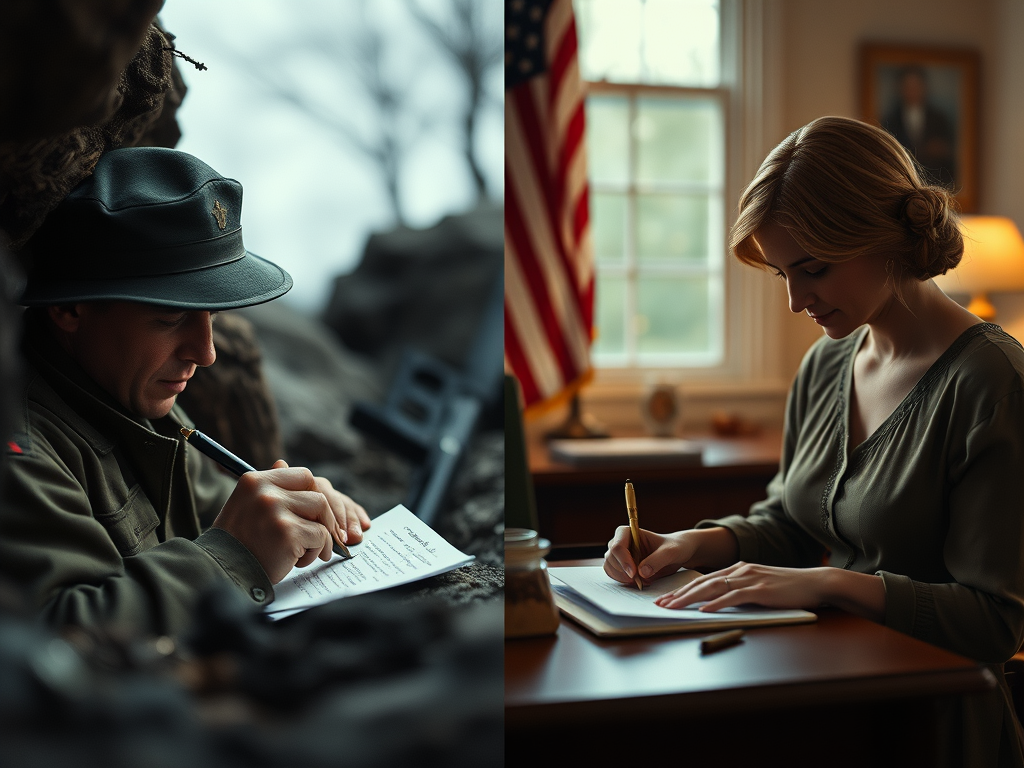
You never know what may cause them. The sight of the ocean can do it, or a piece of music, or a face you’ve never seen before. A pair of somebody’s old shoes can do it. Almost any movie made before the great sadness that came over the world after the Second World War, a horse cantering across a meadow…
You can never be sure. But of this you can be sure.Whenever you find tears in your eyes, especially unexpected tears, it is well to pay the closest attention. They are not only telling you something about the secret of who you are, but more often than not God is speaking to you through them of the mystery of where you have come from and is summoning you to where, if your soul is to be saved, you should go next. ~Frederick Buechner fromWhistling in the Dark
photo by Emily Vander Haak
I’m not paying close enough attention to the meaning of my leaking eyes if I’m constantly looking for kleenex to stem the flow. During the holidays, it seems I have more than ample opportunity to find out the secret of who I am, where I have come from, and where I am to be next.
So I keep my pockets loaded with kleenex, and there is a box ready in every room of the house.
It mostly has to do with welcoming our three children, their spouses, and six grandchildren back home for a few days to become a full-out, noisy, messy, chaotic household again. There will be puzzles and games and music and laughter and unending laundry and constant meal preparation and consumption. It is about singing grace together in five-part harmony before we eat, praying precious words of gratitude.
It is about remembering the drama of our youngest’s birthday thirty-one years ago today, as if it were only yesterday, when her life was saved by a snowstorm. Now she and her husband bring their own son for visits back to the farm.
It certainly has to do with bidding farewell again, gathering them all in for that final hug and then letting go.
We have urged and encouraged them to go where their hearts are telling them they are needed and called to be, even if that means miles away from their one-time home on the farm. For our oldest son’s family, that means returning and settling in just down the road.
I too was let go once and though I would try to look back, too often in tears, I set my face toward the future. It led me here, to this marriage, this family, this farm, this work, our church, to more tears, to more letting go if I’m granted more years to weep again and again with gusto and grace and gravitas.
This is what I’m sure is the secret of me: to love so much and so deeply that letting go is so hard that tears are no longer unexpected or a mystery to me or my children and grandchildren. It is a given that Grandma will weep at a drop of a hat, at a hug, or a hymn. My tears are the spill-over of fullness that can no longer be contained: God’s still small voice spills down my cheeks drop by drop like wax from a burning candle.
No kleenex are needed with these tears.
Let them flow as I let them go. It is as it should be.
One-Time
Monthly
Yearly
Make a one-time or recurring donation to support daily Barnstorming posts
Dearly. How was it used? Dearly beloved. Dearly beloved, we are gathered. Dearly beloved, we are gathered here in this forgotten photo album I came upon recently.
Dearly beloved, gathered here together in this closed drawer, fading now, I miss you. I miss the missing, those who left earlier. I miss even those who are still here. I miss you all dearly. Dearly do I sorrow for you.
Sorrow: that’s another word you don’t hear much anymore. I sorrow dearly. ~Margaret Atwood from “Dearly”
All day we packed boxes. We read birth and death certificates. The yellowed telegrams that announced our births, the cards of congratulations and condolences, the deeds and debts, love letters, valentines with a heart ripped out, the obituaries. We opened the divorce decree, a terrible document of division and subtraction. We leafed through scrapbooks: corsages, matchbooks, programs to the ballet, racetrack, theater—joy and frivolity parceled in one volume— painstakingly arranged, preserved and pasted with crusted glue. We sat in the room in which the beloved had departed. We remembered her yellow hair and her mind free of paradox. We sat together side by side on the empty floor and did not speak. There were no words between us other than the essence of the words from the correspondences, our inheritance—plain speak, bereft of poetry. ~Jill Bialosky “The Guardians” from The Players.
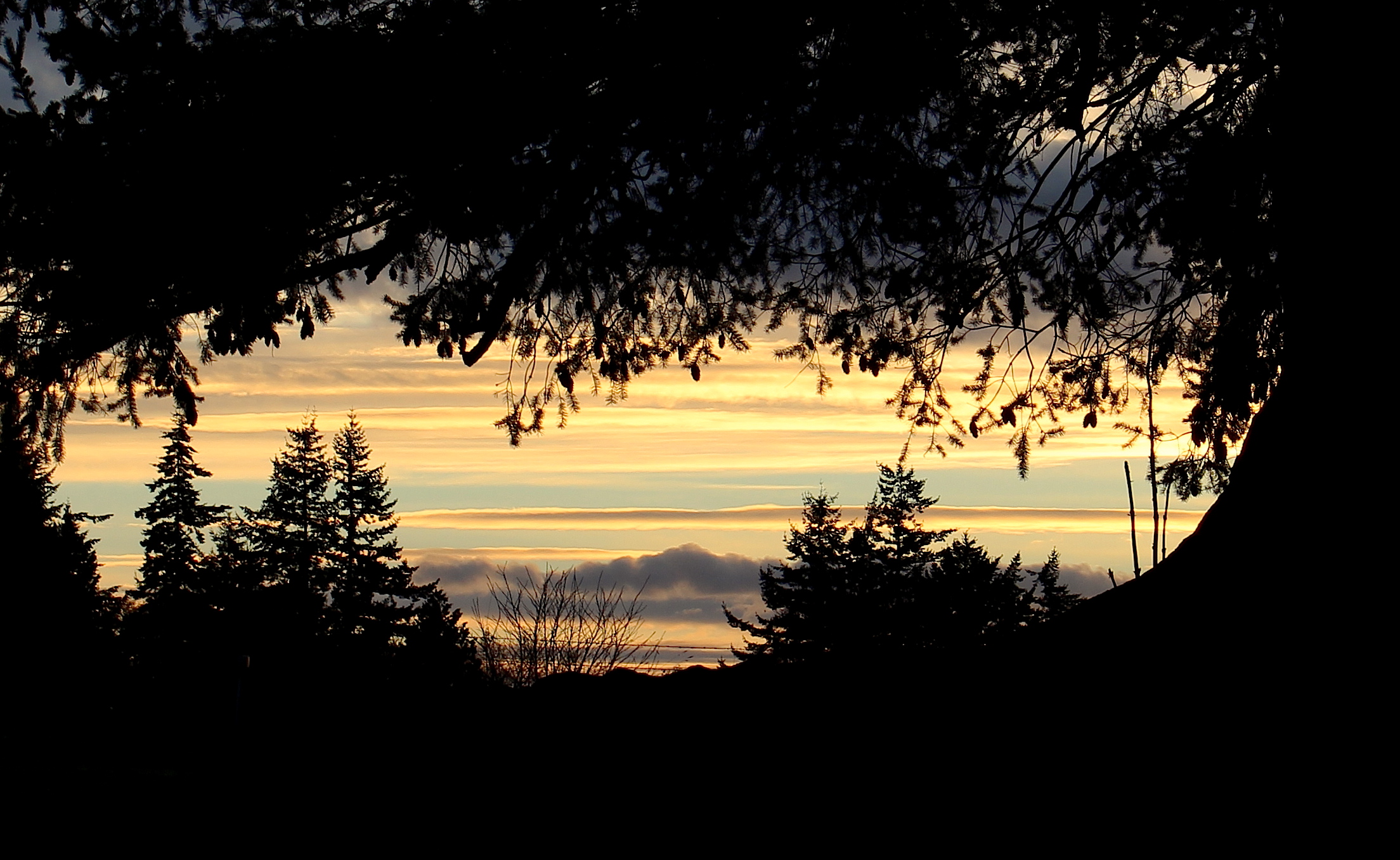
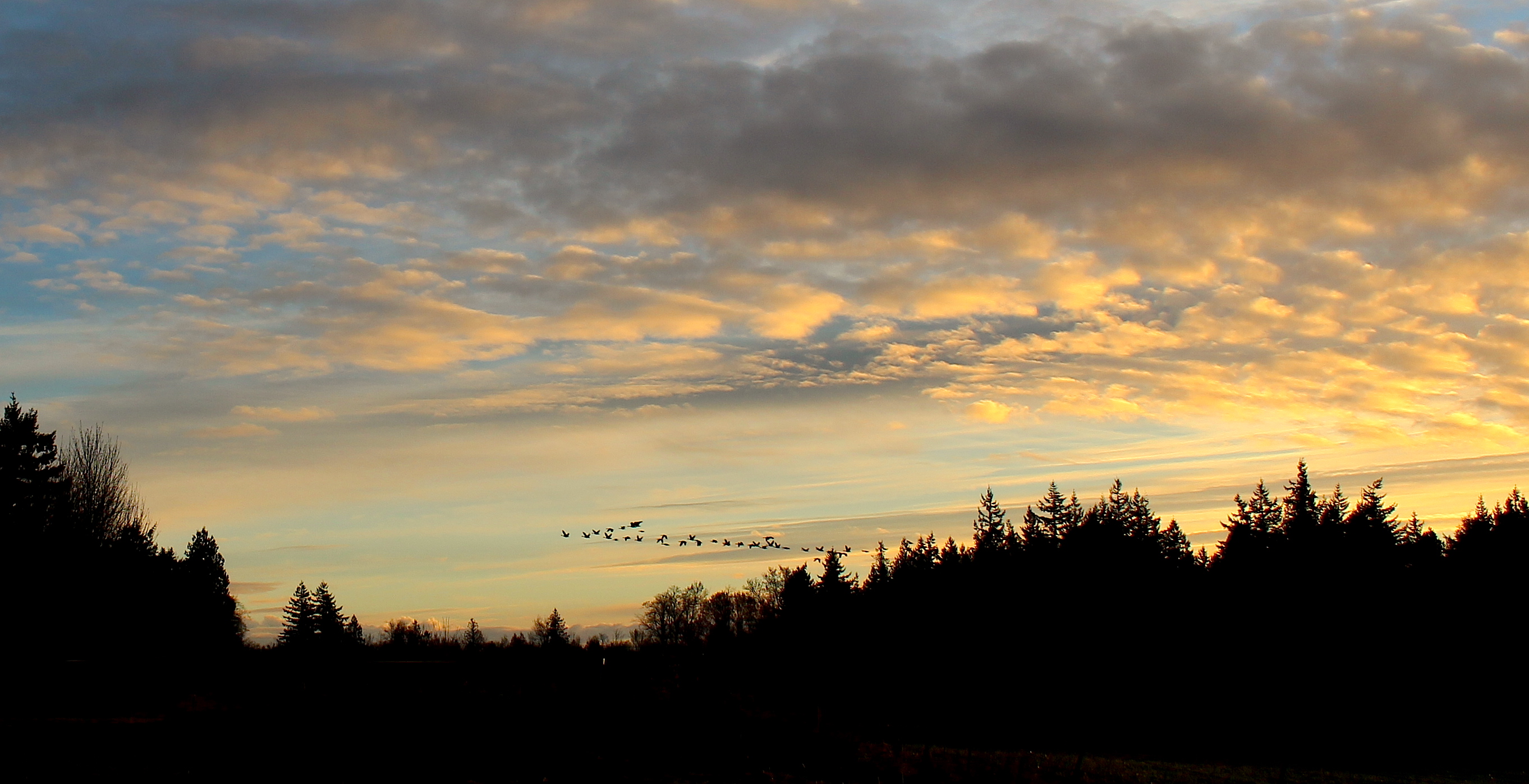
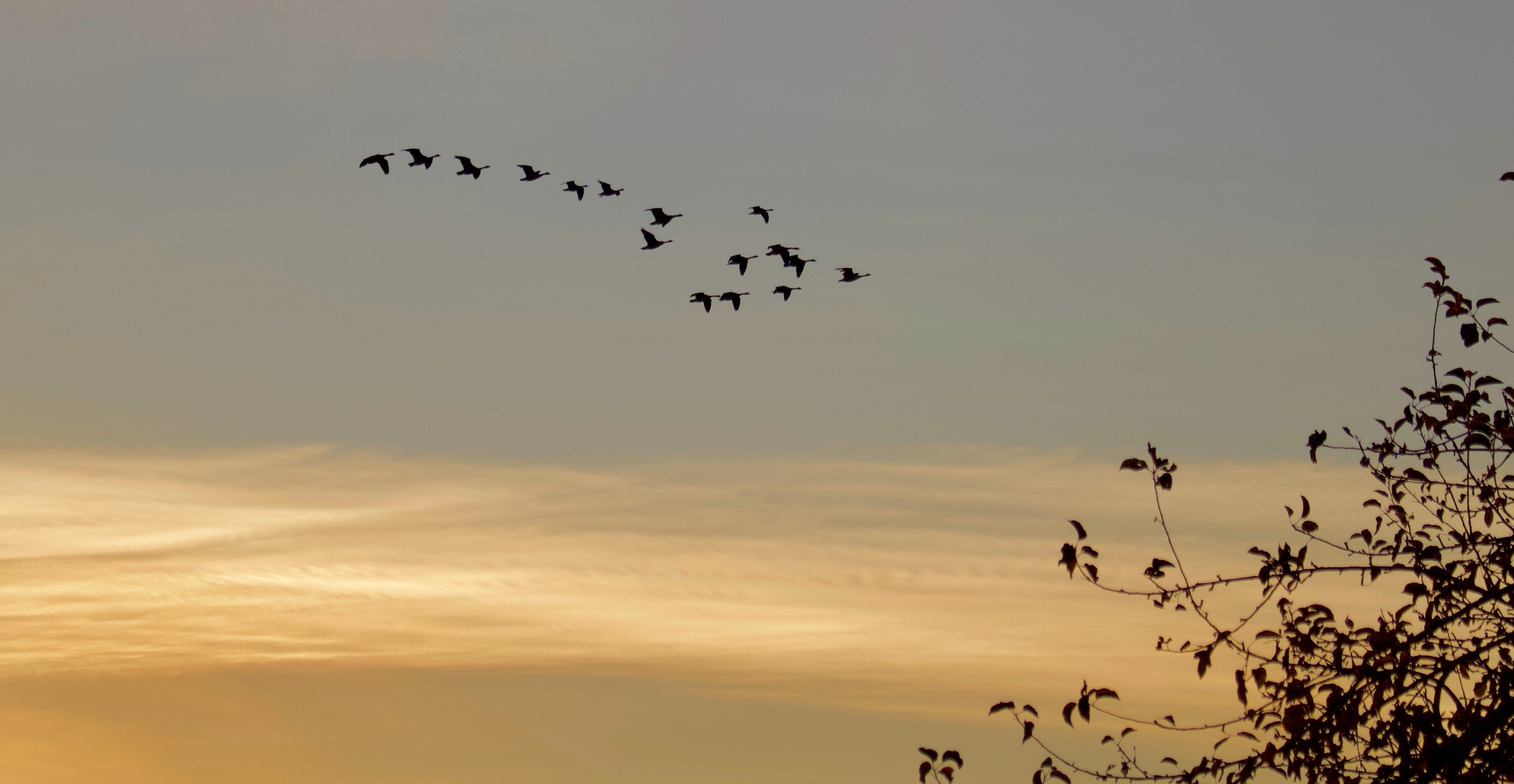
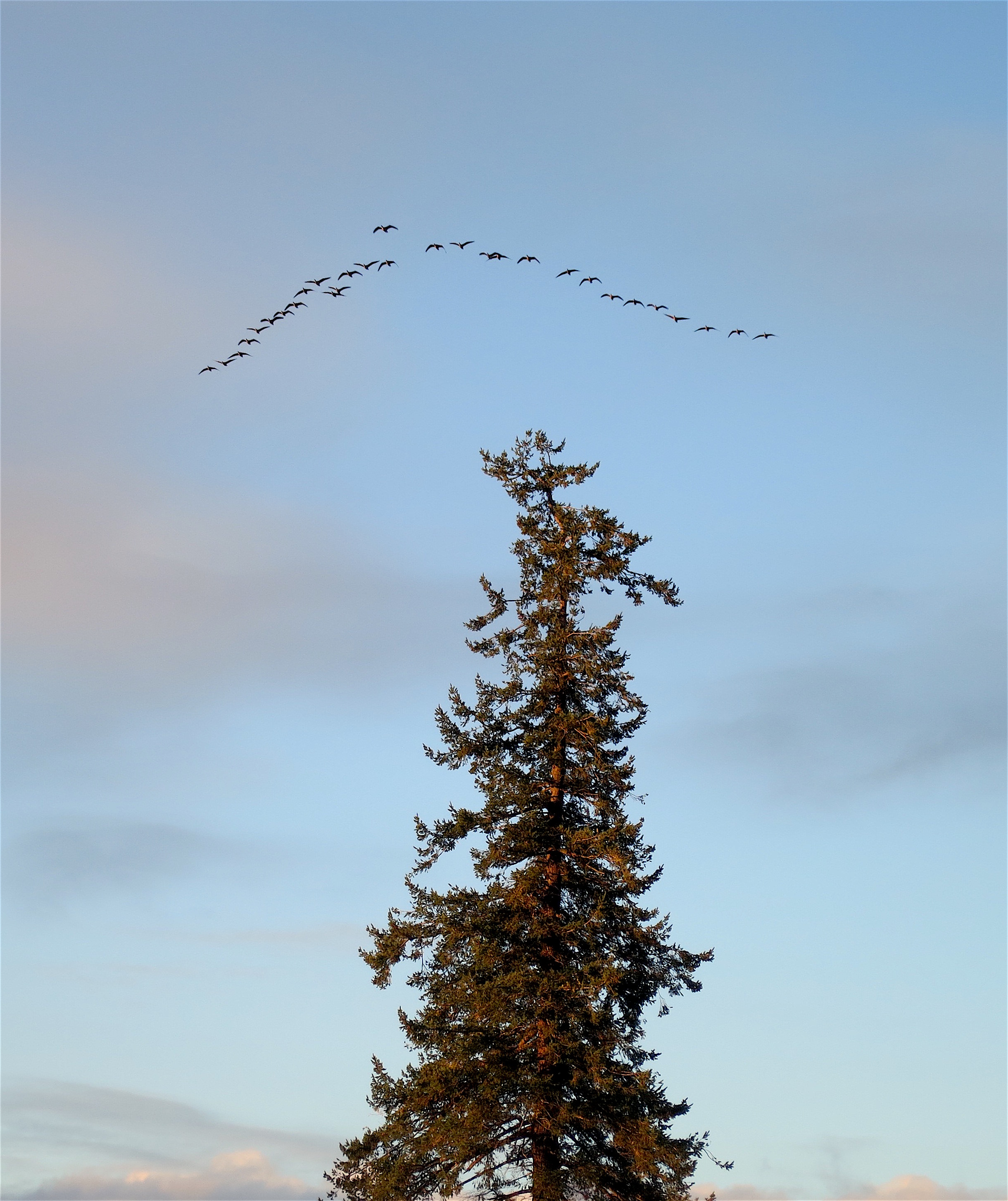
This time of year, huge flocks of migrating birds pass noisily overhead, striving together in their united effort to reach home. I envy their shared instinct to gather together with purpose.
Human families can be far more scattered and far less harmonious, yet still plenty noisy.
Through these holiday weeks, I take time to remember those who left this life long ago. It is bittersweet to be all together only in a photo album, with youth and smiles preserved indefinitely.
In a flash of time, three generations have passed: children have had children who now have children. Newlyweds have become grandparents, trying valiantly to fit the shoes of those who came before.
In our own eventual leave-taking, we will become the missing to be missed. There will come along new generations – those we will never meet – who will turn the pages of photograph albums and writings and wonder aloud about these unknown people from whom they descend.
Dearly beloved, we who are missing are right here, waiting in a drawer or a file or a book on the shelf, ready to share, in plain words bereft of poetry, all our love and hopes and sorrows for you, the future generations to come.
One-Time
Monthly
Yearly
Make a one-time and recurring donation to support daily ad-free Barnstorming posts