Acknowledging the Abyss

The cradle rocks above an abyss, and common sense tells us that our existence is but a brief crack of light between two eternities of darkness. Although the two are identical twins, man, as a rule, views the prenatal abyss with more calm than the one he is heading for.
~Vladimir Nabokov from Speak Memory

I think Nabokov had it wrong. This is the abyss.
That’s why babies howl at birth,
and why the dying so often reach
for something only they can apprehend.

At the end they don’t want their hands
to be under the covers, and if you should put
your hand on theirs in a tentative gesture
of solidarity, they’ll pull the hand free;
and you must honor that desire,
and let them pull it free.

~Jane Kenyon from “Reading Aloud to My Father”

Great Grandma Emma, granddaughter Andrea, great-grandson Zealand – photo by Andrea Nipges

Great Grandpa Harry holding baby Emerson, photo by mama Abby Mobley
Great-Grandma Elna and Noah

And once, for no special reason,
I rode in the back of the pickup, leaning against the cab.
Everything familiar was receding fast…

Whatever I saw
I had already passed…
(This must be what life is like
at the moment of leaving it.)
~Jane Kenyon from “What It’s Like”

The farther I am down the road, everything familiar seems to be receding fast. What I see on my journey, I have already passed by as I watch it disappear into the horizon.

I too often mistake this world, this existence,  as the only light there is,  a mere beam of illumination in the surrounding night of eternity, the only relief from overwhelming darkness.  If we stand looking up from the bottom, we might erroneously assume we are the source of the light, we are all there is.

Yet looking at this world from a different perspective, gazing down into the abyss from above, it is clear the light does not come from below –it is from beyond us.

The newborn and the dying know this.  They signal their transition into and out of this world with their hands.  An infant holds tightly to whatever their fist finds,  grasping and clinging to not be lost to this darkness they have entered.  The dying instead loosen their grip on this world, reaching up and picking the air on their climb back to heaven.

We hold babies tightly so they won’t lose their way in the dark.  We loosen our grip on the dying to honor their outreach to the light that leads to something greater.

In the intervening years, we struggle in our blindness to climb out of the abyss to see vistas of great beauty and grace as we pass through the shadows of our lives.  Only then we acknowledge, with great calm and serenity, where we are headed.

Ben packaged in a paper bag by Grandpa Hank

The Stones Themselves Will Start to Sing: All the Tumult and the Strife

My life flows on in endless song
Above earth’s lamentation
I hear the sweet, though far-off hymn
That hails a new creation
Through all the tumult and the strife
I hear that music ringing
It finds an echo in my soul
How can I keep from singing?
~Robert Lowry

We recently returned from an out of state visit with two grandsons, ages two and six months. They love being sung to – they rock and bop to melodies and rhythms and then relax to sleep listening to us sing the quiet evening hymns we sang to his father at night.

They will see so much in their lifetimes that we can’t even imagine. Already in their short time on earth there have been plenty of cataclysmic events, and without a doubt, more are in store.

No matter what comes, we pray they will always hear their parents’ and four grandparents’ voices resounding inside their heads when things get rough. The hymns and the prayers said over them will give them calm and confidence in the face of troubles, tumult and strife.

God’s reality and truth are shared with them in songs and words every day, and as they someday raise children of their own, how can they keep from singing that out whenever it is most needed?

This year’s Lenten theme for Barnstorming is a daily selection from songs and hymns about Christ’s profound sacrifice on our behalf.

If we remain silent about Him, the stones themselves will shout out and start to sing (Luke 19:40).

In His name, may we sing…

My life flows on in endless song,
above earth’s lamentation.
I catch the sweet, though far-off hymn
that hails a new creation.

Refrain:
No storm can shake my inmost calm
while to that Rock I’m clinging.
Since Love is lord of heav’n and earth,
how can I keep from singing?

Through all the tumult and the strife,
I hear that music ringing.
It finds an echo in my soul.
How can I keep from singing?

What though my joys and comforts die,
I know my Savior liveth.
What though the darkness gather round?
Songs in the night he giveth.

I lift mine eyes the cloud grows thin
I see the blue above it
And day by day this pathway smooths
Since first I learned to love it

The peace of Christ makes fresh my heart,
a fountain ever springing!
All things are mine since I am his!
How can I keep from singing?

A Voice in My Ear

when my father had been dead a week
I woke
with his voice in my ear
                                           I sat up in bed
and held my breath
and stared at the pale closed door

white apples and the taste of stone

if he called again
I would put on my coat and galoshes
~Donald Hall “White Apples”

She skimmed the yellow water like a moth,
Trailing her feet across the shallow stream;
She saw the berries, paused and sampled them
Where a slight spider cleaned his narrow tooth.
Light in the air, she fluttered up the path,
So delicate to shun the leaves and damp,
Like some young wife, holding a slender lamp
To find her stray child, or the moon, or both.
Even before she reached the empty house,
She beat her wings ever so lightly, rose,
Followed a bee where apples blew like snow;
And then, forgetting what she wanted there,
Too full of blossom and green light to care,
She hurried to the ground, and slipped below.
~James Wright “My Grandmother’s Ghost from Above the River: The Complete Poems 

I saw my grandma’s ghost once.

She was my only grandparent I actually knew and who actually knew me — the others were lost before I was born or too young to realize what I had lost.

She had lived a hard life: losing her mother when she was 12, taking over the household duties for her father and younger brother while leaving school forever. She married too young to an abusive alcoholic, lost her first child to lymphoma at age 8 before treatment was possible and took her three remaining children to safety away from their father for a year to live above a seedy restaurant where she cooked seven days a week to make ends meet.

But there was grace too. The marriage somehow got patched together after Grandpa found God and sobriety – after his sudden death sitting in church, Grandma’s faith never wavered. Her garden soil yielded beautiful flowers she planted and nurtured and picked to sell, her children and grandchildren welcomed her many open armed visits and hugs.

She was busy planning her first overseas trip of a lifetime at age 72 when we noticed her eyes looked yellow. Only two weeks later she was bed-bound in unrelenting pain due to pancreatic cancer, gazing heaven-ward instead of Europe-bound. Her dreams had been dashed so quickly, she barely realized her itinerary and destination had changed.

I was 16 at the time, too absorbed in my own teenage cares and concerns to really notice how quickly she was fading and failing like a wilted flower. Instead I was picking fights with my stressed parents, worrying over taking my driver’s license driving test, distracted by all the typical social pressures of high school life.

Her funeral was unbearable as I had never really said goodbye – only one brief hospital visit when she was hardly recognizable in her anguish and jaundice. I didn’t even get to hold her hand.

Soon after she had been lowered into the ground next to her husband and young daughter, she came back to me in a dream.

I was asleep when my bedroom door opened into the dark, wakening me as the bright hallway light pushed its way via a shimmering beam to my bed. Grandma Kittie stood in my bedroom doorway, backlit by the light surrounding her silhouette. She silently stood there, just looking at me.

Startled, I sat up in my bed and said to her, “Grandma, why are you here? You died and we buried you!”

She nodded and smiled. And then she said to me:

“I want you to know I’m okay and always will be. You will be too.”

She gave a little wave, turned and left, closing the door behind her. I woke suddenly with a gasp in my darkened bedroom and knew I had just been visited.
She hadn’t come to say goodbye or to tell me she loved me — that I knew already.

She had come to shine with her light blossoming around her, mending my broken heart by planting it with peace.

Grandma Kittie and Grandpa Leslie in their courting days

You’re in a better place
I’ve heard a thousand times
And at least a thousand times
I’ve rejoiced for you

But the reason why I’m broken
The reason why I cry
Is how long must I wait to be with you

I close my eyes and I see your face
If home’s where my heart is then I’m out of place
Lord, won’t you give me strength
To make it through somehow
I’ve never been more homesick than now

Help me Lord cause I don’t understand your ways
The reason why I wonder if I’ll ever know
But, even if you showed me
The hurt would be the same
Cause I’m still here so far away from home

In Christ, there are no goodbyes
And in Christ, there is no end

So I’ll hold onto Jesus
With all that I have
To see you again
To see you again

And I close my eyes and I see your face
If home’s where my heart is then I’m out of place
Lord, won’t you give me strength
To make it through somehow

Won’t you give me strength
To make it through somehow
Won’t you give me strength
To make it through somehow
I’ve never been more homesick than now
~Millard Bart Marshall

Into a Commonwealth of Joy

The meaning of marriage begins in the giving of words. We cannot join ourselves to one another without giving our word. And this must be an unconditional giving, for in joining ourselves to one another we join ourselves to the unknown.
~Wendell Berry from “Poetry and Marriage” in Standing By Words

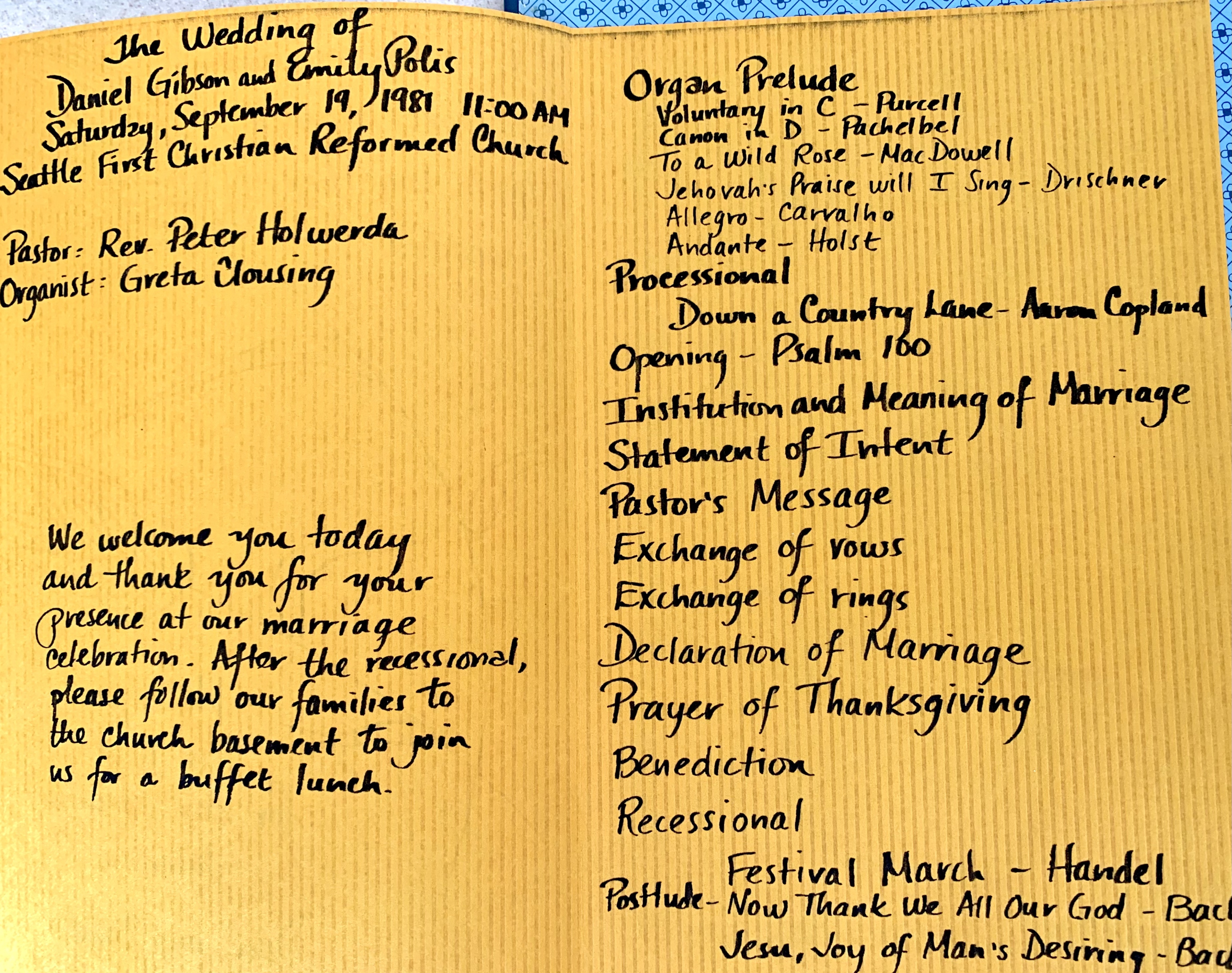
Our vows to one another forty years ago today:

Before God and this gathering, I vow from my heart and spirit that I will be your wife/husband for as long as we both shall live.

I will love you with faithfulness, knowing its importance in sustaining us through good times and bad.

I will love you with respect, serving your greatest good and supporting your continued growth.

I will love you with compassion, knowing the strength and power of forgiveness.

I will love you with hope, remembering our shared belief in the grace of God and His guidance of our marriage.

“And at home, by the fire, whenever you look up, there I shall be–and whenever I look up, there will be you.”

(our wedding vows for our September 19, 1981 wedding at First Seattle Christian Reformed Church — the last line adapted from Thomas Hardy’s  “Far From the Madding Crowd”)

Sometimes our life reminds me
of a forest in which there is a graceful clearing
and in that opening a house,
an orchard and garden,
comfortable shades, and flowers
red and yellow in the sun, a pattern
made in the light for the light to return to.
The forest is mostly dark, its ways
to be made anew day after day, the dark
richer than the light and more blessed,
provided we stay brave
enough to keep on going in.

We enter, willing to die,
into the commonwealth of its joy.
~Wendell Berry from “A Country of Marriage”

…Marriage… joins two living souls as closely as, in this world, they can be joined. This joining of two who know, love, and trust one another brings them in the same breath into the freedom of sexual consent and into the fullest earthly realization of the image of God.  From their joining, other living souls come into being, and with them great responsibilities that are unending, fearful, and joyful. The marriage of two lovers joins them to one another, to forebears, to descendants, to the community, to heaven and earth. It is the fundamental connection without which nothing holds, and trust is its necessity.
~Wendell Berry from Sex, Economy, Freedom and Community

We married in our Seattle church with our pastor officiating, with a small group of family and friends as witnesses.

It was a wedding created by two frugal people with little to spend – I sewed my dress and Dan’s shirt from muslin, we grew our own flowers, our families helped potluck the lunch afterward and our tiered carrot cake was made by a friend.

Yet our vows to one another were not frugal and held nothing back.
They were extravagant and comprehensive, coming from our hearts and spirits. The music we asked our amazing organist to play (versions below) inspired us by its simplicity and complexity – very much like the families that raised us and the God we worship.

Our vows have taken us from the city to the countryside, to the raising and rejoicing in three amazing children (each of whom wrote movingly to us today) and now four grandchildren. We served more than forty years as a public-employed attorney and physician, have laid down those responsibilities, and picked up the tools of farm and garden along with church and community service for as long as we are able.

We treasure each day of living together in faithfulness, respect, compassion and hope – knowing that how we love and find joy in one another mirrors how God loves and revels in His people.

We are praying for many more days to fill us with what endures.

A pot of red lentils
simmers on the kitchen stove.
All afternoon dense kernels
surrender to the fertile
juices, their tender bellies
swelling with delight.

In the yard we plant
rhubarb, cauliflower, and artichokes,
cupping wet earth over tubers,
our labor the germ
of later sustenance and renewal.

Across the field the sound of a baby crying
as we carry in the last carrots,
whorls of butter lettuce,
a basket of red potatoes.

I want to remember us this way—
late September sun streaming through
the window, bread loaves and golden
bunches of grapes on the table,
spoonfuls of hot soup rising
to our lips, filling us
with what endures.
~Peter Pereira from “A Pot of Red Lentils”

Here are versions of the organ music we selected for prelude, processional, recessional and postlude

Resting in the Grace of the World

When despair for the world grows in me
and I wake in the night at the least sound
in fear of what my life and my children’s lives may be,
I go and lie down where the wood drake
rests in his beauty on the water, and the green heron feeds.

I come into the peace of wild things
who do not tax their lives with forethought
of grief. I come into the presence of still water.
And I feel above me the day-blind stars
waiting with their light. For a time
I rest in the grace of the world, and am free.
~Wendell Berry “The Peace of Wild Things” from The Selected Poems of Wendell Berry

When our grandchildren visit our farm,
I watch them rediscover
what I know are the joys and sorrows of this world.
I am reminded there is light beyond the darkness I fear,
there is peace amid the chaos,
there is a smile behind the tears,
there is stillness within the noisiness
there is rest despite my restlessness,
there is grace as old gives way to new.

A new book from Barnstorming is available to order here:

Sweating Under the High Arc of Midsummer

What is the hayfield in late afternoon
that it can fly in the face of time,

and light can be centuries old, and even
the rusted black truck I am driving

can seem to be an implement born
of some ancient harvest,

and the rhythmic baler, which spits out
massive bricks tied up in twine,

can seem part of a time before now
because light glitters on the hay dust,

because the sun is sinking and we sweat
under the high arc of mid-summer,

because our bodies cast such long shadows–
Rebecca, with the baby strapped to her back,

the men who throw impossible weight
to the top of the truck, the black and white

dog that races after mice or moles
whose lives have been suddenly exposed.

How does the taste of my sweat take me
down through the gate of childhood,

spinning backwards to land in a field
painted by Bruigel, where the taste of salt

is the same, and the same heat
rises in waves off a newly flattened field.

In the duskiness of slanted light, we laugh
just as we laughed then, because there is

joy in what the earth gives, allowing
our bodies to mingle with it, our voices

small on the field, our work assuring the goats
can give milk, the sheep can grow wool,

and we will have in our bones the taste
of something so old it travels in light.
~Susie Patlove “First Cutting” from Quickening

photo by Nate Gibson
1994
2005
2011

There is a timelessness to mid-summer hay harvest that goes back generations on both sides of our family. The cutting, raking and gathering of hay has evolved from horse-drawn implements and gathering loose shocks of hay to 100+ horse power air-conditioned tractors and huge round bales wrapped and stored in plastic sheathing rather than in barns.

Our farm is happily stuck somewhere in-between: we still prefer filling the haybarn with bales that I can still lift and move myself to feed our animals. True hay harvest involves sweat and dust and a neighborhood coming together to preserve summer in tangible form.

I grew up on a farm with a hayfield – I still have the scar over my eyebrow where I collided with the handle of my father’s scythe when, as a toddler, I came too close behind him as he was taking a swing at cutting a field of grass one swath at a time. I remember the huge claws of the hay hook reaching down onto loose hay piled up on our wagon. The hook would gather up a huge load, lift it high in the air to be moved by pulley on a track into our spacious hay loft. It was the perfect place to play and jump freely into the fragrant memories of a summer day, even in the dark of winter.

But these days it is the slanted light of summer I remember most:
-the weightlessness of dust motes swirling down sun rays coming through the slats of the barn walls as the hay bales are stacked
-the long shadows and distant alpenglow in the mountains
-the dusk that goes on and on as owls and bats come out to hunt above us

Most of all, I will remember the sweaty days of mid-summer as I open the bales of hay in mid-winter – the light and fragrance of those grassy fields spilling forth into the chill and darkness, in communion of blessing for our animals.

photo by Tayler Rae
Pieter Bruegel “Hay Harvest”
My grandparents Leslie Polis and Kittie Lovelace standing in a hayfield with loose hay shocks — 1915

Enjoy this blog post? A new book from Barnstorming is available to order here:

Go Out and Help Your Dad


It was hard work, dying, harder
than anything he’d ever done.


Whatever brutal, bruising, back-
Breaking chore he’d forced himself


to endure—it was nothing
compared to this. And it took


so long. When would the job
be over? Who would call him


home for supper? And it was
hard for us (his children)—


all of our lives we’d heard
my mother telling us to go out,


help your father, but this
was work we could not do.


He was way out beyond us,
in a field we could not reach.

~Joyce Sutphen, “My Father, Dying” from Carrying Water to the Field: New and Selected Poems.

We will grieve not, rather find                     
Strength in what remains behind;                     
In the primal sympathy                     
Which having been must ever be;  
                   

Thanks to the human heart by which we live,
Thanks to its tenderness, its joys, and fears,
To me the meanest flower that blows can give
Thoughts that do often lie too deep for tears.
~William Wordsworth from “Ode: Intimations of Immortality from Recollections of Early Childhood”

Twenty-six years ago today
we watched at your bedside as you labored,
readying yourself to die and we could not help
except to be there while we watched you
move farther away from us.


This dying, the hardest work you had ever done:

harder than handling the plow behind a team of draft horses,
harder than confronting a broken, alcoholic and abusive father,
harder than slashing brambles and branches to clear the woods,
harder than digging out stumps, cementing foundations, building roofs,
harder than shipping out, leaving behind a new wife after a week of marriage,
harder than leading a battalion of men to battle on Saipan, Tinian and Tarawa,
harder than returning home so changed there were no words,
harder than returning to school, working long hours to support family,
harder than running a farm with only muscle and will power,
harder than coping with an ill wife, infertility, job conflict, discontent,
harder than building your own pool, your own garage, your own house,
harder than your marriage ending, a second wife dying,
and returning home forgiven.

Dying was the hardest of all
as no amount of muscle or smarts could stop it crushing you,
taking away the strength you relied on for 73 years.

So as you lay helpless, moaning, struggling to breathe,
we knew your hard work was complete
and what was yet undone was up to us
to finish for you.

A new book from Barnstorming is available for order here:


Missing the Right Things

In your next letter, please describe
the weather in great detail. If possible,
enclose a fist of snow or mud,

everything you know about the soil,
how tomato leaves rub green against
your skin and make you itch, how slow

the corn is growing on the hill.
Thank you for the photographs
of where the chicken coop once stood,

clouds that did not become tornadoes.
When I try to explain where I’m from,
people imagine corn bread, cast-iron,

cows drifting across grass. I interrupt
with barbed wire, wind, harvest air
that reeks of wheat and diesel.

I hope your sleep comes easy now
that you’ve surrendered the upstairs,
hope the sun still lets you drink

one bitter cup before its rise. I don’t miss
flannel shirts, radios with only
AM stations, but there’s a certain kind

of star I can’t see from where I am—
bright, clear, unconcerned. I need
your recipes for gravy, pie crust,

canned green beans. I’m sending you
the buttons I can’t sew back on.
Please put them in the jar beside your bed.

In your next letter, please send seeds
and feathers, a piece of bone or china
you plowed up last spring. Please
promise I’m missing the right things.

~Carrie Shipers, “In Your Next Letter” from Cause for Concern

For our children (and now their children) who have left the farm, now living far away:

I want to be sure you are missing the right things about this incredible place.

There is so much about a farm that is worrisome, burdensome, back-breaking and unpredictable. Don’t miss those things.

Miss what is breath-taking, awe-inspiring and heart-swelling.

We miss you more than we can ever say, indeed an intensive “missing” that can’t be expressed in words. So I send this to you and you’ll understand.

The Forgiveness of Sleep

The children have gone to bed.
We are so tired we could fold ourselves neatly
behind our eyes and sleep mid-word, sleep standing
warm among the creatures in the barn, lean together
and sleep, forgetting each other completely in the velvet,
the forgiveness of that sleep.

Then the one small cry:
one strike of the match-head of sound:
one child’s voice:
and the hundred names of love are lit
as we rise and walk down the hall.

One hundred nights we wake like this,
wake out of our nowhere
to kneel by small beds in darkness.
One hundred flowers open in our hands,
a name for love written in each one.
~Annie Lighthart “The Hundred Names of Love”

In the lull of evening, your son nested in your arms
becomes heavier and with a sigh his body
sloughs off its weight like an anchor into deep sleep,
until his small breath is the only thing that exists.

And as you move the slow dance through the dim hall
to his bedroom and bow down to deliver his sleeping form,
arms parting, each muscle defining its arc and release—
you remember the feeling of childhood,

traveling beneath a full moon,
your mother’s unmistakable laugh, a field of wild grass,
windows open and the night rushing in
as headlights trace wands of light across your face—

there was a narrative you were braiding,
meanings you wanted to pluck from the air,
but the touch of a hand eased it from your brow
and with each stroke you waded further

into the certainty of knowing your sleeping form
would be ushered by good and true arms
into the calm ocean that is your bed.
 — Alexandra Lytton Regalado, “The T’ai Chi of Putting a Sleeping Child to Bed” author of Matria

Each of those countless nights of a child wakening,
each of the hundreds of hours of lulling them in the moonlit dark,
leading them back to the soft forgiveness of sleep.

I remember the moves of that hypnotic dance,
a head nestled snug into my neck,
their chest pressed into mine,
our hearts beating in synchrony
as if they were still inside.

Even when our sleep was spare and our rest was sparse,
those night times rocking in unison
were worth every waking moment, trusting
we’re in this together, no matter what,
no matter how long.

We’re in this together.

A new book from Barnstorming is available to order here:


Presences of Absences

The sunlight now lay over the valley perfectly still.
I went over to the graveyard beside the church
and found them under the old cedars…
I am finding it a little hard to say that I felt them resting there, but I did…

I saw that, for me, this country would always be populated
with presences and absences,
presences of absences,
the living and the dead.
The world as it is

would always be a reminder
of the world that was,
and of the world that is to come.
~Wendell Berry in Jayber Crow

Today, as always during the last weekend of May, we have a family reunion where most turn up missing.  A handful of the living come together with a slew of the no-longer-living. Some, who have been caught napping for a century or more, are no-shows.

It is always on this day of cemetery visiting that I feel keenly the presence of their absence: the great greats I never knew, a great aunt who kept so many secrets, my alcoholic grandfather (who I remember as a very old man) who died of sudden cardiac arrest at the age I am now, my grandmother from whom I inherited inherent messiness and the love of things that bloom, my parents who divorced for ten years late in life, yet reunited long enough for their ashes to rest together for eternity.

These givers of my genes rest here in this beautiful place above Puget Sound, the Cascade Mountains with shining snow beside them. It is a peaceful spot to lay one’s dust for eternity.

It is good, as one of the still-for-now living, to approach these plots of grass with a wary weariness of the aging.  But for the grace of God, there will I be sooner than I wish to be.  There, thanks to the grace of God, will I one day be an absent presence for my children and grandchildren to ponder if they keep up this annual tradition of the cemetery-visit.

The world as it is…remembers the world that was. 

The world to come calls us home in its time, where we all will be present and accounted for — our reunion celebration where we pray no one is missing.

All in good time. All in good time.

A new book from Barnstorming – available for order here