There you are this cold day boiling the water on the stove, pouring the herbs into the pot, hawthorn, rose; buying the tulips & looking at them, holding your heart in your hands at the table saying please, please, to nobody else there in the kitchen with you. How hard, how heavy this all is. How beautiful, these things you do, in case they help, these things you do that, although you haven’t said it yet, say that you want to live. ~Victoria Adukwei Bulley“There You Are”
Our daily rituals are so routine and mundane, unless they are disrupted by unexpected and unwanted events. Then we desire nothing more than to get back to what is routine, familiar and comforting.
Right now, I’m aware of at least four friends in our small church congregation who are undergoing treatment for cancer, and a couple others who are waiting on testing results. They would love nothing more than a boringly routine day like they had known pre-diagnosis. Instead, nothing seems as if it will ever be the same again, except an awareness of how precious and valued each day of life is.
Thankfully, very few people are forced to share their life-threatening illnesses with the world via headlines, videos and photos like the King of England and Princess of Wales. Surely, that adds another layer of hard heaviness on top of dealing with such difficult, exhausting treatments and interventions.
For those coping with challenging medical illness, I pray for comforting rituals and routines that remind you how much you are loved. These beautiful moments of everyday life are reasons you want to live, even as you do these hard things.
May your heart and soul be held in loving hands as you see this through.
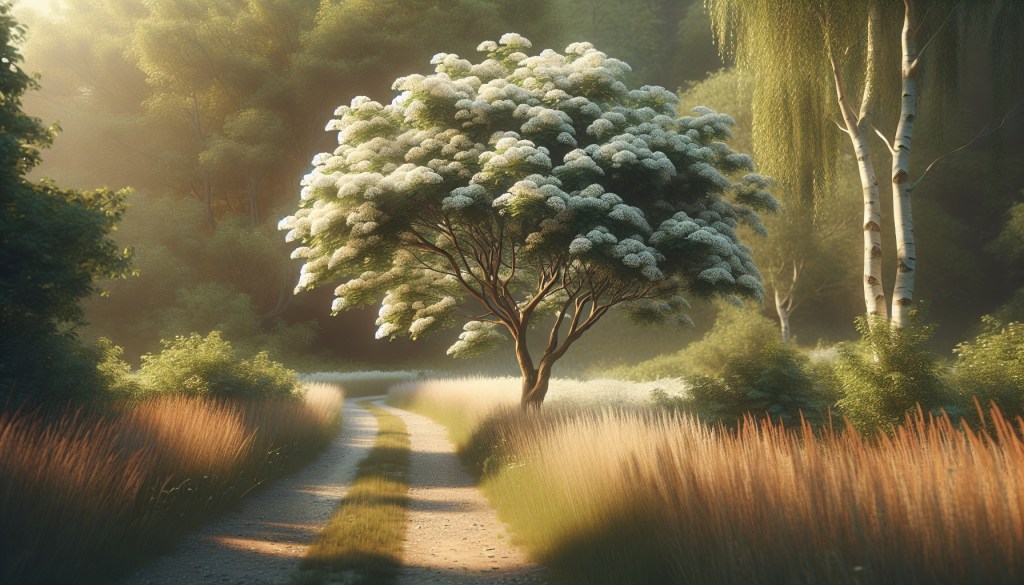
AI image created for this post
One-Time
Monthly
Yearly
Make a one-time or recurring donation to support daily Barnstorming posts
In great deeds, something abides. On great fields, something stays. Forms change and pass; bodies disappear; but spirits linger, to consecrate ground for the vision-place of souls. And reverent men and women from afar, and generations that know us not and that we know not of, heart-drawn to see where and by whom great things were suffered and done for them, shall come to this deathless field, to ponder and dream; and lo! the shadow of a mighty presence shall wrap them in its bosom, and the power of the vision pass into their souls. This is the great reward of service. To live, far out and on, in the life of others; this is the mystery of the Christ, –to give life’s best for such high sake that it shall be found again unto life eternal. ~Major-General Joshua Chamberlain, Gettysburg, Pennsylvania 1889
The sunlight now lay over the valley perfectly still. I went over to the graveyard beside the church and found them under the old cedars… I am finding it a little hard to say that I felt them resting there, but I did…
I saw that, for me, this country would always be populated with presences and absences, presences of absences, the living and the dead. The world as it is would always be a reminder of the world that was, and of the world that is to come. ~Wendell Berry in Jayber Crow
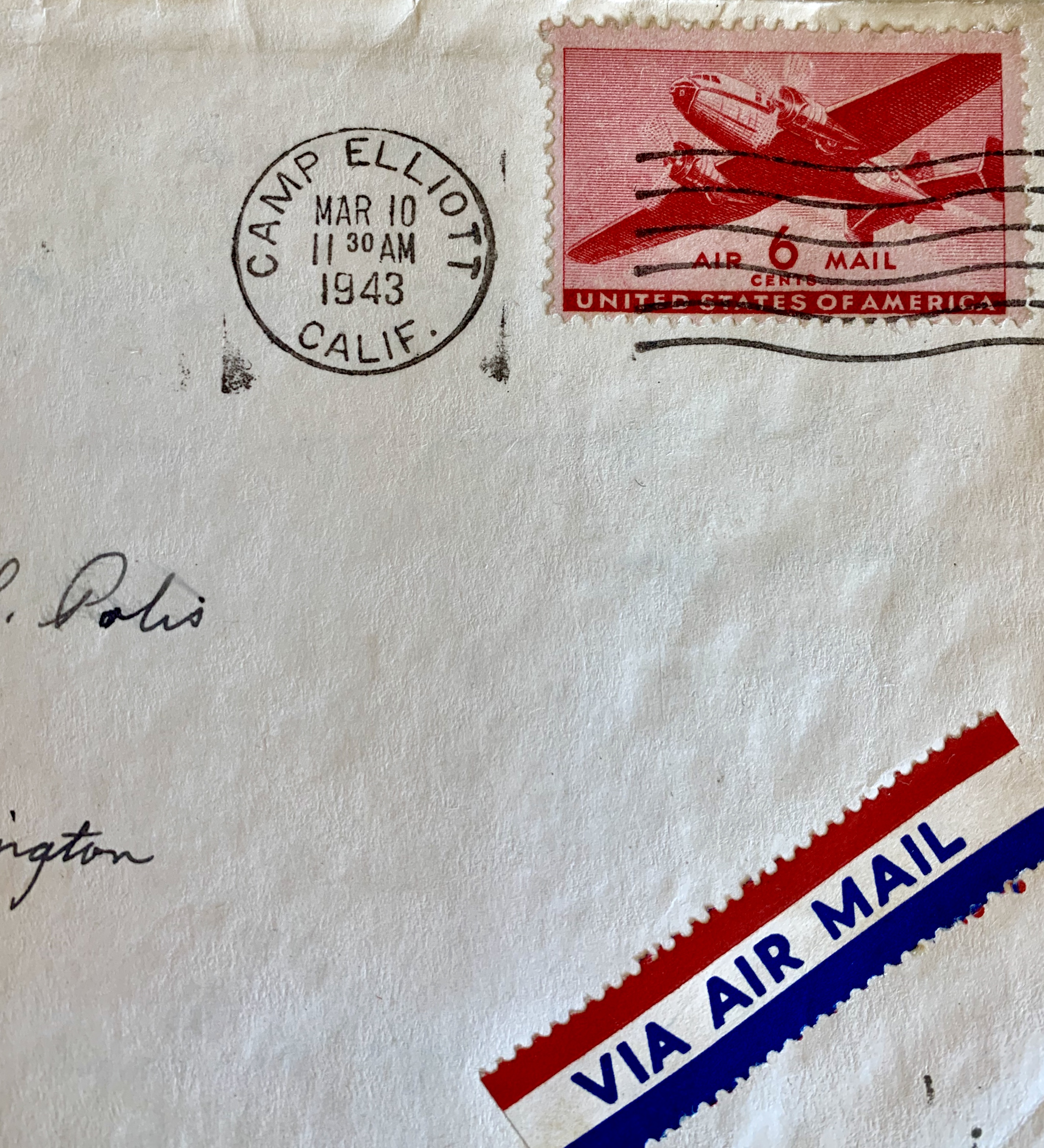
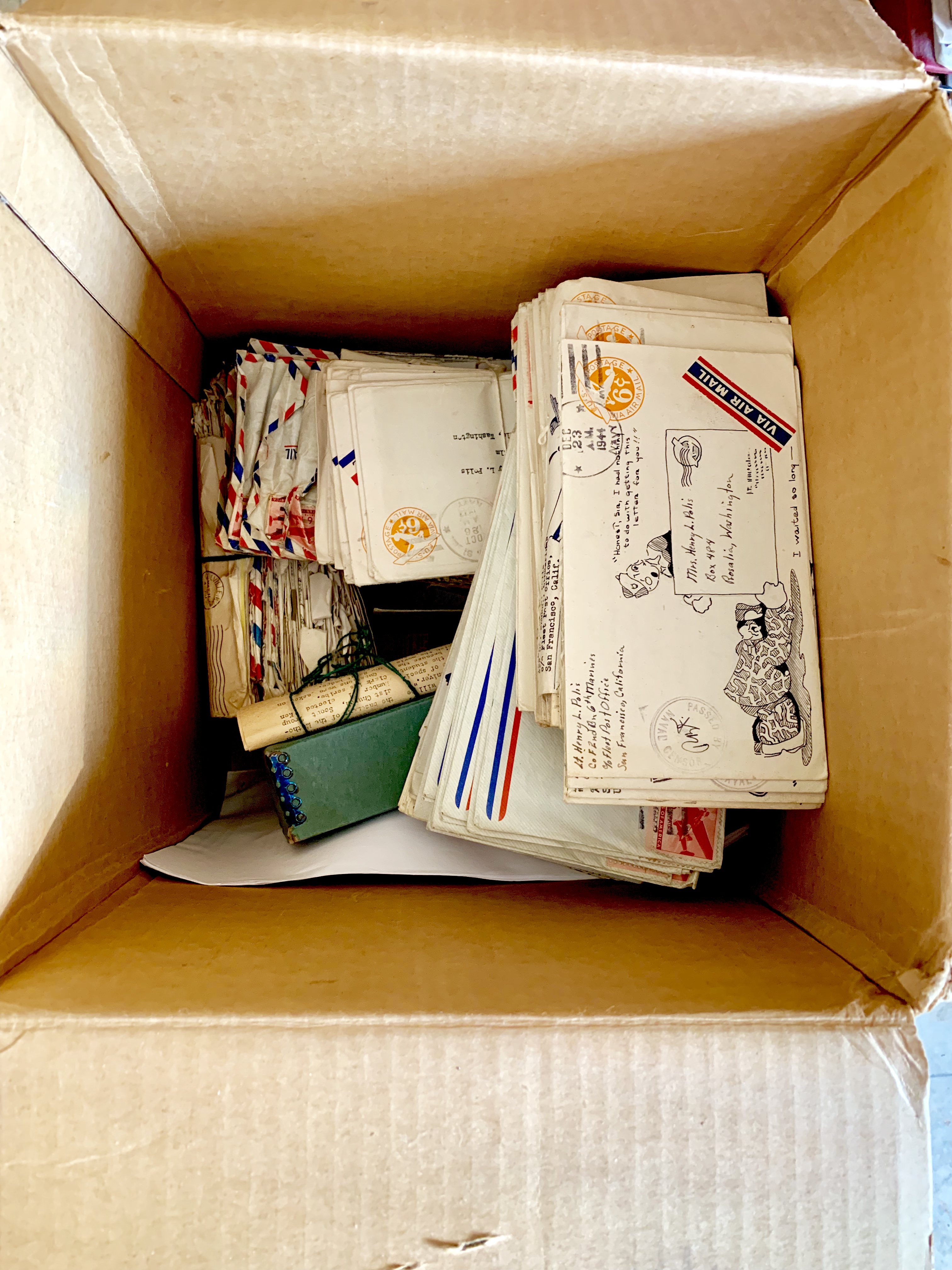
A box of over 700 letters, exchanged between my parents from late 1941 to mid-1945, sat unopened for decades until last year. I started reading.
My parents barely knew each other before marrying quickly on Christmas Eve 1942 – the haste due to the uncertain future for a newly trained Second Lieutenant in the Marine Corps. They only had a few weeks together before she returned home to her rural teaching position and he readied himself to be shipped out for the island battles to come.
They had no idea they would not see each other for another 30+ months or even see each other again at all. They had no idea their marriage would fall apart 35 years later and they would reunite a decade after the divorce for five more years together.
The letters do contain the long-gone but still-familiar voices of my parents, but they are the words and worries of youngsters of 20 and 21, barely prepared for the horrors to come from war and interminable waiting. When he was fighting battles on Tarawa, Saipan, and Tinian, no letters or news would be received for a month or more, otherwise they tried to write each other daily, though with minimal news to share due to military censorship. They speak mostly of their desire for a normal life together rather than a routine centered on mailbox, pen and paper and waiting, lots and lots of waiting.
I’m not sure what I hoped to find in these letters. Perhaps I hoped for flowery romantic whisperings and the poetry of longing and loneliness. Instead I am reading plain spoken words from two people who desperately wanted to have a home together. They somehow made it through those awful years to make my sister and brother and myself possible.
Our inheritance is contained in this musty box of words bereft of poetry. But decades later my heart is moved by these letters – I carefully refold them back into their envelopes and replace them gently back in order. A six cent airmail stamp – in fact hundreds and hundreds of them – was a worthwhile investment in the future, not only for themselves and their family to come, but for generations of U.S. citizens who tend to take their freedom for granted.
Thank you, Dad and Mom, for what you gave up to make today possible.
AI image created by this post
I hear the mountain birds The sound of rivers singing A song I’ve often heard It flows through me now So clear and so loud I stand where I am And forever I’m dreaming of home I feel so alone, I’m dreaming of home
It’s carried in the air The breeze of early morning I see the land so fair My heart opens wide There’s sadness inside I stand where I am And forever I’m dreaming of home I feel so alone, I’m dreaming of home
This is no foreign sky I see no foreign light But far away am I From some peaceful land I’m longing to stand A hand in my hand …forever I’m dreaming of home I feel so alone, I’m dreaming of home ~Lori Barth and Philippe Rombi “I’m Dreaming of Home”
One-Time
Monthly
Yearly
Make a one-time or recurring donation to support daily Barnstorming posts
Not much to me is yonder lane Where I go every day; But when there’s been a shower of rain And hedge-birds whistle gay, I know my lad that’s out in France With fearsome things to see Would give his eyes for just one glance At our white hawthorn tree.
. . . .
Not much to me is yonder lane Where he so longs to tread: But when there’s been a shower of rain I think I’ll never weep again Until I’ve heard he’s dead. ~Siegfried Sassoon“The Hawthorn Tree”
I drove West in the season between seasons. I left behind suburban gardens. Lawnmowers. Small talk.
Under low skies, past splashes of coltsfoot, I assumed the hard shyness of Atlantic light and the superstitious aura of hawthorn.
All I wanted then was to fill my arms with sharp flowers, to seem from a distance, to be part of that ivory, downhill rush. But I knew,
I had always known, the custom was not to touch hawthorn. Not to bring it indoors for the sake of
the luck such constraint would forfeit– a child might die, perhaps, or an unexplained fever speckle heifers. So I left it
stirring on those hills with a fluency only water has. And, like water, able to redefine land. And free to seem to be–
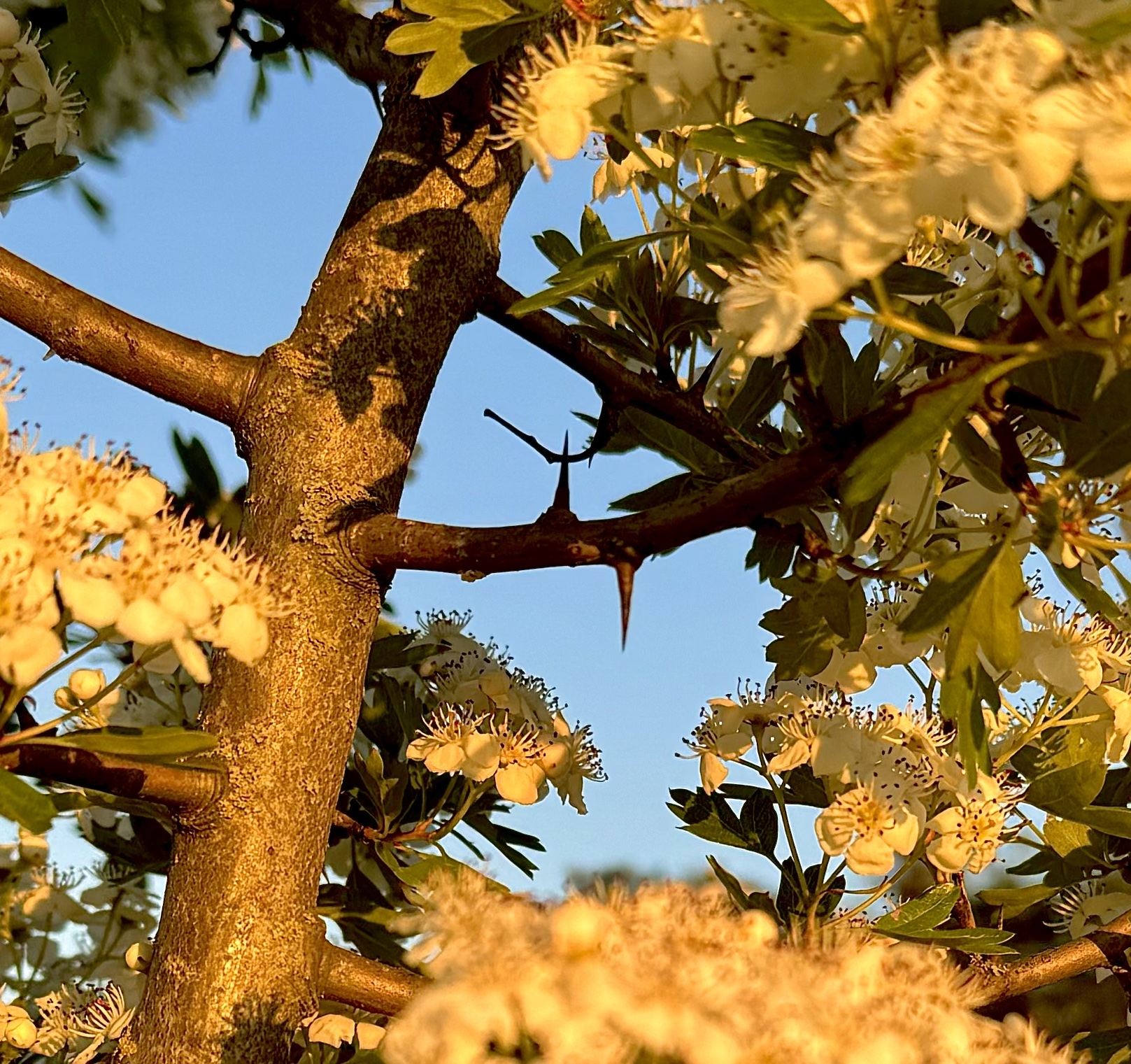
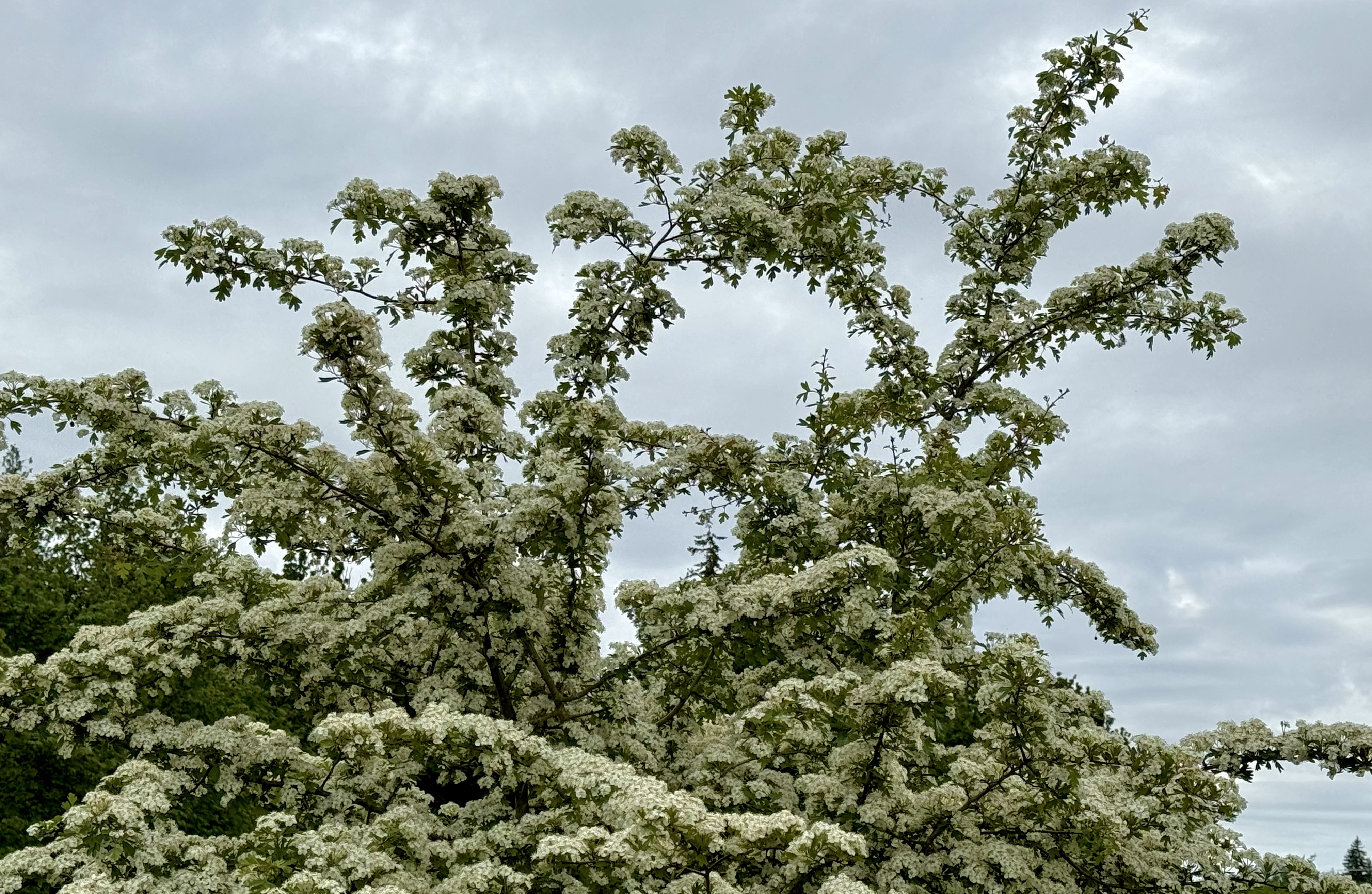
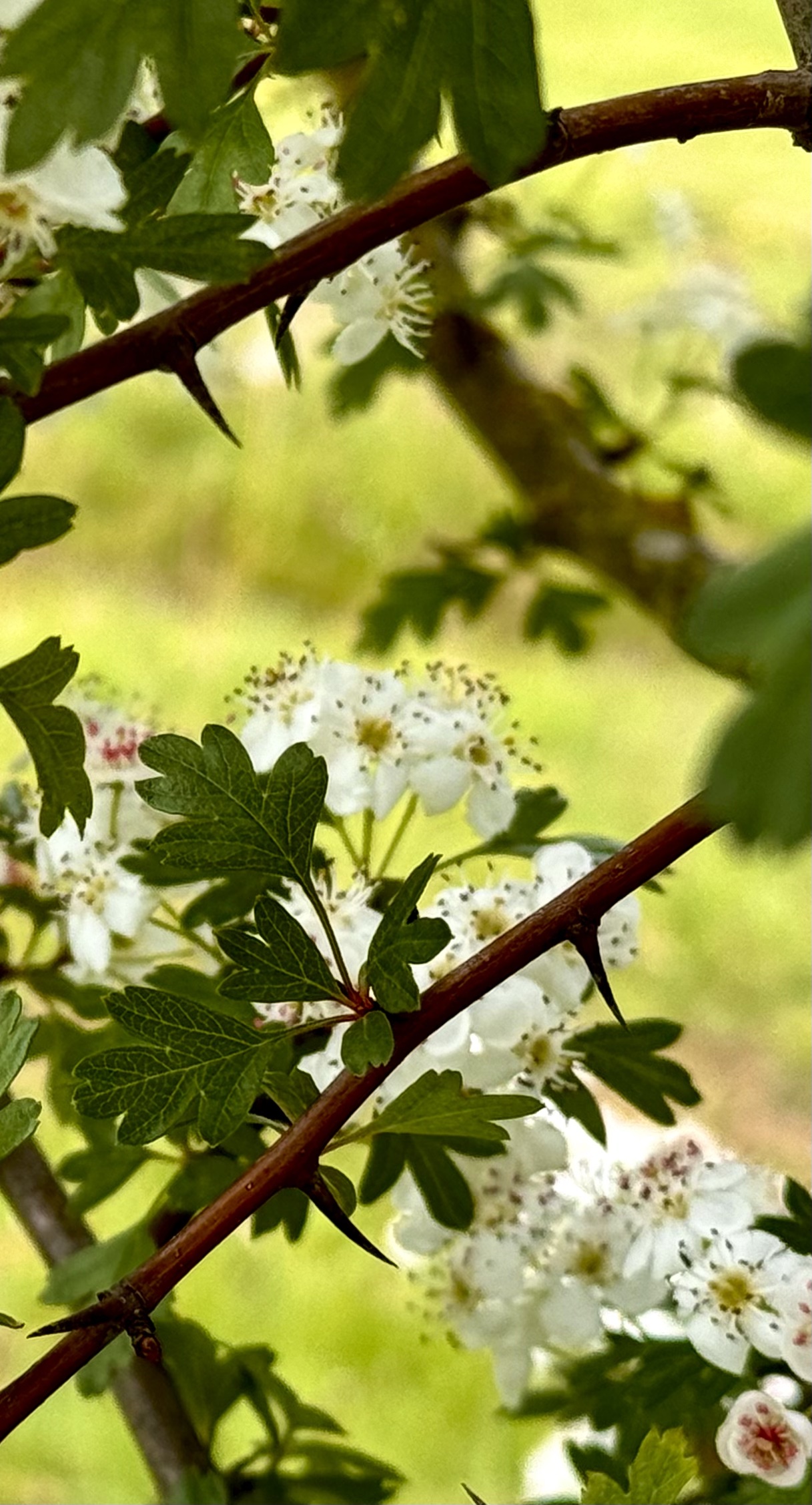
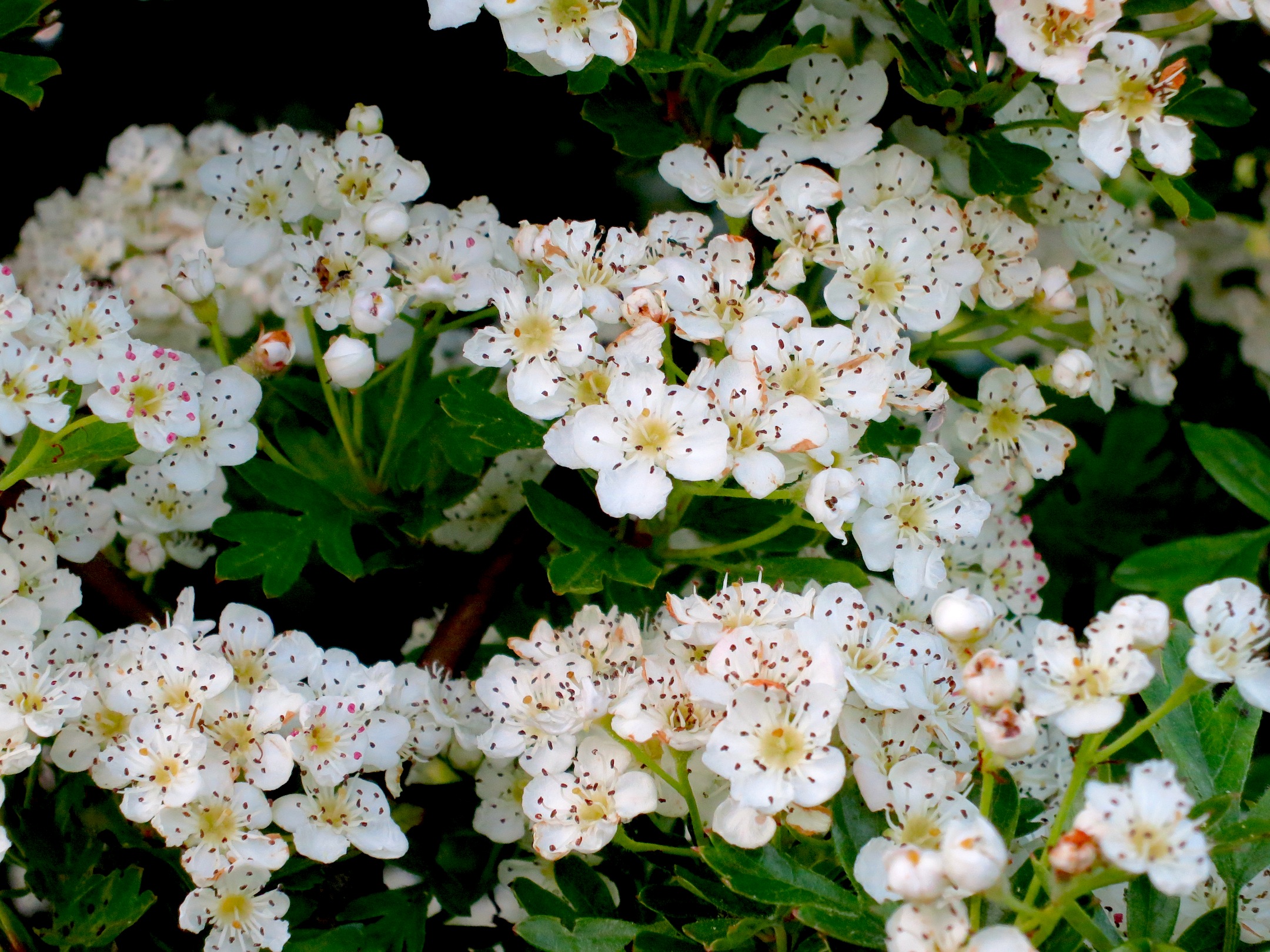
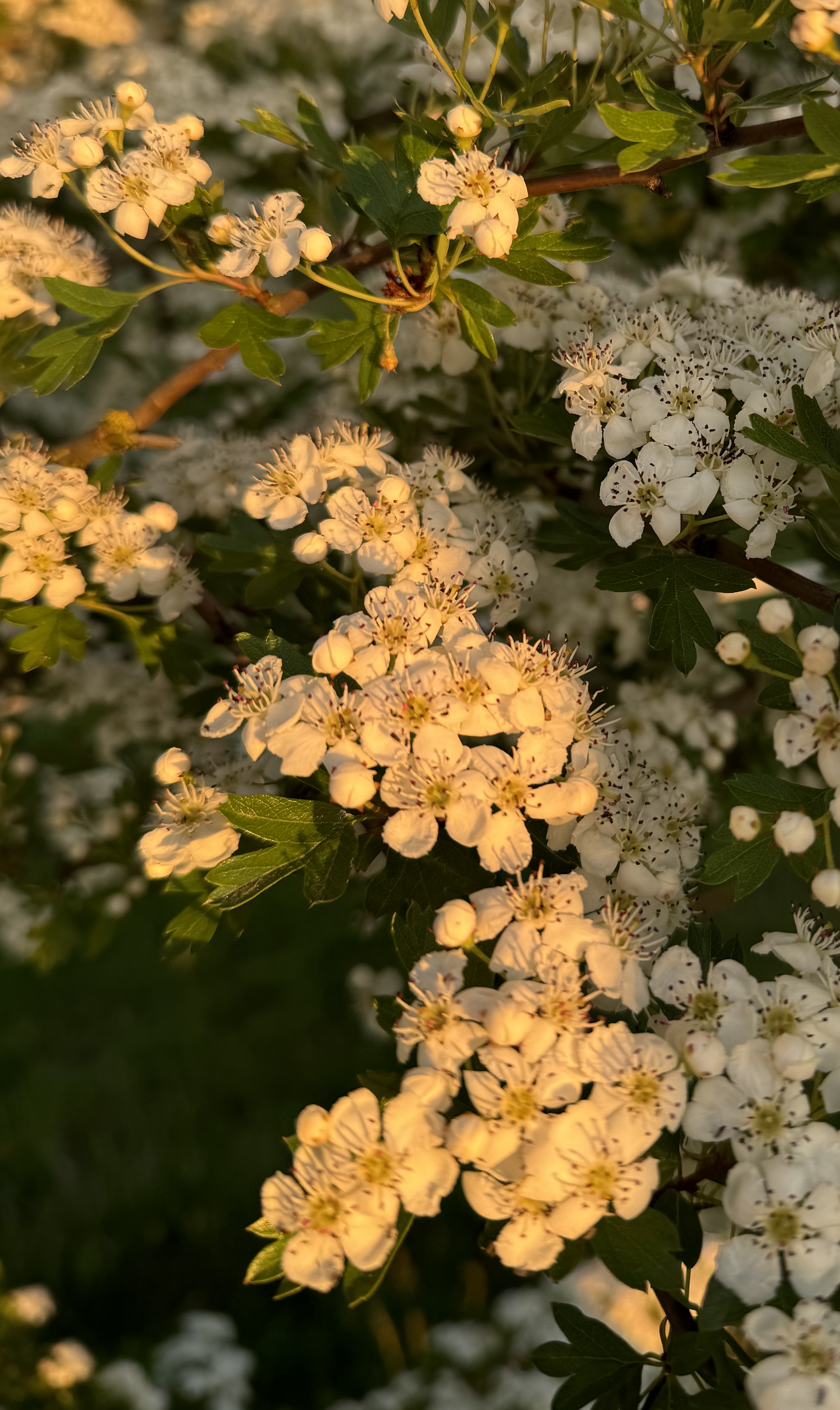
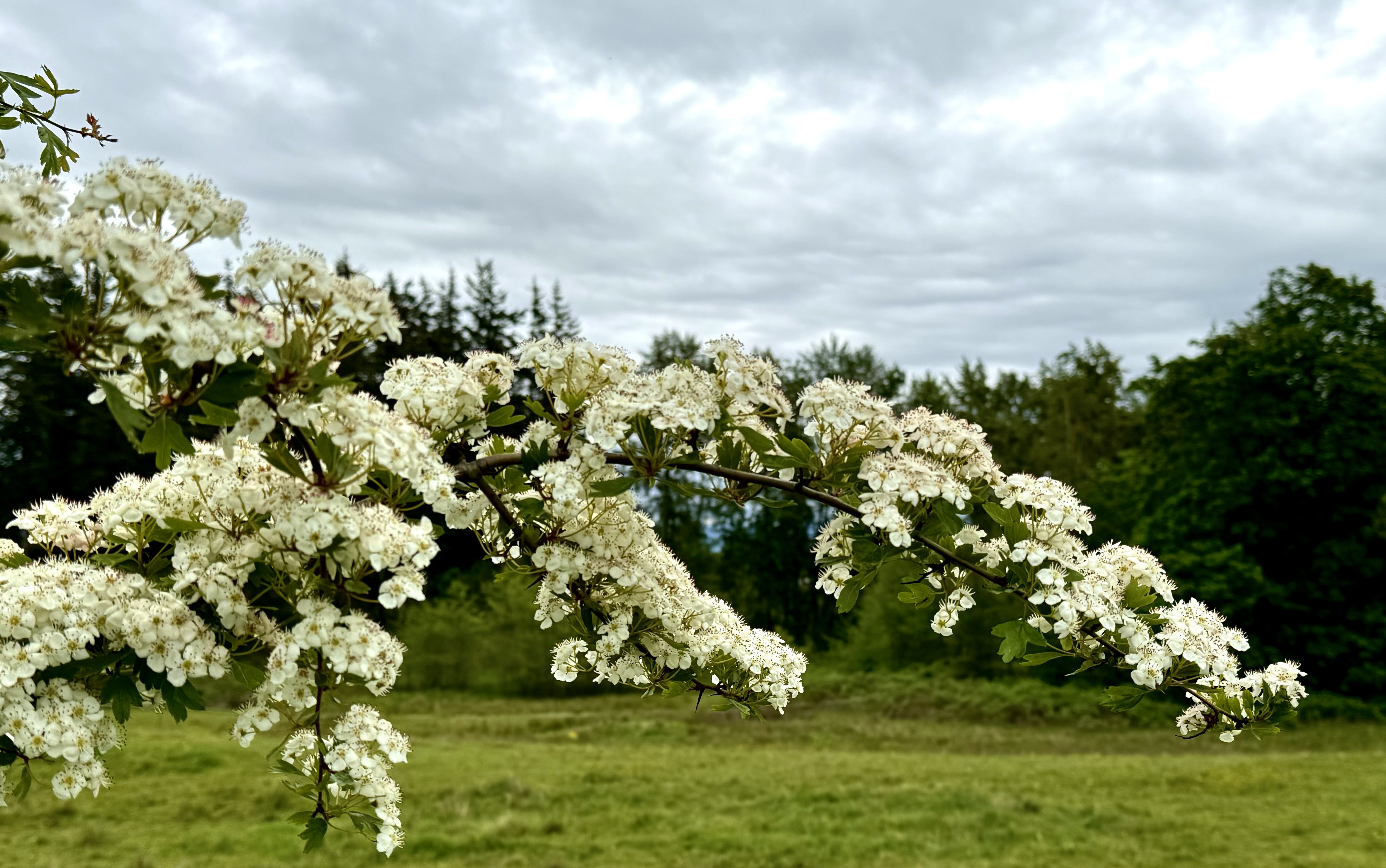
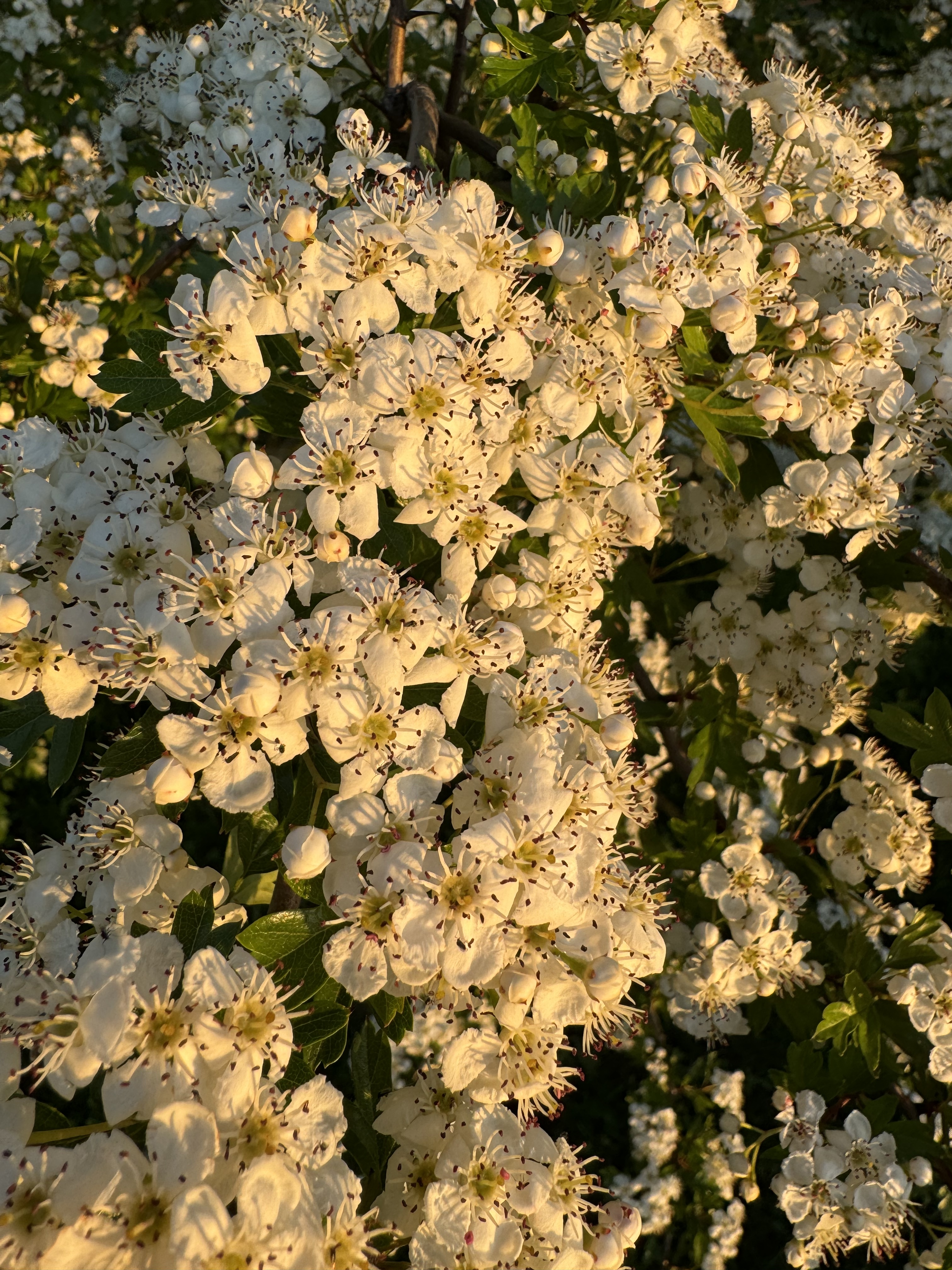
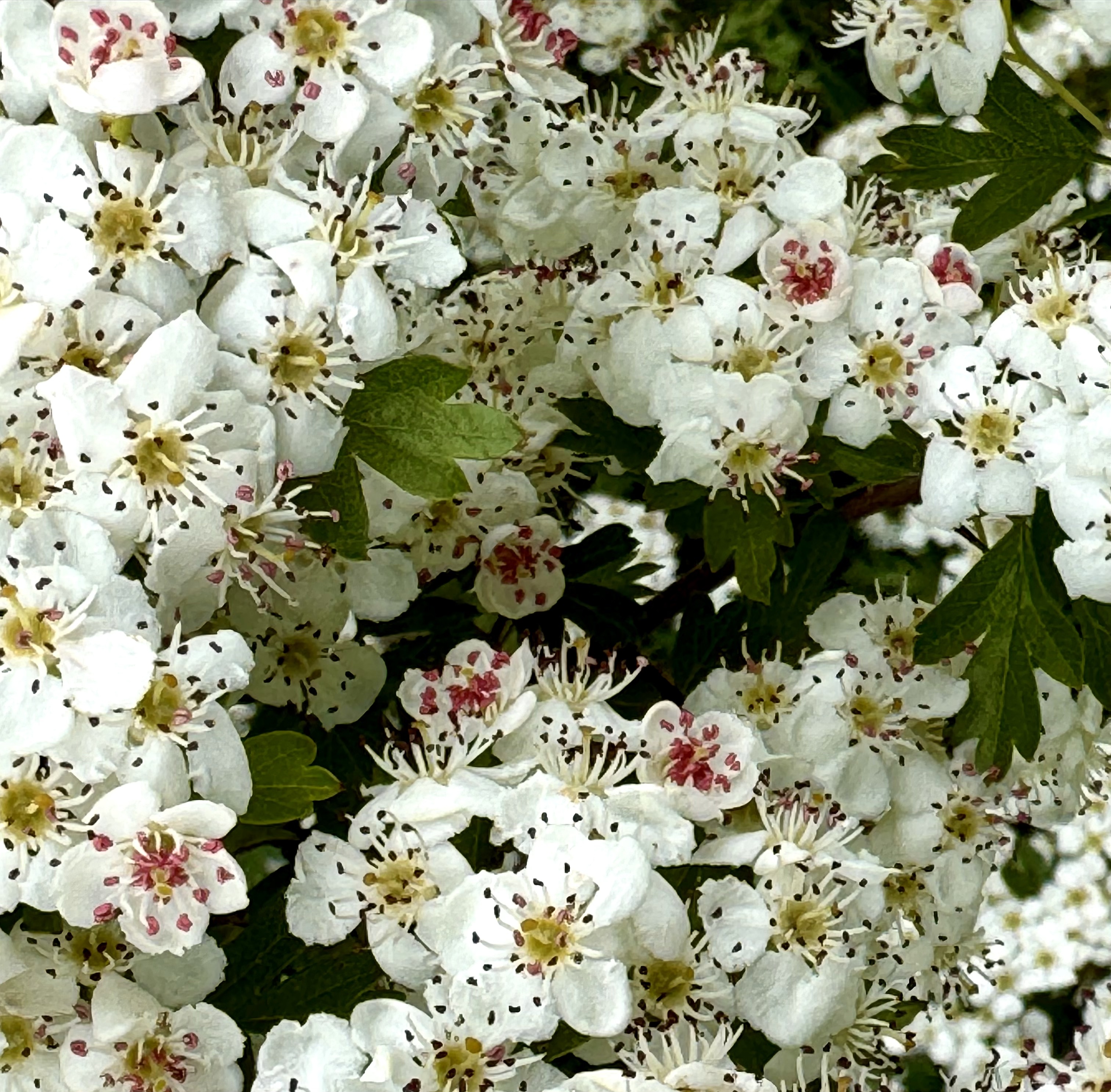
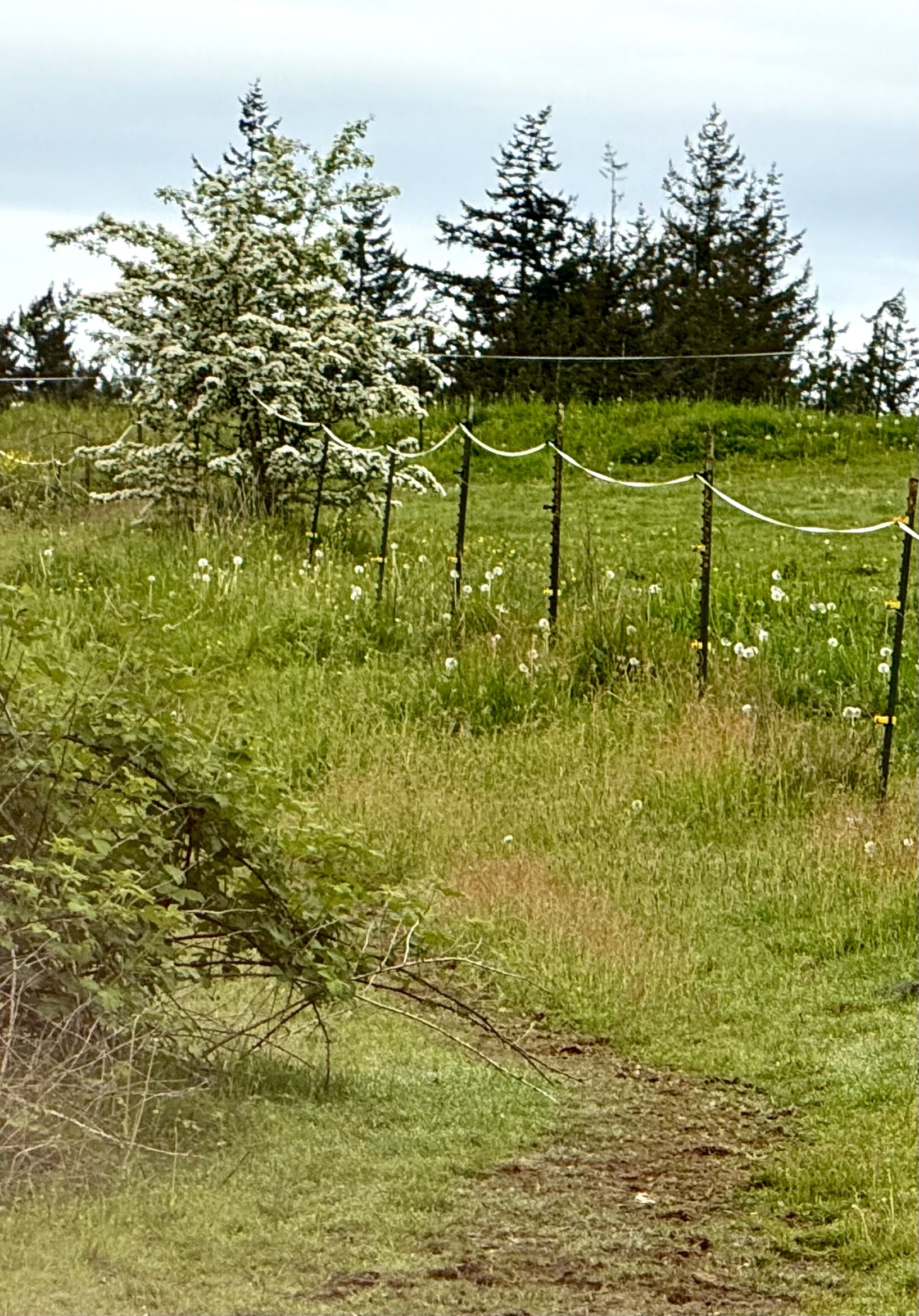
The bird-sowed hawthorn bush along the lane to our back field has suddenly become a blooming tree, staking out its place alongside the trail the horses follow to their pasture. This May, it is a white flame against the dark woods.
Though we didn’t intend for it to be there, we’ll leave it be. Hawthorns are great bird habitat and a haven for honeybees. They are found in most hedge rows in the United Kingdom, impenetrable due to their fierce thorns and criss-cross network of branches, a historic symbol of the toughness and persistence of the Celtic people. Though we don’t need a hedge row here, I appreciate the tree’s reminder it has a place in myth and lore.
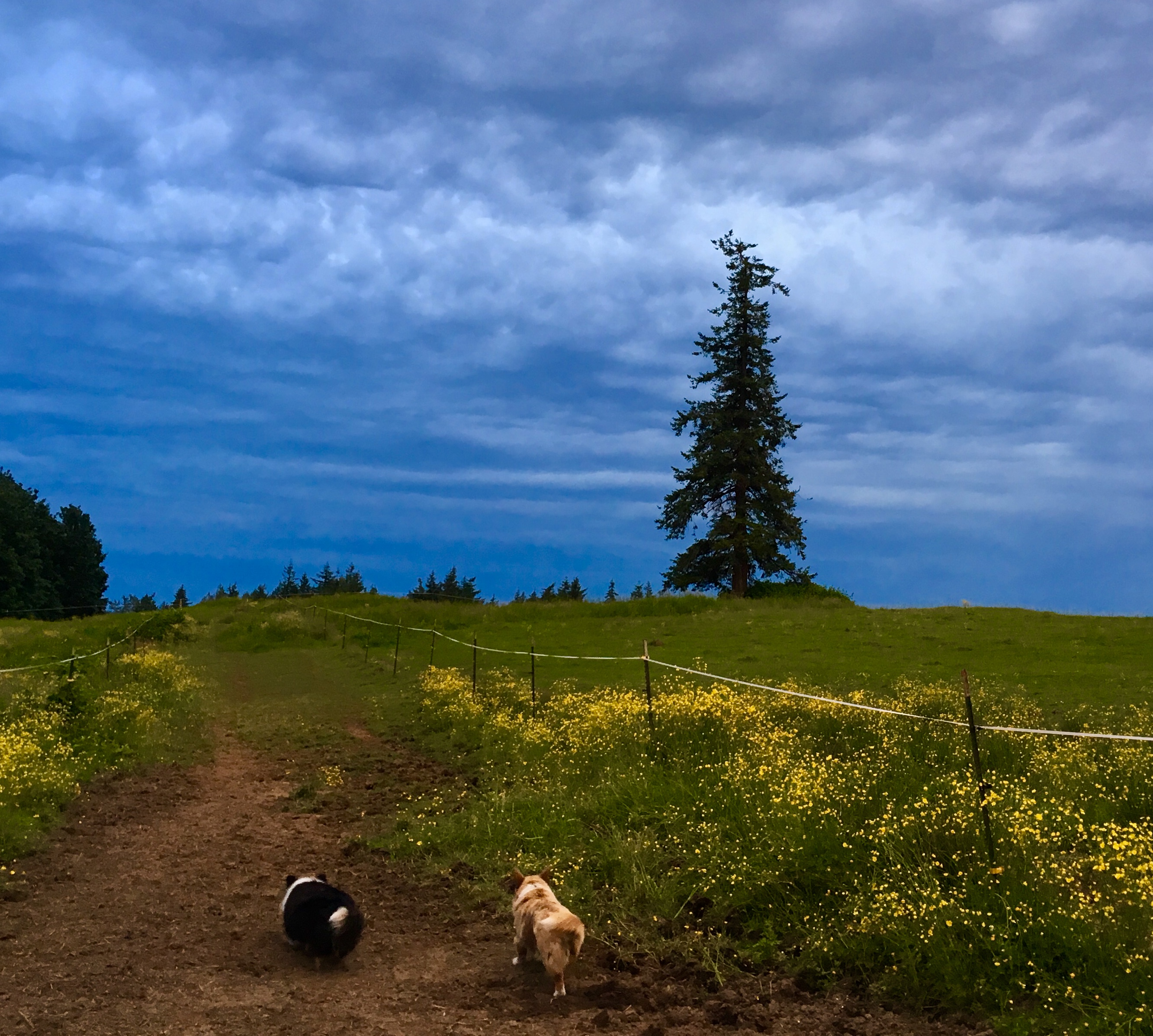
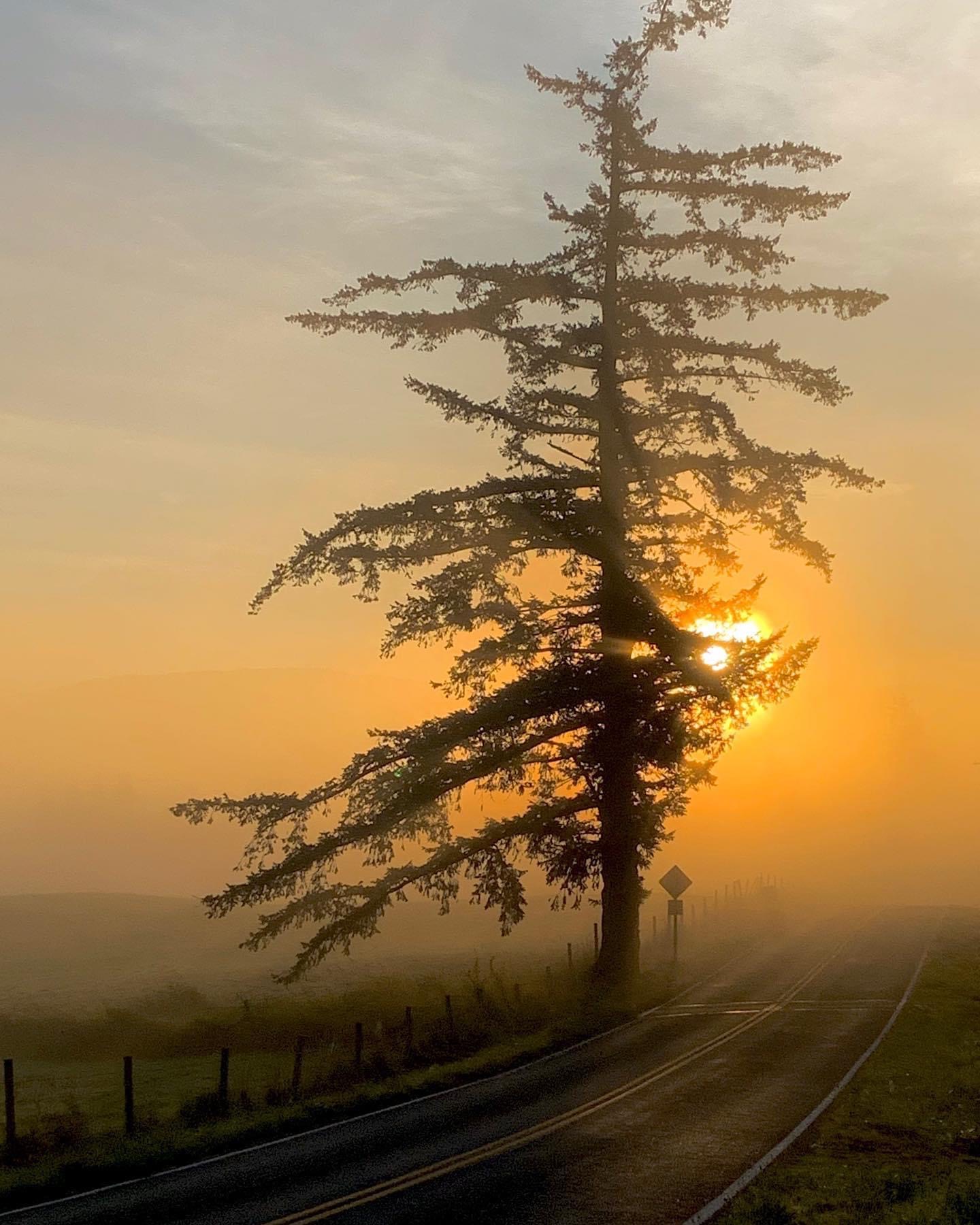
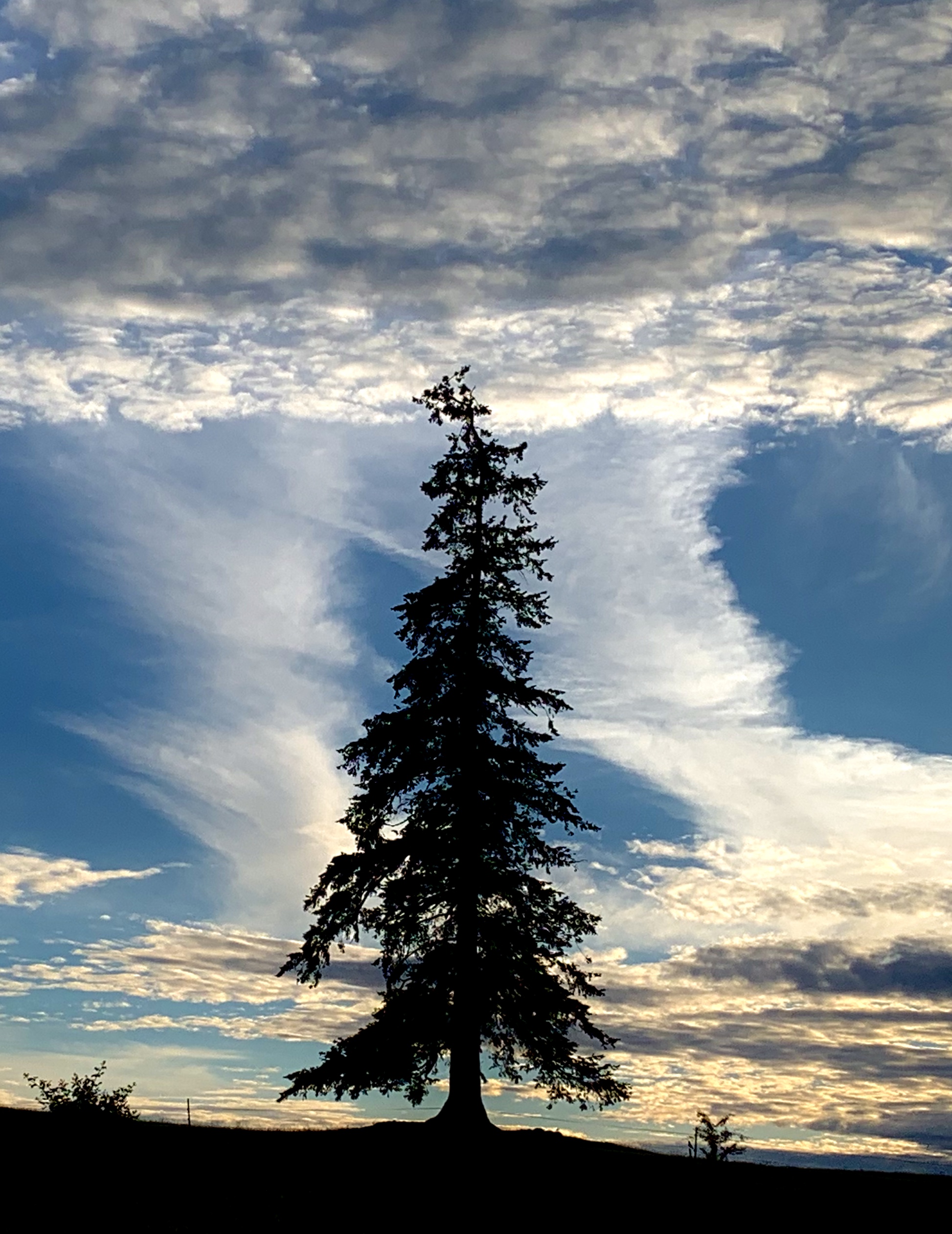
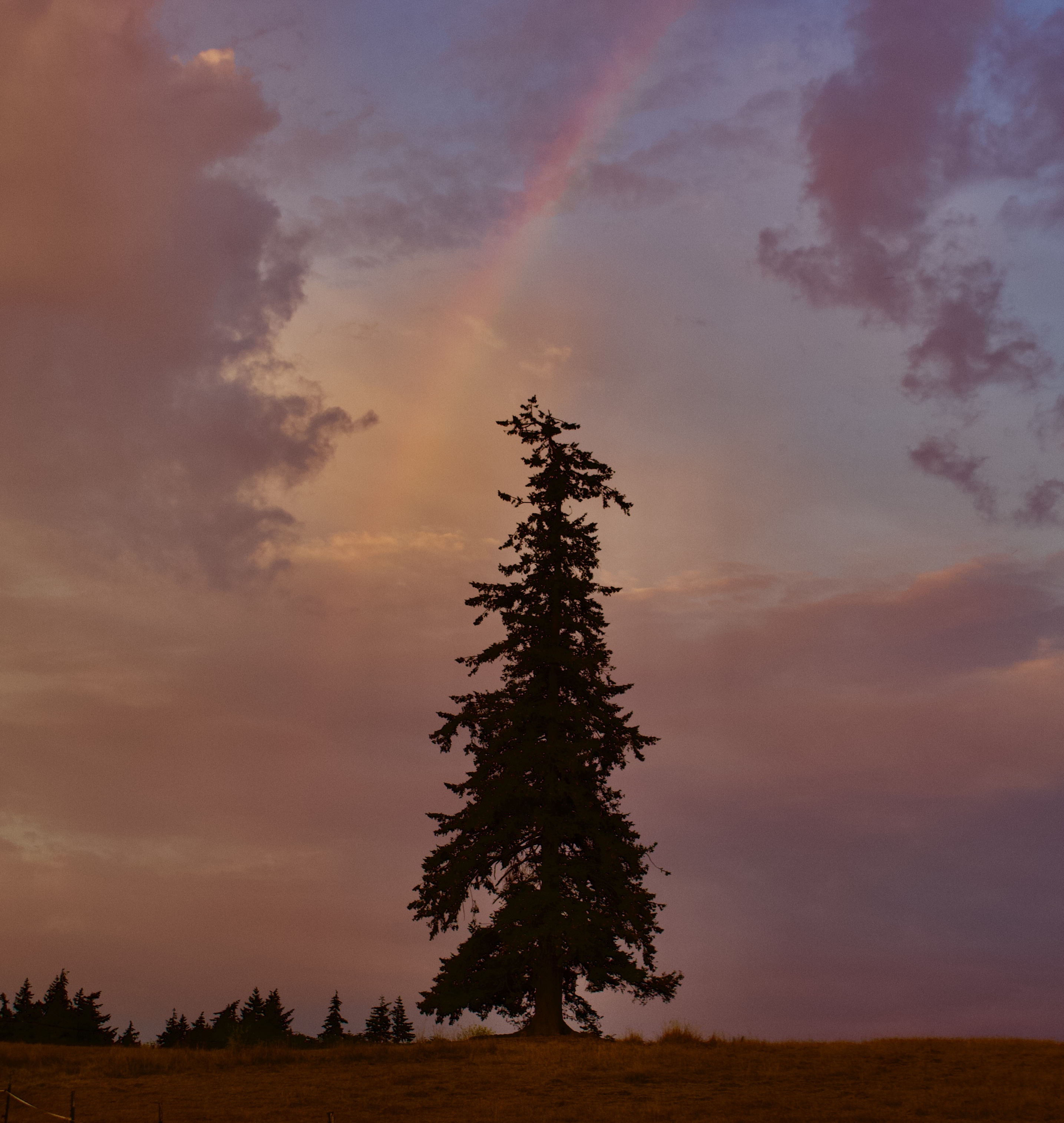
It will never be a hospitable tree like the lone fir tree that graces our hill, or the big leaf maple where children climb, or the black walnut whose branches support the treehouse. But it will be a white beacon every May, portending the summer to come, and if it bears fruit, it will feed the birds that nest in its interior.
And like the poem written by WWI soldier/poet Sassoon, it will be a bittersweet reminder of the familiar comfort of home, even though sharp thorns abound among the blossoms. Those thorns are nothing compared to the despair found in the fearsome trenches of warfare.
AI image created for this postSiegfried Sassoon’s handwritten poem
along fair Arran’s shores the swans sing soft of tale of yore, of a young love taken to sea
the two were hand in glove like sparrows bound in sacred love a tune that only they can sing
a tree of unity they planted by the green eyed sea the branch would hold their love through time
a sailor lad was he he said,”dont cry my lovely, mhari before the moon is full i’ll return”
I’ll wait for thee and she sang to him
the moon shone full and bright and home he sailed mid-summers night the tree so young and blossoming
they slept among the green the world was light and dreams serene the fires in their hearts burned bright
Where moss-grown boulders stand, he took her by the lily hand and there they wed at break of day
the seas know not of hearts and once again the two must part. “it wont be long, i swear to thee.
please wait for me.” and she sang to him
The hawthorn tree has grown, 10 years she walked shores alone, she hears his whisper in the leaves
Home is the sailor lad, home in the sea, forever plaid, Under the wide and starry sky
Yes, I will wait for thee, By mountain, sea and tree; And on the wind you’ll hear my love,
for at the fall of day Beneath the leaves where once we lay I’ll sit and sing i’ll wait for thee
come back to me…. music and lyrics by Fae Wiedenhoeft
One-Time
Monthly
Yearly
Make a one-time or recurring donation to support daily Barnstorming posts
I pray because I can’t help myself. I pray because I’m helpless. I pray because the need flows out of me all the time — waking and sleeping. It doesn’t change God — it changes me. ~attributed to C.S. Lewis in “Shadowlands”
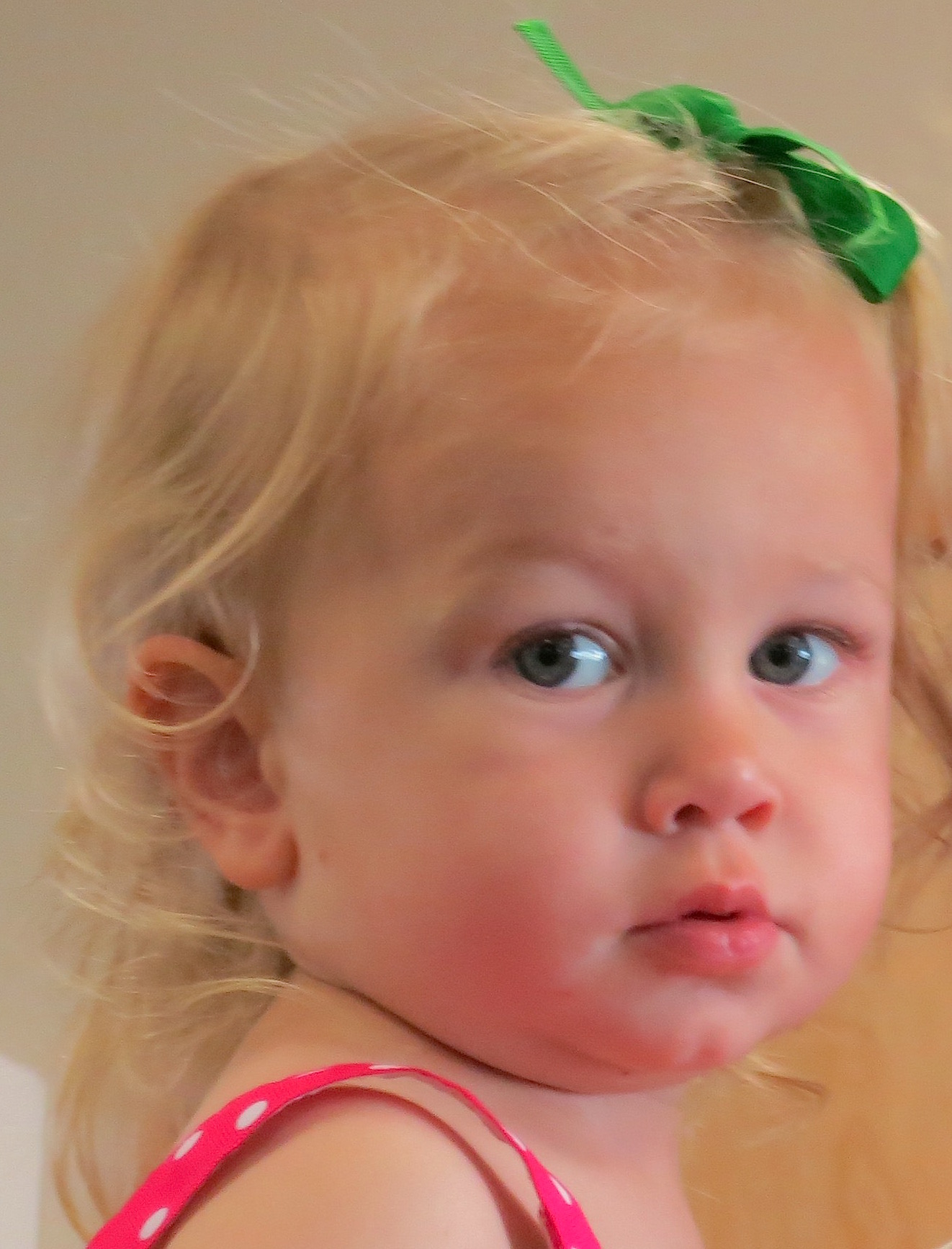
A recovering Faye with her sister Merry
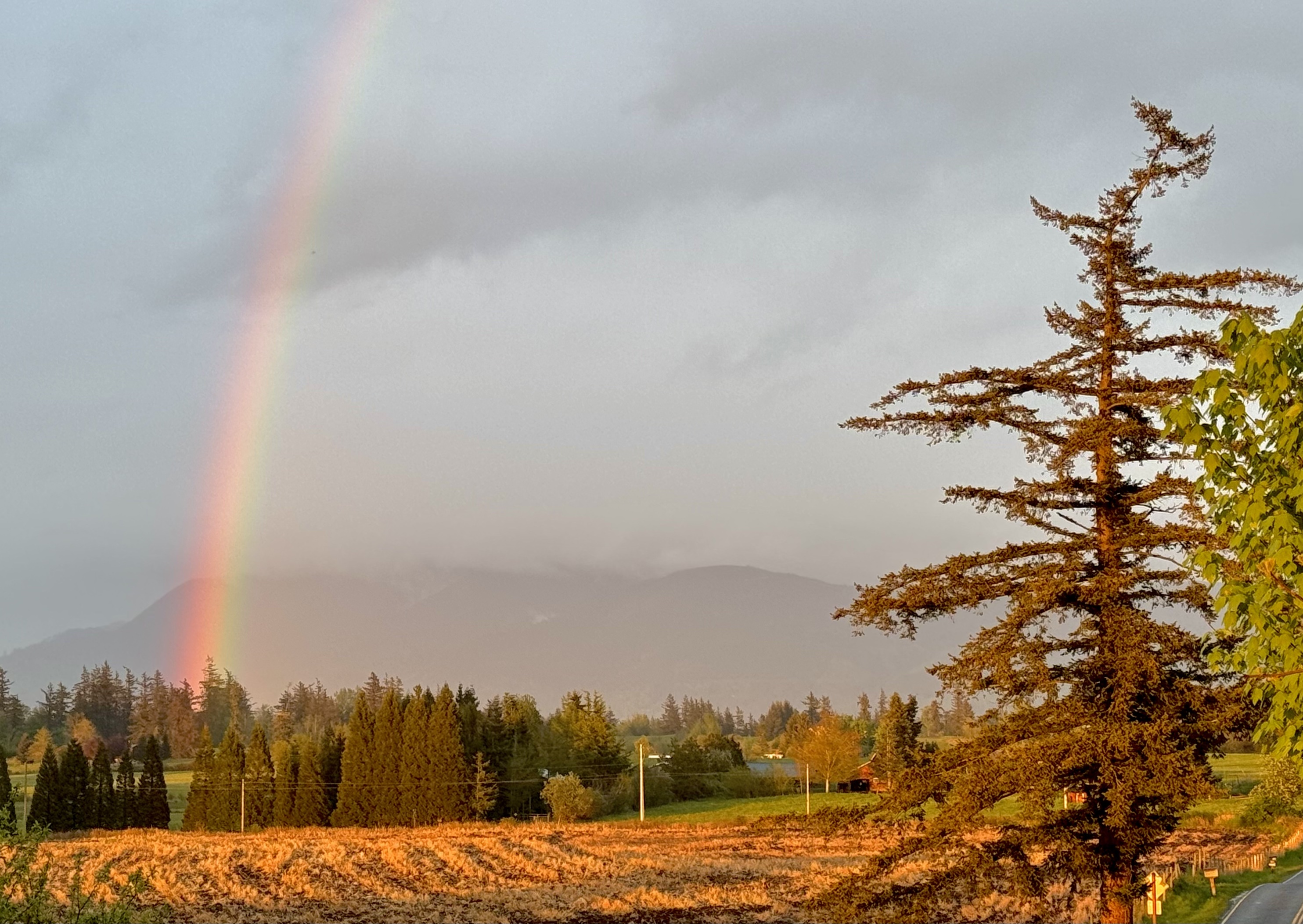
Last week, on May 1, I found a surprise hanging on our front door – a little May Day basket full of little perennial blooms, along with a cheery message and a rainbow sticker. It hung from the door handle as a symbol of spring renewal, as well as a bit of a mystery – the flowers came with no hint of who had left them.
So I did a little sleuthing (actually A LOT of sleuthing) and found out they were delivered by our nearby neighbor Faye, who turned 11 just last week. She has a very special history some of you may remember:
Nine years ago, on this Barnstorming blog, I wrote about our little neighbor, two year old Faye, sickened by E.Coli 0157 infection/toxin to the point of becoming critically ill with Hemolytic Uremic Syndrome (plummeting cell counts and renal failure requiring dialysis to keep her alive). My original post about her illness is found here. I asked for your prayers on her (and others’) behalf.
At the worst point of her hospitalization at Seattle Children’s, when the doctors were sounding very worried on her behalf, Faye’s mother Danyale, in the midst of her helplessness, wrote to our Wiser Lake Chapel Pastor Bert Hitchcock with a plea for prayers from our church.
Here is how Pastor Bert responded to Danyale and her husband Jesse who remained at home, caring for their four other children:
“I understand that Faye (and everyone dealing with her) is fighting for her life. And that’s the way I am praying: that God in his merciful power, would deliver her, even if her condition looks hopeless.
If you were able to be in church this morning, you might hear my sense of urgency, for I have chosen this benediction, with which to close the service — and I give it to you right now, from the mouth of our Lord:
Jesus said: “Do not be afraid, Danyale! I am the First and the Last. I am the Living One. I died, but look – I am alive forever and ever! And I hold the keys of death and the grave.
Neither you nor I know how this will turn out — the possibilities are terrifying. But we do know who holds the keys of life and health and death; He is the Life-giver, who heals all our diseases — nothing can rip our lives (or little Faye’s life) out of His hands. And, when He does allow these bodies to give out, He promises to give us glorious new life, safe forever in His presence. These are not pious platitudes; these are the rock-hard promises of the one who loves us more than life, and who is absolutely in control of what is happening today.
Safe in the arms of Jesus, Safe on His gentle breast; There by His love o’ershaded, Sweetly my soul shall rest.
I’m praying for you all; and your Chapel Family will be praying this morning, as we gather in the Lord’s presence.
Love you, and yours, Danyale, Pastor Bert Hitchcock
That week, Faye’s renal failure reversed itself. She was able to return home with normal kidney function and improved cell counts, having also survived a bout with pneumonia.
Here is what her mother wrote to share with you all once she came home:
“Dear Friends and readers of Barnstorming,
Some of you we know, but so many of you we do not. Whichever the case, Emily tells me you have prayed for our little girl, Faye, throughout her sickness and into her recovery. What can parents say when people–many of whom we may never be privileged to meet in this life–have come alongside us to beseech the Lord for our daughter’s life and pray for her healing? Thank you. Thank you!
Faye is doing so well; stronger every day, more and more herself! It is wonderful to see.
This week we head back down to Seattle Children’s for a check up–we’ll get to say hello to the good folks who saw her through her sickness. A special stop will be made on the dialysis unit to see Nurse Kathy, a favorite of Faye’s. We anticipate a good report!
Thanks again for your love and support, far and wide. Truly astounding. Danyale and Jesse, for Faye, too
—————————————
Now Faye is a delightful, healthy eleven year old girl who secretly blessed me with a basket of May Day flowers. She doesn’t remember the crisis that nearly took her from us nine years ago, but she does know about God’s rainbow promises. And she certainly knows about the power of prayer in the face of helplessness.
As Pastor Bert said: our faith in an unchanging and steadfast God who loves and holds us, can change us – forever.
Still and calm, In purple robes of kings, The low-lying mountains sleep at the edge of the world. The forests cover them like mantles; Day and night Rise and fall over them like the wash of waves. Asleep, they reign. Silent, they say all. Hush me, O slumbering mountains – Send me dreams. ~Harriet Monroe “The Blue Ridge”
If you find yourself half naked and barefoot in the frosty grass, hearing, again, the earth’s great, sonorous moan that says you are the air of the now and gone, that says all you love will turn to dust, and will meet you there, do not raise your fist. Do not raise your small voice against it. And do not take cover. Instead, curl your toes into the grass, watch the cloud ascending from your lips. Walk through the garden’s dormant splendor. Say only, thank you. Thank you. ~Ross Gay “Thank You”
I live for those who love me, Whose hearts are kind and true; For the heaven that smiles above me, And awaits my spirit, too; For all human ties that bind me, For the task my God assigned me, For the bright hopes left behind me, And the good that I can do. For the cause that needs assistance, For the wrongs that need resistance, For the future in the distance, And the good that I can do ~George Linnaeus Banks from “What I Live For”
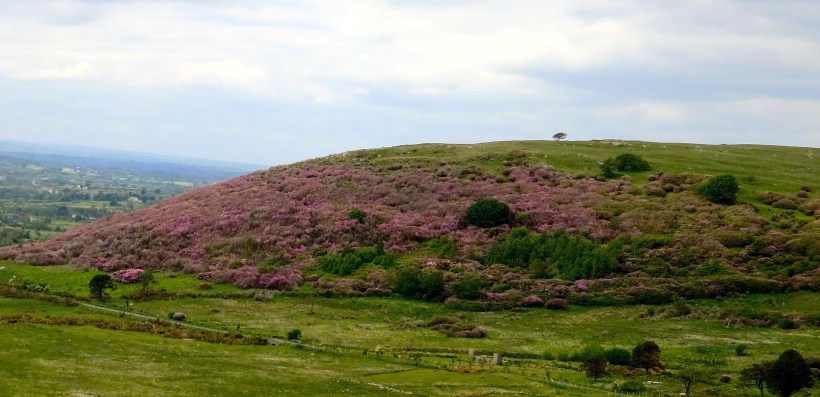
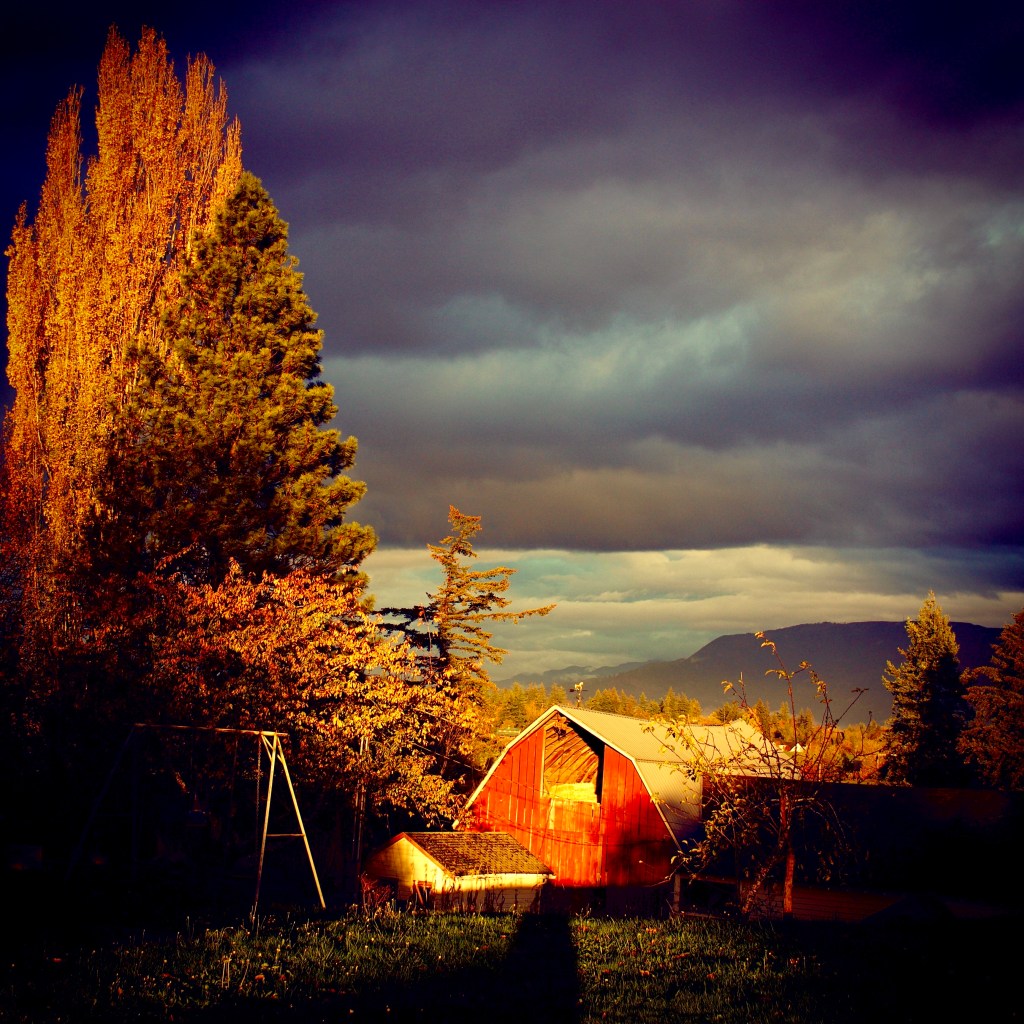
Our surrounding hills circle like wagons, their strong shoulders promising steadfast protection. Above them, the palette of sky changes with the weather, as turmoil and turbulence continually stirs up our world.
There is so much good to be done: our world needs hands-on, hearts-on work for causes needing assistance – for wrongs needing resistance.
Feeding, housing, healing, caring, for those in our own neighborhoods won’t make headlines like blocking freeways and college buildings.
Rather than raising tents and fists, idle hands can serve. Rather than raising voices and drums, heads can bow in grateful prayer.
The mountains remind us: Though we are here and now, we will soon turn to dust. They ask us: How to live a life that truly makes a difference for those in need?
What words or harder gift does the light require of me carving from the dark this difficult tree?
What place or farther peace do I almost see emerging from the night and heart of me?
The sky whitens, goes on and on. Fields wrinkle into rows of cotton, go on and on. Night like a fling of crows disperses and is gone.
What song, what home, what calm or one clarity can I not quite come to, never quite see: this field, this sky, this tree. ~Christian Wiman, “Hard Night”
Some days, although we cannot pray, a prayer utters itself. So, a woman will lift her head from the sieve of her hands and stare at the minims sung by a tree, a sudden gift.
Some nights, although we are faithless, the truth enters our hearts, that small familiar pain; then a man will stand stock-still, hearing his youth in the distant Latin chanting of a train.
Pray for us now. Grade 1 piano scales console the lodger looking out across a Midlands town. Then dusk, and someone calls a child’s name as though they named their loss.
Darkness outside. Inside, the radio’s prayer — Rockall. Malin. Dogger. Finisterre. ~Carol Ann Duffy “Prayer”
photo by Bob Tjoelker
As a child falling asleep, I prayed to God with moans and groans echoing in my ears.
Growing up on a small farm located about two miles from a bay in Puget Sound, I found myself praying for safety on foggy nights as fog horns moaned in the distance. Scattered throughout the inlet, the horns called out mournful groans of warning to passing freighter ships. The resonant lowing of the horns carried miles over the surrounding landscape due to countless water particles in the fog transmitting sound waves so effectively. The louder the foghorn moan heard on our farm, the thicker and more hazardous the mist in the air. Those horns would make me unspeakably sad for reasons I could only articulate to God. Thus I prayed for the ships, and I prayed for my own shaky navigation through life.
Navigating blind in a fog necessitates taking unpredictable risks. The future can seem a murky mess. I cannot see what lies ahead: I navigate by my wits, by my best guess, but particularly by listening for the low-throated warnings coming from the rocky shores and shallows of those who have gone ahead of me.
I am easily lost in the fog of my fears – disconnected, afloat and circling aimlessly, searching for a touch point of purpose and direction. The isolation I sometimes feel may simply be my own self-absorbed state of mind, sucking me in deep until I’m soaked, dripping and shivering from the smothering gray. If only I trust the fog horn warnings and reassurances from the Word of God, I could charge into the future undaunted.
He is in the pea soup alongside me, awaiting the Sun’s dissipation of the fog. Now I know, nearly seventy years into this voyage, the fog eventually clears. The journey continues on beyond these shores.
Even so, I will keep praying with the resonant voices of wisdom and caution from shore, like the nightly tradition of the BBC radio shipping forecasts that calm so many to sleep to this day. Even a Finisterre (the end of the land) prayer holds us in safety as we find our way home.
Instead of echoing the anxious moans and groans of my childhood prayers, may my voice be heard singing an anthem of hope and promise.
One-Time
Monthly
Yearly
Make a one-time or recurring donation to support daily Barnstorming posts
Tell us of a bypassed heart beating in 12C, how the woman holds a stranger’s hand to the battery sewn in beneath her collarbone, and says feel this. Tell us of the man’s ear listening across the aisle, hugging itself, a fist long since blistered by blaze. Outside, morning sun buckling up. Inside, twitching bonesacks of bat, birdsong erupting as light cracks the far jungle canopy. Ten thousand feet below ours, a grey cat tongues the morning’s butter left out to soft. Last night we broke open the sweet folds around two paper fortunes. One said variety. One said caution. The woman in 12C would hold that her heart needs its hidden spark, but the man shows how some live the rest of their lives with half a face remembering its before expression. Who was it that said our souls know one another by smell, like horses? ~Jenny Browne “Love Letter to a Stranger”
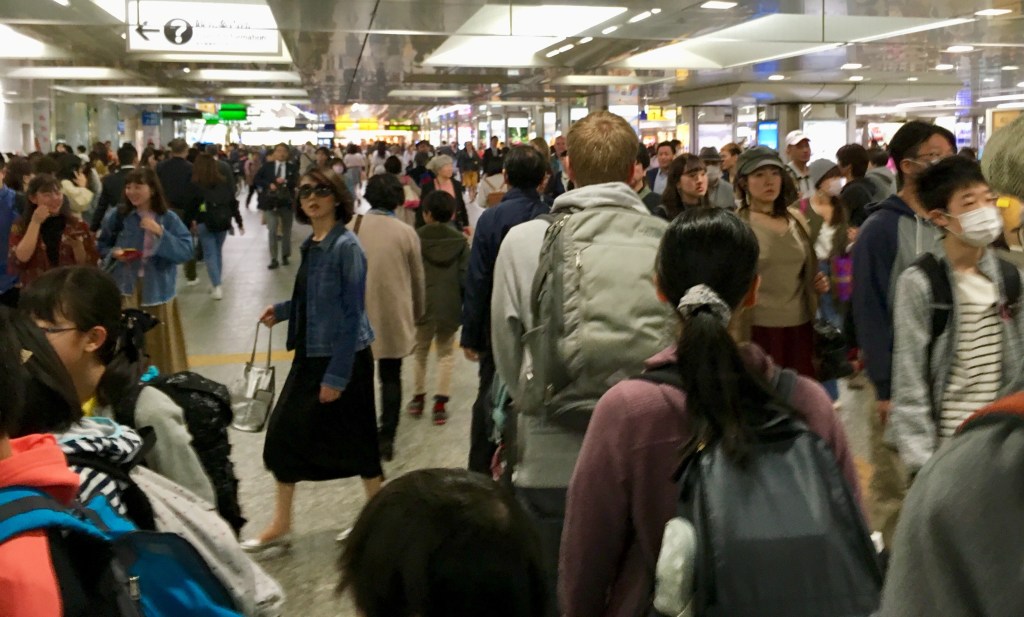
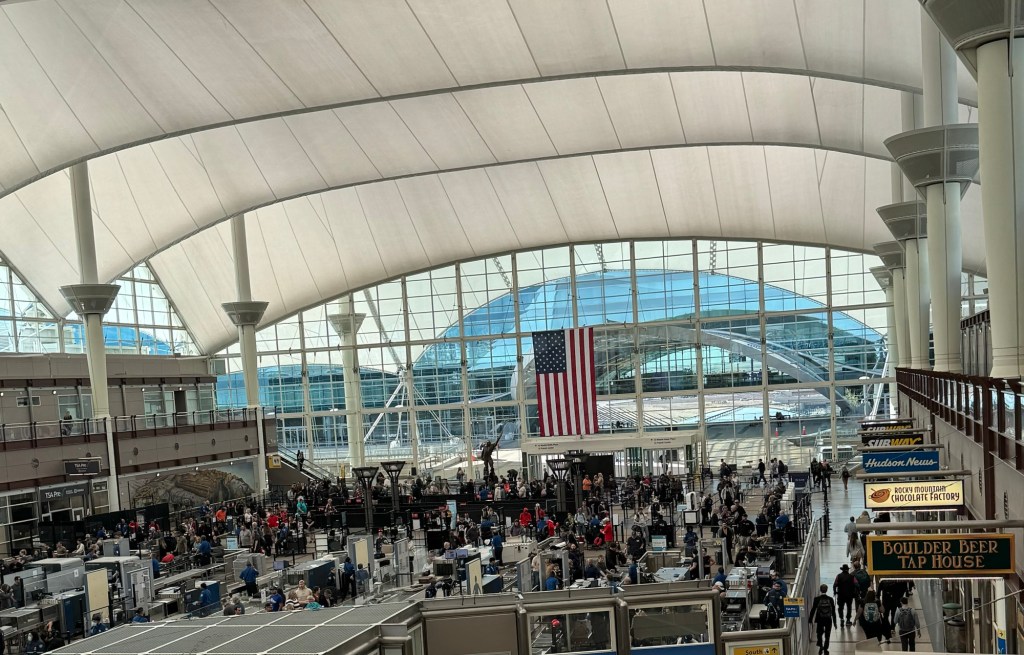
I spent part of last weekend in airports and airplanes among strangers. As an introvert who prefers to read and stay securely in my shell, I don’t often initiate conversation with the people next to me other than the necessary “excuse me” or “thanks” when appropriate. It is always a wonder to me when seat partners across from me or in front of me will find out all about each other’s lives, destinations and feelings about the state of the world. I wrote about this recently, sharing one of Billy Collins’ poems.
I am far more private and cautious – (ironic words to be written by a blogger of 14 years with over 20,000 followers). Even so, I’m struck by the affinity I feel for my fellow passengers as we embark on a trip by air – so different from each of us independently traveling down a highway in our individual vehicles. In an airplane, our fates are lashed together. What happens to one will happen to all.
Because we are bound together – sometimes randomly, sometimes not – I do believe that we might find kindred and sympathetic souls in a mysterious way when we are thrust among strangers. We are created for connection, whether by smell or sight or spirit.
And perhaps, scrolling through the internet, you have run across Barnstorming not expecting a connection to happen.
One never knows how we may become bound together.
One-Time
Monthly
Yearly
Make a one-time or recurring donation to support daily Barnstorming posts
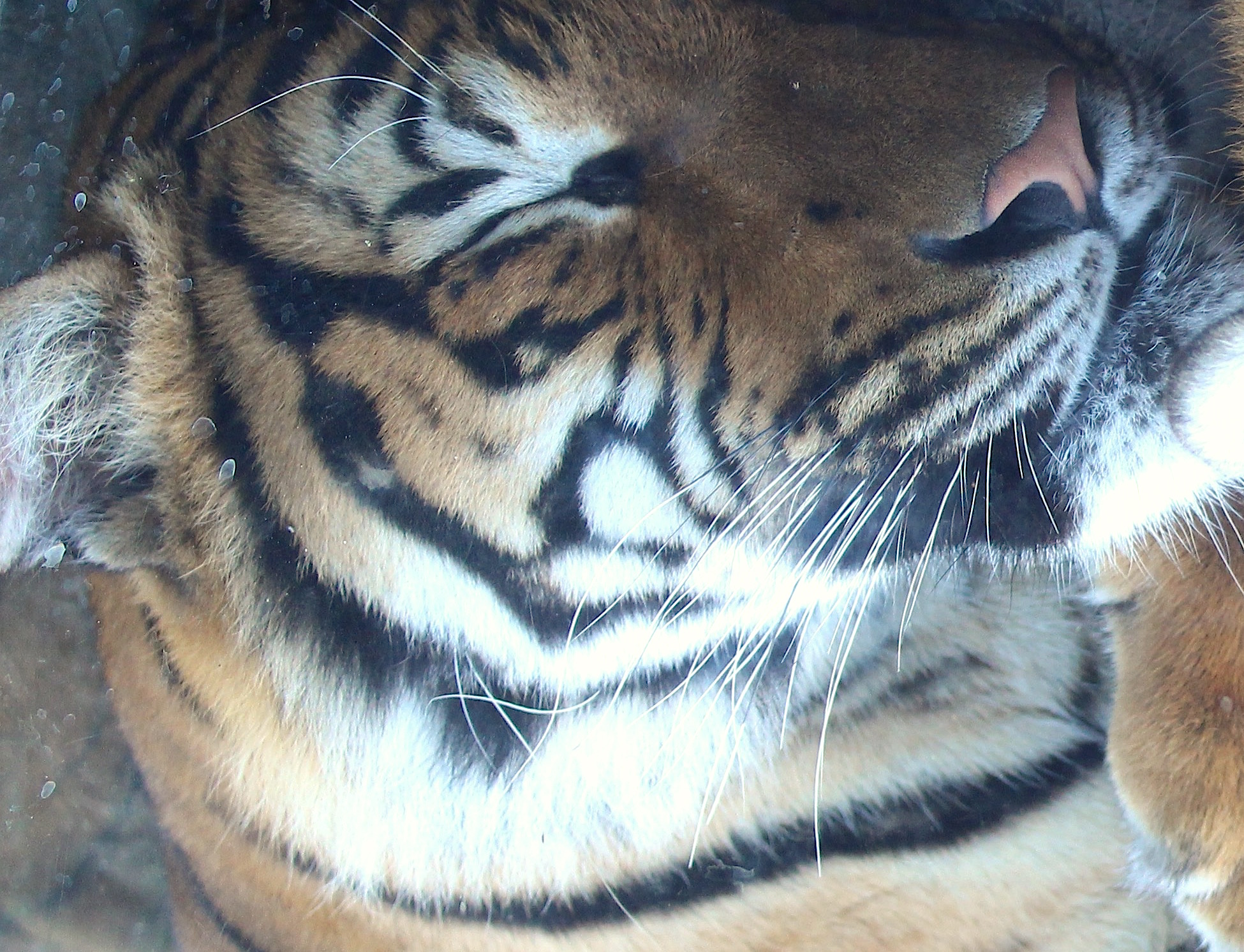
Trust that there is a tiger, muscular Tasmanian, and sly, which has never been seen and never will be seen by any human eye. Trust that thirty thousand sword- fish will never near a ship, that far from cameras or cars elephant herds live long elephant lives. Believe that bees by the billions find unidentified flowers on unmapped marshes and mountains. Safe in caves of contentment, bears sleep. Through vast canyons, horses run while slowly snakes stretch beyond their skins in the sun. I must trust all this to be true, though the few birds at my feeder watch the window with small flutters of fear, so like my own. ~Susan Kinsolving “Trust”
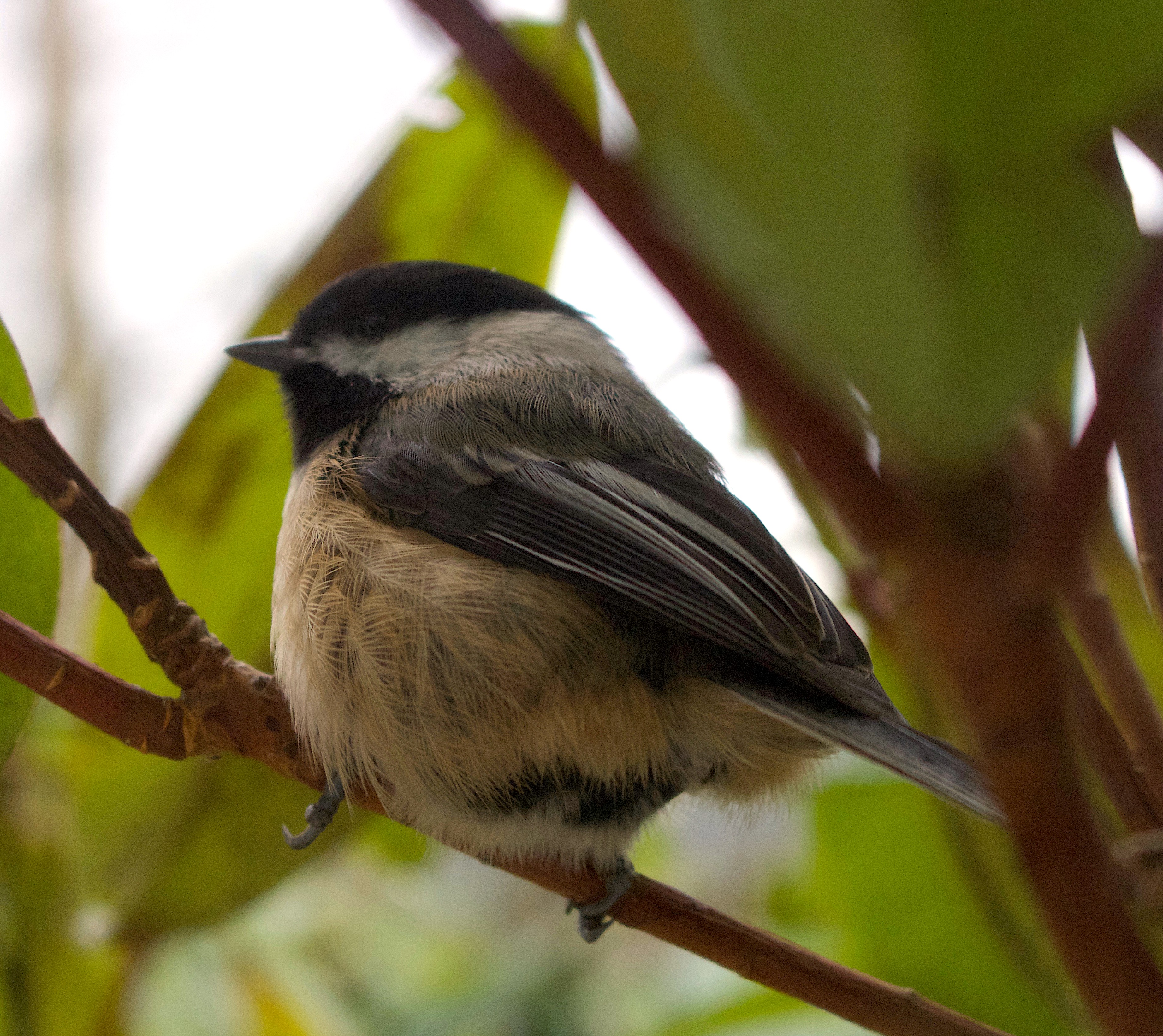
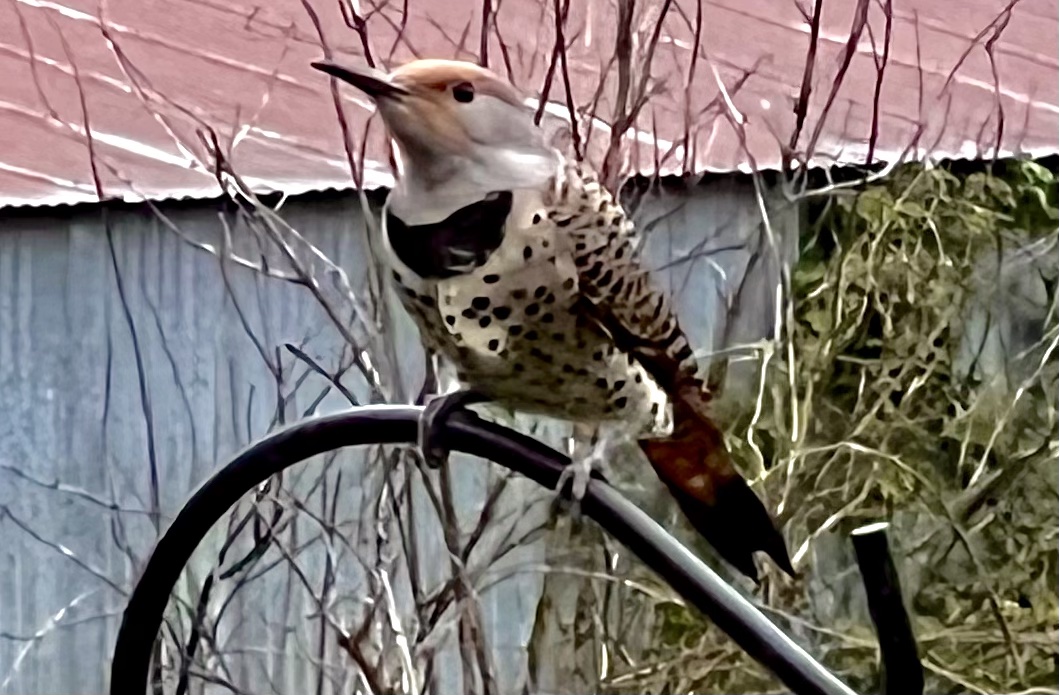
When I stand at the window watching the flickers, sparrows, finches, chickadees, and red-winged blackbirds come and go from the feeders, I wonder who is watching who. They remain wary of me, fluttering away quickly if I approach. They fear capture, even within a camera. They have a life to be lived without my witness or participation. So much happens that I never see or know about; it would be too overwhelming to absorb it all.
I understand: I fear being captured too, my wrinkles and crinkles on full display.
Even if only for a moment as an image preserved forever, I know it doesn’t represent all I am, all I’ve done, all I feel, all my moments put together. The birds are, and I am, so much more than one moment.
Only God sees me fully in every moment that I exist, witness to my freedom and captivity, my loneliness and grief, my joy and tears, knowing my very best and my very worst.
And He is not overwhelmed by what He sees of me. He knows me so well, in Him I must trust.
photo by Tomomi Gibson
One-Time
Monthly
Yearly
Make a one-time or recurring donation to support daily Barnstorming posts
Tonight his airplane comes in from the West, and he rises from his seat, a suitcoat slung over his arm. The flight attendant smiles and says, “Have a nice visit,” and he nods as if he has done this all before, as if his entire life hasn’t been 170 acres of corn and oats, as if a plow isn’t dragging behind him through the sand and clay, as if his head isn’t nestling in the warm flank of a Holstein cow.
Only his hands tell the truth: fingers thick as ropes, nails flat and broken in the trough of endless chores. He steps into the city warily, breathing metal and exhaust, bewildered by the stampede of humanity circling around him. I want to ask him something familiar, something about tractors and wagons, but he is taken by the neon night, crossing carefully against the light. ~Joyce Sutphen “My Father Comes to the City” from Straight Out of View.
Photo by Abby Mobley
I’ve lived a mostly quiet farm life over the last four years – minimized air travel and avoided big cities, as I was never fond of either even before COVID. Flying recently to visit family reminded me how challenging it is for me to get used to large crowds again, navigating unfamiliar urban highways and sitting with a hundred people in a winged metal tube 35,000 feet in the air.
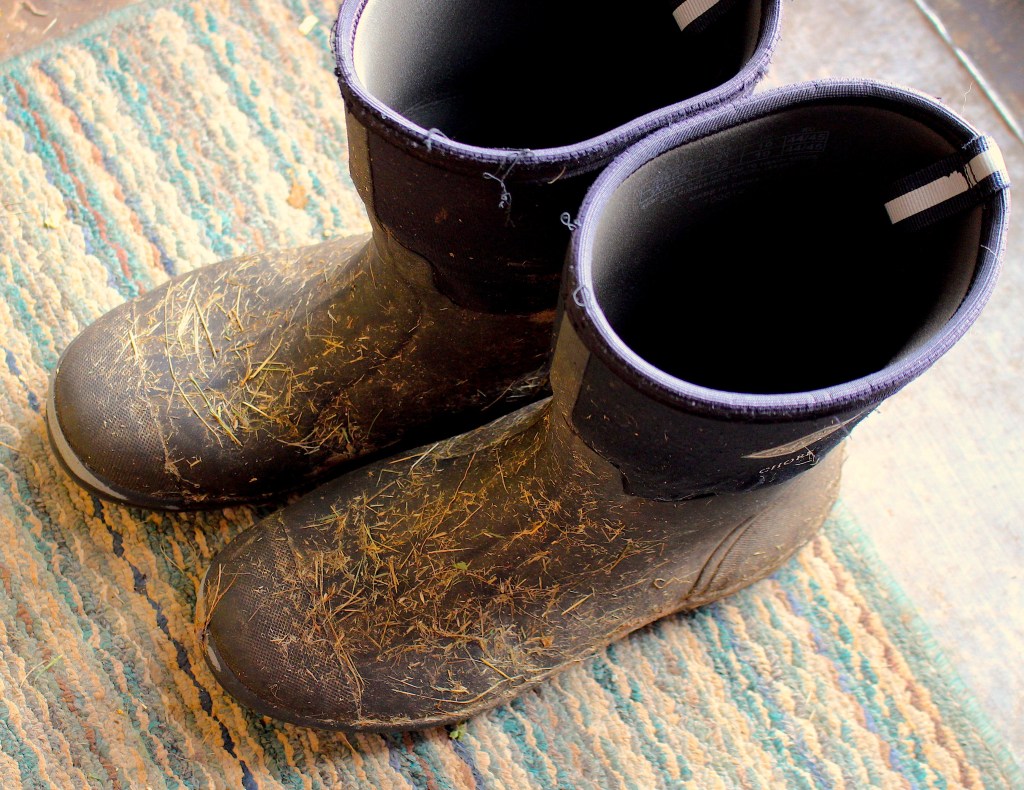
But even farmers have to leave home once in a while. We shake the mud off our boots and brush the hayseeds from our hair, and try to act and be presentable in civilized society.
But my nervousness remains, knowing I’m out of my comfort zone, continually yearning for the wide open spaces of home.
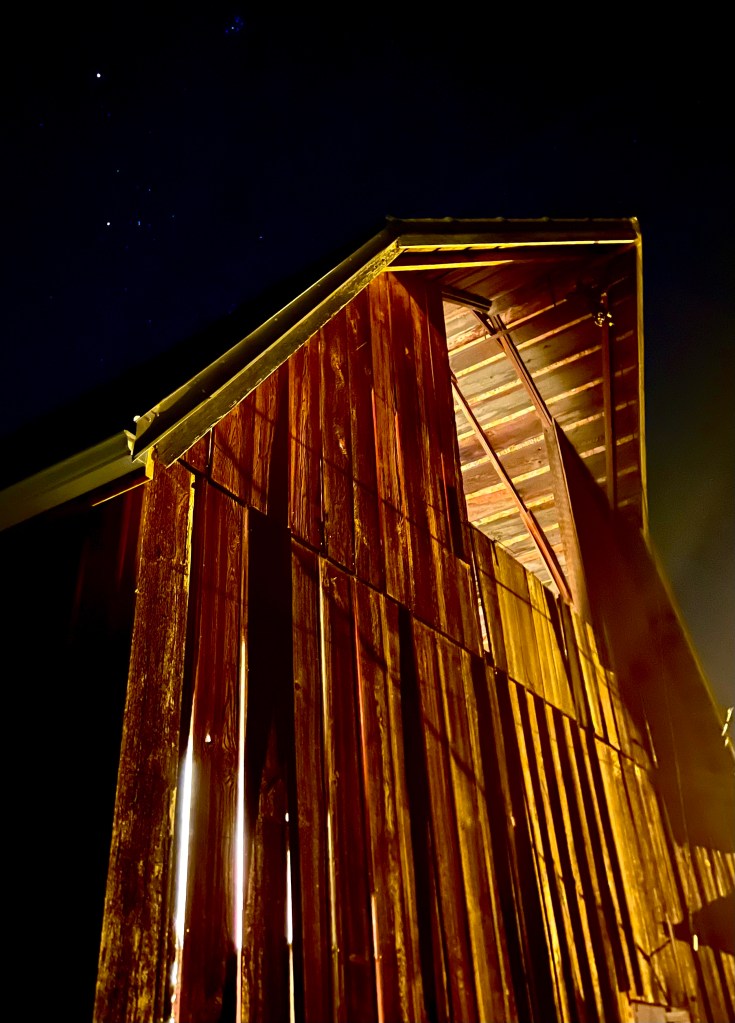
Travel will take some getting used to again, but there is a world to be explored out there. It’s time to see how the city’s neon night compares with one illuminating barn light on the farm.
We should always endeavour to wonder at the permanent thing, not at the mere exception. We should be startled by the sun, and not by the eclipse. We should wonder less at the earthquake, and wonder more about the earth. ~ G.K. Chestertonfrom ILLUSTRATED LONDON NEWS, October 21, 1905
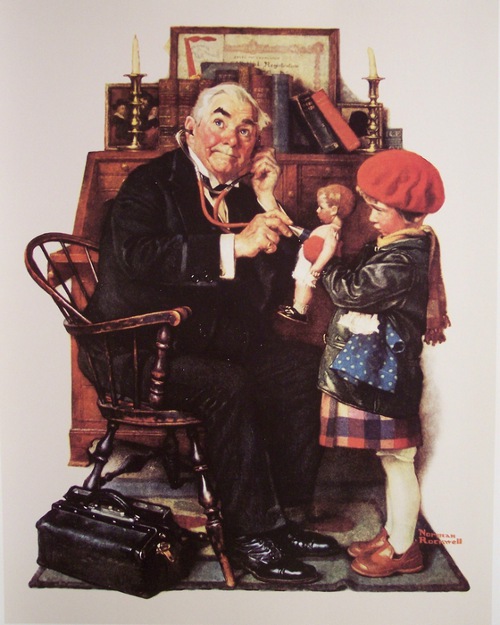
As a physician, I was trained to perform physical examinations by learning first what was normal about the human body. As young, theoretically healthy, medical students, we practiced physical examinations on each other, and then had to demonstrate our skills in front of a professor for our class grade in physical assessments.
Since I went to medical school at a time when fewer than 1 in 5 students was a woman, each female student was placed in a physical exam group of three men, taught by a male physician, and then evaluated by a male professor. These were full examinations, including internal assessments, conducted in a typical open-backed hospital gown, in a classroom with long black lab tables to substitute for exam tables.
It was the ultimate feeling of vulnerability to be exposed to one’s classmates, supervisors and evaluators in such a way. Yet, it helped me understand the naked vulnerability of a patient undressing for a physician’s evaluation in the exam room.
After learning to assess and document what was normal in the physical exam, I was then trained to take note of the exceptions – the human body equivalent of an eclipse or an earthquake, a wildfire or drought, a hurricane or flood, or merely an annoying pothole or molehill.
A physician’s attention is rarely focused on everything that is going well with the human body, but instead concentrating on what is aberrant, failing, or could be made better.
This is unfortunate; there is much beauty and amazing design to behold in every person I meet, especially those with chronic illness who feel nothing is as it should be — they feel despair and frustration at how their mind or body is aging, failing or faltering.
To counter this tendency to just find what’s wrong and needed fixing, I learned over the years to talk out loud as I was trained to do during those medical school physical assessments: you have no concerning skin lesions, your eardrums look clear, your eyes react normally, your tonsils are fine, your thyroid feels smooth, your lymph nodes are tiny, your lungs auscultate clear, your heart sounds are perfect, your breasts reveal no palpable lumps, your belly exam is reassuring, your reflexes are symmetrical, your prostate is smooth and normal, your cervix, uterus and ovaries are healthy, your emotional response to your stress level and your tears are completely understandable.
I also wrote messages to patients meant to reassure: your labs are in a typical range or are getting better or at least maintaining, your xray shows no concerns, or isn’t getting worse, those medication side effects are to be expected and could go away.
I chose to acknowledge what was working well before attempting to intervene in what is not.
I’m not sure how much difference it made to my patient. But it made a difference to me to wonder first at who this whole patient was before I focused in on what was broken and causing dis-ease.
I remain startled nearly 50 years later, and always astonished, by the sheer wonder that is our bodies – the Artist’s masterpiece.
One-Time
Monthly
Yearly
Make a one-time or recurring donation to support daily Barnstorming posts





























 Barnstorming