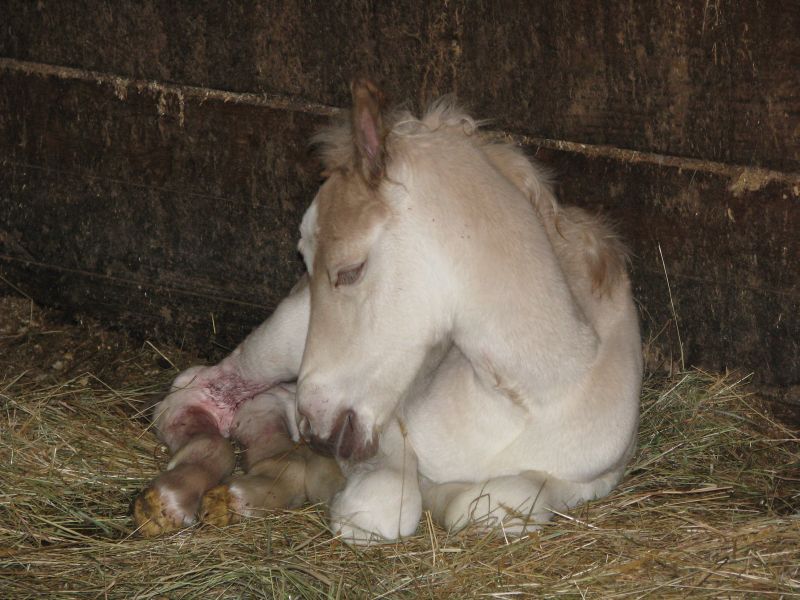
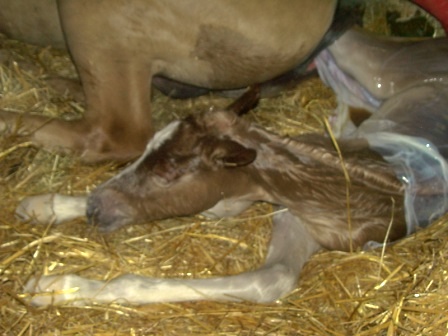
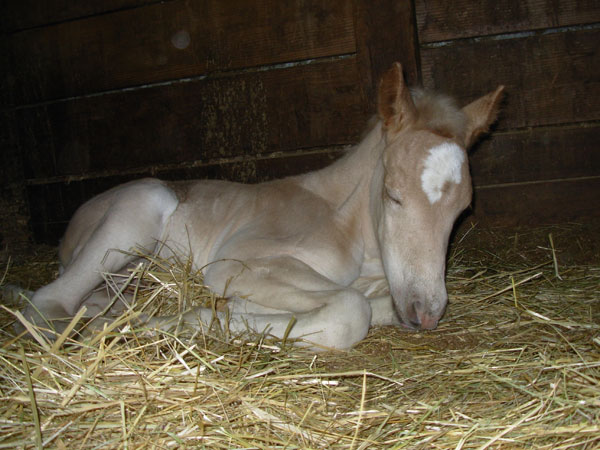
When we reach the field she is still eating the heads of yellow flowers and pollen has turned her whiskers gold. Lady, her stomach bulges out, the ribs have grown wide. We wait, our bare feet dangling in the horse trough, warm water where goldfish brush our smooth ankles. We wait while the liquid breaks down Lady’s dark legs and that slick wet colt like a black tadpole darts out beginning at once to sprout legs. She licks it to its feet, the membrane still there, red, transparent the sun coming up shines through, the sky turns bright with morning and the land with pollen blowing off the corn, land that will always own us, everywhere it is red. ~Linda Hogan, “Celebration: Birth of a Colt” from Red Clay.
First, her fluid flows in subtle stream then gushes in sudden drench. Soaking, saturating, precipitating inevitability. No longer cushioned slick sliding forward following the rich river downstream to freedom.
The smell of birth clings to shoes, clothes, hands as soaked in soupy brine I reach to embrace new life sliding toward me.
I too was caught once; three times emptied into other hands, my babies wet on my chest their slippery skin under my lips so salty sweet
In a moment’s scent the rush of life returns; now only barn or field birthings yet still as sweet and rich. I carry the smell of damp foal fur with me all day to recall from whence I came. I floated once and will float free someday again.
All winter your brute shoulders strained against collars, padding and steerhide over the ash hames, to haul sledges of cordwood for drying through spring and summer, for the Glenwood stove next winter, and for the simmering range.
In April you pulled cartloads of manure to spread on the fields, dark manure of Holsteins, and knobs of your own clustered with oats. All summer you mowed the grass in meadow and hayfield, the mowing machineclacketing beside you, while the sun walked high in the morning;
and after noon’s heat, you pulled a clawed rake through the same acres, gathering stacks, and dragged the wagon from stack to stack, and the built hayrack back, uphill to the chaffy barn, three loads of hay a day from standing grass in the morning.
Sundays you trotted the two miles to church with the light load a leather quartertop buggy, and grazed in the sound of hymns. Generation on generation, your neck rubbed the windowsill of the stall, smoothing the wood as the sea smooths glass.
When you were old and lame, when your shoulders hurt bending to graze, one October the man, who fed you and kept you, and harnessed you every morning, led you through corn stubble to sandy ground above Eagle Pond, and dug a hole beside you where you stood shuddering in your skin,
and lay the shotgun’s muzzle in the boneless hollow behind your ear, and fired the slug into your brain, and felled you into your grave, shoveling sand to cover you, setting goldenrod upright above you, where by next summer a dent in the ground made your monument.
For a hundred and fifty years, in the Pasture of dead horses, roots of pine trees pushed through the pale curves of your ribs, yellow blossoms flourished above you in autumn, and in winter frost heaved your bones in the ground – old toilers, soil makers:
O Roger, Mackerel, Riley, Ned, Nellie, Chester, Lady Ghost. ~Donald Hall, “Names of Horses”
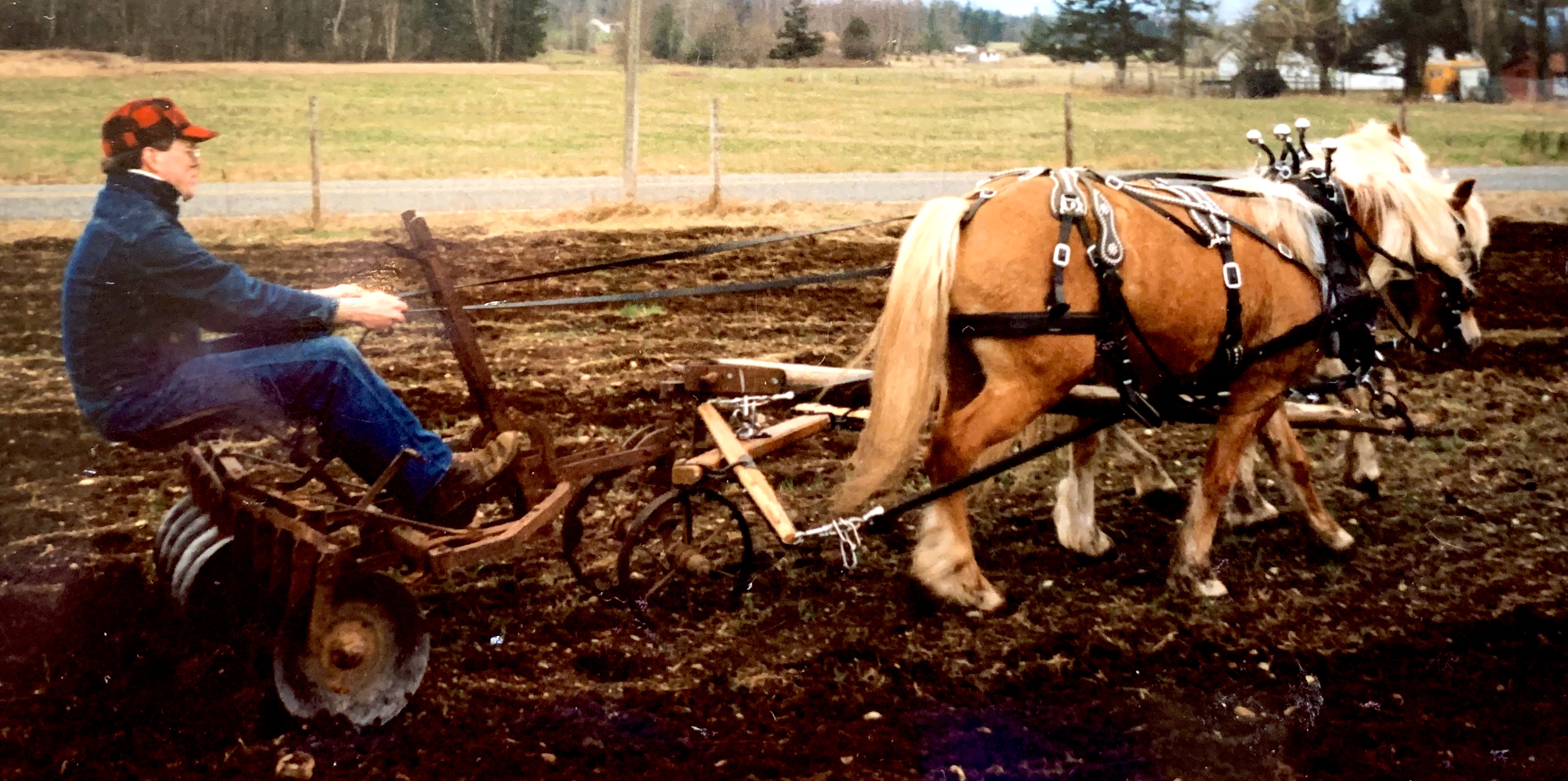
Photo of Aaron Janicki haying with his Oberlander team in Skagit County courtesy of Tayler Rae
As a child, I regularly visited the horse grave dug by hand by my father in 1965 in an open clearing of our woods where our little chestnut mare, Dolly, rested in the ground.
She was felled by a vet’s bullet to the head after an agonizing bout with colic. I had returned to the house, unable to watch, but could not help but hear the gunshot as if it had gone through me as well.
At first her grave was a place to cry where no one but the trees and wild flowers could see.
When my tears dried up, it was a place to sing loudly where no one but chipmunks and my dog could hear.
Later it became the sanctuary where I retreated to talk to God when my church no longer was.
Her bones lie there still and no one but me knows where. The dent in the ground will always betray the spot.
I like farming. I like the work. I like the livestock and the pastures and the woods. It’s not necessarily a good living, but it’s a good life. I now suspect that if we work with machines the world will seem to us to be a machine, but if we work with living creatures the world will appear to us as a living creature. That’s what I’ve spent my life doing, trying to create an authentic grounds for hope. ~Wendell Berry, horse farmer, essayist, poet, professor
When I pull open the barn doors, every morning and each evening, as my grandparents did one hundred years ago, six rumbling voices rise in greeting. We exchange scents, nuzzle each others’ ears.
I do my chores faithfully as my grandparents once did– draw fresh water into buckets, wheel away the pungent mess underfoot, release an armful of summer from the bale, reach under heavy manes to stroke silken necks.
I don’t depend on our horses’ strength and willingness to don harness to carry me to town or move the logs or till the soil as my grandparents did.
Instead, these soft eyed souls, born on this farm two or three long decades ago, are simply grateful for my constancy morning and night to serve their needs until the day comes they need no more.
I depend on them to depend on me to be there to open the doors; their low whispering welcome gives voice to the blessings of living on a farm ripe with rhythms and seasons, as if today and tomorrow are just like one hundred years ago.
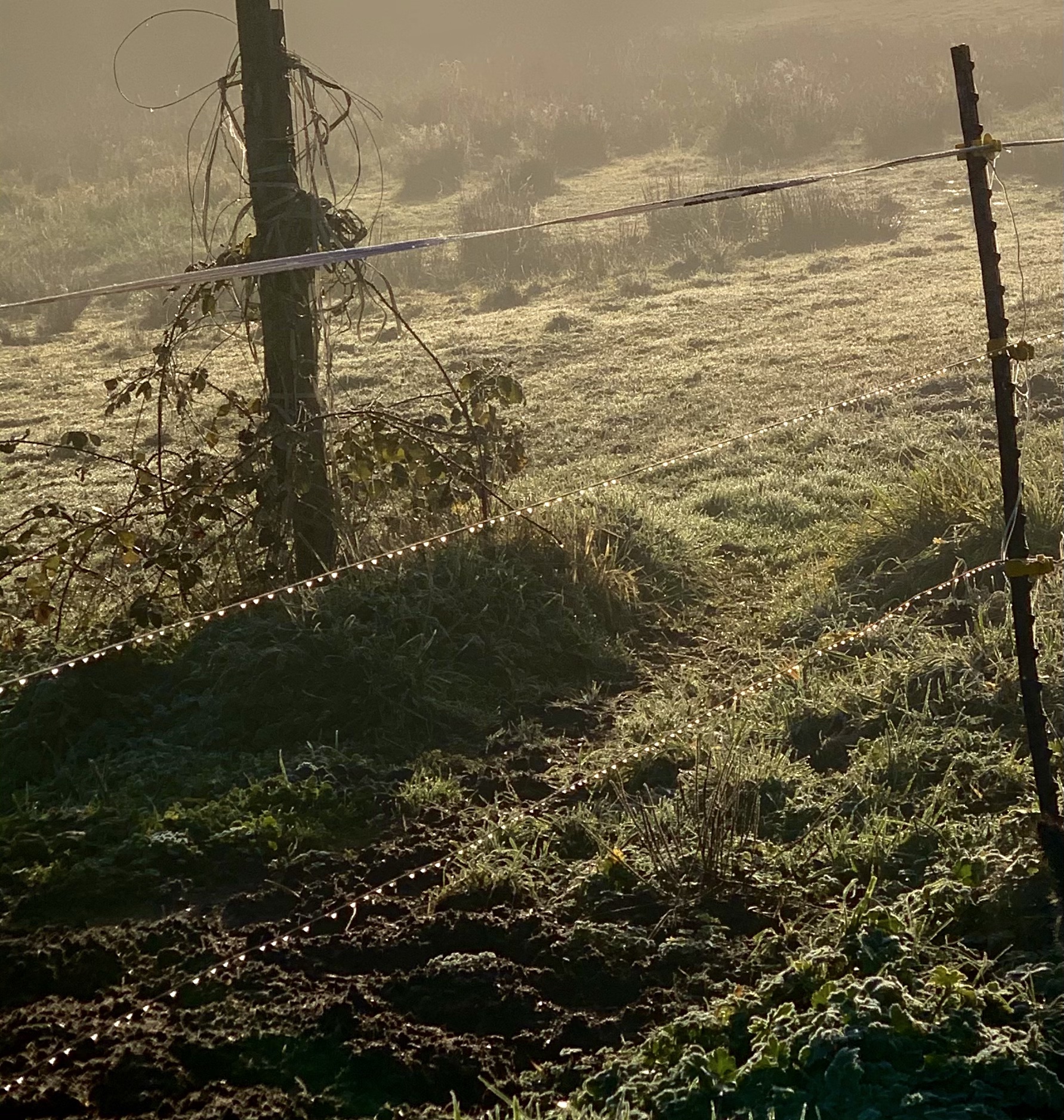
There are three kinds of men. The ones that learn by reading. The few who learn by observation. The rest of them have to pee on the electric fence for themselves. ~Will Rogers
Learning is a universal human experience from the moment we take our first breath. It is never finished until the last breath is given up. With a lifetime of learning, one would think eventually we should get it right.
But we don’t. We tend to learn the hard way especially when it comes to matters having to do with our (or others’) health.
As physicians in training, we “see one, do one, teach one.” That kind of approach doesn’t always go so well for the patient. As patients, we like to eat, drink, and live how we wish, demanding what interventions we want only when we want them – this also doesn’t go so well for the patient. You’d think we’d know better, but as fallible human beings, we may impulsively make decisions about our health without actually using our heads (is it evidence-based or simply an anecdotal story about what “worked” for someone else?).
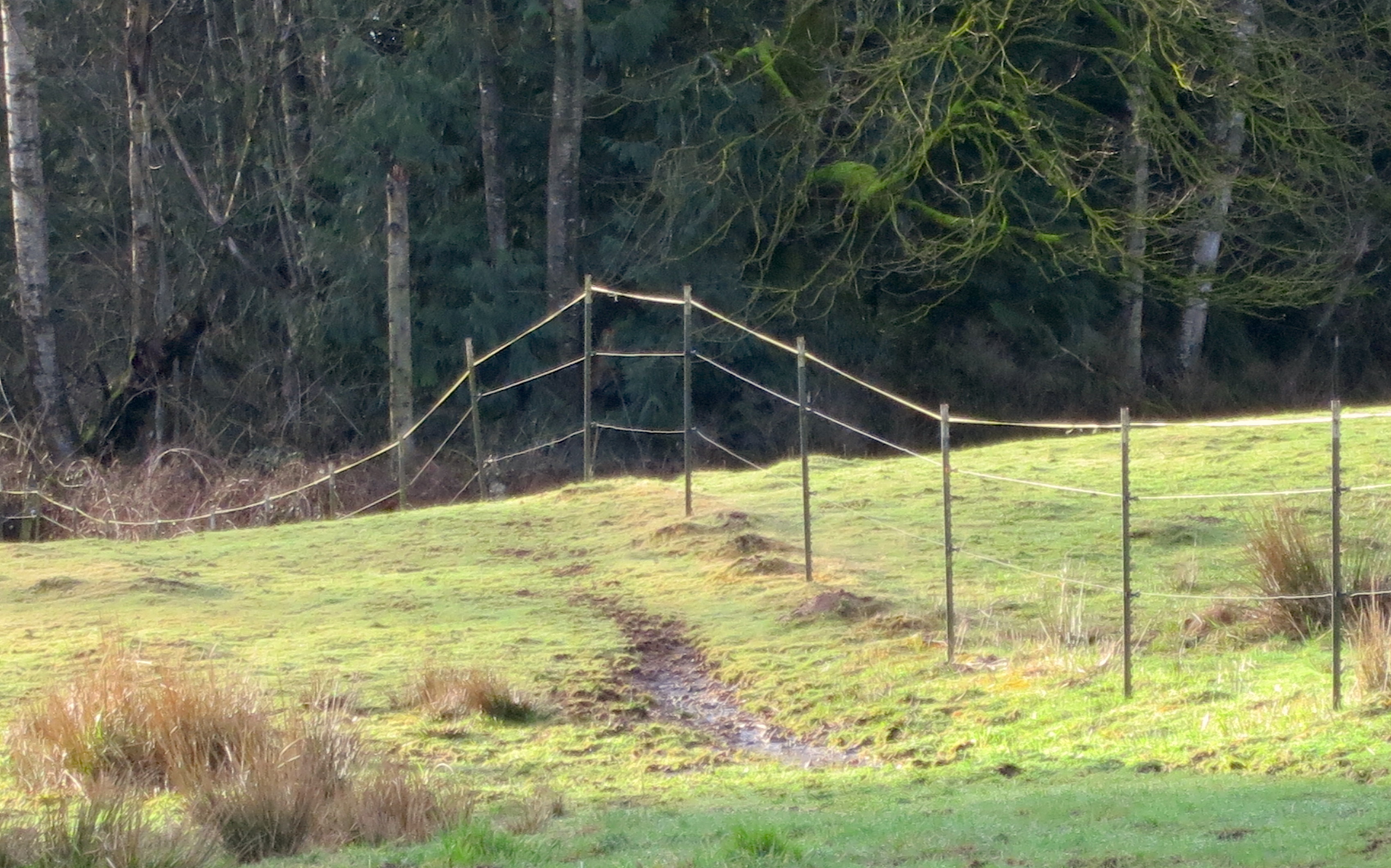
The cows and horses on our farm need to touch an electric fence only once when reaching for greener grass on the other side. That moment provides a sufficient learning curve for them to make an important decision. They won’t try testing it again no matter how alluring the world appears on the other side. Humans are smarter sentient beings who should learn as quickly as animals but unfortunately don’t. I know all too well what a shock feels like and I want to avoid repeating that experience. Even so, in unguarded careless moments of feeling invulnerable (it can’t happen to me!), and yearning to have what I don’t necessarily need, I may find myself reaching for the greener grass (or another cookie) even though I know better. I suspect I’m not alone in my surprise when I’m jolted back to reality when I continually indulge myself and climb on the scale to see the results.
Many great minds have worked out various theories of effective learning, but, great mind or not, Will Rogers confirms a common sense suspicion: an adverse experience, like a “bolt out of the blue,” can be a powerful teacher. As clinicians, we call it “a teachable moment.” None of us want to experience a teachable moment — none of us, and we resent it when someone points it out to us.
When physicians and patients learn the hard way, we need to come along aside one another rather than work at cross-purposes.
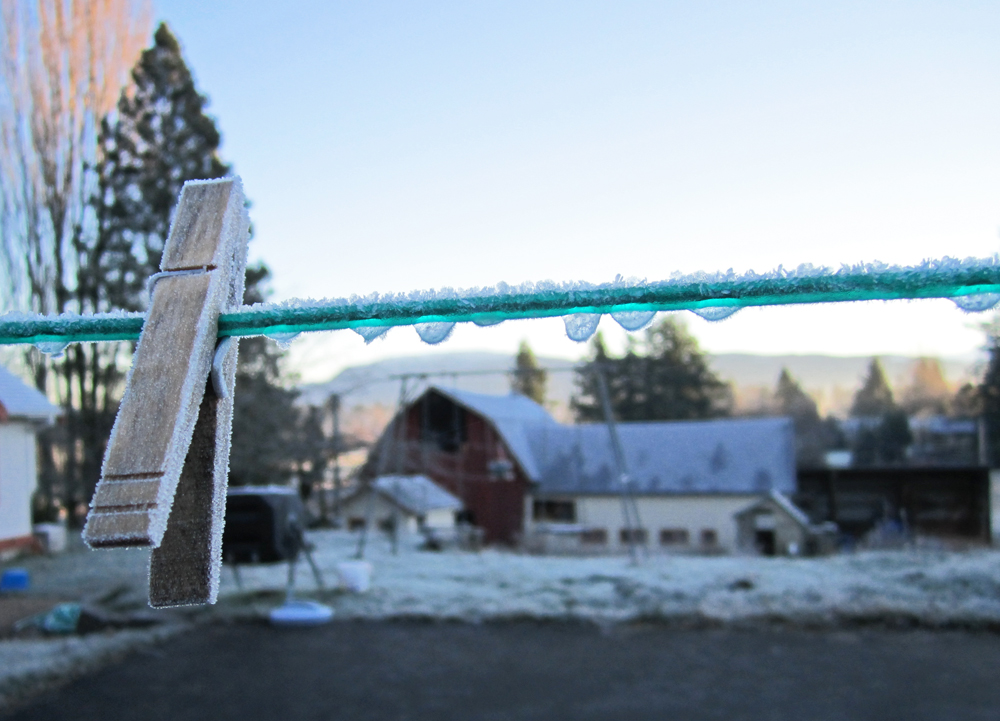
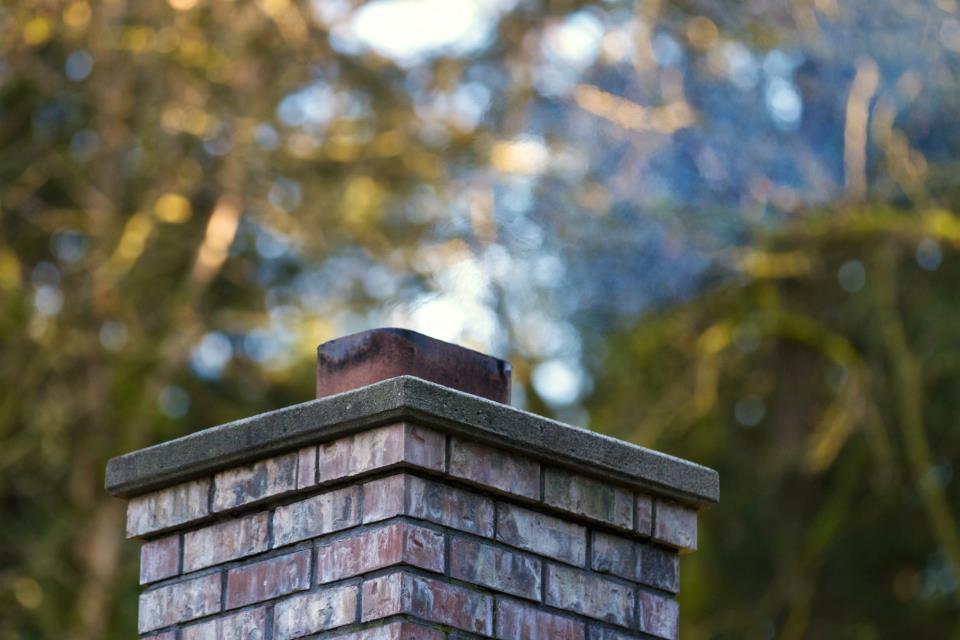
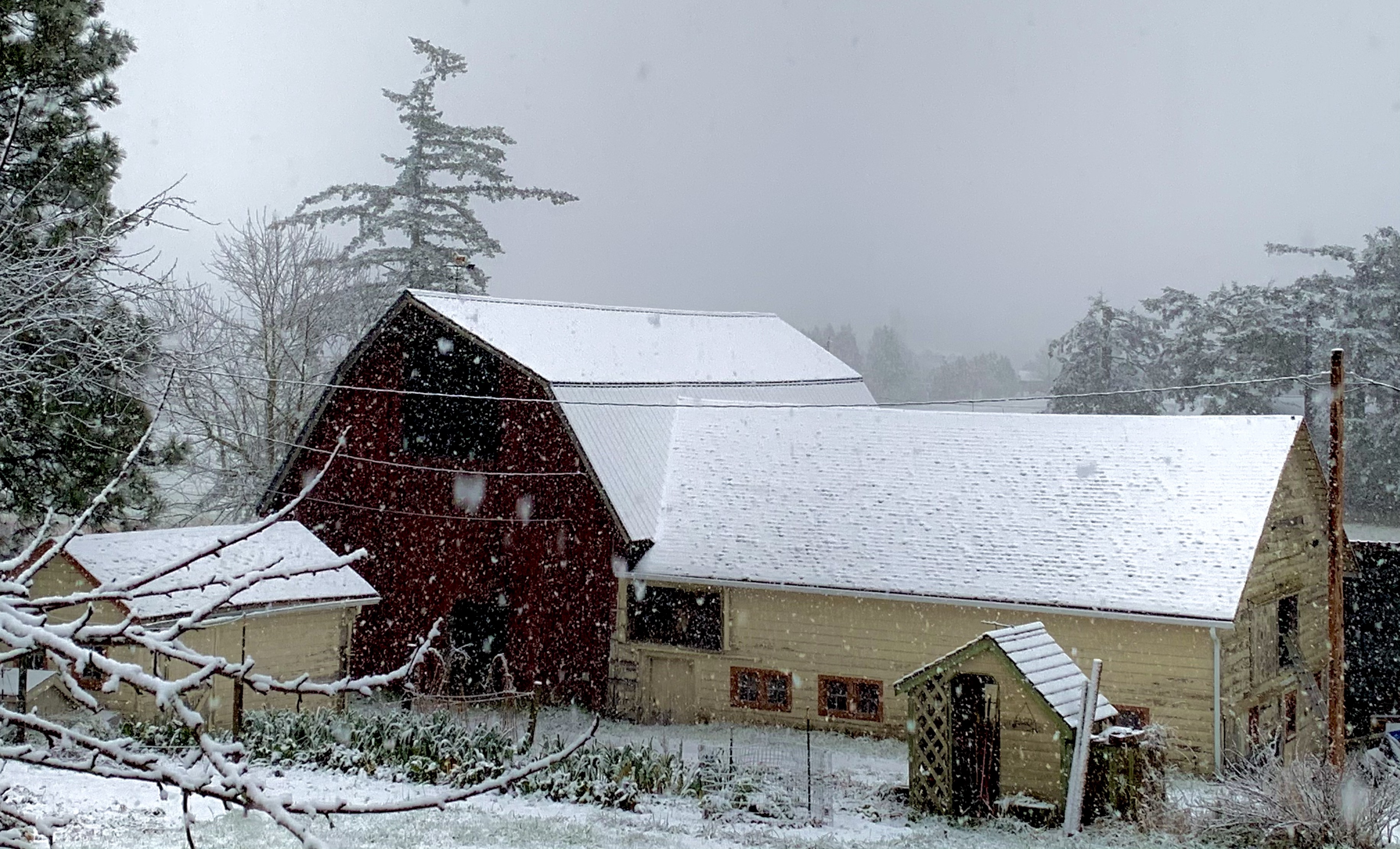
The glittering roofs are still with frost; each worn Black chimney builds into the quiet sky Its curling pile to crumble silently. Far out to the westward on the edge of morn, The slender misty city towers up-borne Glimmer faint rose against the pallid blue; And yonder on those northern hills, the hue Of amethyst, hang fleeces dull as horn.
And here behind me come the woodmen’s sleighs With shouts and clamorous squeakings; might and main Up the steep slope the horses stamp and strain, Urged on by hoarse-tongued drivers–cheeks ablaze, Iced beards and frozen eyelids–team by team, With frost-fringed flanks, and nostrils jetting steam. ~Archibald Lampman “A January Morning”
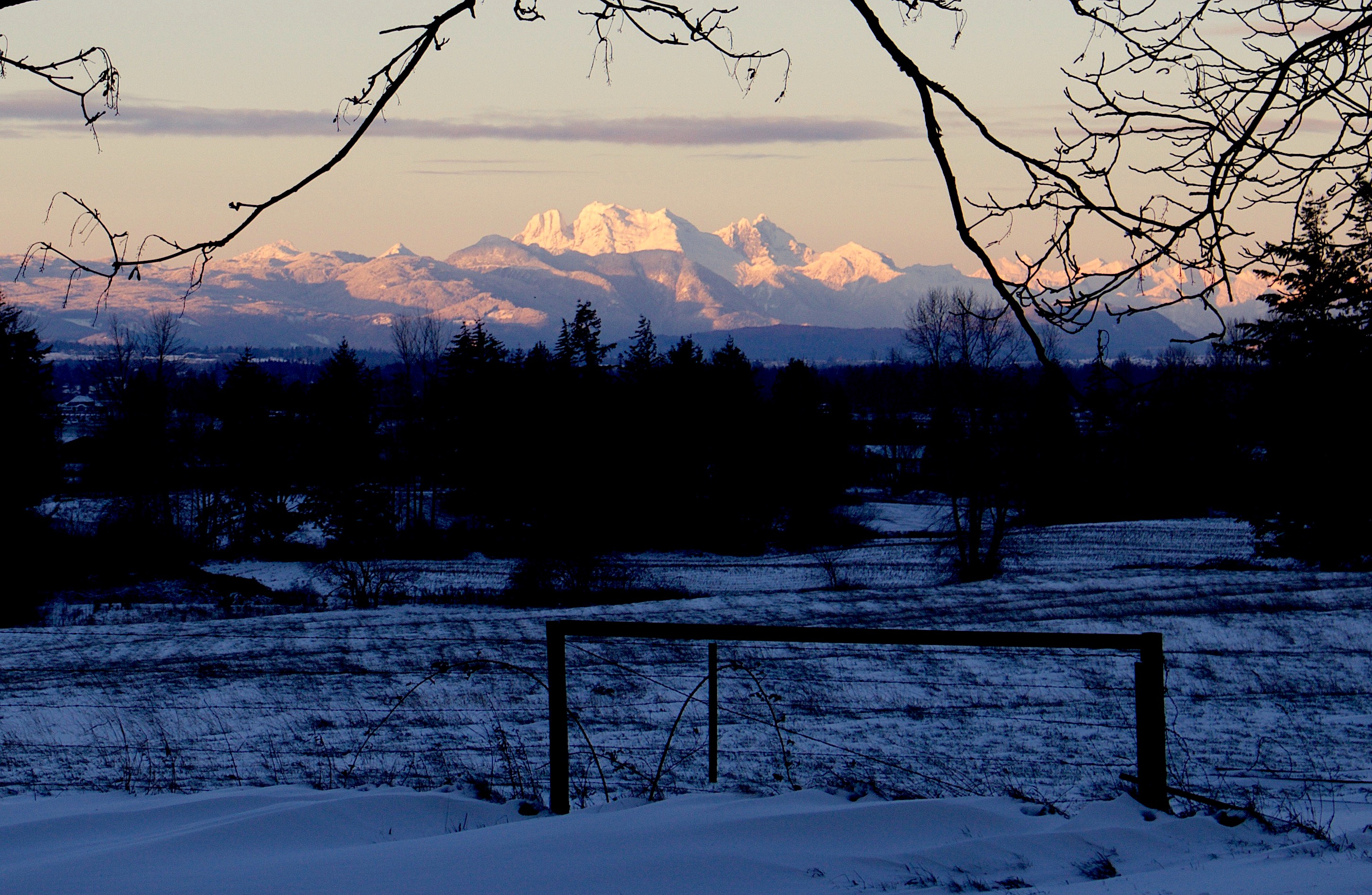
photo by Josh Scholten
The vast majority of the world no longer depends on horse power on hooves to bring us the things we need to live every day.
Few of us depend on wood heat in our homes during these chilly January nights. Chimneys have become obsolete or merely decorative.
We live in a farm house that depended solely on wood heat to keep its original family warm through decades of brisk Pacific Northwest winters – in our remodel twenty plus years ago, we removed two wood stoves and installed a propane furnace and gas stove instead – now dependent on fossil fuels but trying to keep the air clean around us.
We also no longer have to wait, as our parents and grandparents did, on teamsters with frosted beards urging on their teams of steaming horses – pulling sleighs and wagons loaded with firewood or other goods. Now, sleek semis back up to the ramps of grocery stores and off-load their cargo into warehouse and freezers so night stockers can ensure the shelves are full for shoppers each morning.
For most of us living in a time of modern and immediate conveniences, we have little connection to the original source of the daily supplies we need and how they get to us. As descendants of subsistence farmers, my husband and I feel a relationship to the land we live on, fortunate to be able to store much of our garden and orchard produce right here in our pantry, root cellar and freezer.
And what of the horses who were so critical to the economy up until a century ago? Their role has been reduced to recreation and novelty rather than providing the essential horse power that supplied the goods we needed to live and moved us where we needed to go.
No fossil fuel necessary back then. No exhaust other than steaming nostrils and a pile of manure here or there.
We are the aging bridge generation between the end of horse power on hooves giving way to universal horse power on wheels. I remind myself of this each day as I do the chores in the barn. I’m a fortunate farmer, working alongside these animals on the edge of a frosty morning, knowing few people will remember how essential they were or have the privilege to continue to care for them as they deserve.
Though the barn is so warm that the oats in his manger, the straw in his bed seem to give off smoke—
though the wind is so cold, the snow in the pasture so deep he’d fall down and freeze in an hour—
the eleven-month-old palomino stallion has gone almost crazy fighting and pleading to be let out. ~Alden Nowlan “The Palomino Stallion” from Selected Poems.
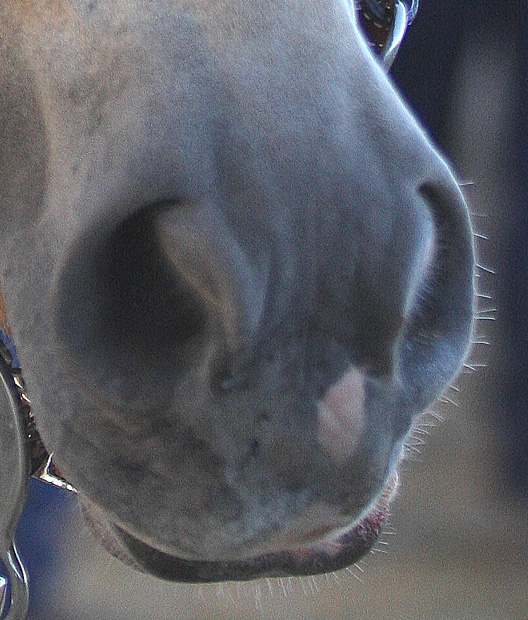
photo by Emily Vander Haak
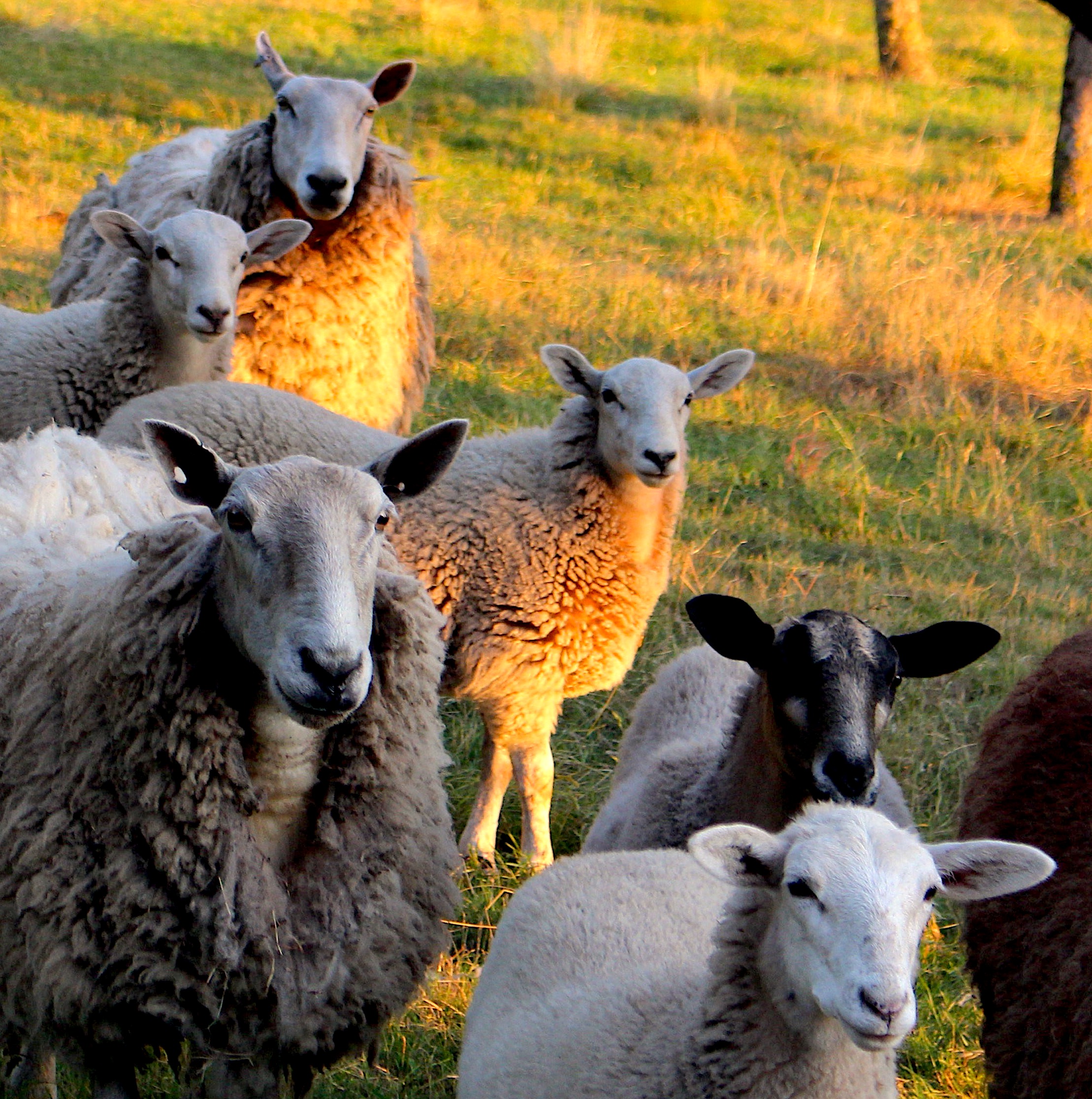
Inside the barn the sheep were standing, pushed close to one another. Some were dozing, some had eyes wide open listening in the dark. Some had no doubt heard of wolves. They looked weary with all the burdens they had to carry, like being thought of as stupid and cowardly, disliked by cowboys for the way they eat grass about an inch into the dirt, the silly look they have just after shearing, of being one of the symbols of the Christian religion. In the darkness of the barn their woolly backs were full of light gathered on summer pastures. Above them their white breath was suspended, while far off in the pine woods, night was deep in silence. The owl and rabbit were wondering, along with the trees, if the air would soon fill with snowflakes, but the power that moves through the world and makes our hair stand on end was keeping the answer to itself. ~Tom Hennen “Sheep in the Winter Night” from Darkness Sticks to Everything.
We all feel pretty locked in right now – not able to go where we want, when we want, or how we want. We are kicking at the walls and pummeling each other in our frustration at the limitations imposed by a blizzard of virus swirling outside, swallowing up another person every couple minutes.
It is hard to think of quarantine as a necessary time of security and safety. Even our horses are confined to their barn stalls in the worst of winter weather with all the comforts of home provided to them, yet somehow they believe it is better “out there” than inside. However, once they are “out there,” they take one look around and turn back to come in where there isn’t knee deep mud or bitter northeast winds or pounding drenching rain. It isn’t a bit friendly out there.
In this part of the world, we can continue to have harsh winter weather for another month or so and then we can start allowing our critters more freedom. There is no chance the viral storm will settle that soon so the rest of us will hunker down for a while longer.
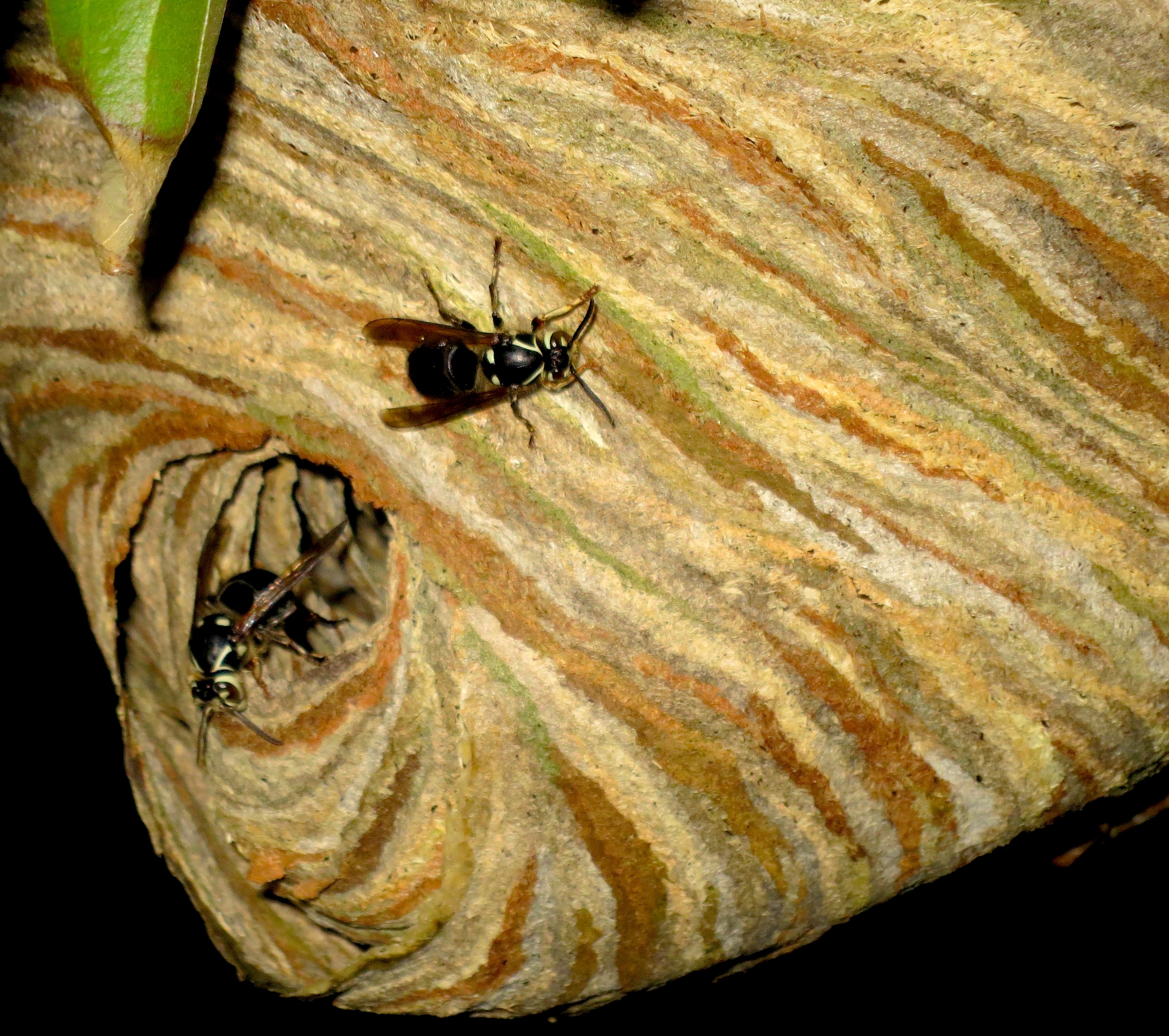
When the plowblade struck An old stump hiding under The soil like a beggar’s Rotten tooth, they swarmed up & Mister Jackson left the plow Wedged like a whaler’s harpoon. The horse was midnight Against dusk, tethered to somebody’s Pocketwatch. He shivered, but not The way women shook their heads Before mirrors at the five & dime—a deeper connection To the low field’s evening star. He stood there, in tracechains, Lathered in froth, just Stopped by a great, goofy Calmness. He whinnied Once, & then the whole Beautiful, blue-black sky Fell on his back. ~Yusuf Komunyakaa “Yellow Jackets” from Pleasure Dome
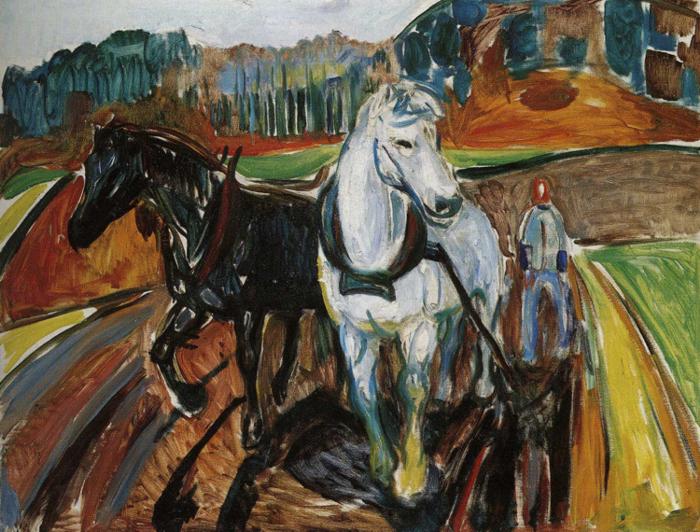
Horse Team by Edvard Munch
Death by a thousand stings.
This poem is twenty years old, yet shattering to read by the light of the events of this past week and this past year. Written by a Pulitzer Prize winning Black poet and Vietnam War veteran, it is a stark description of a teamster and plow horse going about their routine work when a hive of yellow jackets is disturbed.
The farmer saves himself.
The abandoned work horse remains harnessed and chained to the immobilized plow, eventually falling crushed beneath the swarm on his back.
How many times recently have we witnessed this stark reality of the power of the angry swarm – whether the target is someone set upon and killed by law enforcement gone rogue, or last week, a man in blue defending the U.S. Capitol, beaten and crushed by rioters who pummeled him senseless with the pole of the American flag?
A poetic metaphor about an enslaved worker dying in chains expands to include us all:
-we are the farmer who panics and runs for his life in the midst of crisis -we are the harnessed plowhorse obediently and calmly doing his job, becoming the sacrifice for the sake of the farmer -we are the angry swarm whose well being and security is threatened so all hell breaks loose -we are the poet whose words try to make sense of the senseless.
Ultimately, the Writer of the Word is our rescuer: rather than abandoning us to our fate, He saves us by becoming the sacrifice Himself.
He allowed the swarm to fall on His back rather than on us.
For years, before the birth of this Barnstorming blog, I would sit down Christmas Eve to write a (sort of) rhyming farm poem — here are several from 15-18 years ago
Growing up as a child on our farm, I remember the magic of Christmas eve night, Bundling up in layers to stay warm, To the barn to witness an unbelievable sight.
At midnight we knew the animals knelt down, And spoke in words we could all understand. They worshiped a Child born in a tiny town, In a barn such as theirs held in God’s hand.
They were there that night, to see and to hear, The blessings that came from the sky. They patiently stood watch at the manger near, In a barn, while shepherds and kings came by.
Yet my childhood trips to the barn were always too late, Our cows would be chewing, our chickens fast asleep, Our horse breathing softly, our cat climbing the gate, In the barn there was never a peep.
But I knew they had done it, just too quick to see! They were plainly so happy and at peace. In the sweet smelling hay, and no longer hungry, In our barn, though so humble, a miracle had taken place.
I still bundle to go out each Christmas eve, In the hope I’ll catch them this time. Though I’m older now I still must believe In the barn, birth happened amid cobwebs and grime.
Yet our horses nicker as I come near, They tell me the time is now! They drop to their knees without any fear In our barn, all living things bow.
Imagine the wonder of God’s immense trust For the loving creatures who were there that night. Now I know why this special Child must Be born in a barn, it was only right. (written Christmas Eve 1999)
Sometimes it seems time flies too fast Amid our daily work and play We want to make each moment last and value in every day.
A place we’ve found that time slows Is the Haflinger barn on our farm. As we listen to the chewing among the stall rows We know each horse is safe and loved and warm.
Years ago, such peace was found In a Baby lying in a manger. Sung a lullaby of animals’ sounds Sleeping protected from earthly danger.
We can know that peace apart From the rest of our worldly care The Baby’s found within our heart A knowledge we gladly share.
(written 2000 Christmas Eve)
I walk to the barn tonight as I do each year, Counting my blessings, knowing my flaws, Praying for family and friends so dear, And for each precious creature with hooves or paws.
Each horse is content and a witness to peace, And I wish every person could know, Sadness and worry for a moment can cease, While patting noses down a stall row.
For once I see the sky is clear And stars are shining bright The northeast wind is coming near And briskly chills this special night.
For weeks stars hid behind a cloud Of doubt, of fear, of weeping rain, Explosions at once so horrid and loud The whole world instantly felt the pain.
Like stars that glow through blackest dark Good overwhelms bad with barely left trace All owed to a Child who left His mark By giving Himself in infinite grace.
(written Christmas Eve 2001)
On a night long ago The two traveled far After days on the road Sought rest beneath a brightening star.
Yet no room was found As they asked all they could Instead they were bound for a cave in the wood.
In a barn dry and warm Farm animals welcomed them Safely sheltered from harm And the closed doors of Bethlehem.
Where else can the birth be But deep in a cave? Where the heart is set free Our lives and souls saved.
My barn, like my heart Should always have “room” For the Word had its start In a manger assumed.
As your Haflingers welcome you To their barn home today A heart is shown what it must do– Always give Love and Peace a place to stay.
I wanted a horse. This was long after we sold the work horses, and I was feeling
restless on the farm. I got up early to help my father milk the cows, talking
a blue streak about TV cowboys he never had time to see and trying to
convince him that a horse wouldn’t cost so much and that I’d do all the work.
He listened while he leaned his head against the flank of a Holstein, pulling
the last line of warm milk into the stainless bucket. He kept listening
while the milk-machine pumped like an engine, and the black and silver cups fell off and
dangled down, clanging like bells when he stepped away, balancing the heavy milker
against the vacuum hose and the leather belt. I knew he didn’t want the trouble
of a horse, but I also knew there was nothing else I wanted the way I wanted a horse—
another way of saying I wanted to ride into the sunset and (maybe)
never come back—I think he knew that too. We’ll see, he said, we’ll see what we can do. ~Joyce Sutphen “What Every Girl Wants”
I once was a skinny freckled eleven year old girl who wanted nothing more than to have her own horse. Every inch of my bedroom wall had posters of horses, all my shelves were filled with horse books and horse figurines and my bed was piled with stuffed horses. I suffered an extremely serious case of horse fever.
I had learned to ride my big sister’s horse while my sister was off to college, but the little mare had pushed down a hot wire to get into a field of spring oats which resulted in a terrible case of colic and had to be put down. I was inconsolable until I set my mind to buy another horse. We had only a small shed, not a real barn, and no actual fences other than the electric hot wire. Though I was earning money as best I could picking berries and babysitting, I was a long way away from the $150 it would take to buy a trained horse back in 1965. I pestered my father about my dreams of another horse, and since he was the one to dig the hole for my sister’s horse to be buried, he was not enthusiastic. “We’ll see,” he said. “We will see what we can do.”
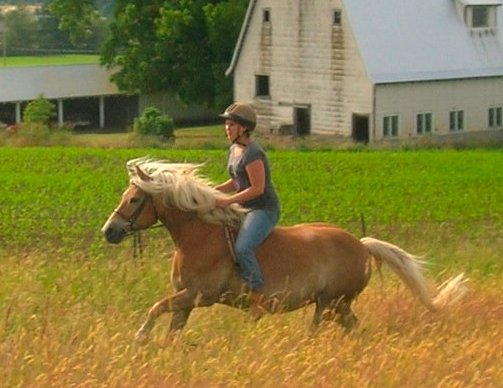
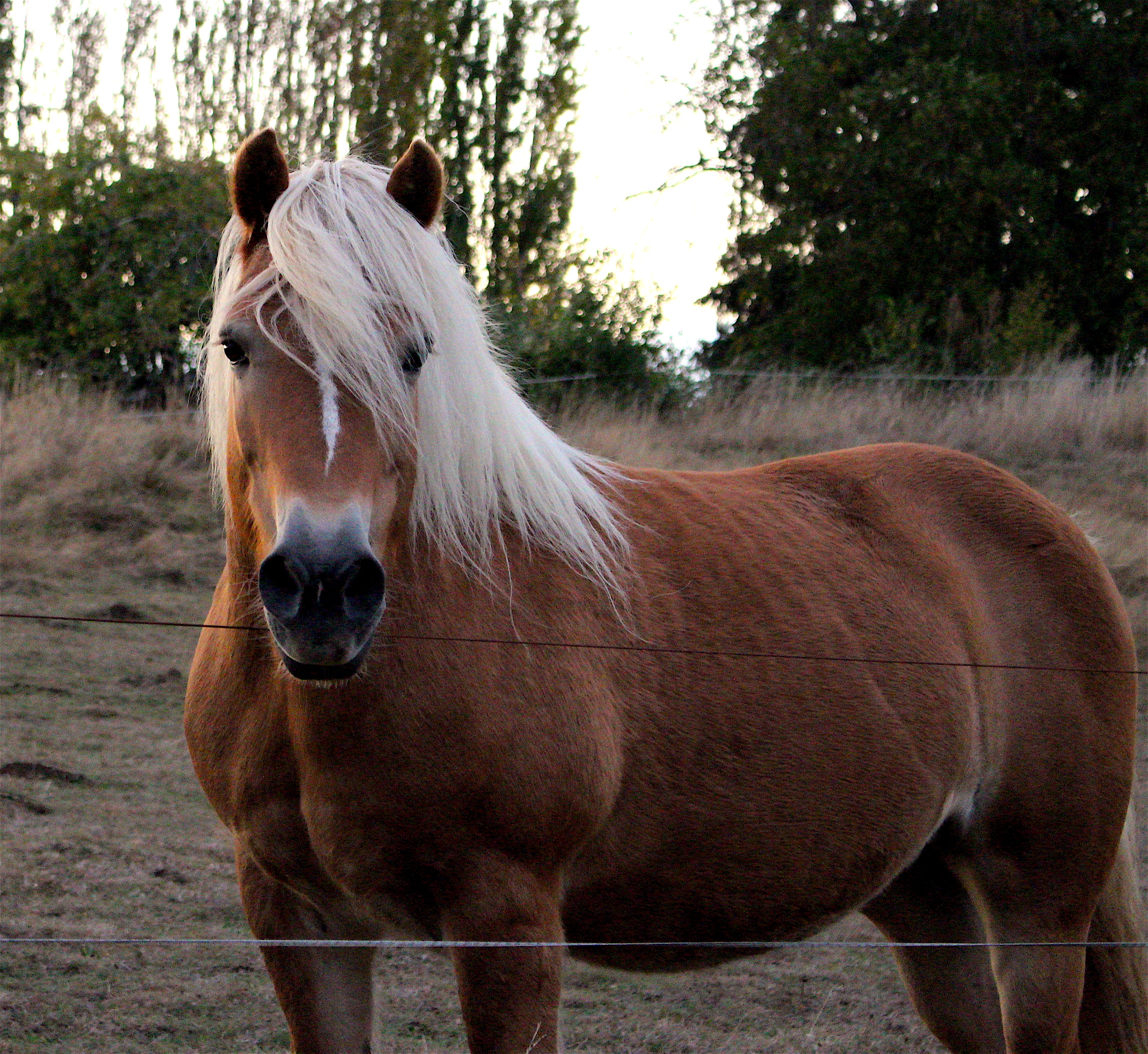
So I dreamed my horsey dreams, mostly about golden horses with long white manes, hoping one day those dreams might come true.
In fall 1965, the local radio station KGY’s Saturday morning horse news program announced their “Win a Horse” contest. I knew I had to try. The prize was a weanling bay colt, part Appaloosa, part Thoroughbred, and the contest was only open to youth ages 9 to 16 years old. All I had to do was write a 250 word or less essay on “Why I Should Have a Horse”. I worked and worked on my essay, crafting the right words and putting all my heart into it, hoping the judges would see me as a worthy potential owner. My parents took me to visit the five month old colt named “Prankster”, a fuzzy engaging little fellow who was getting plenty of attention from all the children coming to visit him, and that visit made me even more determined.
When I read these words now, I realize there is nothing quite like the passion of an eleven year old girl:
“Why I Should Have a Horse”
When God created the horse, He made one of the best creatures in the world. Horses are a part of me. I love them and want to win Prankster for the reasons which follow:
To begin with, I’m young enough to have the time to spend with the colt. My older sister had a horse when she was in high school and her school activities kept her too busy to really enjoy the horse. I’ll have time to give Prankster the love and training needed.
Another reason is that I’m shy. When I was younger I found it hard to talk to anybody except my family. When my sister got the horse I soon became a more friendly person. When her horse recently died (about when Prankster was born), I became very sad. If I could win that colt, I couldn’t begin to describe my happiness.
Also I believe I should have a horse because it would be a good experience to learn how to be patient and responsible while teaching Prankster the same thing.
When we went to see Prankster, I was invited into the stall to brush him. I was never so thrilled in my life! The way he stood there so majestically, it told me he would be a wonderful horse.
If I should win him, I would be the happiest girl alive. I would work hard to train him with love and understanding. If I could only get the wonderful smell and joy of horses back in our barn!
I mailed in my essay and waited.
Fifty five years ago on this day, November 27, 1965, my mother and I listened to the local horse program that was always featured on the radio at 8 AM on Saturday mornings. They said they had over 300 essays to choose from, and it was very difficult for them to decide who the colt should go to. I knew then I didn’t have a chance. They had several consolation prizes for 2nd through 4th place, so they read several clever poems and heartfelt essays, all written by teenagers. My heart was sinking by the minute.
The winning essay was next. The first sentence sounded very familiar to me, but it wasn’t until several sentences later that we realized they were reading my essay, not someone else’s. My mom was speechless, trying to absorb the hazards of her little girl owning a young untrained horse. I woke up my dad, who was sick in bed with an early season flu. He opened one eye, looked at me, and said, “I guess I better get a fence up today, right?” Somehow, fueled by the excitement of a daughter whose one wish had just come true, he pulled himself together and put up a wood corral that afternoon, despite feeling so miserable.
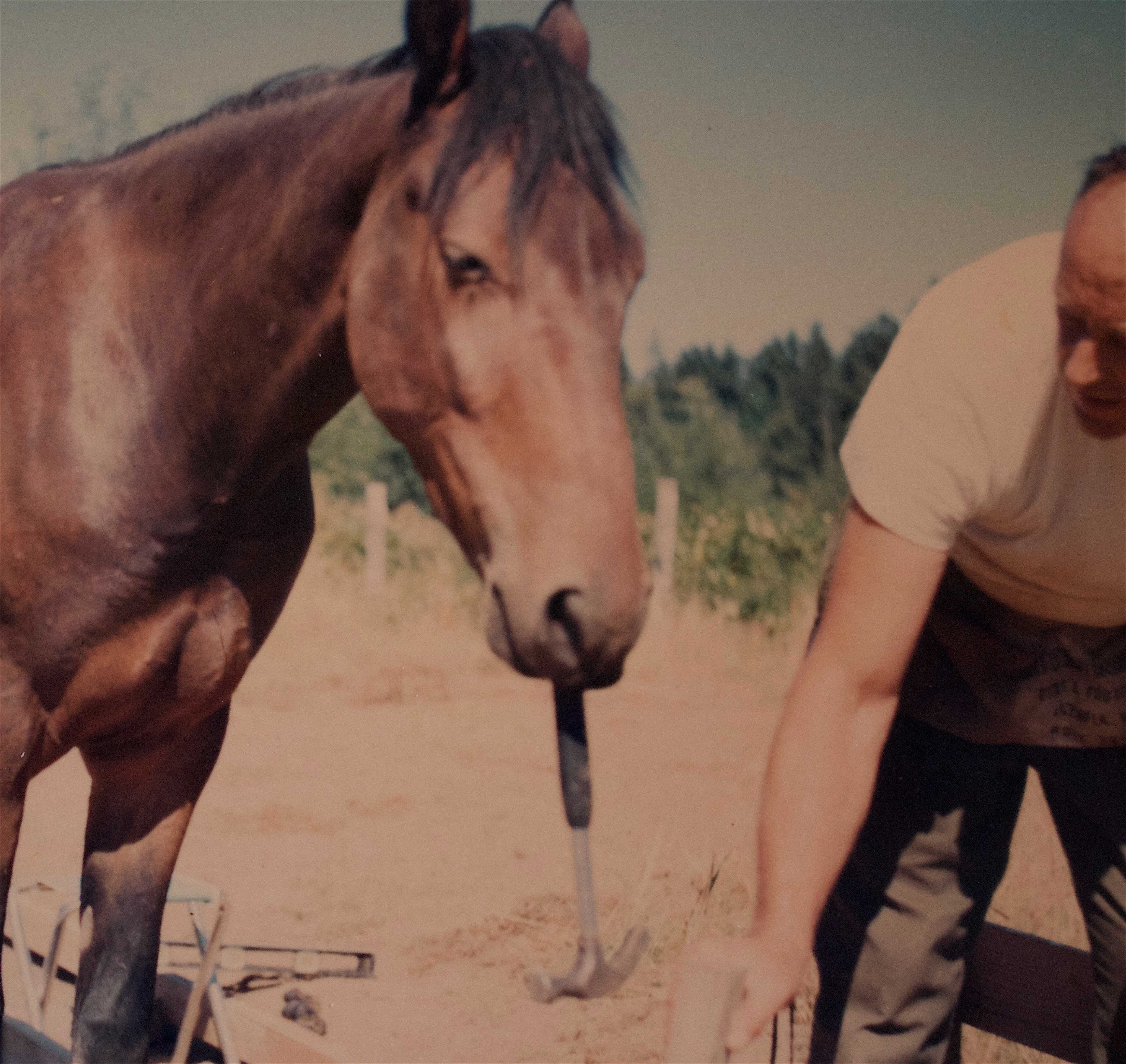
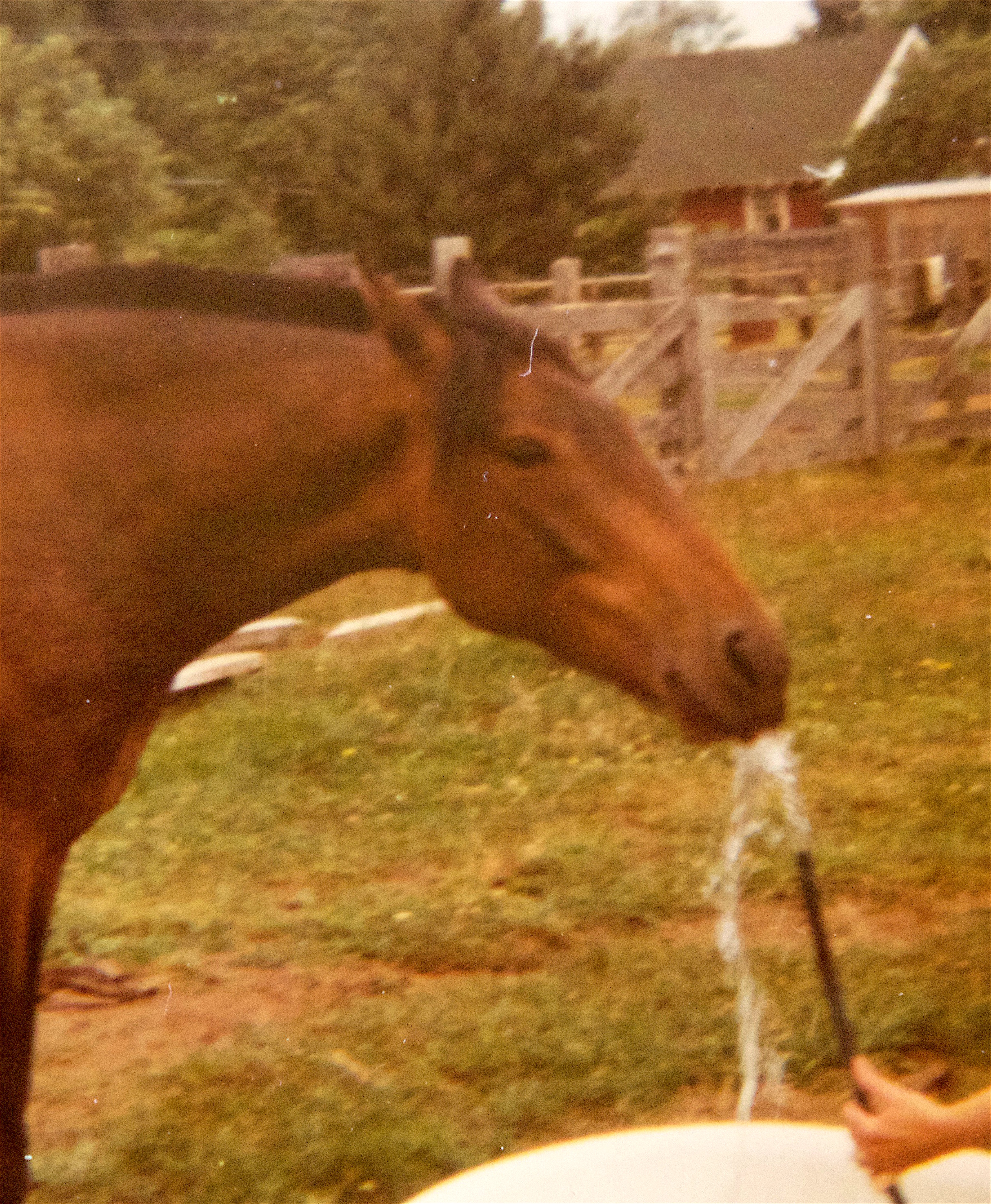
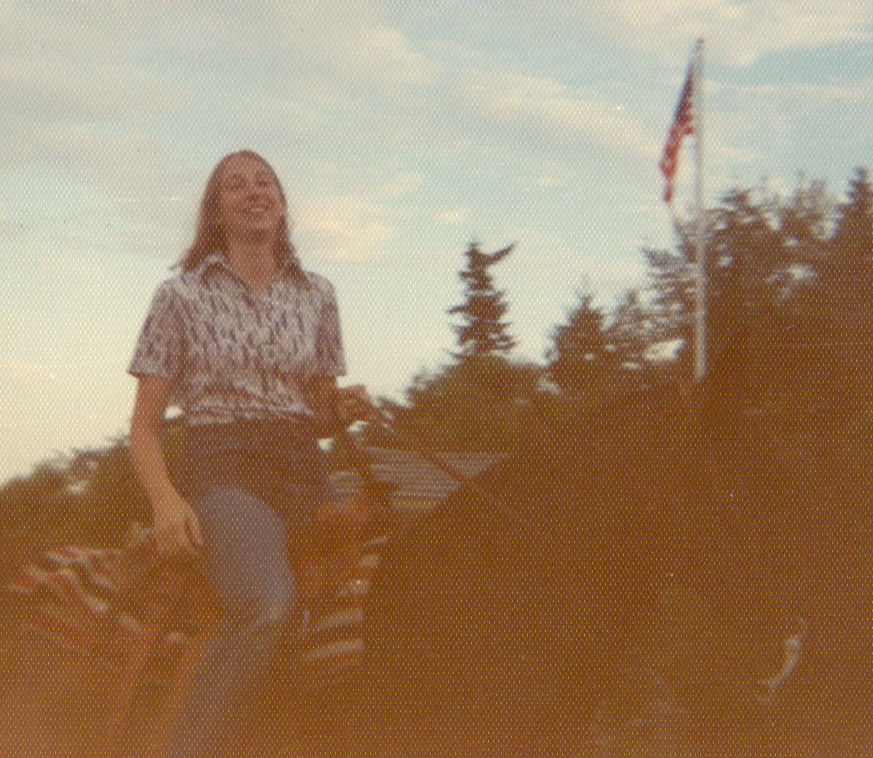
That little bay colt came home to live with me the next day. Over the next few months he and I did learn together, as I checked out horse training books from the library, and joined a 4H group with helpful leaders to guide me. I made plenty of mistakes along the way, learning from each one, including those that left behind scars I still bear. Prankster was a typical adolescent gelding who lived up to his name — full of mischief with a sense of humor and a penchant for finding trouble, but he was mine and that was all that mattered.
That and a dad who saw what he needed to do for his passionate kid. I’ll never forget.
I stop the car along the pasture edge, gather up bags of corncobs from the back, and get out. Two whistles, one for each, and familiar sounds draw close in darkness— cadence of hoof on hardened bottomland, twinned blowing of air through nostrils curious, flared. They come deepened and muscular movements conjured out of sleep: each small noise and scent heavy with earth, simple beyond communion, beyond the stretched-out hand from which they calmly take corncobs, pulling away as I hold until the mid-points snap. They are careful of my fingers, offering that animal-knowledge, the respect which is due to strangers; and in the night, their mares’ eyes shine, reflecting stars, the entire, outer light of the world here. ~Jane Hirshfield “After Work”from Of Gravity and Angels.
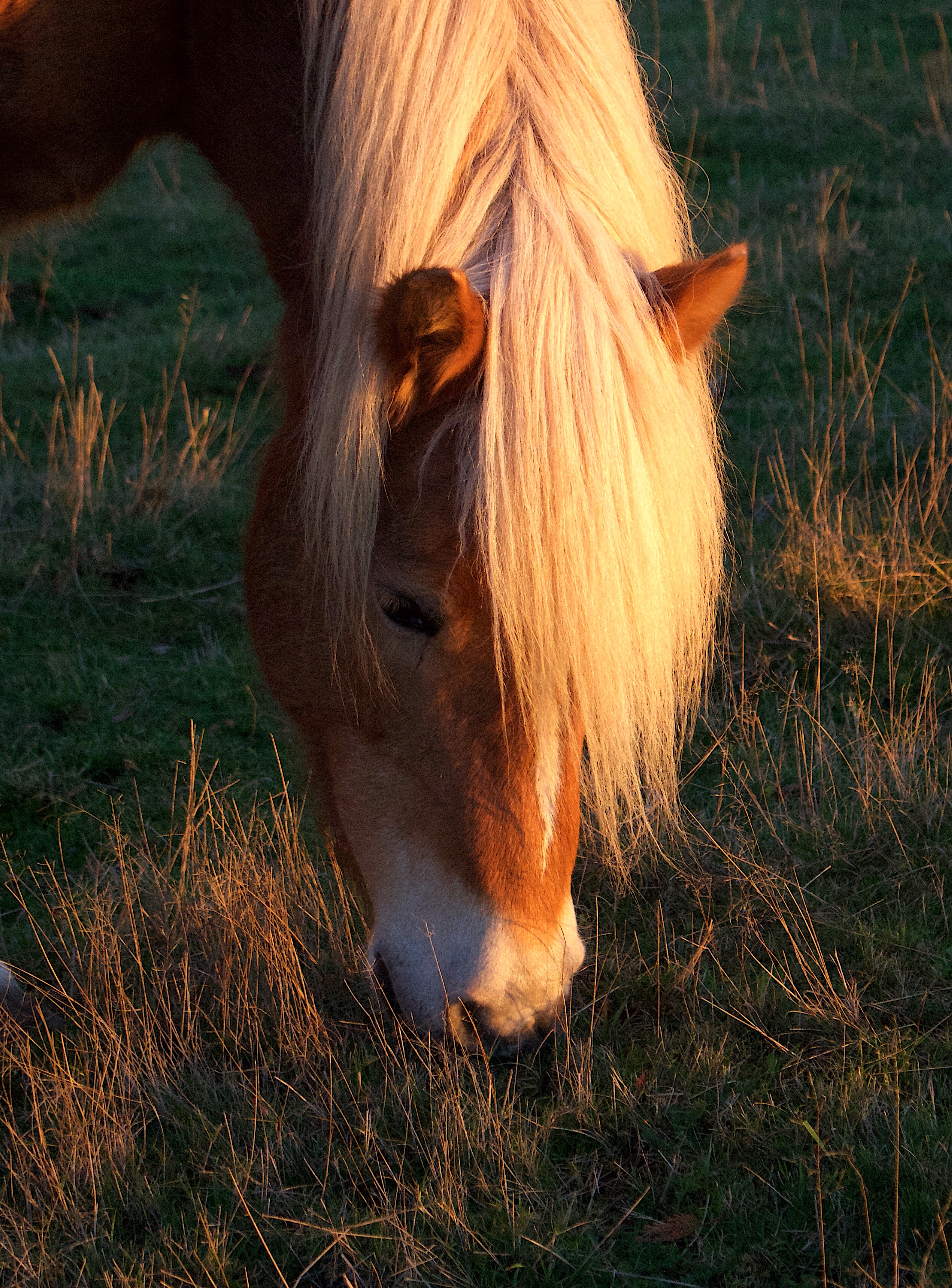
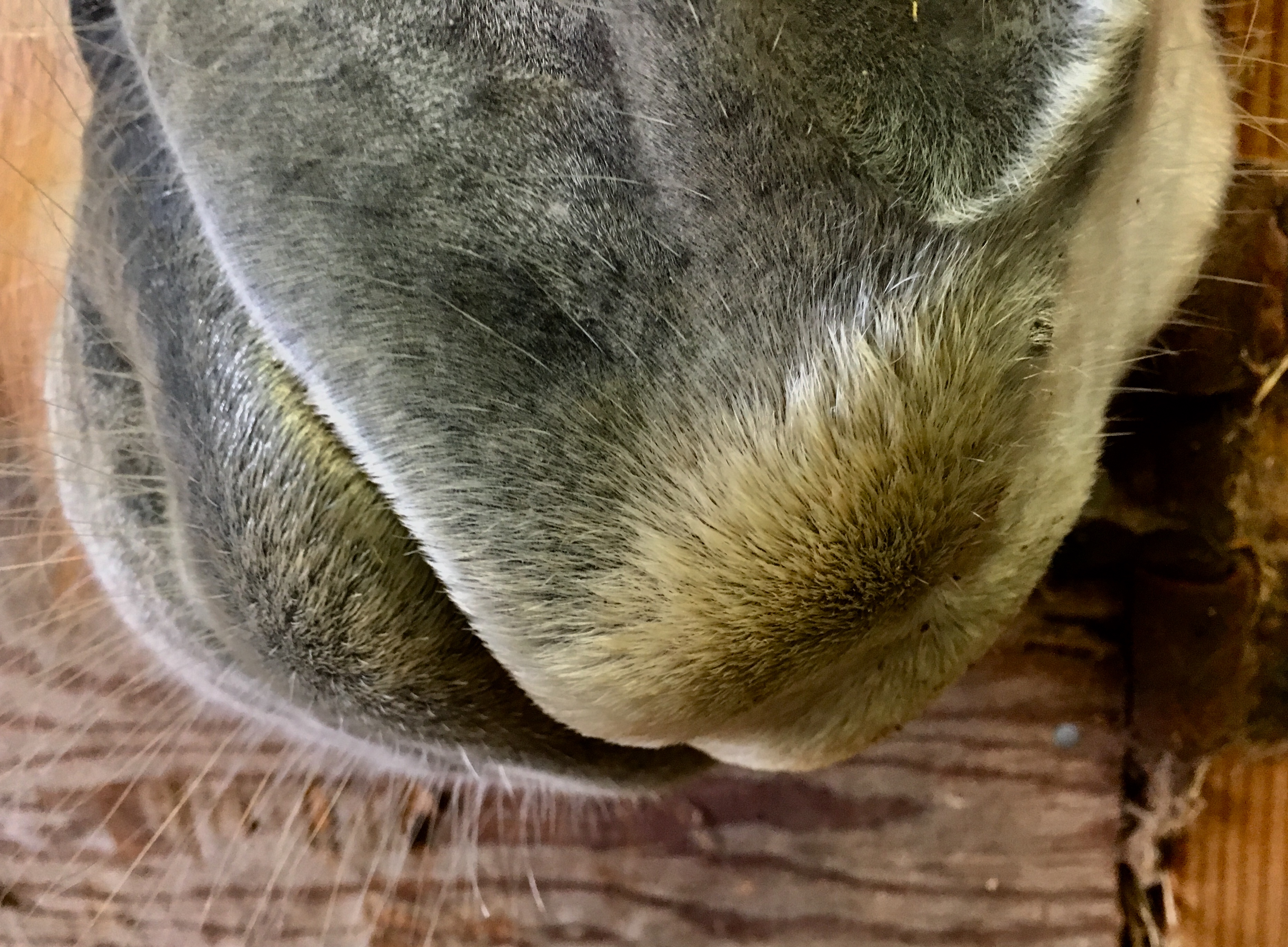
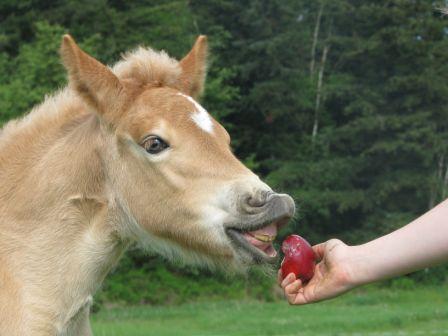
I’ve been picking up windfall apples to haul down to the barn for a special treat each night for the Haflingers. These are apples that we humans wouldn’t take a second glance at in all our satiety and fussiness, but the Haflingers certainly don’t mind a bruise, or a worm hole or slug trails over apple skin.
I’ve found over the years that our horses must be taught to eat apples–if they have no experience with them, they will bypass them lying in the field and not give them a second look. There simply is not enough odor to make them interesting or appealing–until they are cut in slices that is. Then they become irresistible and no apple is left alone from that point forward.
When I offer a whole apple to a young Haflinger who has never tasted one before, they will sniff it, perhaps roll it on my hand a bit with their lips, but I’ve yet to have one simply bite in and try. If I take the time to cut the apple up, they’ll pick up a section very gingerly, kind of hold it on their tongue and nod their head up and down trying to decide as they taste and test it if they should drop it or chew it, and finally, as they really bite in and the sweetness pours over their tongue, they get this look in their eye that is at once surprised and supremely pleased. The only parallel experience I’ve seen in humans is when you offer a five month old baby his first taste of ice cream on a spoon and at first he tightens his lips against its coldness, but once you slip a little into his mouth, his face screws up a bit and then his eyes get big and sparkly and his mouth rolls the taste around his tongue, savoring that sweet cold creaminess. His mouth immediately pops open for more.
It is the same with apples and horses. Once they have that first taste, they are our slaves forever in search of the next apple.
The Haflinger veteran apple eaters can see me coming with my sweat shirt front pocket stuffed with apples, a “pregnant” belly of fruit, as it were. They offer low nickers when I come up to their stalls and each horse has a different approach to their apple offering.
There is the “bite a little bit at a time” approach, which makes the apple last longer, and tends to be less messy in the long run. There is the “bite it in half” technique which leaves half the apple in your hand as they navigate the other half around their teeth, dripping and frothing sweet apple slobber. Lastly there is the greedy “take the whole thing at once” horse, which is the most challenging way to eat an apple, as it has to be moved back to the molars, and crunched, and then moved around the mouth to chew up the large pieces, and usually half the apple ends up falling to the ground, with all the foam that the juice and saliva create. No matter the technique used, the smell of an apple as it is being chewed by a horse is one of the best smells in the world. I can almost taste the sweetness too when I smell that smell.
What do we do when offered such a sublime gift from someone’s hand? If it is something we have never experienced before, we possibly walk right by, not recognizing that it is a gift at all, missing the whole point and joy of experiencing what is being offered. How many wonderful opportunities are right under our noses, but we fail to notice, and bypass them because they are unfamiliar?
Perhaps if the giver really cares enough to “teach” us to accept this communion meal, by preparing it and making it irresistible to us, then we are overwhelmed with the magnitude of the generosity and are transformed by the simple act of receiving.
We must learn to take little bites, savoring each piece one at a time, making it last rather than greedily grab hold of the whole thing, struggling to control it, thereby losing some in the process. Either way, it is a gracious gift, and it is how we receive it that makes all the difference.












 Barnstorming