When Jesus wept, the falling tear in mercy flowed beyond all bound; when Jesus groaned, a trembling fear seized all the guilty world around. ~William Billings
And when he drew near and saw the city, he wept over it, saying, “Would that you, even you, had known on this day the things that make for peace! But now they are hidden from your eyes. ~Luke 19:41-42
Facing this week of remembrance, knowing that right now thousands are displaced by war, some in graves, some grieving their losses, some wondering what comes next.
On this journey, we face our own fears of vulnerability and mortality, a week where thorns overwhelm the emerging blossoms~~
To acknowledge what He did this week long ago, to conquer the shroud and the stone, to defy death, makes all the difference for us here and now.
Indeed Jesus wept and groaned for us.
To be known for who we are by a God who weeps for us and groans with pain we caused: we can know no greater love.
This week ends our living for self, only to die, and begins our dying to self, in order to live.
This year’s Lenten theme for Barnstorming is a daily selection from songs and hymns about Christ’s profound sacrifice on our behalf.
If we remain silent about Him, the stones themselves will shout out and start to sing (Luke 19:40).
In His name, may we sing…
One-Time
Monthly
Yearly
Make a one-time or recurring donation to support daily Barnstorming posts
Sing to the God who turns our sighs into a song. Sing to the One who mends our broken hearts with music. Sing to the One who fills our empty hearts with love. Sing to the One who gives us light to step into the darkest night. Sing to the God who turns our sighs into a song. ~Susan Boersma
Sixty-seven years, oh Lord, to look at the clouds, the trees in deep, moist summer,
daisies and morning glories opening every morning
their small, ecstatic faces— Or maybe I should just say
how I wish I had a voice like the meadowlark’s,
sweet, clear, and reliably slurring all day long
from the fencepost, or the long grass where it lives
in a tiny but adequate grass hut beside the mullein and the everlasting,
the faint-pink roses that have never been improved, but come to bud
then open like little soft sighs under the meadowlark’s whistle, its breath-praise,
Each day opens to new possibility with a sigh, a breath and thankfulness-
once in awhile tears, sometimes heartbreak, and flat out fear of what comes next.
Even so, through it all I sing a song of praise, an alleluia that reminds me why I am and who I live for.
All is well, it is well with my soul.
This year’s Lenten theme for Barnstorming is a daily selection from songs and hymns about Christ’s profound sacrifice on our behalf.
If we remain silent about Him, the stones themselves will shout out and start to sing (Luke 19:40).
In His name, may we sing…
When time sweeps yesterday away, It leaves behind an empty heart, Weeping through the night so dark and long. When words are lost among the tears, When sadness steals another day, God hears our cries and turns our sighs into a song.
Sing to the One who mends our broken hearts with music. Sing to the One who fills our empty hearts with love. Sing to the One who gives us light to step into the darkest night. Sing to the God who turns our sighs into a song.
From heaven falls a mercy sweet, The time for weeping now is gone; God hears our sighs and gives us His eternal song. Sing to the One who mends our broken hearts with music. Sing to the One who fills our empty hearts with love.
Translation: Lord, protect Ukraine. Give us strength, faith, and hope, our Father. Amen
One-Time
Monthly
Yearly
Make a one-time or recurring donation to support daily Barnstorming posts
Death shall not destroy my comfort, Christ shall guide me thro’ the gloom; Down he’ll send some heav’nly convoy, To escort my spirit home. ~American Folk Hymn
Our neighbor Linda died yesterday after being cared for in hospice for the past several days. Her life journey was sadly shortened by the gloom and toll of early-onset dementia.
Even as her memory developed enlarging gaps and holes over the past few years, Jesus was always her refuge when she was lost in her confusion. Linda never lost her awe of God’s goodness, and never forgot His love for her. Even when fearful of the unknown or unremembered, she was held fast by Jesus.
Worshipping weekly with her husband Steve and extended family members brought her immense joy and comfort. She smiled broadly, singing faithfully the hymns she had known for decades.
Her call home is bittersweet for Steve, along with her family and friends who have supported her remaining at home during her last few vulnerable years. There is a toll and gloom in watching a beloved person slowly fade from this life, like a wave retreating from this shore to crest on some other far-off place.
What we who mourn know is that Linda was greeted on that other shore by those who have gone before her, assuring her she no longer would wonder where she was or be worried about what comes next.
She will forever know the joy of worship and the assurance of belonging. After all, there is no gloom in heaven, only the light of holy love.
This year’s Lenten theme for Barnstorming is a daily selection from songs and hymns about Christ’s profound sacrifice on our behalf.
If we remain silent about Him, the stones themselves will shout out and start to sing (Luke 19:40).
In His name, may we sing…
Death shall not destroy my comfort, Christ shall guide me thro’ the gloom; Down he’ll send some heav’nly convoy, To escort my spirit home.
(Refrain): Oh, hallelujah! How I Love my Savior, Oh, hallelujah! That I Do. Oh, Hallelujah! How I love my Savior! Mourners, you may love him too.
Jordan’s stream shall not o’erflow me, While my Savior’s by my side; Canaan, Canaan lies before me! Soon I’ll cross the swelling tide.
See the happy spirits waiting, On the banks beyond the stream! Sweet responses still repeating, “Jesus! Jesus!” is their theme.
…we all suffer. For we all prize and love; and in this present existence of ours, prizing and loving yield suffering. Love in our world is suffering love. Some do not suffer much, though, for they do not love much. Suffering is for the loving. This, said Jesus, is the command of the Holy One: “You shall love your neighbor as yourself.” In commanding us to love, God invites us to suffer.
Over there, you are of no help. What I need to hear from you is that you recognize how painful it is. I need to hear from you that you are with me in my desperation. To comfort me, you have to come close. Come sit beside me on my mourning bench. ~Nicholas Wolterstorff from Lament for a Son
Spring 1980
I wondered if 8:30 AM was too early to call my friend and mentor Margy. As a sleep-deprived fourth year medical student, I selfishly needed to hear her voice. I wanted to know how she was doing; she was not sleeping well either these days. She was wearing a new halo brace—a metal contraption that wrapped around her head like a scaffolding to secure her degenerating cervical spine from collapsing from metastatic breast cancer growth in her bones. When she was fitted into the brace, she named the two large screw-like fasteners anchored into her frontal skull her “Frankenstein bolts”. I had reassured her that with a proper white veil draped around the metal halo, she would be more suited to be Frankenstein’s bride.
Each patient I had seen the previous 24 hours while working in the Emergency Room benefited from the interviewing skills Margy had taught each one of us medical students. She reminded us that each patient had an important story to tell, and no matter how pressured our time, we needed to ask questions that gave permission for that story to be told. As a former nun now married with two teenage children, Margy had become our de facto counselor, and insisted physicians-in-training remember the soul thriving inside the broken and hurting body.
“Just let the patient know with certainty, through your eyes, your body language, your words, that you want to hear what they have to say. You can heal so much hurt simply by sitting beside them and caring enough to listen…”
Now with her recent diagnosis of metastatic cancer, Margy herself had become the broken vessel who needed the glue of a good listener. She continued to teach, often from her bed at home and I regularly visited, in need of her wisdom and she still needed her students.
That night I had felt uneasy about her all during my ER shift and felt compelled to visit her and her husband and daughter that day, maybe help out by cleaning their house, fixing them a meal or taking her for a drive as a diversion.
Her phone rang only once after I dialed her number. There was a long pause; I could hear a clearing of her throat. A deep dam of tears welled behind a muffled “Hello?” Something was deeply wrong.
Her voice shattered like glass into fragments, strangling on words that struggled to form. She sobbed out the words that their college son, Gordon, was dead. Earlier that morning, a police officer had knocked loudly on their door, awakening her and her husband with the news of a tragic highway accident.
I sat in stunned silence, listening to her sobs, completely unequipped to know how to respond. None of this made sense although I knew her son was on college spring break, heading to Mexico for a missions trip.
She paused and took in a shuddering breath.
“Gordy died as they were driving through the night. He was sleeping in the camper as they drove. They think he sleepwalked right out of the back of the moving camper, fell onto the highway and was hit by another car.“
I felt strangled by her words and could only imagine how difficult it was for her to keep breathing enough to say them.
“They’ll bring him home to us, won’t they? I need to know I can see him again. I need to tell him how much I love him.”
I assured Margy she would see him again, both in his broken body and, some day yet to be determined, whole.
Up until then, I knew in my head this life was full of sorrow, but I had been spared the full heart impact of grief until I witnessed such intensity of an acute unbelievable loss – how loving one so deeply meant suffering immeasurably.
I understood, for the first but surely not the last time, how it is the only way to love.
During the remaining few months of Margy’s life as she waited to join her son, she continued to teach me about how to come close in to the suffering and grief of others, and also how to sit together, even in silence, on that too-often lonesome mourning bench.
…for the Jude Veltkamp family who lost their teenage son, grandson, nephew, brother this week to a relentless cancer.
But our God is even more relentless in His love and comfort for His mourning children…
I knew this life was full of sorrow But still I believed That good times would follow That the evil would falter And true hearts would rise True hearts would rise That simple dream ended On the night that you died
And even the sound of a whistle fading Brings back the longing And stirs up the aching Peaceful companion that grounded my soul You grounded my soul The world spins without meaning Now that you’re gone
Sometimes I still think I will see you in New York And we will meet on the platform of the train And with your great leaning stride You’ll cross back to my side And my old life Will be my life again
You were quiet as a winter sky Where planets turn And the North Star rides My sweet brother, so reasoned, so calm My brother, my own The world spins without meaning Now that you’re gone ~Fernando Ortega
When I was a child I once sat sobbing on the floor Beside my mother’s piano As she played and sang For there was in her singing A shy yet solemn glory My smallness could not hold
And when I was asked Why I was crying I had no words for it I only shook my head And went on crying
Why is it that music At its most beautiful Opens a wound in us An ache a desolation Deep as a homesickness For some far-off And half-forgotten country
I’ve never understood Why this is so
But there’s an ancient legend From the other side of the world That gives away the secret Of this mysterious sorrow
For centuries on centuries We have been wandering But we were made for Paradise As deer for the forest
And when music comes to us With its heavenly beauty It brings us desolation For when we hear it We half remember That lost native country
We dimly remember the fields Their fragrant windswept clover The birdsongs in the orchards The wild white violets in the moss By the transparent streams
And shining at the heart of it Is the longed-for beauty Of the One who waits for us Who will always wait for us In those radiant meadows
Yet also came to live with us And wanders where we wander. ~Anne Porter “Music” from Living Things.
One evening, when our daughter was only a toddler, just learning the words to tell us what she needed, I was preparing dinner, humming along to a Celtic choral music piece playing in the background.
She sat on the kitchen floor, looking up at me, her eyes welling full with tears like pools of reflected light spilling over from some deep-remembered reservoir of sorrow.
At first I thought she was hurt or upset but then could see she was feeling an ache a desolation deep as a homesickness as she wept for wonder at the sad beauty of the music of the land her ancestors left long ago – it spoke for her the words she herself could not express:
Of the One who waits for us Who will always wait for us In those radiant meadows
Yet also came to live with us And wanders where we wander.
One-Time
Monthly
Yearly
Support Barnstorming with a one-time or recurring donation
As nightfall does not come at once, neither does oppression. In both instances, there is a twilight when everything remains seemingly unchanged. And it is in such twilight that we all must be most aware of change in the air – however slight – lest we become unwitting victims of the darkness. ~William O. Douglasin a 1976 letter to Young Lawyers of the Washington State Bar Association
Through our scientific and technological genius, we have made of this world a neighborhood and yet we have not had the ethical commitment to make of it a brotherhood.
We must all learn to live together as brothers or we will all perish together as fools. We are tied together in the single garment of destiny, caught in an inescapable network of mutuality. And whatever affects one directly affects all indirectly.
This is the way God’s universe is made; this is the way it is structured.
John Donne caught it years ago and placed it in graphic terms: “No man is an island entire of itself. Every man is a piece of the continent, a part of the main.” And he goes on toward the end to say, “Any man’s death diminishes me because I am involved in mankind; therefore send not to know for whom the bell tolls; it tolls for thee.”
We must see this, believe this, and live by it… ~Martin Luther King Jr. from a sermon in A Knock At Midnight
Do you know why this world is as bad as it is? It is because people think only about their own business, and won’t trouble themselves to stand up for the oppressed, nor bring the wrong-doers to light. My doctrine is this, that if we see cruelty or wrong that we have the power to stop, and do nothing, we make ourselves sharers in the guilt. ~Anna Sewell from Black Beauty
Dr. King’s words and wisdom still inform us of our shortcomings.
We flounder in brokenness despite our shared global neighborhood, despite an inescapable mutuality and commitment to brotherhood.
We still stand apart from one another; even as the bell tolls, we suffer divisiveness from a lack of humility, grace and love.
Perhaps today, for a day, for a week, for a year, we can unite in our shared tears: shed for continued strife and disagreement, shed for injustice that results in senseless killings, shed for our inability to hold up one another as brothers and sisters holy in God’s eyes.
We weep together as the light dawns on this day, knowing as Dr. King knew: a new day will come when the Lord God wipes tears away from all faces and all colors — a brotherhood created exactly as He intends.
Here is a story to break your heart. Are you willing? This winter the loons came to our harbor and died, one by one, of nothing we could see. A friend told me of one on the shore that lifted its head and opened the elegant beak and cried out in the long, sweet savoring of its life which, if you have heard it, you know is a sacred thing., and for which, if you have not heard it, you had better hurry to where they still sing. And, believe me, tell no one just where that is. The next morning this loon, speckled and iridescent and with a plan to fly home to some hidden lake, was dead on the shore. I tell you this to break your heart, by which I mean only that it break open and never close again to the rest of the world. ~Mary Oliver “Lead” from New and Selected Poems
Why shouldn’t we go through heartbreaks?
…if through a broken heart God can bring His purposes to pass in the world, then thank Him for breaking your heart. ~Oswald Chambers from “Ye are not your own” from My Utmost for the Highest
These last two years have seen an epidemic of heart-break.
Due to hospital visitor restrictions, thousands of loved ones have died of COVID without family by their side, deprived of the solace of hearing familiar voices and being touched by familiar hands. A weary and over-worked health care team can only do so much in their efforts to comfort and console when so many patients are losing their battle with the virus at the same time. Although nurses and doctors have always been witnesses to the cries of the dying and the weeping of the grief-stricken, that is usually together at the bedside.
An iPad screen isn’t the same for those saying good-bye forever.
For all the advances of our modern society – through technology and communication and the development of medical miracles – people still die and others still grieve and weep over their loss. We’re not used to dying happening with such frequency to those who have no business dying in the first place. We assume death rates exceeding birth rates happens only in third world countries beset with drought or plague.
Not any more.
So my heart is tender – for those lost, for those left behind, for those trying their best to save lives when they are weary and ill themselves, for the irony of hundreds of thousands of unnecessary deaths when the preventive measures available to us all are so clear-cut.
If anything, a breaking heart is an open invitation for the solace of a God who himself had no business dying in the first place, but did. He cried out in a long, sweet savoring of his life and ours, saving us in the process.
One-Time
Monthly
Yearly
Make a one-time or recurring donation to Barnstorming
Here, the bells are silent, blown glass hung from branches of pine whose fragrance fills the room. It’s December, and the world’s run out of color. Darkness at five seems absolute outside the nine square panes of glass. But inside hundreds of small white lights reflect off fragile ornaments handed down from before the war. They’re all Shiny-Brite, some solid balls— hot pink, lime green, turquoise, gold—some striped and flocked. This night is hard obsidian, but these glints pierce the gloom, along with their glittery echoes, the stars. We inhale spruce, its resinous breath: the hope of spring, the memory of summer. Every day, another peal on the carillon of light. ~Barbara Crooker, “Bells” from Some Glad Morning
The time is ripe for looking back over the day, the week, the year, and trying to figure out where we have come from and where we are going to, for sifting through the things we have done and the things we have left undone for a clue to who we are and who, for better or worse, we are becoming.
We cling to the present out of wariness of the past. But there is a deeper need yet, I think, and that is the need —not all the time, surely, but from time to time— to enter that still room within us all where the past lives on as a part of the present, where the dead are alive again, where we are most alive ourselves to turnings and to where our journeys have brought us.
The name of the room is Remember— the room where with patience, with charity, with quietness of heart, we remember consciously to remember the lives we have lived. ~Frederick Buechner“A Room Called Remember”
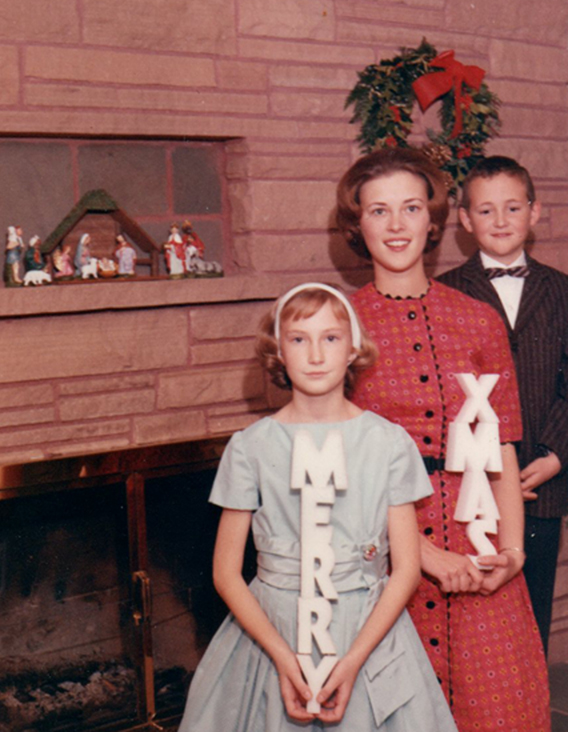
In 1959, when I was five years old, my father left his high school agriculture teaching position for a new supervisor position with the state. Our family moved from a large 3 story farm house in a rural community to a 1950’s newer rambler style home just outside the city limits of the state capitol. It was a big adjustment to move to a much smaller house without a basement or upper story, no garage, and no large haybarn nor chicken coop. It meant most things we owned didn’t make the move with us.
The rambler had two side by side mirror image rooms as the primary central living space between the kitchen on one side and the hallway to the bedrooms on the other. The living room could only be entered through the front door and the family room was accessed through the back door with a shared sandstone hearth in the center, containing a fireplace in each room. The only opening between the rooms had a folding door shut most of the year. In December, the door was opened to accommodate a Christmas tree, so it sat partially in the living room and depending on its generous width, spilled over into the family room. That way it was visible from both rooms, and didn’t take up too much floor space.
The living room, because it contained the only carpeting in the house, and our “best” furniture, was strictly off-limits for us kids. In order to keep our two matching sectional knobby gray fabric sofas, a green upholstered chair and gold crushed velvet covered love seat in pristine condition, the room was to be avoided unless we had company. The carpet was never to develop a traffic pattern, there would be no food, beverage, or pet ever allowed in that room, and the front door was not to be used unless a visitor arrived. The hearth never saw a fire lit on that side because of the potential of messy ashes or smoke smell. This was not a room for laughter, arguments or games and certainly not for toys. The chiming clock next to the hearth, wound with weighted pine cones on the end of chains, called out the hours without an audience.
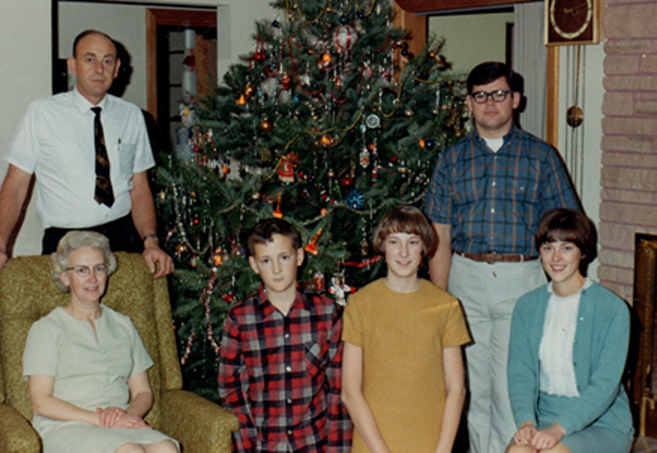
One week before Christmas, a tree was cut down to fit in the space where it could overflow into the family room. I particularly enjoyed decorating the “family room” side of the tree, using all my favorite ornaments that were less likely to break if they fell on the linoleum floor on that side of the door.
It was as if the Christmas tree became divided, with a “formal” side in the living room and a “real life” face on the other side where the living (and all that goes along with that) was actually taking place.
The tree straddled more than just two rooms. Each year that tree’s branches reached out to shelter a family that was slowly, almost imperceptibly, falling apart like fir needles dropping to the floor, soon to be swept away.
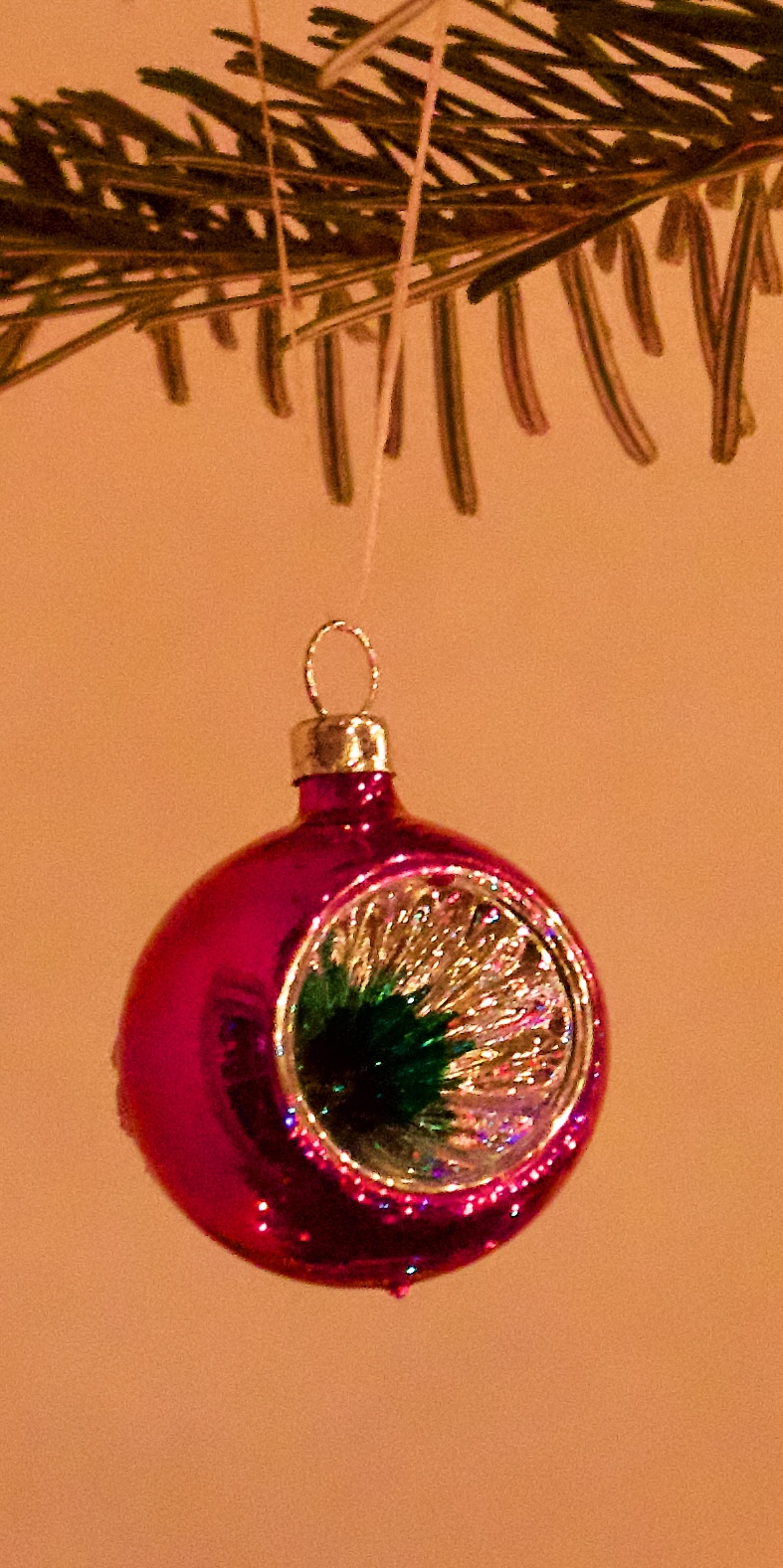
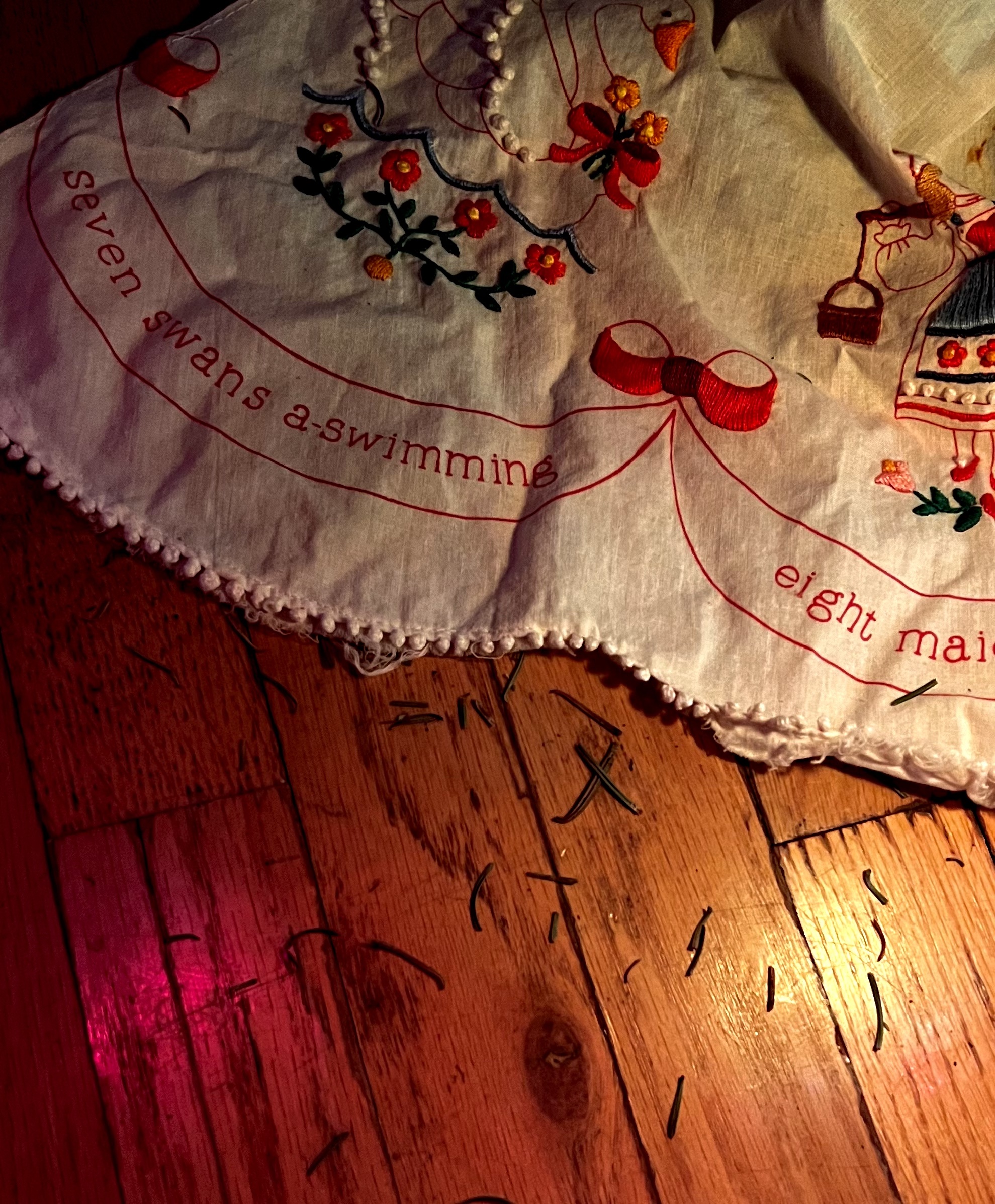
Each year since, our Christmas tree, bearing those old ornaments from my childhood, reminds me of that still room of memories. No longer am I wary of the past, and as I sweep up the fir needles that inevitably drop, I no longer weep.
One-Time
Monthly
Yearly
Make a one-time or recurring donation to support Barnstorming
Sure on this shining night Of star made shadows round, Kindness must watch for me This side the ground. The late year lies down the north. All is healed, all is health. High summer holds the earth. Hearts all whole. Sure on this shining night I weep for wonder wand’ring faralone Of shadows on the stars. ~James Agee
He who has come to men dwells where we cannot tell nor sight reveal him, until the hour has struck when the small heart does break with hunger for him;
those who do merit least, those whom no tongue does praise the first to know him, and on the face of the earth the poorest village street blossoming for him. ~Jane Tyson Clement from No One Can Stem the Tide
In the somber dark of this blustery solstice morning, when there seems no hope for sun or warmth, I hunger for comfort, knowing there is solace only He can bring.
He calls me forth from where I have hidden, buried face down in the troubles of the world, hiding amid my quilt and pillows, fearing the news of the day.
Only God can glue together what evil shatters. He just asks us to hand Him the pieces of our broken hearts.
If I grab hold His offered hand, I’m lifted, my emptiness filling in the light, reaching for a new day bursting fully into blossom.
This year’s Barnstorming Advent theme “… the Beginning shall remind us of the End” is taken from the final lines in T.S. Eliot’s poem “The Cultivation of Christmas Trees”
One-Time
Monthly
Yearly
Make a one-time or recurring donation to support Barnstorming
Something has descended like feathered prophecy. Someone has offered the world a bowl of frozen tears,
has traced the veins and edges of leaves with furred ink. The grass is stiff as the strings of a lute.
And, day by day, the tiny windows crack their cardboard frames seizing the frail light. The sun, moving through
these waxy squares, undiminished as a word passing from mind to speech. Every breath a birth,
a stir of floating limbs within me. I stay up late and waken early to feel beneath my feet the silence coming. ~Anya Silver “Advent, First Frost”
When I am weary, putting one foot in front of the other in the humble chores of the barn, feeling so cold at times, I no longer remember this was once sweaty summer work ~ now my hands ache in an arctic wind that shows no mercy.
Yet I know respite will come, refuge is near, salvation is imminent. Each breath I breathe a cloud of hope.
I will remember what our good God has prepared for us in such a place as this, what He has done to come down to dwell with us, melting our frozen tears, aching in silence alongside us.
This year’s Barnstorming Advent theme “… the Beginning shall remind us of the End” is taken from the final lines in T.S. Eliot’s poem “The Cultivation of Christmas Trees”
Good people all, this Christmas time, Consider well and bear in mind What our good God for us has done In sending his beloved son With Mary holy we should pray, To God with love this Christmas Day
In Bethlehem upon that morn, There was a blessed Messiah born The night before that happy tide The noble Virgin and her guide Were long time seeking up and down To find a lodging in the town
But mark right well what came to pass From every door repelled, alas As was foretold, their refuge all Was but a humble ox’s stall Near Bethlehem did shepherds keep Their flocks of lambs and feeding sheep
To whom God’s angel did appear Which put the shepherds in great fear Arise and go, the angels said To Bethlehem, be not afraid For there you’ll find, this happy morn A princely babe, sweet Jesus, born With thankful heart and joyful mind
The shepherds went the babe to find And as God’s angel had foretold They did our Saviour Christ behold Within a manger he was laid And by his side a virgin maid
Attending on the Lord of Life Who came on earth to end all strife There were three wise men from afar Directed by a glorious star And on they wandered night and day
Until they came where Jesus lay And when they came unto that place Where our beloved Messiah lay They humbly cast them at his feet With gifts of gold and incense sweet. ~Traditional Irish — the Wexford Carol 12th century





















































 Barnstorming