The Scar of Proud Flesh

There are names for what binds us:
strong forces, weak forces.
Look around, you can see them:
the skin that forms in a half-empty cup,
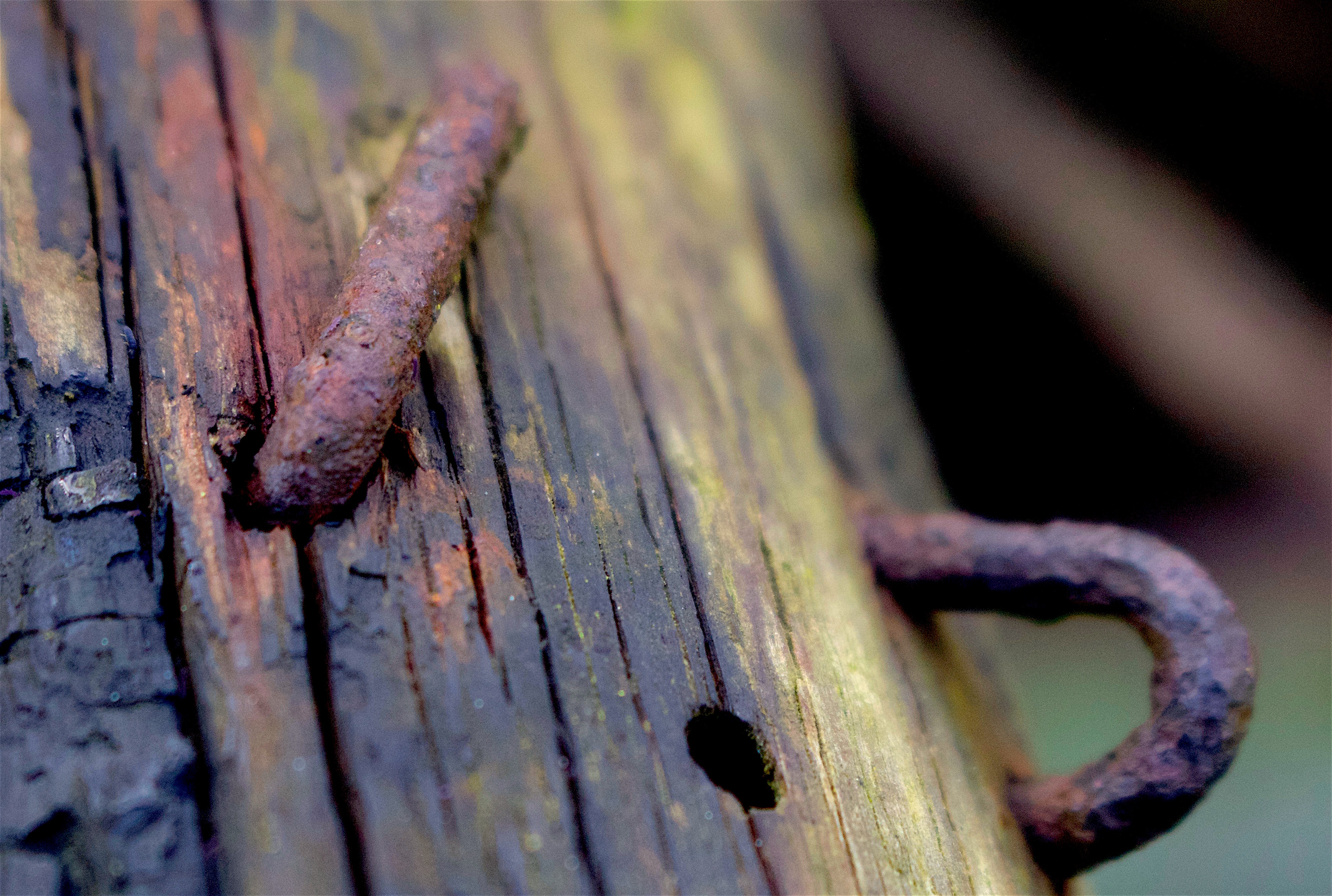
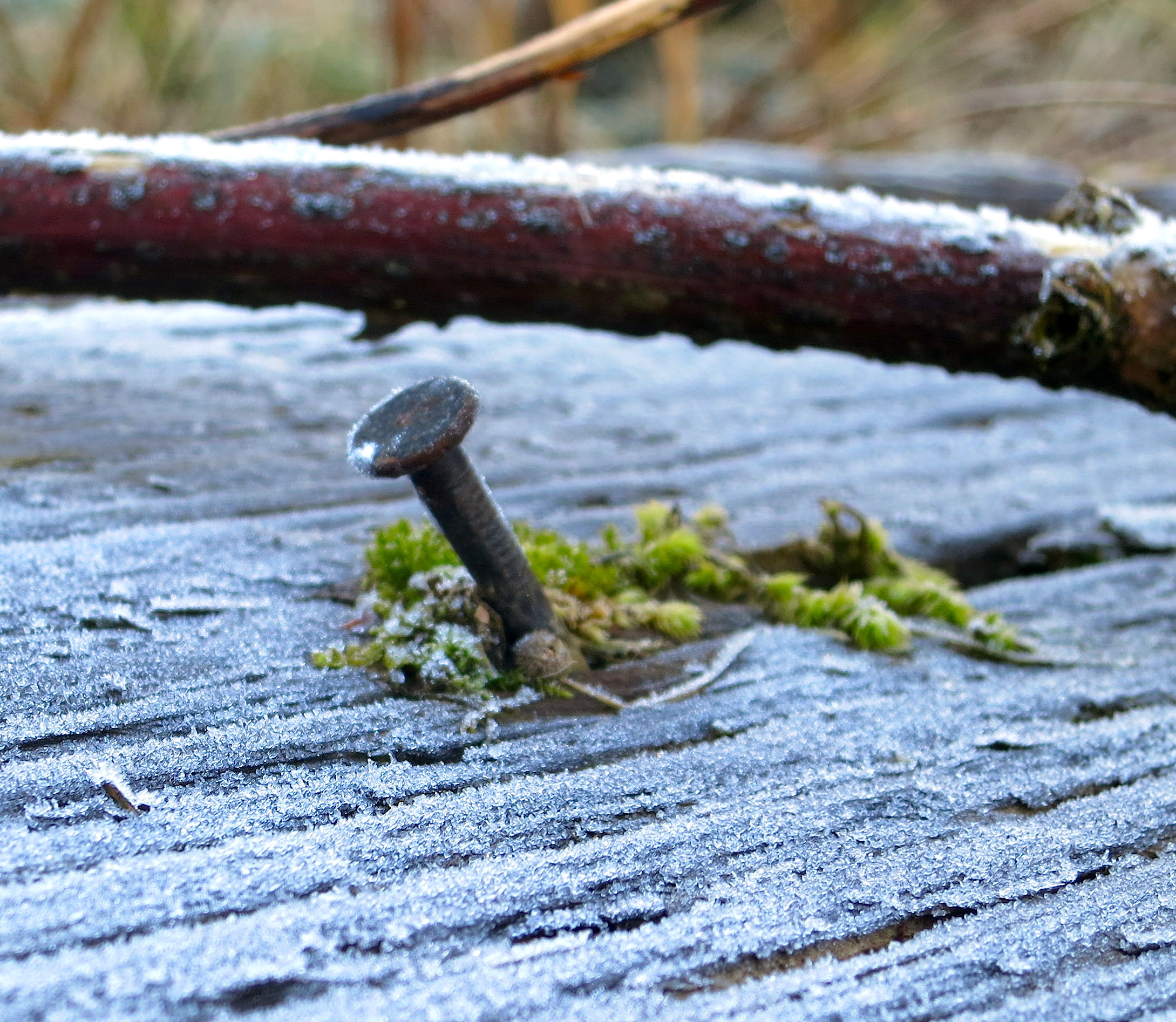
nails rusting into the places they join,
joints dovetailed on their own weight.

The way things stay so solidly whenever they’ve been set down –
and gravity, scientists say, is weak.

And see how the flesh grows back across a wound, with a great vehemence,
more strong than the simple, untested surface before.

There’s a name for it on horses, when it comes back darker and raised:
proud flesh, as all flesh is proud of its wounds,
wears them as honors given out after battle,
small triumphs pinned to the chest –

And when two people have loved each other,
see how it is like a scar between their bodies,
stronger, darker, and proud;
how the black cord makes of them a single fabric
that nothing can tear or mend.
~Jane Hirshfield  “For What Binds Us”
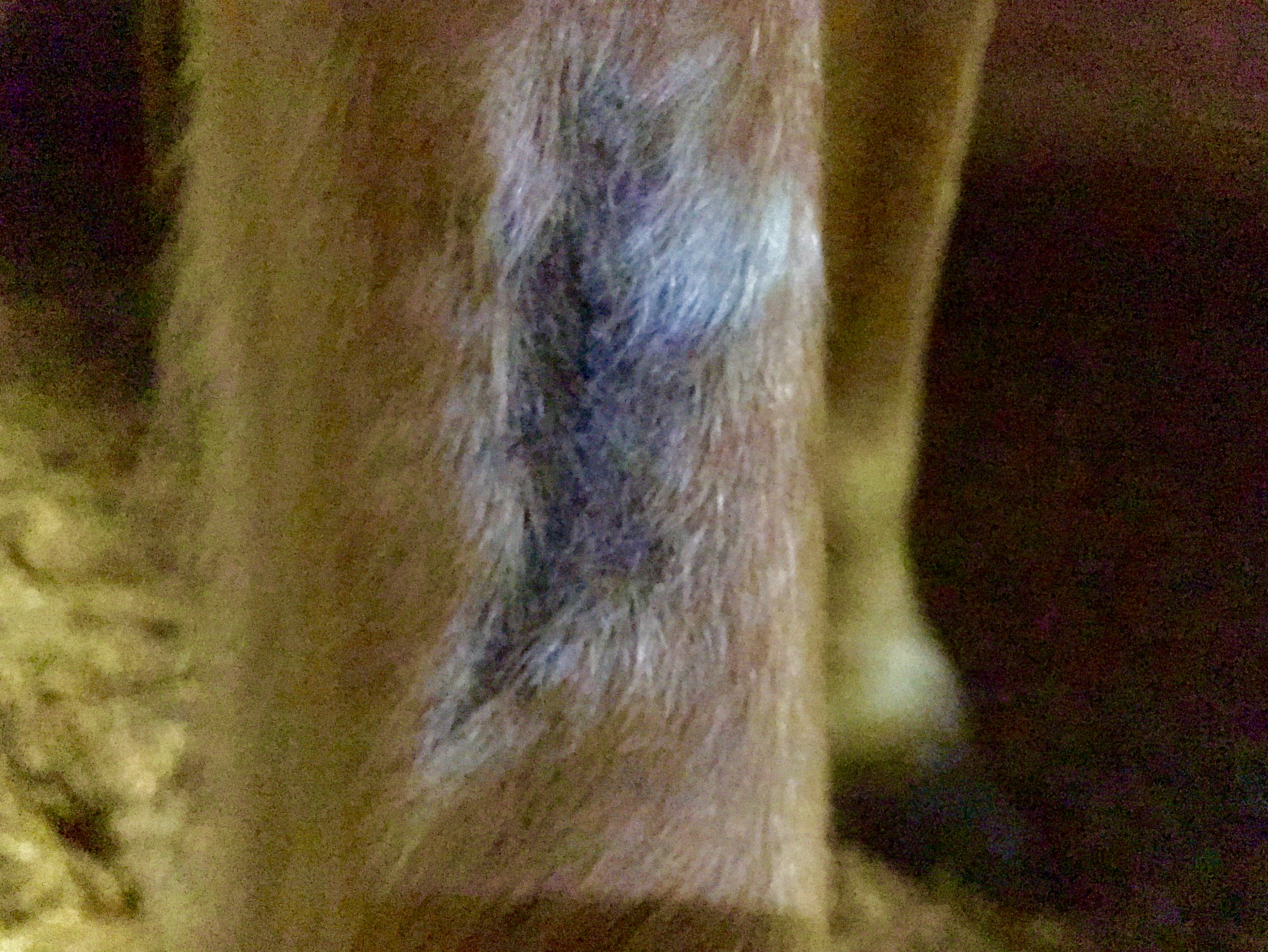
Scars come in various sizes and shapes, some hidden, some quite obvious to all.  How they are inflicted also varies–some accidental, others therapeutic, and too many intentional. 

The most insidious are the ones so deep inside,  no one can see or know they are there.

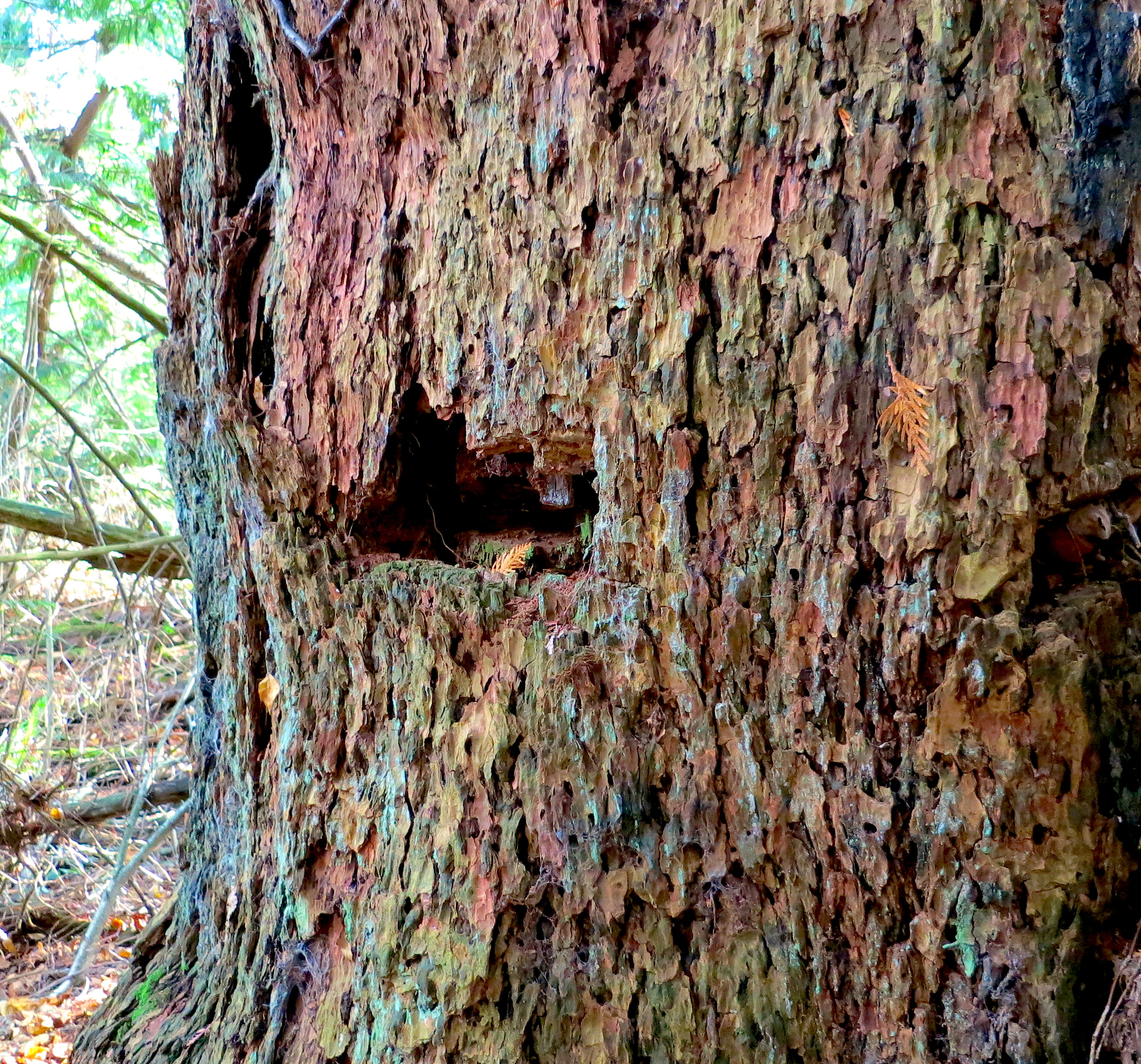
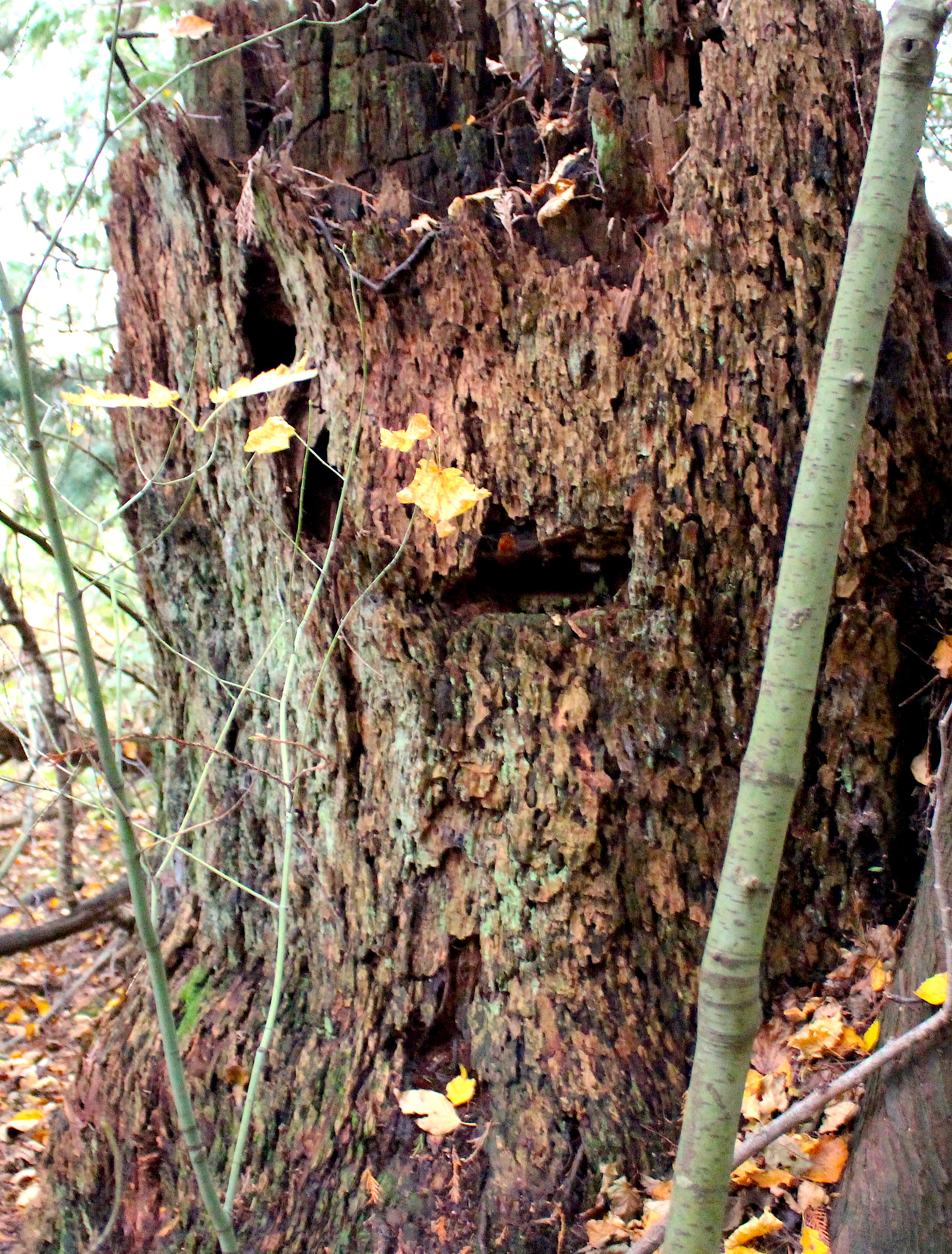
Back in our woodlot stands a sawed off stump of a cedar that was old growth in virgin forest over a hundred years ago.  One day clearcut loggers came through and took every tree they could to haul to the local sawmills to become beams and lumber for the growing homesteading population in the region.  This cedar once was grand and vast, covering an immense part of the forest floor, providing protection to trillium at its feet and finches’ nests and raptors hunting in its branches.   It nurtured its environment until other plans were made, and one day, axes fell on its sides to cut out the notches for the springboards where two loggers stood either side of the proud trunk to man the saw which brought the tree down. 

Where the wood went is anyone’s guess.  It could be one of the mighty beams supporting our old hay barn roof or it could have become the foundation flooring of a nearby one room school house.  It surely had a productive and meaningful life as part of a structure somewhere until rot or carpenter ants or fire brought it once again to its knees.

But this ghost of a stump remains, a tombstone of remembrance of a once grand tree, the notch scars embedded deep in its sides, nursing new seedlings from its center and moss, lichen and ferns from its sides.

I come from logger stock so I don’t begrudge these frontier settlers their hard scrabble living, nor minimize their dangerous work in order to feed themselves and their families.  It’s just I’m struck by those scars over one hundred years later — such a visible reminder of what once was a vital living organism toppled for someone’s need and convenience.

Trees are not unique.  It happens to people too.  Everyday scars are inflicted for reasons hard to justify.  Too often I see them self-inflicted in an effort to feel something other than despair.  Sometimes they are inflicted by others out of fear or need for control.

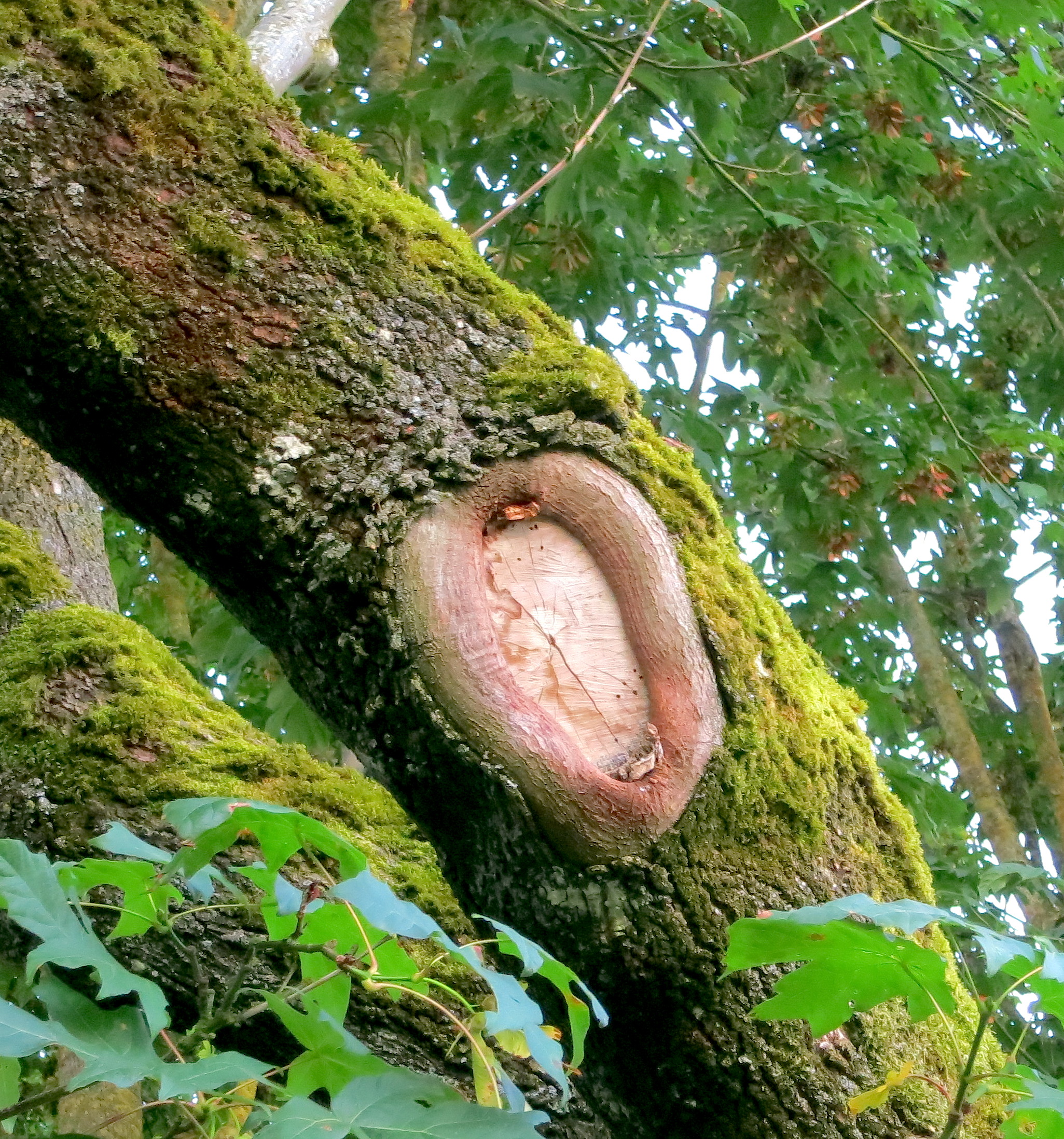
Sometimes they are simply the scars of living – on our horses they are a dark tough scar of leathery “proud flesh”. These are the wounds that accumulate on our journey through our numbered days.

None of them are as deep and wide as the scars that were accepted on our behalf, nor as wondrous as the Love that oozed from them, nor as amazing as the Grace that abounds to this day because of the promise they represent. 

These are scars from the Word made Flesh, a proud flesh that won’t give way, lasting forever.

As a result, that Tree lives, and so do we.
One-Time
Monthly
Yearly

Make a one-time donation to support Barnstorming

Make a monthly donation

Make a yearly donation

Choose an amount

¤5.00
¤10.00
¤20.00
¤5.00
¤15.00
¤100.00
¤5.00
¤15.00
¤100.00

Or enter a custom amount

¤

Your contribution is deeply appreciated.

Your contribution is appreciated.

Your contribution is appreciated.

DonateDonate monthlyDonate yearly

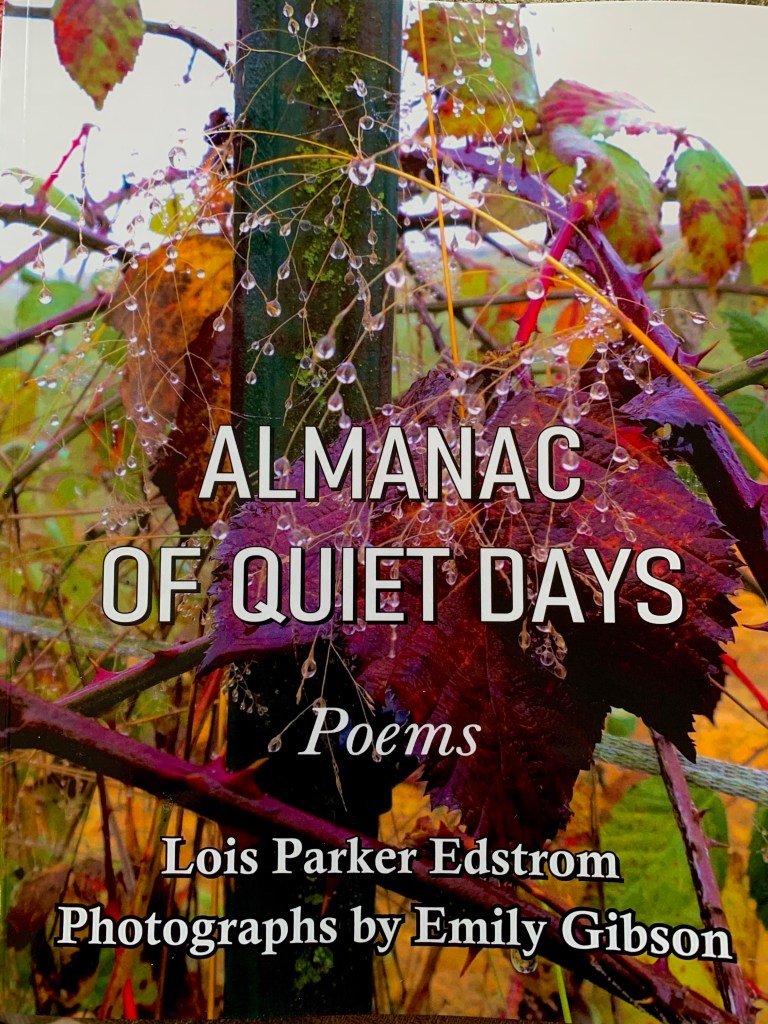
A book of beauty in words and photography, available to order here:
For Your Tomorrow We Gave Our Today

When you go home tell them of us and say –
“For your tomorrow we gave our today”
~John Maxwell Edmonds from “The Kohima Epitaph” 

I’m unsure why the United States does not call November 11 Remembrance Day as the Commonwealth nations did over a century ago at the Armistice. This is a day that demands much more than the more passive name Veterans’ Day represents.

This day calls all citizens who appreciate our freedoms to stop what we are doing and disrupt the routine rhythm of our lives. We are to remember in humble thankfulness the generations of military veterans who sacrificed time, resources, sometimes health and well being, and too often their lives in answering the call to defend their countries.

Remembrance means
~never forgetting what it costs to defend freedom.
~acknowledging the millions who have given of themselves and continue to do so on our behalf.
~never ceasing to care.
~a commitment to provide resources needed for the military to remain strong and supported.
~unending prayers for safe return home to family.
~we hold these men and women close in our hearts, always teaching the next generation about the sacrifices they made.

Most of all,
it means being willing ourselves to become the sacrifice when called.

We are the Dead. Short days ago
We lived, felt dawn, saw sunset glow,
Loved and were loved, and now we lie
In Flanders fields.

To you from failing hands we throw    
The torch; be yours to hold it high.    
If ye break faith with us who die
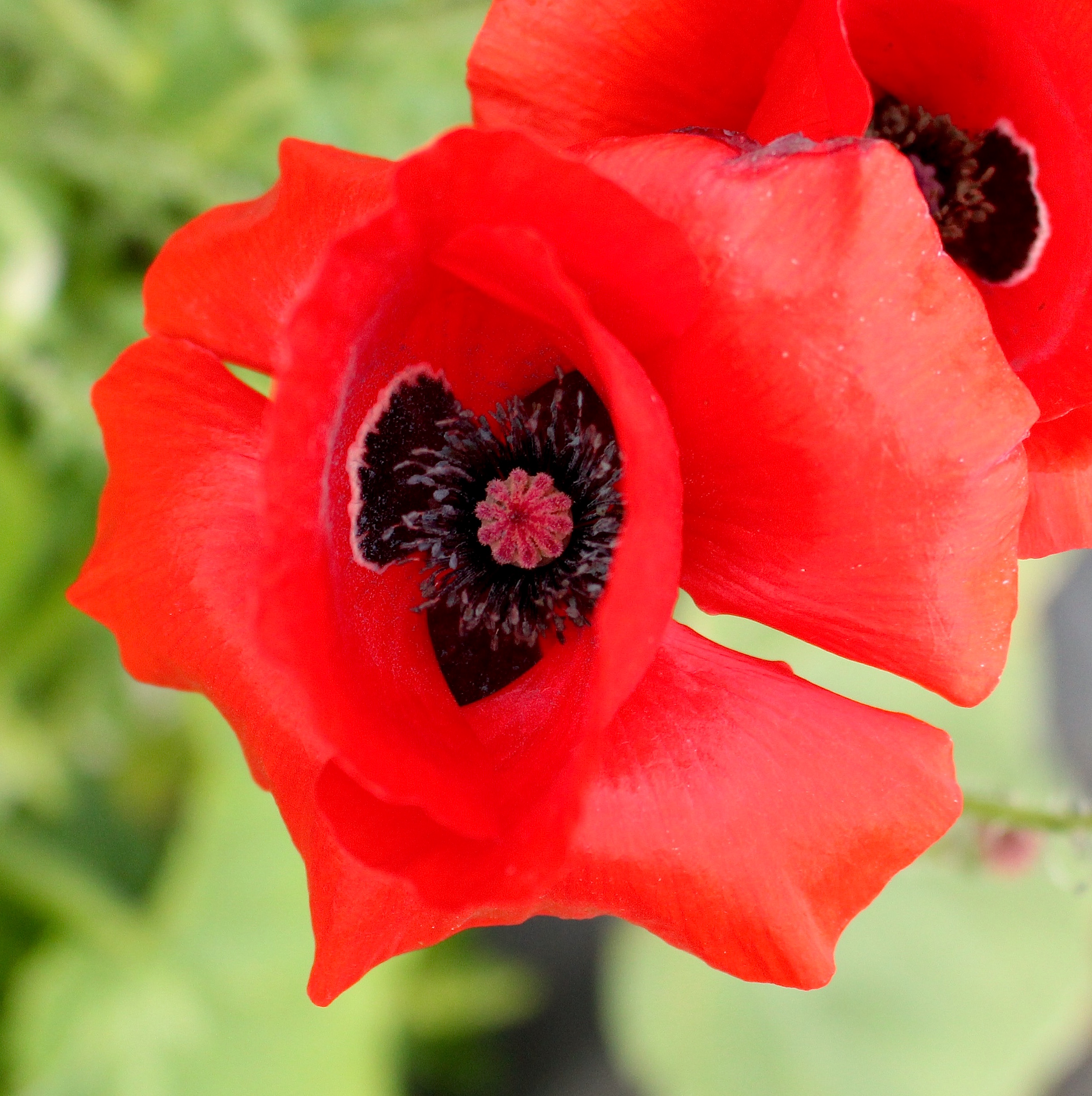
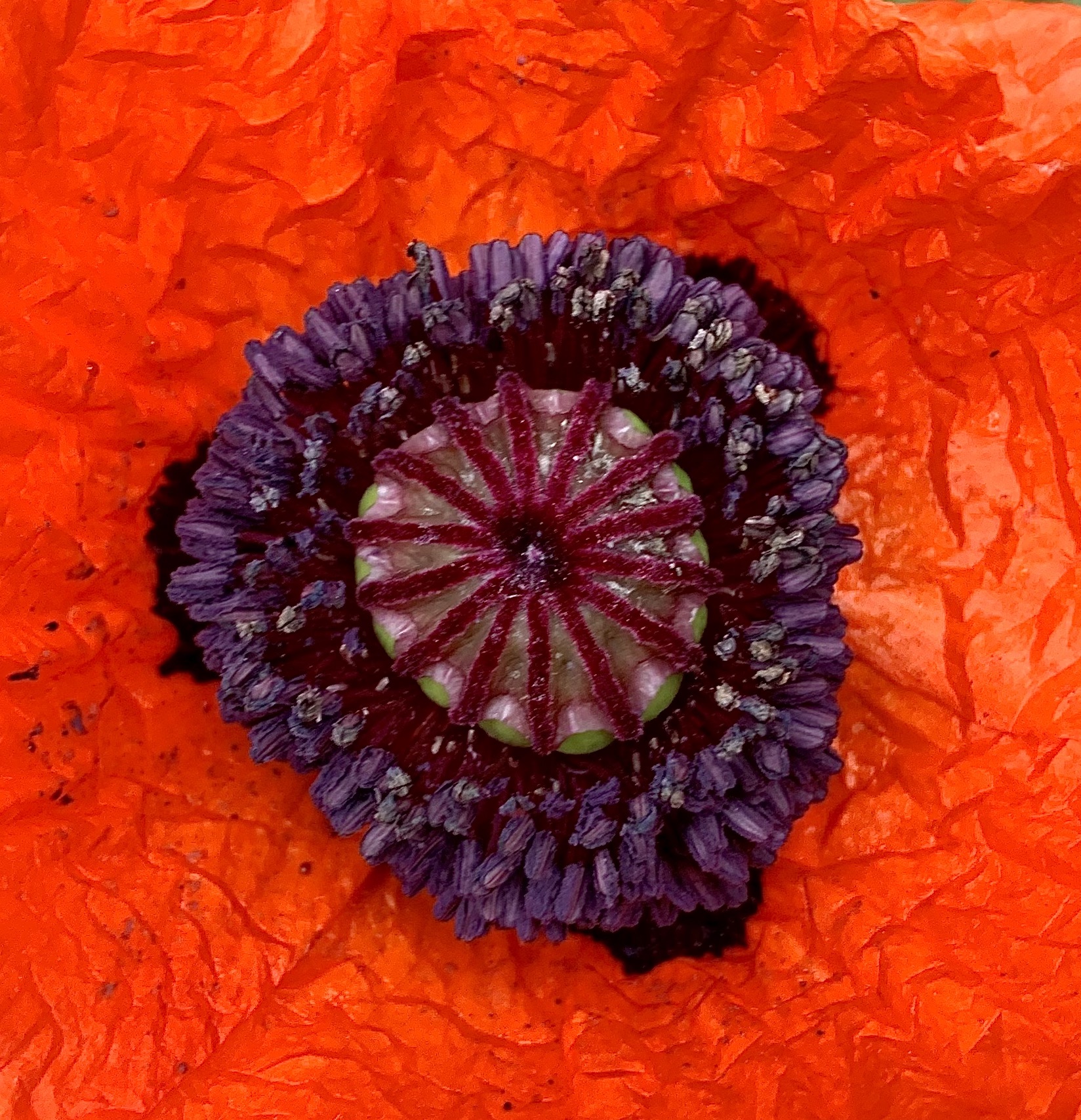
We shall not sleep, though poppies grow…
~LtCol (Dr.) John McCrae from “In Flanders Fields”

A book of beauty in words and photography, available to order here:
Holding Back My Heart

The others bent their heads and started in.
Confused, I asked my neighbor
to explain—a sturdy, bright-cheeked girl
who brought raw milk to school from her family’s
herd of Holsteins. Ann had a blue bookmark,
and on it Christ revealed his beating heart,
holding the flesh back with His wounded hand.
Ann understood division. . . .

Miss Moran sprang from her monumental desk
and led me roughly through the class
without a word. My shame was radical
as she propelled me past the cloakroom
to the furnace closet, where only the boys
were put, only the older ones at that.
The door swung briskly shut.

The warmth, the gloom, the smell
of sweeping compound clinging to the broom
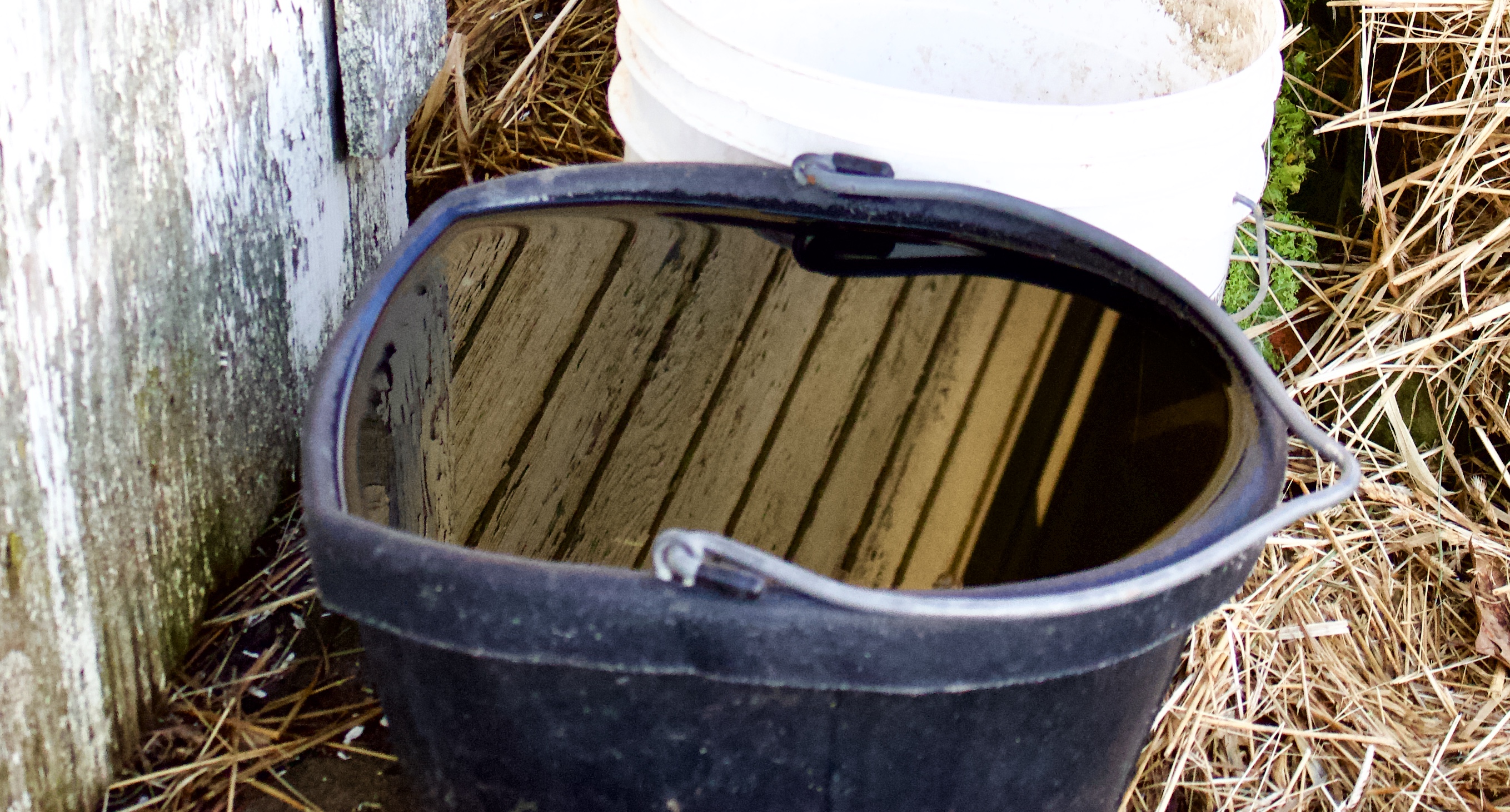
soothed me. I found a bucket, turned it
upside down, and sat, hugging my knees.
I hummed a theme from Haydn that I knew
from my piano lessons. . . .
and hardened my heart against authority.
And then I heard her steps, her fingers
on the latch. She led me, blinking
and changed, back to the class.

~Jane Kenyon “Trouble with Math in a One-room Country School”

I avoided all potential trouble in school by avoiding the trouble-makers.
I never was disciplined or even looked at crossly by a teacher. They loved me and I wanted badly to be loved by them.

I looked away whenever another student got in trouble; I didn’t want to be a lookie-loo enjoying the travails of another child. It was painful for me to see another kid disciplined. I know I would have been crushed to be publicly called out, sent to the hallway, name on the board, or worse yet, banished to the principal.

So my heart broke when I saw another child cry,
or be defiant or be removed from class.
I knew I couldn’t fix it or them.
I knew I couldn’t help the teacher to like them.
I knew some kids have their own secret pain they endure.
I knew it would change me to know what their pain felt like.
So I just imagined being good and compliant and rule-abiding and lovable.

Forever.

Of course, I wasn’t and I’m not, sixty years later.
I too changed, just like everyone else.
It still makes me sad to think how much we change, how many hearts we break,
how our innocence is so fragile and as a result, how badly we need forgiveness
so we can learn to love ourselves as we are loved.

A book of beauty in words and photography available to order here:

Generous Indefatigable Love

And what if I never get it right,
this loving, this giving of the self
to the other? And what if I die


before learning how to offer
my everything? What if, though
I say I want this generous,


indefatigable love, what if
I forever find a way to hold
some corner back? I don’t want


to find out the answer
to that. I want to be the sun
that gives and gives until it burns out,


the sea that kisses the shore
and only moves away so that
it might rush up to kiss it again.
~ Rosemerry Wahtola Trommer, “And Again” from Hush

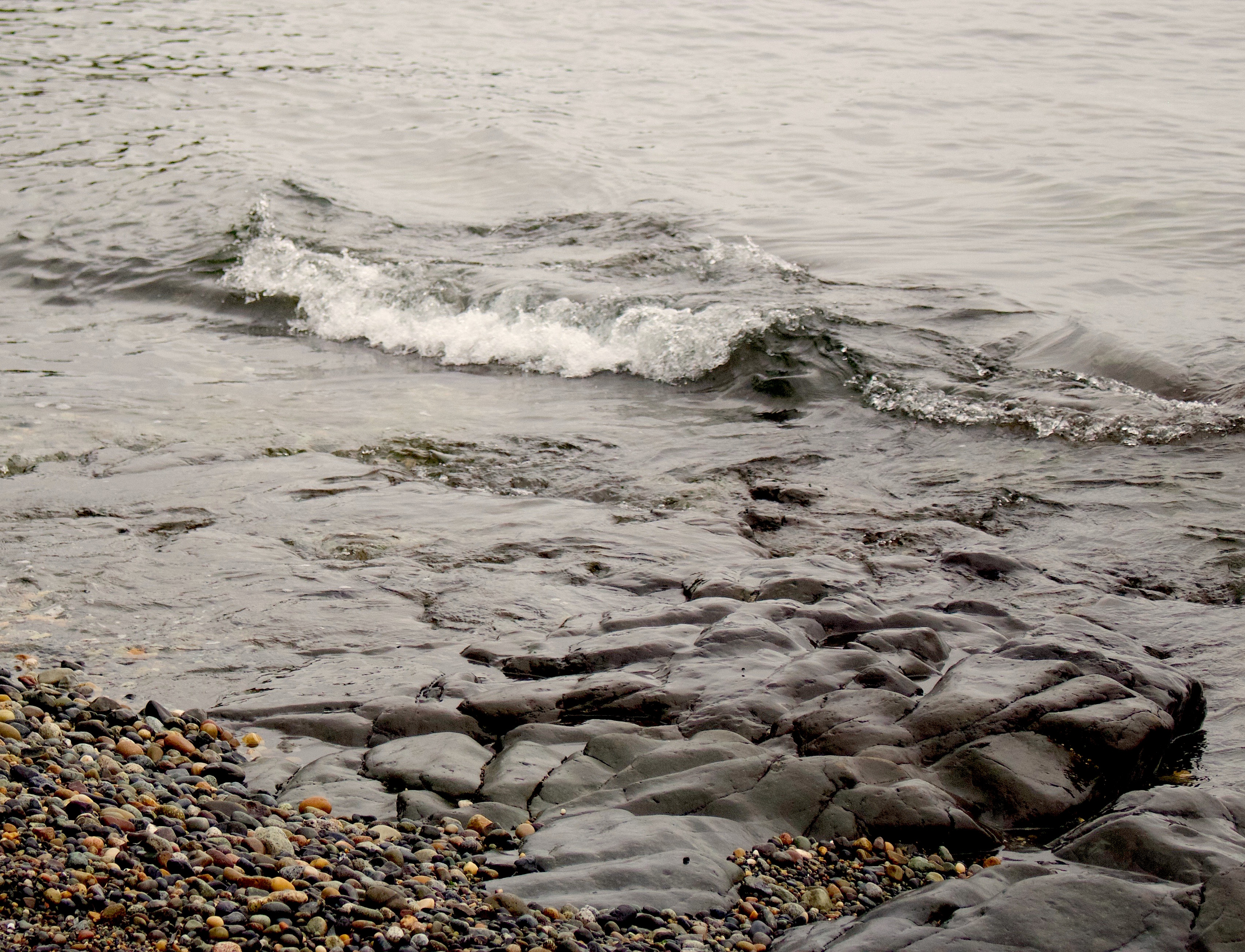
The beach at Tohoku, Japan where the tsunami hit in 2011

What is it about us
that always holds something back
when loving others,
keeping in reserve
some little piece of ourselves
that we can’t quite let go?

Even so, we ourselves want to be loved
wholly, fully, completely, unconditionally
yet something in us doesn’t trust
it could be true –
we know how undeserving we are.

When we are offered such
generous indefatigable love,
we hold back part of ourselves
because we are afraid
we’ll be left desolate, never to be filled again –
a sun burned out and darkened,
a shore left high and dry.

Once we experience our Creator’s love
as wholly generous,
completely tireless and persistent,
unconditionally grace-filled,
we can stop fearing our emptiness.

He pours more than enough love into us
without holding back,
filling us so full that we might spill over to others,
again and again and again,
with our light and heart and spirit unbound.

A new book from Barnstorming is available to order here:

When the Trivial is Transformed

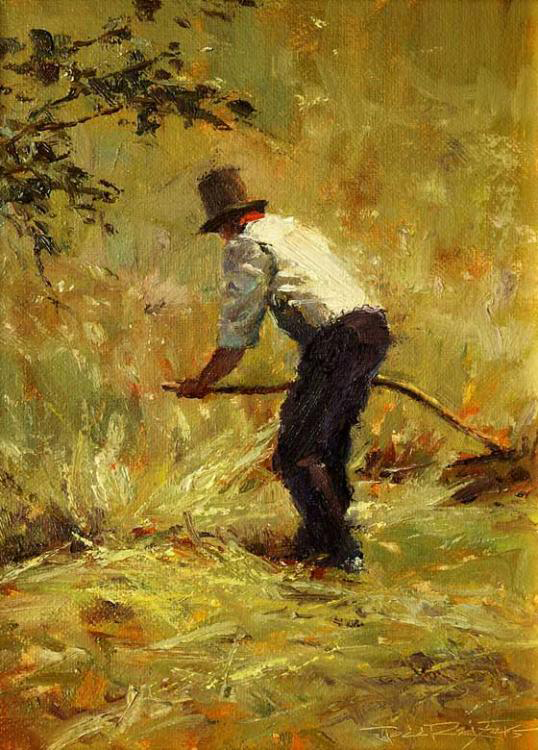
Man Scything Hay by Todd Reifers

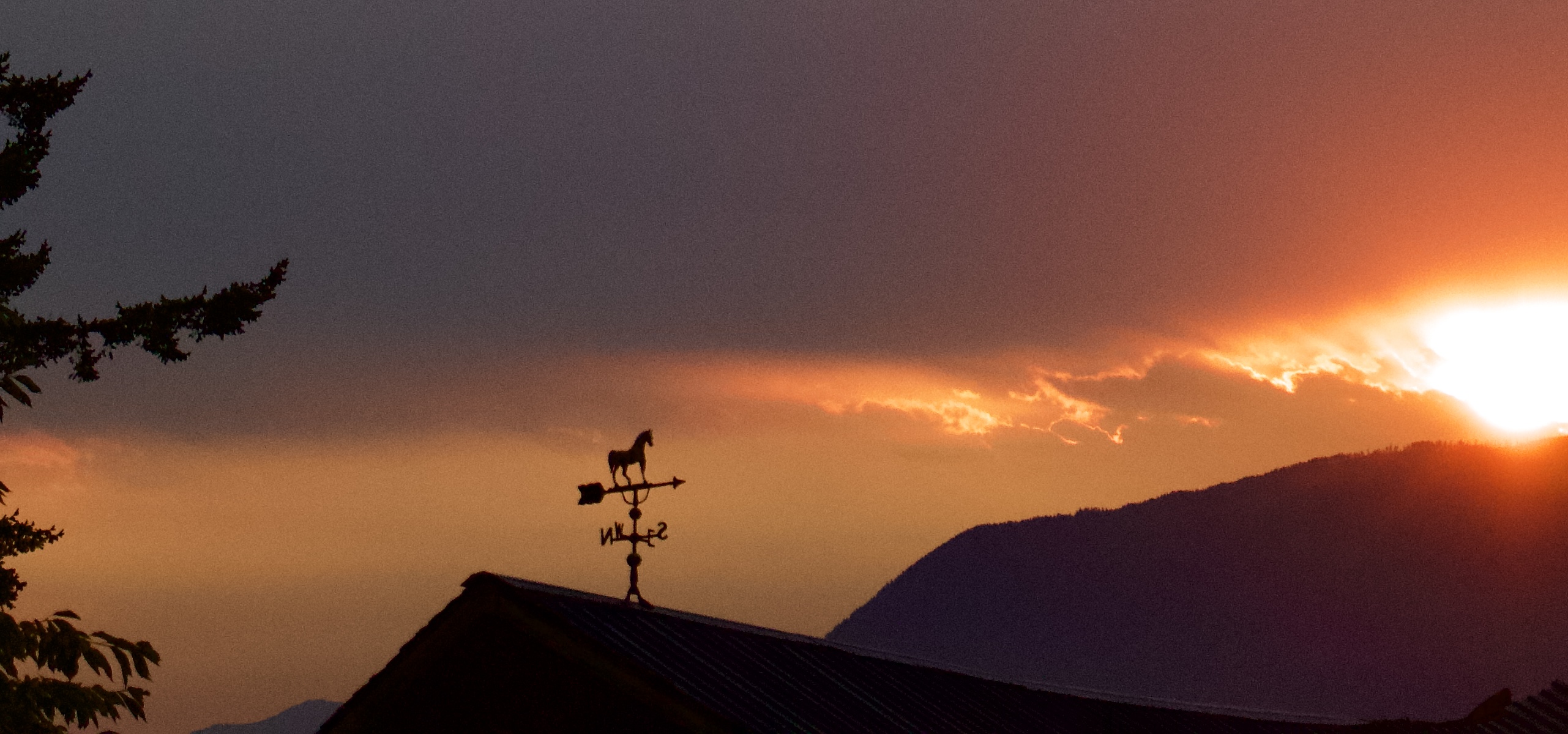
A sudden light transfigures a trivial thing,
a weather-vane,
a wind-mill,
a winnowing flail,
the dust in the barn door;
a moment,- -and the thing has vanished,
because it was pure effect;
but it leaves a relish behind it,
a longing that the accident may happen again.
~Walter Pater from his essay “The Renaissance”

The accident of light does happen, again and again, but when I least expect it.  If I’m not ready for it, in a blink, it can be gone.

Yet in that moment, everything is changed and transformed forever.  The thing itself, trivial and transient becomes something other, merely because of how it is illuminated.

So am I, trivial and transient, lit from outside myself with a light that ignites me within. I’m transfigured by a love and sacrifice unexpected and undeserved.

Am I ready to be changed?

A book of beautiful words and photos, available for order here:

Madly in Love

How is it they live for eons in such harmony
– the billions of stars –
when most men can barely go a minute
without declaring war in their mind

against someone they know.

There are wars where no one marches with a flag,

though that does not keep casualties from mounting.

Our hearts irrigate this earth. 
We are fields before each other.
How can we live in harmony?


First we need to know 

we are all madly in love
with the same God.

O Lord my God, make me
submissive without protest,

poor without discouragement,
chaste without regret,
patient without complaint,
humble without posturing,
cheerful without frivolity,
mature without gloom,
and quick-witted without flippancy.


Grant that I may know
what You require me to do.
Bestow upon me
the power to accomplish Your will,
as is necessary and fitting
for the salvation of my soul.

~St. Thomas Aquinas

I look at headline news through my fingers, cringing.  

Amid the centuries of posturing between governments and every imaginable tribe and faction, the names and faces change but the nature of hatred of the “other” doesn’t.

We’ve seen this all before, over and over through history.  Over 150 years ago it was in the Gettysburg fields that blood of rival armies intermingled and irrigated U.S. soil.  Though now we stand side by side with Germany and Japan, our bitter adversaries a mere eighty years ago, our world continually brews new enemies and ignites new conflicts.

We can barely go a minute without declaring war in our minds even against our neighbor, even those we consider friends and family. There is yelling from the streets in angry protest and screaming at school board meetings. Casualties mount in our bitterness toward one another.

And who am I to point fingers or squint through them at the news of the day?
I am as prone to this as anyone.

Am I myself capable of submission without protest, remaining patient and uncomplaining even when I disagree? Can I embody humility without having a hidden agenda? Can I remain selfless when my true nature is wholly selfish?

How can there ever be harmony? 
How can I overcome my own rancorous heart?

As critical as it seems, It is not love for one another that comes first.
I must first know, love and trust the only God who has loved the unloveable so much He became one with us, overpowering our tendency to hate one another by taking it all upon Himself.

Jesus found us dying in a world desperately drying up; His bleeding heart poured itself out onto our thirsting soil. We have been handed salvation.

It is, in fact, God who is madly in love with us and though we’ve done nothing to deserve it, it is our turn to show love to one another.

A book from Barnstorming is available for order here:

The Center Cannot Hold

Things fall apart; the centre cannot hold;
Mere anarchy is loosed upon the world,
The blood-dimmed tide is loosed, and everywhere   
The ceremony of innocence is drowned;
~William Butler Yeats from “The Second Coming”

The city orbits around eight million
centers of the universe
and turns around the golden clock
at the still point of this place.
Lift up your eyes from the moving hive
and you will see time circling
under a vault of stars and know
just when and where you are.
~Billy Collins “Grand Central”

At the still point of the turning world.
Neither flesh nor fleshless;
Neither from nor towards;

at the still point, there the dance is,
But neither arrest nor movement. And do not call it fixity,
Where past and future are gathered.

Neither movement from nor towards,
Neither ascent nor decline.

Here is a place of disaffection
Time before and time after
In a dim light: neither daylight
Investing form with lucid stillness
Turning shadow into transient beauty
With slow rotation suggesting permanence
Nor darkness to purify the soul
Emptying the sensual with deprivation
Cleansing affection from the temporal.
Neither plentitude nor vacancy. 

~T.S. Eliot from “Burnt Norton” The Four Quartets

In those days there was no king in Israel. Everyone did what was right in his own eyes. Judges 21:25

Which shall it be?
Billions of people orbit the center – or – each of us strives to be our own center of the universe, but cannot hold on there.

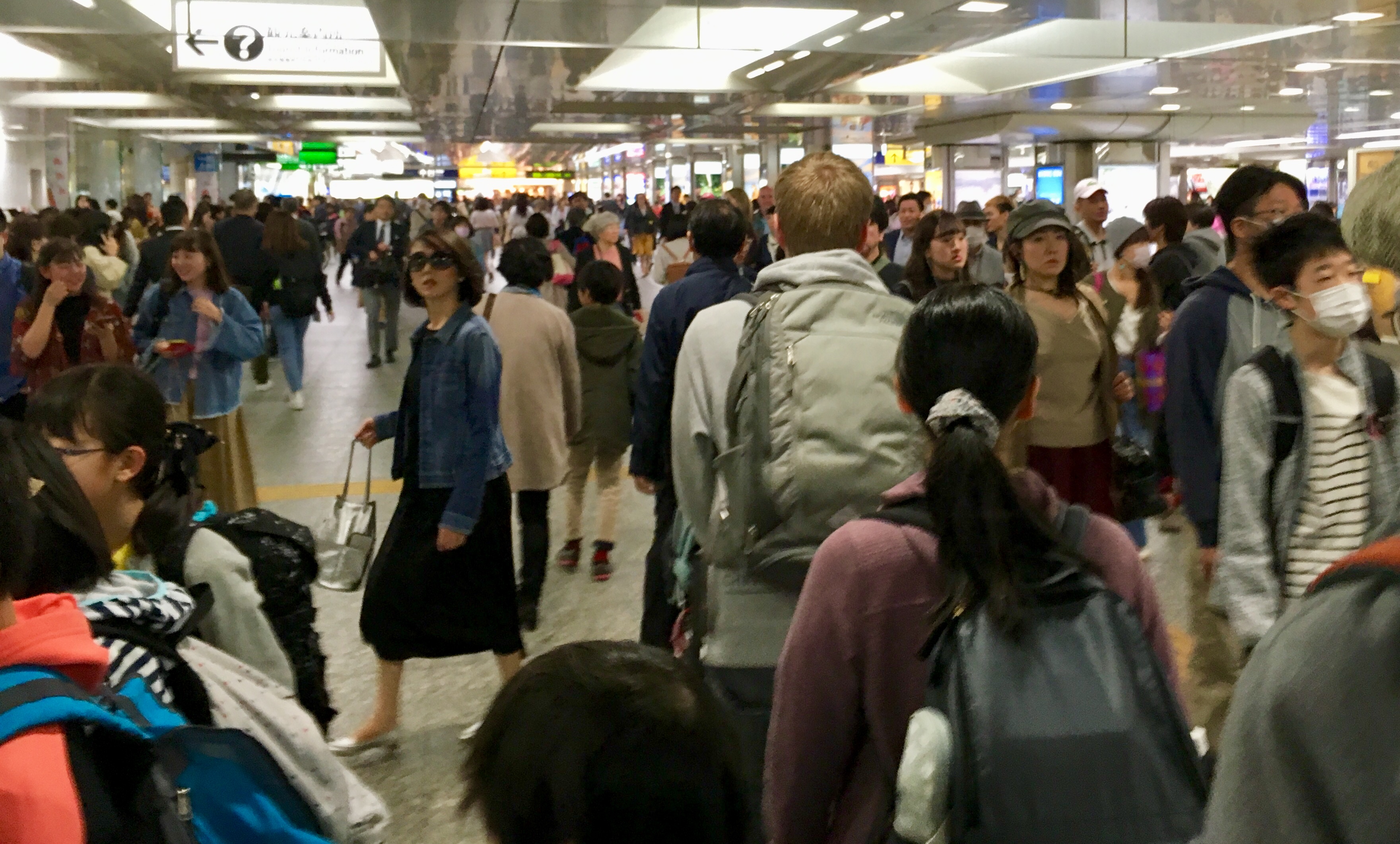
We’ve been to Grand Central Station, a relaxed rest stop compared to the moving hive we navigated at Shinjuku Station and Ikebukuro Station in Tokyo, a city four times the size of New York.

Try as I might to picture train stations constituting a “center” holding a great city together, such works of man – like political leaders – have only a tenuous hold on those who come and go. We each desire to do what is right in our own eyes.

As a result, there is no glue; things fall apart.

The Center only holds when it constitutes the Source itself-
the origin, the beginning and the end and everything in between.
Starting from there, no matter how far you may feel from the Center,
you have no doubt about who and where and when you are.
Then and only then, you know what is right to do.

More photos and words of encouragement are found in this new book from Barnstorming, available for order here:

Change Altitudes

           ‘Regret has to be useless or it’s not really regret.’
                                                     ~Simone de Beauvoir

Rescuers did not find my uncle’s body.
But they found his axe at an icy altitude
impossible to navigate without one.


A little higher up, they found my uncle
’s sleeping bag at an altitude
unsurvivable without one.


You likely have a pen in purse or pocket.
Take it out and write a list of all
you need at your present altitude.


Next, change altitudes. Now, make another list:
the two biggest regrets of your life.
Take your time. Get it right. Because

here is all you need to know about need:
That list of regrets—cross one off.
You are going to need that space later.
~Jessica Goodfellow, “Unreachable” from Whiteout

I’ve known people who lost their lives while hiking/climbing in the mountains or due to some other tragedy – the cascade of decisions leading to their death are sources of regret for all who mourn them, even decades later. Somehow regret is a difficult feeling to let go; we cling to it as if it is somehow an essential part of us.

It is easy for me to come up with a long list of regrets in my life. They seem to grow like weeds – useless, unplanned, unwanted and prolific, threatening to take over any good fruit being produced.

Few of us volunteer to share openly about our current guilt or shame unless we are sitting in a therapy group or AA. Instead it gives us permission to beat ourselves up, going over and over in our minds how we could have done things differently. As a physician, I’ve heard about such heart-ache in my clinical encounters – a patient will regret an impulsive sexual encounter that turned out badly, or drinking and drugging too much, or regret an ongoing conflict with a family member, or wish they had decided to get that vaccine before becoming ill with a potentially preventable infection.

Our list of regrets can be endless and life-destroying.

I understand the pain of regret as I too am a flawed and fractured person with a seven decade history of things done and left undone, words said and unsaid. Even if I think I can somehow manage to cross a regret off my own list – perhaps I apologized and was granted forgiveness, or I tried to make right what I’d messed up — I still know a new regret will occupy its place before long.

I can’t simply fix my own regret list.

No matter what altitude we’re at — down in the pits in the lowest of the low, or up in the highest imaginable, I have come to realize that forgiveness is only possible through a knowledge of God Himself. He came to walk beside us in our low spots and our high spots, no matter where we find ourselves. His work on earth has crossed off our regrets and mistakes and wiped us clean of them.

He did this because He understood our desperate need; thanks to His sacrifice and love, our heart-aches are left at the Cross.

More beauty in words and photos are found in this new book from Barnstorming, available to order here:

If you have already read our book, your review of the book would be deeply appreciated here:

You Never Know…

Without realizing it, we fill
important places in each others’ lives.
It’s that way with the guy at the corner grocery,

the mechanic at the local garage,
the family doctor, teachers, neighbors, coworkers.


Good people who are always “there,”
who can be relied upon in small,
important ways. People who teach us,
bless us, encourage us, support us,
uplift us in the dailiness of life.

We never tell them.
I don’t know why, but we don’t.

And, of course, we fill that role ourselves.
There are those who depend on us, watch us,
learn from us, take from us. And we never know.

You may never have proof of your importance,
but you are more important than you think.
There are always those who couldn’t do without you.
The rub is that you don’t always know who.
~Robert Fulghum from All I Really Need to Know I Learned in Kindergarten

If there is one thing the pandemic taught me, it’s noticing the people in my life who may have not been as obvious to me before. I hadn’t realized how many folks truly are front-line serving others. It is not only the health care workers, grocery store clerks and school teachers but suddenly the list of “essential workers” has grown large, including law enforcement, plumbers and electricians, child care workers, water, sanitation and sewer maintenance, postal clerks, technicians who fix our cars and appliances and the farmers who tend the crops and livestock we need to live.

I realized how oblivious I had been before not taking the time to acknowledge the daily services I receive from so many varied people. In fact, it became even more urgent for me to tell my family members and friends – some thousands of miles away from me – how much they mean to me.

I’ve tried to remedy this: I try to tell others as simply and clearly as I can, whenever possible, that I appreciate what they have done and what they continue to do under difficult circumstances, how important they are to me and others and make life better for us all. I also need to continue to nurture those relationships with family and friends crucial to my well-being. I need them all.

It is so important for them to know.

Well over a thousand of you receive these daily Barnstorming emails and posts yet I only hear from a few of you – I treasure those messages, thank you! Let me know if I can do better at reaching out to each of you in a meaningful way – either by commenting on posts or emailing me privately at emilypgibson@gmail.com – we all need encouragement that we can make a difference in others’ lives.

This new book from Barnstorming is available to order here:
To Live One More Day

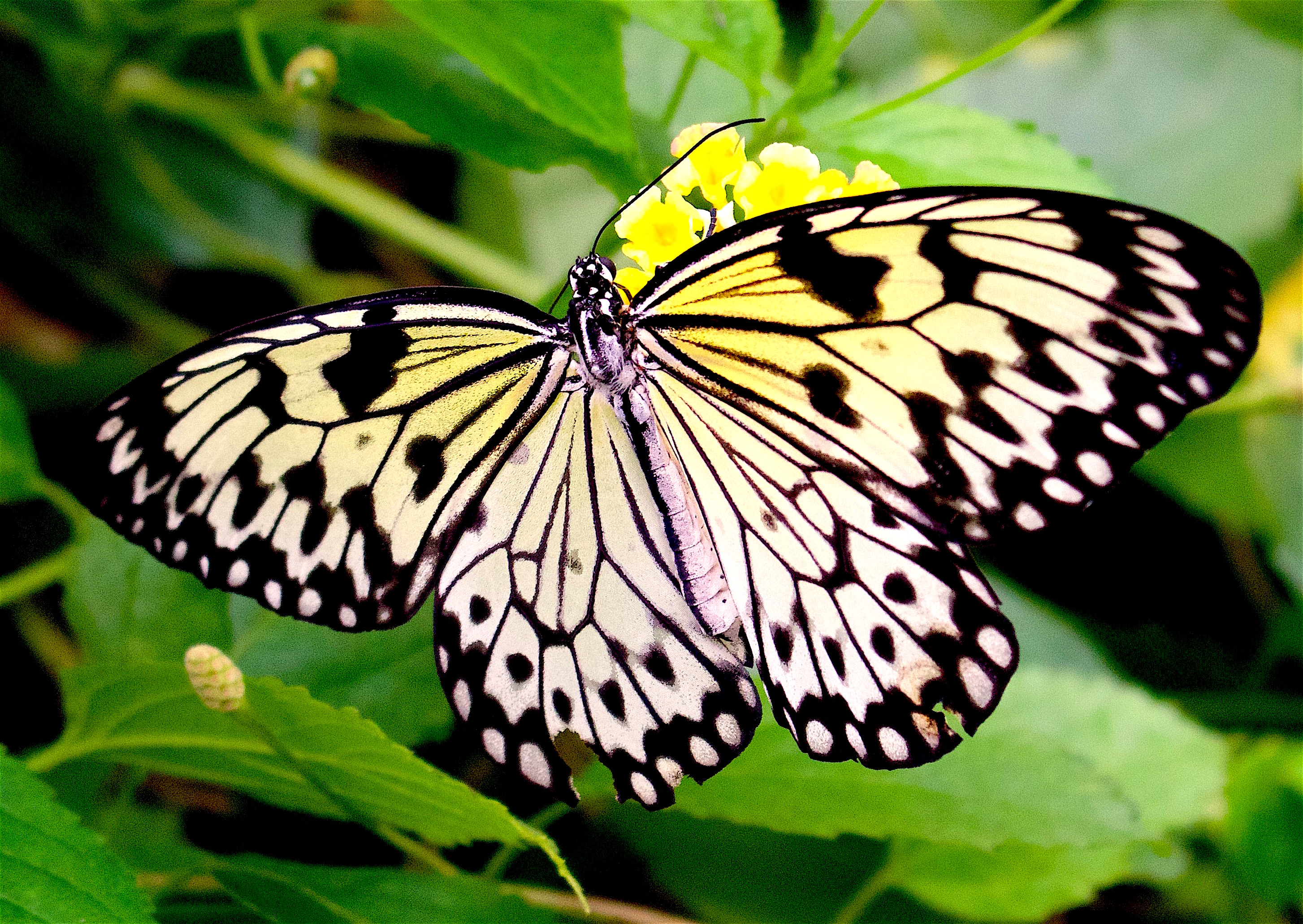
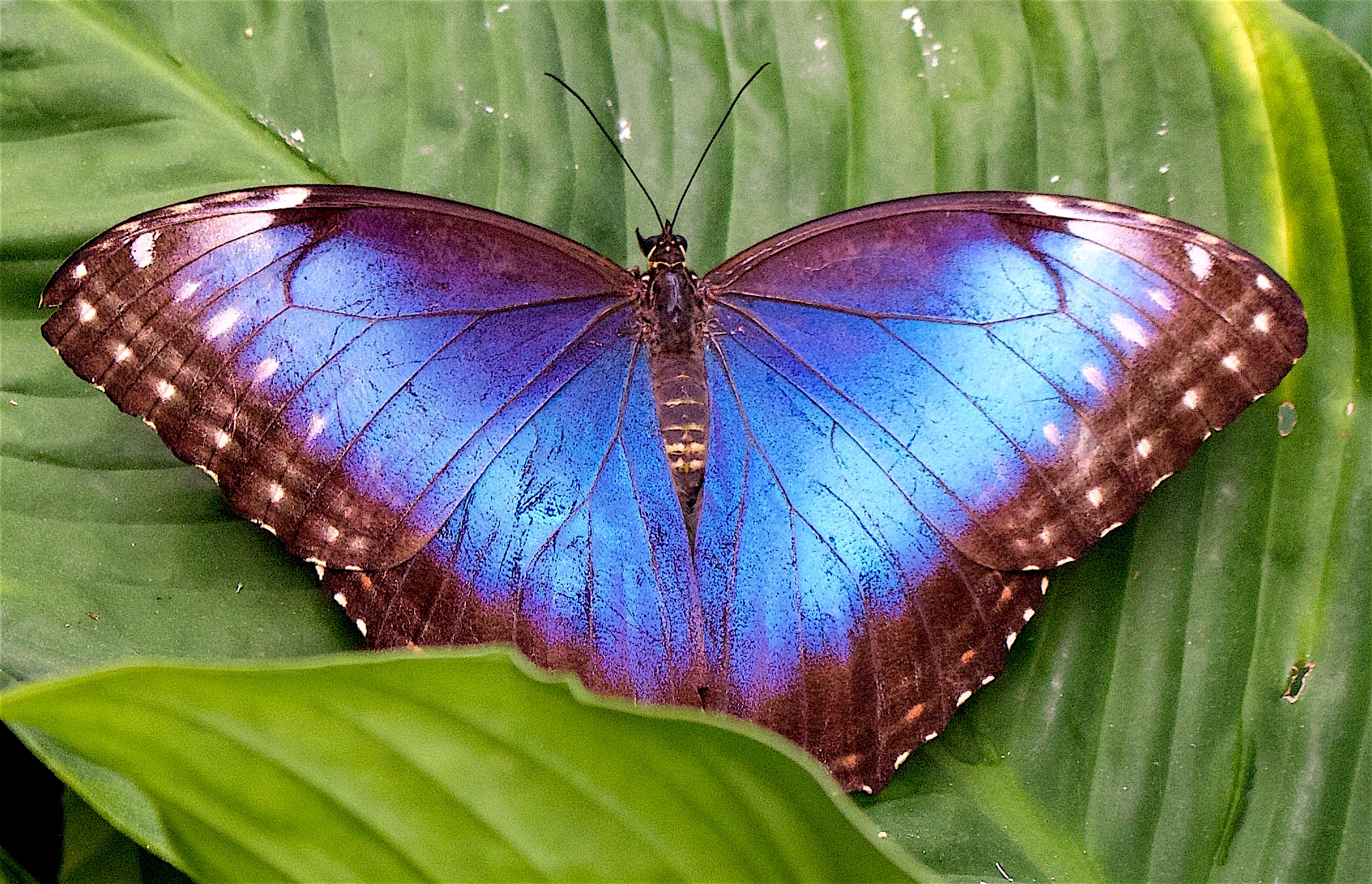
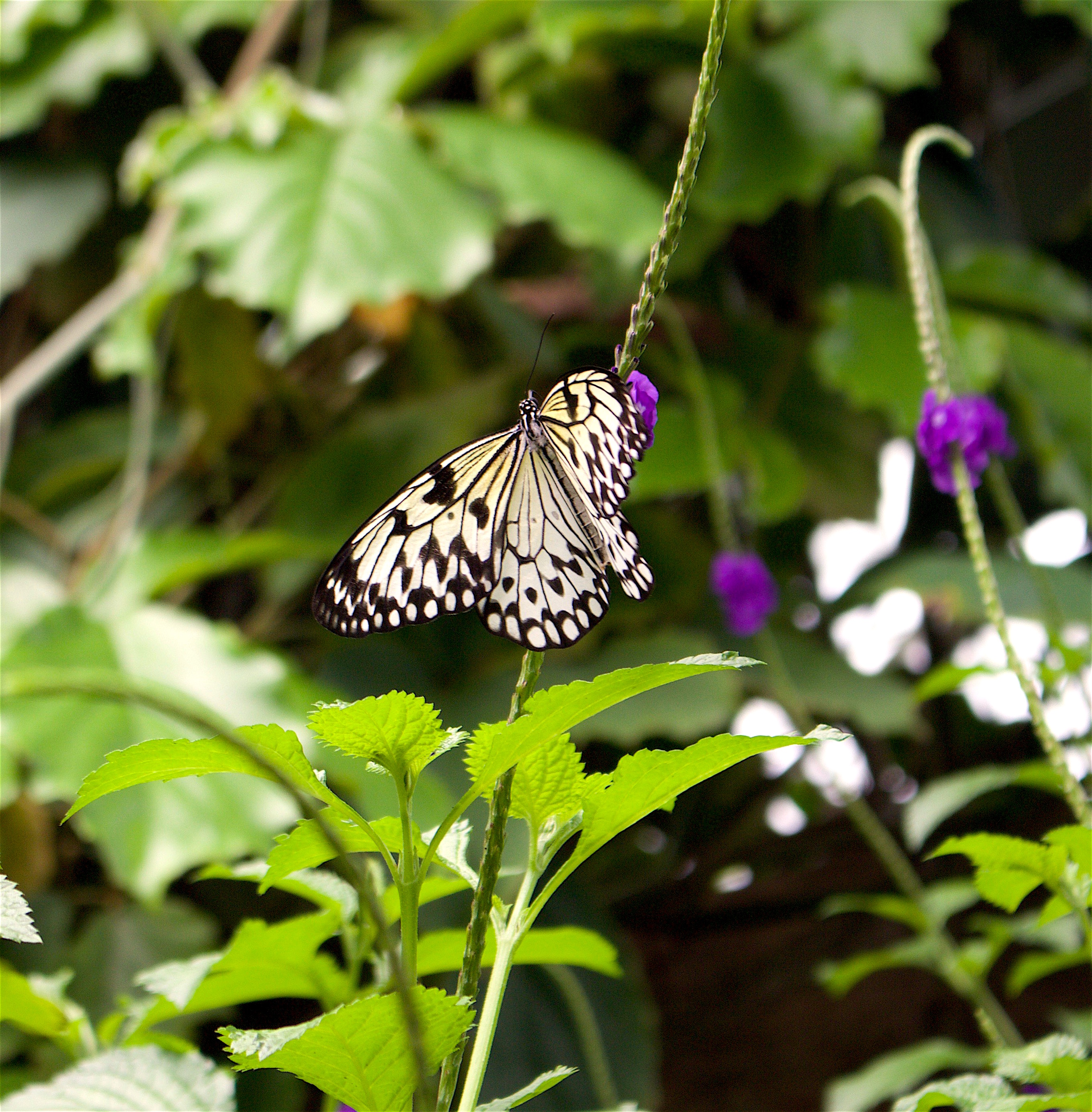
What a slow way to eat, the butterfly
is given by Nature, sipping nectar
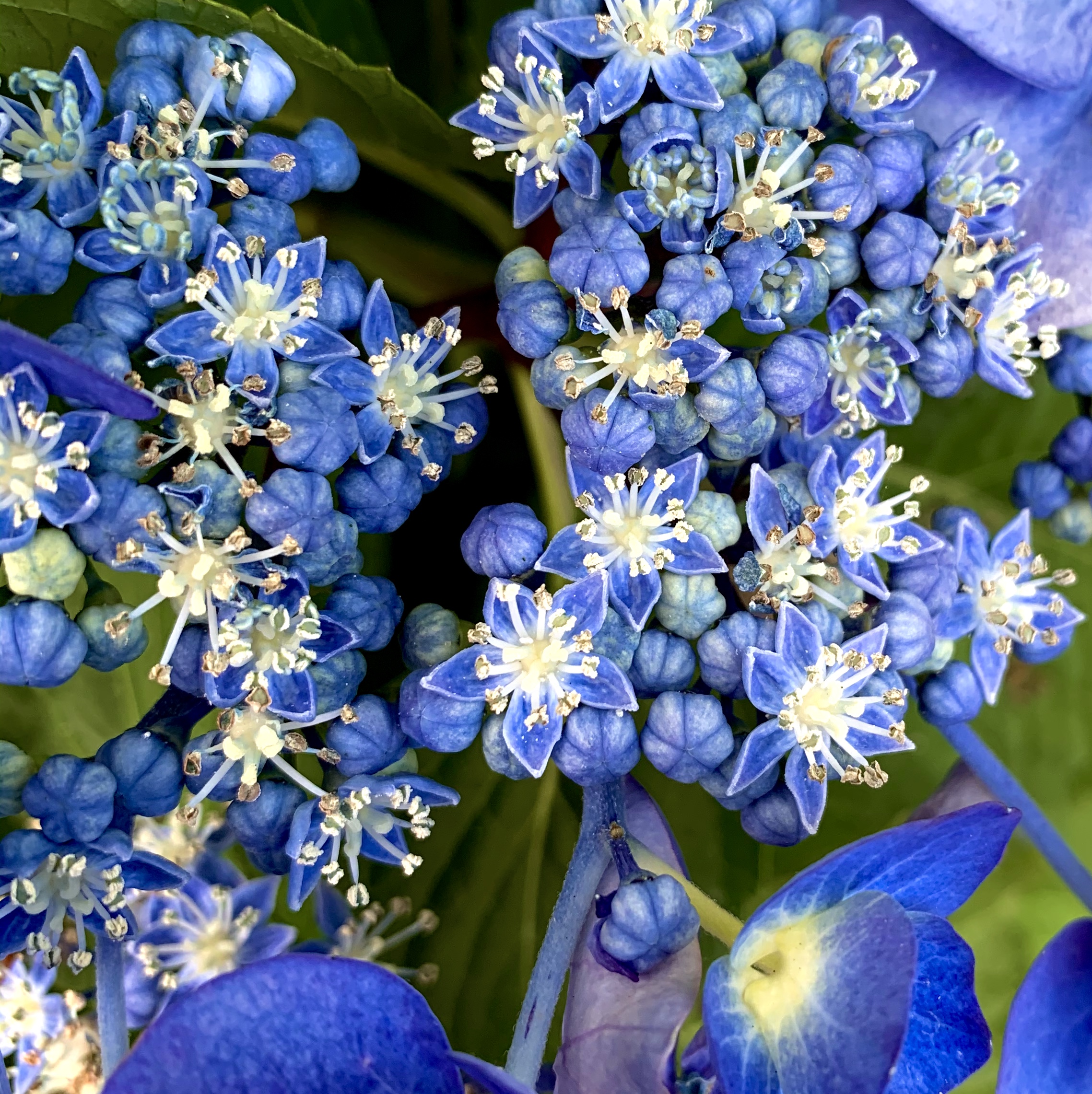
one tiny blue flower at a time. Though
a Monarch in name, she’s made to scavenge
like the poorest of the poor, a morsel
here, a morsel there. A flutter of ink-
splattered orange wings. We don’t want to see
the struggle that undergirds the grace: the
ballerina’s sweat, or her ruined feet
hidden by tights and toe-shoes. She knows her
career will be as brief as it was hard
to achieve. Pollinated, the tiny
blue flowers are sated. The butterfly
flits away, hoping to live one more day.

~Barbara Quick, “The Struggle That Undergirds the Grace.”

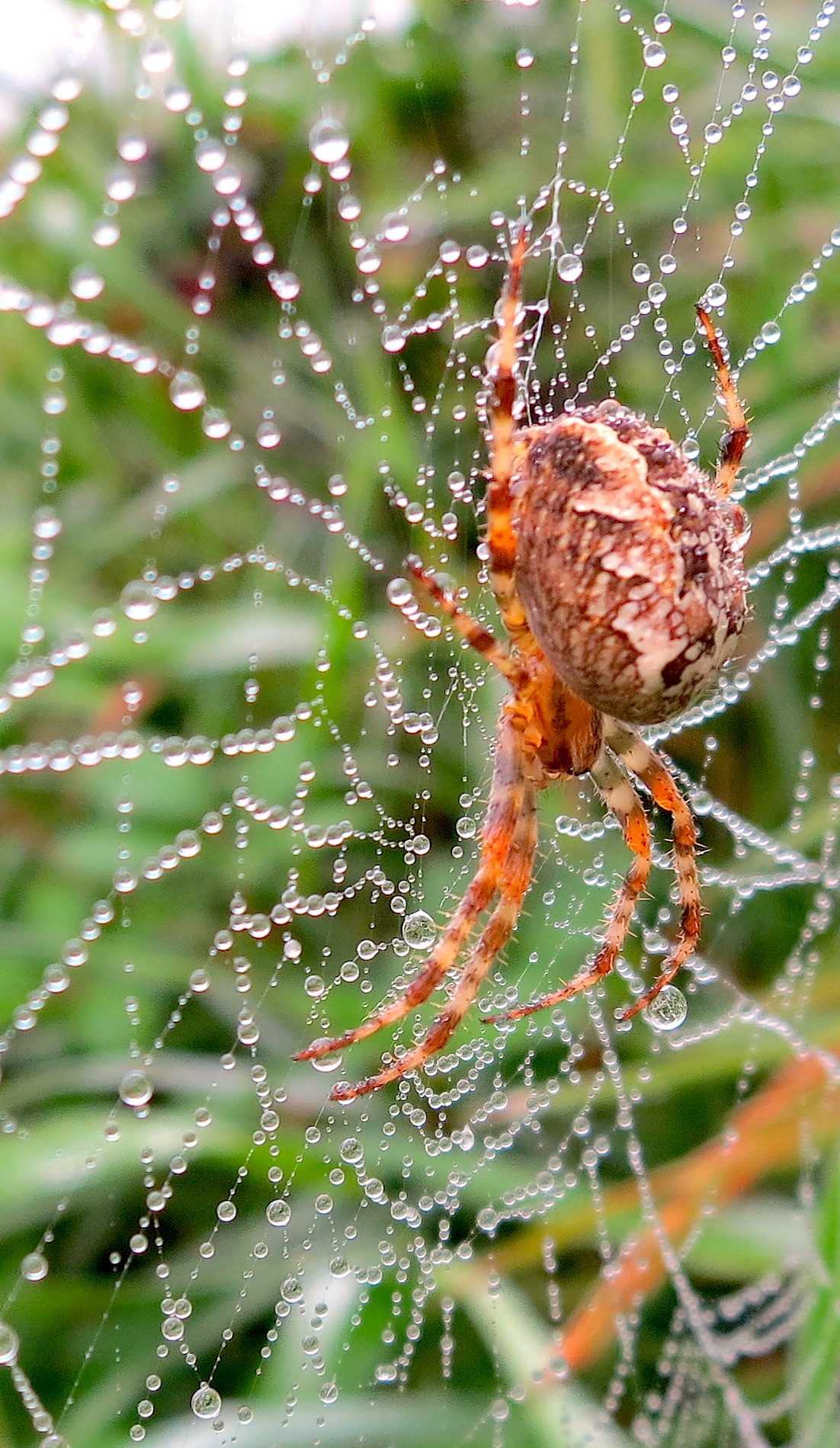
You have been my friend. That in itself is a tremendous thing.
I wove my webs for you because I liked you.
After all, what’s a life, anyway?
We’re born, we live a little while, we die.
A spider’s life can’t help being something of a mess,
with all this trapping and eating flies.
By helping you, perhaps I was trying to lift up my life a trifle.
Heaven knows anyone’s life can stand a little of that.
~E. B. White, Charlotte’s Web


And when the sun rises we are afraid
it might not remain

when the sun sets we are afraid
it might not rise in the morning
when our stomachs are full we are afraid
of indigestion
when our stomachs are empty we are afraid
we may never eat again
when we are loved we are afraid
love will vanish
when we are alone we are afraid
love will never return
and when we speak we are afraid
our words will not be heard
nor welcomed
but when we are silent
we are still afraid


So it is better to speak
remembering
we were never meant to survive.
~Audre Lorde from “A Litany for Survival”

We are here so briefly.
We were never designed to survive forever on this earth
yet we try to run the clock out as long as we can.

Just one day more.

We are here because of struggle –
the pain of our birth, whether the cry of our laboring mother,
or our own wrestling free of the cocoon or the shell,
our daily work to find food
to feed ourselves and our young,
the upkeep and maintenance of our frail and failing bodies,
our ongoing fear we’ll be taken
before we can make a difference in another’s life.

If there is a reason for all this (and there is):
our struggle forms the grace of another’s salvation.
The flowers bloom to feed the butterfly,
the butterfly pollinates the flower,
ensuring the next generations of both.
The silent and weakened find their voice
so that the next generation can thrive.

Heaven knows,
anyone’s life can stand a little of that.

Just one day more, Lord. Please – one day more.

Tomorrow we’ll discover
What our God in Heaven has in store
One more dawn
One more day
One day more

~from Les Miserable

A new book available from Barnstorming available to order here: