As long as that woman from the Rijksmuseum in painted quiet and concentration keeps pouring milk day after day from the pitcher to the bowl the World hasn’t earned the world’s end. ~Wislawa Szymborska “Vermeer” tr. by Claire Cavanagh and Stanislaw Baranczak from Here
Vermeer’s “The Milkmaid” from the Rijksmuseum, Amsterdam
As ever, the sun rises and the sun sets, day after day. God continues to pour out His colors across the skies.
God loves us enough to plant each of us here with a plan for our redemption.
We don’t know how much longer.
Today we wave flags, some in a show of power, some in a show of gratitude, some in a show of discontent.
Instead, I pour milk as a daily sacrament: quietly, with great concentration and appreciation, as that is the work I must do, day after day.
To milk the cows and raise wheat for bread and conceive children and raise them up to pour and bake.
This is God’s created world, after all. We must do our best to restore and preserve all that He has made.
So keep milking and keep pouring.
AI image created for this post
One-Time
Monthly
Yearly
Make a one-time or recurring donation to support daily Barnstorming posts
Dearly. How was it used? Dearly beloved. Dearly beloved, we are gathered. Dearly beloved, we are gathered here in this forgotten photo album I came upon recently.
Dearly beloved, gathered here together in this closed drawer, fading now, I miss you. I miss the missing, those who left earlier. I miss even those who are still here. I miss you all dearly. Dearly do I sorrow for you.
Sorrow: that’s another word you don’t hear much anymore. I sorrow dearly. ~Margaret Atwood from “Dearly”
All day we packed boxes. We read birth and death certificates. The yellowed telegrams that announced our births, the cards of congratulations and condolences, the deeds and debts, love letters, valentines with a heart ripped out, the obituaries. We opened the divorce decree, a terrible document of division and subtraction. We leafed through scrapbooks: corsages, matchbooks, programs to the ballet, racetrack, theater—joy and frivolity parceled in one volume— painstakingly arranged, preserved and pasted with crusted glue. We sat in the room in which the beloved had departed. We remembered her yellow hair and her mind free of paradox. We sat together side by side on the empty floor and did not speak. There were no words between us other than the essence of the words from the correspondences, our inheritance—plain speak, bereft of poetry. ~Jill Bialosky “The Guardians” from The Players.
This time of year, huge flocks of migrating birds pass noisily overhead, striving together in their united effort to reach home. I envy their shared instinct to gather together with purpose.
Human families can be far more scattered and far less harmonious, yet still plenty noisy.
Through these holiday weeks, I take time to remember those who left this life long ago. It is bittersweet to be all together only in a photo album, with youth and smiles preserved indefinitely.
In a flash of time, three generations have passed: children have had children who now have children. Newlyweds have become grandparents, trying valiantly to fit the shoes of those who came before.
In our own eventual leave-taking, we will become the missing to be missed. There will come along new generations – those we will never meet – who will turn the pages of photograph albums and writings and wonder aloud about these unknown people from whom they descend.
Dearly beloved, we who are missing are right here, waiting in a drawer or a file or a book on the shelf, ready to share, in plain words bereft of poetry, all our love and hopes and sorrows for you, the future generations to come.
One-Time
Monthly
Yearly
Make a one-time and recurring donation to support daily ad-free Barnstorming posts
In October of the year, he counts potatoes dug from the brown field, counting the seed, counting the cellar’s portion out, and bags the rest on the cart’s floor.
He packs wool sheared in April, honey in combs, linen, leather tanned from deerhide, and vinegar in a barrel hooped by hand at the forge’s fire.
He walks by his ox’s head, ten days to Portsmouth Market, and sells potatoes, and the bag that carried potatoes, flaxseed, birch brooms, maple sugar, goose feathers, yarn.
When the cart is empty he sells the cart. When the cart is sold he sells the ox, harness and yoke, and walks home, his pockets heavy with the year’s coin for salt and taxes,
and at home by fire’s light in November cold stitches new harness for next year’s ox in the barn, and he carved a new yoke and sawed planks for a new cart and split shingles all winter, while his wife made flax into linen all winter, and his daughter embroidered linen all winter, and his son carved Indian brooms from birch all winter, and everybody made candles, and in March they tapped the sugar maple trees and boiled the sap down, and in April they sheared the sheep, spun yarn, and wove and knitted, and in May they planted potatoes, turnips, and cabbages, while apple blossoms bloomed and fell, while bees woke up, starting to make new honey, and geese squawked in the barnyard, dropping feathers as soft as clouds. ~Donald Hall “The Oxcart Man”
Come inside now. Stand beside the warming stove. Watch out through the windows as a cold rain tears down the last leaves.
The larder full of dried herbs, hot peppers, chutneys, jellies, jams, dill pickles, pickled relishes, pickled beets.
The freezer full of frozen greens— chard and spinach, collards, kale— green beans, basil, red sauces, applesauce, and smoked meats.
The woodshed dry and full of wood, winter squashes stashed away. Down cellar: potatoes, carrots, crock of sauerkraut.
Come inside now. Stand beside the warming stove. Listen. Wait. ~David Budbill “Come Inside Now” from Happy Life
Nothing would sleep in that cellar, dank as a ditch, Bulbs broke out of boxes hunting for chinks in the dark, Shoots dangled and drooped, Lolling obscenely from mildewed crates, Hung down long yellow evil necks, like tropical snakes. And what a congress of stinks! Roots ripe as old bait, Pulpy stems, rank, silo-rich, Leaf-mold, manure, lime, piled against slippery planks. Nothing would give up life: Even the dirt kept breathing a small breath. ~Theodore Roetke “Root Cellar”from The Collected Poems
Even in the cold wet chill of November, our garden continues breathing, guarded by the furry fellow on a stalk below until a heavy windstorm topples him over.
When I descend the steps into our root cellar, I find a still life of empty jars, no longer in use for produce to be preserved until spring. I no longer preserve produce through canning, as I used to. Instead we dry and freeze fruits and vegetables for storage. The cellar, though not as full as in years past, remains a place of quiet fecundity with its rich and earthy smells – a reminder of how things were done before the conveniences of today. We still keep apples, potatoes and onions in safe-keeping below ground – some of this farm’s orchard and garden harvest has been stored fresh in the cellar, year after year, for decades.
Until the last century, all of a farm family’s energy and effort was to preserve and store what was necessary to survive another year. Today, in too many places in the world, simple survival remains a family’s necessary and noble goal.
Surrounded by the relative comfort and privilege of a bountiful garden, orchard and woodpile, I never want to forget that.
Come inside. Warm up by the fire. Listen. Wait. Pray for lasting peace.
My artichoke “pup”
One-Time
Monthly
Yearly
Make a one-time or recurring donation to support daily Barnstorming posts
Bending above the spicy woods which blaze, Arch skies so blue they flash, and hold the sun Immeasurably far; the waters run Too slow, so freighted are the river-ways With gold of elms and birches from the maze Of forests. Chestnuts, clicking one by one, Escape from satin burs; her fringes done, The gentian spreads them out in sunny days, And, like late revelers at dawn, the chance Of one sweet, mad, last hour, all things assail, And conquering, flush and spin; while, to enhance The spell, by sunset door, wrapped in a veil Of red and purple mists, the summer, pale, Steals back alone for one more song and dance. ~Helen Hunt Jackson “October”
And how like a field is the whole sky now that the maples have shed their leaves, too. It makes us believers—stationed in groups, leaning on rakes, looking into space. We rub blisters over billows of leaf smoke. Or stand alone, bagging gold for the cold days to come. ~David Baker from “Neighbors in October”
A touch of cold in the Autumn night— I walked abroad, And saw the ruddy moon lean over a hedge Like a red-faced farmer. I did not stop to speak, but nodded… ~T.E. Hulme from “Autumn”
No other time of year is quite like the end of October. God prepares us for the long haul of winter gray by giving us one last sweet hour of golden memories to bag up as keepsakes for the dark cold nights ahead.
The air is now pristine after a wind and rain storm yesterday. I am finally seeing the golden glow of October.
As Robert Frost wrote, “nothing gold can stay” so I bid this gilded air goodbye for another year. I nod in recognition at the rising moon and wave at bare branches dancing leafless in the wind and celebrate the last sweet hours of October.
It’s now time to dwell together, huddled and cuddled, in the chill of the autumn evening air.
One-Time
Monthly
Yearly
Make a one-time or recurring donation to support daily Barnstorming posts
All afternoon his tractor pulls a flat wagon with bales to the barn, then back to the waiting chopped field. It trails a feather of smoke. Down the block we bend with the season: shoes to polish for a big game, storm windows to batten or patch. And how like a field is the whole sky now that the maples have shed their leaves, too. It makes us believers—stationed in groups, leaning on rakes, looking into space. We rub blisters over billows of leaf smoke. Or stand alone, bagging gold for the cold days to come. ~David Baker “Neighbors in October”
There is a desperation to these October days: the leaves torn from branches by unrelenting gusts with no thought to where they may land~ upon which patch of grass or gravel will be their final resting place to wilt and wither in the rain, under frost, buried by eventual peaceful snowbanks until they return to dust.
Or in my need to hold on to what I can of what was, I preserve a few like precious treasure, tucked between book pages to remain forever neighbors with the words they embrace.
A book with beautiful words and photography (but no leaves tucked inside) is available to order here:
I found a box of old hours at the back of the fridge. I don’t even know how long it had been there. Summer hours. Smelled like roses. ~Duchess Goldblatt on Twitter
We all have things we’ve forgotten tucked away in the back of the fridge. A good cleaning now and then will surface some things that are barely identifiable and, frankly, a little scary. But those of us who are nostalgic creatures, like the delightfully fictional Duchess Goldblatt who dispenses desperately needed ascerbic wisdom on Twitter (of all places), also store away a few things that just might come in handy on a depressing day
I like the idea of taking these long summer days, the countless hours of daylight and slowed-downness, putting them in a box and pushing them to the back of fridge for safe-keeping. I might even label it “open in case of emergency” or “don’t open until December 25” or “fragile – handle with care.” In the darkest hours of winter, when I need a booster shot of light, I would bend down to look as far back on the fridge shelf as possible, pushing aside the jam jars and the left-over pea soup and the blocks of cheese, and reach for my rescue inhaler.
I would lift the lid on the box of summer hours and take in a deep breath to remind myself of dewy mornings with a bit of fog, a scent of mown grass, a hint of campfire smoke. But mostly, I would open the box to smell the roses of summer, as no winter florist rose ever exudes that fragrance. It has to be tucked away in the summer hours box in the back of the fridge. Just knowing it’s there would make me glad.
We are waiting for snow the way we might wait for permission to breathe again.
For only the snow will release us, only the snow will be a letting go, a blind falling towards the body of earth and towards each other. ~Linda Pastan from “Interlude”
I wish one could press snowflakes in a book like flowers. ~James Schuyler from “February 13, 1975”
I wait with bated breath, wondrous at today’s snowfall, to see the landscape transformed. Each snowflake falls alone, settling in together in communal effort. And each is created as a singular masterpiece itself.
We, the created, are like each snowflake. Together we change the world, sometimes for better, too often for worse. But each of us have come from heaven uniquely designed and purposed, preciously preserved for eternity through God’s loving sacrifice.
Without Him, we melt between the pages of history.
My grandmother’s house had been torn down after she sold her property on Similk Bay near Anacortes, Washington to a lumber company. This was the house where her four babies were born, where she and my grandfather loved and fought and separated and loved again, and where our family spent chaotic and memorable Thanksgiving and Christmas meals. After Grandpa died suddenly, she took on boarders, trying to afford to remain there on the wooded acreage fronted by stump farm meadows where her Scottish Highland cattle grazed. She reached an age when it was no longer possible to make it work. A deal was struck with the lumber company and she had moved to a small apartment, bruised by the move from her farm.
My father realized what her selling to a lumber company meant and it was a crushing thought. The old growth woods would soon also be stumps on the rocky hill above the bay, opening a view to Mt. Baker to the east, to the San Juan Islands to the north, and presenting an opportunity for development into a subdivision. He woke my brother and me early one Saturday in May and told us we were driving the 120 miles to Anacortes. He was on a mission.
As a boy growing up on that land, he had wandered the woods, explored the hill, and helped his dad farm the rocky soil. There was only one thing he felt he needed from that farm and he had decided to take us with him, to trespass where he had been born and raised to bring home a most prized treasure–his beloved lady slippers from the woods.
These dainty flowers enjoy a spring display known for its brevity–a week or two at the most–and they tend to bloom in small little clusters in the leafy duff mulch of the deep woods, preferring only a little indirect sunlight part of the day. They are not easy to find unless you know where to look. My father remembered exactly where to look.
We hauled buckets up the hill along with spades, looking as if we were about to dig for clams at the ocean. Dad led us up a trail into the thickening foliage, until we had to bushwhack our way into the taller trees where the ground was less brush and more hospitable ground cover. He would stop occasionally to get his bearings as things were overgrown. We reached a small clearing and he knew we were near. He went straight to a copse of fir trees standing guard over a garden of lady slippers.
There were almost thirty of them blooming, scattered in an area about the size of my tiny bedroom at home. Each orchid-like pink and lavender blossom had a straight backed stem that held it with sturdy confidence. To me, they looked like they could be little shoes for fairies who may have hung them up while they danced about barefoot. To my father, they represented the last redeeming vestiges of his often traumatic rearing by an alcoholic father, and were about to be trammeled by bulldozers. We set to work gently digging them out of their soft bedding, carefully keeping their bulb-like corms from losing a protective covering of soil and leafy mulch. Carrying them in the buckets back to the car, we felt some vindication that even if the trees were to be lost to the saws, these precious flowers would survive.
When we got home, Dad set to work creating a spot where he felt they could thrive in our own woods. He found a place with the ideal amount of shade and light, with the protection of towering trees and the right depth of undisturbed leaf mulch. We carefully placed the lady slippers in their new home, scattered in a pattern similar to how we found them. Then Dad built a four foot split rail fence in an octagon around them, as a protection from our cattle and a horse who wandered the woods, and as a way to demarcate that something special was contained inside.
The next spring only six lady slippers bloomed from the original thirty. Dad was disappointed but hoped another year might bring a resurgence as the flowers established themselves in their new home. The following year there were only three. Two years later my father left us and them, not looking back.
Sometime after, when my mother had to sell our farm after the divorce, I visited our lady slipper sanctuary in the woods for the last time in the middle of May. The split rail fence was still there, guarding nothing but old memories. No lady slippers bloomed. There was not a trace they had ever been there. They had simply given up and disappeared.
The new owners of our farm surely puzzled over the significance of the small fenced-off area in the middle of our woods. They probably thought it surrounded a graveyard of some sort.
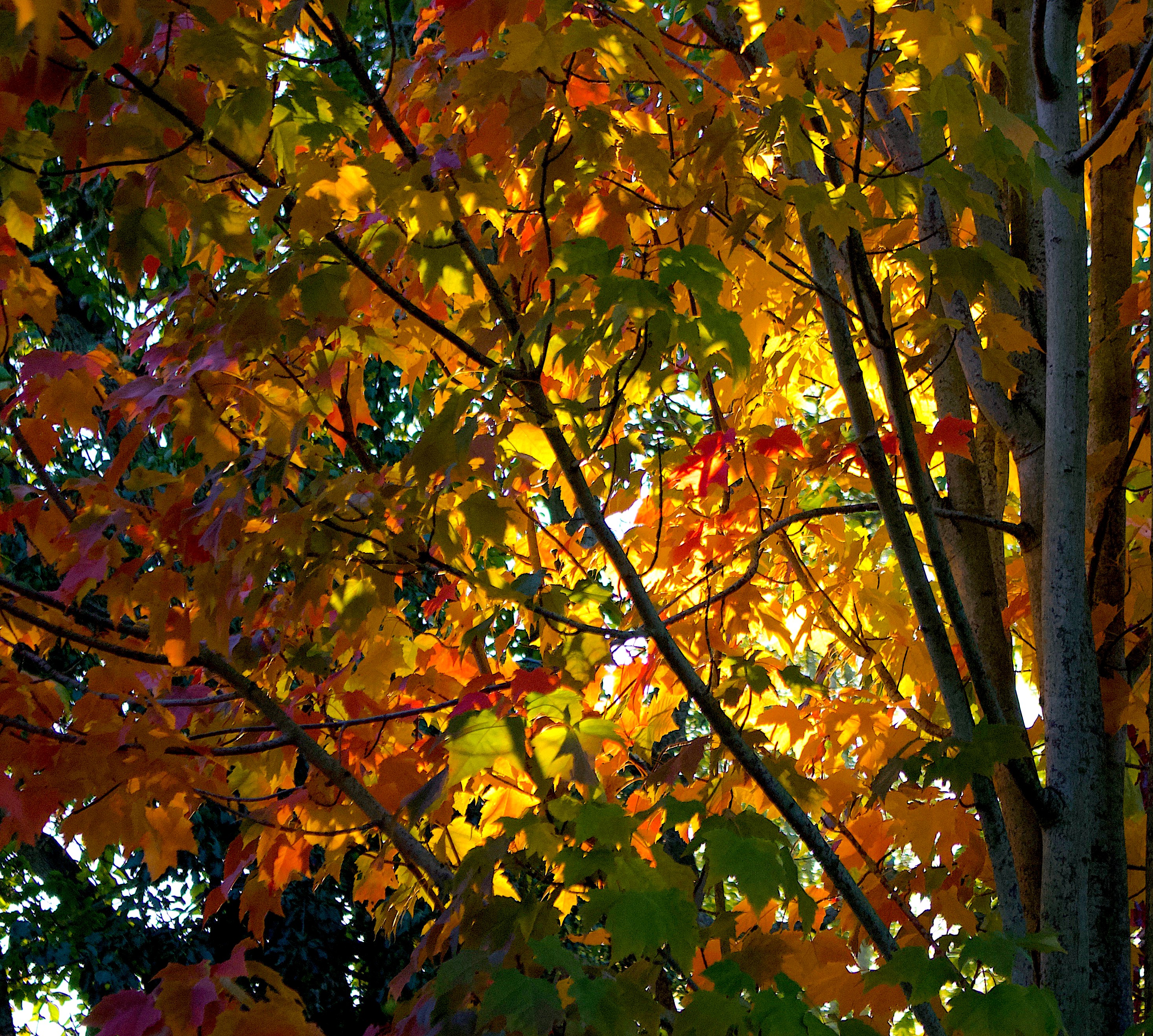
The scarlet of maples can shake me like a cry Of bugles going by. And my lonely spirit thrills to see the frosty asters like smoke upon the hills. ~ William Bliss Carman
It is like the blowing of taps, this last blast of color before the rains and winter. There is quickened heartbeat and choking back tears at seeing the vividness outlined by robins egg-blue sky, each maple a torch aflame about to burn down to ash and smoke.
The bright palette is too much to take in all at once. If only it could spread out through the year and not last only for a week or two when I’m relegated indoors in long work hours and weekend harvest preservation of fruits and vegetables. I so wish to be two places at once, to be two people, to be more than I am.
So I must harvest autumn in words and pictures, just like preserving the garden and orchard in jars and bags, someday to refresh and restore when gray pervades and mildew threatens to overpower, when hunger for fall shakes me wholly, like a sob.
Like a cry for how it used to be and how it one day will be again.
There is no season when such pleasant and sunny spots may be lighted on, and produce so pleasant an effect on the feelings, as now in October. ~Nathaniel Hawthorne