I loved you before I was born. It doesn’t make sense, I know.
I saw your eyes before I had eyes to see. And I’ve lived longing for your ever look ever since. That longing entered time as this body. And the longing grew as this body waxed. And the longing grows as the body wanes. The longing will outlive this body.
I loved you before I was born. It doesn’t make sense, I know.
Long before eternity, I caught a glimpse of your neck and shoulders, your ankles and toes. And I’ve been lonely for you from that instant. That loneliness appeared on earth as this body. And my share of time has been nothing but your name outrunning my ever saying it clearly. Your face fleeing my ever kissing it firmly once on the mouth.
In longing, I am most myself, rapt, my lamp mortal, my light hidden and singing.
The birds do not sing in these mornings. The skies are white all day. The Canadian geese fly over high up in the moonlight with the lonely sound of their discontent. Going south. Now the rains and soon the snow. The black trees are leafless, the flowers gone. Only cabbages are left in the bedraggled garden. Truth becomes visible, the architecture of the soul begins to show through. God has put off his panoply and is at home with us. We are returned to what lay beneath the beauty. We have resumed our lives. There is no hurry now. We make love without rushing and find ourselves afterward with someone we know well. Time to be what we are getting ready to be next. This loving, this relishing, our gladness, this being puts down roots and comes back again year after year. ~Jack Gilbert “Half the Truth” from Collected Poems.
In the shape of this night, in the still fall of snow, Father In all that is cold and tiny, these little birds and children… Before the bells ring, before this little point in time has rushed us on Before this clean moment has gone, before this night turns to face tomorrow, Father There is this high singing in the air Forever this sorrowful human face in eternity’s window And there are other bells that we would ring, Father Other bells that we would ring. ~Kenneth Patchen from “At the New Year”
The object of a New Year is not that we should have a new year. It is that we should have a new soul… ~G.K.Chesterton from A Chesterton Calendar
Ring out, wild bells, to the wild sky, The flying cloud, the frosty light: The year is dying in the night; Ring out, wild bells, and let him die.
Ring out the old, ring in the new, Ring, happy bells, across the snow: The year is going, let him go; Ring out the false, ring in the true.
Ring in the valiant man and free, The larger heart, the kindlier hand; Ring out the darkness of the land, Ring in the Christ that is to be. ~Lord Alfred Tennyson from “In Memoriam”
Often when something is ending we discover within it the spore of new beginning, and a whole new train of possibility is in motion before we even realize it. When the heart is ready for a fresh beginning, unforeseen things can emerge. And in a sense, this is exactly what a beginning does. It is an opening for surprises. ~John O’Donohue from “To Bless the Space Between Us”
No heralding trumpets – Just softening shadows, Timed and tracked.
Fingers of light flaring amber Over the eastern ridge of foothills, Caress the slopes of snow capped peaks. So I bid this past year farewell.
Each earthly thing bathed in gold Glimpsed and grasped without fanfare Yet wholly miraculous. Too soon this day, this year, becomes ordinary again Although it is truth: we can be born anew, year after year.
One-Time
Monthly
Yearly
Make a one-time or recurring donation to support daily Barnstorming posts
I wondered if that was how forgiveness budded; not with the fanfare of epiphany, but with pain gathering its things, packing up, and slipping away unannounced in the middle of the night. — Khaled Hosseini from The Kite Runner
The time is ripe for looking back over the day, the week, the year, and trying to figure out where we have come from and where we are going to, for sifting through the things we have done and the things we have left undone for a clue to who we are and who, for better or worse, we are becoming.
We cling to the present out of wariness of the past.
But there is a deeper need yet, I think, and that is the need—not all the time, surely, but from time to time—to enter that still room within us all where the past lives on as a part of the present, where the dead are alive again, where we are most alive ourselves to turnings and to where our journeys have brought us.
The name of the room is Remember—the room where with patience, with charity, with quietness of heart, we remember consciously to remember the lives we have lived. ~Frederick Buechner from A Room Called Remember
age nineage 14age 15
Something went wrong, says the empty house in the weed-choked yard. Stones in the fields say he was not a farmer; the still-sealed jars in the cellar say she left in a nervous haste. And the child? Its toys are strewn in the yard like branches after a storm—a rubber cow, a rusty tractor with a broken plow, a doll in overalls. Something went wrong, they say. ~Ted Kooser, from “Abandoned Farmhouse” from Sure Signs: New and Selected Poems.
In 1959, when I was five years old, my father took a new job so our family moved from a large 3 story farm house in a rural community to a 1950’s newer rambler-style home just outside the city limits of the state capitol.
It was a big adjustment to move to a much smaller house without a basement or upper story, no garage, and no large haybarn nor chicken coop. It meant most things we owned didn’t make the move with us.
The rambler had two side-by-side mirror image rooms as the primary central living space between the kitchen/dining area on one side and the hallway to the bedrooms on the other. The living room could only be entered through the front door and the family room was accessed through the back door with a shared sandstone hearth in the center, containing a fireplace in each room. The only opening between the rooms had a folding door shut most of the year. In December, the door was opened to accommodate a Christmas tree, so it sat partially in the living room and depending on its generous width, spilled over into the family room. That way it was visible from both rooms, and didn’t take up too much floor space.
The living room, because it contained the only carpeting in the house, and our “best” furniture, was strictly off-limits. In order to keep our two matching sectional knobby gray fabric sofas, a green upholstered chair and gold crushed velvet covered love seat in pristine condition, the room was to be avoided unless we had company. The carpet was never to develop a traffic pattern, there would be no food, beverage, or pet ever allowed in that room, and the front door was not to be used unless a visitor arrived. The hearth never saw a fire lit on that side because of the potential of messy ashes or smoke smell.
This was not a room for toys or games. The chiming clock next to the hearth, wound with weighted cones on the end of chains, called out the hours without an audience.
One week before Christmas, a tree was chosen to fit in the space where it could overflow into the family room. I particularly enjoyed decorating the “family room” side of the tree, using all my favorite ornaments that were less likely to break if they fell on the linoleum floor on that side of the door.
It was almost as if the Christmas tree itself became divided, with a “formal” side in the living room and a “real life” face on the other side where the living (and hurting) was actually taking place.
The tree straddled more than just two rooms. Every year that tree’s branches reached out to shelter a family that was slowly, almost imperceptibly, falling apart, like the fir needles dropping to the floor to be swept away.
Something was going wrong, only I didn’t see it at the time.
Each year since, our Christmas tree, bearing those old ornaments from my childhood, reminds me of that still room of memories.
No longer am I wary of the past. As I sweep up the fir needles that inevitably drop, I no longer weep.
One-Time
Monthly
Yearly
Make a one-time or recurring donation to support daily Barnstorming posts
On the third day a wedding took place at Cana in Galilee. Jesus’ mother was there,and Jesus and his disciples had also been invited to the wedding. When the wine was gone, Jesus’ mother said to him, “They have no more wine.”
“Woman, why do you involve me?” Jesus replied. “My hour has not yet come.”
His mother said to the servants, “Do whatever he tells you.”
Nearby stood six stone water jars, the kind used by the Jews for ceremonial washing, each holding from twenty to thirty gallons.
Jesus said to the servants, “Fill the jars with water”; so they filled them to the brim.
Then he told them, “Now draw some out and take it to the master of the banquet.”
They did so, and the master of the banquet tasted the water that had been turned into wine. He did not realize where it had come from, though the servants who had drawn the water knew. Then he called the bridegroom asideand said, “Everyone brings out the choice wine first and then the cheaper wine after the guests have had too much to drink; but you have saved the best till now.”
What Jesus did here in Cana of Galilee was the first of the signs through which he revealed his glory; and his disciples believed in him.
After this he went down to Capernaum with his mother and brothers and his disciples. There they stayed for a few days. John 2: 1-12
St. John tells how, at Cana’s wedding feast, The water-pots poured wine in such amount That by his sober count There were a hundred gallons at the least.
It made no earthly sense, unless to show How whatsoever love elects to bless Brims to a sweet excess That can without depletion overflow.
Which is to say that what love sees is true; That this world’s fullness is not made but found. Life hungers to abound And pour its plenty out for such as you. ~Richard Wilbur from “A Wedding Toast”
In sleep his infant mouth works in and out. He is so new, his silk skin has not yet been roughed by plane and wooden beam nor, so far, has he had to deal with human doubt.
He is in a dream of nipple found, of blue-white milk, of curving skin and, pulsing in his ear, the inner throb of a warm heart’s repeated sound.
His only memories float from fluid space. So new he has not pounded nails, hung a door broken bread, felt rebuff, bent to the lash, wept for the sad heart of the human race. ~Luci Shaw “Kenosis”from Waiting on the Word
Experiencing the present purely is being emptied and hollow; you catch grace as a man fills his cup under a waterfall. ~Annie Dillard from Pilgrim at Tinker Creek
The world is filled, and filled with the Absolute.To see this is to be made free. ~Pierre Teilhard de Chardin from Hymn of the Universe
My mouth will utter praise of the Lord, of the Lord through whom all things have been made and who has been made amidst all things; who is the Revealer of His Father, Creator of His Mother; who is the Son of God from His Father without a mother, the Son of Man through His mother without a father.
He is as great as the Day of Angels, and as small as a day in the life of men; He is the Word of God before all ages, and the Word made flesh at the destined time. Maker of the sun, He is made beneath the sun.
In His Father He abides; from His mother He goes forth. Creator of heaven and earth, under the heavens He was born upon earth.
Wise beyond all speech, as a speechless child, He is wise. Filling the whole world, He lies in a manger. Ruling the stars, He nurses at His mother’s breast. He is great in the form of God and small in the form of a servant, so much so that His greatness is not diminished by His smallness, nor His smallness concealed by His greatness. ~St. Augustine from Exposition on Psalm 148
How empty was the world before Christ!
From Mary’s untouched womb to Joseph’s futile search for a place to sleep in Bethlehem, to the shepherds’ dismal existence on the hillsides, to Simeon’s arms aching to hold the Messiah, to Anna’s long wait in the temple, to the dregs left in the wedding casks of wine.
In a million ways, seen and unseen, the empty spaces are filled, the hunger sated, the thirst quenched, the rest assured. He joined with us in celebration so we shall never lack again.
He is wedded to us–all is fulfilled, someday to be filled fully.
I am reading slowly through the words in the Book of John over the next year or so. Each week, I will invite you to “come and see” what those words might mean as we explore His promises together.
My 2025 Advent theme: On the threshold between day and night
On that day there will be neither sunlight nor cold, frosty darkness. It will be a unique day—a day known only to the Lord— with no distinction between day and night. When evening comes, there will be light. Zechariah 14:6-7
So once in Israel love came to us incarnate, stood in the doorway between two worlds, and we were all afraid. ~Annie Dillard in Teaching a Stone to Talk
One-Time
Monthly
Yearly
Make a one-time or recurring donation to support daily Barnstorming posts
Bethlehem in Germany, Glitter on the sloping roofs, Breadcrumbs on the windowsills, Candles in the Christmas trees, Hearths with pairs of empty shoes: Panels of Nativity Open paper scenes where doors Open into other scenes, Some recounted, some foretold. Blizzard-sprinkled flakes of gold Gleam from small interiors, Picture-boxes in the stars Open up like cupboard doors In a cabinet Jesus built.
Leaning from the cliff of heaven, Indicating whom he weeps for, Joseph lifts his lamp above The infant like a candle-crown. Let my fingers touch the silence Where the infant’s father cries. Give me entrance to the village From my childhood where the doorways Open pictures in the skies. But when all the doors are open, No one sees that I’ve returned. When I cry to be admitted, No one answers, no one comes. Clinging to my fingers only Pain, like glitter bits adhering, When I touch the shining crumbs. ~Gjertrud Schnackenberg,from “Advent Calendar” from Supernatural Love: Poems 1976-1992.
He will come like last leaf’s fall. One night when the November wind has flayed the trees to the bone, and earth wakes choking on the mould, the soft shroud’s folding.
He will come like frost. One morning when the shrinking earth opens on mist, to find itself arrested in the net of alien, sword-set beauty.
He will come like dark. One evening when the bursting red December sun draws up the sheet and penny-masks its eye to yield the star-snowed fields of sky.
He will come, will come, will come like crying in the night, like blood, like breaking, as the earth writhes to toss him free. He will come like child. ~Rowan Williams “Advent Calendar”
Who has not considered Mary And who her praise would dim, But what of humble Joseph Is there no song for him?
If Joseph had not driven Straight nails through honest wood If Joseph had not cherished His Mary as he should;
If Joseph had not proved him A sire both kind and wise Would he have drawn with favor The Child’s all-probing eyes?
Would Christ have prayed, ‘Our Father’ Or cried that name in death Unless he first had honored Joseph of Nazareth ? ~Luci Shaw “Joseph The Carpenter”
The hero of the story this season is the man in the background of each creche, the old master Nativity paintings, and the Advent Calendar doors that open each day.
He is the adoptive father who does the right thing rather than what he has legal right to do, who listens to his dreams and believes, who leads the way over dusty roads to be counted, who searches valiantly for a suitable place to stay, who does whatever he can to assist her labor, who stands tall over a vulnerable mother and infant while the poor and curious pour out of the hills, the wise and foreign appear bringing gifts, who takes his family to safety when the innocents are slaughtered.
He is only a carpenter, not born for heroics, but strong and obedient, stepping up when called.
He is a humble man teaching his son a living, until his son leaves to save the dying.
This man Joseph is the Chosen father, the best Abba a God could possibly hope for.
My 2025 Advent theme: On the threshold between day and night
On that day there will be neither sunlight nor cold, frosty darkness. It will be a unique day—a day known only to the Lord— with no distinction between day and night. When evening comes, there will be light. Zechariah 14:6-7
So once in Israel love came to us incarnate, stood in the doorway between two worlds, and we were all afraid. ~Annie Dillard in Teaching a Stone to Talk
One-Time
Monthly
Yearly
Make a one-time or recurring donation to support daily Barnstorming posts
The meaning of marriage begins in the giving of words. We cannot join ourselves to one another without giving our word. And this must be an unconditional giving, for in joining ourselves to one another we join ourselves to the unknown. ~Wendell Berry from “Poetry and Marriage” in Standing By Words
Our vows to one another forty-four years ago today:
Before God and this gathering, I vow from my heart and spirit that I will be your wife/husband for as long as we both shall live.
I will love you with faithfulness, knowing its importance in sustaining us through good times and bad.
I will love you with respect, serving your greatest good and supporting your continued growth.
I will love you with compassion, knowing the strength and power of forgiveness.
I will love you with hope, remembering our shared belief in the grace of God and His guidance of our marriage.
“And at home, by the fire, whenever you look up, there I shall be–and whenever I look up, there will be you.”
(our wedding vows for our September 19, 1981 wedding at First Seattle Christian Reformed Church — the last line adapted from Thomas Hardy’s “Far From the Madding Crowd”)
Sometimes our life reminds me of a forest in which there is a graceful clearing and in that opening a house, an orchard and garden, comfortable shades, and flowers red and yellow in the sun, a pattern made in the light for the light to return to. The forest is mostly dark, its ways to be made anew day after day, the dark richer than the light and more blessed, provided we stay brave enough to keep on going in.
We enter, willing to die, into the commonwealth of its joy. ~Wendell Berry from “A Country of Marriage”
…Marriage… joins two living souls as closely as, in this world, they can be joined. This joining of two who know, love, and trust one another brings them in the same breath into the freedom of sexual consent and into the fullest earthly realization of the image of God. From their joining, other living souls come into being, and with them great responsibilities that are unending, fearful, and joyful. The marriage of two lovers joins them to one another, to forebears, to descendants, to the community, to heaven and earth. It is the fundamental connection without which nothing holds, and trust is its necessity. ~Wendell Berry from Sex, Economy, Freedom and Community
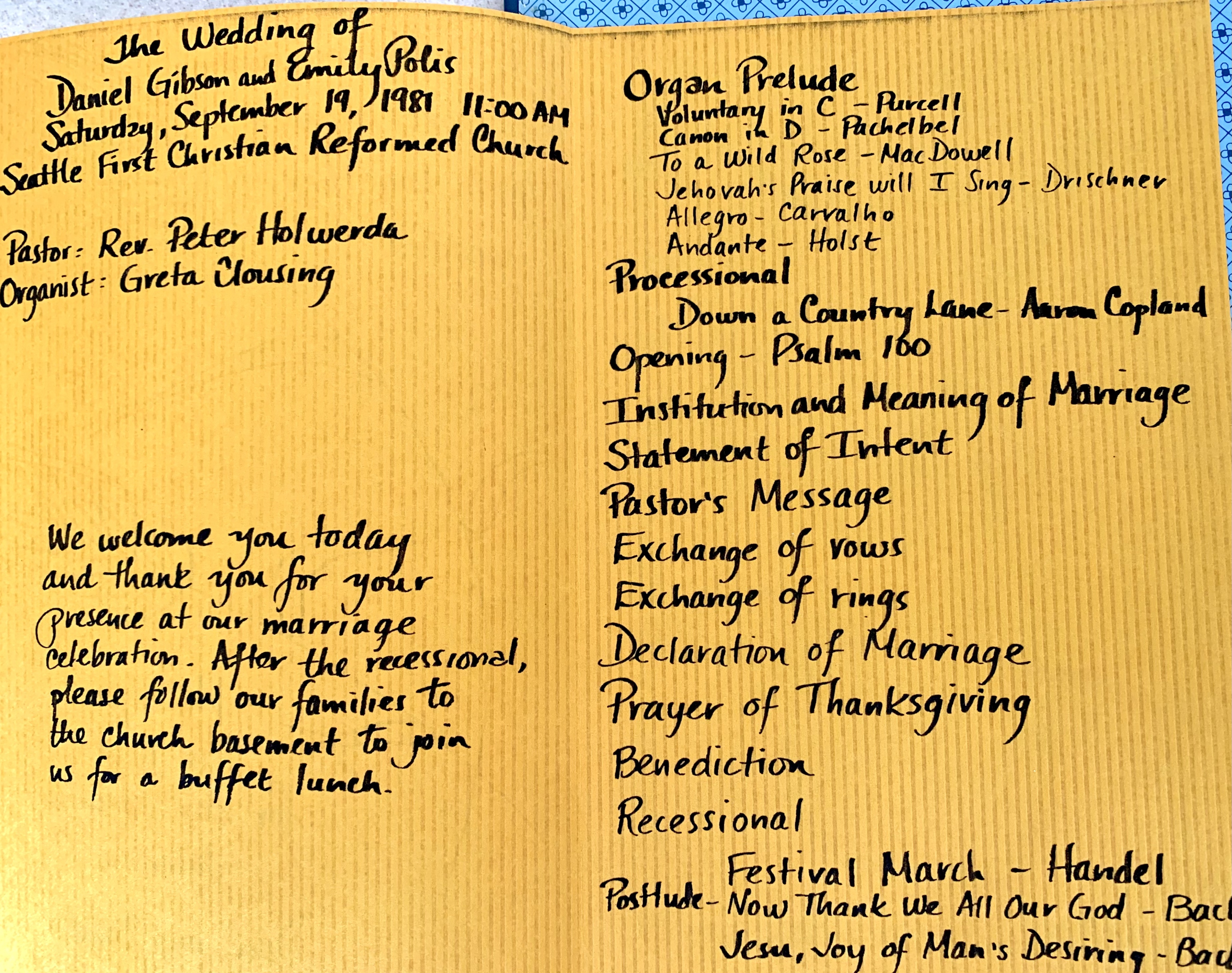
We married forty-four years ago today in our Seattle church with Pastor Peter Holwerda officiating, with a small group of family and friends as witnesses.
It was a wedding of two frugal people with little to spend – I sewed my dress and Dan’s shirt from muslin, we grew our own flowers, our families helped potluck the lunch afterward and our tiered carrot cake was made by a friend.
Yet our vows to one another were not frugal and held nothing back. They were extravagant and comprehensive, coming from our hearts and spirits. The music we asked our amazing organist to play (versions below) inspired us by its simplicity and complexity – very much like the families that raised us and the God we worship.
Our vows have taken us from the city to the countryside, to the raising and rejoicing in three amazing children and now six grandchildren. We both served more than forty years as a public-employed attorney and physician. We have laid down those responsibilities, and picked up the tools of farm and garden along with church and community service for as long as we are able.
We treasure each day of living together in faithfulness, respect, compassion and hope – knowing that how we love and find joy in one another mirrors how God loves and revels in His people.
We pray for many more days to fill us with what endures.
A pot of red lentils simmers on the kitchen stove. All afternoon dense kernels surrender to the fertile juices, their tender bellies swelling with delight.
In the yard we plant rhubarb, cauliflower, and artichokes, cupping wet earth over tubers, our labor the germ of later sustenance and renewal.
Across the field the sound of a baby crying as we carry in the last carrots, whorls of butter lettuce, a basket of red potatoes.
I want to remember us this way— late September sun streaming through the window, bread loaves and golden bunches of grapes on the table, spoonfuls of hot soup rising to our lips, filling us with what endures. ~Peter Pereira from “A Pot of Red Lentils”
Here are versions of the organ music we selected for prelude, processional, recessional and postlude
One-Time
Monthly
Yearly
Make a one-time or recurring donation to support daily Barnstorming posts
Needing them still, I come when I can, this time to the sea where we share a room: their double bed, my single. Morning fog paints the pale scene even paler. Lace curtains breathing, the chenille spread folded back, my father’s feet white sails furled at the edge of blue pajamas. Every child’s dream, a parent in each hand, though this child is fifty. Their bodies fit easily, with room to spare. When did they grow so small? Grow so small— as if it were possible to swell backwards into an earlier self.
“Her Room” by Andrew Wyeth in the Farnsworth Art Museum
My parents have been gone now for some time, my father 30 years, my mother, nearly 17 years. Their dying was a long process of counted breaths and pauses. I witnessed their bodies curling into themselves, shrinking smaller, worn down by illness and age.
I still miss them as I’m reminded of them by the events of my own life, still wanting them to take me by the hand as I navigate my own daily path.
After mom’s death, those possessions not distributed to family members have remained packed up and stored in our barn buildings. I know it is well past time to deal with their stuff as I become keenly aware of my own graying and aging.
In the house, next to where I write, is a box of over 500 letters written by my mother and father between 1941 and 1945. The letters began as they were getting to know each other at college, going from “pinned” to “engaged” and continue for three and a half more years after a hurried wedding Christmas Eve 1942. By mid-January 1943, my newly minted Marine officer father shipped out to spend the next three years of his life fighting on the battlefields of Saipan, Tinian and Tarawa in the Pacific Ocean, not to return again to the states until late summer of 1945.
My mother wrote her letters from the small rural eastern Washington community of Colville, living in a “teachers’ cottage” with other war wives who taught school while waiting for their husbands to return home – or not.
It took me a decade to find the courage and time to devote to reading these letters they treasured and never threw away. I sorted them unopened by postmark date into some semblance of order and sat down to start at the very beginning, which, of course, is my beginning as well. I opened each one with some trepidation and a lump in my throat about what I might find written there. I worried I may find things I didn’t want to know. I hoped I would find things that I desperately needed to know.
Most of all I wanted to understand the two people who became my parents within the coiled shell of their forty years together, though broken by a painful divorce which lasted a decade. Having lived through that awful time with them, I want to understand the origin of a love which eventually mended their cracked shell of companionship, gluing them back together for five more years before my father died.
As I ponder their words, I too cross a bridge back to them both, my ear pressed to the coiled shell of those fading voices, as if I might still hear the sea, at times bringing them closer, then pulling them farther away.
AI image created for this post
One-Time
Monthly
Yearly
Make a one-time or recurring donation to support daily Barnstorming posts
Who loves the rain And loves his home, And looks on life with quiet eyes, Him will I follow through the storm; And at his hearth-fire keep me warm; Nor hell nor heaven shall that soul surprise, Who loves the rain, And loves his home, And looks on life with quiet eyes. ~Frances Shaw, “Who loves the rain” from Look To the Rainbow of Grace
Now more than ever you can be generous toward each day that comes, young, to disappear forever, and yet remain unaging in the mind. Every day you have less reason not to give yourself away. ~Wendell Berry from “There is no going back”
What a wonder I was when I was young, as I learn by the stern privilege of being old: how regardlessly I stepped the rough pathways of the hillside woods, treaded hardly thinking the tumbled stairways of the steep streams, and worked unaching hard days thoughtful only of the work, the passing light, the heat, the cool water I gladly drank. ~Wendell Berry “VII” 2015 from Another Day
Love is a universe beyond The daylight spending zone: As one we more abound Than two alone. ~Wendell Berry “VIII” 2015 from Another Day
Thinking out loud on this day you were born, I thank God each day for bringing you to earth so we could meet, raise three amazing children, now six wonderful grandchildren, and walk this journey together with pulse and breath and dreams.
The boy you were became the man you are: so blessed by God, so needed by your family, church and community.
You give yourself away every day with such grace.
It was your quiet brown eyes I trusted first and just knew I’d follow you anywhere and I have.
In this journey together, we inhabit each other, however long may be the road we travel; you have become the air I breathe, refreshing, renewing, restoring~~ you are that necessary to me, and that beloved.
One-Time
Monthly
Yearly
Make a one-time or recurring donation to support daily Barnstorming posts
The cat calls for her dinner. On the porch I bend and pour brown soy stars into her bowl, stroke her dark fur. It’s not quite night. Pinpricks of light in the eastern sky. Above my neighbor’s roof, a transparent moon, a pink rag of cloud. Inside my house are those who love me. My daughter dusts biscuit dough. And there’s a man who will lift my hair in his hands, brush it until it throws sparks. Everything is just as I’ve left it. Dinner simmers on the stove. Glass bowls wait to be filled with gold broth. Sprigs of parsley on the cutting board. I want to smell this rich soup, the air around me going dark, as stars press their simple shapes into the sky. I want to stay on the back porch while the world tilts toward sleep, until what I love misses me, and calls me in. ~Dorianne Laux “On the Back Porch” from Awake
They sit together on the porch, the dark Almost fallen, the house behind them dark. Their supper done with, they have washed and dried The dishes–only two plates now, two glasses, Two knives, two forks, two spoons–small work for two. She sits with her hands folded in her lap, At rest. He smokes his pipe. They do not speak, And when they speak at last it is to say What each one knows the other knows. They have One mind between them, now, that finally For all its knowing will not exactly know Which one goes first through the dark doorway, bidding Goodnight, and which sits on a while alone. ~Wendell Berry “They Sit Together on the Porch” from A Timbered Choir
If just for a moment, when the world feels like it is tilting so far I just might fall off, there is a need to pause to look at where I’ve been and get my feet back under me.
The porch is a good place to start: a bridge to observe “out there” without completely leaving the safety of “in here.”
I am outside looking squarely at uncertainty yet still hear and smell and taste the love that dwells just inside these walls.
What do any of us want more than to be missed if we were to step away or be taken from this life?
Our voice, our words, our heart, our touch never to be replaced, its absence a hole impossible to fill?
When we are called back inside to the Love that made us who we are, may we leave behind the outside world more beautiful because we were part of it.
One-Time
Monthly
Yearly
Make a one-time or recurring donation to support daily Barnstorming posts
The cold remote islands And the blue estuaries Where what breathes, breathes The restless wind of the inlets, And what drinks, drinks The incoming tide;
Where shell and weed Wait upon the salt wash of the sea, And the clear nights of stars Swing their lights westward To set behind the land;
Where the pulse clinging to the rocks Renews itself forever; Where, again on cloudless nights, The water reflects The firmament’s partial setting;
—O remember In your narrowing dark hours That more things move Than blood in the heart. Louise Bogan “Night” from The Blue Estuaries
I know what my heart is like Since your love died: It is like a hollow ledge Holding a little pool Left there by the tide, A little tepid pool, Drying inward from the edge. ~Edna St. Vincent Millay “Ebb”
My mother was 58 when my father left her for a younger woman.
For months, she withered, her heart broken, her pulse erratic, crying until there were no more tears left.
She began drying inward from her edges despite the ebbing and flowing of her heartbeat.
It took ten years, but he came back like an overdue high tide.
She was sure her love had died but that tepid pool refilled with water cool to the touch, yet overflowing.
AI image created for this post
One-Time
Monthly
Yearly
Make a one-time or recurring donation to support daily Barnstorming posts