My mother, who hates thunder storms, Holds up each summer day and shakes It out suspiciously, lest swarms Of grape-dark clouds are lurking there; But when the August weather breaks And rains begin, and brittle frost Sharpens the bird-abandoned air, Her worried summer look is lost,
And I her son, though summer-born And summer-loving, none the less Am easier when the leaves are gone Too often summer days appear Emblems of perfect happiness I can’t confront: I must await A time less bold, less rich, less clear: An autumn more appropriate. ~Philip Larkin “Mother, Summer, I”
August rushes by like desert rainfall, A flood of frenzied upheaval, Expected, But still catching me unprepared. Like a match flame Bursting on the scene, Heat and haze of crimson sunsets. Like a dream Of moon and dark barely recalled, A moment, Shadows caught in a blink. Like a quick kiss; One wishes for more But it suddenly turns to leave, Dragging summer away. – Elizabeth Maua Taylor“August”
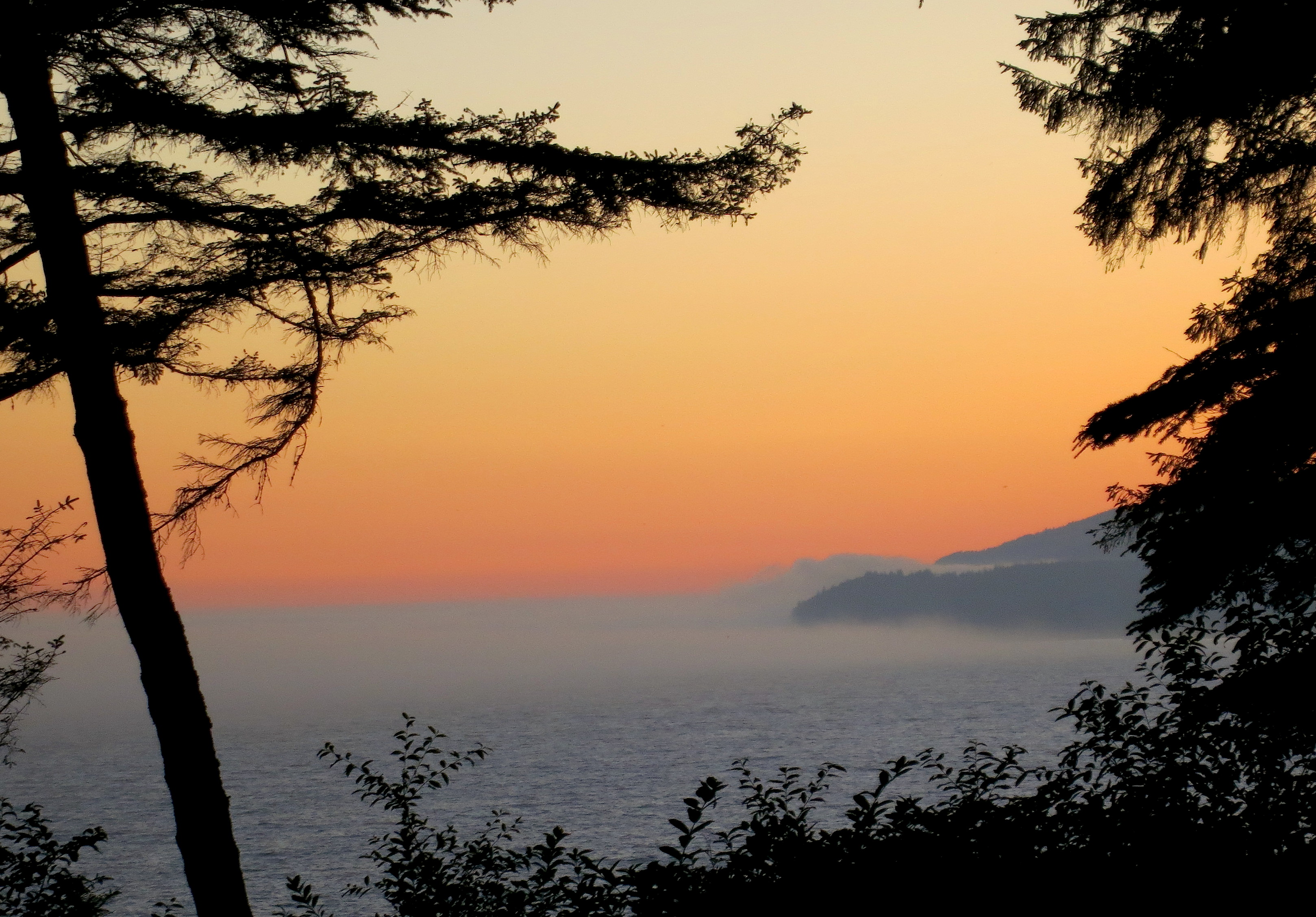
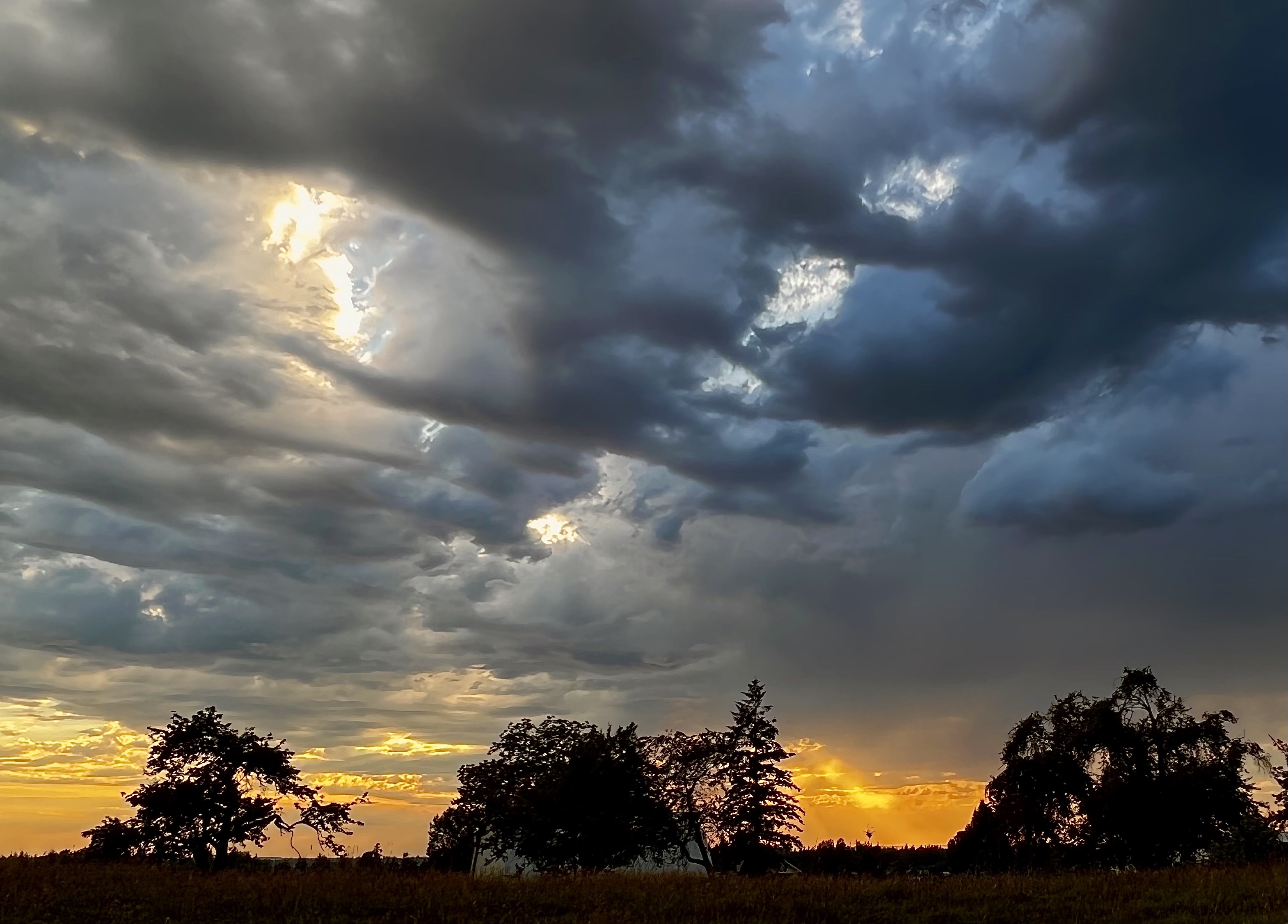
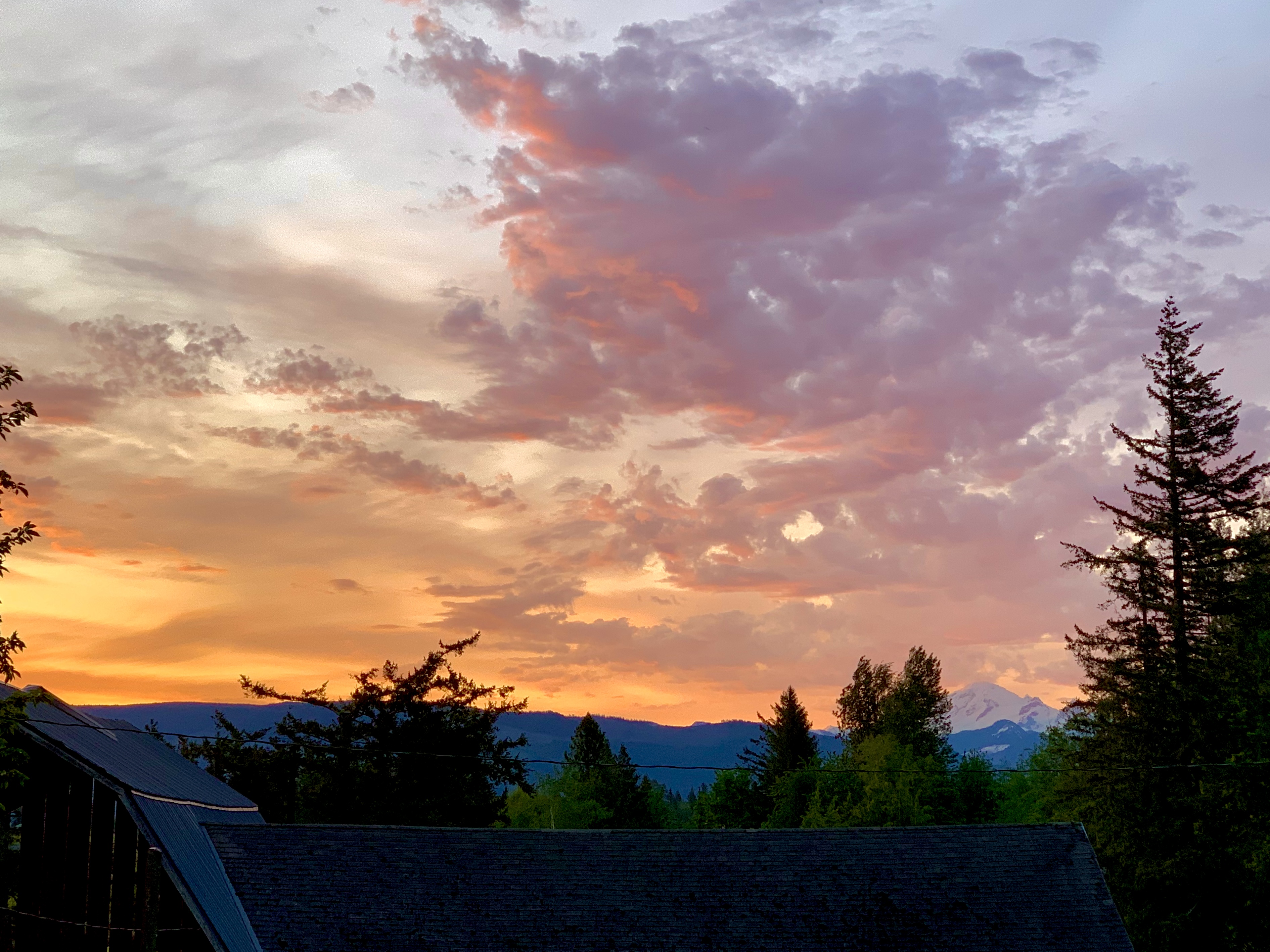
The endless clear skies of August have been broken with clouds, rain falling in warm gusts, leaves landing on browned ground.
This summer ended up being simply too much – an excess of everything bright and beautiful, meant to make us joyful yet bold and exhausting in its riches.
From endless hours of daylight, to high rising temperatures, to palettes of exuberant clouds to fruitfulness and abundant blooms.
While summer always fills an empty void after enduring cold spare dark days the rest of the year, I still depend on autumn returning.
I welcome darkening times back, knowing how much I miss those drear twilight months of longing for the overwhelming fullness of summer.
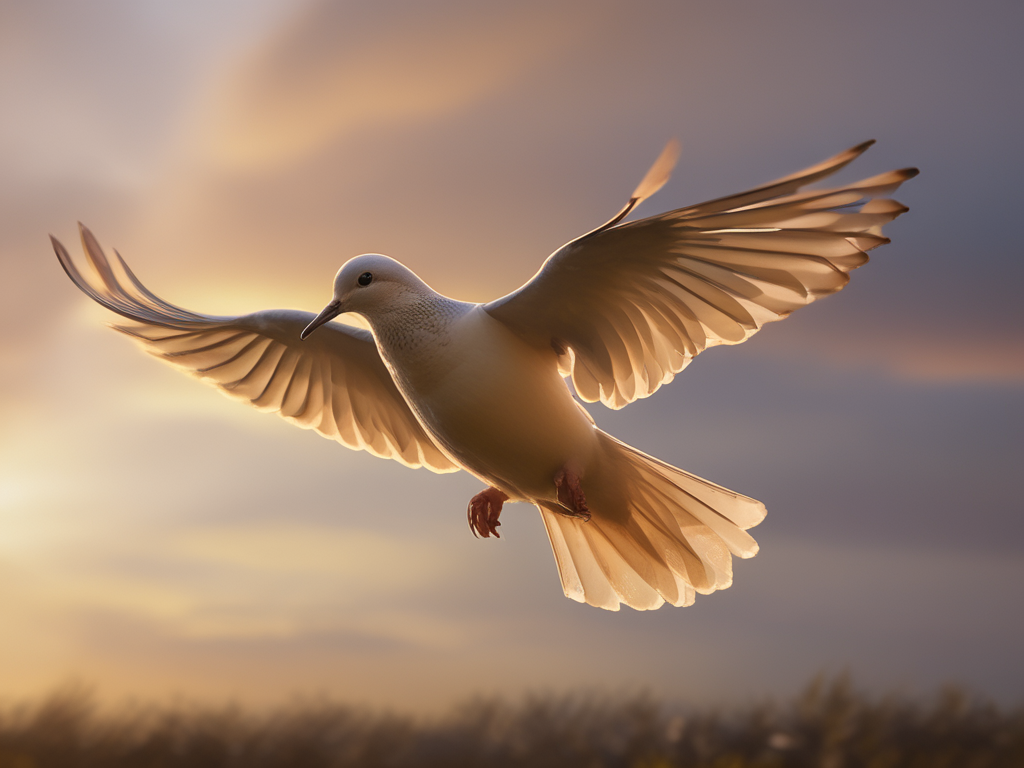
AI image created for this post
This song and video fits so well today – maybe a little weepy…
One-Time
Monthly
Yearly
Make a one-time or recurring donation to support daily Barnstorming posts
So many want to be lifted by song and dancing, and this morning it is easy to understand. I write in the sound of chirping birds hidden in the almond trees, the almonds still green and thriving in the foliage. Up the street, a man is hammering to make a new house as doves continue their cooing forever. Bees humming and high above that a brilliant clear sky. The roses are blooming and I smell the sweetness. Everything desirable is here already in abundance. And the sea. The dark thing is hardly visible in the leaves, under the sheen. We sleep easily. So I bring no sad stories to warn the heart. All the flowers are adult this year. The good world gives and the white doves praise all of it. ~Linda Gregg, “A Dark Thing Inside the Day” from The Sacraments of Desire
Sometimes, hard-trying, it seems I cannot pray– For doubt, and pain, and anger, and all strife. Yet some poor half-fledged prayer-bird from the nest May fall, flit, fly, perch–crouch in the bowery breast Of the large, nation-healing tree of life;– Moveless there sit through all the burning day, And on my heart at night a fresh leaf cooling lay. ~George MacDonald from Diary of an Old Soul
My cracks seem to expand with age: do they not heal as quickly or am I simply more brittle than before?
I know how my eyes leak over the beauty of the morning, my heart feels more porous then world events break me to bleeding.
Yet the Light pours in the cracks to illuminate wounds old and new. Let the world know, let the world know, after a hurt comes healing.
May I become the perfect offering.
AI image created for this postAI image created for this post
The birds they sang At the break of day Start again I heard them say Don’t dwell on what Has passed away Or what is yet to be
Ah the wars they will Be fought again The holy dove She will be caught again Bought and sold And bought again The dove is never free
You can add up the parts but you won’t have the sum You can strike up the march, there is no drum Every heart, every heart to love will come but like a refugee.
Ring the bells that still can ring Forget your perfect offering There is a crack, a crack in everything That’s how the light gets in. ~Leonard Cohen from “Anthem”
One-Time
Monthly
Yearly
Make a one-time or recurring donation to support daily Barnstorming posts
Some things are very dear to me— Such things as flowers bathed by rain Or patterns traced upon the sea Or crocuses where snow has lain … the iridescence of a gem, The moon’s cool opalescent light, Azaleas and the scent of them, And honeysuckles in the night. And many sounds are also dear— Like winds that sing among the trees Or crickets calling from the weir Or Negroes humming melodies. But dearer far than all surmise Are sudden tear-drops in your eyes. ~Gwendolyn Brooks “Sonnet 2”
We human beings do real harm. History could make a stone weep. ~Marilynne Robinson from Gilead
I am an easy cryer. It takes very little to tip me over the edge: a hymn, a poem, simply witnessing a child’s joy. Suddenly my eyes fill up. I blame this on my paternal grandmother who was in tears much of her time when visiting our family, crying happy, crying sad, crying frustrated and angry tears.
Somehow after her visit, she was always smiling, so I think her weeping was cathartic emptying of her stress.
My greatest trigger to weep myself is watching someone else tear up. I think my grandmother left behind some powerful empathy genes.
I had to desensitize my response to tears to be effective as a physician/healer. Witnessing tears in the exam room is a normal part of the job: patients are anxious, ill, in pain or simply need to decompress in safety. I learned early on to be unobtrusive and not interrupt, letting the flow of tears be part of how the patient was trying to communicate. It was a struggle when my inclination was to cry right along with them. But I needed to be the rock in the room, solid and steady. I could understand their tears as yet another symptom of a clinical presentation, allowing me to observe without being clouded by my own emotional response.
Sometimes that worked. Sometimes not. At times overwhelmed, I wept at births, I wept at deaths, I wept at the sharing of bad news.
Now, liberated from the exam room, I freely weep at the state of the world, or when I read of disaster and tragedy, and especially when I witness intentional harm and meanness in others. I’m no longer a barely responsive stone, but more like an over-filled sponge being squeezed – everything builds up until I can hold it no more. Reading headlines in the news is sometimes more than I can bear.
I cry myself dry.
And that is okay. Once emptied out, I can be filled again by so much that is good and precious in this life.
That is worth weeping over.
AI image created for this post
Detail from “Descent from the Cross” by Rogier van der Weyden
One-Time
Monthly
Yearly
Make a one-time or recurring donation to support daily Barnstorming posts
Not much to me is yonder lane Where I go every day; But when there’s been a shower of rain And hedge-birds whistle gay, I know my lad that’s out in France With fearsome things to see Would give his eyes for just one glance At our white hawthorn tree.
. . . .
Not much to me is yonder lane Where he so longs to tread: But when there’s been a shower of rain I think I’ll never weep again Until I’ve heard he’s dead. ~Siegfried Sassoon“The Hawthorn Tree”
I drove West in the season between seasons. I left behind suburban gardens. Lawnmowers. Small talk.
Under low skies, past splashes of coltsfoot, I assumed the hard shyness of Atlantic light and the superstitious aura of hawthorn.
All I wanted then was to fill my arms with sharp flowers, to seem from a distance, to be part of that ivory, downhill rush. But I knew,
I had always known, the custom was not to touch hawthorn. Not to bring it indoors for the sake of
the luck such constraint would forfeit– a child might die, perhaps, or an unexplained fever speckle heifers. So I left it
stirring on those hills with a fluency only water has. And, like water, able to redefine land. And free to seem to be–
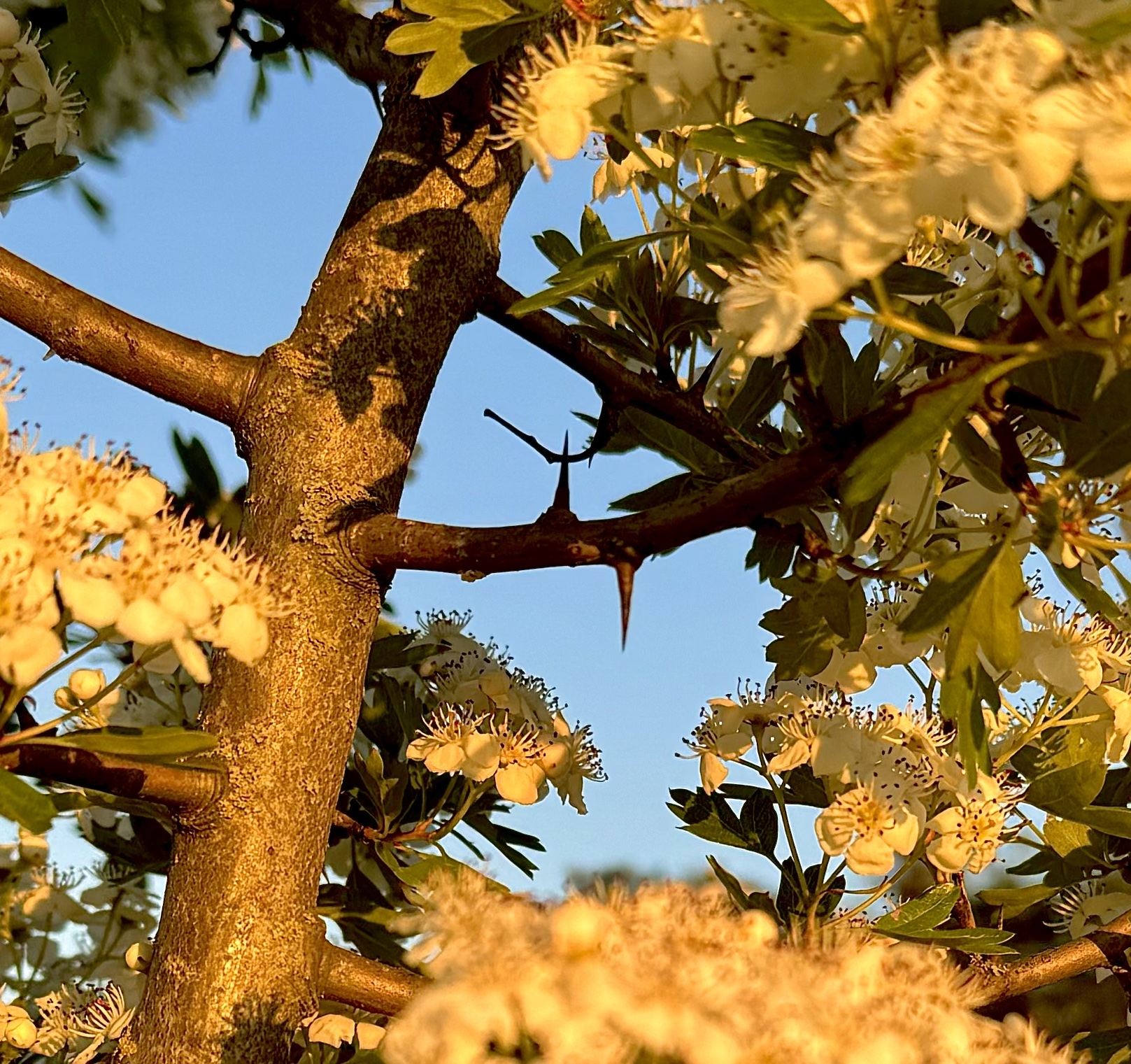
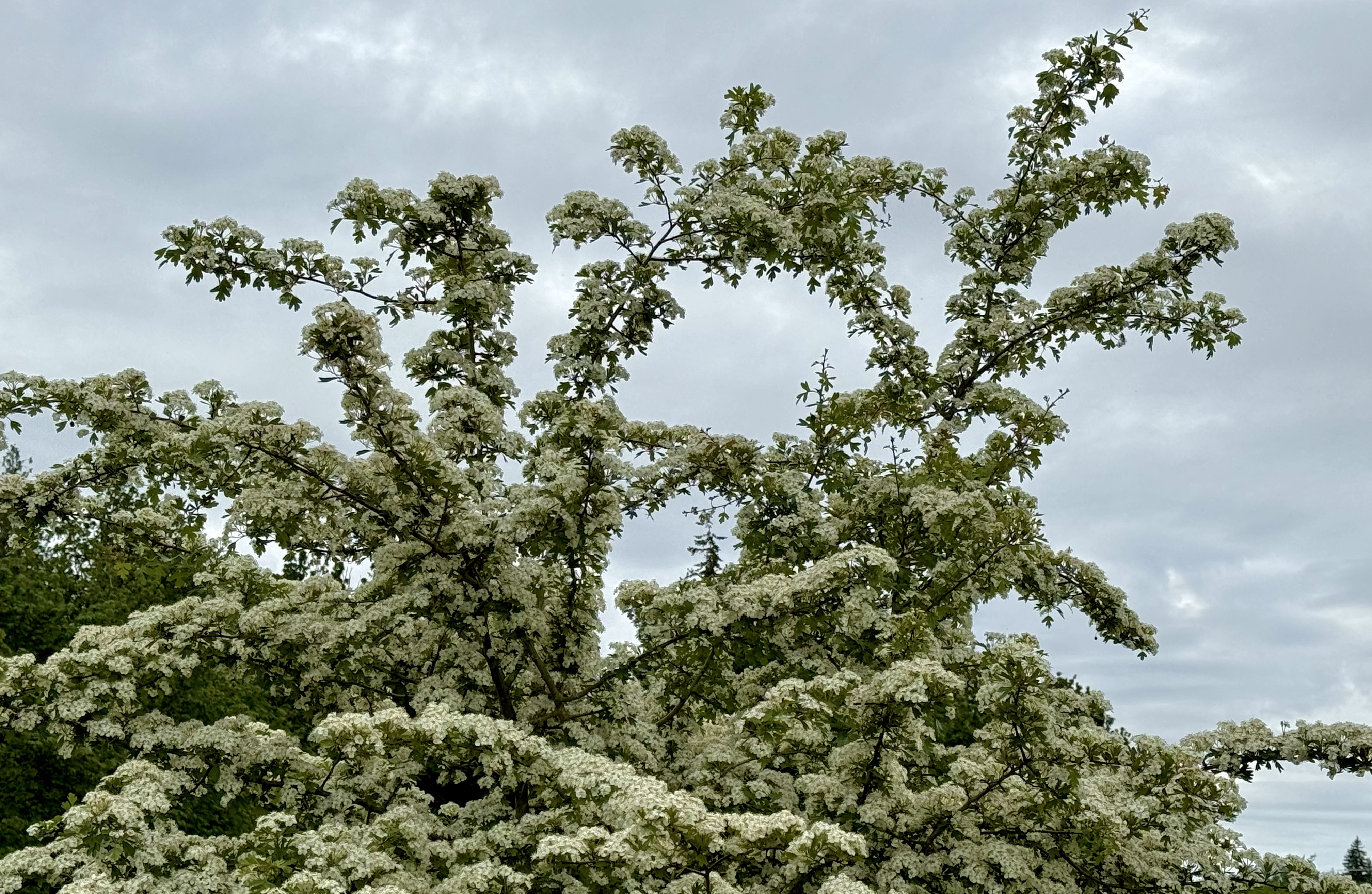
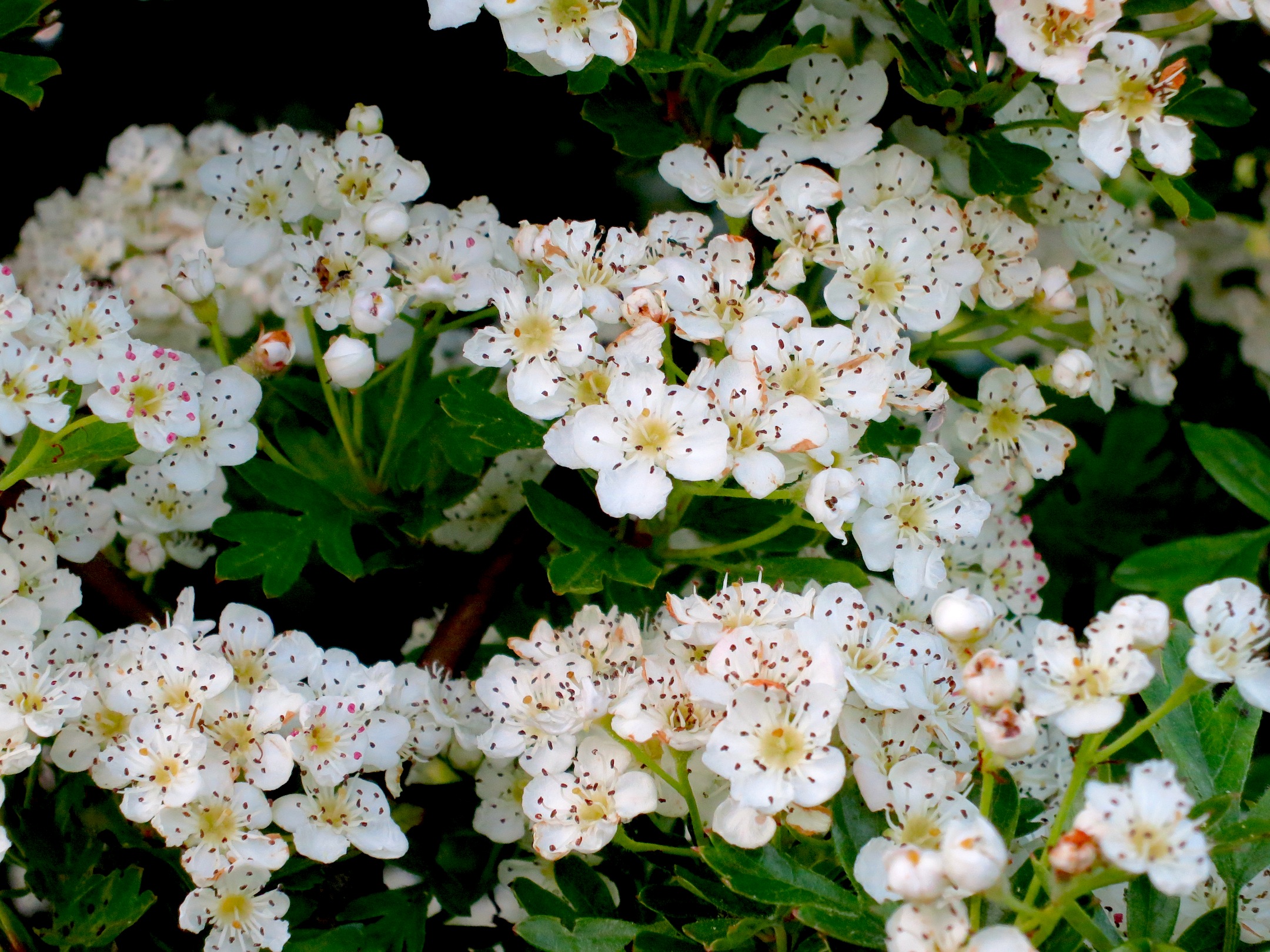
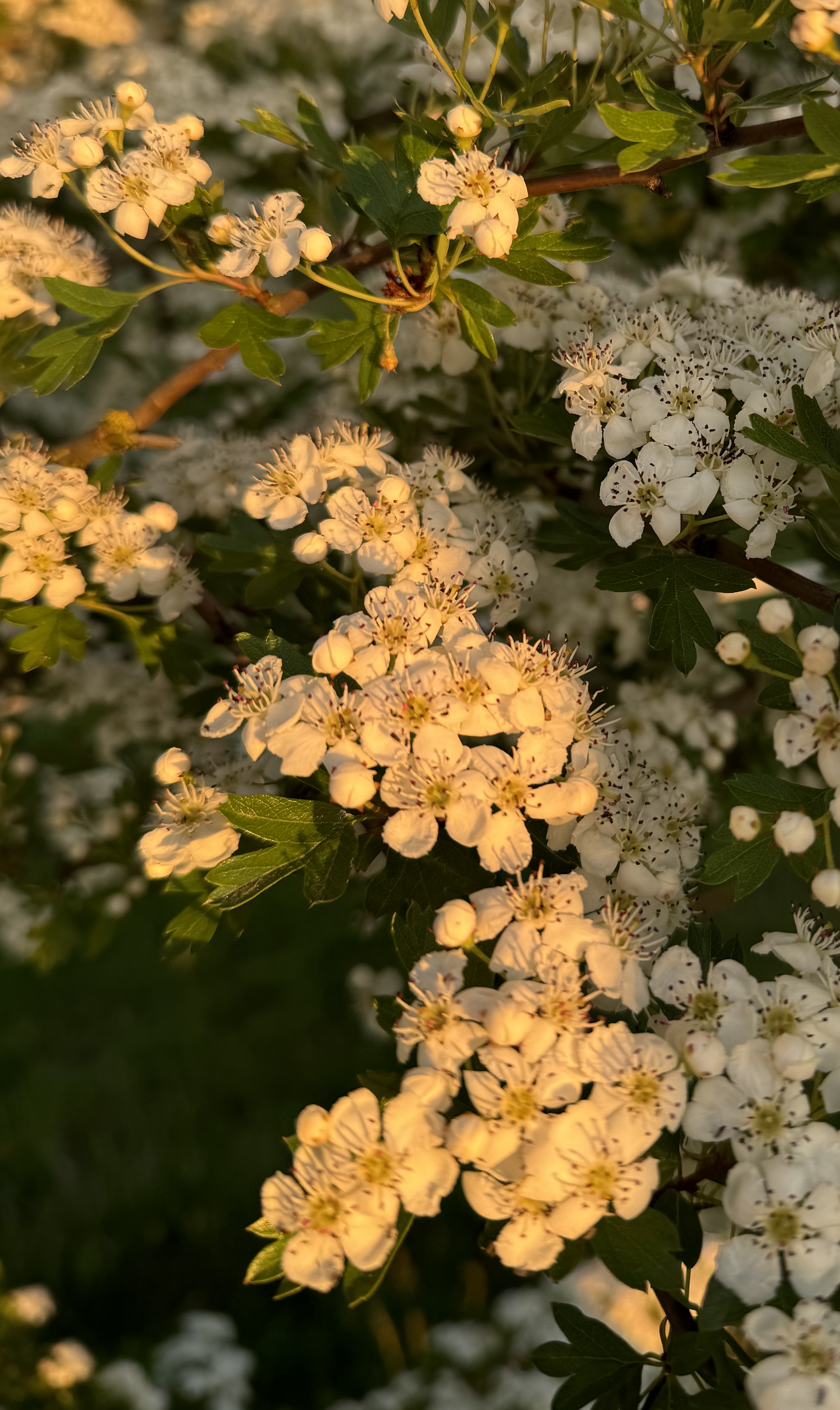
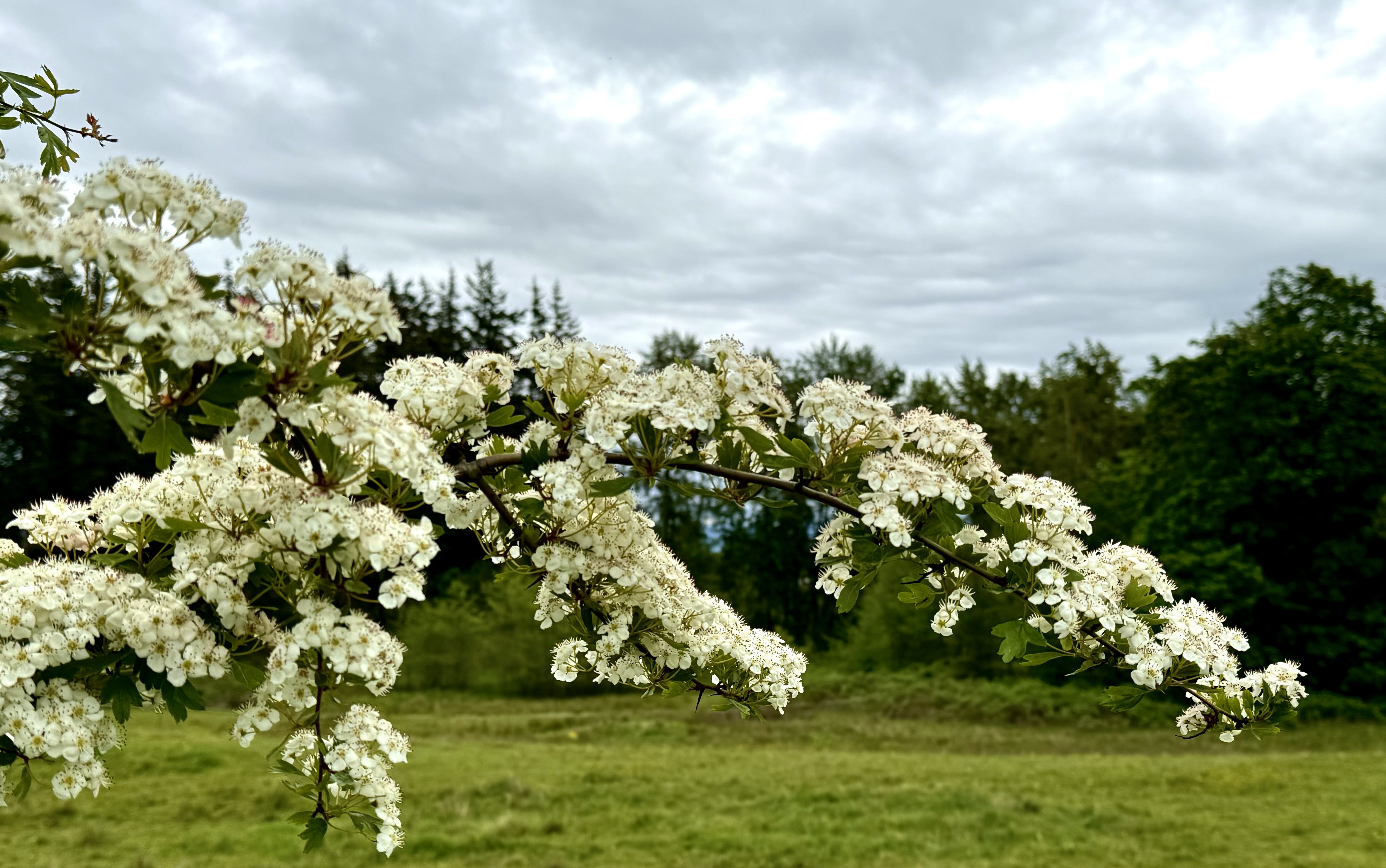
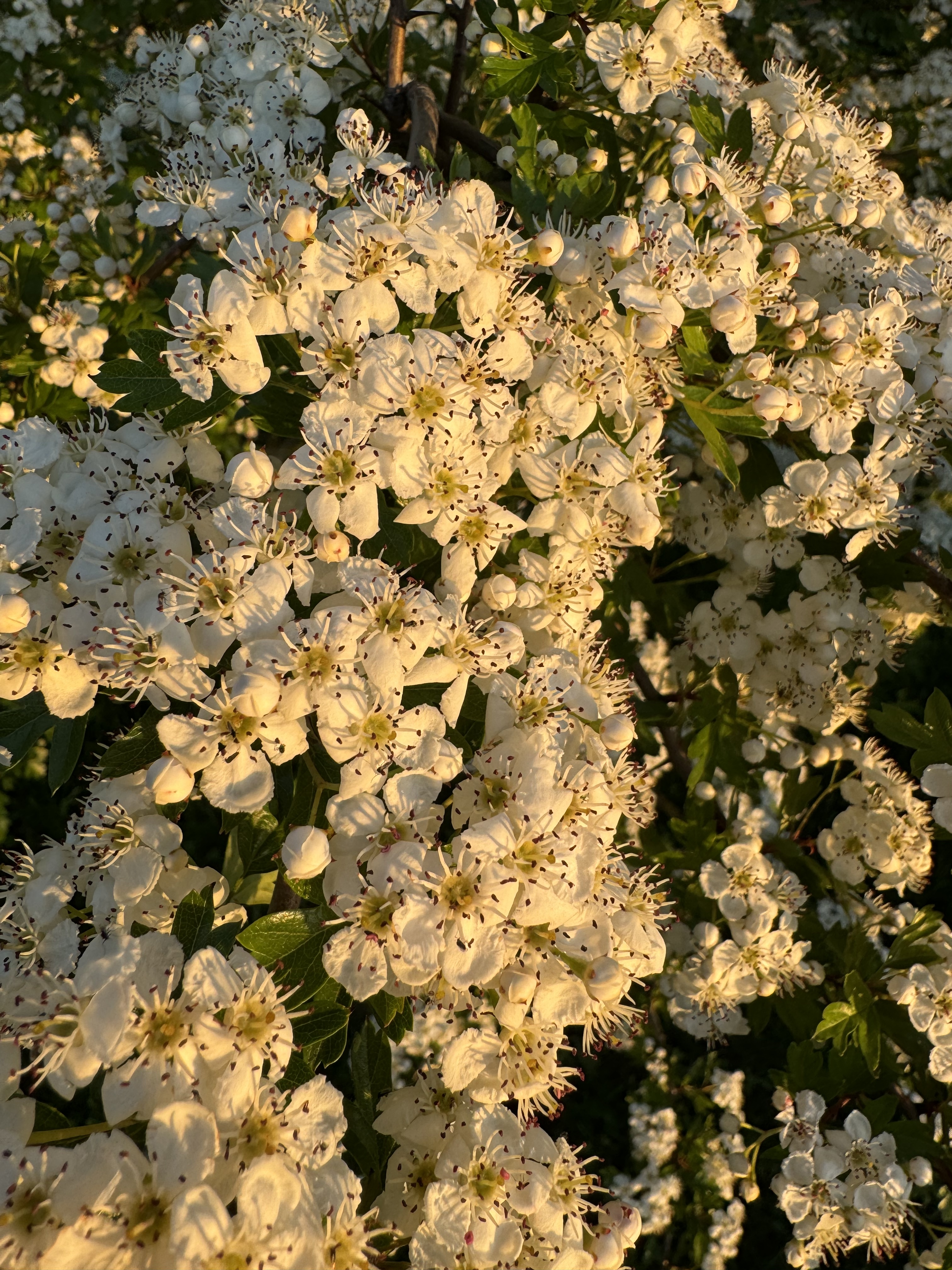
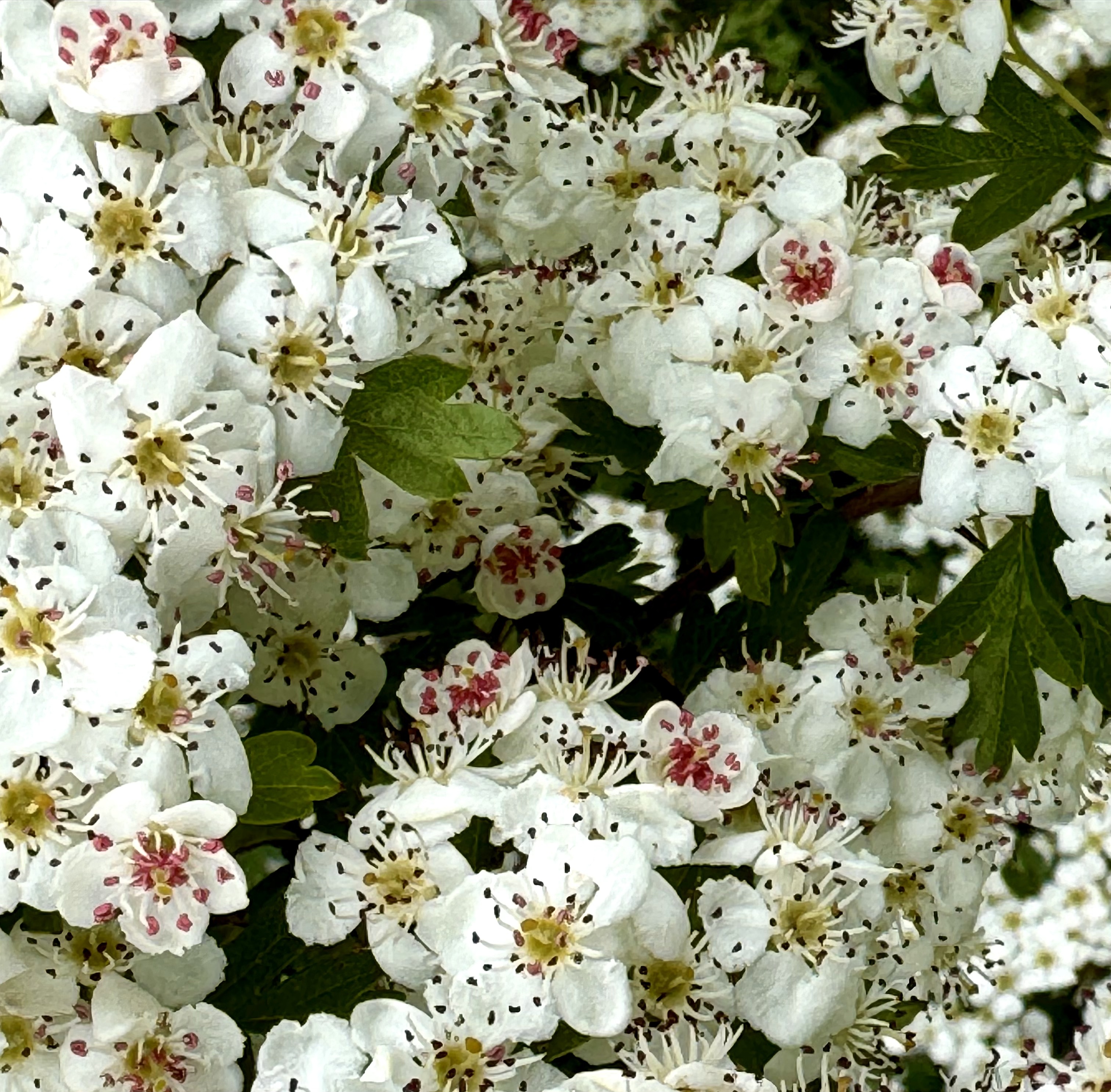
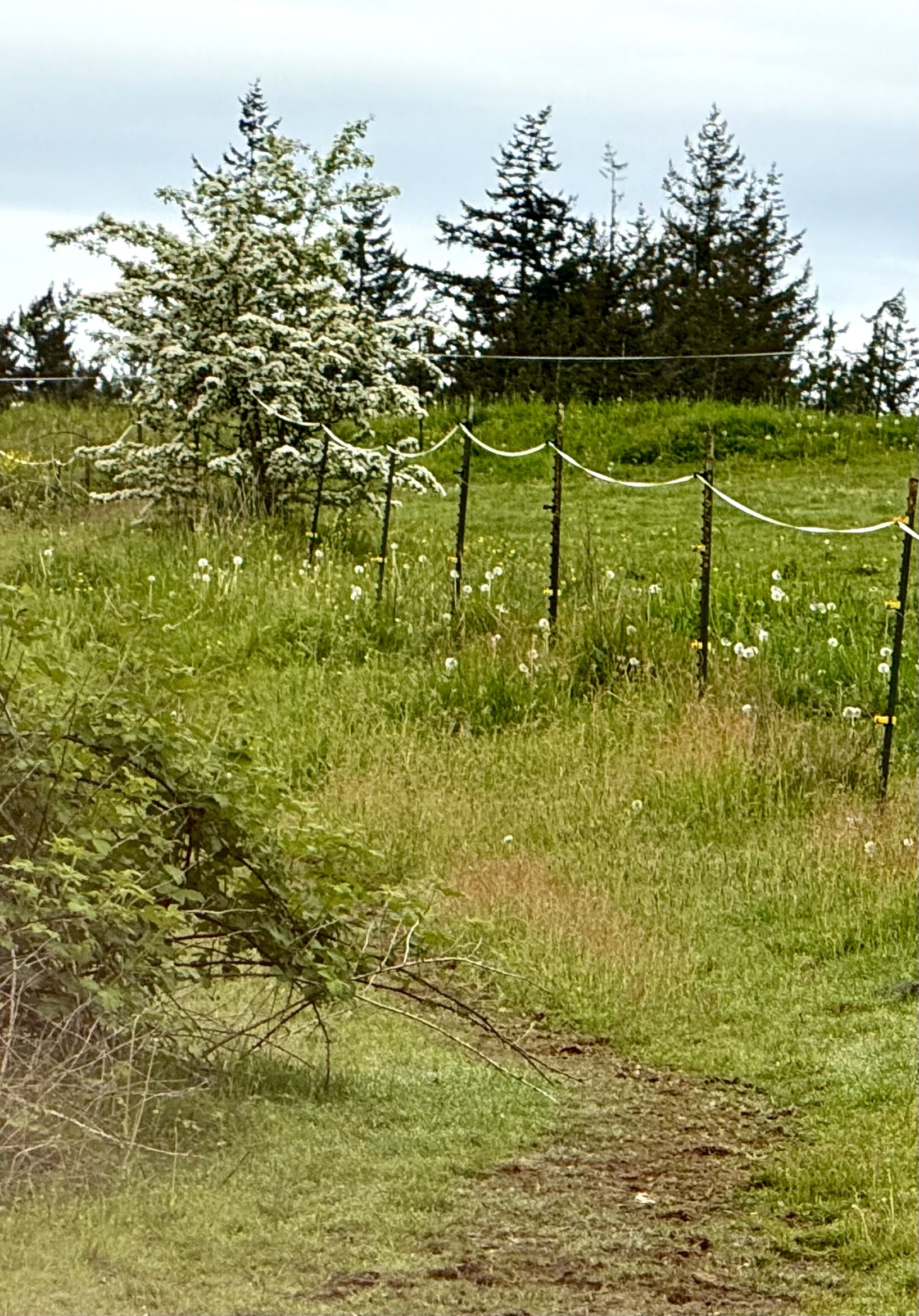
The bird-sowed hawthorn bush along the lane to our back field has suddenly become a blooming tree, staking out its place alongside the trail the horses follow to their pasture. This May, it is a white flame against the dark woods.
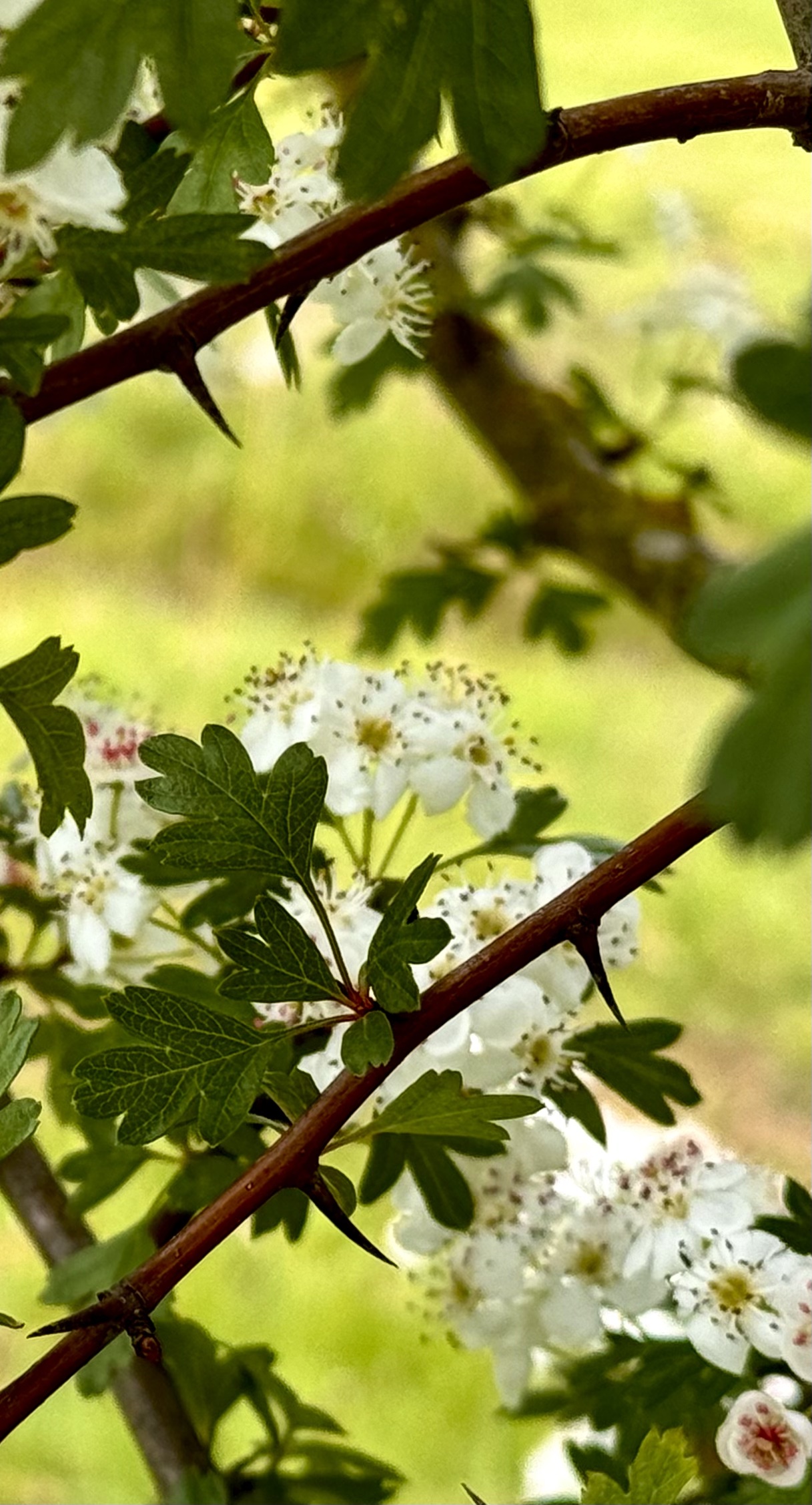
Though we didn’t intend for it to be there, we’ll leave it be. Hawthorns are great bird habitat and a haven for honeybees. They are found in most hedge rows in the United Kingdom, impenetrable due to their fierce thorns and criss-cross network of branches, a historic symbol of the toughness and persistence of the Celtic people. Though we don’t need a hedge row here, I appreciate the tree’s reminder it has a place in myth and lore.
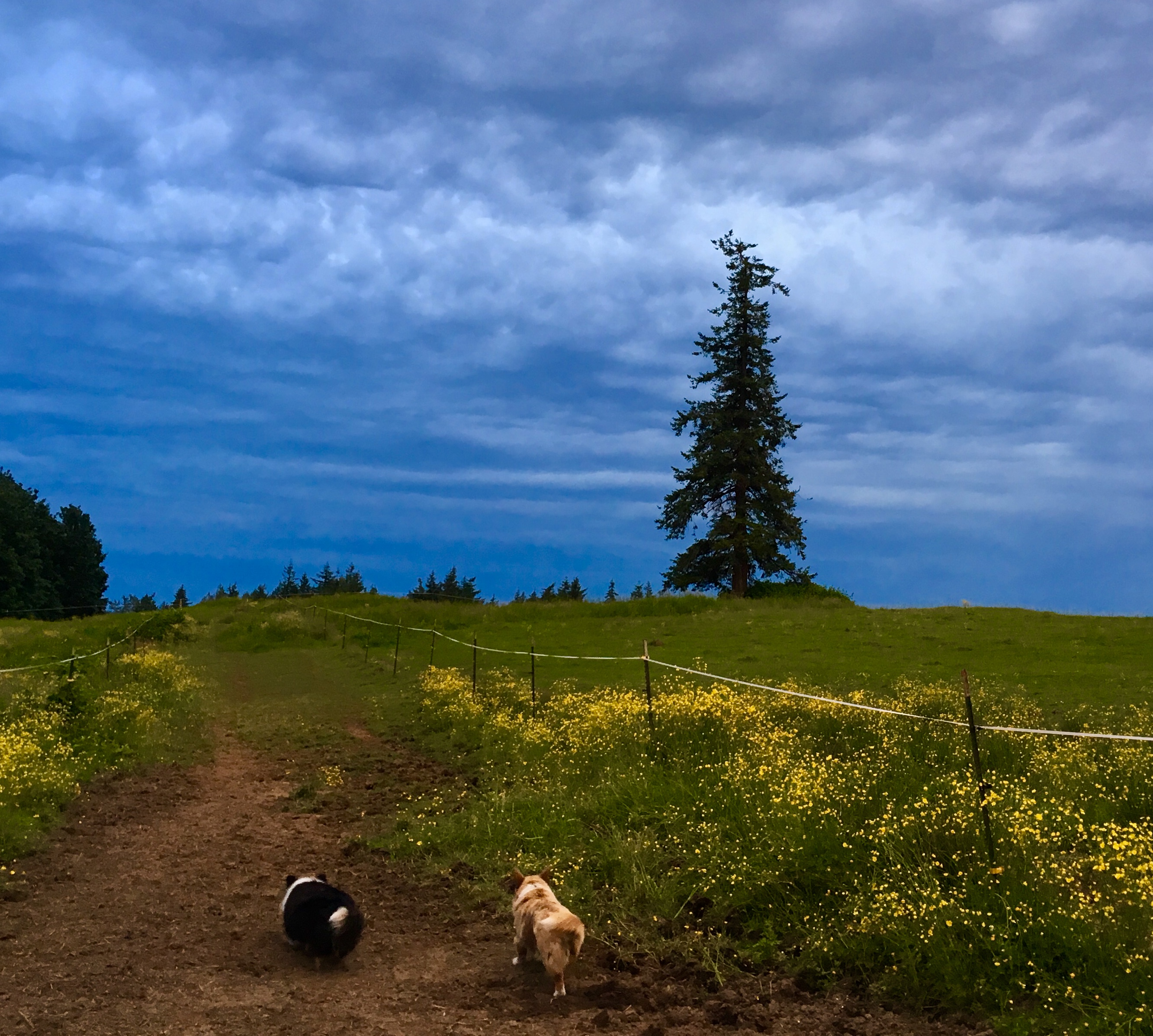
It will never be a hospitable tree like the lone fir tree that graces our hill, or the big leaf maple where children climb, or the black walnut whose branches support the treehouse. But it will be a white beacon every May, portending the summer to come, and if it bears fruit, it will feed the birds that nest in its interior.
And like the poem written by WWI soldier/poet Sassoon, it will be a bittersweet reminder of the familiar comfort of home, even though sharp thorns abound among the blossoms. Those thorns are nothing compared to the despair found in the fearsome trenches of warfare.
AI image created for this postSiegfried Sassoon’s handwritten poem
along fair Arran’s shores the swans sing soft of tale of yore, of a young love taken to sea
the two were hand in glove like sparrows bound in sacred love a tune that only they can sing
a tree of unity they planted by the green eyed sea the branch would hold their love through time
a sailor lad was he he said,”dont cry my lovely, mhari before the moon is full i’ll return”
I’ll wait for thee and she sang to him
the moon shone full and bright and home he sailed mid-summers night the tree so young and blossoming
they slept among the green the world was light and dreams serene the fires in their hearts burned bright
Where moss-grown boulders stand, he took her by the lily hand and there they wed at break of day
the seas know not of hearts and once again the two must part. “it wont be long, i swear to thee.
please wait for me.” and she sang to him
The hawthorn tree has grown, 10 years she walked shores alone, she hears his whisper in the leaves
Home is the sailor lad, home in the sea, forever plaid, Under the wide and starry sky
Yes, I will wait for thee, By mountain, sea and tree; And on the wind you’ll hear my love,
for at the fall of day Beneath the leaves where once we lay I’ll sit and sing i’ll wait for thee
come back to me…. music and lyrics by Fae Wiedenhoeft
One-Time
Monthly
Yearly
Make a one-time or recurring donation to support daily Barnstorming posts
Let us not with one stone kill one bird, much less two. Let us never put a cat in a bag nor skin them, regardless of how many ways there are to do so. And let us never take the bull, especially by his gorgeous horns. What I mean is
we could watch our tongues or keep silent. What I mean is we could scrub the violence from our speech. And if we find truth in a horse’s mouth, let us bless her
ground-down molars, no matter how old she is, especially if she was given as a gift. Again, let’s open her mouth——that of the horse, I mean——let us touch that interdental space where no teeth grow, where the cold bit was made to grip. Touch her there, gently now, touch that gentle
empty between her incisors and molars, rub her aching, vulnerable gums. Don’t worry: doing so calms her. Besides, she’s old now; she’s what we call broken; she won’t bite. She’s lived through two thirteen-year emergences of cicadas
and thought their rising a god infestation, thought each insect roiling up an iteration of the many names of god, because god to her is the grasses so what comes up from grass is god. She would not say it that way. Nor would she
say the word cicada——words are hindrances to what can be spoken through the body, are what she tolerates when straddled, giddy-up on one side then whoa on the other. After, it’s all good girl, Mable, good girl, before the saddle sweat is rinsed cool with water from the hose and a carrot is offered flat from the palm. Yes, words being
generally useless she listens instead to the confused rooster stuttering when the sun burns overhead, when it’s warm enough for those time-keepers to tunnel up from the dark and fill their wings to make them stiff and capable of flight. To her, it is the sound
of winter-coming in her mane or the sound of winter-leaving in her mane—— yes, that sound——a liquid shushing like the blood-fill of stallion desire she knew once but crisper, a dry crinkle of fall leaves. Yes, that sound, as they fill their new wings then lumber to the canopy to demand come here, come here, come here, now come.
If this is a parable you don’t understand, then, dear human, stop listening for words. Listen instead for mane, wind, wings, wind, mane, wings, wings, wings. The lesson here is of the mare and of the insects, even of the rooster puffed and strutting past. Because now, now there is only one thing worth hearing, and it is the plea of every living being in that field we call ours, is the two-word commandment trilling from the trees: let live, let live, let live. Can you hear it? Please, they say. Please. Let us live. ~Nickole Brown “Parable”
When a governor writes about her decision to shoot her wayward dog and stinky goat, our reaction is about the injustice perpetrated on the dog more than her decision to play god with any animal she has responsibility for. I feel a twinge of guilt at the accusation. Who among us can throw stones?
God is clear we are meant to be caretakers of His Creation. Yet I still swat flies and trap mice – there is no pleasure in doing so, so I still ask for forgiveness for my lack of charity and decision to make my own existence more comfortable at the expense of another living thing.
I admit I fail Creation in myriad ways.
I have owned animals whose behavior brought me to my knees, sometimes literally with my face in the muck. I have wept over the loss of a deformed stillbirth foal and a pond of koi frozen in a bitter winter storm. The stories abound of my helplessness in the face of sadness and loss and frustration but I never wanted to become executioner.
I don’t live with cycles of cicada population booms but have experienced their overwhelming din and understood we are mere witnesses and not in control. We are not “little g” gods on this earth. We are its stewards.
Part of the joy of beauty is the realization that it is part of a larger whole, most of which appears to be just out of sight. We are drawn forward toward something… and left waiting, wondering. ~N.T. Wright from Life, God and Other Small Topics
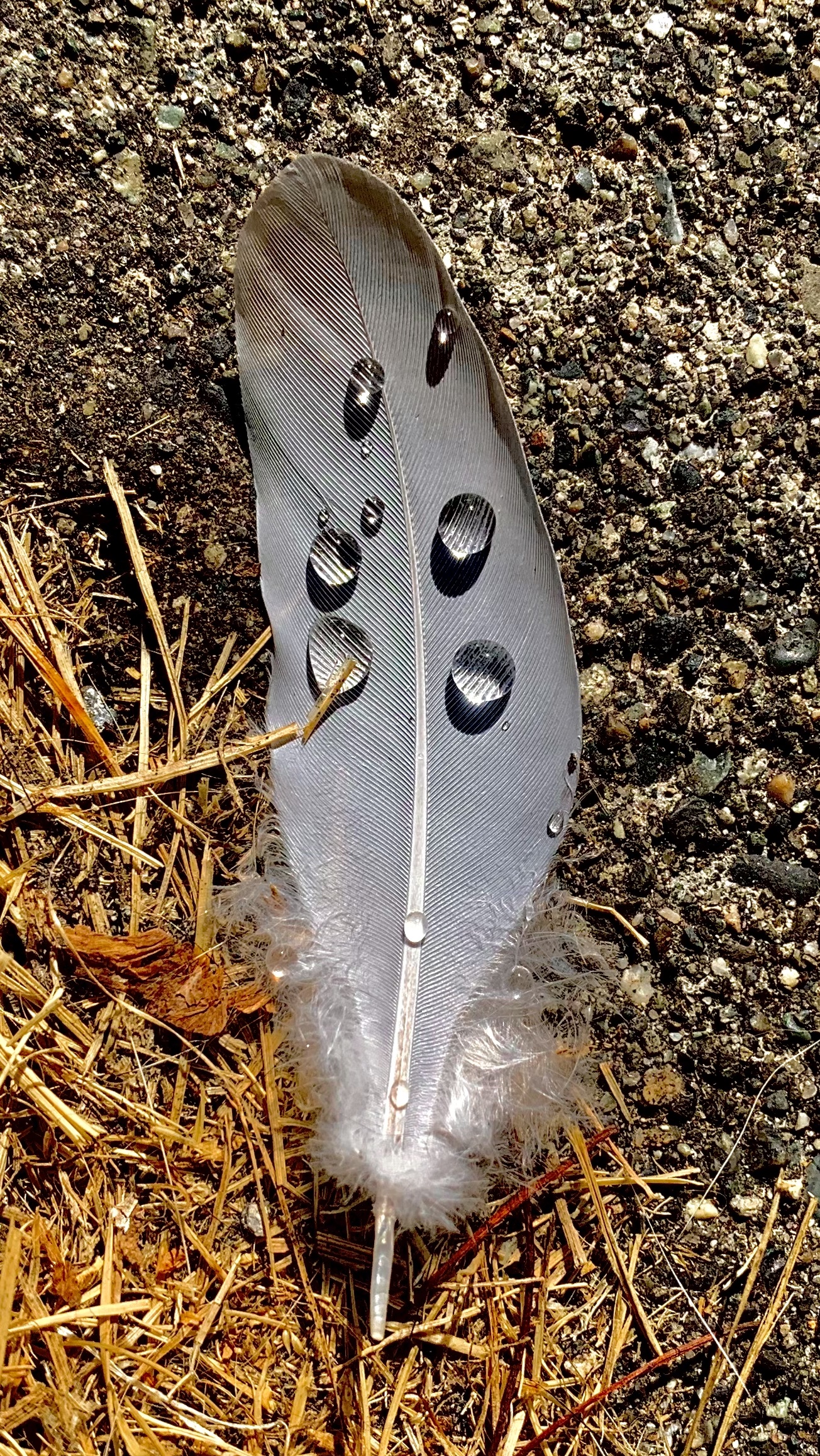
Once, in the cool blue middle of a lake, up to my neck in that most precious element of all,
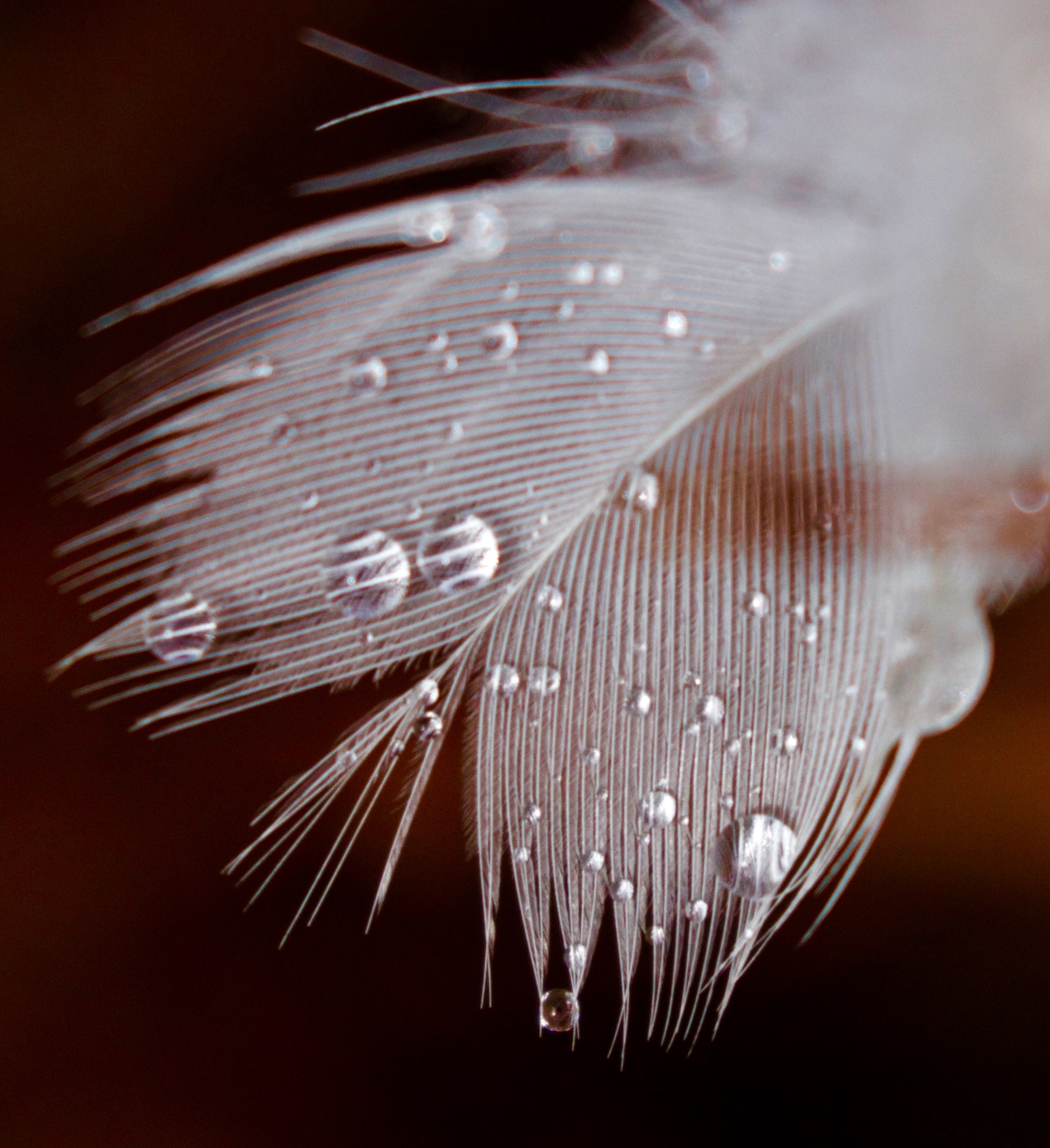
I found a pale-gray, curled-upwards pigeon feather floating on the tension of the water
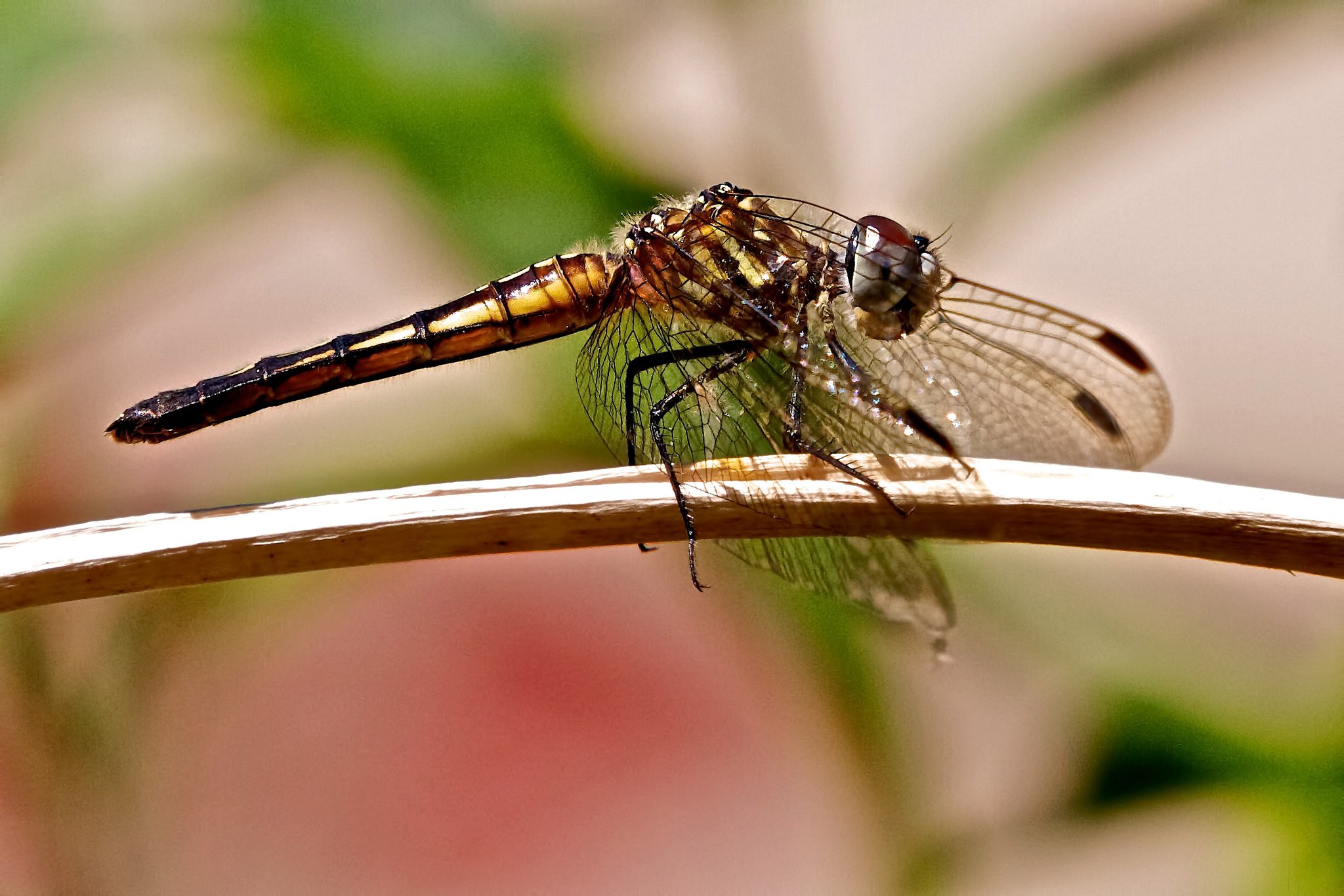
at the very instant when a dragonfly, like a blue-green iridescent bobby pin,
hovered over it, then lit, and rested. That’s all.
I mention this in the same way that I fold the corner of a page
in certain library books, so that the next reader will know
…God’s attention is indeed fixed on the little things. But this is not because God is a great cosmic cop, eager to catch us in minor transgressions, but simply because God loves us–loves us so much that the divine presence is revealed even in the meaningless workings of daily life. It is in the ordinary, the here-and-now, that God asks us to recognize that the creation is indeed refreshed like dew-laden grass that is “renewed in the morning” or to put it in more personal and also theological terms, “our inner nature is being renewed everyday”. ~Kathleen Norrisfrom The Quotidian Mysteries
We do not want merely to see beauty… we want something else which can hardly be put into words- to be united with the beauty we see, to pass into it, to receive it into ourselves, to bathe in it, to become part of it.
We discern the freshness and purity of morning, but they do not make us fresh and pure. We cannot mingle with the splendours we see. But all the leaves of the New Testament are rustling with the rumour that it will not always be so. Someday, God willing, we shall get in. ~C.S. Lewis from The Weight of Glory
Whether it is in a favorite book of fiction or poetry, or from the Word itself, or as I keep my eyes open to the daily wonders around me, I feel compelled to share the good parts with those of you who visit here.
It is easy to be ground to a pulp by the little things: waiting in line too long, heavy traffic, an insistent alarm clock, a mouse (or more) in the house, miserable spring-time pollen allergies, so much misery in the headlines.
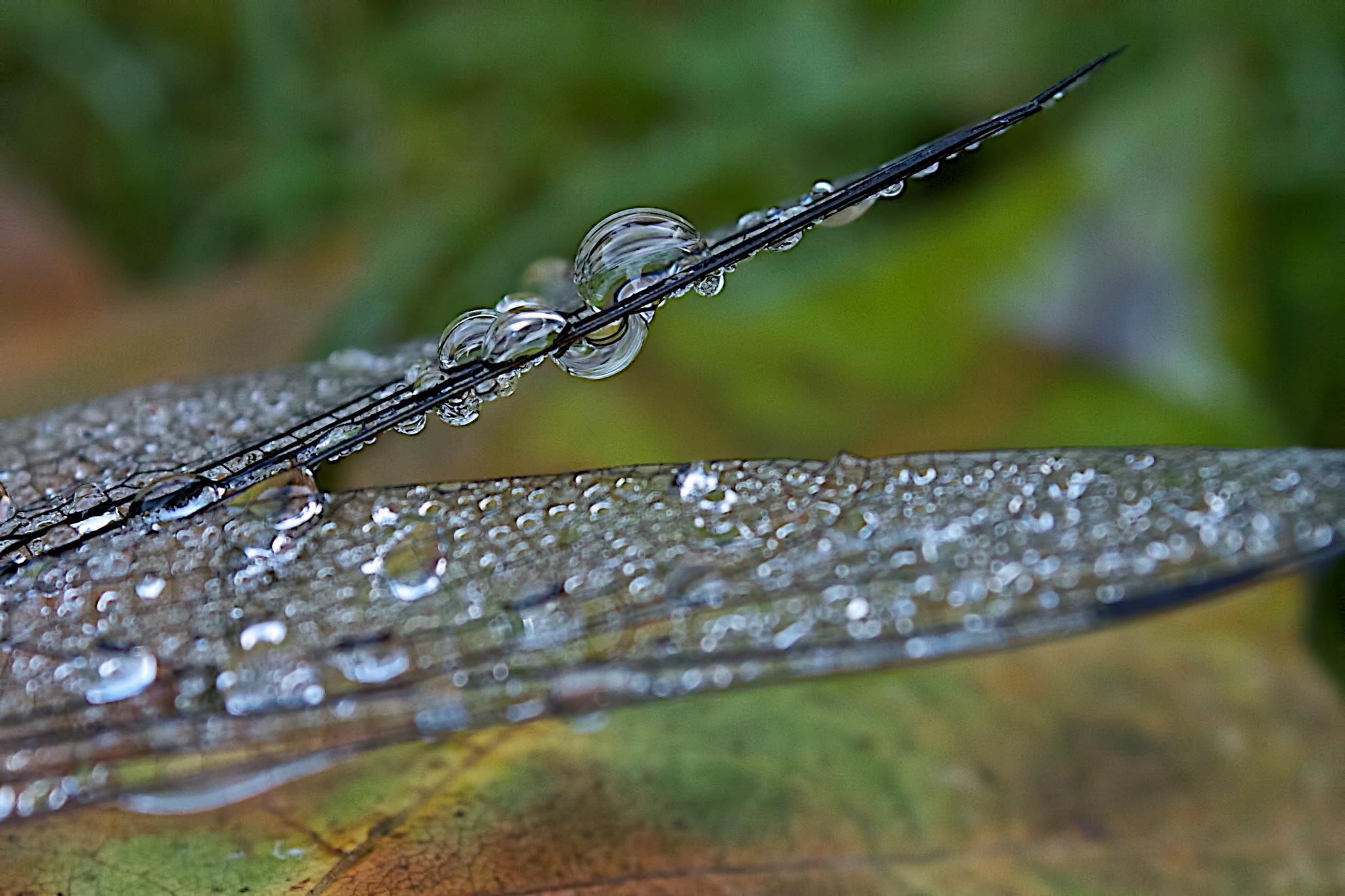
God is in the details, from dew drop to tear drop and even to nose snot. His ubiquitous presence is in all things, large and small, not just the “good parts” of His exquisite grandeur.
It isn’t all elegance from our limited perspective, but still, they are all good parts worthy of His divine attention.
The time has come to be refreshed and renewed by His care revealed in the tiniest ways. I feel immersed in His wonder.
He has my attention and perhaps, in some small way, I now have yours.
One-Time
Monthly
Yearly
Make a one-time or recurring donation to support daily Barnstorming posts
God goes, belonging to every riven thing he’s made sing his being simply by being the thing it is: stone and tree and sky, man who sees and sings and wonders why
God goes. Belonging, to every riven thing he’s made, means a storm of peace. Think of the atoms inside the stone. Think of the man who sits alone trying to will himself into a stillness where
God goes belonging. To every riven thing he’s made there is given one shade shaped exactly to the thing itself: under the tree a darker tree; under the man the only man to see
God goes belonging to every riven thing. He’s made the things that bring him near, made the mind that makes him go. A part of what man knows, apart from what man knows,
God goes belonging to every riven thing he’s made. ~Christian Wiman “Every Riven Thing”
The Holy Saturday of our life must be the preparation for Easter, the persistent hope for the final glory of God. The virtue of our daily life is the hope which does what is possible and expects God to do the impossible. To express it somewhat paradoxically, but nevertheless seriously: the worst has actually already happened; we exist, and even death cannot deprive us of this. Now is the Holy Saturday of our ordinary life, but there will also be Easter, our true and eternal life. ~Karl Rahner “Holy Saturday” in The Great Church Year
This is the day in between when nothing makes sense: we are lost, hopeless, grieving,riven beyond recognition.
We are brought to our senses by this one Death, this premeditated killing, this senseless act that darkened the skies, shook the earth and tore down the curtained barriers to the Living Eternal God.
The worst has already happened, despite how horrific are the constant tragic events filling our headlines.
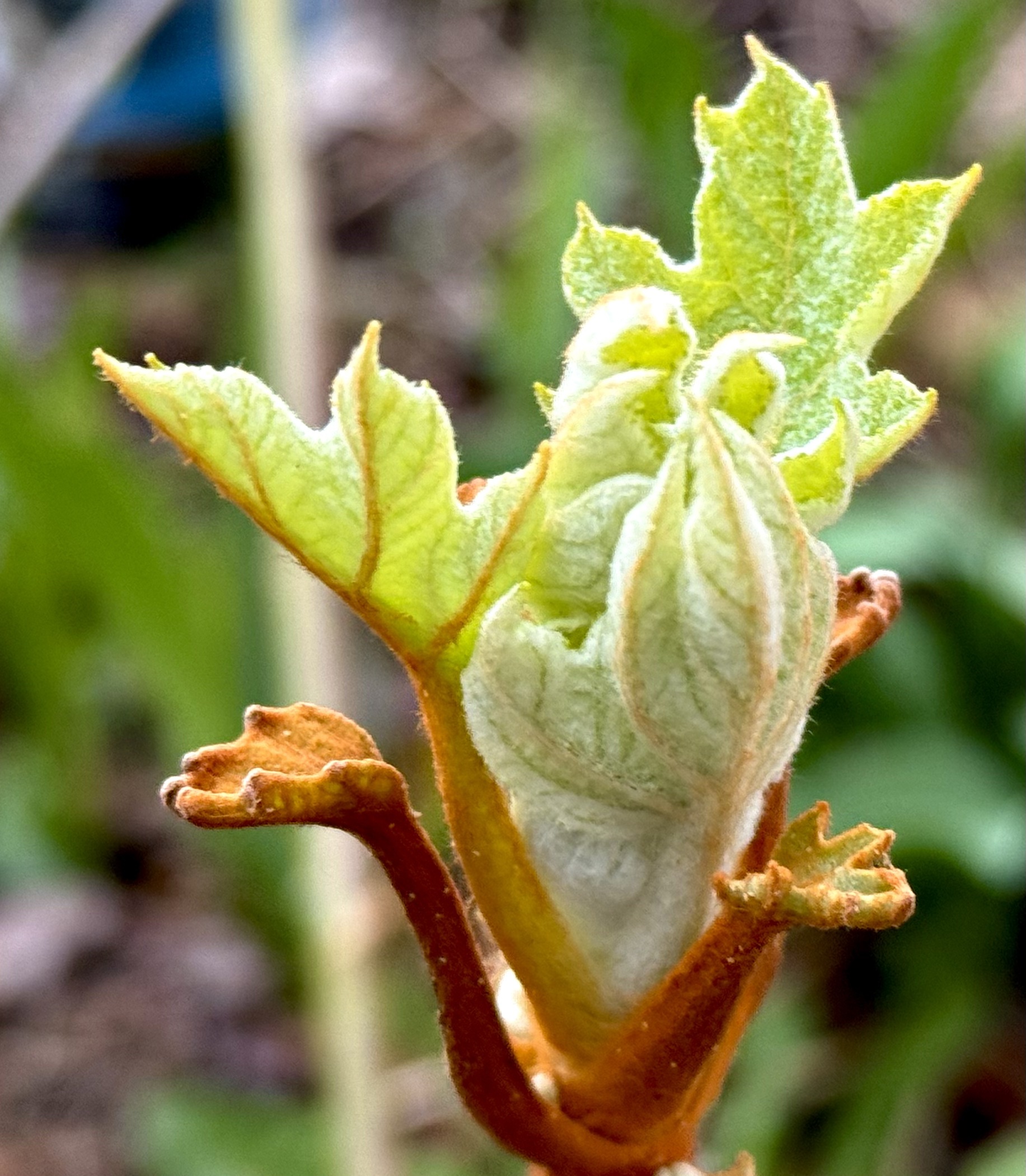
Today, this Holy Saturday we are in between, stumbling in the darkness but aware of hints of light, of buds, of life, of promised fruit to come.
The best has already happened; it happened even as we remained oblivious to its impossibility.
We move through this Saturday, doing what is possible even when it feels senseless, even as we feel split apart, torn and sundered.
Tomorrow it will all make sense: our hope brings us face to face with our God who is and was and does the impossible.
So Joseph bought some linen cloth, took down the body, wrapped it in the linen, and placed it in a tomb cut out of rock. Then he rolled a stone against the entrance of the tomb.Mary Magdalene and Mary the mother of Joseph saw where he was laid. Mark 15:46-47
Wait for the Lord; be strong and take heart and wait for the Lord. Psalm 27:14
This Lenten season I reflect on the words of the 19th century southern spiritual hymn “What Wondrous Love is This”
I see his blood upon the rose And in the stars the glory of his eyes, His body gleams amid eternal snows, His tears fall from the skies.
I see his face in every flower; The thunder and the singing of the birds Are but his voice-and carven by his power Rocks are his written words.
All pathways by his feet are worn, His strong heart stirs the ever-beating sea, His crown of thorns is twined with every thorn, His cross is every tree. ~Joseph Plunkett “I See His Blood Upon the Rose”
One-Time
Monthly
Yearly
Make a one-time or recurring donation to support daily Barnstorming posts
“My God, My God,” goes the Psalm 22, “hear me, why have you forsaken me?”
This is the anguish all we of Godforsaken heart know well. But hear the revelation to which Christ directs us, further in the same psalm:
For He has not despised nor scorned the beggar’s supplication, Nor has He turned away His face from me; And when I cried out to Him, He heard me.
He hears us, and he knows, because he has suffered as one Godforsaken. Which means that you and I, even in our darkest hours, are not forsaken. Though we may hear nothing, feel nothing, believe nothing, we are not forsaken, and so we need not despair. And that is everything. That is Good Friday and it is hope, it is life in this darkened age, and it is the life of the world to come. ~Tony Woodlief from “We are Not Forsaken”
The whole of Christ’s life was a continual passion; others die martyrs, but Christ was born a martyr. He found a Golgotha, where he was crucified, even in Bethlehem, where he was born; for to his tenderness then the straws were almost as sharp as the thorns after, and the manger as uneasy at first as the cross at last.
His birth and his death were but one continual act, and his Christmas Day and his Good Friday are but the evening and the morning of one and the same day.
From the creche to the cross is an inseparable line. Christmas only points forward to Good Friday and Easter. It can have no meaning apart from that, where the Son of God displayed his glory by his death. ~John Donne in the opening words of his sermon on Christmas Day 1626
How is faith to endure, O God, when you allow all this scraping and tearing on us? You have allowed rivers of blood to flow, mountains of suffering to pile up, sobs to become humanity’s song–all without lifting a finger that we could see. You have allowed bonds of love beyond number to be painfully snapped. If you have not abandoned us, explain yourself.
Instead of explaining our suffering God shares it.
We strain to hear. But instead of hearing an answer we catch sight of God himself scraped and torn. Through our tears we see the tears of God. ~Nicholas Wolterstorffin Lament for a Son
In a daring and beautiful creative reversal, God takes the worse we can do to Him and turns it into the very best He can do for us. ~Malcolm Guite from The Word in the Wilderness
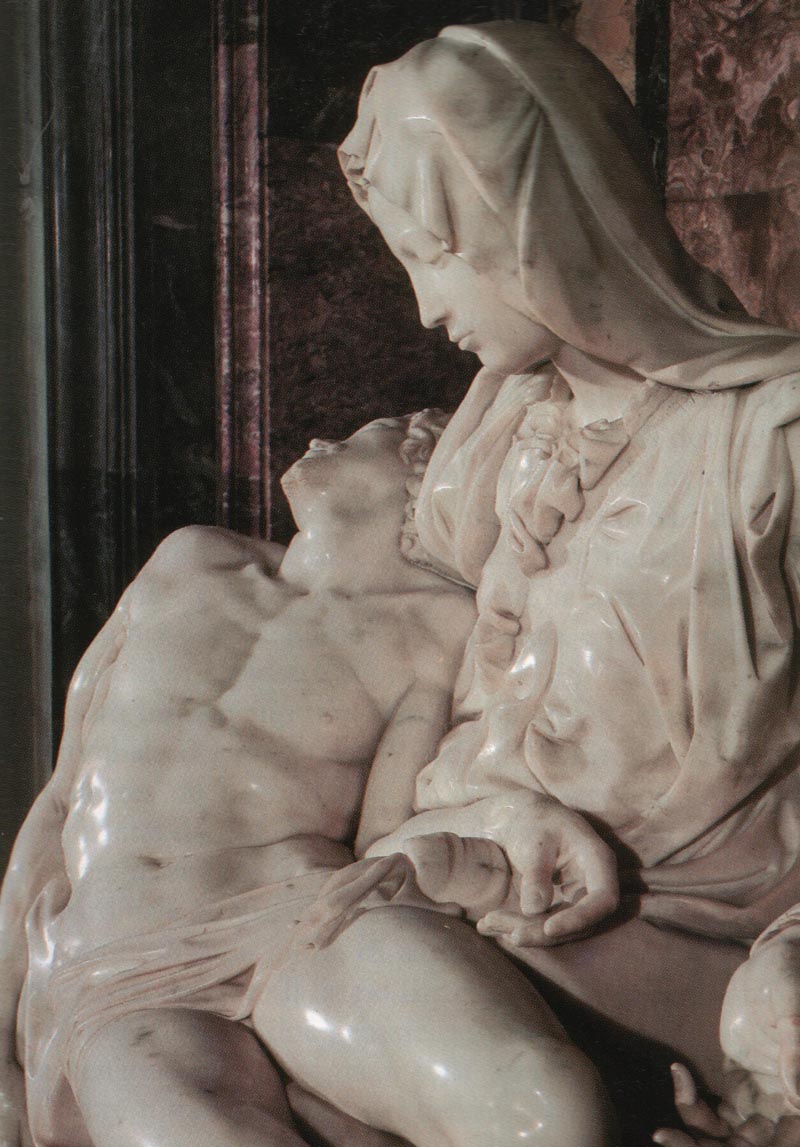
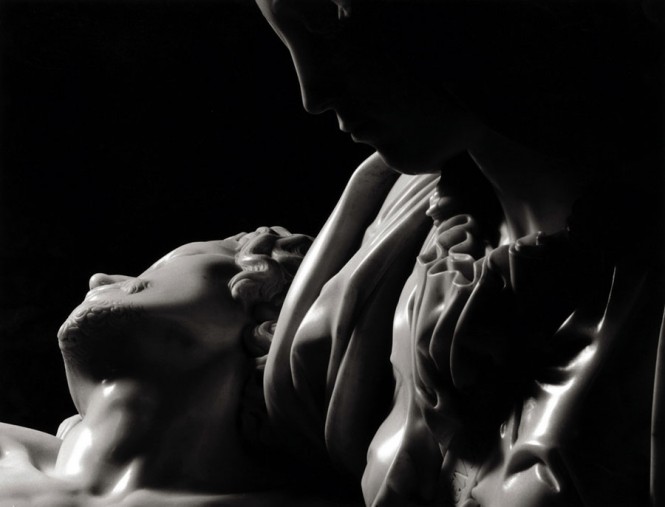
La Pietà of Michelangelo
Emmett Till’s mother speaking over the radio
She tells in a comforting voice what it was like to touch her dead boy’s face,
how she’d lingered and traced the broken jaw, the crushed eyes —
the face that badly beaten, disfigured — before confirming his identity.
And then she compares his face to the face of Jesus, dying on the cross.
This mother says, no, she’d not recognize her Lord, for he was beaten far, far worse
than the son she loved with all her heart. For, she said, she could still discern her son’s curved earlobe,
but the face of Christ was beaten to death by the whole world. ~Richard Jones “The Face” from Between Midnight and Dawn
May we remember today – Good Friday – of all days, the worst that can happen became the best that can happen.
We tussle and haggle over the price of what this cost us, but realizing He paid all for us makes an impossible loss possible.
We are paid in full, no longer debtors.
From now on, we recognize His face even when He is beaten unrecognizable: the worst became the best because He loves us over all else.
Detail from “Descent from the Cross” by Rogier van der Weyden
The world is charged with the grandeur of God. It will flame out, like shining from shook foil; It gathers to a greatness, like the ooze of oil Crushed. Why do men then now not reck his rod? Generations have trod, have trod, have trod; And all is seared with trade; bleared, smeared with toil; And wears man’s smudge and shares man’s smell: the soil Is bare now, nor can foot feel, being shod. And for all this, nature is never spent; There lives the dearest freshness deep down things; And though the last lights off the black West went Oh, morning, at the brown brink eastward, springs — Because the Holy Ghost over the bent World broods with warm breast and with ah! bright wings. ~Gerard Manley Hopkins “God’s Grandeur”
Today marks the crushing of Christ in the Garden of the Oil Press, Gethsemane.
“Gethsemane” means “oil press” –a place of olive trees treasured for the fine oil delivered from their fruit. And so, on this Thursday night, the pressure is turned up high on the disciples, not just on Jesus.
The disciples are expected, indeed commanded, to keep watch alongside the Master, to be filled with prayer, to avoid the temptation of weakened flesh thrown at them at every turn.
But they fail pressure testing and fall apart.
Like them, I am easily lulled by complacency, by my over-indulged satiety for material comforts that do not truly fill hunger or quench thirst, by my belief that being called a follower of Jesus is enough.
It is not enough. I fail the pressure test as well.
I fall asleep through His anguish. I dream, oblivious, while He sweats blood. I might even deny I know Him when pressed hard.
Yet, the moment of betrayal becomes the moment He is glorified, thereby God is glorified.
Crushed, bleeding, poured out over the world — from precious loving wings that brood and cover us — He becomes the sacrifice that anoints us.
Incredibly, indeed miraculously, He, the crushed, loves us, bent and flattened as we are – anyway.
Jerusalem, Jerusalem, you who kill the prophets and stone those sent to you, how often I have longed to gather your children together, as a hen gathers her chicks under her wings, and you were not willing. Luke 13:34
This Lenten season I reflect on the words of the 19th century southern spiritual hymn “What Wondrous Love is This”
One-Time
Monthly
Yearly
Make a one-time or recurring donation to support daily Barnstorming posts
Jesus comes near and he beholds the city And looks on us with tears in his eyes, And wells of mercy, streams of love and pity Flow from the fountain whence all things arise. He loved us into life and longs to gather And meet with his beloved face to face How often has he called, a careful mother, And wept for our refusals of his grace, Wept for a world that, weary with its weeping, Benumbed and stumbling, turns the other way, Fatigued compassion is already sleeping Whilst her worst nightmares stalk the light of day. But we might waken yet, and face those fears, If we could see ourselves through Jesus’ tears. ~Malcolm Guite “Jesus Weeps”
On this Holy Monday, facing ahead to a week of knowing our world is in disarray~ a week of facing our own shame and mortality, a week where thorns and tears overwhelm the blossoms~~
To remember what He did this week long ago, to conquer the shroud and the stone, to defy death, makes all the difference to me.
Indeed Jesus wept and groaned for us.
To be known for who we are by a God who weeps for our sin and despair and groans with pain we caused: we can know no greater love.
This week ends our living for self, only to die, and begins our dying to self, in order to live.
And when he drew near and saw the city, he wept over it, saying, “Would that you, even you, had known on this day the things that make for peace! But now they are hidden from your eyes. Luke 19:41
This Lenten season I reflect on the words of the 19th century southern spiritual hymn “What Wondrous Love is This”
Seems the sorrow untold, as you look down the road At the clamoring crowd drawing near Feel the heat of the day, as you look down the way Hear the shouts of Hosanna the King
Chorus Oh, daughter of Zion your time’s drawing near Don’t forsake Him, oh don’t pass it by On the foal of a donkey as the prophets had said Passing by you, He rides on to die
Come now little foal, though you’re not very old Come and bear your first burden bravely Walk so softly upon all the coats and the palms Bare the One on your back oh so gently
Midst the shouting so loud and the joy of the crowd There is One who is riding in silence For He knows the ones here will be fleeing in fear When their shepherd is taken away
Soon the thorn cursed ground will bring forth a crown And this Jesus will seem to be beaten But He’ll conquer alone both the shroud and the stone And the prophesies will be completed On the foal of a donkey as the prophets had said Passing by you He rides on to die ~Michael Card































 Barnstorming