At times these days I think of the way the sun would set on the farmland around our small house in the autumn.
A view of the horizon, the entire circle of it, if you turned, the sun setting behind you, the sky in front becoming pink and soft, then slightly blue again, as though it could not stop going on in its beauty, then the land closest to the setting sun would get dark, almost black against the orange line of the horizon, but if you turn around, the land is still available to the eye with such softness, the few trees, the quiet fields of cover crops already turned, and the sky lingering, lingering, then finally dark.
As though the soul can be quiet for those moments. All life amazes me. ~Elizabeth Strout, from My Name is Lucy Barton
I have learned, from those much wiser than I am, to recognize moments meant for quieting.
The news of the world constantly rushes past; there is suffering beyond imagining in the lives of a few I know well and for millions I don’t know at all.
What little can I do to make a difference? So much need lies beyond my short reach.
Instead of feeling abandoned on the shores of overwhelm, I seek out the familiar, the routine, and the ordinary, lingering immersed in the recurring patterns of the day and night as the world keeps on spinning on its axis.
I too turn around to witness that which surrounds me, and in so doing, my soul is quieted. And amazed.
One year ago, my teacher and mentor Jane Goodall passed into eternity, leaving behind this message for us all…
Mountains are giant, restful, absorbent. You can heave your spirit into a mountain and the mountain will keep it, folded, and not throw it back as some creeks will. The creeks are the world with all its stimulus and beauty; I live there. But the mountains are home. ~Annie Dillard from Pilgrim at Tinker Creek
He found himself wondering at times, especially in the autumn, about the wild lands, and strange visions of mountains that he had never seen came into his dreams.
He loved mountains, or he has loved the thought of them marching on the edge of stories brought from far away; but now he was borne down by the insupportable weight of Middle-earth. He longed to shut out the immensity in a quiet room by a fire. ~J.R.R. Tolkienfrom The Lord of the Rings
This time of year, we feel a call to drive up the highway an hour or so to witness grander things than our own worries or the chaos of yet another election season.
There is always that moment as we turn the bend into Heather Meadows when Mount Shuksan suddenly appears, overwhelming the landscape and everything and everyone else.
There is simply nothing else to look at so I stand there gawking, forgetting to breathe.
Then I realize that I become more self-conscious rather than less: here I am at the foot of this incredible creation, wondering at how blessed I am to be there; that moment becomes all about me. Yet the mountain has been here for eons and will continue to be here for eons. Just a mere blip in that continuum, I feel summoned.
We leave behind all the political divisiveness and drama and talking heads: up in the mountains there is such sheer stillness all around us – nary a breeze or a bird call or even a bug making ripples on the lakes to spoil the perfect reflection.
I bring these images back with me to remember that moment of awestruck witness. The photographic image isn’t the real mountain or the pristine perfect reflection. Yet it means I was privileged to watch this mountain watching me back, welcoming me home.
The sweetest thing in all my life has been the longing — to reach the Mountain, to find the place where all the beauty came from — my country, the place where I ought to have been born. Do you think it all meant nothing, all the longing? The longing for home? For indeed it now feels not like going, but like going back. ~ C. S. Lewis from Till We Have Faces
One-Time
Monthly
Yearly
Make a one-time or recurring donation to support daily Barnstorming posts
Fifteen years ago today, family and friends lost Jenny Rausch to eternity. She is someone we will never forget and I want to share a bit about what she taught me, but also direct you to a page of her wit and wisdom — some wonderful horse stories she had written over the years.
I spent this morning adjusting to this change in season by occupying myself with the familiar task of moving manure. Cleaning barn is a comforting chore, allowing me to transform tangible benefit from something objectionable and just plain stinky to the nurturing fertilizer of the future. It feels like I’ve actually accomplished something.
As I scooped and pushed the wheelbarrow, I remembered another barn cleaning over two decades ago, when I was one of three or four friends left cleaning over ninety stalls after a Haflinger horse event that I had organized at our local fairgrounds. Some people had brought their horses from over 1000 miles away to participate for several days. Whenever horse people gather, there were inevitable personality clashes and harsh words among some participants along with criticism directed at me that I had taken very personally.
As I struggled with the umpteenth wheelbarrow load of manure, tears stung my eyes and my heart. I was miserable with regrets over people not getting along. My work did not feel worth the pain I was feeling.
My friend Jenny Rausch had stayed behind with her family to help clean up the large facility and she could see I was struggling to keep my composure. Jenny put herself right in front of my wheelbarrow and looked me in the eye, insisting I stop for a moment and listen.
“You know, none of these troubles and conflicts will amount to a hill of beans years from now. People will remember a fun event in a beautiful part of the country, a wonderful time with their horses, their friends and family, and they’ll be all nostalgic about it, not giving a thought to the infighting or the sour attitudes or who said what to whom.
So don’t make this about you and whether you did or didn’t make everyone happy. You loved us all enough to make it possible to meet here and the rest was up to us. So quit being upset about what you can’t change. There’s too much you can still do for us.”
And then she gave me a hug that I will always cherish.
During tough times which have come often in my professional life, including the difficult and controversial decisions I had to make during the COVID pandemic, Jenny’s advice replays in my mind, reminding me to stop seeking appreciation from others, or feeling hurt when harsh words come my way.
None of these things amount to a hill of beans now…
She was right about the balm found in the tincture of time. She was right about giving up being upset in order to die to myself and my self-absorption, to keep focusing outward rather than inward.
Jenny, I have remembered what you said even though at times I relapse and forget.
A few years after that day in the barn, Jenny herself spent six years vigorously living her life every day while treating a relentless cancer. The tumor spread was initially slowed in the face of her faith and intense drive to live. Over time though, she became a rusting leaf, fading imperceptibly, crumbling at the edges until she finally let go.
Her dying on this day twelve years ago did not flash brilliance, nor draw attention at the end. Her intense focus during the years of her illness had always been outward to others, to her family and friends, to the numerous healers she spent so much time with in medical offices, to her belief in the plan God had written for her and others.
Despite her intense love for her husband and young children, she let go her hold on life here. And we all had to let her go.
Brilliance cloaks you as your focus is now on things eternal.
You were so right, Jenny. Conflicts from twenty-five years ago surely haven’t amounted to a hill of beans; all is remembered fondly by those who were part of the gathering. I especially treasure the words you wisely spoke to me as they have helped me through other tough times when I tend to focus on nurturing my own hurt feelings.
Bathing in the hurt never helps…
And I’m no longer upset that I can’t change the fact that you have left us. There is still so much you continue to do for us by staying alive in our memories. We won’t forget what you have said and written.
And so it goes… I know we’ll catch up later.
Jenny R –photo by Ginger Kathleen Coombs
…to love life, to love it even when you have no stomach for it and everything you’ve held dear crumbles like burnt paper in your hands, your throat filled with the silt of it. When grief sits with you, its tropical heat thickening the air, heavy as water more fit for gills than lungs; when grief weights you like your own flesh only more of it, an obesity of grief, you think, How can a body withstand this? Then you hold life like a face between your palms, a plain face, no charming smile, no violet eyes, and you say, yes, I will take you I will love you, again. — Ellen Bass “The Thing Is…” from Mules of Love
In the high woods that crest our hills, Upon a steep, rough slope of forest ground, Where few flowers grow, sweet blooms today I found Of the Autumn Crocus, blowing pale and fair. Dim falls the sunlight there; And a mild fragrance the lone thicket fills.
Languidly curved, the long white stems Their purple flowers’ gold treasure scarce display: Lost were their leaves since in the distant spring,
Their February sisters showed so gay. Roses of June, ye too have followed fleet! Forsaken now, and shaded as by thought, As by the human shade of thought and dreams, They bloom ‘mid the dark wood, whose air has wrought With what soft nights and mornings of still dew! Into their slender petals that clear hue, Like paleness in fresh cheeks; a thing On earth, I vowed, ne’er grew More delicately pure, more shyly sweet.
Child of the pensive autumn woods! So lovely, though thou dwell obscure and lone, And though thy flush and gaiety be gone; Say, among flowers of the sad, human mind, Where shall I ever find So rare a grace? in what shy solitudes? ~Robert Laurence Binyon “Autumn Crocus”
The late September emergence of autumn crocus is always sudden, rising up near the equinox in the shade of spent peony bushes.
These rare blooms: tall, tender, bold, and frail, their incubation triggered by retreating light from above, unlike their springtime cousins emerging through melting snow.
The autumn crocus waits with thoughtful temerity, summoned forth from the soil to remind us the end of summer is not the end of them or us.
A luminous gift of hope and beauty borne from a humble bulb; plain and only soil-adorned.
Slowly unfurling on a pale leggy stem, the tender lavender petals peel back to reveal golden crowns of saffron, brazenly blooming when all else is dying back.
Vulnerable to blustery wind and heavy rains, they easily wilt, crushed, deeply bruised purple – under the Sun’s reflection made manifest; returning defeated, inglorious, fallen, to dust.
Yet we know – they remind us: they (and we) will rise again.
…we know what is coming behind the crocus. The spring comes slowly down this way; but the great thing is that the corner has been turned. . . It remains with us to follow or not, to die in this winter, or to go on into that spring and that summer. C.S. Lewis from God in the Dock
One-Time
Monthly
Yearly
Make a one-time or recurring donation to support daily Barnstorming posts
From steady rain we step to sheltered ground in the dark cathedral of the barn, breathe in scents of damp wood and hay, assume a reverent stillness. The dog, with the sudden confidence of one engaged, at last, in good work, trots through the barn’s far doorway heading seven white-faced ewe lambs. Not knowing me, they halt, uncertain, until you smoothly bucket corn from storage to trough, and they— as sheep will—follow where hunger leads. Hard teeth crack dry kernels in percussive counterpoint, a muted consort mimicking the fall of winter rain on wooden shingles. In entiring darkness, we stand, until from your post beneath the hayloft beams, you turn to me, grinning, and say, That’s a good sound. And it is. ~Brian Volck “Visiting”
Every now and then, I forget to turn off the lights in the barn. I usually notice just before I go to bed, when the farm’s boundaries seem to have drawn in close. That light makes the barn seem farther away than it is — a distance I’m going to have to travel before I sleep. The weather makes no difference. Neither does the time of year.
Usually, after turning out that forgotten barn light, I sit on the edge of the tractor bucket for a few minutes and let my eyes adjust to the night outside. City people always notice the darkness here, but it’s never very dark if you wait till your eyes owl out a little….I’m always glad to have to walk down to the barn in the night, and I always forget that it makes me glad. I heave on my coat, stomp into my barn boots and trudge down toward the barn light, muttering at myself. But then I sit in the dark, and I remember this gladness, and I walk back up to the gleaming house, listening for the horses. ~Verlyn Klinkenborg from A Light in the Barn
…let me live in a small room up the narrow stairs from the stalls, the horse shifting comfortably below, browsing and chewing sweet hay. A single bed with blanket the color of factory-sweepings will suffice, each day shaped to the same arc, because days can only end when the lock slides free on the stall’s Dutch door, and I lead the horse in, then muscle the corroded bolt shut. That’s what days are for: I cannot rest until the horse comes home. ~Julie Bruck from “To Bring the Horse Home”
The best moment in the barn is in the evening just following the hay feeding, as the animals are settling down to some serious chewing. I linger in the center aisle, listening to the rhythmic sounds coming from their stalls. It is a most soothing contented cadence, first their lips picking up the grass, then the chew chew chew chew and a pause and it starts again. It’s even better in the dark, with the lights off.
In the past, I’ve enjoyed listening to the eating sounds at night from the remote vantage point of my bedroom TV monitor system set up to watch my very pregnant mares before foaling. A peculiar lullaby of sorts, strange as that seems, but when all my farm animals are chewing and happy, I am at peace and sleep better.
It reminds me of those dark deep nights of feeding my own newborns, rocking back and forth with the rhythm of their sucking. It is a moment of being completely present and peaceful, and knowing at that moment, nothing else matters–nothing else at all.
If I am very fortunate, each day I live has a rhythm that is reassuring and steady, like the sounds of hay chewing, or rocking a baby. I awake thinking about where my next step will bring me, and then the next, like each chew of sweet hay.
I try to live in communion, without distraction by the worry of the unknown.
But the reality is: life’s rhythms are often out of sync, the cadence is jarring, the sounds are discordant, sometimes I’m the one being chewed on, so pain replaces peacefulness.
Maybe that is why this lullaby in the barn~~this sanctuary~~is so treasured, the chosen place of Jesus’ birth. It brings me home to that doubting center of myself that needs reminding that struggle is fleeting, and peace, however elusive now, is forever. I always know where to find it for a few minutes at the end of every day, in a pastoral symphony of sorts.
Someday my hope for heaven will be angel choruses of glorious praise, augmenting a hay-chewing lullaby.
So simple yet so very, very good.
TEXT O magnum mysterium, et admirabile sacramentum, ut animalia viderent Dominum natum, iacentem in praesepio! Beata Virgo, cujus viscera meruerunt portare Dominum Iesum Christum. Alleluia!
TRANSLATION O great mystery, and wonderful sacrament, that animals should see the newborn Lord, lying in a manger! Blessed is the virgin whose womb was worthy to bear the Lord, Jesus Christ. Alleluia!
One-Time
Monthly
Yearly
Make a one-time or recurring donation to support daily Barnstorming posts
You can die for it- an idea, or the world. People have done so, brilliantly, letting their small bodies be bound to the stake, creating an unforgettable fury of light. But this morning, climbing the familiar hills in the familiar fabric of dawn, I thought of China, and India and Europe, and I thought how the sun blazes for everyone just so joyfully as it rises under the lashes of my own eyes, and I thought I am so many! What is my name? What is the name of the deep breath I would take over and over for all of us? Call it whatever you want, it is happiness, it is another one of the ways to enter fire. ~Mary Oliver “Sunrise”
Over the years, I have not missed many early autumn sunrises – most I have not recorded as they are often gray and rainy.
This particular day of September – the 24th – has been a treasure trove of color and cloud patterns and light for the last 12 years. Today I share these with you in their variety and beauty.
Every day, let us watch the sun rise with its light under our eyelashes – the fire of happiness illuminating us all as morning breaks open, like the First Day.
9/24/17 9/24/169/24/159/24/149/24/26 6:53 AM
One-Time
Monthly
Yearly
Make a one-time or recurring donation to support daily Barnstorming posts
Summer ends now; now, barbarous in beauty, the stooks rise Around; up above, what wind-walks! what lovely behaviour Of silk-sack clouds! has wilder, wilful-wavier Meal-drift moulded ever and melted across skies?
I walk, I lift up, I lift up heart, eyes, Down all that glory in the heavens to glean our Saviour; And eyes, heart, what looks, what lips yet give you a Rapturous love’s greeting of realer, of rounder replies?
And the azurous hung hills are his world-wielding shoulder Majestic – as a stallion stalwart, very-violet-sweet! – These things, these things were here and but the beholder Wanting; which two when they once meet, The heart rears wings bold and bolder And hurls for him, O half hurls earth for him off under his feet. ~Gerard Manley Hopkins “Hurrahing in Harvest”
This poem is (in Hopkin’s own words) “the outcome of half an hour of extreme enthusiasm as I walked home alone one day from fishing in the [River] Elwy.”
This afternoon was the colour of water falling through sunlight; The trees glittered with the tumbling of leaves; The sidewalks shone like alleys of dropped maple leaves, And the houses ran along them laughing out of square, open windows. Under a tree in the park, Two little boys, lying flat on their faces, Were carefully gathering red berries To put in a pasteboard box.
Some day there will be no war, Then I shall take out this afternoon And turn it in my fingers, And remark the sweet taste of it upon my palate, And note the crisp variety of its flights of leaves. To-day I can only gather it And put it into my lunch-box, For I have time for nothing But the endeavour to balance myself Upon a broken world. ~Amy Lowell from “September 1918”
There is no point in seeing without responding; there is no way to respond without seeing.
Christian life and practice require both faith (the sight of the heart) and works (the lurch of the heart toward him in obedience). ~Kathleen Mulhern from “A Christ Sighting” from Dry Bones
Am I the only one who awoke this morning praying today might be a day of healing between peoples, when the barbarous becomes beautiful and we seek to become balanced rather than broken?
A day of no drone missiles being launched, no threats of annihilation and winner takes all, no one gunned down in the street, no vehicles used as weapons, no harsh and angry words spoken, no child misused, no one sold into slavery, no one overdosing, abandoned, homeless and starving.
Am I the only one who awakes and only seeks to watch the clouds to praise the heavens to see the leaves turn color to take out this one day and taste it and find that it is good, then put it away for self-keeping to share when and if I find someone else as hungry for grace and mercy as I am,
so as to balance myself somehow in the beauty of this world while teetering on its brokenness?
The songs of small birds fade away into the bushes after sundown, the air dry, sweet with goldenrod. Beside the path, suddenly, bright asters flare in the dusk. The aged voices of a few crickets thread the silence. It is a quiet I love, though my life too often drives me through it deaf. Busy with costs and losses, I waste the time I have to be here—a time blessed beyond my deserts, as I know, if only I would keep aware. The leaves rest in the air, perfectly still. I would like them to rest in my mind as still, as simply spaced. As I approach, the sorrel filly looks up from her grazing, poised there, light on the slope as a young apple tree. A week ago I took her away to sell, and failed to get my price, and brought her home again. Now in the quiet I stand and look at her a long time, glad to have recovered what is lost in the exchange of something for money. ~Wendell Berry “The Sorrel Filly”
I am reminded at summer’s end — when it is already dark and chores not done yet, and horses waiting to be fed — of the value of decades of moments spent with long-lashed eyes, wind-swept manes, and velvet muzzles.
True, it appears to others to be time and money wasted. But for a farmer like me, sometimes deaf and blind to what is in front of me every day, not all valuables are preserved in a lock box or a bank account.
Golden treasure can have four hooves, a tail, a rumbling greeting asking if I’d somehow gotten lost since I’m a little later than usual and they were a bit concerned I’d forgotten them.
If only I would keep aware, remember where my home is, how easy it is to wander from the path that somehow always leads me back here.
One-Time
Monthly
Yearly
Make a one-time or recurring donation to support daily Barnstorming posts
Now among those who went up to worship at the feast were some Greeks. So these came to Philip, who was from Bethsaida in Galilee, and asked him, “Sir, we would like to see Jesus.” Philip went and told Andrew; Andrew and Philip went and told Jesus.
And Jesus answered them, “The hour has come for the Son of Man to be glorified. Truly, truly, I say to you, unless a grain of wheat falls into the earth and dies, it remains alone; but if it dies, it bears much fruit. Whoever loves his life loses it, and whoever hates his life in this world will keep it for eternal life. If anyone serves me, he must follow me; and where I am, there will my servant be also. If anyone serves me,the Father will honor him. John 12: 20-26
There was once in man a true happiness of which there now remain to him only the mark and empty trace, which he in vain tries to fill from all his surroundings, seeking from things absent the help he does not obtain in things present.
But these are all inadequate, because the infinite abyss can only be filled by an infinite and immutable object, that is to say, only by God Himself. ~Blaise Pascal from Pensees
You have made us for yourself, O Lord, and our heart is restless until it rests in you. ~Augustine of Hippo from Confessions
The sacred moments, the moments of miracle, are often the everyday moments, the moments which, if we do not look with more than our eyes or listen with more than our ears reveal only… a gardener, a stranger coming down the road behind us, a meal like any other meal. But if we look with our hearts, if we listen with all our being and imagination… what we may see is Jesus himself. ~Frederick Buechner from The Magnificent Defeat
“Sir, we would like to see Jesus.”
I thought our old church pulpit was the only one to have a plaque with John 12:21 attached to it — a clear reminder to anyone standing there, preparing to speak. I learned this verse has traditionally graced pulpits through the generations, encouraging preachers and listeners to work together to clear the obscuring fog to find the Messiah.
Jesus is not hidden from us; indeed, we are heart-blind most of the time, so wrapped in our own worries and troubles that we do not know where to look or who to ask to help us see Him.
It is through the preaching and sharing of God’s Word that the heart veil is lifted. To those Gentiles who wanted to see the man they had heard about, Jesus tells them what must come next: He must die, like a seed in the ground, in order to be glorified. We see Him in ways and places we could never have imagined, especially hanging on the cross in our place.
As we restlessly seek to clear the fog and fill what is empty within us, we must keep our eyes open wide, listening with all our being, our hearts at the ready, every moment.
He is already here, right where we are, always beside us.
We would see Jesus, for the shadows lengthen Across this wanting visage of our life; We would see Jesus, our weak faith to strengthen For the last weariness, the final strife.
We would see Jesus, the great rock foundation Whereon our feet were set by sov’reign grace; Nor life nor death, with all their agitation, Can thence remove us, if we see His face.
We would see Jesus: this is all we’re needing; Strength, joy, and willingness come with the sight; We would see Jesus, dying, risen, pleading; Then welcome day, and farewell mortal night. ~Anna Bartlett Warner “We Would See Jesus”
I am reading slowly through the words in the Book of John over the next year alongside my church family. Once a week, I will invite you to “come and see” what those words might mean as we explore His promises together.
One-Time
Monthly
Yearly
Make a one-time or recurring donation to support daily Barnstorming posts
The meaning of marriage begins in the giving of words. We cannot join ourselves to one another without giving our word. And this must be an unconditional giving, for in joining ourselves to one another we join ourselves to the unknown. ~Wendell Berry from “Poetry and Marriage” in Standing By Words
Our vows to one another forty-five years ago today:
Before God and this gathering, I vow from my heart and spirit that I will be your wife/husband for as long as we both shall live.
I will love you with faithfulness, knowing its importance in sustaining us through good times and bad.
I will love you with respect, serving your greatest good and supporting your continued growth.
I will love you with compassion, knowing the strength and power of forgiveness.
I will love you with hope, remembering our shared belief in the grace of God and His guidance of our marriage.
“And at home, by the fire, whenever you look up, there I shall be–and whenever I look up, there will be you.”
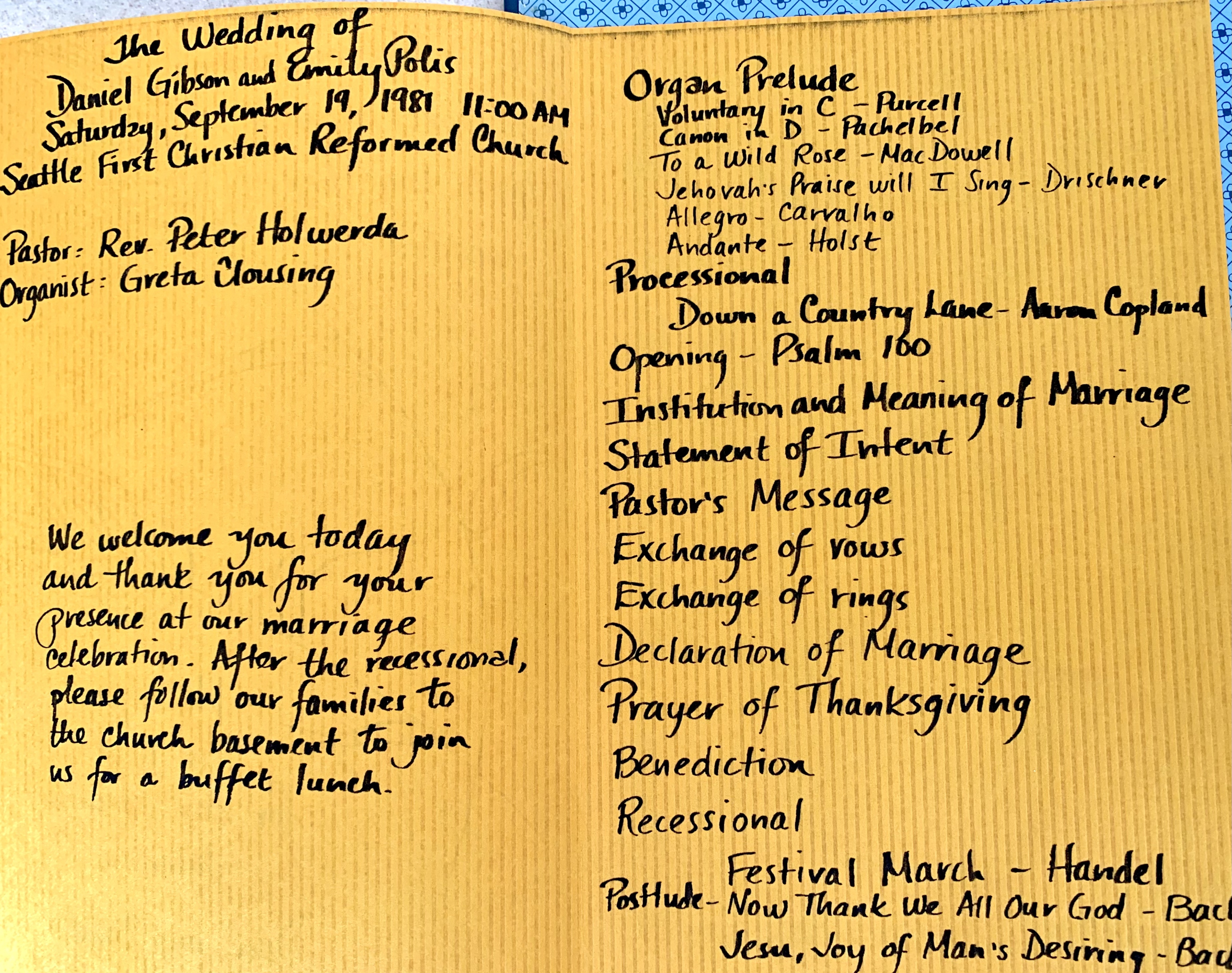
(our wedding vows for our September 19, 1981 wedding at First Seattle Christian Reformed Church — the last line adapted from Thomas Hardy’s “Far From the Madding Crowd”)
Sometimes our life reminds me of a forest in which there is a graceful clearing and in that opening a house, an orchard and garden, comfortable shades, and flowers red and yellow in the sun, a pattern made in the light for the light to return to. The forest is mostly dark, its ways to be made anew day after day, the dark richer than the light and more blessed, provided we stay brave enough to keep on going in.
We enter, willing to die, into the commonwealth of its joy. ~Wendell Berry from “A Country of Marriage”
…Marriage… joins two living souls as closely as, in this world, they can be joined. This joining of two who know, love, and trust one another brings them in the same breath into the freedom of sexual consent and into the fullest earthly realization of the image of God. From their joining, other living souls come into being, and with them great responsibilities that are unending, fearful, and joyful. The marriage of two lovers joins them to one another, to forebears, to descendants, to the community, to heaven and earth. It is the fundamental connection without which nothing holds, and trust is its necessity. ~Wendell Berry from Sex, Economy, Freedom and Community
We married forty-five years ago today in our Seattle church with Pastor Peter Holwerda officiating, with a small group of family and friends as witnesses.
It was a wedding of two frugal people with little to spend – I sewed my dress and Dan’s shirt from muslin, we grew our own flowers, our families helped potluck the lunch afterward and our tiered carrot cake was made by a friend.
Yet our vows to one another were not frugal and held nothing back. They were extravagant and comprehensive, coming from our hearts and spirits. The music we asked our amazing organist to play (versions below) inspired us by its simplicity and complexity – very much like the families that raised us and the God we worship.
Our vows have taken us from the city to the countryside, to the raising and rejoicing in three amazing children and now soon to be seven grandchildren. We served more than forty years as a public-employed attorney and physician. We have laid down those responsibilities, and picked up the tools of farm and garden along with church and community service for as long as we are able.
We treasure each day of living together in faithfulness, respect, compassion and hope – knowing that how we love and find joy in one another mirrors how God loves and revels in His people.
We pray for many more days to fill us with what endures.
I want to remember us this way— late September sun streaming through the window, bread loaves and golden bunches of grapes on the table, spoonfuls of hot soup rising to our lips, filling us with what endures. ~Peter Pereira from “A Pot of Red Lentils”
Here are versions of the organ music we selected for prelude, processional, recessional and postlude