She wasn’t looking when they took this picture: sitting on the grass in her bare feet wearing a cotton dress, she stares off to the side watching something on the lawn the camera didn’t catch. What was it? A ladybug? A flower? Judging from her expression, possibly nothing at all, or else the lawn was like a mirror, and she sat watching herself, wondering who she was and how she came to be there sitting in this backyard, wearing a cheap, white dress, imagining that tomorrow would be like all her yesterdays, while her parents chatted and watched, as I do years later, too distantly to interfere. ~Dana Gioia, “Photograph of My Mother as a Young Girl” from Daily Horoscope
Seeing photos of ancestors a century past
is like looking at your own fingerprints—
circles and lines you can’t recognize
until someone else with a stranger’s eye looks close and says that’s you. ~Joseph Bruchac, “Prints” from Sing: Poetry from the Indigenous Americas.
Growing up, it was never obvious to me that I looked like either one of my parents. Once, as a naughty kid, I told them I thought I was adopted as there wasn’t a single photo to be found of my mother looking pregnant (never mind that few women in the 50’s allowed themselves to be photographed pregnant).
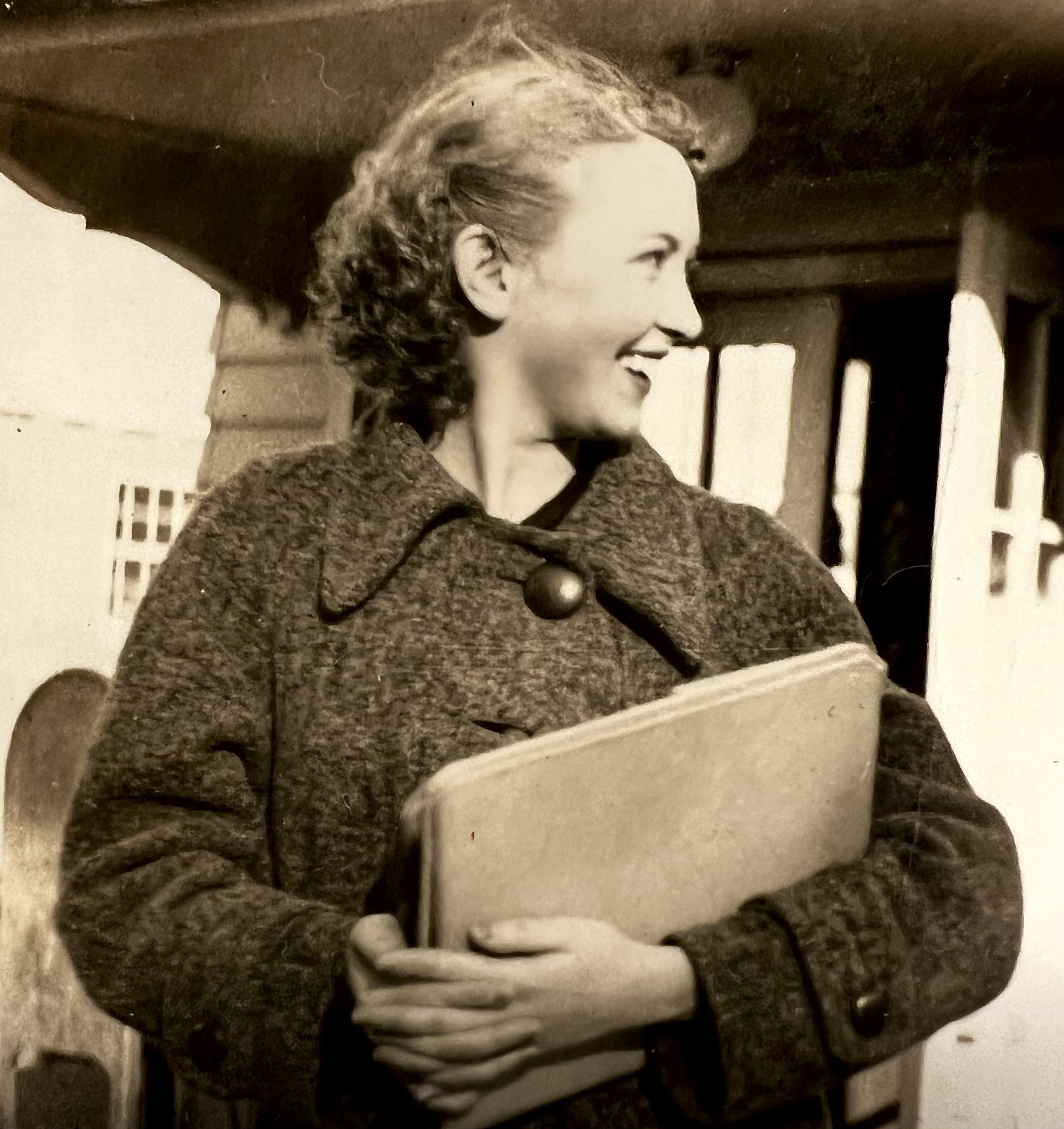
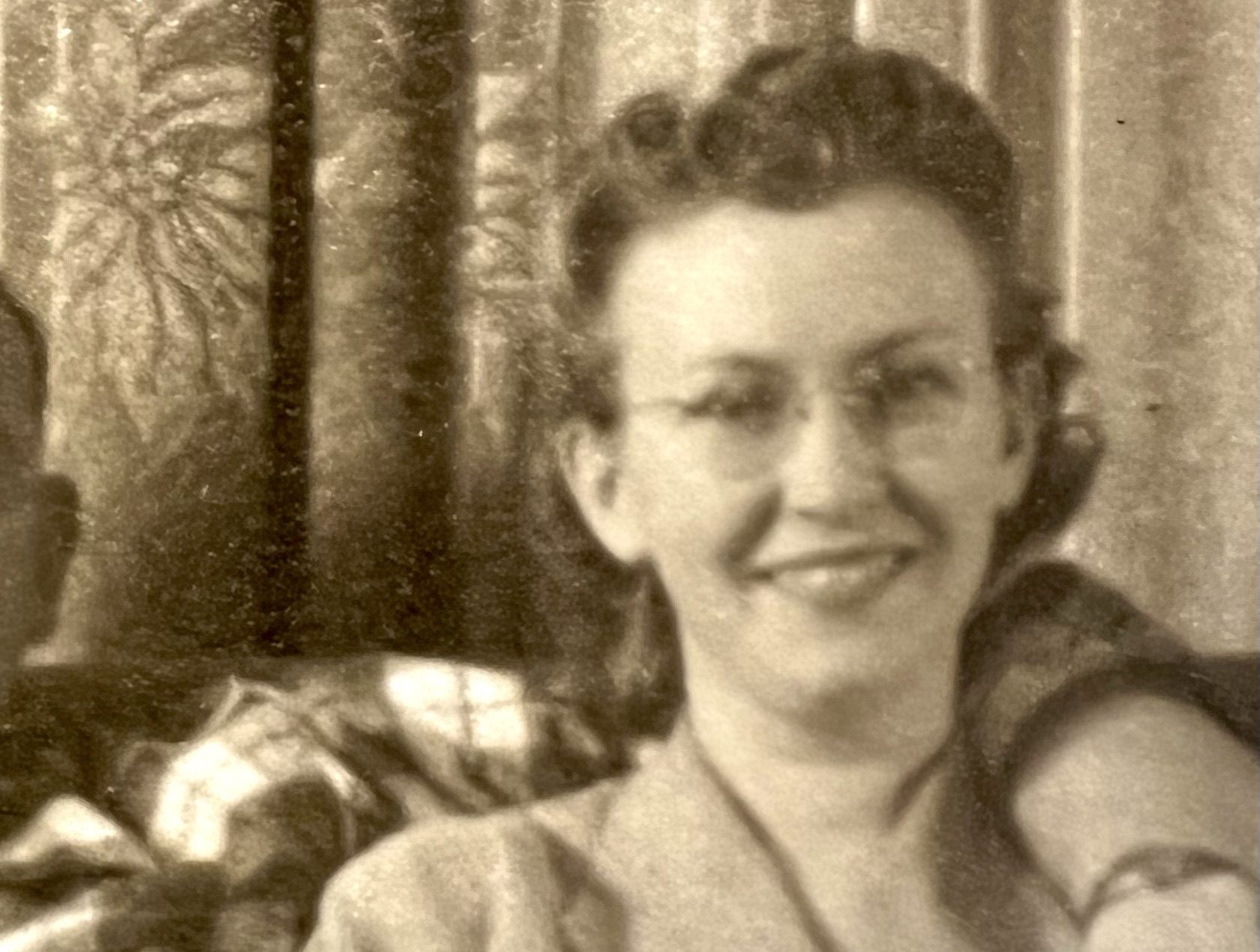
Searching the faces of extended family in old photographs, others would comment on the facial similarities between my young mother and me.
And indeed, the older I have become, the more I see my mother looking back at me in the mirror.
The characteristics I inherited from my father aren’t as obvious in the mirror: his persistence and problem-solving, his inability to ever fully relax, his drive to get things done and not give up.
So, yes, that is me in the photos of my mother taken nearly a century ago, as well as those taken not so long ago.
I now recognize me in those photos, grateful to resemble such a loving and lovely mom.
One-Time
Monthly
Yearly
Make a one-time or recurring donation to support daily Barnstorming posts
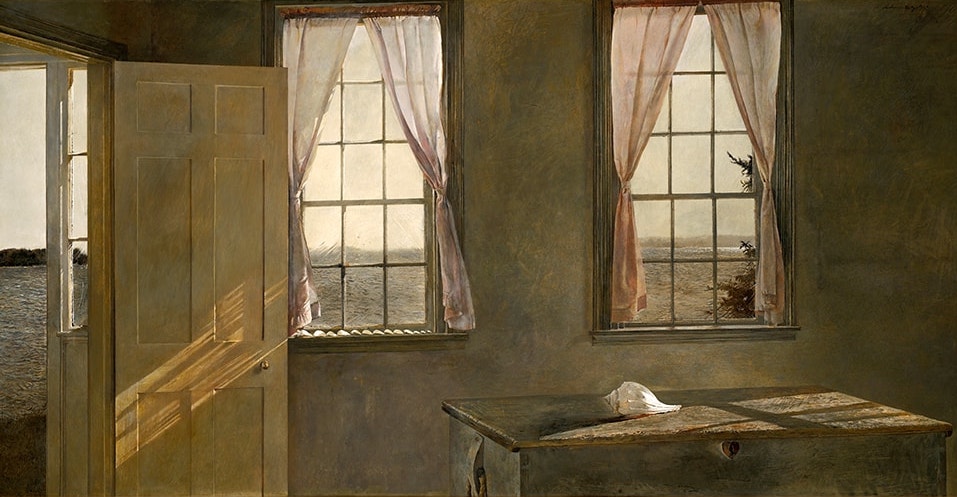
Needing them still, I come when I can, this time to the sea where we share a room: their double bed, my single. Morning fog paints the pale scene even paler. Lace curtains breathing, the chenille spread folded back, my father’s feet white sails furled at the edge of blue pajamas. Every child’s dream, a parent in each hand, though this child is fifty. Their bodies fit easily, with room to spare. When did they grow so small? Grow so small— as if it were possible to swell backwards into an earlier self.
“Her Room” by Andrew Wyeth in the Farnsworth Art Museum
My parents have been gone now for some time, my father 30 years, my mother, nearly 17 years. Their dying was a long process of counted breaths and pauses. I witnessed their bodies curling into themselves, shrinking smaller, worn down by illness and age.
I still miss them as I’m reminded of them by the events of my own life, still wanting them to take me by the hand as I navigate my own daily path.
After mom’s death, those possessions not distributed to family members have remained packed up and stored in our barn buildings. I know it is well past time to deal with their stuff as I become keenly aware of my own graying and aging.
In the house, next to where I write, is a box of over 500 letters written by my mother and father between 1941 and 1945. The letters began as they were getting to know each other at college, going from “pinned” to “engaged” and continue for three and a half more years after a hurried wedding Christmas Eve 1942. By mid-January 1943, my newly minted Marine officer father shipped out to spend the next three years of his life fighting on the battlefields of Saipan, Tinian and Tarawa in the Pacific Ocean, not to return again to the states until late summer of 1945.
My mother wrote her letters from the small rural eastern Washington community of Colville, living in a “teachers’ cottage” with other war wives who taught school while waiting for their husbands to return home – or not.
It took me a decade to find the courage and time to devote to reading these letters they treasured and never threw away. I sorted them unopened by postmark date into some semblance of order and sat down to start at the very beginning, which, of course, is my beginning as well. I opened each one with some trepidation and a lump in my throat about what I might find written there. I worried I may find things I didn’t want to know. I hoped I would find things that I desperately needed to know.
Most of all I wanted to understand the two people who became my parents within the coiled shell of their forty years together, though broken by a painful divorce which lasted a decade. Having lived through that awful time with them, I want to understand the origin of a love which eventually mended their cracked shell of companionship, gluing them back together for five more years before my father died.
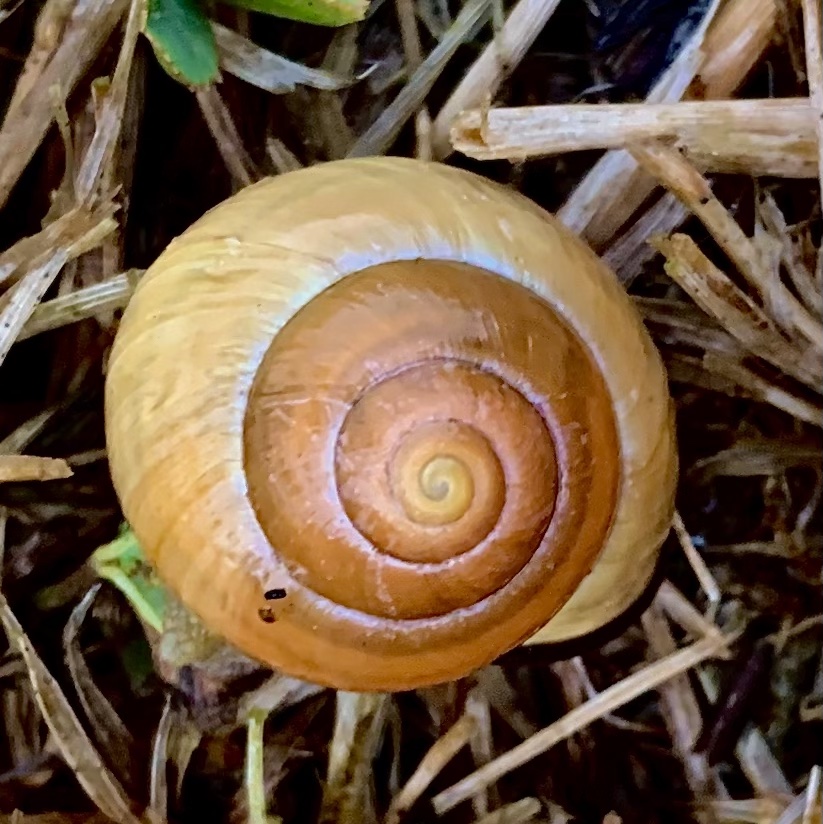
As I ponder their words, I too cross a bridge back to them both, my ear pressed to the coiled shell of those fading voices, as if I might still hear the sea, at times bringing them closer, then pulling them farther away.
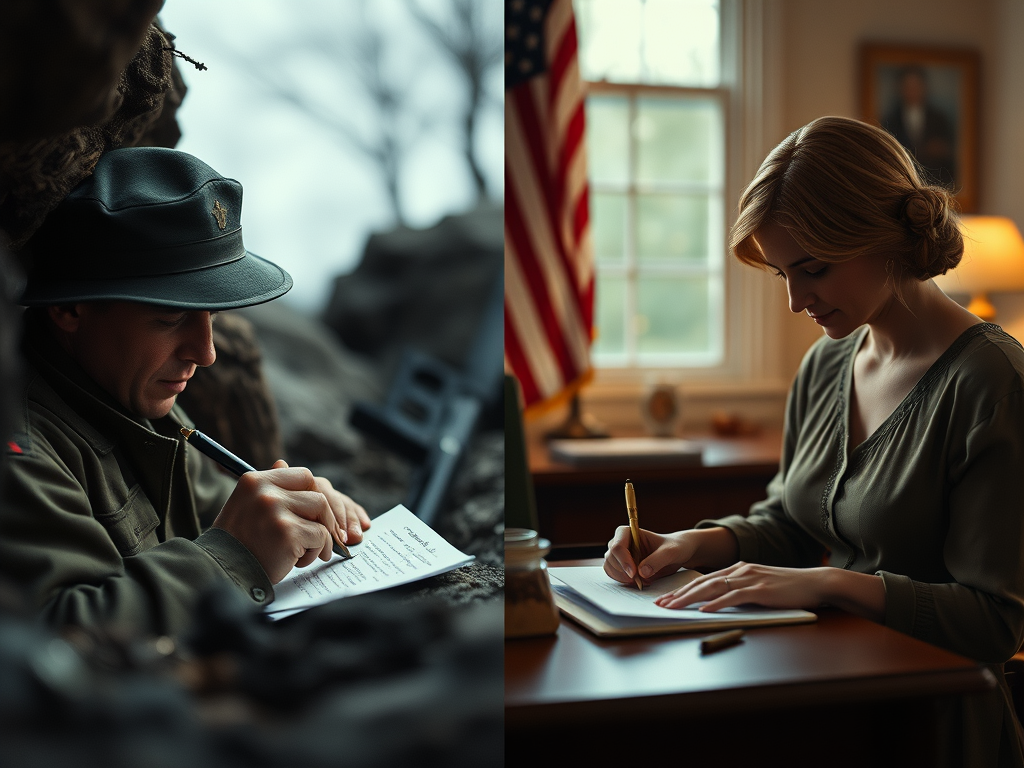
AI image created for this post
One-Time
Monthly
Yearly
Make a one-time or recurring donation to support daily Barnstorming posts
My father taught me how to eat breakfast those mornings when it was my turn to help him milk the cows. I loved rising up from
the darkness and coming quietly down the stairs while the others were still sleeping. I’d take a bowl from the cupboard, a spoon
from the drawer, and slip into the pantry where he was already eating spoonfuls of cornflakes covered with mashed strawberries
from our own strawberry fields forever. Didn’t talk much—except to mention how good the strawberries tasted or the way
those clouds hung over the hay barn roof. Simple—that’s how we started up the day. ~Joyce Sutphen, “Breakfast” from First Words, Red Dragonfly.
By the time I was four years old, my family owned several Guernsey and Jersey dairy cows my father milked by hand twice a day. My mother pasteurized the milk on our wood stove and we grew up drinking the best milk on earth, as well as enjoying home-made butter and ice cream.
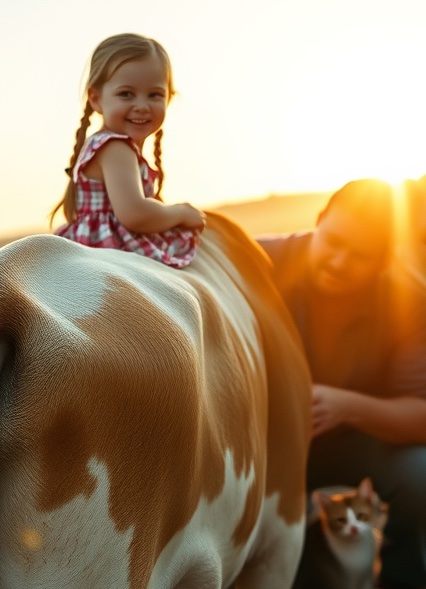
One of my fondest early memories is getting up early with my dad, before he needed to be at school teaching FFA agriculture students (Future Farmers of America). I would eat breakfast with him and then walk out into the foggy fall mornings with our dog to bring in the cows for milking. He would boost me up on top of a very bony-backed chestnut and white patchwork cow while he washed her udder and set to work milking.
I would sometimes sing songs from up there on my perch and my dad would whistle since he didn’t sing.
I can still hear the rhythmic sound of the milk squirting into the stainless steel bucket – the high-pitched metallic whoosh initially and then a more gurgling low wet sound as the bucket filled up. I can see my dad’s capped forehead resting against the flank of the cow as he leaned into the muscular work of squeezing the udder teats, each in turn. I can hear the cow’s chewing her breakfast of alfalfa and grain as I balanced on her prominent spine feeling her smooth hair over her ribs. The barn cats circulated around us, mewing, attracted by the warm milky fragrance in the air.
Those were preciously simple starts to the day for me and my father, whose thoughts he didn’t articulate nor I could ever quite discern. But I did know I wasn’t only his daughter on mornings like that – I was one of his future farmers of America he dedicated his life to teaching.
Dad, even without you saying much, those were mornings when my every sense was awakened. I’ve never forgotten that- the best start to the day.
AI image created for this post
One-Time
Monthly
Yearly
Make a one-time or recurring donation to support daily Barnstorming posts
In the quiet misty morning When the moon has gone to bed, When the sparrows stop their singing And the sky is clear and red, When the summer’s ceased its gleaming When the corn is past its prime, When adventure’s lost its meaning – I’ll be homeward bound in time
Bind me not to the pasture Chain me not to the plow Set me free to find my calling And I’ll return to you somehow
If you find it’s me you’re missing If you’re hoping I’ll return, To your thoughts I’ll soon be listening, And in the road I’ll stop and turn Then the wind will set me racing As my journey nears its end And the path I’ll be retracing When I’m homeward bound again
Bind me not to the pasture Chain me not to the plow Set me free to find my calling And I’ll return to you somehow
In the quiet misty morning When the moon has gone to bed, When the sparrows stop their singing I’ll be homeward bound again. ~Marta Keen “Homeward Bound”
Eighty-two years ago, my parents married on Christmas Eve. It was not a conventional wedding day but a date of necessity, only because a justice of the peace was available to marry a score of war-time couples in Quantico, Virginia, shortly before the newly trained Marine officers were shipped out to the South Pacific to fight in WWII.
When I look at my parents’ young faces – ages 22 and just turned 21 — in their only wedding portrait, I see a hint of the impulsive decision that led to that wedding just a week before my father left for 30 months. They had known each other at college for over a year, had talked about a future together, but with my mother starting a teaching job in a rural Eastern Washington town, and the war potentially impacting all young men’s lives very directly, they had not set a date.
My father put his college education on hold to enlist, knowing that would give him some options he wouldn’t have if drafted, so they went their separate ways as he headed east to Virginia for his Marine officer training, and Mom started her high school teaching career as a speech and drama teacher. One day in early December of 1942, he called her and said, “If we’re going to get married, it’ll need to be before the end of the year. I’m shipping out the first week in January.” Mom went to her high school principal, asked for a two week leave of absence which was granted, told her astonished parents, bought a dress, and headed east on the train with a friend who had received a similar call from her boyfriend.
This was a completely uncharacteristic thing for my overly cautious mother to do, so… it must have been love.
They were married in a brief civil ceremony with another couple as the witnesses. They stayed in Virginia only a couple days and took the train back to San Diego, and my father was shipped out. Just like that. Mom returned to her teaching position and the first three years of their married life was composed of letter correspondence only, with gaps of up to a month during certain island battles when no mail could be delivered or posted.
As I sorted through my mother’s things following her death over a decade ago, I found their war-time letters to each other, stacked neatly and tied together in a box.
In my father’s nearly daily letters home to my mother during WWII, month after month after month, he would say, over and over, while apologizing for the repetition:
“I will come home to you, I will return, I will not let this change me, we will be joined again…”
This was his way of convincing himself even as he carried the dead and dying after island battles: men he knew well and the enemy he did not know. He knew they were never returning to the home they died protecting and to those who loved them.
He shared little of battle in his letters as each letter was reviewed and signed off by a censor before being sealed and sent. This story, however, made it through:
“You mentioned a story of Navy landing craft taking the Marines into Tarawa. It reminded me of something which impressed me a great deal and something I’m sure I’ll never forget.
So you’ll understand what I mean I’ll try to start with an explanation. In training – close order drill- etc. there is a command that is given always when the men form in the morning – various times during the day– after firing– and always before a formation is dismissed. The command is INSPECTION – ARMS. On the command of EXECUTION- ARMS each man opens the bolt of his rifle. It is supposed to be done in unison so you hear just one sound as the bolts are opened. Usually it is pretty good and sounds O.K.
Just to show you how the morale of the men going to the beach was – and how much it impressed me — we were on our way in – I was forward, watching the beach thru a little slit in the ramp – the men were crouched in the bottom of the boat, just waiting. You see- we enter the landing boats with unloaded rifles and wait till it’s advisable before loading. When we got about to the right distance in my estimation I turned around and said – LOAD and LOCK – I didn’t realize it, but every man had been crouching with his hand on the operating handle and when I said that — SLAM! — every bolt was open at once – I’ve never heard it done better – and those men meant business when they loaded those rifles.
A man couldn’t be afraid with men like that behind him.”
My father did return home to my mother after nearly three years of separation. He finished his college education to become an agriculture teacher to teach others how to farm the land while he himself became bound to the pasture and chained to the plow.
He never forgot those who died, making it possible for him to return home. I won’t forget either.
My mother and father could not have foretold the struggles that lay ahead for them. The War itself seemed struggle enough for the millions of couples who endured the separation, the losses and grieving, as well as the eventual injuries–both physical and psychological. It did not seem possible that beyond those harsh and horrible realities, things could go sour after reuniting.
The hope and expectation of happiness and bliss must have been overwhelming, and real life doesn’t often deliver. After raising three children, their 35 year marriage fell apart with traumatic finality. When my father returned home (again) over a decade later, asking for forgiveness, they remarried and had five more years together before my father died in 1995.
Christmas is a time of joy, a celebration of new beginnings and new life when God became man, humble, vulnerable and tender. But it also gives us a foretaste for the profound sacrifice made in giving up this earthly life, not always so gently.
As I peer at my father’s and mother’s faces in their wedding photo, I remember those eyes, then so trusting and unaware of what was to come. I find peace in knowing they both have returned home to behold the Light, the Salvation and the Glory~~the ultimate Christmas~~in His presence.
AI image created for this postAI image created for this post
One-Time
Monthly
Yearly
Make a one-time or recurring donation to support daily Barnstorming posts
It started before Christmas. Now our son officially walks to school alone. Semi-alone, it’s accurate to say: I or his father track him on his way. He walks up on the east side of West End, we on the west side. Glances can extend (and do) across the street; not eye contact. Already ties are feeling and not fact. Straus Park is where these parallel paths part; he goes alone from there. The watcher’s heart stretches, elastic in its love and fear, toward him as we see him disappear, striding briskly. Where two weeks ago, holding a hand, he’d dawdle, dreamy, slow, he now is hustled forward by the pull of something far more powerful than school.
The mornings we turn back to are no more than forty minutes longer than before, but they feel vastly different–flimsy, strange, wavering in the eddies of this change, empty, unanchored, perilously light since the red hat vanished from our sight. ~Rachel Hadas “The Red Hat”
You can kiss your family and friends good-bye and put miles between you, but at the same time you carry them with you in your heart, your mind, your stomach, because you do not just live in a world but a world lives in you. ~ Frederick Buechner
As a child, I lived just outside of city limits in a semi-rural area, only a half mile from my elementary school on a country road. By first grade, I was allowed to walk to school and home again, then when I was older, with my younger brother in tow. I don’t remember my parents watching me as I made the journey, but I do remember some practice walks on a weekend, to reinforce how to safely cross the roads and where to walk alongside the drainage ditch.
I don’t remember ever being worried about what might happen to me outside of my parents’ presence, and nothing scary ever did happen. I’m sure my parents were worried, but both as children had walked to their rural schools on their own – it simply was how things happened in the 20’s and 30’s.
For children growing up now, it feels different.
Our three children grew up on a farm seven miles from town, so rode a school bus or were taken to school by a parent or grandparent. They didn’t have that early independence that I did. Our grandchildren, especially those living in large cities, are even more protected. It didn’t hamper their desire to explore the world – they have traveled all over.
The difference is the anxiety of the parent, watching that child disappear around a corner on foot, or bike or eventually in a car. It is that empty feeling of letting go before one is ready, but when you know you must.
The heart stretches to encompass one’s child out in the world, out of sight, no longer anchored at home. After all, we are that elastic and that resilient.
One-Time
Monthly
Yearly
Make a one-time or recurring donation to support daily Barnstorming posts
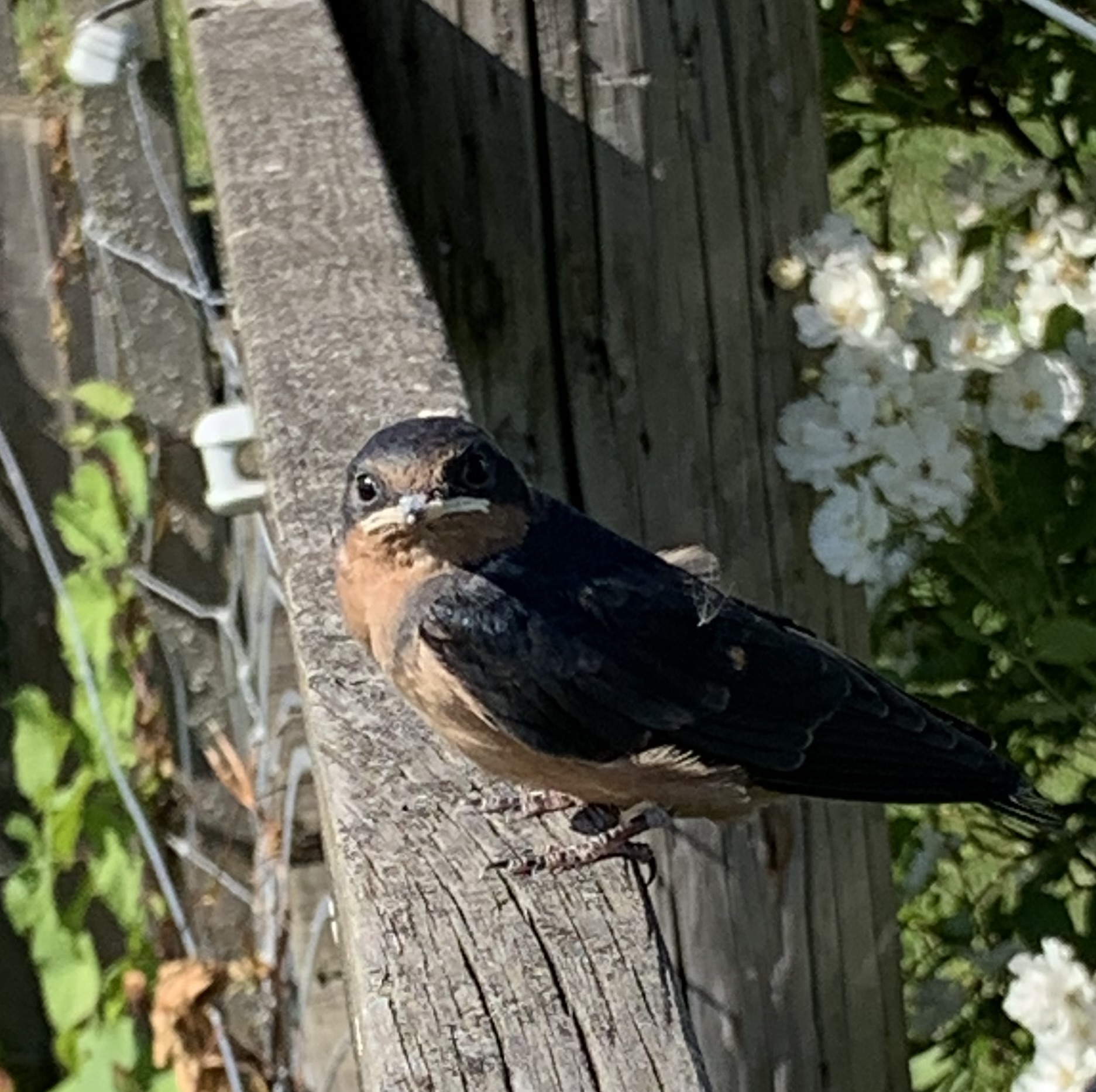
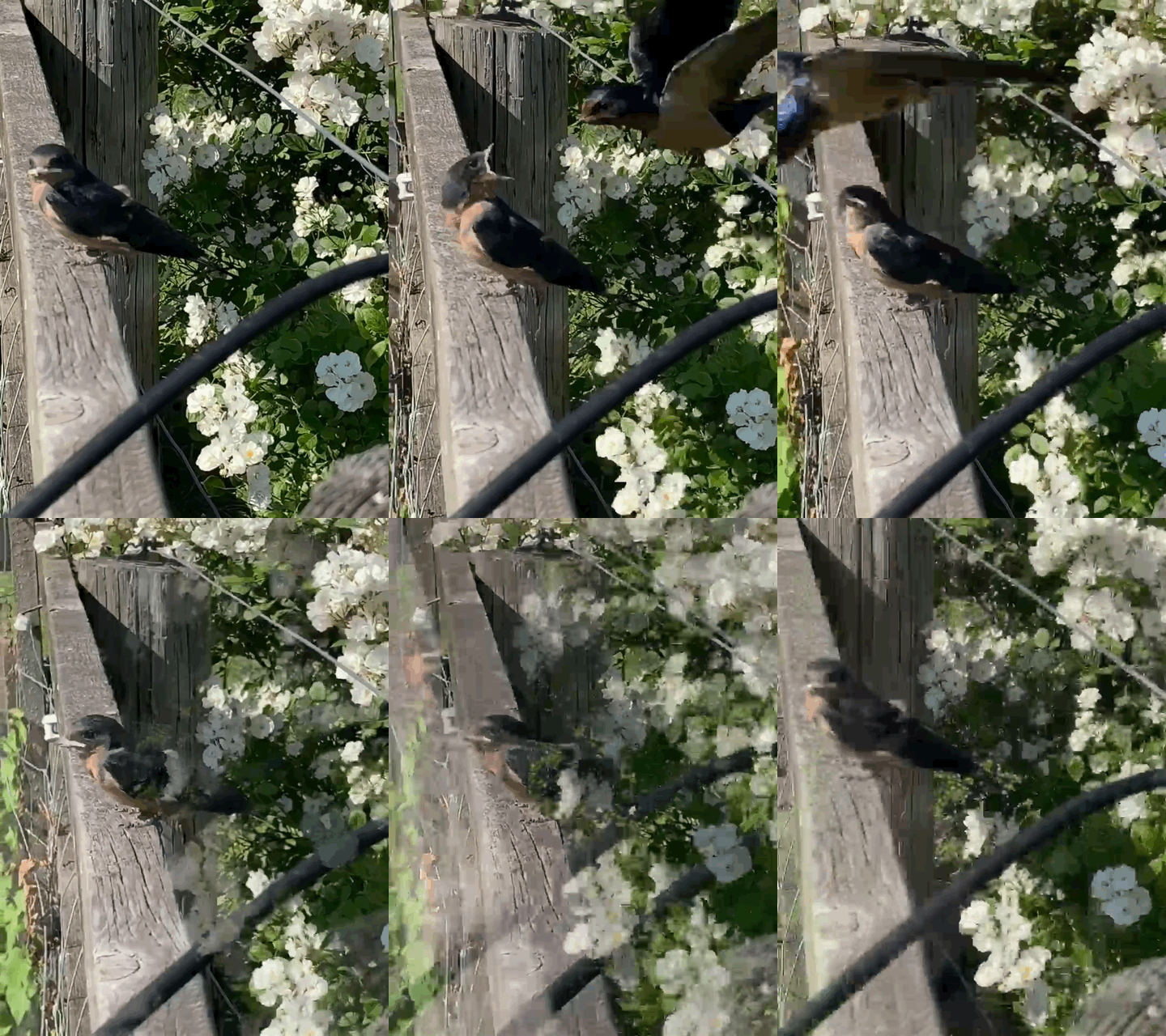
The squirrel sticks its head from the tree’s knot, shrieking directions, a village gossip with a huge plumed tail. It moves down the scalloped bark, swaying on tiny nails, and stops, eye-level with my swollen belly. A black blur of bird swoops, the velvet of its wing against my cheek. It nests among a ruckus of robins, less interested in being fed than being heard. Around the curve of the road, I near the farmer’s fence. His mare lowers her fan of lashes. In the pond, a fish flips, exposing its silver stomach. ~Tina Barry, “The Animals Know” from Beautiful Raft
photo by Harry Rodenberger
video by Harry Rodenberger
It has been over thirty years since I carried a child in my belly. Each time, I remember having the feeling our farm animals knew I was “expecting” even before it became obvious. Maybe it was because I was so overjoyed, I carried myself differently. After experiencing a miscarriage and two years of infertility workups, it felt almost magical being pregnant. It seemed as if our invisibly growing baby was already welcomed by all the creatures on our farm and were celebrating the anticipation along with us.
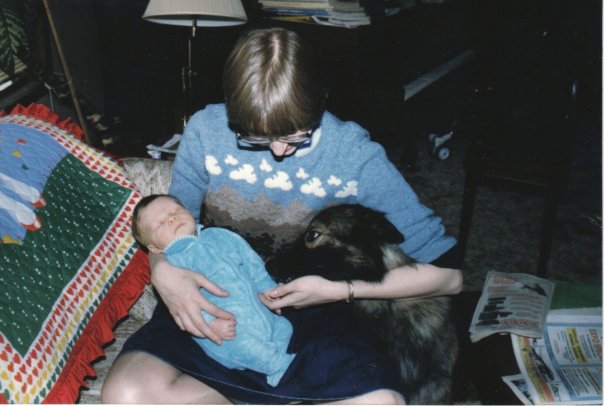
While I was pregnant with our first son, after such a long wait for parenthood, we bought a new dog, Tango and moved to a farm from the city. She was a year old and had never been around babies, so we weren’t sure how she would adapt to both new surroundings and new owners. As we drove six hours to her bring her to her new home, she happily settled in for the trip lying on my bulging tummy, pummeled by kicks from a baby she would soon meet face to face.
She loved him as soon as she saw him. She had known him and understood him as he grew inside.
Now, decades later, our family’s next generation is fulfilling their own hopes for the future: we have four cherished grandchildren in addition to the two we are now waiting to meet — one will be any day now.
The expectation of new life is so sweet. All that lives and breathes anticipates this new soul budding and about to bloom.
Somehow, they just know…
One-Time
Monthly
Yearly
Make a one-time or recurring donation to support daily Barnstorming posts
On a table in the living room there is a gray ceramic bowl that catches the light each afternoon, contains it. This is the room we turned into the room of her dying, the hospital bed in the center, the medical equipment against the walls like personnel. In Maine, once, I rented a house hundreds of years old. One room had been the birthing room, I was told, and I sat in that room writing towards the bright new world I am always trying to write into. And while I could stop there, with those two recognitions of endings and beginnings, I’m thinking of yesterday’s afternoon of errands. My father and mother were in the backseat, my sister in the passenger seat, and I driving. It was like decades ago but everyone in the wrong places, as though time was simply about different arrangements of proximity. Sometimes someone is in front of you. Or they are beside. At other times they are behind you, or just elsewhere, inconsolably, as though time was about how well or badly you attended to the bodies around you. First, we went to the bakery. Then the hardware. The pharmacy, the grocery. Then the bank. ~Rick Barot “Of Errands”
For a time, my husband and I were the middle of the proverbial family sandwich – the meat and cheese with condiments while our aging parents were one slice of bread and our young children the other slice. It was such a full time of always being needed by someone somewhere somehow in some way that I barely can recall details of what those years were like.
Mothers with daughters sometimes note the irony of being in the throes of menopause while their pre-teen is adjusting to menarche – we pass on the fertility torch.
As I sort through boxes that have been stored away for over a decade from my mother and mother-in-law’s belongings to find things to help our son’s family get settled in their house, I realize that time could be measured in bowls and vases and casserole baking dishes. They are passed to the next generation for another lifetime of use. We start out being fed, then we become the provider, and wind up being fed ourselves in the end.
I want to forestall that time of becoming dependent again as long as possible. For now, I want to hold my grandchildren’s hands as I try to keep them safe in an unpredictable world. Someday, I may need them to help hold my hand once I lack the strength to walk unaided.
Turn turn turn – there is a season. Turn around and everyone has changed places, blessed to still walk alongside one another for as long as possible.
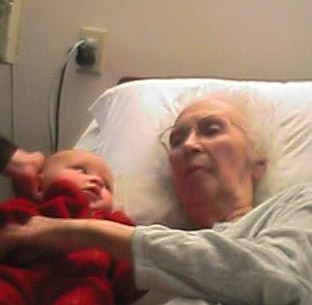
Great Grandma Emma, granddaughter Andrea, great-grandson Zealand, photo by Andrea Nipges
To every thing there is a season, and a time to every purpose under the heaven… Ecclesiastes 3:1
One-Time
Monthly
Yearly
Make a one-time or recurring donation to support daily Barnstorming posts
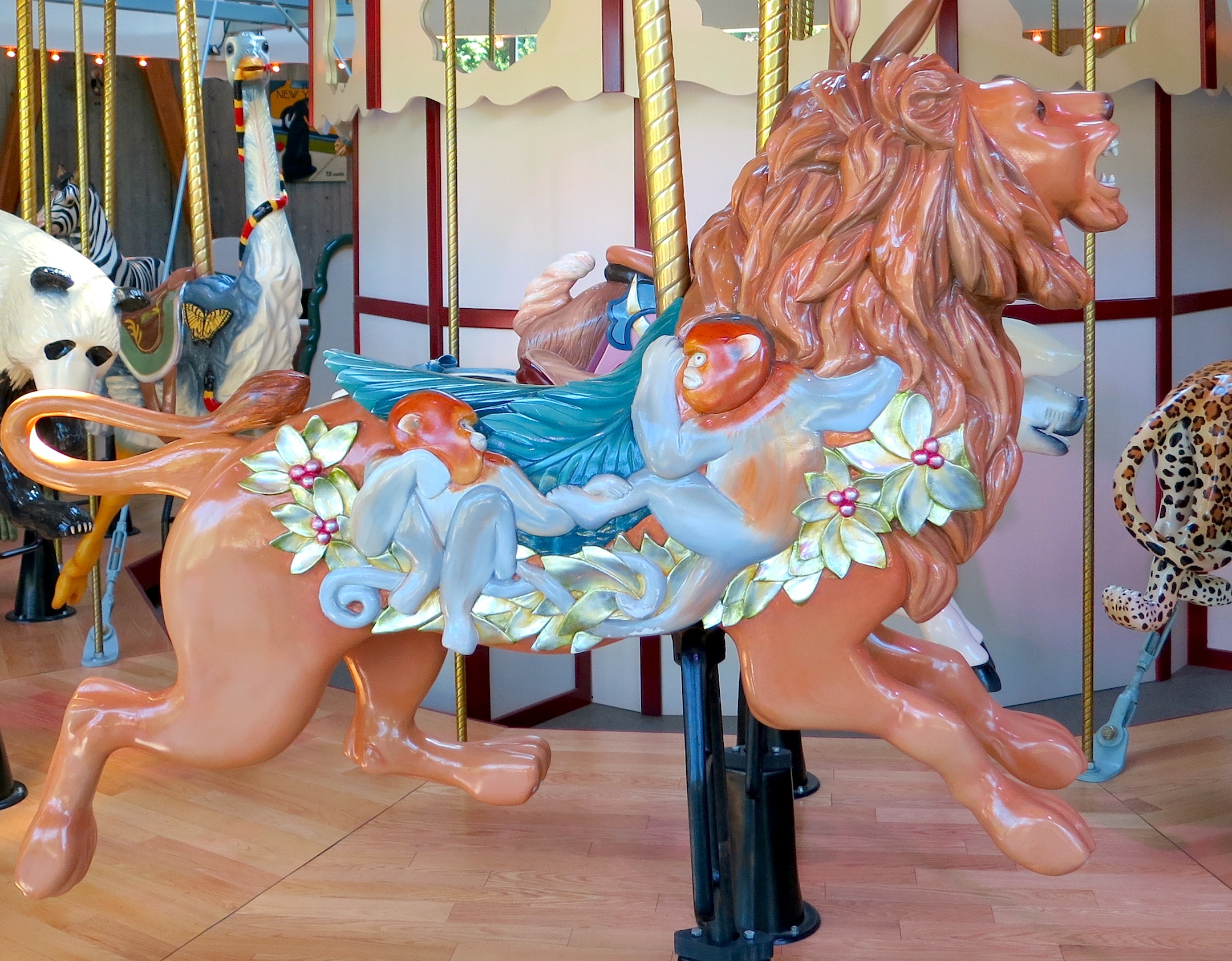
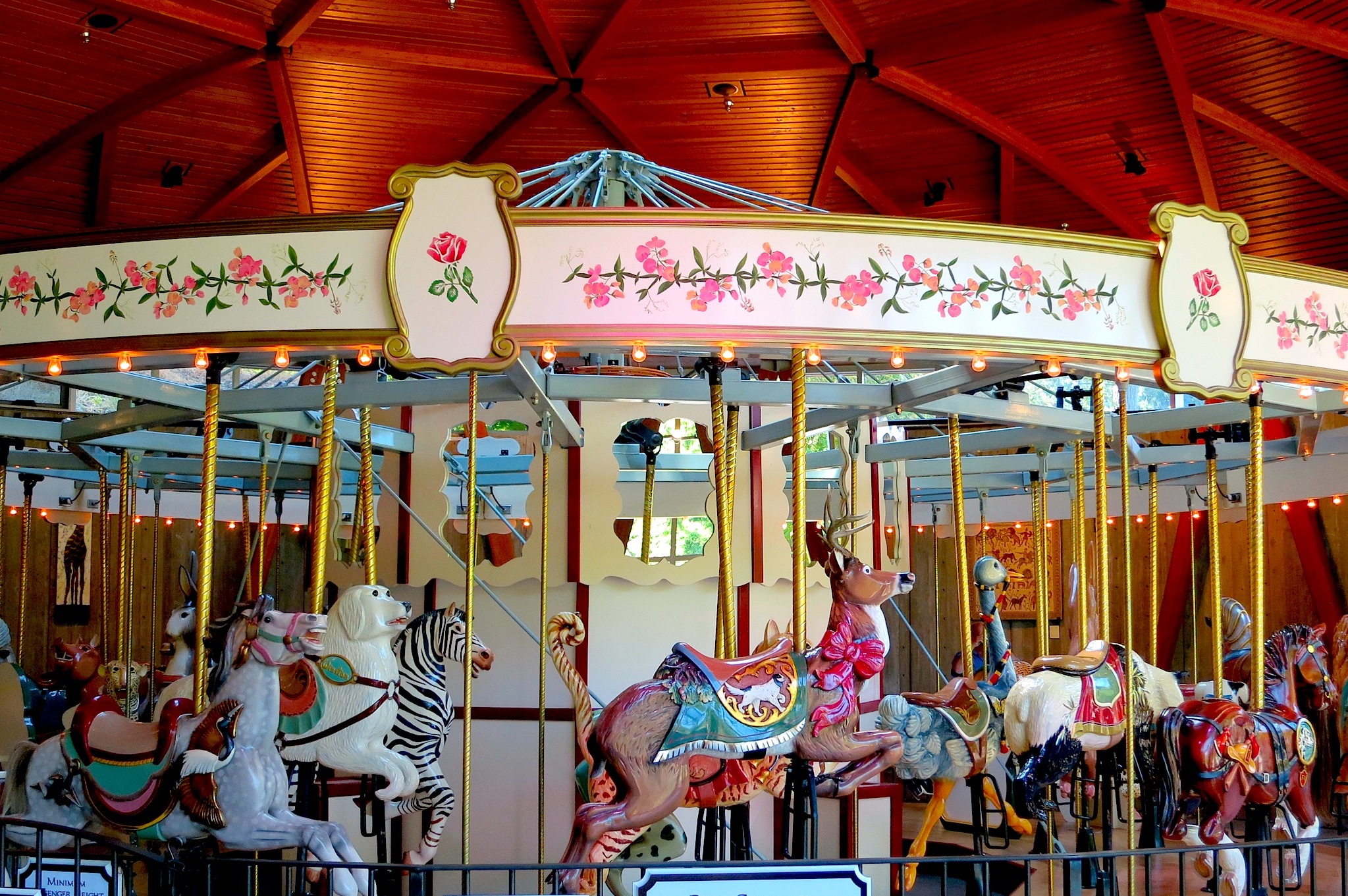
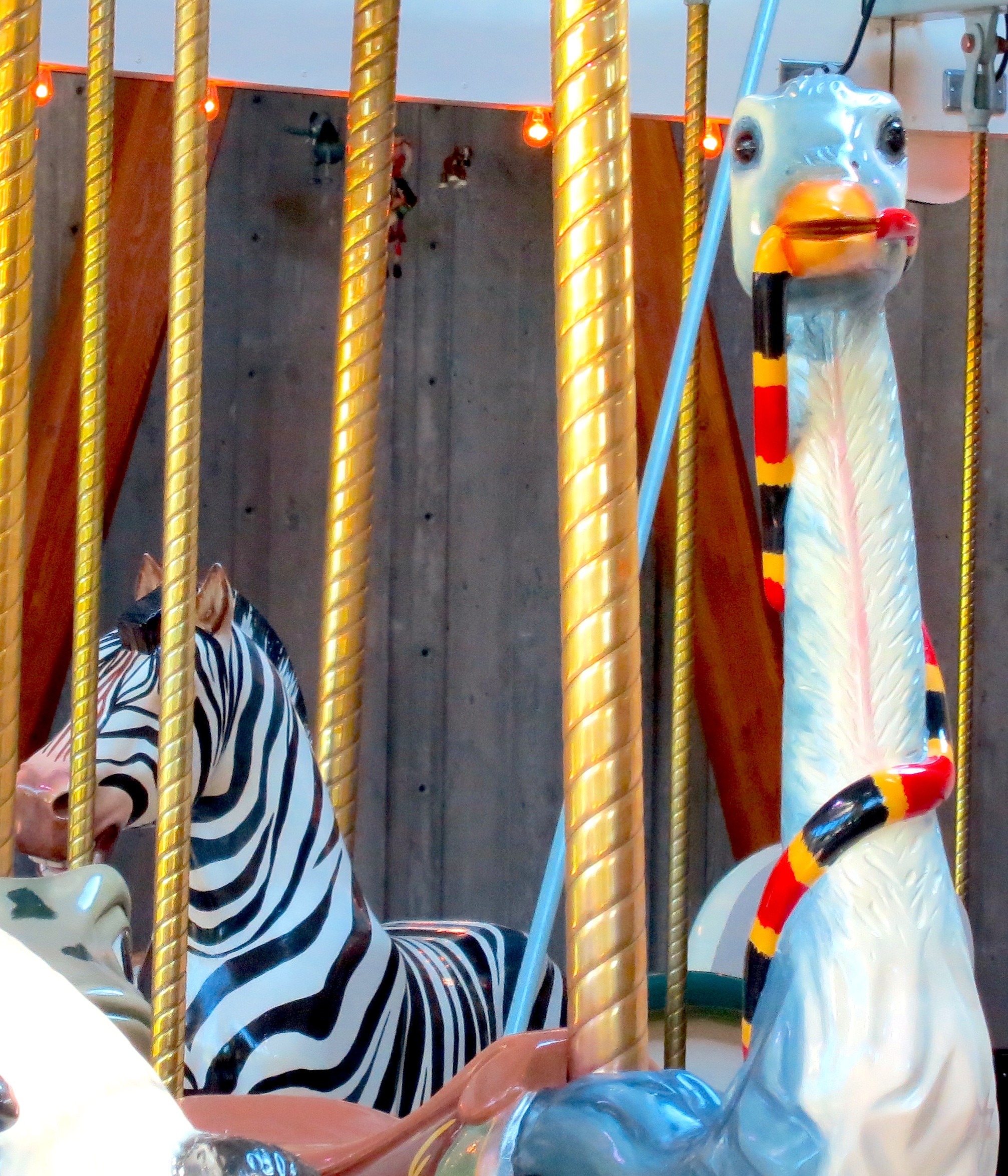
calliope cadence—O where have I been? ~Richard Maxson “Carousel at Seventy”
Under its canopy, in the shade it casts, turns a world with painted horses, all from a land that lingers a while before it disappears. Some, it’s true, are harnessed to a wagon, but all have valor in their eyes. A fierce red lion leaps among them, and here comes ’round a snow-white elephant.
Even a stag appears, straight from the forest, except for the saddle he wears, and, buckled on it, a small boy in blue.
And a boy in white rides the lion, gripping it with small clenched hands, while the lion flashes teeth and tongue.
And here comes ’round a snow-white elephant.
And riding past on charging horses come girls, bright-eyed, almost too old now for this children’s play. With the horses rising under them, they are looking up and off to what awaits. ~Rainer Maria Rilke from “Jardin de Luxembourg”
You don’t really understand human nature unless you know why a child on a merry-go-round will wave at his parents every time around – and why his parents will always wave back. ~William D. Tammeus
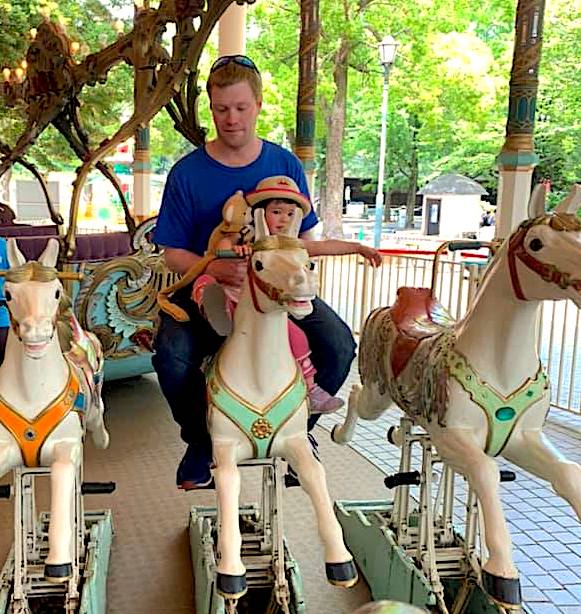
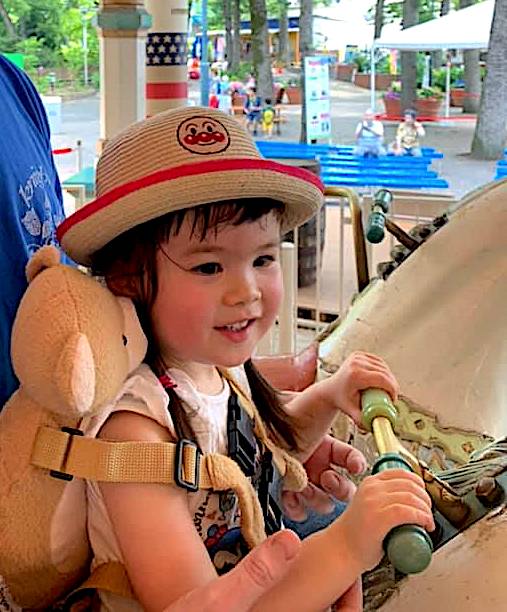
As a child, I could not resist a ride on a carousel, waving each time I came round. Decades later, I can not resist standing and watching a carousel, waving back at whoever waves at me.
It is a world that turns and turns without going anywhere, except in the imaginations of the riders who fly higher, leap farther, jump huge gaps, race fastest. For them, it becomes a world that goes anywhere and everywhere.
The swirl of surroundings and magic of music raises each child up, up, speeding faster and faster to catch whatever may await them. Then the world slows, settling and settling until each waving child becomes the stationary waving adult who stands their ground faithfully waiting — remembering how going round and round without going anywhere was the most wonderful feeling in the ever turning world.
Yesterday a child came out to wonder Caught a dragonfly inside a jar Fearful when the sky was full of thunder And tearful at the falling of a star
And the seasons they go round and round And the painted ponies go up and down We’re captive on the carousel of time We can’t return we can only look behind From where we came And go round and round and round In the circle game
Then the child moved ten times round the seasons Skated over ten clear frozen streams Words like, when you’re older, must appease him And promises of someday make his dreams
Sixteen springs and sixteen summers gone now Cartwheels turn to car wheels thru the town And they tell him, Take your time, it won’t be long now Till you drag your feet just to slow the circles down
So the years spin by and now the boy is twenty Though his dreams have lost some grandeur coming true There’ll be new dreams, maybe better dreams and plenty Before the last revolving year is through ~Joni Mitchell “The Circle Game”
One-Time
Monthly
Yearly
Make a one-time or recurring donation to support daily Barnstorming posts
In the ordinary weather of summer with storms rumbling from west to east like so many freight trains hauling their cargo of heat and rain, the dogs sprawl on the back steps, panting, insects assemble at every window, and we quarrel again, bombarding each other with small grievances, our tempers flashing on and off in bursts of heat lightning. In the cooler air of morning, we drink our coffee amicably enough and walk down to the sea which seems to tremble with meaning and into which we plunge again and again. The days continue hot. At dusk the shadows are as blue as the lips of the children stained with berries or with the chill of too much swimming. So we move another summer closer to our last summer together— a time as real and implacable as the sea out of which we come walking on wobbly legs as if for the first time, drying ourselves with rough towels, shaking the water out of our blinded eyes. ~Linda Pastan, “The Ordinary Weather of Summer” from Carnival Evening: New and Select Poems 1968-1998
I grew up near Puget Sound and only a couple hours from the Washington Pacific Ocean coastline. Our annual trips to the ocean were early morning clamming harvests, usually returning home by noon to process the bounty we had dug up at the shore. Vacations at the beach were a few days spent in a rented cabin at Birch Bay on Puget Sound (now Salish Sea) or on Camano Island. These were short stays, usually no more than two or three nights but it gave our family a chance to live together in a different way.
It wasn’t easy for a family of five to sleep in a tiny two bedroom cabin with very little privacy – we siblings easily got on each other’s nerves as we teased each other or played hyper-competitive card or board games or futilely tried to distance ourselves from one another. We didn’t understand that these few summers in the 60’s were the last opportunities we would spend time together simply to “play”. Storms were on the horizon, our tempers flared when the weather was hot and humid. We had no awareness time was slipping through our fingers.
How this family time at the beach affected my parents is something I can only guess. Their marriage was on shaky ground ten years prior to their separation and divorce, even though we children were oblivious to it at the time. Whether being forced out of their routine was helpful or made their tensions worse, I don’t know. I do know quarreling children, small living quarters and sweaty temperatures can be a challenging combination.
Something about our current heat wave this week places me back to those hot nights in the beach cabins, unable to fall asleep due to a combination of itchy sweat and the world pressing down on me. The crankiness of those family vacations tends to infect my words and attitudes all these decades later.
Although the literal and figurative storms of those years have long since blown over, I still remember the musty smell of those beach cabins that had seen so many different families come and go over the decades, some thriving while others were wobbly and struggling to stay glued together. To the cabins that housed them, they looked all alike. But they weren’t. Only time would tell how well they weathered the storm.
One-Time
Monthly
Yearly
Make a one-time or recurring donation to support daily Barnstorming posts
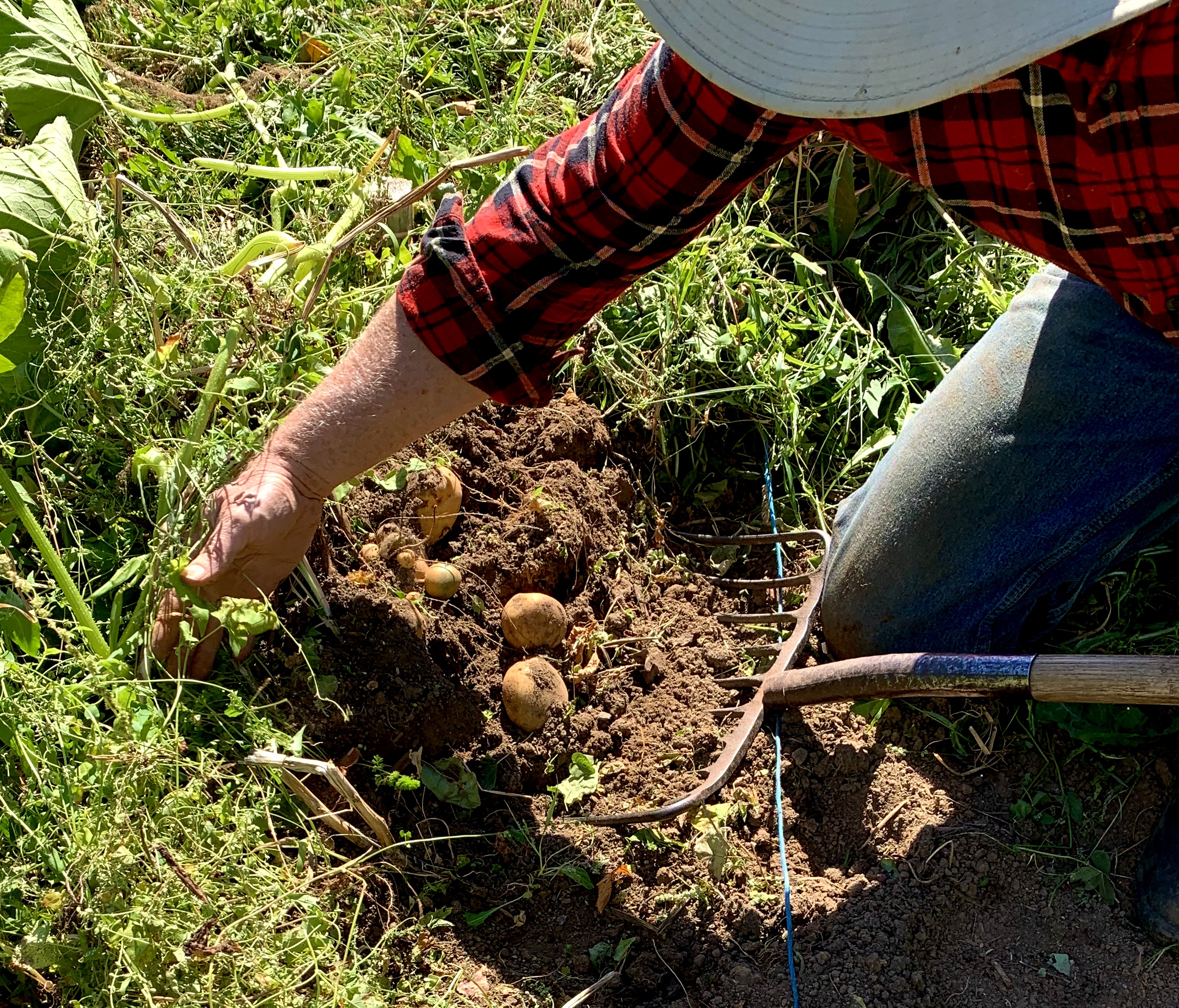
her father had needed her to dig the potatoes and load them into burlap bags
but here she is leaving her daughter
on the campus in the city time to go we go to the parking lot
old glasses thick graying hair she is wearing a man’s shirt has to get back to the job
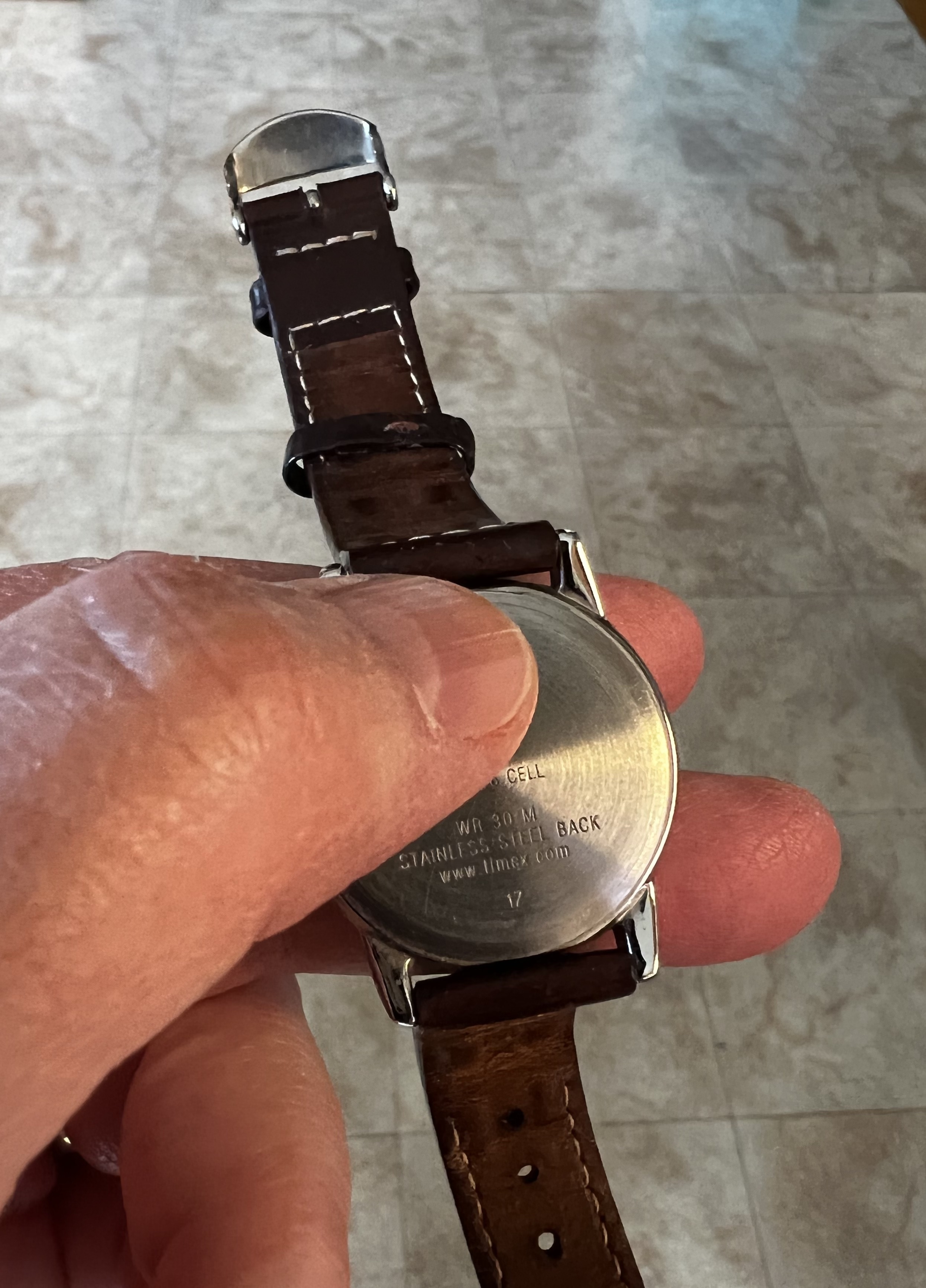
we stand beside her Ford and it is here she undoes the buckle of the watch and holds it out to me
my father’s watch keeping good time for him and then for her
she says she knows I will need a watch to get to class we hug and she gets in
starts the car eases into traffic no wave
the metal of the back of the watch
is smooth to my thumb and it keeps for a moment a warmth from her skin. ~Marjorie Saiser from “She Gives Me the Watch off Her Arm” from I Have Nothing To Say About Fire
When I decided to attend college out of state, to a campus I had never seen before, my mother decided she couldn’t handle the goodbye in a strange place, so sent me on a two day drive with my dad. She was a very emotional person and he wasn’t, so he got the job of dropping me off.
It was a quiet car ride with only my dad and myself together. I think we both dreaded the upcoming parting moments.
When the moment came – my things scattered chaotically about my dorm room, marijuana smoke haze filling the dorm hallway and noise everywhere with loud music and the partings of students and parents – I looked at him with foreboding and desperation at this foreign environment to which I must learn to adapt. His eyes filled with tears — the first time in 18 years I had seen him cry — and he said “you know what you are here for,” hugged me tight and turned around and left.
My father didn’t give me anything but those parting words, but they still ring in my ears every day whenever I am feeling somewhat desperate, even now fifty years later.
It was a rough start at college for me, homesick as I was, in an unsupportive unstructured dorm environment. I came home at Thanksgiving that quarter and didn’t return until the following fall. But I finished strong and never looked back. You can’t go home again, not really.
Now I know what I am here for.
One-Time
Monthly
Yearly
Make a one-time and recurring donation to support daily Barnstorming posts





















 Barnstorming