Morning Has Come Again

when the sun peeks over the horizon to greet
the day and spread golden honey warmth
to the dark, sleepy earth

when the birds begin to stir and twitter
and tune their songs to one another

when the trees rustle as the morning breeze
opens her eyes from slumber, and the dew is heavy
on the blades of grass

when I know morning has come once again
and we are not lost to the night, even as we
are not lost to the day

light dawns, and I can move again
breathing in streams of fresh morning air
lighting a candle for rejuvenation
and praying the day in with ginger and
salt and clay

oh how lovely it feels to be alive
how magical to wake with the light
and live

~Juniper Klatt “when the sun” from I was raised in a house of water.

Each morning is a fresh try at life,
a new chance to get things right
when our yesterdays are broken.

So I drink deeply of the golden dawn,
take a full breath of cool air and dive in head first
into luminous light and bushels of blossoms,
hoping I too might float on the morning magic.

AI image created for this post

Where You Go, I Will Go: The In-Between

Here at the centre everything is still
Before the stir and movement of our grief
Which bears it’s pain with rhythm, ritual,
Beautiful useless gestures of relief.
So they anoint the skin that cannot feel
Soothing his ruined flesh with tender care,
Kissing the wounds they know they cannot heal,
With incense scenting only empty air.
He blesses every love that weeps and grieves
And makes our grief the pangs of a new birth.
The love that’s poured in silence at old graves
Renewing flowers, tending the bare earth,
Is never lost. In him all love is found
And sown with him, a seed in the rich ground.

~Malcolm Guite “Station XIV of the Cross”

The Holy Saturday of our life must be the preparation for Easter,
the persistent hope for the final glory of God.

The virtue of our daily life is the hope which does what is possible
and expects God to do the impossible.

To express it somewhat paradoxically, but nevertheless seriously:
the worst has actually already happened;
we exist, and even death cannot deprive us of this.
Now is the Holy Saturday of our ordinary life,
but there will also be Easter, our true and eternal life.
~Karl Rahner “Holy Saturday” in The Great Church Year

I said to my mind, be still, and wait without hope
For hope would be hope for the wrong thing; wait without love
For love would be love of the wrong thing; yet there is faith
But the faith and the hope and the love are all in the waiting.
Wait without thought, for you are not ready for thought:
So the darkness shall be light, and the stillness the dancing.
~T. S. Eliot, from “East Coker”  The Four Quartets

The happy ending has never been easy to believe in.
After the Crucifixion the defeated little band of disciples
had no hope, no expectation of Resurrection.
Everything they believed in had died on the cross with Jesus.
The world was right, and they had been wrong.
Even when the women told the disciples
that Jesus had left the stone-sealed tomb,
the disciples found it nearly impossible to believe
that it was not all over.
The truth was, it was just beginning.
Madeleine L’Engle from “Waiting for Judas” in Plough Magazine

This in-between day
after all had gone so wrong:
the rejection, the denials,
the trumped-up charges,
the beatings, the burden,
the jeering, the thorns,
the nails, the thirst,
the despair of being forsaken.

This in-between day
before all will go so right:
the forgiveness and compassion,
the grace and sacrifice,
the debt paid in full,
the immovable stone rolled away,
our name on His lips,
our hearts burning
to hear His words.

What does it take to move the stone?
When it is an effort to till the untillable,
creating a place where simple seed
can drop, be covered and sprout and thrive,
it takes muscle and sweat and blisters and tears.

What does it take to move the stone?
When it is a day when no one will speak out of fear,
the silent will be moved to cry out
the truth, heard and known and never forgotten.

What does it take to move the stone?
When it is a day when all had given up,
gone behind locked doors in grief.

When two came to tend the dead,
there would be no dead to tend.

Only a gaping hole left
Only an empty tomb
Only a weeping weary silence
broken by Love calling our name
and we turn to greet Him
as if hearing it for the first time.

We cannot imagine what is to come
in the dawn tomorrow as
the stone lifted and rolled,
giving way so our separation is bridged,
darkness overwhelmed by light,
the crushed and broken rising to dance,
and inexplicably,
from the waiting stillness He stirs
and we, finding death emptied,
greet Him with trembling
and are forever moved,
just like the stone.

This year’s Lenten theme:

…where you go I will go…
Ruth 1:16

Where You Go, I Will Go: What is this Quintessence of Dust?

What a piece of work is a man!
And yet, to me, what is this quintessence of dust?
~ William Shakespeare – Hamlet’s soliloquy

God –
the God who made the dust,
who made the stars,
who made the elements of which we are composed –
that same God chooses from the beginning to make his dwelling among us,

to live for all time like us,
as a servant of the soil.
I am the dust of the earth,
but God declares that he is not too good,
not too proud,
for my dustiness.
~Daniel Stulac from
 Plough Quarterly No. 4: Earth

What I know for sure is this:
We come from mystery and we return to mystery.
I arrived here with no bad memories of wherever I’d come from,
so I have no good reason to fear the place to which I’ll return.
And I know this, too:

Standing closer to the reality of death
awakens my awe at the gift of life.
~Parker Palmer “On the Brink of Everything

 …I do nothing, I give You
nothing. Yet You hold me

minute by minute
from falling.

~Denise Levertov from Psalm Fragments (Schnittke String Trio), in The Stream and the Sapphire

This dust left of man:
earth, air, water and fire
prove inadequate
to quell the significance of how,
in spoken words at the beginning,
this dust became us, and
how, forevermore,
this is holy dust we leave behind.

We are held secure from falling
by transcendent hope
of eternal life,
restored by a glory
breathed into us –
such a piece of work we are
the plainest of ash.

This year’s Lenten theme:

…where you go I will go…
Ruth 1:16

AI image created for this post

The Mystery of Anything At All

Here is the mystery, the secret,
one might almost say the cunning,
of the deep love of God:
that it is bound to draw upon itself
the hatred and pain and shame
and anger and bitterness and rejection of the world,
but to draw all those things on to itself
is precisely the means chosen from all eternity
by the generous, loving God,
by which to rid his world of the evils
which have resulted from
human abuse of God-given freedom.
~N.T. Wright from The Crown and The Fire

Days pass when I forget the mystery.
Problems insoluble and problems offering
their own ignored solutions
jostle for my attention…
            And then
once more the quiet mystery
is present to me, the throng’s clamor
recedes: the mystery
that there is anything, anything at all,
let alone cosmos, joy, memory, everything,
rather than void: and that, O Lord,
Creator, Hallowed one, You still,
hour by hour sustain it.
~Denise Levertov from “Primary Wonder” from Sands of the Well

…to bring to light for everyone what is the plan of the mystery hidden for ages in God, who created all things…
Ephesians 3:9

Despite the bad news of the world,
I cling to the mystery of God’s sustaining us
through weaknesses, flaws and bitterness.
He pulls us out of the dark, to His Light.

Hatred and pain and shame and anger disappear
into the vortex of His bright love and beauty,
the mucky corners of our lives wiped spotless.

We are let in on a secret:
He is not sullied by absorbing the dirty messes of our lives.

Created in His image,
sustained and loved,
thus reflecting Him,
we emerge, hopeful, from the soil
and washed forever clean.

AI image created for this post

Stat Sua cuique dies (To each his day is given)
Stat Sua cuique dies (To each his day is given) – Latin, The Aeneid Maél is mé tó féran(‘Tis time that I fare from you)– Old English
Aleto men moi nostos (Lost is my homecoming) -Greek, The Illiad C’est pour cela que je suis née(I was born for this)–French, Joan of Arc Kono michi ya(On this road)Yuki hito nishi ni (Goes no one)– Japanese C’est pour cela que je suis née (I was born for this) – French
Ne me plaignez pas (Do not pity me) – French, Joan of Arc

Company of the Living

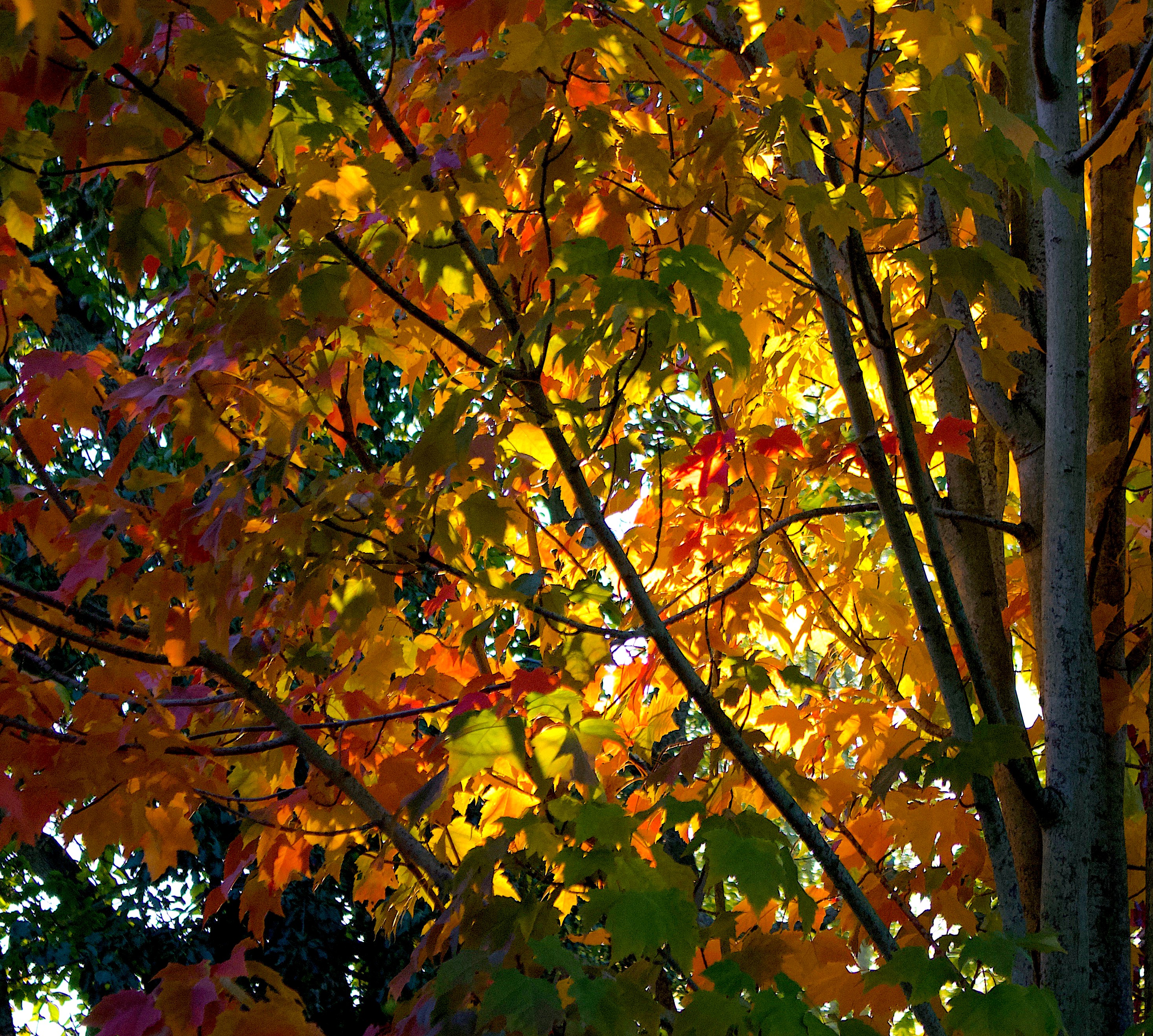
The maple leaves abscond
with summer’s green rain
on such little stems
connecting to spring’s essence,
summer twigs’ foliage,
the company of the living.

But now they shrug off
their red-gold existence
as if they’d never inhabited
the verdure of the undead,
drifting to a ground
hardened by sudden frost.
~Donna Pucciani “One Minute”

I was standing lost, sunk, my hands in my pockets, gazing toward Tinker Mountain and feeling the earth reel down. All at once, I saw what looked like a Martian spaceship whirling towards me in the air. It flashed borrowed light like a propeller. Its forward motion greatly outran its fall. As I watched, transfixed, it rose, just before it would have touched a thistle, and hovered pirouetting in one spot, then twirled on and finally came to rest. I found it in the grass; it was a maple key…Hullo. I threw it into the wind and it flew off again, bristling with animate purpose, not like a thing dropped or windblown, pushed by the witless winds of convection currents hauling round the world’s rondure where they must, but like a creature muscled and vigorous, or a creature spread thin to that other wind, the wind of the spirit that bloweth where it listeth, lighting, and raising up, and easing down. O maple key, I thought, I must confess I thought, o welcome, cheers.

And the bell under my ribs rang a true note, a flourish of blended horns, clarion, sweet, and making a long dim sense I will try at length to explain. Flung is too harsh a word for the rush of the world. Blown is more like it, but blown by a generous, unending breath. That breath never ceases to kindle, exuberant, abandoned; frayed splinters spatter in every direction and burgeon into flame. And now when I sway to a fitful wind, alone and listing, I will think, maple key. When I see a photograph of earth from outer space, the planet so startlingly painterly and hung, I will think, maple key. When I shake your hand or meet your eyes, I will think two maple keys. If I am maple key falling, at least I can twirl.
~Annie Dillard from Pilgrim at Tinker Creek

If only there were living words as plentiful
as the maple keys that twirl from each branch,
words that release us from our dry roots,
ready to unlock life’s secrets, unlatch
and push ajar the doors to heavy hearts.

Who can ever be ready to go
from vibrant and alive,
colorful and mobile,
to dropped and still?

The reality of another spent season
is a slug to the gut.
Time is passing.
I’m wasting time.
There is no stopping it
without stopping me.

Let’s dwell in the company of the living
until we fall away together.

Live well, fellow leaves
and we’ll let go together:
swaying to a fitful wind,
giving a gentle shrug and drifting,
easing into settling down
when the time comes.

A World Upside Down

Obscurely yet most surely called to praise,
As sometimes summer calls us all, I said
The hills are heavens full of branching ways
Where star-nosed moles fly overhead the dead;
I said the trees are mines in air, I said
See how the sparrow burrows in the sky!
And then I wondered why this mad instead
Perverts our praise to uncreation, why
Such savour’s in this wrenching things awry.
Does sense so stale that it must needs derange
The world to know it? To a praiseful eye
Should it not be enough of fresh and strange
That trees grow green, and moles can course
in clay,
And sparrows sweep the ceiling of our day?

~Richard Wilbur “Praise in Summer”

It is possible that God says every morning, “Do it again” to the sun; and every evening, “Do it again” to the moon. It may not be automatic necessity that makes all daisies alike; it may be that God makes every daisy separately, but has never got tired of making them. It may be that He has the eternal appetite of infancy; for we have sinned and grown old, and our Father is younger than we. 
~G.K.Chesterton from Orthodoxy

I need no help to imagine this world feels upside down much of the time. When I read the headlines, I have difficulty understanding how anything makes any sense anymore.

Creation inversed: the birds somehow soar through the earth beneath us and the moles and mushrooms are populating the clouds. Instead of stars in the sky, there are innumerable molehills gracing the hillside. We are all mixed up in our perspective, turning creation on its head.

Thank goodness and thank God that everything is put back where it belongs when we are in sore need of reorientation. When we forget our purpose in creation, He reminds us by restoring predictable order and rhythms. When we destroy, He heals and protects. When we get bored with how things are – desperate for innovation and excitement in our attempt to turn the world upside down – He demonstrates contentment with how things were created, and turns it back to right again.

There is enough to keep us busy in this world: crazy weather, global pandemics, volcanic eruptions and quaking ground. We don’t need to complicate an already complicated creation with our designed messes.

We’re meant to admire the birds’ soaring in the skies and appreciate that grubs and gophers course through the soil beneath us. We can praise the sun as it rises each morning and the moon’s varied journey at night – so predictable and reliable and meant to be that way from the very beginning.

Keep it going, God. Do it again.

AI image created for this post

It’ll Be Someone Else

Here’s the orchard someone else will tend to.
And the crawl space beneath the porch

of the house where someone else’s barn cat
will slumber through the summer nights
dreaming of long-tailed mice in the high grass.
Over that field, the light dips and refracts
through the broken glass of the muck pond
where a catfish will take someone else’s bait
and hook—that it might meet the refined
heat of a skillet. The ghosts of a thousand
head of cattle walk through the woods at night
in someone else’s dream while the windows,
cracked slightly, let a mild breeze pass
through the empty rooms like an appraiser.
There is no death that cannot be undone
by simply turning the compost with a pitchfork
or by scattering scratch in the dirt for chickens
who sing each time they lay, but every repair
is only a gesture against the torment of slow
winds and steady rain and heavy sun. It will be
someone else who grows too old to climb
the ladder into the barn’s cool loft or the flight
of stairs that lead to and from their own bed.
It will be their hand weighing the mortgage.
It will be their face forgetting its smile. Listen,
if the well pump kicks to life at dawn, it will be
someone else drawing a bath for the last time—
joints relaxing as their form submerges, body
recovering and failing in the same held breath.
~Travis Mossotti “Missing the Farm”
from Apocryphal Genesis

Well-away and be it so,
To the stranger let them go.
Even cheerfully I yield
Pasture, orchard, mowing-field,
Yea and wish him all the gain
I required of them in vain.
Yea and I can yield him house,
Barn, and shed, with rat and mouse
To dispute possession of.
These I can unlearn to love.
Since I cannot help it? Good!
Only be it understood,

It shall be no trespassing
If I come again some spring
In the grey disguise of years,
Seeking ache of memory here.
~Robert Frost from “On the Sale of My Farm”

Someday – we fervently hope not anytime soon – someone else will be living here and managing this farm, not us.

This land, originally all forested, provided game and native berries for the inland coastal tribes who lived here. When white settlers arrived and homesteading began, it was clearcut and the land became grazing pastures for livestock. Orchard trees were planted and crops produced and sold in nearby towns. Hundreds of similar small dairy farms in this county managed to feed their families and neighbors for nearly a century.

We purchased this land from the Lawrence family after they had farmed here over 80 years and they were so sad to leave. We are now in our 34th year here. We want to stay for another decade but we’re aging and our physical limitations are becoming increasingly apparent.

On a recent hot summer evening, my husband piled a wagon high with hay bales for the winter, with the help of the sons of the teenagers who helped us buck bales a generation ago. It won’t be too many years before someone else, not us, will be putting hay in the barn.

This land is where we feel we belong, just as those others who lived here were attached to this ground – but for how long? Will our non-farming offspring feel the pull to return home back to the farm?

We don’t know what the future may hold. What we do know: there is no such beauty as this land where we have worked and loved.

Yes, we feel we belong here.

For now. Until then.

AI image created for this post

Tell me, where is the road
I can call my own
That I left, that I lost
So long ago?
All these years I have wandered
Oh, when will I know
There’s a way, there’s a road
That will lead me home

After wind, after rain
When the dark is done
As I wake from a dream
In the gold of day
Through the air there’s a calling
From far away
There’s a voice I can hear
That will lead me home

Rise up, follow me
Come away, is the call
With the love in your heart
As the only song
There is no such beauty
As where you belong
Rise up, follow me
I will lead you home
~Michael Dennis Browne

Each Impossible Blossom

There are days we live
as if death were nowhere
in the background; from joy
to joy to joy, from wing to wing,
from blossom to blossom to
impossible blossom, to sweet impossible blossom.

~Li-Young Lee from “From Blossoms”

August of another summer, and once again
I am drinking the sun…
All my life I have been able to feel happiness,

except whatever was not happiness,
which I also remember.
Each of us wears a shadow.
But just now it is summer again…

Soon now, I’ll turn and start for home.
And who knows, maybe I’ll be singing.

~Mary Oliver from “The Pond” from Felicity

…what I want in my life
is to be willing
to be dazzled-
to cast aside the weight of facts

and maybe even
to float a little
above this difficult world.
I want to believe I am looking

into the white fire of a great mystery.
I want to believe that the imperfections are nothing-
that the light is everything-that it is more than the sum
of each flawed blossom rising and fading. And I do.

~Mary Oliver from “The Ponds” from House of Light

My friend Jean is a skilled gardener who has grown and hybridized dahlias for decades. What I see growing in the soil is her artist’s palette composed of petals, leaves and roots.

She has passionately cared for these plants; they reflect that love in every spiral and swirl, hue and gradient of color, showing stark symmetry and delightful variegation.

From homely and knobby look-alike tubers grow these luxurious beauties of infinite variety. I stand captivated before each one, realizing that same Creator makes sure I too impossibly bloom from mere dust.

Then He sets me to work in His garden, singing.

AI image created for this post

Only an Inch Beneath the Grass

He’s not so absorbed in the life around him
That he never looks up on clear nights
To admire the starry face of the sky.
But he’s awed even more by the earth he lives on,
By how much, for instance, its fertility
Depends on the unseen toil of earthworms.
Who would believe that over decades
Every inch of the field behind his house
Passes through their bodies again and again
As they feed on the dirt they tunnel through?
So much tireless turning over of loam,
So much natural harrowing, shredding, and leveling.
Yes, their work has undermined the stone wall
That marks the edge of his garden. But that’s a small price
For soil that nurtures the berries and grains
He enjoys at breakfast. Why turn from the table
To write a lament on the power of time
To undermine human effort when he can describe
How the work of worms helps sustain us?
Not to bother with them because they aren’t aware
Of his existence—how small-minded
That would seem to him in a species that prides itself
On understanding its place in the scheme of things,
As small-minded as thinking less of the stars
Because they aren’t twinkling for his benefit.
But the stars aren’t likely to go unnoticed
By a species quick to admire what’s distant,
Serene, and glittering, as opposed to what’s near,
Busy, and inconspicuous,
Working an inch beneath the grass.

~Carl Dennis “Near Darwin”

Aren’t you glad at least that the earthworms
Under the grass are ignorant, as they eat the earth,
Of the good they confer on us, that their silence
Isn’t a silent reproof for our bad manners,
Our never casting earthward a crumb of thanks
For their keeping the soil from packing so tight
That no root, however determined, could pierce it?

Imagine if they suspected how much we owe them,
How the weight of our debt would crush us
Even if they enjoyed keeping the grass alive,
The garden flowers and vegetables, the clover,
And wanted nothing that we could give them,
Not even the merest nod of acknowledgment.

A debt to angels would be easy in comparison,
Bright, weightless creatures of cloud, who serve
An even brighter and lighter master.


Lucky for us they don’t know what they’re doing,
These puny anonymous creatures of dark and damp
Who eat simply to live, with no more sense of mission
Than nature feels in providing for our survival.

…the tunneling earthworms, tireless, silent,
As they persist, oblivious, in their service.

~Carl Dennis from “Worms”

We’ve been composting horse manure for several decades behind the barn, and we dig in to the tall pile to spread on our garden plots. As Dan pushes the tractor’s front loader into the pile, steam rises from its compost innards. As the rich soil is scooped, thousands of newly exposed red wiggler worms immediately dive for cover. Within seconds, thousands of naked little creatures have, well, …wormed their way back into the security of warm dirt, being rudely interrupted from their routine. I can’t say I blame them.

Hundreds of thousands of wigglers end up being forced in the spring to adapt to new quarters, leaving the security of the manure mountain behind. As we smooth the topping of compost over the garden plot, the worms–gracious creatures that they are–tolerate being rolled and raked and lifted and turned over, waving their little bodies expectantly in the cool air before slipping back down into the dark. There they begin their work of digesting, aerating and renewing the soil of the garden, reproducing in their unique hermaphroditic way, leaving voluminous castings behind to further feed future seedlings to be planted.

Worms are unjustly denigrated by humans primarily because we don’t like to be surprised by them. We don’t like to see one in our food, especially only part of one, and are particularly distressed to see them after we’ve digested our food. Once we get past that bit of squeamishness, we can greatly appreciate their role as the ultimate recyclers, leaving the earth under our feet a lot better off once they are finished with their work.

We humans actually suffer by comparison: to be called “a worm” is really not as bad as it sounds at first. It is possible the worm may be offended by the association.

I hope to prove a worthy innkeeper for these new tenants.
May they live long and prosper only an inch beneath the grass,
so much more accessible than the infinite stars in the sky.
May each worm forgive the disruption
perpetrated by our rake and shovel.
May I smile appreciatively the next time
someone calls me a mere worm.

a cross section of 30 months of composted manure
AI image created for this post

Keep Reaching Out

Under a sky the color of pea soup
she is looking at her work growing away there
actively, thickly like grapevines or pole beans
as things grow in the real world, slowly enough.
If you tend them properly, if you mulch, if you water,
if you provide birds that eat insects a home and winter food,
if the sun shines and you pick off caterpillars,
if the praying mantis comes and the ladybugs and the bees,
then the plants flourish, but at their own internal clock.

Connections are made slowly, sometimes they grow underground.
You cannot tell always by looking what is happening.
More than half the tree is spread out in the soil under your feet.
Penetrate quietly as the earthworm that blows no trumpet.
Fight persistently as the creeper that brings down the tree.
Spread like the squash plant that overruns the garden.
Gnaw in the dark and use the sun to make sugar.

Weave real connections, create real nodes, build real houses.
Live a life you can endure: Make love that is loving.
Keep tangling and interweaving and taking more in,
a thicket and bramble wilderness to the outside but to us
interconnected with rabbit runs and burrows and lairs.

Live as if you liked yourself, and it may happen:
reach out, keep reaching out, keep bringing in.
This is how we are going to live for a long time: not always,
for every gardener knows that after the digging, after the planting,
after the long season of tending and growth, the harvest comes.
~Marge Piercy “The Seven of Pentacles”

Our garden teaches us all kinds of life lessons, thanks to my husband’s hours of hard work preparing the soil, planting carefully and nurturing the emerging seedlings.

No garden tends itself – the growing plants reach out for connection to one another, for stability and companionship. The gardener nurtures, defends and harvests with an eye to preparing for the next growing season.

We who have been planted here need one another, interwoven and linked, both visibly and invisibly. I am woven around you and you around me; together we grow and thrive when tended, and as intended.

But more than anything else, we need our Gardener…

AI image created for this post