A Day That Perishes

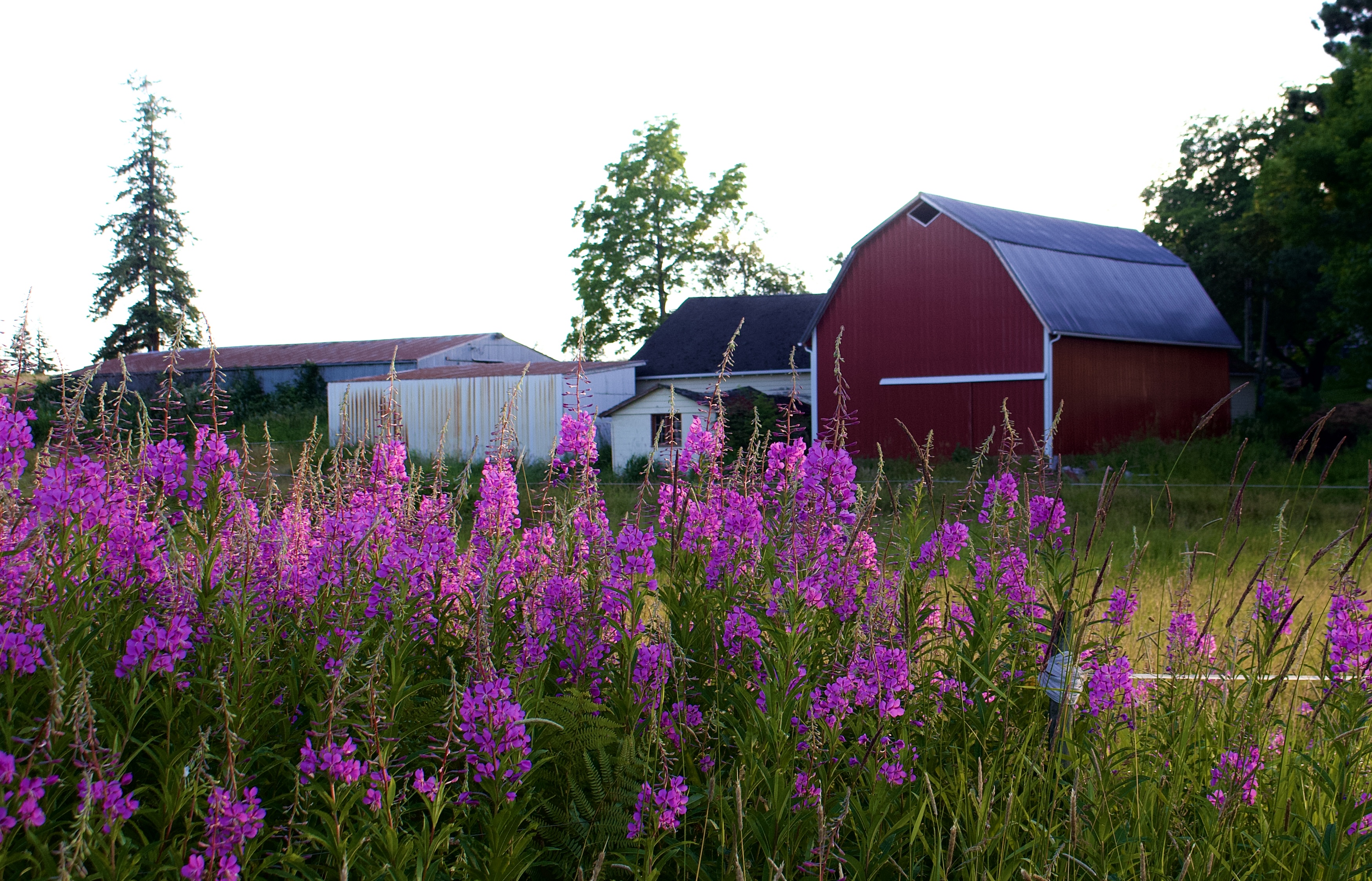
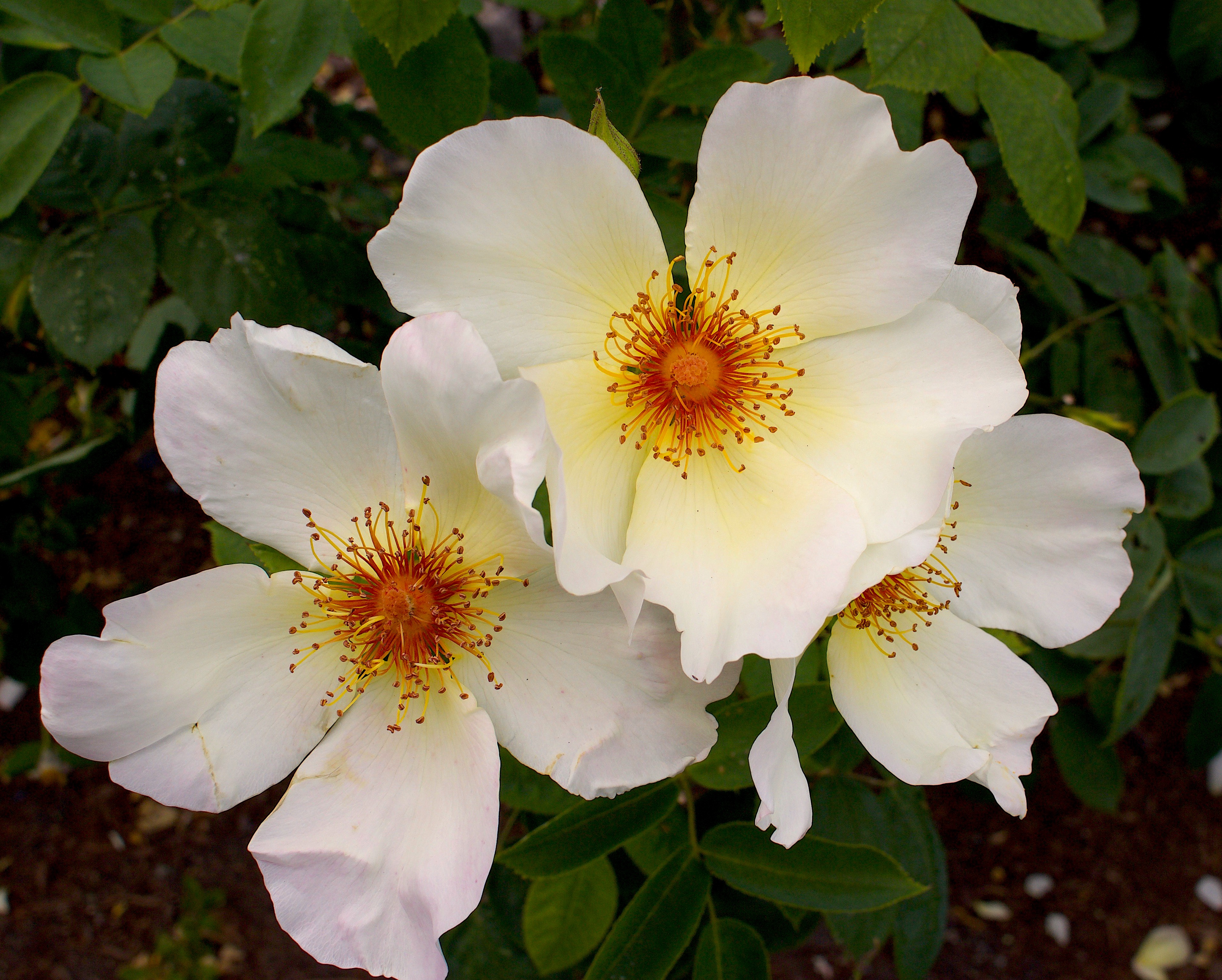
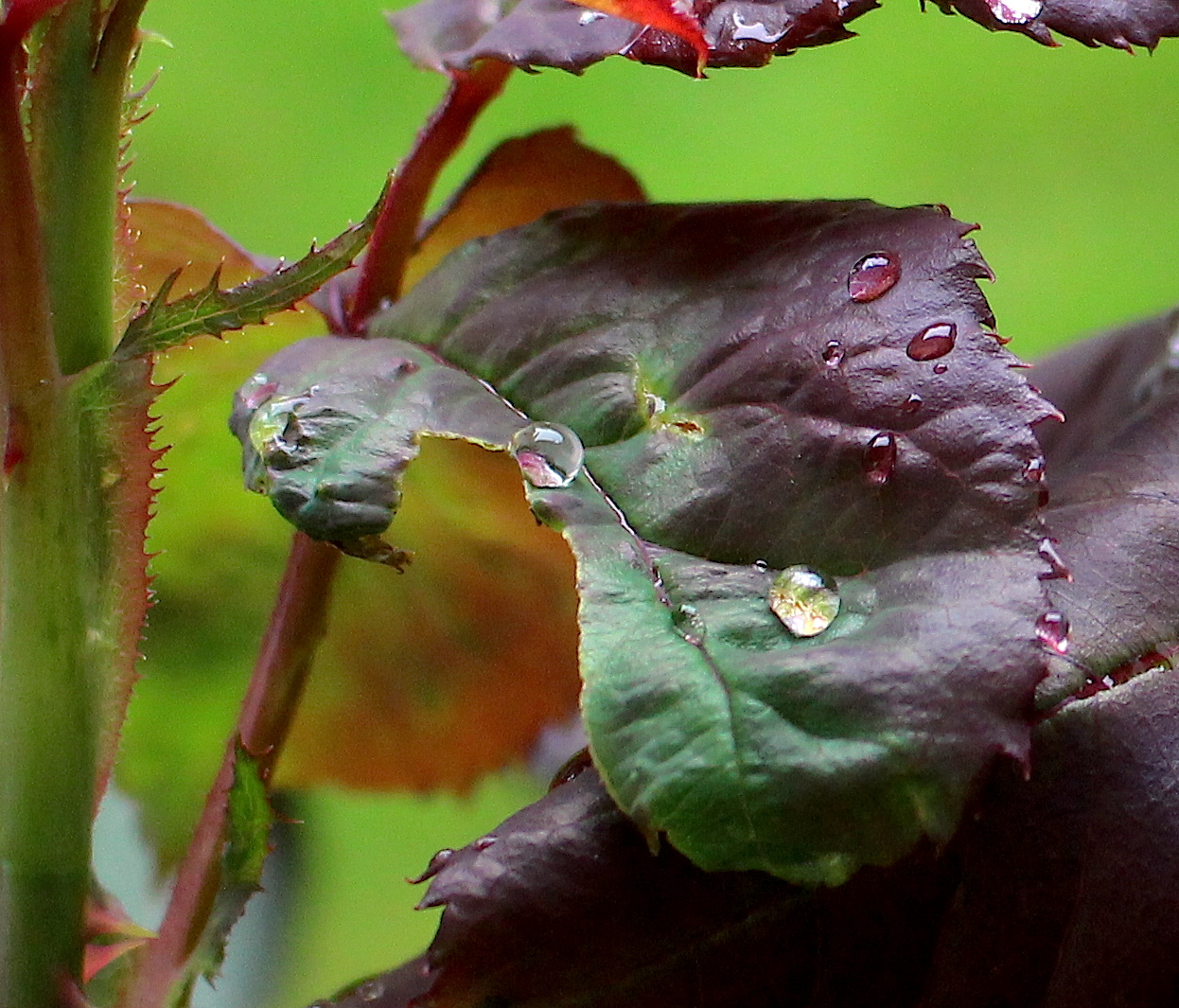
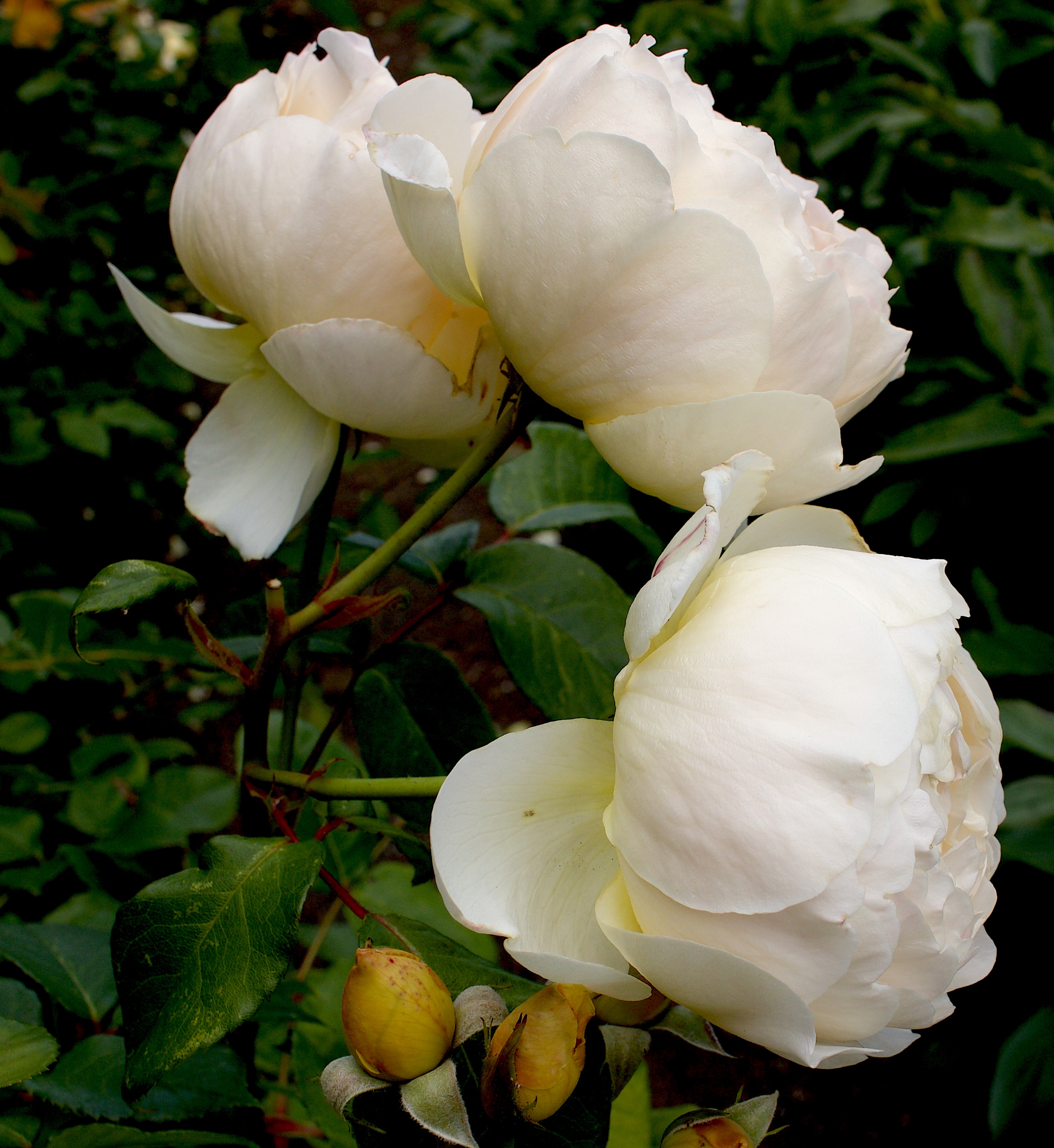
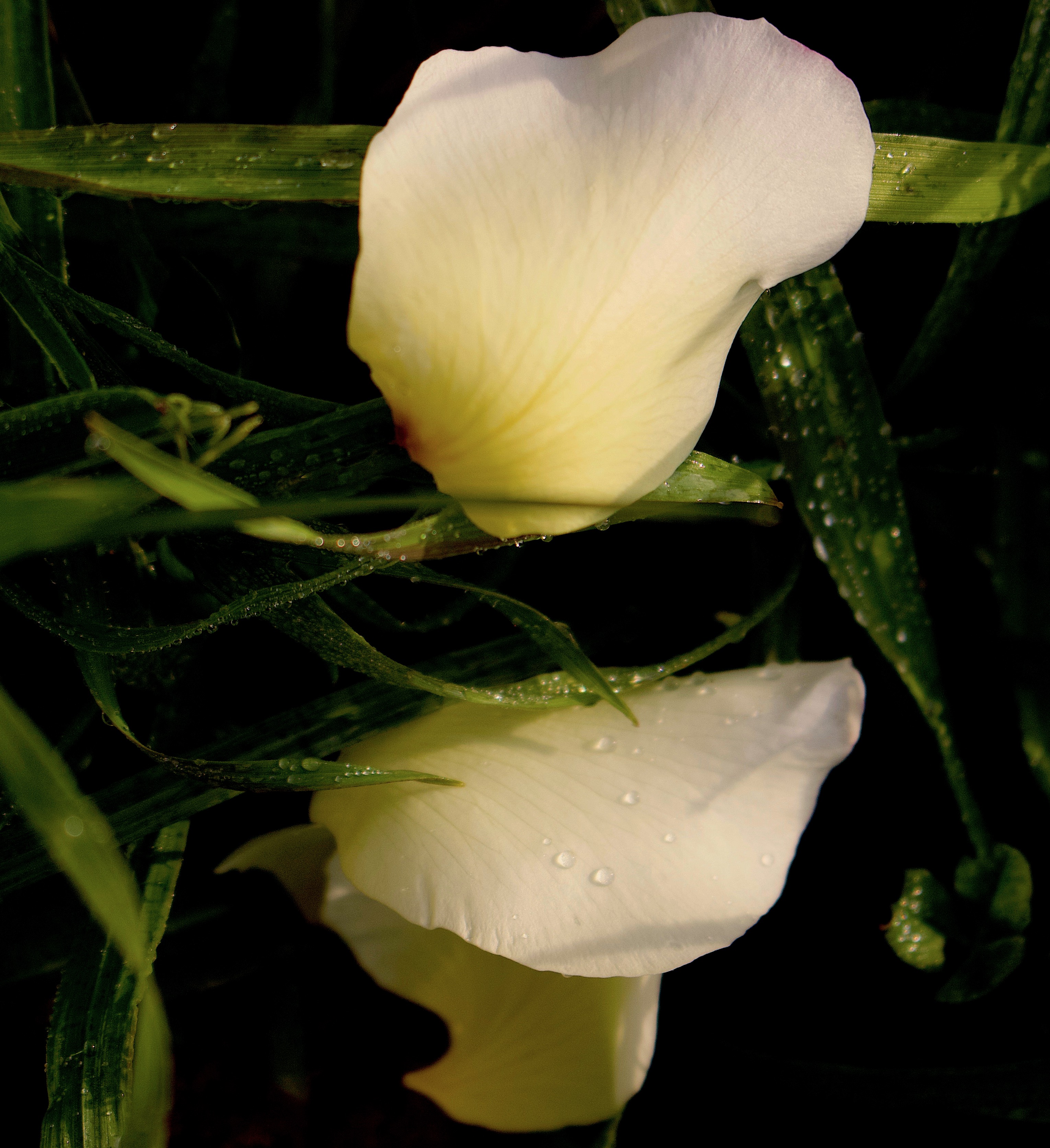
White roses, tiny and old, flare among thorns
by the barn door.
                                For a hundred years
under the June elm, under the gaze
of seven generations,

                                       they lived briefly
like this, in the month of roses,
                                                        by the fields
stout with corn, or with clover and timothy
making thick hay,

                                grown over, now,
with milkweed, sumac, paintbrush.
                                                                 Old
roses survive
winter drifts, the melt in April, August
parch,

           and men and women
who sniffed roses in spring and called them pretty
as we call them now,
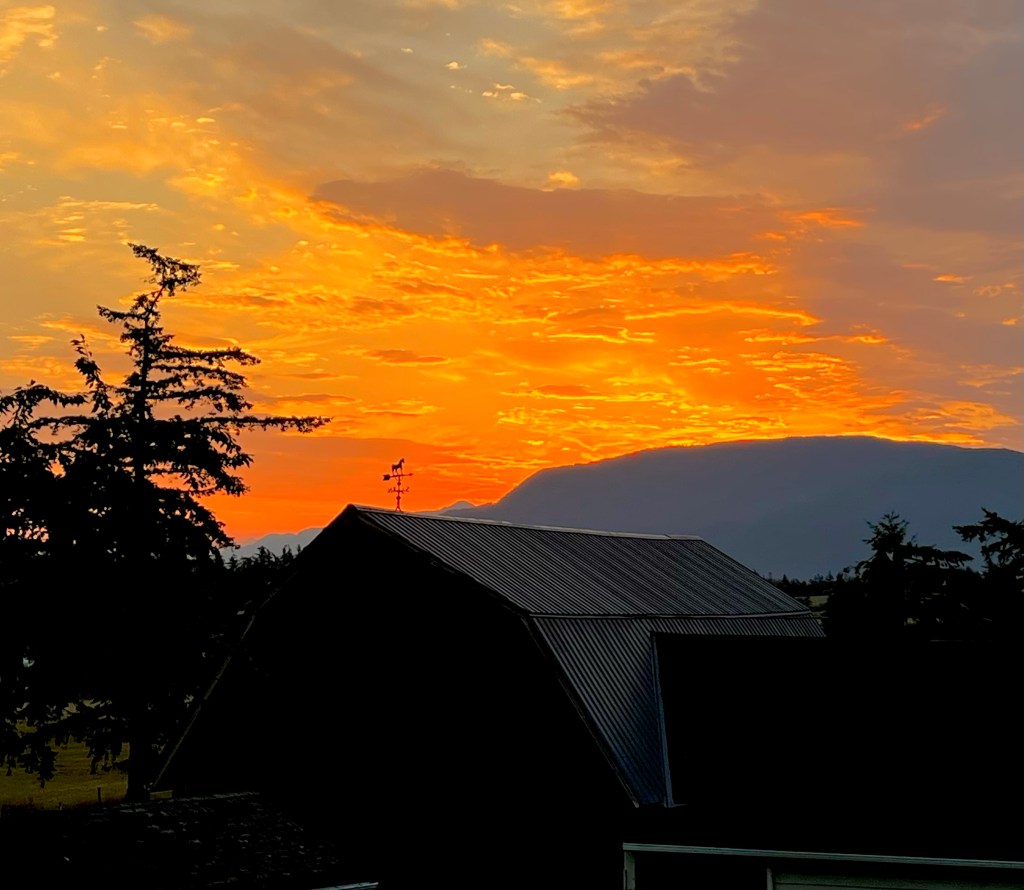
                                      walking beside the barn
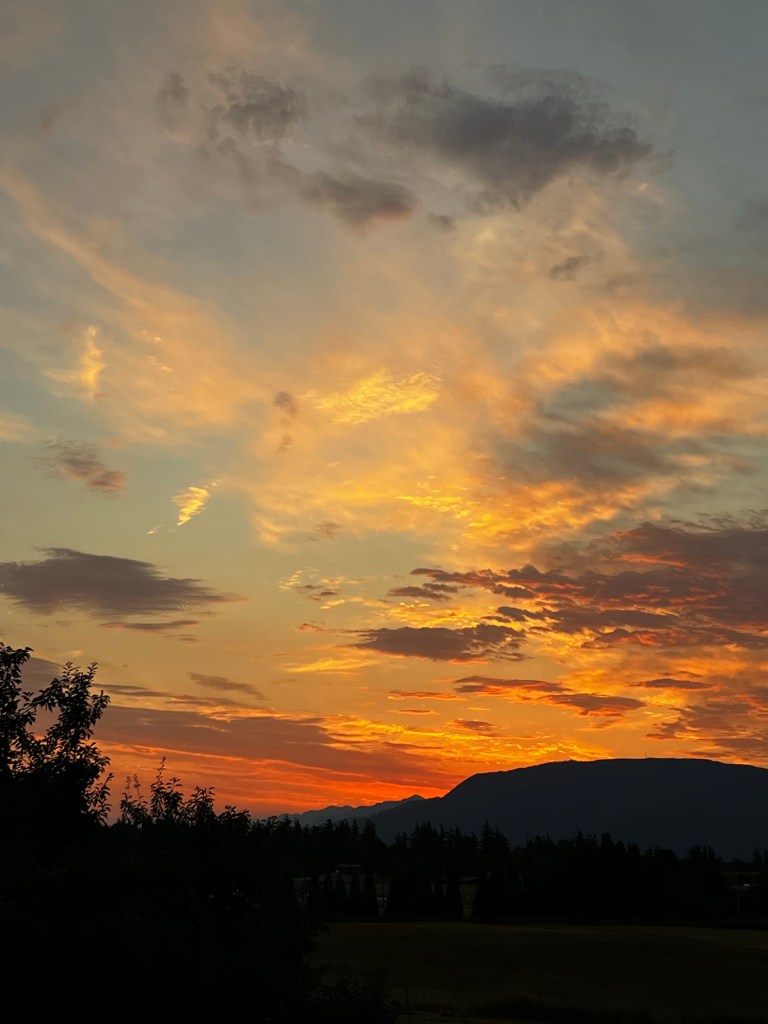
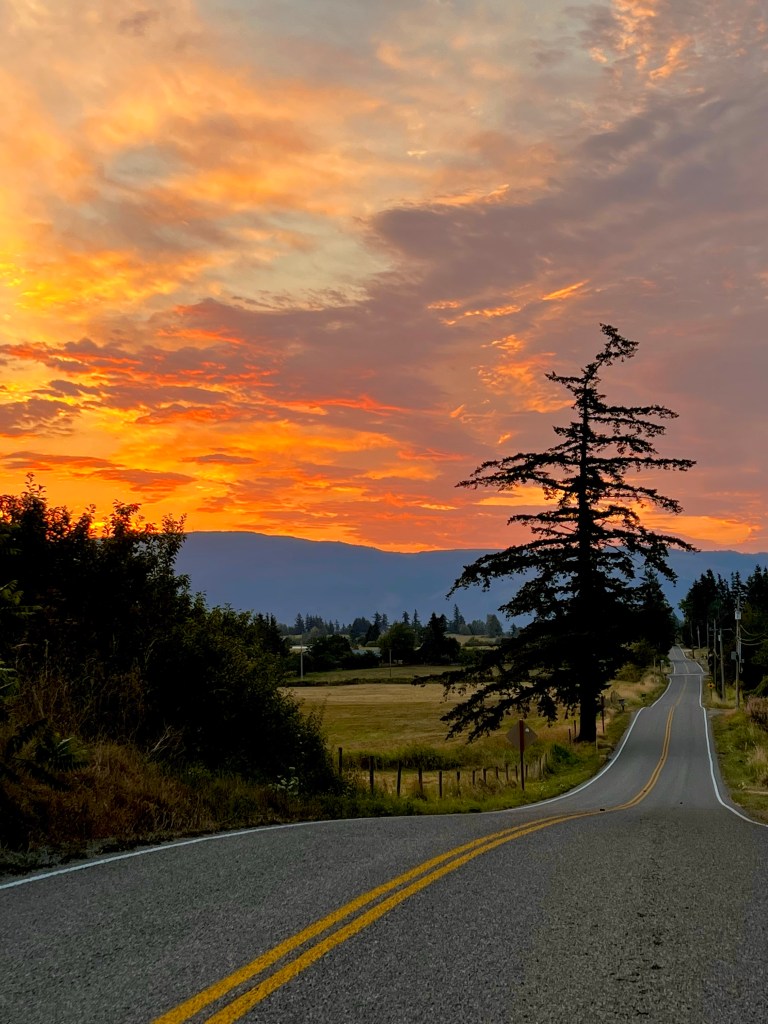
on a day that perishes.

~Donald Hall “Old Roses” from The Selected Poems of Donald Hall. 
The lily has a smooth stalk,
  Will never hurt your hand;
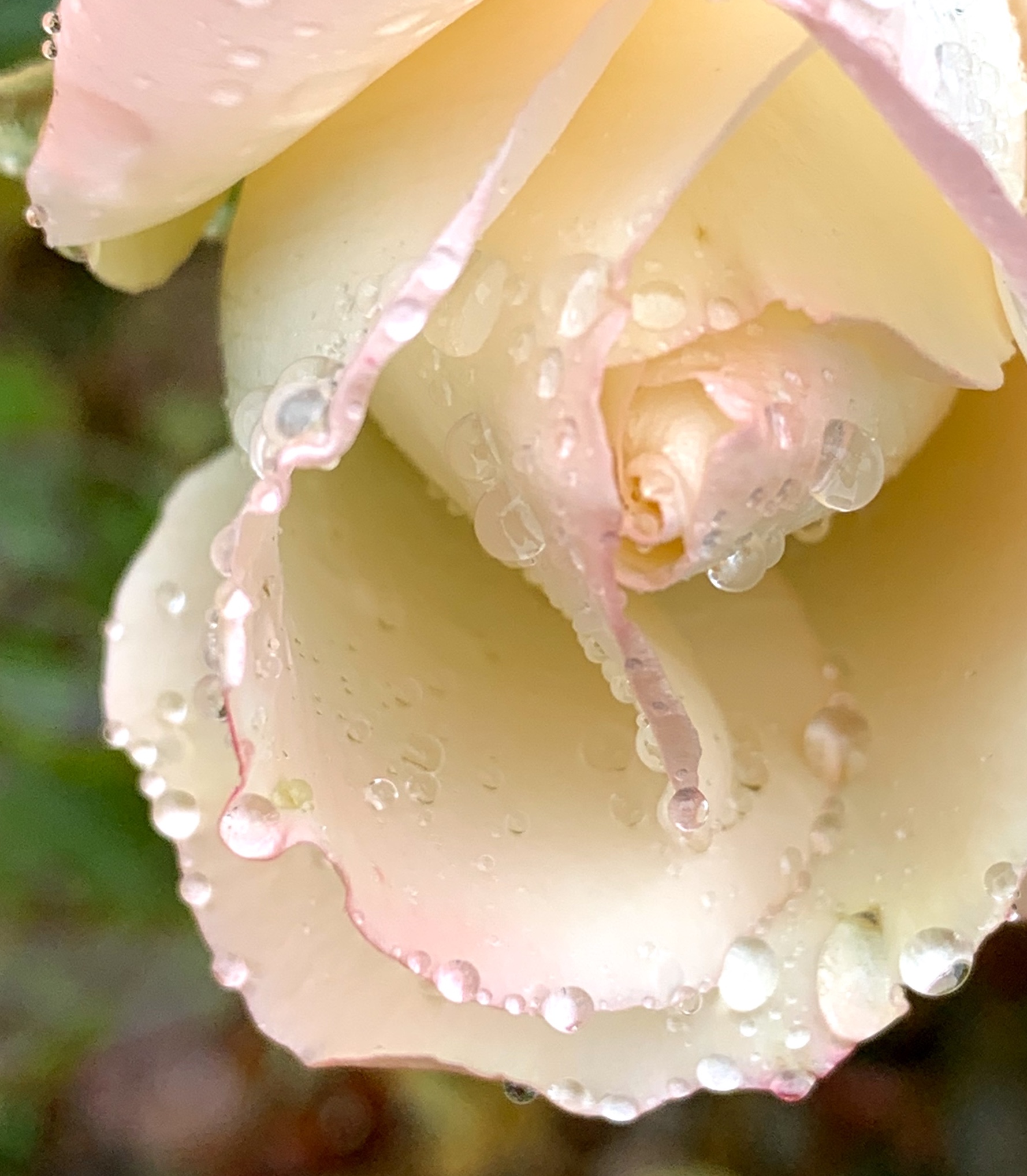
But the rose upon her brier
  Is lady of the land.

There’s sweetness in an apple tree,
  And profit in the corn;
But lady of all beauty
  Is a rose upon a thorn.

When with moss and honey
  She tips her bending brier,
And half unfolds her glowing heart,
  She sets the world on fire.

~Christina Rossetti “The Rose”
We are continually overflowing
toward those who preceded us,
toward our origin, and toward
those who seemingly come after us.

 
It is our task to imprint this
temporary, perishable earth
into ourselves so deeply,
so painfully and passionately,
that its essence can rise again
invisibly, inside us.

~Rainer Maria Rilke from The Selected Poetry of Rainer Maria Rilke
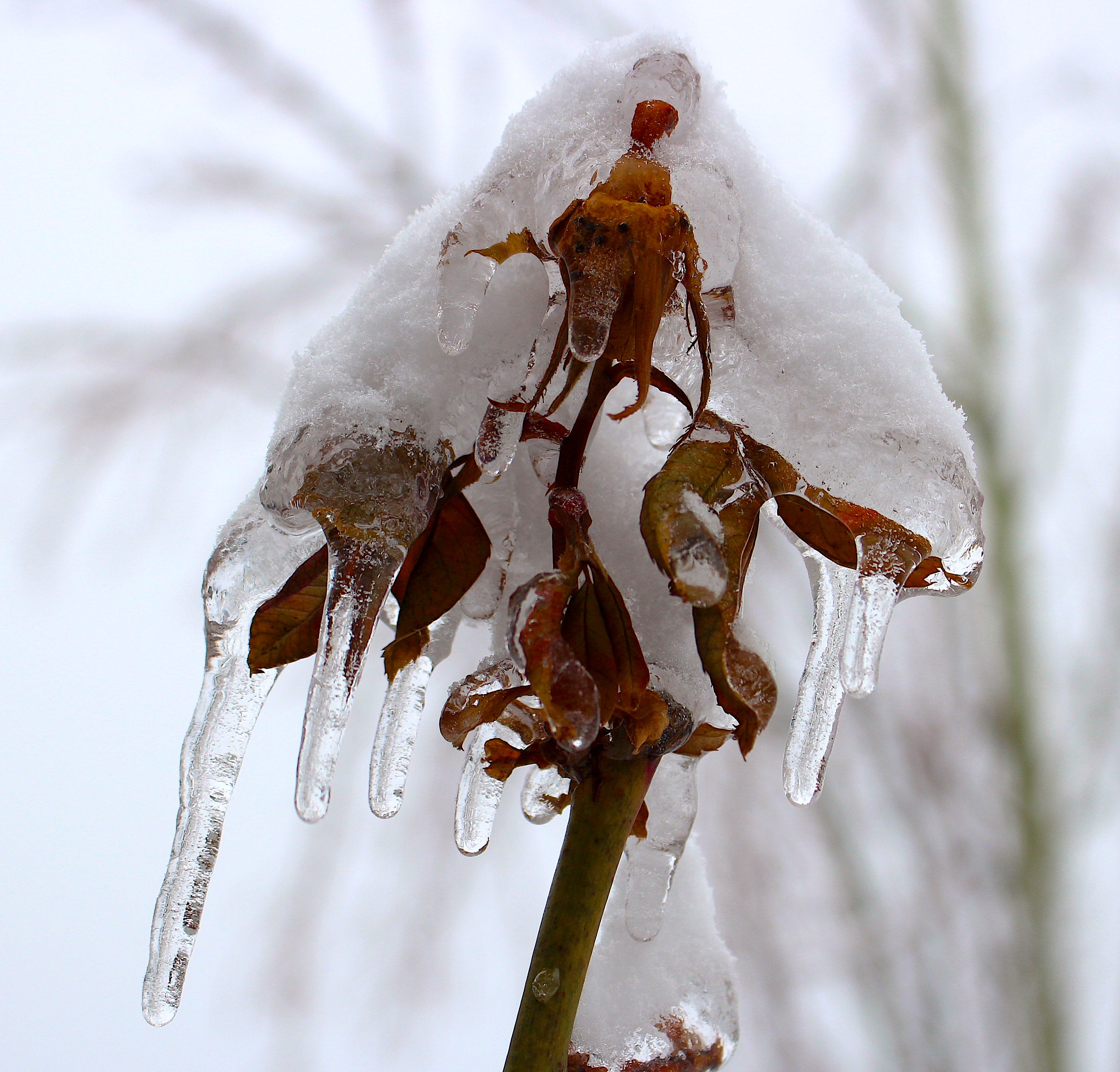
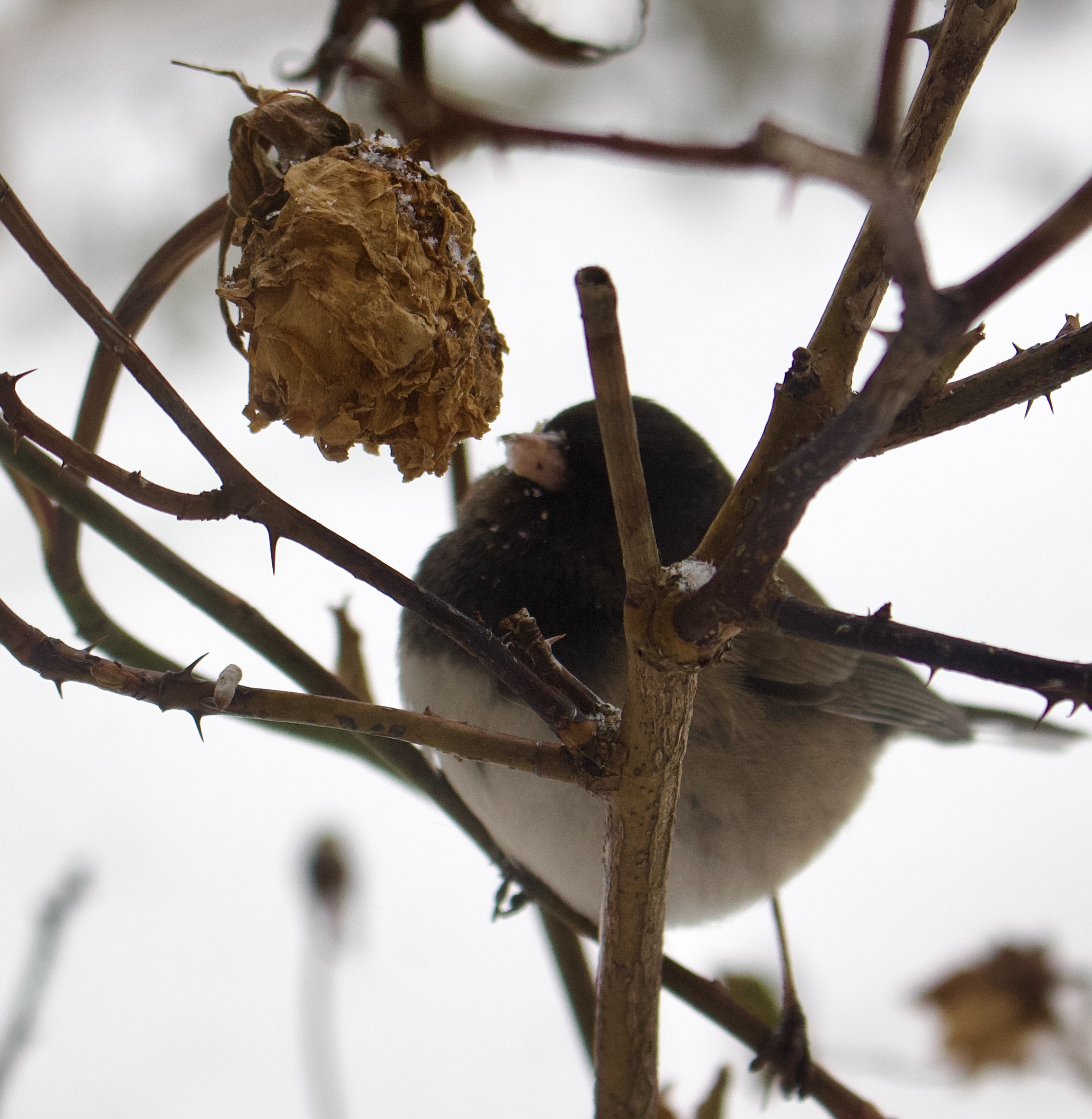
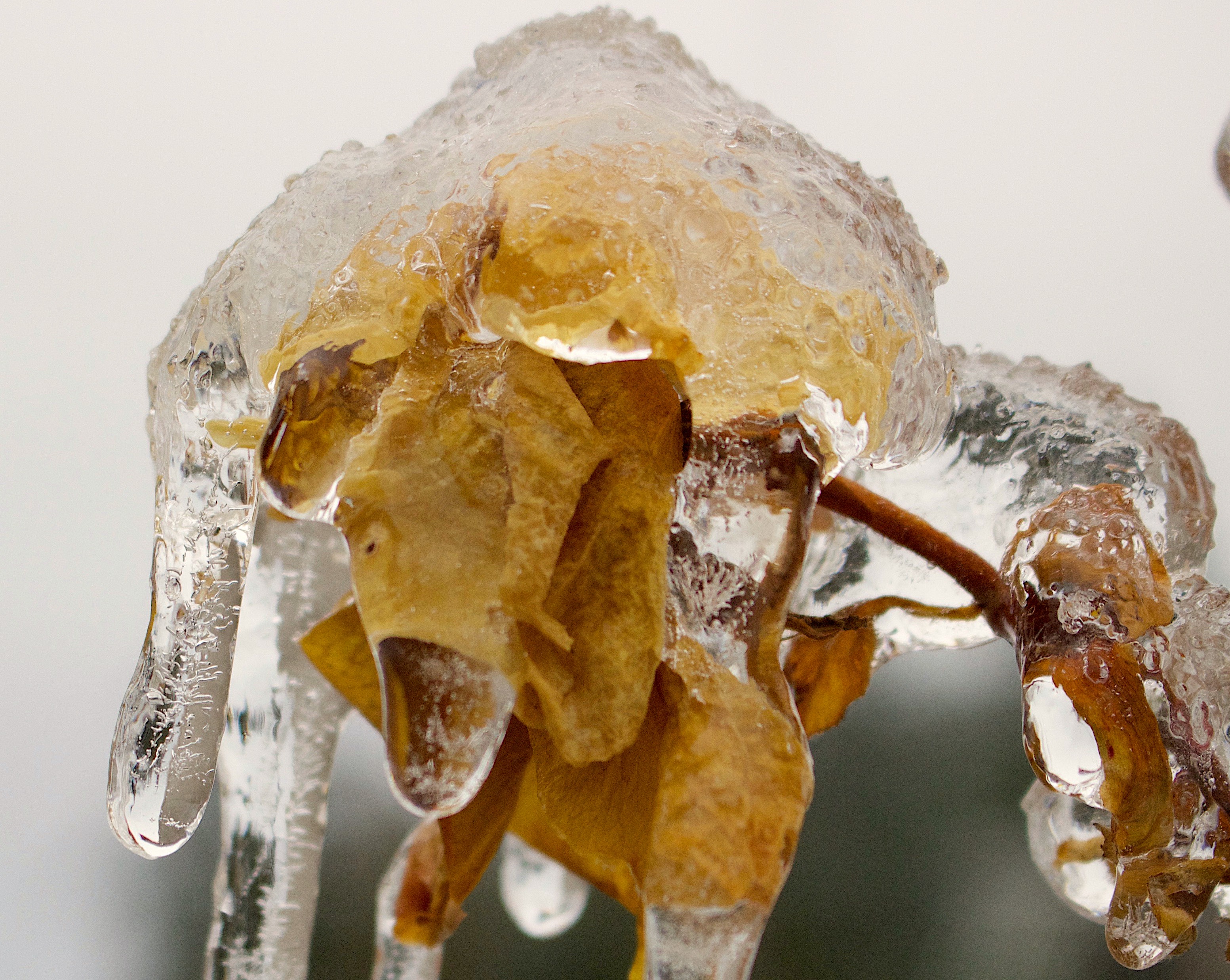
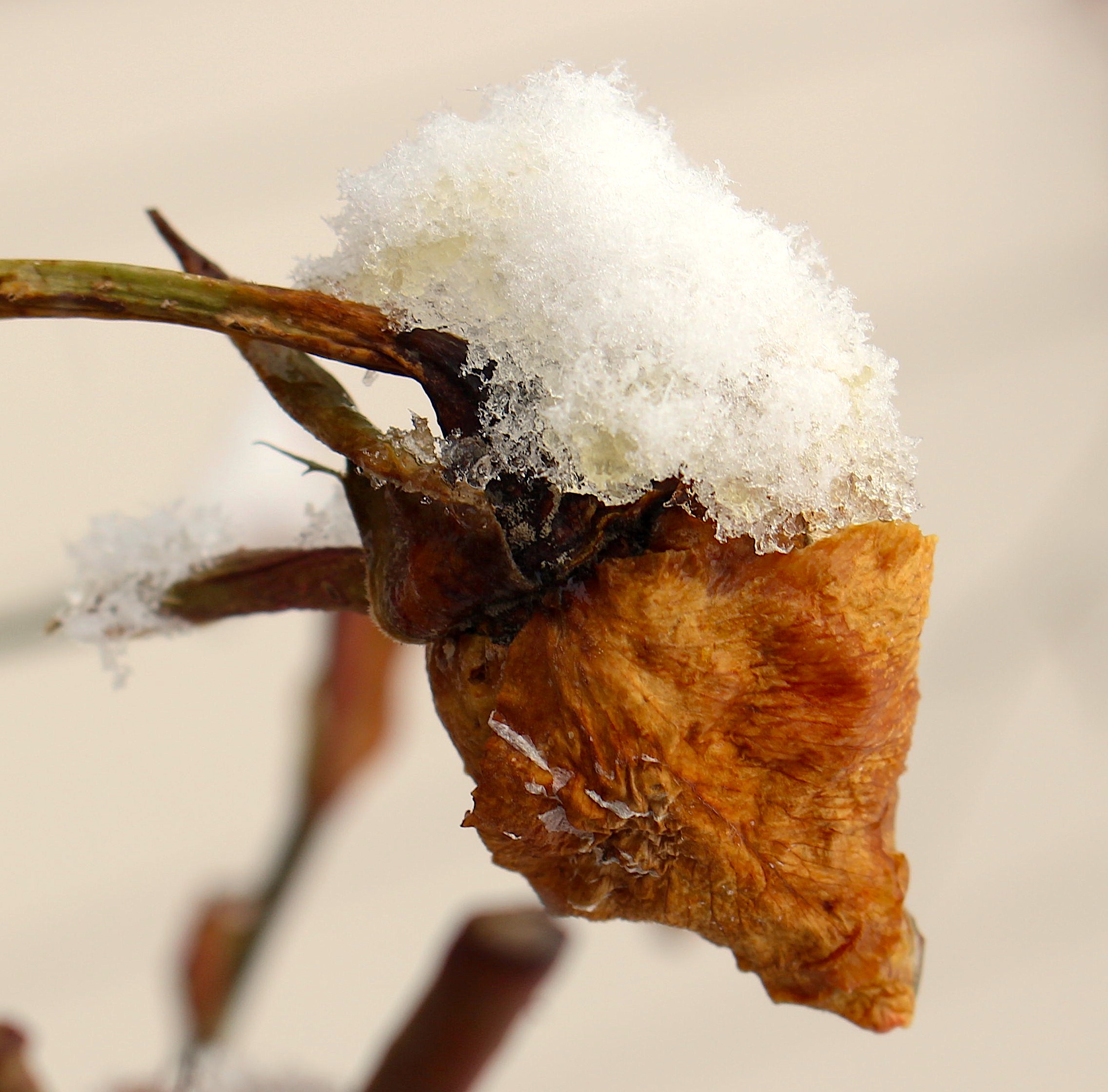
There is a rose bush that still blooms decades later on the farm where my grandparents raised their family, next to the walkway where the house once stood. Overwhelmed with weeds and blackberry vines, it still sets my heart on fire to witness its stubborn persistence, thriving through trauma, abandonment, loneliness and adversity. No one comes to water it in summer drought, and though frozen during ice-covering winters, it thrives again in spring with leaf and bud and blossom.

The vulnerable, perishable, and beloved seed will rise again, imperishable.

…let your adorning be the hidden person of the heart with the imperishable beauty of a gentle and quiet spirit, which in God’s sight is very precious. 1Peter 3:4

One-Time
Monthly
Yearly

Make a one-time or recurring donation to support daily Barnstorming posts

Make a monthly donation

Make a yearly donation

Choose an amount

¤10.00
¤25.00
¤50.00
¤5.00
¤15.00
¤100.00
¤5.00
¤15.00
¤100.00

Or enter a custom amount

¤

Your contribution is deeply appreciated.

Your contribution is appreciated.

Your contribution is appreciated.

DonateDonate monthlyDonate yearly
Looking for God in the Clouds

Sometimes they left me for the day
while they went — what does it matter
where — away. I sat and watched her work
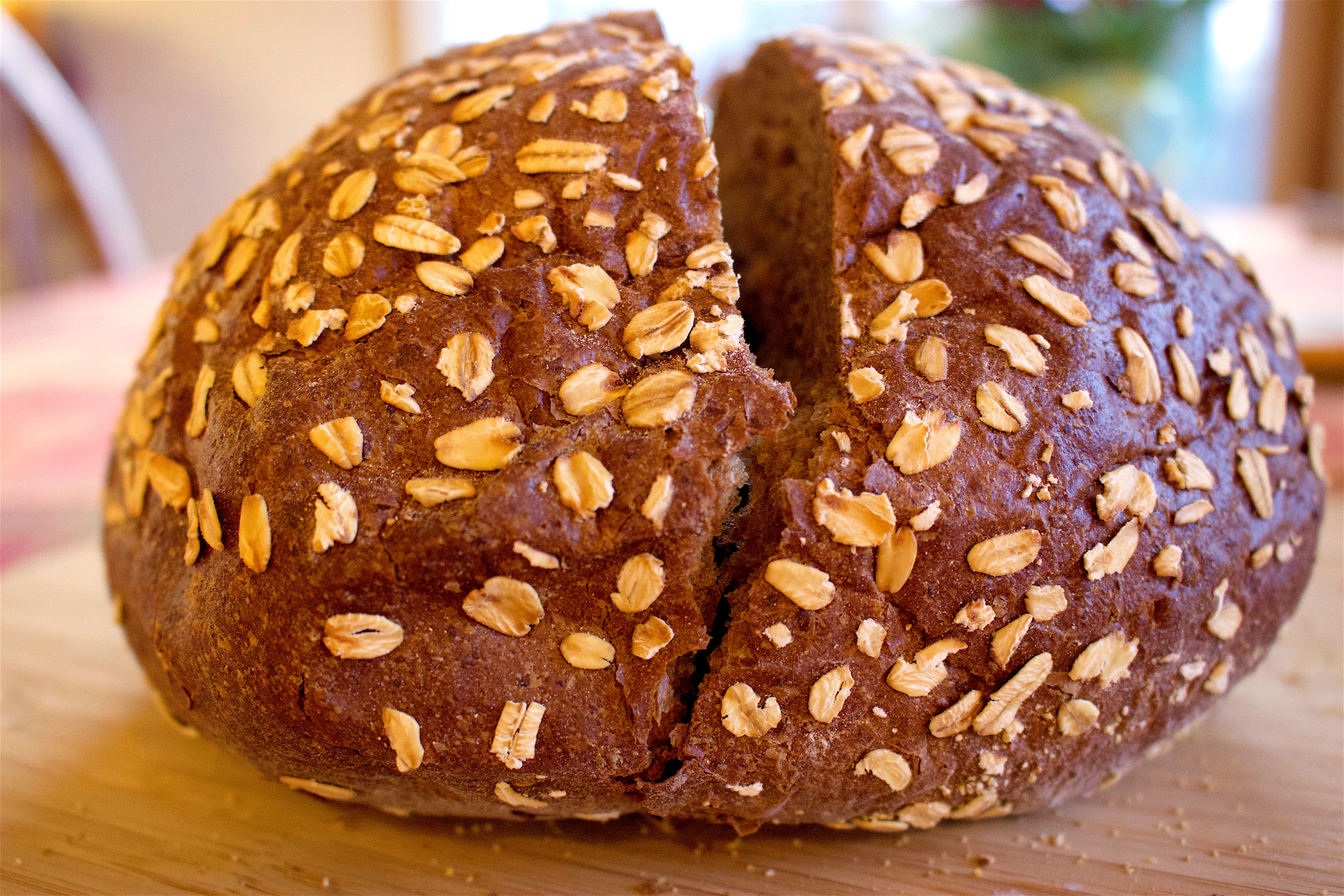
the dough, then turn the white shape
yellow in a buttered bowl.


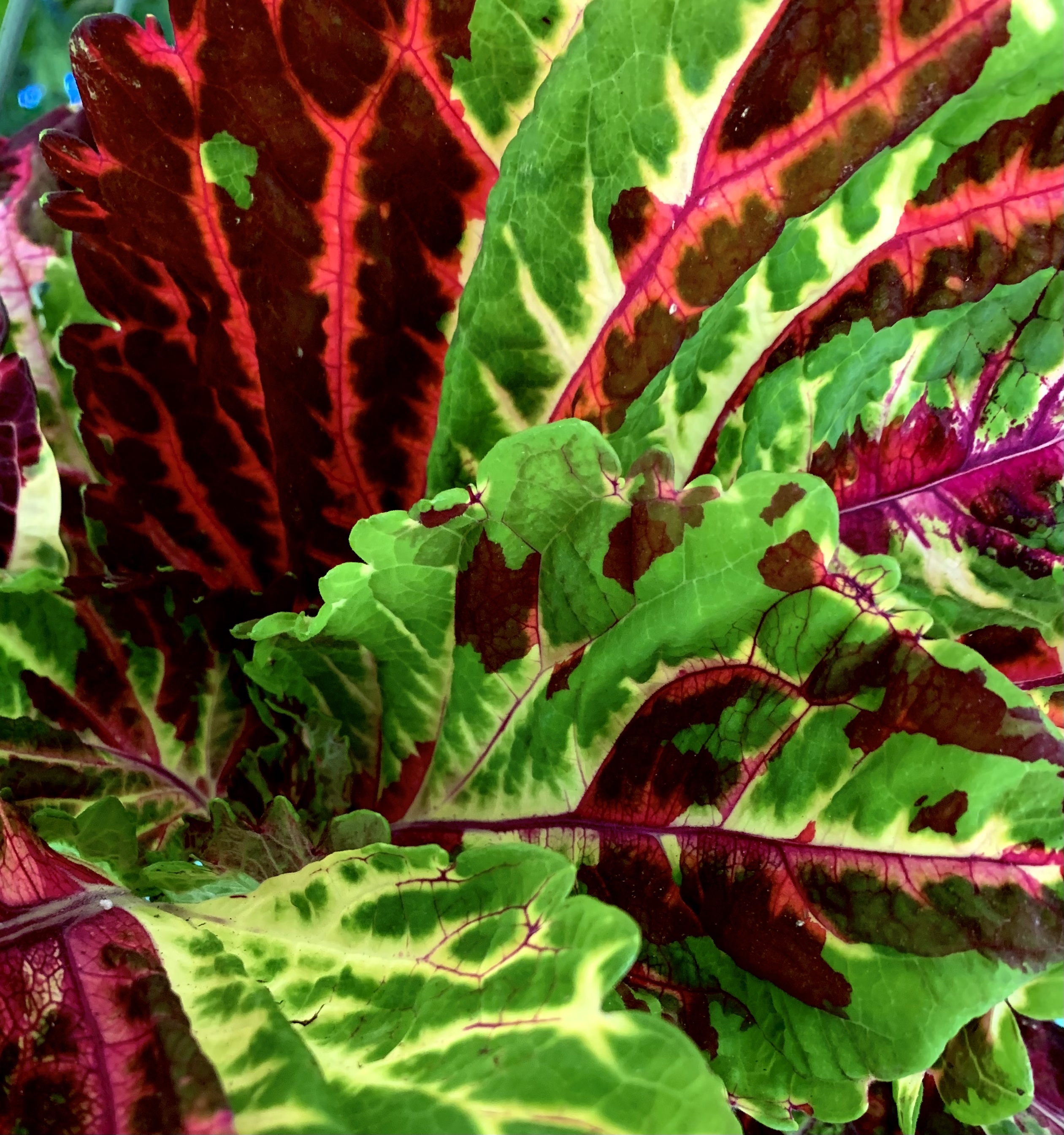
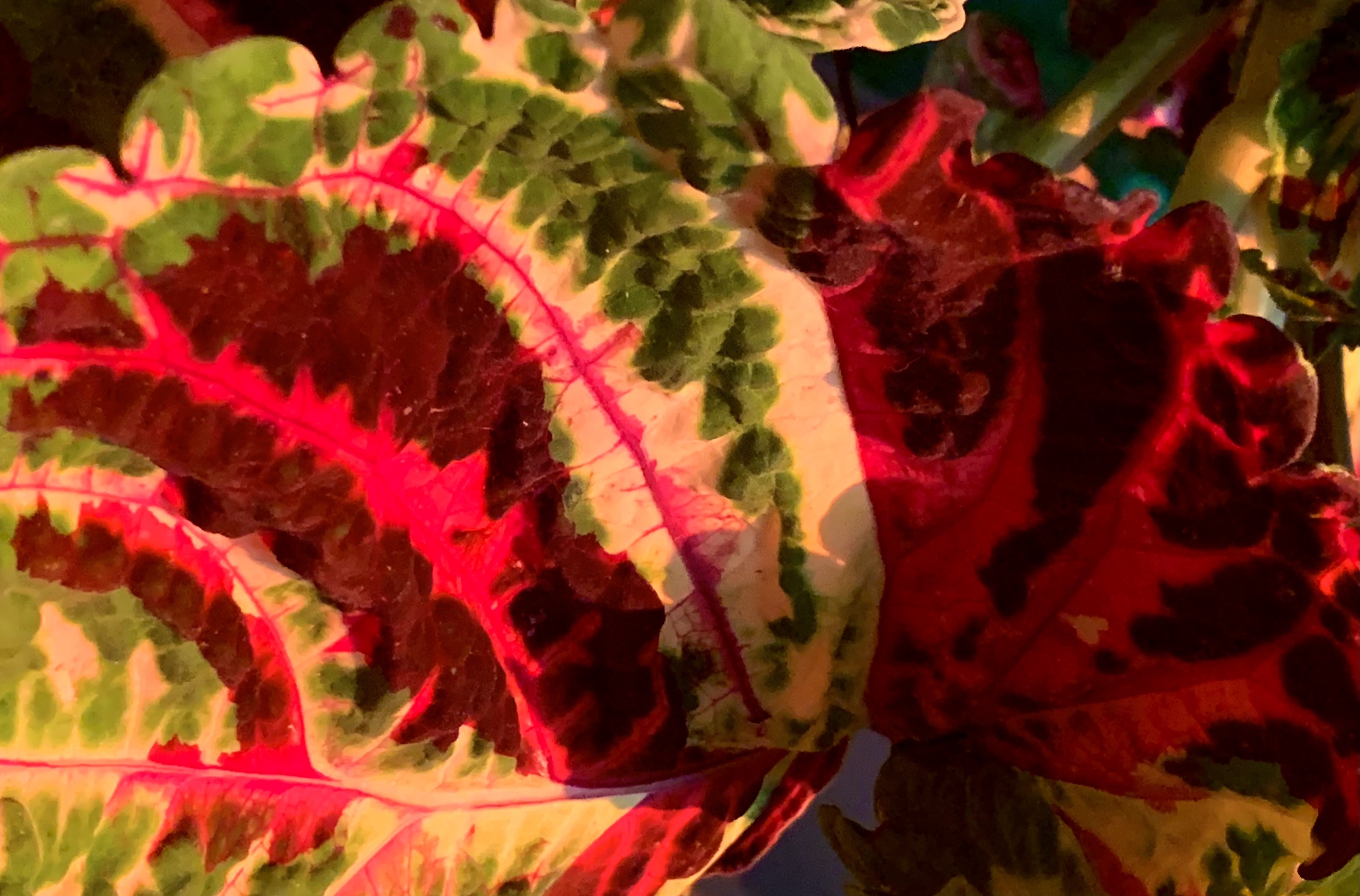
A coleus, wrong to my eye because its leaves
were red, was rooting on the sill
in a glass filled with water and azure
marbles. I loved to see the sun
pass through the blue.


“You know,” she’d say, turning
her straight and handsome back to me,
“that the body is the temple
of the Holy Ghost.”

The Holy Ghost, the oh, oh … the uh
oh, I thought, studying the toe of my new shoe,
and glad she wasn’t looking at me.

Soon I’d be back in school. No more mornings
at Grandma’s side while she swept the walk
or shook the dust mop by the neck.


If she loved me why did she say that
two women would be grinding at the mill,
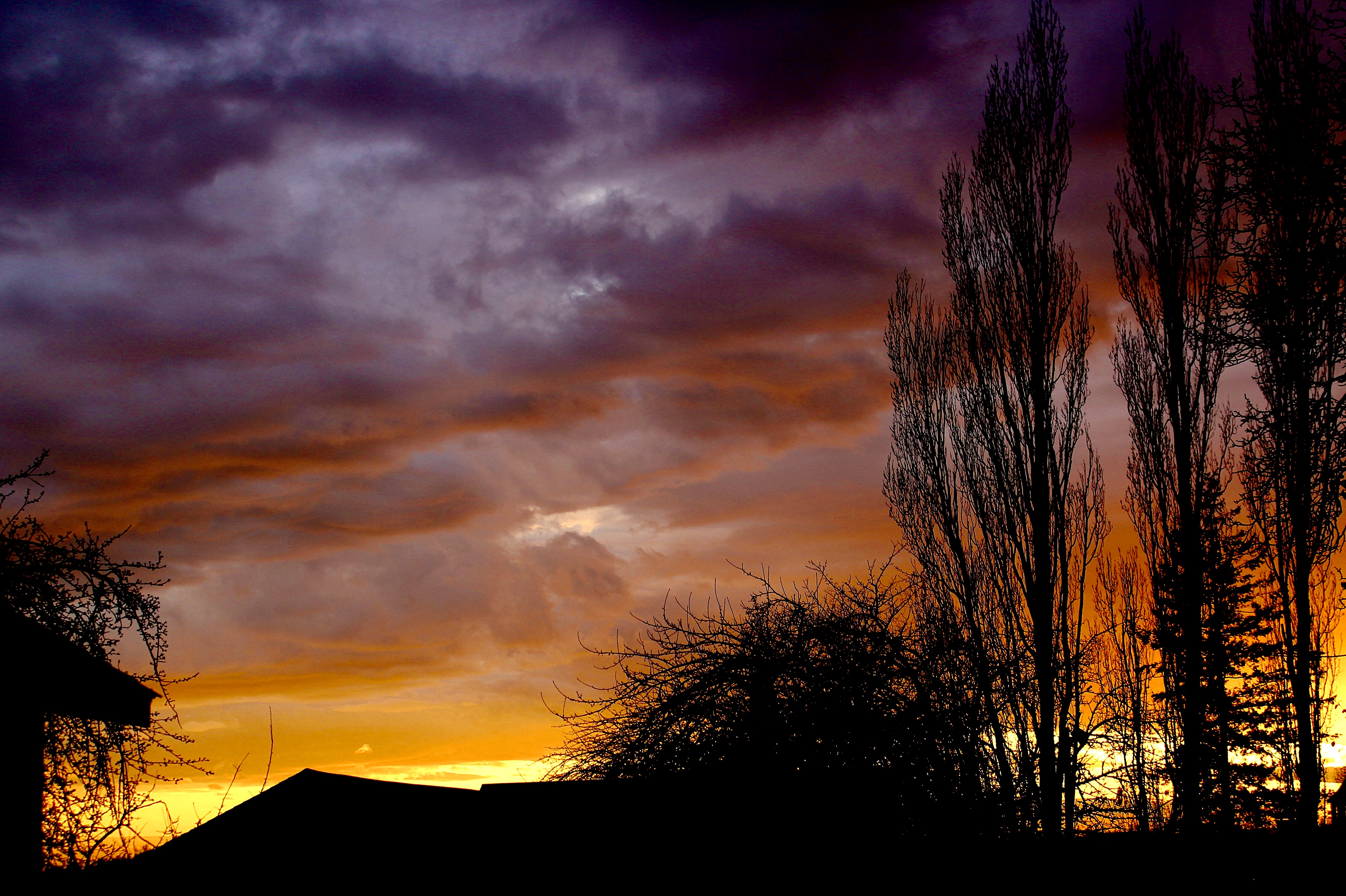
that God would come out of the clouds
when they were least expecting him,
choose one to be with him in heaven
and leave the other there alone?

~Jane Kenyon “Staying at Grandma’s” from Let Evening Come

(For Sarah Innes Blos, in memory of Stephen)
Although we always come this way
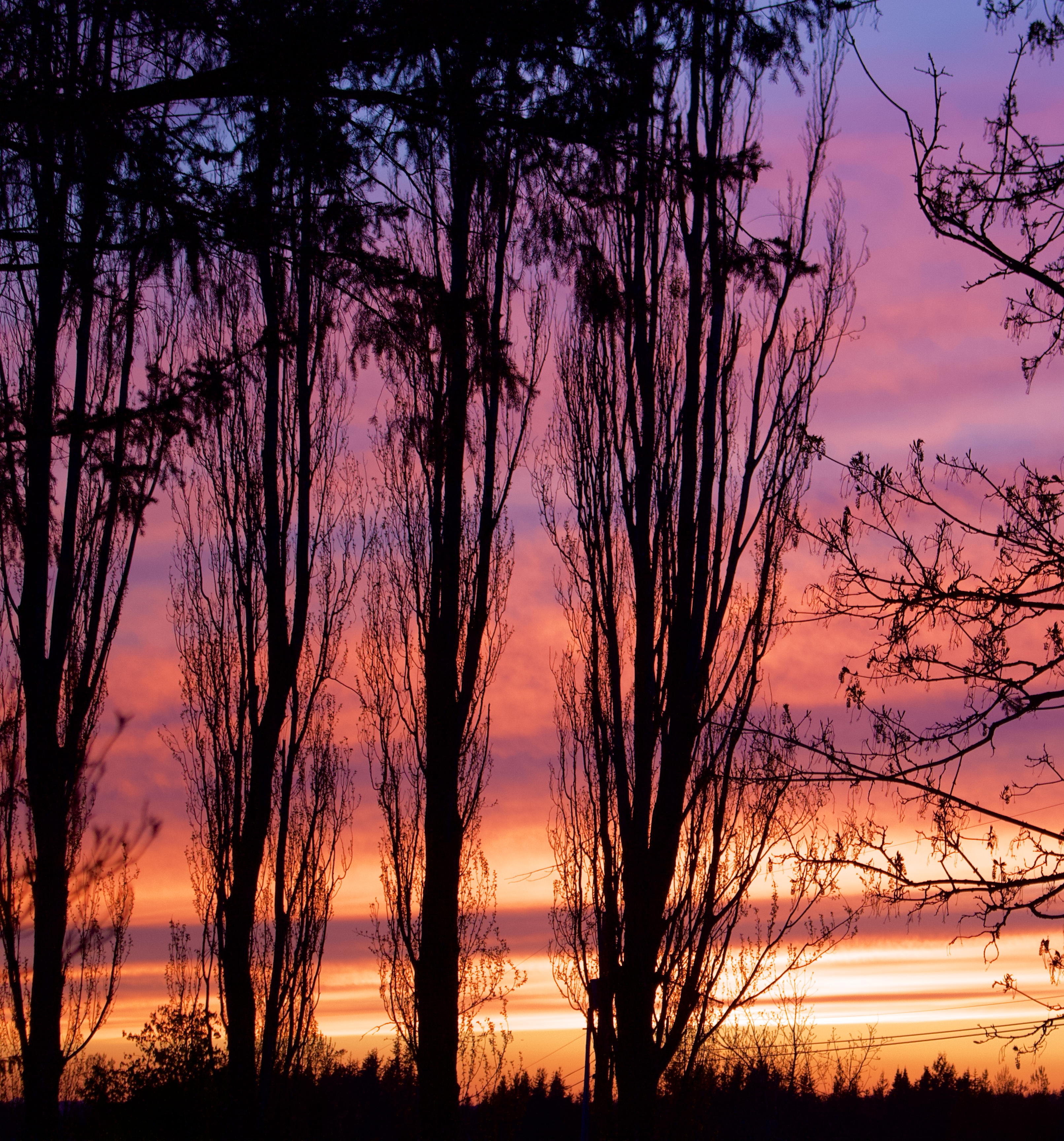
I never noticed before that the poplars
growing along the ravine
shine pink in the light of a winter dawn.
What am I going to say
in my letter to Sarah- -a widow at thirty-one,
alone in the violence
of her grief, sleepless, in doubt
about the goodness of life,
and utterly cast down?
I look at the lithe trees more carefully
remembering Stephen the photographer.
With the hunger of two I take them in.
Perhaps I can tell her that.
The dog furrows his brow while pissing long
and thoughtfully against an ancient hemlock.
The snow turns the saffron of a monk’s robe
and acrid steam ascends.
Looking for God is the first thing and the last,
but in between so much trouble, so much pain.
Far up in the woods where no one goes
deer take their ease under the great
pines, nose to steaming nose ….
~Jane Kenyon “With the Dog at Sunrise”

I never got to stay alone with either of my Grandmas. One died young of cancer before I was born and the other, like Jane Kenyon’s grandmother, ran a chaotic household of boarders. My parents would not have trusted me to her care given everything else she was responsible for. Plus she also possessed a very fundamentalist world view as a faithful-to-the-Bible church goer who could have scared me to death with her dire interpretation of scripture.

I’m relieved it wasn’t fear that led me to a belief in a Trinitarian God. There is no question faith is a hard road, tested in challenging ways along the way, but God is the first thing and the last, the Alpha and Omega. In between, we must search out His Face every day, knowing how hidden He can be.

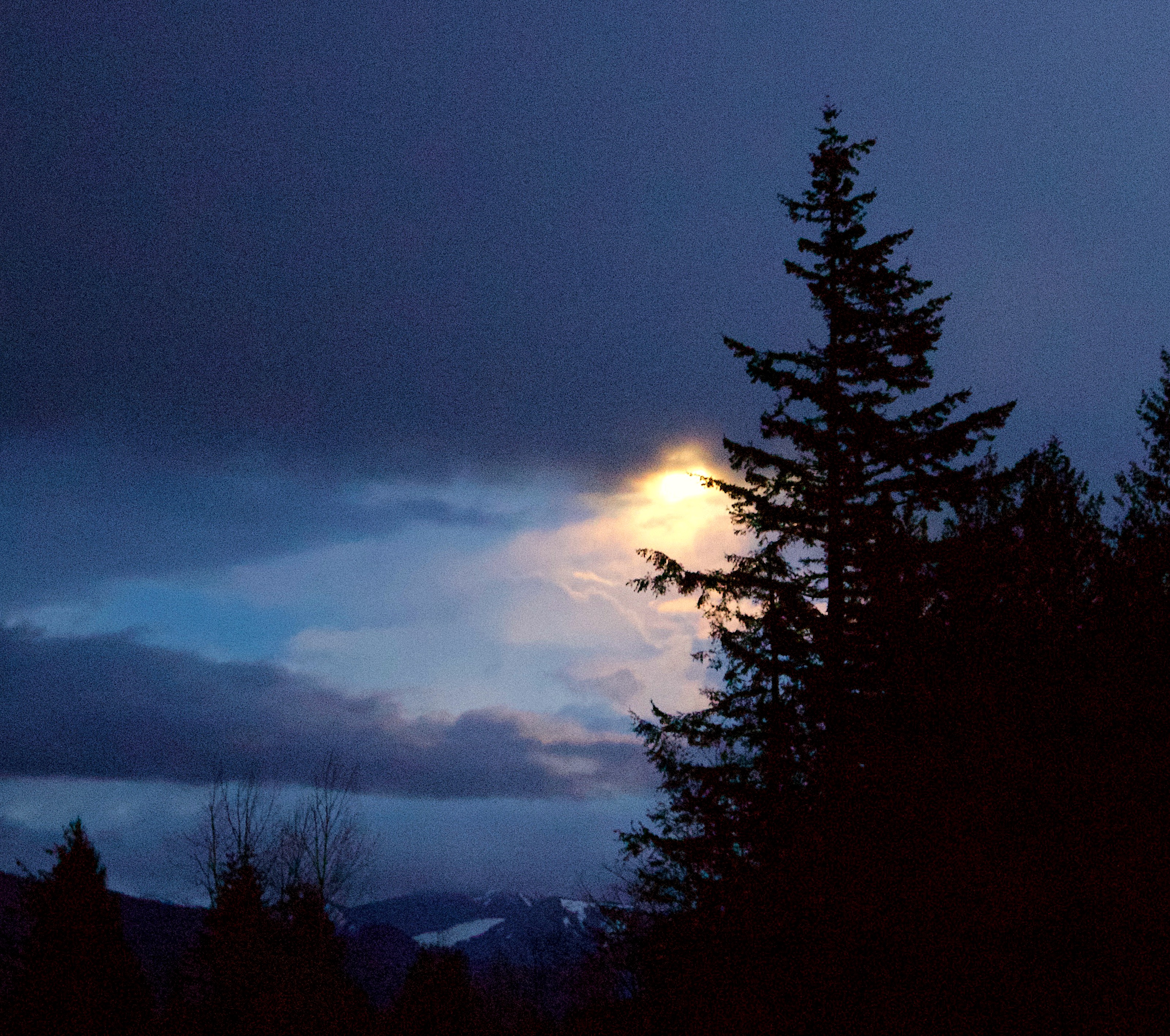
Understanding this, I still check the clouds every day, just in case I might miss His coming.

One-Time
Monthly
Yearly

Make a one-time or recurring donation to support daily Barnstorming posts

Make a monthly donation

Make a yearly donation

Choose an amount

$10.00
$20.00
$50.00
$5.00
$15.00
$100.00
$5.00
$15.00
$100.00

Or enter a custom amount

$

Your contribution is deeply appreciated.

Your contribution is appreciated.

Your contribution is appreciated.

DonateDonate monthlyDonate yearly
Making Something Happen Every Day

There in the attic of forgotten shapes
(Old coats in plastic, hat boxes, fur capes
Amongst the smells of mothballs and cigars),
I saw the doll house of our early years,
With which my mother and my aunt had played,
And later where my sister and I made
The towering grown-up hours to smile and pass:
The little beds, the tin-foil looking glass,
Bookcases stamped in ink upon the walls,
Mismatched chairs where sat the jointed dolls,
The clock whose face, no larger than a dime,
Had, for all these years, kept the same time.
I remembered how we set the resin food
Atop a table of stained balsa wood,
The shiny turkey hollow to the tap,
The cherry pie baked in a bottle cap.
Now it is time to go to sleep, we spoke,
Parroting the talk of older folk,
And laid the dolls out fully-clothed in bed
After their teeth were brushed, and prayers were said,
And flipped the switch on the low-wattage sun.
But in the night we’d have something break in,
Kidnap the baby or purloin the pie —
A tiger, maybe, or a passer by —
Just to make something happen, to move the story.
The dolls awoke, alarmed, took inventory.
If we made something happen every day,
Or night, it was the game we knew to play,
Not realizing then how lives accrue,
With interest, the smallest things we do.

~A.E. Stallings “The Doll House”

I was born with a severe imagination deficiency. I could not create my way out of a paper bag, much less make up a story. This never seemed like much of an impediment since I am quite content dealing with the daily challenges of real life. I married someone with a similar world view and we both thrived in our banal and mundane world.

Then we had children. Children born with intact and active imaginations. Children with imaginary friends, and monsters under the bed and a world outside our front door that I didn’t recognize. And they have grown up to have children with wild imaginings too.

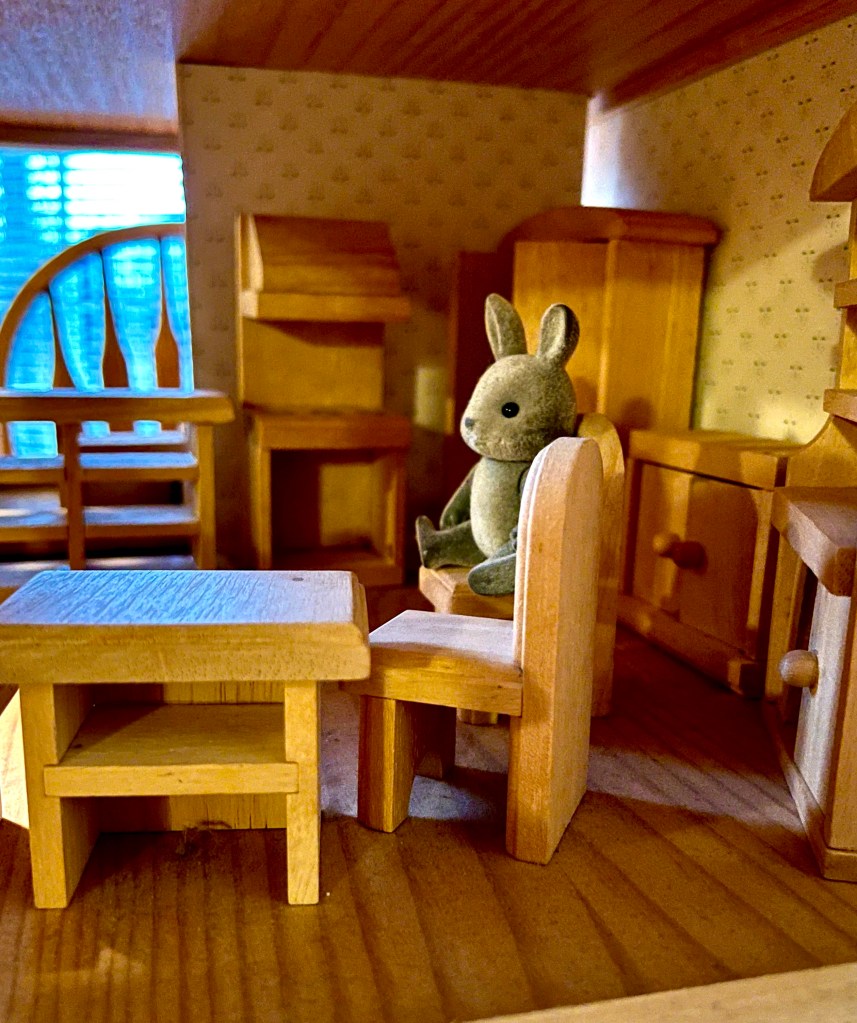
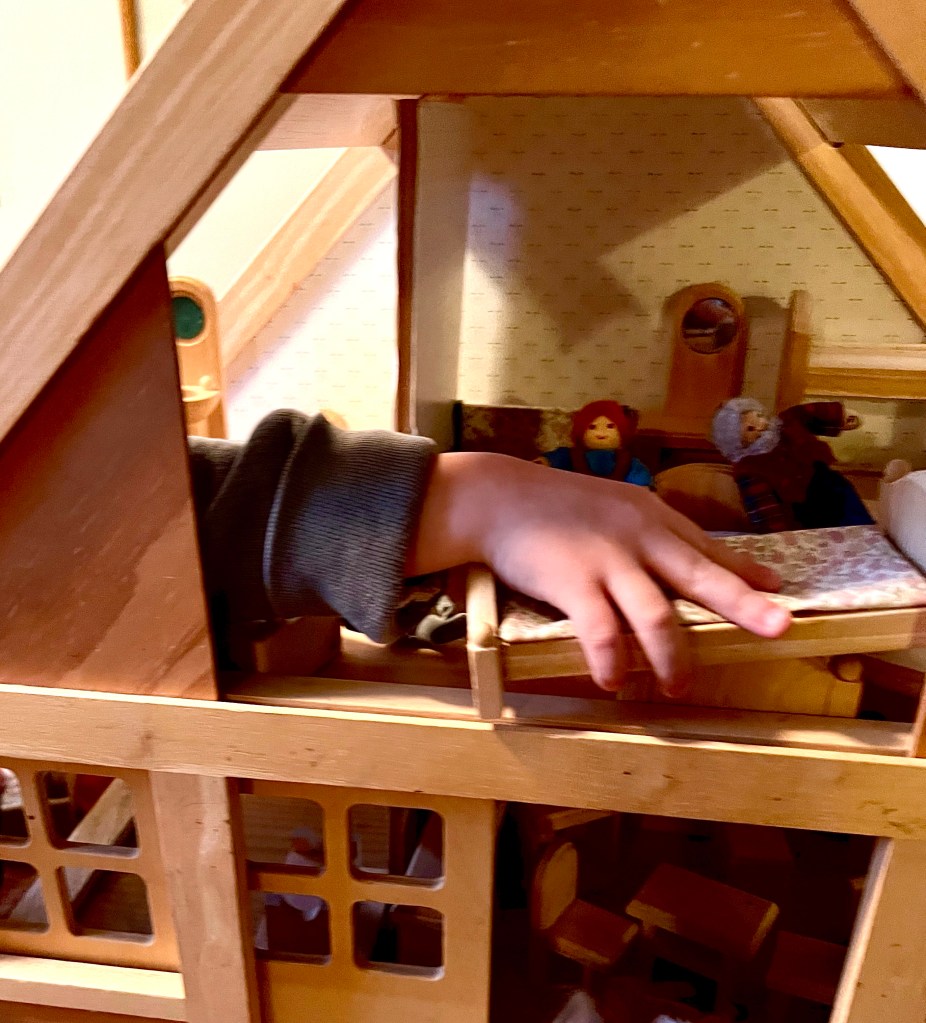
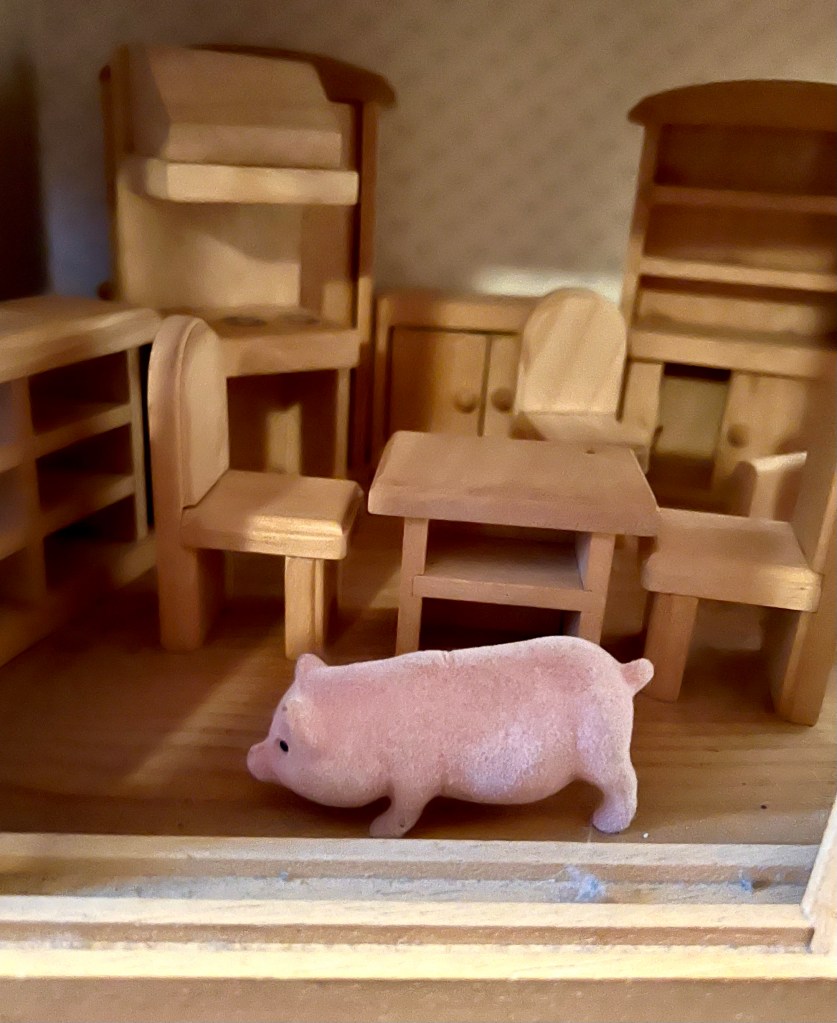
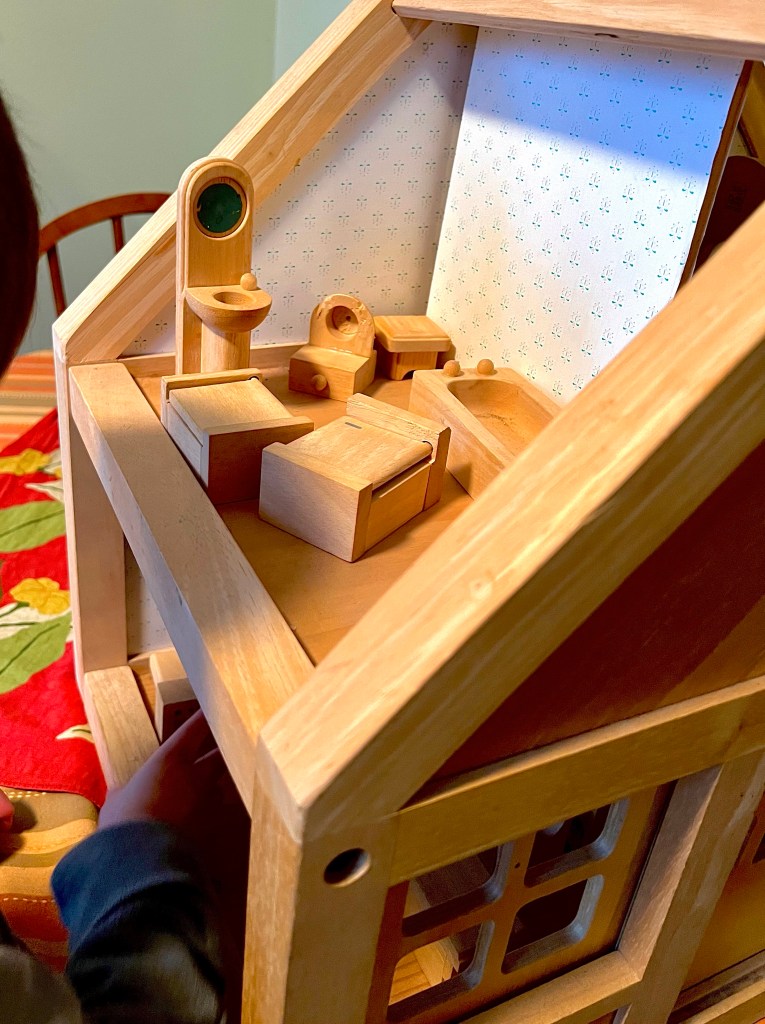
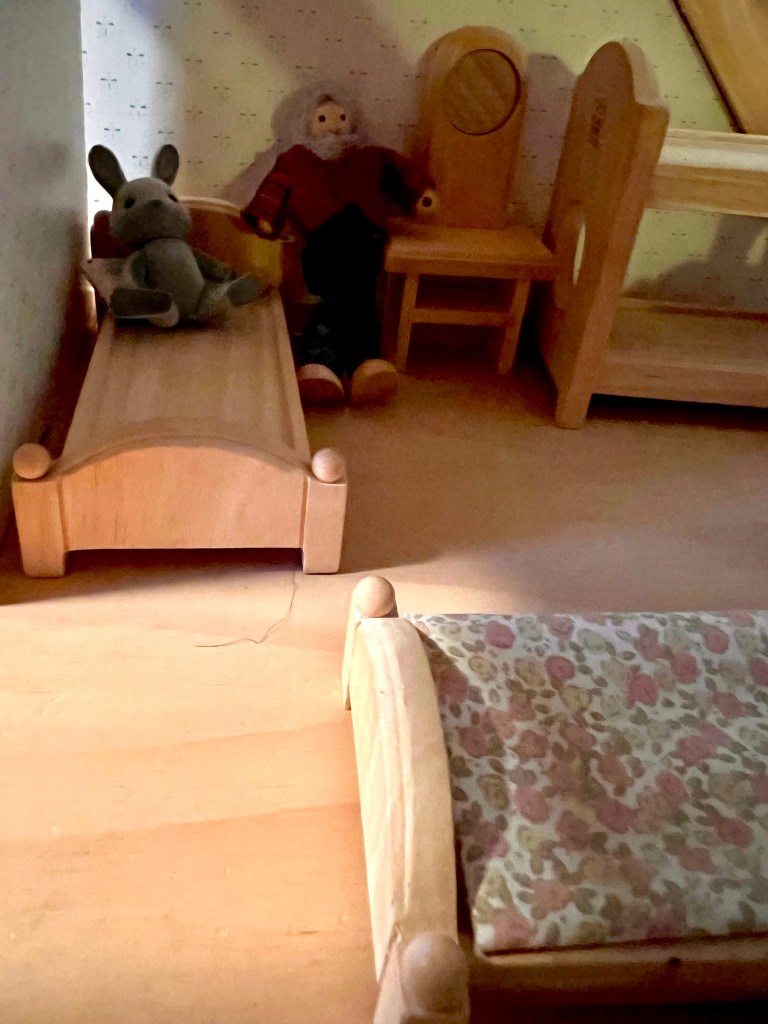
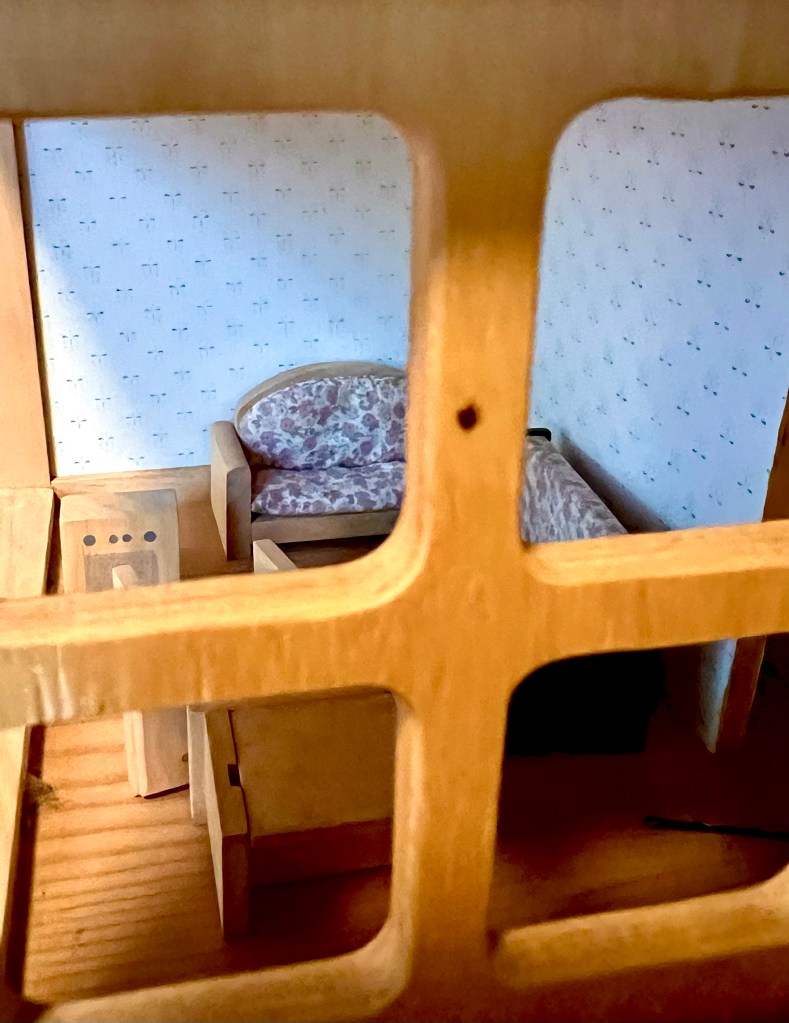
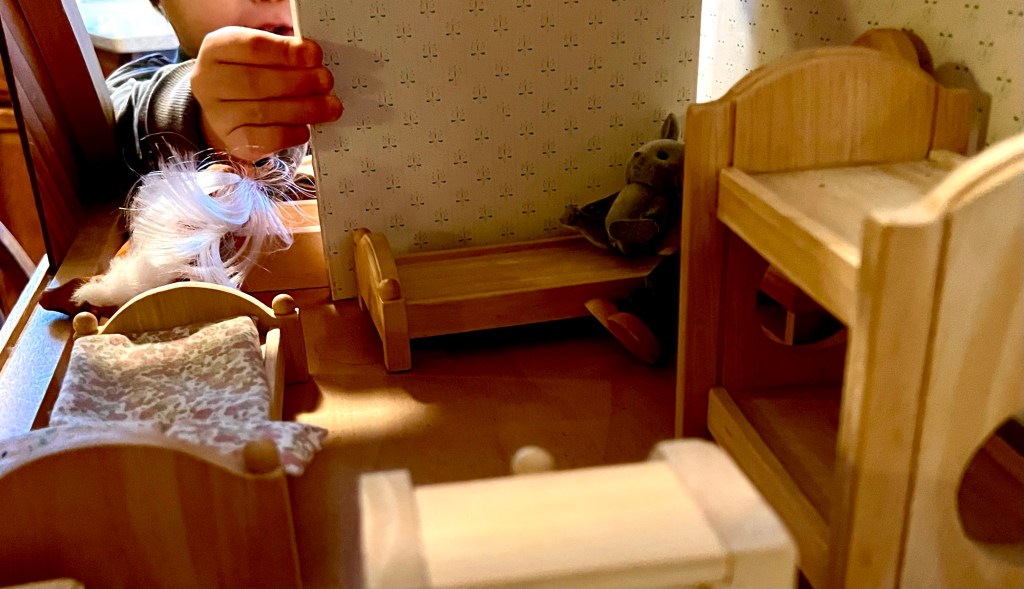
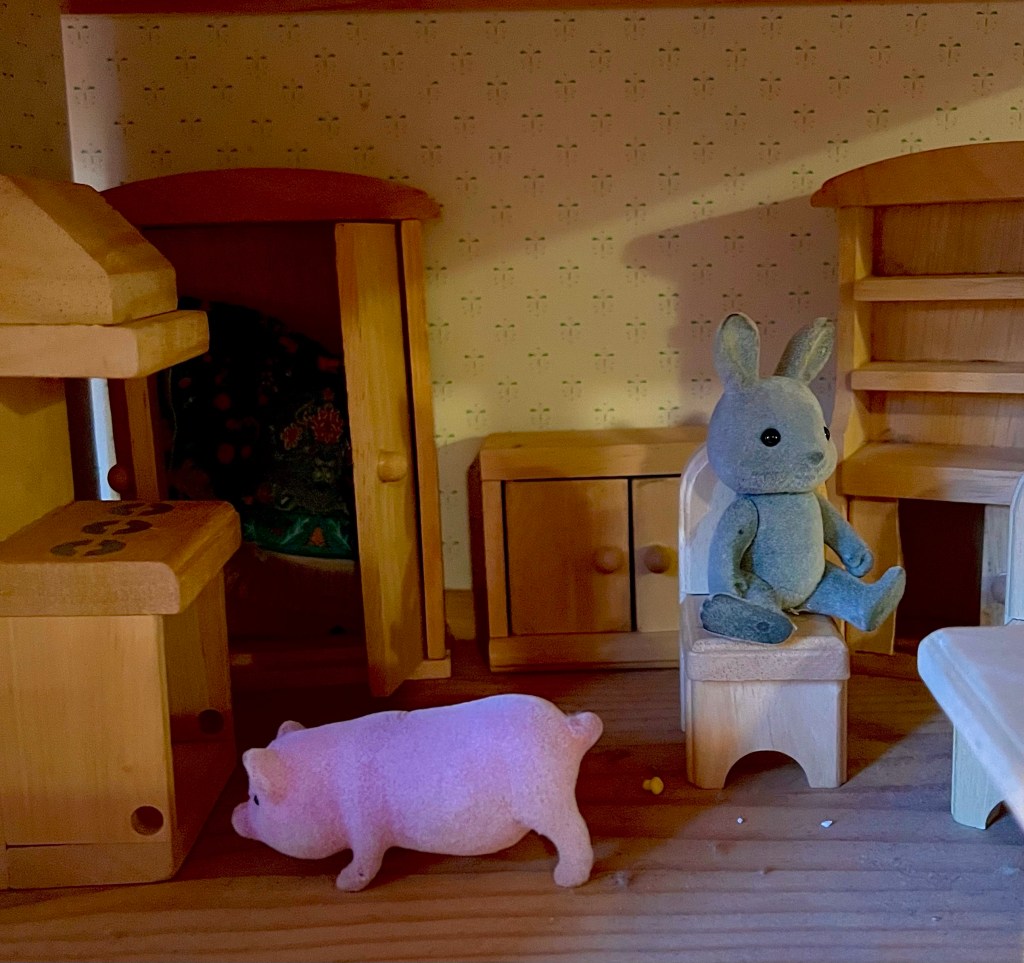
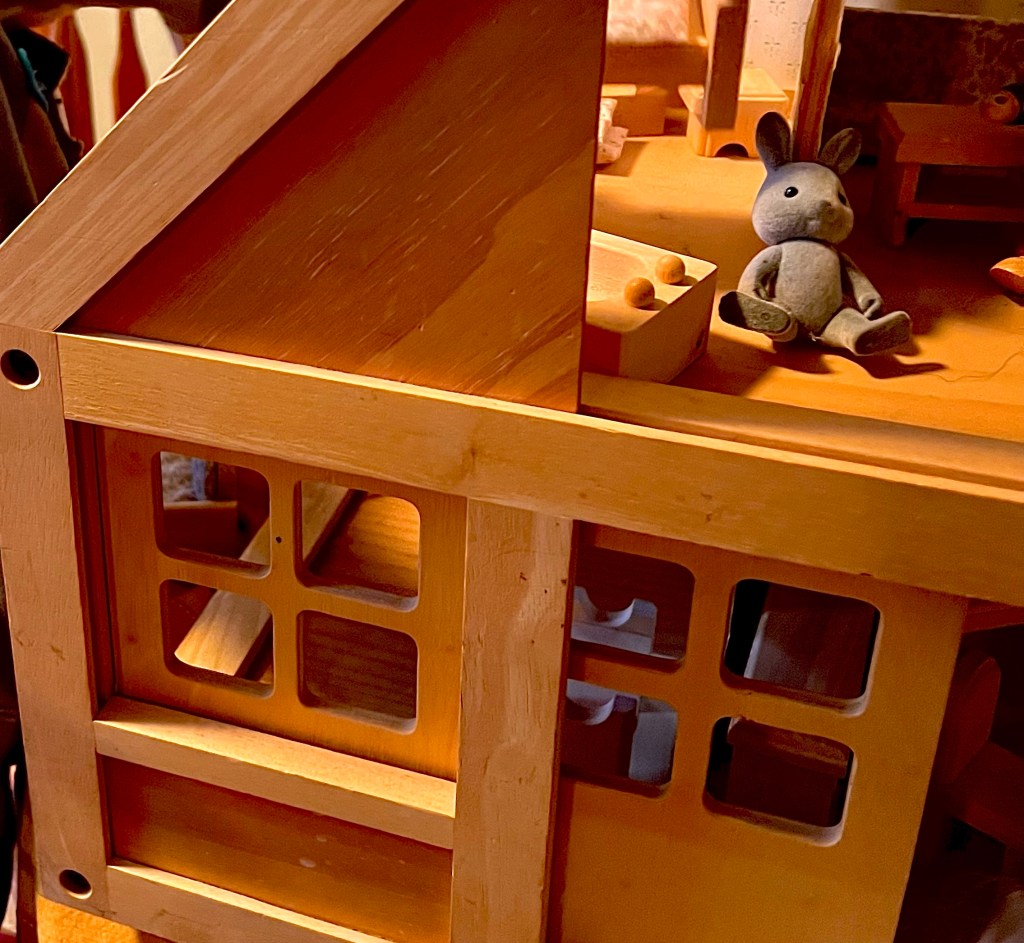
Our old doll house is a pretty tame place to exercise excessive levels of creativity, with characters and furniture to move around, conversations to overhear and conflicts to resolve. So I watch grandchildren make something happen in their world while I continue to make sense of the world I was born into.

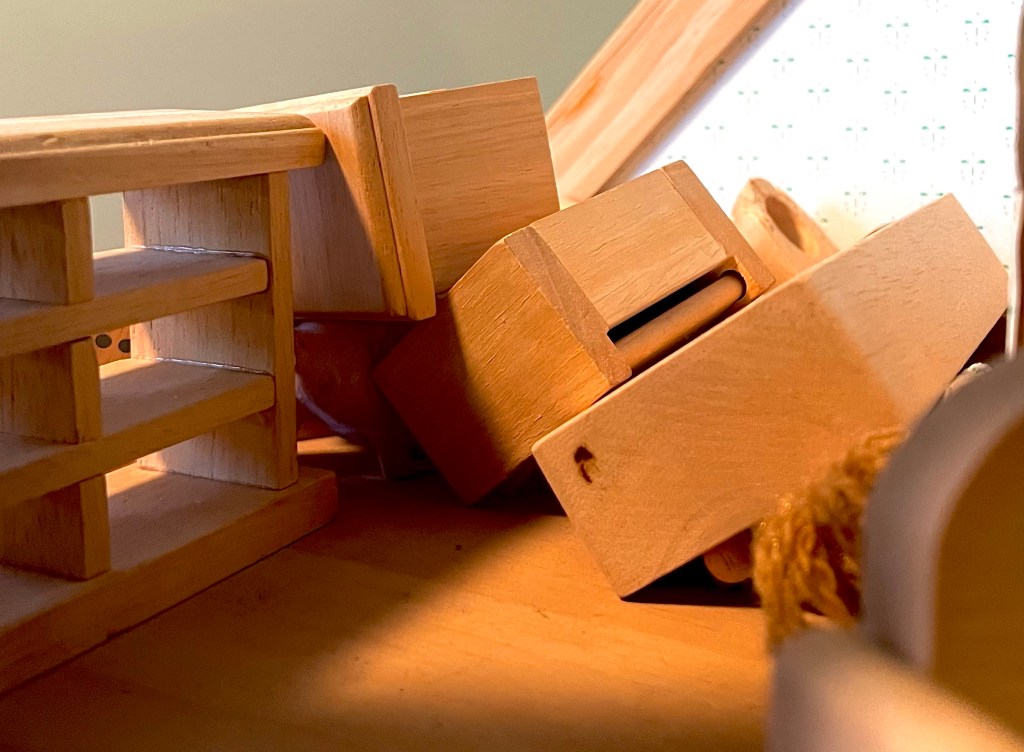
Their stories become interest accrued on lives well-composed and imagined. Even when a giant troll comes and knocks over all the furniture – there is no need for real life earthquakes in their created-reality.

And so it goes…

One-Time
Monthly
Yearly

Make a one-time donation

Make a monthly donation

Make a yearly donation

Choose an amount

¤5.00
¤15.00
¤100.00
¤5.00
¤15.00
¤100.00
¤5.00
¤15.00
¤100.00

Or enter a custom amount

¤

Your contribution is appreciated.

Your contribution is appreciated.

Your contribution is appreciated.

DonateDonate monthlyDonate yearly
Driving at Night

I want to be a passenger
in your car again
and shut my eyes
while you sit at the wheel,


awake and assured
in your own private world,
seeing all the lines
on the road ahead,


down a long stretch
of empty highway
without any other
faces in sight.

I want to be a passenger
in your car again
and put my life back
in your hands.
~Michael Miller “December”

Up north, the dashboard lights of the family car
gleam in memory, the radio
plays to itself as I drive
my father plied the highways
while my mother talked, she tried to hide
that low lilt, that Finnish brogue,
in the back seat, my sisters and I
our eyes always tied to the Big Dipper
I watch it still
on summer evenings, as the fireflies stream
above the ditches and moths smack
into the windshield and the wildlife’s
red eyes bore out from the dark forests
we flew by, then scattered like the last bit of star
light years before.
It’s like a different country, the past
we made wishes on unnamed falling stars
that I’ve forgotten, that maybe were granted
because I wished for love.

~Sheila Packa “Driving At Night” from The Mother Tongue

The moon was like a full cup tonight,
too heavy, and sank in the mist
soon after dark, leaving for light

faint stars and the silver leaves
of milkweed beside the road,
gleaming before my car.

Yet I like driving at night
the brown road through the mist

of mountain-dark, among farms
so quiet
, and the roadside willows
opening out where I saw

the cows. Always a shock
to remember them there, those
great breathings close in the dark.

~Hayden Carruth from “The Cows at Night”

Some of my most comfortable childhood memories come from the long ride home in the car at night from holiday gatherings. My father always drove, my mother humming “I See the Moon” in the front passenger seat, and we three kids sat in the back seat, drowsy and full of feasting. The night world hypnotically passed by outside the car window. I wondered whether the rest of the world was as safe and content as I felt at that moment.

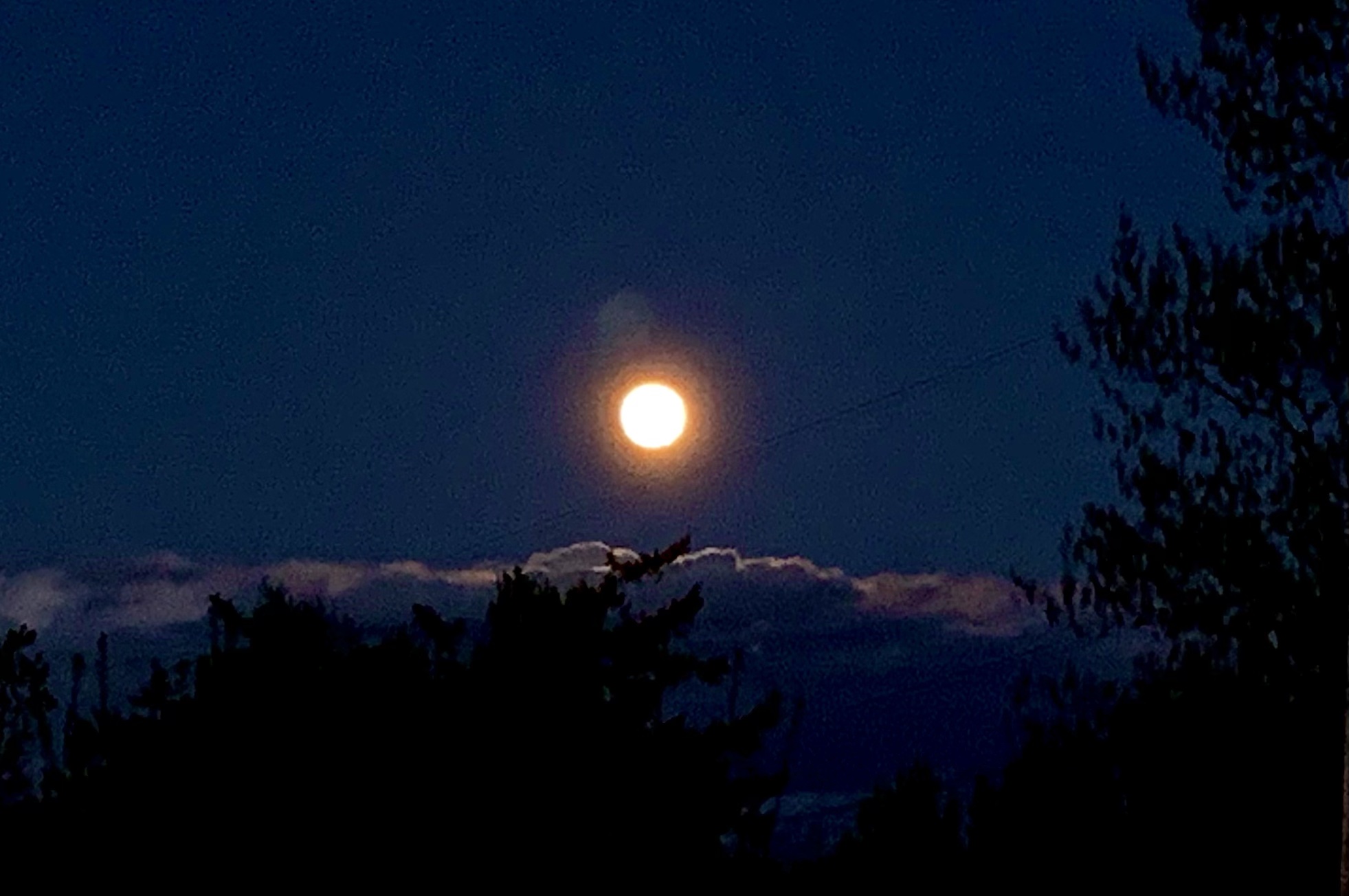
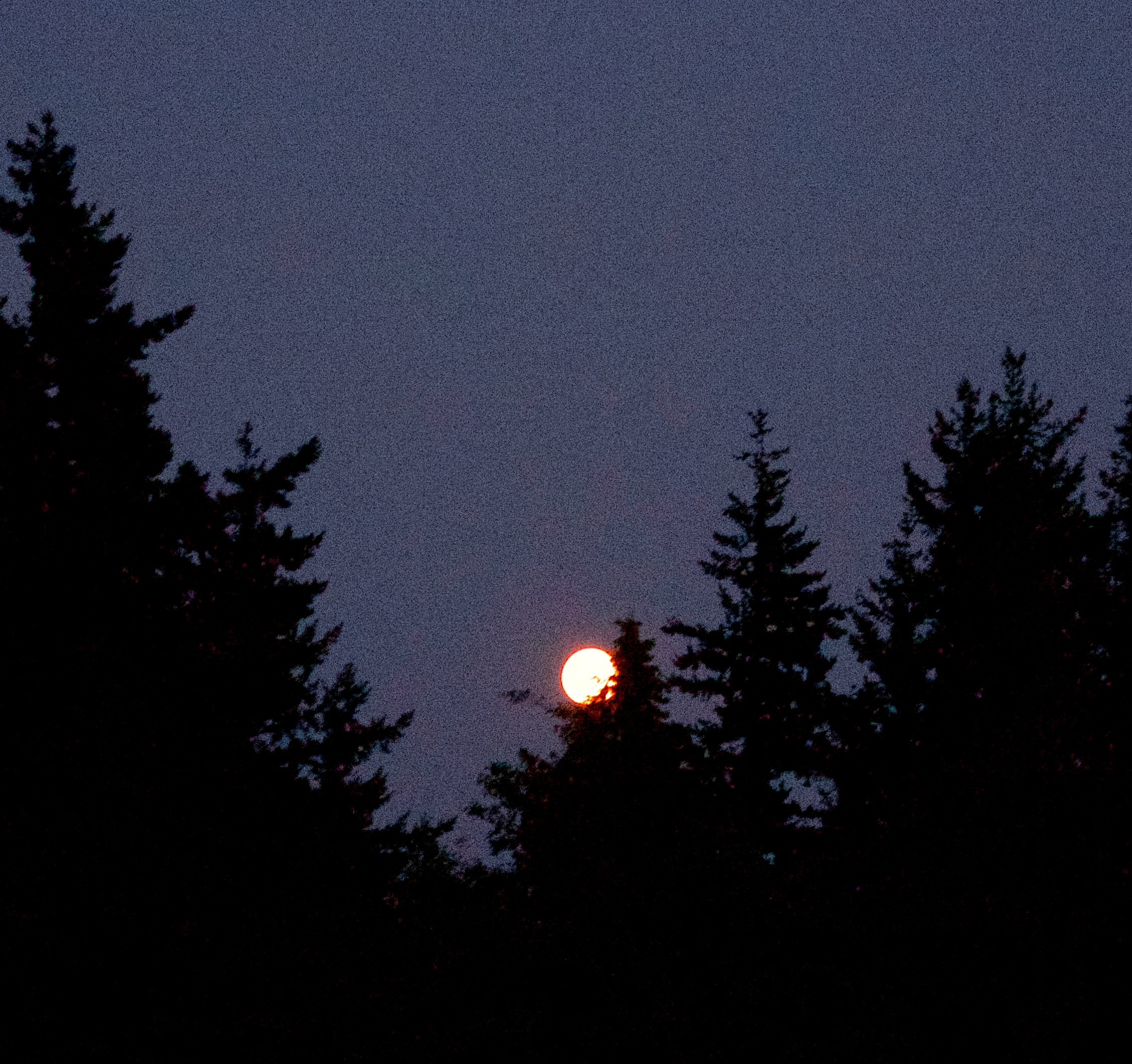
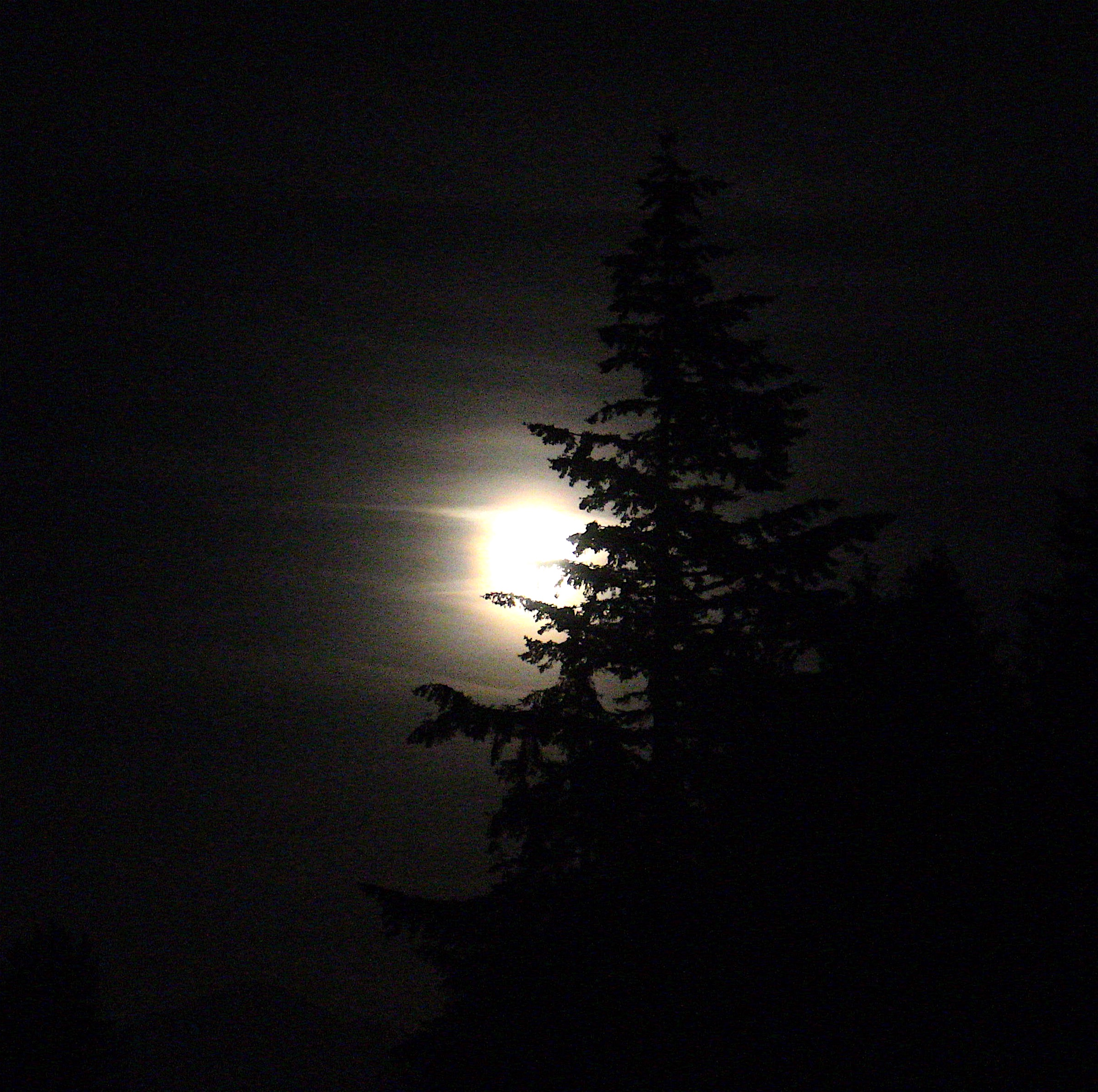
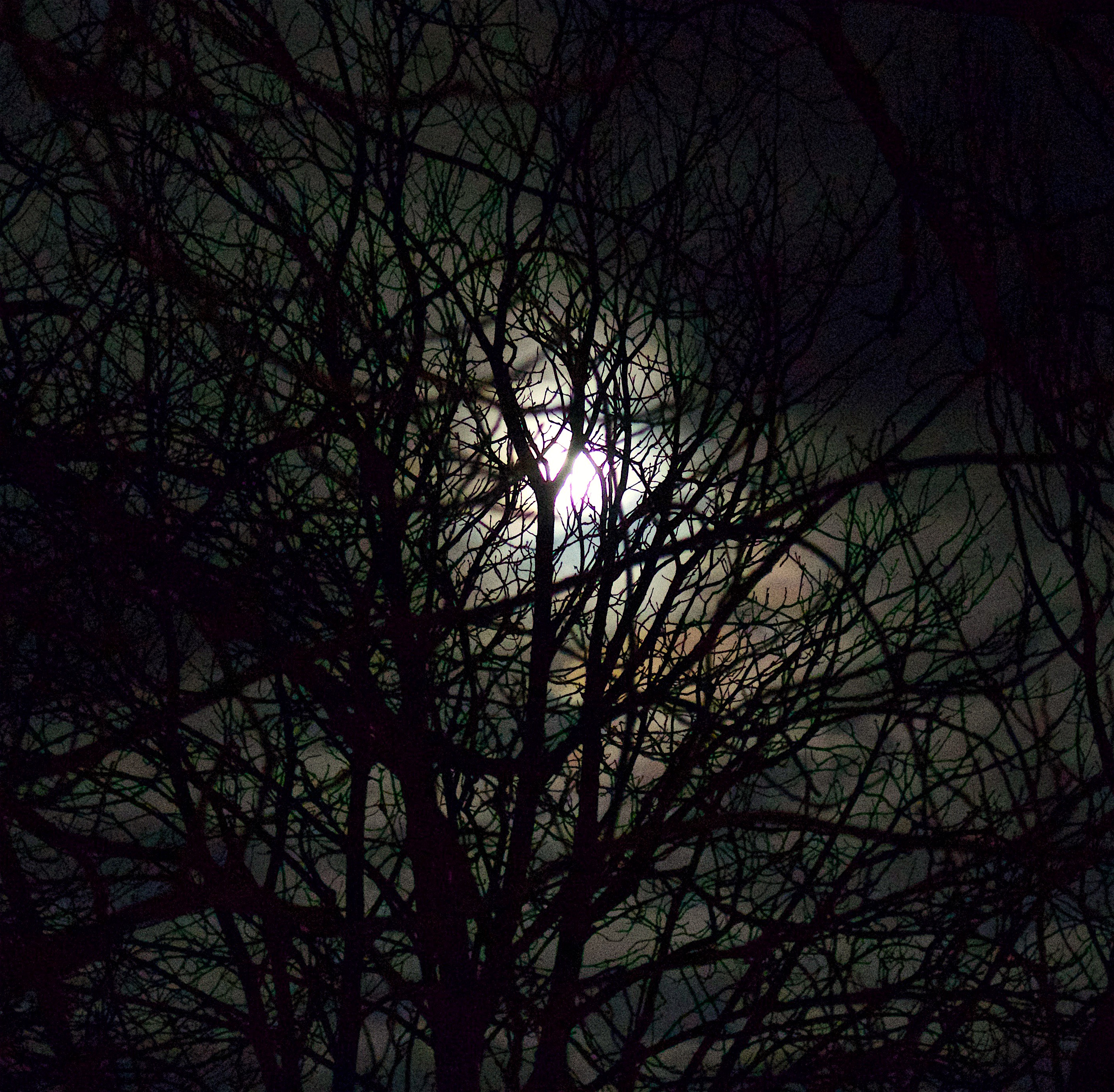
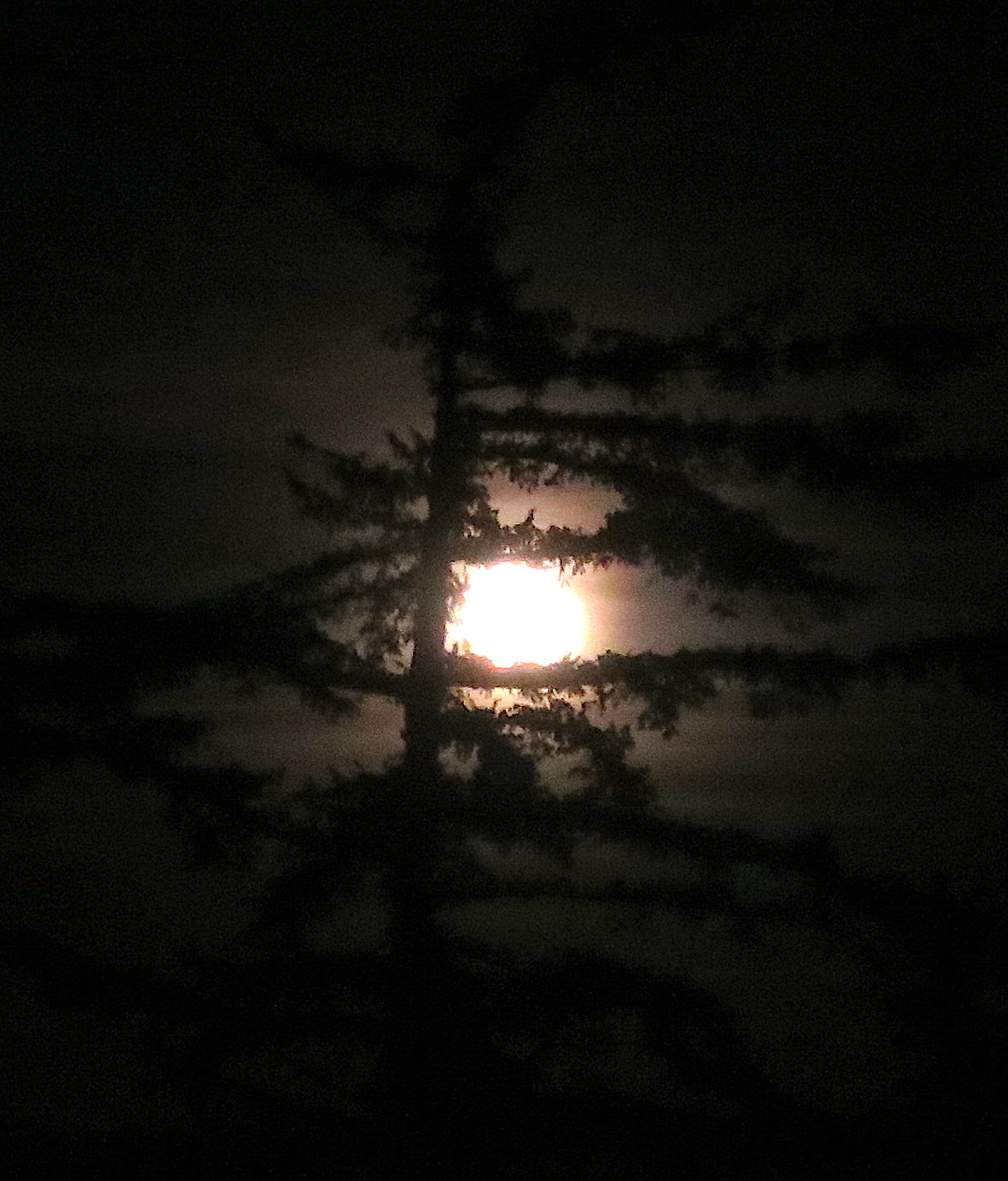
On clear nights, the moon followed us down the highway, shining a light on the road.

Now as a driver at night, transporting grandchildren from a family gathering, I want them to feel the same peaceful contentment that I did as a child. As an older driver, I don’t enjoy driving at night, especially dark rural roads in pouring rain. I understand the enormous responsibility I bear, transporting those whom I dearly love and want to keep safe.

In truth, I long to be a passenger again, with no worries or pressures – just along for the ride, watching the moon and the world drift by, knowing I’m well-cared for.

Despite my fretting about the immense burden I feel to make things right in a troubled world, I do realize:
I am a passenger on a planet that has a driver Who feels great responsibility and care for all He transports through the black night of the universe. He loves me and I can rest content in the knowledge that I am safe in His vigilant hands. I am not the driver – He knows how to safely bring me` home.

I see the moon, it’s shining from far away, Beckoning with ev‘ry beam.
And though all the start above cast down their light, Still the moon is all that I see
And it’s calling out, “Come run a way!
And we’ll sail with the clouds for our sea,
And we’ll travel on through the black of the night, ‘til we float back home on a dream!”
The moon approaches my window pane, stretching itself to the ground.
The moon sings softly and laughs and smiles, and yet never makes a sound!
I see the moon! I see the moon!
Part A
And it’s calling out, “Come run a way!
And we’ll sail with the clouds for our sea,
And we’ll travel on through the black of the night, ‘til we float back home on a dream!”
Part B
I see the moon, it’s shining from far away, Beckoning with ev‘ry beam.
And though all the stars above cast down their light, Still the moon is all that I see
~Douglas Beam

One-Time
Monthly
Yearly

Make a one-time and recurring donation to support daily Barnstorming posts

Make a monthly donation

Make a yearly donation

Choose an amount

¤10.00
¤20.00
¤50.00
¤5.00
¤15.00
¤100.00
¤5.00
¤15.00
¤100.00

Or enter a custom amount

¤

Your contribution is deeply appreciated.

Your contribution is appreciated.

Your contribution is appreciated.

DonateDonate monthlyDonate yearly
A Girl from Spring Valley

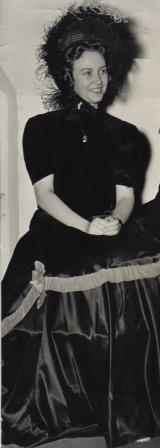
Fourteen years ago today, my mother, Elna Schmitz Polis, returned home for good, gently picked up and carried away by the Lord before dawn. She was just over 88 1/2 years old, and had lived much of her life anticipating her death day with some apprehension, having almost been called home at the age of 13 from a ruptured appendix, before antibiotics were an option. That near-miss seemed to haunt her, filling her with worry that it was a mistake that she survived that episode at all. Yet she thrived despite the anxiety, and ended up, much to her surprise, living a long life full of family and faith.

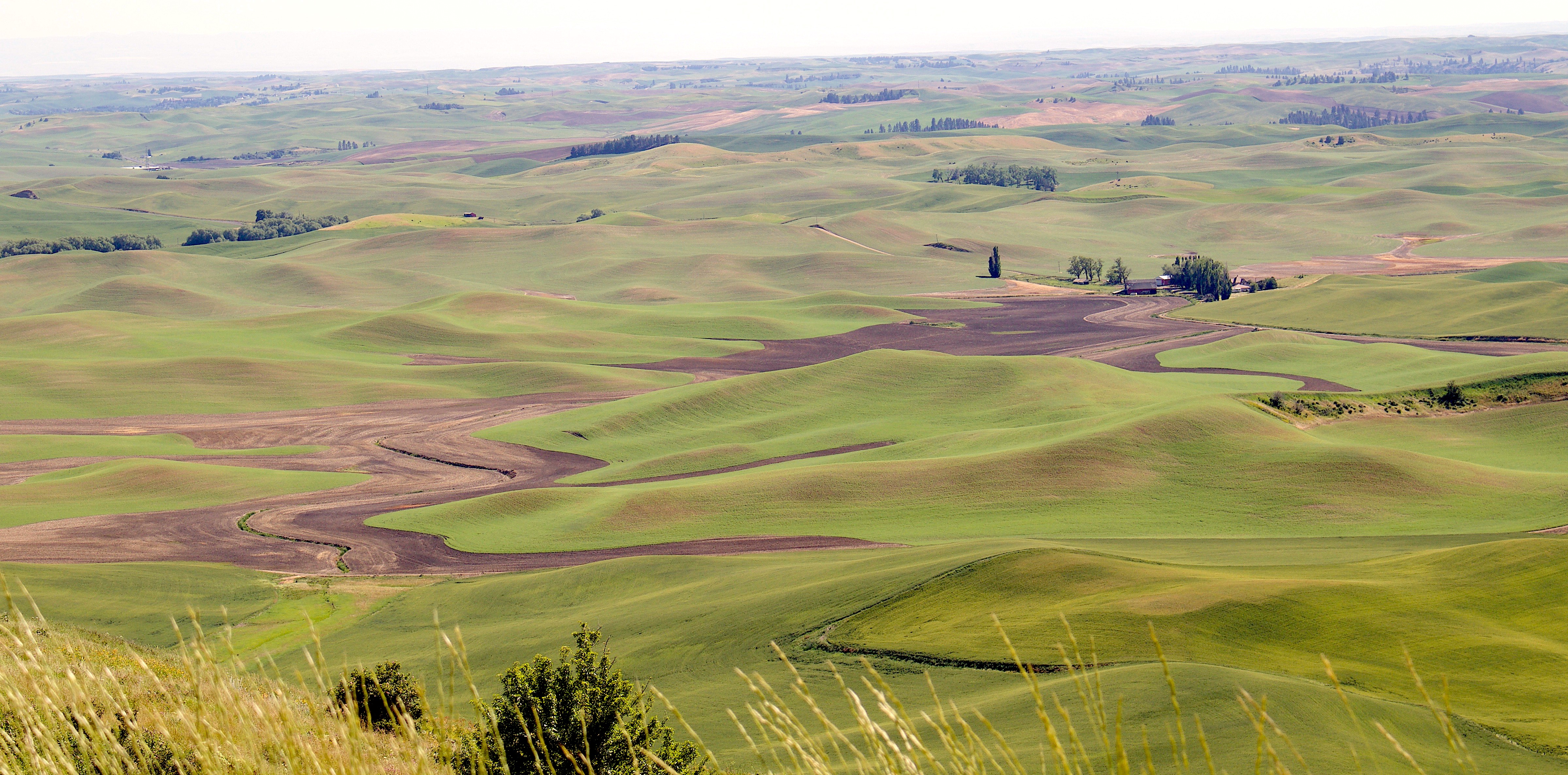
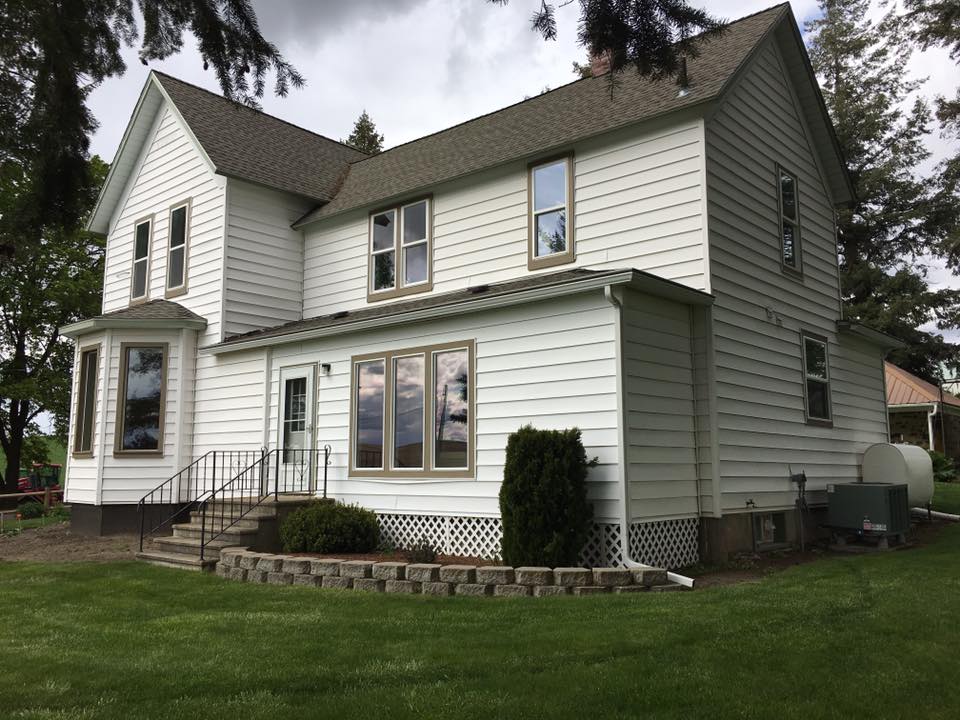
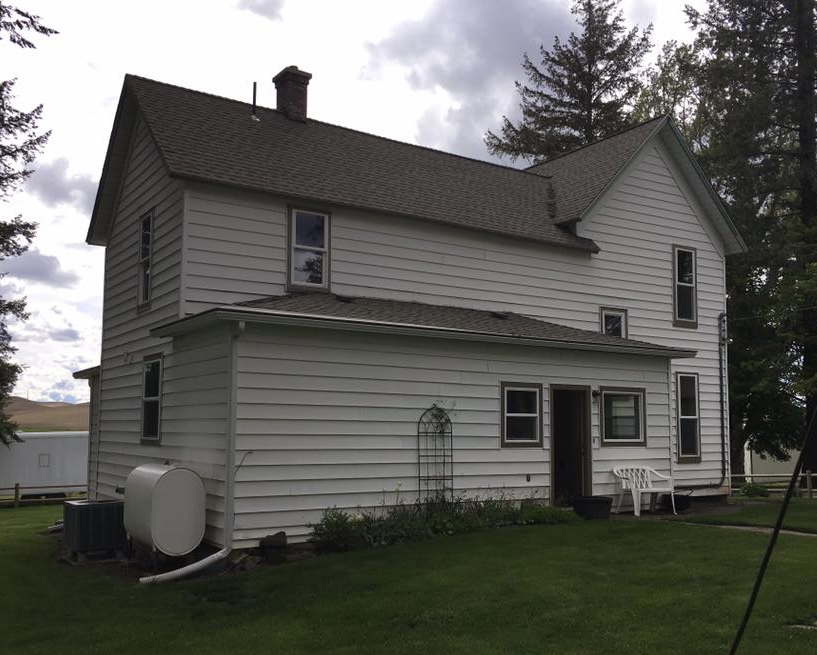
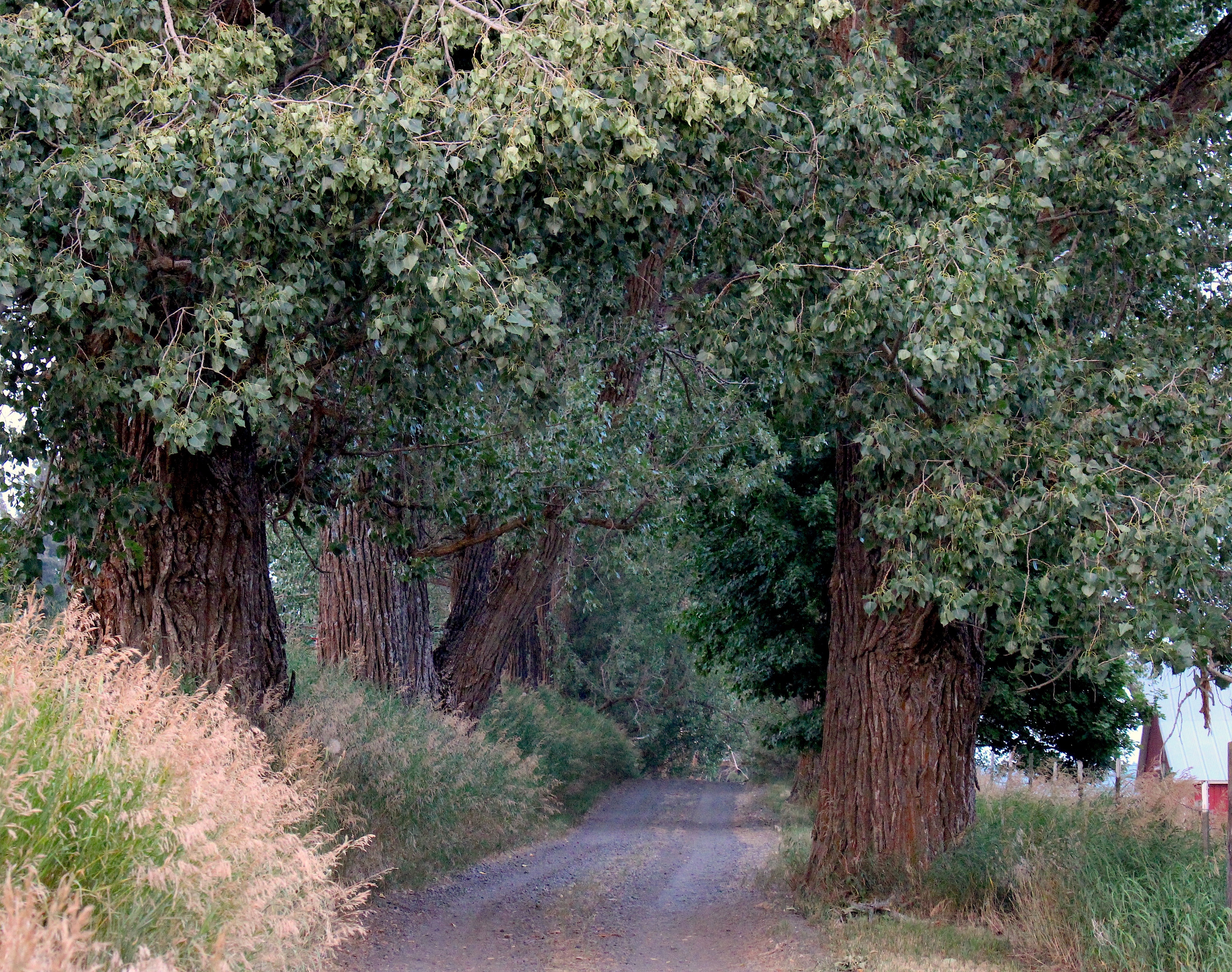
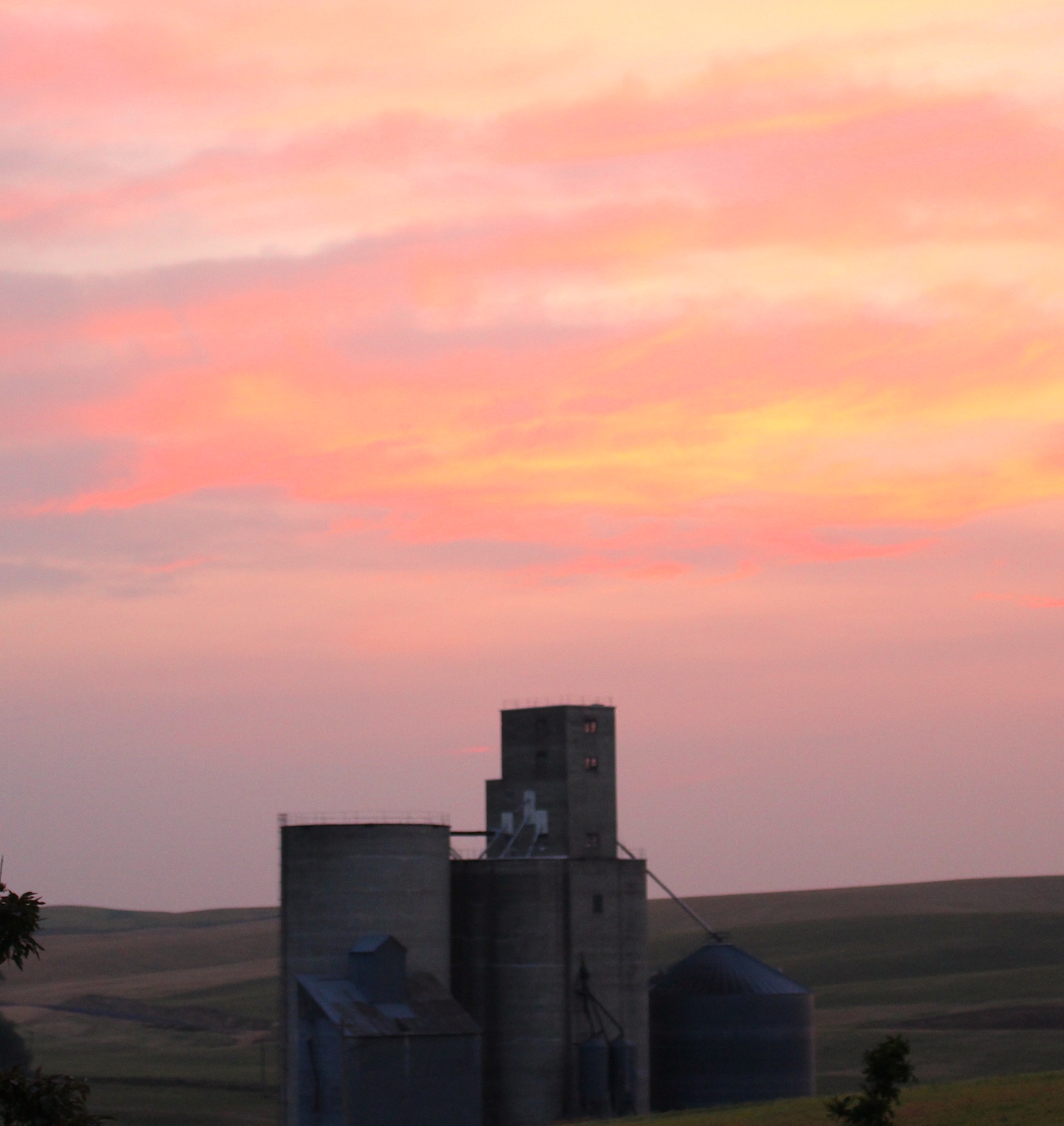
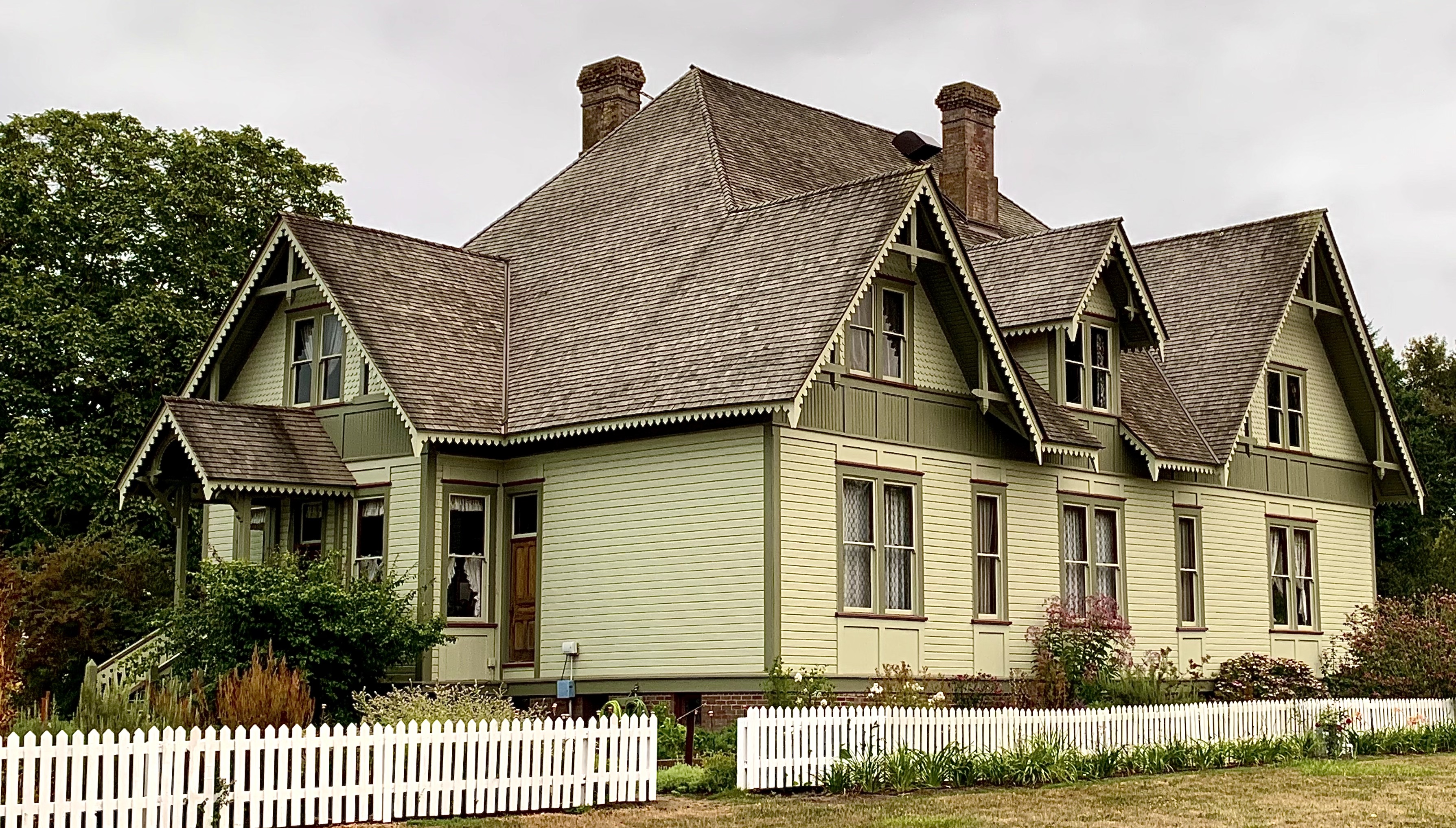
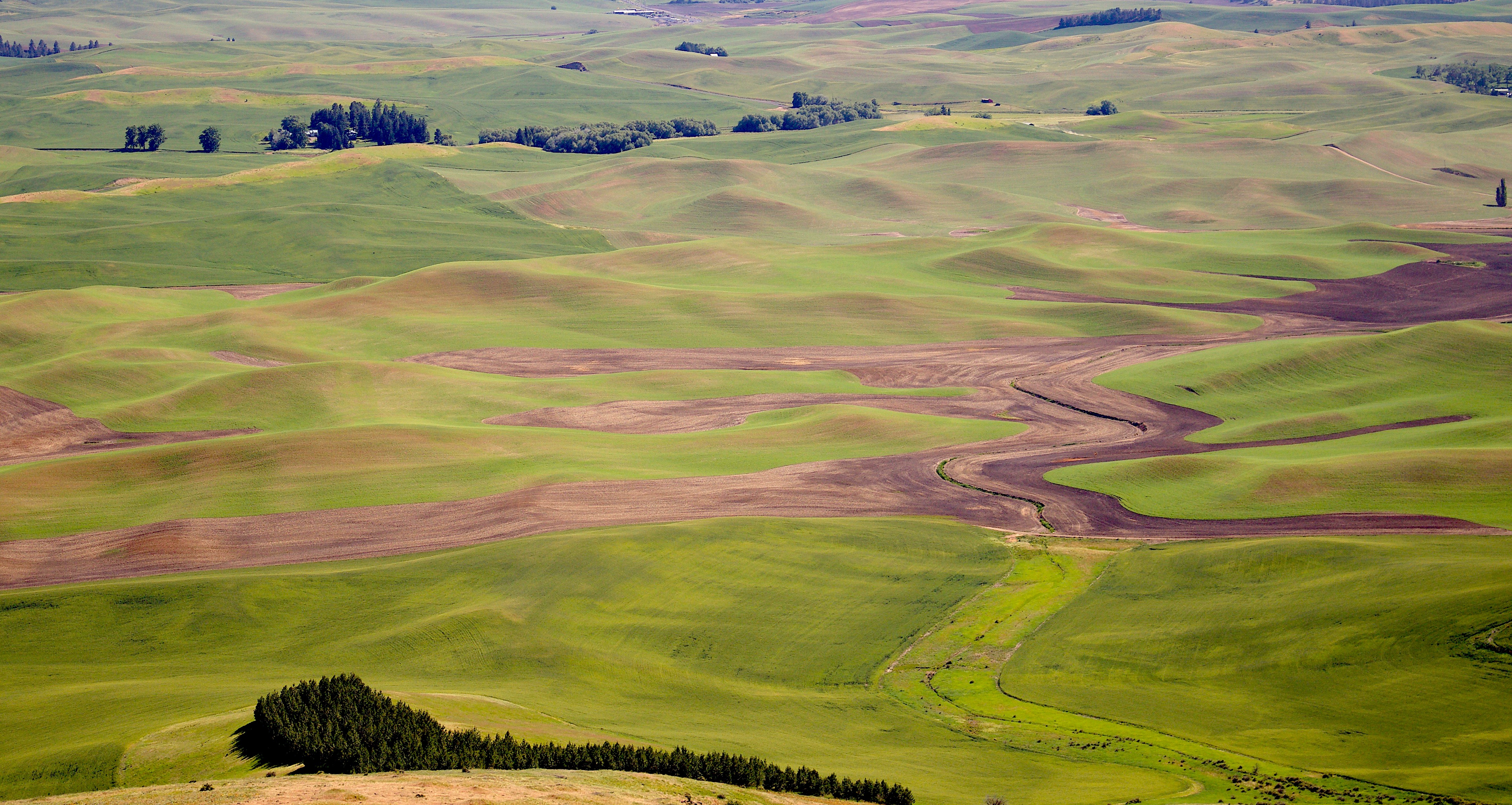
She was born in the isolation of a Palouse wheat and lentil farm in eastern Washington, in a two story white house located down a long lane and nestled in a draw between the undulating hills. Despite having one older brother, it was a lonely childhood which accustomed her to solitude and creative play inside her mind and heart. All her life and especially in her later years, she would prefer the quiet of her own thoughts over the bustle of a room full of activities and conversation.

Her childhood was filled with exploration of the rolling hills, the barns and buildings where her father built and repaired farm equipment, and the chilly cellar where the fresh eggs were stored after she reached under cranky hens to gather them. She sat in the cool breeze of the picketed yard, watching the huge windmill turn and creak next to the house. She helped her weary mother feed farm crews who came for harvest time and then settled in the screened porch listening to the adults talk about lentil prices and bushel production. She woke to the mourning dove call in the mornings and heard the coyote yips and howls at night.

As a young woman, she was ready to leave the farm behind for college, devoting herself to the skills of speech, and the creativity of acting and directing in drama, later teaching rural high school students, including a future Pulitzer Prize winning poet, Carolyn Kizer. She loved words and the power and beauty they wielded.

Marrying my father was a brave and impulsive act, traveling by train to the east coast only a week before he shipped out for almost 3 years to the South Pacific to fight as a Marine in WWII. She must have wondered about the man who returned from war changed and undoubtedly scarred in ways she could not see or touch. They worked it out, as rocky as it must have been at times, and in their reconciliation years later after divorce, I could see the devotion and mutual respect of life companions who shared purpose and love.

As a wife and mother, she rediscovered her calling as a steward of the land and a steward of her family, gardening and harvesting fruits, vegetables and children tirelessly. When I think of my mother, I most often think of her tending us children in the middle of the night whenever we were ill; her over-vigilance was undoubtedly due to her worry we might die in childhood as she almost did.

She never did stop worrying during the last few months if her life after a devastating leg fracture. As she became more dependent on others in her physical decline, she tried to give up the control she thought she had to maintain through her “worry energy” and became more accepting about the control the Lord maintains over all we are and will become.

I know from where my shyness comes, my preference for birdsongs rather than radio music, my preference for naps, and my tendency to be serious and straight laced with a twinkle in my eye. This is my German Palouse side–immersing in the quietness of solitude, thrilling to the sight of the spring wheat flowing like a green ocean wave in the breeze and appreciating the warmth of rich soil held in my hands. From that heritage came my mother and it is the legacy she has left with me. I am forever grateful to her for her unconditional love and her willingness to share the warmth of her nest whenever we felt the need to fly back home and shelter, overprotected but safe nonetheless, under her wings.

Everyone in the Wrong Places

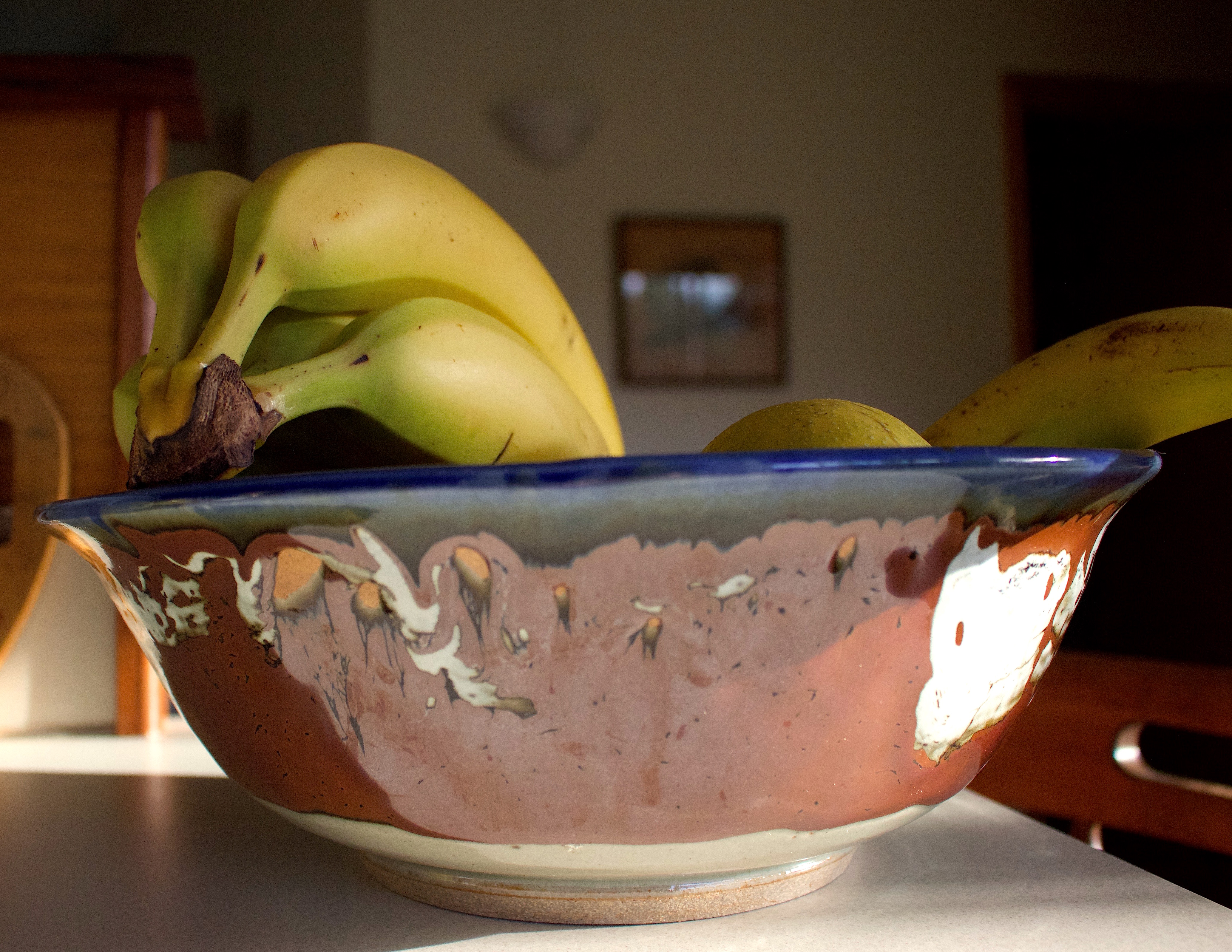
On a table in the living room
there is a gray ceramic bowl that catches
the light each afternoon, contains it.
This is the room we turned into
the room of her dying, the hospital bed
in the center, the medical equipment
against the walls like personnel.
In Maine, once, I rented a house hundreds
of years old. One room had been
the birthing room, I was told, and I sat
in that room writing towards the bright
new world I am always trying
to write into. And while I could stop
there, with those two recognitions
of endings and beginnings, I’m thinking

of yesterday’s afternoon of errands.
My father and mother were in the backseat,
my sister in the passenger seat,
and I driving. It was like decades ago
but everyone in the wrong places,
as though time was simply about
different arrangements of proximity.
Sometimes someone is in front of you.
Or they are beside. At other times
they are behind you, or just elsewhere,
inconsolably, as though time was
about how well or badly you attended
to the bodies around you. First, we went
to the bakery. Then the hardware.
The pharmacy, the grocery. Then the bank.

~Rick Barot “Of Errands”

For a time, my husband and I were the middle of the proverbial family sandwich – the meat and cheese with condiments while our aging parents were one slice of bread and our young children the other slice. It was such a full time of always being needed by someone somewhere somehow in some way that I barely can recall details of what those years were like.

Mothers with daughters sometimes note the irony of being in the throes of menopause while their pre-teen is adjusting to menarche – we pass on the fertility torch.

As I sort through boxes that have been stored away for over a decade from my mother and mother-in-law’s belongings to find things to help our son’s family get settled in their house, I realize that time could be measured in bowls and vases and casserole baking dishes. They are passed to the next generation for another lifetime of use. We start out being fed, then we become the provider, and wind up being fed ourselves in the end.

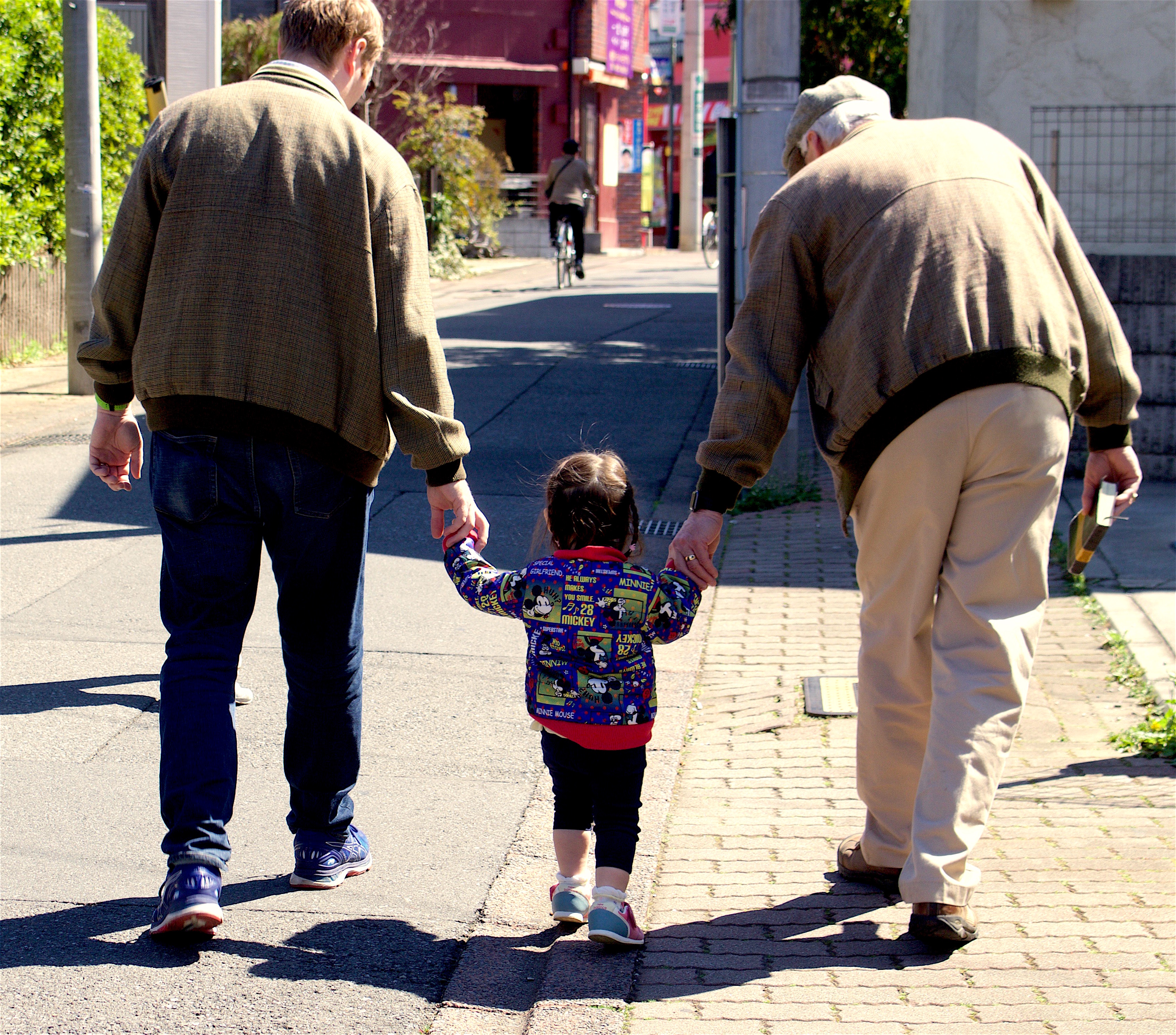
I want to forestall that time of becoming dependent again as long as possible. For now, I want to hold my grandchildren’s hands as I try to keep them safe in an unpredictable world. Someday, I may need them to help hold my hand once I lack the strength to walk unaided.

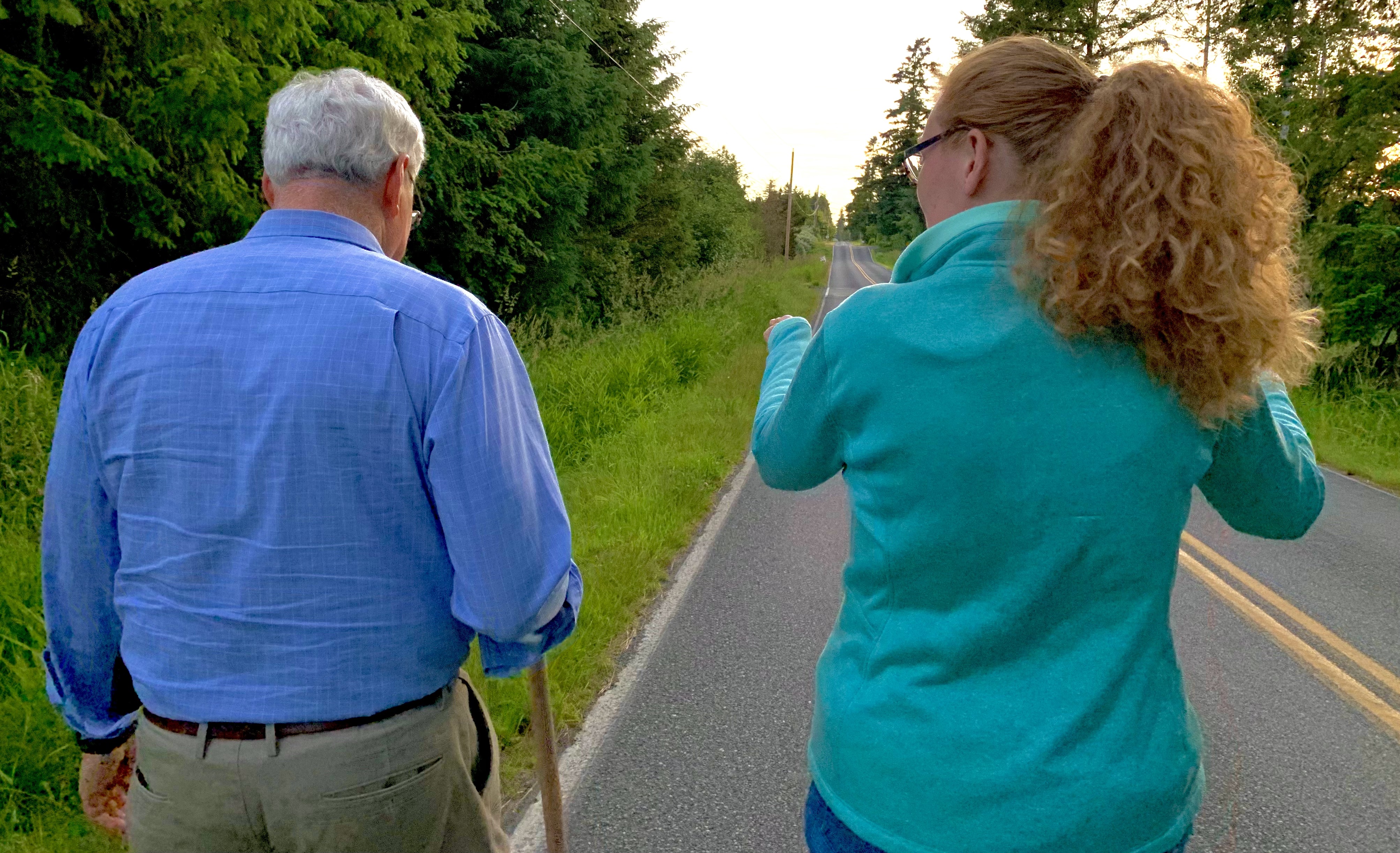
Turn turn turn – there is a season. Turn around and everyone has changed places, blessed to still walk alongside one another for as long as possible.

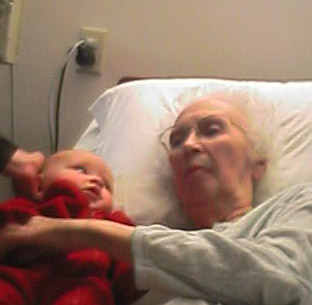
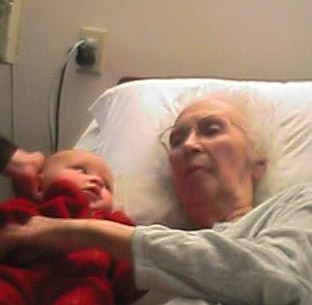
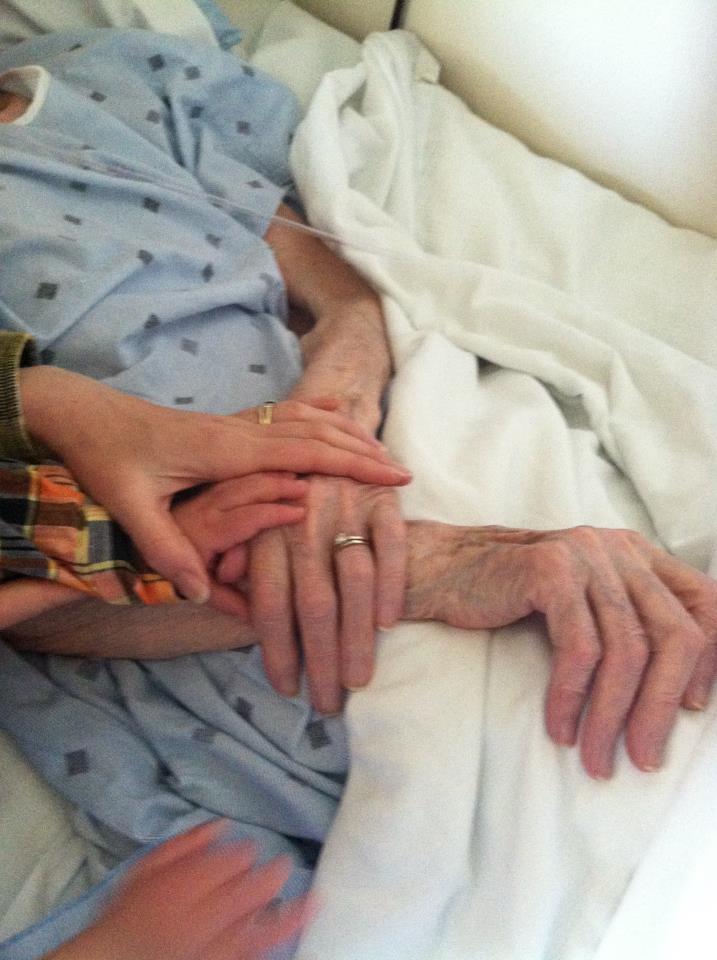
Great Grandma Emma, granddaughter Andrea, great-grandson Zealand, photo by Andrea Nipges

To every thing there is a season, and a time to every purpose under the heaven…
Ecclesiastes 3:1

One-Time
Monthly
Yearly

Make a one-time or recurring donation to support daily Barnstorming posts

Make a monthly donation

Make a yearly donation

Choose an amount

¤10.00
¤20.00
¤50.00
¤5.00
¤15.00
¤100.00
¤5.00
¤15.00
¤100.00

Or enter a custom amount

¤

Your contribution is deeply appreciated.

Your contribution is appreciated.

Your contribution is appreciated.

DonateDonate monthlyDonate yearly

The Forgiveness of Sleep

The children have gone to bed.
We are so tired we could fold ourselves neatly
behind our eyes and sleep mid-word, sleep standing
warm among the creatures in the barn, lean together
and sleep, forgetting each other completely in the velvet,
the forgiveness of sleep.

Then the one small cry:
one strike of the match-head of sound:
one child’s voice:
and the hundred names of love are lit
as we rise and walk down the hall.

One hundred nights we wake like this,
wake out of our nowhere
to kneel by small beds in darkness.
One hundred flowers open in our hands,
a name for love written in each one.
~Annie Lighthart, from Iron String

I thought I had forgotten how to wake to the sound of a child’s voice in the night. I thought I wouldn’t remember how to gently open their bedroom door, entering their darkness from my own darkness, discerning what was distressing them, sensing how to soothe them back to slumber, wondering if I might sing or pray the words they needed to hear, bringing a blossoming peace and stillness to their night.

And then our son’s family arrived two months ago from thousands of miles away, to stay until they could settle in their own place, and I remembered my nights were never meant to be mine alone. As a child, I had so many night-wakenings that I’m sure my mother despaired that I would ever sleep through the night. She would come when I called, sitting beside my bed, rubbing my back until I forgot what woke me in the first place. She was patient and caring despite her own weariness, sleep problems and worriedness. She loved me and forgave me for needing her presence in the night, so her nights were never her own.

I too responded with compassion when my own children called out in the night. I woke regularly to phone calls from hospitals and patients during forty years of medical practice and listened and answered questions with grace and understanding. And now, for a time, I’m on call again, remembering the sweetness of being loved when the dark fears of the night need the light and promise of a new day coming, if only just a few hours away.

One-Time
Monthly
Yearly

Make a one-time or recurring donation to support daily Barnstorming posts

Make a monthly donation

Make a yearly donation

Choose an amount

¤5.00
¤10.00
¤20.00
¤5.00
¤15.00
¤100.00
¤5.00
¤15.00
¤100.00

Or enter a custom amount

¤

Your contribution is deeply appreciated.

Your contribution is appreciated.

Your contribution is appreciated.

DonateDonate monthlyDonate yearly
An Arch of Colored Light

Be thou the rainbow in the storms of life.
The evening beam that smiles the clouds away,

and tints tomorrow with prophetic ray.
~Lord Byron

But mark! what arch of varied hue
  From heaven to earth is bowed?
Haste, ere it vanish, haste to view
  The Rainbow in the cloud.

How bright its glory! there behold
  The emerald’s verdant rays,
The topaz blends its hue of gold
  With the deep ruby’s blaze.

Yet not alone to charm thy sight
  Was given the vision fair;–
Gaze on that arch of colored light,
  And read God’s mercy there.

~Felicia Hemans from “The Rainbow”

The true harvest of my daily life is somewhat as intangible and indescribable as the tints of morning or evening. It is a little star-dust caught, a segment of the rainbow which I have clutched.
~Henry David Thoreau

Painting the indescribable with words necessitates subtlety, sound and rhythm on a page.  The best word color portraits I know are by Gerard Manley Hopkins who created  through startling combinations:  “crimson-cresseted”, “couple-colour”, “rose-moles”, “fresh-firecoal”, “adazzle, dim”, “dapple-dawn-drawn”, “blue-bleak embers”, “gash gold-vermillion”.

I understand, as Thoreau does,  how difficult it is to harvest a day using ordinary words.   Like grasping ephemeral star trails or the transient rainbow that moves away as I approach, what I bring to the page or screen is intangible yet so very real.

I will keep reaching for rainbows, searching for the best words to preserve my days and nights forever. It does feel like I’m clutching at a moment in time moving through my fingers.

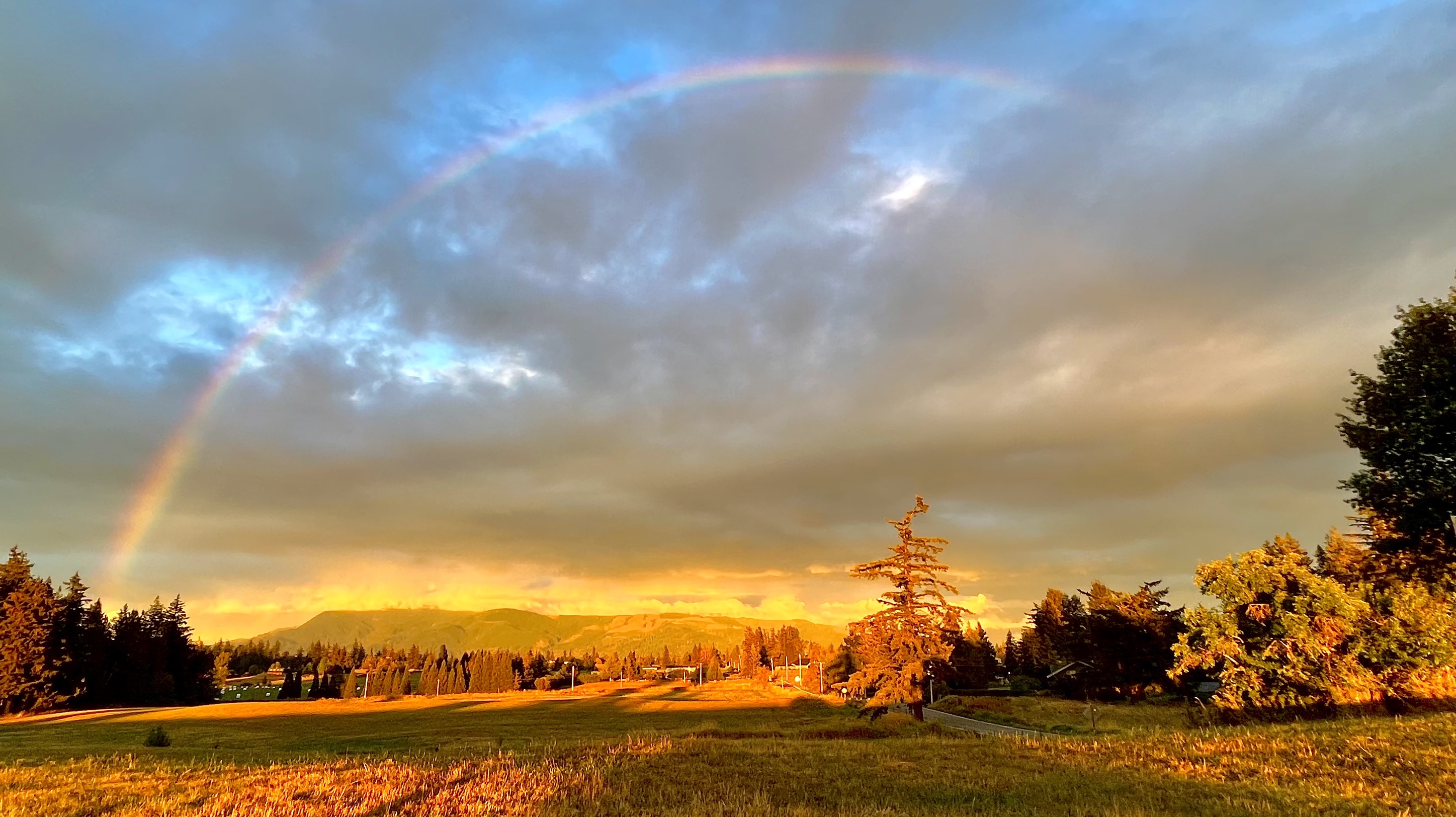
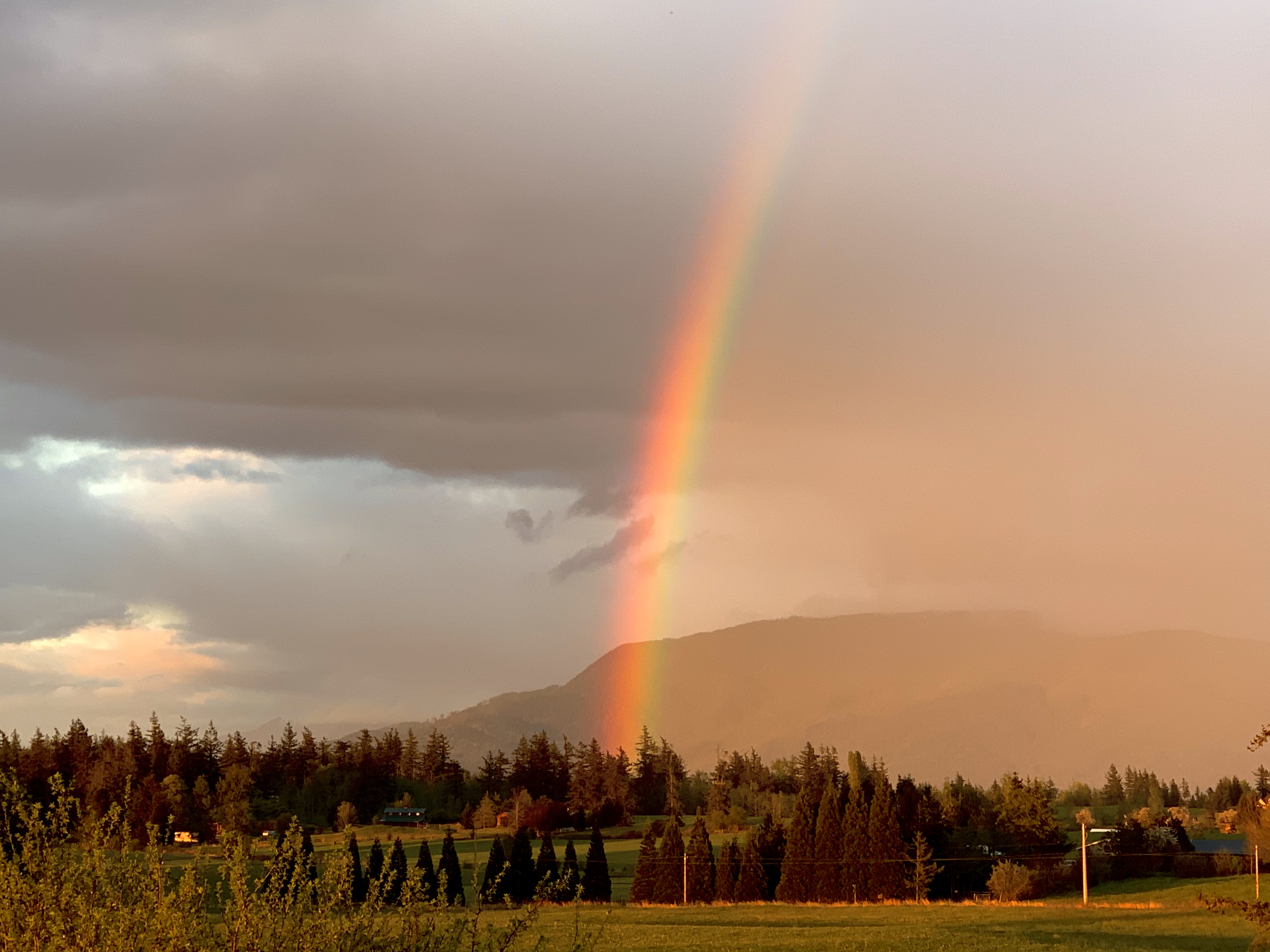
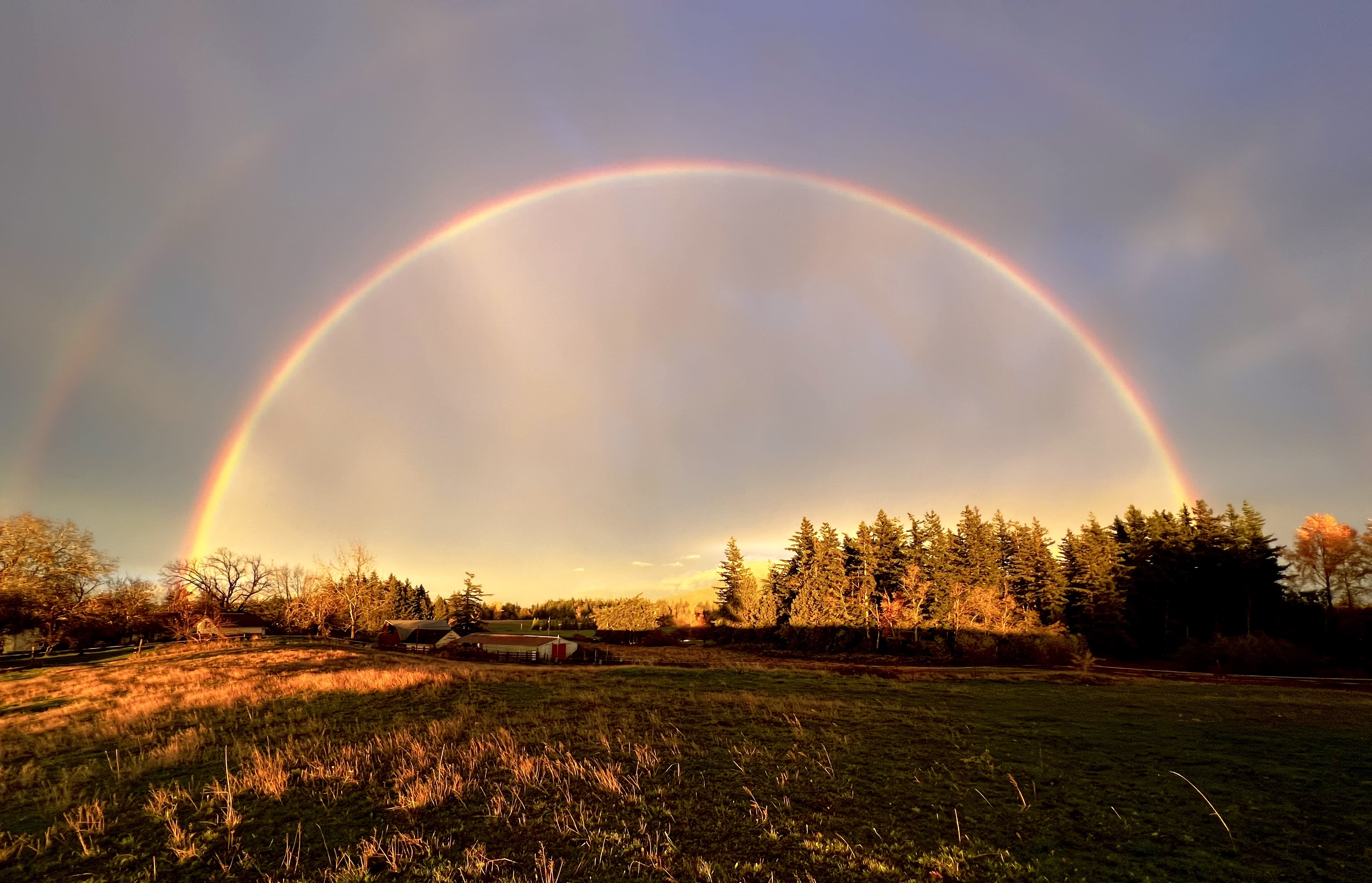
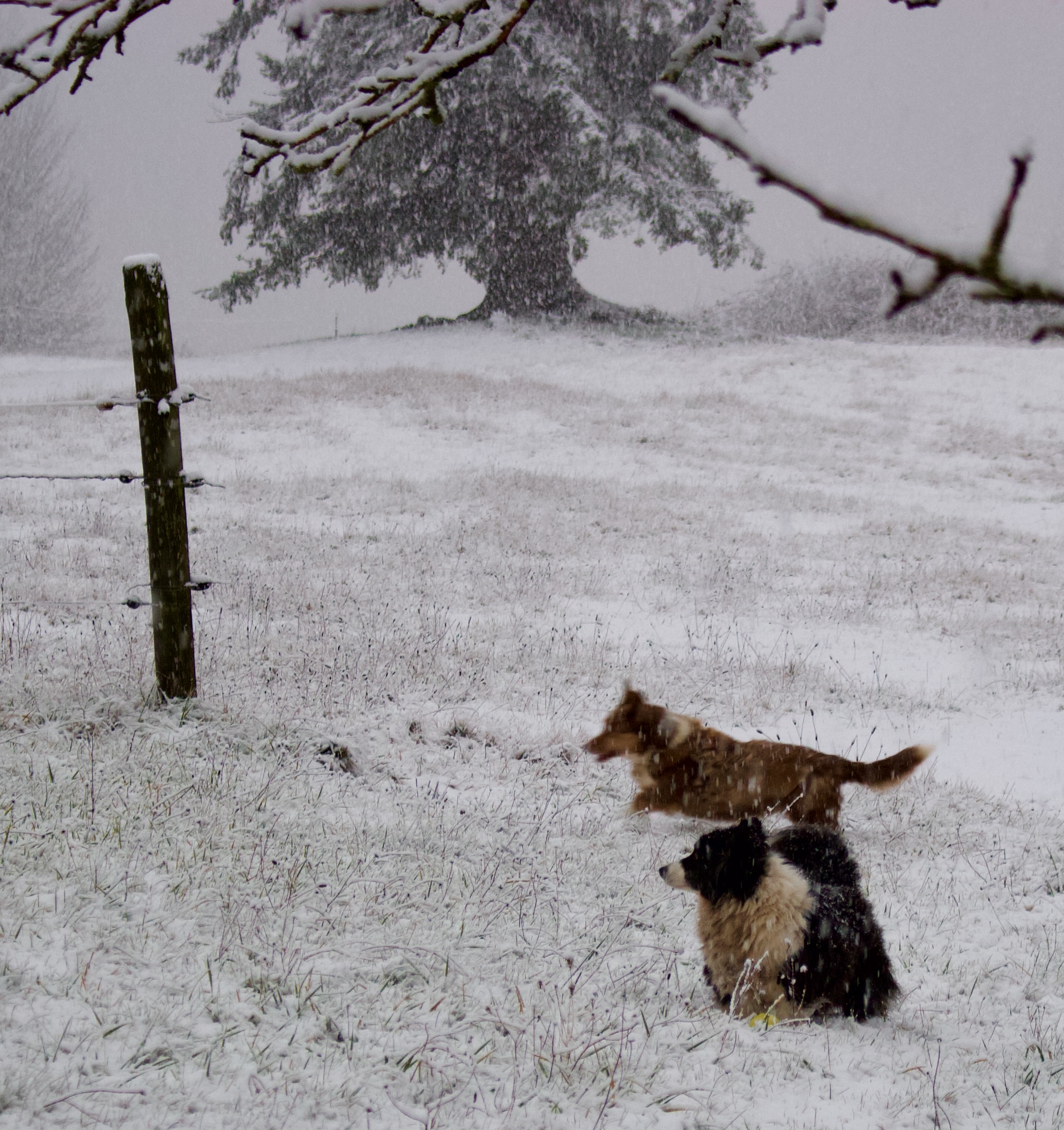
I witnessed this Sabbath rainbow last night from our farm, standing with two of our very young grandchildren, hoping they would remember it enough to describe it to our someday great-grandchildren. Perhaps they will even read my words and know how much it mattered to me that they experience such beauty and promise.

I want them to always remember: in the beginning was the Word, and we are created by the same Author who writes incredible rainbows across the sky.

One-Time
Monthly
Yearly

Make a one-time or recurring donation to support daily Barnstorming posts

Make a monthly donation

Make a yearly donation

Choose an amount

¤5.00
¤10.00
¤20.00
¤5.00
¤15.00
¤100.00
¤5.00
¤15.00
¤100.00

Or enter a custom amount

¤

Your contribution is deeply appreciated.

Your contribution is appreciated.

Your contribution is appreciated.

DonateDonate monthlyDonate yearly
As Much Serenity As Yearning

Last night I walked the woods
lit by the final moon of the month.
Days don’t count here
beneath the centuries-old pines
where my grandmother took her solace
on hard farm days, passing up
the washboard or jam-making
for the eternal whooshing
of the forest as much serenity
as yearning.
~Dave Malone, “Walk in the Woods” from Tornado Drill

My grandparents owned the land,
worked the land, bound
to the earth by seasons of planting
and harvest.

They watched the sky, the habits
of birds, hues of sunset,
the moods of moon and clouds,
the disposition of air.
They inhaled the coming season,
let it brighten their blood
for the work ahead.

Soil sifted through their fingers
imbedded beneath their nails
and this is what they knew;
this rhythm circling the years.
They never left their land;
each in their own time
settled deeper.
~Lois Parker Edstrom “Almanac” from Night Beyond Black.

My husband and I met in the late 70’s while we were both in graduate school in Seattle, living over 100 miles away from our grandparents’ farms farther north in Washington. We lived farther still from my grandparents’ wheat farm in Eastern Washington and his grandparents’ hog farm in Minnesota. One of our first conversations together, the one that told me I needed to get to know this man better, was about wanting to move back to work on the land. We were both descended from peasant immigrants from the British Isles, Holland and Germany – farming was in our DNA, the land remained under our fingernails even as we sat for endless hours studying in law school and medical school classes.

When we married and moved north after buying a small farm, we continued to work full time at desks in town. We’ve never had to depend on this farm for our livelihood, but we have fed our family from the land, bred and raised livestock, and harvested and preserved from a large garden and orchard. It has been a good balance thanks to career opportunities made possible by our education, something our grandparents would have marveled was even possible.

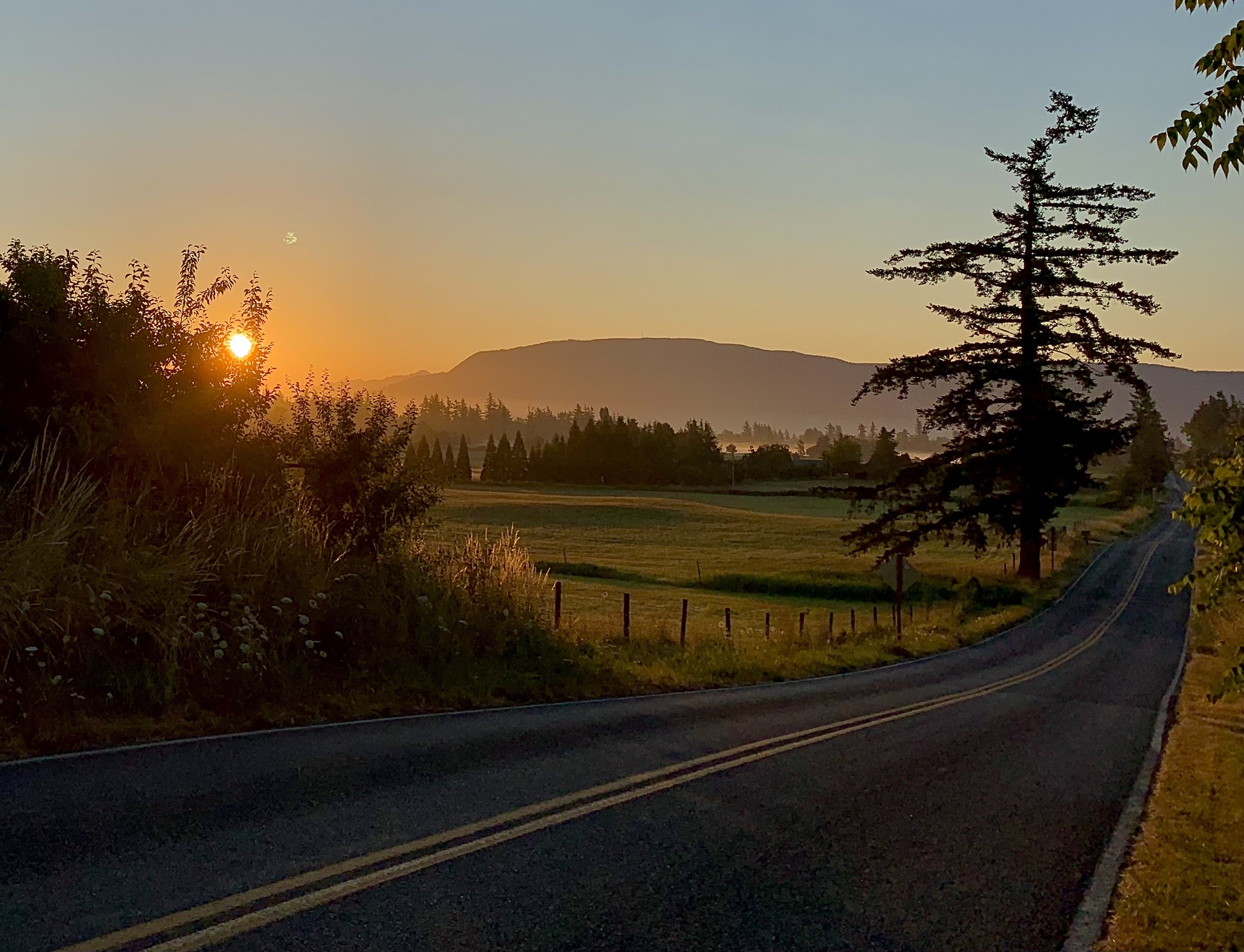
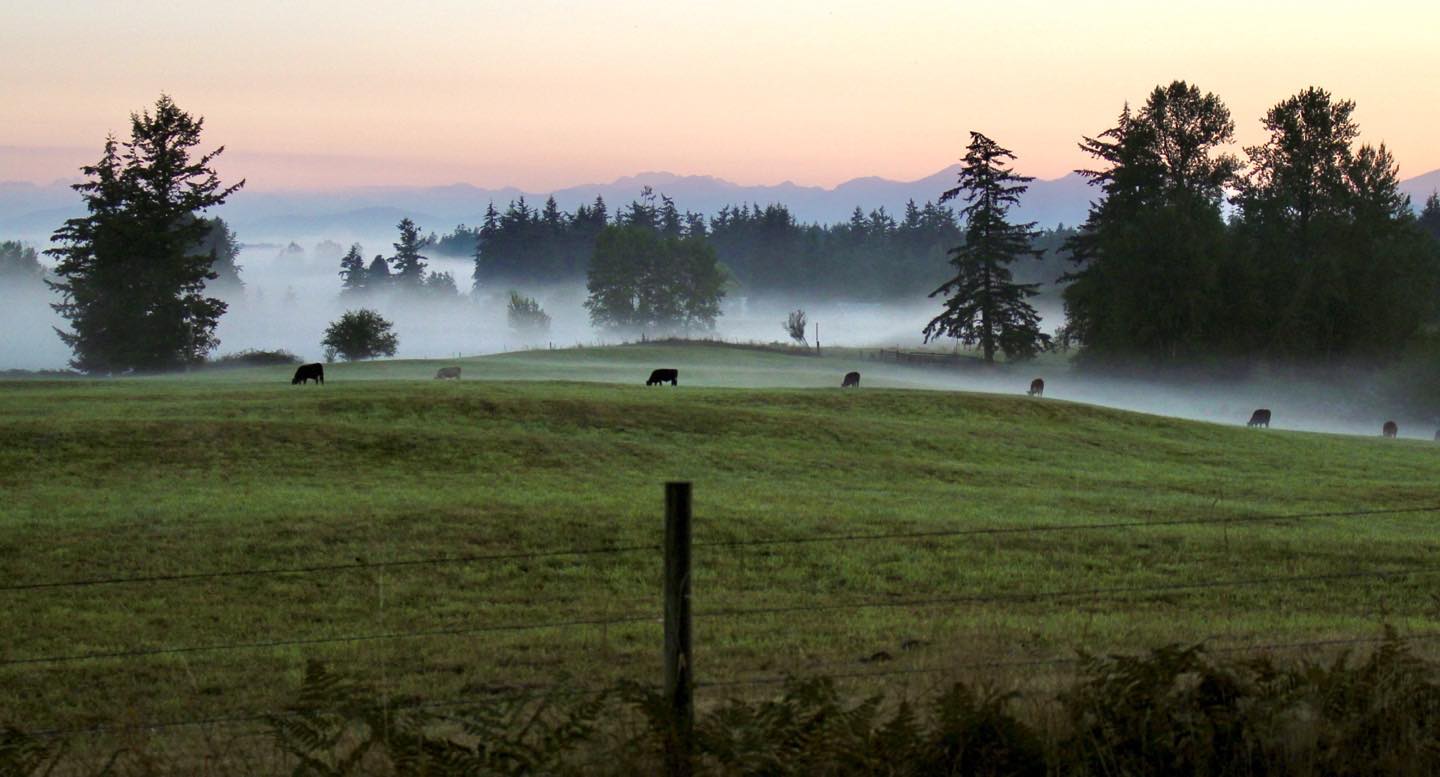
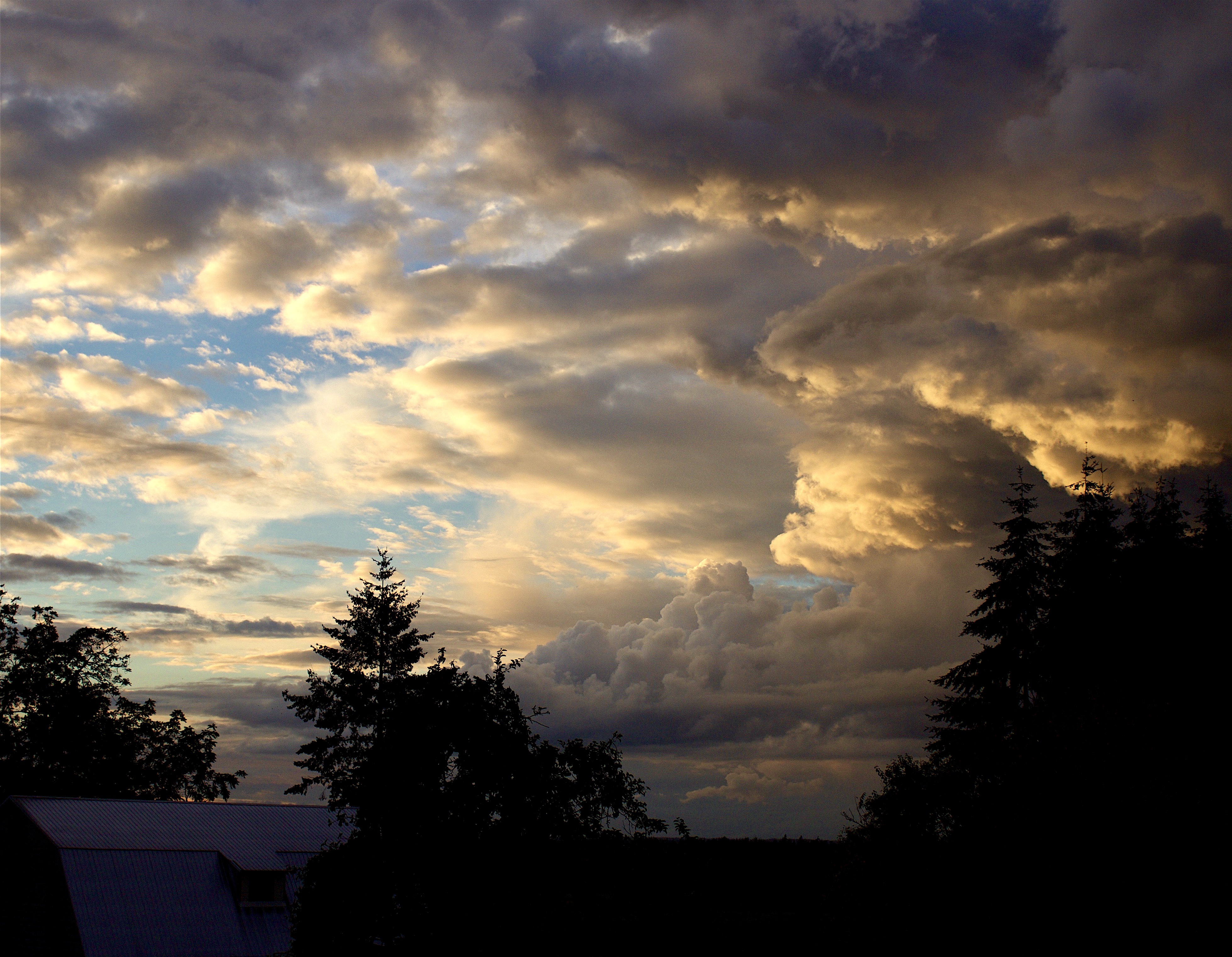
Like our grandparents, we watch in wonder at what the Creator brings to the rhythm of the land each day – the light of the dawn over the fields, the activity of the wild birds and animals in the woods, the life cycles of the farm critters we care for, the glow of the evening sun as night enfolds us when the moon ascends.

We are blessed by the land’s generosity when it is well cared for. Each new day promises another chance to treat it with the love it warrants.

Now forty-some years after that first conversation together about returning to farming, my husband and I hope we never have to leave the land. It brought us together, fed our family, remains imbedded under our fingernails and in our DNA.

Each in our own time, we will settle even deeper.

One-Time
Monthly
Yearly

Make a one-time or recurring donation
to support daily Barnstorming posts

Make a monthly donation

Make a yearly donation

Choose an amount

¤5.00
¤10.00
¤20.00
¤5.00
¤15.00
¤100.00
¤5.00
¤15.00
¤100.00

Or enter a custom amount

¤

Your contribution is deeply appreciated.

Your contribution is appreciated.

Your contribution is appreciated.

DonateDonate monthlyDonate yearly
Just Closing My Eyes For a Bit

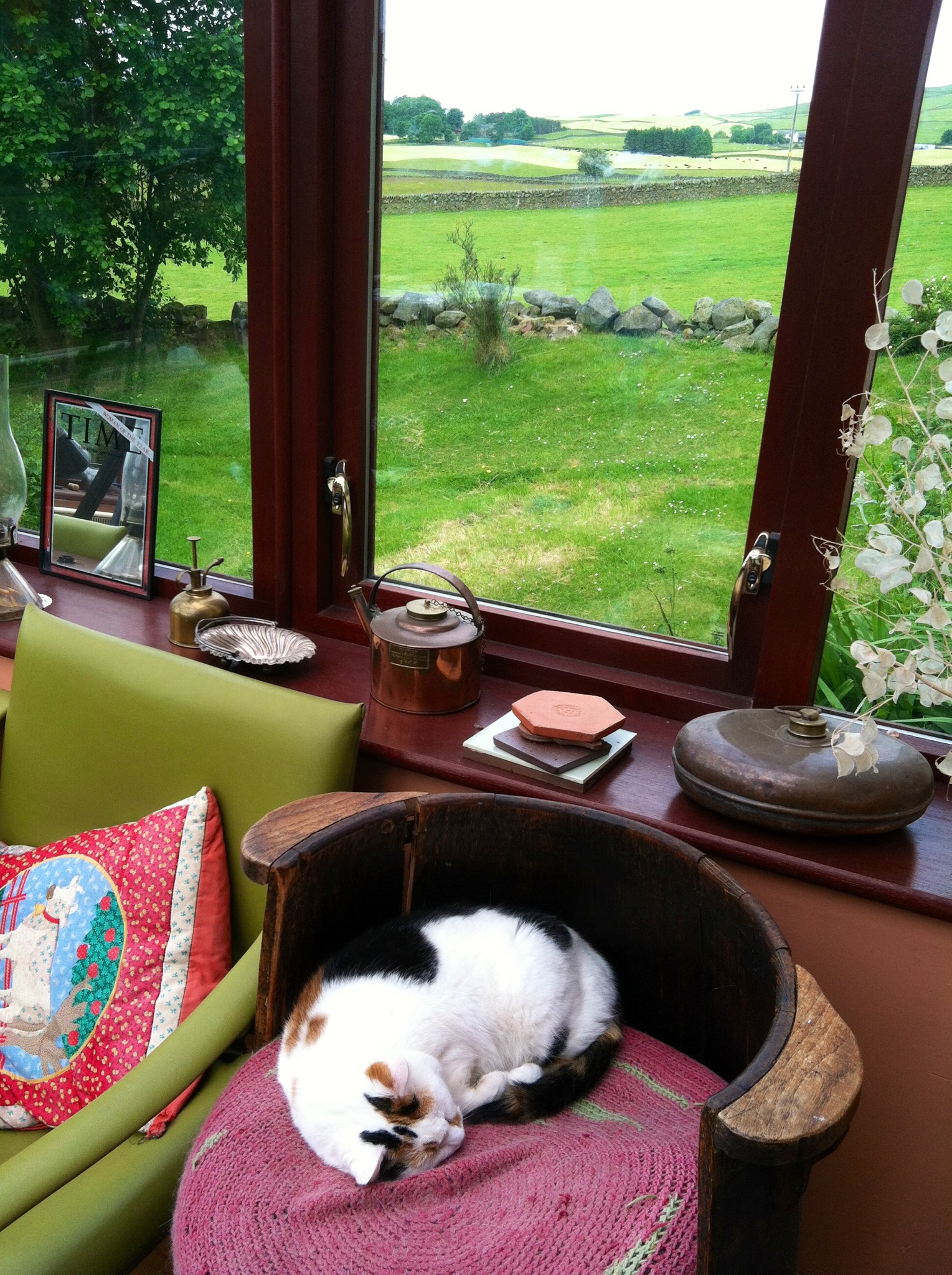
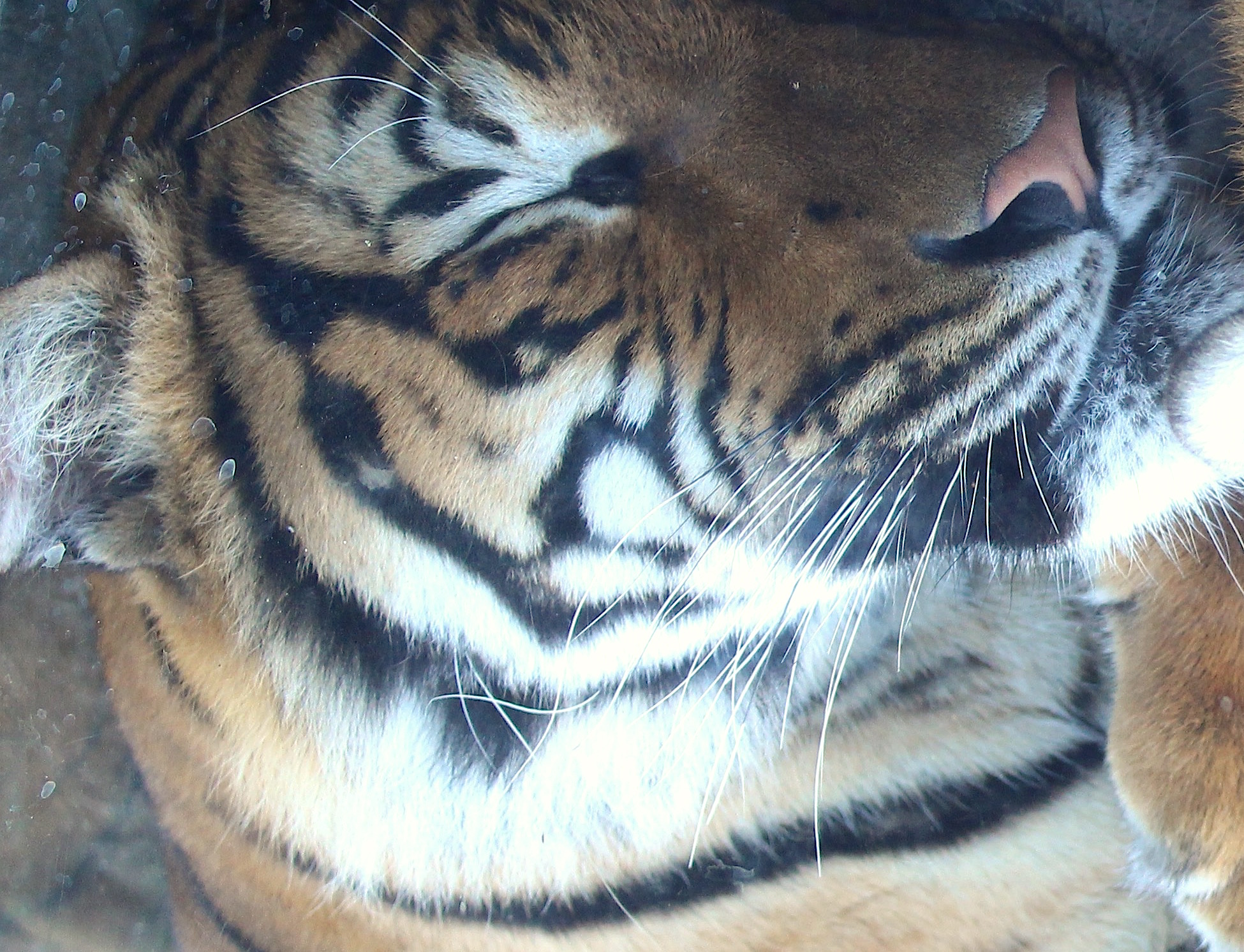
I count it as a certainty that in paradise, everyone naps. 
~Tom Hodgkinson

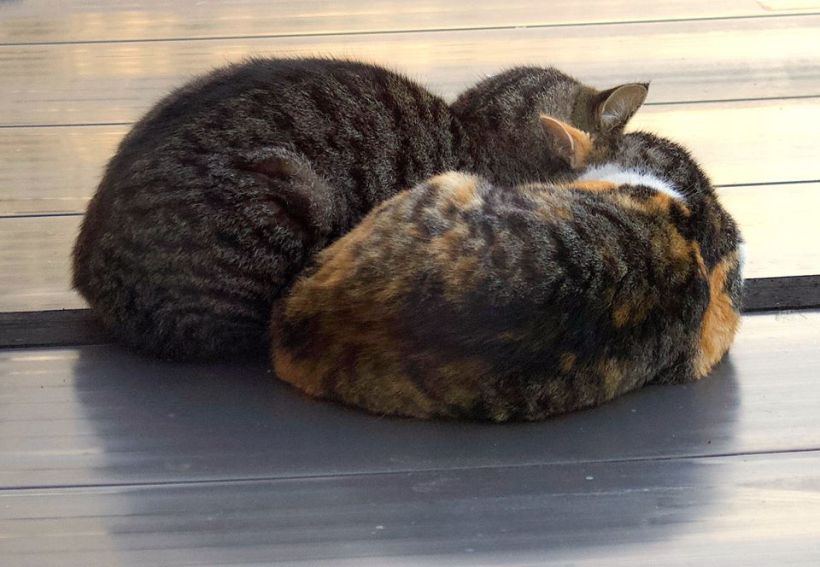
Like a graceful vase, a cat, even when motionless, seems to flow. 
~George F. Will

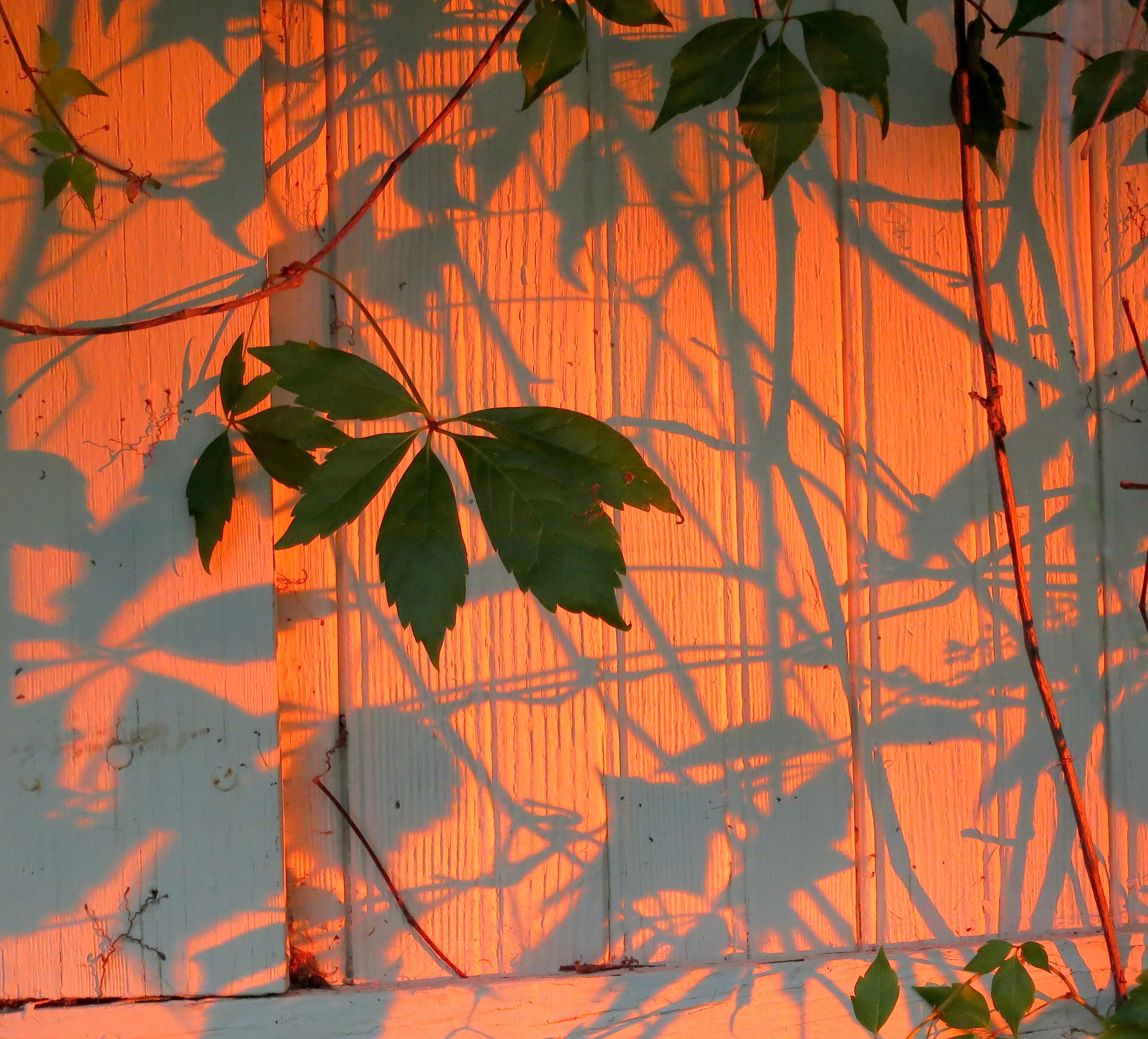
A slight breeze stirs tree branches
so shadow patterns play on the curtains
like candlelight in a drafty room.

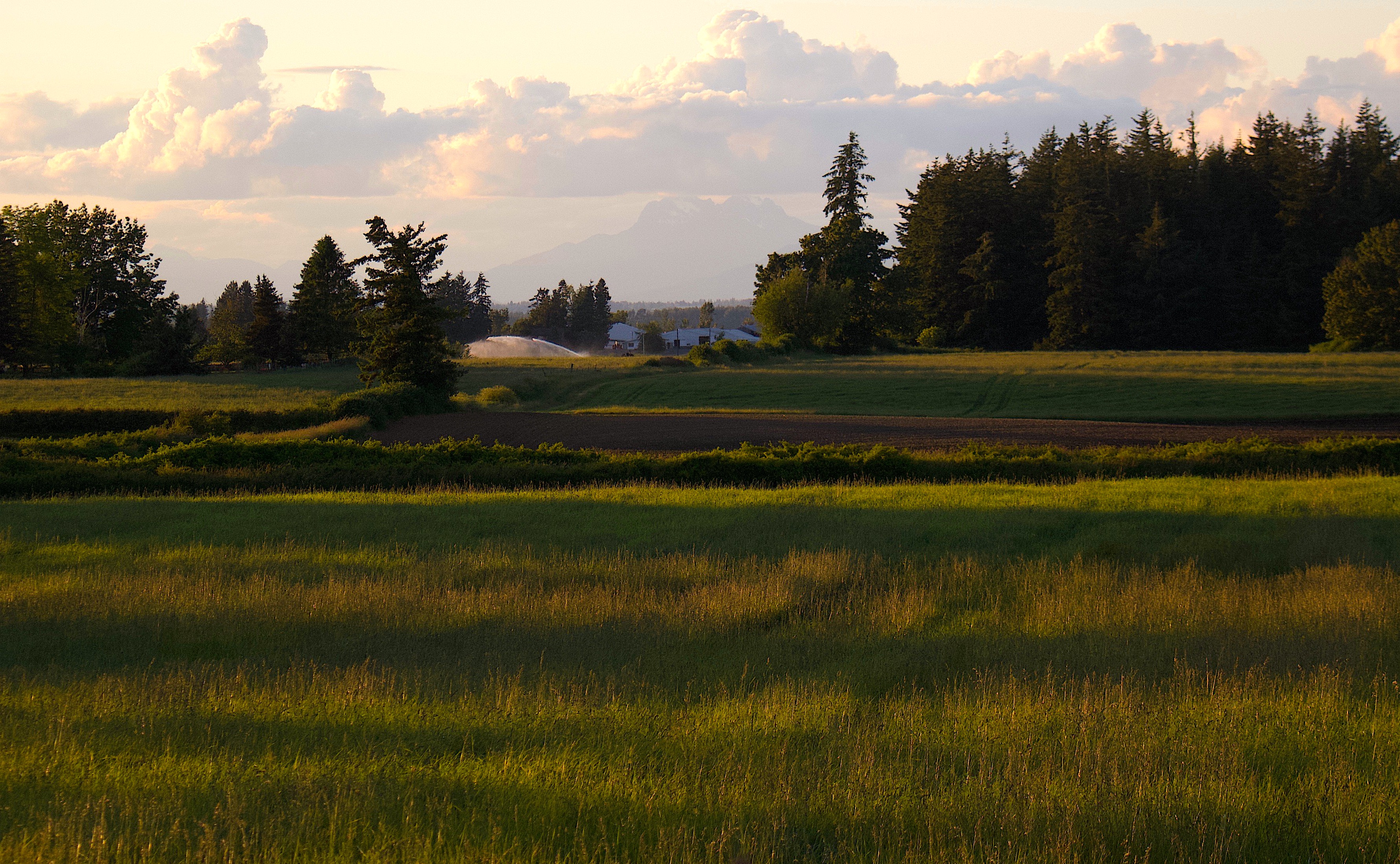
The harvest is over, corn
stubble and weeds in the field. The sky is

soft blue, a few clouds in the distance.

I will close my eyes, nap for
a while. Perhaps when I wake all will seem
the same. Sleep plays tricks in many ways.
~Matthew Spireng “Late August, Lying Down to Nap at Noon”

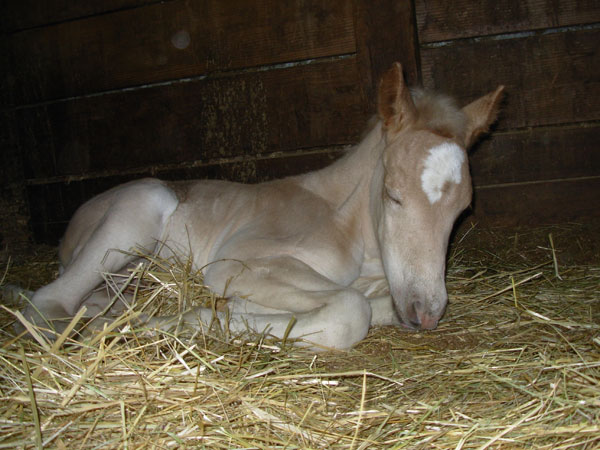
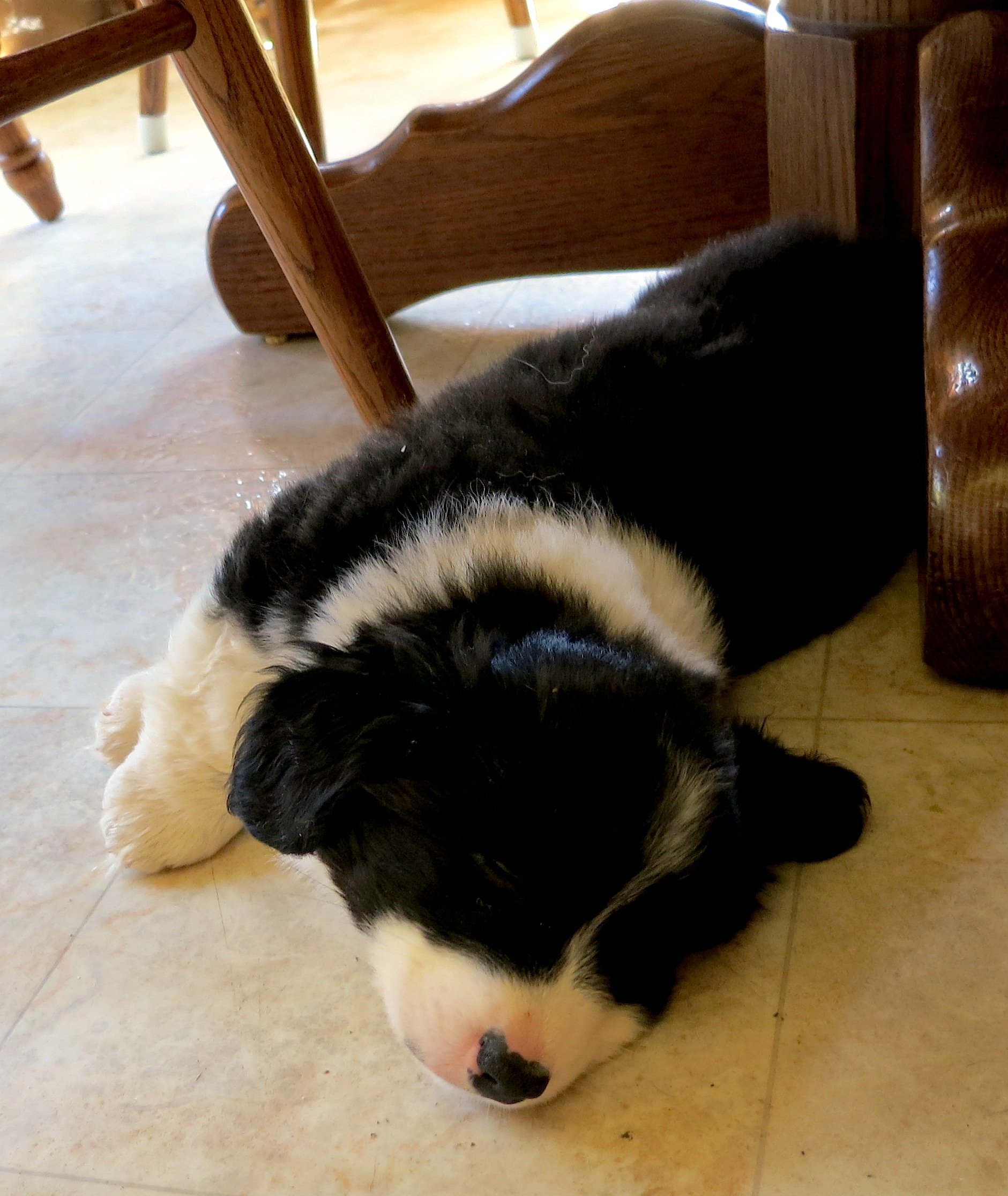
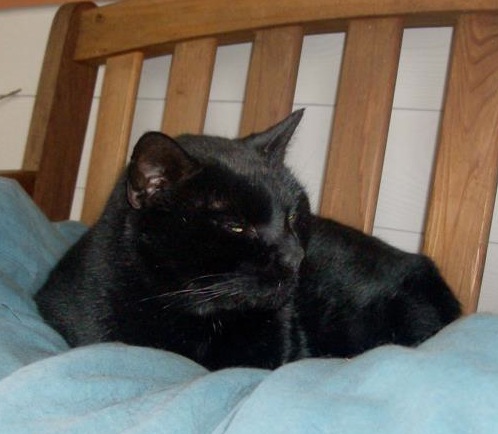
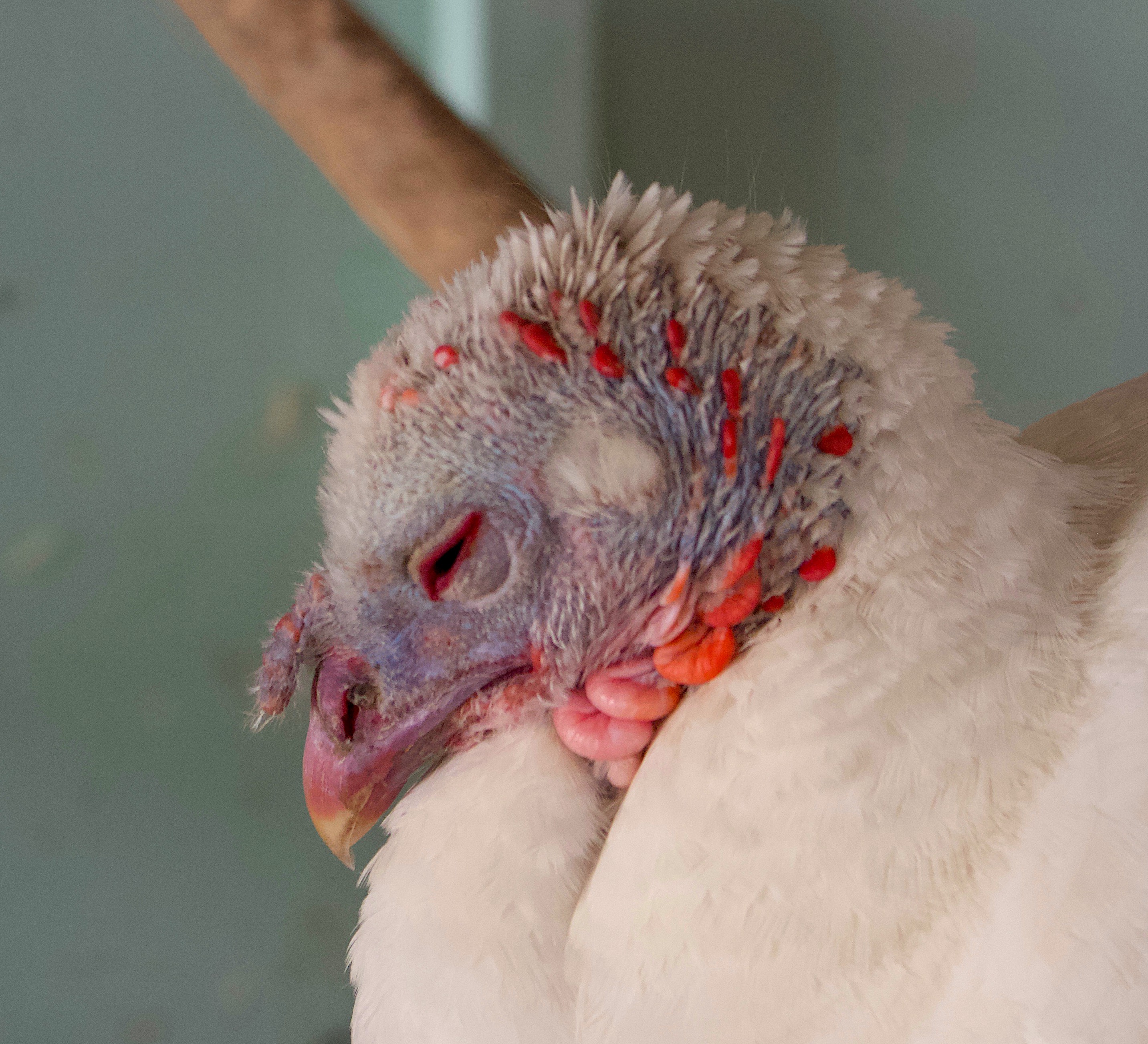
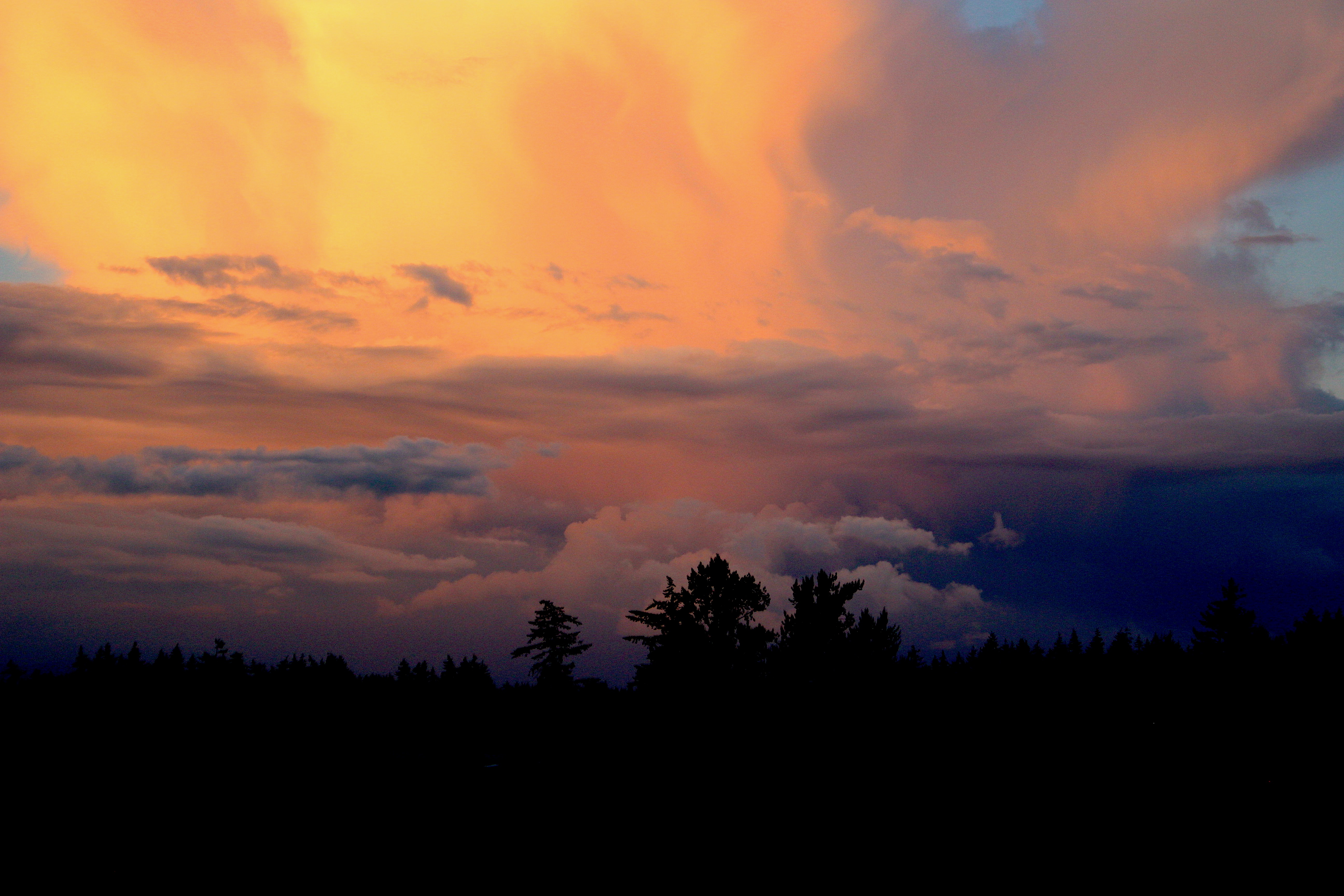
I believe the world would be a better place if we all could stop in the middle of the day and just rest our eyes for awhile — to look at the inside of our eyelids for a few minutes, to pause, to pray, to purr with contentment…

perchance to dream.   Aye, there’s the rub.

Perhaps, we might wake with a new perspective and an improved attitude. Works like a charm for our grandchildren.

And for me as well…

One-Time
Monthly
Yearly

Make a one-time or recurring donation to support daily Barnstorming posts

Make a monthly donation

Make a yearly donation
Choose an amount

¤5.00
¤10.00
¤20.00
¤5.00
¤15.00
¤100.00
¤5.00
¤15.00
¤100.00

Or enter a custom amount

¤

Your contribution is deeply appreciated.
Your contribution is appreciated.

Your contribution is appreciated.

DonateDonate monthlyDonate yearly