All the art of living lies in a fine mingling of letting go and holding on. ~Henry Ellis
The trees are undressing, and fling in many places— On the gray road, the roof, the window-sill— Their radiant robes and ribbons and yellow laces; A leaf each second so is flung at will, Here, there, another and another, still and still.
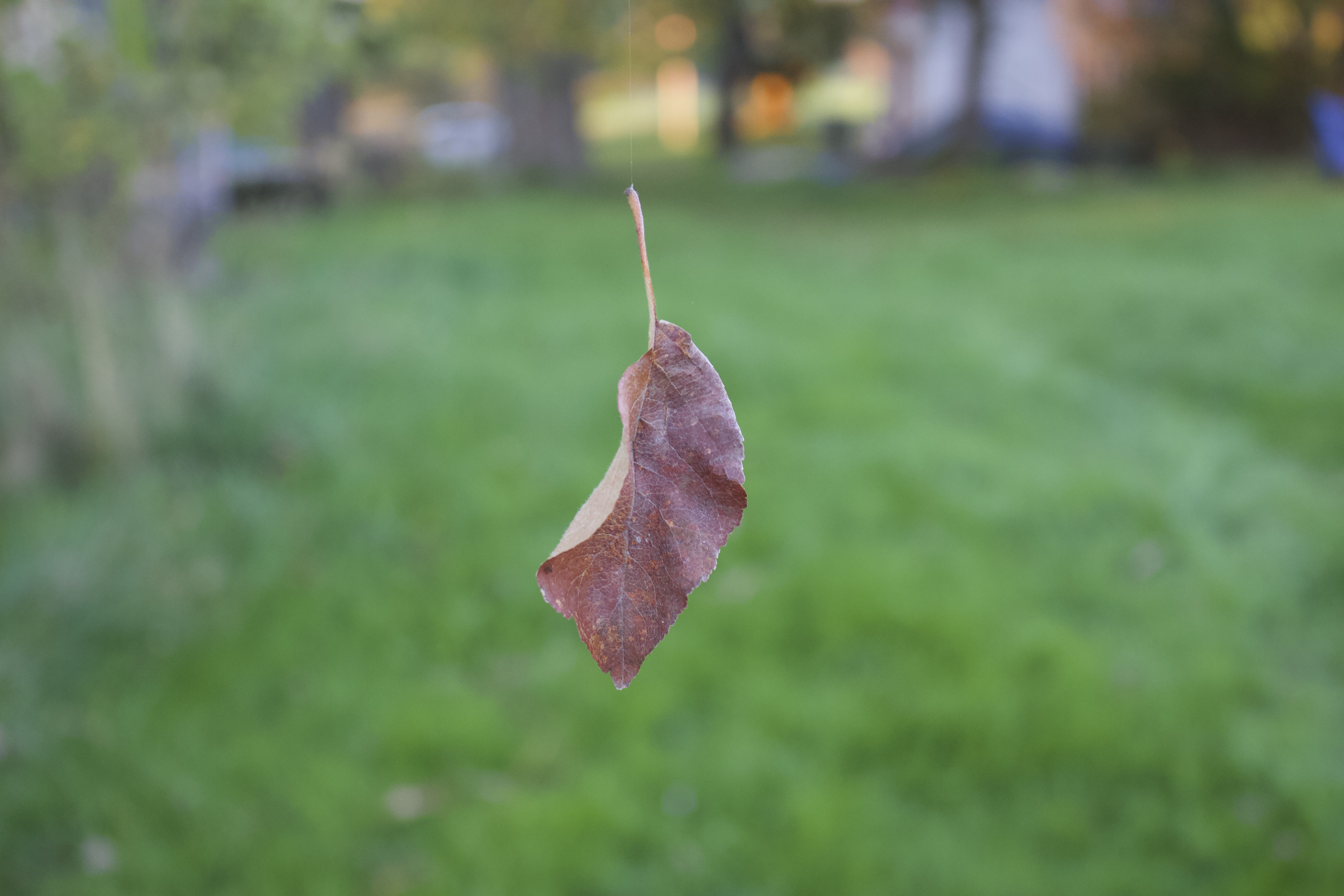
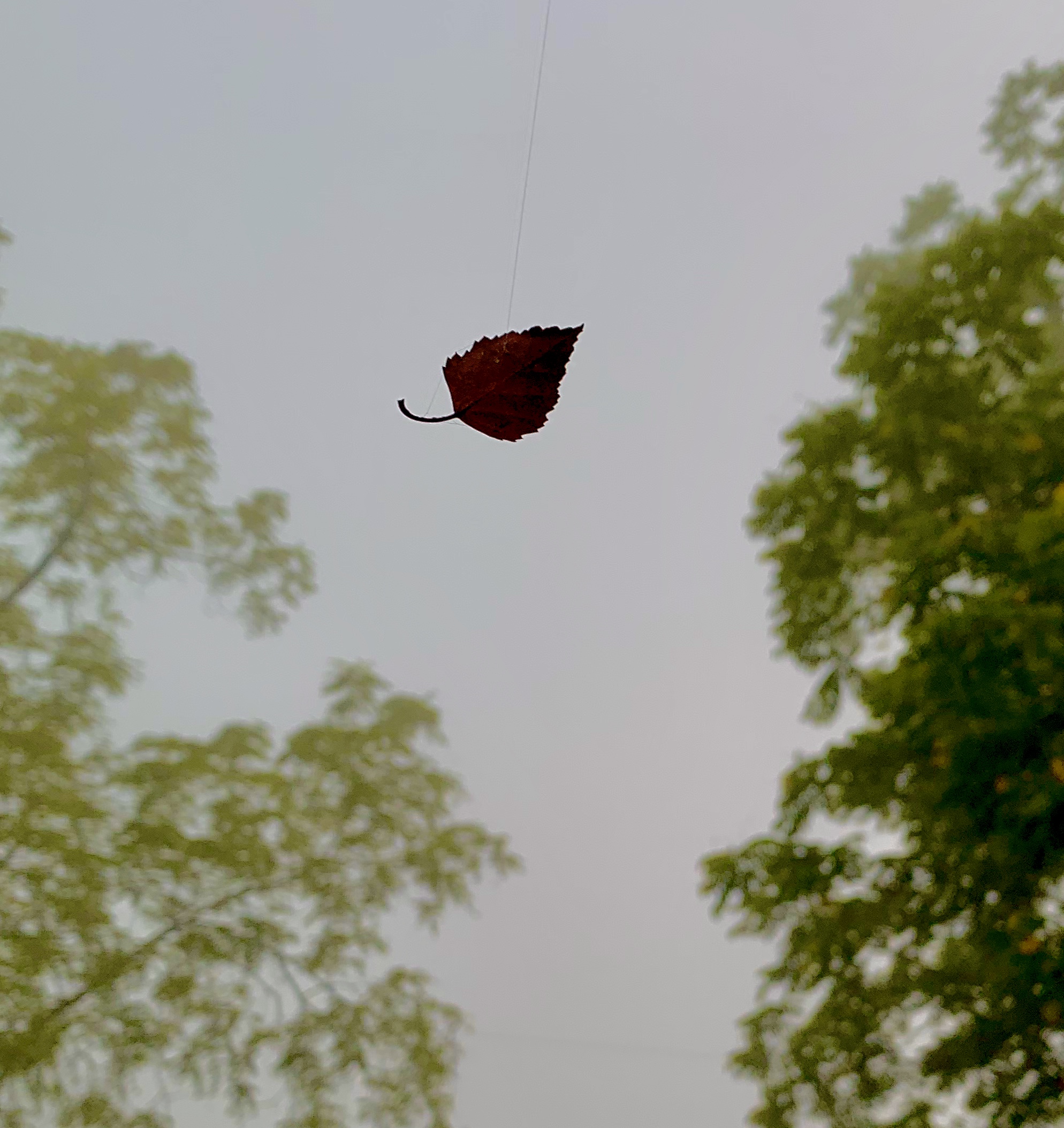
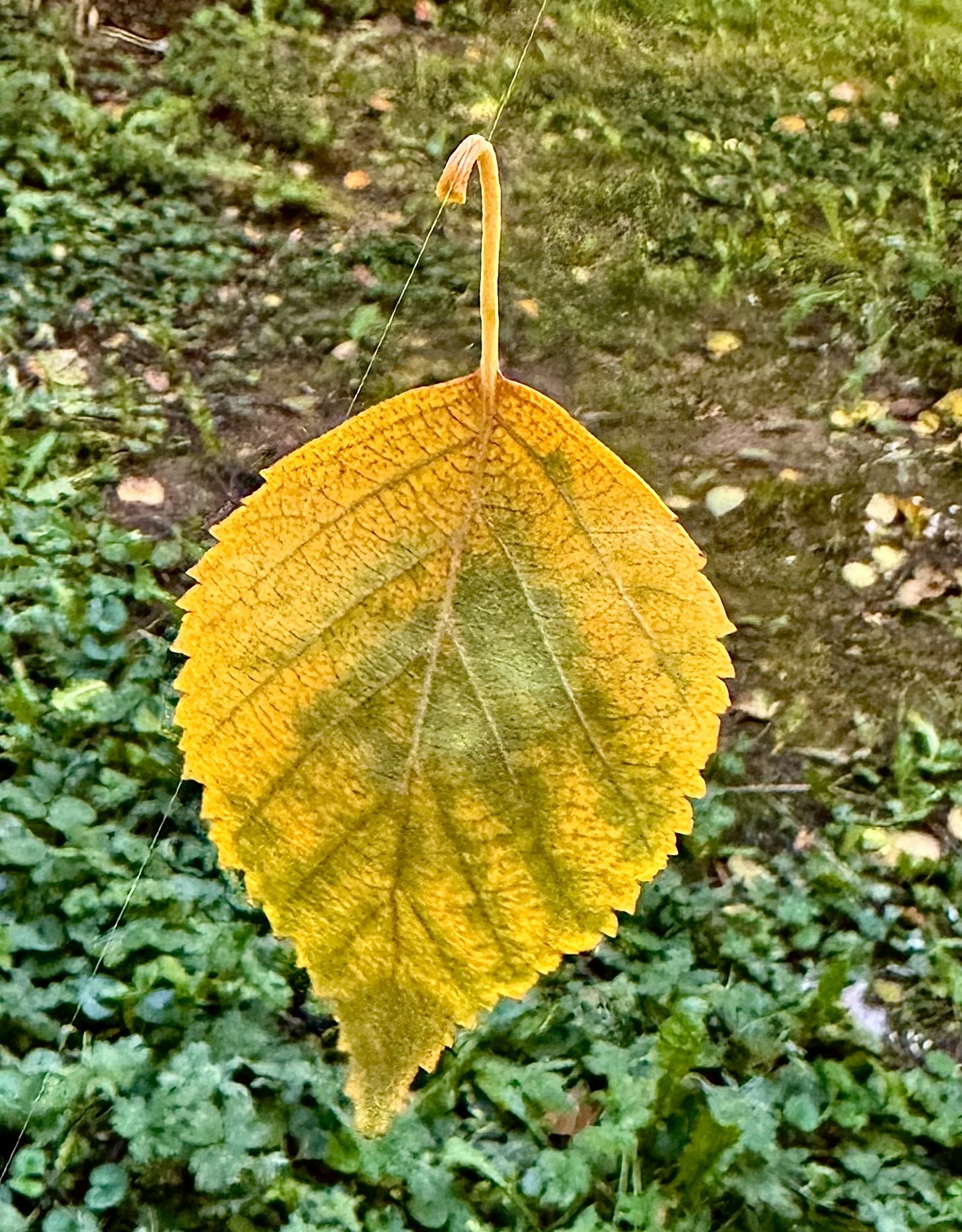
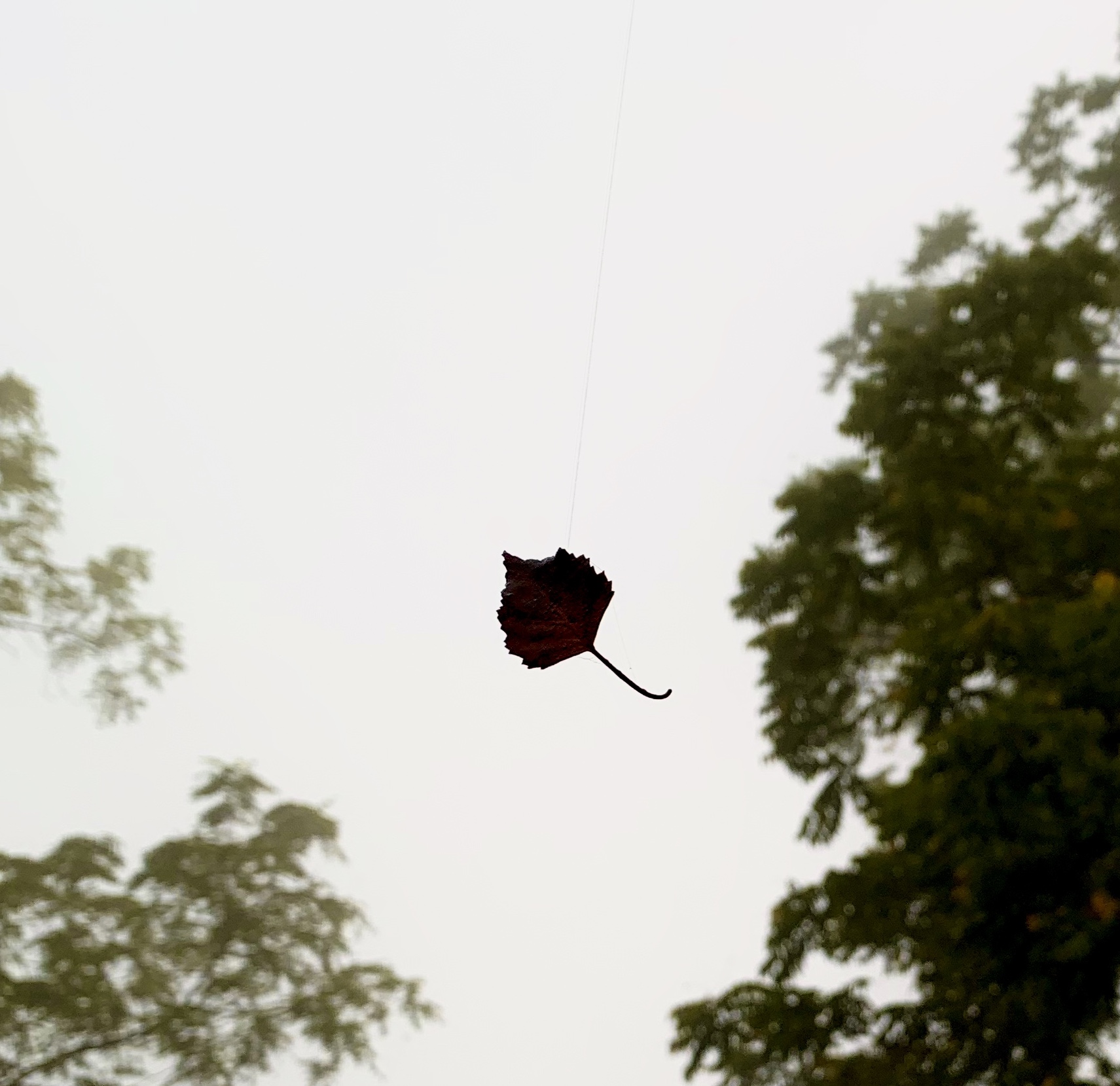
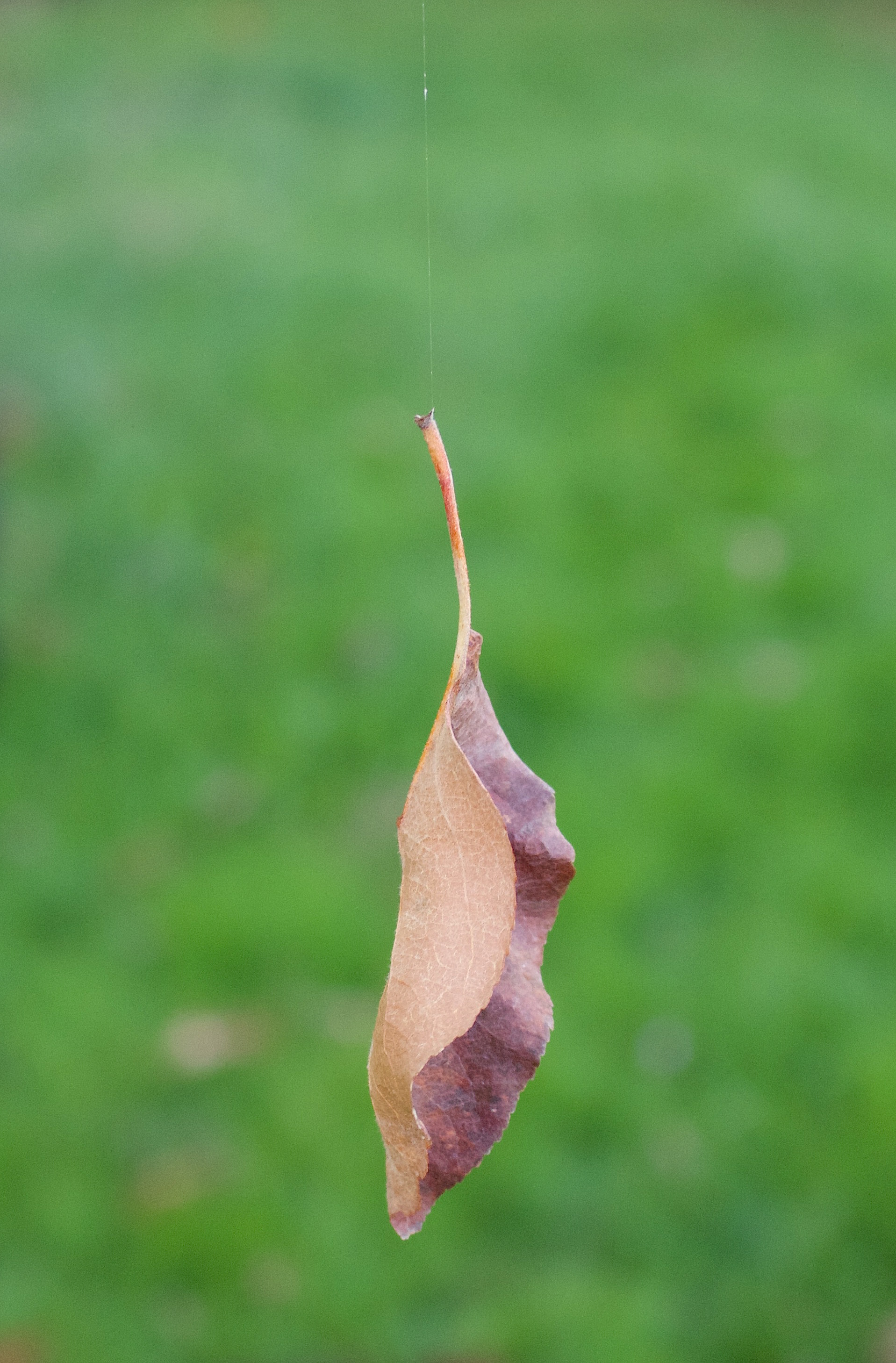
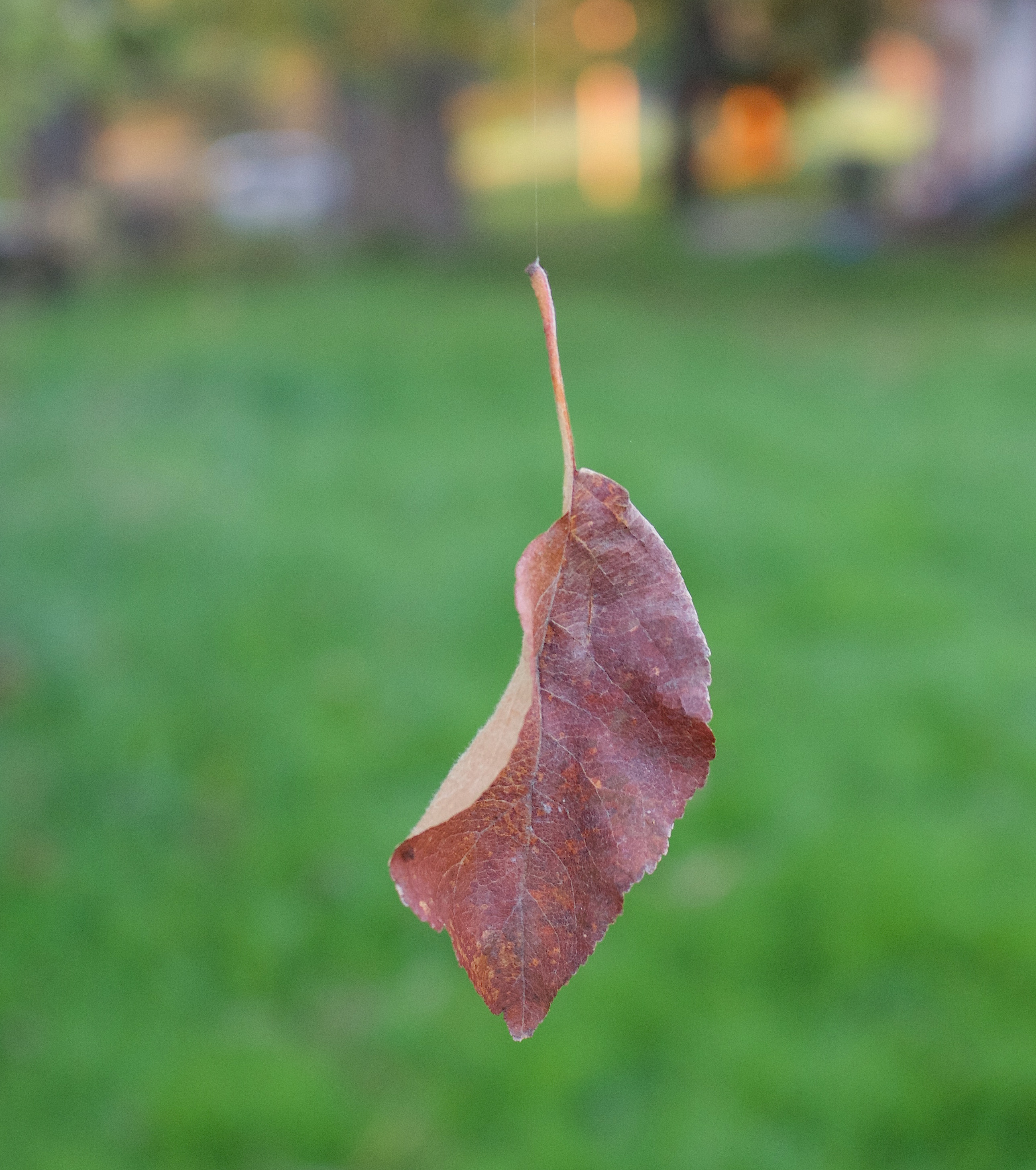
A spider’s web has caught one while downcoming, That stays there dangling when the rest pass on; Like a suspended criminal hangs he, mumming In golden garb, while one yet green, high yon, Trembles, as fearing such a fate for himself anon. ~Thomas Hardy “Last Week in October”
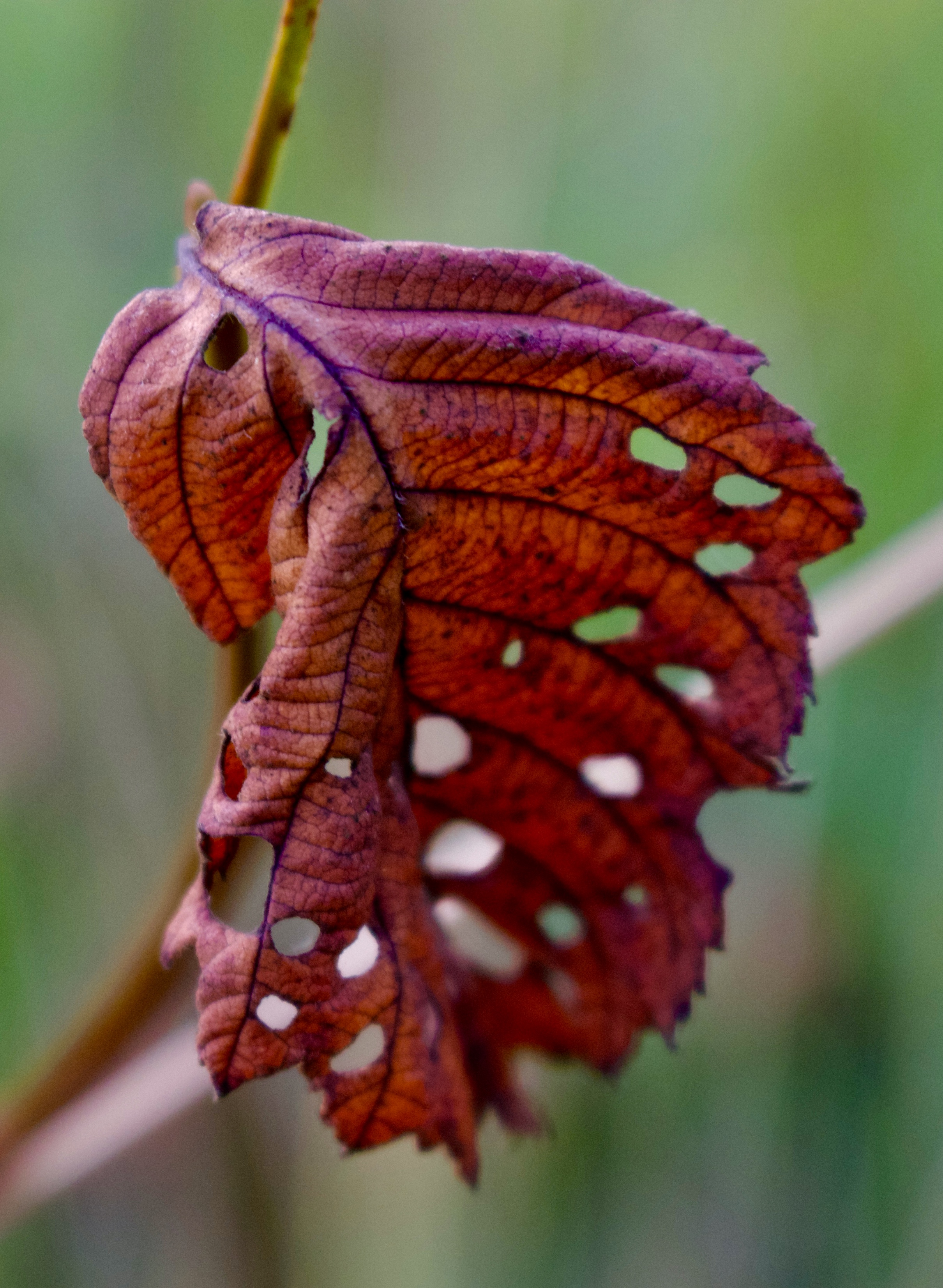
Watching a dry leaf twirl in the wind, its stem still
tethered to the tree, I think of how stubborn I’ve been,
refusing to let go of what was never intended for me,
not knowing something better was waiting if I’d let myself lift
The builder who first bridged Niagara’s gorge, Before he swung his cable, shore to shore, Sent out across the gulf his venturing kite Bearing a slender cord for unseen hands To grasp upon the further cliff and draw A greater cord, and then a greater yet; Till at the last across the chasm swung The cable then the mighty bridge in air! So we may send our little timid thought Across the void, out to God’s reaching hands— Send out our love and faith to thread the deep— Thought after thought until the little cord Has greatened to a chain no chance can break, And we are anchored to the Infinite! ~Edwin Markham “Anchored to the Infinite”
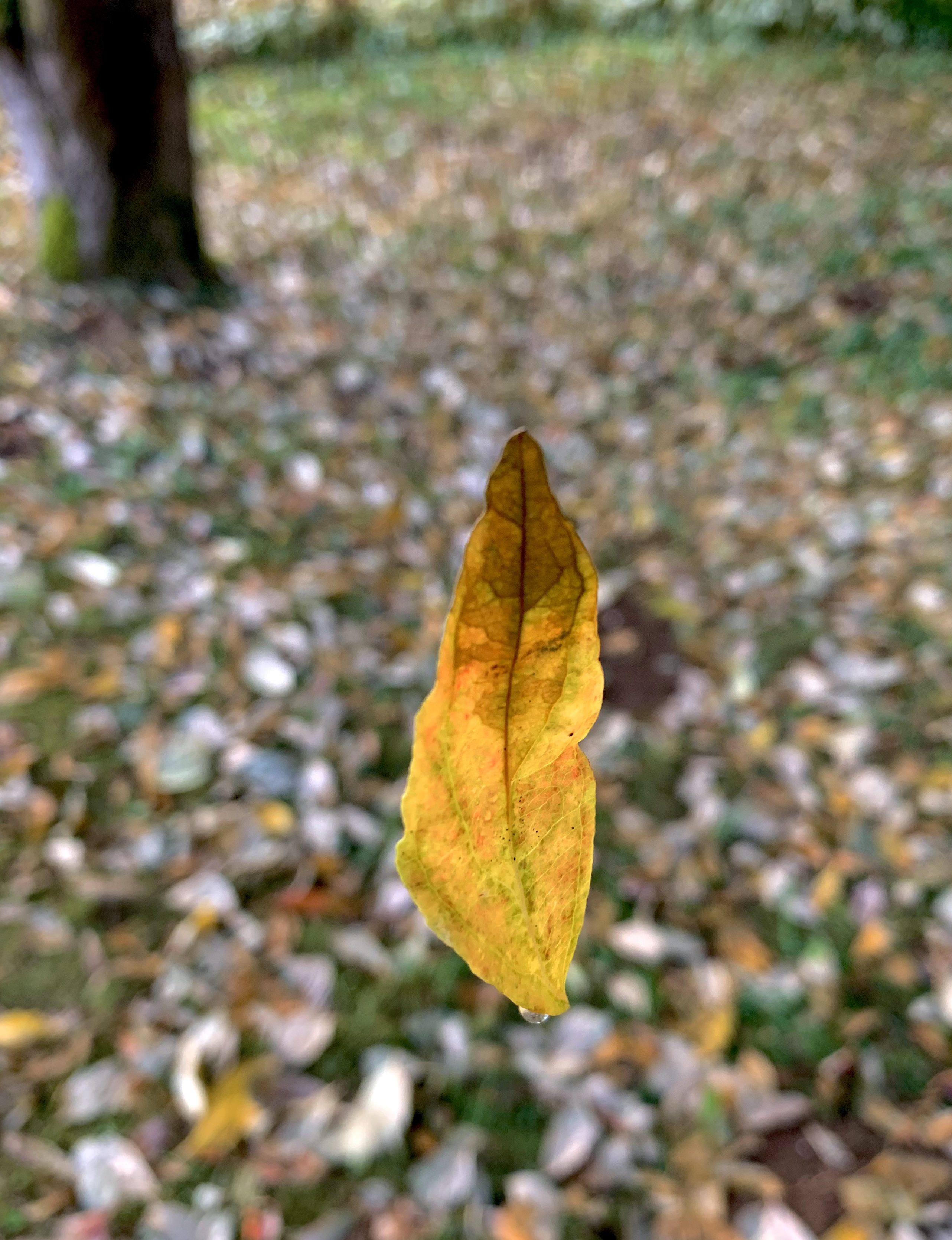
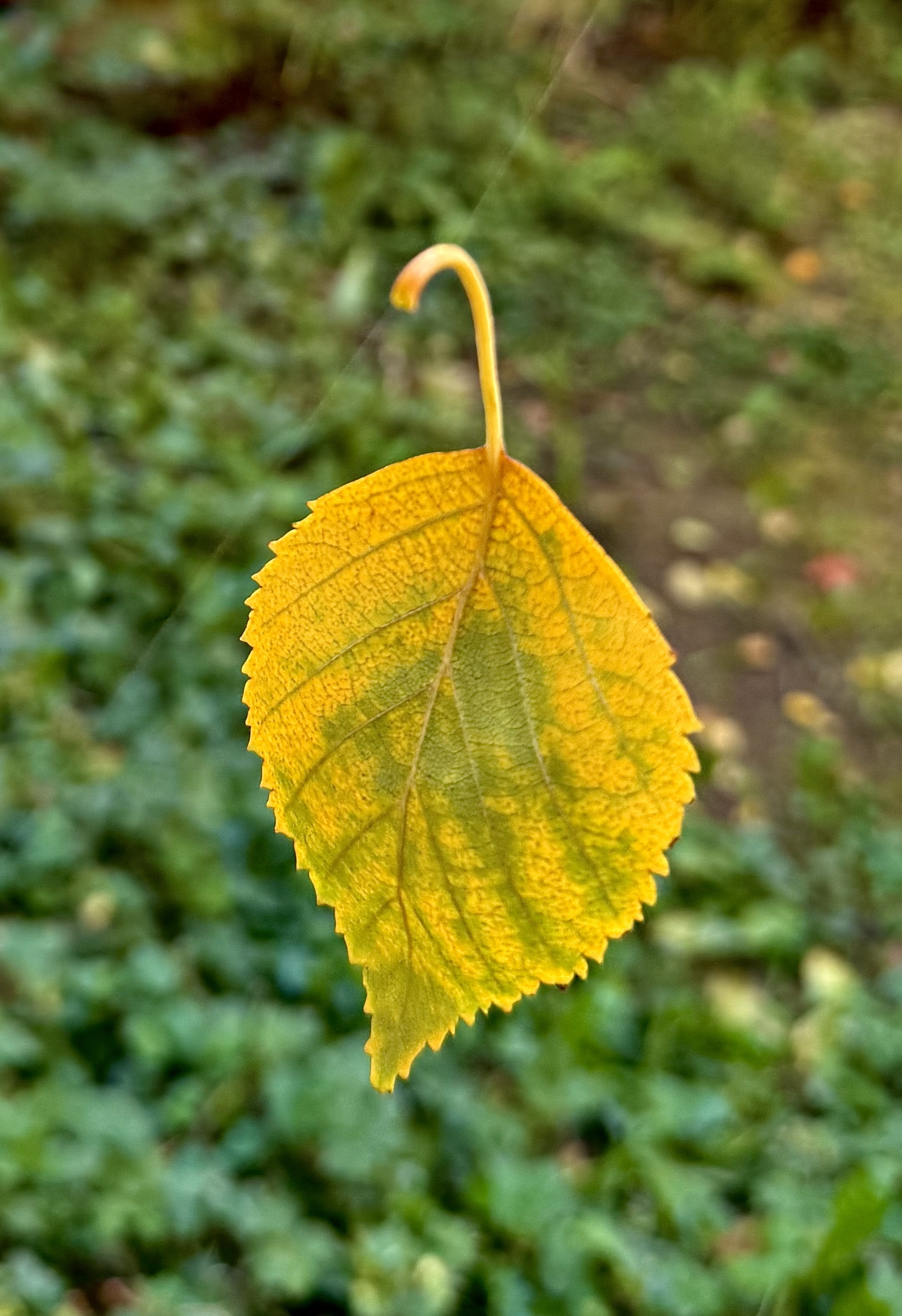
I feel like the only one who failed to fall from the tree along with all the others, caught in an invisible silken strand, dangling suspended and helpless, twisting and turning in the storms of winter.
I wish I had the faith to trust in this slender thread bridging the chasm between heaven and earth, assured rescue will come as others pass me by ~~ another and another, still and still.
So I remain suspended in the void, anchored to God’s reaching hands.
I’ll never again be let go.
One-Time
Monthly
Yearly
Make a one-time or recurring donation to support daily Barnstorming posts
Now there was a man of the Pharisees named Nicodemus, a ruler of the Jews.This man came to Jesus by night and said to him, “Rabbi, we know that you are a teacher come from God, for no one can do these signs that you do unless God is with him.”
Jesus answered him, “Truly, truly, I say to you, unless one is born again he cannot see the kingdom of God.”
Nicodemus said to him, “How can a man be born when he is old? Can he enter a second time into his mother’s womb and be born?”
Jesus answered, “Truly, truly, I say to you, unless one is born of water and the Spirit, he cannot enter the kingdom of God. That which is born of the flesh is flesh, and that which is born of the Spirit is spirit. Do not marvel that I said to you, ‘You must be born again.’ The wind blows where it wishes, and you hear its sound, but you do not know where it comes from or where it goes. So it is with everyone who is born of the Spirit.”
Nicodemus said to him, “How can these things be?”
Jesus answered him, “Are you the teacher of Israel and yet you do not understand these things?Truly, truly, I say to you, we speak of what we know, and bear witness to what we have seen, but you do not receive our testimony. If I have told you earthly things and you do not believe, how can you believe if I tell you heavenly things? No one has ascended into heaven except he who descended from heaven, the Son of Man. And as Moses lifted up the serpent in the wilderness, so must the Son of Man be lifted up, that whoever believes in him may have eternal life. John 3: 1-15
When I lay these questions before God I get no answer. But a rather special sort of “No answer.”
It is not the locked door. It is more like a silent, certainly not uncompassionate, gaze.
As though he shook his head not in refusal but waiving the question.Like, “Peace, child; you don’t understand.”
Can a mortal ask questions which God finds unanswerable? Quite easily, I should think. All nonsense questions are unanswerable.
How many hours are there in a mile? Is yellow square or round?
Probably half the questions we ask – half our great theological and metaphysical problems – are like that. ~C.S. Lewis from A Grief Observed
I know now, Lord, why you utter no answer. You are yourself the answer. Before your face questions die away. ~C.S. Lewis from Till We Have Faces
At present we are on the outside of the world, the wrong side of the door. We discern the freshness and purity of morning, but they do not make us fresh and pure. We cannot mingle with the splendors we see. But all the leaves of the New Testament are rustling with the rumor that it will not always be so. Someday, God willing, we shall get in. ~C.S. Lewis from The Weight of Glory
And now brothers, I will ask you a terrible question, and God knows I ask it also of myself. Is the truth beyond all truths, beyond the stars, just this: that to live without him is the real death, that to die with him the only life? ~Frederich Buechner from The Magnificent Defeat
And that is just the point… how the world, moist and beautiful, calls to each of us to make a new and serious response. That’s the big question, the one the world throws at you every morning. “Here you are, alive. Would you like to make a comment?” ~Mary Oliver from Long Life
Some days, it is impossible to be a silent observer of the world. I ask so many unanswerable questions.
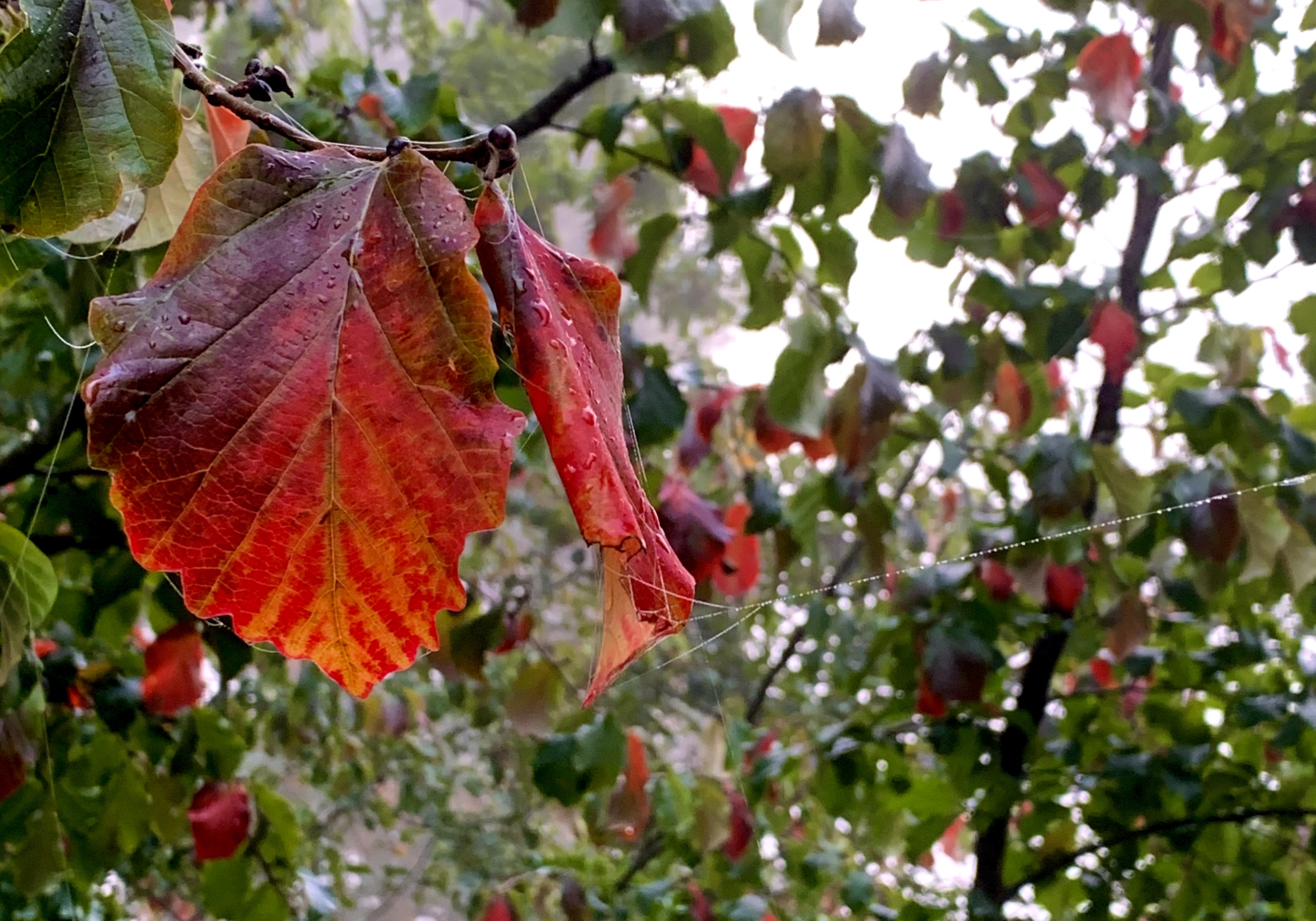
When the wind and rain pulls down nearly every leaf, the ground is carpeted with the dying evidence of last spring’s rebirth, there can be no complacency in witnessing life in progress.
It blusters, rips, drenches, encompasses, buries. Nothing remains as it was. And neither do we.
And yet here I am, alive. Awed. Born to be a witness to all this. Called to comment. Dying to hear a response.
I am reading slowly through the words in the Book of John over the next year. Once a week, I will invite you to “come and see” what those words might mean as we explore His promises together.
One-Time
Monthly
Yearly
Make a one-time or recurring donation to support daily Barnstorming posts
The birds do not sing in these mornings. The skies are white all day. The Canadian geese fly over high up in the moonlight with the lonely sound of their discontent. Going south. Now the rains and soon the snow. The black trees are leafless, the flowers gone. Only cabbages are left in the bedraggled garden. Truth becomes visible, the architecture of the soul begins to show through. God has put off his panoply and is at home with us. We are returned to what lay beneath the beauty. We have resumed our lives. There is no hurry now. We make love without rushing and find ourselves afterward with someone we know well. Time to be what we are getting ready to be next. This loving, this relishing, our gladness, this being puts down roots and comes back again year after year. ~Jack Gilbert “Half the Truth” from Collected Poems.
In the shape of this night, in the still fall of snow, Father In all that is cold and tiny, these little birds and children… Before the bells ring, before this little point in time has rushed us on Before this clean moment has gone, before this night turns to face tomorrow, Father There is this high singing in the air Forever this sorrowful human face in eternity’s window And there are other bells that we would ring, Father Other bells that we would ring. ~Kenneth Patchen from “At the New Year”
The object of a New Year is not that we should have a new year. It is that we should have a new soul… ~G.K.Chesterton from A Chesterton Calendar
Ring out, wild bells, to the wild sky, The flying cloud, the frosty light: The year is dying in the night; Ring out, wild bells, and let him die.
Ring out the old, ring in the new, Ring, happy bells, across the snow: The year is going, let him go; Ring out the false, ring in the true.
Ring in the valiant man and free, The larger heart, the kindlier hand; Ring out the darkness of the land, Ring in the Christ that is to be. ~Lord Alfred Tennyson from “In Memoriam”
Often when something is ending we discover within it the spore of new beginning, and a whole new train of possibility is in motion before we even realize it. When the heart is ready for a fresh beginning, unforeseen things can emerge. And in a sense, this is exactly what a beginning does. It is an opening for surprises. ~John O’Donohue from “To Bless the Space Between Us”
No heralding trumpets – Just softening shadows, Timed and tracked.
Fingers of light flaring amber Over the eastern ridge of foothills, Caress the slopes of snow capped peaks. So I bid this past year farewell.
Each earthly thing bathed in gold Glimpsed and grasped without fanfare Yet wholly miraculous. Too soon this day, this year, becomes ordinary again Although it is truth: we can be born anew, year after year.
One-Time
Monthly
Yearly
Make a one-time or recurring donation to support daily Barnstorming posts
I wondered if that was how forgiveness budded; not with the fanfare of epiphany, but with pain gathering its things, packing up, and slipping away unannounced in the middle of the night. — Khaled Hosseini from The Kite Runner
The time is ripe for looking back over the day, the week, the year, and trying to figure out where we have come from and where we are going to, for sifting through the things we have done and the things we have left undone for a clue to who we are and who, for better or worse, we are becoming.
We cling to the present out of wariness of the past.
But there is a deeper need yet, I think, and that is the need—not all the time, surely, but from time to time—to enter that still room within us all where the past lives on as a part of the present, where the dead are alive again, where we are most alive ourselves to turnings and to where our journeys have brought us.
The name of the room is Remember—the room where with patience, with charity, with quietness of heart, we remember consciously to remember the lives we have lived. ~Frederick Buechner from A Room Called Remember
age nineage 14age 15
Something went wrong, says the empty house in the weed-choked yard. Stones in the fields say he was not a farmer; the still-sealed jars in the cellar say she left in a nervous haste. And the child? Its toys are strewn in the yard like branches after a storm—a rubber cow, a rusty tractor with a broken plow, a doll in overalls. Something went wrong, they say. ~Ted Kooser, from “Abandoned Farmhouse” from Sure Signs: New and Selected Poems.
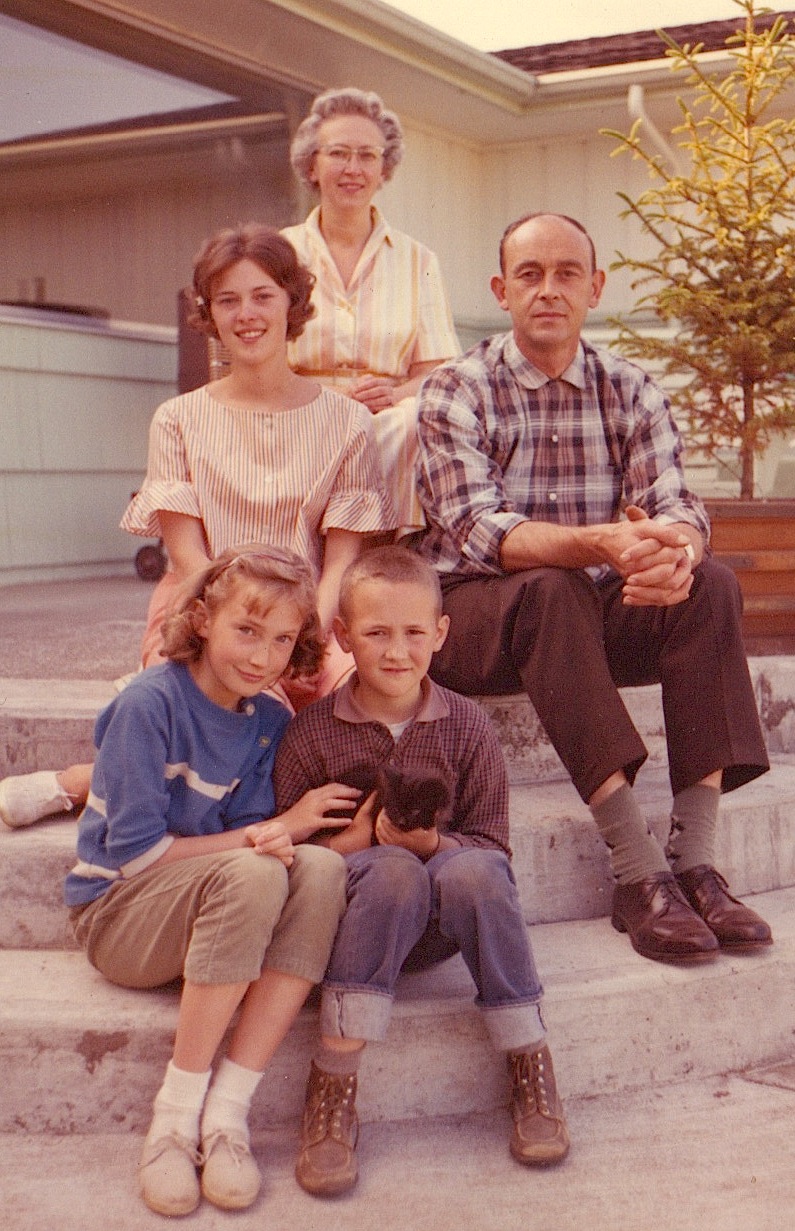
In 1959, when I was five years old, my father took a new job so our family moved from a large 3 story farm house in a rural community to a 1950’s newer rambler-style home just outside the city limits of the state capitol.
It was a big adjustment to move to a much smaller house without a basement or upper story, no garage, and no large haybarn nor chicken coop. It meant most things we owned didn’t make the move with us.
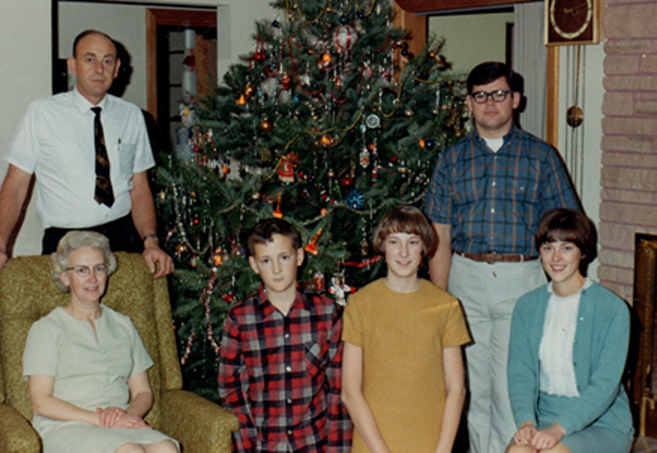
The rambler had two side-by-side mirror image rooms as the primary central living space between the kitchen/dining area on one side and the hallway to the bedrooms on the other. The living room could only be entered through the front door and the family room was accessed through the back door with a shared sandstone hearth in the center, containing a fireplace in each room. The only opening between the rooms had a folding door shut most of the year. In December, the door was opened to accommodate a Christmas tree, so it sat partially in the living room and depending on its generous width, spilled over into the family room. That way it was visible from both rooms, and didn’t take up too much floor space.
The living room, because it contained the only carpeting in the house, and our “best” furniture, was strictly off-limits. In order to keep our two matching sectional knobby gray fabric sofas, a green upholstered chair and gold crushed velvet covered love seat in pristine condition, the room was to be avoided unless we had company. The carpet was never to develop a traffic pattern, there would be no food, beverage, or pet ever allowed in that room, and the front door was not to be used unless a visitor arrived. The hearth never saw a fire lit on that side because of the potential of messy ashes or smoke smell.
This was not a room for toys or games. The chiming clock next to the hearth, wound with weighted cones on the end of chains, called out the hours without an audience.
One week before Christmas, a tree was chosen to fit in the space where it could overflow into the family room. I particularly enjoyed decorating the “family room” side of the tree, using all my favorite ornaments that were less likely to break if they fell on the linoleum floor on that side of the door.
It was almost as if the Christmas tree itself became divided, with a “formal” side in the living room and a “real life” face on the other side where the living (and hurting) was actually taking place.
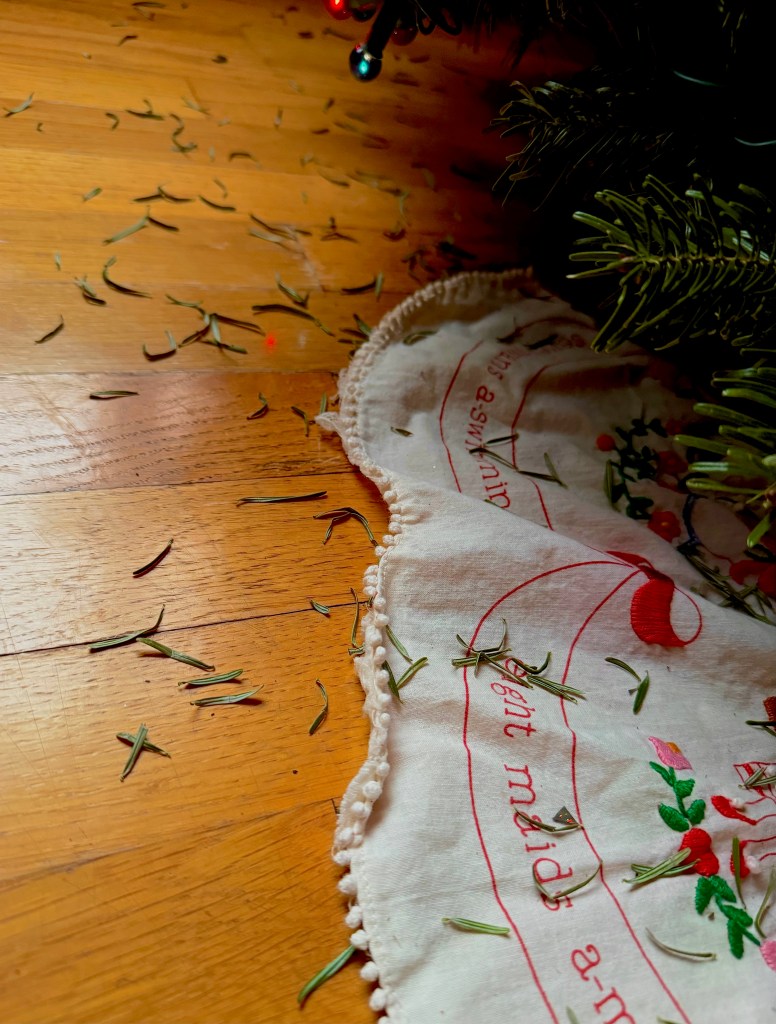
The tree straddled more than just two rooms. Every year that tree’s branches reached out to shelter a family that was slowly, almost imperceptibly, falling apart, like the fir needles dropping to the floor to be swept away.
Something was going wrong, only I didn’t see it at the time.
Each year since, our Christmas tree, bearing those old ornaments from my childhood, reminds me of that still room of memories.
No longer am I wary of the past. As I sweep up the fir needles that inevitably drop, I no longer weep.
One-Time
Monthly
Yearly
Make a one-time or recurring donation to support daily Barnstorming posts
Now, newborn, in wide-eyed wonder he gazes up at his creation. His hand that hurled the world holds tight his mother’s finger. Holy light spills across her face and she weeps silent wondering tears to know she holds the One who has so long held her. ~Joan Rae Mills from “Mary”in Light Upon Light
Now burn, new born to the world, Doubled-naturèd name, The heaven-flung, heart-fleshed, maiden-furled Miracle-in-Mary-of-flame, Mid-numbered he in three of the thunder-throne!
Not a dooms-day dazzle in his coming nor dark as he came; Kind, but royally reclaiming his own; A released shower, let flash to the shire, not a lightning of fíre hard-hurled.
Let him easter in us, be a dayspring to the dimness of us, be a crimson-cresseted east… ~Gerard Manley Hopkins from “The Wreck of the Deutschland”
Through the tender mercy of our God, With which the Dayspring from on high has visited us; To give light to those who sit in darkness and the shadow of death, To guide our feet into the way of peace. Luke 1:78-79 (Zechariah’s Song)
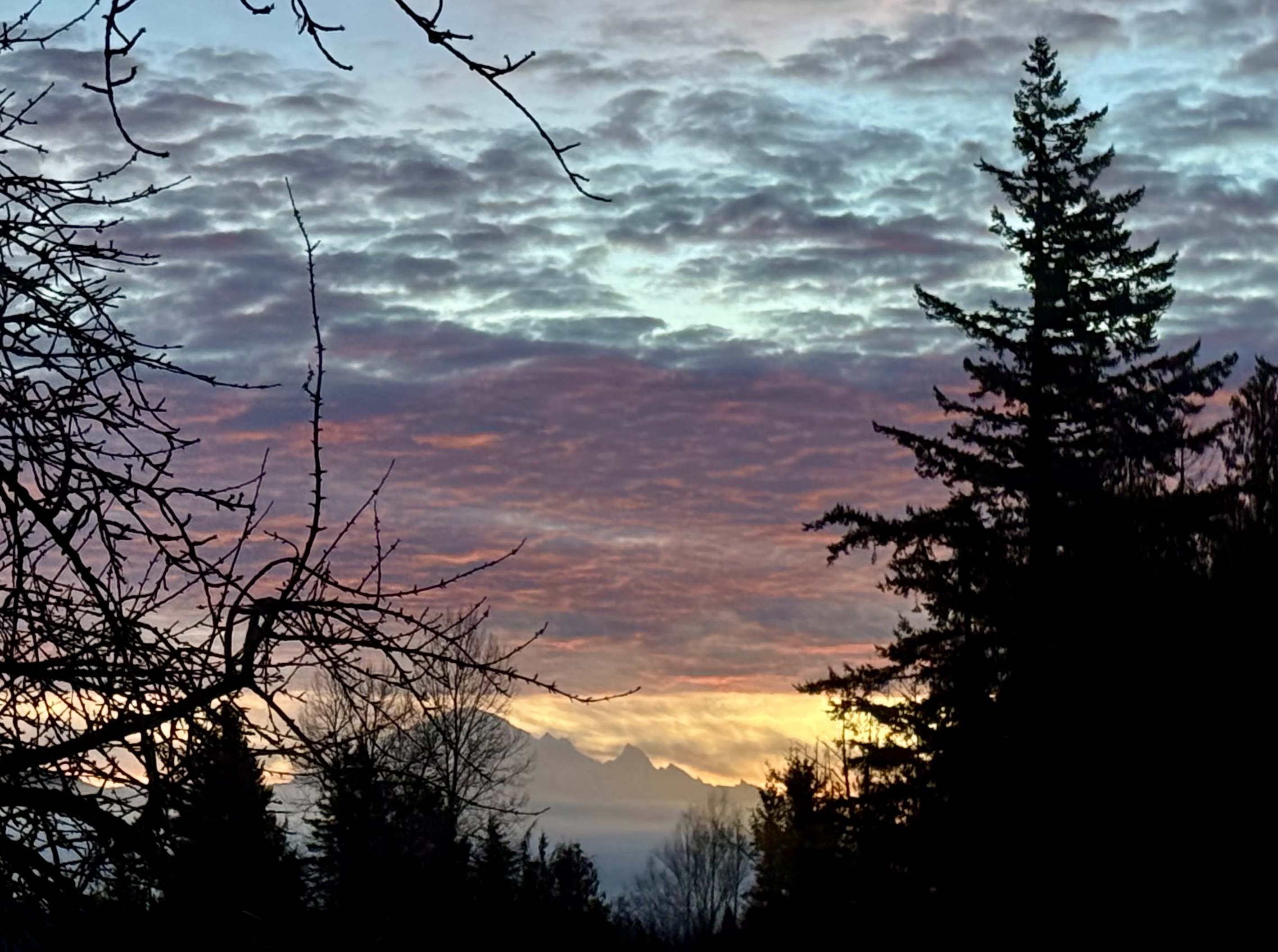
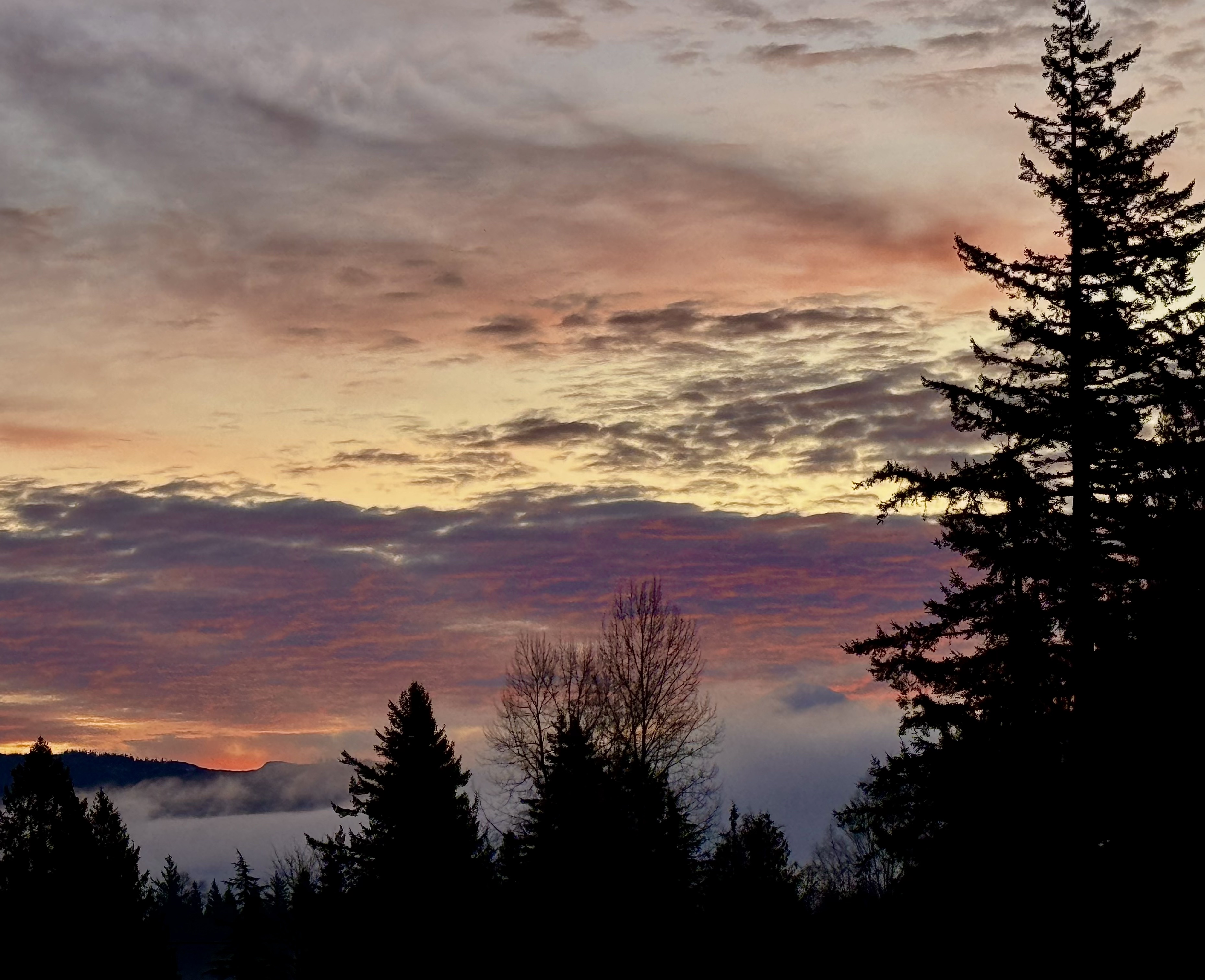
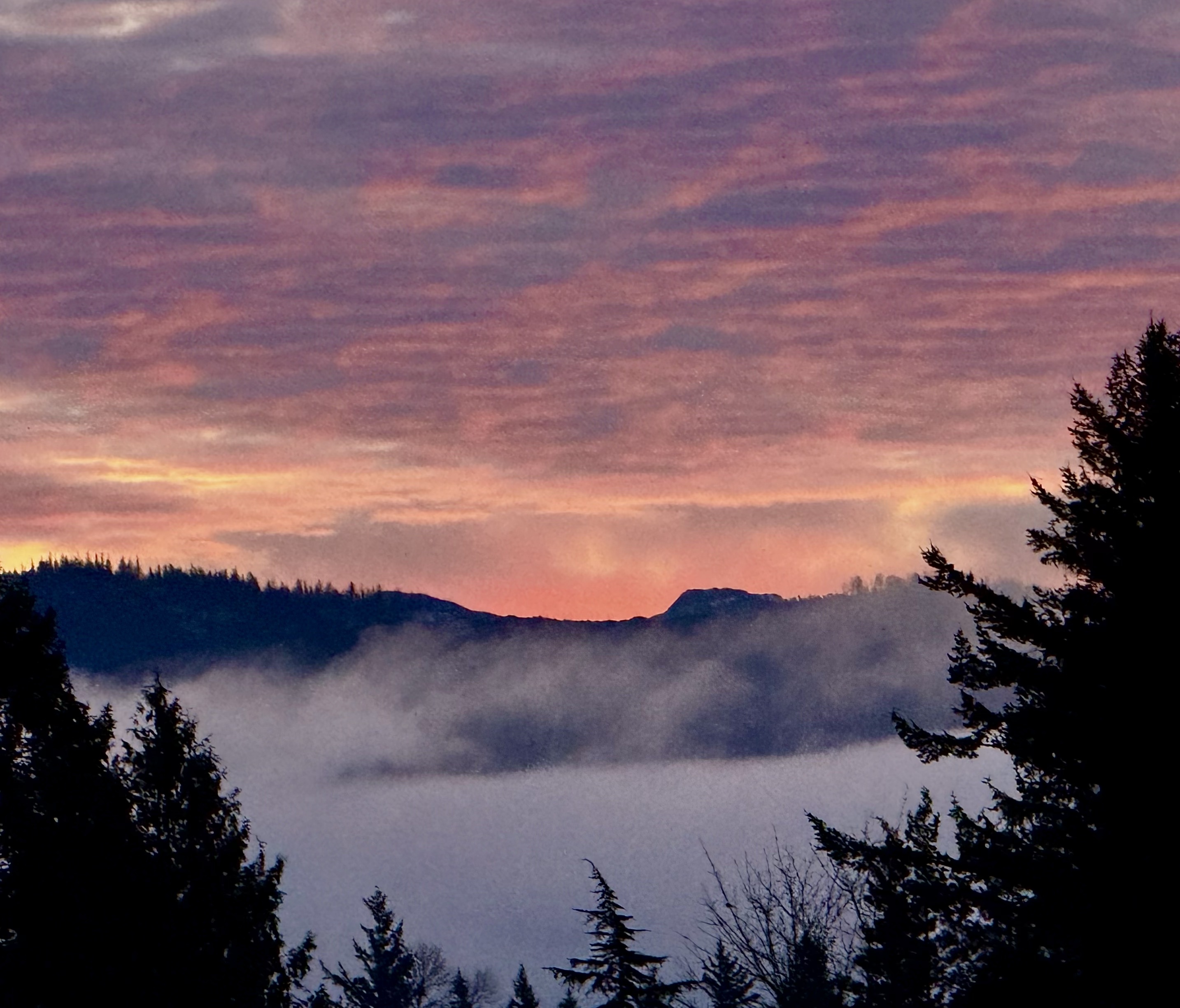
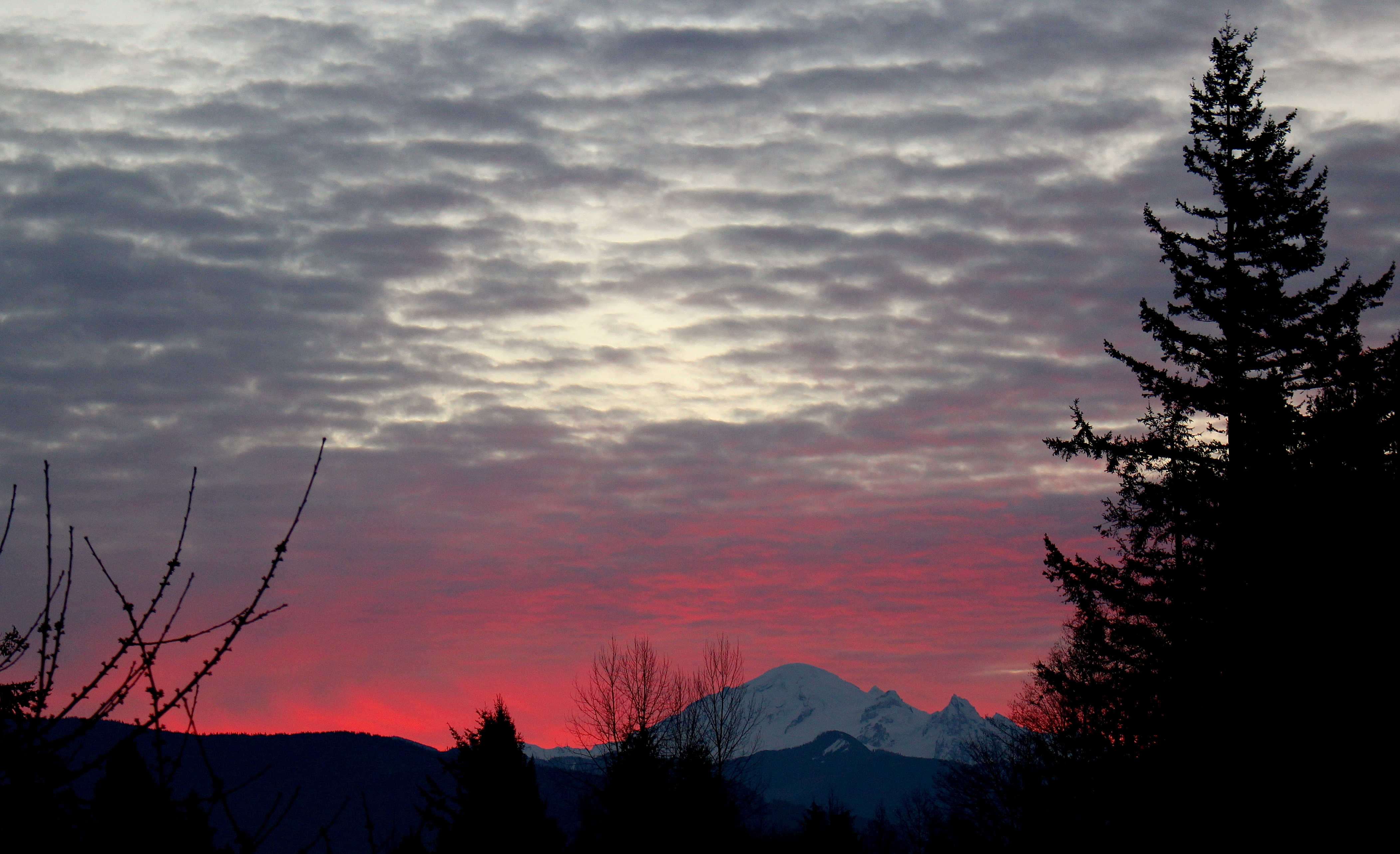
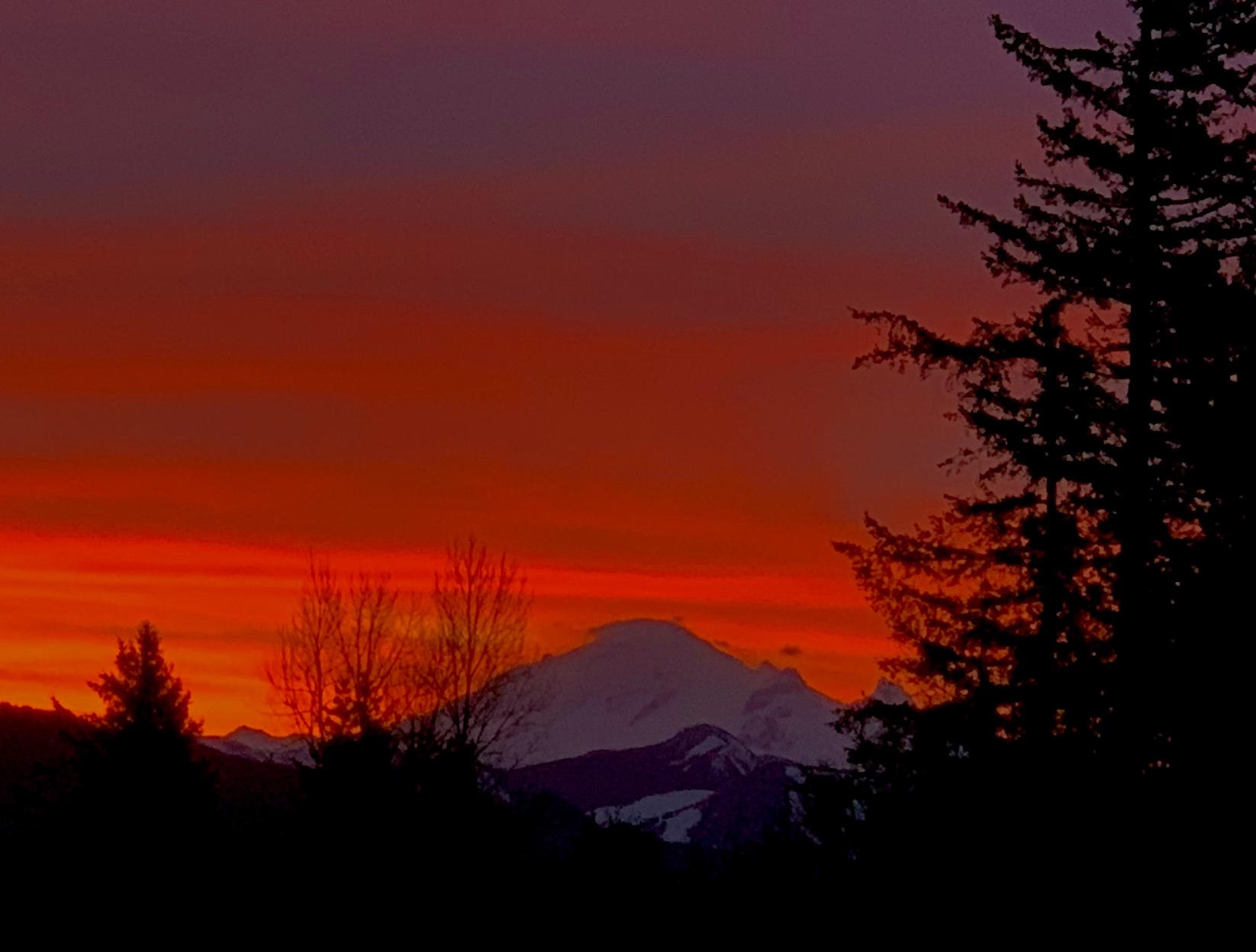
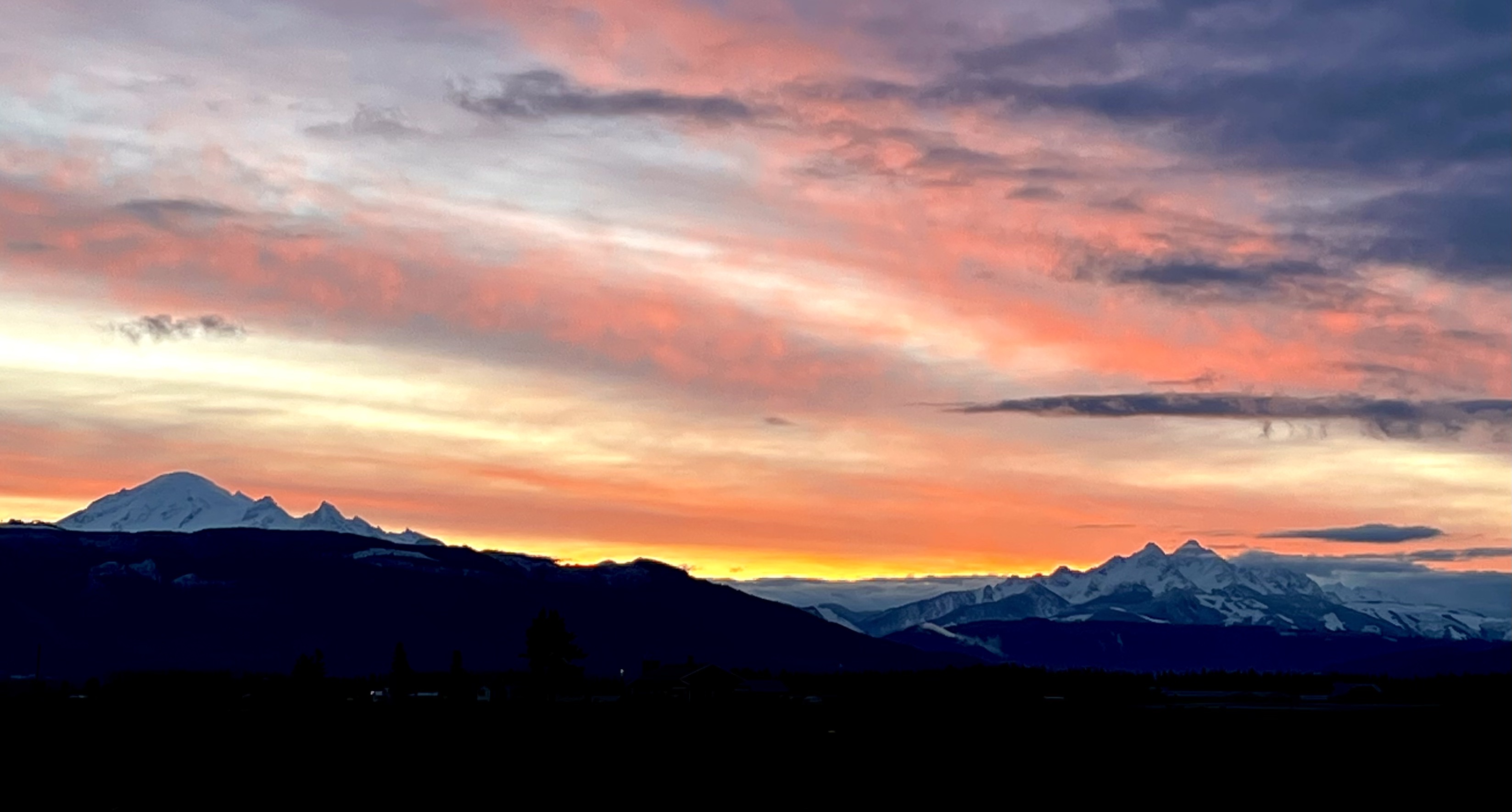
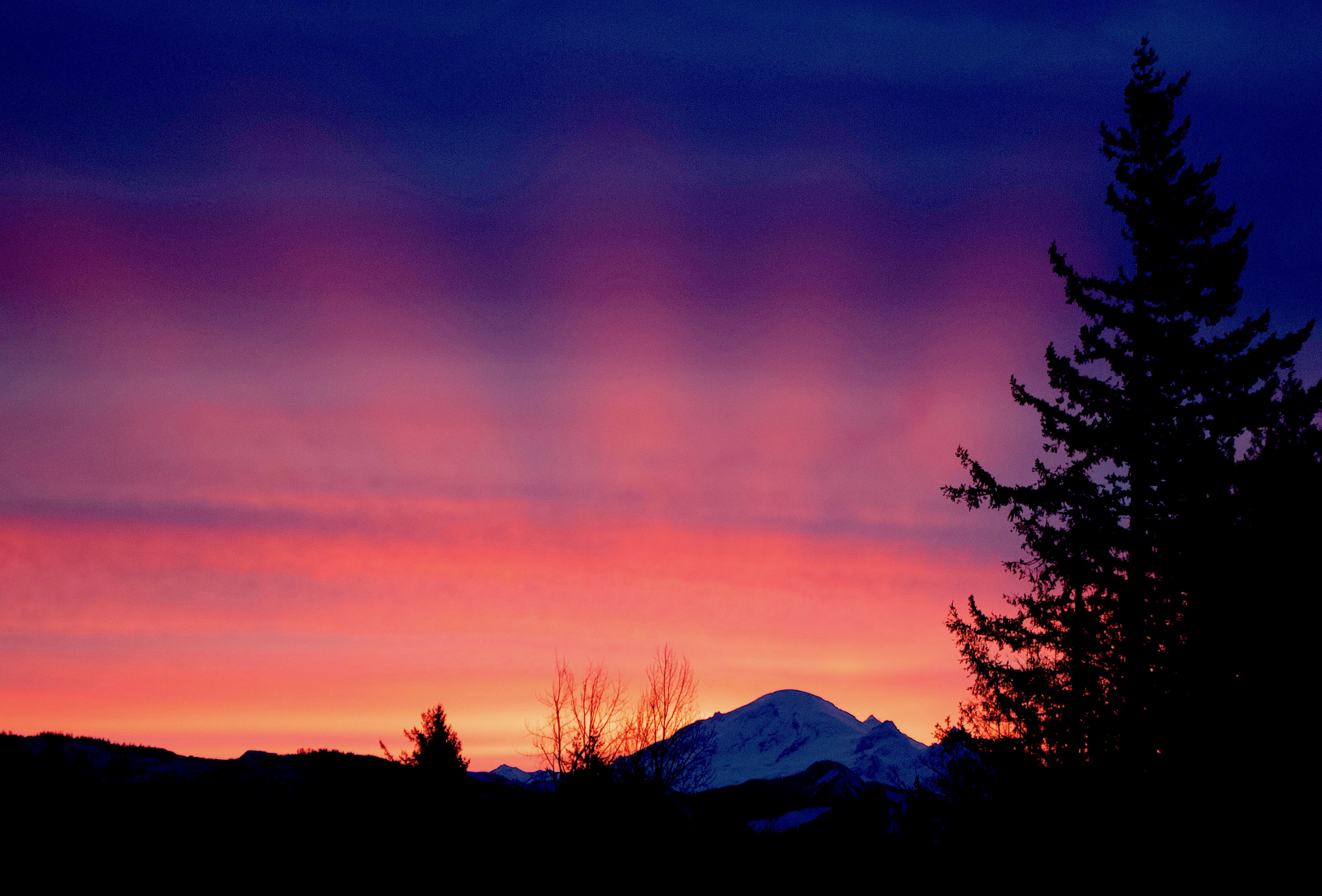
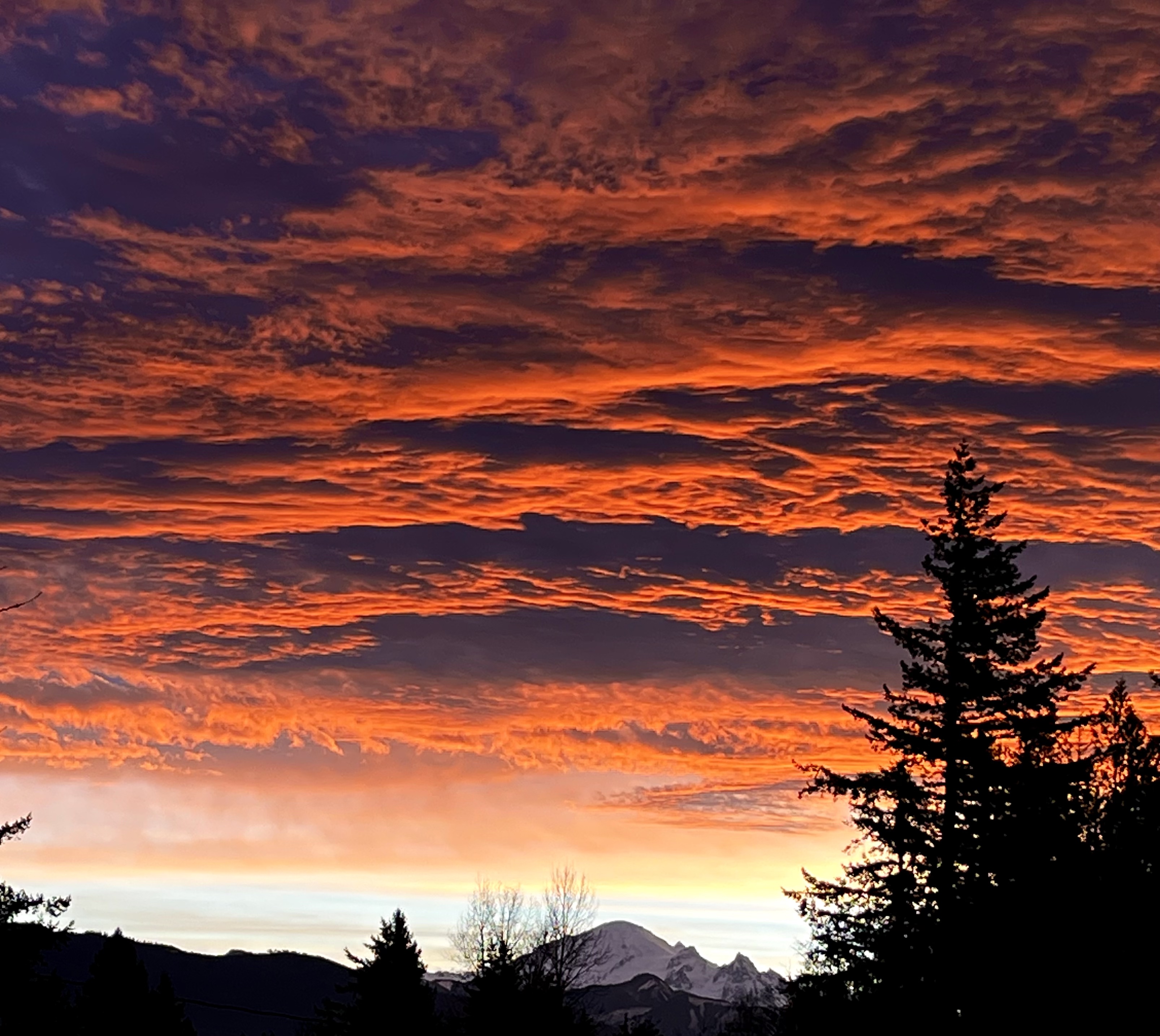
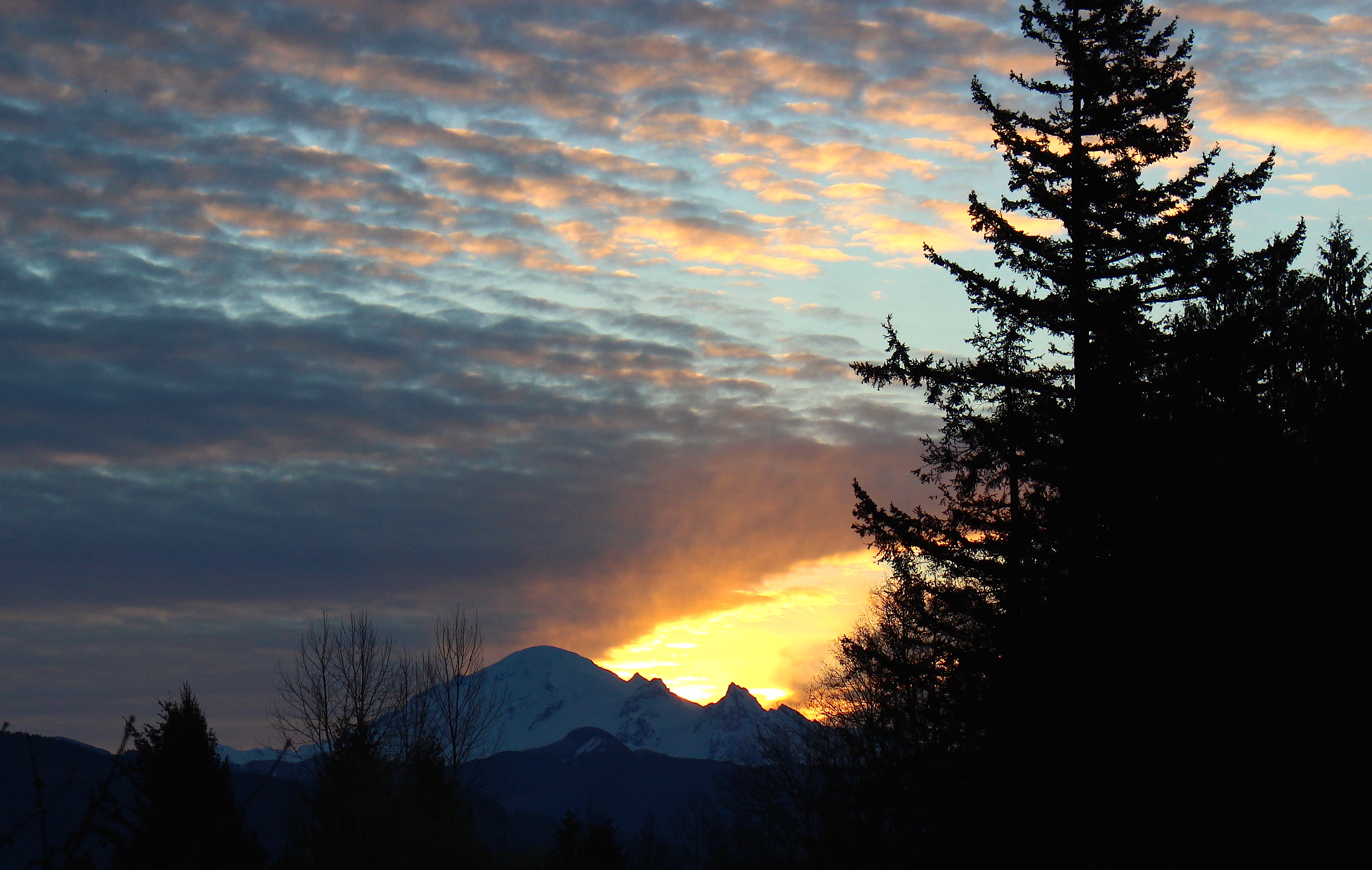
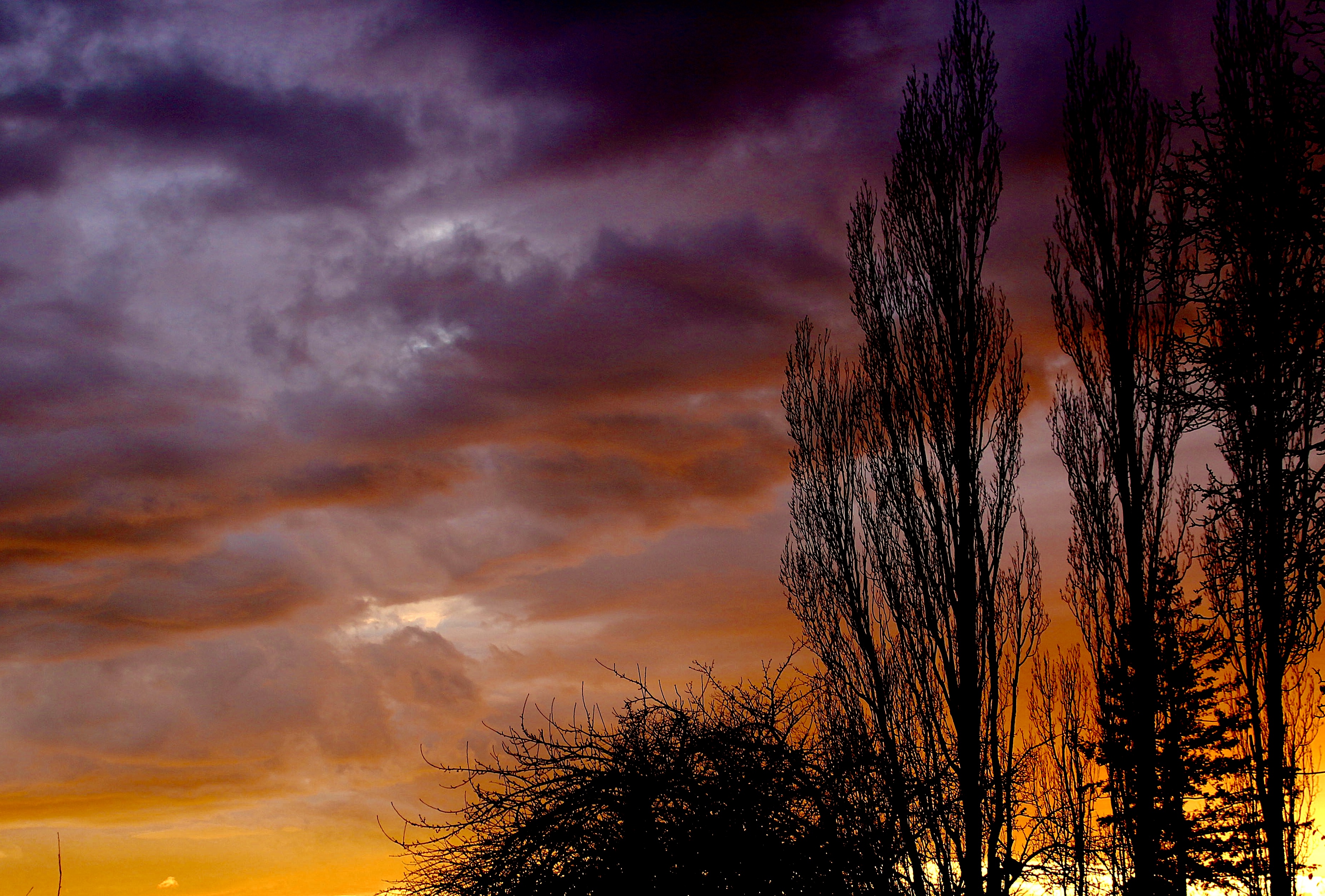
It never fails to surprise and amaze: a colorful dawn seems to come from nowhere.
There is always bleak dark, then a hint of light over the foothills in a long thin line, followed by the appearance of subtle dawn shadows as if the night needs to cling to the ground a little while longer, not wanting to relent and let us go.
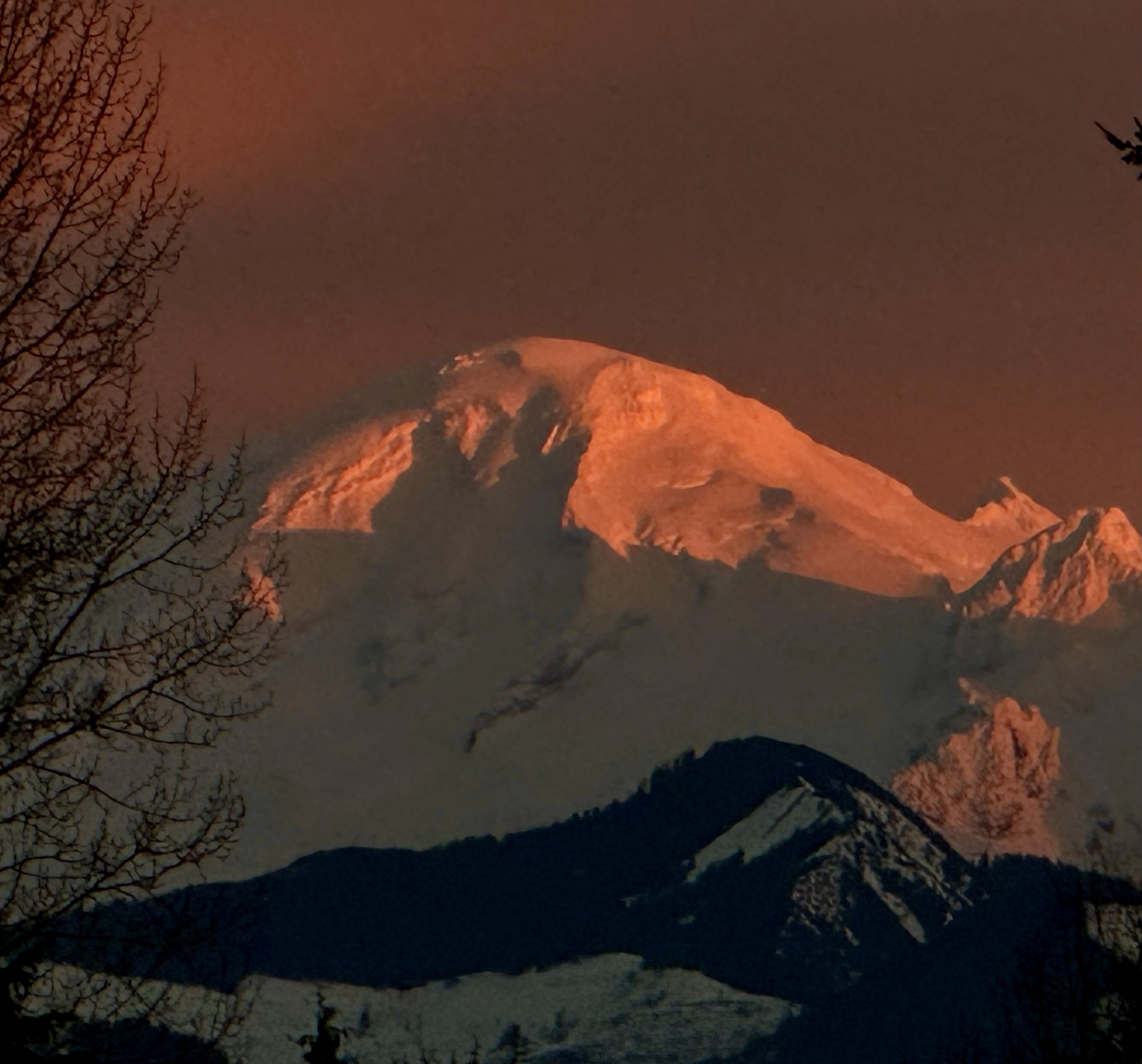
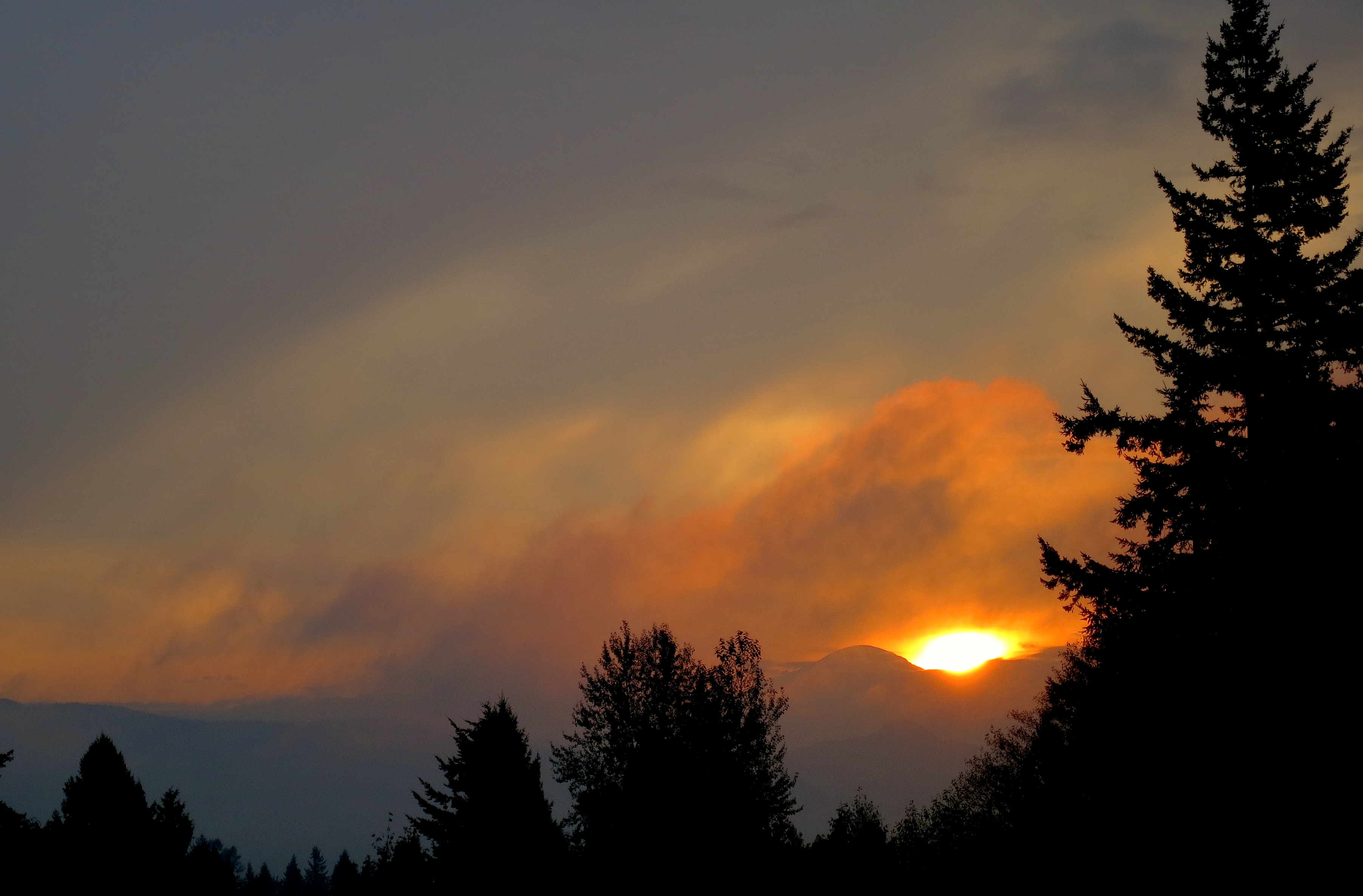
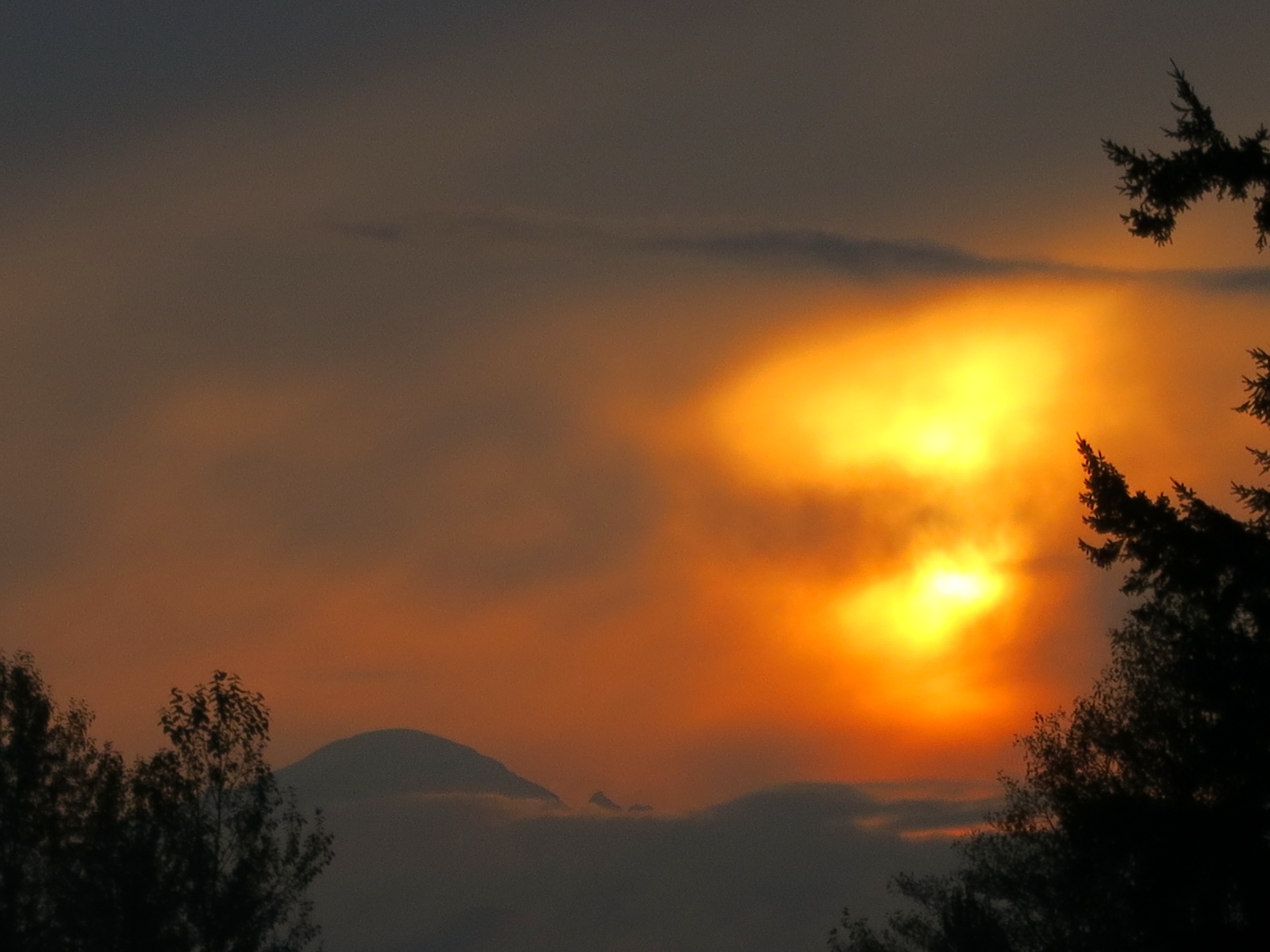
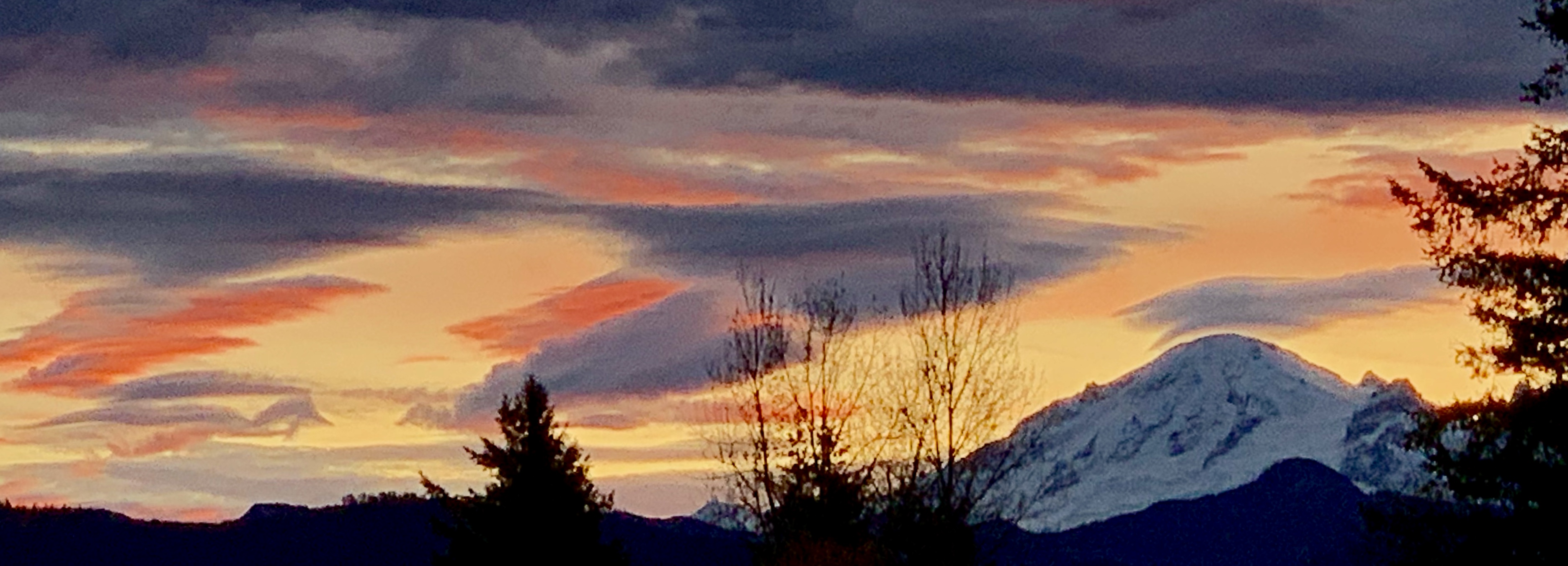
Then color appears, erasing all doubt: the hills begin to glow orange along their crest, as if a flame is ignited and is spreading down a wick. Ultimately the explosion of Light occurs, spreading the orange pink palette unto the clouds above, climbing high to bathe the glaciers of Mount Baker and onto the peaks of the Twin Sisters.
~a Dayspring to our dimness~
From dark to light, ordinary to extraordinary. This gift is from the tender mercy of our God, who has become the Light of a new Day, guiding our feet on the pathway of peace.
We no longer need to stumble about in the shadows. He has come to light our darkness.
The light shines in the darkness, and the darkness has not overcome it. ~John 1:5
Sleeping child, I wonder, have you a dream to share? May I see the things you see as you slumber there? I dream a wind that speaks, like music as it blows As if it were the breath of everything that grows.
I dream a flock of birds flying through the night Like silent stars on wings of everlasting light. I dream a flowing river, deep as a thousand years, Its fish are frozen sorrow, its water bitter tears.
I dream a tree so green, branches wide and long, And ev’ry leaf and ev’ry voice a song. I dream of a babe who sleeps, a life that’s just begun. A word that waits to be spoken. The promise of a world to come. ~Charles Bennett “Sleeping Child”
One-Time
Monthly
Yearly
Make a one-time or recurring donation to support daily Barnstorming posts
“Thin places,” the Celts call this space, Both seen and unseen, Where the door between the world And the next is cracked open for a moment And the light is not all on the other side. God shaped space. Holy. ~Sharlande Sledge
What if you slept And what if In your sleep You dreamed And what if In your dream You went to heaven And there plucked a strange and beautiful flower And what if When you awoke You had that flower in your hand Ah, what then? ~Samuel Coleridge “What if you slept”
Advent does not train us to look away from suffering. No, it gives us the strength with which to face it. A cup of water. A stone on which to rest. A star to guide us. And the essential hope to know that somewhere, a door is opening.
Advent is how we survive, for to live in Advent is to root ourselves in the essential gravity of things, to know that love and goodness are always stronger than whatever seeks to defeat them. We train our eyes on the small and know that it matters. A flower. A kind word. A child in the manger. That is the way that God breaks through the void. ~Stephanie Saldaña“Living on Manger Street”
I know for a while again, the health of self-forgetfulness, looking out at the sky through a notch in the valley side, the black woods wintry on the hills, small clouds at sunset passing across. And I know that this is one of the thresholds between Earth and Heaven, from which I may even step forth from myself and be free. ~ Wendell Berry, Sabbaths 2000
The partition thins between this world and the world to come, or the next or the other world. On the other side of the partition the dead are living. As one grows older some of the dead grow more alive, more essentially themselves. One loves them more. As the next world grows more distinct, this one becomes, not more vague, but more strange. ~Wendell Berry “New Poems”
photo by Nate Gibson
“Thin places,” the Celts call this space, Both seen and unseen, Where the door between the world And the next is cracked open for a moment And the light is not all on the other side. God shaped space. Holy. ~Sharlande Sledge
Ah, what then?
Home is not nearly big enough for heaven to dwell. I must content myself with this visit to the thin edge, peering through the open door, and waiting until invited to come inside.
My 2025 Advent theme: On the threshold between day and night
On that day there will be neither sunlight nor cold, frosty darkness. It will be a unique day—a day known only to the Lord— with no distinction between day and night. When evening comes, there will be light. Zechariah 14:6-7
So once in Israel love came to us incarnate, stood in the doorway between two worlds, and we were all afraid. ~Annie Dillard in Teaching a Stone to Talk
In the stillness of a church where candles glow, In the softness of a fall of fresh white snow, In the brightness of the stars hat shine this night, In the calmness of a pool of healing light, In the clearness of a choir that softly sings, In the oneness of a hush of angels’ wings, In the mildness of a night by stable bare, In the quietness of a lull near cradle fair, There’s a patience as we wait for a new morn, And the presence of a child soon to be born. ~Sally Beamish “In the Stillness”
Autumn Was certainly not winter, scholars say, When holy habitation broke the chill Of hearth-felt separation, icy still, The love of life in man that Christmas day. Was autumn, rather, if seasons speak true; When green retreats from sight’s still ling’ring gaze, And creeping cold numbs sense in sundry ways, While settling silence speaks of solitude. Hope happens when conditions are as these; Comes finally lock-armed with death and sin, When deep’ning dark demands its full display. Then fallen nature driven to her knees Flames russet, auburn, orange fierce from within, And brush burns brighter for the growing grey. ~David Baird “Autumn”
We have become so accustomed to the idea of divine love and of God’s coming at Christmas that we no longer feel the shiver of fear that God’s coming should arouse in us.
We are indifferent to the message, taking only the pleasant and agreeable out of it and forgetting the serious aspect, that the God of the world draws near to the people of our little earth and lays claim to us.
The coming of God is truly not only glad tidings, but first of all frightening news for everyone who has a conscience. ~Dietrich Bonhoeffer from Watch for the Light
The shepherds were sore afraid. So why aren’t we?
The scholars say Christ was most likely born in the autumn of the year ~ so fitting, as our reds and oranges fade fast to grey as we descend into this wintering world on the threshold of dying, crying out for resuscitation.
Murderous frosts and falling snow have wilted down all that was flush with life and we become desperate for hope for renewal.
And so this babe has come like a refiner’s fire to lay claim to us and we feel the heat of His embrace – in the middle of the chill, in the middle of our dying – no matter what time of year.
He finds us in our liminal moment of transition.
Hope happens when conditions are as these…
My 2025 Advent theme: On the threshold between day and night
On that day there will be neither sunlight nor cold, frosty darkness. It will be a unique day—a day known only to the Lord— with no distinction between day and night. When evening comes, there will be light. Zechariah 14:6-7
So once in Israel love came to us incarnate, stood in the doorway between two worlds, and we were all afraid. ~Annie Dillard in Teaching a Stone to Talk
1. Father, enthroned on high—―Holy, holy! Ancient eternal Light—hear our prayer.
REFRAIN Come, O Redeemer, come; grant us mercy. Come, O Redeemer, come; grant us peace.
2. Lord, save us from the dark of our striving, faithless, troubled hearts weighed down. REFRAIN
3. Look now upon our need; Lord, be with us. Heal us and make us free from our sin. REFRAIN
One-Time
Monthly
Yearly
Make a one-time or recurring donation to support daily Barnstorming posts
The next day again John was standing with two of his disciples,and he looked at Jesus as he walked by and said, “Behold, the Lamb of God!”
The two disciples heard him say this, and they followed Jesus. Jesus turned and saw them following and said to them, “What are you seeking?” And they said to him, “Rabbi” (which means Teacher), “where are you staying?”
He said to them, “Come and you will see.” So they came and saw where he was staying, and they stayed with him that day, for it was about the tenth hour.
One of the two who heard John speak and followed Jesus was Andrew, Simon Peter’s brother. He first found his own brother Simon and said to him, “We have found the Messiah” (which means Christ).He brought him to Jesus. Jesus looked at him and said, “You are Simon the son of John. You shall be called Cephas” (which means Peter).
The next day Jesus decided to go to Galilee. He found Philip and said to him, “Follow me.”Now Philip was from Bethsaida, the city of Andrew and Peter.Philip found Nathanael and said to him, “We have found him of whom Moses in the Law and also the prophets wrote, Jesus of Nazareth, the son of Joseph.” Nathanael said to him, “Can anything good come out of Nazareth?”
Philip said to him, “Come and see.”
Jesus saw Nathanael coming toward him and said of him, “Behold, an Israelite indeed, in whom there is no deceit!” Nathanael said to him, “How do you know me?” Jesus answered him, “Before Philip called you, when you were under the fig tree, I saw you.” Nathanael answered him, “Rabbi, you are the Son of God! You are the King of Israel!” Jesus answered him, “Because I said to you, ‘I saw you under the fig tree,’ do you believe? You will see greater things than these.” And he said to him, “Truly, truly, I say to you, you will see heaven opened, and the angels of God ascending and descending on the Son of Man.” John 1:35-51
I never knew what was going on.
He would say, “Let’s go,” and we would follow. “Follow” was his word.
And we would. Fools we were to let that take us all that way. Why we did to this day
I don’t know. Look how it ended. Look what it became. But what did we have
to stay for? Nothing. There wasn’t much work. Nothing much to do. There were no
stories left. Bread. Fish. So we ended up with more bread and fish. But we did find
stories and stories. Well, what else is there? I never did much along the way. Look it up…
I will say, though, that it was his words. Words!
Imagine. Words had never done what his did. I’d listen, and I wasn’t much of a listener. Then
later I would try to make sense of them. I couldn’t. But I could feel them. And maybe that was it, how
they got inside you and made you wonder and wrinkle. They got in my brain’s garden and made it seem like
the roots were above ground and all the flowers and vegetables, all the nourishing, were now below…
See? See how hard it is to explain this stuff? You just started seeing everything with a
new mind. You began to be drawn to a whole new world, and it was a world.
You might say, okay, whatever, and yet those words did become flesh, my flesh. And my flesh, my body, held
the kingdom of God, and if it’s a place that’s a place for children, then most of what I know really doesn’t matter.
Labor doesn’t, and money, and reason, and, well, you go make a list. He’d get me so confused. And then we’d
head off worrying about how we would eat and where we’d sleep. Our feet were filthy. My God, we were always
filthy. We stank. And then he’d go and point at birds or stalks of grain, even stop and have us kneel before a flower,
and then he’d smile. That haunts me still. That smile. And then he died. He brought out hate, not love. He had
a terrifying sense of justice. Nothing he said or did was impossible. Maybe that was it. It was all possible. ~Jack Ridl from “Bartholomew: Disciple”
What are you seeking? What are you looking for in your life?
Jesus asks the new disciples because He needs to know whether they are expecting a wise rabbi/teacher, or a prophesied Messiah come to change the world, or a mighty king who will liberate them from political oppression.
No matter what our expectation is, Jesus asks that we come to see what he is doing, following him to witness what will happen as he speaks, allowing his words to become our new flesh and skin.
He takes us to the threshold of heaven and throws the gate wide open. Nothing he says or does is impossible.
He shows us what is possible simply by asking us what we hope for.
I am reading slowly through the words in the Book of John over the next year or so. Each week, I will invite you to “come and see” what those words might mean as we explore His promises together.
My 2025 Advent theme: On the threshold between day and night
On that day there will be neither sunlight nor cold, frosty darkness. It will be a unique day—a day known only to the Lord— with no distinction between day and night. When evening comes, there will be light. Zechariah 14:6-7
So once in Israel love came to us incarnate, stood in the doorway between two worlds, and we were all afraid. ~Annie Dillard in Teaching a Stone to Talk
One-Time
Monthly
Yearly
Make a one-time or recurring donation to support daily Barnstorming posts
The people walking in darkness have seen a great light; on those living in the land of deep darkness a light has dawned. ~Isaiah 9:2
Advent is the season that, when properly understood, does not flinch from the darkness that stalks us all in this world. Advent begins in the dark and moves toward the light—but the season should not move too quickly or too glibly, lest we fail to acknowledge the depth of the darkness.
As our Lord Jesus tells us, unless we see the light of God clearly, what we call light is actually darkness: “how great is that darkness!” (Matt. 6:23).
Advent bids us take a fearless inventory of the darkness: the darkness without and the darkness within.
Advent is designed to show thatthe meaning of Christmas is diminished to the vanishing point if we are not willing to take a fearless inventory of the darkness. ~Fleming Rutledge from Advent- The Once & Future Coming of Jesus Christ
It is this great absence that is like a presence, that compels me to address it without hope of a reply. It is a room I enter
from which someone has just gone, the vestibule for the arrival of one who has not yet come. I modernise the anachronism
of my language, but he is no more here than before. Genes and molecules have no more power to call him up than the incense of the Hebrews
at their altars. My equations fail as my words do. What resources have I other than the emptiness without him of my whole being, a vacuum he may not abhor? ~R.S. Thomas “The Absence”
There is no light in the incarnation without witnessing the empty darkness that precedes His arrival; His reason for crossing the threshold into our world is to fill our increasing spiritual void, our hollow hearts, our growing deficit of hope and faith.
God abhors a vacuum.
We find our God most when we keenly feel His absence, hearing no reply to our prayers, our faith shaken, not knowing if such unanswered prayers are heard.
In response, He answers. He comes to walk beside us. He comes to be present among us, to ransom us from our self-captivity by offering up Himself instead.
He fills the vacuum completely and forever.
In der Christnacht Lyrics and translation below
Dies ist die Nacht, da mir erschienen des großen Gottes Freundlichkeit! Das Kind, dem alle Engel dienen bringt Licht in meine Dunkelheit, und dieses Welt- und Himmelslicht weicht hundert-tausend Sonnen nicht!
Lass dich erleuchten, meine Seele, versäume nicht den Gnadenschein! Der Glanz in dieser kleinen Höhle dringt bald in alle Welt hinein, er treibet weg der Hölle Macht, der Sünden und des Todes Nacht!
On Christmas Nighttranslation
This is the night on which I saw the kindness of the Almighty power: the Child whom all the angels serve brought light into my darkest hour – the light of heaven that yields to none: not even a hundred thousand suns.
Let it illumine thee, my soul, and shy not from its grace; so bright the radiance from this cave, it soon will fill the very earth with light, will chase the powers of hell away, and sin, and turn death’s night to day.
One-Time
Monthly
Yearly
Make a one-time or recurring donation to support daily Barnstorming posts
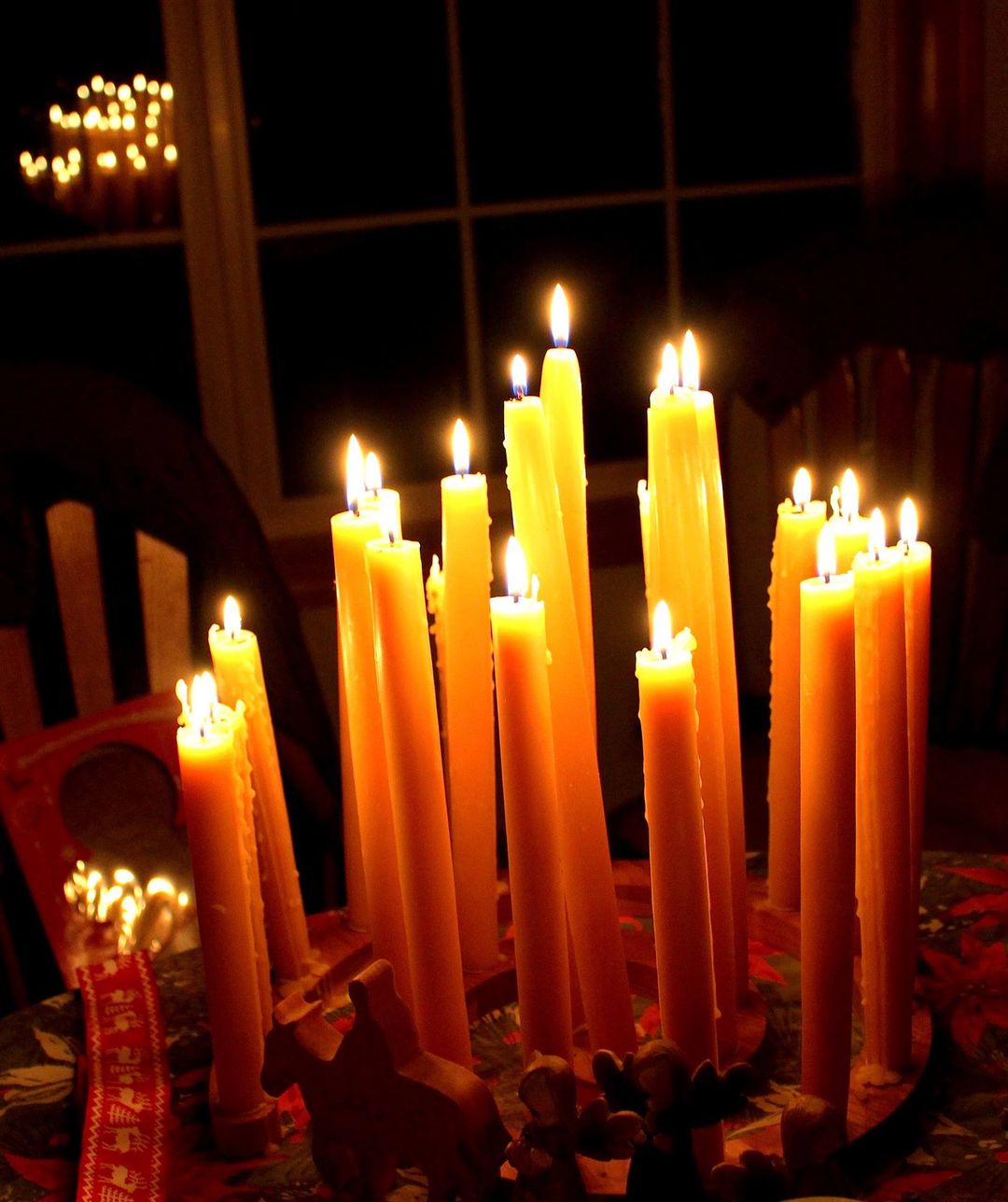
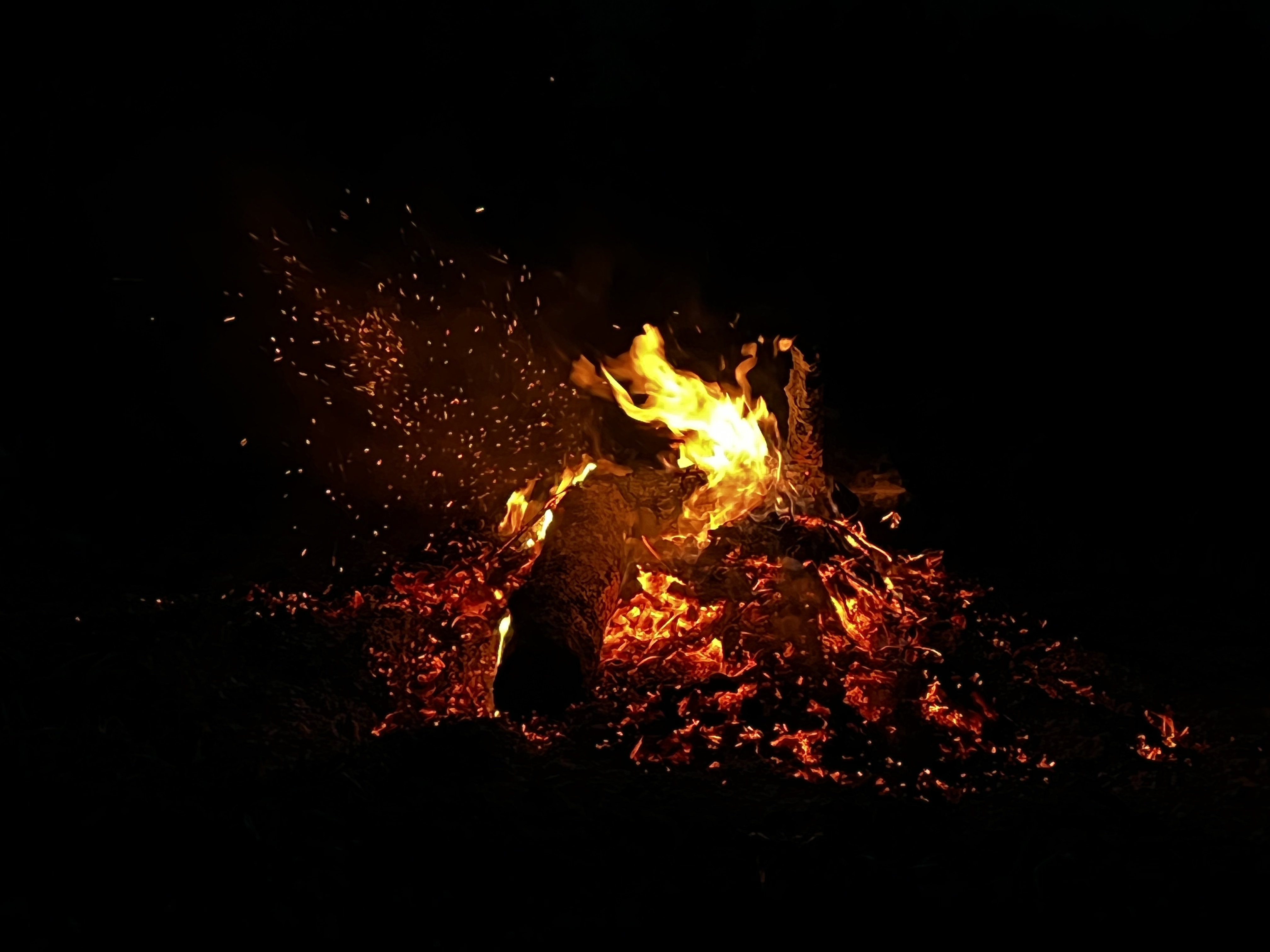
(Jesus said) I have come to bring fire on the earth, and how I wish it were already kindled! Luke 12:49
Earth’s crammed with heaven, and every common bush afire with God ~Elizabeth Barrett Browning from “Aurora Leigh”
It is difficult to undo our own damage… It is hard to desecrate a grove and change your mind. The very holy mountains are keeping mum. We doused the burning bush and cannot rekindle it; we are lighting matches in vain under every green tree. ~Annie Dillard from Teaching a Stone to Talk
Nine Kinds of Blindness 1. The one where your eyes do not work to see anything. 2. The one where your eyes do not work to see everything. 3. The one where your eyes work, but you cannot see what you have never seen before. 4. The one where your eyes work but you cannot see what is inconvenient. 5. The one where your eyes work but someone is keeping you from using them. 6. The one where your eyes work but you are angry. 7. The one where your eyes work but you are afraid. 8. The one where your eyes work but there is no light. 9. The one where your eyes work but there is nothing but light. ~Paul Pastor “Nine Kinds of Blindness” from Bower Lodge
I need to turn aside and look, blinded as I am, to see, as if for the first and last time, the kindled fire that illuminates even the darkest day and never dies away.
We are invited, by no less than God Himself, through the original burning bush that is never consumed to shed our shoes, to walk barefoot and vulnerable, and approach the bright and burning dawn, even when it is the darkest midnight, even when it is a babe in a manger who kindles a fire in each one of us.
Only then, only then can I say: “Here I am! Consume me!”
My 2025 Advent theme: On the threshold between day and night
On that day there will be neither sunlight nor cold, frosty darkness. It will be a unique day—a day known only to the Lord— with no distinction between day and night. When evening comes, there will be light. Zechariah 14:6-7
So once in Israel love came to us incarnate, stood in the doorway between two worlds, and we were all afraid. ~Annie Dillard in Teaching a Stone to Talk
Within our darkest night, you kindle the fire that never dies away, that never dies away. Within our darkest night, you kindle the fire that never dies away, that never dies away. ~Taize
One-Time
Monthly
Yearly
Make a one-time or recurring donation to support daily Barnstorming posts
















 Barnstorming