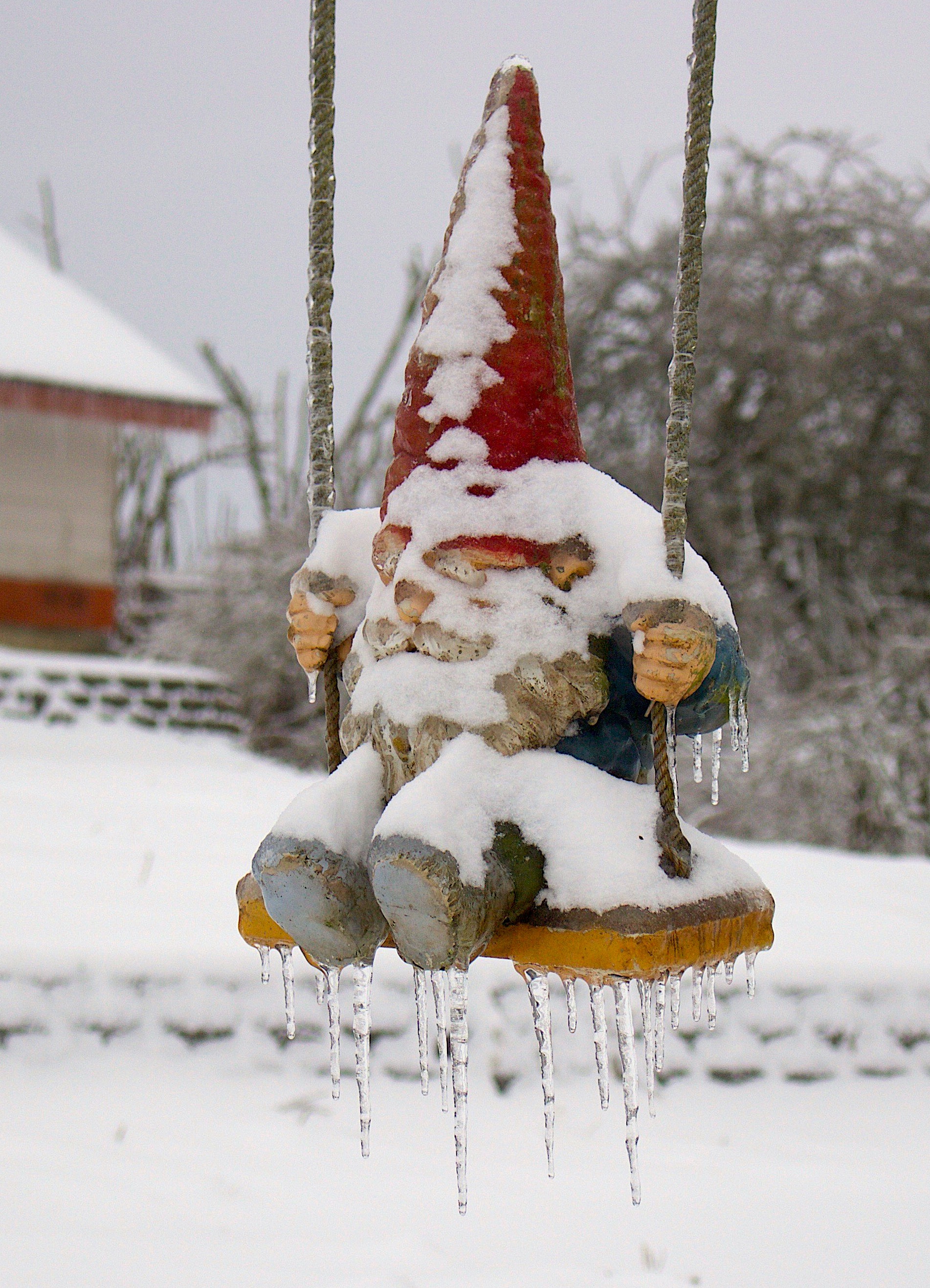
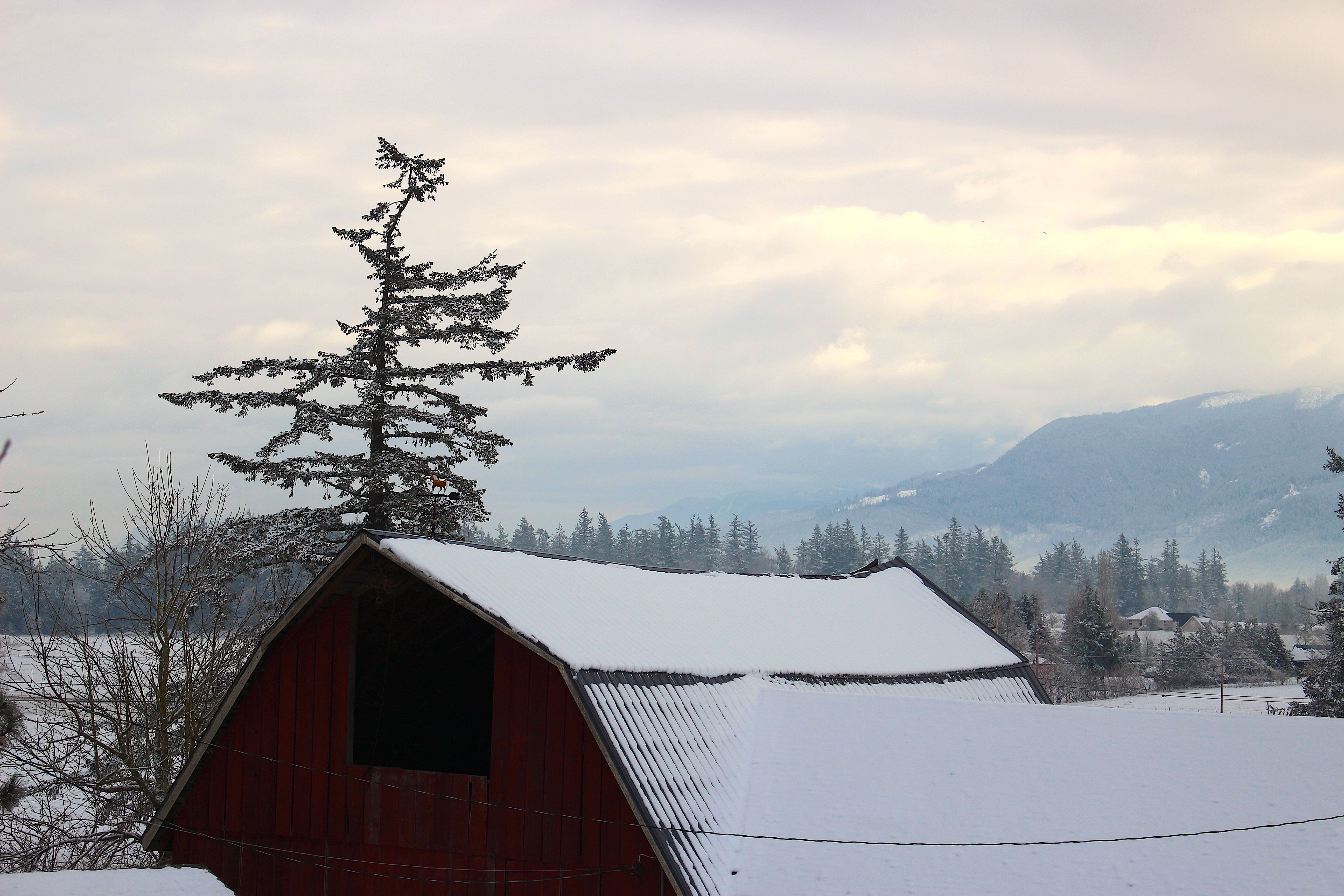
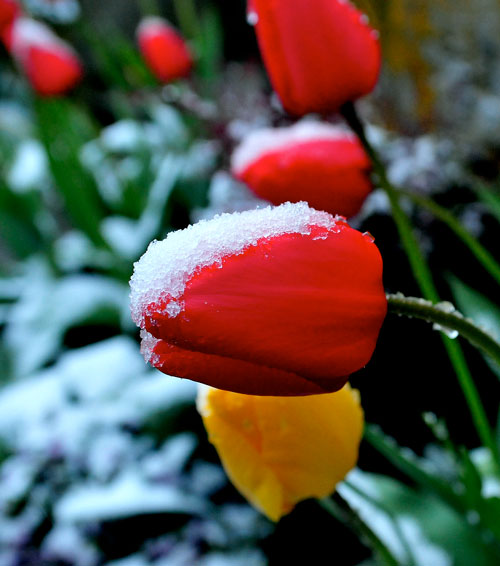
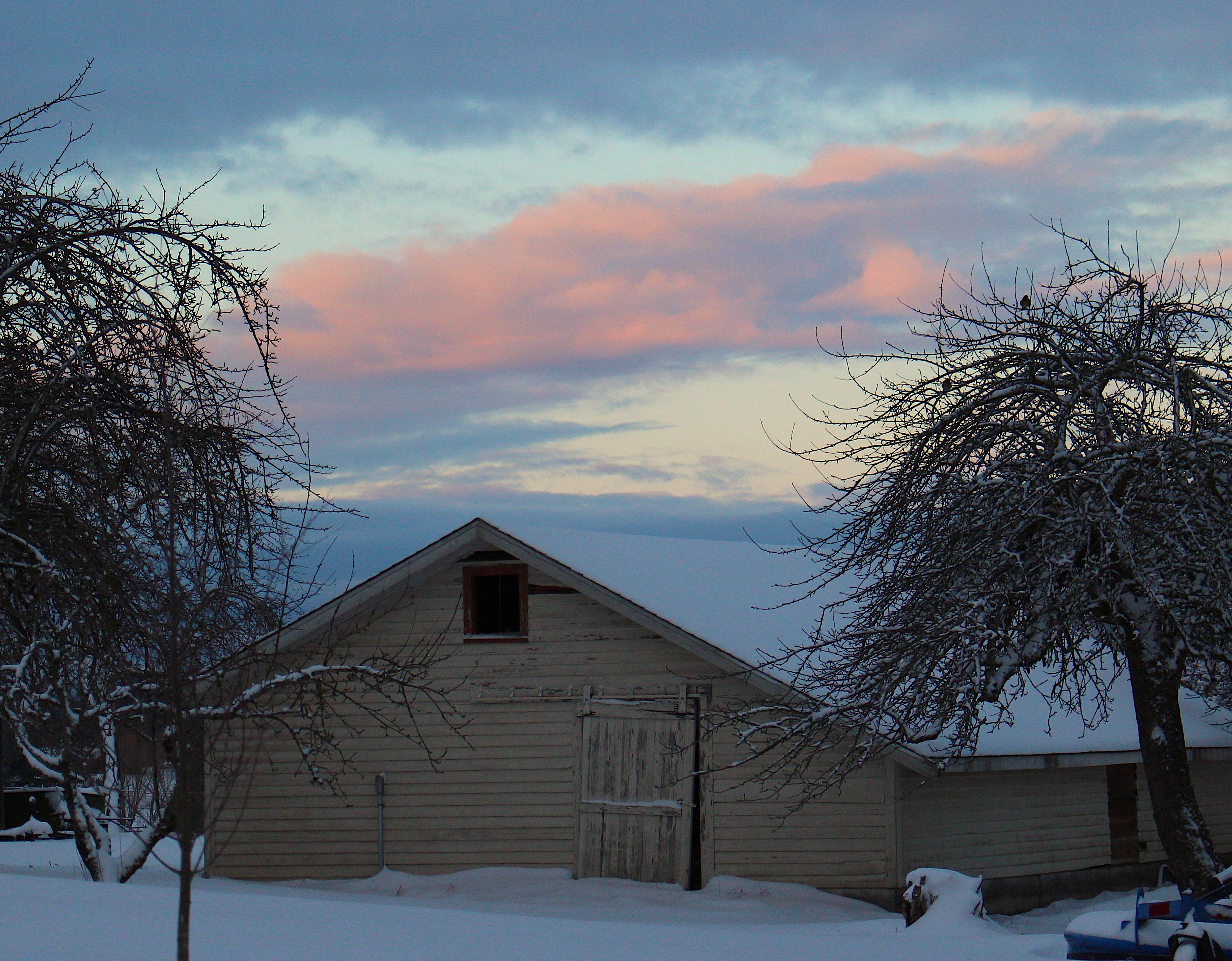
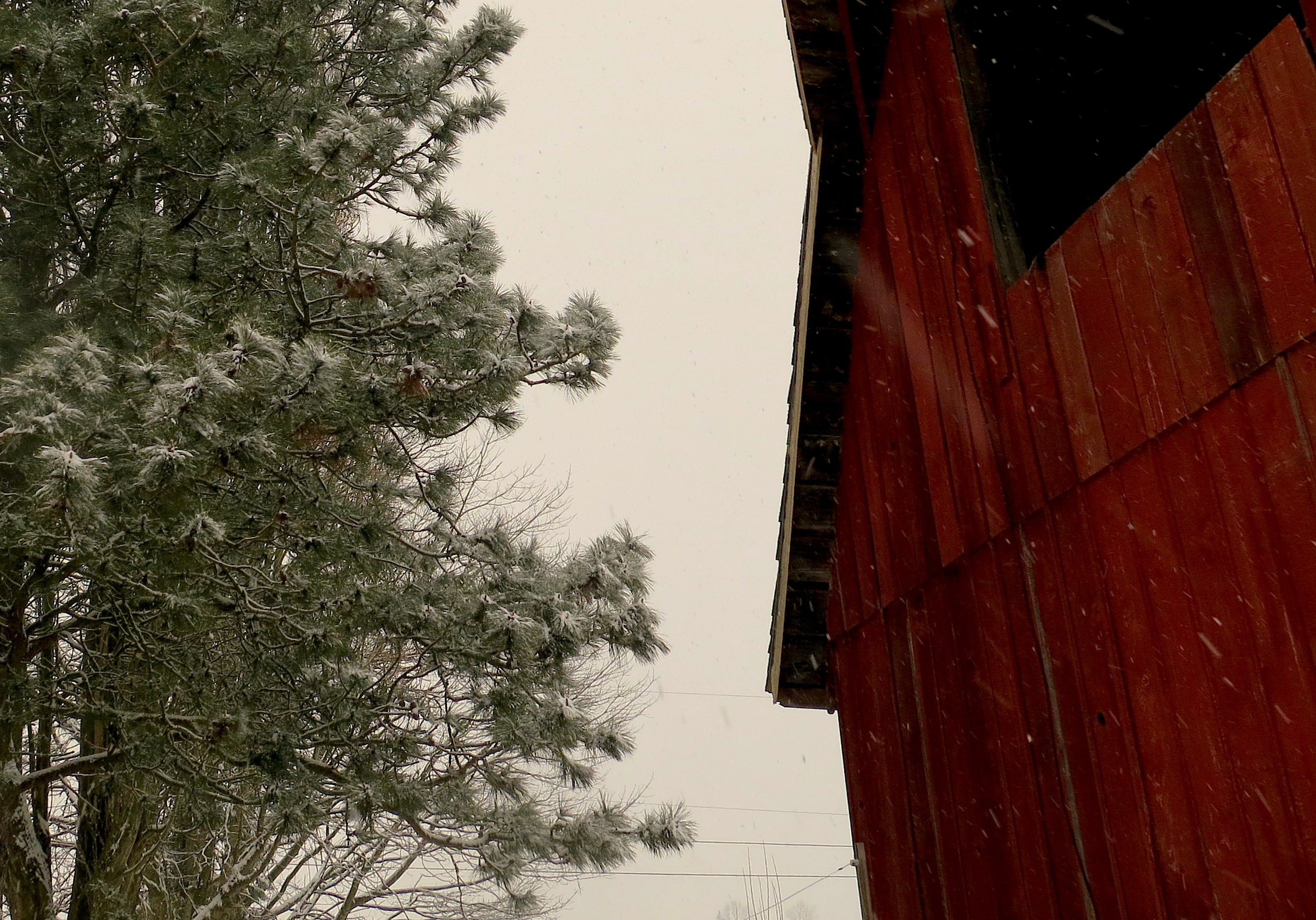
It’s frail, this spring snow, it’s pot cheese packing down underfoot. It flies out of the trees at sunrise like a flock of migrant birds. It slips in clumps off the barn roof, wingless angels dropped by parachute. Inside, I hear the horses knocking aimlessly in their warm brown lockup, testing the four known sides of the box as the soul must, confined under the breastbone. Horses blowing their noses, coming awake, shaking the sawdust bedding out of their coats. They do not know what has fallen out of the sky, colder than apple bloom, since last night’s hay and oats. They do not know how satisfactory they look, set loose in the April sun, nor what handsprings are turned under my ribs with winter gone. ~Maxine Kumin “Late Snow” from Selected Poems: 1960 – 1990
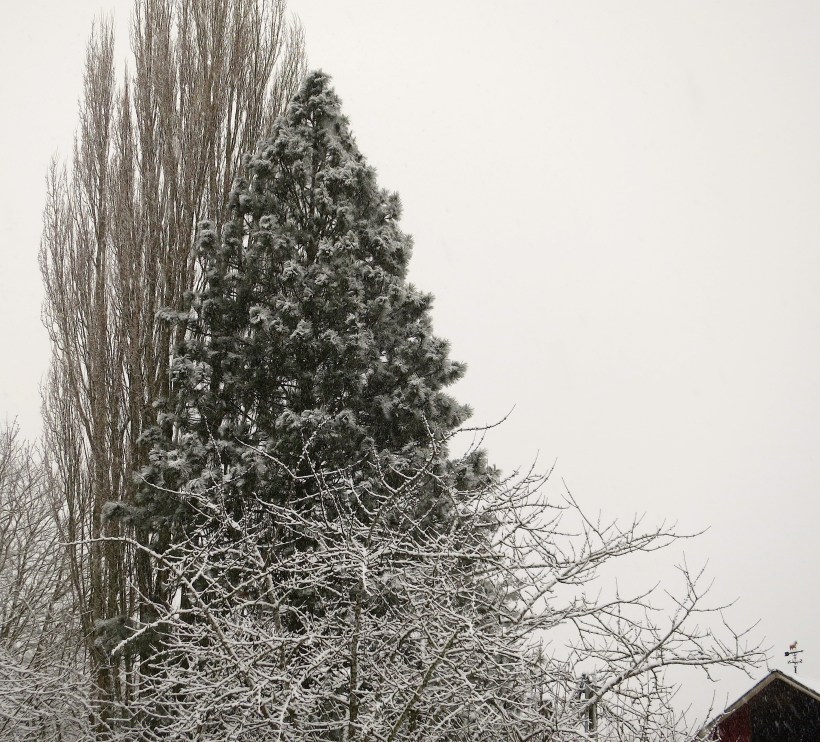
This past weekend we had it all: sun, rain, windstorm, hail, and some local areas even reported a late April snowfall. It is disorienting to have one foot still in winter and the other firmly on grass growing out of control and needs mowing.
It is also confusing to look at pandemic data and hear varying experts’ interpretations about what is happening, what they predict and what strategies are recommended.
It may be time to loosen the tight grip on social distancing yet many are reticent to emerge from the safety of their confinement, for good reason.
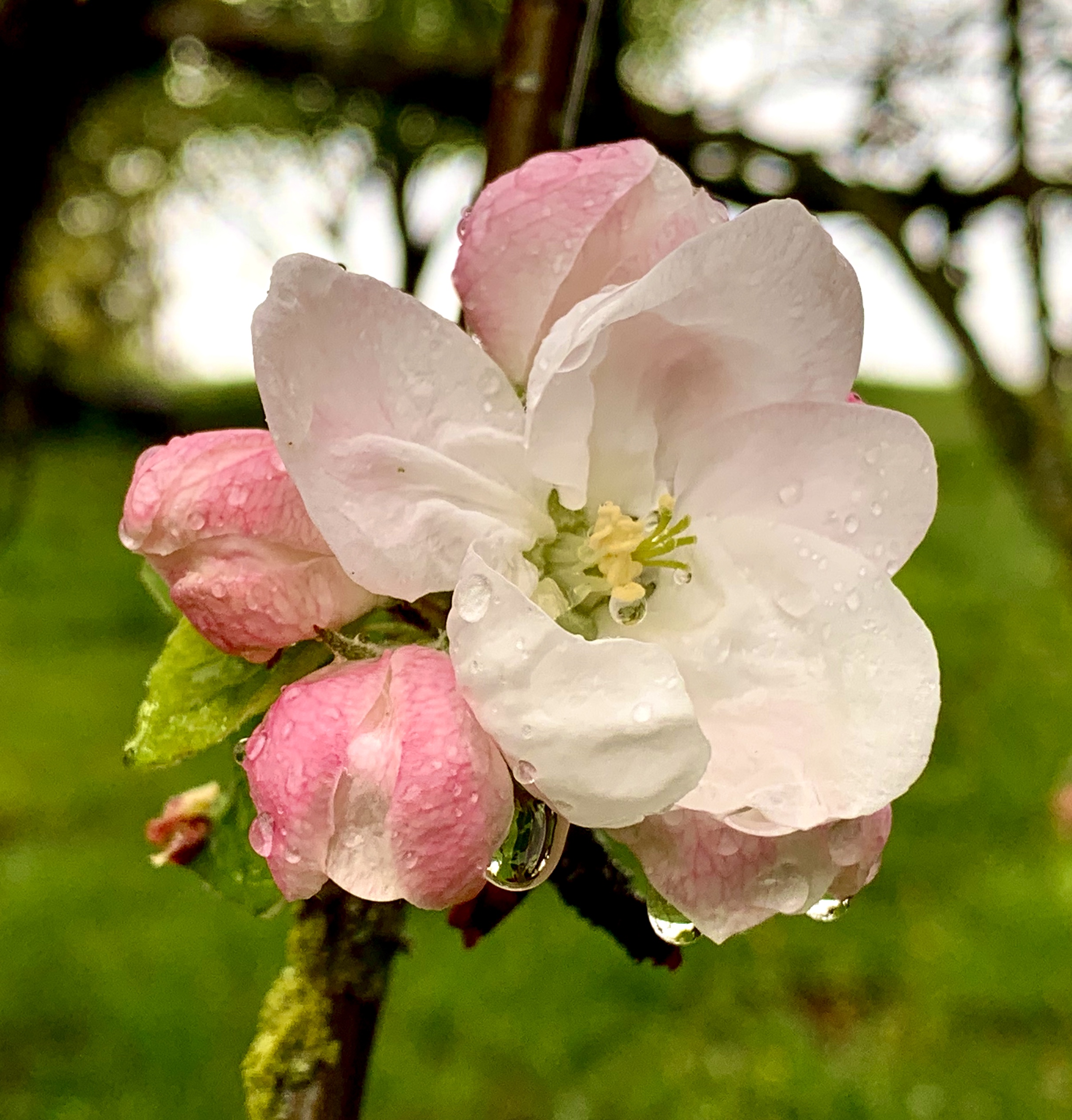
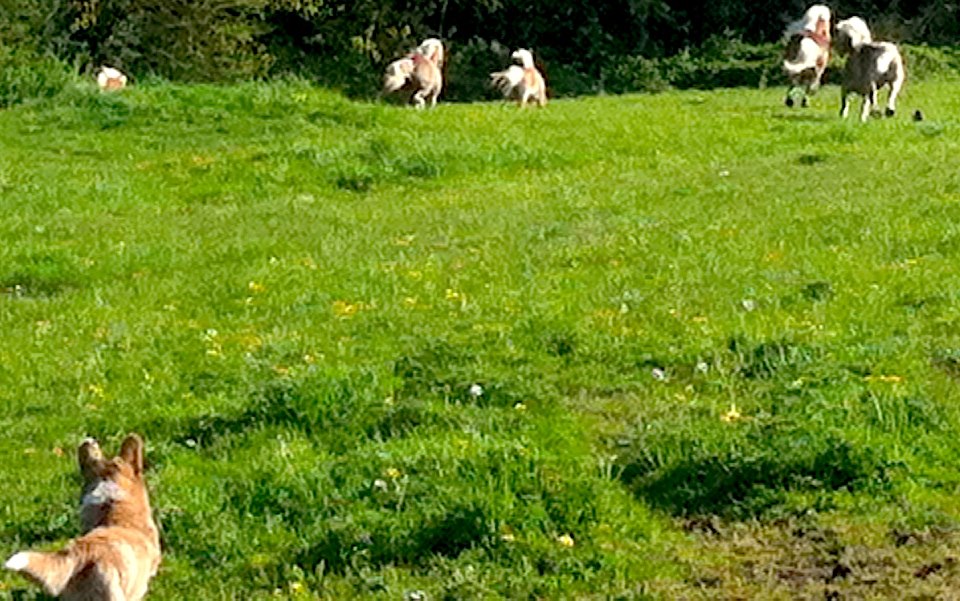
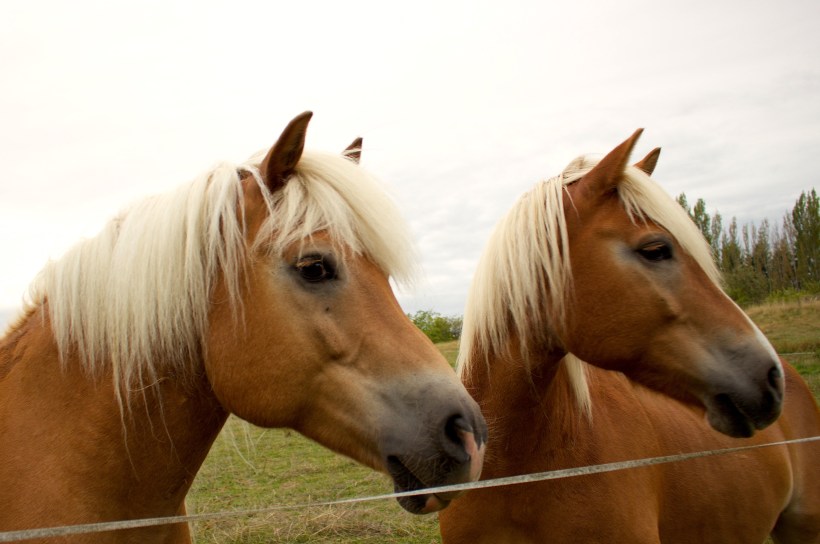
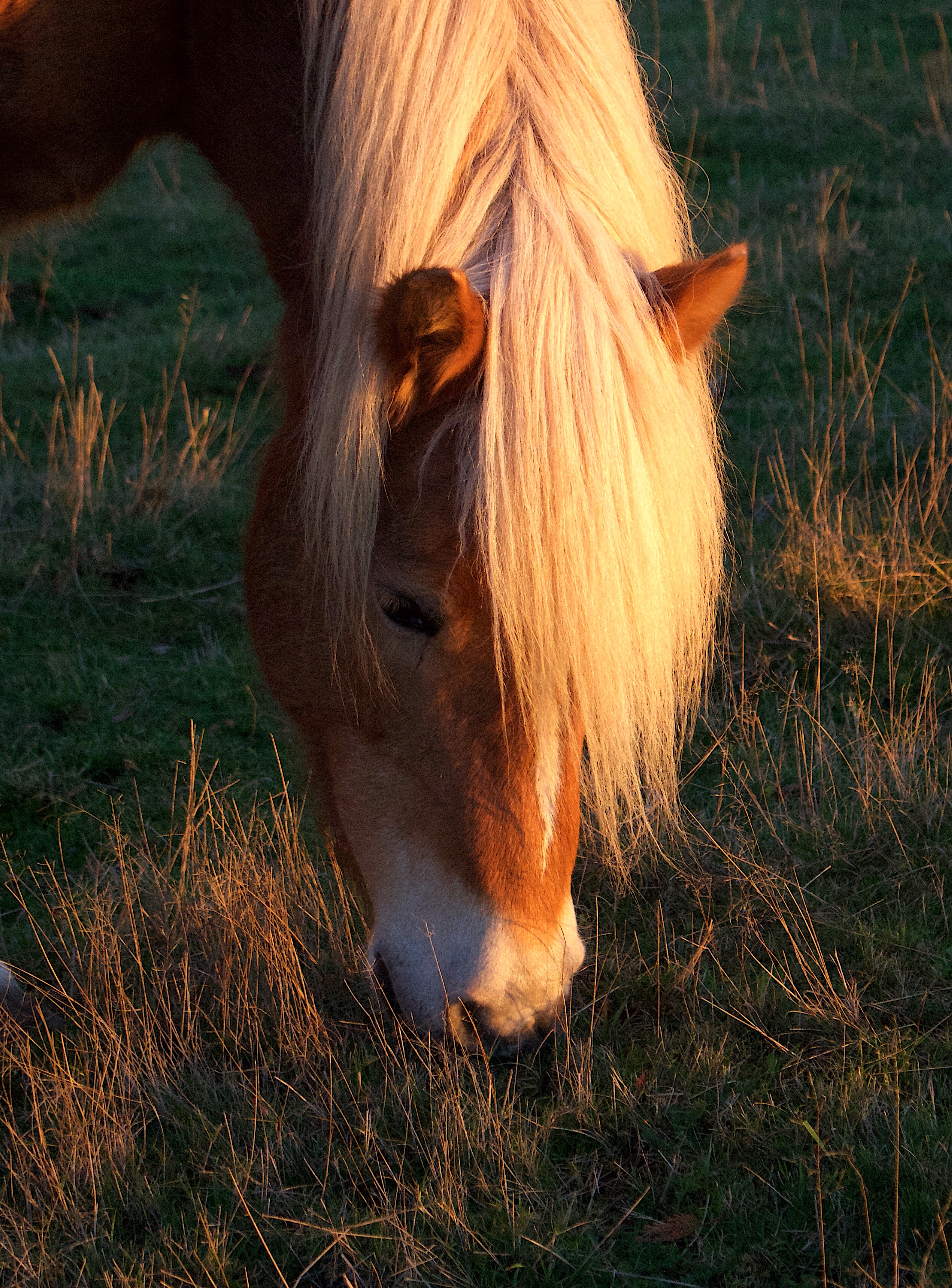
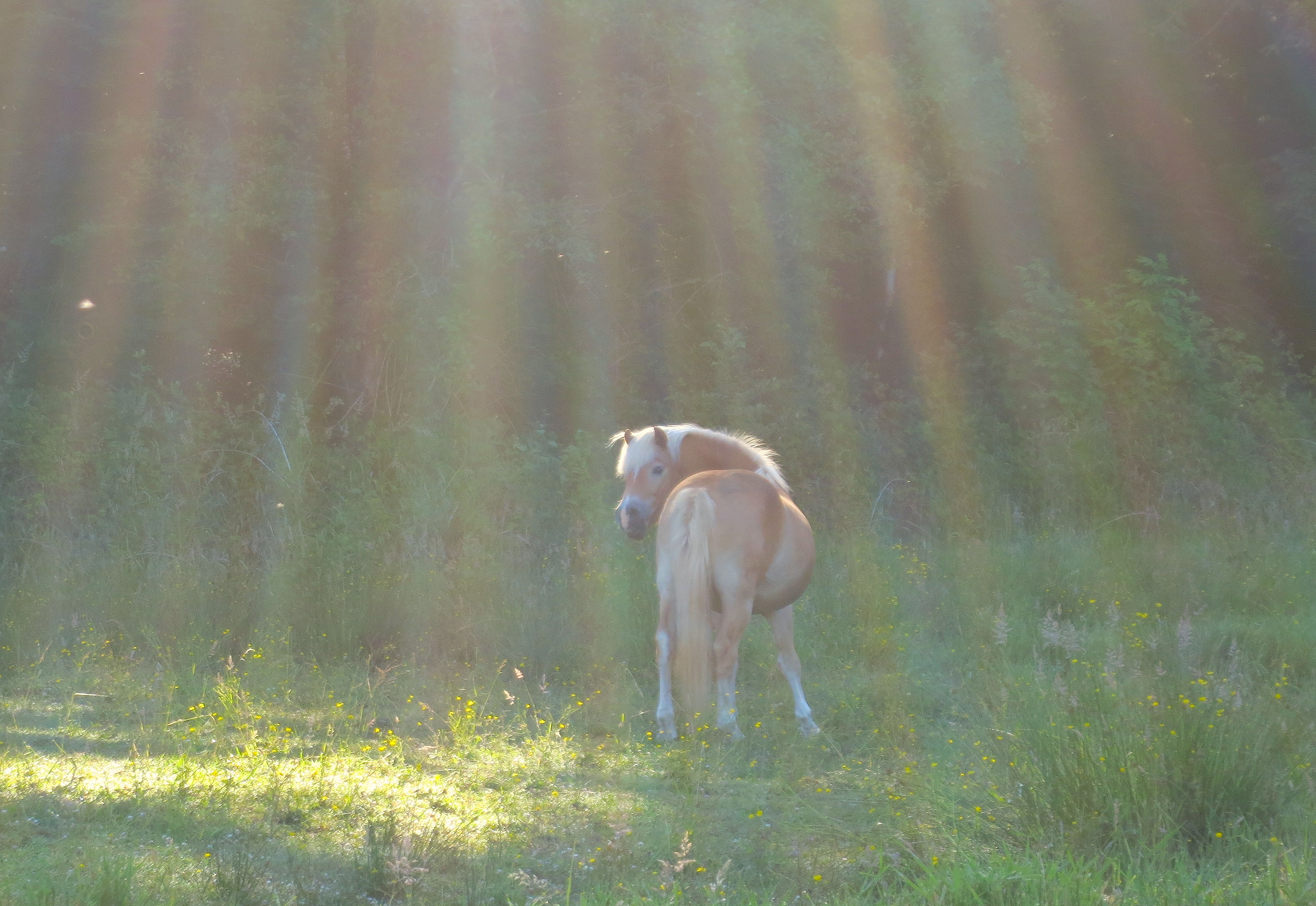
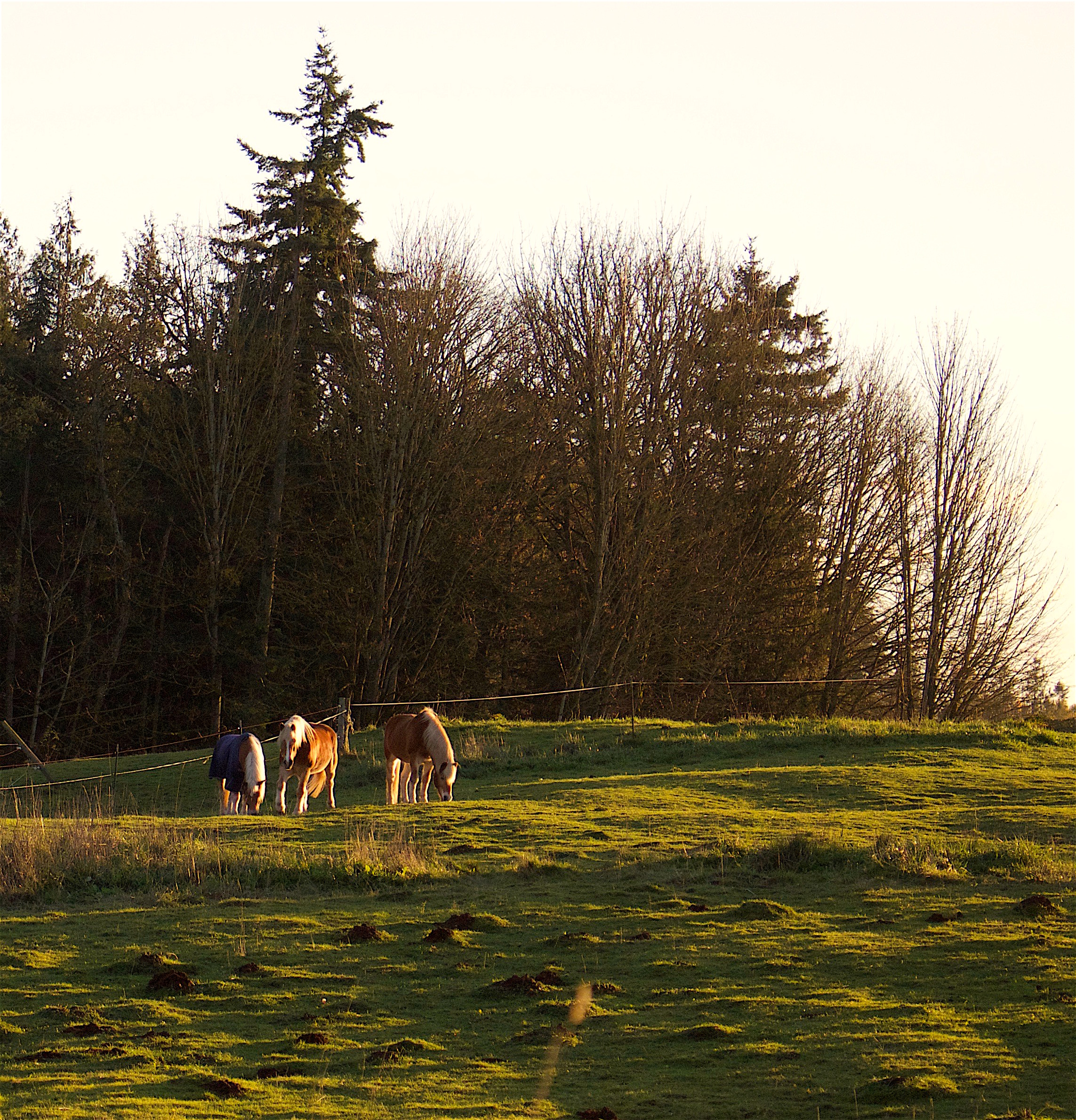
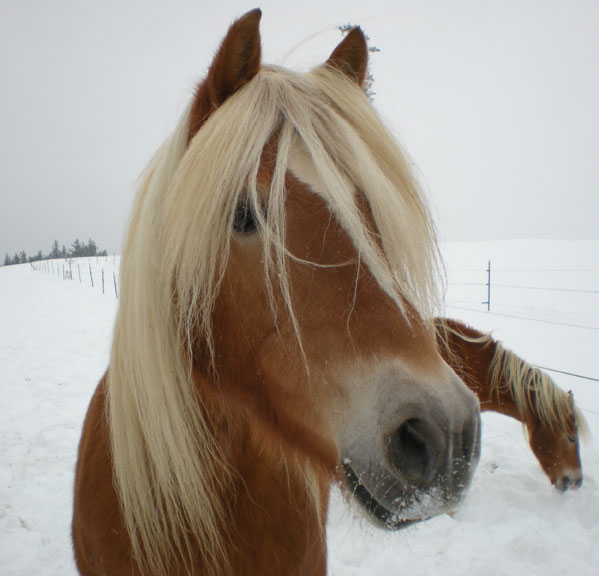
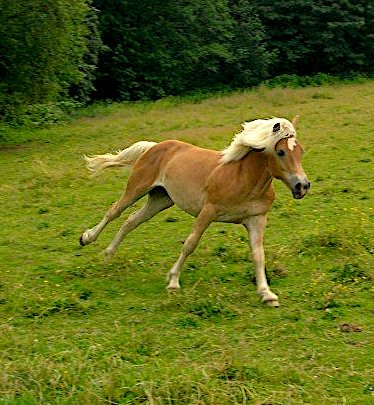
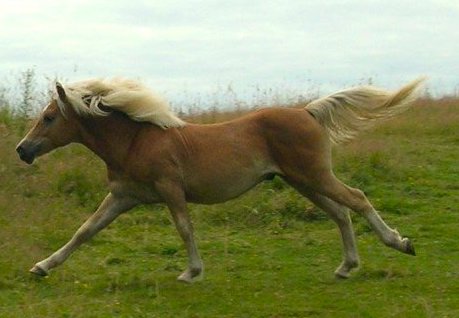
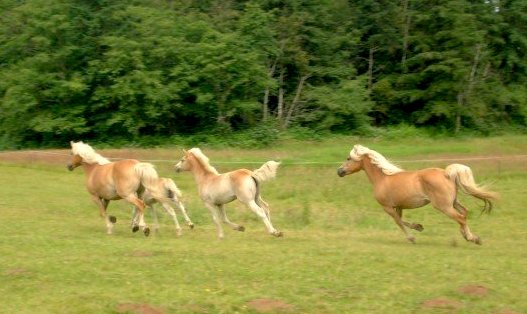
Just last week, we released the Haflingers from their winter lock-in back onto the fields – their winter-creaky barn-confined joints stretched as they joyfully ran the perimeter of the fields before settling their noses into fresh clover. Their ribs sprung with the fragrance of the apple blossom perfume of the orchard and it lifted my sagging spirit to see them gallop. But even the horses are not ready for complete freedom either – I whistled them in after two hours, not wanting them to eat themselves sick with too much spring grass. Their time on the outside will be tightly controlled until it is safe for them to be out unrestricted.
Surprisingly, the horses leave the sun and the grass and the relative freedom and come in willingly to settle back into their stalls and their confinement routine.
I’m not so different. I long to be set loose in the April sun with the freedom to go when and where I wish. But the new reality means winter is not entirely gone yet and may not be for some time. There are still tragic and untimely losses of life, still plenty of weeping and lament from the grief-stricken who have been robbed prematurely of loved ones due to a virus that is circulating indiscriminately.
So we must ease out slowly, carefully and cautiously, with one ear cocked and ready to be whistled back in when we are called to return to safety.
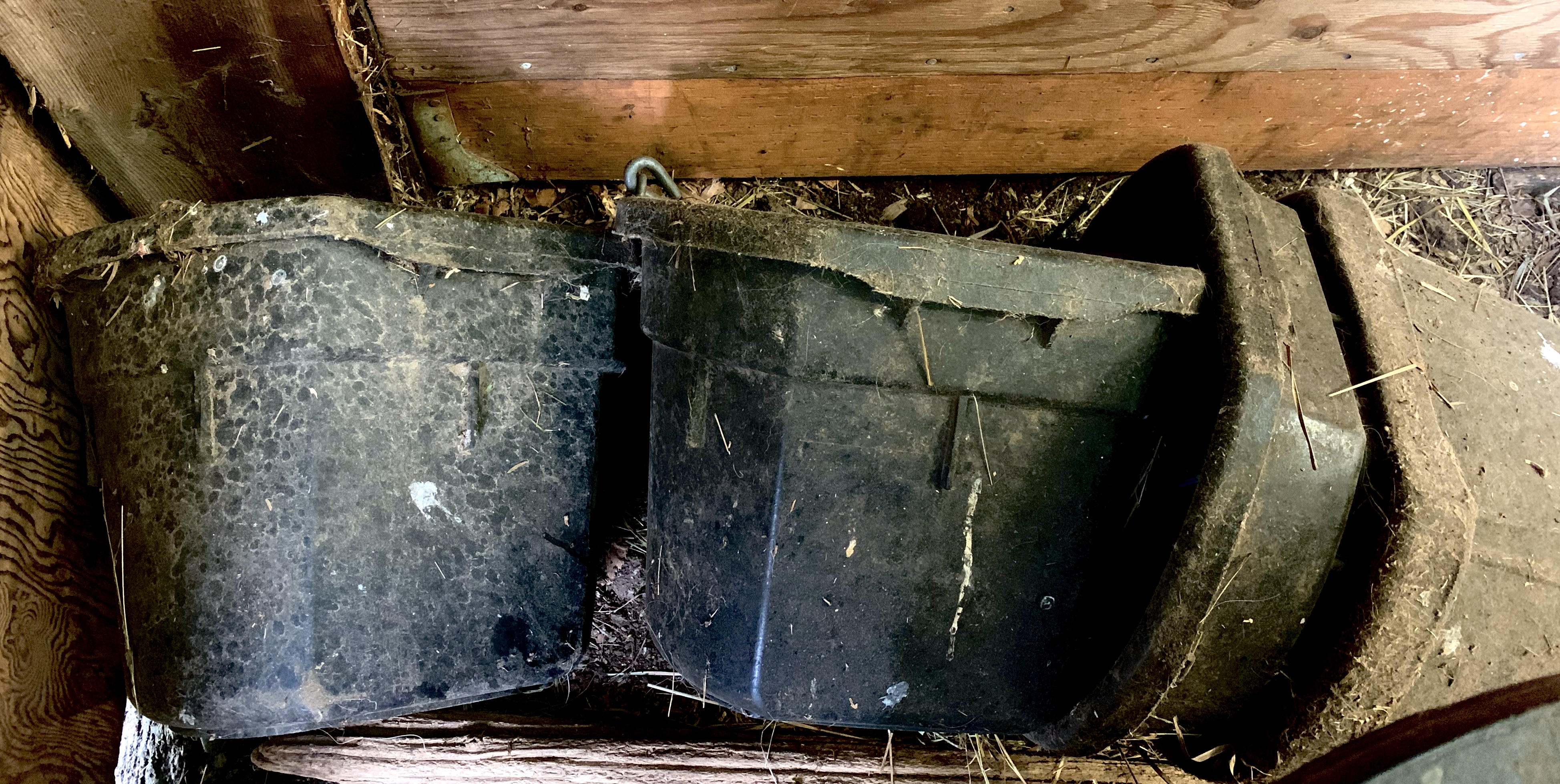
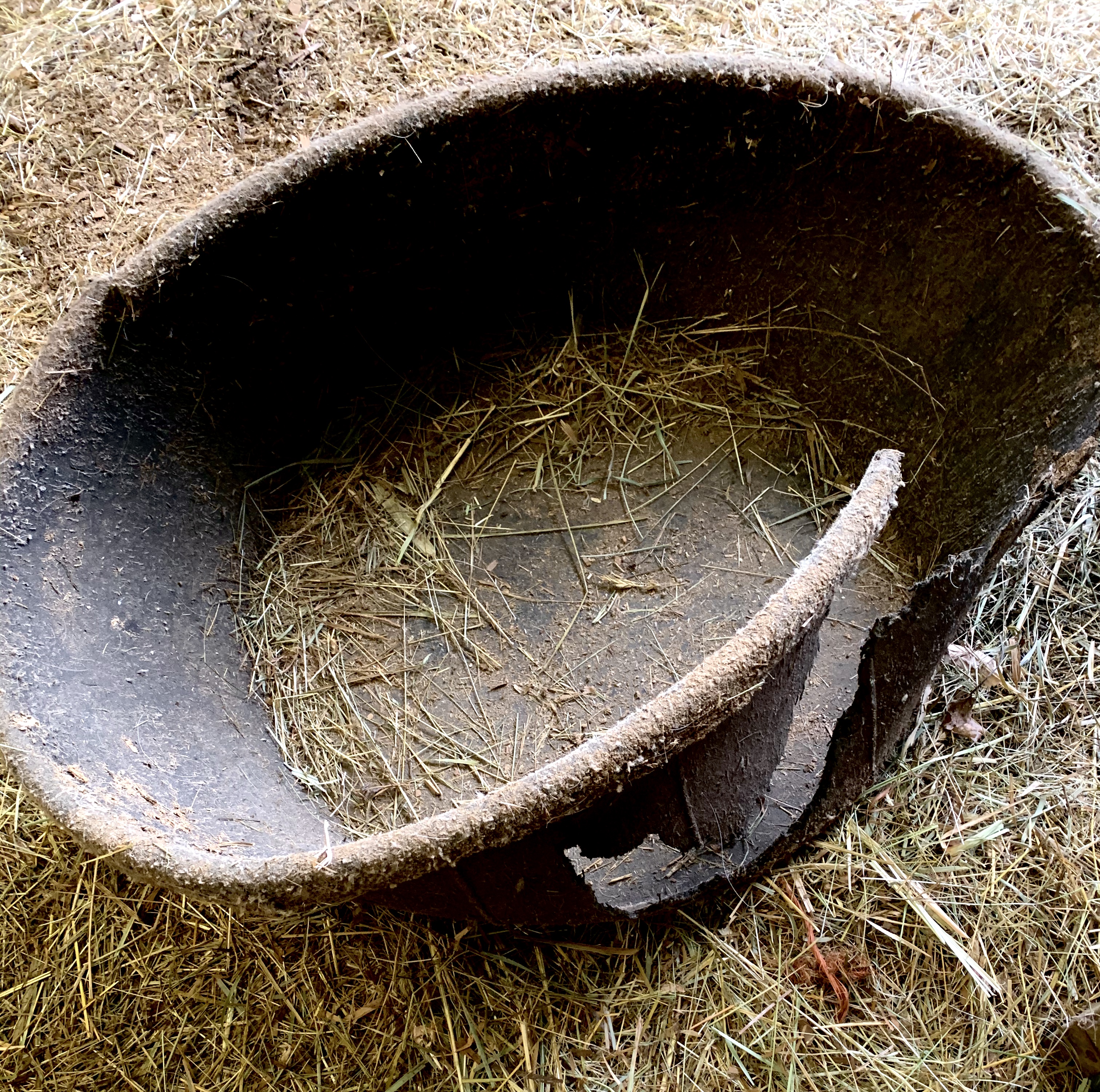
We have a water bucket graveyard on our farm. Buckets, tubs, barrels, you name it – if it once had water in it, it is no longer functional and therefore is not only merely dead, it is really most sincerely dead.
Over the decades, we have bought various styles of buckets and tubs with which to water our Haflinger horses. None have survived more than a few weeks, all thanks to one Haflinger in particular who sees anything rubber, plastic or steel-coated as his personal ninja playground.
We discovered early on that Haflingers do have a variety of creative techniques for attracting attention to themselves when someone walks in the barn, especially around feeding time. Over the years, we’ve had the gamut: the noisy neigher, the mane tosser, the foot stomper, the stall door striker, the play with your lips in the water and splash everything, and most irritating of all, the teeth raked across the woven wire front of the stall. A few Haflingers do wait patiently for their turn for attention, without fussing or furor, sometimes nickering a low “huhuhuhuhuh” of greeting. That is truly blissful in comparison.
We raised one filly whose chosen method of bringing attention to herself was to bump her belly up against her rubber water buckets that hang in the stall, making them bounce wildly about, spraying water everywhere, drenching her, and her stall in the process. She loved it. It was sport for her to see if she could tip the buckets to the point of emptying them and then knock them off their hooks so she could boot them around the stall, destroying a few in the process. Nothing made this mare happier. When she had occasion to share a big stall space with one of her half-siblings, she found that the bucket bouncing technique was very effective at keeping her brothers away, as they had no desire to be drenched and they didn’t find noisy bucket bumping very attractive. So her hay pile was hers alone–very clever thinking.
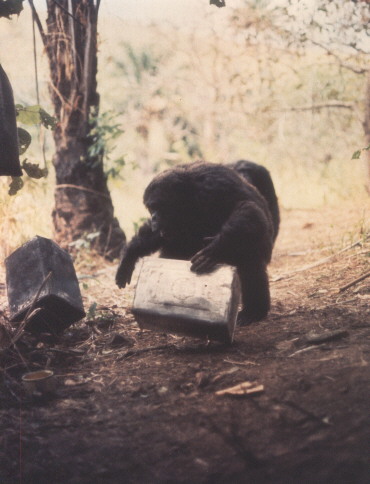
This is not unlike a wild chimpanzee that I knew at Gombe in Tanzania, named “Mike” by Jane Goodall, who found an ingenious way of rising to alpha male status by incorporating empty oil drums in his “displays” of aggression, pounding on them and rolling them down hills to take advantage of their noise and completely intimidating effect on the other male chimpanzees. Mike was on the small side, and a bit old to be alpha male, but assumed the position in spite of his limitations through use of his oil drum displays. So my noisy and water splashing mare, became alpha over her peers.
Mike rolling an oil drum at Gombe (National Geographic photo)
Our current bucket destroyer is intent on making the kill rather than making noise for attention. During this gelding’s fifteen years of life, I estimate he has gone through over a hundred buckets. Ironically some buckets bite him back, causing such significant lower lip tears that on two occasions a vet made an emergency call to perform a laceration repair (also known as plastic surgery in the barn aisle) so this Haflinger bears scars for his bad bucket habit. Unfortunately, expensive lip repairs have not discouraged him from ongoing bucket battles. His latest victim was found this morning, its steel handle broken, the bucket itself half-buried in a hole my gelding had dug in the dirt floor of the stall. He isn’t even waiting for me to issue last rites anymore; he’s taking care of that himself.
We humans aren’t much different in our destructive tendencies and our need for attracting attention. Some of us talk too much, even if we have nothing much to say, some of us strut our physical beauty and toss our hair, some of us are pushy to the point of obnoxiousness. Some of us are real bluffers, making a whole lot more noise and fuss than is warranted, but enjoying the chaos that ensues. Sometimes we even tear down what is important to our own survival and nurture (everyone needs water, right?) and leave a wake of destruction behind us – all done to make sure someone notices.
Well, now I notice each time I buy a new bucket and am reminded:
I need to quit stomping and knocking doors in my impatience, as well as quit hollering when a quiet greeting is far more welcome and appropriate. I need to quit soaking everyone else with my splashing drama – after all, it yields me nothing more than empty broken buckets that sometimes bite me back. Eventually, when I destroy every bucket in the place, I will get very thirsty and wish I hadn’t been so foolish and brash.
So if my horses are potentially trainable to have better manners, so am I.
And then I realize: over the years, my horses have been busy training me.
More often than not, I’m still groggy every morning when I step out the front door onto the porch to make my way down the gravel driveway to fetch the newspaper. More often than not, it is still quite dark out at 5:15 AM. More often than not, my slippered foot lands on something a little crunchy and a little squishy and a lot icky on the welcome mat in front of my door.
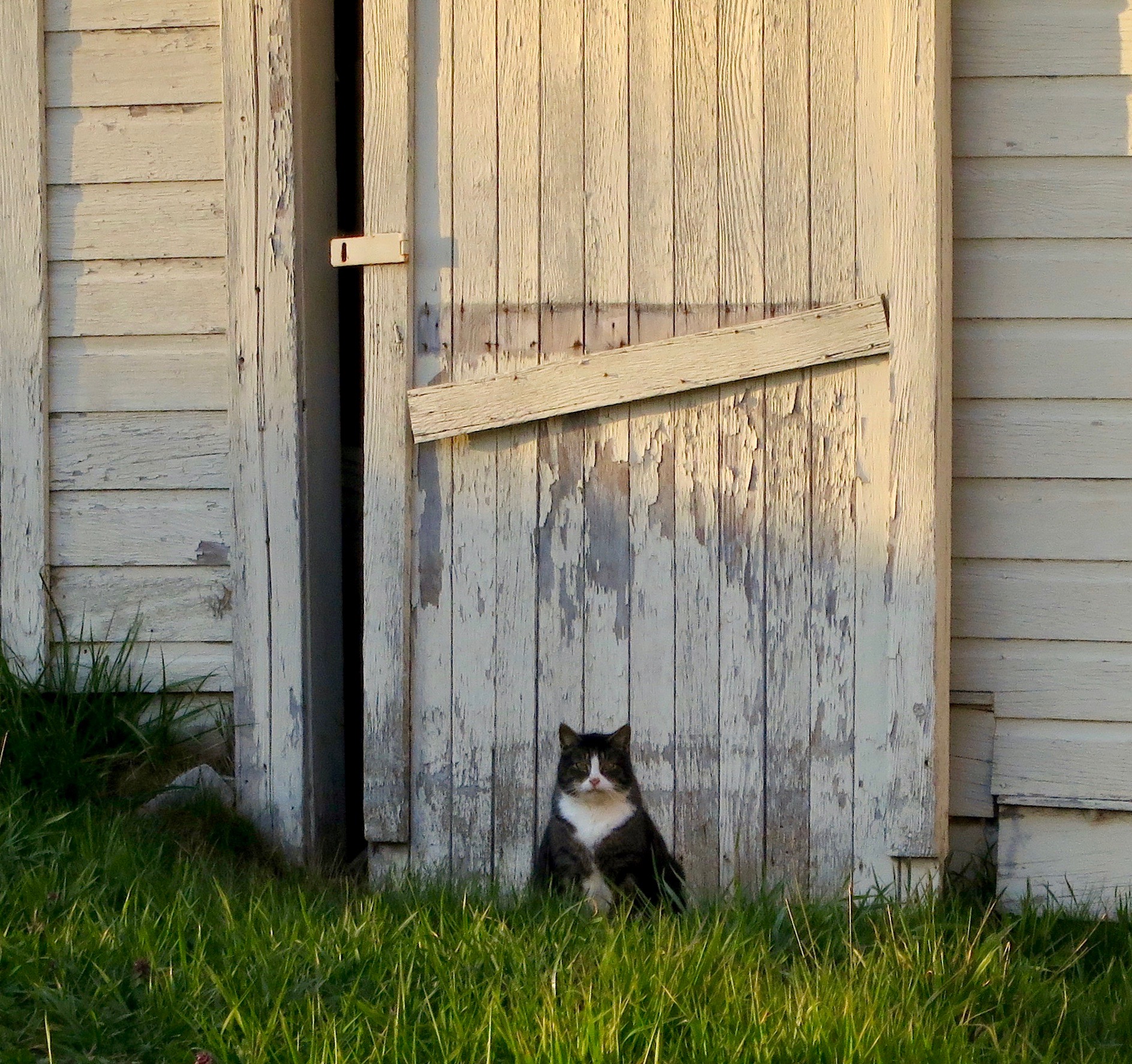
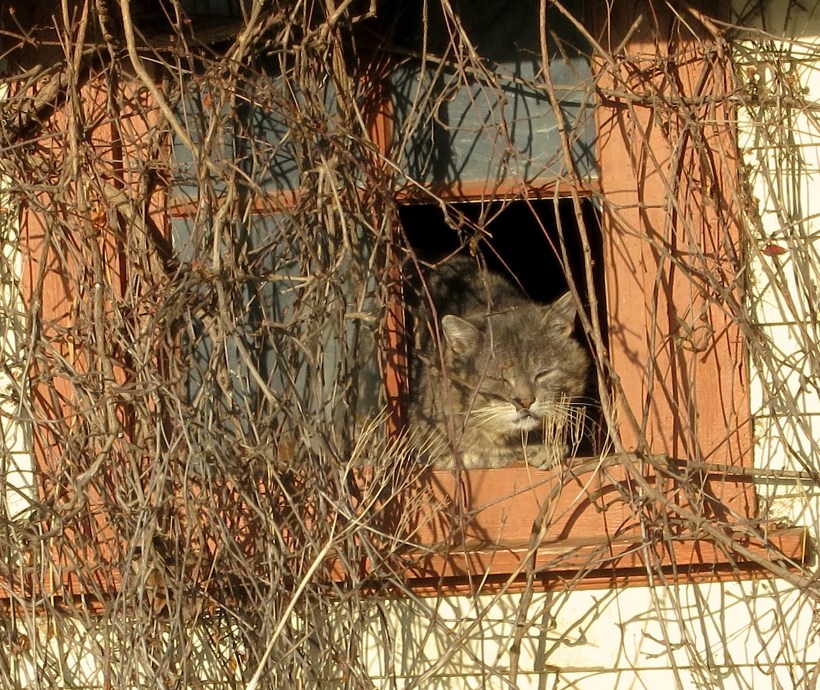
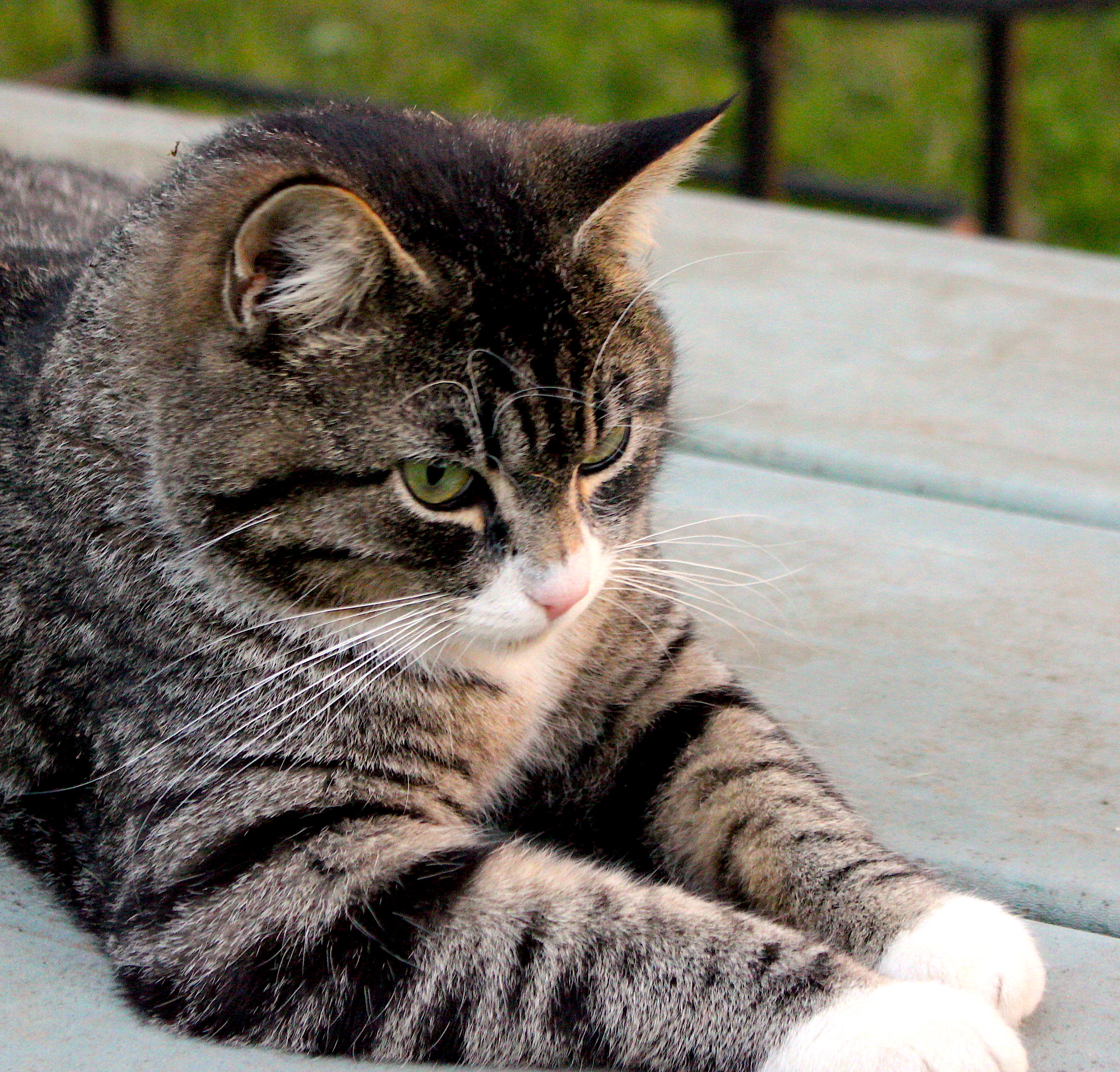
The front porch cat (as opposed to the back porch cat, the garden shed cat, the hay barn cat, the horse barn cat and an average of 3 additional stray cats), predator that he is, leaves behind certain remnants of his prey’s….um, body parts. Mousey body parts or birdie body parts. I assume, from the consistency of this little carnivore compost pile, these are unappealing to the kitty, so become the “leavings”, so to speak, of the kill. Typically, it is a little mouse head, complete with little beady eyes, or a little bird head, complete with little beak, and something that looks suspiciously green and bulbous, like a gall bladder. I don’t think heads or gall bladders are on my preferred delicacy list either. And they are certainly not on my list of things I like to wear on the bottom of my slipper. Yet I do and I have.
I’m perplexed by this habit cats have of leaving behind the stuff they don’t want on the welcome mat, even the occasional whole shrew or field mouse, seemingly untouched by claw or incisor, but yet dead as a doornail on the doormat. Some cat owners naively think their cats are presenting them with “gifts” – kind of a sacrificial offering to the human god that feeds them. Nonsense. Ask the mouse or bird how they feel about becoming the blood sacrifice.
I believe the welcome mat is the universal trash heap for cats and a testimony to their utter disdain for humans. Leave for the human the unappetizing and truly grotesque…
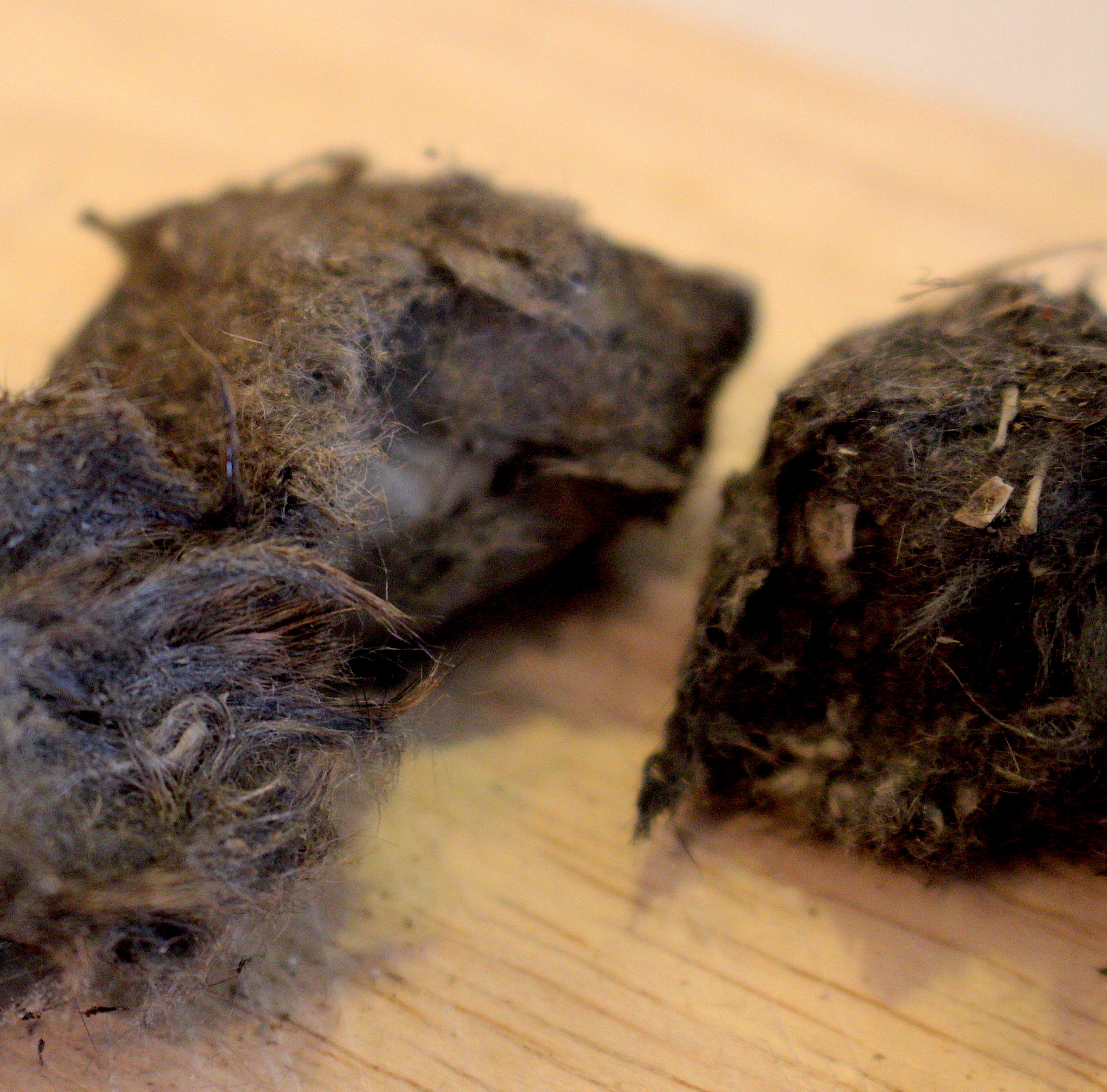
So humanity is not alone of earth’s creatures to create garbage heaps of unwanted stuff. Not only cats, but barn owls are incredibly efficient at tossing back what they don’t want out of their furry meals. Our old hay barn is literally peppered with pellets, popular with high school biology classes and my grand-nephews for dissection instruction. These dried up brown fuzzy poop shaped objects are regurgitated by the owl after sitting in one of its two stomachs for a number of hours.
Bird barf.
It’s fairly interesting stuff, which is why these pellets (which we recycle by donating by the dozens to local schools) are great teaching material. It is possible to practically reconstruct a mouse or bird skeleton from a pellet, or perhaps even both on a night when the hunting was good. There is fur and there are feathers. Whatever isn’t easily digestible doesn’t have much purpose to the owl, so up it comes again and becomes so much detritus on the floor and rafters of our barn. Ask the mouse or rabbit (or occasional kitten) how they feel about becoming owl litter. There should be a law.
Then there is the rather efficient Haflinger horse eating machine which leaves no calorie unabsorbed, which vacuums up anything remotely edible within reasonable reach, even if reasonable means contortions under a gate or fence with half of the body locked under the bottom rung, and the neck stretched 6 feet sideways to grab that one blade of grass still standing. The reason why Haflingers don’t eventually explode from their intake is that Haflinger poop rivals elephant poop pound for pound per day, so there must be a considerable amount ingested that is indigestible and passed on, so to speak – like part of a cloth tail wrap, and that halter that went missing… you know, like those black holes in outer space–that’s what a Haflinger represents on earth.
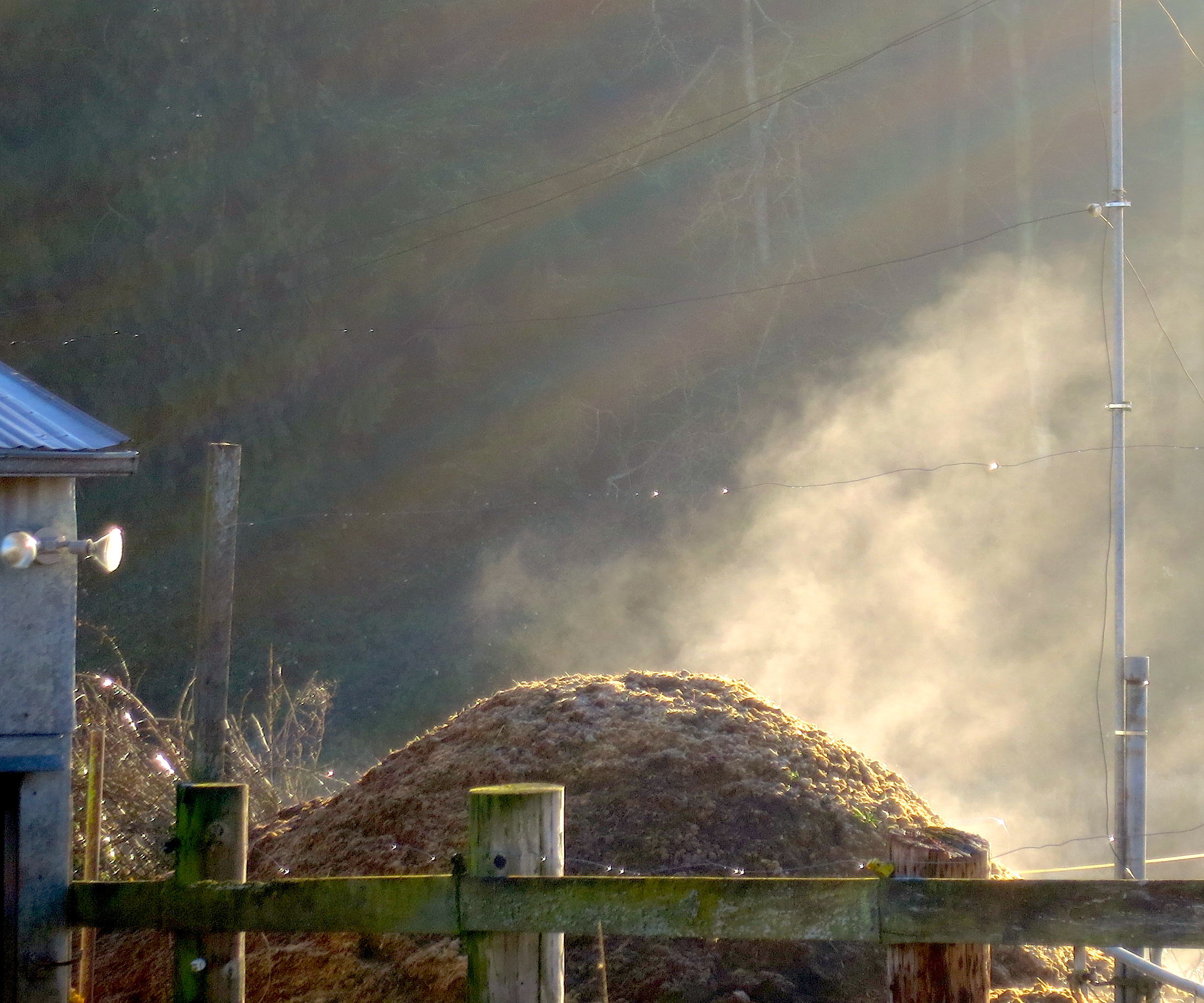
At least we have figured out how to recycle all that poop back to the fields to feed the next generation of grass, which feeds the next generation of Haflingers, which becomes poop to feed the next generation of grass, and so on and so on and so on…
This is quite different from the recycled “cud” of the typical herbivore cow who regurgitates big green gobs of grass/hay/silage to chew it again in a state of (udder) contentment and pleasure. If humans could figure out how to recycle a good meal for another good chew or two, the obesity rate would surely drop precipitously. So would attendance at most happy hours. But then, how many skinny cows have I seen? Probably as many as purple cows. I never hope to see one, but I’d rather see than be one.
In my daily walk through life, I have my share of things I unceremoniously dump that I don’t want, don’t need, can’t use, or abandon when I only want the palatable so figure the rest can rot.
Today is Earth Day, and I feel properly shamed and guilty for my contribution to landfills, despite my avid recycling efforts for the past 50 years. Nonetheless, I am in good company with my fellow carnivores and omnivores who daily leave behind and (sometimes) recycle what they don’t want or need.
I now need to figure out that herbivore cud thing. I can go green, just might save on the grocery bill and my bathroom scale would thank me.
And came the horses. There, still they stood, But now steaming, and glistening under the flow of light,
Their draped stone manes, their tilted hind-hooves Stirring under a thaw while all around them
The frost showed its fires. But still they made no sound. Not one snorted or stamped,
Their hung heads patient as the horizons, High over valleys, in the red leveling rays
In din of the crowded streets, going among the years, the faces, May I still meet my memory in so lonely a place
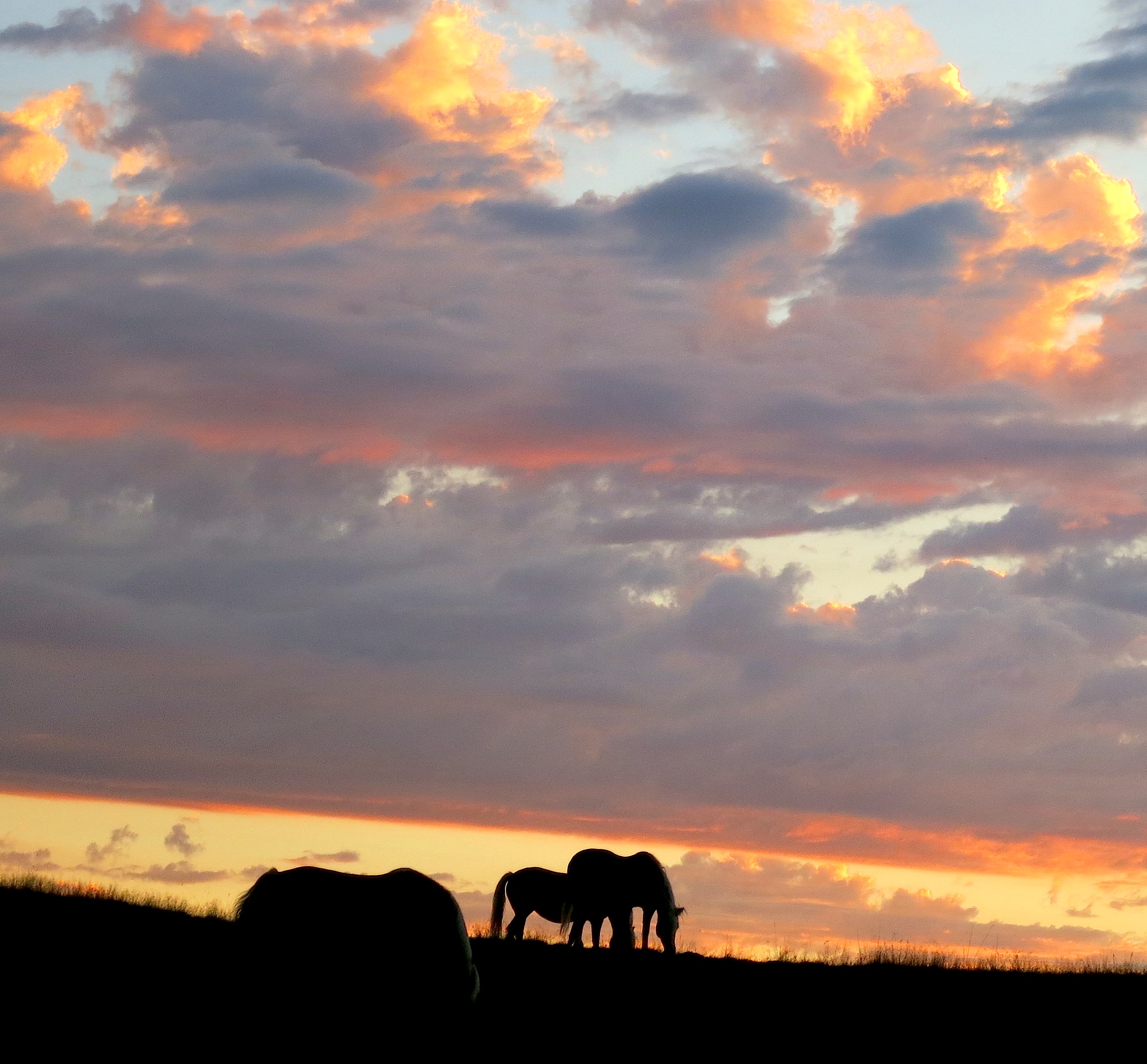
Between the streams and the red clouds, hearing curlews, Hearing the horizons endure. ~Ted Hughes from “The Horses”
Five years ago this week, Marlee went to her forever home, far sooner than we planned. She was only twenty two, born only two months after our daughter’s birth, much too young an age for a Haflinger to die.
But something dire was happening to her over the previous two weeks — not eating much, an expanding girth, then shortness of breath, and it was confirmed she had untreatable lymphoma.
Her bright eyes were shining to the end so it was very hard to ask the vet to turn the light off. But the time had clearly come.
Marlee M&B came to us as a six month old “runty orphan” baby by the lovely stallion Sterling Silver, but she was suddenly weaned at three days when her mama Melissa died of sepsis. She never really weaned from her bottle/bucket feeding humans Stefan and Andrea Bundshuh at M&B Farm in Canada. From them she learned people’s behavior, understood their nonverbal language, and discerned human subtleties that most horses never learn. This made her quite a challenge as a youngster as it also meant there was no natural reserve nor natural respect for people. She had no boundaries taught by a mother, so we were tasked with teaching her the proper social cues.
When turned out with the herd as a youngster, she was completely clueless–she’d approach the dominant alpha mare incorrectly, without proper submission, get herself bitten and kicked and was the bottom of the social heap for years, a lonesome little filly with few friends and very few social skills. She had never learned submission with people either, and had to have many remedial lessons on her training path. Once she was a mature working mare, her relationship with people markedly improved as there was structure to her work and predictability for her, and after having her own foals, she picked up cues and signals that helped her keep her foal safe, though she had always been one of our most relaxed “do whatever you need to do” mothers when we handled her foals as she simply never learned that she needed to be concerned.
Over the years, as the herd has changed, Marlee became the alpha mare, largely by default and seniority, so I don’t believe she really trusted her position as “real”. She tended to bully, and react too quickly out of her own insecurity about her inherited position. She was very skilled with her ears but she was also a master at the tail “whip” and the tensed upper lip–no teeth, just a slight wrinkling of the lip. The herd scattered when they saw her face change. The irony of it all is that when she was “on top” of the herd hierarchy, she was more lonely than when she was at the bottom and I think a whole lot less happy as she had few grooming partners any more.
She accompanied us to the fair for a week of display of our Haflingers year after year after year — she could be always counted on to greet the public and enjoy days of braiding and petting and kids sitting on her back.
The day she started formal under saddle training under Val Bash was when the light bulb went off in her head–this was a job she could do! This was constant communication and interaction with a human being, which she craved! This was what she was meant for! And she thrived under saddle, advancing quickly in her skills, almost too fast, as she wanted so much to please her trainer.
She was the first among North American Haflingers to not only become regional champion in her beginner novice division of eventing as a pregnant 5 year old, but also received USDF Horse of the Year awards in First and Second Level dressage that year as the highest scoring Haflinger.
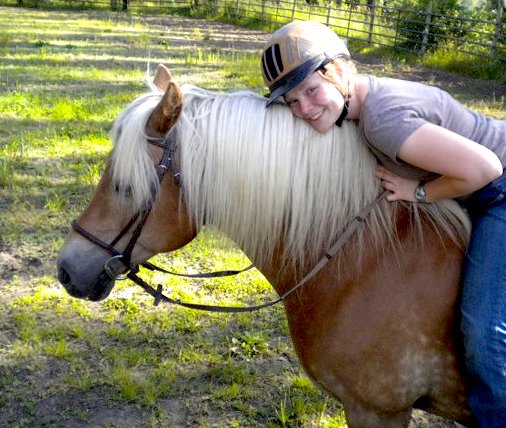
With Jessica Heidemann she did a “bridleless” ride display in front of hundreds of people at the annual Haflinger event, and with Garyn Heidemann as instructor, she became an eventing pony for a young rider whose blonde hair matched Marlee’s. She galloped with abandon in the field on bareback rides with Emily Vander Haak and became our daughter Lea’s special riding horse over the last few years.
She had a career of mothering along with intermittent riding work, with 5 foals –Winterstraum, Marquisse, Myst, Wintermond (aka “Mondo”), and Nordstrom—each from different stallions, and each very different from one another.
This mare had such a remarkable work ethic, was “fine-tuned” so perfectly with a sensitivity to cues–that our daughter said: “Mom, it’s going to make me such a better rider because I know she pays attention to everything I do with my body–whether my heels are down, whether I’m sitting up straight or not.” Marlee was, to put it simply, trained to train her riders.
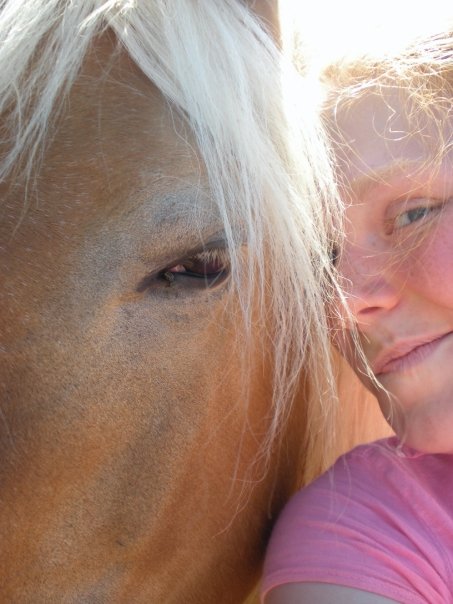
I miss her high pitched whinny from the barn whenever she heard the back door to the house open. I miss her pushy head butt on the stall door when it was time to close it up for the night. I miss that beautiful unforgettable face and those large deep brown eyes where the light was always on.
What a ride she had for twenty two years, that dear little orphan. What a ride she gave to many who trained her and who she trained over the years. Though I never climbed on her back, what joy she gave me all those years, as the surrogate mom who loved and fed her. May I meet her in my memories, whenever I feel lonesome for her, still unable to resist those bright eyes forever now closed in peace.
One-Time
Monthly
Yearly
Make a one-time or recurring donation to support daily Barnstorming posts
Now a red, sleepy sun above the rim Of twilight stares along the quiet weald, And the kind, simple country shines revealed In solitudes of peace, no longer dim. The old horse lifts his face and thanks the light, Then stretches down his head to crop the green. All things that he has loved are in his sight; The places where his happiness has been Are in his eyes, his heart, and they are good. ~Siegfried Sassoon from “Break of Day”
When we are at war, whether deep in the foxhole hiding from the enemy, or fighting against a wily pathogen which makes its hidden way, person to person, we sing our battle hymn without ceasing.
Amid the suffering we dream of better days and an untroubled past, when the hunter and hunted was merely a game, not real life and even more real death.
This is war against a contagious disease, not against one another.
Move away from reading 24 hour headlines. Avoid being crushed in the numbers of viral dead and dying; ignore the politics of power or by those frantically salvaging shredded investments or hoarding the last from bare shelves.
Do not forget how the means of peace was sent to earth directly from God by one Man walking among us.
So stay home, giving the enemy no fresh place to invade. Pray for those who sacrifice much to care for the ill.
A new day breaks fresh each morning and folds gently and quietly each evening. Be glad to live another day with all those things you love within your sight: so glad, so grateful, such glory to be reminded how rich we all are.
This year’s Lenten theme for Barnstorming:
God sees us as we are, loves us as we are, and accepts us as we are. But by His grace, He does not leave us where we are. ~Tim Keller
Mine eyes have seen the glory of the coming of the Lord You are speaking truth to power, you are laying down our swords Replanting every vineyard ’til a brand new wine is poured Your peace will make us one
I’ve seen you in our home fires burning with a quiet light You are mothering and feeding in the wee hours of the night Your gentle love is patient, you will never fade or tire Your peace will make us one
Glory! Glory! Hallelujah! Glory! Glory! Hallelujah! Glory! Glory! Hallelujah! Your peace will make us one
In the beauty of the lilies, you were born across the sea With a glory in your bosom that is still transfiguring Dismantling our empires ’til each one of us is free Your peace will make us one
Glory! Glory! Hallelujah! Glory! Glory! Hallelujah! Glory! Glory! Hallelujah! Your peace will make us one
Like animals moving daily through the same open field, it should be easier to distinguish light from dark, fabrications
from memory, rain on a sliver of grass from dew appearing overnight. In these moments of desperation, a sentence
serves as a halo, the moon hidden so the stars eclipse our daily becoming. You think it should be easier to define
one’s path, but with the clouds gathering around our feet, there’s no sense in retracing where we’ve been or where
your tired body will carry you. Eventually the birds become confused and inevitable. Even our infinite knowledge of the forecast
might make us more vulnerable than we would be in drawn-out ignorance. To the sun all weeds eventually rise up. ~Adam Clay “Our Daily Becoming”
I can choose to fight the inevitable march of time with sighs and sorrows, thus arm myself with regret for what is no more,
or pull myself through light to dark each day with soul-sucking fatigue, uncertain if I have what it takes to power through,
or I can flow passively for as long as I can stay afloat, apart and remote, barely aware of the passage of all around me,
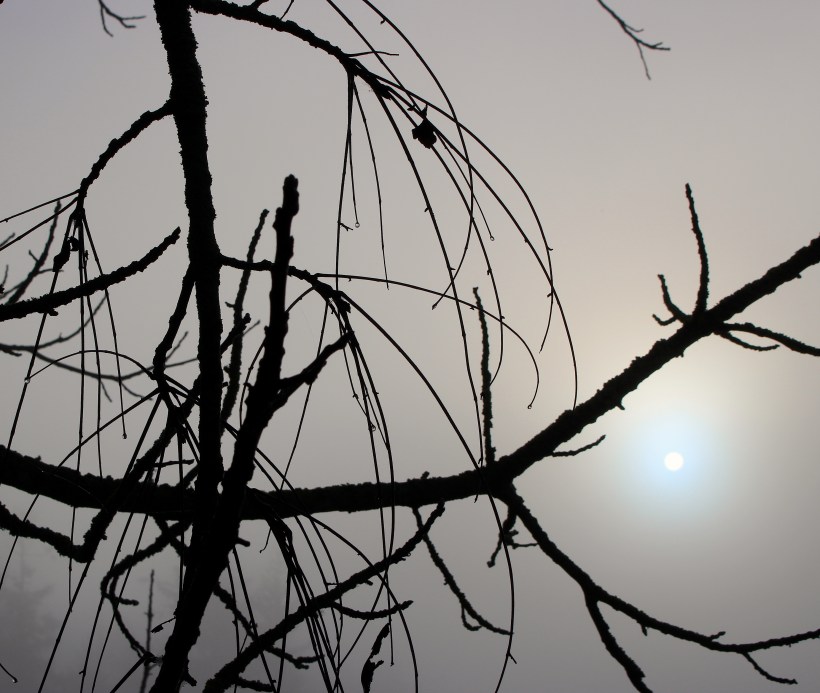
or I can smile at awakening each morning, no matter what is forecast, reaching up to the sun I know is there, though hidden behind mist, fog and clouds,
grateful I’m given another day to work to get it right: my opportunity to be fruitful, despite my weediness.
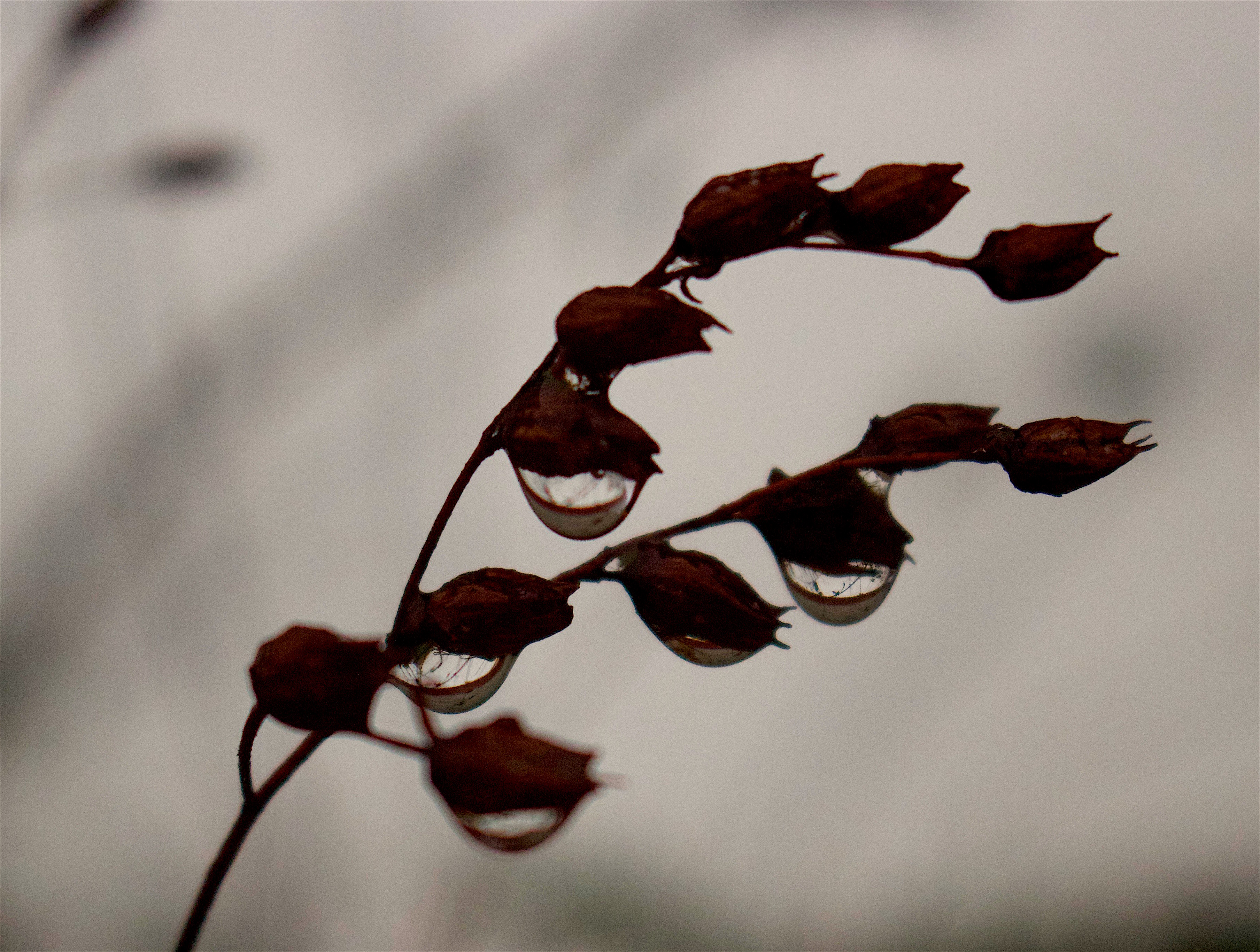
We’re just a drop in the bucket, as if that’s meaningless. But we say, “No, wait a minute. If you have a bucket, those raindrops fill it up very fast. Being a drop in the bucket is magnificent.” The problem is we cannot see the bucket. Our work is helping people see that there is a bucket. There are all these people all over the world who are creating this bucket of hope. And so our drops are incredibly significant. ~Frances Moore Lappe from Hope Dies Last
How great is God—beyond our understanding! The number of his years is past finding out.
He draws up the drops of water, which distill as the mist to rain; the clouds pour down their moisture and abundant showers fall on mankind. Job 36:26-28
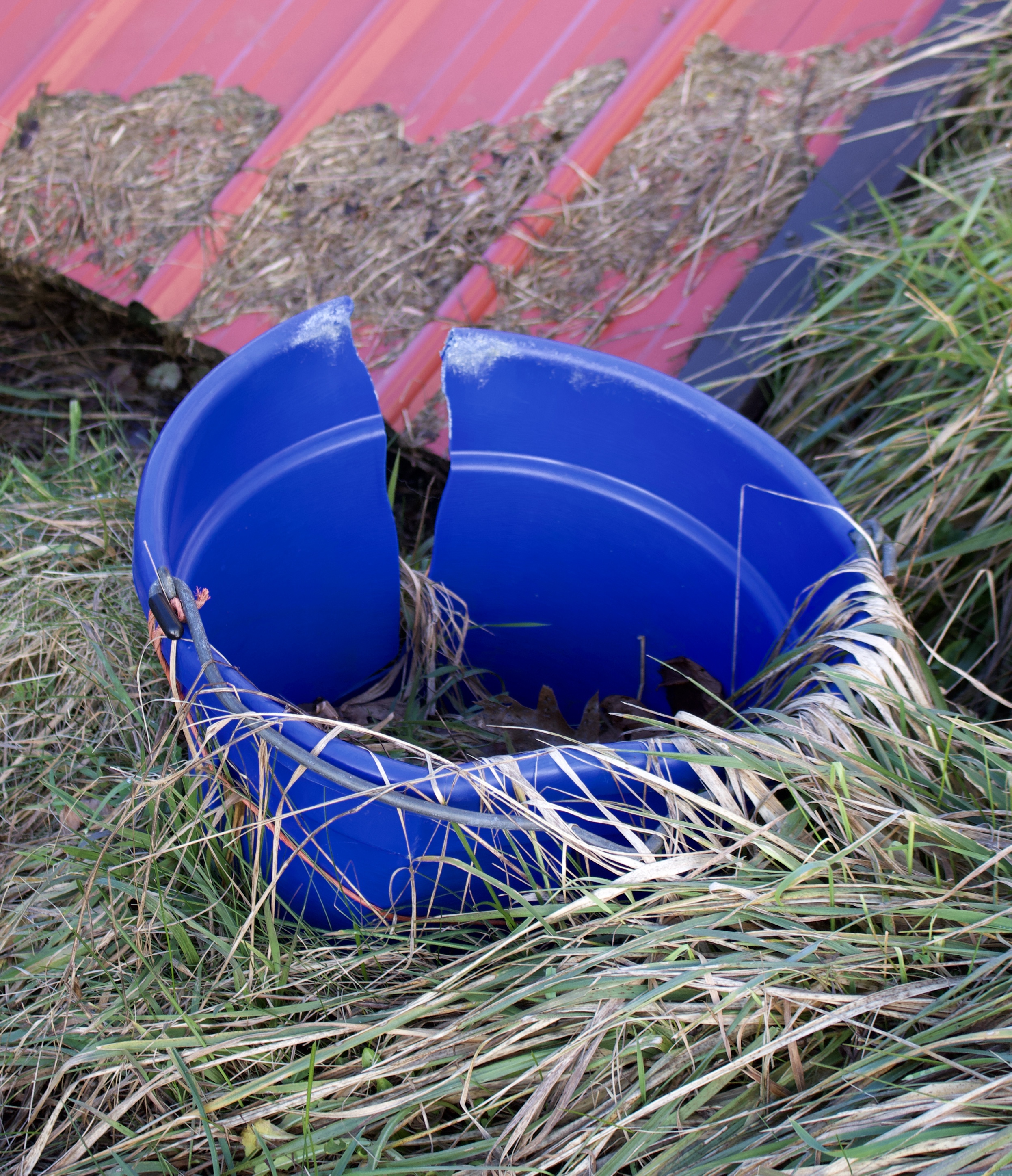
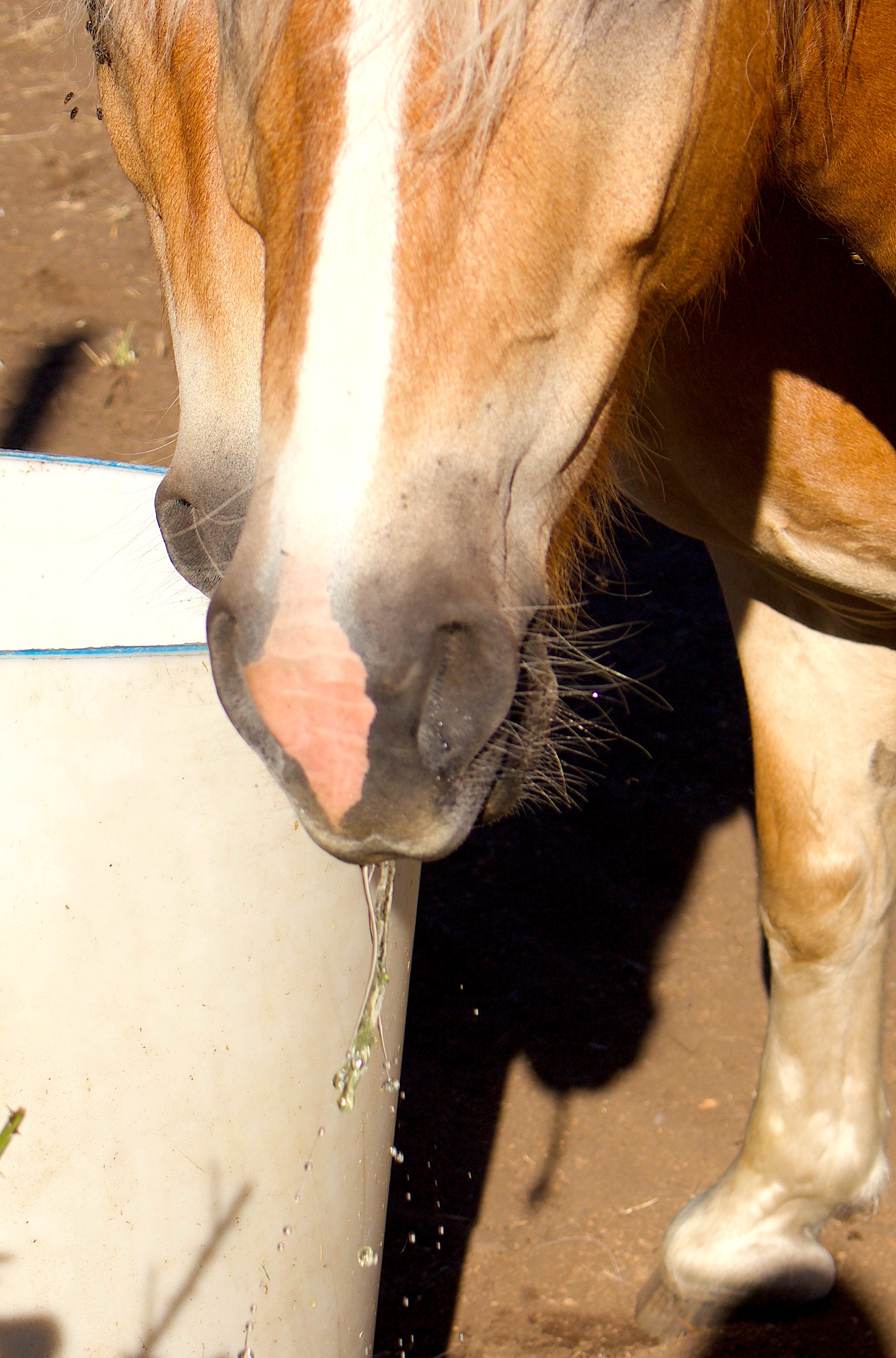
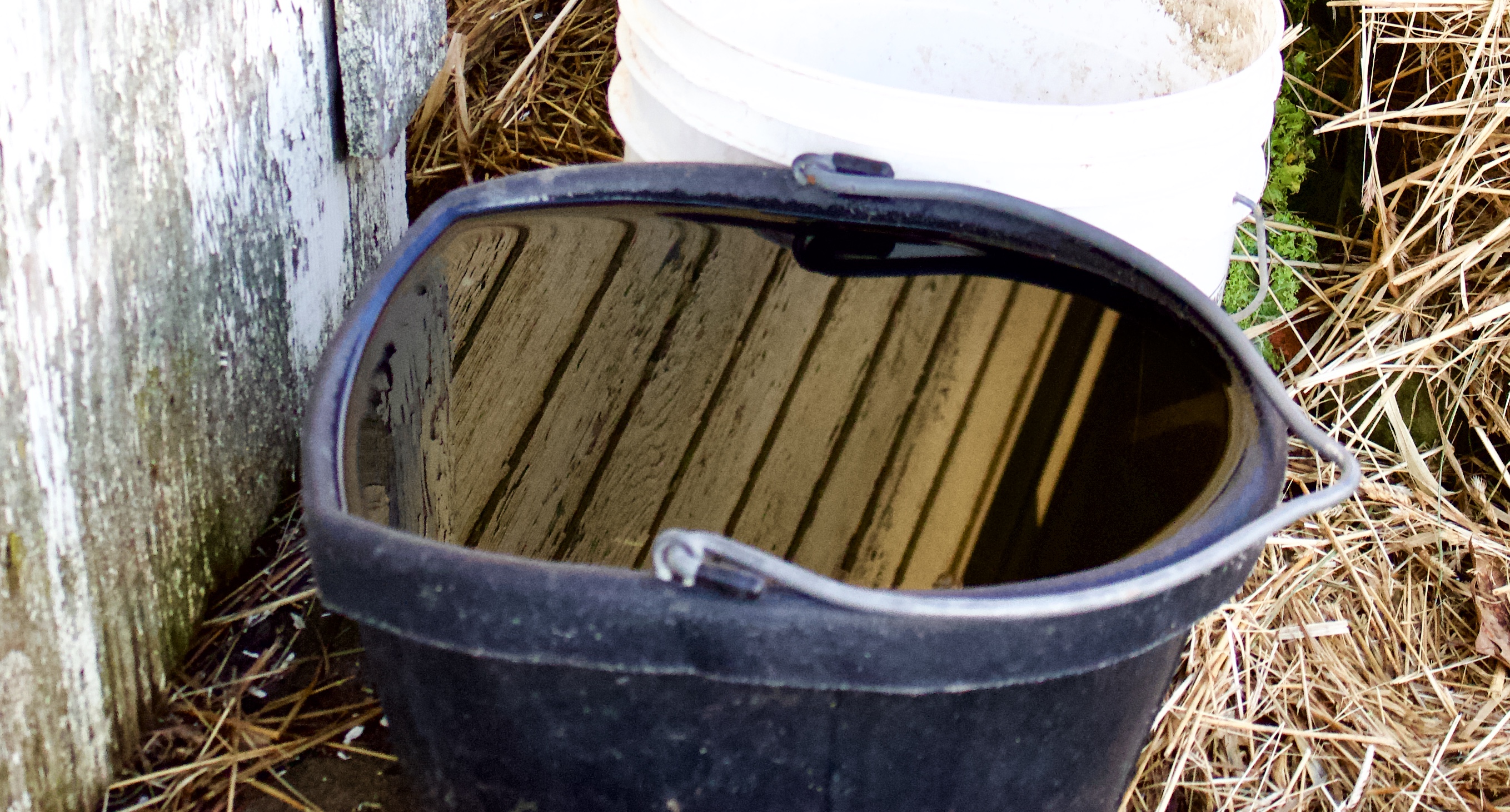
Our farm could be considered a broken bucket sanctuary; our Haflinger horses are very hard on their buckets , and in retaliatory defense the buckets have broken them back.
The best buckets are rubber, not hard plastic. They are more forgiving and flexible and can handle a fair amount of equine abuse.
One of my jobs on the farm is to keep all buckets full, and so less likely to be the target of entertainment and abuse. It takes all those drops of water together to provide what the horse must have to quench their thirst as well as to protect the bucket itself so it will survive to be filled another day.
I can never forget: each bucket of hope starts with just one drop in the bucket, the beginning of a magnificent abundance.
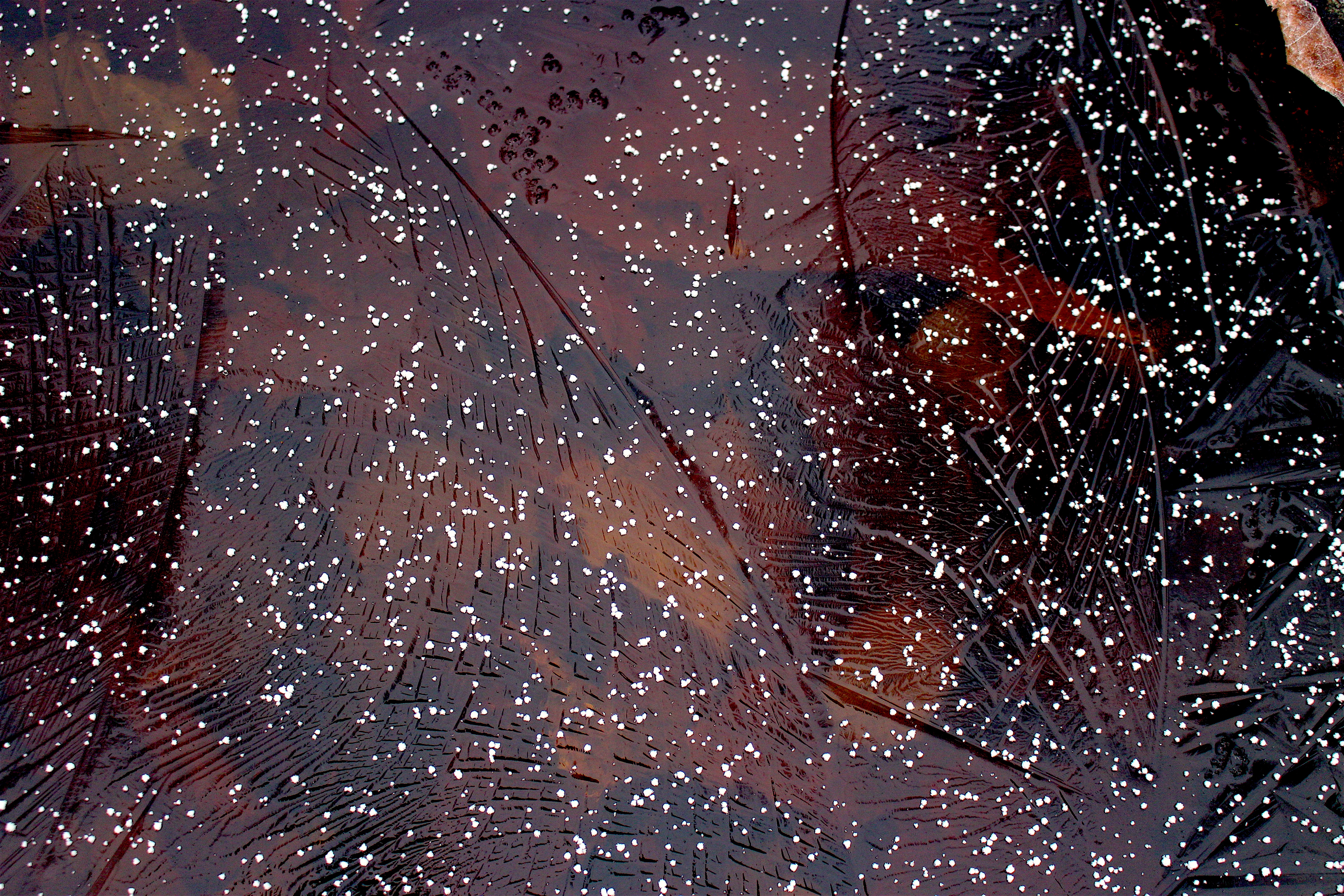
We are waiting for snow the way we might wait for permission to breathe again.
For only the snow will release us, only the snow will be a letting go, a blind falling towards the body of earth and towards each other. ~Linda Pastan from “Interlude”
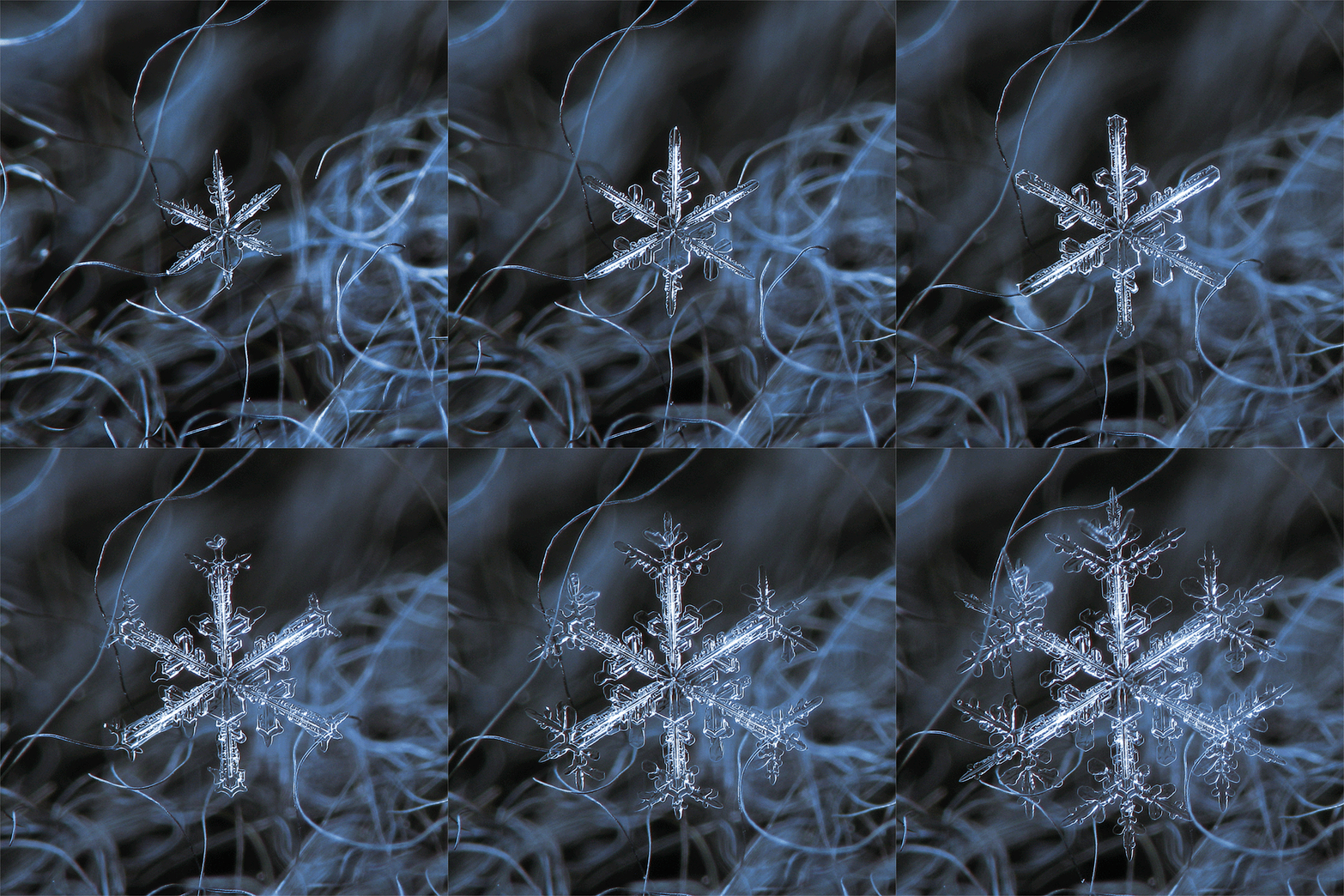
I wish one could press snowflakes in a book like flowers. ~James Schuyler from “February 13, 1975”
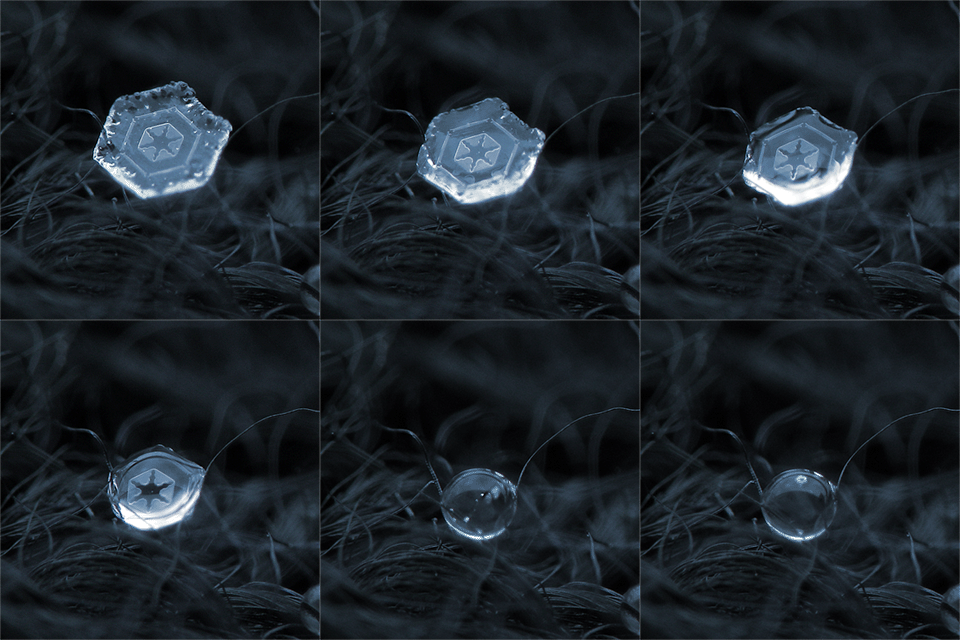
I wait with bated breath, wondrous at today’s snowfall, to see the landscape transformed. Each snowflake falls alone, settling in together in communal effort. And each is created as a singular masterpiece itself.
We, the created, are like each snowflake. Together we change the world, sometimes for better, too often for worse. But each of us have come from heaven uniquely designed and purposed, preciously preserved for eternity through God’s loving sacrifice.
Without Him, we melt between the pages of history.
“Why, what’s the matter, That you have such a February face, So full of frost, of storm and cloudiness?” – William Shakespeare, Much Ado About Nothing
January was particularly dark and dank, especially last night as the month wrapped up with a deluge, flooding numerous roads in our rural county. The beginning of February often feels like this: the conviction winter will never be finished messing with us. Our doldrums are deep; brief respite of sun and warmth too rare.
I feel it in the barn as I go about my daily routine. The Haflingers are impatient and yearn for freedom, over-eager when handled, sometimes banging on the stall doors in their frustration at being shut in, not understanding that the alternative is to stand outside all day in cold rain and wind. To compensate for their confinement, I do some grooming of their thick winter coats, urging their hair to loosen and curry off in sheets over parts of their bodies, yet otherwise still clinging tight. The horses are a motley crew right now, much like a worn ’60s shag carpet, uneven and in dire need of updating. I prefer that no one see them like this and discourage visitors to the farm, begging people to wait a few more weeks until they (and I) are more presentable. Eventually I know the shag on my horses will come off, revealing the sheen of new short hair beneath, but when I look at myself, I’m unconvinced there is such transformation in store for me. Cranky, I put one foot ahead of the other, get done what needs to be done, oblivious to the subtle renewal around me, refusing to believe even in the possibility.
It happened today. Dawn broke bright and blinding and I heard the fields calling, so I heeded, climbing the hill and turning my face to the eastern light, soaking up all I could. It was almost too much to keep my eyes open, as they are so accustomed to gray darkness. And then I stumbled across something extraordinary.
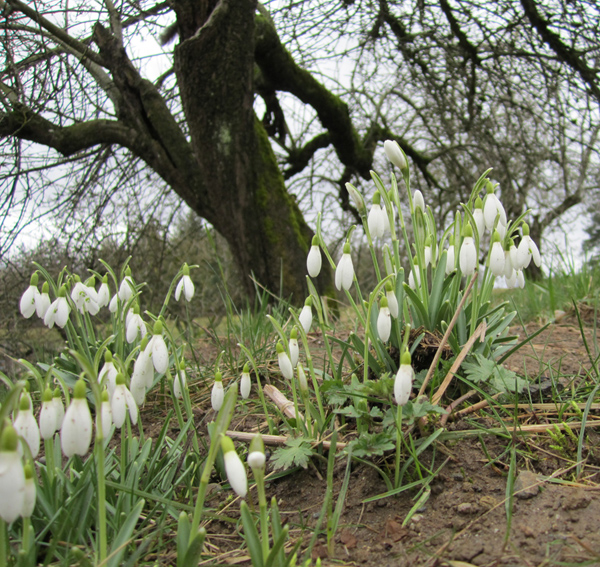
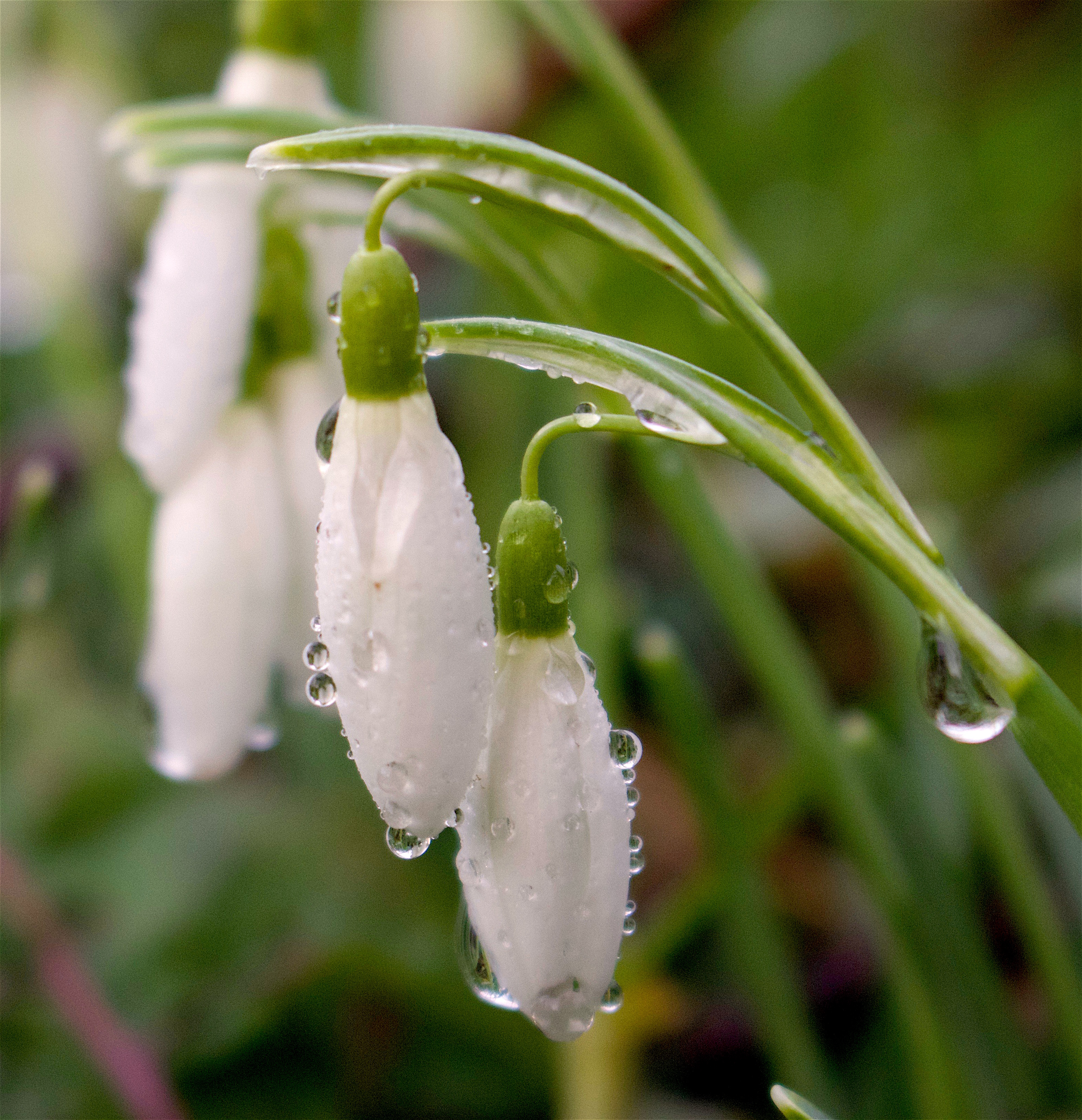
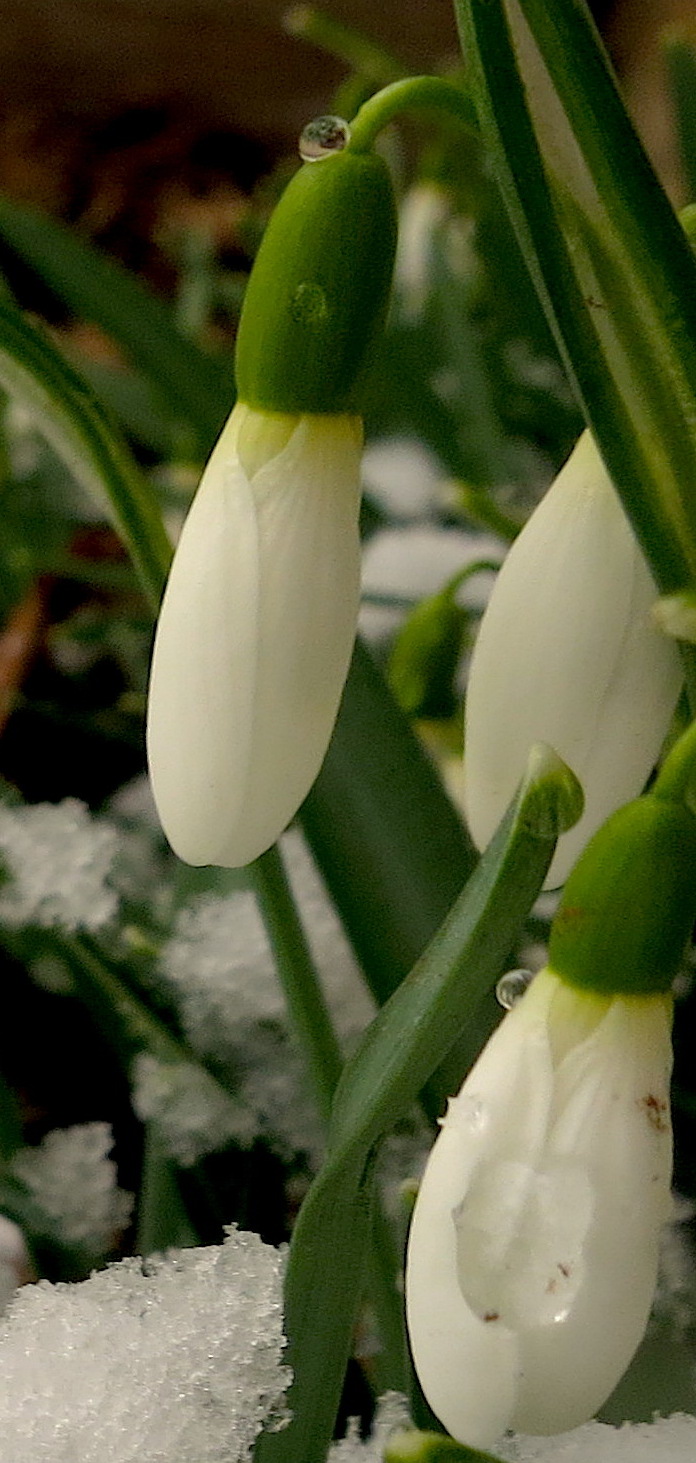
A patch of snowdrops sat blooming in an open space on our acreage, visible now only because of the brush clearing that was done last fall. Many of these little white upside down flowers were planted long ago around our house and yard, but I had no idea they were also such a distance away, hiding underground. Yet there they’ve been, year after year, harbingers of the long-awaited spring to come in a few short weeks, though covered by the overgrowth of decades of neglect and invisible to me in my self-absorbed blindness. I was astonished that someone, many many years ago, had carried these bulbs this far out to a place not easy to find, and planted them, hoping they might bless another soul sometime somehow. Perhaps the spot marks a grave of a beloved pet, or perhaps it was simply a retreat of sorts, but there the blossoms had sprung from their sleep beneath the covering of years of fallen leaves and blackberry vines.
It was if I’d been physically hugged by this someone long dead, now flesh and blood beside me, with work-rough hands, and dirty fingernails, and broad brimmed hat, and a satisfied smile. I’m certain the secret gardener is no long living, and I reach back across those years in gratitude, to show my deep appreciation for the time and effort it took to place a foretaste of spring in an unexpected and hidden place.
I am thus compelled to look for ways to leave such a gift for someone to find 50 years hence as they likewise stumble blindly through too many gray days full of human frailty and flaw. Though I will be long gone, I can reach across the years to grab them, hug them in their doldrums, lift them up and give them hope for what is to come. What an astonishing thought that it was done for me and in reaffirming that promise of renewal, I can do it for another.
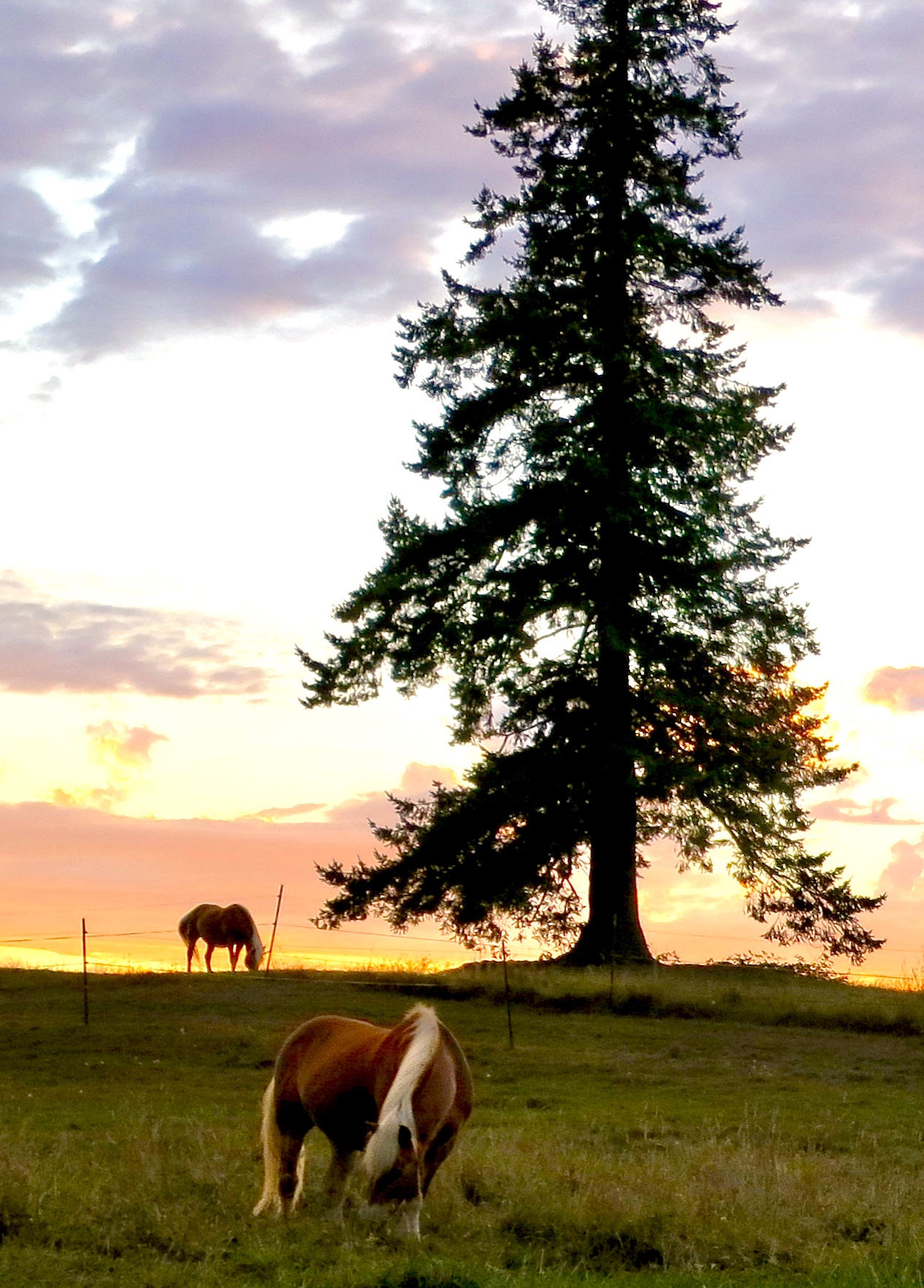
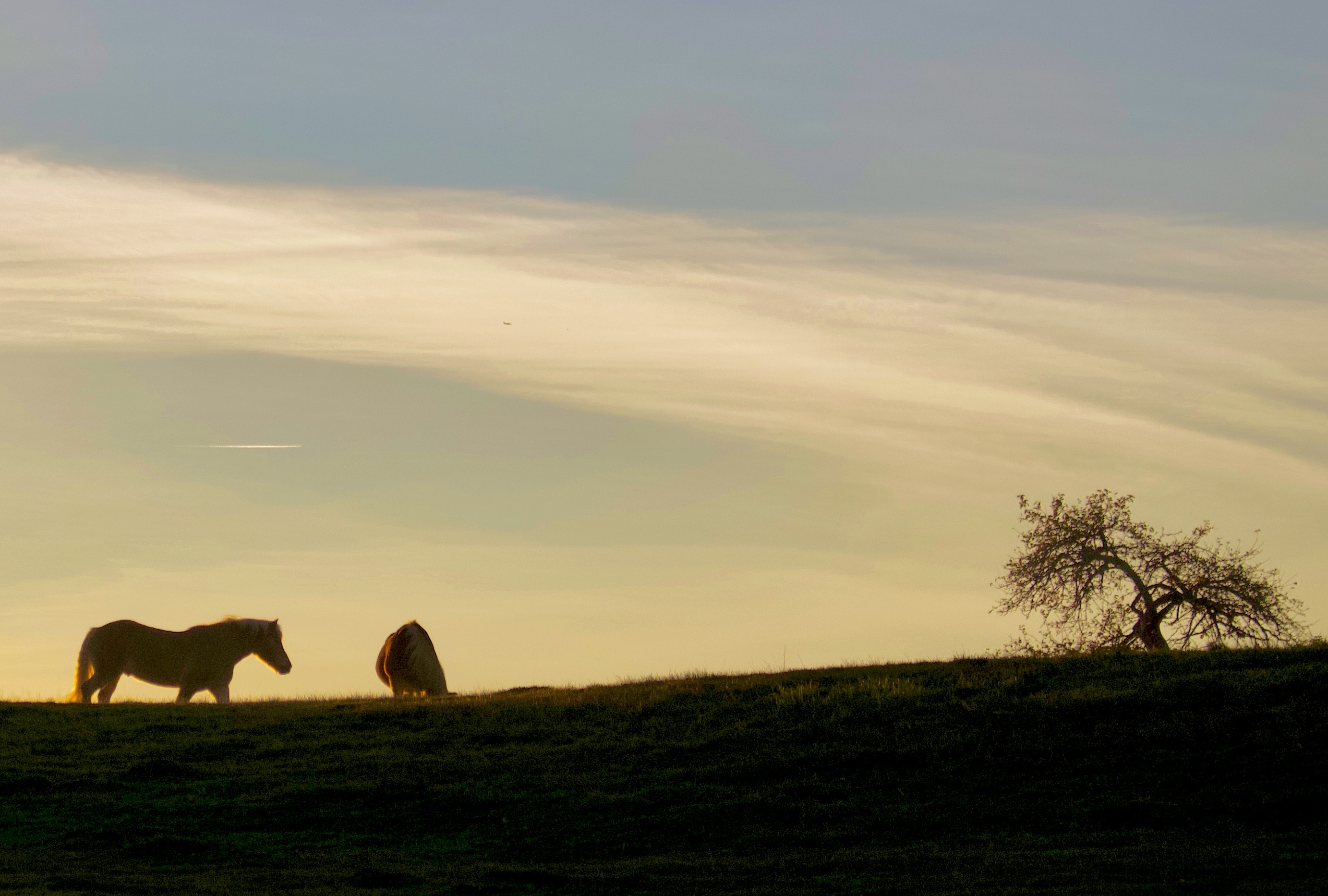
We never know if the turn is into the home stretch. We call it that—a stretch of place and time—with vision of straining, racing. We acknowledge each turn with cheers though we don’t know how many laps remain. But we can hope the course leads on far and clear while the horses have strength and balance on their lean legs, fine-tuned muscles, desire for the length of the run. Some may find the year smooth, others stumble at obstacles along the way. We never know if the finish line will be reached after faltering, slowing, or in mid-stride, leaping forward. ~Judy Ray, “Turning of the Year”
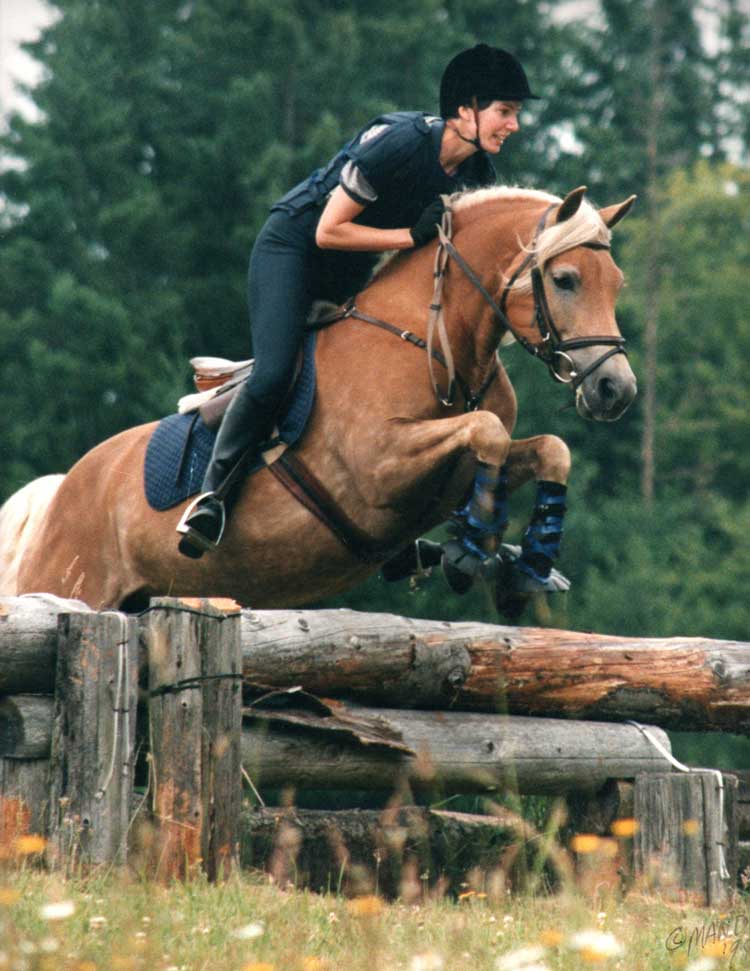
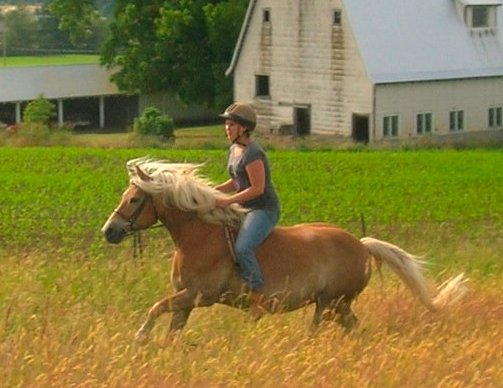
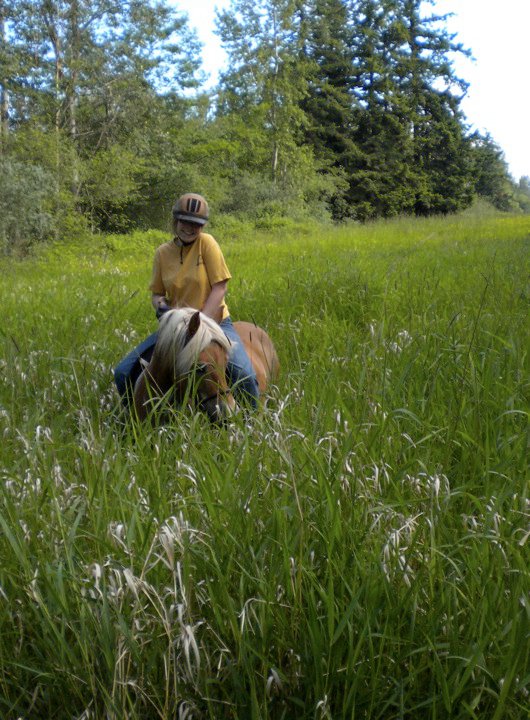
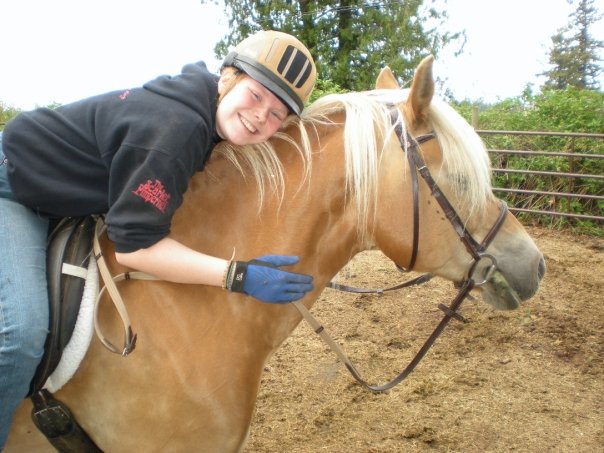
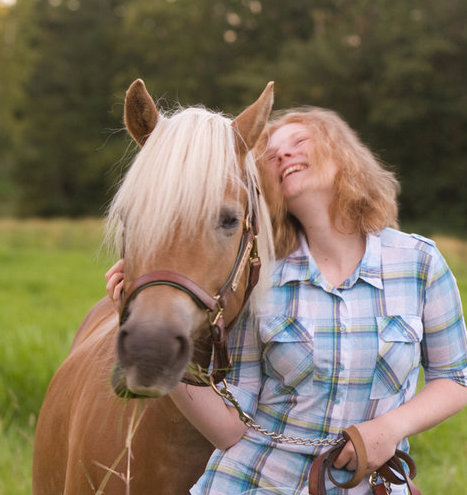
photos by Emily Vander Haak
I’m well along on this journey, yet still feeling tethered to the starting gate. I’m testing how far the residual connection to beginning will stretch; there is still a strong tug to return back to how things were, like a bungee cord at the limits of its capacity.
Yet there is also an inexorable pull to destinations ahead. I know what once was a vital conduit to the past is withering with age, so I must move forward, unsure what is around the bend.
It can be turbulent out there without former ties and tethers as anchors in the storm. It is possible I will lose my balance, stumble and fall and end up limping the rest of the way.
When I hear the call of a new year, I know it is time to simply face the wind and surge ahead to what is coming next, no matter what it may be. I can choose to struggle along, worried and anxious about the unknown, or I can leap ahead at a skip and jump, jubilant, eager, ready, feeling nearly weightless in my anticipation of a joyful finish line.
















 Barnstorming