We Are No Longer Alone: Accepting the Gift of Grace

I finally have faith that no matter what happens to me, I will never be beyond help, because I have seen parents, friends and acquaintances live with catastrophe and illness. They were beautifully cared for by those who most loved them.

Twenty-nine years in a tiny church has proved to me that when two or more are gathered who believe in Goodness, they will take care of those in their community who are suffering, scared, lonely. So what are my closest people going to do when my time comes? They will help me come through to whatever awaits. I’ve learned that we can bank on this. Graciousness almost always bats last.
~Anne Lamott from “Have a Little Faith” from Small Victories: Spotting Improbable Moments of Grace.

photo by Barb Hoelle

…when I experienced the warm, unpretentious reception of those who have nothing to boast about, and experienced a loving embrace from people who didn’t ask any questions, I began to discover that a true spiritual homecoming means a return to the poor in spirit to whom the kingdom of heaven belongs.
~Henri Nouwen from The Return of the Prodigal Son

I urge you to live a life worthy of the calling you have received. Be completely humble and gentle; be patient, bearing with one another in love. Make every effort to keep the unity of the Spirit through the bond of peace. There is one body and one Spirit, just as you were called to one hope when you were called; one Lord, one faith, one baptism; one God and Father of all, who is over all and through all and in all. But to each one of us grace has been given as Christ apportioned it.
Ephesians 4:1-7

The Wiser Lake Chapel sanctuary was a warm and open space with a high lofted ceiling, dark wood trim accents matching the ancient pews, and a plain wooden cross above the pulpit in front. There was a pungent smell from fir bough garlands strung along high wainscoting, and a circle of candles standing lit on a small altar table. Apple pie was baking in the kitchen oven, blending with the aroma of good coffee and hot cocoa.

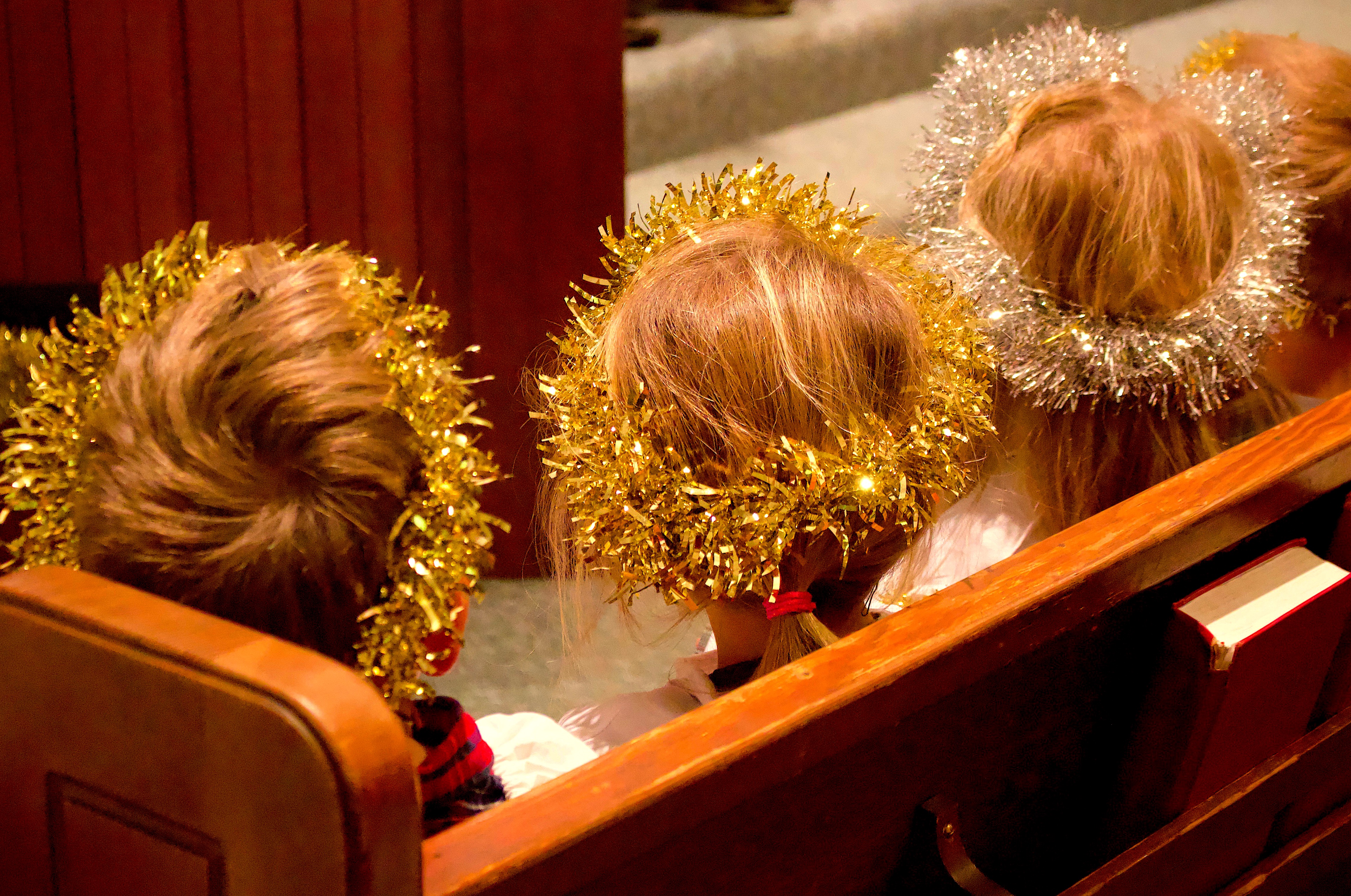
The service was a Sunday School Christmas program, with thirty some children of all ages and skin colors standing up front in bathrobes and white sheet angel gowns, wearing gold foil halos, tinfoil crowns and dish towels wrapped with string around their heads. They were prompted by their teachers through carols and readings of the Christmas story. The final song was Silent Night, sung by candle light, with each child and member of the congregation holding a lit candle. The evening ended in darkness, with the soft glow of candlelight illuminating faces of the young and old, some in tears streaming over their smiles.

It felt like home. We had found our church. We’ve never left. Over three decades it has had peeling paint and missing shingles, a basement that sometimes floods when the rain comes down hard, toilets that don’t always flush well, and though it smells heavenly on potluck days, there are times when it can be just a bit out of sorts and musty.

It also has a warmth and character and uniqueness that is unforgettable.

Like our pastors over the decades – Bruce Hemple, Stephen Tamminga, Albert Hitchcock and now Nathan Chambers – our chapel is humble and unpretentious yet envelops its people in a loving embrace of God’s Word, with warmth, character, grace and a uniqueness that is unforgettable.

That describes all the flawed folks
who have gathered there over the years,
once lost but now found.

We know we belong,
such as we are,
just as we are,
gifted with grace by a God
we worship together in this place.

Perhaps you belong at this old church too…

AI image created for this post

This year’s Advent theme is from Dietrich Bonhoeffer’s sermon on the First Sunday in Advent, December 2, 1928:

The celebration of Advent is possible only to those who are troubled in soul, who know themselves to be poor and imperfect, and who look forward to something greater to come. For these, it is enough to wait in humble fear until the Holy One himself comes down to us, God in the child in the manager.

God comes.

He is, and always will be now, with us in our sin, in our suffering, and at our death. We are no longer alone. God is with us and we are no longer homeless.
~Dietrich Bonhoeffer – from Christmas Sermons

Emptying Like a Cloud

God empties himself
into the earth like a cloud.
God takes the substance, contours
of a man, and keeps them,
dying, rising, walking,
and still walking
wherever there is motion.
Annie Dillard from “Feast Days” in Tickets for a Prayer Wheel

Soon we will enter the season of Advent, an opportunity to reflect on a God who “takes the substance, contours of a man”, as He “empties himself into the earth like a cloud.” 

Like drought-stricken parched ground, we prepare to respond to the drenching of the Spirit through the Son, and be ready to spring up with renewed growth.

He walked among us before His dying and subsequent rising up.
He walked among us again, appearing where least expected,
sharing a meal, causing our hearts to burn within us,
inviting us to touch and know Him.

His invitation remains open-ended,
His heart preparing us for our eternal home.

I think of that every time the clouds gather, open up, and empty.  
He freely falls to earth, soaking us completely,
through and through and through.

AI image created for this post

A Slow and Radiant Happening

In heaven it is always autumn. The leaves are always near
to falling there but never fall, and pairs of souls out walking
heaven’s paths no longer feel the weight of years upon them.
Safe in heaven’s calm, they take each other’s arm,
the light shining through them, all joy and terror gone.
But we are far from heaven here, in a garden ragged and unkept
as Eden would be with the walls knocked down, the paths littered
with the unswept leaves of many years, bright keepsakes
for children of the Fall. The light is gold, the sun pulling
the long shadow soul out of each thing, disclosing an outcome.
The last roses of the year nod their frail heads,
like listeners listening to all that’s said, to ask,
What brought us here? What seed? What rain? What light?
What forced us upward through dark earth? What made us bloom?
What wind shall take us soon, sweeping the garden bare?

Their voiceless voices hang there, as ours might,
if we were roses, too. Their beds are blanketed with leaves,
tended by an absent gardener whose life is elsewhere.
It is the last of many last days. Is it enough?
To rest in this moment? To turn our faces to the sun?
To watch the lineaments of a world passing?
To feel the metal of a black iron chair, cool and eternal,
press against our skin? To apprehend a chill as clouds
pass overhead, turning us to shivering shade and shadow?
And then to be restored, small miracle, the sun shining brightly
as before? We go on, you leading the way, a figure
leaning on a cane that leaves its mark on the earth.
My friend, you have led me farther than I have ever been.
To a garden in autumn. To a heaven of impermanence
where the final falling off is slow, a slow and radiant happening.
The light is gold. And while we’re here, I think it must
    be heaven.
~Elizabeth Spires from “In Heaven it is Always Autumn”
from Now the Green Blade Rises

The Bench by Manet

We wander our autumn garden mystified at the passing of the weeks since seed was first sown, weeds pulled, peapods picked. It could not possibly be done so soon–this patch of productivity and beauty, now wilted and brown, vines crushed to the ground, no longer fruitful.

The root cellar is filling up, the freezer packed. The work of putting away is almost done.

So why do I go back to the now barren soil my husband so carefully worked, numb in the knowledge I will pick no more this season, feel the burst of a cherry tomato exploding in my mouth or the green freshness of a bean straight off the vine?

Because for a few fertile weeks, only a few weeks, the garden was a bit of heaven on earth, impermanent but a real taste nonetheless. 

We may have mistaken Him for the gardener when He appeared to us radiant, suddenly unfamiliar. He offered the care of the garden, to bring in the sheaves, to share the forever mercies in the form of daily bread grown right here and now.

When He says my name, I will know Him. 

And the light is golden.

What If You Dreamed…

What if you slept
And what if
In your sleep
You dreamed
And what if
In your dream
You went to heaven
And there plucked a strange and beautiful flower
And what if
When you awoke
You had that flower in your hand
Ah, what then?
~Samuel Coleridge  “What if you slept”

What do our dreams tell us of heaven?

Perhaps our dreams are lush with exotic flowers
never imagined growing in earthly soil.

We hold tightly to a vision
of divinely strange and beautiful,
to remind us of heaven in our waking hours.

My dream of heaven blooms plain and simple,
strangely beautiful in its familiarity,
held firmly in my hand each day.

The dreams welcome me home, asleep or awake.

Ah, what then?
What if heaven is the divine brought home in our hand?

Let the Years Be Kind

Just down the road… around the bend,
Stands an old empty barn; nearing the end.
It has sheltered no animals for many years;
No dairy cows, no horses, no sheep, no steers.
The neigh of a horse; the low of a cow;
Those sounds have been absent for some time now.
There was a time when the loft was full of hay,
And the resounding echoes of children at play.
At one time the paint was a bold shade of red;
Gradually faded by weather and the sun overhead.
The doors swing in the wind… the hinges are loose,
Windows and siding have taken a lot of abuse.
The fork, rope and pulleys lifted hay to the mow,
A task that always brought sweat to the brow.
But those good days are gone; forever it seems,
And that old barn now stands with sagging beams.
It is now home to pigeons, rats and mice;

The interior is tattered and doesn’t look very nice.
Old, abandoned barns have become a trend,
Just down the road… around the bend.

~Vance Oliphant “Old Barn”

We will call this place our home
The dirt in which our roots may grow
Though the storms will push and pull
We will call this place our home

We’ll tell our stories on these walls
Every year, measure how tall
And just like a work of art
We’ll tell our stories on these walls

Let the years we’re here be kind, be kind
Let our hearts, like doors, open wide, open wide
Settle our bones like wood over time, over time
Give us bread, give us salt, give us wine

A little broken, a little new
We are the impact and the glue
Capable more than we know
To call this fixer upper home

With each year, our color fades
Slowly, our paint chips away
But we will find the strength
And the nerve it takes
To repaint and repaint and repaint every day

Let the years we’re here be kind, be kind
Let our hearts, like doors, open wide, open wide
Settle our bones like wood over time, over time

Give us bread, give us salt, give us wine
Let the years we’re here be kind, be kind
Let our hearts, like doors, open wide, open wide
Settle our bones like wood over time, over time

Give us bread, give us salt, give us wine

Smaller than dust on this map
Lies the greatest thing we have
The dirt in which our roots may grow
And the right to call it home

~Ryan O’Neal “North” (listen to the choral versions below)

Each of us needs a home.
Every creature needs a place to put down roots and rest their head.

Yet, due to ravages of time,
a poverty of spirit and strength,
discouragement and discord,
natural disasters and drought,
or the devastation of politics and war —
too many find themselves chipped away until nothing is left.

It is time for restoration. It is time for renewal.

It is time for kindness:
the broken repaired,
the lonely made welcome,
the hungry fed.

Somehow, someway, we rebuild, repaint and restore
so all put down roots and thrive
and are welcomed home.

AI image created for this post

It’ll Be Someone Else

Here’s the orchard someone else will tend to.
And the crawl space beneath the porch

of the house where someone else’s barn cat
will slumber through the summer nights
dreaming of long-tailed mice in the high grass.
Over that field, the light dips and refracts
through the broken glass of the muck pond
where a catfish will take someone else’s bait
and hook—that it might meet the refined
heat of a skillet. The ghosts of a thousand
head of cattle walk through the woods at night
in someone else’s dream while the windows,
cracked slightly, let a mild breeze pass
through the empty rooms like an appraiser.
There is no death that cannot be undone
by simply turning the compost with a pitchfork
or by scattering scratch in the dirt for chickens
who sing each time they lay, but every repair
is only a gesture against the torment of slow
winds and steady rain and heavy sun. It will be
someone else who grows too old to climb
the ladder into the barn’s cool loft or the flight
of stairs that lead to and from their own bed.
It will be their hand weighing the mortgage.
It will be their face forgetting its smile. Listen,
if the well pump kicks to life at dawn, it will be
someone else drawing a bath for the last time—
joints relaxing as their form submerges, body
recovering and failing in the same held breath.
~Travis Mossotti “Missing the Farm”
from Apocryphal Genesis

Well-away and be it so,
To the stranger let them go.
Even cheerfully I yield
Pasture, orchard, mowing-field,
Yea and wish him all the gain
I required of them in vain.
Yea and I can yield him house,
Barn, and shed, with rat and mouse
To dispute possession of.
These I can unlearn to love.
Since I cannot help it? Good!
Only be it understood,

It shall be no trespassing
If I come again some spring
In the grey disguise of years,
Seeking ache of memory here.
~Robert Frost from “On the Sale of My Farm”

Someday – we fervently hope not anytime soon – someone else will be living here and managing this farm, not us.

This land, originally all forested, provided game and native berries for the inland coastal tribes who lived here. When white settlers arrived and homesteading began, it was clearcut and the land became grazing pastures for livestock. Orchard trees were planted and crops produced and sold in nearby towns. Hundreds of similar small dairy farms in this county managed to feed their families and neighbors for nearly a century.

We purchased this land from the Lawrence family after they had farmed here over 80 years and they were so sad to leave. We are now in our 34th year here. We want to stay for another decade but we’re aging and our physical limitations are becoming increasingly apparent.

On a recent hot summer evening, my husband piled a wagon high with hay bales for the winter, with the help of the sons of the teenagers who helped us buck bales a generation ago. It won’t be too many years before someone else, not us, will be putting hay in the barn.

This land is where we feel we belong, just as those others who lived here were attached to this ground – but for how long? Will our non-farming offspring feel the pull to return home back to the farm?

We don’t know what the future may hold. What we do know: there is no such beauty as this land where we have worked and loved.

Yes, we feel we belong here.

For now. Until then.

AI image created for this post

Tell me, where is the road
I can call my own
That I left, that I lost
So long ago?
All these years I have wandered
Oh, when will I know
There’s a way, there’s a road
That will lead me home

After wind, after rain
When the dark is done
As I wake from a dream
In the gold of day
Through the air there’s a calling
From far away
There’s a voice I can hear
That will lead me home

Rise up, follow me
Come away, is the call
With the love in your heart
As the only song
There is no such beauty
As where you belong
Rise up, follow me
I will lead you home
~Michael Dennis Browne

Going Back and Forth

We were very tired, we were very merry —
We had gone back and forth all night on the ferry.
It was bare and bright, and smelled like a stable —
But we looked into a fire, we leaned across a table,
We lay on a hill-top underneath the moon;
And the whistles kept blowing, and the dawn came soon.

We were very tired, we were very merry —
We had gone back and forth all night on the ferry;
And you ate an apple, and I ate a pear,
From a dozen of each we had bought somewhere;
And the sky went wan, and the wind came cold,
And the sun rose dripping, a bucketful of gold.

We were very tired, we were very merry,
We had gone back and forth all night on the ferry.
We hailed, “Good morrow, mother!” to a shawl-covered head,
And bought a morning paper, which neither of us read;
And she wept, “God bless you!” for the apples and pears,
And we gave her all our money but our subway fares.

~Edna St. Vincent Millay “Recuerdo”

Over my eight decades, I’ve taken many ferry rides between the islands and mainland in the local Salish Sea, sailed through the inland passage from Vancouver Island almost to Alaska, taken a multi-level behemoth between Ireland and Scotland, and overnighted in a bunk bed on a Lake Victoria steamship between Kenya and Tanzania.

Each ride might have been an exotic adventure, wonderfully escapist. Yet the point was always the destination. I needed to get there from here or return from there to here, rather than simply enjoying the back and forth.

I’ve been incapable of being carefree and merry, full of impulse and joy, especially when it costs me a night’s sleep.

Have I ever done anything just for the heck of it?

It’s true. Being born a stick-in-the-mud, a drudge, an “old soul” and a grind is a heavy burden to live with for seventy years.

Perhaps I’m overdue for simply cherishing the voyage without worrying about the details of how I’m getting there or whether it will be on time.

I’m not only thriving on the sweet nectar of apples and pears growing in our orchard, but must share what I don’t use with someone who needs it more than I do.

Then, at some point, having been back and forth and forth and back, I’ll be ready to head home, tired yet carefree and merry and sated, infinitely blissed and eternally blessed.

AI image created for this post

Leading the Lost Home

I appear at the kitchen door,
spiritual equivalent
of a wet dog from a storm,
tail tucked, trembling.
You open your lives, this life,
provide prayerful provision,
a vigorous toweling down,
a large bowl of kibbles.
I curl up and sleep safe on the rug by your heart,
the chapel that warms His,
and so, restored, return
to the weary world rejoicing,
perhaps to provide
a bracing swig from the fiery word,
perhaps to lead a lost one home.
~Bonnie Thurston “Strays” from O Taste and See

How many times have I shown up
muddy, cold, hungry
and you invited me in,
dried me off,
offered me your supper,
let me sleep warm and safe?

How many times
did I go back out into the world
with every good intention
of doing the same for other strays
and yet get lost again myself?

You call me back,
whistle me in,
open the door
to let me know
no matter how much of a mess I’m in
your hearth,
your heart
await my return.

AI image created for this post

Daisy Morning Music

See, the grass is full of stars,
Fallen in their brightness;
Hearts they have of shining gold,
Rays of shining whiteness.

Buttercups have honeyed hearts,
Bees they love the clover,
But I love the daisies’ dance
All the meadow over.

Blow, O blow, you happy winds,
Singing summer’s praises,
Up the field and down the field
A-dancing with the daisies.
~Marjorie Pickthall “Daisy Time”

I still can’t say what life is for, but it can’t be to pretend
     that every part of it is knowable, or that what appears to be
to the naked eye or in the middle ground or documented on paper
     approximates a person any better than a daisy does our sun.

When at a loss for what I am, I know I must be feeling it
     deep in the layers, where a turbulence gives rise to clouds
so massive they collapse in a bliss of gravity, condensing into this
      music I can daisy into morning as it daisies me into morning.

~Timothy Donnelly from “Habitable Nebula”

It is possible, I suppose that sometime
we will learn everything
there is to learn: what the world is, for example,
and what it means. I think this as I am crossing
from one field to another…

At my feet the white-petalled daisies display
the small suns of their center piece, their – if you don’t
mind my saying so – their hearts. Of course
I could be wrong, perhaps their hearts are pale and
narrow and hidden in the roots. What do I know?


But this: it is heaven itself to take what is given,
to see what is plain; what the sun lights up willingly;
for example – I think this
as I reach down, not to pick but merely to touch –
the suitability of the field for the daisies, and the
daisies for the field.

~Mary Oliver from “Daisies”

I realize I can’t understand what all this world means.

No, I will remain in the dark until I cross from this daisy-strewn field to the next. I have to wait for heaven itself to see why we are illuminated by the Sun.

It is all cloud-covered mystery in the meantime, and sometimes a mean and joyless mystery – with pain and heartbreak and suffering, but just enough loving sacrifice to make it worthwhile.

How are we different from that stone, or that tree or that daisy?

We are breathed on.

God’s breath surges within us, as we laugh out loud, weep mightily and sing out His Words – struggling to be suitable for this field of stars, so often trampled and broken, but with plans to flourish under the illuminating stars created by the Son of heaven.

Roads Go Ever Ever On

Roads go ever ever on,
Over rock and under tree,
By caves where never sun has shone,
By streams that never find the sea;
Over snow by winter sown,
And through the merry flowers of June,
Over grass and over stone,
And under mountains in the moon.

Roads go ever ever on,
Under cloud and under star.
Yet feet that wandering have gone
Turn at last to home afar.
Eyes that fire and sword have seen,
And horror in the halls of stone
Look at last on meadows green,
And trees and hills they long have known.

The Road goes ever on and on
Down from the door where it began.
Now far ahead the Road has gone,
And I must follow, if I can,
Pursuing it with weary feet,
Until it joins some larger way,
Where many paths and errands meet.
And whither then? I cannot say.

The Road goes ever on and on
Out from the door where it began.
Now far ahead the Road has gone.
Let others follow, if they can!
Let them a journey new begin.
But I at last with weary feet
Will turn towards the lighted inn,
My evening-rest and sleep to meet.

Still ’round the corner there may wait
A new road or secret gate;
And though I oft have passed them by,
A day will come at last when I
Shall take the hidden paths that run
West of the Moon, East of the Sun.
~J.R.R. Tolkien “Bilbo’s Walking Song”

It’s a dangerous business, Frodo, going out of your door. You step into the Road, and if you don’t keep your feet, there is no knowing where you might be swept off too.
~J.R.R. Tolkien – Bilbo to Frodo in Fellowship of the Rings


I love these roads in June, at dawn or dusk,
the light and shadow playing over the path,
promising summer songs and simple joys.

When I walk these roads,
I try to avoid the deep ditches,
the potholes and speed bumps.

It’s a dangerous business,
walking out the front door,
not knowing where I may be swept off to.

Passing by secret gates and overgrown paths,
I take the familiar route that leads me home,
waiting for a Guide so I don’t lose my way.

AI image created for this post