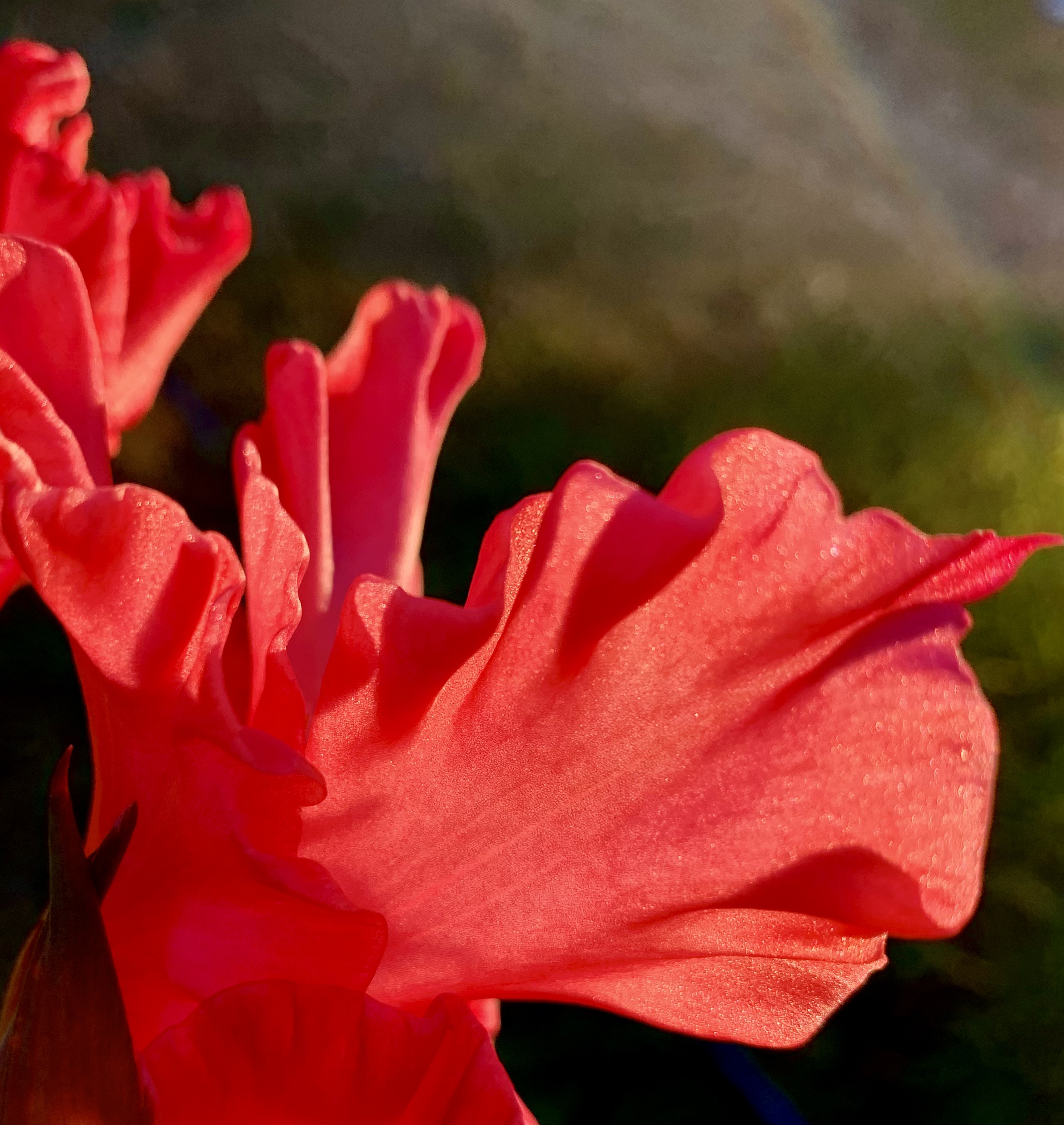
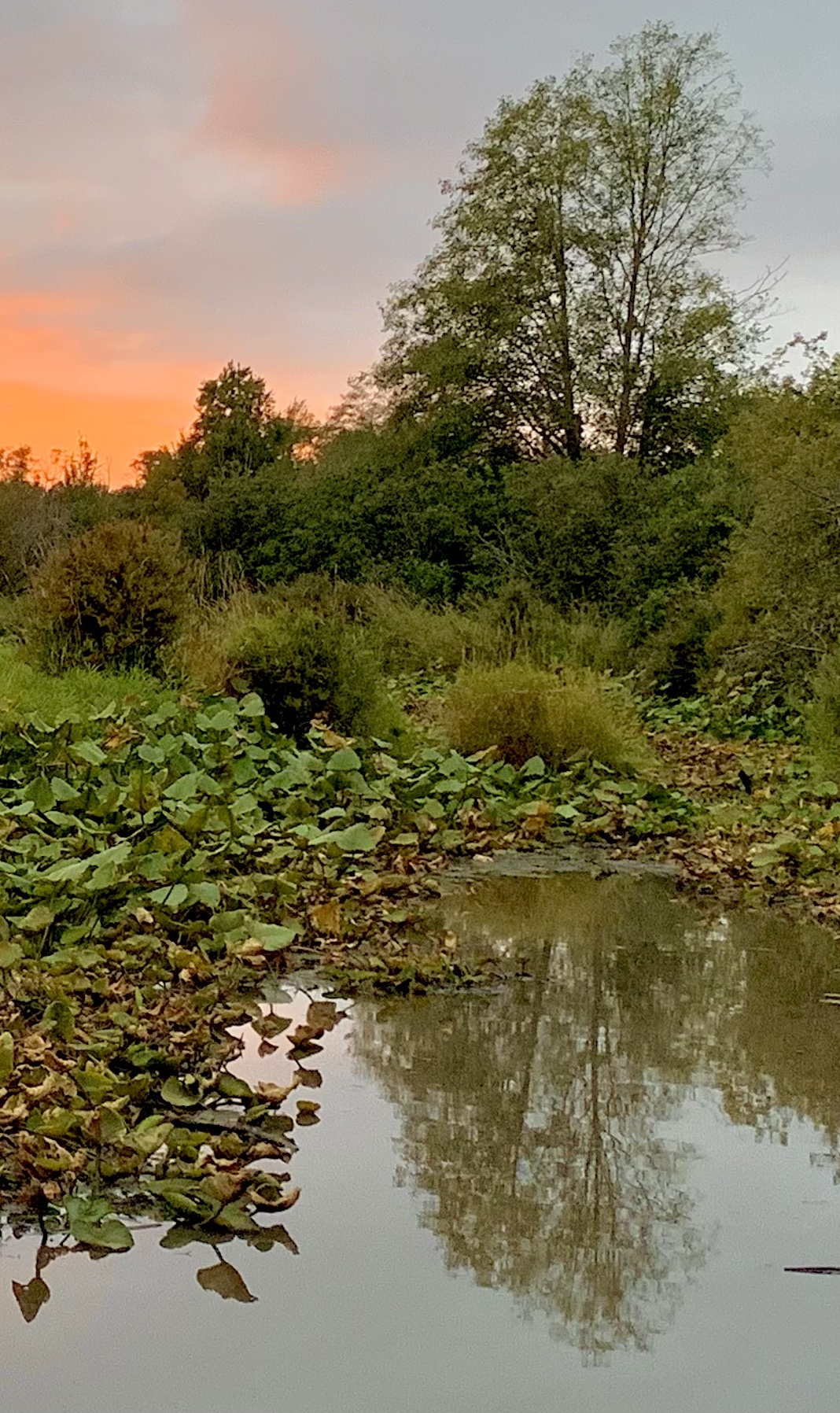
In the evening there were flocks of nighthawks passing southward over the valley. The tall sunflowers stood, burning on their stalks to cold seed, by the still river. And high up the birds rose into sight against the darkening clouds. They tossed themselves among the fading landscapes of the sky like rags, as in abandonment to the summons their blood knew. And in my mind, where had stood a garden straining to the light, there grew an acceptance of decline. Having worked, I would sleep, my leaves all dissolved in flight. ~Wendell Berry “September 2”
And when I rise, let me rise Like a bird, joyfully. And when I fall, let me fall, Like a leaf, gracefully, without regret. And when I stand, let me stand, Like a tree, strong and tall. And when I lie, let me lie, Like a lake, peacefully, calm and still. And when I work, let me work, Like a bee, wholeheartedly. And when I play, let me play, Like a breeze, fresh and cool, light and clear. ~adapted from Wendell Berry’s “When I Rise” in The Mad Farmer Poems
The thistles, rooted out, throng in again; The single regal rose is mobbed by weeds; The plums, the pears, the ripening apples, rain In the sun; and past summer plants new seeds.
Here, or there, these common yearly things Repeat, repeat, and gardens do not range: Yet thistles, roses, fruit trees, birds, and stings Come to an end, and the church bells sound a change.
These many soft declensions of the day, So hard to take to heart, bear life away. ~Dunstan Thompson from “Passage”from Here At Last Is Love
This end-of-summer winding down, a descent into shorter days and longer nights, this preparation for autumn austerity, reminds me to accept my own slow decline ~ an emptying husk once so full of fruit and seed, now clinging to what is left of me ~ still filled with the joys, the tears, the eyes of a brimming-over heart.
One-Time
Monthly
Yearly
Make a one-time or recurring donation to support daily Barnstorming posts
In gratitude to the writing and wisdom of farmer Wendell Berry who, at age 92, passed through his porch’s dark doorway yesterday 8/31/26
All day he’s shoveled green pine sawdust out of the trailer truck into the chute. From time to time he’s clambered down to even the pile. Now his hair is frosted with sawdust. Little rivers of sawdust pour out of his boots.
I hope in the afterlife there’s none of this stuff he says, while I broom off his jeans, his sweater flocked with granules, his immersed-in-sawdust socks. I hope there’s no bedding, no stalls, no barn
no more repairs to the paddock gate the horses burst through when snow avalanches off the roof. Although the old broodmare, our first foal, is his, horses, he’s fond of saying, make divorces.
…he says let’s walk up to the field and catch the sunset and off we go, a couple of aging fools.
I hope, he says, on the other side there’s a lot less work, but just in case I’m bringing tools. ~Maxine Kumin from “Chores”
photo by Emily Vander Haak
They sit together on the porch, the dark Almost fallen, the house behind them dark. Their supper done with, they have washed and dried The dishes–only two plates now, two glasses, Two knives, two forks, two spoons–small work for two. She sits with her hands folded in her lap, At rest. He smokes his pipe. They do not speak, And when they speak at last it is to say What each one knows the other knows. They have One mind between them, now, that finally For all its knowing will not exactly know Which one goes first through the dark doorway, bidding Goodnight, and which sits on a while alone. ~Wendell Berry “They Sit Together on the Porch”
If just for a moment, when this world is tilting so far we just might fall off, we pause to look at where we’ve been and get our feet back under us.
The porch is a good place to start: a bridge to what is beyond without leaving the familiar.
Outside, looking square at the unknown, yet still hearing and smelling and tasting the affection that dwells just inside these walls.
What could we want more than to be missed when we step away?
Our voice, our words, our heart, our touch never to be replaced, its absence a hole impossible to fill…
When we are called back inside where Love made us who we are, may the “in between” of time spent on the porch, be even more treasured, because two aging fools sat together there a spell.
front porch
One-Time
Monthly
Yearly
Make a one-time or recurring donation to support daily Barnstorming posts
I go to nature not because its flowers and sunsets speak to me (though they do) or listen to me inquire but because I have filled it with unintentionality, so that I can miss anything personal in the roar of sunset, so that I can in beds of flowers hold my head up too. ~A.R. Ammons from The Ridge Farm from Complete Poems
Take the tangle instead of the trouble it causes. Take the world inside as seriously as any other. Take your elderly mother and father at face value as they have to. Take the mirror of the sky mirrored in the bay. Take the swell of new-mown hay and the river conversing where the valley opens its mouth and the land begins to creak less as the evening steals light away— Take the wick in the far hills and take the sun and the wind and the look of nothing for granted. Take a little less, all right and try not to take fright. Take the end in mind instead of the end in sight. ~Brian Turner “Take This” from Taking Off
God speaks to each of us as he makes us, then walks with us silently out of the night.
These are the words we dimly hear:
You, sent out beyond your recall, go to the limits of your longing. Embody me.
Flare up like a flame and make big shadows I can move in.
Let everything happen to you: beauty and terror. Just keep going. No feeling is final. Don’t let yourself lose me.
Nearby is the country they call life. You will know it by its seriousness.
Each of us, intentionally made by our Creator in His image, yet we discover the beauty and terror of living in His shadow.
So much happens which we don’t intend but there is nothing unintentional with God.
Books and lectures tell us to live intentionally while each day contains something that brings us to our knees.
I tell myself: even though I don’t know what tomorrow will be, I will not take fright Like a flower, I’ll hold my head up I’ll just keep going while taking His Hand and following wherever He intends to take me.
One-Time
Monthly
Yearly
Make a one-time or recurring donation to support daily Barnstorming posts
And when he got into the boat, his disciples followed him. A gale arose on the lake, so great that the boat was being swamped by the waves; but he was asleep. And they went and woke him up, saying, ‘Lord, save us! We are perishing!’
And he said to them, ‘Why are you afraid, you of little faith?’ Then he got up and rebuked the winds and the sea; and there was a dead calm.
They were amazed, saying, ‘What sort of man is this, that even the winds and the sea obey him?’ Matthew 8:23-27
Sweet Jesus, talking his melancholy madness, stood up in the boat and the sea lay down,
silky and sorry. So everybody was saved that night… Nobody knows what the soul is.
It comes and goes like the wind over the water — sometimes, for days, you don’t think of it.
Maybe, after the sermon, after the multitude was fed, one or two of them felt the soul slip forth
like a tremor of pure sunlight before exhaustion, that wants to swallow everything, gripped their bones and left them
miserable and sleepy, as they are now, forgetting how the wind tore at the sails before he rose and talked to it —
tender and luminous and demanding as he always was — a thousand times more frightening than the killer storm. ~Mary Oliver from “Maybe”
We sleep through our diminishing days even more than we sleep through the nights, unfocused on each passing moment which never is to come again.
Those moments crash to shore, then pull back to be lost forever.
There is a blindness in us all about what is inevitably coming, how we tumble through the years like waves, overcome by their passage, helpless to stop them.
Yet He is tender and luminous and demanding He speaks to us with the same words as He addresses the relentless stormy destructive sea.
Peace be still!
And so we obey in our helplessness, forgiven, saved by grace, so silky and sorry.
One-Time
Monthly
Yearly
Make a one-time or recurring donation to support daily Barnstorming posts
The Old Church leans nearby a well worn road upon a hill that has no grass or tree The winds from off the prairie now unload the dust they bring around it fitfully The path that leads up to the open door is worn and grayed by many toiling feet of us who listen to the Bible lore and once again the old time hymns repeat. And every Sabbath Morning we are still returning to the altar standing there; a hush, a prayer, a pause, and voices fill the Master’s House with a triumphant air. The old church leans awry and looks quite odd, But it is beautiful to us, and God. ~Della Vik“The Old Church” (adapted in song by Stephen Paulus, linked below
photo by Barb Hoelle
…when I experienced the warm, unpretentious reception of those who have nothing to boast about, and experienced a loving embrace from people who didn’t ask any questions, I began to discover that a true spiritual homecoming means a return to the poor in spirit to whom the kingdom of heaven belongs. ~Henri Nouwen from The Return of the Prodigal Son
Today is the 110th anniversary of Wiser Lake Chapel‘s building dedication ceremony and picnic.
Back in the early days of Whatcom County, the little church on Wiser Lake had been constructed through “contributions of the people” in a rural neighborhood only a few miles from where we now live. $600 in lumber was provided by a local farmer whose trees were cut and milled and brought by horse drawn wagon to a building site adjacent to a one room school house along a corrugated plank road. The total property was “valued at $1800, but of even more value to the community.”
The dedication ceremony was held on Sunday, August 27, 1916 followed by “a basket dinner—come with well filled baskets for a common table, under the direction of the Ladies Aid”. This was to be followed by a “Fellowship Meeting, special music and fraternal addresses” and the day ended at 8 PM with a Young People’s Meeting.
So began the long history of the “Wiser Lake Church”.
For reasons unrecorded in the history of the church, the original denomination closed the doors thirty years later, and for a while the building was empty and in need of a congregation.
By the fifties, it became a mission church of the local Christian Reformed Churches and launched a Sunday School program for migrant farm and Native American children in the surrounding rural neighborhood. No formal church services started until the 60s. By the time the building was sixty years old, so many children were arriving for Sunday School, there was not enough room so the building was hoisted up on jacks to allow a hole to be dug underneath for a basement full of classrooms. Over the course of a summer, the floor space doubled, and the church settled back into place, allowed to rest again on its foundation.
Over seventy years after its dedication ceremony, our family drove past the boxy building countless times hurrying on our way to other places, barely giving it a second glance. It had a classic design, but showed its age with peeling paint, a few missing shingles, an old fashioned square flat roofed belfry, and arched windows. The hand lettered sign spelling out “Wiser Lake Chapel” by the road constituted a humble invitation of sorts, simply by listing the time of the service.
photo by Julie Garrettphoto by Julie Garrett
On a blustery December Sunday evening, we had no place else to be for a change. Instead of driving past, we stopped, welcomed by the yellow glow pouring from the windows and an almost full parking lot. Our young family climbed the steps to the big double doors, and inside were immediately greeted by a large balding man with a huge grin and encompassing handshake. He pointed us to one of the few open spots still available in the old wooden pews.
The sanctuary was a warm and open space with a high lofted ceiling, dark wood trim accents matching the ancient pews, and a plain wooden cross above the pulpit in front. There was a pungent smell from fir bough garlands strung along high wainscoting, and a circle of candles standing lit on a small altar table. Apple pie was baking in the kitchen oven, blending with the aroma of good coffee and hot cocoa.
The service was a Sunday School Christmas program, with thirty some children of all ages and skin colors standing up front in bathrobes and white sheet angel gowns, wearing gold foil halos, tinfoil crowns and dish towels wrapped with string around their heads. They were prompted by their teachers through carols and readings of the Christmas story. The final song was Silent Night, sung by candle light, with each child and member of the congregation holding a lit candle. There was a moment of excitement when one girl’s long hair briefly caught fire, but after that was extinguished by a quick-thinking mom in the pastor’s pulpit glass of water, the evening ended in darkness, with the soft glow of candlelight illuminating faces of the young and old, some in tears streaming over their smiles.
photo by Julie Garrett
It felt like home. We had found our church.
We’ve never left, now well into our fourth decade here.
Over the past one hundred years this old building has seen a few thousand people come and go, has had peeling paint and missing shingles, a basement that floods when the rain comes down hard, toilets that don’t always flush very well, and though it smells heavenly every Sunday potluck after evening worship and teaching, there are times when it can be just a bit out of sorts and musty. It really isn’t anything to boast about.
It is humble and unpretentious yet envelops its people in its loving and imperfect embrace, with warmth, character and a uniqueness that is unforgettable.
It really is not so different from the folks who have gathered there over the years.
Like our pastors over the decades – Bruce Hemple, Stephen Tamminga, Albert Hitchcock and now Nathan Chambers – our chapel is humble and unpretentious, enveloping its people in a loving embrace of God’s Word, with warmth, character, grace and a uniqueness that is unforgettable.
We know we belong, such as we are, just as we are, blessed by God in a wonderful old building to join together.
Then Jesus, deeply moved again, came to the tomb. It was a cave, and a stone lay against it.
Jesus said, “Take away the stone.”
Martha, the sister of the dead man, said to him, “Lord, by this time there will be an odor, for he has been dead four days.”
Jesus said to her, “Did I not tell you that if you believed you would see the glory of God?” So they took away the stone.
And Jesus lifted up his eyes and said, “Father, I thank you that you have heard me.I knew that you always hear me, but I said this on account of the people standing around, that they may believe that you sent me.”
When he had said these things, he cried out with a loud voice, “Lazarus, come out.”
The man who had died came out, his hands and feet bound with linen strips, and his face wrapped with a cloth.
Jesus said to them, “Unbind him, and let him go.” John 11:38-44
The man was wholly raised, but not wholly freed. See, here is a living man in the garments of death! That napkin and other grave-clothes were altogether congruous with death, but they were much out of place when Lazarus began again to live. It is a wretched sight to see a living man wearing his shroud.
If the Lord Jesus Christ employed the disciples in relieving Lazarus of his grave-clothes, do you not think he would employ us if we were ready for such work? Innumerable are the instances of souls blessed by human instrumentality… ~Charles Spurgeon from “Unbinding Lazarus”
When the Lord speaks, it will usually produce something that needs to be unwrapped. God’s words are powerful. They create, heal, and restore. They change things in both the visible and invisible realms.
…as we become committed to the discipline of unwrapping, like the bystanders Jesus invited into Lazarus’ miracle story, we’ll be better positioned to participate in the wondrous things Jesus is always doing in the lives of others and the world around us. ~Randy Boldt from “The Discipline of Unwrapping”
After one moment when I bowed my head And the whole world turned over and came upright, And I came out where the old road shone white. I walked the ways and heard what all men said, Forests of tongues, like autumn leaves unshed, Being not unlovable but strange and light; Old riddles and new creeds, not in despite But softly, as men smile about the dead
The sages have a hundred maps to give That trace their crawling cosmos like a tree, They rattle reason out through many a sieve That stores the sand and lets the gold go free: And all these things are less than dust to me Because my name is Lazarus and I live. ~Gilbert Chesterton “The Convert”
Love, take my hand and lead me like the blind, Unbandage me, unwrap me from my fear, Open my eyes, my heart, my soul, my mind. I struggle with these grave clothes, this dark earth, But you are calling ‘Lazarus come forth!’ ~Malcolm Guite from “He who has ears to hear let him hear’
The witnesses were marveling over the miracle of a living, breathing Lazarus, four days dead, stumbling out of the tomb, still wrapped in his graveclothes, in response to Jesus’ shout “Lazarus, come out.”
The next command, spoken to those standing there with their mouths agape, was just as consequential: “Unbind him, and let him go.”
Jesus’ message was clear. This miracle doesn’t end with a stilled heart beating again. It is an ongoing resurrected transformation for the witnesses as well.
What the Lord raises up, the community must unwrap, helping Lazarus move back into life, with support.
We are surrounded every day by those who, like Lazarus, are metaphorically walking in their graveclothes, spiritually dead or dying. They may be a family member or neighbor, they may be living unhoused in the woods down the road, they may be lying overdosed in a city alley. When called back to life, their next step can’t happen until they are unbound from the death-wraps that smother and blind them.
The rest is up to us, their community. Jesus, with only His words, gives new life to the dead. Jesus, with only His words, commands us to make it possible for the living to thrive, unshackled from paralyzing sin, and freed to new life.
I am reading slowly through the words in the Book of John over the next year alongside my church family. Once a week, I will invite you to “come and see” what those words might mean as we explore His promises together.
One-Time
Monthly
Yearly
Make a one-time or recurring donation to support daily Barnstorming posts
No longer do I cover tables filled with food and laughter My seams are frayed my hems falling my strength no longer able To hold the hot and cold
I wish for those first days When just woven I could keep water From seeping through Repelled stains with the tightness of my weave Dazzled the sunlight with my Reflection
I grow old though pleased with my memories The tasks I can no longer complete Are balanced by the love of the tasks gone past
I offer no apology only this plea:
When I am frayed and strained and drizzle at the end Please someone cut a square and put me in a quilt That I might keep some child warm
And some old person with no one else to talk to Will hear my whispers
“I make them warm to keep my family from freezing; I make them beautiful to keep my heart from breaking.” –From the journal of a prairie woman, 1870
To keep a husband and five children warm, she quilts them covers thick as drifts against the door. Through every fleshy square white threads needle their almost invisible tracks; her hours count each small suture that holds together the raw-cut, uncolored edges of her life. She pieces each one beautiful, and summer bright to thaw her frozen soul. Under her fingers the scraps grow to green birds and purple improbable leaves; deeper than calico, her mid-winter mind bursts into flowers. She watches them unfold between the double stars, the wedding rings. ~Luci Shaw “Quiltmaker”from Polishing the Petoskey Stone: New and Selected Poems.
Perhaps the world was made this way: piecemeal, the parts fitting together exactly as if made for one another~ the unique, disparate and separate coming together in a glorious harmony.
The point of its creation is forever functional and full of love – a blanket of warmth and security for generations to come.
Our legacy is to preserve this beauty arising from scraps, this broken stitched to broken in a tapestry holy and whole.
When I no longer have strength or the usefulness to perform my daily tasks, piece me up and sew me into a greater whole along with pieces of others who are fading.
We are so much better together, so much more colorful and bold, becoming art and function in our fraying state.
Full of warmth and comfort covering all who are sick and sleep and love and cuddle, and drift off to heaven as the last breath is breathed.
all quilts above are on display this week at the Northwest Washington Fair – to see previous year’s artwork: 2015, 2016, 2017, 2018, 2021, 2022, 2023 , 2024
One-Time
Monthly
Yearly
Make a one-time or recurring donation to support daily Barnstorming posts
Be patient toward all that is unsolved in your heart and try to love the questions themselves, like locked rooms and like books that are now written in a very foreign tongue.
Do not now seek the answers, which cannot be given you because you would not be able to live them. And the point is, to live everything.
Live the questions now. Perhaps you will then gradually, without noticing it, live along some distant day into the answer.
Be patient and without bitterness, and realize that the least we can do is to make coming into existence no more difficult for Him than the earth does for spring when it wants to come. ~Rainier Marie Rilkefrom Letters to a Young Poet
We feel the twinges of struggling to live broken in difficult times; indeed, all our days are difficult times.
We won’t get out of this predicament alive, yet we are loved.
Whether we care or not about what happens after our last breath does not alter the fact Christ dwells alongside us; our heavy heads bow as we turn to face the compelling Light.
Like Mary, we must say: “Let it be,” – not “no, not me, not now.”
We are transformed by accepting He has come on our behalf: an oh-so-difficult faith connecting us like a slender filament to heaven: like the bird greeting the morning with songs that weep, like the butterfly emerging from its cracked chrysalis to try its wings, like the cracked snail shell abandoned because we no longer fit inside its broken confinement.
One-Time
Monthly
Yearly
Make a one-time or recurring donation to support daily Barnstorming posts
Now when Jesus came, he found that Lazarus had already been in the tomb four days.Bethany was near Jerusalem, about two miles off, and many of the Jews had come to Martha and Mary to console them concerning their brother.
So when Martha heard that Jesus was coming, she went and met him, but Mary remained seated in the house. Martha said to Jesus, “Lord, if you had been here, my brother would not have died.But even now I know that whatever you ask from God, God will give you.”
Jesus said to her, “Your brother will rise again.”Martha said to him, “I know that he will rise again in the resurrection on the last day.”
Jesus said to her, “I am the resurrection and the life. Whoever believes in me, though he die, yet shall he live, and everyone who lives and believes in me shall never die. Do you believe this?”She said to him, “Yes, Lord; I believe that you are the Christ, the Son of God, who is coming into the world.”
When she had said this, she went and called her sister Mary, saying in private, “The Teacher is here and is calling for you.”And when she heard it, she rose quickly and went to him.Now Jesus had not yet come into the village, but was still in the place where Martha had met him.When the Jews who were with her in the house, consoling her, saw Mary rise quickly and go out, they followed her, supposing that she was going to the tomb to weep there.
Now when Mary came to where Jesus was and saw him, she fell at his feet, saying to him, “Lord, if you had been here, my brother would not have died.”When Jesus saw her weeping, and the Jews who had come with her also weeping, he was deeply moved in his spirit and greatly troubled.And he said, “Where have you laid him?”
They said to him, “Lord, come and see.”Jesus wept. So the Jews said, “See how he loved him!”But some of them said, “Could not he who opened the eyes of the blind man also have kept this man from dying?” John 11:17-37
Beauty, to the Japanese of old, held together the ephemeral with the sacred. Cherry blossoms are most beautiful as they fall, and that experience of appreciation lead the Japanese to consider their mortality. Hakanai bi (ephemeral beauty) denotes sadness, and yet in the awareness of the pathos of life, the Japanese found profound beauty.
For the Japanese, the sense of beauty is deeply tragic, tied to the inevitability of death.
Jesus’ tears were also ephemeral and beautiful. His tears remain with us as an enduring reminder of the Savior who weeps. Rather than to despair, though, Jesus’ tears lead the way to the greatest hope of the resurrection. Rather than suicide, Jesus’ tears lead to abundant life. ~Makoto Fujimura
When I read that Jesus weeps as He witnesses the tears of grief of His dear friends, I am comforted.
He understands and feels what we feel, His tears just as plentiful and salty, His feelings of love brimming so fully they must be let go and cannot be held back. He too is overwhelmed by the pathos of His vulnerable and visceral humanity.
Our Jesus who wept with us becomes a promise of ultimate joy.
There is beauty in His rain of ephemeral tears.
I am reading slowly through the words in the Book of John over the next year alongside my church family. Once a week, I will invite you to “come and see” what those words might mean as we explore His promises together.
One-Time
Monthly
Yearly
Make a one-time or recurring donation to support daily Barnstorming posts
This world, after all our science and sciences, is still a miracle; wonderful, inscrutable, magical, and more, to whosoever will think of it.
To awaken each morning with a smile brightening my face; to greet the day with reverence for the opportunities it contains; to approach my work with a clean mind; to hold ever before me, even in the doing of little things, the ultimate purpose toward which I am working; to meet men and women with laughter on my lips and love in my heart; to be gentle, kind, and courteous through all the hours; to approach the night with weariness that ever woos sleep and the joy that comes from work well done – this is how I desire to waste wisely my days. ~Thomas Dekker, 16th century British playwright
I work hard at wasting my days wisely.
Summers are a classic opportunity to waste time and I do – happily – yet there is always a hint of regret: I could have made more of a dewy bright morning, an afternoon of cooling shadows, or a full-moon twilight.
Or perhaps I could have made this day better for someone else to waste.
How better to waste my days: to find ways for my interactions to be more joyous, if only through a smile, a shared chuckle, a kind word, a generous gesture.
Waste away, dear days. What a wonderful world this could be.
The world, after all, is a miracle and needs us to notice.
One-Time
Monthly
Yearly
Make a one-time or recurring donation to support daily Barnstorming posts