There was an entire aspect to my life that I had been blind to — the small, good things that came in abundance. ~Mary Karr from The Art of Memoir
We can only be said to be alive in those moments when our hearts are conscious of our treasures. ~Thornton Wilder, quotes from “Our Town”
The words from “Our Town” written over 80 years ago still ring true: at that time our country was crushed under the Great Depression, and now out country is staggering under a Great Depression of the spirit~ despite more connected electronically, we are, due to politics and pandemic, more isolated from family, friends, faith.
Thought more economically secure, we are emotionally bankrupt.
May we always be conscious of our many treasures and abundance, while taking care of others in need.
God, in His everlasting recognition of our perpetual need of Him, cares for us, even while we turn our faces away from Him.
I search the soil of this life, this farm, this faith to find what yearns to grow, to bloom, to fruit, in order to be harvested to share with others.
My deep gratitude goes to you who visit here and to those who let me know the small and the good I share with you makes a difference in your day
I’m right alongside you in joint Thanksgiving to our Creator and Preserver.
After writing for a week alone in my old shack, I guide the car through Ortonville around midnight.
The policeman talks intently in his swivel chair. The light from above shines on his bald head.
Soon the car picks up speed again beside the quarries. The moonspot on the steel tracks moves so fast!
Thirty or so Black Angus hold down their earth Among silvery grasses blown back and forth in the wind.
My family is still away; no one is home. How sweet it is to come back to an empty house—
The windows dark, no lamps lit, trees still, The barn serious and mature in the moonlight. ~Robert Bly, “Living a Week Alone” from Like the New Moon, I Will Live My Life.
Being introverted, I would expect to enjoy time alone. But I don’t. A conversation with myself is uninspiring, leading me back into the inner circle of my thoughts when I would much rather explore the unknown of another’s view of the world. Alone, I feel exceptionally unexceptional and extraordinarily ordinary. Quite simply, without others around me, I’m empty.
At night, when I drive up to our farm and see both house and barn glowing with lights and life rather than still and dark, it is a warm blessing to return home. Someone left the lights on for me.
When I was a child, I had a powerful sense that I wanted to commemorate things. I even remember thinking at the time that it was a strange word for a twelve-year old to use.
… it is the idea that every life is sacred and that life is composed of details, of lost moments, of things that nobody cares about, including the people who are wounded or overjoyed by those moments. I don’t think people allow themselves to value their lives enough. They ignore and discard these fragments.
I would like my writing to be precise enough, detailed enough so that the attention I bring to bear on something unlocks a door to the reader’s life. In that way, by honoring one’s own life, it’s possible to extend empathy and compassion to others. ~Patricia Hampl – Alaska Quarterly Review, Fall and Winter 1995 (interview)
photo by Ben Gibson
I have been writing here nearly daily for over twelve years:
I have come to know so many of you who I will never meet face to face but who share with me: your love of beautiful words and pictures, your love of the land we all steward, your love of good stories and poetry, your love of your animal companions, your love of hanging on to lost moments, and most of all — your love of our resurrected Lord.
What do I seek to commemorate in my words and photos as I prepare this daily?
I know your light and love illuminates as it finds its way through the darkest and thorniest corners of my life: how precious is a kind word, a silent tear, a crooked smile, a whispered prayer.
What do I want you to experience having visited here?
I want you to remember there is warmth in these words and colors in these photos that don’t come close to what it is like for real, that lost moments will be found and cherished.
I want you to know that each morning, I send out this love to thousands I’ll never meet but feel I know, as you are nevertheless my Barnstorming brothers and sisters.
Carry me with you and pass the light forward. Keep lost moments in your pocket to pull out when needed. Open this door to others and welcome them in. You never know where it could take them.
A book of beauty in words and photos you can share with others, available to order here:
I sit beside the fire and think of all that I have seen, of meadow-flowers and butterflies in summers that have been; Of yellow leaves and gossamer in autumns that there were, with morning mist and silver sun and wind upon my hair. I sit beside the fire and think of how the world will be when winter comes without a spring that I shall ever see.
For still there are so many things that I have never seen: in every wood in every spring there is a different green. I sit beside the fire and think of people long ago, and people who will see a world that I shall never know. But all the while I sit and think of times there were before, I listen for returning feet and voices at the door. ~J.R.R. Tolkien “Bilbo’s Song” from The Lord of the Rings
The shortening days make me greedy for what is left of daylight – watching the sky change by the hour, brown summer fields greening from rain, webs clinging when I pass.
More than anything, I hunker down, waiting for winter, knowing the quiet nights by the fire will restore me – hoping I’ll hear visitors at the door, those I love coming home to spend what time is left.
A dichotomy of sweet peas and pumpkins in October
The perfect book for an autumn evening by the fire, available to order here:
The meaning of marriage begins in the giving of words. We cannot join ourselves to one another without giving our word. And this must be an unconditional giving, for in joining ourselves to one another we join ourselves to the unknown. ~Wendell Berry from “Poetry and Marriage” in Standing By Words
Our vows to one another forty years ago today:
Before God and this gathering, I vow from my heart and spirit that I will be your wife/husband for as long as we both shall live.
I will love you with faithfulness, knowing its importance in sustaining us through good times and bad.
I will love you with respect, serving your greatest good and supporting your continued growth.
I will love you with compassion, knowing the strength and power of forgiveness.
I will love you with hope, remembering our shared belief in the grace of God and His guidance of our marriage.
“And at home, by the fire, whenever you look up, there I shall be–and whenever I look up, there will be you.”
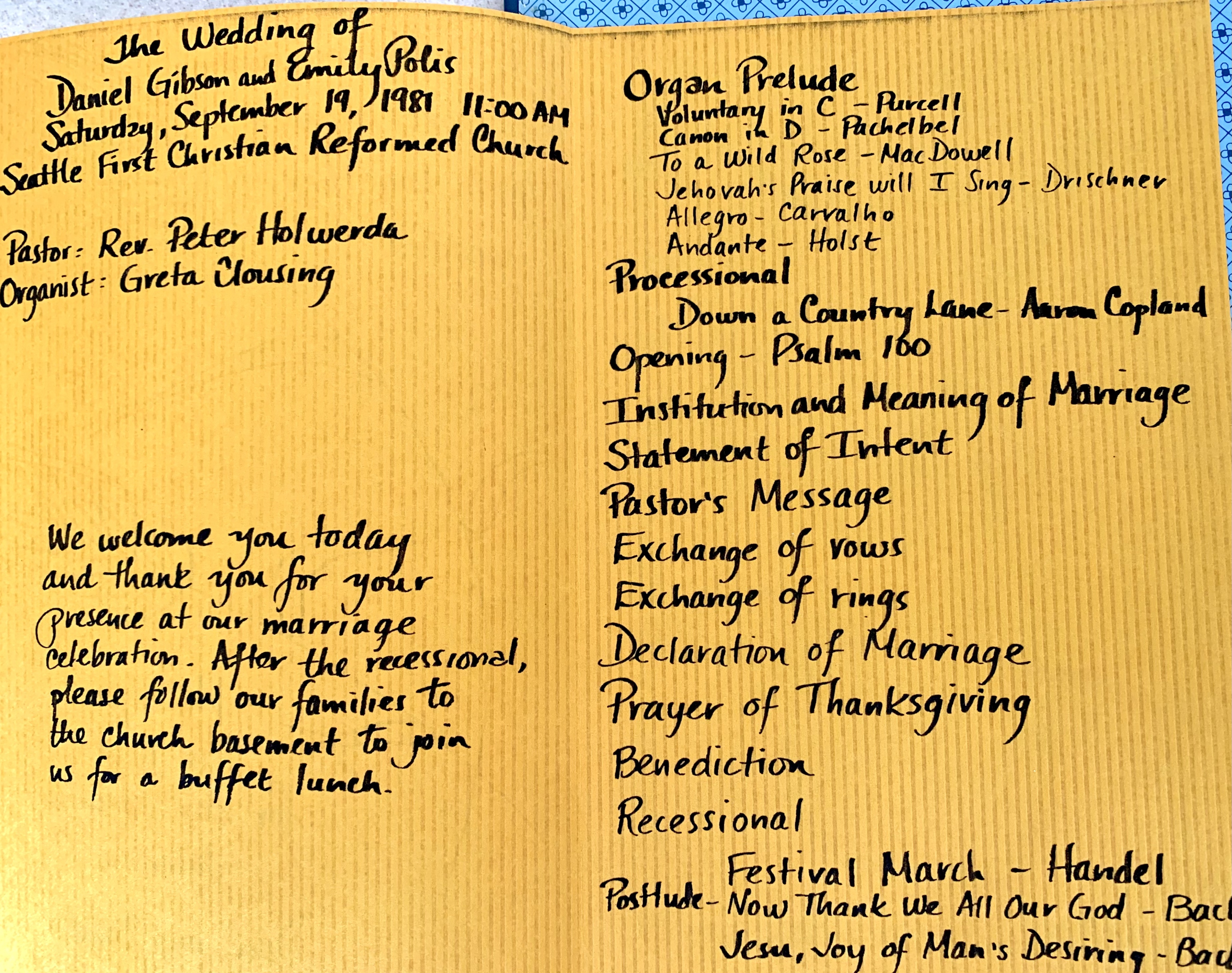
(our wedding vows for our September 19, 1981 wedding at First Seattle Christian Reformed Church — the last line adapted from Thomas Hardy’s “Far From the Madding Crowd”)
Sometimes our life reminds me of a forest in which there is a graceful clearing and in that opening a house, an orchard and garden, comfortable shades, and flowers red and yellow in the sun, a pattern made in the light for the light to return to. The forest is mostly dark, its ways to be made anew day after day, the dark richer than the light and more blessed, provided we stay brave enough to keep on going in.
We enter, willing to die, into the commonwealth of its joy. ~Wendell Berry from “A Country of Marriage”
…Marriage… joins two living souls as closely as, in this world, they can be joined. This joining of two who know, love, and trust one another brings them in the same breath into the freedom of sexual consent and into the fullest earthly realization of the image of God. From their joining, other living souls come into being, and with them great responsibilities that are unending, fearful, and joyful. The marriage of two lovers joins them to one another, to forebears, to descendants, to the community, to heaven and earth. It is the fundamental connection without which nothing holds, and trust is its necessity. ~Wendell Berry from Sex, Economy, Freedom and Community
We married in our Seattle church with our pastor officiating, with a small group of family and friends as witnesses.
It was a wedding created by two frugal people with little to spend – I sewed my dress and Dan’s shirt from muslin, we grew our own flowers, our families helped potluck the lunch afterward and our tiered carrot cake was made by a friend.
Yet our vows to one another were not frugal and held nothing back. They were extravagant and comprehensive, coming from our hearts and spirits. The music we asked our amazing organist to play (versions below) inspired us by its simplicity and complexity – very much like the families that raised us and the God we worship.
Our vows have taken us from the city to the countryside, to the raising and rejoicing in three amazing children (each of whom wrote movingly to us today) and now four grandchildren. We served more than forty years as a public-employed attorney and physician, have laid down those responsibilities, and picked up the tools of farm and garden along with church and community service for as long as we are able.
We treasure each day of living together in faithfulness, respect, compassion and hope – knowing that how we love and find joy in one another mirrors how God loves and revels in His people.
We are praying for many more days to fill us with what endures.
A pot of red lentils simmers on the kitchen stove. All afternoon dense kernels surrender to the fertile juices, their tender bellies swelling with delight.
In the yard we plant rhubarb, cauliflower, and artichokes, cupping wet earth over tubers, our labor the germ of later sustenance and renewal.
Across the field the sound of a baby crying as we carry in the last carrots, whorls of butter lettuce, a basket of red potatoes.
I want to remember us this way— late September sun streaming through the window, bread loaves and golden bunches of grapes on the table, spoonfuls of hot soup rising to our lips, filling us with what endures. ~Peter Pereira from “A Pot of Red Lentils”
Here are versions of the organ music we selected for prelude, processional, recessional and postlude
Echo of the clocktower, footstep in the alleyway, sweep of the wind sifting the leaves.
Jeweller of the spiderweb, connoisseur of autumn’s opulence, blade of lightning harvesting the sky.
Keeper of the small gate, choreographer of entrances and exits, midnight whisper travelling the wires.
Seducer, healer, deity, or thief, I will see you soon enough– in the shadow of the rainfall, in the brief violet darkening a sunset — but until then I pray watch over him as a mountain guards its covert ore
and the harsh falcon its flightless young. ~Dana Gioia “The Prayer” (written in memory of his infant son who died of SIDS)
When we think of those who wait for us on the other side, including our baby lost before birth 38 years ago…
We pray those from whom we are parted are loved as we have loved.
I know God will watch over all these reunions; He knows the moment when our fractured hearts heal whole once again.
I will see you soon enough, sweet one. Soon enough.
photo by Kate Steensma
A peaceful book of beauty in words and pictures, available to order here:
Without realizing it, we fill important places in each others’ lives. It’s that way with the guy at the corner grocery, the mechanic at the local garage, the family doctor, teachers, neighbors, coworkers. Good people who are always “there,” who can be relied upon in small, important ways. People who teach us, bless us, encourage us, support us, uplift us in the dailiness of life.
We never tell them. I don’t know why, but we don’t.
And, of course, we fill that role ourselves. There are those who depend on us,watch us, learn from us, take from us. And we never know.
You may never have proof of your importance, but you are more important than you think. There are always those who couldn’t do without you. The rub is that you don’t always know who. ~Robert Fulghum from All I Really Need to Know I Learned in Kindergarten
If there is one thing the pandemic taught me, it’s noticing the people in my life who may have not been as obvious to me before. I hadn’t realized how many folks truly are front-line serving others. It is not only the health care workers, grocery store clerks and school teachers but suddenly the list of “essential workers” has grown large, including law enforcement, plumbers and electricians, child care workers, water, sanitation and sewer maintenance, postal clerks, technicians who fix our cars and appliances and the farmers who tend the crops and livestock we need to live.
I realized how oblivious I had been before not taking the time to acknowledge the daily services I receive from so many varied people. In fact, it became even more urgent for me to tell my family members and friends – some thousands of miles away from me – how much they mean to me.
I’ve tried to remedy this: I try to tell others as simply and clearly as I can, whenever possible, that I appreciate what they have done and what they continue to do under difficult circumstances, how important they are to me and others and make life better for us all. I also need to continue to nurture those relationships with family and friends crucial to my well-being. I need them all.
It is so important for them to know.
Well over a thousand of you receive these daily Barnstorming emails and posts yet I only hear from a few of you – I treasure those messages, thank you! Let me know if I can do better at reaching out to each of you in a meaningful way – either by commenting on posts or emailing me privately at emilypgibson@gmail.com – we all need encouragement that we can make a difference in others’ lives.
This new book from Barnstorming is available to order here:
You are alive. It needn’t have been so. It wasn’t so once, and will not be forever. But it is so now.
And what is it like: to be alive in this one place of all places anywhere where life is? Live a day of it and see. Take any day and LIVE IT. Nobody claims that it will be entirely painless, but no matter.
It is your birthday and there are many presents to open. The world is to be opened. It is the first day because it has never been before and the last day because it will never be again.
When I was very young, I would trace my finger over the long scar that curved along the front of my mother’s neck and ask her what happened. She would tell me her thyroid gland had been overworking so she had to have it removed before I was born. That’s all she had to say about that and I never thought to ask more. Somehow I knew, just as my knowing my father would not talk about his experience as a Marine in WWII, my mother was hiding more than her big scar under high collars or a pearl necklace.
Hers was a deeper scar I couldn’t see or touch.
However, my older sister – about five at the time – remembers my mother’s illness. Mom was a little over thirty when her hands began to tremble, her pulse raced and she was irritable with trouble sleeping. My parents were hoping for a second child, but unable to get pregnant. Once her doctor diagnosed thyrotoxicosis , Mom had the option to try a new medication that had been recently developed – propylthiouracil – meant to suppress the function of overactive thyroid glands.
It didn’t work for her and she felt worse. It caused more side effects and my mother’s symptoms grew so severe, she was unable to leave her bedroom due to severe anxiety and paranoia made worse by insomnia. My paternal grandmother came to help since my father needed to continue to work to support the family but there was little that could be done other than sedation to ease my mother’s symptoms. My sister recalls not seeing Mom for days, unnerved by the wailing she heard from the bedroom. From her description, I now wonder if Mom was experiencing the beginning of thyroid “storm” (extremely high thyroid levels) which is potentially life-threatening with severe physical and emotional side effects.
After Mom was hospitalized and her entire thyroid was removed, she was placed on thyroid hormone supplements to take daily for the rest of her life. It took months for her to recover and feel somewhat normal again. Her eventual hormonal stability resolved her infertility as well as most of her other symptoms. She remained chronically anxious and had heart palpitations and insomnia the rest of her life, like a residual stain on her sense of well-being, although she lived another 55 years. The trauma of how her illness affected my dad and sister was never fully resolved. They all suffered. I can understand why those months remained as hidden as my mom’s surgical scar.
I was born about two years later – the second baby they never expected could happen. My brother was born 20 months after me.
From my family’s suffering came the solace of new life.
So I nearly wasn’t.
I’m reminded on each birthday: I needn’t have been here yet by the grace of God I am. I need to BE ALIVE and LIVE THIS DAY because it will never be again.
This is a truth for us all to cling to.
Each day is a gift to be opened and savored. Each day a first day, a last day, a great day – a birthday of amazing grace.
A new book from Barnstorming is available to order here:
What is the hayfield in late afternoon that it can fly in the face of time,
and light can be centuries old, and even the rusted black truck I am driving
can seem to be an implement born of some ancient harvest,
and the rhythmic baler, which spits out massive bricks tied up in twine,
can seem part of a time before now because light glitters on the hay dust,
because the sun is sinking and we sweat under the high arc of mid-summer,
because our bodies cast such long shadows– Rebecca, with the baby strapped to her back,
the men who throw impossible weight to the top of the truck, the black and white
dog that races after mice or moles whose lives have been suddenly exposed.
How does the taste of my sweat take me down through the gate of childhood,
spinning backwards to land in a field painted by Bruigel, where the taste of salt
is the same, and the same heat rises in waves off a newly flattened field.
In the duskiness of slanted light, we laugh just as we laughed then, because there is
joy in what the earth gives, allowing our bodies to mingle with it, our voices
small on the field, our work assuring the goats can give milk, the sheep can grow wool,
and we will have in our bones the taste of something so old it travels in light. ~Susie Patlove “First Cutting” from Quickening
photo by Nate Gibsonphoto by Nate Gibson199420052011
There is a timelessness to mid-summer hay harvest that goes back generations on both sides of our family. The cutting, raking and gathering of hay has evolved from horse-drawn implements and gathering loose shocks of hay to 100+ horse power air-conditioned tractors and huge round bales wrapped and stored in plastic sheathing rather than in barns.
Our farm is happily stuck somewhere in-between: we still prefer filling the haybarn with bales that I can still lift and move myself to feed our animals. True hay harvest involves sweat and dust and a neighborhood coming together to preserve summer in tangible form.
I grew up on a farm with a hayfield – I still have the scar over my eyebrow where I collided with the handle of my father’s scythe when, as a toddler, I came too close behind him as he was taking a swing at cutting a field of grass one swath at a time. I remember the huge claws of the hay hook reaching down onto loose hay piled up on our wagon. The hook would gather up a huge load, lift it high in the air to be moved by pulley on a track into our spacious hay loft. It was the perfect place to play and jump freely into the fragrant memories of a summer day, even in the dark of winter.
But these days it is the slanted light of summer I remember most: -the weightlessness of dust motes swirling down sun rays coming through the slats of the barn walls as the hay bales are stacked -the long shadows and distant alpenglow in the mountains -the dusk that goes on and on as owls and bats come out to hunt above us
Most of all, I will remember the sweaty days of mid-summer as I open the bales of hay in mid-winter – the light and fragrance of those grassy fields spilling forth into the chill and darkness, in communion of blessing for our animals.
photo by Tayler RaePieter Bruegel “Hay Harvest”My grandparents Leslie Polis and Kittie Lovelace standing in a hayfield with loose hay shocks — 1915
Enjoy this blog post? A new book from Barnstorming is available to order here:
They disappear with friends near age 11. We lose them to baseball and tennis, garage bands, slumber parties, stages where they rehearse for the future, ripen in a tangle of love knots. With our artificial knees and hips we move into the back seats of their lives, obscure as dust behind our wrinkles, and sigh as we add the loss of them to our growing list of the missing.
Sometimes they come back, carting memories of sugar cookies and sandy beaches, memories of how we sided with them in their wars with parents, sided with them even as they slid out of our laps into the arms of others.
Sometimes they come back and hold onto our hands as if they were the thin strings of helium balloons about to drift off.
~Olivia Stiffler “Grandchildren”, from Otherwise, We Are Safe
Spending a few precious days with a grandchild who lives far away just whets the appetite for wanting more time. These are such short years before they are off to their own lives, leaving their grandparents (and parents) behind.
So when they take my hand, my heart melts, knowing I hold on loosely, knowing I must, someday, somehow, let go.
And before I do, they will come back to hold my hand loosely, knowing they need to let me go.