Sliding Home


7


-1

15


-5


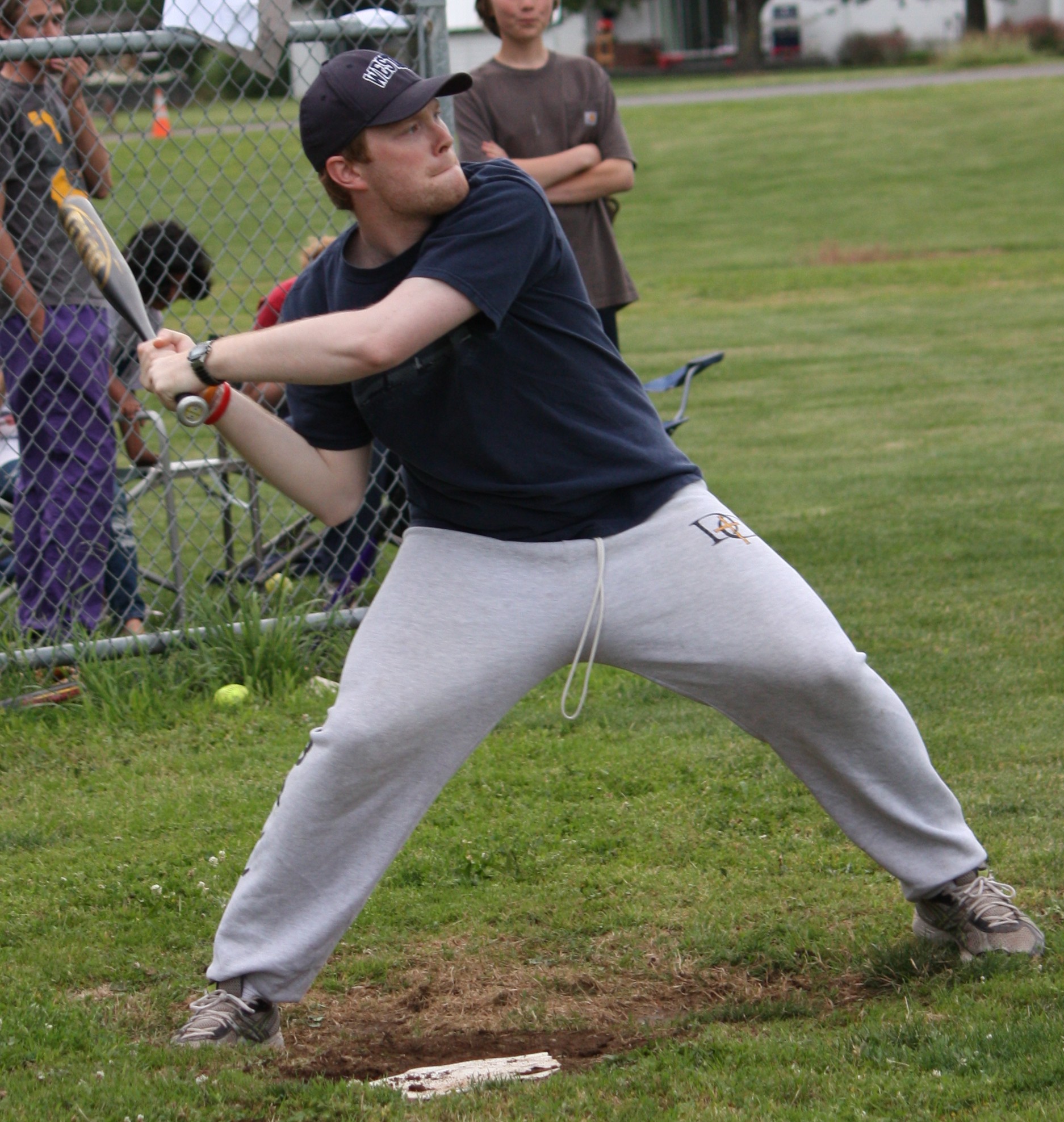
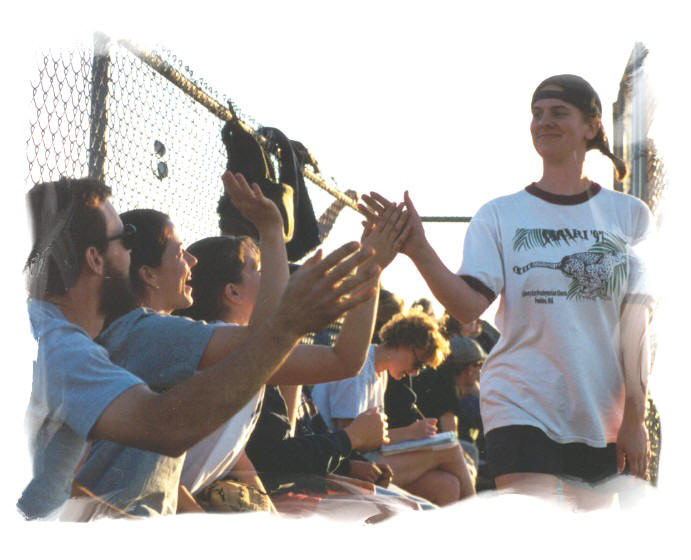
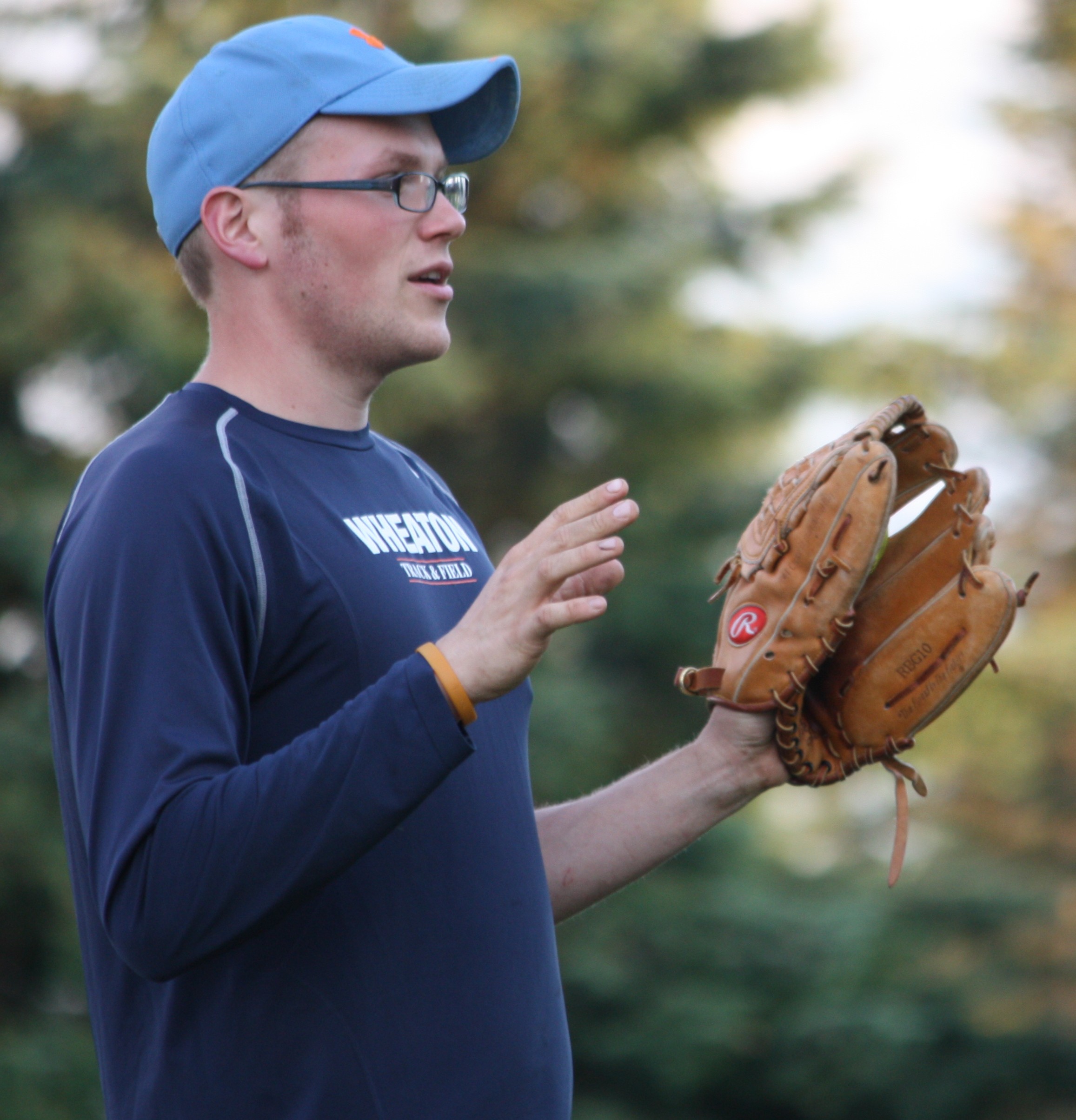
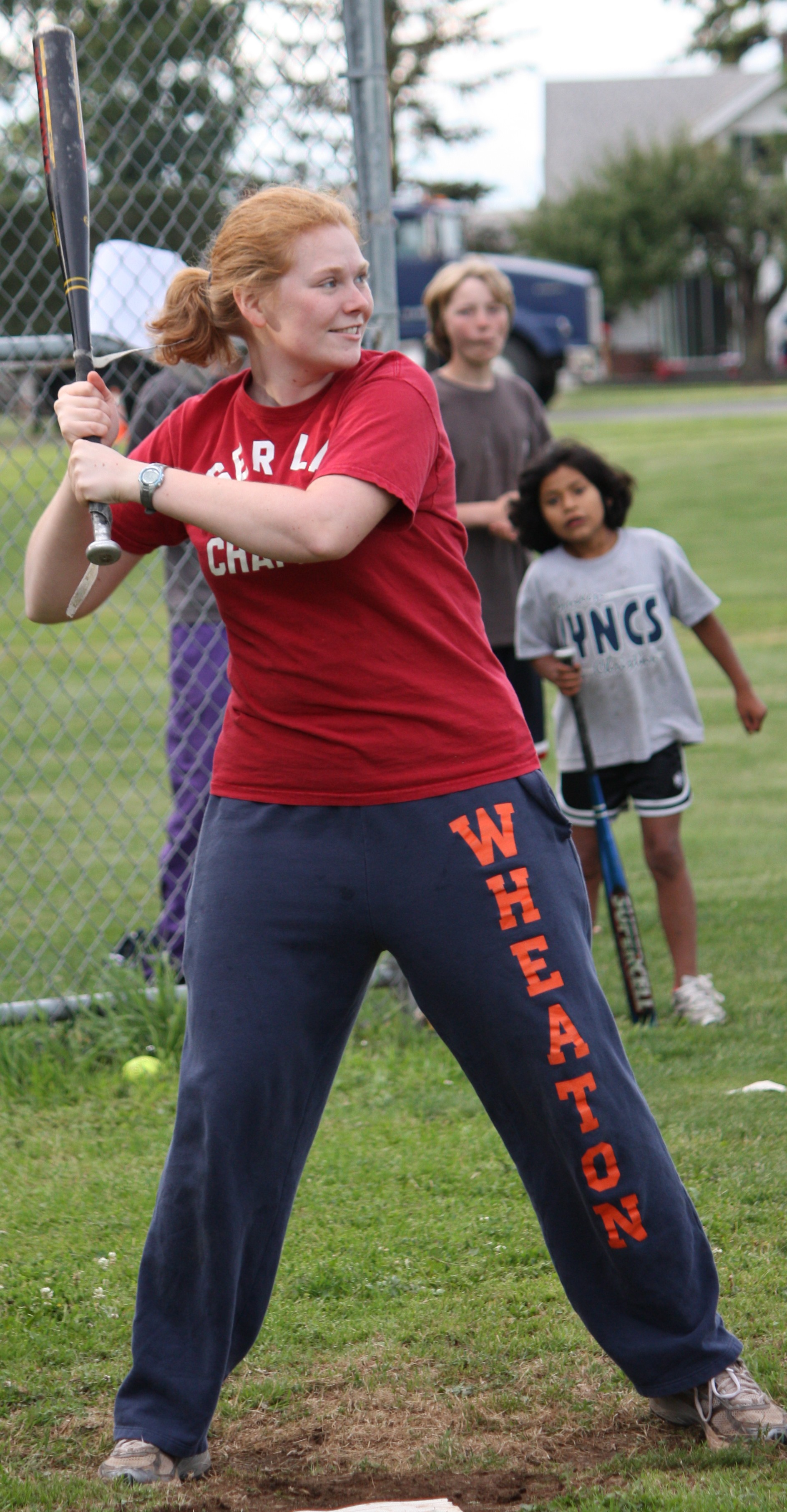
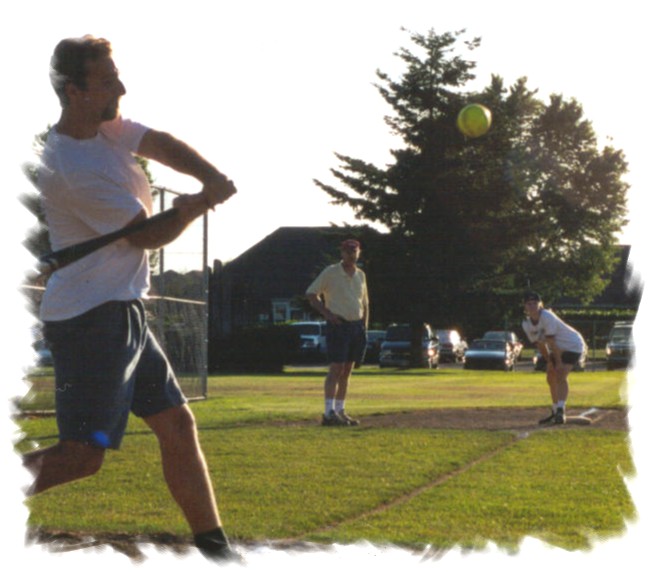
Our small church, Wiser Lake Chapel,  once belonged to a summer co-ed softball league, along with 8 other churches and a few local businesses.  This was a traditional Thursday evening summer activity for the past generation or longer.  Couples met for the first time on the ball fields and eventually married. Babies attended games in back packs and strollers and eventually were catching at home plate.  Relatives going to different churches found themselves on opposing teams yelling good natured insults.  There were a few bopped heads, abrasions, sprained fingers and one broken leg as part of the deal.  Hot dog roasts and ice cream sundaes were the after-game rewards.

Yet nothing was quite as wonderful as how a team recreated itself year after year.  It was thrown together by our coach Brenda in a mere two weeks prior to the season starting, with the youngest members needing to be at least age 14 with no upper age limit; we’ve had our share of 70+ year olds on the team over the years.   Some ball players were raw beginners having never played catch or swung a bat outside of school PE class, and others have extensive history of varsity fastpitch in school or other community league play so meant business when they strolled out on the diamond.  It was the ultimate diverse talent pool.

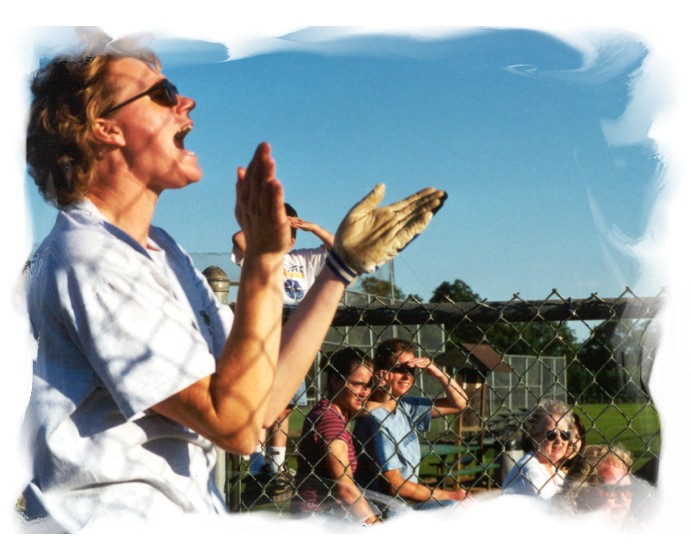
A different dynamic exists in church league softball compared to Little League, Pony League, minors or majors when you watch or play. Sure, there are slow pitch teams that will stock their ranks with “invitation-only” players, reserving the best and most athletic so there is a real chance at the trophy at the end of the summer.  Churches like ours, a mere 150 people average weekly Sunday attendance, had a “come one, come all” attitude, just to make sure we avoided forfeiting by not having enough players week after week.   We always did have enough.  In fact we had more players than we could find positions for.  And we had a whole bleacher full of fans, dedicated to cheering and clapping for anything and everything our players did, whether it was a pop-up foul ball, a strike out swing, a missed catch, or an actual hit.  We loved it all and wanted our players to know they were loved too, no matter what they did or what happened.

I think that was why the players and fans came back to play week after week, though we hadn’t won a game in years.  We rooted and hollered for each other, got great teaching and encouragement from our fantastic coach, and the players’ skills did improve year to year despite months of inactivity.  We had a whole line up of pre-14 year olds eager to grow old enough to play, just so they could be a part of the action.

Why did it not matter that we didn’t win games?  We were winning hearts, not runs.  We were showing our youngsters that the spirit of play is what it is all about, not about the trophy at the end.  We were teaching encouragement in the face of errors, smiles despite failure, joy in the fellowship of people who love each other–spending an evening together week after week.

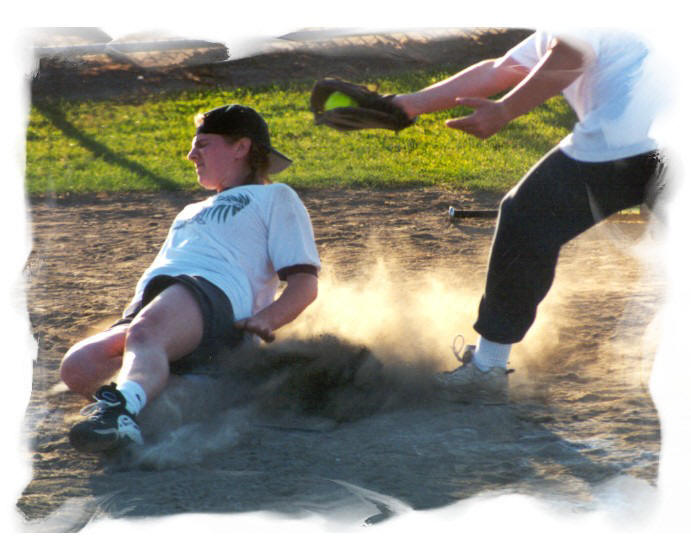
We are family; family picks you up and dusts you off when you’ve fallen flat on your face during your slide to base while still being called “out.”

Most of all, I see this as a small piece of God’s kingdom in action.  Although we no longer gather for church league baseball — the competition got too fierce and the rules too tight — we do gather for a pick-up game now and then, just to remind ourselves of who we are and what we are about:

Our coach models Jesus’ acceptance of all at the table, and embodies the fruits of the spirit: love, joy, peace, patience, kindness, gentleness, faithfulness, and self control.

Our players are the eager, the ambivalent, the accurate, the flawed, the strong, the weak, the fast, the slow: chosen for the game even if they were completely inadequate to the task at hand, volunteering to be part of each moment as painful as it can sometimes be.

The cheering from the bleachers comes as if from heaven itself:

Do not be afraid.  Good will to all.  We are well pleased. Amen!

We’re sliding to home plate, running as hard as we can, diving for safety, covered in the dust and mire and blood of living/dying and will never, ever be called “out”.

Let’s play ball.


13


-3


6

Two Kinds of Infection

springlanerobin


Good things as well as bad, you know are caught by a kind of infection.

If you want to get warm you must stand near the fire:
if you want to be wet you must get into the water.
If you want joy, power, peace, eternal life,
you must get close to, or even into, the thing that has them. 

They are not a sort of prize which God could, if He chose, just hand out to anyone.
They are a great fountain of energy and beauty spurting up at the very centre of reality.
If you are close to it, the spray will wet you: if you are not, you will remain dry.

Once a man is united to God, how could he not live forever?
Once a man is separated from God, what can he do but wither and die?

~C.S. Lewis- Mere Christianity


pinkdogwoodmay2018


upperfield


Each Monday morning, as I transition once again from the observance of Sabbath with God’s people to move into the secular world of government work, I feel an acute separation.

I want to remain infected (and contagious) with the reality of God yet my life feels necessarily compartmentalized.

On Monday, I’m gloved and masked to prevent my infecting others.

All week I am exposed daily to the reality of the world and must defend myself from getting infected.

If I’m to be contagious, let it be because I’m overwhelmed with the Spirit, not the world.


sunset55181


pinkonwhite

Preparing Through Parable: Be Humbled


“When someone invites you to a wedding feast, do not take the place of honor, for a person more distinguished than you may have been invited. If so, the host who invited both of you will come and say to you, ‘Give this person your seat.’ Then, humiliated, you will have to take the least important place. 10 But when you are invited, take the lowest place, so that when your host comes, he will say to you, ‘Friend, move up to a better place.’ Then you will be honored in the presence of all the other guests. 11 For all those who exalt themselves will be humbled, and those who humble themselves will be exalted.”

“When you give a luncheon or dinner, do not invite your friends, your brothers or sisters, your relatives, or your rich neighbors; if you do, they may invite you back and so you will be repaid. 13 But when you give a banquet, invite the poor, the crippled, the lame, the blind, 14 and you will be blessed. Although they cannot repay you, you will be repaid at the resurrection of the righteous.”
Luke 14: 7-14


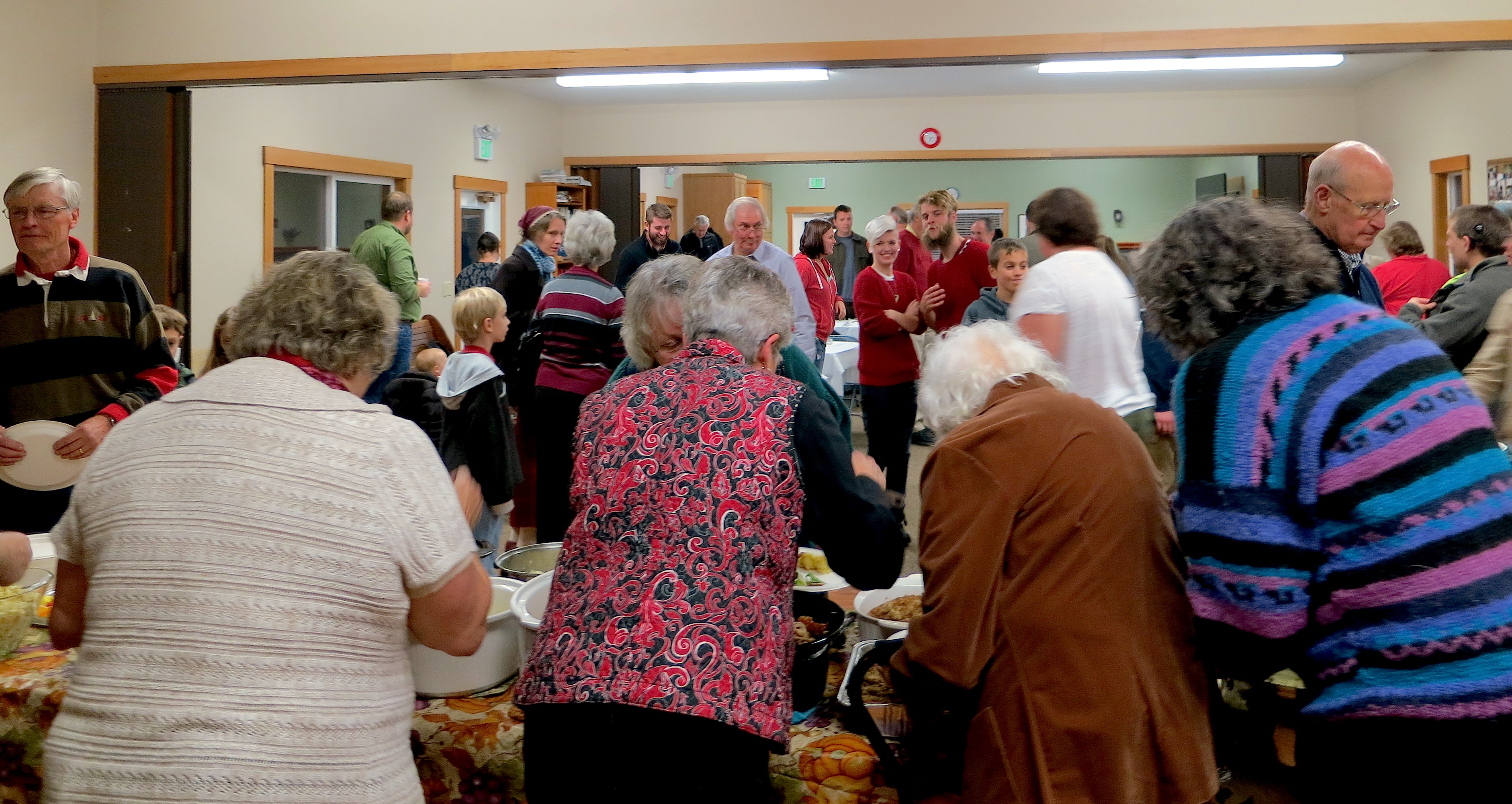
In the unspoken hierarchy of what makes a church function, I’m a kitchen lady and always will be.  I remember those very women from my childhood church of the fifties and sixties– their tight-knit ability to function as if one organism, swarming in aprons among tables set up in the fellowship hall and bustling around in the back by the stoves with steaming pots and pans and the occasionally dropped plate.

They kept the rest of us alive, those church ladies, by feeding us efficiently and plentifully and never ever sitting down.  I would occasionally see them eating standing up in the back of the hall, chatting amiably among themselves after the rest of us were served, but I knew they carefully wrapped up the leftovers during the clean up to deliver to shut-ins who couldn’t make it to the church supper.

I knew I was destined to become a kitchen lady, shy and introverted as I am, hiding myself behind huge plates of food and piles of dish cloths.  For me, it is a place of comfort and clean up filled with plenty of leftovers for anyone who needs them, and that just about perfectly describes the kingdom of God in my book and His Book.


May my eyes see, my ears hear, my heart understand.  He prepares me with parable.

An Amalgam of Black and White

reflection2


Let me say finally, that in the midst of the hollering and in the midst of the discourtesy tonight, we got to come to see that however much we dislike it, the destinies of white and black America are tied together. Now the races don’t understand this apparently. But our destinies are tied together. And somehow, we must all learn to live together as brothers in this country or we’re all going to perish together as fools.

…Whether we like it or not culturally and otherwise, every white person is a little bit negro and every negro is a little bit white. Our language, our music, our material prosperity and even our food are an amalgam of black and white, so there can be no separate black path to power and fulfillment that does not intersect white routes and there can ultimately be no separate white path to power and fulfillment short of social disaster without recognizing the necessity of sharing that power with black aspirations for freedom and human dignity.
~Martin Luther King, Jr.
in one of his last speeches, given at Grosse Point, Michigan high school (near Detroit) to a mostly white and often heckling audience, March 14, 1968


mlk2

I grew up during the 1960’s in Olympia, Washington, a fair-sized state capitol of 20,000+ people at the time and our city had only one black family.

One.

There were a few Japanese and Korean families, a few Hispanics, but other than the Native American folks from the nearby Nisqually Reservation, our community seemed comprised of homogenized milk. Pretty much plain Anglo Saxon white.

In 1970, a white Olympia High School graduation student speaker caused a controversy  when she called our town a “white racist ghetto” in her speech. Numerous parents walked out of the ceremony in protest of her protest, and didn’t watch their children graduate.

It was the first time I’d heard someone other than Martin Luther King, Jr. actually crack a previously unspoken barrier using only words. What she said caused much local consternation and anger, but the ensuing debate in the newspaper Letters to the Editor, around lunch counters at the five and dime, and in the churches and real estate offices made a difference. Olympia, after being called out for bigotry in its hiring practices and housing preferences, began to open its social and political doors to people who weren’t white.

Attending college in California helped broaden my limited point of view, but in the early 70′s there were still few diversity admissions initiatives, so Stanford was still a mostly white campus. While living in Africa to study wild chimpanzees in Africa in 1975, I experienced being one of two whites living and traveling among hundreds of very dark skinned Ugandans, Rwandans, Tanzanians and Kenyans. I became the one gawked at, viewed as an oddity, pointed at by small children who were frightened, amused and perplexed by my appearance.

I constantly felt out of place. I did not belong. Yet I was treated graciously, with hospitality, although always a curiosity:  the homogenized white milk in the mix.

There was minimal diversity in my medical school class where women constituted less than 25% of my class graduating in 1980.  It wasn’t until I was in family practice residency at Seattle’s Capitol Hill Group Health Cooperative Hospital that I began to experience the world in full technicolor. I joined a group of doctors in training that included an African American activist from the east coast, a Kiowa Indian, several of Jewish background, a son of Mexican immigrants, a daughter of Chinese immigrants, a Japanese American, someone of Spanish descent, and a Yupik Eskimo.  I was challenged to appreciate my inner city patients’ cultural, racial, religious, ethnic and sexual minority identities, and saw how much more effectively my colleagues and teachers of diverse backgrounds worked with patients who looked or grew up like them.

My training was such a foundational experience that I was drawn to a medical practice in a Group Health Rainier Valley neighborhood clinic. There I saw patients who lived in the projects that lined Martin Luther King Way, struggling to overcome poverty and social fragmentation, clustered together in knots of extended family within a few square miles. There were many ethnic groups: African Americans, Vietnamese, Cambodian and Laotian refugees, Ashkenazi Jews, Middle East Muslims, Russian immigrants and some Catholic Italian families who spoke broken English. I delivered babies who would grow up learning languages and traditions from every corner of the globe. It was a wide world of diversity walking into my exam rooms, richly filling in the white corners of my life in ways I had never imagined.

I found that white milk, nurturing as it was, was not a reflection of everything the world had to offer.

When I married and Dan and I started our own family, we made the decision to move north near his parents and home community of Lynden, a town of Dutch dairy farming immigrants. We planned to own our own farm to raise our children in a rural setting just as both of us had been raised. There was significant adjustment necessary once again adapting to a primarily Caucasian community. I am not Dutch even though I am as white and tall as the Frieslanders (some of my ancestry is from Schleswig-Holstein in Germany, right across the Holland border).  Even though I looked like my neighbors, I still didn’t belong.

I didn’t share the same cultural or church background to fit in easily in my new home. The color of my skin no longer set me apart, but the difference in rituals, language quirks and traditions became very apparent. In other words, the milk looked just as white, (maybe skim versus whole or 2%), but varied significantly in taste (were the cows just let out on grass??)

Over the past thirty plus years since we moved here, our rural community is transforming slowly.  We have two growing Native American sovereign nations within a few miles of our farm, the Nooksack and Lummi tribes, along with increasing numbers of migrant Hispanic families who work the seasonal berry and orchard harvest, many of whom have settled in year round. My supervisors at the University where I work are African American. Our close proximity to the lower mainland of British Columbia has brought Taiwanese, Japanese and Hong Kong immigrants to our area, and many East Indians immigrate to our county in large extended families, attracted by affordable farmland. A rural corner grocery close to our farm is owned by Sikhs with shelves stocked with the most amazing array of Indian spices and Mexican chili sauce, with Dutch peppermints and licorice thrown in for good measure.

Our children grew up rural but, as adults, have become part of communities even more varied. Nate teaches multiracial students from a dozen different countries in an international high school in Tokyo, has married a Japanese woman and our beloved granddaughter is biracial. Ben finished two years as a Teach for America high school math teacher on the Pine Ridge Lakota Sioux Reservation in South Dakota, and married to Hilary, have lived as a racial minority in a mostly black neighborhood in New Haven, Connecticut before moving to the melting pot of the Bay Area in California.   Lea is teaching fourth graders of multiple ethnicities in a Title 1 school in a military town just a few hours away.

Our children are privileged to work within the kaleidoscope of humanity and our family is blessed to no longer be just plain white milk.

Homogenized means more than just uniformity. It is a unity of substance, a breaking down of barriers so there is no longer obvious separation.  Martin Luther King, Jr. called it amalgam — a mixture that yields something stronger than the original parts.

I am still all white on the outside — that I would never want to change —  but I can strive to break down barriers that separate me from the diverse people who live, work and worship around me.  Thanks to that amalgam, my life is enriched and the flavor of my days remarkably enhanced.


images

The Shadow’s the Thing

myohmy


Be comforted; the world is very old,
  And generations pass, as they have passed,
  A troop of shadows moving with the sun;
Thousands of times has the old tale been told;
  The world belongs to those who come the last,
  They will find hope and strength as we have done.
~Henry Wadsworth Longfellow “A Shadow”


sunriseshadow


The shadow’s the thing. 
If I no longer see shadows as “dark marks,” 
as do the newly sighted,
then I see them as making some sort of sense of the light.
They give the light distance;
they put it in its place.
They inform my eyes of my location here, here O Israel,
here in the world’s flawed sculpture,
here in the flickering shade of the nothingness
between me and the light.
~Annie Dillard from Pilgrim at Tinker Creek


shadow closeup


A shadow is hard to seize by the throat and dash to the ground.
~Victor Hugo from Les Miserables


sunriseoctober

In faith there is enough light for those who want to believe and enough shadows to blind those who don’t.
~Blaise Pascal


These days I find myself seeking safety hiding in the shadows under a rock where lukewarm moderates tend to congregate.

Extremist views predominate simply for the sake of differentiating one’s political turf from the opposition.  There is no discussion of compromise, negotiation or collaboration as that would be perceived as a sign of weakness.  Instead it is “my way or the wrong way.”

I’m ready to say “no way,” as both sides are intolerably intolerant of the other.

The chasm is most gaping in any discussion of faith issues.  Religion and politics have become angry neighbors constantly arguing over how high to build the fence between them, what it should be made out of, what color it should be, should there be peek holes, should it be electrified with barbed wire to prevent moving back and forth, should there be a gate with or without a lock and who pays for the labor.   In a country founded on the principle of freedom of religion, there are more and more who believe our forefathers’ blood was shed for freedom from religion.

Give us the right to believe in nothing whatsoever or give us death. Perhaps both actually go together.

And so it goes.  We bring out the worst in our leadership as facts are distorted, the truth is stretched or completely abandoned, unseemly pandering abounds and curried favors are served for breakfast, lunch and dinner.

Enough already.

In the midst of this morass, we who want to believe still choose to believe.

There is just enough Light for those who seek it.  No need to remain blinded in the shadowlands of unbelief.

I’ll come out from under my rock if you do.

In fact…I think I just did.


morninglightoctober

The Only Day There Is

sunrise101515


sunrise10231


It is a moment of light surrounded on all sides by darkness and oblivion. In the entire history of the universe, let alone in your own history, there has never been another just like it and there will never be another just like it again. It is the point to which all your yesterdays have been leading since the hour of your birth. It is the point from which all your tomorrows will proceed until the hour of your death. If you were aware of how precious it is, you could hardly live through it. Unless you are aware of how precious it is, you can hardly be said to be living at all. 

“This is the day which the Lord has made,” says the 118th Psalm. “Let us rejoice and be glad in it.” Or weep and be sad in it for that matter. The point is to see it for what it is because it will be gone before you know it. If you waste it, it is your life that you’re wasting. If you look the other way, it may be the moment you’ve been waiting for always that you’re missing. 

All other days have either disappeared into darkness and oblivion or not yet emerged from them. Today is the only day there is.
~Frederick Buechner from Whistling in the Dark


octleaf10141


octleaf2


Last night our church held our annual Chapel “talent” show — now renamed “Show and Tell” for those who who don’t feel they have a talent to share.  It was a great evening of infinite variety including a ventriloquism act, hand made quilts, watercolor paintings, a primer on Latin from a 12 year old, a tutorial on Bonsai trees, detailed nautical drawings, embroidery, stories from a kindergarten teacher, a story of a life from the Livestock Journal, kids singing the answers to Heidelberg Catechism questions, a teenager teaching the American Sign Language alphabet, a “don’t quit” testimony from a man who served prison time for homicide and other convictions, wonderful fiddle and guitar music and wrapping up with a bagpipe finale.

It was a delightful sharing of people’s daily lives — how they spend their precious moments and hours and what is important to them.

It reminds me how I “show and tell” each precious day right here, before it disappears into darkness and oblivion. I want to capture and harvest each moment, every moment, and this moment.

You’re welcome.


dogwoodoct2


rocketlaunchpad


dawn101517


Financial Support for the Barnstorming Blog from our Readers

Your financial support helps to keep this blog an ad-free daily offering. Your contribution of any amount is encouragement to me and deeply appreciated.

$10.00

On Mine Aëry Nest

cloudstudy92165

sunset93163
And when Sunset may breathe, from the lit sea beneath,
Its ardours of rest and of love,
And the crimson pall of eve may fall
From the depth of Heaven above,
With wings folded I rest, on mine aëry nest,
As still as a brooding dove.
~Percy Bysse Shelley from “The Cloud”
cloudstudy9216

To make myself understood and to diminish the distance between us, I called out: “I am an evening cloud too.” They stopped still, evidently taking a good look at me. Then they stretched towards me their fine, transparent, rosy wings. That is how evening clouds greet each other. They had recognized me.
~Rainer Maria Rilke from Stories of God

cloudstudy92166

cloudstudy92165

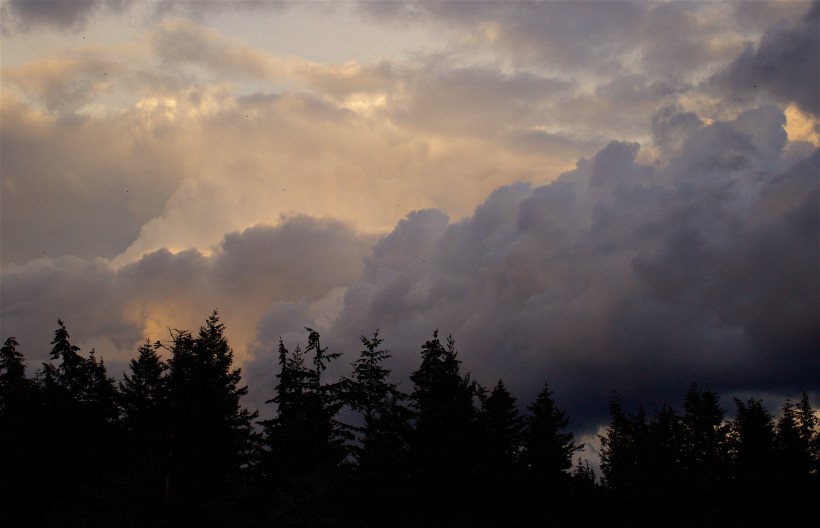
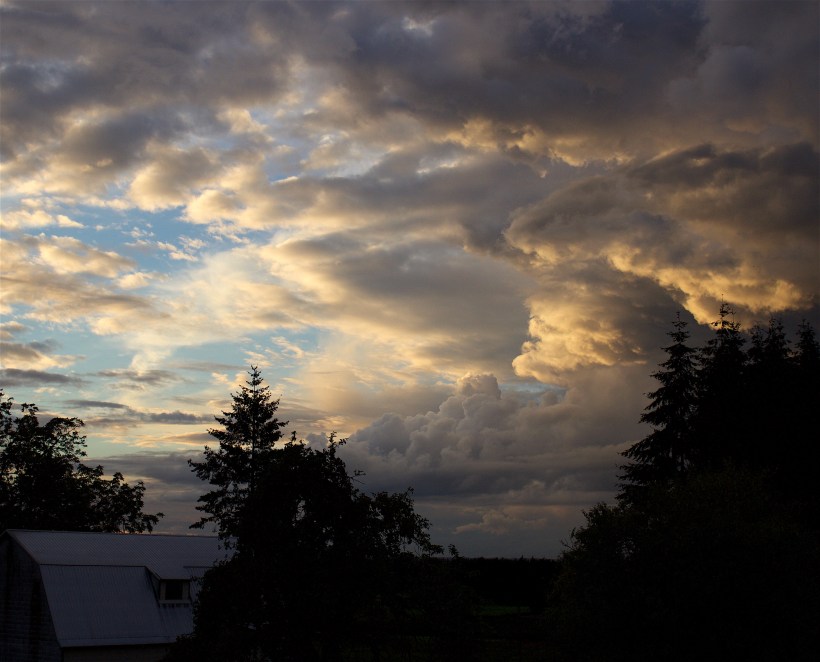
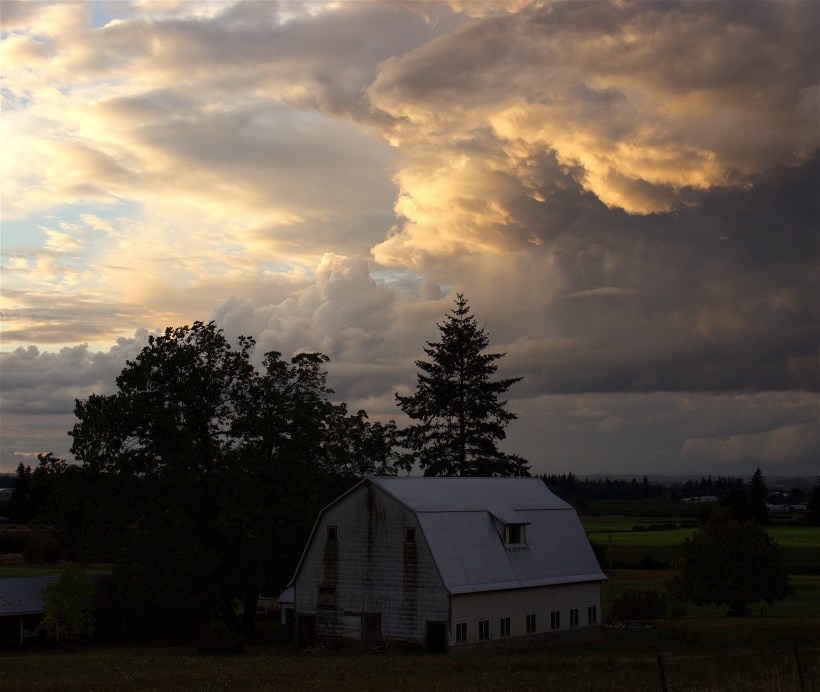
From this hill, we can see for miles.  At certain times of morning and evening, it can feel as if we are aloft, closer up to the clouds, seeing the terrain from their vantage point.  There are the snow-covered peaks to the east, the craggy Canadian coastal range to the north, the stretch of river valley to the north west, the Salish Sea to the west and the forest to the south.

Surrounding us is the farmland and the good people who feed this community: the expanse of dairy land and its vast pastures, the corn fields, berry rows and potato mounds, acres of orchard espaliers and local farm-to-market and CSA growers.

The ever-moving, ever-changing immensity of the clouds covers us all.  As those clouds touch, embrace, release, mold and transform, they show us how connection with others is done.  As we county folk pass on the roads during an evening walk, as we are running late to town jobs, as we meet in the store or at church or community events, we too should touch and greet one another, nod and encourage, acknowledge the shared light that comes from beyond us that restores and transforms us.
Most of all, like the clouds, we are too often full to brimming, a shedding of shared tears at how easily this land can be taken away — whether remembering the sad history of people group domination and removal from their ancestral homes, or the ravages of flood or volcanoes, the effects of drought and wildfire, of blight or sickness, or the currentover-regulation of government ensuring no farmer can afford to continue to do what they know best to preserve the land, the habitat and their crops.

We weep in recognition, like these clouds, to make ourselves understood and to diminish the distance between us.

cloudstudy92163

cloudstudy92162

Dancing in Dust Motes

barnboys

farmkids3

ready
emptied and ready

They put up hay loose there, the old way,
forking it into the loft from the wagon rack
while the sweaty horses snorted and switched off flies
and the littlest kids were commanded to trample it flat
in between loads until the entire bay
was alight with its radiant sun-dried manna….
It was paradise up there with dusty sun motes
you could write your name in as they skirled and drifted down.
There were ropes we swung on and dropped from and shinnied up
and the smell of the place was heaven, hurling me back
to some unknown plateau, tears standing up in my eyes
and an ancient hunger in my throat, a hunger….
~Maxine Kumin from “Hay”

filling
filling up

haybarnfull

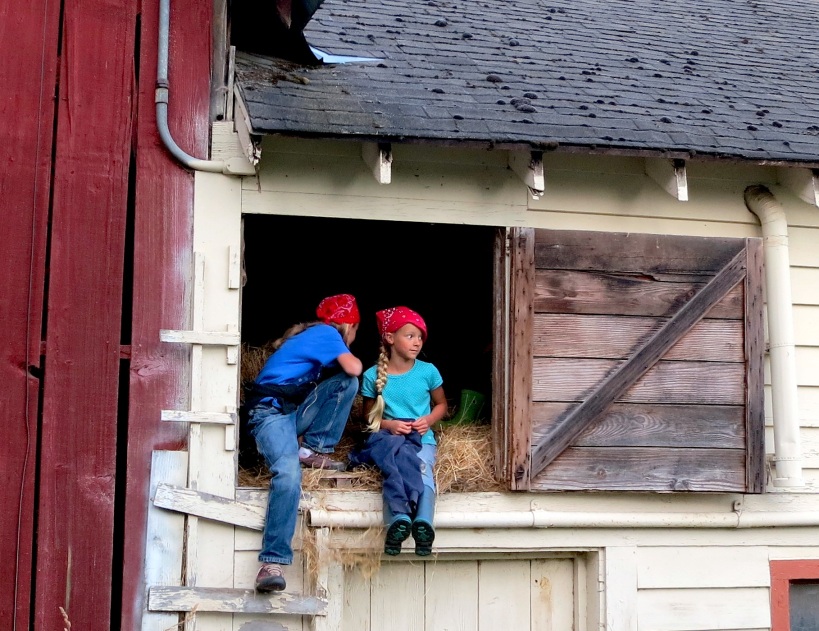
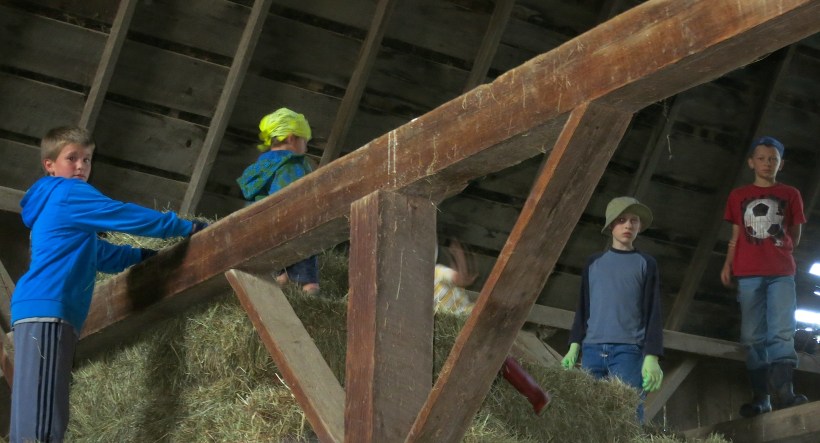
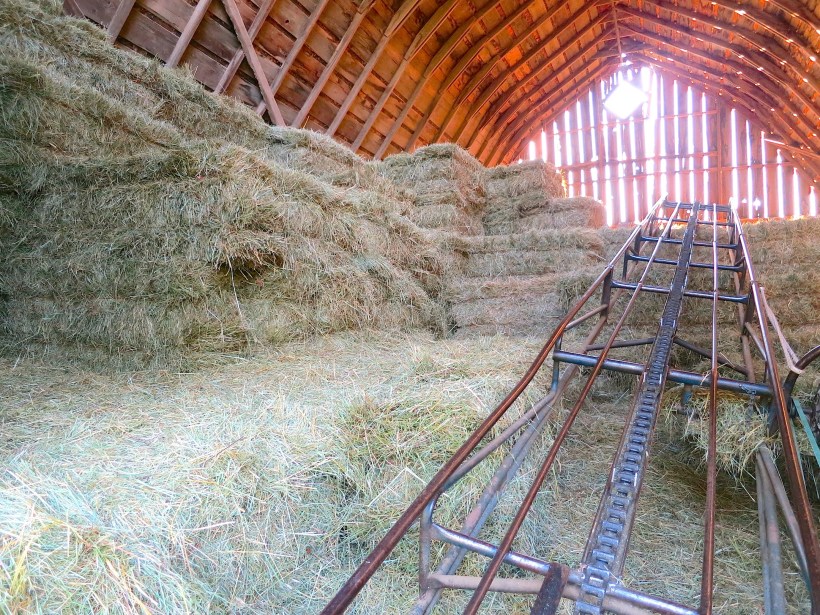
My parents knew that ancient hunger, both born on farms with teams of horses that brought in hay the old way while the children tramped and stamped the loose piles firm.

I’ve known that ancient hunger, having grown up on a farm that brought in to the barn loose hay the old way by tractor and wagon, having danced in the dusty sun motes on the top of the hay on a bright afternoon, the light cut in stripes over the sweet smelling grass.

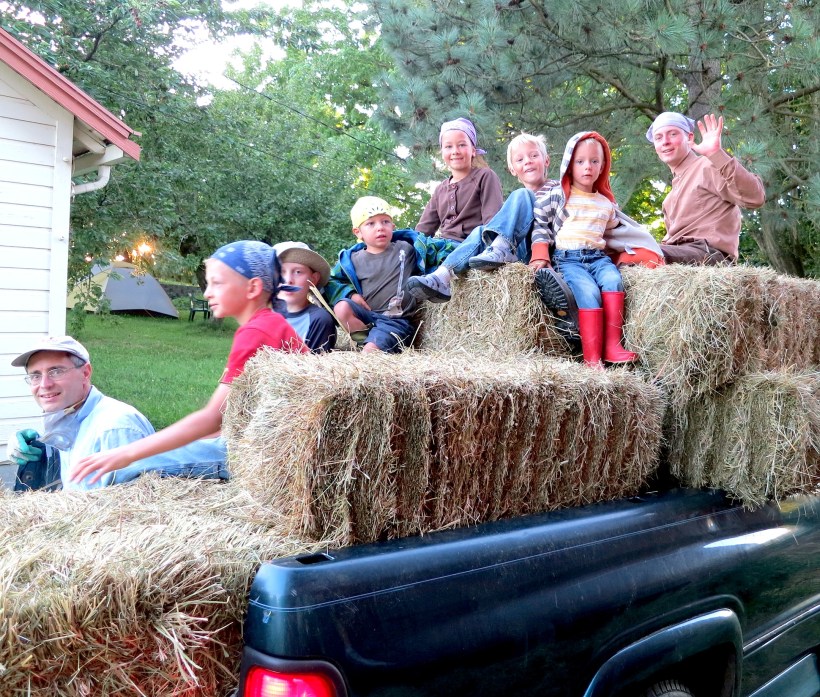
We’ve made sure our three children knew that ancient hunger, born to a farm that brought in hay bales stacked to the rafters through community effort, those same dusty sun motes swirling about their heads as they learned their jobs, from bale rolling to lifting to tossing and stacking.

And now the next generation of neighborhood children arrive with shouts on haying days to clamor up and down the bale mountains, answering to the same hunger, blowing the same dusty snot and thrilling to the adventure of tractors, wagons and trucks, celebrating the gathering in of sun-dried manna together.

Surely this is what heaven will be like: we are all together, dancing in the light of the sun motes, our hunger filled to the brim by manna provided from above.

farmertheo1

farmgirls

farmcrew


A Healthy Fence Row

morning528151

mistyfence

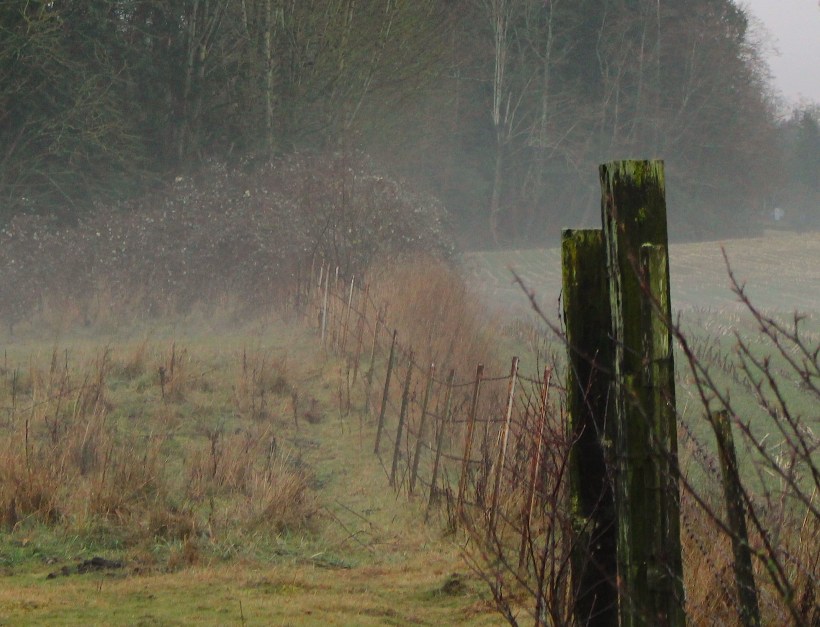
Brushy fencerows are in a sense a gift from man to nature — at least if, after the posts are dug in and the fence stapled to the posts, nature is given some free reign. Birds sitting on the fence and posts will pass undigested seeds in their droppings. Some of these seeds of blackberry, wild cherry, elderberry, bittersweet, sassafras, mulberry, and unfortunately, in some areas, multiflora rose, will take root in the loose soil around the posts and later in soil dug up by woodchucks. Chipmunks scurrying along the fence will bring and bury acorns and hickory nuts, while the wind will deliver dandelion, milkweed, and thistle seeds — all ingredients for a healthy fencerow.
~David Kline from Great Possessions

fence

Before I built a wall I’d ask to know
What I was walling in or walling out,
And to whom I was like to give offence.

He will not go behind his father’s saying,
And he likes having thought of it so well
He says again, “Good fences make good neighbors.”
~Robert Frost from “Mending Fences”

fencepostssunset32

birdonpostrodenberger
photo by Harry Rodenberger


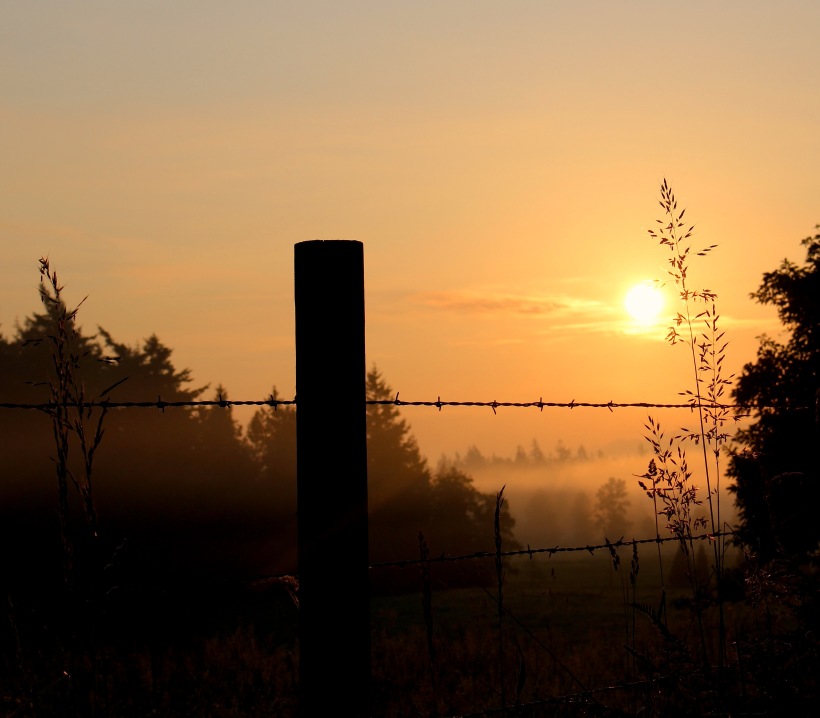
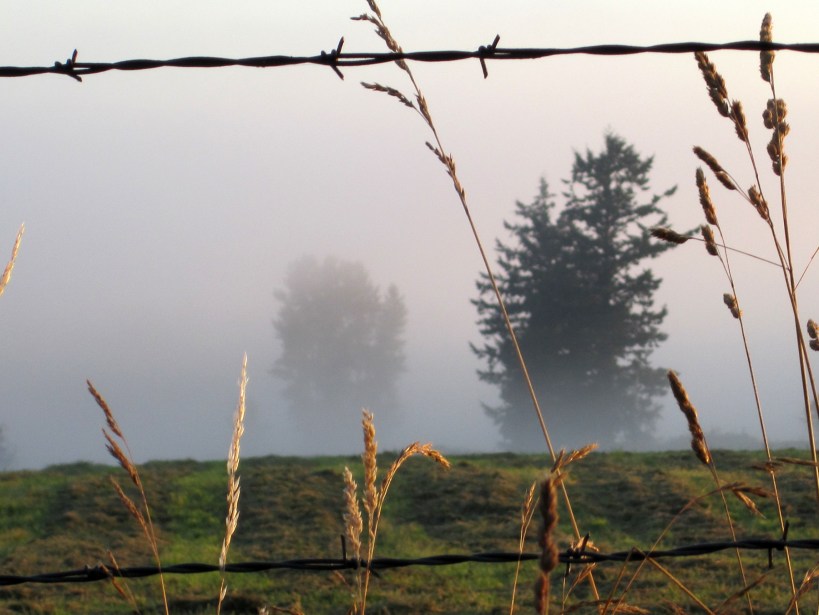
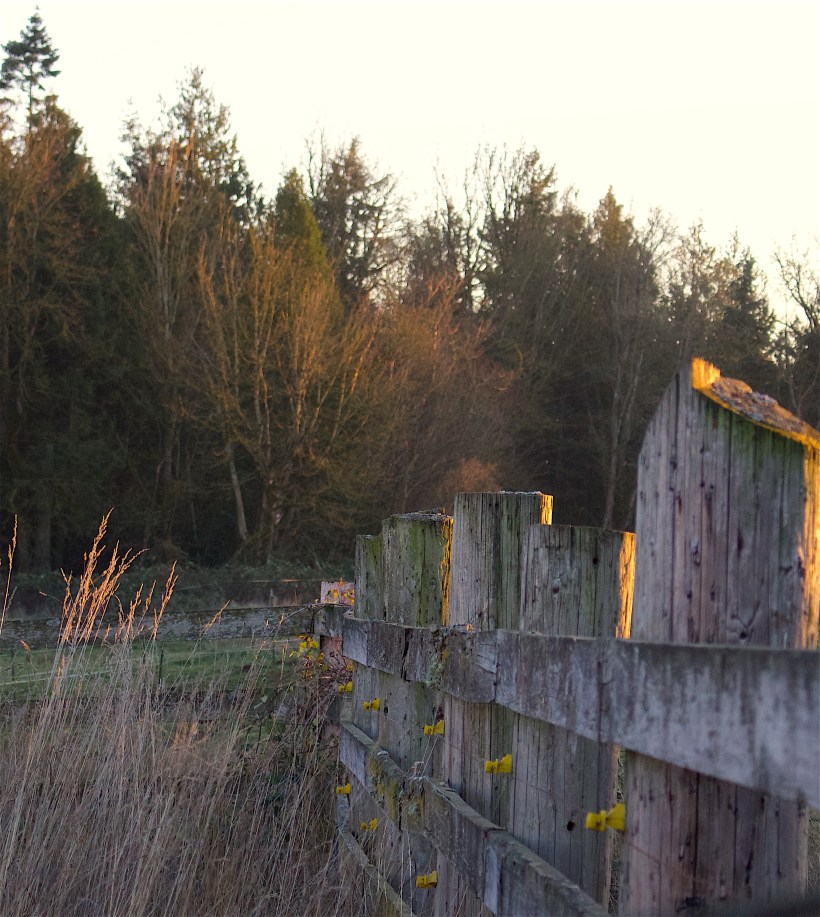
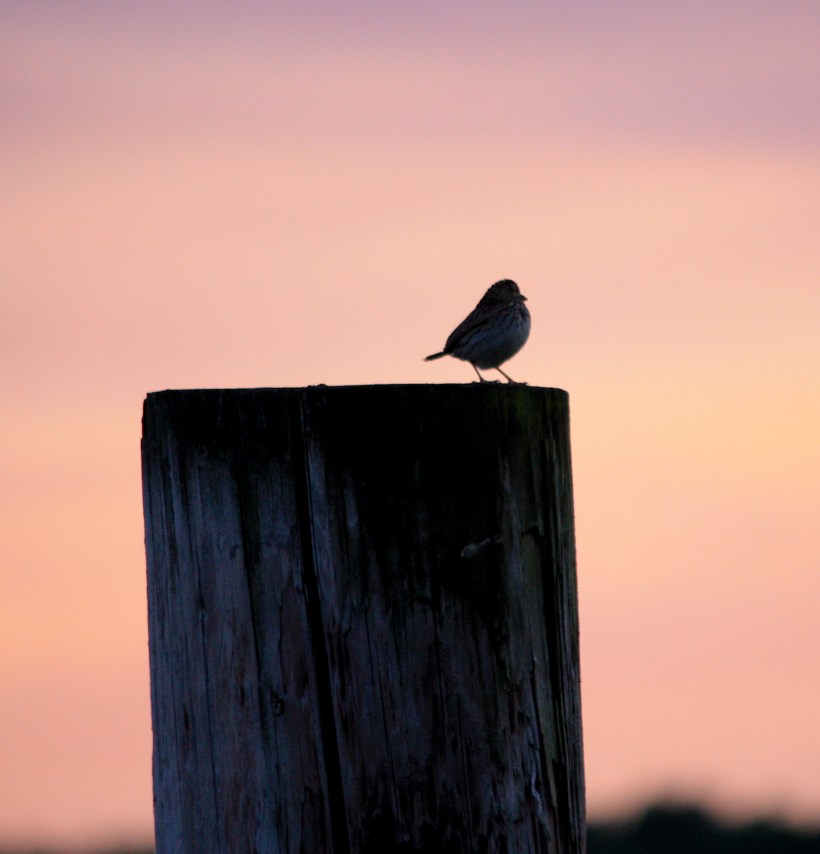
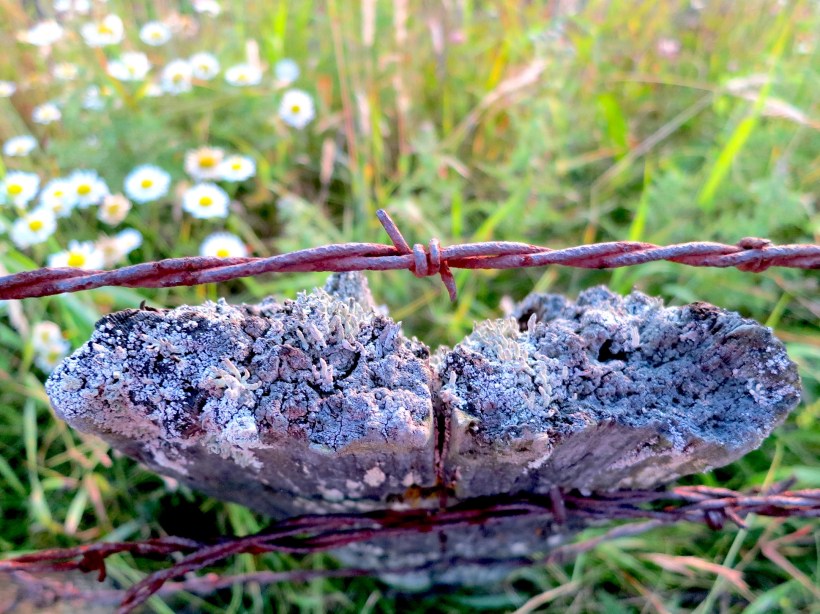
I maintain, in my haphazard and often ineffectual way, our farm’s wood rail and hot wire fences to keep the horses confined, preventing them from wandering into the adjacent orchard, corn field, or most risky of all, the road. As utilitarian as a fence is for that purpose, the fence row itself is the hospitality center for all sorts of diversity of flora and fauna.  It doesn’t repel; it invites.

As one travels in the United Kingdom and across the plains and mountains of North America, old fences are everywhere. Some fences were built painstakingly of stone centuries ago, some of old barbed wire, now falling and decrepit, no longer effective, but still testimony to a determined farmer’s desire to section off his barren land from another’s barren land, or perhaps the requirement borne of the homesteading laws of the time. Robert Frost wrote in his poem “Mending Fences” that a fence spans the balance between man’s sometimes irrational desire for barriers, acknowledging the order that they bring to an uncertain and sometimes unpredictable world that lays beyond our walls.

Political fences continue to exist in many parts of the world today, created primarily out of fear. Indeed, new walls have been proposed, absurdly ridiculous in their scope and expense.  Much celebration accompanied the fall of the Berlin Wall after its years of imposing testimony to the lack of trust and understanding between people who were once relatives, neighbors and friends. The Great Wall of China still stands, now primarily tourist attraction, no longer serving any other useful purpose other than to illustrate the lengths to which man goes to barricade himself off from others.

So why maintain life’s fences, even if the building and maintaining of these fences seems a futile and foolish task when they are pushed down, blown over in the winds, with trees fallen over them, and overgrown with brush and wild blackberries?

Fences, like rules and laws, define order and structure. They can bite back if they are breached. If crashed and broken, they are hazardous in and of themselves, not withstanding the potential dangers that lay beyond them. Remove them altogether and we risk losing the diversity represented in the fence row itself.

So, in the best of times, we are mending walls out of continuing need for contact with our neighbors. We meet across the barriers to shake hands and visit while we repair the fences together, leaving the barriers standing and strong, and the space in the fence row becomes even more diverse and welcoming. In the worst of times, we fortify and hide behind the walls, making them taller, wider, deeper, creating greater and greater gulfs between us and eventually losing touch forever as the walls themselves deteriorate without the necessary mutual “mending”.

So we must not love walls themselves, but must maintain them with our neighbor. We don’t worship the walls themselves but instead respect the foundation they rest on and the life they protect within the row itself.

We accept such boundaries with humility, recognizing their necessity is due to our own imperfections, as we too are full of prickles and barbs that too easily draw blood when breached.

oldfence

moydalganfield5

sunsetfence

sunsetfence

Crossing the Threshold

hayfield

earsgrass

John O’Donohue gave voice to the connection between beauty and those edges of life—
thresholds was the word he loved—
where the fullness of reality becomes more stark and more clear.

If you go back to the etymology of the word “threshold,” it comes from “threshing,” which is to separate the grain from the husk. So the threshold, in a way, is a place where you move into more critical and challenging and worthy fullness.

There are huge thresholds in every life.

You know that, for instance, if you are in the middle of your life in a busy evening, fifty things to do and you get a phone call that somebody you love is suddenly dying, it takes ten seconds to communicate that information.

But when you put the phone down, you are already standing in a different world. Suddenly everything that seems so important before is all gone and now you are thinking of this.

So the given world that we think is there and the solid ground we are on is so tentative.
And a threshold is a line which separates two territories of spirit, and very often how we cross is the key thing.

When we cross a new threshold worthily, what we do is we heal the patterns of repetition
that were in us that had us caught somewhere.

~John O’Donohue from an “On Being” interview with Krista Tippett on “Becoming Wise”

clouds7816

I emerge from the mind’s
cave into the worse darkness
outside, where things pass and
the Lord is in none of them.
I have heard the still, small voice
and it was that of the bacteria
demolishing my cosmos. I
have lingered too long on
this threshold, but where can I go?
To look back is to lose the soul
I was leading upwards towards
the light. To look forward? Ah,
what balance is needed at
the edges of such an abyss.
I am alone on the surface
of a turning planet. What
to do but, like Michelangelo’s
Adam, put my hand
out into unknown space,
hoping for the reciprocating touch?
~R.S. Thomas “Threshold”

fullmoon61916


These past few months of mass shootings, tragic deaths and never-ending conflict have forced us all to a threshold needing to be crossed. Yet we stand stubborn, immobilized, frozen and dying on the spot, peering out in fear but never peering inward for self-examination.

Instead of submitting to the crushing winnowing that must happen to blow away the chaff of our lives, to get down to the kernel of truth that sustains us, we cling to the old and familiar. It is we who have delivered ourselves a non-choice between two deeply flawed individuals for president. They represent what evils we tolerate as a people: celebrating entitlements, tolerating their legal, moral and financial shenanigans simply because they are rich and famous.

Unwilling to change attitude or perspective, reluctant to move forward into largely uncharted territory, mired in a tribalism only skin deep, we wonder why history repeats itself, why we are dying every day, by our own hand or by others’.

How to cross worthily? How to cross together, arm in arm, united in the need to move forward beyond this mess we have made for ourselves?

We need a good threshing, badly. We need to be worthy. We need to reach out our hands into the unknown that lies ahead, hoping and praying Someone is there to grab hold and lead us across to a better day.


thimbleweb