
The Beginning Shall Remind Us of the End: Let Me Go There

photo from NASA

And God held in his hand
A small globe.  Look he said.
The son looked.  Far off,
As through water, he saw
A scorched land of fierce
Colour.  The light burned
There; crusted buildings
Cast their shadows: a bright
Serpent, A river
Uncoiled itself, radiant
With slime.
               On a bare
Hill a bare tree saddened
The sky.  many People
Held out their thin arms
To it, as though waiting
For a vanished April
To return to its crossed
Boughs.  The son watched
Them.  Let me go there, he said.
~R.S. Thomas “The Coming”

You have answered
us with the image of yourself
on a hewn tree, suffering
injustice, pardoning it;
pointing as though in either
direction; horrifying us
with the possibility of dislocation.
Ah, love, with your arms out
wide, tell us how much more
they must still be stretched
to embrace a universe drawing
away from us at the speed of light.
~R.S.Thomas “Tell Us”
Ah, Love~
You the Incarnate,
stretched and fettered to a tree

arms out wide
embracing us
who try to grasp
a heaven which eludes us.

This heaven, Your heaven
You brought down to us
knowing our pain and weakness.

You wanted to come here,
knowing all this.

Holding us firmly
within your wounded grip,
You the Son
handed us heaven.
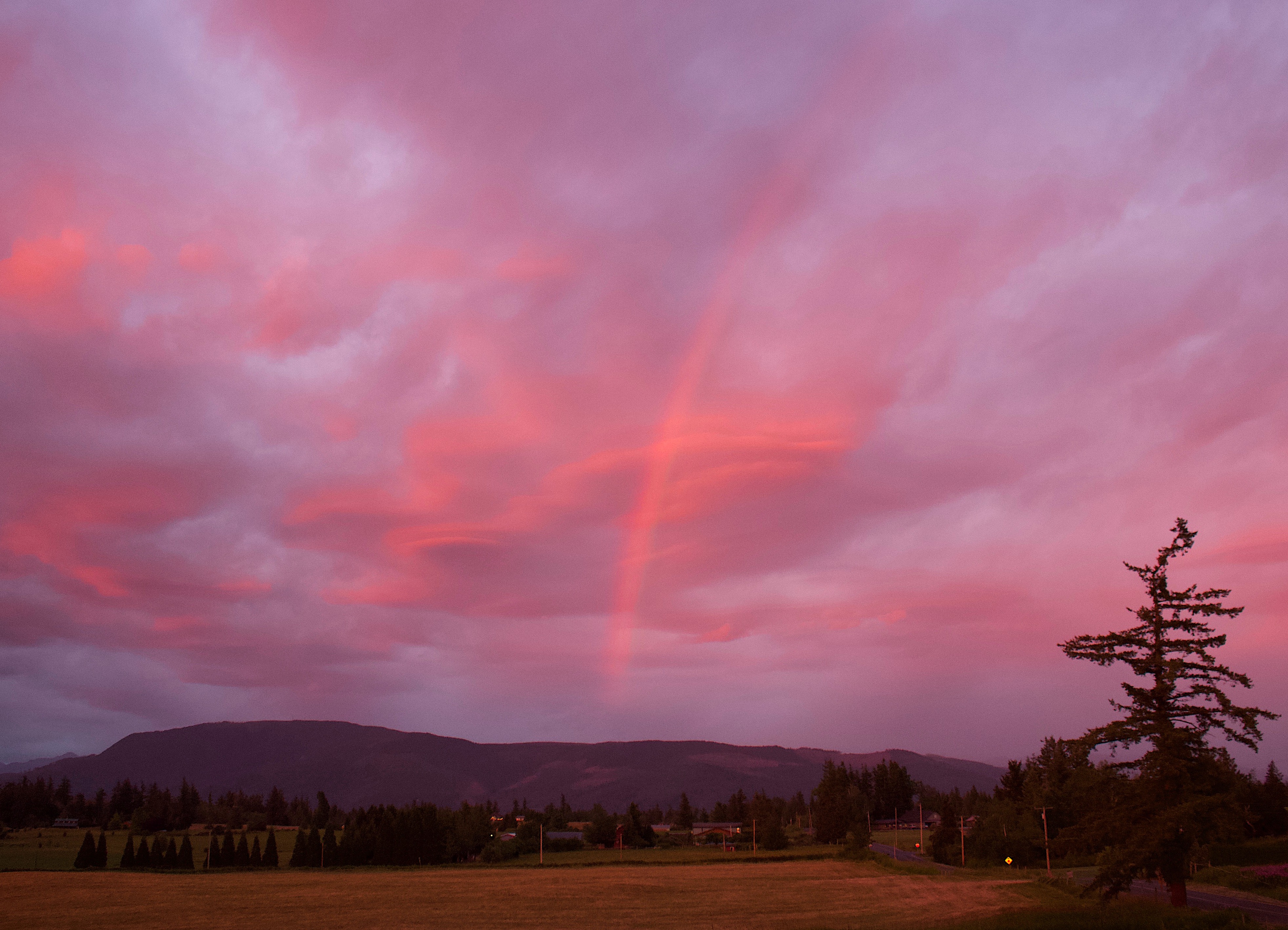
This year’s Barnstorming Advent theme “… the Beginning shall remind us of the End” is taken from the final lines in T.S. Eliot’s poem “The Cultivation of Christmas Trees”

O living Word
Please come and dwell in us
Lord wipe away these tears
O ancient Son, so long foretold
We’re desperate souls, draw near

And we will stand
Securely in the strength of the Lord
Every heart will surely come and adore
The Great I Am

O our Shepherd King
Please come and dwell with us
To fields of grace
Lead on

We need You now
Break our chains by Your glory and power
Make us captive to a holy desire
Come to us O Lord
Come to us O Lord

Prince of Peace, Emmanuel
Lord draw us close, unto Thyself
King of kings, God’s chosen One
We need you now, to Thee we run

We need You now
Break our chains by Your glory and power
Make us captive to a holy desire
Come to us O Lord
Come to us O Lord
Songwriter: Eric Marshall

One-Time
Monthly
Yearly

Make a one-time donation supporting Barnstorming

Make a monthly donation

Make a yearly donation

Choose an amount

¤5.00
¤10.00
¤20.00
¤5.00
¤15.00
¤100.00
¤5.00
¤15.00
¤100.00

Or enter a custom amount

¤

Your contribution is deeply appreciated.

Your contribution is appreciated.

Your contribution is appreciated.

DonateDonate monthlyDonate yearly

Heed No Nightly Noises

There was a fire in the wide hearth before them, and it was burning with a sweet smell, as if it were built of apple-wood. When everything was set in order, all the lights in the room were put out, except one lamp and a pair of candles at each end of the chimney-shelf. Then Goldberry came and stood before them, holding a candle; and she wished them each a good night and deep sleep.

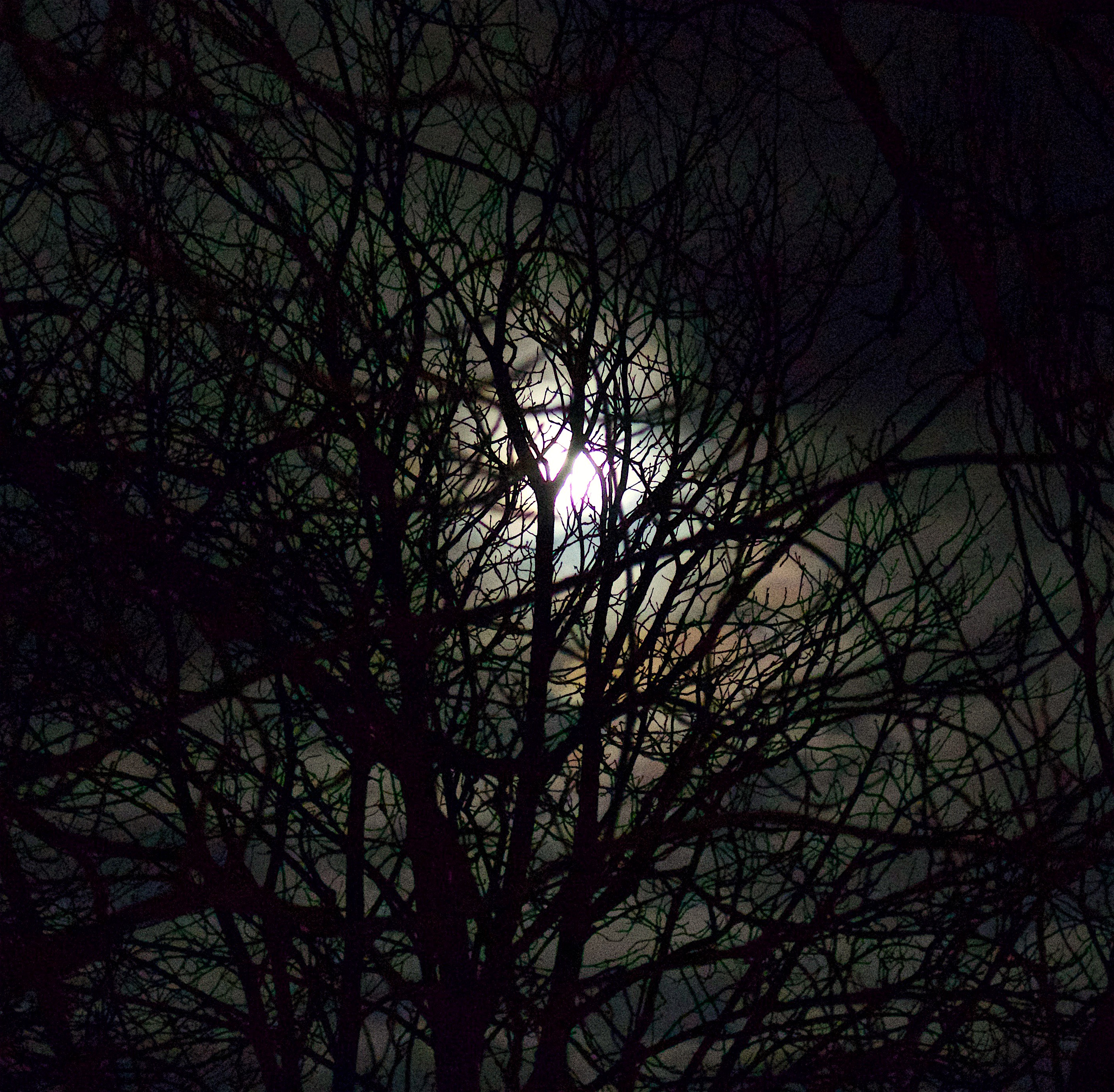
“Have peace now,” she said, “until the morning! Heed no nightly noises! For nothing passes door and window here save moonlight and starlight and the wind off the hill-top. Good night!” She passed out of the room with a glimmer and a rustle. The sound of her footsteps was like a stream falling gently away downhill over cool stones in the quiet of night.

Tom sat on a while beside them in silence, while each of them tried to muster the courage to ask one of the many questions he had meant to ask at supper. Sleep gathered on their eyelids. At last Frodo spoke: “Did you hear me calling, Master, or was it just chance that brought you at that moment?”

Tom stirred like a man shaken out of a pleasant dream. ‘Eh, what?’ said he. ‘Did I hear you calling? Nay, I did not hear: I was busy singing. Just chance brought me then, if chance you call it. It was no plan of mine, though I was waiting for you. We heard news of you, and learned that you were wandering.”
~J.R.R. Tolkien from The Lord of the Rings

We wander through this life, sometimes with a destination in mind, but too often lost and surrounded by a darkness threatening to swallow us whole.

It isn’t by chance that we have been rescued and brought to safety.

Our Savior has been waiting for us, hearing us call out for help. Our rescue begins again tomorrow with the Advent of the Light that comes into pitch dark to illuminate our way to becoming un-lost.

No longer do we need to fear the noises of the night or where we take our next step. We are reassured we have been found, as T.S. Eliot wrote of Advent: “the beginning shall remind us of the end and the first coming of the second coming.”

May the coming weeks be a time of peace and reflection:
For nothing passes door and window here save moonlight and starlight and the wind off the hill-top

One-Time
Monthly
Yearly

Make a one-time donation to Barnstorming

Make a monthly donation

Make a yearly donation

Choose an amount

¤5.00
¤10.00
¤20.00
¤5.00
¤15.00
¤100.00
¤5.00
¤15.00
¤100.00

Or enter a custom amount

¤

Your contribution is deeply appreciated.

Your contribution is appreciated.

Your contribution is appreciated.

DonateDonate monthlyDonate yearly
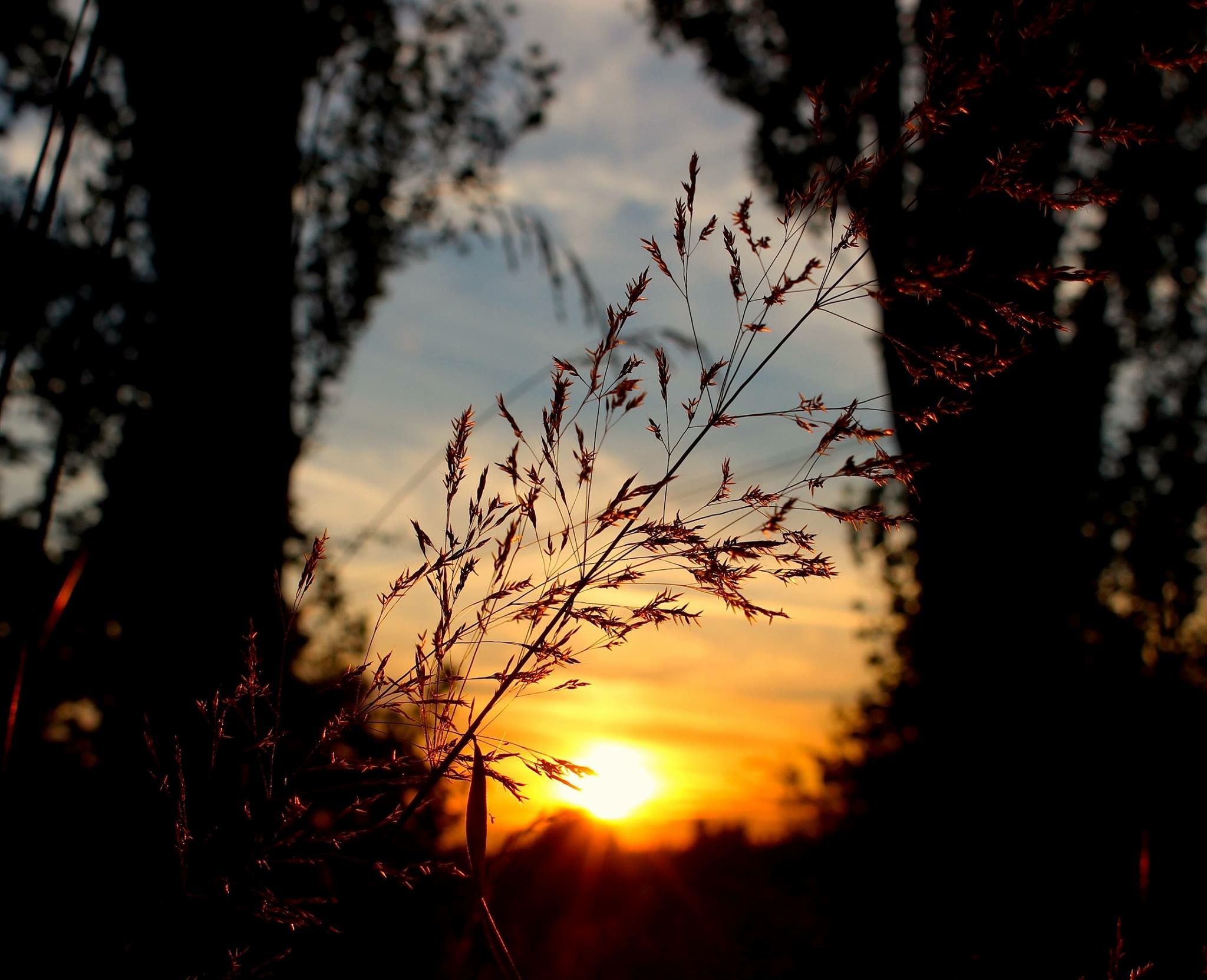
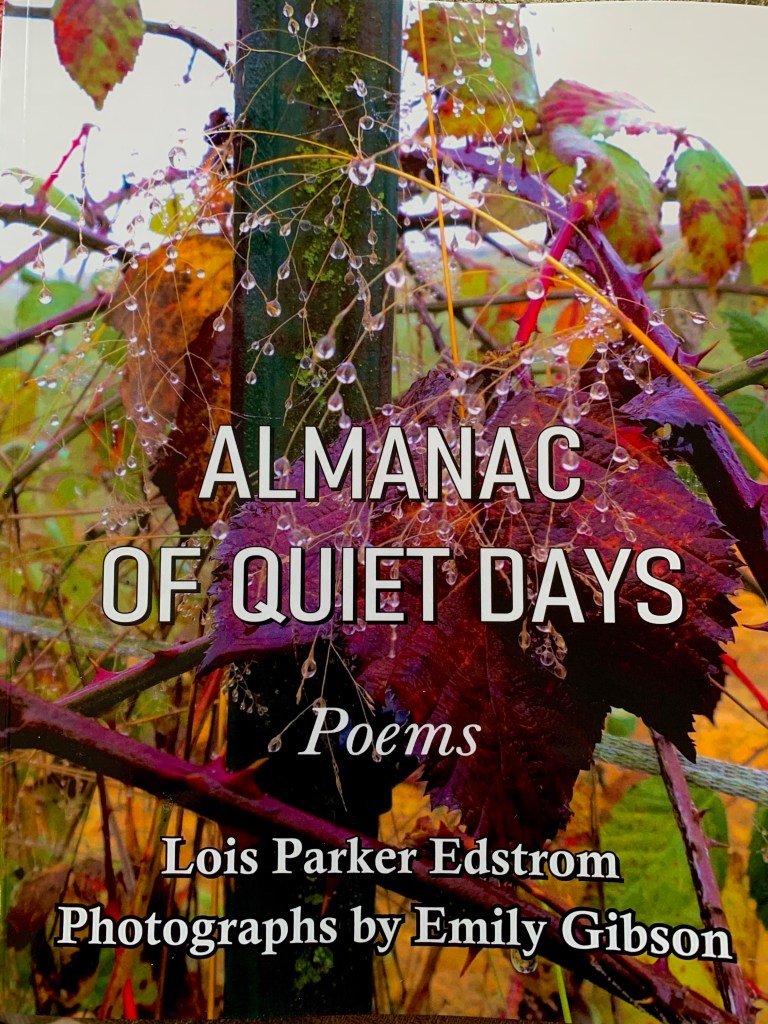
A book of beauty in words and photography, available to order here:

Most Poignant of All

In the years to come they will say,
“They fell like the leaves
In the autumn of nineteen thirty-nine.”
November has come to the forest,
To the meadows where we picked the cyclamen.
The year fades with the white frost
On the brown sedge in the hazy meadows,
Where the deer tracks were black in the morning.
Ice forms in the shadows;
Disheveled maples hang over the water;
Deep gold sunlight glistens on the shrunken stream.
Somnolent trout move through pillars of brown and gold.
The yellow maple leaves eddy above them,
The glittering leaves of the cottonwood,
The olive, velvety alder leaves,
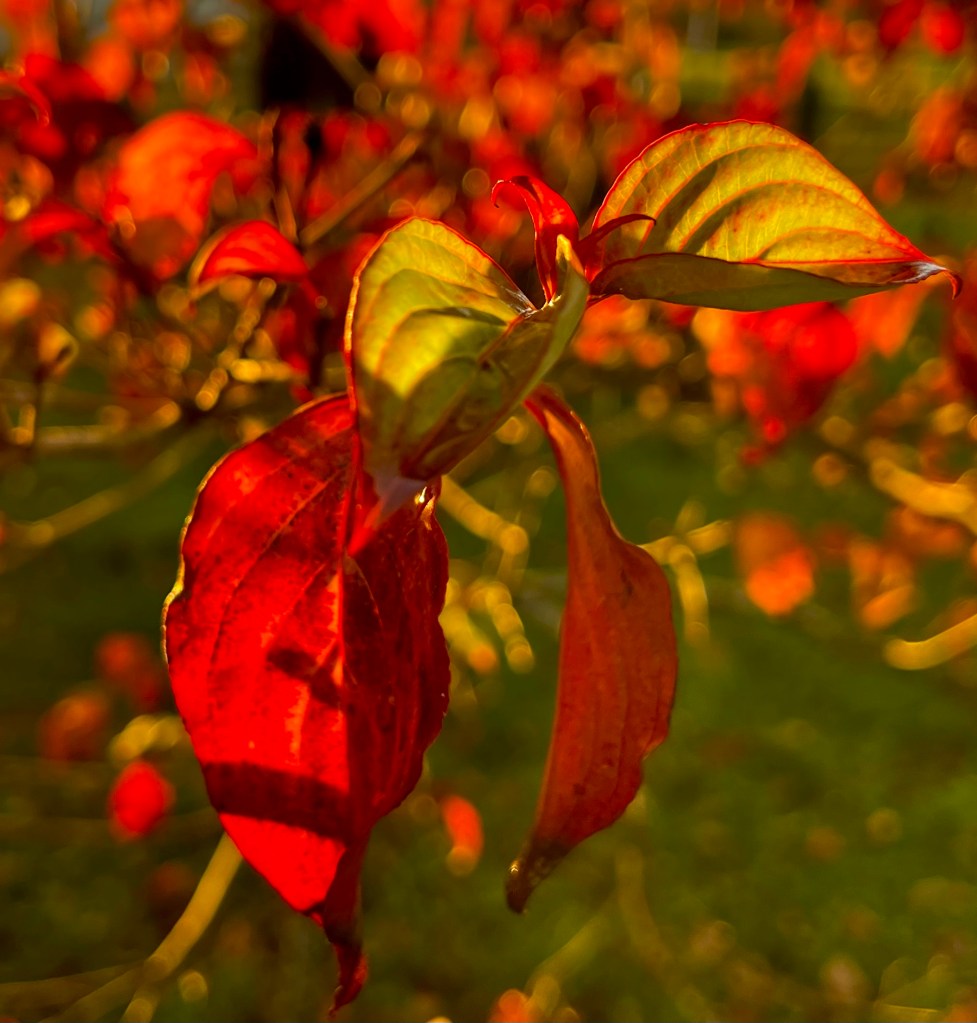
The scarlet dogwood leaves,
Most poignant of all.


In the afternoon thin blades of cloud
Move over the mountains;
The storm clouds follow them;
Fine rain falls without wind.
The forest is filled with wet resonant silence.
When the rain pauses the clouds
Cling to the cliffs and the waterfalls.
In the evening the wind changes;
Snow falls in the sunset.
We stand in the snowy twilight
And watch the moon rise in a breach of cloud.
Between the black pines lie narrow bands of moonlight,
Glimmering with floating snow.
An owl cries in the sifting darkness.
The moon has a sheen like a glacier.
~Kenneth Rexroth, “Falling Leaves and Early Snow” from The Collected Shorter Poems.


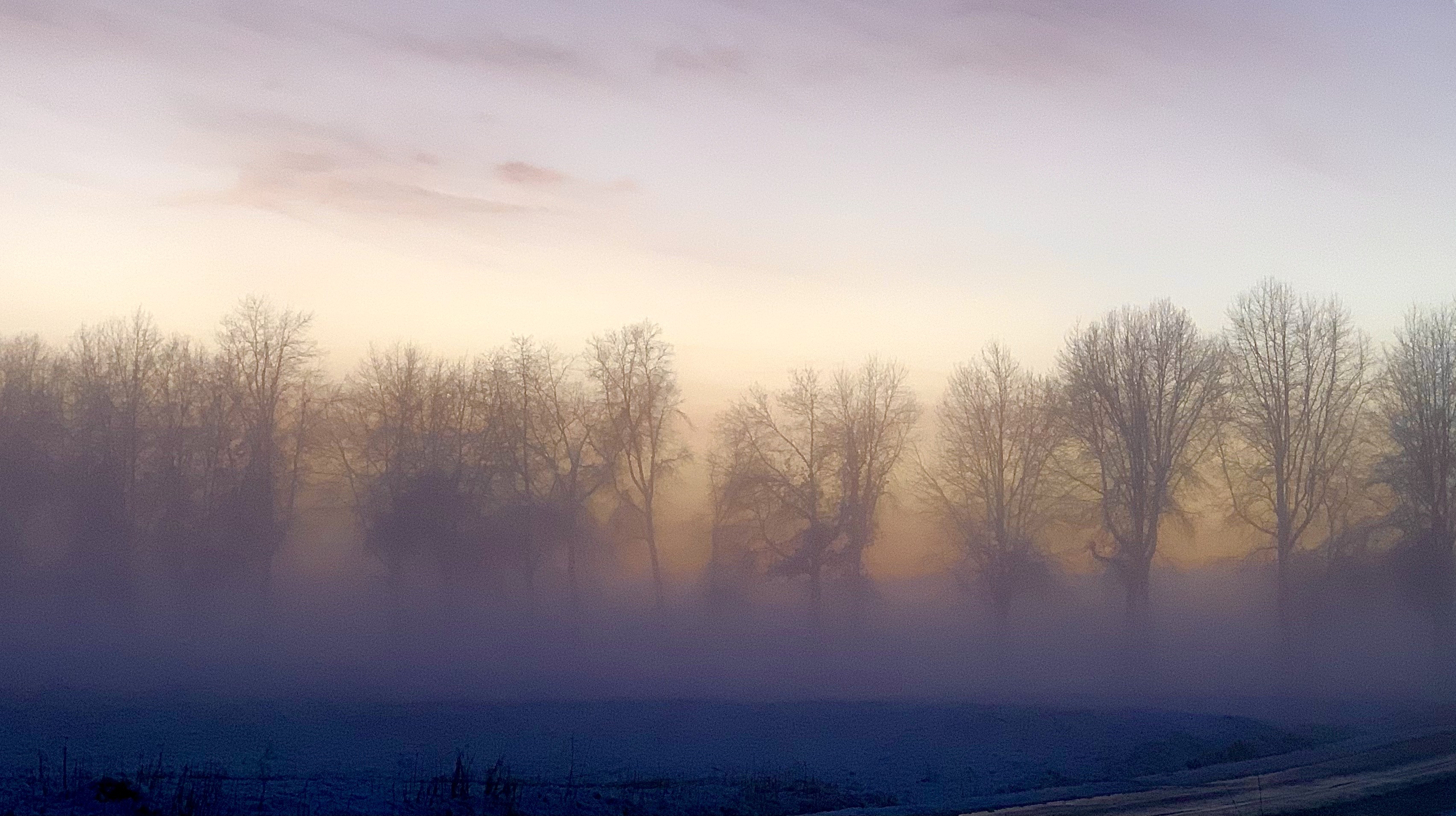
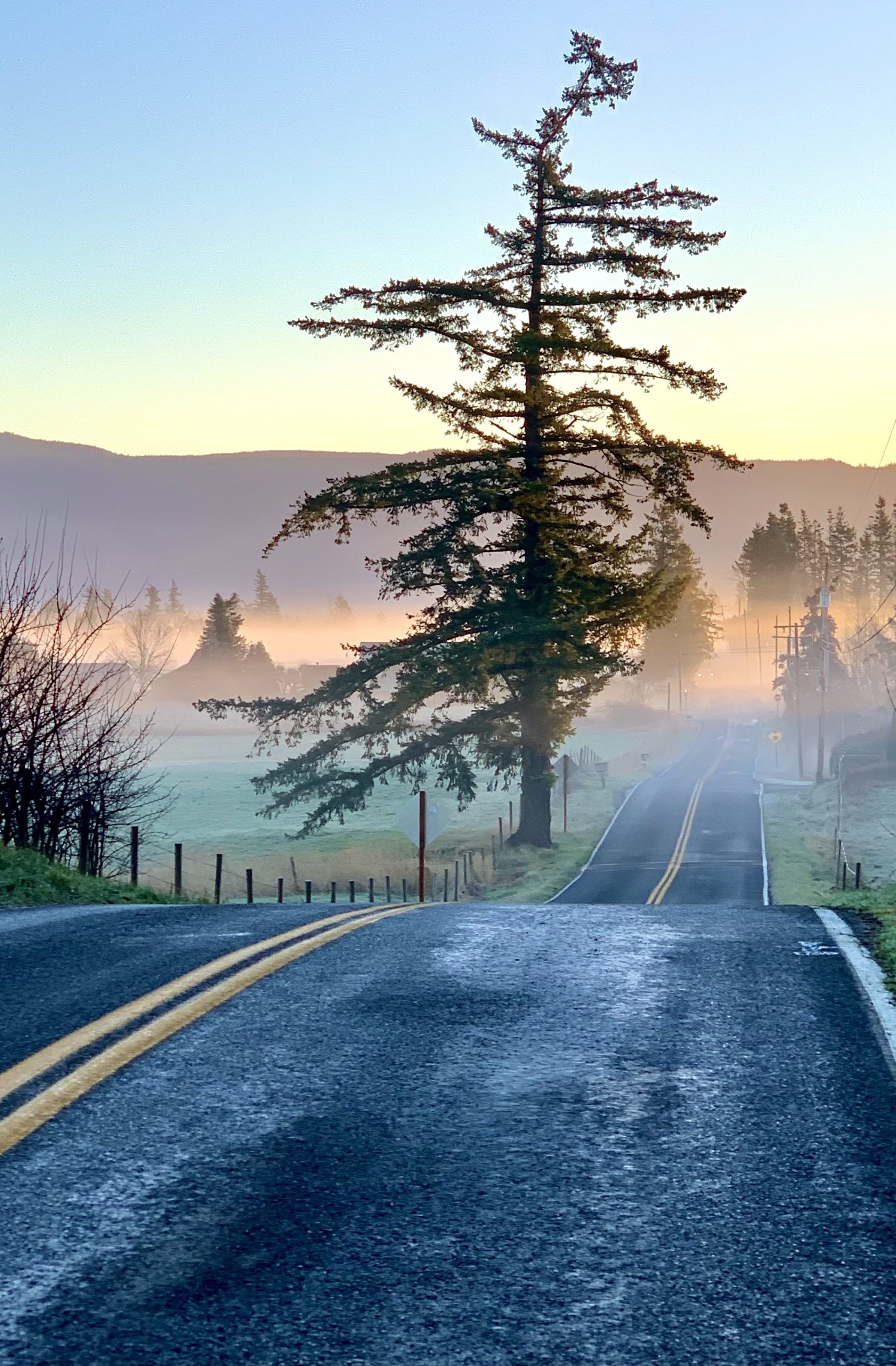
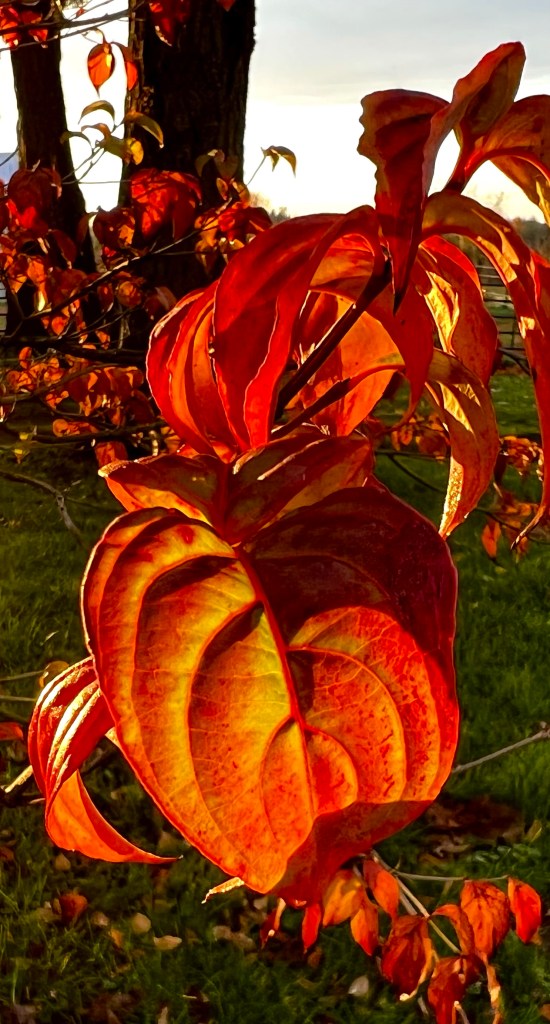
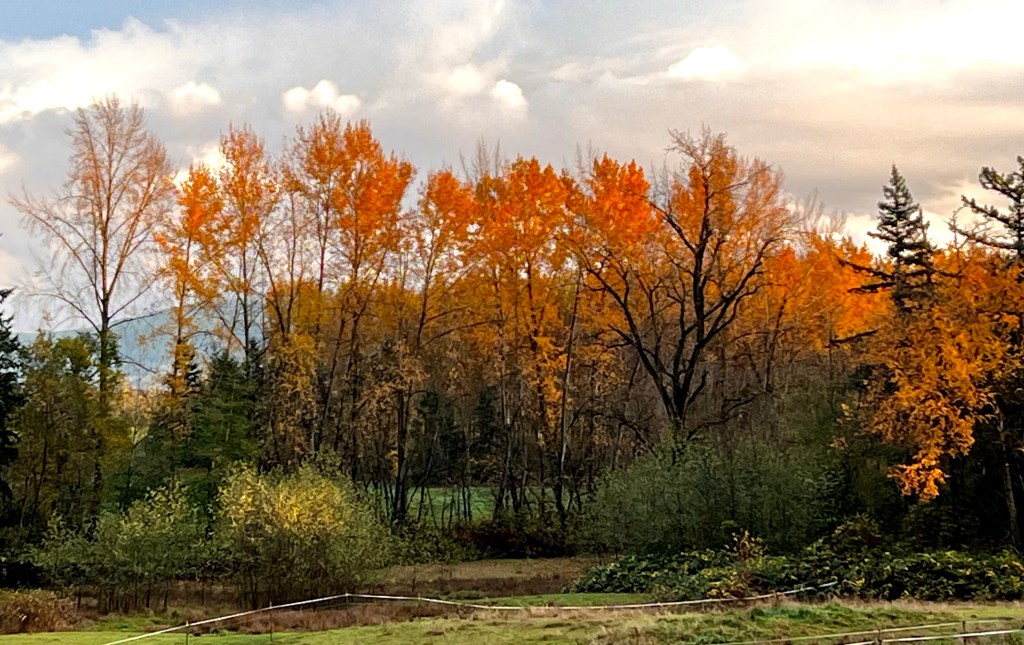
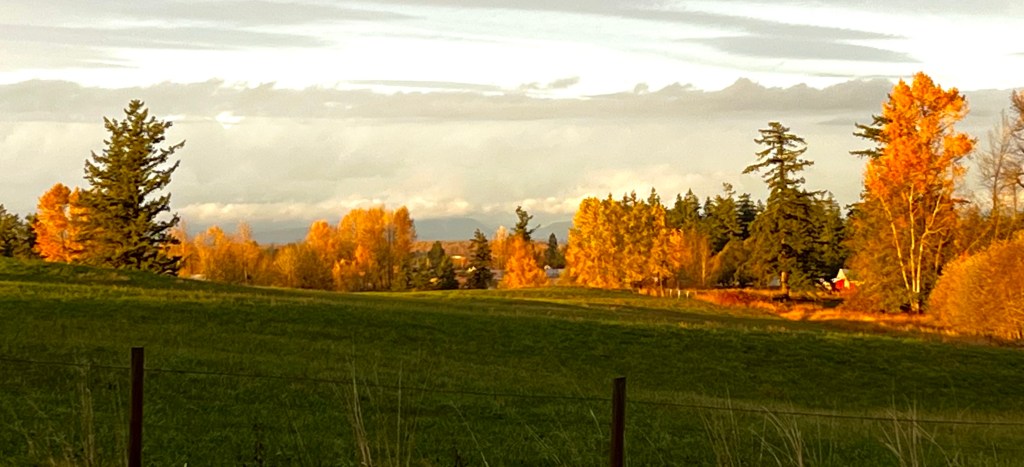
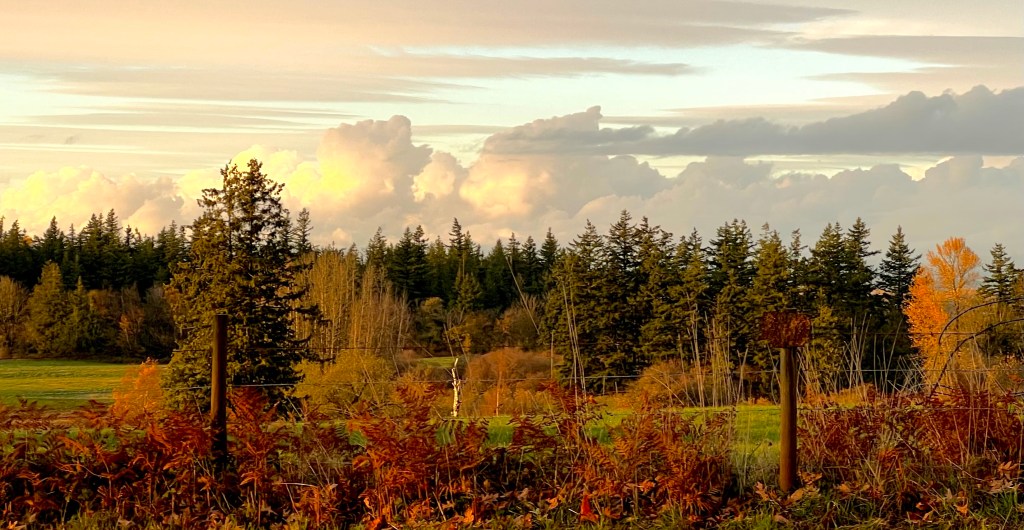
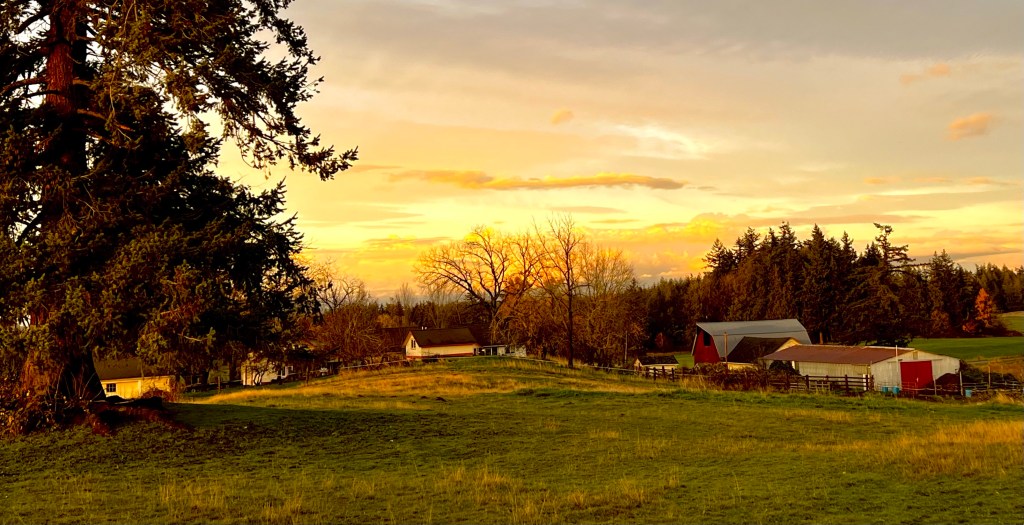
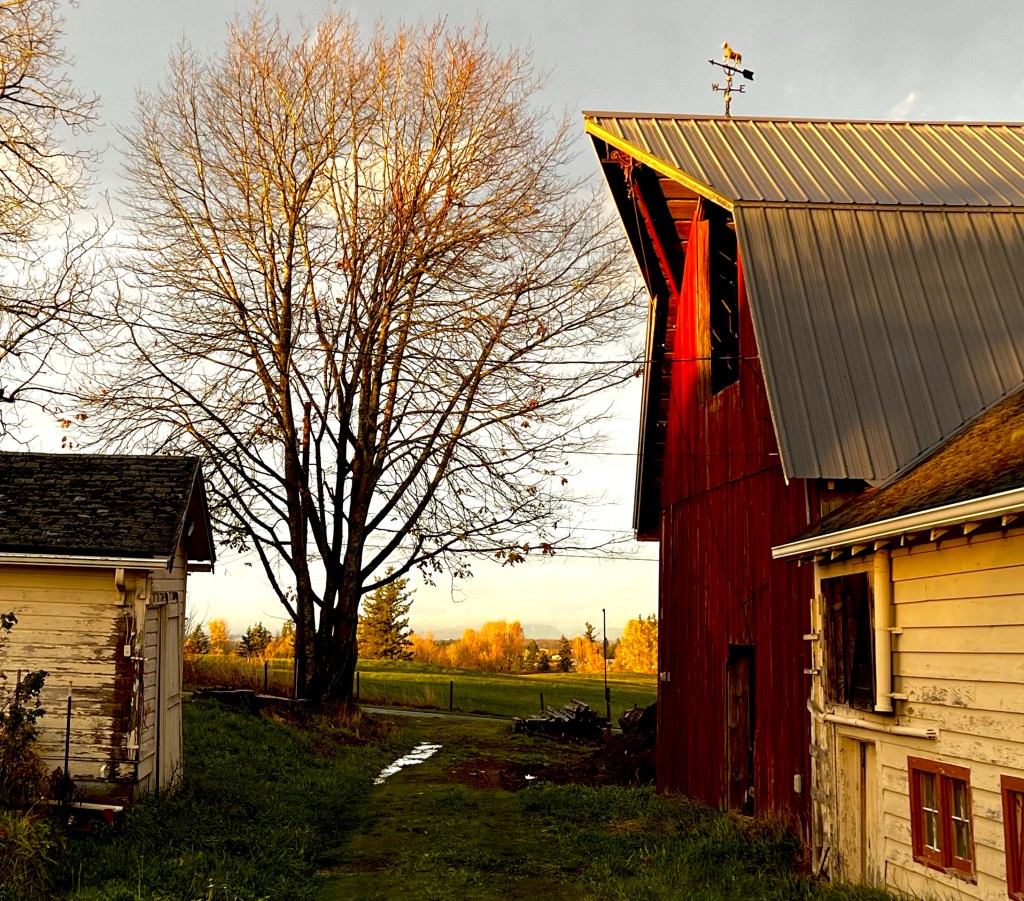
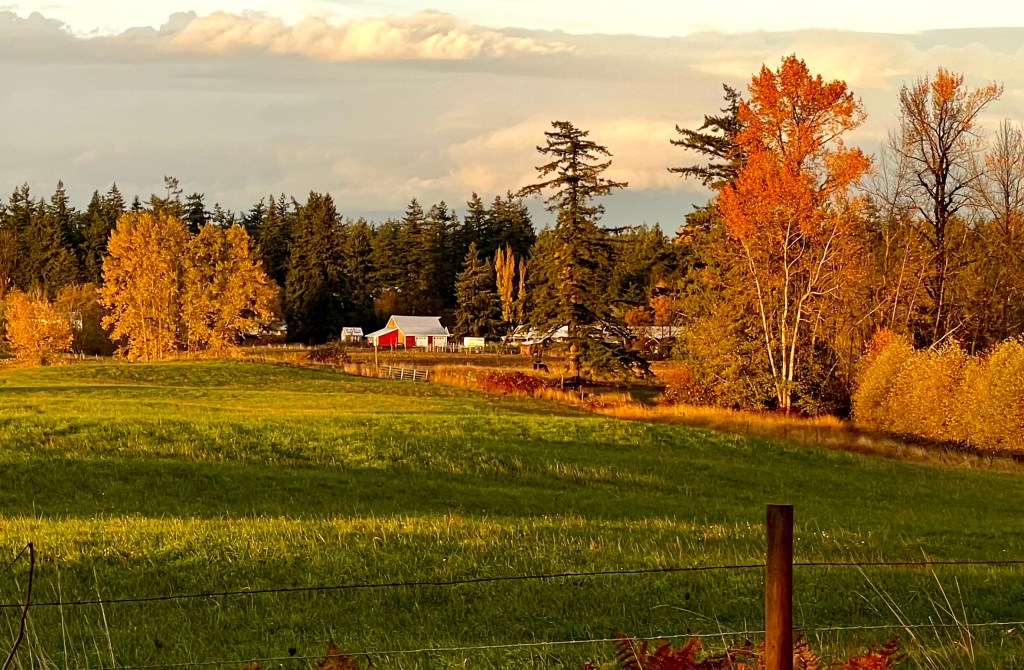
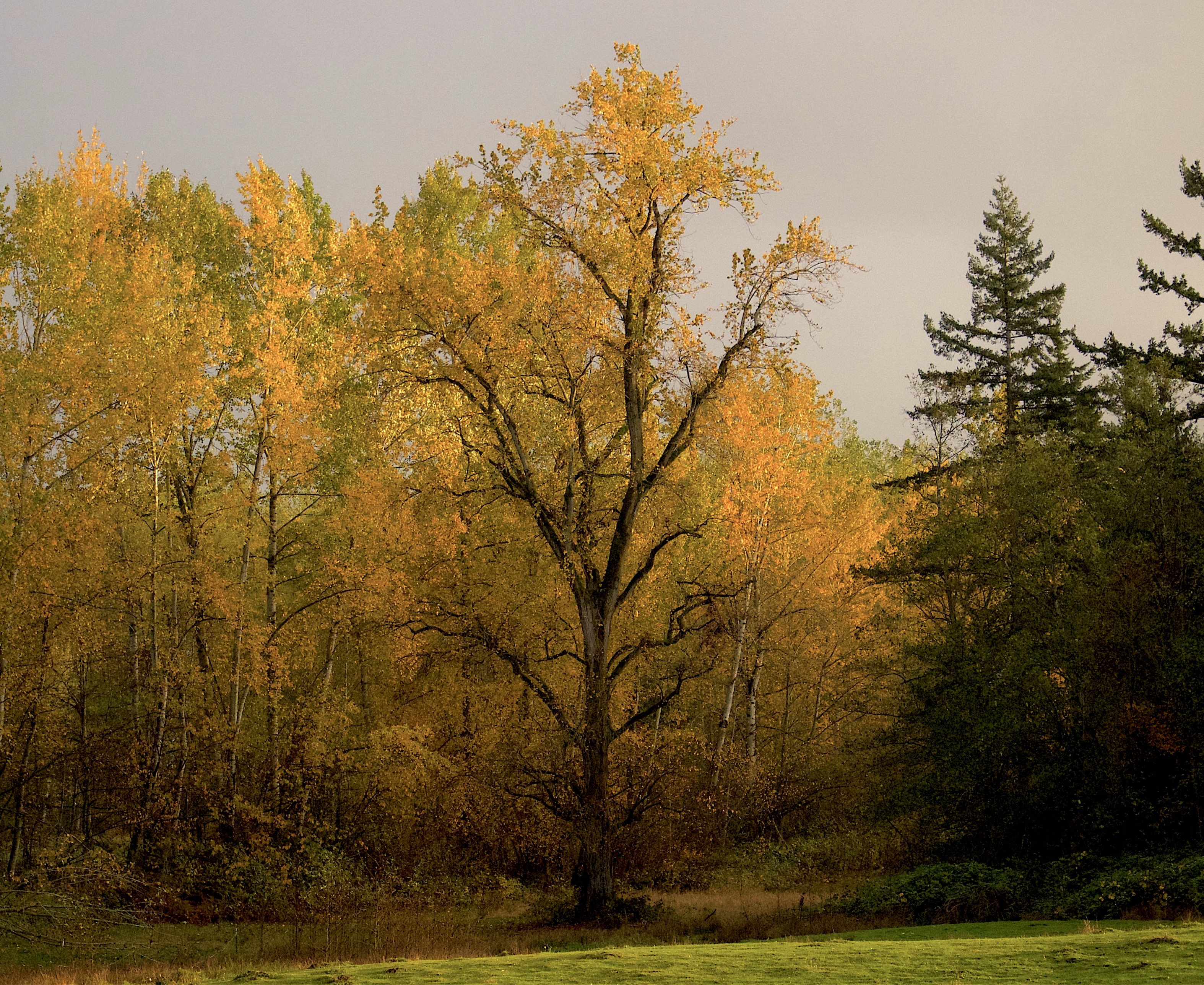
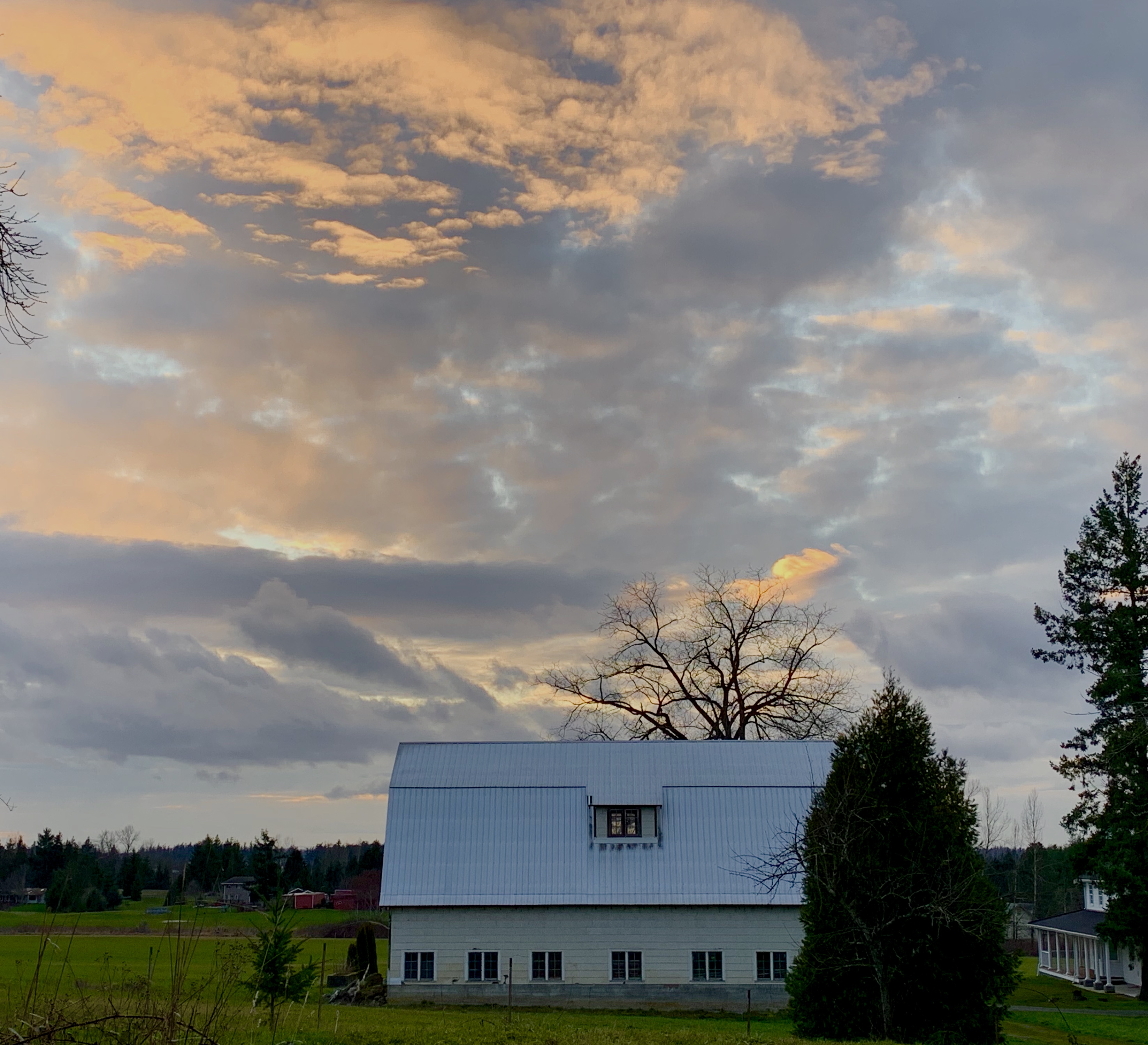
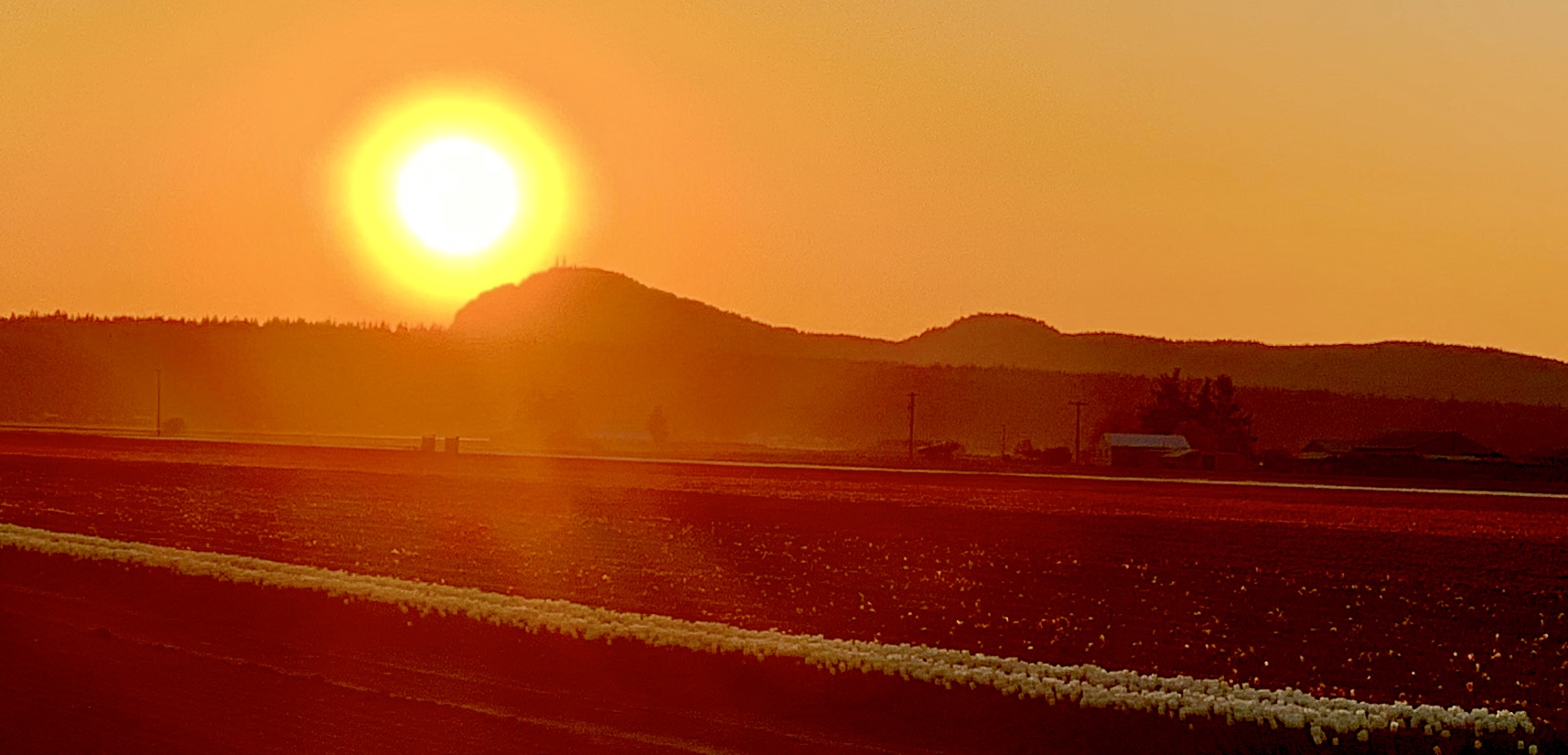
These photos of our farm are from last week, before an atmospheric river fell in torrents from the sky. The downpour precipitated melting of new-fallen snow in the nearby Cascade mountains and foothills, with subsequent cresting of the rivers and streams in lower mainland British Columbia and our local counties over the weekend.

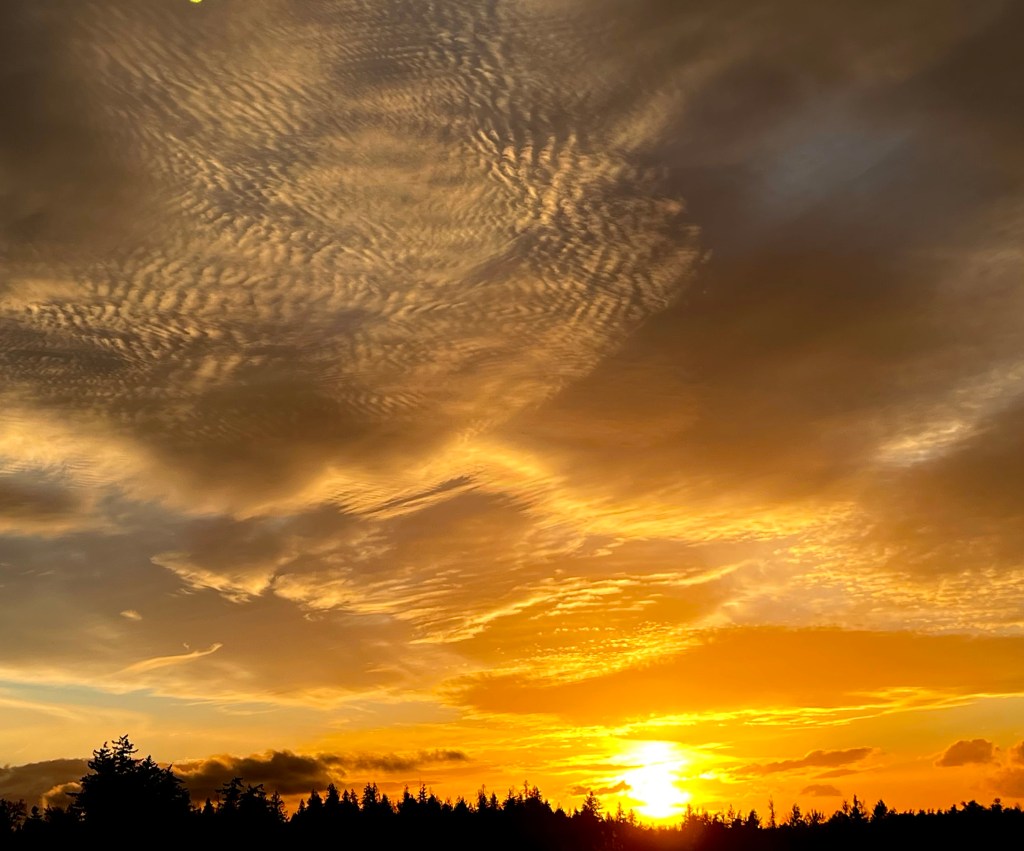
Before the storm hit us, these pictures depict a flood of golden sunshine in the late afternoon. It was the kind of saturation of light we all were needing, unaware that our skies and ground would soon be over-saturated with far too much water in a few days.

Our communities, both north and south of our nearby Canadian border, continue to reel from this unprecedented flood event, with roads impassable due to standing water and landslides, as well as whole towns evacuated by boat and homes and businesses will be uninhabitable for weeks, if not months.

The sun has returned now that the river in the sky has dried up, having dumped its load. We now wait for the waters and the misery to recede.

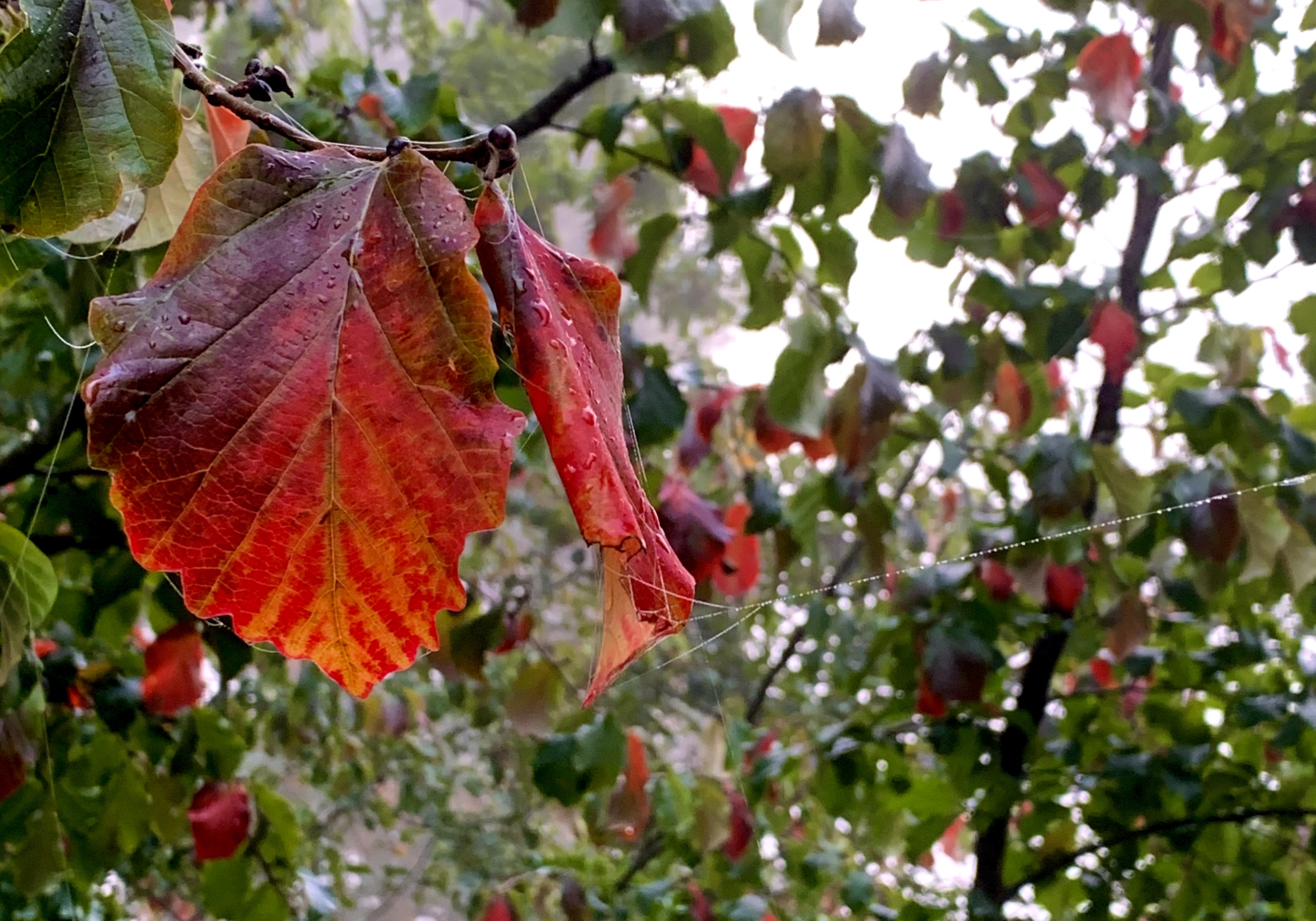
The scarlet red of the dying dogwood leaves are poignant indeed, but nothing like the poignancy of communities pulling together to restore normalcy after disaster. Churches have quickly become places of refuge for those who have no home this week and in the weeks to come.

Bless those who are able to help, if not with boats and muscle, then with donations:

The Whatcom Community Foundation Resilience Fund is targeting the local efforts as well as support of the Red Cross, critical in meeting all disaster needs everywhere.

Thank you for reading and praying for restoration for the affected Canadians and Americans.

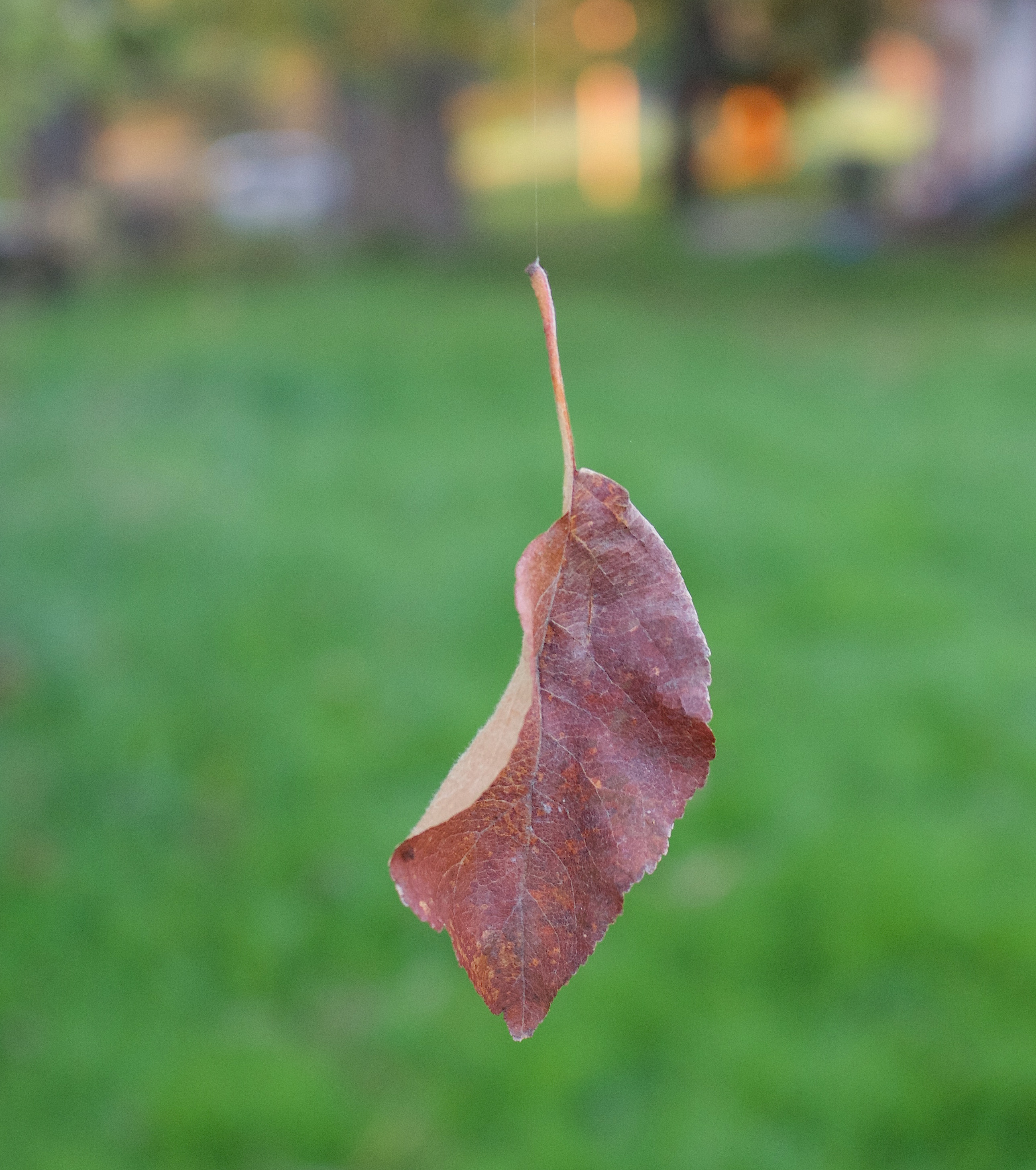
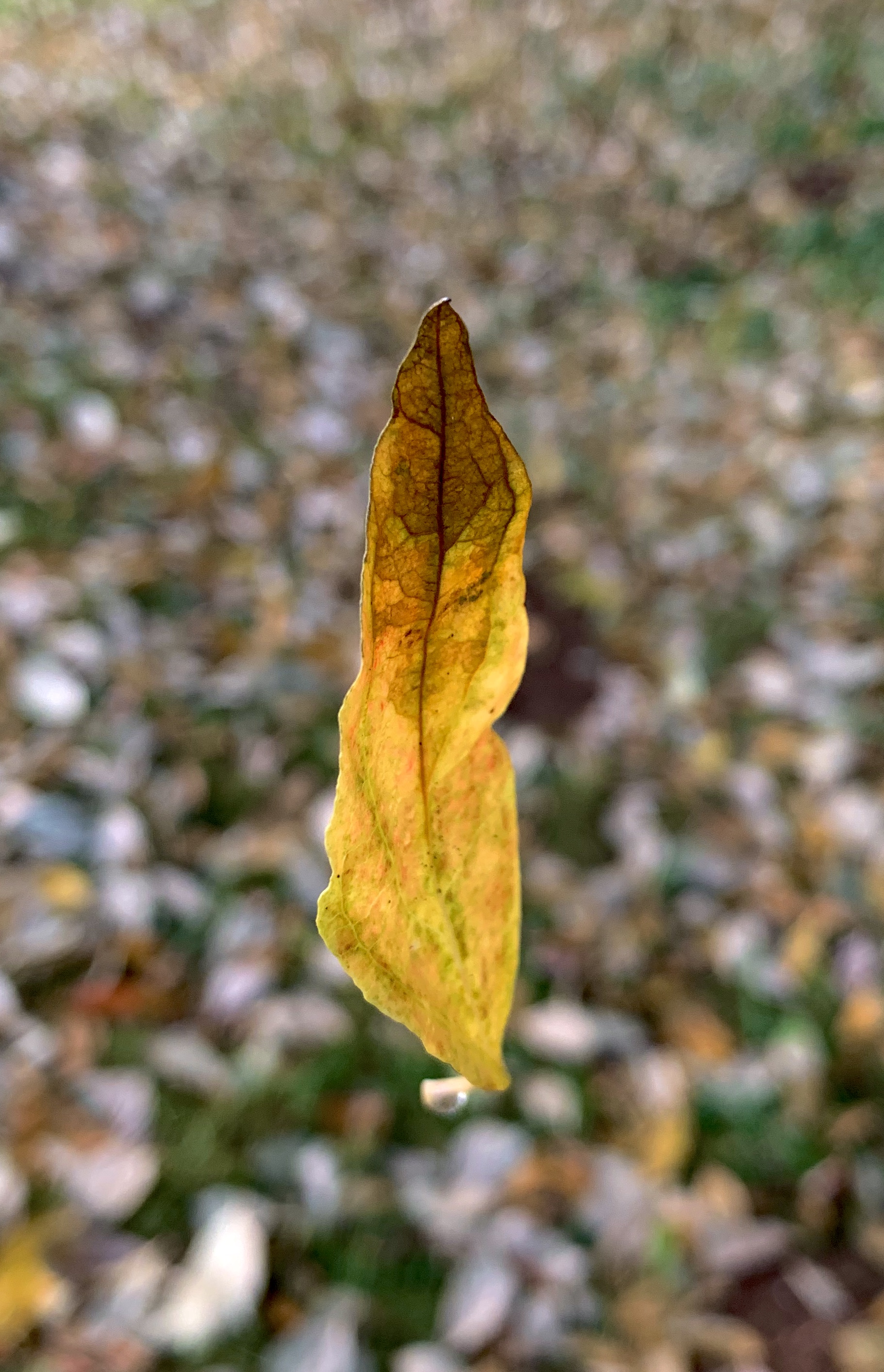
Dangling Alone

l (a

le
af
fa
ll

s)
one
l
iness…

~e.e. cummings

The trees are undressing, and fling in many places—
On the gray road, the roof, the window-sill—
Their radiant robes and ribbons and yellow laces;
A leaf each second so is flung at will,
Here, there, another and another, still and still.

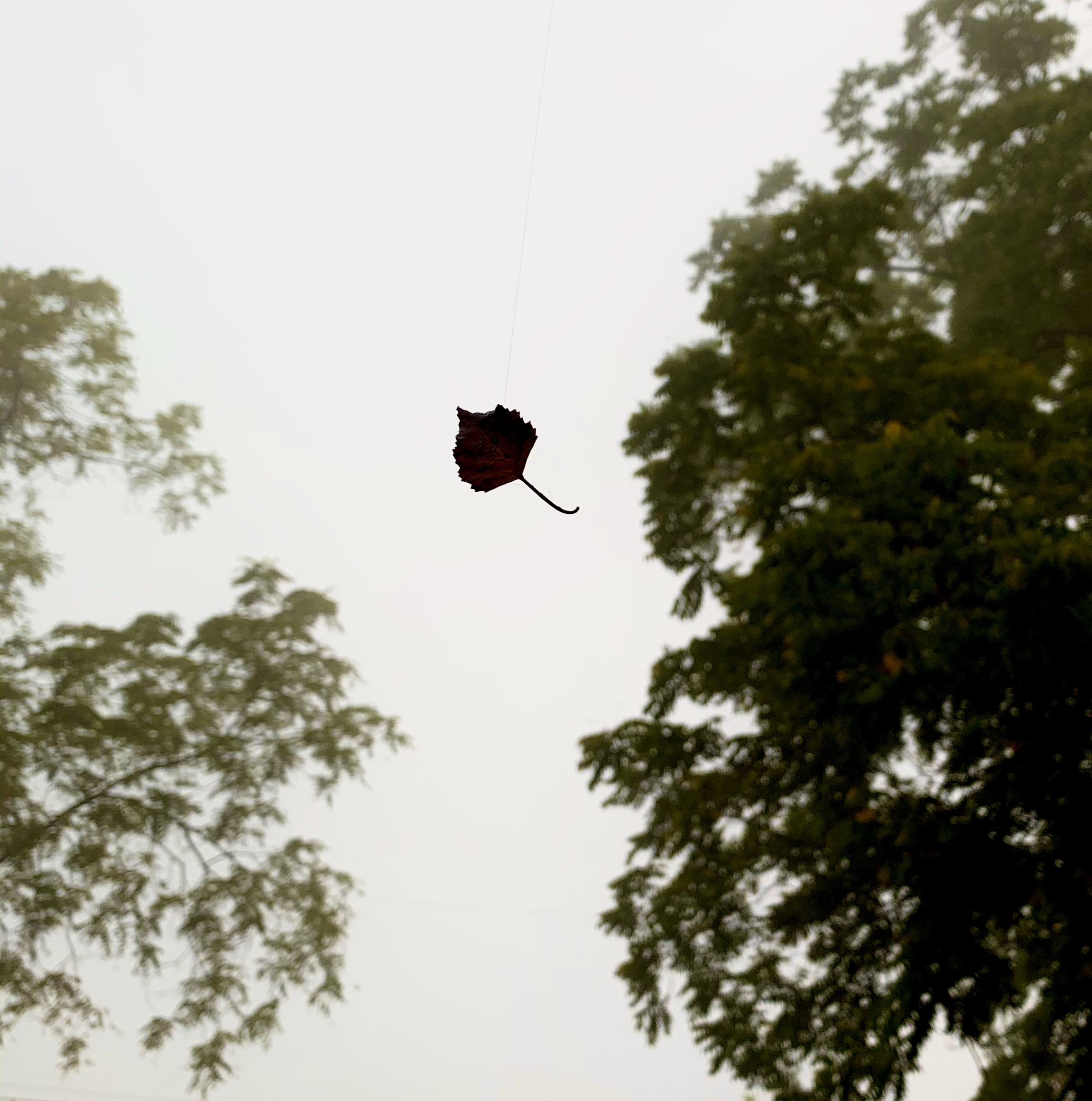
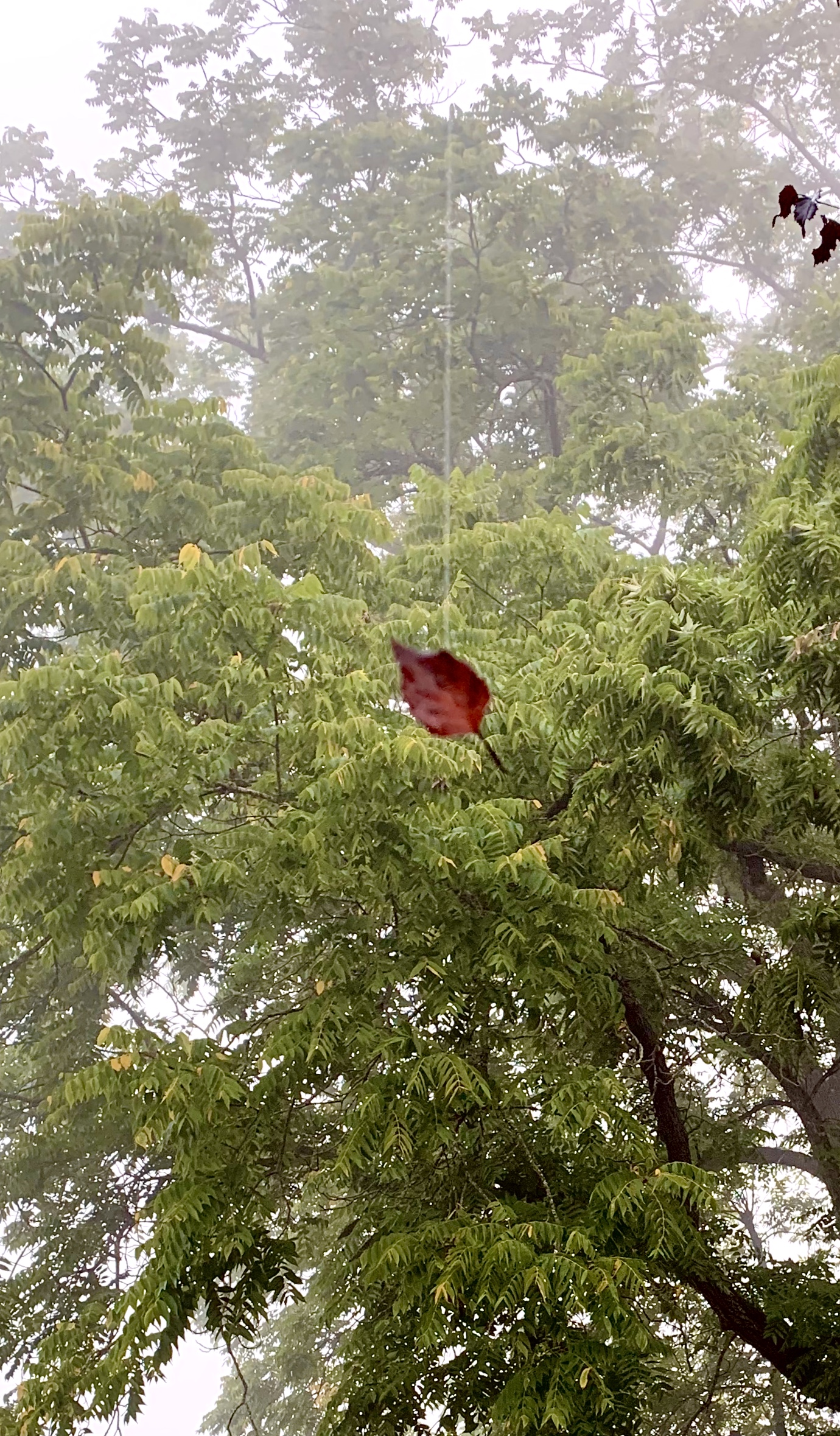
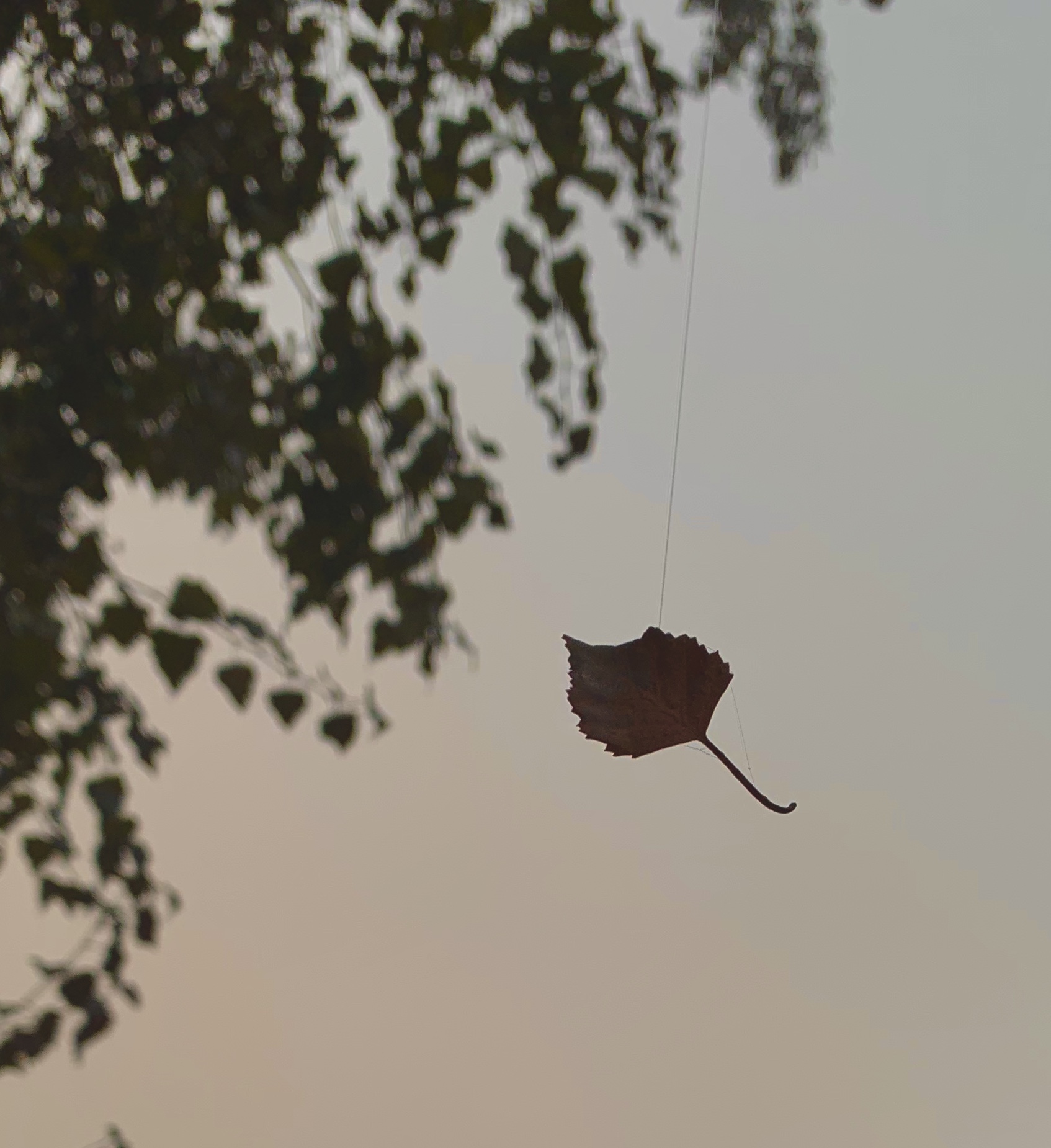
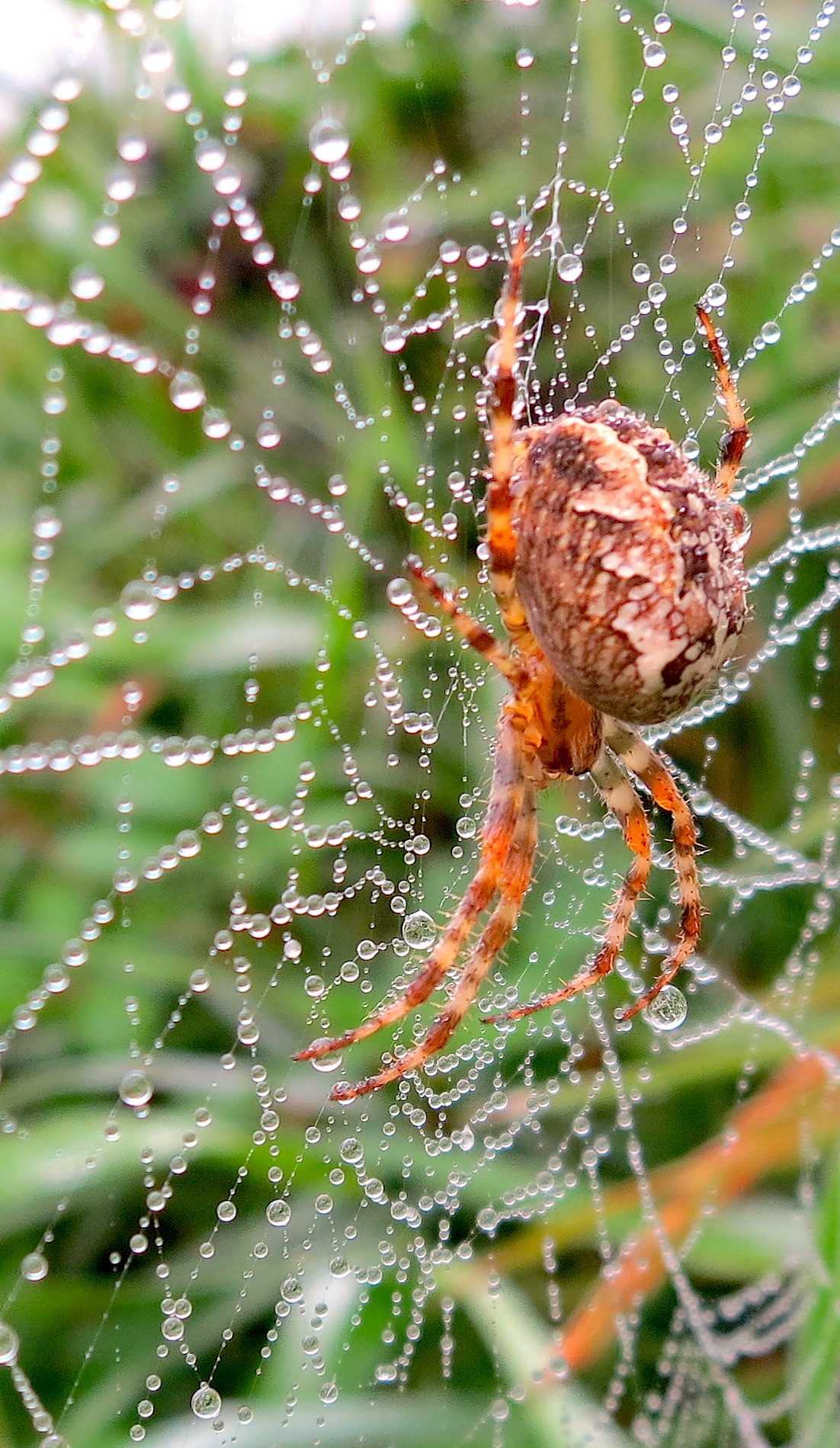
A spider’s web has caught one while downcoming,
That stays there dangling when the rest pass on;
Like a suspended criminal hangs he, mumming
In golden garb, while one yet green, high yon,
Trembles, as fearing such a fate for himself anon.
~Thomas Hardy “Last Week in October”

You may feel you are the only one
to fall
until you land in a cushion of others
comforted.

But maybe you dangle suspended
twisting and turning in the slightest breeze
not knowing when the fall will come.

I know I’m both~
one alone suspended by faith,
hoping for rescue
while others pass me by ~~
another and another, still and still.

Held by a slender silken thread
until the moment comes
when I too am let go.

A book of beauty in words and photography, available for order here:

Another Way Home

I do remember darkness, how it snaked
through the alders, their ashen flanks
in our high-beams the color of stone.
That hollow slap as floodwater hit
the sides of the car. Was the radio on?
Had I been asleep?
Sometimes you have to tell a story
your entire life to get it right.

Twenty-two and terrified, I had married you
but barely knew you. And for forty years
I’ve told this story wrong. In my memory
you drove right through it, the river
already rising on the road behind us,
no turning around.
But since your illness I recall it
differently. Now that I know it’s possible
to lose you, I’m finally remembering
it right. That night,
you threw that car in reverse,
and gunned it. You found us
another way home.
~Emily Ransdell, “Everywhere a River,” from New Letters

When life gets scary, we long for rescue as the world threatens to overwhelm us. And eventually it is true, this world will overwhelm us, and we’ll wonder how we will escape.

Where does our help come from?

It doesn’t always come from the direction we expect. Most often, we keep staring ahead, hoping somehow salvation lies just around the corner.

But salvation has been behind us all the while. We were created saved but need to believe it, live it out, share it with anyone open to listen.

We all need to trust in the Rescuer when we are stuck and flooded with life. It takes courage, faith and grace to be led home, either straight ahead or back the way we came.

Heidelberg Catechism Question and Answer 1:

Q.What is your only comfort in life and death?
A.That I am not my own, 1
but belong with body and soul,
both in life and in death, 
2to my faithful Saviour Jesus Christ. 
3He has fully paid for all my sins
with his precious blood, 
4and has set me free
from all the power of the devil. 
5He also preserves me in such a way 
6that without the will of my heavenly Father
not a hair can fall from my head; 
7indeed, all things must work together
for my salvation. 
8Therefore, by his Holy Spirit
he also assures me
of eternal life 
9and makes me heartily willing and ready
from now on to live for him

A book of beauty and hope in words and photography, available for order here:

To Live One More Day

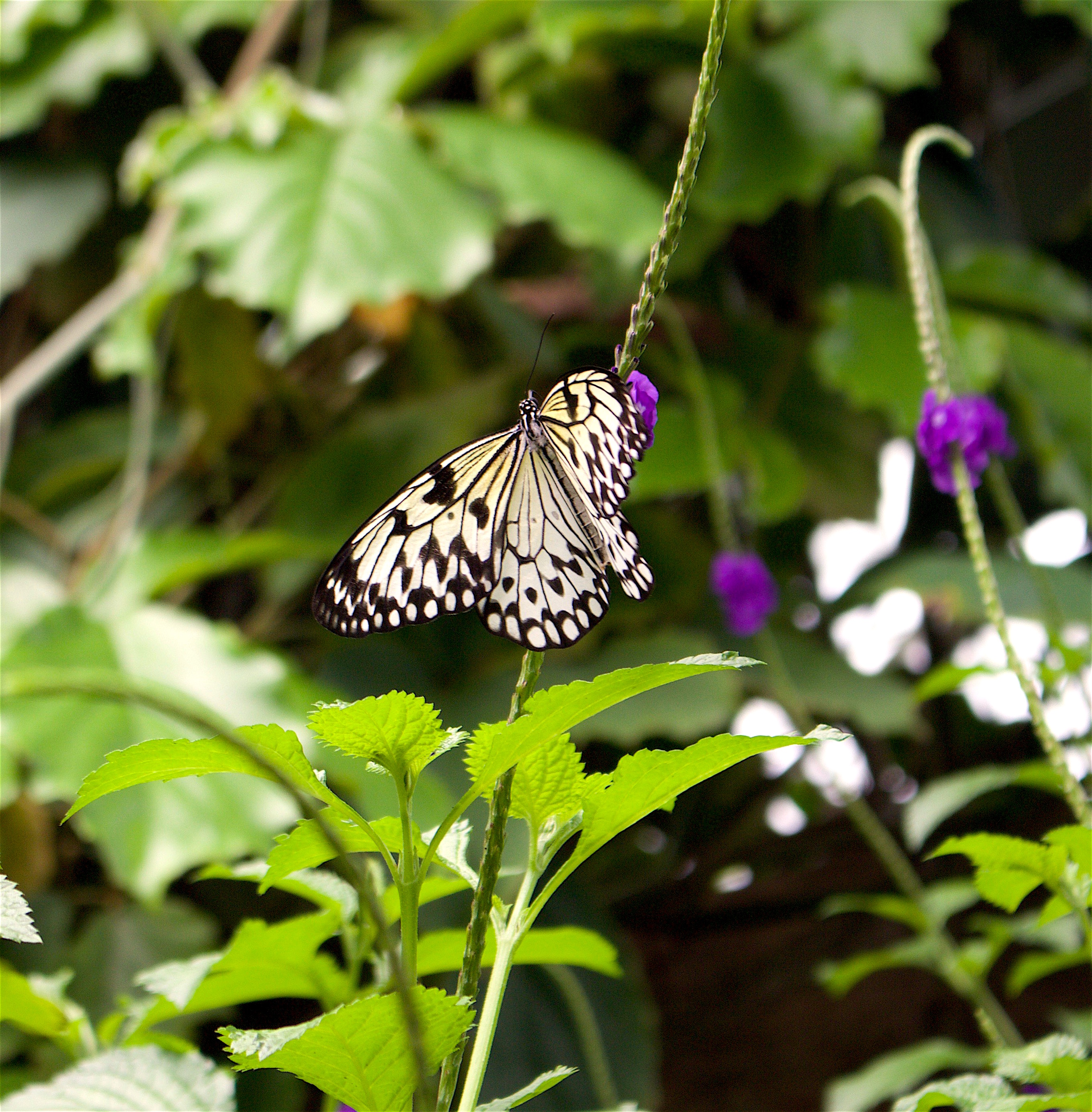
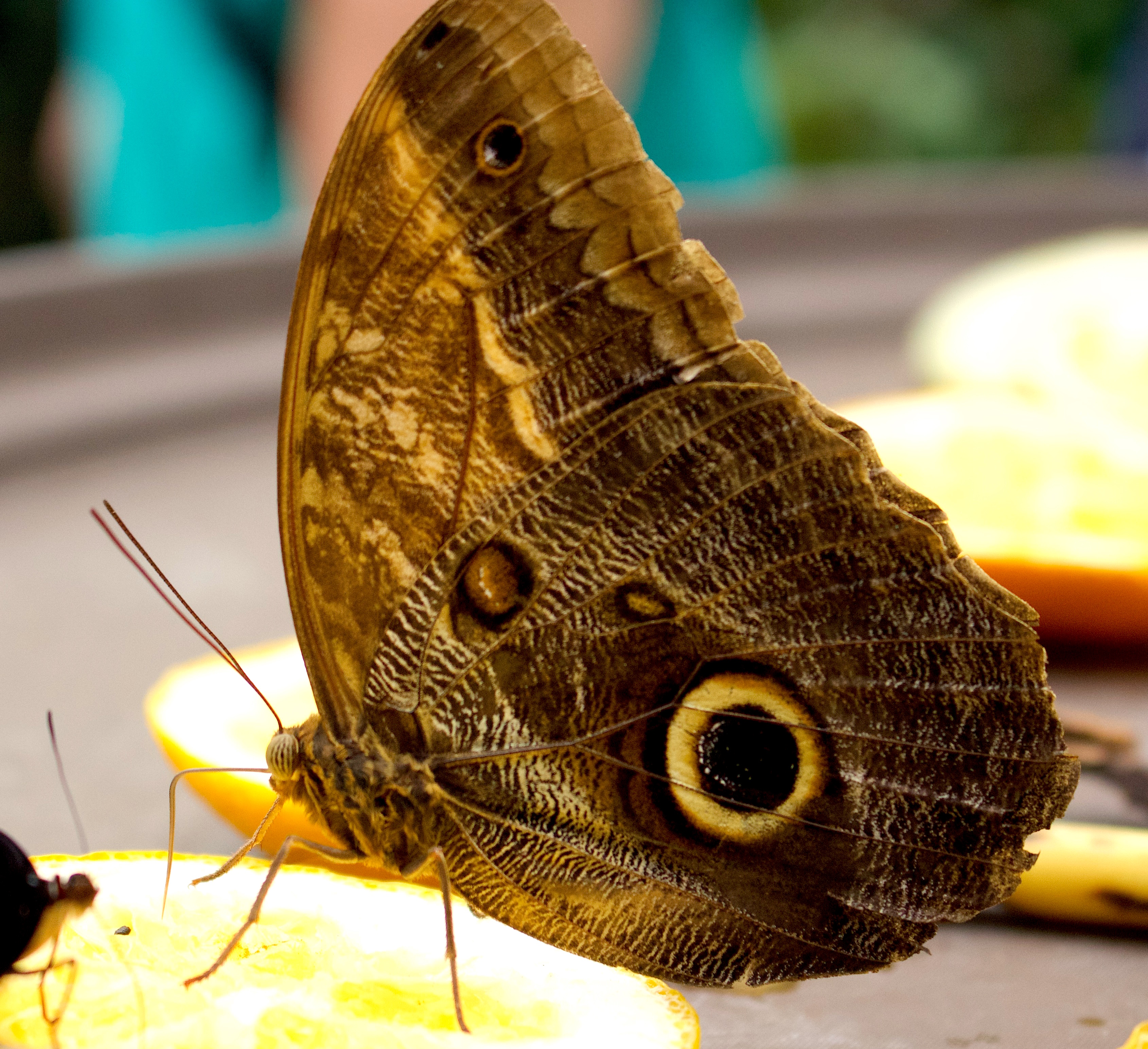
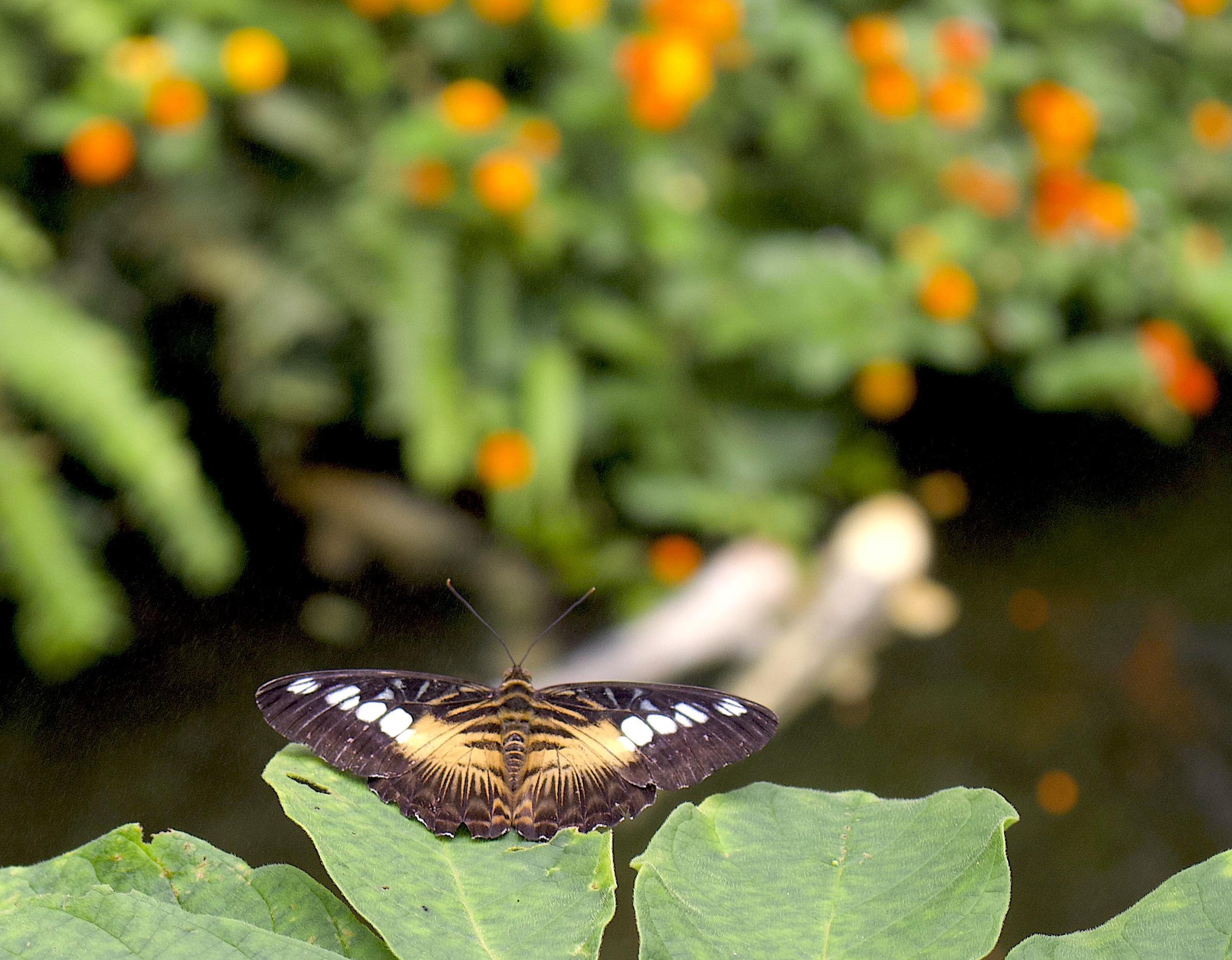
What a slow way to eat, the butterfly
is given by Nature, sipping nectar
one tiny blue flower at a time. Though
a Monarch in name, she’s made to scavenge
like the poorest of the poor, a morsel
here, a morsel there. A flutter of ink-
splattered orange wings. We don’t want to see
the struggle that undergirds the grace: the
ballerina’s sweat, or her ruined feet
hidden by tights and toe-shoes. She knows her
career will be as brief as it was hard
to achieve. Pollinated, the tiny
blue flowers are sated. The butterfly
flits away, hoping to live one more day.

~Barbara Quick, “The Struggle That Undergirds the Grace.”

You have been my friend. That in itself is a tremendous thing.
I wove my webs for you because I liked you.
After all, what’s a life, anyway?
We’re born, we live a little while, we die.
A spider’s life can’t help being something of a mess,
with all this trapping and eating flies.
By helping you, perhaps I was trying to lift up my life a trifle.
Heaven knows anyone’s life can stand a little of that.
~E. B. White, Charlotte’s Web


And when the sun rises we are afraid
it might not remain

when the sun sets we are afraid
it might not rise in the morning
when our stomachs are full we are afraid
of indigestion
when our stomachs are empty we are afraid
we may never eat again
when we are loved we are afraid
love will vanish
when we are alone we are afraid
love will never return
and when we speak we are afraid
our words will not be heard
nor welcomed
but when we are silent
we are still afraid


So it is better to speak
remembering
we were never meant to survive.
~Audre Lorde from “A Litany for Survival”

We are here so briefly.
We were never designed to survive forever on this earth
yet we try to run the clock out as long as we can.

Just one day more.

We are here because of struggle –
the pain of our birth, whether the cry of our laboring mother,
or our own wrestling free of the cocoon or the shell,
our daily work to find food
to feed ourselves and our young,
the upkeep and maintenance of our frail and failing bodies,
our ongoing fear we’ll be taken
before we can make a difference in another’s life.

If there is a reason for all this (and there is):
our struggle forms the grace of another’s salvation.
The flowers bloom to feed the butterfly,
the butterfly pollinates the flower,
ensuring the next generations of both.
The silent and weakened find their voice
so that the next generation can thrive.

Heaven knows,
anyone’s life can stand a little of that.

Just one day more, Lord. Please – one day more.

Tomorrow we’ll discover
What our God in Heaven has in store
One more dawn
One more day
One day more

~from Les Miserable

A new book available from Barnstorming available to order here:

How is Your Life?

Today, when I could do nothing,
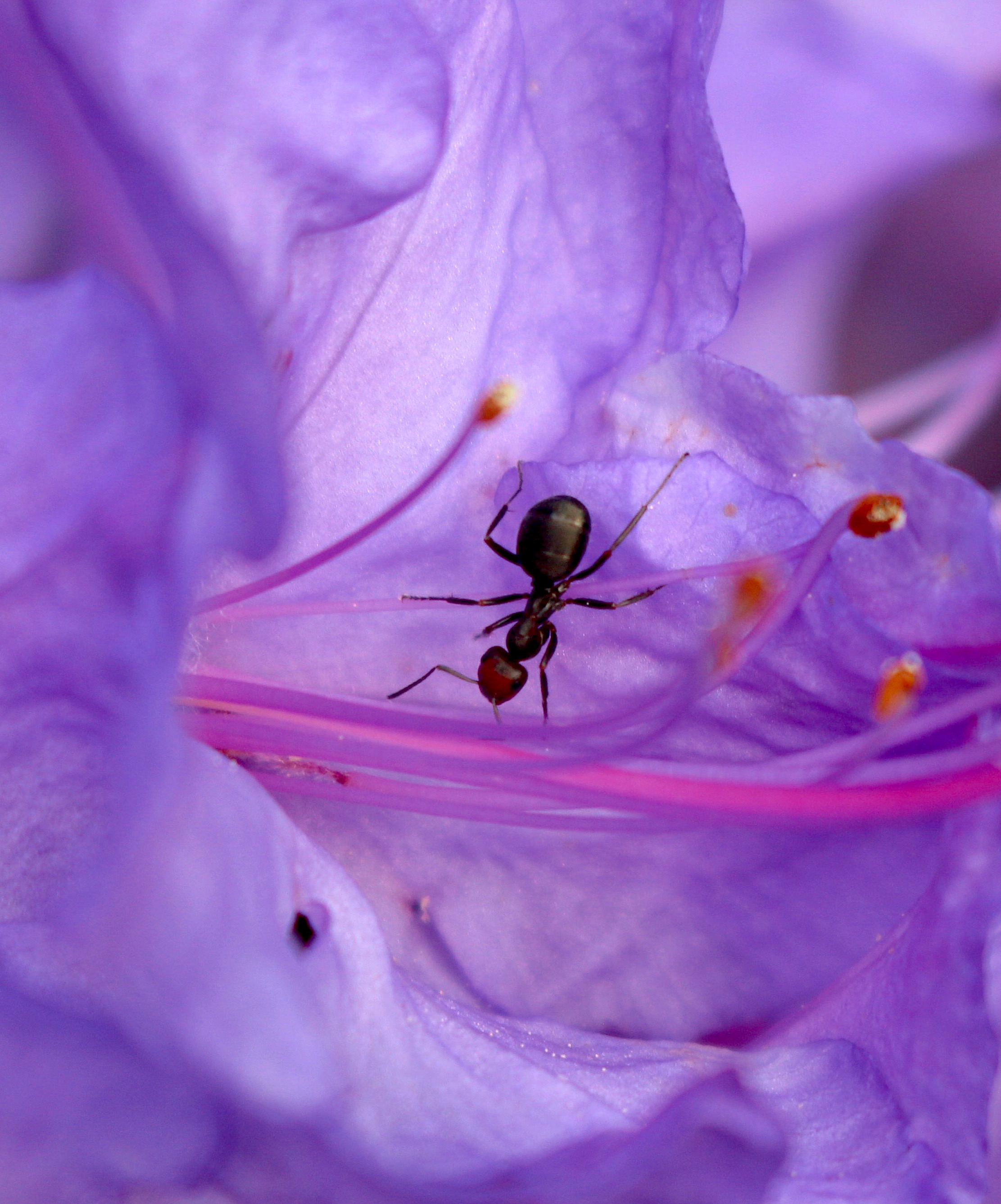
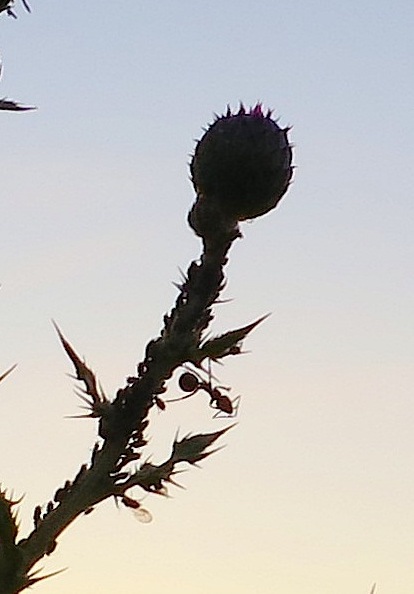
I saved an ant.

It must have come in with the morning paper,
still being delivered
to those who shelter in place.

A morning paper is still an essential service.

I am not an essential service.

I have coffee and books,
time,
a garden,
silence enough to fill cisterns.

It must have first walked
the morning paper, as if loosened ink
taking the shape of an ant.

Then across the laptop computer — warm —
then onto the back of a cushion.


Small black ant, alone,
crossing a navy cushion,
moving steadily because that is what it could do.

Set outside in the sun,
it could not have found again its nest.
What then did I save?


It did not move as if it was frightened,
even while walking my hand,
which moved it through swiftness and air.


Ant, alone, without companions,
whose ant-heart I could not fathom—
how is your life, I wanted to ask.


I lifted it, took it outside.

This first day when I could do nothing,
contribute nothing
beyond staying distant from my own kind,
I did this.

~Jane Hirschfield “Today When I Could Do Nothing”

Nine months into social distancing one from another, with COVID spreading wider and faster than ever, I feel helpless to be a helper without the virus becoming a potentially deadly attachment to my efforts.

So I look for little ways to try to make a difference, as inadequate as they seem. I can no serve meals after evening church service. I can’t visit vulnerable people in their homes so have to be satisfied with screen visits. I can’t go where I wish when I wish because, by definition of age and medical risk, I am one of the vulnerable too.

So I look for words to express that may bring you a smile or maybe a knowing tear. I look for images to share that remind you of something from your past experience. I look for ways to make sense of the senseless when there can be so much disagreement and anger and bitterness. I look for where our common ground exists: how can we deepen and broaden our connection to one another in this time of painful and empty separation?

I want to ask and I want to hear: how is your life?

When we feel we can do nothing, we can do this: rescuing one another from isolation and loneliness. It will be the most important thing we do today.

Please tell me how you are.

Thorns Have Roses

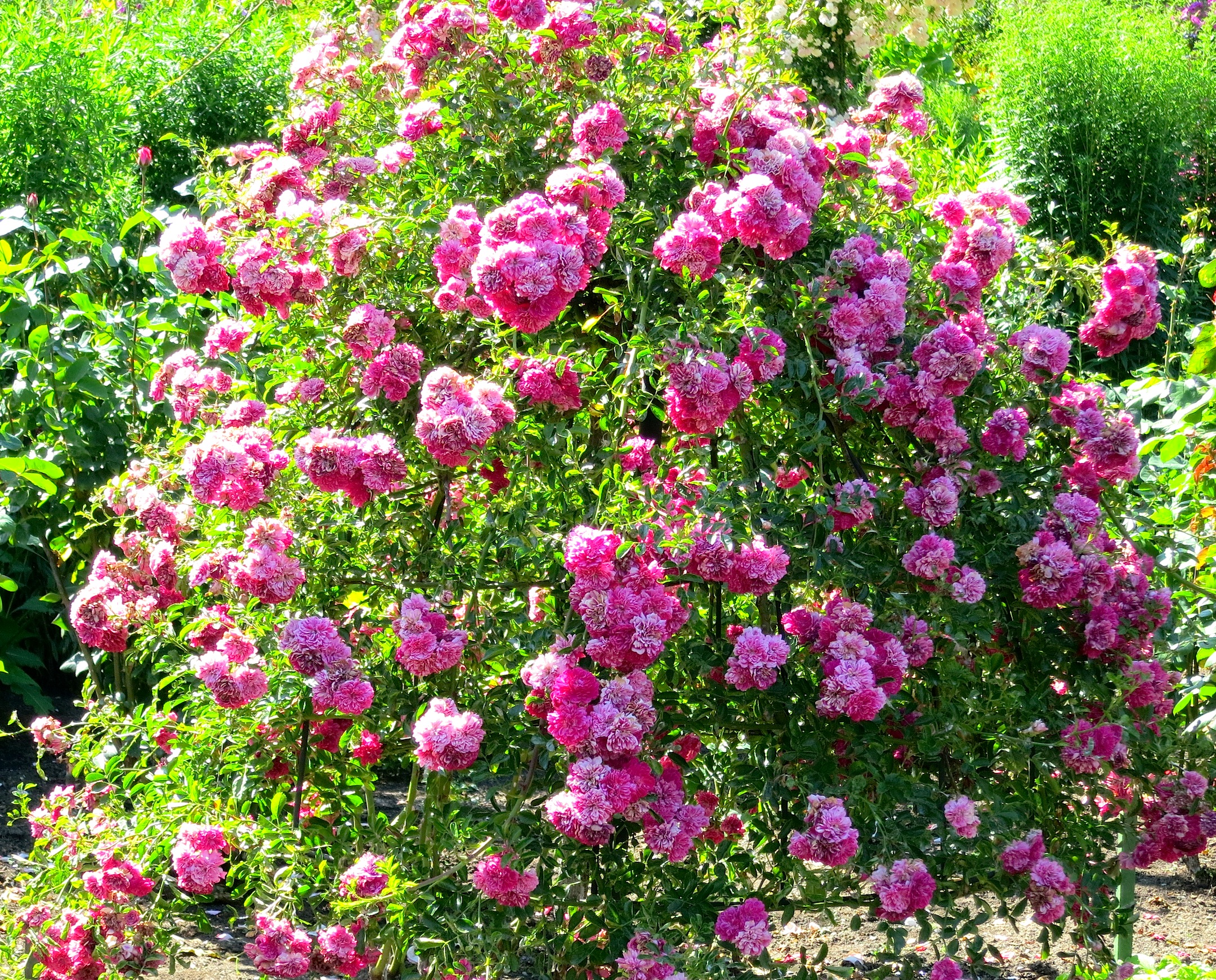
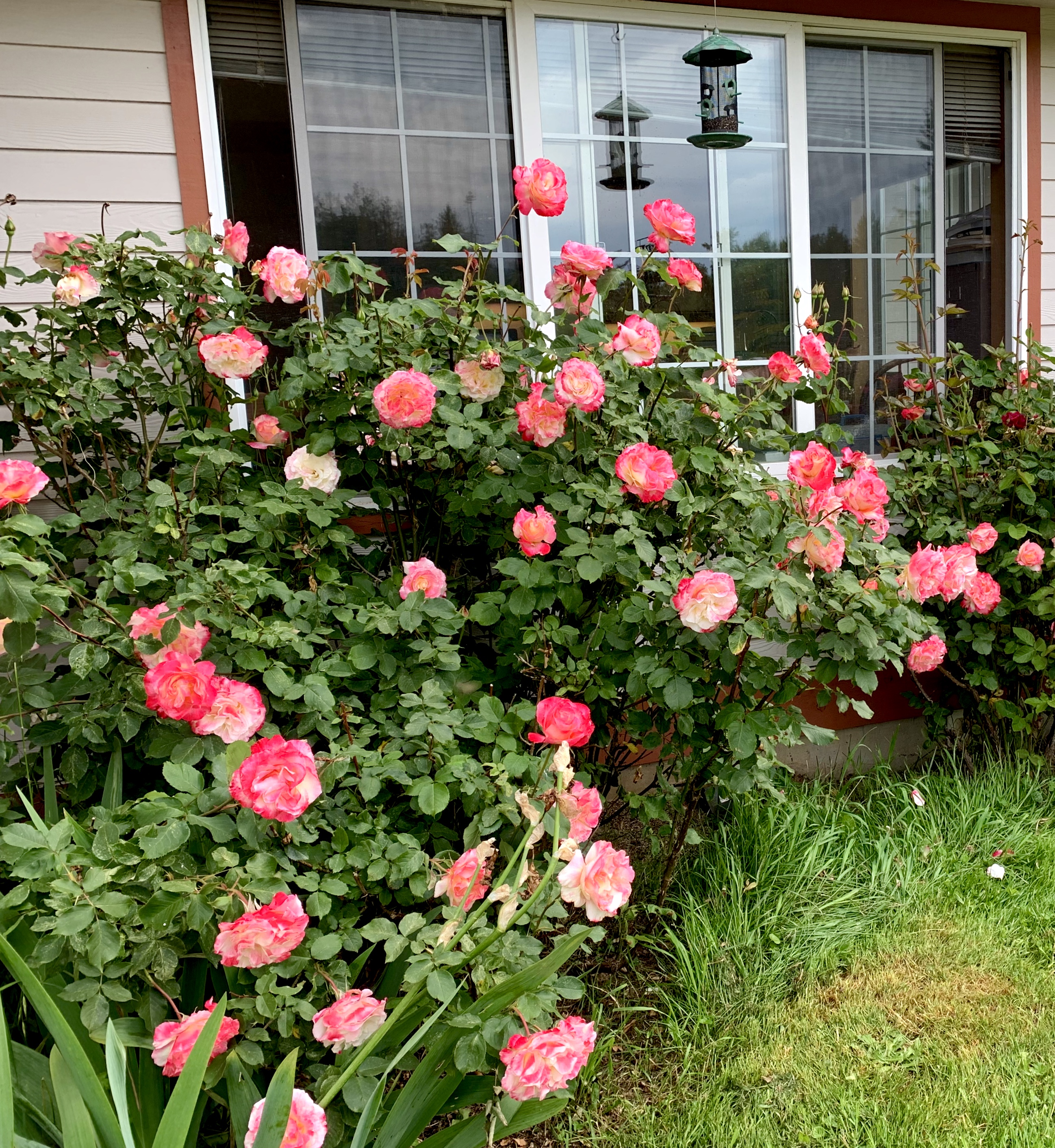
You love the roses – so do I. I wish
The sky would rain down roses, as they rain
From off the shaken bush. Why will it not?
Then all the valley would be pink and white
And soft to tread on. They would fall as light
As feathers, smelling sweet; and it would be
Like sleeping and like waking, all at once!
~George Eliot
from “The Spanish Gypsy”

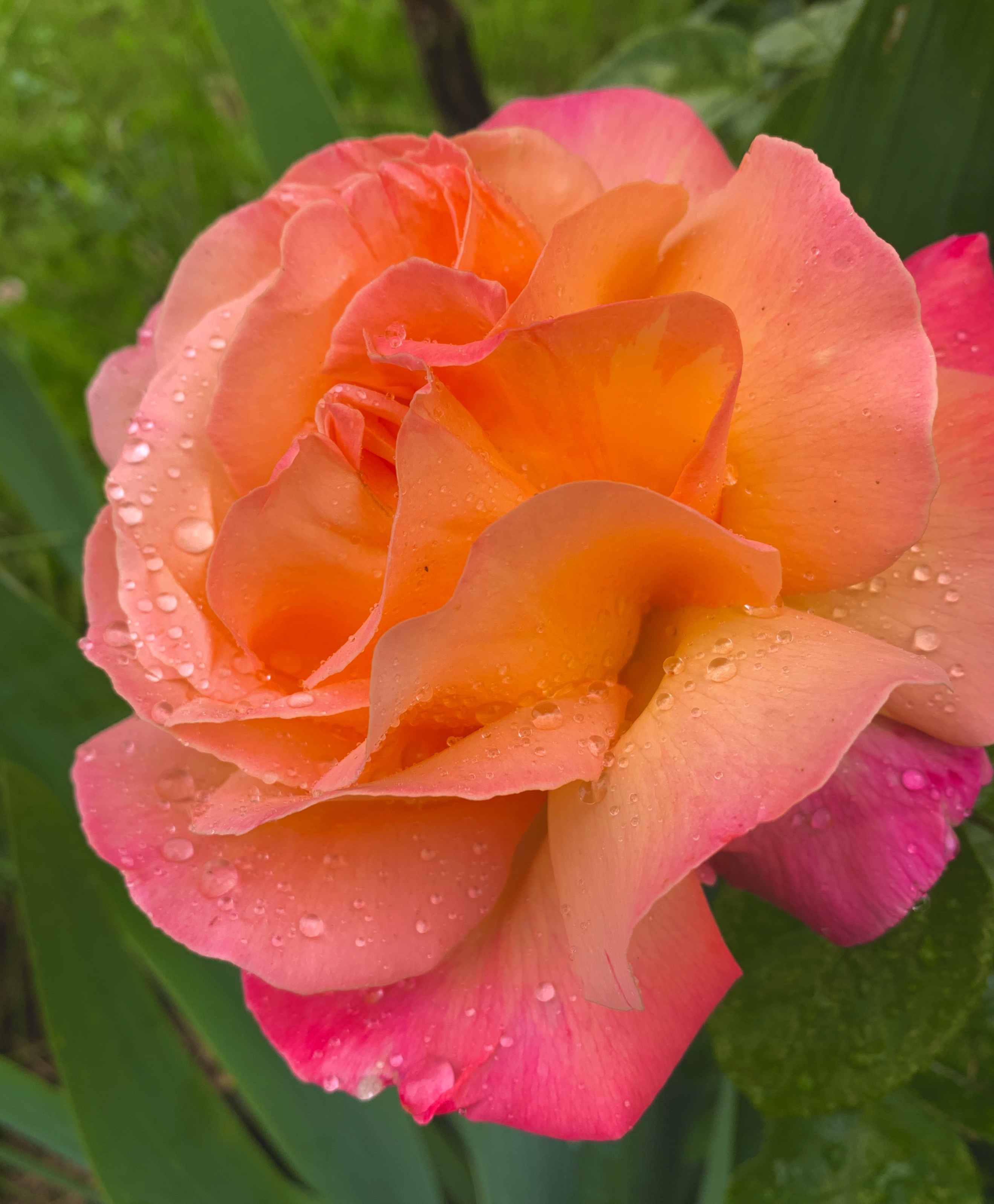
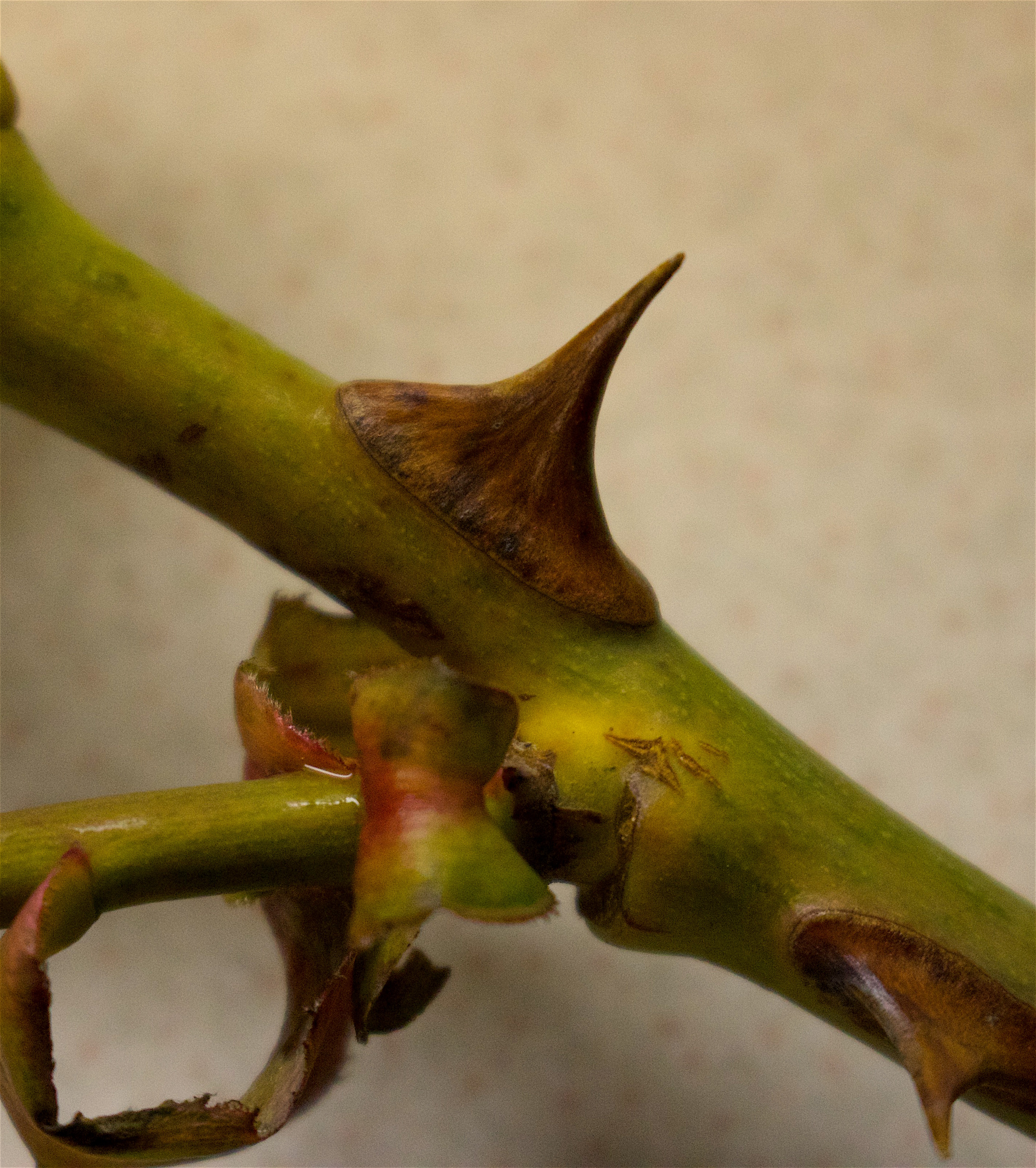
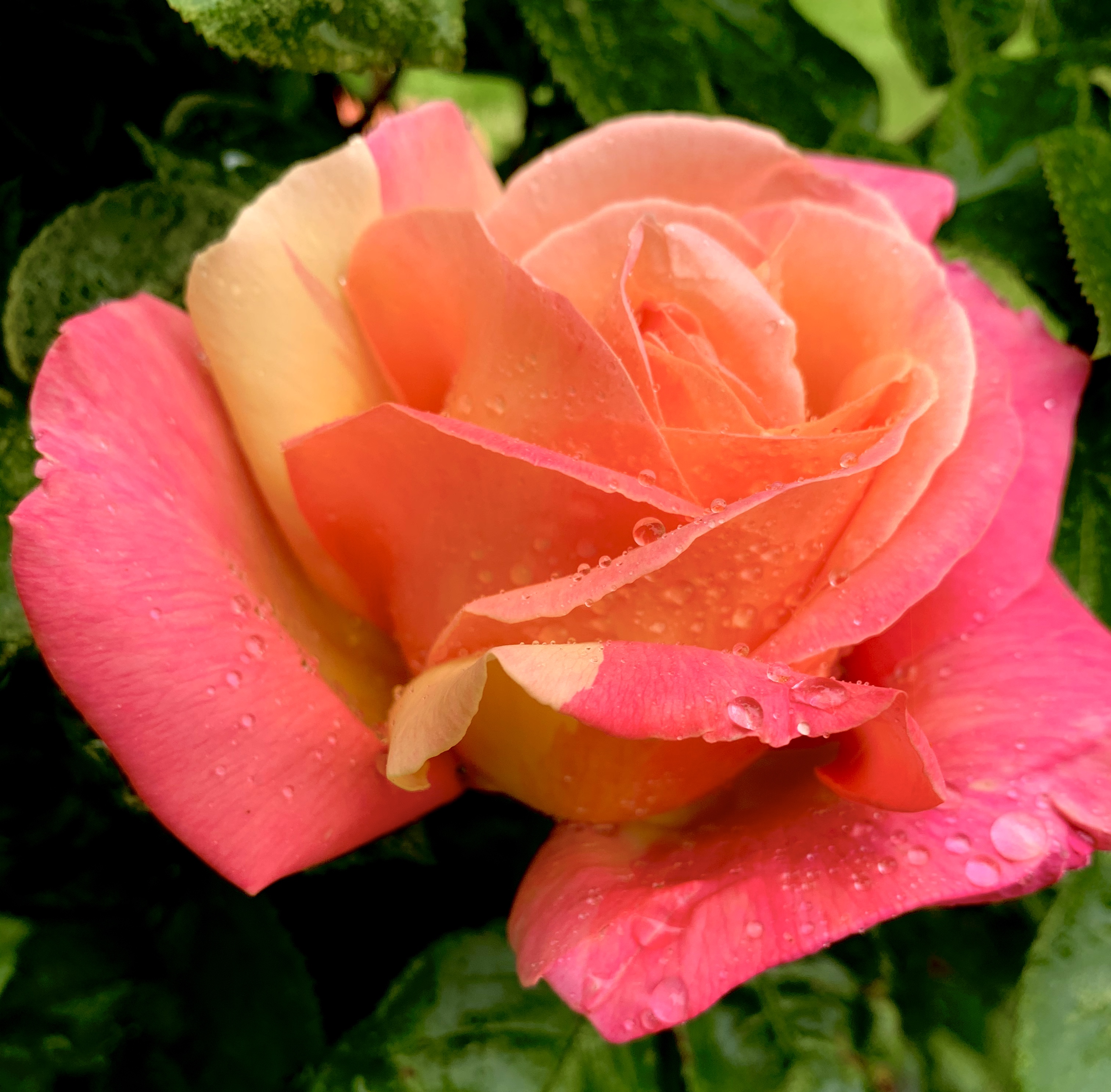
It was gardener/author Alphonse Karr in the mid-19th century who wrote that even though most people grumble about roses having thorns,  he was grateful that thorns have roses.

There was a time when thorns were not part of our world, when we knew nothing of suffering and death. Yet in pursuing and desiring more than we were already generously given, we received more than we bargained for. We are still paying for that decision; we continue to reel under the thorns our choices produce — every day there is more bloodletting.

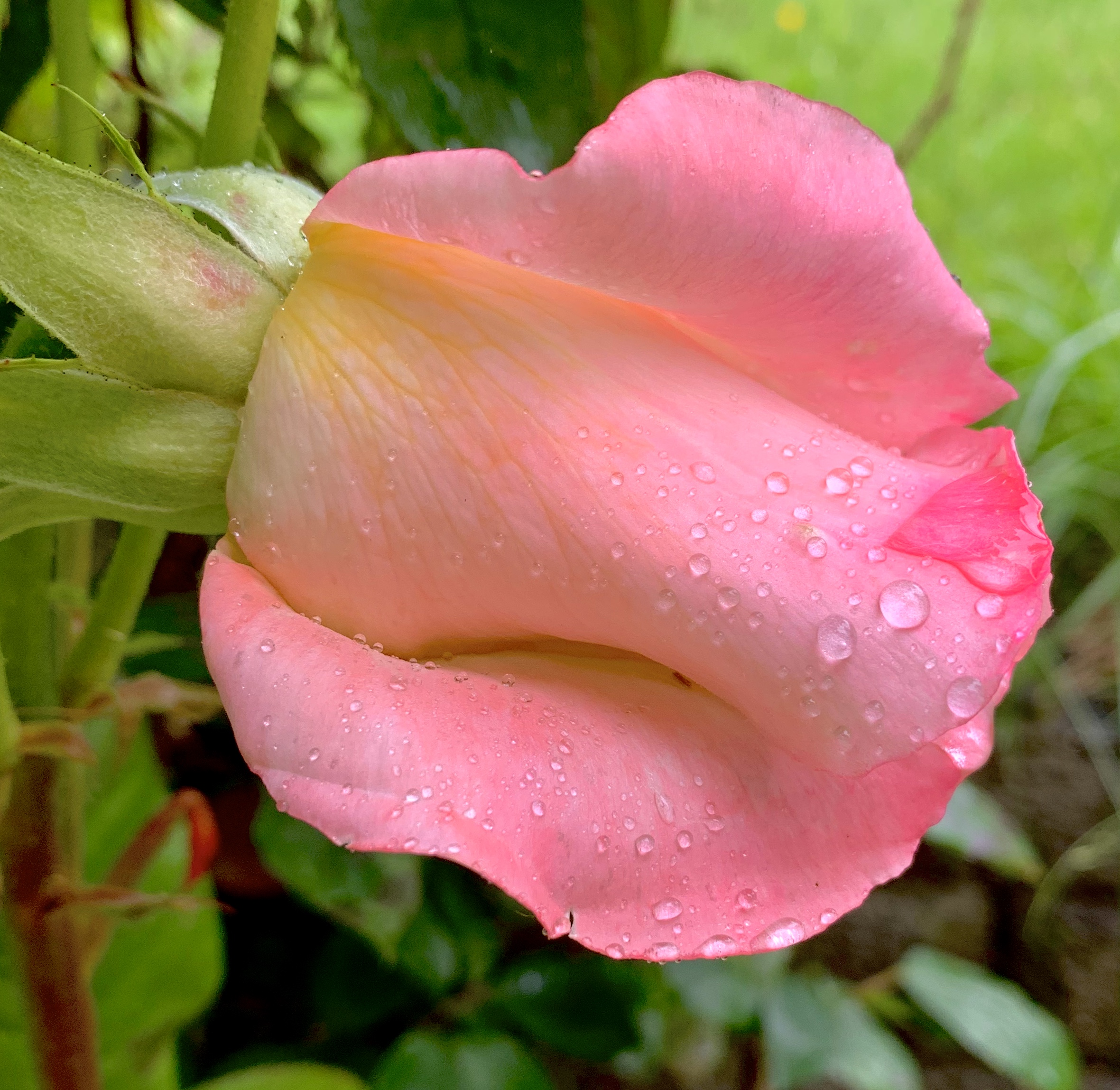
So a Rose was sent to adorn the thorns.

And what did we do? We chose thorns to make Him bleed and still do to this day.

A fragrant rose blooms beautiful,
bleeding amid the thorns,
raining down as we sleep and wake,
and will to the endless day.

Abandon entouré d’abandon, tendresse touchant aux tendresses…
C’est ton intérieur qui sans cesse se caresse, dirait-on;
se caresse en soi-même, par son propre reflet éclairé.
Ainsi tu inventes le thème du Narcisse exaucé.
~Rainer Maria Rilke “Dirait-on” from his French Poetry collection ‘Les chansons de la rose’

(Literal translation of “So They Say” from “The Song of the Rose”)
Abandon enveloping abandon, Tenderness brushing tendernesses,
Who you are sustains you eternally, so they say;
Your very being is nourished by its own enlightened reflection;
So you compose the theme of Narcissus redeemed.

http://www.classicalchops.org/videos/morten-lauridsen-how-he-wrote-dirait-on

Casting All Your Cares

Cast all your anxiety on him because he cares for you. 1Peter 5:7

In late May, on our farm,  there is only a brief period of utter silence during the dark of the night.  Up until about 2 AM, the spring peepers are croaking and chorusing vigorously in our ponds and wetlands, and around 4 AM the diverse bird song begins in the many tall trees surrounding the house and barnyard.

In between those bookend symphonies is stillness–usually.

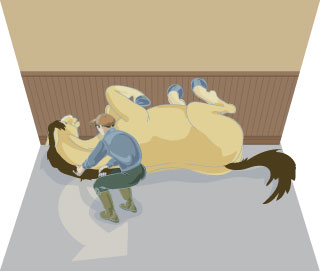
I woke too early this morning aware of something being unstill.  It was an intermittent banging, coming from the barn.  I lay in bed, trying to discern the middle of the night noise that could be a sign of a major problem, like a horse stuck up against a stall wall or “cast” in horseman’s parlance,  or simply one of my water-bucket-banging geldings who enjoys nocturnal percussion.
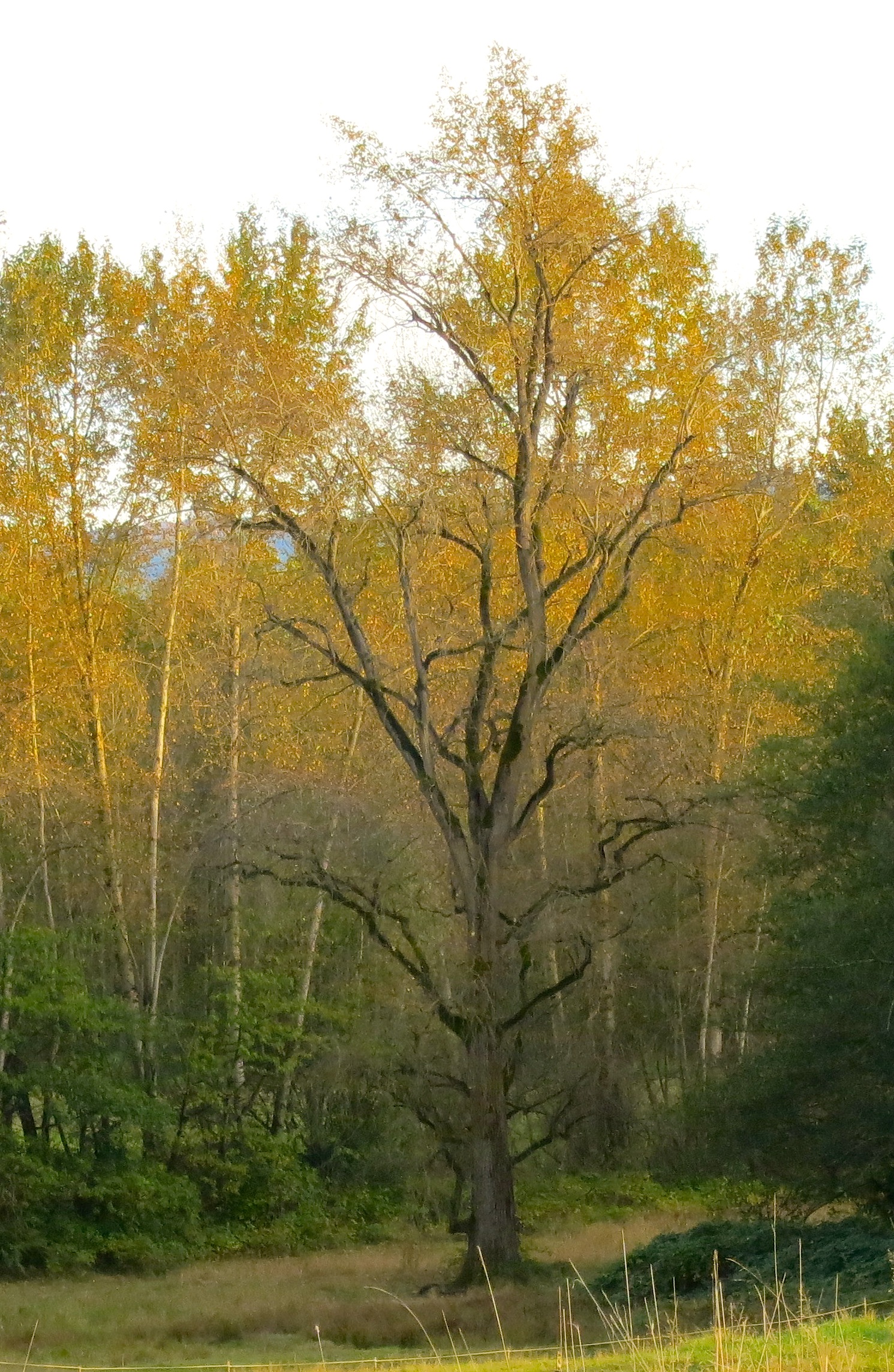
This was not sounding like a bucket drum set.  It was emphatic hooves frantically banging against metal walls.

Throwing on sweats and boots, I head out the back door into the mere light of pre-dawn, dewy, with the birds just starting to rouse from sleep, the floral perfume of lingering apple blossoms heavy in the air.  Entering the barn, I throw on the lights and start to count the noses I can see in the stalls as I walk down the aisle~all present and accounted for until I get to the very end of the row.  No nose.   Down in the corner is one of our older mares on her side, too close to the wall, her feet askew up against the boards and metal siding.  She nickered low to me, and my entering the stall sent her into a renewed effort to right herself, but all she could do was scrabble against the wall, digging an even bigger hole beneath her body.

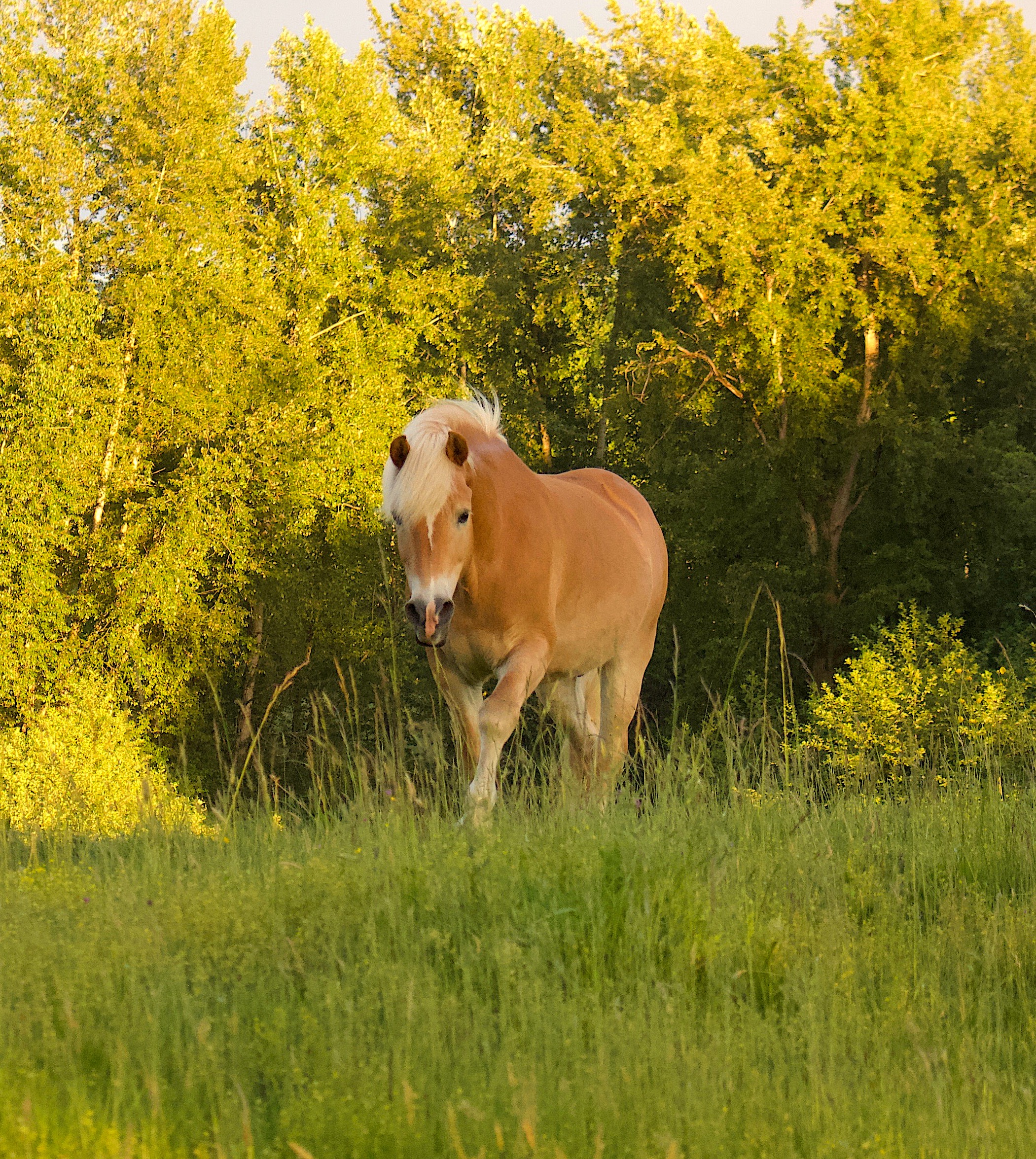
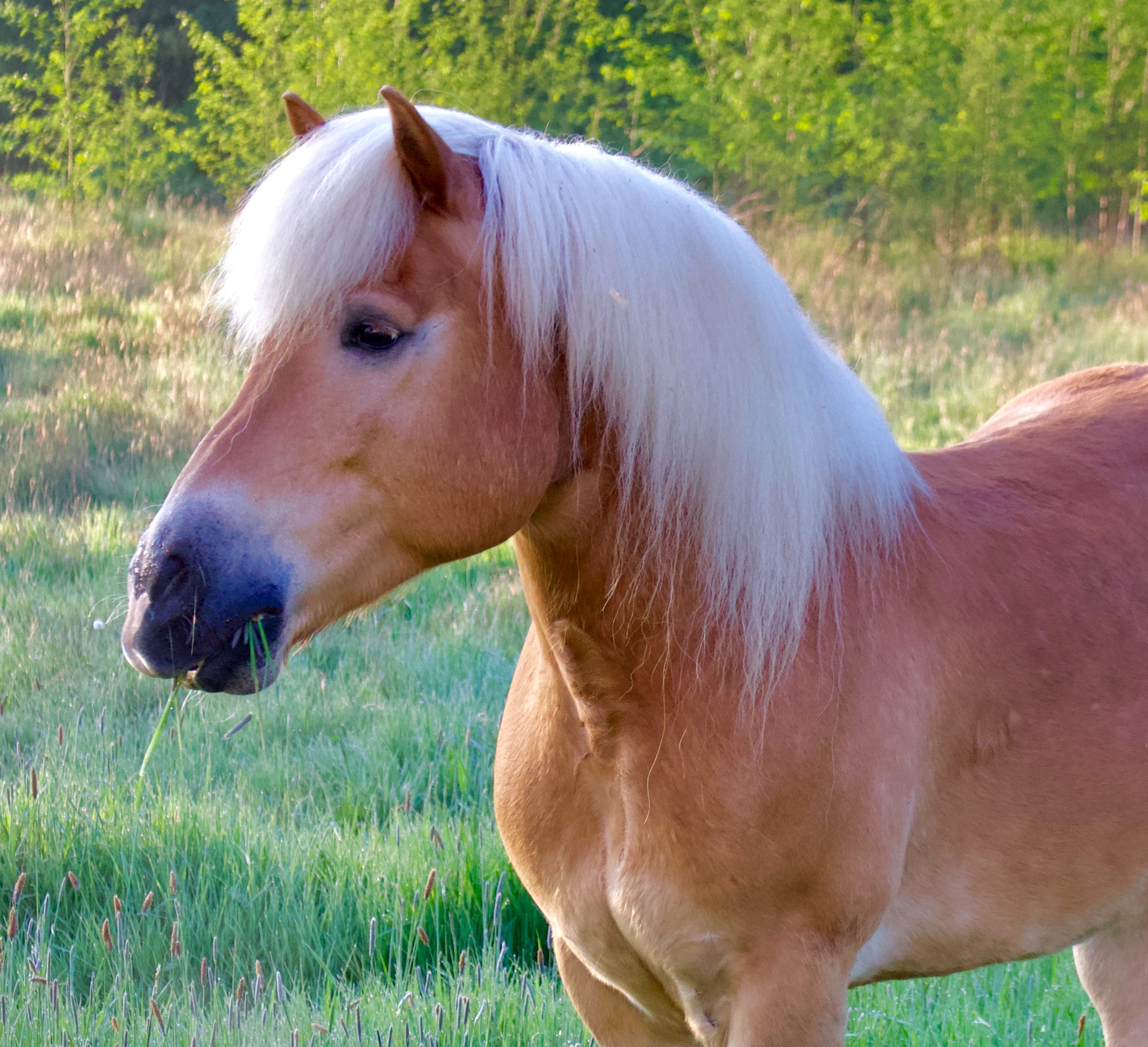
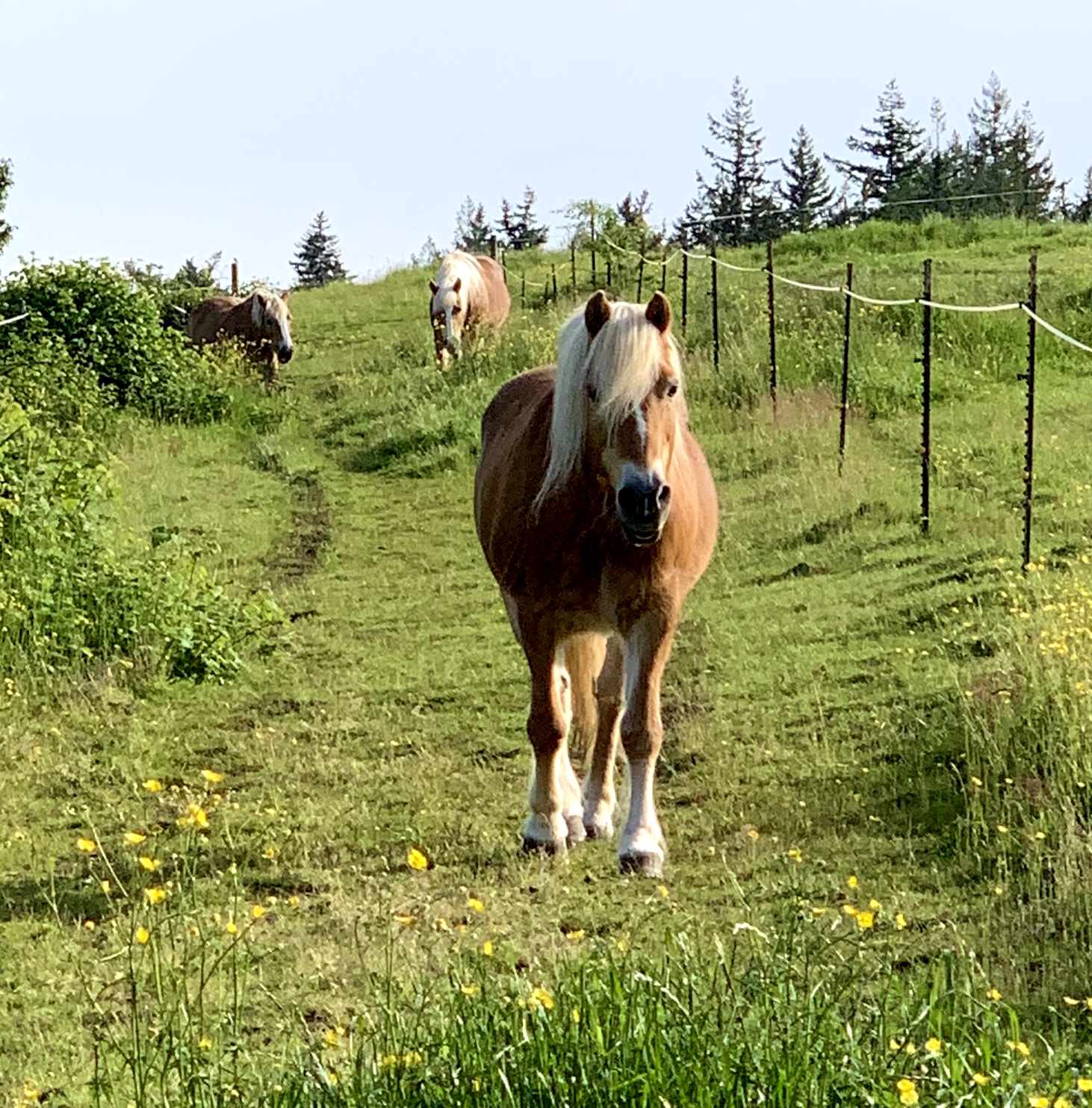
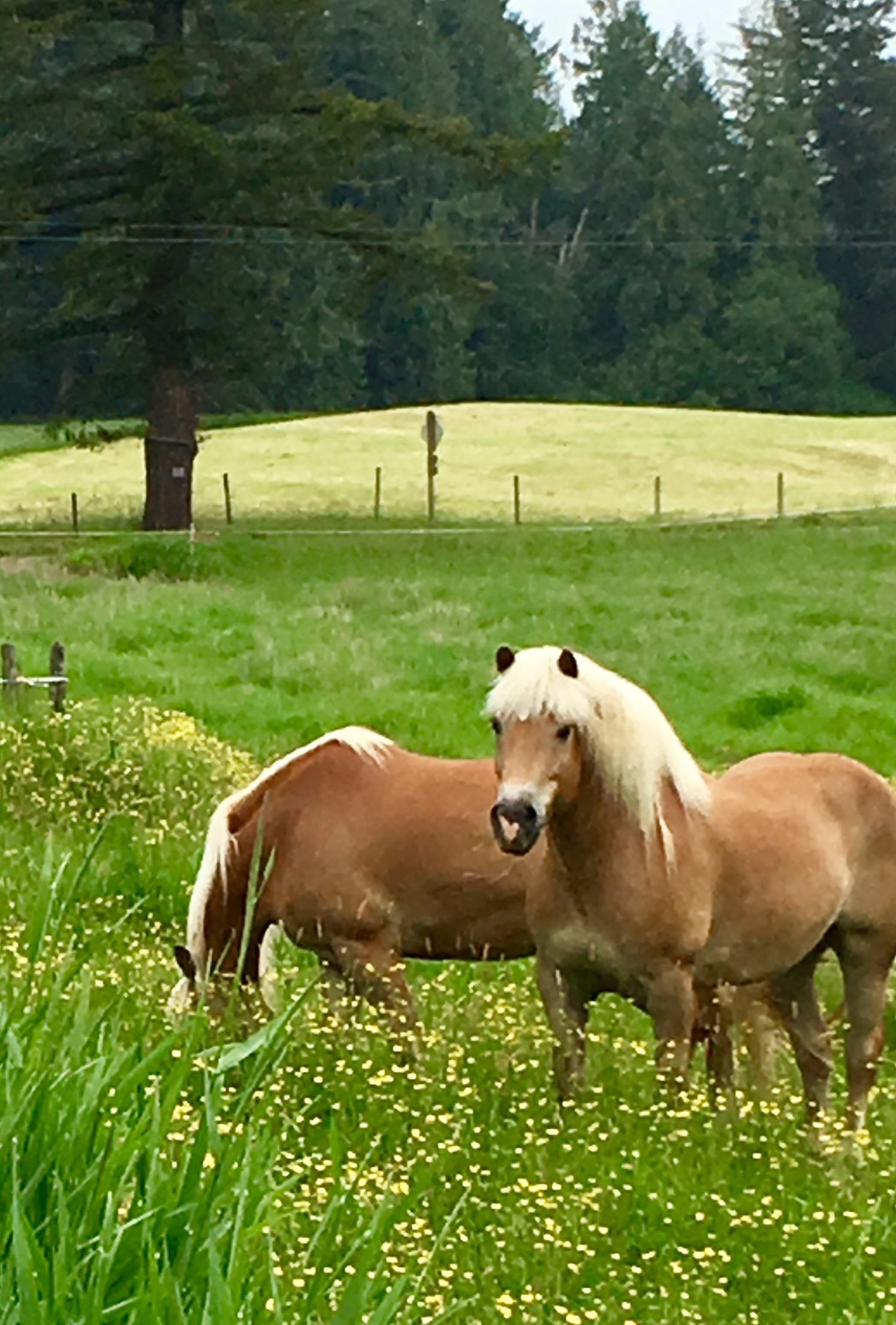
This has happened infrequently over our 35 years of owning horses, usually when a horse is rolling to scratch their back and rolls too close to the wall, and becomes lodged there.  Haflingers, who have a fairly round conformation, are a bit prone to being cast.  Our older barn,  with dirt floors, is particularly likely to having this happen, as depressions in the floor where horses have been digging end up becoming deeper and trap a hapless horse that was nonchalantly rolling.  The horse literally is trapped like a turtle on its back.
Righting a 1000 lb. horse that is frantically flailing and struggling is not a particularly easy or safe task.  Thankfully Haflingers tend to be pretty sensible in this situation and will calm when spoken to and be reassured we’re trying to help.  Carefully, I threw and looped a rope around each lower leg, and with help from the man of the house, we were able to pull her back over, and then jump out of her way quickly.  She got up, shook herself off and immediately asked for breakfast–a good sign this was not a horse in distress or colicking with abdominal pain.
So our day started early.

I hope when I find myself trapped in a hole of my own making, when I’ve been careless about watching where I’m heading and find myself helpless and hopeless with no where and no way to turn, someone will hear my struggles and come rescue me.  I promise not to kick out or bite,  but to wait patiently, in gratitude, for such gracious liberation.  

My cares will be cast upon my rescuer.

And then please, offer me breakfast.

John 21: 12 – Jesus said to them, “Come and have breakfast.”

Here I Am, Still Alive

And that is just the point…
how the world, moist and beautiful,
calls to each of us to make a new and serious response.

That’s the big question,
the one the world throws at you every morning.
“Here you are, alive.
Would you like to make a comment?”
~Mary Oliver

Everyone needs a reminder about the privilege of waking up still alive. Having had that opportunity this morning, I’d like to make a comment.

This has happened at least two times over seven decades, and yesterday provided a third reminder. The common theme is that each involved my driving to work in the morning.

Maybe that alone should tell me something.

Yesterday, my 200,000 + mileage 14 year old hybrid suddenly died while I was going 60 mph on the busy interstate on my way to work. There are not many options for a driver in such a scenario: no power steering to help navigate out of traffic, nothing but coasting to a stop in the safest place available. God’s hand controlled that moment as there was no car to the right of me, so I was able to ease over to an exit that I could roll down, with a spot at the bottom where I could sit with my hazard lights blinking until a very kind policeman pushed me with his car onto a quieter residential side street to wait over two hours for a two truck. Needless to say, I was very late for my clinic day but very grateful to show up at all.

My car awaits diagnosis and prognosis.
I can tell you my diagnosis is “gratefully still alive.
My prognosis is: “still alive enough to make a comment.

My first “dead car in the middle of a busy city street” story was forty years ago during morning rush hour when my ancient Oldsmobile decided to drop its drive train on a rainy steep hill in Seattle as I was driving to my neurology rotation at Harborview Hospital. God’s hand managed to hold my emergency brake in place until a police car with protective flashing lights appeared within seconds to park behind me while streams of highly annoyed traffic passed by. It took a tow truck only 15 minutes to remove me and my car from what could well have been a much bigger mess. Yes, I showed up late and grateful to my work day.

My most dramatic near miss was twenty years ago. I was driving into work on one of our county’s rural two lane roads, going the speed limit of 50 mph, all while in a grumbly mood and wishing I was heading somewhere else on a bright and sunny day.  My mind was busy with the anticipation of my workday when I noticed a slight shift to the right by the driver in the car ahead of me.  It inexplicably moved over the fog line and then suddenly I realized why, in a moment of stark clarity.  A huge empty gravel truck and trailer rig was heading north, moving at the speed limit, the driver seemingly oblivious to the fact his huge trailer was starting to whip back and forth.  As he approached me much too quickly, his trailer was whipping back to the center line, approaching me full force at a ninety degree angle from the truck, filling up the entire lane in front of me.  I had no choice but to run my car off the road into a grassy field to avoid being hit head on by the still attached but runaway trailer.  Only by God’s hand were there no deep ditches, telephone poles or trees at that particular point in the road.  My car dove right into tall grass, which enfolded me, like a shroud of green,  shielding me from a tangle of metal and certain death.  It was a near miss, but a miss nonetheless.

I sat still, gripping the steering wheel, gathering my wits and picking up what was left of my frayed nerves from where they had been strewn, feeling my heart race from the sheer relief of still being alive.

I was able to drive out of the field and happily headed to work to do what I initially planned to do that day, abruptly made aware of the privilege of having a life to live, a job to go to, and a grassy field that rescued me.

It was only later, while calling my husband about what had just taken place, that I cried.  Until then, I couldn’t stop smiling. 

Now, I don’t feel the need for any more such events to remind me to make comments, other than:
Here I am, still alive.