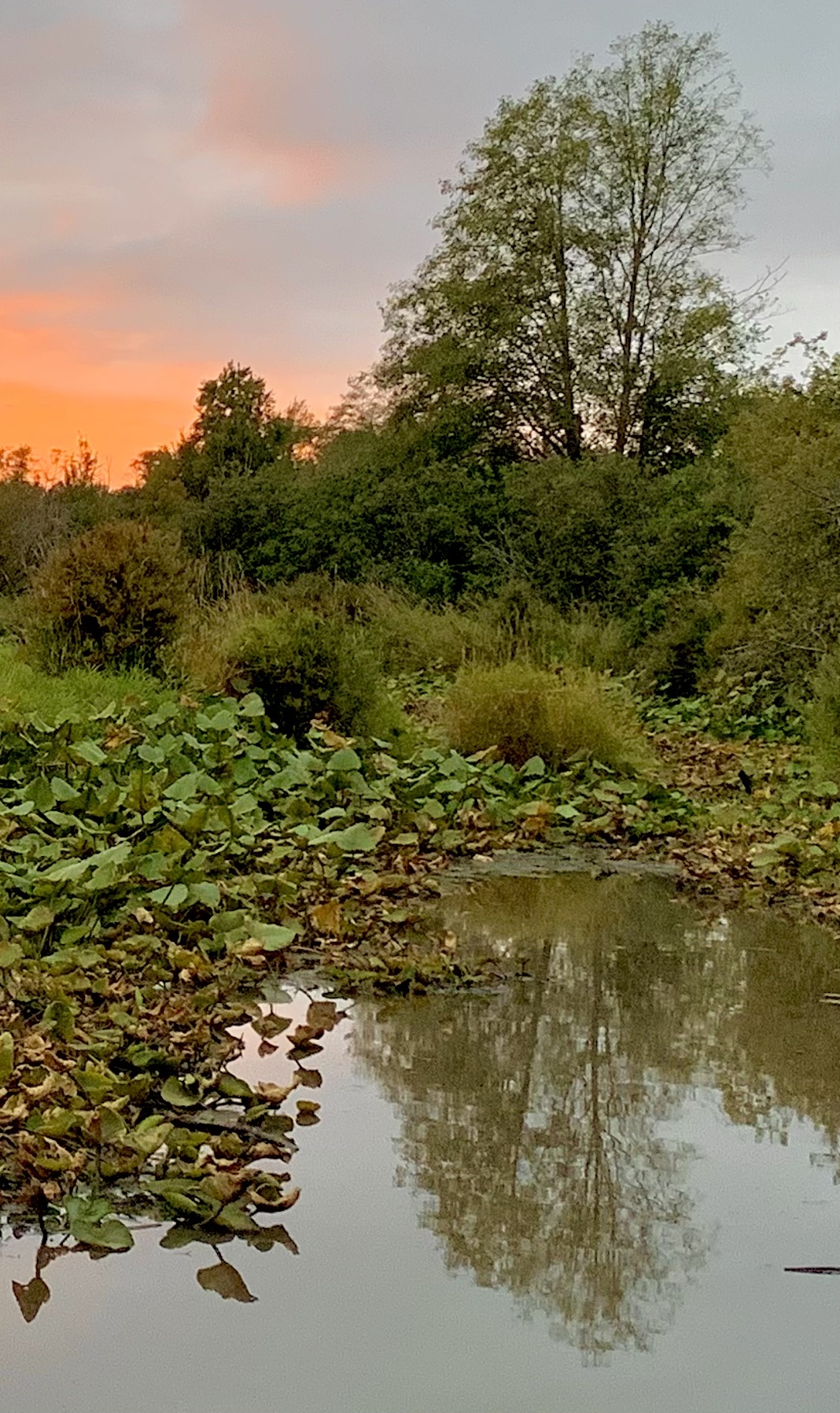
And when he got into the boat, his disciples followed him. A gale arose on the lake, so great that the boat was being swamped by the waves; but he was asleep. And they went and woke him up, saying, ‘Lord, save us! We are perishing!’
And he said to them, ‘Why are you afraid, you of little faith?’ Then he got up and rebuked the winds and the sea; and there was a dead calm.
They were amazed, saying, ‘What sort of man is this, that even the winds and the sea obey him?’ Matthew 8:23-27
Sweet Jesus, talking his melancholy madness, stood up in the boat and the sea lay down,
silky and sorry. So everybody was saved that night… Nobody knows what the soul is.
It comes and goes like the wind over the water — sometimes, for days, you don’t think of it.
Maybe, after the sermon, after the multitude was fed, one or two of them felt the soul slip forth
like a tremor of pure sunlight before exhaustion, that wants to swallow everything, gripped their bones and left them
miserable and sleepy, as they are now, forgetting how the wind tore at the sails before he rose and talked to it —
tender and luminous and demanding as he always was — a thousand times more frightening than the killer storm. ~Mary Oliver from “Maybe”
We sleep through our diminishing days even more than we sleep through the nights, unfocused on each passing moment which never is to come again.
Those moments crash to shore, then pull back to be lost forever.
There is a blindness in us all about what is inevitably coming, how we tumble through the years like waves, overcome by their passage, helpless to stop them.
Yet He is tender and luminous and demanding He speaks to us with the same words as He addresses the relentless stormy destructive sea.
Peace be still!
And so we obey in our helplessness, forgiven, saved by grace, so silky and sorry.
One-Time
Monthly
Yearly
Make a one-time or recurring donation to support daily Barnstorming posts
The chief difficulty Alice found at first was in managing her flamingo: she succeeded in getting its body tucked away, comfortably enough, under her arm, with its legs hanging down, but generally, just as she had got its neck nicely straightened out, and was going to give the hedgehog a blow with its head, it would twist itself round and look up in her face, with such a puzzled expression that she could not help bursting out laughing: and when she had got its head down, and was going to begin again, it was very provoking to find that the hedgehog had unrolled itself, and was in the act of crawling away….
Alice soon came to the conclusion that it was a very difficult game indeed. ~Lewis Carroll from Alice in Wonderland
Navigating the U.S. health care system over the last decade or so reminds me of Alice’s dreamscape game of Wonderland croquet.
A physician is given a flamingo mallet and a hedgehog ball and ordered — by the Queen at the risk of having one’s head lopped off — to go play, but the mallet won’t cooperate and the ball keeps unrolling itself and crawling away.
Just like any day in a medical clinic, a doctor’s time is spent trying to manage their flamingo. The patient, tired of waiting for weeks for an appointment, then stuck in an urgent care center or emergency waiting room– gets up and leaves.
At least Alice gets a good giggle out of it, but the reality in health care causes more tears than laughter. We are playing a very difficult game of changing rules and technology.
The flamingo in the doctor’s hands could represent the increasingly time-consuming requirement to search over 70,000 ICD-10 diagnosis codes rather than the previous 14,000 ICD-9 codes.
Or the requirement to search for a 10 digit NDC number for any prescription medicine sent electronically to a pharmacy.
Or the “meaningful use” criteria that regulate mandatory data collection and reportage on patients to the Federal Government in order to receive full payment for Medicare or Medicaid billings.
Or updated HIPAA and HITECH electronic security requirements to ensure privacy and the requirement for patient access to their chart.
Or the obligations to the new Accountable Care Organization that your employer has joined.
Or the Maintenance of Certification hoops to jump through in order to continue to practice medicine.
The exasperated and uncooperative “managed” flamingo keeps curling itself around and looking at us with a puzzled expression:
just what is it you were supposed to be trained to do?
is there actually a patient to pay attention to in all this morass of mandates?
And the poor hapless hedgehog patient is just rolled up in a ball awaiting a contact that never comes – for something, anything that might look like health care is about to happen.
Instead, for the patient, there are many electronic forms to sign: Notice of Patient Privacy, Notice of Patient Rights and Responsibilities, releases to share medical information, agreements to pay today’s co-pay and tomorrow’s deductible and whatever is left unpaid by insurance, agreement to have an AI app record and then transcribe the healthcare interaction, passwords to choose for each electronic patient portal: the chart, insurance, health savings account, lab and X-ray results and healthcare.gov.
It might be easier and less painful to just crawl away and hide from that bumbling health care provider who can’t seem to get their act together.
I wish I were laughing, but I’m not. As a once-practicing physician and now a patient, it’s getting harder and harder to play the game that is no game at all.
There is always a threat to the physician of a professional beheading: losing credentialing in an insurance plan, getting poor ratings on anonymous online physician grading sites, being inexplicably dropped from a provider list, keeping up with 50 hours of approved continuing education annually, being too unproductive to remain in an employer medical group, losing/forgoing board certification.
We keep trying to juggle the flamingo motivated by those threats, all the while ineptly managing the managed care system, knowing the patient might get up and walk away out of sheer frustration.
Thankfully, I didn’t ever see patients in a fee-for-service clinic setting, so I have sympathy for those who have no other option.
I think, at least I hope, I focused on taking care of people, trying to heal their illnesses and help them cope with life if they can’t be healed.
I wanted to provide compassionate care without all the fol-de-rol. These are absurd times for humans and hedgehogs.
It is enough to make a doctor cry. At least we meet our patients over the Kleenex box and compare notes, and maybe, just maybe, we’ll find enough common ground to even share a giggle or two.
Like a piece of rotten meat which not only stinks right on its own surface but also surrounds itself with a stinking molecular cloud of stink, so, too, each island of the archipelago created and supported a zone of stink around itself. ~ Aleksandr Solzhenitsyn, The Gulag Archipelago, 1918-1956: An Experiment in Literary Investigation, Books III-IV
As I’ve written elsewhere, I spend over an hour a day dealing with the excrement of my farm critters.
This is therapeutic time for me as I have deep respect for the necessity to clean up and compost what is smelly/stinky/yucky and biblically objectionable. (Deuteronomy 23:12-14)
None of us, including God, want to take a walk having to pick our way around poop.
As I’m busy picking up manure, I watch our dogs seek out the smelliest, most vile things they can find in the barn or field (preferably dead) and roll themselves around in it one after another until they are just as stinky as the stuff they found. They are clearly joyous about it, especially when they do it together. It is curious throw-back behavior that I’ve assumed, wearing my animal behaviorist hat, was about a wild predator covering up their scent in order to stalk and capture prey more effectively without being detected – except they are really truly so smelly that any prey could sense them coming from a mile away and would learn quickly that a moving creature that smells like poop or a dead carcass is bad news and to be avoided.
This is the main reason our farm dogs live full time outdoors. We prefer to avoid stinky dirty creatures too. So I’ve tried to understand this behavior for what adaptive purpose it may have.
What makes the most sense to me is the “pack mentality” that suggests that once one dog/wolf rolls in something objectionable, that the rest of the pack does too. This is a unifying theme for anxious individuals – they aren’t really on their own if they smell and blend in with the rest of the pack. So they spread the “wealth,” so to speak.
Stink up one, stink up all. Like team spirit, it seems to improve morale – until it doesn’t anymore.
I’ve been feeling covered with stink myself lately as I’ve searched for those sympathetic around me and found myself stuck between shit and syphilis. There are so many divisive opinions right now about a variety of current issues; vile nonsense has been flying right and left on social media as well as face to face. The theory is if all stink the same from rolling in piles of misinformation, we are then no longer alone.
Yet our destiny does not have to include believing, sharing and “flinging” the stuff that stinks to see who it will stick to. I no longer want to be a target.
Time for a bath. Time for soap and cleansing and some serious self-examination. Time to stop joyously rolling around in it. Time to bury the excrement so we’re not staring at the ground, picking our way around the piles and can actually hold our heads up to see where we’re heading.
One-Time
Monthly
Yearly
Make a one-time or recurring donation to support daily Barnstorming posts
Would you believe I’ve been looking for rain, here, with few days remaining in this fleeting season of summer? Our days are numbered that we might share with the sun in a clear blue sky and the hours growing warmer, and I have kept an eye out for the clouds. Only I wish for the conditions and doubt that might send us all deep inside our dark homes to sleep and read and pray in preparation for the coming colder days. Would you believe that the sight of slate gray spanning horizon to zenith and down is one I am quite taken with? ~David K. Wheeler “The Cold Season” from Contingency Plans
My mother, who hates thunder storms, Holds up each summer day and shakes It out suspiciously, lest swarms Of grape-dark clouds are lurking there; But when the August weather breaks And rains begin, and brittle frost Sharpens the bird-abandoned air, Her worried summer look is lost,
And I her son, though summer-born And summer-loving, none the less Am easier when the leaves are gone Too often summer days appear Emblems of perfect happiness I can’t confront: I must await A time less bold, less rich, less clear: An autumn more appropriate. ~Philip Larkin “Mother, Summer, I”
Summer grass aches and whispers.
It wants something; it calls and sings; it pours out wishes to the overhead stars.
The rain hears; the rain answers; the rain is slow coming; the rain wets the face of the grass. ~Carl Sandberg “Summer Grass”
August rushes by like desert rainfall, A flood of frenzied upheaval, Expected, But still catching me unprepared. Like a match flame Bursting on the scene, Heat and haze of crimson sunsets. Like a dream Of moon and dark barely recalled, A moment, Shadows caught in a blink. Like a quick kiss; One wishes for more But it suddenly turns to leave, Dragging summer away. – Elizabeth Maua Taylor“August”
The endless clear skies of August now broken with exuberant clouds, rain falling in warm gusts, leaves landing on browned ground.
This summer ended up being simply too much – an excess of everything bright and beautiful, meant to make us joyful, yet bold and exhausting in its riches.
From endless hours of daylight, to high rising temperatures and wildfires, to palettes of smoke-filled landscapes to fruitfulness and abundant blooms.
While summer always fills a void after enduring cold spare dark days the rest of the year, I still depend on autumn returning.
I welcome darkening times back, knowing how much I miss those drear twilight months of longing for the overwhelming fullness of summer.
One-Time
Monthly
Yearly
Make a one-time or recurring donation to support daily Barnstorming posts
This world, after all our science and sciences, is still a miracle; wonderful, inscrutable, magical, and more, to whosoever will think of it.
To awaken each morning with a smile brightening my face; to greet the day with reverence for the opportunities it contains; to approach my work with a clean mind; to hold ever before me, even in the doing of little things, the ultimate purpose toward which I am working; to meet men and women with laughter on my lips and love in my heart; to be gentle, kind, and courteous through all the hours; to approach the night with weariness that ever woos sleep and the joy that comes from work well done – this is how I desire to waste wisely my days. ~Thomas Dekker, 16th century British playwright
I work hard at wasting my days wisely.
Summers are a classic opportunity to waste time and I do – happily – yet there is always a hint of regret: I could have made more of a dewy bright morning, an afternoon of cooling shadows, or a full-moon twilight.
Or perhaps I could have made this day better for someone else to waste.
How better to waste my days: to find ways for my interactions to be more joyous, if only through a smile, a shared chuckle, a kind word, a generous gesture.
Waste away, dear days. What a wonderful world this could be.
The world, after all, is a miracle and needs us to notice.
One-Time
Monthly
Yearly
Make a one-time or recurring donation to support daily Barnstorming posts
Leave the dishes. Let the celery rot in the bottom drawer of the refrigerator and an earthen scum harden on the kitchen floor. Leave the black crumbs in the bottom of the toaster. Throw the cracked bowl out and don’t patch the cup. Don’t patch anything. Don’t mend. Buy safety pins. Don’t even sew on a button. Let the wind have its way, then the earth that invades as dust and then the dead foaming up in gray rolls underneath the couch. Talk to them. Tell them they are welcome. Don’t keep all the pieces of the puzzles or the doll’s tiny shoes in pairs, don’t worry who uses whose toothbrush or if anything matches, at all. Except one word to another. Or a thought. Pursue the authentic—decide first what is authentic, then go after it with all your heart. Your heart, that place you don’t even think of cleaning out. That closet stuffed with savage mementos. Don’t sort the paper clips from screws from saved baby teeth or worry if we’re all eating cereal for dinner again. Don’t answer the telephone, ever, or weep over anything at all that breaks. Pink molds will grow within those sealed cartons in the refrigerator. Accept new forms of life and talk to the dead who drift in through the screened windows, who collect patiently on the tops of food jars and books. Recycle the mail, don’t read it, don’t read anything except what destroys the insulation between yourself and your experience or what pulls down or what strikes at or what shatters this ruse you call necessity ~Louise Erdrich “Advice to Myself”
I am a messy person, coming from a long line of messy people. My paternal grandmother never had a clear kitchen counter, or a dining room table without piles of books and papers, spilling over with knickknacks and half-completed craft projects everywhere. I loved the chaos of her house since the messes left behind by her grandchildren weren’t as noticeable. I always felt at home, as if I was not being constantly monitored as a potential mess about to happen.
The other morning, I noticed a good-sized dust bunny on the kitchen floor and bent down to pick it up to toss in the trash can. To my surprise, it leaped away from my fingers!
It kept jumping away and as my eyes finally focused in the early morning light, I realized it wasn’t an escaping dust bunny, but a tree frog covered in dust fuzz from my less than tidy floor. It must have come in the house from the perpetually open front door and hidden under a piece of furniture, being transformed into a furry froggy Frankenstein.
I caught it and carried it outside into the morning dawn, setting it free into the chaos of the world outside, rather than coping inside with my insufficient housekeeping. No, I didn’t think to get a photo. Oh, well. Some things you just have to take on faith.
After all, my heart leaps and rejoices anytime we have multi-generational family under one roof and whether the house is clean is simply a secondary concern.
It actually is not a concern at all.
This mama’s heart carries love with each heartbeat. My worth is not in what I own or how pristine I keep things, but in the depth of my commitment to those who I am given the privilege to know and love.
One-Time
Monthly
Yearly
Make a one-time or recurring donation to support daily Barnstorming posts
At dusk, everything blurs and softens. From here out over the long valley, the fields and hills pull up the first slight sheets of evening, as, over the next hour, heavier, darker ones will follow.
Quieted roads, predictable deer browsing in a neighbor’s field, another’s herd of heifers, the kitchen lights starting in many windows. On horseback I take it in, neither visitor nor intruder, but kin passing, closer and closer to night, its cold streams rising in the sugarbush and hollow.
Half-aloud, I say to the horse, or myself, or whoever: let fire not come to this house, nor that barn, nor lightning strike the cattle. Let dogs not gain the gravid doe, let the lights of the rooms convey what they seem to.
And who is to say it is useless or foolish to ride out in the falling light alone, wishing, or praying, for particular good to particular beings, on one small road in a huge world?
The horse bears me along, like grace, making me better than what I am, and what I think or say or see is whole in these moments, is neither small nor broken. For up, out of the inscrutable earth, have come my body and the separate body of the mare: flawed and aching and wronged. Who then is better made to say be well, be glad,
or who to long that we, as one, might course over the entire valley, over all valleys, as a bird in a great embrace of flight, who presses against her breast, in grief and tenderness, the whole weeping body of the world? ~ Linda McCarriston, “Riding Out at Evening” fromTalking Soft Dutch
photo by Emily Vander Haak
On this, my 72nd birthday, I pray for this troubled world, reminding myself: be well, be glad…
I’m still here by the grace of God who carries not just me on His back through each day, but all earthly burdens.
I pray like a bird embracing the air which lifts its wings, tenderly holding to its breast a soaring freedom to transcend the weeping world.
I have seen so much goodness over 72 years, sometimes through tears of sorrow. I know there will be more joy and sadness before I’m done.
I am grateful, so very grateful to have lived all these years seeing tears shed, then dried, learning how love heals, knowing the only thing to last forever is God’s covenant promise to always carry us home.
photo by Brandon Dielemanphoto by Brandon Dieleman
video by Peter Tamminga
Whilst the world is weeping, let us do our bit. We have the time to sympathise, to listen and to sit. No needless thoughts, of the things we cannot do. But appreciate all the good bits and look at them anew.
The warmth and comfort of our homes, the food we have to eat. The family and friends we have, although we cannot meet. The village that we live in, and the community we share. So precious to us right now, so sit and think and care.
Whilst the world is full of sadness, anxiety and pain, It’s hard to imagine our lives ever carefree again. But nothing lasts forever, the clouds will always clear. Let’s heal the world with love, so the sunshine can appear. ~Sandra Rickman
Lyrics: Drop, drop, slow tears, and bathe those beauteous feet, which brought from heaven the news and Prince of Peace. Cease not, wet eyes, his mercies to entreat; to cry for vengeance sin doth never cease. In your deep floods drown all my faults and fears; nor let his eye see sin, but through my tears.
One-Time
Monthly
Yearly
Make a one-time or recurring donation to support daily Barnstorming posts
Whence comes Solace?—Not from seeing What is doing, suffering, being, Not from noting Life’s conditions, Nor from heeding Time’s monitions; But in cleaving to the Dream, And in gazing at the gleam Whereby gray things golden seem.
II
Thus do I this heyday, holding Shadows but as lights unfolding, As no specious show this moment With its irised embowment; But as nothing other than Part of a benignant plan; Proof that earth was made for man. ~Thomas Hardy “On a Fine Morning”
Whence comes Solace? Cleaving to the dream, gazing at the gleam…
nothing other than Part of a benignant plan; Proof that earth was made for man.
I had to look up “benignant” – it is like being told a concerning tumor is “benign” – granting gracious kindness and beneficence in the midst of deep-seated worry.
A new lease on life.
We forget our original task of caring for the Garden. Having soiled our own nest, we can’t abandon earth for another greener, brighter, happier planet. Of all the planetary options in this infinite universe, we were placed right here for good reason, and here we remain.
Our solace: all that ordinarily seems gray gleams golden illuminated by the Light shining down on our shadowy selves.
Even when the news headlines are dismal, when our individual struggles are great, when human history seems to keep repeating itself, our Creation is purposeful, eternally preserved through divine sacrifice.
The solace of gray shadows melts to gold: as part of the overall “benignant plan” we have been given our life back.
One-Time
Monthly
Yearly
Make a one-time or recurring donation to support daily Barnstorming posts
And on those hot afternoons in July, when my father was out on the tractor cultivating rows of corn, my mother would send us out with a Mason jar filled with ice and water, a dish towel wrapped around it for insulation.
Like a rocket launched to an orbiting planet, we would cut across the fields in a trajectory calculated to intercept— or, perhaps, even—surprise him in his absorption with the row and the turning always over earth beneath the blade.
He would look up and see us, throttle down, stop, and step from the tractor with the grace of a cowboy dismounting his horse, and receive gratefully the jar of water, ice cubes now melted into tiny shards, drinking it down in a single gulp, while we watched, mission accomplished. ~Joyce Sutphen“Carrying Water to the Field”
It was my special responsibility to carry cold water out to my dad when he was on the tractor doing field work.
Yes, he could have carried a thermos along but then he would not have seen his kid walking carefully from the house over the fresh-turned dirt, he would not have an excuse for a short break to wipe the sweat from his face with his bright red kerchief, nor sit and survey the straightness of his furrows.
He would not have lifted her up to sit beside him on the tractor, allowing her to “drive,” steering down the rows, curving around the killdeer nests so their young are spared.
Indeed – it is a a special responsibility to nurture someone at work who doesn’t stop to refill themselves. It happens rarely any more – whether in the field or factory or home or even – creating a daily blog like this.
What wondrous love to carry water to those who thirst. What wondrous grace then fills our furrowed lives.
Thank you, faithful readers and supporters, for you who carry water to me when I am dry and thirsty convince me my work here is not in vain: mission accomplished.
Once a year I ask my readers to fill out the feedback form at the bottom left of my blog home page, or this link to a feedback form
Questions I hope you will answer to assist me in making Barnstorming worth your time: *how long have you been following Barnstorming? *how often do you share Barnstorming with others? *what does Barnstorming content mean to you personally? *what Barnstorming content do you most appreciate? *do you have a favorite post, photo, or moment from the blog? *what Barnstorming content would you rather see less often? *do you listen to the music links at the end of posts? *do you ever click on the links to sources for poems and quotes? *how can I make your time on Barnstorming more worthwhile?
One-Time
Monthly
Yearly
Make a one-time or recurring donation to support daily Barnstorming posts
It’s the immemorial feelings I like the best: hunger, thirst, their satisfaction; work-weariness, earned rest; the falling again from loneliness to love; the green growth the mind takes from the pastures in March; the gayety in the stride of a good team of Belgian mares that seems to shudder from me through all my ancestry. ~Wendell Berry “Goods”
photo by Joel De Waardphoto by Joel De Waard
The plow has savaged this sweet field Misshapen clods of earth kicked up Rocks and twisted roots exposed to view Last year’s growth demolished by the blade.
I have plowed my life this way Turned over a whole history Looking for the roots of what went wrong Until my face is ravaged, furrowed, scarred.
Enough. The job is done. Whatever’s been uprooted, let it be Seedbed for the growing that’s to come. I plowed to unearth last year’s reasons—
The farmer plows to plant a greening season. ~Parker Palmer “Harrowing”
photo by Joel De Waardphoto by Joel De Waard
It’s not likely anyone would say I didn’t work hard enough.
After all, I come from a long line of human work-horses who knew it takes sweat and tears, and sometimes bleeding.
Even so, all those years I know I could have plowed more deeply than I did.
I could have thrown myself more fully into the pull on the tugs, shared the load more effectively, shouldered the yoke with greater enthusiasm, bent my neck down low with unbroken determination.
You could say somewhere I lost the gayety in my stride, and you would be right — toward the end, I was trudging through the furrow, bruised from turning up too many submerged rocks, bumping into immoveable tree stumps, tripping on hidden roots, stuck in the deep mud of long and lonely post-midnight hours.
You might even say the knowledge of a job well-done lay at a depth my plow could ever reach.
I had seen others die in the harness, never able to rest easy.
A few years ago I knew the time had come to shrug off the yoke, shake off the bridle and bit, shudder free of the harness.
On this side of the ground, I find myself wondering and wandering, the blinkers no longer impeding my vision, feeling the morning sun on my unyoked withers.
Yet when I see an untilled field, something in me even now still tries to hold on to the plow —
photo by Joel De Waardphoto by Joel De Waardphoto by Joel De Waard
One-Time
Monthly
Yearly
Make a one-time or recurring donation to support daily Barnstorming posts