In the high woods that crest our hills, Upon a steep, rough slope of forest ground, Where few flowers grow, sweet blooms today I found Of the Autumn Crocus, blowing pale and fair. Dim falls the sunlight there; And a mild fragrance the lone thicket fills.
Languidly curved, the long white stems Their purple flowers’ gold treasure scarce display: Lost were their leaves since in the distant spring,
Their February sisters showed so gay. Roses of June, ye too have followed fleet! Forsaken now, and shaded as by thought, As by the human shade of thought and dreams, They bloom ‘mid the dark wood, whose air has wrought With what soft nights and mornings of still dew! Into their slender petals that clear hue, Like paleness in fresh cheeks; a thing On earth, I vowed, ne’er grew More delicately pure, more shyly sweet.
Child of the pensive autumn woods! So lovely, though thou dwell obscure and lone, And though thy flush and gaiety be gone; Say, among flowers of the sad, human mind, Where shall I ever find So rare a grace? in what shy solitudes? ~Robert Laurence Binyon “Autumn Crocus”
The late September emergence of autumn crocus is always sudden, rising up near the equinox in the shade of spent peony bushes.
These rare blooms: tall, tender, bold, and frail, their incubation triggered by retreating light from above, unlike their springtime cousins emerging through melting snow.
The autumn crocus waits with thoughtful temerity, summoned forth from the soil to remind us the end of summer is not the end of them or us.
A luminous gift of hope and beauty borne from a humble bulb; plain and only soil-adorned.
Slowly unfurling on a pale leggy stem, the tender lavender petals peel back to reveal golden crowns of saffron, brazenly blooming when all else is dying back.
Vulnerable to blustery wind and heavy rains, they easily wilt, crushed, deeply bruised purple – under the Sun’s reflection made manifest; returning defeated, inglorious, fallen, to dust.
Yet we know – they remind us: they (and we) will rise again.
…we know what is coming behind the crocus. The spring comes slowly down this way; but the great thing is that the corner has been turned. . . It remains with us to follow or not, to die in this winter, or to go on into that spring and that summer. C.S. Lewis from God in the Dock
One-Time
Monthly
Yearly
Make a one-time or recurring donation to support daily Barnstorming posts
From steady rain we step to sheltered ground in the dark cathedral of the barn, breathe in scents of damp wood and hay, assume a reverent stillness. The dog, with the sudden confidence of one engaged, at last, in good work, trots through the barn’s far doorway heading seven white-faced ewe lambs. Not knowing me, they halt, uncertain, until you smoothly bucket corn from storage to trough, and they— as sheep will—follow where hunger leads. Hard teeth crack dry kernels in percussive counterpoint, a muted consort mimicking the fall of winter rain on wooden shingles. In entiring darkness, we stand, until from your post beneath the hayloft beams, you turn to me, grinning, and say, That’s a good sound. And it is. ~Brian Volck “Visiting”
Every now and then, I forget to turn off the lights in the barn. I usually notice just before I go to bed, when the farm’s boundaries seem to have drawn in close. That light makes the barn seem farther away than it is — a distance I’m going to have to travel before I sleep. The weather makes no difference. Neither does the time of year.
Usually, after turning out that forgotten barn light, I sit on the edge of the tractor bucket for a few minutes and let my eyes adjust to the night outside. City people always notice the darkness here, but it’s never very dark if you wait till your eyes owl out a little….I’m always glad to have to walk down to the barn in the night, and I always forget that it makes me glad. I heave on my coat, stomp into my barn boots and trudge down toward the barn light, muttering at myself. But then I sit in the dark, and I remember this gladness, and I walk back up to the gleaming house, listening for the horses. ~Verlyn Klinkenborg from A Light in the Barn
…let me live in a small room up the narrow stairs from the stalls, the horse shifting comfortably below, browsing and chewing sweet hay. A single bed with blanket the color of factory-sweepings will suffice, each day shaped to the same arc, because days can only end when the lock slides free on the stall’s Dutch door, and I lead the horse in, then muscle the corroded bolt shut. That’s what days are for: I cannot rest until the horse comes home. ~Julie Bruck from “To Bring the Horse Home”
The best moment in the barn is in the evening just following the hay feeding, as the animals are settling down to some serious chewing. I linger in the center aisle, listening to the rhythmic sounds coming from their stalls. It is a most soothing contented cadence, first their lips picking up the grass, then the chew chew chew chew and a pause and it starts again. It’s even better in the dark, with the lights off.
In the past, I’ve enjoyed listening to the eating sounds at night from the remote vantage point of my bedroom TV monitor system set up to watch my very pregnant mares before foaling. A peculiar lullaby of sorts, strange as that seems, but when all my farm animals are chewing and happy, I am at peace and sleep better.
It reminds me of those dark deep nights of feeding my own newborns, rocking back and forth with the rhythm of their sucking. It is a moment of being completely present and peaceful, and knowing at that moment, nothing else matters–nothing else at all.
If I am very fortunate, each day I live has a rhythm that is reassuring and steady, like the sounds of hay chewing, or rocking a baby. I awake thinking about where my next step will bring me, and then the next, like each chew of sweet hay.
I try to live in communion, without distraction by the worry of the unknown.
But the reality is: life’s rhythms are often out of sync, the cadence is jarring, the sounds are discordant, sometimes I’m the one being chewed on, so pain replaces peacefulness.
Maybe that is why this lullaby in the barn~~this sanctuary~~is so treasured, the chosen place of Jesus’ birth. It brings me home to that doubting center of myself that needs reminding that struggle is fleeting, and peace, however elusive now, is forever. I always know where to find it for a few minutes at the end of every day, in a pastoral symphony of sorts.
Someday my hope for heaven will be angel choruses of glorious praise, augmenting a hay-chewing lullaby.
So simple yet so very, very good.
TEXT O magnum mysterium, et admirabile sacramentum, ut animalia viderent Dominum natum, iacentem in praesepio! Beata Virgo, cujus viscera meruerunt portare Dominum Iesum Christum. Alleluia!
TRANSLATION O great mystery, and wonderful sacrament, that animals should see the newborn Lord, lying in a manger! Blessed is the virgin whose womb was worthy to bear the Lord, Jesus Christ. Alleluia!
One-Time
Monthly
Yearly
Make a one-time or recurring donation to support daily Barnstorming posts
You can die for it- an idea, or the world. People have done so, brilliantly, letting their small bodies be bound to the stake, creating an unforgettable fury of light. But this morning, climbing the familiar hills in the familiar fabric of dawn, I thought of China, and India and Europe, and I thought how the sun blazes for everyone just so joyfully as it rises under the lashes of my own eyes, and I thought I am so many! What is my name? What is the name of the deep breath I would take over and over for all of us? Call it whatever you want, it is happiness, it is another one of the ways to enter fire. ~Mary Oliver “Sunrise”
Over the years, I have not missed many early autumn sunrises – most I have not recorded as they are often gray and rainy.
This particular day of September – the 24th – has been a treasure trove of color and cloud patterns and light for the last 12 years. Today I share these with you in their variety and beauty.
Every day, let us watch the sun rise with its light under our eyelashes – the fire of happiness illuminating us all as morning breaks open, like the First Day.
9/24/17 9/24/169/24/159/24/149/24/26 6:53 AM
One-Time
Monthly
Yearly
Make a one-time or recurring donation to support daily Barnstorming posts
Summer ends now; now, barbarous in beauty, the stooks rise Around; up above, what wind-walks! what lovely behaviour Of silk-sack clouds! has wilder, wilful-wavier Meal-drift moulded ever and melted across skies?
I walk, I lift up, I lift up heart, eyes, Down all that glory in the heavens to glean our Saviour; And eyes, heart, what looks, what lips yet give you a Rapturous love’s greeting of realer, of rounder replies?
And the azurous hung hills are his world-wielding shoulder Majestic – as a stallion stalwart, very-violet-sweet! – These things, these things were here and but the beholder Wanting; which two when they once meet, The heart rears wings bold and bolder And hurls for him, O half hurls earth for him off under his feet. ~Gerard Manley Hopkins “Hurrahing in Harvest”
This poem is (in Hopkin’s own words) “the outcome of half an hour of extreme enthusiasm as I walked home alone one day from fishing in the [River] Elwy.”
This afternoon was the colour of water falling through sunlight; The trees glittered with the tumbling of leaves; The sidewalks shone like alleys of dropped maple leaves, And the houses ran along them laughing out of square, open windows. Under a tree in the park, Two little boys, lying flat on their faces, Were carefully gathering red berries To put in a pasteboard box.
Some day there will be no war, Then I shall take out this afternoon And turn it in my fingers, And remark the sweet taste of it upon my palate, And note the crisp variety of its flights of leaves. To-day I can only gather it And put it into my lunch-box, For I have time for nothing But the endeavour to balance myself Upon a broken world. ~Amy Lowell from “September 1918”
There is no point in seeing without responding; there is no way to respond without seeing.
Christian life and practice require both faith (the sight of the heart) and works (the lurch of the heart toward him in obedience). ~Kathleen Mulhern from “A Christ Sighting” from Dry Bones
Am I the only one who awoke this morning praying today might be a day of healing between peoples, when the barbarous becomes beautiful and we seek to become balanced rather than broken?
A day of no drone missiles being launched, no threats of annihilation and winner takes all, no one gunned down in the street, no vehicles used as weapons, no harsh and angry words spoken, no child misused, no one sold into slavery, no one overdosing, abandoned, homeless and starving.
Am I the only one who awakes and only seeks to watch the clouds to praise the heavens to see the leaves turn color to take out this one day and taste it and find that it is good, then put it away for self-keeping to share when and if I find someone else as hungry for grace and mercy as I am,
so as to balance myself somehow in the beauty of this world while teetering on its brokenness?
The songs of small birds fade away into the bushes after sundown, the air dry, sweet with goldenrod. Beside the path, suddenly, bright asters flare in the dusk. The aged voices of a few crickets thread the silence. It is a quiet I love, though my life too often drives me through it deaf. Busy with costs and losses, I waste the time I have to be here—a time blessed beyond my deserts, as I know, if only I would keep aware. The leaves rest in the air, perfectly still. I would like them to rest in my mind as still, as simply spaced. As I approach, the sorrel filly looks up from her grazing, poised there, light on the slope as a young apple tree. A week ago I took her away to sell, and failed to get my price, and brought her home again. Now in the quiet I stand and look at her a long time, glad to have recovered what is lost in the exchange of something for money. ~Wendell Berry “The Sorrel Filly”
I am reminded at summer’s end — when it is already dark and chores not done yet, and horses waiting to be fed — of the value of decades of moments spent with long-lashed eyes, wind-swept manes, and velvet muzzles.
True, it appears to others to be time and money wasted. But for a farmer like me, sometimes deaf and blind to what is in front of me every day, not all valuables are preserved in a lock box or a bank account.
Golden treasure can have four hooves, a tail, a rumbling greeting asking if I’d somehow gotten lost since I’m a little later than usual and they were a bit concerned I’d forgotten them.
If only I would keep aware, remember where my home is, how easy it is to wander from the path that somehow always leads me back here.
One-Time
Monthly
Yearly
Make a one-time or recurring donation to support daily Barnstorming posts
She lingered in that charming little garden to say hello to the gnomes, such a glorious infestation! How few wizards realize just how much we can learn from the wise little gnomes- or, to give them their correct names, the Gernumbli gardensi. ‘Ours do know a lot of excellent swear words,’ said Ron… J.K. Rowling in Harry Potter and the Deathly Hallows
It is hard to say exactly when the first one moved in. This farm was distinctly gnome-less when we bought it nearly forty years ago, largely due to twenty-seven hungry barn cats residing here at the time in various stages of pregnancy, growth, development and aging. It took awhile for the feline numbers to whittle down to an equilibrium that matched the rodent population.
In the mean time, our horse numbers increased from three to seven to over fifteen with a resultant exponential increase in barn chores. One spring thirty years ago, I was surprised to walk in the barn one morning to find numerous complex knots tied in the Haflingers’ manes. Puzzling as I took precious time to undo them, literally adding hours to my chores, I knew I needed to find the cause or culprit.
It took some research to determine the probable origin of these tight tangles. Based on everything I researched, they appeared to be the work of Gernumbli faenilesi, a usually transient species of gnome preferring to live in barns and haylofts in close proximity to heavy maned ponies. In this case, as the tangles persisted for months, they clearly had moved in, lock, stock and barrel. The complicated knots were their signature pride and joy, their artistic way of showing their devotion to a happy farm.
All well and good, but the extra work was killing my fingers and thinning my horses’ hair. I plotted ways to get them to cease and desist.
I set live traps of cheese and peanut butter cracker sandwiches, hoping to lure them into cages for a “catch and release”. Hoping to drive them away, I played polka music on the radio in the barn at night. Hoping to be preemptive, I braided the manes up to be less tempting but even those got twisted and jumbled. Just as I was becoming ever more desperate and about to round up more feral cats, the tangling stopped.
It appeared the gnomes had moved on to a more hospitable habitat. Apparently I had succeeded in my gnome eradication plan.
Or so I thought.
Not long after, I had the distinct feeling of being watched as I walked past some rose bushes in the yard. I stopped to take a look, expecting to spy the shining eyes of one of the pesky raccoons that frequents our yard to steal from the cats’ food dish. Instead, beneath the thorny foliage, I saw two round blue eyes peering at me serenely. This little gal was not at all intimidated by me, and made no move to escape. She was an ideal example of Gernumbli gardensi, a garden gnome known for their ability to keep varmints and vermin away from plants and flowers. They also happen to actively feud with Gernumbli Faenilesi so that explained the sudden disappearance of my little knot-tying pests in the barn.
It wasn’t long before more Gardensi moved in, a gnomey infestation. They tend to arrive in pairs and bunches, bringing their turtles and dogs with them, like to play music, smoke pipes, play on a teeter totter, work with garden tools, take naps on sun-warmed rocks and one even prefers a swing, day and night through all four seasons. They are a bit of a rowdy bunch and always up for a party, but I enjoy their happy presence and jovial demeanor. I haven’t yet heard any bad language as we have a “keep it clean” policy about bad words around here. They seem quite hardy, stoically withstand extremes in weather, wear masks when asked and only seem fearful when hornets build a nest right in their lap.
As long as they continue to coexist peaceably with us and each other, keep the varmints and their knot-tying cousins away, and avoid bad habits and swear words, I’m quite happy they are here. Actually, I’ve given them the run of the place. I’ve been told to be cautious as there are now news reports of an even more invasive species of gnome, Gernumbli kitschsi, that could move in and take over if I’m not careful. In fact, several new little fellows moved into my hanging baskets and back into the barn this week – someone obviously had put the word out this is a great place to winter over. Now I need to watch for more mane tangles again.
A gnome explosion.
I shudder to think. There goes the neighborhood.
photo by Tomomi Gibson
One-Time
Monthly
Yearly
Make a one-time or recurring donation to support daily Barnstorming posts
Now among those who went up to worship at the feast were some Greeks. So these came to Philip, who was from Bethsaida in Galilee, and asked him, “Sir, we would like to see Jesus.” Philip went and told Andrew; Andrew and Philip went and told Jesus.
And Jesus answered them, “The hour has come for the Son of Man to be glorified. Truly, truly, I say to you, unless a grain of wheat falls into the earth and dies, it remains alone; but if it dies, it bears much fruit. Whoever loves his life loses it, and whoever hates his life in this world will keep it for eternal life. If anyone serves me, he must follow me; and where I am, there will my servant be also. If anyone serves me,the Father will honor him. John 12: 20-26
There was once in man a true happiness of which there now remain to him only the mark and empty trace, which he in vain tries to fill from all his surroundings, seeking from things absent the help he does not obtain in things present.
But these are all inadequate, because the infinite abyss can only be filled by an infinite and immutable object, that is to say, only by God Himself. ~Blaise Pascal from Pensees
You have made us for yourself, O Lord, and our heart is restless until it rests in you. ~Augustine of Hippo from Confessions
The sacred moments, the moments of miracle, are often the everyday moments, the moments which, if we do not look with more than our eyes or listen with more than our ears reveal only… a gardener, a stranger coming down the road behind us, a meal like any other meal. But if we look with our hearts, if we listen with all our being and imagination… what we may see is Jesus himself. ~Frederick Buechner from The Magnificent Defeat
“Sir, we would like to see Jesus.”
I thought our old church pulpit was the only one to have a plaque with John 12:21 attached to it — a clear reminder to anyone standing there, preparing to speak. I learned this verse has traditionally graced pulpits through the generations, encouraging preachers and listeners to work together to clear the obscuring fog to find the Messiah.
Jesus is not hidden from us; indeed, we are heart-blind most of the time, so wrapped in our own worries and troubles that we do not know where to look or who to ask to help us see Him.
It is through the preaching and sharing of God’s Word that the heart veil is lifted. To those Gentiles who wanted to see the man they had heard about, Jesus tells them what must come next: He must die, like a seed in the ground, in order to be glorified. We see Him in ways and places we could never have imagined, especially hanging on the cross in our place.
As we restlessly seek to clear the fog and fill what is empty within us, we must keep our eyes open wide, listening with all our being, our hearts at the ready, every moment.
He is already here, right where we are, always beside us.
We would see Jesus, for the shadows lengthen Across this wanting visage of our life; We would see Jesus, our weak faith to strengthen For the last weariness, the final strife.
We would see Jesus, the great rock foundation Whereon our feet were set by sov’reign grace; Nor life nor death, with all their agitation, Can thence remove us, if we see His face.
We would see Jesus: this is all we’re needing; Strength, joy, and willingness come with the sight; We would see Jesus, dying, risen, pleading; Then welcome day, and farewell mortal night. ~Anna Bartlett Warner “We Would See Jesus”
I am reading slowly through the words in the Book of John over the next year alongside my church family. Once a week, I will invite you to “come and see” what those words might mean as we explore His promises together.
One-Time
Monthly
Yearly
Make a one-time or recurring donation to support daily Barnstorming posts
The meaning of marriage begins in the giving of words. We cannot join ourselves to one another without giving our word. And this must be an unconditional giving, for in joining ourselves to one another we join ourselves to the unknown. ~Wendell Berry from “Poetry and Marriage” in Standing By Words
Our vows to one another forty-five years ago today:
Before God and this gathering, I vow from my heart and spirit that I will be your wife/husband for as long as we both shall live.
I will love you with faithfulness, knowing its importance in sustaining us through good times and bad.
I will love you with respect, serving your greatest good and supporting your continued growth.
I will love you with compassion, knowing the strength and power of forgiveness.
I will love you with hope, remembering our shared belief in the grace of God and His guidance of our marriage.
“And at home, by the fire, whenever you look up, there I shall be–and whenever I look up, there will be you.”
(our wedding vows for our September 19, 1981 wedding at First Seattle Christian Reformed Church — the last line adapted from Thomas Hardy’s “Far From the Madding Crowd”)
Sometimes our life reminds me of a forest in which there is a graceful clearing and in that opening a house, an orchard and garden, comfortable shades, and flowers red and yellow in the sun, a pattern made in the light for the light to return to. The forest is mostly dark, its ways to be made anew day after day, the dark richer than the light and more blessed, provided we stay brave enough to keep on going in.
We enter, willing to die, into the commonwealth of its joy. ~Wendell Berry from “A Country of Marriage”
…Marriage… joins two living souls as closely as, in this world, they can be joined. This joining of two who know, love, and trust one another brings them in the same breath into the freedom of sexual consent and into the fullest earthly realization of the image of God. From their joining, other living souls come into being, and with them great responsibilities that are unending, fearful, and joyful. The marriage of two lovers joins them to one another, to forebears, to descendants, to the community, to heaven and earth. It is the fundamental connection without which nothing holds, and trust is its necessity. ~Wendell Berry from Sex, Economy, Freedom and Community
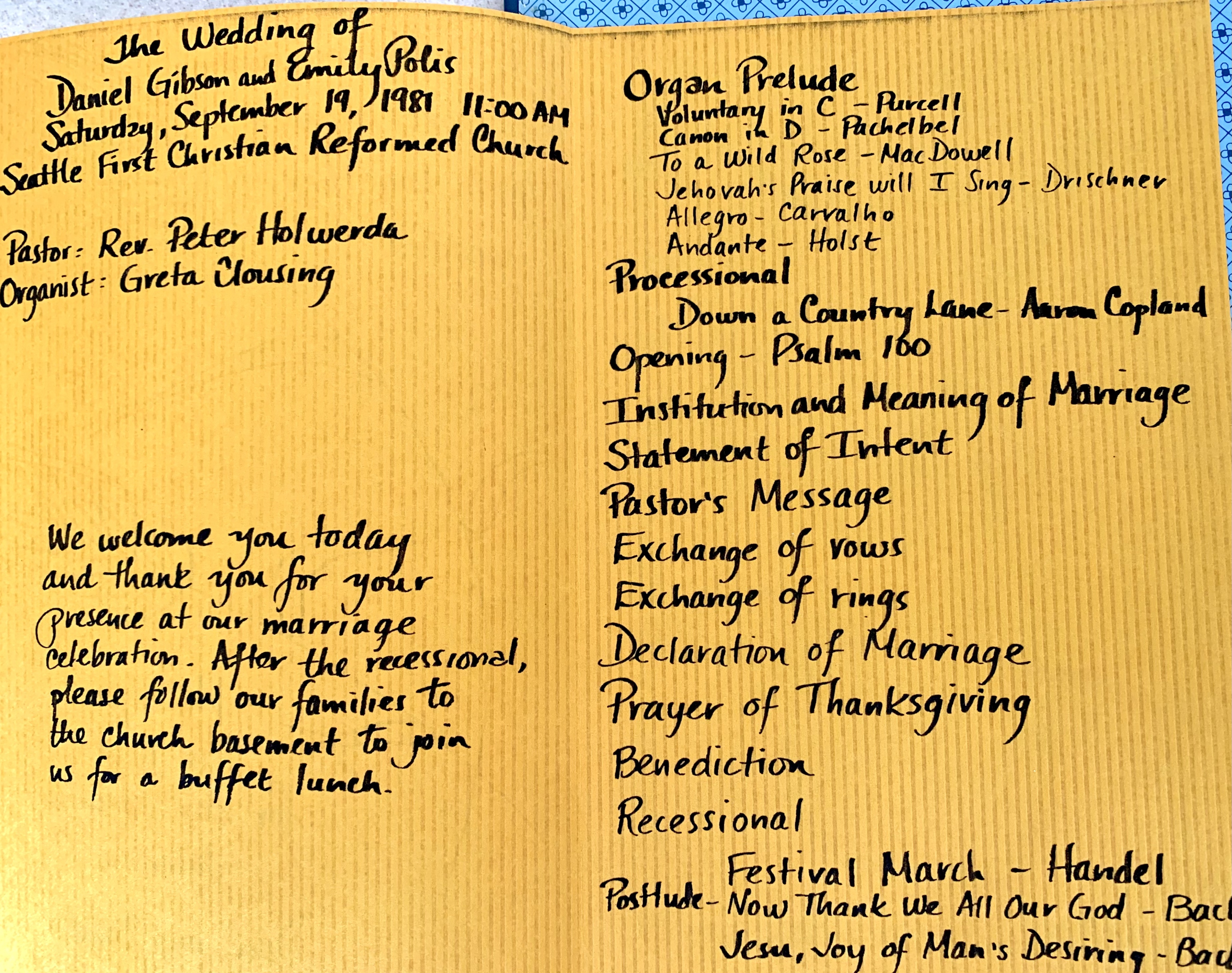
We married forty-five years ago today in our Seattle church with Pastor Peter Holwerda officiating, with a small group of family and friends as witnesses.
It was a wedding of two frugal people with little to spend – I sewed my dress and Dan’s shirt from muslin, we grew our own flowers, our families helped potluck the lunch afterward and our tiered carrot cake was made by a friend.
Yet our vows to one another were not frugal and held nothing back. They were extravagant and comprehensive, coming from our hearts and spirits. The music we asked our amazing organist to play (versions below) inspired us by its simplicity and complexity – very much like the families that raised us and the God we worship.
Our vows have taken us from the city to the countryside, to the raising and rejoicing in three amazing children and now soon to be seven grandchildren. We served more than forty years as a public-employed attorney and physician. We have laid down those responsibilities, and picked up the tools of farm and garden along with church and community service for as long as we are able.
We treasure each day of living together in faithfulness, respect, compassion and hope – knowing that how we love and find joy in one another mirrors how God loves and revels in His people.
We pray for many more days to fill us with what endures.
I want to remember us this way— late September sun streaming through the window, bread loaves and golden bunches of grapes on the table, spoonfuls of hot soup rising to our lips, filling us with what endures. ~Peter Pereira from “A Pot of Red Lentils”
Here are versions of the organ music we selected for prelude, processional, recessional and postlude
The kitchen is sweet with the smell of apples, big yellow pie apples, light in the hand, their skins freckled, the stems knobby and thick with bark, as if the tree could not bear to let the apple go. Baskets of apples circle the back door, fill the porch, cover the kitchen table.
My mother and my grandmother are running the apple brigade. My mother, always better with machines, is standing at the apple peeler; my grandmother, more at home with a paring knife, faces her across the breadboard. My mother takes an apple in her hand,
She pushes it neatly onto the sharp prong and turns the handle that turns the apple that swivels the blade pressed tight against the apple’s side and peels the skin away in long curling strips that twist and fall to a bucket on the floor. The apples, coming off the peeler,
Are winding staircases, little accordions, slinky toys, jack-in-the-box fruit, until my grandmother’s paring knife goes slicing through the rings and they become apple pies, apple cakes, apple crisp. Soon they will be married to butter and live with cinnamon and sugar, happily ever after. ~Joyce Sutphen, “Apple Season” from Coming Back to the Body.
I liked how the starry blue lid of that saucepan lifted and puffed, then settled back on a thin hotpad of steam, and the way her kitchen filled with the warm, wet breath of apples, as if all the apples were talking at once, as if they’d come cold and sour from chores in the orchard, and were trying to shoulder in close to the fire. She was too busy to put in her two cents’ worth talking to apples. Squeezing her dentures with wrinkly lips, she had to jingle and stack the bright brass coins of the lids and thoughtfully count out the red rubber rings, then hold each jar, to see if it was clean, to a window that looked out through her back yard into Iowa. And with every third or fourth jar she wiped steam from her glasses, using the hem of her apron, printed with tiny red sailboats that dipped along with leaf-green banners snapping, under puffs of pale applesauce clouds scented with cinnamon and cloves, the only boats under sail for at least two thousand miles. ~Ted Kooser “Applesauce” from Delights and Shadow
1.
Through the night the apples outside my window one by one let go their branches and drop to the lawn. I can’t see, but hear the stem-snap, the plummet through leaves, then the final thump against the ground.
Sometimes two at once, or one right after another. During long moments of silence I wait and wonder about the bruised bodies, the terror of diving through air, and think I’ll go tomorrow to find the newly fallen, but they all look alike lying there dewsoaked, disappearing before me.
2.
I lie beneath my window listening to the sound of apples dropping in
the yard, a syncopated code I long to know, which continues even as I sleep, and dream I know
the meaning of what I hear, each dull thud of unseen apple-
I tell you, folks, all politics is like applesauce. ~Will Rogers
Once again, it’s applesauce season on our farm. The number of windfall apples lying on the ground is exponentially increasing, so I can put off the task no longer.
The old apple trees in our orchard are primarily antique varieties rarely grown any longer. I have the choice of a number of varieties: a Baldwin or two, some Pippins, a few Kings, and some Dutch Mignons, a russet apple undistinguished in appearance, not at all pretty, and easy to pass by for something more showy.
It takes no time at all to fill several large boxes. Sadly, some apples are already beyond hope; they lay rotting, half consumed by hornets, slugs, deer, possum, raccoons and other critters — so I let them be.
The task of washing, peeling and coring organic apples is time consuming. They require a fair amount of preparation: the bruised spots must be cut out, as well as the worm holes and tracks. The apples are cut to the core and sliced into the simmering pot to be stirred and slowly cooked down to sauce. Before long, before my eyes, together they become a pale yellow mash, blending their varied flavors together.
However the smooth sweetness of this wonderful sauce is owed to the Dutch Mignon. It is a sublime sauce apple despite its humble unassuming appearance. Used alone, it would lack the “stand out” flavors of the other apple varieties, but as it cooks down, it becomes a foundation allowing the other apples to blend their unique qualities.
If I’m feeling really homespun, I marry the sublime with cinnamon and sugar, to create something happily ever after.
So it should be with the fellowship of diverse people and so should it be during a painful political season.
We are bruised, wormy, but salvageable. We are far better together than we are separate. And through the process, with perhaps a sprinkle of cinnamon and sweetness, we are transformed into something far better than how we began.
One-Time
Monthly
Yearly
Make a one-time or recurring donation to support daily Barnstorming posts
God empties himself into the earth like a cloud. God takes the substance, contours of a man, and keeps them, dying, rising, walking, and still walking wherever there is motion. Annie Dillard from “Feast Days” in Tickets for a Prayer Wheel
Divinity is not playful. The universe was not made in jest but in solemn incomprehensible earnest. By a power that is unfathomably secret, and holy, and fleet. There is nothing to be done about it, but ignore it, or see. ~Annie Dillard from Pilgrim at Tinker Creek
What does it feel like to be alive? Living, you stand under a waterfall… It is time pounding at you, time. Knowing you are alive is watching on every side your generation’s short time falling away as fast as rivers drop through air, and feeling it hit.
I had hopes for my rough edges. I wanted to use them as a can opener, to cut myself a hole in the world’s surface, and exit through it. ~Annie Dillard from An American Childhood
What I have been after all along is not an explanation but a picture. This is the way the world is, altar and cup, lit by the fire from a star that has only begun to die. My rage and shock at the pain and death of individuals of my kind is the old, old mystery, as old as man but forever fresh, and completely unanswerable. ~Annie Dillard from Pilgrim at Tinker Creek
I came here to study hard things – rock mountain and salt sea – and to temper my spirit on their edges.
“Teach me thy ways, O Lord” is, like all prayers, a rash one, and one I cannot but recommend.
The Cascade Range, in these high latitudes, backs almost into the water. There is only a narrow strip, an afterthought of foothills and farms sixty miles wide, between the snowy mountains and the sea. These mountains — Mount Baker and the Sisters and Shuksan, the Canadian Coastal Range and the Olympics on the peninsula — are surely the edge of the known and comprehended world….
That they bear their own unimaginable masses and weathers aloft, holding them up in the sky for anyone to see plain, makes them, as Chesterton said of the Eucharist, only the more mysterious by their very visibility and absence of secrecy. ~Annie Dillard from Holy the Firm
Some unwonted, taught pride diverts us from our original intent, which is to explore the neighborhood, view the landscape, to discover at least where it is that we have been so startlingly set down, if we can’t learn why. ~Annie Dillard from Pilgrim at Tinker Creek
The shadow’s the thing. If I no longer see shadows as “dark marks,”as do the newly sighted, then I see them as making some sort of sense of the light. They give the light distance;they put it in its place. They inform my eyes of my location here, here O Israel, here in the world’s flawed sculpture, here in the flickering shade of the nothingness between me and the light. ~Annie Dillard from Pilgrim at Tinker Creek
We are here to abet creation and to witness it, to notice each thing so each thing gets noticed. Together we notice not only each mountain shadow and each stone on the beach but we notice each other’s beautiful face and complex nature so that creation need not play to an empty house. ~Annie Dillard from The Meaning of Life (1991 Life Magazine)
But time is one thing we have been given, and we have been given to time. Time gives us a whirl. We keep waking from a dream we can’t recall, looking around in surprise, and lapsing back, for years on end. All I want to do is stay awake, keep my head up, prop my eyes open, with toothpicks, with trees. … You don’t run down the present… You wait for it, empty-handed, and you are filled. ~Annie Dillard from Pilgrim at Tinker Creek
An infant is a pucker of the earth’s thin skin; so are we. We arise like budding yeasts and break off; we forget our beginnings. A mammal swells and circles and lays him down. You and I have finished swelling; our circling periods are playing out, but we can still leave footprints in a trail whose end we do know. ~Annie Dillard from For the Time Being
The world is wilder in all directions, more dangerous and bitter, more extravagant and bright. We are making hay when we should be making whoopee; we are raising tomatoes when we should be raising Cain or Lazarus. ~Annie Dillard from Pilgrim at Tinker Creek
Why are we reading, if not in hope of beauty laid bare, life heightened and its deepest mystery probed?
Can the writer isolate and vivify all in experience that most deeply engages our intellects and our hearts?
Why are we reading, if not in hope that the writer will magnify and dramatize our days, will illuminate and inspire us with wisdom, courage and the hope of meaningfulness, and press upon our minds the deepest mysteries, so we may feel again their majesty and power?
What do we ever know that is higher than that power which, from time to time, seizes our lives, and which reveals us startlingly to ourselves as creatures set down here bewildered?
Why does death so catch us by surprise, and why love?
Annie Dillard passed into glory yesterday at age 81, finally witnessing firsthand the holy and sacred mysteries she pondered in her writings.
Since 1974,I have been indebted to her God-given gifts of observation and unique ability to share precisely perfect words to describe how she felt about what she saw. In 1976, she did a reading locally – I was amazed at herinsistence that we all have the power to open our eyes to this place we have been set down, to witness all that is secret, holy and fleet in our existence…
She indeed left her mark while living, teaching and writing here in Whatcom County for a time nearly fifty years ago…
All the photos on this page are from my collection of pictures I’ve taken here in Whatcom County, as I can imagine this scenery inspired Annie in her writing while she was here.
We are invited by Christ Himself to “come and see.” (John 1:39)
We weren’t conceived by random happenstance –
We are here because we were earnestly needed and wanted, by a power and divinity with a capacity for love and compassion beyond anything we are capable of.
We aren’t a cosmic joke, or random couplings of DNA. We aren’t pawns in the universe’s chess game.
We have the capacity to see the image of God in one another, as well as in the mirror, yet we ignore with our own eyes, His shimmering reflection.
…beauty and grace are performed whether or not we will or sense them. The least we can do is try to be there… ~Annie Dillard from Pilgrim at Tinker Creek
Mountains are giant, restful, absorbent. You can heave your spirit into a mountain and the mountain will keep it, folded, and not throw it back as some creeks will. The creeks are the world with all its stimulus and beauty; I live there. But the mountains are home. ~Annie Dillard from Pilgrim at Tinker Creek
One-Time
Monthly
Yearly
Make a one-time or recurring donation to support daily Barnstorming posts