The World Persists in its Beauty

Though he was ill and in pain,
in disobedience to the instruction he
would have received if he had asked,
the old man got up from his bed,
dressed, and went to the barn.
The bare branches of winter had emerged
through the last leaf-colors of fall,
the loveliest of all, browns and yellows
delicate and nameless in the gray light
and the sifting rain. He put feed
in the troughs for eighteen ewe lambs,
sent the dog for them, and she
brought them. They came eager
to their feed, and he who felt
their hunger was by their feeding
eased. From no place in the time
of present places, within no boundary
nameable in human thought,
they had gathered once again,
the shepherd, his sheep, and his dog
with all the known and the unknown
round about to the heavens’ limit.
Was this his stubbornness or bravado?
No. Only an ordinary act
of profoundest intimacy in a day
that might have been better. Still
the world persisted in its beauty,
he in his gratitude, and for this
he had most earnestly prayed.

~Wendell Berry “XI”

He (the professor) asked what I made
of the other students (at Oxford) so I told him.
They were okay, but they were all very similar…
they’d never failed at anything or been nobodies,
and they thought they would always win.
But this isn’t most people’s experience of life.

He asked me what could be done about it.
I told him the answer was to send them all out for a year
to do some dead-end job
like working in a chicken processing plant
or spreading muck with a tractor.
It would do more good than a gap year in Peru. 

He laughed and thought this was tremendously witty.
It wasn’t meant to be funny.
~James Rebanks from The Shepherd’s Life:Modern Dispatches from an Ancient Landscape
(or how a sheep farmer succeeds at Oxford and then goes back to the farm)

For over forty years, I have spent about an hour a day shoveling manure out of our horse stalls and I’m a better person for it.

Wheeled to a mountainous pile in our barnyard, this daily collection of manure happily composts year round, becoming rich fertilizer in a matter of months through a crucible-like heating process of organic chemistry, bacteria and earthworms. Nothing mankind has achieved quite matches the drama of useless and basically disgusting stuff transforming into the essential elements needed for productive growth and survival.

Our government certainly hasn’t discovered the secret. This is a metaphor I can <ahem> happily muck about in.

I’m in awe, every day, at being part of this process — in many ways a far more tangible improvement to the world than anything else I manage to accomplish every day. The horses, major contributors that they are, act underwhelmed by my enthusiasm. I guess some miracles are relative, depending on one’s perspective, but if the horses understood that the grass they contentedly eat in the pasture, or the hay they munch on during the winter months, was grown thanks to their carefully recycled waste products, they might be more impressed.

Their nonchalance about the daily mucking routine is understandable. If they are outside, they probably don’t notice their beds are clean when they return to the stalls at night. If they are inside during the heavy rain days, they feel duty-bound to be in my face as I move about their stall, toting my pitchfork and pushing a wheelbarrow. I’m a source of constant amusement as they nose my jacket pockets for treats that I never carry, as they beg for scratches on their unreachable itchy spots, and as they attempt to overturn an almost full load, just to see balls of manure roll to all corners of the stall like breaking a rack of billiard balls in a game of pool.

Good thing I’m a patient person always seeking an object lesson in whatever I see or do ~ mucking out stalls every day helps me tolerate the proverbial muck I encounter in the news. And spending an hour a day getting dirty in the real stuff somehow makes the virtual manure less noxious.

Indeed, everyone should be mucking out, especially during election season, as I think the world would generally be a better place.

Comprehending the Difference

foggydrops17

…the essence of sin
is man substituting himself for God,
while the essence of salvation
is God substituting himself for man.

~John Stott from The Cross of Christ

foggydrops15

Try as we might
to make things in our own image,
no matter what discontent we feel,
we fail to comprehend
we are not God
and never can be.

Try as we might
to pick ourselves up when we fall,
no matter the anguish we feel,
we struggle to understand
He fell to earth specifically to catch us:
He bled our blood, shed our tears, brought us home.

fogdrops2
leafdewy

Lyrics from Psalm 84:

How lovely is your dwelling place,
O Lord of hosts!
2 My soul longs, yes, faints
for the courts of the Lord;
my heart and flesh sing for joy
to the living God.

3 Even the sparrow finds a home,
and the swallow a nest for herself,
where she may lay her young,
at your altars, O Lord of hosts,
my King and my God.
4 Blessed are those who dwell in your house,
ever singing your praise!

Come and See: And It Was Night…

After saying these things, Jesus was troubled in his spirit, and testified, “Truly, truly, I say to you, one of you will betray me.”

The disciples looked at one another, uncertain of whom he spoke. One of his disciples, whom Jesus loved, was reclining at table at Jesus’ side. so Simon Peter motioned to him to ask Jesus of whom he was speaking. So that disciple, leaning back against Jesus, said to him, “Lord, who is it?”

Jesus answered, “It is he to whom I will give this morsel of bread when I have dipped it.”So when he had dipped the morsel, he gave it to Judas, the son of Simon Iscariot. Then after he had taken the morsel, Satan entered into him. Jesus said to him, “What you are going to do, do quickly.”

Now no one at the table knew why he said this to him. Some thought that, because Judas had the moneybag, Jesus was telling him, “Buy what we need for the feast,”or that he should give something to the poor. So, after receiving the morsel of bread, he immediately went out.

And it was night.
John 13: 21-30

And he (Judas) that went out — was himself the night…

~St. Augustine, Tractate 62 on the Book of John

There is in God, some say,

A deep but dazzling darkness, as men here

Say it is late and dusky, because they

           See not all clear.

  O for that night! where I in Him

  Might live invisible and dim!

~Henry Vaughn from “The Night”

Ask what the moon witnesses in the night.
Ask what we, as fallen creatures, do in the dark.
Darkness was not banished by God in the beginning, so we would search, blinded, for Him.

We are promised this in the Word: “and night will be no more. They will need no light of lamp or sun, for the Lord God will be their light… Revelation 22:5.

The Word in the beginning set a dark universe in motion.
The Word is both flesh and Savior to a world dwelling in darkness.
The Word as Spirit thrives eternally to enlighten our hearts, our minds and hands.

Darkness is not banished. But it is overcome.
And so, we have a lit pathway leading us home.

I am reading slowly through the words in the Book of John over the next year alongside my church family. Once a week, I will invite you to “come and see” what those words might mean as we explore His promises together.

Swift Elation with a Sense of Sadness

Then summer fades and passes and October comes.
We’ll smell smoke then,
and feel an unexpected sharpness,
a thrill of nervousness,
swift elation,
a sense of sadness and departure.
~ Thomas Wolfe

Such days of autumnal decline hold a strange mystery which adds to the gravity of all our moods.
~Charles Nodier

I was drinking in the surroundings:
air so crisp you could snap it with your fingers
and greens in every lush shade imaginable
offset by autumnal flashes of red and yellow.
~Wendy Delsol

October feels bittersweet, heralding the inevitable slow down to winter stillness.

The garden is put to bed, lawnmowers stored away, horses fluffy with winter fur coats, pruning shears not yet sharpened for the winter work of refinement and shaping.

Yet the air sparkles, sharp-edged in the lungs.

I am never ready for this crush of dark hours descending so quickly. Yet it comes with the promise of light and growth to come.

And so we feast on October while pondering what comes next.

A Radical Amazement

I shall open my eyes and ears.
Once every day I shall simply stare

at a tree, a flower, a cloud, or a person.
I shall not then be concerned at all to ask what they are but simply be glad that they are.
I shall joyfully allow them the mystery of what C.S. Lewis calls their “divine, magical, terrifying and ecstatic” existence.
~Clyde Kilby in “Amazed in the Ordinary”

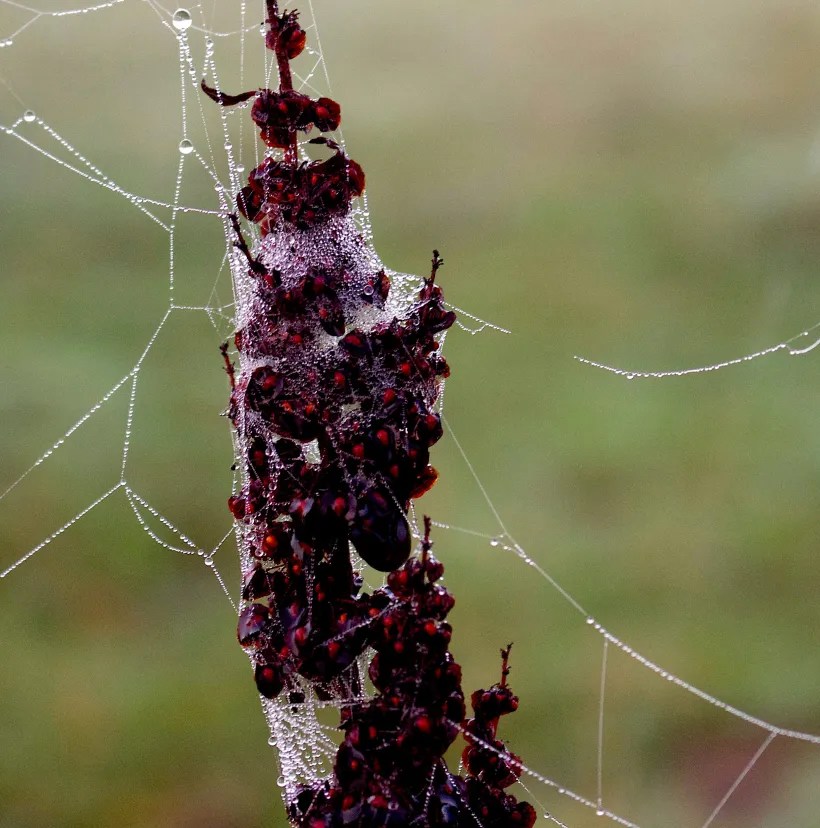
Our goal should be to live life in radical amazement. ….get up in the morning and look at the world in a way that takes nothing for granted. Everything is phenomenal; everything is incredible; never treat life casually. To be spiritual is to be amazed.
~Abraham Joshua Heschel

An open heart is alive to wonder, to the sheer marvel of “isness.”
It is remarkable that the world is,
that we are here,
that we can experience it.
This world is not ordinary.
Indeed, what is remarkable is that
it could ever look ordinary to us.


An open heart knows “radical amazement.”
An open heart and gratitude go together.
We can feel this in our bodies.
In the moments in my life
when I have been most grateful,
I have felt a swelling,
almost a bursting in my chest.
~Marcus Borg from The Heart of Christianity

photo by Nicole Moore

Much of the time I sleep-walk through each day, oblivious, as if in dense fog with unseeing wide-open eyes.

Especially if I’m rushing from here to there, I sense time slowing: I stumble through the days, the path appears indiscernible, my future uncertain, my purpose elusive.

How to stay awake and aware of the radical amazement of each moment given to me?

When I’m simply glad, everything becomes more vivid — the sounds of geese flying overhead, the smell of the farm, the layers of a foggy landscape, the taste of an autumn apple right from the tree, the string of fog-drop pearls on a spider web, the necessity and intensity of every breath, my purpose to be witness.

So wake me to be amazed anew -please- to see all that is around me. I want to chew on it again and again, simply savoring and simply glad.

And What if?

What if you slept
And what if
In your sleep
You dreamed
And what if
In your dream
You went to heaven
And there plucked a strange and beautiful flower
And what if
When you awoke
You had that flower in your hand
Ah, what then?
~Samuel Taylor Coleridge “What if you slept…”

What might our dreams tell us of heaven?

The last few nights I dreamed of those with whom I once had a warm friendship but no longer do.

My dreams were of grace and reconciliation, of walking and talking together and rediscovering our common goals and beliefs rather than dwelling on estrangement and sadness as we’ve gone our separate ways.

Upon waking, I wondered what vision of heaven this suggests: finding the lost treasure of connection that I allowed to let go.

Restoring a friendship is like waking, holding a strange and beautiful flower plucked in a dream. I cradle it gently in my hand as the precious gem it is.

What then is still possible? And what might I do with this flower now?

To Keep Looking Out

Dawn comes later and later now,
and I, who only a month ago
could sit with coffee every morning
watching the light walk down the hill
to the edge of the pond and place
a doe there, shyly drinking,

then see the light step out upon
the water, sowing reflections
to either side — a garden
of trees that grew as if by magic —
now see no more than my face,
mirrored by darkness, pale and odd,

startled by time. While I slept,
night in its thick winter jacket
bridled the doe with a twist
of wet leaves and led her away,
then brought its black horse with harness
that creaked like a cricket, and turned

the water garden under. I woke,
and at the waiting window found
the curtains open to my open face;
beyond me, darkness. And I,
who only wished to keep looking out,
must now keep looking in.
~Ted Kooser “A Letter in October”

God knows we seek out light
these autumn mornings

praying to see multicolors filling the lines outside;
my face a shadow in a blackened window pane

Some mornings we can only see our own reflection
mirrored by darkness, startled by time, as we wonder what comes next.

God knows, as each year passes, we need His Light illuminating us as we look beyond ourselves, but even more as we look within.

Come and See: Lifted His Heel Against Me

When he had washed their feet and put on his outer garments and resumed his place, he said to them, “Do you understand what I have done to you? You call me Teacher and Lord, and you are right, for so I am. If I then, your Lord and Teacher, have washed your feet, you also ought to wash one another’s feet.

For I have given you an example, that you also should do just as I have done to you. Truly, truly, I say to you, a servant is not greater than his master, nor is a messenger greater than the one who sent him. If you know these things, blessed are you if you do them.

I am not speaking of all of you; I know whom I have chosen. But the Scripture will be fulfilled, ‘He who ate my bread has lifted his heel against me.’ (Psalm 41:9)

I am telling you this now, before it takes place, that when it does take place you may believe that I am he.

Truly, truly, I say to you, whoever receives the one I send receives me, and whoever receives me receives the one who sent me.”
John 13: 12-20

Rembrandt Head of Christ

I, too, stood on the sacred image … on the face of the man who has been ever in my thoughts, … on the best and most beautiful face that any man can ever know, on the face of him whom I have always longed to love.

I understand your pain and your suffering. It is for that reason that I am here.

Lord, I resented your silence.

I was not silent. I suffered beside you.
~Shisaku Endo from Silence – an interchange at the end of the book between Father Sebastian Rodrigues and the voice of the Lord Jesus

Then Judas in his hot desire
 Said, “Give me what you will.”
Christ spoke to him with words of fire,
 “Then, Judas, you must kill,
One whom you love, One who loves you
 As only God’s son can:
This is the work for you to do
 To save the creature man.
“

“And men to come will curse your name,
 And hold you up to scorn;
In all the world will be no shame
 Like yours; this is love’s thorn.
It takes strong will of heart and soul,
 But man is under ban.
Think, Judas, can you play this role
 In heaven’s mystic plan?”

So Judas took the sorry part,
 Went out and spoke the word,
And gave the kiss that broke his heart,
 But no one knew or heard.
And no one knew what poison ate
 Into his palm that day,
Where, bright and damned, the monstrous weight
 Of thirty white coins lay.

It was not death that Judas found
 Upon a kindly tree;
The man was dead long ere he bound
 His throat as final fee.
And who can say if on that day
 When gates of pearl swung wide,
 Christ did not go His honored way
With Judas by His side?

~Countee Cullen “Judas Iscariot”

And then there is the love for the enemy–
love for the one who does not love you
but mocks, threatens, and inflicts pain.
The tortured’s love for the torturer.
This is God’s love.
It conquers the world.
~Frederick Buechner
from The Magnificent Defeat

Even my close friend in whom I trusted, who ate my bread, has lifted his heel against me. Psalm 41:9

…he shall bruise your head, and you shall bruise his heel. Genesis 3:15

Jesus knew Judas would “lift his heel against him” – Jesus chose him for that very reason, a close friend who had been a cherished part of the twelve.

The kick is hard, but not unexpected.

A heel crushes the image of Jesus and all that is good and beautiful.

Yet, this Lord is able to understand the pain of the betrayer and know suffering so much, He brings it onto Himself.

It was for this reason He came. It was for this reason He invites us to eat the bread of life alongside Him. We are filled and forgiven because He loves us enough to take our kicks and crushes.

What a gift to be known so well by God Himself.

I am reading slowly through the words in the Book of John over the next year alongside my church family. Once a week, I will invite you to “come and see” what those words might mean as we explore His promises together.

Mirrored Light

photo by Joel DeWaard

What is this unfolding, this slow-
going unraveling of gift held
in hands open
to the wonder and enchantment of it all?

What is this growing, this rare
showing, like blossoming
of purple spotted forests
by roadsides grown weary with winter months?

Seasons affected, routinely disordered
by playful disturbance of divine glee
weaving through limbs with
sharpened shards of mirrored light,
cutting dark spaces, interlacing creation,
commanding life with whimsical delight.

What is this breaking, this hopeful
re-making, shifting stones, addressing dry bones,
dizzying me with blessings,
intercepting my grieving
and raising the dead all around me?
~Enuma Okoro “Morning Reflections” from At the Still Point: A Literary Guide to Prayer in Ordinary Time

Everything is made to perish;
the wonder of anything at all is that it has not already done so.
No, he thought.
The wonder of anything is that it was made in the first place.
What persists beyond this cataclysm of making and unmaking?
~Paul Harding
from Tinkers

God does not leave us to perish in the valley of dry bones.

We may think we are invincible, yet the truth is:
we are mere dust, ready to blow away.
The immense power of the breath of God fills newborn lungs and will someday restore the empty lungs of the resurrected dead.

He rebuilds our muscle and sinews, reconnects us bone to bone, person to person, living to rattle and sing as the body of Christ, mirrored reflections in His image.

This unfolding, this growing, this blossoming, this breaking:
Lord, keep dizzying us with your blessings, now and always.

As the Rain Begins…

The room darkened, darkened until
our nakedness became a form of gray;
then the rain came bursting,
and we were sheltered, blessed,
upheld in a world of elements
that held us justified.
In all the love I had felt for you before,
in all that love,
there was no love
like that I felt when the rain began…
~John Updike from “The Blessing” from Collected Poems.

As the rains return,
as we shelter together,
blessed by the passing years and miles,
our unknowns have become known,
our understanding breathed in silence.

Though we be gray as the clouds above,
our hearts still beat in synchrony
each pulsing moment
more sacred than the last.

Lyrics: A soft voice, a kind word
A tender touch in a hard world
Your voice like rain after the seeds are sown
Your kindness and grace is all I’ve ever known

We’re not the same, you and me
You’re an evergreen and I’m a maple tree
Sometimes I’m bare, sometimes I’m sweet
You can carry on consistently
And in a million little ways, you show
How to take two souls and make one home

You love the dirt, I find life in words
I sit and think, you relish your work
You could teach, teach a master class
Without a word you show us how to make a feast from scratch
And in a million little ways, you show
How to take two souls and make one home
And in a million little ways, you show
How to take two souls and make one home

A sanctuary for our children
A sanctuary for our fears and hopes
Here in the wilderness, our world longs for this
To be known and loved

Lyrics: In the quiet misty morning
When the moon has gone to bed,
When the sparrows stop their singing
And the sky is clear and red,
When the summer’s ceased its gleaming
When the corn is past its prime,
When adventure’s lost its meaning –
I’ll be homeward bound in time

Bind me not to the pasture
Chain me not to the plow
Set me free to find my calling
And I’ll return to you somehow

If you find it’s me you’re missing
If you’re hoping I’ll return,
To your thoughts I’ll soon be listening,
And in the road I’ll stop and turn
Then the wind will set me racing
As my journey nears its end
And the path I’ll be retracing
When I’m homeward bound again

Bind me not to the pasture
Chain me not to the plow
Set me free to find my calling
And I’ll return to you somehow

In the quiet misty morning
When the moon has gone to bed,
When the sparrows stop their singing
I’ll be homeward bound again.

~Marta Keen “Homeward Bound”