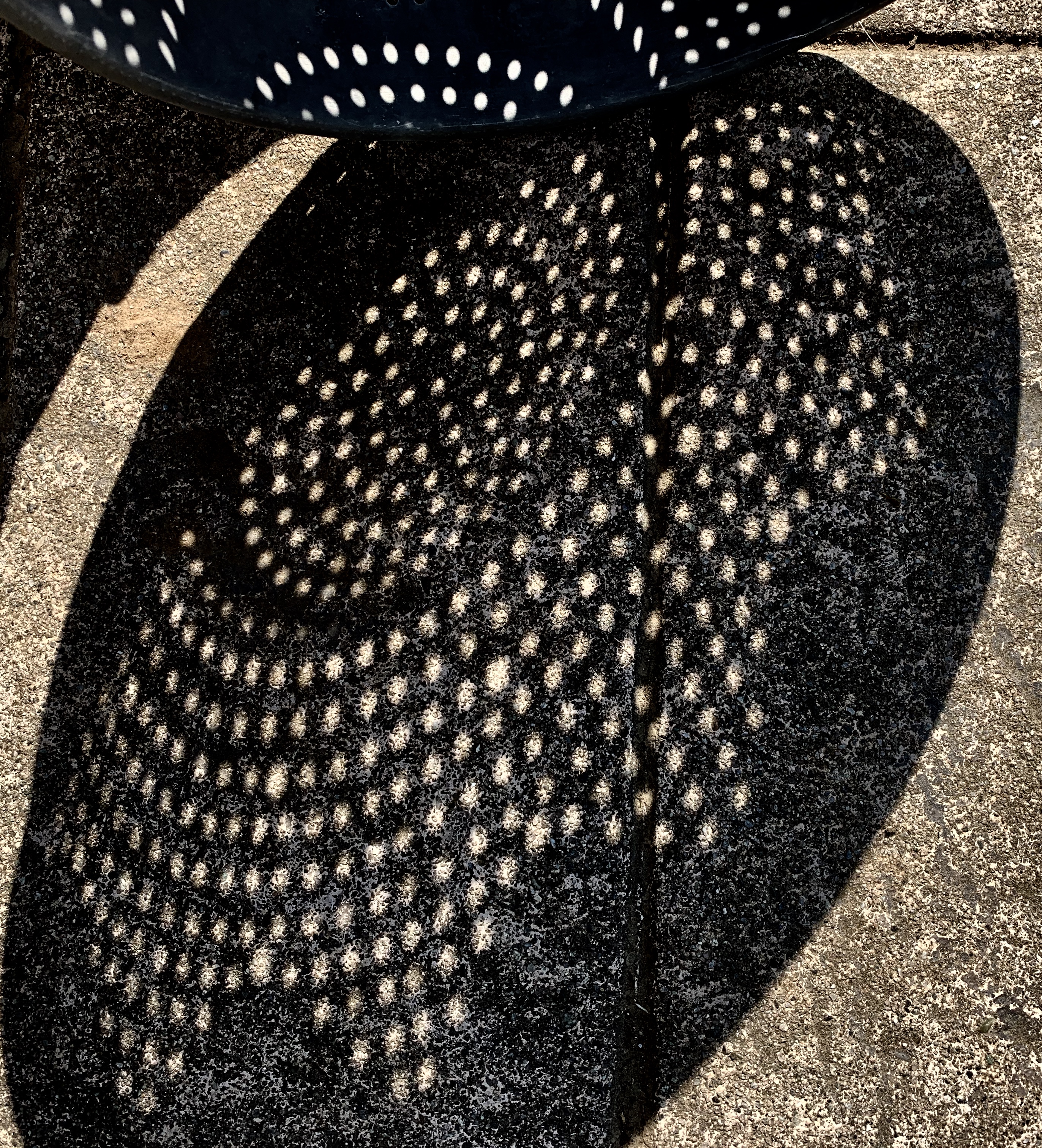
Holes in the shape of stars punched in gray tin, dented, cheap, beaten by each of her children with a wooden spoon.
Noodle catcher, spaghetti stopper, pouring cloudy rain into the sink, swirling counter clockwise down the drain, starch slime on the backside, caught in the piercings.
Scrubbed for sixty years, packed and unpacked, the baby’s helmet during the cold war, a sinking ship in the bathtub, little boat of holes.
Dirt scooped in with a plastic shovel, sifted to make cakes and castles. Wrestled from each other’s hands, its tin feet bent and re-bent.
Bowl daylight fell through onto freckled faces, noon stars on the pavement, the universe we circled aiming jagged stones, rung bells it caught and held. ~Dorianne Laux “My Mother’s Colander”
Many of my mother’s kitchen things, some over eighty years old, are still packed away in boxes that I haven’t had the emotional wherewithal to open. They sit waiting for me to sort and purge and save and weep.
It is as if I haven’t wanted to say goodbye after her death at age 88, now seventeen years ago.
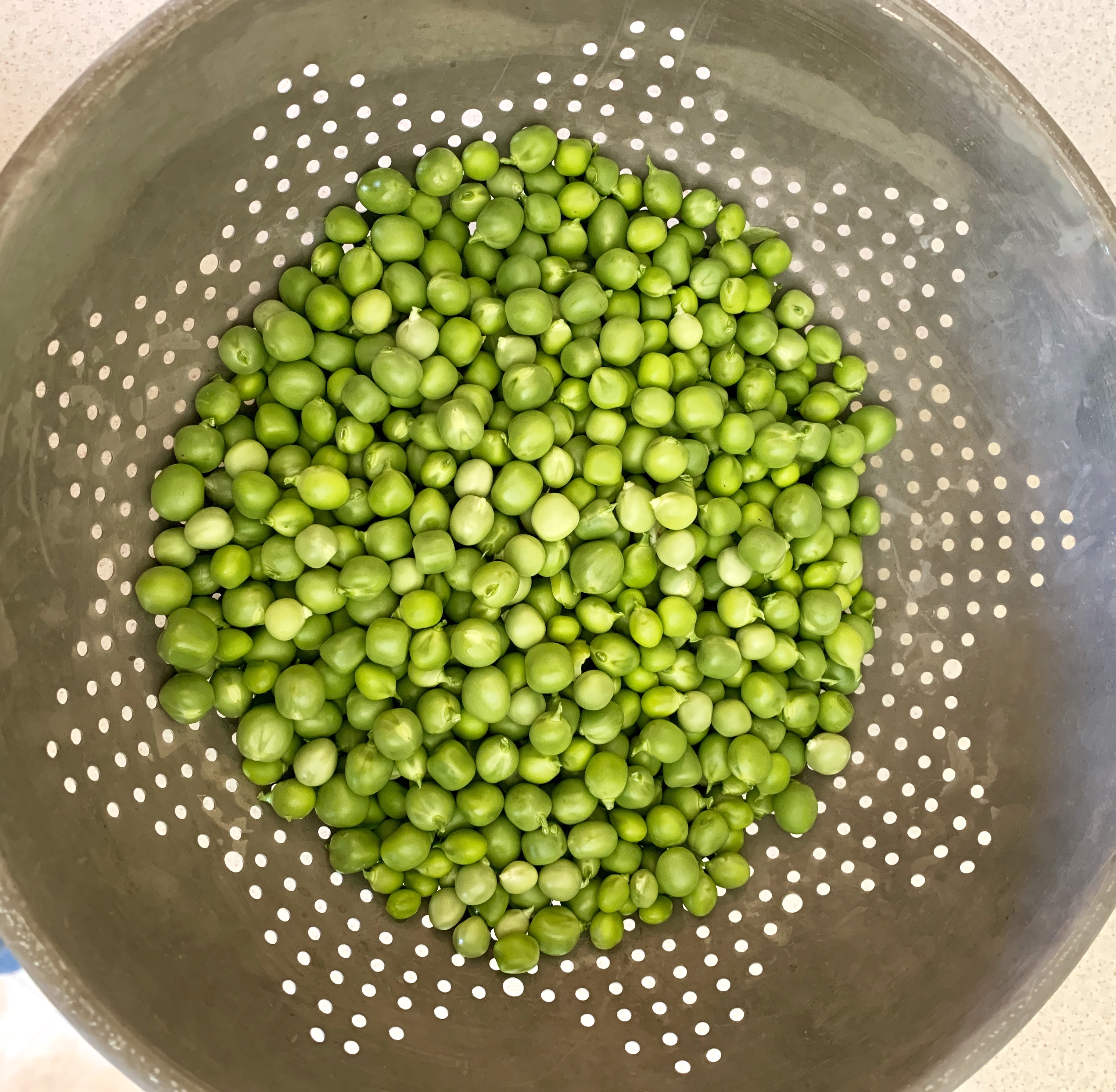
This particular kitchen item- her old dented metal colander – found its way to me when I moved into my first apartment some 49 years ago. She had purchased a bright green plastic colander at a Tupperware party so she felt the old metal one was somehow outdated, overworked and plain, and ready for retirement.
It had held hundreds of pounds of rinsed garden vegetables during my childhood, had drained umpteen pasta noodles, had served as a sifter in our sandbox, and a helmet for many a pretend rocket launch to infinity and beyond.
Dented and battered, it still works fine, thank you very much, for all intended and some unintended purposes. It does make me wonder what other treasures may surprise me as I begin to open and sort my mother’s boxes. Her things have remained in suspended animation, waiting to be rediscovered.
I know there will be tons of tupperware, carefully saved yogurt containers with lids, and quite likely a hoard of pickle jars. As a child of the depression, she saved anything that could be potentially used again.
Perhaps these items have waited patiently to be touched lovingly and with distinct purpose as they once were, and be remembered for the part they played in one woman’s long sacrificial and faith-filled life.
Maybe, just maybe, it will feel like I’ve unpacked Mom once again and maybe this time it can be both a hello and a goodbye.
To infinity and beyond…
AI image created for this post
One-Time
Monthly
Yearly
Make a one-time or recurring donation to support daily Barnstorming posts
And the secret garden bloomed and bloomed and every morning revealed new miracles.
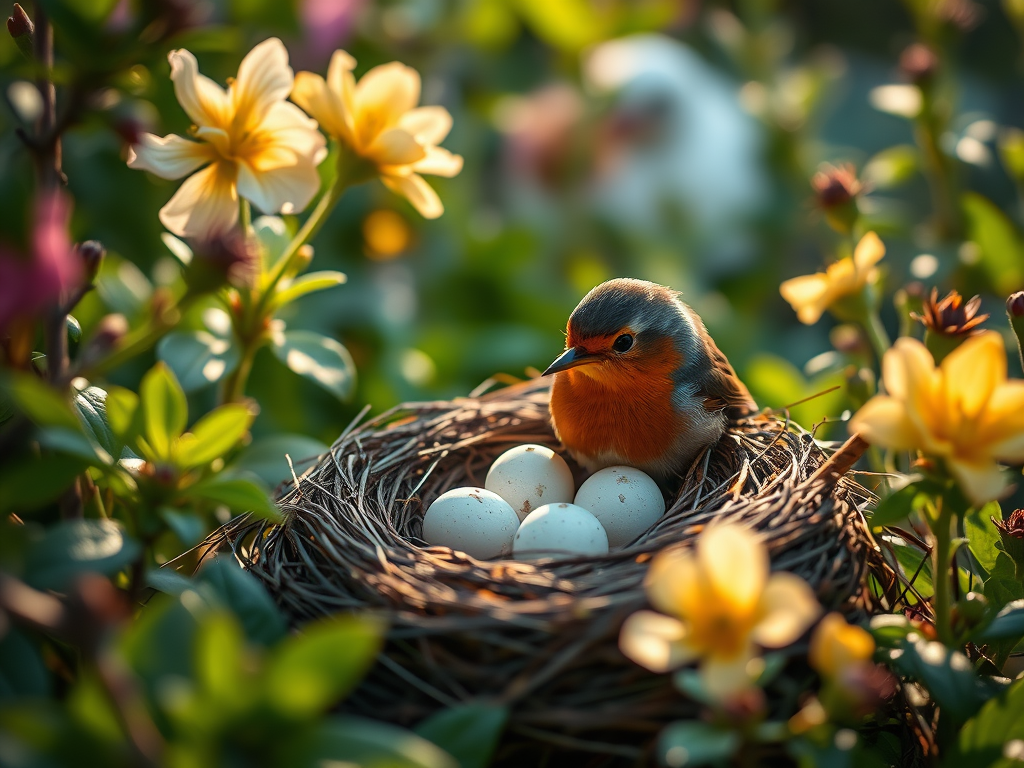
In the robin’s nest there were Eggs and the robin’s mate sat upon them keeping them warm with her feathery little breast and careful wings.
….in the garden there was nothing which was not quite like themselves, nothing which did not understand the wonderfulness of what was happening to them, the immense, tender, terrible, heart-breaking beauty and solemnity of Eggs.
If there had been one person in that garden who had not known through all his or her innermost being that if an Egg were taken away or hurt the whole world would whirl round and crash through space and come to an end—
if there had been even one who did not feel it and act accordingly there could have been no happiness even in that golden springtime air.
But they all knew it and felt it and the robin and his mate knew they knew it. ~Frances Hodgson Burnett from The Secret Garden
Some say you’re lucky If nothing shatters it.
But then you wouldn’t Understand poems or songs. You’d never know Beauty comes from loss.
It’s deep inside every person: A tear tinier Than a pearl or thorn.
We all start out in the secret garden of a fallopian tube as an egg pierced to become so much more… – each tiny part of the least of us – – whether brain, heart, lungs or liver – wonderfully made, even if discarded or fallen from the nest.
The act of creation of something so sacred is immense, tender, terrible, beautiful, heart-breaking, and so very solemn and joyful.
The act of harming one tiny part of creation hurts the whole world; we risk whirling round and crashing through space and coming to an end.
If there is even one who does not feel it and act accordingly, there can be no happiness.
But they all knew it and felt it and they knew they knew it.
And what is born broken is beloved nevertheless.
photo by Josh ScholtenAI image created for this post
One-Time
Monthly
Yearly
Make a one-time or recurring donation to support daily Barnstorming posts
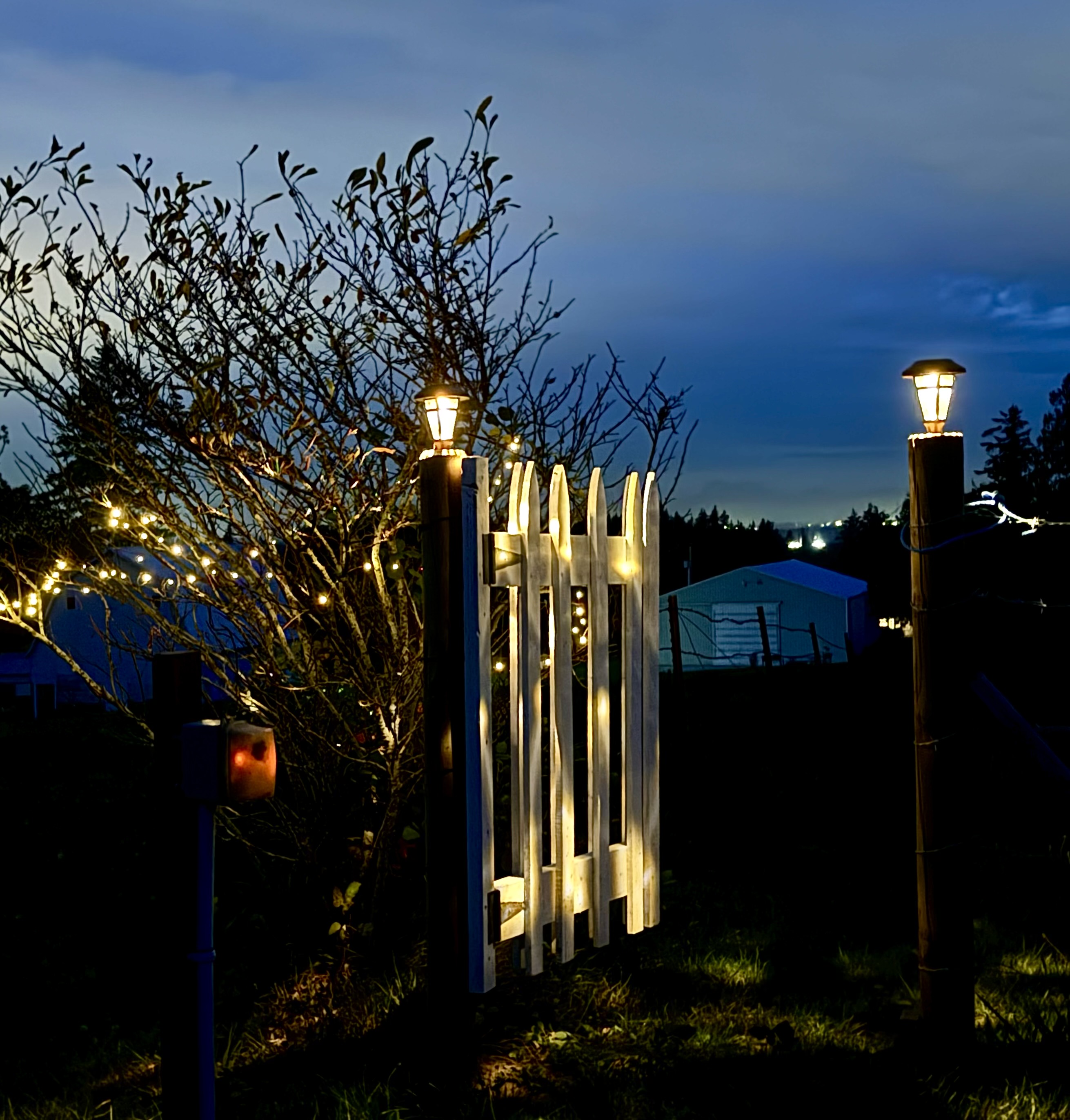
What seemed to be the end proved to be the beginning… Suddenly a wall becomes a gate. ~Henri Nouwen from Gracias! A Letter of Consolation
As Christians we do not believe in walls, but that life lies open before us; that the gate can always be unbarred; that there is no final abandonment or desertion. We do not believe that it can ever be “too late.”
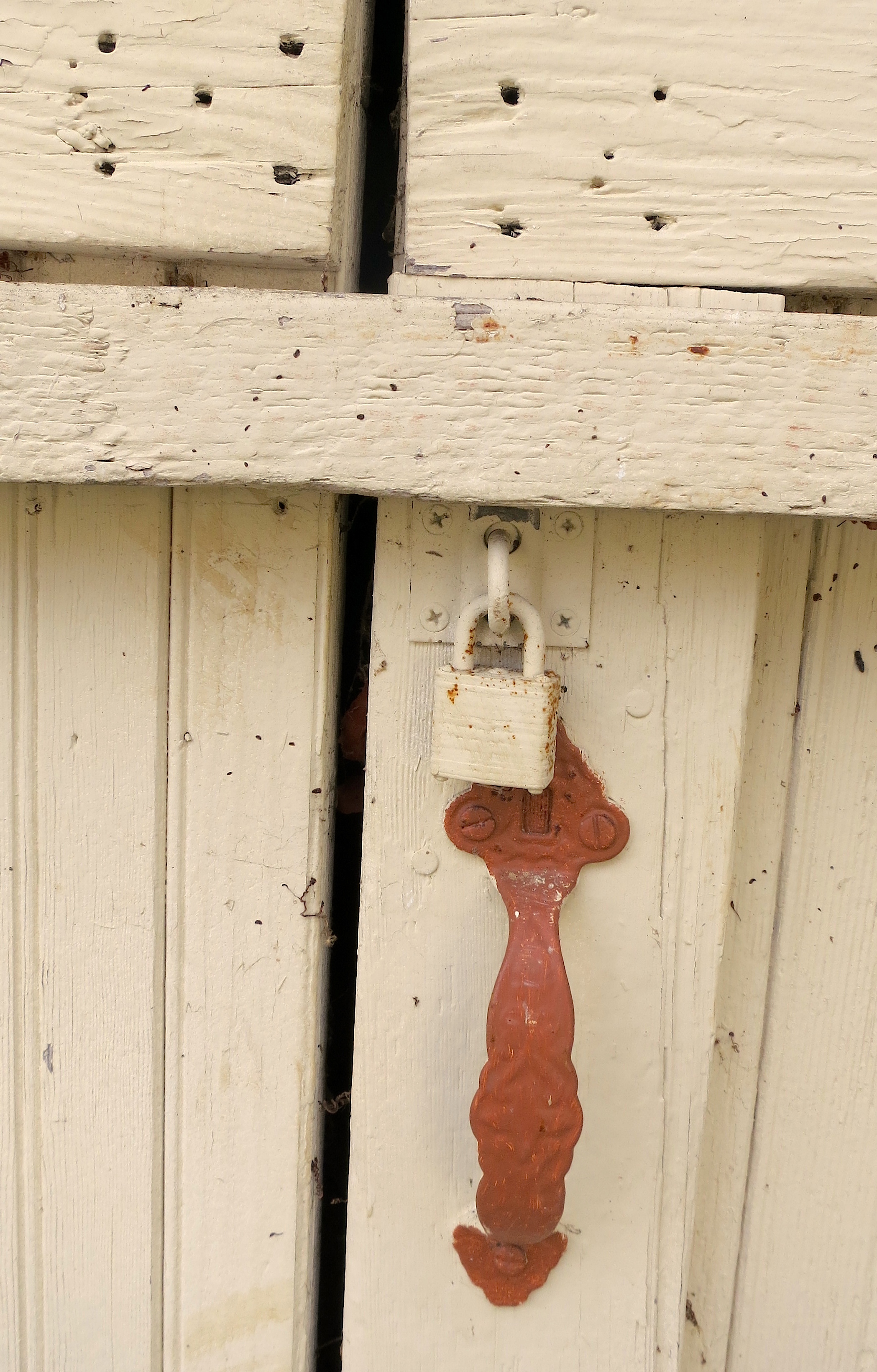
We believe that the world is full of doors that can be opened. Between us and others. Between the people around us. Between today and tomorrow. Our own inner person can be unlocked too: even within our own selves, there are doors that need to be opened.
If we open them and enter, we can unlock ourselves, too, and so await whatever is coming to free us and make us whole. ~ Jörg Zink from “Doors to the Feast”
What we call the beginning is often the end And to make an end is to make a beginning. The end is where we start from.
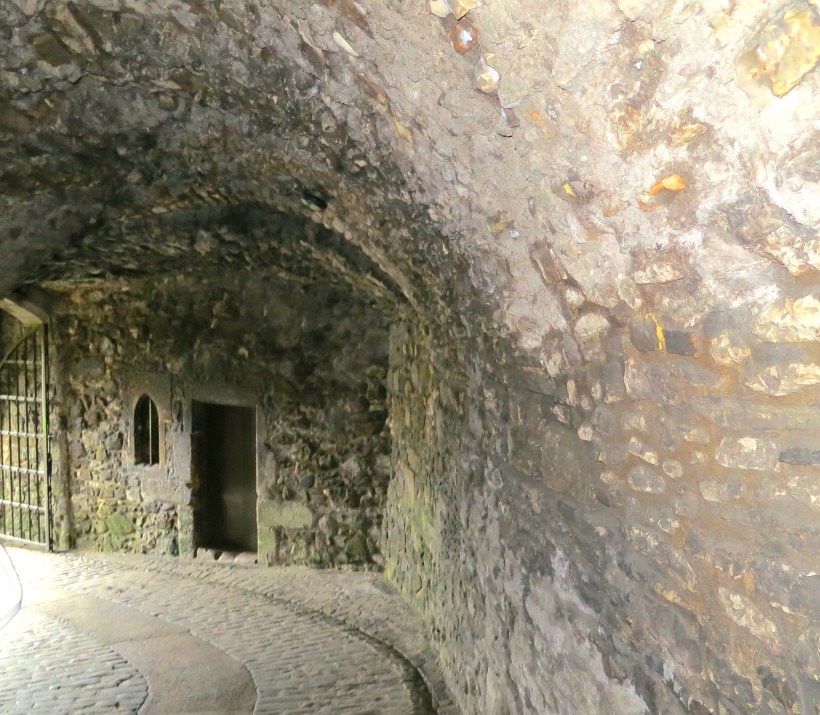
We shall not cease from exploration And the end of all our exploring Will be to arrive where we started And know the place for the first time. Through the unknown, unremembered gate When the last of earth left to discover Is that which was the beginning; ~T.S. Eliot from “Little Gidding” The Four Quartets
There we shall rest and we shall see; we shall see and we shall love; we shall love and we shall praise. Behold what shall be in the end and shall not end. ~Augustine of Hippo ‘The City of God,’ Bk. XXII, Chap. 30
We stand outside the gate, incapable of opening it ourselves, watching as God Himself throws it open wide.
We choose to enter this unknown, unremembered gate into the endless length of days, where we shall see and we shall love, we shall love and we shall praise –
or we choose to remain outside, lingering in the familiar confines of what we know, though it destroys us.
AI image created for this post
With thanks to conductor, composer, singer Ben Kornelis for putting these beautiful Augustinian words to music
One-Time
Monthly
Yearly
Make a one-time or recurring donation to support daily Barnstorming posts
i was talking to a moth the other evening he was trying to break into an electric light bulb and fry himself on the wires
why do you fellows pull this stunt i asked him because it is the conventional thing for moths or why if that had been an uncovered candle instead of an electric light bulb you would now be a small unsightly cinder have you no sense
plenty of it he answered but at times we get tired of using it we get bored with the routine and crave beauty and excitement fire is beautiful and we know that if we get too close it will kill us but what does that matter it is better to be happy for a moment and be burned up with beauty than to live a long time and be bored all the while so we wad all our life up into one little roll and then we shoot the roll that is what life is for it is better to be a part of beauty for one instant and then cease to exist than to exist forever and never be a part of beauty our attitude toward life is come easy go easy we are like human beings used to be before they became too civilized to enjoy themselves
and before i could argue him out of his philosophy he went and immolated himself on a patent cigar lighter i do not agree with him myself i would rather have half the happiness and twice the longevity but at the same time i wish there was something i wanted as badly as he wanted to fry himself
One night a moth flew into the candle, was caught, burned dry, and held. I must have been staring at the candle, or maybe I looked up when a shadow crossed my page; at any rate, I saw it all…
Her moving wings ignited like tissue paper…
And then this moth essence, this spectacular skeleton, began to act as a wick. She kept burning. The wax rose in the moth’s body from her soaking abdomen to her thorax to the jagged hole where her head should be, and widened into flame, a saffron-yellow flame that robed her to the ground like any immolating monk. That candle had two wicks, two flames of identical height, side by side. The moth’s head was fire. She burned for two hours, until I blew her out. ~Annie Dillard from “The Death of the Moth” from Holy the Firm
The struggle was over.
The insignificant little creature now knew death. As I looked at the dead moth, this minute wayside triumph of so great a force over so mean an antagonist filled me with wonder. Just as life had been strange a few minutes before, so death was now as strange.
The moth having righted himself now lay most decently and uncomplainingly composed. O yes, he seemed to say, death is stronger than I am. ~Virginia Woolf from “The Death of a Moth”
I too would take half the happiness and twice the longevity over one moment of ecstasy.
But I admire the blind passion of a tiny creature who will beat itself senseless on a light bulb, or fly into a flame to become cinders, or struggle so hard to live upright rather than upside down, that it dies in the struggle.
Why are famous poets and essayists fascinated by the tiny deaths they witness on their front porches, in their kitchens or at their writing desk?
Death is never tiny at all. Nevertheless, death is ceasing to be, after a unique and intentional creation, whether a moth, a mother, or ourselves.
We live today. Look for a moment of beauty to enjoy. Let’s be sensible about what we want so badly. As one tiny part of matter, we matter. And when we die, it is never a tiny death.
AI image created for this post
Lyrics: A day may come that asks of us all we have to give: a day we never would have sought and yet we have to live. If it should be our destiny to live in such a day, let our faith and love be worthy of the ones who showed the way. The ones we now call heroes The ones we say their memory will not die – they were no different in their day than you or I. They were no different in their day. than you or I. ~Grahame Davies
One-Time
Monthly
Yearly
Make a one-time or recurring donation to support daily Barnstorming posts
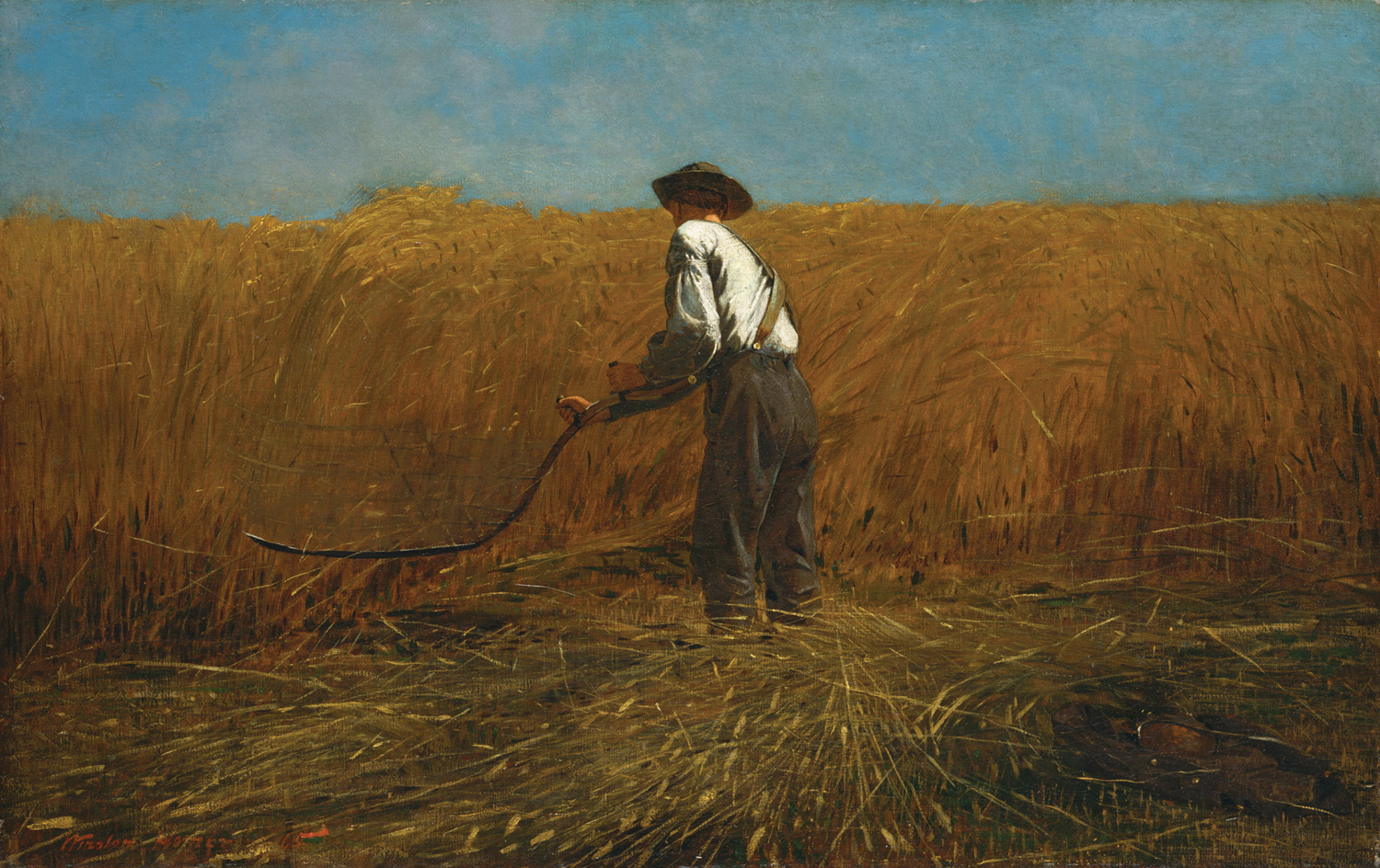
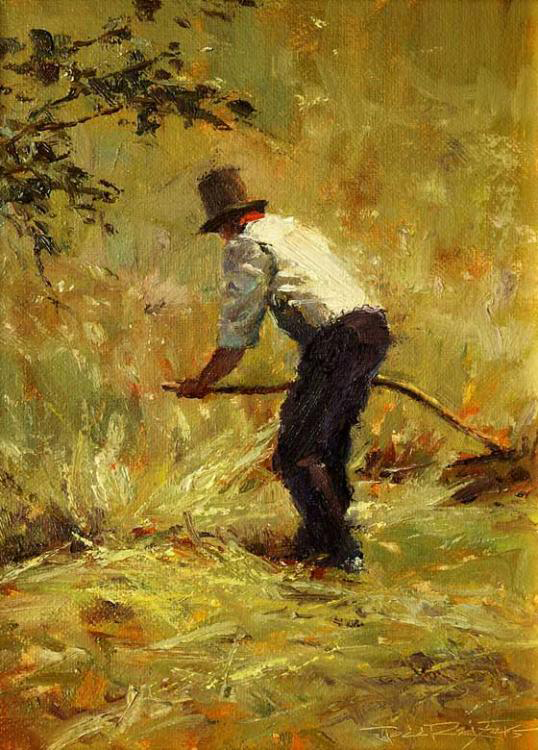
Winslow Homer’s The Veteran in a New FieldMan Scything Hay by Todd Reifers
There was never a sound beside the wood but one, And that was my long scythe whispering to the ground. What was it it whispered? I knew not well myself; Perhaps it was something about the heat of the sun, Something, perhaps, about the lack of sound— And that was why it whispered and did not speak. To the earnest love that laid the swale in rows, The fact is the sweetest dream that labor knows. My long scythe whispered and left the hay to make. ~Robert Frost in “Mowing”
Mowers, weary and brown, and blithe, What is the word methinks ye know, Endless over-word that the Scythe Sings to the blades of the grass below? Scythes that swing in the grass and clover, Something still, they say as they pass; What is the word that, over and over, Sings the Scythe to the flowers and grass?
Hush, ah hush, the Scythes are saying, Hush, and heed not, and fall asleep; Hush, they say to the grasses swaying, Hush, they sing to the clover deep! Hush – ’tis the lullaby Time is singing – Hush, and heed not, for all things pass, Hush, ah hush! and the Scythes are swinging Over the clover and over the grass! ~Andrew Lang (1844-1912) “The ScytheSong”
It is blue May. There is work to be done. The spring’s eye blind with algae, the stopped water silent. The garden fills with nettle and briar. Dylan drags branches away. I wade forward with my scythe.
There is stickiness on the blade. Yolk on my hands. Albumen and blood. Fragments of shell are baby-bones, the scythe a scalpel, bloodied and guilty with crushed feathers, mosses, the cut cords of the grass. We shout at each other each hurting with a separate pain.
From the crown of the hawthorn tree to the ground the willow warbler drops. All day in silence she repeats her question. I too return to the place holding the pieces, at first still hot from the knife, recall how warm birth fluids are. ~Gillian Clarke“Scything” from Letter from a Far Country (1982)
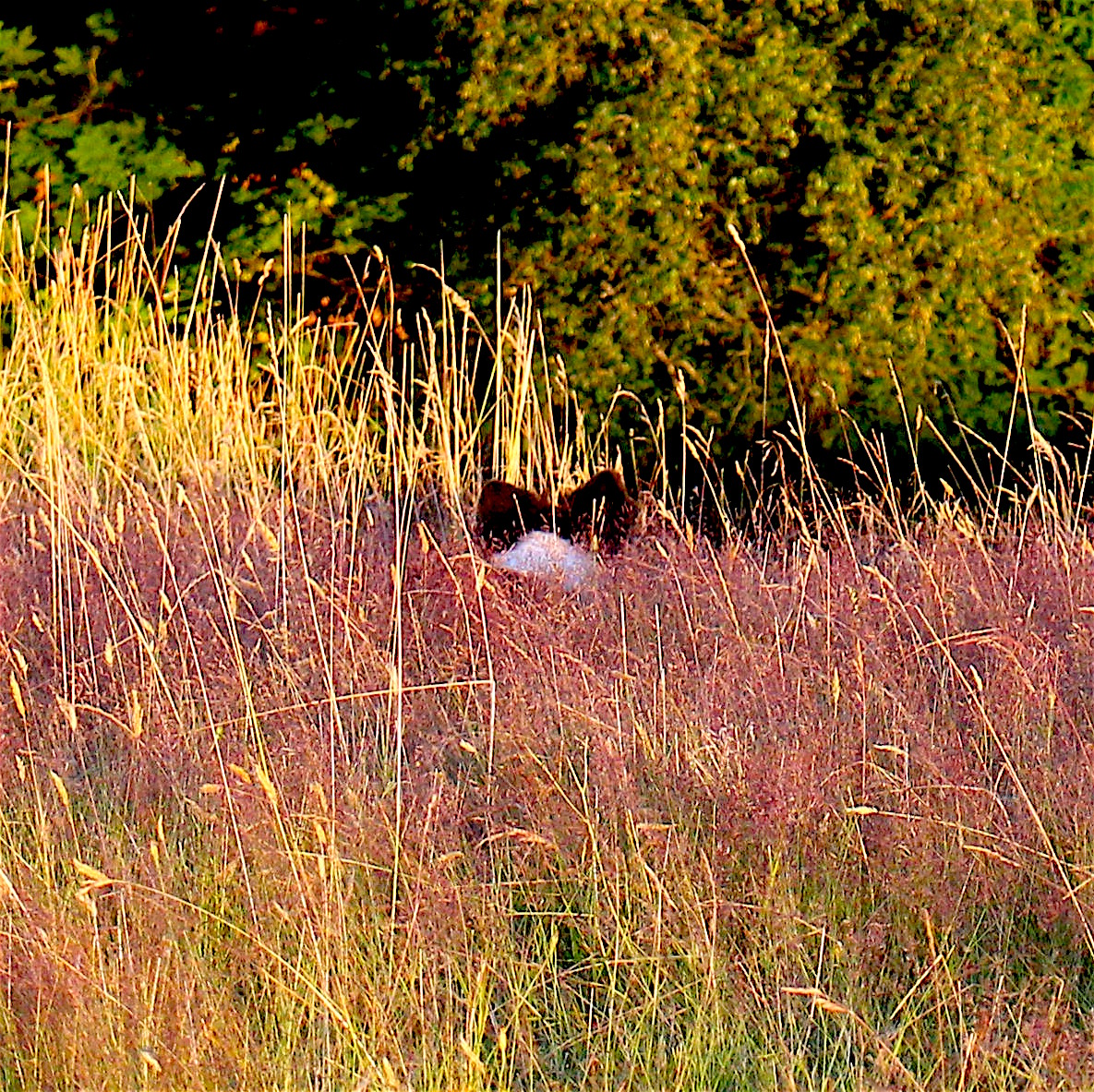
The grass around our orchard and yet-to-be-planted garden is now thigh-high. It practically squeaks while it grows. Anything that used to be in plain sight on the ground is rapidly being swallowed up in a sea of green: a ball, a pet dish, a garden gnome, a hose, a tractor implement, a bucket. In an effort to stem this tidal flood of grass, I grab the scythe out of the garden shed and plan my attack.
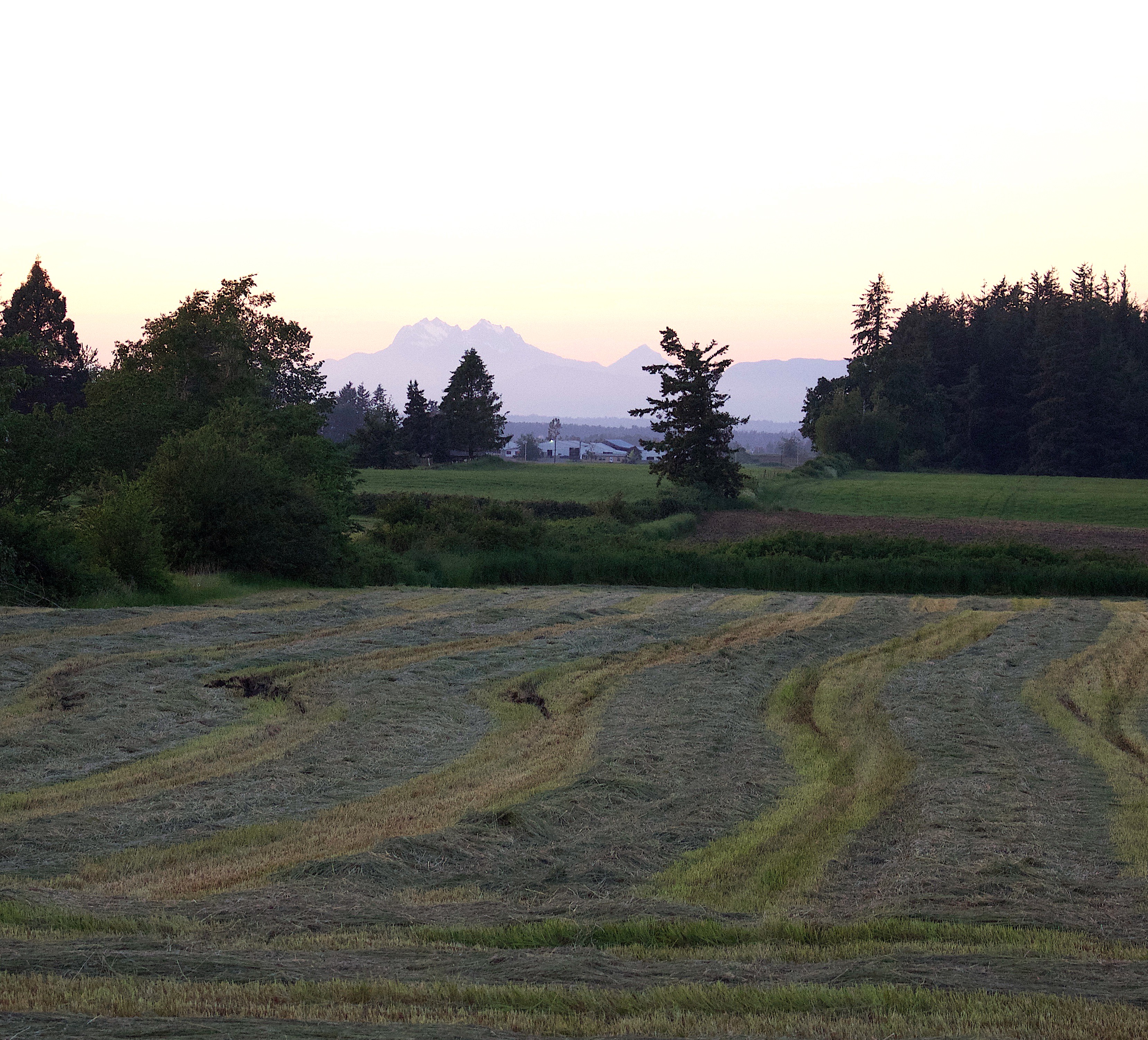
When the pastures are too wet yet for heavy hooves, I have hungry horses to provide for and there is more than plenty fodder to cut down for them.
I’m not a weed whacker kind of gal. First there is the necessary fuel, the noise necessitating ear plugs, the risk of flying particles requiring goggles–it all seems too much like an act of war to be remotely enjoyable. Instead, I have tried to take scything lessons from my husband.
Emphasis on “tried.”
I grew up watching my father scythe our hay in our field because he couldn’t afford a mower for his tractor. He enjoyed physical labor in the fields and woods–his other favorite hand tool was a brush cutter that he’d take to blackberry bushes. He would head out to the field with the scythe over this shoulder, grim reaper style. Once he was standing on the edge of the grass needing to be mowed, he would then lower the scythe, curved blade to the ground, turn slightly, positioning his hands on the two handles just so, raise the scythe up past his shoulders, and then in a full body twist almost like a golf swing, he’d bring the blade down. It would follow a smooth arc through the base of the standing grass, laying clumps flat in a tidy pile alongside the 2 inch stubble left behind. It was a swift, silky muscle movement — a thing of beauty.
Once, when I was three years old, I quietly approached my dad in the field while he was busily scything grass for our cows, but I didn’t announce my presence. The handle of his scythe connected with me as he swung it, laying me flat with a bleeding eyebrow. I still bear the scar, somewhat proudly, as he abruptly stopped his fieldwork to lift me up as I bawled and bled on his sweaty shirt. He must have felt so badly to have injured his little girl and drove my mom and I to the local doctor who patched my brow with sticky tape rather than stitches.
So I identify a bit with the grass laid low by the scythe. I forgave my father, of course, and learned never again to surprise him when he was working in the field.
Instead of copying my father’s graceful mowing technique, I tended to chop and mangle rather than effect an efficient slicing blow to the stems. I unintentionally trampled the grass I meant to cut. I got blisters from holding the handles too tightly. It felt hopeless that I’d ever perfect that whispery rise and fall of the scythe, with the rhythmic shush sound of the slice that is almost hypnotic.
Not only did I become an ineffective scything human, I also learned what it is like to be the grass laid flat, on the receiving end of a glancing blow. Over a long career, I bore plenty of footprints from the trampling. It can take awhile to stand back up after being cut down.
Sometimes it makes more sense to simply start over as the oozing stubble bleeds green, with deep roots that no one can reach. As I have grown back over the years, singing rather than squeaking or bawling, I realize, I forgave the scythe every time it came down on my head.
photo by Nate Gibson
One-Time
Monthly
Yearly
Make a one-time or recurring donation to support daily Barnstorming posts
It was like the moment when a bird decides not to eat from your hand, and flies, just before it flies, the moment the rivers seem to still and stop because a storm is coming, but there is no storm, as when a hundred starlings lift and bank together before they wheel and drop, very much like the moment, driving on bad ice, when it occurs to you your car could spin, just before it slowly begins to spin, like the moment just before you forgot what it was you were about to say, it was like that, and after that, it was still like that, only all the time. ~Marie Howe “Part of Eve’s Discussion” (2025 Pulitizer Prize-winning poet)
Sometimes my mind’s eye will perceive what is about to happen before it does. I can see it play out – yet sometimes it doesn’t happen.
Sometimes I teeter on the cusp of a new revelation that would change things completely — yet it stalls unformed and unspoken.
Sometimes I believe I can do whatever is right in my own eyes because it feels right, despite potential consequences.
I reach for the fruit because I want it and I’m hungry and it is hanging there waiting for someone, anyone – yet if I hesitate and consider the message of the worm hole before I take a bite, it just might spare me much sorrow and heartache.
We know how vulnerable we are to temptation and manipulation; we know our failings and weaknesses yet how quickly we go from knowing, to forgetting.
There is a stillness, a suspension of time, in that moment of knowing – there is constant internal debate about the choices we face and what to do with that knowledge.
How many of us, knowing well the consequences, still do what we ought not to do? How many of us, having been warned, having learned from past history, still make the wrong decision?
All of us, all the time, that’s how many, despite knowing what is right and best.
We forget, over and over. If we can’t get it right now, then when?
Thank God for His grace in the face of our poor memories and judgment.
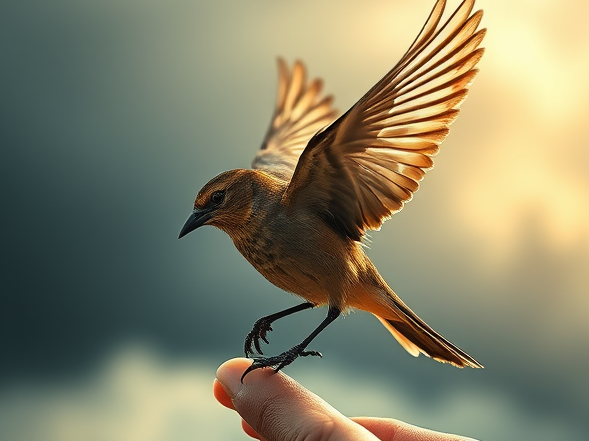
Thank God He still feeds us wholly from His loving hands as long as we don’t fly away.
AI image created for this post
One-Time
Monthly
Yearly
Make a one-time or recurring donation to support daily Barnstorming posts
The second before the sun went out we saw a wall of dark shadow come speeding at us. We no sooner saw it than it was upon us, like thunder. It roared up the valley. It slammed our hill and knocked us out. It was the monstrous swift shadow cone of the moon. I have since read that this wave of shadow moves 1,800 miles an hour. Language can give no sense of this sort of speed—1,800 miles an hour. It was 195 miles wide. No end was in sight—you saw only the edge. It rolled at you across the land at 1,800 miles an hour, hauling darkness like plague behind it. Seeing it, and knowing it was coming straight for you, was like feeling a slug of anesthetic shoot up your arm. If you think very fast, you may have time to think, “Soon it will hit my brain.” You can feel the deadness race up your arm; you can feel the appalling, inhuman speed of your own blood. We saw the wall of shadow coming, and screamed before it hit.
This was the universe about which we have read so much and never before felt: the universe as a clockwork of loose spheres flung at stupefying, unauthorized speeds. How could anything moving so fast not crash, not veer from its orbit amok like a car out of control on a turn?
Less than two minutes later, when the sun emerged, the trailing edge of the shadow cone sped away. It coursed down our hill and raced eastward over the plain, faster than the eye could believe; it swept over the plain and dropped over the planet’s rim in a twinkling. It had clobbered us, and now it roared away. We blinked in the light. It was as though an enormous, loping god in the sky had reached down and slapped the Earth’s face.
When the sun appeared as a blinding bead on the ring’s side, the eclipse was over. The black lens cover appeared again, back-lighted, and slid away. At once the yellow light made the sky blue again; the black lid dissolved and vanished. The real world began there. I remember now: We all hurried away.
We never looked back. It was a general vamoose … but enough is enough. One turns at last even from glory itself with a sigh of relief. From the depths of mystery, and even from the heights of splendor, we bounce back and hurry for the latitudes of home. ~Annie Dillard from her essay “Total Eclipse” in The Atlantic about the February 1979 eclipse in Washington State
From my six week psychiatric inpatient rotation at a Veteran’s Hospital—late winter 1979
Sixty eight year old male catatonic with depression
He lies still, so very still under the sheet, eyes closed; the only clue that he is living is the slight rise and fall of his chest. His face is skull- like framing his sunken eyes, his facial bones standing out like shelves above the hollows of his cheeks, his hands lie skeletal next to an emaciated body. He looks as if he is dying of cancer but without the smell of decay. He rouses a little when touched, not at all when spoken to. His eyes open only when it is demanded of him, and he focuses with difficulty. His tongue is thick and dry, his whispered words mostly indecipherable, heard best by bending down low to the bed, holding an ear almost to his cracked lips.
He has stopped feeding himself, not caring about hunger pangs, not salivating at enticing aromas or enjoying the taste of beloved coffee. His meals are fed through a beige rubber tube running through a hole in his abdominal wall emptying into his stomach, dripping a yeasty smelling concoction of thick white fluid full of calories. He ‘eats’ without tasting and without caring. His sedating antidepressant pills are crushed, pushed through the tube, oozing into him, deepening his sleep, but are designed to eventually wake him from his deep debilitating melancholy.
After two weeks of treatment and nutrition, his cheeks start to fill in, and his eyes are closed less often. He watches people as they move around the room and he responds a little faster to questions and starts to look us in the eye. He asks for coffee, then pudding and eventually he asks for steak. By the third week he is sitting up in a chair, reading the paper.
After a month, he walks out of the hospital, 15 pounds heavier than when he was wheeled in. His lips, no longer dried and cracking, have begun to smile again.
Thirty two year old male rescued by the Coast Guard at 3 AM in the middle of the bay
As he shouts, his eyes dart, his voice breaks, his head tosses back and forth, his back arches and then collapses as he lies tethered to the gurney with leather restraints. He writhes constantly, his arm and leg muscles flexing against the wrist and ankle bracelets.
“The angels are waiting!! They’re calling me to come!! Can’t you hear them? What’s wrong with you? I’m Jesus Christ, King of Kings!! Lord of Lords!! If you don’t let me return to them, I can’t stop the destruction!”
He finally falls asleep by mid-morning after being given enough antipsychotic medication to kill a horse. He sleeps uninterrupted for nine hours. Then suddenly his eyes fly open, and he looks startled.
He glares at me. “Where am I? How did I get here?”
“You are hospitalized in the VA psych ward after being picked up by the Coast Guard after swimming out into the bay in the middle of the night. You said you were trying to reach the angels.”
He turns his head away, his fists relaxing in the restraints, and begins to weep uncontrollably, the tears streaming down his face.
“Forgive them, Father, for they know not what they do.”
Twenty two year old male with auditory and visual hallucinations
He seems serene, much more comfortable in his own skin when compared to the others on the ward. Walking up and down the long hallways alone, he is always in deep conversation. He takes turns talking, but more often is listening, nodding, almost conspiratorial.
During a one-on-one session, he looks at me briefly, but his attention continues to be diverted, first watching an invisible something or someone enter the room, move from the door to the middle of the room, until finally, his eyes lock on an empty chair to my left. I ask him what he sees next to me.
“Jesus wants you to know He loves you.”
It takes all my will power not to turn and look at the empty chair.
Fifty four year old male with chronic paranoid schizophrenia
He has been disabled with psychiatric illness for thirty years, having his first psychotic break while serving in World War II. His only time living outside of institutions has been spent sharing a home with his mother who is now in her eighties. This hospitalization was precipitated by his increasing delusion that his mother is the devil and the voices in his head commanded that he kill her. He had become increasingly agitated and angry, had threatened her with a knife, so she called the police, pleading with them not to arrest him, but to bring him to the hospital for medication adjustment.
His eyes have taken on the glassy staring look of the overmedicated psychotic, and he sits in the day room much of the day sleeping in a chair, drool dripping off his lower lip. When awake he answers questions calmly and appropriately with no indication of the delusions or agitation that led to his hospitalization. His mother visits him almost daily, bringing him his favorite foods from home which he gratefully accepts and eats with enthusiasm. By the second week, he is able to take short passes to go home with her, spending a lunch time together and then returning to the ward for dinner and overnight. By the third week, he is ready for discharge, his mother gratefully thanking the doctors for the improvement she sees in her son. I watch them walk down the long hallway together to be let through the locked doors to freedom.
Two days later, a headline in the local paper:
“Veteran Beheads Elderly Mother”
Forty five year old male — bipolar disorder with psychotic features
He has been on the ward for almost a year, his unique high pitched laughter heard easily from behind closed doors, his eyes intense in his effort to conceal his struggles. Trying to follow his line of thinking is challenging, as he talks quickly, with frequent brilliant off topic tangents, and at times he lapses into a “word salad” of almost nonsensical sentences. Every day as I meet with him I become more confused about what is going on with him, and am unclear what is expected of me in my interactions with him. He senses my discomfort and tries to ease my concern.
“Listen, this is not your problem to fix but I’m bipolar and regularly hear command voices and have intrusive thoughts. My medication keeps me under good control. But just tell me if you think I’m not making sense because I don’t always recognize it in myself.”
During my rotation, his tenuous tether to sanity is close to breaking. He starts to listen more intently to the voices in his head, becoming frightened and anxious, often mumbling and murmuring under his breath as he goes about his day.
On a particular morning, all the patients are more anxious than usual, pacing and wringing their hands as the light outdoors slowly fades, with noon being transformed to an oddly shadowy dusk. The street lights turn on automatically and cars are driving with headlights shining. We stand at the windows in the hospital, watching the city become dark as night in the middle of the day. The unstable patients are sure the world is ending and extra doses of medication are dispensed as needed while the light slowly returns to the streets outside. Within an hour the sunlight is back, and all the patients are napping soundly.
The psychiatrist locks himself in his office and doesn’t respond to knocks on the door or calls on his desk phone.
Stressed by the recent homicide by one of his discharged patients, and identifying with his patients due to his own mental illness, he is overwhelmed by the eclipse. The nurses call the hospital administrator who comes to the ward with two security guards. They unlock the door and lead the psychiatrist off the ward. We watch him leave, knowing he won’t be back.
It is as if the light had left and only his shadow remains.
AI image created for this post
Lyrics: Measure me, sky! Tell me I reach by a song Nearer the stars; I have been little so long.
Weigh me, high wind! What will your wild scales record? Profit of pain, Joy by the weight of a word.
Horizon, reach out! Catch at my hands, stretch me taut, Rim of the world: Widen my eyes by a thought.
Sky, be my depth, Wind, be my width and my height, World, my heart’s span; Loveliness, wings for my flight. ~Leonora Speyer
One-Time
Monthly
Yearly
Make a one-time or recurring donation to support daily Barnstorming posts
I know what you planned, what you meant to do, teaching me to love the world, making it impossible to turn away completely, to shut it out completely ever again – it is everywhere; when I close my eyes, birdsong, scent of lilac in early spring, scent of summer roses: you mean to take it away, each flower, each connection with earth – why would you wound me, why would you want me desolate in the end, unless you wanted me so starved for hope I would refuse to see that finally nothing was left to me, and would believe instead in the end you were left to me. ~Louise Glück “Vespers”(one of ten Vespers poems)
I wait for the Lord, my soul waits, and in his word I hope; ~Psalm 130:5
Mid-spring days like this: bright, so promising with potential, birdsong constantly in the air, scent of orchard blossoms, lilacs, early roses and a flush of color everywhere…
how can we not love the world so much we never want to leave it?
Yet we must hold this loosely.
It is but a tiny show of the glories to come, of what You have waiting for us next.
I am wounded knowing I must eventually let this go.
I am hungry for hope that isn’t found in all this beauty and lushness, the fulfilling hope that is only You as my Father and Creator.
You provide only a taste here. I know what I starve for, so starved with hope for what You have in store.
I will wait for you I will wait for you in the end You were left for me.
Amen and Amen.
AI image created for this post
One-Time
Monthly
Yearly
Make a one-time or recurring donation to support daily Barnstorming posts
One day thru the primeval wood A calf walked home, as good calves should, But made a trail all bent askew, A crooked trail, as all calves do. Since then three hundred years have fled, And I infer, the calf is dead; But still behind he left his trail, And thereon hangs my mortal tale.
The trail was taken up next day By a lone dog that passed that way, And then a wise bell-weather sheep Sliding into a rut now deep, Pursued that trail over hill and glade Thru those old woods a path was made.
And many men wound in and out, And dodged and turned and bent about, and uttered words of righteous wrath Because “twas such a crooked path” But still they follow-do not laugh- The first migrations of that calf.
The forest became a lane That bent and turned and turned again; This crooked lane became a road where many a poor horse with his load Toiled on beneath the burning sun, And traveled some three miles in one.
The years passed on in swiftness fleet, The village road became a street, And this, before the men were aware, A city’s crowded thoroughfare.
And soon a central street was this In a renowned metropolis; And men two centuries and a half Followed the wanderings of this calf.
Each day a hundred thousand strong Followed this zigzag calf along; And over his crooked journey went The traffic of a continent.
A hundred thousand men were led By one poor calf, three centuries dead. For just such reverence is lent To well established precedent.
A moral lesson this might teach Were I ordained and called to preach. For men are prone to go it blind Along the calf paths of the mind; And work away from sun to sun To do what other men have done.
They follow in the beaten track, And out and in, and forth and back, And still their devious course pursue, To keep the path that others do. They keep the path a sacred groove, Along which all their lives they move.
But how the wise old wood gods laugh, Who saw the first primeval calf. Ah, many things this tale might teach— But I am not ordained to preach. ~Sam Walter Foss “Cow Path”
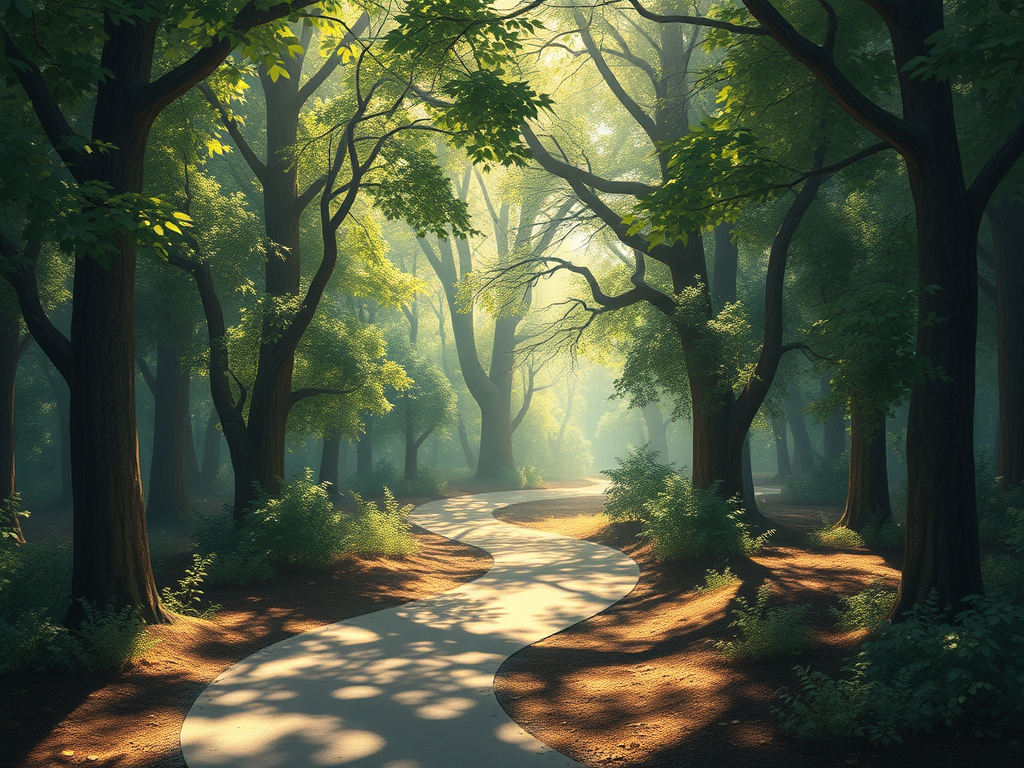
As I age, I try to keep perspective while traveling this winding road of life, looking back at where I’ve been, hoping for the best about what lies ahead, while trying to stick to the path ahead without too much deviation. My one regret about this journey is that I haven’t stopped nearly often enough to simply take in the scenery, listen to the birds, smell the orchard blossoms, and feel the grass under my bare feet.
It is the conundrum of following only the cow path laid down before me: sticking to traveling a well-worn pathway – a “sacred groove” of precedent.
Nevertheless, as with all cow paths, there may have been no greater reason for the bend or curve than a patch of tall appealing grass at one time, or a good itching spot on a tree trunk or a boulder obstructing the way. Still I follow the curve, dodge the now-absent boulder, tread the zig zag.
My path may appear random without focus on the destination and that’s okay: I need to stop once in awhile to let the sun warm my face, settle down for a really good nap, enjoy a particularly fine meal, read an insightful book, or play a lovely hymn.
It is not which path I’ve meandered to my eventual destination but treasuring my journey along the way.
I will enjoy the twists and turns of life more, if I take the time to appreciate them. Just maybe – I’ll throw in a few curves and sacred digressions of my own for those who follow behind me.
AI image created for this post
One-Time
Monthly
Yearly
Make a one-time or recurring donation to support daily Barnstorming posts
After all, I don’t see why I am always asking for private, individual, selfish miracles when every year there are miracles like … dogwood. ~Anne Morrow Lindbergh
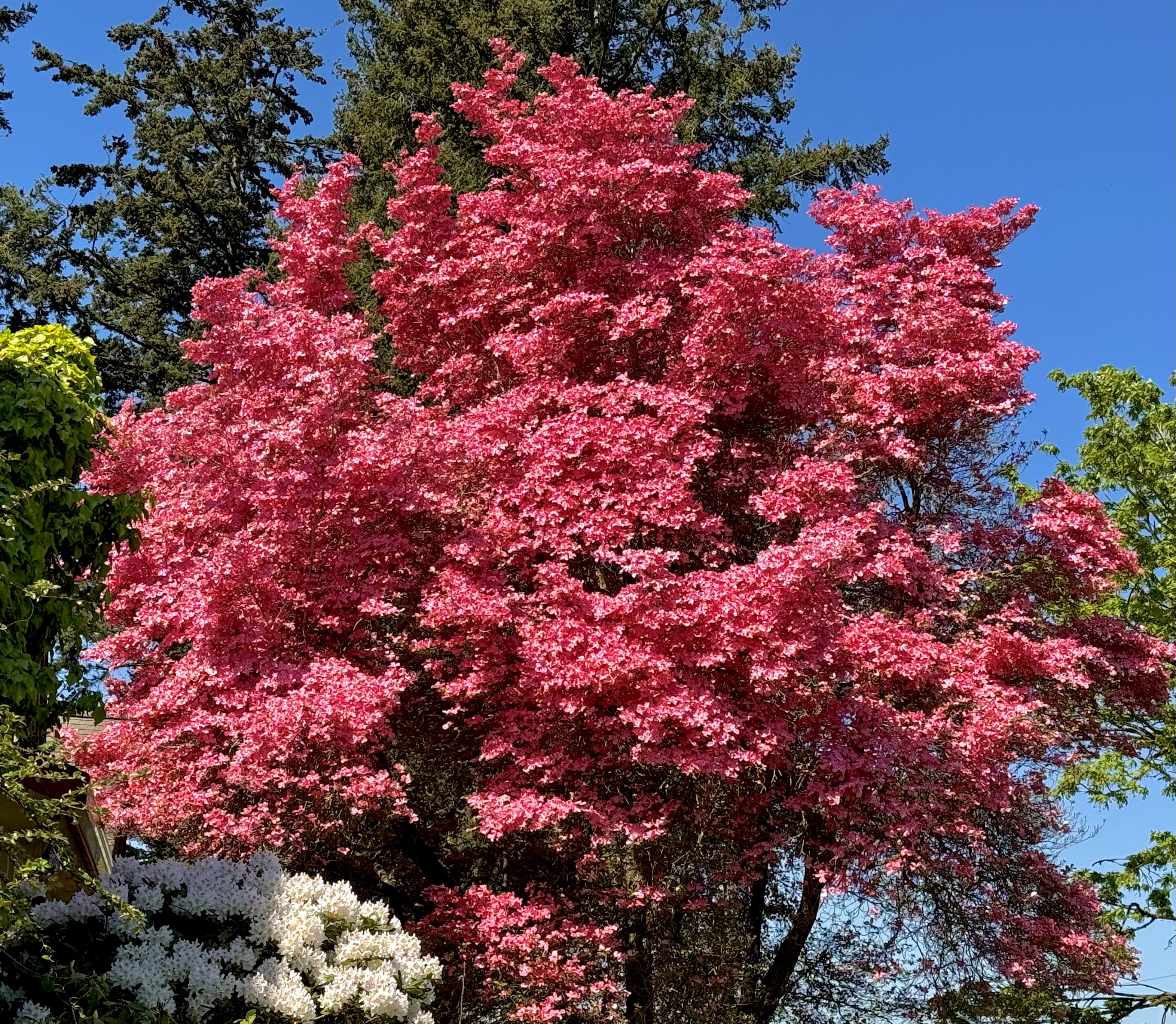
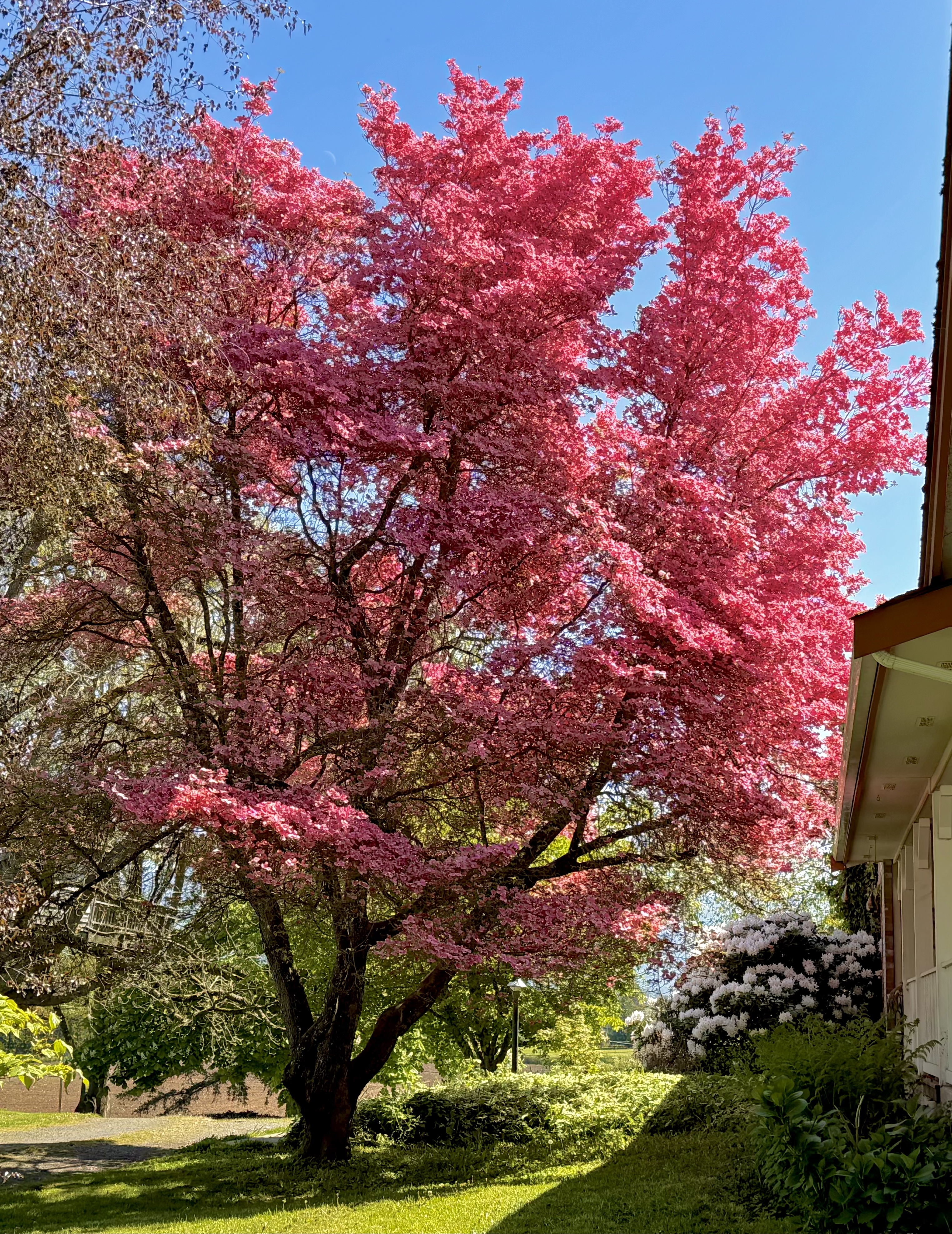
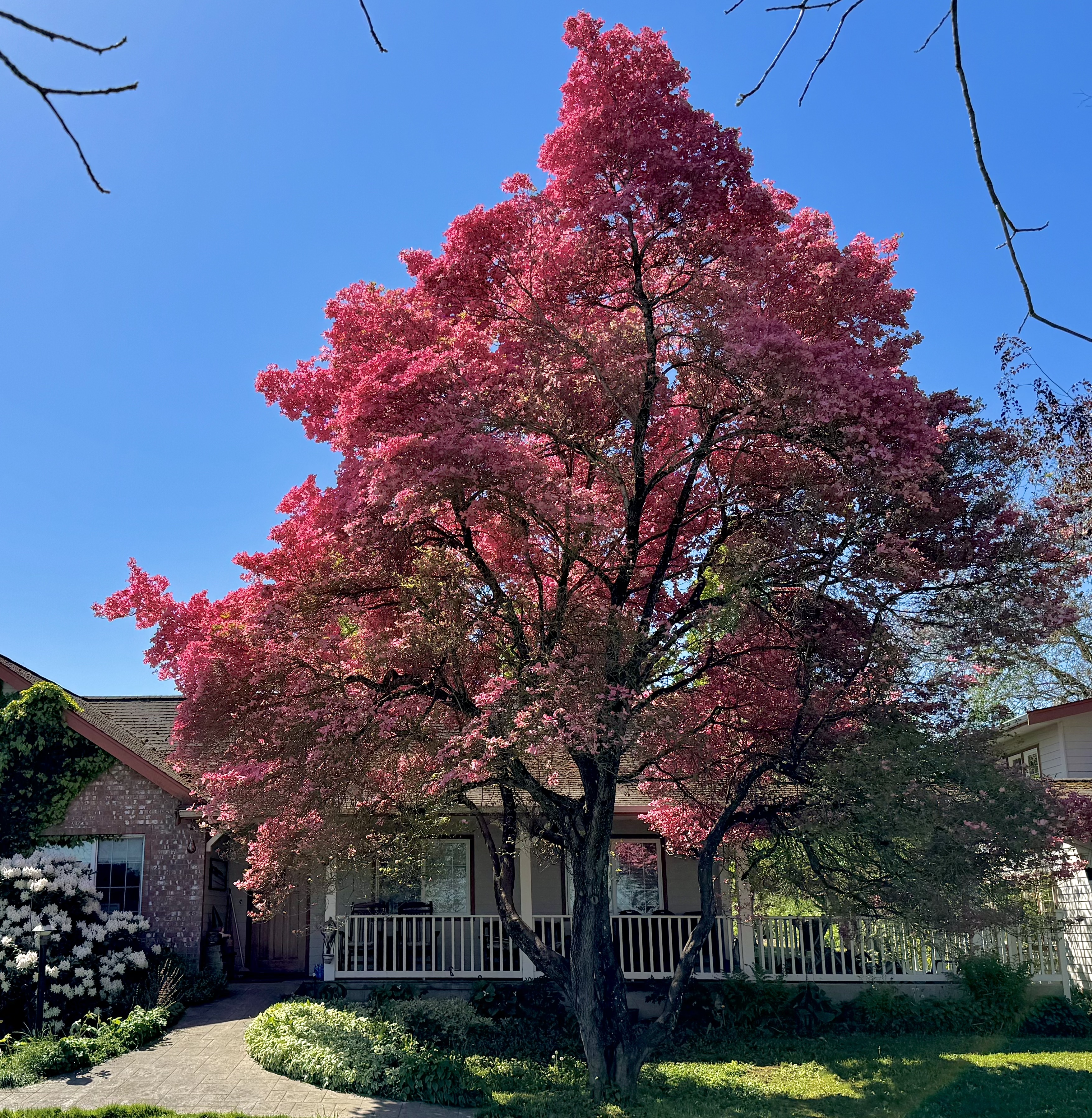
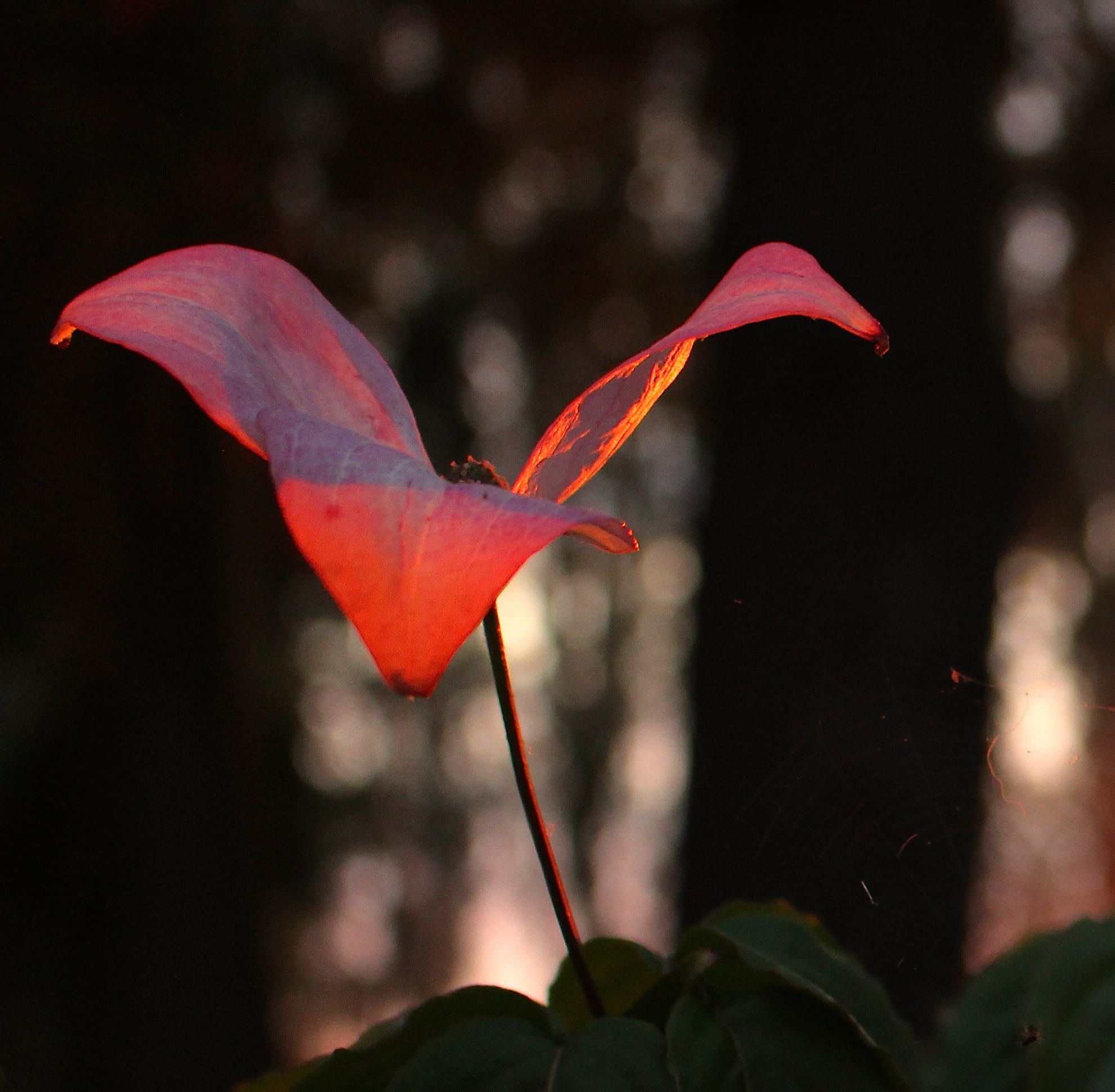
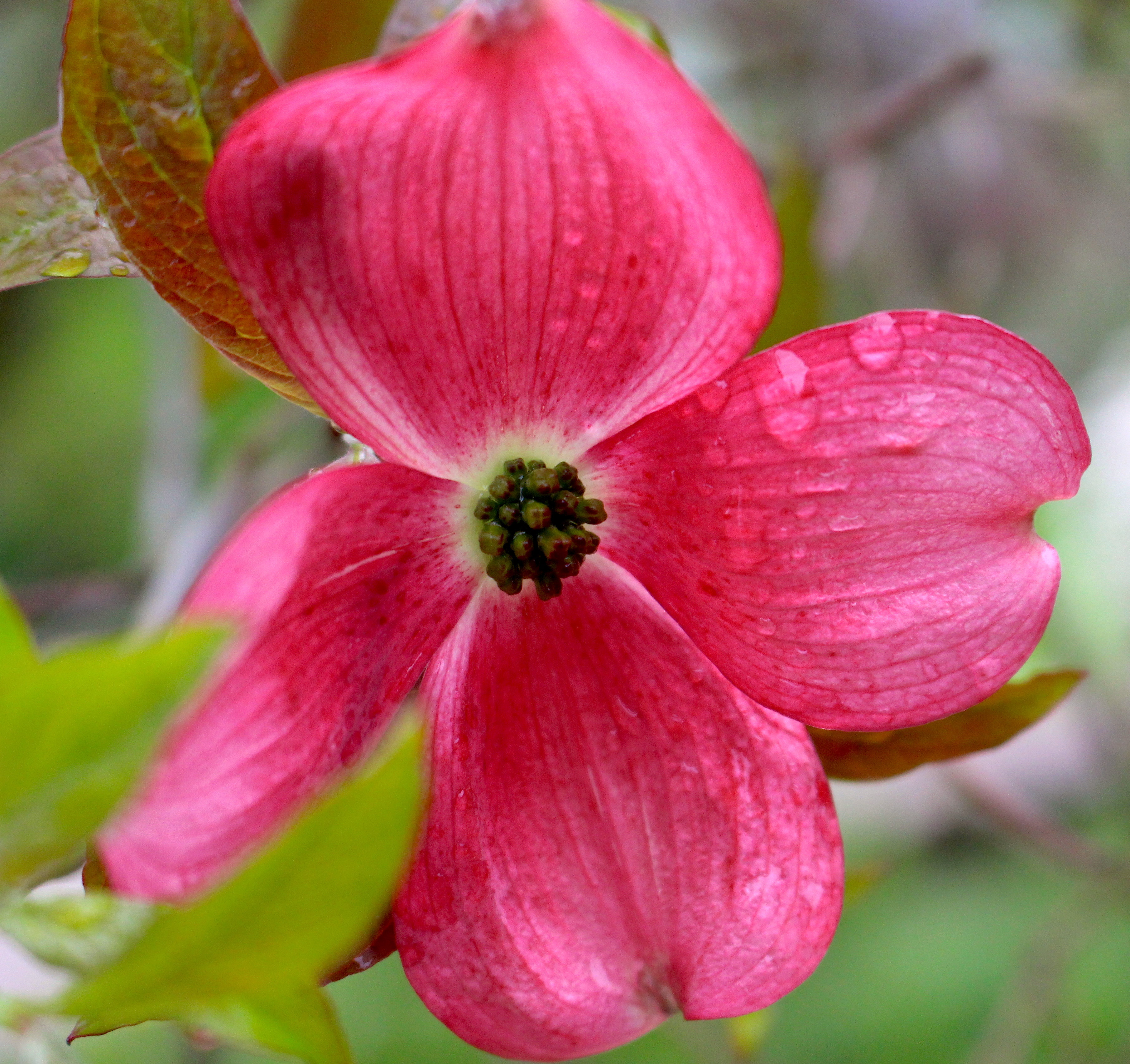
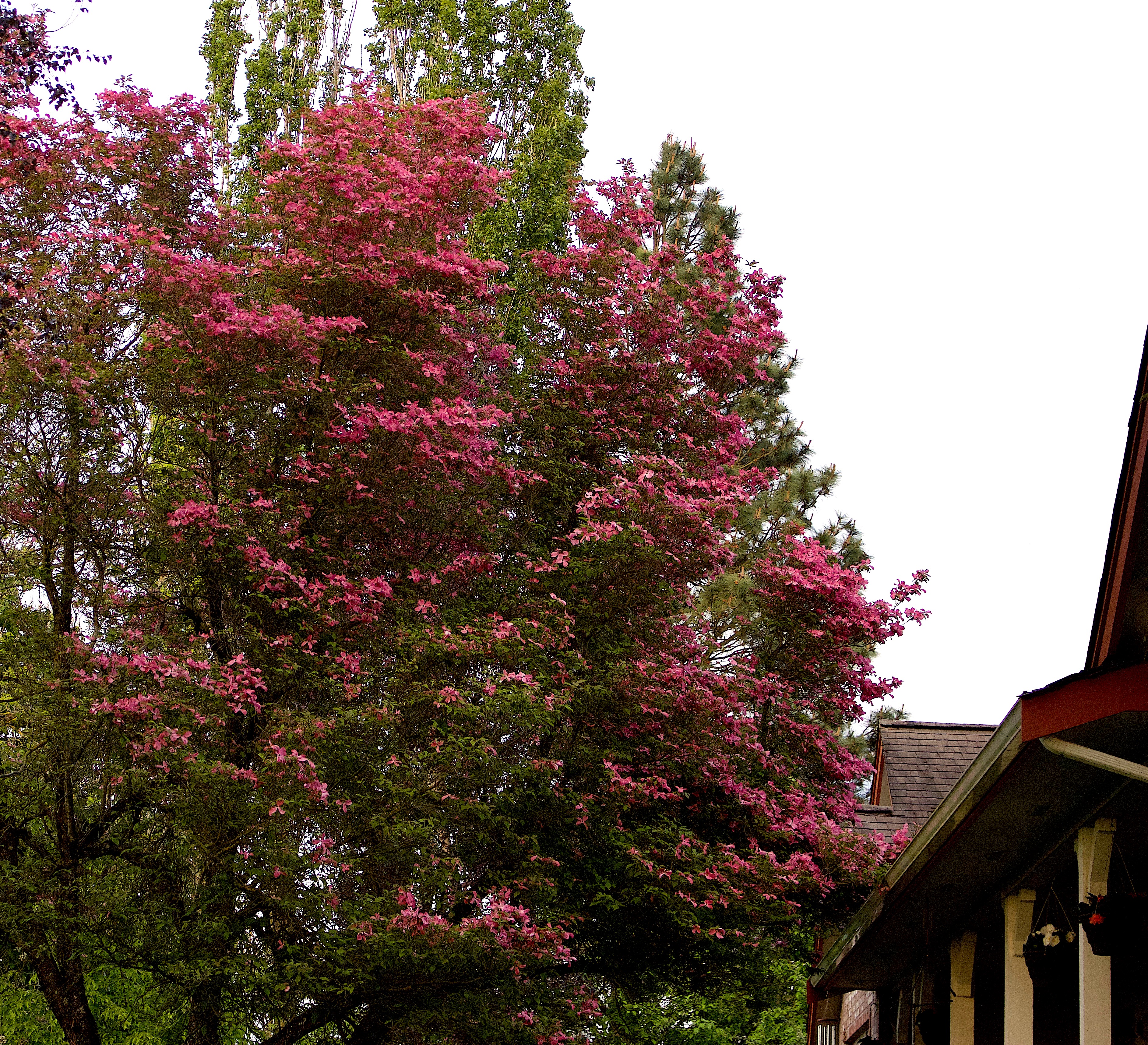
It began last week. The tree right next to our front porch, having looked dormant for the past six months, started to bud out in subtle pink-petalled blossoms.
Through the winter, there had been nothing remarkable whatsoever about this tree. Now it is a feast for the eyes, almost blinding in its brilliance.
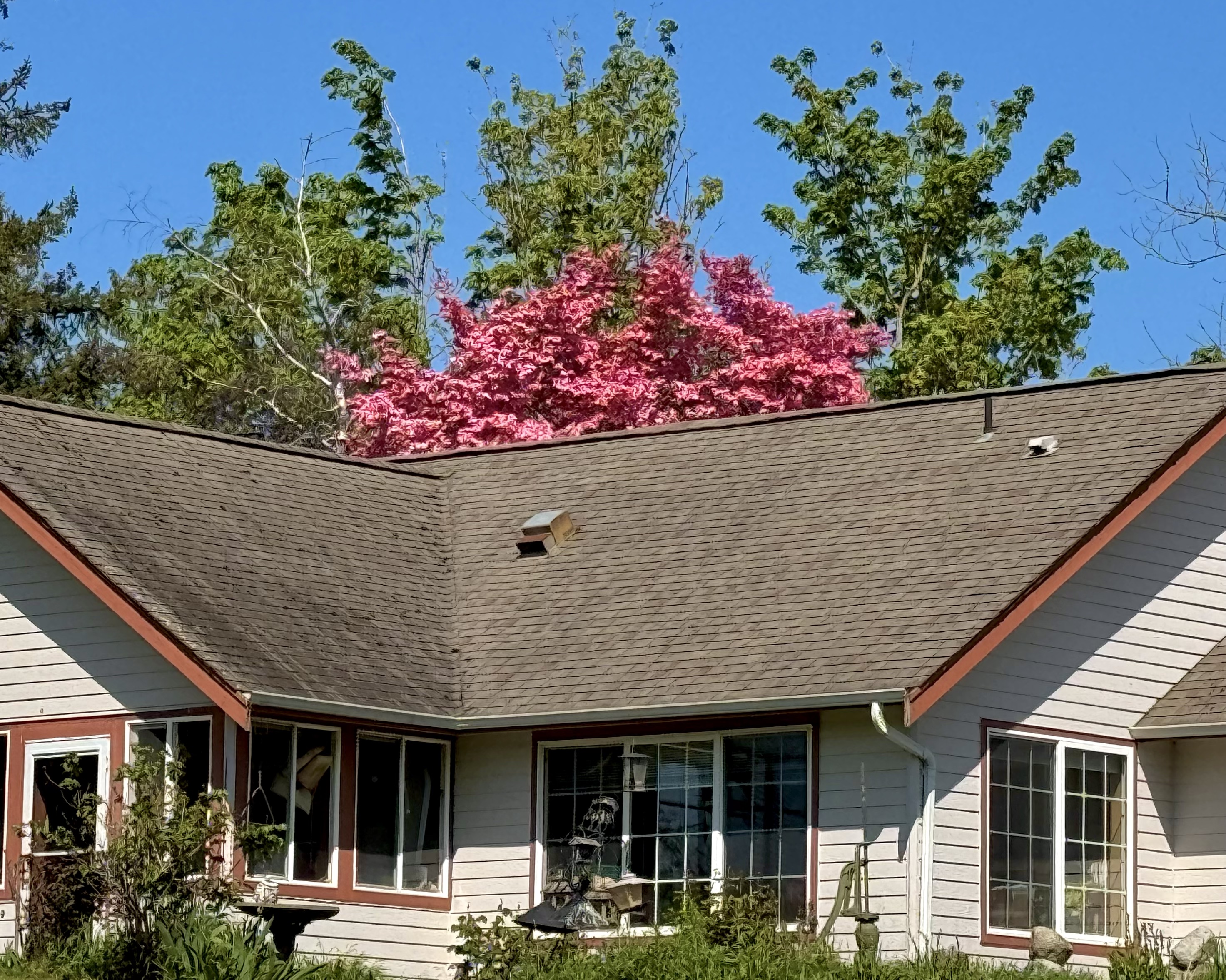
Each year the dogwood startles me awake. From dead to brilliant in a mere two weeks. And not only our tree, but every other pink dogwood within a twenty mile radius has answered the same late April/early May siren call: bloom! bloom your heart out! dazzle every retina in sight!
And it is done simultaneously on every tree, all the same day, without a sound, without an obvious signal, as if an invisible conductor had swooped a baton up and in the downbeat everything turned pink.
Or perhaps the baton is really a wand, shooting out pink stars to paint these otherwise plain and humble trees, so inconspicuous the rest of the year.
Ordinarily I don’t dress up in finery like these trees do. I prefer inconspicuous earth tones for myself. But I love the celebratory joy of those trees in full blossom and enjoy looking for them in yards and parks and along roadways.
Maybe there is something pink in my closet I can wear. Maybe conspicuously miraculous every once in awhile is exactly what is needed.
Then again, it is best to leave the miracles to the trees…
If you stand in an orchard In the middle of Spring and you don’t make a sound you can hear pink sing, a darling, whispery song of a thing. ~Mary O’Neill from Hailstones and Halibut Bones “Pink”
One-Time
Monthly
Yearly
Make a one-time or recurring donation to support daily Barnstorming posts










































 Barnstorming